











Tool ID: 5.3
SLP + SpEd
Strong Evidence
Rank #1
Constant Use
₹0–3,00,000
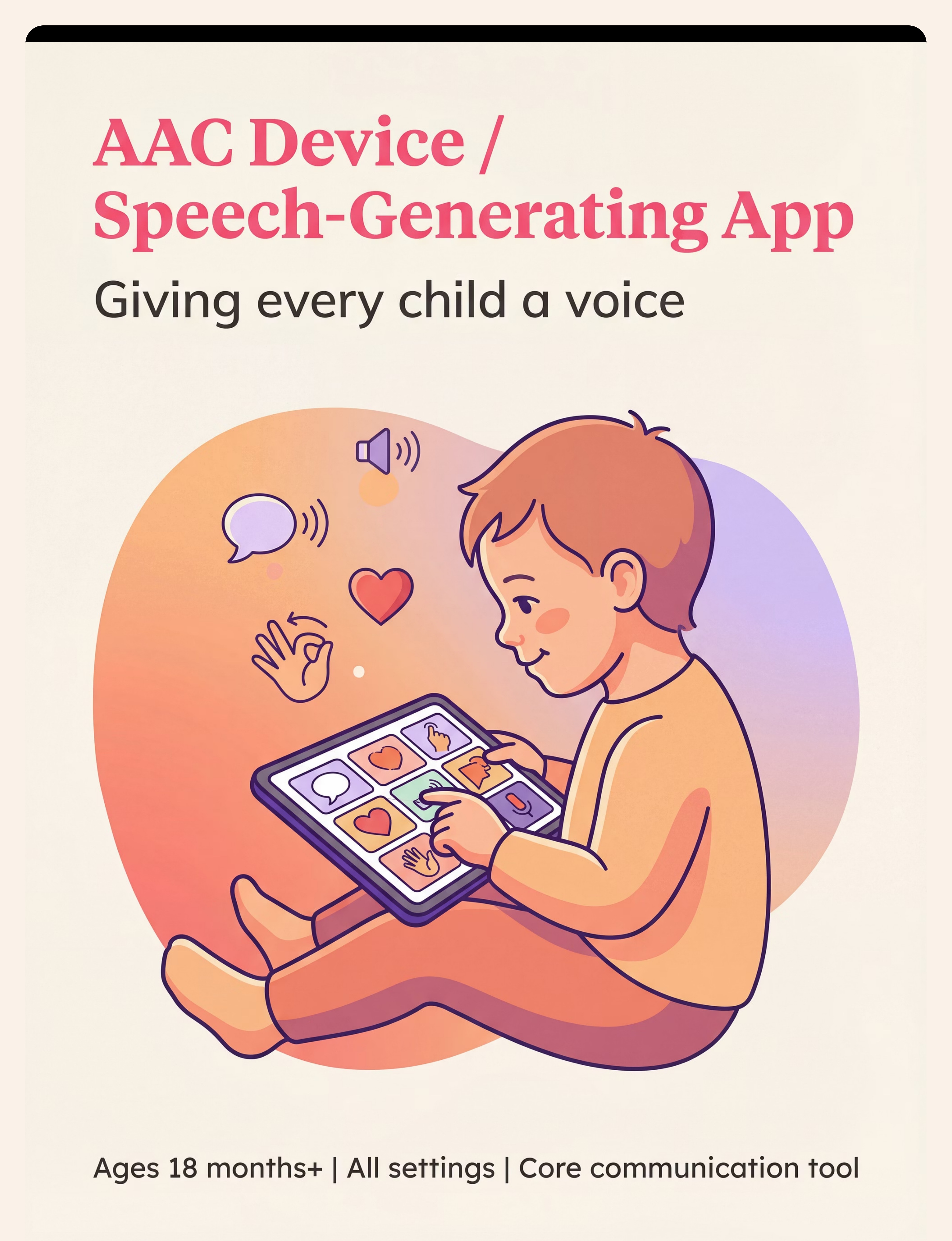
AAC Device / Speech-Generating App
High-tech augmentative and alternative communication system
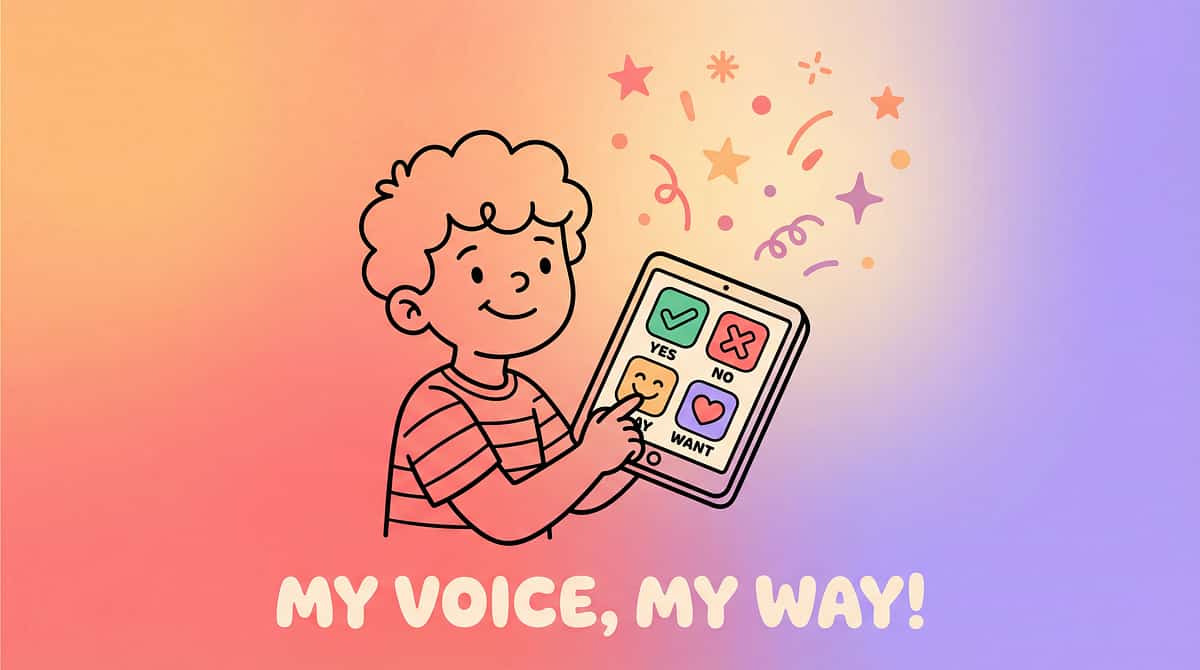
For children who cannot speak or have minimal speech, AAC devices and apps provide a powerful voice. These tools transform symbols, pictures, or text into spoken words, enabling children to express their thoughts, needs, feelings, and stories. Research consistently shows that AAC does not prevent speech development—it supports all communication growth while giving children immediate access to language and connection.
Whether through a dedicated speech-generating device or an app on a tablet, AAC technology opens doors to conversation, learning, friendship, and participation in every aspect of life. From simple single-button devices for beginning communicators to comprehensive symbol-based apps with thousands of vocabulary words, there's an AAC solution for every child's needs and every family's budget.

Who This Helps
Expressive Communication
Empowering non-speaking or minimally speaking individuals to share their thoughts, needs, and feelings effectively.
Language Development
Supporting growth in vocabulary, grammar, and overall language skills for clearer communication.
Social Participation
Facilitating engagement in conversations, building friendships, and full inclusion in all social settings.
Literacy Skills
Enhancing reading, writing, and comprehension, which are crucial for academic and life success.
For All Ages & Settings
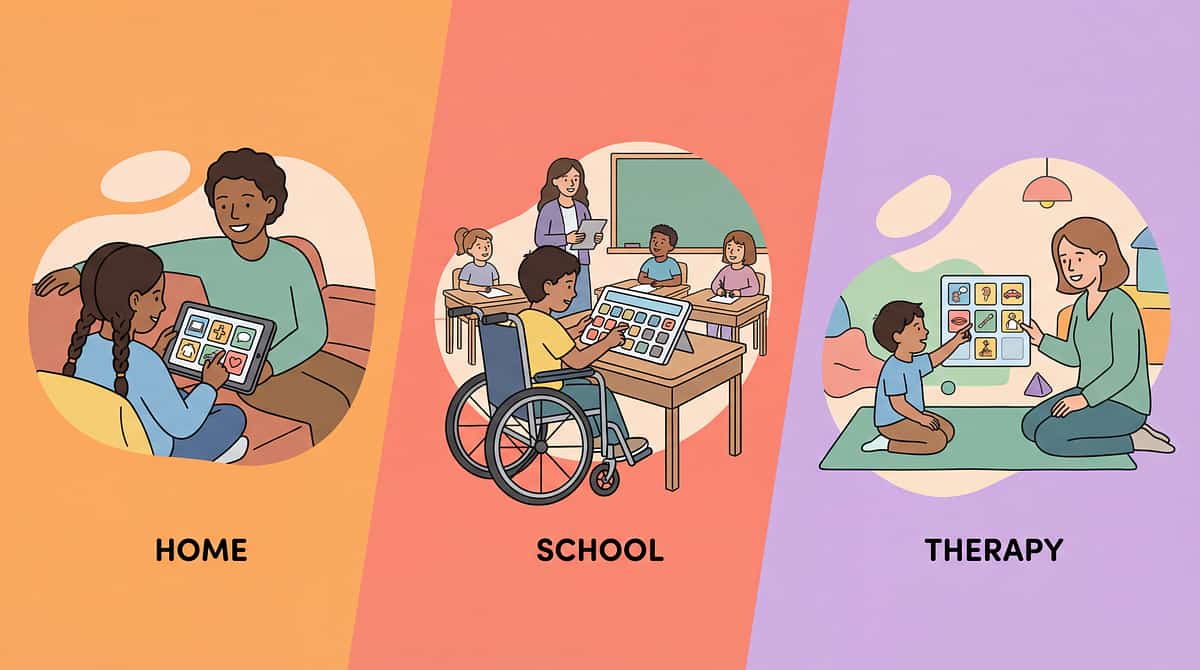
Beneficial for individuals from 18 months to adulthood, used effectively at home, school, clinic, and community.

Does This Sound Familiar?
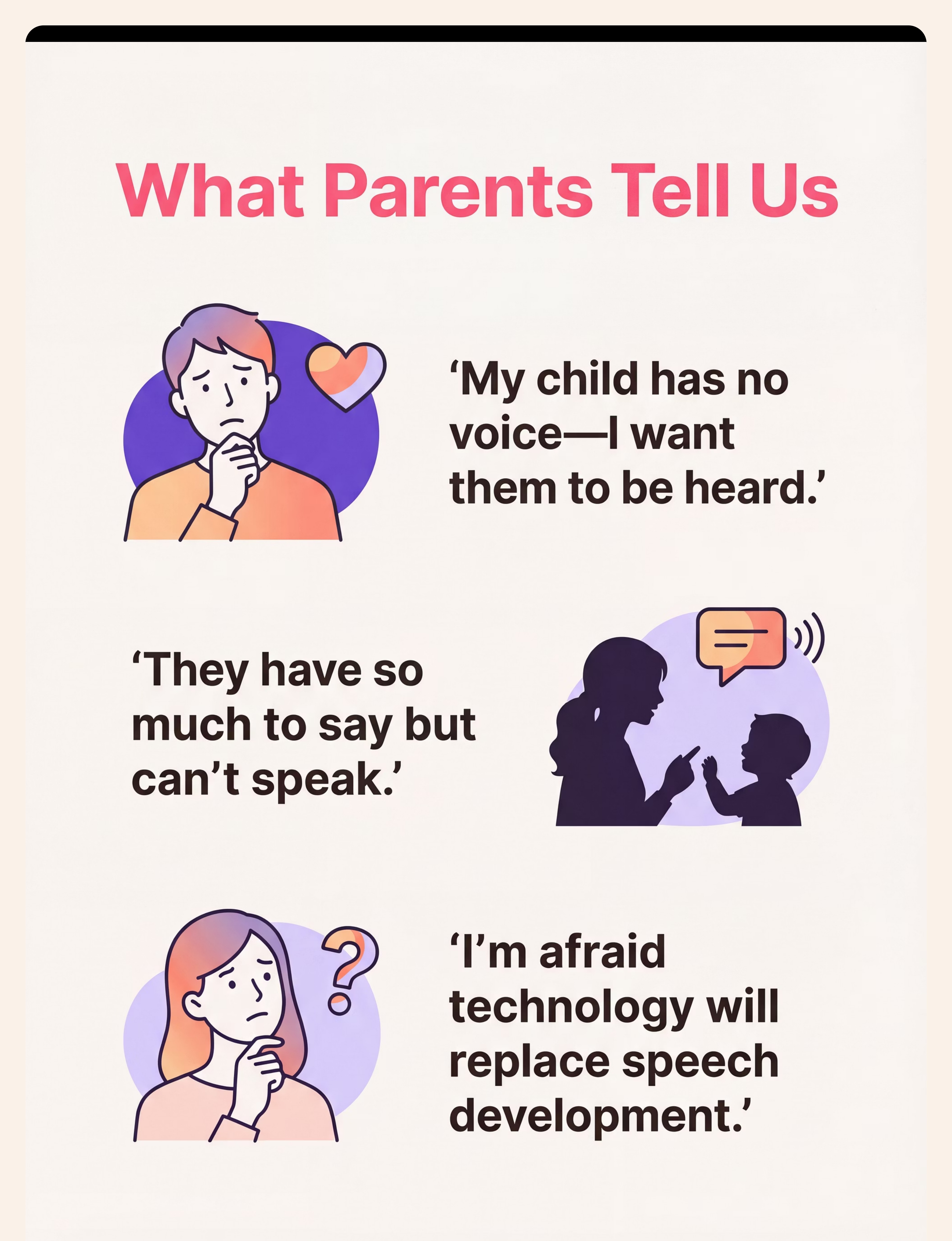
"My child has no voice - I want them to be heard"
"PECS and boards aren't enough anymore"
"They have so much to say but can't speak"
"I'm afraid technology will replace speech development"
"AAC devices are so expensive"
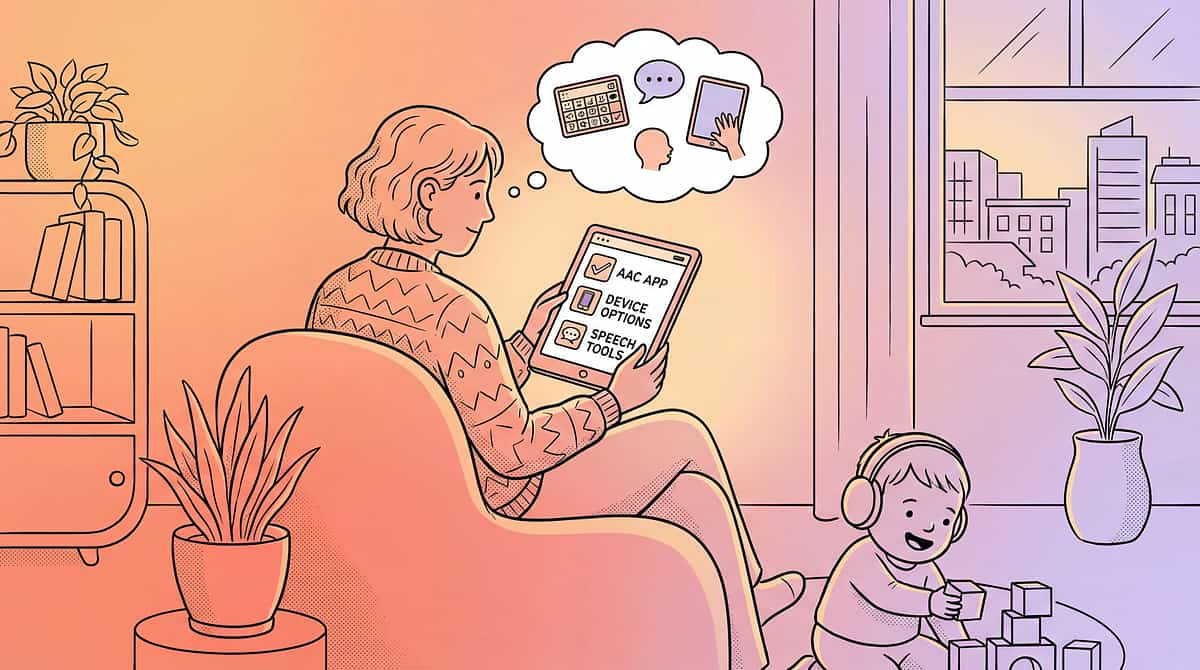
"I don't know which app to choose"
You're not alone. These are common challenges faced by families of non-speaking children. The journey to finding the right communication system can feel overwhelming, but every child deserves a voice—and AAC technology makes that possible.

A Day Without the Right Support
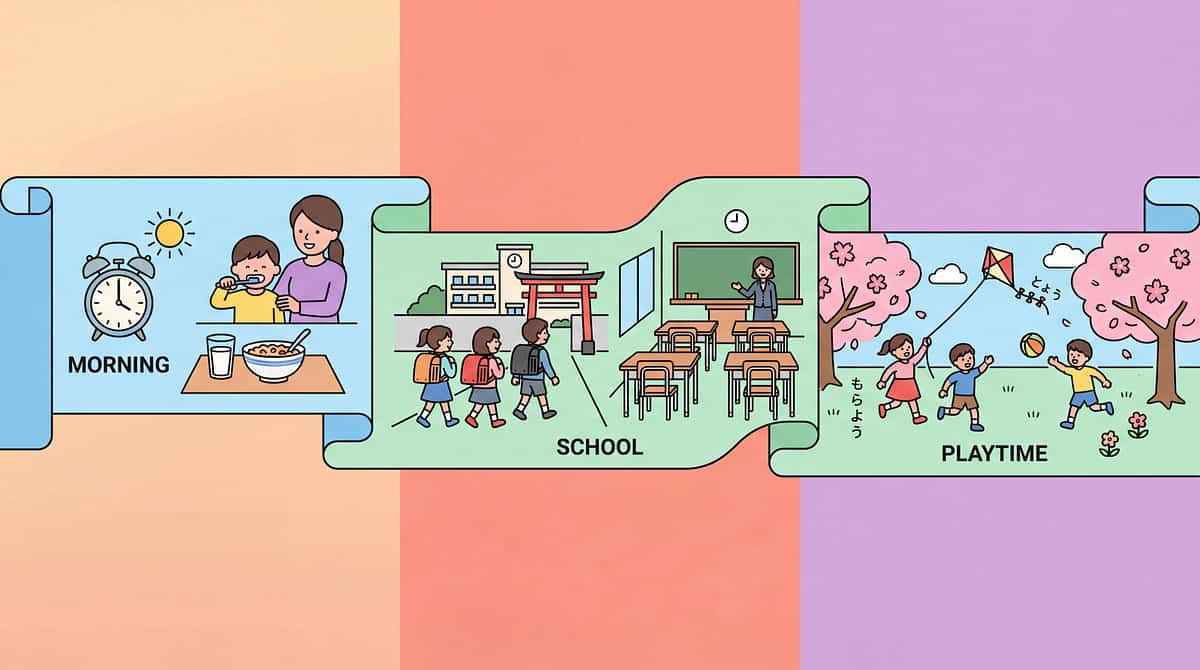
Morning Routine
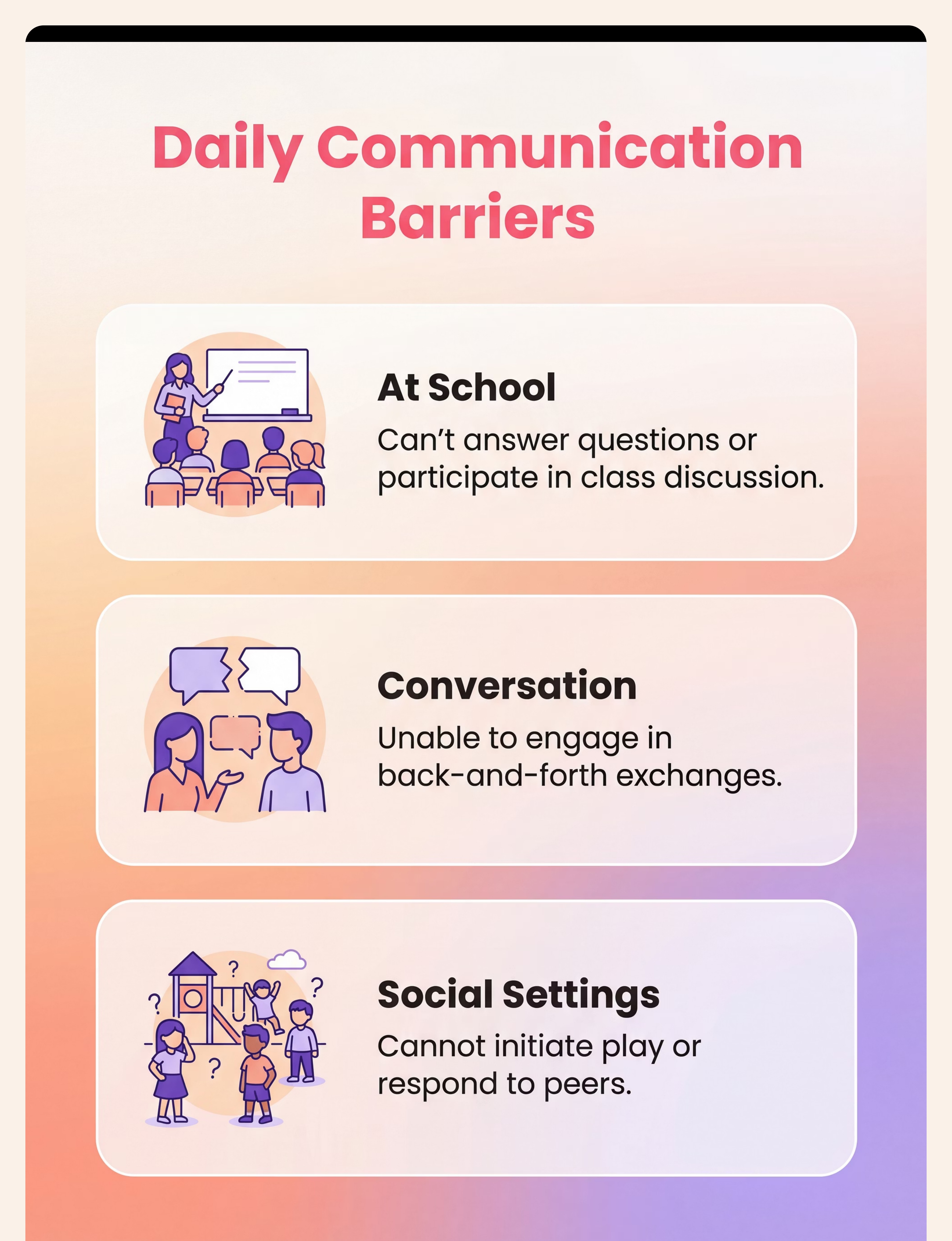
Conversation: Can't participate in back-and-forth conversation. Child has stories to tell from yesterday, questions to ask about today, but no way to share. Family conversations happen around them, not with them.
School Day
School: Can't answer questions or participate in class. Teacher asks who knows the answer. Child knows it. Raises hand. Gets called on. Opens mouth. Nothing. Teacher moves on. Knowledge trapped inside.
Playtime
Social: Can't engage with peers verbally. Peers play together, talking, laughing, planning games. Child stands nearby, wanting to join. Can't ask "Can I play?" Can't suggest ideas. Can't respond to questions. Eventually, peers stop trying to include them.
Throughout the Day
Everywhere: Voice output needed in all contexts. Every moment requiring communication becomes a barrier. Simple needs, complex thoughts, funny observations, important questions—all remain unspoken. Frustration builds. Connection fades.
Without voice output communication, non-speaking children experience isolation even when surrounded by people who love them. Every meal, every class, every interaction becomes a reminder of what they cannot say. This daily reality of communication barriers affects not just the child, but the entire family's quality of life and connection.

The Science Behind It
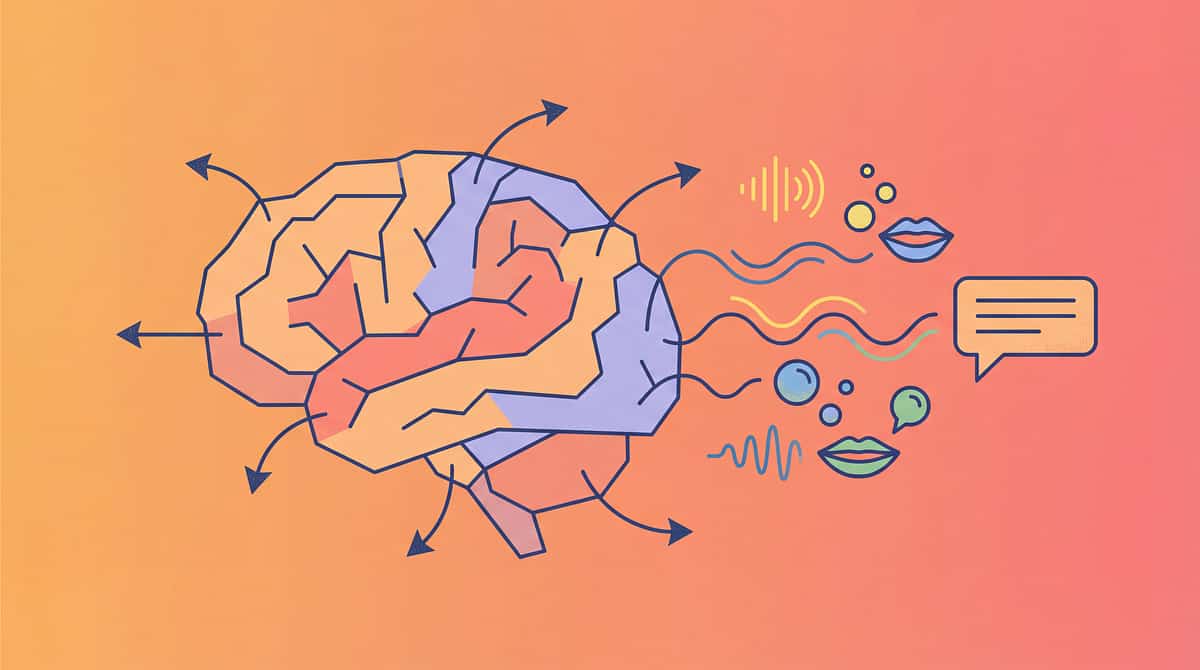
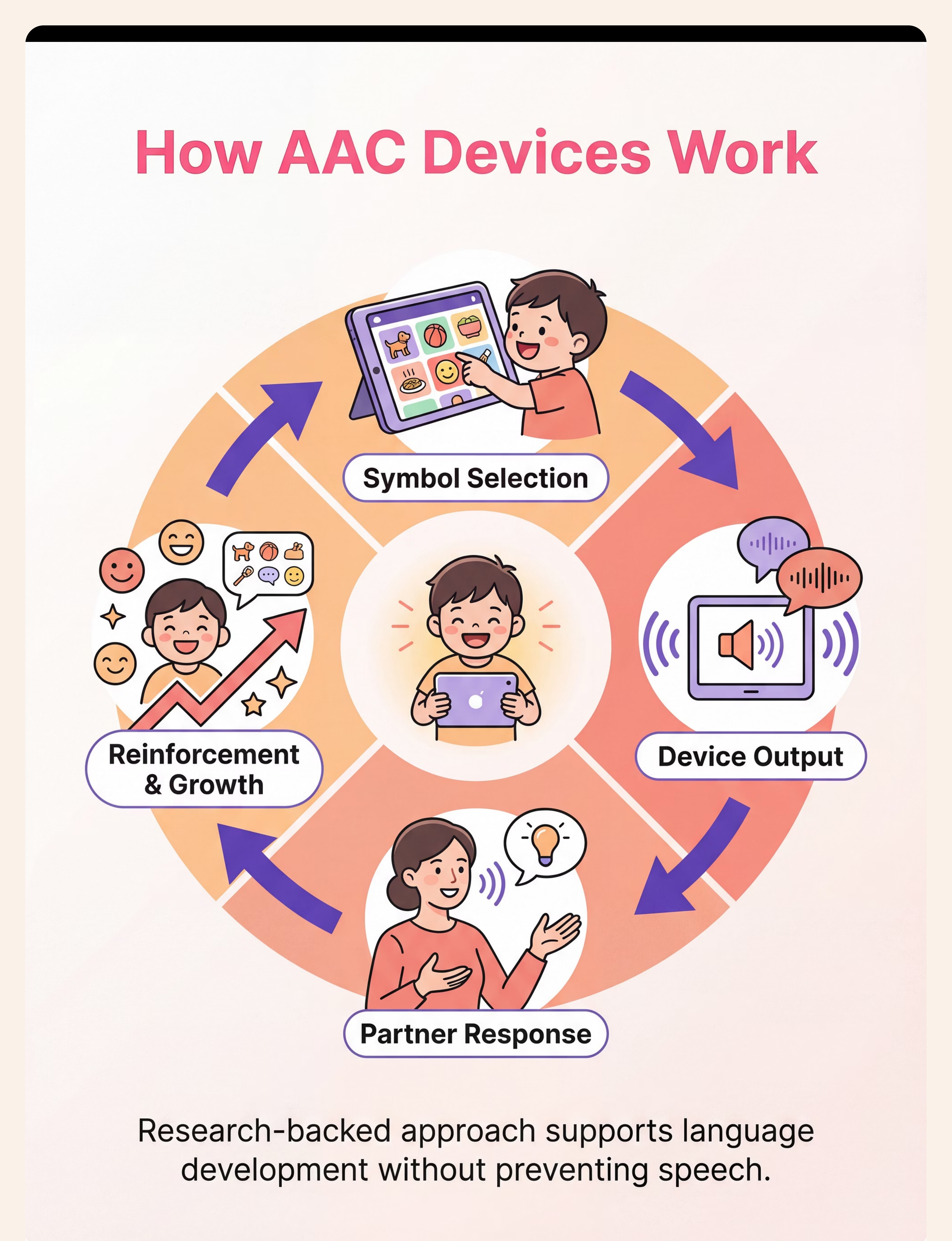
AAC devices work by transforming a child's intent into spoken language, creating successful communication experiences that build language skills and increase communication confidence over time.
Child Selects
Child chooses symbol, types word, or selects phrase on device
Device Speaks
AAC system generates voice output of the message
Partner Responds
Communication partner hears and responds to the message
Success Achieved
Successful communication happens, need is met
Development Continues
Child makes more attempts, language skills grow
Expressive Communication
Voice Output
Language Development
Social Participation
Literacy
This cycle of successful communication reinforces language learning. Each time a child uses their AAC device and receives a response, their brain builds connections between symbols/words and meanings. Over time, vocabulary expands, sentence structure develops, and communication becomes more sophisticated—all while the device provides immediate functional communication.

How to Use It Right
Success with AAC requires consistent access, constant modeling, and a communication-first mindset. These evidence-based practices ensure your child gets maximum benefit from their voice output system.
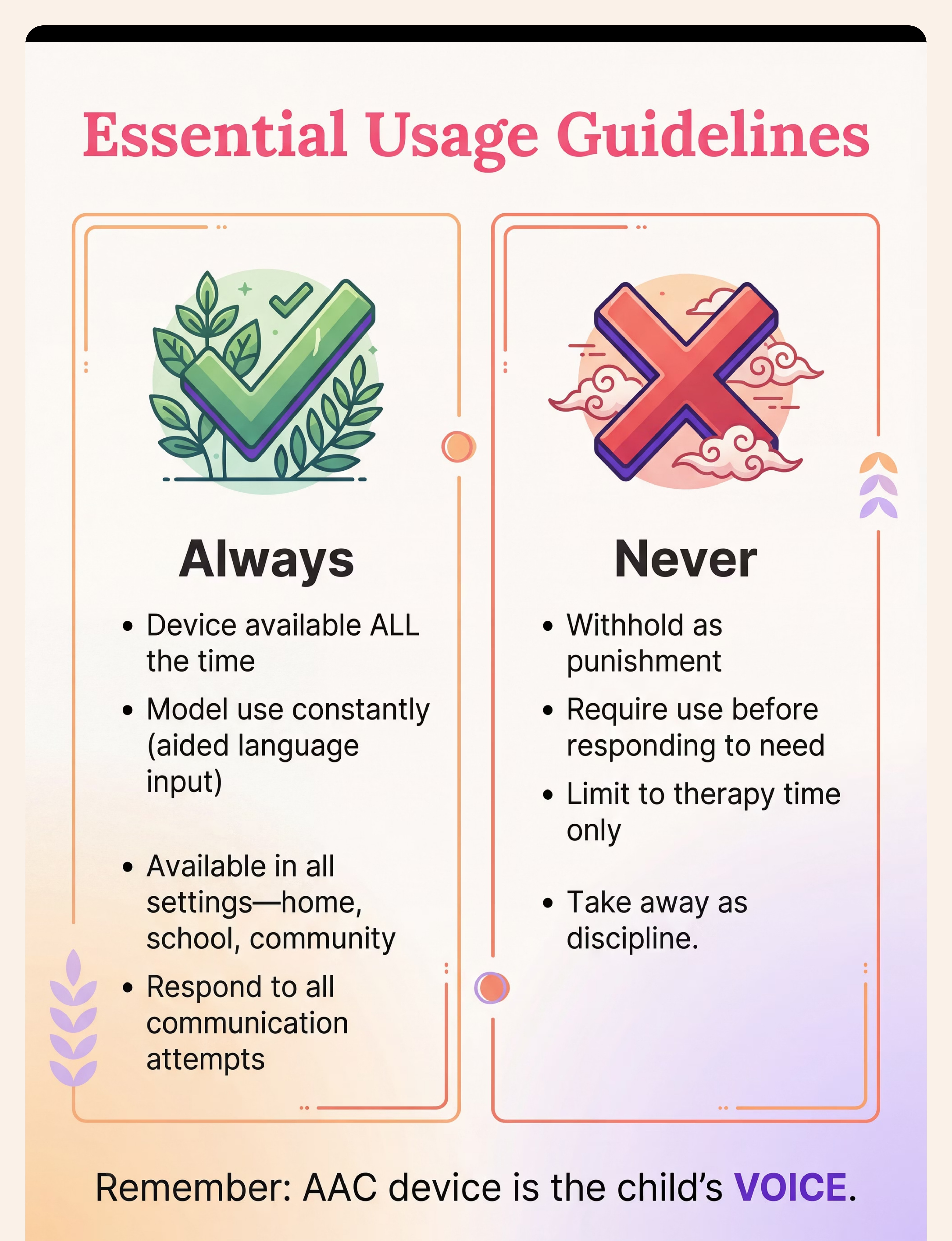
Device Available ALL the Time
The AAC device is your child's voice. It must be available constantly—at home, school, therapy, community, everywhere. Never restrict access or take it away as punishment. Would you take away a speaking child's voice?
Start with Core Vocabulary, Not Just Nouns
Core words like "want," "more," "go," "stop," "help," "like" are used across all contexts. Don't just program names of favorite toys. Include words that work everywhere for true communication flexibility.
Model Use Constantly (Aided Language Input)
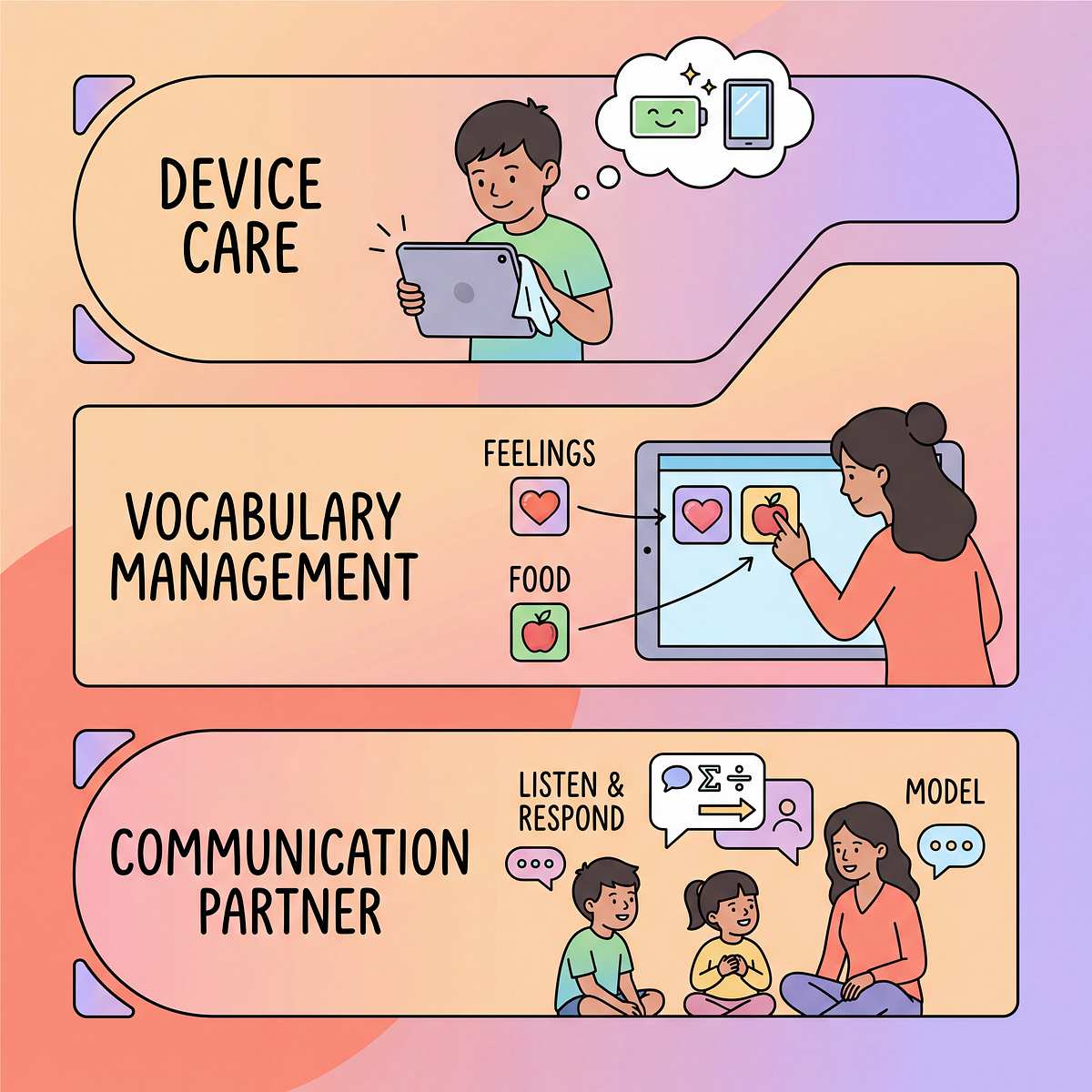
Point to symbols on your child's device as you talk throughout the day. This "aided language input" teaches how to use AAC naturally. Model more than you expect your child to produce independently.
Don't Require Use Before Giving Item
If your child gestures for juice and you know what they want, give it while modeling "juice" on their device. Don't withhold items to force device use. This creates communication frustration, not communication growth.
Train All Communication Partners
Everyone who interacts with your child—family, teachers, therapists, friends—needs basic AAC training. Communication happens everywhere, so everyone needs to know how to respond to and support device use.
Device is Child's VOICE - Respect It
Respond to AAC-generated messages with the same attention and respect you'd give spoken words. Never ignore messages, talk over the device, or treat it as less legitimate than speech.
Duration: AAC is a lifelong tool for those who need it. Some children develop speech alongside AAC use and eventually transition away from devices; others use AAC throughout their lives. Both outcomes are valid and valuable.

Expert Perspective
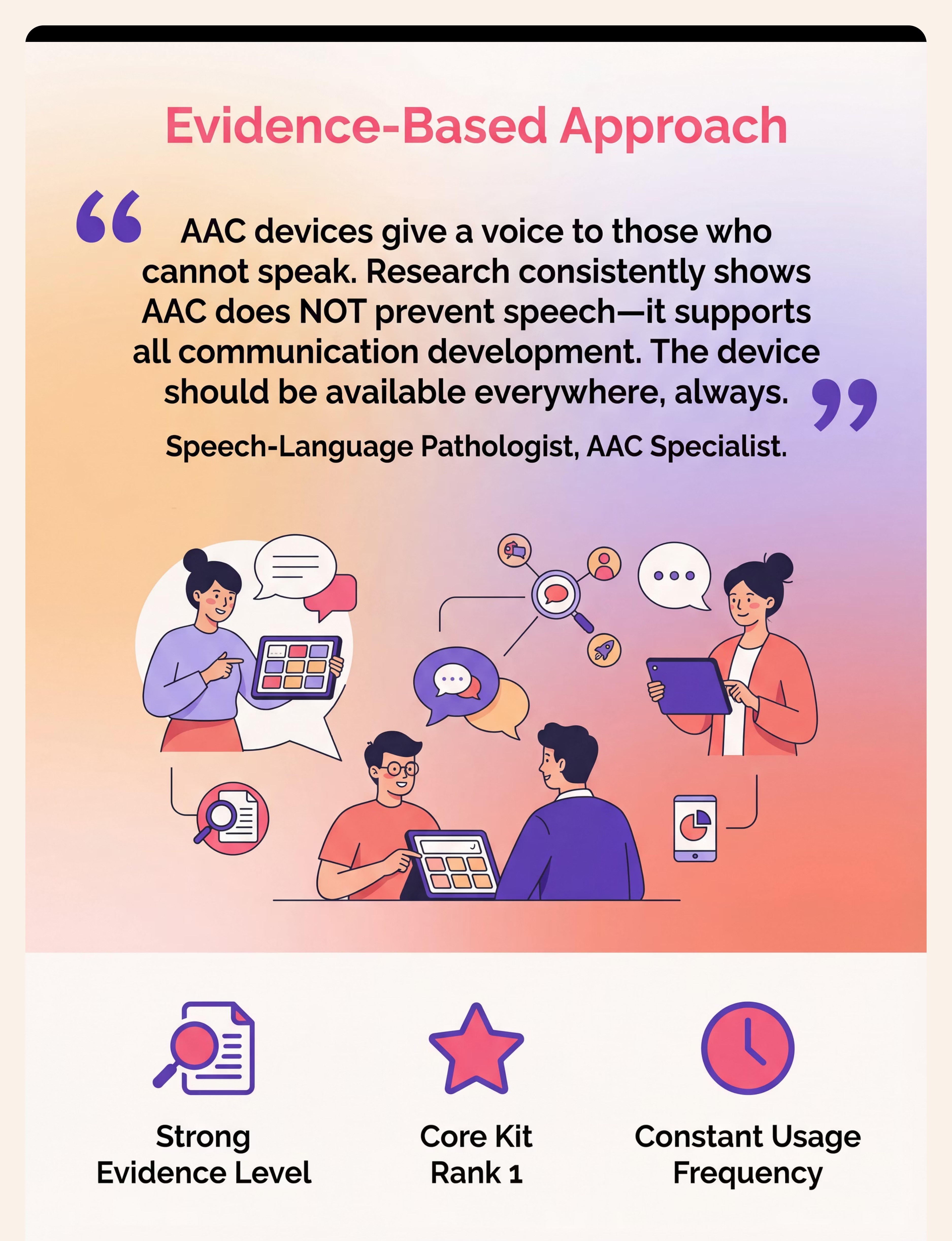
"AAC devices give a voice to those who cannot speak. Research consistently shows AAC does NOT prevent speech - it supports all communication development. The device should be available everywhere, always."
— Speech-Language Pathologist, AAC Specialist
SLP + SpEd Recommended
Co-owned by Speech-Language Pathology and Special Education professionals
Strong Evidence
Extensive research supports AAC effectiveness for communication and language development
Rank #1 in Category
Top-ranked tool in Communication & Language category for non-speaking individuals
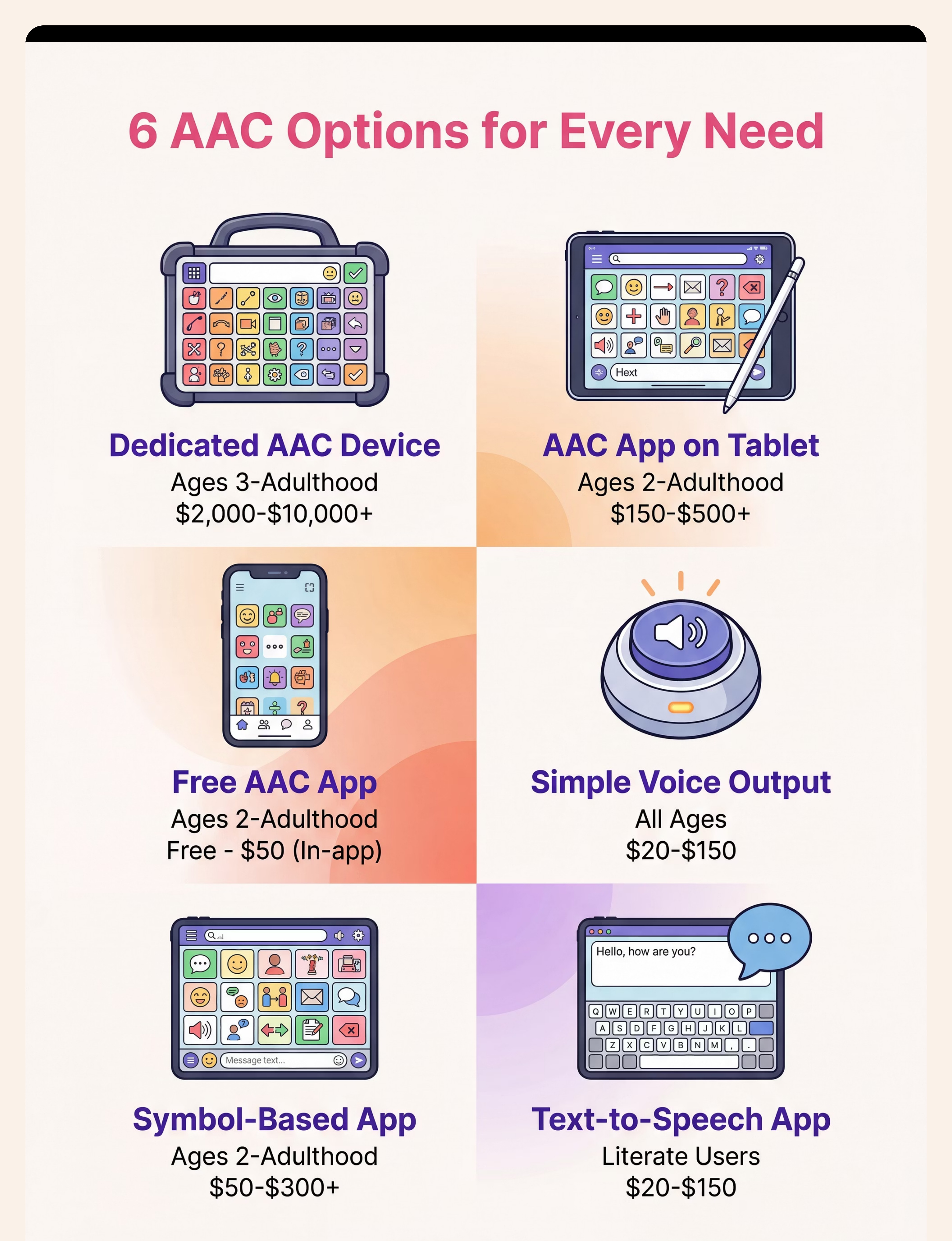
Choose Your Option (6 Variants)

AAC solutions range from free smartphone apps to sophisticated dedicated devices costing lakhs. The right choice depends on your child's communication needs, motor skills, cognitive level, portability requirements, and budget. Start where you can and upgrade as needs evolve.
Simple Voice Output Device
Best for: Beginning communicators, specific messages
Free/Low-Cost AAC App
Best for: Getting started, budget option
Symbol-Based AAC App
Best for: Non-readers, visual communicators
Text-to-Speech App
Best for: Literate children, situational mutism
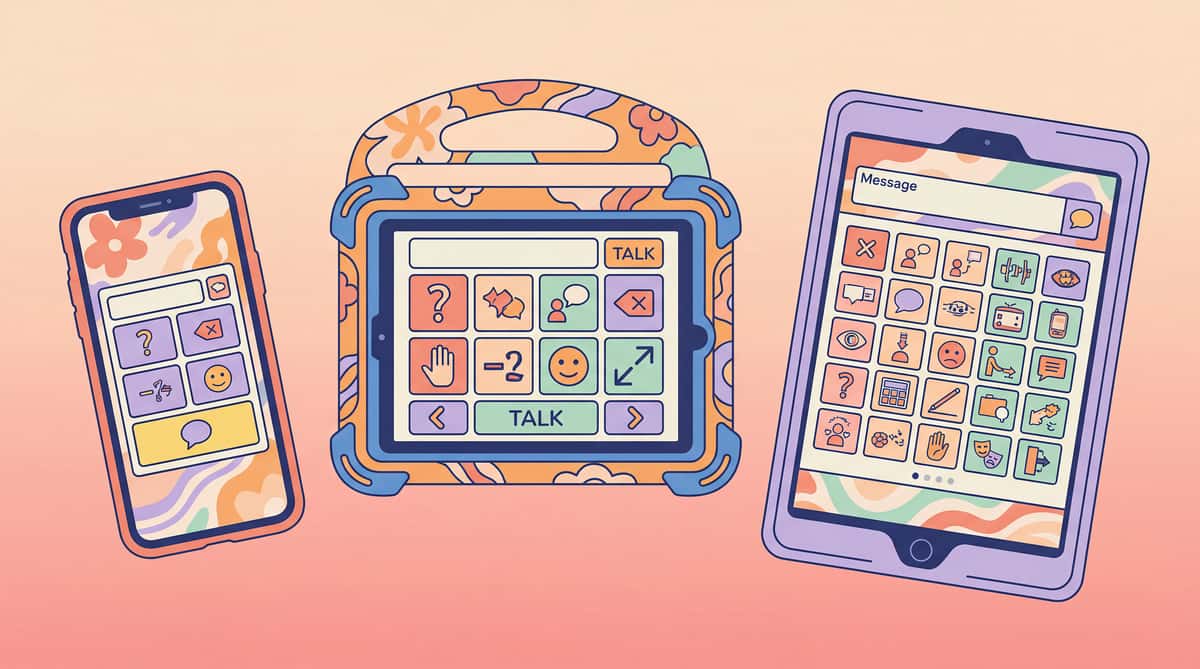
AAC App on Tablet
Best for: Comprehensive AAC, more affordable than dedicated device
Dedicated AAC Device
Best for: Comprehensive AAC, durability, professional support
Simple Voice Output Device
Ages: 18 months+ | Settings: All | Portability: Very High | Price: ₹1,000–5,000
Single button or few-button devices with recorded messages. Perfect for earliest communicators or specific situations requiring consistent messages.
Free/Low-Cost AAC App
Ages: 2-9 years+ | Settings: All | Portability: Very High | Price: ₹0–2,000
Basic speech generation apps available free or low cost. Great starting point to assess if AAC works for your child before major investment.
Symbol-Based AAC App
Ages: 2-9 years+ | Settings: All | Portability: Very High | Price: ₹0–10,000
Apps like Avaz and LetMeTalk use picture symbols for communication. Ideal for children who aren't yet reading but understand visual representations.
Text-to-Speech App
Ages: 6-9 years+ | Settings: All | Portability: Very High | Price: ₹0–1,000
Type-to-speak apps for children who can read and write but cannot speak, or for selective mutism situations. Simple, effective, nearly free.
AAC App on Tablet
Ages: 2-9 years+ | Settings: All | Portability: High | Price: ₹5,000–25,000
Full-featured AAC apps (Proloquo2Go, TouchChat) on consumer tablets. Nearly as capable as dedicated devices at fraction of cost. Requires device protection.
Dedicated AAC Device
Ages: 2-9 years+ | Settings: All | Portability: Medium | Price: ₹50,000–3,00,000
Purpose-built speech generation devices with specialized features, rugged construction, and comprehensive manufacturer support. Most expensive but most robust option.
How to Choose
By Goal
- Comprehensive communication: Dedicated device or premium app
- Getting started: Free app
- Specific messages: Simple button device
- Visual communication: Symbol-based app
By Setting
- All settings: Portable tablet app
- Home primarily: Any option works
- School/community: Durable device or protected tablet
- On-the-go: Phone-based app
By Portability
- Very High: Phone apps, simple buttons
- High: Tablet apps
- Medium: Dedicated devices
- Consider: Battery life, case durability
Specifications & Types Guide
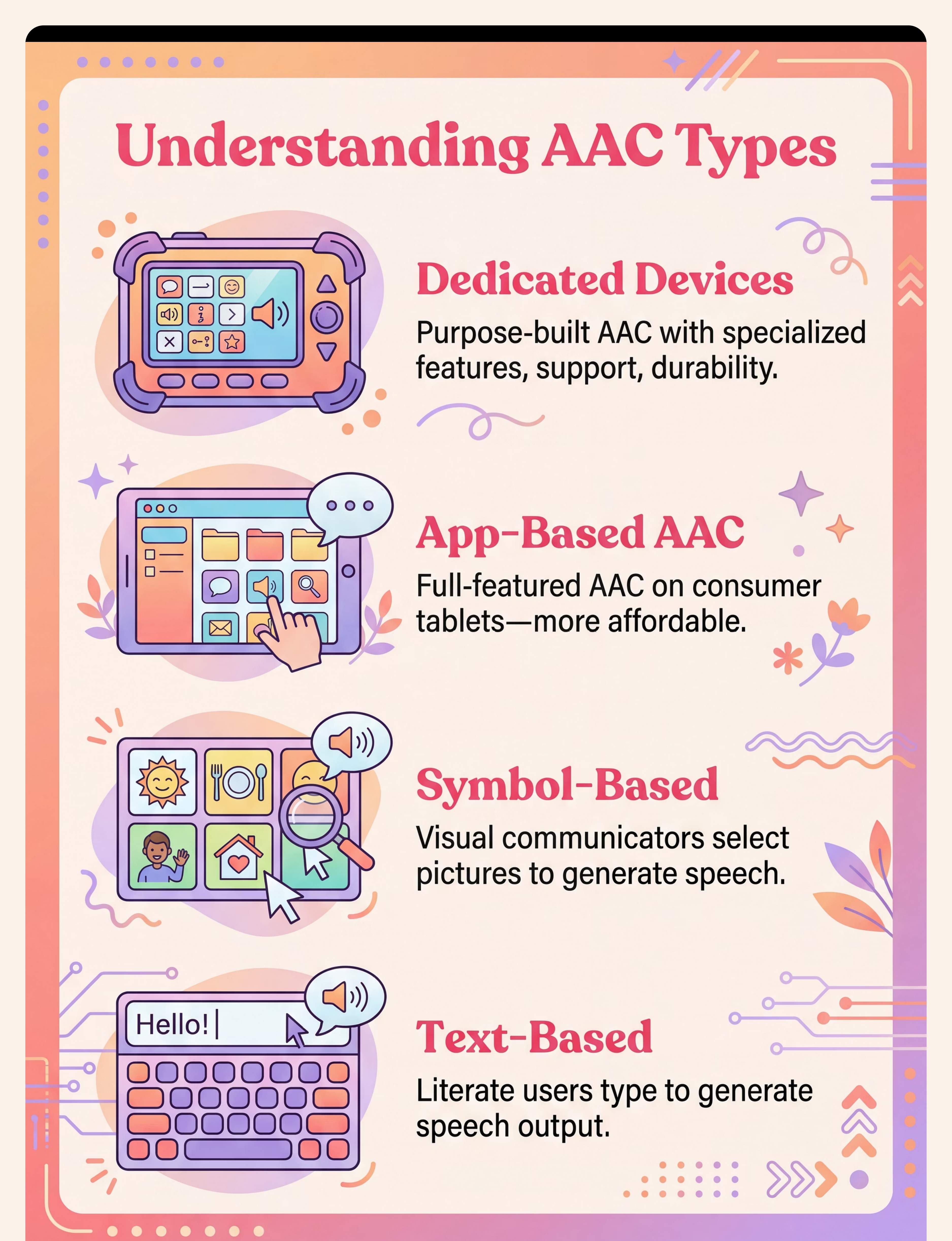
AAC System Types

Dedicated
Purpose-built AAC devices with specialized features, rugged construction, professional support. Most expensive but most durable.

App-Based
AAC apps on consumer tablets (iPad, Android). Nearly as capable as dedicated devices at much lower cost. Requires protective case.

Symbol-Based
Picture symbols user selects to generate speech. Best for non-readers and visual communicators. Highly intuitive interface.

Text-Based
Typing to generate speech for literate users. Fastest communication for those with reading/writing skills. Unlimited vocabulary.

Hybrid
Combination of symbols and text. Allows transition from pictures to text as literacy develops. Most flexible long-term option.
Materials & Key Features
Materials
- Tablets and dedicated communication devices
- AAC apps and software programs
- Protective cases (often with handles and straps)
- Mounting systems for wheelchair or table use
Key Features to Look For
- Voice output: Clear, adjustable speech synthesis
- Customizable vocabulary: Add child's specific words
- Core vocabulary access: Quick access to most-used words
- Durable construction: Withstands drops and daily use
- Portable design: Goes everywhere child goes
- Battery life: Lasts full day minimum
- Backup capability: Save vocabulary regularly
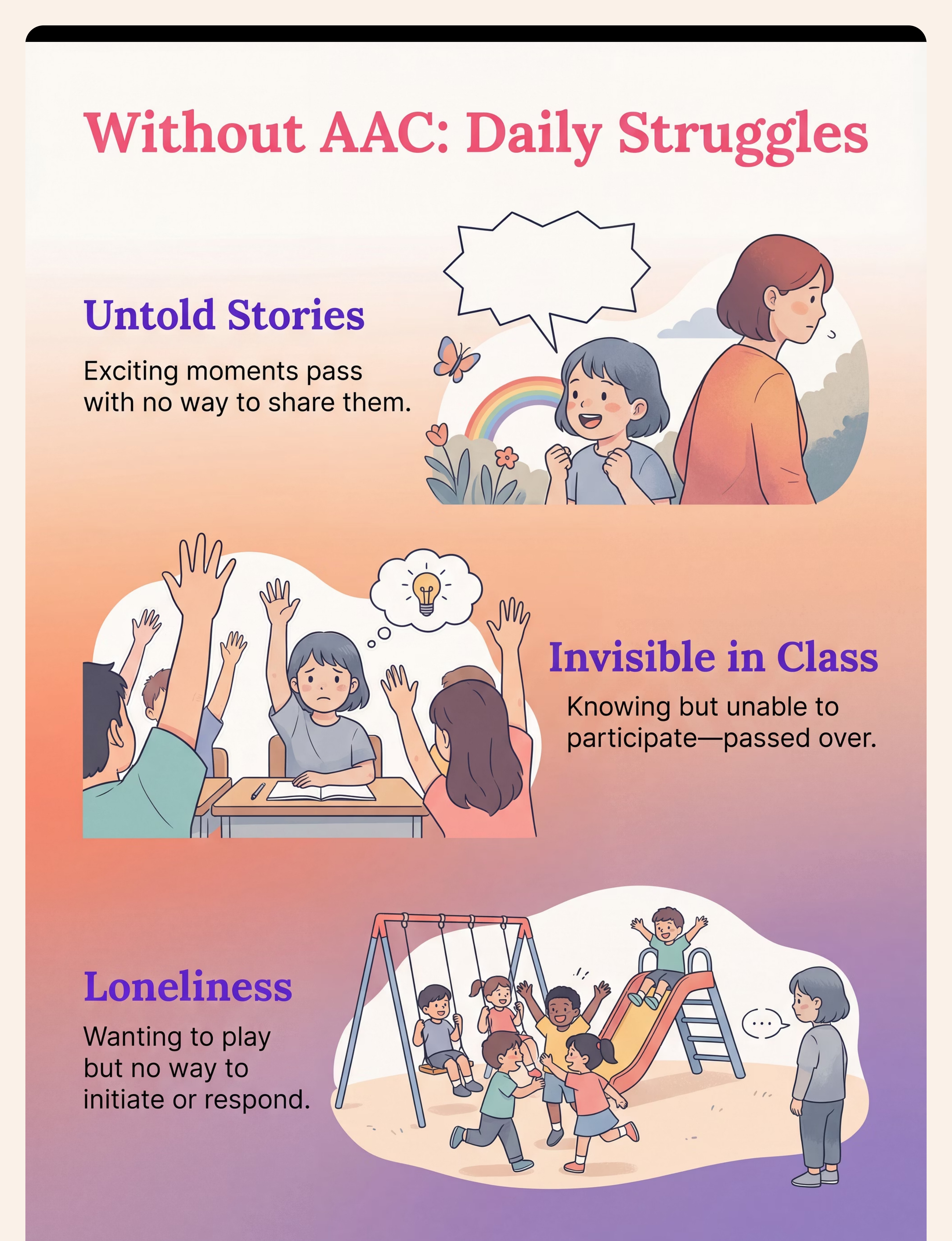
The Struggle (Before)

Having Something to Say
Situation: Child witnesses something exciting—a bird landing on the window, a funny moment, something important.
Experience: Wants to tell parent immediately. Opens mouth. No words come. Tries to gesture, point, make sounds. Parent doesn't understand. Moment passes. Story remains untold. Connection missed.
Emotion: Frustration builds into isolation. "I have so much to say. Why can't anyone hear me?"

There was an error generating this image
Classroom
Situation: Teacher asks question to whole class. Child knows the answer—has been learning, understands the content.
Experience: Raises hand eagerly. Teacher calls on them. Entire class waits. Child opens mouth. Nothing. Teacher waits a moment, then moves to another student. Child never gets to share what they know.
Emotion: Exclusion and invisibility. "I know the answer. I'm smart. But nobody will ever know."

Making Friends
Situation: Playground, children playing together. Child wants to join the game.
Experience: Can't say "Can I play?" Can't respond when peers ask questions. Can't suggest ideas or agree to rules. Stands at edge of group. Peers try at first, then give up. Eventually stop inviting. Isolation continues.
Emotion: Loneliness and yearning. "I want friends. I want to play. Why won't anyone include me?"
Without voice output, non-speaking children experience these scenarios repeatedly, every single day. The cumulative effect on self-esteem, social development, and quality of life is profound. AAC devices don't just enable communication—they enable connection, participation, and dignity.

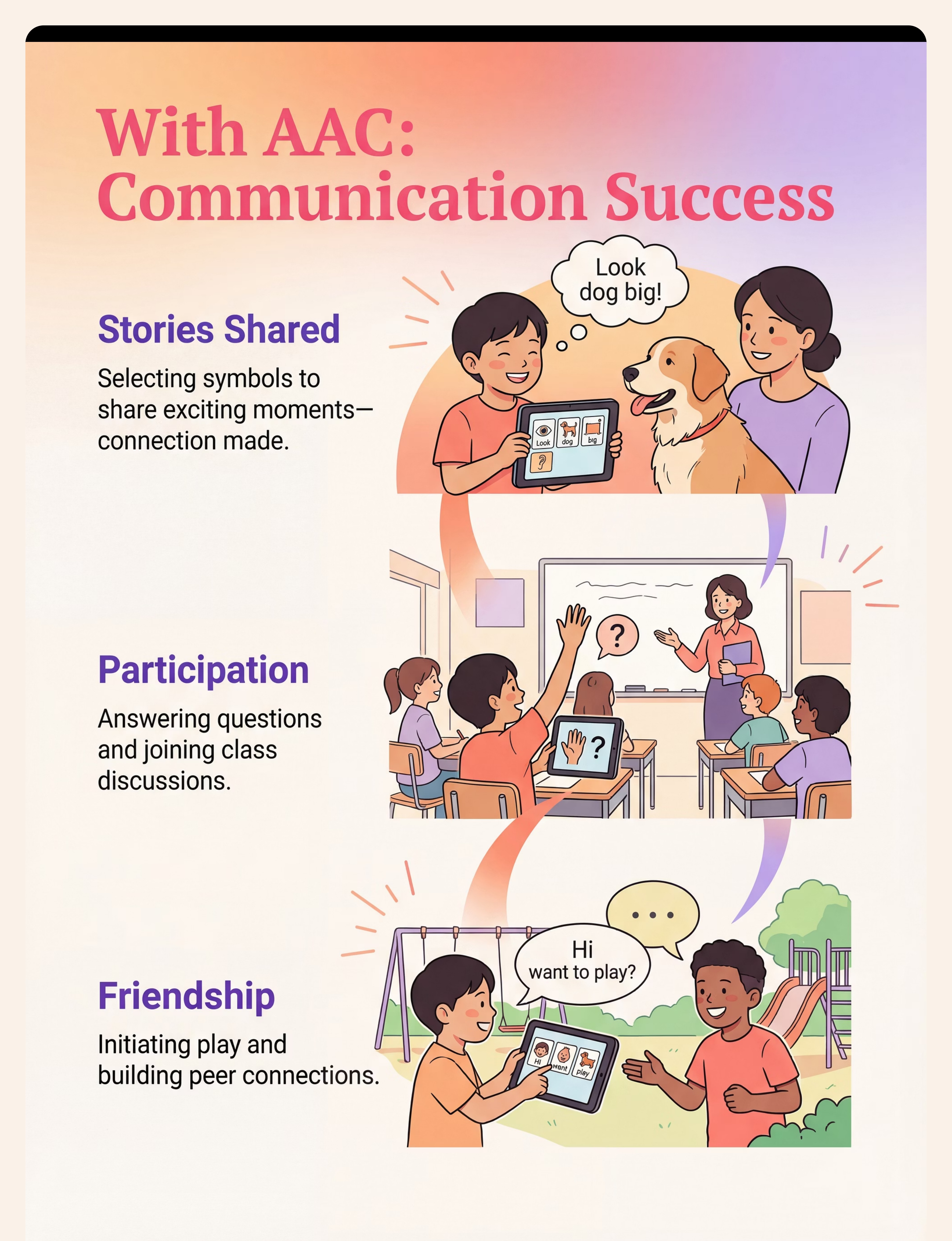
The Breakthrough (After)
Having Something to Say
Situation: Child sees dog at park—big, fluffy, playful dog.
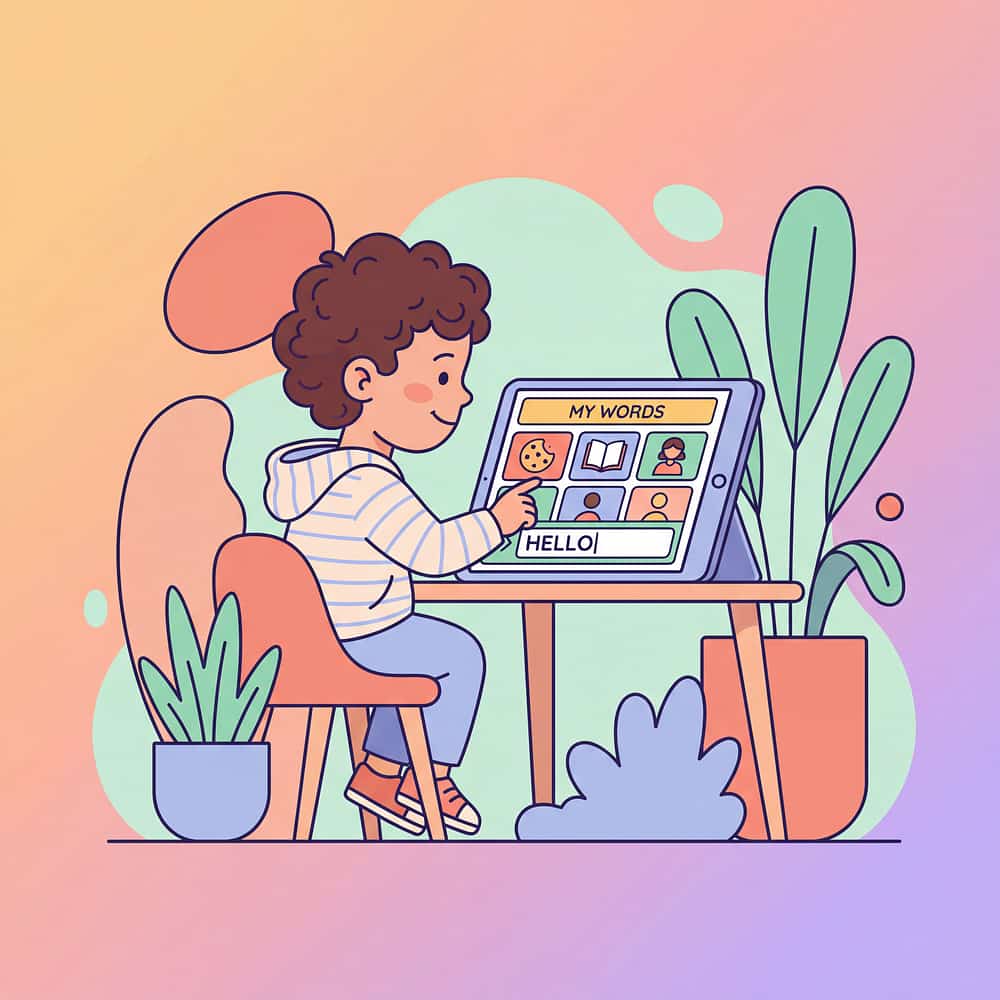
Experience: Opens AAC app. Navigates to vocabulary. Selects "Look" + "dog" + "big!" Device speaks clearly. Parent hears, turns, engages: "Yes! That IS a big dog!" Child beams. Adds "funny" + "run." Conversation flows. Story shared. Connection made.
Emotion: Joy and connection. "I have a voice. People hear me. I can share my world."
Classroom Participation
Situation: Teacher asks question about story they just read.
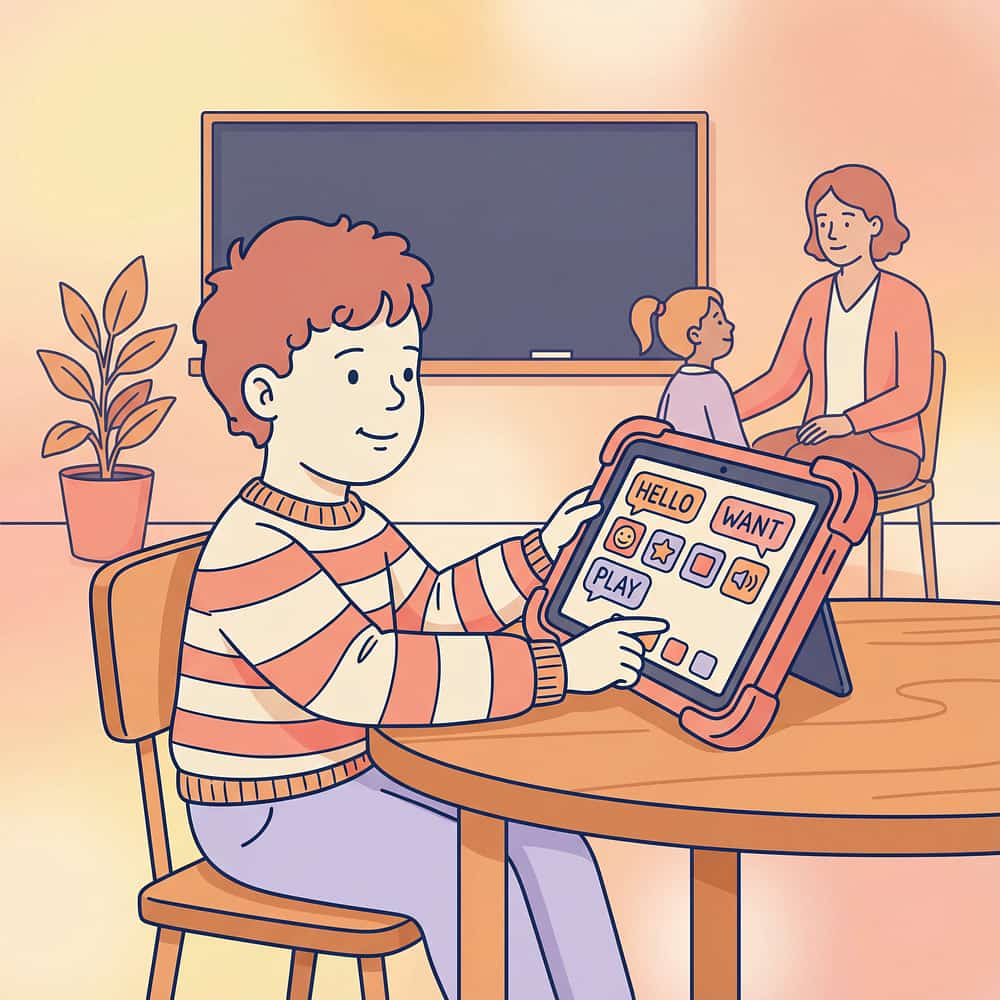
Experience: Child raises hand. Gets called on. Uses device to select answer: "The boy was brave." Device speaks. Class hears response. Teacher affirms: "Yes! Great answer!" Child participates in discussion. Included in learning community.
Emotion: Inclusion and pride. "I can participate. I belong here. My ideas matter."
Making Friends
Situation: Peer approaches child on playground.
Experience: Child uses device: "Hi" + "want to play?" Peer responds: "Yeah! Let's play!" Child suggests game using device. Peer agrees. Play begins. Interaction happens naturally. Friendship becomes possible.
Emotion: Hope and belonging. "I can make friends. I can play. I'm included."

What to Expect (Realistic Timelines)
AAC success doesn't happen overnight, but with consistent use and support, meaningful outcomes emerge. Here's what research and clinical experience show families can realistically expect.
Child has voice output for communication
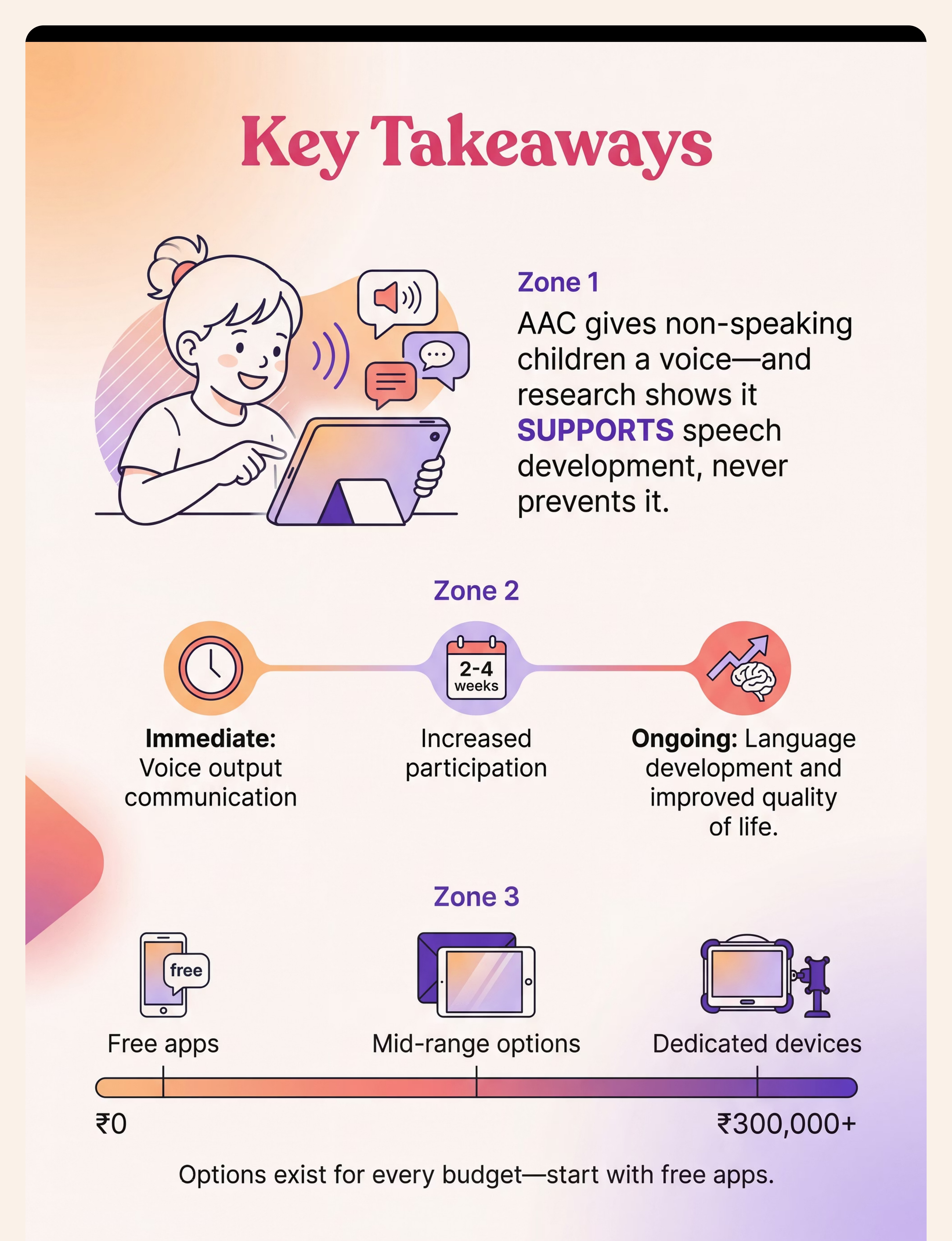
Timeframe: Immediate — As soon as device is programmed and available, child can generate spoken messages. The tool works from day one; mastery develops over time.
Participation in conversation increases
Timeframe: 2-4 weeks — As child becomes familiar with device navigation and experiences communication success, spontaneous communication attempts increase noticeably.
Language skills develop with AAC support
Timeframe: Ongoing — Vocabulary expands, sentence structure develops, and pragmatic communication skills improve continuously with consistent modeling and use.
Social participation improves
Timeframe: 2-3 months — As communication becomes more reliable, peers learn to interact, teachers learn to include, and social opportunities multiply.
Quality of life and autonomy increase
Timeframe: Ongoing — Long-term impact on self-determination, independence, education, relationships, and overall well-being is profound and lifelong.
Some children develop speech alongside AAC
Timeframe: Variable — Research shows AAC supports (not prevents) speech development. Some children develop verbal speech while using AAC; others use AAC long-term. Both outcomes are valuable.

Is This Right for My Child? (2-Minute Check)
Answer these questions honestly. If you respond "yes" to 3 or more, an AAC device or app is likely highly appropriate for your child. These indicators are based on clinical assessment criteria used by speech-language pathologists.
Is your child non-speaking or minimally speaking?
If yes, this indicates: AAC device/app appropriate
Non-speaking children or those with very limited verbal output are primary candidates for voice output AAC. If your child cannot reliably use speech to communicate basic needs, AAC provides immediate functional communication.
Has your child outgrown or needs more than low-tech AAC?
If yes, this indicates: High-tech AAC indicated
If your child has mastered PECS, communication boards, or other low-tech systems and needs more vocabulary, faster communication, or voice output to be heard across environments, high-tech AAC is the next step.
Would voice output help your child communicate?
If yes, this indicates: Speech-generating device will help
If your child is in inclusive settings where they need to be heard across a room, or if communication partners have difficulty seeing low-tech systems, voice output dramatically improves communication accessibility.
Can your child learn to use a tablet/device?
If yes, this indicates: Has motor/cognitive skills for AAC
If your child can touch or point to pictures/symbols on a screen, even with support, they have the foundational skills for AAC. Systems can be simplified to match current abilities and grow with the child.
3+ 'yes' answers = strong fit for AAC intervention. Even if you only answered yes to 1-2 questions, AAC may still be appropriate. Consult with a speech-language pathologist who specializes in AAC for personalized assessment and recommendations.

Usage Guide
When to Use | When NOT to Use | |
All the time – the device is the child's voice | Never withhold as punishment | |
During all communication opportunities | Never require use before responding to communication | |
Model use constantly (aided language input) | Don't limit to 'therapy time' only | |
Meals, play, school, outings – everywhere | Don't hide the device away | |
Never restrict access |
Supervision by Age
Stage | Supervision Level | Notes | |
Initial Learning | Adult models constantly | Child observes, explores, begins to understand device functionality | |
Developing Skills | Adult supports and prompts | Child uses with guidance, adult helps navigate, provides models | |
Independent Use | Adult responds to messages | Child uses independently, adult engages in conversation naturally |
Settings: ALL settings—home, school, therapy, community, everywhere the child goes
Duration: Lifelong tool for those who need it. AAC is not a "phase" or "stepping stone"—it's a legitimate, permanent communication system for many individuals.
Age Range: 18 months to adulthood. Never too young or too old to begin AAC. Even babies can use simple voice output devices with single messages.

Safety First
Critical Safety
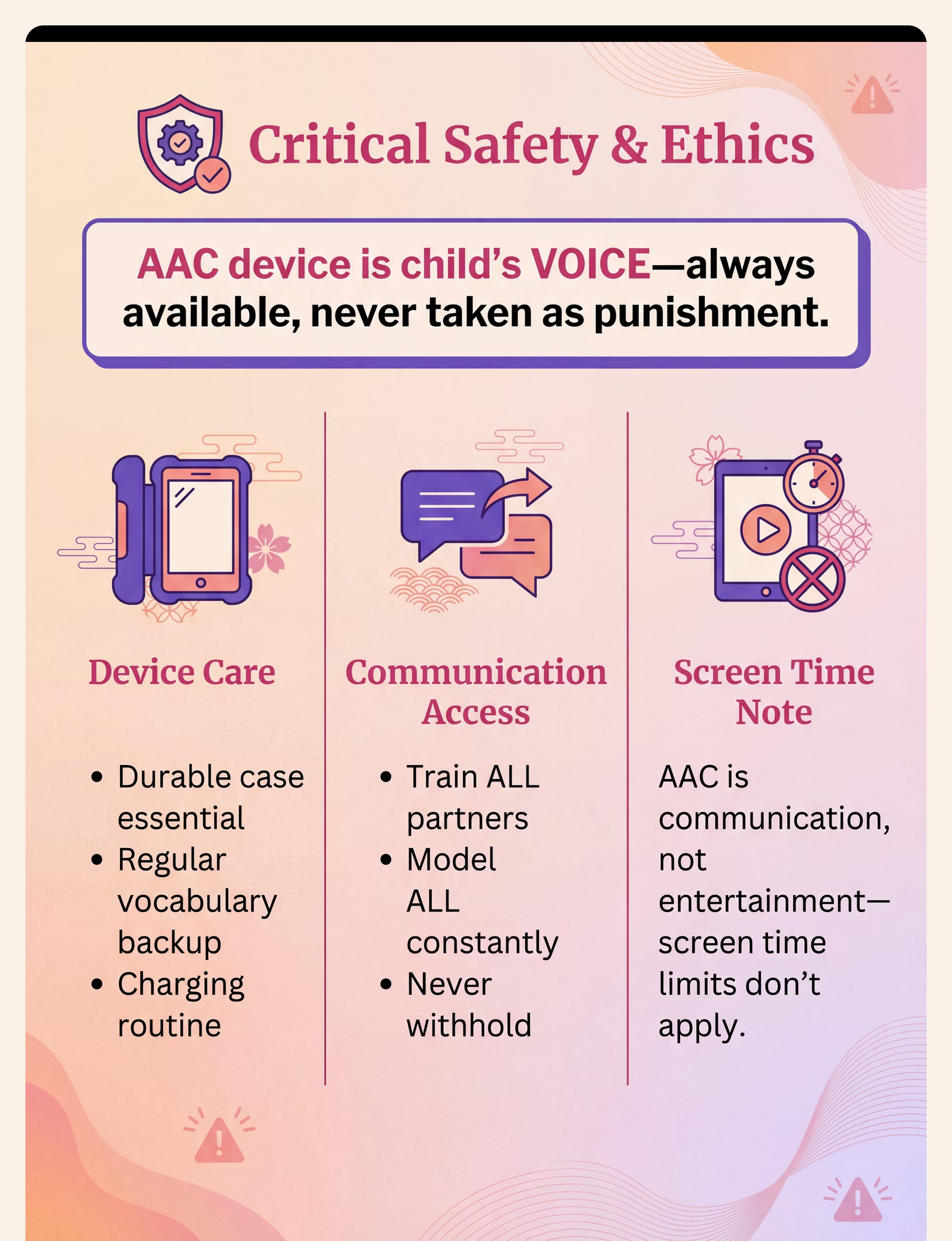
- AAC device is child's VOICE - always available, never taken as punishment. Removing communication access is harmful.
- Model use constantly (aided language input). Children learn AAC by seeing others use it, just like spoken language.
- Don't require use before responding to need. Withholding responses until child uses device creates communication barriers, not communication growth.
- Train ALL communication partners. Family, teachers, therapists, peers—everyone needs to know how to support and respond to AAC use.
Warnings
- Protect device from damage (durable case essential). Tablets and devices are expensive; protective cases with handles prevent costly damage.
- Back up vocabulary regularly. Losing customized vocabulary is devastating. Back up weekly to cloud or computer.
- Don't let battery die (charging routine). Device with dead battery is useless. Establish consistent charging routine (e.g., every night).
- Screen time concerns don't apply - AAC is communication, not entertainment. Using AAC device is not "too much screen time." It's language use.
Contraindicated Practices
- Withholding device as behavior management
- Limiting access to certain times or places
- Using only in therapy sessions
- Taking away as punishment for any reason
Safety Checklist
Before Use
- ✓ Device/app selected and set up
- ✓ Vocabulary customized for child
- ✓ Communication partners trained
- ✓ Device always charged and available
During Use
- ✓ Modeling constantly
- ✓ Available in all settings
- ✓ Responding to all attempts
- ✓ Expanding vocabulary over time
Signs of Success
- ✓ Child using device to communicate
- ✓ Communication attempts increasing
- ✓ Frustration decreasing
- ✓ Participation improving
- ✓ Possibly verbal attempts increasing

Common Questions (Honest Answers)
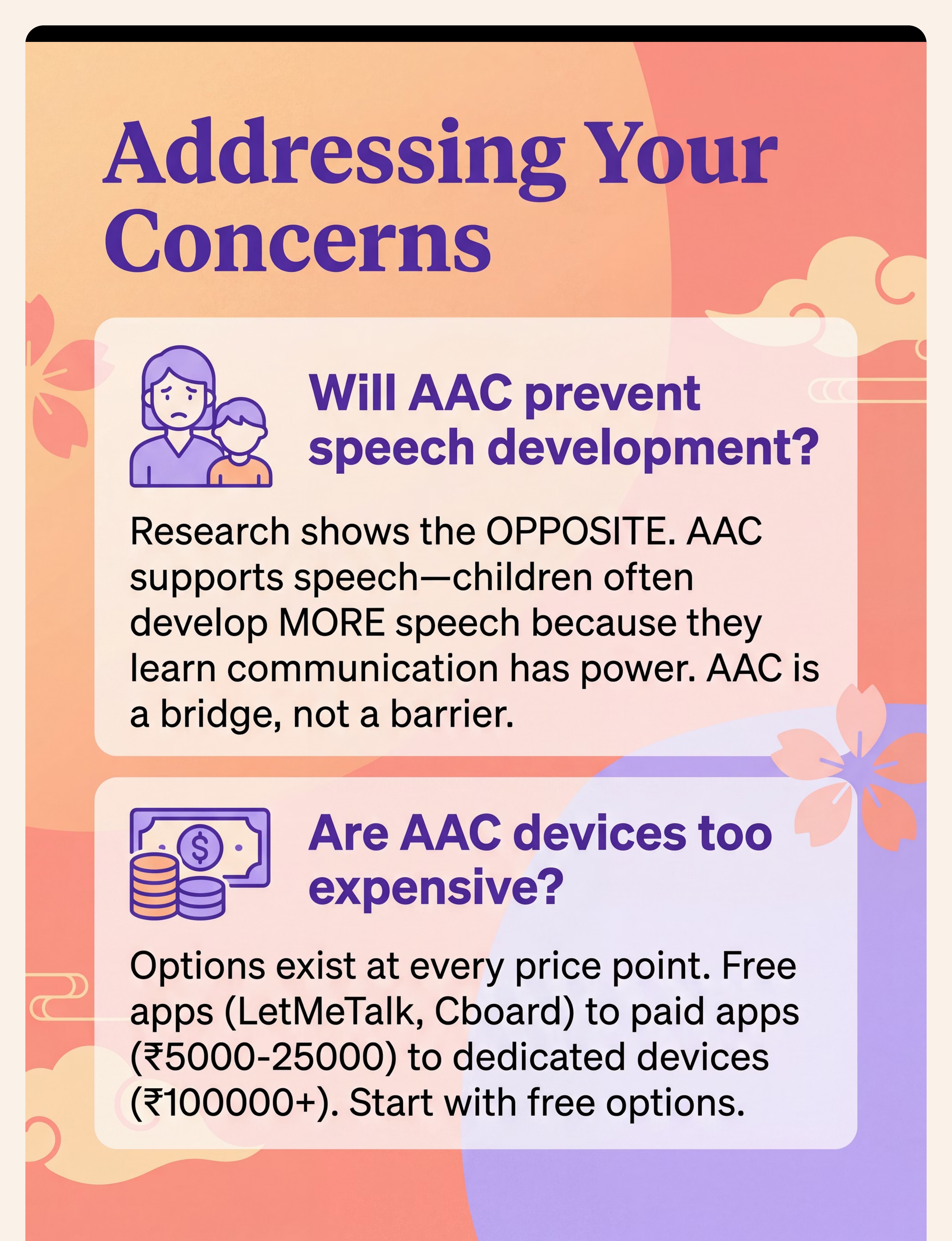
Q: AAC will prevent my child from learning to speak
A: Research conclusively shows the OPPOSITE. AAC SUPPORTS speech development—it doesn't prevent it. Children often develop MORE speech with AAC because they learn communication has power. When a child experiences successful communication through AAC, they're motivated to communicate more in any way possible, including speech. AAC is a bridge, not a barrier.
Try this: View AAC as support FOR speech, not replacement OF speech. Continue speech therapy while using AAC. Many children develop verbal speech alongside AAC use.
Q: These devices are too expensive
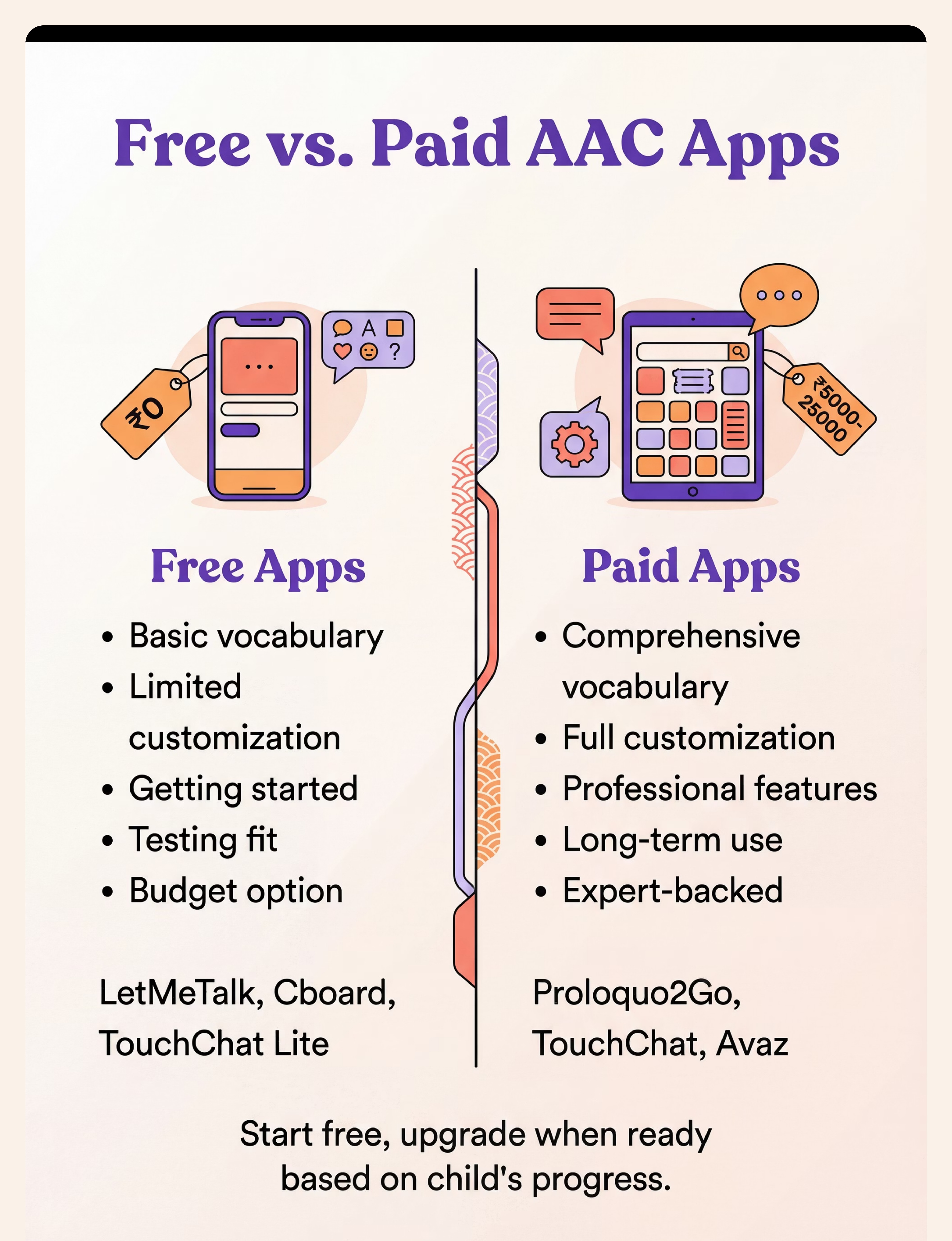
A: Options exist at every price point. Free apps (LetMeTalk, Cboard) provide basic AAC at zero cost. Paid apps (₹5,000-25,000) like Avaz or Proloquo2Go offer comprehensive AAC on tablets you may already own. Dedicated devices (₹50,000-3,00,000) are most expensive but also most durable. Government schemes, NGOs, and crowdfunding can help with costs. Start with free options and upgrade as needed.
Try this: Start with free app on existing device. Assess whether AAC works for your child. If successful, explore funding sources for more comprehensive options.
Q: My child won't be able to learn to use it
A: AAC apps and devices are designed for accessibility at all levels. Start simple—even one button with one message is communication. Build from there with consistent modeling and availability. With proper support, most children can learn to use AAC at some level. Don't underestimate your child—give them the chance. Many parents are amazed at what their children can do when given the right tools.
Try this: Start simple with 5-10 core vocabulary words. Build complexity gradually as skills develop. Work with SLP for training and support.
Q: It's not 'real' communication
A: AAC IS real communication. A voice through a device is still a voice. The message matters, not the medium. Would you say Stephen Hawking wasn't "really" communicating? Every voice deserves respect, regardless of how it's produced. AAC users are communicating their authentic thoughts, needs, and feelings—that's as real as it gets.
Try this: Reframe your thinking. AAC is a valid, respected voice used by thousands of people worldwide. It's assistive technology, like glasses or hearing aids—tools that enable function.

Investment Guide
Overall Range: ₹0–3,00,000 (US $0–3,600)
AAC pricing varies dramatically based on features, durability, and support. The good news: effective AAC is available at every price point, from completely free to professional-grade devices. Start where your budget allows and upgrade as your child's skills and needs develop.
Free AAC Apps | ₹0 | Basic functional AAC on existing smartphones/tablets (e.g., LetMeTalk, Cboard, TouchChat Lite) | |
Paid AAC Apps | ₹5,000-25,000 | Comprehensive features on existing tablets/devices (e.g., Avaz, Proloquo2Go) | |
Dedicated AAC Devices | ₹1,00,000-3,00,000 | Purpose-built, robust, speech-generating devices (e.g., Tobii Dynavox, PRC-Saltillo, Forbes AAC) |
Factors Influencing Cost
Features & Customization
Number of vocabulary options, voices, customization capabilities, and advanced settings.
Device Durability
Robustness of the device, whether it's an off-the-shelf tablet or a purpose-built, ruggedized AAC system.
Technical Support & Training
Availability of professional support, warranties, and training resources from manufacturers or app developers.
Funding & Accessibility
Availability of government schemes, NGO assistance, insurance coverage, or crowdfunding opportunities.
Investment Progression
1
Start Simple: Free Apps
Begin with free apps on devices you already own to assess AAC suitability without financial commitment.
2
Upgrade: Comprehensive Apps
If successful and more features are needed, move to paid, feature-rich apps on existing tablets.
3
Long-term: Dedicated Devices
Consider dedicated, robust devices for established AAC users needing maximum durability and features for years.
For most families, starting with a free or low-cost AAC app (₹0-2,000) on an existing device is recommended. This allows you to assess whether AAC works for your child without major financial commitment. Reserve dedicated devices for children with established AAC success who need maximum durability and features.

Where to Buy in India
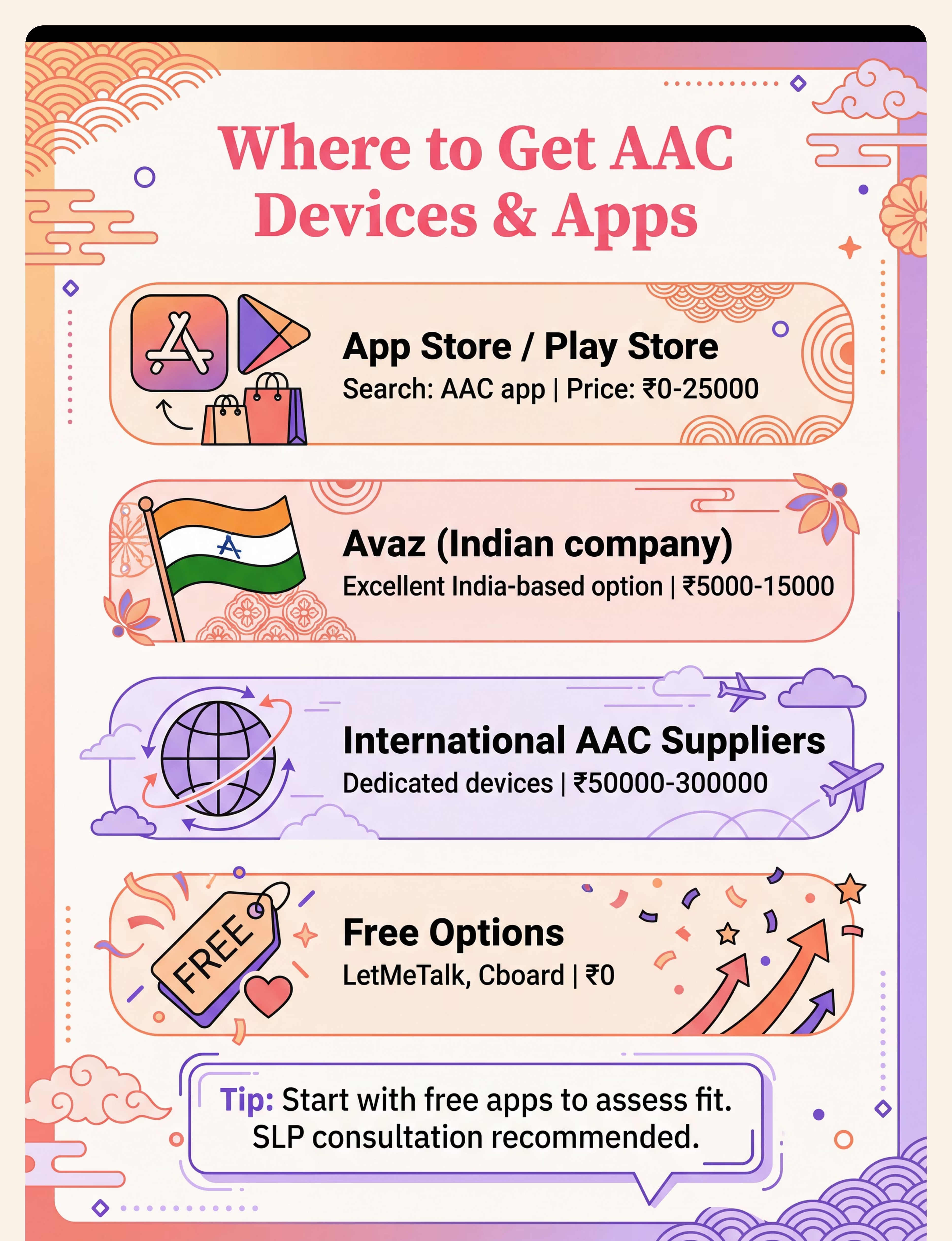
Availability: Apps widely available through app stores; dedicated devices available through specialized suppliers
App Store / Google Play Store
Search: "AAC app" or specific app names
Price: ₹0–25,000
Download AAC apps directly to iPad, iPhone, or Android devices. Most comprehensive AAC apps available. Instant access, immediate download.
Avaz (Indian company)
Search: "Avaz AAC"
Price: ₹5,000–15,000
Excellent India-based AAC solution with Indian language support, cultural relevance, and local customer support. Highly recommended for Indian families.
International AAC Suppliers
Search: "AAC device India"
Price: ₹50,000–3,00,000
Dedicated AAC devices shipped to India. Contact suppliers directly for availability, import costs, and local support options. Longer lead times, higher costs.
Free Options
Search: "LetMeTalk, Cboard"
Price: ₹0
Completely free AAC apps available for immediate download. Basic but functional. Perfect starting point to assess AAC fit before investing.
Buying Tips
- Start with free apps to assess fit before major purchase
- Avaz is excellent India-based option with local support
- SLP consultation recommended for app/device selection
- Device should be available ALL the time—factor in durability
- Consider portability, battery life, and ease of customization
- Test multiple free apps to see which interface suits your child
Red Flags
- ❌ Limiting device access as part of purchase terms
- ❌ No training or support included with expensive device
- ❌ App doesn't include core vocabulary (only nouns)
- ❌ Not customizable for child's specific needs
- ❌ No backup/export options for vocabulary
- ❌ Extremely limited free trial before major purchase

DIY Alternative (Save Significantly)
Low Feasibility
Use existing free apps instead of building from scratch.
Zero Cost Savings
Get full AAC functionality with free apps.
Minimal Time Investment
2-3 hours for initial setup; ongoing vocabulary customization.
Basic Materials
Owned tablet/smartphone, free AAC app, optional photos, protective case.
Steps to Set Up Free AAC System
1
Download free AAC app
Search for LetMeTalk, Cboard, or TouchChat Lite on App Store or Google Play. Download and install. All are free and functional.
2
Set up basic vocabulary
Start with 20-30 core vocabulary words: want, more, help, stop, go, eat, drink, play, yes, no, etc. Don't overwhelm—start simple.
3
Add photos of child's preferred items/people
Take photos of family members, favorite toys, foods, places. Add to app as custom buttons. Personal photos more meaningful than stock symbols.
4
Begin modeling use
Point to words on device as you talk throughout day. Model constantly—this is how child learns. Don't expect immediate use; learning takes time.
5
Expand vocabulary over time
Add new words weekly as child masters existing vocabulary. Follow child's interests—add words for things they care about.
6
Upgrade to paid app if needed
After 2-3 months, if child is successful with free app but needs more features, consider upgrading to comprehensive paid app (₹5,000-15,000).
DIY vs Commercial Comparison
Getting Started
DIY: Free apps are perfect for immediate start.
Commercial: Only if funding is already secured.
Budget Conscious
DIY: Zero cost, fully functional.
Commercial: Wait until free option proves successful.
Testing AAC Fit
DIY: Low-risk way to assess needs.
Commercial: Major investment without knowing effectiveness.
Basic Needs
DIY: Free apps handle essential communication.
Commercial: Premium features may be unnecessary.
Comprehensive Vocabulary
DIY: Limited in free versions.
Commercial: Paid apps have extensive libraries.
Advanced Customization
DIY: Basic customization only.
Commercial: Paid apps offer sophisticated programming.
Child Proficiency
DIY: May outgrow free app features.
Commercial: Upgrade when skills exceed free app capabilities.
Professional Recommendation
DIY: Start free, upgrade if SLP advises.
Commercial: Follow professional guidance on specific app.
Tradeoffs: Free apps have fewer features and limited customization compared to paid apps. However, they're fully functional for basic-to-moderate AAC needs. Most families should start with free options before investing in premium apps or devices.
Preview of aac device speech generating app Therapy Material
Below is a visual preview of aac device speech generating app therapy material. The pages shown help educators, therapists, and caregivers understand the structure and content of the resource before use. Materials should be used under appropriate professional guidance.


Share this resource
Help others discover thisLink copied!

Measuring Success & Next Steps
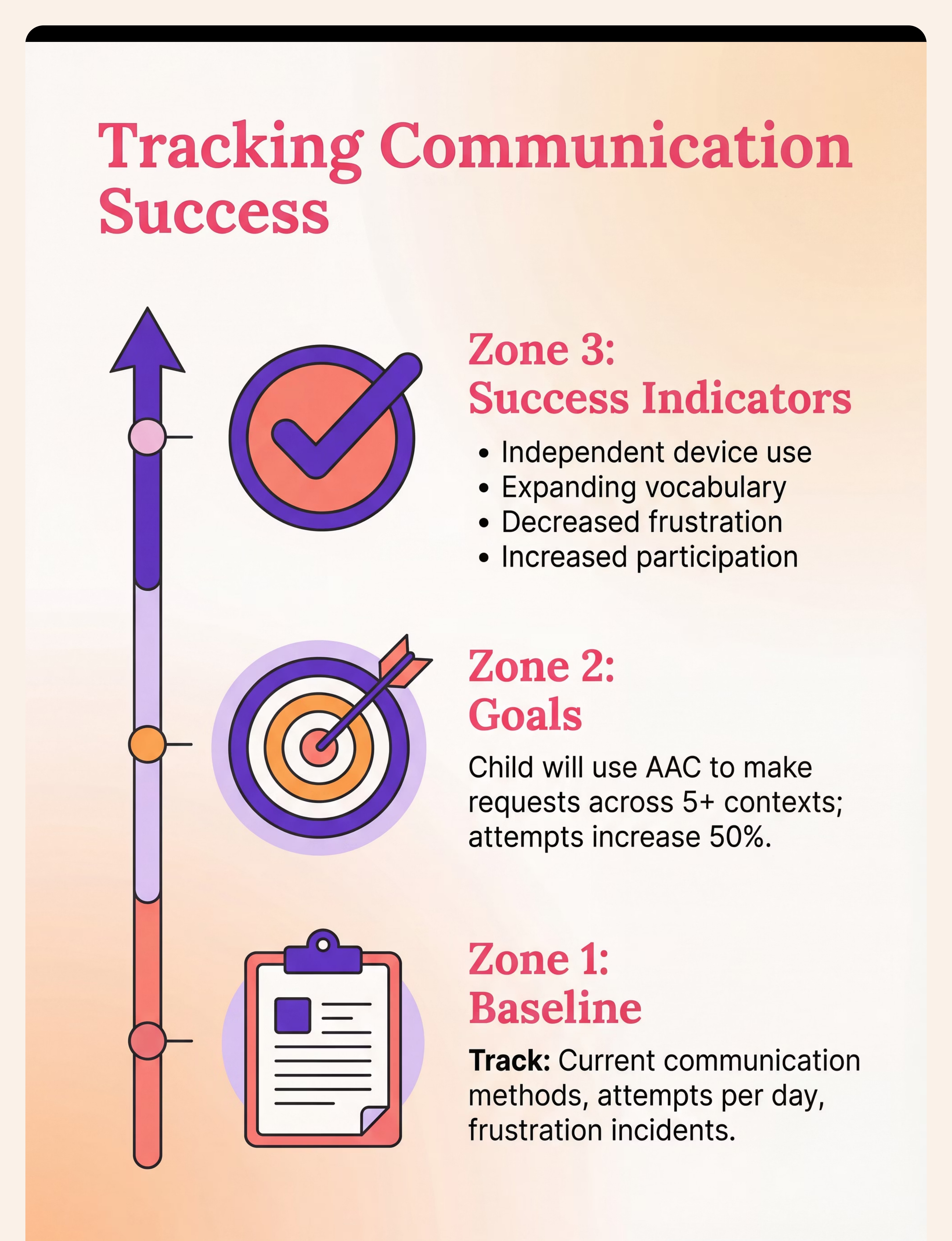
Track Progress: Monitor & Measure
Establish baselines (communication methods, vocabulary size, attempts, frustration) and set clear goals (increase AAC use, combine symbols). Success is indicated by independent device use, expanding vocabulary, decreased frustration, and increased participation.
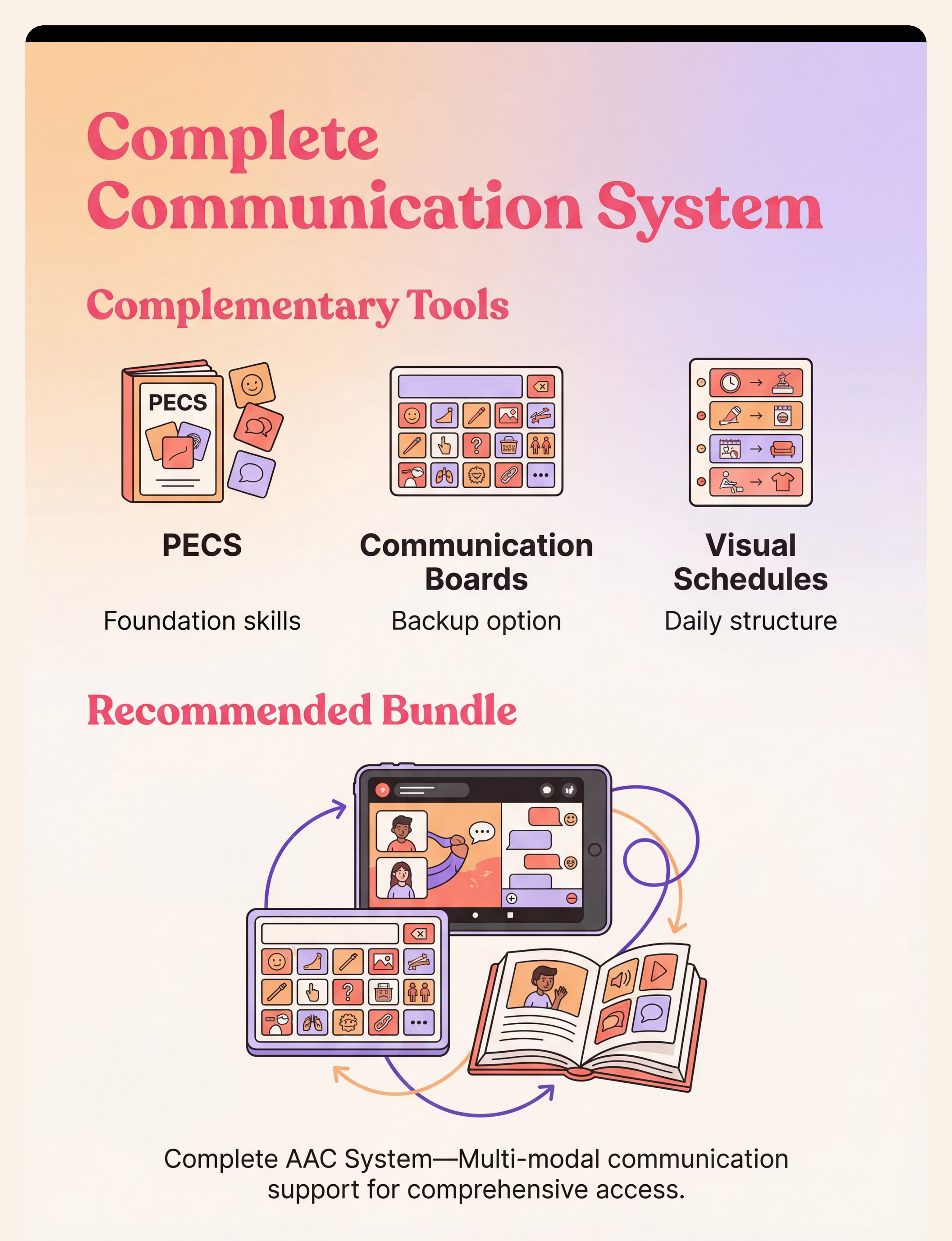
Complementary Tools & Bundles
Pair AAC with PECS for foundational skills, communication boards for backup, and sign language for multi-modal communication. Integrate visual schedules for daily support. Explore recommended bundles like the Complete AAC System or Communication Access Kit for comprehensive support.
AAC System Overview
AAC devices and apps provide voice output for non-speaking individuals, supporting communication and language development. Considered a Core Kit (Rank 1) with strong evidence, essential for those needing voice output.
AAC
speech device
communication app
voice output
non-verbal
tablet
SLP
SpEd
core-kit
Common searches: AAC device autism, speech generating device, communication app autism, Proloquo2Go, Avaz AAC, non-verbal communication device, tablet communication autism
Get Support & Integration
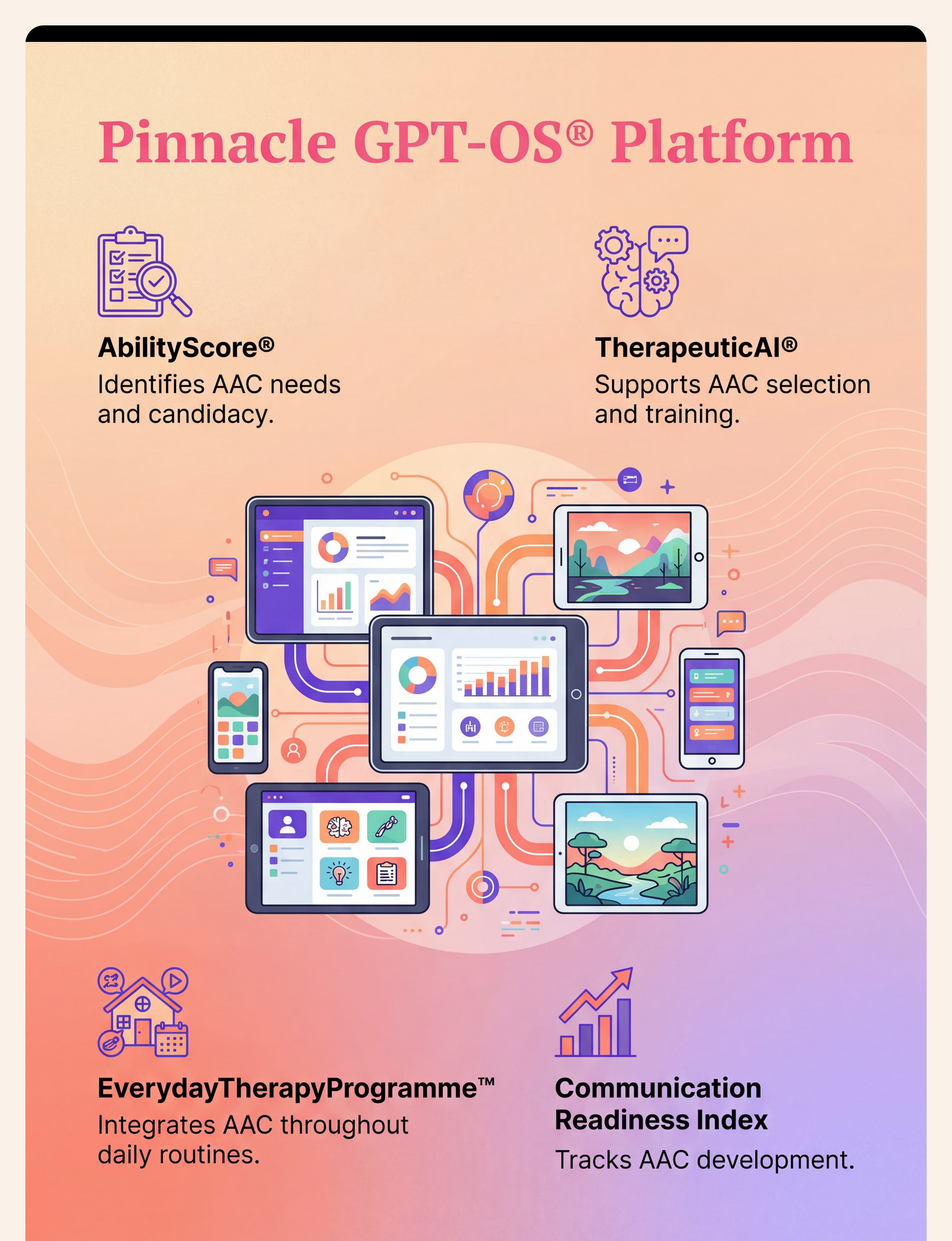
Access free national autism helpline for guidance on AAC selection, funding, and implementation. Leverage platform integrations like AbilityScore®, TherapeuticAI®, EverydayTherapyProgramme™, and Communication Readiness Index to identify needs, personalize training, and track skill development.
FREE National Autism Helpline
Phone: 9100 181 181
Languages: 16+ languages supported
Website:pinnacleblooms.org
Free consultation and guidance on AAC selection, funding sources, and implementation support.
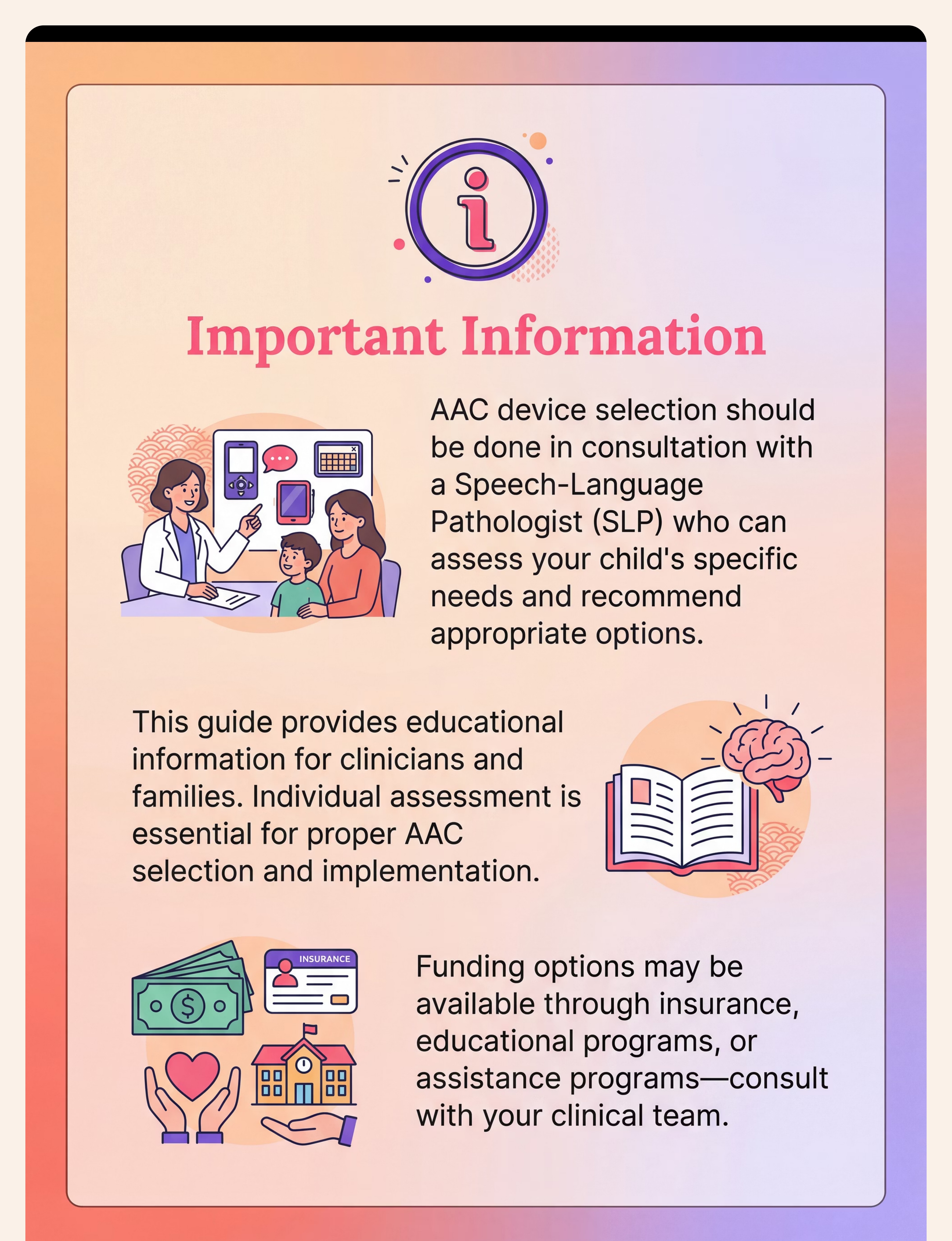
Disclaimer: This is educational information. Always consult qualified occupational therapists, speech-language pathologists, or pediatricians for personalized AAC assessment and recommendations. Individual results vary. AAC devices should be selected with professional guidance to ensure proper fit for your child's specific communication needs and abilities.