











Tool ID: 19.5
Tool ID: 19.5
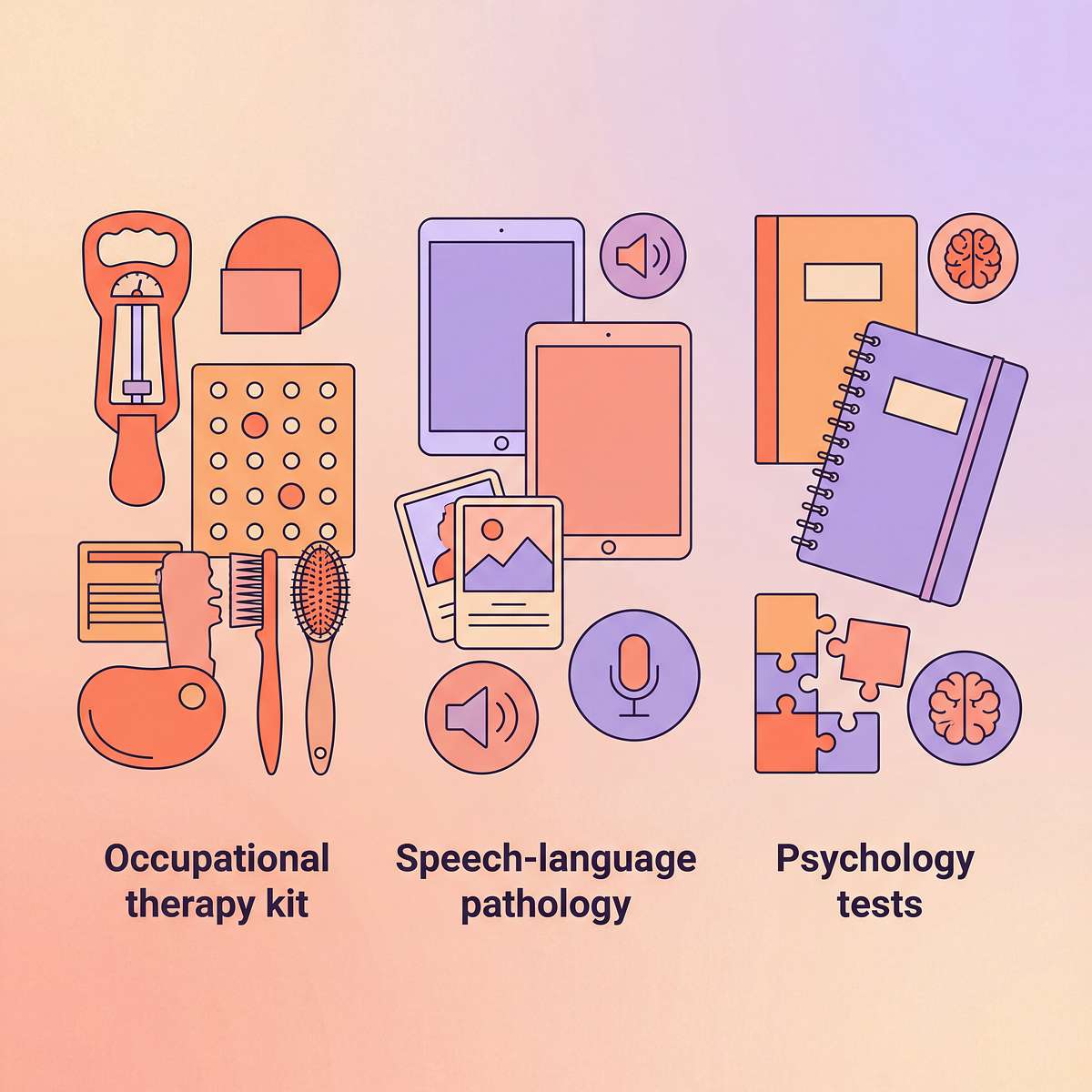
OT + SLP + Psychology
Strong Evidence
Rank #1
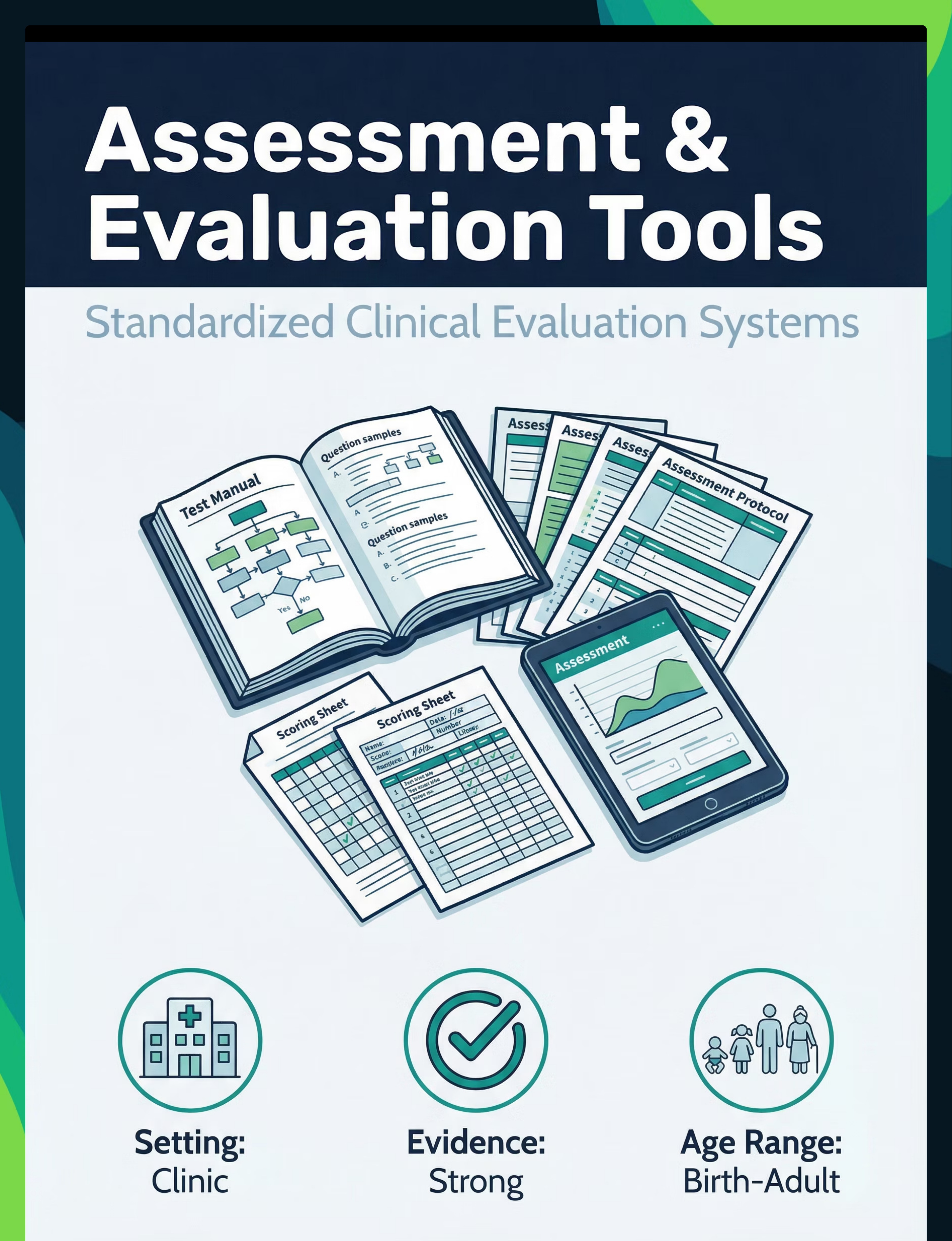
Assessment & Evaluation Tools
Standardized assessment and clinical evaluation system
Professional Kit
Clinic Use
As Needed
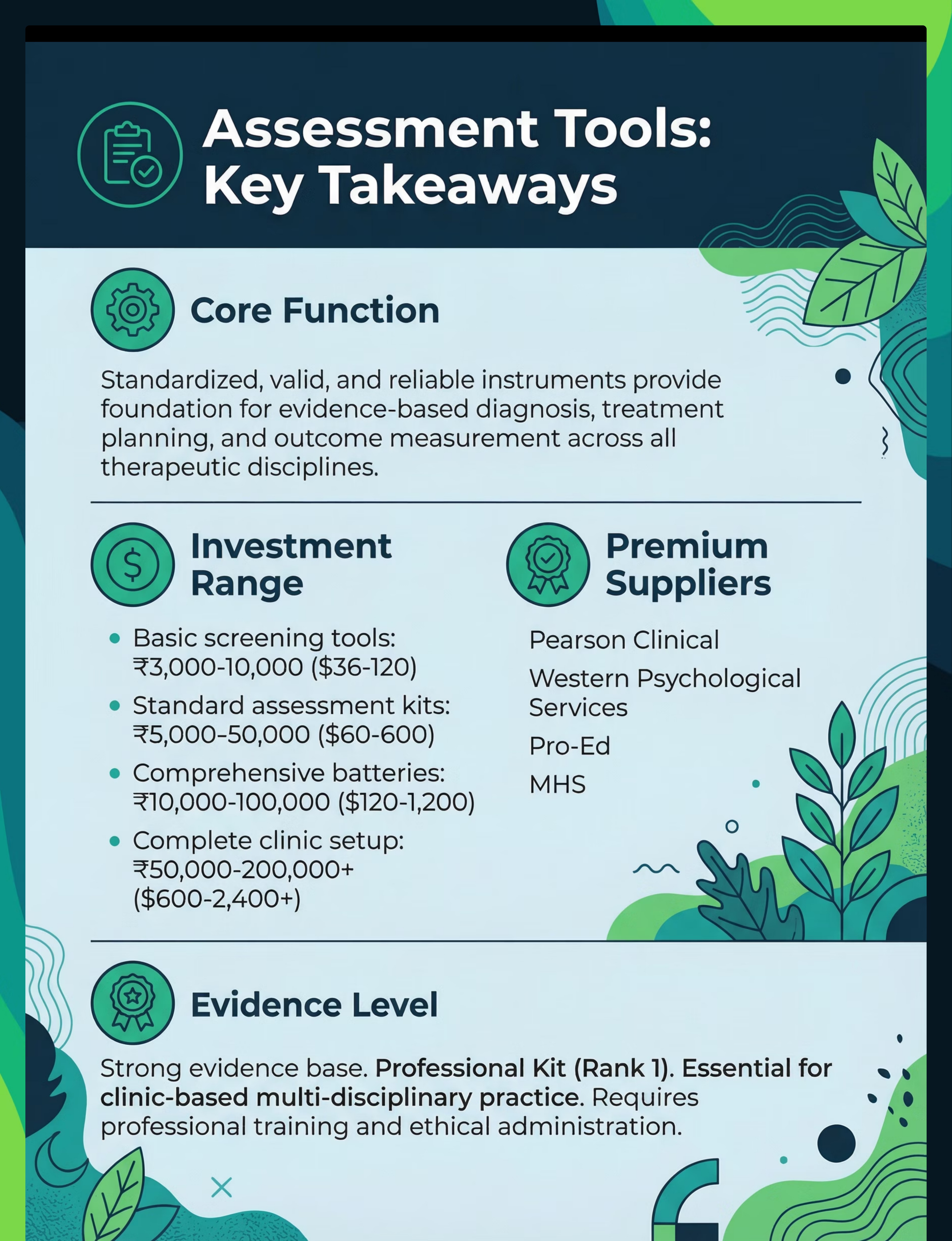
₹3,000–₹1,00,000
Who These Assessments Help
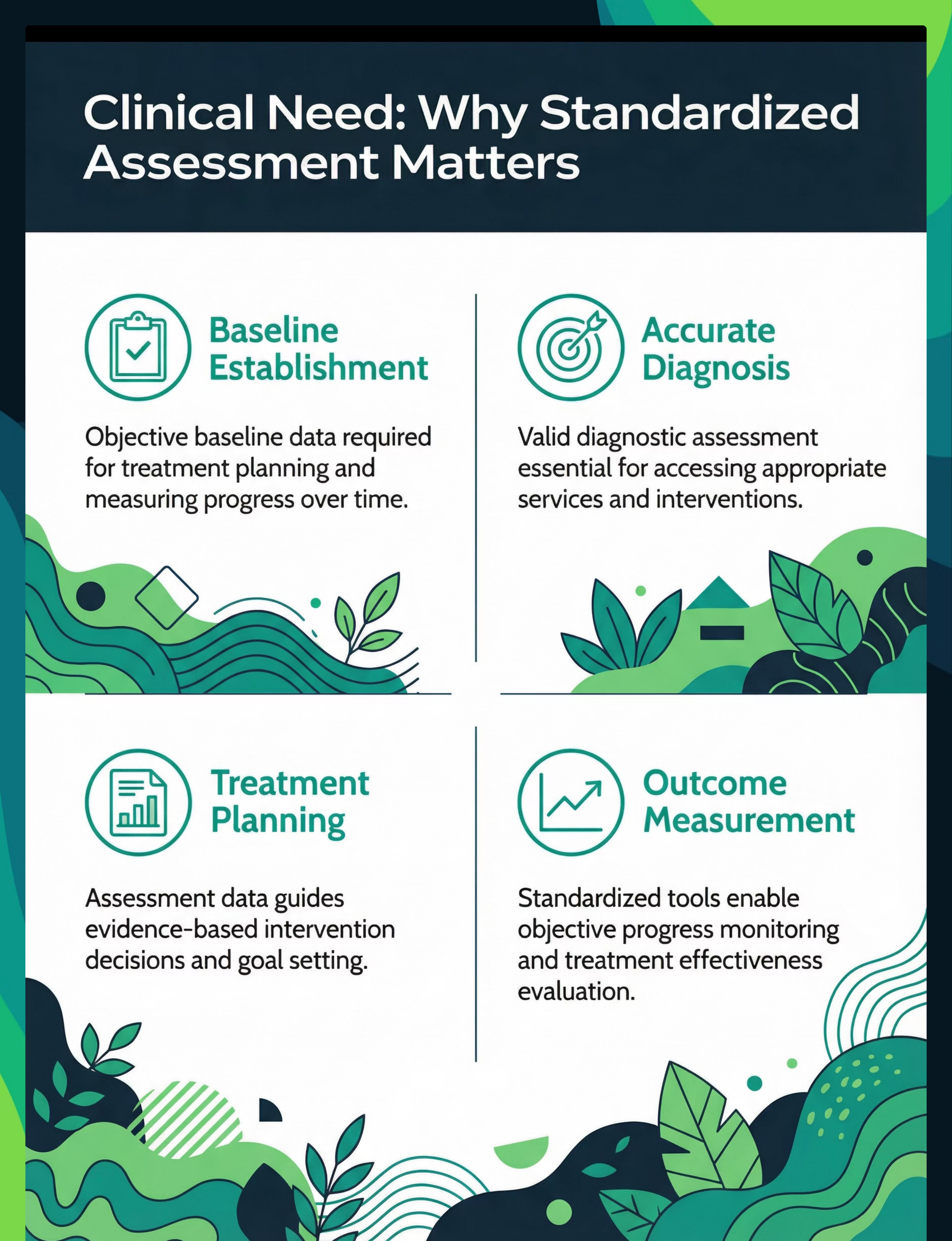
Diagnosis
Establish accurate developmental, autism, speech, or behavioral diagnoses
Baseline Establishment
Create objective starting points for measuring growth and progress
Treatment Planning
Design evidence-based, targeted intervention strategies
Progress Monitoring
Track development objectively over time with reliable data
Birth to Adult
Clinic Setting
Multi-disciplinary
These standardized tools provide the foundation for evidence-based practice across developmental, communication, sensory, motor, behavioral, and cognitive domains. They give clinicians, parents, and educators objective data for diagnosis, treatment planning, and measuring meaningful outcomes.
Does This Sound Familiar?
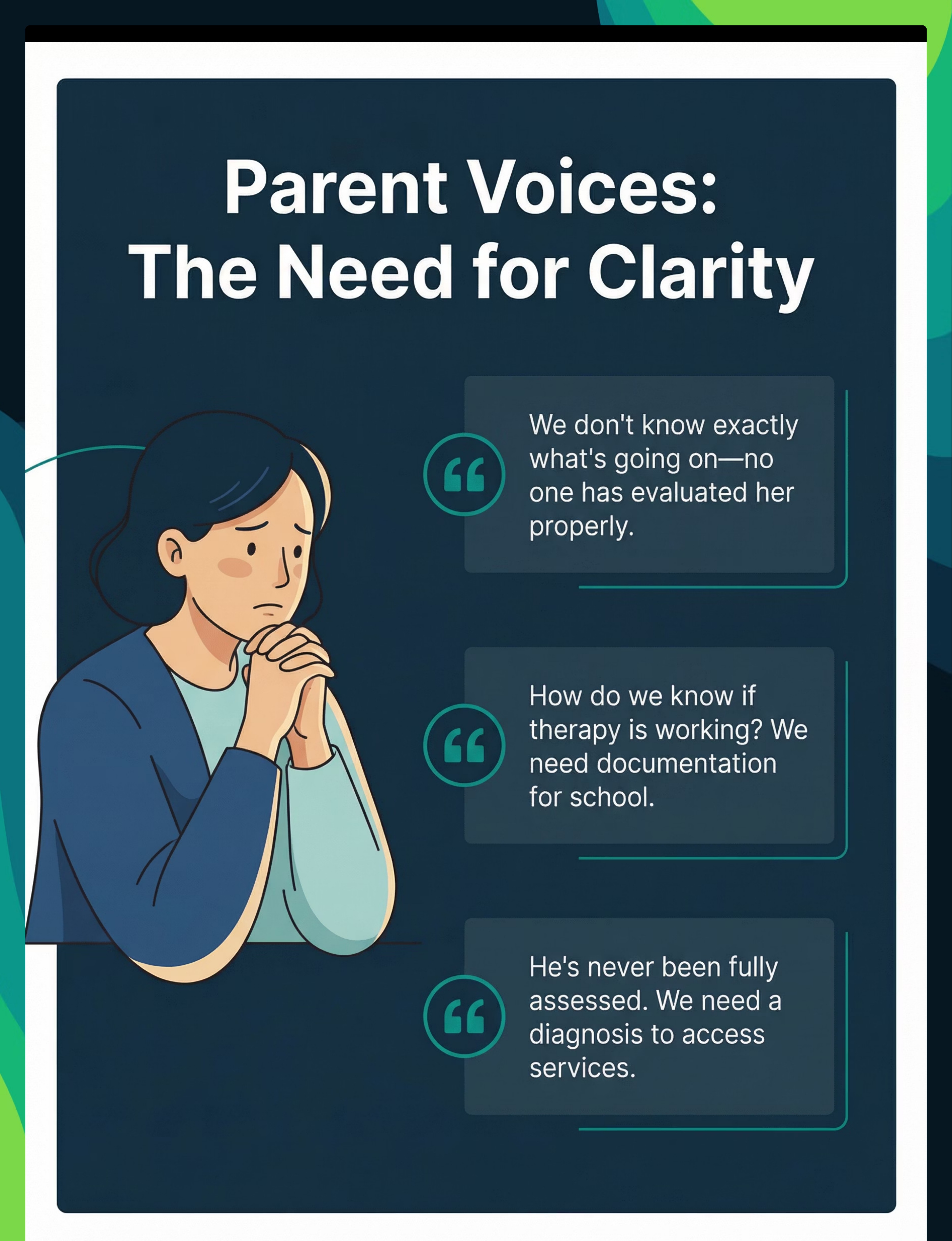
"We don't know exactly what's going on with our child."
"No one has evaluated her properly yet."
"We need a diagnosis to access services."
"How do we know if therapy is actually working?"
"We need documentation for school."
"He's never been fully assessed across all areas."
You're not alone. These are common challenges families face when seeking clarity about their child's development. Standardized assessments provide the objective answers you need to move forward with confidence.
The Journey Without Clear Assessment
No Diagnosis
Parents suspect autism or delays but lack formal diagnosis. Services inaccessible. Treatment not targeted. Family living in uncertainty.
Therapy Without Data
Child receives months of intervention with no objective measurement. Don't know if truly progressing. Resources invested without evidence of effectiveness.
Services Denied
School needs evaluation for support. Insurance requires diagnosis. No formal documentation means services denied. Doors remain closed.
Planning Without Direction
Professionals can't create targeted treatment plans without baseline data. Family makes decisions in the dark. Every choice feels uncertain.
The Science Behind Standardized Assessment
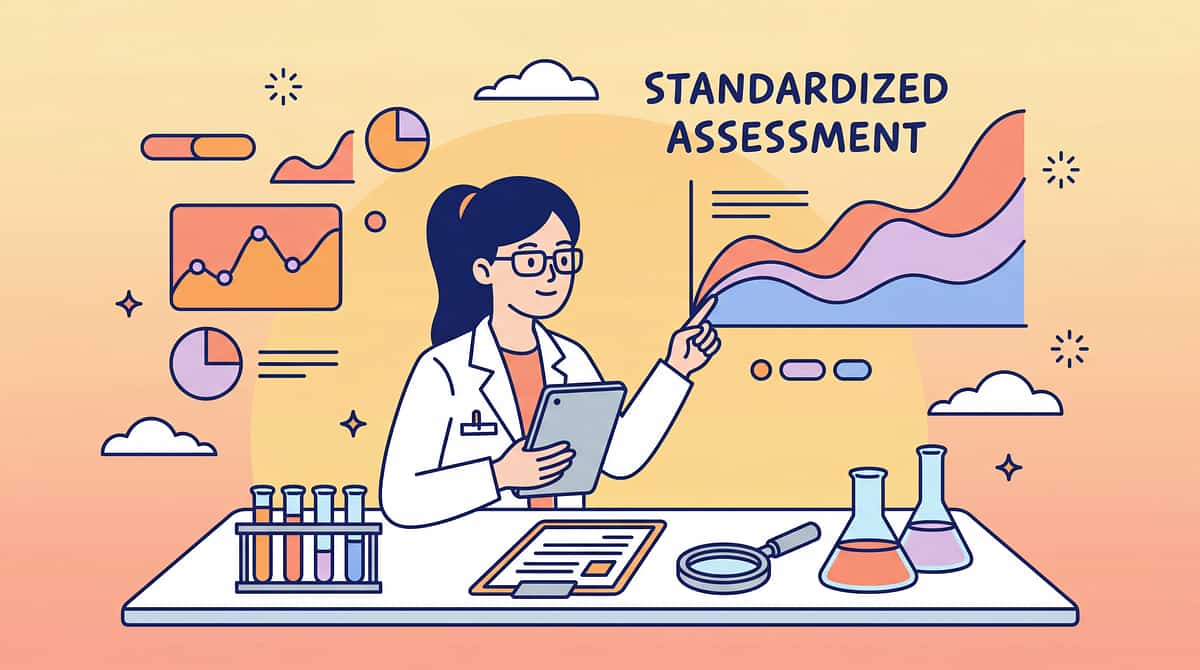
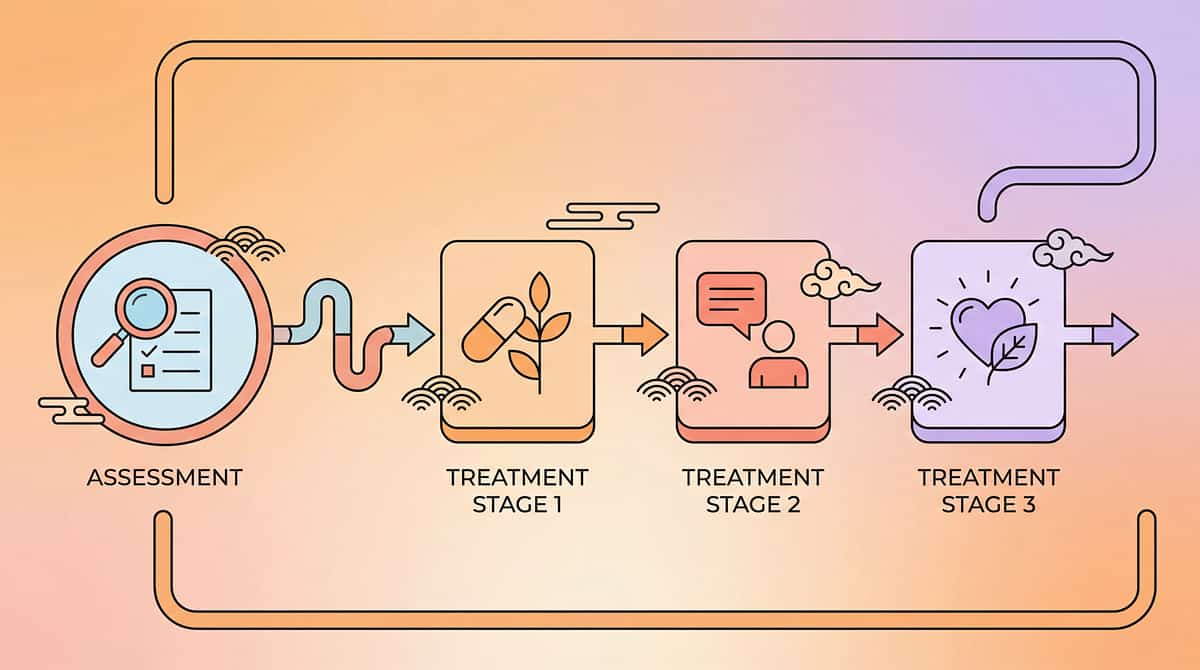
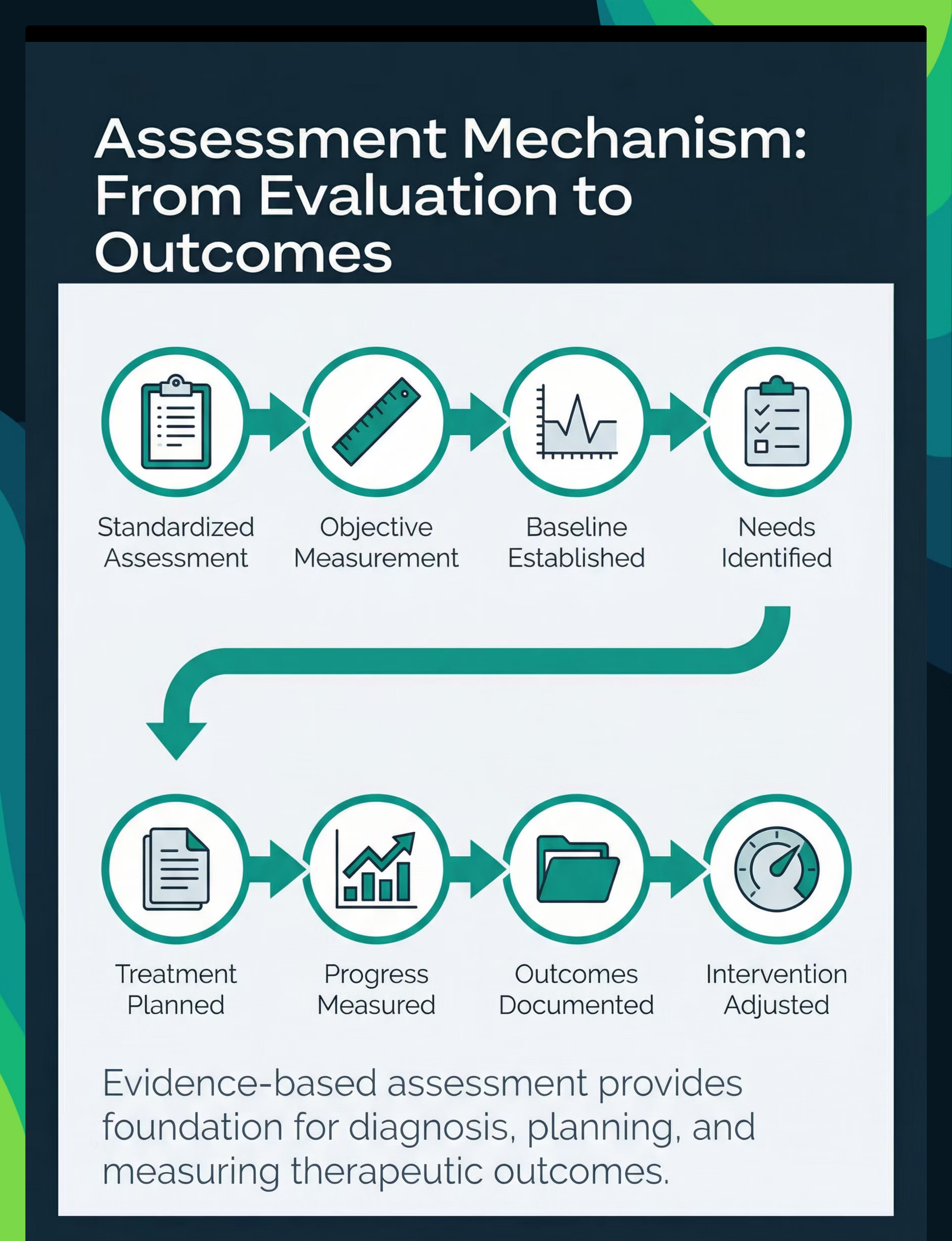
Standardized Assessment
Trained clinician administers validated tools using consistent procedures across all children
Objective Measurement
Scores compared against normative data to understand where child stands developmentally
Baseline Established
Clear starting point documented for strengths, challenges, and developmental profile
Needs Identified
Specific areas requiring intervention become clear and prioritized
Treatment Planned
Evidence-based interventions designed to target identified needs precisely
Progress Measured
Regular reassessment shows objective growth and guides adjustments
Diagnosis
Baseline Establishment
Treatment Planning
Progress Monitoring
Outcome Measurement
Research
How to Use Assessments Right
Use Within Scope
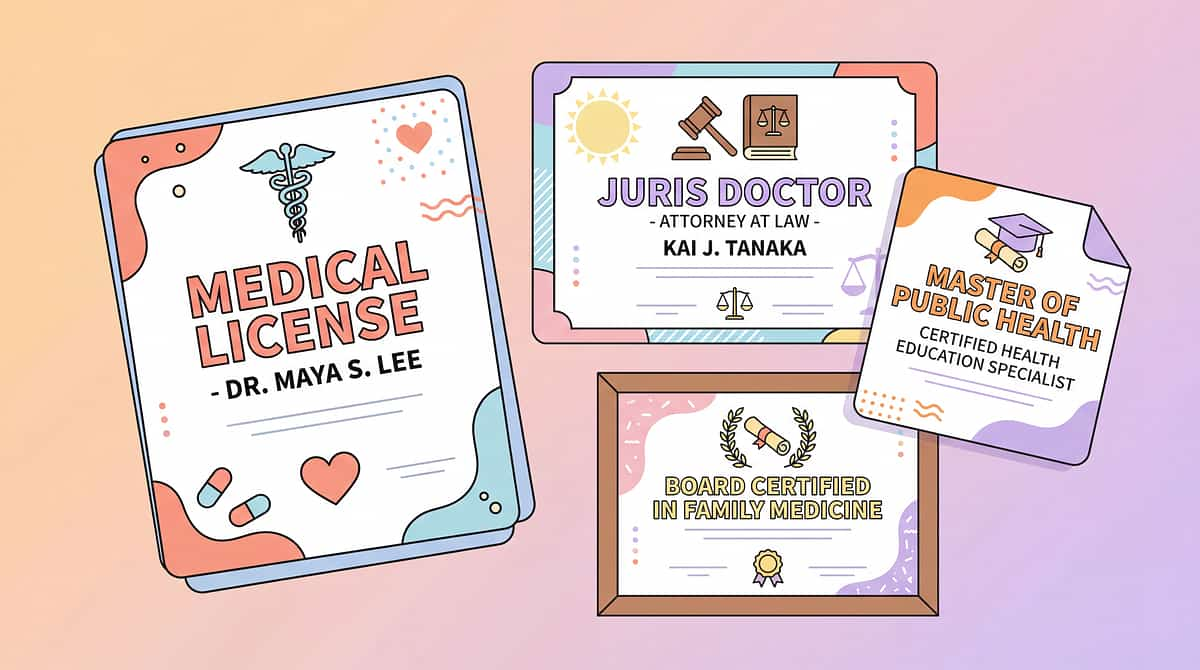
Administer only assessments for which you have proper training and credentials. Professional qualifications ensure valid results.
Follow Standardization
Adhere strictly to standardized administration procedures. Consistency ensures reliability and allows comparison to norms.
Consider Culture
Account for cultural and linguistic factors that may affect performance. Choose culturally appropriate tools when available.
Combine Methods
Integrate standardized scores with clinical observation, parent reports, and functional analysis for complete picture.
Monitor Regularly
Conduct progress monitoring at appropriate intervals. Regular data collection shows growth and informs treatment adjustments.
Multi-Disciplinary Approach
Coordinate assessments across disciplines when indicated. Comprehensive evaluation captures full developmental profile.
Duration: Assessment sessions typically range from 30 minutes to 8 hours depending on the specific tool and child's needs.
Expert Perspective
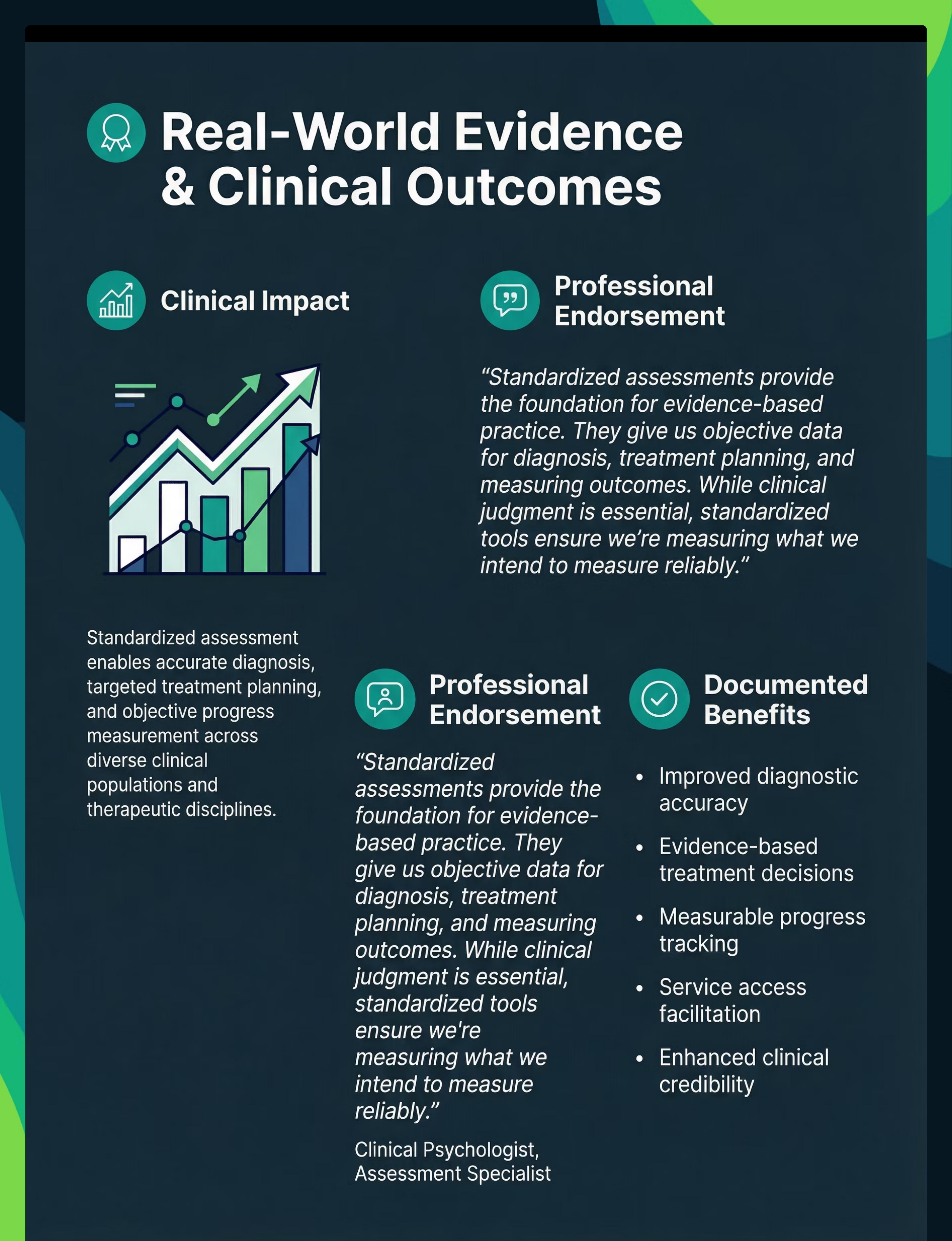
"Standardized assessments provide the foundation for evidence-based practice. They give us objective data for diagnosis, treatment planning, and measuring outcomes. While clinical judgment is essential, standardized tools ensure we're measuring what we intend to measure reliably."
— Clinical Psychologist, Assessment Specialist
OT + SLP + Psychology Recommended
Strong Evidence
Rank #1 in Category
assessment-evaluation-tools therapy material
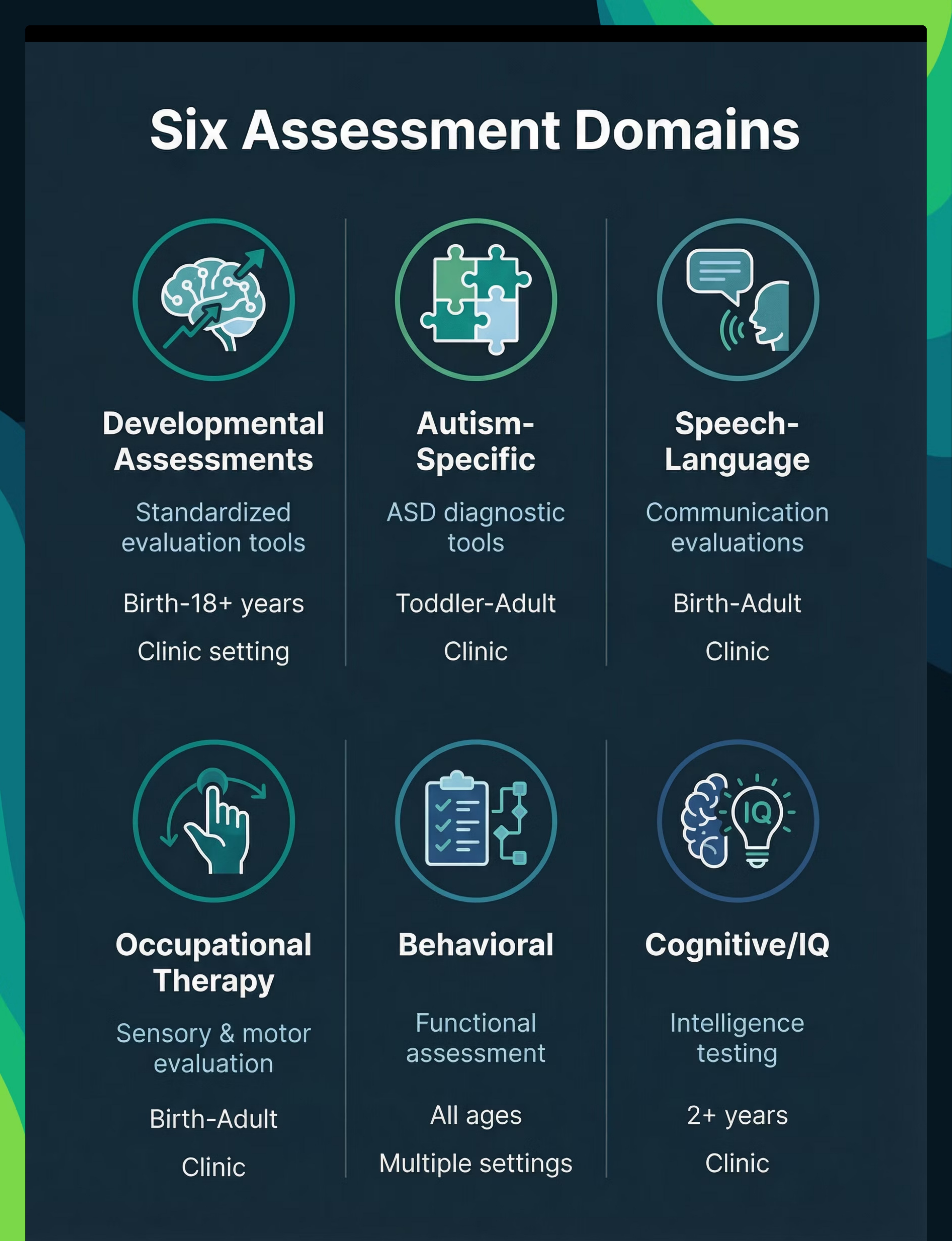
Choose Your Assessment (6 Categories)
Developmental Assessments
Best for: Overall developmental evaluation
Ages: Birth-18+ years
Settings: Clinic
Price: ₹5,000–₹50,000
Standardized evaluation tools
Autism-Specific Assessments
Best for: Autism diagnosis, severity, skills
Ages: Toddler-Adult
Settings: Clinic
Price: ₹10,000–₹1,00,000
ASD diagnostic tools
Speech-Language Assessments
Best for: Speech, language, communication evaluation
Ages: Birth-Adult
Settings: Clinic
Price: ₹5,000–₹40,000
Communication evaluations
Occupational Therapy Assessments
Best for: Sensory, motor, functional evaluation
Ages: Birth-Adult
Settings: Clinic
Price: ₹5,000–₹40,000
OT evaluation tools
Behavioral Assessments
Best for: Behavioral function, skills assessment
Ages: All ages
Settings: Clinic, School, Home
Price: ₹3,000–₹30,000
Functional behavior assessment
Cognitive/IQ Assessments
Best for: Cognitive ability, learning profile
Ages: 2+ years
Settings: Clinic
Price: ₹10,000–₹80,000
Intelligence testing

How to Choose
  • By goal: Diagnosis vs. treatment planning vs. progress monitoring
  • By domain: Developmental, communication, sensory, motor, behavioral, cognitive
  • By setting: Most require clinic; some behavioral tools allow home/school use
Assessment Types & Specifications
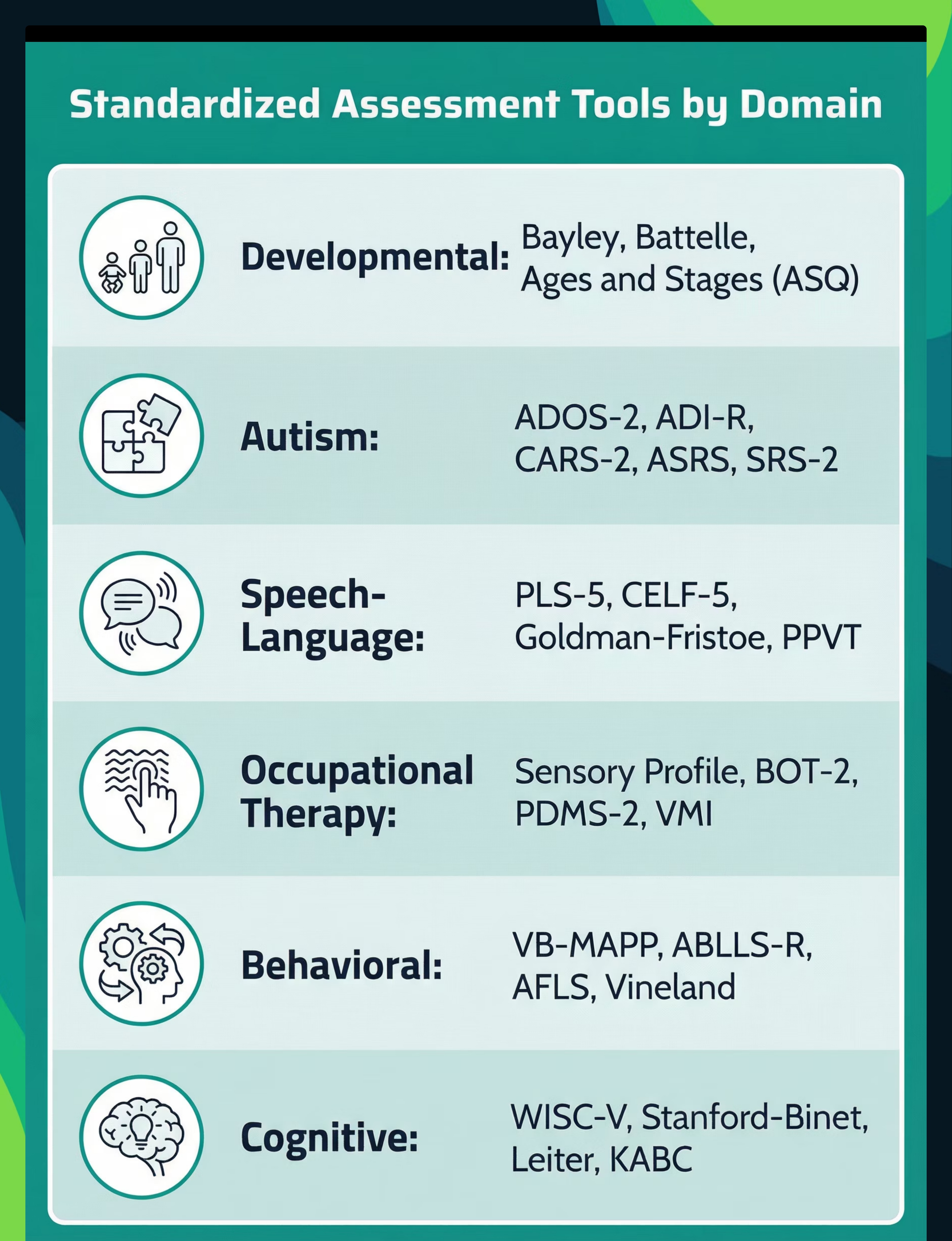
Assessment Categories
Developmental
Bayley, Battelle, Ages and Stages (ASQ)
Autism
ADOS-2, ADI-R, CARS-2, ASRS, SRS-2
Speech-Language
PLS-5, CELF-5, Goldman-Fristoe, PPVT
Occupational Therapy
Sensory Profile, BOT-2, PDMS-2, VMI
Behavioral
VB-MAPP, ABLLS-R, AFLS, Vineland
Cognitive
WISC-V, Stanford-Binet, Leiter, KABC
Materials & Key Features
Materials Include:
  • Test kits with standardized materials
  • Administration manuals with protocols
  • Scoring materials and forms
  • Digital software platforms
assessment-evaluation-tools therapy material
Key Features:
Standardized
Valid
Reliable
Normed
Evidence-based
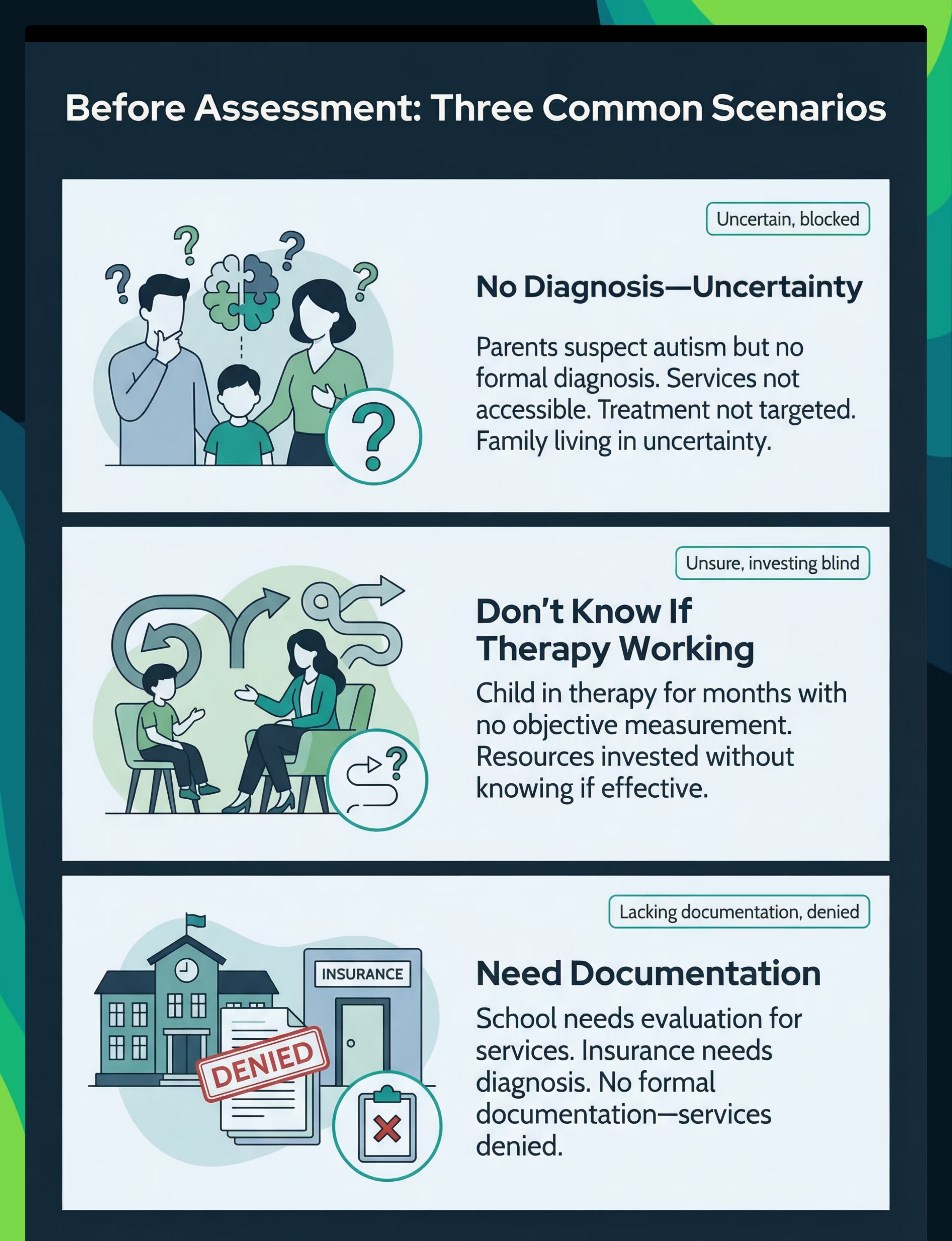
The Struggle (Before Assessment)
No Diagnosis - Living in Uncertainty
Situation: Parents suspect autism but no formal diagnosis exists
Experience: Services not accessible. Treatment not targeted. Family living day-to-day without clear direction or understanding.
Emotion: Uncertain, blocked, frustrated
Don't Know If Therapy Is Working
Situation: Child has been in therapy for months without measurement
Experience: No objective data to show progress. Don't know if intervention is effective. Resources and time invested without knowing outcomes.
Emotion: Unsure, investing blind, anxious
Need Documentation - Services Denied
Situation: School needs evaluation. Insurance requires diagnosis.
Experience: No formal documentation available. Services denied repeatedly. Child not receiving needed support.
Emotion: Lacking documentation, denied, helpless
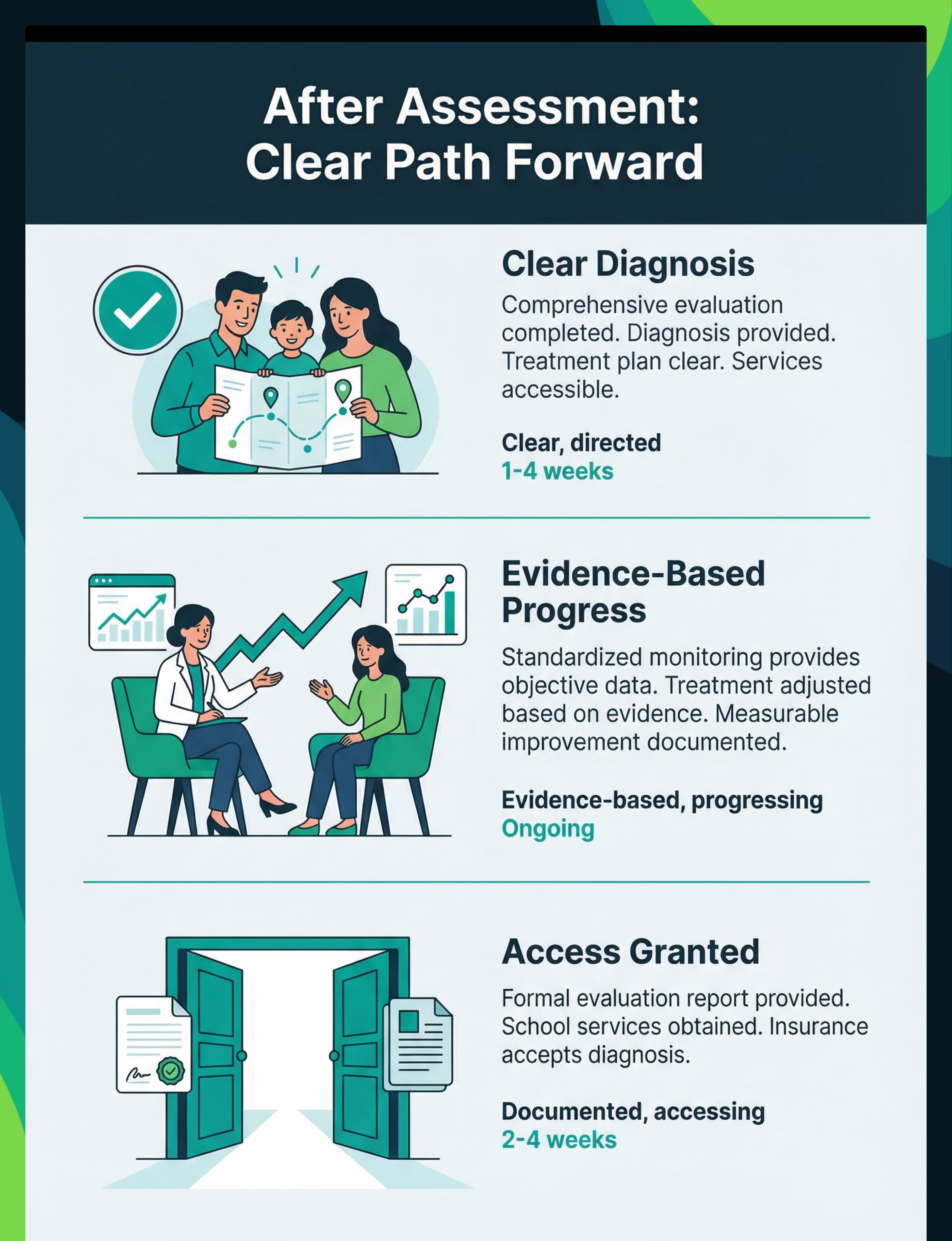
The Breakthrough (After Assessment)
Diagnosis - Clear Direction Forward
Situation: Comprehensive evaluation completed with formal diagnosis
Experience: Diagnosis provided with clarity. Strengths and needs clearly identified. Treatment plan makes sense. Services now accessible.
Emotion: Clear, directed, empowered
1-4 weeks
Evidence of Progress - Data-Driven
Situation: Standardized progress monitoring in place
Experience: Objective data clearly shows improvement. Treatment adjusted based on evidence. Can see and measure meaningful growth.
Emotion: Evidence-based, progressing, confident
Ongoing
Documentation - Doors Opened
Situation: Formal evaluation report and professional documentation received
Experience: School services obtained. Insurance accepts diagnosis. Support systems activated. Appropriate accommodations provided.
Emotion: Documented, accessing services, relieved
2-4 weeks
What to Expect (Realistic Timelines)
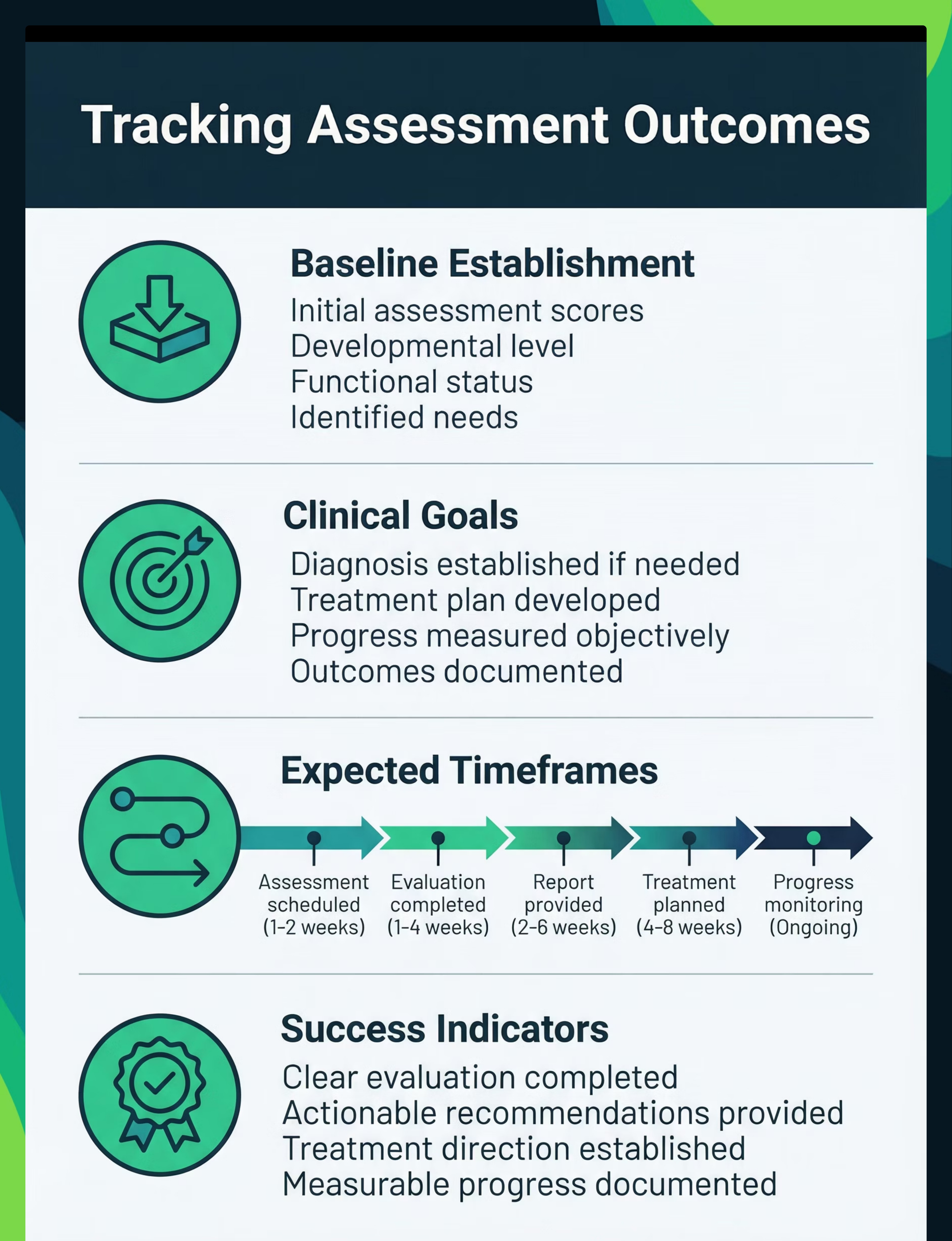
Assessment Scheduled
Initial consultation completed, appropriate assessments selected, appointment booked with qualified professional.
1-2 weeks
Evaluation Completed
All assessment sessions finished, scoring and analysis underway, clinical observations documented thoroughly.
1-4 weeks
Report Provided
Comprehensive written report delivered with scores, interpretations, diagnosis (if applicable), and clear recommendations.
2-6 weeks
Treatment/Services Planned
Evidence-based intervention plan created, services accessed, accommodations arranged, team coordinated.
4-8 weeks
Progress Monitoring Ongoing
Regular reassessment tracks growth objectively, treatment adjusted based on data, outcomes measured continuously.
Ongoing
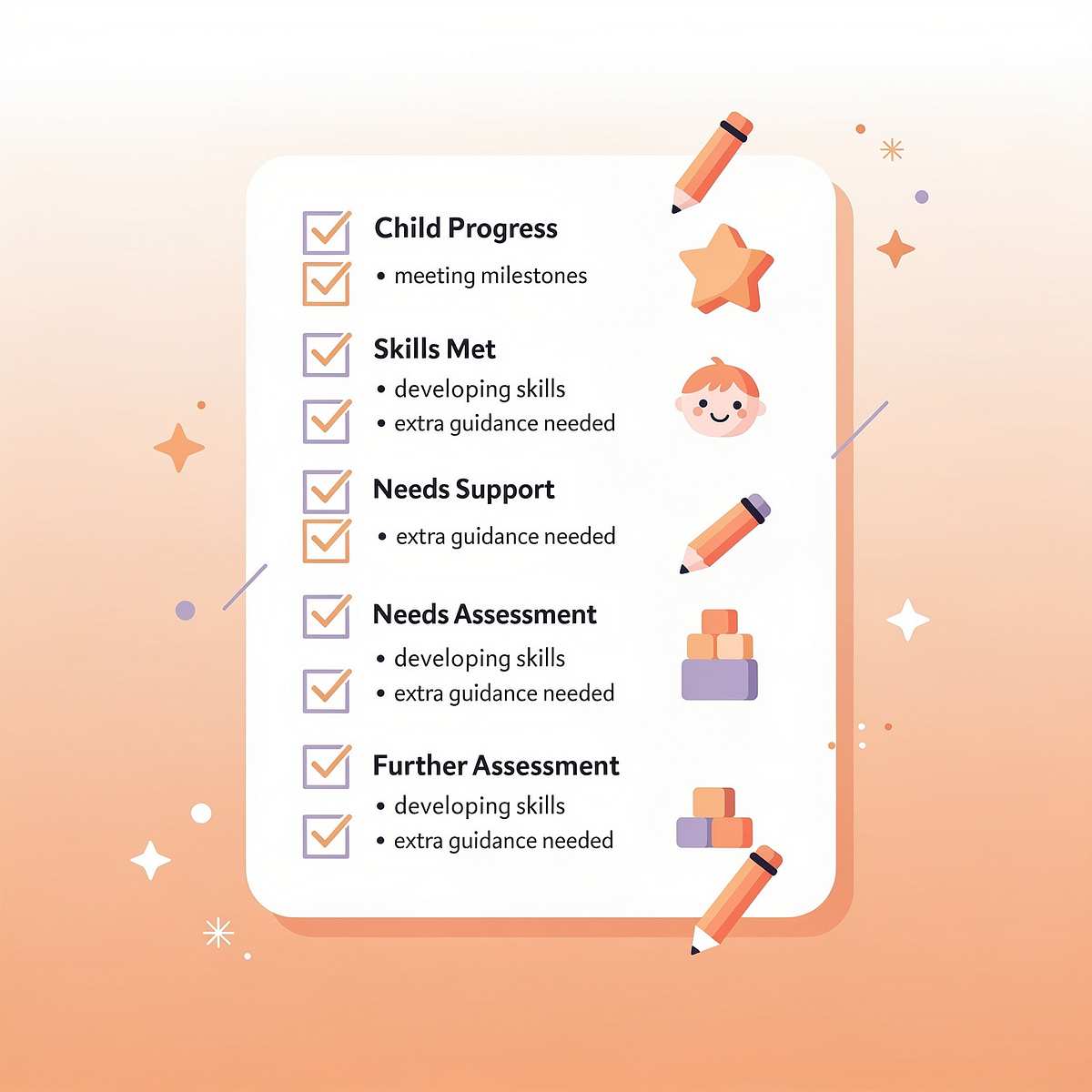
Is This Right for My Child? (2-Minute Check)
Has your child had a formal evaluation?
If yes, this indicates: Baseline established
If no, this indicates: Evaluation may be needed
Do you have a diagnosis or documentation needed for services?
If yes, this indicates: Documentation in place
If no, this indicates: Assessment may be needed
Do you know if therapy is producing measurable results?
If yes, this indicates: Progress monitoring in place
If no, this indicates: Outcome measurement needed
When was the last comprehensive evaluation?
Response guides: Whether re-evaluation is needed (typically every 1-3 years)

Interpretation: If you answered "no" to questions 1, 2, or 3, or if the last evaluation was more than 2-3 years ago, a comprehensive assessment may benefit your child's treatment planning and progress.
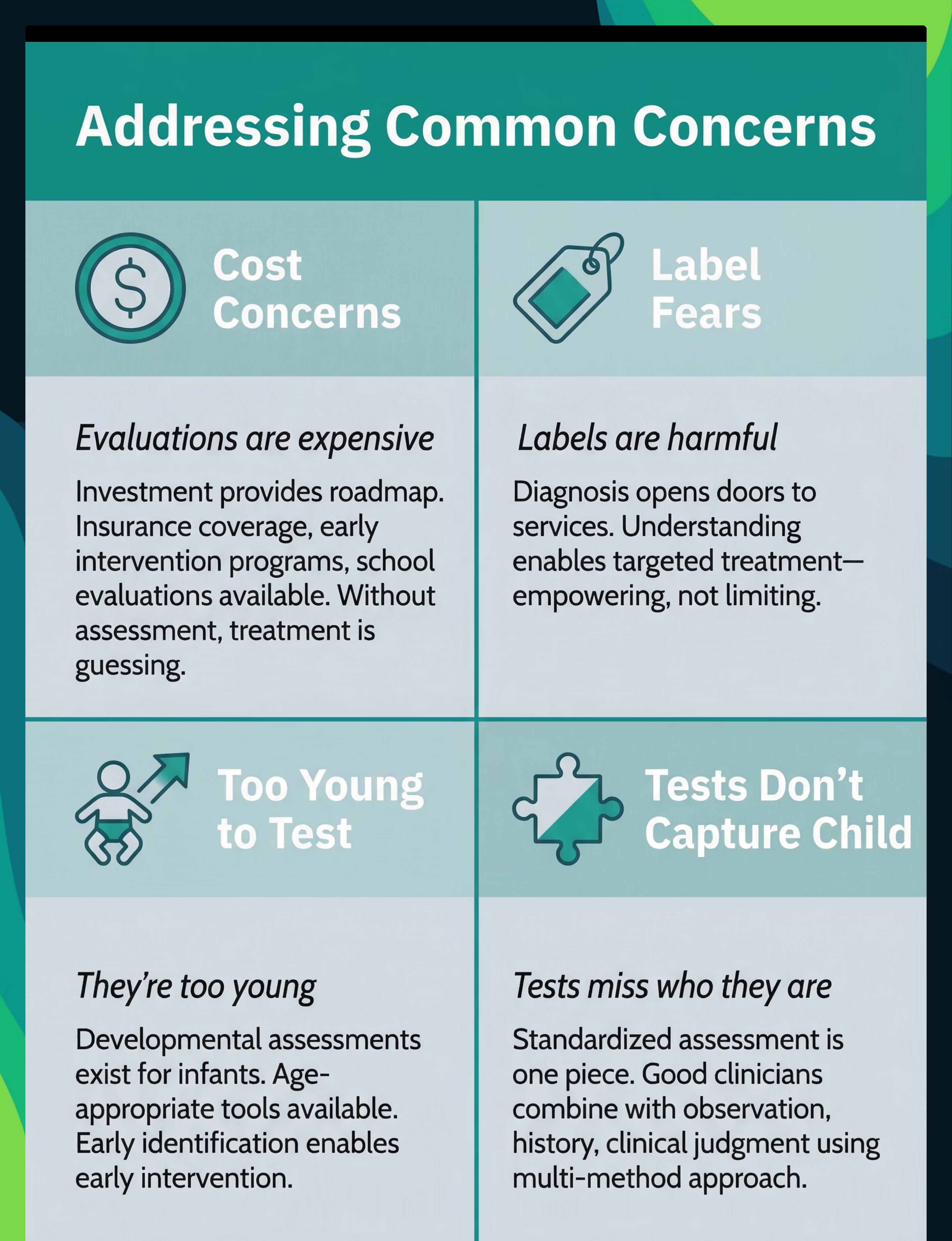
Common Questions (Honest Answers)
Q: Evaluations are expensive
A: Consider insurance coverage options, early intervention programs (often free), school-based evaluations, and community clinic rates. This investment provides a roadmap. Without assessment, treatment becomes guesswork—potentially wasting more resources long-term.
Try this: Explore coverage options; investment provides roadmap for targeted treatment.
Q: Labels are harmful
A: Diagnosis opens doors to services and support. Understanding your child's profile helps target treatment effectively. It can be empowering, not limiting. Without diagnosis, the same challenges exist but without the support systems.
Try this: View diagnosis as opening doors and enabling understanding, not limiting potential.
Q: They're too young to test
A: Developmental assessments exist for infants as young as birth. Early identification enables early intervention, which produces the best outcomes. Age-appropriate tools are available. It's never too young for evaluation.
Try this: Seek age-appropriate infant/toddler assessments; early identification enables early help.
Q: Tests don't capture my child
A: Standardized tests are one piece of the puzzle. Good clinicians combine test scores with observations, developmental history, and clinical judgment. Multi-method assessment is best practice. Always share your concerns with the evaluator.
Try this: Request comprehensive evaluation combining multiple methods and parent input.
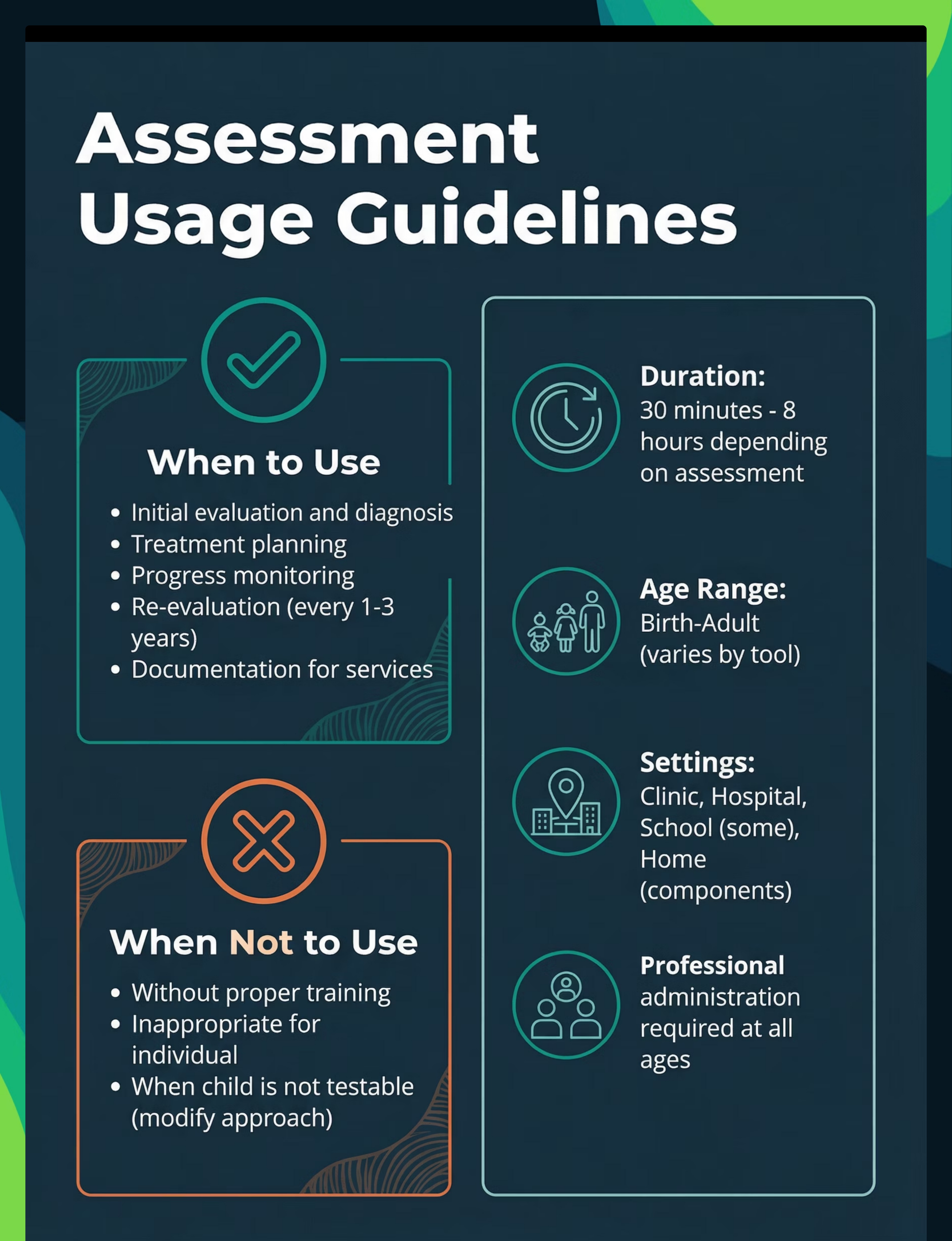
Usage Guide
When to Use
  • Initial evaluation for diagnosis
  • Treatment planning and goal setting
  • Progress monitoring and outcome tracking
  • Re-evaluation (typically every 1-3 years)
  • Documentation for school or insurance
When NOT to Use
  • Without proper professional training
  • When assessment is inappropriate for individual
  • When child is not in optimal testing state (modify approach as needed)
Supervision by Age
Young Children
Direct administration by trained professional
School Age
Professional administers with age-appropriate adaptations
Adolescents
Professional administers with accommodations as needed
Settings & Duration
Clinic
Hospital
School (some)
Duration: 30 minutes to 8 hours depending on assessment type and child's needs
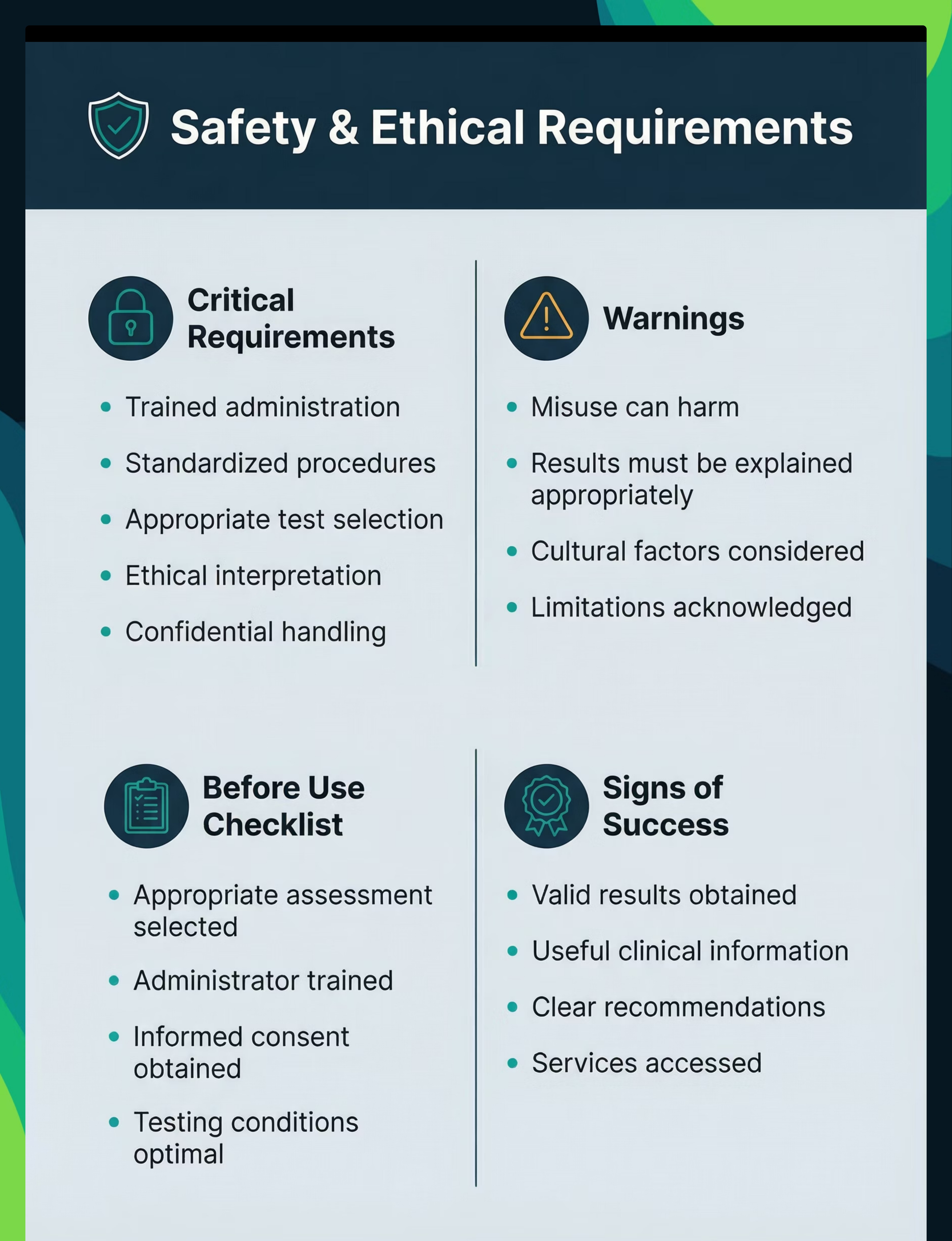
Safety & Ethical Use
Critical Safety
  • Trained administration required
  • Follow standardized procedures
  • Appropriate test selection essential
  • Ethical interpretation mandatory
  • Confidential handling of results
Warnings
  • Misuse can cause significant harm
  • Results must be explained appropriately to families
  • Cultural factors must be considered
  • Acknowledge limitations of tools
Contraindicated
  • Use by untrained individuals
  • Inappropriate test selection for individual
Safety Checklist
Before Use
  • Appropriate assessment selected
  • Administrator trained and credentialed
  • Informed consent obtained
  • Testing conditions optimal
During Use
  • Standardized administration followed
  • Rapport maintained with child
  • Behavioral observations noted
  • Child's state monitored continuously
Signs of Success
  • Valid results obtained
  • Useful clinical information gained
  • Clear recommendations provided
  • Services successfully accessed
Investment Guide
Understanding the financial aspects of psychological assessments is crucial. Here's a breakdown of typical costs and considerations:
Basic Screening Tools
₹3,000–₹10,000
Comprehensive Assessment Battery
₹50,000–₹2,00,000
Overall Range: ₹3,000–₹1,00,000 (USD $36–$1,200)
Basic Screening Tools
  • Screening tools identify need for further evaluation but don't provide comprehensive diagnosis.
  • Suitable for initial identification and community-level screening programs.
Comprehensive Assessment Battery
  • Full diagnostic evaluation with multi-domain assessment, detailed reporting, and treatment recommendations.
  • Leading brands: Pearson, WPS, Pro-Ed, MHS.
Initial Investment
Comprehensive assessments represent a significant upfront investment.
Long-Term Foundation
They provide the foundation for years of targeted, effective treatment.
Avoiding Ineffective Interventions
Without proper assessment, families often spend more on ineffective interventions due to lack of direction.

Investment Consideration: While comprehensive assessments represent a significant investment, they provide the foundation for years of targeted, effective treatment. Without proper assessment, families often spend more on ineffective interventions due to lack of direction.
Where to Access in India
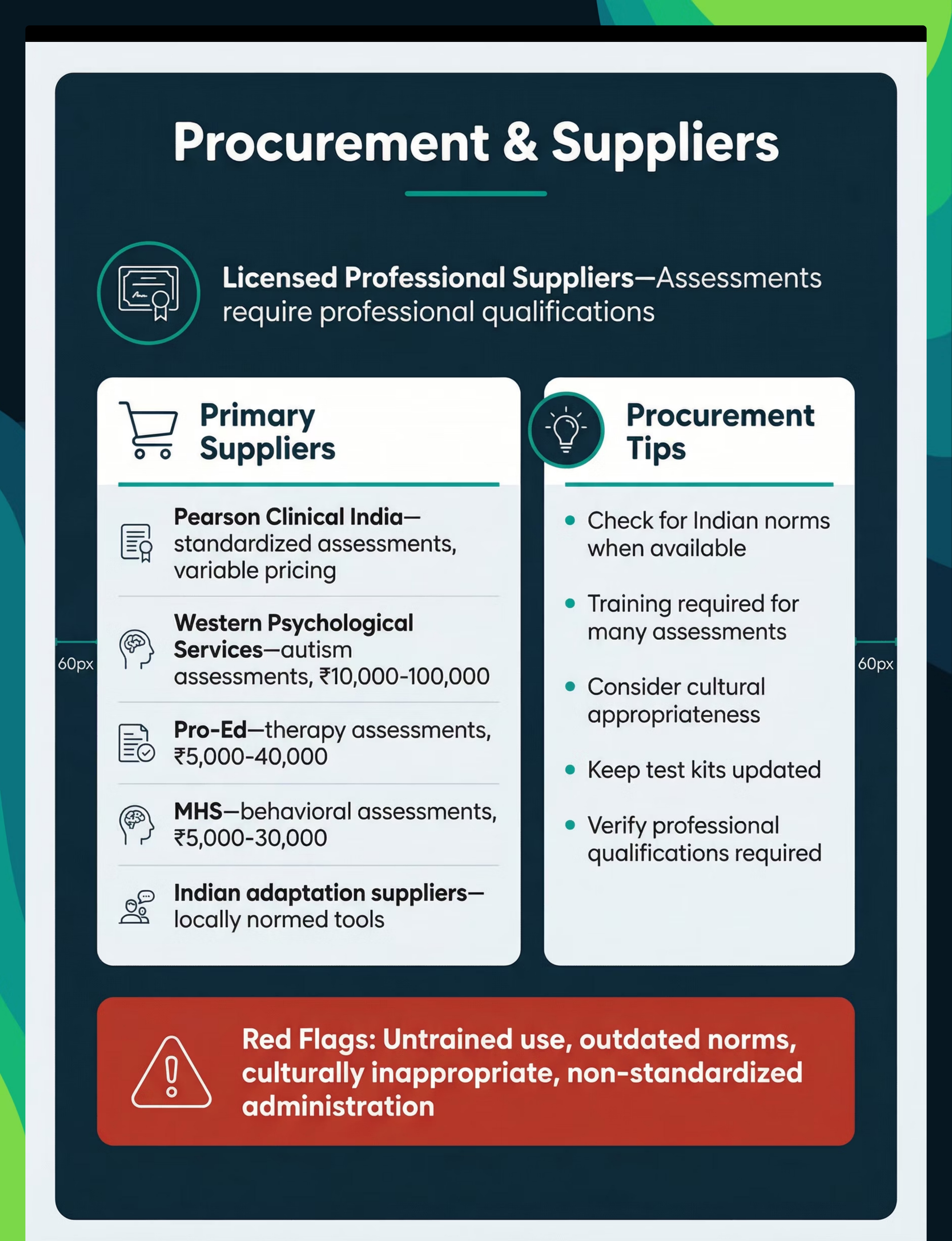
Availability: Licensed Professional Suppliers
Platform
Search For
Price Range
Pearson Clinical India
Standardized assessments
Variable
Western Psychological Services
Autism assessments
₹10,000–₹1,00,000
Indian adaptation suppliers
Indian normed assessments
Variable
Pro-Ed
Therapy assessments
₹5,000–₹40,000
MHS
Behavioral assessments
₹5,000–₹30,000
Buying Tips
  • Assessments require professional qualifications to purchase
  • Check for Indian norms when available for cultural appropriateness
  • Training required for administration of many assessments
  • Consider cultural and linguistic appropriateness
  • Keep test kits updated with latest editions
Red Flags
  • Use by untrained individuals
  • Outdated normative data
  • Culturally inappropriate tools
  • Non-standardized administration
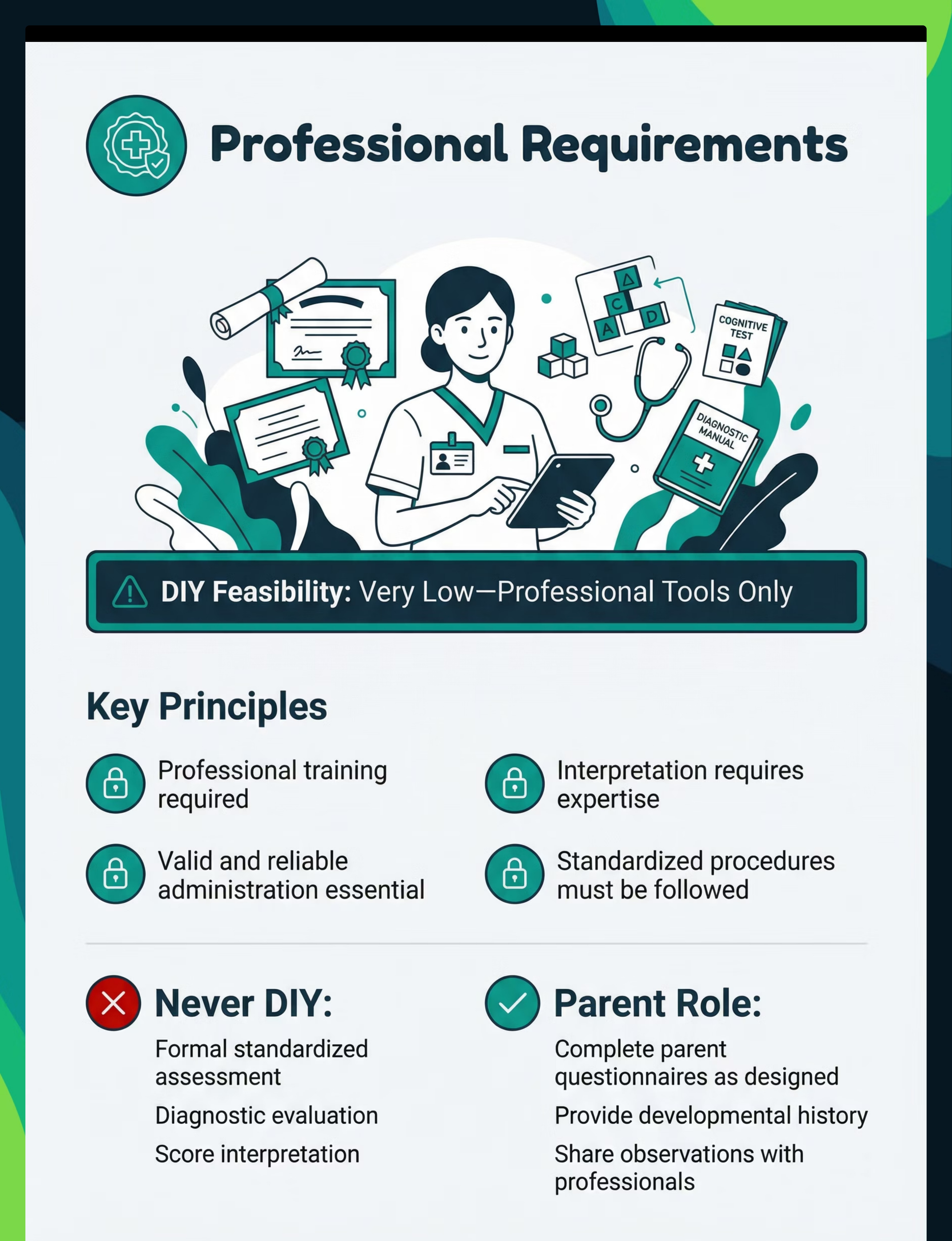
Professional Requirements (No DIY)
DIY Not Appropriate
Feasibility: Very Low (professional tools only)
  • DIY is not appropriate for standardized assessment
  • Professional training and credentials required
  • Valid and reliable administration essential
  • Clinical interpretation requires expertise
  • Always seek professional evaluation
When "DIY" Applies
  • Never for formal assessment: Professional administration is mandatory
  • Parent questionnaires only: Some assessments include parent-completed forms as designed
  • These parent forms are part of professional assessment, not standalone DIY
Always Use Professionals When
  • Standardized assessment needed
  • Diagnosis required
  • Treatment planning required
  • School or insurance documentation needed
  • Progress monitoring needed

Critical Note: Attempting to use professional assessment tools without proper training can result in invalid results, misdiagnosis, inappropriate treatment, and potential harm. Professional evaluation is a critical investment in your child's care.

Preview of assessment evaluation tools Therapy Material

Below is a visual preview of assessment evaluation tools therapy material. The pages shown help educators, therapists, and caregivers understand the structure and content of the resource before use. Materials should be used under appropriate professional guidance.

Page 1
Page 2
Page 3
Page 4
Page 5
Page 6
Page 7
Page 8
Page 9
Page 10
Page 11
Page 12
Page 13
Page 14
Page 15
Page 16
Page 17
Page 18
Page 19
Page 20
Link copied!
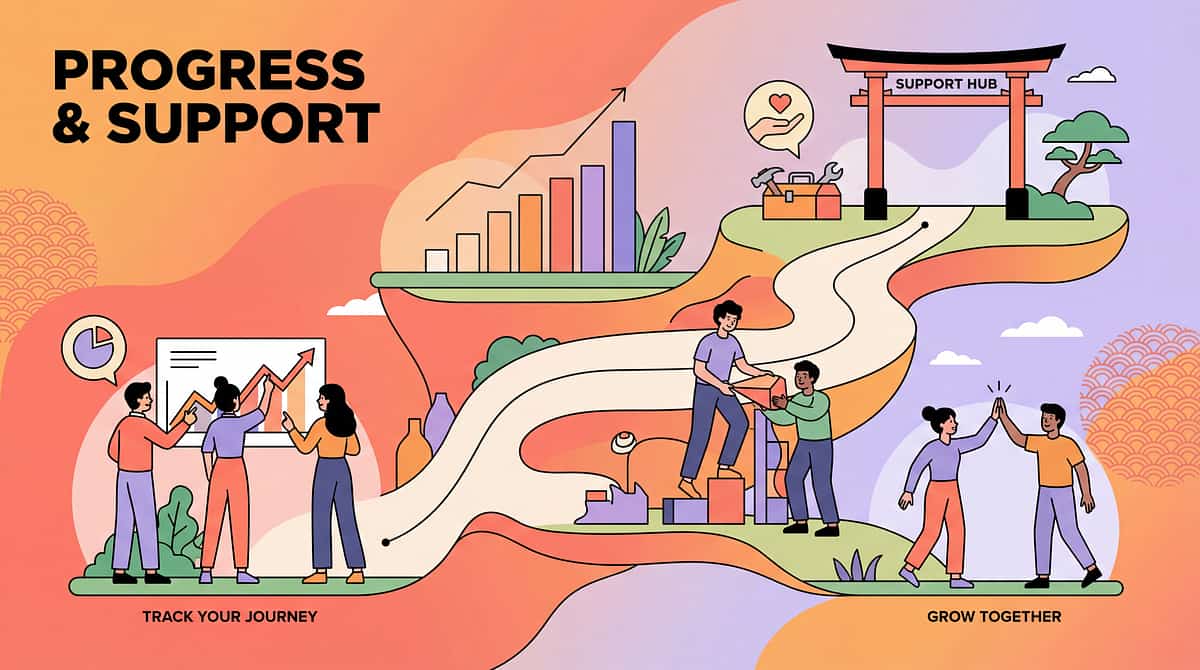
Measuring Success & Getting Support
Track Progress
Baseline Metrics
Initial assessment scores, developmental level, functional status, identified needs
Goals
Diagnosis established if needed, evidence-based treatment plan developed, progress measured objectively, outcomes documented
Success Indicators
Clear evaluation completed, actionable recommendations provided, treatment direction established, measurable progress demonstrated

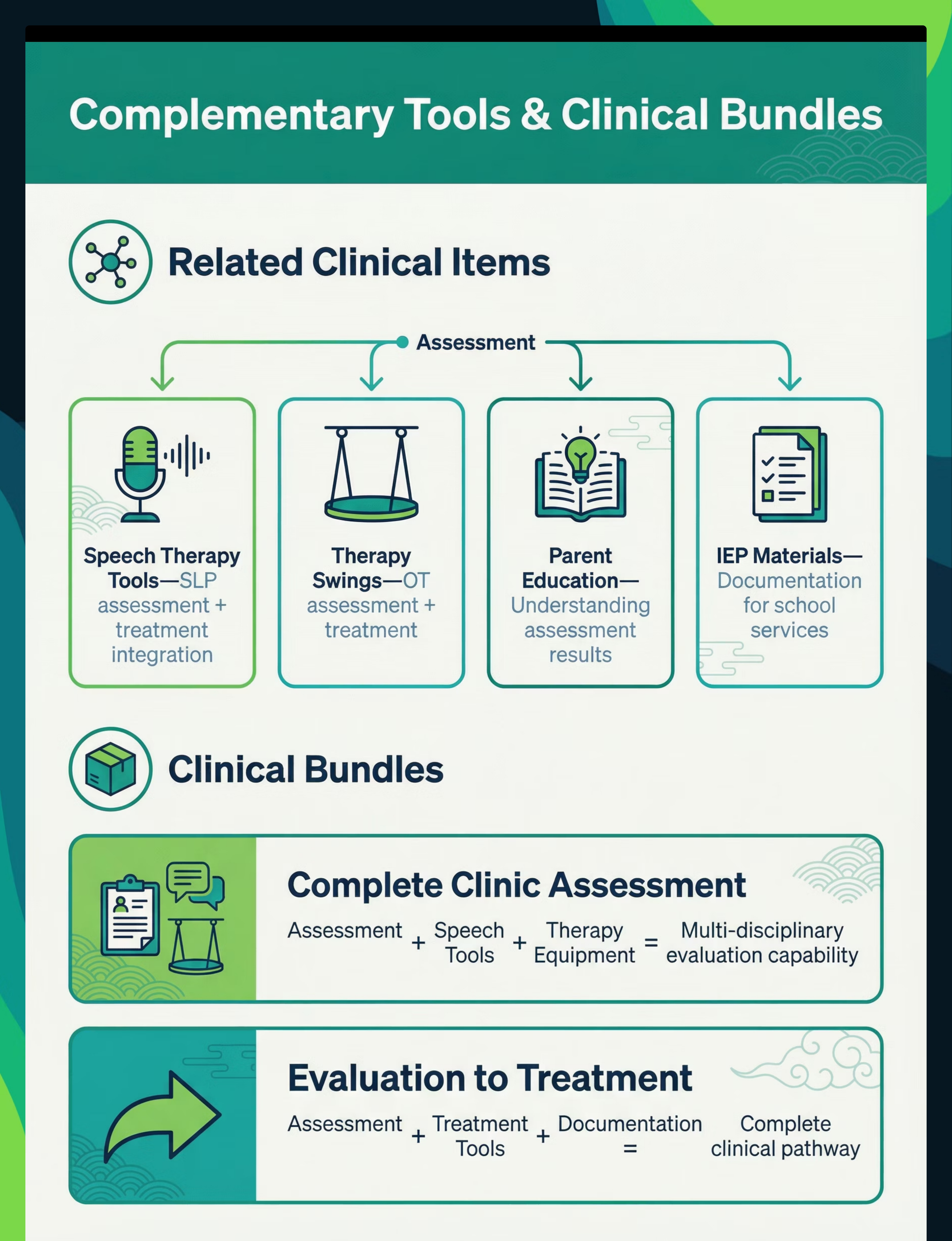
Complete the Assessment Journey
Complementary Tools:
Recommended Bundles:
  • Complete Clinic Assessment: Assessment Tools + Speech Therapy Tools + Therapy Swings — Multi-disciplinary evaluation to treatment
  • Evaluation + Treatment: Assessment Tools + Speech Therapy + Sensory Equipment — From baseline to intervention

AI Summary
Assessment and evaluation tools provide standardized, valid, and reliable instruments for diagnosis, treatment planning, and progress monitoring across developmental, autism, speech-language, OT, behavioral, and cognitive domains. Professional Kit (Rank 1), strong evidence, clinic essential.
assessment
evaluation
diagnosis
standardized
testing
multi-disciplinary
professional-kit
Common searches: autism assessment tools, developmental evaluation, ADOS-2, standardized assessment, therapy evaluation tools, cognitive testing, speech language assessment

Get Support
FREE National Autism Helpline
Phone: 9100 181 181
Languages: 16+ Indian languages
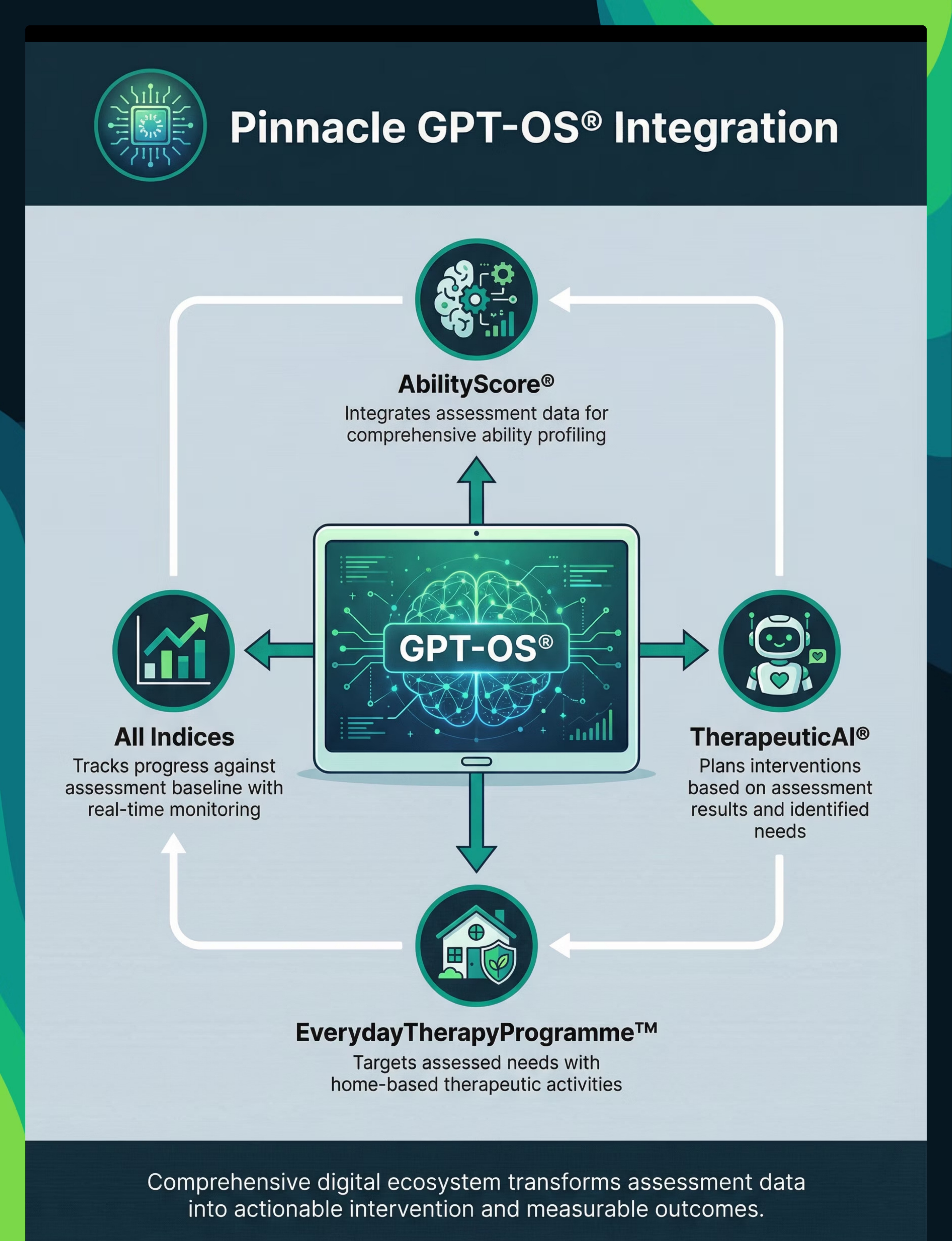
Platform Integration
AbilityScore® integrates assessment data for comprehensive tracking
TherapeuticAI® creates treatment plans from assessment results
EverydayTherapyProgramme™ targets assessed needs in daily routines
All Indices track progress against assessment baseline

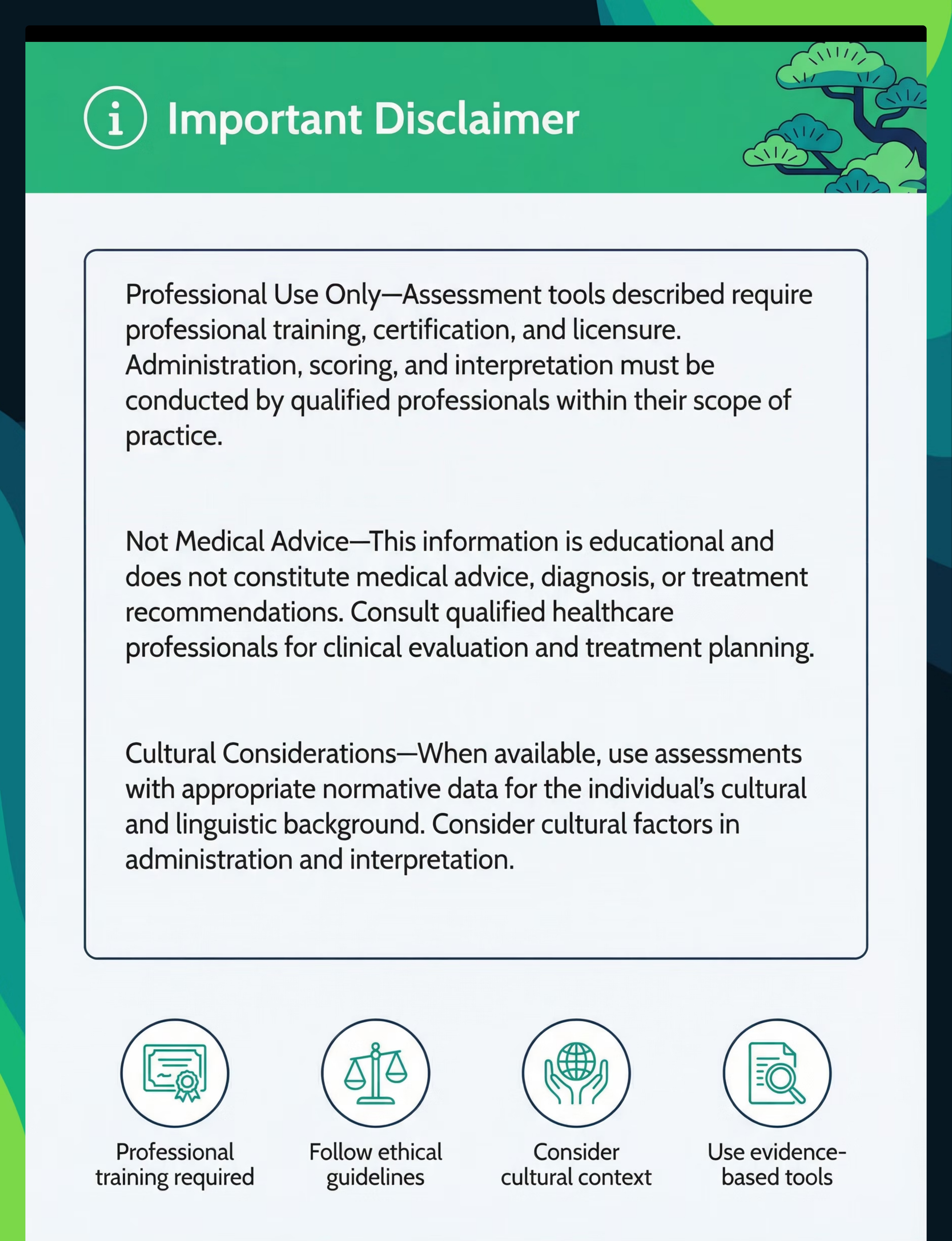
Disclaimer: This is educational information about standardized assessment tools and professional evaluation processes. Always consult qualified occupational therapists, speech-language pathologists, clinical psychologists, or pediatricians for formal evaluation. Professional administration and interpretation are essential. Individual results vary. Assessment tools require proper training and credentials.