












Tool ID: 10.2
Behavior Charts / Tracking
Behavior monitoring and progress visualization system
BCBA + SpEd
Strong Evidence
Rank #1
Daily Use
₹50–200
Who This Helps
Monitor Behavior & Identify Patterns
Easily track behaviors to pinpoint trends and triggers. Essential for understanding and addressing specific challenges in children aged 2-12 and for adult tracking.
Visualize Progress & Boost Motivation
Visually measure progress over time, providing clear feedback that encourages positive behavior change and engagement in all settings: home, school, or clinic.
Enable Data-Informed Decisions
Supports families and professionals in making strategic decisions about interventions and supports, ensuring effective and measurable outcomes for all ages.
Improve Communication & Collaboration
Facilitates seamless communication between parents, educators, and therapists, ensuring everyone is aligned on goals and strategies for behavior support.
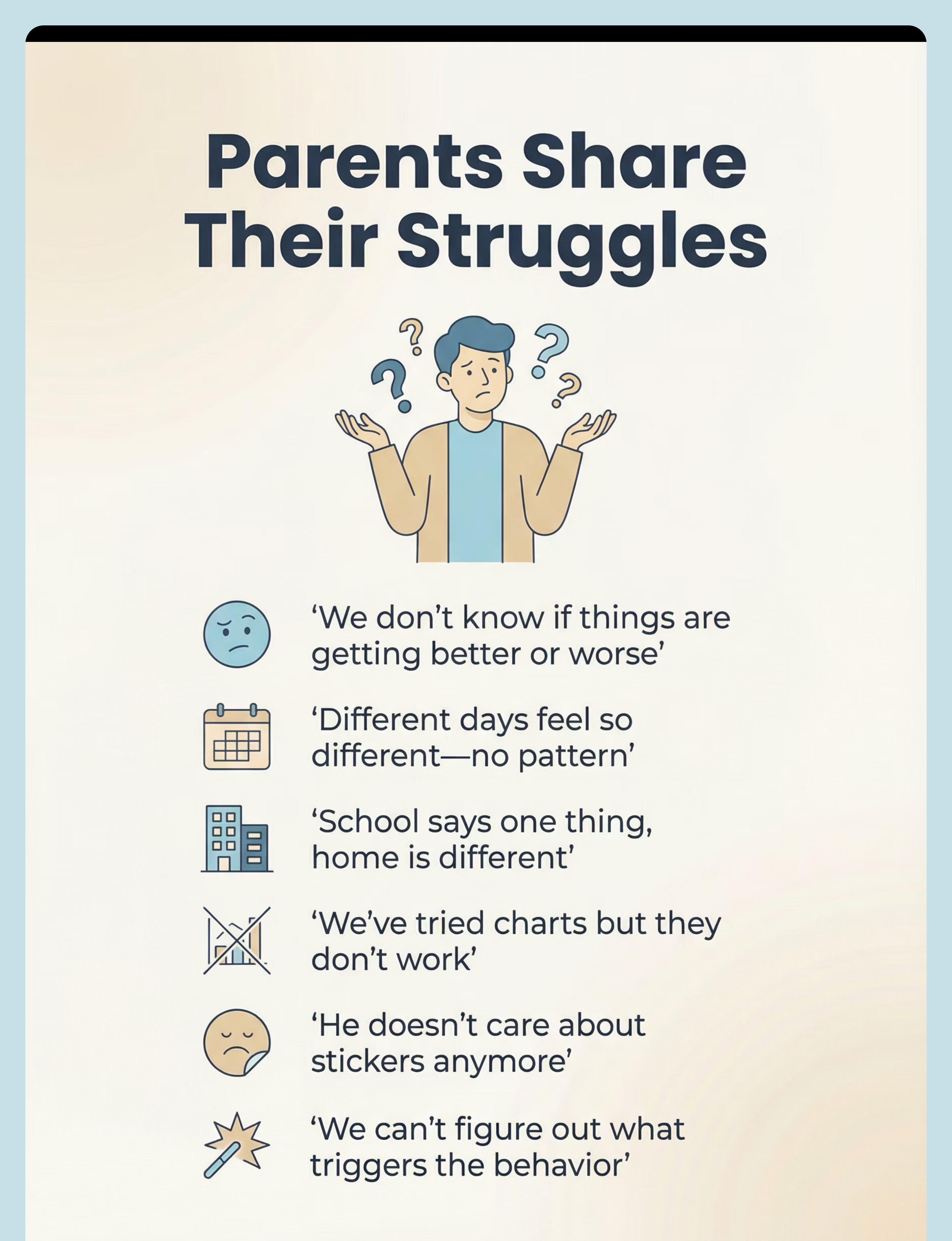
Does This Sound Familiar?
"We don't know if things are getting better or worse"
"Different days feel so different - no pattern"
"School says one thing, home is different"
"We've tried charts but they don't work"
"He doesn't care about stickers anymore"
"We can't figure out what triggers the behavior"
You're not alone. These are common challenges that many families face when trying to understand and support their child's behavior. Systematic tracking provides the clarity and consistency you need.
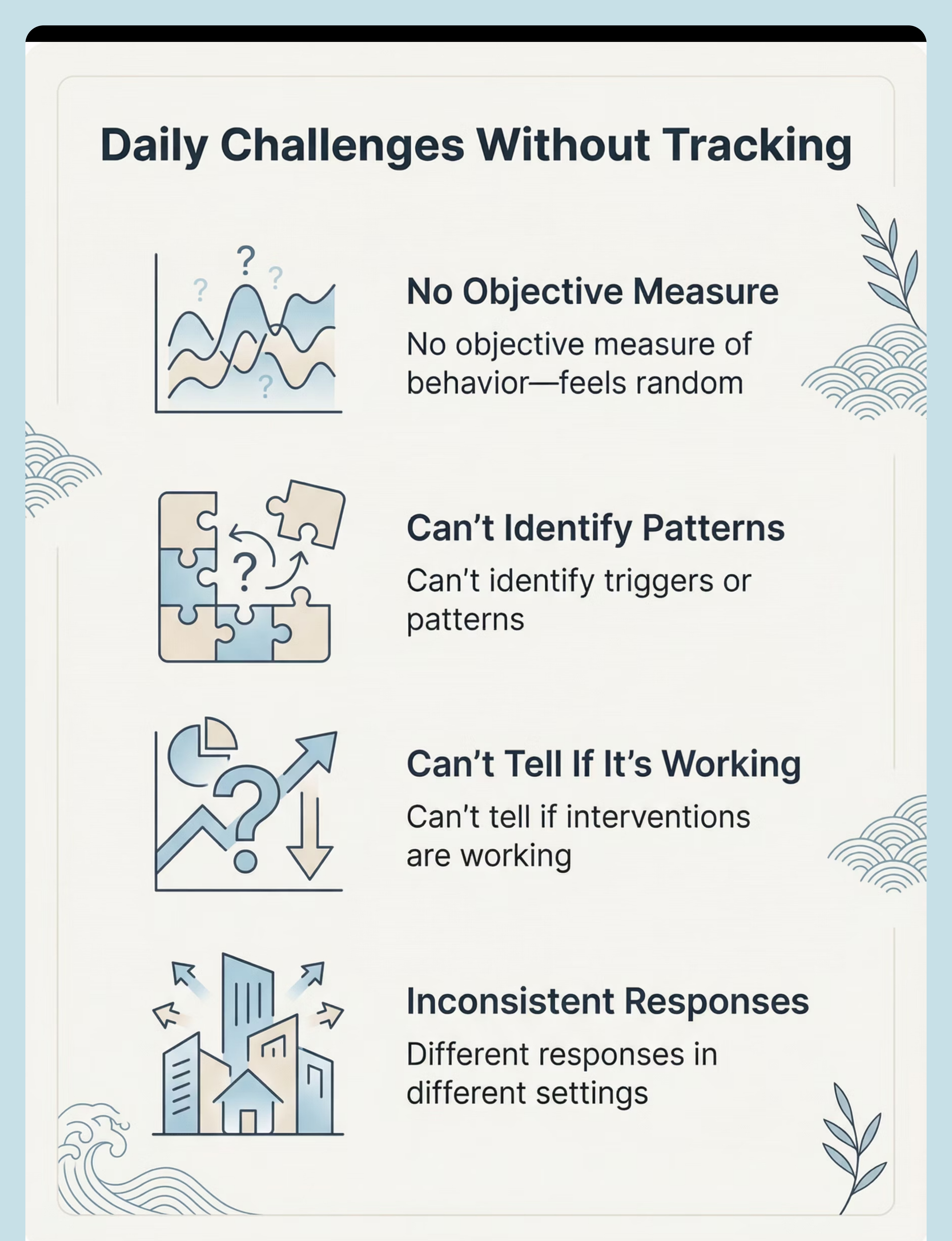
A Day Without the Right Support
Morning
No objective measure of behavior. Days feel chaotic and unpredictable. Guessing what might help.
Transitions
Can't identify triggers or patterns. Same strategies tried repeatedly without knowing if they work.
Therapy/School
Different responses in different settings. Home and school not communicating. Inconsistent expectations.
Bedtime
Can't tell if interventions are working. No way to measure progress or celebrate small wins.
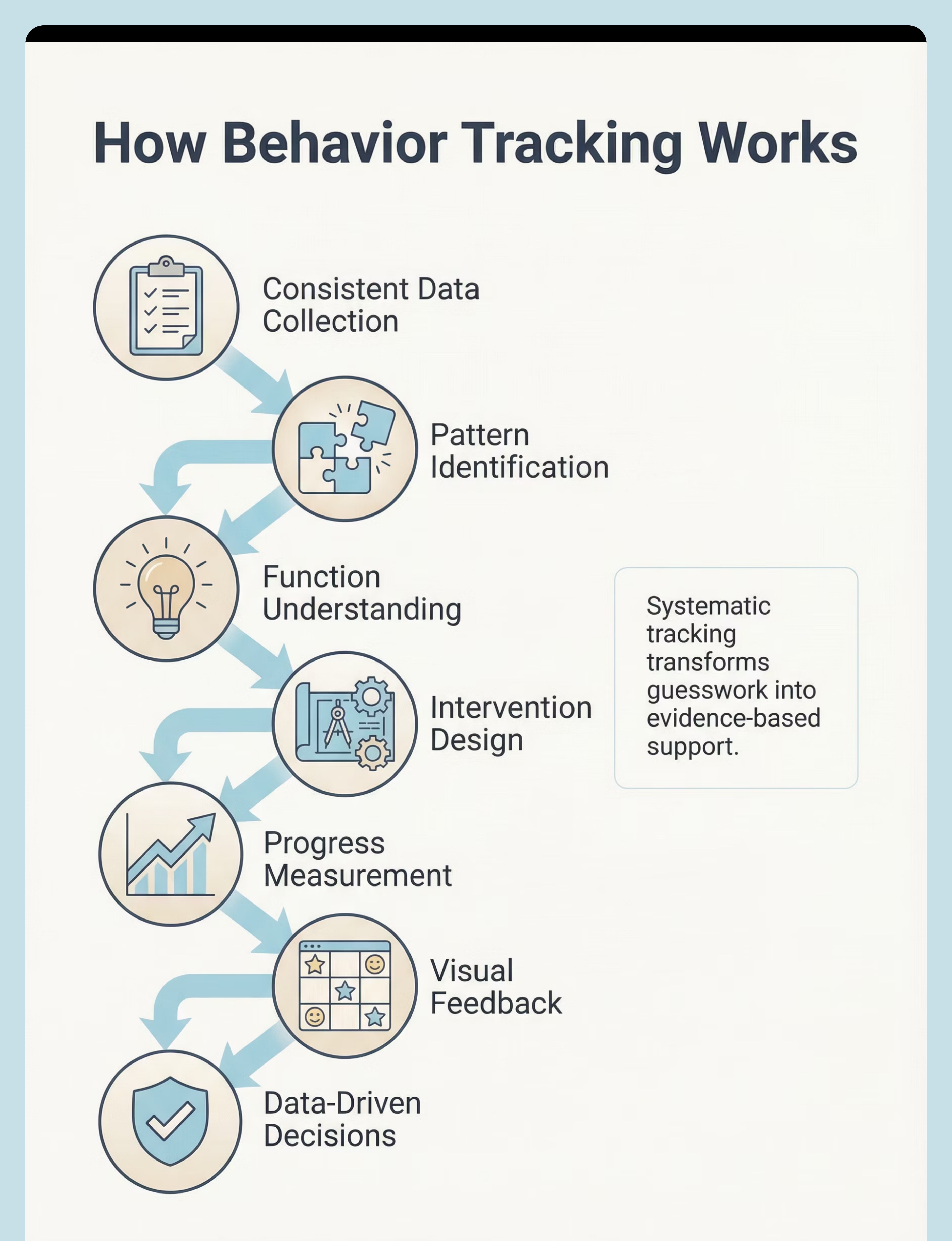
The Science Behind It
Consistent Data Collection
Record specific behaviors systematically over time
Pattern Identification
Analyze data to reveal when, where, and why behaviors occur
Function Understanding
Determine what purpose the behavior serves for the child
Intervention Design
Create targeted strategies based on patterns and function
Progress Measurement
Track whether interventions are producing desired changes
Visual Feedback & Reinforcement
Show progress clearly, motivating continued positive behavior
Data-Driven Decisions
Adjust support based on evidence, not guesswork
Behavior Monitoring
Pattern Identification
Progress Tracking
Motivation
Communication
Data-Based Decisions
How to Use It Right
1
Track specific, observable, measurable behaviors
Define behaviors clearly so anyone can identify them. "Hits others" is measurable; "being aggressive" is not.
2
Consistent tracking across settings if possible
Home-school coordination provides comprehensive view. Use daily report cards or shared systems when feasible.
3
Use for positive tracking, not punishment
Focus on what you want to see more of. Track desired behaviors alongside challenging ones for balanced perspective.
4
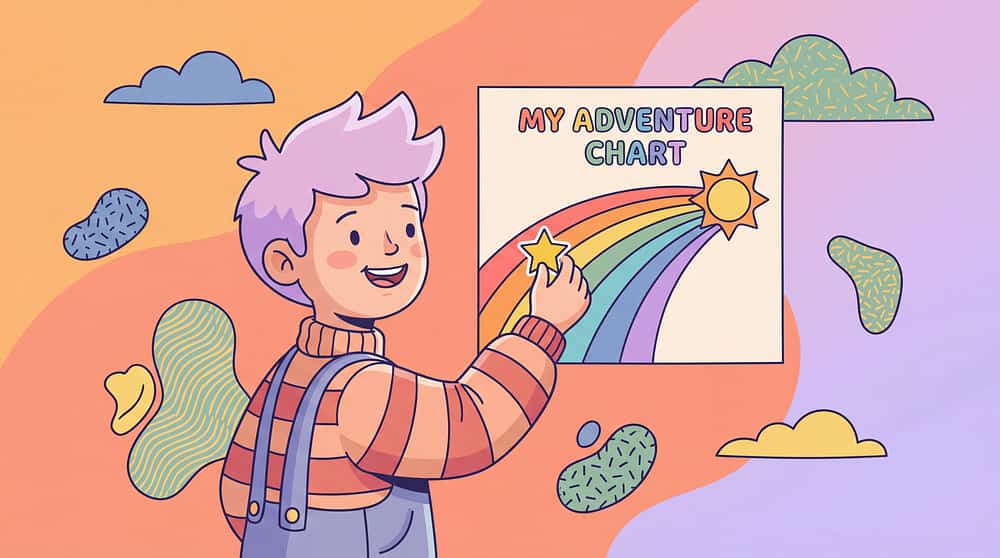
Share progress visually with child
Make success visible and tangible. Children respond to seeing their own progress accumulate over time.
5
Use data to adjust interventions
Review weekly. If progress stalls, modify approach. Let data guide your decisions rather than assumptions.
6
Celebrate progress, don't punish gaps
Acknowledge every step forward. Missing a day or having a setback is information, not failure.
Duration: Ongoing tracking with regular review (daily/weekly). Adjust chart systems as child develops and goals evolve.
Expert Endorsement
Expert Quote
"What gets measured gets managed. Behavior charts serve dual purposes: they provide data for adults to make decisions, and they provide visual motivation for children. Focus on tracking desired behaviors, not just problems."
— Board Certified Behavior Analyst
BCBA + SpEd Recommended
Trusted by behavior specialists and special educators
Strong Evidence
Robust research supporting effectiveness
Rank #1 in Category
Top-rated behavior support tool
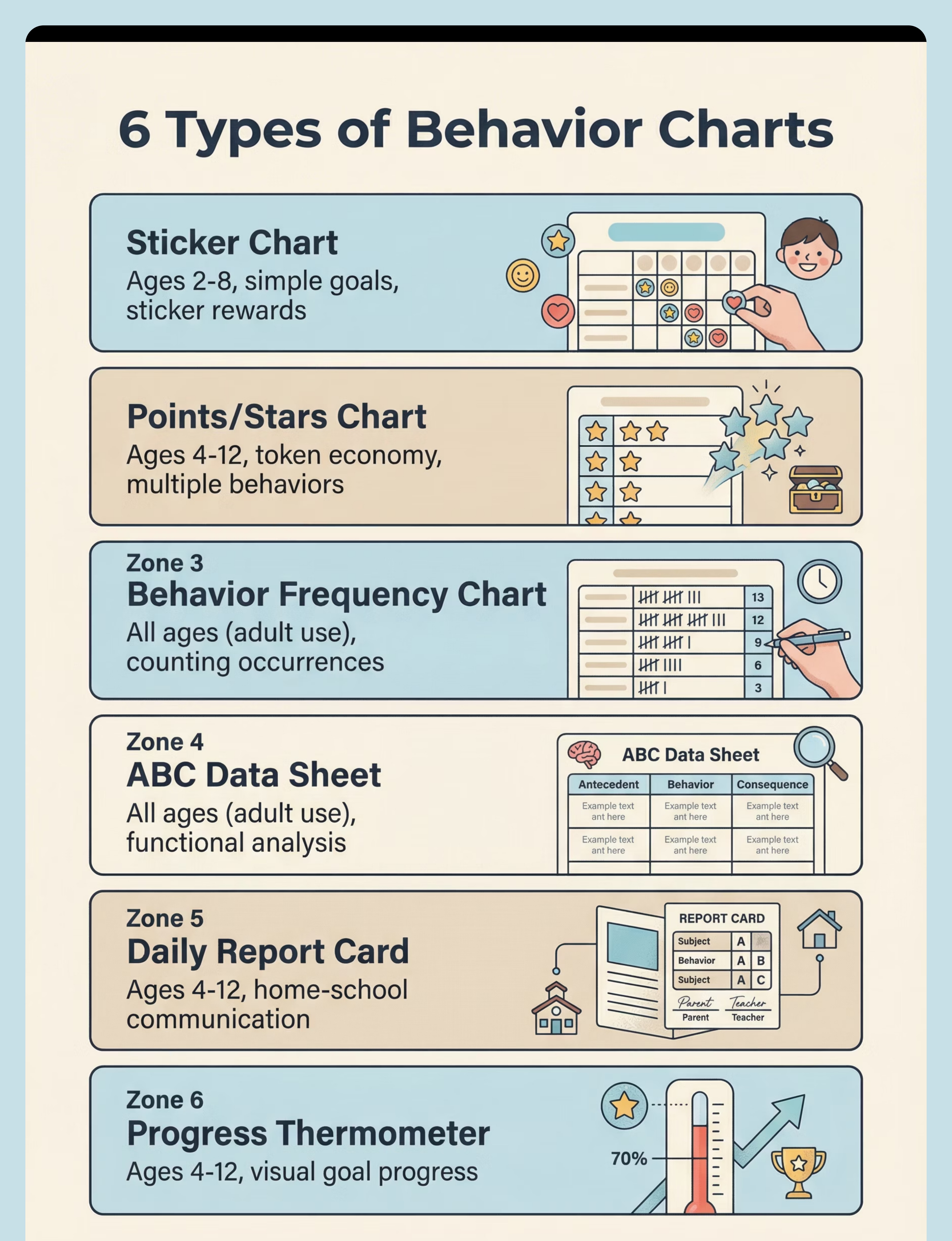
Choose Your Option (6 Variants)
Select the tracking system that matches your child's needs, developmental level, and your specific goals. Each variant serves different purposes from simple motivation to comprehensive data analysis.
How to Choose
- By goal: Motivation (sticker/stars) • Analysis (frequency/ABC) • Communication (daily report card) • Big picture (progress thermometer)
- By setting: Home (any) • School coordination (daily report card) • Clinic (ABC/frequency)
- By age: Young children (sticker) • School-age (points/daily report) • All ages for adult tracking (frequency/ABC)
Sticker Chart
Best for: Young children, simple goals
Ages: 2-8 years
Settings: Home • School
Type: Basic positive tracking with sticker rewards
Portability: High
Price: ₹50–200
Points/Stars Chart
Best for: Multiple behaviors, earned rewards
Ages: 4-12 years
Settings: All
Type: Token economy chart with accumulating points toward reward
Portability: High
Price: ₹50–200
Behavior Frequency Chart
Best for: Tracking specific behaviors, patterns
Ages: All ages (adult use)
Settings: All
Type: Data collection for analysis, counting occurrences
Portability: High
Price: ₹50–150
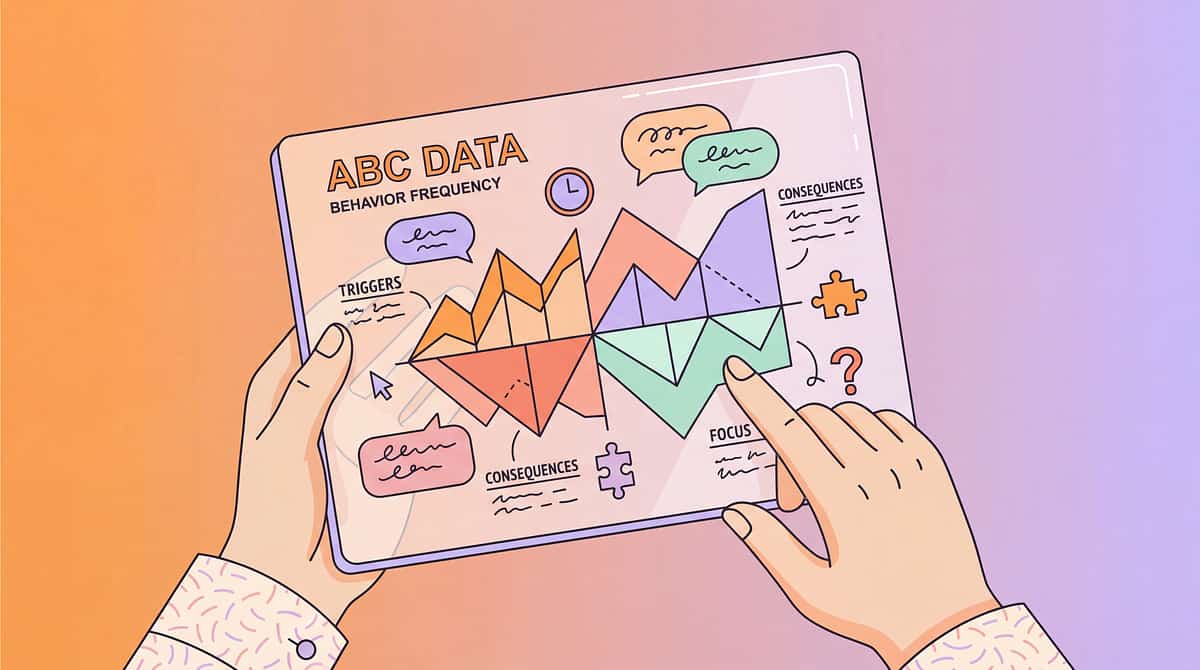
ABC Data Sheet
Best for: Understanding behavior function
Ages: All ages (adult use)
Settings: Clinic • Home • School
Type: Antecedent-Behavior-Consequence functional analysis tool
Portability: High
Price: ₹50–150
Daily Report Card (Home-School)
Best for: Consistency across environments
Ages: 4-12 years
Settings: Home • School
Type: Cross-setting behavior tracking, communication between settings
Portability: Very High
Price: ₹50–150
Visual Progress Thermometer/Chart
Best for: Showing progress visually, big goals
Ages: 4-12 years
Settings: Home • School • Clinic
Type: Progress visualization with visual representation toward goal
Portability: Medium
Price: ₹50–200
Specifications & Types Guide
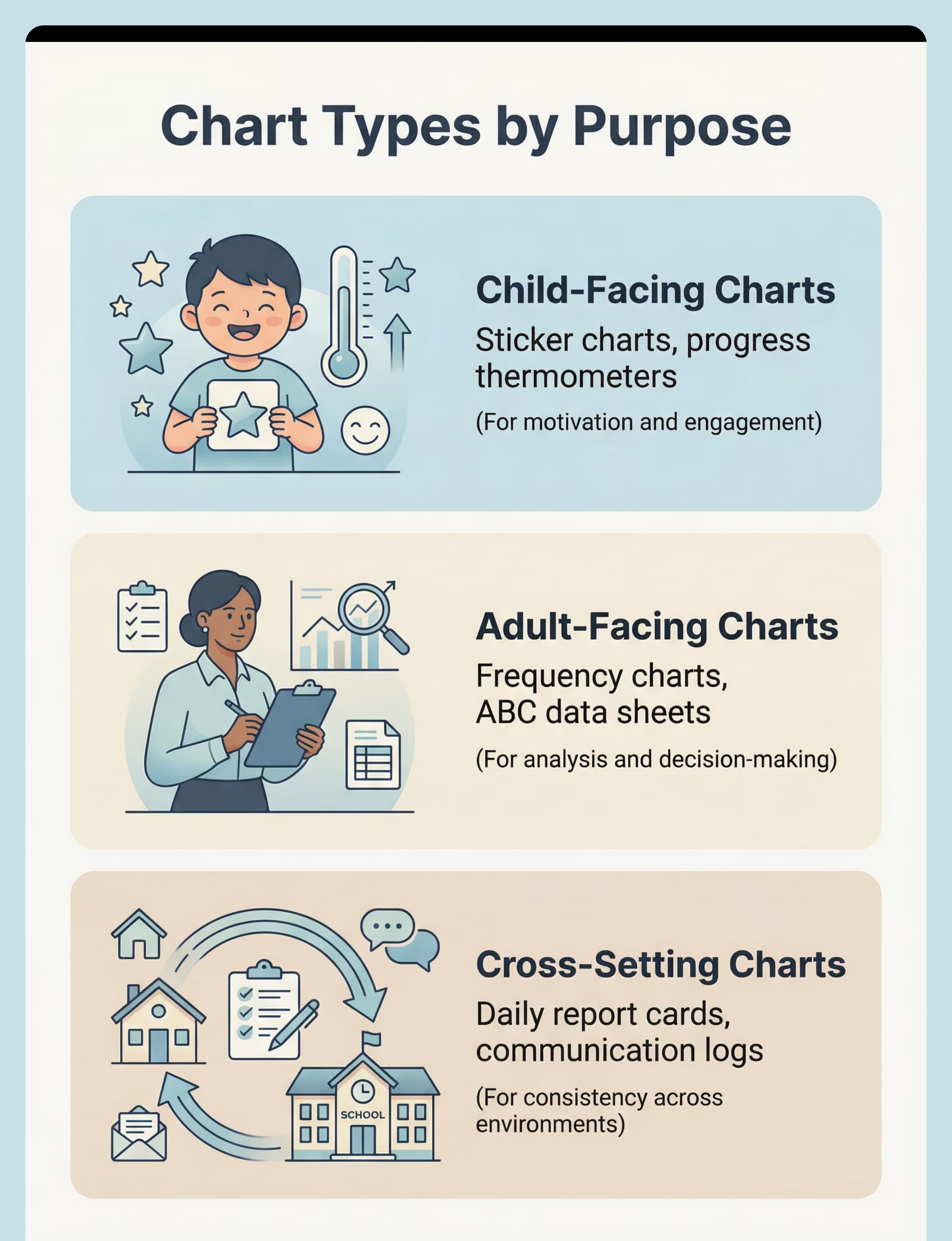
Child-Facing
Purpose: Motivation
Examples: Sticker charts, progress thermometers
Visual, immediate feedback that children can see and engage with. Builds intrinsic motivation.
Examples: Sticker charts, progress thermometers
Visual, immediate feedback that children can see and engage with. Builds intrinsic motivation.
There was an error generating this image
Adult-Facing
Purpose: Analysis
Examples: Frequency charts, ABC data
Detailed tracking for pattern identification and intervention planning. Professional data collection.
Examples: Frequency charts, ABC data
Detailed tracking for pattern identification and intervention planning. Professional data collection.
There was an error generating this image
Cross-Setting
Purpose: Communication
Examples: Daily report cards, communication logs
Bridges home and school. Ensures consistent expectations and coordinated support.
Examples: Daily report cards, communication logs
Bridges home and school. Ensures consistent expectations and coordinated support.
Materials
- Paper charts (affordable, customizable)
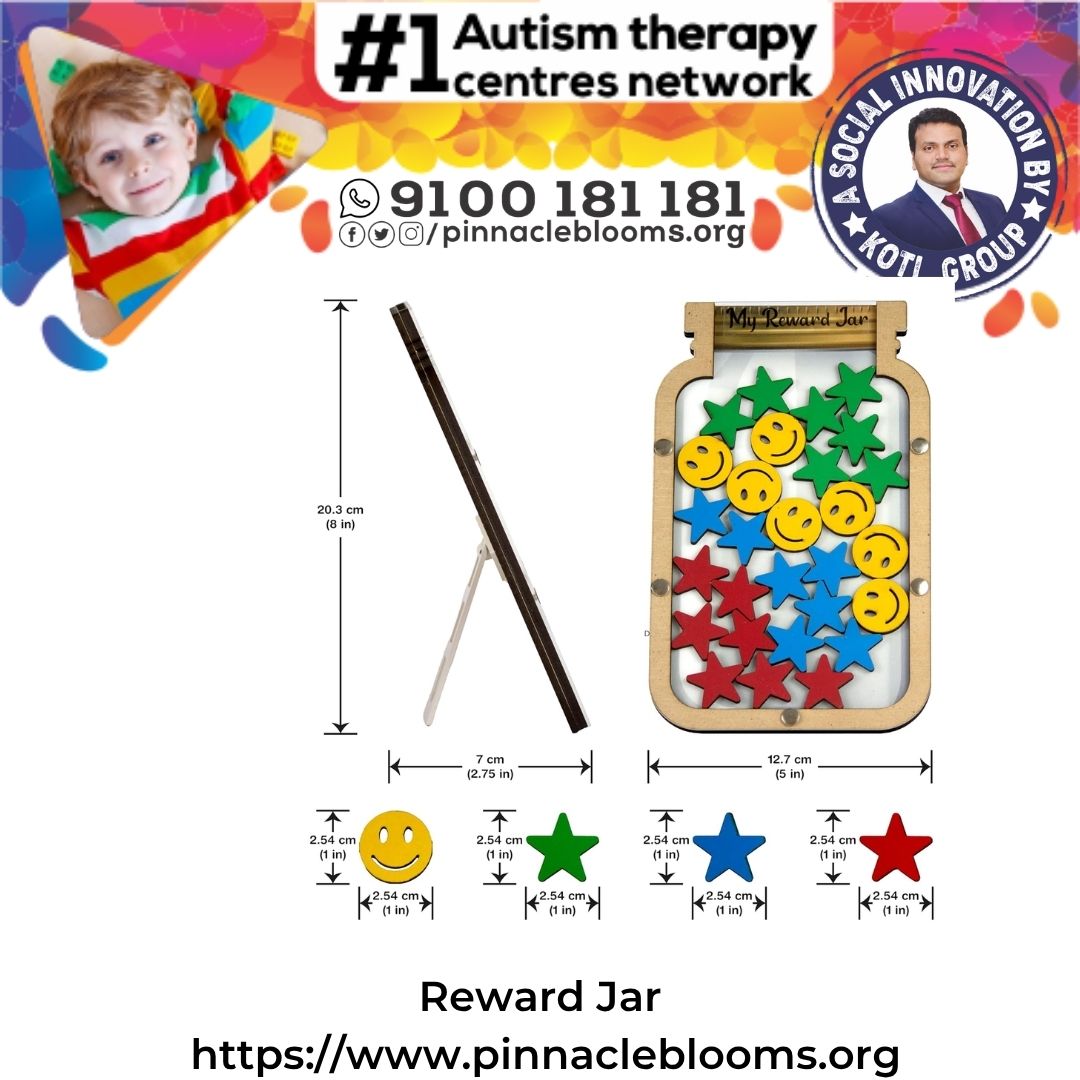
- Laminated boards (reusable, durable)
- Apps (digital tracking, automatic analysis)
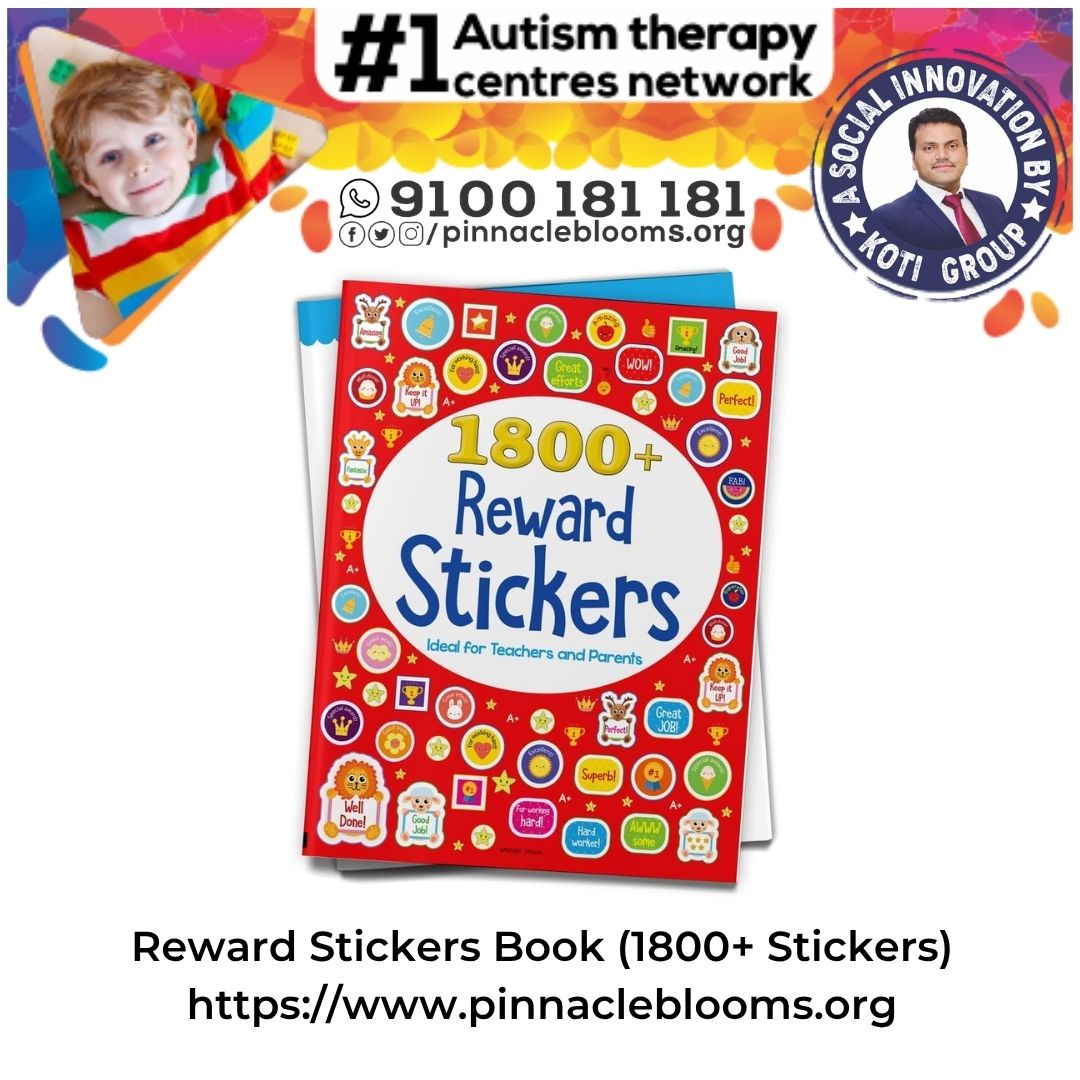
- Stickers (visual, tactile reinforcement)
Key Features
- Clear behavior definitions — specific, observable, measurable
- Consistent tracking — same time, same way, every day
- Visual representation — progress visible at a glance
- Connected to reinforcement — clear path to rewards
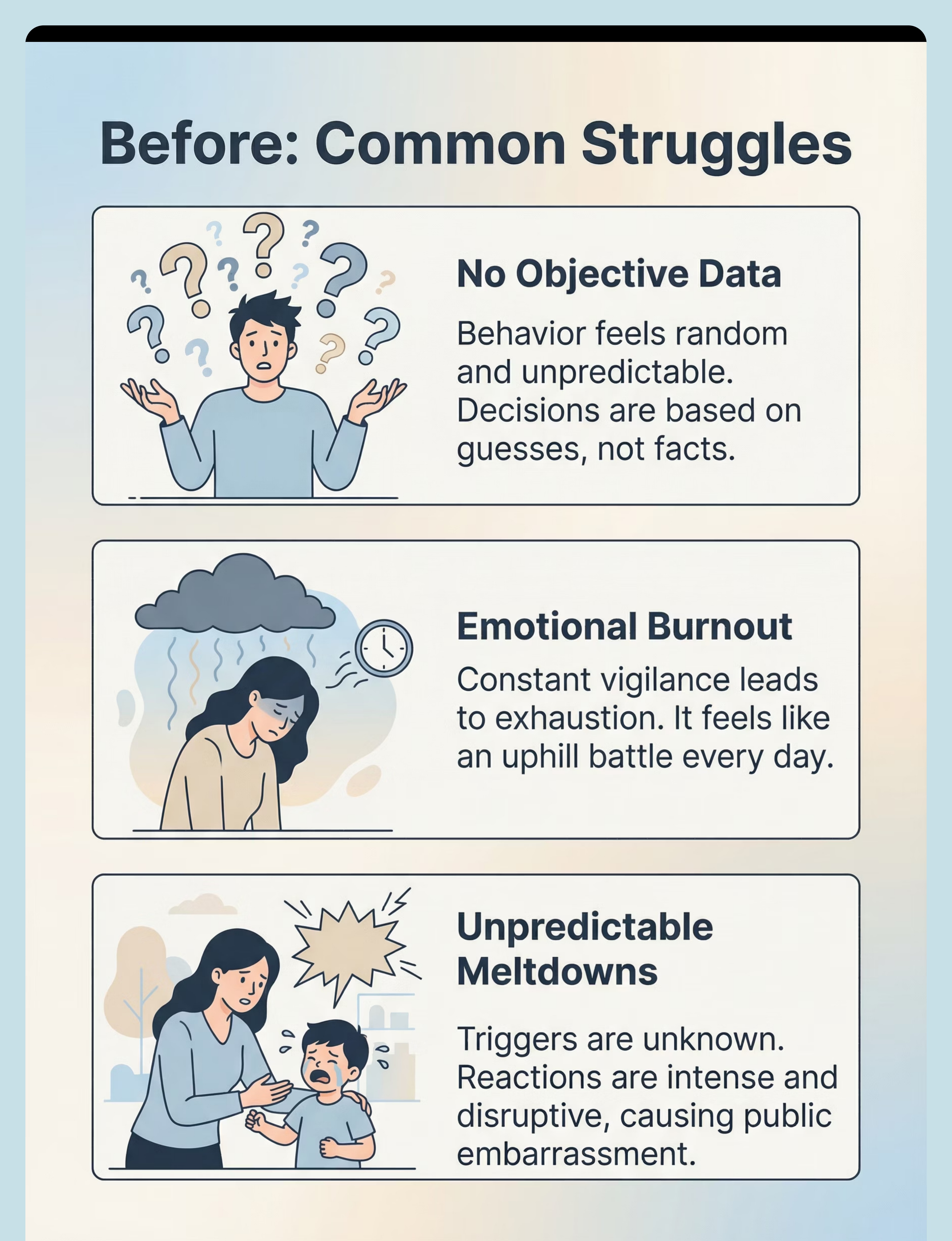
The Struggle (Before)
No Objective Data
Situation: Behavior feels 'all over the place.' No pattern visible.
Experience: Can't tell if getting better or worse. Interventions not data-based.
Emotion: Confusion, guessing
Charts Don't Work
Situation: Tried sticker charts, child doesn't care. No motivation.
Experience: Chart abandoned. Nothing works.
Emotion: Frustration, giving up
Home-School Disconnect
Situation: School says behavior is fine; home is chaos. Or vice versa.
Experience: No communication. Different approaches.
Emotion: Disconnect, inconsistency
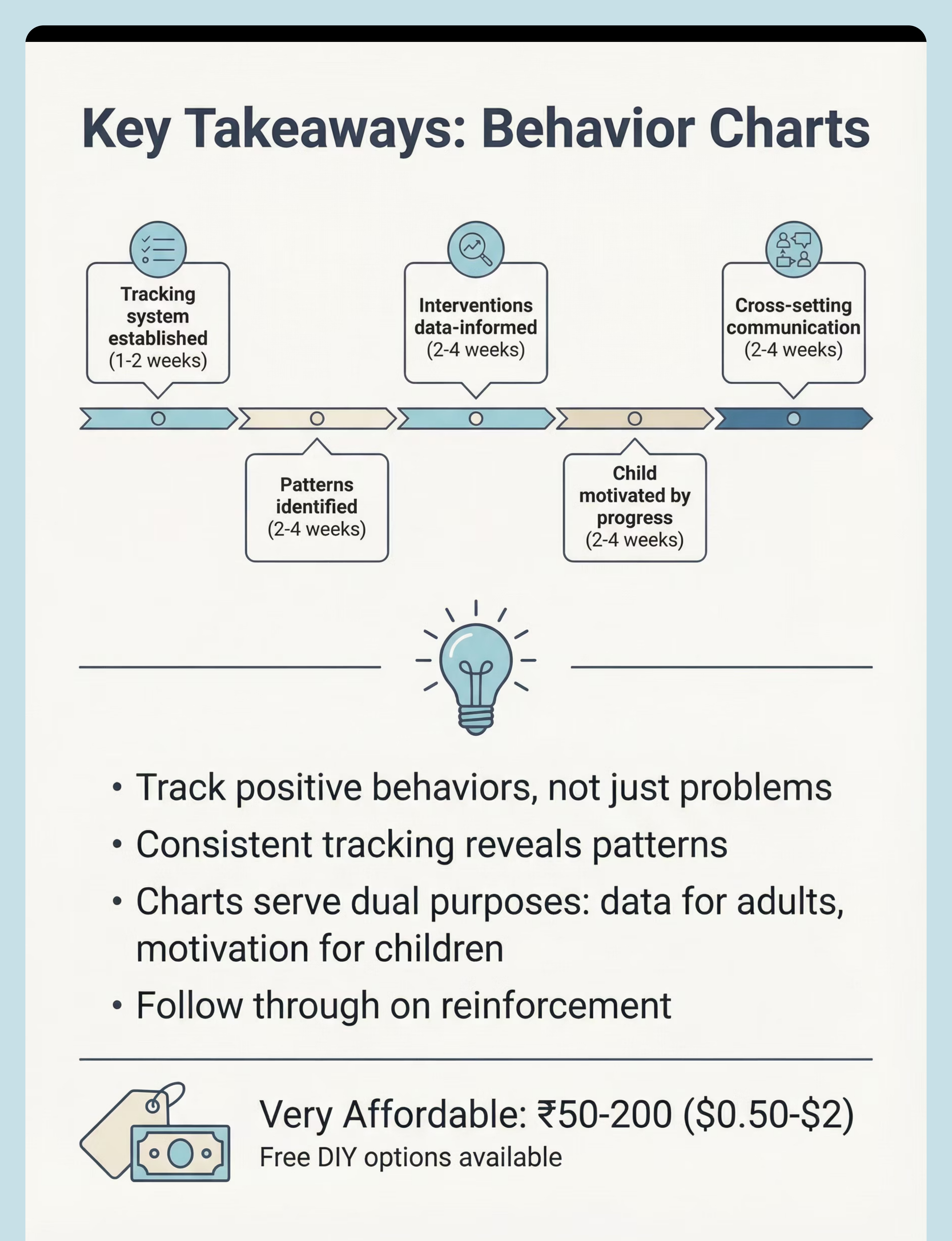
What to Expect (Realistic Timelines)
Change takes time, consistency, and patience. Here's what you can realistically expect as you implement systematic behavior tracking.
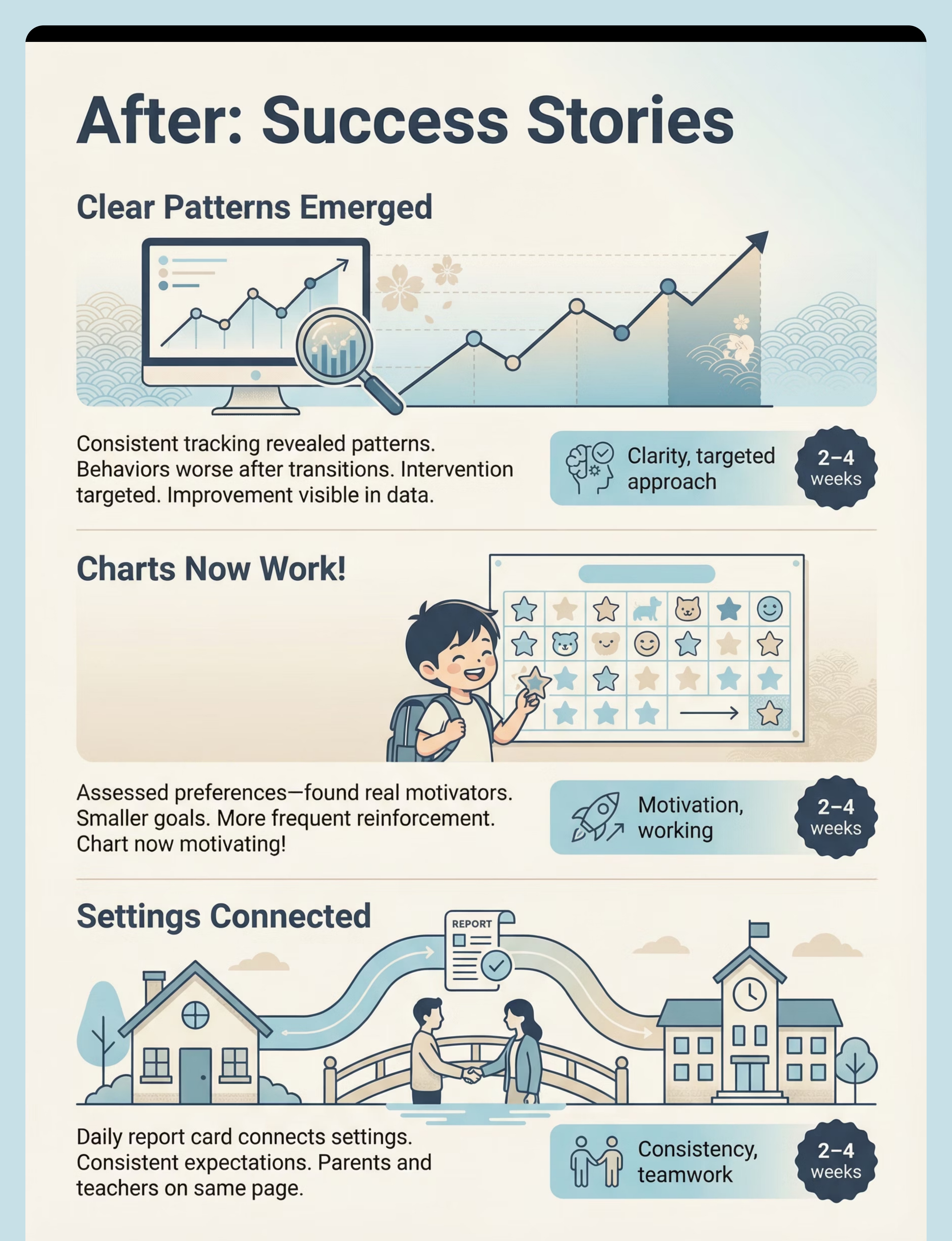
Tracking system established
Chart created, behaviors defined, tracking routine in place
1-2 weeks
Patterns identified from data
Triggers, times, settings become clear from consistent tracking
2-4 weeks
Interventions data-informed
Strategies adjusted based on what data reveals
2-4 weeks
Child motivated by visual progress
Seeing own success becomes intrinsically rewarding
2-4 weeks
Cross-setting communication established
Home and school coordinating consistently
2-4 weeks
Common Questions (Honest Answers)
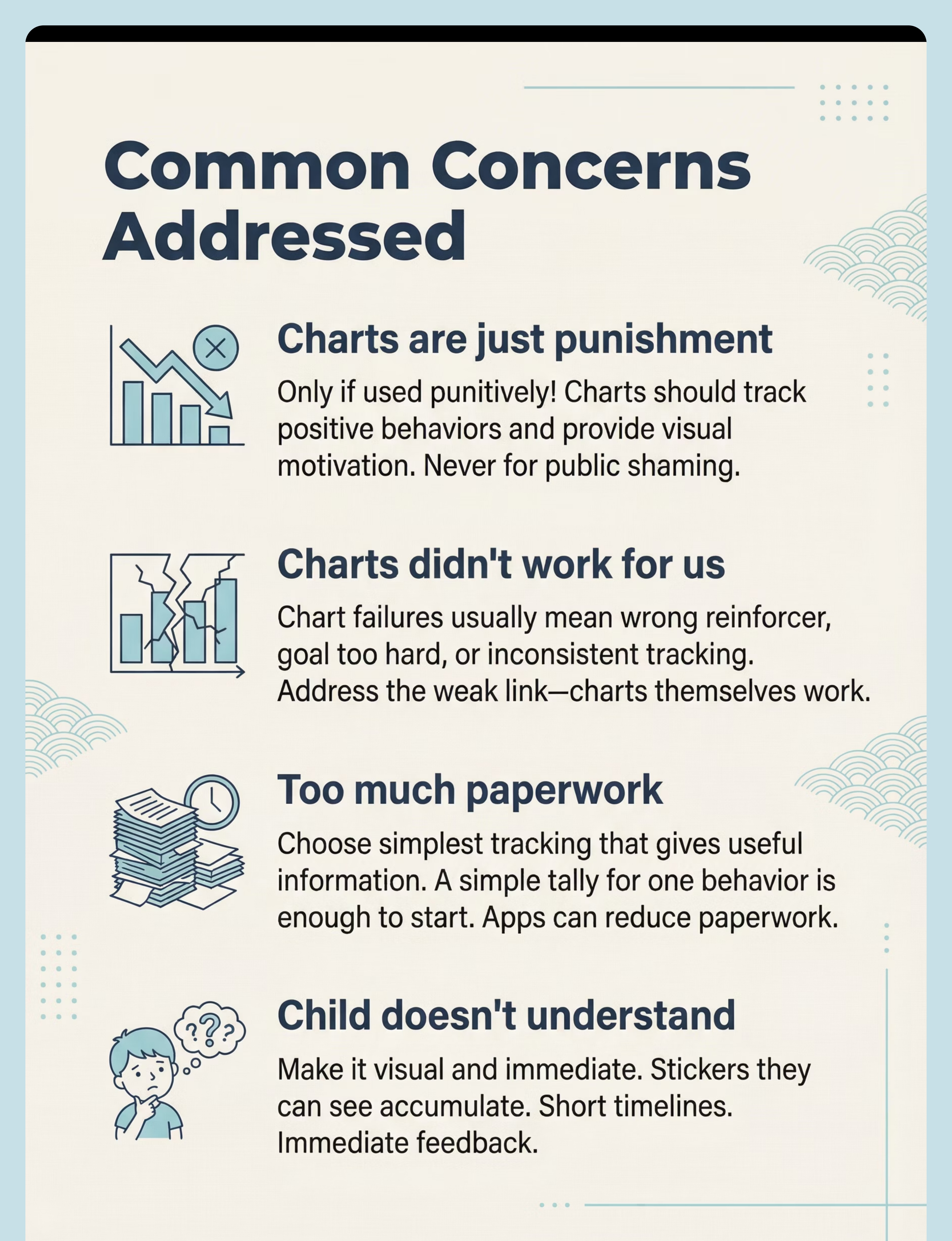
Charts are just punishment in disguise
Reality: Only if used punitively! Charts should track positive behaviors, provide visual motivation, and inform interventions. Never for public shaming or punishment.
Try this: Focus on positive tracking; never punitive. Track what you want to see MORE of.
We tried charts and they didn't work
Reality: Chart failures usually mean: wrong reinforcer, goal too hard, tracking inconsistent, or no follow-through. Address the weak link - charts themselves work when implemented correctly.
Try this: Diagnose why chart failed; fix the weak link. Often it's the reward system, not the chart.
Too much paperwork
Reality: Choose the simplest tracking that gives useful information. A simple tally for one behavior is enough to start. Apps can reduce paperwork significantly.
Try this: Start simple; expand if needed. Five-minute daily tracking beats elaborate systems that get abandoned.
Child doesn't understand the chart
Reality: Make it visual and immediate. Stickers they can see accumulate. Short timelines. Immediate feedback. Some children need adult-facing tracking only, which is perfectly fine.
Try this: Simplify for child; adult tracking always valuable even if child doesn't engage directly.
Usage Guide
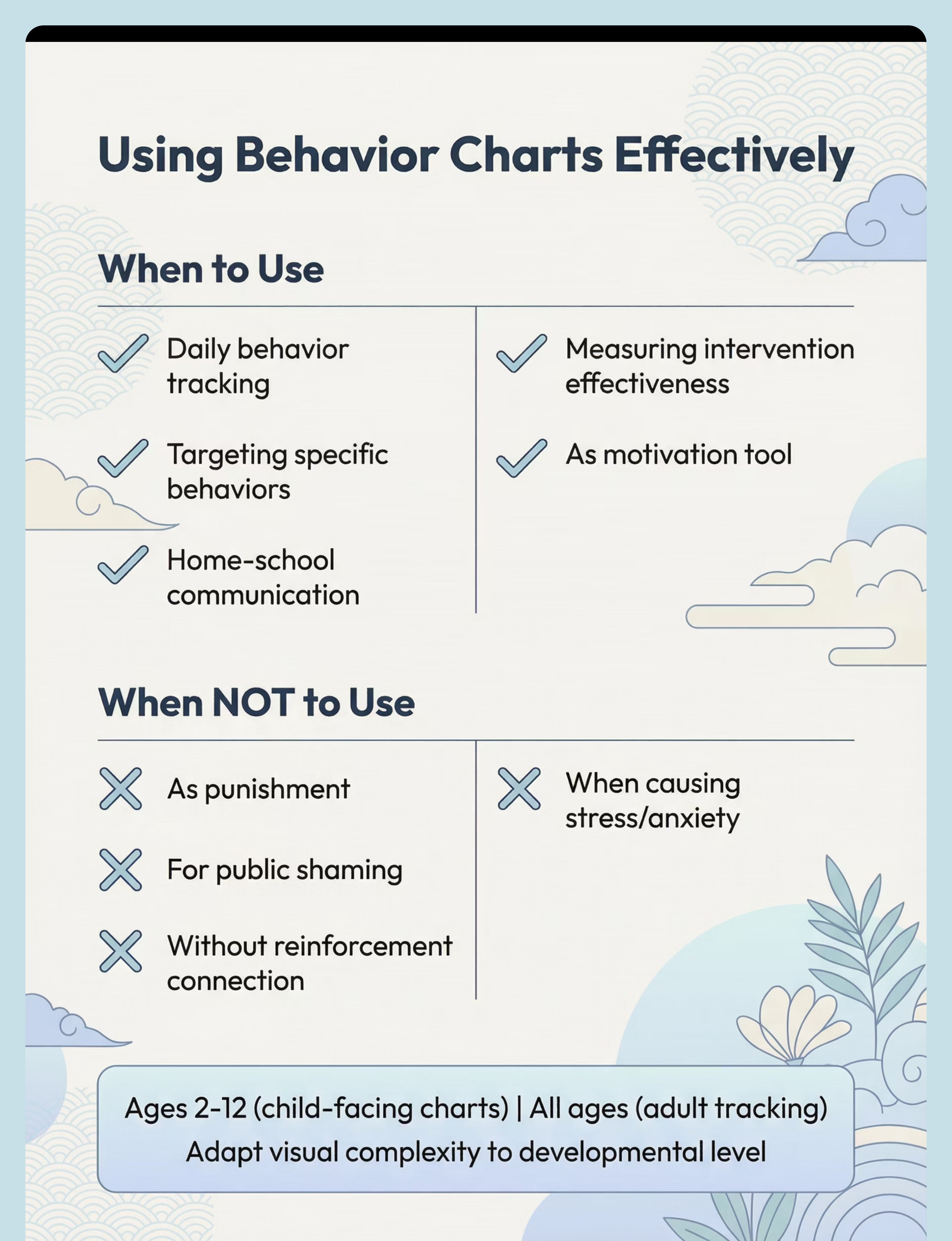
When to Use
- Daily behavior tracking
- When targeting specific behaviors
- For home-school communication
- To measure intervention effectiveness
- As motivation tool
When NOT to Use
- As punishment
- For public shaming
- Without connection to reinforcement
- When causing stress/anxiety
Duration
Ongoing tracking; regular review (daily/weekly). Adjust systems as goals evolve and child develops.
Settings
Home
School
Clinic
Supervision by Age
Age Range | Supervision Level | Notes | |
Young (2-4 years) | Adult manages chart | Involves child visually, immediate rewards | |
Developing (5-8 years) | Child participates | Child marks chart with adult guidance | |
Older (9-12 years) | Child may self-monitor | Adult verification, increasing independence |
Age Note: Adapt visual complexity to developmental level. Younger children need simpler, more immediate systems. Older children can handle more complex tracking.
Safety First
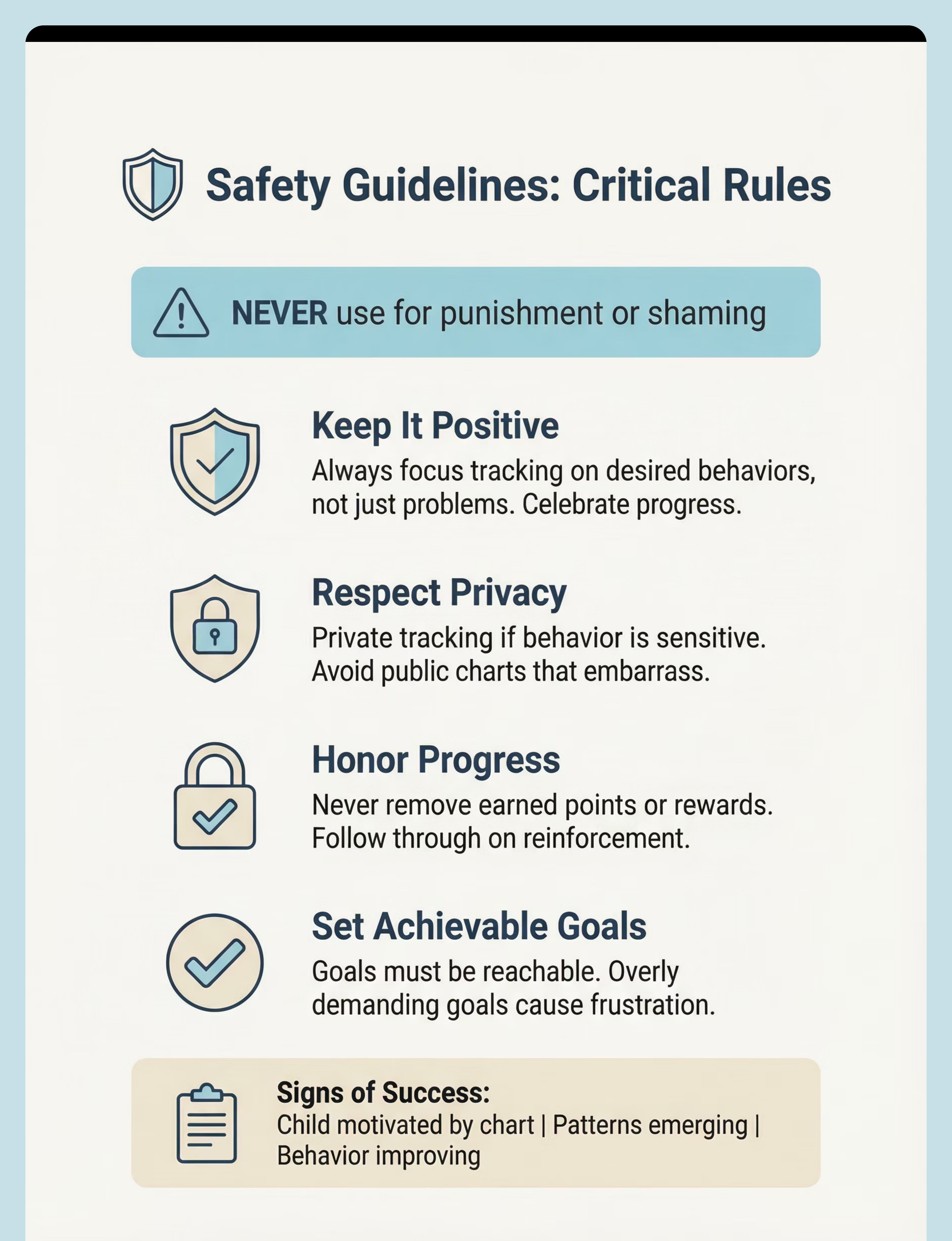
Critical Safety
- Never use for punishment or shaming
- Keep tracking positive-focused
- Follow through on earned reinforcement
- Private tracking if behavior is sensitive
Warnings
- Public charts can cause embarrassment
- Removing earned points is harmful
- Overly demanding goals cause frustration
Contraindicated
- Punitive use
- Public shaming
- Removing earned progress
Safety Checklist
Before Use
- Behavior clearly defined
- Chart appropriate for child
- Reinforcement connected
- Achievable goals set
During Use
- Consistent tracking
- Positive interactions around chart
- Progress celebrated
- Data reviewed for patterns
Signs of Success
- Child motivated by chart
- Patterns emerging from data
- Behavior improving
- Interventions data-informed
Investment Guide
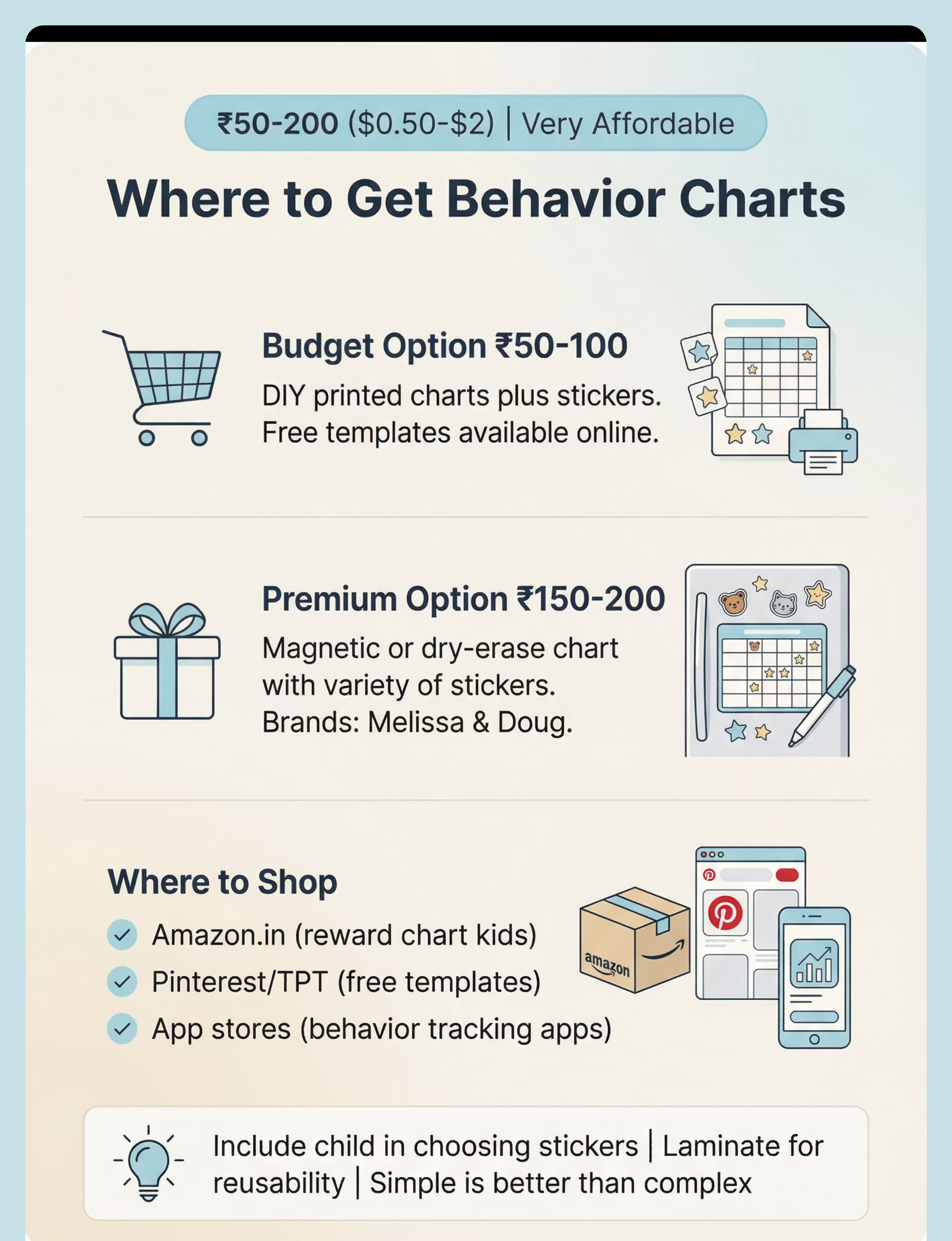
Behavior tracking is one of the most affordable yet powerful tools available. You can start with nearly zero investment and scale based on your needs.
Budget Option
Item: DIY printed charts + stickers
Cost: ₹50-100
Note: Free templates available online
Print from computer, laminate at local shop, buy stickers from any store. Fully functional and customizable.
Premium Option
Item: Magnetic/dry-erase chart + variety of stickers
Cost: ₹150-200
Brands: Melissa & Doug, various reward charts
Reusable, durable, professional appearance. Magnetic backing for easy placement.
₹50
Starting Point
Minimum to begin effective tracking
₹200
Maximum Investment
Top-end premium reusable systems
90%
Cost Savings
DIY vs. commercial options
Very Low Price Tier
₹50–200 (INR) • $0.50–2 (USD)
USAGE PLAYBOOK (WHEN TO USE / WHEN NOT)
Understanding the appropriate application of behavior charts is crucial for their effectiveness. This guide outlines key situations where they are most beneficial, and critical scenarios to avoid.
Situation Type | When to Use | When NOT to Use | |
Behavior Focus | Target positive actions (e.g., sharing, completing tasks). | Highlight negative behaviors or failures. | |
Motivation | Visual progress, earned rewards, intrinsic growth. | Public shaming, withdrawal of earned points as punishment. | |
Communication | Bridge home-school gaps, align strategies. | Create conflict or inconsistency between settings. |
When to Use
Behavior charts are powerful tools when applied thoughtfully to foster positive habits and provide clear feedback.
Targeting Specific Behaviors
When there's a clearly defined behavior you want to increase (e.g., "Puts toys away," "Completes homework").
Enhancing Motivation
To provide visual evidence of progress and earned rewards, fostering a sense of accomplishment.
Facilitating Home-School Alignment
For consistent communication and a unified approach between parents and teachers on behavioral goals.
Data-Driven Interventions
To collect objective data on behavior patterns, helping to identify triggers and assess intervention effectiveness.
When NOT to Use
Misapplication can undermine trust and harm a child's self-esteem. Avoid these critical pitfalls.
As Punishment or Public Shaming
Never to embarrass, scold, or take away earned progress. This can erode trust and create resentment.
Without Positive Reinforcement
Charts must be paired with meaningful, consistent rewards or praise; otherwise, they lose their motivational power.
When Causing Stress or Anxiety
If the chart is leading to significant stress, obsession, or negative emotional responses, reassess its use.
For Undefined or Abstract Goals
Avoid charts for vague goals like "Be good." Behaviors must be specific, observable, and measurable.
Prioritizing Child Safety: A Guide to Behavior Chart Usage
Ensuring the well-being and positive development of a child is paramount when implementing behavior tracking tools. This guide outlines essential safety protocols to prevent harm and foster a supportive environment.
Critical Safety Warnings
- Never use charts to shame, punish, or publicly display a child's struggles.
- Do not remove earned rewards or points as a form of punishment.
- Ensure all goals are positive, achievable, and age-appropriate.
- Protect the child's privacy; keep sensitive behavioral tracking confidential.
Important Cautions
- Avoid overly complex systems that can overwhelm or frustrate a child.
- Be consistent with tracking and reinforcement to maintain trust.
- Monitor for signs of anxiety or stress related to the chart.
- Do not use charts to control intrinsic motivation for naturally occurring behaviors.
Stop Signs: When to Discontinue Use
- If the chart consistently causes significant distress or resentment.
- If the child's behavior worsens or new negative behaviors emerge.
- When the system becomes a source of conflict between child and caregiver.
- If the chart fails to motivate progress despite adjustments and positive reinforcement.
Professional Consultation Guidelines
- Consult a pediatrician or child psychologist for severe or complex behavioral issues.
- Seek guidance if the chart isn't effective after consistent, careful implementation.
- Discuss the chart's use with teachers or therapists for a unified approach.
- Always prioritize professional advice over informal tracking methods for serious concerns.
Where to Buy in India
Availability: Widely Available — behavior charts and tracking materials are easy to find online, in stores, and through free digital resources.
Platform | Search Term | Price | |
Amazon.in | "reward chart kids" | ₹100-200 | |
Amazon.in | "sticker chart behavior" | ₹75-150 | |
Amazon.in | "magnetic reward chart" | ₹150-300 | |
Pinterest/TPT | "behavior tracking chart" | Free-₹100 | |
App stores | "behavior tracking app" | Free-₹500 |
Buying Tips
Free Templates
Excellent and widely available online, a great starting point.
Laminate for Reusability
Extend the life of printed charts by laminating them.
Involve Your Child
Let your child choose stickers to increase engagement.
Keep it Simple
An effective chart doesn't need to be overly complex.
Digital Options
Consider apps to reduce paper waste and increase convenience.
1
Red Flags to Avoid
2
Overly Complex Charts
Can confuse children and make tracking difficult.
3
Charts Used for Punishment
Behavior charts should be positive reinforcement tools, not punitive.
4
Public Display Causing Shame
Always maintain privacy and respect for the child.
5
No Connection to Reinforcement
Rewards or consequences must be clearly linked to tracked behaviors.
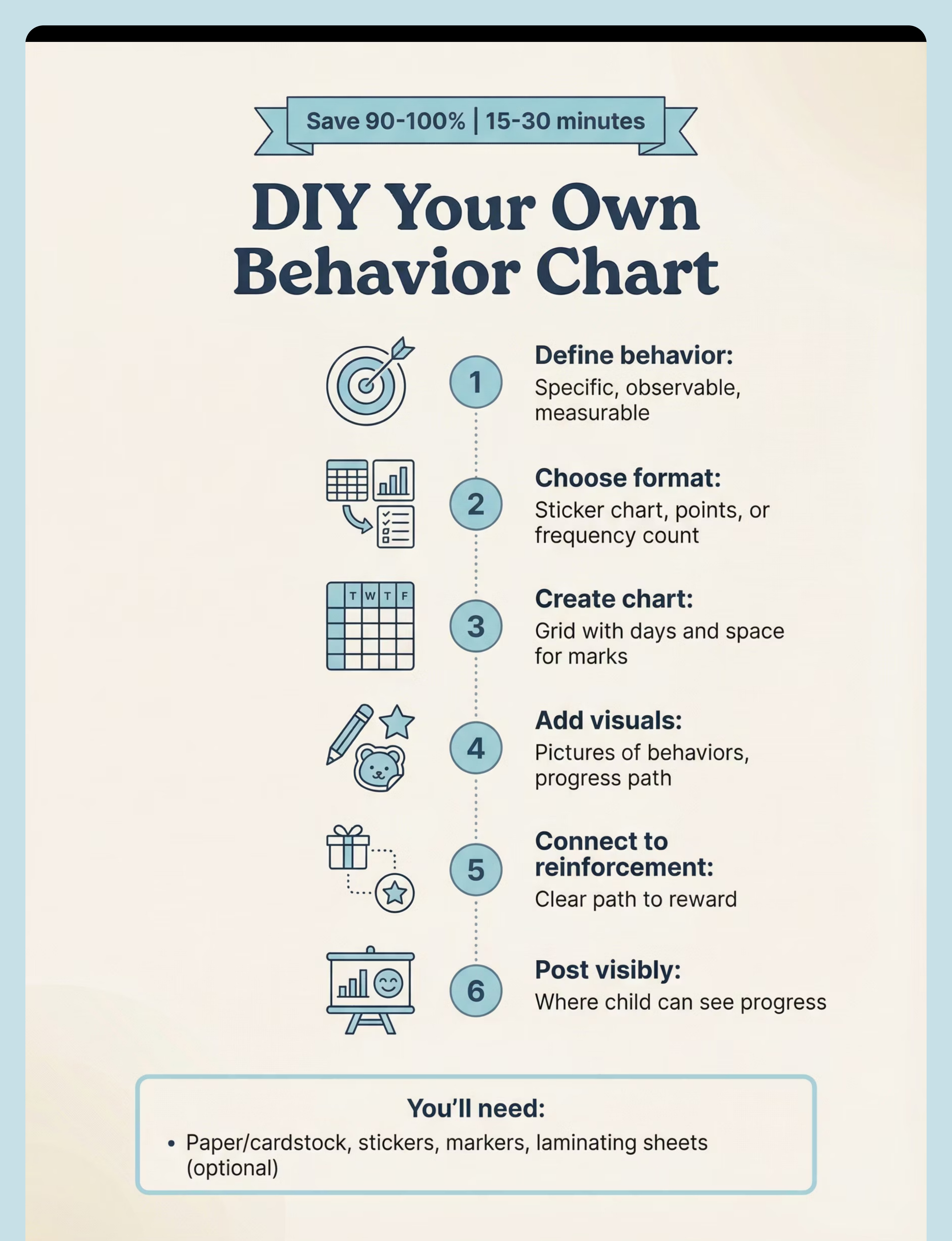
DIY Alternative (Save 90-100%)
Feasibility: Very High • Time: 15-30 minutes • Cost Savings: 90-100%
DIY behavior charts work just as well as commercial options and allow complete customization to your child's specific needs and preferences.
1
Materials Needed
- Paper/cardstock
- Stickers or stamps
- Markers
- Laminating sheets (optional)
2
Step-by-Step Instructions
- Define behavior: Specific, observable, measurable (e.g., "uses kind words" not "is nice")
- Choose format: Sticker chart, points, frequency count — match to child's age and goal
- Create chart: Grid with days/opportunities and space for marks. Leave room for visual appeal.
- Add visual elements: Pictures of behaviors, progress path, colorful borders
- Connect to reinforcement: Clear path to reward — show what earning X stickers/points means
- Post visibly: Where child can see progress — kitchen, bedroom, homework area
DIY vs Commercial: When to Choose Each
When to DIY
Ideal for most situations, custom behaviors, specific reinforcer goals, and when you have an immediate need. Offers complete customization but may be less durable than commercial options.
When to Buy Commercial
Choose commercial for magnetic/reusable options, a professional appearance, or if pre-made designs save you time. Higher initial cost but generally more polished and durable.
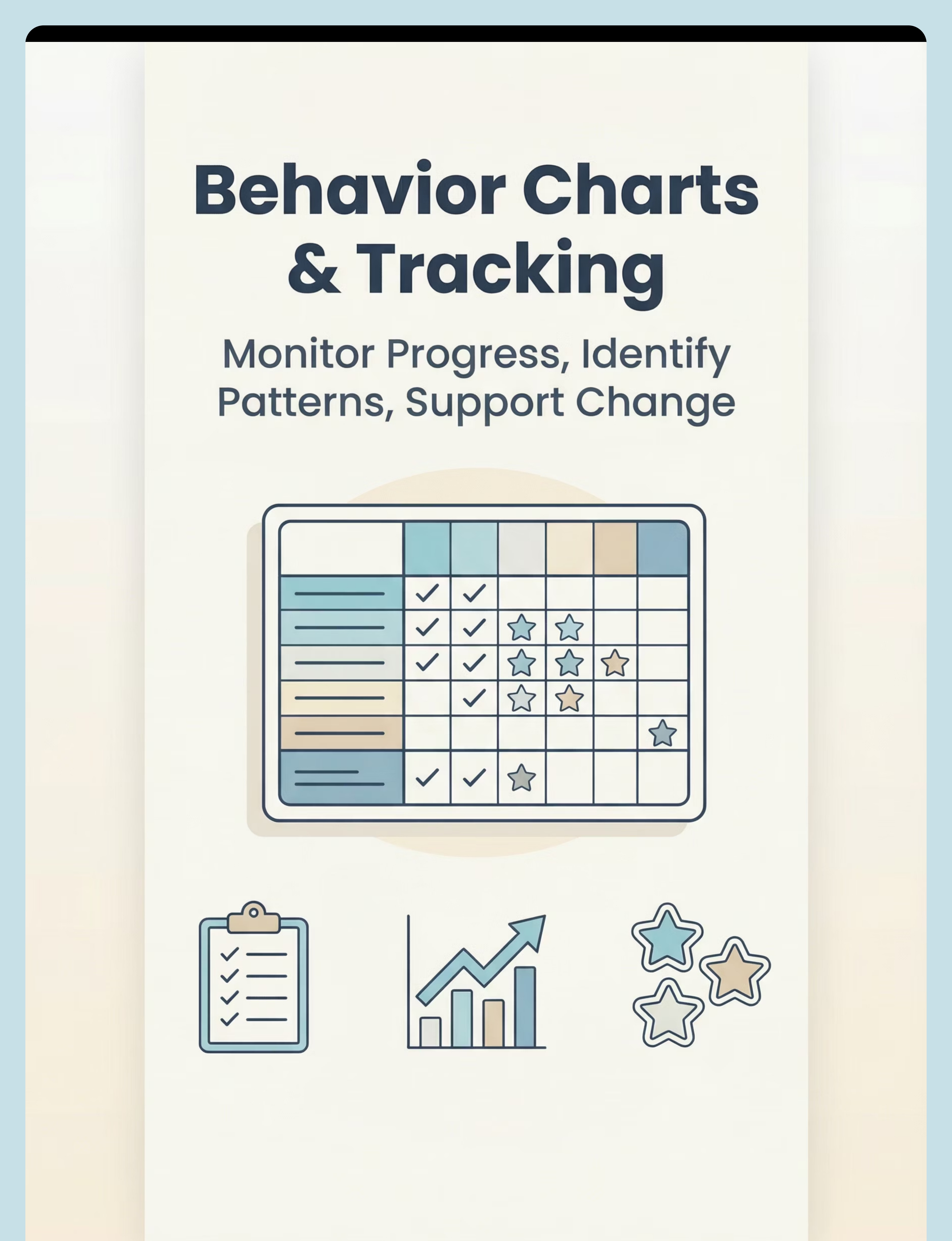
Preview of behavior charts tracking Therapy Material
Below is a visual preview of behavior charts tracking therapy material. The pages shown help educators, therapists, and caregivers understand the structure and content of the resource before use. Materials should be used under appropriate professional guidance.
Share this resource
Help others discover thisLink copied!
Measuring Success & Complete the Kit
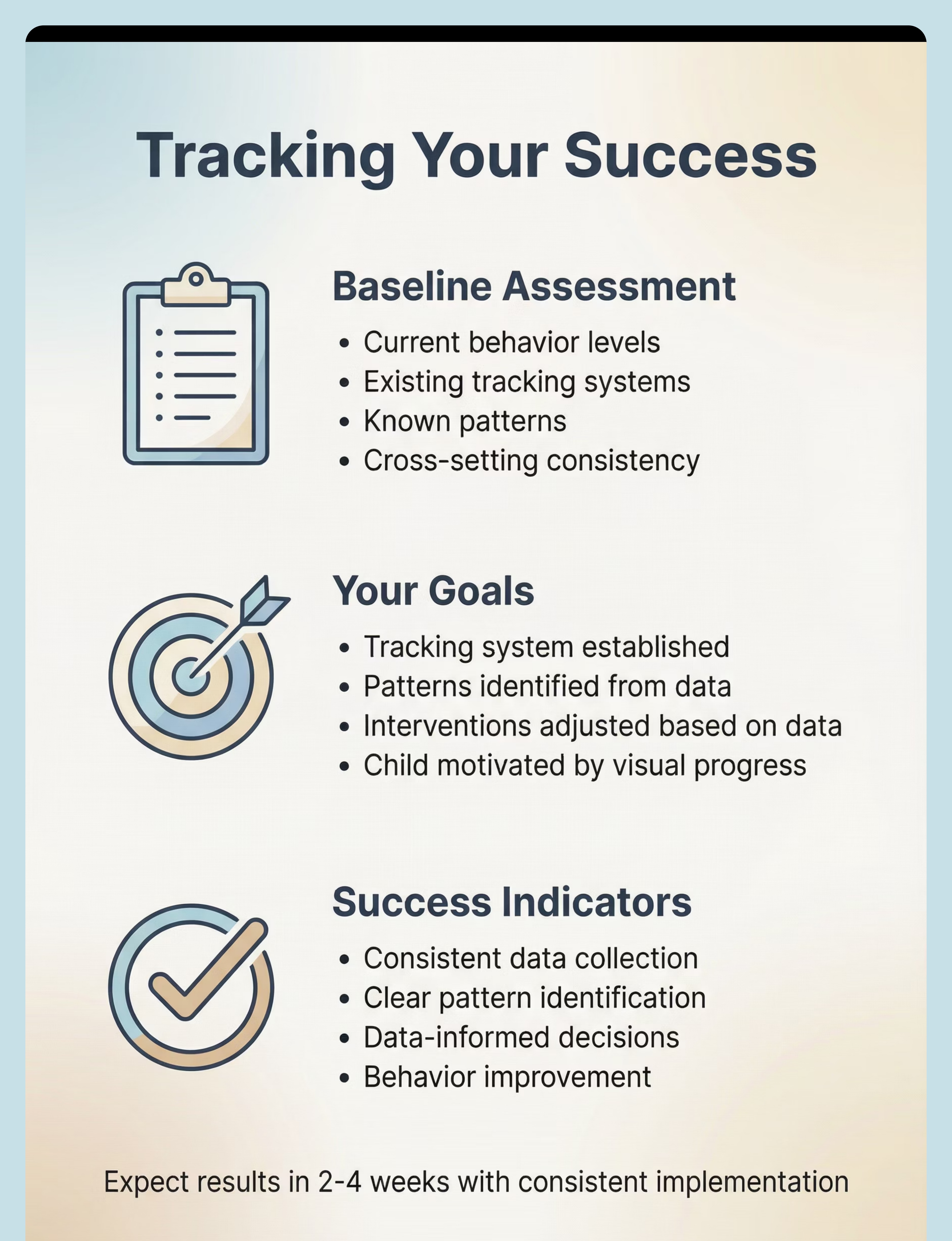
1. Establish Foundation: Baseline & Goals
Understand current behavior levels, existing tracking systems, and set clear, measurable objectives for improvement.
- Current behavior & patterns
- Define specific, observable goals
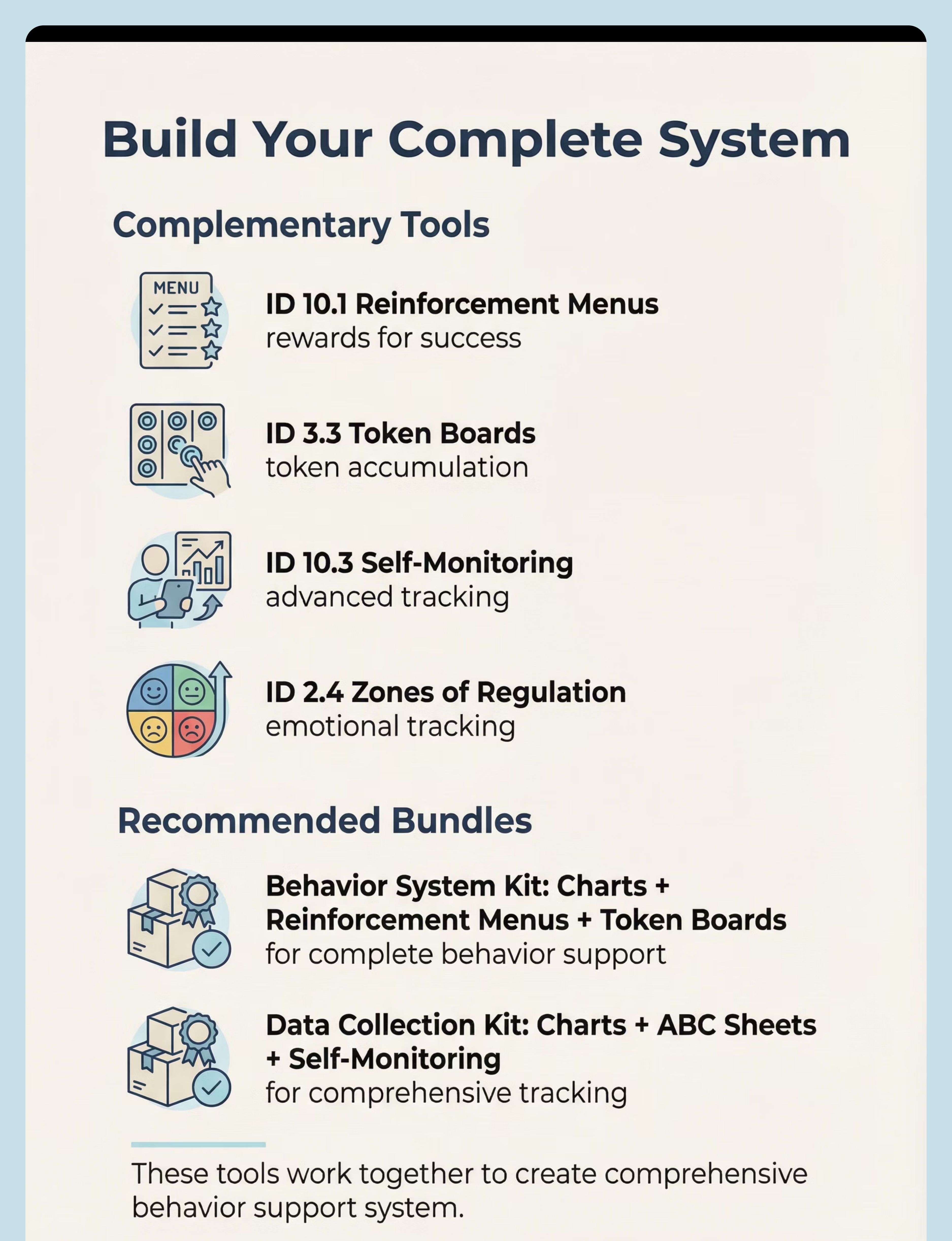
2. Implement Tracking & Pairing Tools
Utilize behavior charts for data collection and integrate them with complementary tools for enhanced support and feedback.
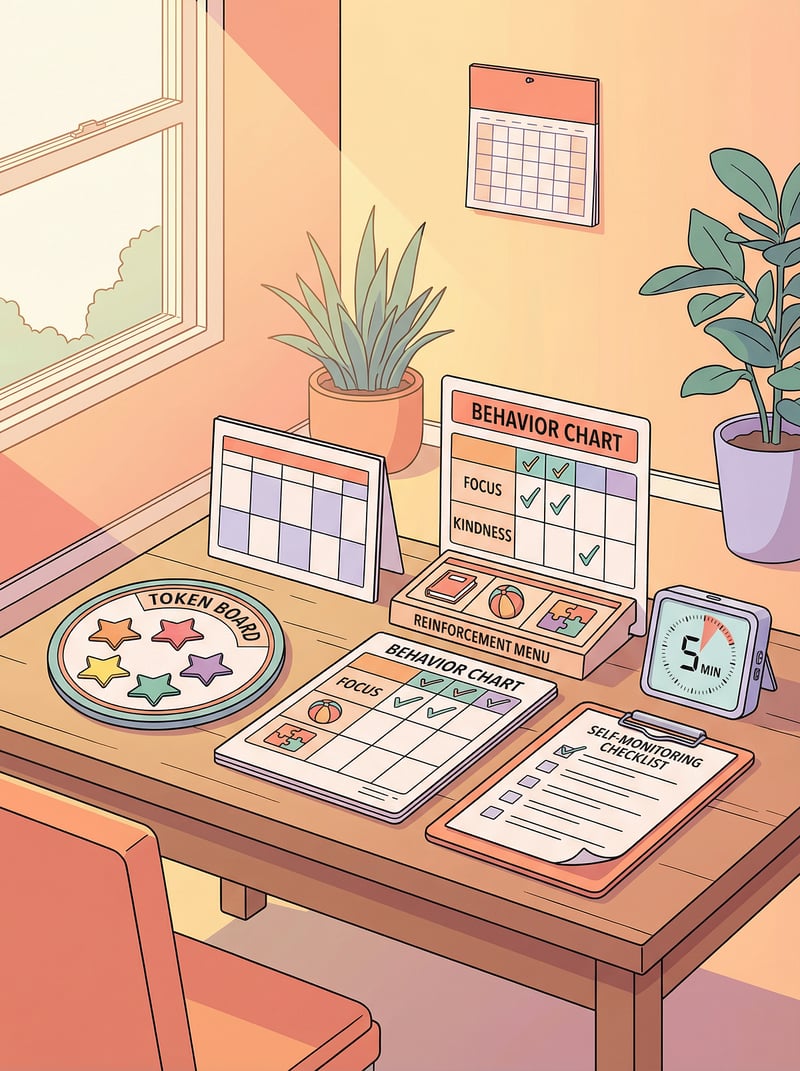
- Reinforcement Menus: Link rewards to chart success.
- Token Boards: Provide immediate visual feedback.
- Self-Monitoring: Build independence in tracking.
- Zones of Regulation: Connect emotions to behaviors.
3. Monitor Progress & Adjust Interventions
Consistently collect data, identify patterns, and use insights to make data-informed decisions and adapt strategies.
- Consistent data collection
- Clear pattern identification
- Data-informed adjustments
4. Achieve Behavior Improvement
Ultimately, a well-implemented tracking system leads to positive behavior change and sustained child motivation.
- Desired behavior improvement
- Sustained child motivation
Complete Support Bundles
- Behavior System Kit: Behavior Charts (10.2) + Reinforcement Menus (10.1) + Token Boards (3.3) — Complete behavior support
- Data Collection Kit: Behavior Charts (10.2) + ABC Data Sheet (10.2.4) + Self-Monitoring (10.3) — Comprehensive tracking
Quick Summary
AI Summary: Behavior charts and tracking tools monitor behaviors to identify patterns, measure progress, and provide visual motivation through consistent data collection. Core Kit (Rank 1), strong evidence, essential behavior support.
behavior
tracking
charts
data
reinforcement
progress
ABA
BCBA
SpEd
core-kit
Common searches: behavior chart autism • sticker chart • reward chart kids • behavior tracking • ABC data sheet • daily report card • progress chart
Get Support
FREE National Autism Helpline
Phone: 9100 181 181
Languages: 16+
Website: pinnacleblooms.org
Platform Integration
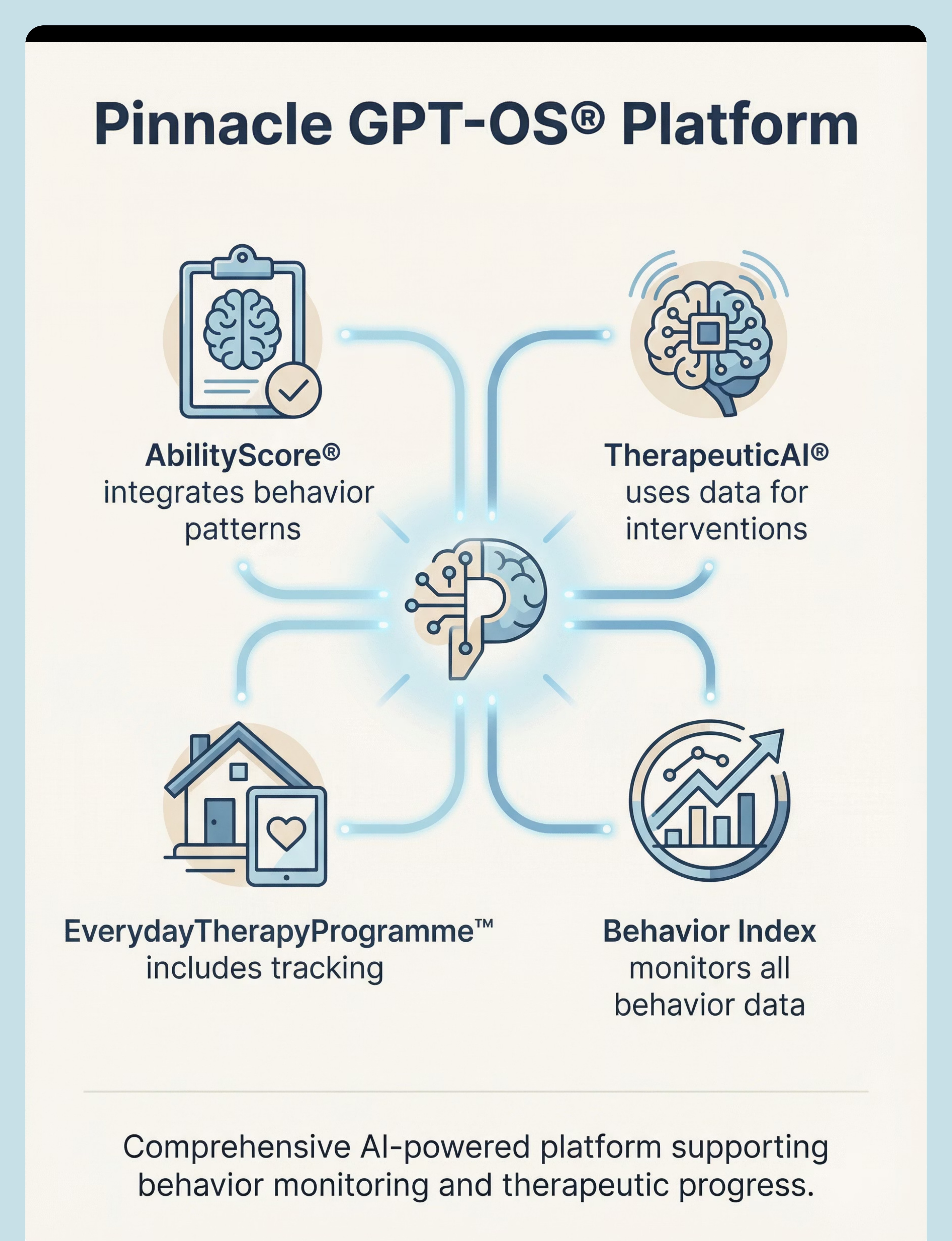
AbilityScore® integrates behavior patterns. TherapeuticAI® uses data for intervention. EverydayTherapyProgramme™ includes tracking. Behavior Index monitors all behavior data.
Disclaimer: This is educational information. Always consult qualified Board Certified Behavior Analysts (BCBAs), occupational therapists, speech-language pathologists, or pediatricians. Individual results vary. Behavior tracking should be part of a comprehensive support plan tailored to your child's unique needs.