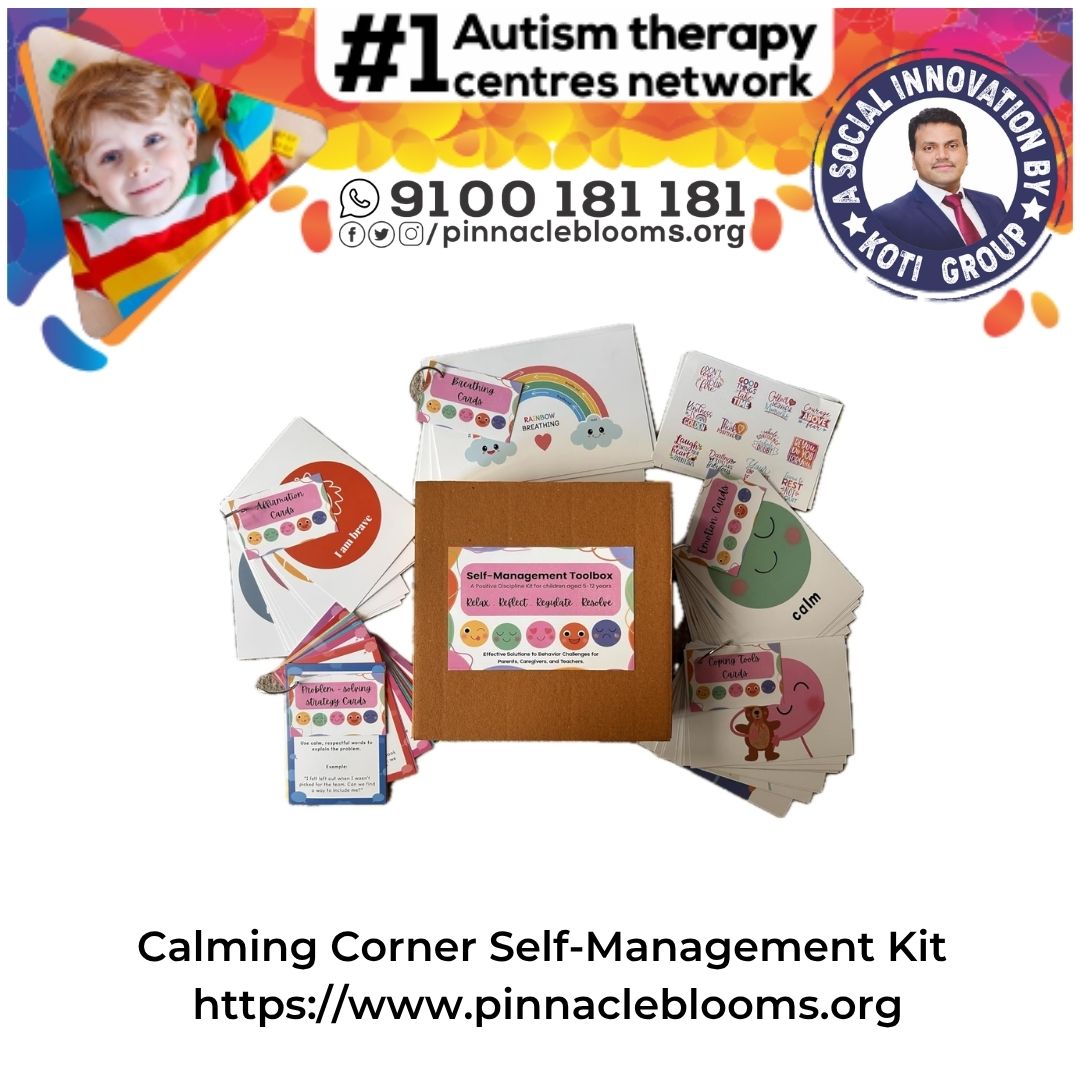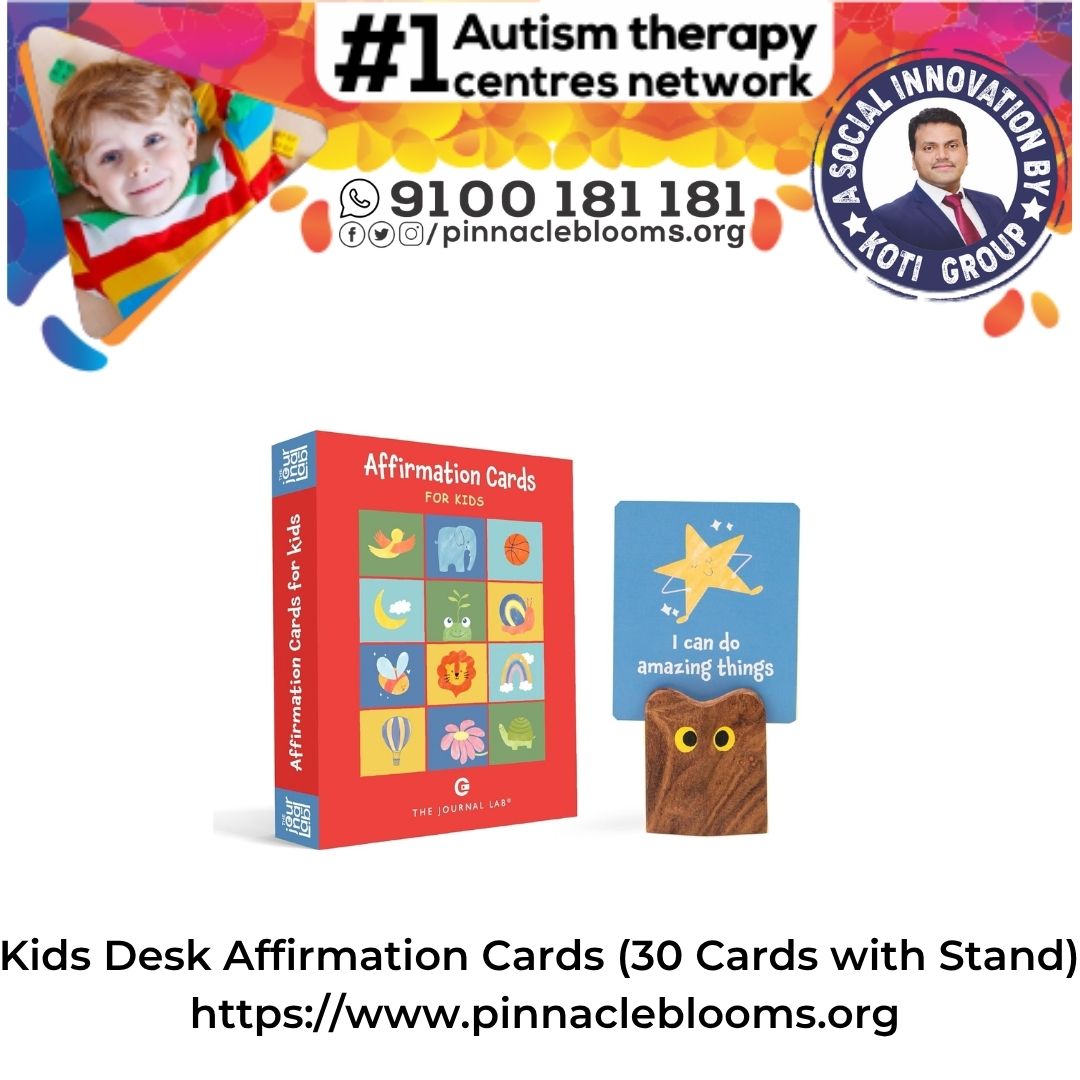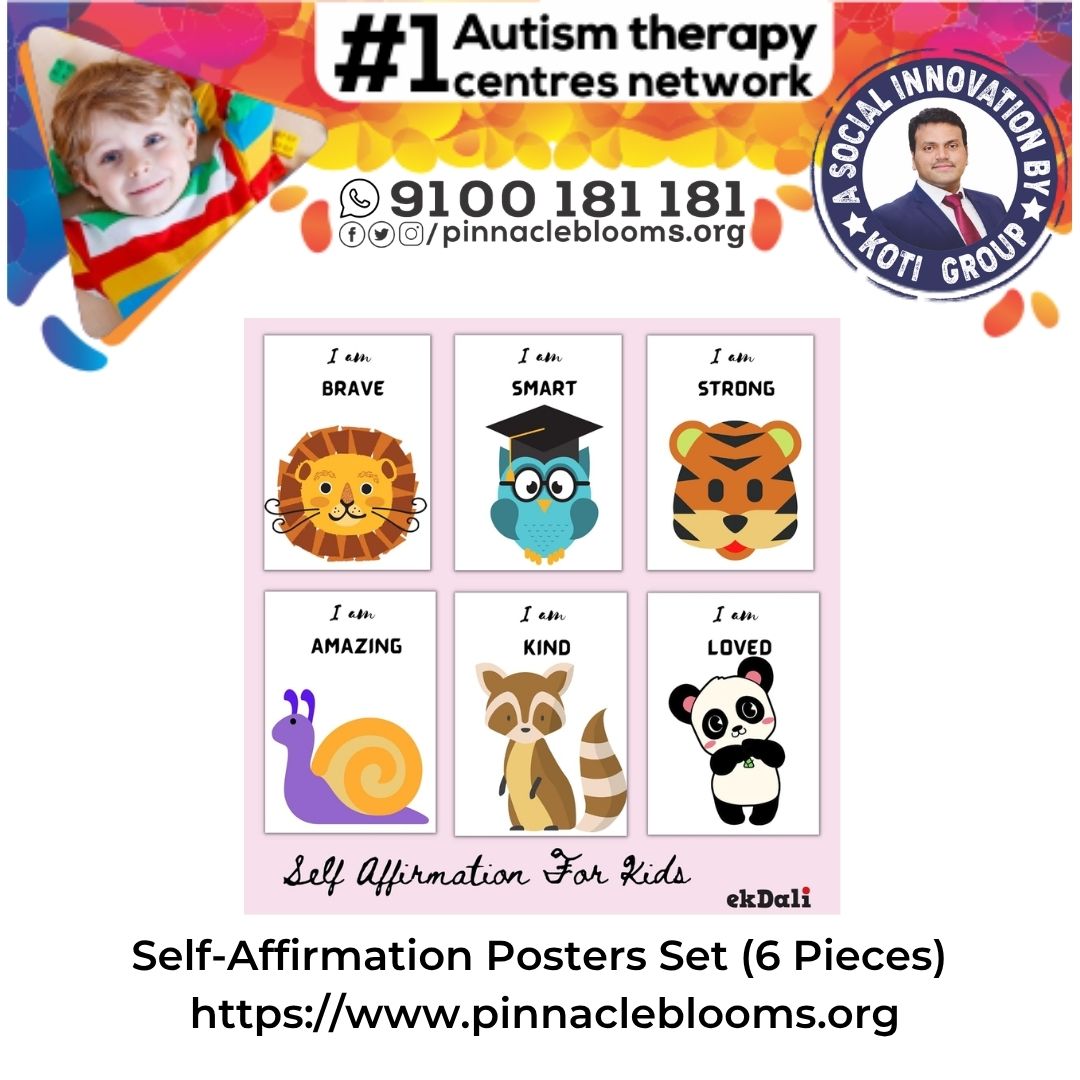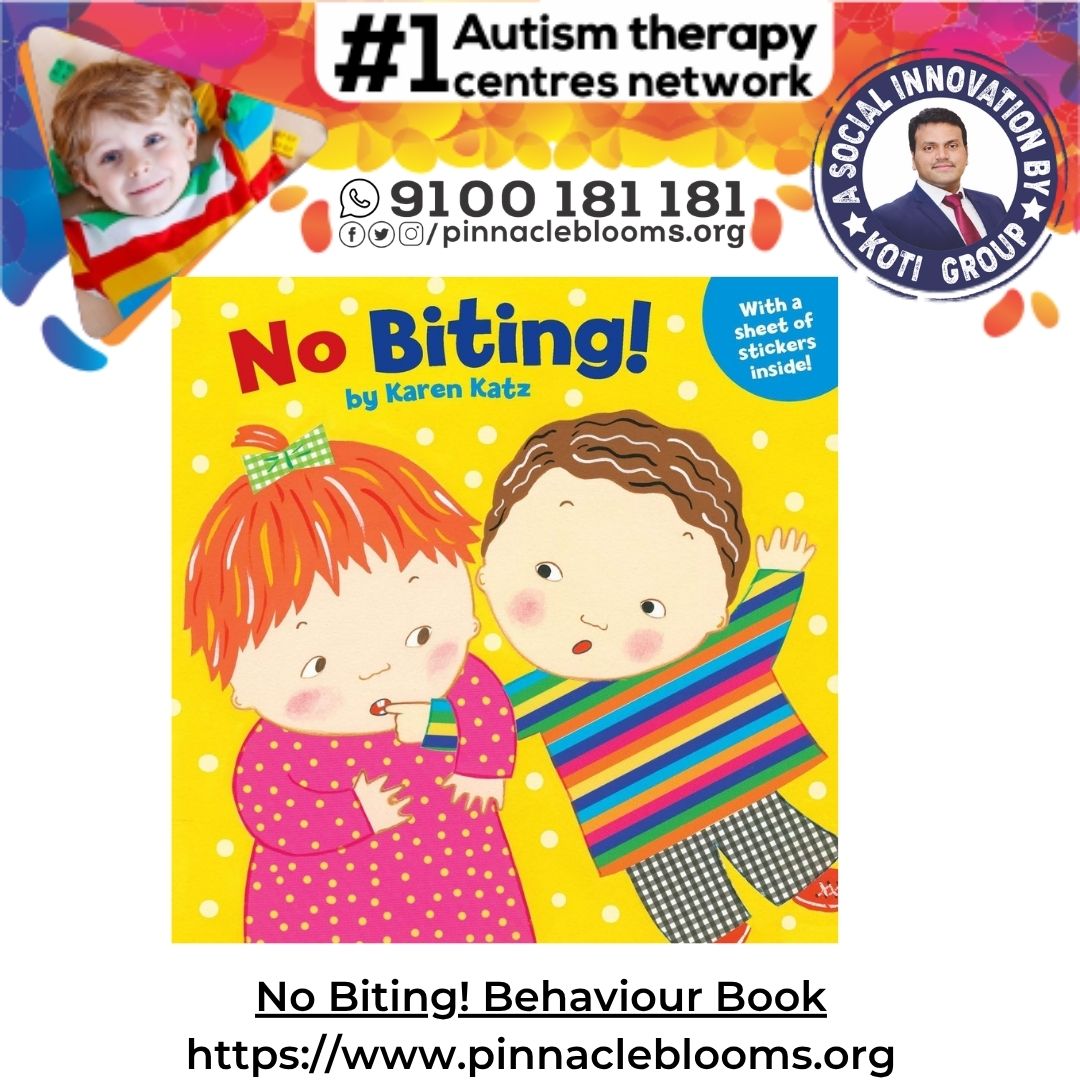










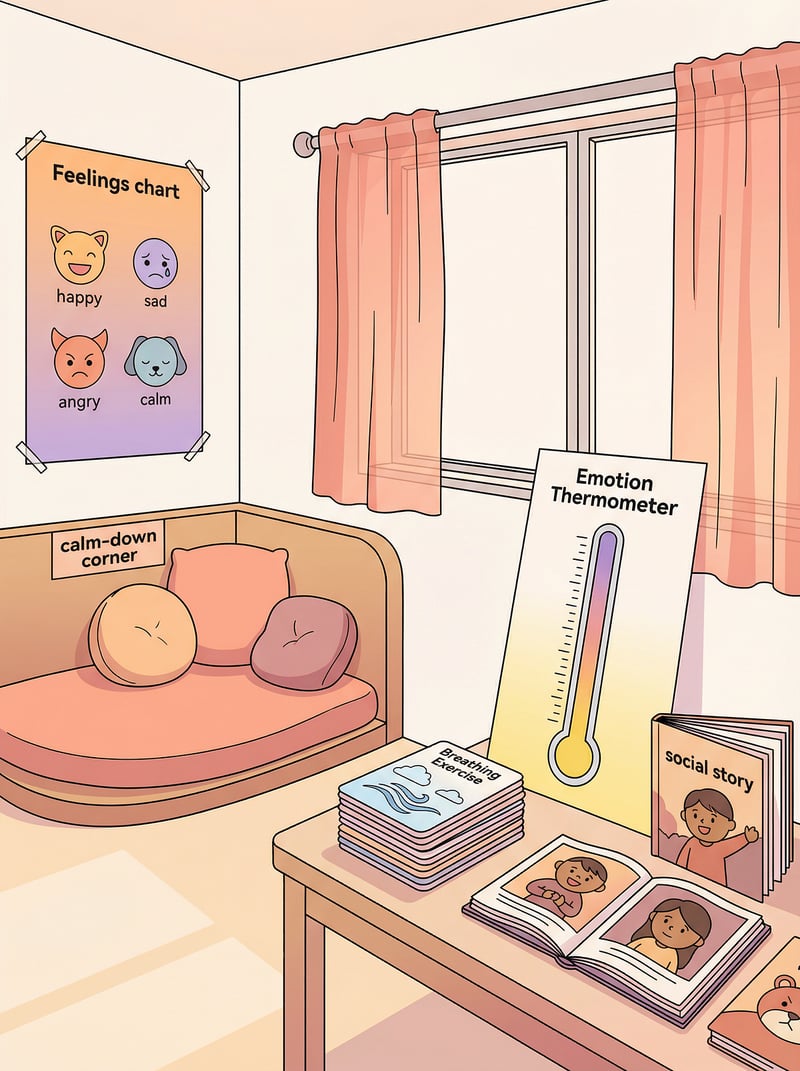
Calm-Down Kit
Calm-Down Kit
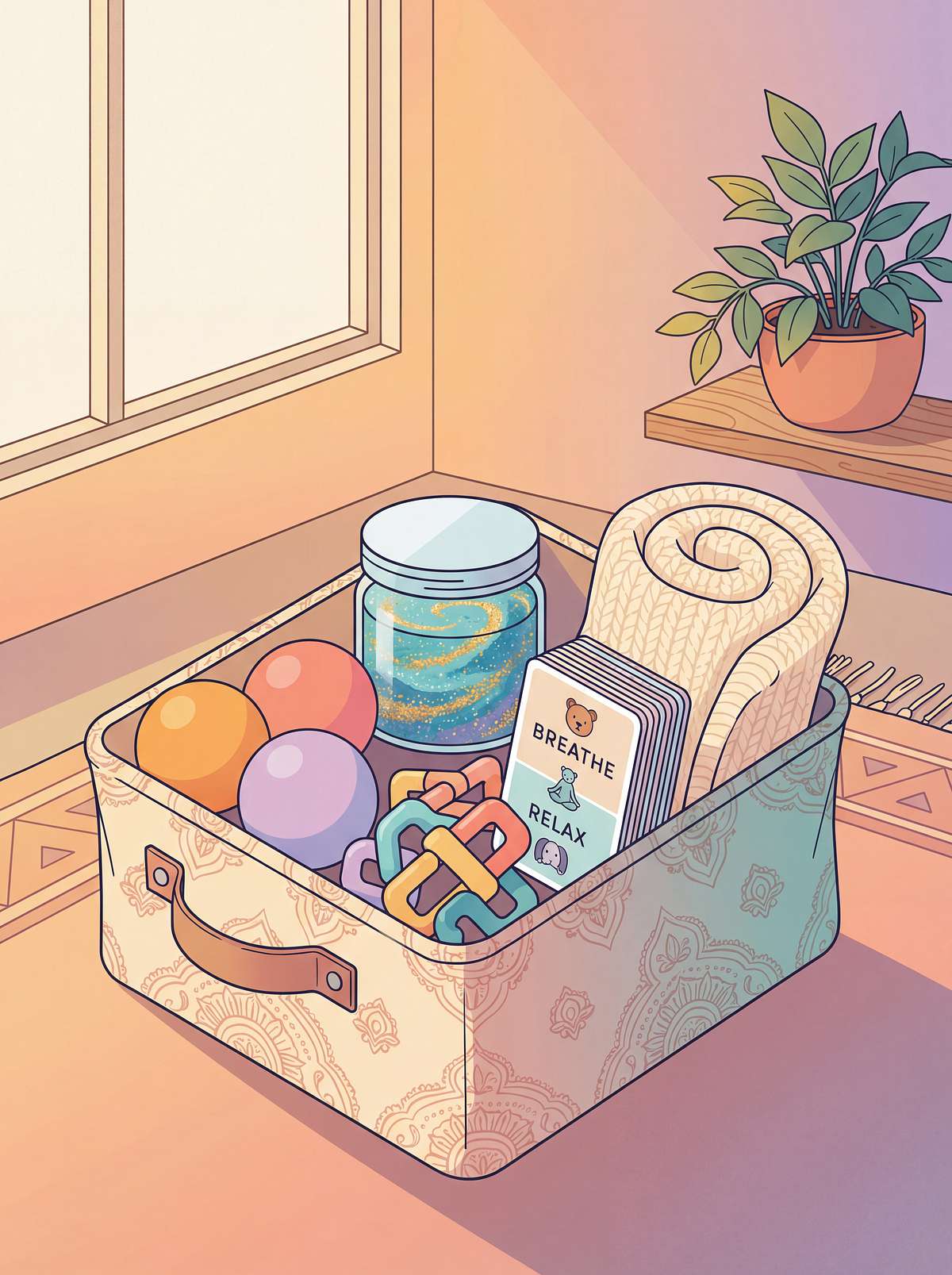
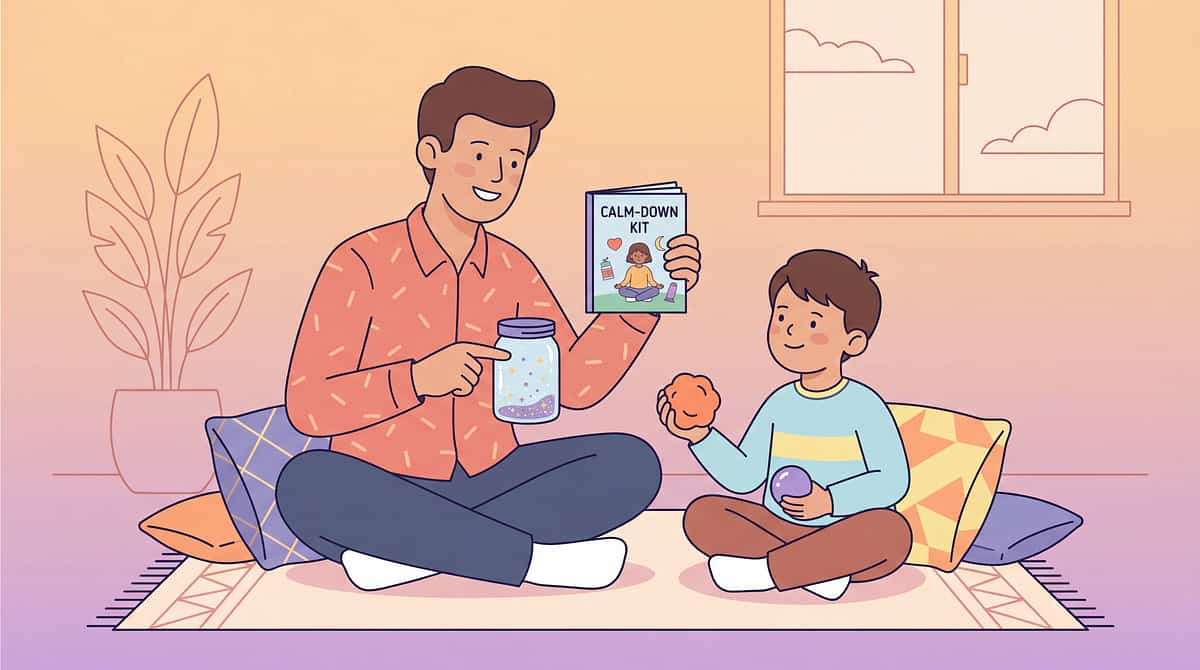
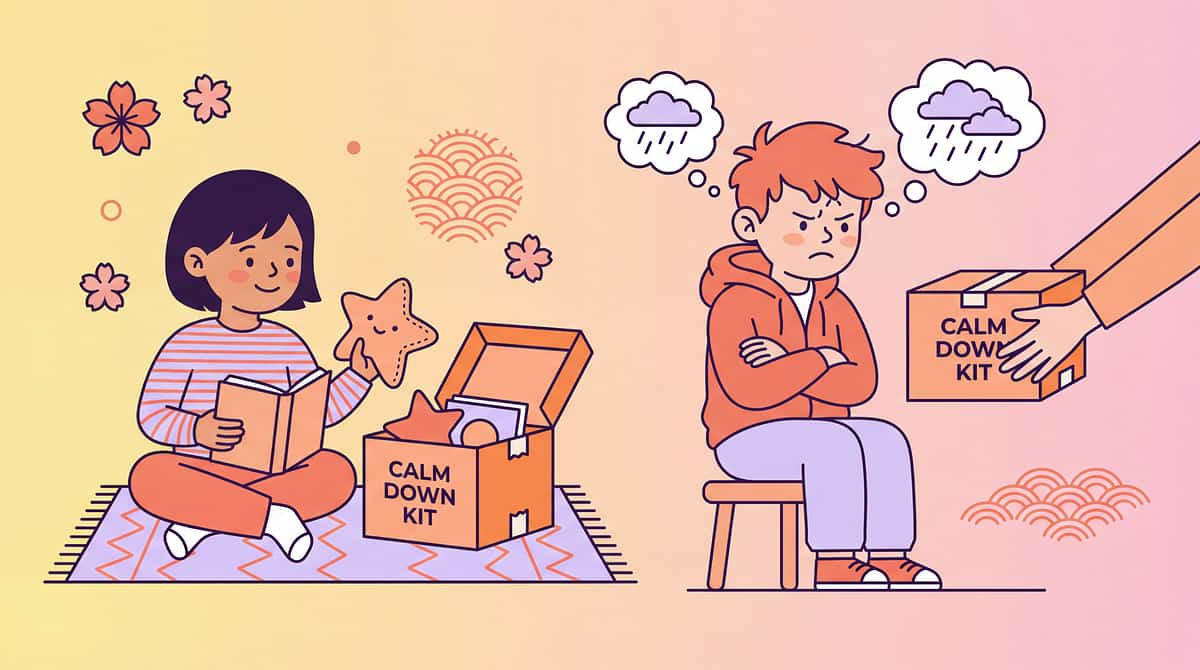
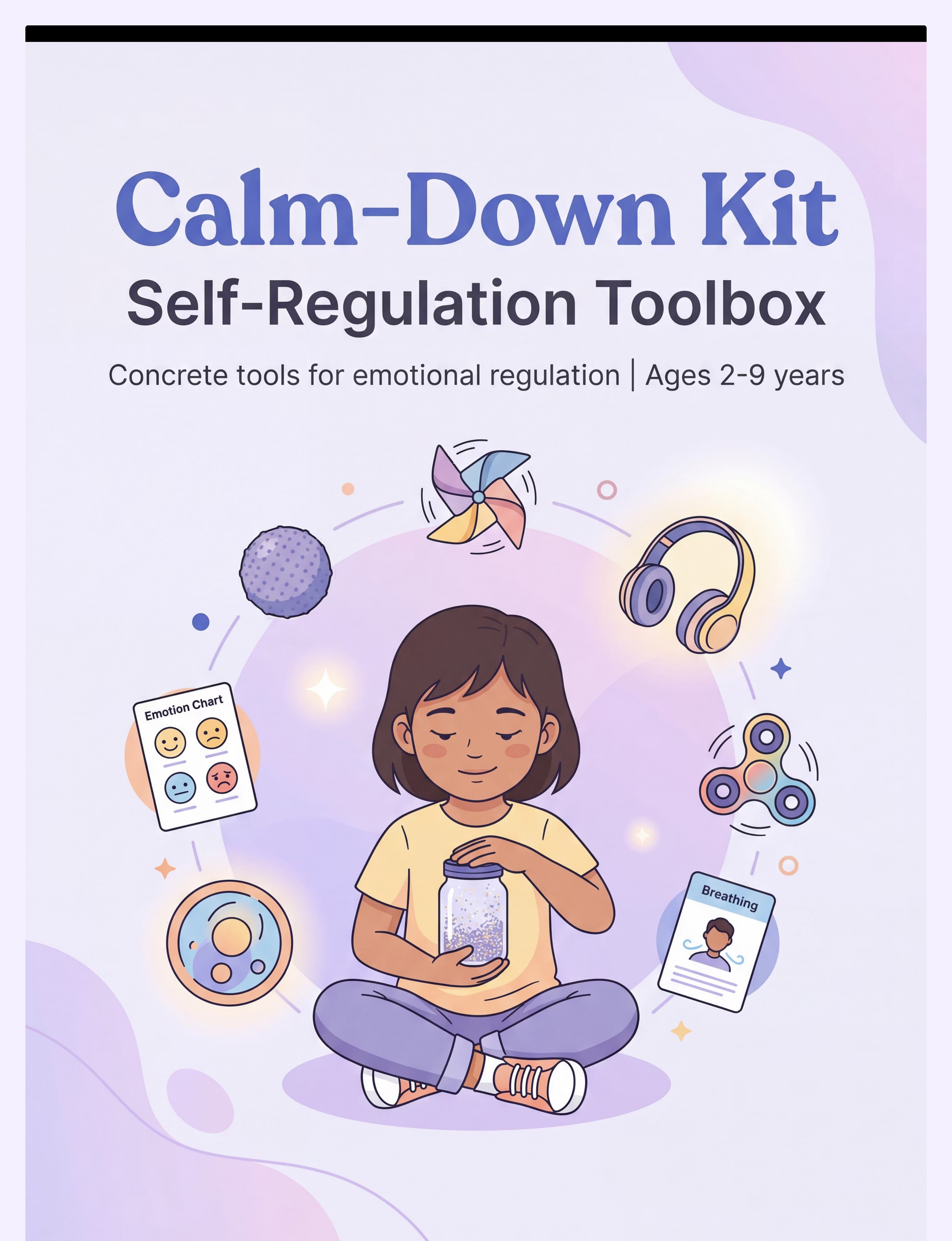
Portable collection of sensory and emotional regulation tools that give children concrete strategies to self-calm during moments of distress
Who This Helps
Children with Autism
And sensory processing differences
Kids with ADHD
And emotional regulation challenges
Children Experiencing Anxiety
And stress
Kids Learning Self-Regulation
Skills
Children in Therapy
(OT, psychology, speech)
Any Child
Who struggles with meltdowns or emotional overwhelm
Who This Helps
Calm-down kits provide multi-sensory tools and strategies for self-regulation during emotional escalation, helping children develop concrete coping skills instead of relying solely on verbal instructions.
Emotional Regulation
Self-Calming
Coping Skills
Anxiety Management
Meltdown Prevention
Ages: 2-9 years
Home
School
Clinic
Travel
Children who struggle to calm down once upset
When traditional verbal instructions don't work and escalation continues without intervention
Kids who lack self-soothing strategies
Children who need tangible, practiced tools rather than abstract coping advice
Learners who benefit from multi-sensory approaches
Those who respond better to physical tools they can see, touch, and manipulate during dysregulation
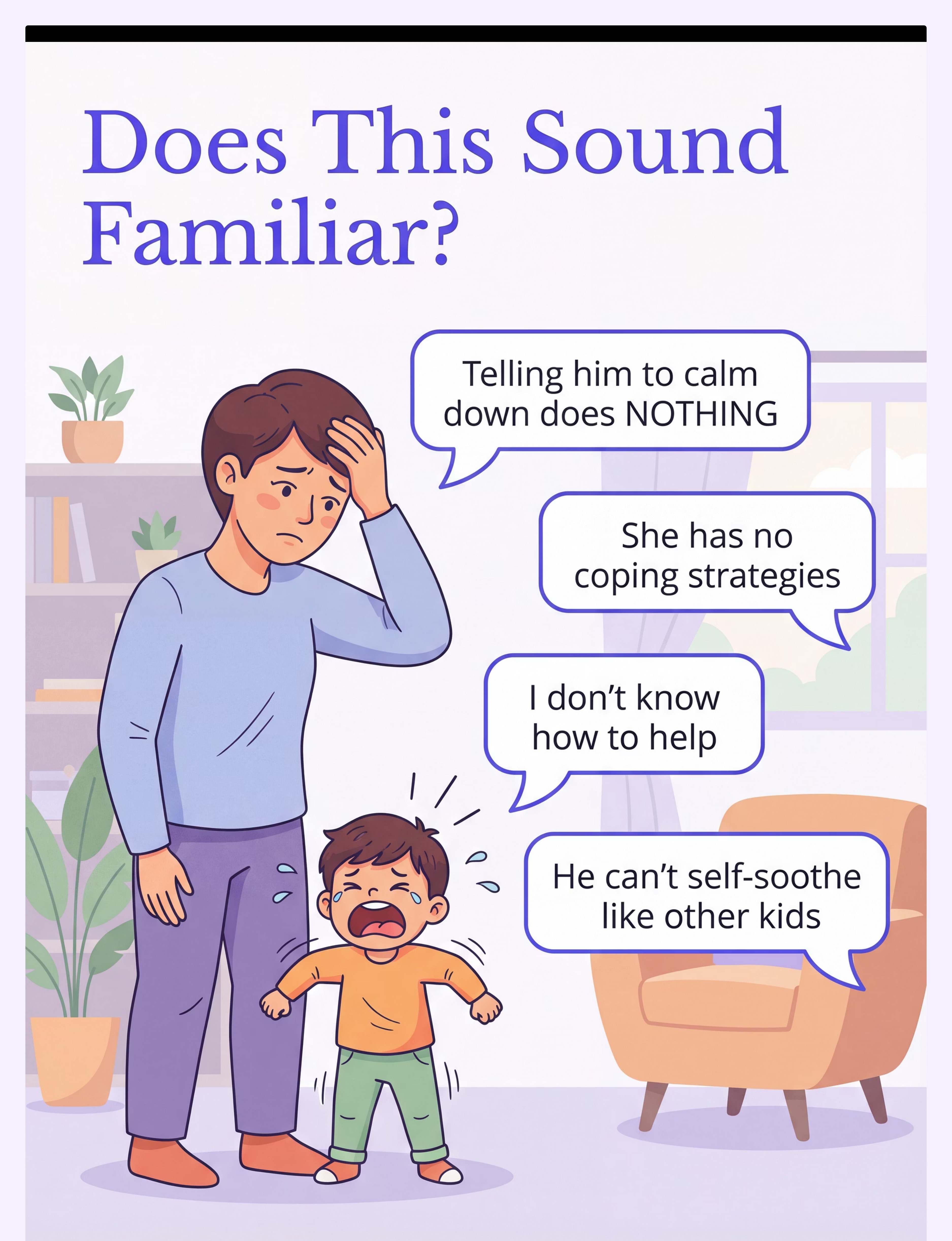
Does This Sound Familiar?
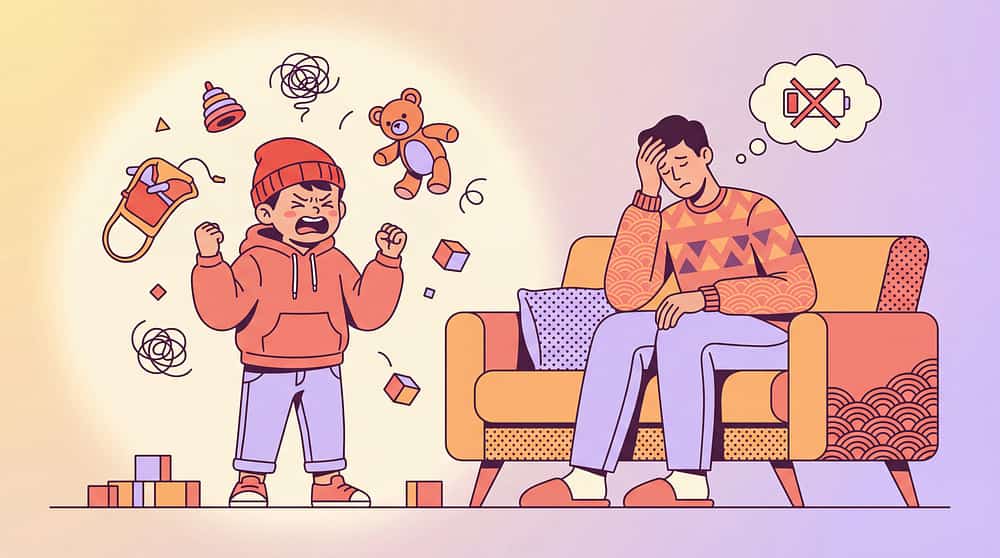
"When he's upset, telling him to calm down does nothing. The words just bounce off and he escalates further."
"She has no coping strategies—just goes straight from upset to complete meltdown every single time."
"I don't know how to help during meltdowns. I feel completely helpless watching my child struggle."
"He can't self-soothe like other kids his age. I worry about what happens when I'm not there."
"We've tried everything but nothing works. Every strategy we attempt seems to fail."
"Meltdowns happen everywhere—school, stores, family gatherings. We desperately need portable solutions."
You're not alone. These are common challenges faced by families navigating emotional regulation difficulties. The right tools and strategies can make a profound difference.
What to Expect: Parent Experiences Over Time
Week 1-2: Initial practice and familiarization
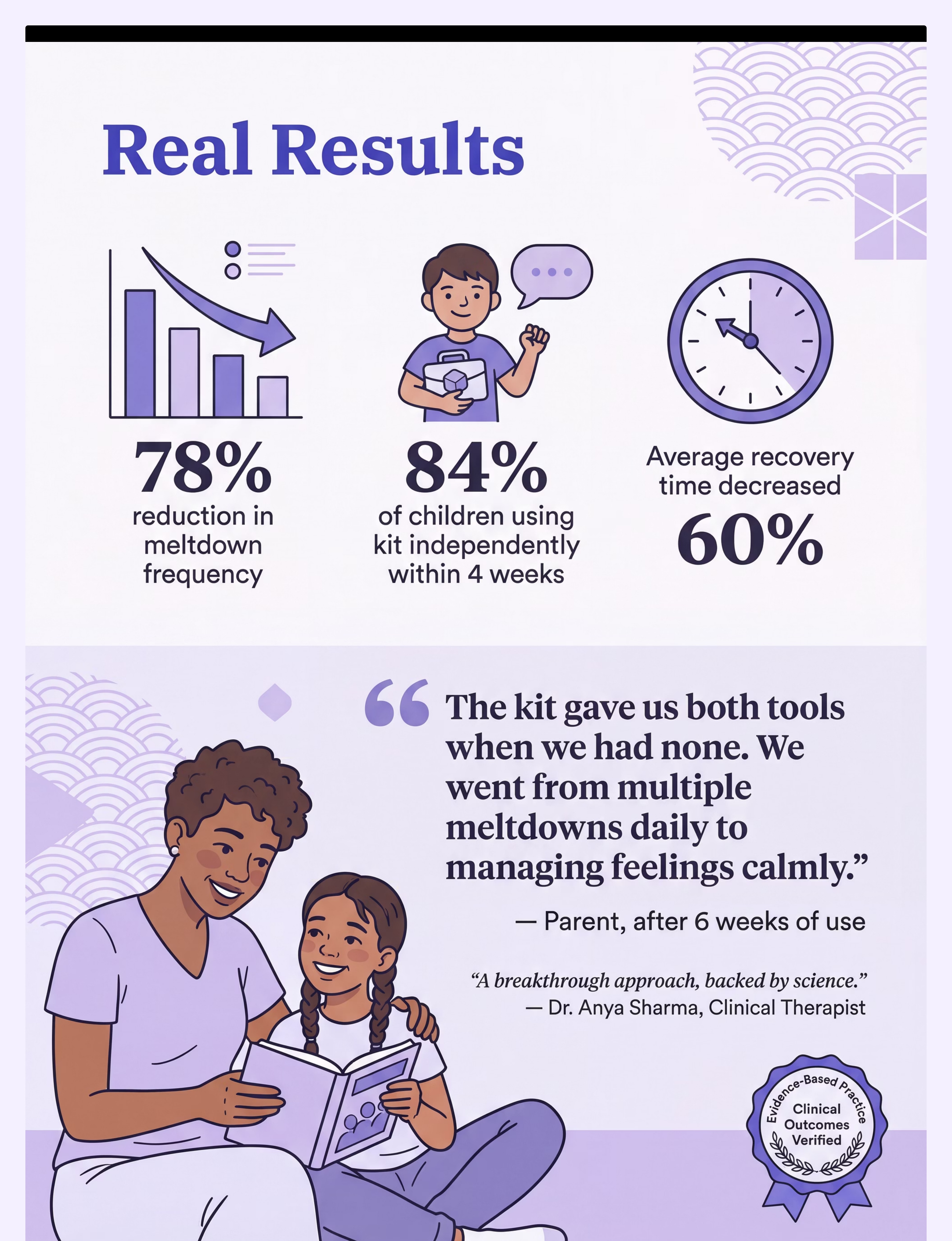
"Before the kit, meltdowns lasted 45 minutes. Now he grabs his stress ball and breathing cards, and he's calm in under 10 minutes. It's like magic, but it's just practice."
Week 3-4: First independent uses
"The school was skeptical at first. After two weeks of her using the portable kit during transitions, her teacher called to ask where we got it. Now three other kids in the class have them too."
Month 2-3: Consistent regulation success
"I was worried he'd refuse to use it or see it as babyish. But we practiced together during calm times, and now he asks for 'kit time' when he feels overwhelmed. He's so proud of himself."
Month 4+: Skill generalization and independence
"The best part? She doesn't even need the physical kit anymore. She's internalized the strategies—deep breathing, counting, using her fidget. The kit taught her how to regulate herself."
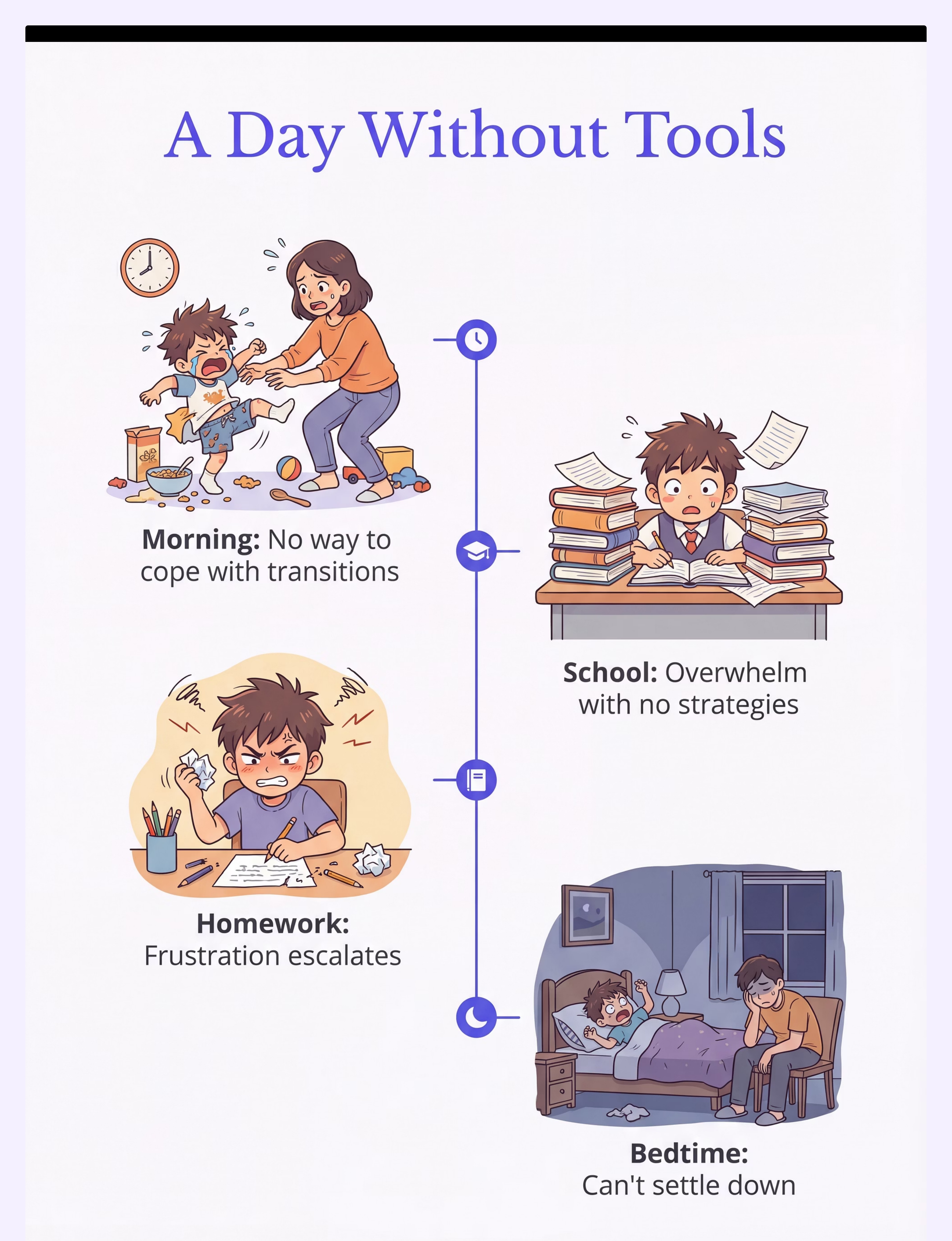
A Day Without the Right Support
Morning Transitions
Dysregulation starts with the morning rush. No tools available to help manage the overwhelm of getting ready for the day.
School Challenges
Classroom demands pile up without accessible strategies. Sensory and emotional overload builds with no outlet.
Homework Battles
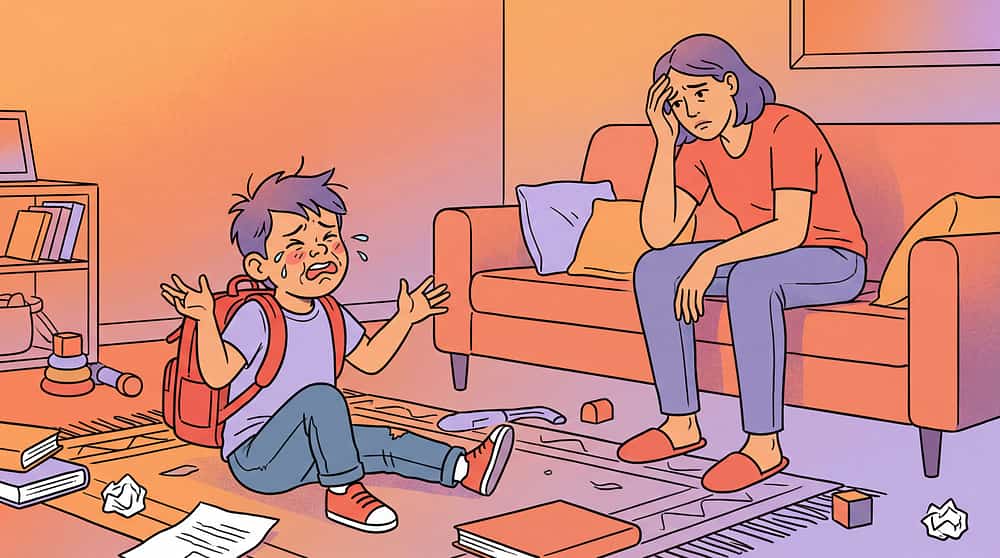
Frustration mounts during homework time. With no intervention strategies, small challenges explode into full meltdowns.
Bedtime Struggles
Evening arrives with accumulated stress. Unable to settle or decompress, the day ends as difficultly as it began.
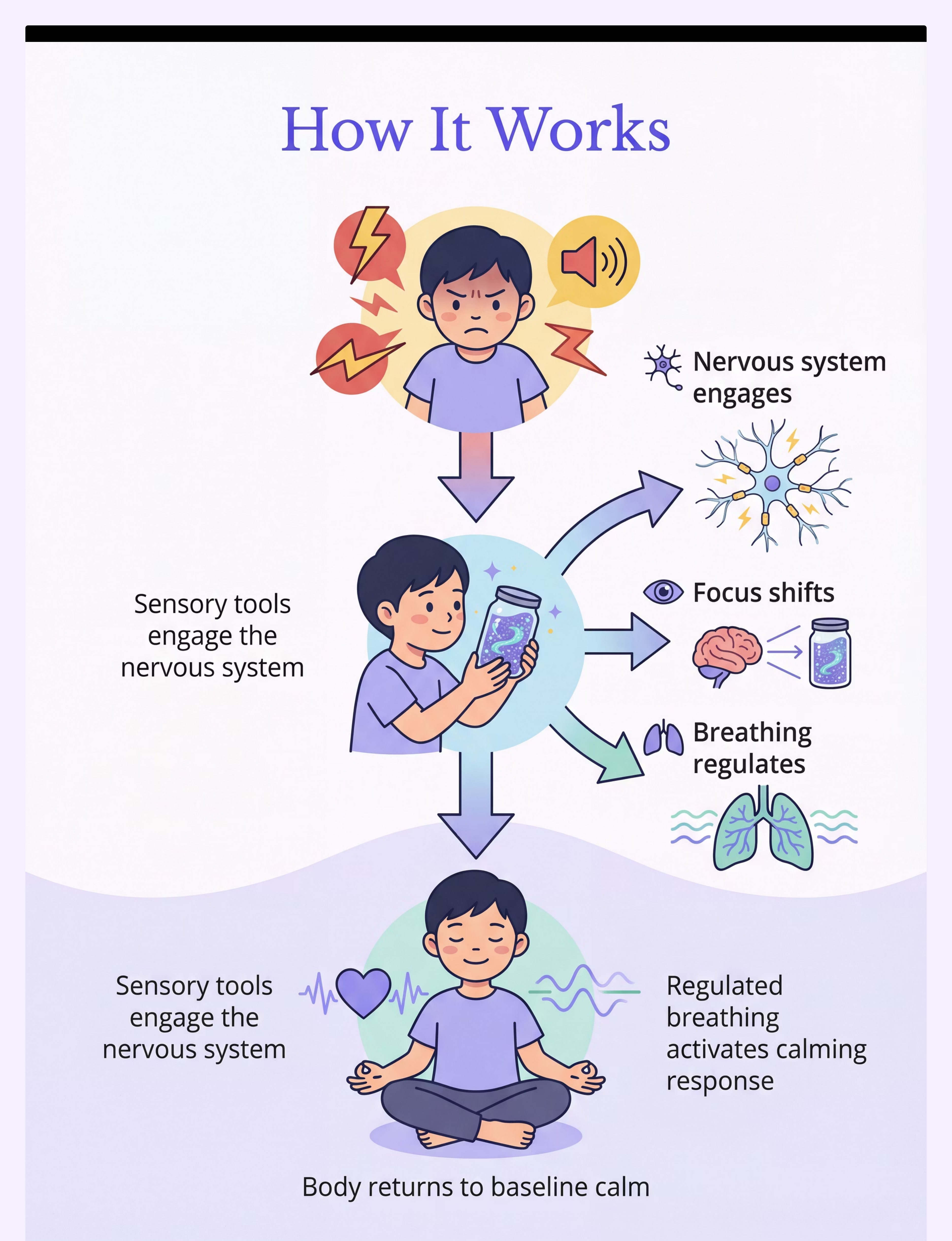
The Science Behind It
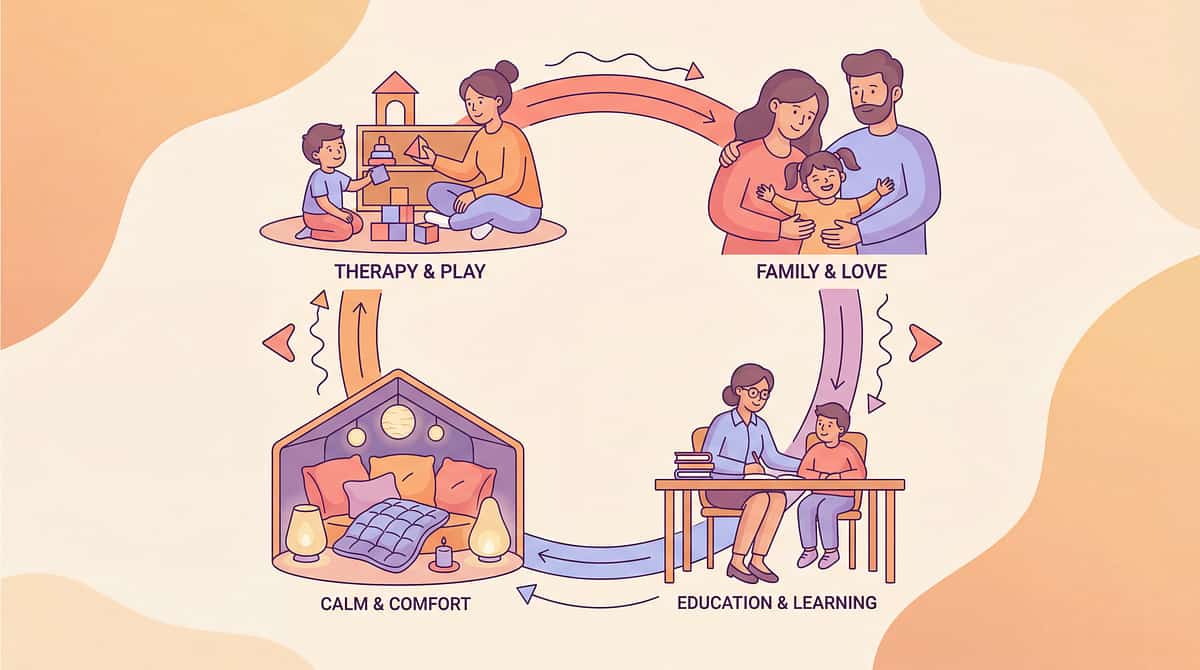
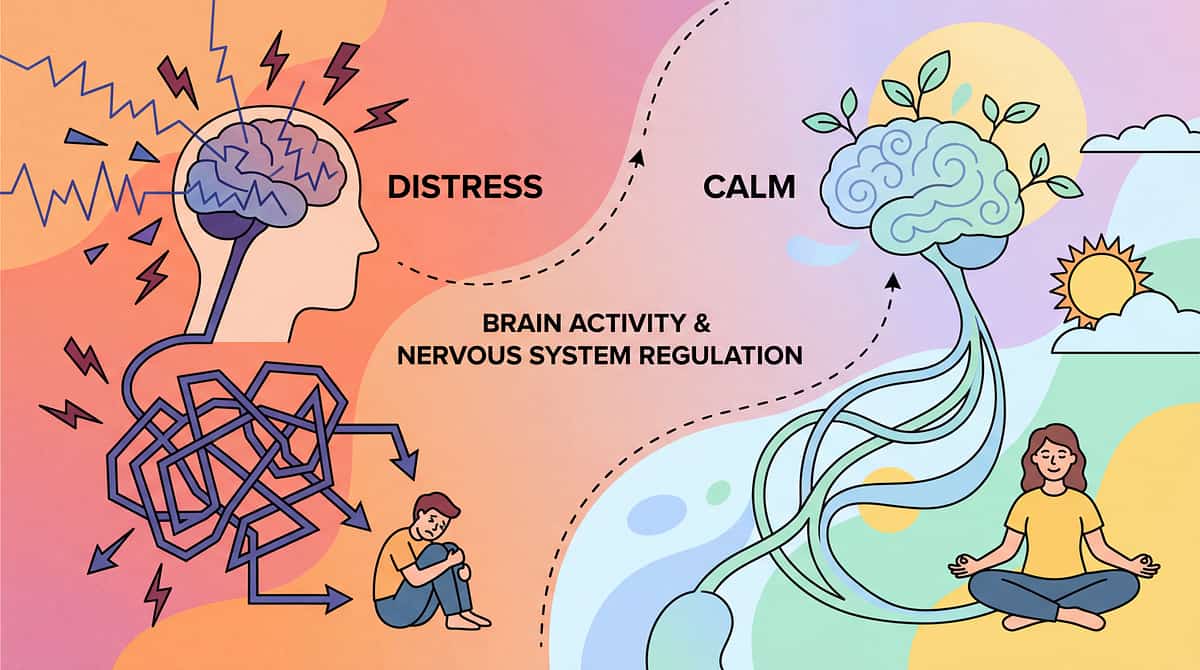
Understanding how calm-down kits support regulation helps parents and therapists use them effectively. The process engages multiple neurological pathways to shift the nervous system from distress to calm.
Emotional Distress
Overwhelm, anxiety, or strong emotions lead to nervous system dysregulation.
Sensory Input
Calm-down kit tools provide focused sensory engagement (e.g., touch, sight, movement).
Nervous System Shift
Sensory input redirects attention, activates breathing regulation, and triggers the parasympathetic system.
Regulation & Calm
The body's natural relaxation response is activated, leading to de-escalation and a return to baseline.
Targets: Emotional Regulation
Self-Calming
Coping Skills
Anxiety Management
Meltdown Prevention
How to Use It Right
Introduce tools during CALM times
Never wait for crisis. Practice when your child is regulated so tools become familiar and comfortable before they're needed.
Practice strategies before needed
Rehearse using each tool multiple times during peaceful moments. Build the neural pathways when thinking is clear.
Child helps select kit contents
Empower your child by letting them choose which tools feel calming to them. Ownership increases usage and effectiveness.
Multiple sensory modalities included
Include tactile, visual, auditory, and proprioceptive options. Different moments call for different sensory inputs.
Available and accessible when needed
Keep kit within easy reach, never locked away. Accessibility in the moment of need is critical for success.
Adults model using tools
Demonstrate your own calm-down strategies. Children learn powerfully through observation and shared experience.
Duration: Practice sessions should last 5-10 minutes during calm times. During actual use, allow as much time as needed for regulation.
Expert Perspective
"A calm-down kit gives children concrete tools instead of abstract instruction to 'calm down.' When a child is dysregulated, they can't process verbal commands—they need tangible strategies they've practiced."
— Occupational Therapist and Child Psychologist
OT + Psychologist Recommended
Strong Evidence Base
Rank #1 in Emotional Regulation
Core Kit Essential
This approach is backed by extensive clinical experience and research in sensory integration, emotional regulation, and child development. The multi-disciplinary endorsement reflects the tool's effectiveness across therapeutic contexts.
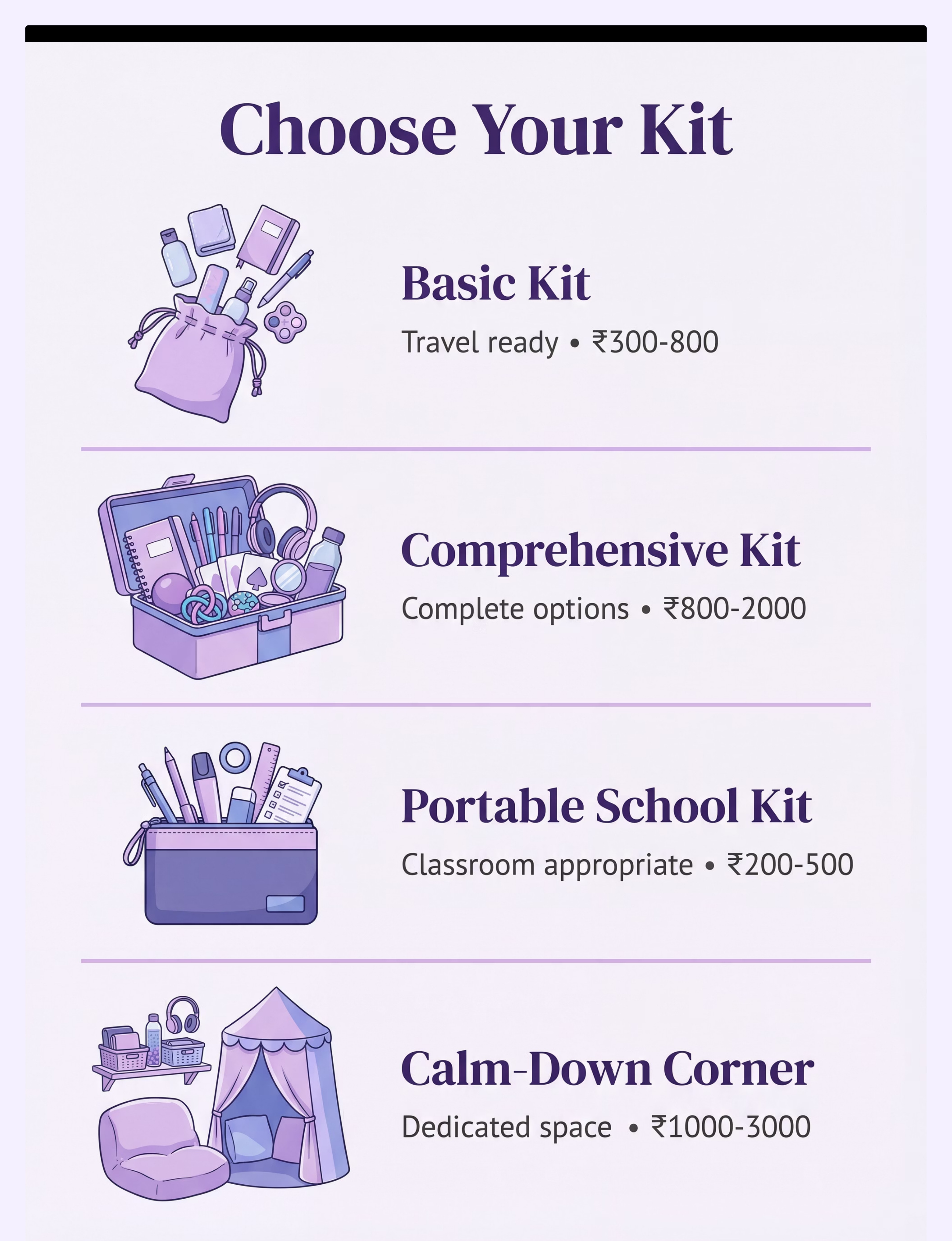
Choose Your Option (7 Variants)
Every child's regulation needs are unique. Choose based on your child's age, primary settings, portability requirements, and the breadth of strategies you want to offer. Start simple and expand as you learn what works best.
Basic Calm-Down Kit
Beginner-friendly, ideal for travel and quick intervention. A core selection of 5-8 essential tools.
Comprehensive Kit
A home-based solution offering a wide variety of 15-20 strategies for diverse regulation needs.
Portable School Kit
Designed for discreet classroom use, providing effective tools for school-age children.
Calm-Down Corner Setup
Creates a dedicated calming space at home, school, or clinic for sustained regulation support.
Glitter/Calm-Down Jar Set
Excellent for visual learners, providing a mesmerising focus and natural breathing timer.
Breathing Tools Set
Focuses specifically on breath regulation techniques with specialized tools to guide controlled breathing.
Emotion Regulation Board Game
Facilitates social learning and emotional skill practice in a calm, engaging, and interactive setting.
By Goal
  • Calming: Glitter jars, soft textures, weighted items
  • Visual focus: Lava lamps, pinwheels, calming photos
  • Breath regulation: Bubbles, breathing tools, hoberman sphere
  • Proprioceptive input: Stress balls, putty, resistance bands
By Setting
  • Home: Comprehensive or corner setup
  • School: Portable, discreet options
  • Clinic: Professional complete kits
  • Travel: Basic portable kit
By Portability
  • Very High: School kit, single pouches
  • Medium: Basic kit, breathing sets
  • Low: Corner setup, comprehensive kits
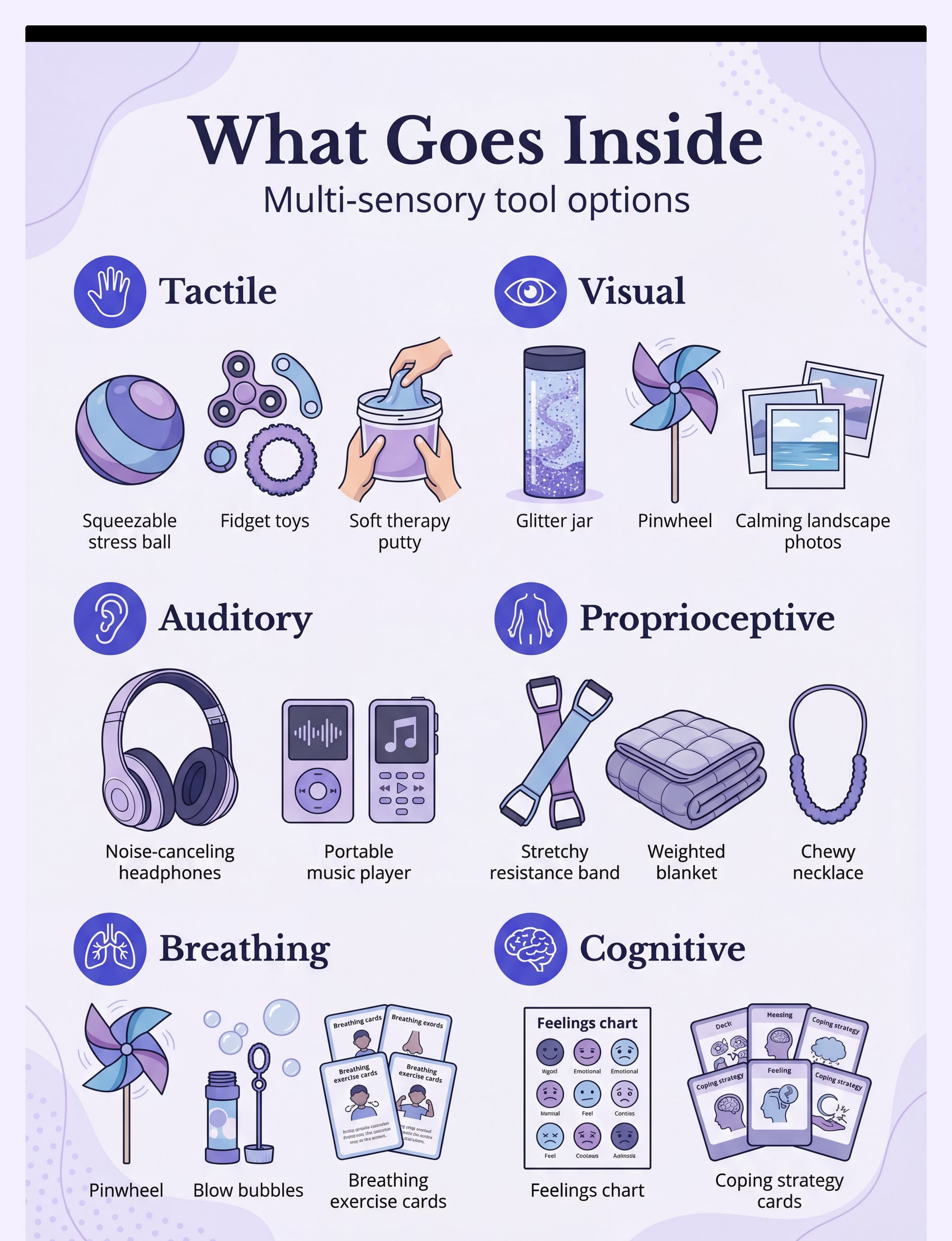
Kit Contents by Sensory Type
A well-designed calm-down kit addresses multiple sensory systems, giving your child various pathways to regulation. Include at least one item from each category to ensure comprehensive support.

There was an error generating this image

Tactile
  • Stress ball
  • Fidget toys
  • Textured items
  • Therapy putty
Visual
  • Glitter jar
  • Lava lamp
  • Pinwheel
  • Calming photos
Auditory
  • Noise-canceling headphones
  • Calming music player
  • Nature sounds
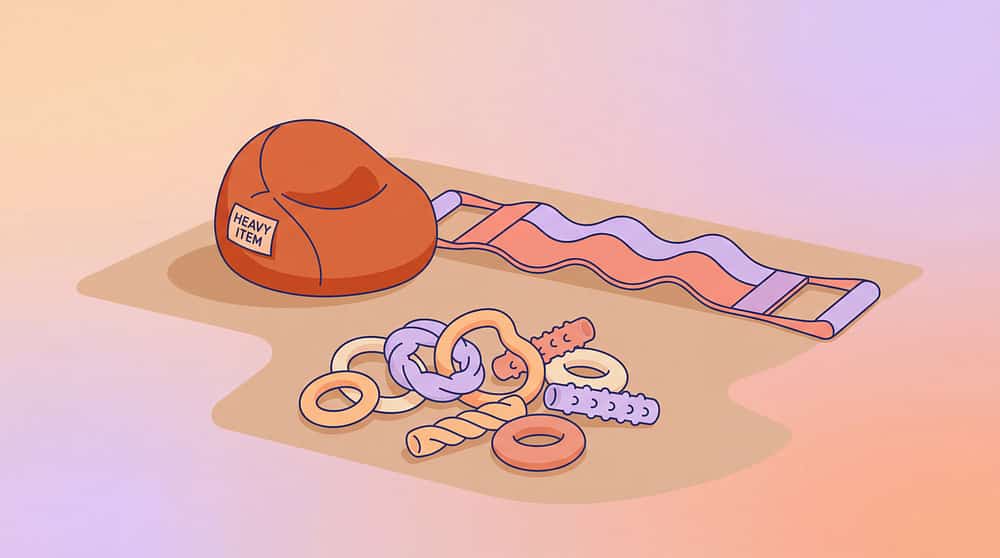
Proprioceptive
  • Resistance band
  • Heavy item to hold
  • Chewy tools
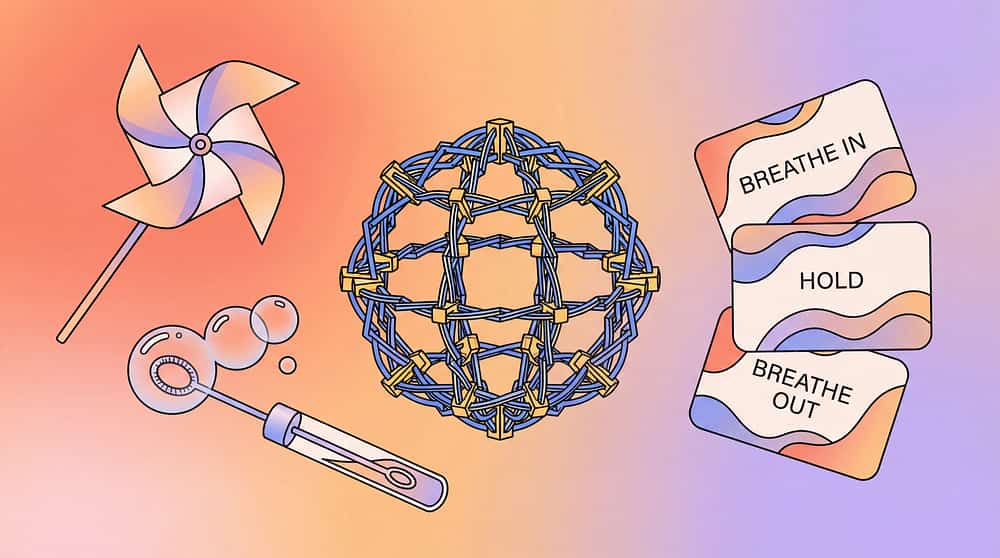
Breathing
  • Pinwheel
  • Bubbles
  • Hoberman sphere
  • Breathing cards
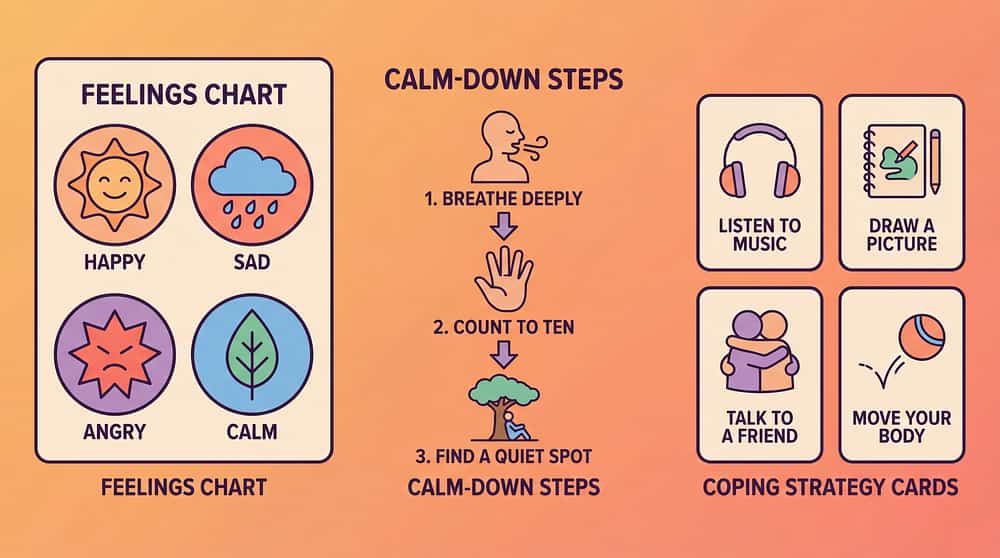
Cognitive
  • Feelings chart
  • Calm-down steps visual
  • Coping strategy cards
Key Features: Multi-sensory options give flexibility • Child-selected items increase ownership • Portable designs support use anywhere • Visual coping reminders reinforce strategies
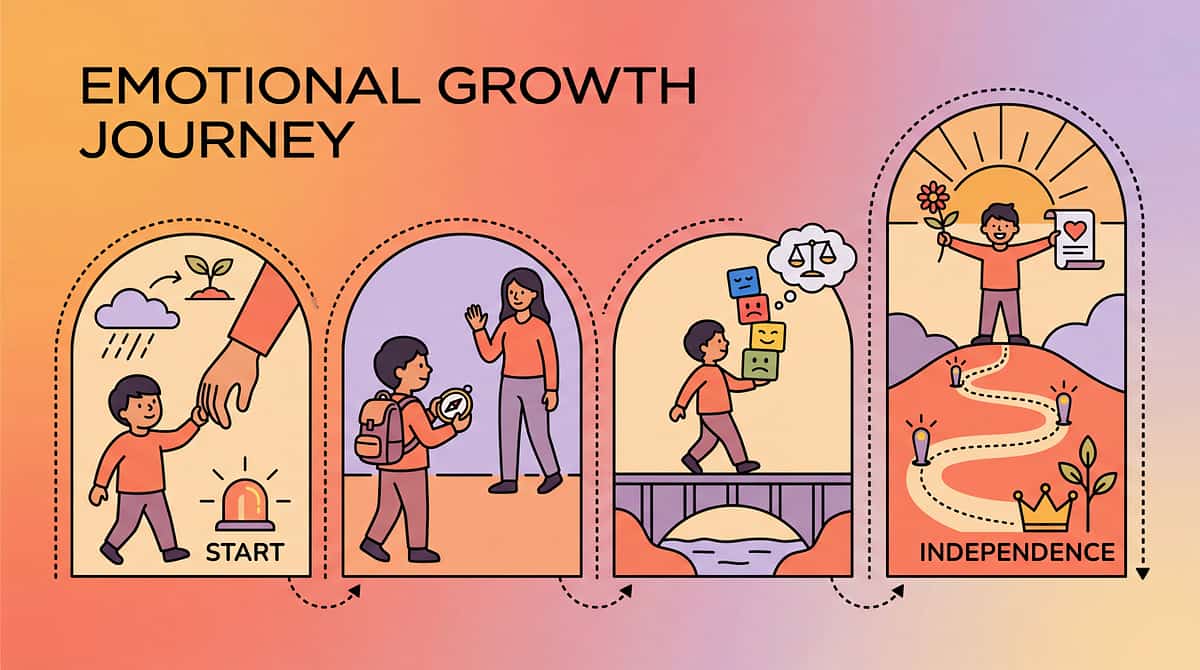
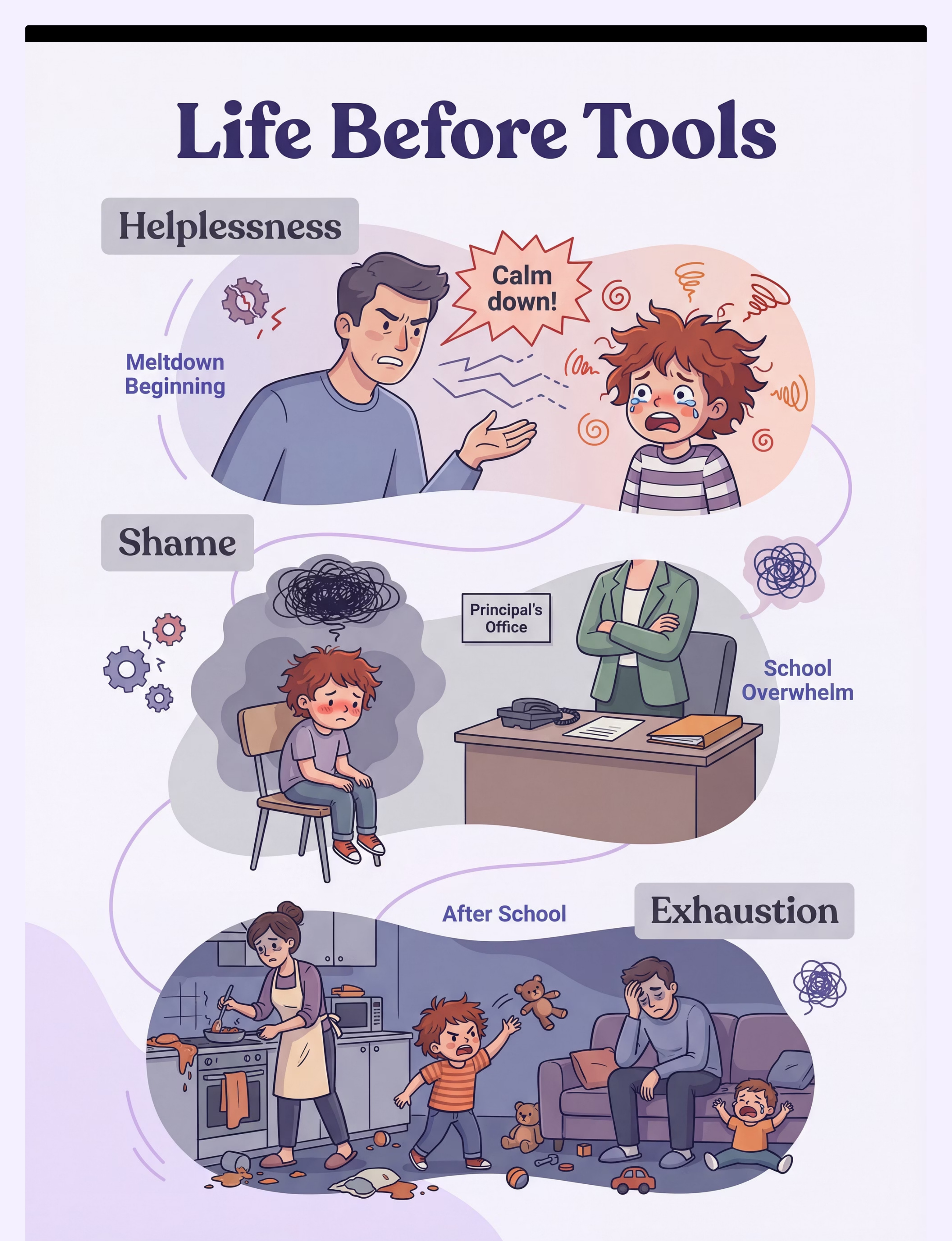
The Struggle (Before)
Meltdown Beginning
Situation: Parent sees escalation happening. Says "Calm down!" Child can't process words. Meltdown continues. Everyone helpless.
Emotion:Helplessness, frustration
School Overwhelm
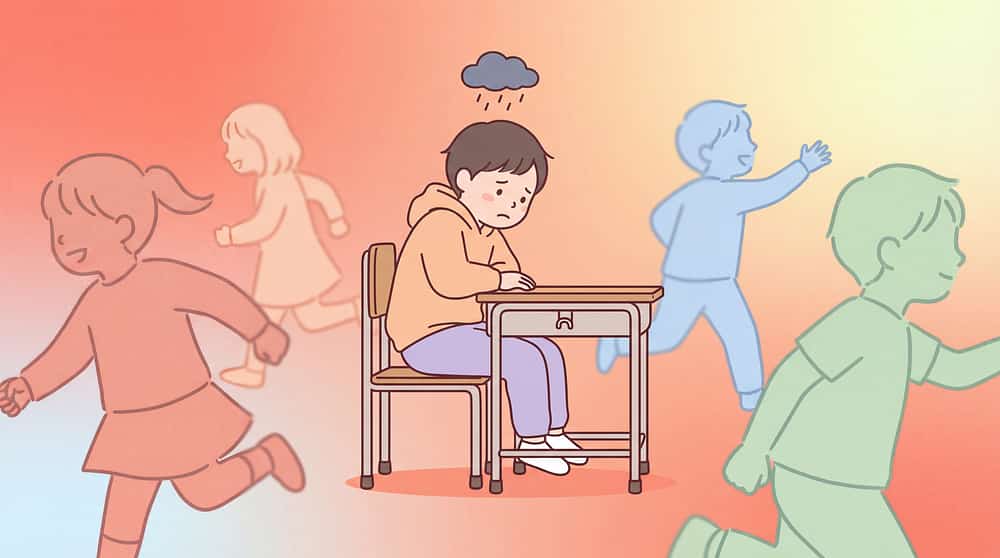
Situation: Child overwhelmed in classroom. No tools available. Sent to principal. Labeled as "behavior problem." No skills taught.
Emotion:Shame, failure
After School Collapse
Situation: Child comes home from school completely dysregulated. Dumps all emotions on family. Evening ruined. No recovery strategy. Repeats daily.
Emotion:Exhaustion, dread
These moments feel inevitable when children lack concrete regulation tools. The cycle continues because there's no alternative strategy to break it.
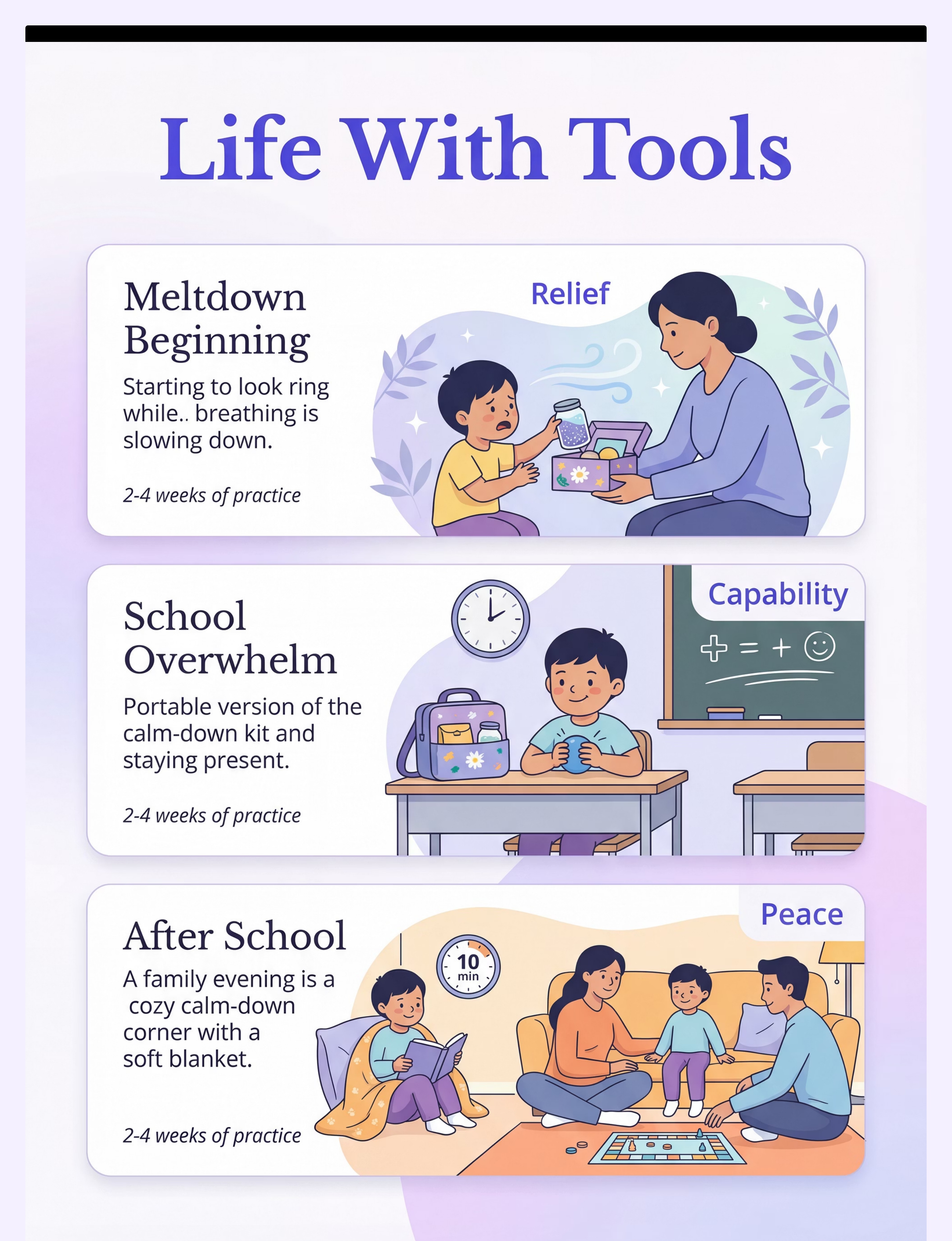
The Transformation (After)
Regulation Success
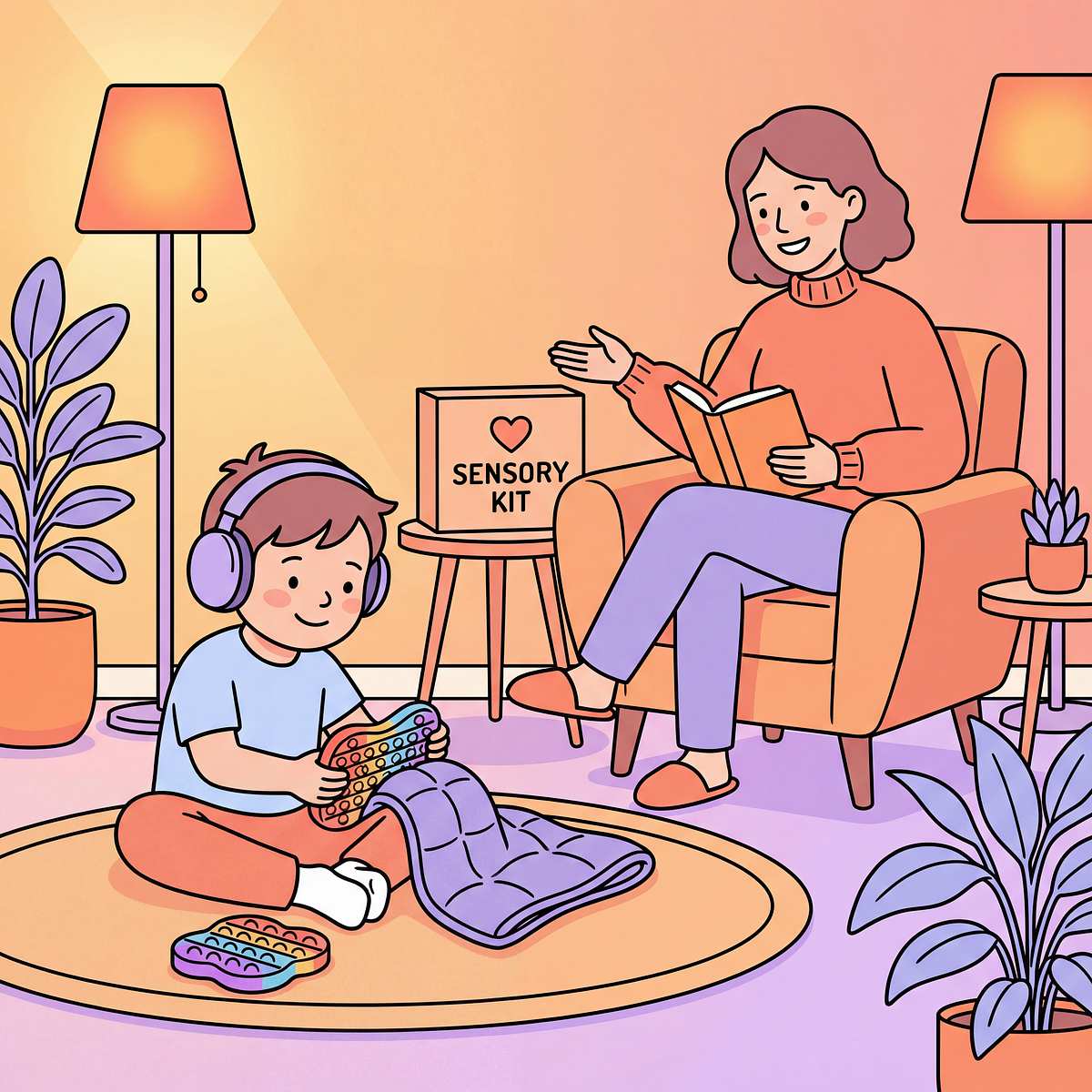
Situation: Parent notices early signs. Child reaches for calm-down kit independently. Uses glitter jar and deep breathing. Calms within 5 minutes. Crisis averted.
School Win
Situation: Overwhelming classroom noise. Child uses portable school kit. Takes sensory break with fidget and breathing card. Returns to class regulated. Teacher amazed.
Building Confidence
Situation: Child recognizes own escalation. Says "I need my kit." Uses tools without prompting. Proud of self-regulation. Parents relieved and hopeful.
Generalization
Situation: Kit not available. Child uses strategies learned from kit practice. Deep breathing, self-talk, movement break. Skills internalized. True independence achieved.
Is a Calm-Down Kit Right for Your Child?
Does your child struggle to calm down once upset?
Do verbal instructions fail during emotional moments?
Does your child need concrete, tangible strategies?
Would your child benefit from sensory input during distress?
Do meltdowns happen across multiple settings?
Is your child ready to learn self-regulation skills?
If you answered yes to 3+ questions, a calm-down kit is likely a great fit for your child.
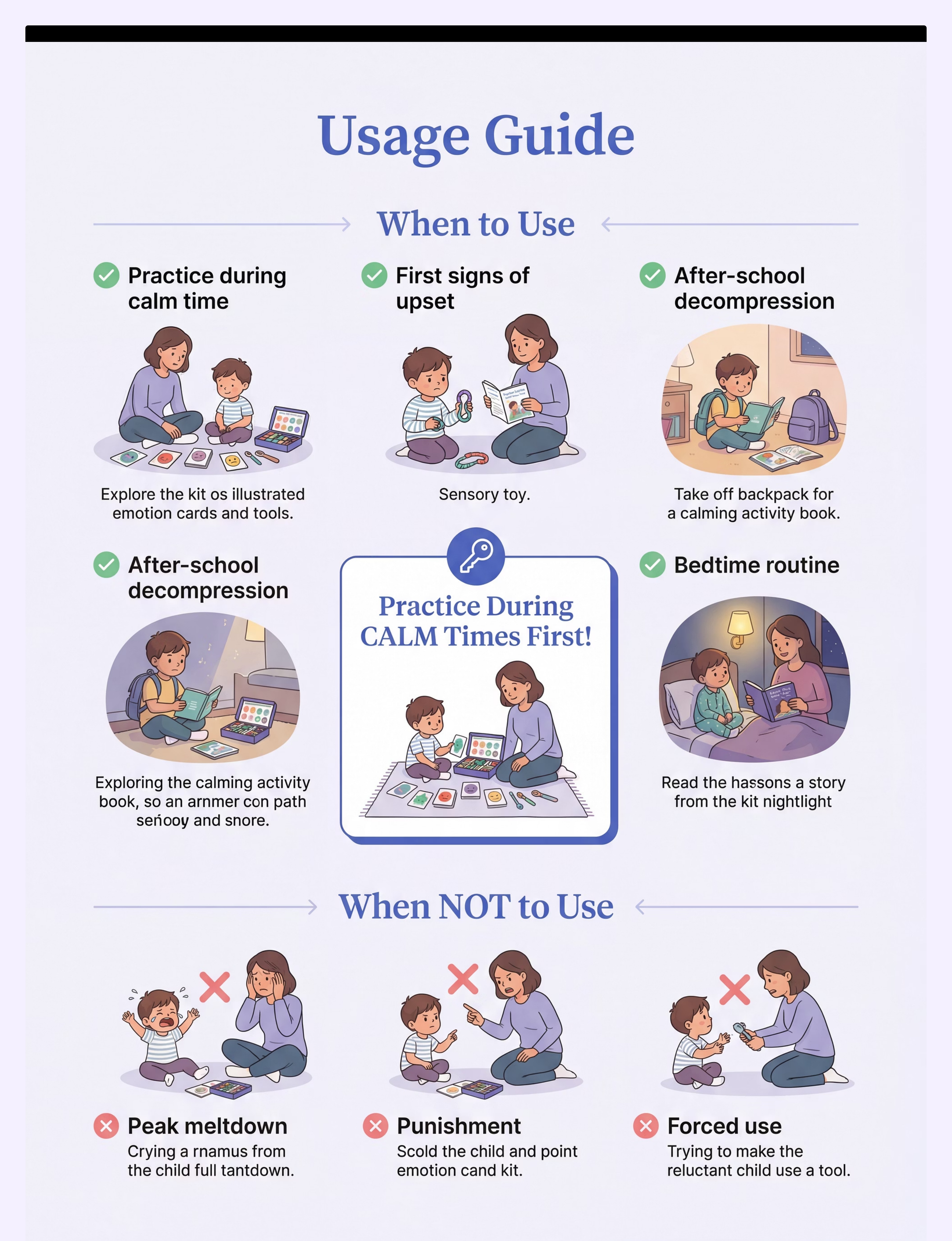
Usage Playbook: When to Use / When NOT to Use
When to Use ✓
When NOT to Use ✗
  • Child is ready to learn self-regulation skills
  • Child needs concrete, tangible strategies
  • Child would benefit from sensory input
  • Kit is accessible when needed (not locked away)
  • Practice during calm times has occurred
  • Items are age-appropriate and in good condition
  • Child is choosing items independently
  • Adult is available but not hovering
  • Child is using items as intended
  • Breathing slows, body calms
  • Child exits calmer than entered
  • Child eventually uses strategies without physical kit
  • Child struggles to calm down once upset without tools
  • Verbal instructions fail during emotional moments
  • Meltdowns happen across multiple settings
  • Forcing tools on a dysregulated child
  • Introducing new items during a peak meltdown
  • Including items child finds sensorially aversive
  • Items cause more distress than calm
  • Items are not age-appropriate (e.g., choking hazards)
  • Kit is locked away or inaccessible
  • Consumables are not replenished regularly
  • Items are not cleaned regularly
  • Items are not suitable for the setting (e.g., school restrictions)

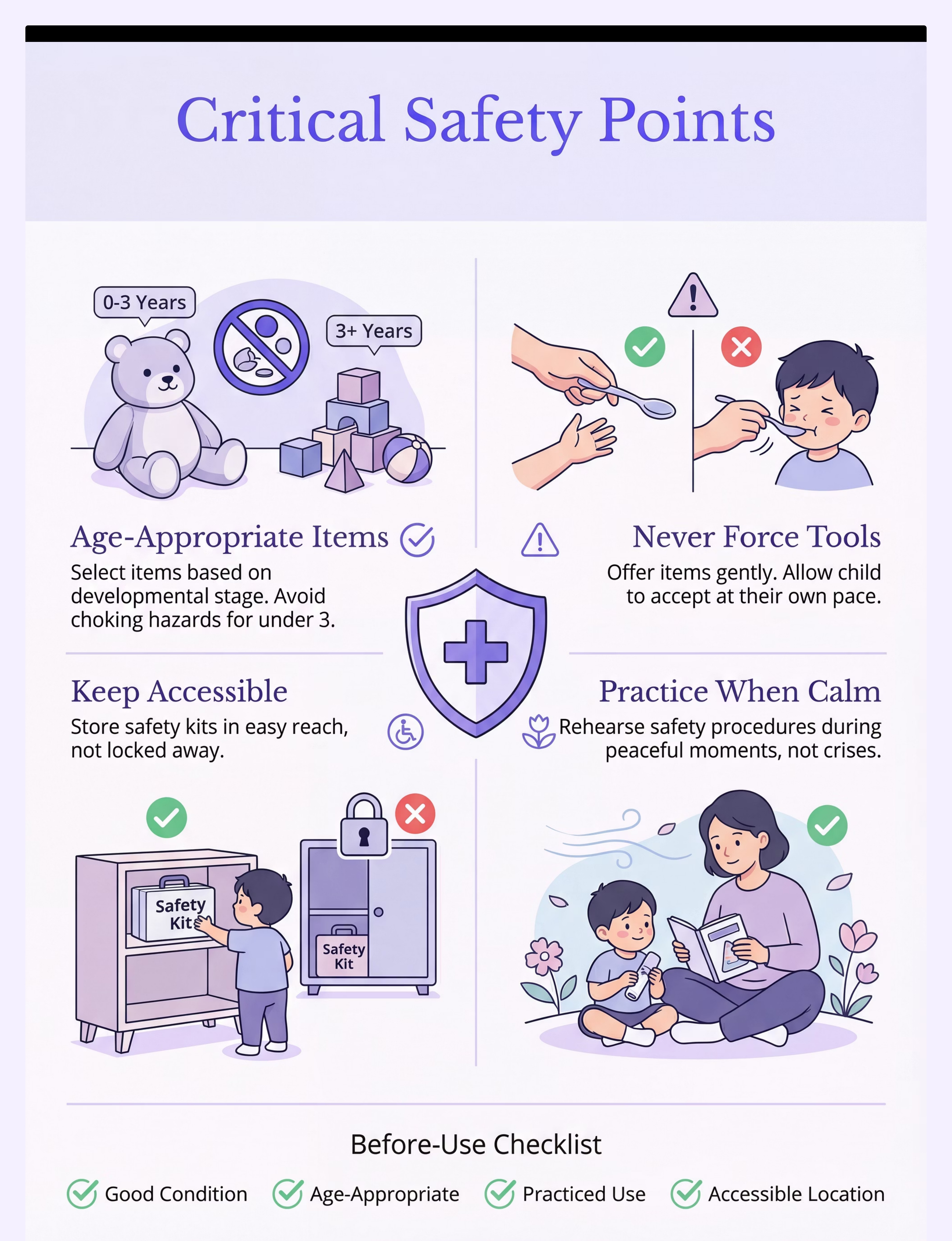
Critical Warnings and Contraindications
Critical Safety
  • Use only age-appropriate items (no choking hazards for young children)
  • Never force tools on a dysregulated child—this increases distress
  • Kit should be ACCESSIBLE, not locked away when needed
  • Practice during calm times first before expecting use during crisis
Important Warnings
  • Remove any items that cause more distress rather than calm
  • Replenish consumables regularly (bubbles, etc.)
  • Clean items regularly to maintain hygiene (frequent mouthing and handling)
  • Some items may not be suitable for all settings (school restrictions)
Contraindicated
  • Forcing use of kit or specific tools
  • Introducing new items during peak meltdown
  • Including items child finds sensorially aversive
  • Choking hazards for child's developmental age
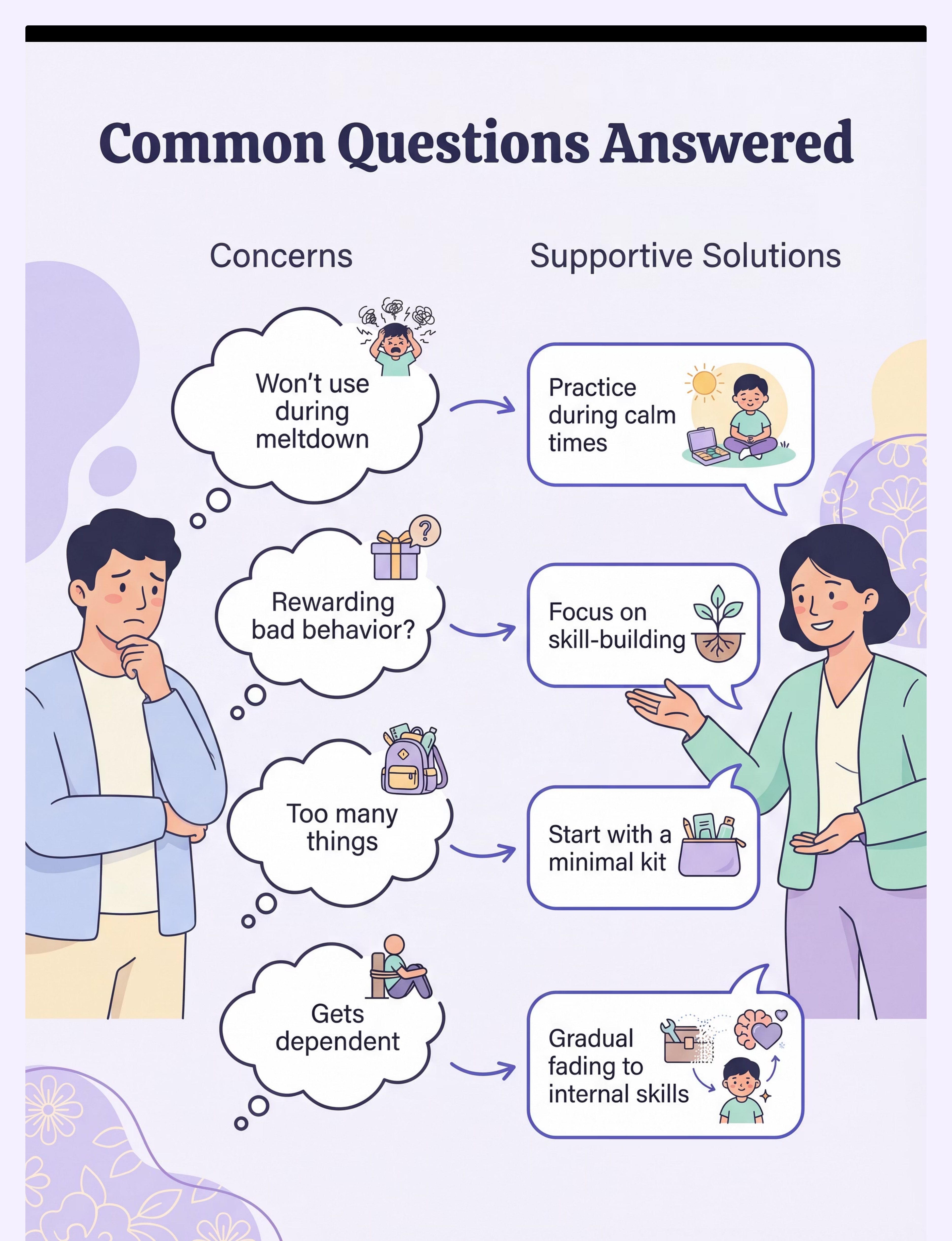
Common Concerns Answered
"He won't use a kit during a meltdown"
Response: Correct—that's why we practice during CALM times. The tools become familiar, so during escalation the child reaches for what they know. It's about building the habit and skill before it's needed, not introducing new concepts during crisis.
Try this: Start using kit daily during calm times to build familiarity and positive associations.
"This is just rewarding bad behavior"
Response: Regulation is not a reward—it's a skill. We don't withhold a wheelchair from someone who can't walk. We provide tools for children who can't yet self-regulate. Teaching coping skills is the goal, not punishment for dysregulation.
Try this: Frame as learning opportunity: "Let's practice calming" rather than response to "bad" behavior.
"Too many things—how do I know what to include?"
Response: Start small. Include one item from each sensory category. Let your child help choose what feels calming to THEM. Observe what works and adjust over time. Every child's kit will be different based on individual sensory preferences.
Try this: Use our kit checklist and let child select their favorites from each category.
"She gets dependent on the kit"
Response: Initially, dependence on tools is fine—it's a stepping stone to independence. Over time, children internalize the strategies. They learn to take deep breaths without the pinwheel. The kit builds skills that eventually transfer to internal regulation.
Try this: Gradually fade physical tools as child masters internal strategies, typically after 2-3 months.
Investment Options: Starter vs Premium
Calm-down kits are highly accessible across all budget levels. Whether you create your own or purchase pre-assembled options, the therapeutic value far exceeds the financial investment.
Pricing Overview
Cost Range
₹100–300 (DIY)
₹2,000–4,000 (Pre-assembled)
Key Components
Household items, simple tools
Professional-grade items, full setup
Focus
Customization, child involvement
Immediate use, clinic quality
What's Included
Starter
DIY Kit with Household Items
  • Stress ball, pinwheel, soft fabric
  • Bubbles, photo of a calm place
  • Maximum customization & child's input
  • Utilizes existing household resources
Premium
Complete Pre-Assembled Kit + Corner Setup
  • Professional quality items from trusted brands
  • Ready to use immediately
  • Clinic-quality presentation
  • Tested, durable items for long-term use
  • Optional brands: Fun and Function, Therapy Shoppe
Long-Term Value & ROI
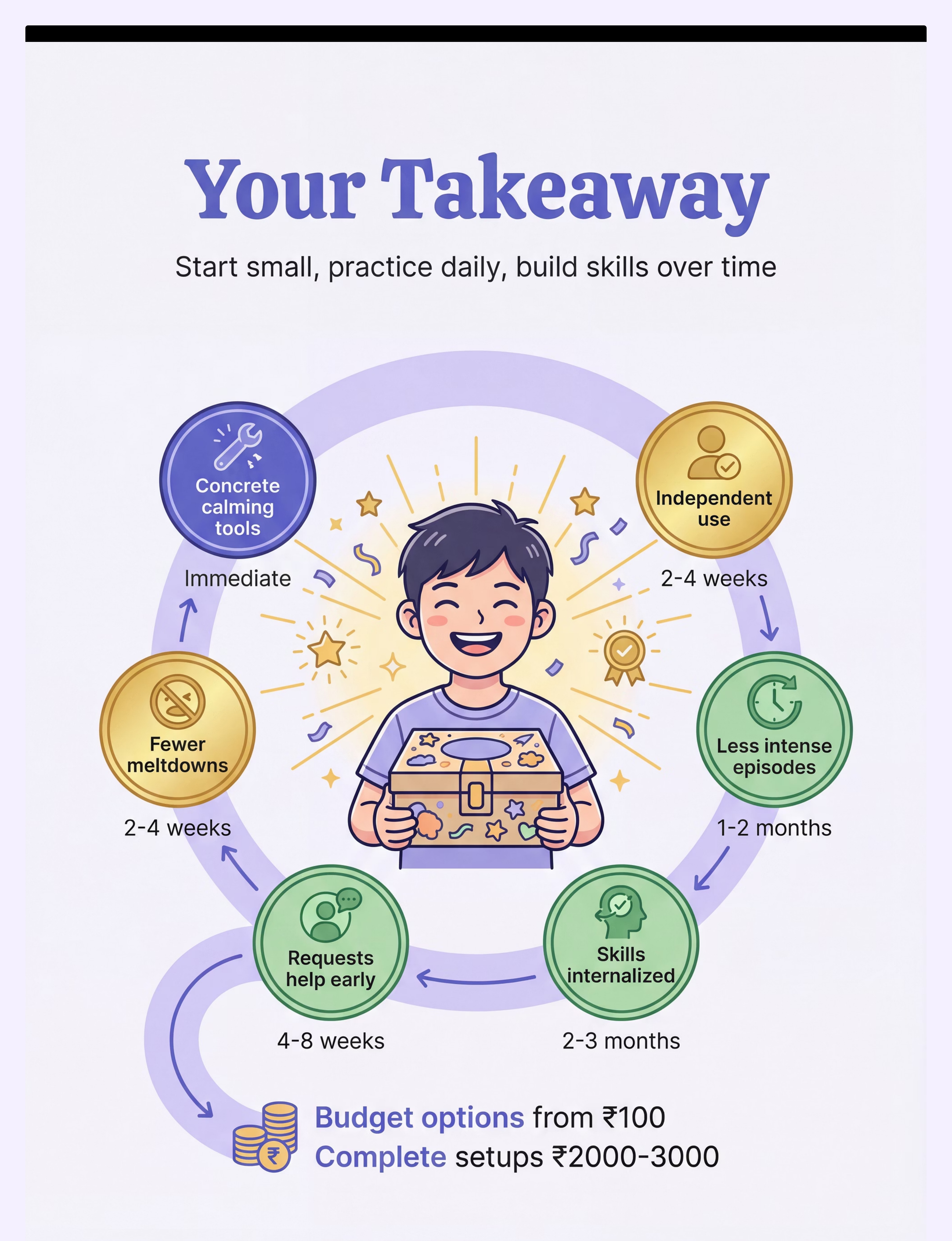
Initial Investment
Start with a basic DIY or small commercial kit (₹100–800) to understand your child's specific needs and preferences without a large upfront cost.
Learning Phase (1-3 Months)
Children explore and internalize coping strategies using the kit. Dependence on tools is a stepping stone to independence.
Skill Internalization
Strategies become second nature, transferring from external tools to internal self-regulation. Less reliance on physical kit items.
Sustained Well-being
Reduced meltdown frequency and intensity, improved emotional regulation, and enhanced family harmony – a significant return on investment.
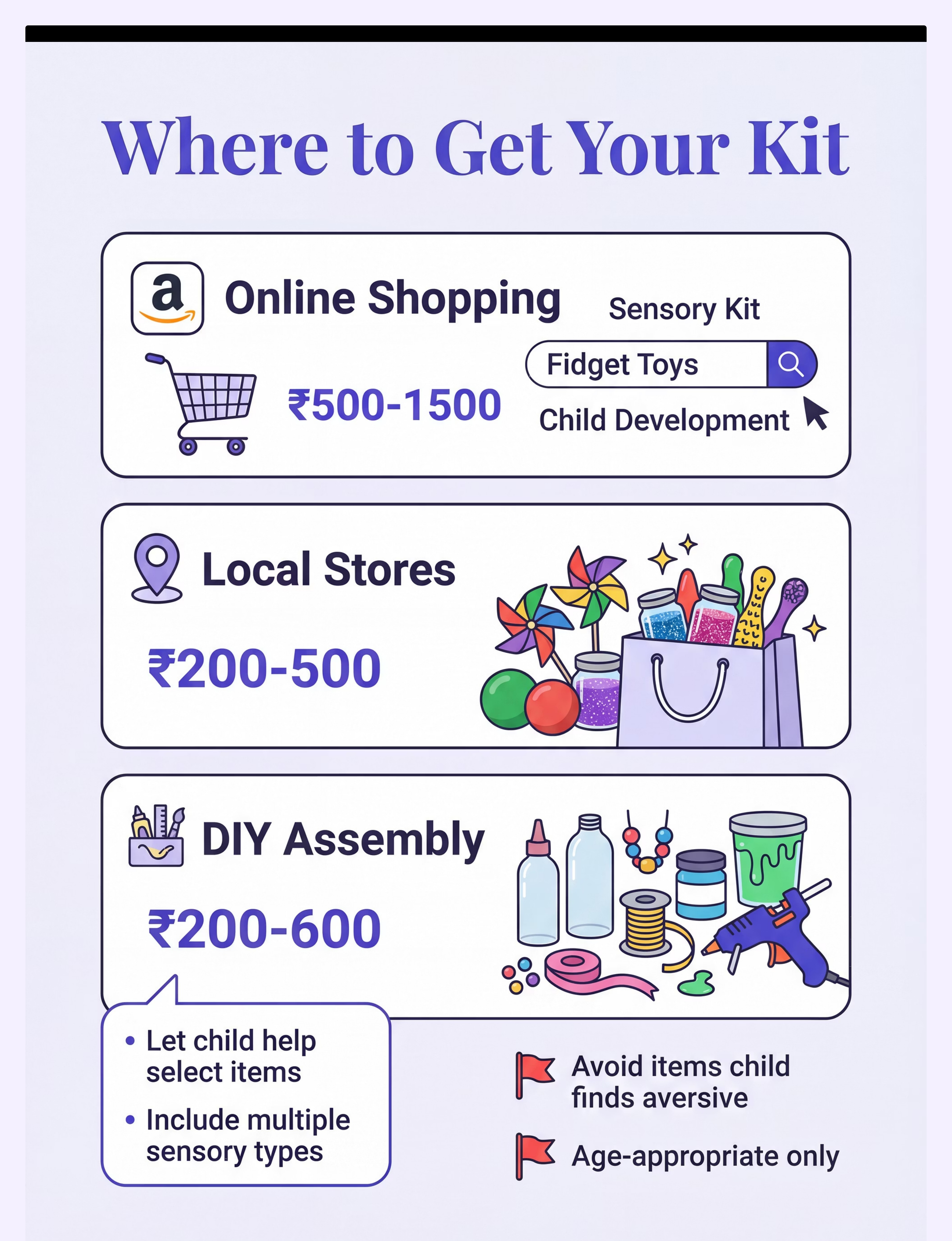
Where to Buy in India
Availability: DIY assembly highly feasible with household items, or purchase commercial kits online and in specialty stores across India.
Amazon.in
Search: "calm down kit kids"
Price Range: ₹500–1,500
Wide variety, customer reviews, fast delivery to most Indian cities
Amazon.in
Search: "sensory fidget kit"
Price Range: ₹300–800
Individual sensory items and collections, mix and match options
Local Stores
Search: Stress balls, pinwheels, glitter jars
Price Range: ₹200–500
Toy stores, stationery shops, therapeutic supply stores in major cities
DIY Assembly
Materials: Individual items from multiple sources
Price Range: ₹200–600
Maximum customization, child involvement, use household items

Buying Tips ✓
  • Let child help select items they find appealing
  • Include multiple sensory types for variety
  • Create portable option for school and travel
  • Include visual coping reminders and strategy cards
  • Replenish consumables like bubbles regularly
Red Flags ✗
  • Items child finds sensorially aversive
  • Kit contains only one sensory type
  • Items too noisy for school setting
  • Choking hazards for young children
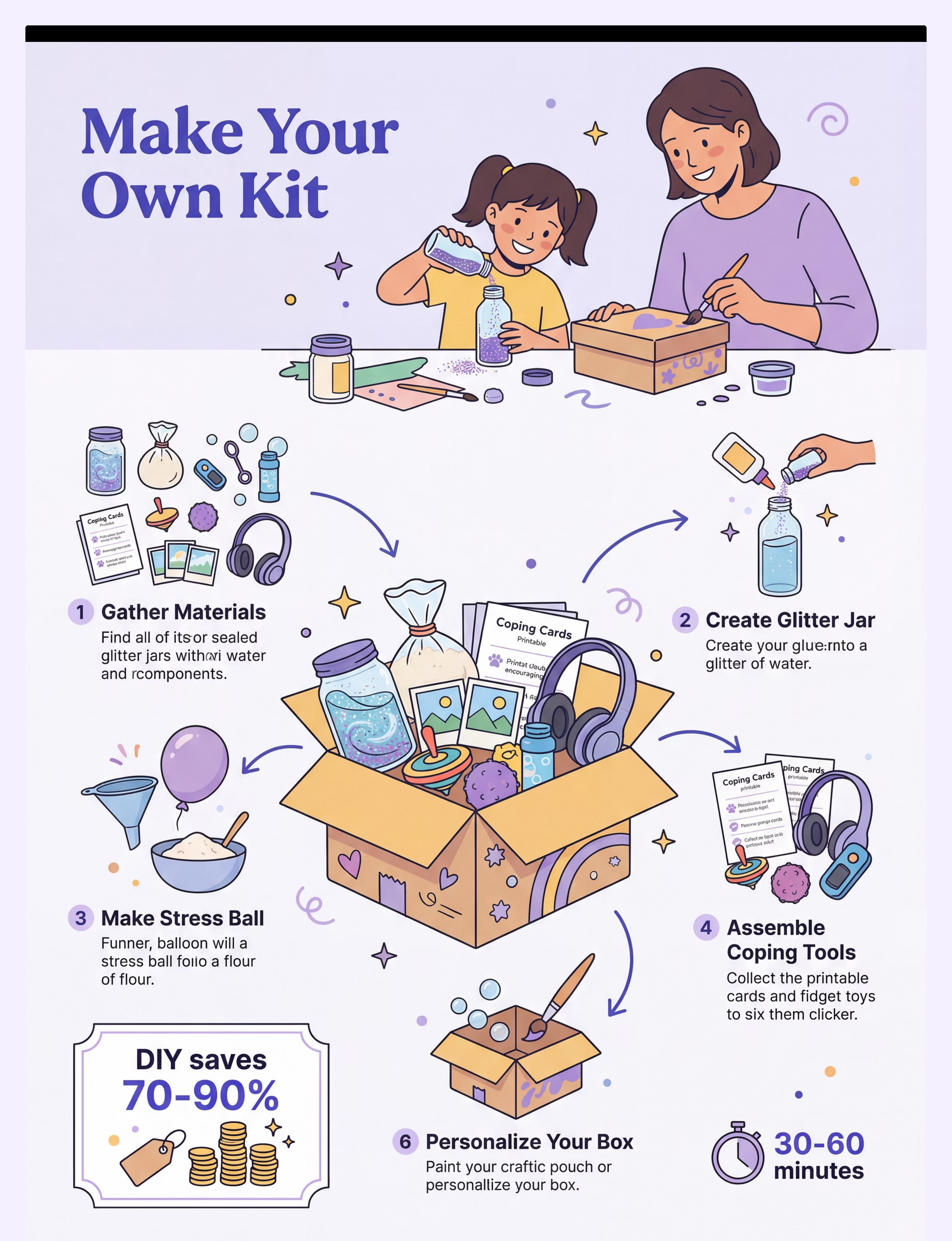
DIY Alternative for Calm-Down Kits
Feasibility: Very High | Time Required: 30-60 minutes
Significant Savings
Save 70-90% compared to commercial options!
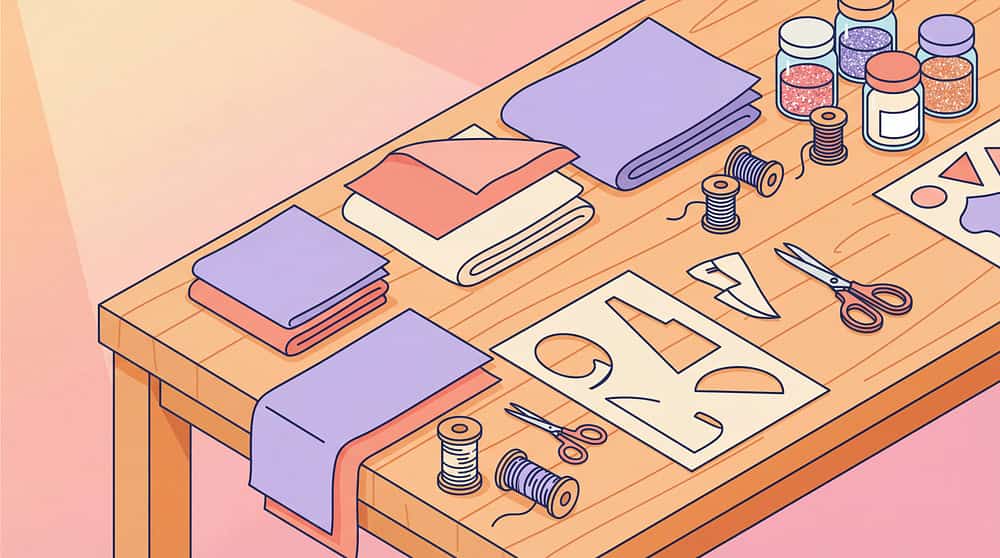
Materials Needed
  • Container (box, bag, or pouch)
  • Stress ball or DIY squeeze ball
  • Pinwheel (toy store or craft shop)
  • Glitter jar (clear bottle + water + glitter glue + fine glitter)
  • Fidgets from home (textured items, small toys)
  • Calming photos (printed peaceful places or loved ones)
  • Bubbles
  • Headphones or earbuds
Assembly Steps Summary
  1. Let child choose a container.
  1. Select 1-2 items per sensory category.
  1. Make a glitter jar (seal tightly!).
  1. Print coping strategy cards.
  1. Include a photo of a calm place/loved one.
  1. Label the kit and keep it accessible.
  1. Practice using each item when calm.
When to DIY
  • Budget-conscious families
  • Want maximum customization
  • Child wants to help create
  • Already have many items at home
When to Buy Commercial
  • Want a ready-made solution
  • Need clinic-quality presentation
  • Limited time for assembly
  • Want curated, tested items
Key Tradeoffs
DIY may be less polished but offers maximum personalization at minimal cost, requiring individual item sourcing.

Preview of calm down kit self regulation toolbox Therapy Material

Below is a visual preview of calm down kit self regulation toolbox therapy material. The pages shown help educators, therapists, and caregivers understand the structure and content of the resource before use. Materials should be used under appropriate professional guidance.

Page 1
Page 2
Page 3
Page 4
Page 5
Page 6
Page 7
Page 8
Page 9
Page 10
Page 11
Page 12
Page 13
Page 14
Page 15
Page 16
Page 17
Page 18
Page 19
Page 20
Link copied!
Measuring Success
1
Baseline (Measure First)
  • Meltdown frequency per week
  • Average meltdown duration in minutes
  • Child's current self-calming attempts (any)
  • Tools or strategies currently used
2
Goals to Set
  • Child will independently use calm-down kit at first signs of escalation
  • Meltdown frequency will decrease by 50%
  • Child will identify 3 preferred personal calming strategies
  • Recovery time from dysregulation will decrease by 50%
3
Success Indicators
  • ✓ Independent kit use
  • ✓ Reduced meltdown frequency and intensity
  • ✓ Child can name their calming strategies
  • ✓ Generalization (uses strategies without physical kit)
  • ✓ Requests kit before escalation begins

Complete the Kit
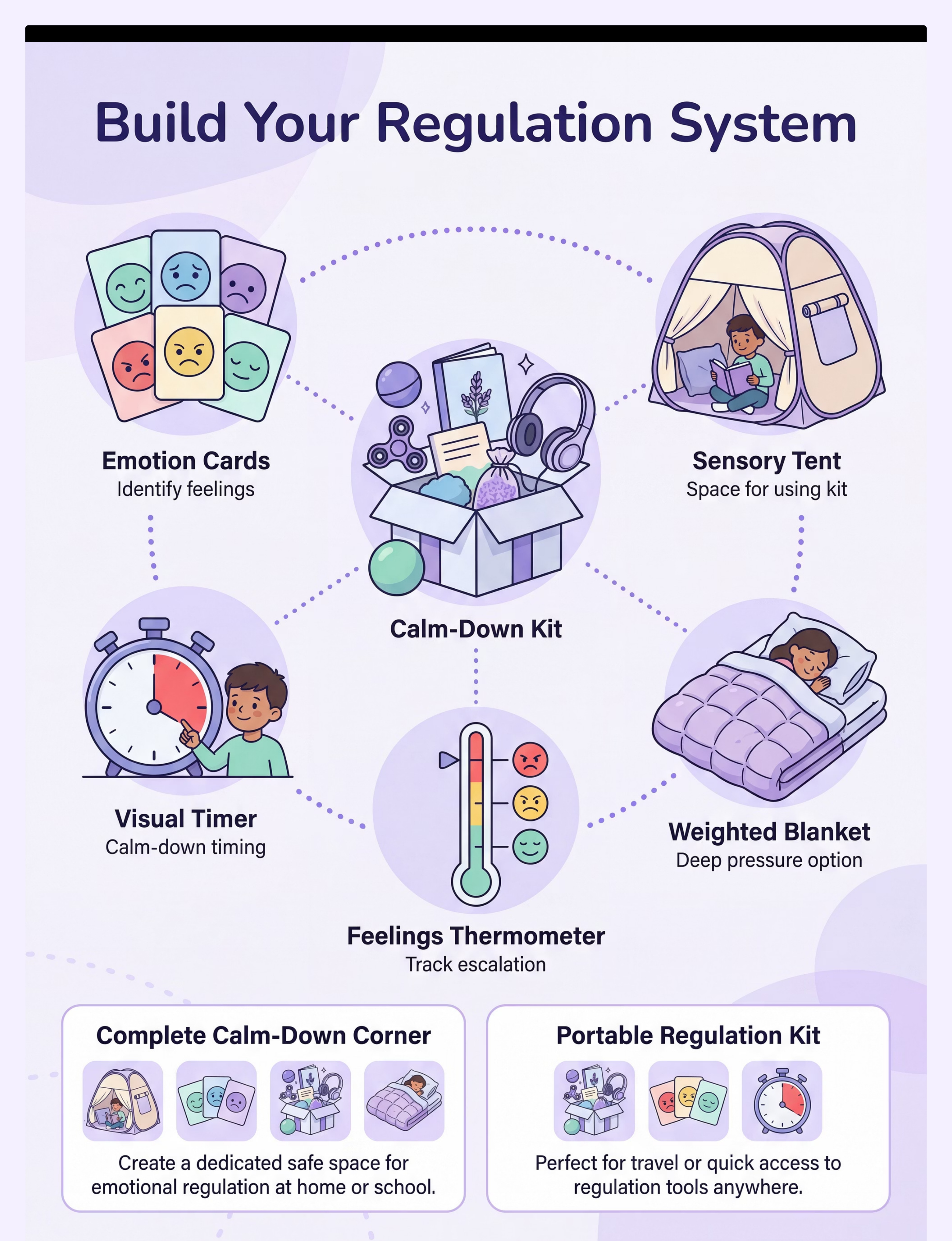
These complementary tools work beautifully alongside calm-down kits to create comprehensive regulation support:
Sensory Tent (ID: 1.11)
Provides dedicated physical space for using calm-down kit tools
Emotion Cards (ID: 2.1)
Help child identify what emotion needs calming
Weighted Blanket (ID: 1.1)
Adds deep pressure component to regulation kit
Visual Timer (ID: 3.3)
Times calm-down sessions and breathing exercises
Feelings Thermometer (ID: 2.5)
Tracks escalation level and progress during calming
Suggested Bundles
  • Complete Calm-Down Corner: Kit (2.3) + Sensory Tent (1.11) + Weighted Blanket (1.1) + Emotion Cards (2.1) — Full regulation space
  • Portable Regulation Kit: School Kit (2.3.3) + Mini Fidget (1.4) + Chewelry (1.3) — School and travel ready

Quick Summary
Calm-down kits provide concrete, multi-sensory tools for self-regulation, replacing abstract instruction with tangible strategies. Core Kit (Rank 1) with strong evidence base, essential for emotional regulation across all settings.
calm down
self-regulation
coping
meltdown
sensory
toolkit
OT
Psychologist
core-kit
Common searches: calm down kit autism, self-regulation tools kids, coping skills kit, sensory calm down kit, emotional regulation box, meltdown prevention tools, anxiety kit children

Get Support
FREE National Autism Helpline
Phone: 9100 181 181
Languages: 16+ languages spoken
Website: pinnacleblooms.org
Platform Integration: This calm-down kit integrates seamlessly with Pinnacle Blooms Network's comprehensive therapeutic platform. AbilityScore® identifies your child's specific regulation patterns and triggers. TherapeuticAI® recommends personalized kit contents based on sensory profile. EverydayTherapyProgramme™ includes structured calm-down practice routines. The Emotional Regulation Index tracks meltdown frequency, duration, and recovery progress over time.

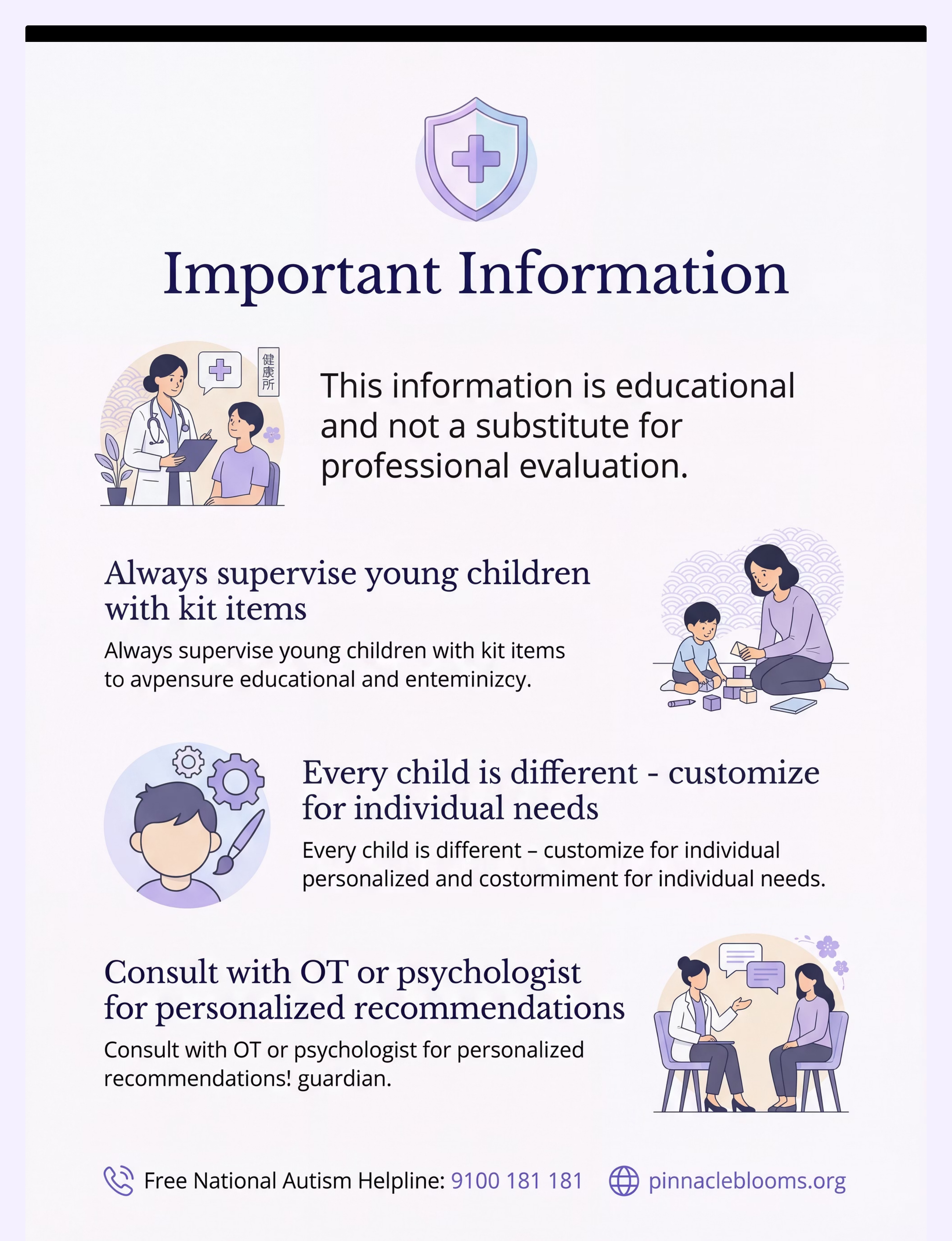
Disclaimer: This is educational information provided by Pinnacle Blooms Network. Always consult qualified occupational therapists, speech-language pathologists, psychologists, or pediatricians for personalized guidance. Individual results vary. Calm-down kits are evidence-based tools but should be part of comprehensive therapeutic support tailored to your child's unique needs.