










Tool ID: 17.4
Tool ID: 17.4
OT + Parent Recommended
Moderate Evidence
Rank #2
Daily Use
₹100–3,000
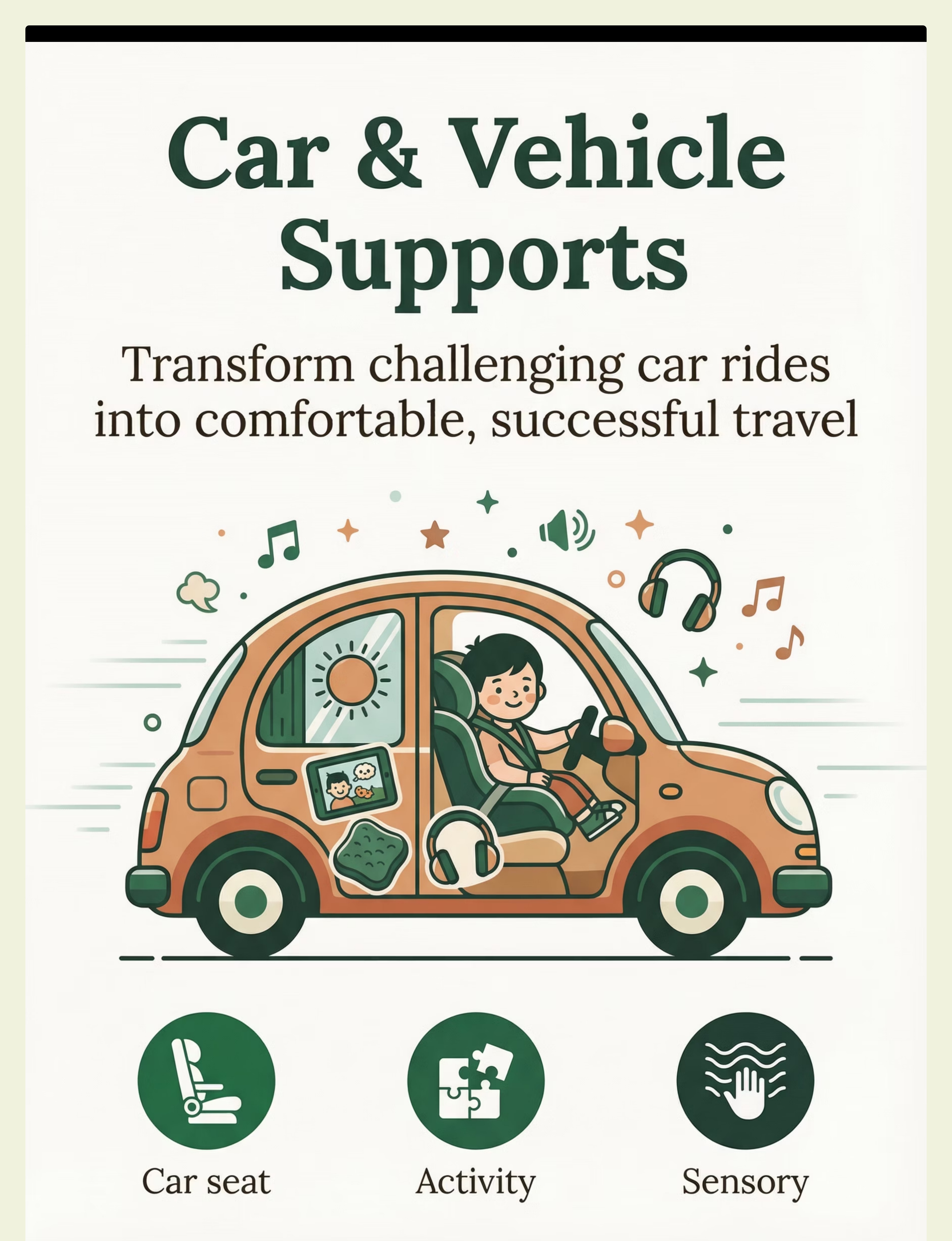
Car & Vehicle Supports for Children with Special Needs
A comprehensive guide to comfortable and safe travel with sensory modifications, visual supports, and behavior strategies.
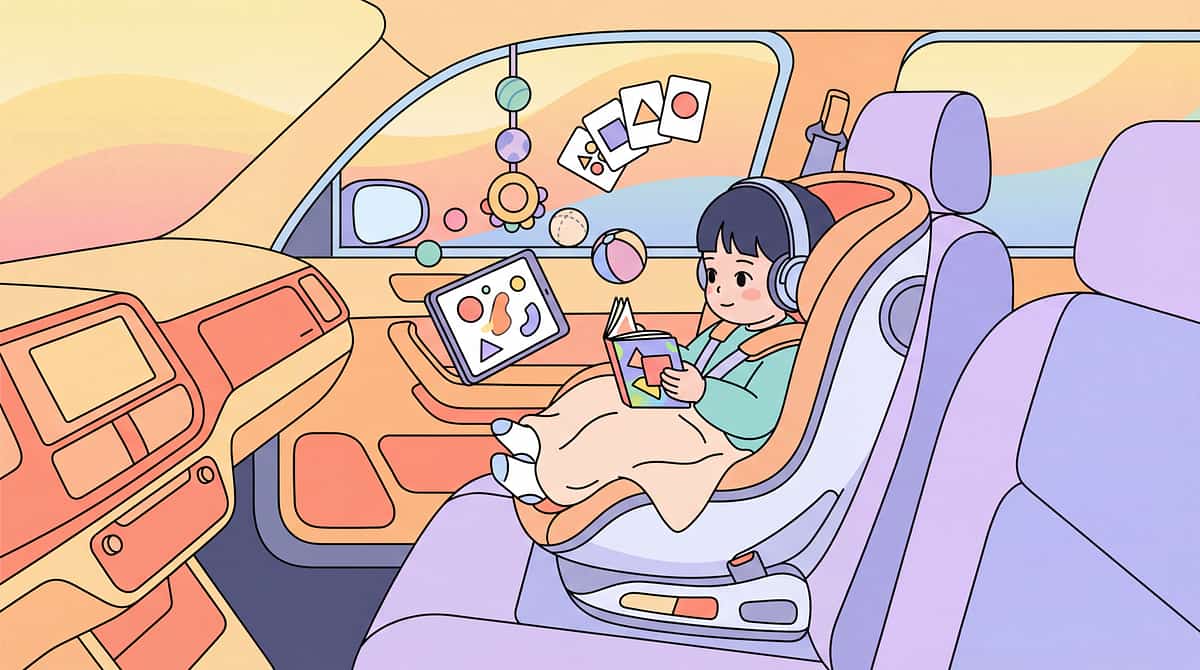
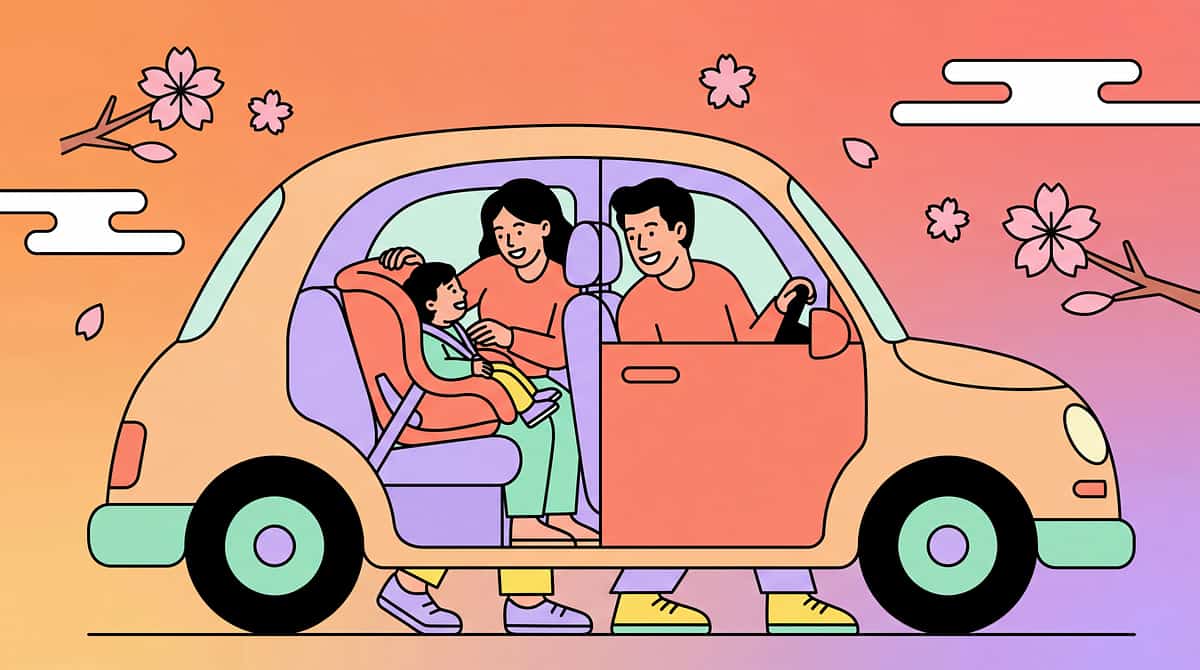
Transform challenging car journeys into manageable family experiences. Through thoughtful sensory modifications, visual supports, and engagement strategies—all while maintaining complete car seat safety—families across India are discovering that comfortable car travel is possible. Whether it's a quick trip to the market or a long journey to grandparents' home, the right supports help children tolerate the confined space, understand the journey, and stay regulated throughout the ride.
Who This Helps
Car Travel Tolerance
Supports comfortable and successful car travel through sensory modifications, visual supports, and engagement strategies that make the journey manageable for children and families.
Sensory Comfort
Addresses sensory needs during travel—from light sensitivity to seat discomfort—creating a more tolerable environment within the vehicle.
Engagement & Behavior
Provides appropriate activities and clear expectations that support positive behavior throughout the journey, reducing stress for everyone.
Family Mobility
Expands what's possible for families—from medical appointments to social visits to vacation travel—by making car journeys accessible.
1+ years
Vehicle
All Driving Families
Best for: Children who struggle with car seat tolerance, sensory discomfort during travel, difficulty understanding journey duration, or families whose activities are limited by challenging car rides.
Does This Sound Familiar?
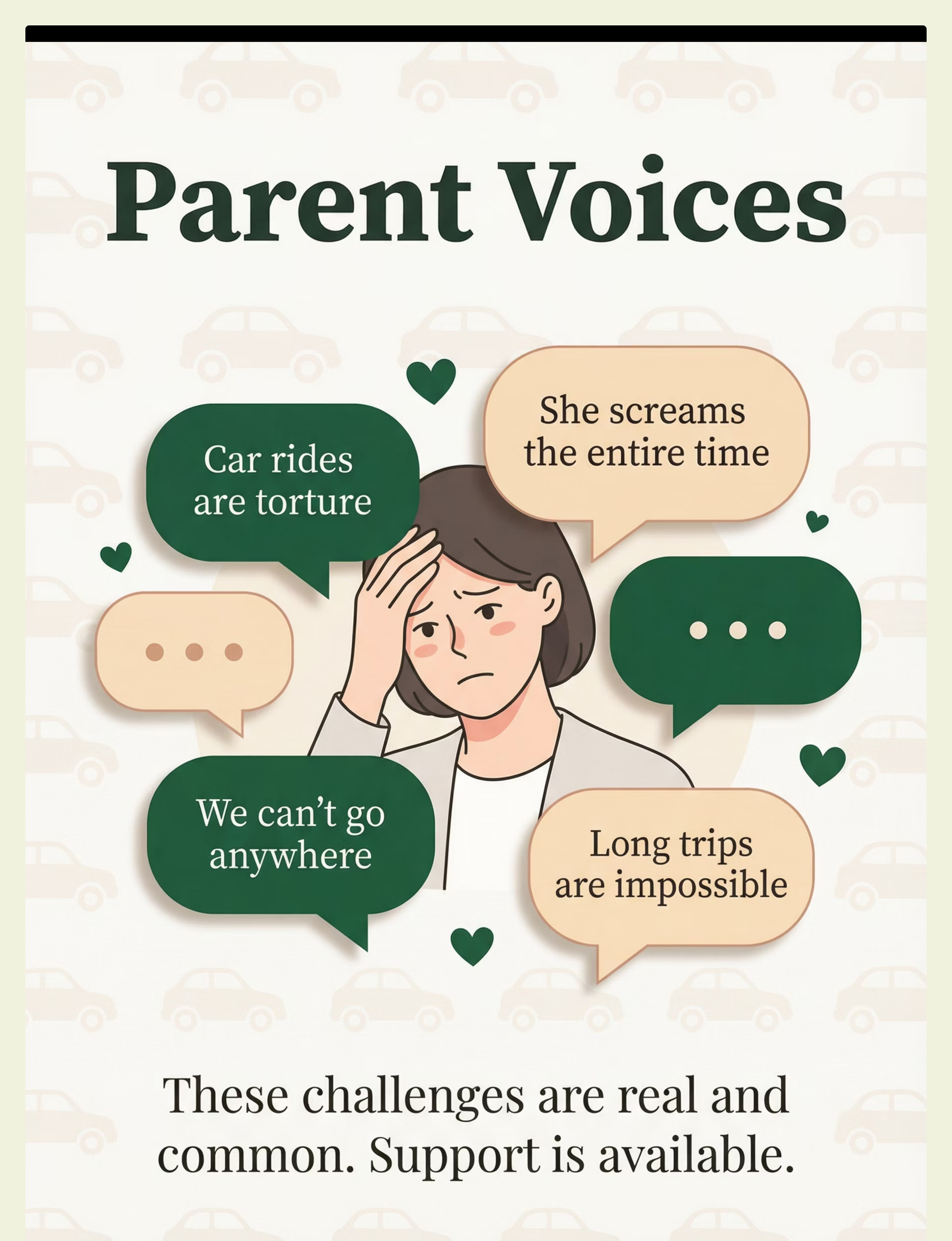
"Car rides are torture. She screams the entire time and we can't go anywhere because of it. Even a 10-minute trip becomes unbearable for everyone."
"He can't tolerate the car seat—he fights the restraint and tries to escape. Every journey feels like a battle we're losing."
"We can't go anywhere as a family. Long trips are impossible. We've had to skip weddings, avoid family visits, even postpone important medical appointments."
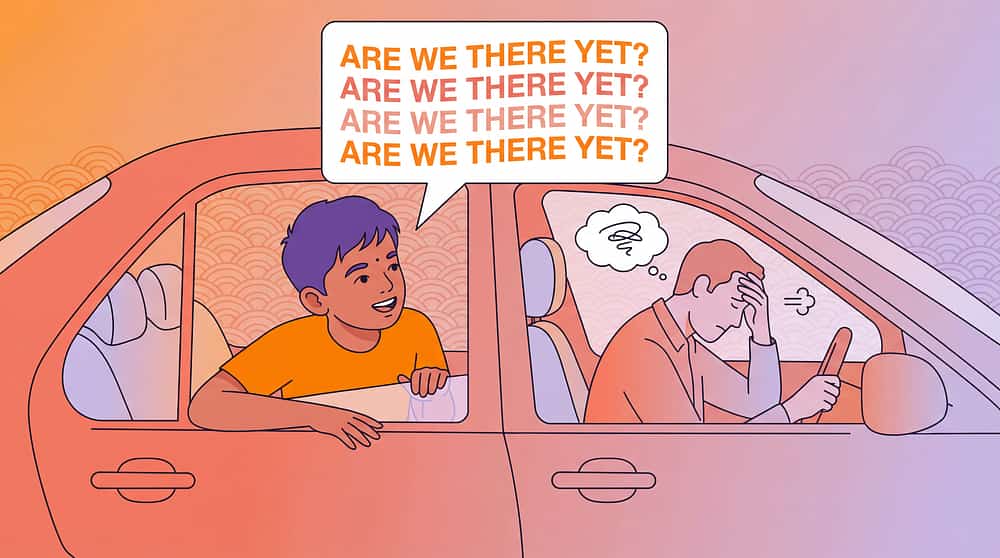
"The constant 'are we there yet?' questions never stop. She has no sense of time or progress, and we're all exhausted from the repetition."
"We can't travel more than 15 minutes without complete meltdown. Our entire life is limited by this car intolerance."
"Every car ride is distressing for everyone. I dread even short trips to the grocery store now."

You're not alone. These are common challenges faced by thousands of families. Car travel intolerance affects family mobility, access to services, and quality of life—but with the right supports, meaningful improvement is possible.
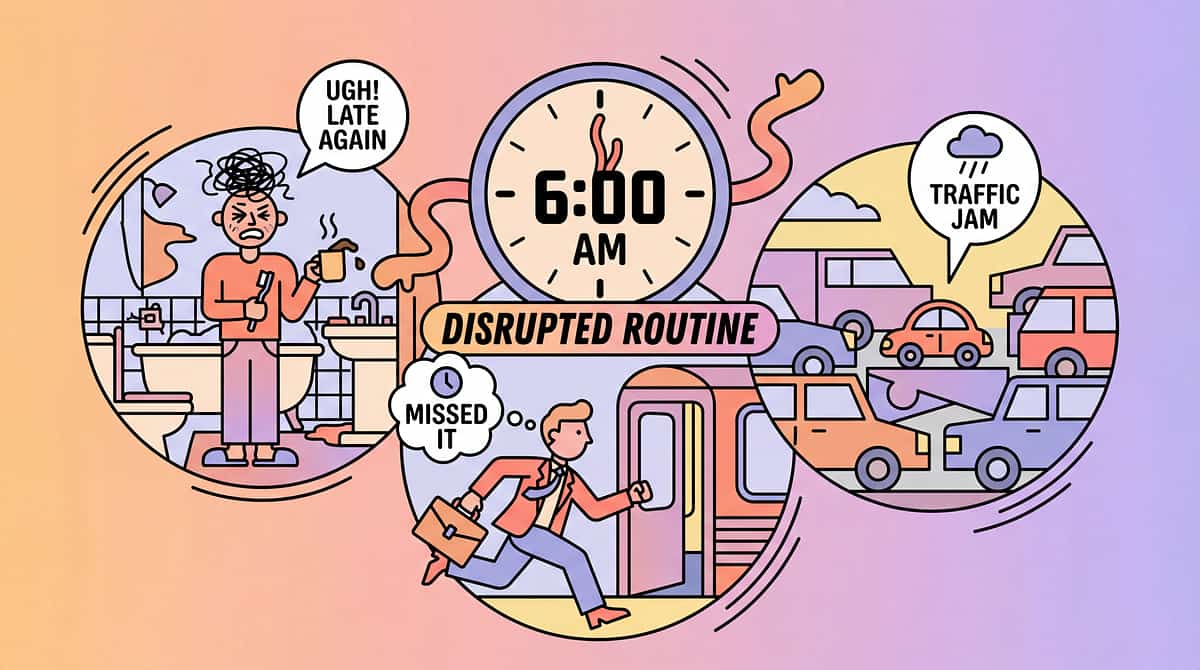
A Day Without the Right Support
Morning Routine Disrupted
The mere mention of getting in the car triggers resistance. Child becomes anxious knowing a car ride is coming. Family morning becomes tense before the journey even begins.
Difficult Transitions
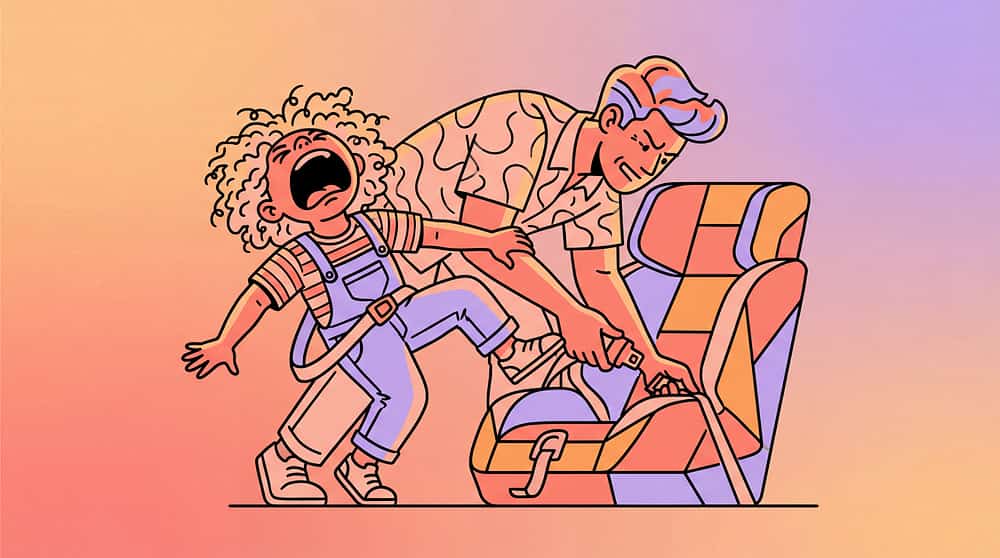
Getting into the car seat becomes a physical struggle. Child fights restraint, arches back, screams. Parents struggle to buckle safely while child is in distress.
Therapy or School Journey
During the drive, child is uncomfortable, overstimulated, or bored. Constant questions about arrival. Meltdowns that make the driver unsafe. Therapy session or school day starts with child already dysregulated.
Afternoon Activities Avoided
Family skips activities that require driving. Parks, relatives' homes, community events—all avoided because the car journey isn't worth the distress.
Evening Return Home
The drive home repeats the morning struggle. Child arrives home exhausted and dysregulated from travel stress. Family feels trapped by car intolerance.
The Science Behind It
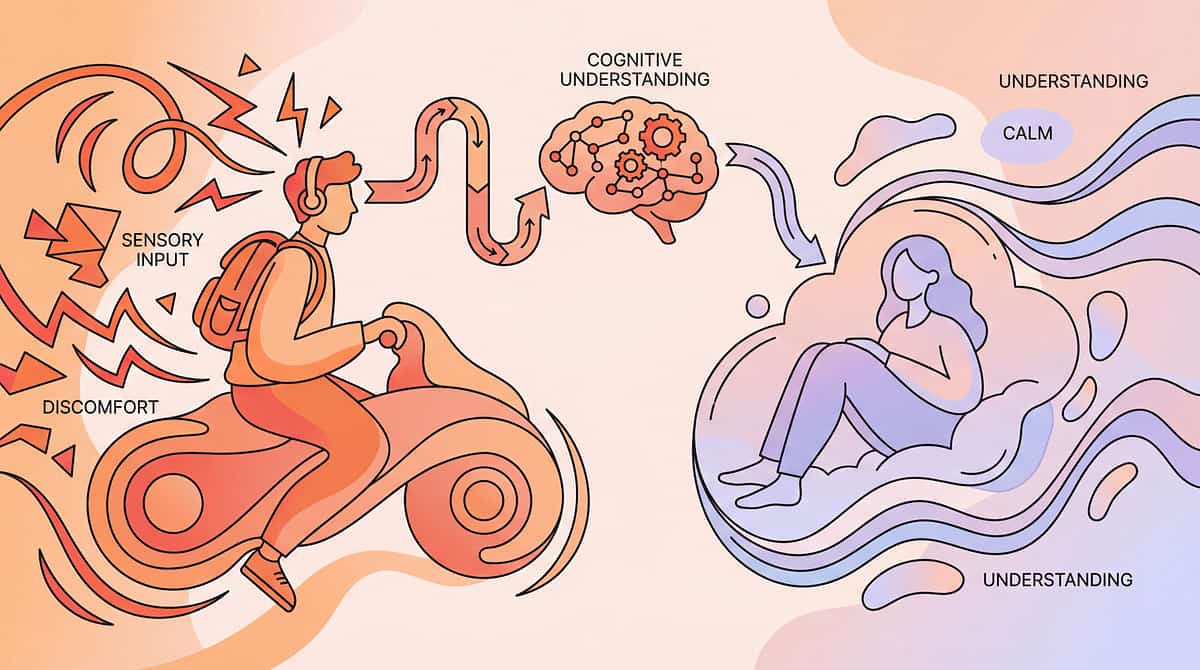
Sensory Discomfort
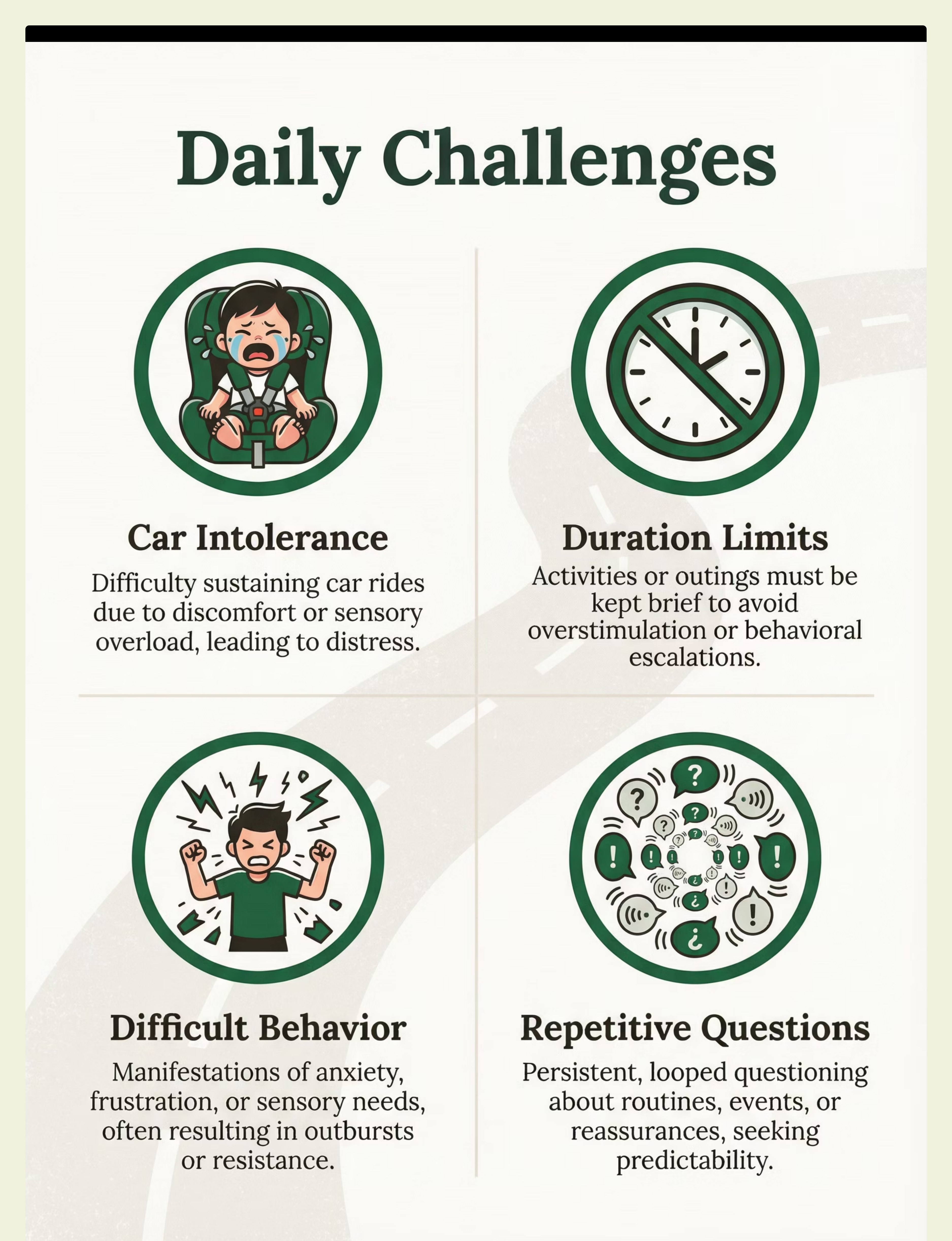
Confined spaces, unexpected sounds, bright lights, and sudden movements can overwhelm a child's senses, leading to discomfort and distress.
Cognitive Uncertainty
Difficulty understanding the duration, route, and destination of travel creates anxiety and confusion, leading to repetitive questions and frustration.
Restricted Movement
Being confined to a car seat for extended periods limits natural movement, contributing to physical discomfort and restlessness.
Unpredictable Stimuli
The constantly changing environment outside the car—traffic, weather, new sights—can be overwhelming and dysregulating.
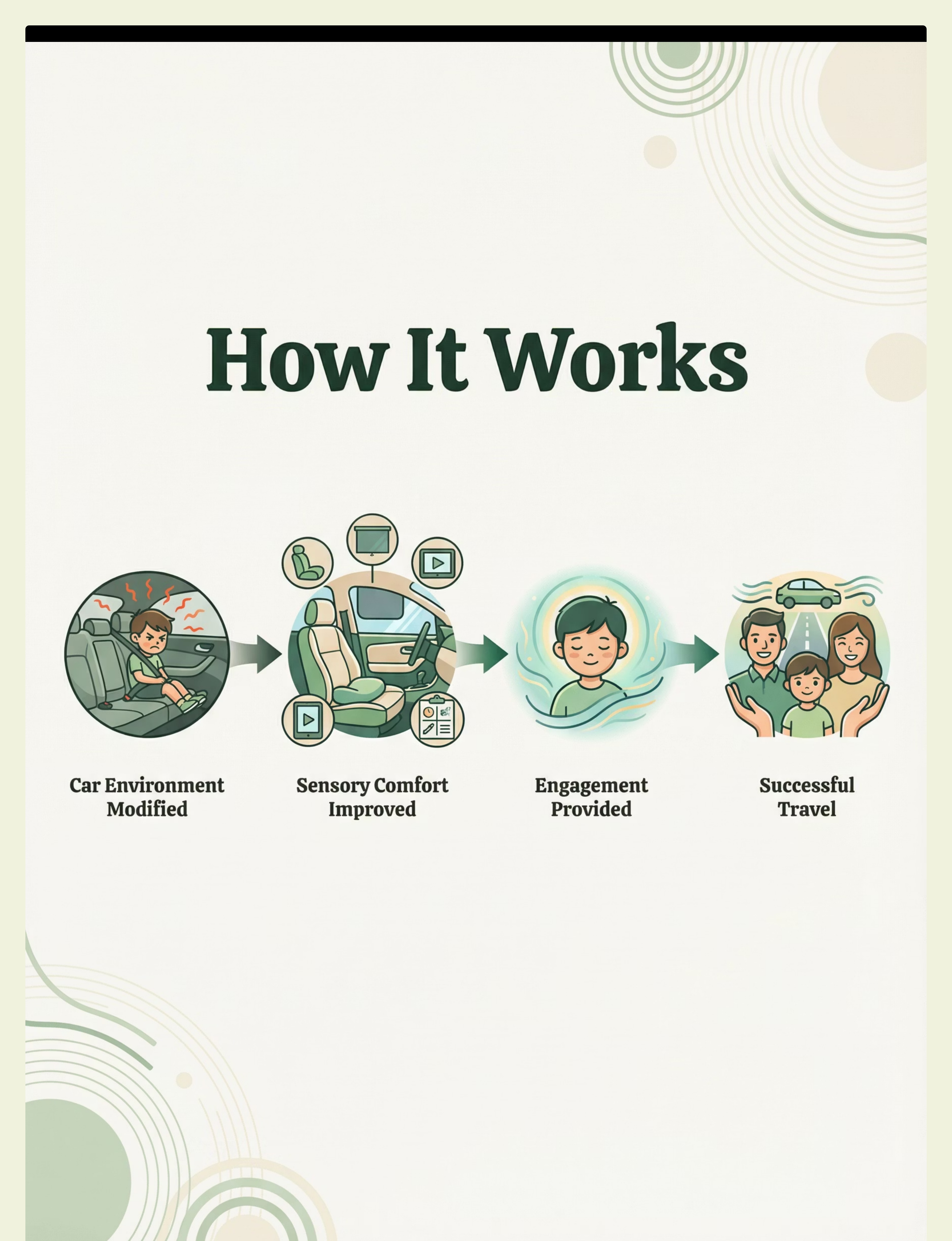
Environment Modified
Sensory modifications to the car—sunshades for light, cushions for comfort, audio control—create a more tolerable environment.
Comfort Improved
With sensory needs addressed, the child experiences less discomfort and overwhelm during the journey.
Engagement Provided
Appropriate activities keep the child occupied and regulated during the confined travel time.
Expectations Clear
Visual supports help the child understand the destination, progress, and duration—reducing anxiety and repetitive questioning.
Behavior Supported
With comfort, engagement, and understanding in place, challenging behaviors decrease and tolerance increases.
Travel Becomes Possible
Successful car rides mean expanded family activities, better access to services, and improved quality of life for everyone.
Car Travel Tolerance
Sensory Comfort
Engagement
Behavior During Travel
Family Mobility
Independence
How to Use It Right
Safety First Always
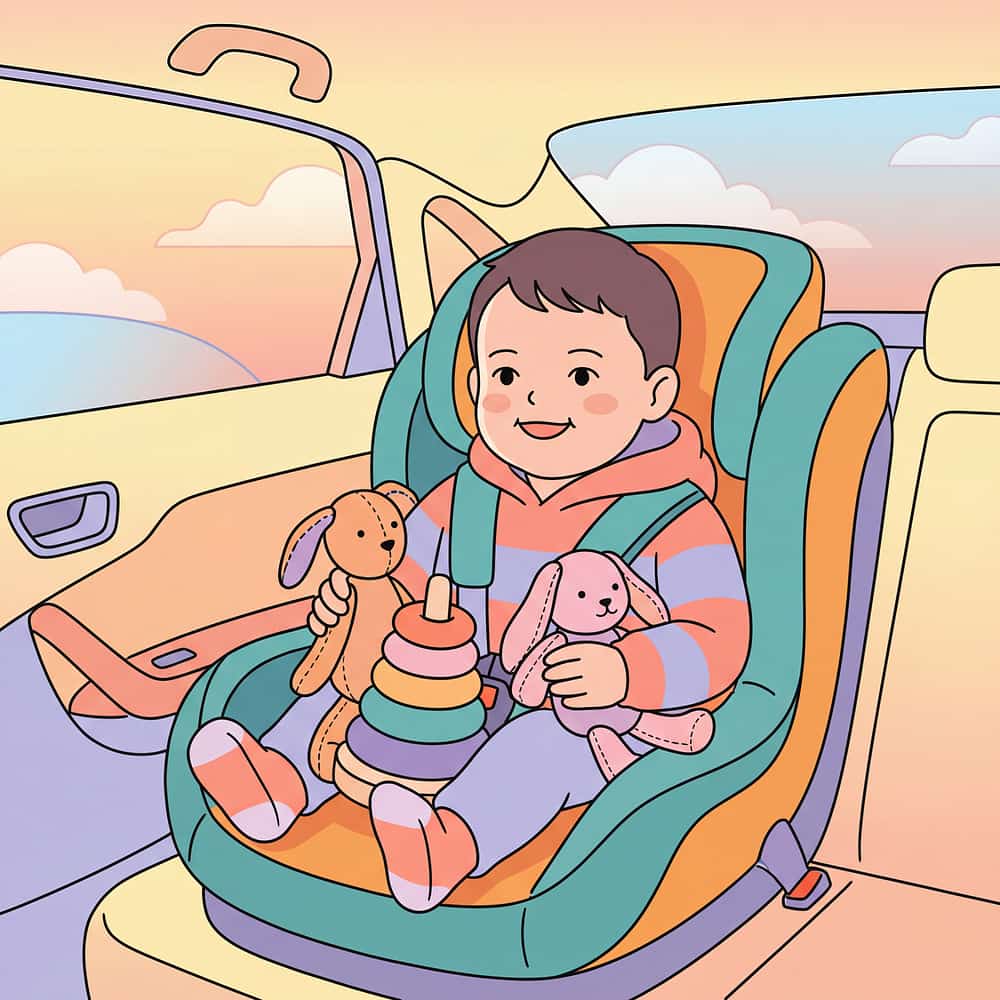
Never compromise car seat safety for comfort. Ensure car seat is properly installed and used according to manufacturer guidelines. Only use approved accessories.
Test Before Long Trips
Try new modifications and strategies on short, familiar journeys first. Build confidence and tolerance gradually before attempting longer or unfamiliar routes.
Keep Essentials Accessible
Have preferred items, comfort objects, and emergency supports within easy reach. Parent shouldn't need to leave driver's seat to provide support.
Use Visual Destination Board
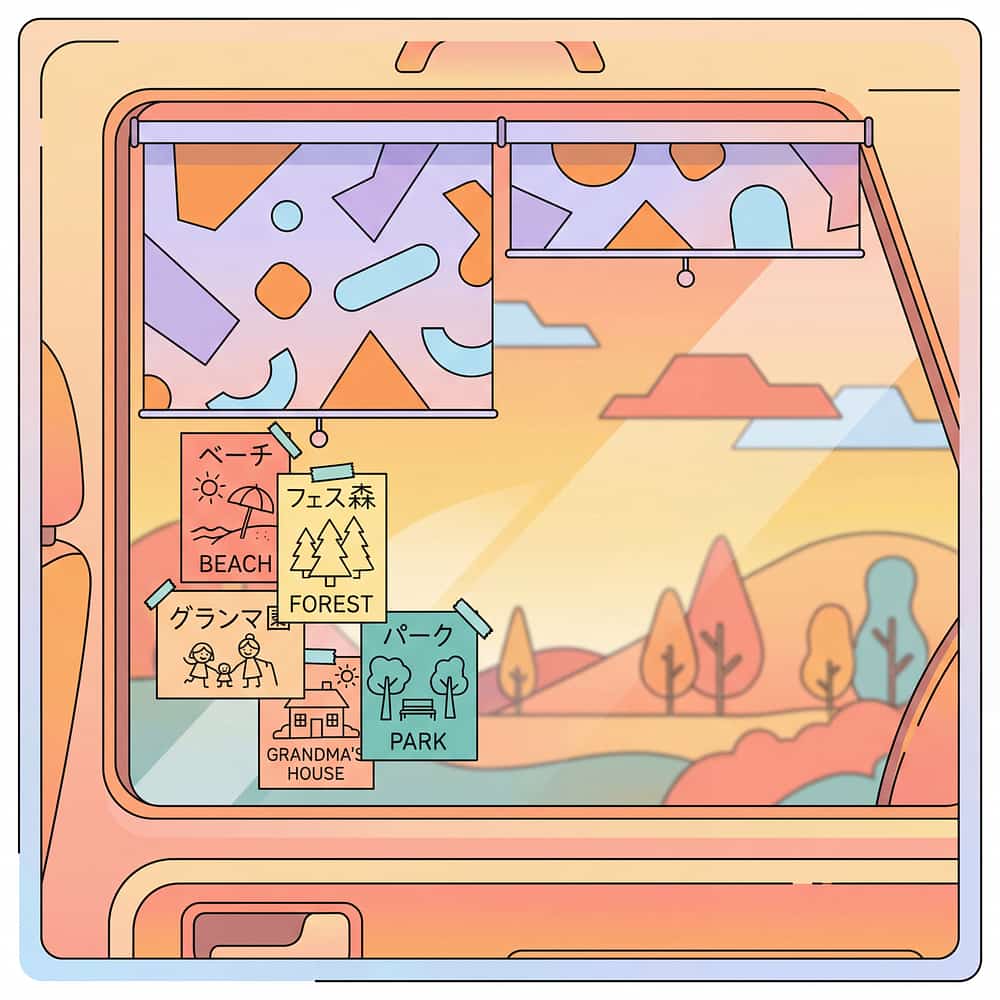
Create simple visual showing starting point, any stops, and final destination. Update progress during journey to provide concrete understanding of travel.
Build in Planned Stops
For longer trips, schedule movement and regulation breaks. Let child know these stops are coming—they're part of the journey plan, not delays.
Consistency Builds Tolerance
Use supports consistently, even on short familiar trips. Regular successful experiences build overall car travel tolerance over time.

Duration note: Use supports throughout car travel. Consistency is key—even short trips benefit from having the supportive environment in place.
Expert Perspective
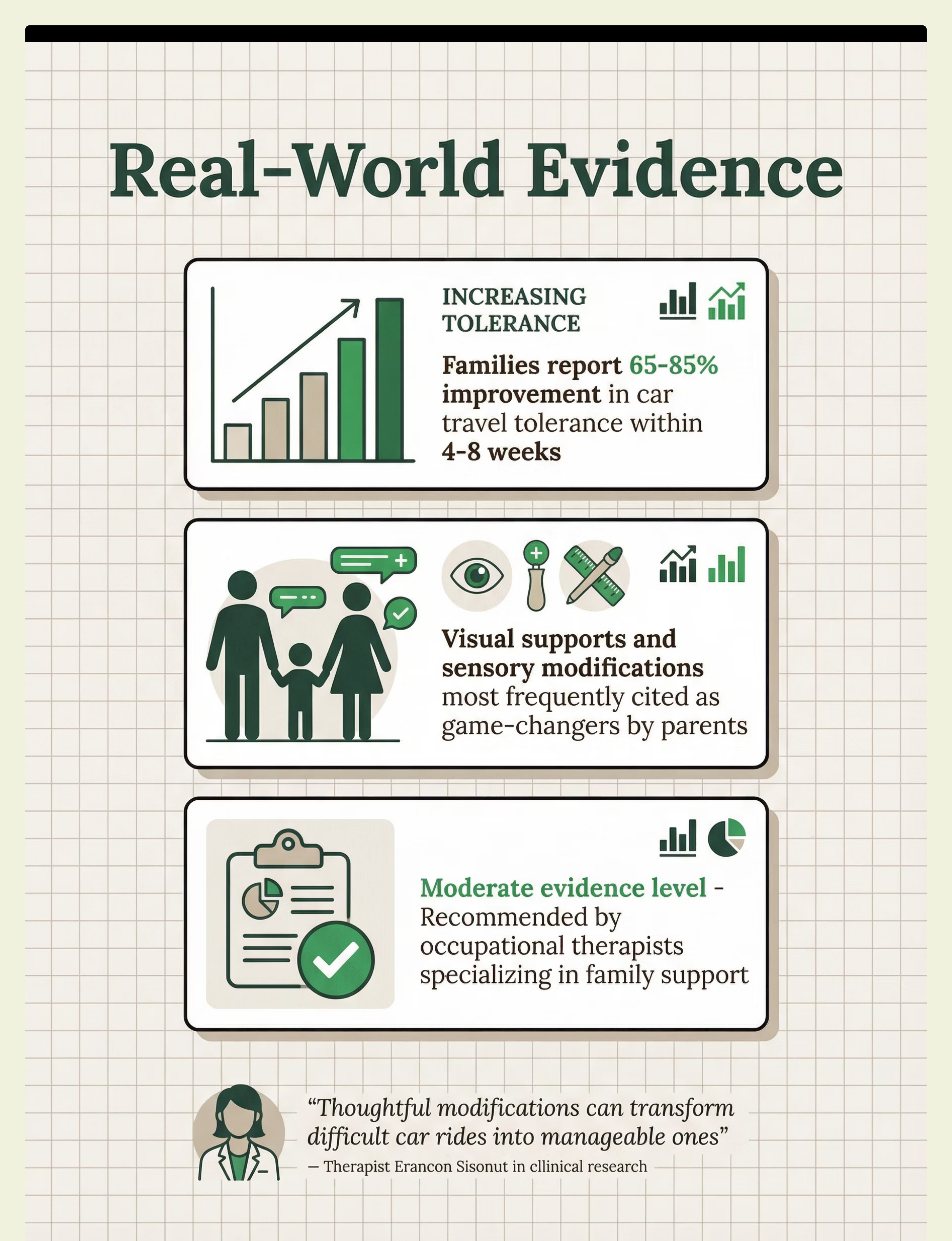
"Car travel can be very challenging—confined space, unpredictable duration, sensory issues with motion. Thoughtful modifications to the environment, combined with visual supports and engagement strategies, can transform difficult car rides into manageable ones."
— Occupational Therapist, Family Support Specialist
car-vehicle-supports therapy material
OT + Parent Recommended
Collaboratively developed by occupational therapy and parent expertise
Moderate Evidence
Supported by clinical practice and family success stories
Rank #2 in Travel Category
Core Kit essential for family mobility and independence
car-vehicle-supports therapy material
Choose Your Option (5 Variants)
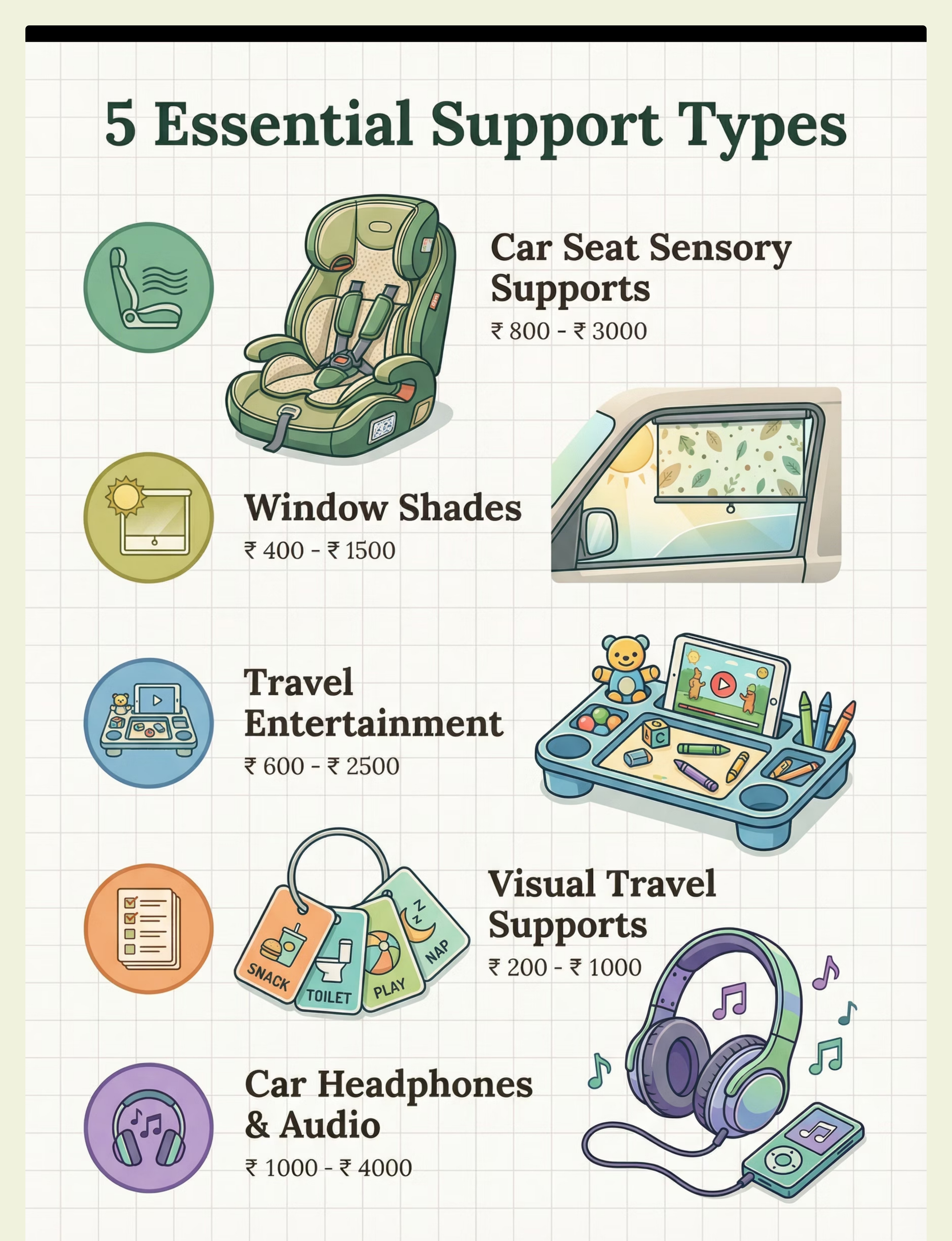
17.4.1: Car Seat Sensory Supports
Best for: Improving car seat tolerance
17.4.2: Window Shades / Sunshades
Best for: Light sensitivity, visual overwhelm
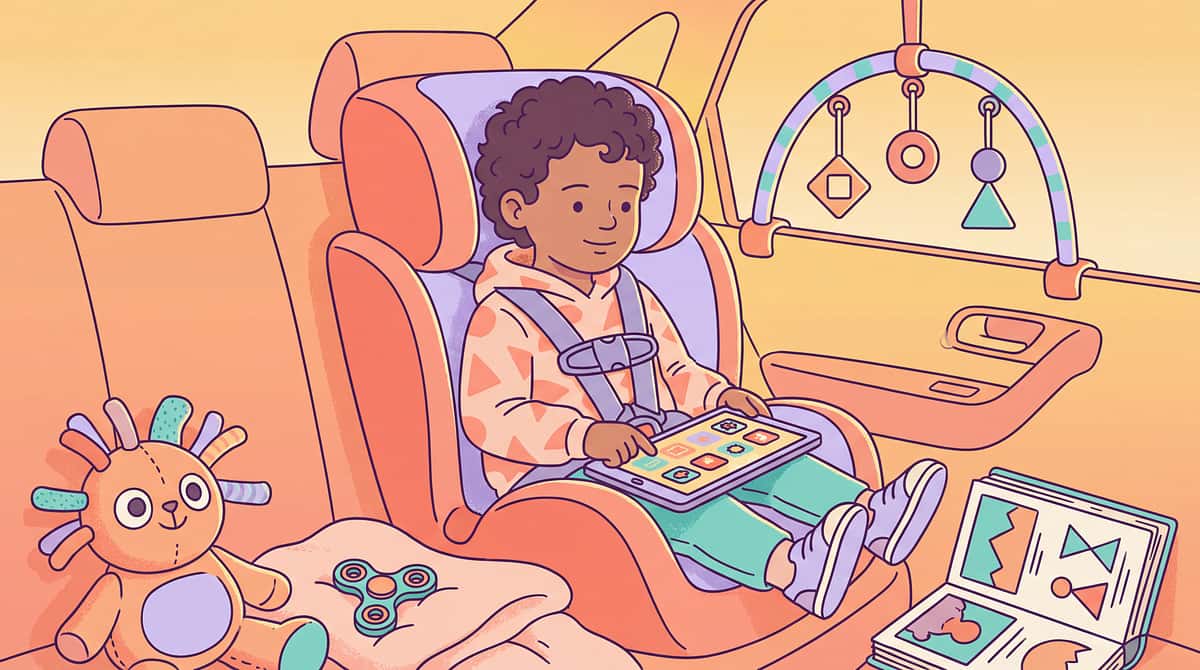
17.4.3: Travel Entertainment
Best for: Keeping occupied during rides
17.4.4: Visual Travel Supports
Best for: Expectations, destinations, timing
17.4.5: Car Headphones / Audio
Best for: Audio preferences, noise management
Every child's car travel needs are unique. Select supports based on your child's specific challenges—sensory comfort, visual overwhelm, engagement needs, or understanding of travel. Many families combine multiple variants for comprehensive support.

How to Choose
  • By goal: Comfort (sensory supports), overwhelm (sunshades), boredom (entertainment), understanding (visual supports), noise (audio)
  • By setting: All variants designed specifically for vehicle use
  • By portability: Low (stays in car), Medium (easily added/removed), High (travels between vehicles)
Specifications & Types Guide
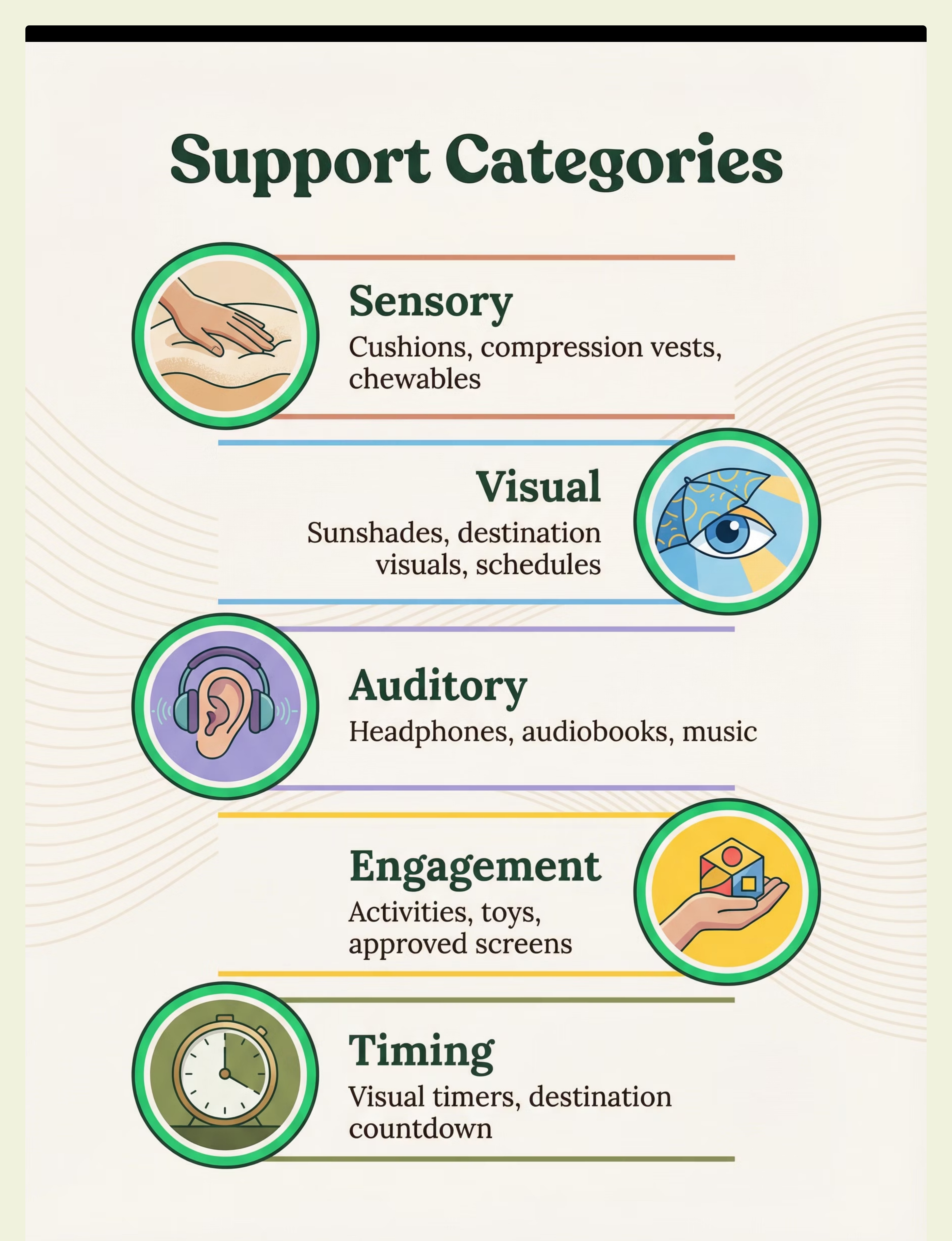
Car Support Types
Sensory
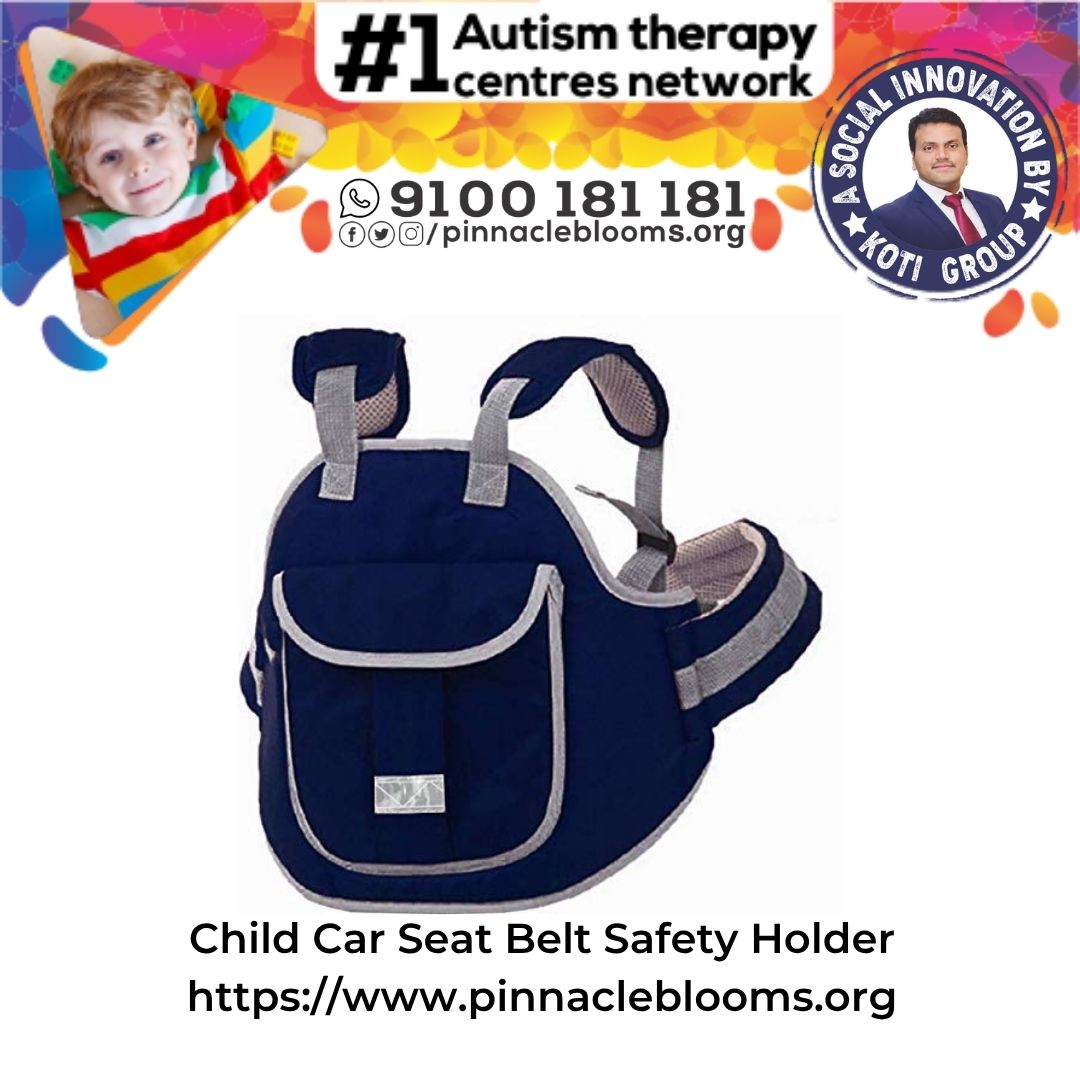
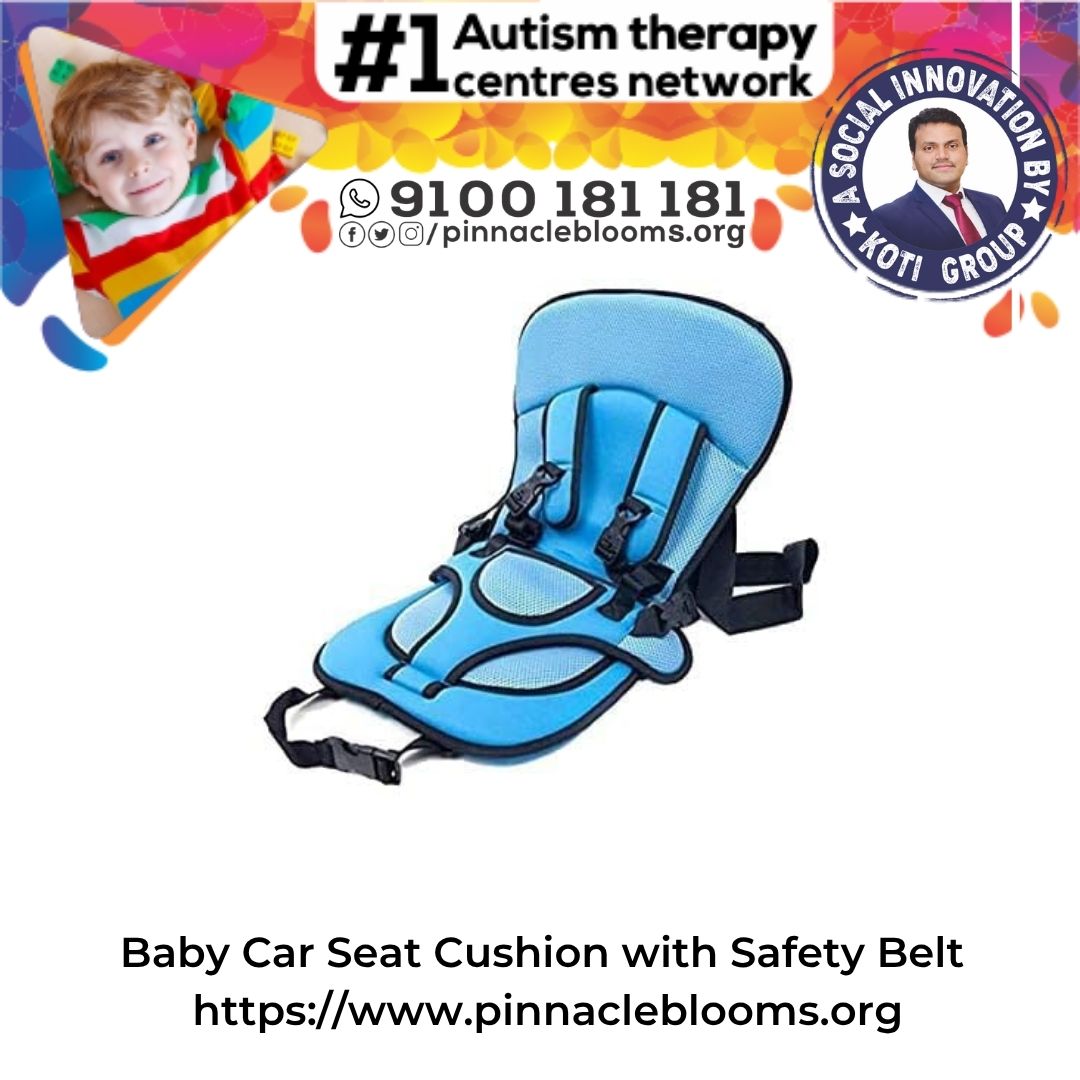
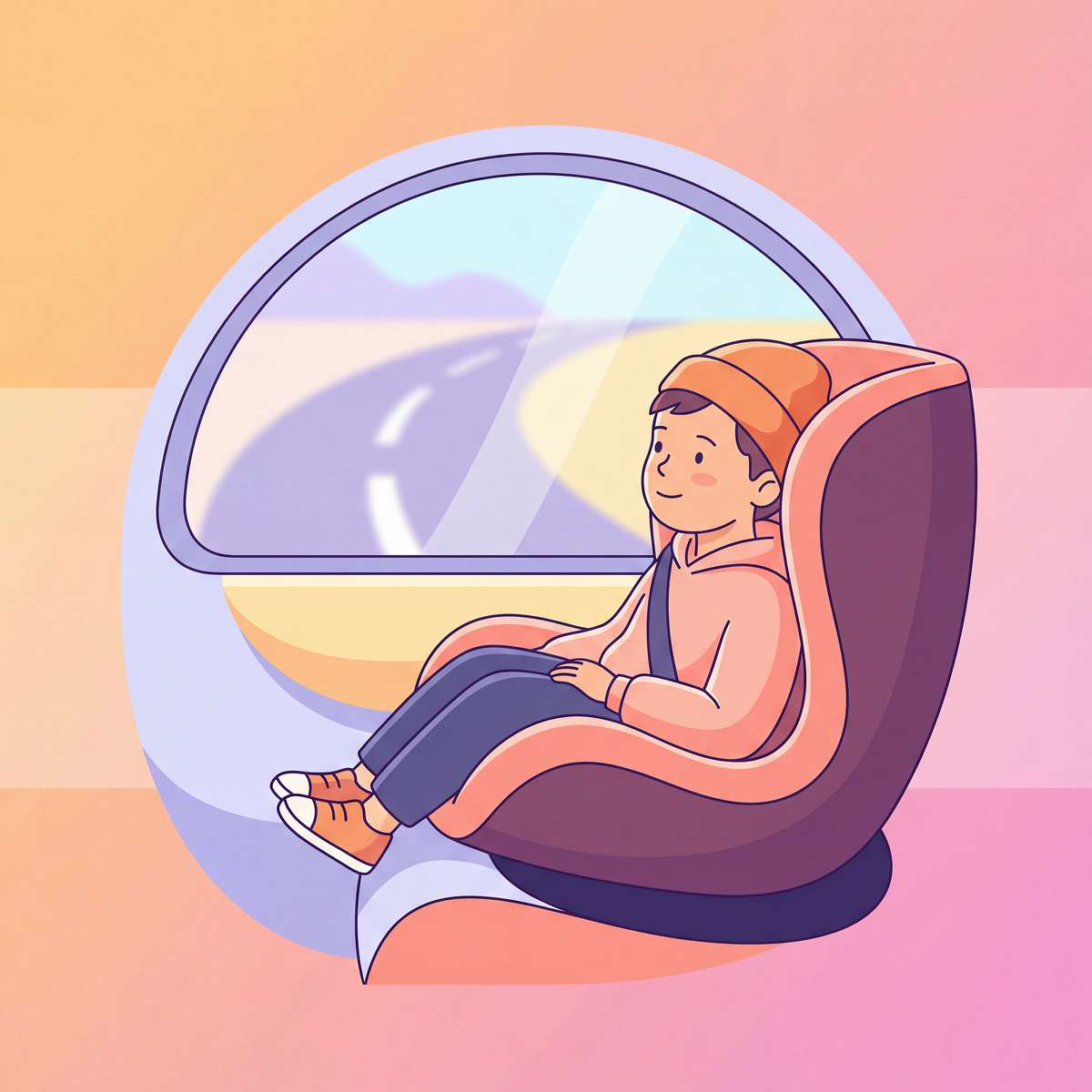
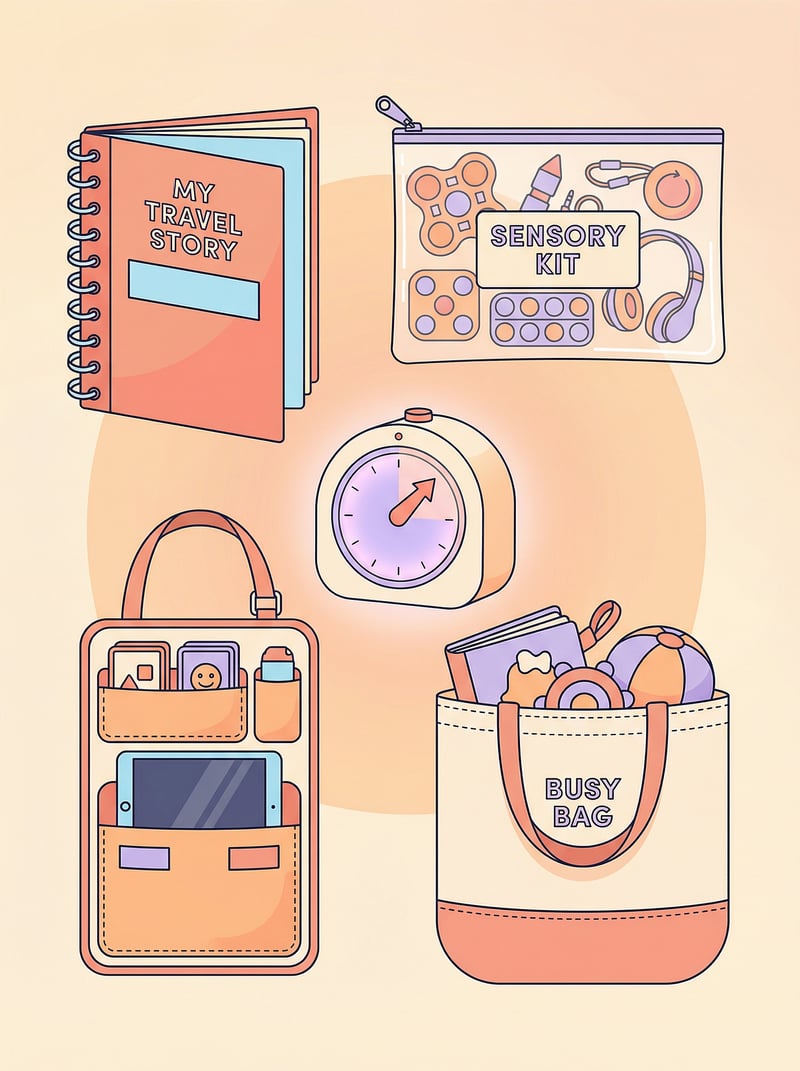
Seat cushions for comfort, compression vests for calming input, chewables for oral regulation. Addresses physical discomfort and sensory seeking needs.
Visual
Sunshades to reduce light sensitivity, destination visuals showing where you're going, travel schedule showing journey sequence and progress.
Auditory
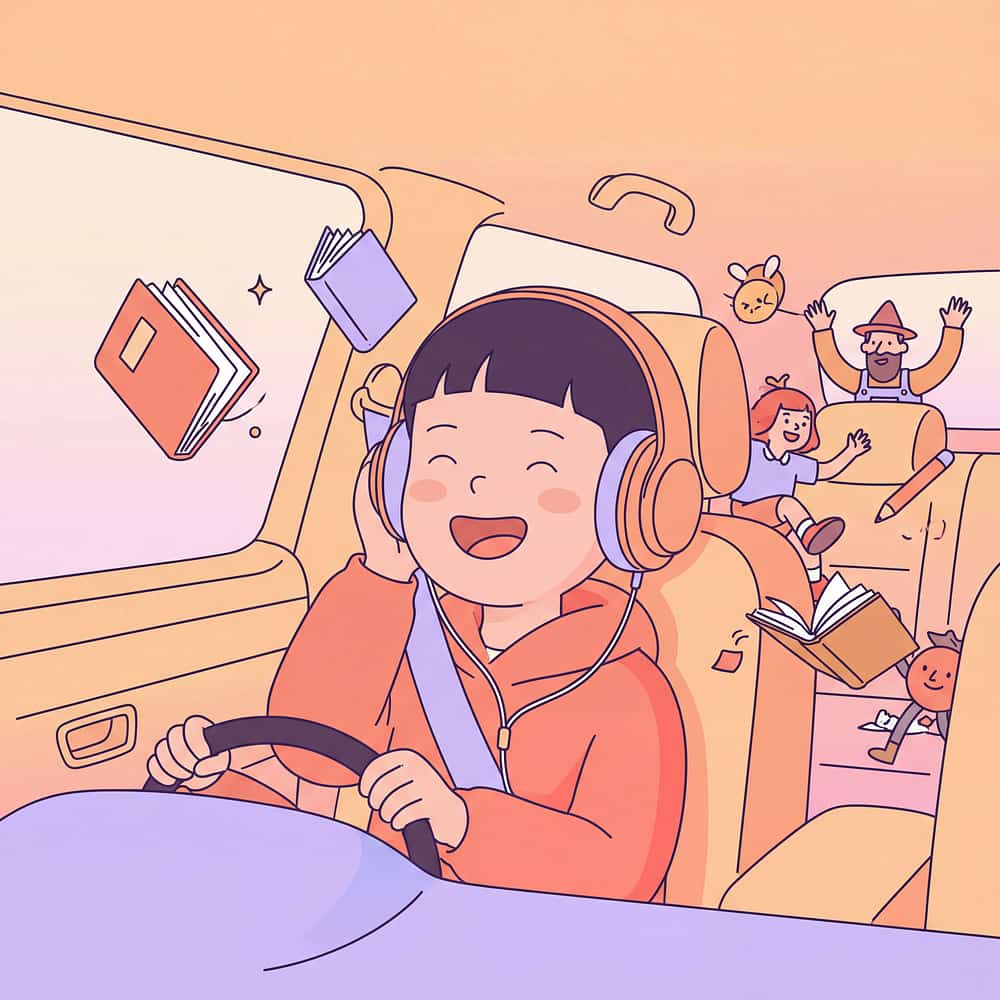
Headphones for preferred audio, audiobooks for engagement, preferred music for calming or regulation during travel.
Engagement
Activities to occupy hands and mind, toys for play, screens (if family allows) for entertainment during longer journeys.
Timing
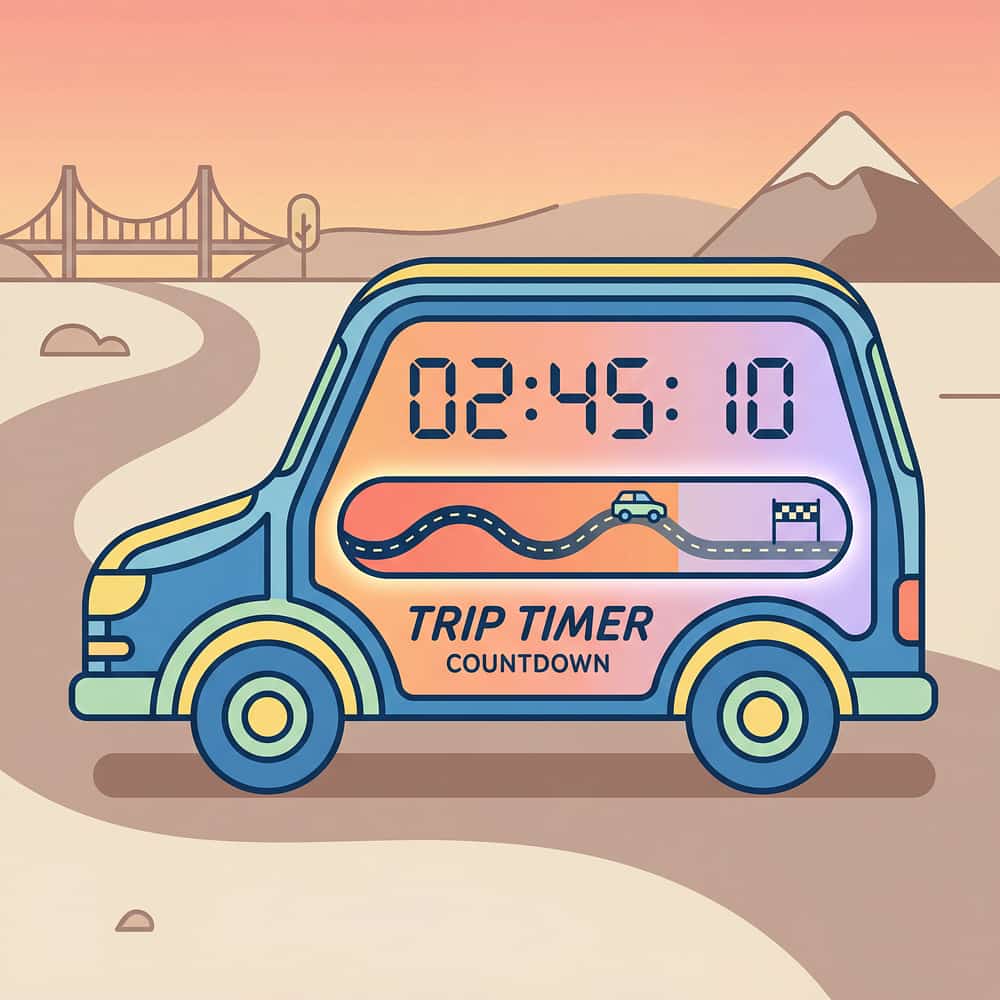
Visual timer showing remaining time, destination countdown providing concrete progress information, reducing repetitive questions.
Materials & Key Features
  • Fabric supports: Comfortable, washable materials for seat modifications and comfort items
  • Sunshades: UV-blocking, easy attachment, doesn't obstruct driver view
  • Entertainment items: Age-appropriate, safe for car use, keeps hands busy
  • Visual cards: Durable, clear images, easily visible to child in seat
Key Features to Look For
  • Safe with car seat—doesn't compromise restraint system
  • Accessible to child—within reach from car seat position
  • Effective for needs—addresses specific challenge
  • Easy to use—parent can manage while driving safely
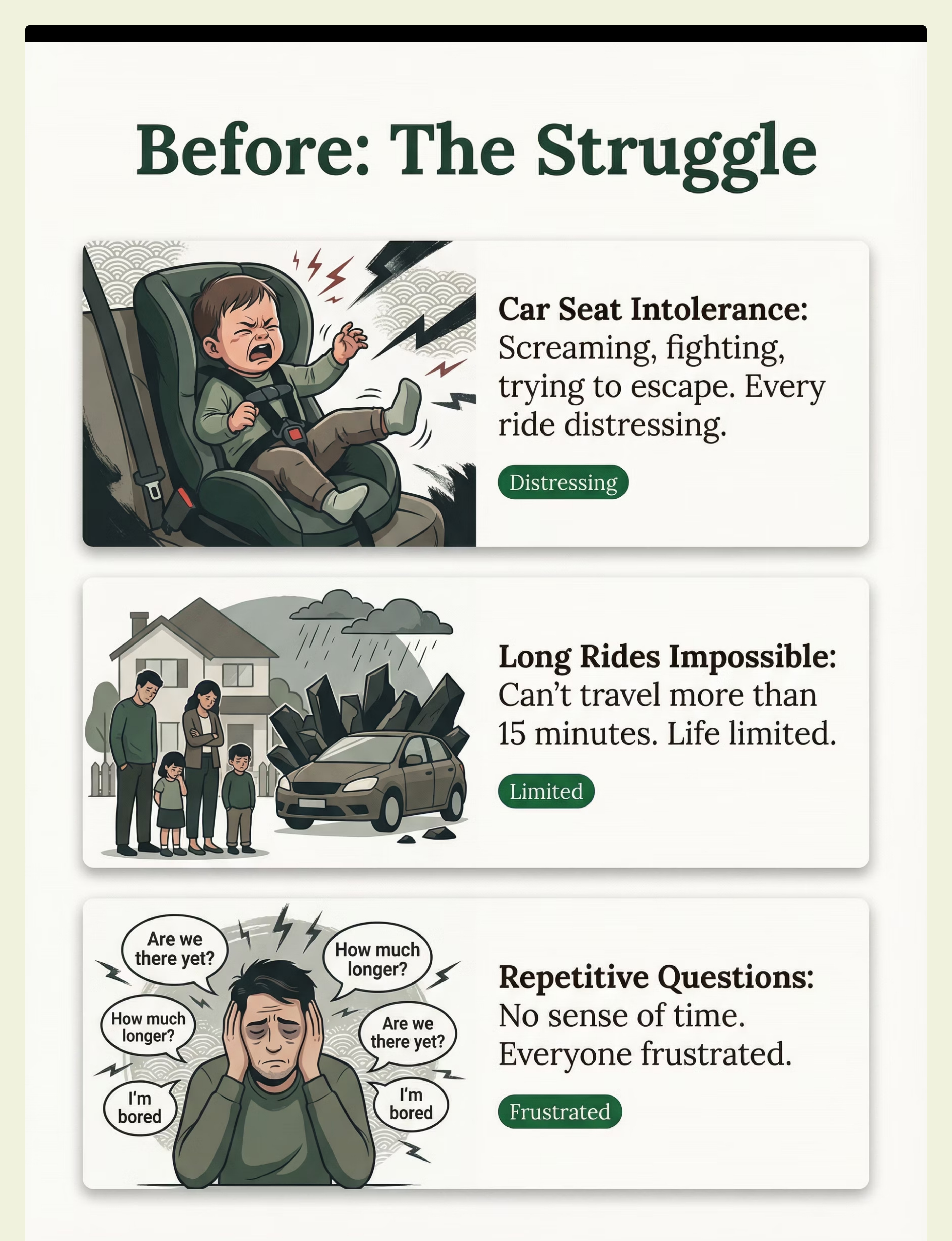
The Struggle (Before)
Car Seat Intolerance
Situation: Child screams in car seat. Fights restraint. Tries to escape. Every car ride is distressing for everyone.
Experience: Physical struggle to get child buckled. Constant crying throughout journey. Feeling helpless to comfort child.
Emotion: Distressing, fighting, exhausting
Long Rides Impossible
Situation: Can't travel more than 15 minutes. Family vacation impossible. Medical appointments far away avoided. Life limited by car intolerance.
Experience: Missing family weddings, skipping outings, postponing necessary appointments. Entire life constrained by this one barrier.
Emotion: Limited, trapped, isolated
'Are We There Yet?' Loop
Situation: Child asks constantly about arrival. No sense of time or progress. Parents exhausted from repetition. Everyone frustrated.
Experience: Answering the same question 50 times per trip. No answer satisfies. Child has no concrete understanding of journey progress.
Emotion: Repetitive, frustrated, helpless
car-vehicle-supports therapy material
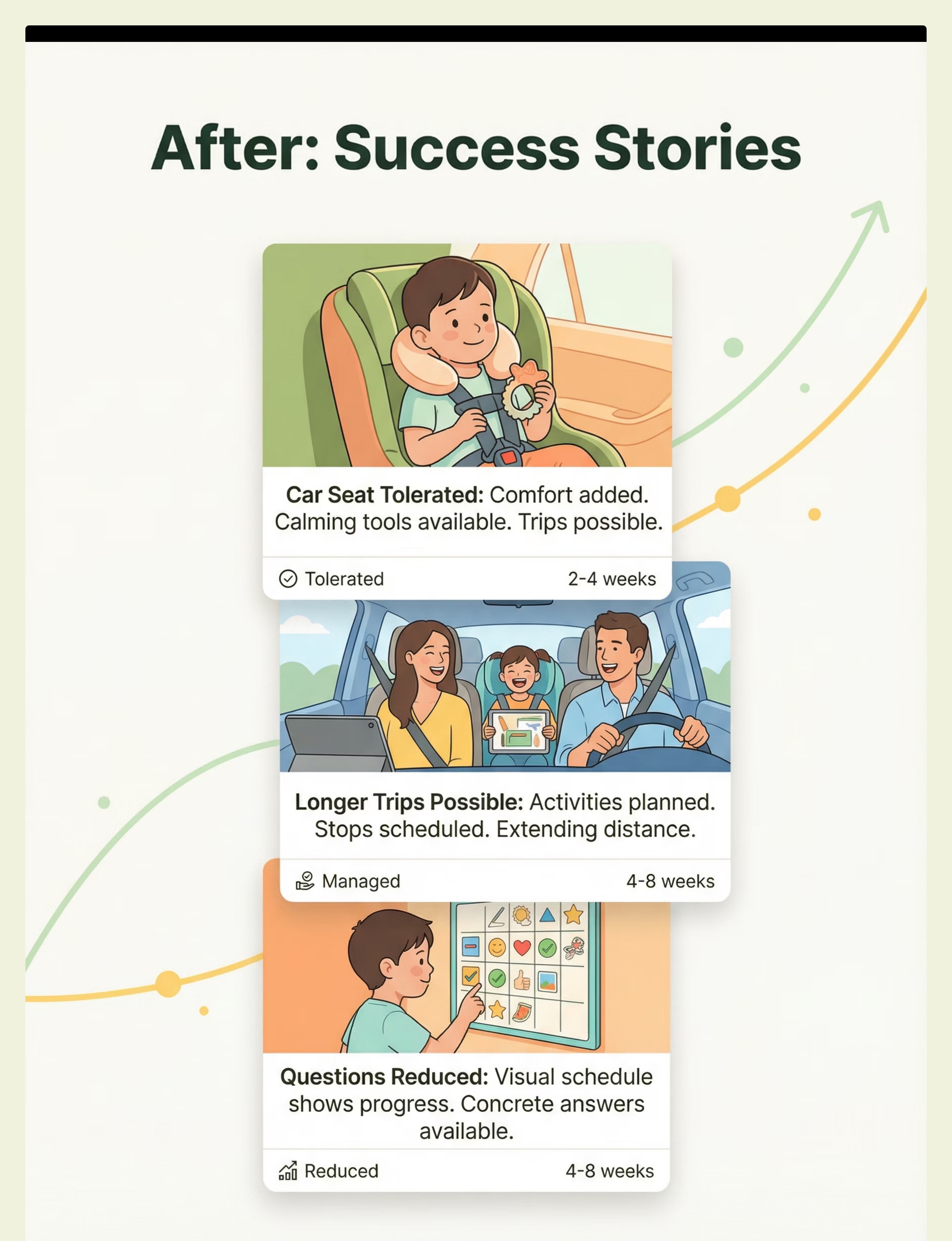
The Breakthrough (After)
Car Seat Intolerance → Tolerated
Situation: Seat cushion adds comfort. Compression vest for calming. Chewables available. Car seat tolerated. Trips possible.
Experience: Child gets into seat with minimal resistance. Stays relatively calm during journey. Family can actually travel together.
Emotion: Tolerated, possible, hopeful
2-4 weeks
Long Rides → Becoming Possible
Situation: Engagement activities planned. Headphones with preferred audio. Planned stops. Visual schedule of trip. Longer trips becoming possible.
Experience: Recently attended family wedding two hours away. Made it to specialist appointment. Beginning to plan vacation.
Emotion: Managed, extending, opening up
4-8 weeks
'Are We There Yet?' → Answered
Situation: Visual destination board shows progress. Timer shows remaining time. Questions reduced. Child has concrete answers.
Experience: Child checks visual board instead of asking constantly. Understands "timer shows 5 more minutes." Repetition dramatically reduced.
Emotion: Concrete, understood, peaceful
2-4 weeks
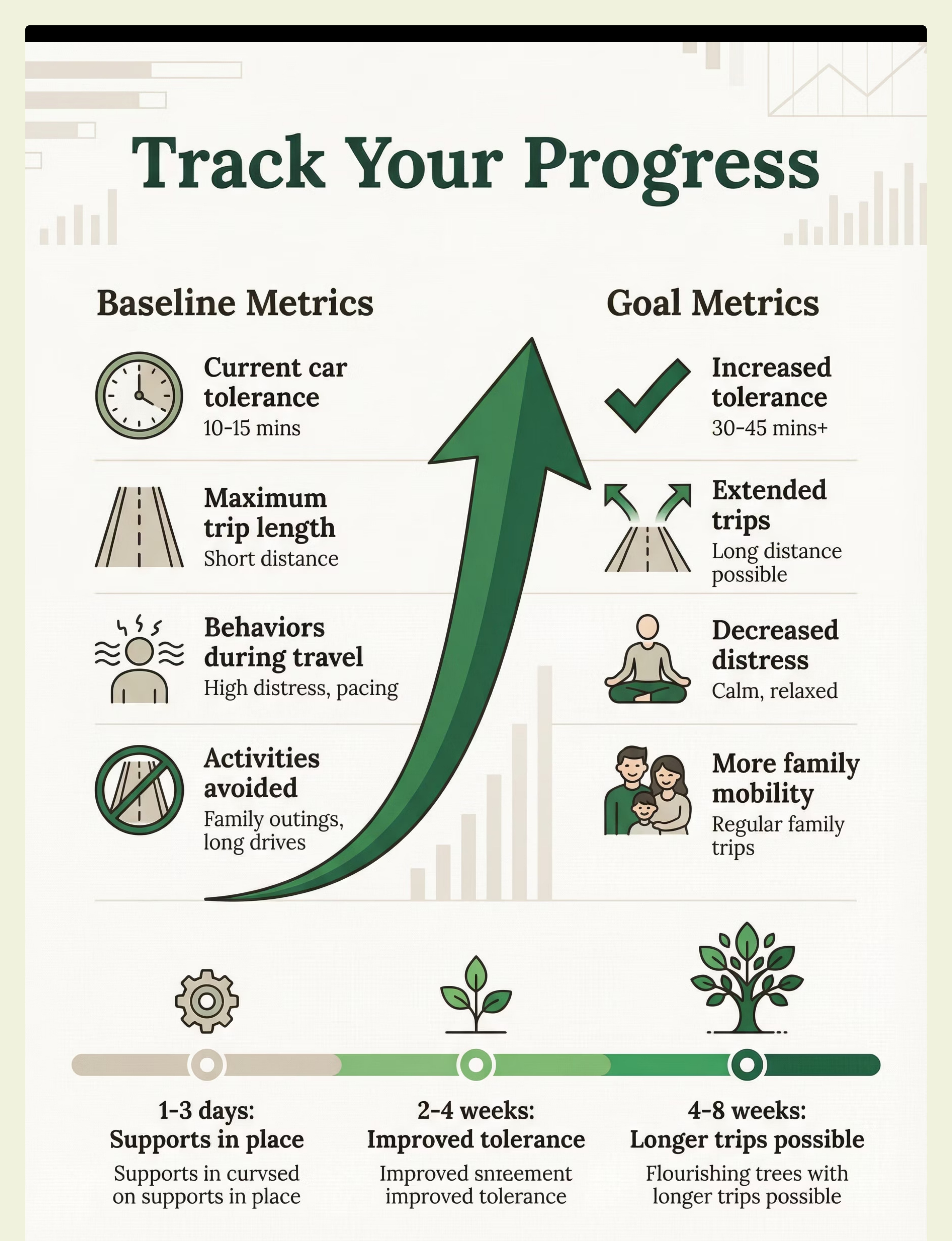
What to Expect (Realistic Timelines)
Car supports in place
First supports installed and ready to use during travel
1-3 days
Improved car tolerance
Noticeable reduction in distress and resistance to car travel
2-4 weeks
Longer trips possible
Able to extend travel duration beyond previous limits
4-8 weeks
Reduced distress during travel
Fewer meltdowns, less crying, more regulated throughout journey
2-4 weeks
Family mobility increased
Accessing more activities, appointments, and family events
4-8 weeks

Remember: Every child's timeline is unique. These are typical ranges based on consistent use. Some children show improvement faster, others need more time. The key is consistency and patience as new skills develop.
Is This Right for My Child? (2-Minute Check)
1
Does your child struggle with car travel?
If yes, this indicates: Car supports needed
Struggles can include resistance, distress, sensory discomfort, or difficulty tolerating the confined space and restraint.
Confidence: 92%
2
Are car rides limited by child's tolerance?
If yes, this indicates: Supports may extend tolerance
If you can only travel short distances or must avoid certain times of day due to child's car intolerance, supports can help expand what's possible.
Confidence: 88%
3
Does your child have difficulty with car seat confinement?
If yes, this indicates: Sensory supports may help
Discomfort with restraint, positioning, or confined space often has sensory components that can be addressed with the right modifications.
Confidence: 85%
4
Do you avoid activities due to travel required?
If yes, this indicates: Better car support may expand activities
When car travel is the barrier to family life, addressing it opens access to community, services, and social connections.
Confidence: 90%

Scoring: 3+ "yes" answers = strong fit for car and vehicle supports. Even 1-2 "yes" answers suggest specific supports could improve your family's travel experience.
Usage Guide
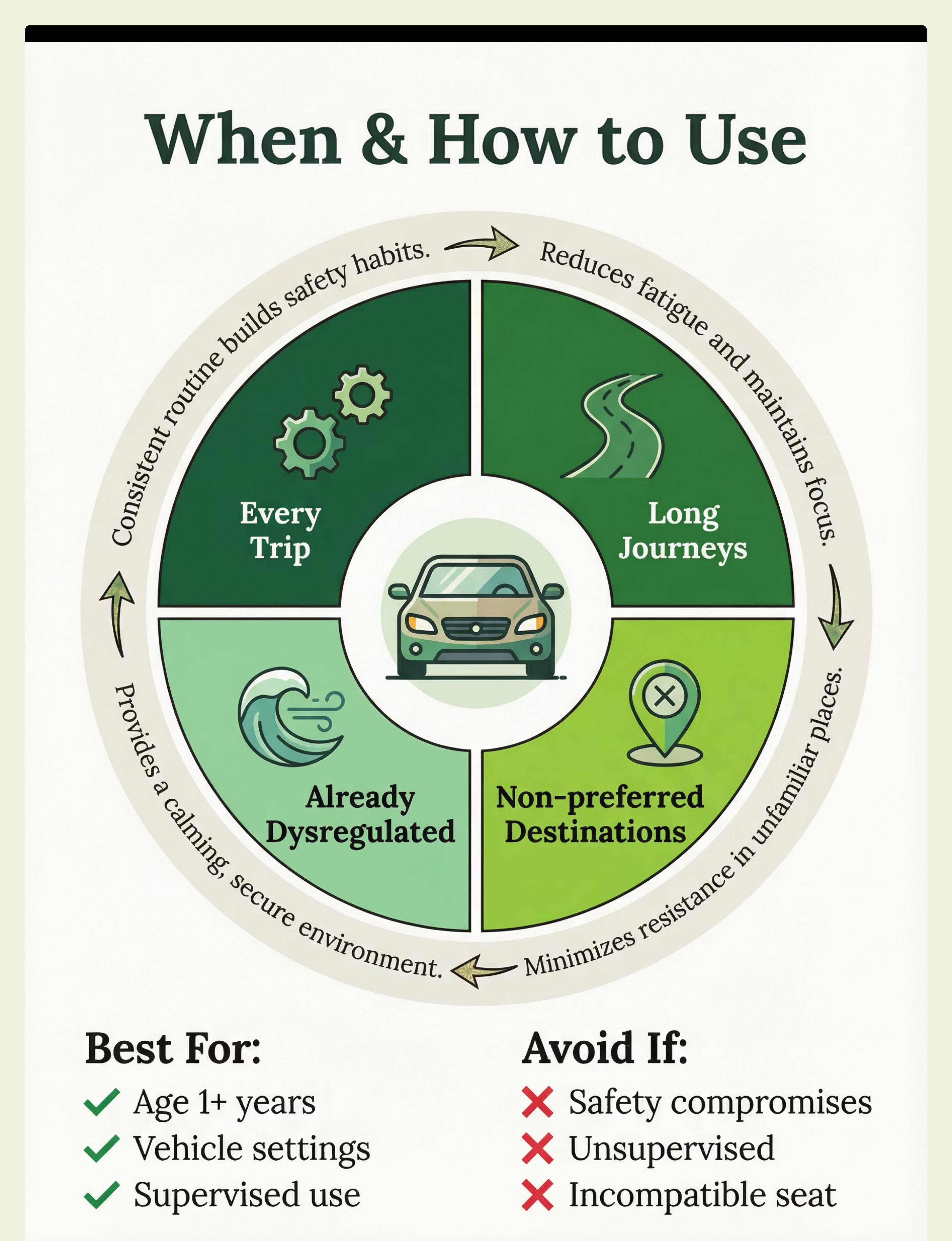
When to Use
Every car trip (consistency)
Regular use builds tolerance and creates predictable environment
Especially for longer trips
Extended journeys benefit most from comprehensive support system
Trips to non-preferred destinations
When destination isn't motivating, journey support becomes critical
When child is already dysregulated
Supports can prevent escalation during necessary travel
When NOT to Use
If item compromises car seat safety
Supervision by Age
Young Children
Adult manages all supports, provides items, controls environment
Developing Independence
Child uses supports with guidance, learns to request preferred items
Older/Independent
Independent access to supports, self-regulates during travel
Duration & Settings
Duration: Throughout car travel—from getting into seat until exiting vehicle
Vehicle
All Driving Families
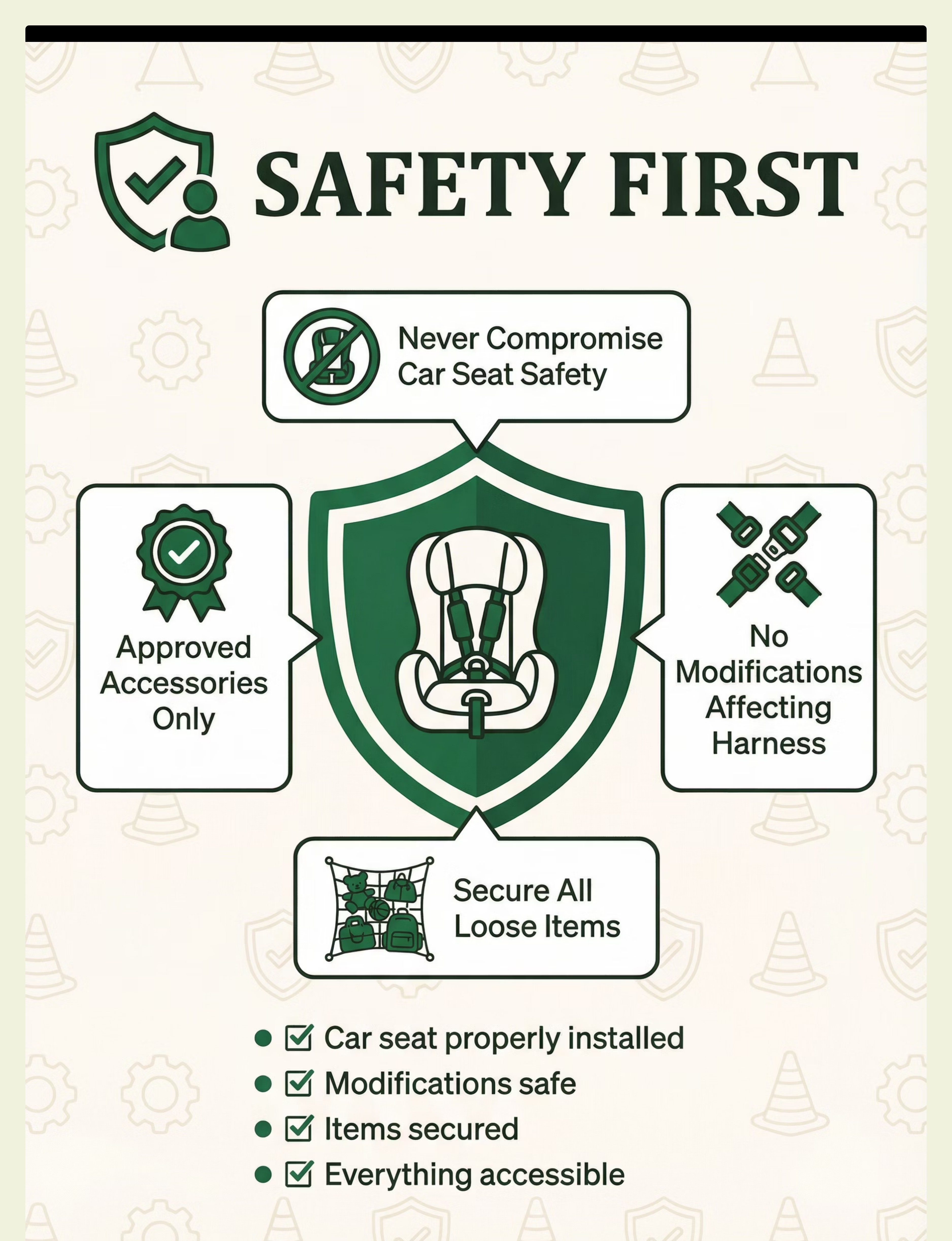
Safety First
CRITICAL SAFETY
  • NEVER compromise car seat safety
  • No modifications affecting harness/straps
  • Secure all loose items
  • Approved accessories only
  • Regular car seat safety check
WARNINGS
  • Loose items become projectiles in crash
  • Don't add bulk under straps
  • Check manufacturer guidelines
  • Airbag safety considerations
CONTRAINDICATED
Do NOT use: Anything that compromises car seat safety—any item interfering with harness function, restraint system, or proper positioning in seat
Safety Checklist
Before Use
  • Car seat properly installed
  • Modifications don't affect safety
  • Items secured
  • Everything accessible
During Use
  • Child in seat correctly
  • Supports being used
  • Car ride going better
  • Nothing compromising safety
Signs of Success
  • Better car tolerance
  • Longer trips possible
  • Less distress
  • Family mobility increased
Common Questions (Honest Answers)
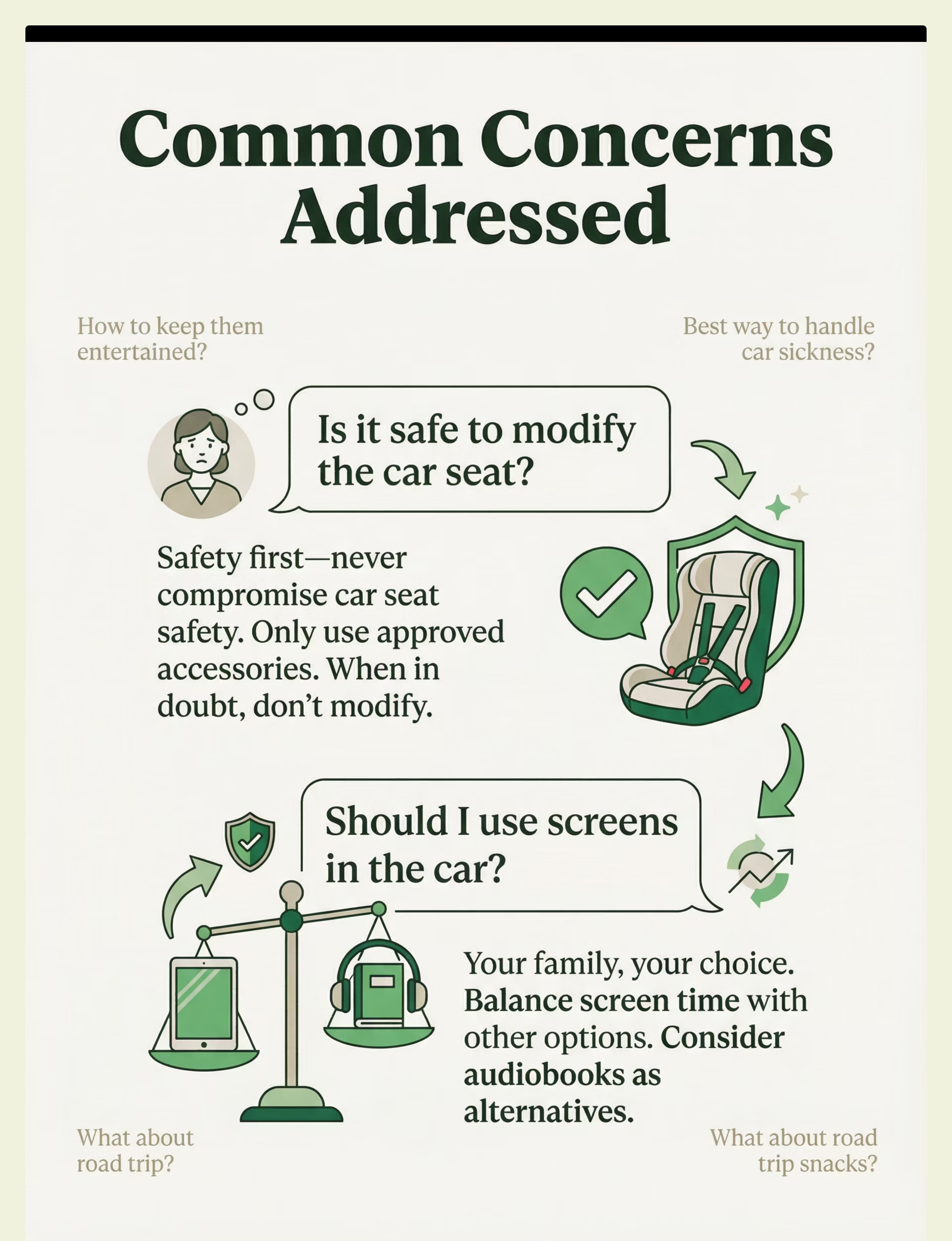
Q: Modifications might be unsafe
A: SAFETY FIRST—never compromise car seat safety. Only use approved accessories. Don't add items under straps. Keep loose items secured. When in doubt, don't modify seat.
Try this: Safety first; approved accessories only; when in doubt, don't.
Q: What about screen time in car?
A: Your family, your choice. Balance screen time with other activities. For difficult travel, screens can be appropriate tool. Consider audiobooks as alternative.
Try this: Family decision; balance; audiobooks as alternative.
Q: They should just learn to ride
A: Supports help them learn. Comfortable child is learning child. Gradually build tolerance. Forcing doesn't work and causes trauma.
Try this: Supports help learning; build tolerance gradually.
Q: What works for short trips won't work for long
A: Different strategies for different trips. More engagement for long trips. Planned stops. Build up gradually. Some children do better on long trips (settle in).
Try this: Different strategies; planned stops; gradual building.
Investment Guide
Budget Option
DIY visual supports + simple activities + sunshade
Cost: ₹200-500
Note: Basic but effective
Perfect starting point for families wanting to test strategies before larger investment. Visual supports can be homemade, activities can be existing toys designated for car only, and basic sunshades are affordable.
Premium Option
Seat support + headphones + entertainment tablet + visual system
Cost: ₹2,000-5,000
Brands: Various
Comprehensive support system for families who drive frequently or have longer commutes. Includes sensory comfort, audio control, engagement, and clear expectations—addressing multiple needs simultaneously.

Overall Investment Range: ₹100–3,000 (USD $1–36)
Best starting point: Begin with visual supports (low/no cost) and basic sunshade (₹200-400). Add sensory supports if car seat tolerance is primary issue. Build comprehensive system gradually based on what makes the biggest difference for your child.
Low-Mid Tier
Accessible for Most Families
DIY Options Available
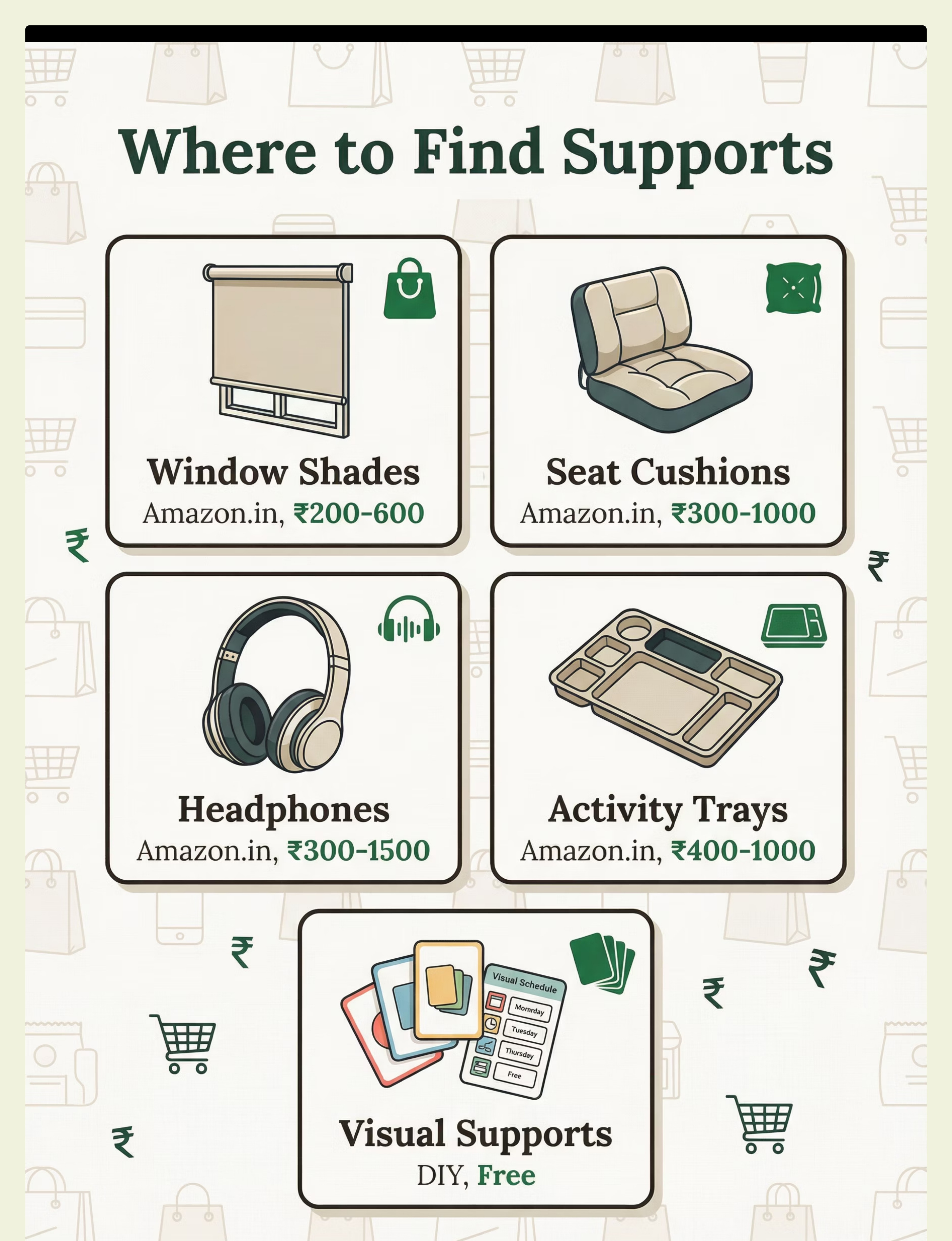
Where to Buy in India
Availability: Widely Available across India through online platforms and local stores
Amazon.in 🛒
Search Term: "car window shade kids"
Price Range: ₹200-600
Amazon.in 🛒
Search Term: "car seat cushion kids"
Price Range: ₹300-1,000
Amazon.in 🛒
Search Term: "kids headphones car"
Price Range: ₹300-1,500
Amazon.in 🛒
Search Term: "car activity tray kids"
Price Range: ₹400-1,000
DIY ✂️
Search Term: "visual travel supports"
Price Range: Free
Buying Tips
  • Check safety ratings for any seat modifications
  • Test on short trips first
  • Have backup activities/entertainment
  • Keep essentials within reach
  • Visual supports can be laminated for durability
🚨 Red Flags
  • Unsafe modifications to car seat
  • Items that could become projectiles
  • Modifications affecting strap function
  • Untested items on long trips
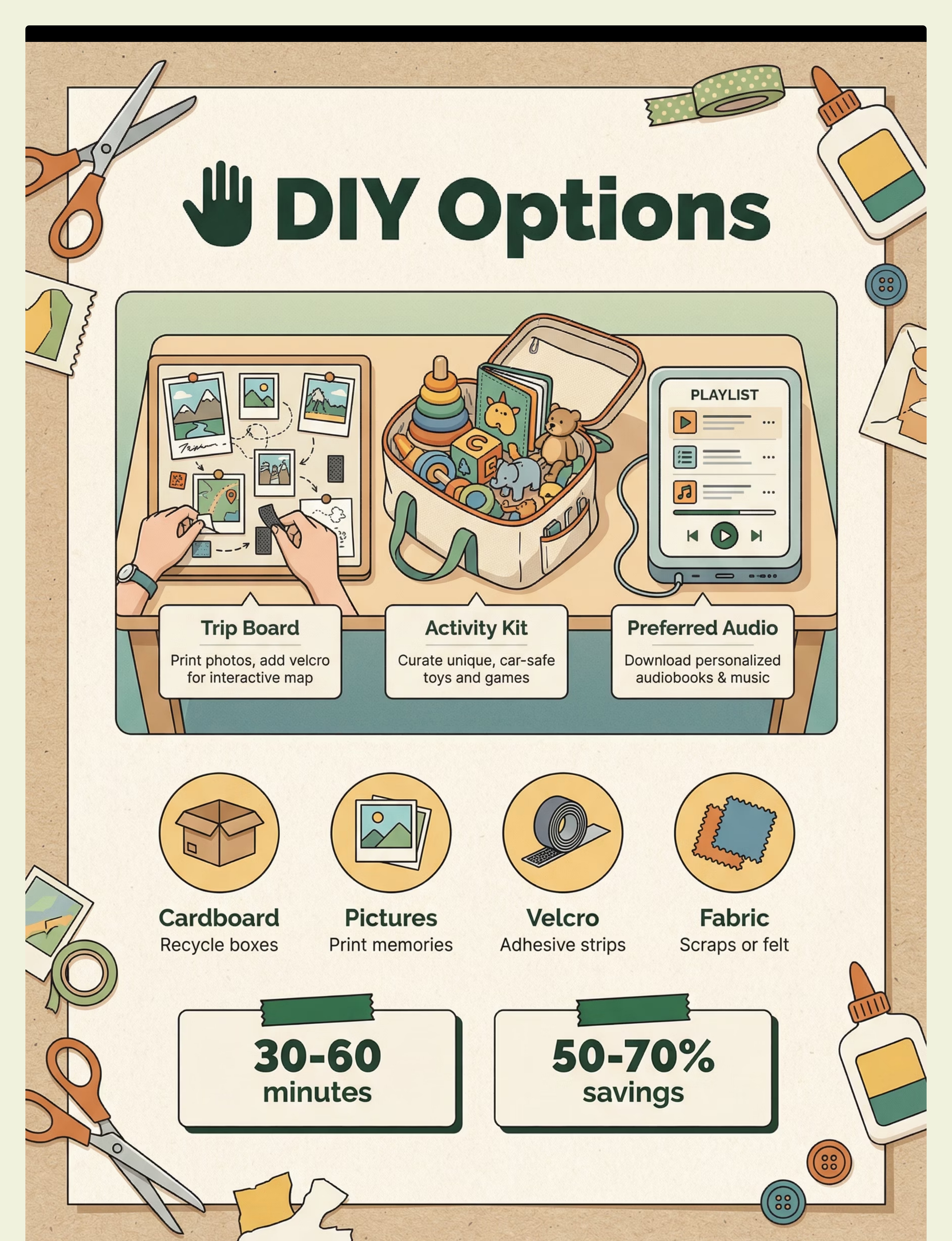
DIY Alternative (Save 50-70%)
1
DIY Car Travel Supports
Feasibility: Medium-High
Time: 30-60 minutes
Cost Savings: 50-70%
Materials Needed
  • Cardboard or poster board
  • Pictures (printed or cut from magazines)
  • Velcro dots
  • Fabric scraps for comfort items
  • Laminating sheets (optional but helpful)
Steps
  1. Visual destination board: Pictures of stops and destination on card
  1. Trip schedule: Visual sequence of trip events
  1. Progress tracker: Movable marker on trip timeline
  1. Activity bag: Rotate special car-only activities
  1. Comfort items: Preferred textures, items for holding
  1. Audio playlist: Preferred music/stories ready to play
2
DIY vs Commercial & Tradeoffs
When to DIY
When to Buy
Visual supports
Car seat modifications
Activity bags/kits
Sunshades
Audio playlists
Headphones
Comfort items
Tablet/entertainment

Tradeoffs: DIY visuals work great and cost almost nothing. Safety items like approved seat modifications should be commercial to ensure they meet safety standards.

Preview of car vehicle supports Therapy Material

Below is a visual preview of car vehicle supports therapy material. The pages shown help educators, therapists, and caregivers understand the structure and content of the resource before use. Materials should be used under appropriate professional guidance.

Page 1
Page 2
Page 3
Page 4
Page 5
Page 6
Page 7
Page 8
Page 9
Page 10
Page 11
Page 12
Page 13
Page 14
Page 15
Page 16
Page 17
Page 18
Page 19
Page 20
Travel Transitions

Category 17: Travel & Transitions

5 MATERIALS

Portable supports for managing transitions, travel, community outings, and new environments. These materials provide comfort, predictability, and sensory support during changes in routine, helping children navigate challenging transitions with greater ease and independence.

Key Materials

  • Transition supports and warnings
  • Travel comfort and sensory kits
  • Car and vehicle supports
  • Waiting and queue supports
  • Travel preparation tools

Target Areas

  • Transition management
  • Travel comfort
  • Community participation
  • Flexibility
  • Predictability
Car & Vehicle SupportsAdaptive supports promoting safe, comfortable, and regulated travel experiences for children during car journeys and vehicle transitions.
Link copied!
Measuring Success & Next Steps
Define & Track Progress
Establish a baseline by measuring current car travel tolerance, maximum comfortable trip length, and observed behaviors. Set clear goals for increased tolerance, extended trip duration, and decreased distress, aiming for greater family mobility. Success is indicated by meeting these specific objectives.
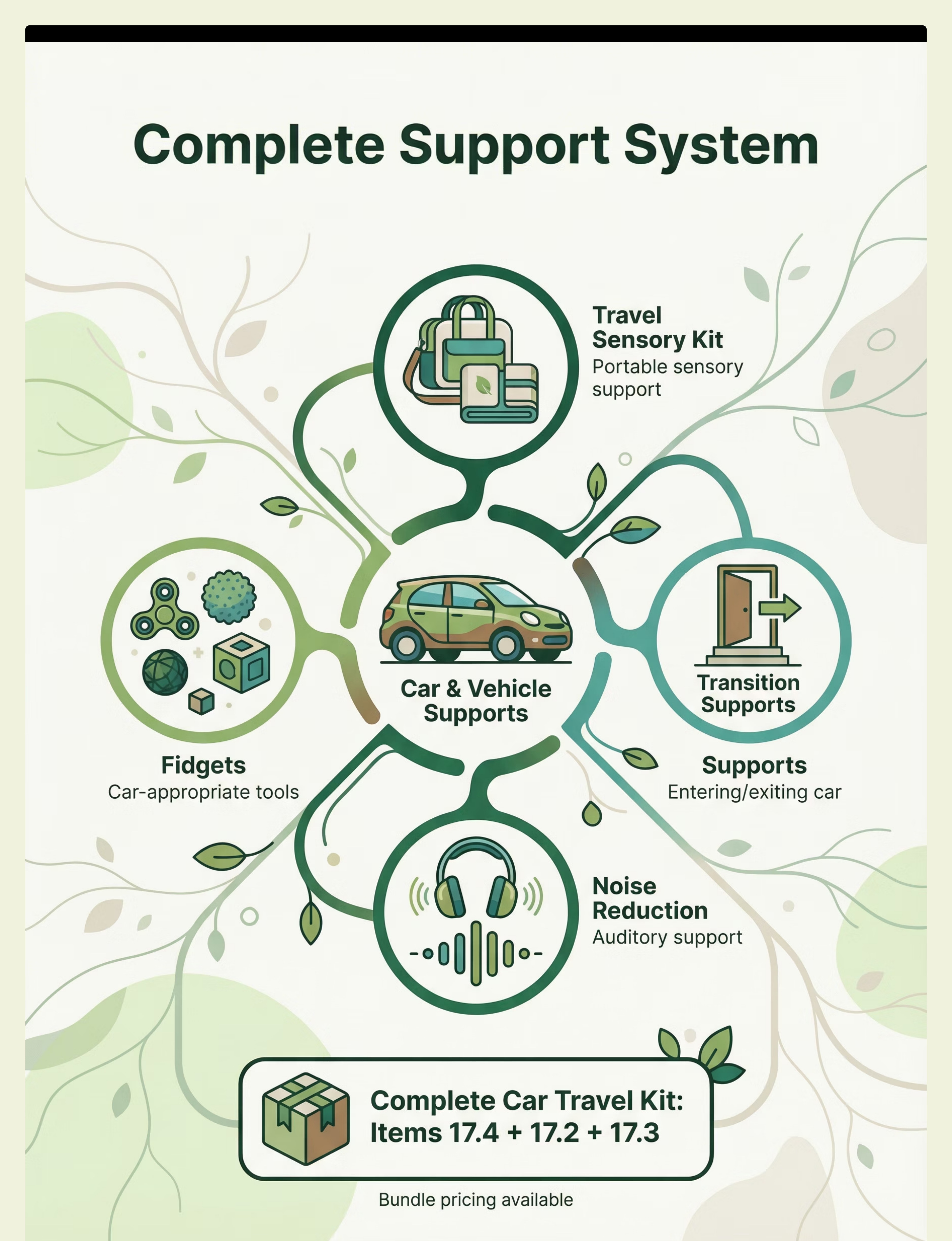
Enhance Your Kit with Complementary Tools
Combine car-specific modifications with essential complementary tools for a comprehensive approach. Integrate sensory kits, transition supports for entering/exiting the car, noise reduction solutions for sensitive individuals, and car-appropriate fidgets to keep hands busy, ensuring a smoother journey.
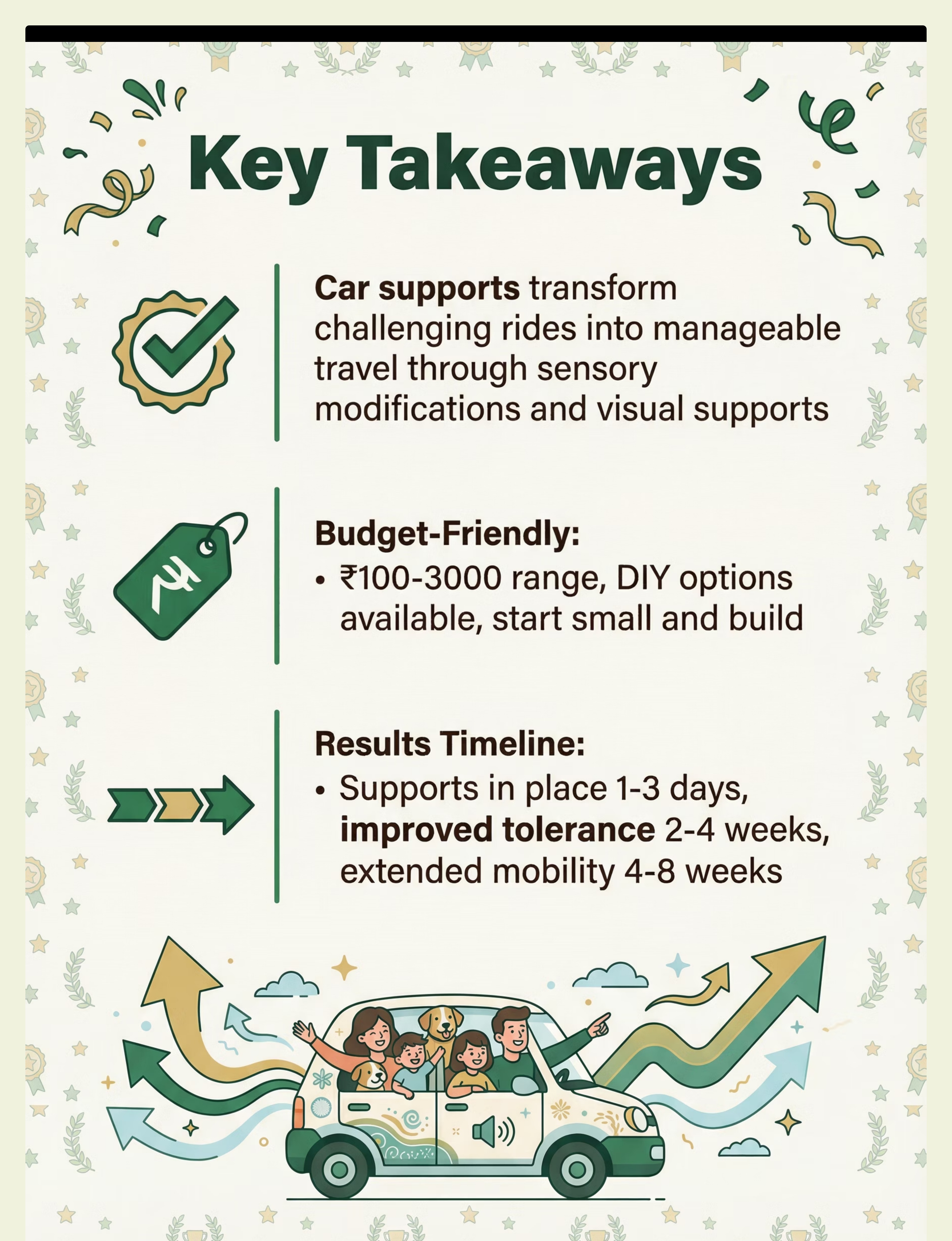
Review & Learn from the Summary
Car and vehicle supports improve travel tolerance through sensory modifications, visual supports, and engagement strategies, while always maintaining car seat safety. The Core Kit (Rank 2) offers moderate evidence and is essential for family mobility. Explore common searches like "car travel autism" to find relevant information.
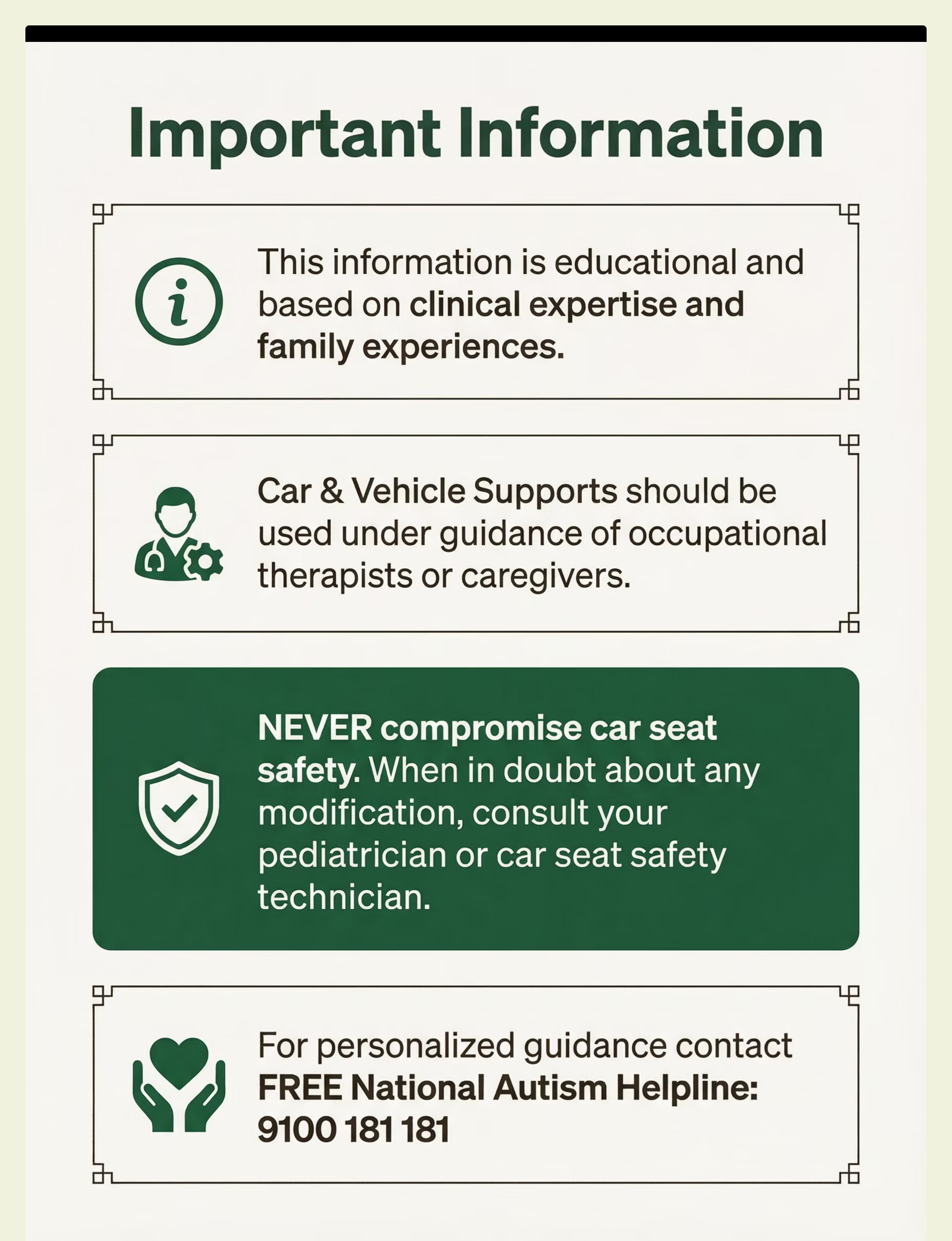
Access Expert Guidance & Integration
Get personalized guidance from the FREE National Autism Helpline (9100 181 181, 16+ languages supported, pinnacleblooms.org). Leverage platform integrations like AbilityScore® to identify needs, TherapeuticAI® for recommendations, and the EverydayTherapyProgramme™ for integrated goals, tracking progress with the Mobility Index.

Disclaimer: This is educational information. Always consult qualified occupational therapists, speech-language pathologists, or pediatricians. Individual results vary. Never compromise car seat safety for comfort—when in doubt about any modification, consult car seat safety technician.
Version 3.2
Last Updated: 2025-12-26
Locale: en-IN
Pinnacle Blooms Network