












Classroom Sensory Accommodations
Essential Tools for Focus, Regulation & Learning Success
Tool ID: 18.1 | Evidence-Based School Support
Who This Helps
Sensory Processing Differences
Supports children experiencing sensory overwhelm or under-responsiveness, helping them regulate and engage more effectively in the classroom.
ADHD & Attention Challenges
Aids students with ADHD or difficulty maintaining attention and focus by providing tools to manage sensory input and improve concentration.
Autism Spectrum Support
Offers critical sensory accommodations for autistic children to create a more predictable and comfortable learning environment, reducing anxiety and promoting participation.
Regulation Needs
Assists children needing help with self-regulation, providing options for calming, alerting, or organizing their sensory systems to better access learning.
Does This Sound Familiar?
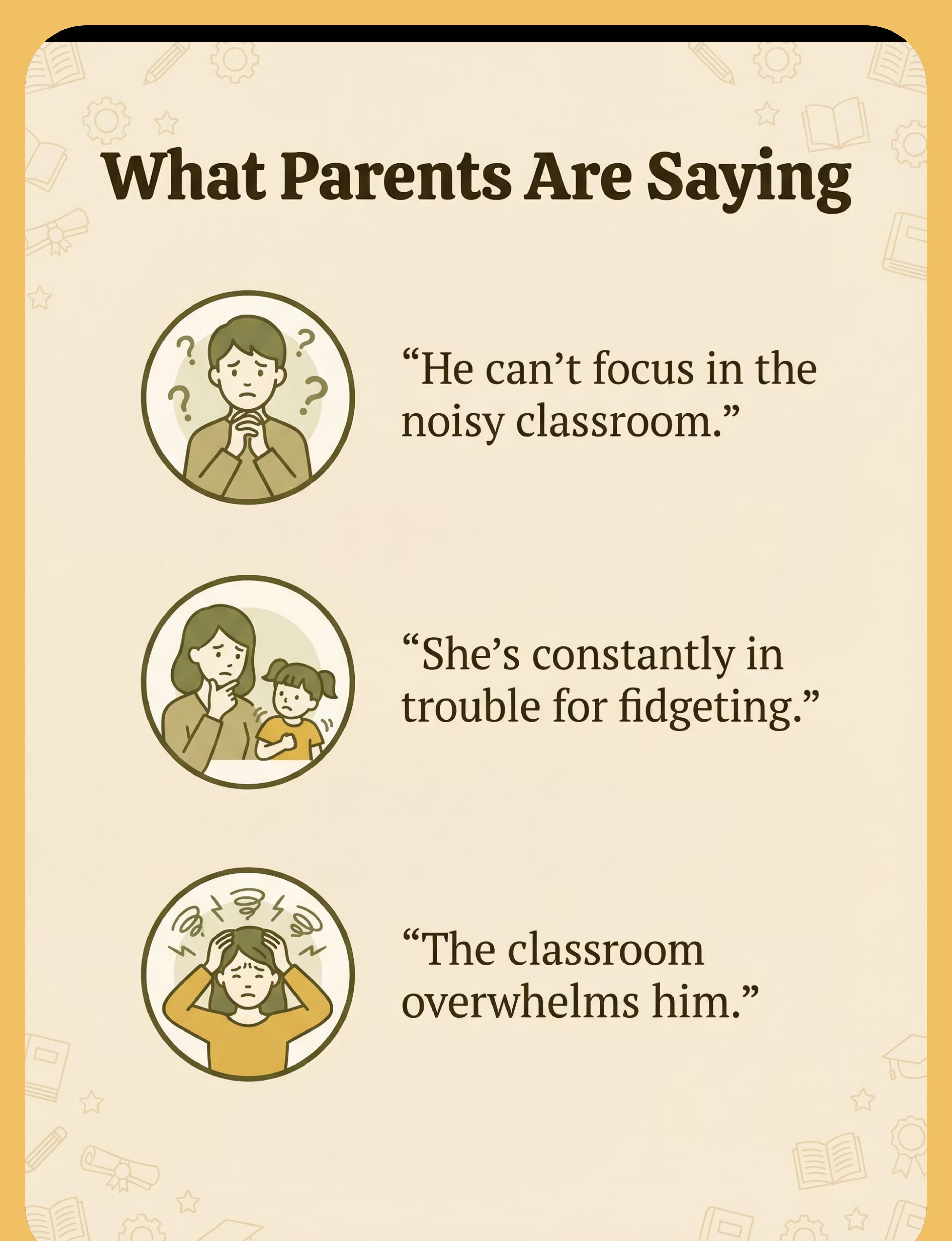
"He can't focus in the noisy classroom. The sound level overwhelms him and he misses so much instruction."
"She's constantly in trouble for fidgeting. The teachers don't understand she needs to move to focus."
"The classroom environment completely overwhelms him. Too much noise, movement, visual stimulation."
"She can't sit still in her chair and gets punished for it. Her body needs movement but school doesn't allow it."
"He's dysregulated all day at school. Comes home exhausted and melts down. Homework is impossible."
"No one at school understands her sensory needs. They think she's being difficult or defiant."
You're not alone. These are among the most common challenges parents report about their child's school experience. Sensory needs significantly impact learning access, but appropriate accommodations can transform the school day.
A Day Without the Right Support
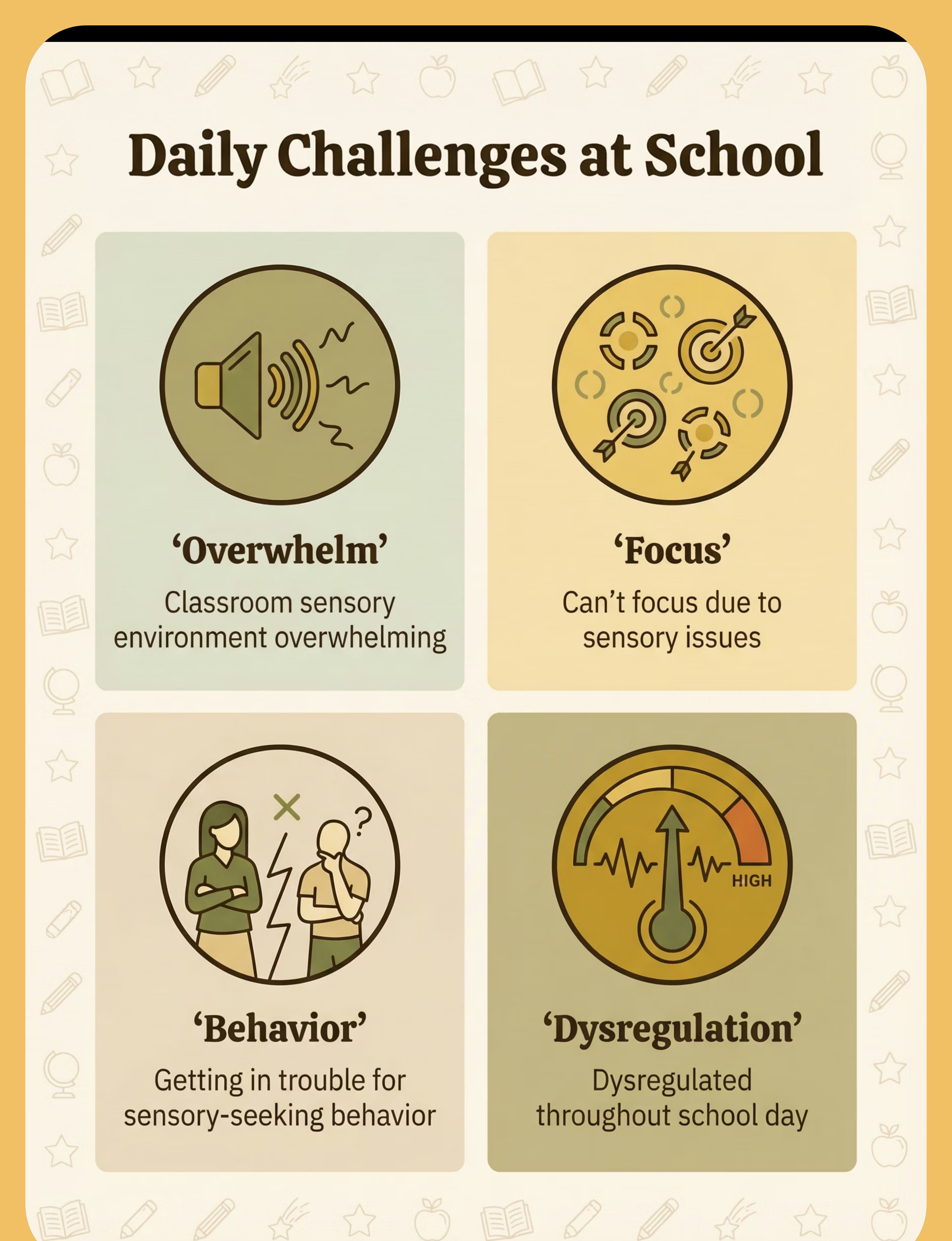
Morning: Classroom Overwhelm
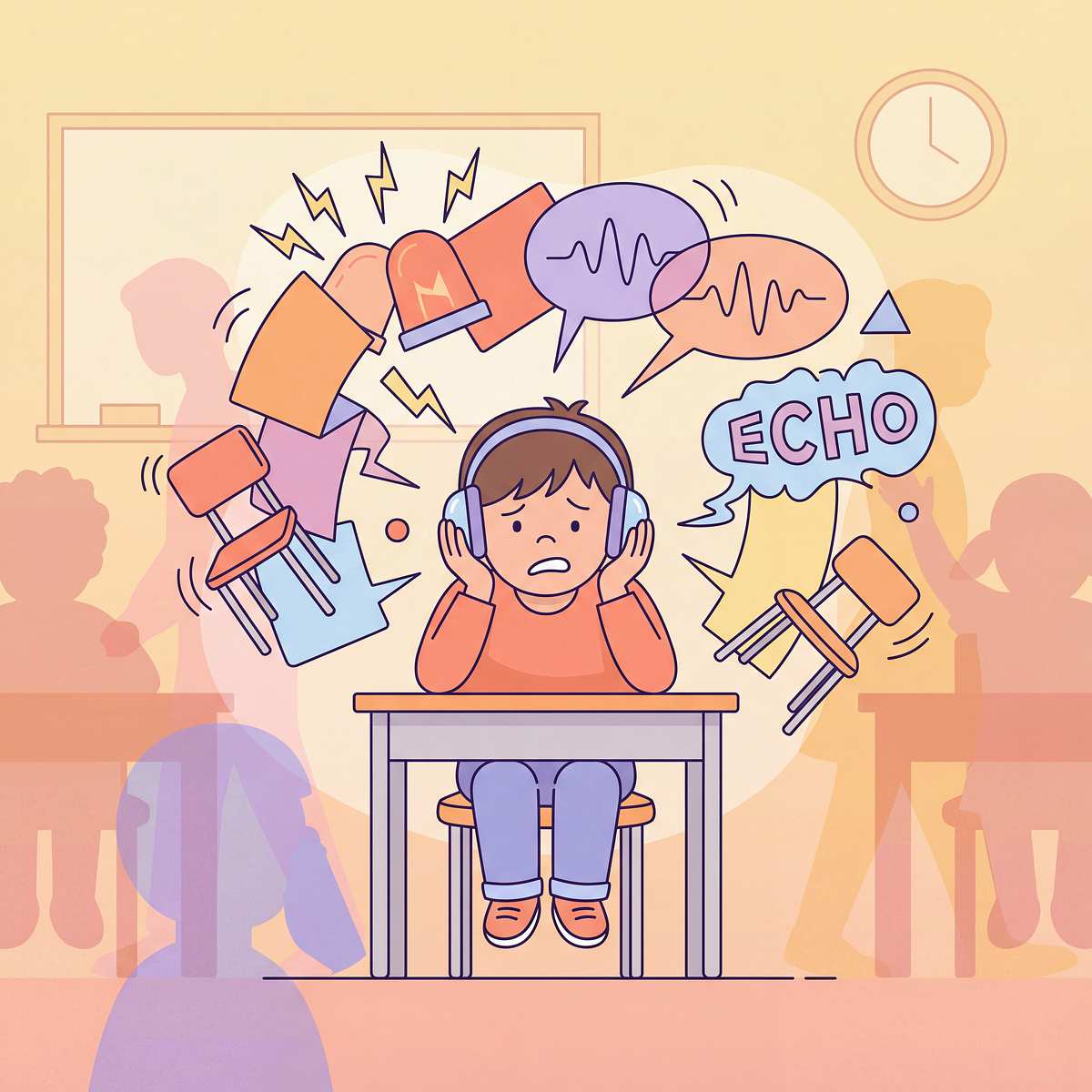
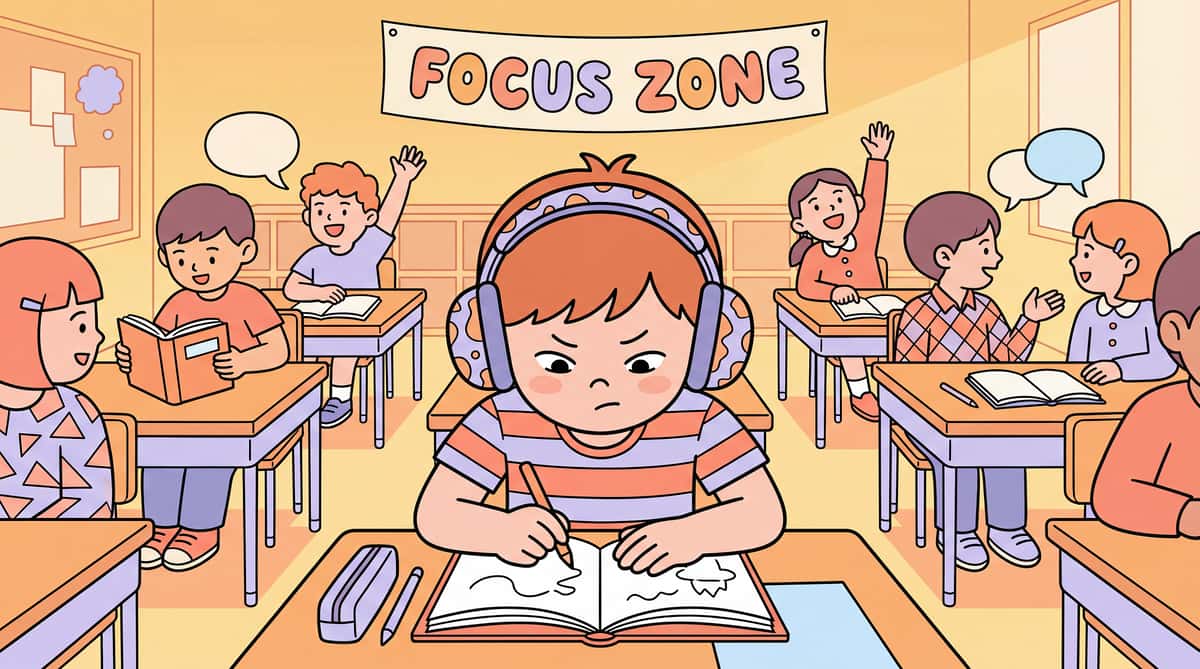
Classroom sensory environment is immediately overwhelming. Fluorescent lights buzz, chairs scrape, twenty voices echo. Child cannot filter relevant sounds from background noise. Instruction is lost in sensory chaos.
Mid-Morning: Focus Impossible
Cannot concentrate due to unmet sensory needs. Body needs movement but must sit perfectly still. Falling further behind academically. Teacher perceives inattention as willful behavior. Frustration mounting.
Afternoon: Behavior Issues
Getting in trouble for sensory-seeking behavior—fidgeting, moving, chewing pencils. Each correction damages self-esteem. School becoming negative experience. Child believes they are "bad" or "broken."
After School: Complete Dysregulation
Child arrives home completely dysregulated after holding it together all day. Immediate meltdown. Exhausted parent faces homework battles. Family evening is consumed by recovery from school day.

Without appropriate sensory accommodations, children spend enormous energy just managing the environment—energy that should go toward learning. This pattern creates academic gaps, behavioral challenges, and school avoidance.
The Science Behind It
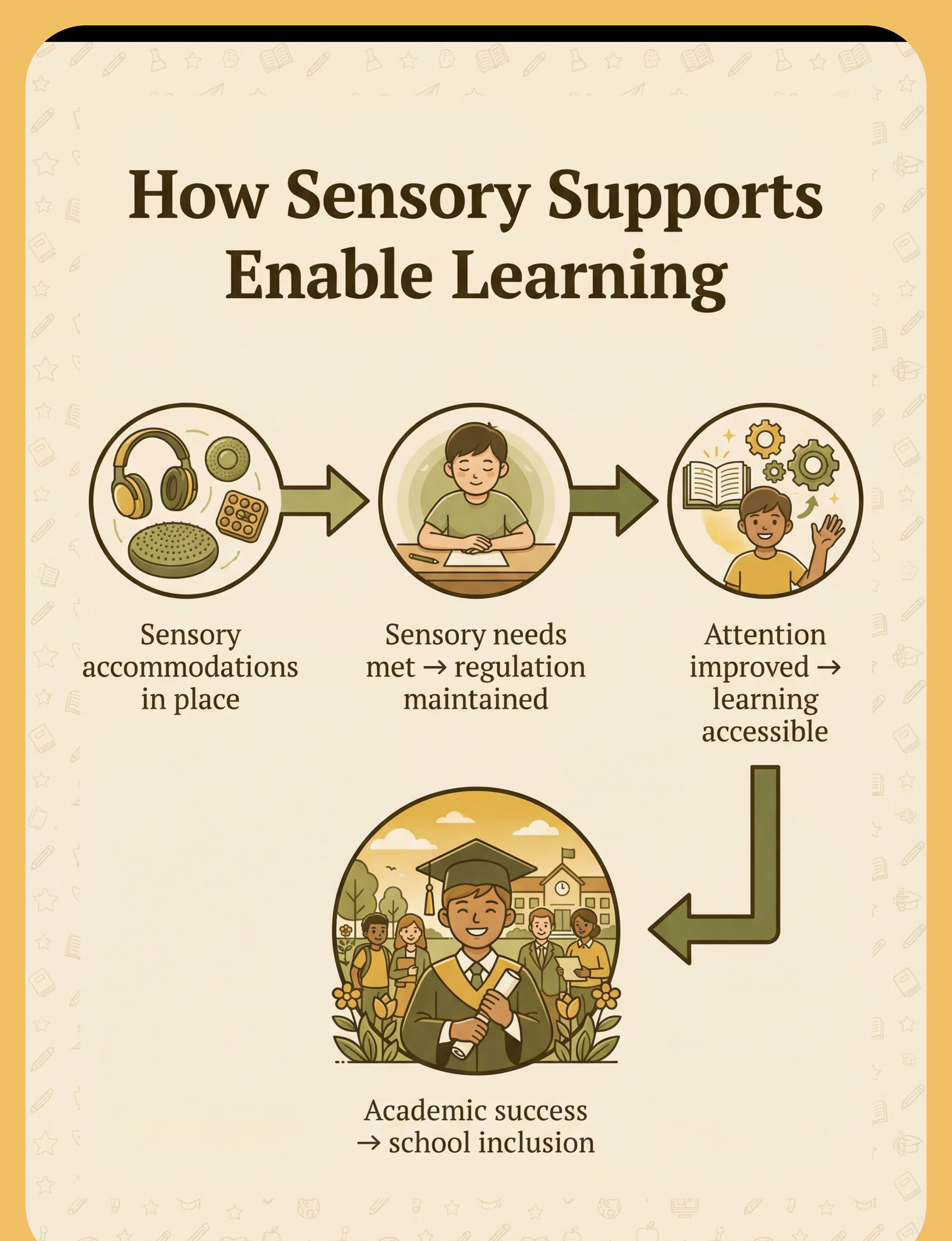
Sensory Accommodations in Place
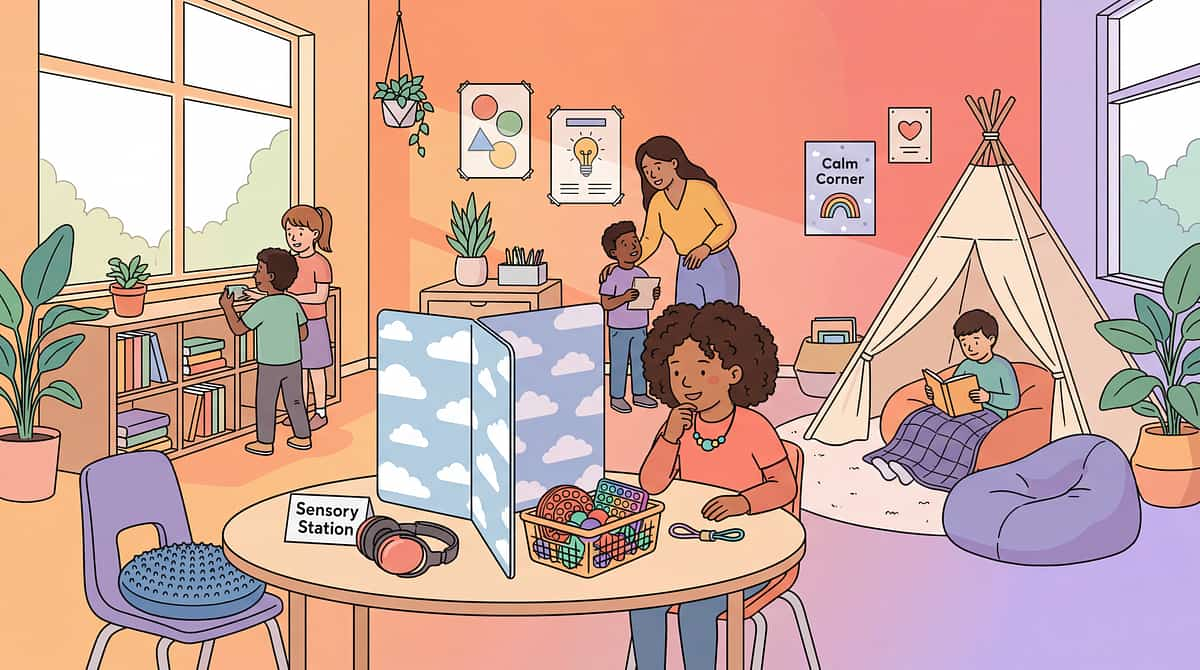
Appropriate supports provided—noise reduction, movement options, fidgets, visual shields, calm spaces available when needed.
Sensory Needs Met
Child's specific sensory requirements are addressed throughout the school day. Environment becomes manageable rather than overwhelming.
Regulation Maintained
With needs met, child maintains regulated state. Energy goes toward learning rather than managing sensory environment.
Attention Improved
Freed from sensory distraction and overwhelm, child can attend to instruction and academic tasks effectively.
Learning Accessible
Academic content becomes accessible. Child can participate, learn, and demonstrate knowledge. Educational potential realized.
Behavior Challenges Reduced
With regulation maintained and needs met, behavior challenges decrease dramatically. Fewer incidents, less punishment, improved relationships.
Academic Success
Learning progresses, grades improve, confidence builds. Child experiences school success and develops positive academic identity.
School Inclusion
Child participates fully in school community. Social connections strengthen. School becomes place of growth rather than daily struggle.
This mechanism transforms school experience from survival to success. Simple accommodations remove barriers, allowing the child's true abilities to emerge.
Sensory Regulation
Attention
Focus
Self-Regulation
Learning Access
Behavior Prevention
How to Use It Right
Best Practice: Collaborate with School OT
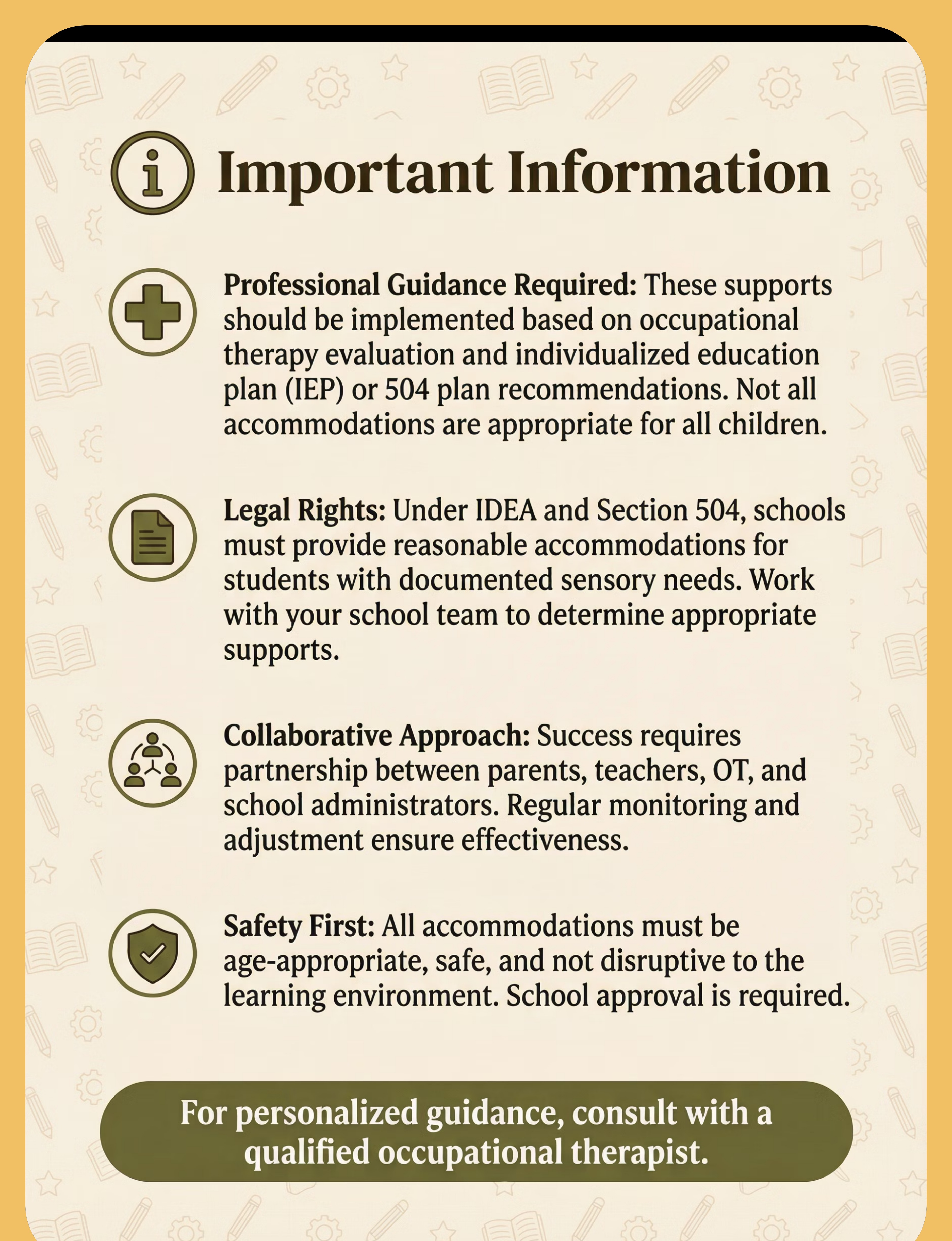
Occupational therapist evaluation identifies specific needs and recommends appropriate accommodations. Professional guidance ensures effective, evidence-based supports rather than trial and error.
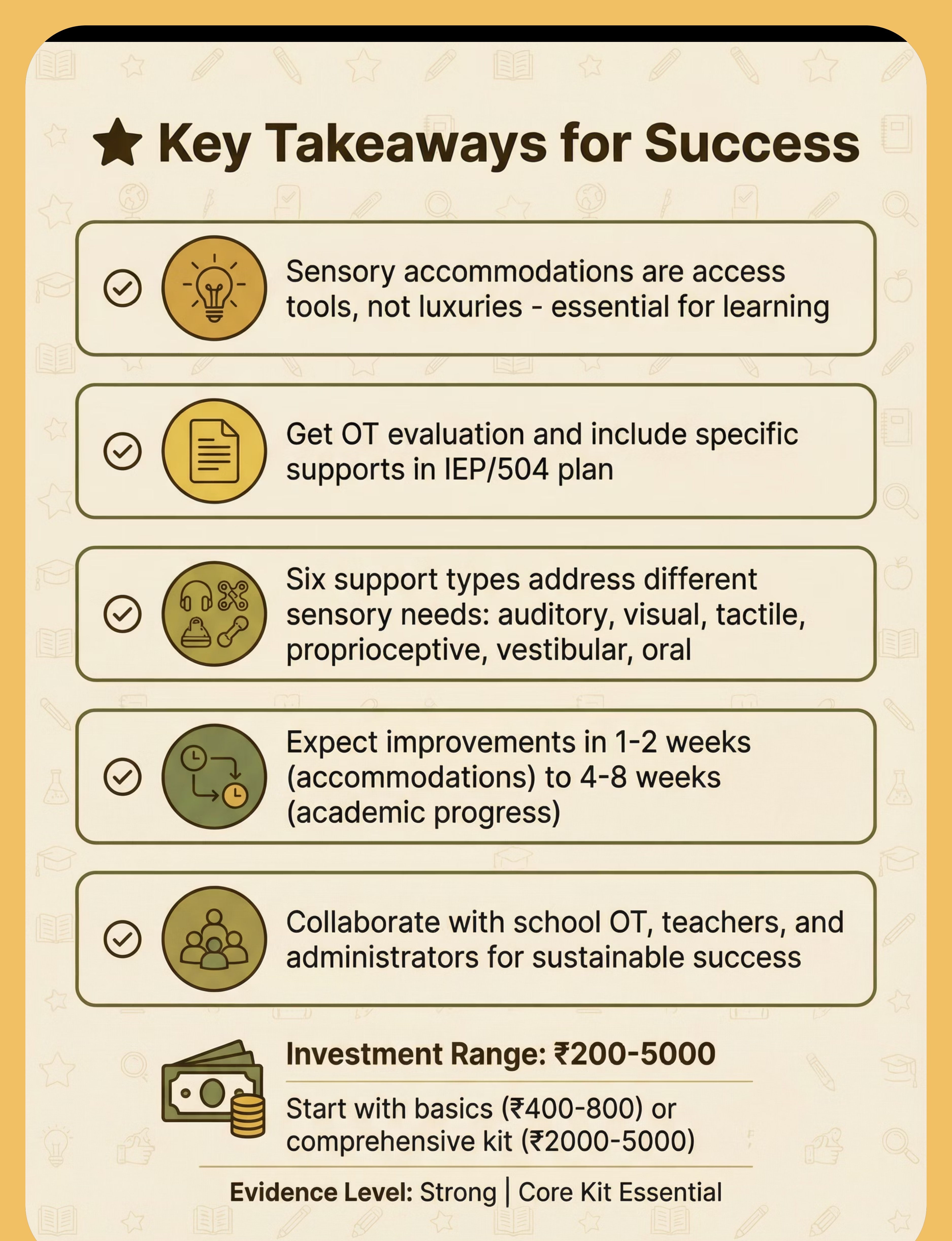
Include in IEP/504 Accommodation Plan
Document accommodations formally through Individual Education Plan or Section 504 plan. This ensures consistent implementation, legal protection, and school accountability for providing supports.
Train Teachers on Proper Use
Educators need training on when and how supports are used. Understanding the "why" behind accommodations increases buy-in and appropriate implementation throughout the school day.
Choose Non-Stigmatizing Options When Possible
Select discrete, normalized accommodations that don't unnecessarily single out the child. Many sensory supports benefit all students and can be presented as classroom resources.
Provide Multiple Options
Different situations require different supports. Offer variety—some days noise-reduction is critical, other days movement seating. Child learns to identify and request what they need.
Regular Review of Effectiveness
Monitor whether accommodations are actually improving regulation and learning. Adjust as needed. What works in September may need modification by January as skills develop.
Duration: As needed throughout school day, with regular review of effectiveness and adjustment as the child develops and needs change.
Expert Perspective
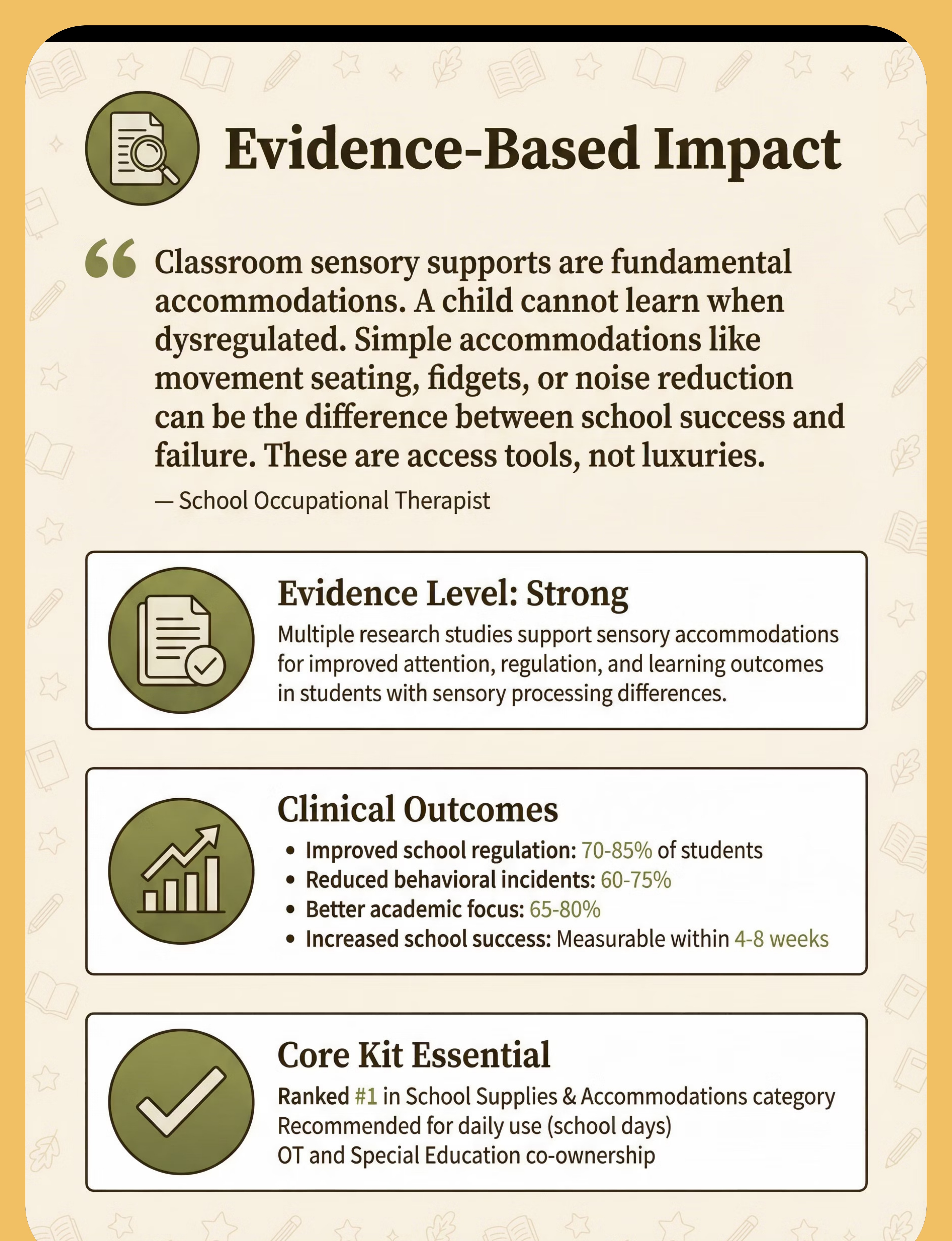
"Classroom sensory supports are fundamental accommodations, not optional extras. A child cannot learn when dysregulated—the brain literally cannot access higher-level thinking when in survival mode. Simple accommodations like movement seating, appropriate fidgets, or noise reduction can be the difference between school success and failure. These are access tools, not luxuries. Every child deserves the supports they need to learn."
— School Occupational Therapist
OT + SpEd Recommended
Strong Evidence
Rank #1 in Category
Core Kit Essential
Choose Your Option (6 Variants)
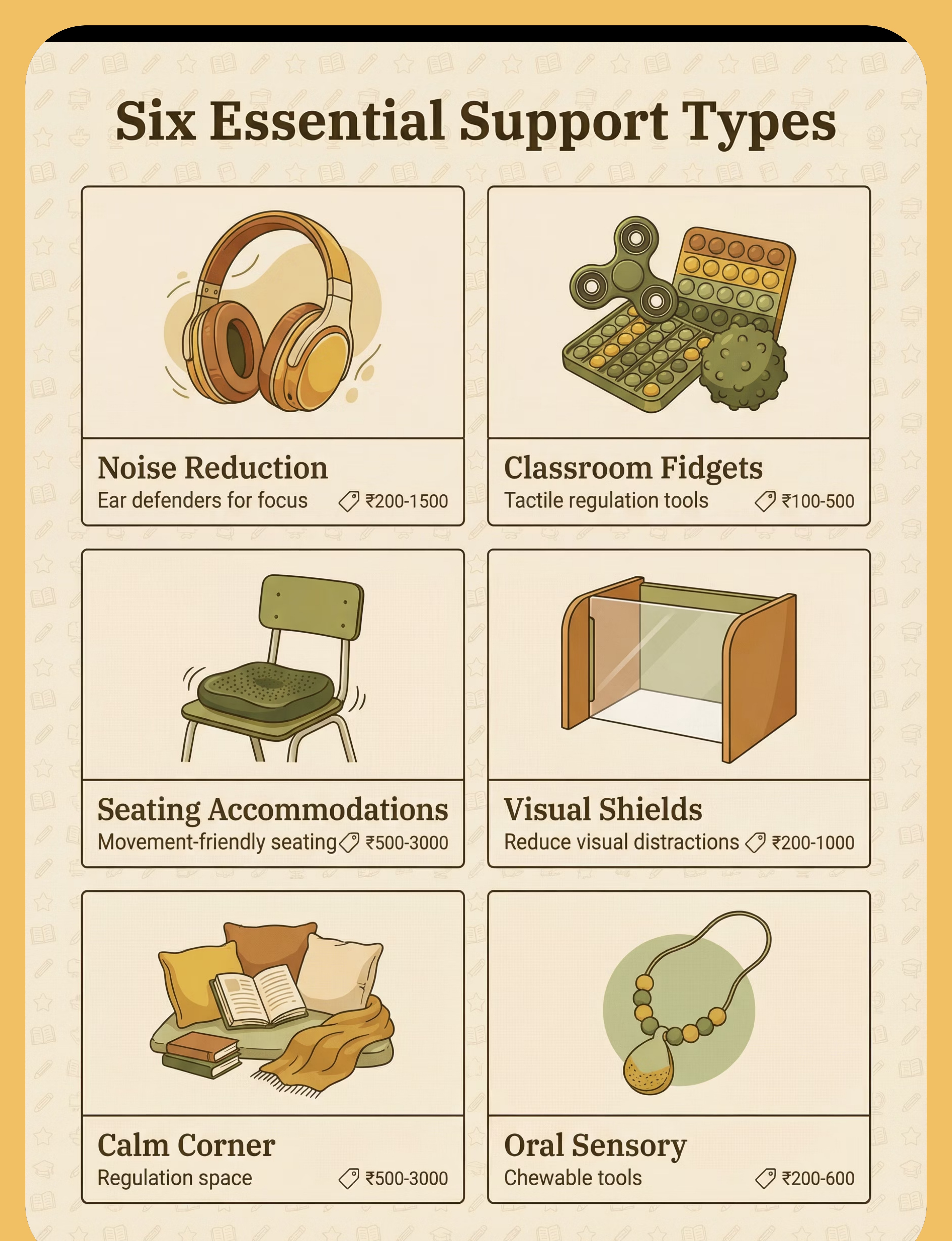
Classroom Noise Reduction
Auditory accommodation for noise sensitivity.
Classroom Fidgets
Tactile regulation for focus and attention.
Seating Accommodations
Proprioceptive/vestibular support for movement needs.
Visual Shields/Carrels
Visual accommodation to reduce distractions.
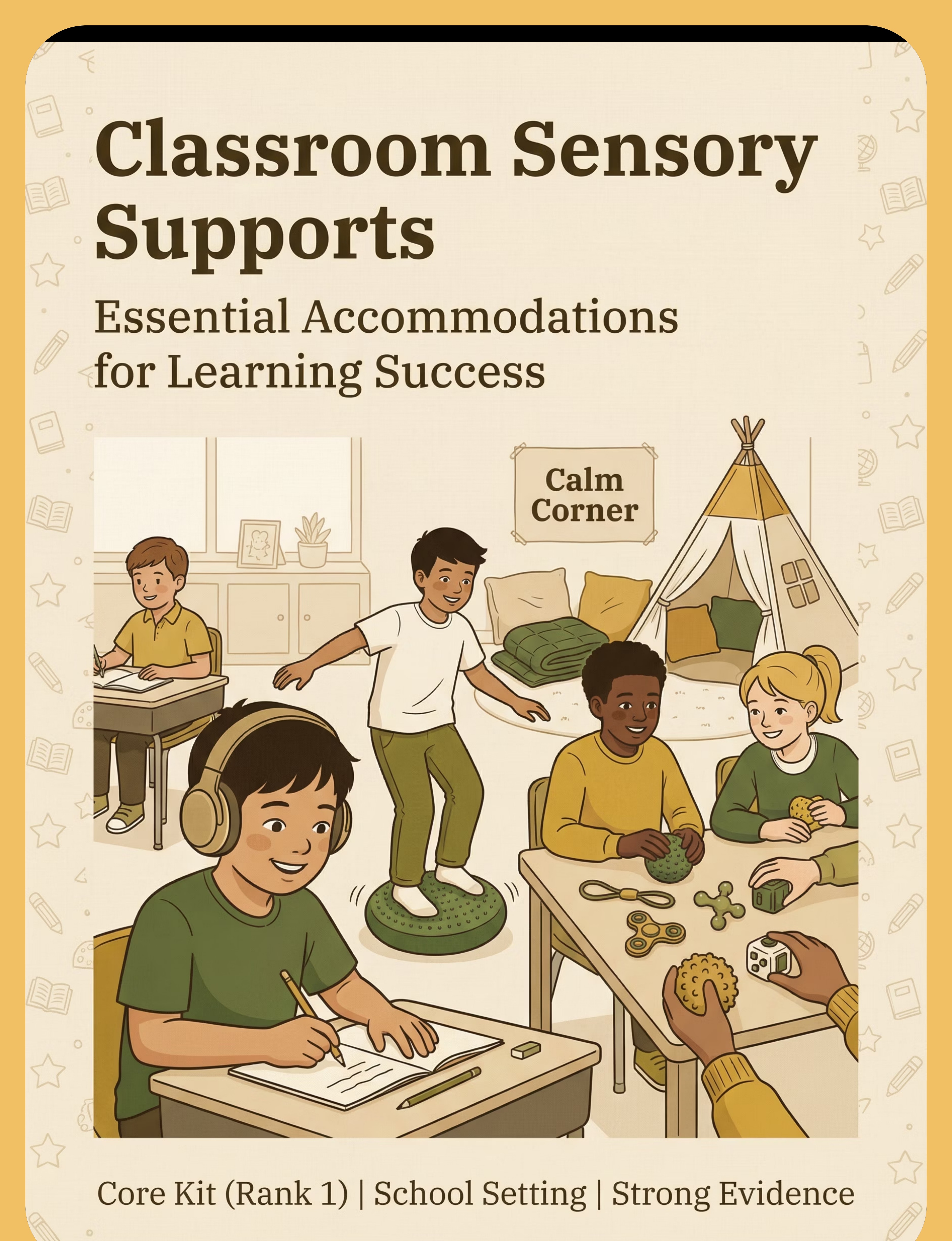
Classroom Calm Corner
Designated space for self-regulation and breaks.
Chewable/Oral Sensory
Oral sensory input for calming and focus.
Each variant addresses different sensory needs in the classroom. Select based on your child's specific challenges, the classroom environment, and school policies. Many children benefit from multiple accommodations used together.

How to Choose:
  • By Goal: Calming (noise reduction, calm corner), Focus (fidgets, visual shields), Movement (seating), Oral needs (chewables)
  • By Setting: All designed for school use but vary in portability for field trips and transitions
  • By Portability: Very High (fidgets, chewables), High (noise reduction), Medium (shields), Low (seating, calm corner)
Most children benefit from multiple accommodations addressing different sensory systems throughout the school day.
Specifications & Sensory Types
Materials & Features
Materials Include:
  • Various sensory tools
  • Seating modifications
  • Environmental modifications
Key Features:
  • School-appropriate and acceptable
  • Non-distracting to other students
  • Effective for individual child
  • Sustainable for daily use
Classroom Sensory Types
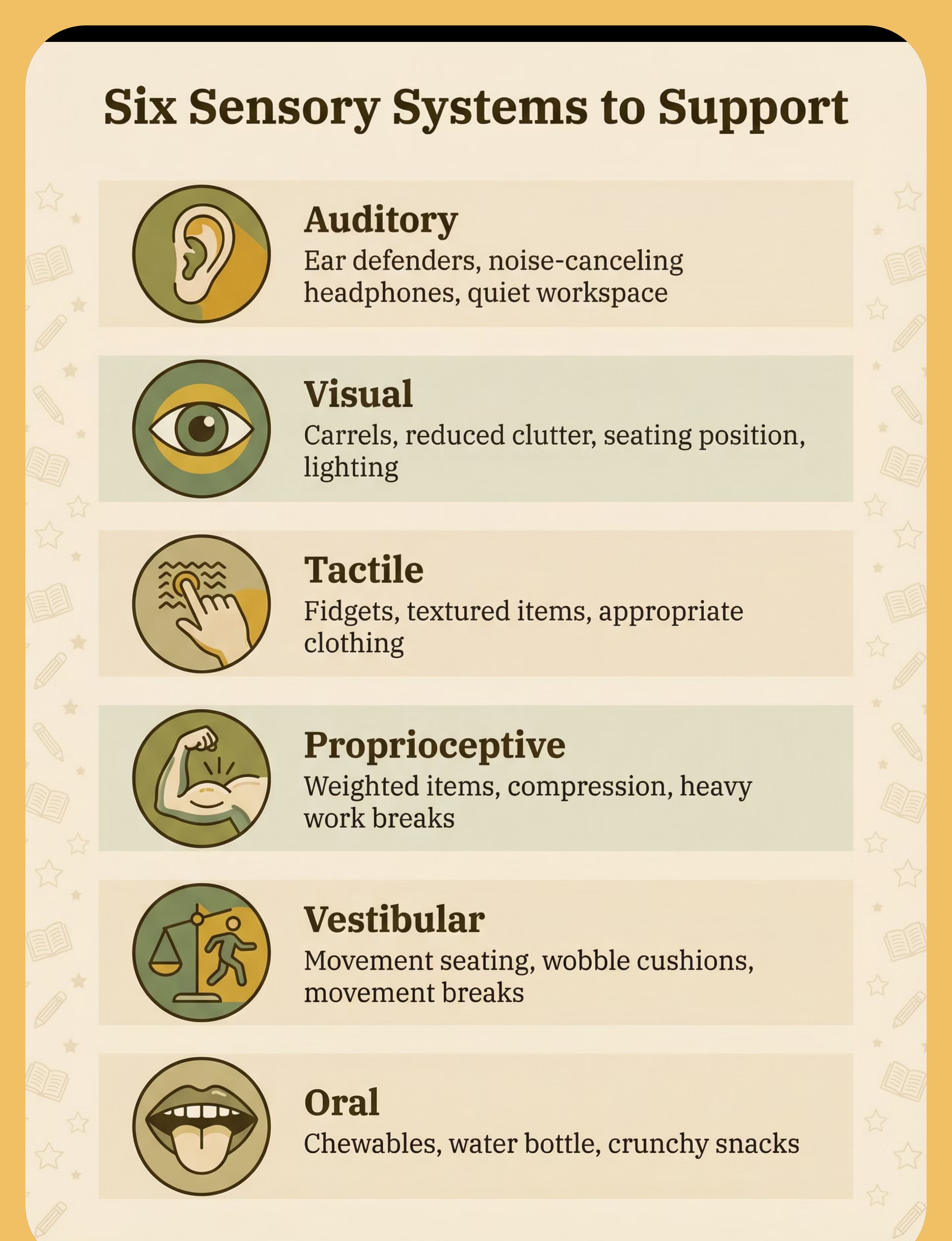
Auditory: Ear defenders, noise-canceling headphones, quiet workspace positioning
Visual: Desk carrels, reduced visual clutter, strategic seating position, lighting modifications
Tactile: Appropriate fidgets, textured items, comfortable clothing accommodations
Proprioceptive: Weighted items, compression clothing, heavy work break opportunities
Vestibular: Movement seating, wobble cushions, scheduled movement breaks
Oral: Chewable jewelry, water bottle access, crunchy snack breaks
Different sensory systems require different accommodation types. Comprehensive sensory support often addresses multiple systems simultaneously for optimal regulation and learning access.
The Struggle (Before Accommodations)
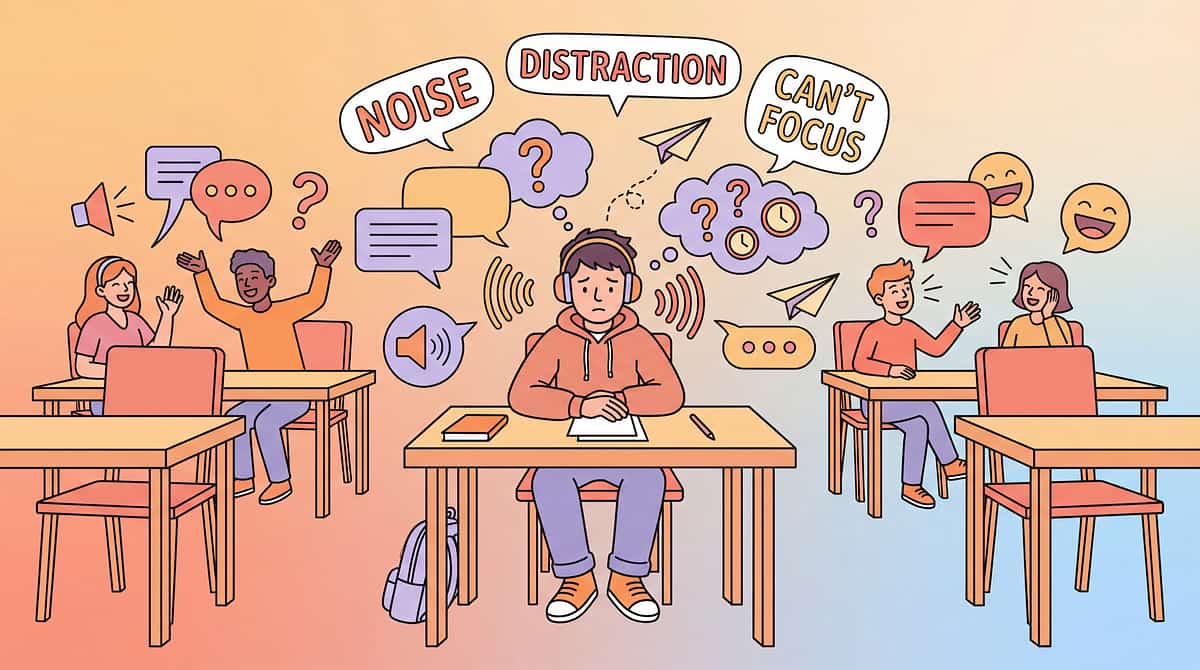
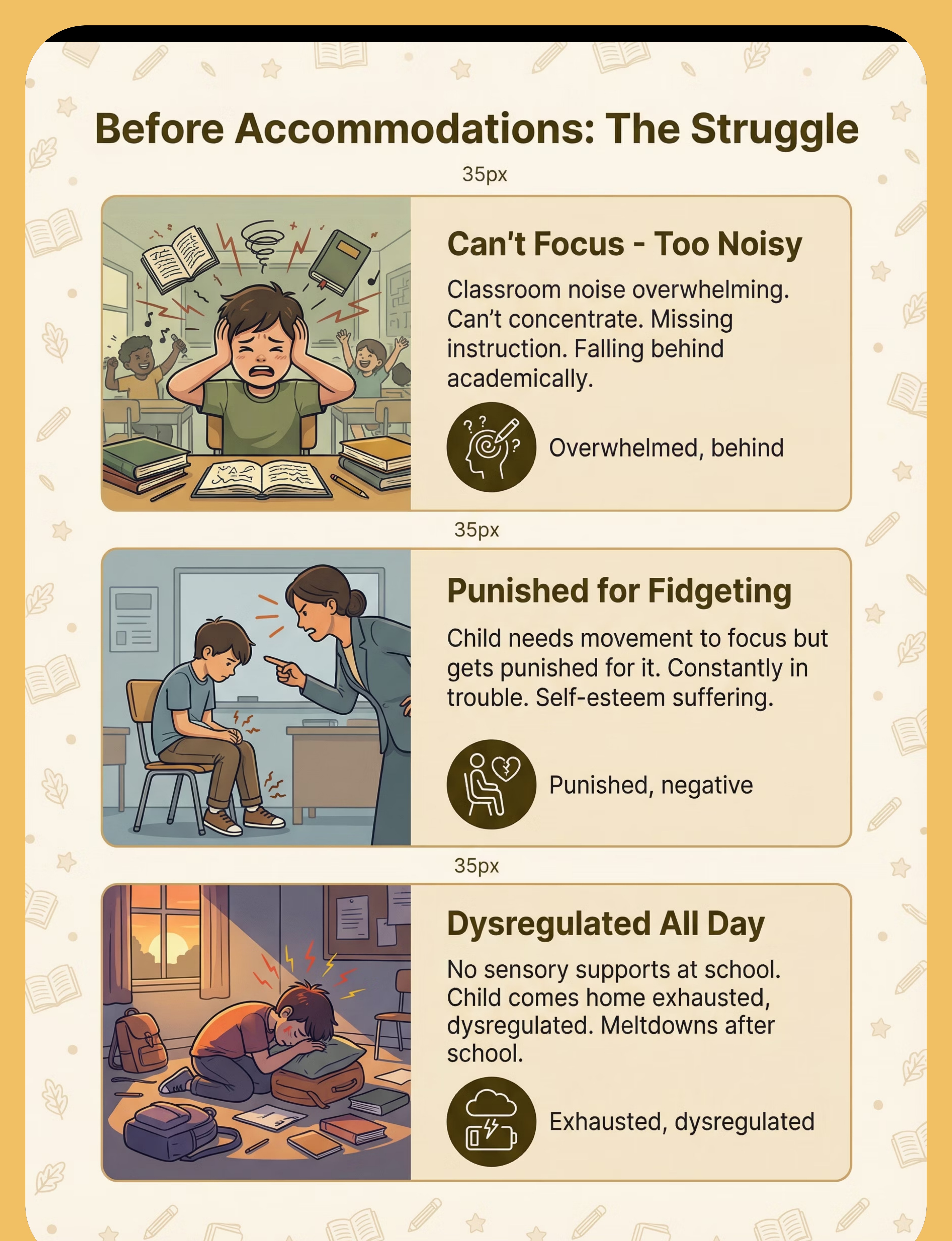
Scenario 1: Can't Focus - Too Noisy
Situation: Classroom noise is completely overwhelming. Cannot concentrate on instruction or independent work.
Experience: Missing critical instruction daily. Falling progressively behind academically. No accommodations in place. Teachers attribute poor performance to lack of effort rather than sensory barriers.
Emotion: Overwhelmed, falling behind, anxious about school
Scenario 2: Punished for Fidgeting
Situation: Child needs movement input to focus effectively but gets repeatedly punished for natural sensory-seeking.
Experience: Constantly in trouble for behaviors the child cannot control. Self-esteem suffering with each correction. School becoming negative, punitive experience rather than place of learning and growth.
Emotion: Punished, misunderstood, developing negative self-concept
Scenario 3: Dysregulated All Day
Situation: No sensory supports available at school to maintain regulation throughout demanding day.
Experience: Child comes home completely dysregulated and exhausted from holding it together. Immediate after-school meltdowns. Homework battles every evening. Family life consumed by school recovery.
Emotion: Exhausted, dysregulated, school is draining entire family
These scenarios represent common experiences before appropriate sensory accommodations are implemented. The struggle is real, documented, and preventable with proper supports.
What to Expect (Realistic Timelines)
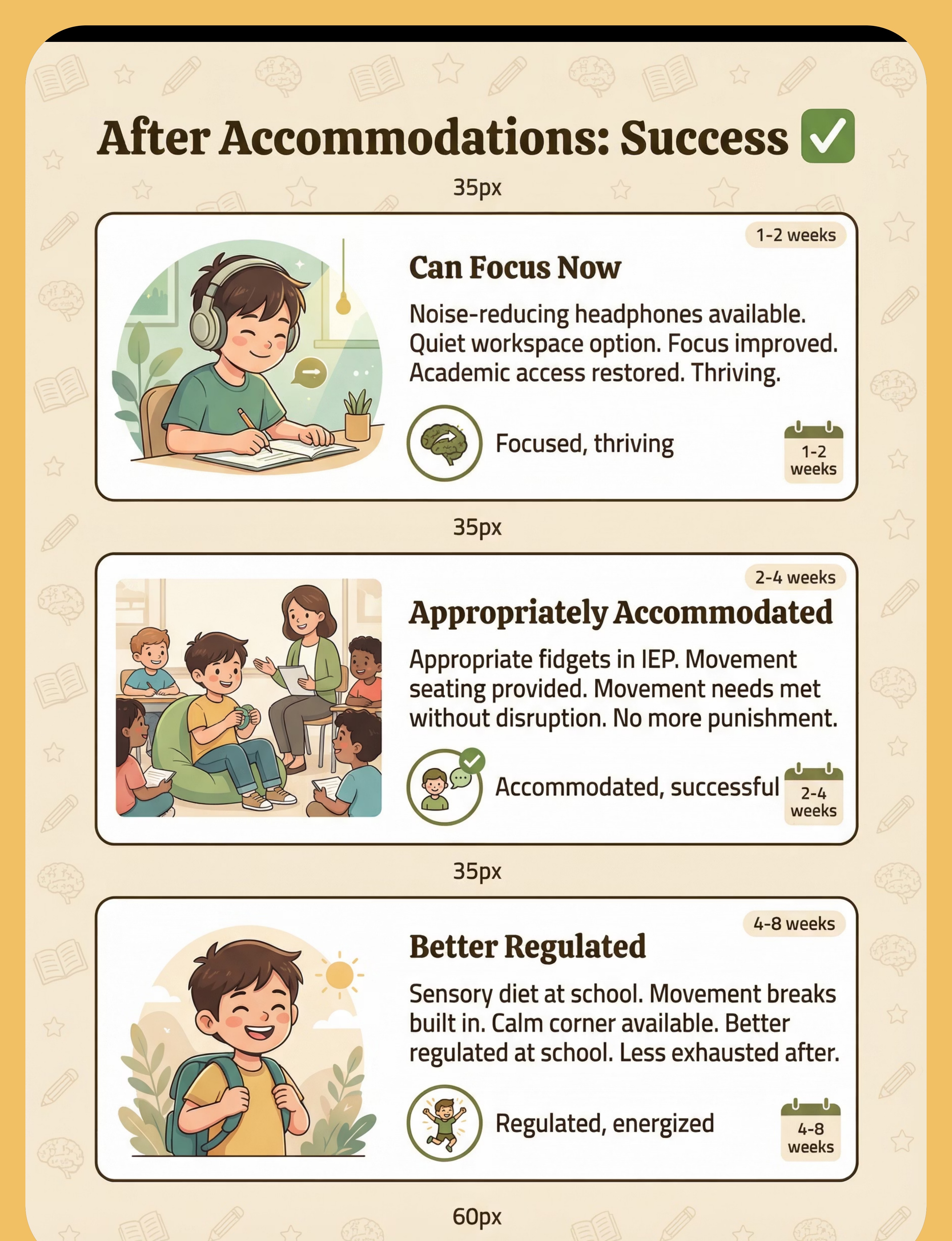
Sensory Needs Identified
Occupational therapy evaluation completed. Specific sensory challenges documented. Appropriate accommodations recommended with clinical rationale.
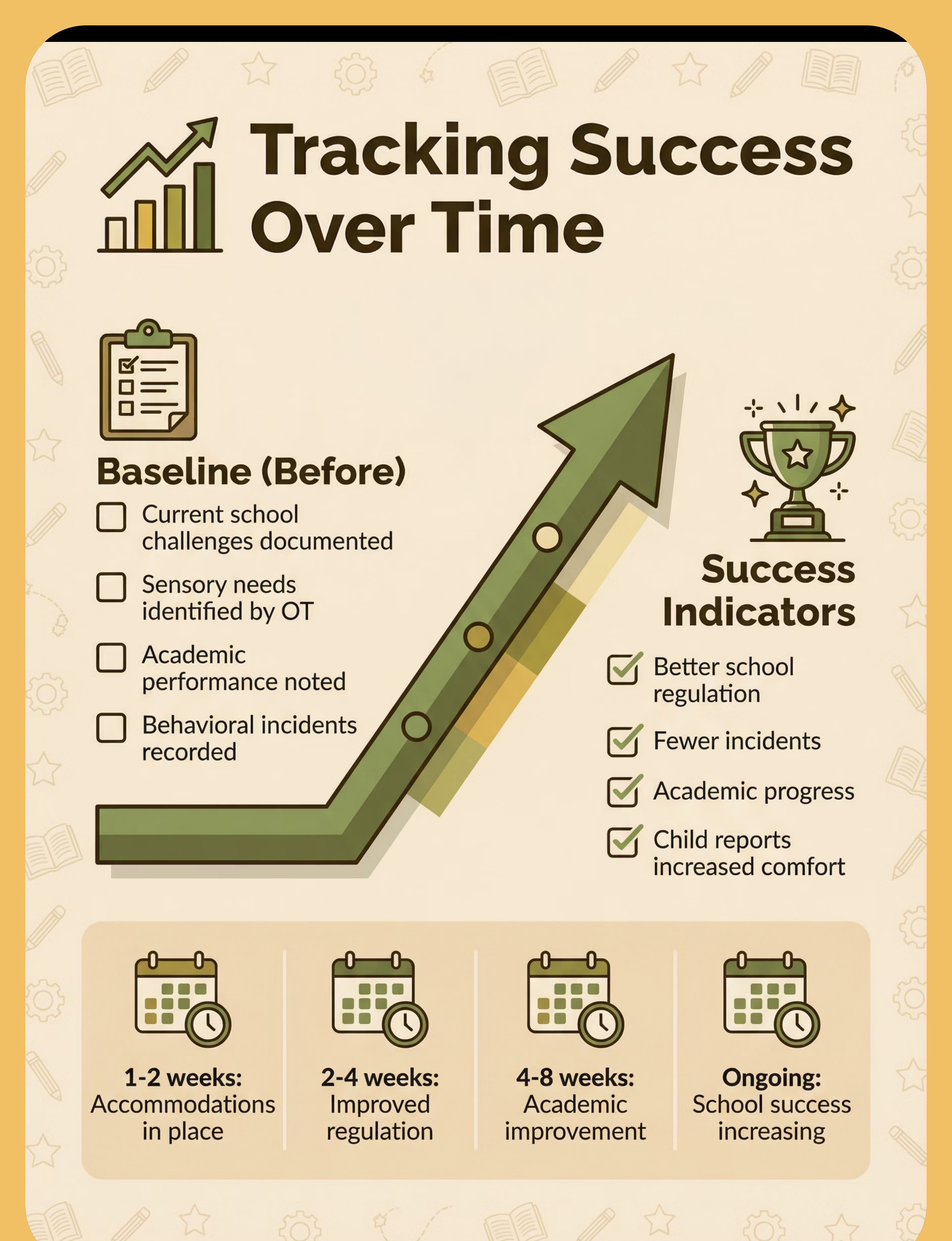
1-2 weeks
Accommodations in Place
IEP or 504 plan updated with specific sensory accommodations. Tools and modifications implemented in classroom. Staff trained on use and purpose.
2-4 weeks
Improved Regulation at School
Child maintaining better regulation throughout school day. Fewer behavioral incidents. Using accommodations appropriately. Teachers reporting positive changes in focus and participation.
2-4 weeks
Better Academic Focus
Sustained attention improving with sensory needs met. Academic performance showing measurable gains. Child able to access and demonstrate learning more consistently.
4-8 weeks
School Success Increasing
Continued academic progress. Developing positive school identity. Self-advocacy skills emerging as child learns to identify and request needed accommodations. Success building on success.
Ongoing
Progress follows predictable patterns when accommodations are appropriate and consistently implemented. Early intervention with sensory supports prevents accumulation of academic gaps and behavioral patterns.
Is This Right for My Child? (2-Minute Check)
Question 1
Does your child struggle with the sensory environment at school?
If yes, this indicates: Classroom sensory supports are needed to improve regulation and learning access
Question 2
Does your child get in trouble for sensory-seeking behavior (fidgeting, moving, chewing)?
If yes, this indicates: Appropriate sensory accommodations needed to meet needs without behavioral consequences
Question 3
Is your child dysregulated and exhausted after school?
If yes, this indicates: Better sensory supports during school day may significantly reduce after-school dysregulation
Question 4
Are sensory accommodations documented in your child's IEP or 504 plan?
If yes: Excellent! Ensure consistent implementation and monitor effectiveness
If no: Strong indication to advocate for formal accommodation documentation

Scoring: 3+ "yes" answers = strong fit for classroom sensory supports. Even one "yes" warrants occupational therapy consultation to assess needs and recommend appropriate accommodations.
Common Questions (Honest Answers)
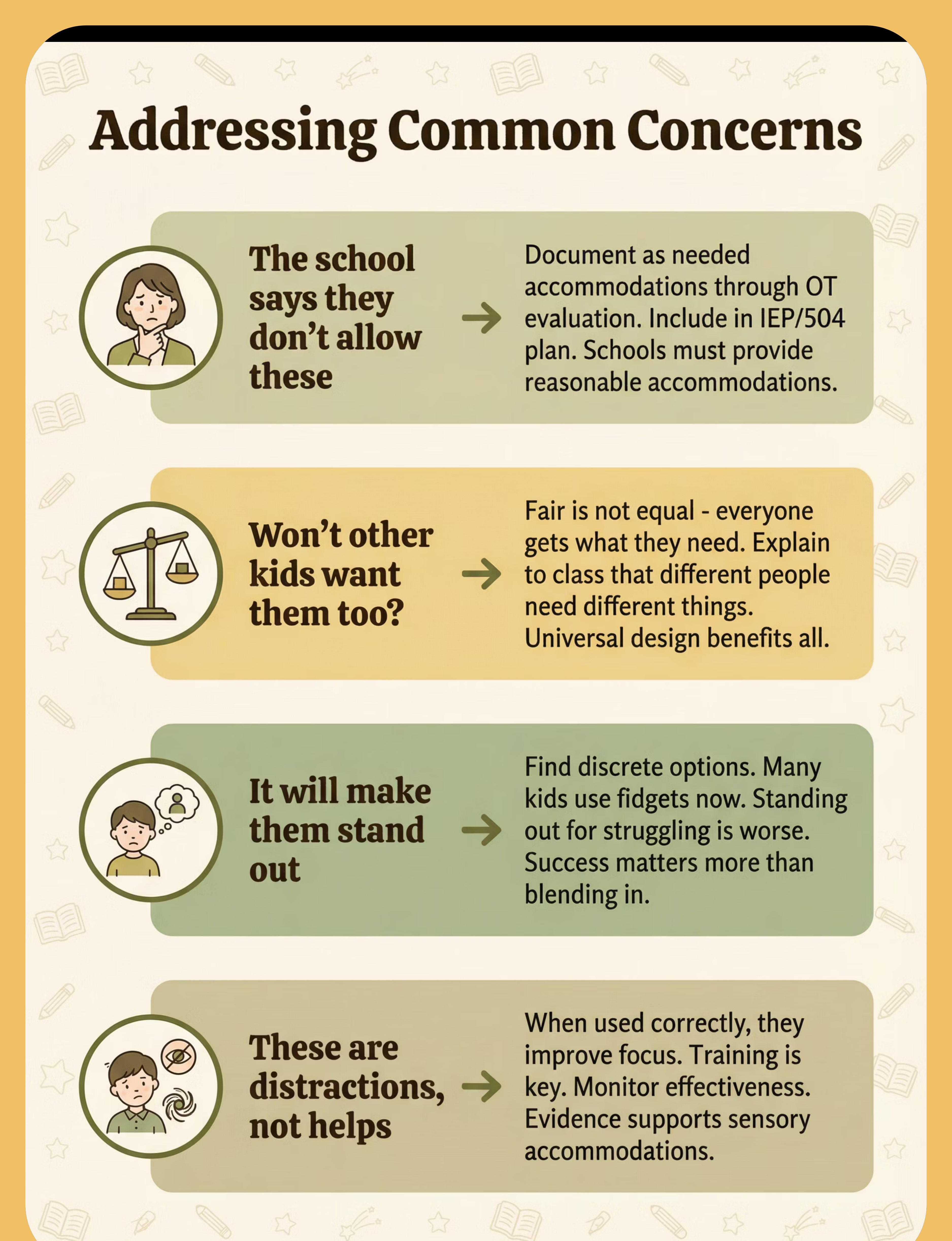
Q: "The school says they don't allow these accommodations"
Honest Answer: Schools must provide reasonable accommodations when documented as educationally necessary. Obtain occupational therapy evaluation documenting specific needs. Include accommodations in IEP or 504 plan with clinical justification. Schools are legally required to provide documented accommodations.
Action Step: Document need through professional evaluation; include in IEP/504; schools must accommodate documented disabilities.
Q: "Won't other kids want them too?"
Honest Answer: Fair is not equal—every child gets what they need. This is fundamental special education principle. Explain to class that different people need different things (like glasses for vision). Universal design actually benefits all students. Many accommodations can be offered classroom-wide.
Action Step: Fair doesn't mean identical; normalize accommodations; universal design benefits everyone.
Q: "Won't accommodations make them stand out?"
Honest Answer: Discrete options are available for most accommodations. Many students use fidgets now—it's normalized. Standing out for struggling academically and behaviorally is far worse than using a wobble cushion. Your child's success and educational access matter more than blending in.
Action Step: Discrete options available; success matters more than invisible struggle.
Q: "Aren't these distractions rather than helps?"
Honest Answer: When used correctly with proper training, sensory accommodations improve focus rather than distract. Training child and teacher on appropriate use is critical. Monitor effectiveness objectively. Adjust if particular item isn't helping. Strong research evidence supports sensory accommodations for attention and learning.
Action Step: Improve focus when used correctly; proper training essential; evidence-based practice.
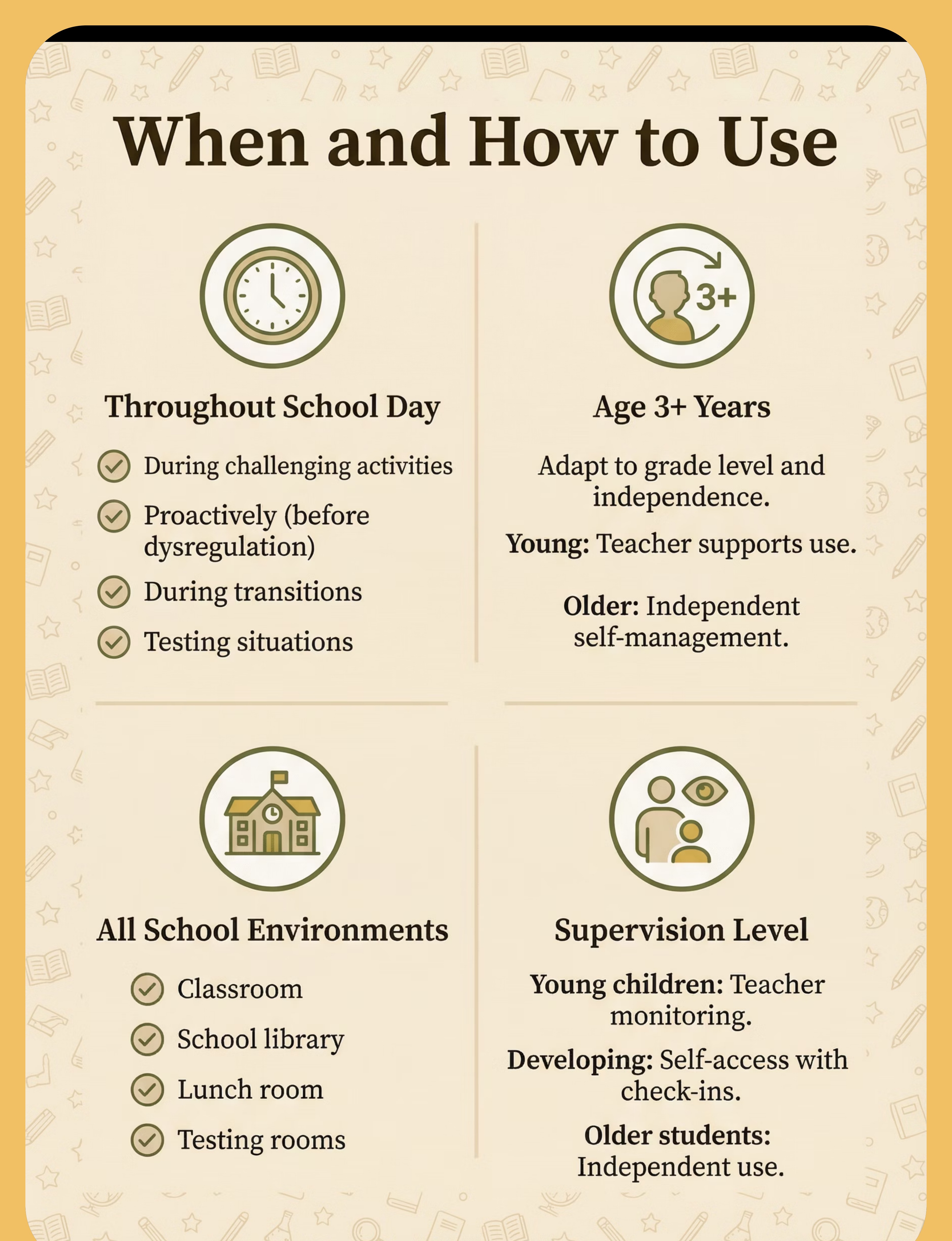
Usage Guide: When & How
Category
Guidance & Examples
When to Use ✓
  • Throughout school day as needed for regulation
  • During particularly challenging activities or subjects
  • Proactively before dysregulation occurs
  • During classroom transitions and schedule changes
  • Testing situations requiring sustained focus
When NOT to Use ✘
  • If accommodation is distracting to the child (wrong item selected)
  • If significantly disrupting other students' learning
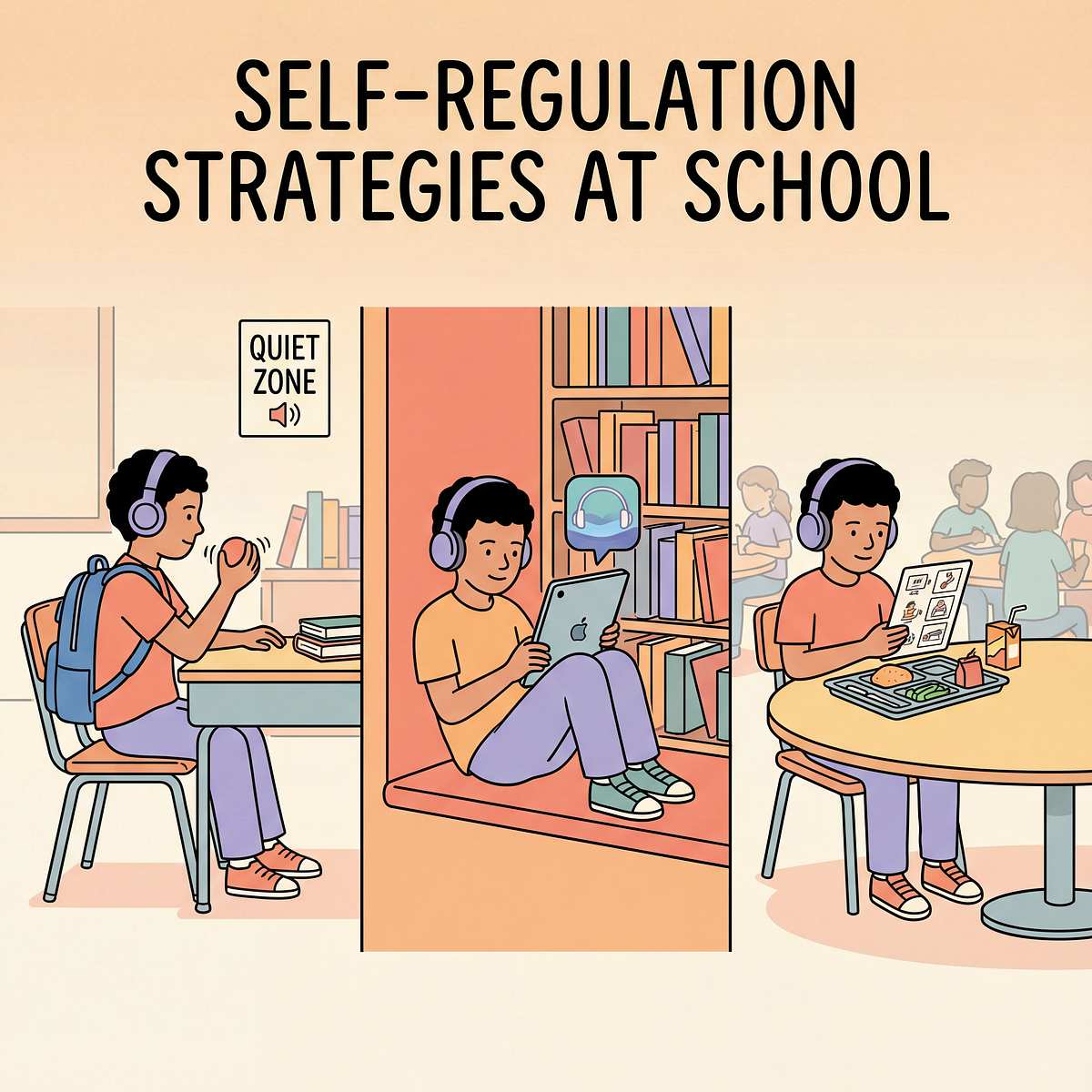
Settings
Classroom
School Library
Lunch Room
All School Environments
Duration
As needed throughout school day based on individual regulation needs and activity demands
Supervision by Age
Age Range
Supervision Level
Notes
Young children (3-6 years)
Teacher supports use
Adult guidance on when and how to use accommodations; building awareness
Developing skills (7-10 years)
Self-access with monitoring
Child initiating use with teacher oversight; learning self-advocacy
Older children (11+ years)
Independent self-management
Student independently identifies needs and uses accommodations appropriately
Safety First
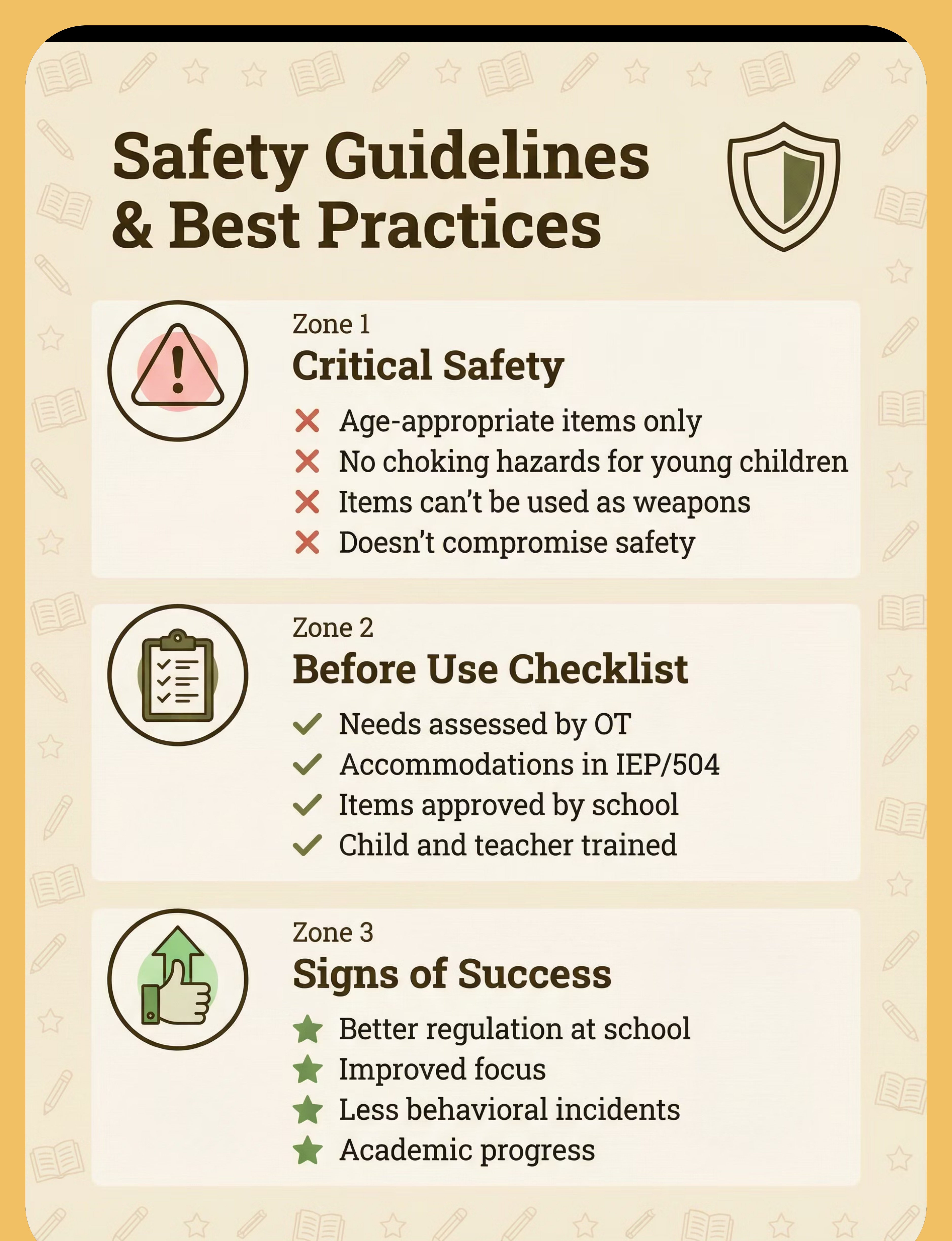
Critical Safety ⚠️
  • All items must be age-appropriate for child's developmental level
  • No choking hazards for young children—check small parts
  • Items cannot be used as weapons or in unsafe ways
  • Accommodations cannot compromise safety of child or others
Warnings
  • Monitor for appropriate use—adjust if item becomes distraction
  • Adjust or change accommodation if becoming distraction rather than support
  • School approval and IEP documentation needed for all accommodations
Contraindicated (Do Not Use) 🛑
  • Items that actively disrupt learning (child's or others')
  • Unsafe items that pose danger in school environment
Before Use Checklist
  • Sensory needs assessed by OT
  • Accommodations documented in IEP/504
  • Items approved by school administration
  • Child and teacher trained on use
During Use Checklist
  • Items being used appropriately
  • Regulation showing improvement
  • Learning is being accessed
  • Not distracting other students
Signs of Success
  • Better regulation at school
  • Improved focus and attention
  • Fewer behavioral incidents
  • Academic progress visible
Investment Guide
Overall Investment Range: ₹200–5,000 (USD $2–60)
Tier: Low to Mid-range investment with significant educational impact
Overall Range
200-5000
2-60
Budget Option
400-800
5-10
Premium Option
2000-5000
25-60
Budget Option 💰
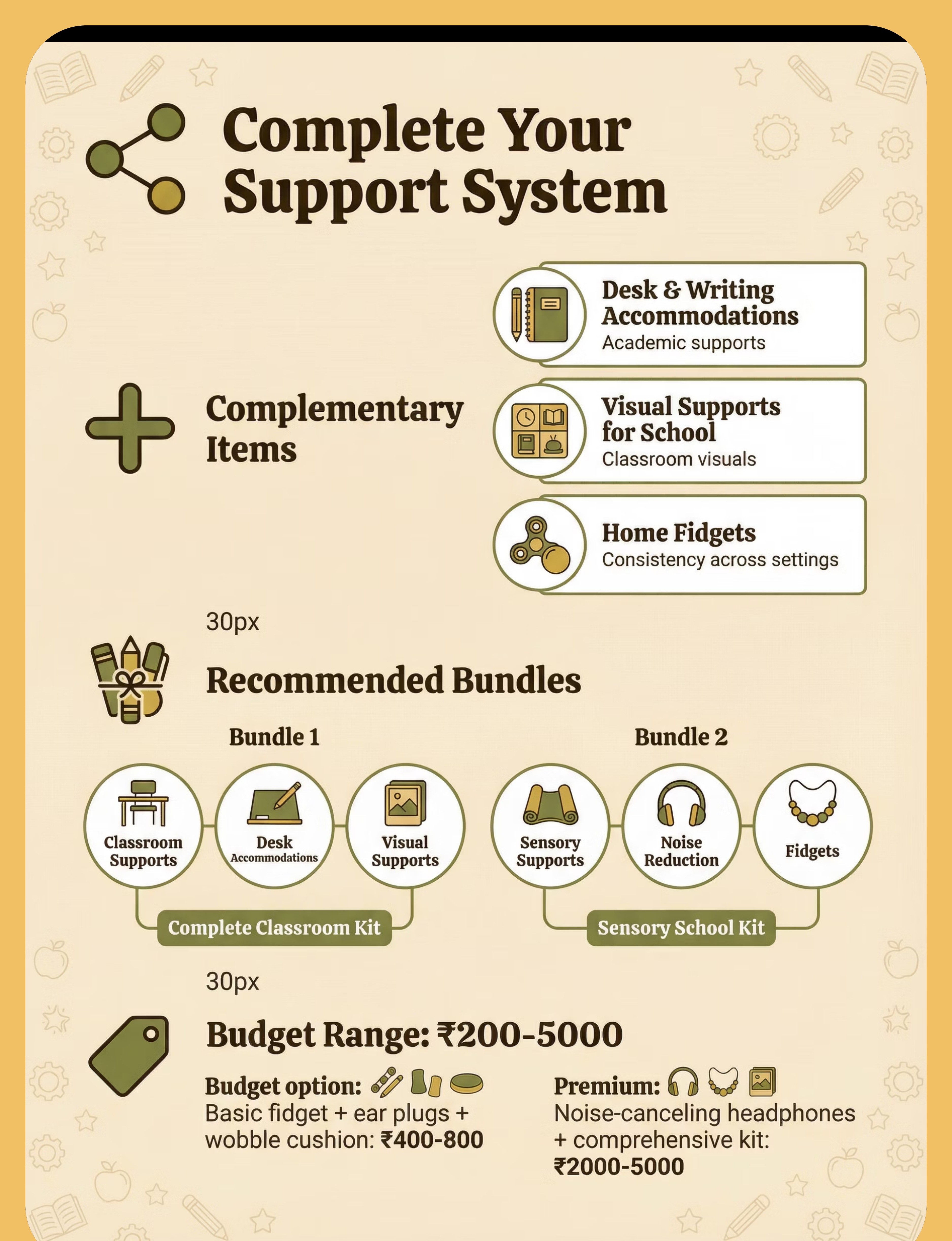
Essential Starter Package
Investment: ₹400–800
Basic Fidget Tools
Cost: ₹100-200
Ear Plugs / Defenders
Cost: ₹200-400
Wobble Cushion
Cost: ₹100-200
Note: Covers essential basics across multiple sensory systems. Excellent starting point while assessing more specific needs.
Premium Option
Comprehensive Accommodation Kit
Investment: ₹2,000–5,000
Quality Noise-Canceling Headphones
Cost: ₹1000-2000
Multiple Seating Options
Cost: ₹500-2000
Comprehensive Sensory Toolkit
Cost: ₹500-1000
Brands: Various sensory and educational suppliers provide quality options

Best Starting Point: Begin with budget essentials addressing your child's primary sensory challenges (auditory, movement, or tactile). Add accommodations progressively based on OT recommendations and observed effectiveness. Many schools provide some items once documented in IEP.
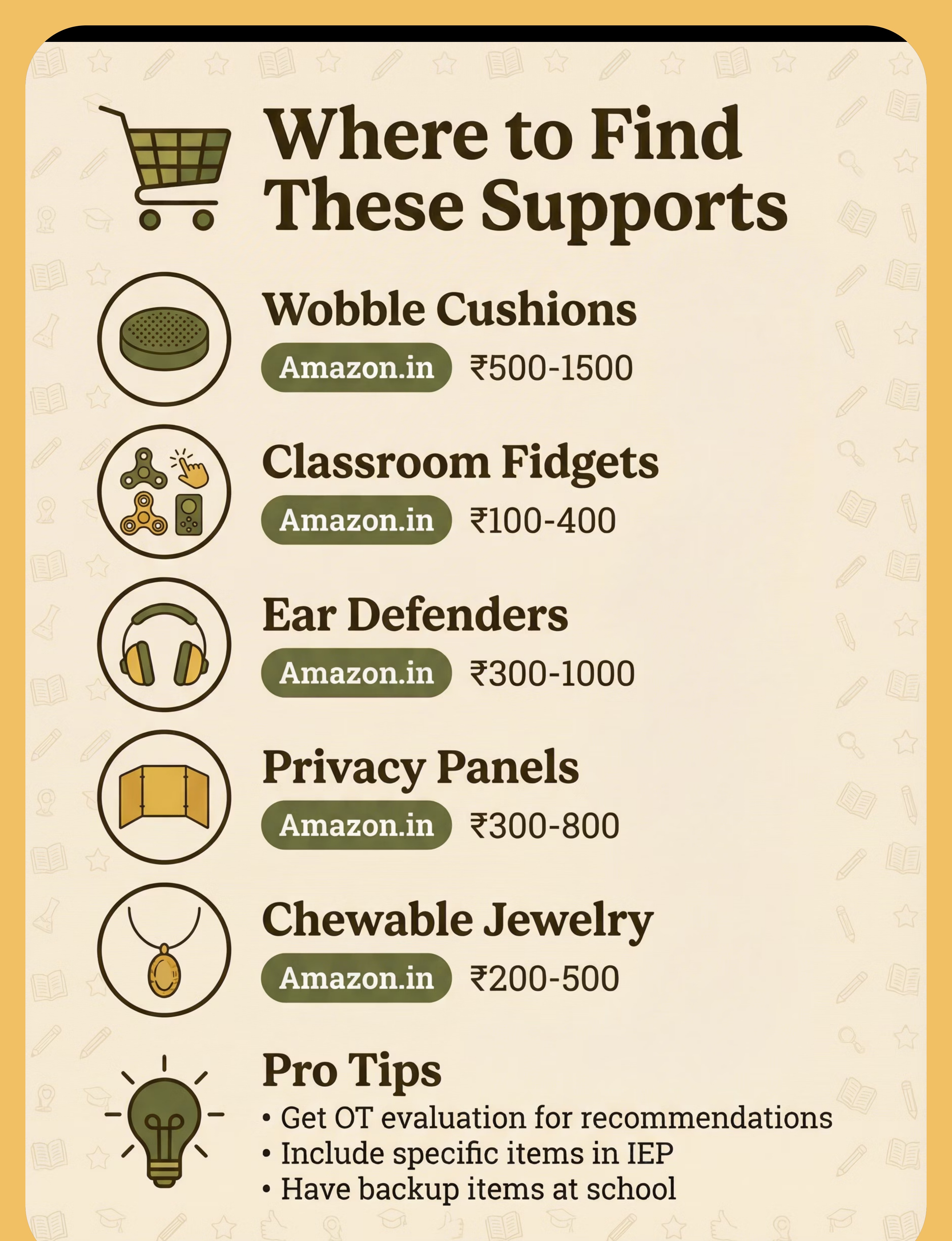
Where to Buy in India
Availability: Various sources including online platforms, educational suppliers, and specialty sensory stores
Amazon.in
Search Terms: "wobble cushion kids"
Price Range: ₹500-1,500
Notes: Movement seating
Amazon.in
Search Terms: "classroom fidgets"
Price Range: ₹100-400
Notes: Tactile tools
Amazon.in
Search Terms: "kids ear defenders"
Price Range: ₹300-1,000
Notes: Noise reduction
Amazon.in
Search Terms: "desk privacy panel"
Price Range: ₹300-800
Notes: Visual shields
Amazon.in
Search Terms: "chew necklace kids"
Price Range: ₹200-500
Notes: Oral sensory

Buying Tips ✓
  • Get occupational therapy evaluation for specific recommendations
  • Include specific item names/types in IEP documentation
  • Keep backup items at school (items get lost or worn)
  • Train child on appropriate, discrete use in classroom
  • Communicate regularly with teacher about effectiveness

Red Flags 🚩
  • Purchasing without OT input or assessment
  • School refuses reasonable, documented accommodations
  • Items provided but not actually used or implemented
  • No follow-up on effectiveness or adjustment as needed
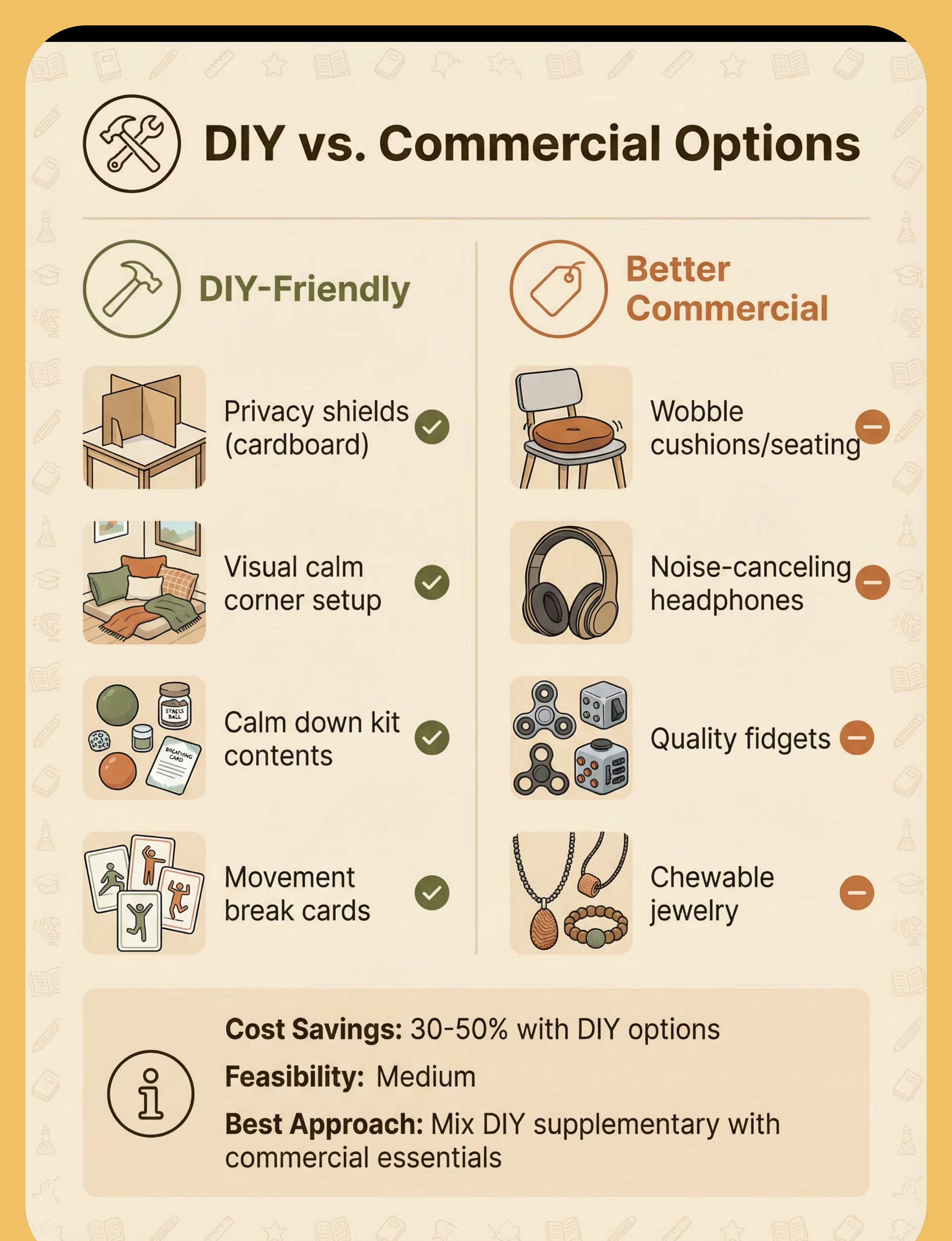
DIY Alternative (Save 30-50%)
Feasibility: Medium—some accommodations DIY-friendly, others better purchased
Cost Savings: 30-50% on select items | Time Investment: Variable by project
Materials Needed (Variable)
  • Cardboard or poster board (shields)
  • Fabric and filling (cushions)
  • Storage containers (calm corner)
  • Sensory items (calm kit contents)
DIY Steps
  1. Identify specific sensory needs through OT evaluation
  1. Select appropriate accommodations for those needs
  1. Request accommodations through formal IEP/504 process
  1. Provide DIY items if school cannot supply
  1. Train child and teacher on proper use and purpose
  1. Monitor effectiveness and adjust as needed over time
When to DIY
  • Privacy shields (cardboard, decorated)
  • Visual calm corner setup and organization
  • Calm down kit contents and activities
  • Movement break activity cards
Better to Purchase
  • Wobble cushions and movement seating (safety/quality)
  • Noise-canceling headphones (effectiveness)
  • Quality fidget tools (durability)
  • Chewable jewelry (safety/hygiene)
Tradeoffs to Consider
DIY options work well for supplementary supports and some environmental modifications. However, core accommodations like quality movement seating and noise reduction benefit from commercial products designed for school use. DIY can stretch budget while ensuring safety and effectiveness for primary accommodations.
Measuring Success & Next Steps
Track Progress
Baseline (Measure First)
  • Current school challenges and frequency
  • Sensory needs identified through assessment
  • Existing accommodations (if any)
  • Current academic performance and behavior data
Goals
  • Sensory accommodations will be documented and in place
  • School regulation will improve measurably
  • Behavioral incidents will decrease
  • Academic access and performance will improve
Success Indicators
  • Better regulation observed at school
  • Fewer behavioral incidents documented
  • Academic progress and grade improvement
  • Child's own report of comfort and success

Complete the Kit: Pair It With...
Tool ID: 18.2
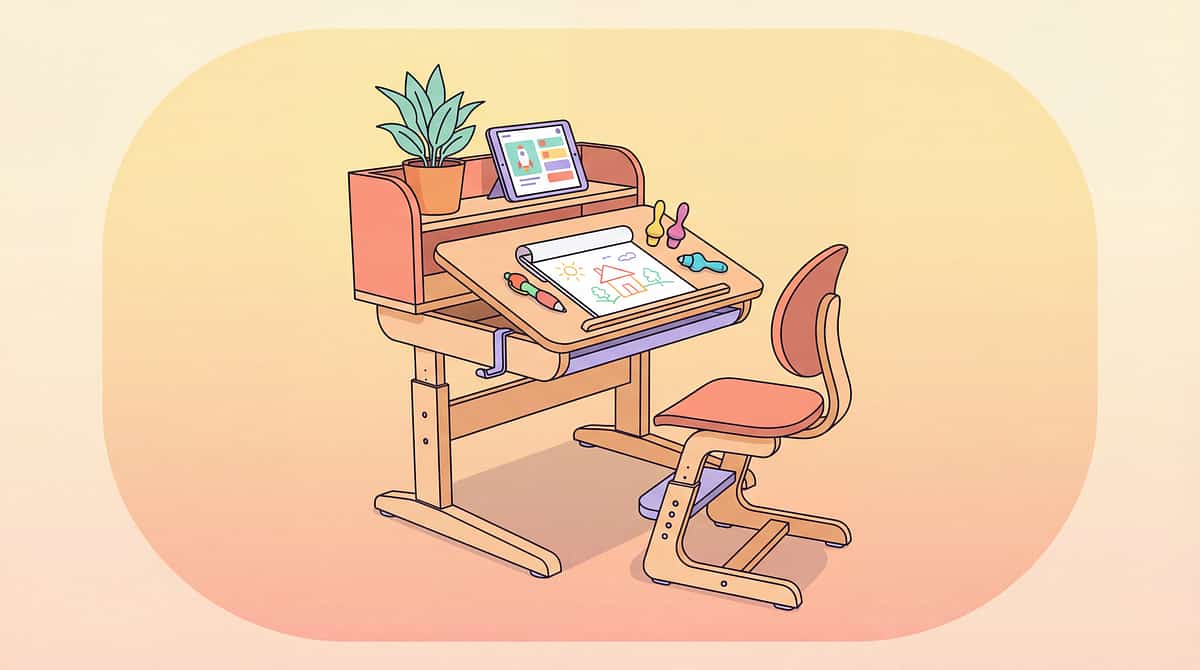
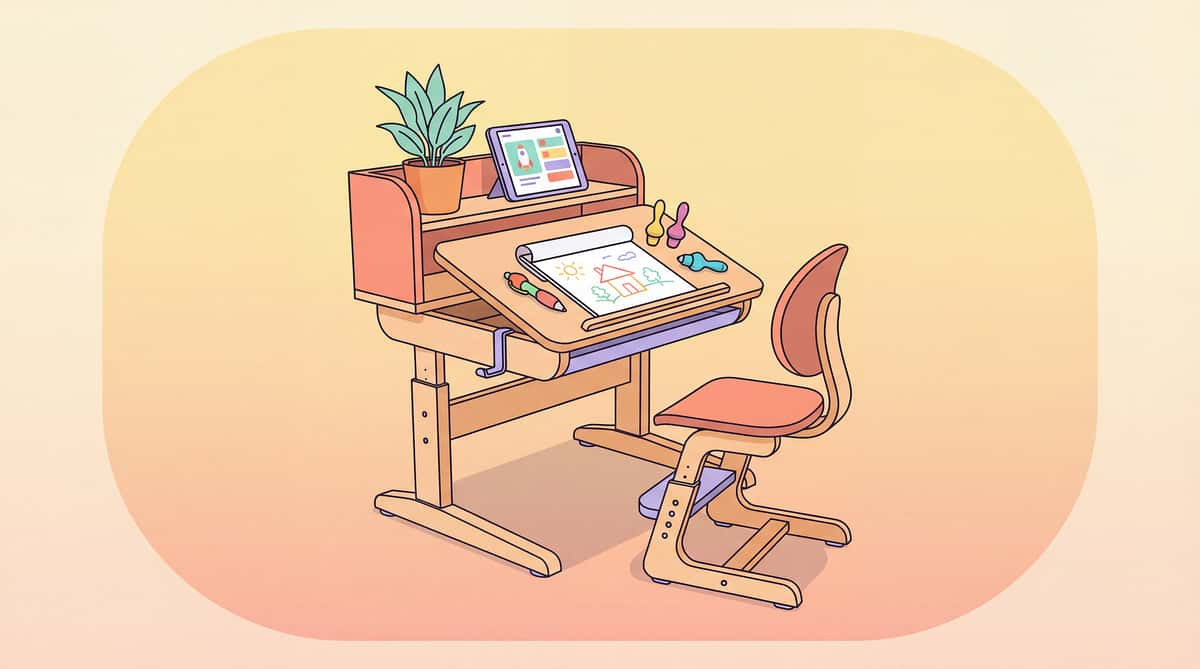
Desk & Writing Accommodations
classroom-sensory-supports therapy material
Academic supports for handwriting and desk work success
Tool ID: 18.3
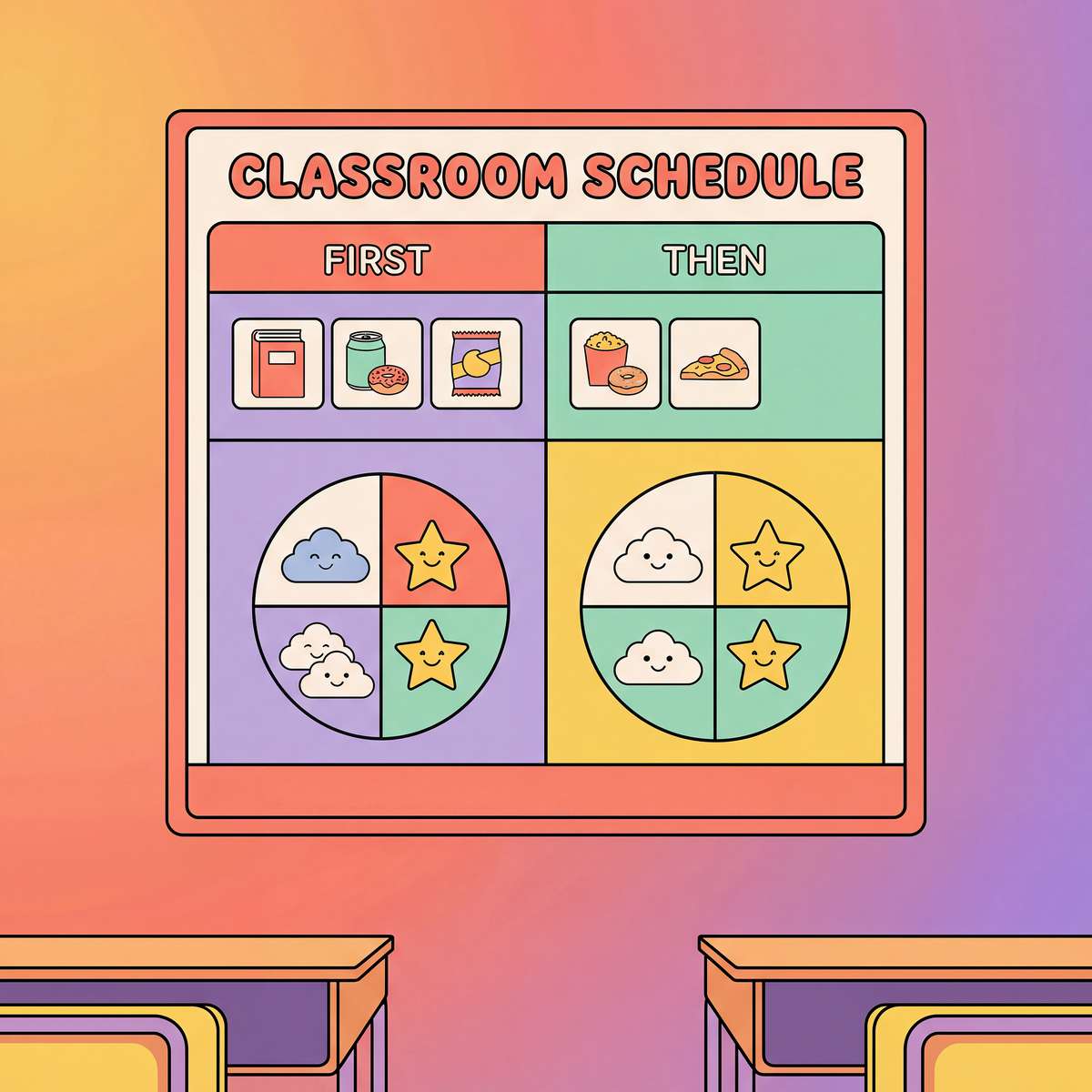
Visual Supports for School
classroom-sensory-supports therapy material
Classroom visual schedules and support systems
Tool ID: 1.4
Noise Reduction Tools
classroom-sensory-supports therapy material
Complete auditory support options for various settings
Tool ID: 2.1
Fidget Collection
classroom-sensory-supports therapy material
Comprehensive fidget options for home and school
Recommended Bundles:
  • Complete Classroom Kit: Tools 18.1 + 18.2 + 18.3 for full school accommodation system
  • Sensory School Kit: Tools 18.1 + 1.4 + 2.1 for sensory-focused school support

Quick Summary
Classroom sensory supports provide essential accommodations including noise reduction, fidgets, seating modifications, and calm spaces to support regulation, attention, and learning access at school. Core Kit (Rank 1), strong evidence, essential school accommodation.
classroom
sensory
school
accommodations
IEP
focus
OT
SpEd
core-kit
Common Searches: classroom sensory supports, school accommodations autism, classroom fidgets, school sensory needs, IEP sensory accommodations, wobble cushion classroom, classroom noise reduction

Get Support

FREE National Autism Helpline
Phone: 9100 181 181
Languages: 16+ Indian languages
Website: pinnacleblooms.org
Expert guidance on school accommodations, IEP advocacy, and sensory supports available free of charge.
Platform Integration:
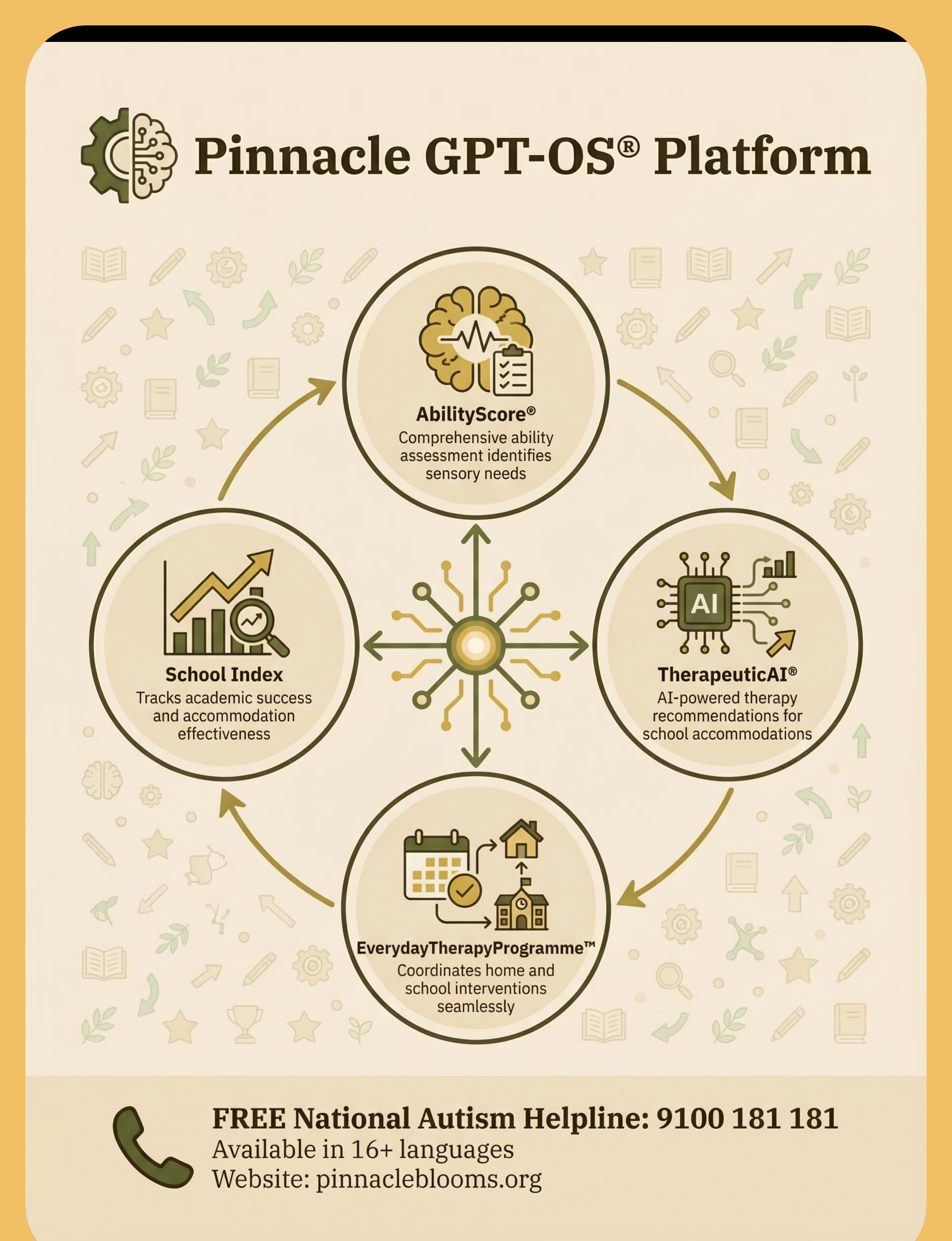
  • AbilityScore® identifies specific sensory needs affecting school performance
  • TherapeuticAI® recommends appropriate school accommodations based on individual profile
  • EverydayTherapyProgramme™ coordinates home and school supports for consistency
  • School Index tracks academic success and accommodation effectiveness over time

Disclaimer: This is educational information only. Always consult qualified occupational therapists, speech-language pathologists, special educators, or pediatricians for individualized recommendations. Individual results vary. Accommodations should be based on professional assessment and documented in appropriate educational plans (IEP/504).

Preview of classroom sensory supports Therapy Material

Below is a visual preview of classroom sensory supports therapy material. The pages shown help educators, therapists, and caregivers understand the structure and content of the resource before use. Materials should be used under appropriate professional guidance.

Page 1
Page 2
Page 3
Page 4
Page 5
Page 6
Page 7
Page 8
Page 9
Page 10
Page 11
Page 12
Page 13
Page 14
Page 15
Page 16
Page 17
Page 18
Page 19
Page 20
Link copied!
Effective Teacher Collaboration for Sensory Support
Implementing sensory accommodations successfully requires a strong partnership between parents and educators. Building this collaborative bridge ensures your child receives tailored support for optimal learning and regulation.
Foster Open Dialogue
Establish consistent, respectful communication channels. Regular check-ins help share observations and discuss challenges proactively for swift solutions.
Educate & Empower
Share information about your child's sensory needs and the purpose behind each accommodation. Provide resources and practical examples for better understanding.
Co-Create Solutions
Work together to brainstorm practical ways to integrate accommodations into daily classroom routines. Leverage the teacher's expertise in classroom management.
Review & Adjust
Schedule periodic reviews to assess accommodation effectiveness. Be flexible and open to making adjustments based on feedback from both the teacher and your child.
This collaborative approach ensures accommodations are not just present, but truly effective in supporting your child's learning and well-being in the school environment.