








Tool ID: 9.7
Tool ID: 9.7
OT + SpEd
Moderate Evidence
Rank #2
Daily Use
₹100–800
Cooking/Kitchen Tools (Adapted)
Food preparation and kitchen independence system
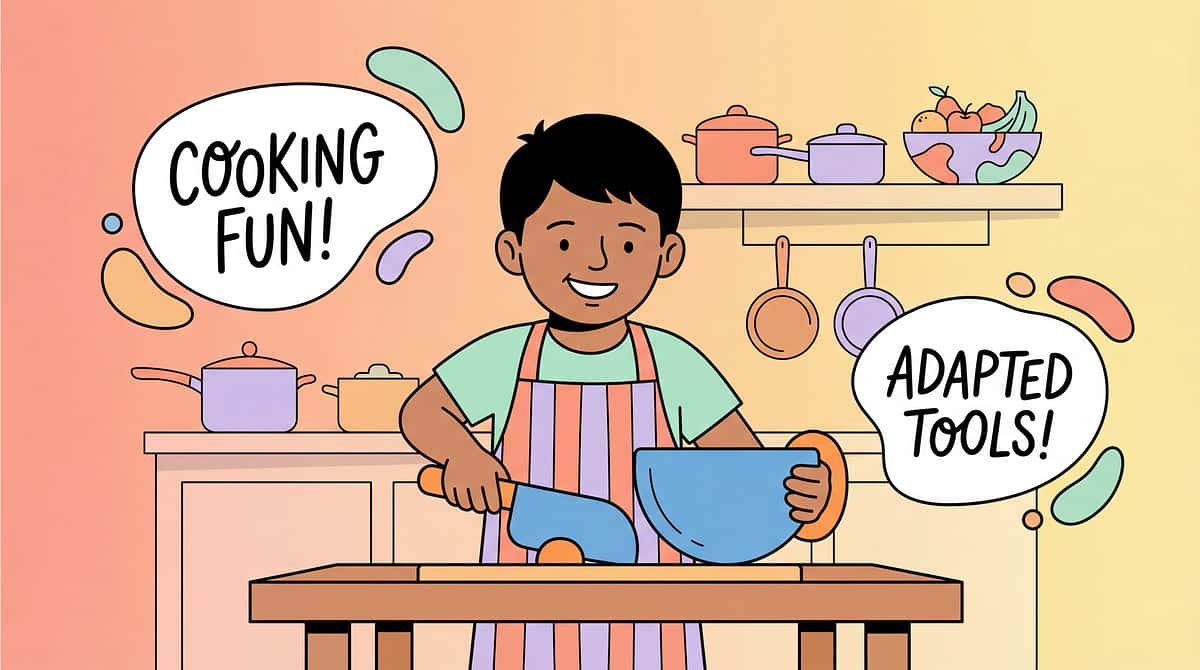
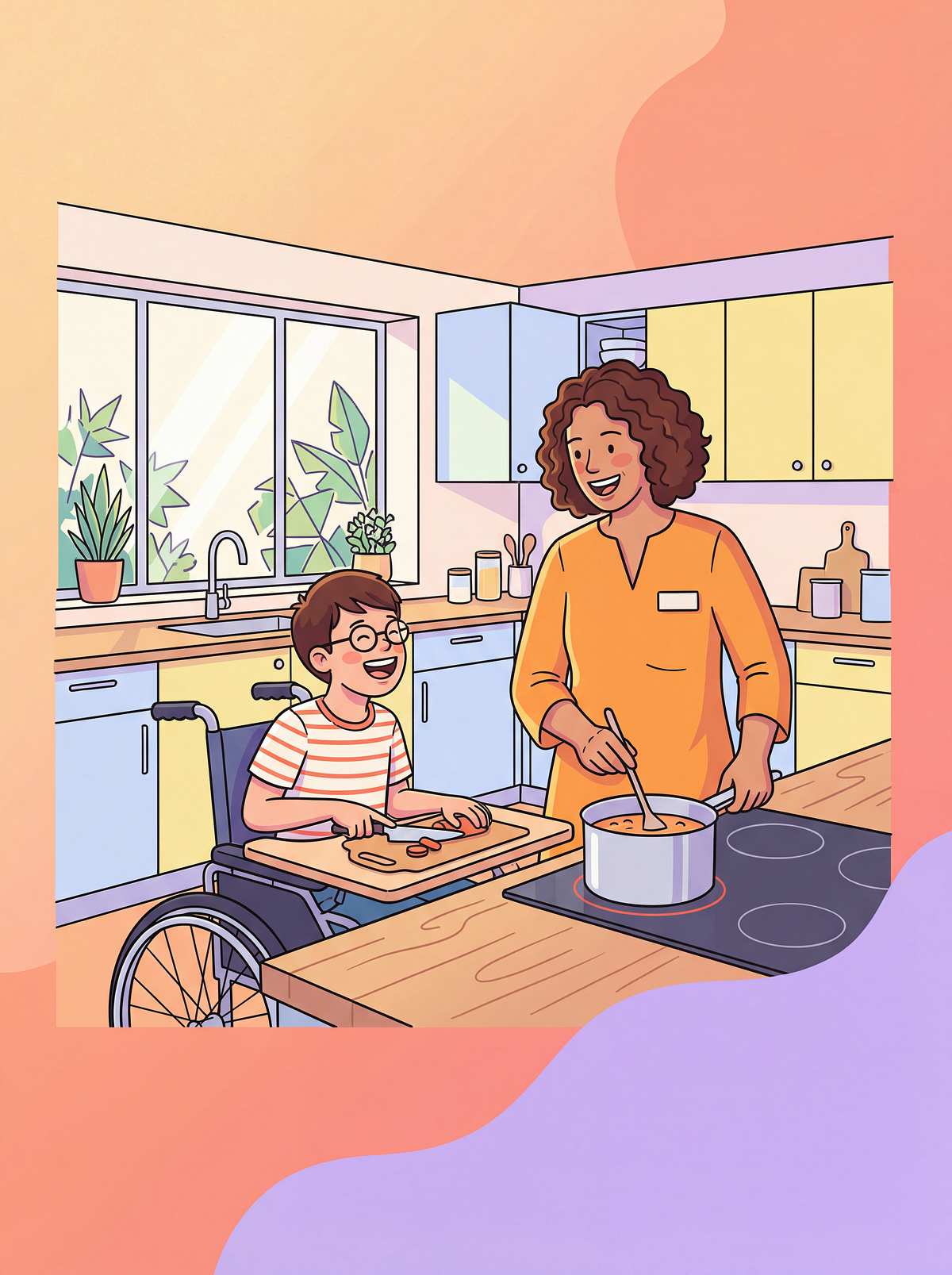
Enable your child's participation in food preparation and cooking through adapted tools, visual supports, and safety accommodations. With the right equipment and guidance, children can safely develop practical life skills that build toward kitchen independence.
Kitchen Skills
Fine Motor
Sequencing
Following Directions
Safety Awareness
Independence
Executive Function
Ages 3+ years
Home
School
Children needing adapted tools
Ideal for children who want to engage in cooking activities but require safety accommodations or motor adaptations for a positive experience.
Developing practical life skills
Helps children build essential life skills through active participation in real kitchen tasks, supported by visual recipes and clear directions.
Fostering independence and confidence
Supports the development of kitchen independence, improves sequencing abilities, and builds confidence in daily living and executive function tasks.
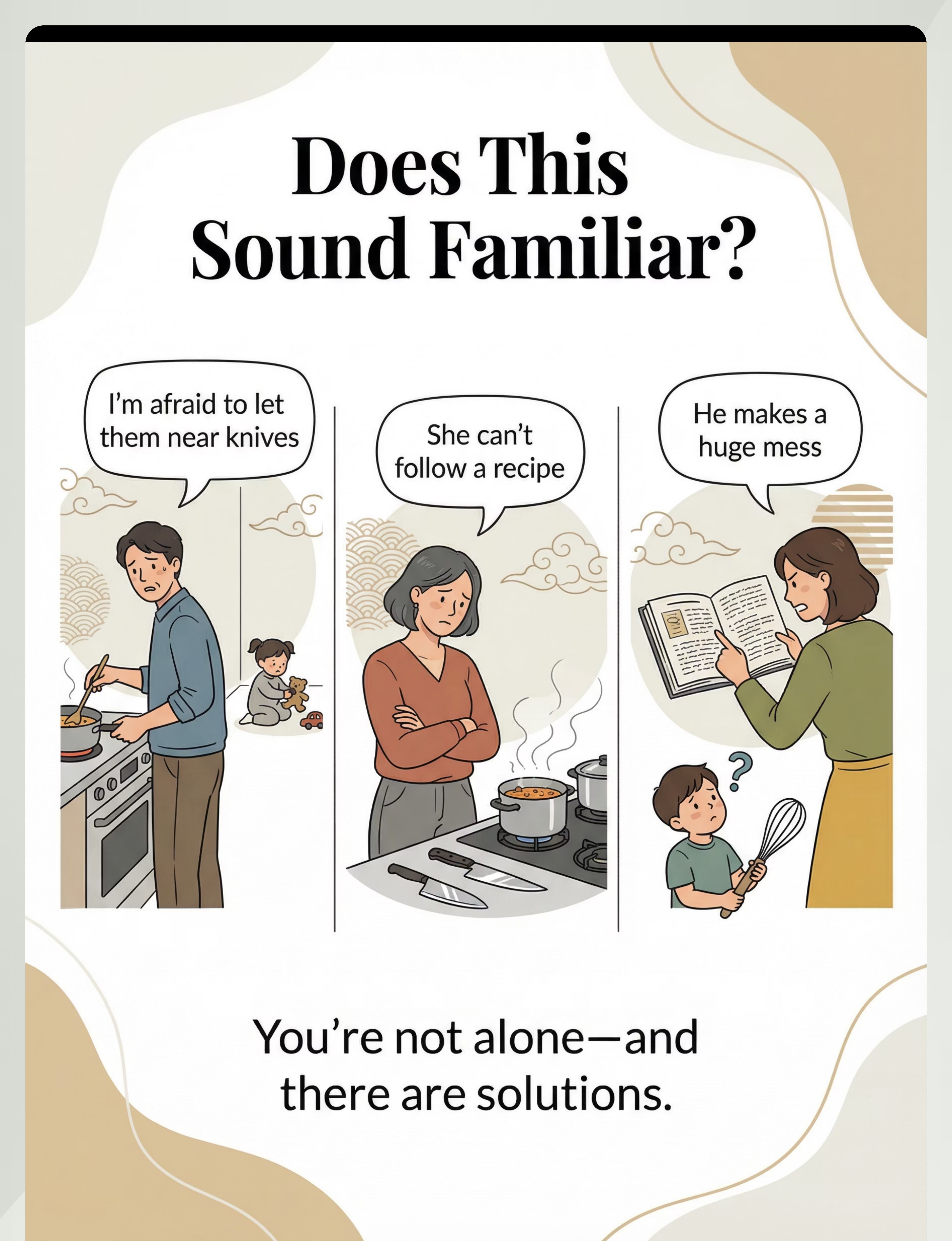
Does This Sound Familiar?
"My child can't do anything in the kitchen. I do everything myself."
"I'm afraid to let them near knives or the stove. What if they get hurt?"
"She can't follow a recipe. The instructions are too confusing."
"He makes a huge mess and can't actually help. It's easier to do it myself."
"She has no practical life skills. I worry about her future."
"He'll never be able to cook for himself. He's completely dependent on us."
You're not alone. These are common challenges for families. With adapted tools, visual supports, and the right approach, children can safely participate in kitchen activities and build real independence.
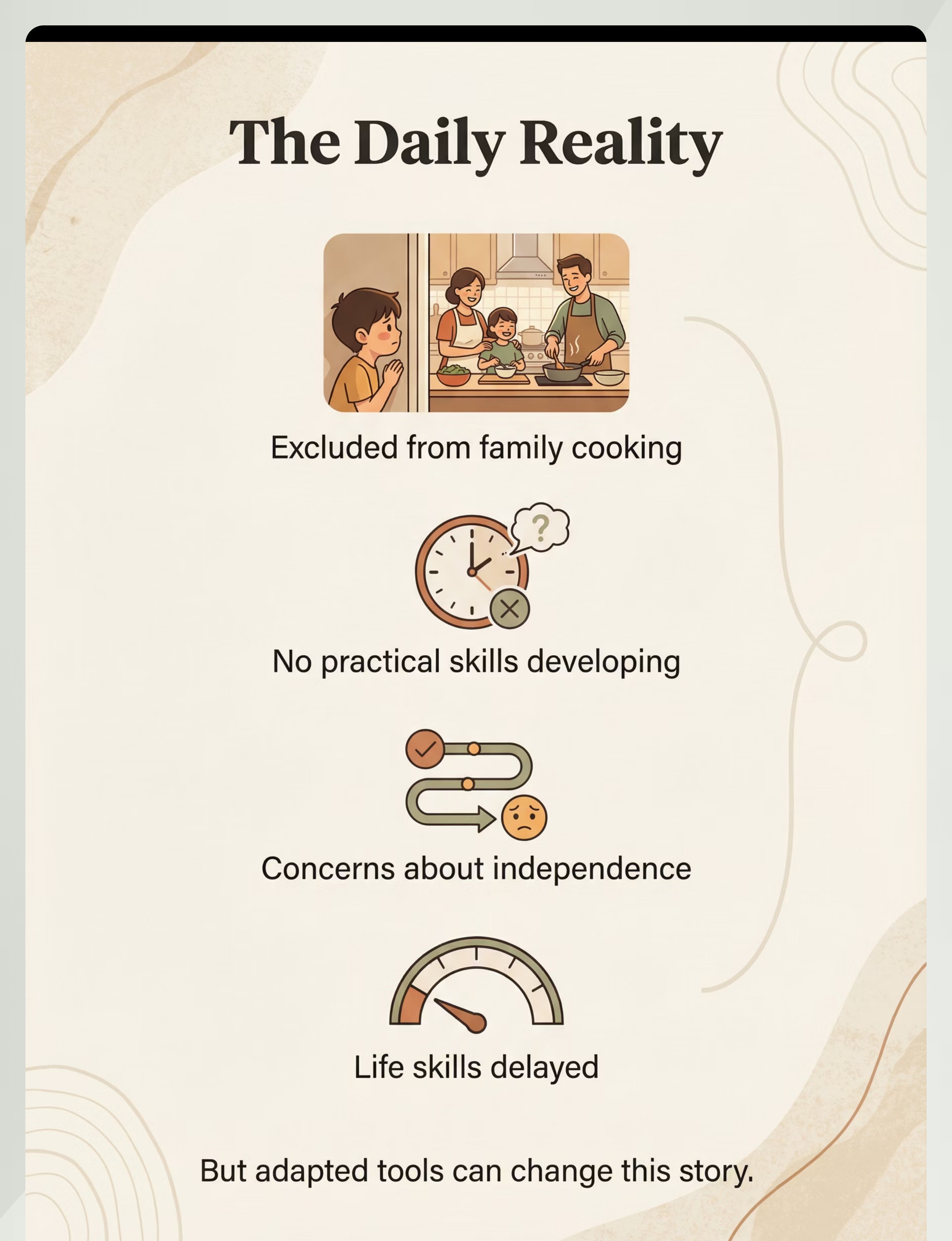
A Day Without the Right Support
Meal Participation
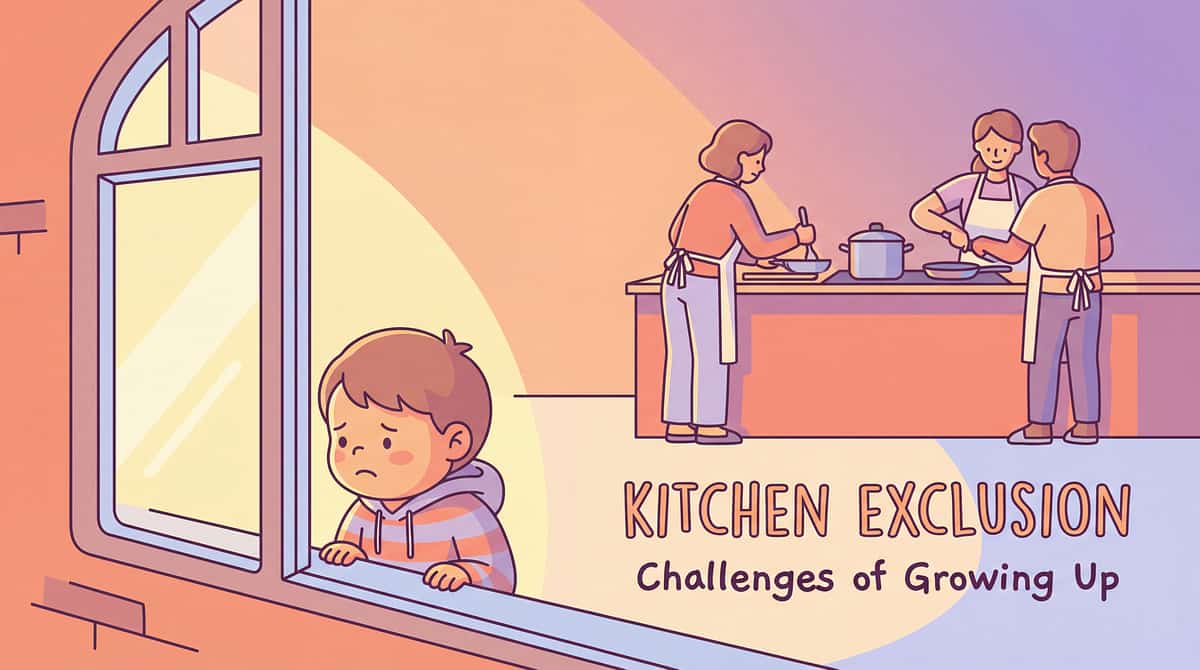
Child excluded from family cooking. Watches from the side while everyone else prepares food together. Missing opportunities to learn and contribute.
Independence Skills
No cooking skills developing. Complete dependence on others for food preparation. Practical life skills remain undeveloped year after year.
Future Concerns
Growing anxiety about adult independence. Will they ever be able to prepare their own meals? How will they manage when we're not there?
Life Skills Gap
Practical skills delayed compared to peers. Missing crucial learning during key developmental windows. Every meal is a missed teaching opportunity.
The Science Behind It
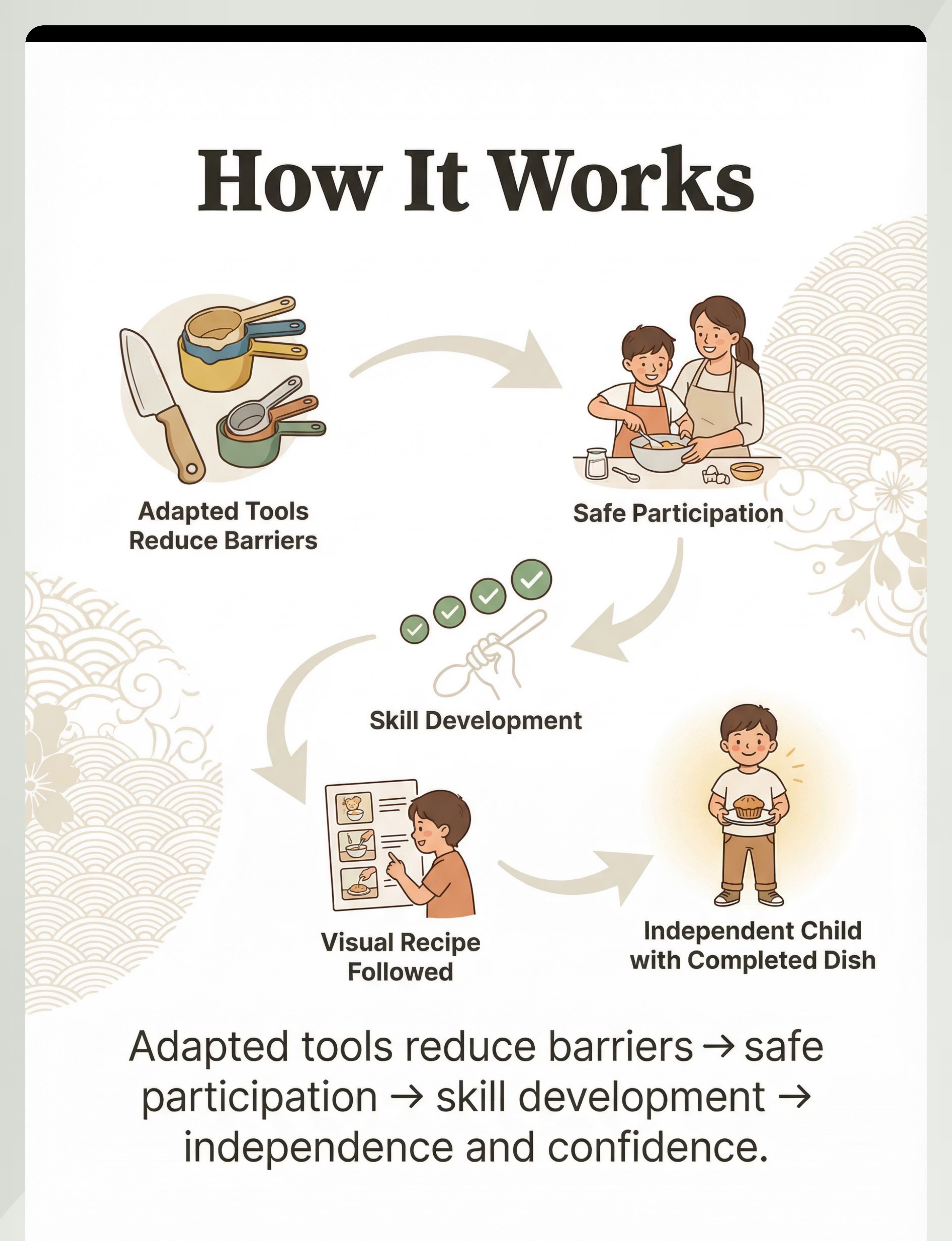
Adapted kitchen tools create a clear pathway from exclusion to independence. Here's how the mechanism works:
Adapted Tools
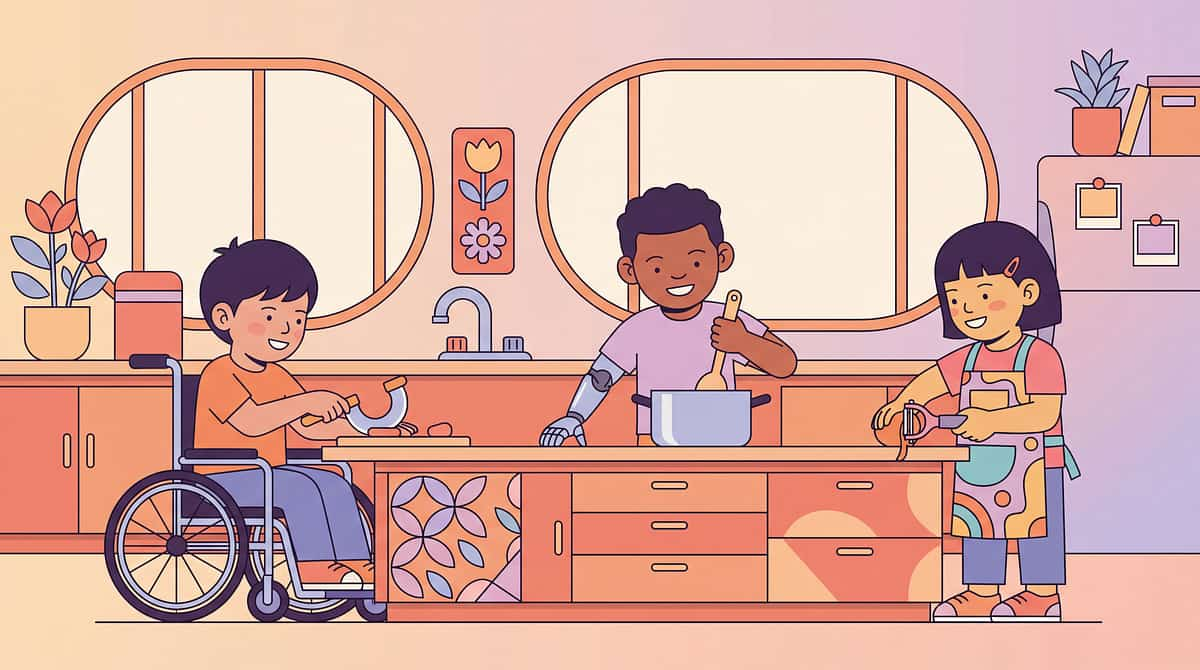
Reduce barriers to participation through safety features and motor accessibility, ensuring a welcoming environment for all.
Safe Participation
Enables hands-on cooking experience with appropriate accommodations, fostering confidence and safety awareness.
Skill Development
Following visual recipes builds crucial kitchen skills, fine motor control, sequencing, and executive function. These contribute to comprehensive child development.
Independence & Confidence
Mastering practical life skills leads to increased self-sufficiency, confidence, and real-world capability, reinforcing a cycle of learning and growth.
Kitchen Skills
Fine Motor
Sequencing
Following Directions
Safety Awareness
Independence
Executive Function
How to Use It Right
Start with safe, no-cook recipes
Begin with activities that don't involve heat or sharp objects. Build confidence and skills gradually before introducing more complex tasks.
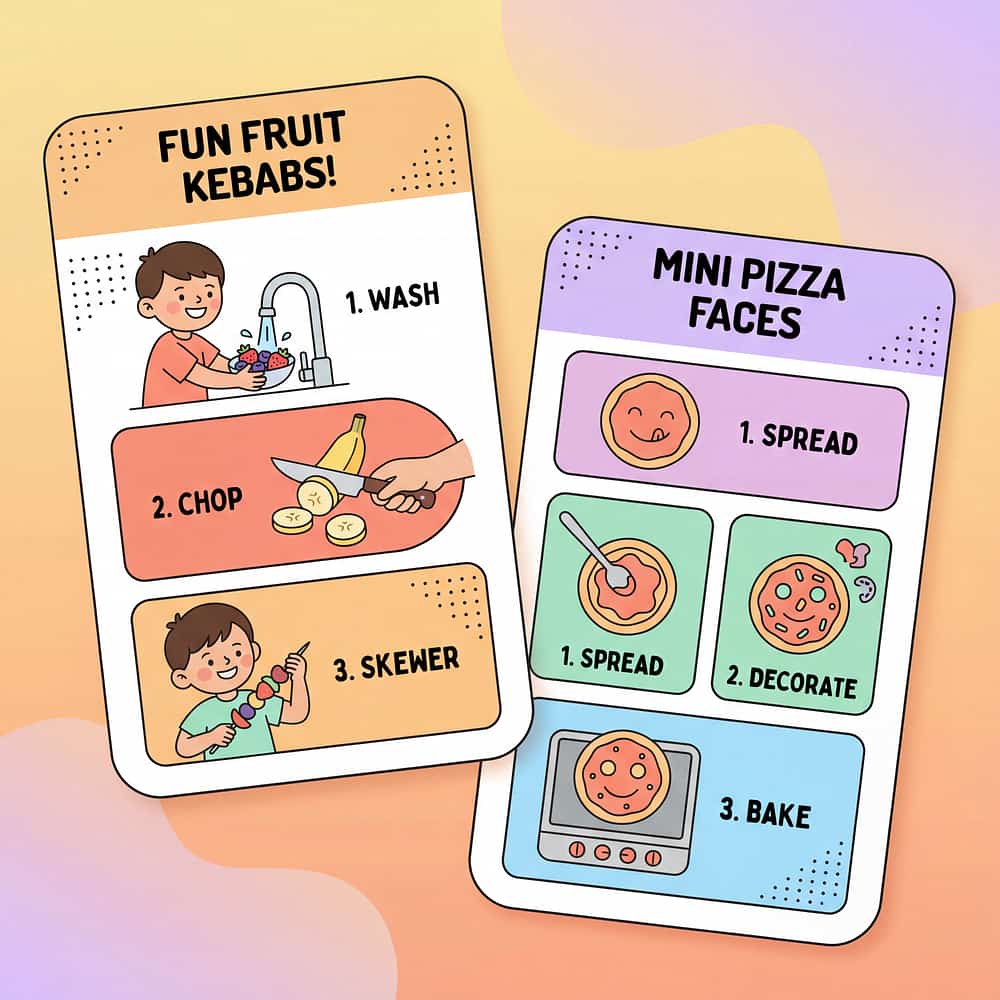
Visual recipes with step-by-step pictures
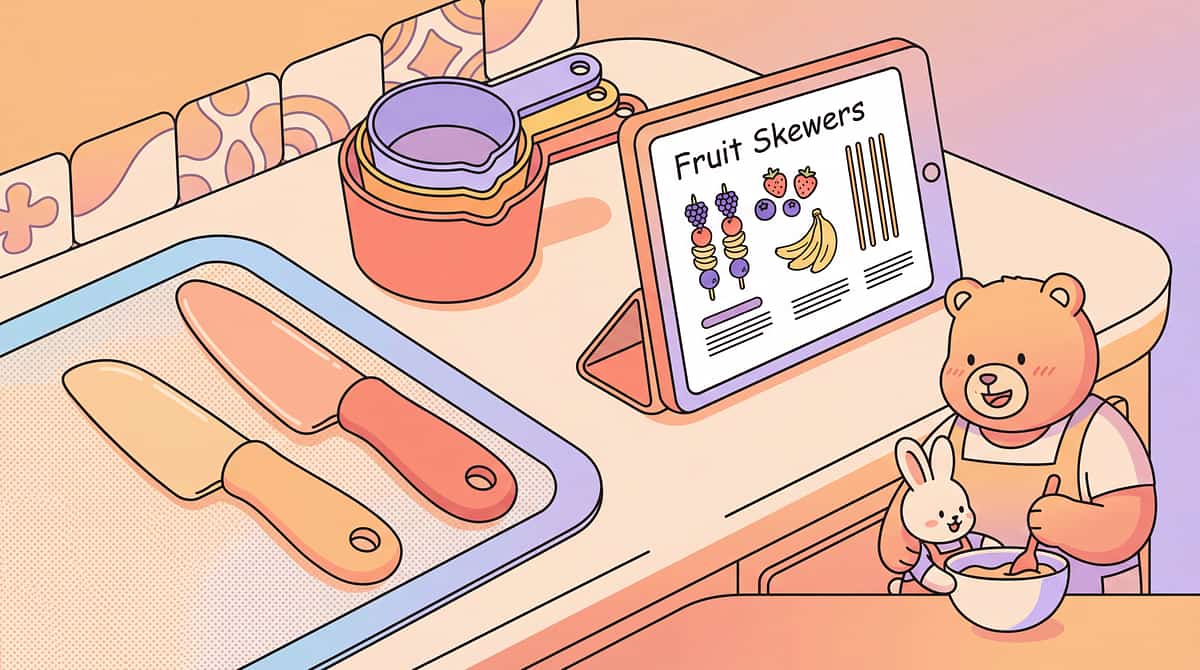
Use photo-based recipe cards that show exactly what to do at each step. Pictures eliminate reading barriers and make sequencing clear.
Adapted tools matching motor abilities
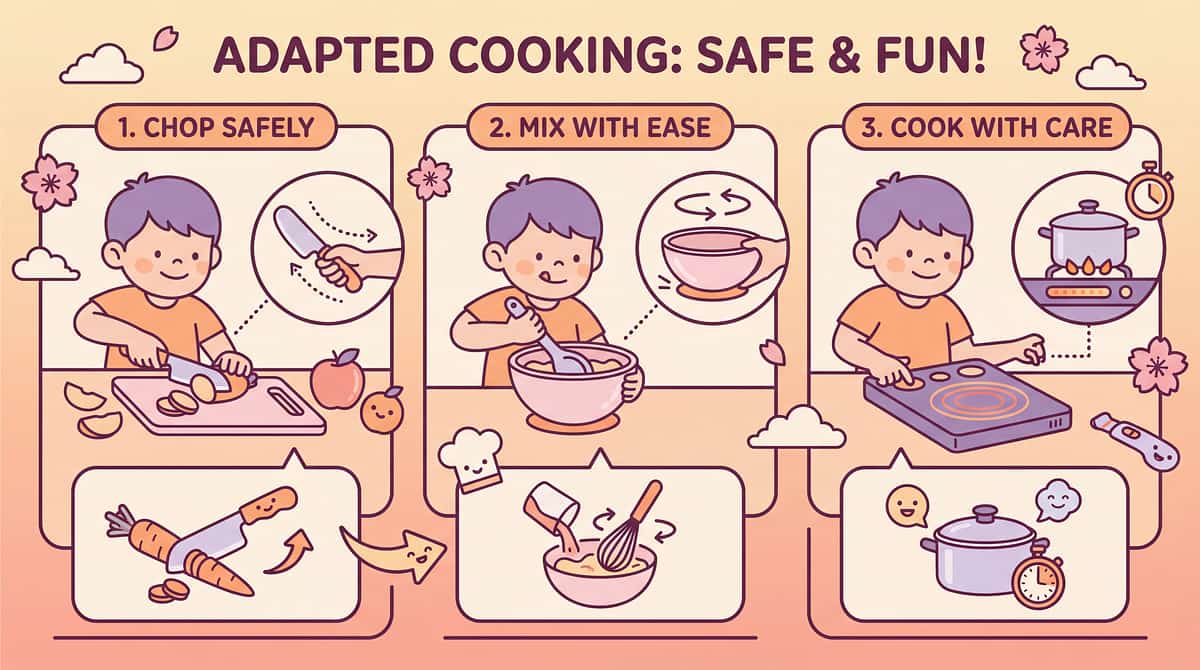
Choose equipment designed for your child's specific needs—easy-grip handles, child-safe knives, non-slip mats, or one-handed adaptations.
Supervision appropriate to skill level
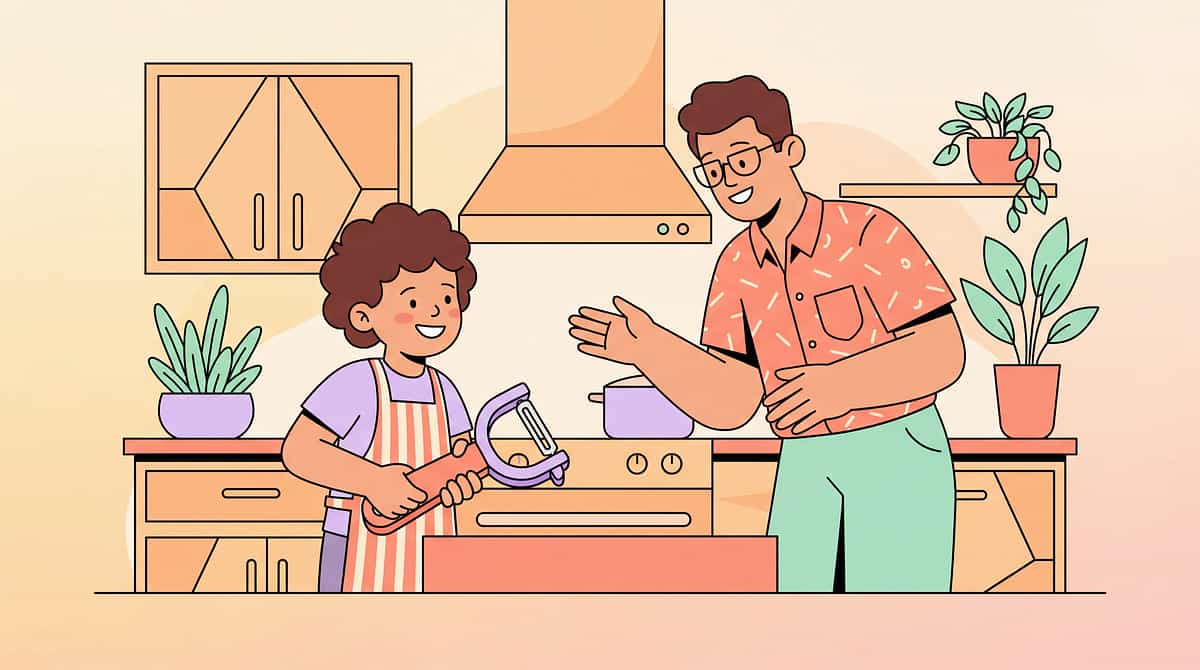
Provide constant close supervision for beginners, gradually stepping back as skills and safety awareness develop over time.
Build from simple to complex tasks
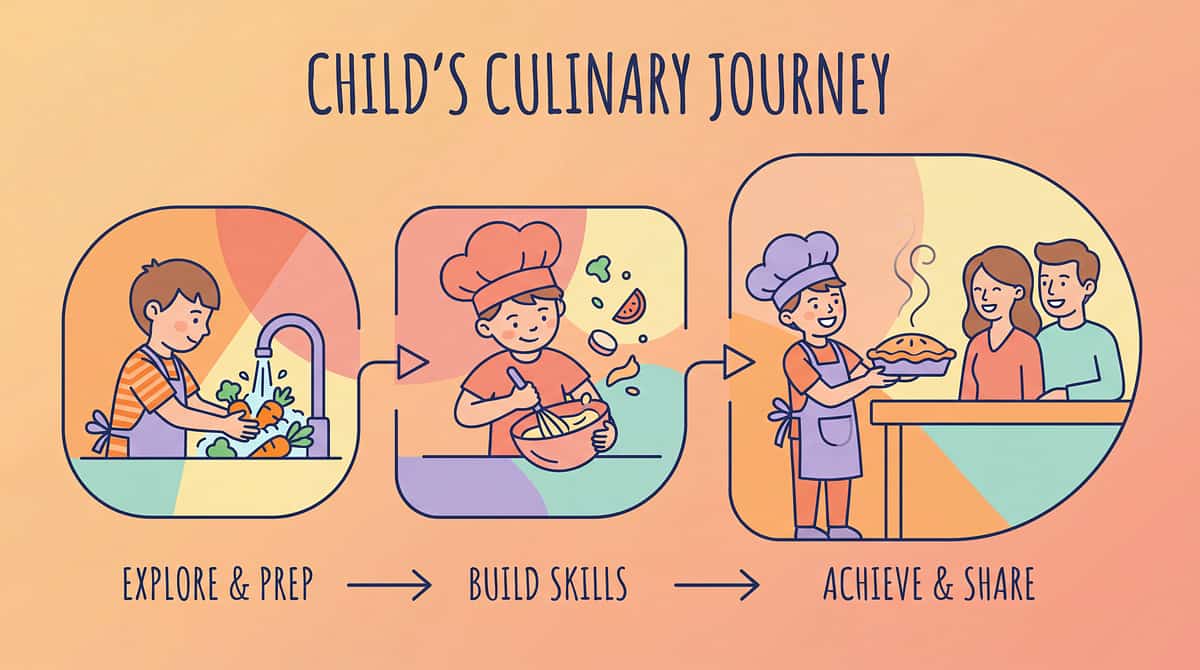
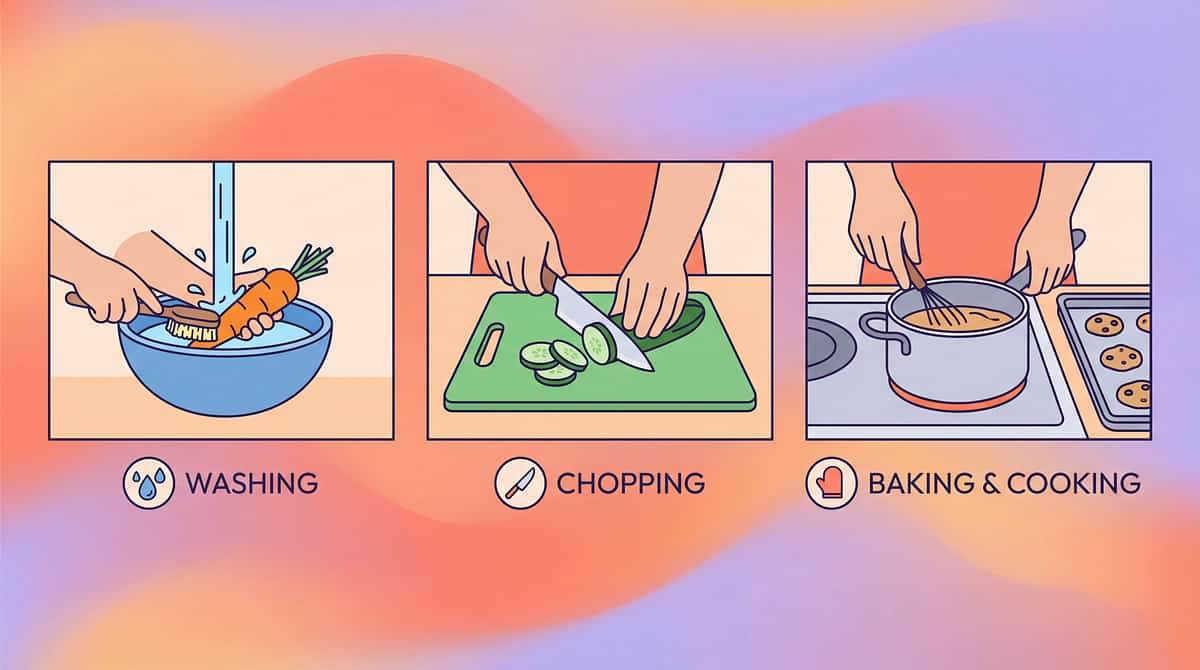
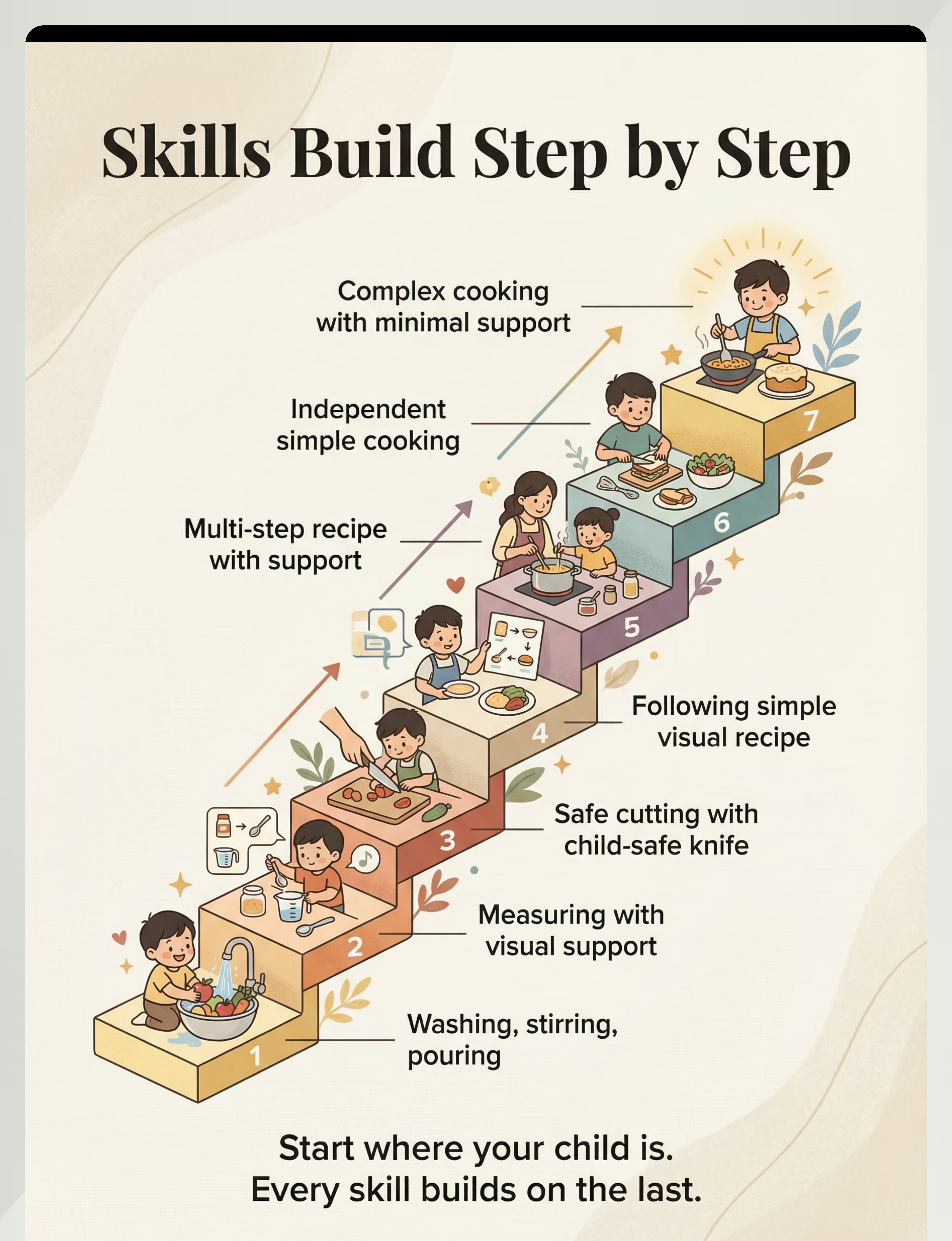
Progress systematically from washing vegetables to stirring, then measuring, cutting with safe tools, and finally following complete recipes.
Real participation, not just watching
Children learn by doing. Provide meaningful roles in actual meal preparation, not token tasks or pretend activities.

Duration: Varies by task; start with short participation and gradually extend time as skills and attention build.
Expert Perspective
"Cooking teaches sequencing, following directions, measuring, timing, and practical skills. With adapted tools and visual recipes, children can participate safely and build real independence in the kitchen."
— Occupational Therapist, Life Skills Specialist
OT + SpEd Recommended
Endorsed by occupational therapy and special education professionals
Moderate Evidence
Supported by clinical research and therapeutic practice
Rank #2 in Category
Core Kit classification for daily living skills development
cooking-kitchen-tools-adapted therapy material
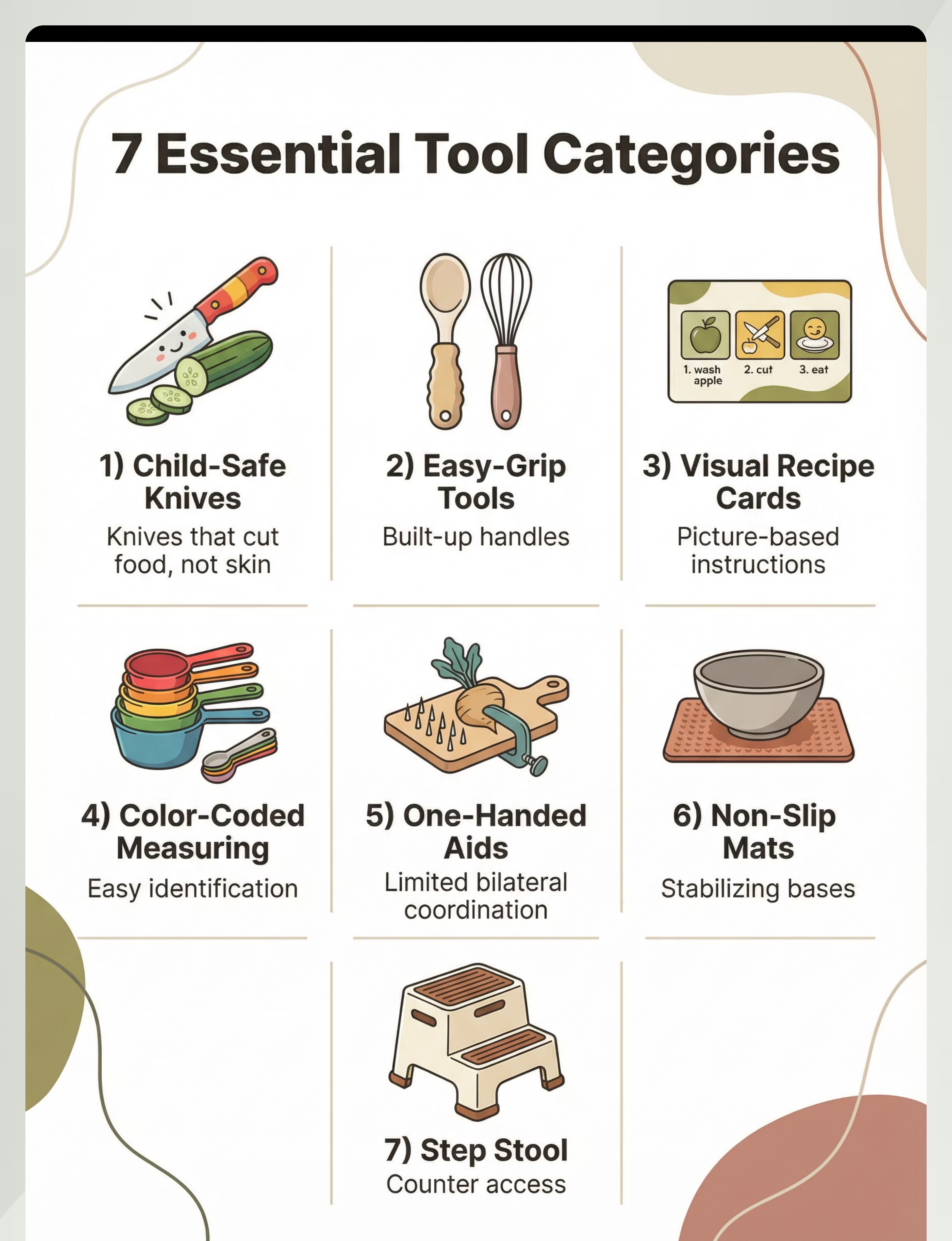
Choose Your Option (7 Variants)
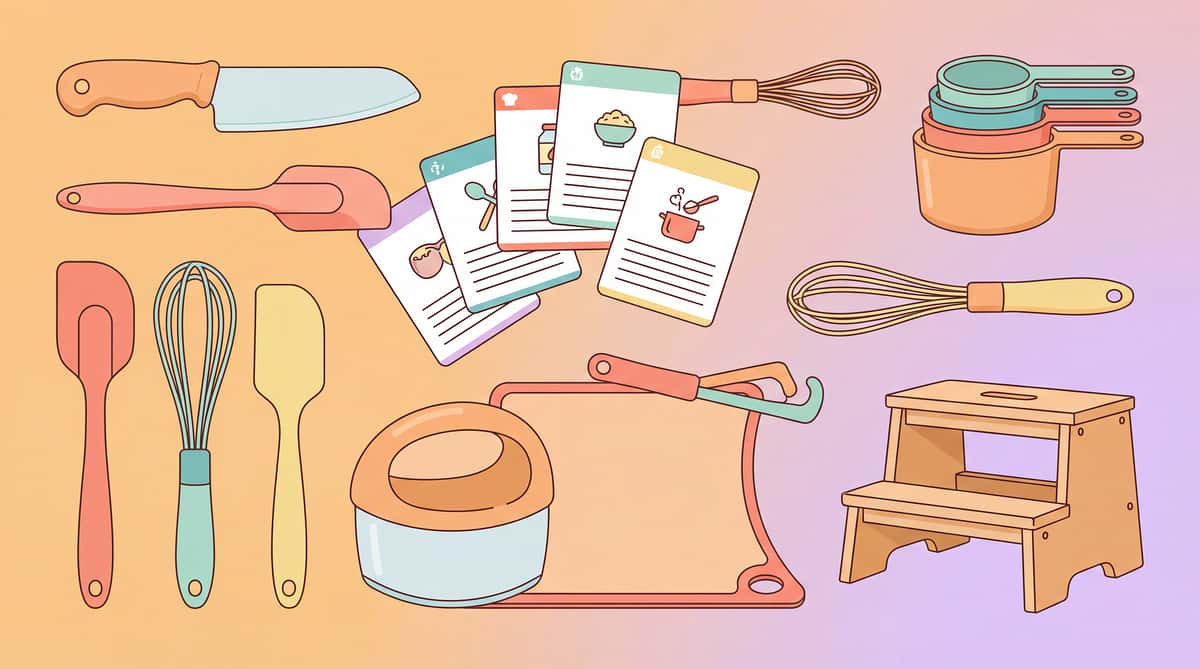
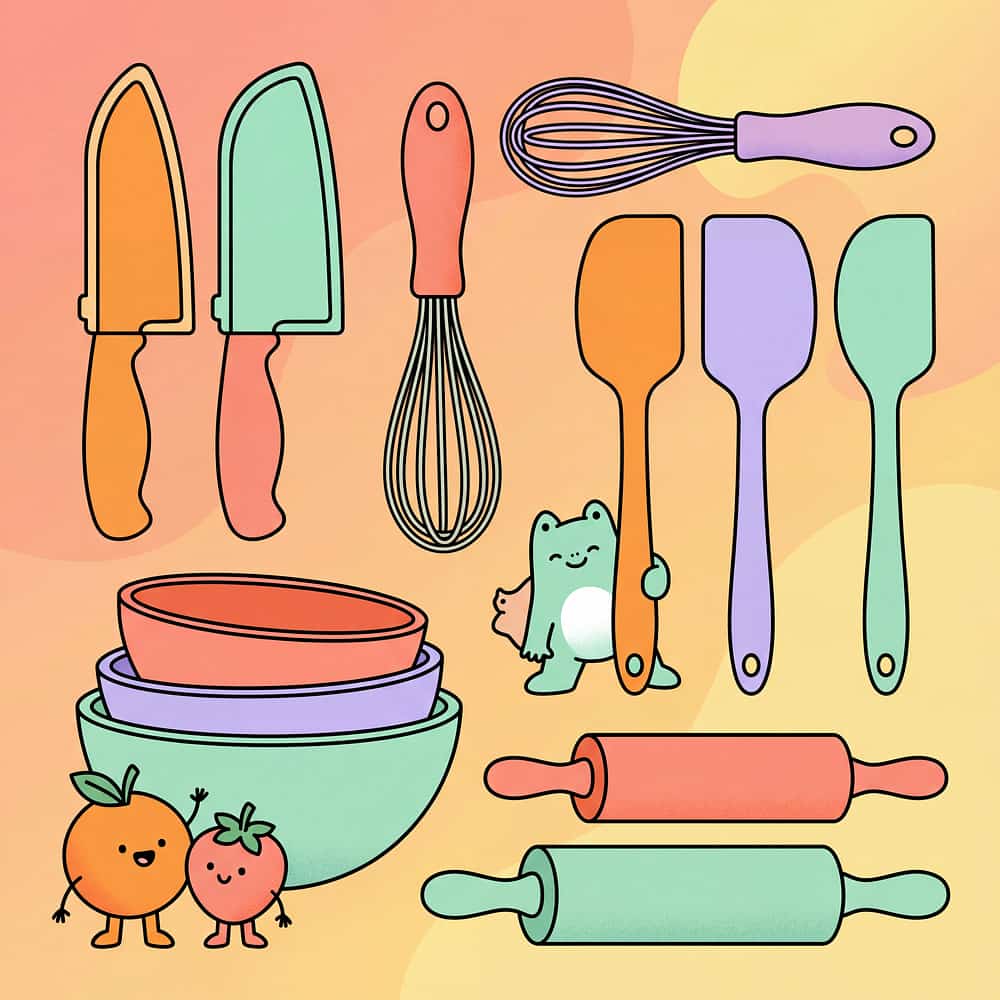
Child-Safe Knives
Best for: Learning cutting, building independence
Knives that cut food but not skin—essential for safe cutting practice
Easy-Grip Kitchen Tools
Best for: Weak grasp, motor challenges
Utensils with built-up handles for easier grasping and control
Visual Recipe Cards
Best for: Non-readers, visual learners, independence
Picture-based cooking instructions eliminate reading barriers
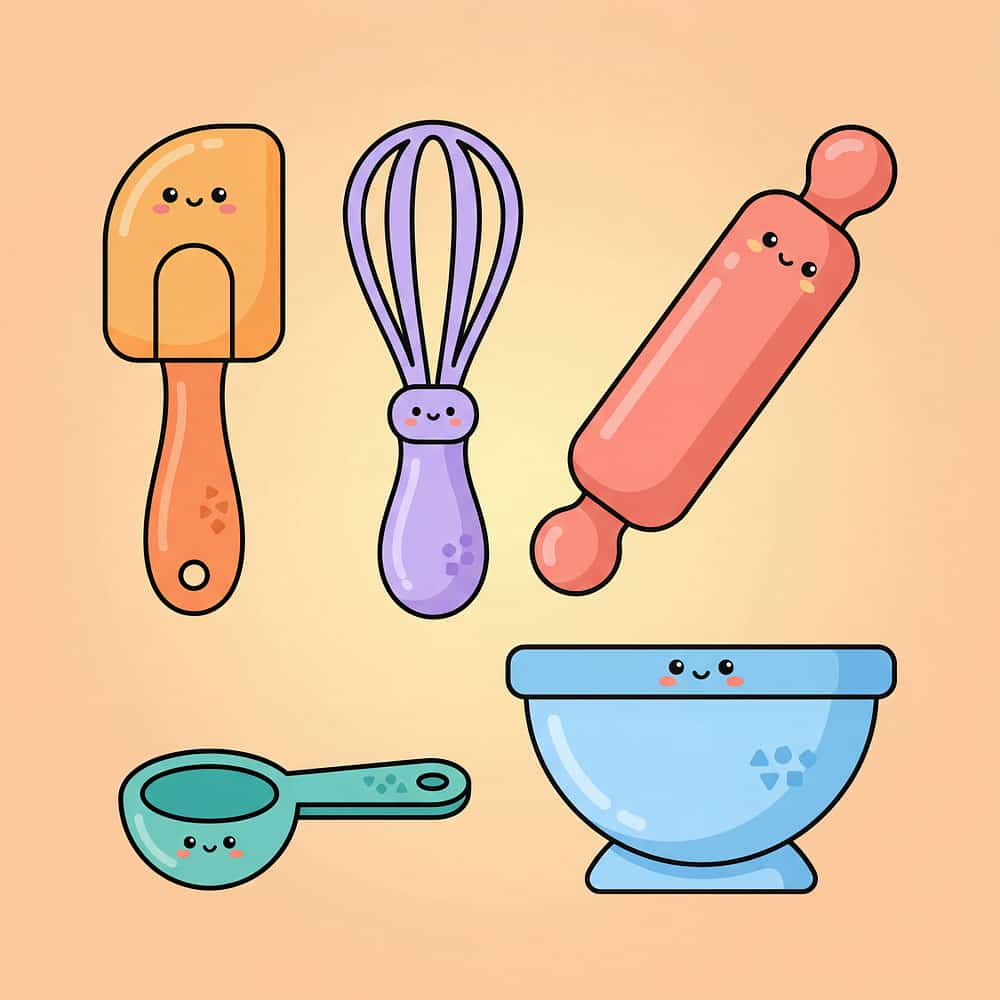
Color-Coded Measuring Cups/Spoons
Best for: Easy identification, recipe following
Color-matched measuring tools simplify recipe following
One-Handed Kitchen Aids
Best for: Limited bilateral coordination
Tools designed for one-handed food preparation tasks
Non-Slip Mats/Bowls
Best for: Motor challenges, one-handed work
Stabilizing bases keep prep surfaces secure during work
Step Stool for Kitchen
Best for: Counter access, participation
Safe elevated platform enables counter access for younger children
Each variant addresses different aspects of kitchen participation. Choose based on your child's specific needs, motor abilities, and the skills you want to build. Many families start with child-safe knives and visual recipes, then add other tools as needed.

How to Choose
  • By goal: Cutting skills → child-safe knives | Recipe following → visual cards | Grip challenges → easy-grip tools
  • By setting: Home use → full range | School → portable items like knives, measuring cups, visual cards
  • By portability: High mobility → knives, cards, measuring tools | Fixed location → step stools, one-handed aids
Specifications & Skill Progression
Plastic Knives
Safe knives that cut food but not skin—ideal for learning.
Silicone Grips
Easy-grip handles and non-slip surfaces for better control.
Non-Slip Bases
Mats and bowl bases provide stability during food prep.
Wooden Tools
Durable wooden tools and cutting boards for a natural feel.
Built-in Safety
All tools feature integrated safety designs to protect little hands.
Motor Accessibility
Adaptations to support various motor skills and abilities.
Visual Support
Designed for compatibility with visual recipe cards and guides.
Age-Appropriate Design
Sized and designed to fit comfortably for young chefs.
Skill Development Pathway
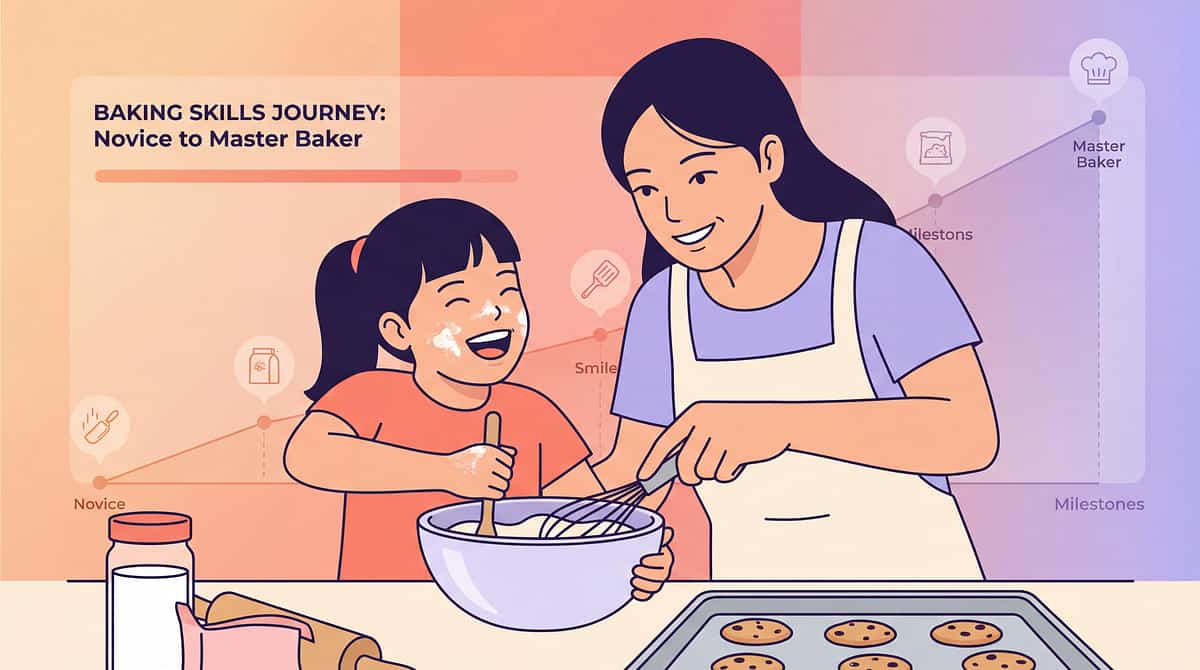
Level 1
Washing produce, stirring, pouring
Level 2
Measuring with visual support, spreading
Level 3
Safe cutting with child-safe knife
Level 4
Following simple visual recipes
Level 5
Multi-step recipes with support
Level 6
Independent simple cooking
Level 7
Complex cooking with minimal support
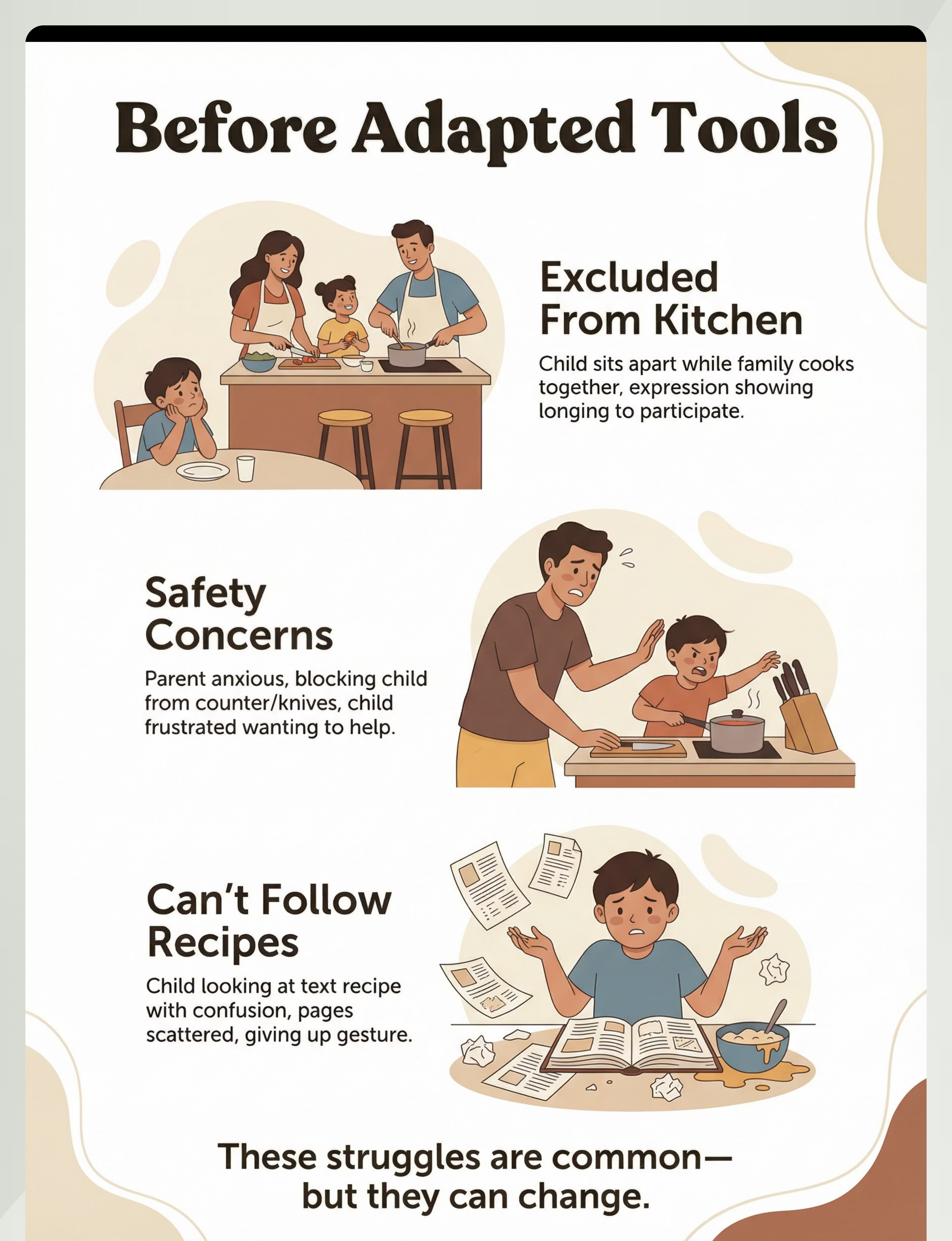
The Struggle (Before)
Before introducing child-friendly cooking tools, many families face common challenges that prevent children from fully participating in the kitchen. This often leads to feelings of exclusion and missed opportunities for skill development.
Excluded From Kitchen
Situation: Child never participates in cooking. Parents do everything.
Experience: No kitchen skills developing. Missing practical learning opportunities every single day.
Emotion: Exclusion, missed opportunities, growing skill gap
Safety Concerns
Situation: Parents afraid child will get hurt. No access to kitchen tasks.
Experience: Child frustrated, wants to help. Parents anxious about any kitchen involvement.
Emotion: Fear, limitation, growing frustration
Can't Follow Recipes
Situation: Text-based recipes too complex. Can't sequence steps.
Experience: Gives up easily. No independent cooking possible. Complete dependence continues.
Emotion: Confusion, giving up, learned helplessness
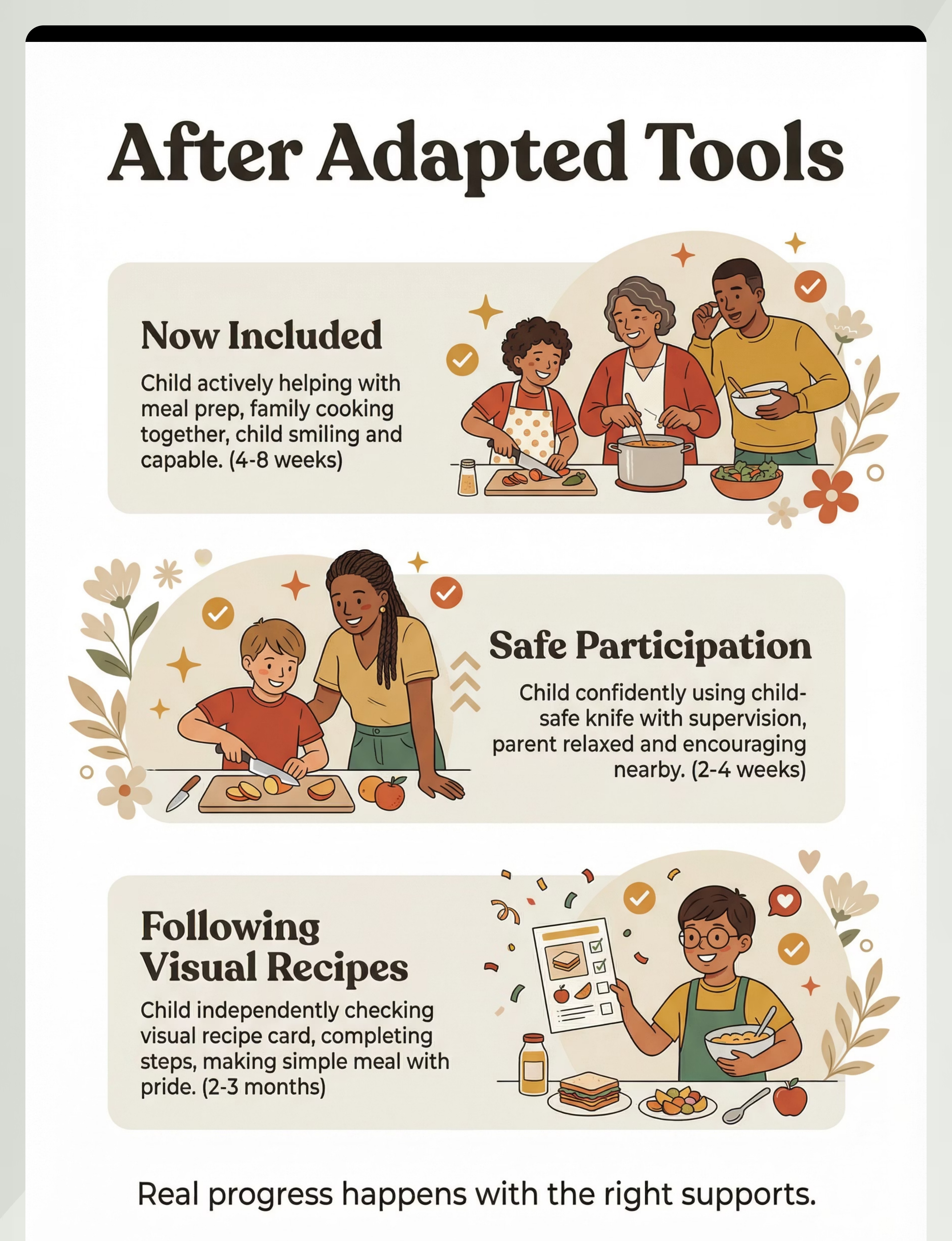
The Breakthrough (After)
Excluded From Kitchen → Included & Capable
Situation: Adapted tools and visual recipes enabled participation
Experience: Now helps with meal prep regularly. Building skills steadily with each cooking session!
Emotion: Inclusion, capability, growing confidence
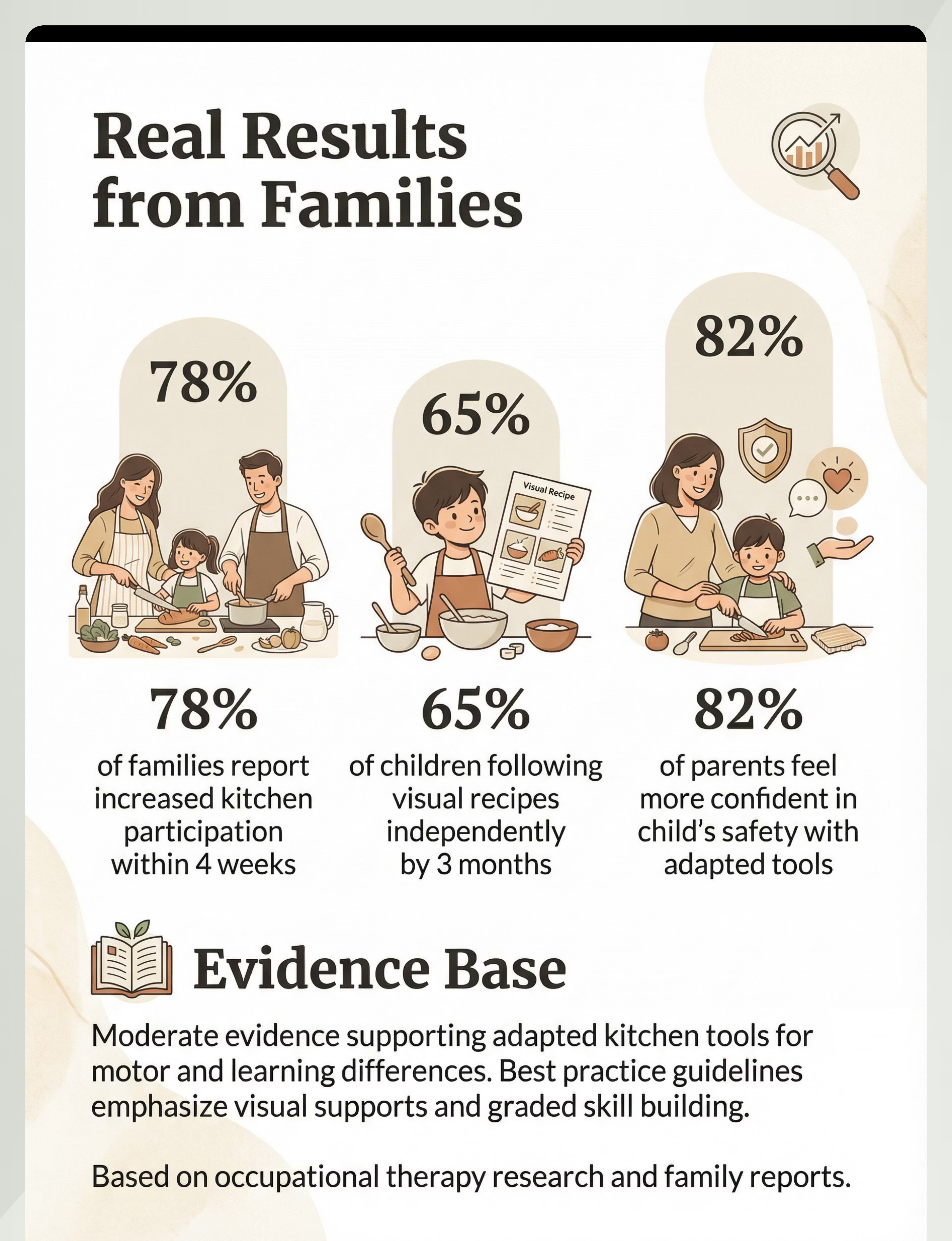
4-8 weeks
Safety Concerns → Safe Participation
Situation: Child-safe knives, step stool, close supervision implemented
Experience: Safe participation happening daily. Skills building safely with proper tools and guidance.
Emotion: Safe participation, confidence, capability
2-4 weeks
Can't Follow Recipes → Independent Success
Situation: Visual recipes with pictures transformed cooking completely
Experience: Now follows steps independently. Making simple meals with minimal support!
Emotion: Independence, success, pride in accomplishment
2-3 months
What to Expect (Realistic Timelines)
Progress happens in stages. Every child develops at their own pace, but here are typical milestones families report when using adapted kitchen tools consistently:
Participates in simple kitchen tasks
Washing vegetables, stirring, pouring with assistance. First steps toward involvement.
2-4 weeks
Uses adapted tools safely
Child-safe knives, measuring cups, non-slip mats used correctly with supervision.
2-4 weeks
Follows visual recipes
Can sequence 3-5 step recipes using picture cards. Major milestone for independence!
4-8 weeks
Completes simple recipes
Makes snacks or simple meals from start to finish with decreasing support.
2-3 months
Increasing kitchen independence
Takes initiative, handles more complex tasks, needs less supervision over time.
3-6 months
Is This Right for My Child? (2-Minute Check)
Answer these questions to determine if adapted cooking tools are a good fit for your family. Three or more "yes" answers indicate strong potential benefit.
Does your child participate in any kitchen tasks?
If yes: Build on current participation with better tools and supports
If no: Start with simple tasks and appropriate adaptations
Does your child have motor challenges affecting kitchen work?
If yes: Adapted tools are specifically designed to address these barriers
Can your child follow multi-step directions?
If yes: Ready for visual recipes and more complex tasks
If no: Start with single-step tasks and visual supports
Do you have safety concerns about kitchen participation?
If yes: Start with safe, adapted tools designed specifically for learning—child-safe knives, no-heat tasks, close supervision

3+ "yes" answers = strong fit. Adapted kitchen tools can help your child build practical skills safely.
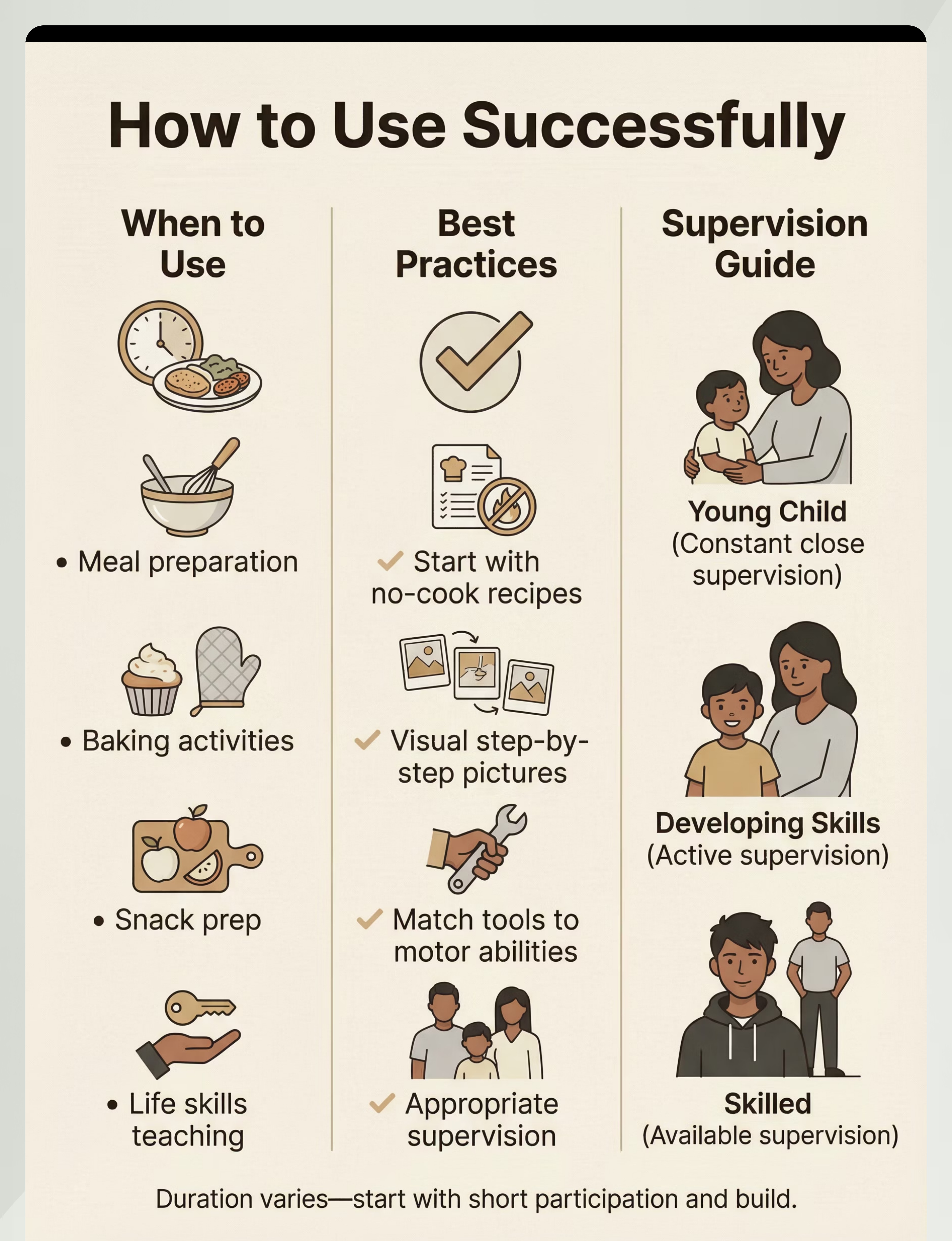
Usage Guide
When to Use ✓
  • Meal preparation times—real participation in daily cooking
  • Baking activities—precise measuring and following recipes
  • Snack preparation—building independence with simple tasks
  • Life skills teaching times—focused skill-building sessions
  • Family cooking time—inclusive participation for everyone
When NOT to Use ✗
  • When rushed—safety risk when hurrying
  • When child is dysregulated—wait for calm, focused state
  • Without appropriate supervision—never leave unsupervised
Supervision by Age & Skill Level
Age/Skill Range
Supervision Level
Notes
Young learners (3-6 years)
Constant close supervision
Within arm's reach at all times. Direct all activities.
Developing skills (6-10 years)
Active supervision, hands-off guidance
In same room, watching closely but allowing independence.
Skilled users (10+ years)
Available supervision, increasing independence
Nearby and available. Check in regularly. Increase autonomy gradually.
Settings: Home kitchens (primary), School cooking programs (educational)
Duration: Varies by task; start with short participation (5-10 minutes) and gradually extend time as skills and attention build
Age Note: Match tasks to developmental level and motor abilities, not just chronological age
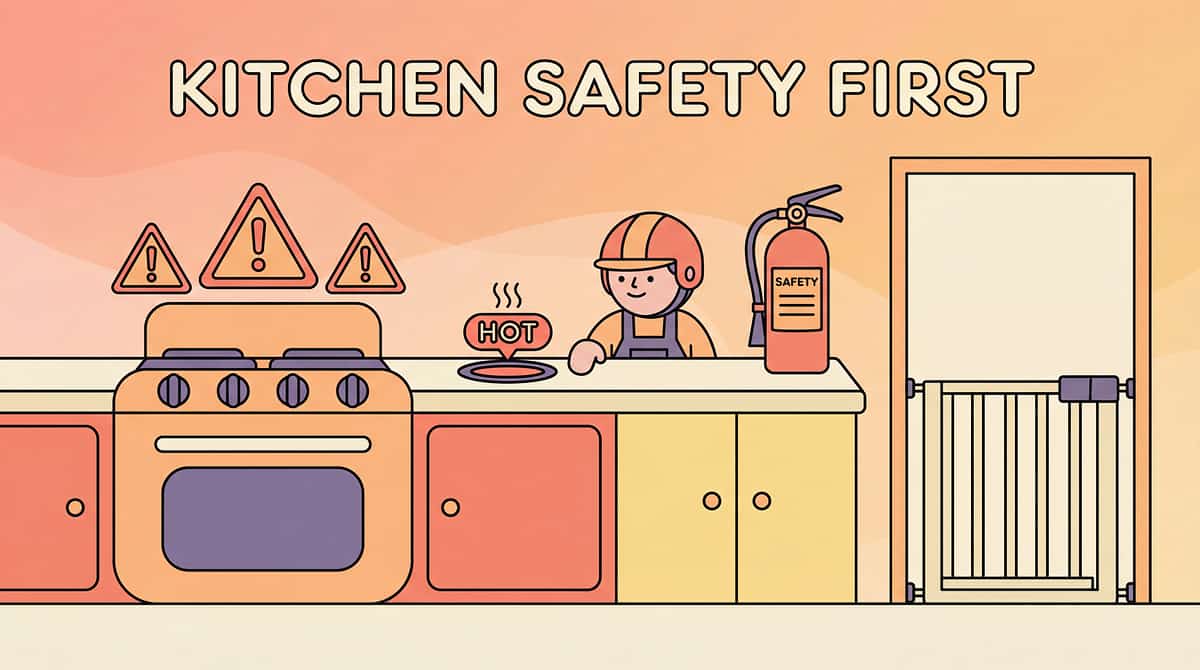
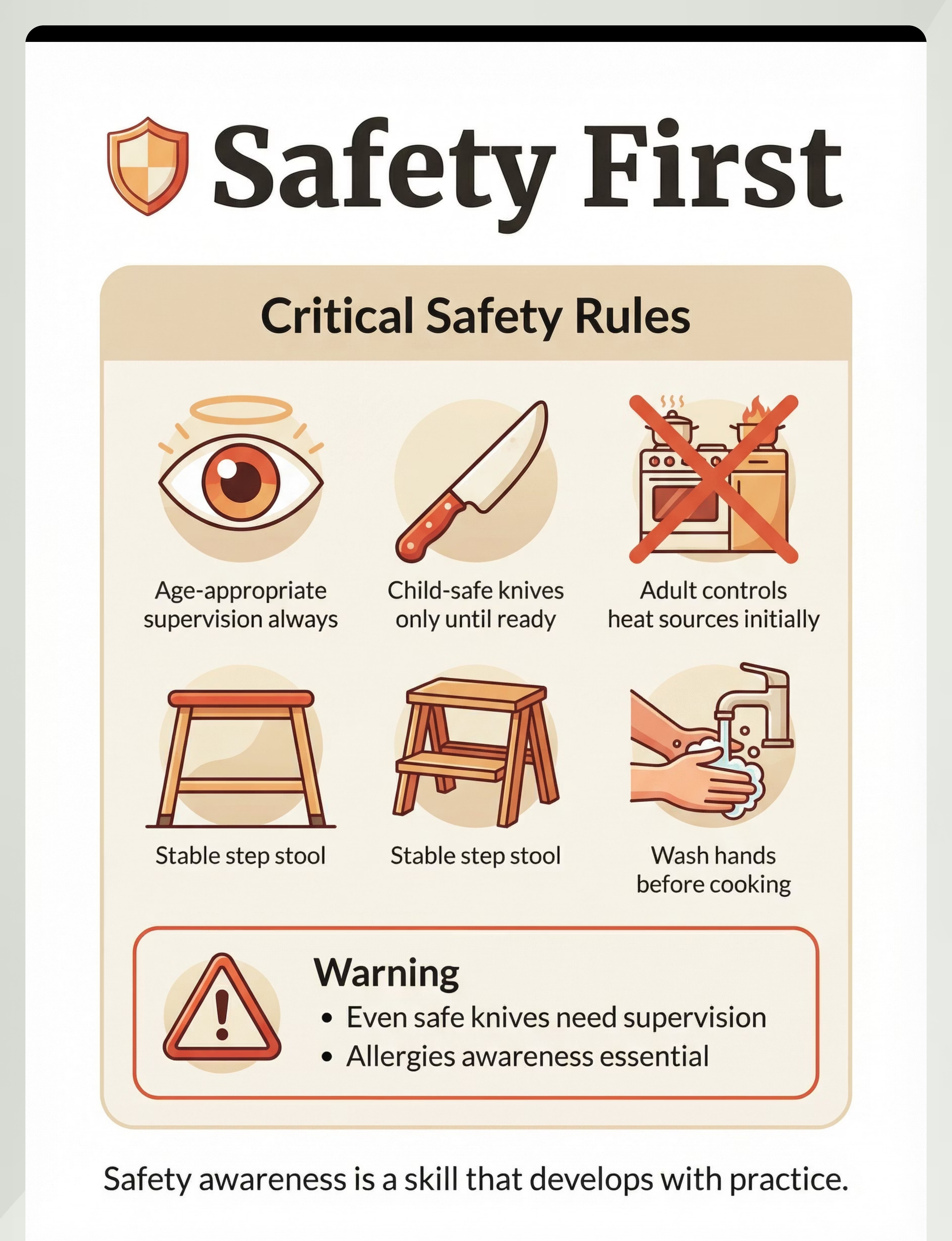
Safety First
Critical Safety
  • Age-appropriate supervision always required
  • Child-safe knives only until ready for next level
  • Heat sources adult-controlled initially
  • Stable step stool with non-slip surface
  • Wash hands before cooking every single time
Warnings
  • Even child-safe knives need supervision—not truly unsupervised
  • Hot surfaces, ovens require adult control—serious burn risk
  • Allergies awareness essential—always check ingredients
  • Choking hazards during tasting—appropriate food sizes
Never Do This
  • Unsupervised kitchen access
  • Real knives before demonstrating readiness
  • Tasks clearly beyond ability level
Safety Checklist
Before Use
  • Clean workspace prepared
  • Appropriate tools ready
  • Visual recipe available
  • Ingredients prepared
  • Supervision arranged
During Use
  • Following safety rules
  • Using tools appropriately
  • Following visual recipe
  • Appropriate supervision maintained
Signs of Success
  • Safe participation happening
  • Following recipe steps correctly
  • Task completion achieved
  • Growing independence visible
Common Questions (Honest Answers)
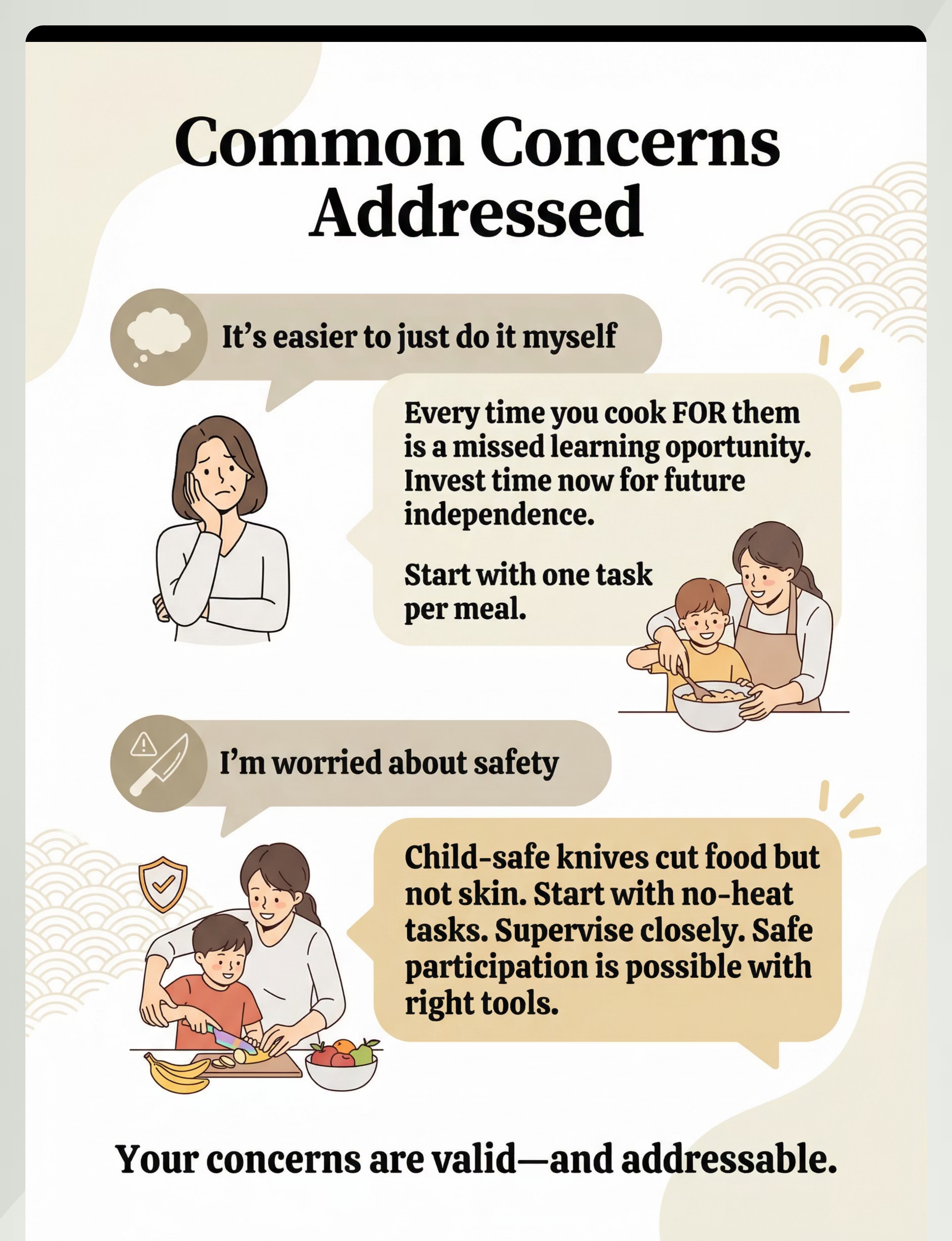
Q: "It's easier to just do it myself"
A: Short-term yes, long-term no. Every time you cook FOR them is a missed learning opportunity. Invest time now for future independence. The extra 15 minutes today builds lifelong skills.
Try this: Start with one task per meal. Build gradually. Even washing vegetables is real participation.
Q: "They'll make a mess"
A: Mess is part of learning! Start with tasks that have contained mess. Use smocks, mats, and make cleanup part of the routine. Skills require practice, and practice creates mess. That's normal and okay.
Try this: Expect and contain mess. Make cleanup a learning task too. Celebrate effort, not perfection.
Q: "I'm worried about safety"
A: Child-safe knives cut food but not skin. Start with no-heat tasks like salads or sandwiches. Supervise closely. Build safety awareness as a teachable skill, not just a restriction. Safe participation is absolutely possible.
Try this: Child-safe tools, no-heat start, close supervision. Safety improves with experience.
Q: "They'll never cook independently"
A: Many people with disabilities cook independently with adaptations. Start building skills now—don't wait. Visual recipes and adapted tools enable far more than you might think. Don't limit future potential based on current abilities.
Try this: Skills build over time. Start where they are. Adaptations enable independence.
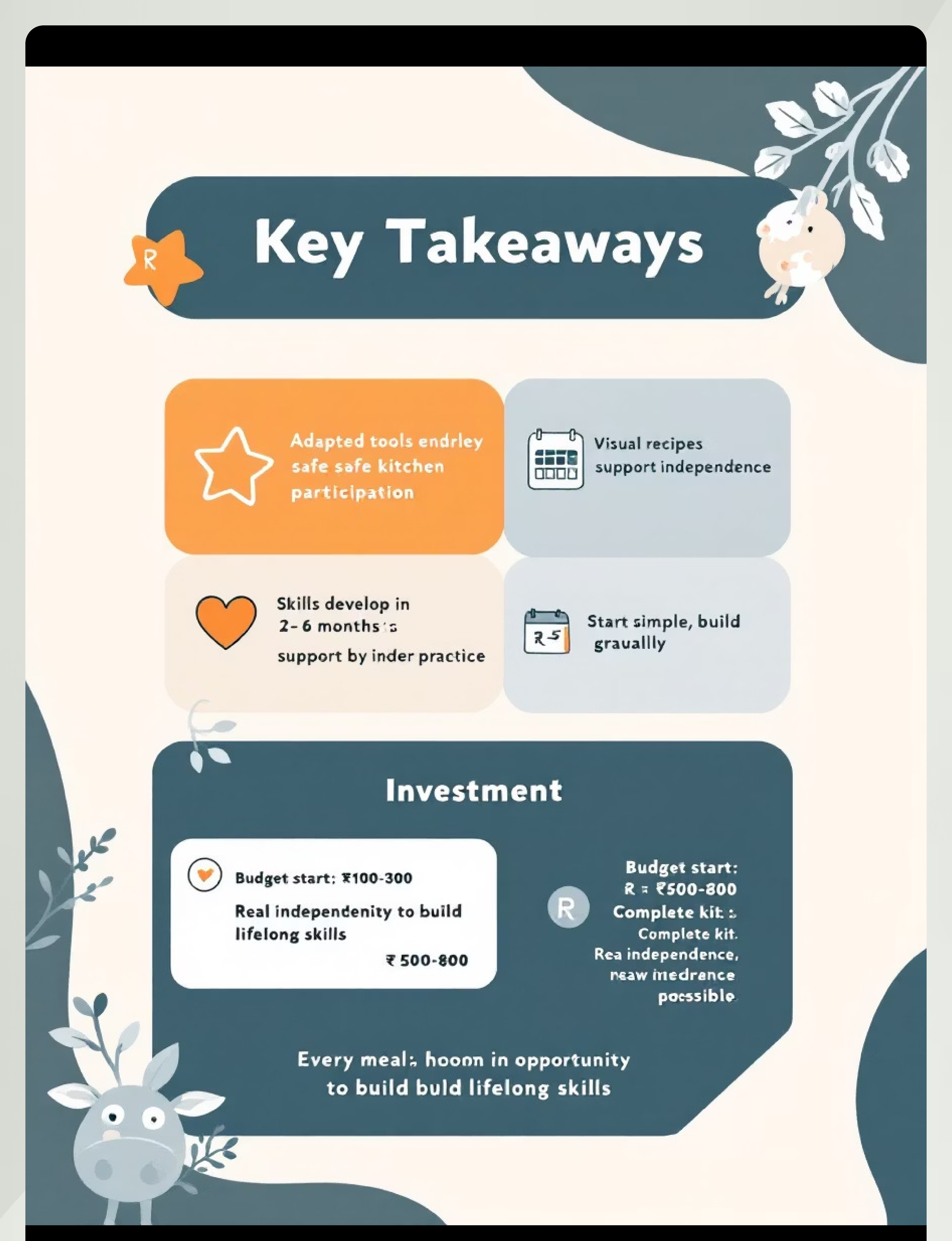
Investment Guide
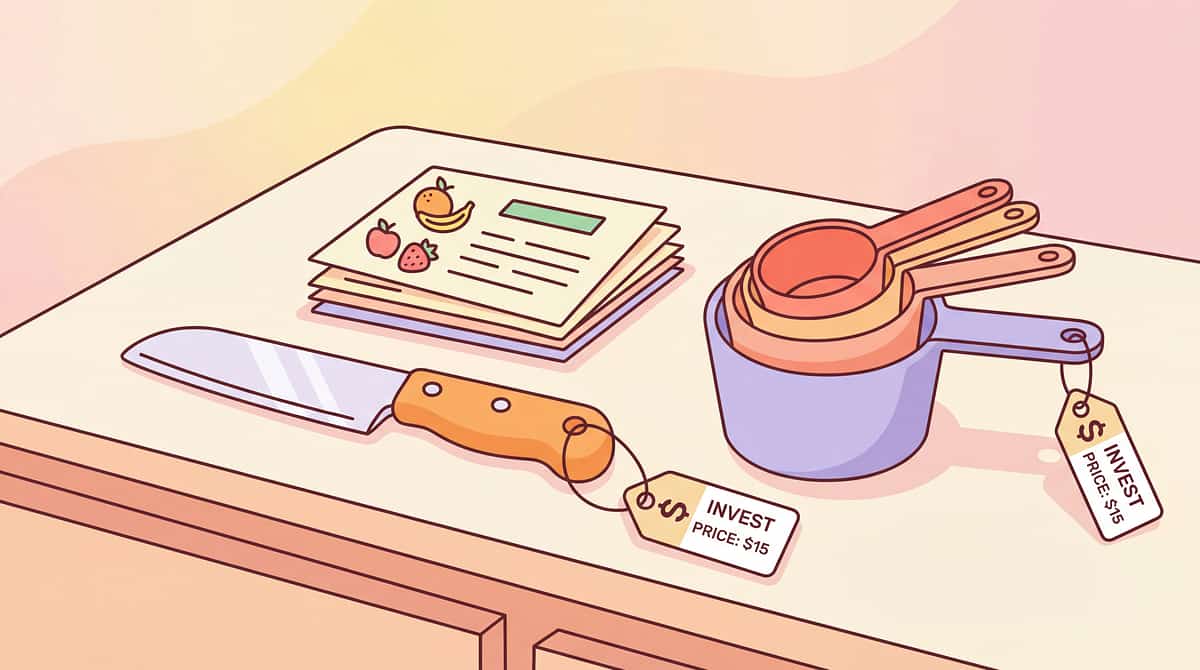
Adapted cooking tools range from ₹100–800 depending on type and quality. You don't need everything at once—start with essential safety tools and visual supports, then build your collection based on your child's developing skills.
Here's a breakdown of potential investment tiers:
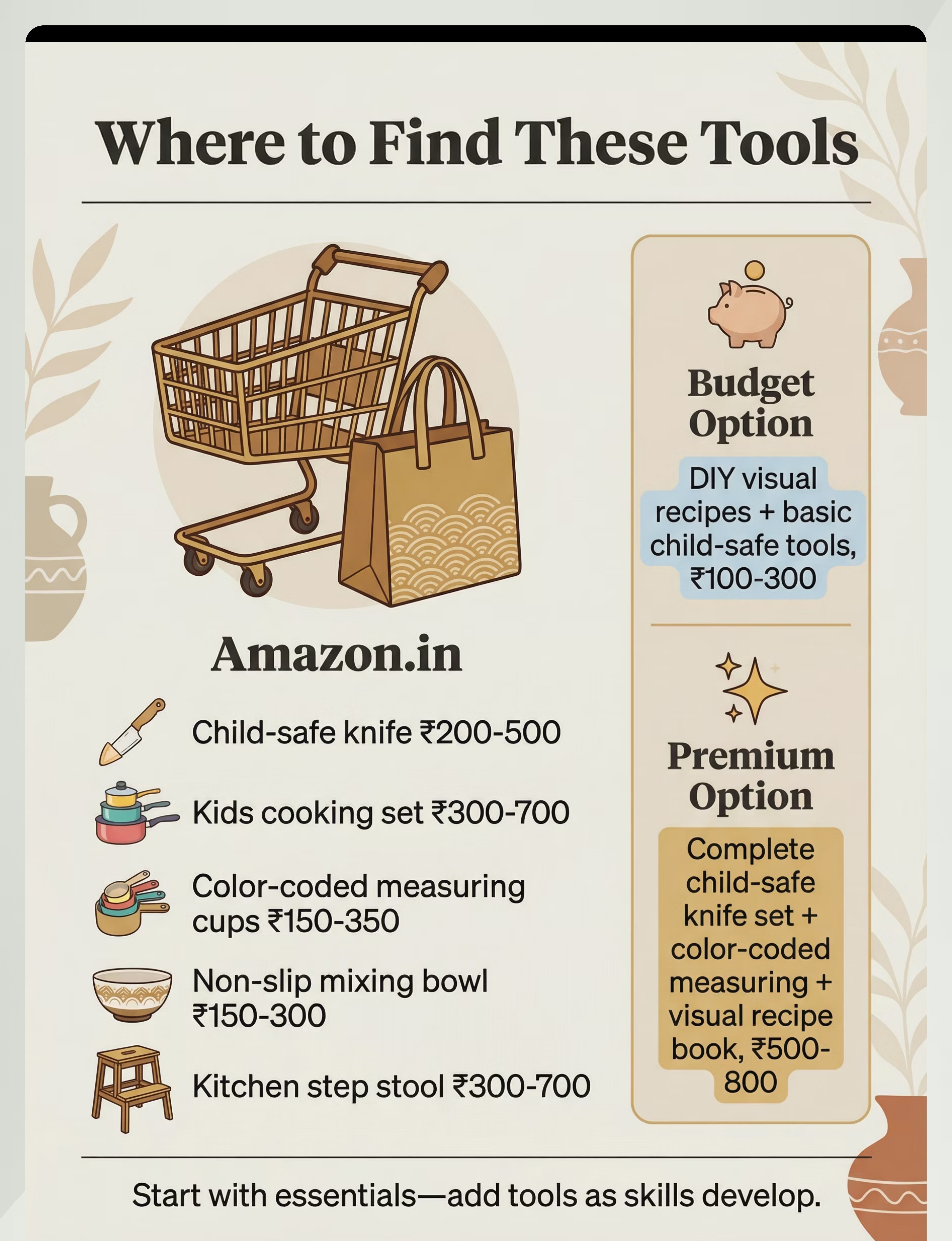
Budget Option
₹100–300
DIY visual recipes + basic child-safe tools
Immediate participation without significant expense
Premium Option
₹500–800
Child-safe knife set + color-coded measuring + visual recipe book
Complete system for safe, independent skill development
Key Features of Adapted Tools
DIY Visual Recipes
Photograph your own step-by-step recipe cards to create personalized visual guides, making cooking accessible and engaging.
Basic Child-Safe Tools
Start with essential plastic knives and use color stickers on existing measuring cups to begin safe kitchen participation.
Quality Child-Safe Knives
Invest in brands like Kuhn Rikon or Curious Chef for durable, effective, and safe cutting tools for young chefs.
Color-Coded Measuring
Utilize complete color-coded measuring sets for easy ingredient identification and accurate portioning, fostering independence.
Professional Visual Recipe Books
Access professionally designed visual recipe collections that offer a structured approach to learning new dishes and techniques.
Investment Progression
Phase 1: Immediate Safe Start
Begin with a child-safe knife (₹200–600) and free DIY visual recipes. This enables immediate and safe participation without major costs.
Phase 2: Expand Visual Supports
Add pre-made visual recipe cards or a dedicated visual recipe book (₹100–300) as skills develop, providing more diverse options.
Phase 3: Enhance Toolset
Introduce additional adapted tools like color-coded measuring cups or specialized gripping aids (₹100–200) to broaden cooking capabilities.
Phase 4: Build a Complete System
Gradually invest in a comprehensive set of quality child-safe knives and accessories to support advanced independent cooking skills.

Overall range across all variants: ₹100–800 (₹1–10 USD)
Where to Buy in India
Availability: Moderately Available—most items can be found through online retailers, though you may need to search specifically for adapted versions.
Recommended Platforms
Amazon.in
Search Term: "child safe knife"
Price Range: ₹200–500
Amazon.in
Search Term: "kids cooking set"
Price Range: ₹300–700
Amazon.in
Search Term: "color coded measuring cups"
Price Range: ₹150–350
Amazon.in
Search Term: "non slip mixing bowl"
Price Range: ₹150–300
Amazon.in
Search Term: "kitchen step stool kids"
Price Range: ₹300–700
Buying Tips ✓
Child-safe knives are essential for learning cutting safely
Color-coded measuring cups simplify recipe following
Visual recipe cards can be made at home or purchased
Non-slip mats stabilize work surfaces effectively
Step stools must be stable and enable counter access safely
Red Flags
Giving real knives too early before readiness
No supervision during learning phase
Tasks beyond motor ability causing frustration
No visual supports for recipe following
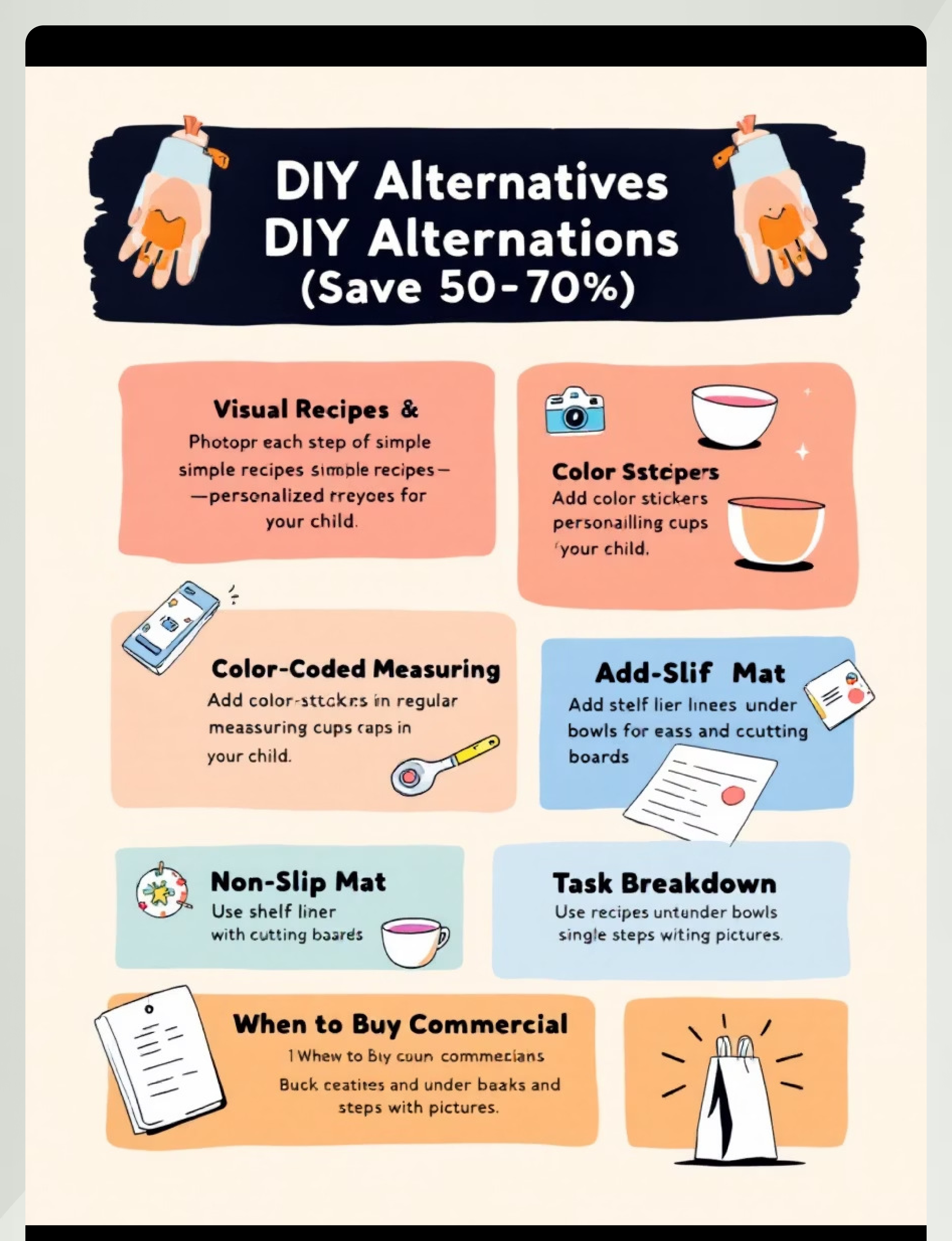
DIY Alternative (Save 50-70%)
Feasibility: High | Time Required: 30-60 minutes | Cost Savings: 50-70% compared to commercial options
Materials Needed & DIY Steps
1
Visual recipes
Photograph each step of simple recipes your child might make. Print or display on tablet.
2
Color-coded measuring
Add color stickers to regular measuring cups and spoons to simplify identification.
3
Non-slip mat
Use shelf liner under bowls and cutting boards for stability during food prep.
4
Stable step stool
Use a stable step or tower you already own for safe counter access.
5
Task analysis
Break recipes into single steps with one picture per step for clarity.
6
Ingredient bins
Pre-measure ingredients into labeled containers before starting the recipe.
DIY vs Commercial Tradeoffs
When to DIY
  • Visual recipes (personalized to your family's meals)
  • Color-coding measuring tools you already own
  • Non-slip solutions using shelf liner
  • Task breakdown for specific recipes
When to Buy Commercial
  • Child-safe knives (DIY versions less effective)
  • Quality kitchen tools built for accessibility
  • Step stools (safety is critical)
  • Professional visual recipe sets with tested clarity

Tradeoffs: DIY safe knives are less effective than commercial versions. Photo recipes take time to create initially but can be personalized to your child's favorite foods.

Preview of cooking kitchen tools adapted Therapy Material

Below is a visual preview of cooking kitchen tools adapted therapy material. The pages shown help educators, therapists, and caregivers understand the structure and content of the resource before use. Materials should be used under appropriate professional guidance.

Page 1
Page 2
Page 3
Page 4
Page 5
Page 6
Page 7
Page 8
Page 9
Page 10
Page 11
Page 12
Page 13
Page 14
Page 15
Page 16
Page 17
Page 18
Page 19
Page 20
Link copied!
Measuring Success & Next Steps
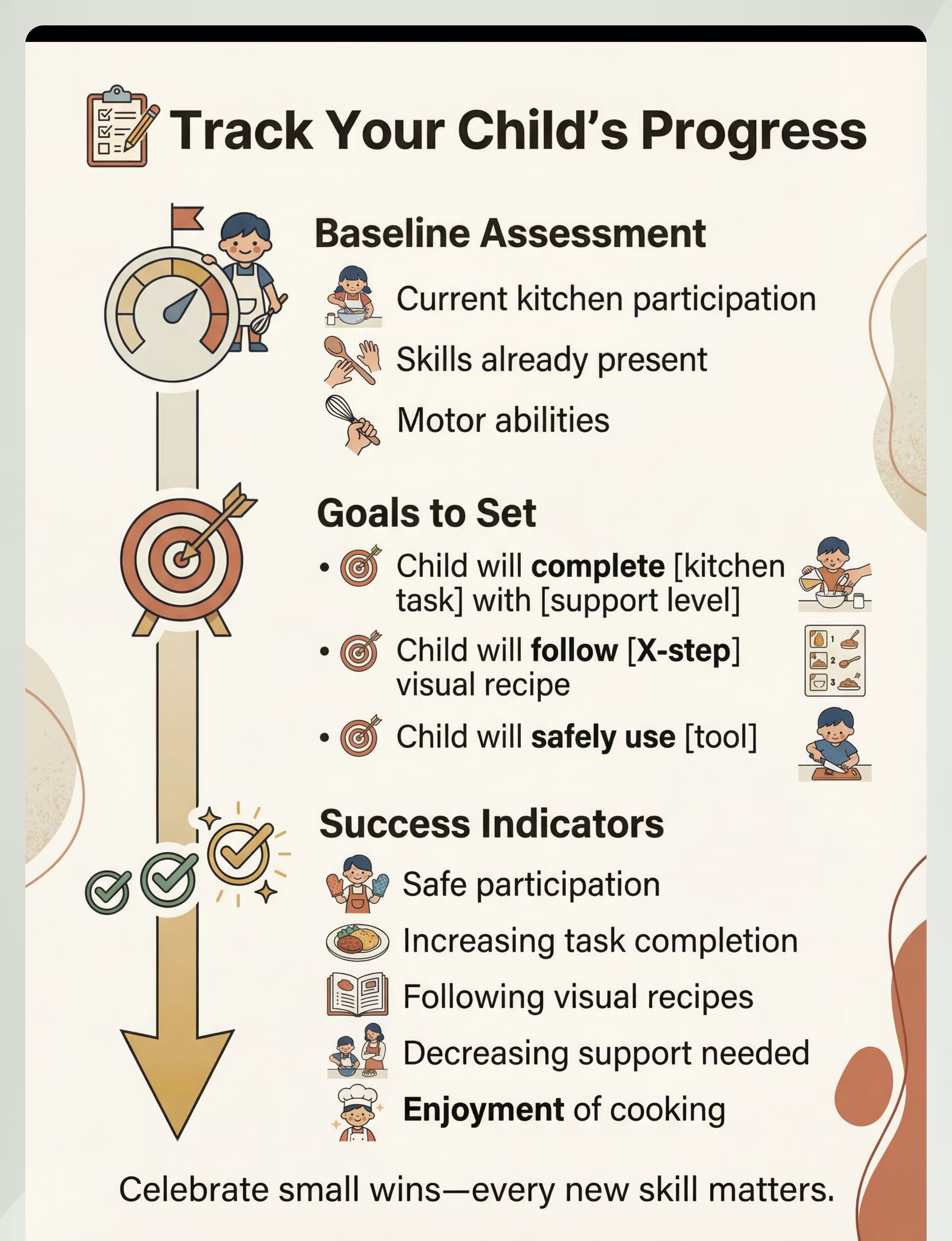
Track Progress
Baseline (Measure First)
  • Current kitchen participation level
  • Skills already present
  • Motor abilities assessment
  • Recipe-following ability
Goals (Target These)
  • Child will complete [specific task] with [support level]
  • Child will follow [number]-step visual recipe
  • Child will safely use [specific tool]
  • Child will prepare [simple dish] with support
Success Indicators
  • Safe participation happening
  • Increasing task completion
  • Following visual recipes
  • Decreasing support needed
  • Enjoyment of cooking
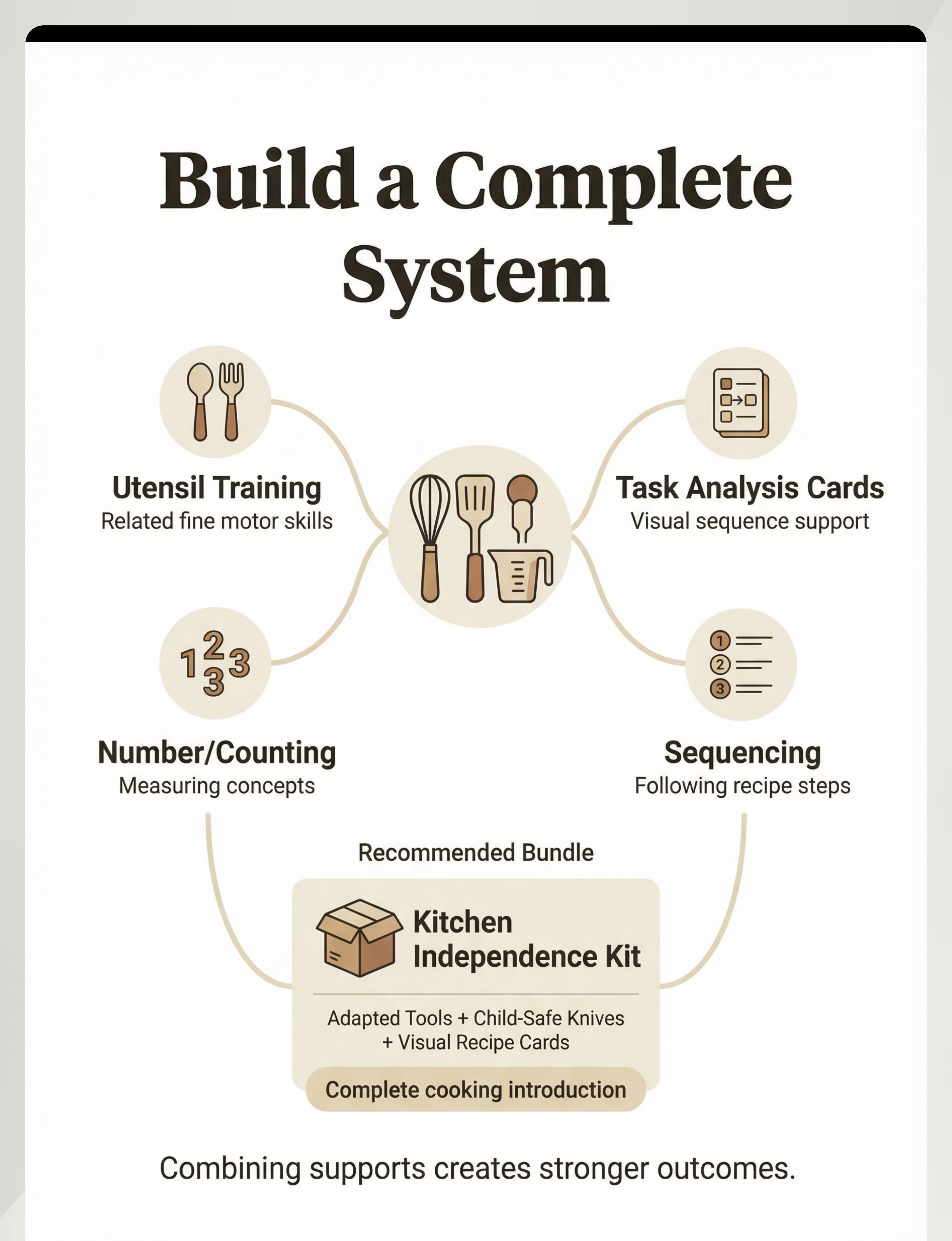
Complete the Kit
These complementary tools work together to support kitchen independence and related skill development:
Utensil Training (ID: 9.3)
Related fine motor skills for eating and food preparation
Task Analysis Cards (ID: 3.5)
Visual sequence support for multi-step activities
Number/Counting (ID: 8.6)
Measuring concepts and recipe math skills
Sequencing (ID: 8.3)
Following recipe steps in correct order
Quick Summary
Adapted cooking and kitchen tools enable safe participation in food preparation through child-safe equipment, visual recipes, and motor adaptations for building practical life skills. Core Kit (Rank 2), moderate evidence.
cooking
kitchen
life skills
safety
visual recipes
independence
ADL
OT
SpEd
core-kit
Common searches: cooking autism, adapted kitchen tools, child safe knife, visual recipes autism, kitchen skills special needs, cooking life skills, kids cooking tools

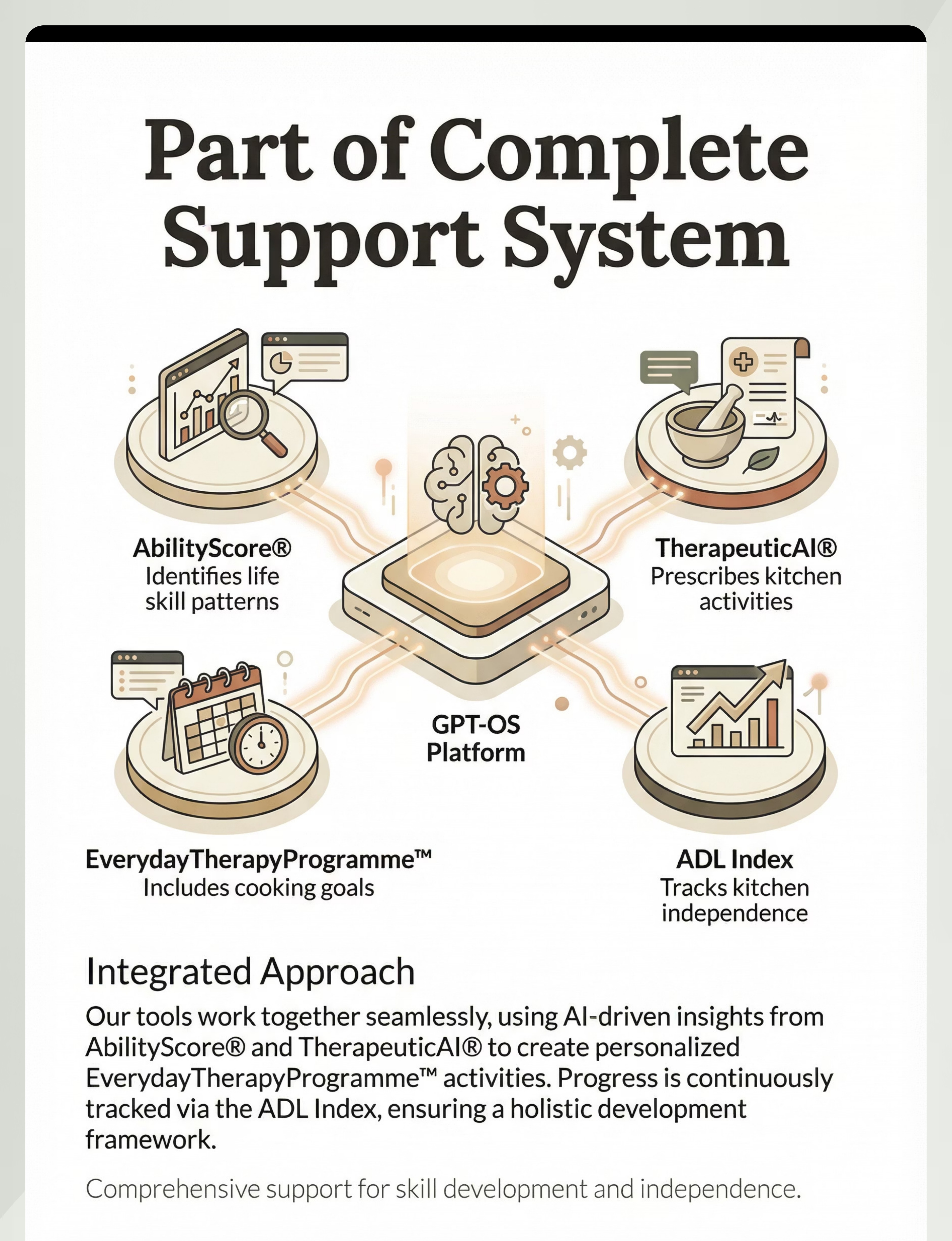
Integration & Support
AbilityScore®
Identifies life skill patterns and kitchen readiness
TherapeuticAI®
Prescribes personalized kitchen activities matched to your child's abilities
EverydayTherapyProgramme™
Includes cooking goals in daily routines
ADL Index
Tracks kitchen independence progress over time
FREE National Autism Helpline
Phone: 9100 181 181
Languages: 16+ languages supported
Website: pinnacleblooms.org
Expert guidance on implementing adapted cooking tools and building kitchen independence

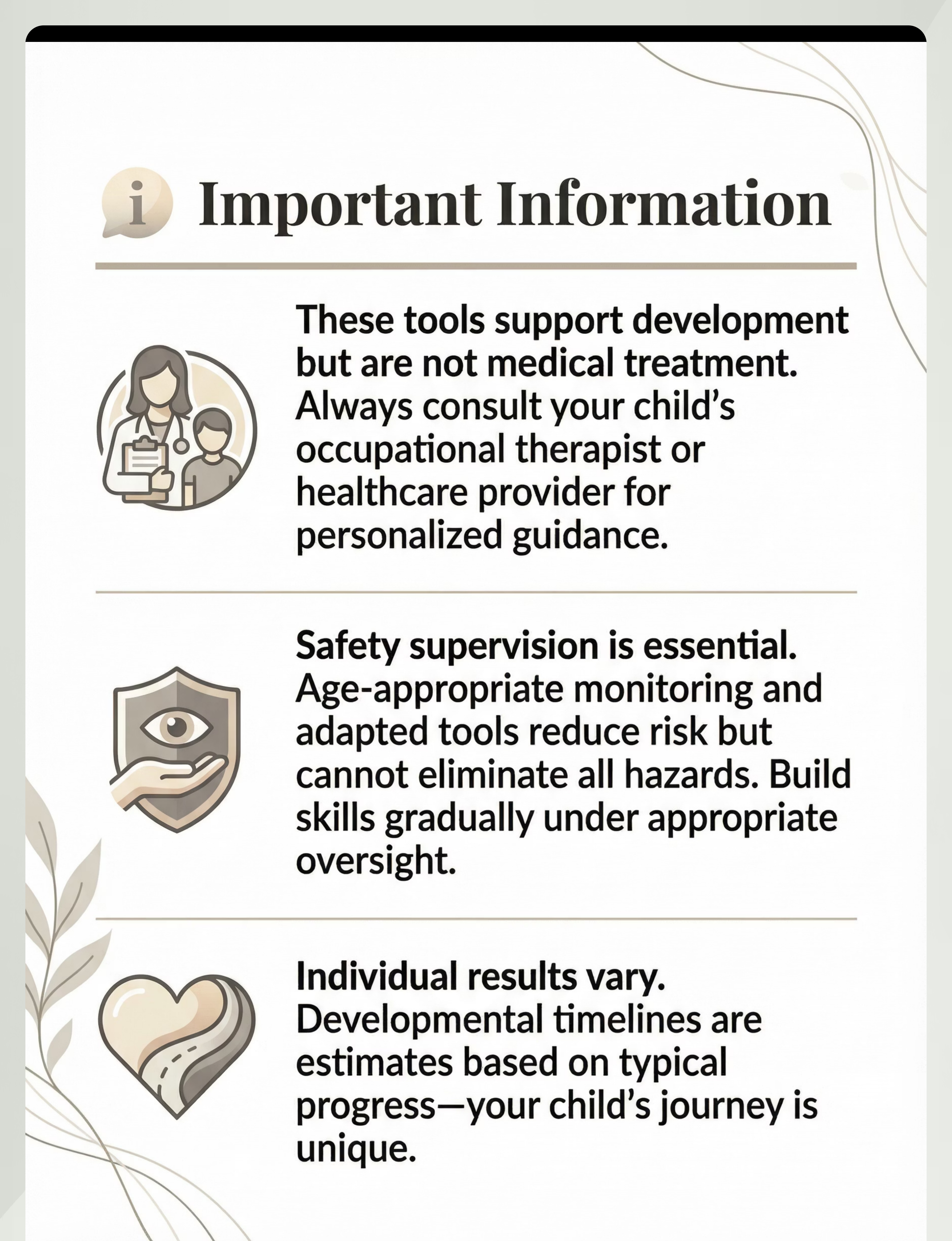
Disclaimer: This is educational information provided by Pinnacle Blooms Network. Always consult qualified occupational therapists, speech-language pathologists, or pediatricians for personalized guidance. Individual results vary based on child's unique abilities and family implementation.