
Tool ID: 11.6
Tool ID: 11.6
OT + SLP Recommended
Strong Evidence
Rank #2
Daily Use
₹100–700
Cup/Bottle Adaptations
Independent drinking and liquid intake system
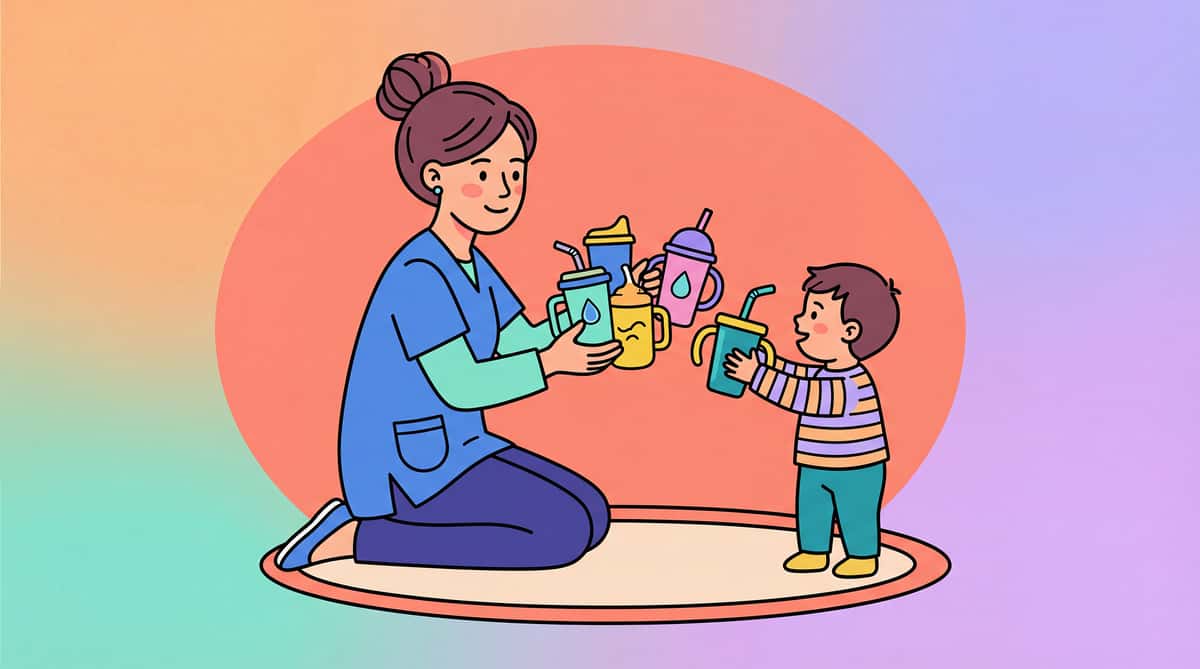
Enable safe, independent drinking through cups and bottles designed for various motor, positioning, and oral challenges. From cut-out cups that protect the airway to weighted cups that provide stability, these adaptations transform drinking from a struggle into an achievable daily skill.
Who This Helps
Independent Drinking
Supports children in achieving safe, independent drinking skills through targeted adaptations that address specific barriers.
Safety & Hydration
Reduces aspiration risk while ensuring adequate fluid intake throughout the day.
Oral Motor Development
Builds essential oral motor skills and coordination through appropriate cup progression.
Ages: 6 months+
Home
Clinic
School
Community
Best for: Children with positioning challenges, motor coordination difficulties, tremors, aspiration risk, bilateral coordination needs, or those transitioning from bottle to cup.
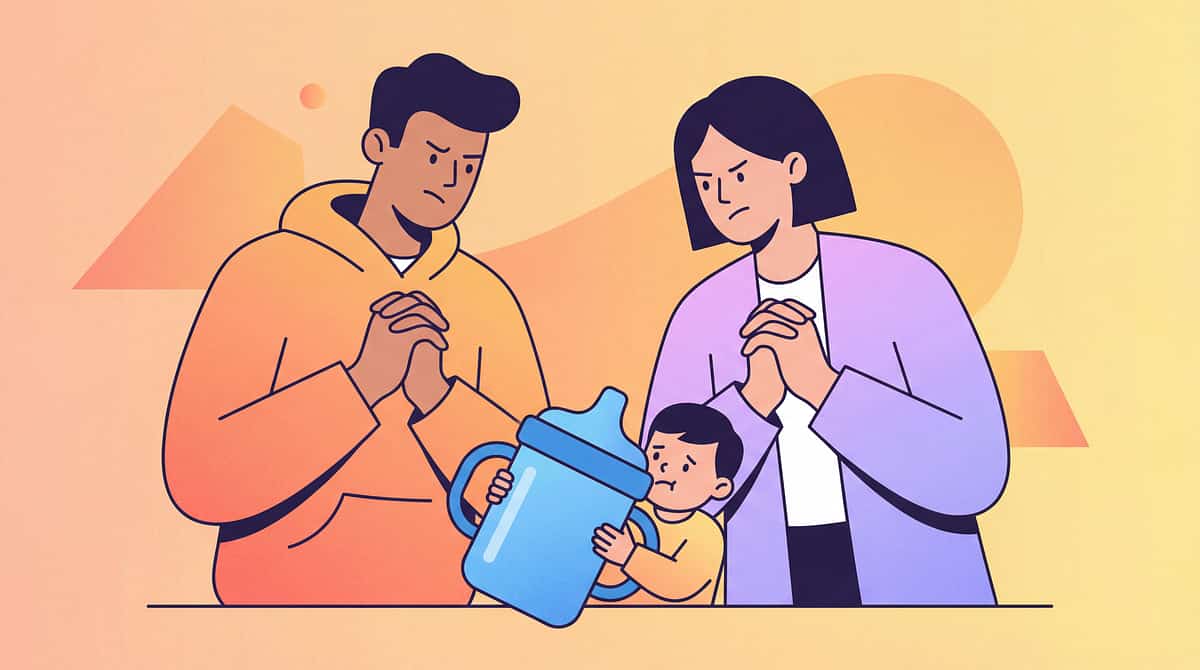
Does This Sound Familiar?
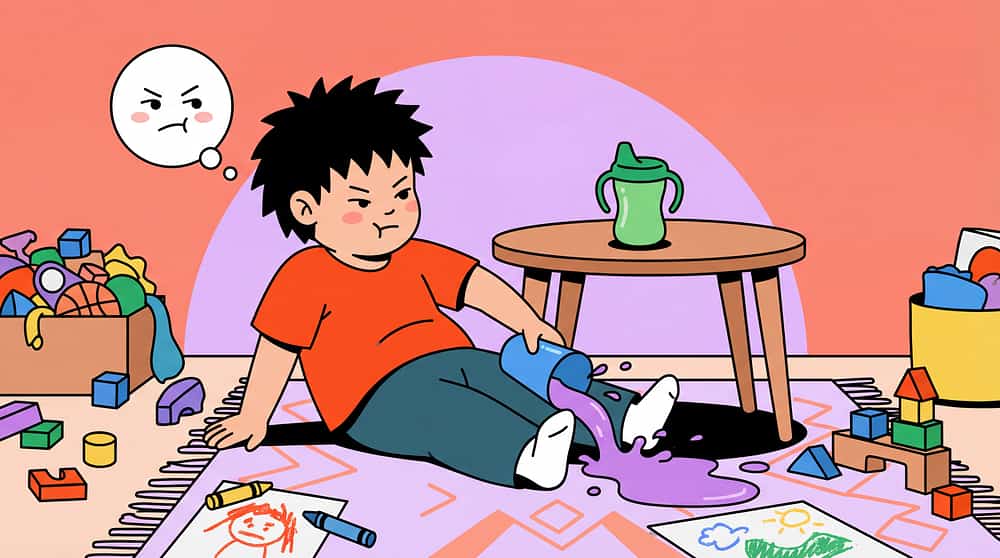
"My child can't drink from a cup. Every attempt ends in frustration or spills. I don't know what to try next."
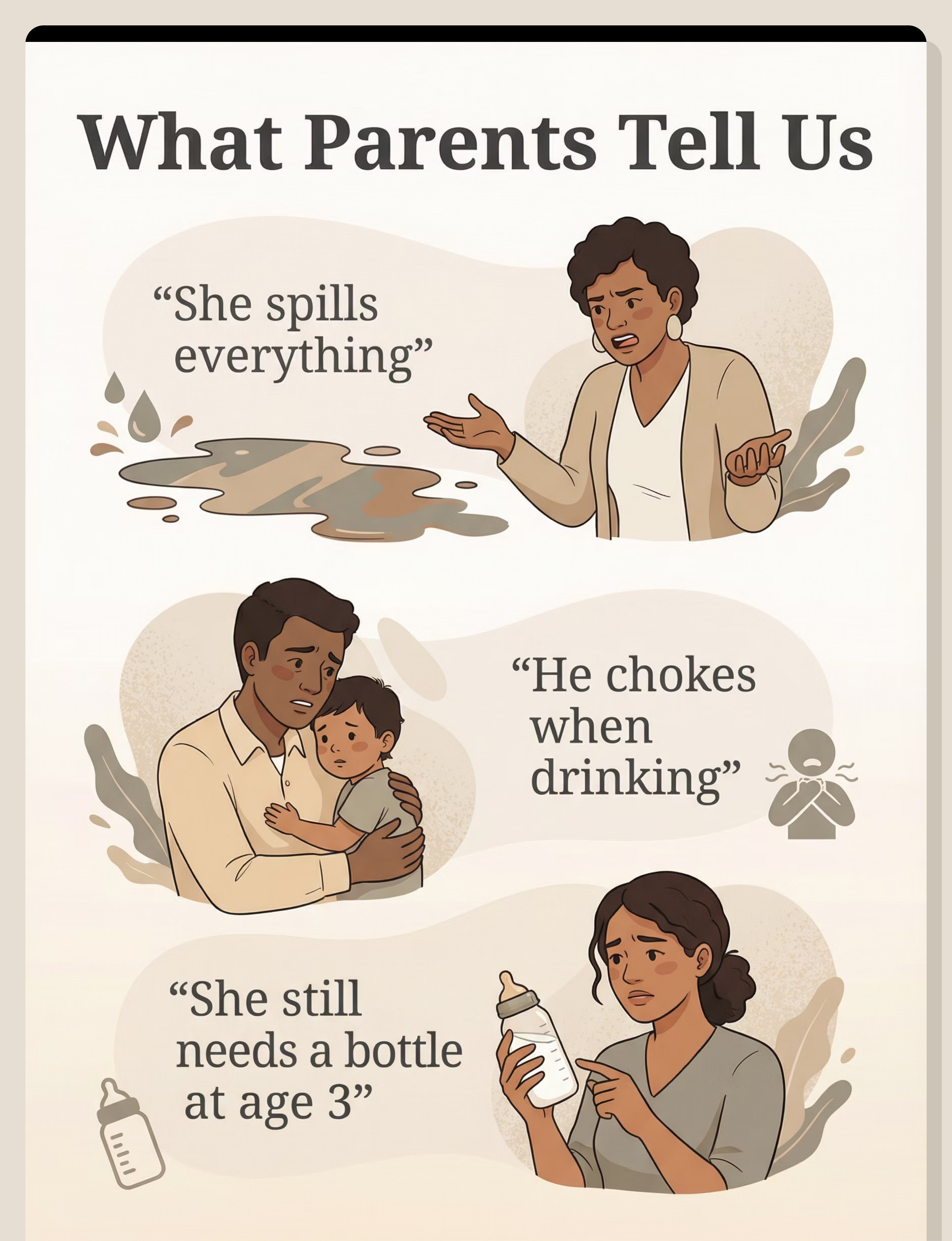
"She spills everything. The mess is constant, and I worry she's not getting enough to drink throughout the day."
"He chokes when drinking. It's terrifying. I'm afraid to give him anything but a bottle, but he's three years old now."
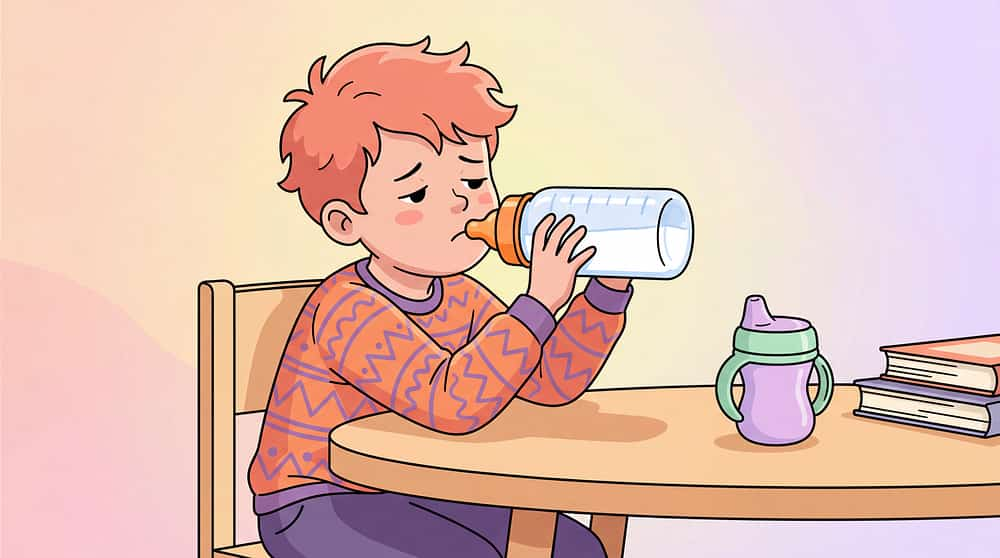
"She still needs a bottle at age 3. We've tried every cup, and she rejects them all. I'm worried about her teeth."
You're not alone. These are common challenges faced by families of children with motor, positioning, or oral motor differences. The right adaptation can transform drinking from a daily struggle into an achievable skill.
A Day Without the Right Support
Morning Hydration
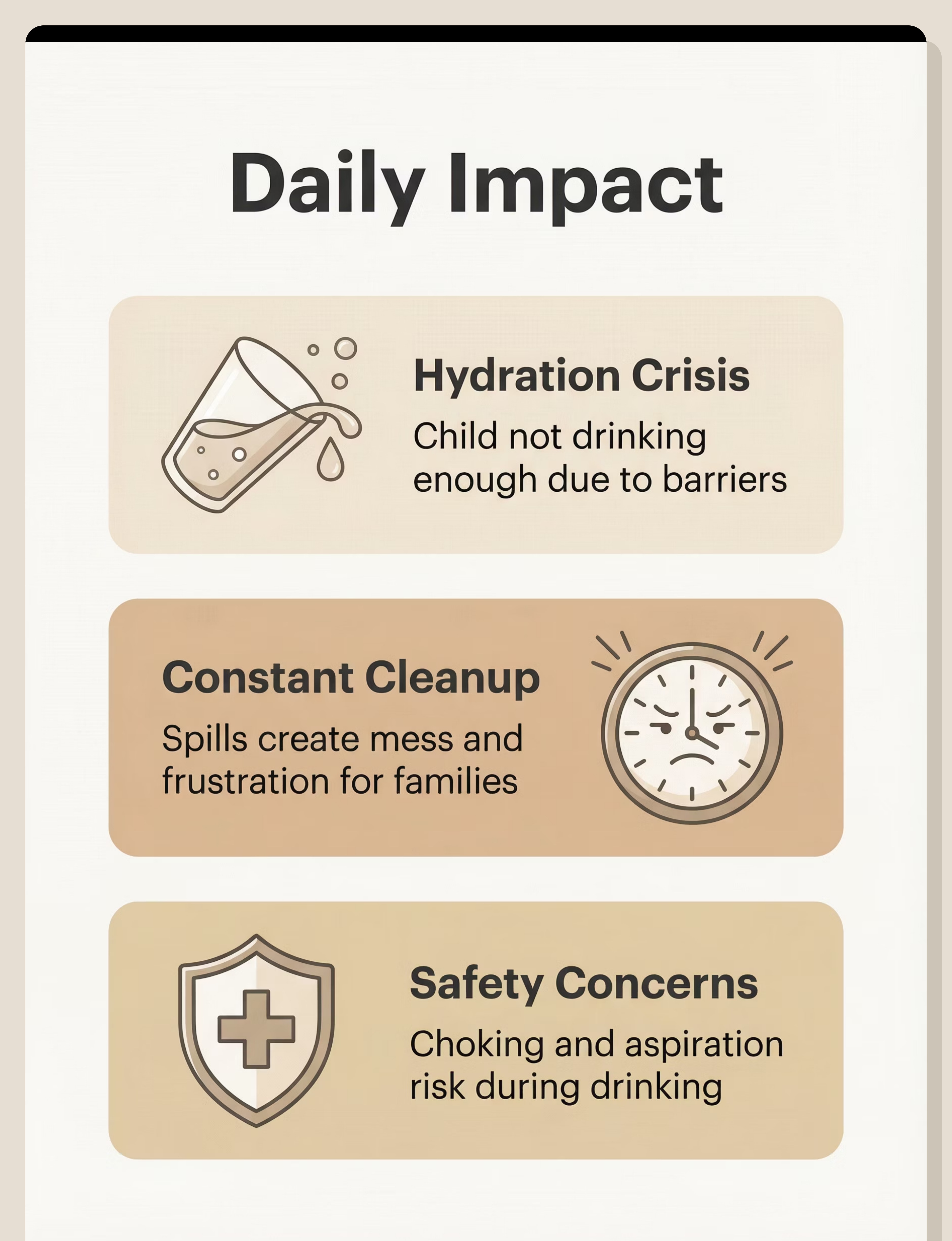
Child refuses water at breakfast. Already behind on fluid intake before the day begins. Parent worries about dehydration.
Transitions & Outings
Can't bring regular cups out. Spills in the car. Bottle at age 3 draws stares. Social situations become stressful.
Therapy & School
Therapist notes inadequate hydration. Teacher reports child avoids drinking. Skills not generalizing across settings.
Bedtime Routine
Child still using bottle to settle. Dental concerns growing. Parents feel stuck in pattern they can't break.
The Science Behind It
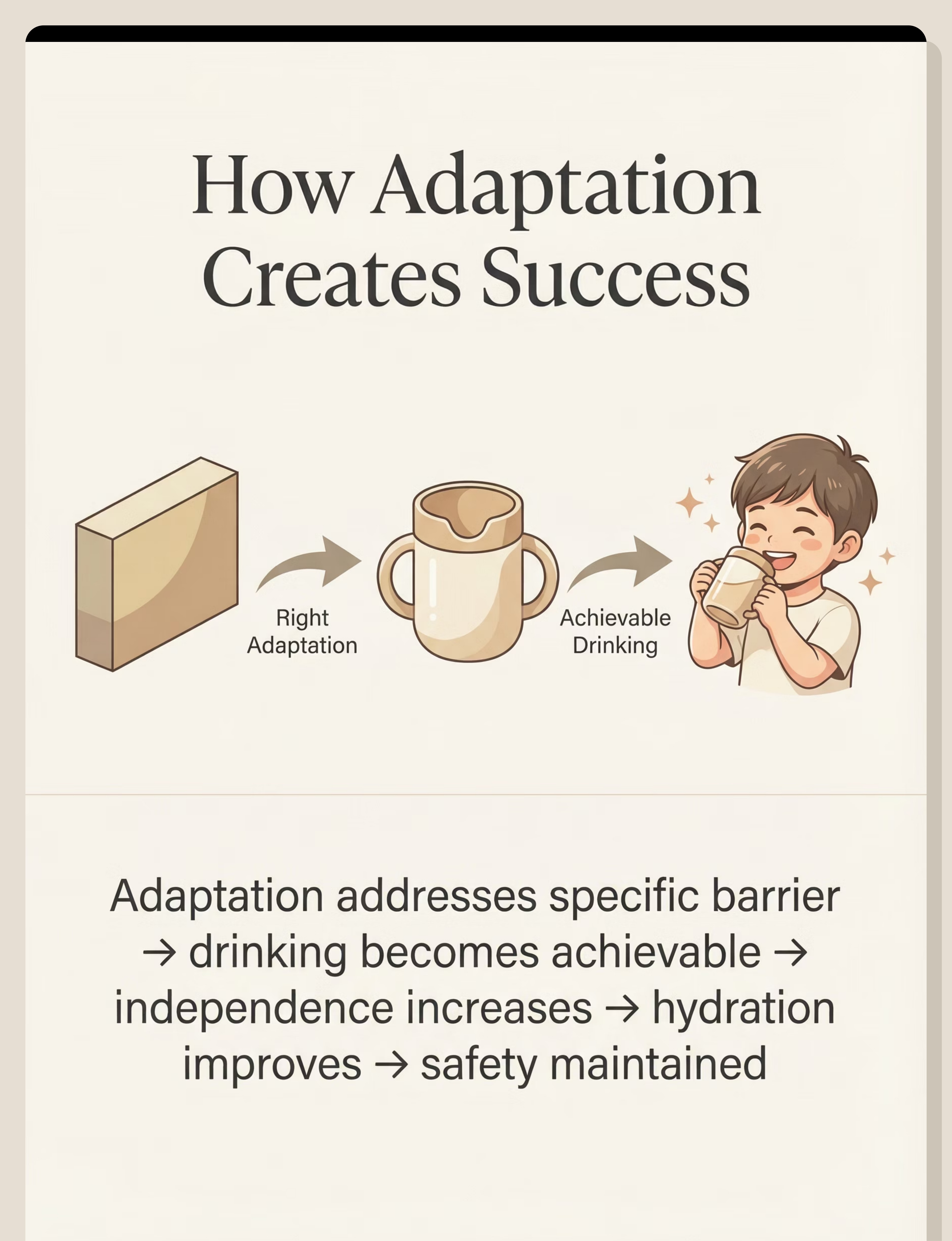
Identify Barrier
Specific challenge is assessed—positioning, motor control, coordination, or transition needs.
Match Adaptation
Appropriate cup modification addresses the exact barrier preventing independent drinking.
Drinking Achievable
With barrier removed, child can drink safely and independently for the first time.
Hydration Improves
Adequate fluid intake achieved. Safety maintained. Independence increases. Skills generalize.
Independent Drinking
Hydration
Safety
Oral Motor Development
Motor Accommodation
Transition Skills
How to Use It Right
1
Match adaptation to specific need
Each cup type addresses a different challenge. Assessment by OT or SLP ensures the right match for your child's needs.
2
Cut-out cups for aspiration risk
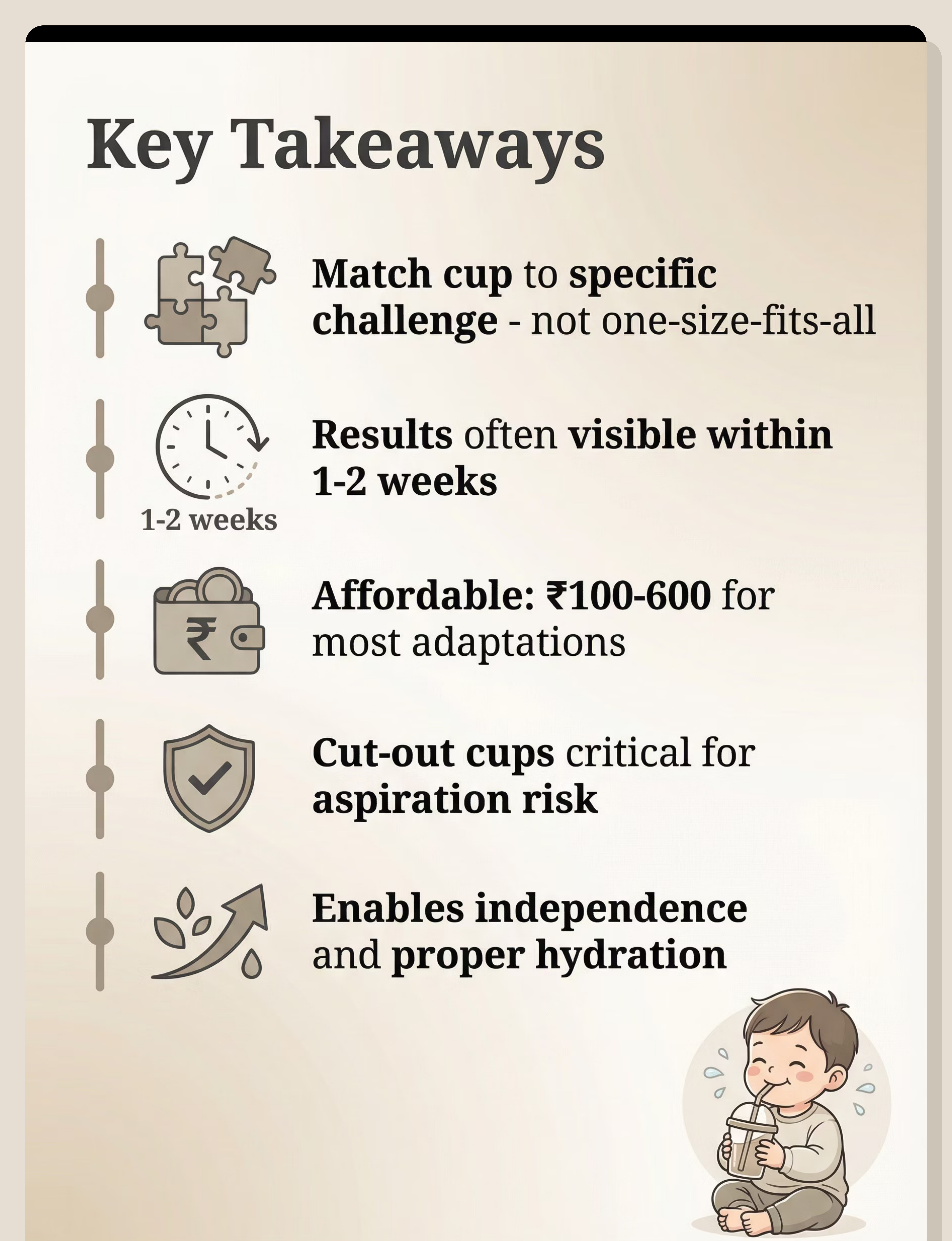
If your child chokes or coughs when drinking, a cut-out cup allows drinking without tilting the head back—protecting the airway.
3
Two handles for bilateral coordination
Children developing bilateral skills benefit from cups with handles on both sides, providing stability and practice.
4
Progress from trainer cups to open cups
Use 360 cups or similar trainers as a bridge from bottle to open cup, building lip closure and oral motor skills.
5
Consider lip closure and flow control
Recessed lid cups control flow rate, helping children who struggle with managing liquid in their mouth.
6
OT/SLP guidance for complex needs
Children with swallowing difficulties, aspiration history, or complex oral motor needs require professional evaluation and monitoring.

Duration: Use adapted cups at every drinking opportunity throughout the day. This is ongoing support that continues as long as needed, with progression to less adapted options when appropriate.
Expert Perspective
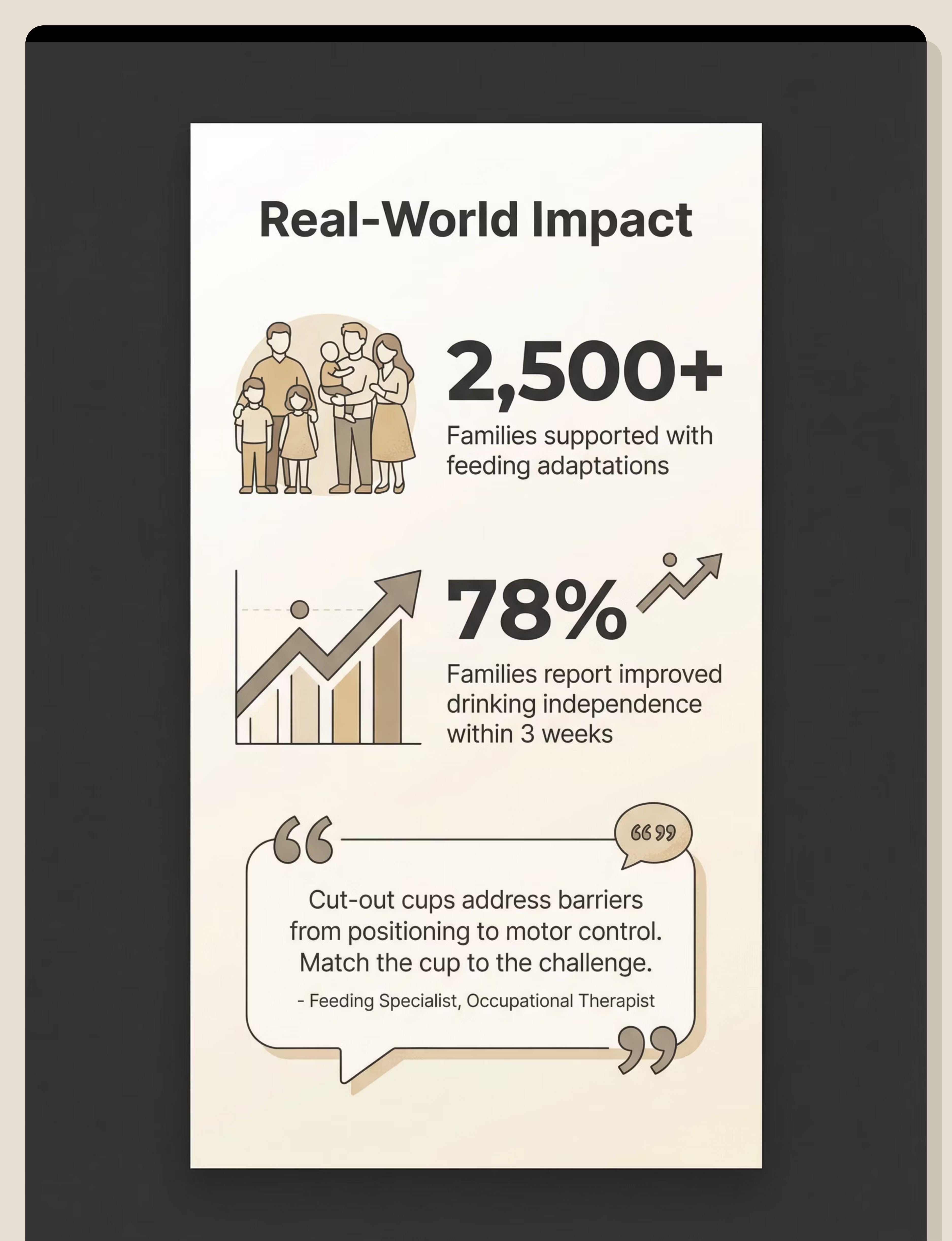
"Cup and bottle adaptations address barriers from positioning to motor control. Cut-out cups protect the airway, two handles support bilateral skills, and trainer cups bridge to open cup drinking. Match the cup to the challenge."
— Occupational Therapist, Feeding Specialist
cup-bottle-adaptations therapy material
OT + SLP Recommended
Core collaboration between occupational therapy and speech-language pathology
cup-bottle-adaptations therapy material
Strong Evidence
Backed by clinical research and widespread therapeutic use
cup-bottle-adaptations therapy material
Rank #2 in Category
Essential tool in Oral Motor & Feeding interventions
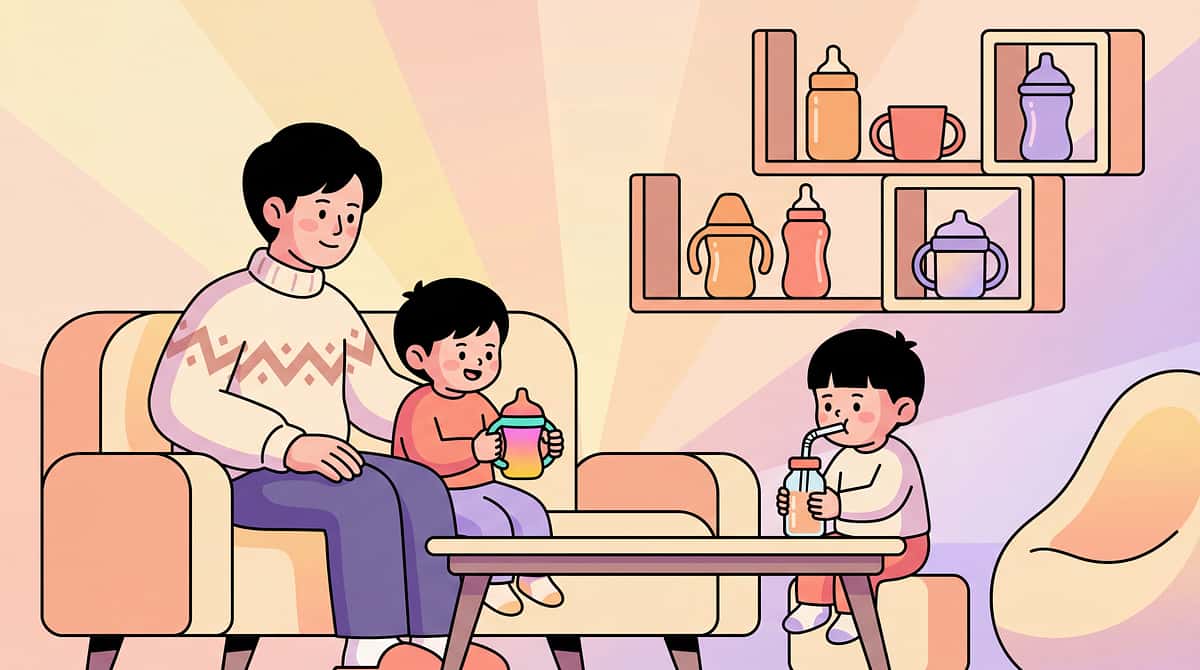
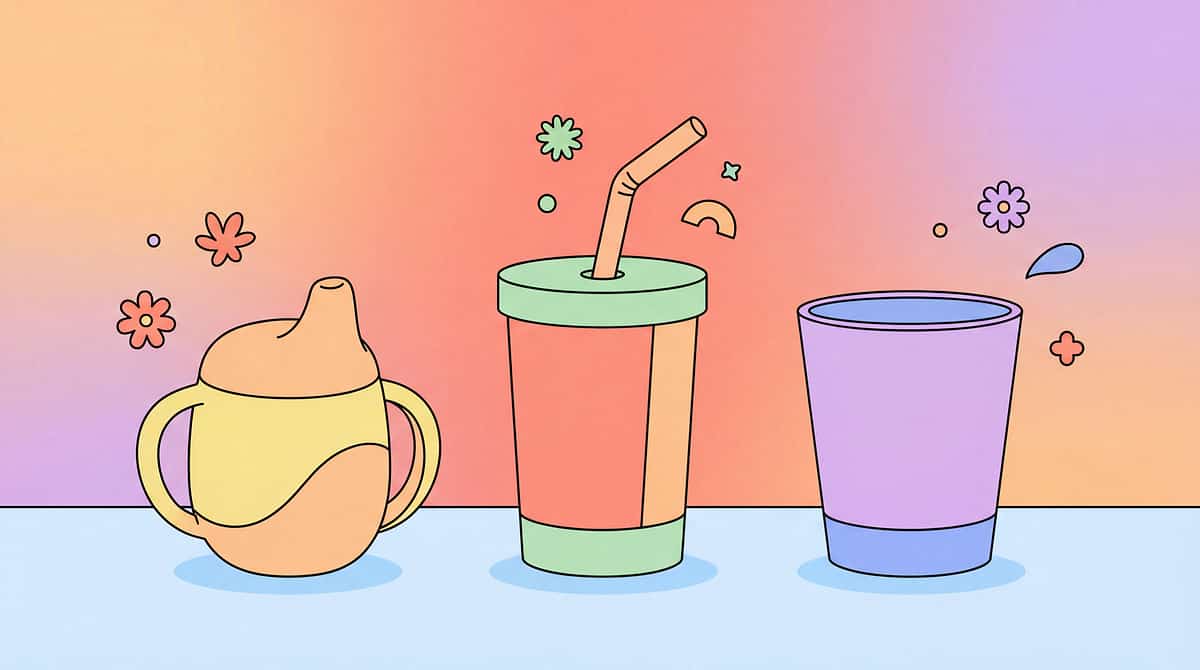
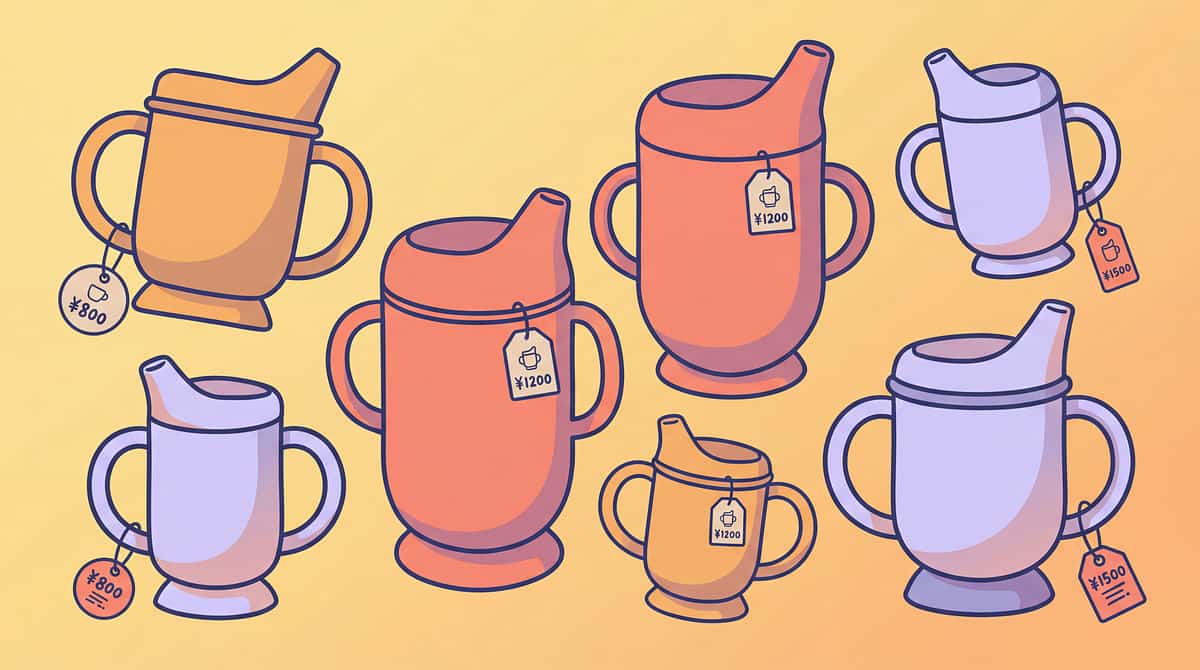
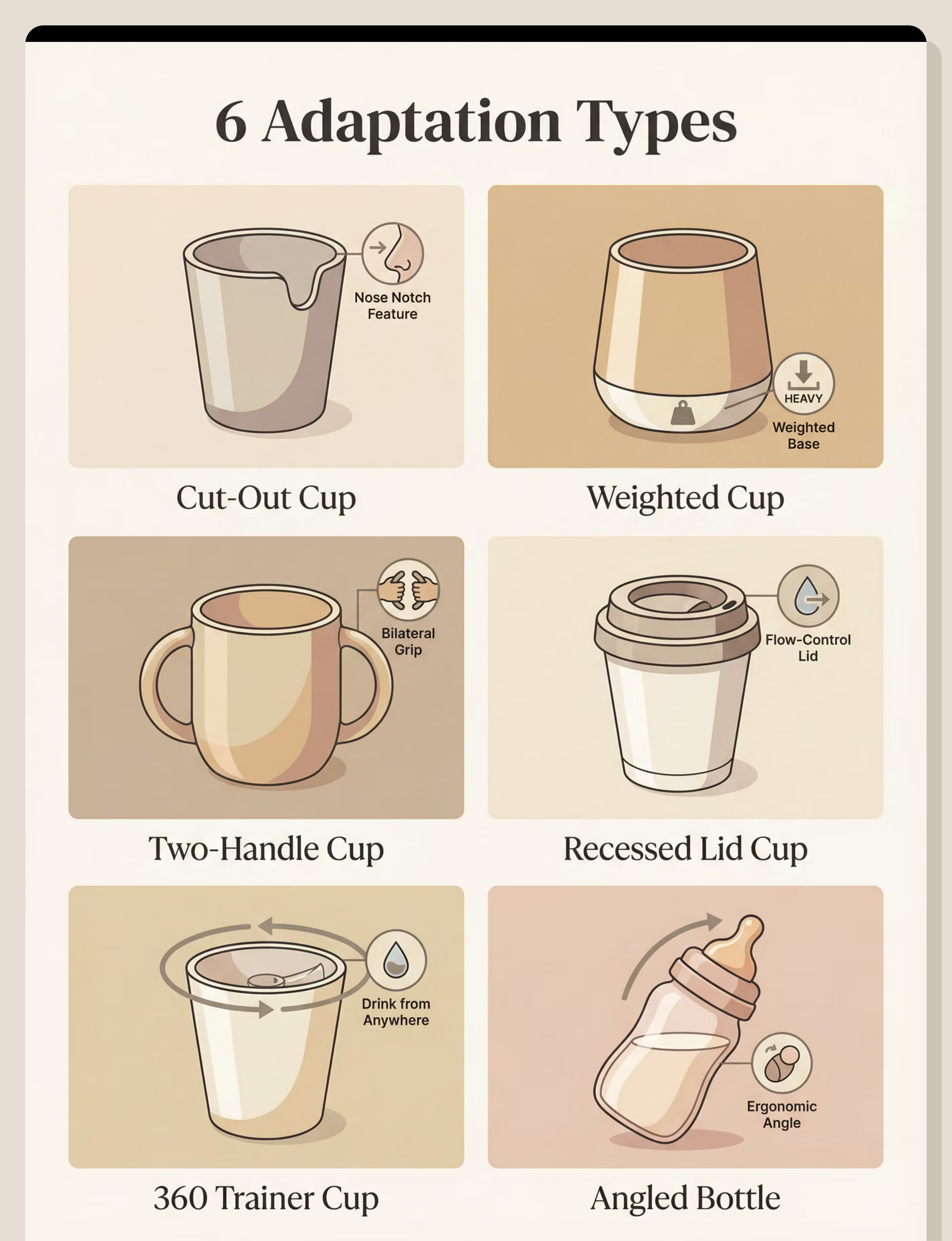
Choose Your Option (6 Variants)
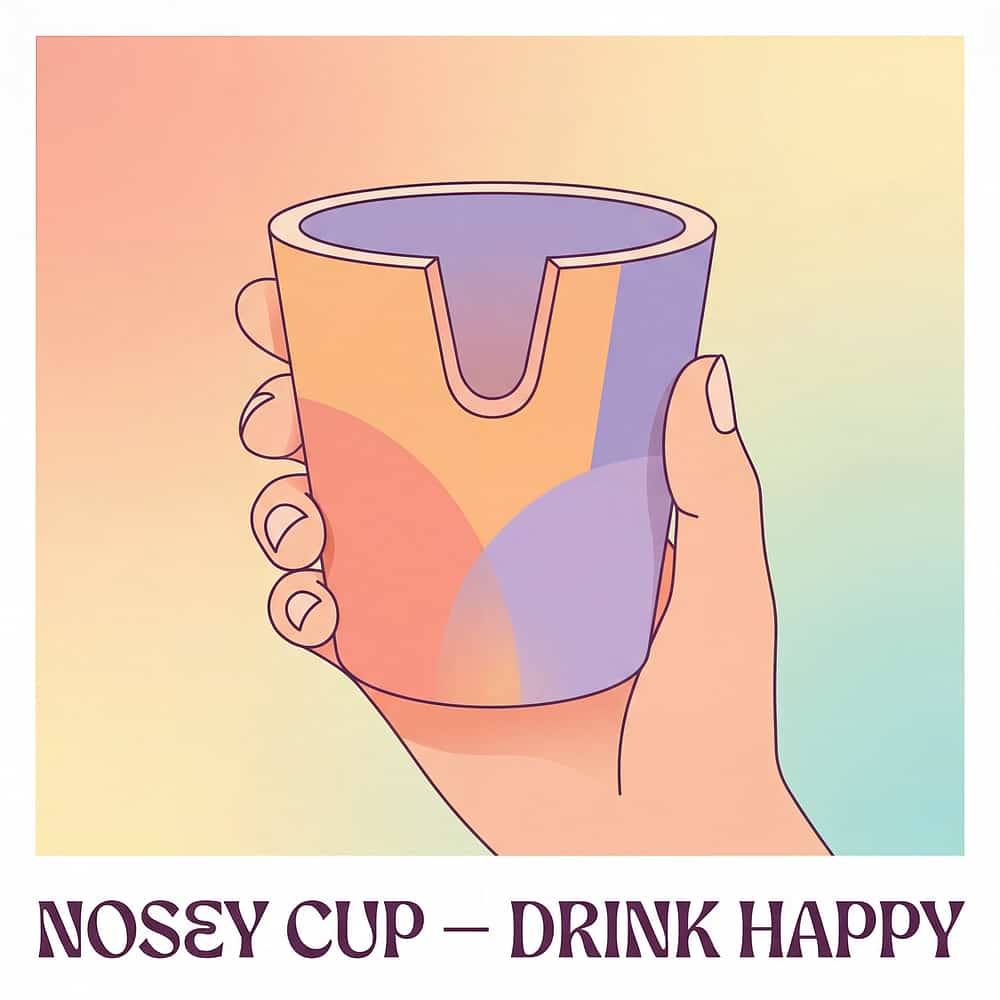
Cut-Out/Nosey Cup
Allows drinking without tilting the head back, protecting the airway and preventing choking. Ideal for limited neck extension or aspiration risk.
Weighted Cup
Provides stability for children with tremors or coordination challenges, reducing spills. Best for 2+ years, home/clinic settings.
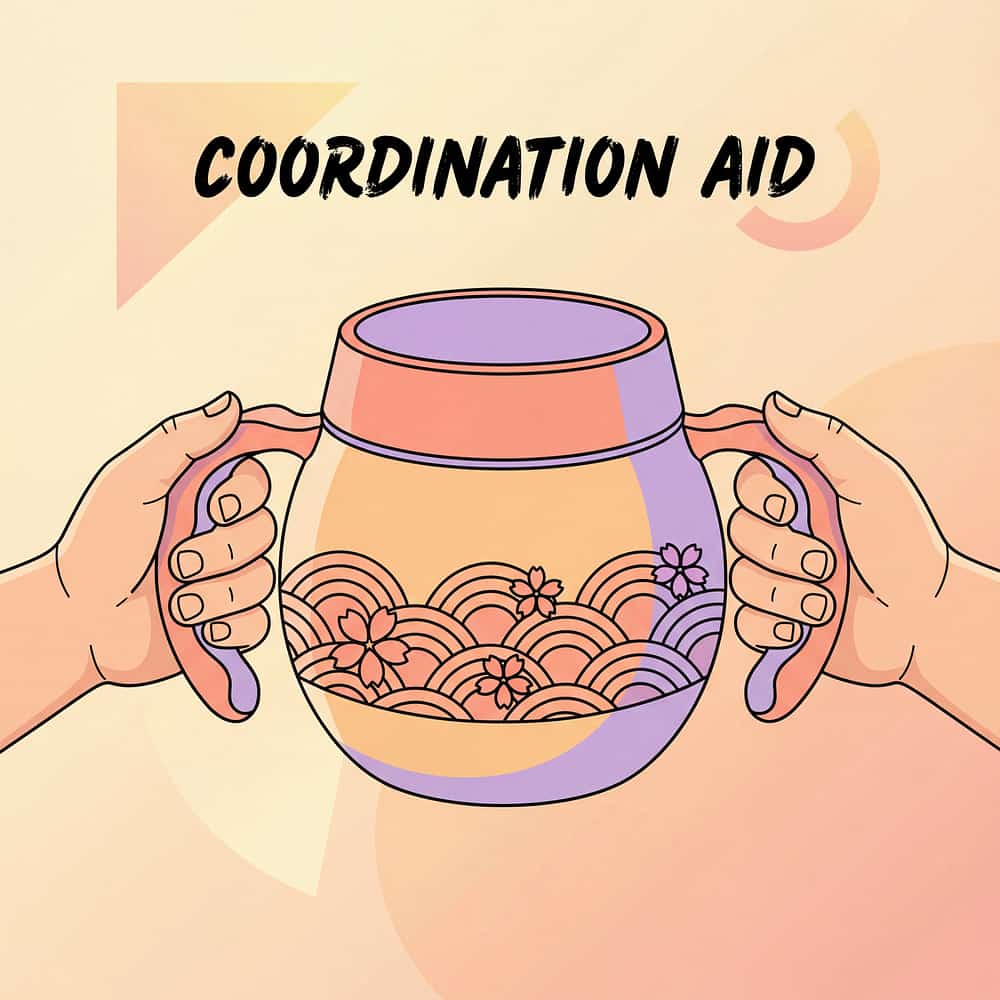
Two-Handle Cup
Supports bilateral grasp and provides stability as motor skills develop. Suitable for 6 months+, highly portable.
Recessed Lid Cup
Controls flow rate and helps manage liquid volume to prevent spills. Excellent for learning to drink independently.
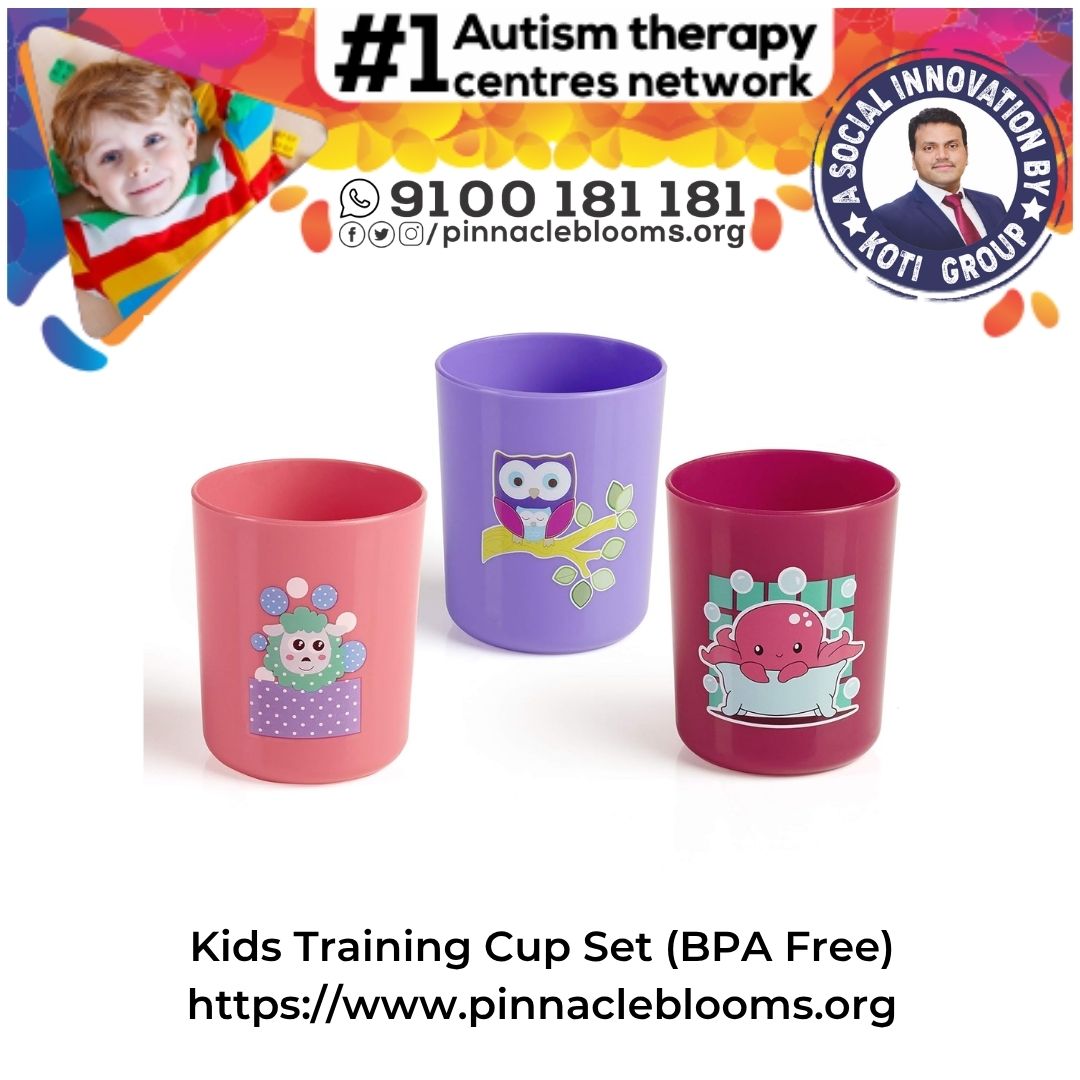
360 Cup / Trainer Cup
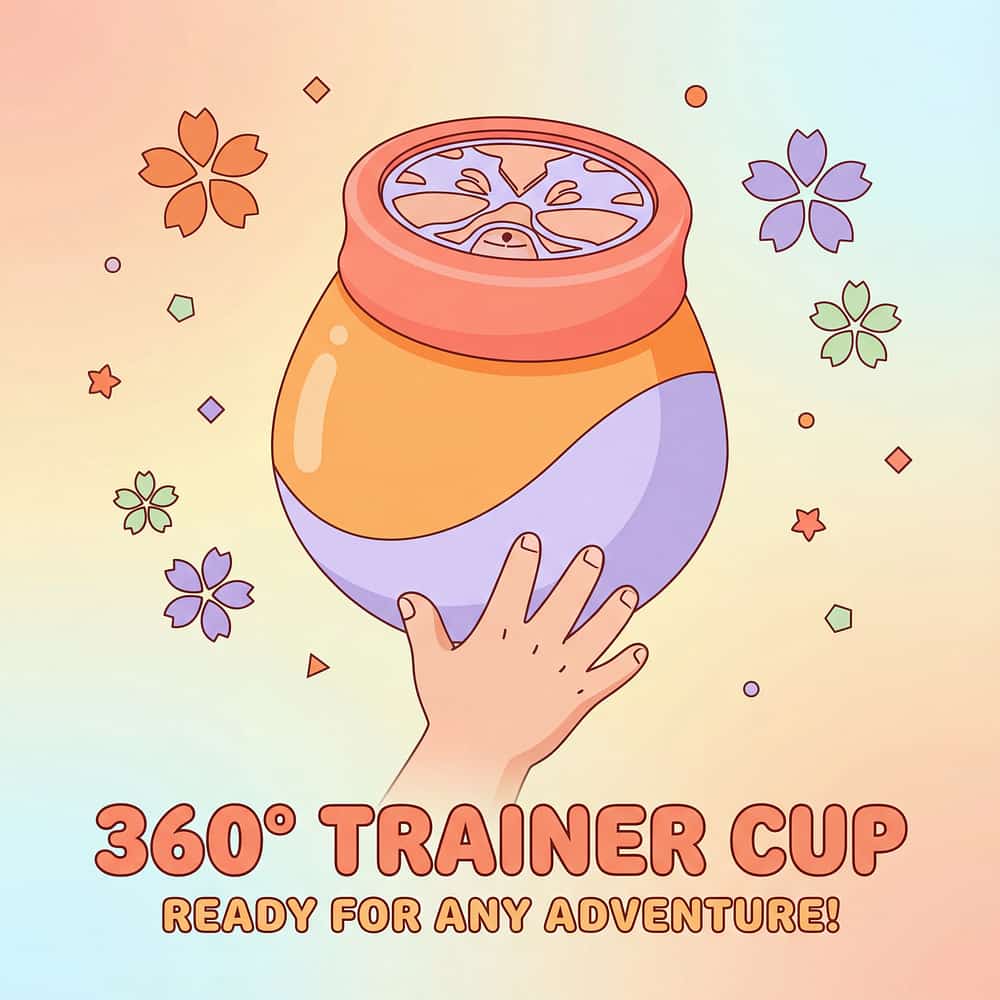
Allows drinking from any edge while preventing spills, bridging the gap from bottle to open cup. For ages 6 months to 4 years.
Adaptive Bottle (Angled)
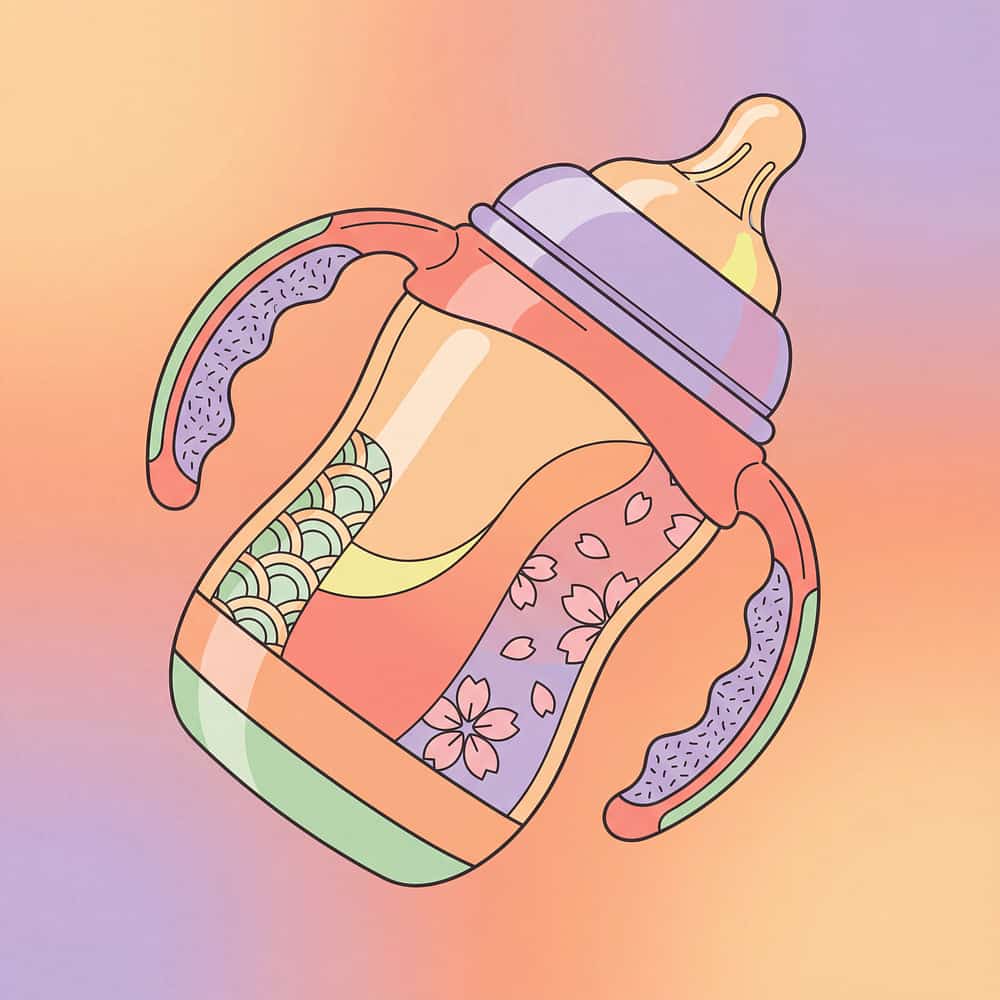
Bent neck design makes self-holding easier and improves positioning during bottle feeding. Great for 0–2 years at home.
Every child's drinking challenge is unique. Select the adaptation that addresses your child's specific barrier—whether it's positioning, motor control, coordination, or transition needs. Many families start with one type and progress or add others as skills develop.

How to choose:
  • By goal: Safety (cut-out), stability (weighted), coordination (two-handle), transition (360 cup)
  • By setting: All settings (cut-out, two-handle), home focus (360 cup, angled bottle)
  • By portability: High portability (cut-out, 360, angled bottle), medium (weighted, two-handle)
Specifications & Adaptation Selection
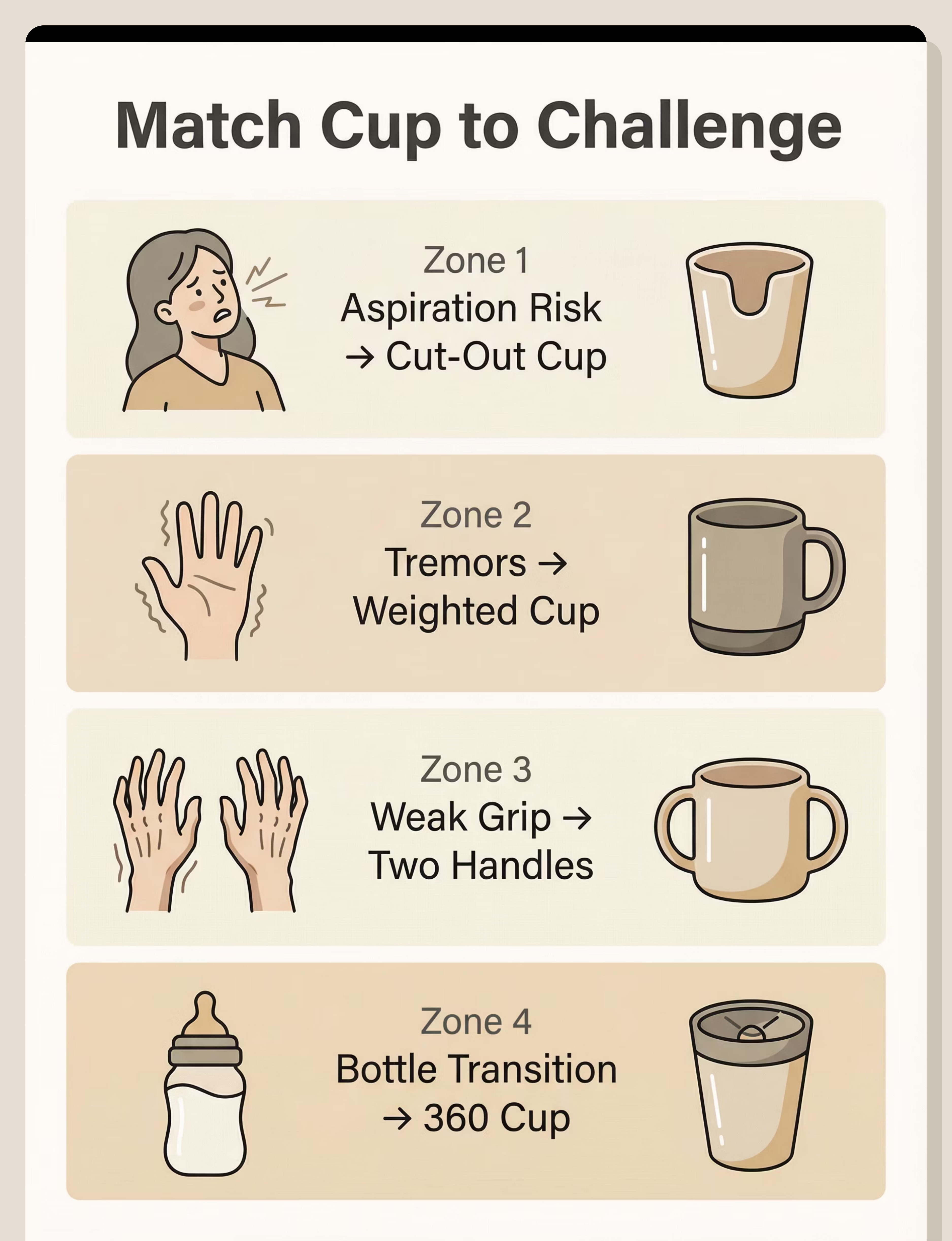
Adaptation Selection Guide
Aspiration Risk
Cut-out/nosey cup → drink without neck extension, protecting airway
Tremors
Weighted cup → stability from weight reduces spills and increases control
Weak Bilateral Skills
Two-handle cup → bilateral support builds coordination and strength
Flow Issues
Recessed lid → controls flow rate, manages liquid volume
Transition to Cup
360 cup → learns lip closure without spills, bridges to open cup
Bottle Positioning
Angled bottle → self-hold easier, better positioning for infants
Materials & Features
Materials
  • BPA-free plastic (food-safe, durable)
  • Silicone components (soft, flexible)
  • Weighted materials (stainless steel or similar)
  • All materials must be food-safe certified
Key Features to Look For
  • Correct adaptation type for your child's specific challenge
  • Food-safe, BPA-free materials only
  • Appropriate size for child's age and hand size
  • Easy to clean (dishwasher safe preferred)
  • Durable construction for daily use
  • No sharp edges or small parts
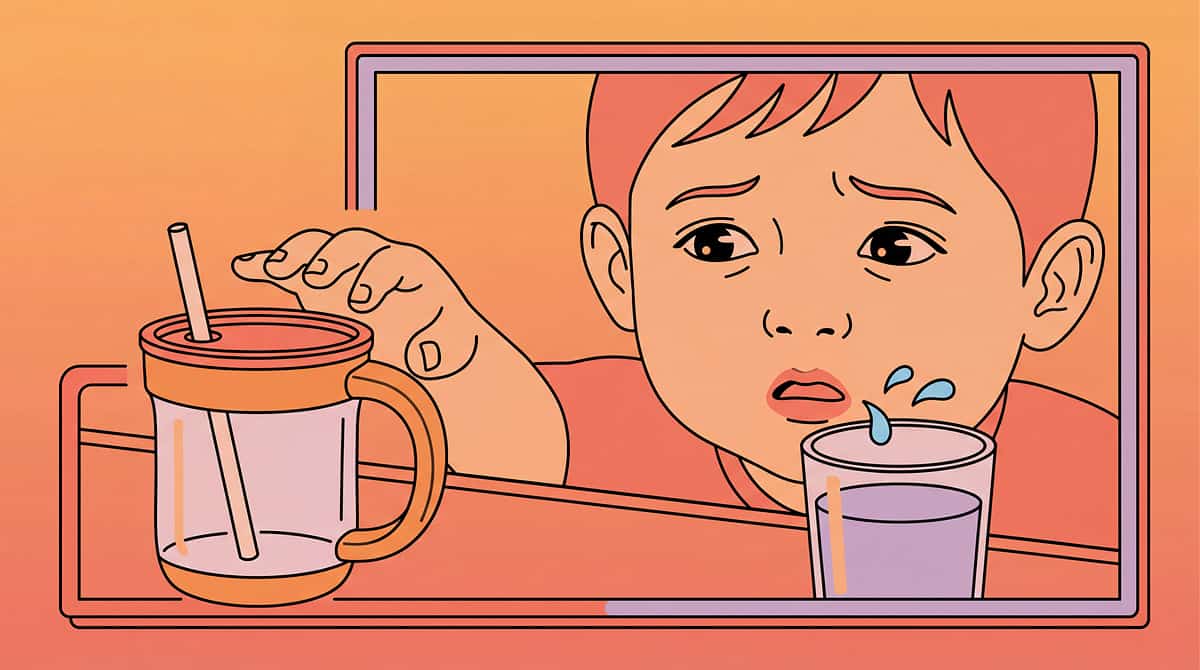
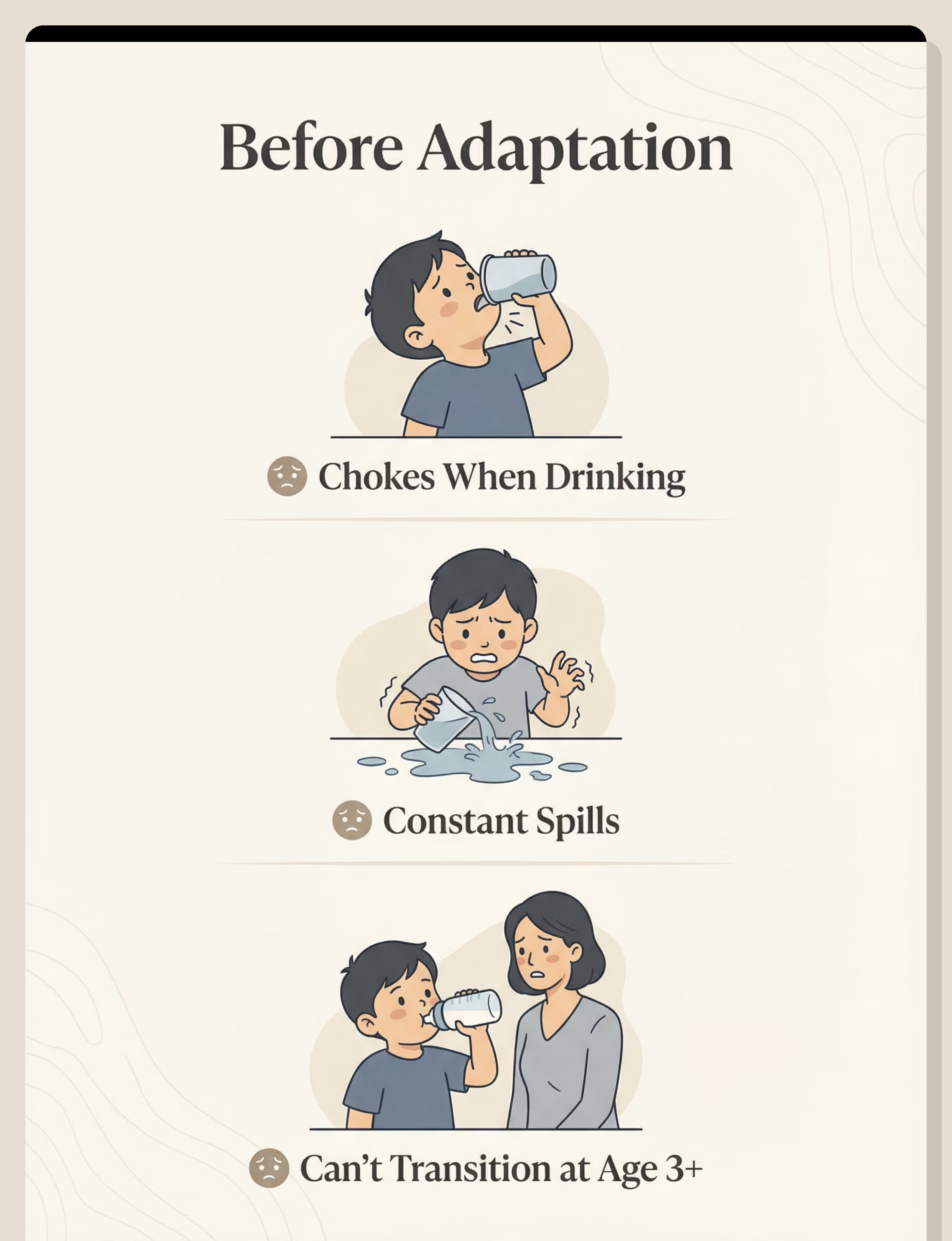
The Struggle (Before)
Chokes When Drinking
Situation: Child tilts head back to drink from regular cup, causing liquid to go down the wrong way.
Experience: Frequent choking and coughing. Aspiration risk is real and scary. Child avoids drinking, leading to inadequate hydration.
Emotion: Fear, anxiety, constant vigilance
Constant Spills
Situation: Child's shaky hands or poor coordination result in spilled drinks multiple times per day.
Experience: Cleanup is constant and exhausting. Child's fluid intake is limited because so much is spilled. Frustrating for everyone, embarrassing in public.
Emotion: Frustration, mess, embarrassment
Can't Transition from Bottle
Situation: Child is 3+ years old and still using a bottle because every cup attempt has been rejected.
Experience: Parents are stuck. Dental concerns are growing. Social situations are awkward. Nothing has worked, and hope is fading.
Emotion: Stuck, worried, defeated
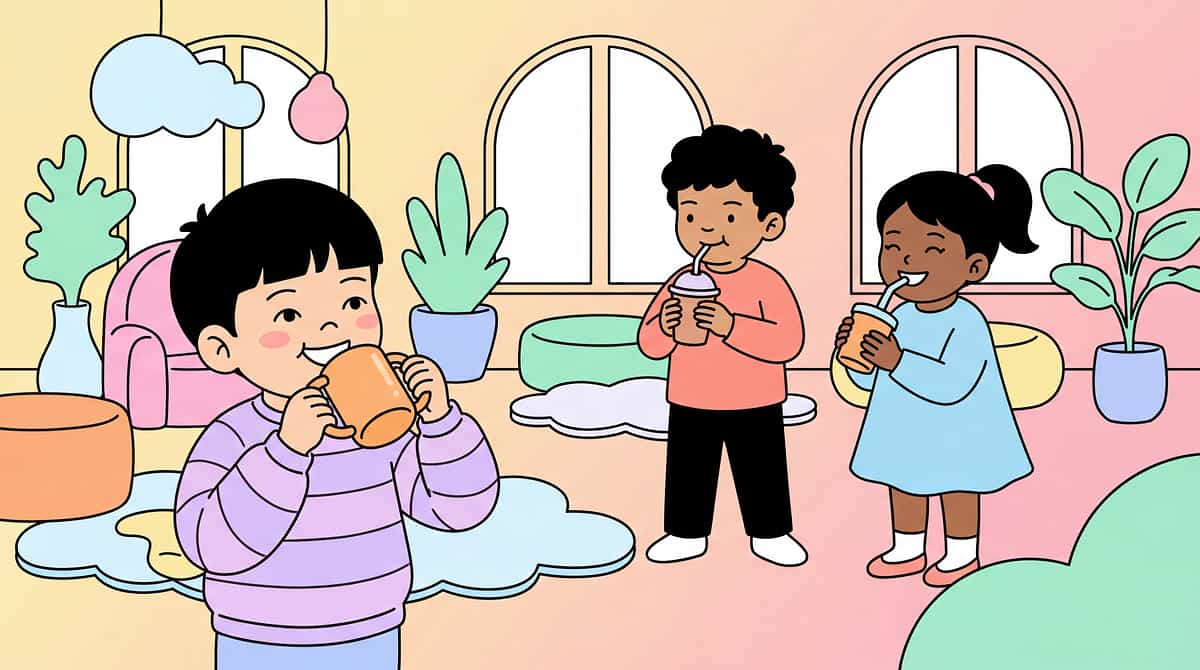
The Breakthrough (After)
Chokes When Drinking
Situation: Cut-out cup allows child to drink without tilting head back—liquid stays in control.
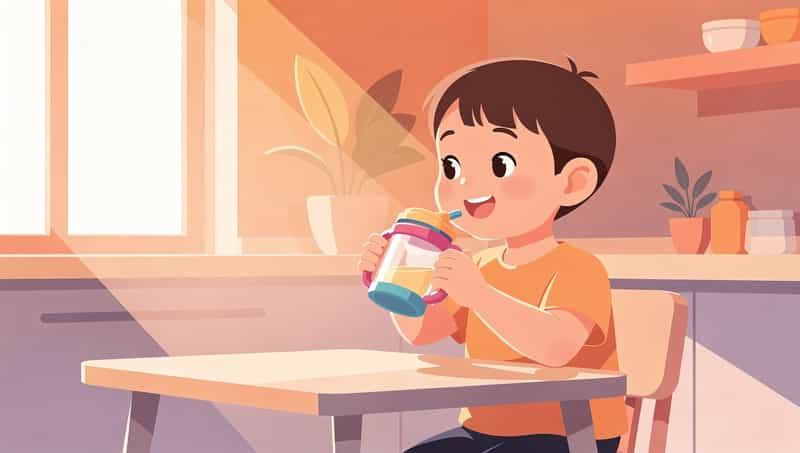
Experience: No more choking. No more coughing. Drinking is safe and comfortable. Child drinks more throughout the day. Parents can breathe easier.
Emotion: Safety, relief, confidence restored
Immediate – 1 week
Constant Spills
Situation: Weighted two-handle cup provides the stability child needed all along.
Experience: Spills are dramatically reduced. Child can drink independently with much more success. Adequate hydration is finally achieved. Less mess, less stress.
Emotion: Control, independence, less mess
1–2 weeks
Can't Transition from Bottle
Situation: 360 cup was the missing piece—familiar drinking motion but with spill prevention built in.
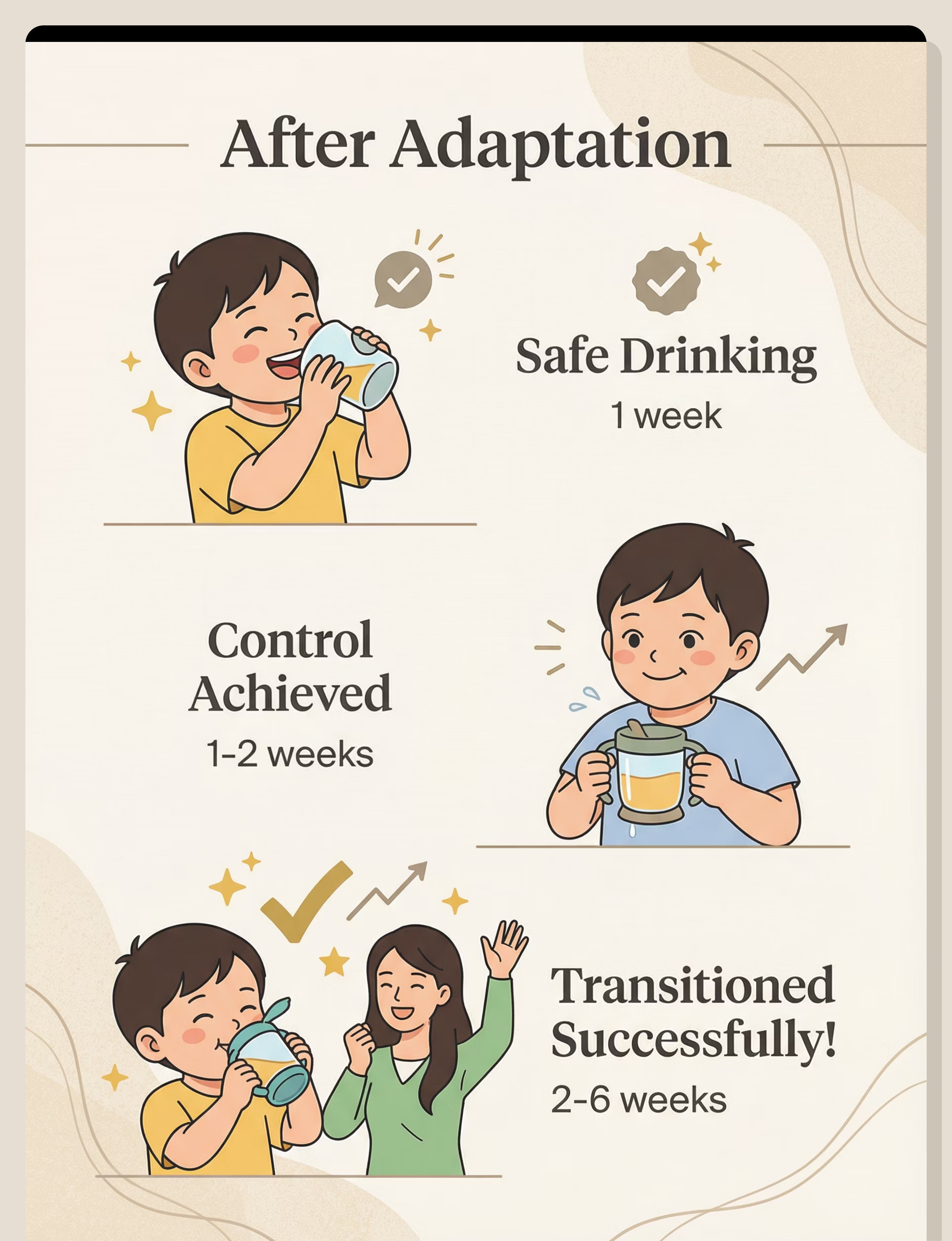
Experience: Child accepted the 360 cup immediately. Within weeks, bottle was eliminated. Dental concerns resolved. Social situations normalized. Transition achieved!
Emotion: Progress, success, hope fulfilled
2–6 weeks
What to Expect (Realistic Timelines)
Appropriate cup selected
After assessment or trial, the right cup adaptation is identified and obtained for your child's specific needs.
1 week
Independent drinking begins
Child starts drinking safely and independently from adapted cup with decreasing assistance needed.
1–2 weeks
Hydration improves
Adequate fluid intake is achieved throughout the day. Child drinks more consistently at meals and snacks.
1–2 weeks
Spills decrease
Drinking becomes more controlled and successful, with fewer spills and increased confidence.
1–2 weeks
Safety improved if applicable
For children with aspiration risk, choking and coughing episodes are eliminated or dramatically reduced.
Immediate

Remember: Every child progresses at their own pace. Some children show immediate improvement, while others need more time to adjust to new adaptations. Consistency, appropriate supervision, and professional guidance support the best outcomes.
Is This Right for My Child? (2-Minute Check)
What is the main challenge with cup drinking?
If yes, this indicates: Guides cup selection—understanding the specific barrier is the first step to finding the right adaptation.
95% confidence
Does your child choke or cough when drinking?
If yes, this indicates: Cut-out cup is likely needed; SLP consultation is essential to assess swallowing safety and aspiration risk.
92% confidence
Does your child spill frequently due to motor issues?
If yes, this indicates: Weighted cups or two-handle cups provide the stability and support needed to reduce spills significantly.
88% confidence
Is your child struggling to transition from bottle?
If yes, this indicates: 360 cup or similar transition cup may be the missing bridge from bottle to open cup drinking.
85% confidence
3+ "yes" answers = strong fit for adaptive cup intervention. Consult with your child's OT or SLP to determine which specific adaptation(s) will best address your child's needs.
cup-bottle-adaptations therapy material
Usage Guide
When to Use ✓
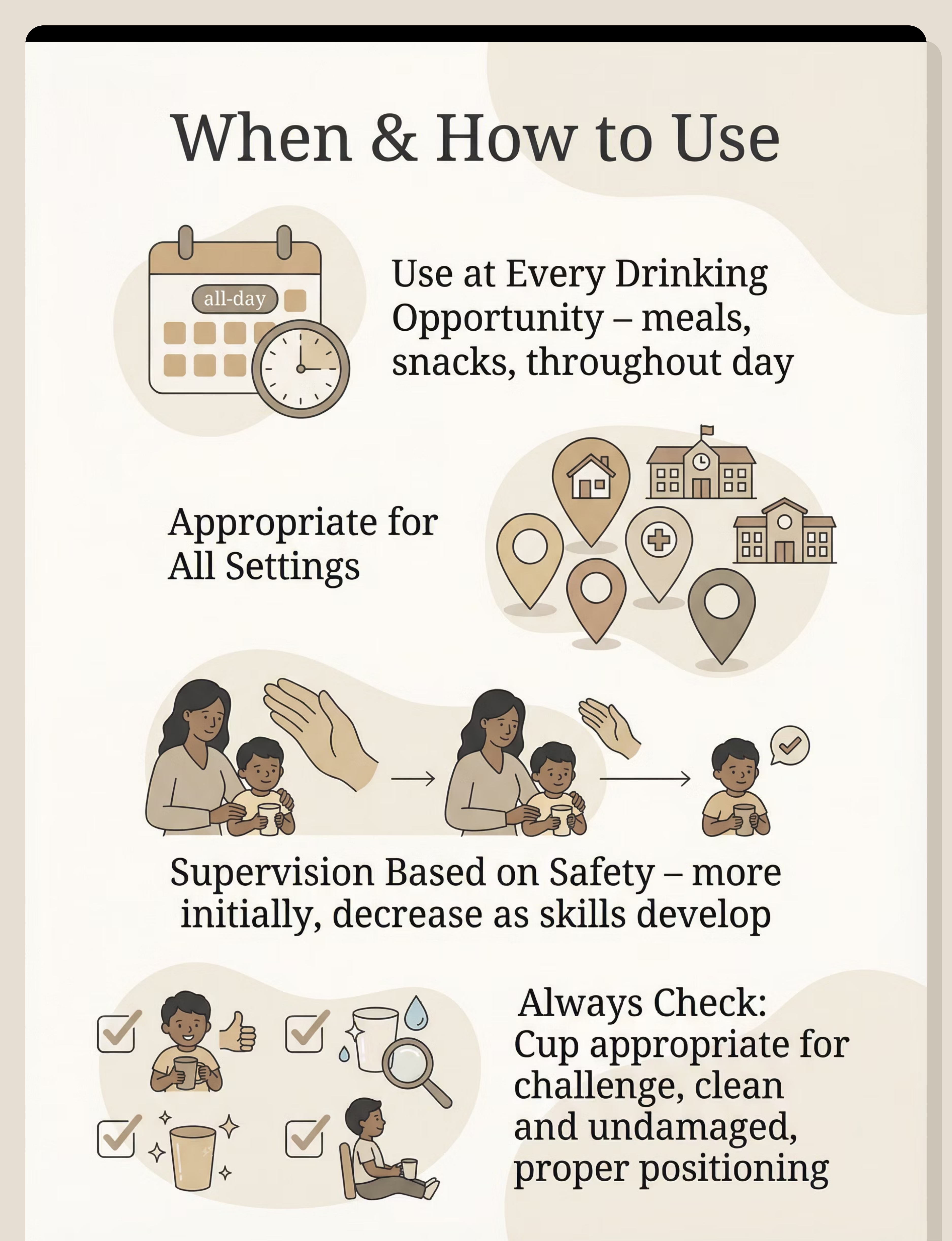
Every drinking opportunity throughout the day
All mealtimes—breakfast, lunch, dinner
Snack times and hydration breaks
Throughout day for consistent hydration
When NOT to Use ✗
Wrong cup type for the specific challenge
Damaged or cracked cups (safety risk)
Without appropriate supervision if child has safety concerns
Supervision by Age
Age Range
Supervision Level
Notes
Young children
Direct supervision
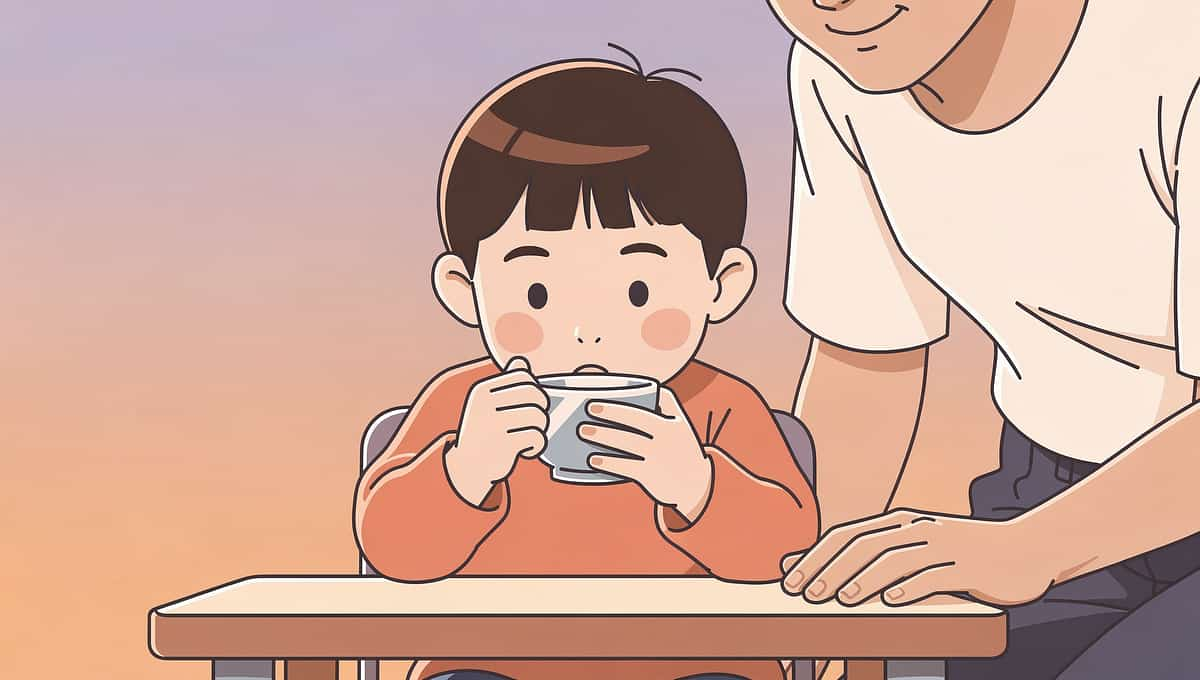
Supervised drinking, especially with new cups or safety concerns
Developing skills
Decreasing supervision
Monitoring while gradually increasing independence
Independent drinkers
Independent as appropriate
Child can use adapted cup safely without constant supervision

Duration: Every drinking opportunity; ongoing. Adapted cups should be used consistently throughout the day for as long as needed. Some children progress to less adapted options over time; others continue to benefit from adaptations long-term. Both paths are success.
Safety First
CRITICAL SAFETY
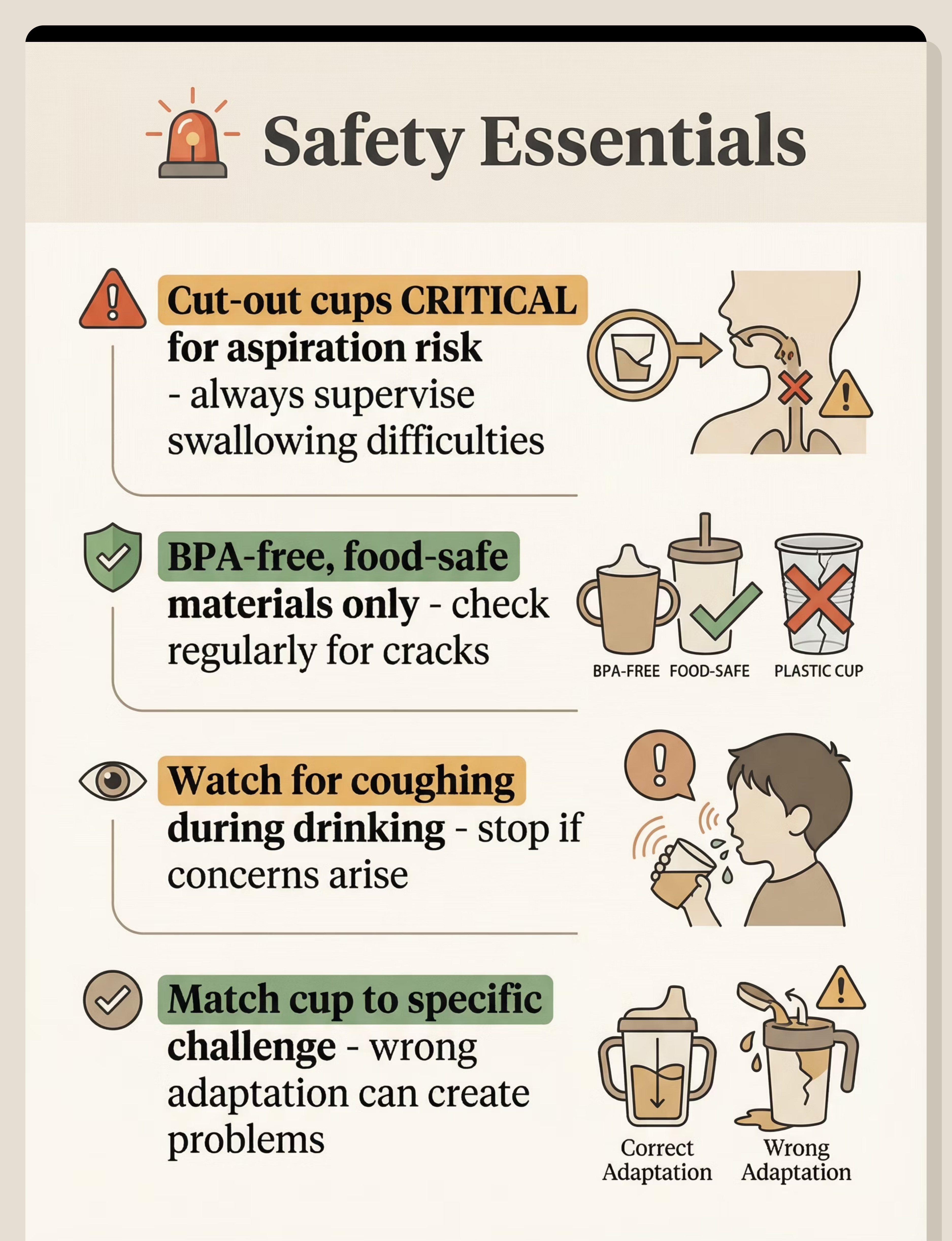
  • Cut-out cups are essential for children with aspiration risk
  • Supervise children with swallowing difficulties during all drinking
  • Use only BPA-free, food-safe materials
  • Check cups regularly for cracks or damage
WARNINGS
  • Monitor for coughing or choking during drinking
  • Weighted cups can break if dropped from height
  • Replace any damaged cups immediately
CONTRAINDICATED
  • Using wrong cup type for the specific challenge
  • Ignoring signs of aspiration or swallowing difficulty
  • Continuing to use damaged or cracked cups
Safety Checklist
Before Use
  • Cup is appropriate for child's specific challenge
  • Cup is clean and undamaged
  • Child is positioned properly for safe drinking
  • Appropriate supervision is in place
During Use
  • Monitor for coughing or choking
  • Observe safe drinking pattern
  • Ensure adequate fluid intake
  • Notice independence increasing
Signs of Success
  • Safe drinking with no choking
  • Adequate hydration achieved
  • Growing independence
  • No coughing or aspiration signs
Common Questions (Honest Answers)
1
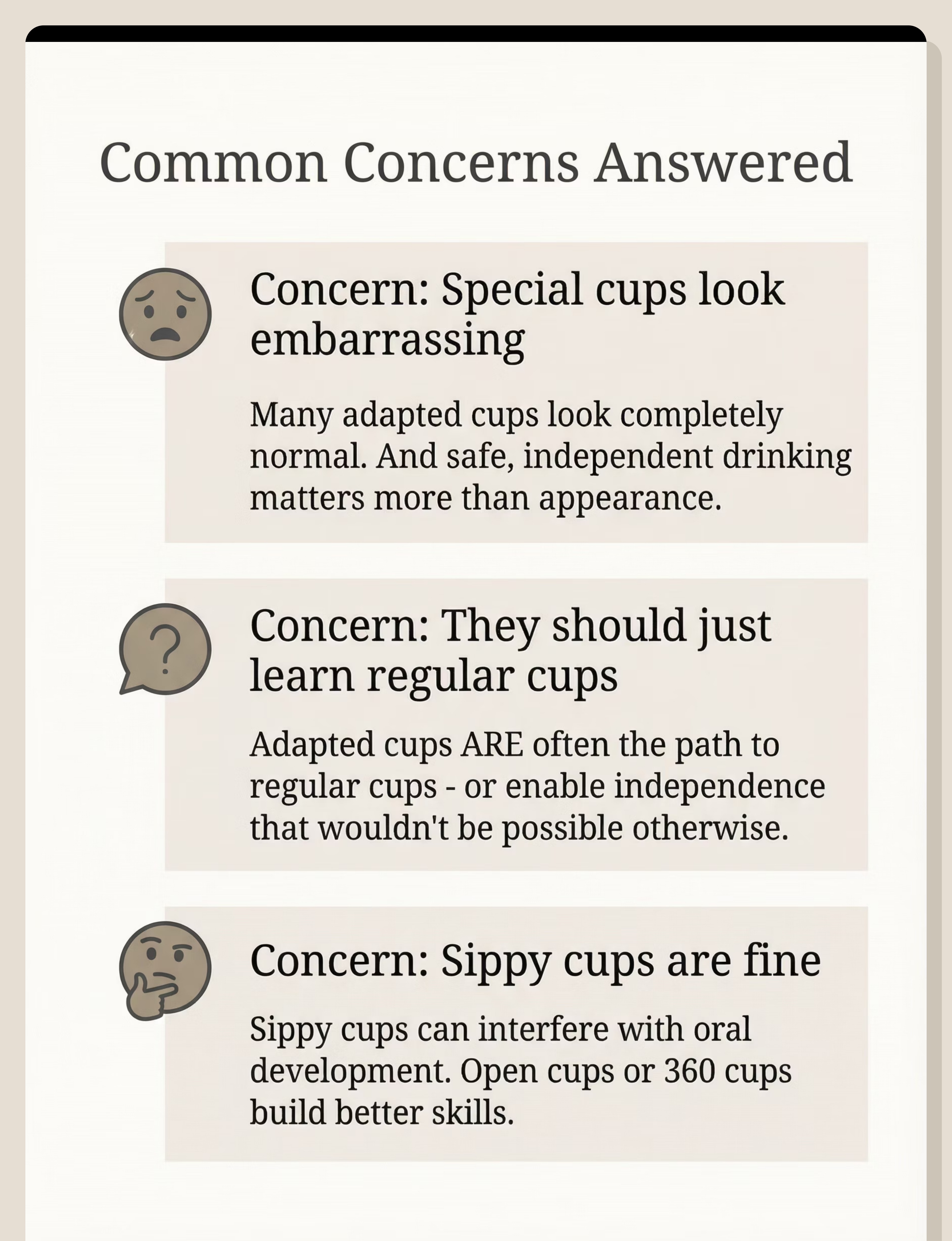
Q: "Special cups are embarrassing"
A: Many adapted cups look normal—cut-out cups, two-handle cups, and 360 cups blend in with regular drinkware. And safe, independent drinking matters far more than cup appearance. Your child's health and confidence are what count.
Try this: Many look normal; independence matters most. Focus on function over appearance.
2
Q: "They should just learn regular cups"
A: For some children, adapted cups ARE the path to regular cups—they build the skills needed. For others, adapted cups enable independence that wouldn't otherwise be possible. Both outcomes are success.
Try this: Adapted cups may lead to regular cups; either way is meaningful progress and independence.
1
Q: "Sippy cups are fine"
A: Sippy cups can interfere with oral motor development because they encourage sucking rather than sipping. Open cups or 360 cups build better oral motor skills. Straws also work well. Avoid long-term sippy cup use if possible.
Try this: Open cup skills are better for oral motor development; 360 cups bridge the gap.
2
Q: "Cut-out cups look strange"
A: Cut-out cups are medical adaptations that protect the airway and prevent aspiration. Looking different is a small price for preventing choking and ensuring safe drinking. Safety comes first, always.
Try this: Safety over appearance; protecting your child's airway is paramount.
Investment Guide
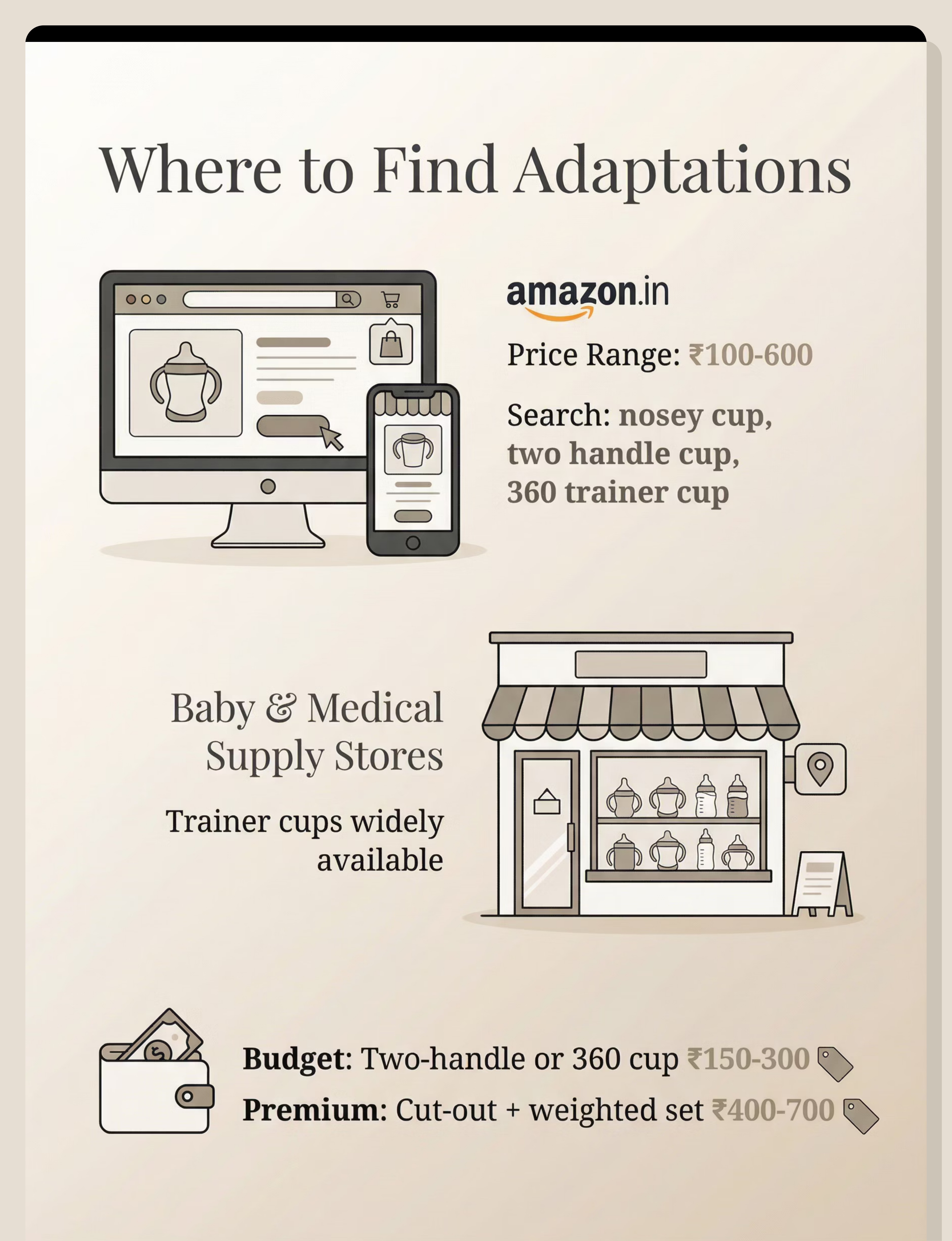
Adaptive cups are among the most affordable therapeutic tools, with options ranging from ₹100 to ₹700. Most families find what they need in the ₹150–400 range. Consider starting with one or two cups to trial, then expanding your collection as you understand your child's needs better.
Budget
Two-handle cup or 360 cup
₹150–300
Common adaptations widely available; excellent starting point for most children.
Bilateral coordination, cup transition, spill prevention
N/A
Premium
Cut-out cup + weighted cup set
₹400–700
Addresses multiple challenges with specialized adaptations; essential for safety concerns.
Aspiration risk, tremors, comprehensive support
Nosey Cup, Doidy Cup, Munchkin 360
Key Benefits of Adaptive Cups
Enhanced Safety
Reduce risk of choking and aspiration with controlled fluid flow and protected airways.
Skill Development
Promote proper oral motor skills necessary for drinking from open cups and straws.
Increased Independence
Empower children to drink on their own, boosting confidence and self-sufficiency.
Versatile Solutions
Offer options for various challenges, from tremors to transitioning from bottles.
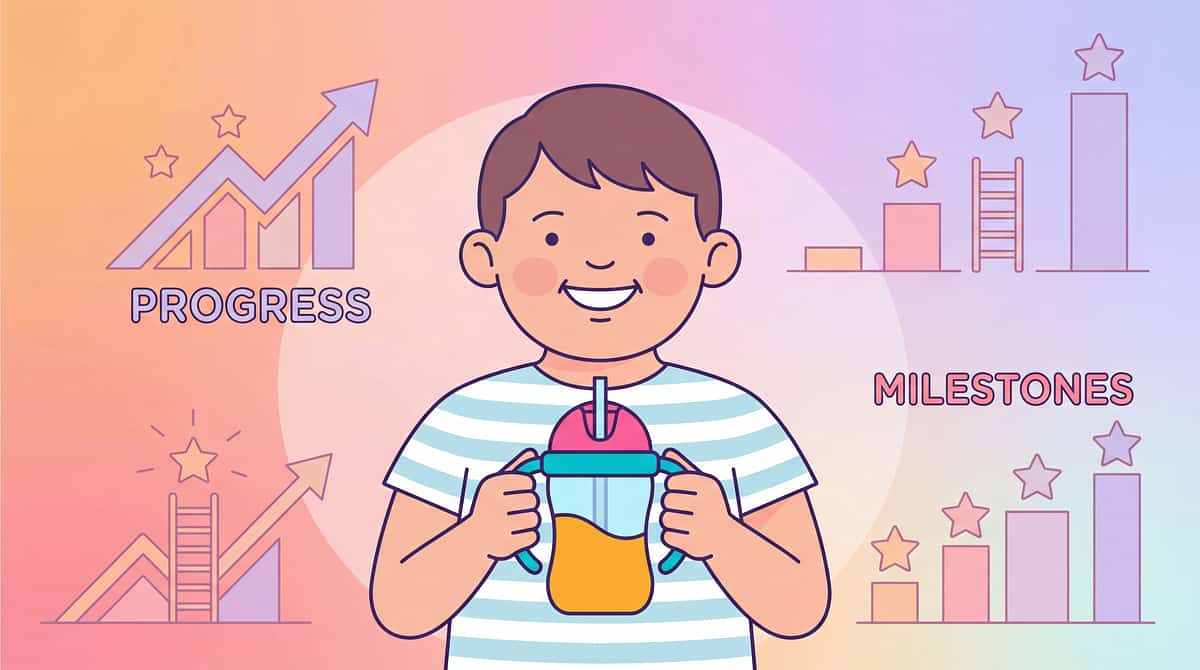
Journey to Independent Drinking
Assess Needs
Identify primary challenges like aspiration, motor control, or transition.
Trial Cups
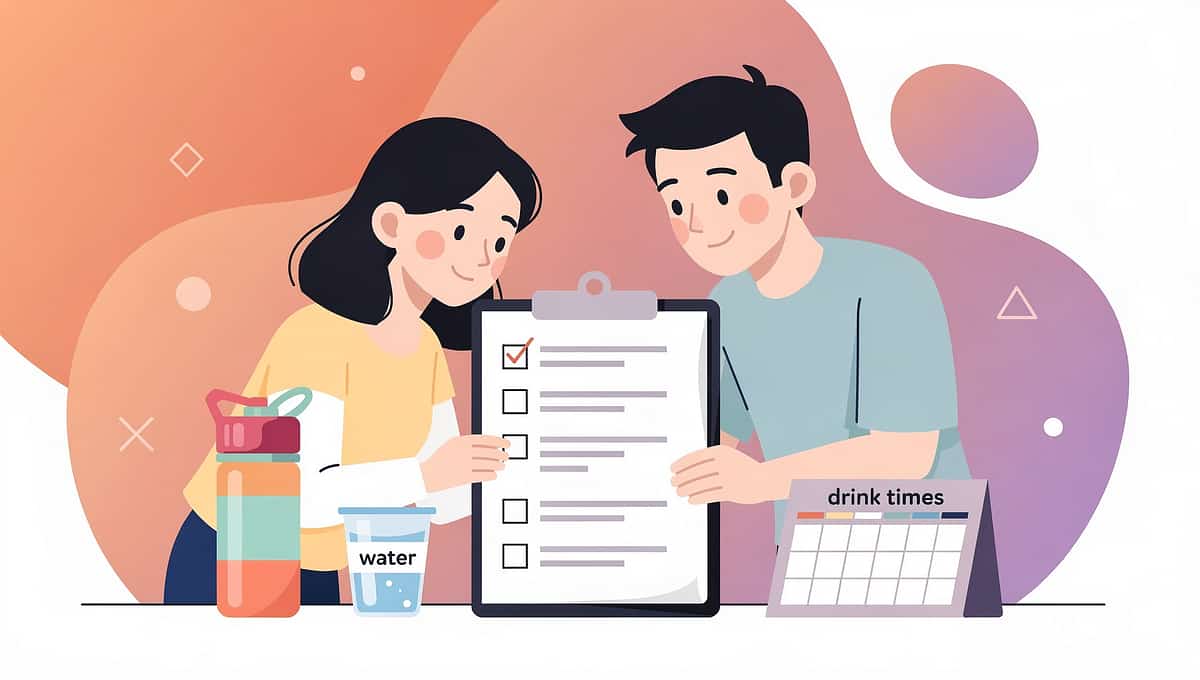
Start with 1-2 cups matching initial needs; observe child's interaction.
Monitor Progress
Track improvements in drinking, coordination, and comfort.
Expand Collection
Introduce new types as skills evolve or new challenges arise.
Achieve Independence
Celebrate milestones, whether with adapted or regular cups.

Overall range: ₹100–700 | Best starting point: Begin with the adaptation that addresses your child's primary challenge. For positioning/aspiration concerns, start with cut-out cup. For motor issues, try two-handle or weighted. For bottle transition, 360 cup is excellent.
Where to Buy in India
Availability: Widely Available. Adaptive cups are readily available through online retailers and baby stores throughout India, making them accessible to most families.
Platform List
Platform
Search Term
Price Range
Amazon.in
"nosey cup cut out"
₹200–400
Amazon.in
"two handle cup kids"
₹100–300
Amazon.in
"360 cup munchkin"
₹200–450
Amazon.in
"weighted cup"
₹300–600
Baby stores
"trainer cup"
₹150–400
Buying Tips
  • Cut-out cups are essential for aspiration risk—don't substitute
  • 360 cups are excellent for bottle-to-cup transition
  • Two-handle cups are widely available and affordable
  • Consider multiple cups for different settings
  • Get SLP guidance for swallowing issues before purchasing
Red Flags
  • Cups not appropriate for your child's specific challenge
  • Long-term sippy cup use instead of progression
  • Ignoring signs of aspiration or choking
  • Non-food-safe materials or BPA-containing plastics
DIY Alternative
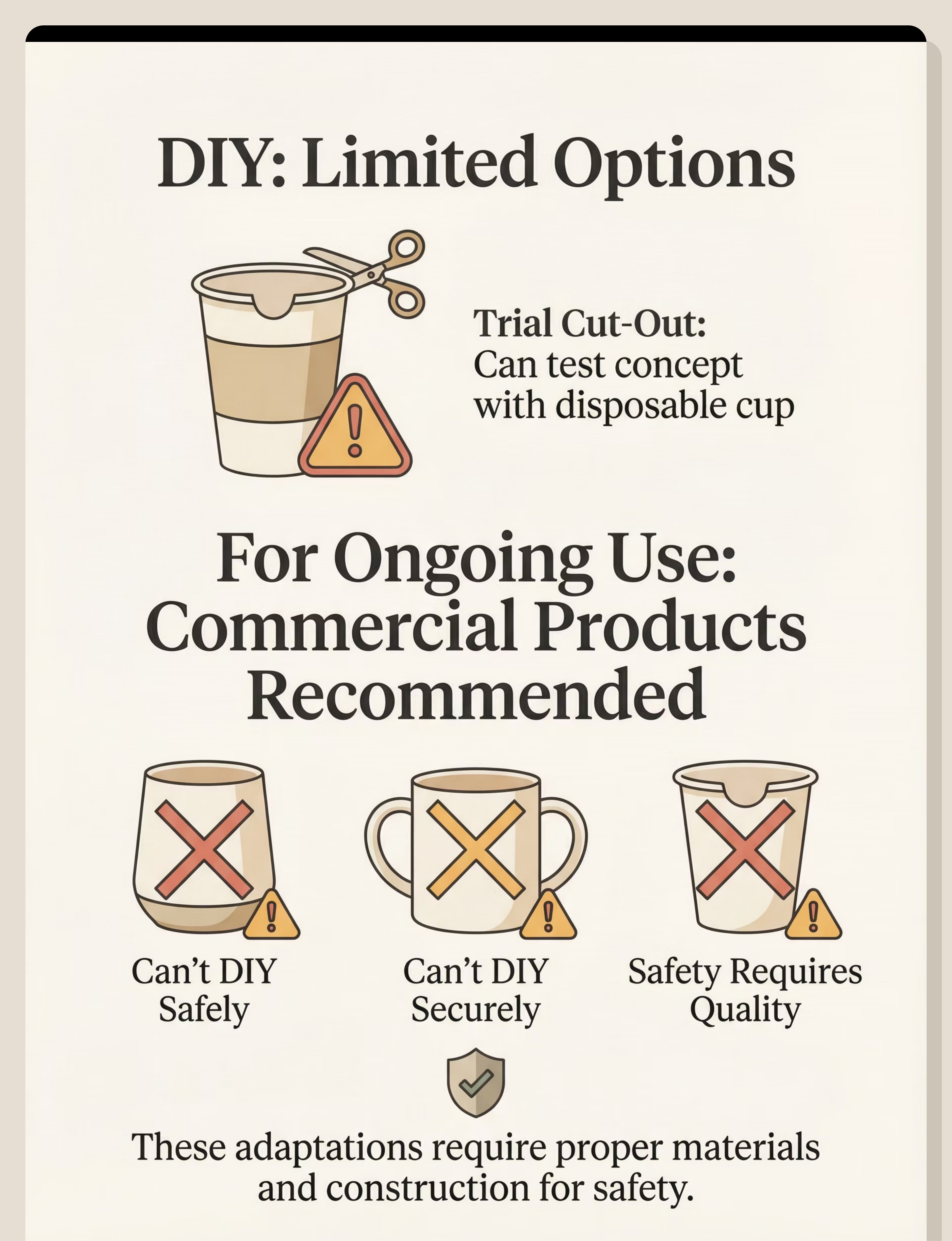
Feasibility: Low-Medium | Cost Savings: Variable | Time: 15–30 minutes for cut-out cup trial
Materials Needed
  • Plastic disposable cup (for DIY cut-out trial only)
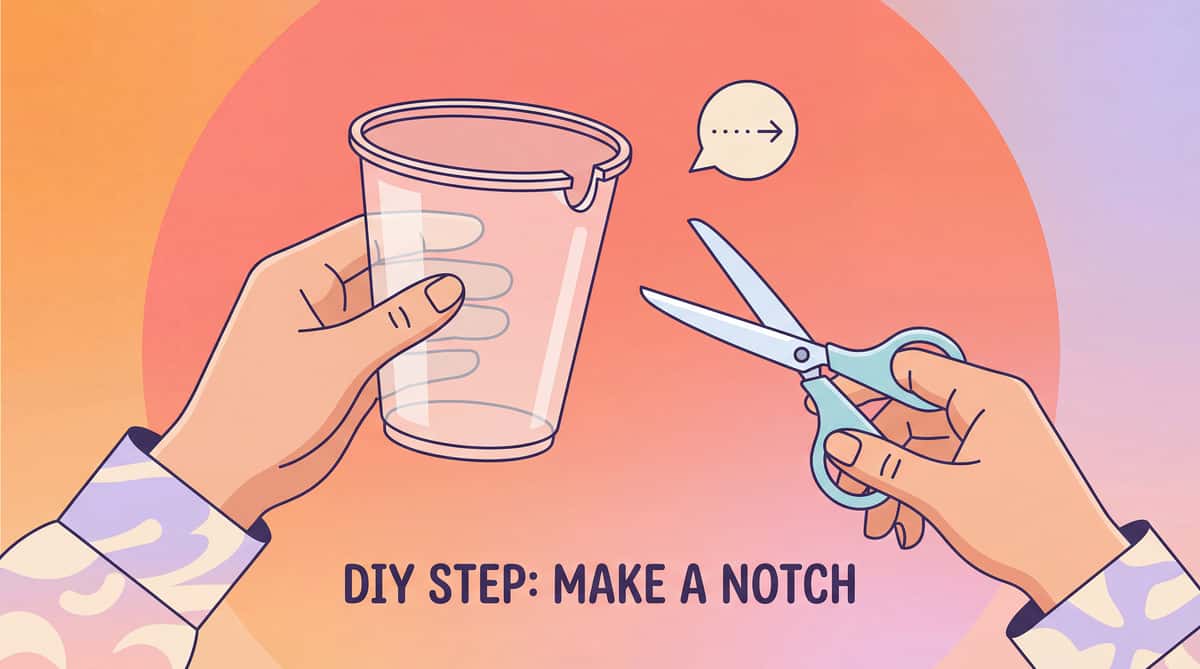
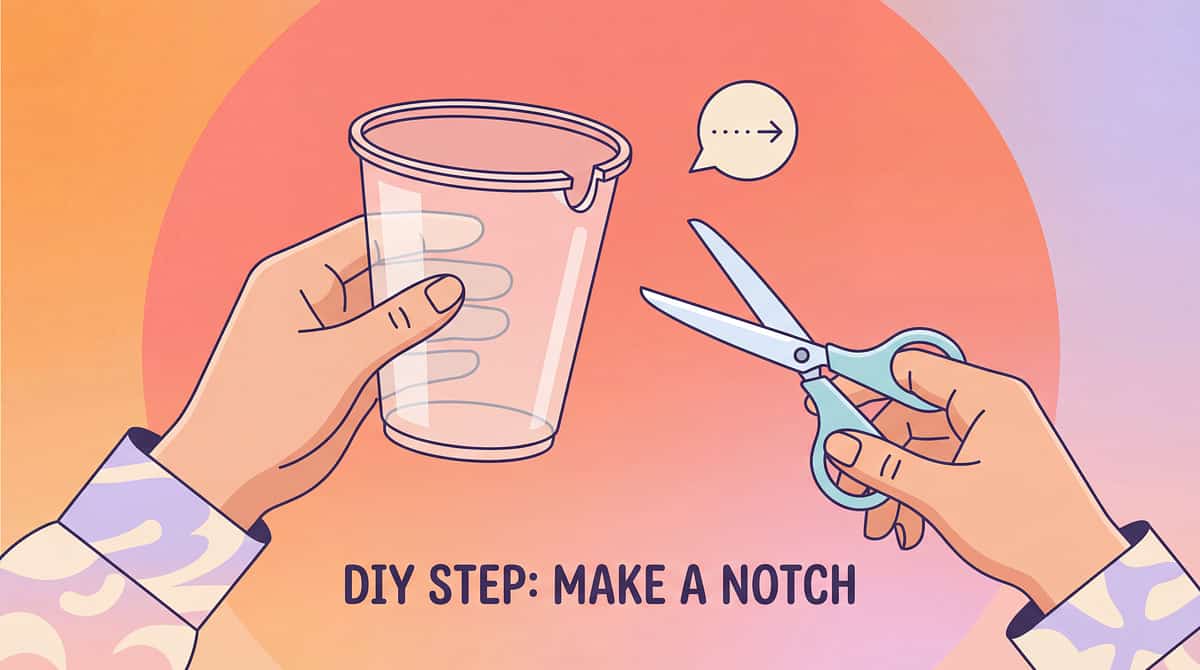
  • Scissors (for cutting notch)

Important: Two-handle cups and weighted cups cannot be safely DIY'd. These require proper manufacturing for safety and durability.
DIY Steps (Cut-Out Cup Trial Only)
  1. Take a disposable plastic cup
  1. Cut a small notch in the rim (U-shaped, about 1 inch wide)
  1. Smooth any sharp edges carefully
  1. Trial with your child to see if cut-out concept helps
  1. This is for TRIAL only—not for ongoing use
DIY vs Commercial
When to DIY:
Only for trialing the cut-out cup concept to see if this adaptation type might help your child.
When to Buy Commercial:
  • All ongoing cup adaptations
  • Cut-out cups for daily use (safety and durability)
  • Weighted cups (cannot DIY safely)
  • Two-handle cups (safety and proper design)
Tradeoffs
DIY cut-out cups are not durable or safe for ongoing use. They can crack, develop sharp edges, or break down quickly. For any regular use, commercial adaptive cups are essential for safety and effectiveness.

Preview of cup bottle adaptations Therapy Material

Below is a visual preview of cup bottle adaptations therapy material. The pages shown help educators, therapists, and caregivers understand the structure and content of the resource before use. Materials should be used under appropriate professional guidance.

Page 1
Page 2
Page 3
Page 4
Page 5
Page 6
Page 7
Page 8
Page 9
Page 10
Page 11
Page 12
Page 13
Page 14
Page 15
Page 16
Page 17
Page 18
Page 19
Page 20
Link copied!
Measuring Success & Next Steps
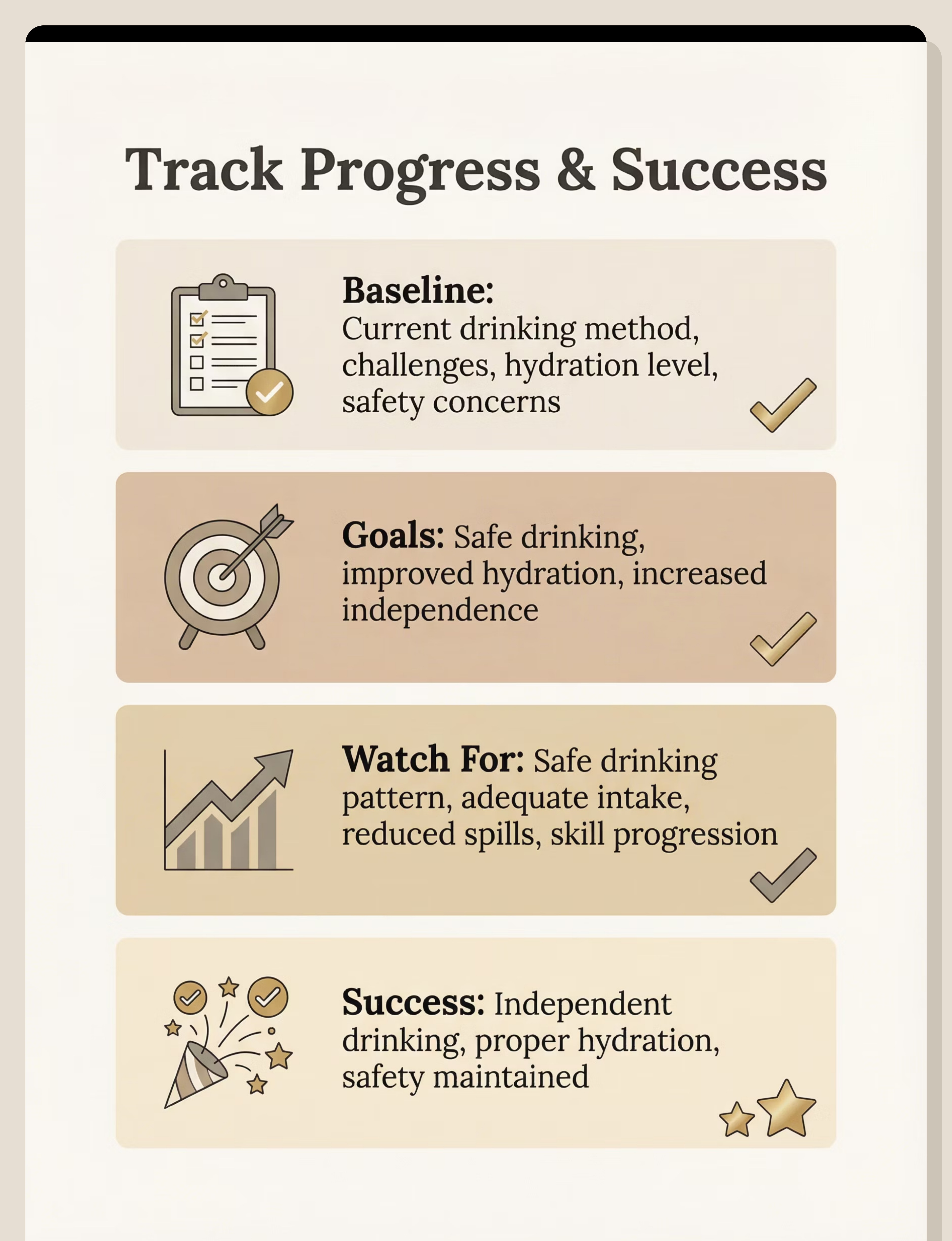
Track Progress
Baseline (What to Measure First)
  • Current drinking method and success rate
  • Specific challenges with drinking
  • Daily hydration level
  • Any safety concerns (choking, coughing)
Goals
  • Child will drink safely from adapted cup
  • Hydration will improve to adequate levels
  • Independence will increase
  • Progress to less adapted cup if appropriate
Success Indicators
  • Safe drinking with no choking
  • Adequate hydration throughout day
  • Growing independence
  • Reduced spills
  • Skill progression visible

Complete the Kit
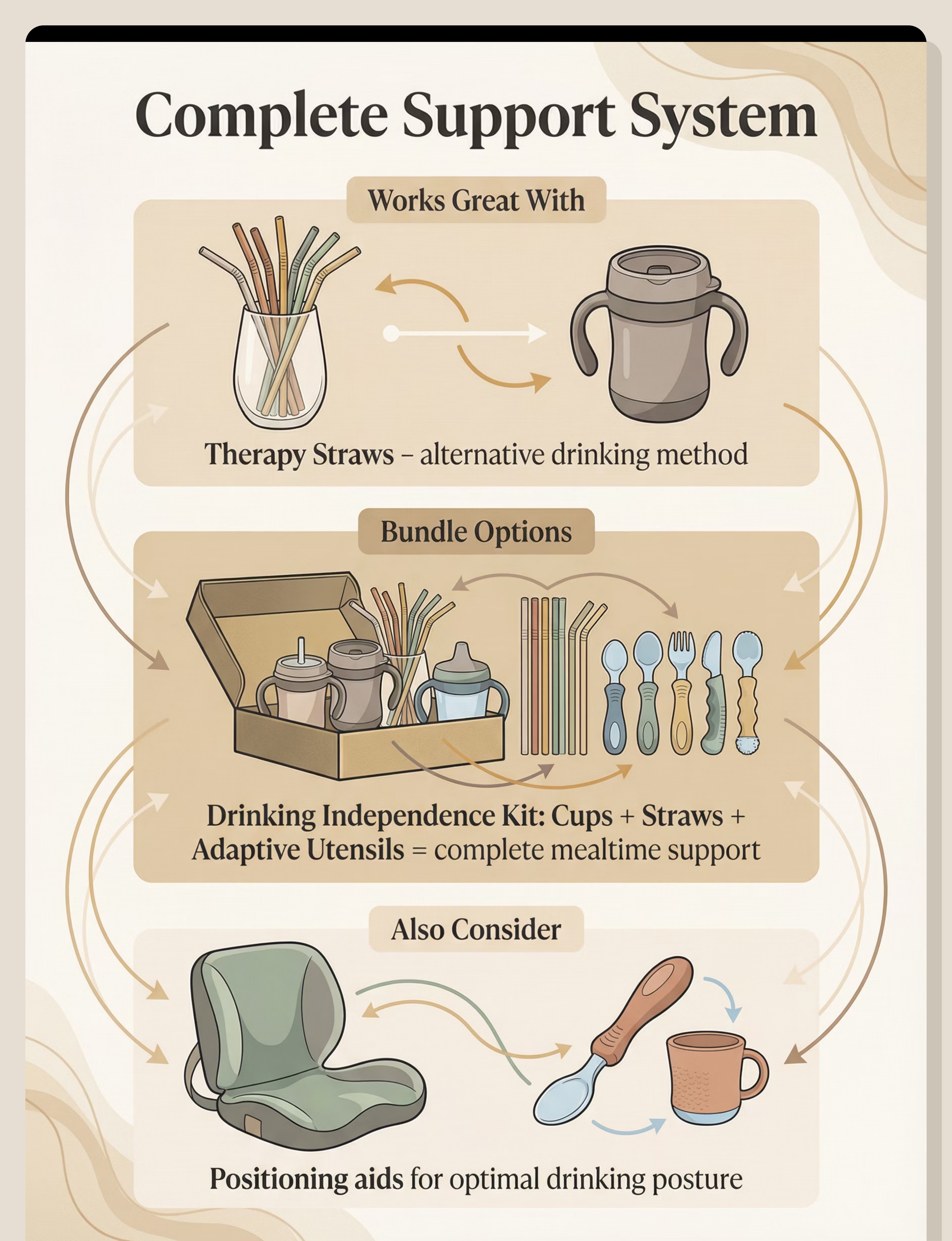
Pair It With...
Therapy Straws (ID: 11.2)
Alternative drinking method that builds oral motor skills and works alongside adaptive cups.
Adaptive Utensils (ID: 11.5)
Complete your mealtime independence setup with appropriate eating utensils.
Positioning Tools (ID: 12.3)
Proper positioning supports safe drinking and swallowing.
Utensil Training Tools (ID: 9.3)
Build comprehensive mealtime skills alongside drinking independence.

Recommended Bundles:
  • Drinking Independence Kit: Cup/Bottle Adaptations (11.6) + Therapy Straws (11.2) + Adaptive Utensils (11.5) → Complete drinking support system
  • Cup Transition Kit: 360 Cup (11.6.5) + Two-Handle Cup (11.6.3) + Therapy Straws (11.2) → Comprehensive bottle-to-cup transition support

Quick Summary
Cup and bottle adaptations enable safe, independent drinking by matching specific adaptations to positioning, motor, and oral challenges. Core Kit (Rank 2), strong evidence, essential feeding support.
cups
drinking
adaptive
feeding
hydration
safety
OT
SLP
core-kit
Common searches: adaptive cup autism, nosey cup cut out, 360 trainer cup, weighted cup kids, two handle cup, drinking therapy, cup transition

Get Support
FREE National Autism Helpline
Phone: 9100 181 181
Languages: 16+ languages supported
Website: pinnacleblooms.org
Platform Integration
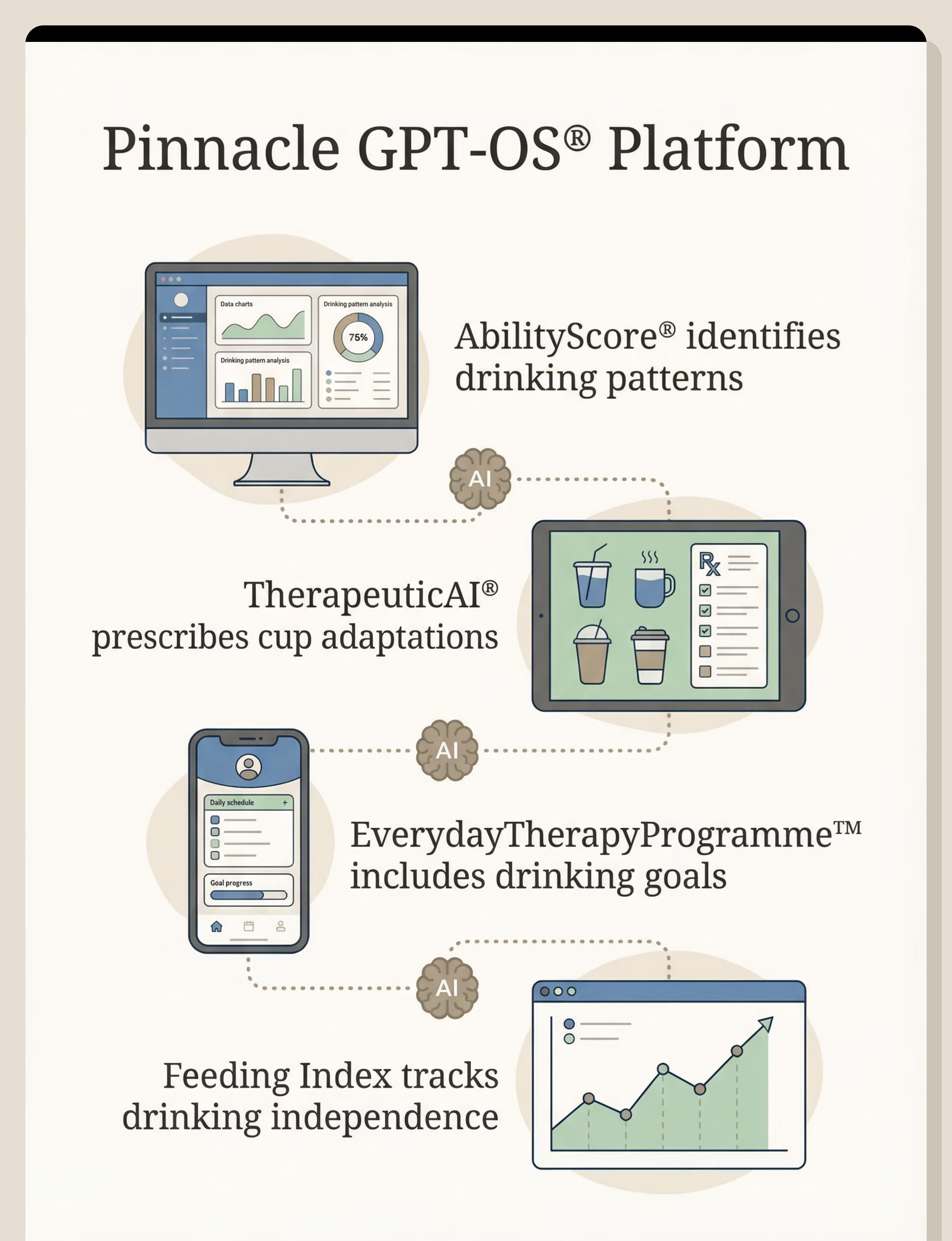
Cup/Bottle Adaptations integrate with Pinnacle Blooms Network's comprehensive child development platform:
  • AbilityScore® identifies drinking patterns and needs through comprehensive assessment
  • TherapeuticAI® prescribes specific cup adaptations based on your child's challenges
  • EverydayTherapyProgramme™ includes drinking goals and tracks progress
  • Feeding Index monitors drinking independence and hydration as part of overall feeding development

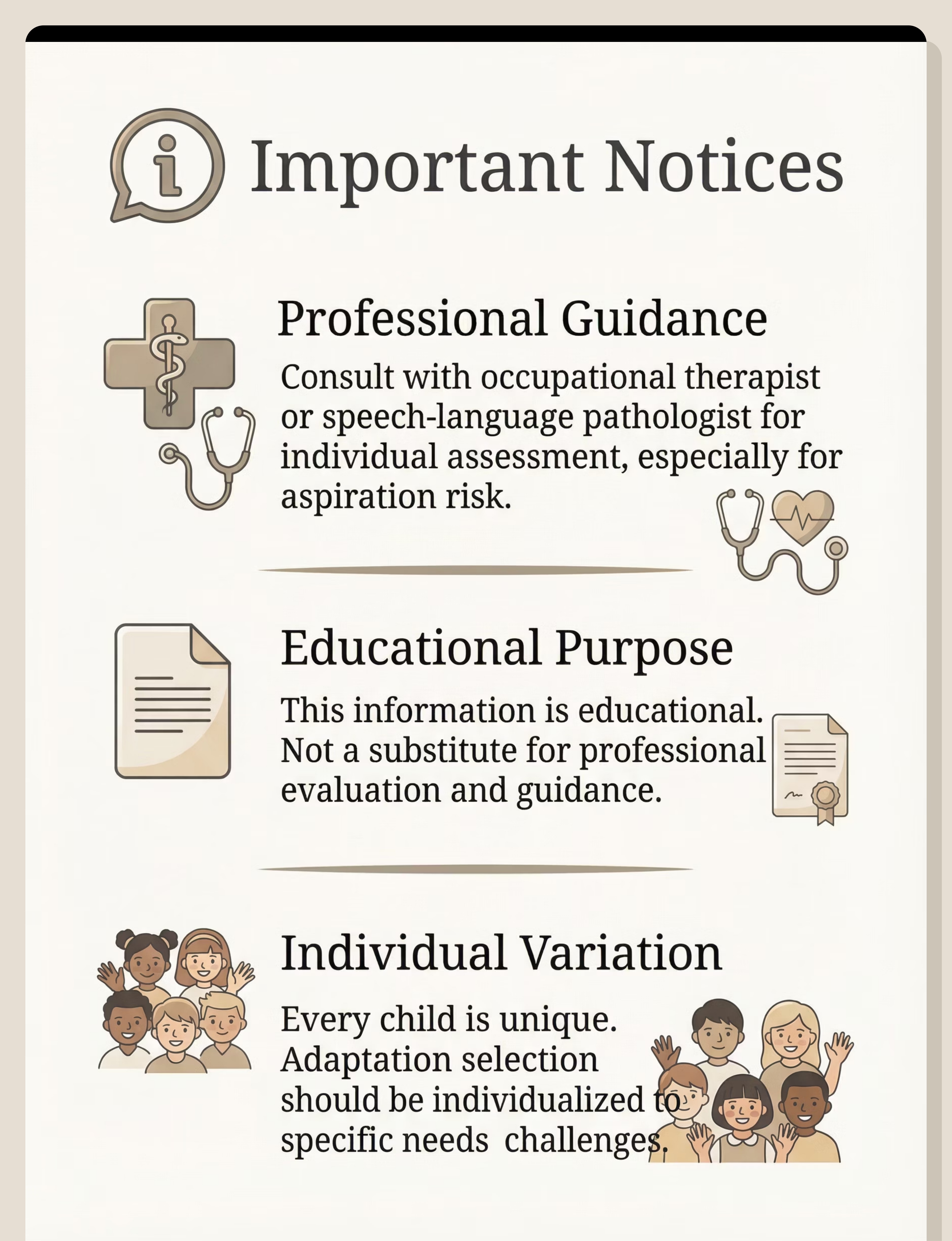
Disclaimer: This is educational information. Always consult qualified occupational therapists, speech-language pathologists, or pediatricians for assessment and recommendations specific to your child. Individual results vary. For children with swallowing difficulties or aspiration history, professional evaluation is essential before implementing any drinking adaptations.