























Tool ID: 1.4
Tool ID: 1.4
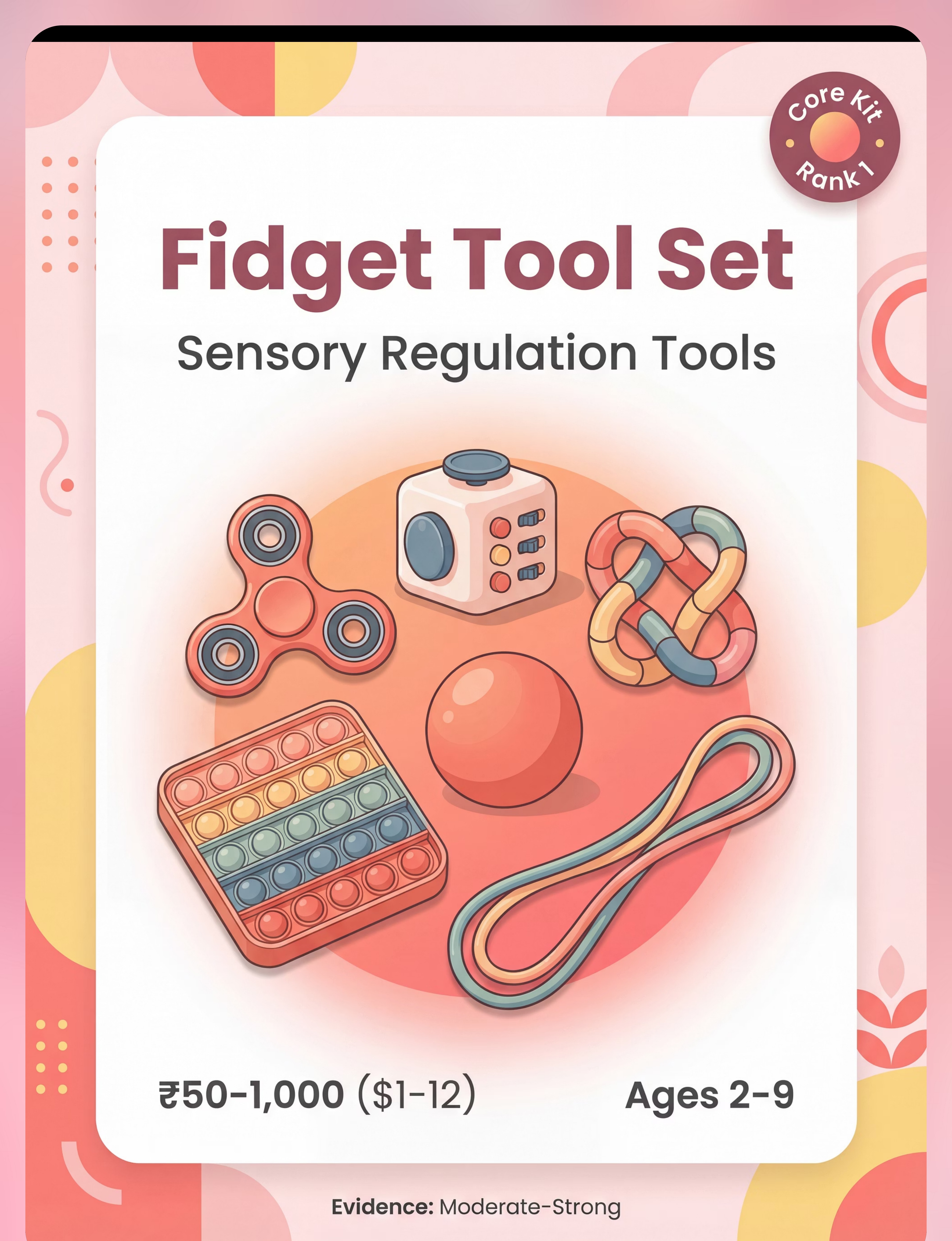
Fidget Tool Set
Tactile/proprioceptive self-regulation tools
OT Recommended
Moderate-Strong Evidence
Rank #1
Daily Use
₹50–1,000
When little hands need to move to help big minds focus, the right fidget tool can transform homework battles into calm productivity. These carefully designed sensory tools provide the tactile and proprioceptive input that helps children regulate their bodies, manage anxiety, and improve attention—turning fidgeting from a problem into a solution.
Who This Helps
Fidget tools provide tactile and proprioceptive input to support attention and self-regulation, helping children channel their natural need to move into productive focus.
Self-Regulation
Attention
Anxiety Reduction
Fine Motor
Oral Motor
Ages 2-9 years
Home
School
Clinic
Travel
Children who need to move to focus
Hands that always need to be doing something finally have an appropriate outlet
Oral sensory seekers
Safe alternatives to chewing clothing, pencils, or inappropriate items
Anxious children
Calming tactile input that helps manage worry and stress throughout the day
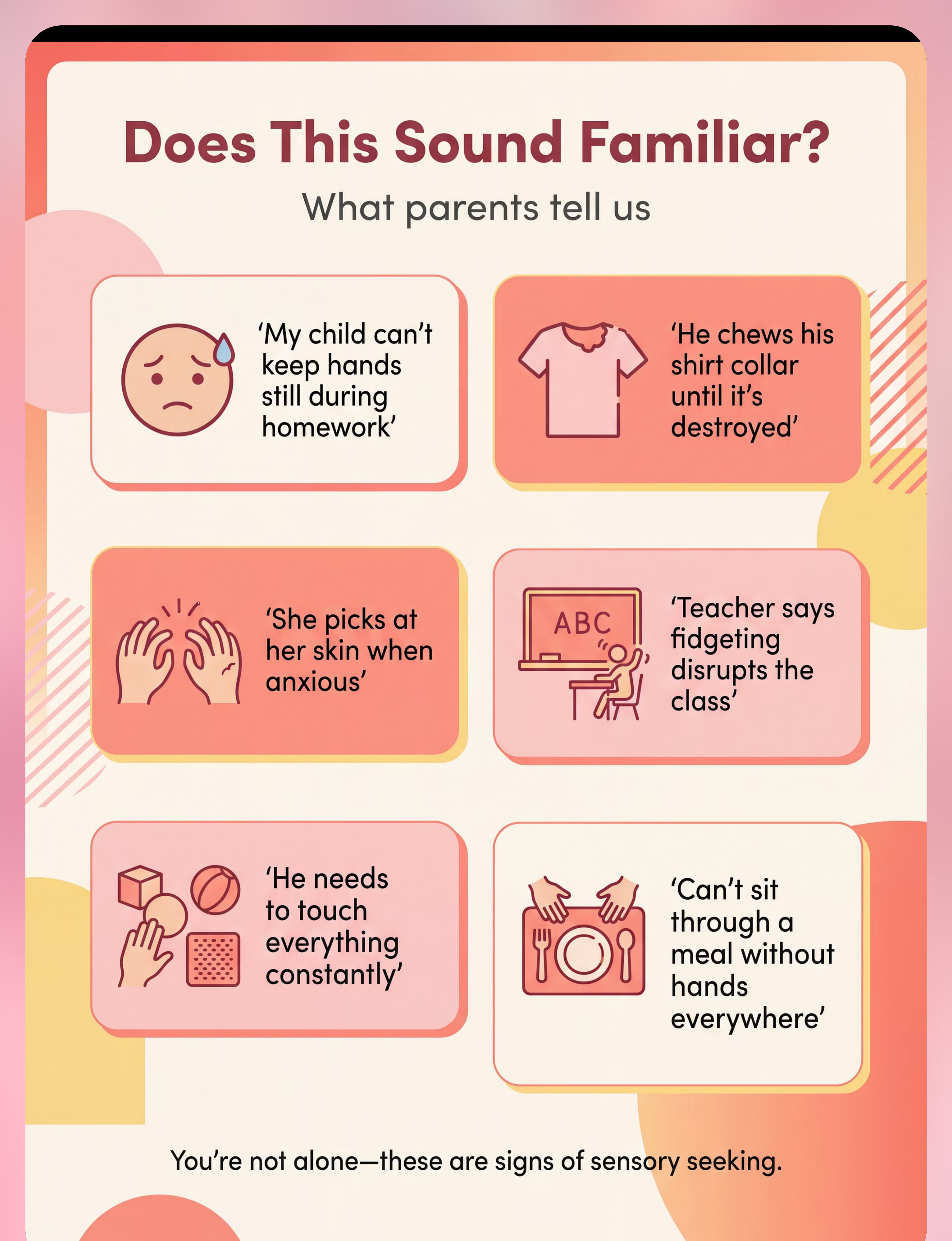
Does This Sound Familiar?
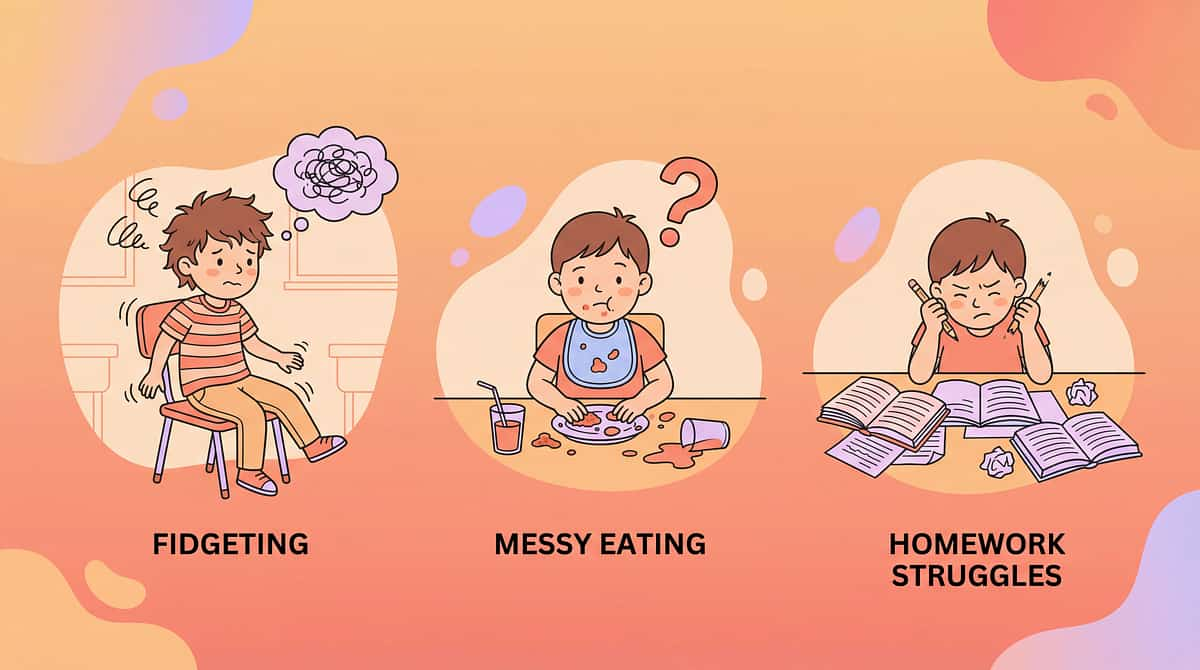
"My child can't keep hands still during homework—it takes twice as long to finish anything"
"He chews his shirt collar until it's destroyed. We've replaced so many uniforms"
"She picks at her skin when anxious. I don't know how to help her stop"
"Teacher says fidgeting disrupts the class. But he's not trying to be disruptive"
"He needs to touch everything constantly. Shopping is exhausting"
"Can't sit through a meal without hands everywhere—touching food, plates, everything"
You're not alone. These are common challenges for children with sensory processing differences. The good news? The right sensory tools can make a remarkable difference.
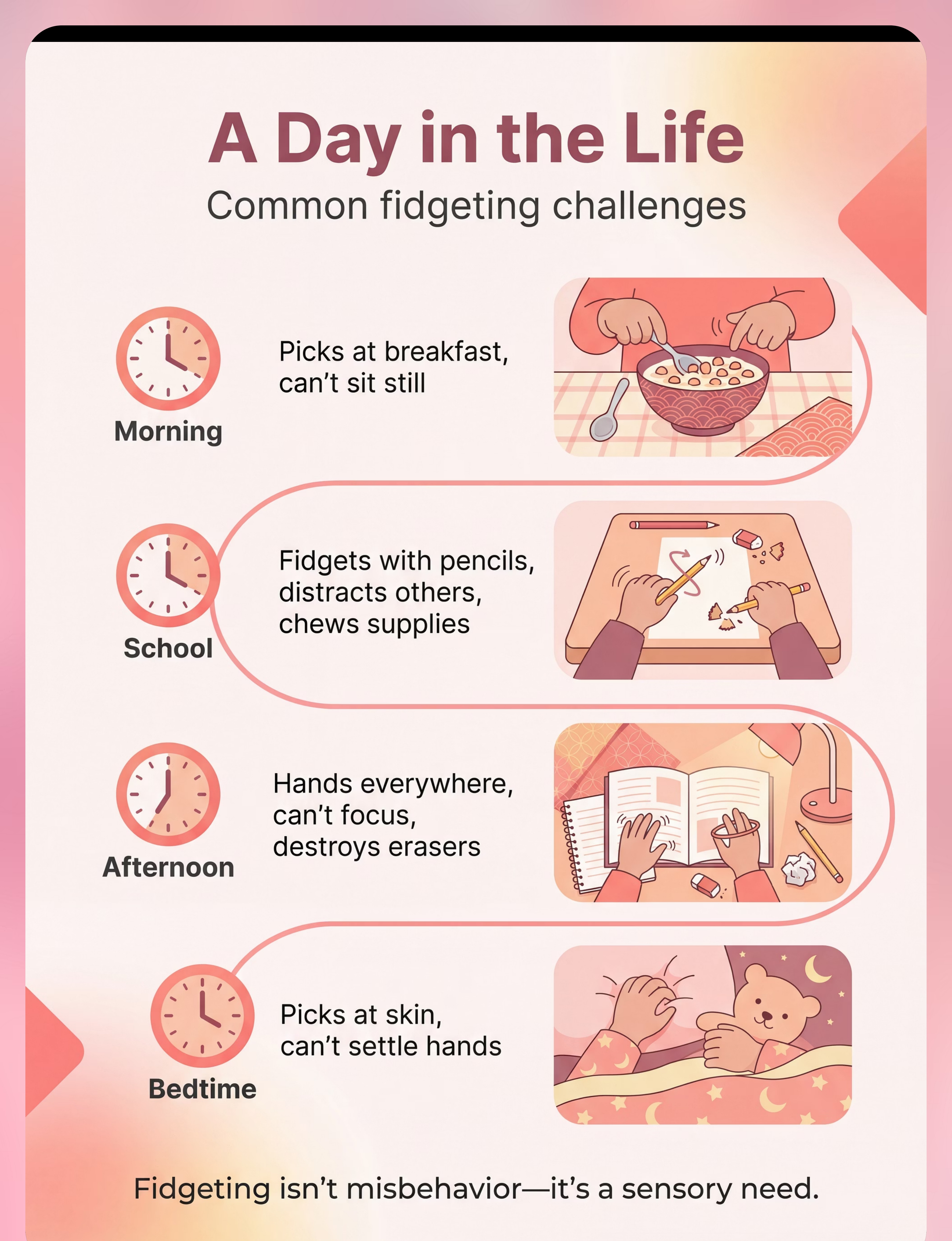
A Day Without the Right Support
1
Morning
Picks at breakfast plate, can't sit still long enough to finish eating. Hands constantly moving, touching everything on the table.
2
School
Fidgets with pencils and pens, distracts neighbors. Chews on school supplies. Teacher repeatedly redirects—negative attention cycles begin.
3
Homework
Hands everywhere—picking eraser bits, tapping pencil, touching face. Simple assignments take forever. Destroys erasers and pencils daily.
4
Bedtime
Picks at skin and nails while settling down. Can't keep hands still. Wind-down routine takes much longer than it should.
Each moment becomes a battle between the child's sensory needs and environmental expectations. This exhausts everyone—child, parents, and teachers alike.
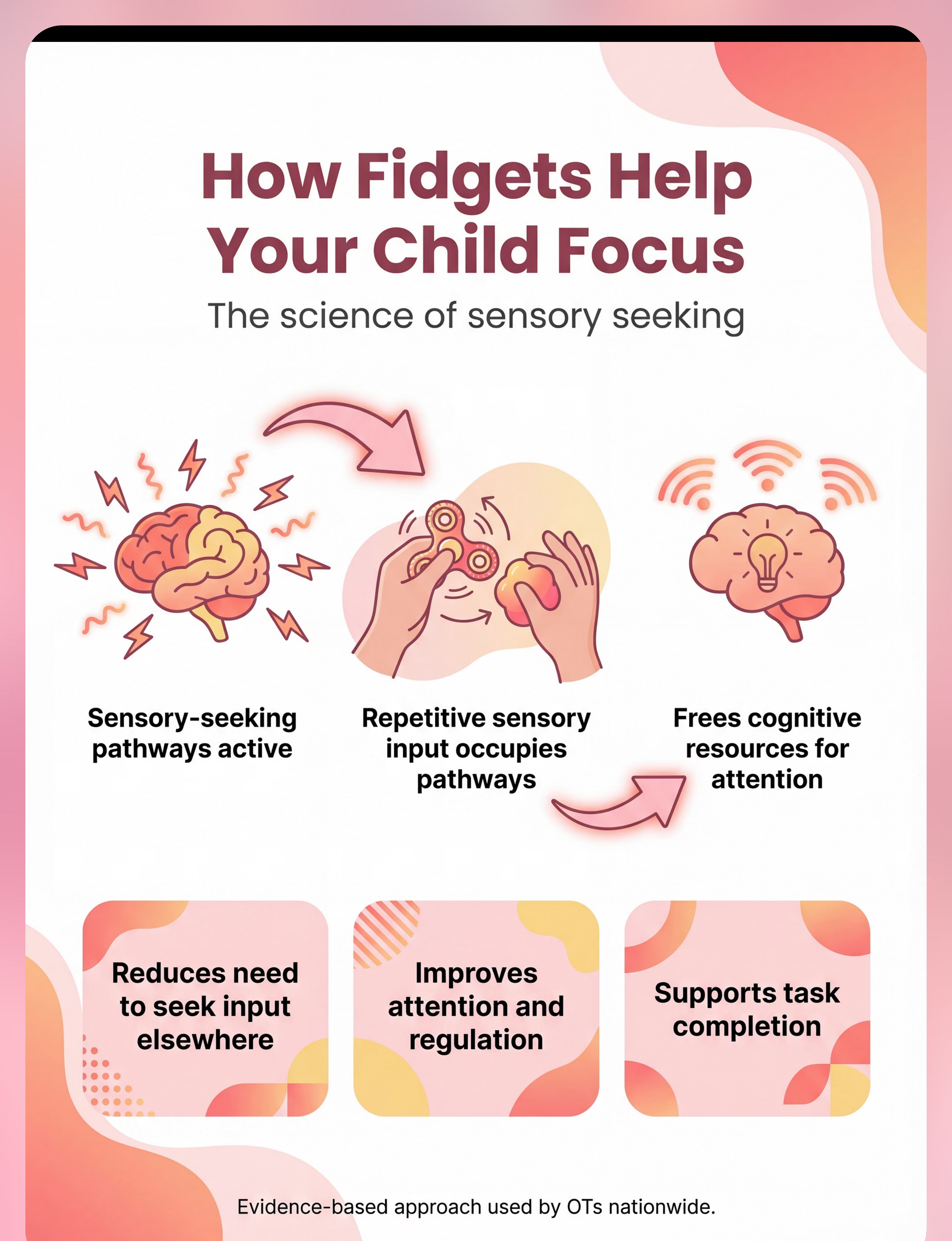
The Science Behind It
Repetitive Sensory Input
Fidget provides continuous tactile or proprioceptive feedback to the nervous system
Occupies Seeking Pathways
Satisfies the body's need for sensory input through an appropriate, focused channel
Reduces Inappropriate Seeking
When sensory needs are met, child stops seeking input from inappropriate sources
Frees Cognitive Resources
Body satisfied, brain can now focus on learning, listening, and task completion
Improved Regulation
Better attention, reduced anxiety, and enhanced self-regulation throughout the day
This isn't about distraction—it's about meeting the nervous system's needs so the mind can focus. When sensory pathways are satisfied through appropriate tools, children can direct their attention where it matters most.
Self-Regulation
Attention
Anxiety Reduction
Fine Motor
Oral Motor
How to Use It Right
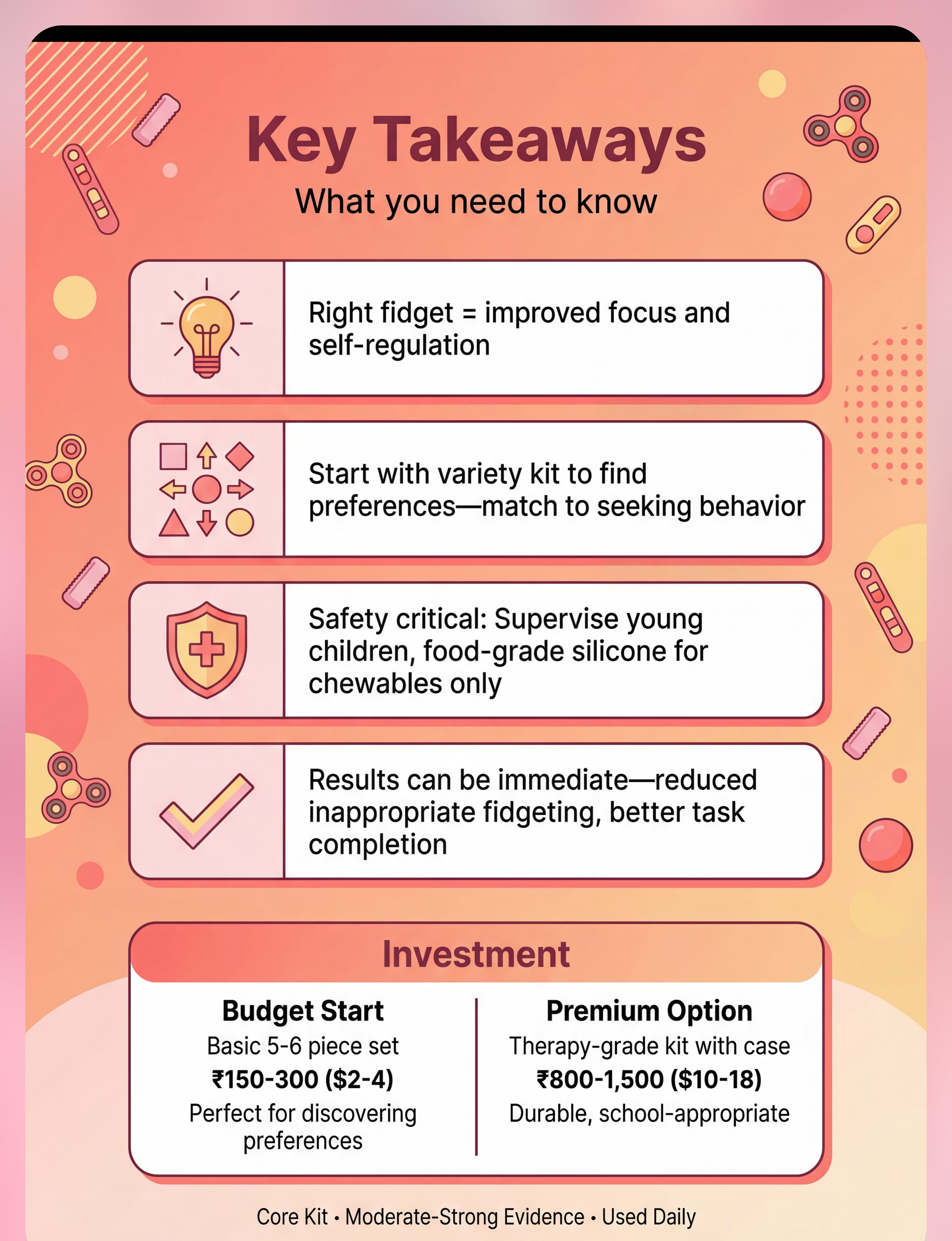
Match fidget to sensory need
Oral seekers need chewables, tactile seekers need textured items, proprioceptive seekers need resistance. Observe what your child naturally does with their hands.
Trial multiple types to find preference
Start with a variety pack. Children often don't know what works until they try it. Some days they may prefer different fidgets for different tasks.
Teach appropriate use—tool, not toy
Set clear expectations: fidget stays in one hand, eyes remain on work or teacher, tasks still get completed. Practice at home before school use.
Silent fidgets for classroom
Choose quiet options like tangles, stress balls, or fidget cubes for school. Save auditory fidgets like pop-its for home use.
Have backup—fidgets get lost
Once you identify favorites, buy multiples. Keep one at home, one in backpack, one in car. Small items disappear easily.
Typical Duration: As needed throughout the day—no time limit. Some children benefit from continuous access, others use fidgets strategically during challenging tasks or transitions.
Expert Perspective
Expert Quote
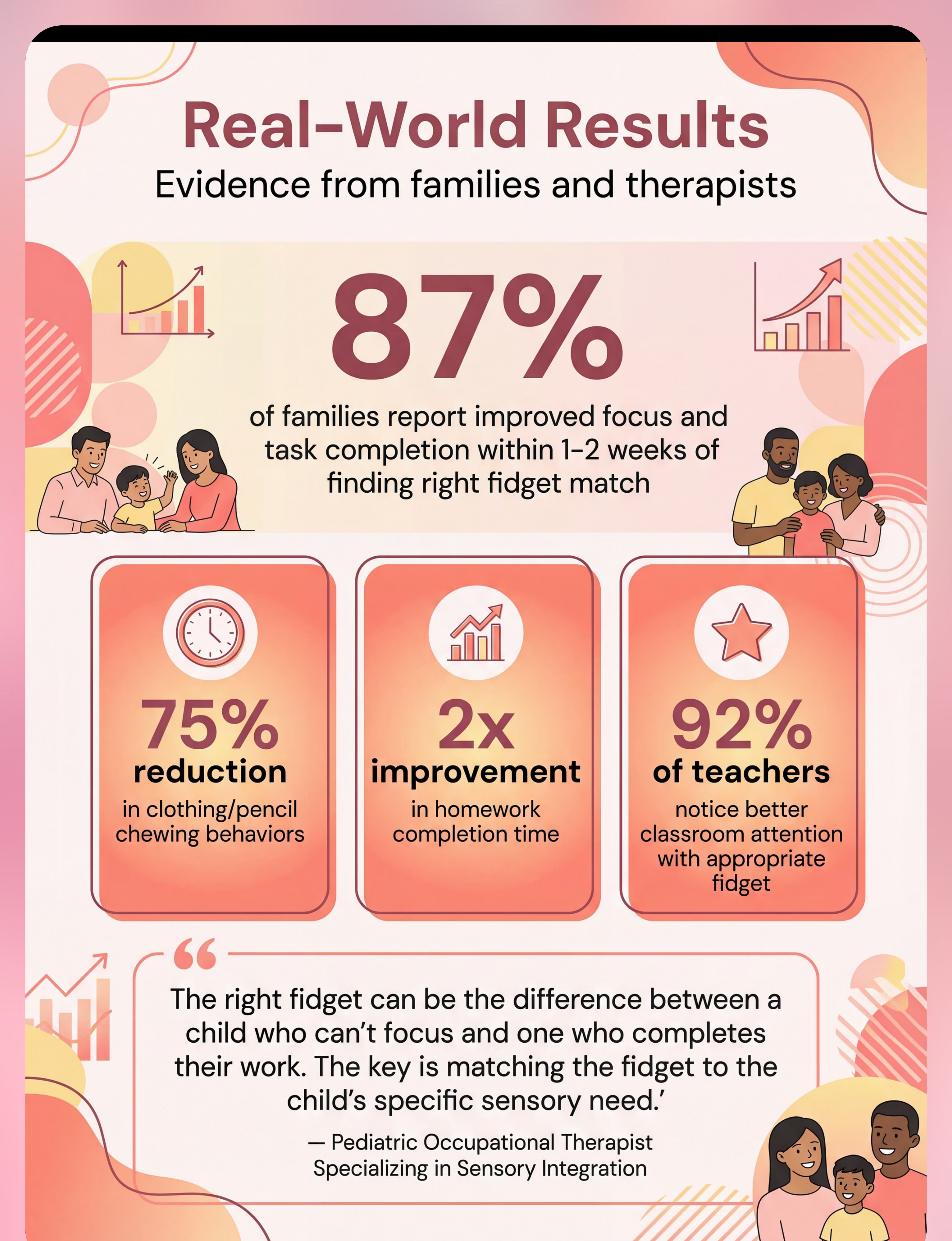
"The right fidget can be the difference between a child who can't focus and one who completes their work. The key is matching the fidget to the child's specific sensory need."
Expert Credentials
Occupational Therapist, Pediatric Sensory Specialist
OT Recommended
Occupational therapy's first-line tool for attention and regulation support
Moderate-Strong Evidence
Research supports effectiveness when matched to individual sensory profile
Rank #1 in Category
Top-rated tool in Sensory Regulation toolkit for daily use
fidget-tool-set-sensory-regulation therapy material
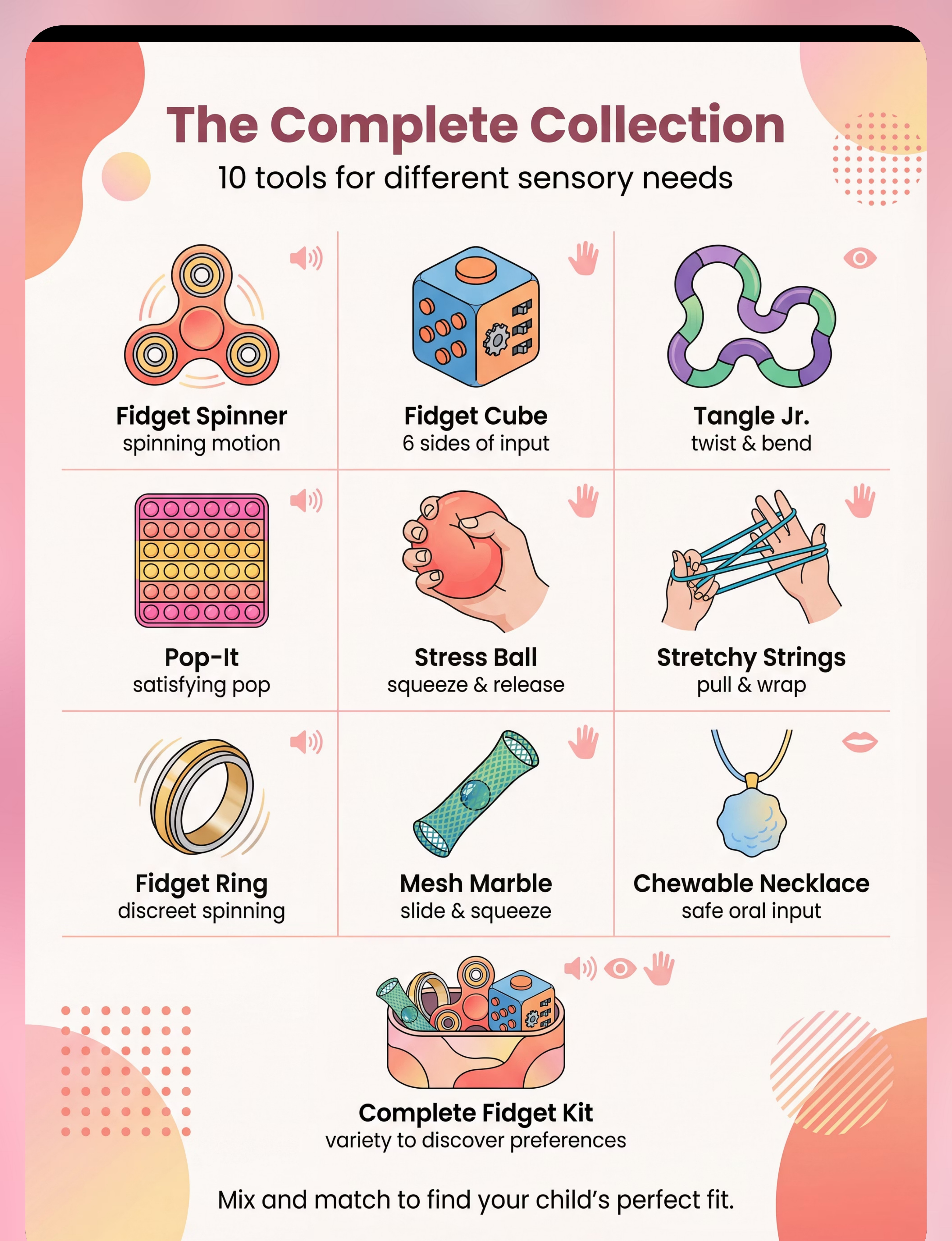
Choose Your Option (10 Variants)
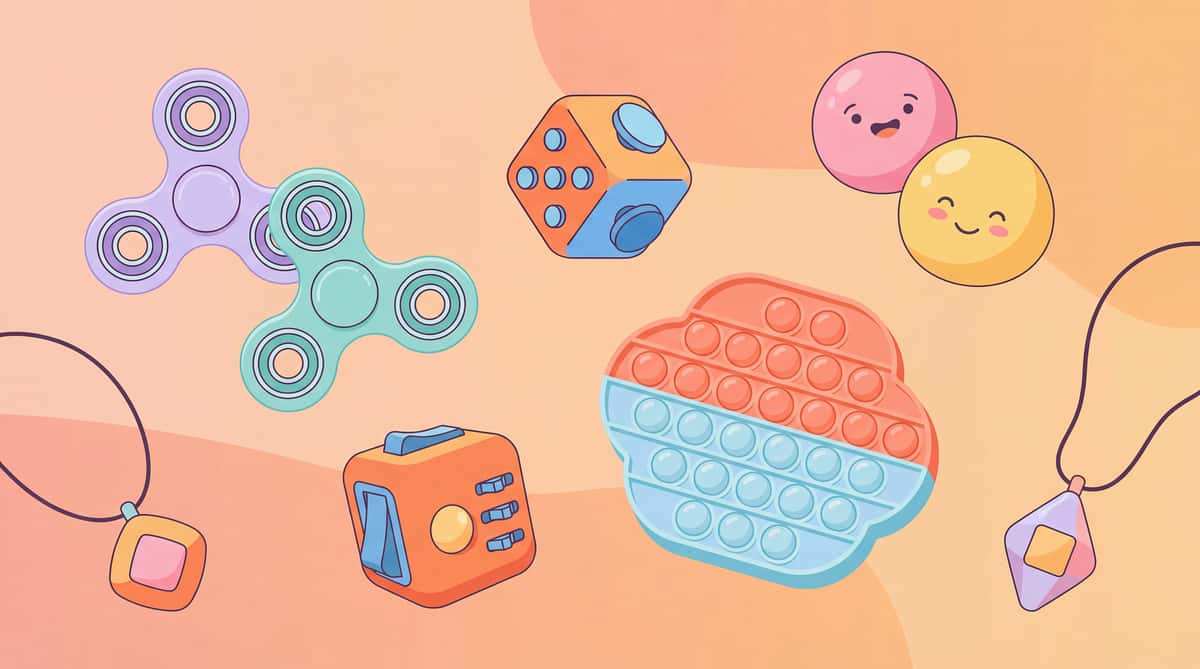
Fidget Spinner
Visual stimulation, waiting, anxiety relief
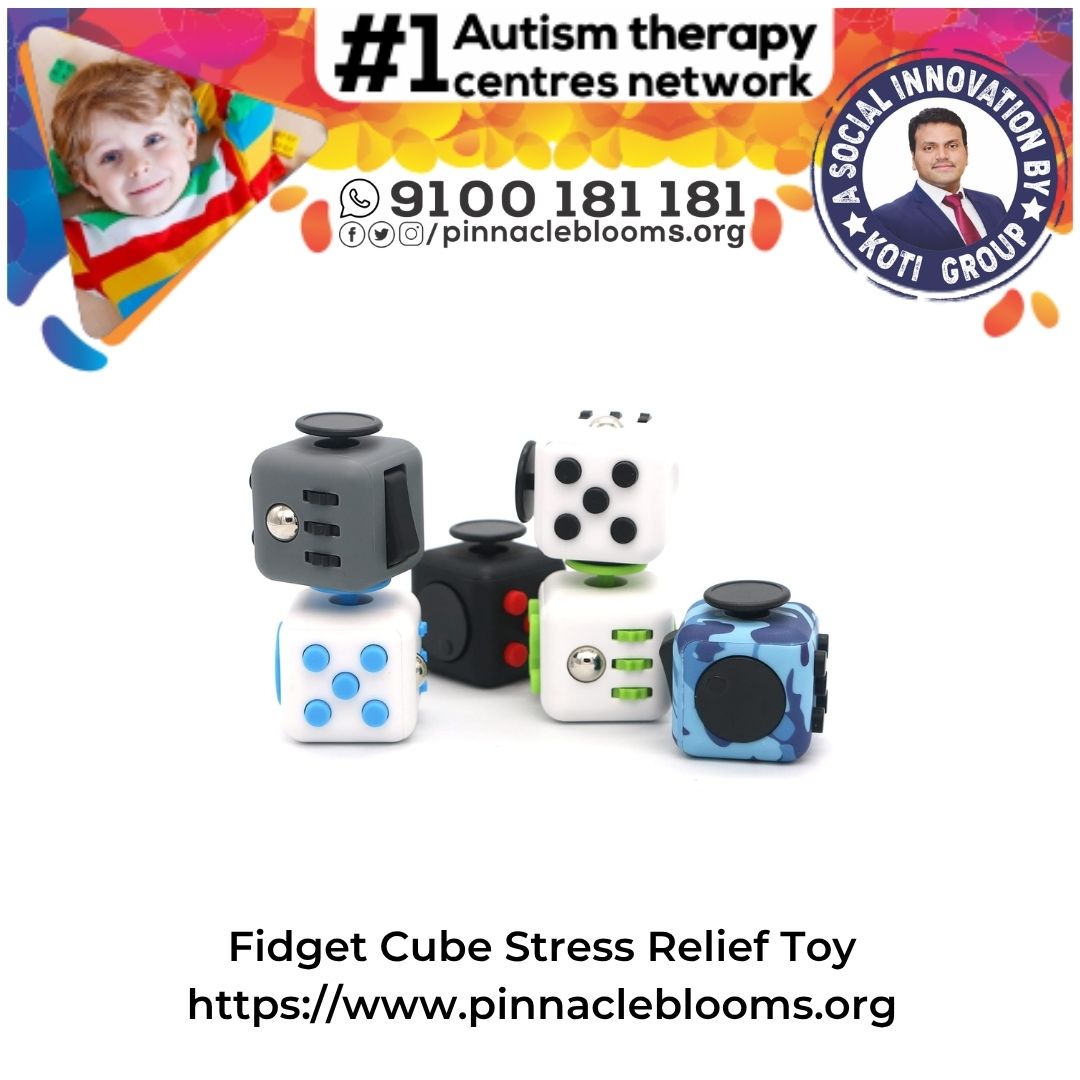
Fidget Cube
Desk work, quiet fidgeting, multi-sensory input
Tangle Jr.
Silent fidgeting, classroom, therapy sessions
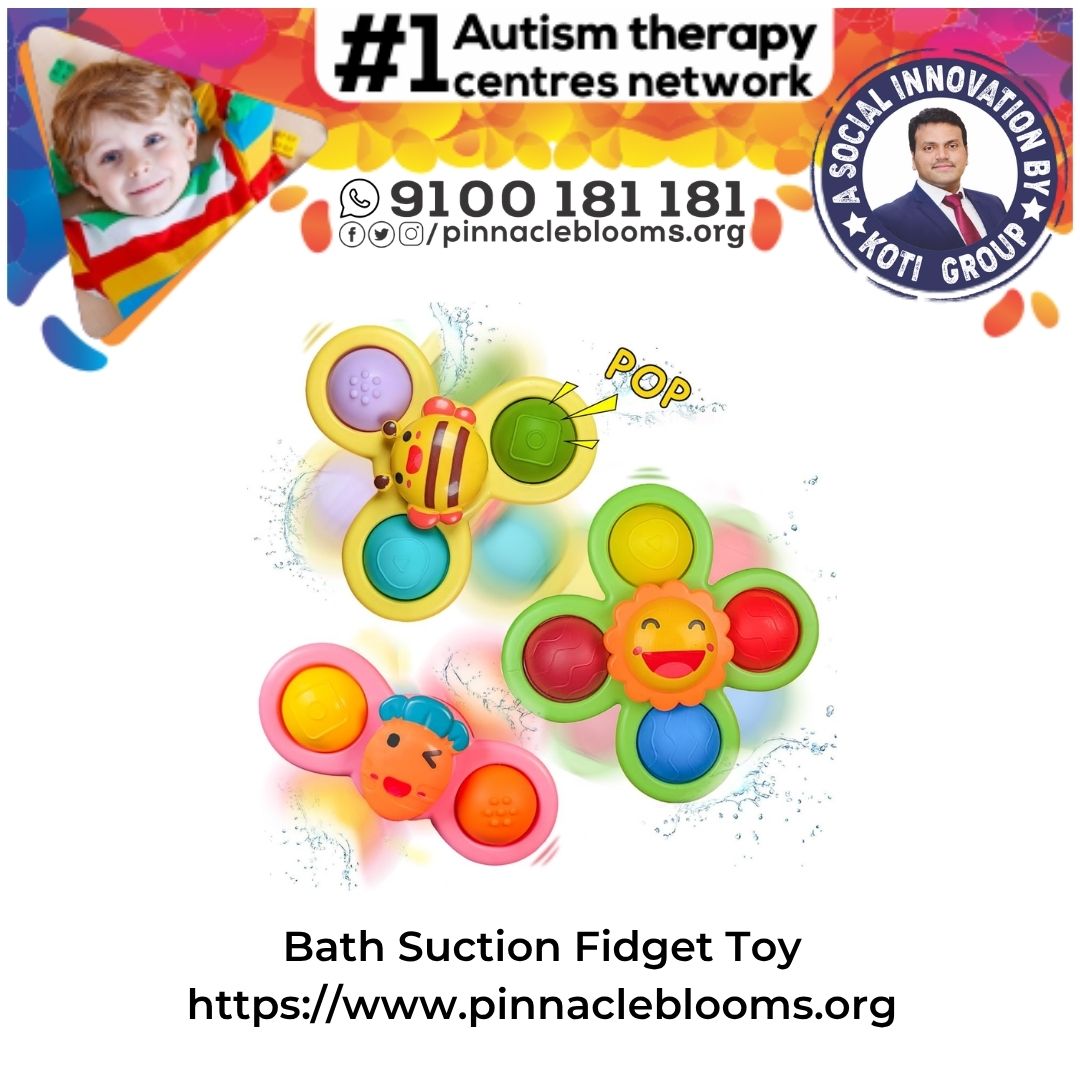
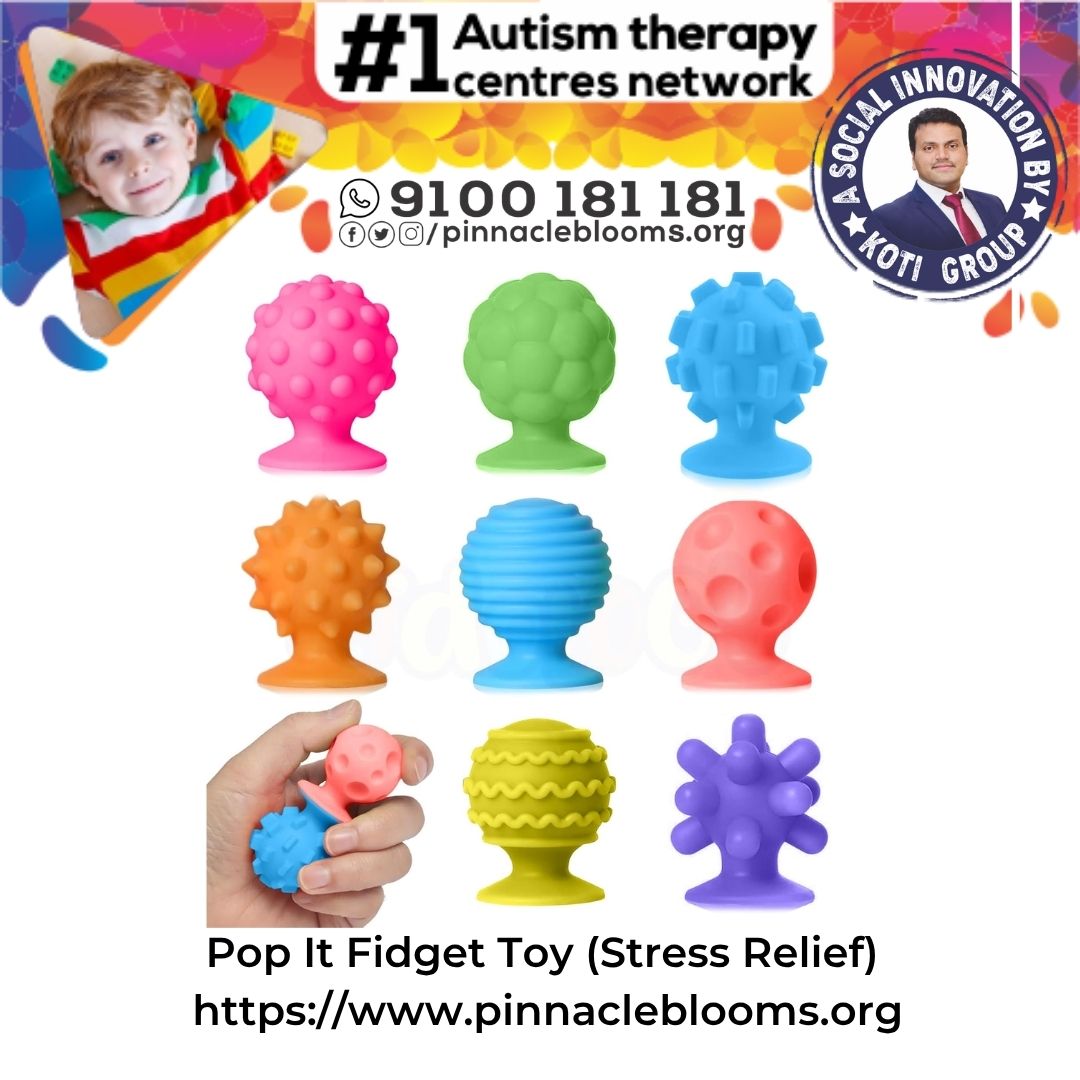
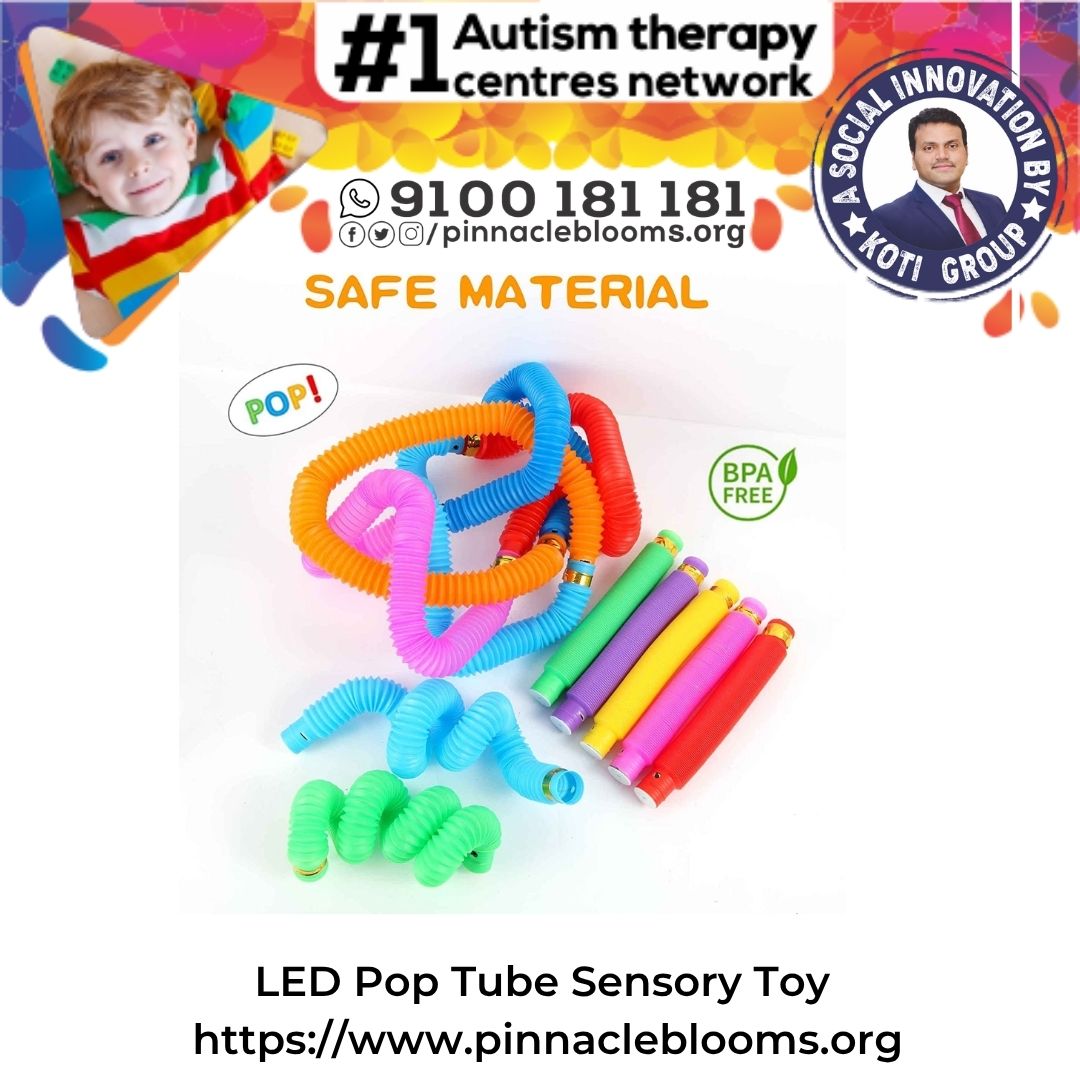
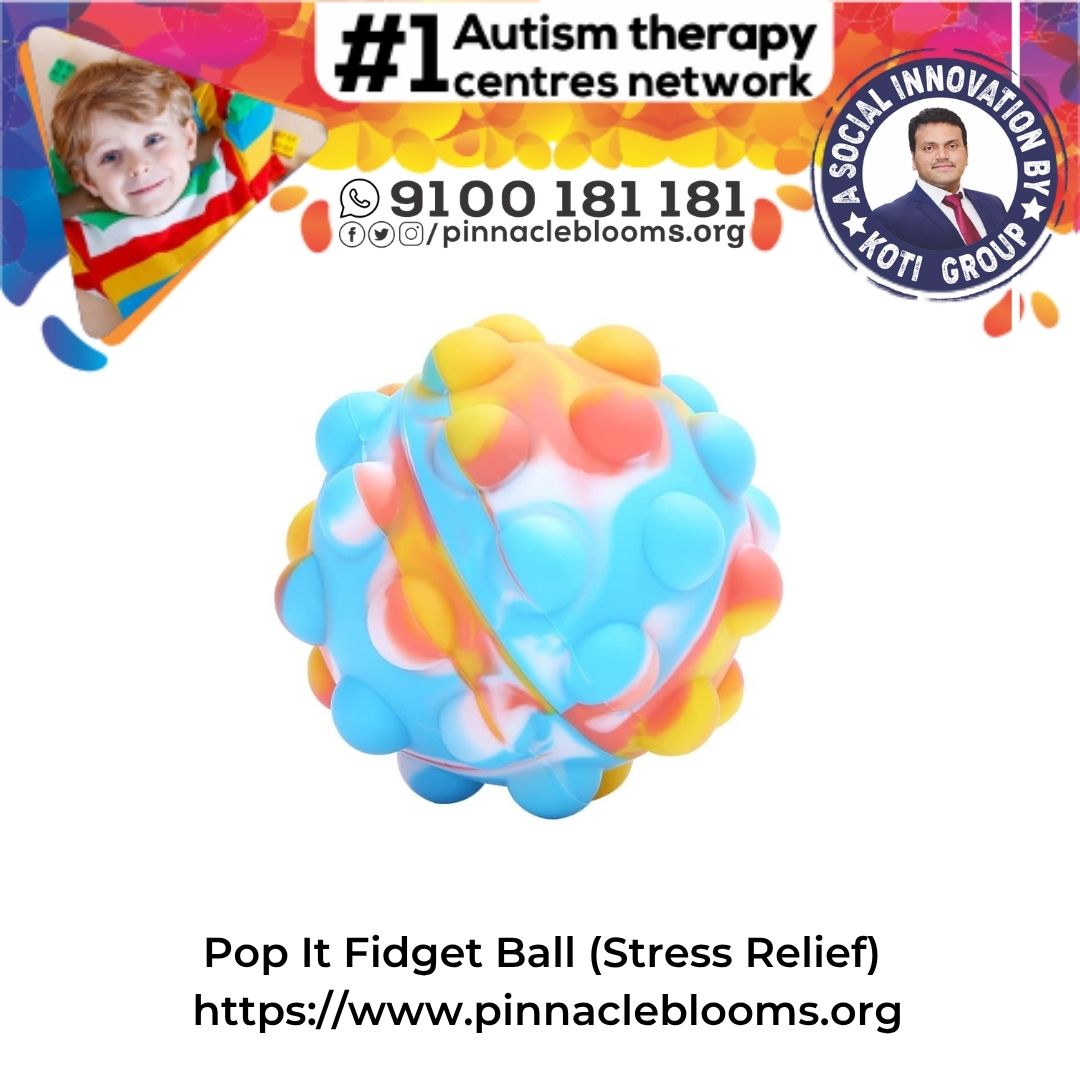
Pop-It / Push Pop
Anxiety relief, repetitive tactile and auditory input
Stress Ball / Squeeze Ball
Hand strengthening, stress relief, anger management
Stretchy Strings / Noodles
Quiet fidgeting, hand strengthening, anxiety
Fidget Ring / Spinner Ring
Discreet fidgeting, suitable for teens and older kids
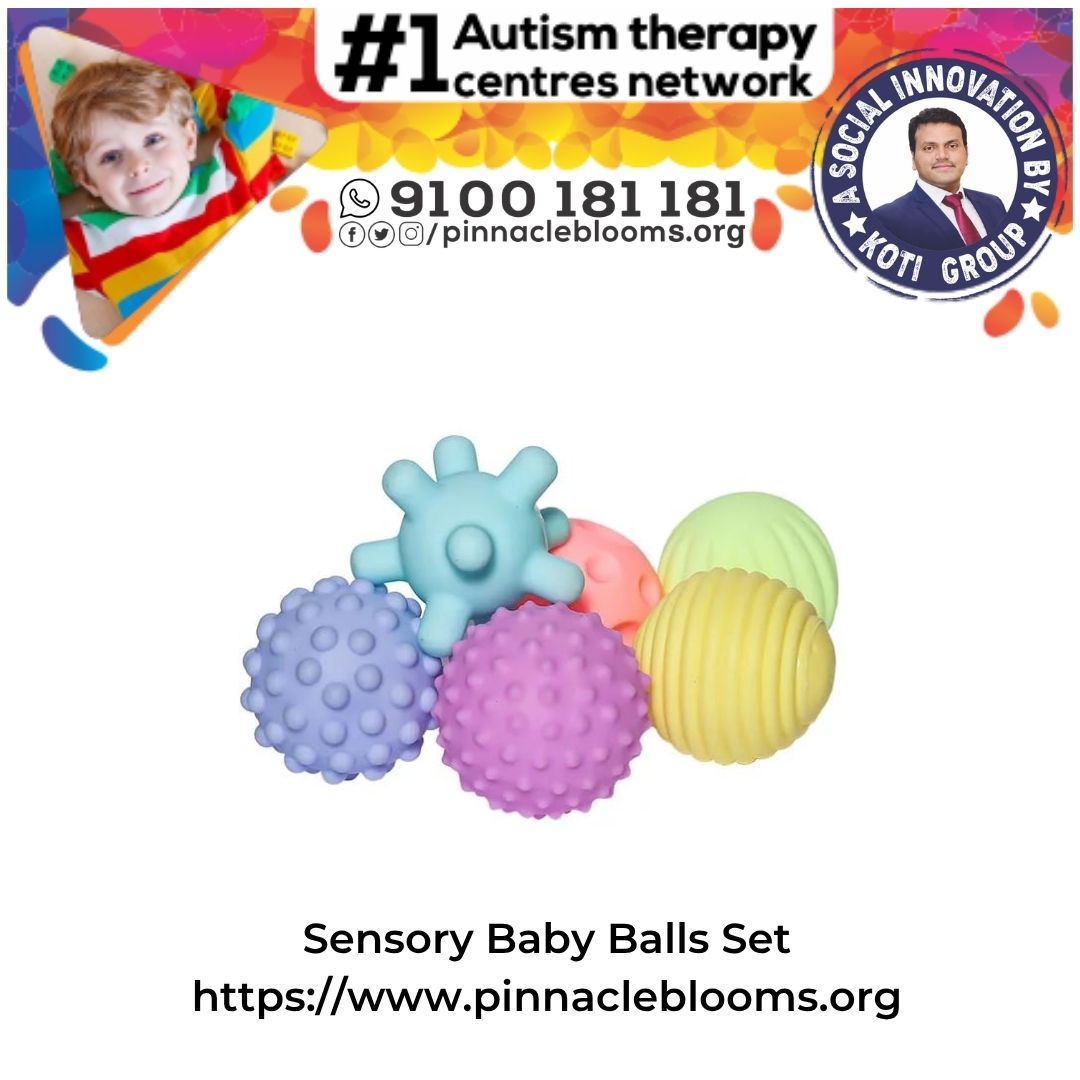
Mesh Marble Fidget
Tactile exploration, calming, and focus improvement
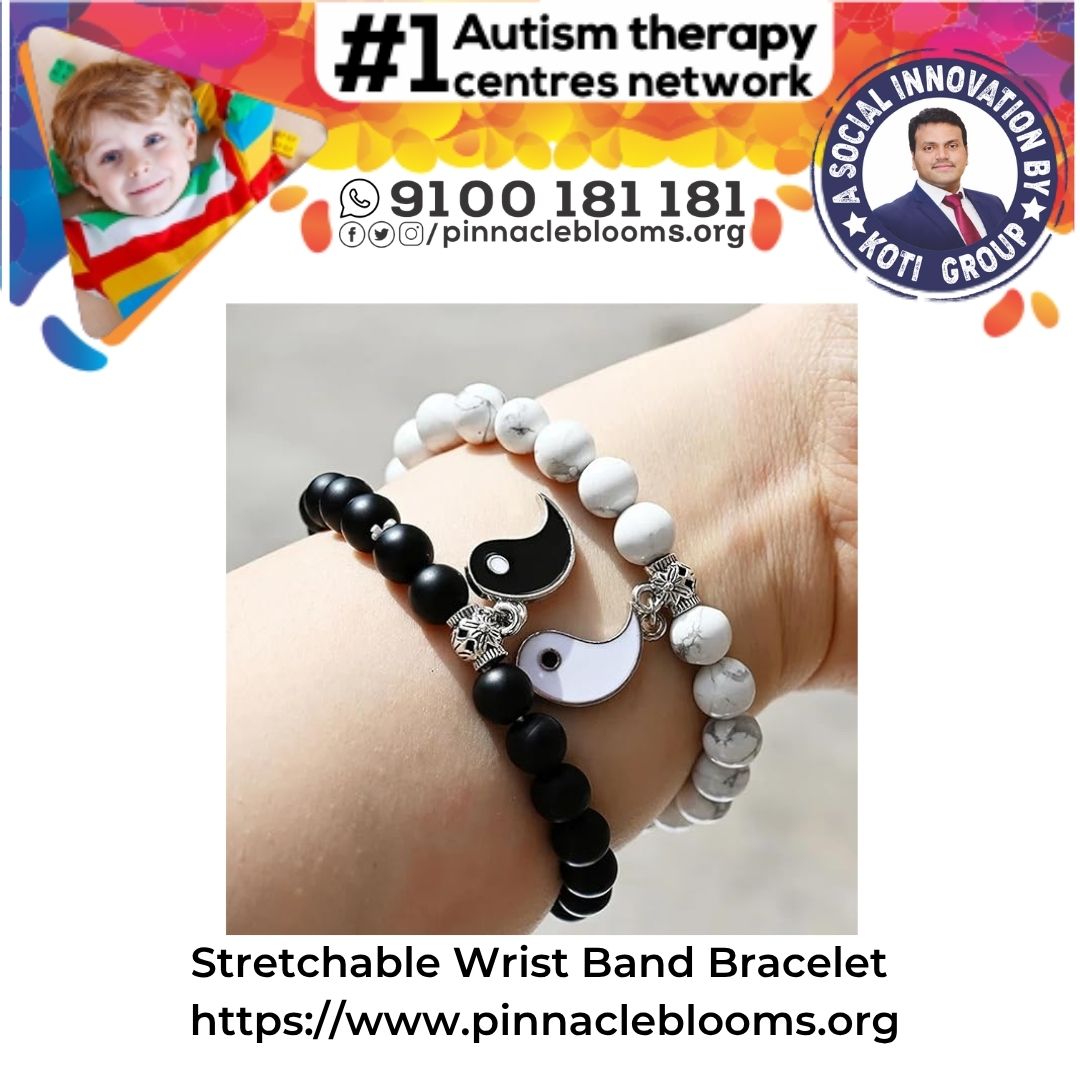
Chewable Fidget (Necklace/Bracelet)
Designed for oral seekers, redirects chewing habits
Complete Fidget Kit (8-12 pieces)
Ideal for discovering preferences, clinical or travel use
Every child's sensory needs are unique. This complete guide helps you find the perfect match—whether your child seeks oral input, tactile feedback, proprioceptive resistance, or visual stimulation. Understanding the diverse range of fidget tools available is key to supporting focus, calming anxiety, and enhancing learning environments.

How to Choose the Right Fidget
  • By goal: Calming (stress balls, tangles) | Visual (spinners) | Breath regulation (pop-its) | Motor (resistance fidgets)
  • By setting: Home (any) | Clinic (therapy-grade) | Outdoor (durable) | School (silent options only)
  • By portability: Pocket-sized for travel, desk-friendly for homework, wearable for constant access
Matching the fidget to the specific sensory need ensures maximum effectiveness and benefit.
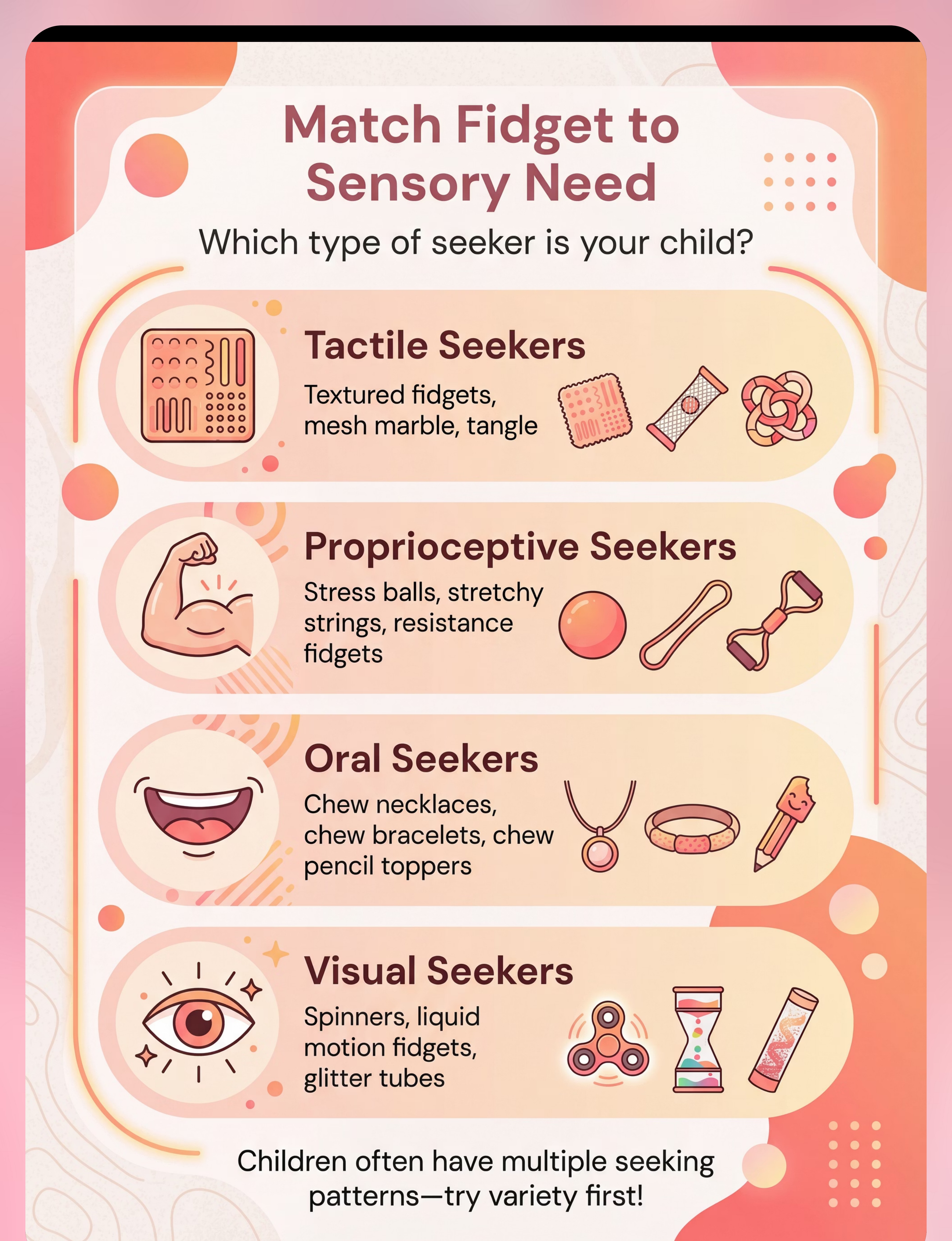
Match Fidget Type to Sensory Need
fidget-tool-set-sensory-regulation therapy material
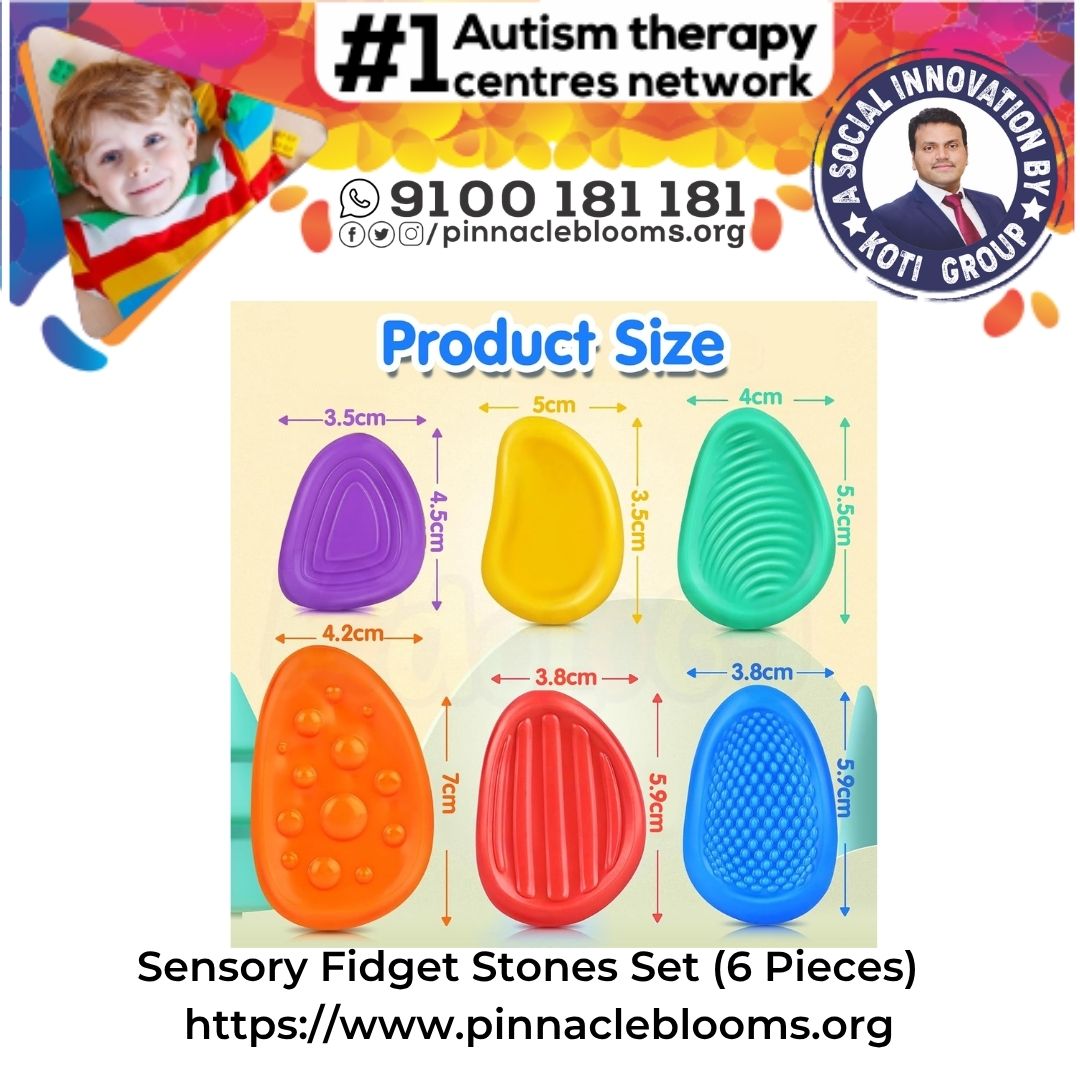
Need: Touch and texture exploration | Best tools: Textured stress balls, mesh marble fidgets, stretchy strings, pop-its | Why it works: Provides varied tactile input to satisfy sensory seeking
fidget-tool-set-sensory-regulation therapy material
Need: Deep pressure and resistance | Best tools: Stress balls, therapy putty, resistance bands, heavy fidgets | Why it works: Engages muscles and joints, provides calming deep pressure input
fidget-tool-set-sensory-regulation therapy material
Need: Oral motor input and jaw stimulation | Best tools: Chewable necklaces, bracelets, pencil toppers (food-grade silicone) | Why it works: Redirects chewing behaviors safely, provides oral sensory feedback
fidget-tool-set-sensory-regulation therapy material
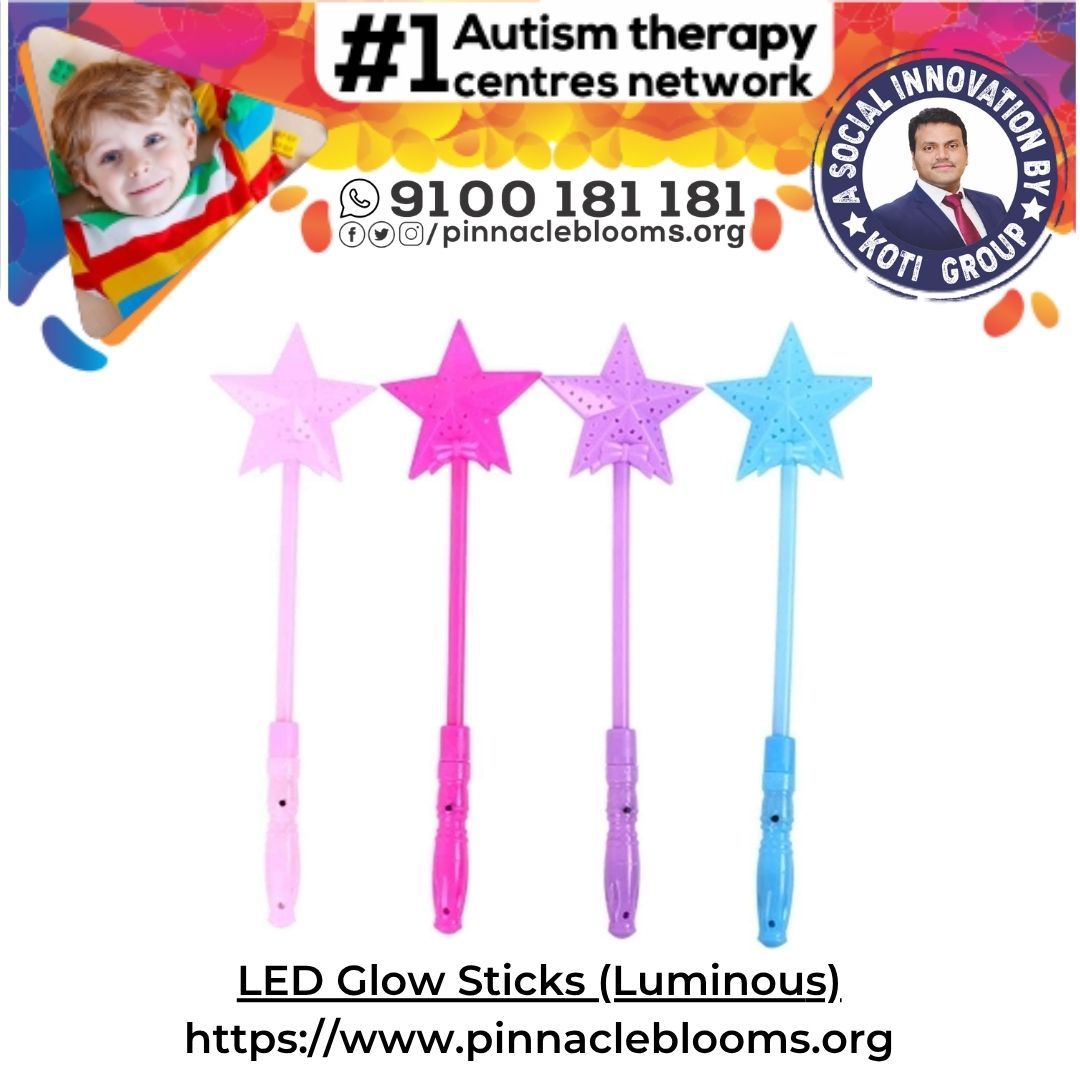
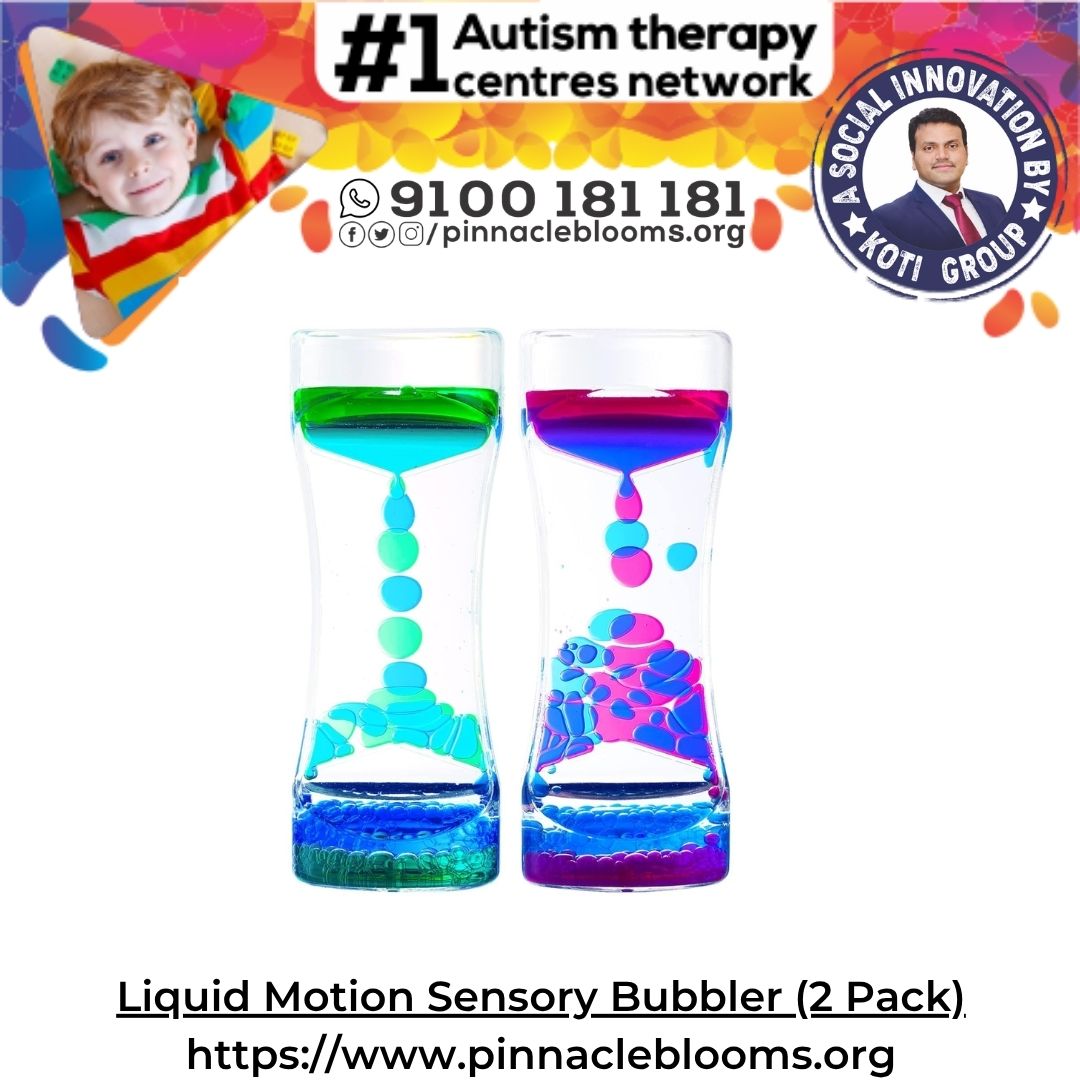
Need: Visual stimulation and tracking | Best tools: Fidget spinners, liquid motion timers, glitter wands | Why it works: Provides visual focus point, can be calming or alerting
fidget-tool-set-sensory-regulation therapy material
Need: Sound feedback (but consider environment) | Best tools: Pop-its (soft sound), clickers, quiet fidget cubes | Why it works: Provides auditory feedback while maintaining appropriate volume for setting
Key Materials: Silicone (safe, durable), ABS plastic, metal (spinners), food-grade silicone (chewables), rubber/latex-free options available. Key Features: Non-toxic materials, durable construction, quiet options for school, washable/cleanable.
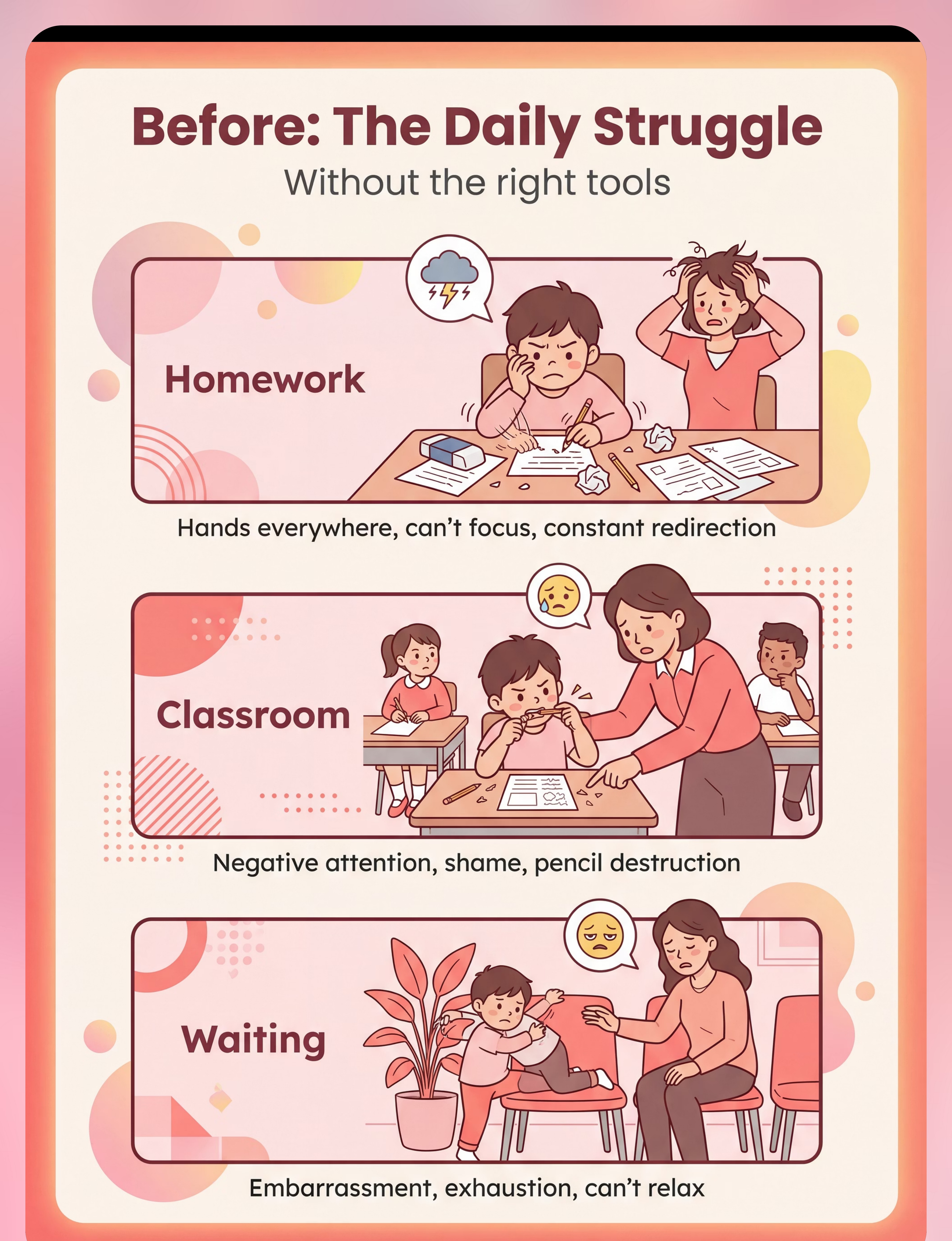
The Struggle (Before)
fidget-tool-set-sensory-regulation therapy material
Homework Time
Situation: Child sits down for homework with pencil and paper
Experience: Hands everywhere—picking eraser bits, tapping pencil constantly, touching face and hair. Can't seem to focus on the actual work. Gets in trouble for not paying attention.
Emotion: Frustration builds. Parent repeats "focus" over and over. Child feels like a failure. Conflict escalates.
fidget-tool-set-sensory-regulation therapy material
Classroom
Situation: Teacher is explaining new concept, expects students to listen
Experience: Teacher constantly redirecting. Child chews pencils, picks at desk edge, distracts neighbors with fidgeting. Receives negative attention throughout the day.
Emotion: Shame sets in. Child doesn't understand why they can't sit still like others. School becomes associated with failure. Avoidance behaviors begin.
fidget-tool-set-sensory-regulation therapy material
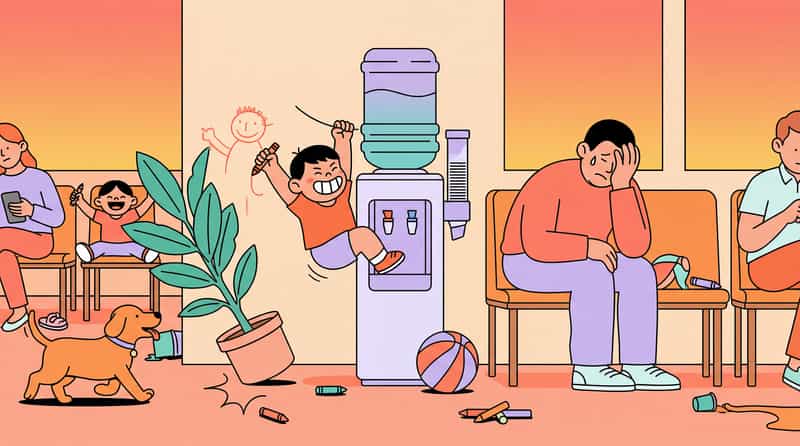
Waiting (Doctor, Restaurant)
Situation: Family needs to wait quietly in public space
Experience: Child cannot wait calmly. Touches everything in reach, climbs on furniture, disrupts others. Parent exhausted from constant management and redirection.
Emotion: Embarrassment for parent. Looks from others. Child picking up on stress. Everyone uncomfortable. Family starts avoiding public outings.
fidget-tool-set-sensory-regulation therapy material
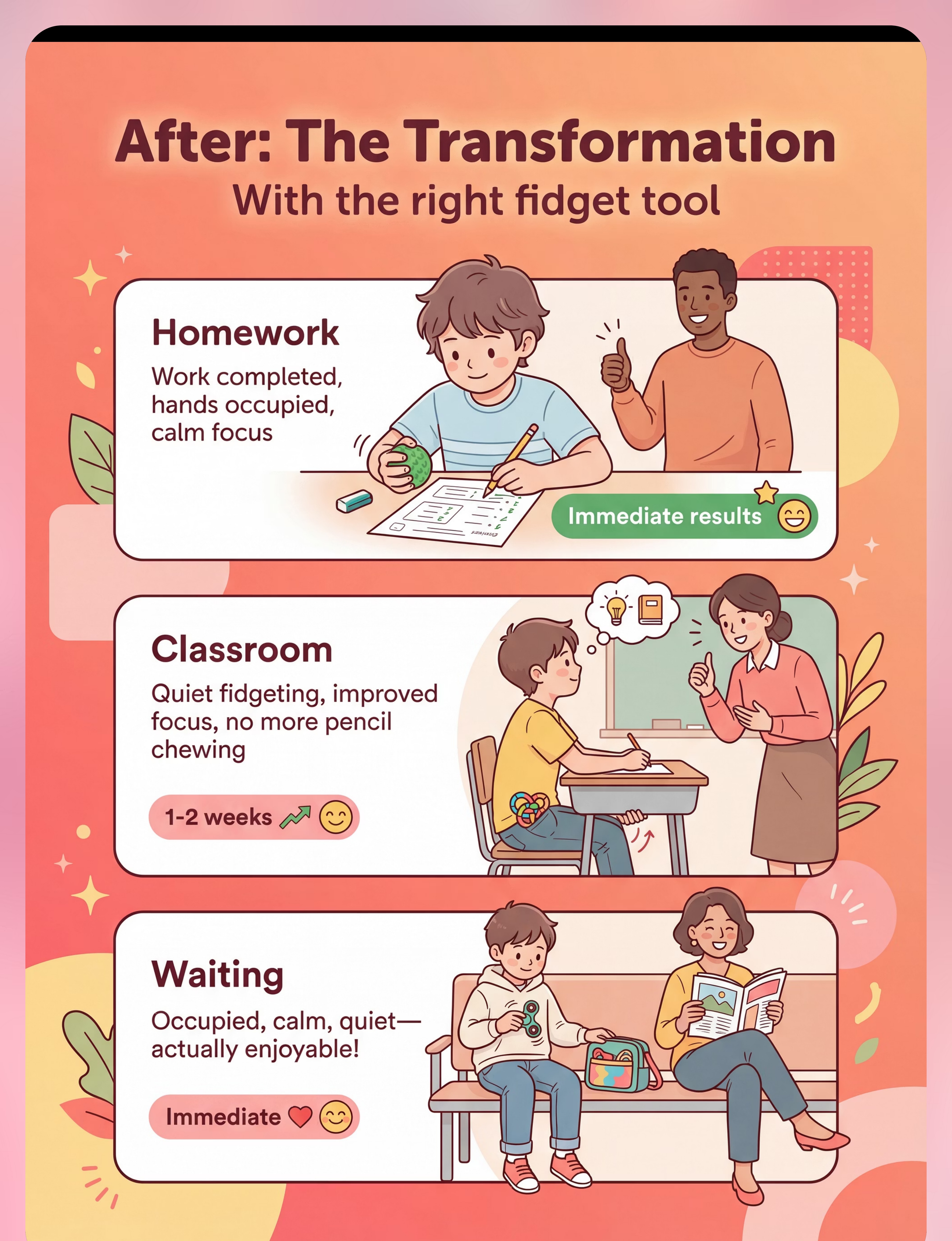
What to Expect (Realistic Timelines)
1
Immediate
  • Reduced inappropriate fidgeting (picking, chewing)
  • Self-regulation during waiting improves noticeably
  • Child appears calmer with hands occupied
2
1 Week
  • Improved homework completion time—tasks that took 45 minutes now take 25
  • Child begins independently reaching for fidget when feeling dysregulated
3
1-2 Weeks
  • Teacher reports better focus and on-task behavior in classroom
  • Child identifies preferred fidget type for different situations
  • Reduced clothing and pencil destruction—uniforms last longer
4
Ongoing
  • Child develops self-awareness about sensory needs
  • Family outings become manageable and enjoyable again
  • Fidget use becomes natural self-regulation strategy
Remember, every child is different. Some respond immediately, others need time to learn how to use fidgets as tools rather than toys. Consistency and patience during the learning phase makes all the difference.
Is This Right for My Child? (2-Minute Check)
fidget-tool-set-sensory-regulation therapy material
Does your child's hands always need to be doing something?
If yes, this indicates: Tactile/proprioceptive seeking—a strong indicator that fidget tools will help satisfy this sensory need through appropriate channels.
95% fit confidence
Does your child chew on clothing, pencils, or non-food items?
If yes, this indicates: Oral sensory seeking—chewable fidgets (necklaces, bracelets) provide safe, appropriate oral motor input that satisfies this need.
92% fit confidence
Does your child pick at skin, nails, or objects when anxious?
If yes, this indicates: Tactile regulation need—fidgets redirect this behavior into appropriate sensory channels, reducing skin damage and nail biting.
88% fit confidence
Does your child focus better when allowed to move or fidget?
If yes, this indicates: Movement supports attention—providing appropriate fidget tools allows the body to move while the mind focuses on learning.
96% fit confidence

Scoring: 3+ "yes" answers = strong fit for fidget tool intervention. Even one "yes" suggests your child may benefit from trying fidgets. The key is matching the right type to your child's specific sensory seeking pattern.
fidget-tool-set-sensory-regulation therapy material
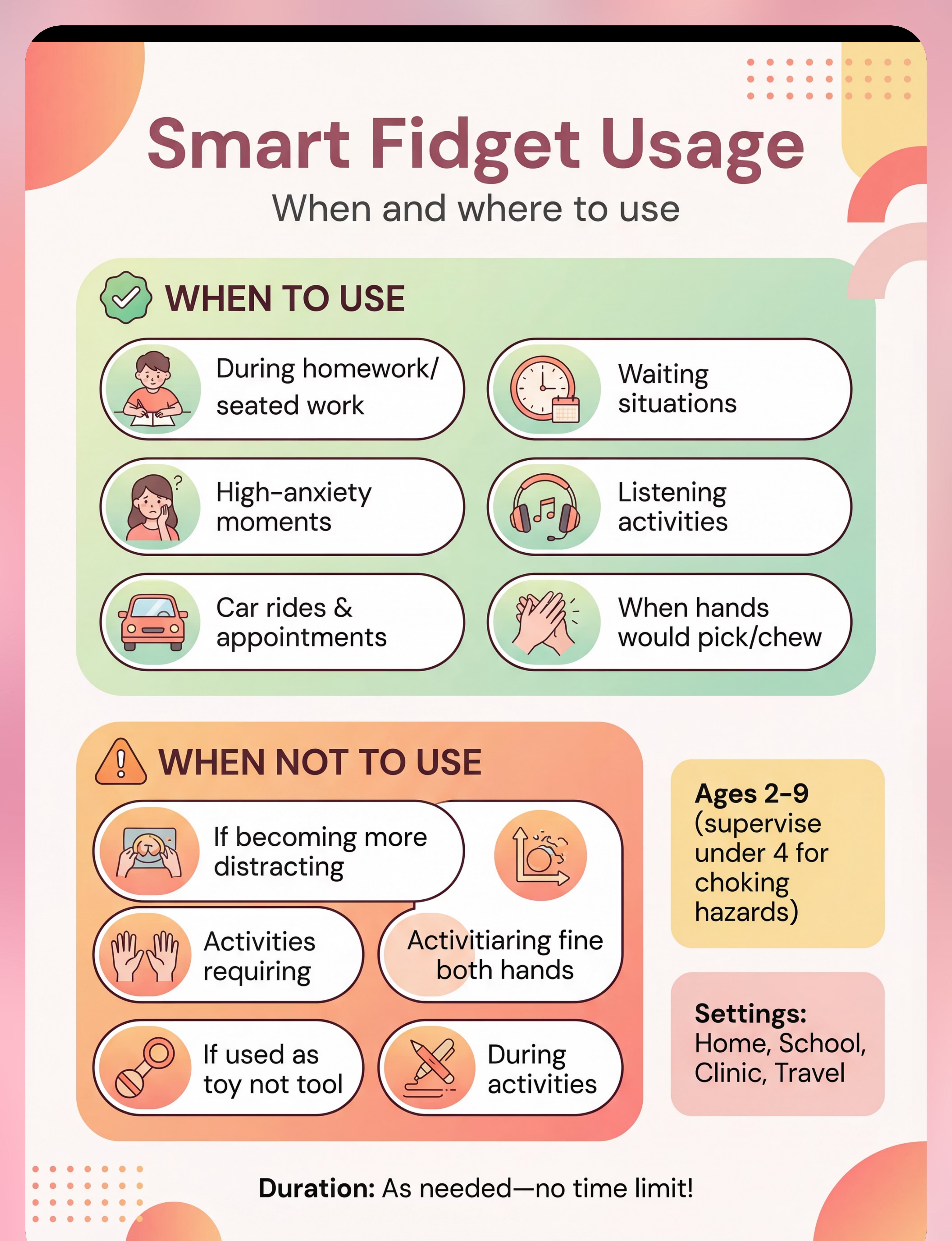
Usage Guide: When & How
When to Use ✓
During homework or seated work—keeps hands busy so mind can focus
Waiting situations (appointments, restaurants)—provides appropriate occupation
High-anxiety moments—tactile input helps calm nervous system
Listening activities (story time, assemblies)—body satisfied, ears can listen
Car rides and appointments—portable calming tool
When hands would otherwise pick at skin or chew on items
When NOT to Use ✗
If it becomes more distracting than helpful—reassess fidget type
During activities requiring both hands (writing practice, art projects)
If child uses as toy rather than tool—reteach purpose and expectations
When specific attention to hands needed (fine motor therapy, handwriting)
Supervision by Age
Age Range
Supervision Level
Notes
Under 3 years
Constant supervision
Avoid small parts. High choking risk. Only use large, one-piece fidgets.
3-5 years
Active supervision
Monitor for appropriate use. Check that child isn't mouthing or breaking fidget.
5+ years
Periodic check-ins
Most children can use independently. Inspect fidgets weekly for damage.
Settings: Home (all fidgets) | School (silent options only—tangle, stress ball, fidget cube) | Clinic (therapy-grade preferred) | Travel (portable, durable options)
Duration: As needed throughout the day—no time limit. Some children benefit from continuous access during all seated work, others use strategically during challenging moments.
fidget-tool-set-sensory-regulation therapy material
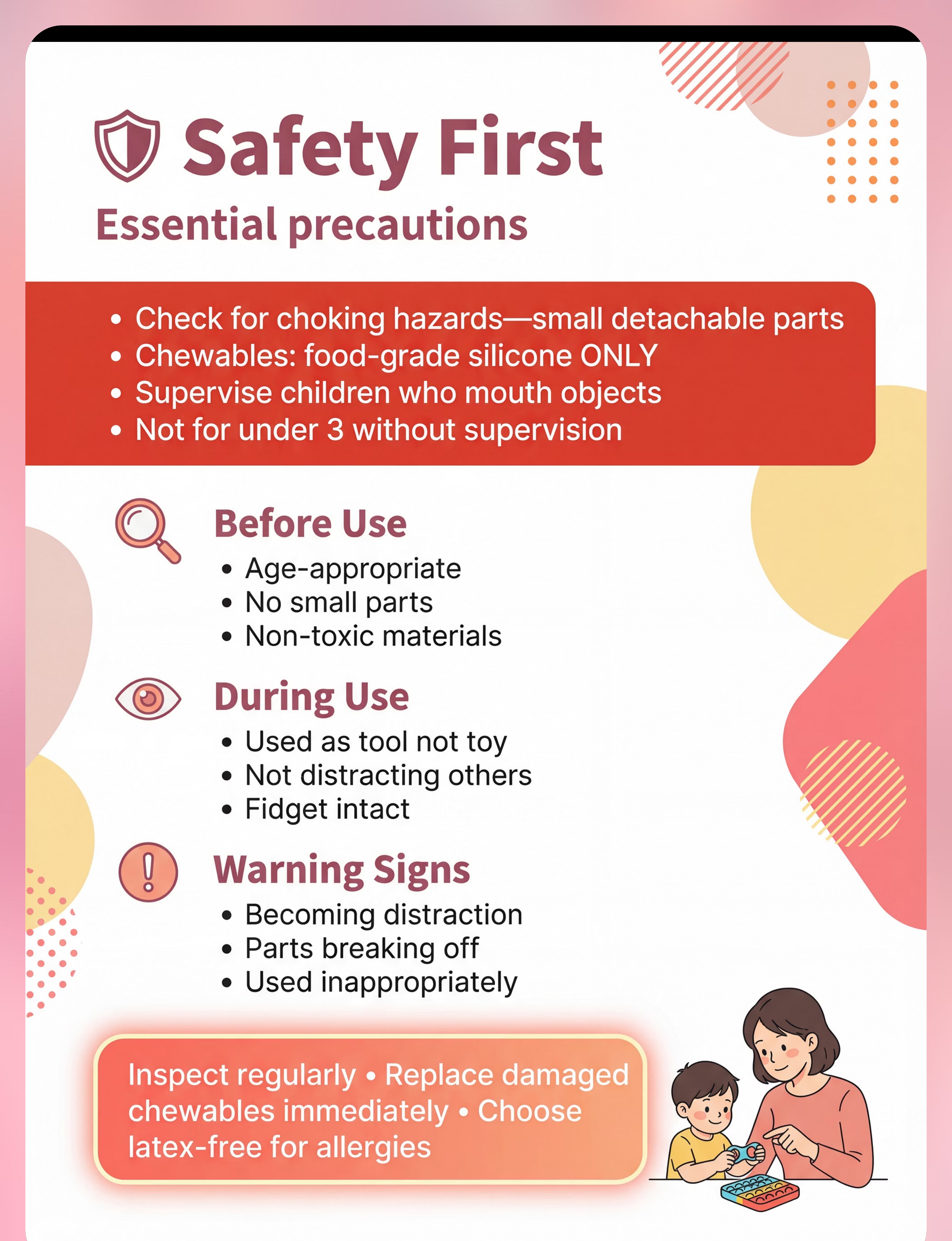
Safety First
Critical Safety: Choking Hazards
Avoid small parts and detachable pieces for children who mouth objects.
Critical Safety: Chewables
Use food-grade silicone only—replace immediately when damaged, torn, or showing wear.
Critical Safety: Supervision
Supervise children who mouth inappropriately—some fidgets unsafe for oral exploration.
Critical Safety: Age Restriction
Not for children under 3 without constant supervision—small parts present serious choking risk.
Warnings: Inspect Fidgets
Regularly check for damage—broken pieces can become choking hazards.
Warnings: Replace Chewables
Replace worn chewables immediately—don't wait for complete breakage.
Warnings: Age Suitability
Some fidgets not suitable for all ages—always check manufacturer recommendations.
Warnings: Allergies
Latex-free options available for children with allergies—ask specifically when purchasing.
Contraindicated (Do Not Use If)
  • Child mouths objects inappropriately AND fidget has small parts = serious choking risk
  • Damaged chewables = choking risk from broken pieces—dispose immediately
  • Child has difficulty understanding tool vs. toy distinction = will be more distracting than helpful
  • Classroom has strict no-fidget policy = advocate for accommodation or use under-desk alternatives
Before Use ✓
  • Age-appropriate for child
  • No small detachable parts
  • Non-toxic materials verified
  • No visible damage or wear
During Use ✓
  • Child using as tool not toy
  • Not distracting others
  • Fidget intact, not being destroyed
  • Appropriate for setting
Signs to Remove ✗
  • More distracting than helpful
  • Child destroying fidget
  • Parts breaking off
  • Using inappropriately (throwing)
fidget-tool-set-sensory-regulation therapy material
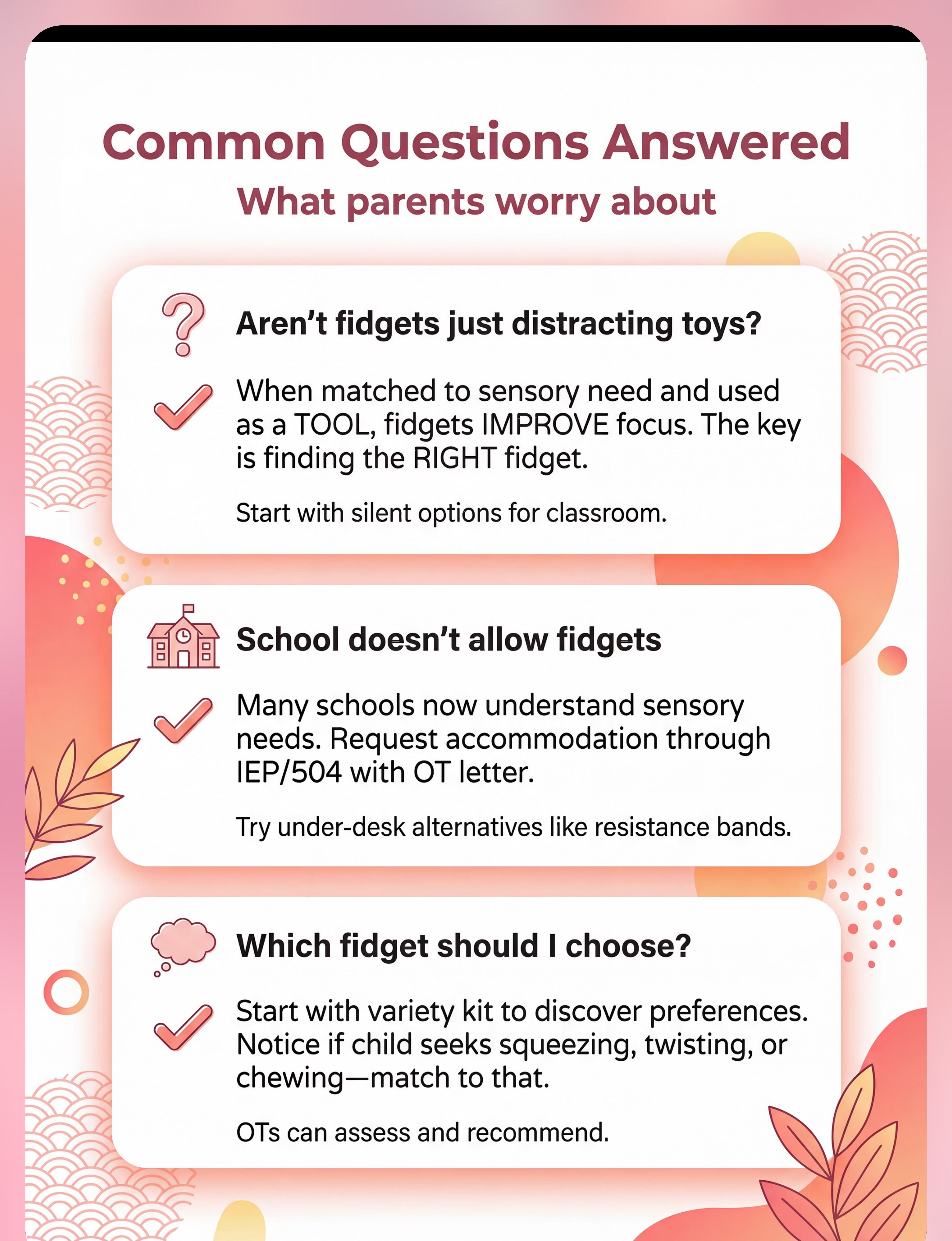
Common Questions (Honest Answers)
Concern: "Fidgets are distracting toys, not helpful tools"
Concern: "School doesn't allow fidgets—they're banned"
Concern: "My child will just play with it instead of working"
Concern: "Too many options—which fidget should I choose?"
Honest Answer: When matched to sensory need and used as a tool (not a toy), fidgets actually IMPROVE focus by satisfying the body's need to move. The research is clear—appropriate fidgets free cognitive resources for learning. The key is finding the RIGHT fidget for your child's specific sensory profile and teaching appropriate use expectations.
Try this instead: Start with silent, non-visual fidgets like tangle or stress ball for classroom use. Practice at home first with clear rules: fidget stays in one hand, eyes on work, tasks get completed.
Honest Answer: Many schools are now understanding sensory needs better, especially with OT guidance. Request accommodation through IEP/504 meeting or schedule teacher conference. Offer to provide silent, non-distracting options that won't disrupt others. An OT letter explaining medical necessity can be very effective.
Try this instead: Under-desk alternatives: resistance bands on chair legs, textured stickers under desk surface, or fidgets that remain in pocket. These provide sensory input without being visible or distracting to classmates.
Honest Answer: That's exactly why we teach that fidgets are TOOLS not toys. Set crystal clear expectations before introducing: fidget stays in one hand, eyes remain on teacher or work, tasks still get completed on time. Practice this at home during homework before sending to school. It's a learned skill.
Try this instead: Some children need fidget "breaks" rather than continuous use—5 minutes of focused fidgeting, then 15 minutes of work. Find what pattern works for your child's regulation needs.
Honest Answer: Start with a variety kit to discover preferences through trial. Notice patterns: Does your child naturally seek squeezing (→ stress ball), twisting (→ tangle), or chewing (→ chewable)? Match the fidget to the seeking behavior you observe. Most children need 2-3 weeks to identify clear preferences.
Try this instead: Request OT assessment to identify your child's specific sensory profile. The OT can recommend targeted fidgets based on whether your child is tactile seeking, proprioceptive seeking, or oral seeking.
Investment Guide
fidget-tool-set-sensory-regulation therapy material
Choosing the right fidget tools can significantly impact focus and regulation. Here's a guide to understanding different investment levels and how to make informed decisions for your child's sensory needs.
Investment
₹150–300
₹800–1,500
What you get
5-6 piece variety pack (spinner, stress ball, pop-it, stretchy string, cube)
8-12 durable, therapy-quality fidgets in organized case (includes chewables, silent options)
Best for
Families exploring sensory tools; low-risk testing for focus/regulation
Long-term sensory support; professional-grade durability for daily use
Recommended Brands
Various budget brands
Therapy Shoppe, Fun and Function
Budget-Friendly Options
Start with Variety Packs
Begin with a basic set (5-6 pieces) costing ₹150–300 to discover what your child prefers without a large upfront investment.
Low-Risk Exploration
These sets are perfect for testing if fidgets effectively help your child's focus and regulation. It's a discovery phase.
Common Fidget Types
Typically includes a spinner, stress ball, pop-it, stretchy string, and a cube to cover various sensory inputs.
Investment Progression
1
Phase 1: Initial Exploration
Begin with a budget variety pack (₹150-300) to identify individual preferences and observe which fidget types are most effective.
2
Phase 2: Targeted Investment
Once preferences are clear, invest in higher-quality, therapy-grade versions of the favorite types for enhanced durability and effectiveness.
3
Phase 3: Building a Collection
Acquire multiples of well-loved fidgets, as they are often misplaced. This ensures continuous access to preferred tools across different settings.
4
Long-term Solution
For sustained support, consider a comprehensive therapy-grade kit (₹800–1,500) that offers durability and a wider range of specialized tools.
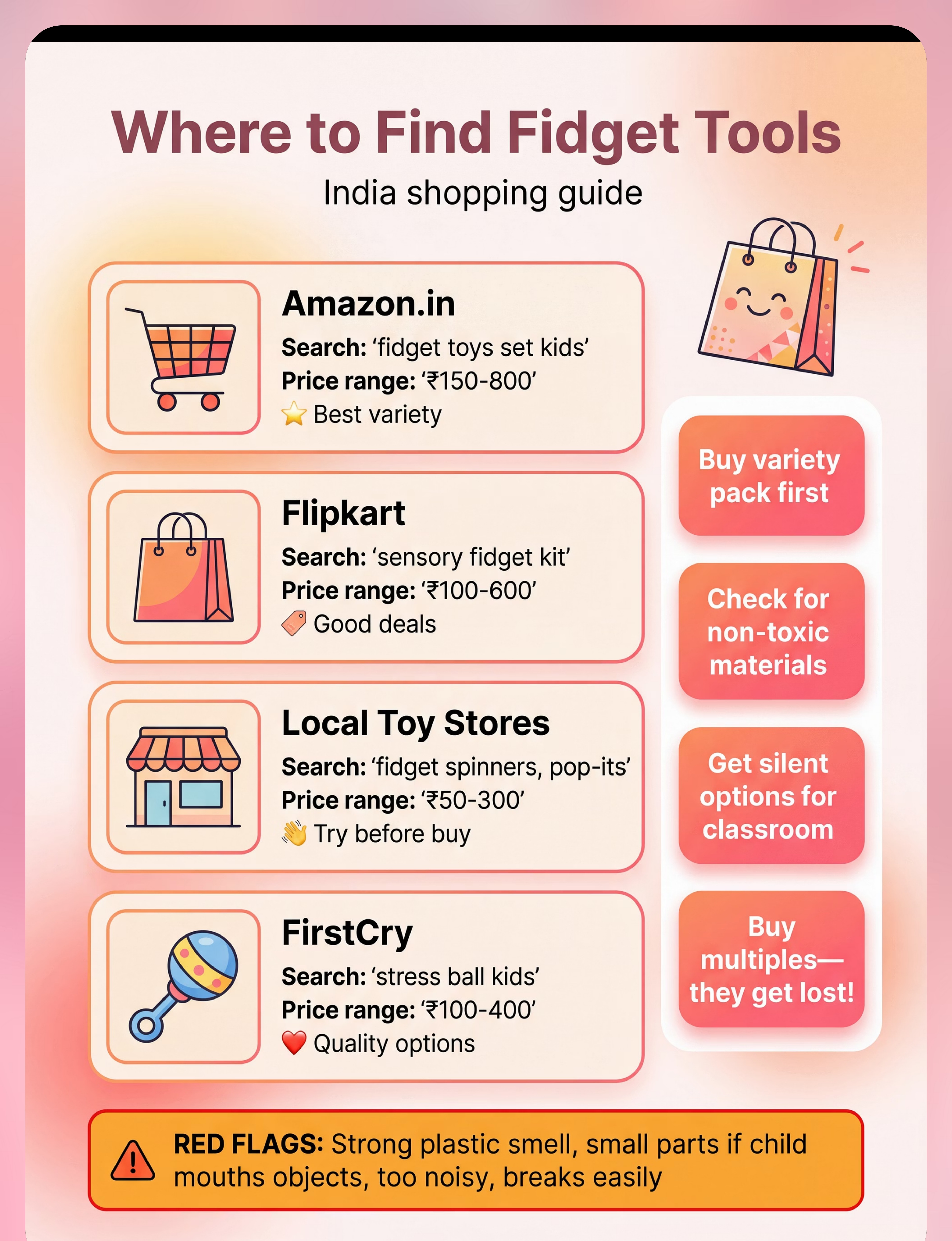
Where to Buy in India
Availability: Widely available through online and offline retailers across India. Quality and selection vary significantly by platform and vendor.
Amazon.in
Search: "fidget toys set kids"
Price Range: ₹150–800
Largest selection, customer reviews help identify quality. Prime delivery available. Easy returns if fidget doesn't work for your child.
Flipkart
Search: "sensory fidget kit"
Price Range: ₹100–600
Good variety of budget options. Competitive pricing. Check seller ratings before purchase.
Local Toy Stores
Search: "fidget spinners, pop-its"
Price Range: ₹50–300
Immediate availability, child can test before buying. Limited selection but convenient for quick replacement.
FirstCry
Search: "stress ball kids"
Price Range: ₹100–400
Curated selection for children. Generally safe, age-appropriate options. Good for chewables and younger children.
Smart Buying Tips
  • Buy variety pack first to discover preferences—don't invest heavily in one type until you know it works
  • Check for non-toxic, BPA-free materials—especially critical for chewables and items that go near mouth
  • Silent options for classroom use—avoid click fidgets and pop-its for school; save those for home
  • Buy multiples of favorites—keep one at home, one in backpack, one in car. Small items disappear constantly
  • Chewables: ensure food-grade silicone—this is non-negotiable for safety. Look for certification on packaging

Red Flags (Don't Buy If)
  • Strong plastic smell = likely contains toxic materials—return immediately
  • Small parts for children who mouth = choking hazard—verify age recommendations carefully
  • Too noisy for classroom = will get confiscated—test sound level before school use
  • Breaks easily = check customer reviews mentioning durability issues
  • Not labeled non-toxic = skip it—only buy from vendors who provide material safety information
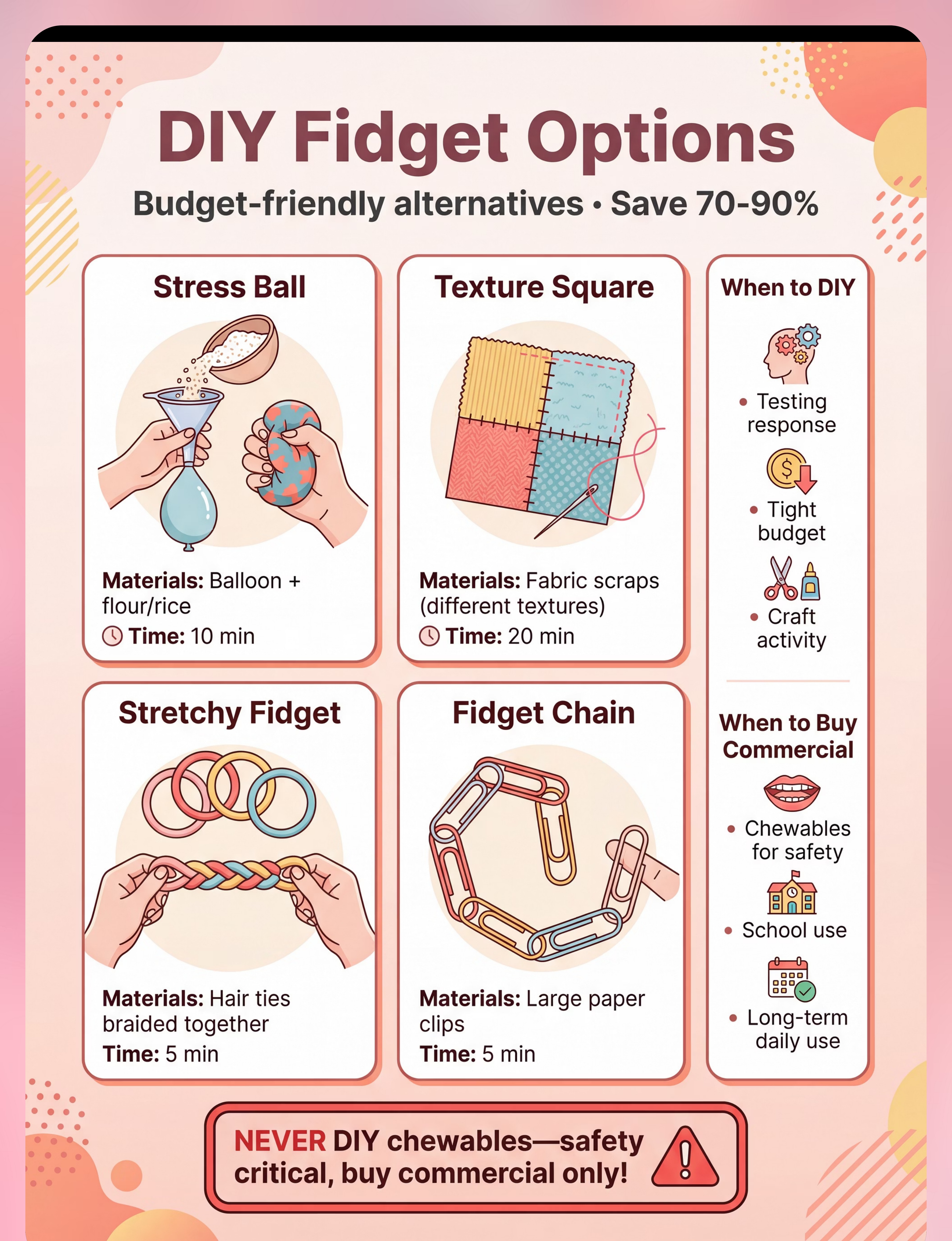
DIY Alternative (Save 70-90%)
Feasibility: High | Cost Savings: 70-90% | Time Investment: 10-30 minutes per fidget
1
DIY Stress Ball
Fill balloon with flour or rice, tie closed securely. Double-balloon for extra durability. Cost: ₹10-20.
2
Texture Square
Sew together fabric scraps with different textures (silk, corduroy, velvet, burlap). 10cm square works well. Cost: ₹15-30.
3
Stretchy Fidget
Braid multiple hair ties together to create stretchy resistance toy. Easy, fast, very cheap. Cost: ₹10-15.
4
Fidget Chain
Link together large paper clips to create bendable, manipulable chain. Quiet option for classroom. Cost: ₹5-10.
Required Materials: Balloons, flour or rice (stress ball) | Hair ties (stretchy) | Fabric scraps (texture square) | Beads and pipe cleaners (various) | Paper clips (fidget chain)
When to DIY
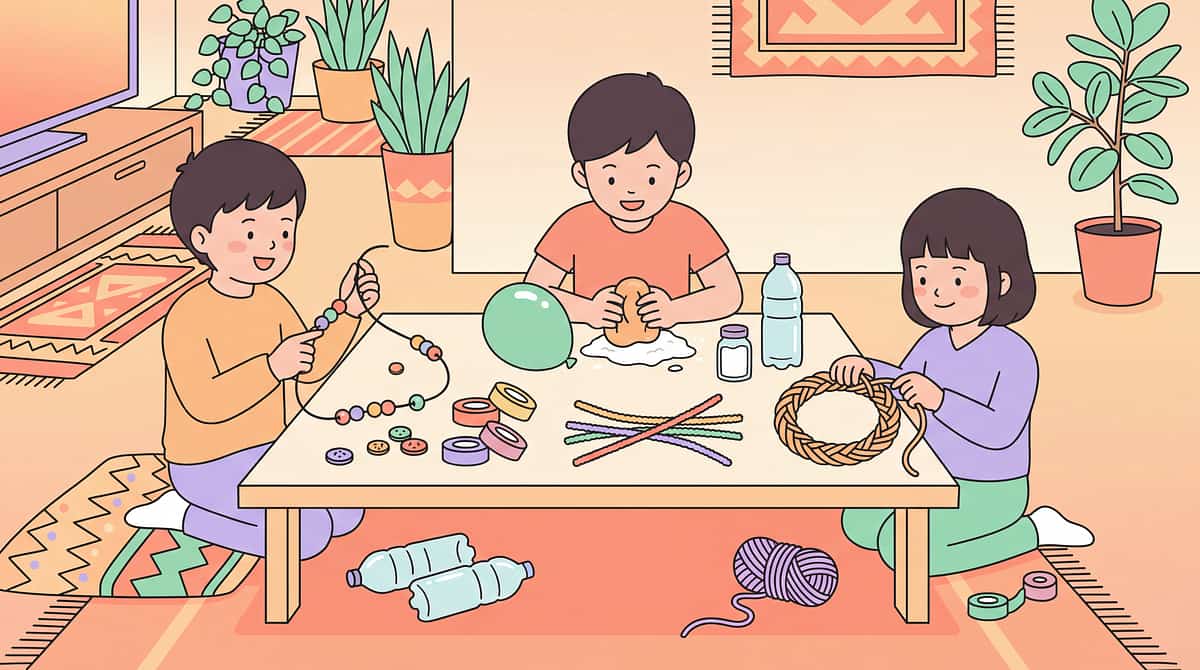
  • Testing if child responds to fidgets
  • Very tight budget constraints
  • Fun craft activity with child
  • Need immediate solution
When to Buy Commercial
  • Chewables (ALWAYS buy)—safety critical
  • School use—durability matters
  • Specific sensory need identified
  • Long-term daily use expected
Tradeoffs
  • Less durable than commercial options
  • May not be school-appropriate
  • Chewables MUST be purchased
  • Limited complexity

Safety Note: Never attempt DIY chewables—food-grade silicone certification is essential for oral safety. DIY stress balls are safe for hand use only, not for mouthing. Supervise young children with DIY fidgets.
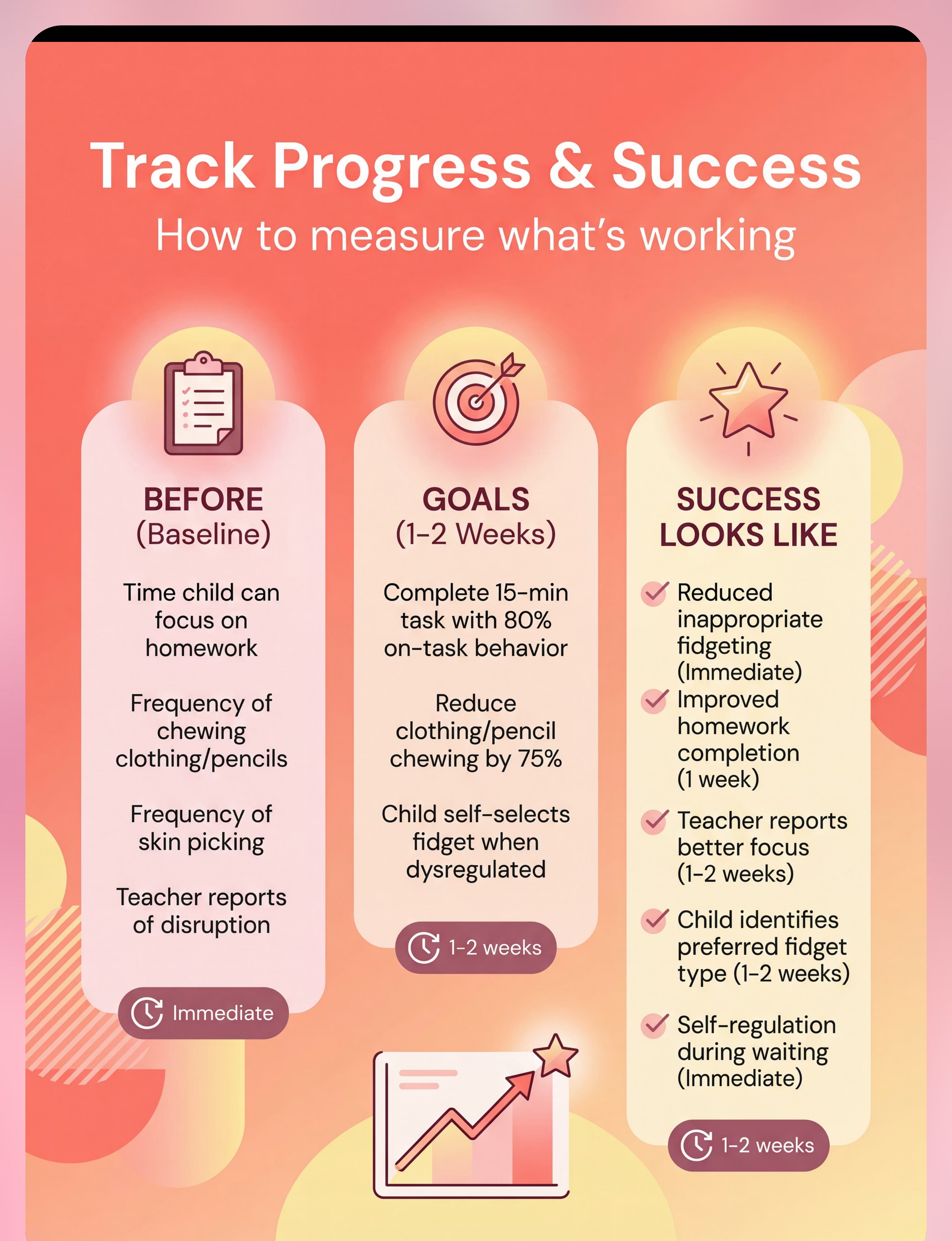
Complete Success System
Measuring Success
Establish Baseline
Measure time child can focus on homework without inappropriate fidgeting. Track frequency of chewing clothing/pencils. Count instances of skin picking or nail biting. Document teacher reports of classroom disruption.
Set Clear Goals
Child will complete 15-minute homework task using fidget with 80% on-task behavior. Clothing/pencil chewing will reduce by 75% with appropriate fidget use. Child will independently select and use fidget when feeling dysregulated.
Track Progress Weekly
Monitor homework completion time. Document reduction in inappropriate fidgeting. Request teacher feedback bi-weekly. Observe child's independent fidget selection.
Success Indicators: Reduced inappropriate fidgeting behaviors | Improved task completion speed and accuracy | Child self-selects fidget when needed | Teacher reports improved focus | Reduced destruction of clothing and supplies | Family outings become manageable

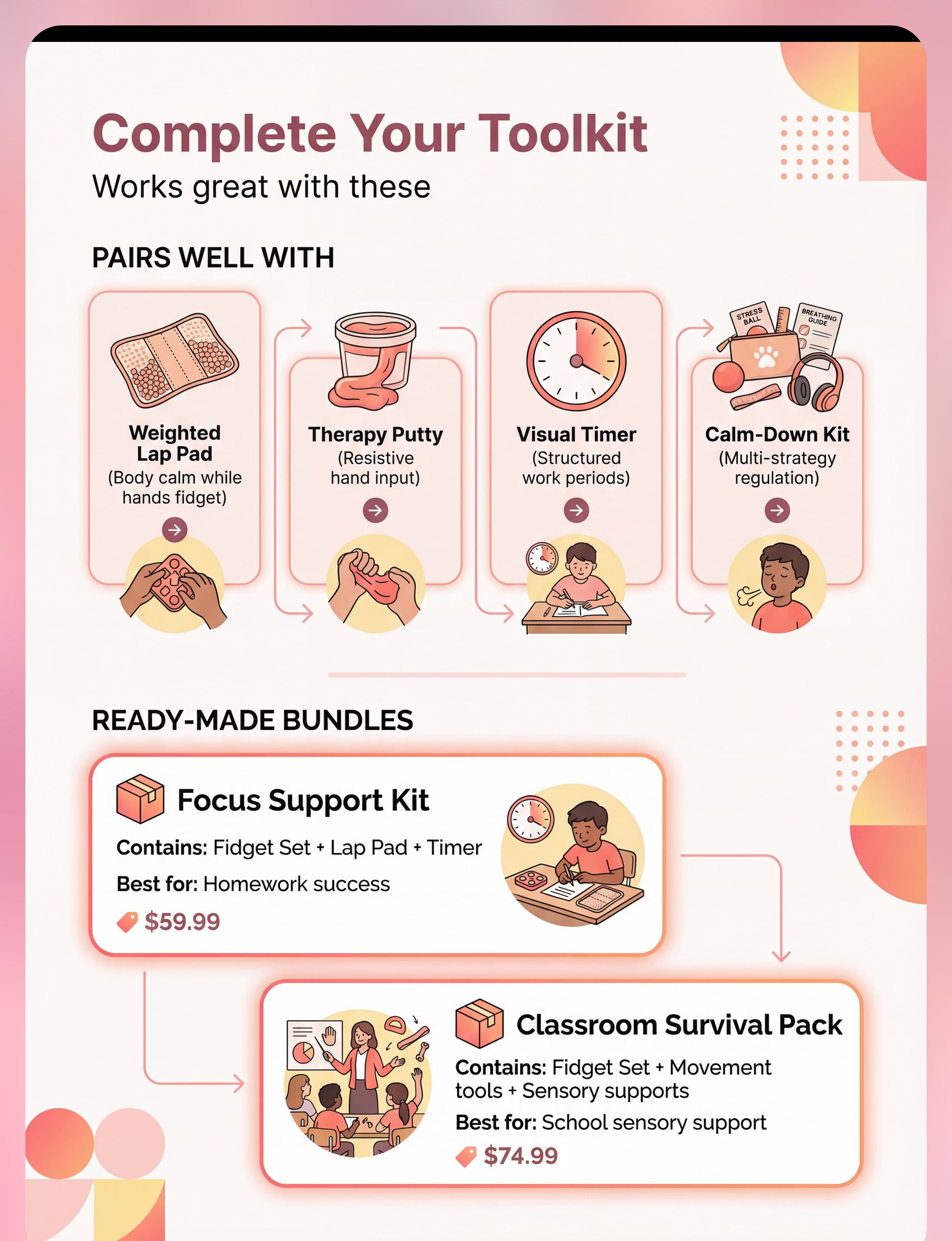
Complete the Sensory Toolkit
Weighted Lap Pad (ID: 1.1)
Pairs perfectly with fidgets—body receives deep pressure calm while hands stay busy. The combination supports full-body regulation for optimal focus.
Therapy Putty (ID: 1.6)
Alternative for children needing more resistive hand input. Occupies both hands and builds strength. Good for children who destroy standard fidgets.
Visual Timer (ID: 3.3)
Structure work periods with fidget use. Child can see time remaining, reducing anxiety. Creates predictable routine: 15 minutes focused work with fidget, then break.
Calm-Down Kit (ID: 2.3)
Multi-strategy regulation toolkit that includes fidgets plus other sensory tools. Comprehensive approach for children needing varied sensory input throughout the day.
Recommended Bundles:
  • Focus Support Kit: Fidget Set (1.4) + Weighted Lap Pad (1.1) + Visual Timer (3.3) = Complete homework success system
  • Classroom Survival Pack: Fidget Set (1.4) + Seat Cushion (1.2) + Wiggle Seat (1.3) = Full-day school sensory support

AI-Powered Precision Matching
Fidget tools provide tactile/proprioceptive input that satisfies sensory-seeking needs, improving attention and self-regulation. Core Kit (Rank 1), moderate-strong evidence, essential for children who need to move to focus.
fidget
tactile
proprioceptive
attention
focus
anxiety
chewable
classroom
OT
core-kit
Common Searches: fidget toys autism, sensory fidget set, fidget tools for ADHD, stress ball kids, chew necklace autism, classroom fidgets, tangle fidget, fidget cube India
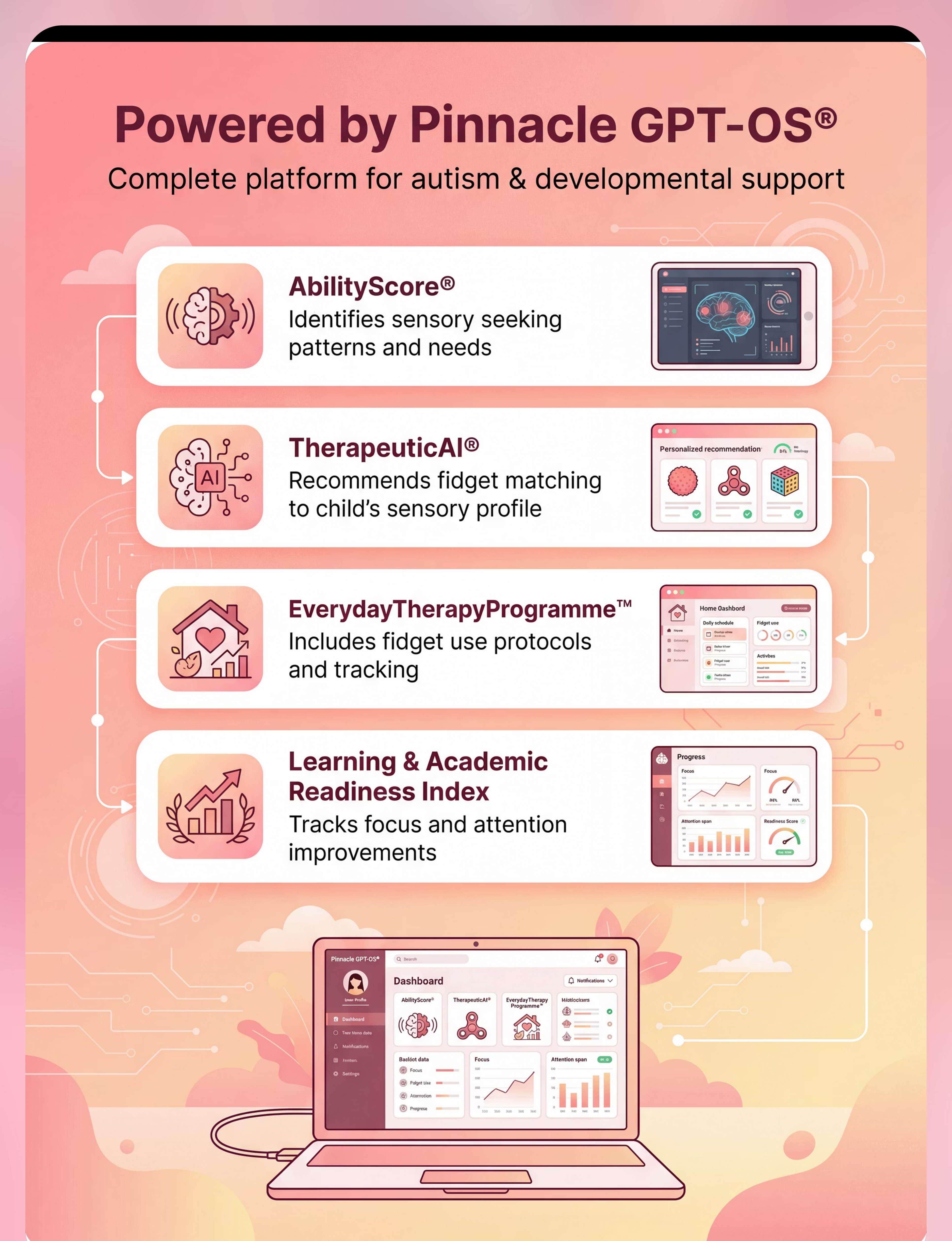
Platform Integration
  • AbilityScore® identifies tactile/proprioceptive seeking patterns in your child's assessment, recommending fidget tools as primary intervention
  • TherapeuticAI® matches specific fidget types to your child's unique sensory profile—whether oral, tactile, proprioceptive, or visual seeking
  • EverydayTherapyProgramme™ includes detailed fidget use protocols integrated into daily routines for maximum effectiveness
  • Learning & Academic Readiness Index tracks focus improvement over time, documenting fidget tool impact on attention and task completion
Get Expert Support
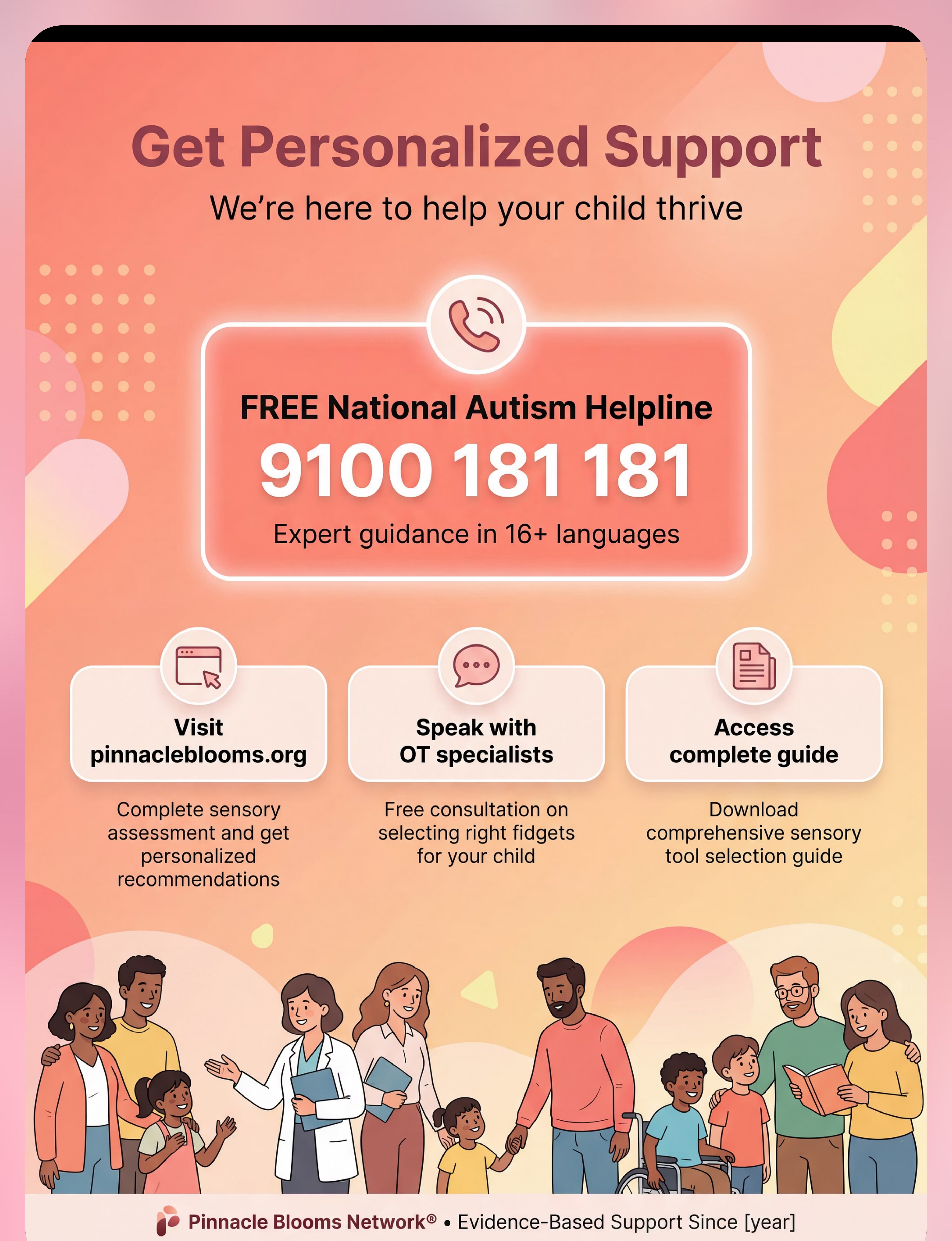
FREE National Autism Helpline
Phone: 9100 181 181
Languages: 16+ Indian languages supported
Website: pinnacleblooms.org
Connect with occupational therapists who can help you select the right fidget tools for your child's specific needs. Free guidance on implementation, troubleshooting, and school advocacy.

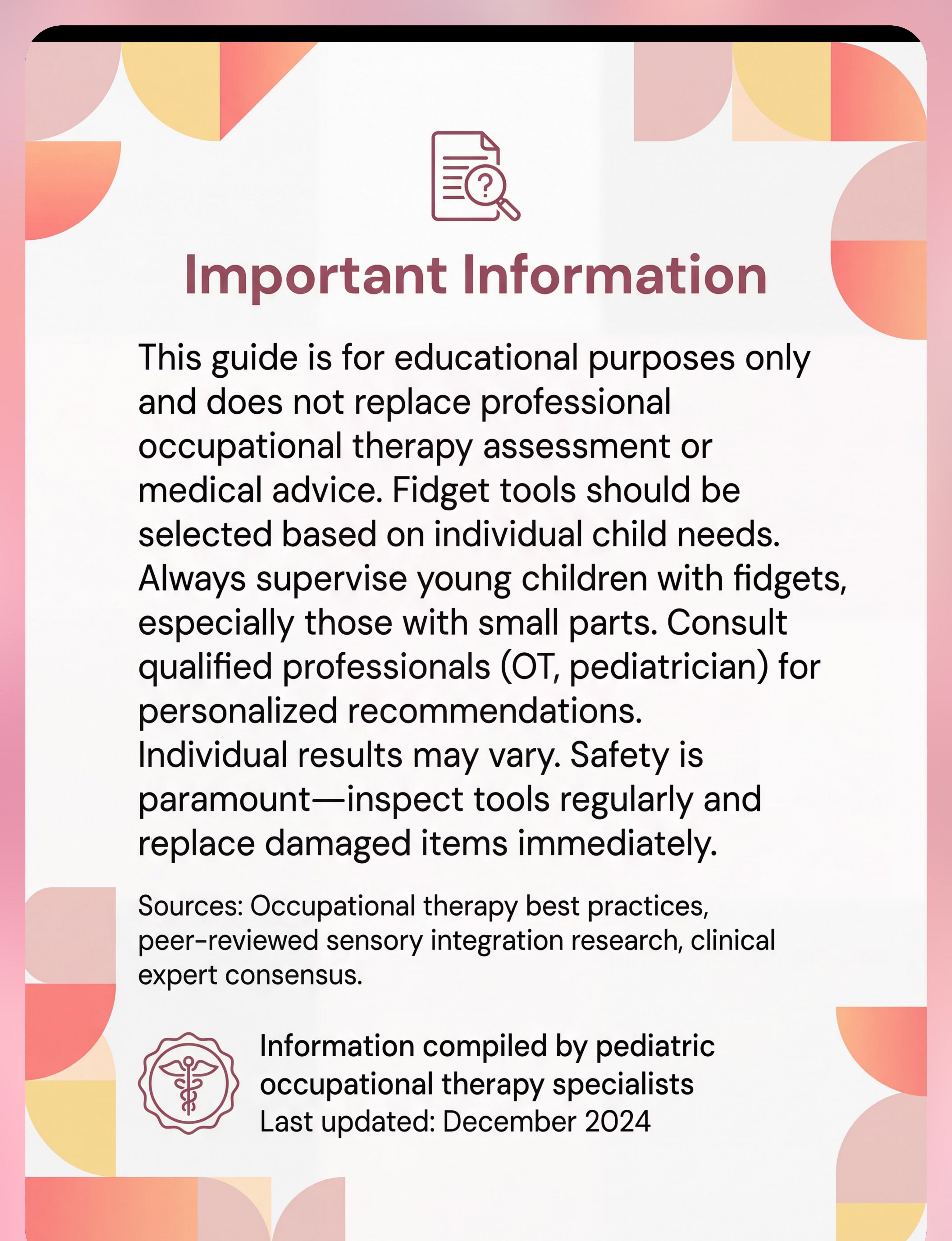
Disclaimer: This is educational information provided by Pinnacle Blooms Network. Always consult qualified occupational therapists, speech-language pathologists, or pediatricians for personalized assessment and recommendations. Individual results vary based on child's unique sensory profile and consistent implementation. Fidget tools are most effective when matched to specific sensory needs and used as part of comprehensive sensory regulation strategies.

Preview of fidget tool set sensory regulation Therapy Material

Below is a visual preview of fidget tool set sensory regulation therapy material. The pages shown help educators, therapists, and caregivers understand the structure and content of the resource before use. Materials should be used under appropriate professional guidance.

Page 1
Page 2
Page 3
Page 4
Page 5
Page 6
Page 7
Page 8
Page 9
Page 10
Page 11
Page 12
Page 13
Page 14
Page 15
Page 16
Page 17
Page 18
Page 19
Page 20
Link copied!
Take the Next Step
You've learned how fidget tools can transform your child's ability to focus, regulate, and succeed. Now it's time to take action.
Get Your Free Assessment
Complete the AbilityScore® assessment to identify your child's specific sensory needs. Receive personalized fidget tool recommendations matched to their unique profile. Takes 15 minutes, provides lifetime guidance.
Connect with Experts
Speak with occupational therapists who specialize in sensory processing. Get guidance on fidget selection, implementation strategies, and school advocacy. Free consultation available.
Join the Community
Connect with 50,000+ Indian parents navigating similar challenges. Share experiences, get support, access exclusive resources and workshops. You're not alone in this journey.

Your Child Deserves Support That Works
Every child with sensory processing differences deserves tools that help them succeed. Fidget tools are evidence-based, affordable, and can be implemented immediately. Don't wait for the 'perfect moment'—start today with one simple fidget and watch your child's confidence grow.
"The right fidget tool didn't just help my son focus—it gave him control over his own body for the first time. He went from constant frustration to proud independence." — Priya M., Mother of 7-year-old with ADHD, Bangalore

Ready to Begin? Visit pinnacleblooms.org or call our National Autism Helpline at 9100 181 181. Available in 16+ Indian languages. Free resources, expert guidance, and a community that understands your journey.
next-steps
assessment
support
community
action-plan
parent-resources

Pinnacle Blooms Network | India's Leading Neurodevelopmental Support Organization | Serving 50,000+ families across 28 states | Evidence-based, culturally-adapted interventions