






Tool ID: 3.2
Tool ID: 3.2
Core Kit
First-Then Board: The Visual Contract That Ends Power Struggles
Empowering motivation and compliance through visual contracts.
Transform "no" into "yes" with a simple two-box visual that shows children exactly what they're working for. When verbal promises fail, this ABA-proven tool builds trust, motivation, and compliance—one achievable task at a time.
ABA/BCBA + SpEd Recommended
Rank #1 in Category
Strong Evidence
Multiple Daily Uses
₹0–400
Who This Helps
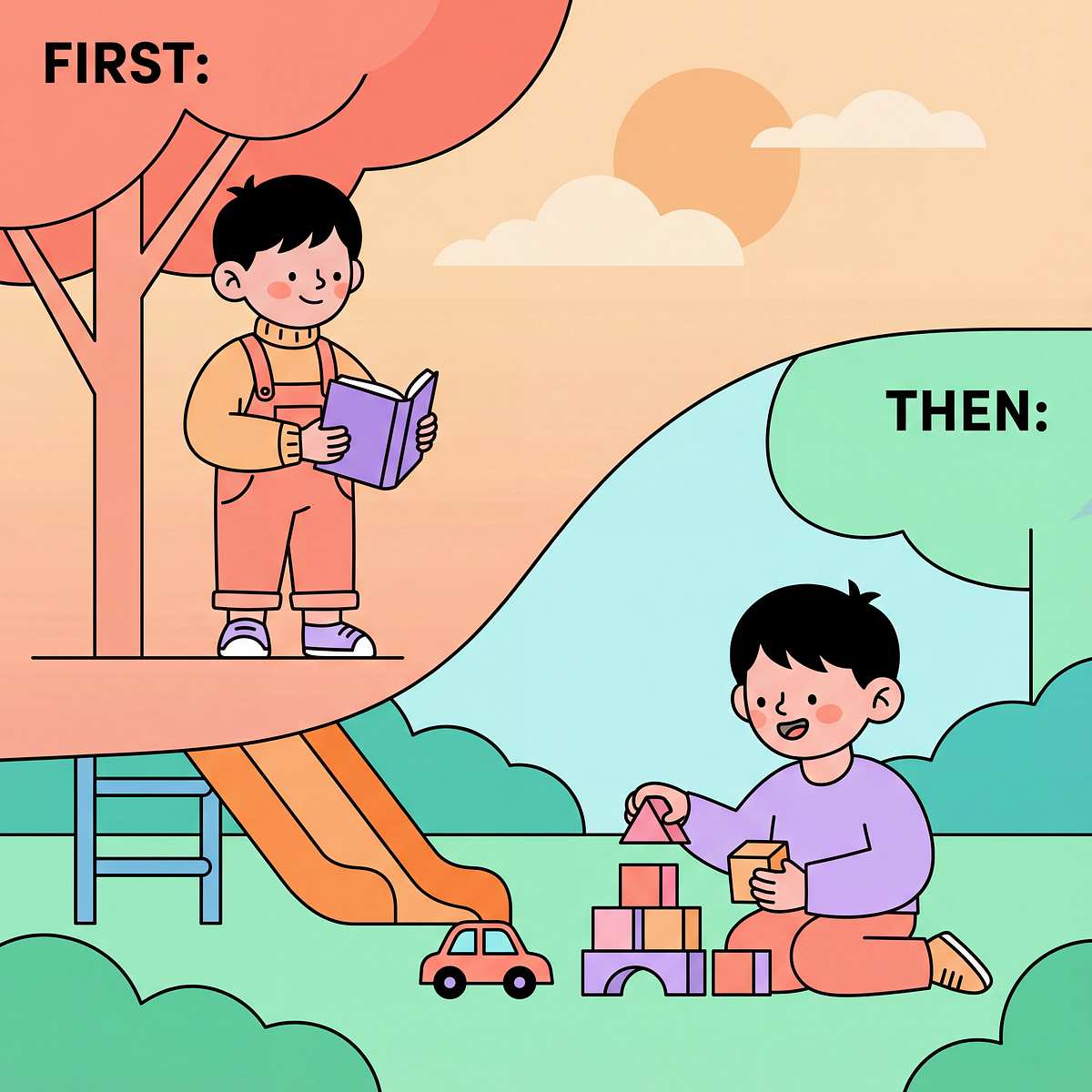
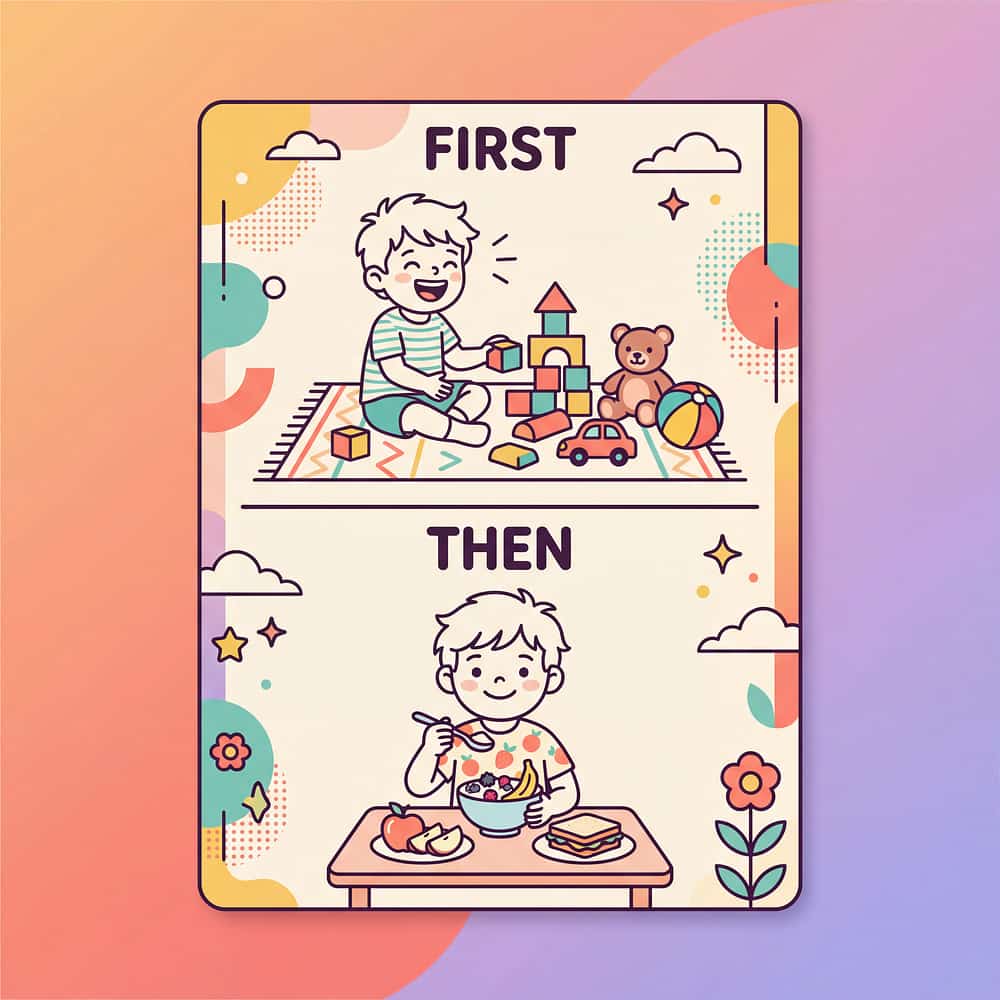
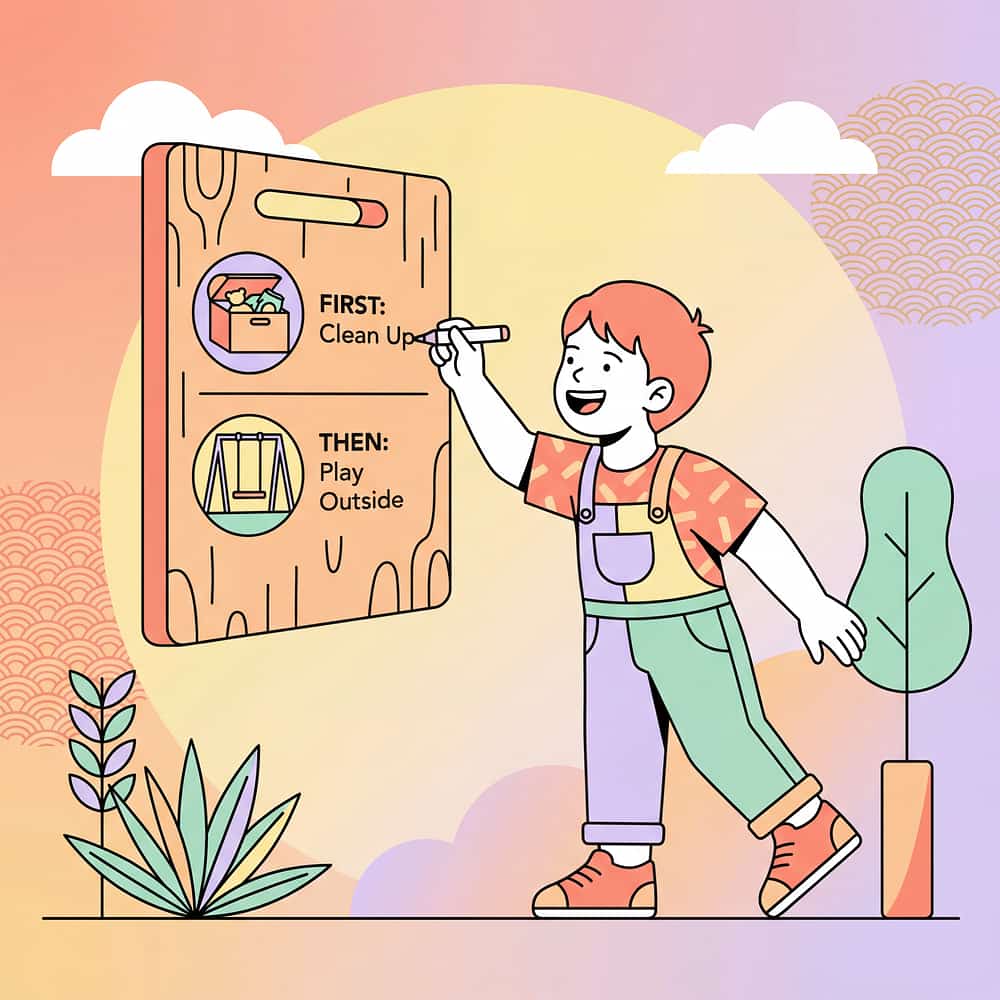
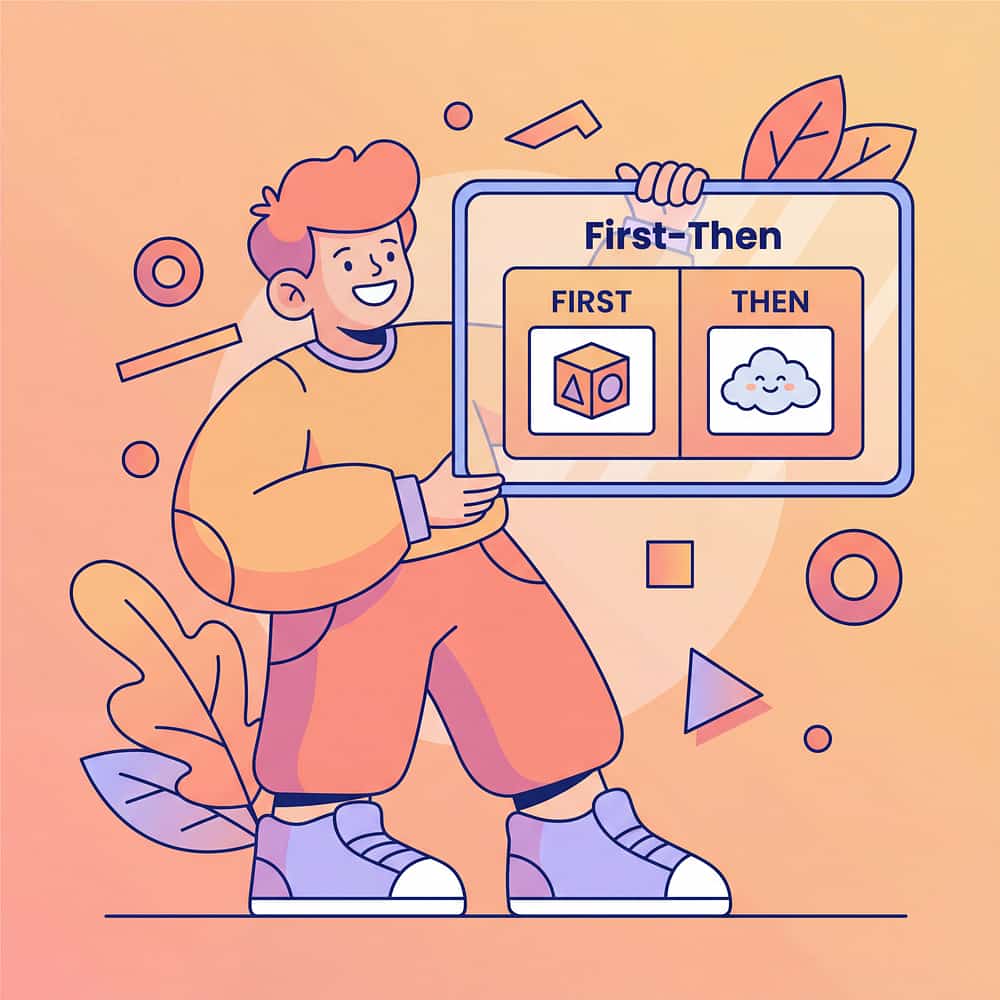
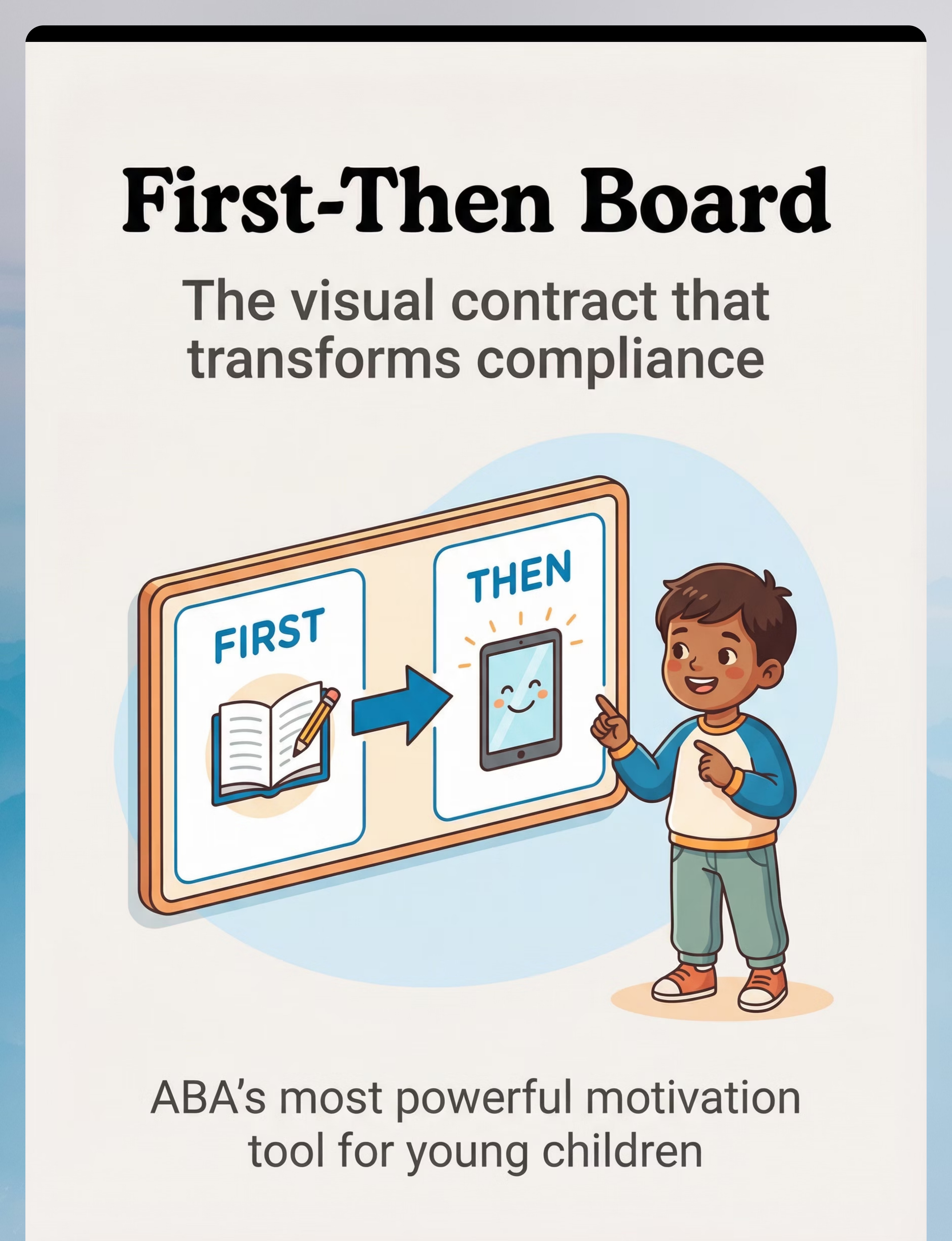
The First-Then Board creates a visual contract between work and reward, making expectations clear.
It helps children understand exactly what's expected of them and what they will gain in return.
This tool transforms abstract verbal promises into concrete, visible agreements.
By making agreements tangible, it builds trust and motivation in children.
Task Completion
Supports children in finishing non-preferred activities by showing the end goal
Motivation
Increases drive to complete tasks by making rewards concrete and visible
Compliance
Reduces resistance to demands through clear visual expectations
Transition Support
Eases movement between activities with predictable sequences
Delayed Gratification
Builds tolerance for waiting by showing the reward is coming
Ages 18 months–9 years
Home
School
Clinic
Community
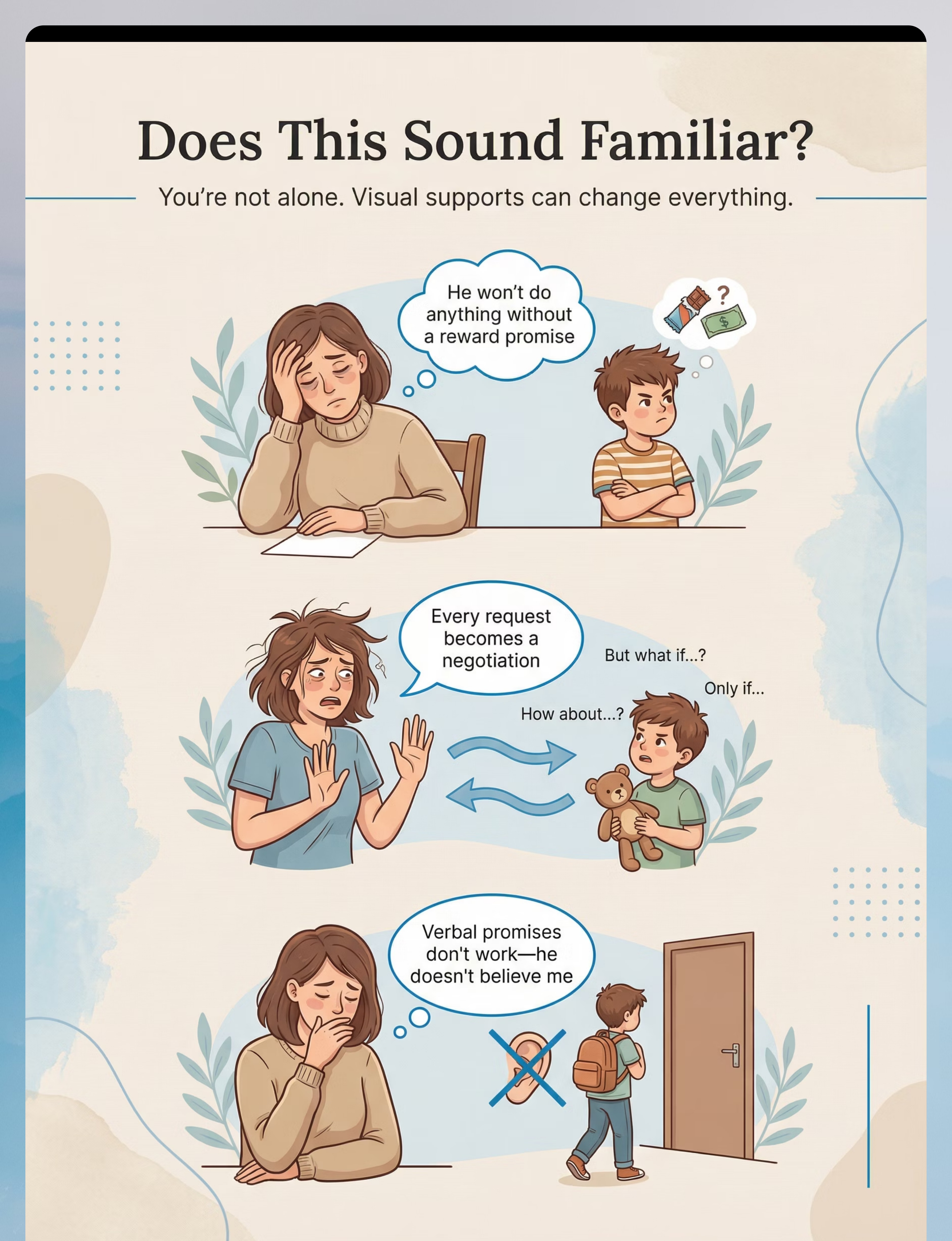
Does This Sound Familiar?
"He won't do anything unless I promise a reward—and even then, he doesn't believe me. Every single request becomes an exhausting negotiation."
"She doesn't believe me when I say 'after homework, you can play.' Verbal promises just don't work. She forgets or thinks I'm lying."
"He can't see past the current moment. If the reward isn't immediate, it might as well not exist. I'm constantly battling."
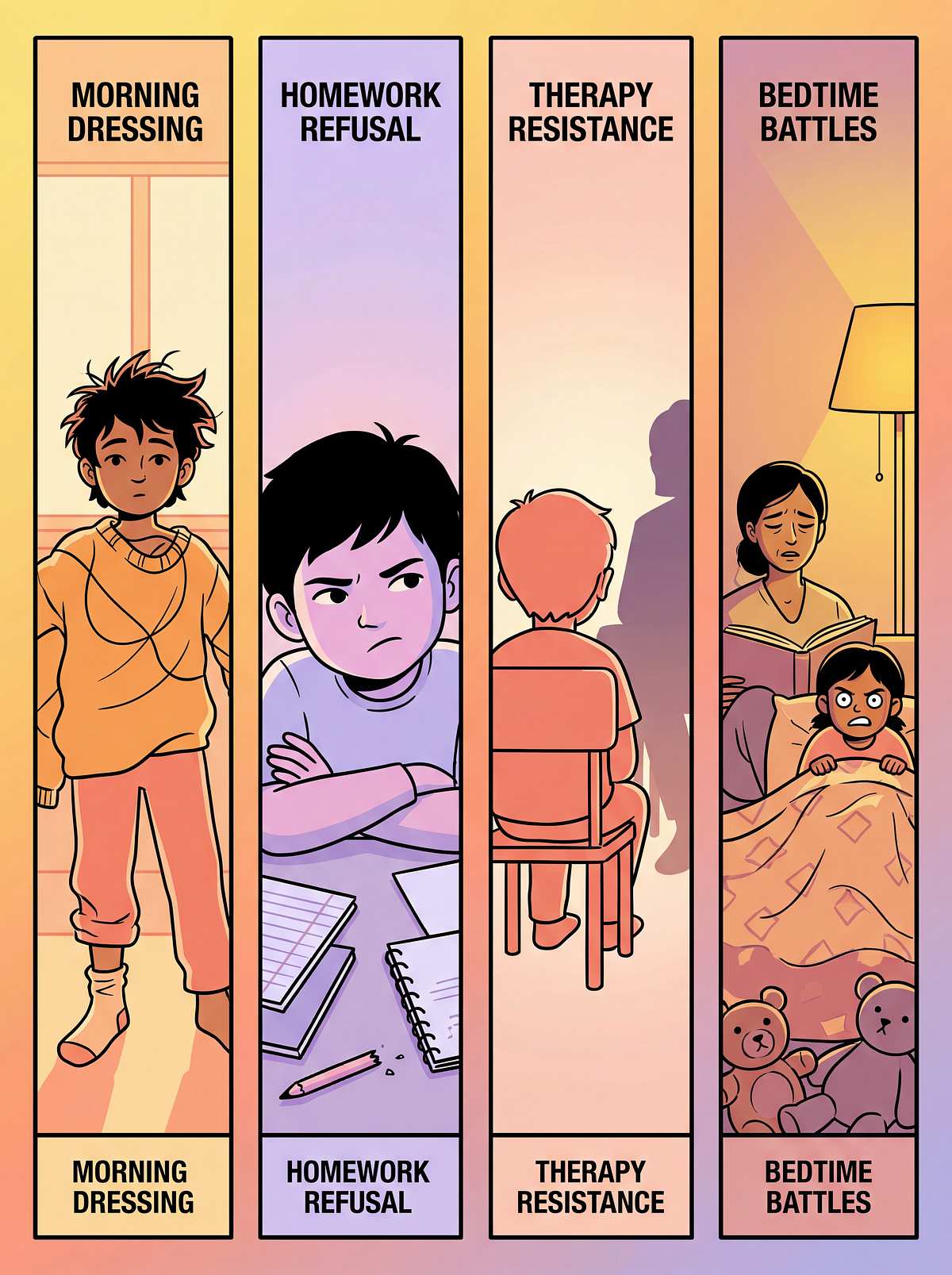
"Power struggles over every little thing—getting dressed, eating, homework. I feel like I'm fighting all day long."
You're not alone. These are common challenges faced by parents of children who struggle with task compliance and delayed gratification. The First-Then Board addresses this core issue by making the invisible visible.
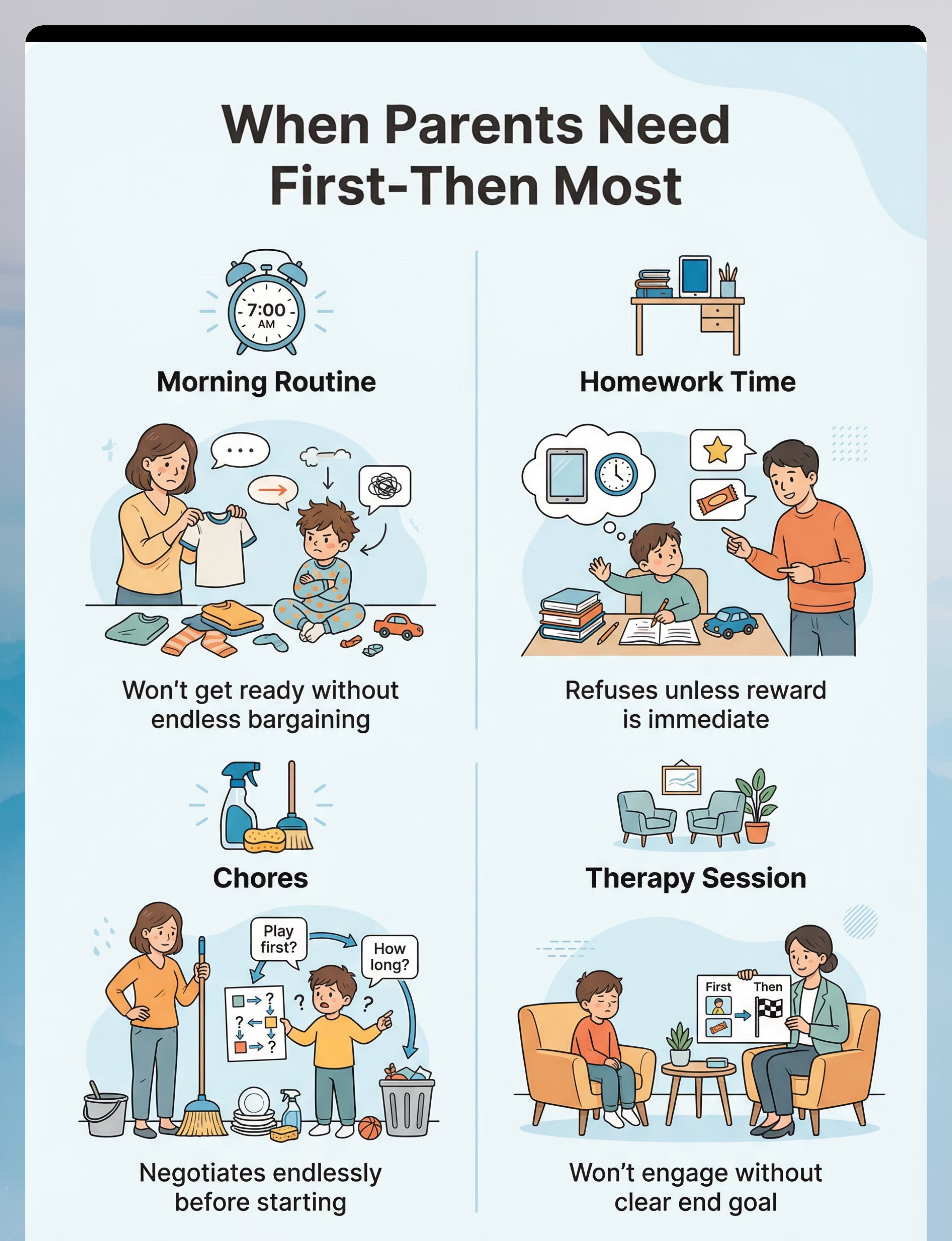
A Day Without the Right Support
Morning
Won't get ready without constant bargaining. "Just five more minutes!" becomes an hour-long battle before school.
Homework
Refuses unless reward is immediate. "Why should I do this?" No amount of explaining helps—the payoff feels too far away.
Therapy/School
Non-compliance without clear end goal. Sessions become struggles instead of learning opportunities. Everyone ends up frustrated.
Chores
Negotiates endlessly before starting. Simple tasks like putting toys away take 30 minutes of convincing.
Without visual support, children can't connect the work to the reward. Verbal promises feel abstract, untrustworthy, or impossible to wait for. The First-Then Board changes this by creating a concrete visual contract.
The Science Behind It
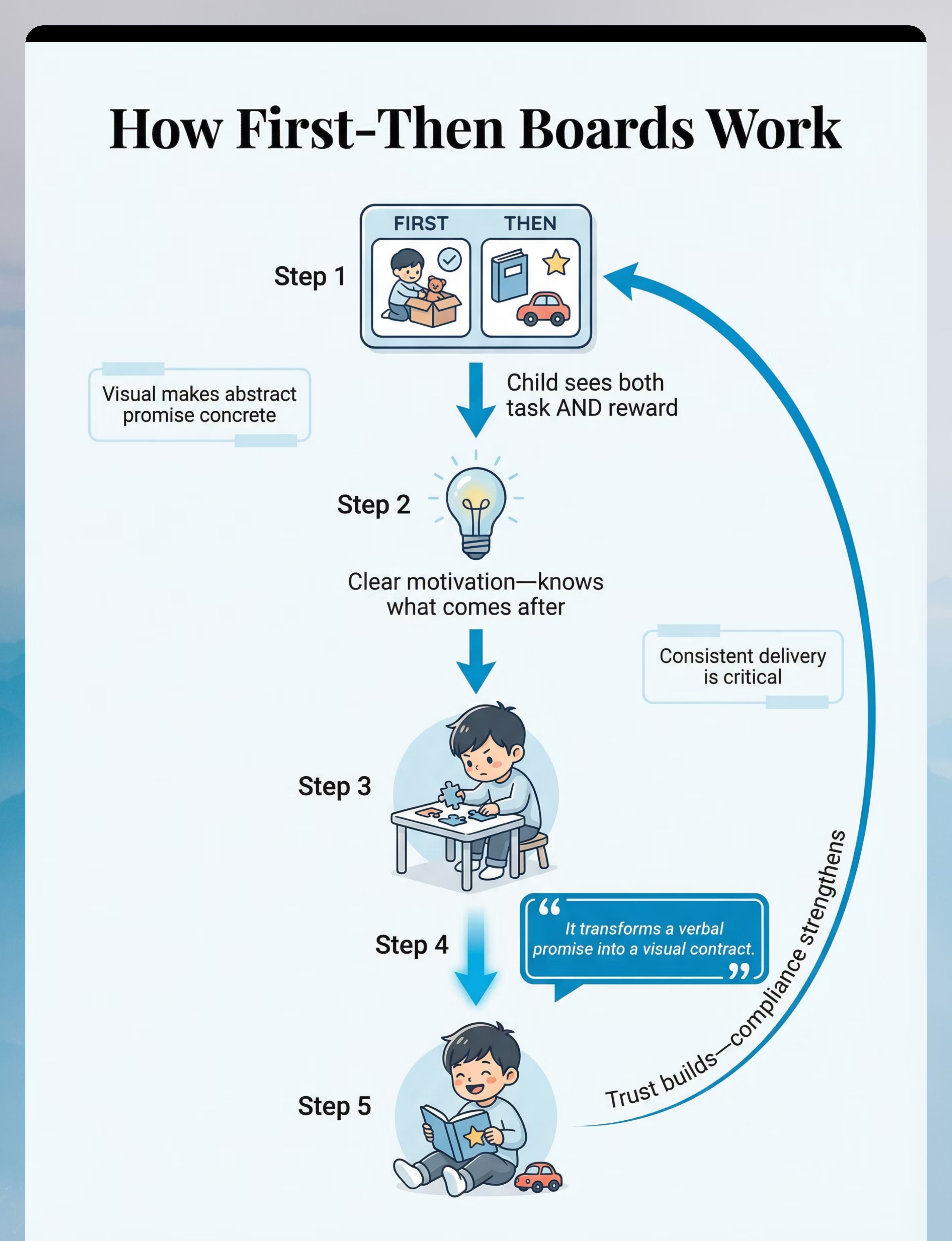
Visual Contingency
Child sees both the task and the reward simultaneously, making the connection concrete and real
End Goal Visible
The reward is no longer abstract—it's right there in the picture, making motivation immediate
Task Completion
Child completes the 'first' task because they can see and understand what comes next
Immediate Reward
Consistent delivery of 'then' reinforces the behavior and builds trust in the system
Strengthened Compliance
Over time, power struggles decrease as the child learns the contract is reliable
Task Completion
Motivation
Compliance
Transition Support
Delayed Gratification
This isn't manipulation—it's the same principle adults use every day. We work, then get paid. We exercise, then feel better. The First-Then Board simply makes this contingency visible and concrete for children who can't yet process it verbally.
How to Use It Right
1
ALWAYS Deliver the 'Then'
After 'first' is complete, deliver the reward immediately. Breaking this contract destroys all trust and effectiveness. This is non-negotiable.
2
Keep 'First' Achievable
Start with very simple, short tasks—especially initially. Build confidence and trust before increasing demands. One minute of homework counts as success.
3
Use Real Preferred Items
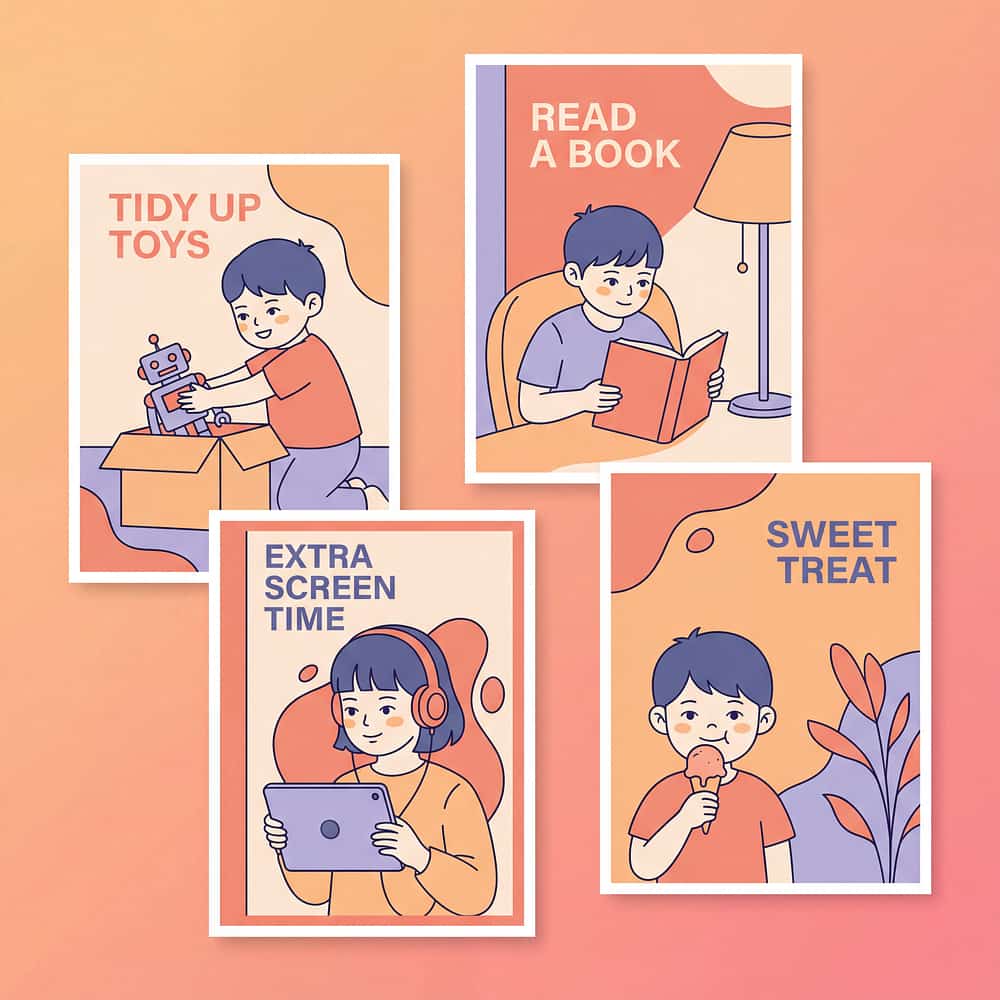
The 'then' must be genuinely motivating for YOUR child. Use photos of their actual favorite toys, activities, or treats—not generic images.
4
Present Board BEFORE Instruction
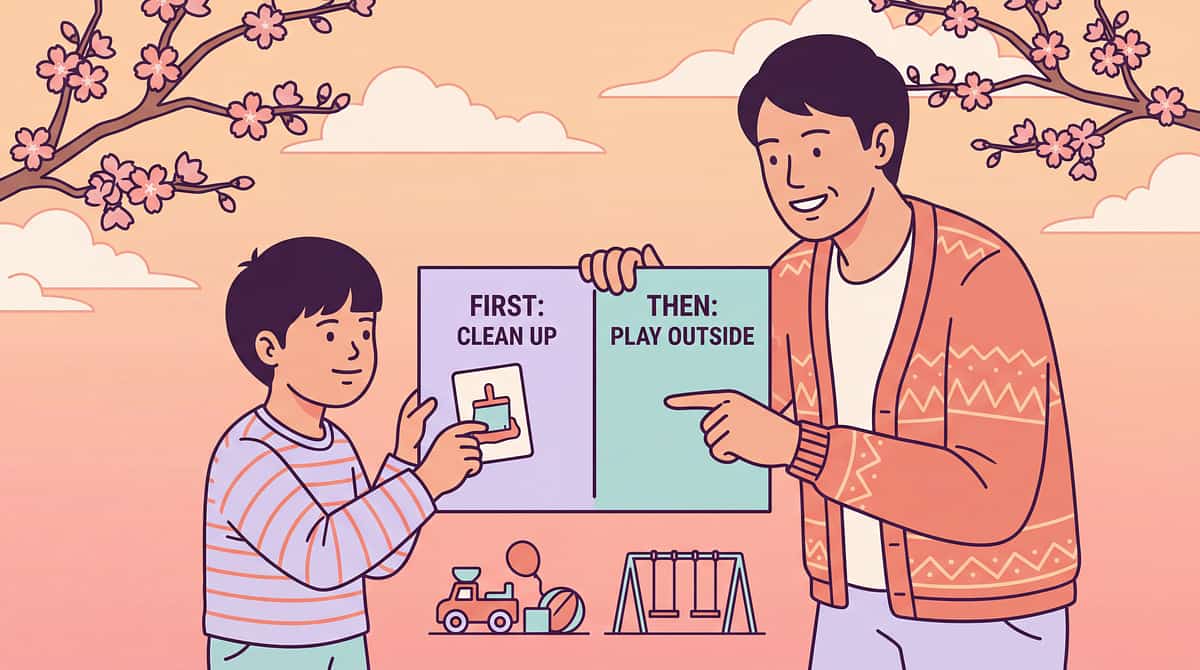
Show the board before giving the demand, not during resistance. This is a preventive tool, not a crisis intervention.
5
Point While Explaining
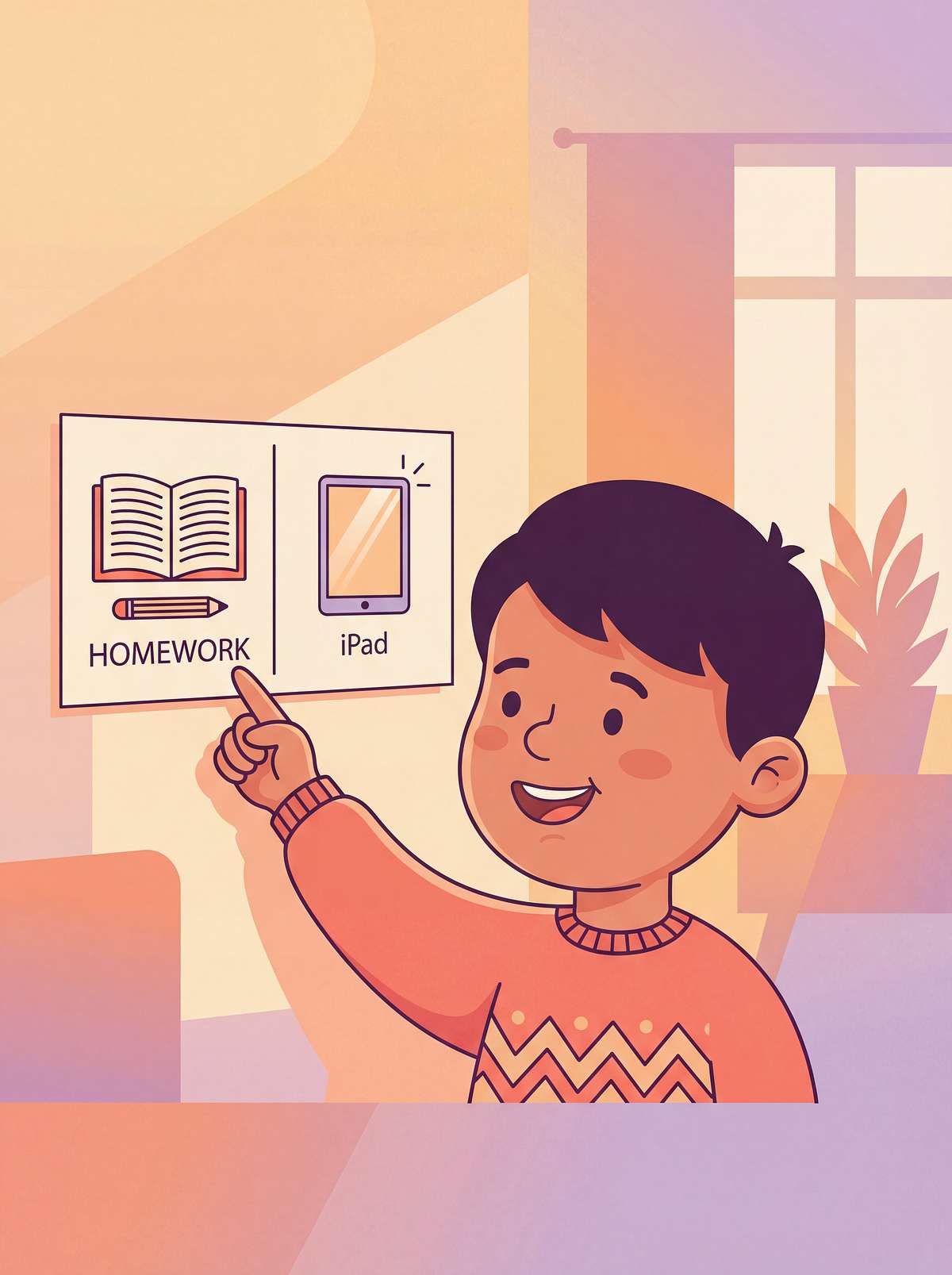
Point to each section as you explain: "First we do homework [point], then you get iPad [point]." Make the connection explicit.
6
Gradually Increase Complexity
Once trust is built, slowly increase the challenge of 'first' tasks. Start with 1 minute, build to 5 minutes, then 10 minutes over weeks.

Duration: Brief presentation (30 seconds), but used multiple times daily as an ongoing motivational tool. Each use takes under a minute to set up and explain.
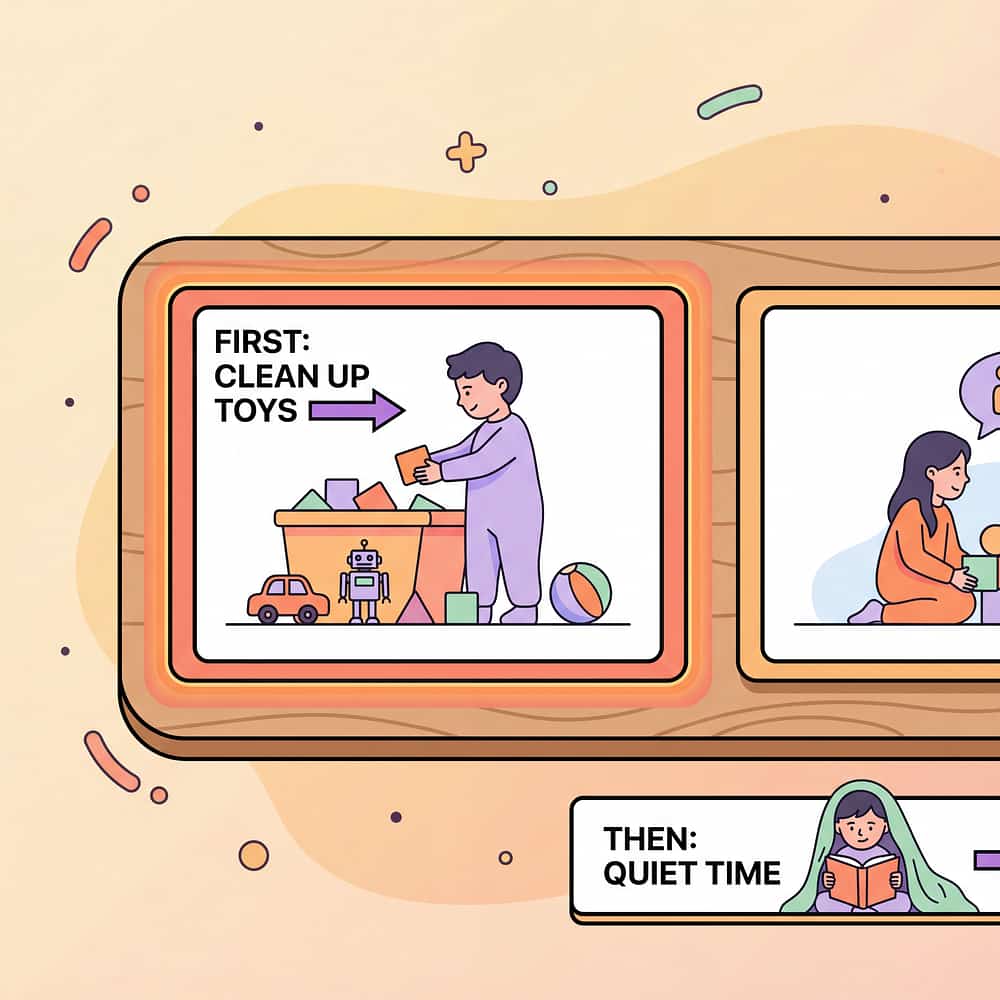
first-then-board-contingency-visual therapy material
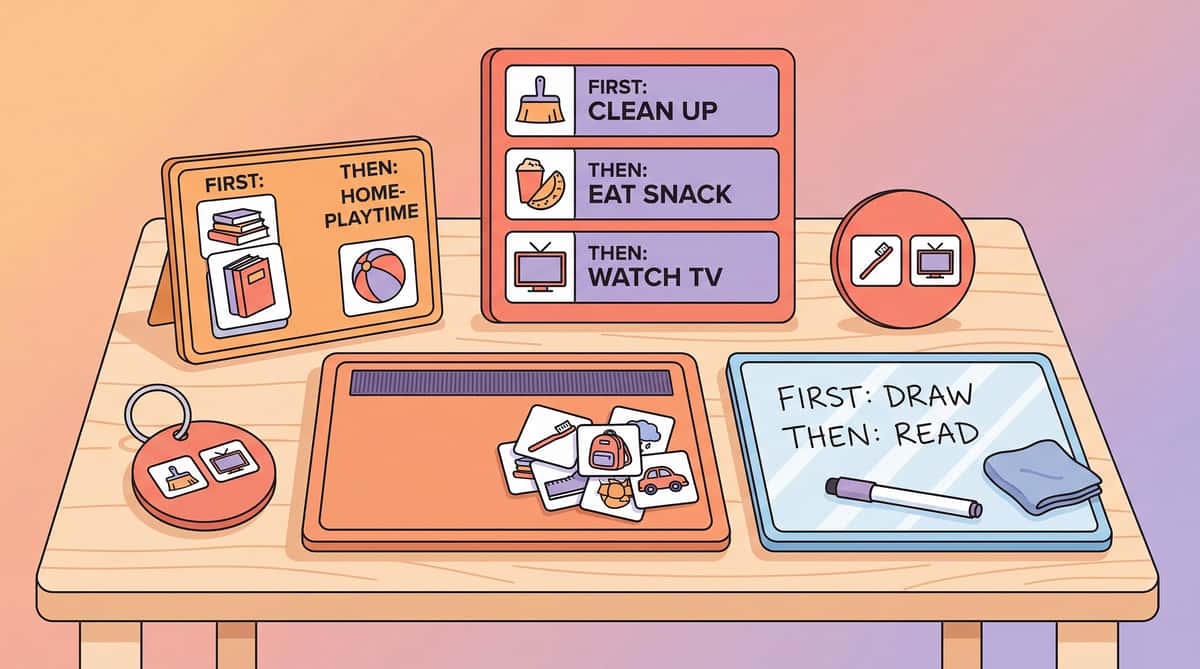
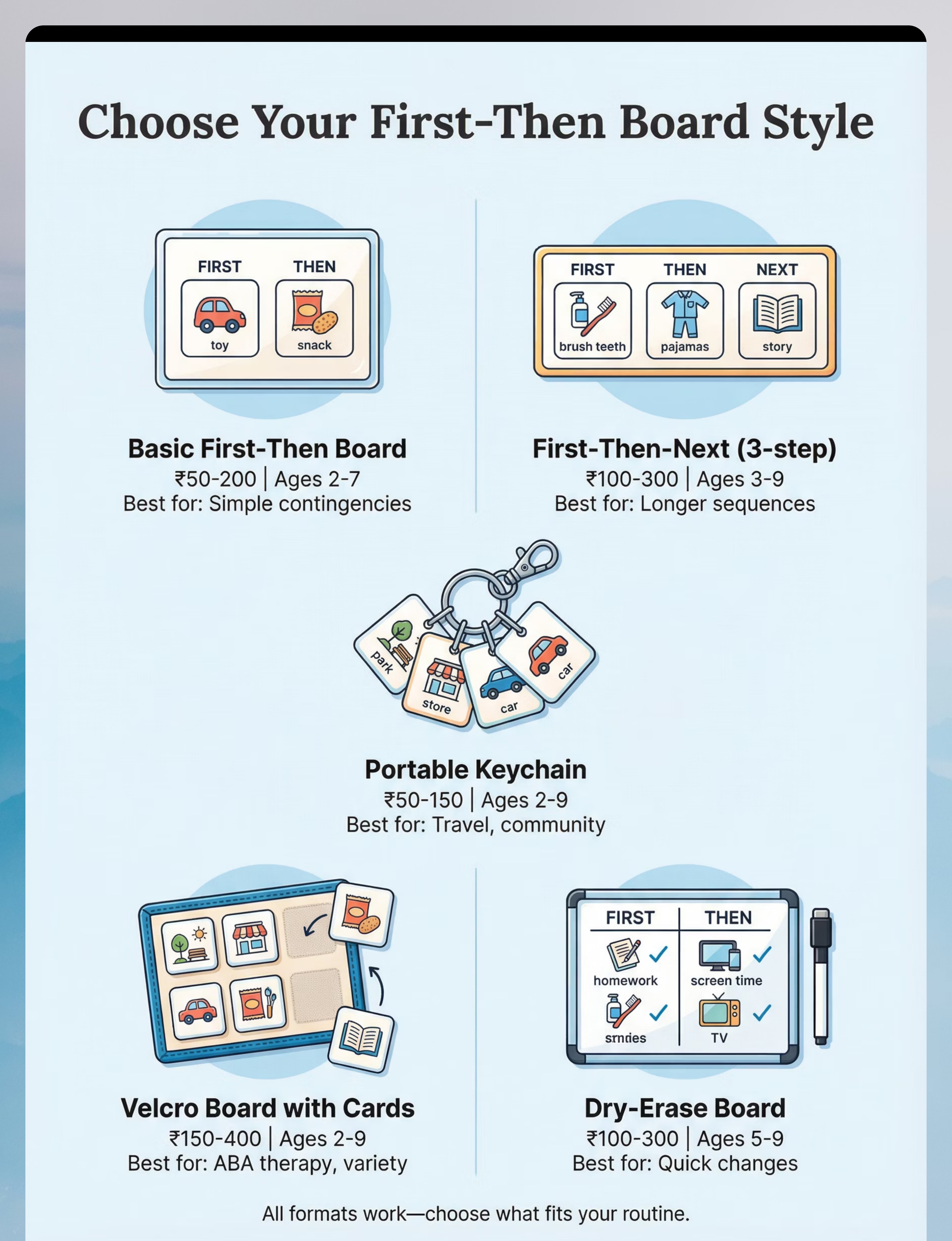
Choose Your Option (5 Variants)
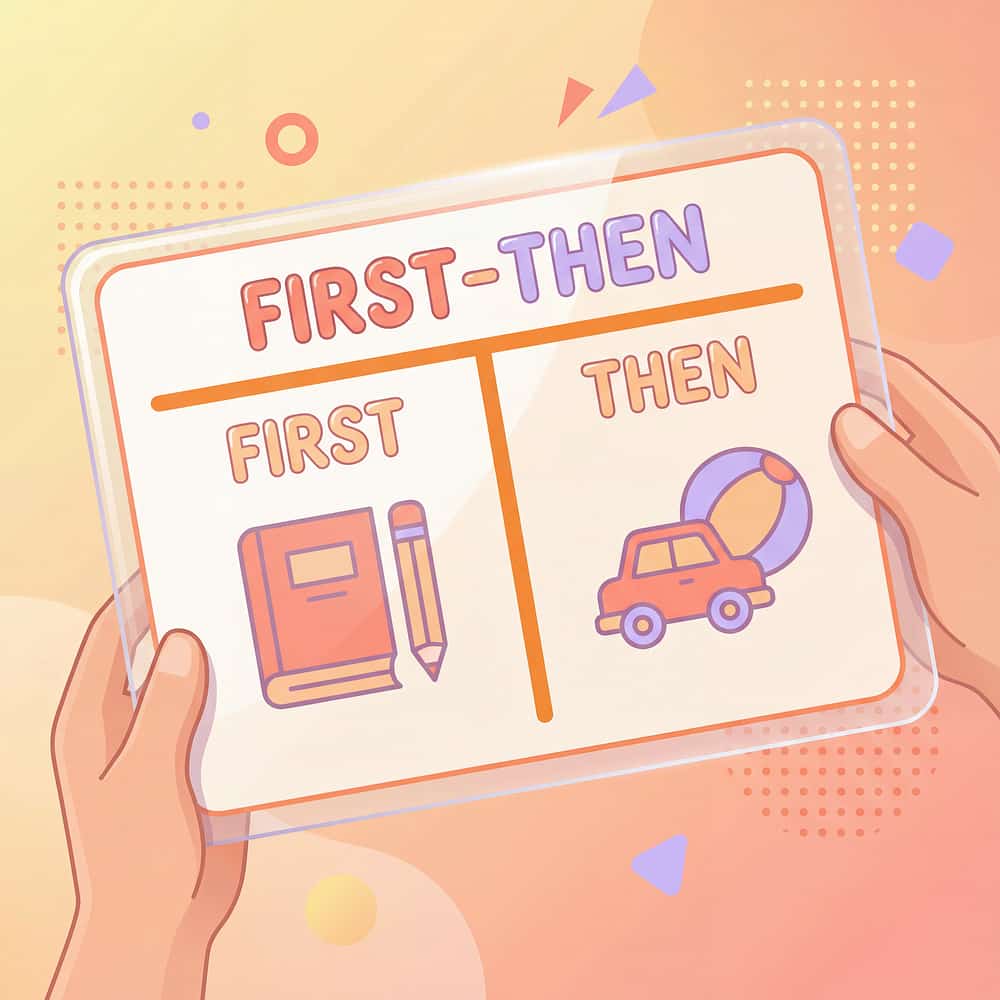
Basic First-Then Board
First-Then-Next Board (3-step)
Portable Keychain First-Then
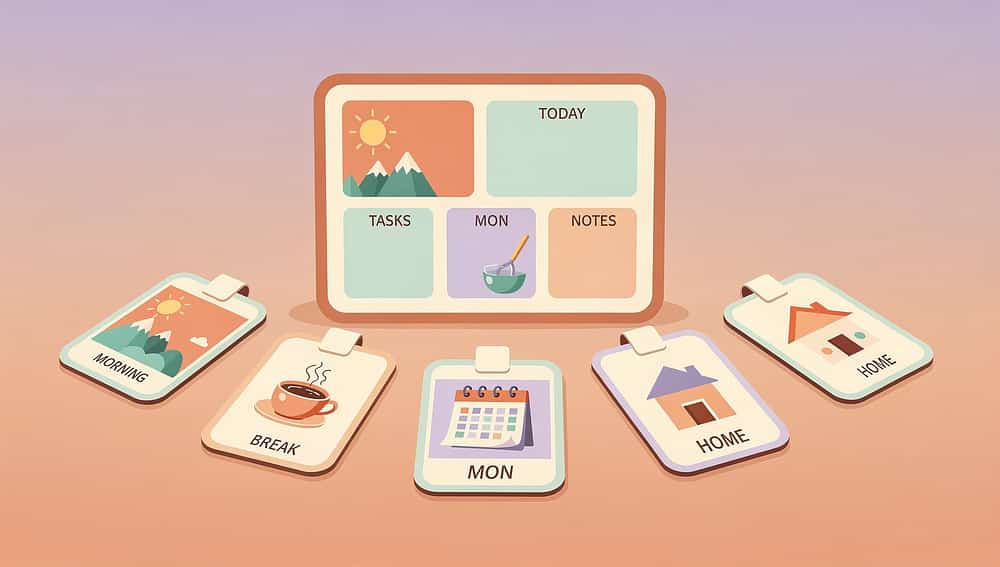
Velcro First-Then with Interchangeable Cards
Dry-Erase First-Then Board

There was an error generating this image

Basic First-Then Board
Best for: Simple contingencies, young children
Ages: 2-7 years | Settings: All | Portability: High
Price: ₹50–200

There was an error generating this image

First-Then-Next Board (3-step)
Best for: Slightly longer sequences, older children
Ages: 3-9 years | Settings: All | Portability: High
Price: ₹100–300

There was an error generating this image

Portable Keychain First-Then
Best for: Community, travel, quick use
Ages: 2-9 years | Settings: Community, Travel | Portability: Very High
Price: ₹50–150
Velcro First-Then with Interchangeable Cards
Best for: Variety of situations, ABA therapy
Ages: 2-9 years | Settings: Home, Clinic, School | Portability: Medium
Price: ₹150–400
Dry-Erase First-Then Board
Best for: Quick changes, literate children
Ages: 5-9 years | Settings: Home, School, Clinic | Portability: Medium
Price: ₹100–300
How to Choose
By Goal
  • Quick setup: Basic or Dry-Erase
  • Maximum flexibility: Velcro with cards
  • On-the-go: Keychain version
  • Longer sequences: 3-step board
By Setting
  • Home: Any variant works well
  • Travel/Community: Keychain version
  • Clinic/School: Velcro or Dry-Erase
  • Multiple locations: Have 2-3 boards
Structure & Key Features
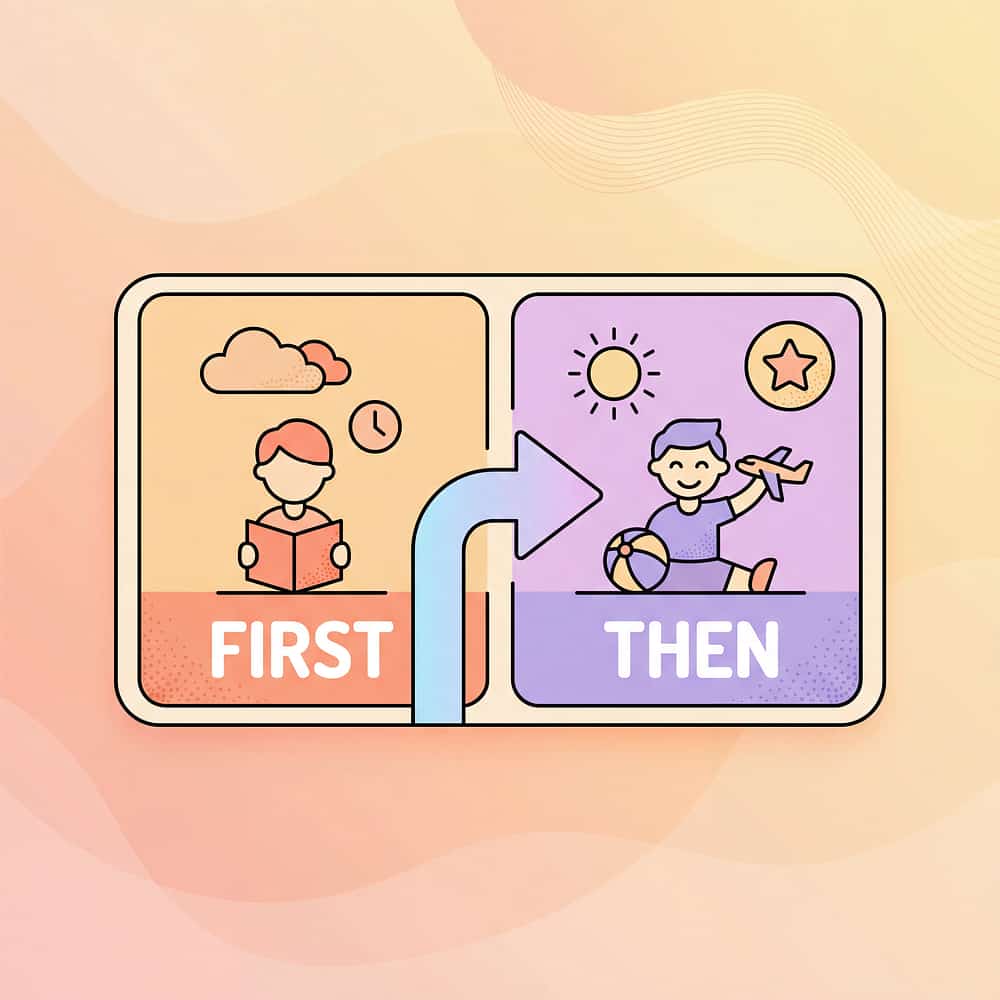
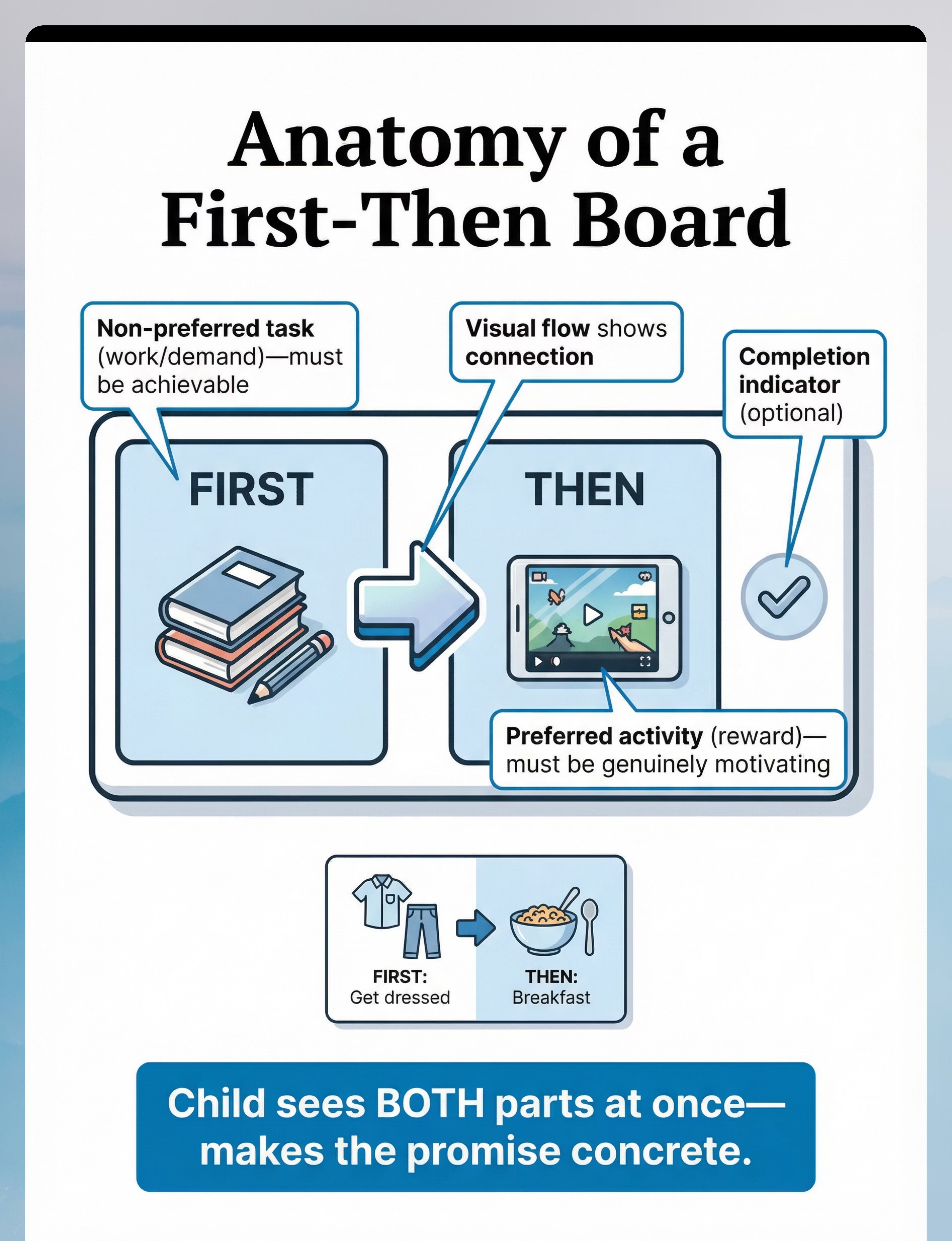
Board Structure
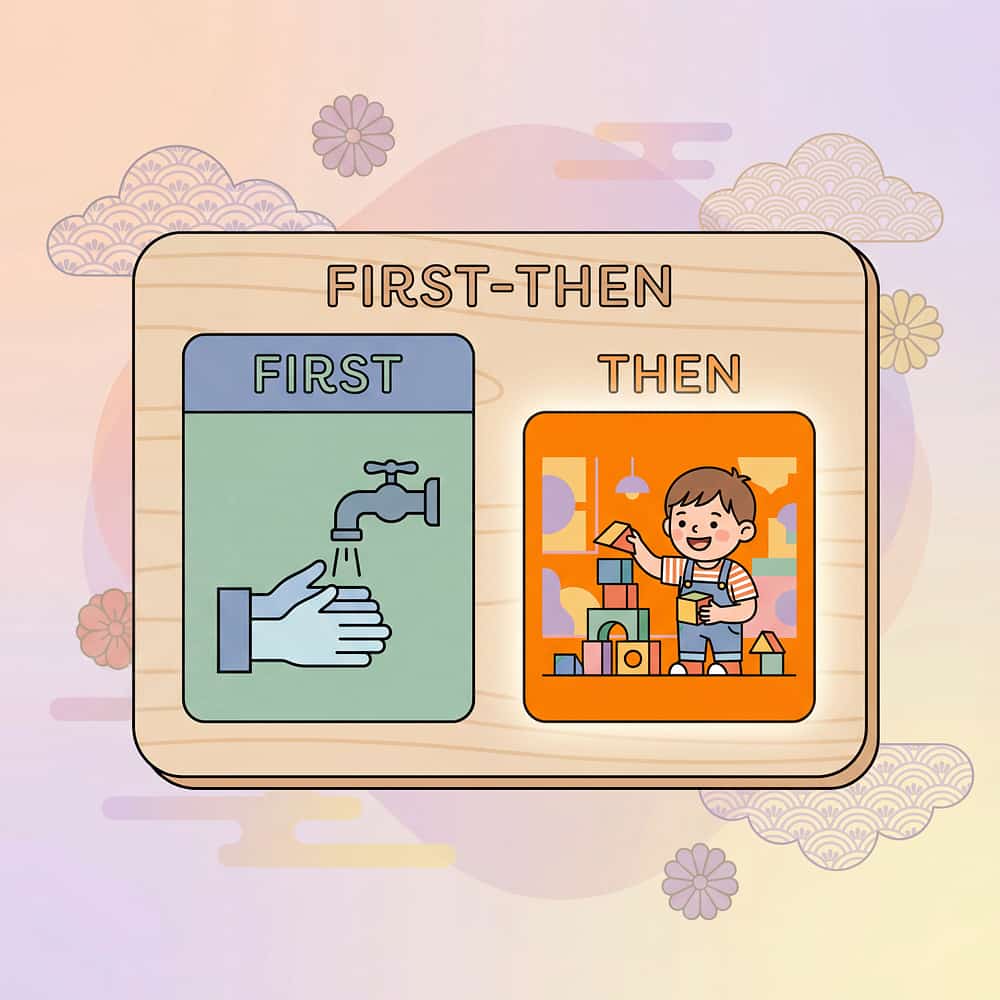
First Box
Non-preferred task (work/demand)
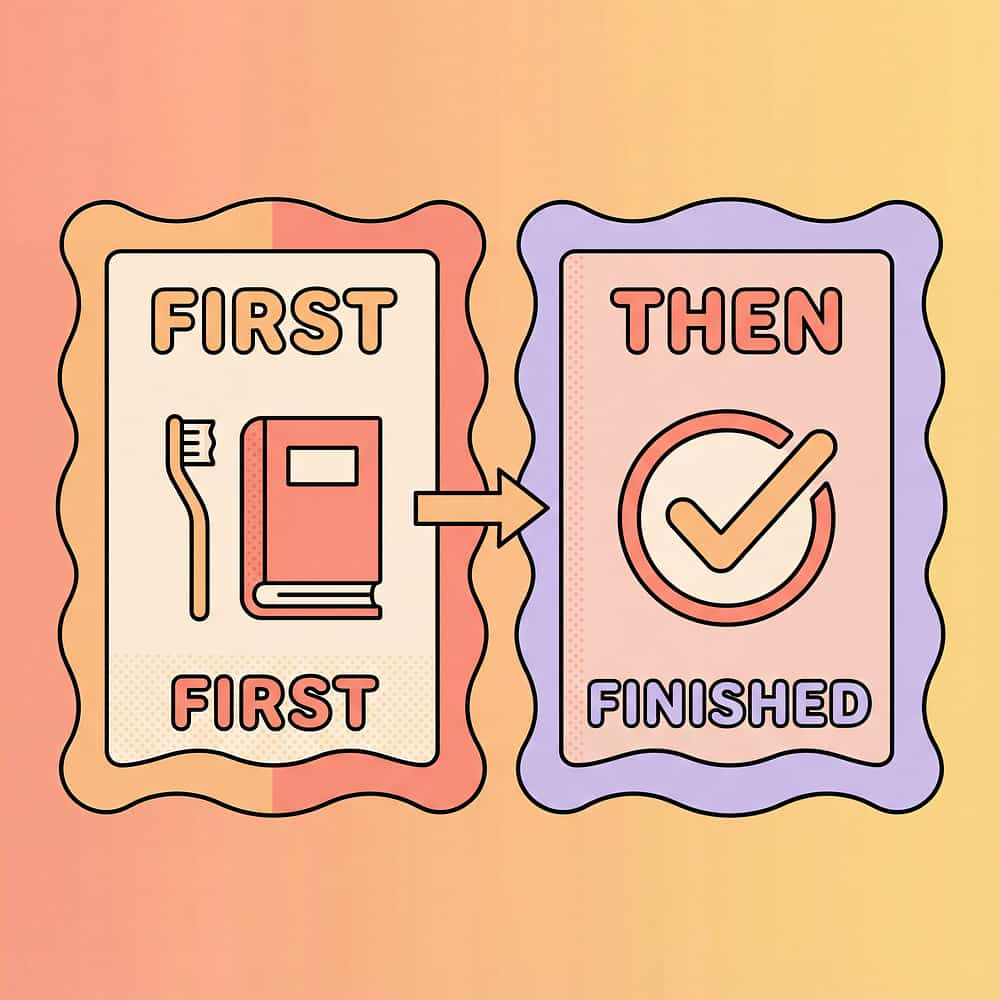
Arrow
Visual flow from first → then
Then Box
Preferred activity/item (reward)
Completion
Optional checkmark or 'done' indicator
Materials & Features
Durability
Laminated card/board for long-lasting use

There was an error generating this image

Flexibility
Velcro for interchangeable activity/reward cards
Adaptability
Dry-erase surface for quick, easy changes
Personalization
Photo cards showing real tasks/rewards

There was an error generating this image

Clarity
Clear two-part visual layout, easy to understand
Portability
Lightweight and easy to carry anywhere
The simplicity is the power. Two boxes, one arrow, and the ability to customize with your child's actual preferred items. Don't overcomplicate this—it works because it's clear, concrete, and consistent.
The Struggle (Before)
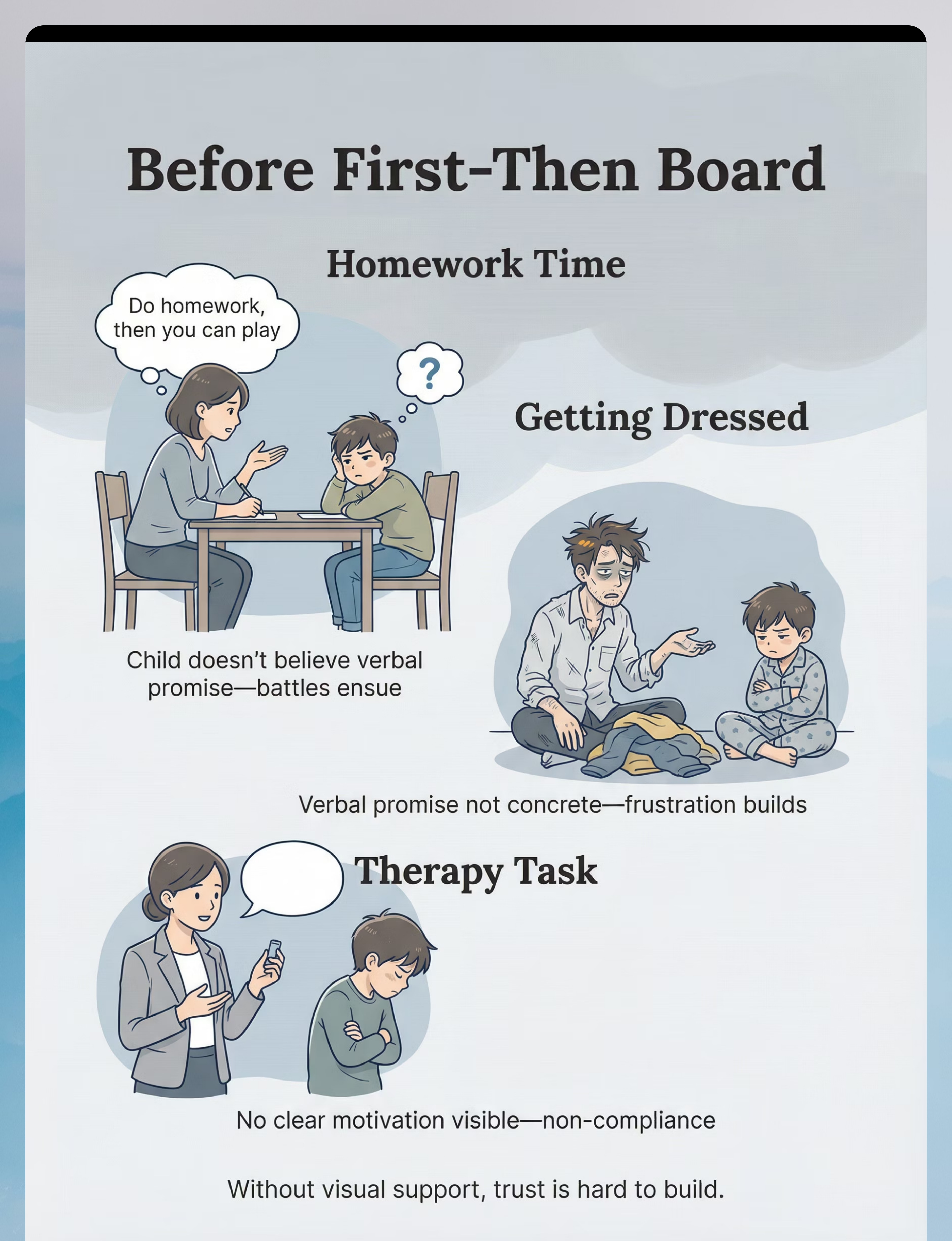
Homework Time
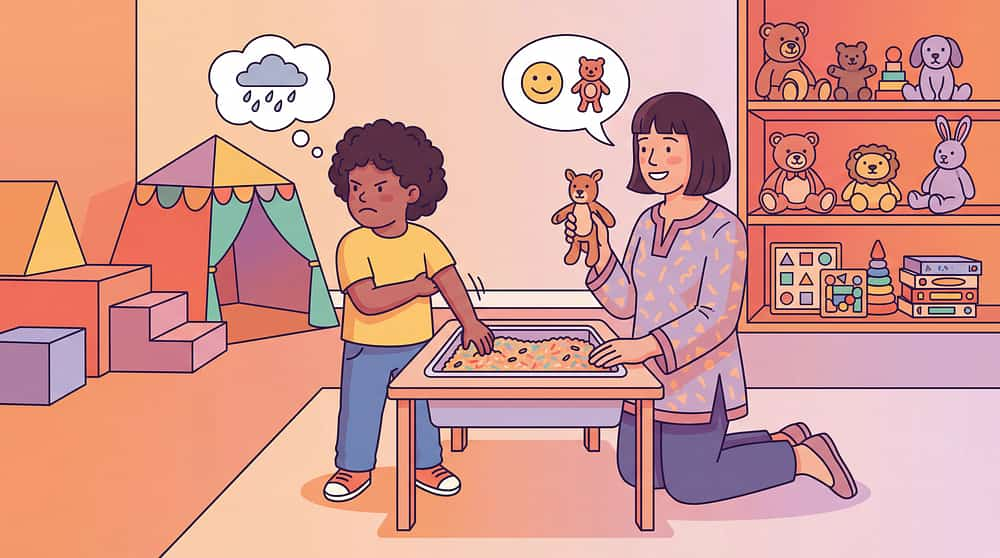
Situation: Parent says "Do homework, then you can play." Child doesn't believe it, or forgets, or can't conceptualize it.
Experience: Child refuses. Parent repeats. Child still refuses. Battle ensues. Homework takes 3 hours instead of 30 minutes.
Emotion: Frustration, distrust, exhaustion
Getting Dressed
Situation: Child won't get dressed for school. Parent promises treat after. Child still refuses.
Experience: Verbal promise isn't concrete enough. Child can't hold the concept in mind. Meltdown happens. Everyone late.
Emotion: Battle fatigue, helplessness
Therapy Task
Situation: Therapist asks child to complete a sensory activity. Child refuses. No clear motivation visible.
Experience: Session becomes a power struggle. Little learning happens. Therapist and child both frustrated.
Emotion: Non-compliance, wasted time
Without visual support, children struggle to connect present effort with future reward. The gap feels impossible to bridge. Verbal promises feel empty or untrustworthy, especially if they've been broken before.
The Breakthrough (After)
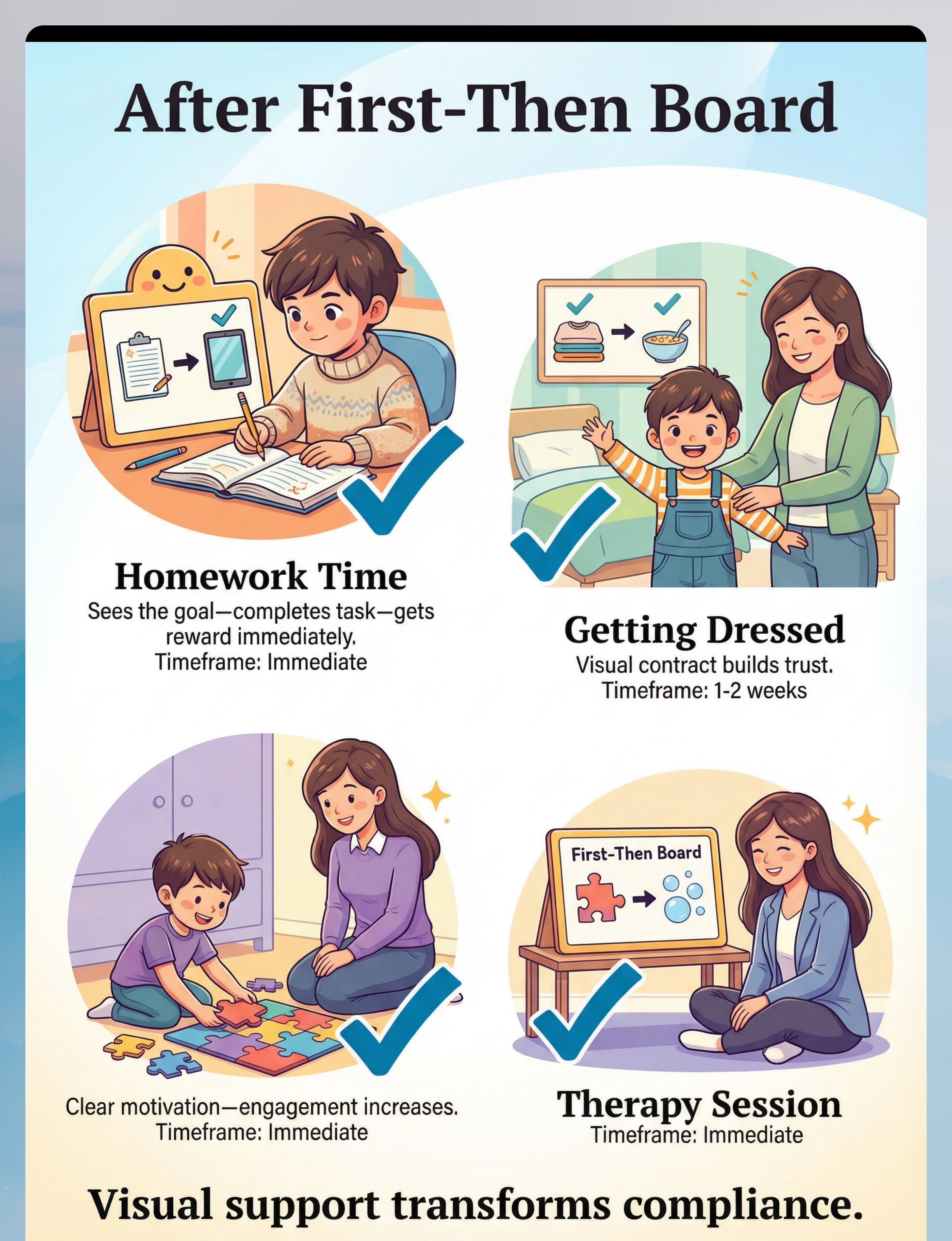
Homework Time
Immediate
Situation: First-Then board shows: First homework (photo), Then iPad (photo). Child can SEE the goal.
Experience: Child completes homework. Gets iPad immediately. Trust is built through consistent delivery. Homework time shrinks from 3 hours to 45 minutes.
Emotion: Clarity, motivation, success
Getting Dressed
1-2 weeks
Situation: Board shows: First clothes on, Then breakfast. Child sees the contract.
Experience: Child gets dressed. Gets breakfast. Trust builds over days. Morning routine becomes predictable and calm.
Emotion: Cooperation, trust, calm
Therapy Task
Immediate
Situation: Therapist shows First-Then: First puzzle, Then bubbles. Child sees preferred activity coming.
Experience: Child completes task. Reinforcement delivered immediately. Next session, compliance is even faster.
Emotion: Engagement, success, learning
The transformation happens when children can SEE the connection. The board makes the invisible visible. It's not magic—it's neuroscience. Visual processing is faster and more concrete than verbal processing for many children.
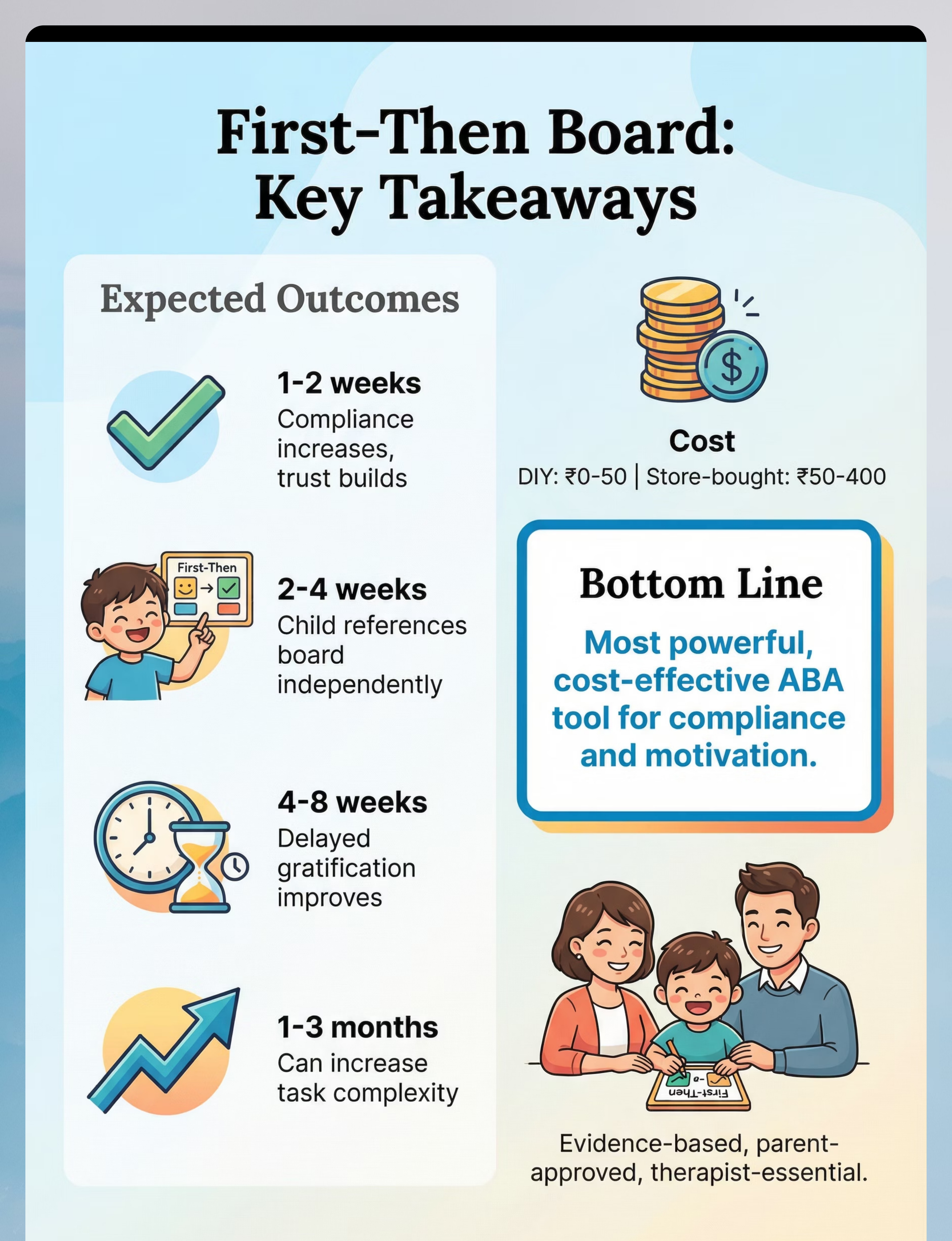
What to Expect (Realistic Timelines)
Child understands and trusts the contingency
Once they see the contract honored consistently, belief replaces skepticism
1-2 weeks
Compliance with non-preferred tasks increases
Saying "yes" becomes easier when the endpoint is clear and reliable
1-2 weeks
Power struggles and negotiation decrease
The board answers "why should I?" before the question is even asked
2-4 weeks
Child references board independently
They start pointing to the board or bringing it to you—ownership develops
2-4 weeks
Delayed gratification tolerance improves
They learn to wait because they trust the reward is coming
4-8 weeks
Can increase 'first' complexity over time
What started as 1 minute of work can become 10-15 minutes as skills build
1-3 months

Important: Progress isn't always linear. Some days will be harder. Consistency in delivering the 'then' is what builds long-term trust and compliance.
Is This Right for My Child? (2-Minute Check)
Does your child struggle to comply with non-preferred tasks?
If yes, this indicates: First-Then will help build motivation and reduce resistance
Do verbal promises of 'later' or 'after' not work?
If yes, this indicates: Your child needs visual contingency to process the connection
Does your child need to see the reward to be motivated?
If yes, this indicates: First-Then is ideal—visual learners thrive with this tool
Are there constant negotiations before tasks?
If yes, this indicates: Visual contract will reduce battles and clarify expectations

3+ "yes" answers = strong fit. The First-Then Board is likely to significantly improve compliance and reduce daily stress for both you and your child.
Usage Guide
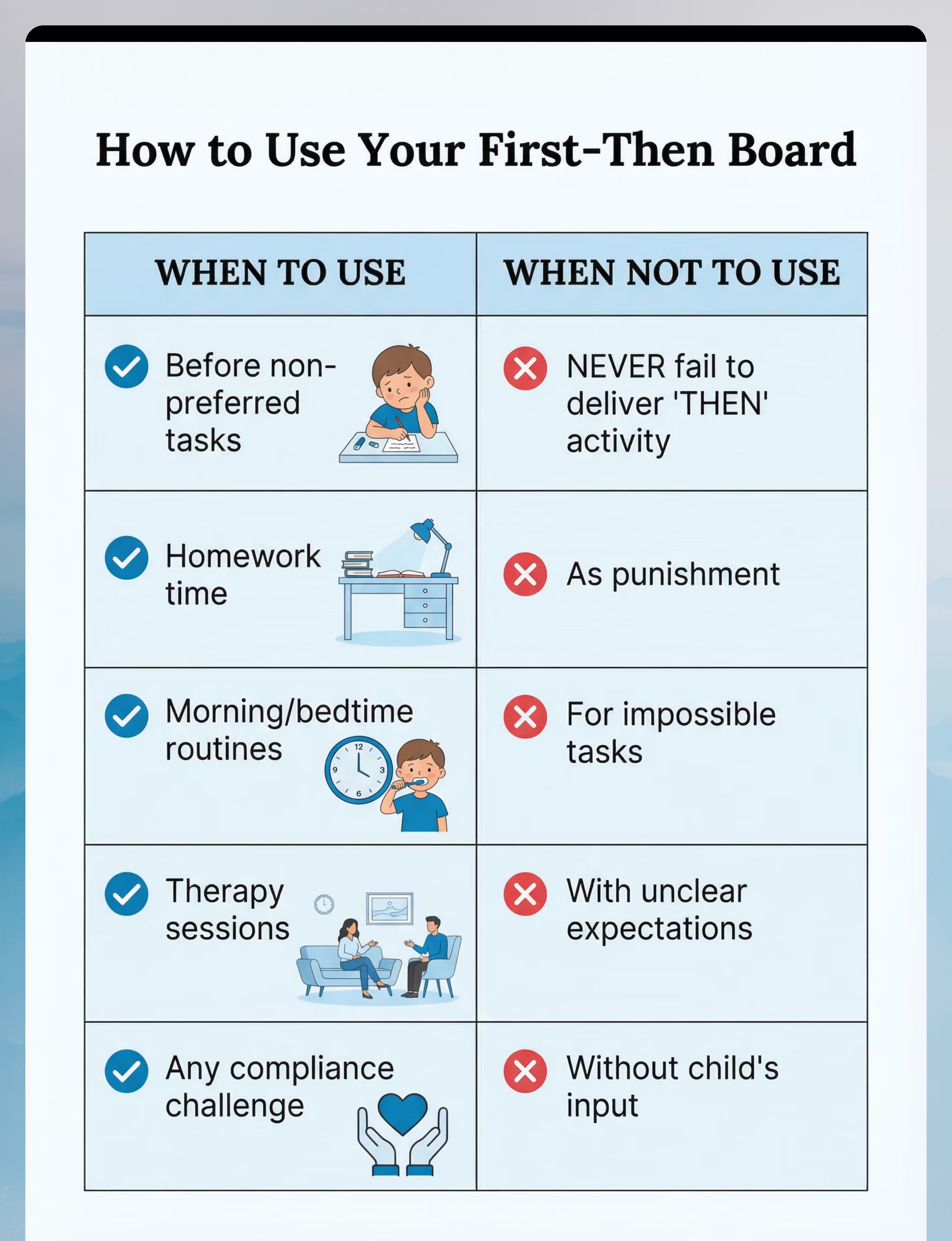
✓ When to Use
  • Before any non-preferred task
  • When verbal promises don't work
  • During therapy sessions
  • Morning/bedtime routines
  • Homework time
  • Any compliance challenge
✗ When NOT to Use
  • NEVER fail to deliver 'then' after 'first' completion
  • Don't present during meltdown (too late—this is preventive)
  • Don't make 'first' unachievable
  • Don't use 'then' items that aren't truly preferred
Supervision by Age
Age Range
Supervision Level
Notes
Under 3 years
Adult manages entirely
Adult presents board, provides full support through task, delivers reward
3-6 years
Adult presents, child engages
Child begins to understand and reference board independently
6+ years
Child can request/reference
Child may bring board to adult or point to it as reminder
Brief presentation (30 seconds)
Ongoing daily tool
The First-Then Board is appropriate across all settings—home, school, clinic, and community. It's portable, flexible, and works anywhere compliance is a challenge. Duration is brief for each use, but it becomes a consistent part of your daily routine.
Safety First
Critical Safety
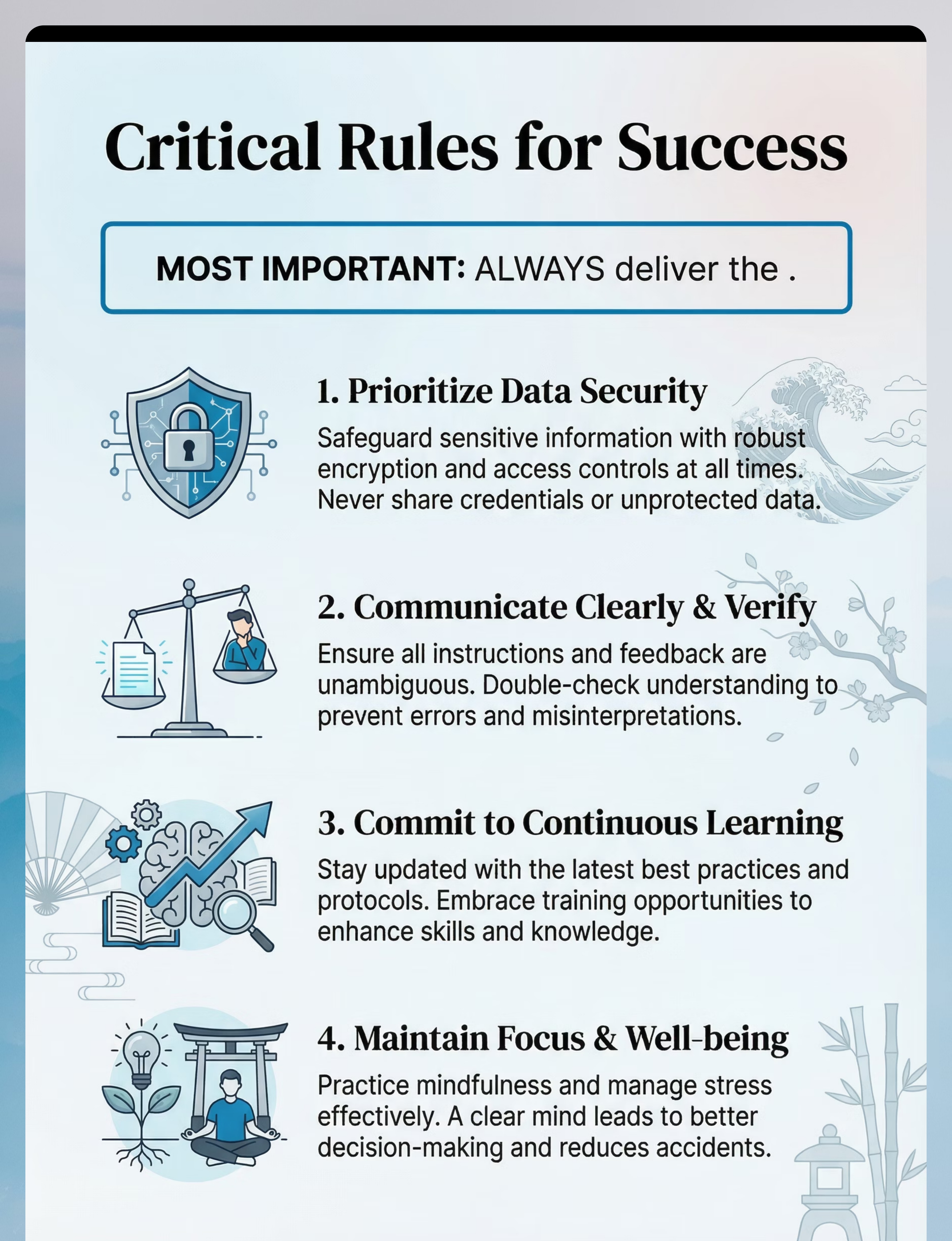
  • ALWAYS deliver 'then' immediately after 'first' completion
  • Breaking the contract destroys trust and effectiveness
  • 'First' must be achievable—don't set child up to fail
  • Don't add to 'first' after completion (no moving goalposts)
Warnings
  • Don't overuse for every single small task—reserve for challenges
  • Ensure 'then' is actually motivating (not what YOU think is motivating)
  • Don't present during escalation—this is a preventive tool
  • Gradually increase challenge; don't start too hard
Contraindicated
  • Not delivering promised reward (breaks all trust)
  • Making 'first' unachievable (sets up failure)
  • Presenting during active meltdown (too late)
Safety Checklist
Before Use
  • 'First' is achievable for this child
  • 'Then' is genuinely motivating
  • You WILL deliver 'then' immediately
  • Board is prepared with correct visuals
During Use
  • Point to each part while explaining
  • Child can see both boxes
  • Support through 'first' if needed
  • Deliver 'then' IMMEDIATELY upon completion
Signs of Success
  • Child looks at board and complies
  • Reduced negotiation
  • Child points to 'then' with anticipation
  • Can increase 'first' complexity over time
Common Questions (Honest Answers)
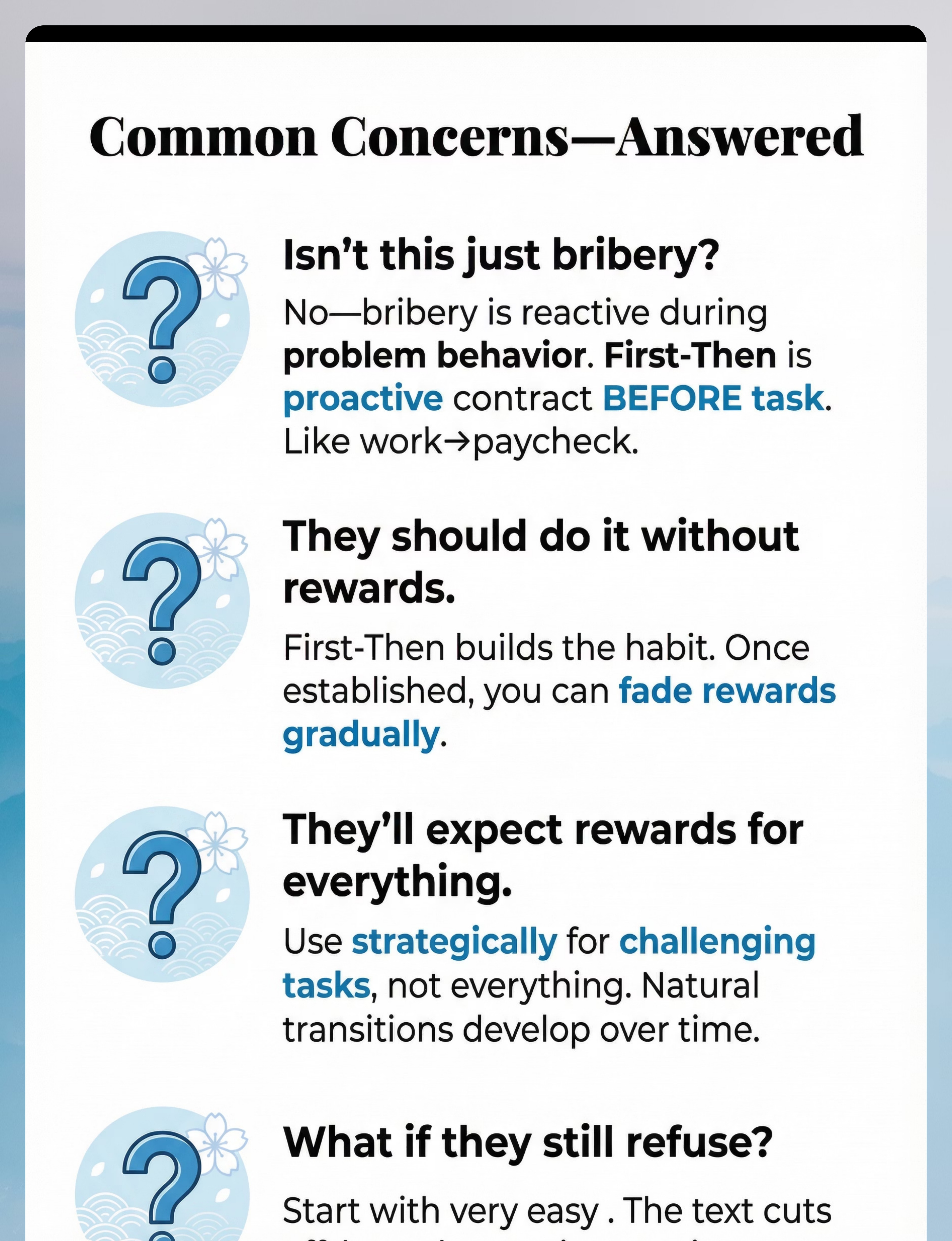
Q: "This is just bribery"
A: Bribery is offering a reward DURING problem behavior to stop it. First-Then is a proactive CONTRACT presented BEFORE the task. It's the same principle as "work then paycheck"—contingency, not bribery. Adults work for rewards too. We're just making it visual and predictable for children.
Try this: Think of it as a visual contract, not a bribe.
Q: "They should do it without rewards"
A: Eventually, yes. First-Then builds the habit and trust. Once behavior is established, you can fade the explicit rewards—natural consequences take over. But we have to BUILD the behavior first. You can't skip the foundation.
Try this: Plan to fade rewards gradually as compliance becomes habit.
Q: "They'll expect rewards for everything"
A: Use strategically for challenging tasks, not everything. Mix with tasks that don't need First-Then. Over time, some 'then' items become natural transitions (First homework, Then dinner). Not everything needs explicit reward—use your judgment.
Try this: Reserve for genuinely difficult compliance situations.
Q: "What if they refuse even with the board?"
A: Make 'first' easier initially—even 1 minute of task counts. Make 'then' highly motivating. Deliver immediately. Build trust. If still refusing, 'then' item may not be motivating enough, or 'first' is too demanding. Adjust and try again.
Try this: Start with very easy 'first' and very motivating 'then.'
Investment Guide
Overall Price Range: ₹0–400 (or $0–5 USD)
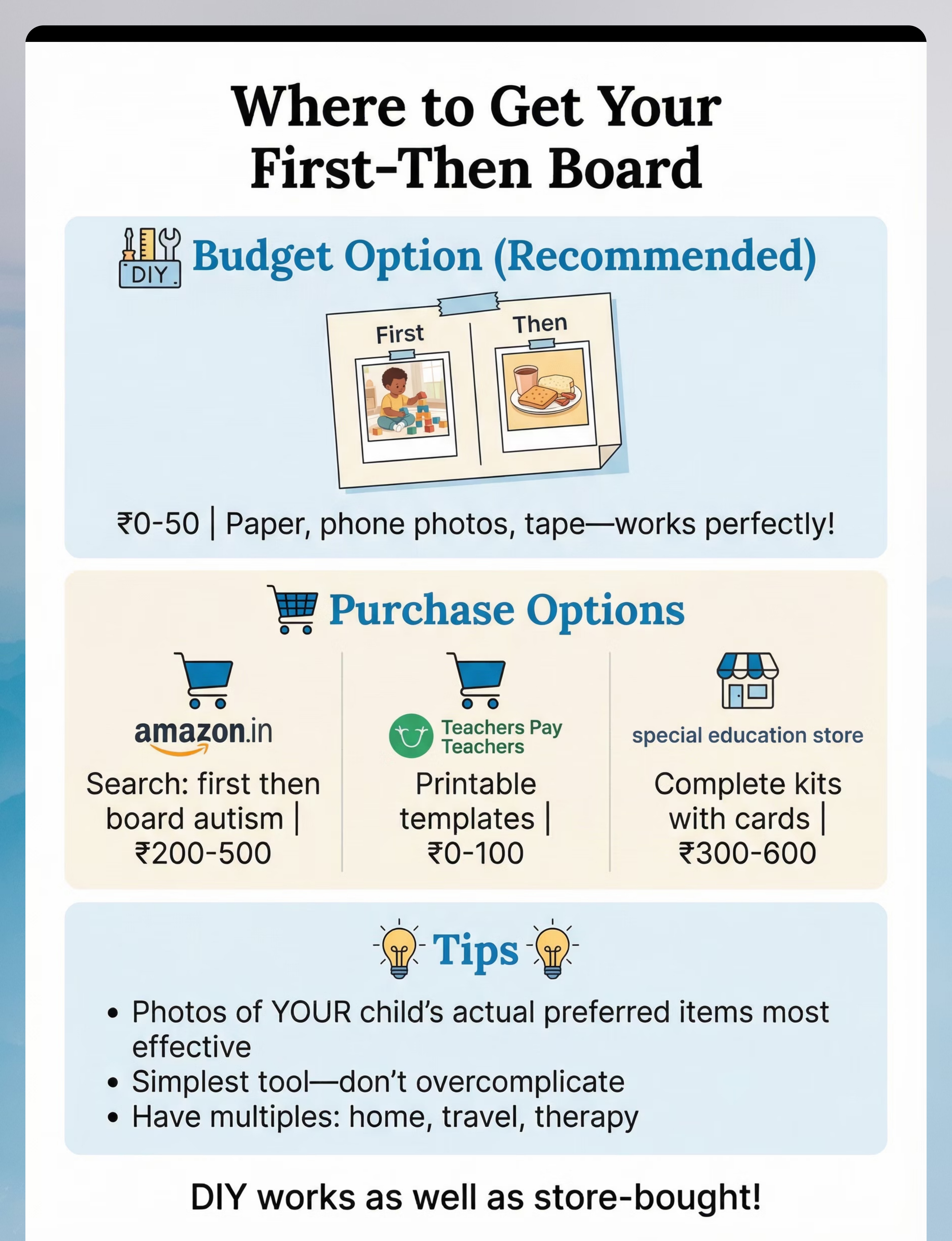
Budget Option
What: DIY paper First-Then board + photos
Cost: ₹0-50
Note: Paper, phone photos, tape—works perfectly. This is genuinely effective, not a compromise.
Premium Option
What: Complete First-Then kit with board and 50+ cards
Cost: ₹300-600
Brands: ABA therapy suppliers, Special education stores

Best starting point: DIY version. This is one of the simplest therapeutic tools—there's no need to spend money unless you want pre-made cards or extra durability. Save your budget for tools that truly require commercial quality.
Very Low Investment
DIY Strongly Preferred
Where to Buy in India
Availability: DIY strongly preferred—this is one of the easiest and most cost-effective tools to make yourself.
Platform Options
Amazon.in
Search: "first then board autism"
Price: ₹200-500
Pre-made boards with some card sets included
Teachers Pay Teachers
Search: "first then board printable"
Price: ₹0-100
Downloadable templates you can print and laminate
DIY Materials
What you need: Paper + photos + laminate
Price: ₹0-100
Most effective and personalized option
✓ Buying Tips
Simplest tool—don't overcomplicate
Photos of YOUR child's actual preferred items most effective
Can be paper—doesn't need to be fancy
Have multiples: one for home, one for travel
Dry-erase version offers flexibility
Red Flags
Overly complex design (defeats the purpose)
Generic images child doesn't connect with
Too expensive for such a simple tool
Not portable enough for daily use
DIY Alternative (Save 95-100%)
Extremely High Feasibility
₹0-50 Total Cost
10-15 Minutes
What You Need
  • Paper or cardboard
  • Marker
  • Photos (optional—can draw)
  • Laminating pouch (optional)
  • That's it!
Simple Steps
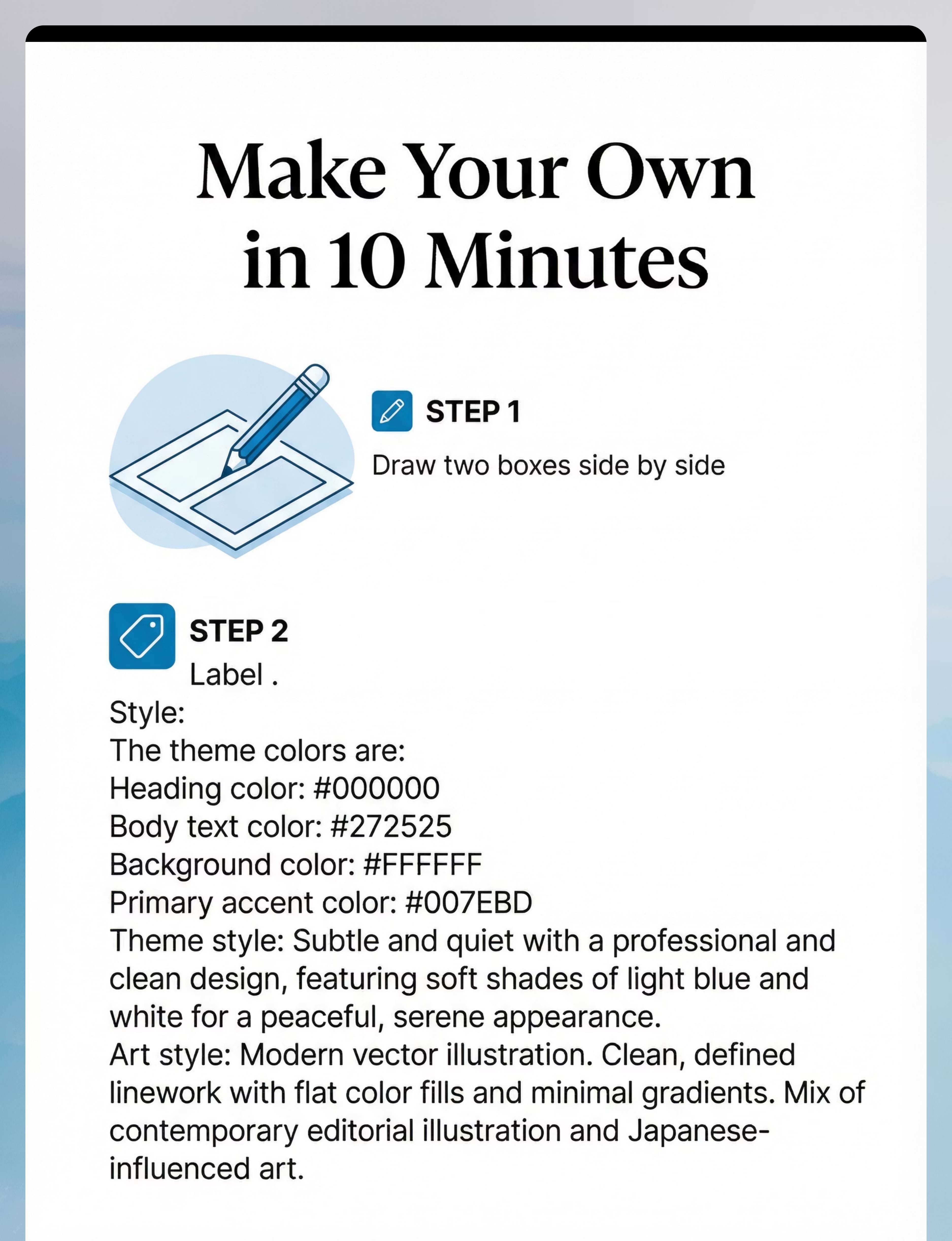
1
Draw two boxes side by side on paper
2
Label 'FIRST' over left box, 'THEN' over right box
3
Draw arrow from First → Then
4
Leave blank and draw/write in each time, OR create velcro version with photo cards
5
Laminate for reuse (optional but helpful)
6
That's it—don't overcomplicate!
DIY vs Commercial
When to DIY
When to Buy Commercial
  • Budget-conscious (should be everyone for this tool)
  • Want immediate solution
  • Personalizing with real photos of your child's items
  • Testing the concept
  • Want pre-made card library
  • Need durable clinic materials
  • Prefer ready-made aesthetic

Tradeoffs: Paper version less durable than commercial; may need to re-draw or use velcro cards. But functionally? Just as effective. Save your money for tools that genuinely require commercial quality.
Measuring Success, Complete the Kit & Support
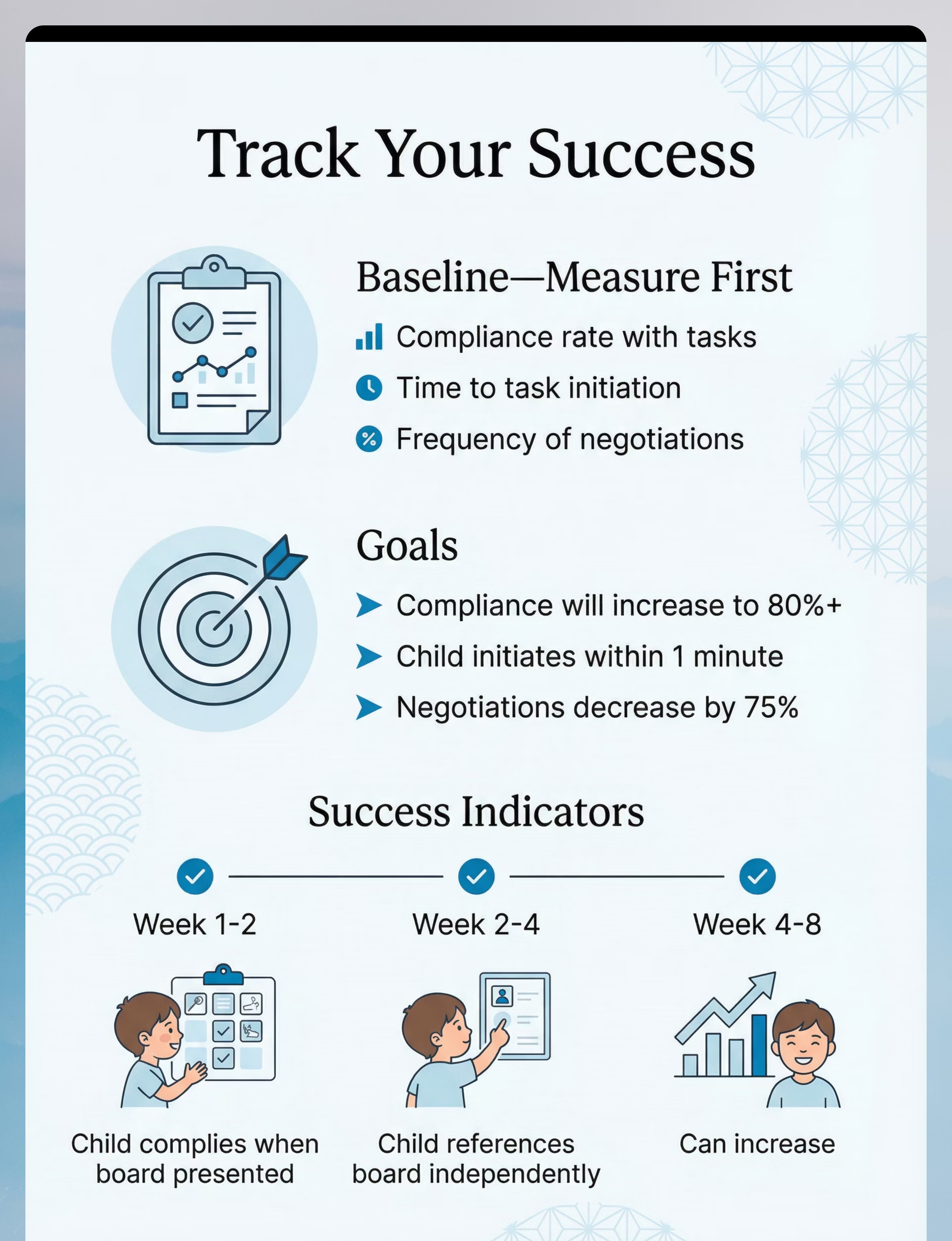
Track Progress
Baseline Measures
  • Compliance rate with non-preferred tasks
  • Time/prompts to task initiation
  • Frequency of negotiations/battles
  • Tasks currently avoided
Goals
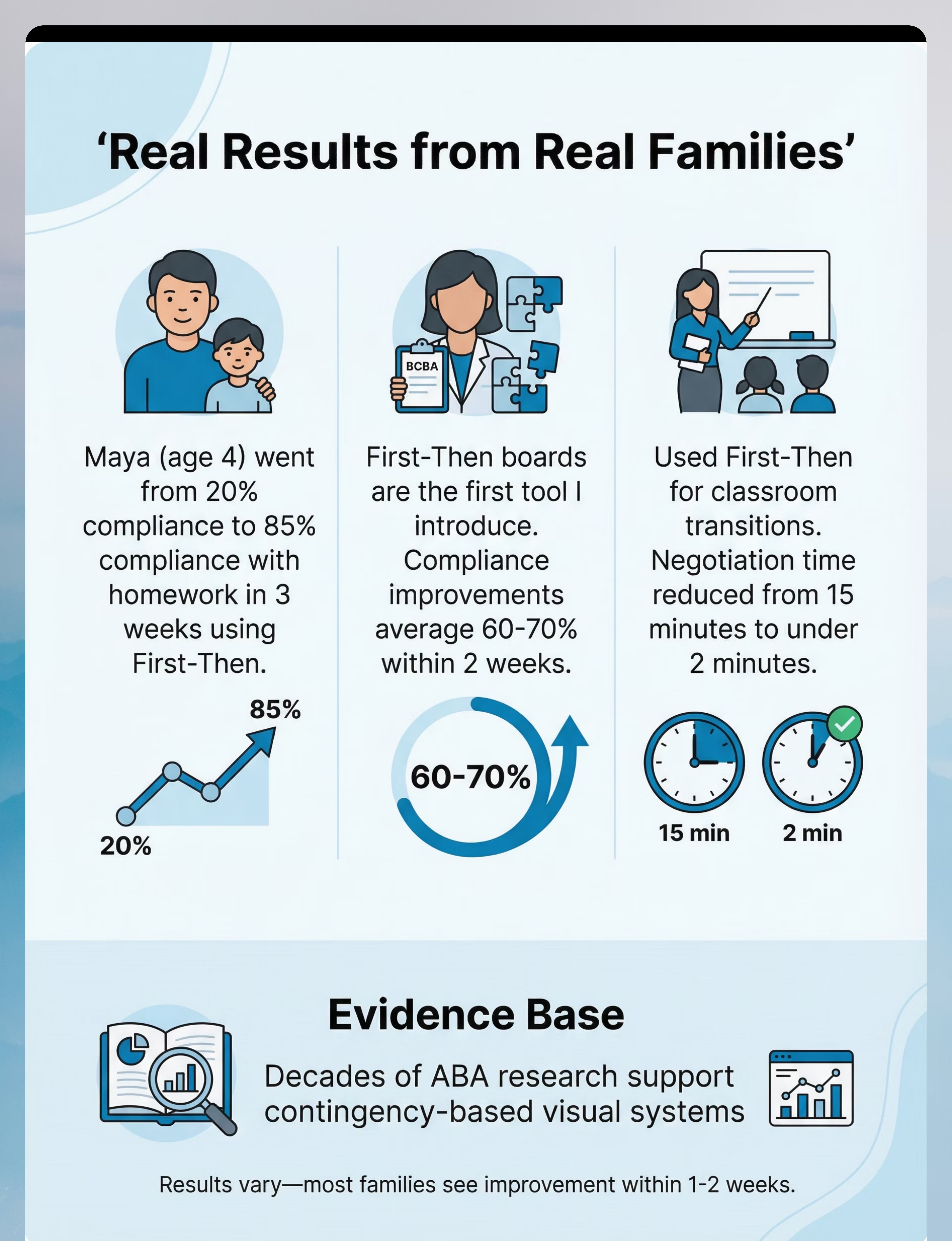
  • Compliance with 'first' tasks will increase to 80%+
  • Child will initiate 'first' within 1 minute of board presentation
  • Negotiations before tasks will decrease by 75%
Success Indicators
  • Immediate compliance when board presented
  • Child references board independently
  • Verbal 'first-then' begins working
  • Can increase 'first' demands

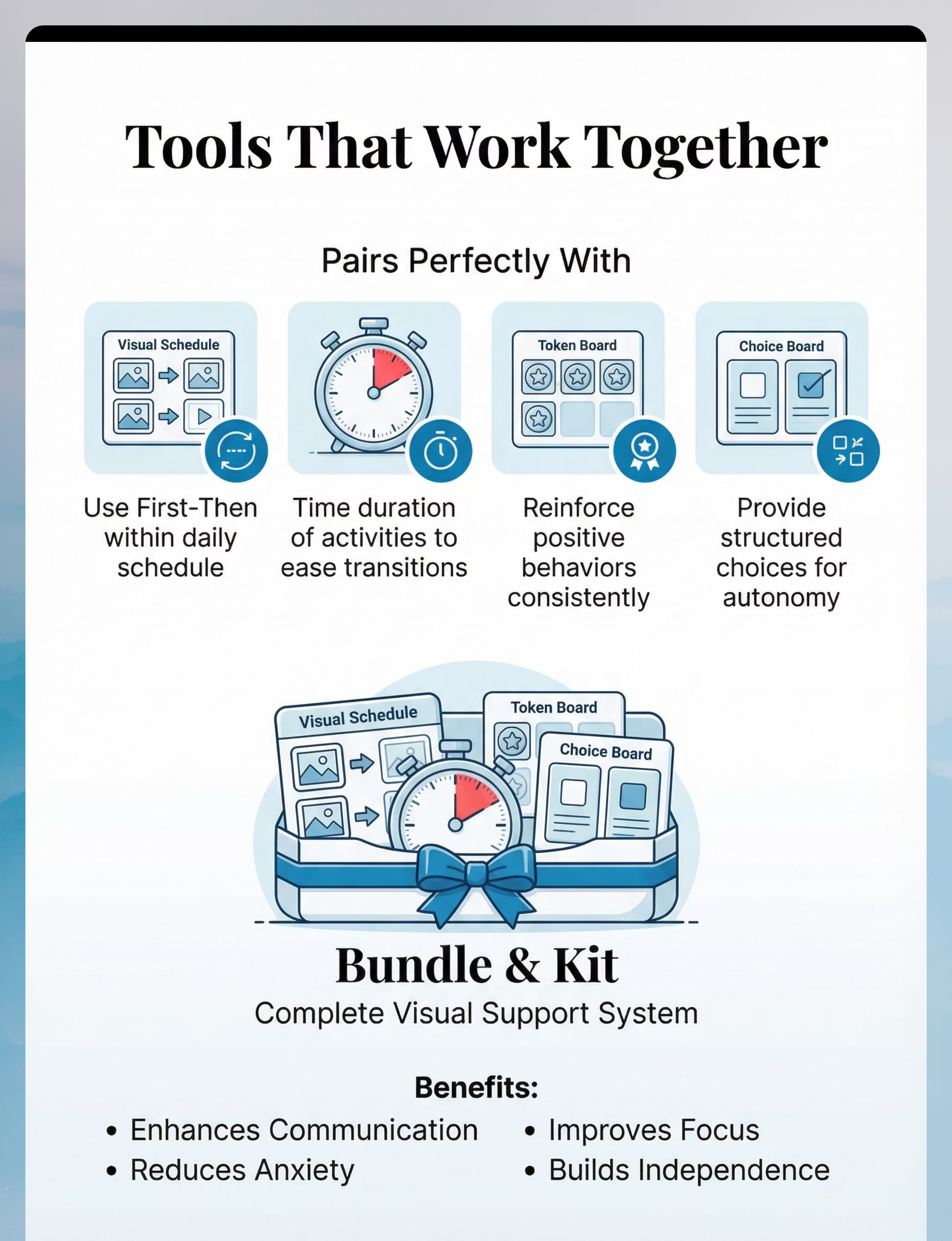
Pair It With...
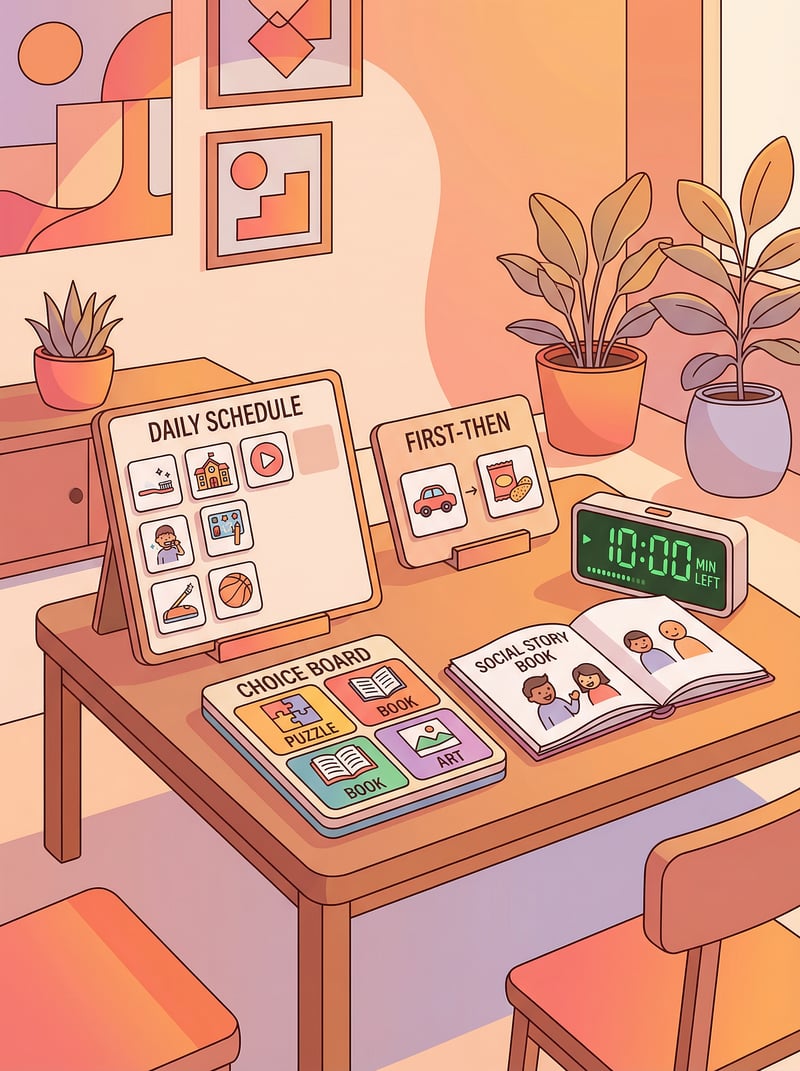
Visual Schedule (ID: 3.1)
Use First-Then within a larger daily schedule for comprehensive structure
Visual Timer (ID: 3.3)
Show duration of 'first' task to make time concrete
Token Board (ID: 2.7)
Combine for multiple 'firsts' before earning a single 'then'
Choice Board (ID: 2.8)
Let child choose their 'then' reward from available options
Recommended Bundle: Compliance Support Kit (First-Then Board, Visual Timer, Token Board) for comprehensive task completion support

Quick Summary
First-Then boards create visual contracts showing work → reward contingency. Fundamental ABA tool ranked #1 in Visual Supports category with strong evidence base. Essential for building compliance and motivation across all settings and ages 18 months–9 years.
first-then
contingency
motivation
compliance
ABA
visual
core-kit
Common Searches
first then board autism, first then visual, ABA first then, contingency board autism, task motivation autism, visual motivation board, work reward board

Get Support
FREE National Autism Helpline
Phone: 9100 181 181
Languages: 16+ languages supported
Platform Integration
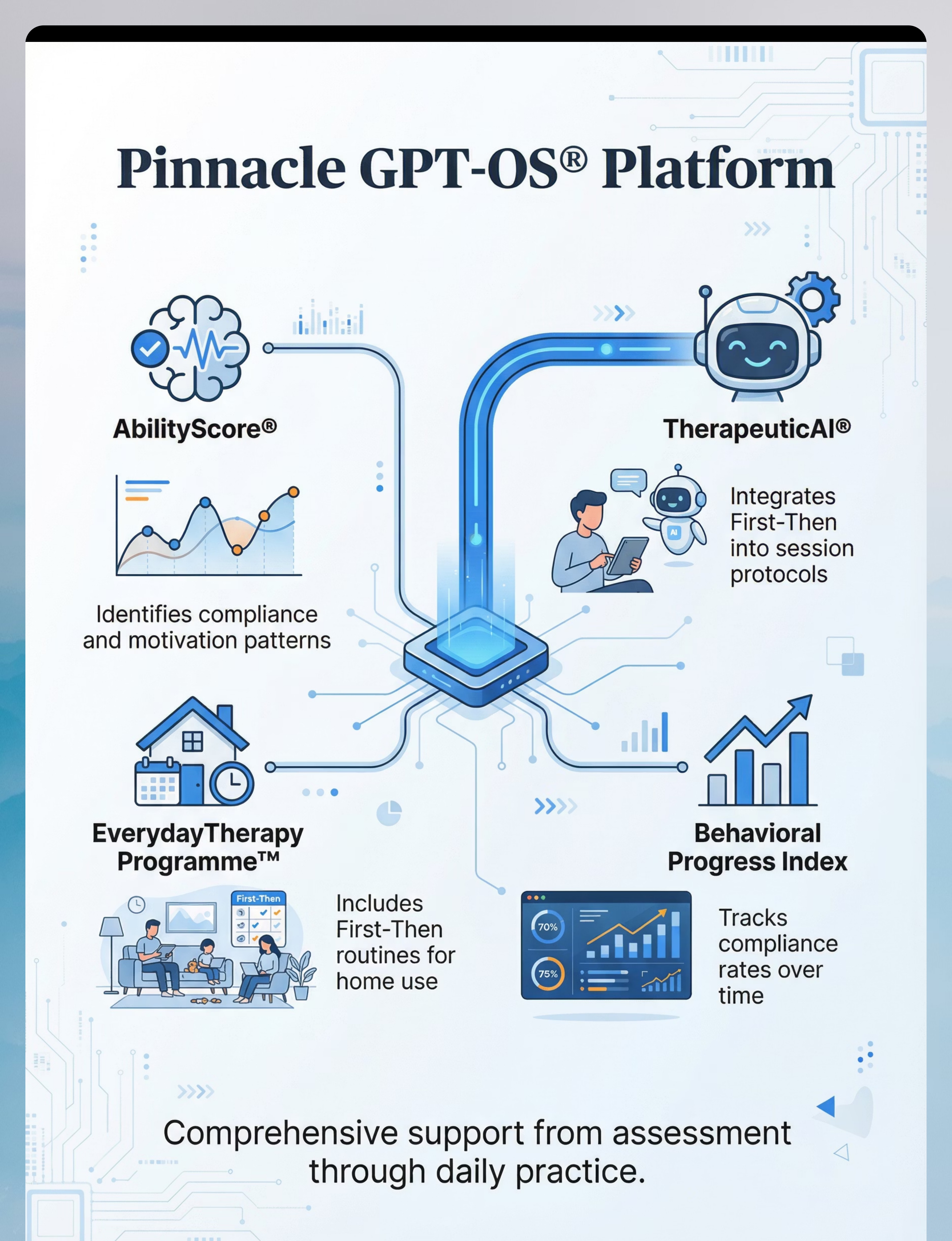
First-Then Boards integrate seamlessly with Pinnacle Blooms Network's comprehensive child development platform:
  • AbilityScore® identifies motivation and compliance patterns
  • TherapeuticAI® uses First-Then in session protocols
  • EverydayTherapyProgramme™ includes First-Then routines
  • Behavioral Progress Index tracks compliance rates

Disclaimer: This is educational information. Always consult qualified occupational therapists, speech-language pathologists, or pediatricians before implementing new therapeutic tools. Individual results vary. The First-Then Board is a support tool, not a medical treatment.

Preview of first then board contingency visual Therapy Material

Below is a visual preview of first then board contingency visual therapy material. The pages shown help educators, therapists, and caregivers understand the structure and content of the resource before use. Materials should be used under appropriate professional guidance.

Page 1
Page 2
Page 3
Page 4
Page 5
Page 6
Page 7
Page 8
Page 9
Page 10
Page 11
Page 12
Page 13
Page 14
Page 15
Page 16
Page 17
Page 18
Page 19
Page 20
Link copied!
Next Steps & Resources
Start Today
  • Download free printable templates
  • Watch 2-minute tutorial video
  • Identify one challenging routine to target
  • Gather materials (5 minutes)
This Week
  • Introduce board during low-stress moment
  • Use consistently for chosen routine
  • Track compliance rate
  • Adjust 'then' rewards based on what works
Get Support
  • Join parent community groups
  • Consult with your child's therapist
  • Share progress with teachers
  • Access troubleshooting guide
Consistency is more important than perfection
Trust builds over time—give it 2 weeks
Every child responds differently
You're doing great by seeking solutions
Taking the first step is often the hardest, but it's where real progress begins. Embrace these tools, adapt them to your child's unique needs, and celebrate every small victory. You've got this!