







Lacing / Beading / Threading Activities
Precision fine motor and visual-motor integration system
OT + SpEd
Strong Evidence
Rank #1
Daily Use
₹50–600
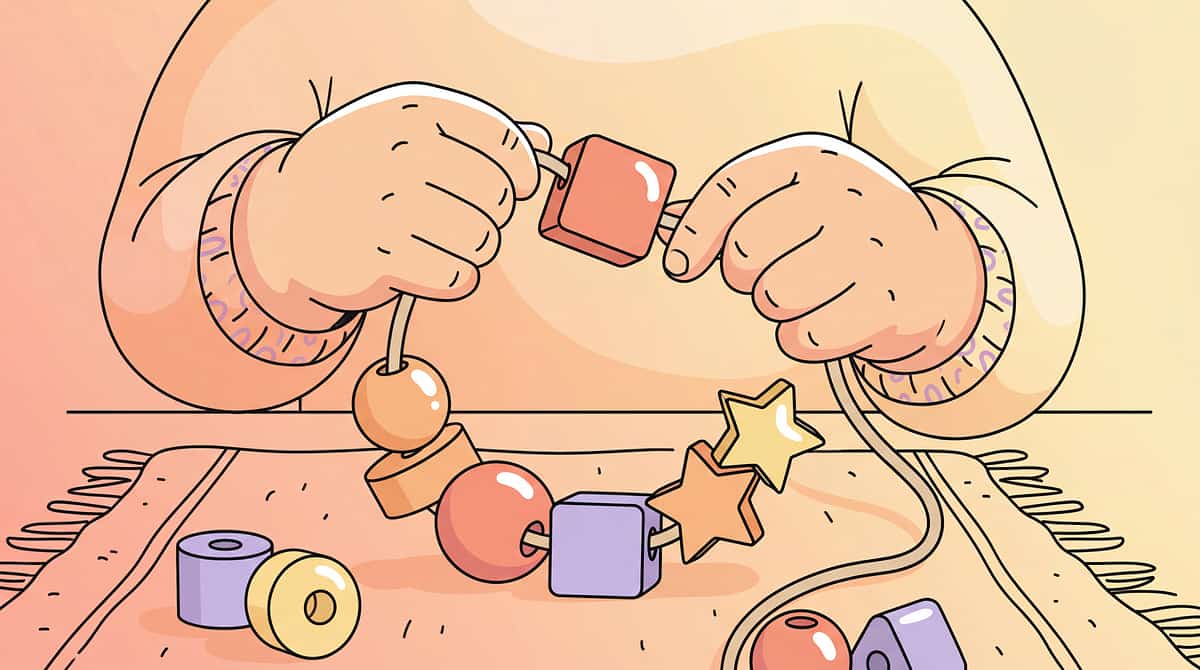
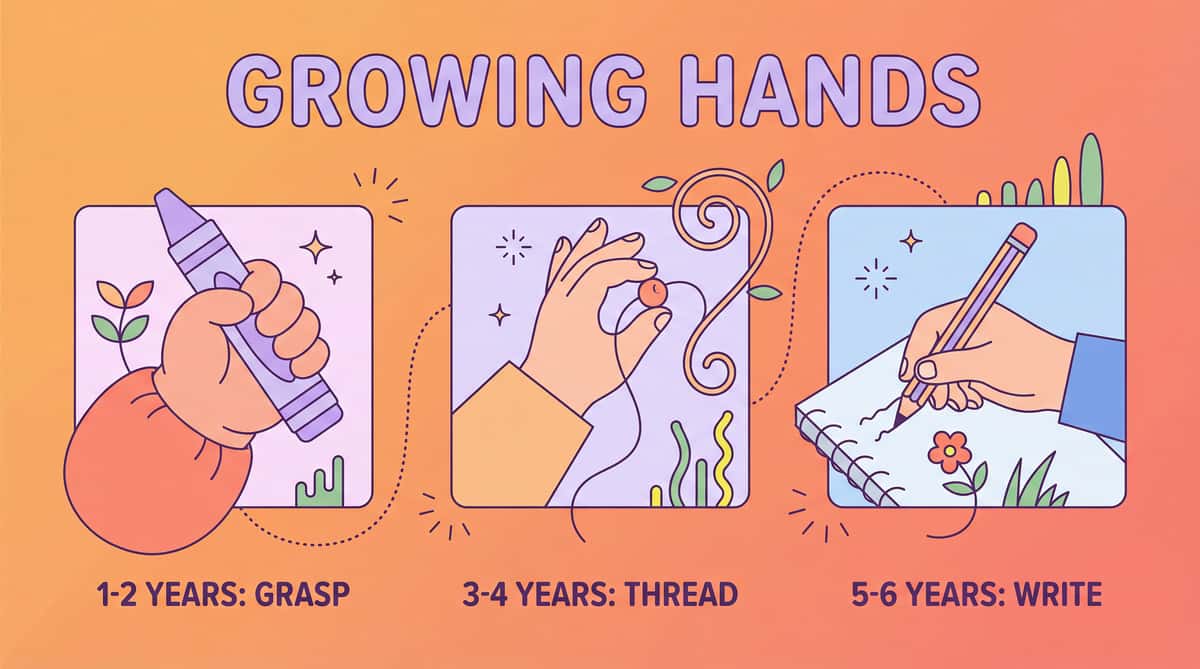
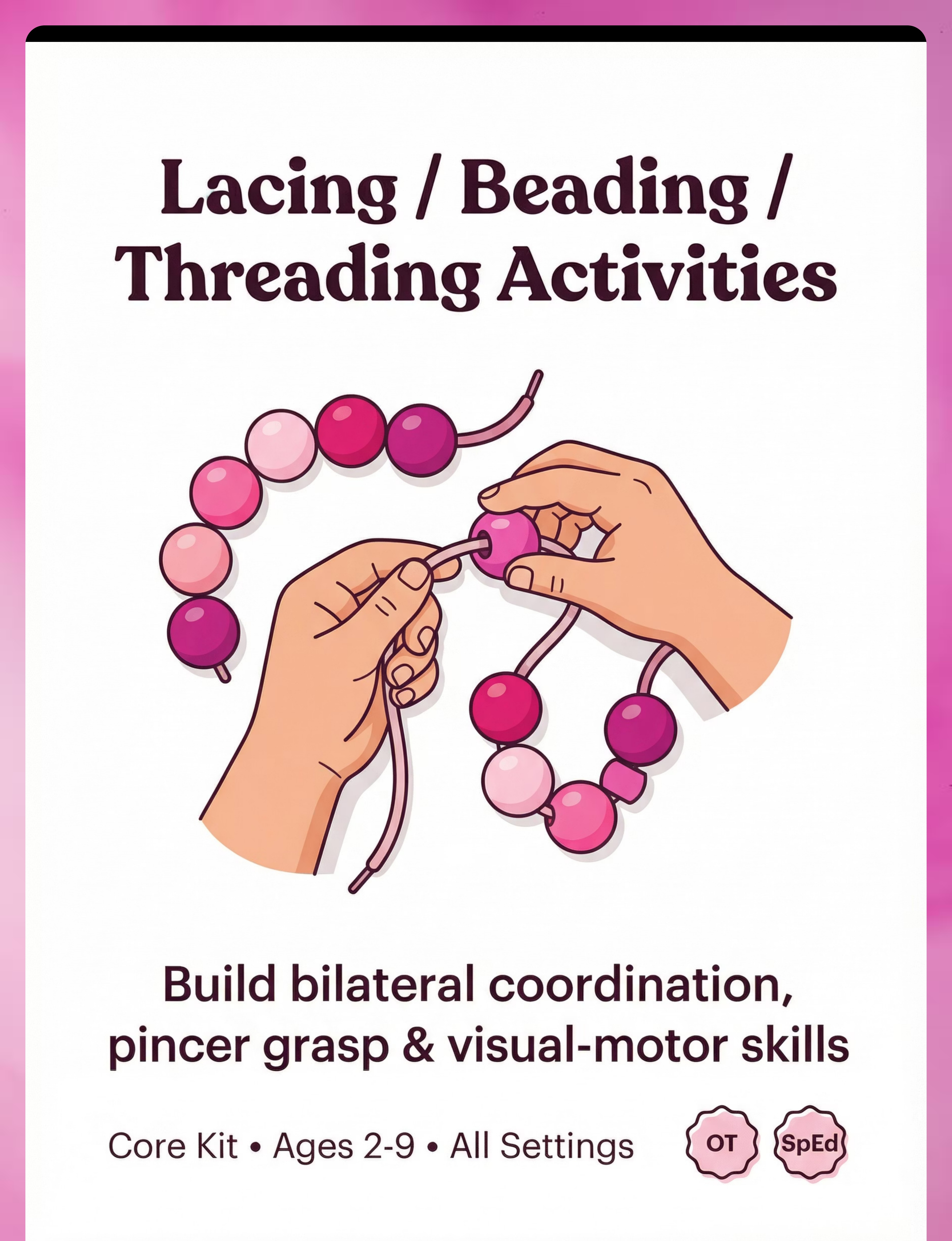
Build the foundation for writing, dressing, and countless daily skills through engaging threading activities. These classic occupational therapy tools develop bilateral coordination, strengthen pincer grasp, and enhance eye-hand coordination—essential building blocks for independence.

Who This Helps
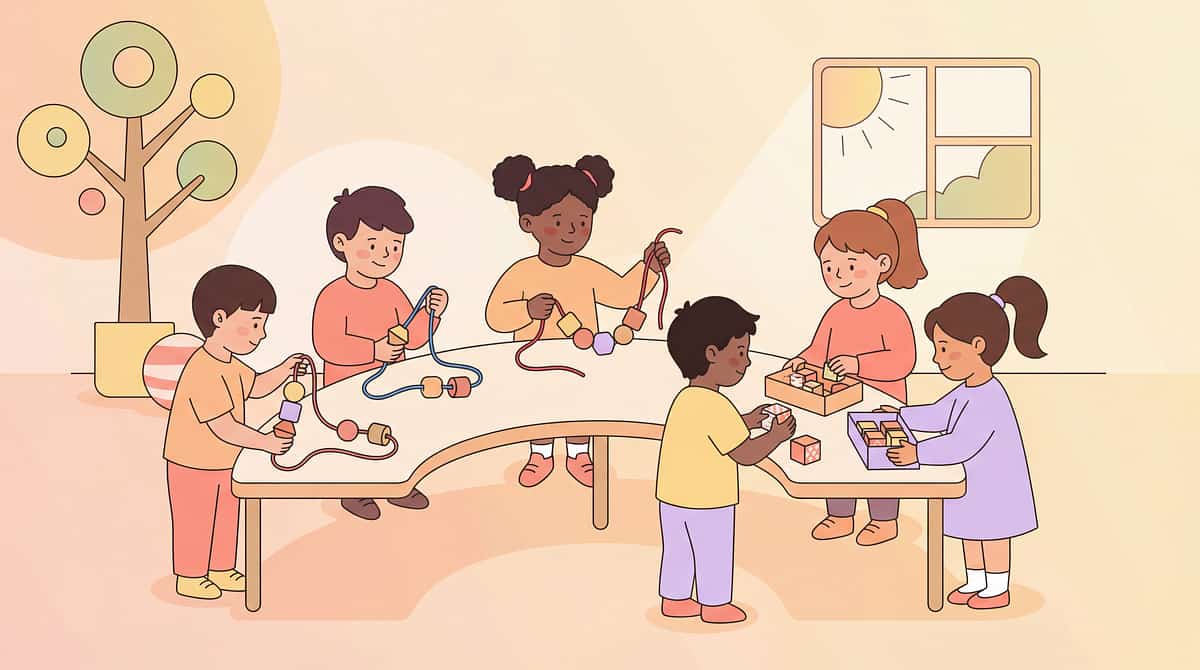
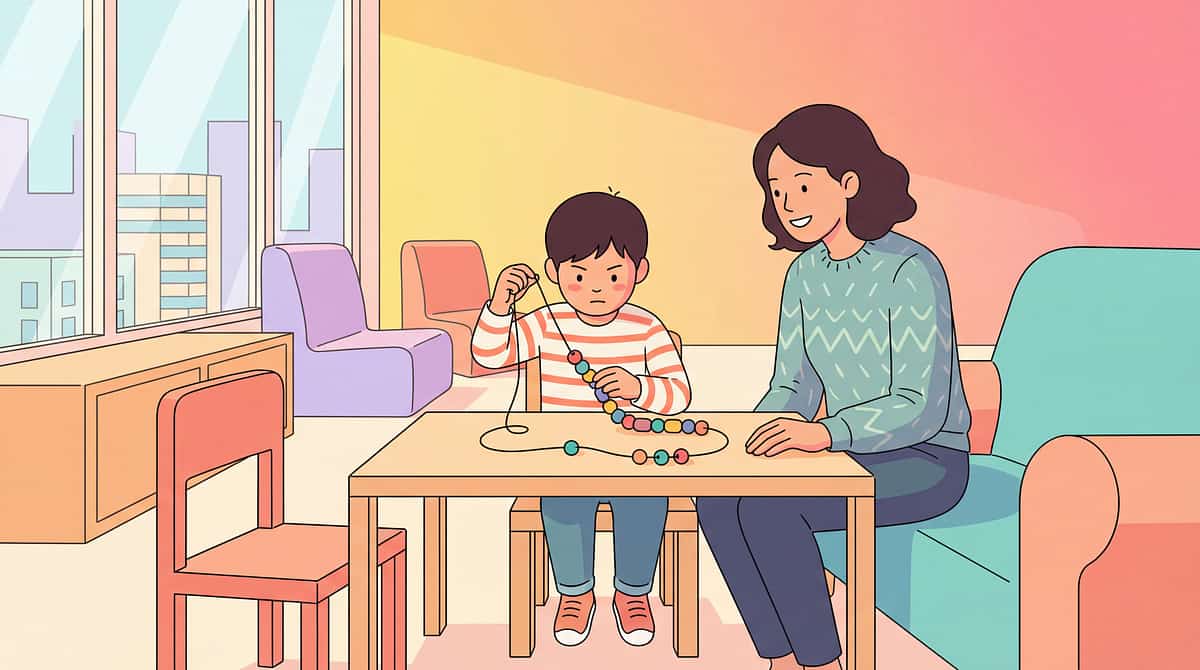
Lacing and beading activities are structured threading tasks that require both hands to work together in coordinated patterns, effectively developing several key skills:
Bilateral Coordination
Learning to use both hands together effectively in complementary roles.
Pincer Grasp
Developing thumb and finger coordination for precise manipulation.
Visual-Motor Integration
Coordinating what the eyes see with what the hands do.
Precision Fine Motor Skills
Developing accurate and controlled small muscle movements for delicate tasks.
Ages 2-9 years
Home
Clinic
School
Daily Practice
Best for: Children developing fine motor skills, preparing for writing tasks, building hand coordination for dressing independence (buttons, zippers, laces), and strengthening the foundational skills needed for academic and self-care success.

Does This Sound Familiar?
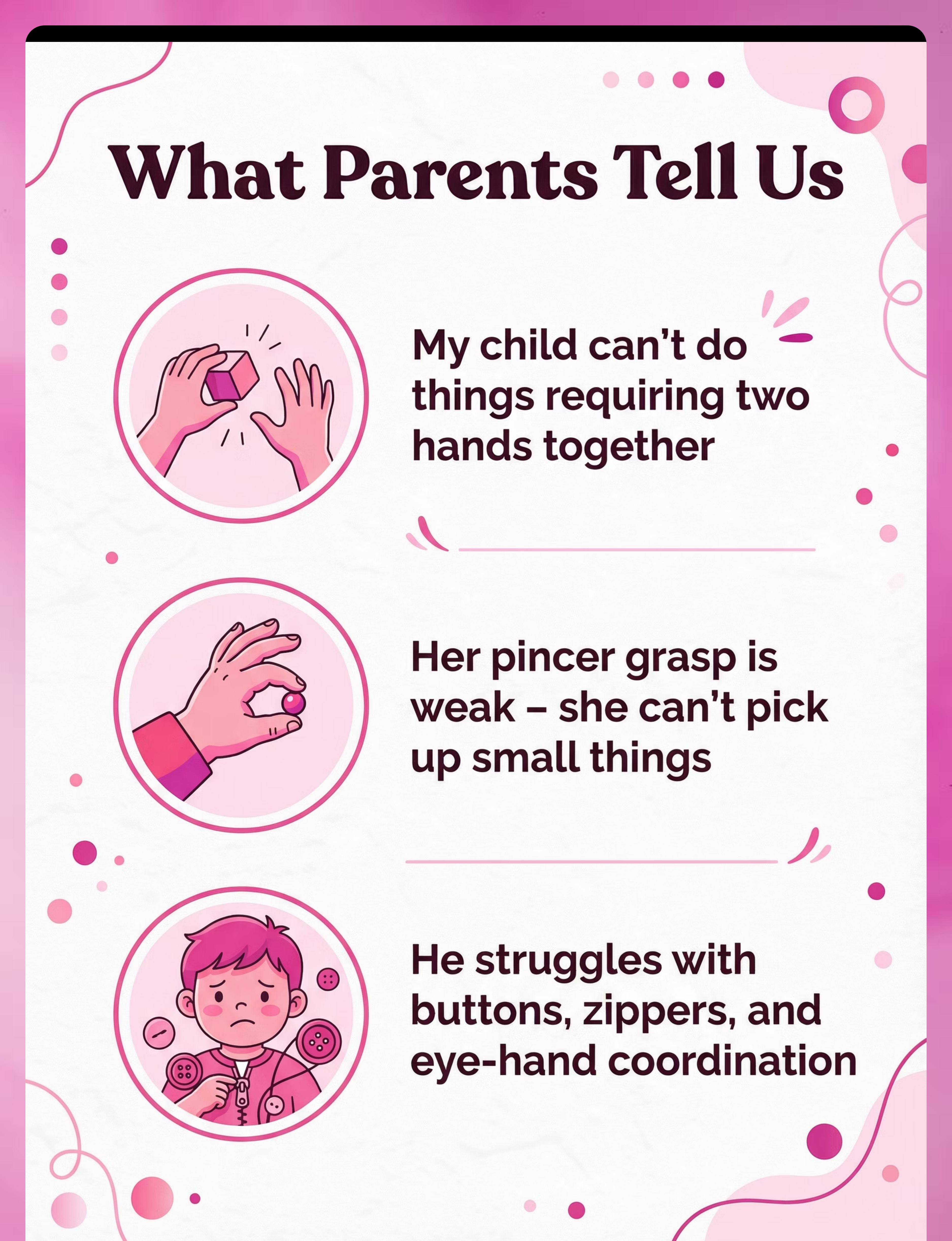
"My child can't do things requiring two hands together. One hand doesn't seem to know what the other is doing."
"Her pincer grasp is so weak. She struggles to pick up small items and avoids anything requiring precision."
"He can't coordinate his hands at all. Everything that needs both hands working together is a battle."
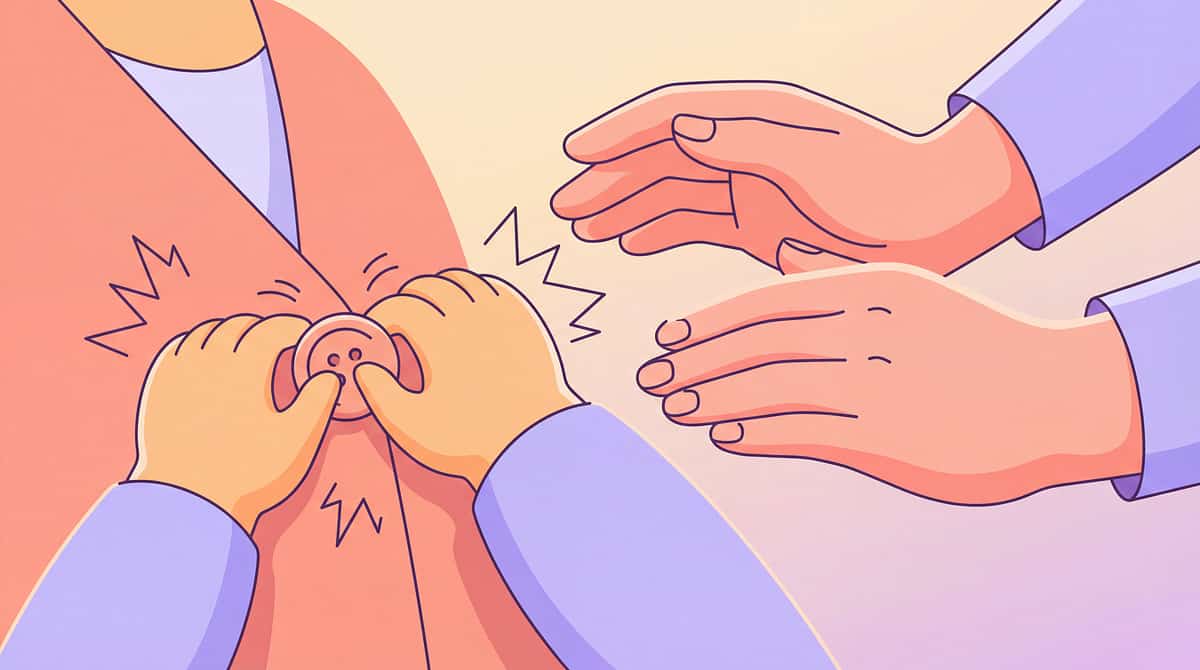
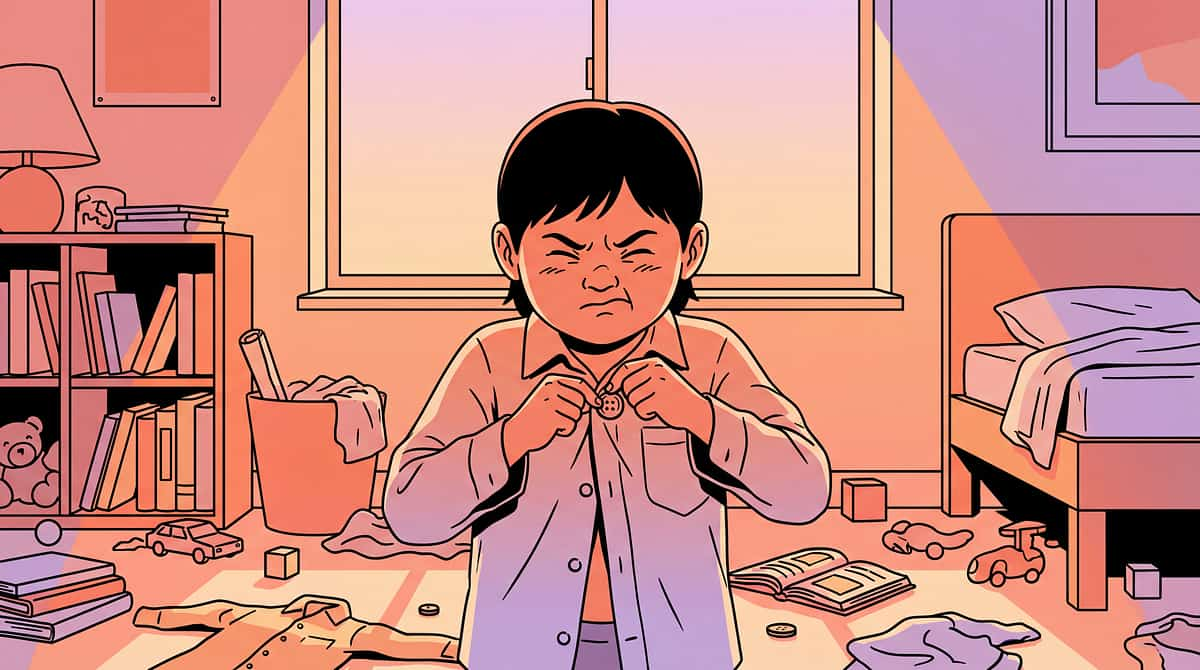
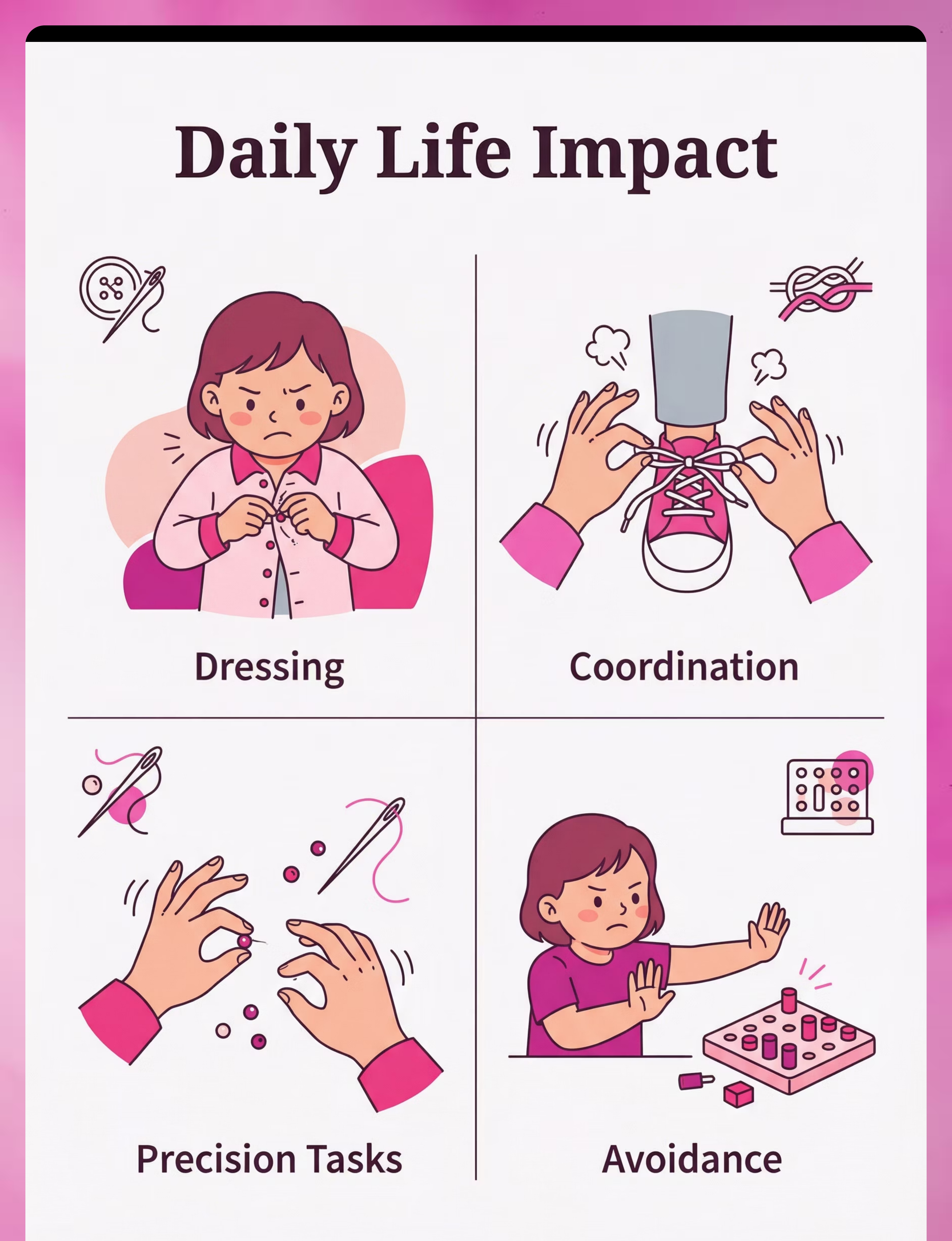
"She struggles with buttons and zippers. Getting dressed takes forever and ends in tears."
"His eye-hand coordination is poor. He can't seem to make his fingers do what his eyes want them to do."
"She avoids anything fiddly or precise. The moment fine motor work appears, she shuts down."
You're not alone. These are common challenges that occupational therapists address daily. The frustration you see in your child—and feel yourself—has a clear path forward through structured, engaging fine motor practice.

A Day Without the Right Support
Morning Routine
Dressing becomes a battle. Can't manage buttons, struggling with zippers, shoelaces are impossible. Every morning starts with frustration and dependence on help.
Transitions
Hands don't work together smoothly. Opening containers, managing backpack zippers, handling classroom materials—all require adult assistance.
Therapy & School
Can't do precise finger work that peers handle easily. Fine motor activities avoided. Therapist says not ready for writing. Gap widening.
Evening Activities
Avoids arts, crafts, building toys—anything requiring coordination. Siblings race ahead in skills. Confidence eroding with each avoided activity.

The Science Behind It
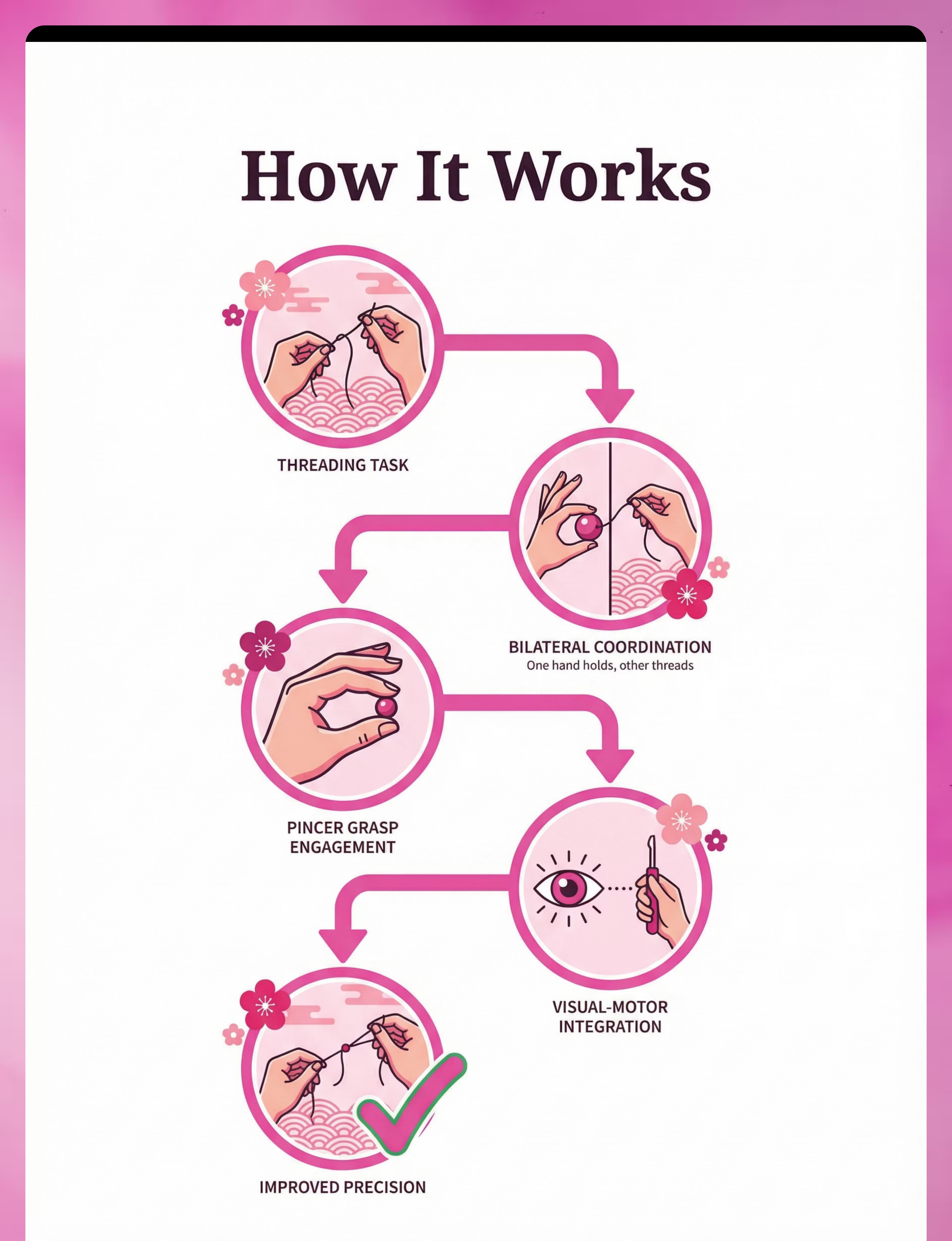
Threading activities create a powerful cascade of skill development. Understanding this mechanism helps you see why these simple activities produce profound results.
Threading Task Begins
Child presented with bead and lace requiring coordinated action
Bilateral Coordination Activated
One hand must hold steady while other threads—true two-handed work
Pincer Grasp Engagement
Thumb and fingers work together to manipulate lace and control movement
Visual-Motor Integration
Eyes guide hands to align hole and lace—critical eye-hand coordination
Finger Isolation & Control
Individual fingers learn to move independently with increasing precision
Precision Improves
Repeated practice builds skill, confidence, and transfer to daily tasks
Bilateral Coordination
Pincer Grasp
Visual-Motor Integration
Eye-Hand Coordination
Finger Isolation
Precision

How to Use It Right
Start Large, Progress Small
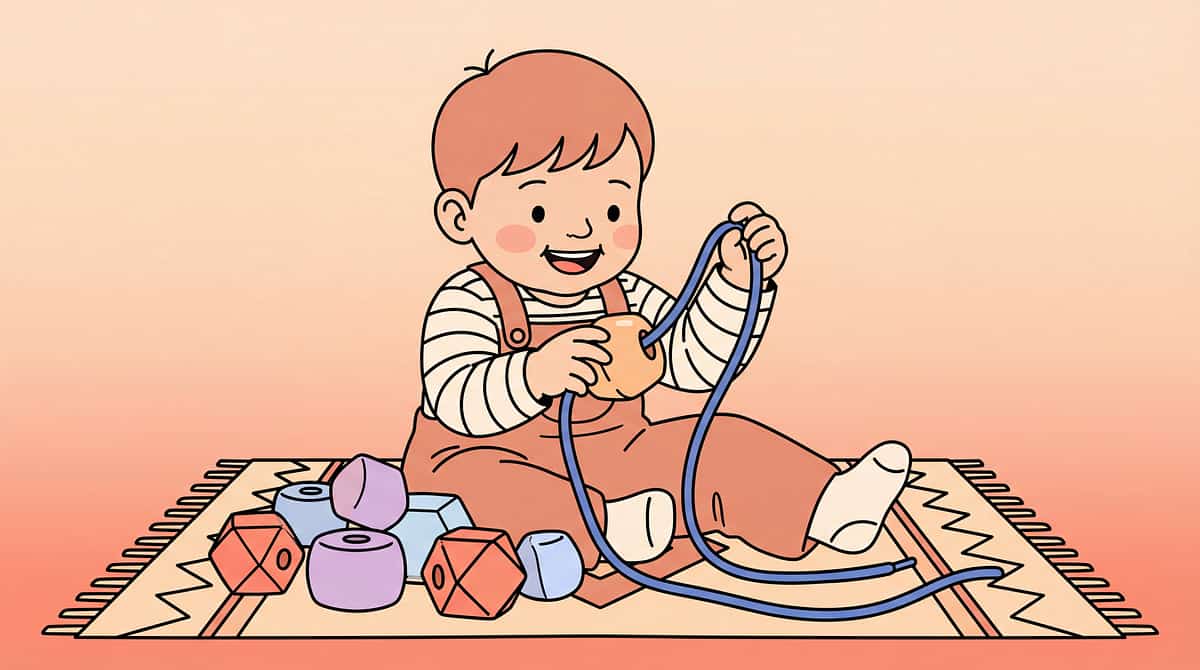
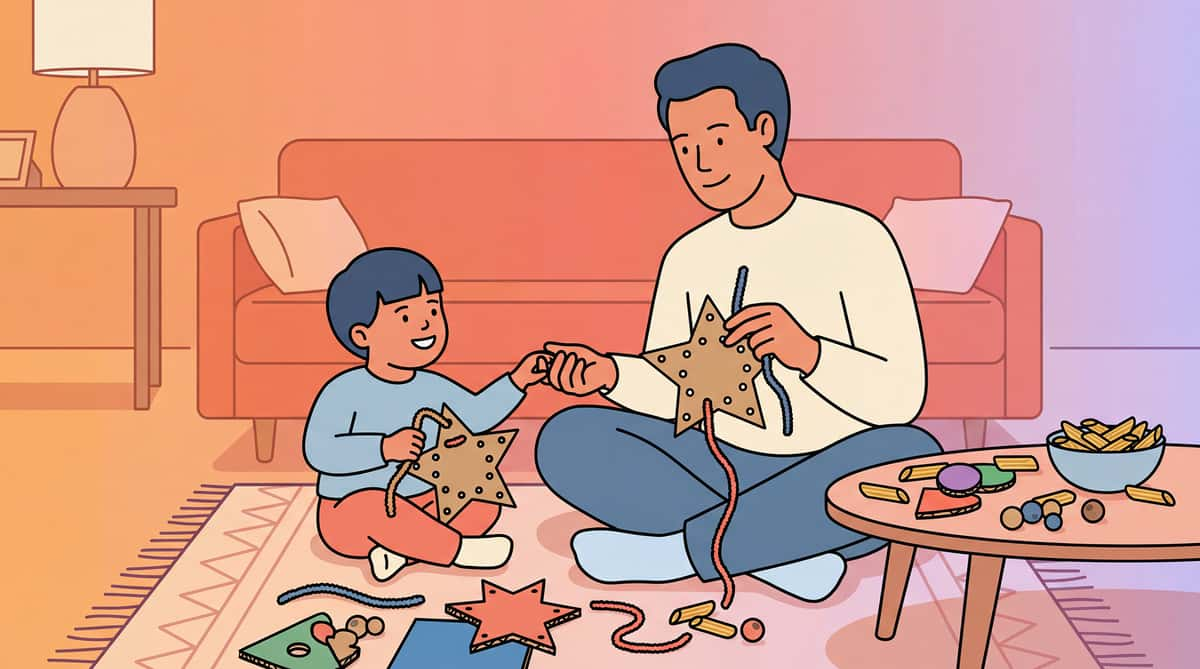
Begin with big holes, large beads, and stiff laces or pipe cleaners. Only increase difficulty as skill develops. Success builds motivation and confidence.
Use Stiff Materials for Beginners
Pipe cleaners work perfectly as "training laces" because they hold their shape. For soft laces, wrap the threading end tightly with tape to create a stiff tip.
True Bilateral Work
One hand holds the card or bead steady while the other threads. This is genuine two-handed coordination—both hands have distinct, important jobs.
Engage with Motivating Themes
Character lacing cards, colorful bead patterns, jewelry-making—themes dramatically increase engagement. Let your child choose colors and designs.
Practice Duration
Start with 10-15 minute sessions and adjust to your child's attention span. Daily practice yields better results than longer, infrequent sessions.
End on Success
Always conclude when your child succeeds, not when frustrated. This builds positive associations and eagerness to practice again.
Recommended Duration: 10-20 minutes daily, adjusted to attention span and engagement level. Consistency matters more than length.

Expert Perspective
"Lacing and beading are classic OT activities because they require precisely what many children need to develop: bilateral coordination, pincer grasp, and visual-motor integration. Simple, effective, portable."
— Occupational Therapist
OT + SpEd Recommended
Co-owned by Occupational Therapy and Special Education professionals
Strong Evidence Level
Backed by decades of clinical practice and research in developmental therapy
Rank #1 in Category
Top-ranked tool in Fine Motor & Hand Skills for foundational development
Core Kit Essential
Designated Core Kit tool for all therapeutic settings and home programs

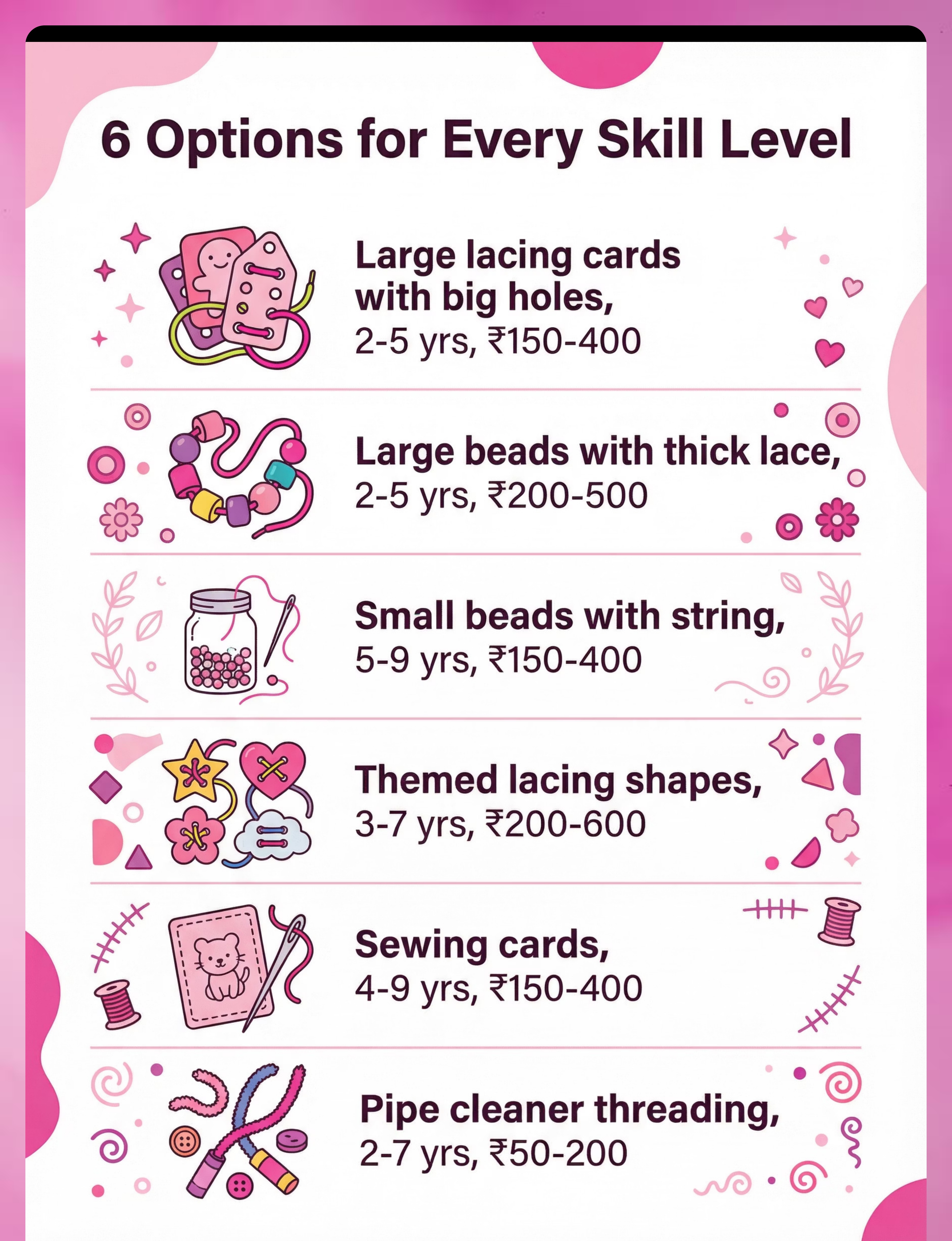
Choose Your Option (6 Variants)
Pipe Cleaner Threading
Ages 2-7. Best for children who struggle with floppy laces, offering an easier start to threading.
Large Lacing Cards
Ages 2-5. Ideal for beginners, bridging large motor skills to fine motor precision.
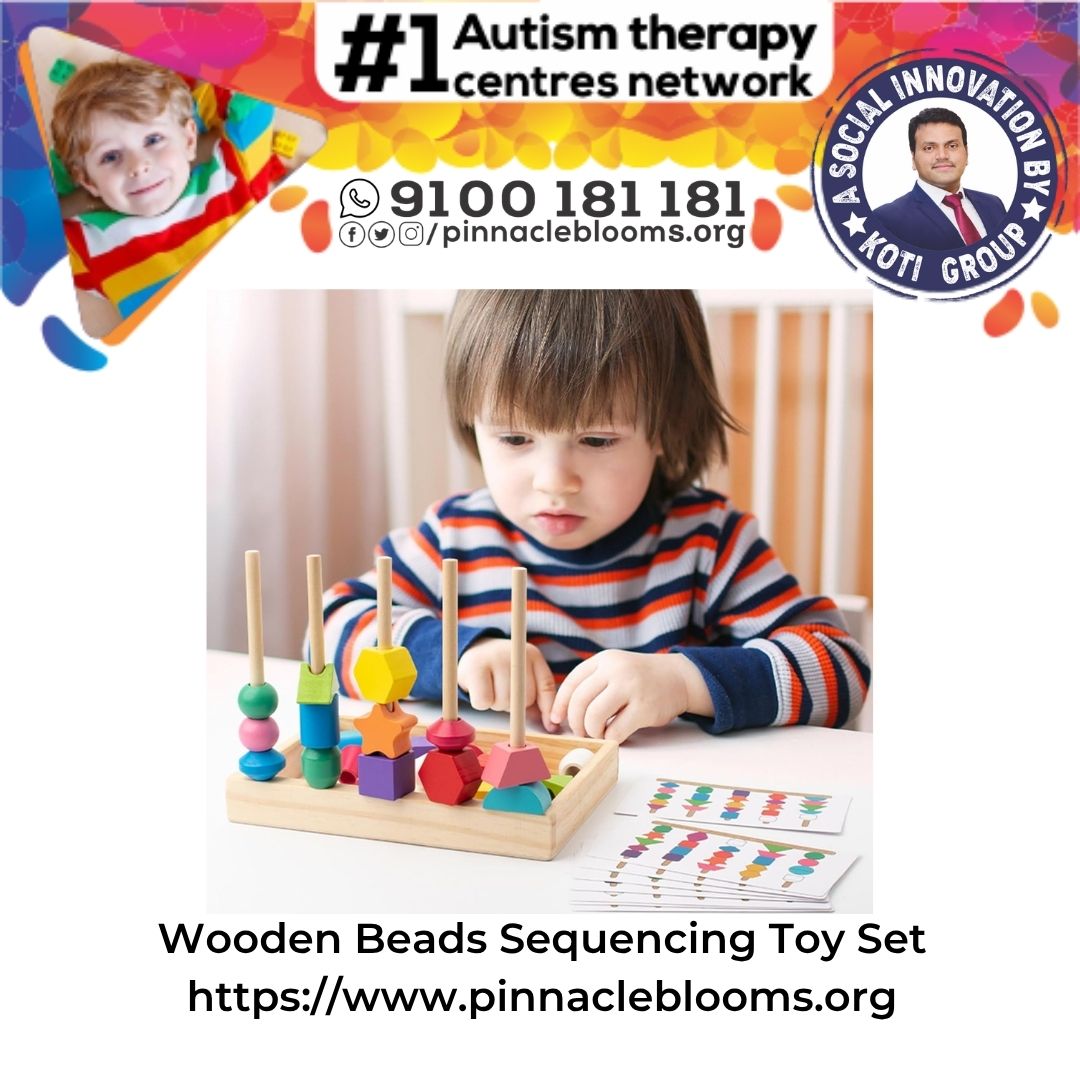
Large Beads with Thick Lace
Ages 2-5. Excellent for initial beading experiences, promoting early hand-eye coordination.
Lacing Shapes/Animals
Ages 3-7. Boosts engagement and pattern following with themed designs.
Sewing Cards
Ages 4-9. Develops pre-sewing skills and enhances bilateral coordination for more complex tasks.
Small Beads with String
Ages 5-9. Focuses on precision work, suitable for older children refining their fine motor skills.
Select the right variant based on your child's age, skill level, and specific goals. Start easier than you think necessary—success builds motivation to progress.
How to Choose
- By goal: Motor bridge (large cards), precision (small beads), engagement (themes), easier option (pipe cleaners)
- By setting: All work in all settings—choose based on skill level and portability needs
- By portability: Pipe cleaners and small beads most portable for travel; large materials better for home base
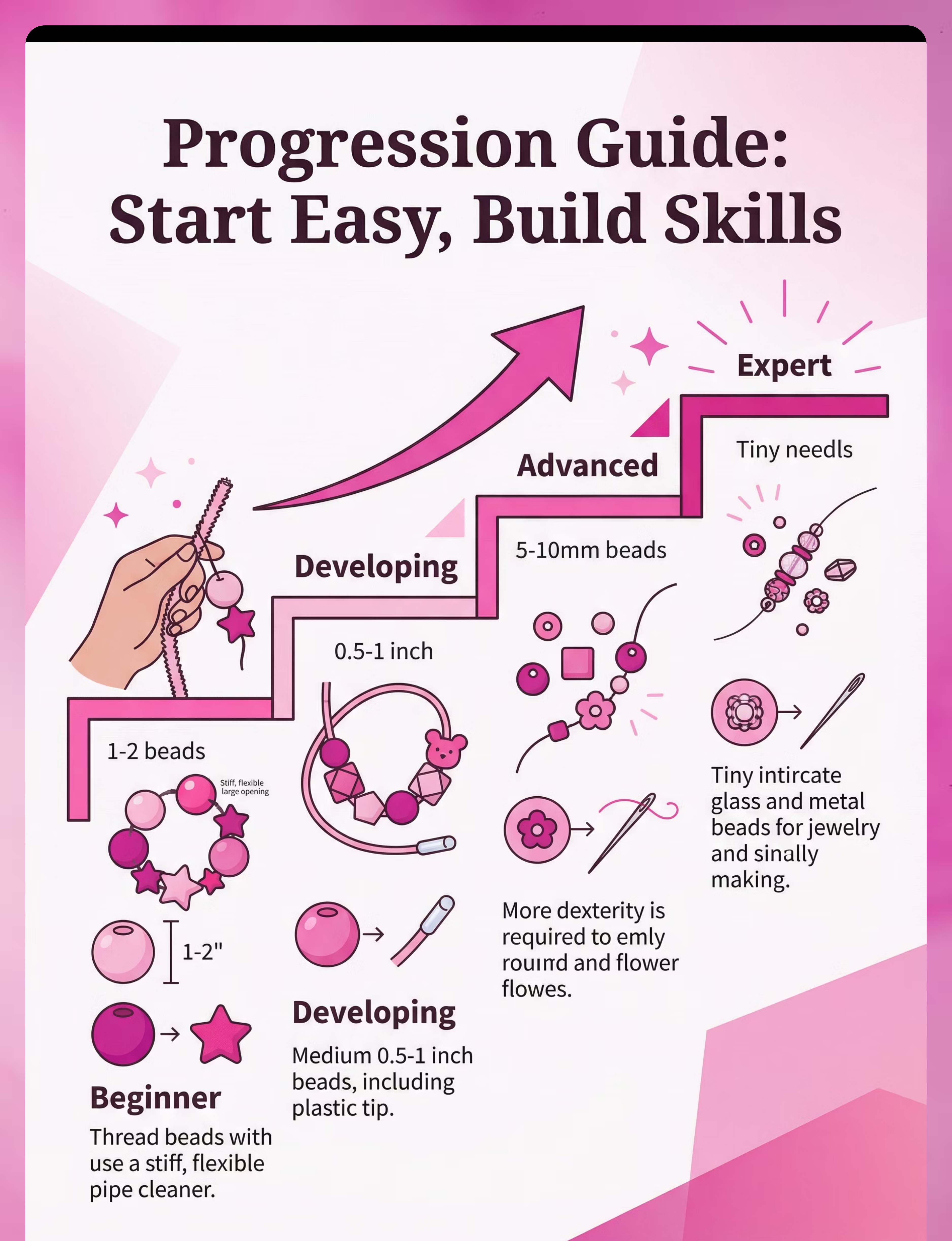
Progression Levels Guide
Threading activities offer a clear developmental progression. Moving through these levels builds confidence and ensures your child experiences success at every stage.
Level 1: Foundation
Large beads (1-2 inch) on stiff cord or pipe cleaner
Perfect starting point. Stiff materials don't flop, large holes are easy targets. Builds confidence and basic bilateral coordination.
Level 2: Progression
Medium beads (0.5-1 inch) on cord with plastic tip
Slightly smaller beads require more precision. Plastic-tipped cord still provides structure while increasing challenge.
Level 3: Advanced
Small beads (5-10mm) on string
True fine motor precision required. Managing soft string adds bilateral coordination challenge. Preparing for real-world tasks.
Level 4: Mastery
Tiny beads, jewelry making
Expert-level precision work. Creating functional items (bracelets, necklaces) adds motivation. Ready for complex fine motor demands.
Key Features to Consider:
Size-appropriate for skill level
Non-choking size for young children
Engaging colors/themes
Appropriate lace stiffness
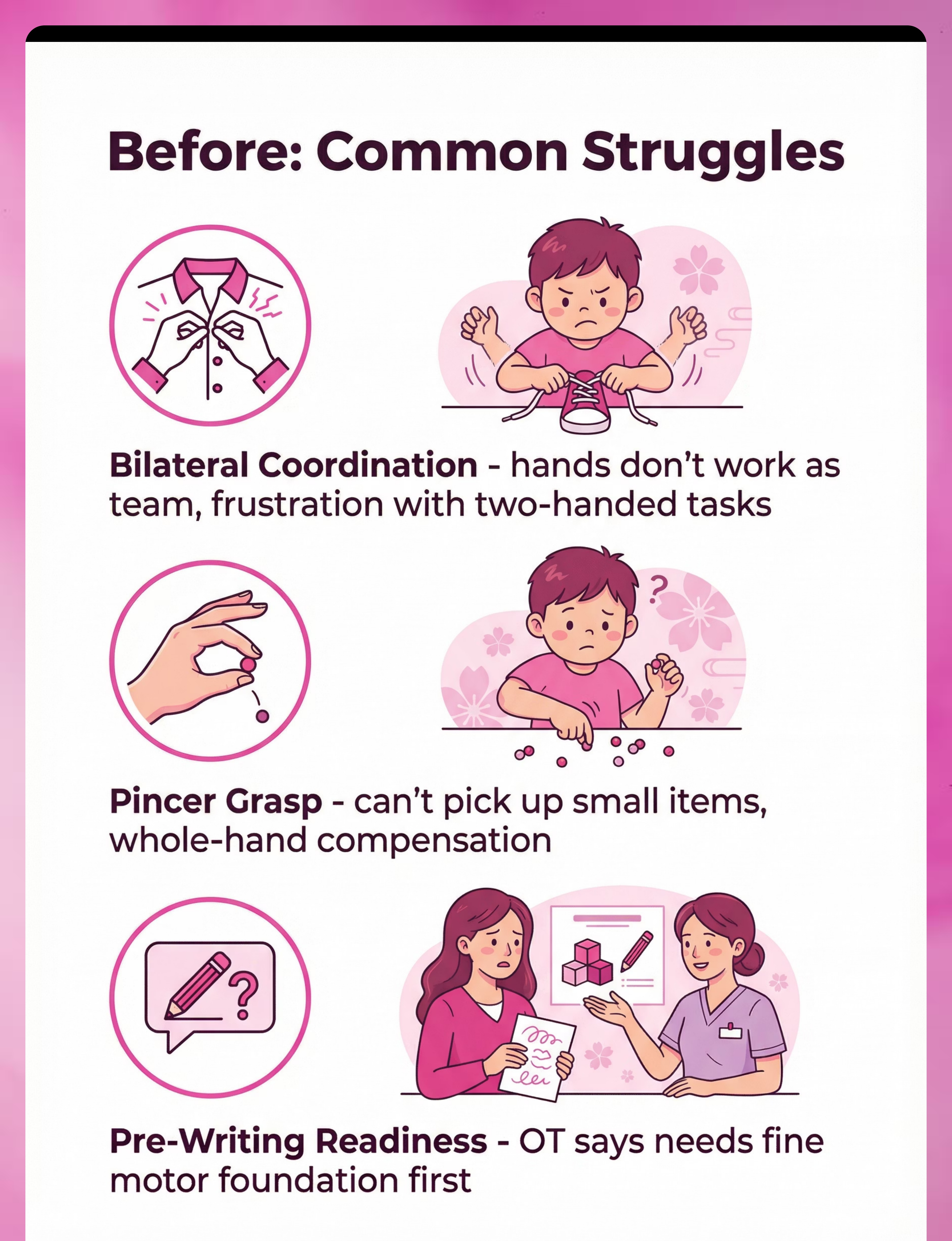
The Struggle (Before)
Bilateral Coordination Challenges
Situation: Child can't use two hands together effectively. One hand doesn't know what the other is doing.
Experience: Daily tasks requiring both hands become sources of frustration. Opening containers, managing clothing, handling materials—everything takes longer and requires help.
Emotion: Frustration and increasing avoidance of two-handed activities
Pincer Grasp Weakness
Situation: Child can't pick up small things with thumb and finger. Uses whole hand or avoids tasks entirely.
Experience: Fine motor activities become impossible or deeply frustrating. Peers handle small objects easily while your child struggles or compensates with less efficient movements.
Emotion: Difficulty and compensation strategies that limit skill development
Pre-Writing Readiness Gap
Situation: Occupational therapist says child not ready for writing. Needs more fine motor foundation.
Experience: Academic demands approaching but foundational skills missing. You want to help at home but don't know what activities build the right skills.
Emotion: Concern and actively seeking effective home strategies

What to Expect (Realistic Timelines)
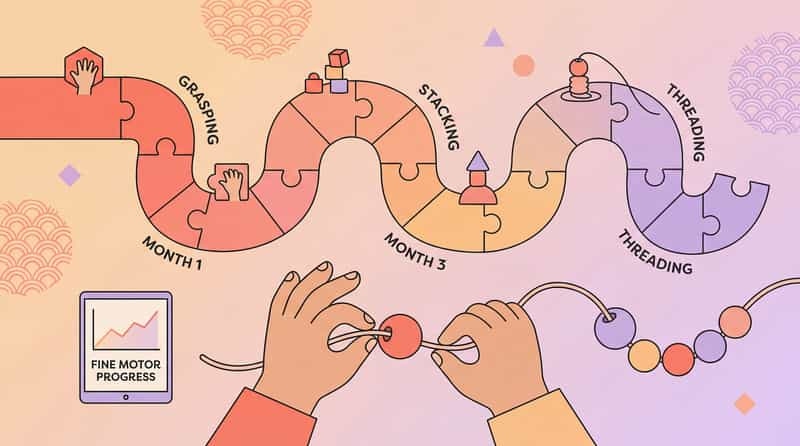
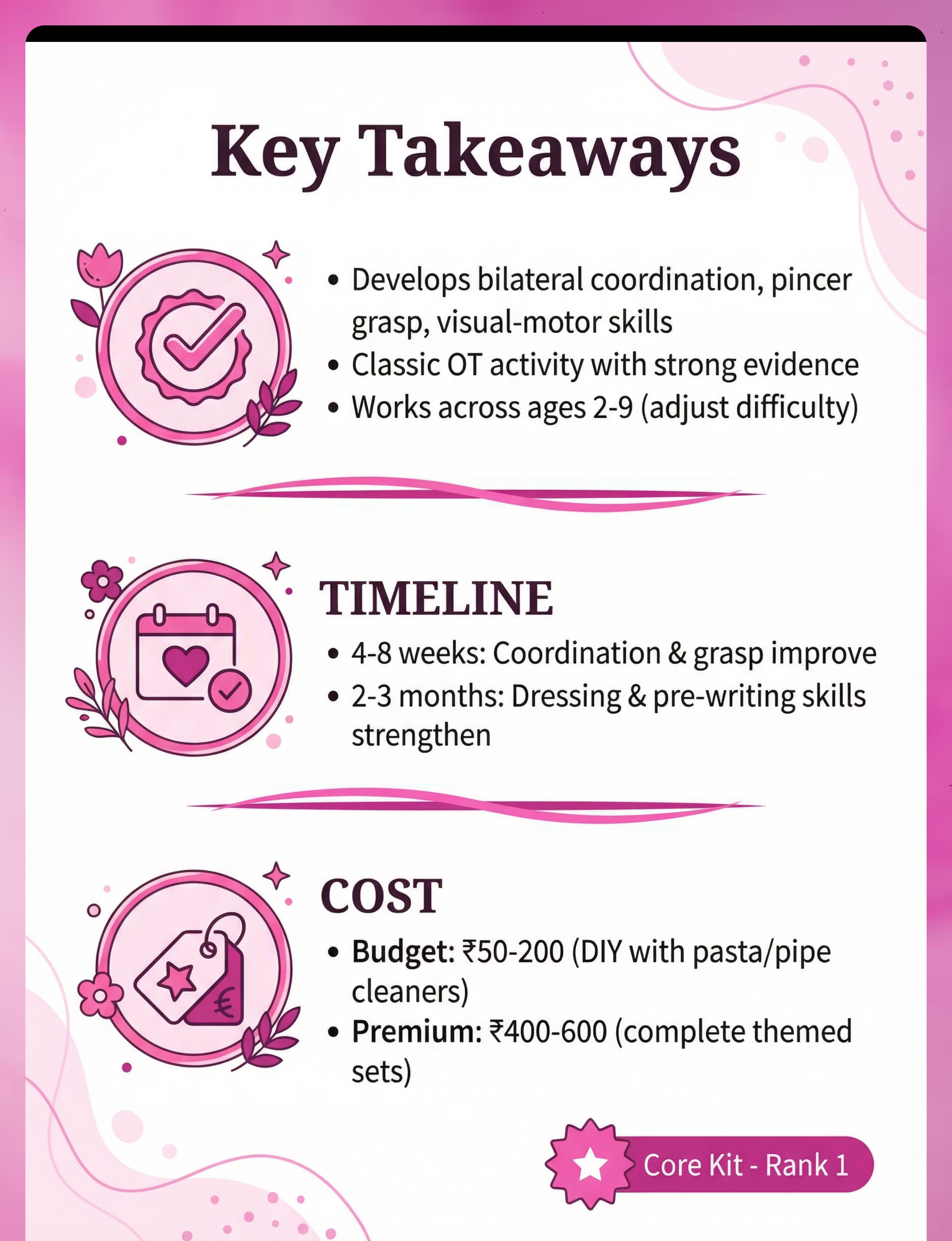
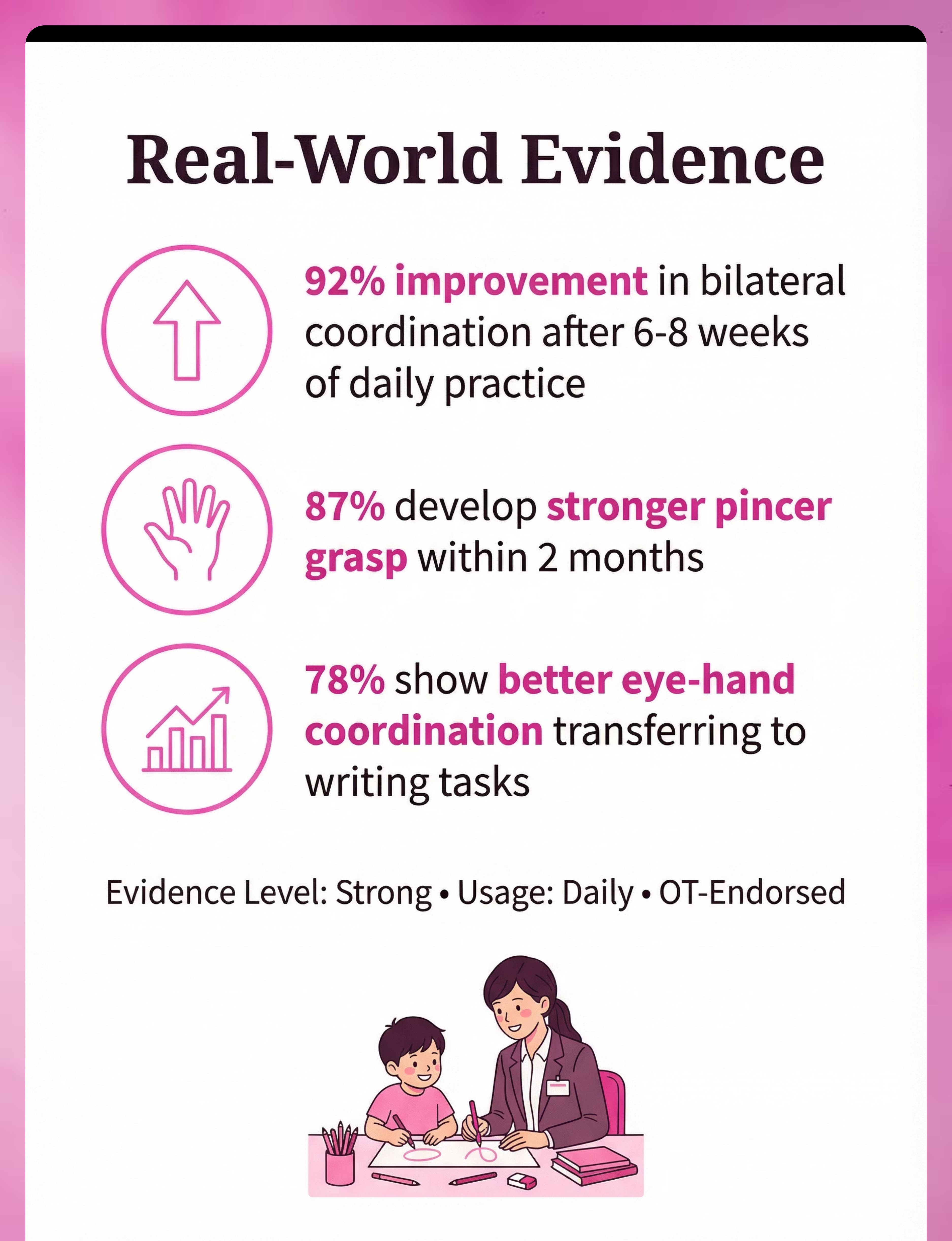
Threading activities produce measurable results when practiced consistently. Here's what research and clinical experience show about typical progression timelines.
Week 1-2: Initial Engagement
Introduction to threading activities, fostering interest and early signs of improved bilateral coordination and pincer grasp.
Week 3-4: Skill Emergence
Noticeable improvements in bilateral coordination, developing pincer grasp, and better visual-motor integration for basic tasks.
Month 2-3: Consolidation
Precision fine motor skills become more consistent. Improved dressing skills and strengthening of pre-writing foundations.
Month 3-6: Mastery & Transfer
Fine motor skills are fluid and applied to complex tasks. Confident pre-writing readiness and enhanced independence in daily activities.
Important: Timelines vary by individual, starting skill level, practice consistency, and proper difficulty progression. These represent typical ranges observed in therapeutic settings with regular practice.

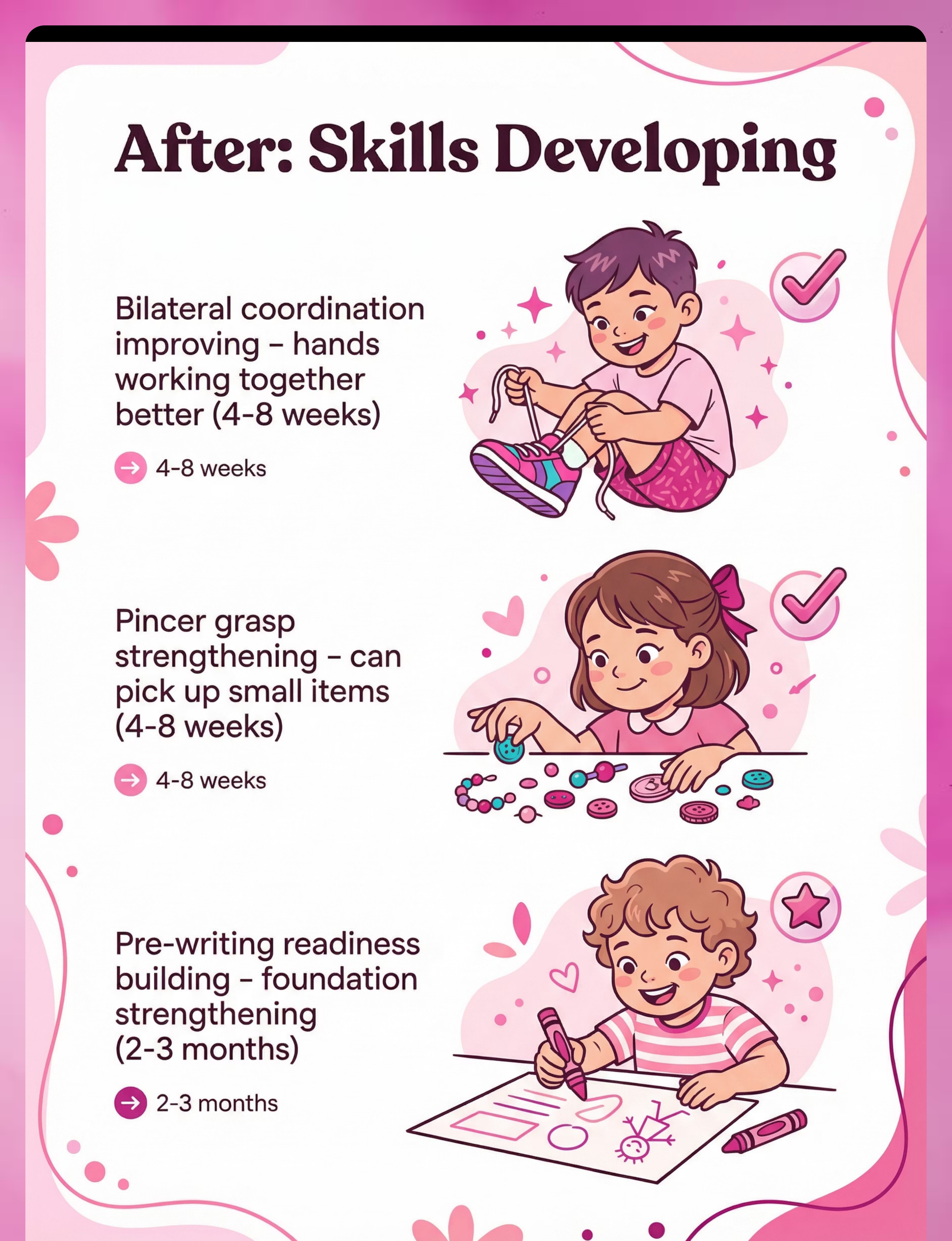
The Transformation (After)
Witness the remarkable progress your child can achieve with consistent engagement in threading activities. From initial fumbles to confident mastery, each step builds crucial fine motor skills.
Week 1-2: Initial Success
Children quickly gain confidence as they successfully thread large beads. This early achievement boosts motivation and lays the groundwork for further development.
Week 3-4: Emerging Dexterity
Bilateral coordination improves, making threading motions smoother and more controlled. Hands work together more effectively, reducing frustration.
Month 2-3: Skill Consolidation
Children master smaller beads and begin to transfer these refined fine motor skills to everyday tasks like zipping jackets or using utensils.
Month 3-6: Confident Mastery
Independent dressing skills become second nature, handwriting readiness improves significantly, and overall fine motor control is robust and confident.

Is This Right for My Child? (2-Minute Check)
Answer these questions honestly to determine if lacing and beading activities address your child's specific needs. Three or more "yes" answers indicate a strong fit.
Does your child have difficulty using two hands together?
If yes, this indicates: Lacing and beading directly build bilateral coordination through tasks requiring both hands in complementary roles.
Confidence score: 95%
Does your child have a weak pincer grasp?
If yes, this indicates: Beading develops pincer grasp through repeated thumb-finger manipulation of progressively smaller objects.
Confidence score: 92%
Does your child struggle with eye-hand coordination?
If yes, this indicates: Threading builds visual-motor skills as eyes must guide hands to precise alignment repeatedly.
Confidence score: 90%
Does your child avoid fine motor activities?
If yes, this indicates: Fun, themed lacing activities may increase engagement while building skills in a motivating context.
Confidence score: 85%
3+ "yes" answers = strong fit. Lacing and beading activities directly address these foundational fine motor challenges with strong evidence and clinical support.

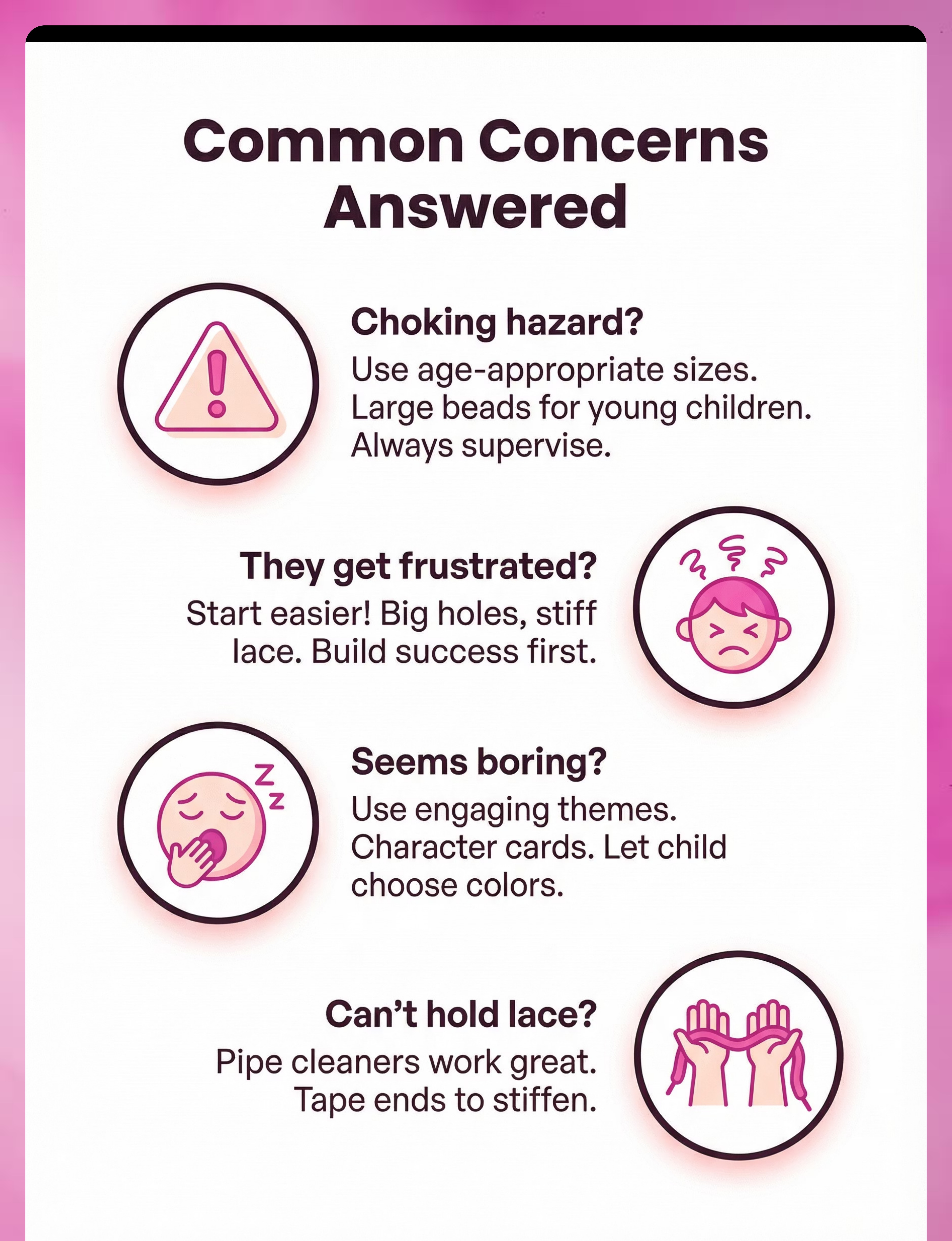
Common Questions (Honest Answers)
Q: Choking hazard with small beads?
A: Use age-appropriate sizes! Large beads (1-2 inches) for young children. Never use small beads for children who mouth objects. Always supervise. The activity can be done completely safely with appropriate material selection.
Try this: Large beads for young or mouthing children; constant supervision with any small items.
Q: They get frustrated and give up
A: Start much easier than you think necessary! Big holes, large beads, stiff laces (pipe cleaners work perfectly). Success builds motivation. Only increase difficulty when your child is ready. Always end sessions on success.
Try this: Start at easier level; progress only when child shows readiness and confidence.
Q: Seems boring or old-fashioned
A: Use engaging themes your child loves! Character lacing cards, colorful beads for jewelry-making, patterns to copy. Make it creative, not drill-based. Let your child choose colors and create designs.
Try this: Use themes aligned with child's interests; emphasize creativity and choice.
Q: They can't hold the lace steady
A: Use stiff materials! Pipe cleaners work brilliantly. Tape the end of soft lace tightly. Plastic-tipped laces. Start with materials that don't require managing floppy string—that's an advanced skill.
Try this: Pipe cleaners; plastic tips; tape soft lace ends for stiffness.

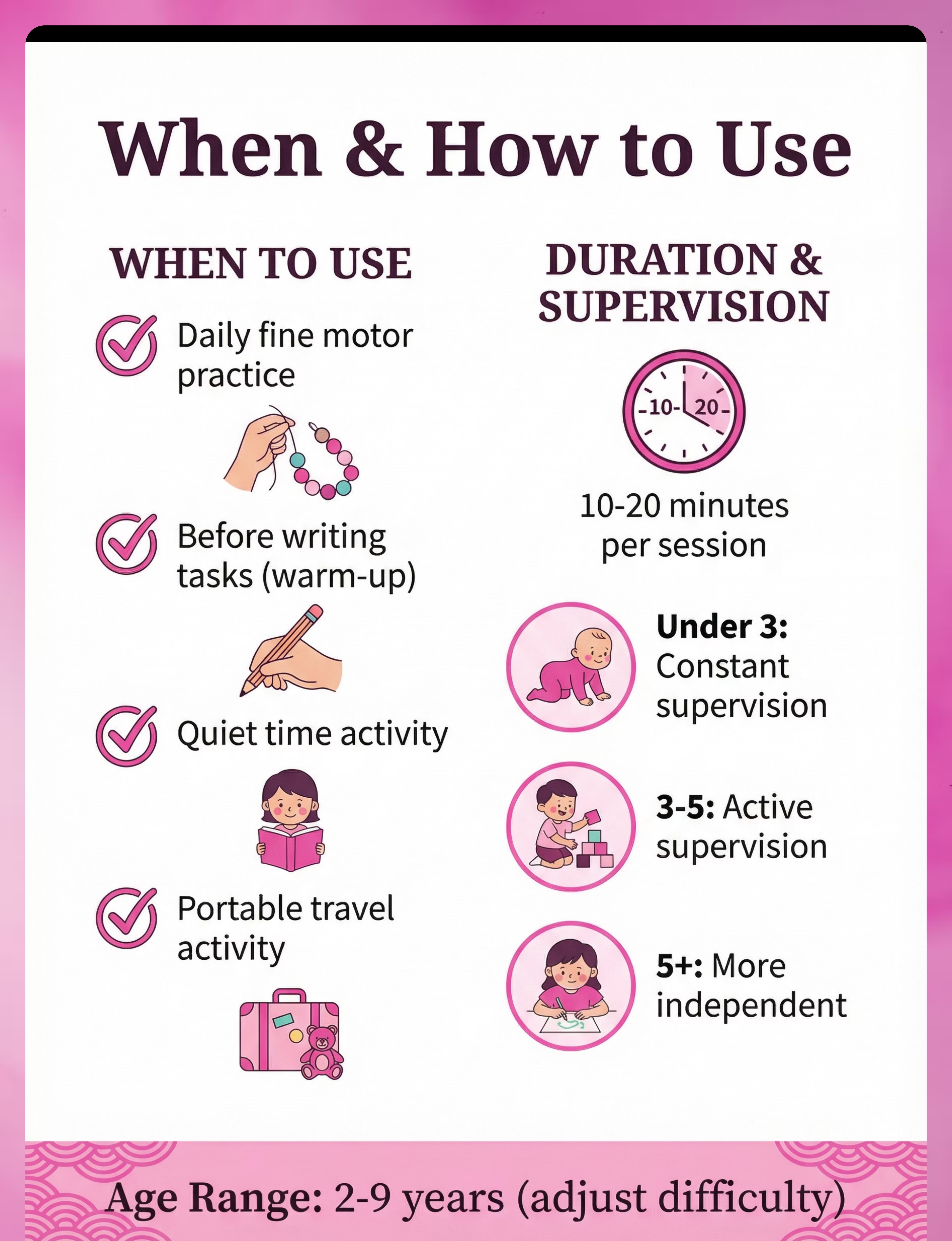
Usage Guide
When to Use
- Daily fine motor practice sessions
- Before writing tasks as warm-up
- Structured therapy sessions
- Quiet time activity at home
- Travel activity (highly portable)
When NOT to Use
- If child mouths objects and beads are small
- When child is overly frustrated (scale back difficulty immediately)
- Without appropriate supervision for young children
Supervision by Age
Under 3 years | Constant supervision (choking risk with any small items) | |
3-5 years | Active supervision; age-appropriate materials only | |
5+ years | Can work more independently with appropriate materials |
Ages 2-9 years
Adjust size/difficulty for skill level
Recommended Duration: 10-20 minutes per session; adjust to your child's attention span. Daily practice yields better results than longer, infrequent sessions.
Settings: Works effectively in home, school, and clinic environments. Highly portable for use anywhere fine motor practice is needed.

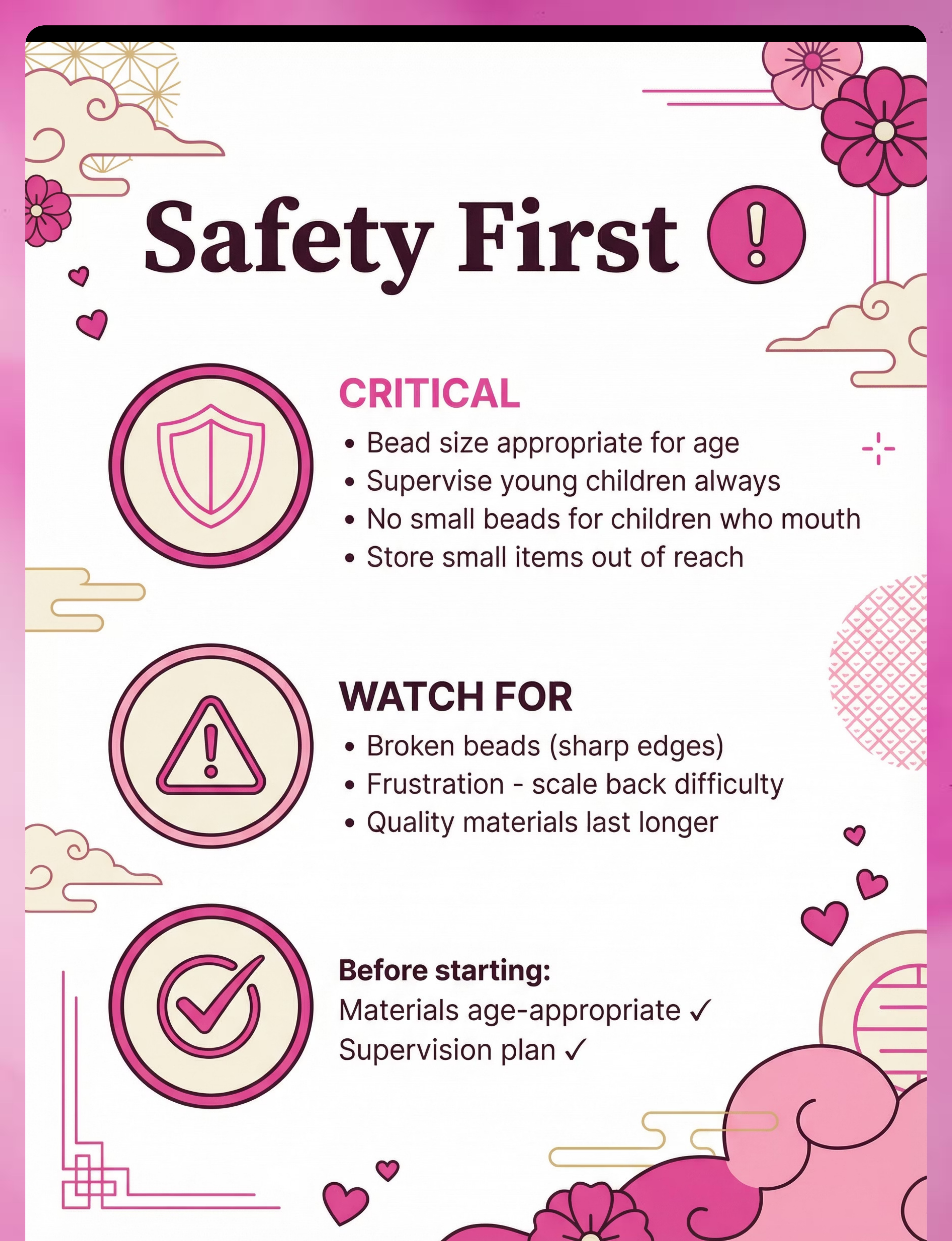
Safety First
Critical Safety
- Bead size MUST be appropriate for child's age and mouthing risk
- Supervise young children constantly during all threading activities
- Never use small beads with children who mouth objects
- Store small beads completely out of reach when not in supervised use
Important Warnings
- Check materials regularly for broken beads with sharp edges
- Watch for mounting frustration—scale back difficulty immediately
- Ensure laces don't become strangulation risk (keep appropriate length)
- Quality materials are less likely to break and create hazards
Contraindicated
- Small beads for children who mouth objects (choking hazard)
- Unsupervised use by young children
Safety Checklist
Before Use
- Materials age-appropriate
- Difficulty matches skill level
- Supervision plan in place
- Materials in good condition
During Use
- Supervising appropriately
- Child engaged, not frustrated
- No mouthing of small items
- Celebrating effort and success
Signs of Success
- Threading skills improving
- Bilateral coordination better
- Pincer grasp developing
- Child enjoys the activity

Investment Guide
Lacing and beading activities offer exceptional value across all price points. Even the most budget-conscious options deliver strong therapeutic benefit.
Budget Option
Item: Pipe cleaners + large beads or pasta
Cost: ₹50–150
Note: Highly effective DIY option that delivers full therapeutic benefit at minimal cost. Pasta (penne, rigatoni) makes excellent practice beads.
Premium Option
Item: Complete lacing and beading set with engaging themes
Cost: ₹400–800
Brands: Melissa & Doug, Learning Resources, Hape
Offers durability, beautiful designs, and comprehensive variety for sustained engagement.
Immediate ROI
Basic skill acquisition, enhanced focus, initial therapeutic engagement.
Short-Term Value
Improved dexterity, hand-eye coordination, problem-solving abilities, sustained interest.
Medium-Term Growth
Refined fine motor skills, bilateral coordination mastery, boosted creativity and independence.
Long-Term Benefits
Transferable skills, cognitive development, foundation for complex tasks.
Overall Investment Range: ₹50–600 (USD $0.50–7). Even premium options represent exceptional value for skill development achieved. This is one of the most cost-effective therapeutic tools available.
Best starting point: If you're on a tight budget, start with the DIY option (pipe cleaners + pasta/large beads). It works just as effectively as commercial options. If budget allows and you want durability and variety, invest in a themed commercial set that matches your child's interests.

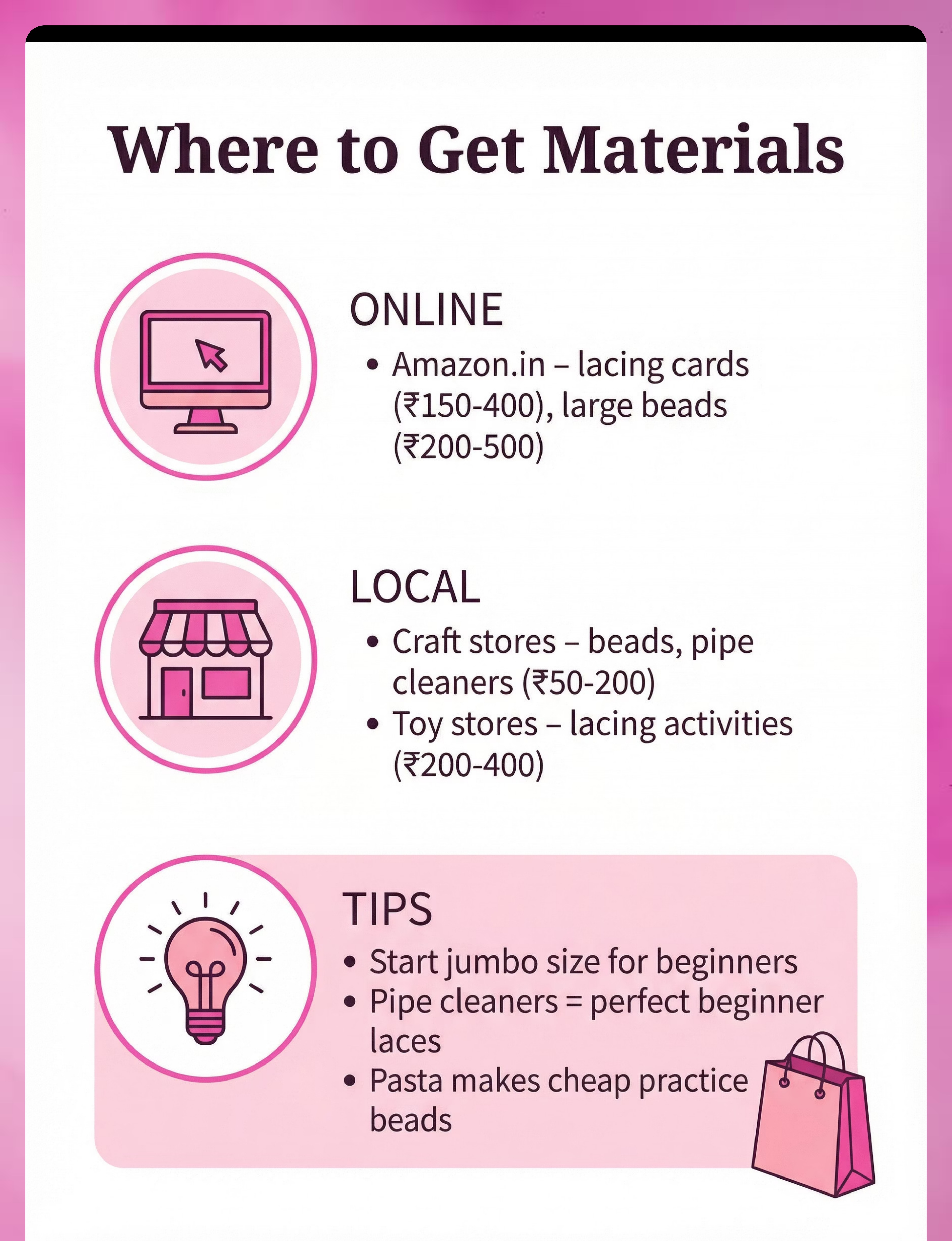
Where to Buy in India
Availability: Widely Available across India through online and offline channels.
Amazon.in
Search: "lacing cards kids"
Price Range: ₹150–400
Amazon.in
Search: "large beads threading"
Price Range: ₹200–500
Amazon.in
Search: "lacing shapes wooden"
Price Range: ₹200–500
Local Craft Stores
Search: "beads pipe cleaners"
Price Range: ₹50–200
Toy Stores
Search: "lacing activity"
Price Range: ₹200–400
Buying Tips
- Start with jumbo size for beginners—bigger than you think necessary
- Pipe cleaners are the perfect beginner "laces" because they hold shape
- Pasta (penne, rigatoni) makes excellent cheap beads for practice
- Progress to smaller sizes only as skill develops—don't rush
- Themed sets dramatically increase motivation and engagement
Red Flags (Avoid These)
- Small beads marketed for young children (check age recommendations carefully)
- Flimsy lace without stiff option (pipe cleaners or plastic tips essential for beginners)
- Holes too small for the lace provided (test before purchasing if possible)
- Poor quality materials that fall apart (read reviews about durability)

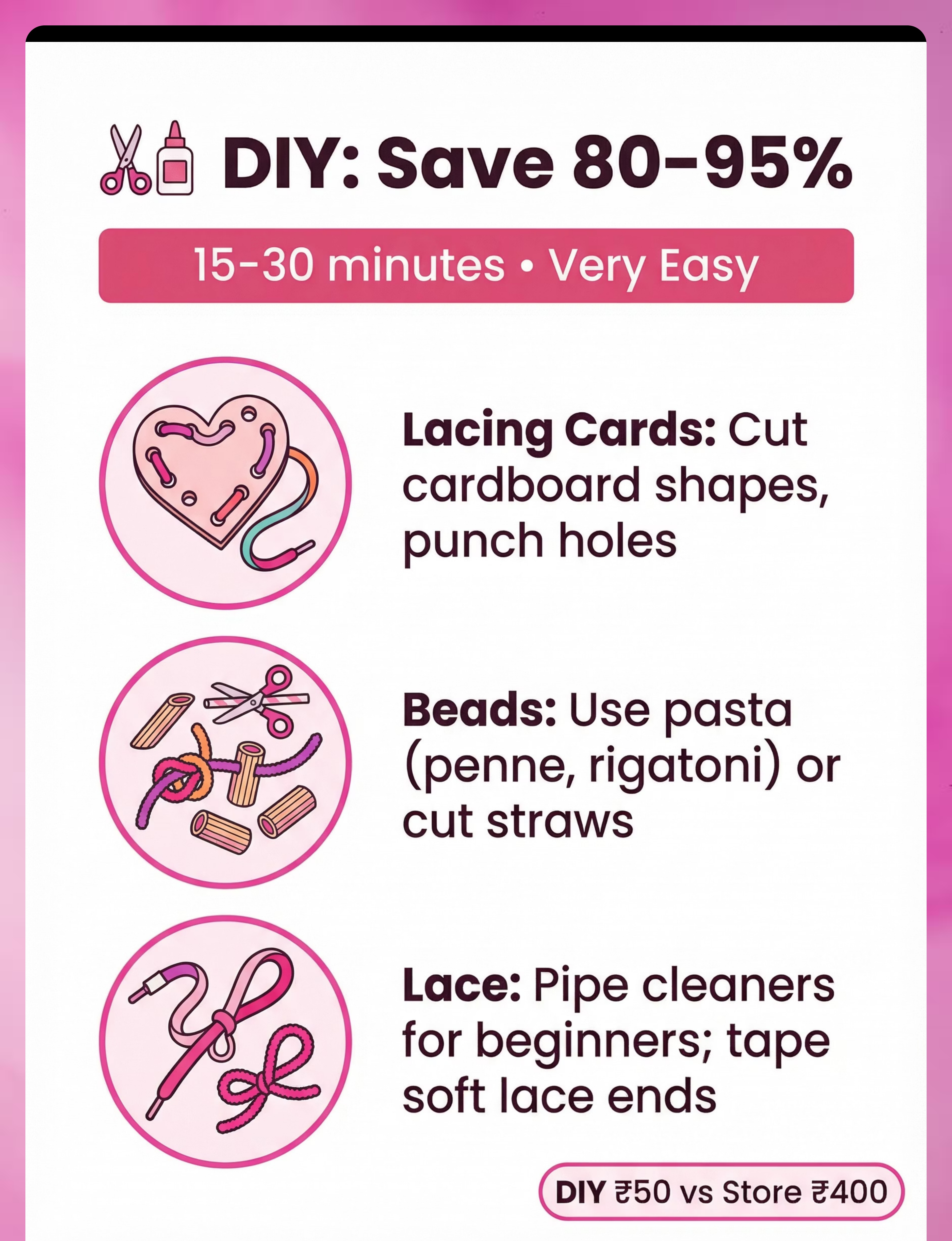
DIY Alternative (Save 80-95%)
Feasibility: Very High | Cost Savings: 80-95% | Time Required: 15-30 minutes
Creating effective lacing and beading activities at home is remarkably simple and delivers the same therapeutic benefit as commercial products. This is one of the easiest and most effective DIY therapeutic tools.
Materials You Need
- Pipe cleaners (perfect stiff "lace" for beginners)
- Large pasta (penne, rigatoni—makes excellent beads)
- Shoelaces with plastic tips (for more advanced work)
- Cardboard (for making lacing cards)
- Hole punch (to create holes in cardboard)
Step-by-Step Instructions
Create Lacing Cards
Cut cardboard into simple shapes (circle, square, triangle). Punch holes around the edges, spacing them 1-2 inches apart for beginners.
Prepare Beads
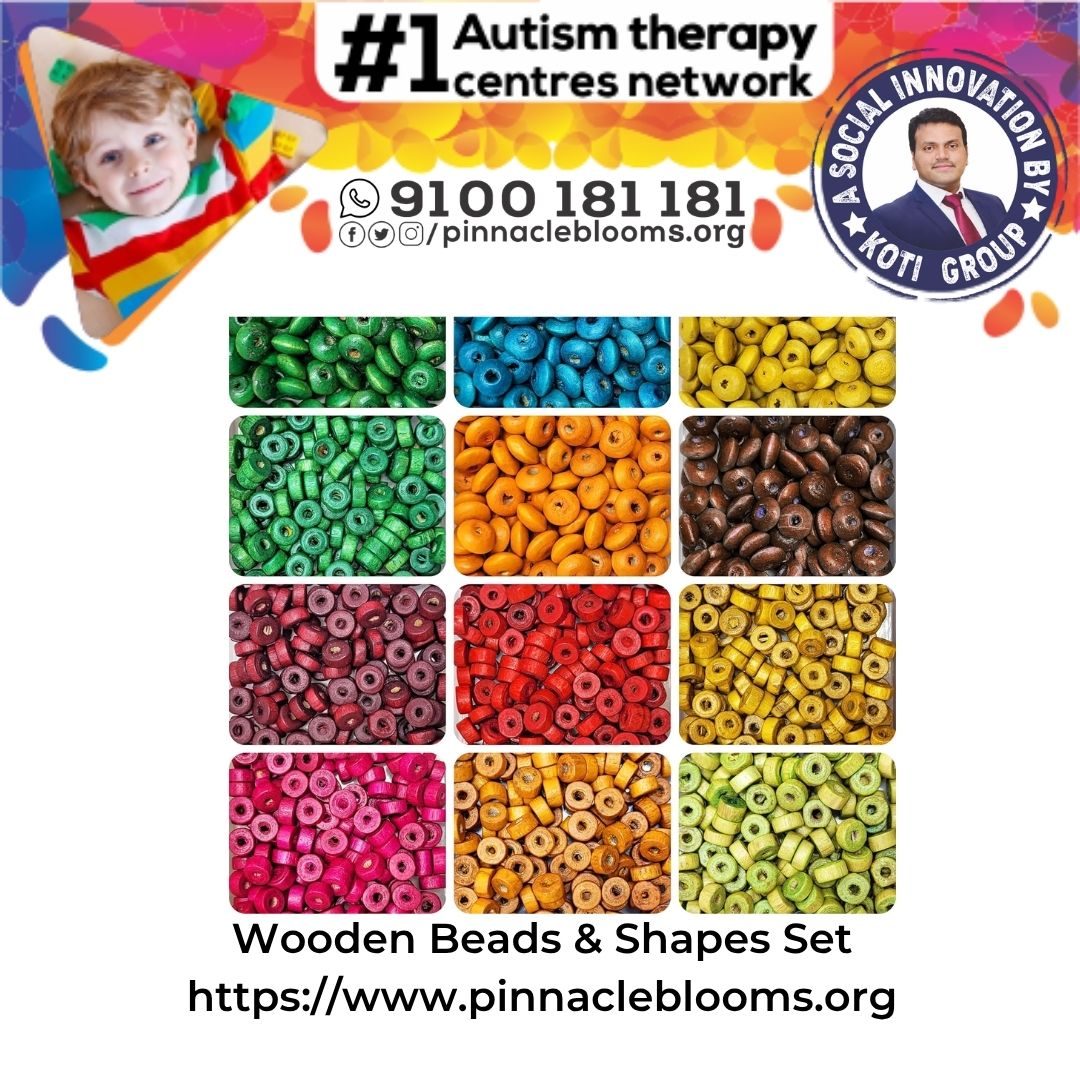
Use pasta (penne or rigatoni works perfectly), cut straws into 1-inch pieces, or purchase large wooden beads inexpensively at craft stores.
Select Appropriate Lace
Pipe cleaners for absolute beginners (they hold shape). Shoelaces with plastic tips for intermediate. Regular string for advanced.
Stiffen Soft Laces
If using soft string or yarn, wrap the threading end tightly with clear tape to create a stiff "needle" that's easier to guide through holes.
Create Patterns (Optional)
Draw or print simple patterns to copy (red-blue-red-blue, etc.) for added visual-motor and sequencing challenge.
DIY vs. Commercial: Making the Decision
When to DIY | When to Buy Commercial | |
Budget-conscious families | Want maximum durability and quality | |
Need activity immediately today | Need engaging themes and designs | |
Customizing difficulty for your child | Prefer ready-made convenience | |
Large quantities needed (classroom) | Gift giving or classroom sets |
Tradeoffs: DIY versions are less durable than commercial products and pasta can break with heavy use. However, they deliver identical therapeutic benefit and are easily replaced at minimal cost.
Preview of lacing beading threading activities Therapy Material
Below is a visual preview of lacing beading threading activities therapy material. The pages shown help educators, therapists, and caregivers understand the structure and content of the resource before use. Materials should be used under appropriate professional guidance.


Share this resource
Help others discover thisLink copied!

Measuring Success & Building Your Complete Kit
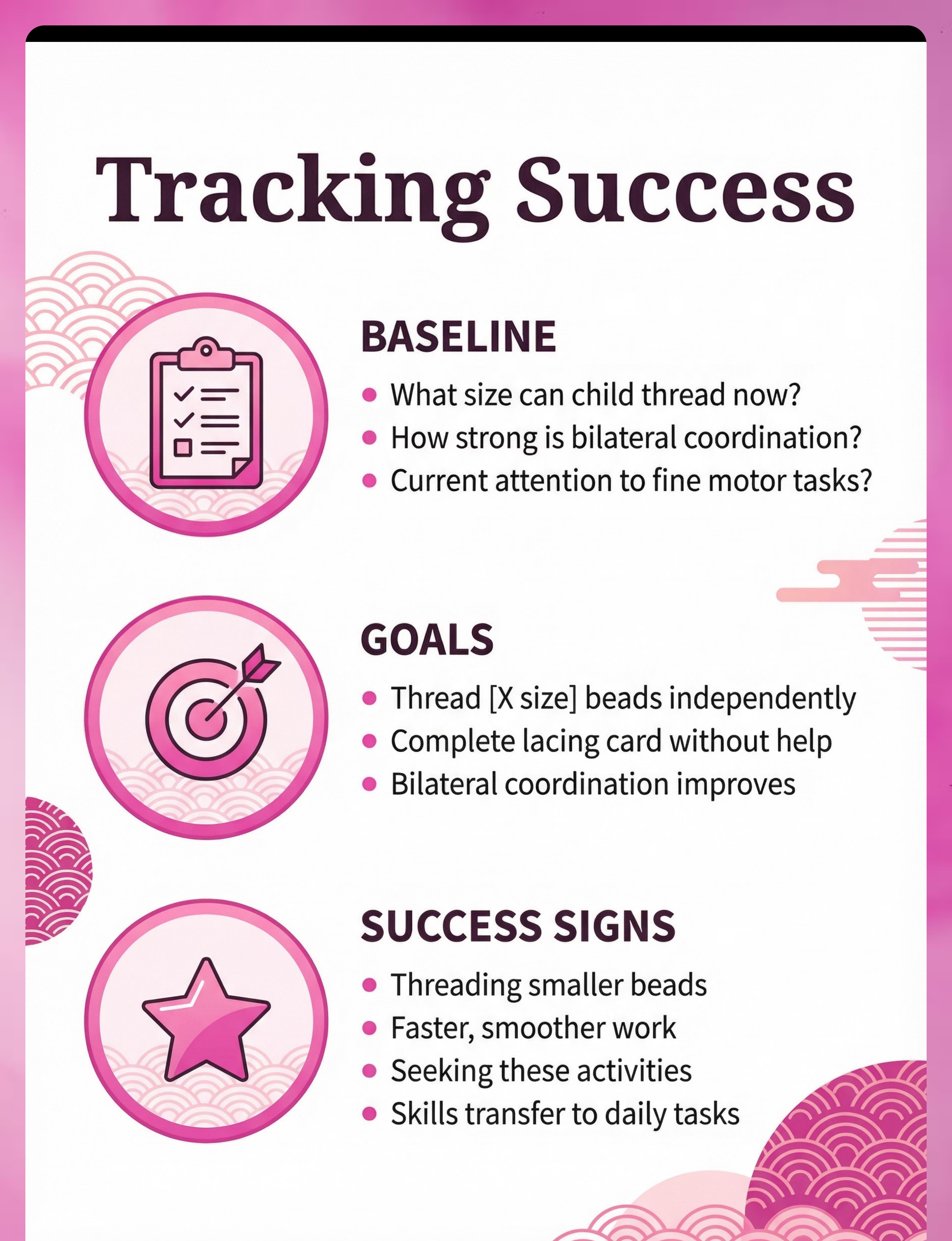
Track Progress
Systematic tracking helps you see progress that might otherwise feel invisible. Small improvements compound into significant skill development over time.
Measure Baseline
- Current bilateral coordination level (can hands work together?)
- Pincer grasp strength (thumb-finger control)
- Largest bead/hole size child can manage currently
- Attention span for fine motor tasks
Set Clear Goals
- Child will thread [specific size] beads independently
- Child will complete lacing card without assistance
- Bilateral coordination will improve in daily tasks
- Pincer grasp will strengthen measurably
Success Indicators
- Threading progressively smaller beads
- Faster, smoother threading movements
- Reduced frustration during activity
- Actively seeking lacing/beading activities
- Skill transfer to other fine motor tasks (dressing, writing)
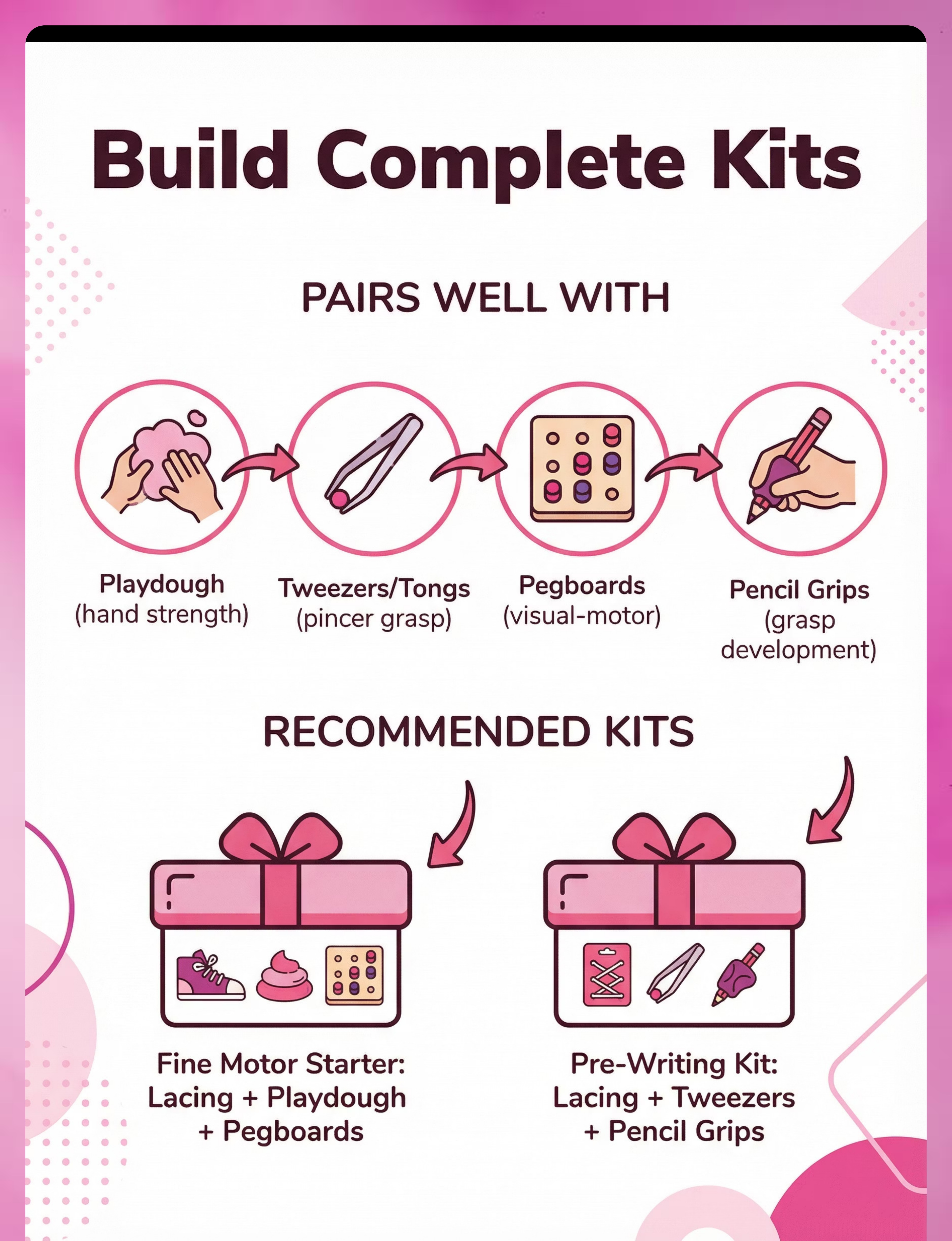
Complete the Kit: Complementary Tools
Lacing and beading work even better alongside these complementary tools. Each addresses related skill areas and creates a comprehensive fine motor development system.

Playdough/Putty (Tool 7.1)
Why pair: Builds hand strength that supports threading precision. Use before lacing as warm-up.

Tweezers/Tongs (Tool 7.4)
Why pair: Additional pincer grasp development through varied grasping activities.

Pegboards (Tool 7.5)
Why pair: Visual-motor integration and fine motor control through related precision placement tasks.

Pencil Grips (Tool 7.6)
Why pair: Grasp development that transfers directly to writing readiness.
Recommended Bundles
- Fine Motor Starter Kit: Lacing/Beading (7.2) + Playdough/Putty (7.1) + Pegboards (7.5) — Complete basic fine motor foundation
- Pre-Writing Readiness Kit: Lacing/Beading (7.2) + Tweezers/Tongs (7.4) + Pencil Grips (7.6) — Comprehensive writing preparation
Quick Summary
AI Summary: Lacing and beading develop bilateral coordination, pincer grasp, and visual-motor integration through precision threading activities. Core Kit (Rank 1), strong evidence, classic OT activity that transfers directly to writing readiness and dressing independence.
lacing
beading
threading
bilateral
pincer
visual-motor
OT
SpEd
core-kit
Common searches: lacing cards autism, beading fine motor, threading activities kids, bilateral coordination activities, pincer grasp activities, fine motor lacing, occupational therapy beading
Get Support
FREE National Autism Helpline
Phone: 9100 181 181
Languages: 16+ Indian languages supported
Website:pinnacleblooms.org
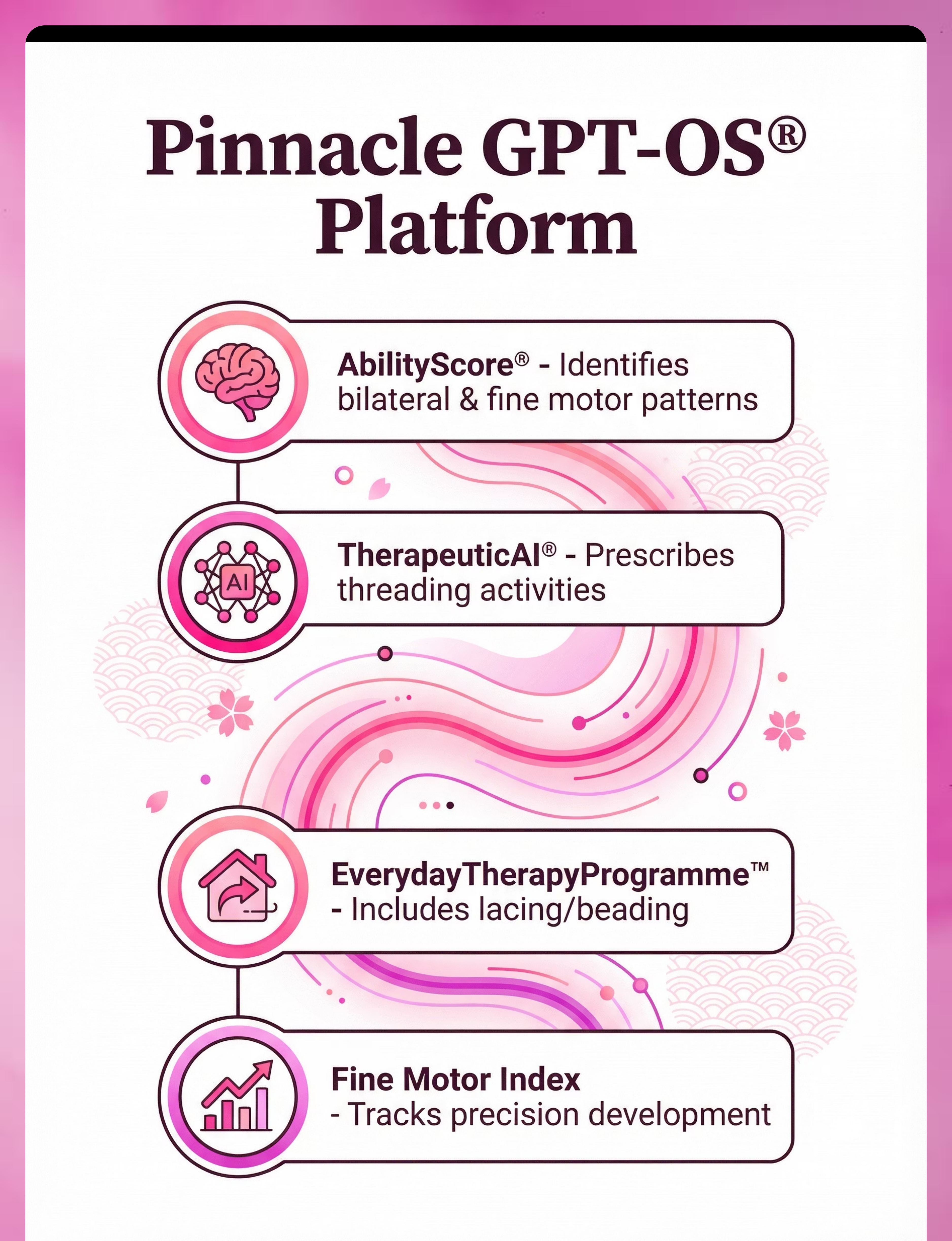
Platform Integration
This tool integrates seamlessly with Pinnacle Blooms Network's comprehensive platform:
- AbilityScore® identifies bilateral and fine motor development patterns
- TherapeuticAI® prescribes personalized threading activities
- EverydayTherapyProgramme™ includes structured lacing/beading protocols
- Fine Motor Index tracks precision skill development over time
Disclaimer: This is educational information developed by occupational therapy and special education professionals. Always consult qualified occupational therapists, speech-language pathologists, or pediatricians for personalized assessment and recommendations. Individual results vary based on starting skill level, practice consistency, and proper progression through difficulty levels.