






























Money/Time Concept Tools
SpEd + OT
Moderate-Strong Evidence
Rank #2
Several times weekly
₹100–1,000
Functional numeracy and temporal understanding system
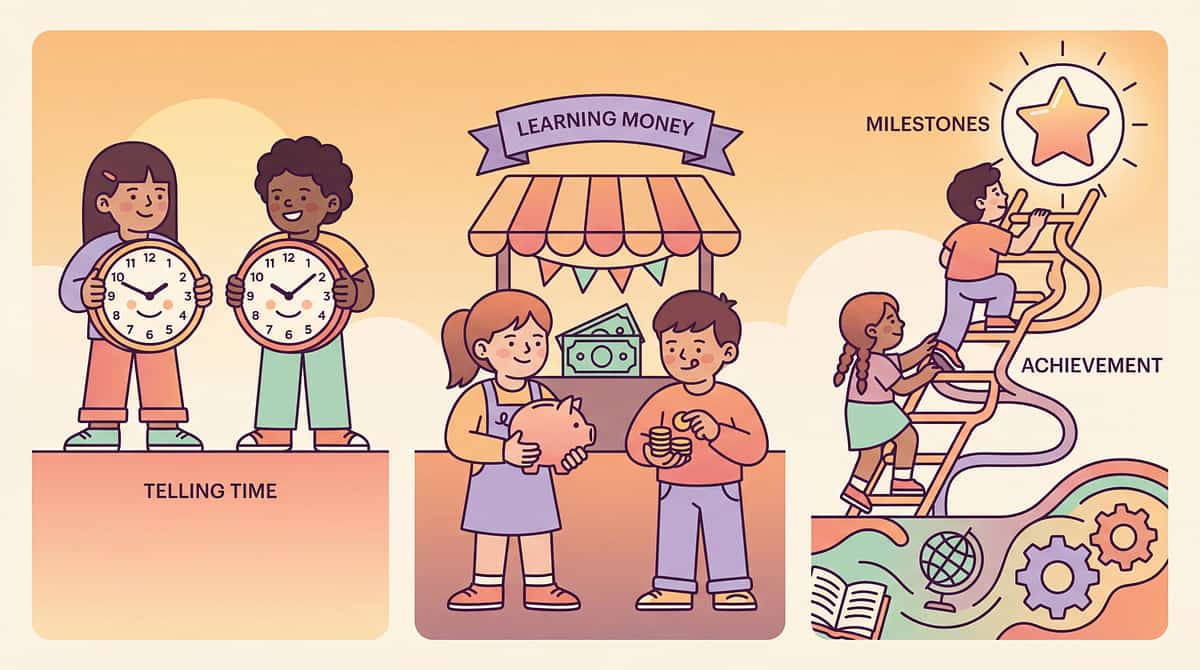
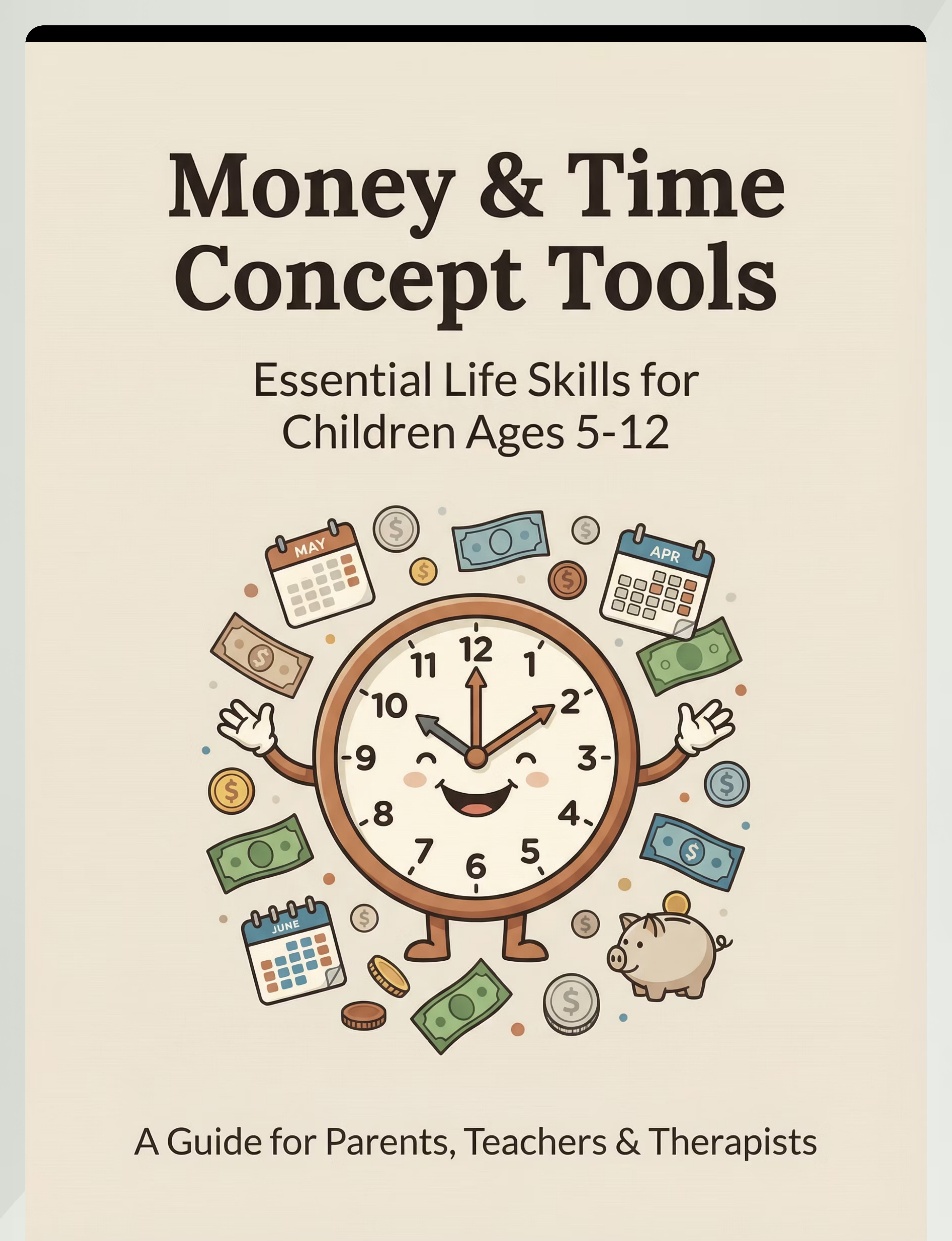
Develop functional understanding of money and time concepts essential for daily life and independence. These concrete learning tools bridge abstract concepts to real-world skills, supporting children aged 4-12 years in mastering essential life competencies across home, school, and clinical settings.
Who This Helps
These tools develop functional understanding of money and time concepts essential for daily life and independence, supporting cognitive development through hands-on learning.
Money Concepts
Time Telling
Temporal Language
Functional Math
Planning
Independence
Ages 4-12 years
Matched to cognitive and developmental level, progressing from basic recognition to functional independence with real-world money and time management.
All Environments
Home practice, school learning, clinic instruction, and community application for comprehensive skill development.
Daily Living Skills
For children who need concrete materials to understand abstract money and time concepts, with visual supports connecting learning to real life.
Does This Sound Familiar?
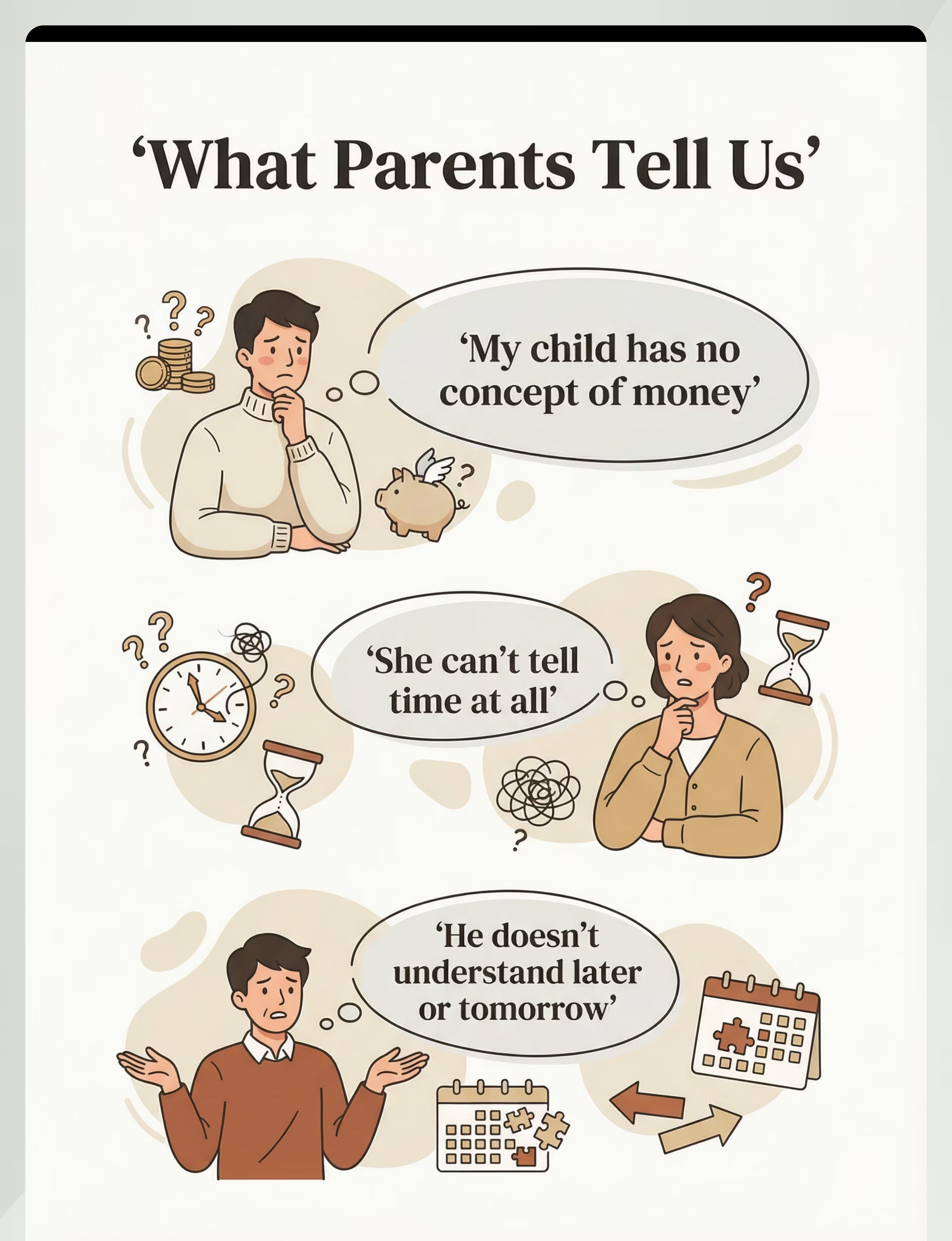
"My child has no concept of money. We can't even go to the store together because they don't understand what things cost or how to participate in buying anything."
"She can't tell time at all. Every clock in our house might as well be decoration. She has no idea when things happen during the day."
"He doesn't understand 'later' or 'tomorrow.' Everything is 'now.' We can't plan anything or help him anticipate what's coming next."
"She can't manage any money. I worry about her independence as she grows older. These are such basic life skills."
"He always asks 'how long until...' but has no sense of time passing. Five minutes and five hours are the same to him."
"She has no sense of time passing. She's either too early or too late for everything because she can't gauge duration at all."
You're not alone. These are common challenges for children developing functional numeracy and temporal understanding. Money and time concepts are abstract, and many children need concrete materials and real-world practice to make sense of them.
A Day Without the Right Support
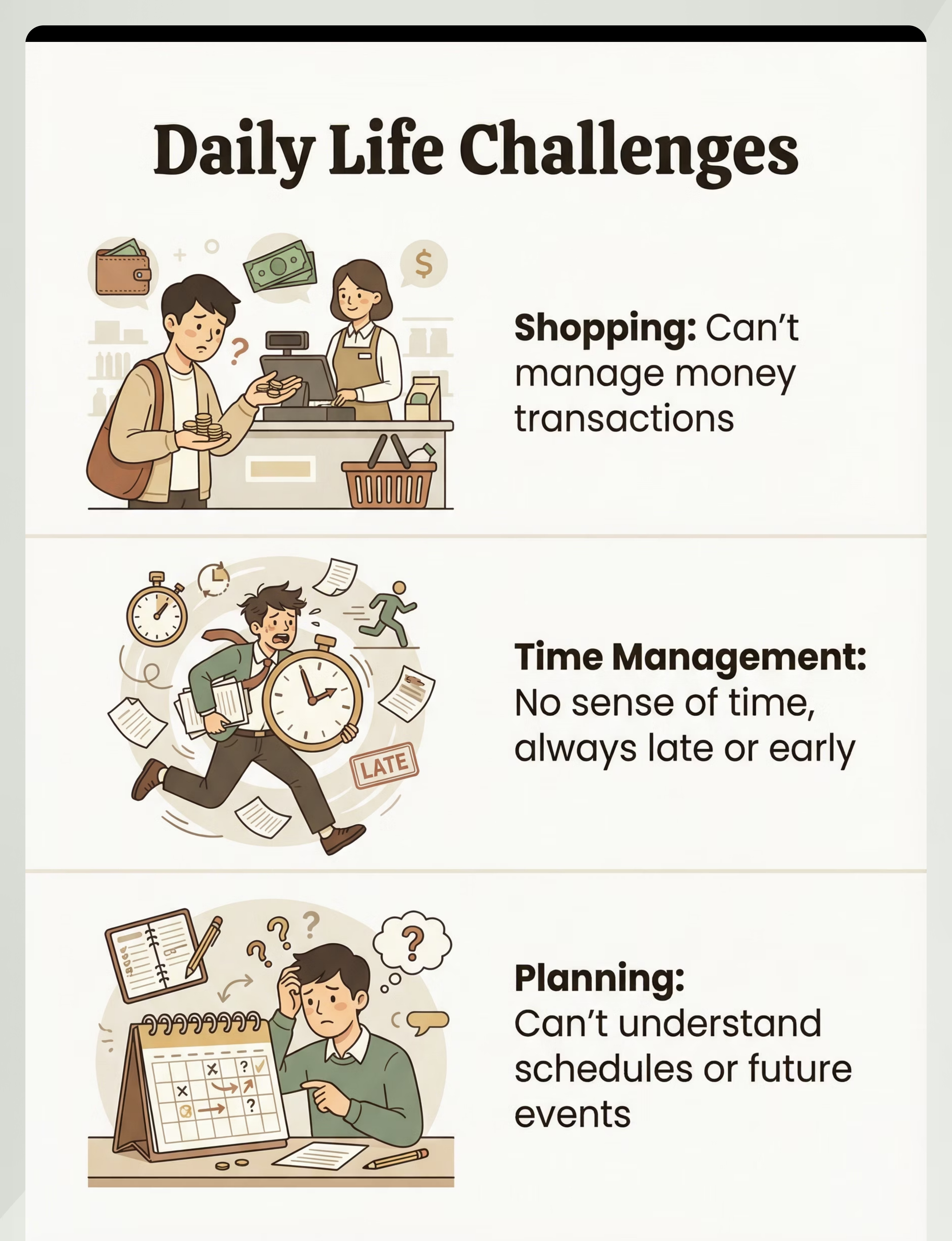
Shopping Trips
Can't manage money transactions. Child excluded from purchasing. No understanding of value or exchange. Dependence on others for every transaction.
Time Management
No sense of time, always late or too early. Can't gauge how long activities take. Constant confusion about when things happen. Schedule feels chaotic.
Planning & Schedules
"Tomorrow" and "yesterday" have no meaning. Can't understand schedules or anticipate events. Living only in the immediate moment. Future planning impossible.
Independence Barriers
Money and time skills missing for independence. Can't participate in community activities. Relies completely on others for temporal and financial navigation.
The Science Behind It
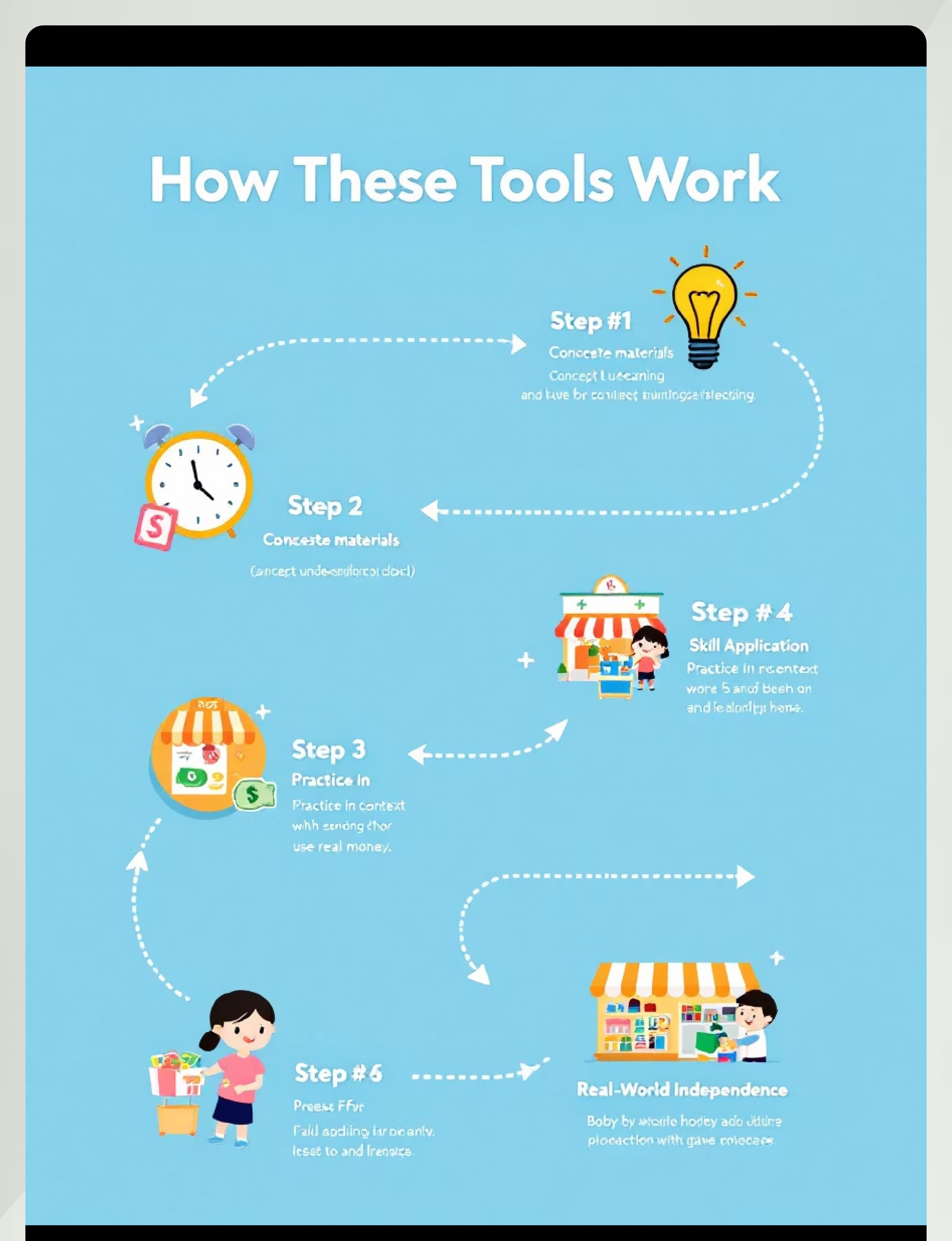
Money and time concept tools work through a carefully structured learning progression that moves from concrete hands-on materials to abstract understanding, ultimately supporting real-world functional independence.
Concrete Materials
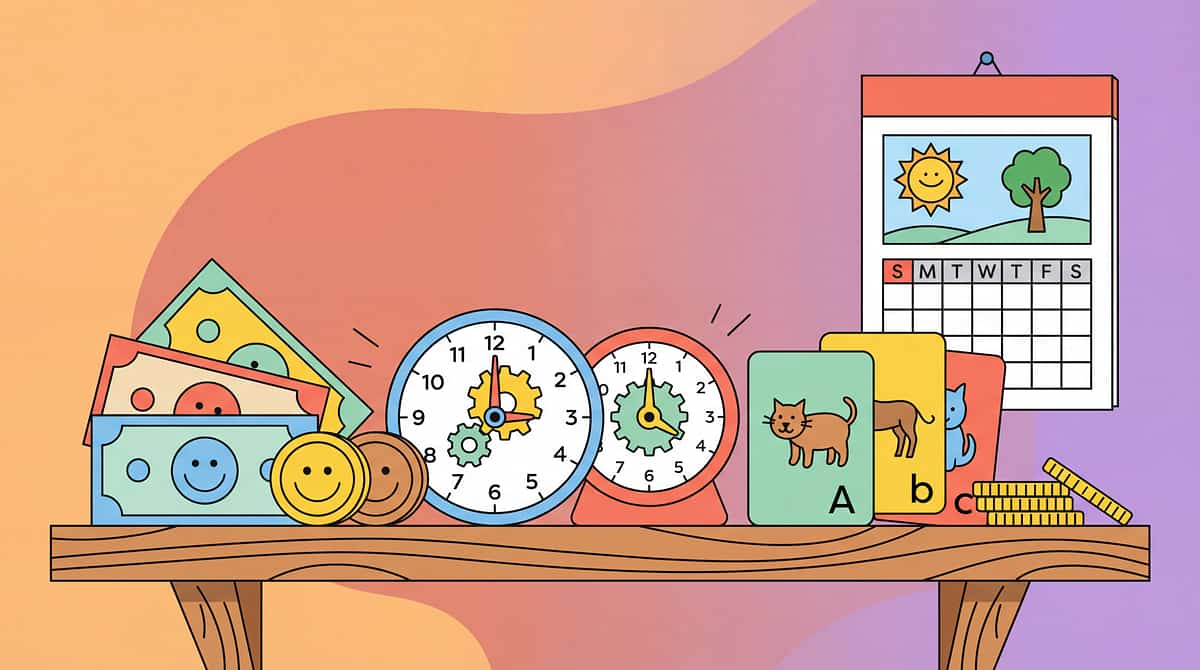
Real or realistic money, teaching clocks, visual calendars provide tangible learning foundations
Concept Understanding
Hands-on exploration builds recognition, value comprehension, and temporal relationships
Practice in Context
Pretend stores and daily schedule connections link learning to meaningful situations
Skill Application
Guided practice in safe settings builds confidence before real-world challenges
Real-World Transfer
Supported community experiences apply skills in actual transactions and time management
Functional Independence
Mastery enables participation in daily life with appropriate supports
Money Concepts
Time Telling
Temporal Language
Functional Math
Planning
Independence
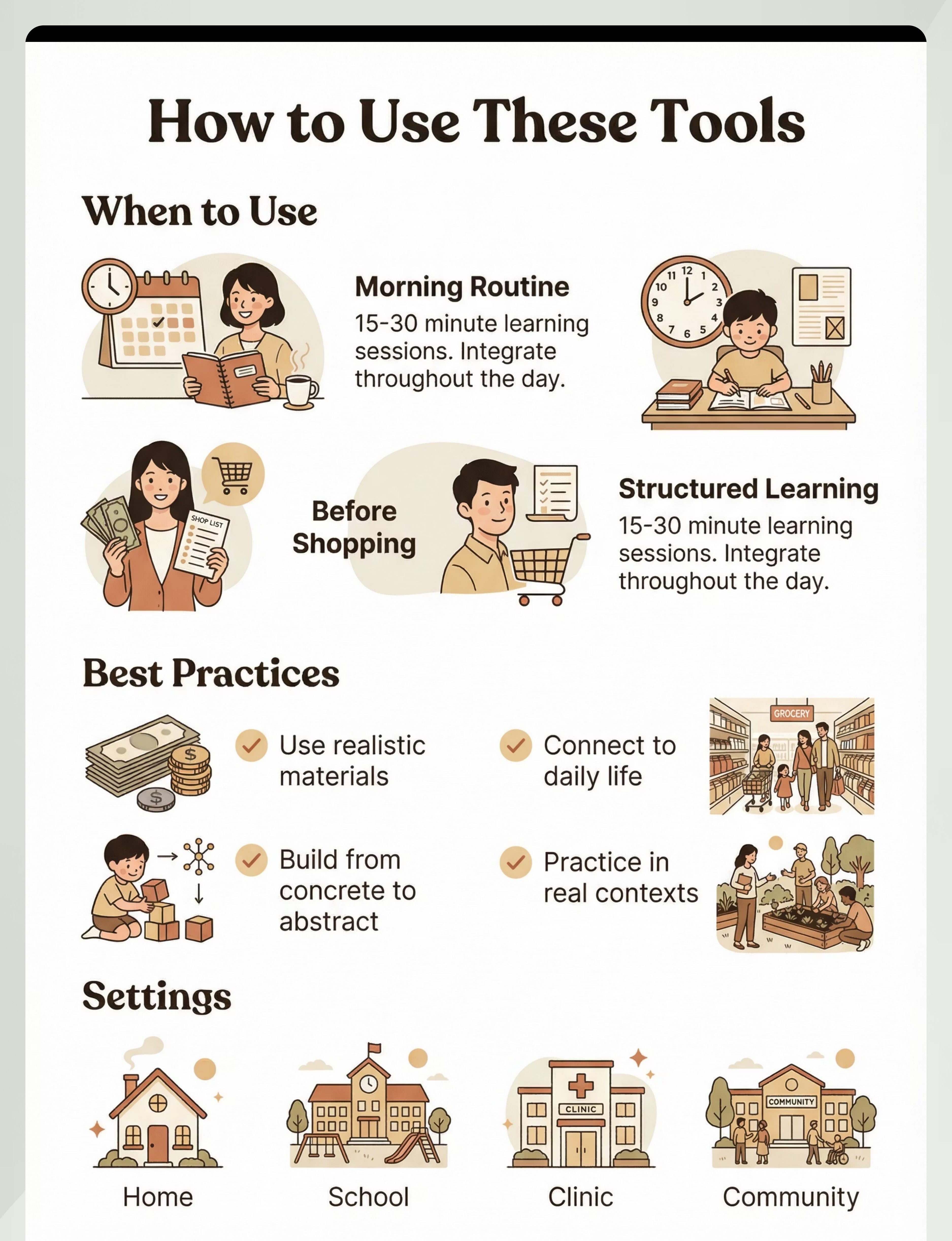
How to Use It Right
Effective use of money and time concept tools requires connection to real life, appropriate progression, and consistent practice in meaningful contexts. These evidence-based best practices maximize learning outcomes.
1
Use real or realistic materials
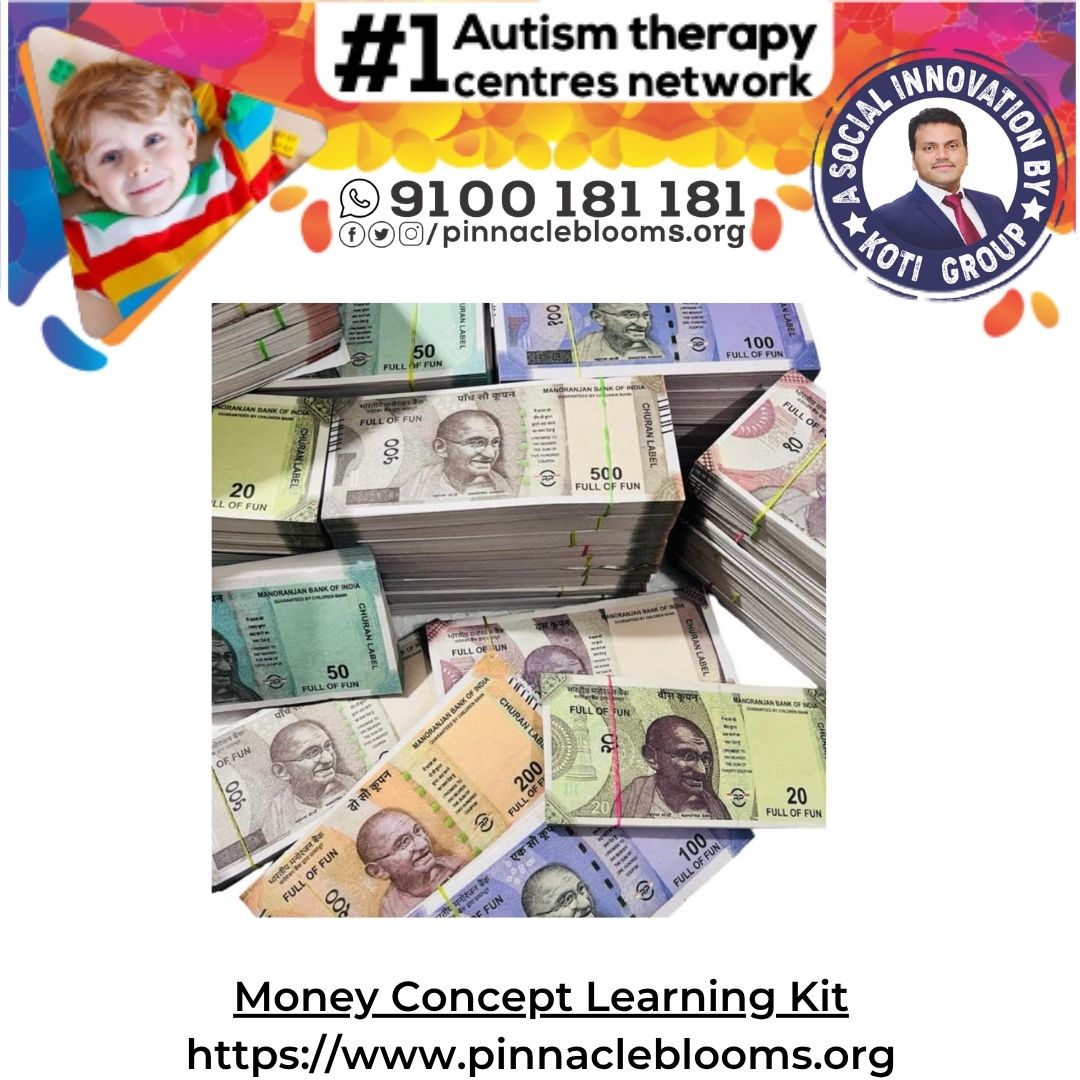
Indian currency denominations, functional clocks, and authentic calendars make concepts concrete and immediately relevant to daily life.
2
Connect to daily life situations
Link learning to your child's actual experiences—buying their favorite snack, knowing when dinner happens, understanding when the weekend arrives.
3
Practice in functional contexts
Use pretend stores at home, connect time to daily routines, and gradually introduce supported real-world practice opportunities.
4
Build from concrete to abstract
Start with hands-on materials, progress to visual representations, and gradually introduce more abstract understanding as concepts solidify.
5
Use visual supports
Picture schedules, visual calendars, and labeled materials scaffold understanding and provide ongoing reference points.
6
Include real-world practice
Visit actual stores with support, use real clocks for daily activities, and create authentic opportunities to apply developing skills.
Duration: 15-30 minutes structured learning; integrate concepts throughout the day for maximum retention and generalization.
Expert Insight
"Money and time are essential life skills. Concrete materials, real-world practice, and visual supports make these abstract concepts accessible. Start with real-life relevance—buying something they want, knowing when dinner is."
— Special Educator, Functional Academics Specialist
SpEd + OT Recommended
Collaborative approach ensures both educational and functional development goals are addressed comprehensively.
Moderate-Strong Evidence
Research supports concrete materials and functional practice for building money and time concepts in children with learning differences.
Rank #2 in Daily Living Skills
Essential Core Kit tool reflecting the fundamental importance of functional numeracy and temporal understanding for independence.
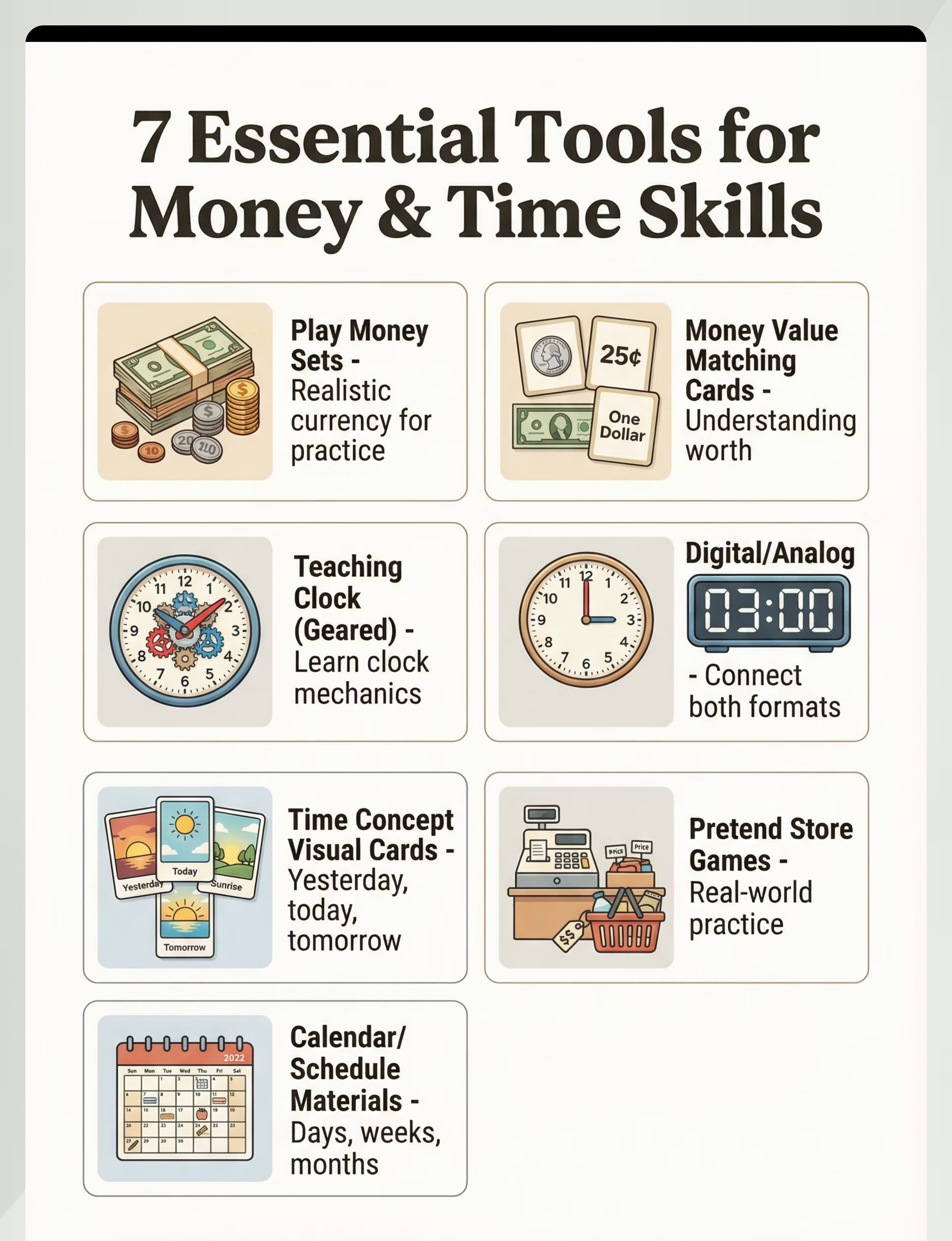
Choose Your Option (7 Variants)
Play Money Sets
Coin/note identification, counting
Money Value Matching Cards
Understanding worth, making change
Teaching Clock (Geared)
Understanding clock mechanics, telling time
Digital/Analog Comparison Clock
Connecting digital to analog
Time Concept Visual Cards
Before/after, yesterday/tomorrow, duration
Pretend Store/Shopping Games
Real-world money application
Calendar/Schedule Materials
Days, dates, scheduling, future planning
Select the tools that match your child's learning needs, developmental level, and practice contexts. Each variant targets specific aspects of money and time understanding, from basic recognition to functional independence.

How to Choose
  • By goal: Money skills → Play money + matching cards + pretend store | Time skills → Teaching clock + time cards + calendar
  • By setting: Home practice → Portable materials | Clinic instruction → Comprehensive teaching sets
  • By portability: High mobility needs → Cards and compact tools | Stationary use → Complete pretend store setups
Specifications & Learning Progressions
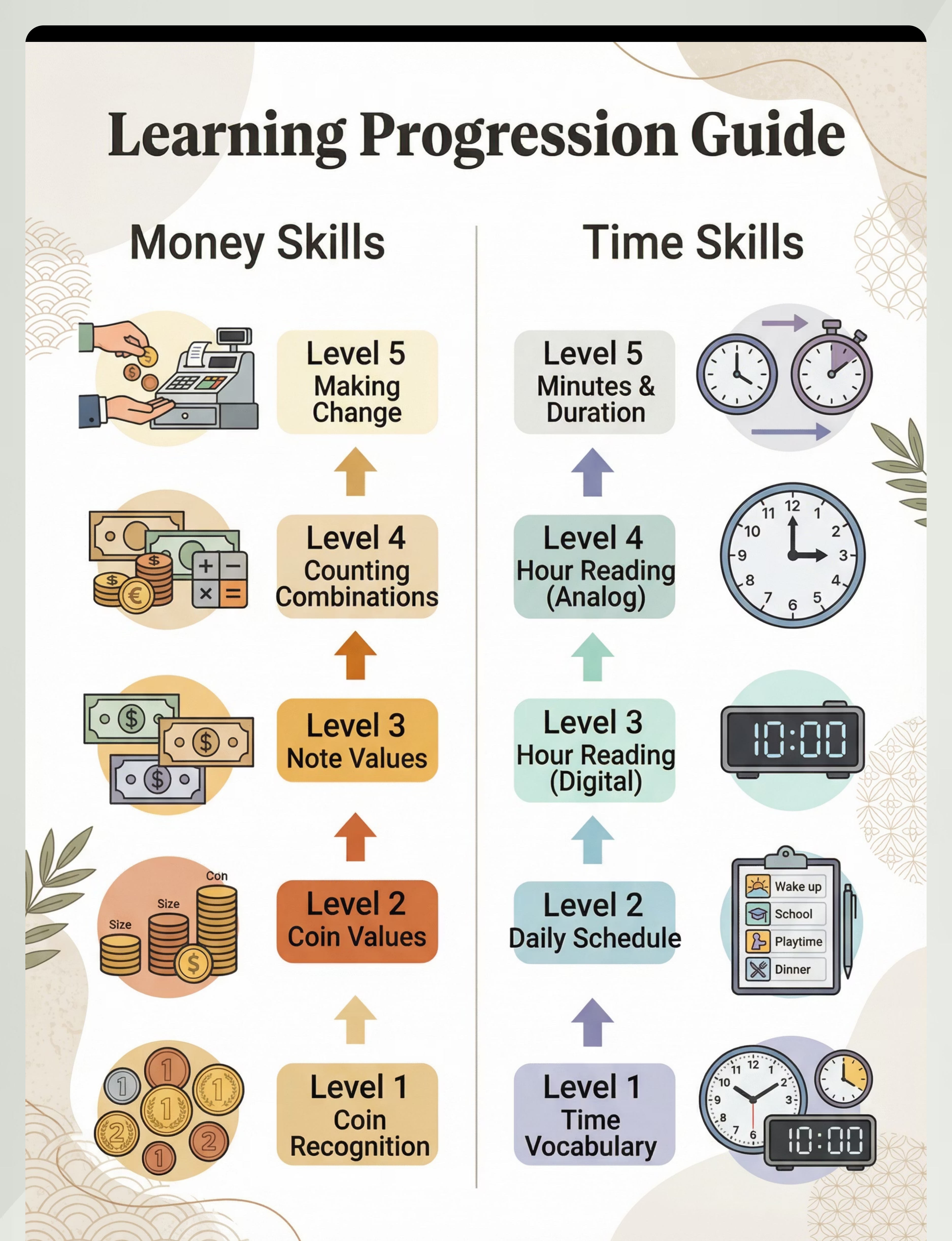
Money Progression
Coin/note recognition
Identify Indian currency denominations by sight and touch
Coin values
Understand worth of 1, 2, 5, 10 rupee coins
Note values
Recognize 10, 20, 50, 100, 500 rupee notes
Counting combinations
Add different denominations to reach totals
Making change (receiving)
Understand receiving correct change
Giving change
Calculate and provide appropriate change
Budgeting and planning
Plan purchases within available funds
Time Progression
Time vocabulary
Before, after, now, later, soon, yesterday, tomorrow
Daily schedule awareness
Connect activities to times of day
Hour reading (digital)
Read time to the hour on digital displays
Hour reading (analog)
Tell time to the hour on analog clocks
Half-hour, quarter-hour
Understand :30 and :15/:45 time markers
Minutes
Tell time to the nearest minute
Duration and elapsed time
Calculate how long activities take, time between events
Materials & Key Features
Realistic Materials
Indian currency designs, functional clock faces, authentic calendar formats
Progressive Complexity
Structured learning sequences from basic to advanced concepts
Real-World Connection
Direct links to daily life situations and practical applications
Visual Supports
Pictures, labels, and scaffolds throughout all materials
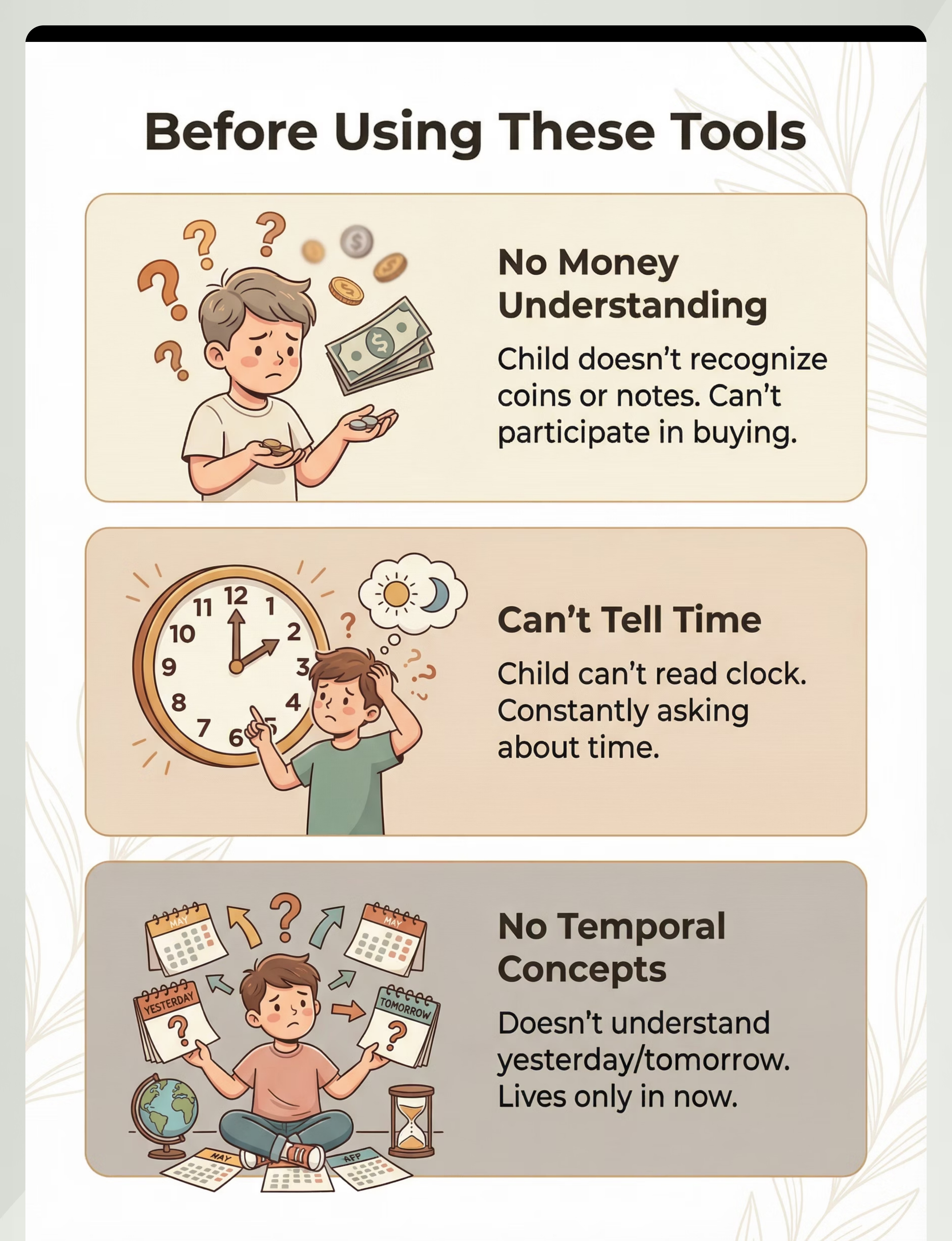
The Struggle (Before)
No Money Understanding
Situation: Child doesn't recognize coins or notes. No concept of value.
Experience: Can't participate in buying anything. Excluded from shopping experiences. Complete dependence on others for every transaction.
Emotion: Confusion, disconnection, dependence
Can't Tell Time
Situation: Child can't read any clock—digital or analog. No sense of when things happen.
Experience: Constantly asking about time. No awareness of schedule. Lives without temporal structure or understanding of daily rhythm.
Emotion: Disconnection, constant questioning, anxiety about "when"
No Temporal Concepts
Situation: Child doesn't understand yesterday/tomorrow, before/after. Everything exists only in "now."
Experience: Lives entirely in the immediate moment. Can't anticipate future events or understand past experiences. Planning is impossible.
Emotion: Immediate focus only, no sense of continuity, constant present-moment demands
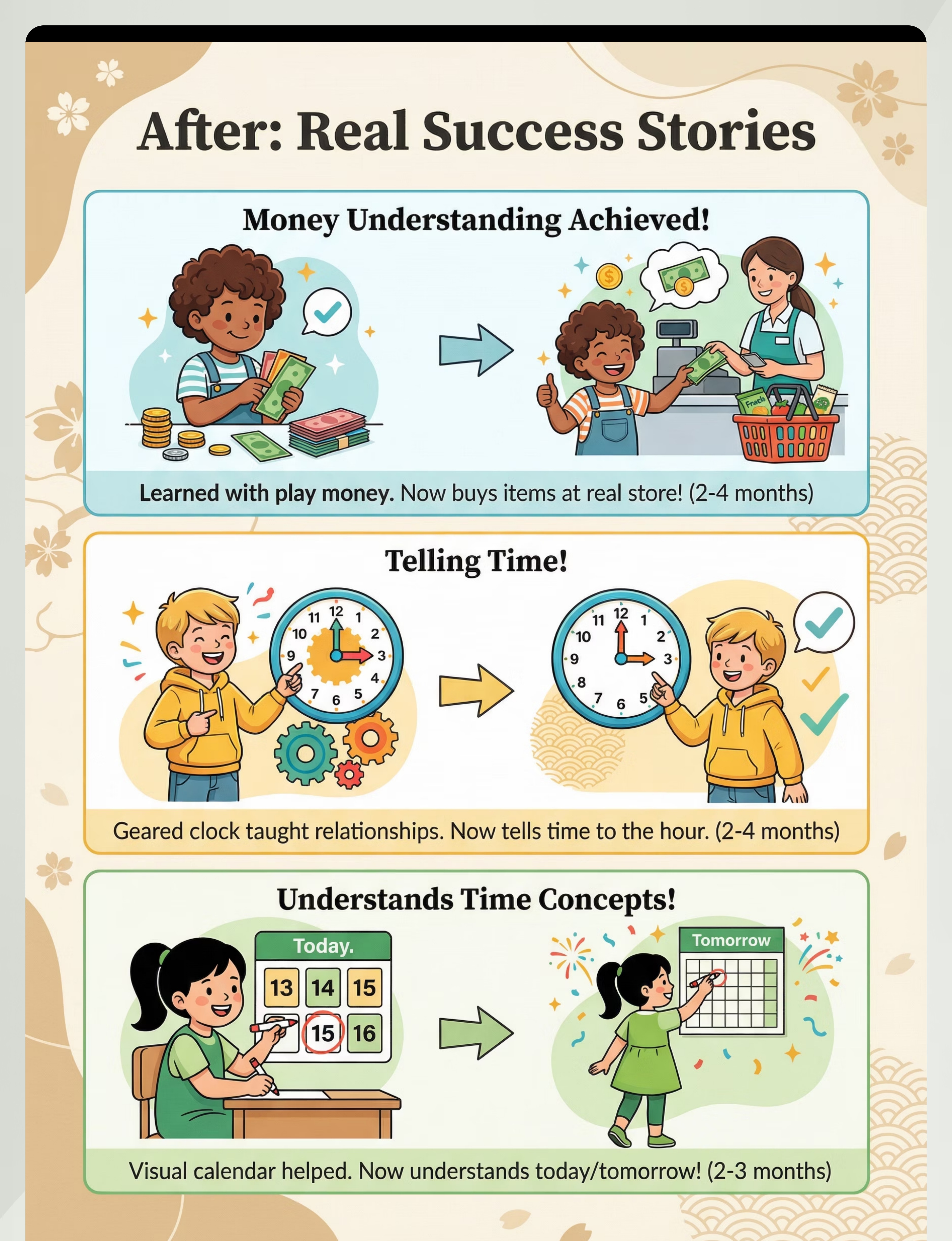
The Breakthrough (After)
No Money Understanding → Functional Participation
Situation: Learned coin values with play money. Practiced extensively in pretend store at home.
Experience: Now buys items at real store with support! Recognizes notes and coins. Participates in transactions with confidence.
Emotion: Understanding, participation, pride in independence
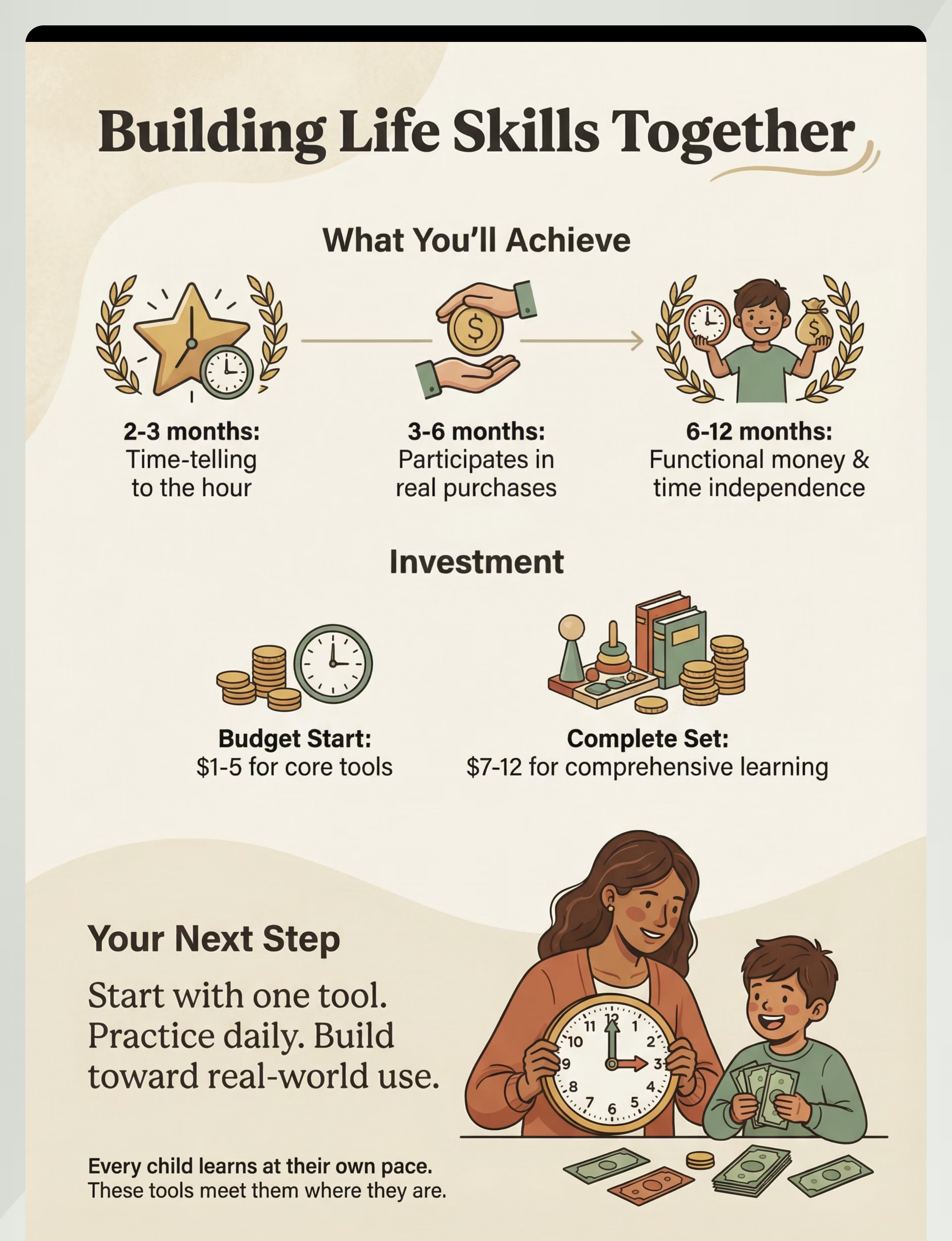
2-4 months
Can't Tell Time → Time Awareness
Situation: Geared clock taught hand relationships and mechanics. Connected learning to daily events.
Experience: Now tells time to the hour! Understands when activities happen. Uses clock to navigate day with increasing independence.
Emotion: Connection, temporal awareness, confidence in schedule
2-4 months
No Temporal Concepts → Future Thinking
Situation: Visual calendar and time vocabulary practice connected abstract words to concrete experiences.
Experience: Now understands today/tomorrow! Can wait for future events. Talks about past experiences. Planning is developing.
Emotion: Understanding, anticipation, temporal connection
2-3 months
What to Expect (Realistic Timelines)
Skill development follows a predictable progression with concrete materials and consistent practice. These evidence-based timelines reflect typical learning trajectories for children using money and time concept tools regularly.
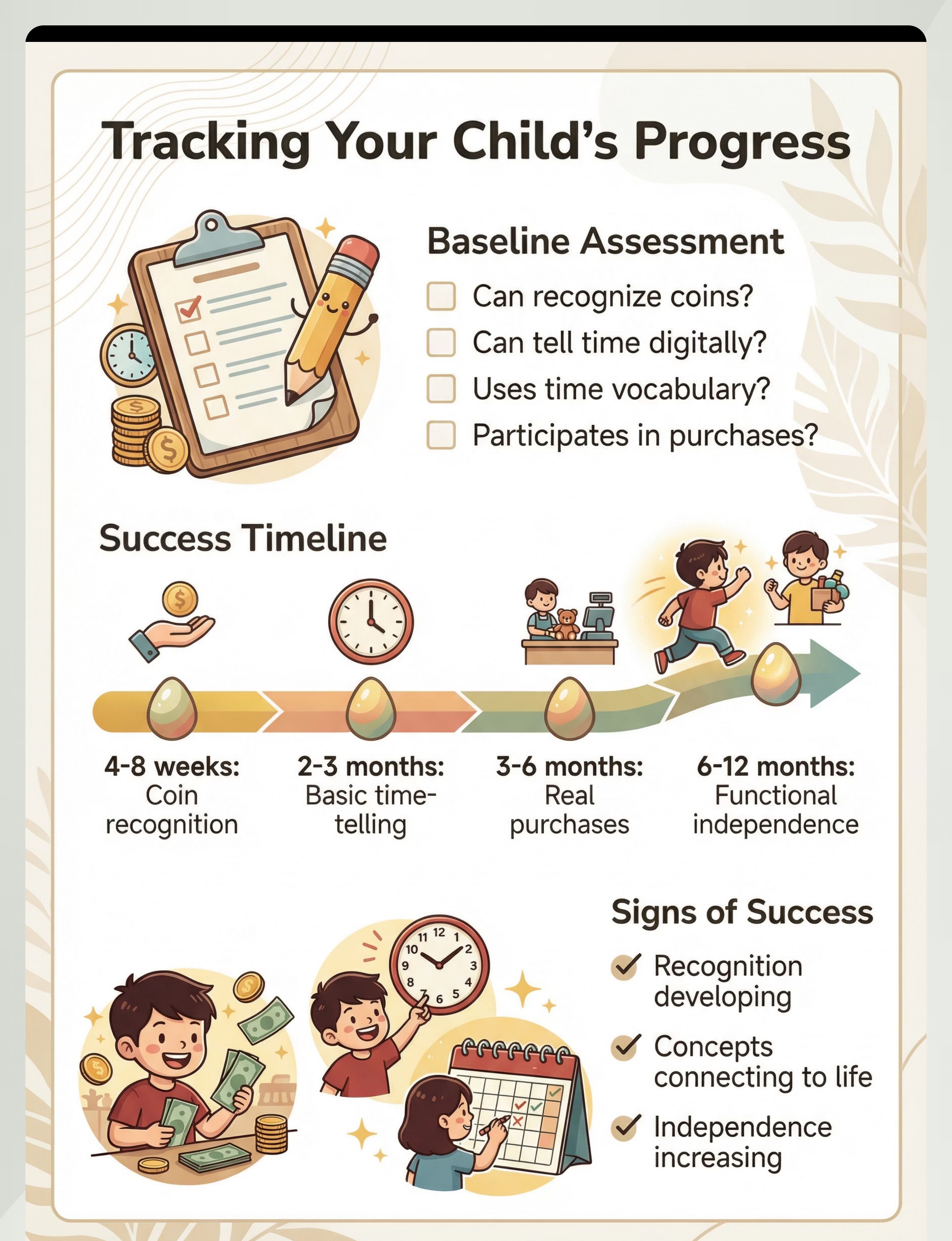
Recognizes coins and notes
Child can identify different Indian currency denominations by sight and begins understanding that different coins and notes have different names and appearances.
4-8 weeks
Understands basic values
Child grasps that coins and notes represent different amounts, can compare values (which is more), and begins connecting money to purchasing power.
2-3 months
Tells time to the hour
Child can read time to the hour on both digital and analog clocks, connecting clock reading to daily schedule events and activities.
2-3 months
Uses temporal vocabulary
Child correctly uses words like yesterday, tomorrow, before, after, now, later in conversation and understands their meaning in daily contexts.
2-3 months
Participates in real purchases
Child engages in actual store transactions with support, hands over appropriate money, receives change, and understands the exchange process.
3-6 months
Functional money/time independence
Child manages age-appropriate money tasks and time awareness with minimal support, demonstrating genuine functional independence in daily life contexts.
6-12 months
Is This Right for My Child? (2-Minute Check)
Answer these questions to determine if money and time concept tools match your child's current developmental level and learning needs. Three or more "yes" answers indicate a strong fit for these materials.
Can your child recognize coins and notes?
If yes, this indicates: Build on existing recognition skills to develop value understanding and functional use. Ready for next-level money concepts.
If no, this indicates: Start with basic identification activities using realistic play money. Recognition is the essential first step.
Can your child tell time on a digital clock?
If yes, this indicates: Extend learning to analog clock reading and more complex time concepts. Digital competence provides strong foundation.
If no, this indicates: Start with digital hour reading connected to daily schedule. Digital is easier to learn than analog initially.
Does your child understand 'yesterday' and 'tomorrow'?
If yes, this indicates: Temporal language developing well. Ready for calendar use and more advanced time concepts like duration.
If no, this indicates: Build time vocabulary with visual supports connecting words to daily experiences and concrete examples.
Can your child participate in simple purchases?
If yes, this indicates: Functional skills present and ready for more independence. Focus on expanding complexity and reducing supports.
If no, this indicates: Build toward real-world application through extensive pretend store practice and supported early experiences.

Interpretation: 3+ "yes" answers = strong fit for money/time concept tools. 1-2 "yes" answers = good candidate, start with basics. 0 "yes" answers = may need prerequisite skills first; consult with special educator or occupational therapist for readiness assessment.
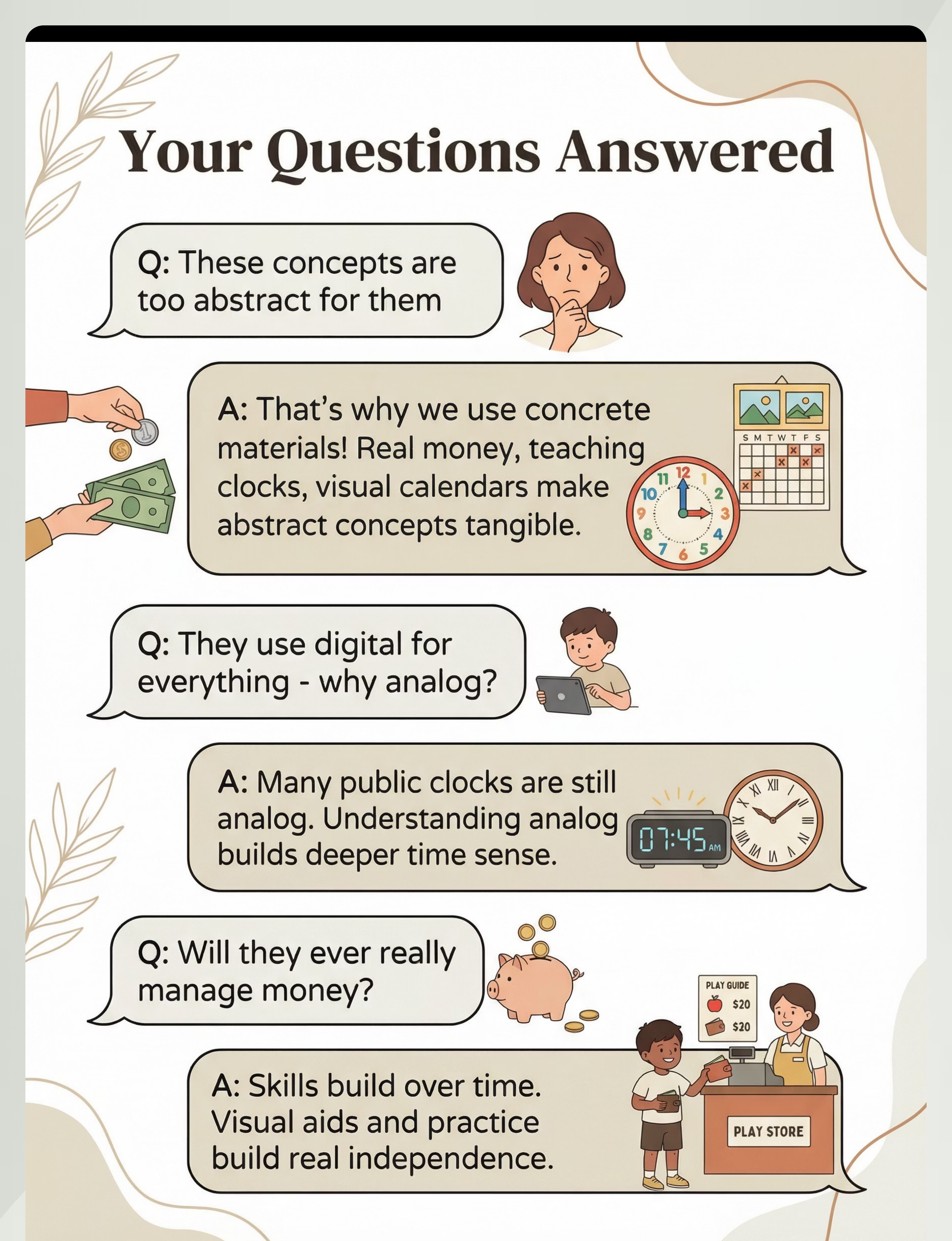
Common Questions (Honest Answers)
These concepts are too abstract for them
They use digital for everything—why teach analog?
Real transactions are too overwhelming
Will they ever really manage money independently?
Honest Answer: Concrete Materials Bridging Abstract Gaps
That's exactly why we use concrete materials! Real money, teaching clocks, and visual calendars make abstract concepts tangible. Abstract becomes concrete through hands-on practice with real-world connection. The materials are specifically designed to bridge the gap between abstract ideas and concrete understanding.
Strategy: Concrete materials make abstract concepts accessible through multi-sensory learning.
Honest Answer: Analog for Foundational Time Literacy
Many public clocks are still analog—schools, waiting rooms, train stations. Understanding analog builds deeper time sense and shows the relationship between hours and minutes visually. Both formats matter for complete time literacy, but analog is significantly harder to learn later if skipped early.
Strategy: Both formats matter; analog understanding is foundational for complete time literacy.
Honest Answer: Gradual Real-World Application
Absolutely—start with pretend store at home! Graduate to small real purchases with full support only after extensive practice. Build confidence before introducing complex transactions. Real-world application is the goal, not the starting point.
Strategy: Pretend practice first; introduce small real purchases with support gradually.
Honest Answer: Supports for Functional Independence
Many people with disabilities manage money successfully with appropriate supports—visual aids, routines, and ongoing practice. Independence comes in degrees and looks different for everyone. Start building now; skills compound over time with consistent instruction.
Strategy: Skills build over time; various supports enable functional independence appropriate to each individual.
Usage Guide
When to Use ✓
Structured learning times
Dedicated practice sessions with full attention and appropriate materials
Before shopping trips
Preview and practice for upcoming real-world money experiences
Daily schedule discussions
Morning review of day's events, evening reflection on completed activities
Before transitions
Use time concepts to prepare for upcoming changes in activity or location
Real-world application opportunities
Supported practice in actual community settings when child is ready
When NOT to Use ✗
When child is dysregulated
Wait for calm, focused state before introducing abstract concepts
Rushing through concepts
These skills need time and repetition; rushing leads to confusion and frustration
Without connection to real life
Always link practice to meaningful daily situations for best retention
Supervision by Development Level
Learning Stage
Supervision Level
Notes
Initial Learning
Adult-guided instruction
Direct teaching, modeling, step-by-step support for all activities
Practicing Skills
Supported practice
Adult nearby, providing prompts and feedback as needed
Applying Skills
Supervised real-world use
Adult present during community applications, gradually fading support
Duration: 15-30 minutes structured learning sessions; integrate concepts throughout the day for maximum retention
Settings: Home, School, Clinic, Community (real practice with support)
Safety First
Critical Safety
  • Supervise real money handling at all times to prevent loss or inappropriate use
  • Small coins can be choking hazards for young children—never leave unattended
  • Real-world practice needs adult support—never send child to make purchases alone until truly ready
Warnings
  • Keep real money secure when not in supervised use—establish clear storage routines
  • Supervise young children with coins to prevent choking and ensure appropriate handling
  • Practice in safe environments before attempting community applications
Contraindicated
  • Unsupervised real money access—child must be developmentally ready for independent money management
  • Real-world practice without support—always accompany child during community money use until independence is demonstrated
  • Abstract teaching without concrete examples—these concepts require hands-on materials
Safety Checklist
Before Use
  • Materials ready and organized
  • Realistic and relevant to child's life
  • Connected to meaningful daily situations
  • Matched to child's developmental level
During Use
  • Child engaging actively with materials
  • Making connections to real life
  • Practicing functional skills appropriately
  • Celebrating growing understanding
Signs of Success
  • Recognition skills developing
  • Concepts connecting to daily life
  • Real-world application emerging
  • Independence steadily increasing
Investment Guide
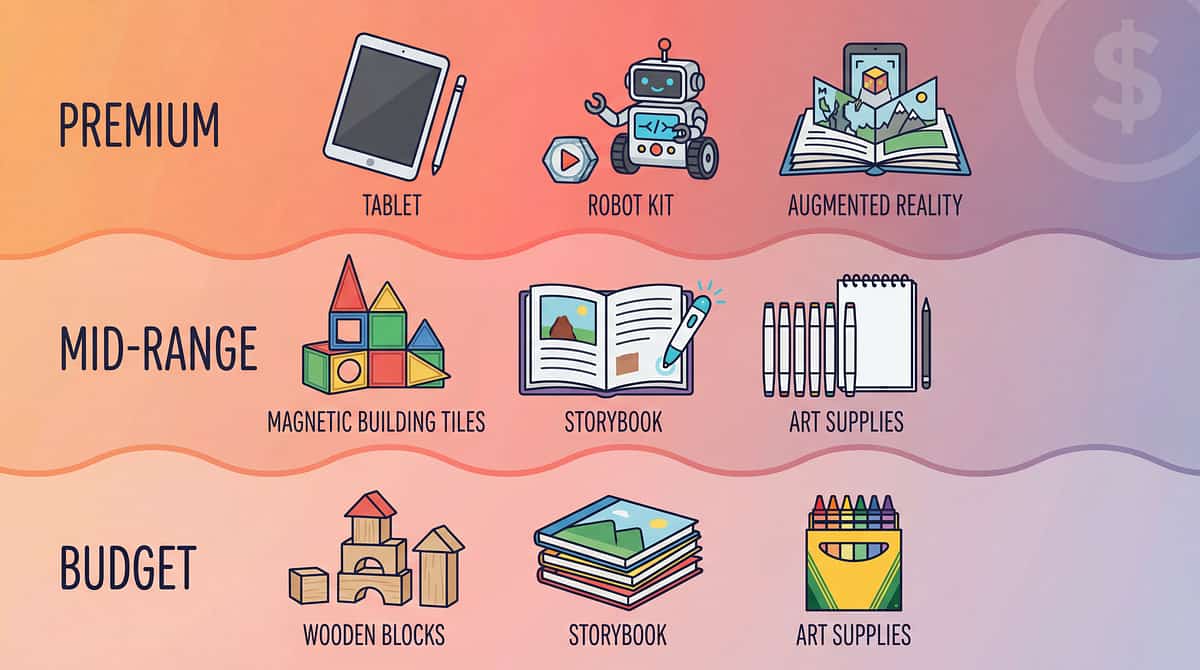
Money and time concept tools are available across a wide price range, from basic starter sets to comprehensive premium collections. Choose based on your child's current needs, learning goals, and practice contexts.
Option
Kit Description
Investment (INR)
Key Details
Best For
Budget Option
Play money set + teaching clock + DIY time cards
₹200-400
Covers core learning needs for both money and time concepts
Starting out, testing engagement, home practice focus
Premium Option
Complete money/time learning set with pretend store
₹600-1,000
Brands: Learning Resources, Educational Insights
Comprehensive instruction, clinic use, maximum variety
Overall Range: ₹100–1,000 (approximately $1-12 USD)
Excellent Foundation
Budget options provide a strong base for initial learning.
Core Concepts Covered
Individual components effectively address essential money and time skills.
Expand as Skills Develop
Start simple and upgrade to premium materials when ready for advanced practice.
Start with Basics
Utilize budget-friendly tools for initial engagement and understanding.
Assess Progress
Observe child's engagement and skill development before advancing.
Gradual Investment
Introduce more complex or premium materials as learning goals evolve.
Maximize Variety
Access comprehensive sets for rich, varied learning experiences.

Best starting point: Budget option provides excellent foundation. Individual components (play money, teaching clock, time cards) address core learning needs effectively. Expand to pretend store and premium materials as skills develop and engagement confirms this is the right fit.
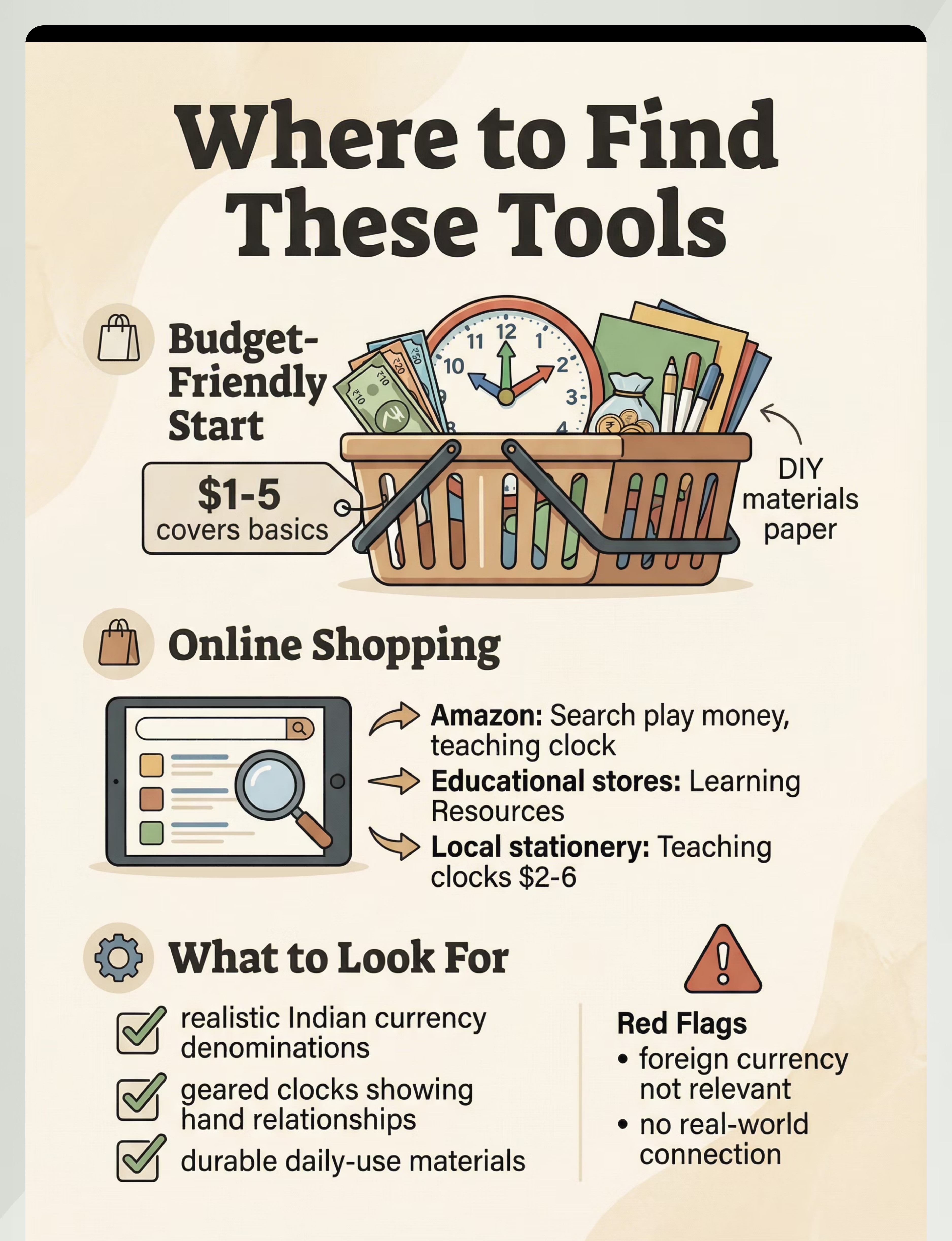
Where to Buy in India
Availability: Widely Available across India through online platforms and local stationery stores
Amazon.in—Play Money
Search: "play money Indian rupees"
Price Range: ₹100-350
Realistic Indian currency sets for hands-on learning
Amazon.in—Teaching Clocks
Search: "teaching clock"
Price Range: ₹200-500
Geared clocks showing hand relationships
Amazon.in—Calendars
Search: "kids learning calendar"
Price Range: ₹150-400
Visual calendars for daily use and planning
Amazon.in—Pretend Store
Search: "pretend store play set"
Price Range: ₹300-800
Complete shopping game setups for functional practice
Local Stationery Stores
Search: "teaching clock"
Price Range: ₹150-400
Often stock basic teaching clocks and calendars
Buying Tips ✓
  • Use real Indian currency denominations for relevance
  • Geared clocks show hand relationships best
  • Connect materials to child's actual daily schedule
  • Practice with real small purchases when ready
  • Visual calendars for daily use build consistency
Red Flags ✗
  • Foreign currency (not relevant to Indian context)
  • Abstract teaching without concrete materials
  • No real-world connection in design
  • Starting complexity too high for child's level
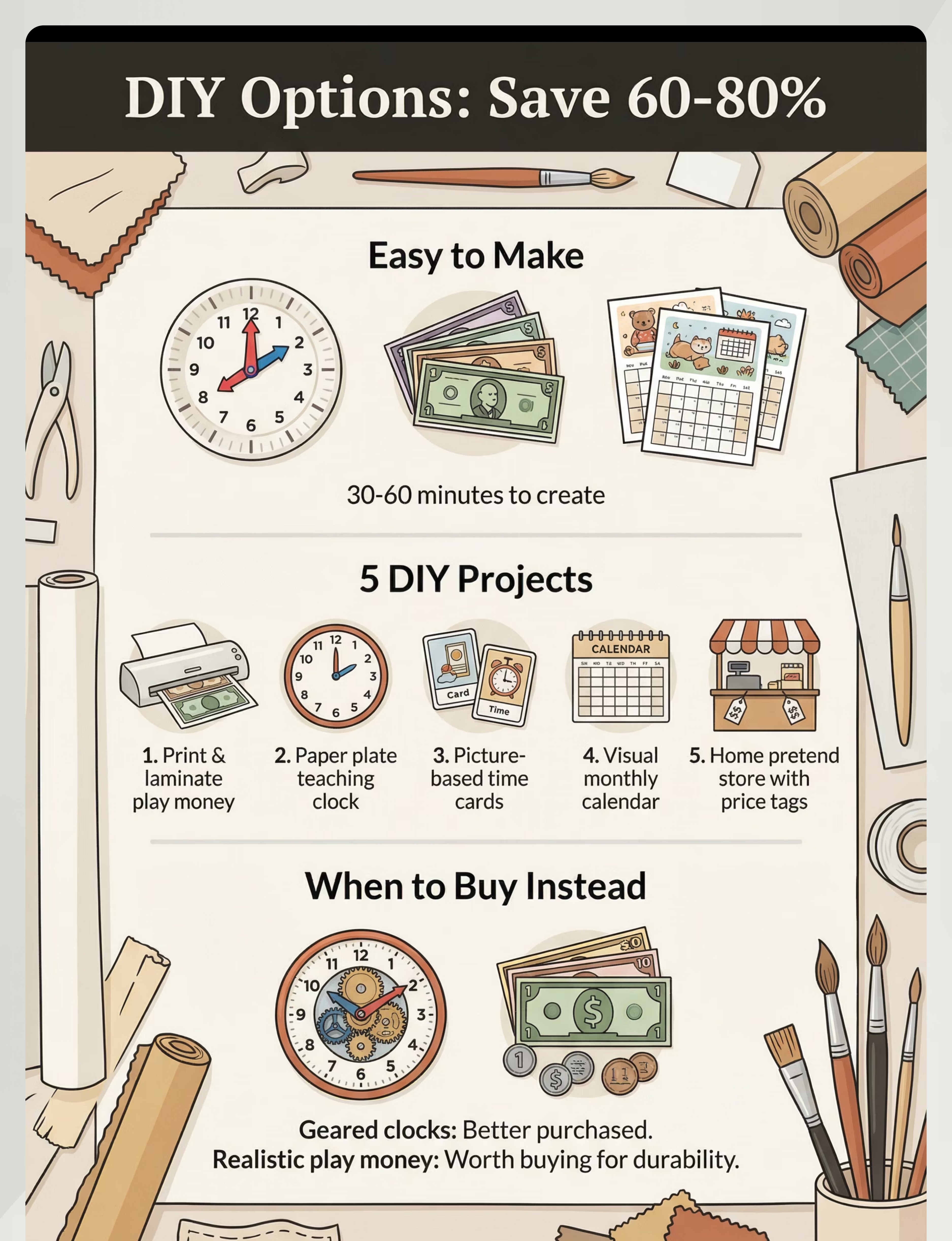
DIY Alternative (Save 60-80%)
Feasibility: High | Cost Savings: 60-80% | Time Investment: 30-60 minutes
Materials Needed
  • Printed play money images (search "printable Indian rupees")
  • Paper plates, brass fasteners for DIY clock
  • Calendar printables (free online templates)
  • Real coins for hands-on practice
  • Laminating pouches or clear contact paper
Step-by-Step Instructions
Create Play Money
Print Indian currency images in color, laminate or cover with contact paper for durability. Cut out individual notes and coins.
Make Teaching Clock
Use paper plate as clock face, mark hours, create moveable hour and minute hands with cardstock, attach with brass fastener in center.
Design Time Cards
Take photos of daily activities or find pictures, add time labels, laminate. Create "before/after" and "yesterday/tomorrow" card pairs.
Build Visual Calendar
Print monthly calendar template, add picture symbols for recurring activities, make it interactive with velcro or pockets.
Set Up Pretend Store
Use household items, create price tags, designate "store" area. Rotate inventory to maintain interest and practice variety.
Create Money Matching
Make coin value cards showing different ways to make amounts (e.g., "10 rupees = 2×5 or 10×1"), laminate for repeated practice.
DIY vs Commercial Comparison
When to DIY
  • Play money (can be printed effectively)
  • Visual calendars (customizable to your family)
  • Time vocabulary cards (personalize to child's life)
  • Pretend store setup (use actual household items)
When to Buy Commercial
  • Realistic play money (more durable, authentic feel)
  • Geared teaching clocks (mechanism is key feature)
  • Durable daily-use materials (withstand repeated handling)
  • Complete learning sets (comprehensive coverage)

Tradeoffs: DIY money is less realistic in texture and durability but serves learning purpose. Geared teaching clocks are genuinely worth purchasing—the mechanism that links the hands is critical for understanding clock relationships and difficult to replicate effectively at home.

Preview of money time concept tools Therapy Material

Below is a visual preview of money time concept tools therapy material. The pages shown help educators, therapists, and caregivers understand the structure and content of the resource before use. Materials should be used under appropriate professional guidance.

Page 1
Page 2
Page 3
Page 4
Page 5
Page 6
Page 7
Page 8
Page 9
Page 10
Page 11
Page 12
Page 13
Page 14
Page 15
Page 16
Page 17
Page 18
Page 19
Page 20
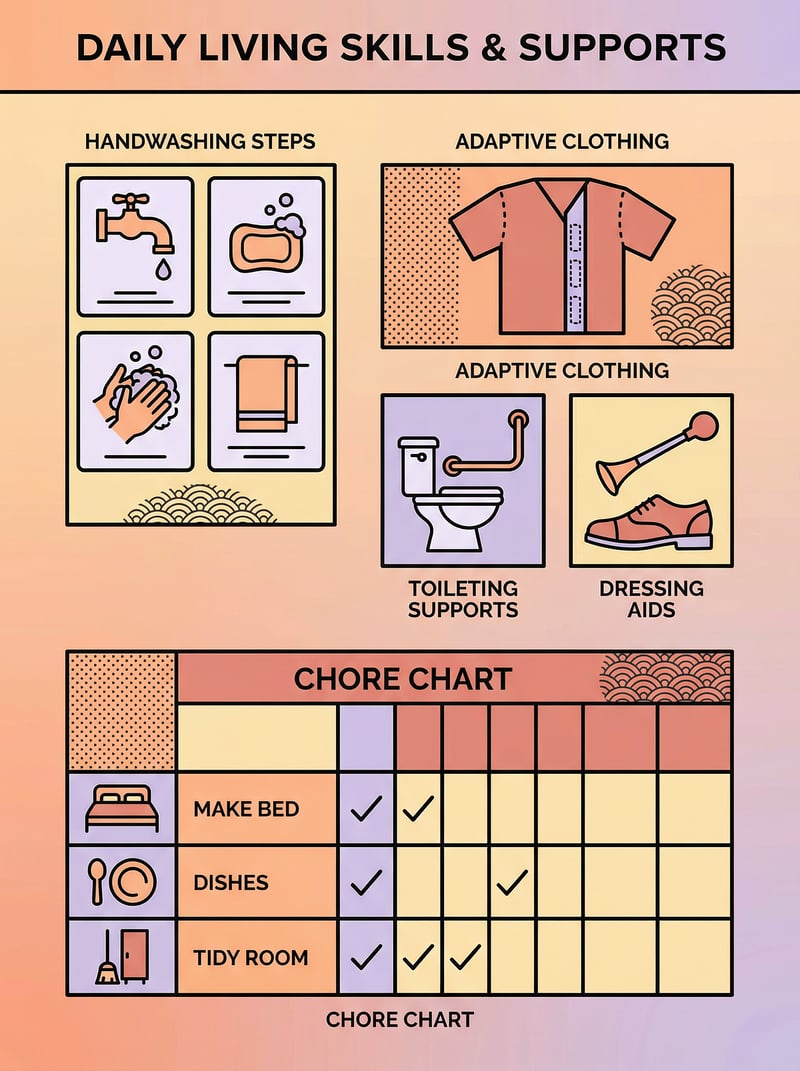
Daily Living Skills

Category 9: Daily Living Skills

8 MATERIALS

Tools and supports developing independence in self-care, hygiene, dressing, toileting, and household tasks. These materials break down complex daily routines into manageable steps, promoting skill acquisition and increasing independence in essential life activities.

Key Materials

  • Visual task analysis cards
  • Adaptive clothing and dressing aids
  • Toileting supports and schedules
  • Hygiene and grooming tools
  • Household task supports

Target Areas

  • Self-care skills
  • Independence
  • Hygiene
  • Dressing
  • Toileting
Money / Time Concept ToolsFunctional life skills tools supporting money recognition, financial literacy, and mathematical concept development across home, school, and therapy settings.
Link copied!
Measuring Success & Next Steps
Track Progress
  • Money recognition: coins, notes
  • Time-telling ability: digital, analog
  • Temporal vocabulary usage
  • Real-world application attempts
Set Goals
  • Child will identify [specific coins/notes]
  • Child will tell time to [hour/half-hour/minute]
  • Child will use temporal vocabulary correctly
  • Child will participate in [transaction type]
Monitor Success
  • Coin and note recognition improving
  • Basic time-telling emerging
  • Temporal understanding developing
  • Real-world application successful
  • Independence steadily increasing
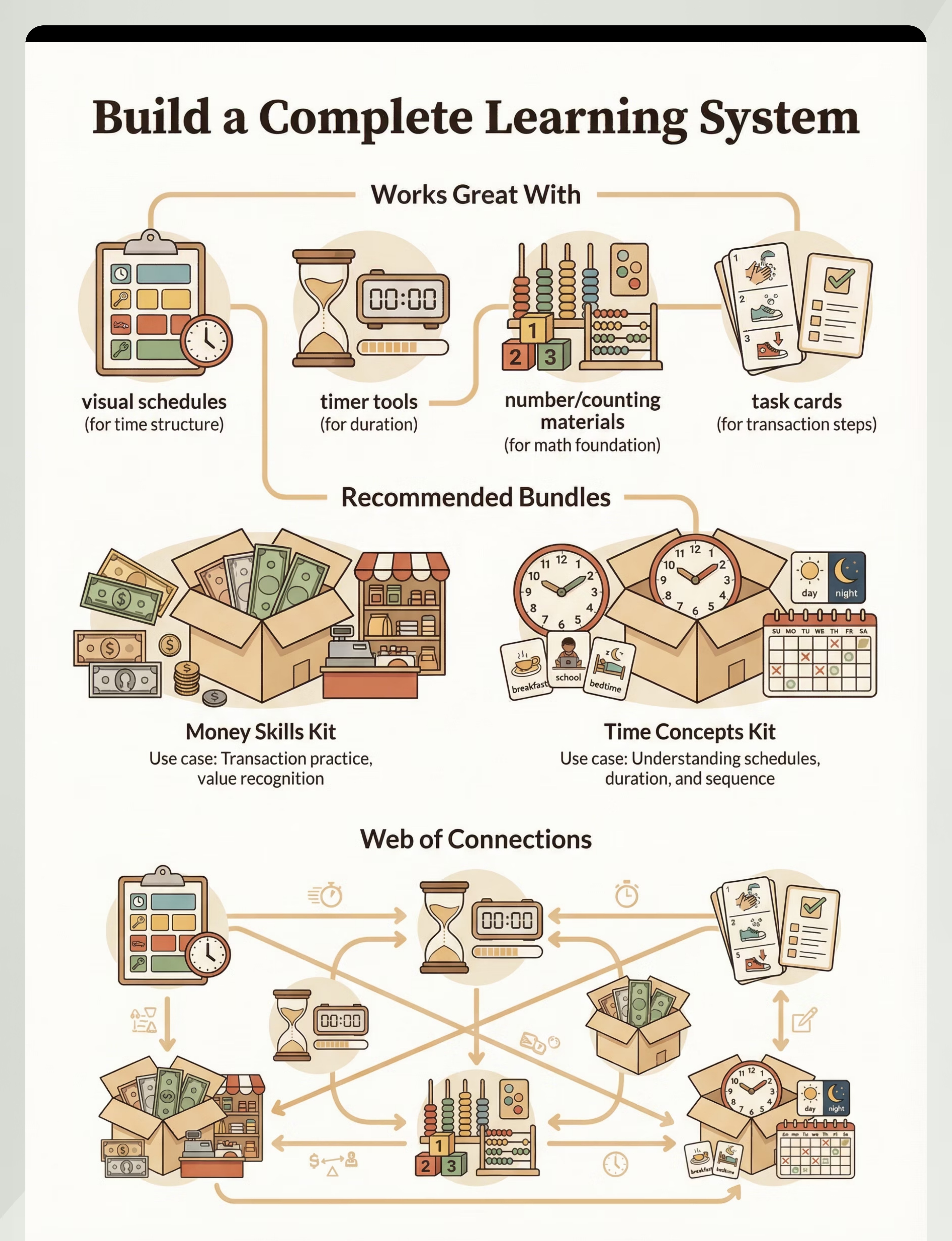
Complete the Kit
Pair money/time tools with complementary resources:
  • Number/Counting Tools
  • Visual Schedules
  • Timer Tools
  • Task Analysis Cards
Explore Bundles
  • Money Skills Kit (Recognition to application)
  • Time Concepts Kit (Vocabulary to clock reading)

Quick Summary
Money and time concept tools develop functional numeracy and temporal understanding essential for daily life through concrete materials, visual supports, and real-world practice opportunities. Core Kit (Rank 2), moderate-strong evidence base for effectiveness.
money
time
concepts
functional math
life skills
independence
ADL
SpEd
OT
core-kit
Common searches: money concepts autism, teaching clock, time telling special needs, play money India, functional math autism, life skills money time, temporal concepts

Get Support
FREE National Autism Helpline
Phone: 9100 181 181
Languages: 16+ languages supported
Website: pinnacleblooms.org
Connect with specialists who can guide your money and time concept teaching journey
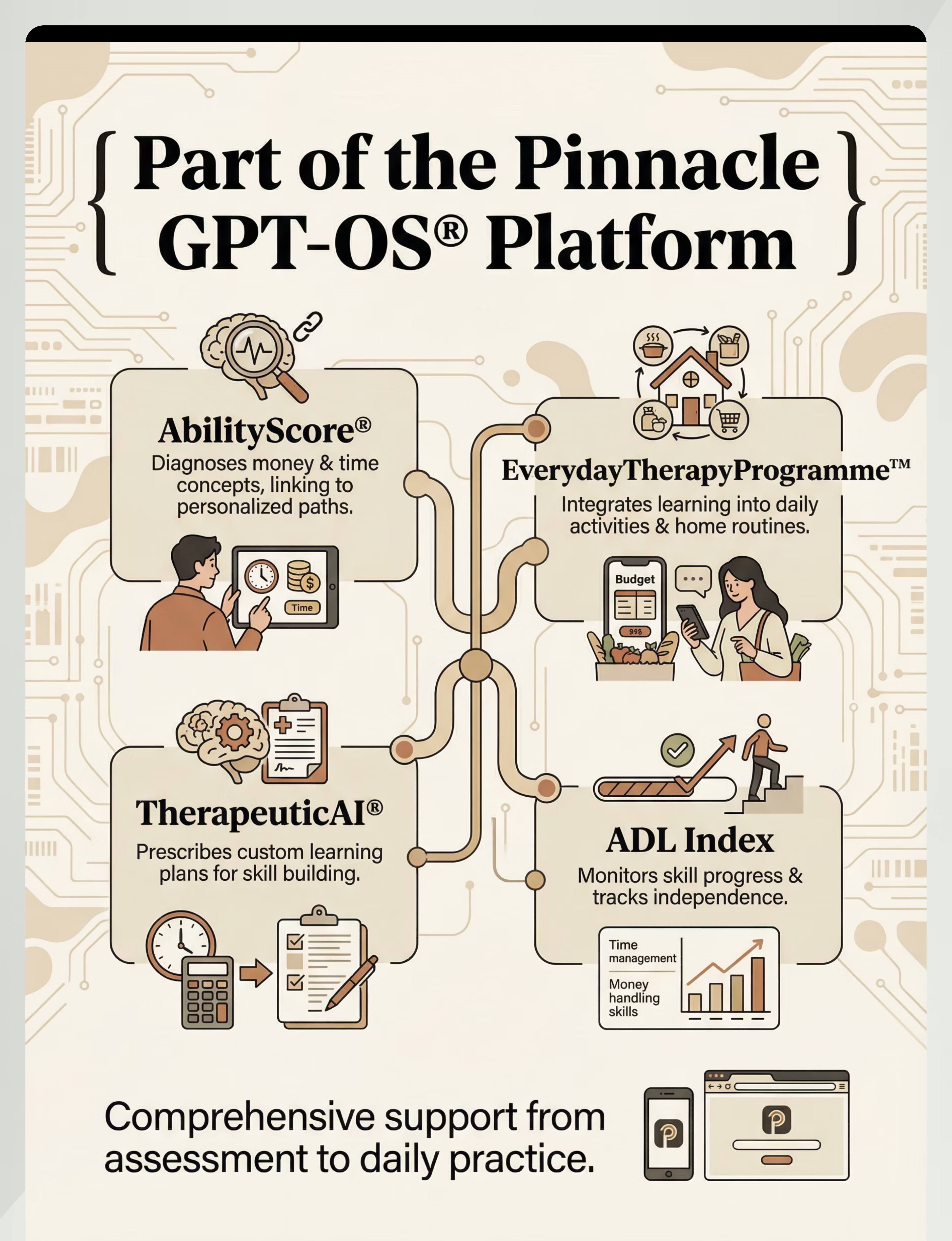
Integrated Platform Support
AbilityScore®: Identifies numeracy and temporal understanding patterns specific to your child
TherapeuticAI®: Prescribes functional math activities matched to developmental level
EverydayTherapyProgramme™: Includes money/time goals in daily routine
ADL Index: Tracks functional skills progress over time

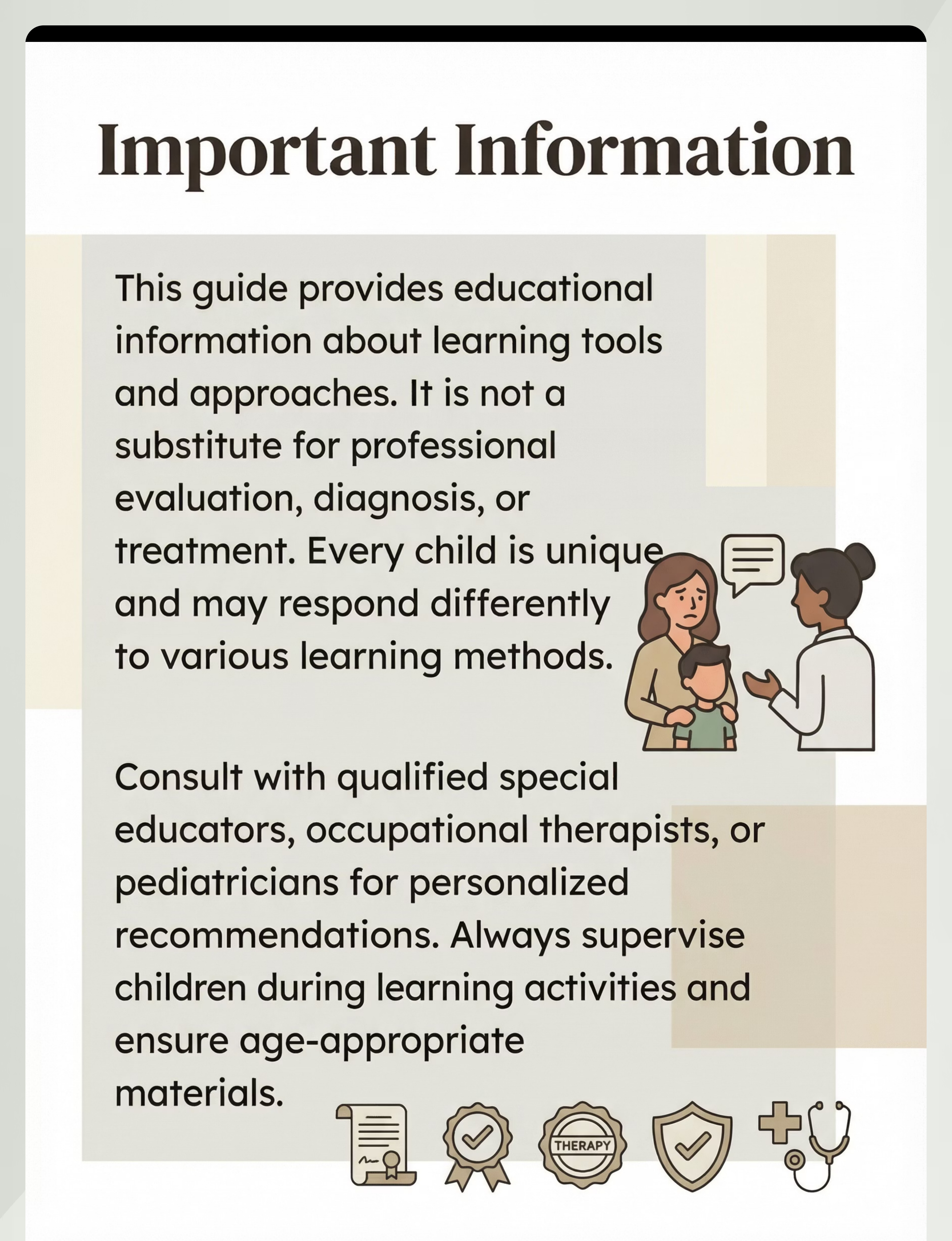
Disclaimer: This is educational information. Always consult qualified occupational therapists, speech-language pathologists, special educators, or pediatricians for individualized guidance. Individual results vary based on child's unique developmental profile, learning style, and family support context.