







Tool ID: 15.4
Tool ID: 15.4
SpEd + OT
Moderate Evidence
Rank #2
Weekly+ Use
₹100–1,500
Nature Exploration Tools
Nature engagement and discovery system
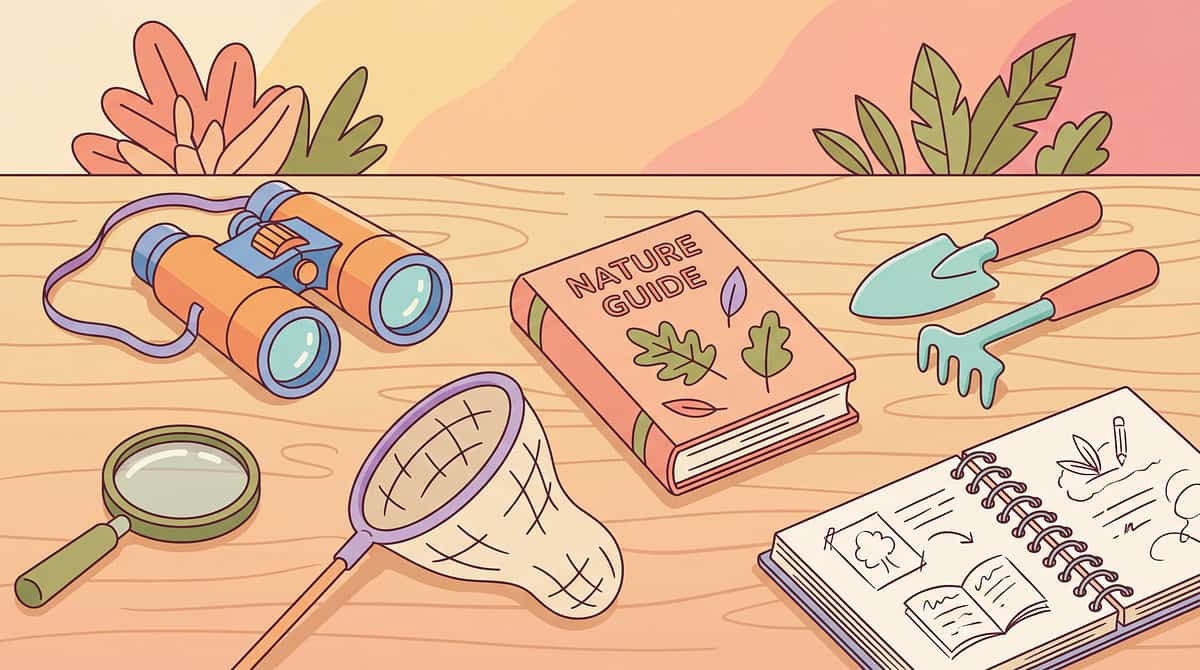
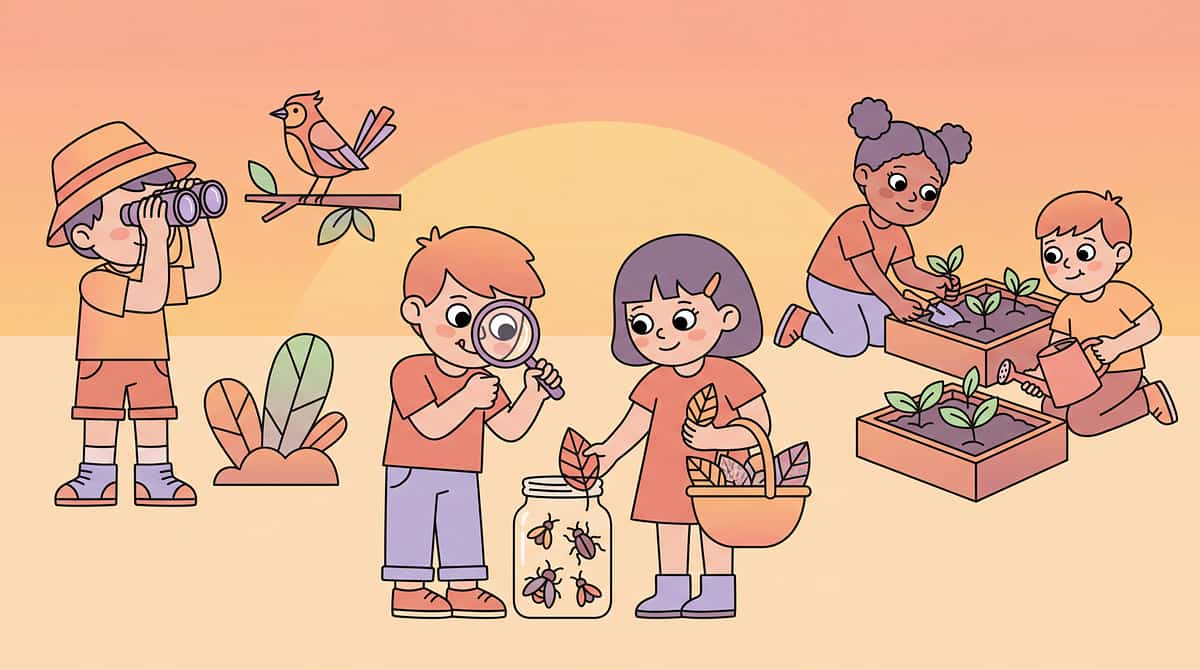
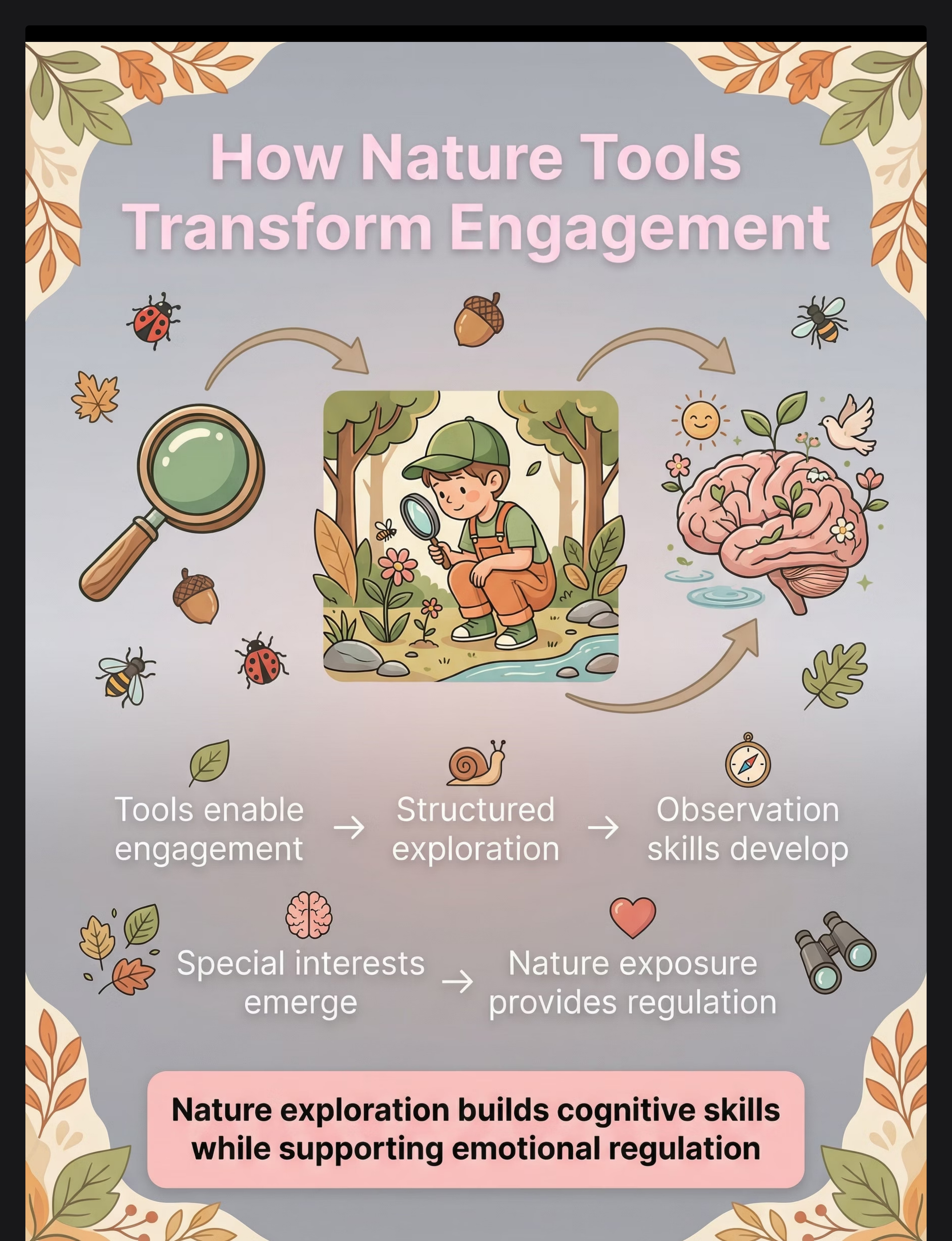
Transform outdoor time into purposeful discovery with child-friendly tools that unlock the wonders of nature. From magnifying glasses that reveal hidden insect worlds to binoculars that bring distant birds into view, these exploration tools provide structure and purpose for outdoor engagement. Perfect for building observation skills, developing special interests, and creating meaningful connections with the natural world.
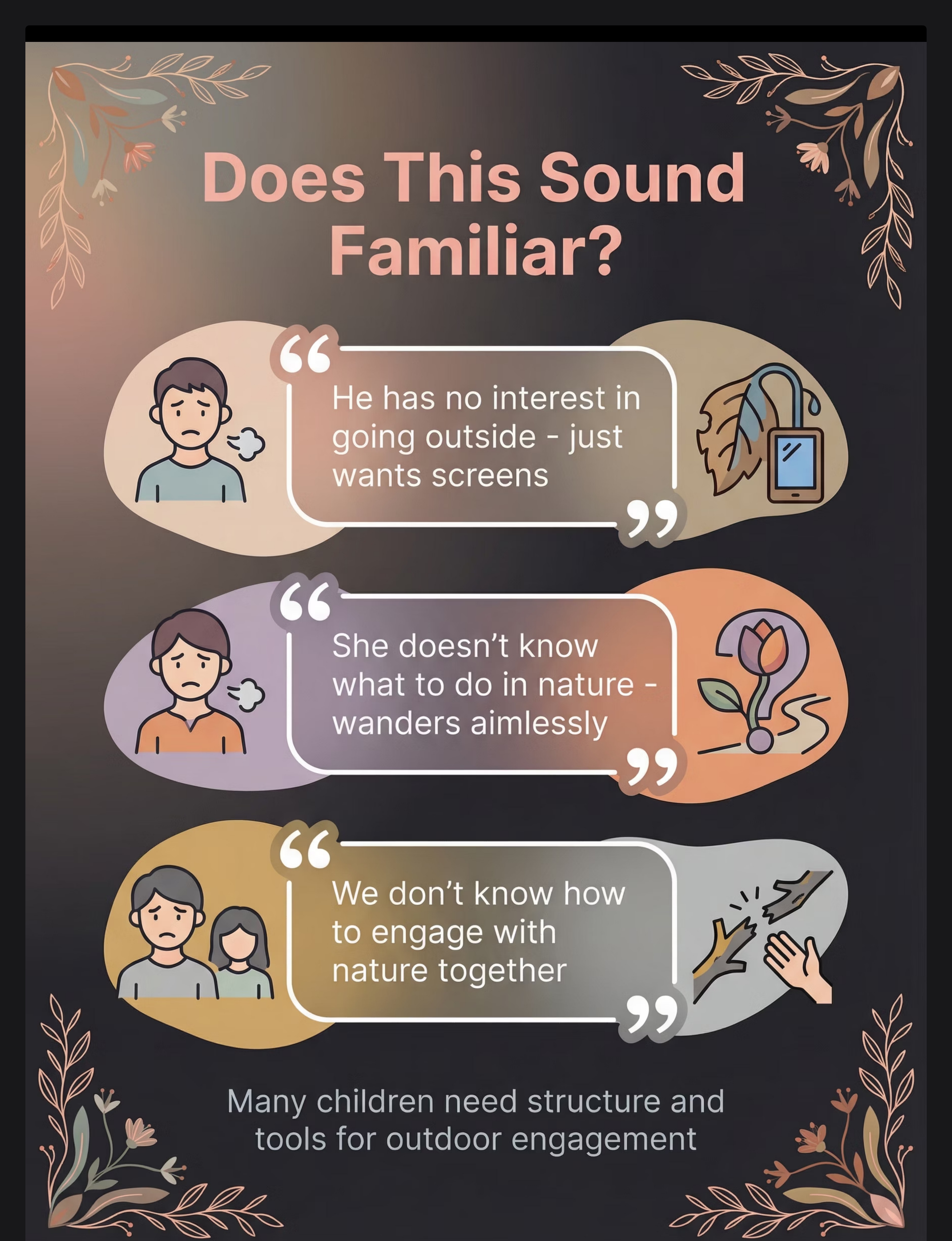
Does This Sound Familiar?
"He has no interest in going outside"
"She doesn't know what to do in nature"
"He needs structure even for outdoor play"
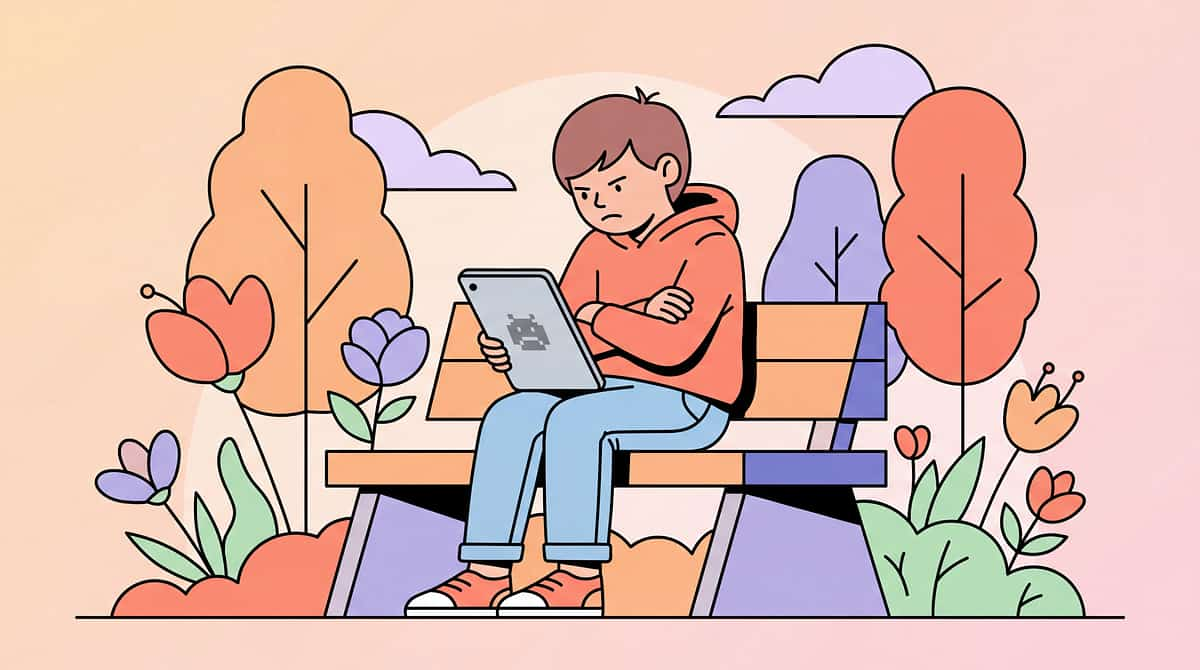
"She just wants screens - not nature"
"He wanders aimlessly outside"
"We don't know how to engage with nature"
You're not alone. These are common challenges families face when trying to help their children connect with the outdoors. Nature exploration tools provide the structure, purpose, and engagement that can transform outdoor time from resistant to rewarding.
A Day Without the Right Support
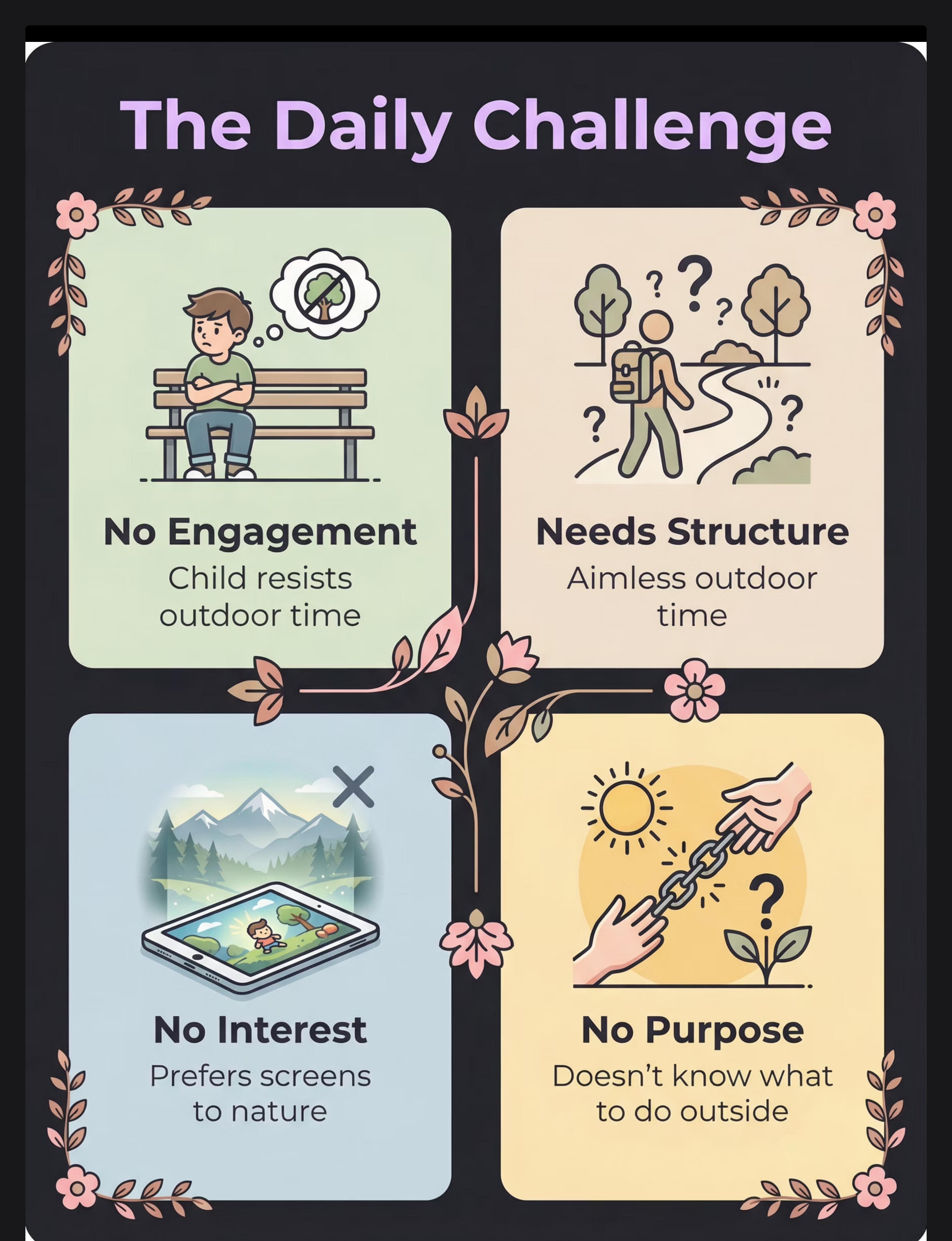
No Engagement
Morning: Child resists going outside. Prefers staying indoors with screens. Outdoor time feels like a battle.
No Structure
Afternoon: When finally outside, child doesn't know what to do. Wanders aimlessly. No purpose or direction for the time.
No Interest
Evening: Brief time outside ends quickly. Child wants to come back in immediately. No apparent interest in nature. Missing out on outdoor benefits.
No Purpose
Bedtime: Another day without meaningful outdoor engagement. Parents feel they're failing. Child missing calming benefits of nature connection.
How to Use It Right
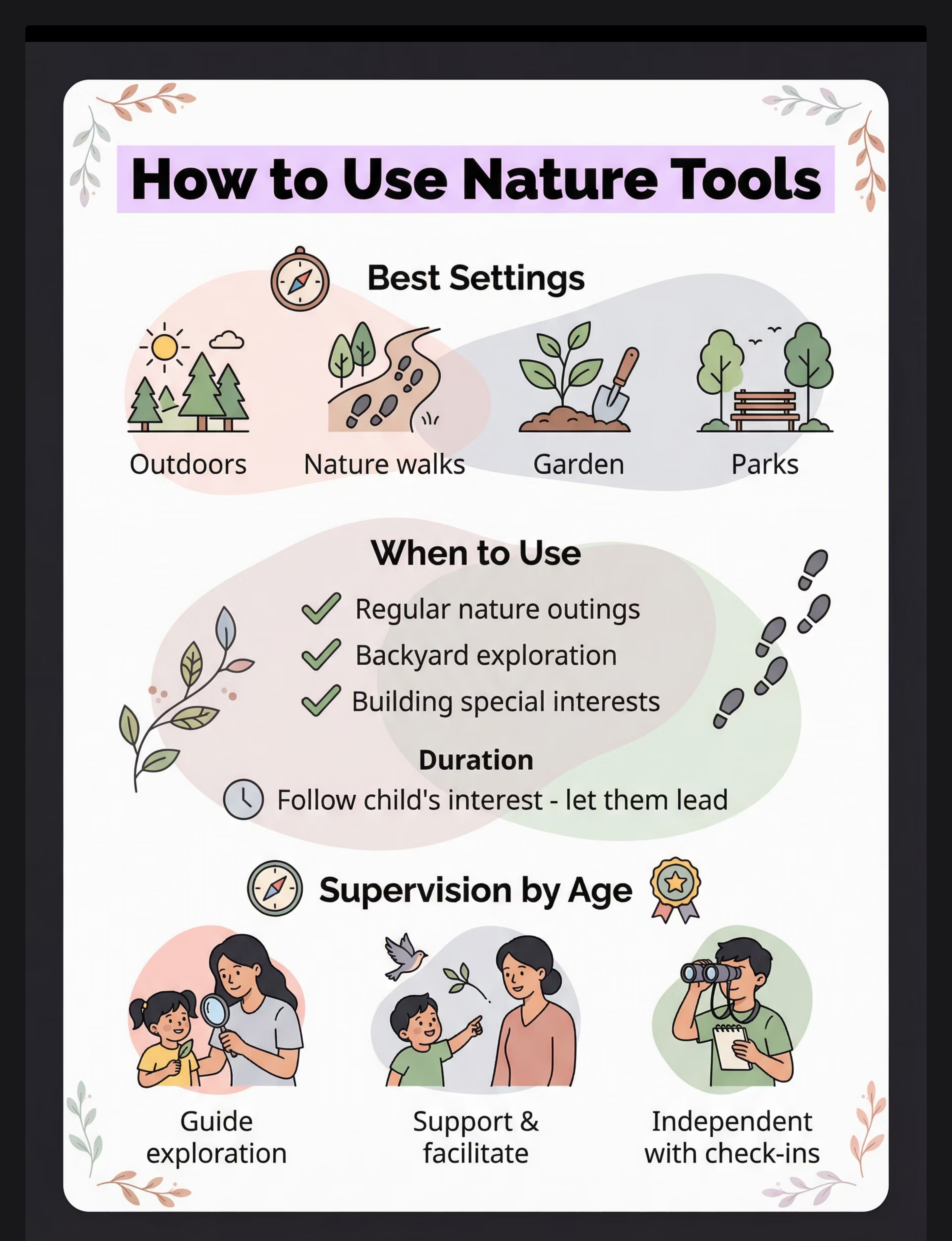
Follow child's interests
Let curiosity guide exploration. If they're drawn to insects, focus there. If plants fascinate them, follow that path.
Make nature walks structured if needed
Create scavenger hunts or collection goals. Use visual schedules for outdoor time. Build predictable routines around exploration.
Use visual supports for nature activities
Picture cards showing what to find. Visual guides for using tools. Charts for recording discoveries.
Collect and classify
Builds cognitive skills through sorting, categorizing, and organizing natural specimens. Creates concrete learning experiences.
Connect to special interests if possible
Link nature exploration to existing passions. Use special interests as bridge to outdoor engagement.
Regular nature time in routine
Consistent outdoor exploration becomes expected and comfortable. Duration: Variable - follow child's interest level and engagement.
Expert Perspective
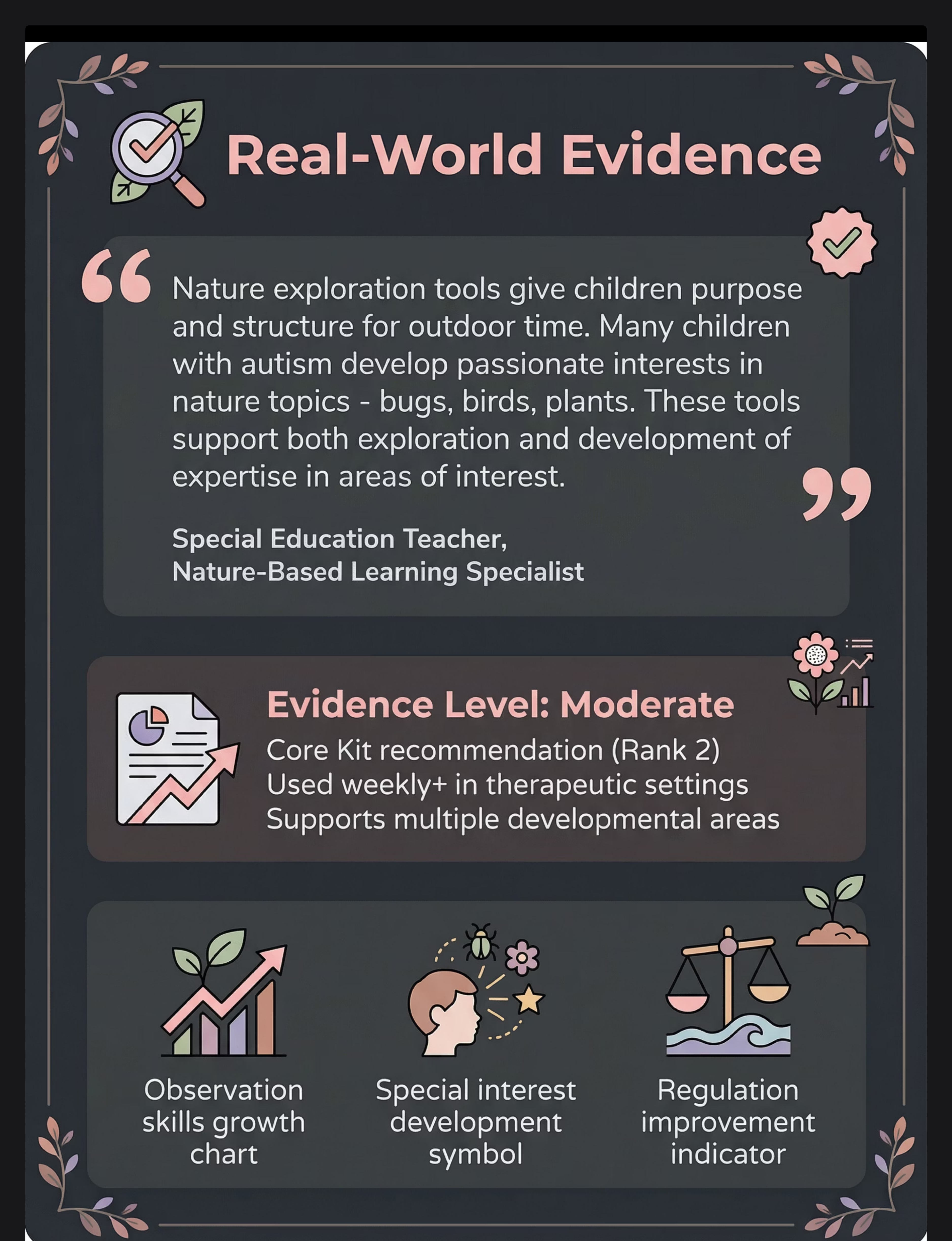
"Nature exploration tools give children a purpose and structure for outdoor time. Many children with autism develop passionate interests in nature topics - bugs, birds, plants. These tools support both the exploration and the development of expertise in areas of interest."
— Special Education Teacher, Nature-Based Learning Specialist
SpEd + OT Recommended
Moderate Evidence
Rank #2 in Category
Weekly+ Use Frequency
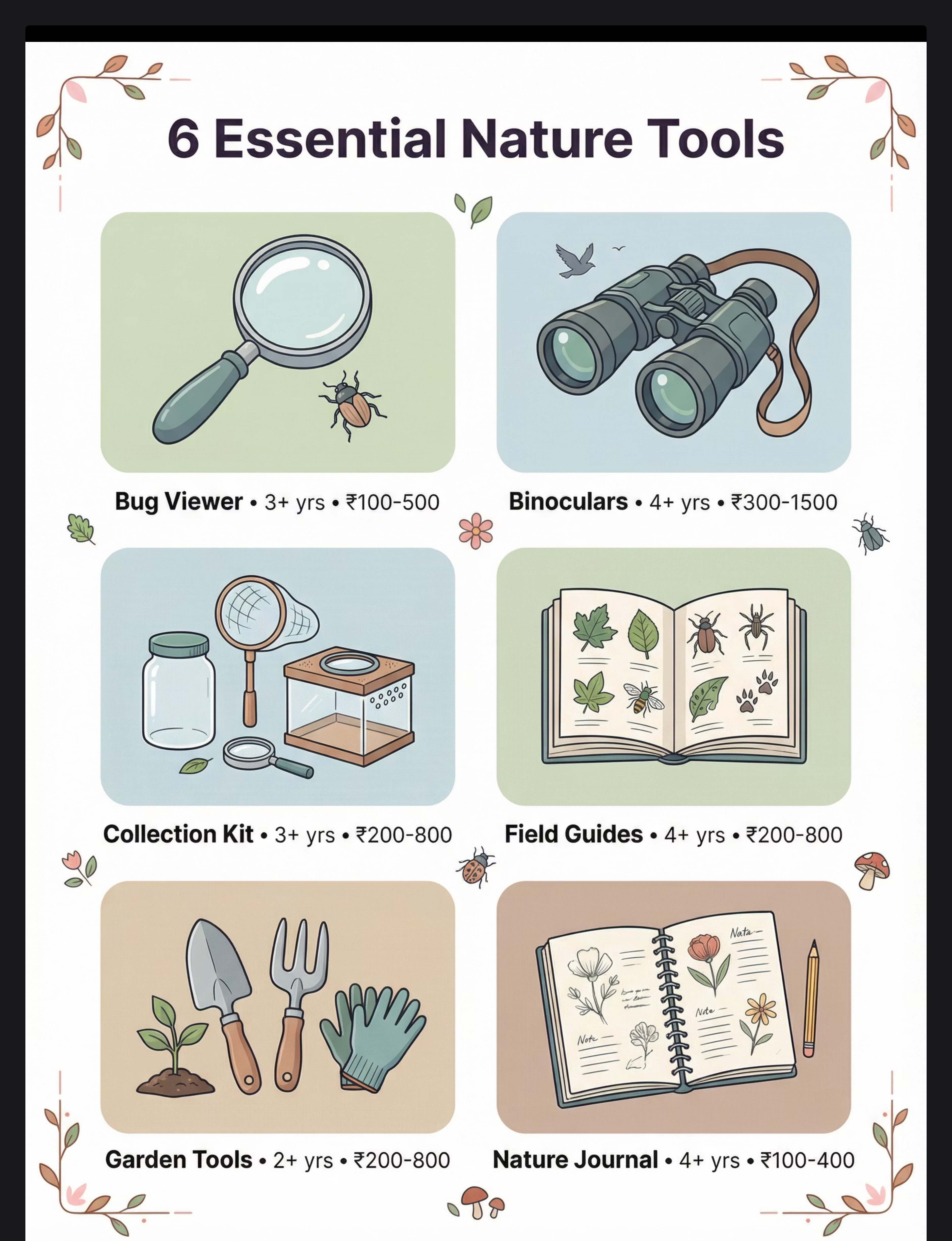
Choose Your Option (6 Variants)
Each variant serves different exploration needs - from close-up insect examination to distance bird watching, from specimen collection to documentation. Choose based on your child's interests, developmental level, and the types of nature activities that engage them most.
1
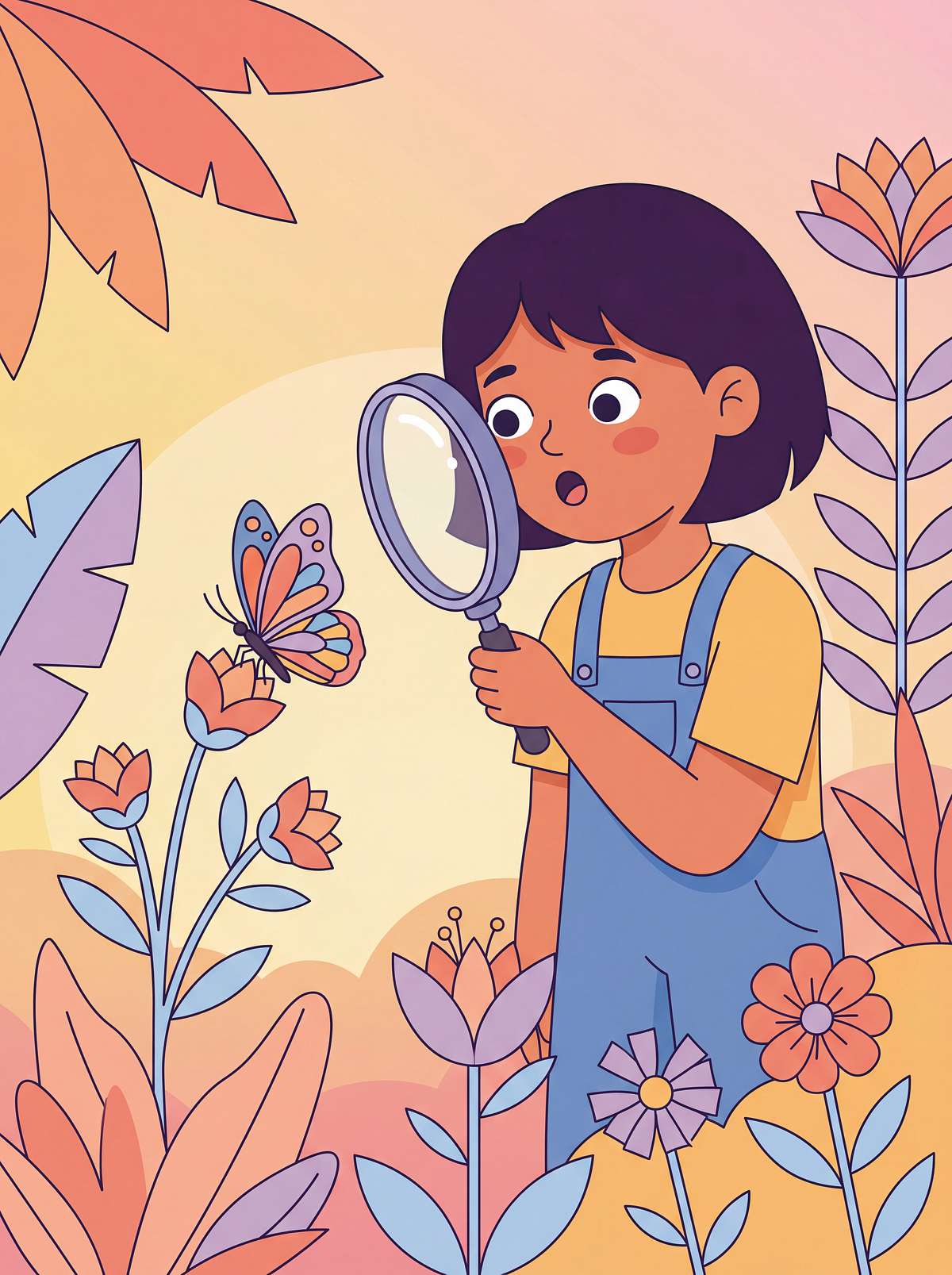
Magnifying Glass / Bug Viewer
Best for: Examining insects, plants, details
Ages: 3+ years | Settings: Outdoors, Nature walks
Portability: Very High
Price: ₹100–500
2
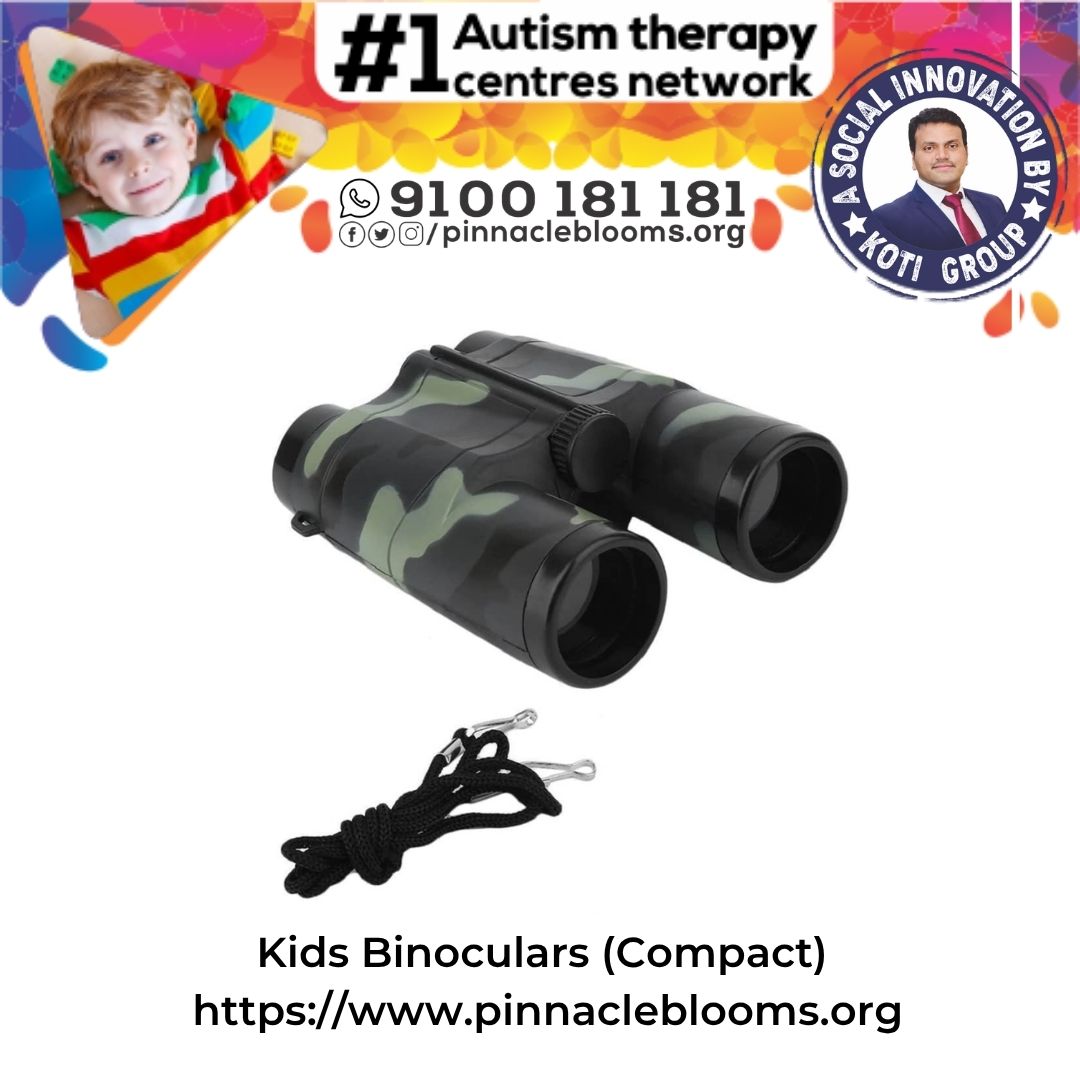
Binoculars (Child)
Best for: Bird watching, distance viewing
Ages: 4+ years | Settings: Outdoors, Nature walks
Portability: High
Price: ₹300–1,500
3
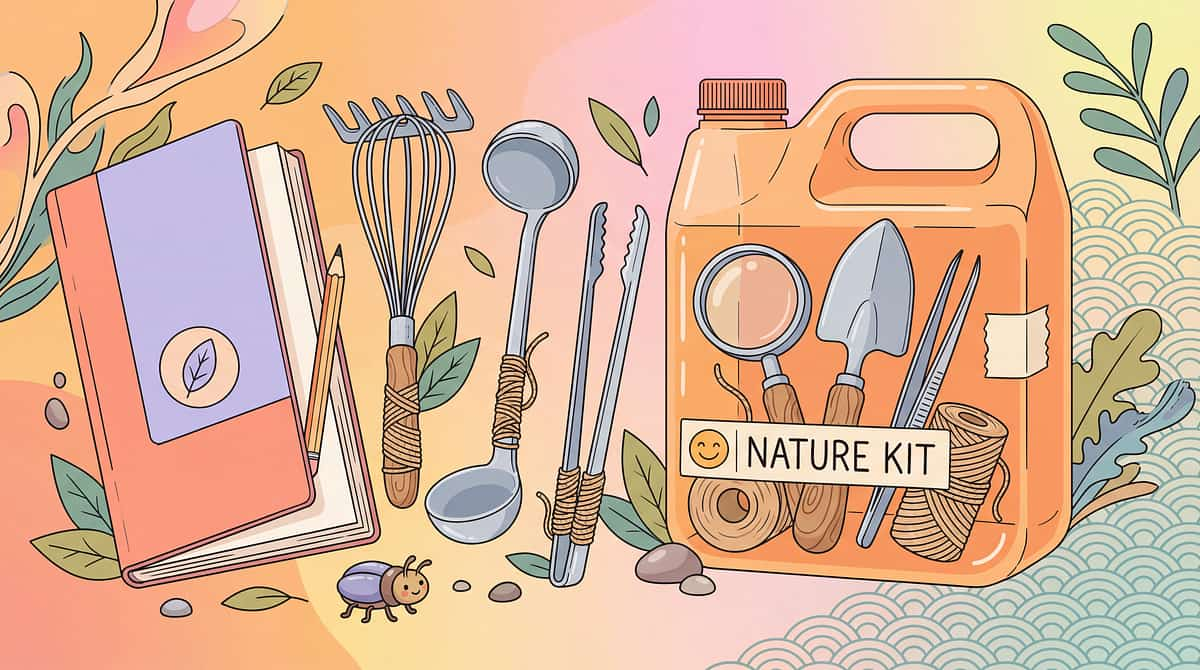
Nature Collection Kit
Best for: Collecting leaves, rocks, specimens
Ages: 3+ years | Settings: Outdoors, Nature walks
Portability: High
Price: ₹200–800
4
Field Guides (Child-Friendly)
Best for: Learning about birds, plants, insects
Ages: 4+ years | Settings: Outdoors, Home
Portability: Medium
Price: ₹200–800
5
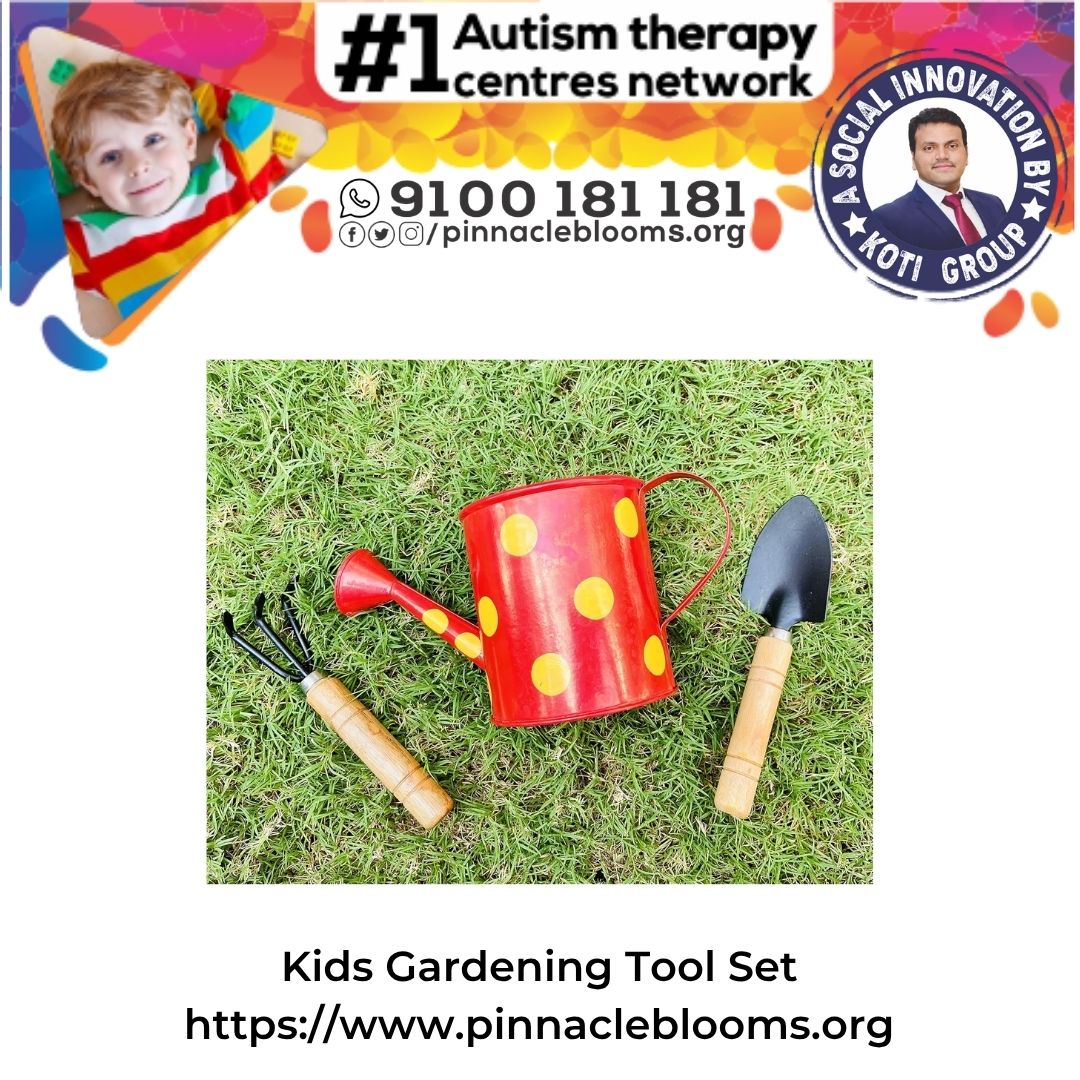
Gardening Tools (Child)
Best for: Planting, digging, caring for plants
Ages: 2+ years | Settings: Garden, Backyard
Portability: Medium
Price: ₹200–800
6
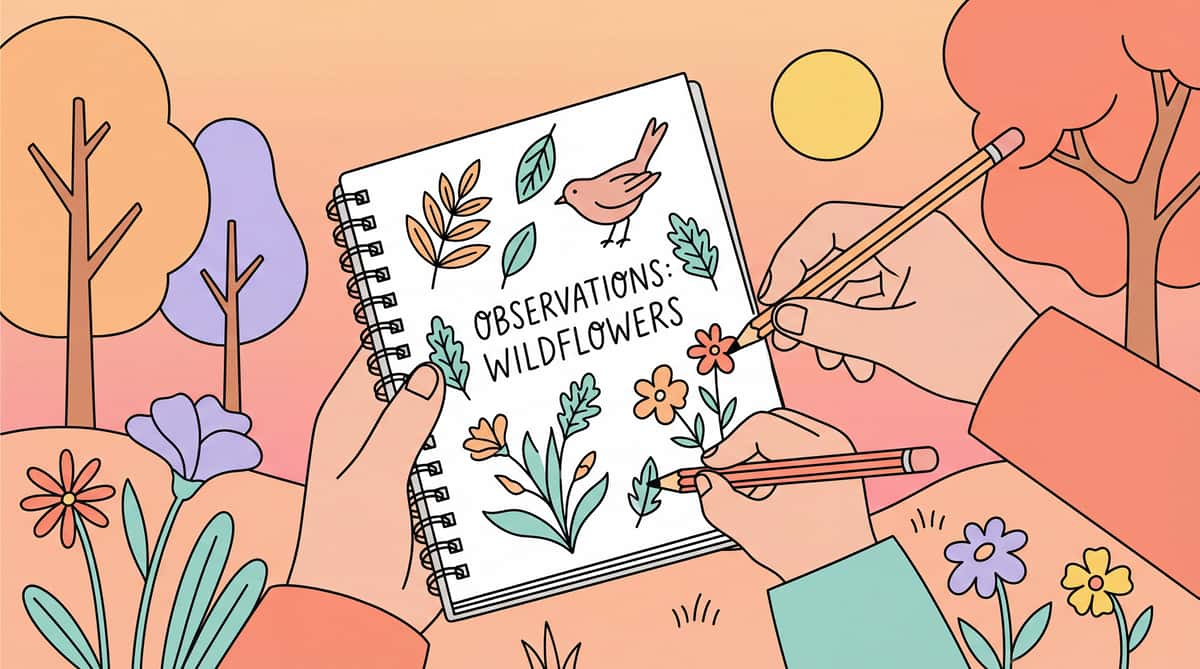
Nature Journal / Scrapbook
Best for: Drawing, pressing leaves, recording
Ages: 4+ years | Settings: Outdoors, Home
Portability: High
Price: ₹100–400

How to Choose
By goal: Close observation (magnifier) • Distance viewing (binoculars) • Collection (kit) • Documentation (journal) • Active engagement (gardening)
By setting: Nature walks (portable tools) • Garden (gardening tools) • Home follow-up (journal, guides)
By portability: Very high (magnifier) • High (collection kit, journal, binoculars) • Medium (guides, gardening tools)
Specifications & Exploration Types
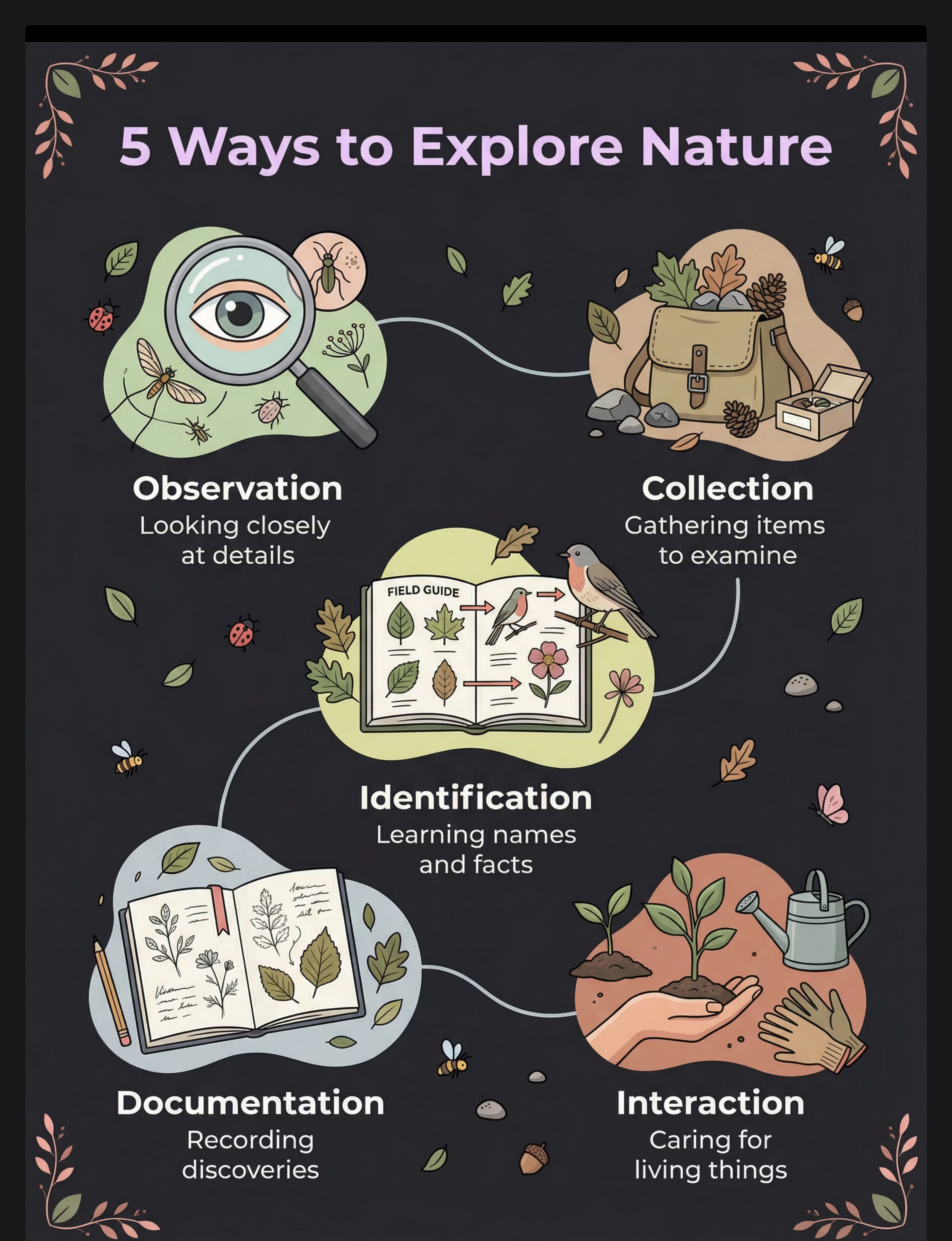
Exploration Types
Observation
Magnifying glasses and binoculars for looking closely at details or viewing from distance
Collection
Gathering specimens like leaves, rocks, insects for closer examination and study
Identification
Using field guides to match findings, learn names, and build knowledge
Documentation
Journals, photos, and pressing leaves to record and remember discoveries
Interaction
Gardening and caring for plants to actively engage with living things
Materials & Features
Materials
  • Plastic/glass for optical tools (magnifiers, binoculars)
  • Fabric for collection bags and pouches
  • Metal/plastic for durable gardening tools
  • Paper for journals and field guides
Key Features
  • Child-sized: Appropriately scaled for small hands and bodies
  • Durable: Built to withstand outdoor use and exploration
  • Engaging: Designed to capture and maintain interest
  • Interest development: Tools that support growing expertise in nature topics
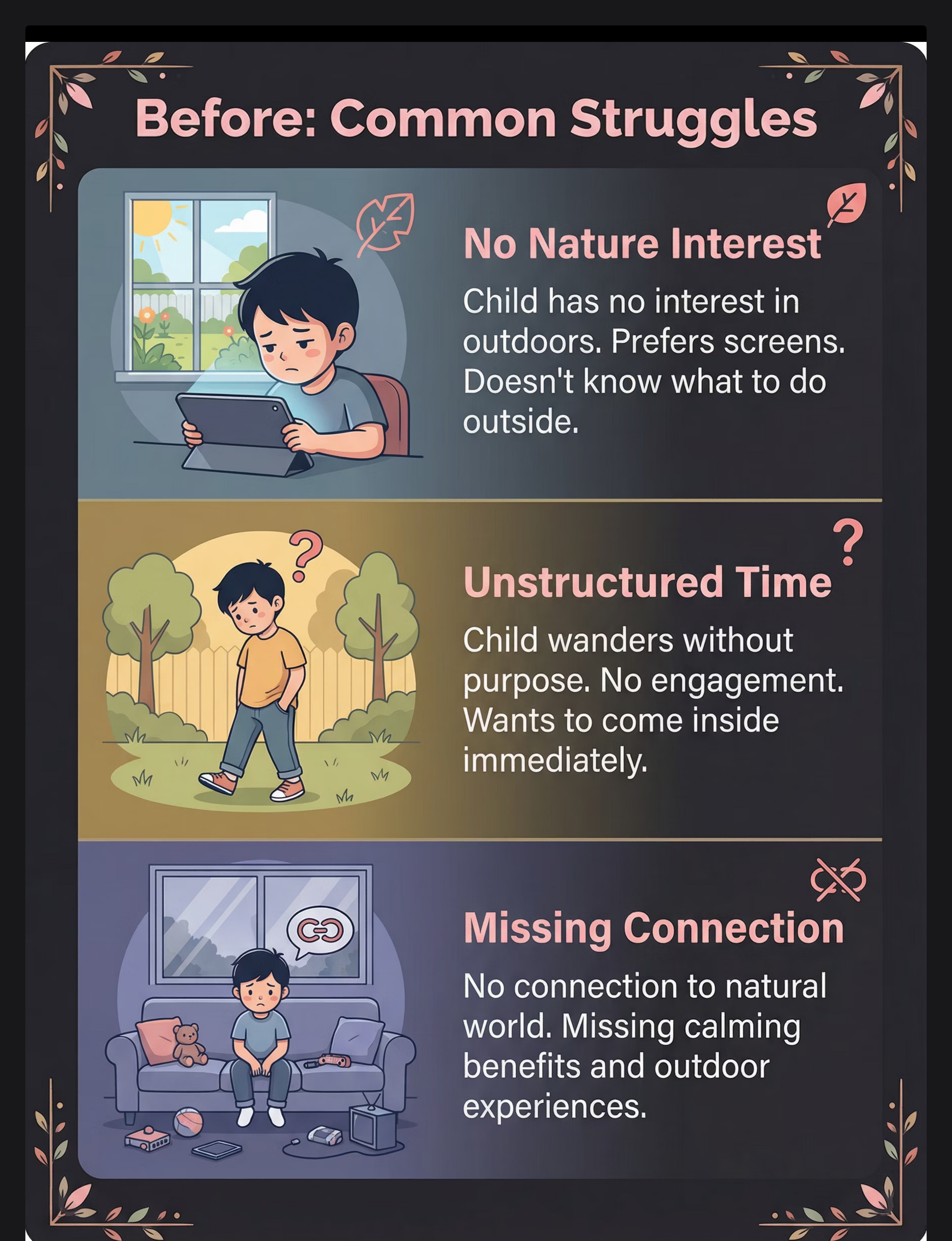
The Struggle (Before)
No Nature Interest
Situation: Child has no interest in outdoors. Prefers screens. Doesn't know what to do outside. Nature time resisted.
Experience: Every attempt to go outside met with resistance. Child immediately wants to return indoors. Missing out on outdoor benefits.
Emotion:Disinterest, resistance
Unstructured Outdoor Time
Situation: Child wanders aimlessly outside. No purpose or engagement. Time feels wasted. Wants to come in immediately.
Experience: Brief outdoor periods that lack direction. Child doesn't know what to look for or do. Parents frustrated by lack of engagement.
Emotion:Aimless, unengaged
Missing Nature Connection
Situation: Child has no connection to natural world. Missing calming benefits. No outdoor interests. Limited experiences.
Experience: Growing up disconnected from nature. Missing opportunities for regulation through outdoor time. No pathway to nature-based interests.
Emotion:Disconnected, limited
Is This Right for My Child? (2-Minute Check)
Answer these questions to determine if nature exploration tools would benefit your child. Three or more "yes" answers suggest a strong fit.
Does your child have tools for nature exploration?
If yes: Good - focus on optimizing use and expanding toolkit as interests develop
If no: Consider starting with basic nature exploration tools to enable structured outdoor engagement
Does your child need structure for outdoor activities?
If yes: Tools and structured activities will provide purpose and direction for outdoor time, making it more engaging and meaningful
Does your child have any nature-related interests?
If yes: Build on these existing interests with appropriate tools to deepen engagement and expertise
If no: Explore different nature topics with various tools to discover what captures their attention
Would your child benefit from regular nature time?
If yes: Tools can facilitate meaningful engagement with the natural world and unlock the calming, regulatory benefits of outdoor time

Scoring: Three or more "yes" answers indicate that nature exploration tools would be a valuable addition to your child's outdoor experiences.
Safety First
Critical Safety
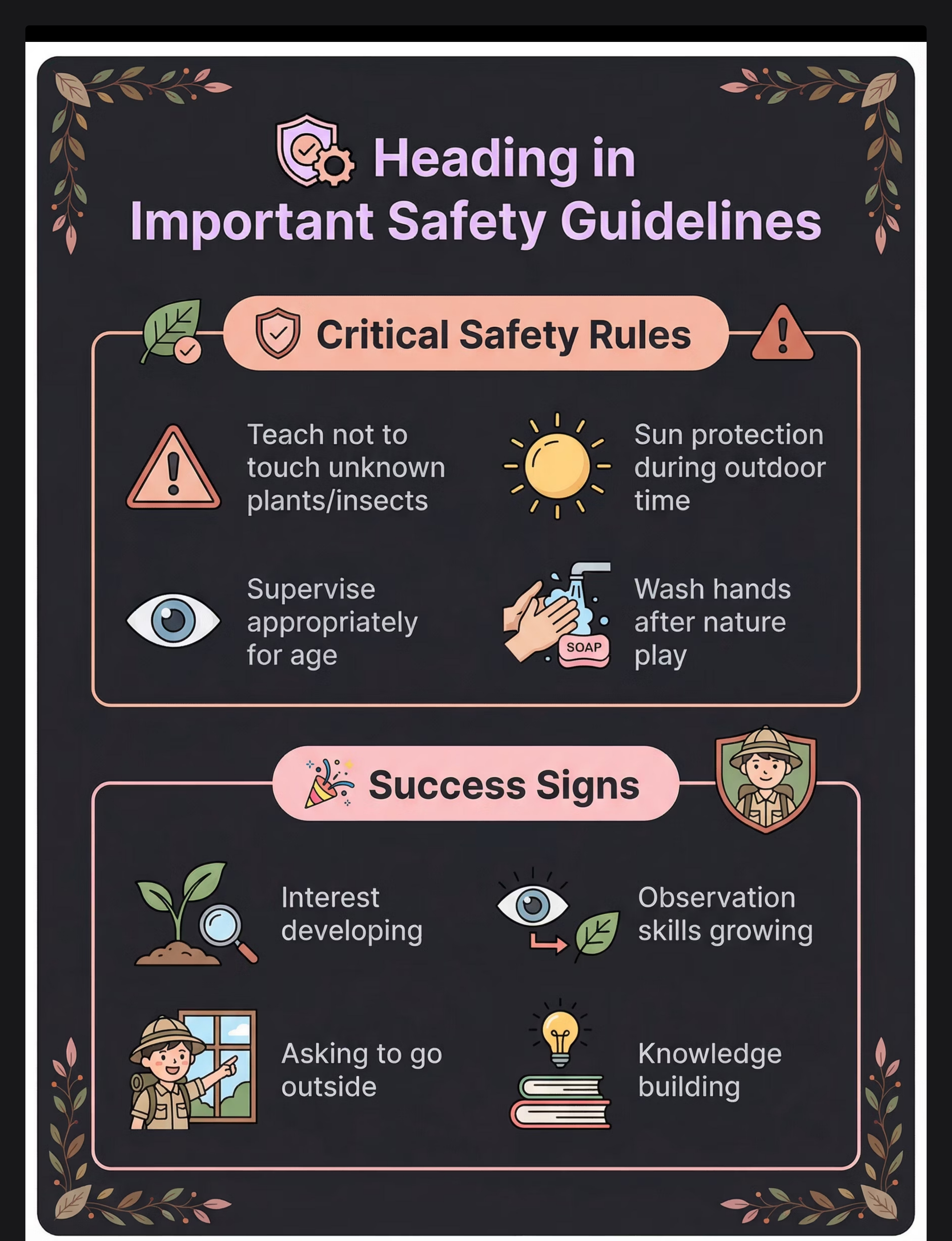
  • Teach child not to touch unknown plants or insects until identified
  • Apply sun protection during outdoor exploration time
  • Supervise appropriately based on age and setting
  • Ensure hands are washed thoroughly after nature play
Important Warnings
  • Some insects can sting or bite - teach safe observation
  • Some plants are irritating or poisonous - identification is key
  • Allergies may be triggered by certain plants or insects
  • Weather awareness - heat, cold, storms require different precautions
Contraindicated / Never Do

  • Never: Collect or handle potentially harmful specimens
  • Never: Allow unsupervised exploration in unfamiliar areas
Safety Checklists
Before Use
  • ✓ Tools in working condition
  • ✓ Sun/weather protection ready
  • ✓ Safety rules reviewed with child
  • ✓ Activity planned (if structure needed)
During Use
  • ✓ Child engaged in exploration
  • ✓ Safe specimen handling practiced
  • ✓ Appropriate supervision maintained
  • ✓ Child enjoying activity
Signs of Success
  • ✓ Nature interest developing
  • ✓ Observation skills growing
  • ✓ Child asking to go outside
  • ✓ Knowledge building over time
Common Questions (Honest Answers)
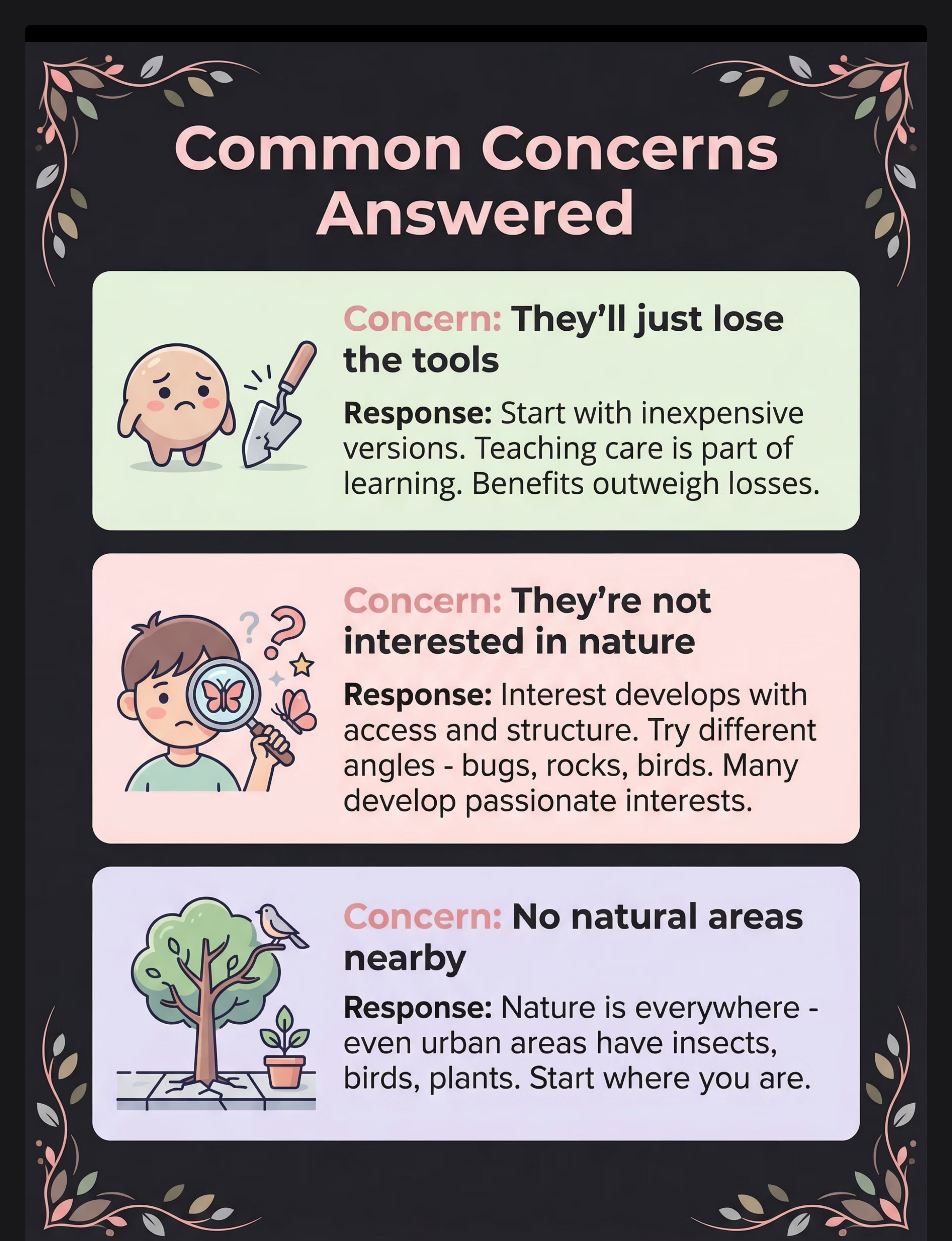
Q: They'll just lose or break the tools
A: Start with inexpensive versions while your child learns. Teaching tool care is part of the learning process. Benefits far outweigh the cost of replacing occasional lost items. As responsibility grows, invest in higher quality tools.
Try this: Begin with inexpensive versions, teach care routines, and replace as needed while skills develop.
Q: They're not interested in nature
A: Interest often develops once children have access to tools and structure for engagement. Try different angles - bugs, rocks, birds, plants. Follow any spark of curiosity. Many children develop passionate interests in nature topics once they discover them.
Try this: Provide access to various tools, try different nature topics, and follow any spark of interest that emerges.
Q: We don't have natural areas nearby
A: Nature exists everywhere, even in urban settings. Insects, birds, and plants can be found in any neighborhood. Garden pots on balconies count. Even small parks offer exploration opportunities. Start exactly where you are.
Try this: Look for nature in your immediate area - urban nature counts, start small with what's accessible.
Q: I don't know anything about nature myself
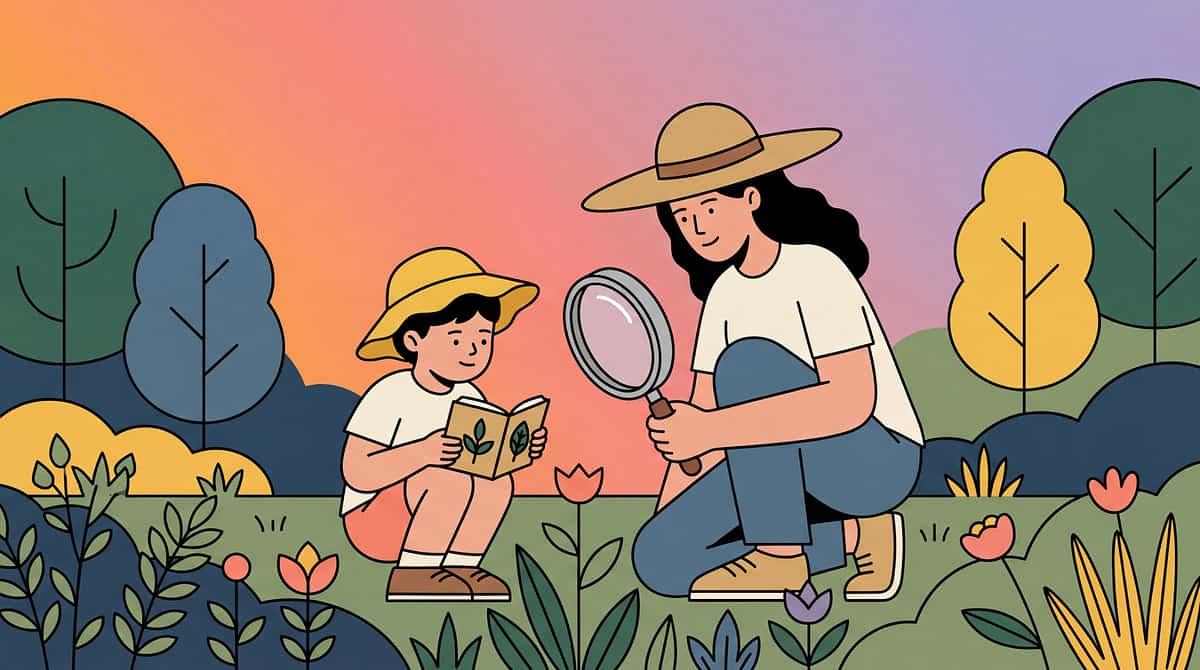
A: Perfect - learn together! Apps can identify plants and birds. Field guides are designed for beginners. Your child might become the expert and teach you. The joy is in shared discovery.
Try this: Use apps and guides to learn together, let your child potentially lead, embrace shared discovery.
Investment Guide
Nature exploration tools are among the most affordable therapeutic resources, with options ranging from ₹100 to ₹1,500. Start with basic tools and expand based on your child's developing interests.
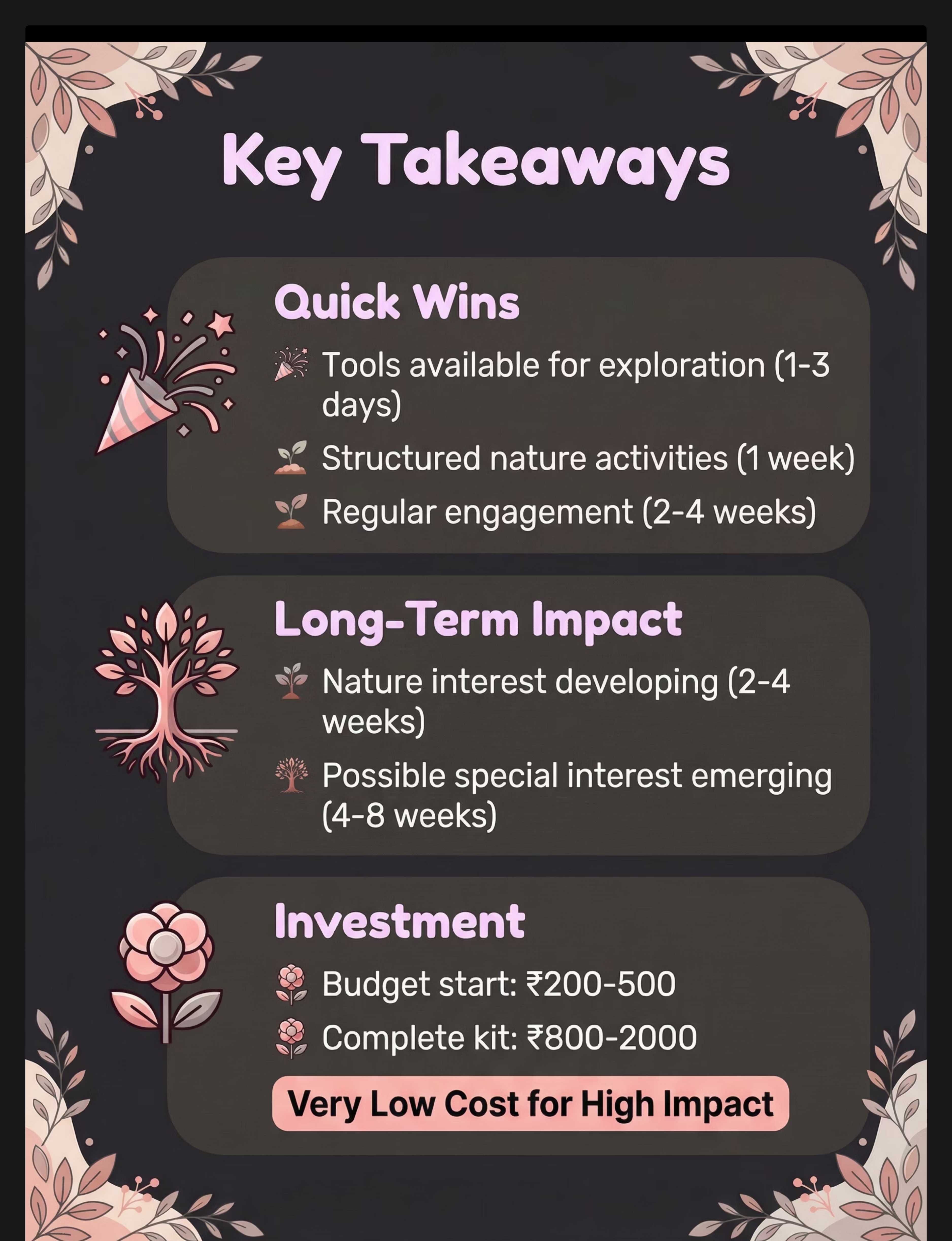
Budget Option
Essential Starting Kit
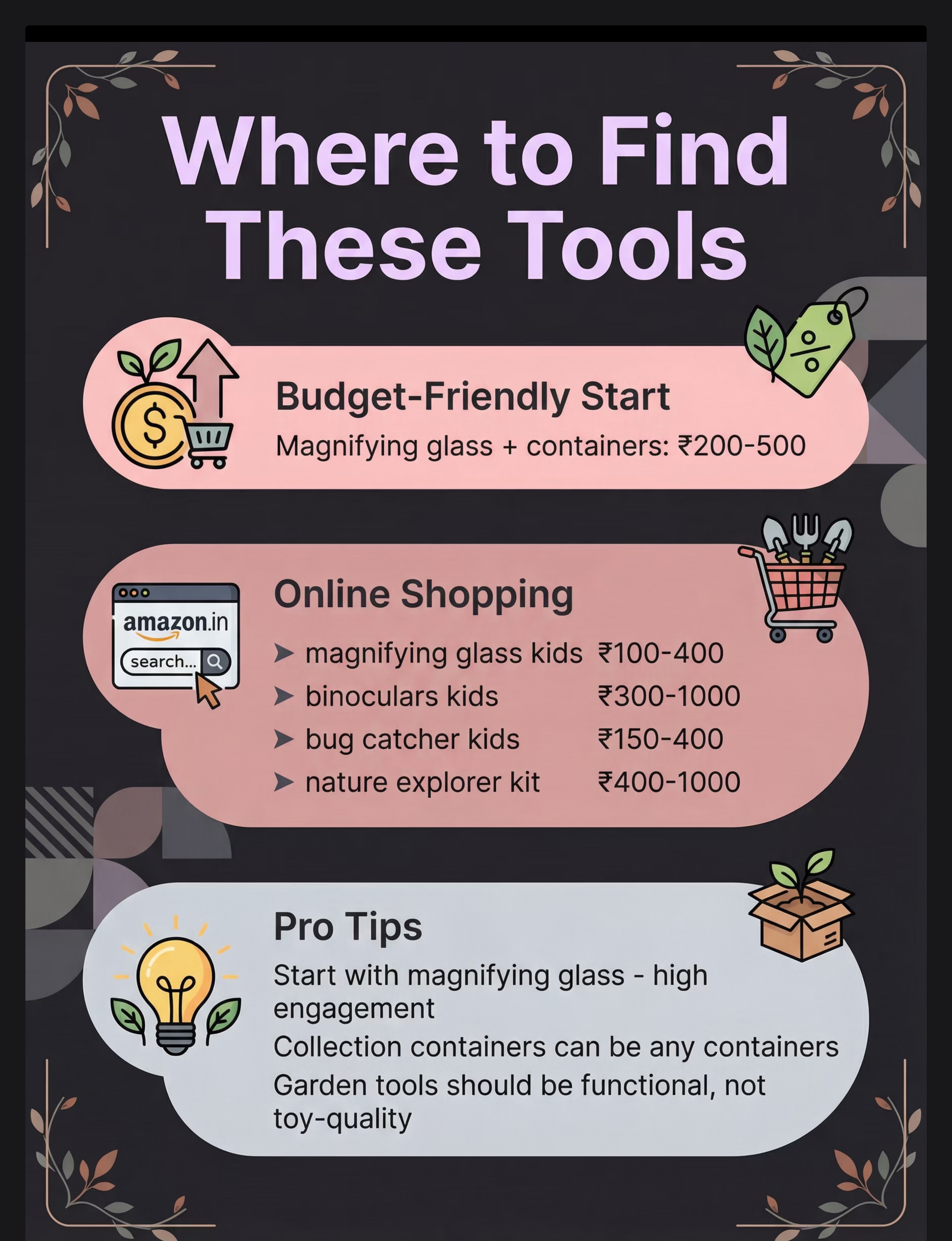
Items: Magnifying glass + collection containers
Investment: ₹200-500
Best for: Testing interest, starting exploration journey, providing basic structure for outdoor time
Premium Option
Complete Nature Kit
Items: Binoculars, magnifier, collection tools, nature journal
Investment: ₹800-2,000
Best for: Comprehensive exploration, multiple nature interests, supporting deep engagement
Brands: Various outdoor and educational brands

Overall Range: ₹100–1,500 per individual tool
Best Starting Point: Begin with magnifying glass (₹100-400) to test engagement, then add tools based on interests that emerge.
Where to Buy in India
Availability: Widely available through online and local retailers
Recommended Platforms
Platform
Search Term
Price Range
Amazon.in
"magnifying glass kids"
₹100-400
Amazon.in
"binoculars kids"
₹300-1,000
Amazon.in
"bug catcher kids"
₹150-400
Amazon.in
"gardening tools kids"
₹200-600
Amazon.in
"nature explorer kit"
₹400-1,000
Buying Tips
Start with magnifying glass - consistently high engagement
Collection containers can be repurposed from home items
Field guide apps are often free alternatives to books
Garden tools should be functional, not toy-quality
Nature journal can be any notebook with blank pages
Red Flags to Avoid

  • Very poor quality optics that frustrate rather than help
  • Flimsy tools that break during first use
  • Age-inappropriate complexity that discourages use
  • Tools sold without any guidance for appropriate use
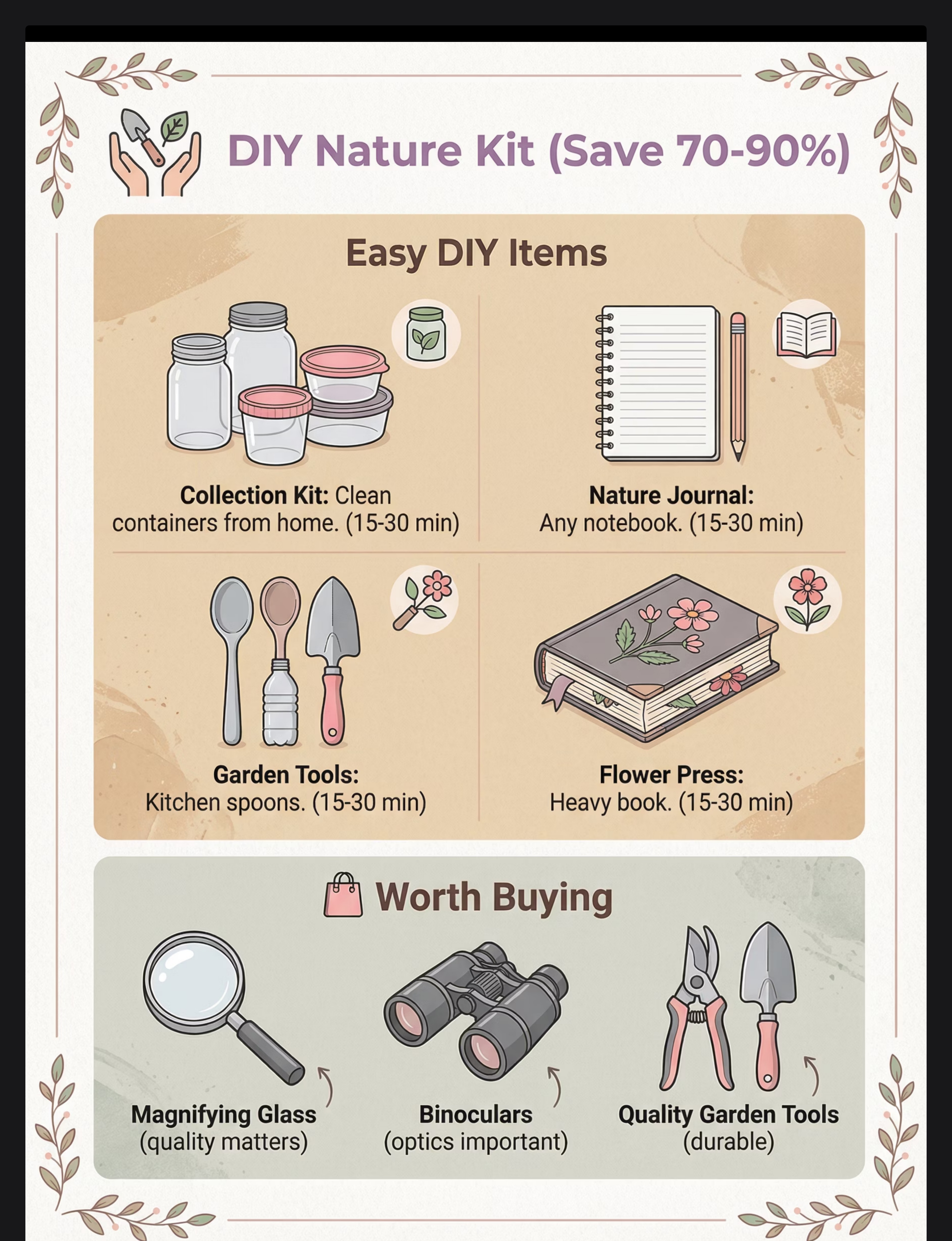
DIY Alternative (Save 70-90%)
Feasibility: High | Time Required: 15-30 minutes | Cost Savings: 70-90%
Materials Needed
  • Clean containers from home (jars, tubs, bags)
  • Any notebook with blank pages
  • Printed field guide pages or free apps
  • Kitchen tools for garden use (spoons, forks)
  • Heavy books and paper for pressing flowers
DIY Instructions
1
Create Collection Kit
Clean and repurpose containers, bags, and jars from around your home for specimen collection
2
Make Nature Journal
Use any notebook with blank pages for drawings and observations
3
Prepare Field Guide
Print identification pages from free online sources or download free identification apps
4
Repurpose Garden Tools
Kitchen spoons and forks work well for digging and planting activities
5
Create Flower Press
Use heavy books and paper for pressing and preserving leaves and flowers
6
Build Display Station
Use boxes to create an observation station for displaying and examining collections
DIY vs Commercial
When to DIY
  • Collection containers
  • Nature journals
  • Flower pressing supplies
  • Most basic supplies
When to Buy
  • Magnifying glass (quality matters)
  • Binoculars (optics important)
  • Printed field guides (optional)
  • Quality garden tools (last longer)
Tradeoffs
DIY works well for most supplies. However, magnifying glasses and binoculars should be purchased as quality optics significantly impact the exploration experience.
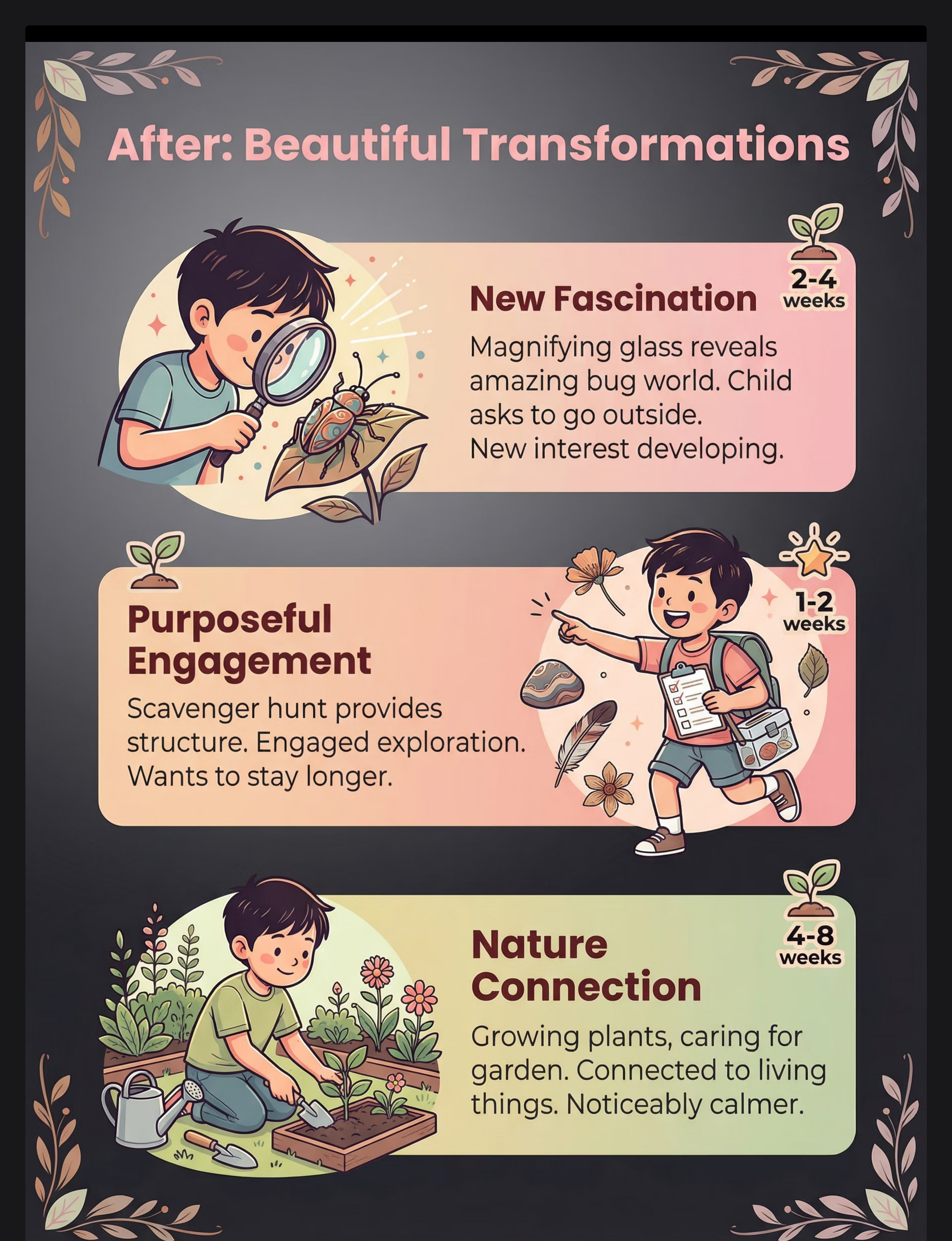
Transformation: Engaged & Connected
Witness the profound positive changes in children with autism as they discover the world through nature exploration tools.
Enhanced Focus & Calm
Children like Aarav (7) show reduced sensory overload and increased sustained attention, finding a new sense of calm while engaging with nature.
Developing Interests & Communication
Children like Diya (9) begin to initiate conversations about their discoveries, fostering improved verbal communication and shared family interests.
Increased Independence & Motor Skills
Children like Rohan (5) exhibit enhanced independent play and improved fine motor skills, confidently exploring their surroundings.
Stronger Family Bonds
Parents report deeper connections and understanding, as families share joyful moments of discovery and learning in the outdoors.
Outcomes & Timelines: Your Child's Journey
Witness the profound positive changes in children with autism as they discover the world through nature exploration tools, experiencing growth across different timeframes.
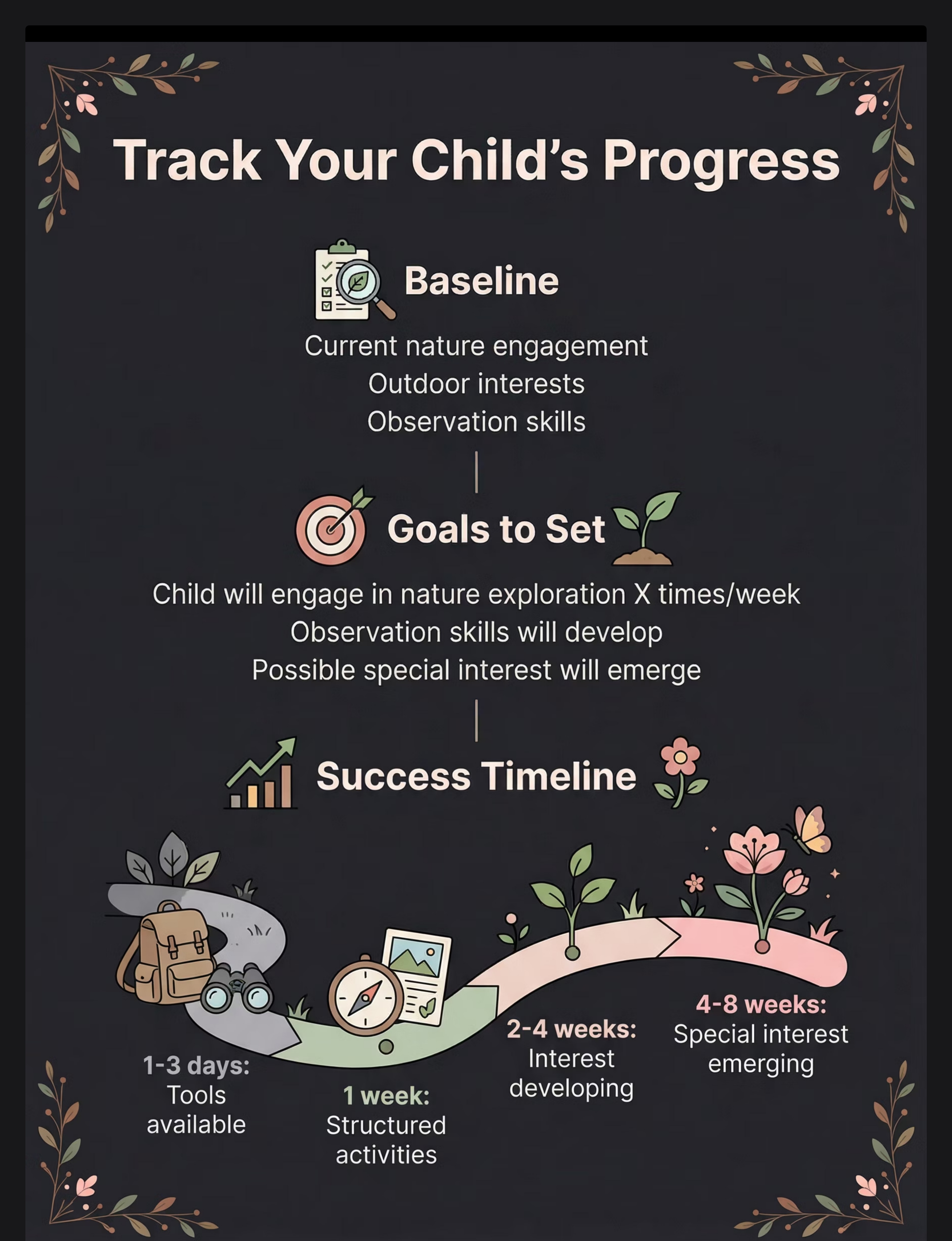
Week 1: Initial Engagement
Expect first signs of curiosity and brief, focused engagement during short exploration sessions. You might observe a new sense of calm and a reduction in sensory overwhelm in the outdoor environment.
Month 1: Developing Interests
Children will likely show increased consistency in their engagement, developing preferences for certain tools or 'nature spots'. Improved sustained attention and early attempts at communicating discoveries may emerge, fostering shared interests.
3-6 Months: Skill Building
Significant progress in fine motor skills and independent exploration will become evident. Children often begin to initiate conversations about their observations, building verbal communication and cognitive skills.
Long-Term: Sustained Benefits
Families report deeper connections and understanding. Children exhibit sustained curiosity, enhanced social engagement, and a profound sense of well-being, integrating nature exploration as a joyful part of their lives.
nature-exploration-tools therapy material
Tracking Your Child's Nature Journey
Observing and documenting your child's engagement with nature can reveal powerful insights into their development. Use this simple framework to track progress and celebrate milestones.
"Their focus has grown so much!"
I've noticed my child staying focused much longer during our outdoor activities. Their attention span has really grown, and they're more engaged with what they're doing.
"They're starting to share their discoveries."
My child is initiating more conversations and pointing out things they find interesting in nature. It's wonderful to see them express their curiosity and wonder, both verbally and non-verbally.
"Nature brings them a sense of calm."
Time in nature has become a great calming activity for them. I've seen a noticeable decrease in their sensory sensitivities and anxiety, and it provides a positive outlet for their energy.
"Their confidence to explore is blossoming."
They're so much more willing to explore on their own now, picking up leaves, examining insects, or pointing at birds. Their confidence and curiosity in the natural world have truly blossomed.
Even small changes are significant. Celebrate every step, encouraging a lifelong love for the natural world.
Usage Playbook: Nature Exploration for Children with Autism
nature-exploration-tools therapy material
Understanding when and how to best engage children with autism in nature exploration is key. This playbook provides guidance on effective approaches and situations to consider.
When to Use
  • When leveraging existing special interests to introduce nature concepts.
  • To encourage sensory regulation and calm in stimulating environments.
  • For building confidence and independence through guided exploration.
  • To maintain engagement with nature during unfavorable weather conditions.
When Not to Use / Alternative Approaches
  • Avoid forcing activities if there's high anxiety; instead, offer passive observation or indoor nature options.
  • Do not introduce fragile tools unsupervised if tool management is a challenge; opt for durable items or close supervision.
  • If new environments cause distress, stick to familiar spaces and gradually introduce changes.
  • When safety concerns are paramount, prioritize education and controlled environments over wide-open, unknown spaces.
Strategic Approaches for Common Scenarios
Lack of Interest
Connect nature to existing special interests (e.g., trains, patterns).
Leverages intrinsic motivation, makes nature relatable and engaging.
Tools Lost or Broken
Designate "nature kit" spot, involve child in tidying, use sturdy child-friendly tools or DIY.
Promotes responsibility, ensures tool availability, reduces frustration.
Weather Limitations
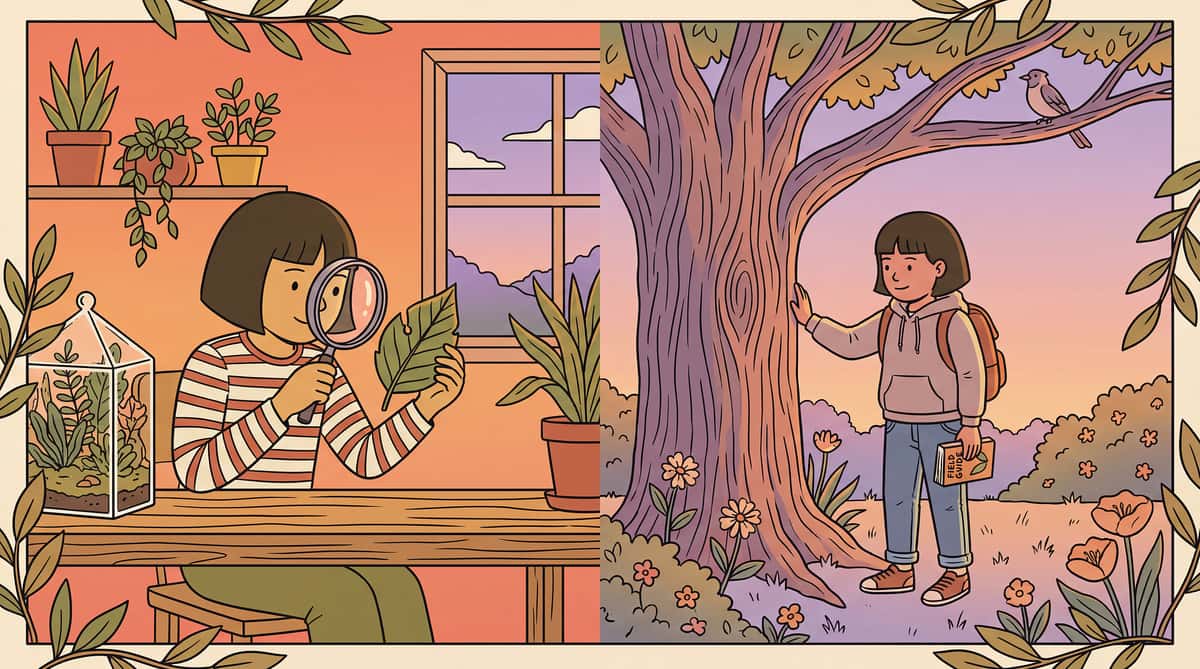
Bring nature indoors (potted plants, terrarium), use documentaries/books, nature-inspired art.
Maintains engagement with nature despite external conditions, offers varied sensory experiences.
Safety Concerns
Close supervision, teach "look, don't touch" for unfamiliar items, start in familiar spaces, gradual expansion.
Ensures physical safety, builds confidence, teaches boundaries.
Beyond the Basics: Next Steps
Once your child is comfortable with initial tools, deepen their nature exploration with these engaging next steps. These ideas foster continued learning, social connection, and creative expression in the natural world.
nature-exploration-tools therapy material
Explore Nature Centers
Visit local botanical gardens, nature preserves, or wildlife sanctuaries. Many offer guided tours and interactive exhibits, providing new environments and learning opportunities.
Curate Themed Collections
Encourage focused observation by starting a specific collection, such as different types of leaves, interesting rocks, or unique seeds. This promotes detailed study and categorization skills.
Nature Photography & Art
Provide a child-friendly camera or sketching supplies. Documenting discoveries through photos or drawings enhances attention to detail and offers a creative outlet for connecting with nature.
These activities build upon basic skills, fostering a deeper, more enriching connection with the natural world.

Preview of nature exploration tools Therapy Material

Below is a visual preview of nature exploration tools therapy material. The pages shown help educators, therapists, and caregivers understand the structure and content of the resource before use. Materials should be used under appropriate professional guidance.

Page 1
Page 2
Page 3
Page 4
Page 5
Page 6
Page 7
Page 8
Page 9
Page 10
Page 11
Page 12
Page 13
Page 14
Page 15
Page 16
Page 17
Page 18
Page 19
Page 20
Link copied!
Take Action Today
Unlock a world of wonder and growth for your child. Embracing nature nurtures curiosity, reduces stress, and builds vital developmental skills. Discover our integrated support ecosystem designed to guide every step of their journey.
nature-exploration-tools therapy material
Progress Tracking Resources
Keep a nature journal, use a discovery checklist, or an app to log observations and celebrate milestones in your child's exploration journey.
Related Tools & Resources
Expand their toolkit with field guides, binoculars, or a microscope to delve deeper. Explore online communities for shared ideas and tips.
Additional Support Options
Connect with local nature clubs, educational workshops, or online forums to share experiences and gain expert insights.
Next Steps
Continue to foster their curiosity with new challenges, themed explorations, and opportunities to share their discoveries with others.
Empower your child with the joy of discovery. These moments build resilience, creativity, and a lifelong connection to the natural world.