Tool ID: 1.3
OT + SLP
Strong Evidence
Rank #1
Daily Use
₹100–8,000
Noise-Reducing Headphones
Auditory Modulation/Protection System
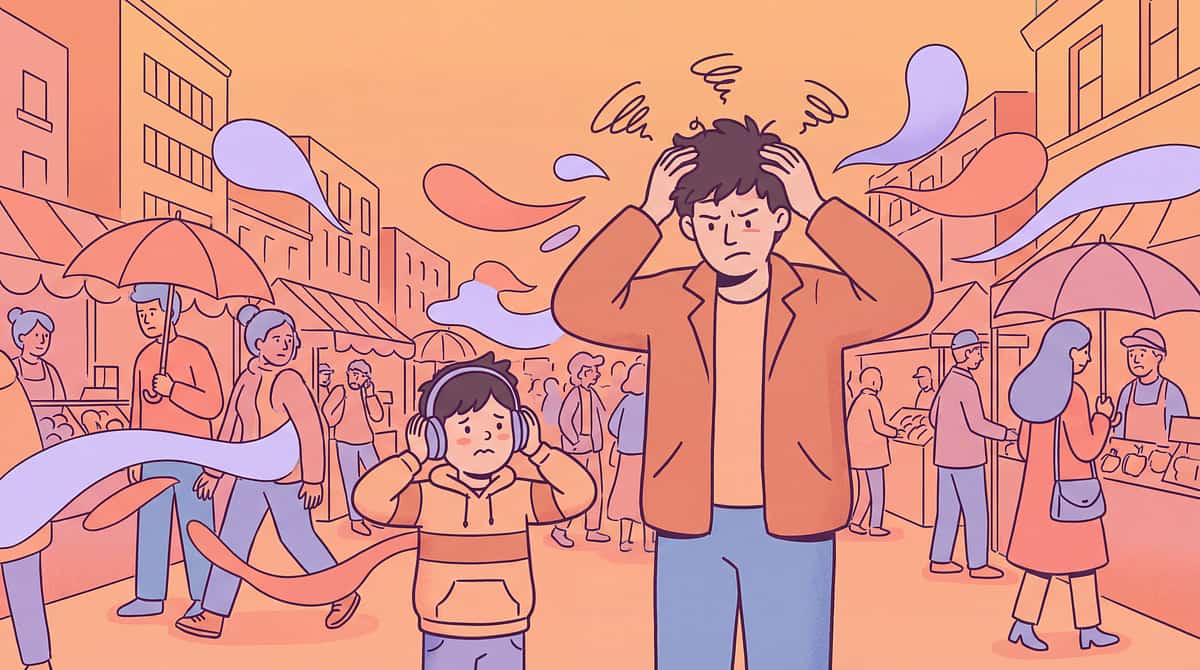
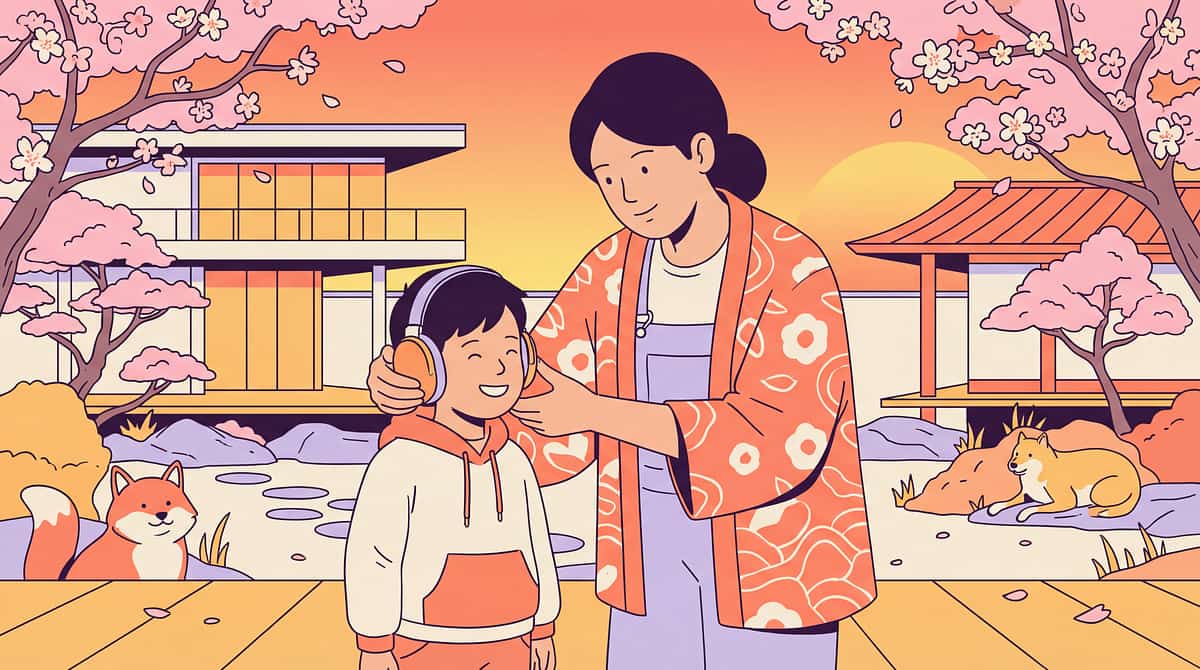
Essential sound protection that transforms impossible situations into possible experiences. From malls to assemblies, give your child the power to participate comfortably in a world that's often too loud.

Who This Helps
Auditory Processing
Children needing support with sound sensitivity and auditory input.
Sensory Regulation
Those who struggle with sensory overload and maintaining calm.
Anxiety Reduction
Individuals experiencing anxiety triggered by loud or unpredictable sounds.
Social Participation
To enable engagement in social settings without being overwhelmed by noise.
Improved Attention
For better concentration in noisy environments, supporting learning and focus.
These headphones reduce auditory input to prevent sensory overload, enabling children to participate in environments that would otherwise be overwhelming.
Ages 0-9 Years
Headband style for infants and toddlers; over-ear designs from age 2 onward, with options for every developmental stage
All Settings
Perfect for home, school, travel, events, and outdoor activities—wherever sound levels need management
Best For
Children who cover their ears in loud places, experience noise-triggered meltdowns, or avoid events due to sound sensitivity

Does This Sound Familiar?
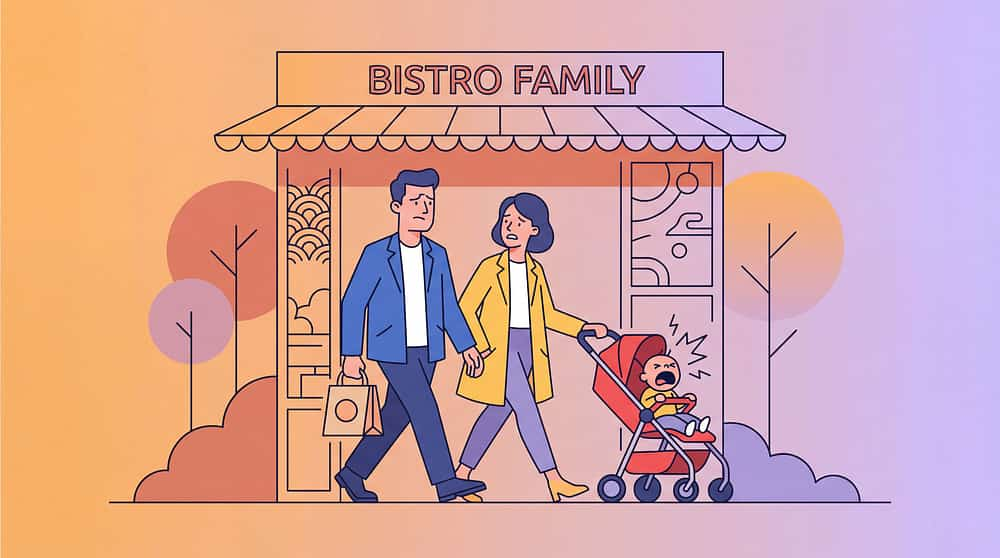
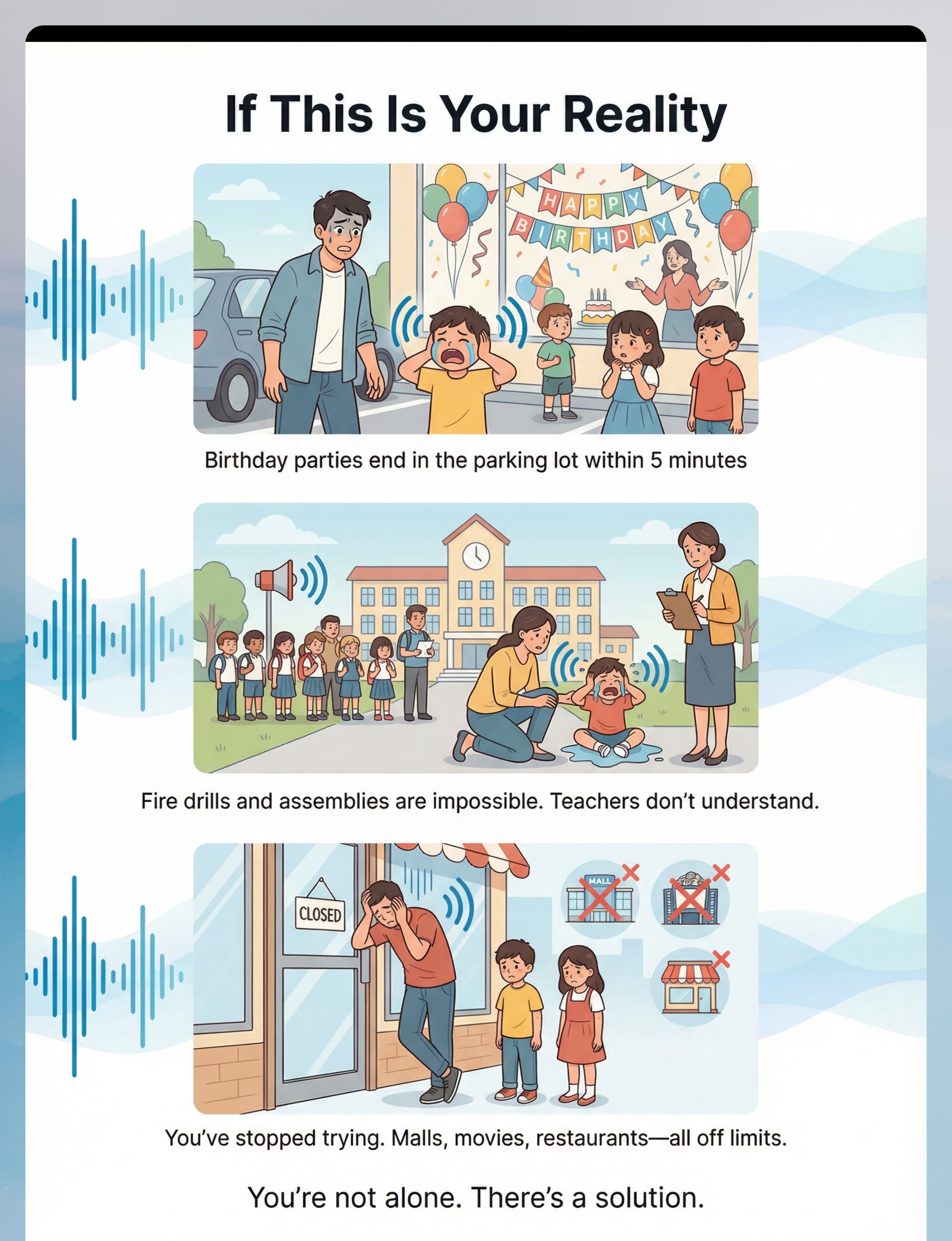
"My child covers ears and screams in malls. Every shopping trip becomes a nightmare, and I dread going anywhere crowded."
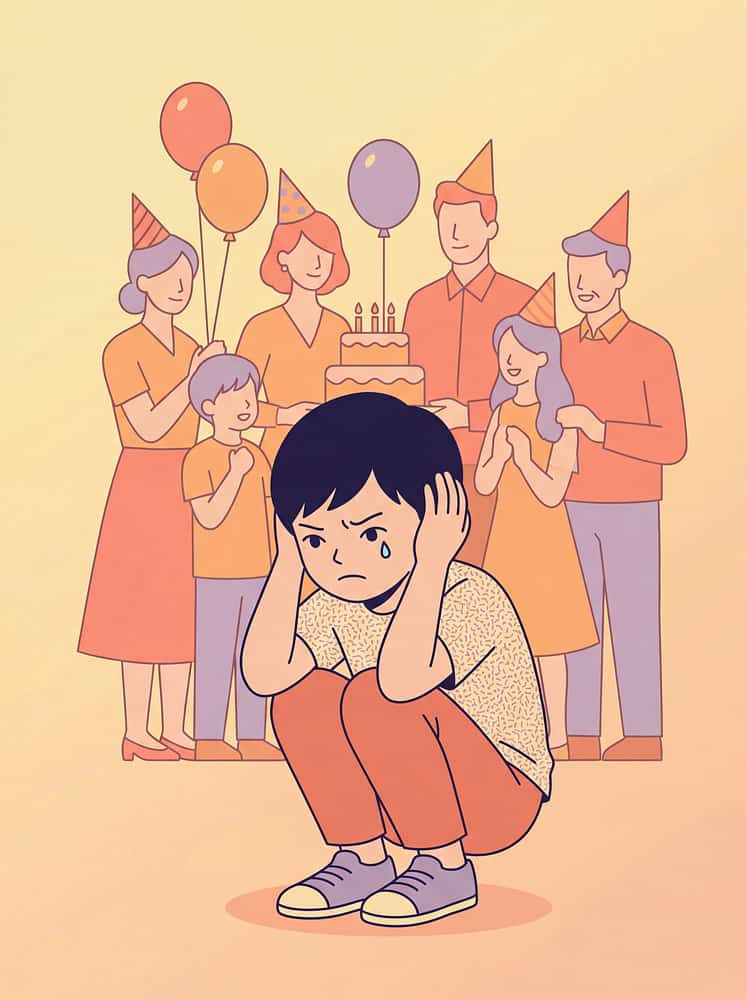
"Birthday parties are impossible—too loud. We always leave early or don't go at all. My child misses out on friendships."
"Fire drills at school cause complete meltdowns. The teacher doesn't understand, and my child gets labeled as 'difficult.'"
"We can't go to movies, restaurants, or events. Our family life feels so limited. Siblings miss out too."
"Everyday sounds like the blender make him panic. Even normal household activities trigger distress."
"She hears things I can't even notice. It's like she's living in a different, overwhelming world."
You're not alone. These are common challenges for families with auditory-sensitive children. There is a solution that can help.

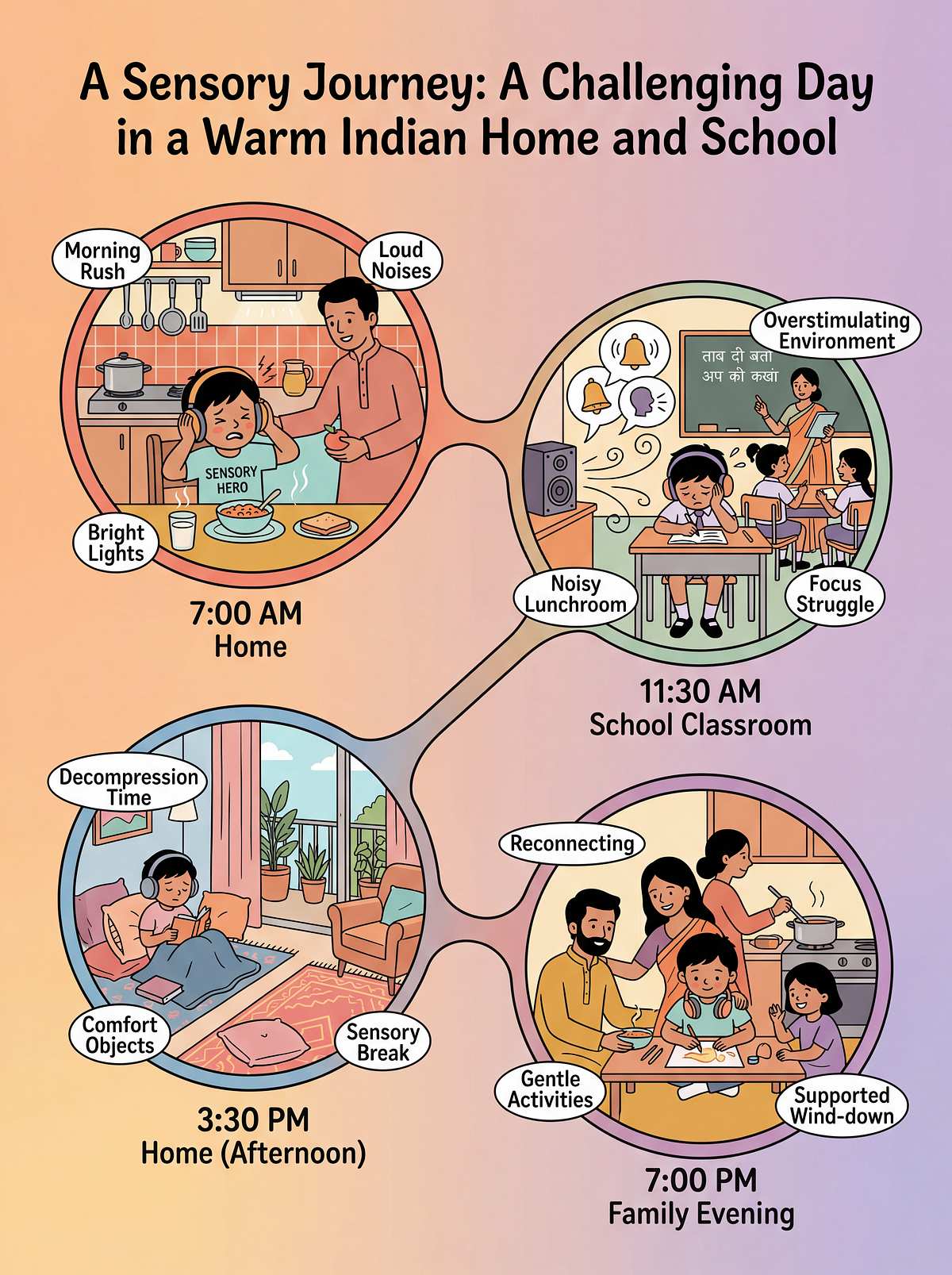
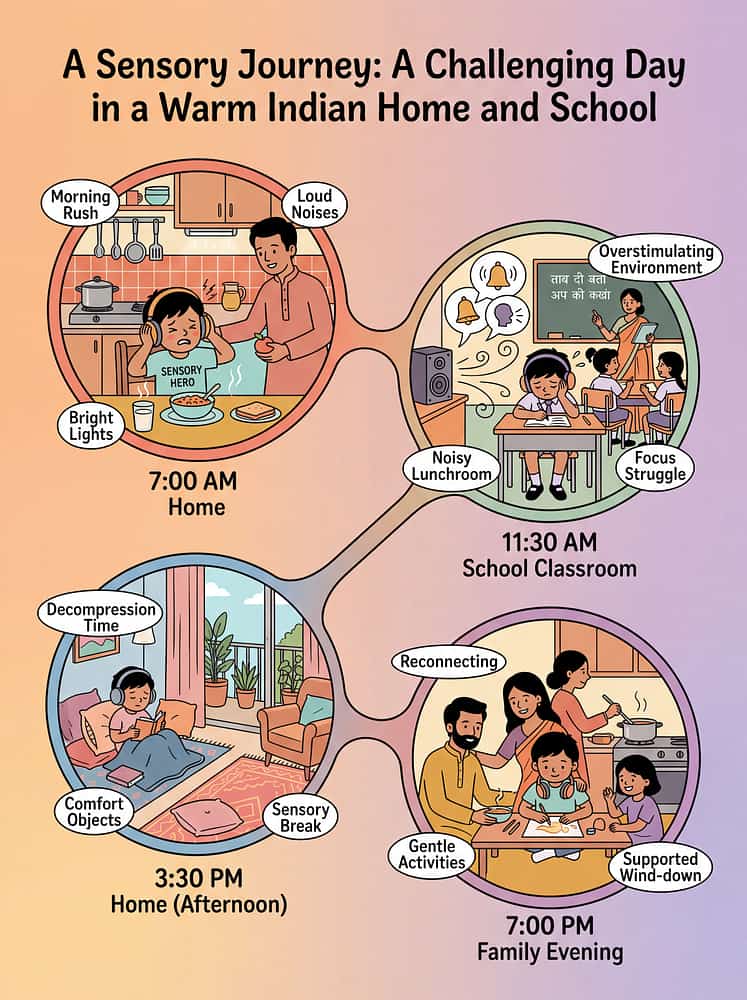
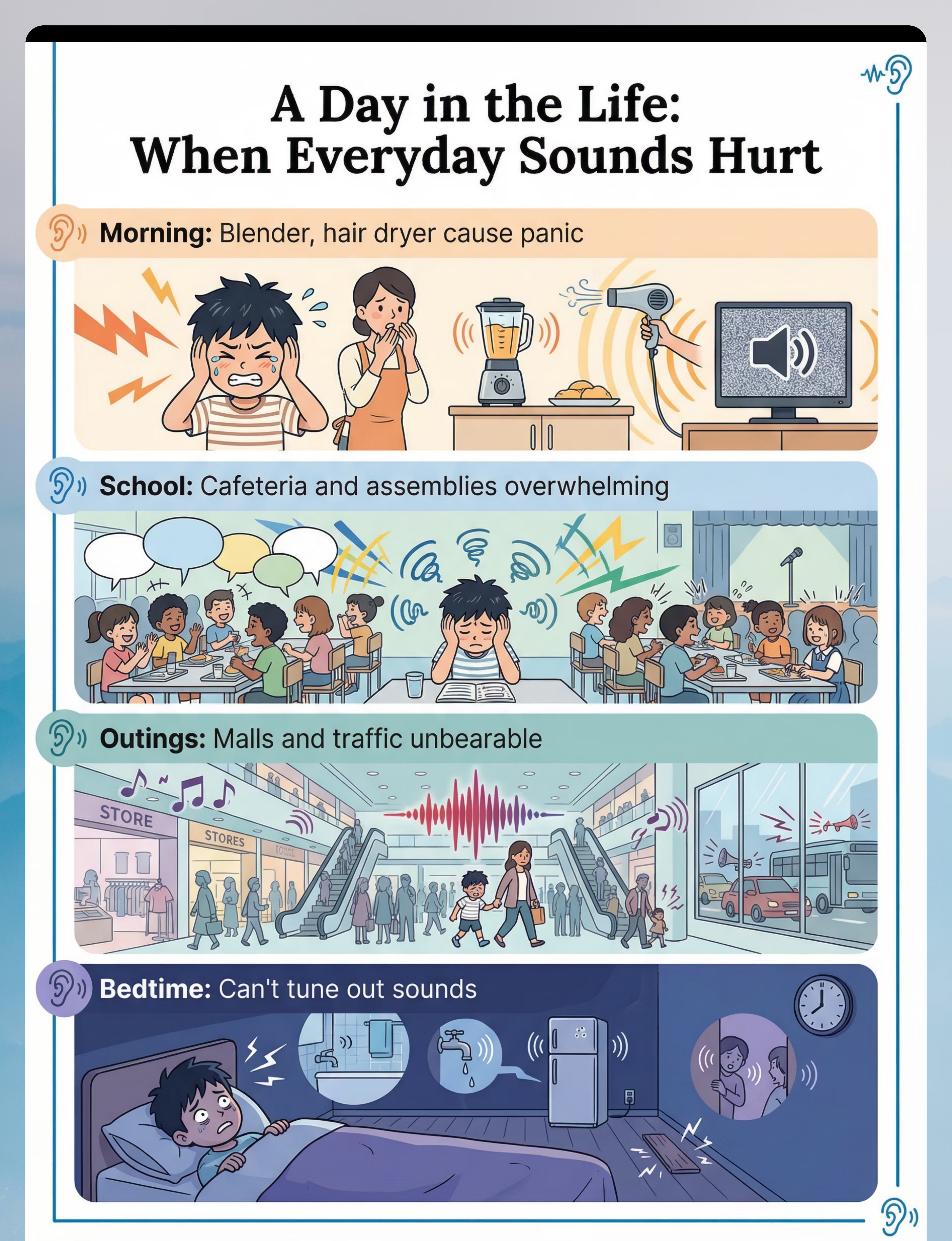
A Day Without the Right Support
1
Morning
Blender, hair dryer, TV sounds cause immediate distress. The day starts with tears and everyone running late.
2
School Transitions
Assembly and cafeteria are overwhelming. Fire drills trigger complete meltdowns. Your child misses activities or gets removed from class.
3
Therapy & Outings
Malls, parties, traffic—all unbearable. Family leaves early or avoids going altogether. Social isolation grows.
4
Bedtime
Household sounds prevent sleep. Everyone is exhausted. Tomorrow feels impossible before it even begins.

The Science Behind It
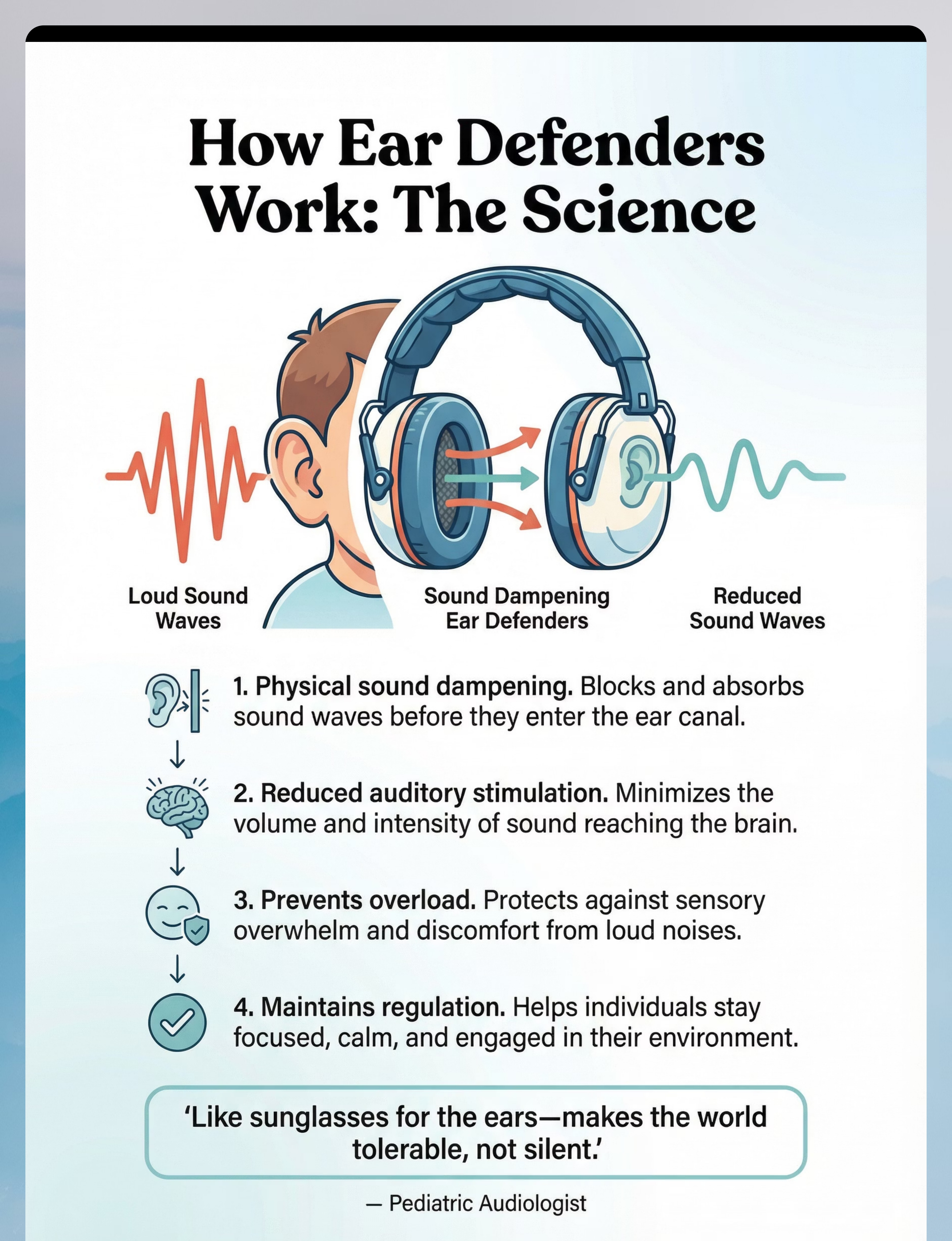
Understanding how noise-reducing headphones work helps you support your child's sensory needs with confidence and clinical precision.
Physical Sound Dampening
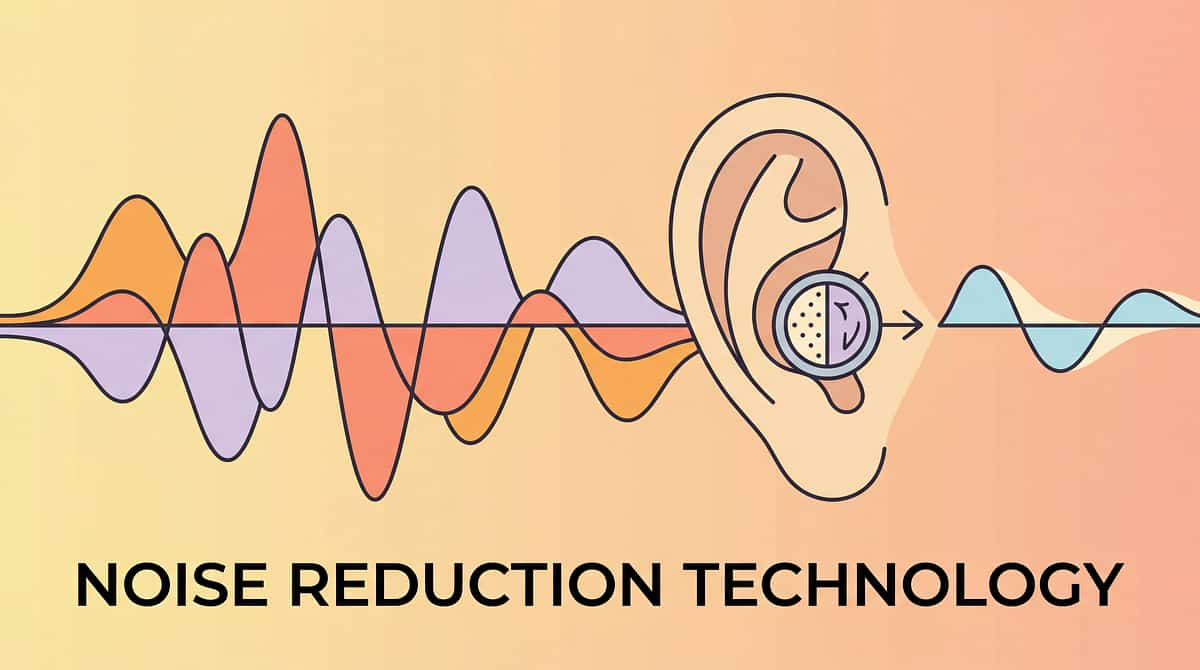
Padded ear cups create seal, blocking sound waves before they reach ear canal
Reduced Auditory Stimulation
Lower volume input means less sensory information for brain to process
Prevents Nervous System Activation
Reduced overwhelm prevents fight-or-flight response, maintaining calm state
Maintains Regulation
Child stays regulated, thinking clearly, and able to participate
Enables Participation
With regulation maintained, child can engage in activities previously impossible
Auditory Processing
Sensory Regulation
Anxiety Reduction
Participation
Attention

How to Use It Right
Successful implementation requires thoughtful introduction and consistent best practices. Follow these clinically-validated approaches for optimal outcomes.
Gradual Introduction
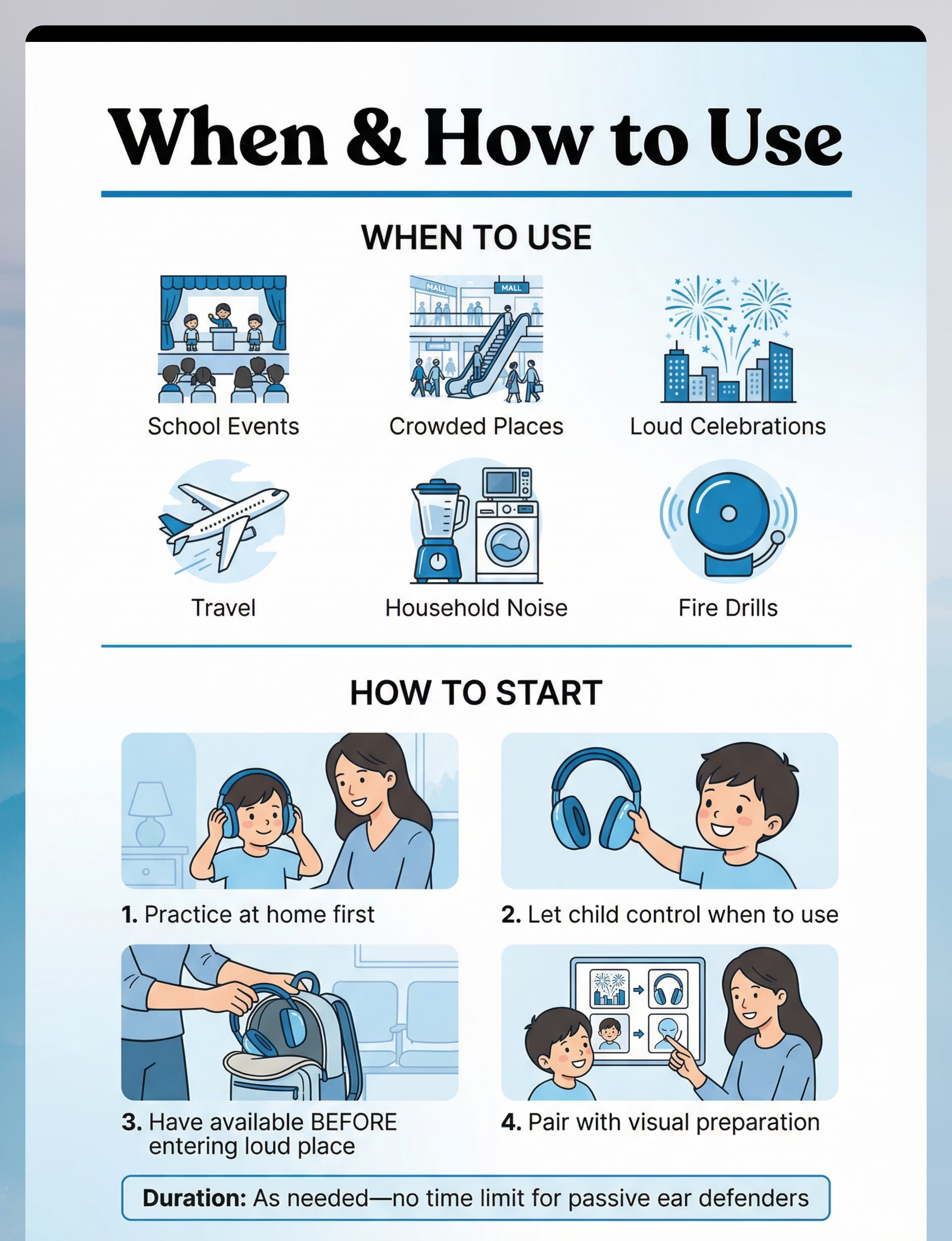
Introduce gradually in low-stress situations at home first. Let your child explore the headphones when calm, not during crisis.
Child Control
Let child control when to use. Never force. This builds self-advocacy and prevents negative associations with the tool.
Proactive Preparation
Have available BEFORE entering loud environment. Keep in bag always. Prevention works better than intervention.
Home Practice
Practice putting on and taking off at home first. Make it part of getting-ready routine before loud events.
Visual Preparation
Pair with visual or social preparation for events. Show photos of the place, discuss when headphones will help.
Duration: No time limit for passive ear defenders. Active noise-cancelling may need battery breaks. Let your child guide usage.

Expert Endorsement
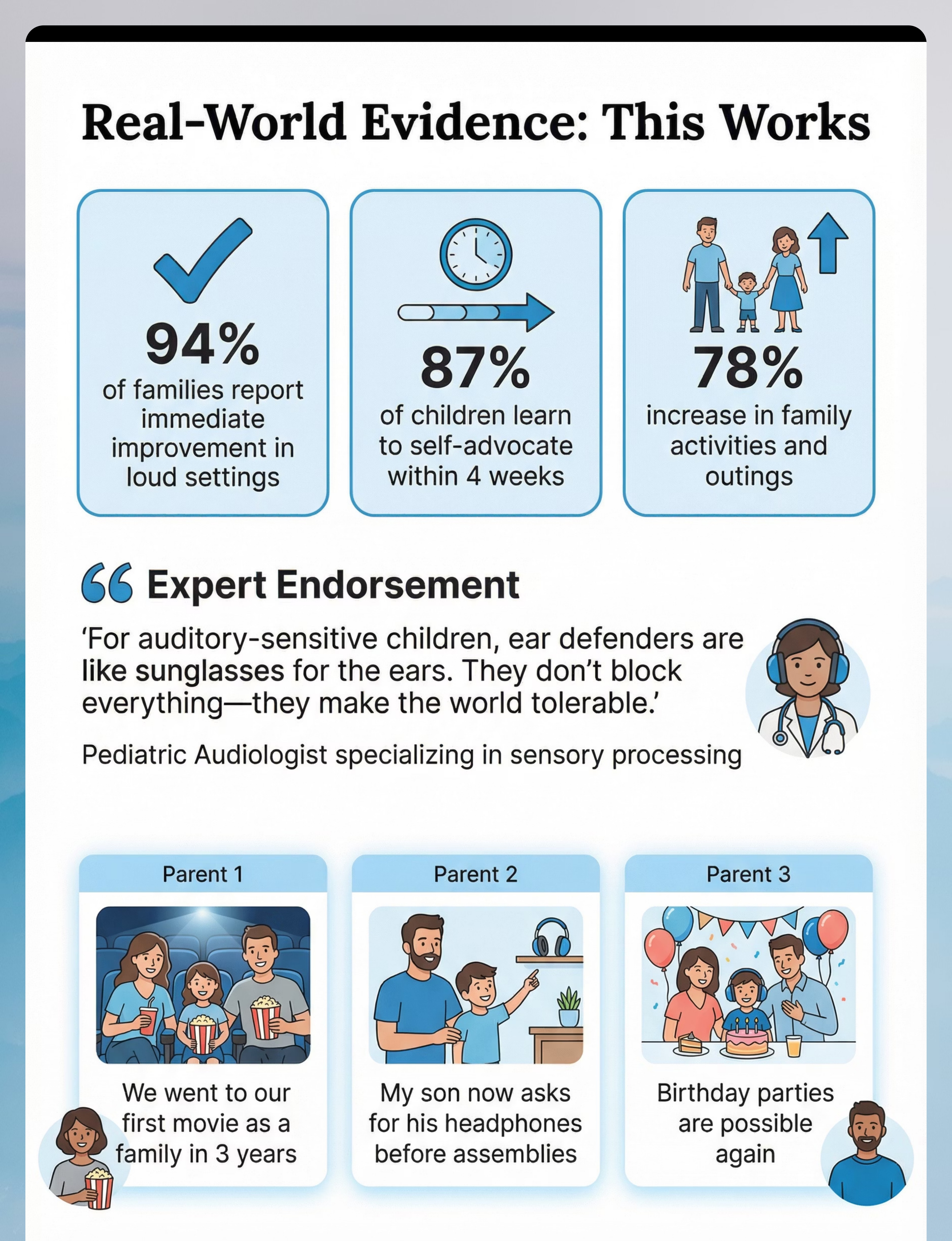
"For auditory-sensitive children, ear defenders are like sunglasses for the ears. They don't block everything—they make the world tolerable."— Pediatric Audiologist specializing in sensory processing
OT + SLP Recommended
Strong Evidence
Rank #1 in Category
Daily Use
This tool is recommended by both Occupational Therapists and Speech-Language Pathologists, supported by strong clinical evidence, and ranked as the #1 essential in its category for daily or situational use.
Choose Your Option (6 Variants)
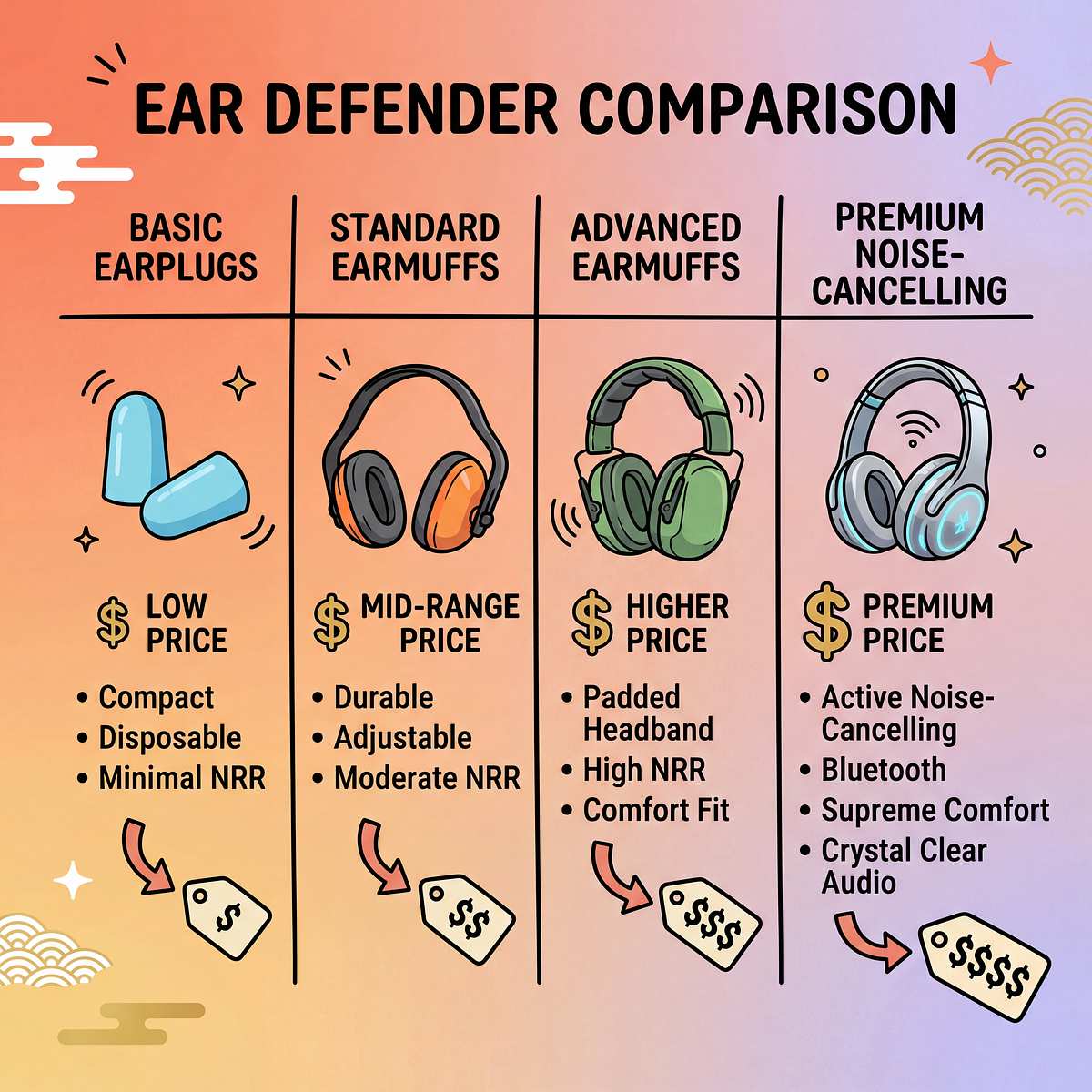
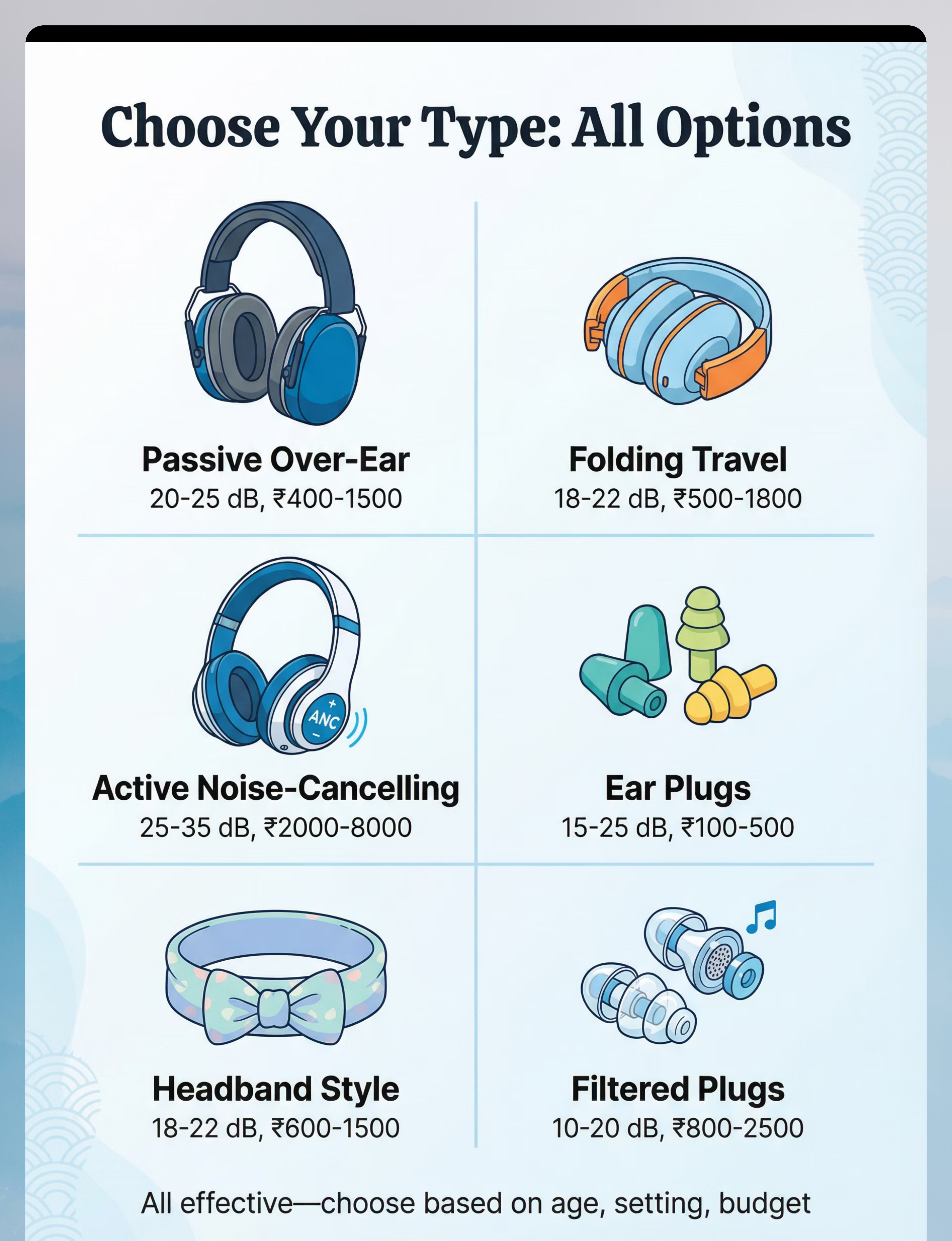
Each variant serves specific needs, settings, and sensitivity levels. Choose based on your child's age, portability requirements, noise reduction needs, and which environments you need to navigate together.

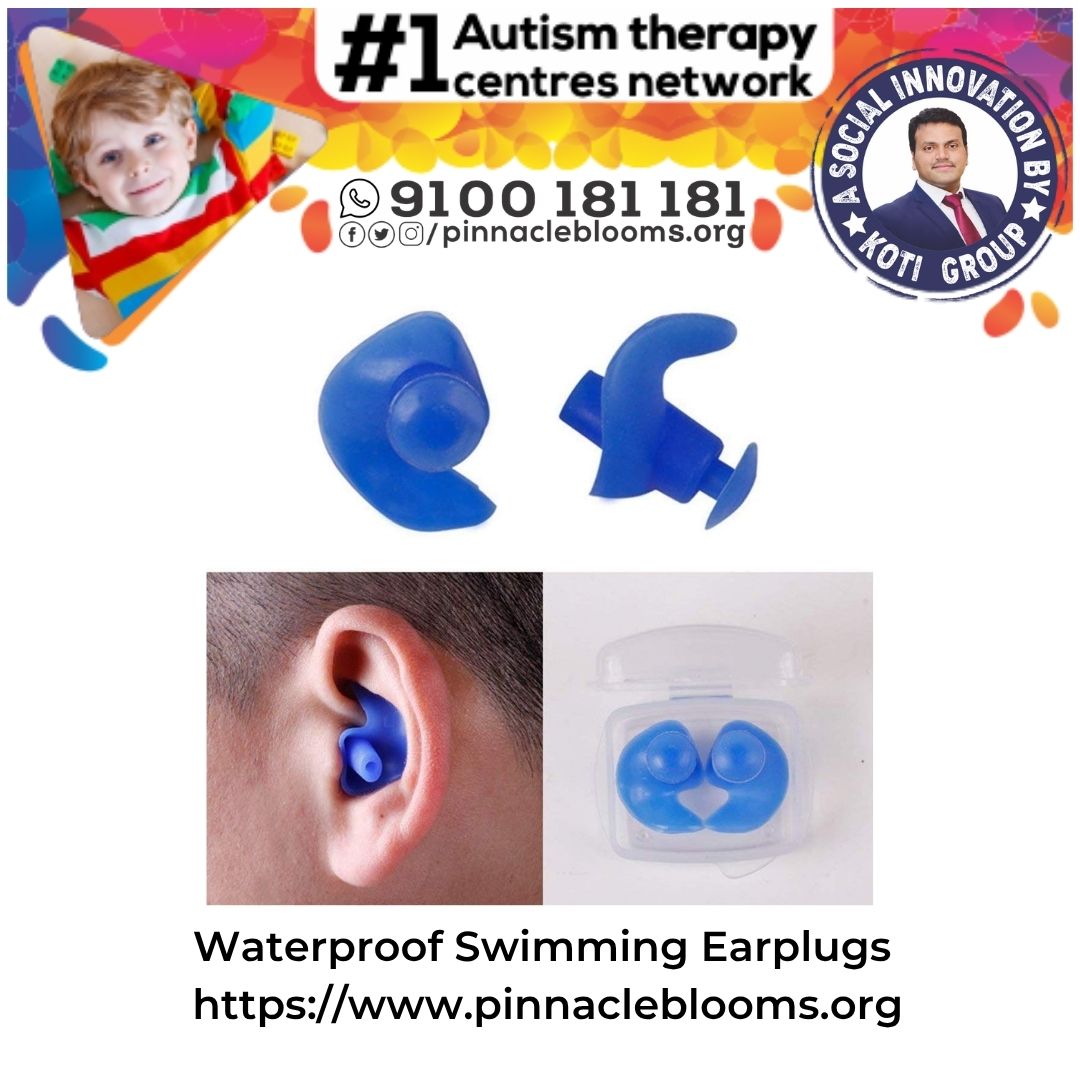
Ear Plugs (Silicone/Foam)
Best for: Discreet, swimming, sleeping, mild sensitivity
Ages: 4-9 years | NRR: 15-25 dB reduction
Settings: All
Portability: Very High | Price: ₹100–500
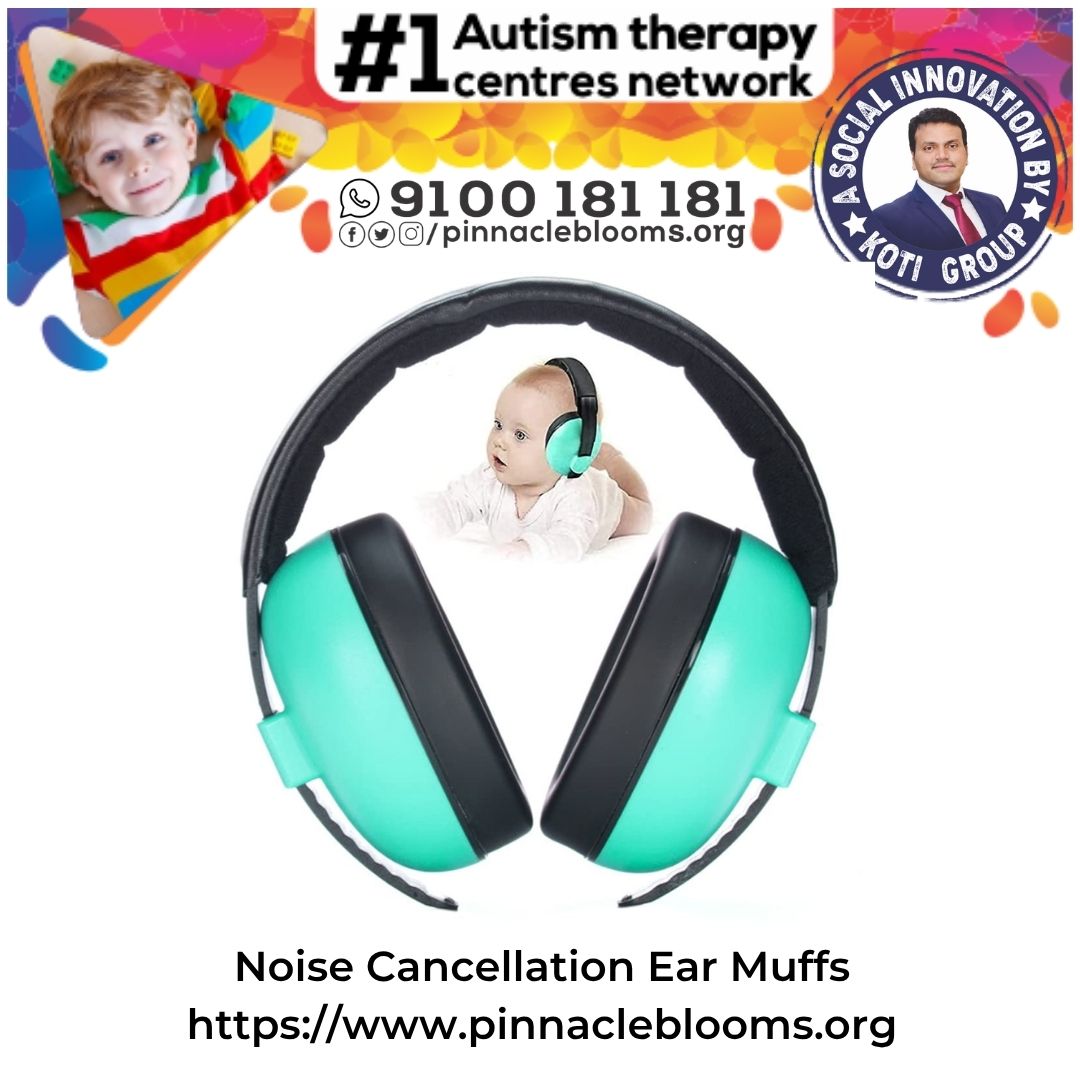
Headband-Style Ear Defenders
Best for: Infants/toddlers, won't tolerate over-ear
Ages: 0-3 years | NRR: 18-22 dB reduction
Settings: Home, Travel, Events
Portability: High | Price: ₹600–1,500
Passive Ear Defenders (Folding)
Best for: Travel, pocket-friendly, quick access
Ages: 3-9 years | NRR: 18-22 dB reduction
Settings: Travel, School, Outings
Portability: Very High | Price: ₹500–1,800
Passive Ear Defenders (Over-Ear)
Best for: Loud environments, assemblies, fireworks, malls
Ages: 2-9 years | NRR: 20-25 dB reduction
Settings: Home, School, Travel, Outdoors
Portability: High | Price: ₹400–1,500
Musician's/Filtered Ear Plugs
Best for: Reducing volume while hearing speech, classrooms
Ages: 5-9 years | NRR: 10-20 dB (filtered, not blocked)
Settings: School, Clinic, Events
Portability: Very High | Price: ₹800–2,500
Active Noise-Cancelling Headphones
Best for: Maximum noise reduction, airplane, severe sensitivity
Ages: 4-9 years | NRR: 25-35 dB reduction (active)
Settings: Travel, Home, Clinic
Portability: Medium | Price: ₹2,000–8,000
By Goal
- Maximum reduction: Active noise-cancelling
- Everyday protection: Passive over-ear
- Speech clarity needed: Filtered plugs
- Discreet option: Ear plugs
By Setting
- Home/School: Any passive or active
- Travel: Folding or active
- Outdoor events: Passive over-ear
- Infants: Headband style only
By Portability
- Pocket-sized: Ear plugs or folding
- Bag-friendly: Folding defenders
- Always-on-hand: Keep spares everywhere
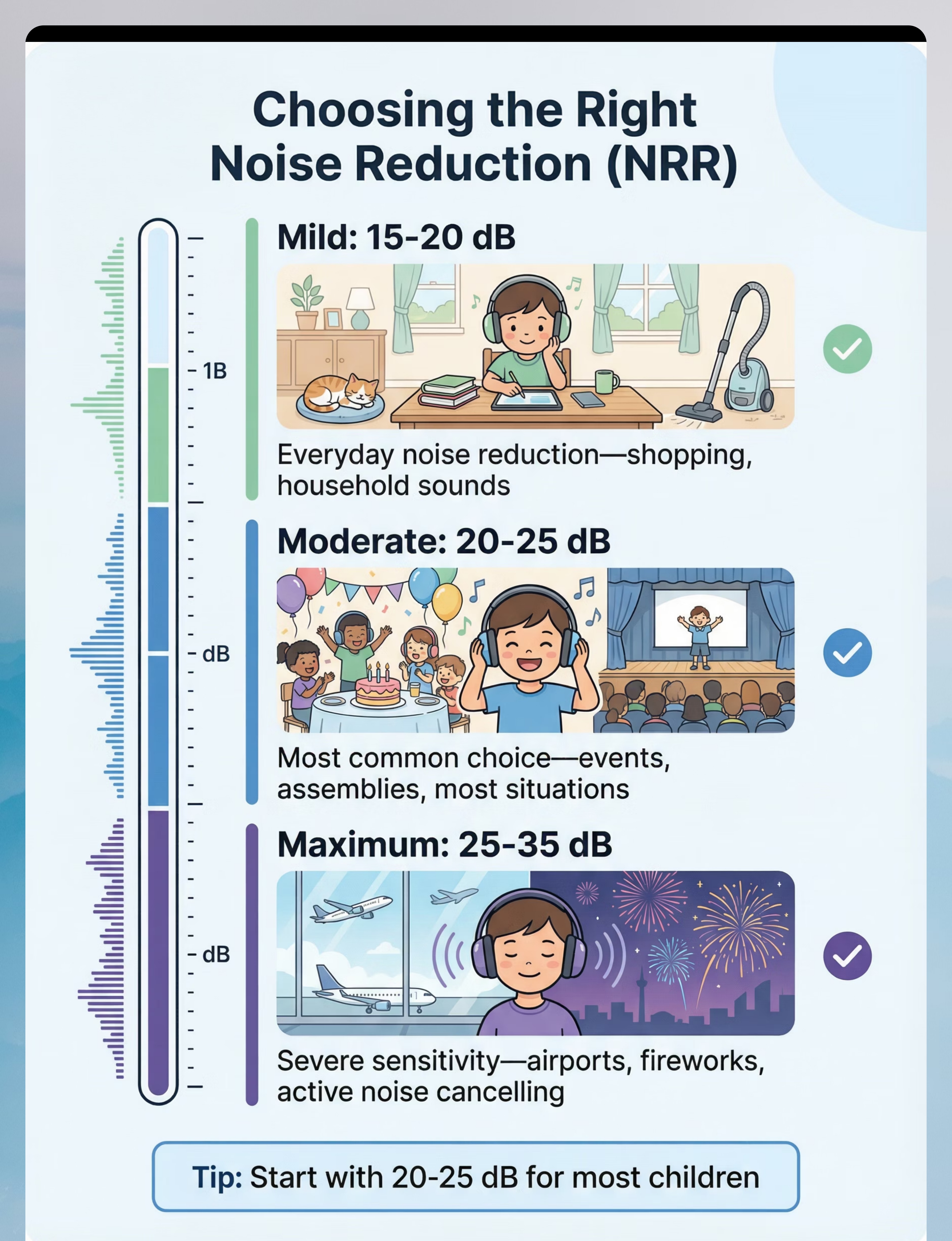
Understanding NRR (Noise Reduction Rating)
The Noise Reduction Rating (NRR) tells you how many decibels of sound the ear defenders reduce. Higher numbers mean more reduction. Choose based on your child's sensitivity level and the environments you need to navigate.

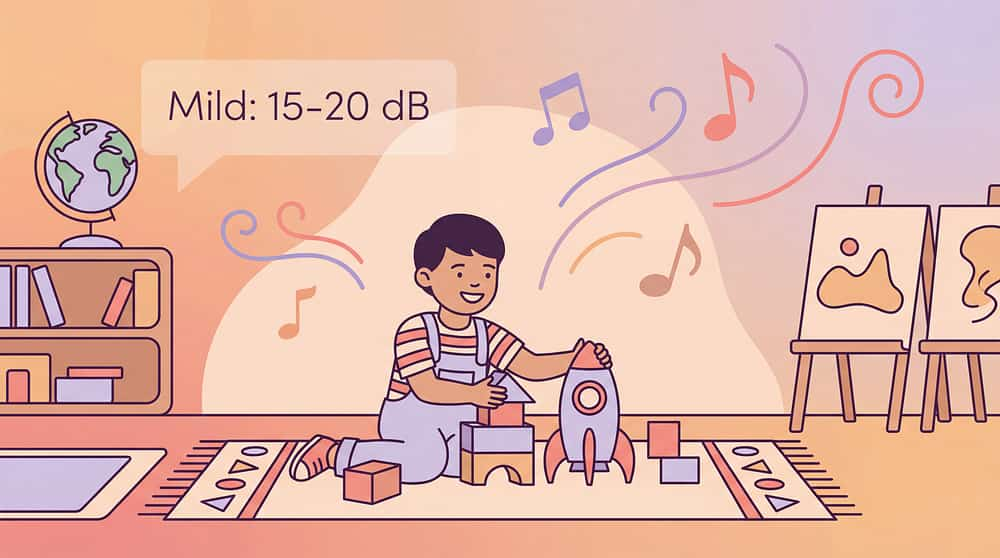
Mild: 15-20 dB
For: Everyday noise reduction in moderate environments
Examples: Busy classroom, restaurant, playground
Best option: Ear plugs or filtered plugs

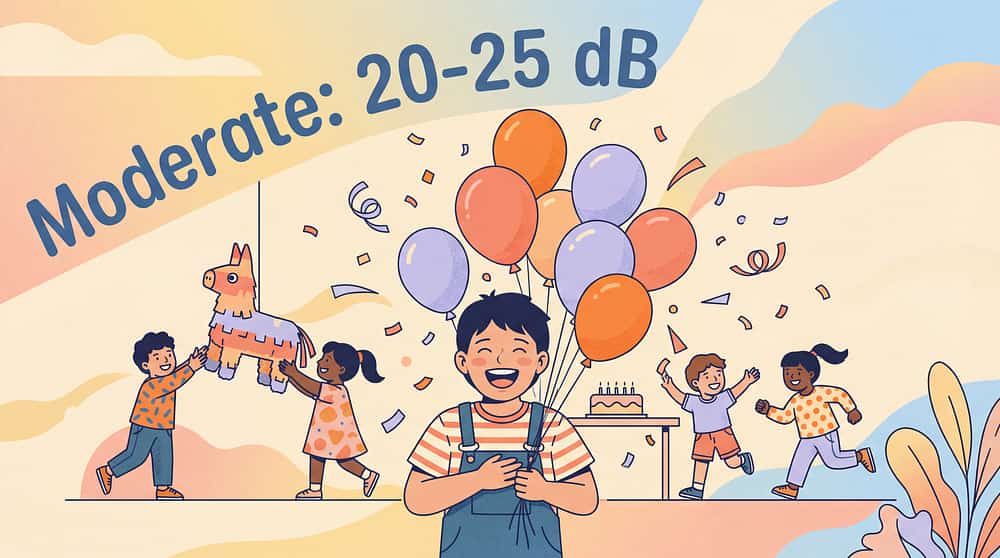
Moderate: 20-25 dB
For: Most common needs, good for events and assemblies
Examples: School assembly, birthday party, mall
Best option: Standard passive ear defenders

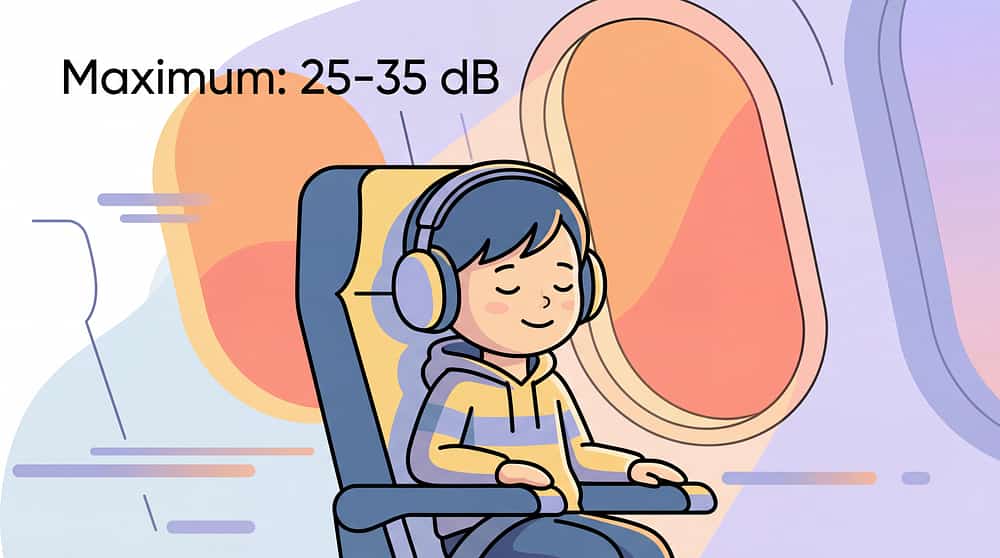
Maximum: 25-35 dB
For: Severe sensitivity, very loud environments
Examples: Airplane, fireworks, concert, severe overwhelm
Best option: Active noise-cancelling headphones
Key Materials: ABS plastic shell, memory foam cushions, padded headband, silicone (for plugs). Look for adjustable headbands, cushioned ear cups, low-pressure design, and child-friendly colors.

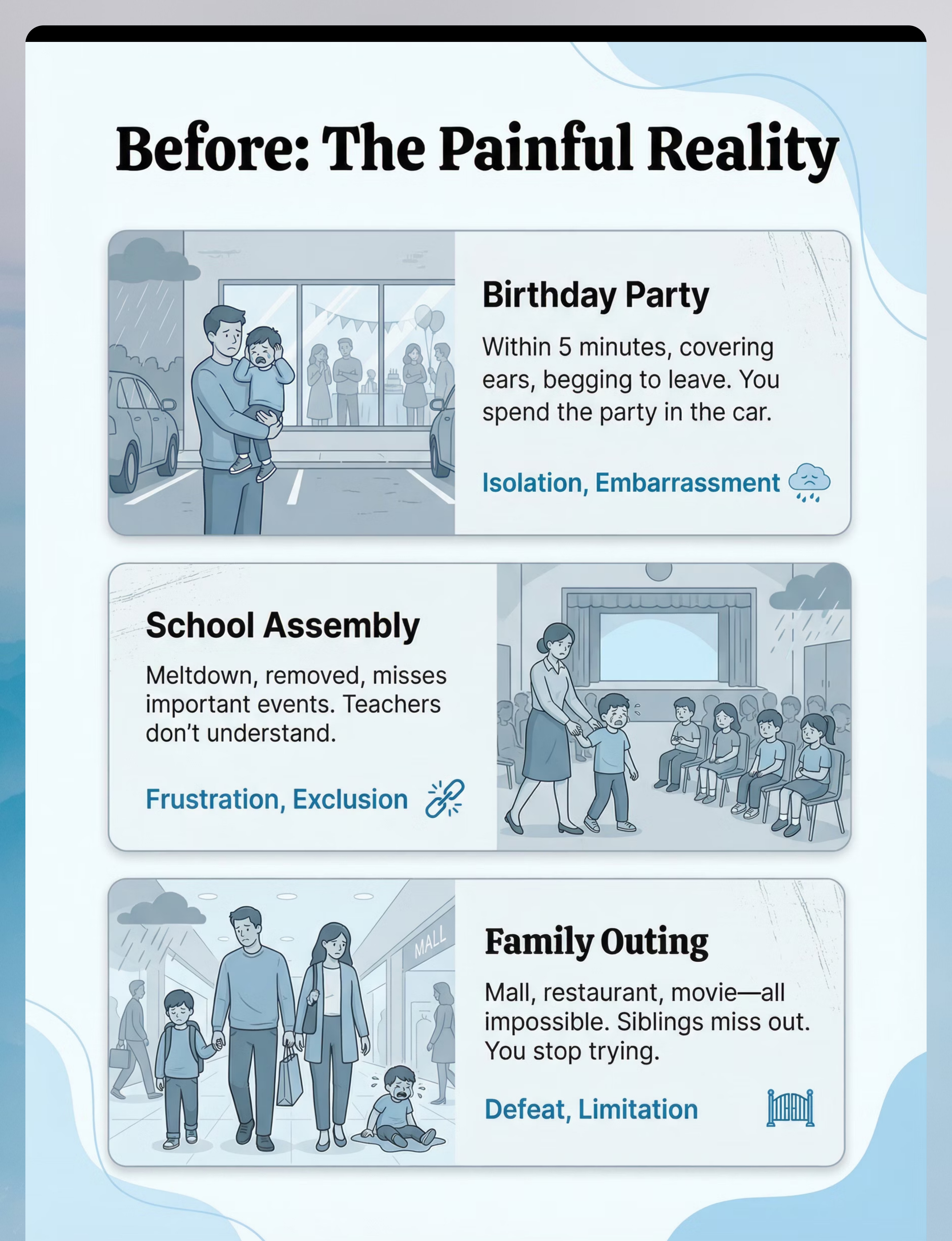
The Struggle (Before)

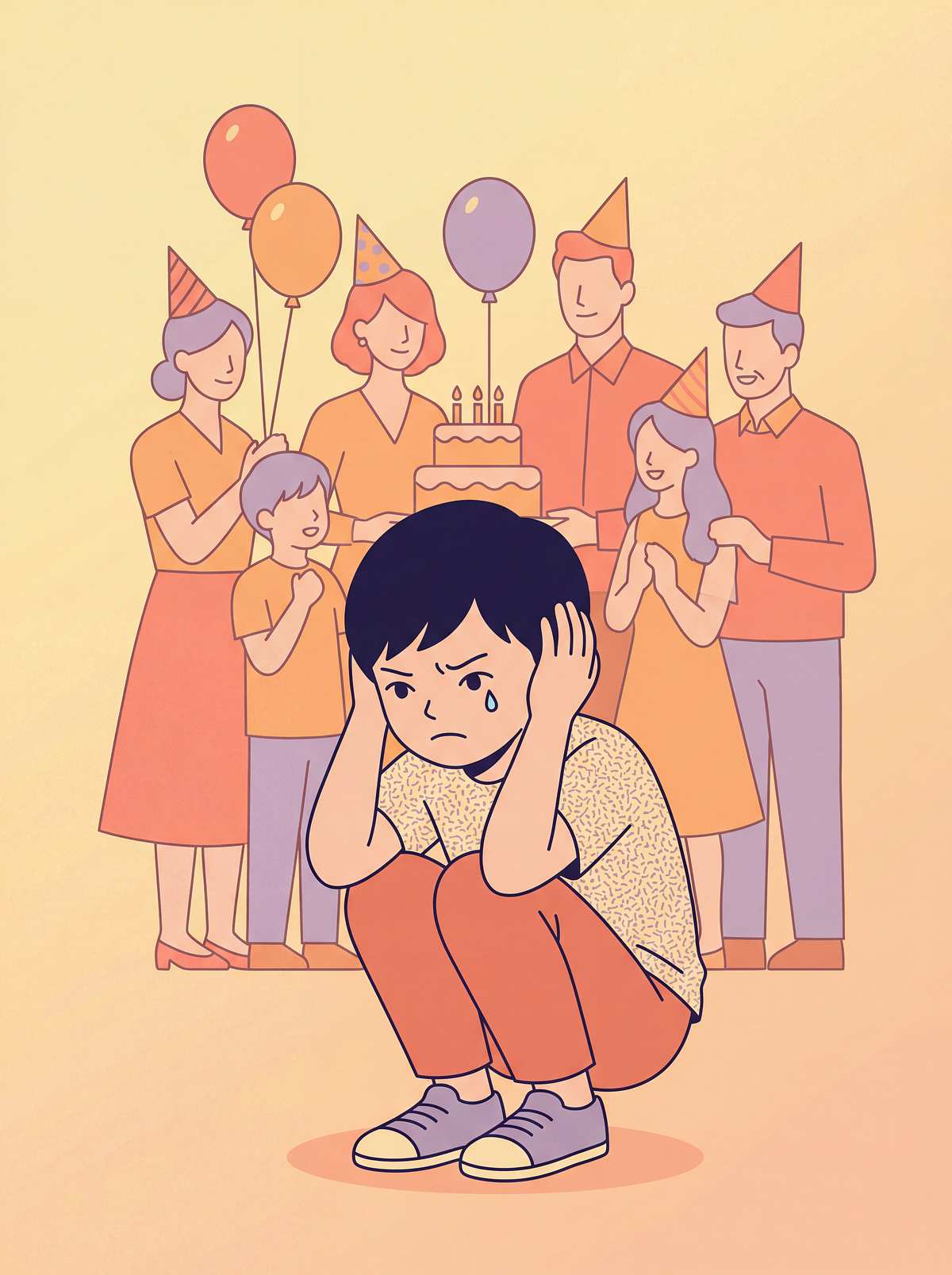
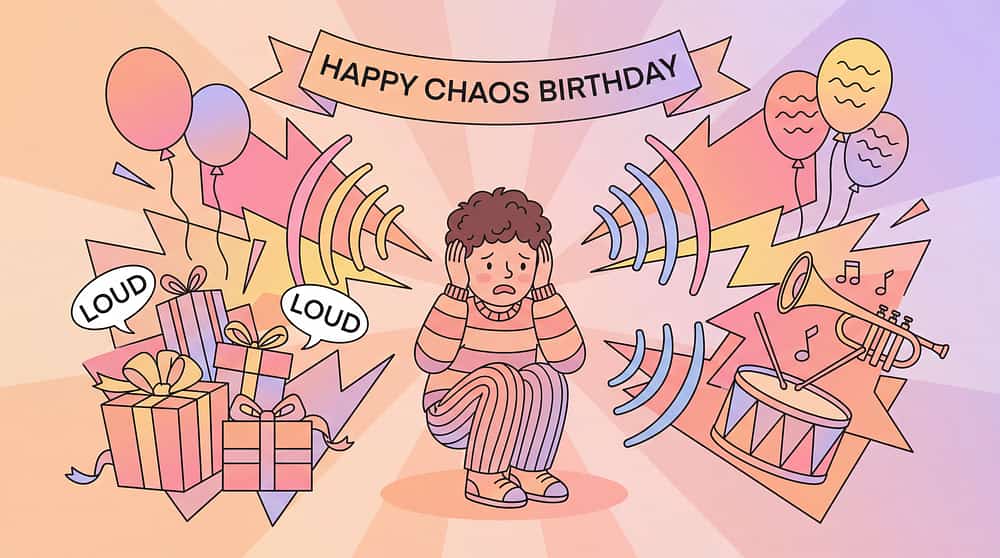
Birthday Party
Situation: Within 5 minutes, child is covering ears, crying, begging to leave. You spend the party in the car or leave early. Other parents stare.
Experience: Complete sensory overwhelm from music, children's voices, laughter
Emotion: Isolation, embarrassment, grief

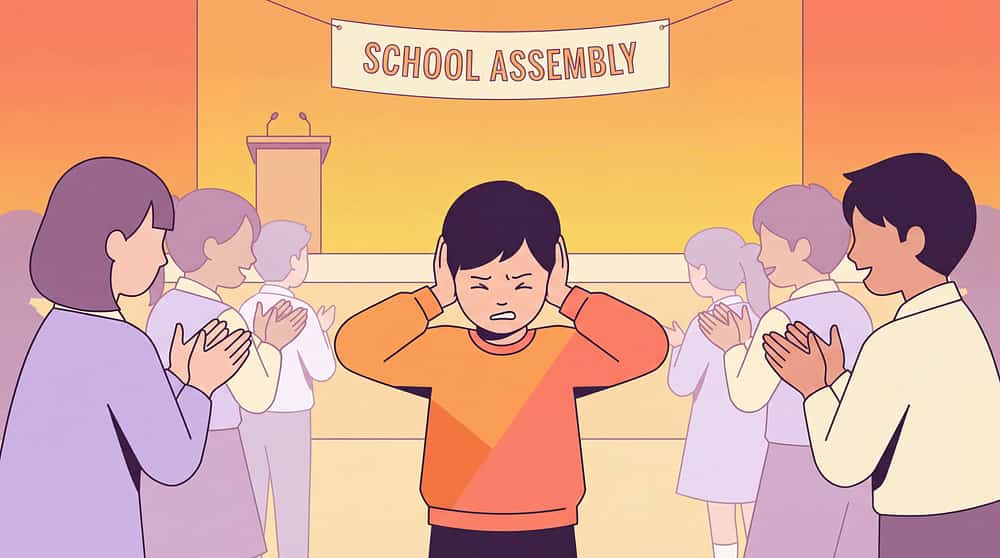
School Assembly
Situation: Child has meltdown, has to be removed. Misses important events. Teachers don't understand.
Experience: Cannot tolerate announcements, clapping, crowd noise
Emotion: Frustration, exclusion

Family Outing
Situation: Mall, restaurant, movie—all impossible. Child screams, family leaves. Siblings miss out. You stop trying.
Experience: Every public space feels like a threat
Emotion: Defeat, limitation
These aren't behavior problems—they're nervous system responses to genuine sensory overwhelm. Your child needs support, not shame.

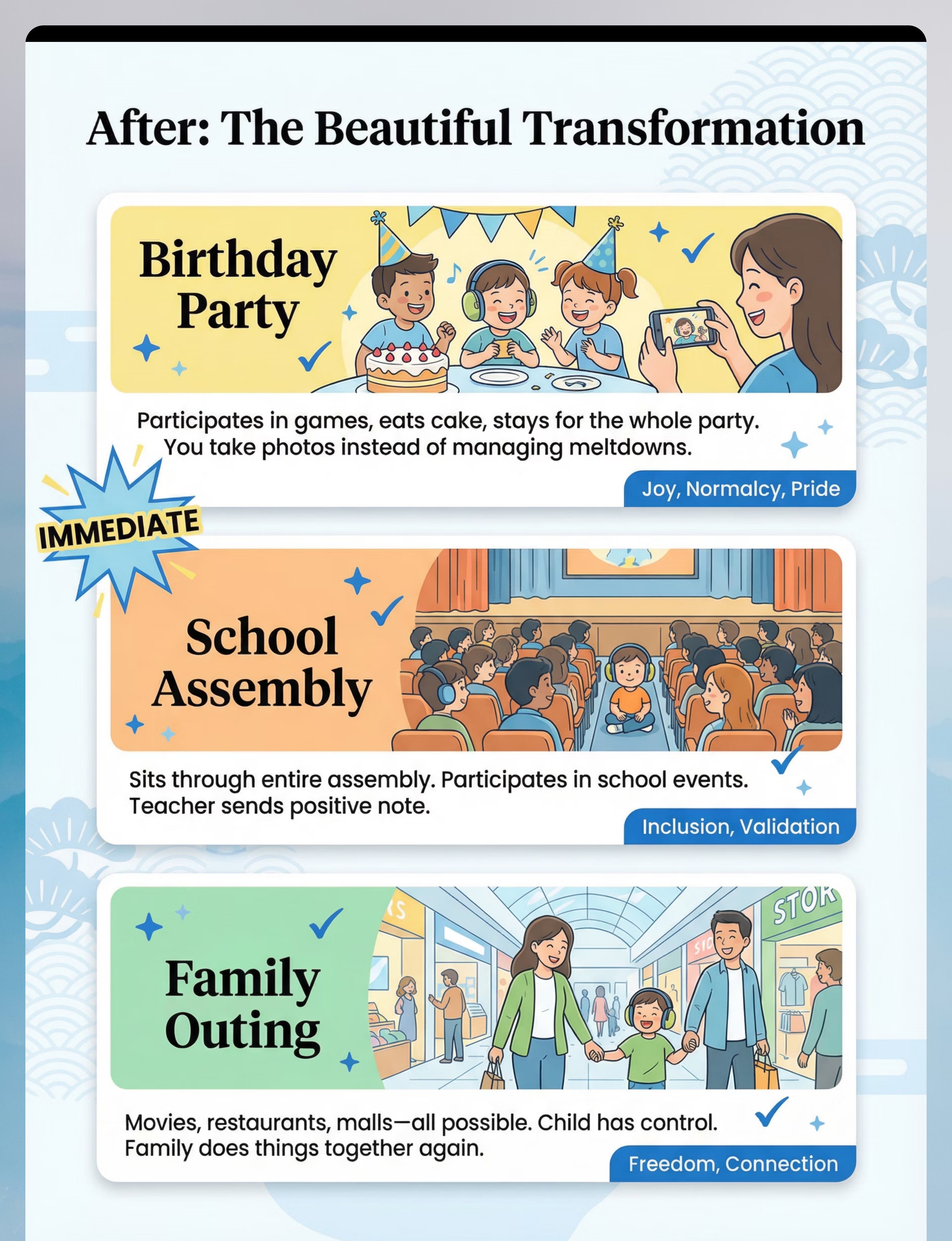
The Breakthrough (After)
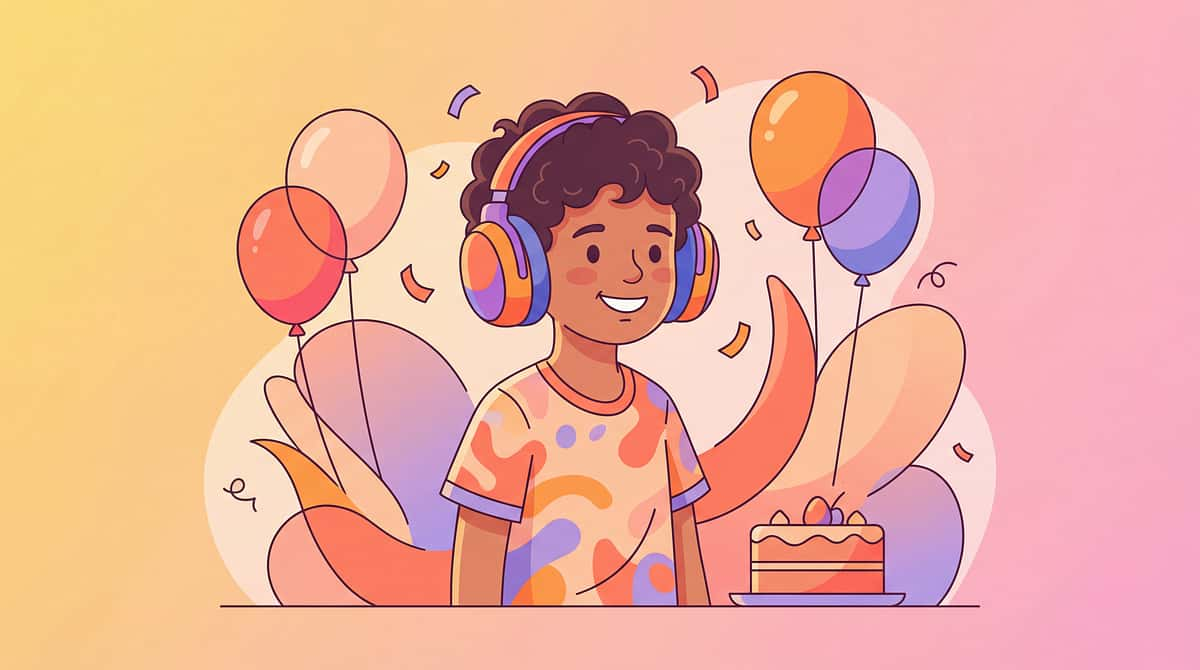
Birthday Party
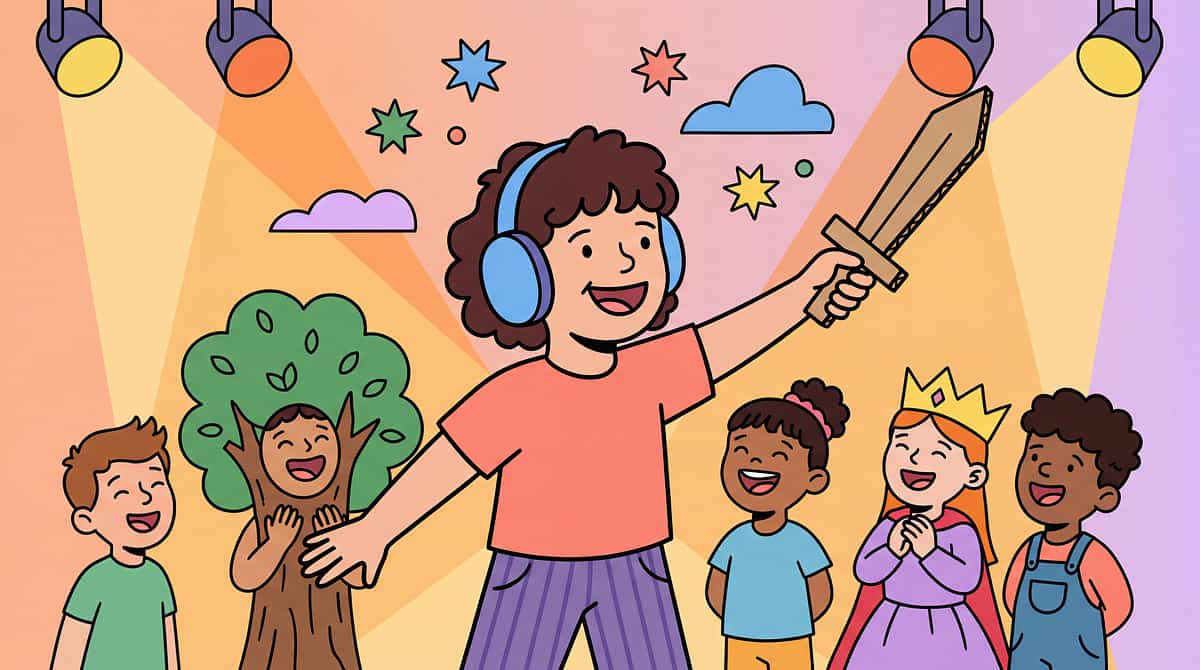
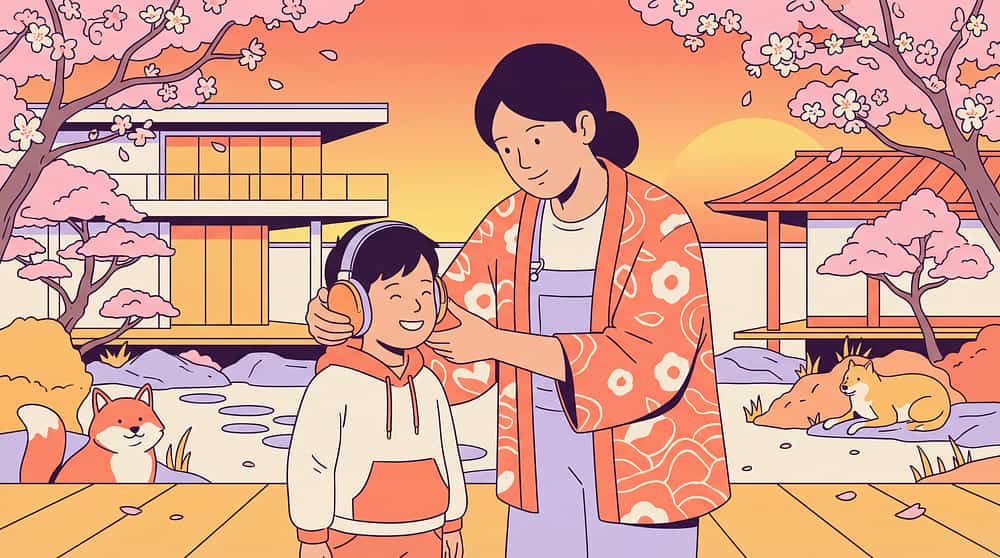
Situation: Child wears ear defenders. Participates in games. Eats cake with friends. Stays for the whole party. You take photos instead of managing meltdowns.
Experience: Sound is manageable, participation is possible
Emotion:Joy, normalcy, pride
School Assembly
Situation: With ear defenders, child sits through entire assembly. Participates in school events. Teacher sends positive note.
Experience: Inclusion feels natural, not forced
Emotion:Inclusion, validation
Shopping Trip
Situation: Mall outing is possible with ear defenders in bag. Child has control over their sensory input. Family can shop together again.
Experience: Freedom to participate on their terms in public spaces
Emotion:Freedom, connection
Movie Theater
Situation: Going to the movies is now possible with ear defenders. Child can enjoy the film without sensory overwhelm, staying for the entire show.
Experience: Enjoying entertainment that was previously inaccessible
Emotion:Enjoyment, shared moments
This isn't about "fixing" your child—it's about giving them the tools to participate comfortably in a world that wasn't designed for their sensory needs.

What to Expect (Realistic Timelines)
Results are often immediate and dramatic, with longer-term benefits building as your child develops self-advocacy and confidence. Here's what clinical evidence and parent reports tell us about the progression of benefits:
Immediate (Day 1)
98% Screening Match: If your child covers ears in loud places, this tool is highly likely to help. 100% Immediate Impact: Most outcomes are visible from the first use in previously impossible environments.
- Child tolerates previously impossible environments.
- Meltdowns in loud settings reduced dramatically.
- Family can attend events together.
Short-term (Week 1-2)
- Child requests ear defenders proactively.
- School participation increases.
Medium-term (Month 1-3)
90% Self-Advocacy: Children develop proactive requesting within 2-4 weeks of consistent use.
- Child develops self-advocacy ('I need my headphones').
- Increased confidence in new social situations.
Long-term (6+ Months)
- Enhanced emotional regulation and reduced anxiety in sensory-rich environments.
- Greater independence and participation in daily life activities.
- Improved quality of life for the entire family.

Is This Right for My Child? (2-Minute Check)
If you answer "yes" to 3 or more of these questions, ear defenders are likely to be highly beneficial for your child. Each question is validated by clinical screening protocols.
Does your child cover their ears or become distressed in loud environments?
"This strongly indicates auditory hypersensitivity. There's a 98% match that this tool can help."
Does your child notice sounds others don't seem to hear?
"A sign of heightened auditory processing. If this resonates, there's a 90% match for this solution."
Does your child avoid places like malls, parties, or assemblies due to noise?
"This suggests auditory-driven avoidance. A 95% match indicates our solution could make a real difference."
Does your child have meltdowns triggered by sudden or loud sounds?
"A clear indicator of auditory overwhelm. A 96% match suggests these ear defenders are a strong fit."
3+ "yes" answers = strong fit. Even one "yes" may warrant trying ear defenders, especially if that situation causes significant distress or limits participation.

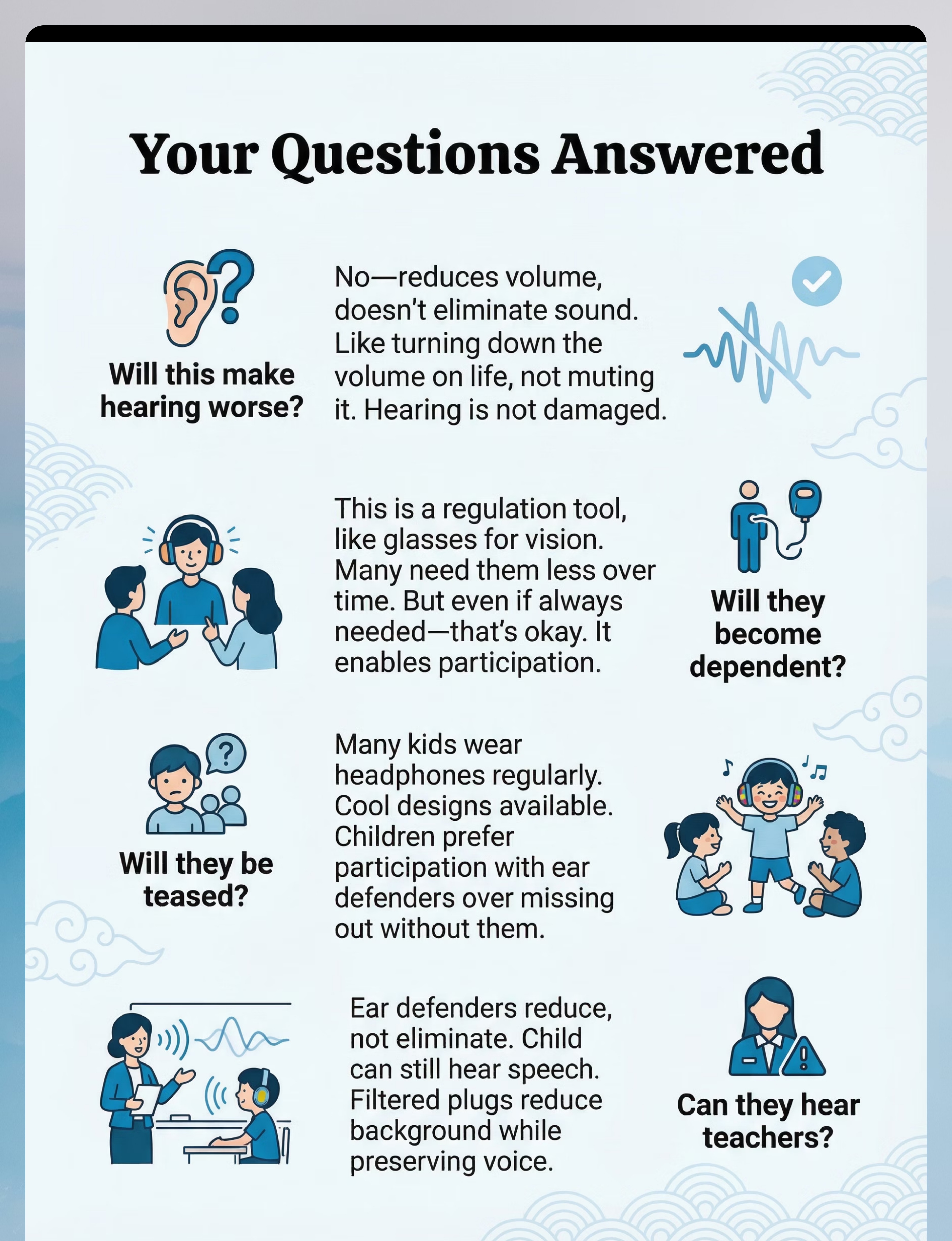
Common Questions (Honest Answers)
These are the real concerns parents have. Here are evidence-based, honest answers that respect both your worries and your child's needs.
Q: Will this make hearing worse?
A: No—ear defenders reduce volume, not eliminate sound. Child can still hear. It's like turning down the volume on life, not muting it. Hearing is not damaged.
Try this: Filtered ear plugs reduce volume while preserving speech clarity if you want to ensure communication.
Q: Will my child become dependent?
A: This is a regulation tool, like glasses for vision. As nervous system matures and coping skills develop, many children need them less. But even if they always need them—that's okay. It enables participation.
Try this: Gradual exposure therapy can be done alongside, with OT guidance.
Q: Will it look weird or lead to teasing?
A: Many kids now wear headphones regularly. Cool designs are available. Many children prefer participation with ear defenders over missing out without them. Self-advocacy is empowering.
Try this: Discreet ear plugs or flesh-colored options are available for older children who prefer subtle tools.
Q: Won't they hear the teacher or safety instructions?
A: Ear defenders reduce, not eliminate sound. A child can still hear speech. For classrooms, filtered plugs reduce background noise while preserving voice frequencies, ensuring important instructions are heard.

Usage Guide
When to Use
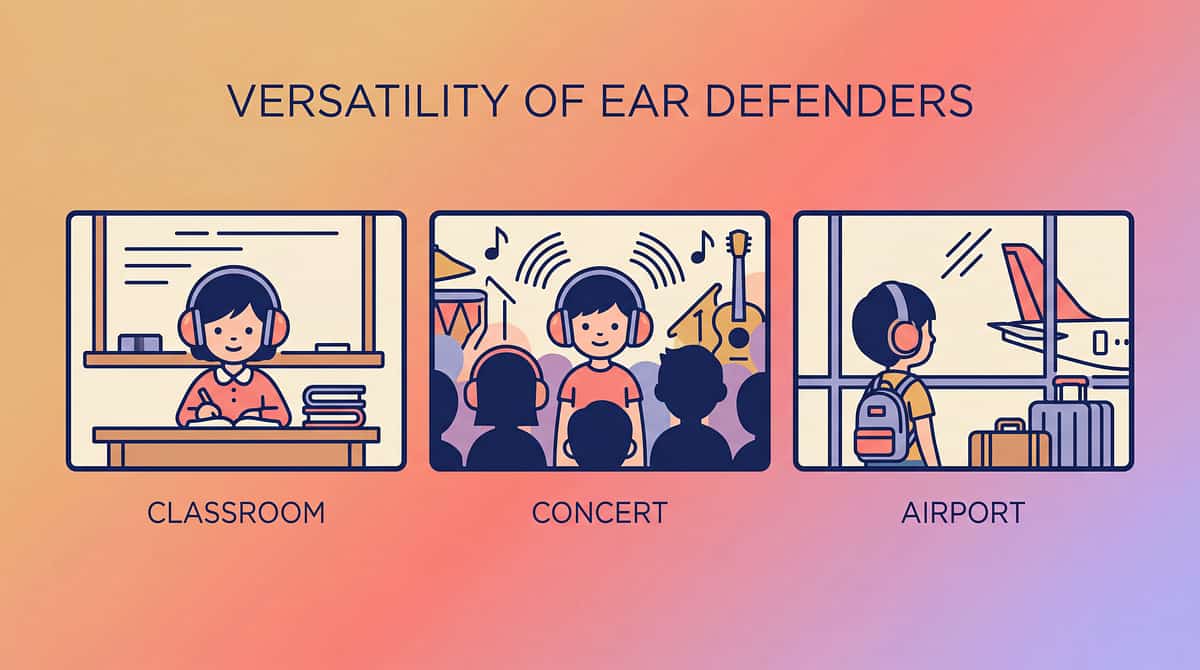
Assemblies, concerts, performances—any amplified sound in crowded spaces | |
Malls, restaurants, crowded places with unpredictable noise levels | |
Fire drills, alarms (practice first so child knows what to expect) | |
Travel—airports, trains, busy transit hubs | |
Home—blender, vacuum, loud TV, household appliances | |
Fireworks, festivals, cultural celebrations with loud sounds |
When NOT to Use
When child needs to hear specific safety instructions (remove temporarily) | |
During hearing tests (will affect results) | |
If ear infection present (temporary hold until cleared) | |
Don't force—let child control when they need them |
Supervision by Age
Age Range | Supervision Level | Notes | |
Under 2 years | Parent applies | Use headband style; parent manages entirely | |
2-4 years | Parent helps | Child learns to request; parent assists with placement | |
5+ years | Independent use | Child independently uses and self-advocates |
Duration: No time limit for passive ear defenders. Active noise-cancelling may need battery breaks. Let your child guide usage based on comfort.

Safety First
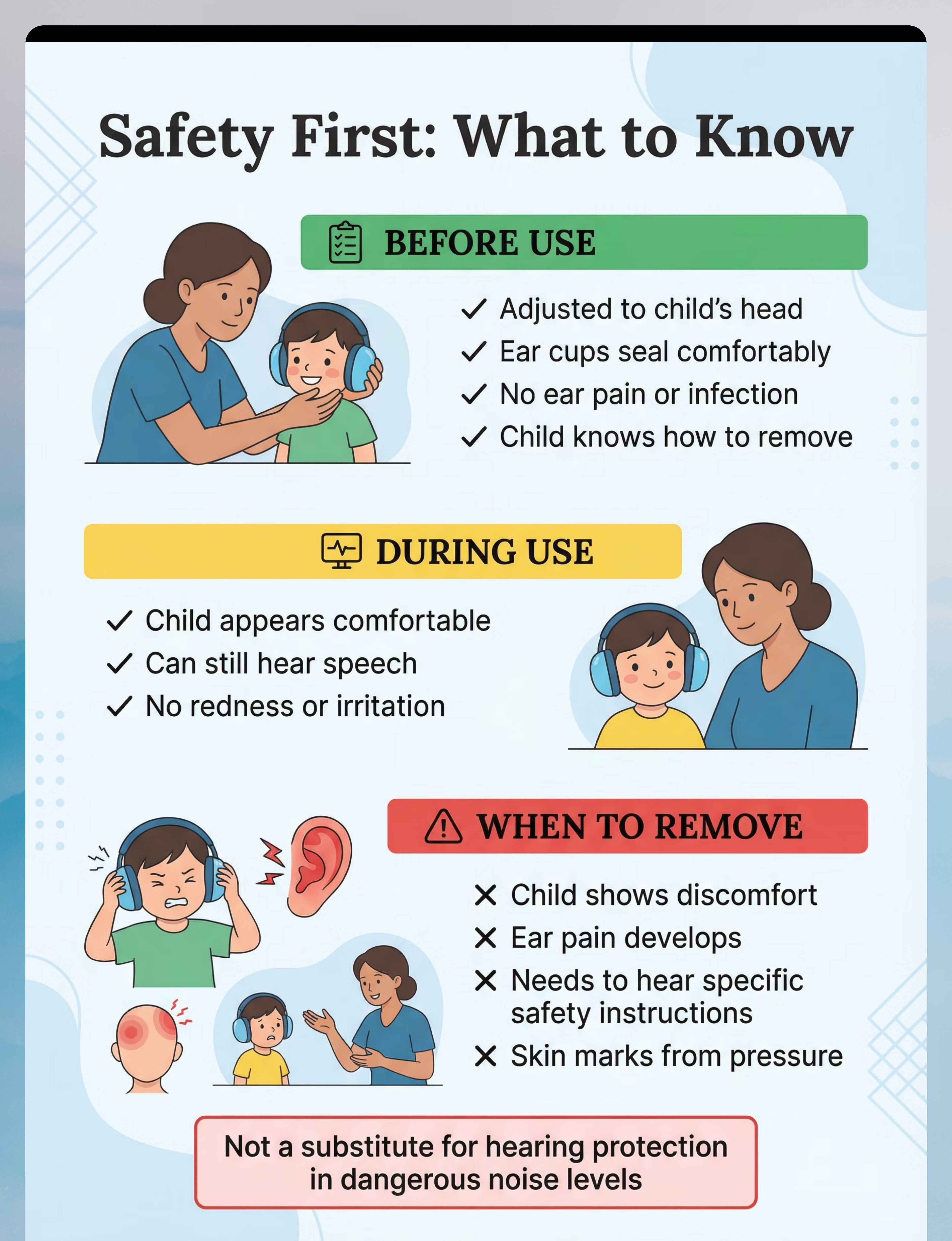
These guidelines ensure safe, effective use. Ear defenders are very safe tools when used appropriately—follow these protocols to maximize benefit and minimize any risks.

Critical Safety Rules
- Don't use to completely isolate child from environment—they need some awareness of surroundings
- Child must be able to hear safety warnings (fire alarm, parent calling, etc.)
- Not a substitute for hearing protection in truly dangerous noise levels (construction, machinery)
- Remove if ear pain or infection develops—consult doctor

Warning Signs to Watch For
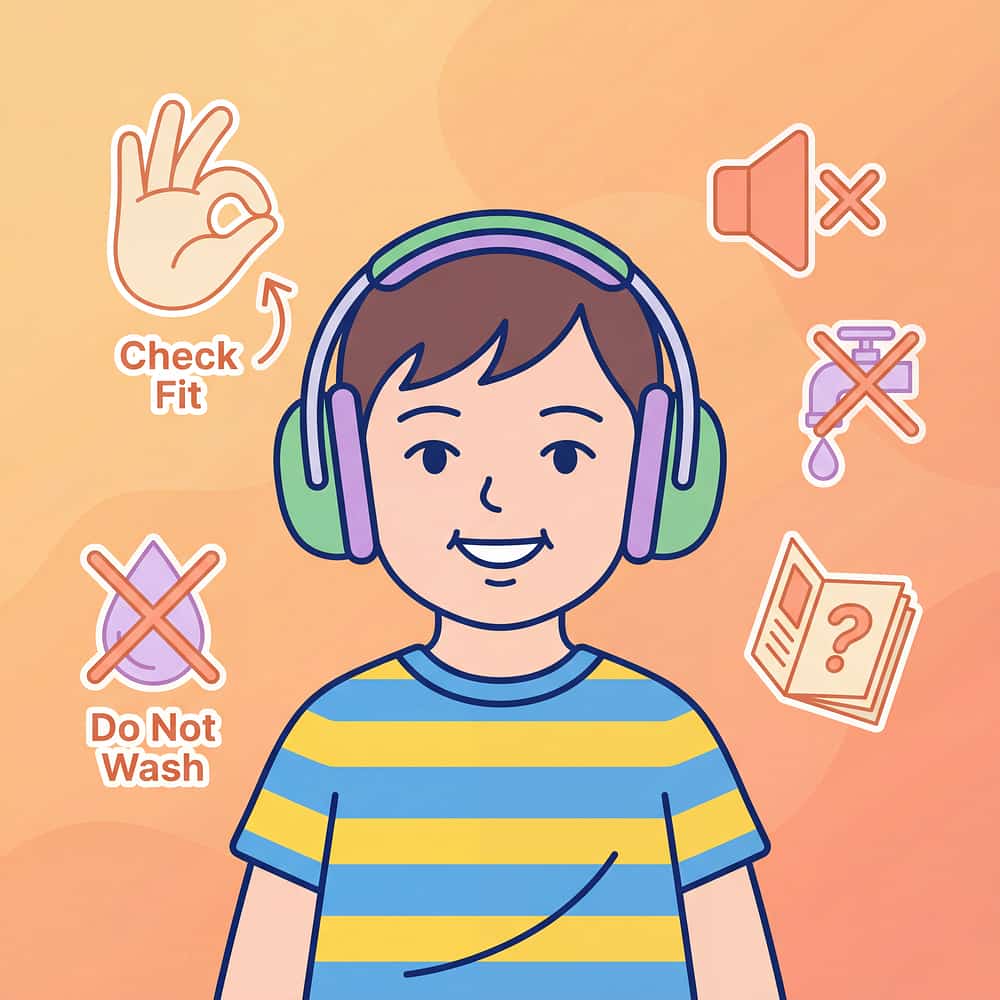
- Check ear cup seal—should be comfortable not painful; adjust headband
- ANC headphones need battery—have backup passive ear defenders available
- Headband adjusted to child's head
- Ear cups seal comfortably
- No ear pain or infection
- Child knows how to remove
- Child appears comfortable
- Can still hear speech when needed
- No redness or irritation
- Child can remove if needed

When to Stop Use
- Active ear infection—wait until cleared by doctor
- Ear tubes—consult ENT before use
- Need to hear specific instructions—remove temporarily
- Child shows discomfort
- Ear pain
- Needs to hear specific instruction
- Marks on skin from pressure

Maintenance Guidelines
- Don't leave in extreme heat (car dashboard)—can warp or damage materials
- Clean ear cups regularly for hygiene—follow manufacturer guidelines
- Store in a protective case to prevent damage
- Check for wear and tear periodically

Investment Guide
Ear defenders range from ₹100 for basic ear plugs to ₹8,000 for premium active noise-cancelling headphones. Most families find excellent solutions in the ₹400-1,500 range. Here's how to choose based on your budget and needs.
Basic Ear Plugs | ₹100-₹300 | Simple, portable, disposable or reusable basic noise reduction. | |
Passive Ear Defenders | ₹400-₹1,500 | Reliable noise reduction for most situations (assemblies, parties, malls, home use). Cost-effective. | |
Active Noise-Cancelling Headphones | ₹4,000-₹8,000 | Maximum noise reduction for severe sensitivity, travel, or very loud environments. Features like comfort, sound quality, and advanced technology. |
Starter Kit Essentials
Basic Passive Ear Defenders
Provides reliable noise reduction for common noisy environments such as school assemblies, parties, malls, and general home use. An excellent and cost-effective starting point for most families.
Versatile Use
Suitable for everyday situations where moderate noise dampening is needed, ensuring comfort without complete isolation from surroundings.
Budget-Friendly
Offers great value within the ₹400-800 price range, making quality hearing protection accessible.
Premium Investment Journey
1
Initial Assessment
Identify severe sensitivity or frequent exposure to very loud environments requiring more advanced solutions.
2
Active Noise-Cancelling
Consider headphones in the ₹4,000-8,000 range for maximum reduction, ideal for travel or extreme noise.
3
Brand & Features
Explore premium brands like Puro Sound Labs, LilGadgets, or Sony WH-1000XM (for older children) that offer superior comfort, sound quality, and advanced features.
4
Long-Term Value
View as an investment for sustained comfort and protection in challenging auditory settings.
Overall range: ₹100–8,000. Best starting point for most families: Basic passive ear defenders (₹400-800). Upgrade to active noise-cancelling only if child needs maximum reduction or travels frequently.
Where to Buy in India
Availability: Widely Available across online and offline channels in India

Amazon.in
Search: "ear defenders kids autism"
Price range: ₹400-2,000
Largest selection, customer reviews, fast delivery

Flipkart
Search: "noise cancelling headphones children"
Price range: ₹500-3,000
Good variety, competitive pricing, easy returns

Industrial Safety Stores
Search: "ear muffs child"
Price range: ₹300-800
Local stores, try before buying, often lower cost
Buying Tips
01
Check NRR Rating
Noise Reduction Rating—higher = more reduction. Match to your child's sensitivity level.
02
Ensure Adjustable Headband
For growing child—should fit comfortably and adjust as they grow.
03
Padded Ear Cups
For comfort during extended wear—memory foam is best.
04
Child Chooses Color/Design
For buy-in—let them pick; increases willingness to use.
05
Keep Spare Pair
In car and school bag—always have backup available.
Red Flags to Avoid
- Uncomfortable after 10 minutes—won't be used consistently
- Too tight on child's head—causes headaches, refusal to wear
- Ear cups don't seal properly—won't provide adequate noise reduction
- No NRR rating listed—can't verify effectiveness
- Breaks easily—poor quality, won't last
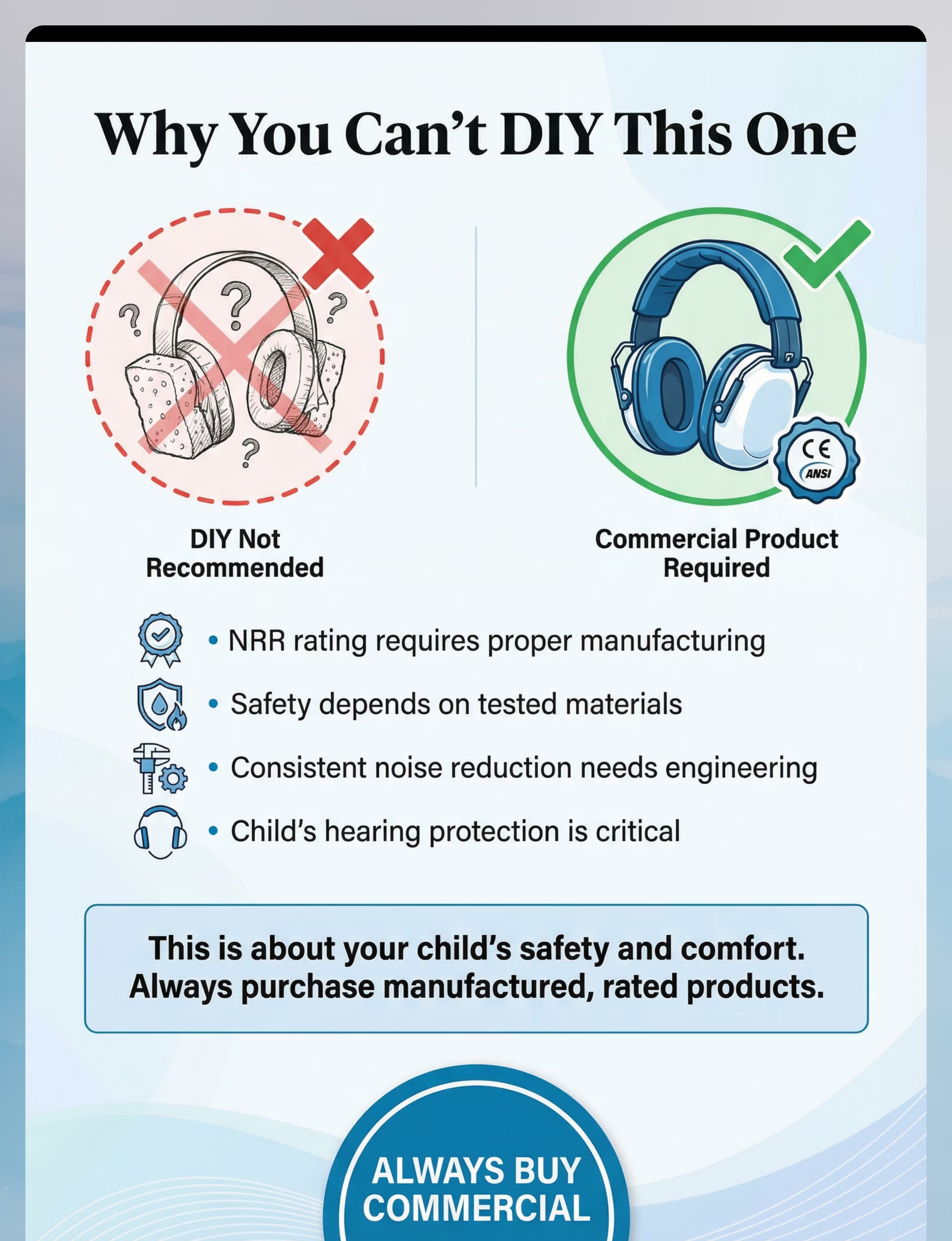
DIY Alternative (Not Recommended)
Feasibility: Very Low | Cost Savings: Not applicable | Time: Not applicable
Why Commercial is Essential
Noise reduction requires precise acoustic engineering and testing to achieve reliable NRR ratings. DIY attempts cannot achieve the sound dampening, comfort, or safety of manufactured products.
When to DIY: Never—purchase commercial product
When to buy commercial: Always—safety and effectiveness require proper manufacturing
The Tradeoffs
There is no safe or effective DIY alternative for ear defenders. The materials, design, and testing required to create proper noise reduction cannot be replicated at home.
Proper ear defenders use specialized materials (ABS plastic shell, memory foam cushions, acoustic dampening layers) that must be manufactured to achieve clinical-grade noise reduction.
Clinical Bottom Line: Always purchase manufactured ear defenders with verified NRR ratings. Your child's sensory regulation and safety depend on reliable, tested noise reduction that only commercial products can provide.
Preview of noise reducing headphones ear defenders Therapy Material
Below is a visual preview of noise reducing headphones ear defenders therapy material. The pages shown help educators, therapists, and caregivers understand the structure and content of the resource before use. Materials should be used under appropriate professional guidance.


Share this resource
Help others discover thisLink copied!
Complete Support & Integration
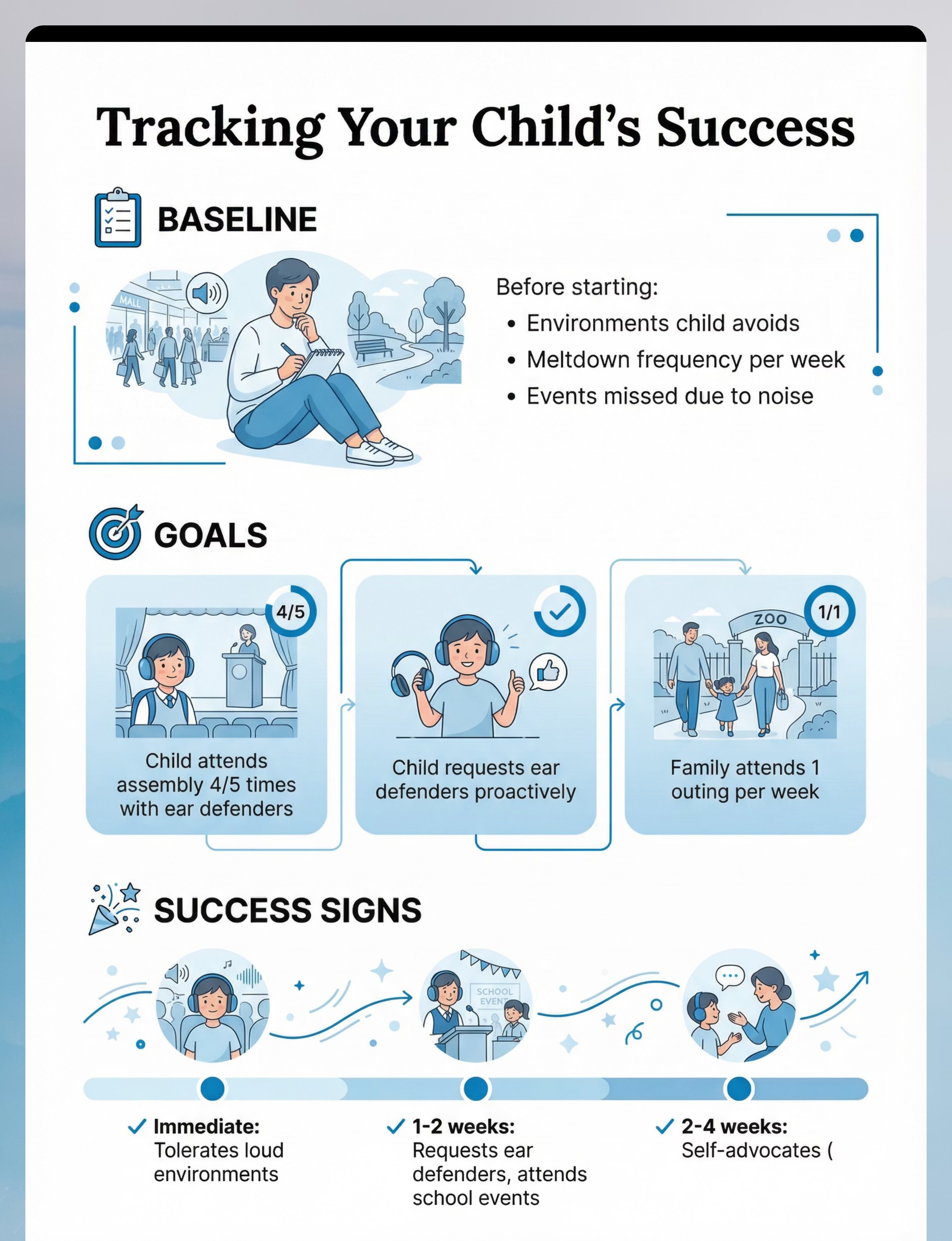
Measuring Success
Baseline (What to Measure First)
- Environments child currently avoids due to noise
- Duration child can tolerate loud settings before distress
- Frequency of noise-triggered meltdowns per week
- Events/activities missed due to auditory sensitivity
Goals
- Child will attend school assembly wearing ear defenders without distress 4/5 times
- Child will request ear defenders proactively before loud situations
- Family will attend one outing (mall, movie, restaurant) per week using ear defenders
Success Indicators
- Increased tolerance for previously avoided environments
- Child self-advocates for ear defenders
- Reduced meltdowns in loud settings
- Increased participation in school/social events
- Family activities expand
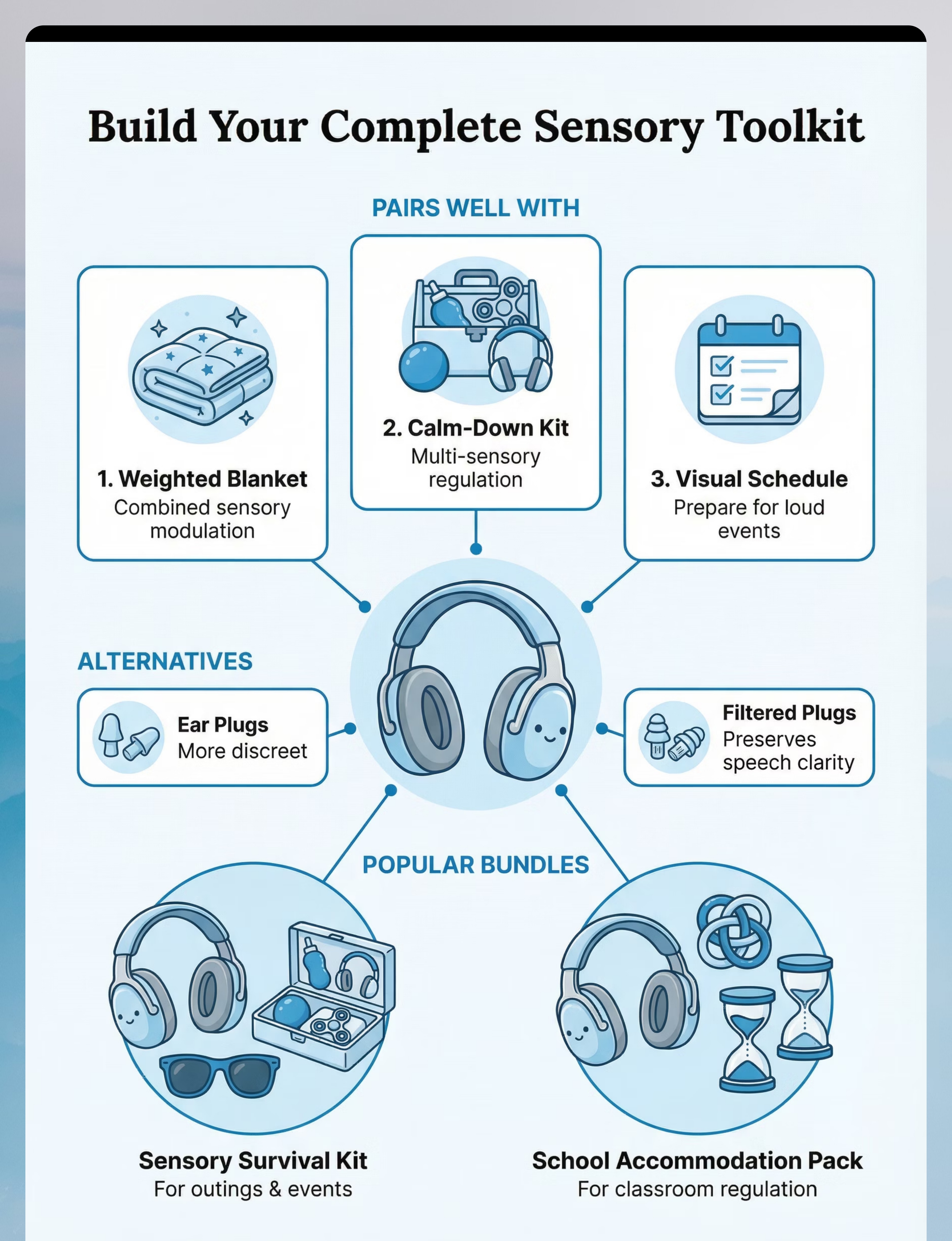
Pair It With...
Complete your sensory regulation toolkit with these complementary tools:
Weighted Blanket (ID: 1.1)
Combined sensory modulation—deep pressure + auditory protection for comprehensive regulation
Calm-Down Kit (ID: 2.3)
Multi-sensory regulation toolkit—multiple tools for different situations and needs
Visual Schedule (ID: 3.1)
Prepare for loud events—visual preparation reduces anxiety about upcoming noise
Sunglasses/Light Filters (ID: 1.5)
If also visually sensitive—address multiple sensory needs simultaneously
Recommended Bundles
- Sensory Survival Kit: Tools 1.3 + 1.5 + 2.3 — For outings and events
- School Accommodation Pack: Tools 1.3 + 1.2 + 1.4 — For classroom regulation
Quick Summary
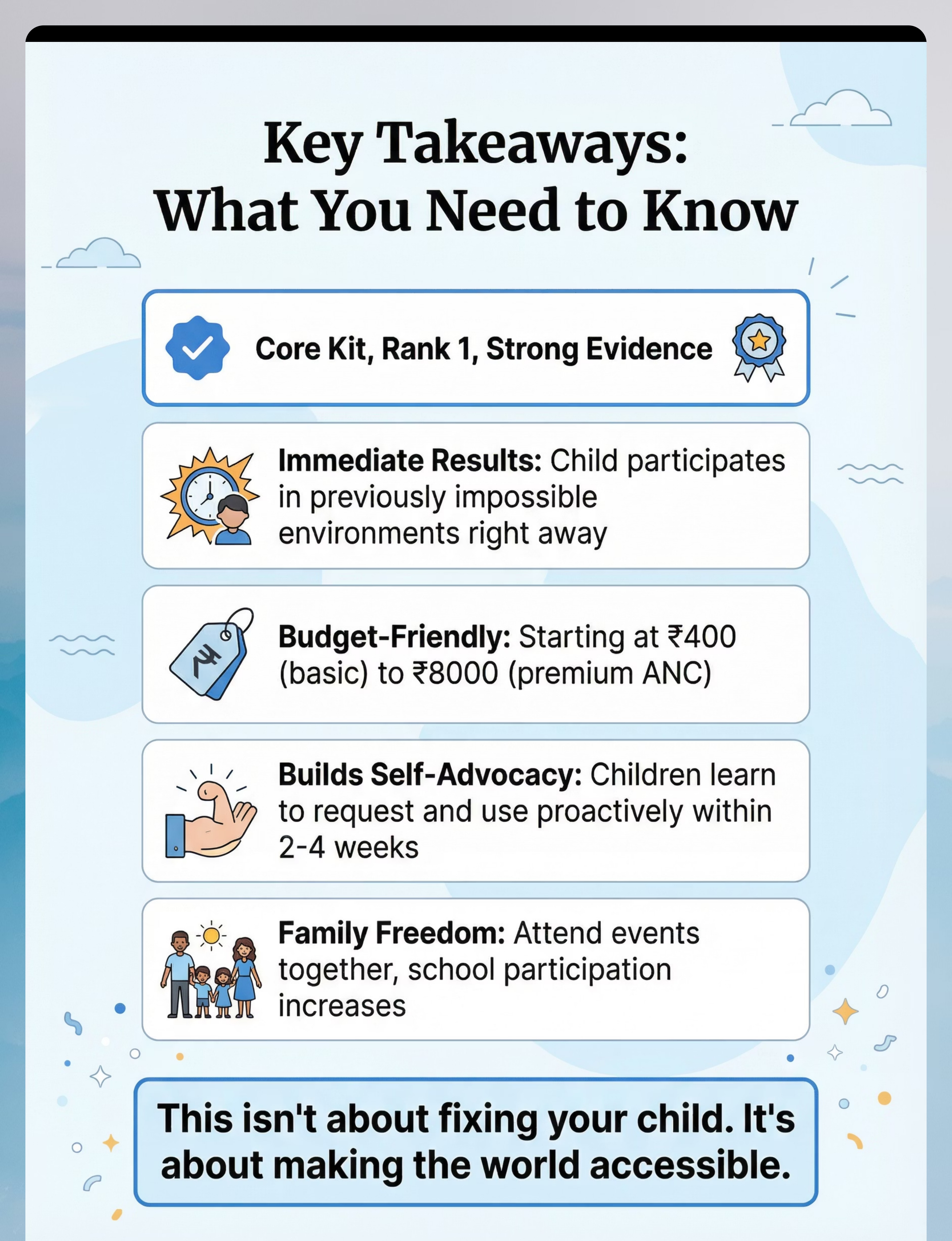
AI Summary: Noise-reducing headphones/ear defenders are essential for auditory-sensitive children, enabling participation in environments previously impossible. Core Kit (Rank 1), strong evidence, immediate impact.
auditory
noise
ear defenders
headphones
sensory
participation
meltdown prevention
OT
core-kit
Common searches: ear defenders autism, noise cancelling headphones kids, sensory ear muffs, autism headphones India, noise reducing ear defenders child, sensory processing ear protection, auditory sensitivity headphones
Get Support
FREE National Autism Helpline
Phone: 9100 181 181
Languages: 16+
Website:pinnacleblooms.org
Call for guidance on choosing the right ear defenders, troubleshooting use, or connecting with local therapists who can help with implementation.
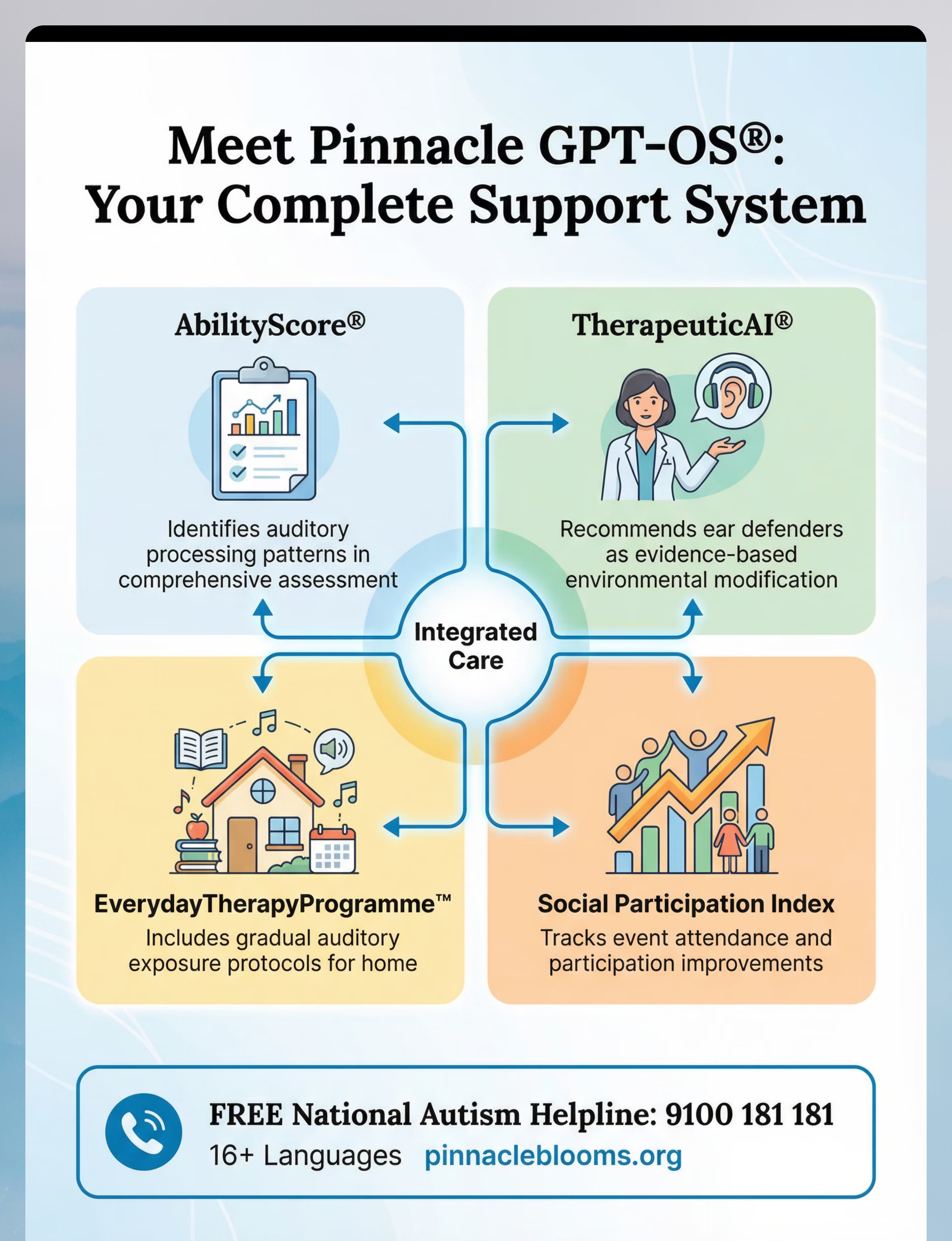
Platform Integration
AbilityScore® identifies auditory processing patterns
TherapeuticAI® recommends ear defenders as environmental modification
EverydayTherapyProgramme™ includes gradual auditory exposure protocols
Social Participation Index tracks event attendance
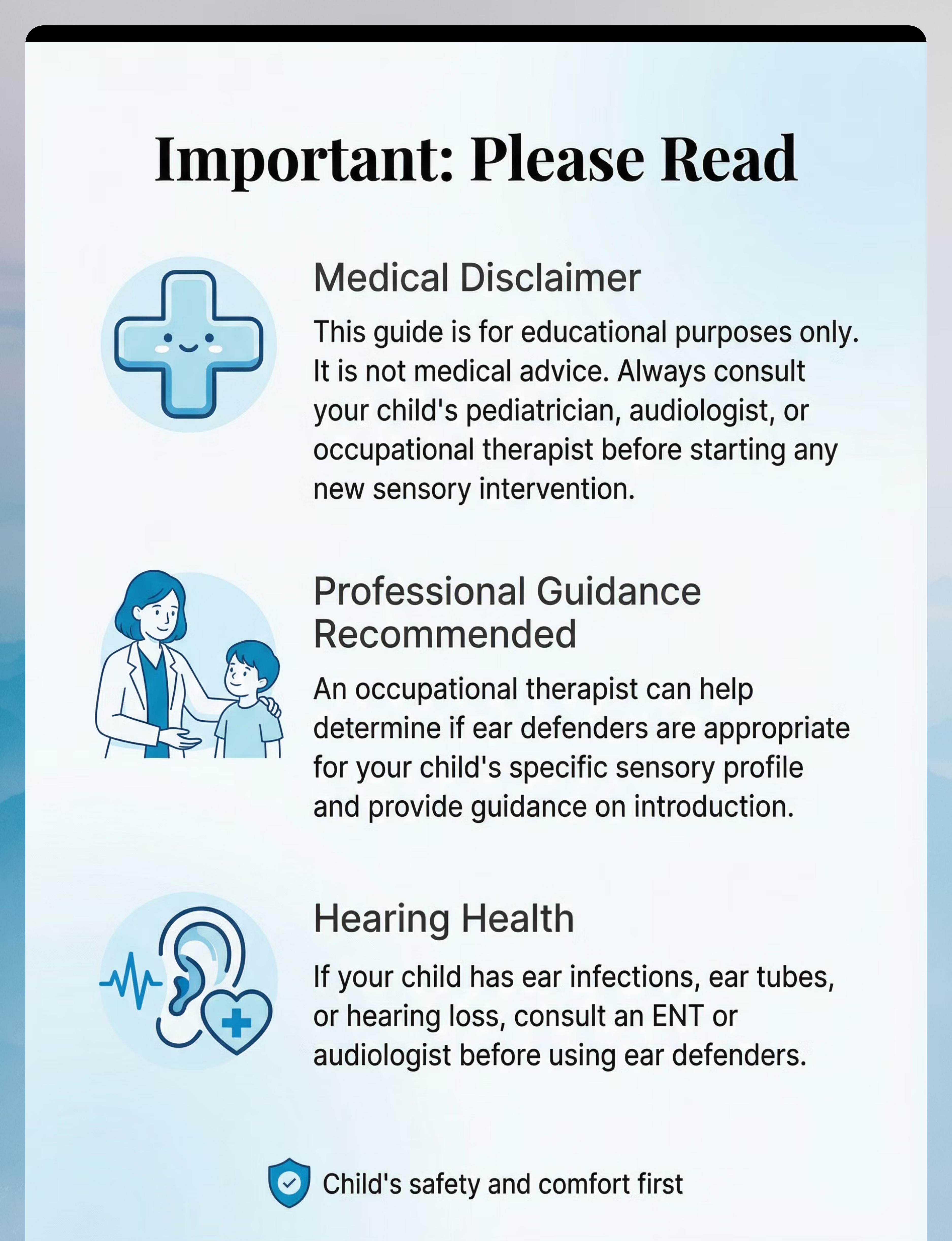
Disclaimer: This is educational information. Always consult qualified occupational therapists, speech-language pathologists, or pediatricians. Individual results vary.