










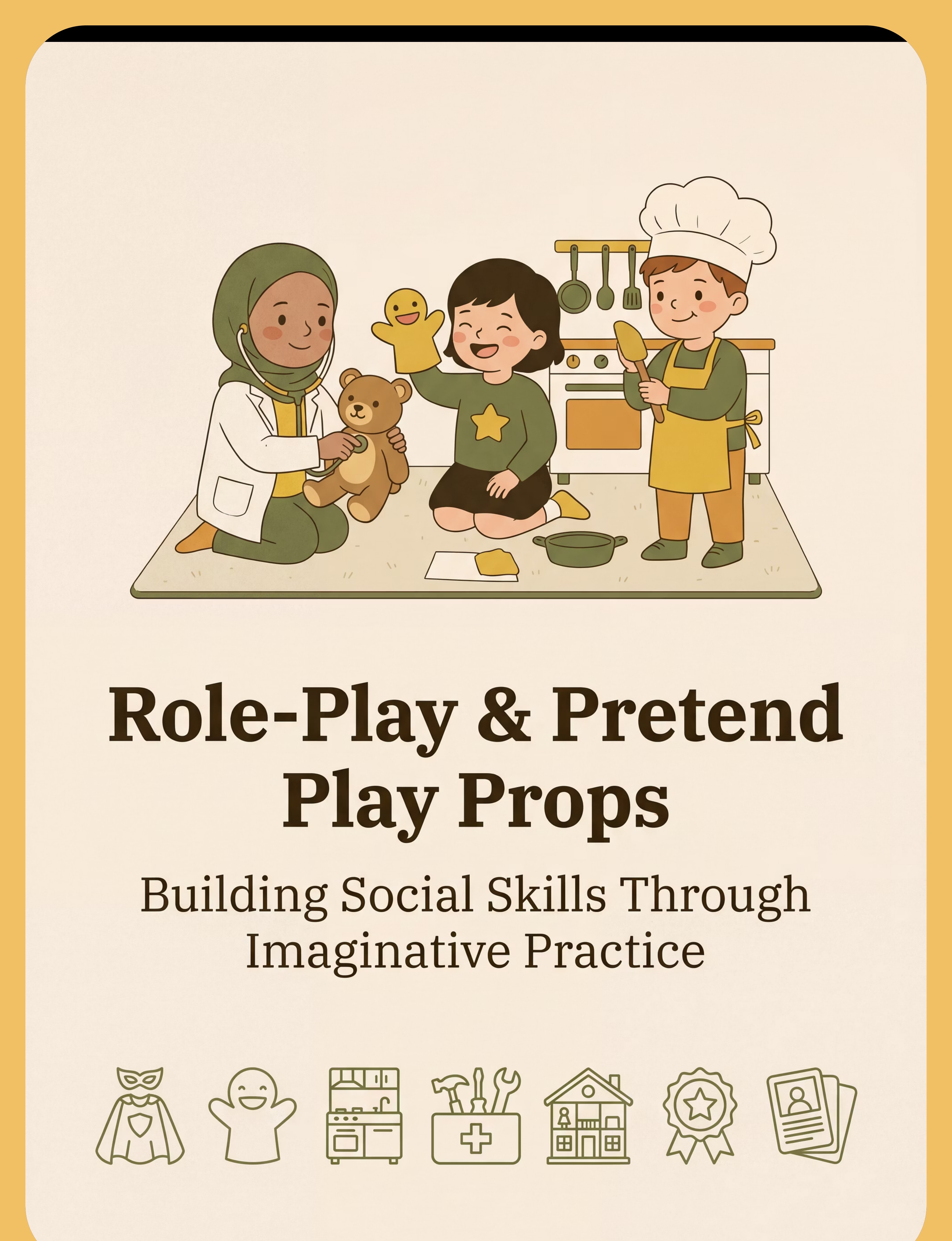

Role-Play & Pretend Play Props: Building Social Skills Through Imaginative Play
Symbolic play and social practice system
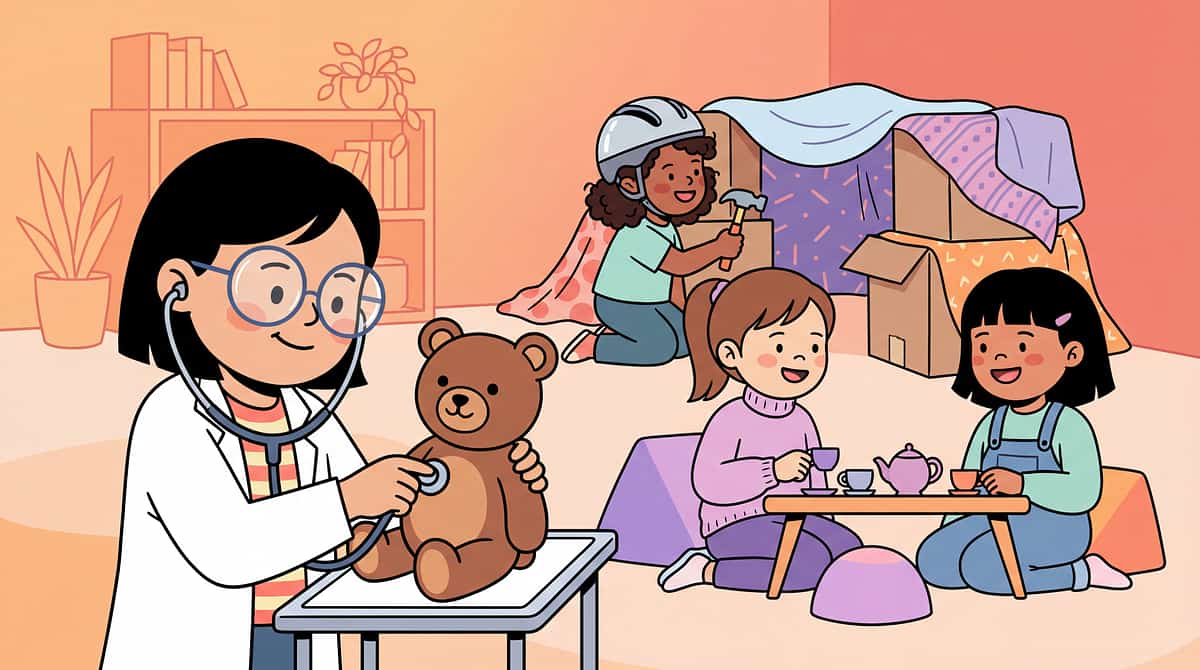
Transform everyday interactions into powerful learning moments. Role-play props create safe spaces where children practice social scripts, develop imagination, and build the confidence to navigate real-world situations—from doctor visits to birthday parties.

Who This Helps
Ages 2-9 years
Home
Clinic
School
Structured Practice
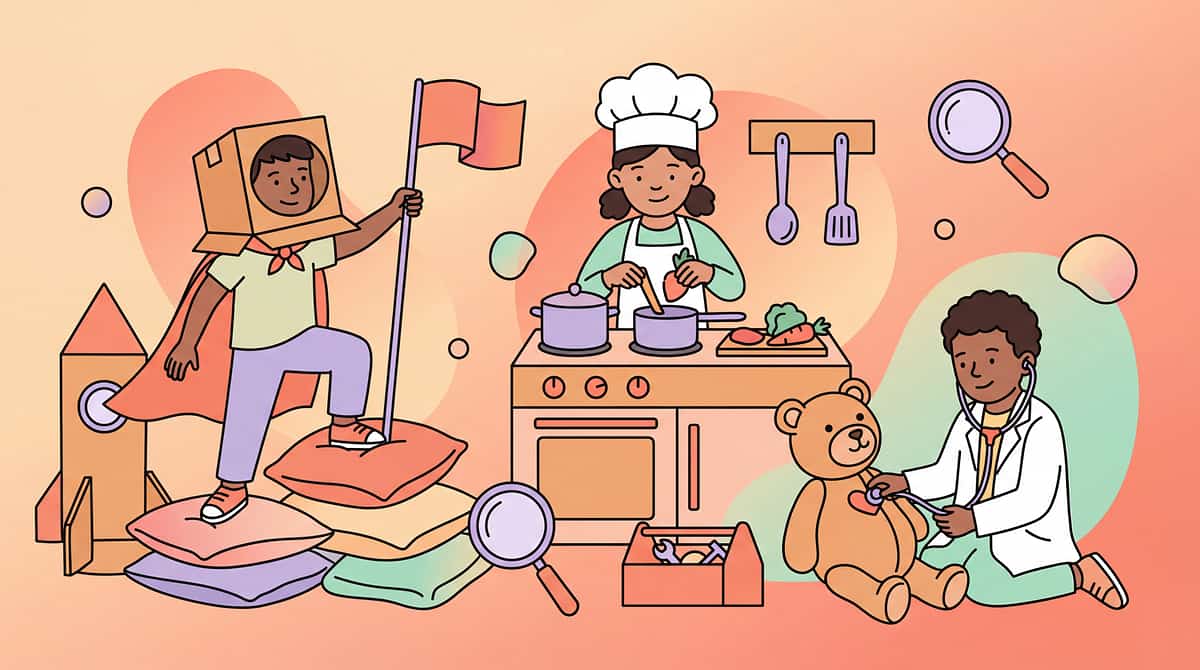
Role-play props provide a safe environment for children to engage in structured practice, developing pretend play and imaginative thinking.
Social Script Rehearsal
Children can safely rehearse real-world social situations, such as navigating doctor visits, going shopping, or engaging in various social exchanges.
Perspective-Taking
Through character play and practicing different scenarios, children learn to understand and appreciate various roles and viewpoints, building social understanding.
Target Areas: Pretend Play • Symbolic Thinking • Social Scripting • Perspective-Taking • Language Development • Flexibility

Does This Sound Familiar?
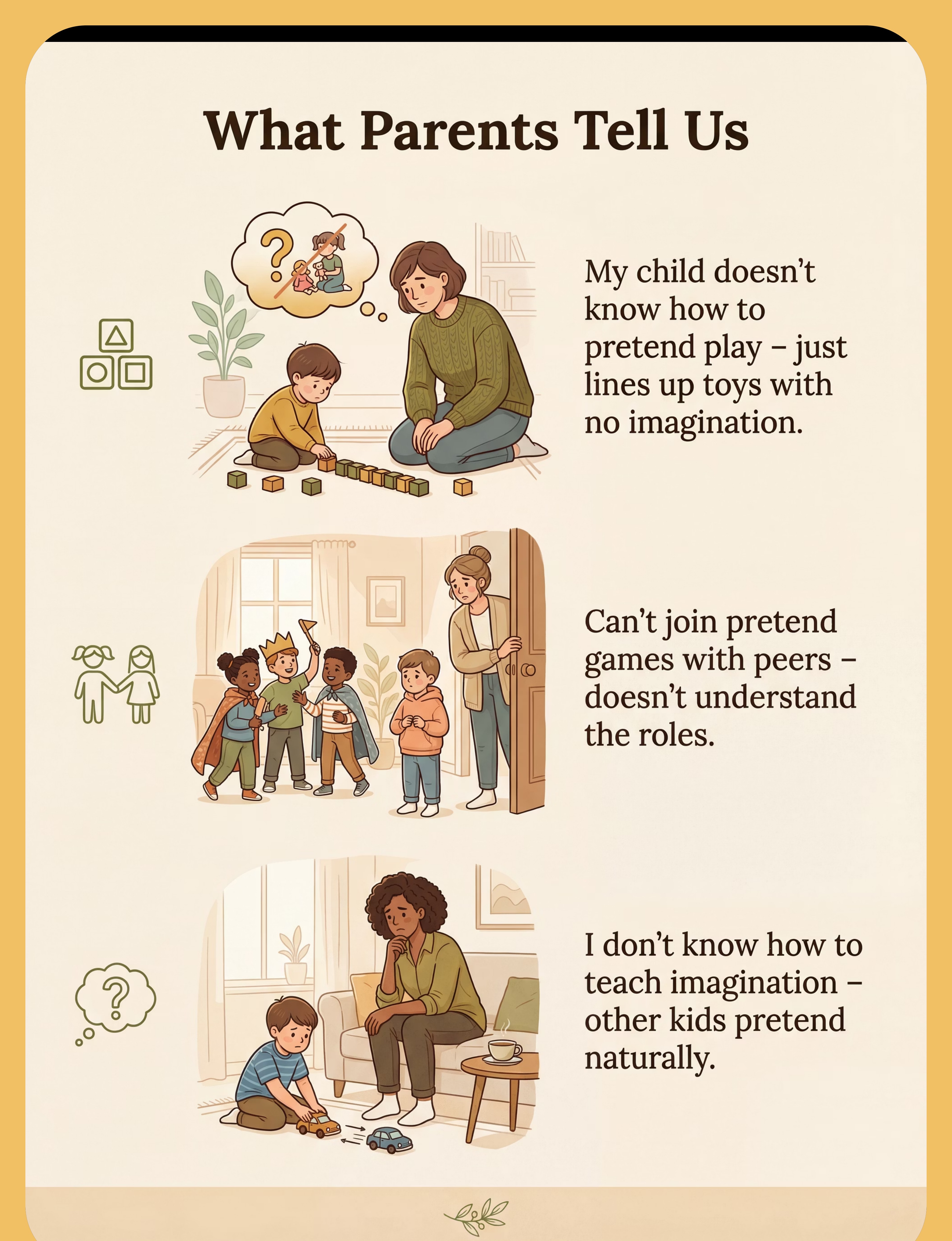
"My child doesn't know how to pretend play"
"She just lines up toys - no imagination"
"He can't role-play with other kids"
"She doesn't understand pretend at all"
"I don't know how to teach imagination"
"Other kids pretend - mine doesn't join in"
You're not alone. These are common challenges for children developing social and play skills. With the right tools and guidance, pretend play abilities can emerge and flourish.

A Day Without the Right Support
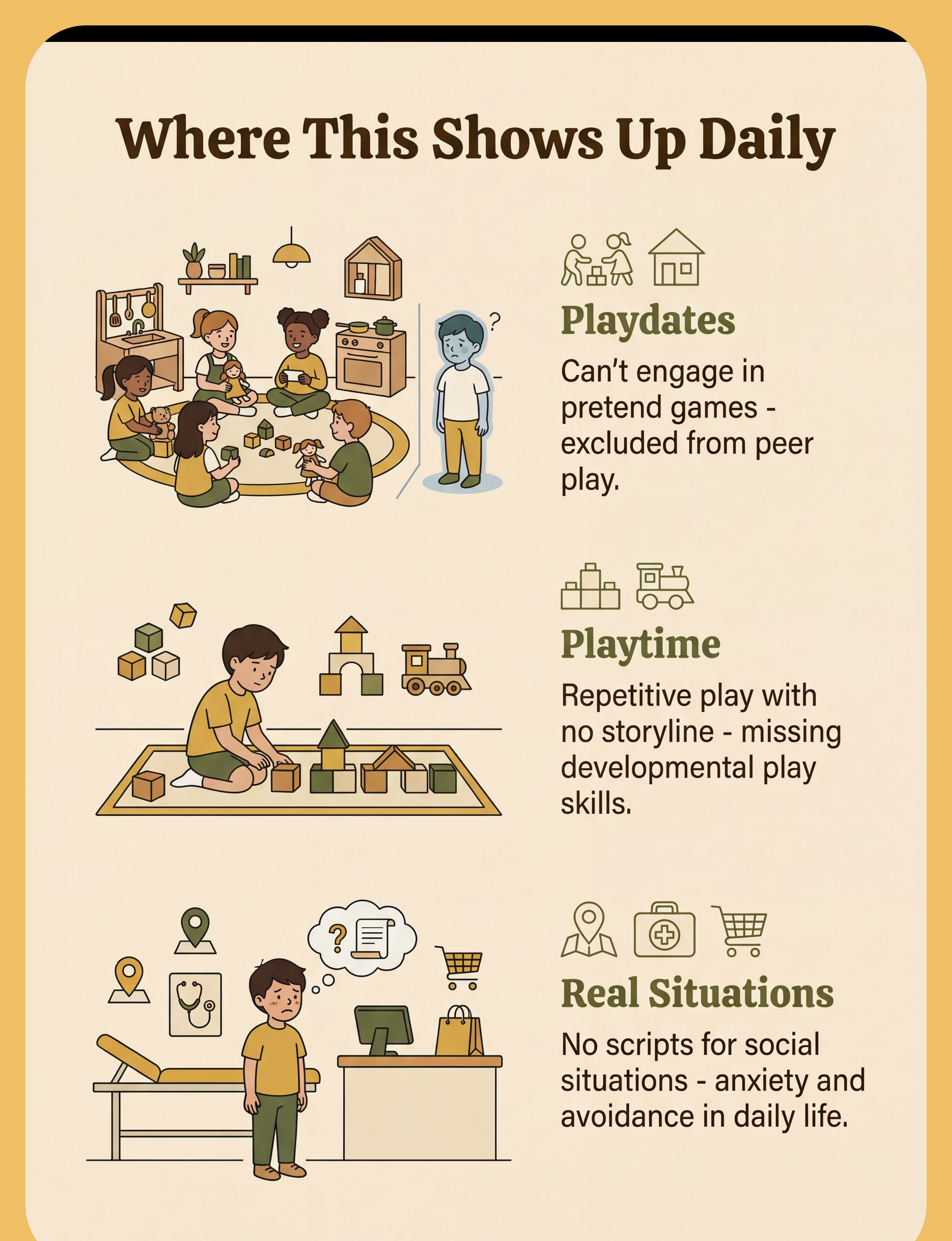
Playtime
Child engages in repetitive play with no narrative development or imaginative element
Playdate
Unable to join peers in pretend games, stands apart confused while others play "house"
Social Situations
Anxious at stores, doctors, restaurants—no mental script for these interactions
Flexibility Challenges
Rigid play patterns, won't try new scenarios or adapt to others' play ideas
Without pretend play skills, children miss crucial developmental opportunities for social learning, creative thinking, and emotional preparation for new experiences. These challenges ripple through daily life, affecting peer relationships and confidence in unfamiliar situations.

The Science Behind It
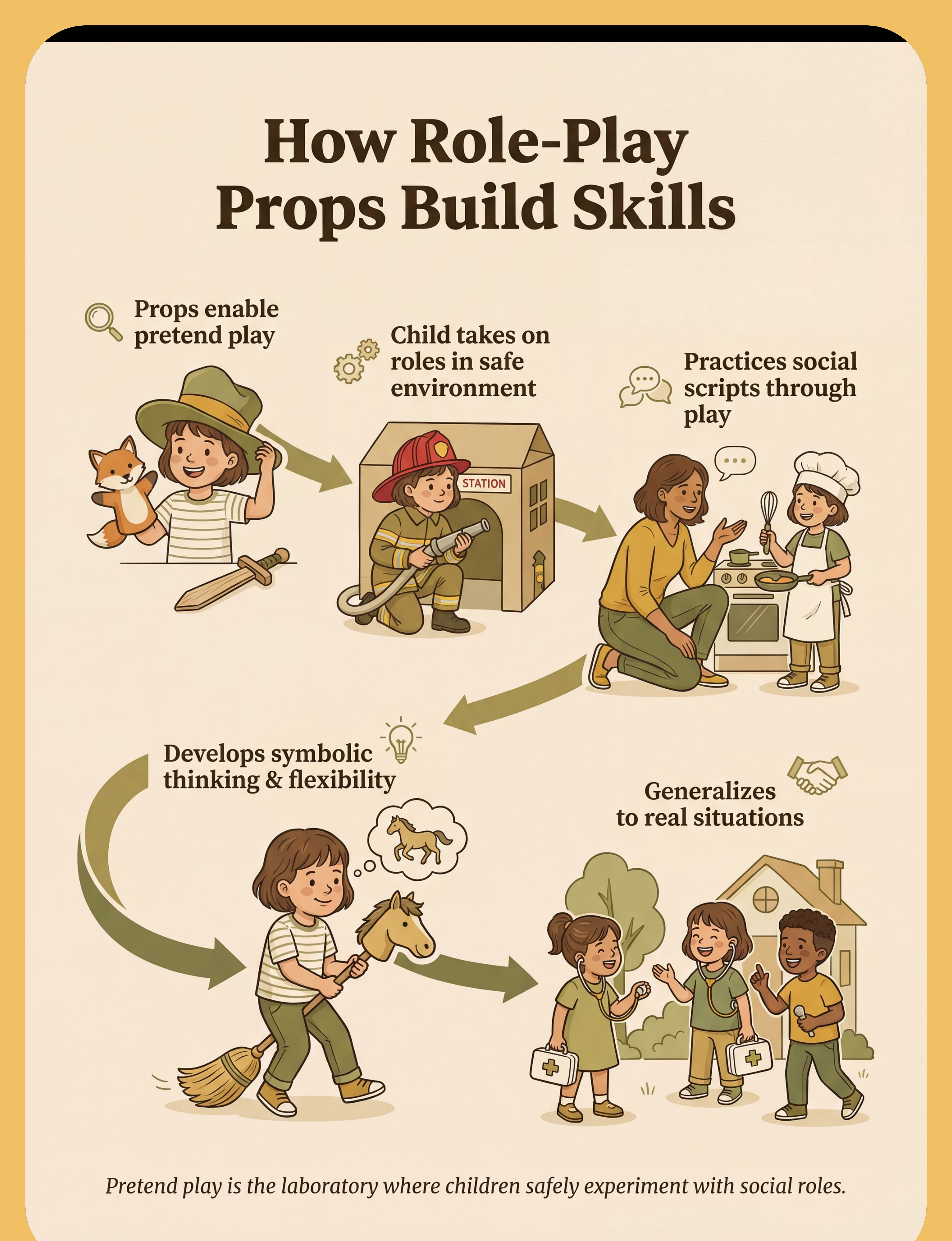
Role-play props work by scaffolding imagination and providing tangible tools for practicing abstract social concepts. The mechanism is simple yet powerful:
Props Enable Pretend Play
Physical objects give concrete starting points for imagination
Child Takes on Roles
Costumes and props help children embody different characters
Safe Practice Environment
Low-stakes rehearsal builds confidence and competence
Symbolic Thinking Develops
Understanding that objects can represent other things
Social Understanding Improves
Practicing perspectives and social exchanges
Generalization to Real Life
Skills transfer to actual social situations
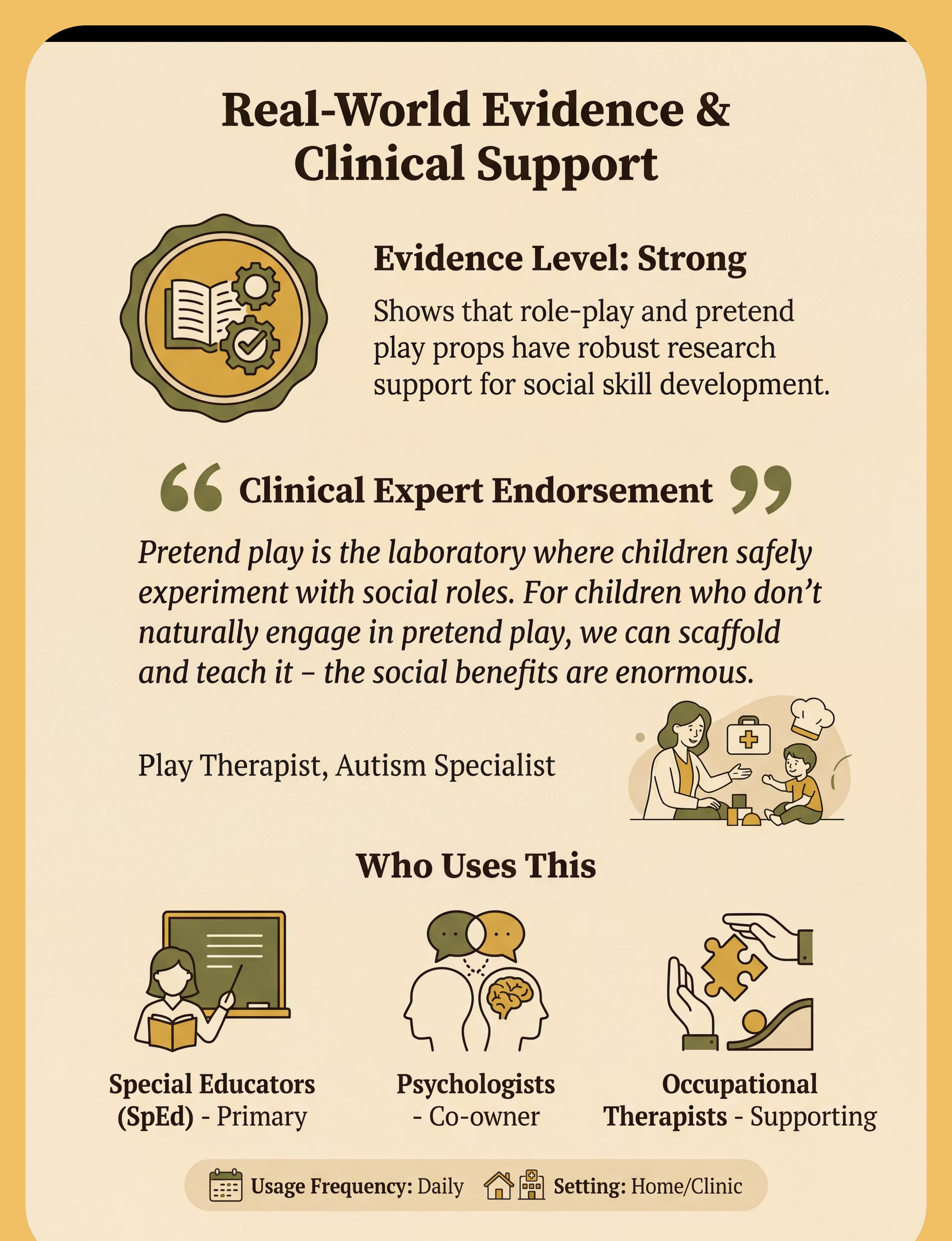
Evidence Level:Strong research support for role-play interventions in developing social and play skills.

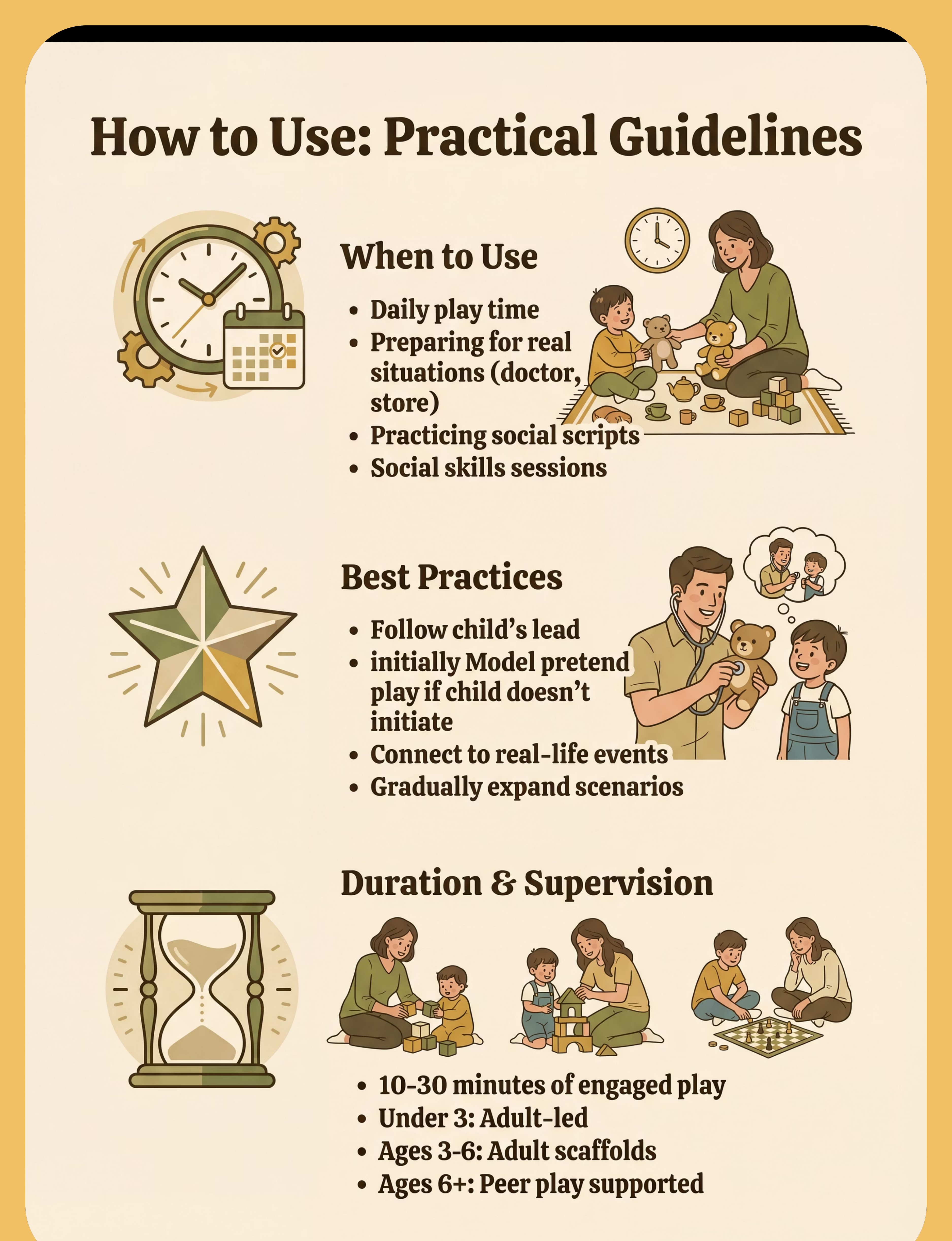
How to Use It Right
Follow child's lead initially
Observe what captures their interest before introducing new elements
Model pretend play if child doesn't initiate
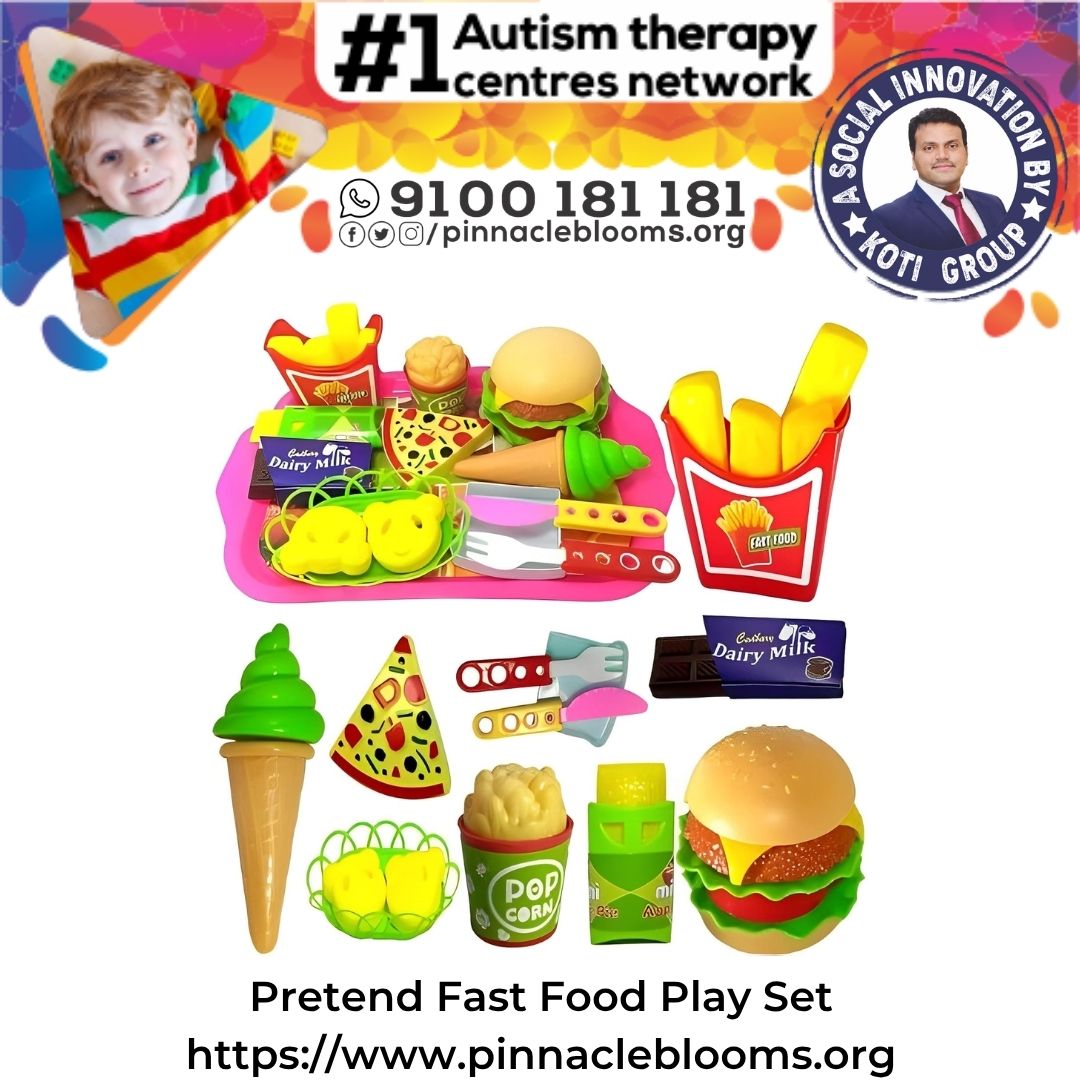
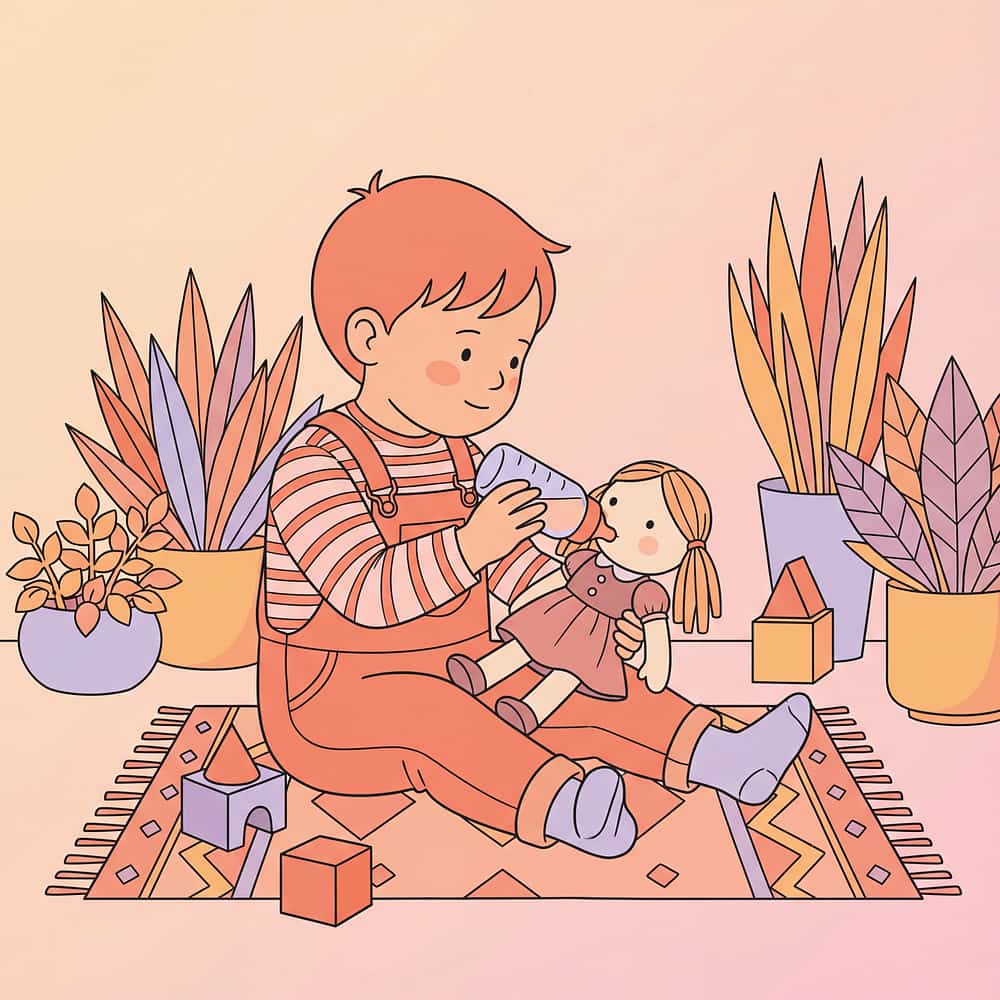
Demonstrate simple pretend actions like "feeding" a doll or "cooking" with toy food
Use props related to child's experiences
Start with familiar scenarios like mealtime or bedtime routines
Gradually expand scenarios
Once comfortable with simple play, introduce variations and new situations
Practice specific social situations
Rehearse upcoming events like doctor visits or birthday parties
Connect to real-life events
Bridge pretend play to actual experiences to reinforce learning
Duration: Aim for 10-30 minutes of engaged play per session, adjusting based on the child's attention span and interest level.
Expert Perspective

"Pretend play is the laboratory where children safely experiment with social roles and scenarios. For children who don't naturally engage in pretend play, we can scaffold and teach it - and the social benefits are enormous."
— Play Therapist, Autism Specialist
SpEd + Psychologist Recommended
Co-owned by Special Education and Psychology professionals
Strong Evidence Base
Supported by research in developmental psychology and play therapy
Rank #1 in Social Skills Category
Core Kit essential for play and social development

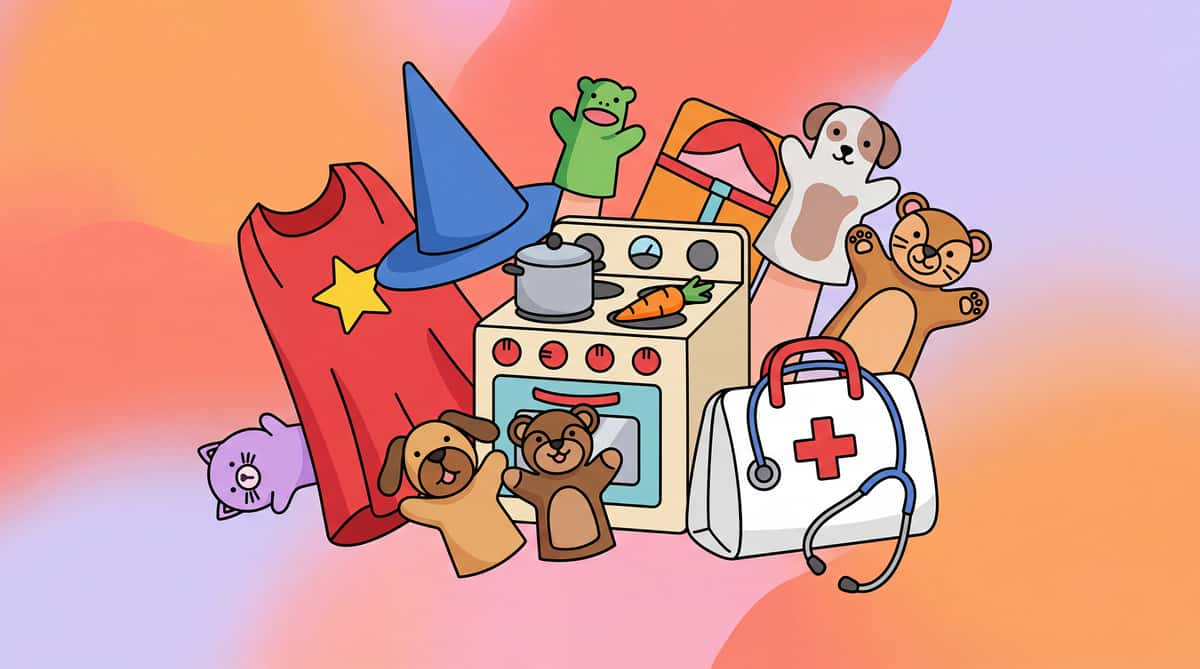
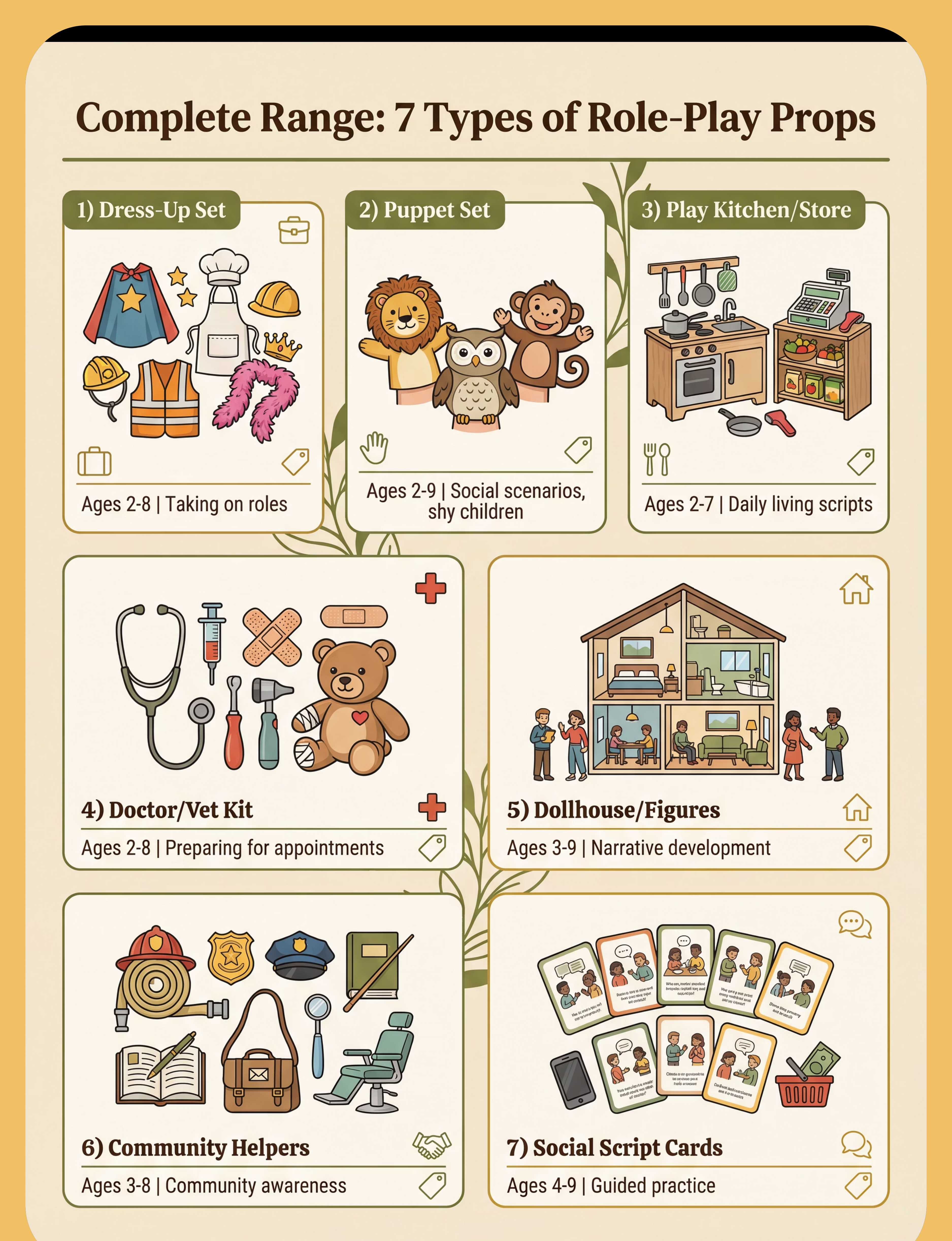
Choose Your Option (7 Variants)
Each variant serves different developmental needs and settings. Consider your child's interests, portability needs, and the specific social scenarios you want to practice.
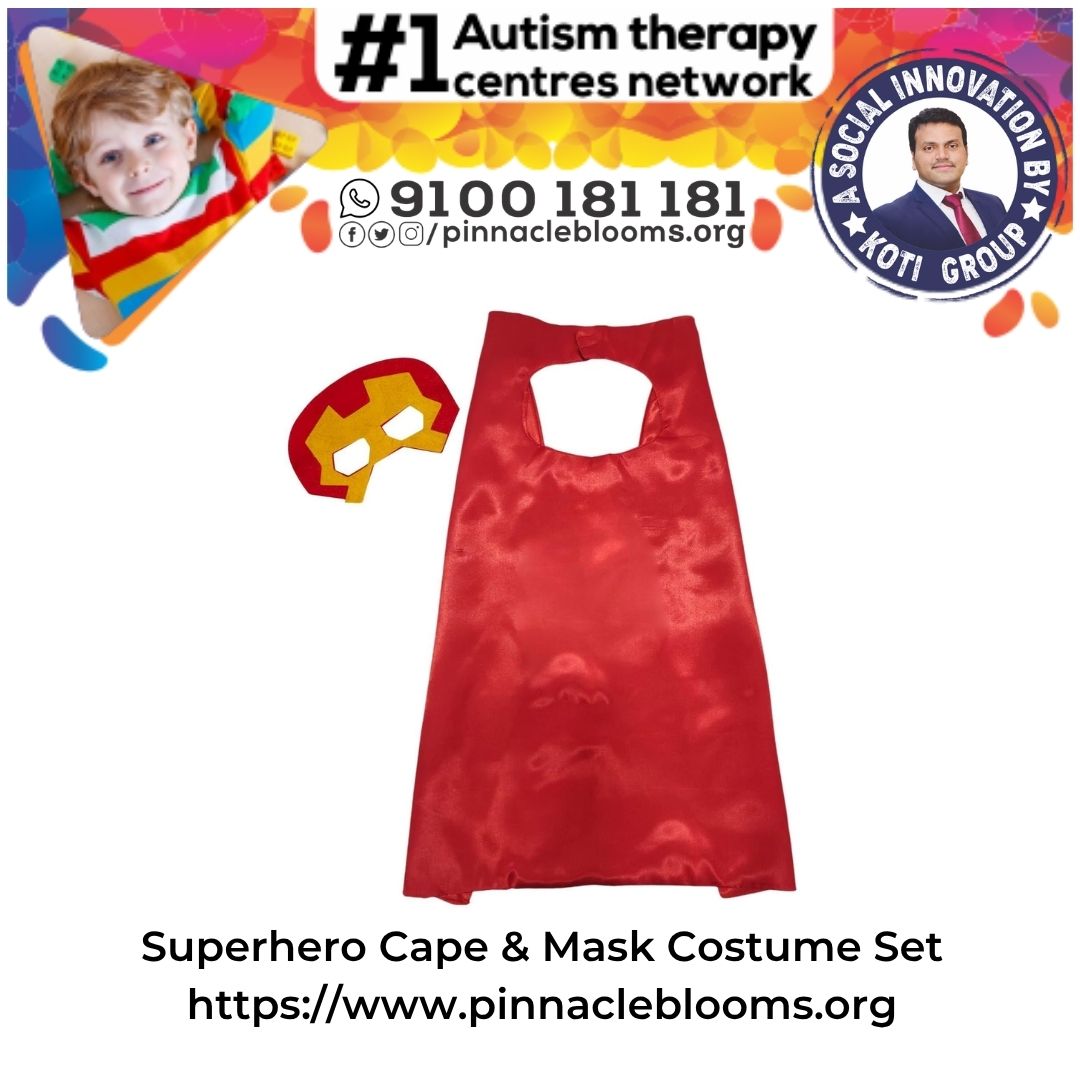
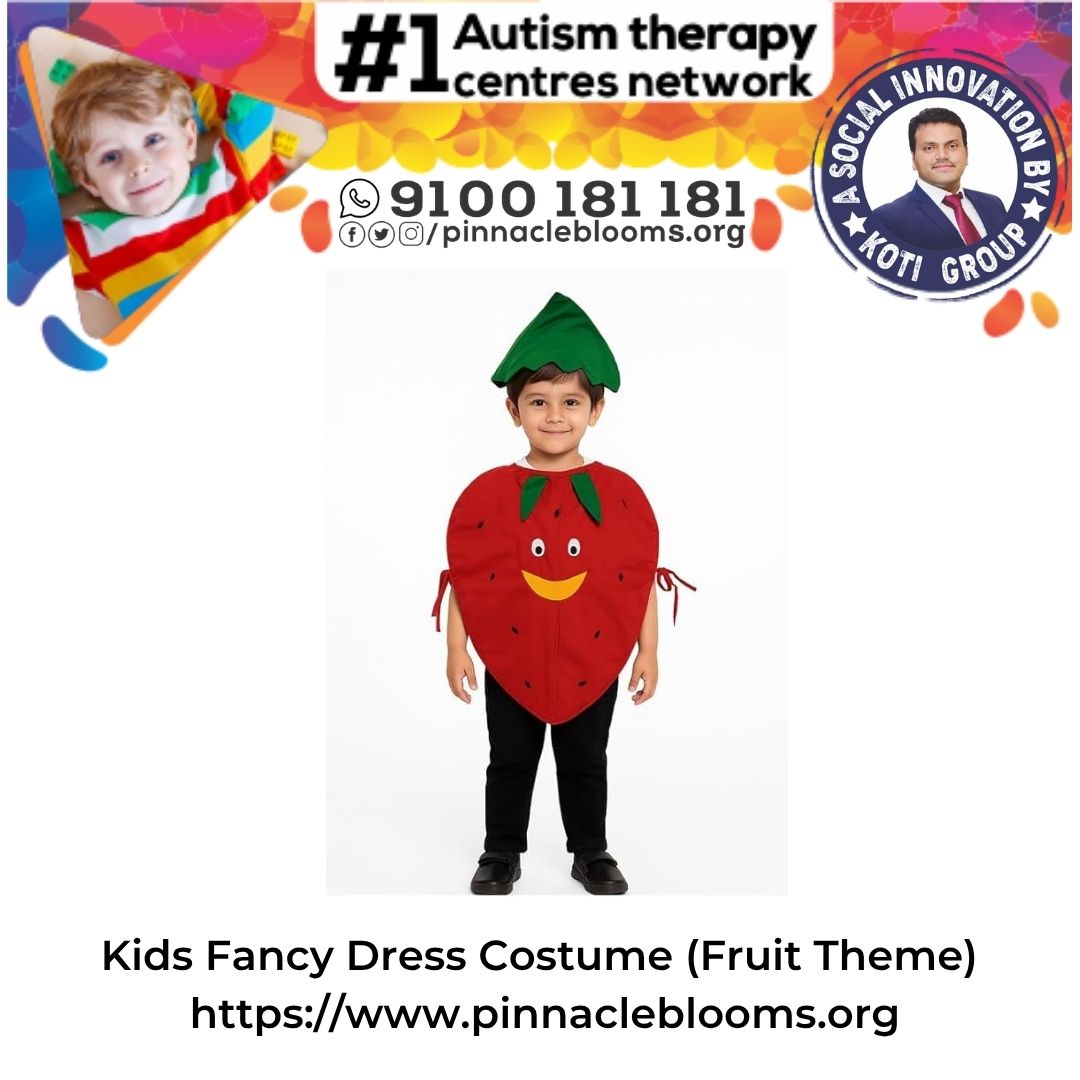
Dress-Up / Costume Set
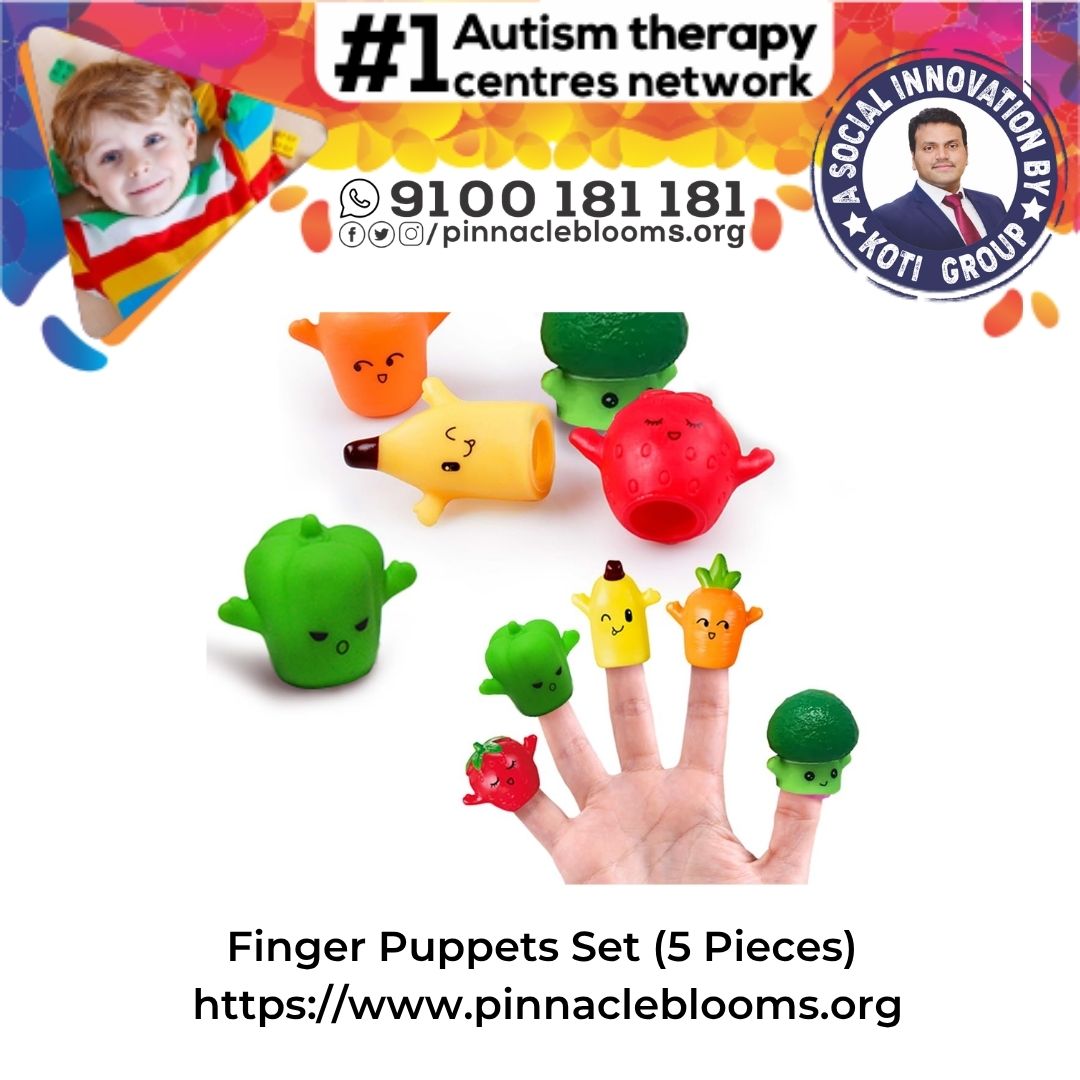
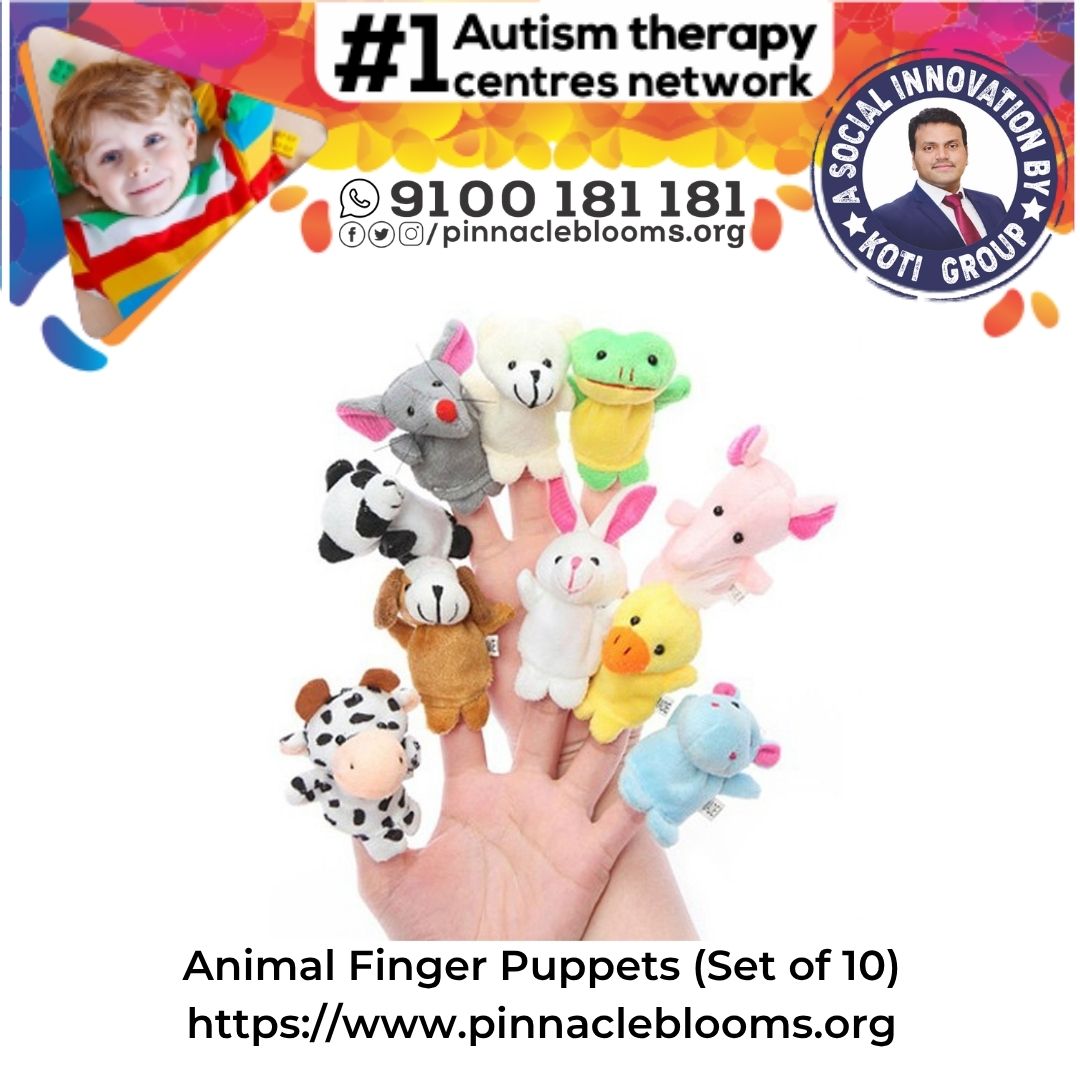
Puppet Set
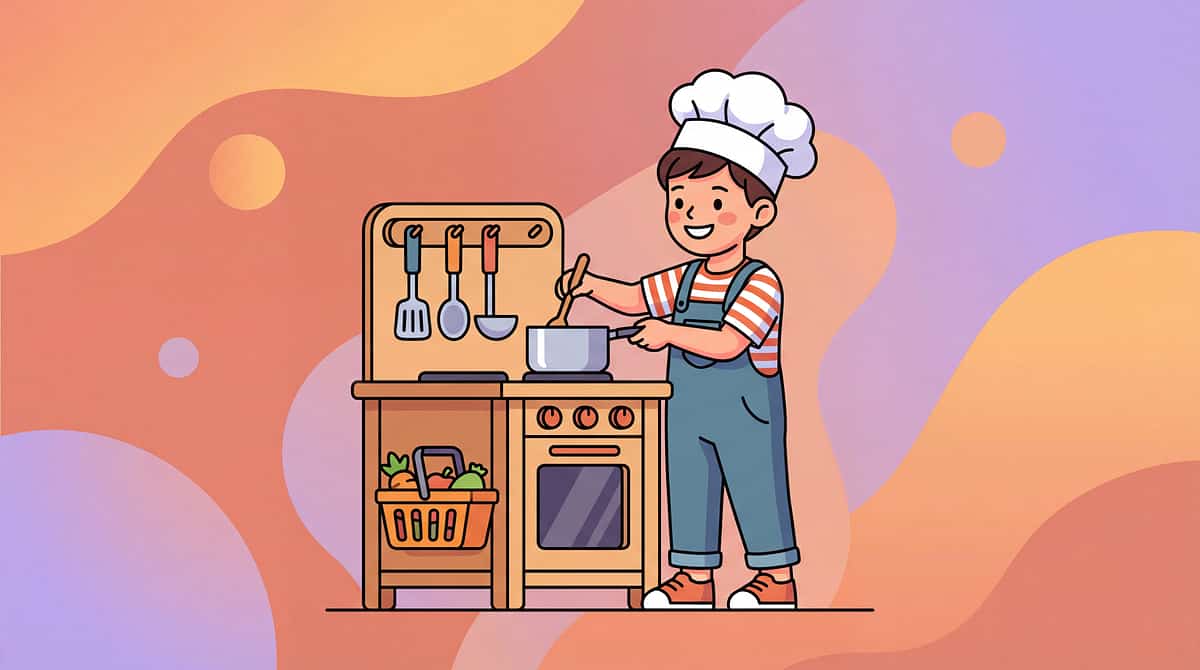
Play Kitchen / Store Set
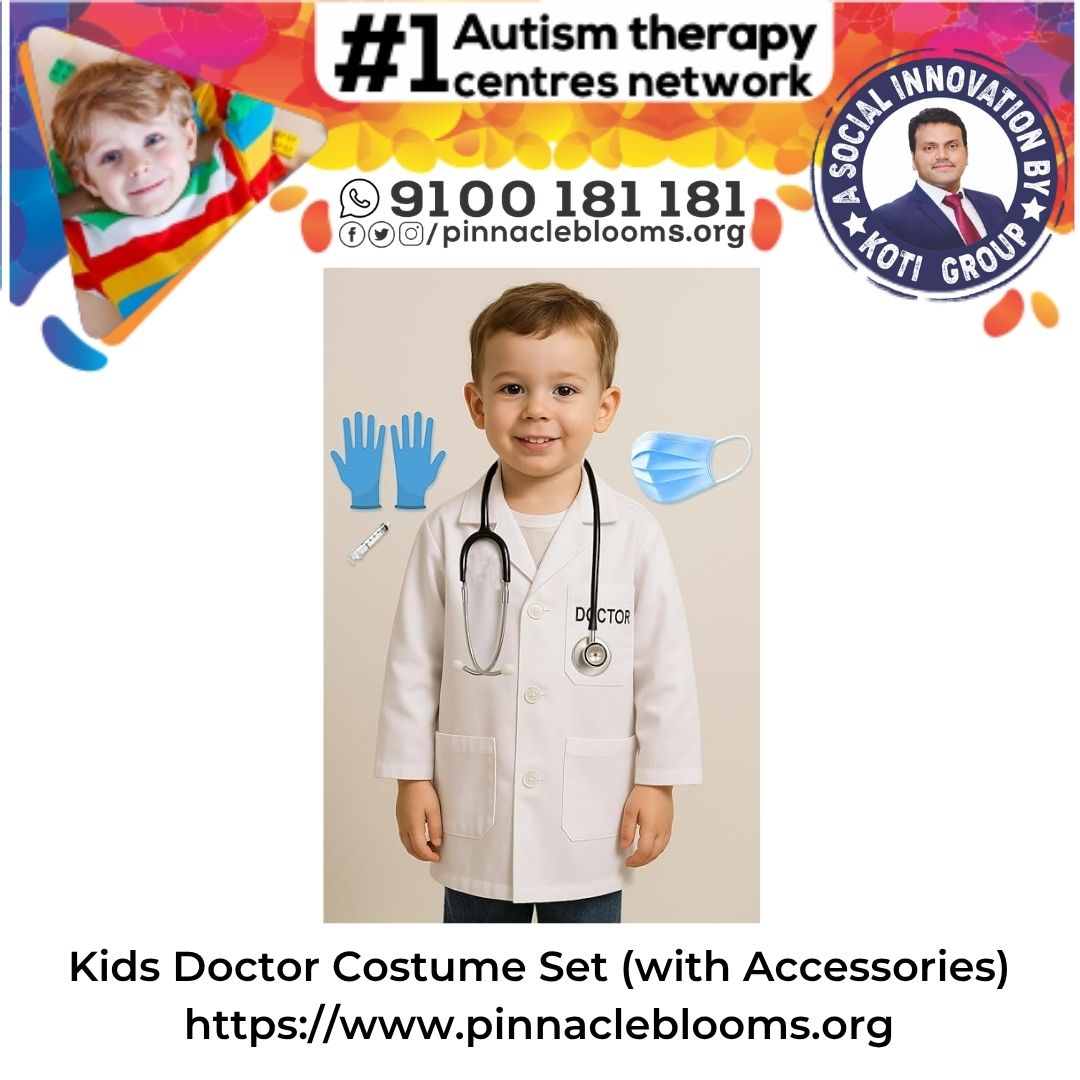
Doctor / Vet Kit
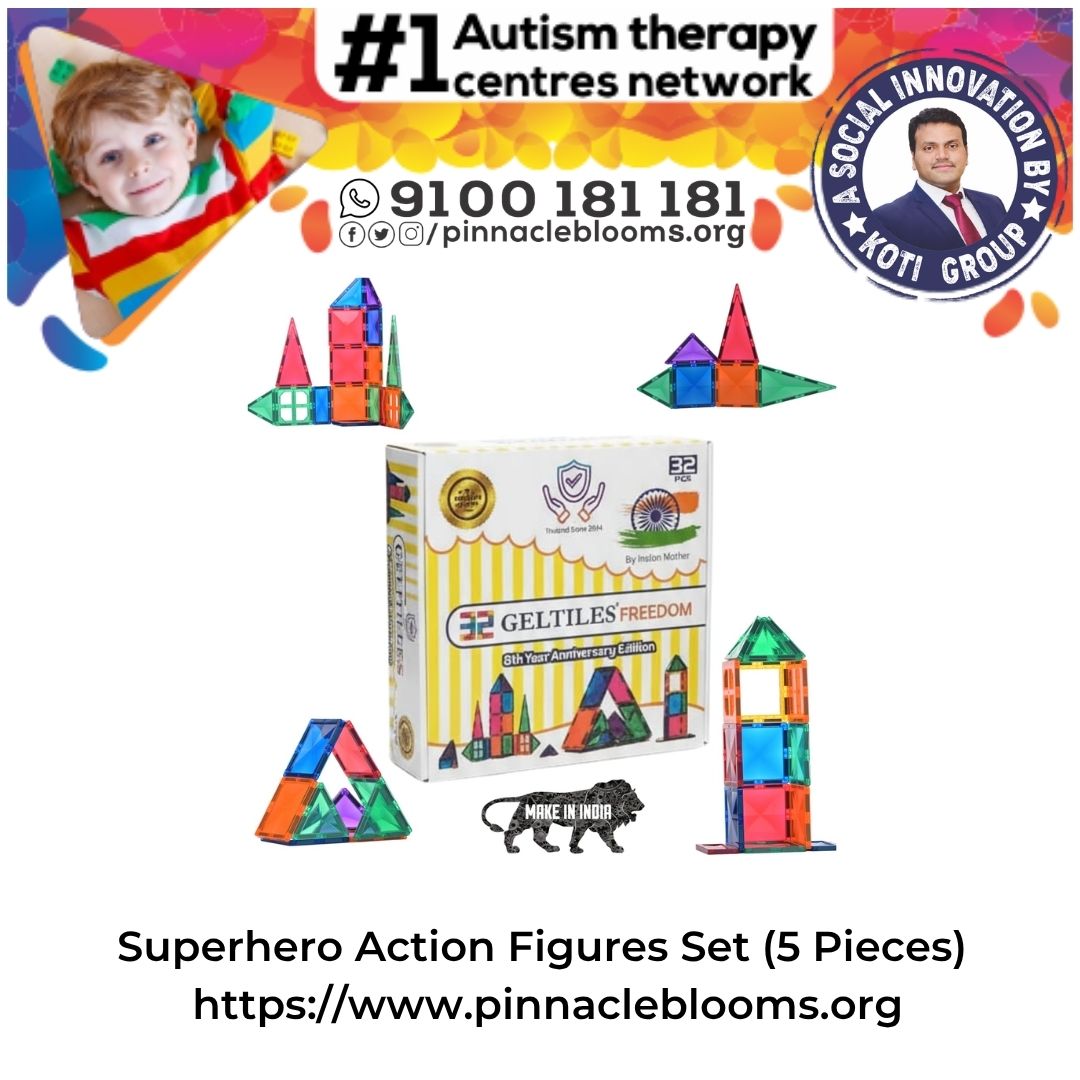
Dollhouse / Action Figure Set
Community Helpers Props
Social Script Cards + Props
Dress-Up / Costume Set
Best for: Taking on roles, imagination, flexibility
Ages: 2-8 years | Settings: Home, Clinic
Portability: Low | Price: ₹500–2,000
Puppet Set
Best for: Social scenarios, conversation practice, shy children
Ages: 2-9 years | Settings: Home, Clinic, School
Portability: High | Price: ₹200–800
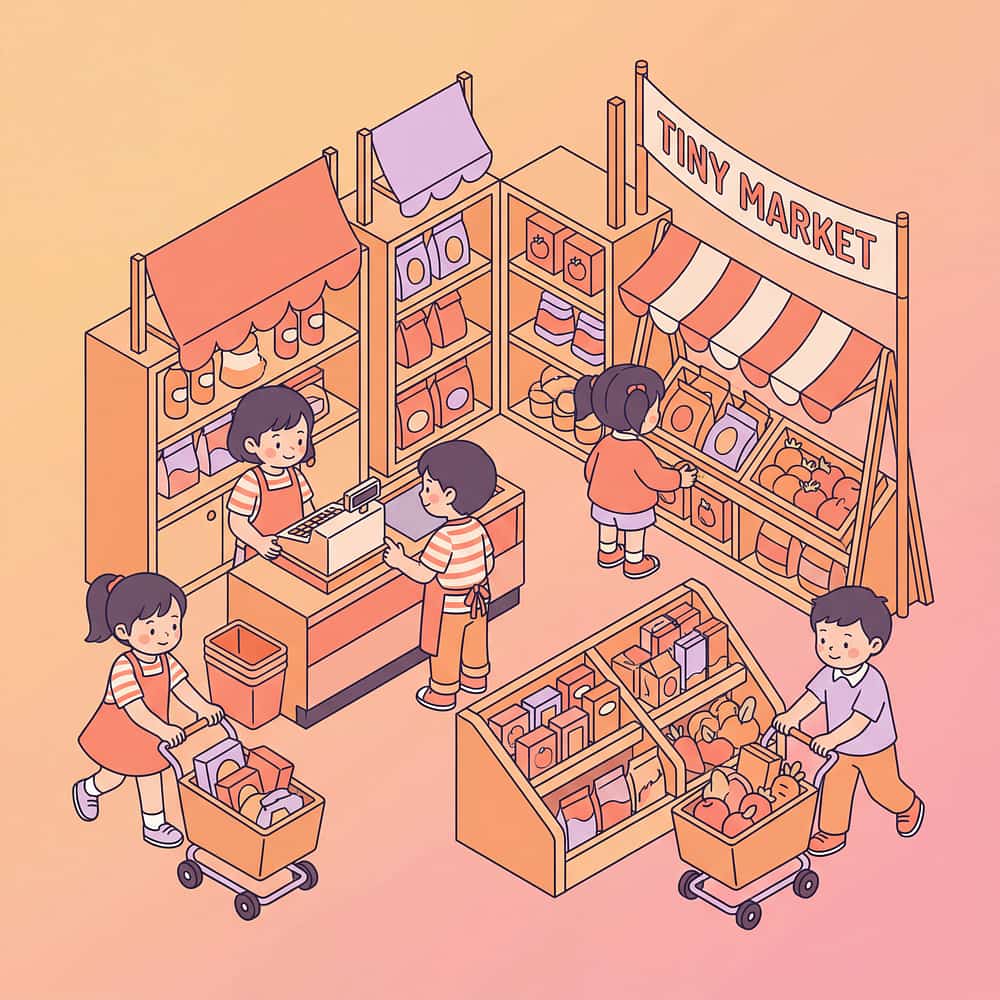
Play Kitchen / Store Set
Best for: Daily living scripts, social exchanges
Ages: 2-7 years | Settings: Home, Clinic
Portability: Low | Price: ₹800–3,000
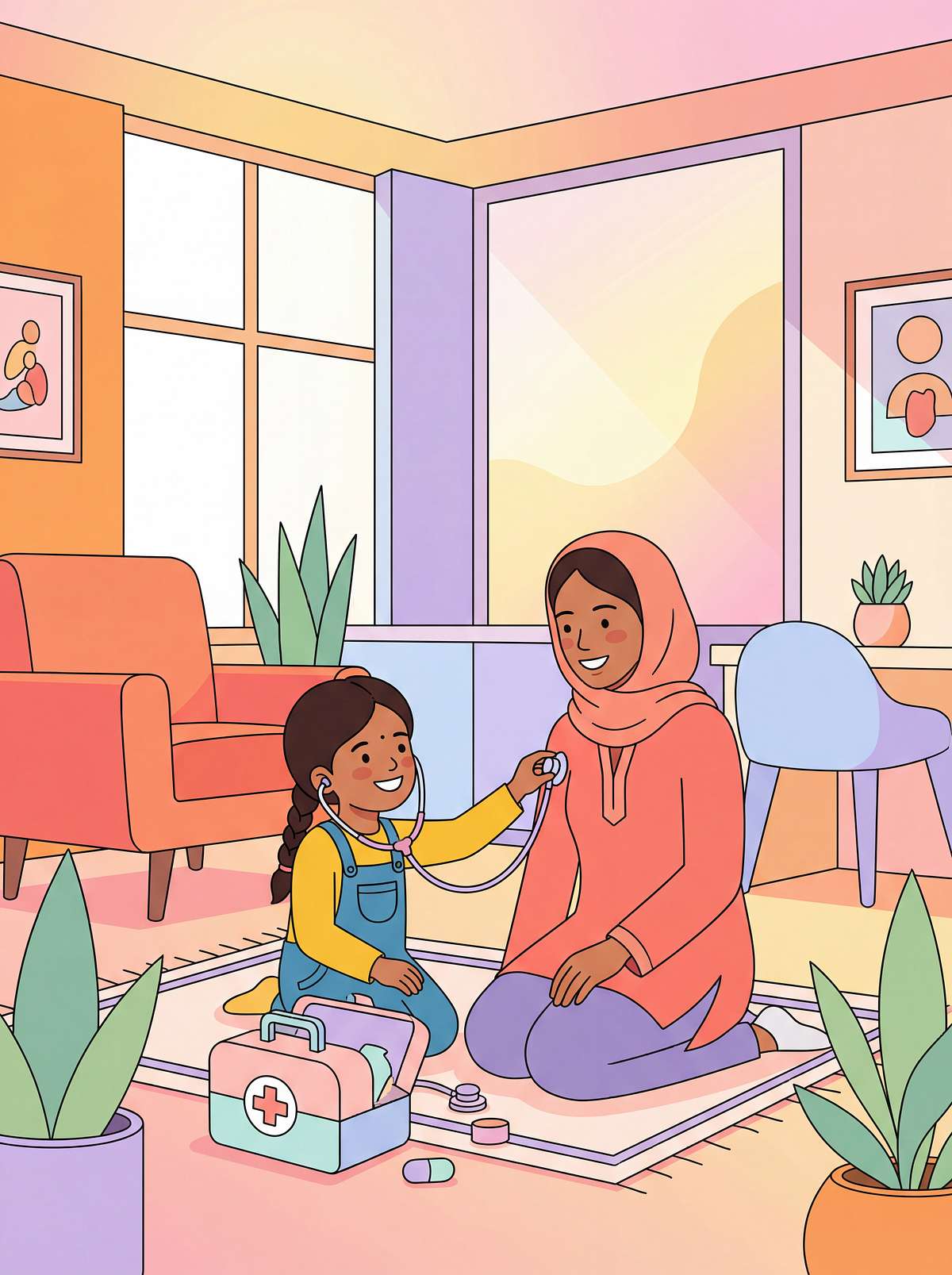
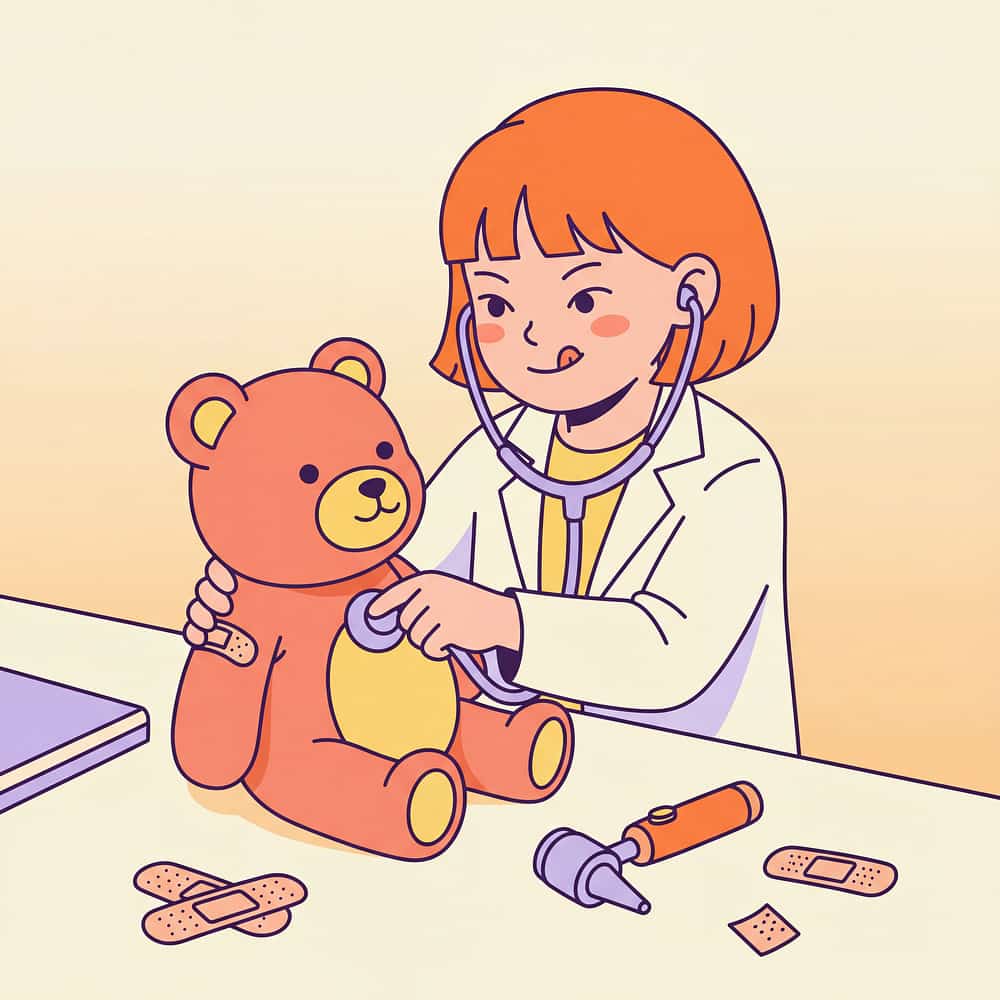
Doctor / Vet Kit
Best for: Preparing for appointments, helping/caring scripts
Ages: 2-8 years | Settings: Home, Clinic
Portability: High | Price: ₹300–1,000
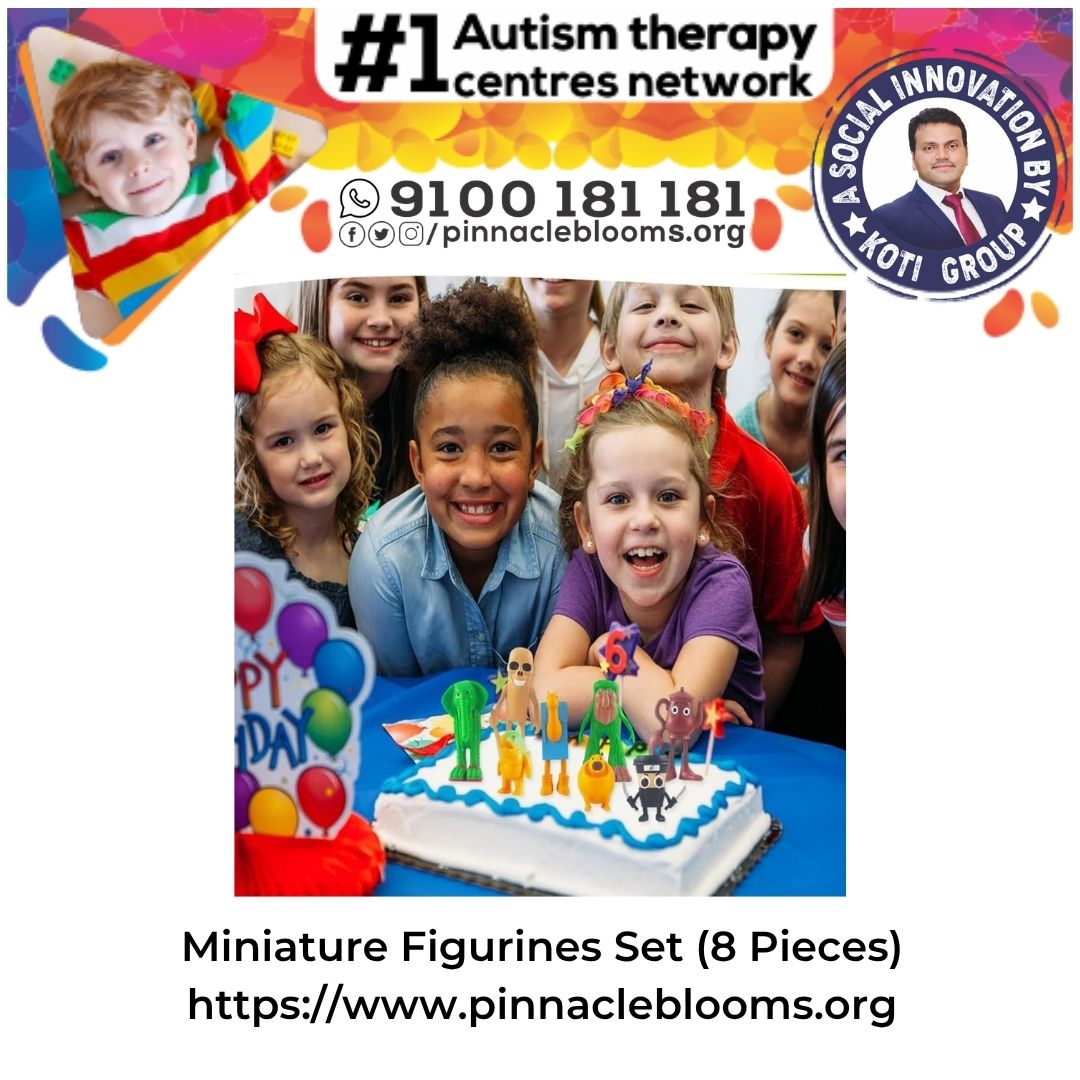
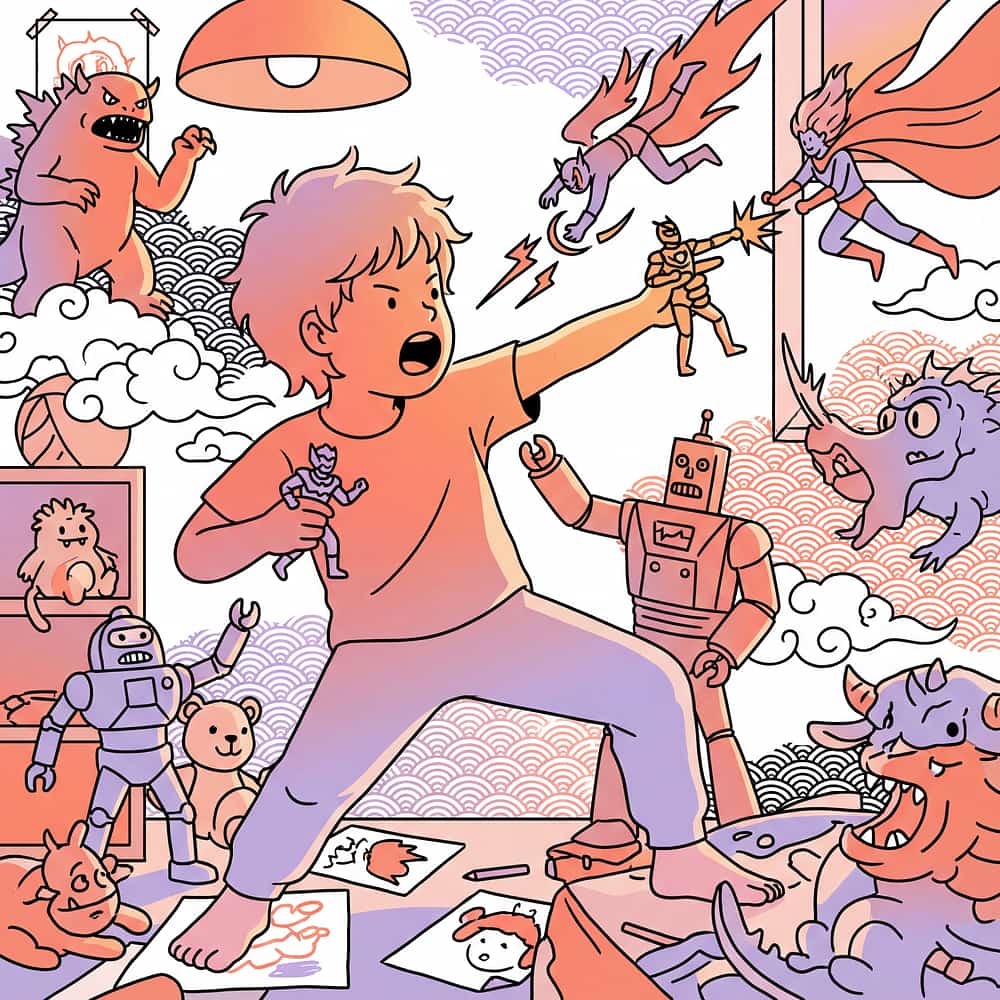
Dollhouse / Action Figure Set
Best for: Social scripting, narrative development
Ages: 3-9 years | Settings: Home, Clinic
Portability: Medium | Price: ₹500–2,500
Community Helpers Props
Best for: Community awareness, social scripts
Ages: 3-8 years | Settings: Home, Clinic, School
Portability: Medium | Price: ₹300–1,000
Social Script Cards + Props
Best for: Guided social skills practice
Ages: 4-9 years | Settings: All
Portability: High | Price: ₹200–600
How to Choose:
- By goal: Imagination (costumes), conversation (puppets), daily skills (kitchen/store), medical prep (doctor kit)
- By setting: Home-only (kitchen, dress-up), portable (puppets, doctor kit, script cards)
- By portability: High mobility needs = puppets, doctor kit, or script cards
Specifications & Play Types
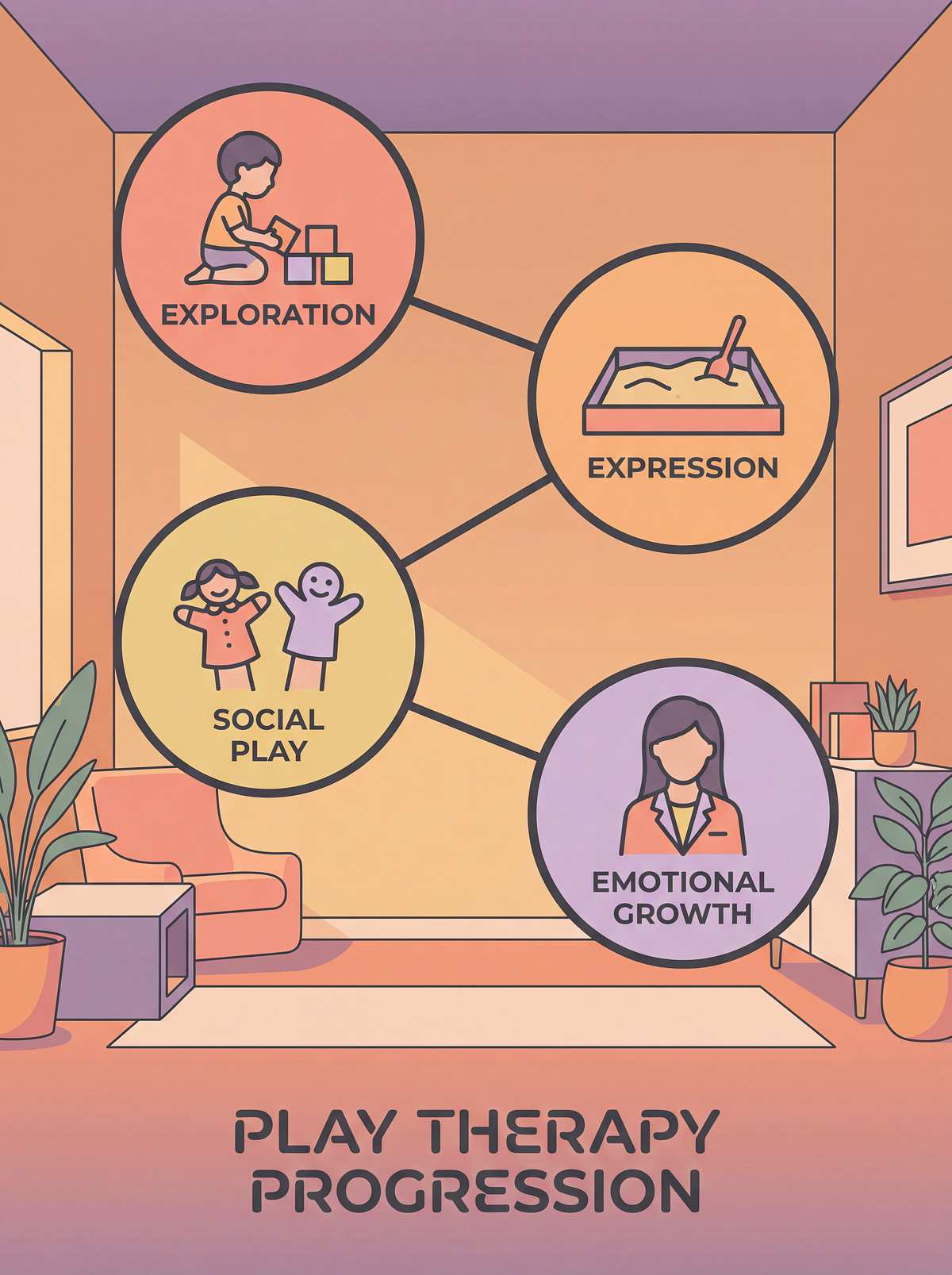
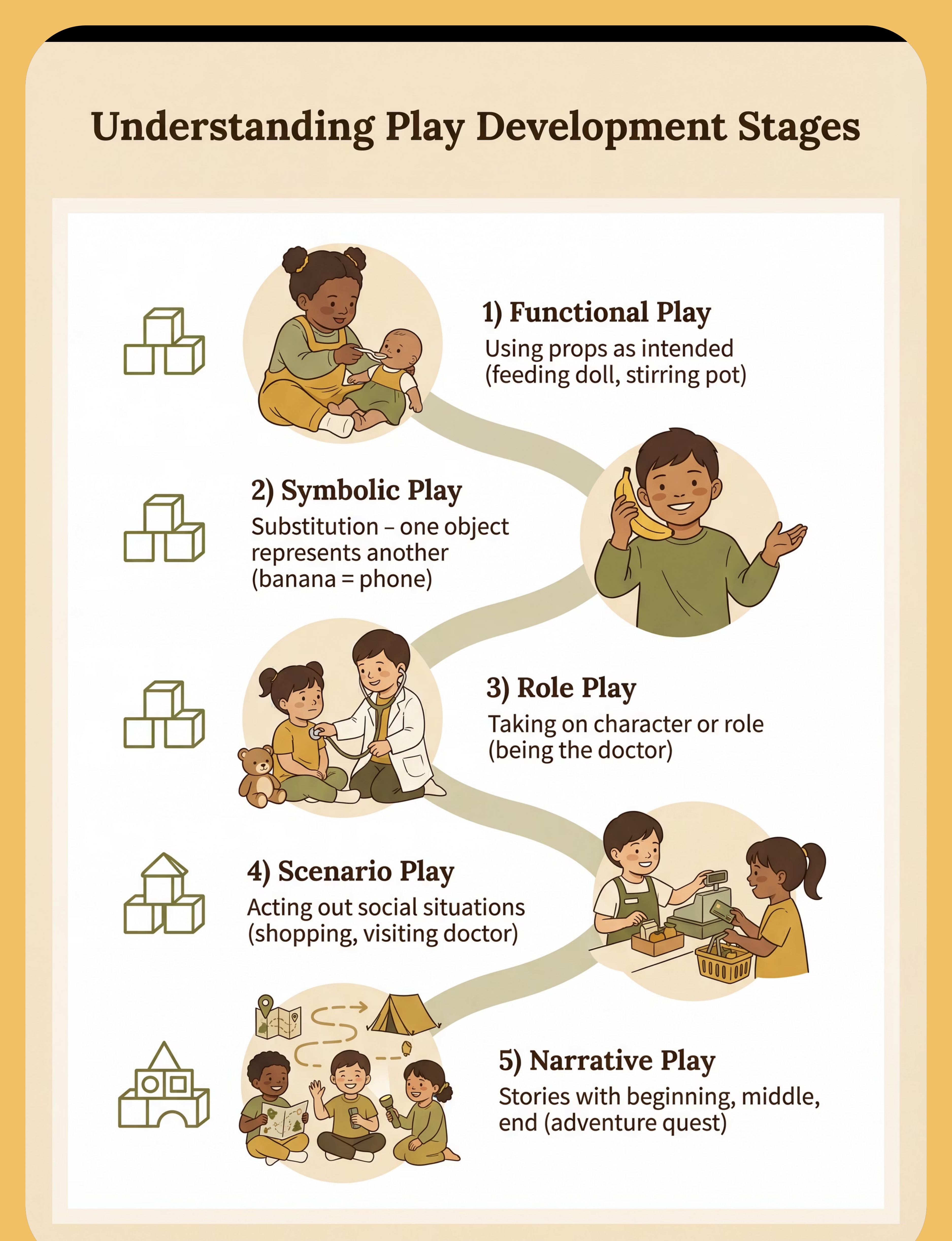
Play Types Progression

Functional Play
Using props as intended (feeding doll, stirring pot)

Symbolic Play
Object substitution (banana as phone, block as car)

Role Play
Taking on character or role (being mommy, doctor)

Scenario Play
Acting out social situations (shopping, visiting doctor)

Narrative Play
Creating stories with beginning, middle, and end

Materials & Features
Common Materials
- Fabric costumes (washable, durable)
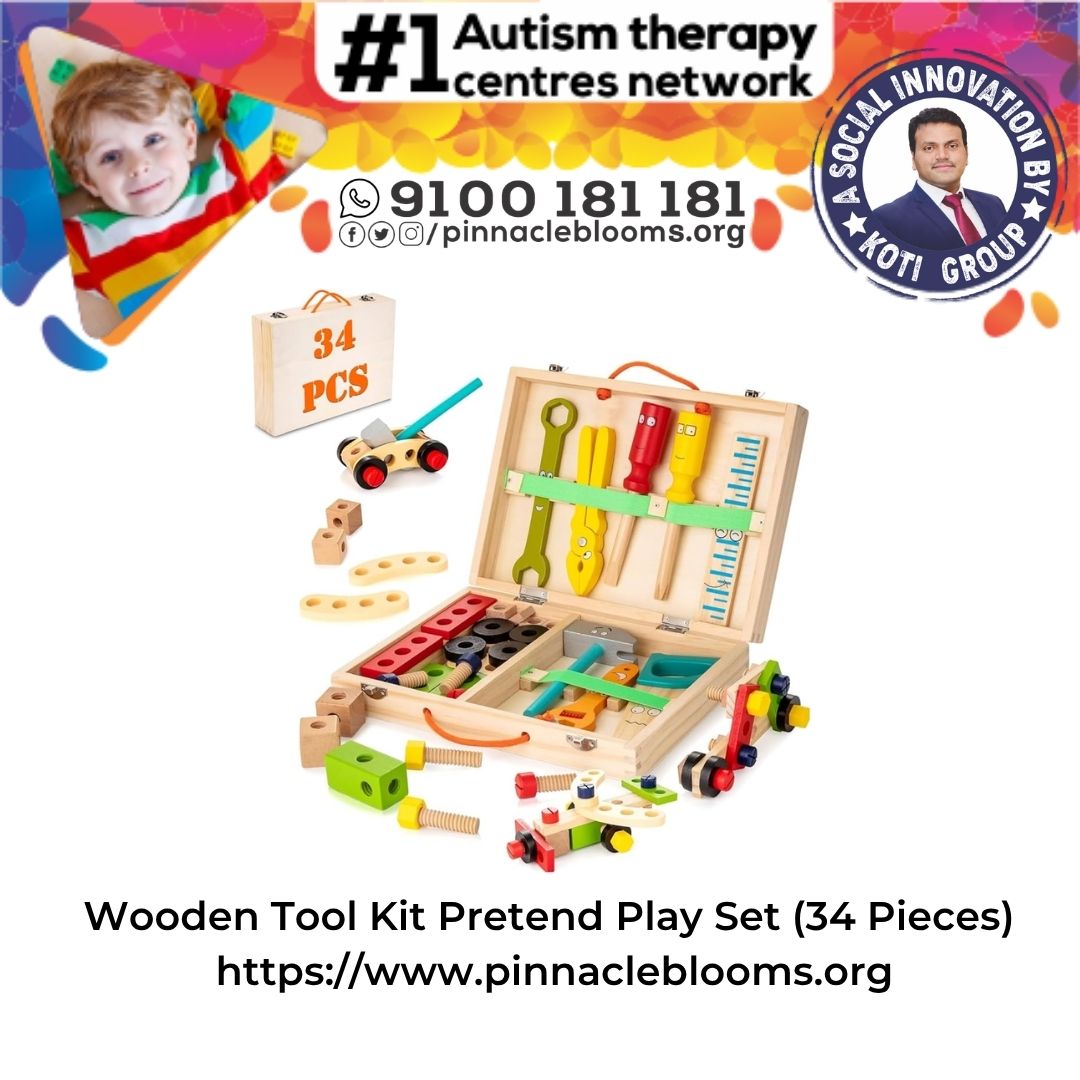
- Plastic or wooden props (safe, non-toxic)
- Hand or finger puppets (various characters)
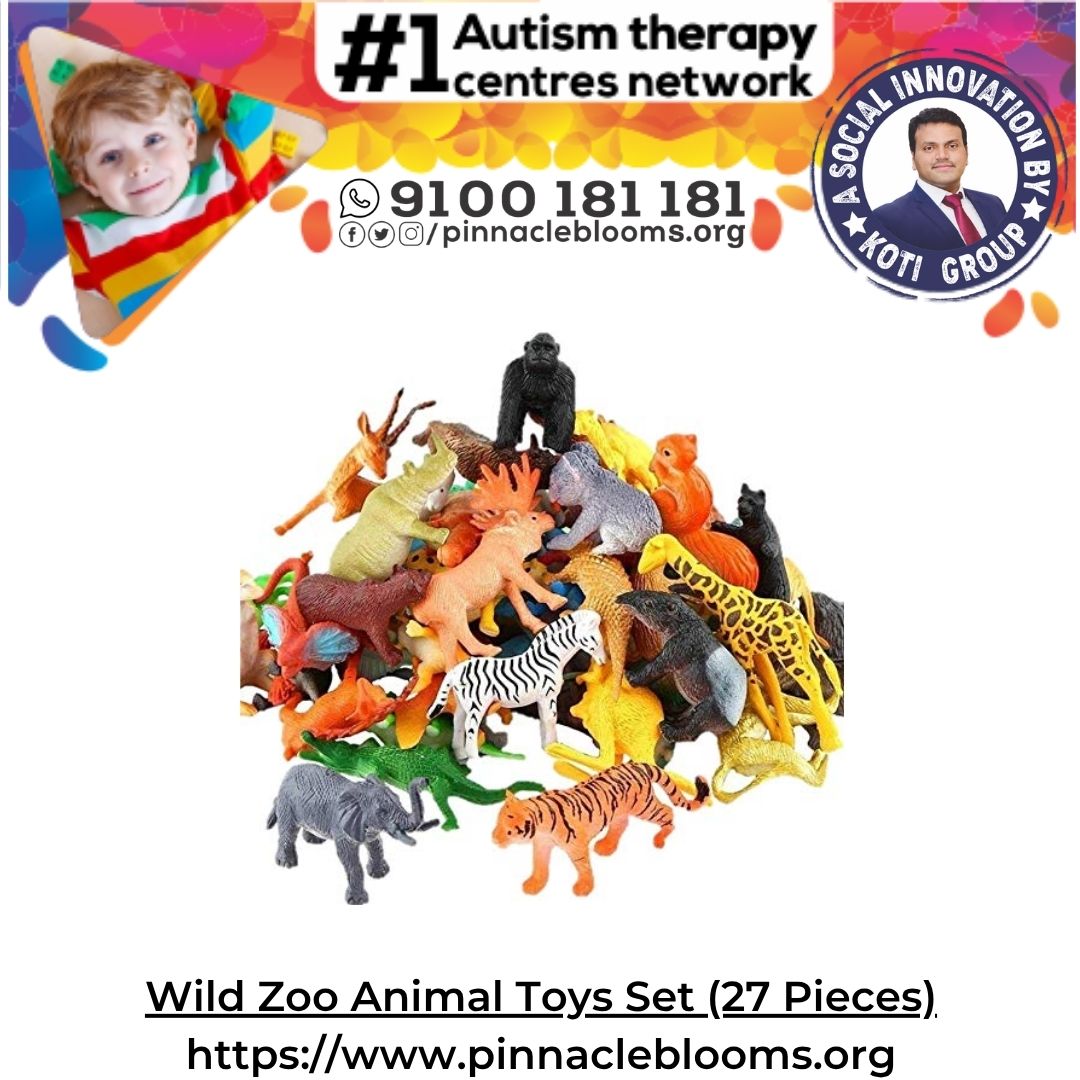
- Miniature figures (people, animals)
Key Features
- Age-appropriate sizing and complexity
- Safe, non-toxic materials
- Multiple roles and characters available
- Supports social script development
- Durable for repeated use
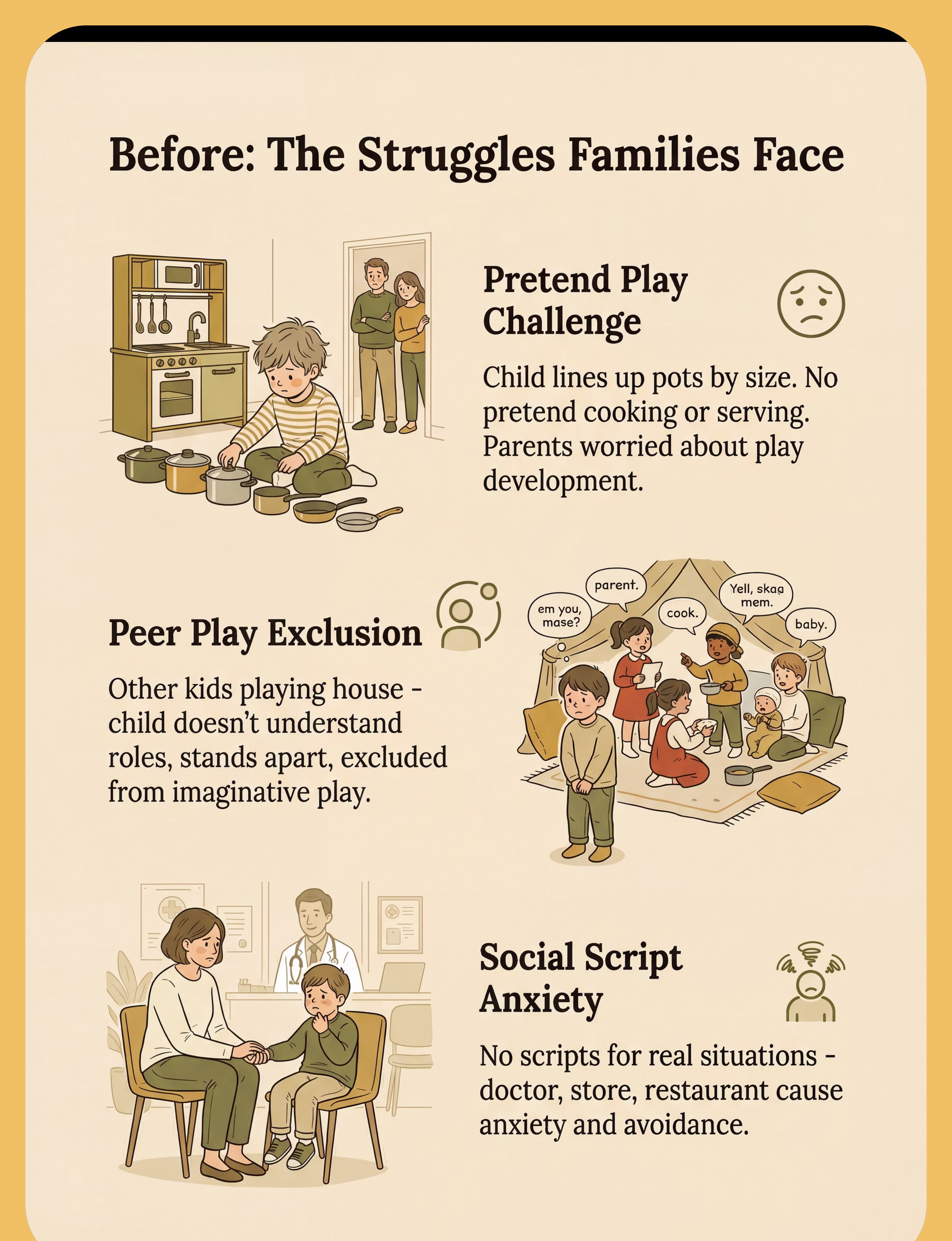
The Struggle (Before)

Pretend Play
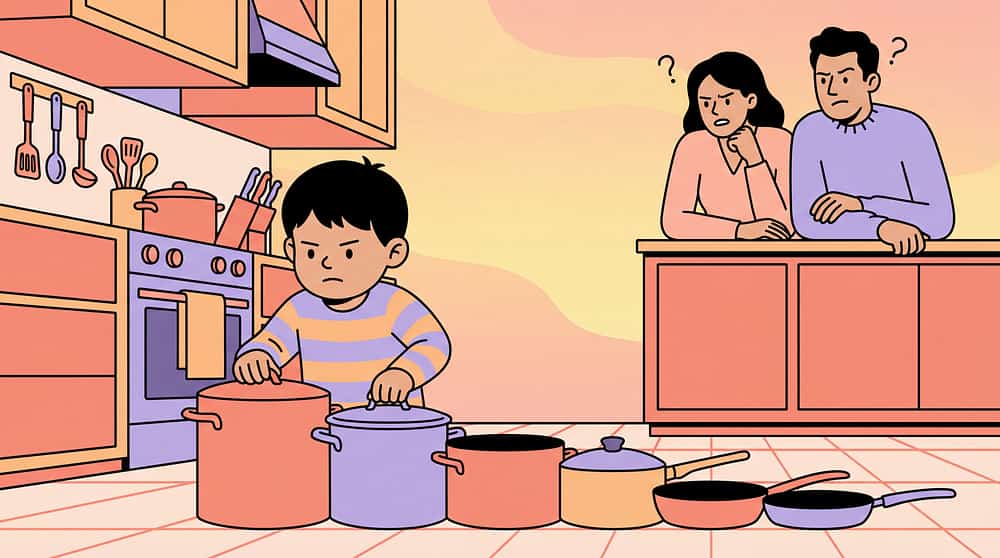
Situation: Child given toy kitchen. Lines up pots by size. Doesn't 'cook.' Doesn't serve 'food.' No pretend element. Parents worried.
Emotion: Concern, confusion

Peer Play
Situation: Other kids playing 'house.' Child doesn't understand roles. Stands apart. Doesn't know how to join. Excluded from imaginative play.
Emotion: Isolation, exclusion

Social Scripts
Situation: Child doesn't know how to interact at store, doctor, restaurant. No mental script for these situations. Anxious, avoidant.
Emotion: Anxiety, avoidance
These challenges aren't failures—they're signals that a child needs structured support to develop play skills that come naturally to some but can be taught to all.

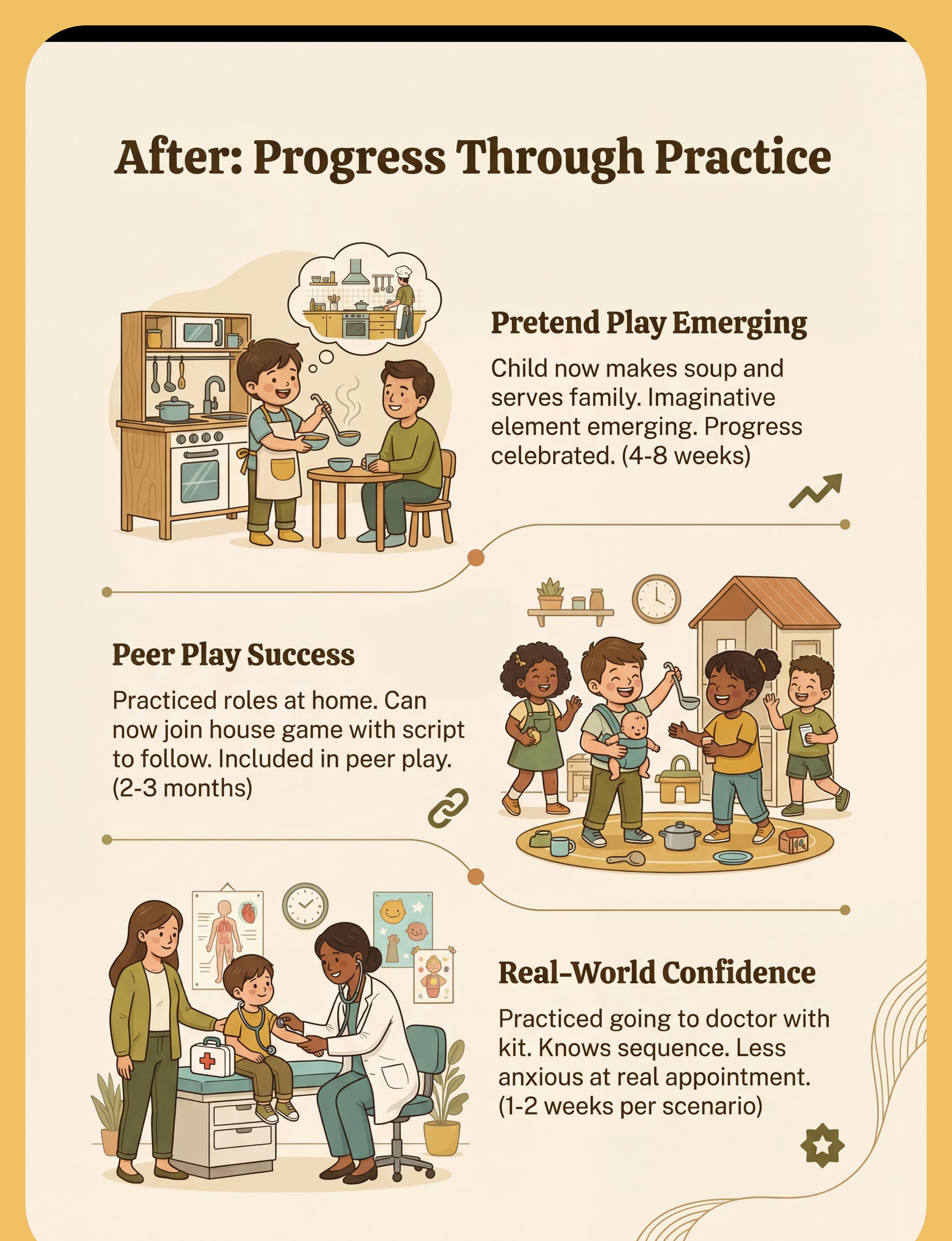
The Breakthrough (After)
Pretend Play
Adult modeled cooking, serving. Child now 'makes soup' and 'serves' family. Imaginative element emerging. Progress celebrated. Emotion: Growth, hope (4-8 weeks)
Peer Play
Practiced role-play at home. Knows 'mom/dad/baby' roles. Can join 'house' game. Has a script to follow. Included in play. Emotion: Inclusion, connection (2-3 months)
Social Scripts
Practiced 'going to doctor' with kit. Knows sequence. Less anxious at real appointment because had safe practice. Emotion: Preparation, confidence (1-2 weeks per scenario)
Transformation happens through patient scaffolding, consistent practice, and celebrating each small victory in play development.

What to Expect (Realistic Timelines)
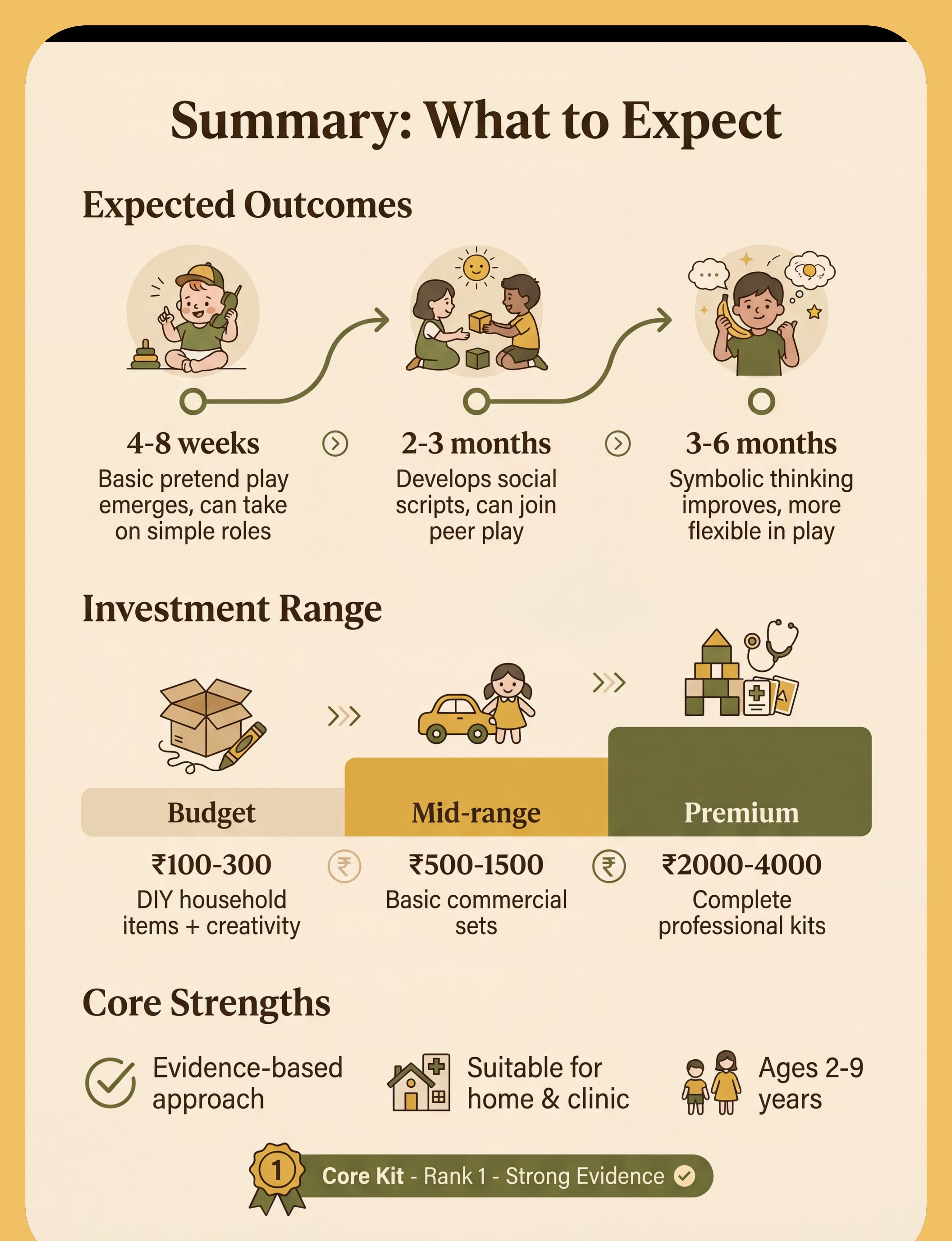
Child engages in basic pretend play
4-8 weeks
Can take on simple roles
4-8 weeks
Develops social scripts through practice
2-3 months
Can join peer pretend play
2-3 months
Symbolic thinking improves
3-6 months
More flexible in play
3-6 months
Remember: Every child progresses at their own pace. These timeframes represent typical patterns, but individual variation is normal and expected. Consistency and patience yield results.

Is This Right for My Child? (2-Minute Check)
Does your child have difficulty with pretend/imaginative play?
If yes, this indicates: Role-play props and teaching needed
Confidence: 95% match
Does your child play with toys in repetitive/non-imaginative ways?
If yes, this indicates: Symbolic play development needed
Confidence: 92% match
Does your child struggle to join pretend games with peers?
If yes, this indicates: Role-play practice will help
Confidence: 90% match
Would your child benefit from practicing real-life scenarios?
If yes, this indicates: Social script practice through role-play
Confidence: 88% match
Assessment: 3+ 'yes' answers = strong fit for role-play interventions. Even 1-2 'yes' answers suggest potential benefit from targeted pretend play support.

Usage Guide
When to Use ✓ | When NOT to Use ✗ | |
Daily play time (consistent practice) | Forcing play when child resists | |
Preparing for real situations (doctor, store) | Making scripts too rigid | |
Practicing social scripts | When child is dysregulated | |
Social skills sessions | As the only play option (balance needed) | |
Sibling/peer play opportunities | ||
Developing narrative skills |
Supervision by Age
Age Range | Supervision Level | Notes | |
Under 3 years | Adult-led | Simple actions, high engagement, safety monitoring | |
3-6 years | Adult scaffolds | Models, extends play, introduces variations | |
6+ years | Peer play supported | Adult available, less direct involvement needed |
Duration: 10-30 minutes of engaged play | Settings: Home, Clinic, School (adjust props for setting)

Safety First
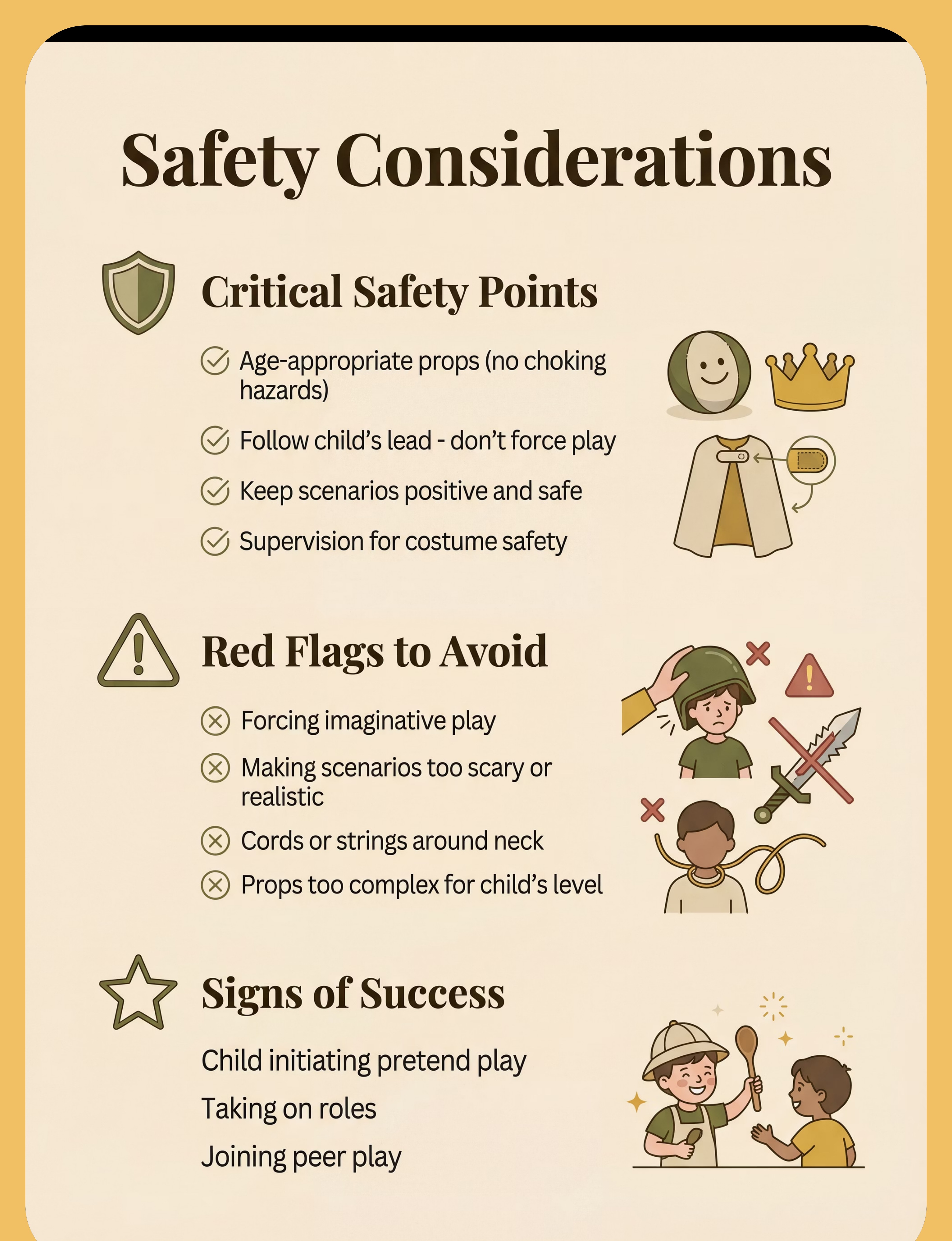
🚨 Critical Safety
- Age-appropriate props (no choking hazards)
- Follow child's lead, don't force
- Keep play positive and safe
- Supervision for costume safety (no strangulation risks)
⚠️ Warnings
- Costumes should be flame-resistant
- No cords or strings around neck
- Watch for frustration - scale back if needed
- Don't make scenarios too scary or realistic
❌ Contraindicated
- Forcing play against child's will
- Scary or traumatic scenarios
- Unsafe props (sharp edges, small parts for young children)
- Rigid scripts without room for flexibility
Safety Checklist
Before Use ✓
- Props age-appropriate and safe
- Scenario connects to child's experience
- Adult ready to model and scaffold
- Environment conducive to play
During Use ✓
- Following child's lead when possible
- Modeling pretend actions
- Expanding play gently
- Child engaged and comfortable
Signs of Success ✓
- Child initiating pretend play
- Taking on roles
- Expanding scripts
- Playing with peers using props

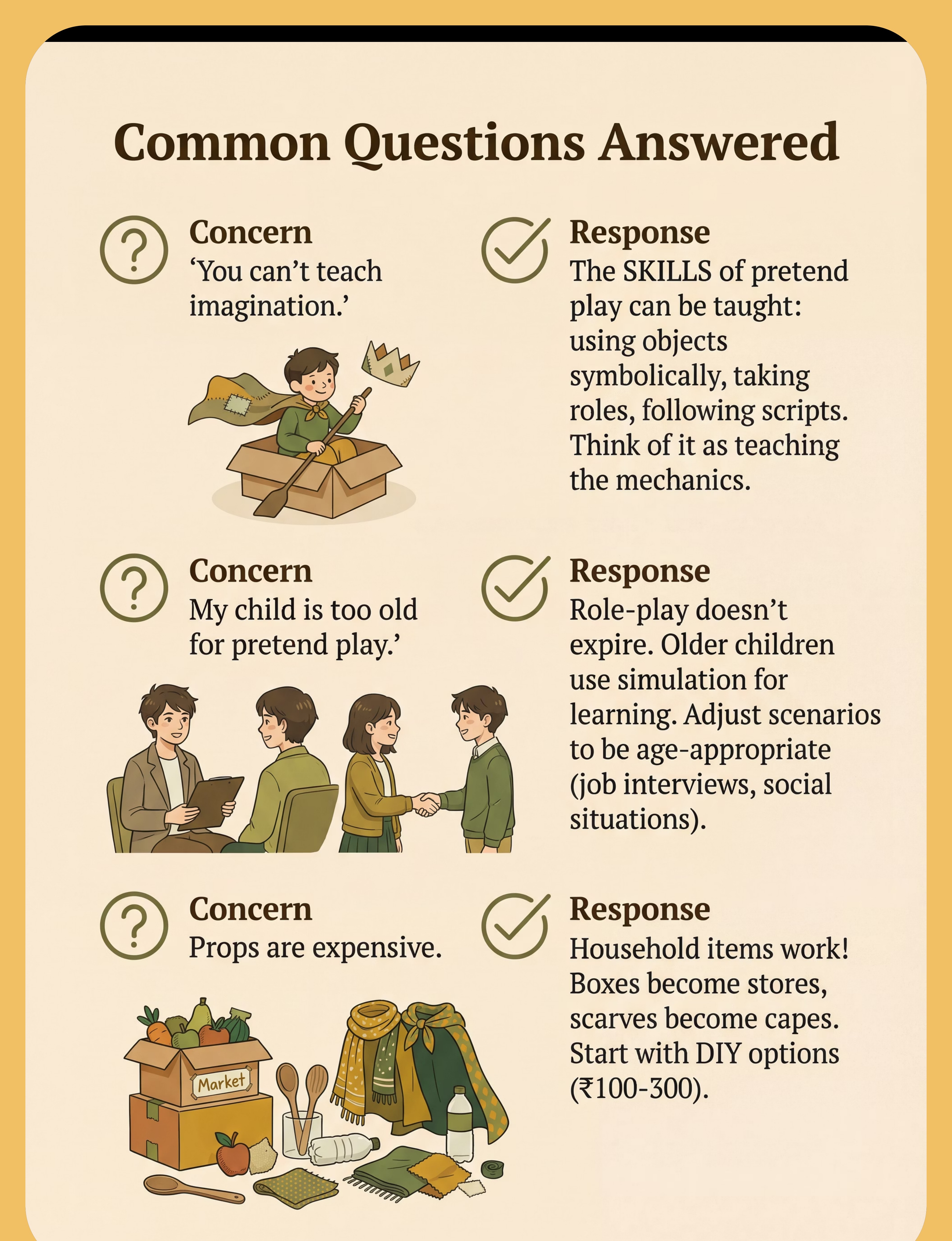
Common Questions (Honest Answers)
Q: "You can't teach imagination"
A: While spontaneous imagination may be different, the SKILLS of pretend play can be taught: using objects symbolically, taking roles, following scripts. Many children with autism develop rich imaginative lives when given scaffolding.
Try this: Think of it as teaching the mechanics of pretend play.
Q: "My child is too old for pretend play"
A: Role-play and social practice don't expire. Older children and adults use simulation, drama, and role-play for learning. Adjust the props and scenarios to be age-appropriate (social situations, job interviews, etc.).
Try this: Call it 'practicing scenarios' rather than 'pretend play.'
Q: "They just repeat the same scripts over and over"
A: Repetitive scripts are a starting point, not the end. Once comfortable, gently introduce variations. 'What if the patient has a different problem?' Flexibility builds on foundations of comfort.
Try this: Use familiar scripts as base, then add small variations.
Q: "Props are expensive"
A: Household items work! Boxes become stores. Scarves become capes. Real items (safe kitchen tools) work better than toys for some children. Puppets can be socks with buttons.
Try this: Start with household items and simple DIY props.

Investment Guide
Role-play props range from essentially free (household items) to premium commercial sets. Both approaches can be highly effective—the key is matching the props to your child's interests and developmental needs.
Here's a comparison of starter versus premium options:
Budget Option | Premium Option | ||
Items | Household items + DIY costumes + sock puppets | Complete role-play kit with costumes, props, puppets | |
Cost | ₹100-300 (US $1-4) | ₹2,000-4,000 (US $24-48) | |
Key Features | Highly effective with creativity; uses everyday objects and simple crafts. | Durable, high-quality materials; comprehensive themed sets with realistic details. | |
Examples | Boxes for stores/ovens, scarves for costumes, safe kitchen items, homemade puppets | Melissa & Doug, KidKraft, Learning Resources sets |
Overall Range: ₹100–4,000 (US $1–48)
Key Features
Accessibility
Utilize everyday household items for immediate and cost-effective role-play.
Creativity & DIY
Encourages imagination through homemade costumes and simple craft props.
Quality & Durability
Invest in high-quality, long-lasting materials and professional-grade kits.
Comprehensive Sets
Access detailed, themed kits for immersive and structured play experiences.
Investment Progression
Start Simple
Begin with 1-2 budget-friendly options based on your child's immediate interests.
Observe Engagement
Monitor which activities or props genuinely capture your child's attention.
Gradual Expansion
Slowly introduce more props or themed sets as you see sustained interest and developmental benefit.

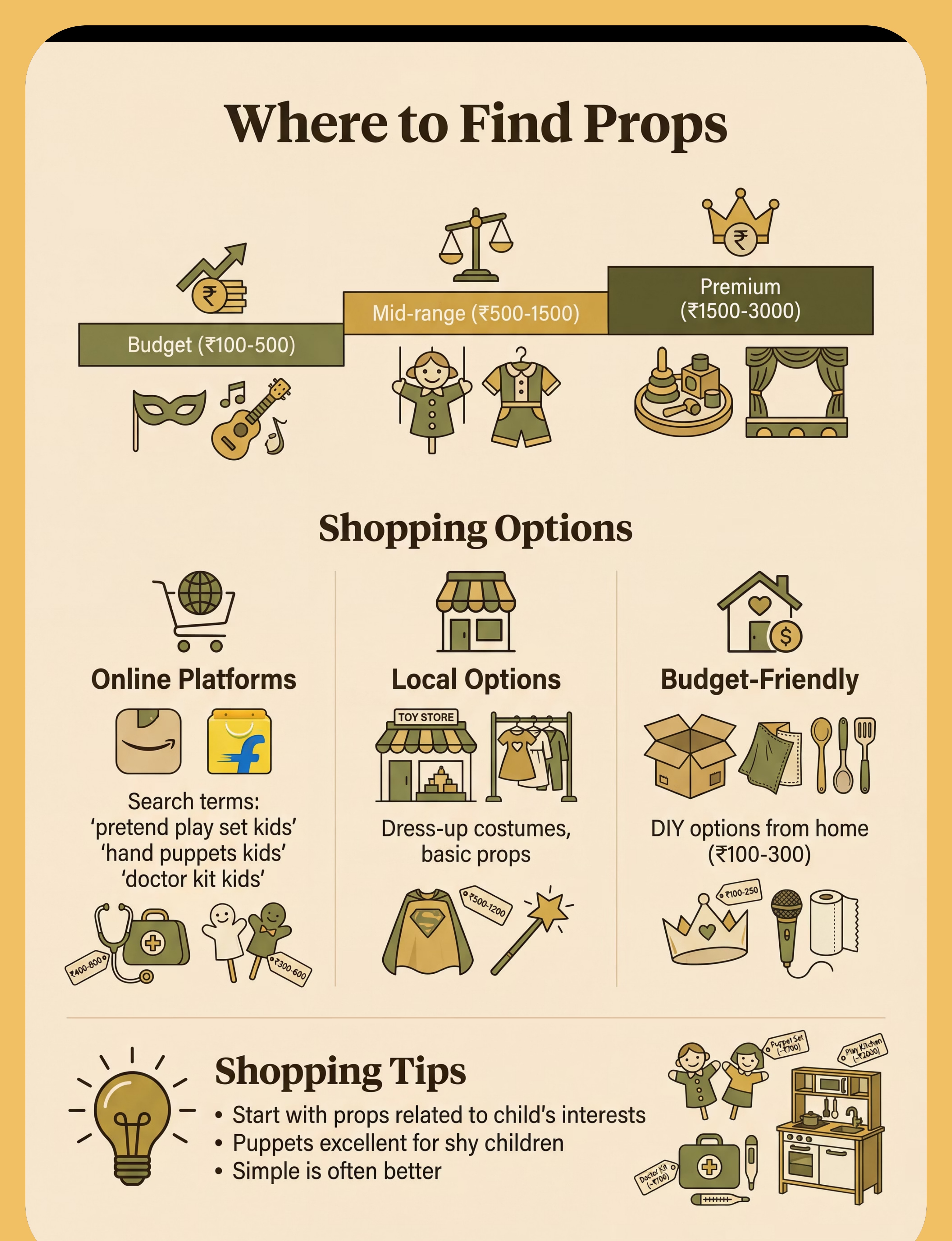
Where to Buy in India
Availability:Widely Available across India through online and offline channels
Recommended Platforms
Amazon.in
Search Term: "pretend play set kids"
Price Range: ₹500-2,000
Amazon.in
Search Term: "hand puppets kids"
Price Range: ₹200-800
Amazon.in
Search Term: "doctor kit kids"
Price Range: ₹300-800
Flipkart
Search Term: "play kitchen kids"
Price Range: ₹800-3,000
Local toy stores
Search Term: "dress up costumes"
Price Range: ₹300-1,000
✓ Buying Tips
- Start with props related to child's interests or experiences
- Puppets are excellent for shy children
- Doctor/vet kits help prepare for real appointments
- Miniatures (dollhouse) good for narrative development
- Simple is often better - too much overwhelms
🚩 Red Flags
- Too complex for child's play level
- Small parts for young children
- Props don't match child's experiences
- Only one role available (need multiple)
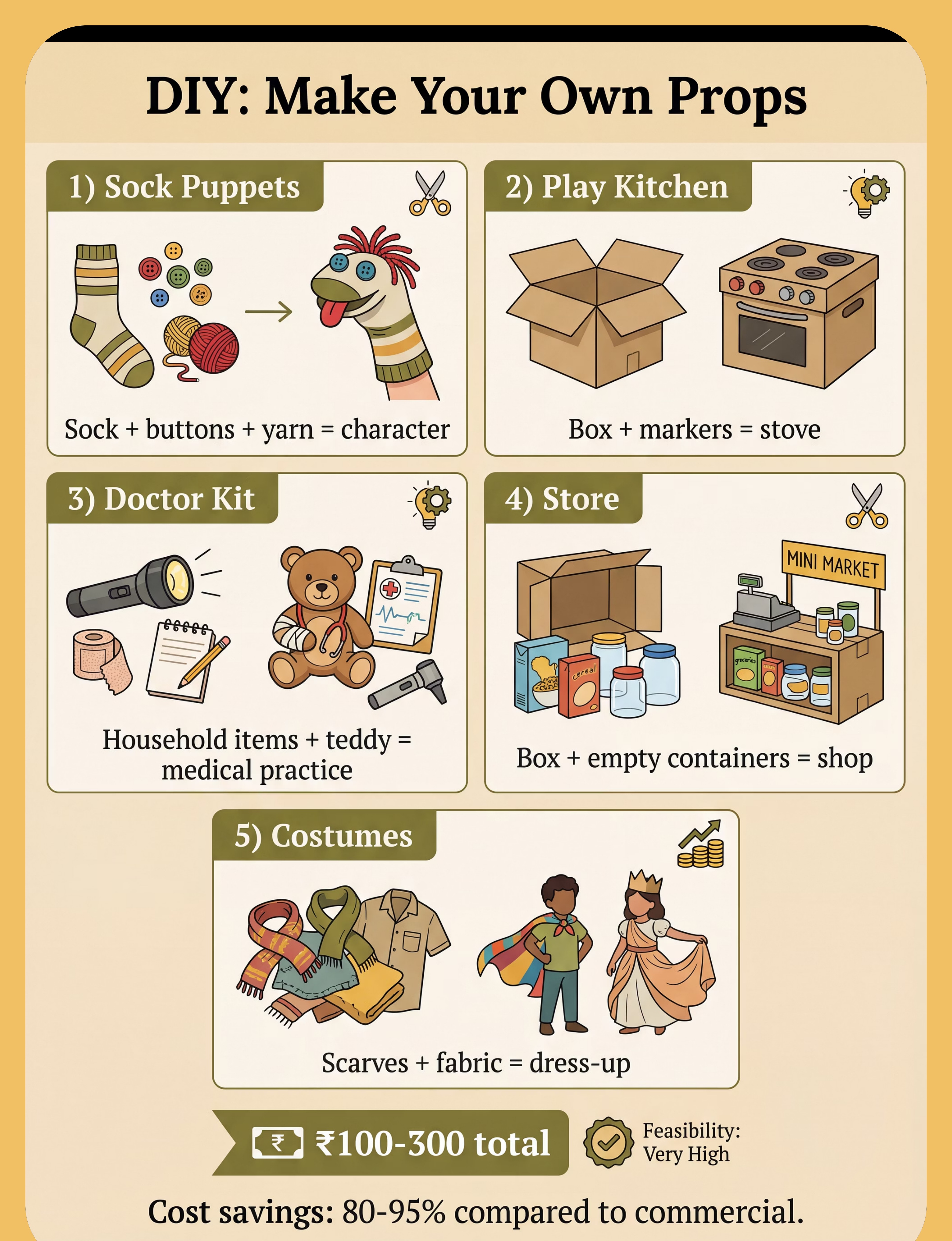
DIY Alternative (Save 80-95%)
Feasibility:Very High | Cost Savings: 80-95% | Time Investment: Variable (1-3 hours depending on project)
Materials Needed
- Household items (boxes, containers, safe kitchen tools)
- Boxes (for stores, ovens, counters)
- Scarves/fabric (for costumes and capes)
- Socks (for puppets)
- Salt dough or playdough (for play food)
- Basic craft supplies (buttons, yarn, markers)
Simple DIY Projects
01
Sock Puppets
Sock + buttons for eyes + yarn for hair = instant character
02
Play Kitchen
Cardboard box + drawn 'burners' + real safe utensils = cooking station
03
Doctor Kit
Bandages, flashlight, notepad, teddy bear patient = medical play
04
Store Setup
Box counter + empty food containers + play money = shopping practice
05
Costumes
Scarves, hats, vests from thrift store = instant transformation
DIY vs Commercial
When to DIY | When to Buy Commercial | |
|
|
Tradeoffs: DIY options may have less polished appearance and require creativity, but are highly customizable and use familiar objects that may be more meaningful to the child.
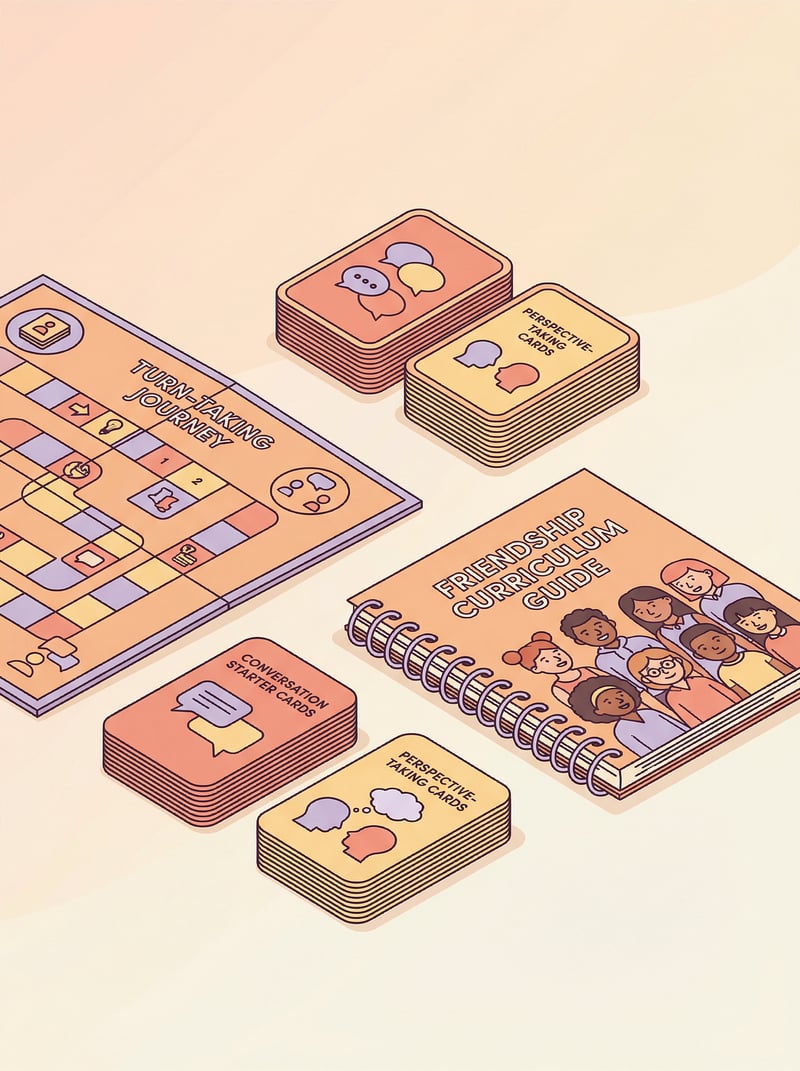
Preview of role play pretend play props Therapy Material
Below is a visual preview of role play pretend play props therapy material. The pages shown help educators, therapists, and caregivers understand the structure and content of the resource before use. Materials should be used under appropriate professional guidance.


Share this resource
Help others discover thisLink copied!
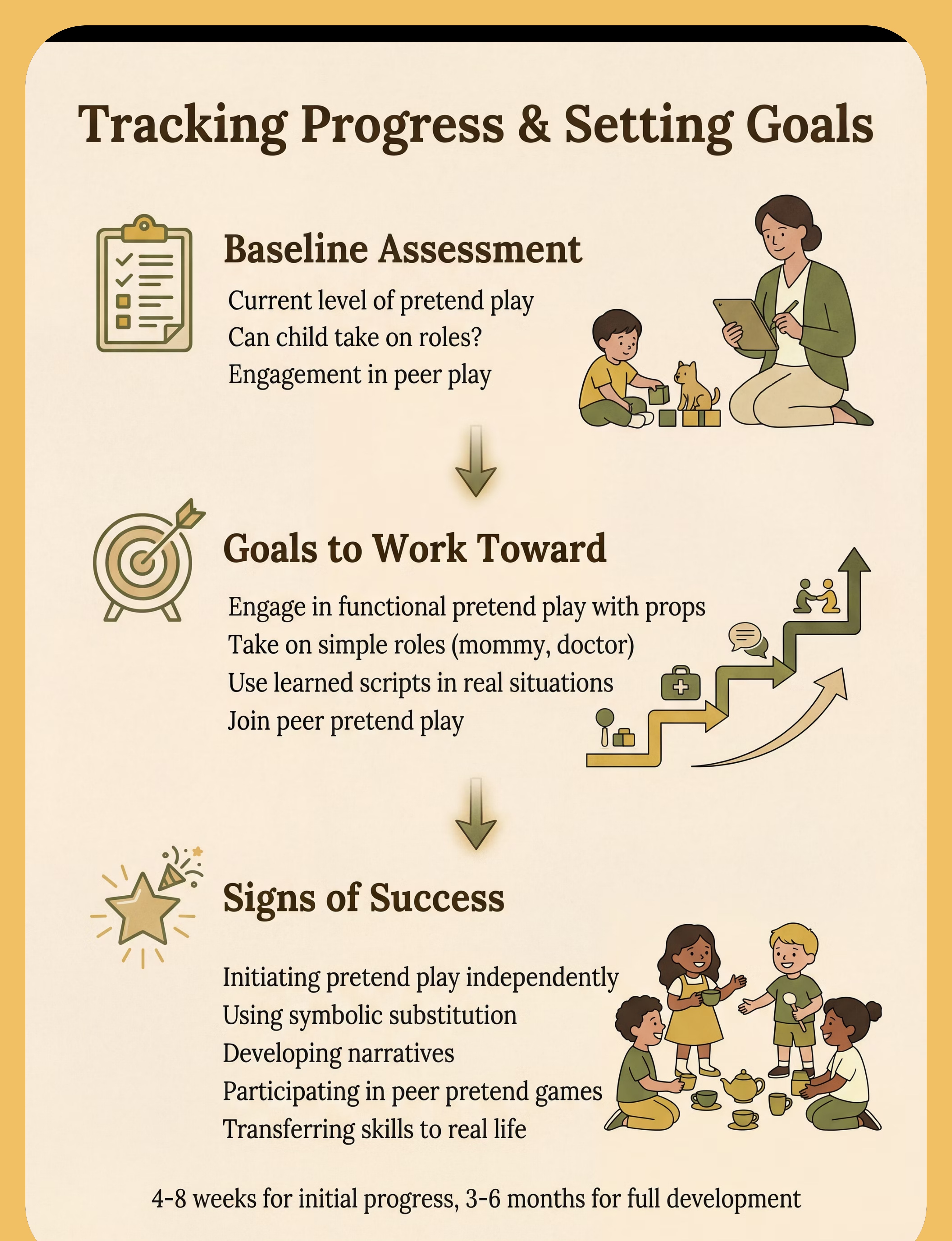
Measuring Success & Next Steps
Track Progress
Baseline Assessment
- Current level of pretend play
- Types of symbolic play observed
- Can child take on roles?
- Engagement in peer pretend play
Goals to Work Toward
- Child will engage in functional pretend play with props
- Child will take on simple roles (mommy, doctor)
- Child will use learned scripts in real situations
- Child will join peer pretend play
Success Indicators ✓
- Initiating pretend play independently
- Using symbolic substitution
- Role-play with narrative development
- Peer play participation
- Transfer to real situations
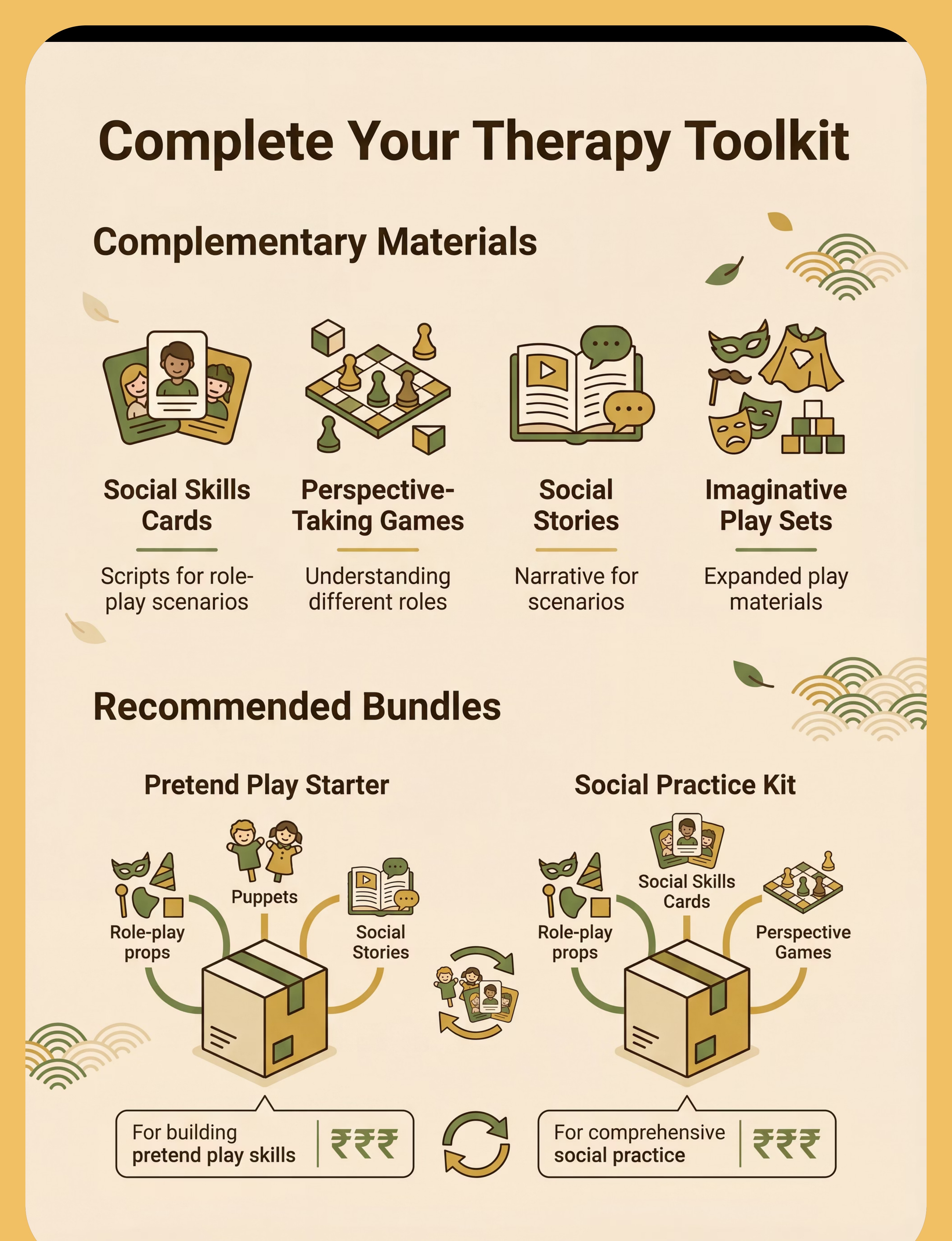
Complete the Kit
Complementary Tools
Social Skills Cards (ID: 4.1)
Scripts for role-play scenarios
Perspective-Taking Games (ID: 4.2)
Understanding different roles
Social Stories (ID: 2.2)
Narrative for scenarios
Imaginative Play Sets (ID: 9.1)
Expanded play materials
Recommended Bundles
Pretend Play Starter: Role-Play Props (4.3) + Puppet Set (4.3.2) + Social Stories (2.2) = Building pretend play skills foundation
Social Practice Kit: Role-Play Props (4.3) + Social Skills Cards (4.1) + Perspective-Taking Games (4.2) = Comprehensive social skills practice
Quick Summary
Role-play and pretend play props develop symbolic thinking, social scripts, and perspective-taking in a safe practice environment. Core Kit (Rank 1), strong evidence, fundamental for play development.
role-play
pretend
props
puppets
scripts
imagination
SpEd
Psychologist
core-kit
Common searches: pretend play autism, role play props autism, dramatic play autism, puppet therapy autism, imaginative play autism, social scripts role play, play therapy props
Get Support
FREE National Autism Helpline
Phone: 9100 181 181
Languages: 16+ languages supported
Website: pinnacleblooms.org
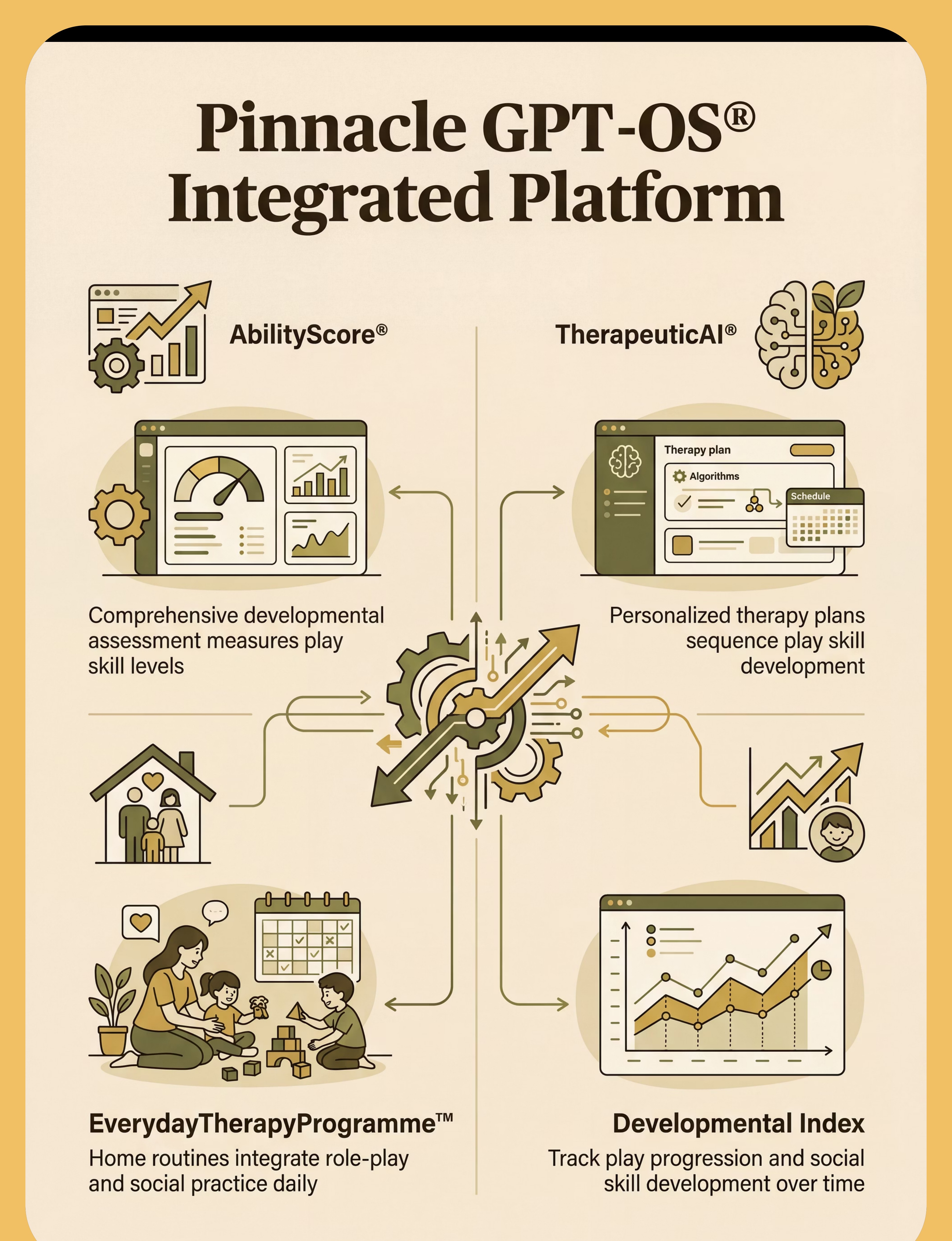
Platform Integration
This tool integrates with Pinnacle Blooms Network's comprehensive support system:
- AbilityScore® assesses play development level and recommends appropriate props
- TherapeuticAI® sequences play skill development with personalized progressions
- EverydayTherapyProgramme™ includes daily play routines and scripts
- Developmental Index tracks play progression and social skills growth over time
Disclaimer: This is educational information. Always consult qualified occupational therapists, speech-language pathologists, or pediatricians. Individual results vary. Role-play props are tools to support development—they work best as part of a comprehensive, professionally guided intervention plan.