










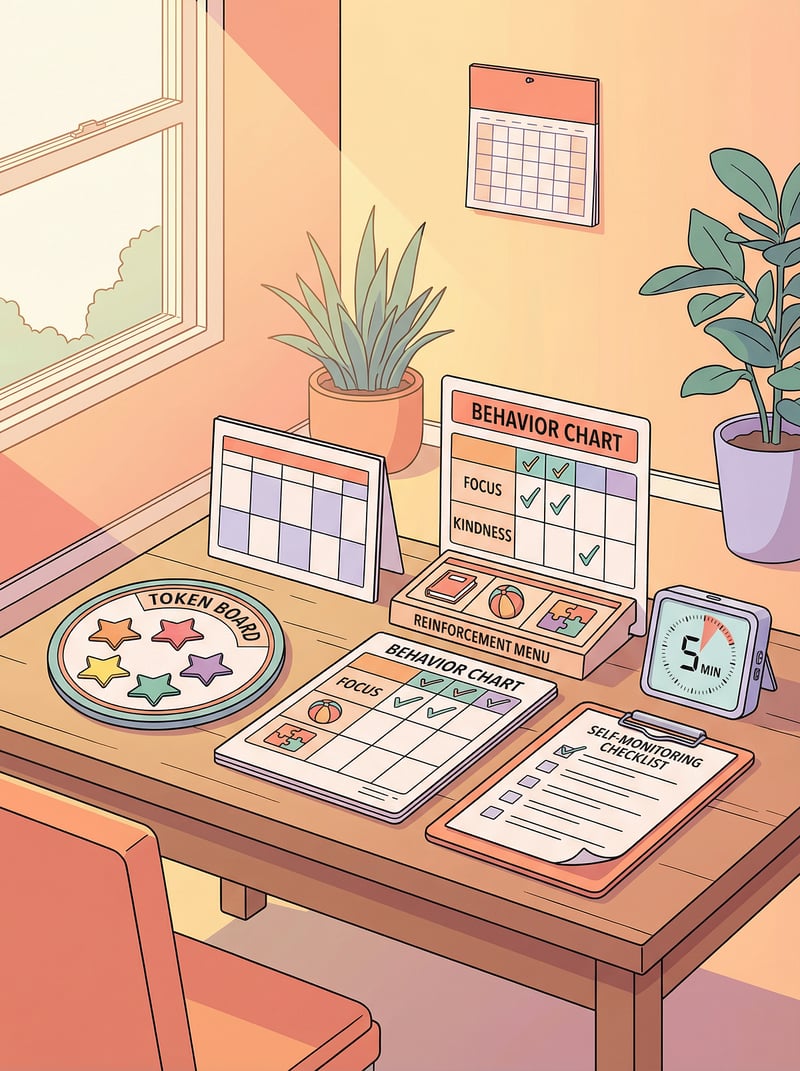
Self-Monitoring Tools: Building Independence Through Self-Awareness

Who This Helps
Builds Behavior Awareness
Supports children in recognizing their own behaviors, emotional states, and triggers in various situations.
Develops Internal Control
Facilitates the crucial shift from relying on external prompts to internal self-management and regulation.
Fosters Independence Skills
Empowers children who are ready to develop and apply skills for greater personal autonomy and decision-making.
Encourages Self-Recognition
Assists students in accurately observing, understanding, and taking ownership of their actions and their impact.
Ages 5-12 years
Home
School
Clinic
Community
Target areas: Self-Awareness, Self-Evaluation, Self-Regulation, Independence, Metacognition, Generalization

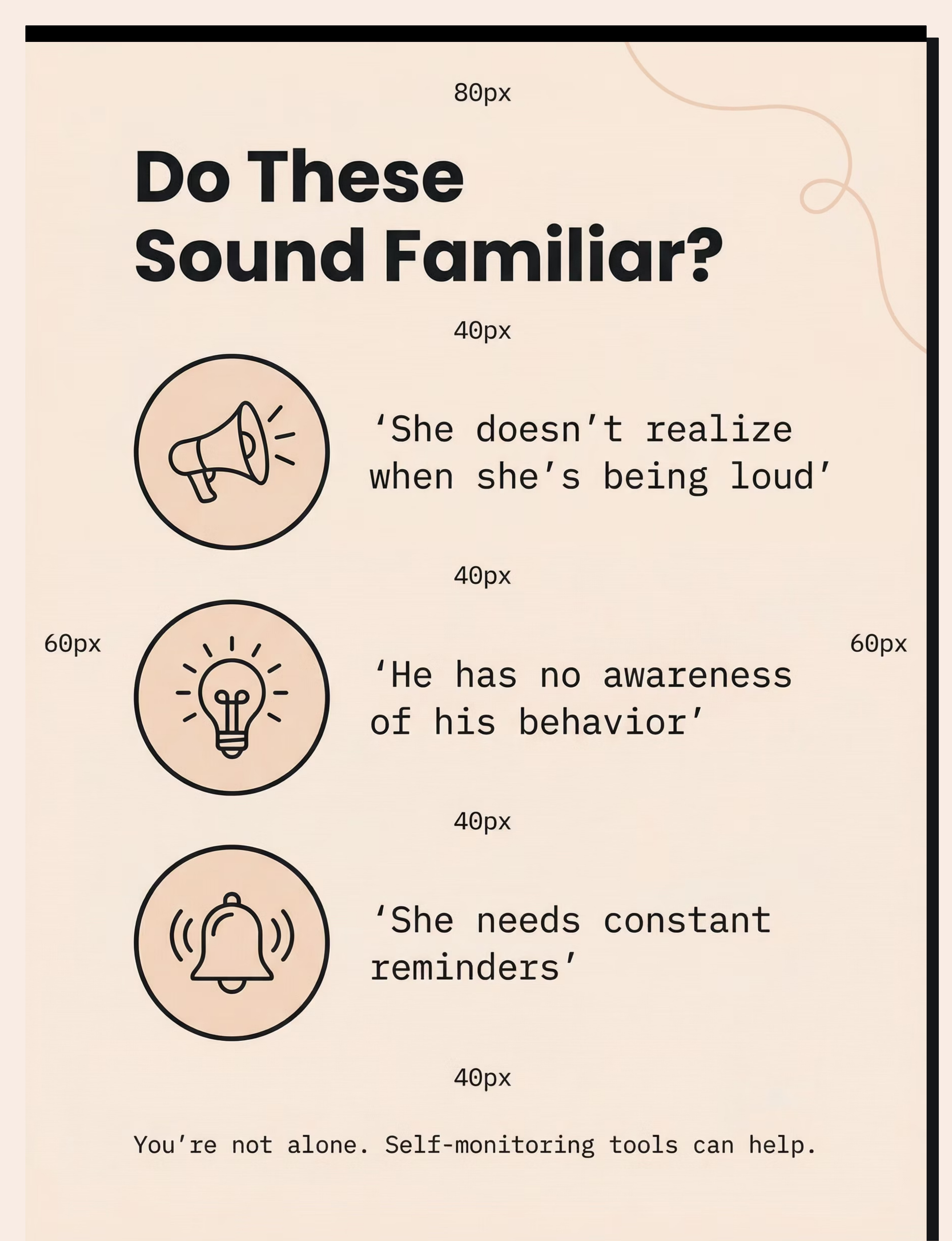
Does This Sound Familiar?
"He has no awareness of his behavior"
"She doesn't realize when she's being loud"
"He can't tell when he's getting upset"
"She needs constant reminders"
"He can't self-correct"
"She's not developing independence"
You're not alone. These are common challenges that self-monitoring tools are specifically designed to address. Thousands of families have found that teaching self-awareness transforms both behavior and confidence.

A Day Without the Right Support
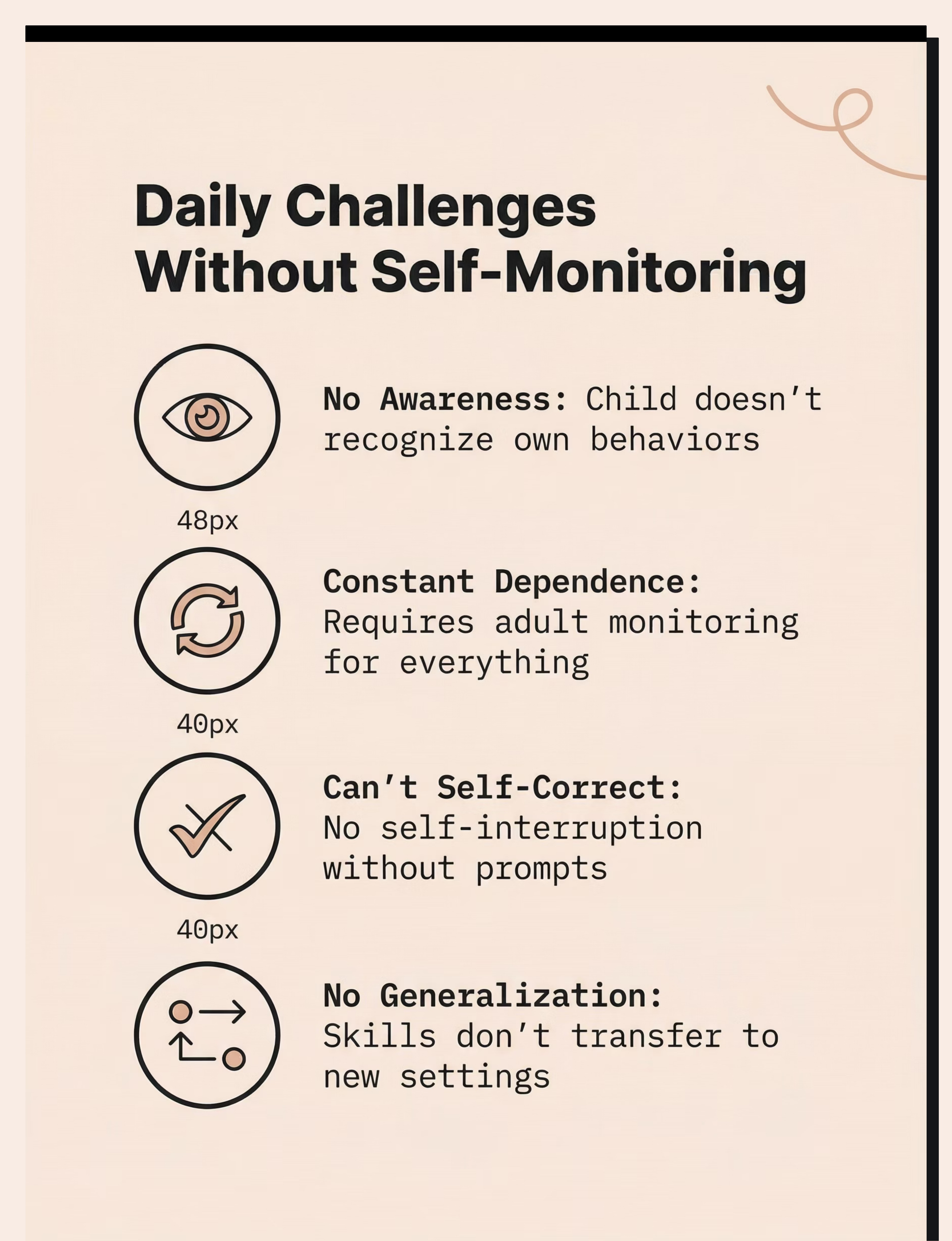
Morning: No Awareness
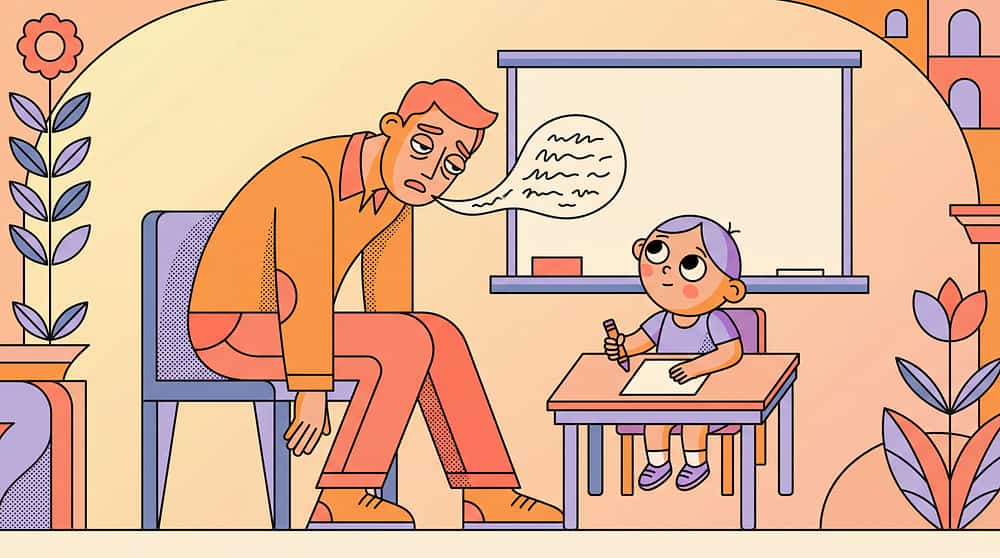
The child doesn't recognize their own behavior, leading to repeated issues and being surprised by corrections. There's no internal monitoring of actions or volume.
Afternoon: Constant Corrections
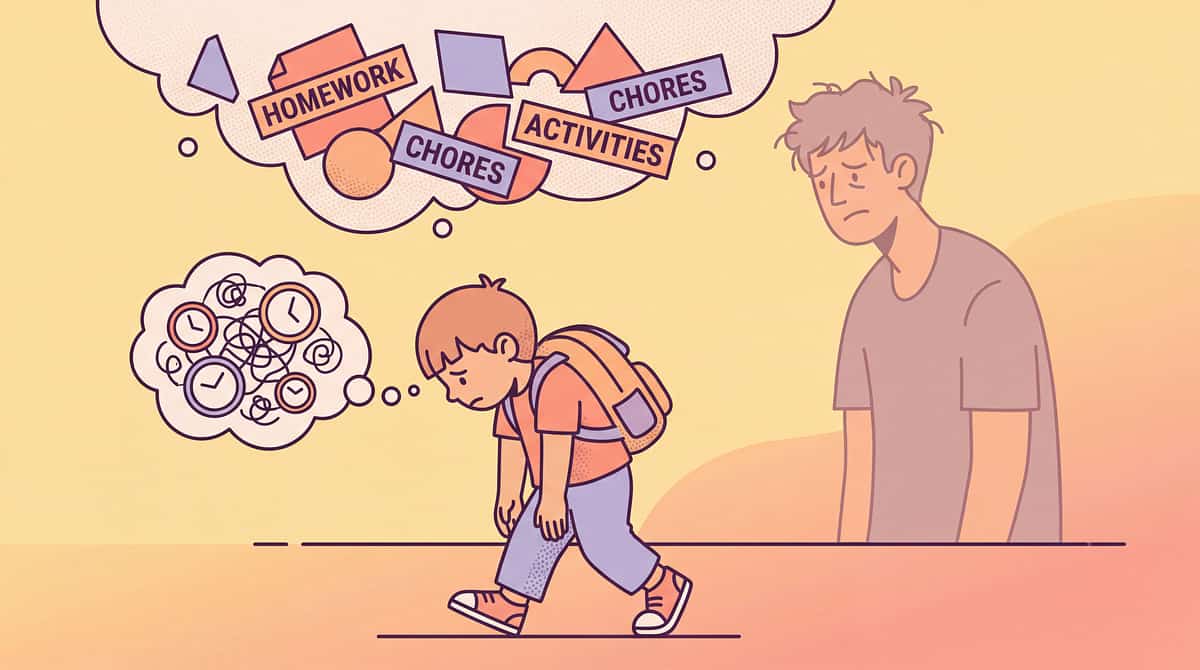
Throughout the day, the child requires continuous adult prompts for basic behaviors. This dependence on external control is exhausting for caregivers and hinders self-initiation.
Evening: Frustration Builds
Despite understanding what's expected, the child struggles to self-correct in the moment. This leads to escalating frustration for both the child and those around them.
Night: Everyone Exhausted
By the end of the day, any progress made doesn't transfer. Both the child and caregivers are drained, preventing true independence and reinforcing a cycle of dependence.
Without self-monitoring tools, children remain trapped in a cycle of external dependence, unable to develop the self-awareness that leads to genuine behavior change and independence.

The Science Behind It
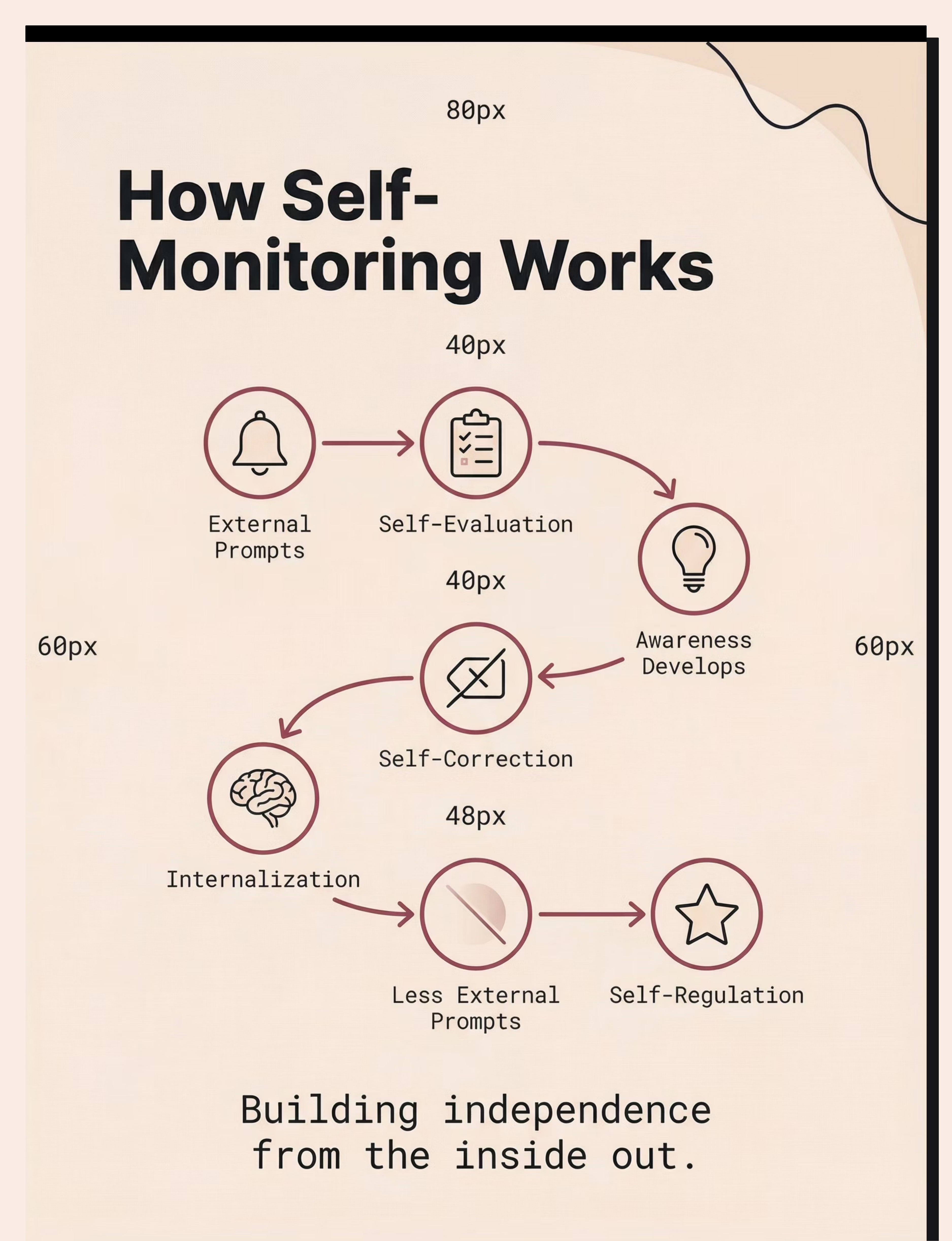
External Prompts
Watch vibrations or timer alerts prompt child to pause and check behavior
Self-Evaluation
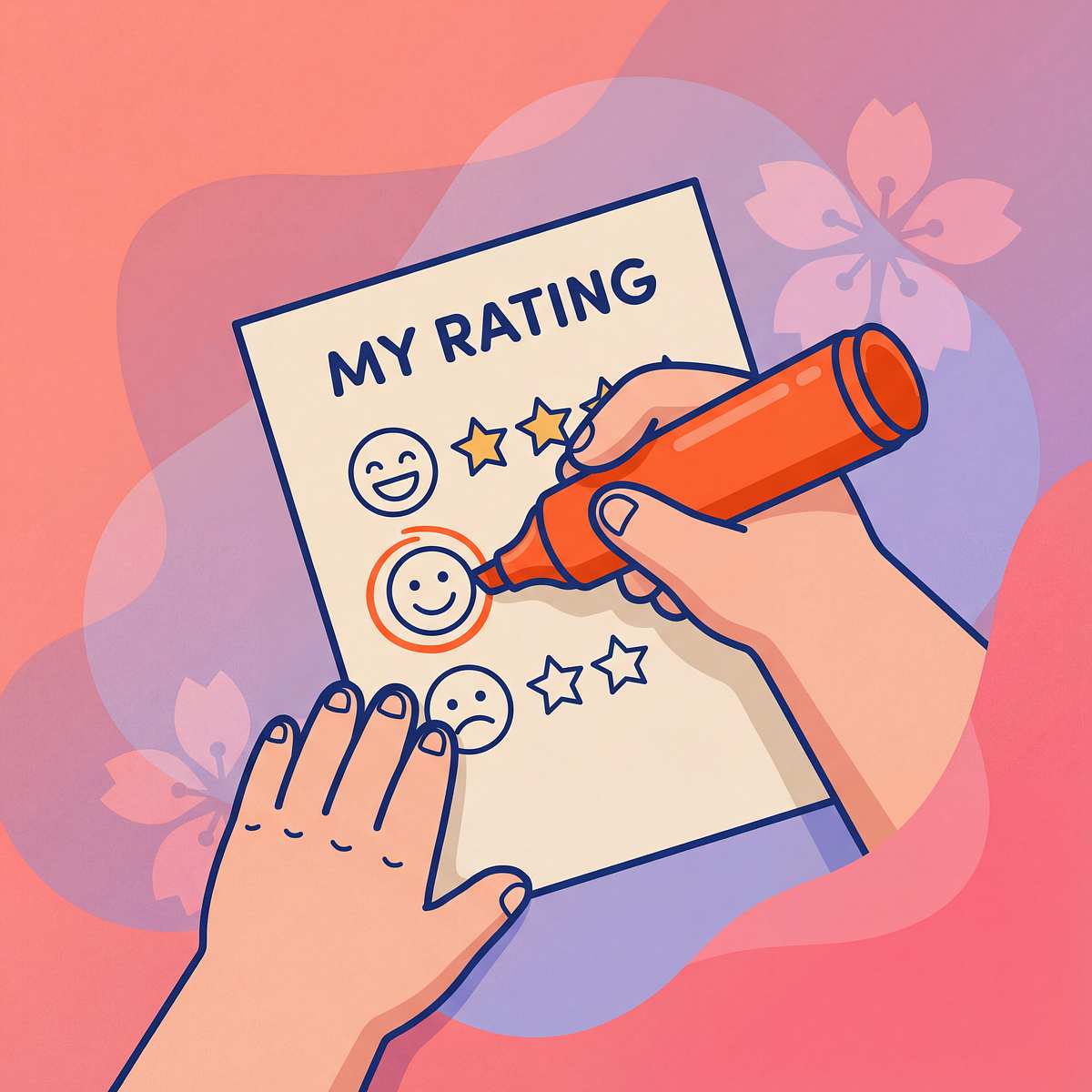
Child uses rating scale to assess own behavior against clear criteria
Awareness Development
Repeated evaluation builds recognition of behavior patterns in real-time
Self-Correction
Child begins adjusting behavior before external prompts are needed
Internalization
Monitoring becomes automatic, external prompts fade, true self-regulation emerges
Self-Awareness
Self-Evaluation
Self-Regulation
Independence
Metacognition
Generalization
This evidence-based progression transforms external behavior management into internal self-regulation, the cornerstone of lifelong independence and social success.

How to Use It Right
1
Start with Adult Comparison
Calibrate child's self-ratings by comparing with your assessment. This builds accuracy and prevents over- or under-rating.
2
Use Frequent Check-ins
Regularly review and discuss the child's self-monitoring data. This provides opportunities for feedback, reflection, and adjustment.
3
Reinforce Accuracy
Praise honest evaluation even when behavior was challenging. Accuracy in self-assessment matters more than perfect behavior.
4
Fade Prompts Gradually
As self-awareness increases, slowly reduce external reminders. The ultimate goal is for the child to internalize the monitoring process.
Duration: Use at regular intervals throughout the day based on individual need. Frequency typically starts high and decreases as skills develop.

Expert Insight
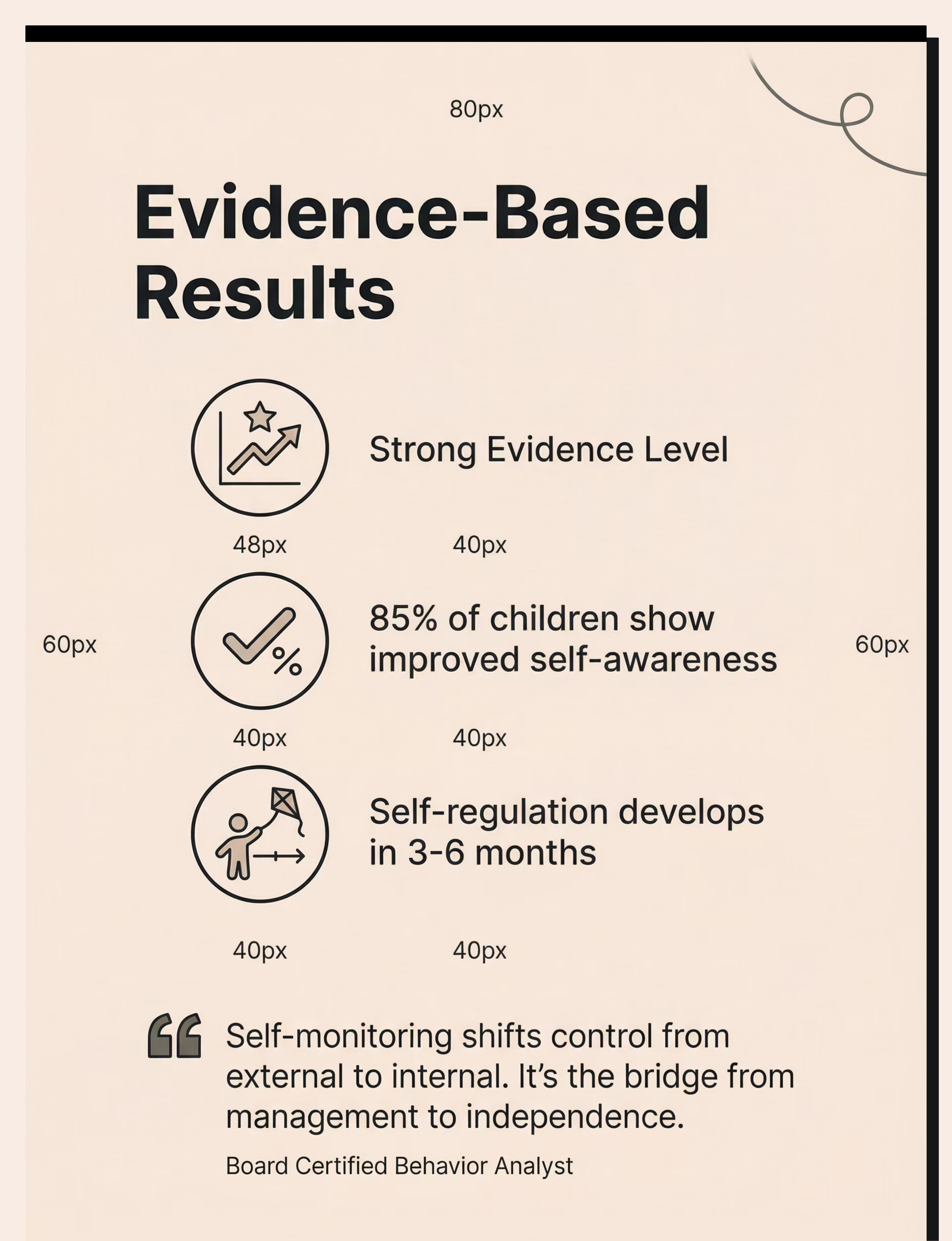
"Self-monitoring shifts control from external to internal. When children learn to accurately evaluate their own behavior, they can self-correct without adult prompts. It's the bridge from management to independence."
— Board Certified Behavior Analyst (BCBA)
BCBA + SpEd Recommended
Strong Evidence
Rank #2 in Category
Daily Use
This expert endorsement reflects decades of research and clinical practice. Self-monitoring is not just a tool—it's a fundamental skill that separates lifelong dependence from true autonomy. The evidence base is robust, with strong research support across multiple populations and settings.

Choose Your Option (6 Variants)
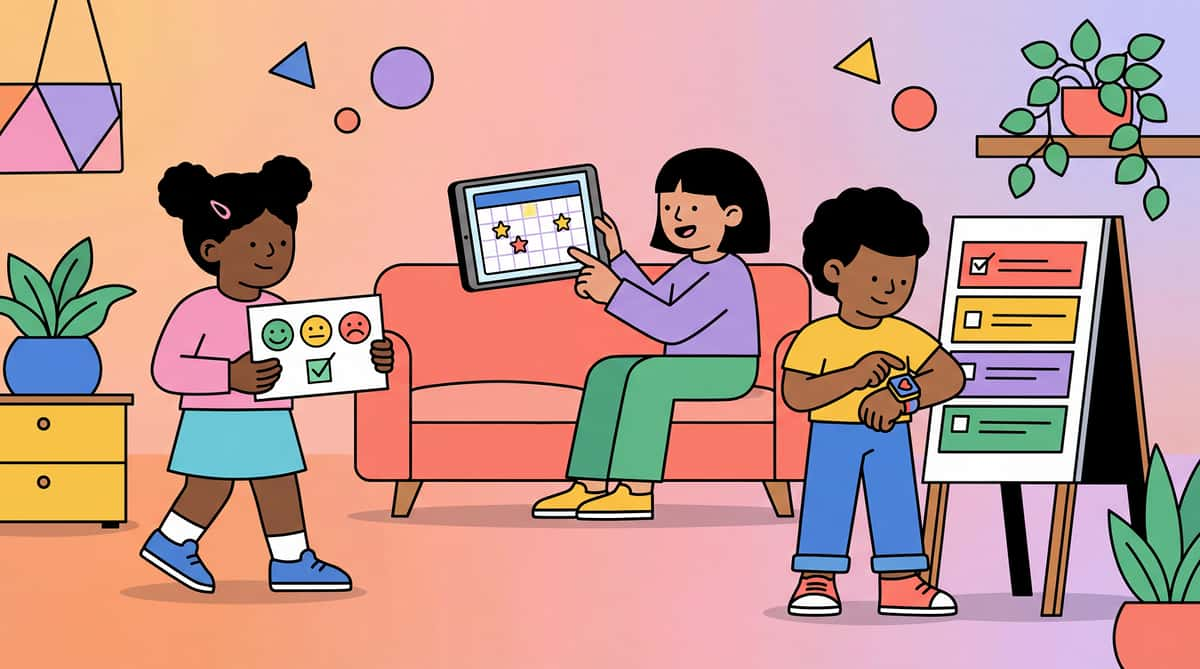
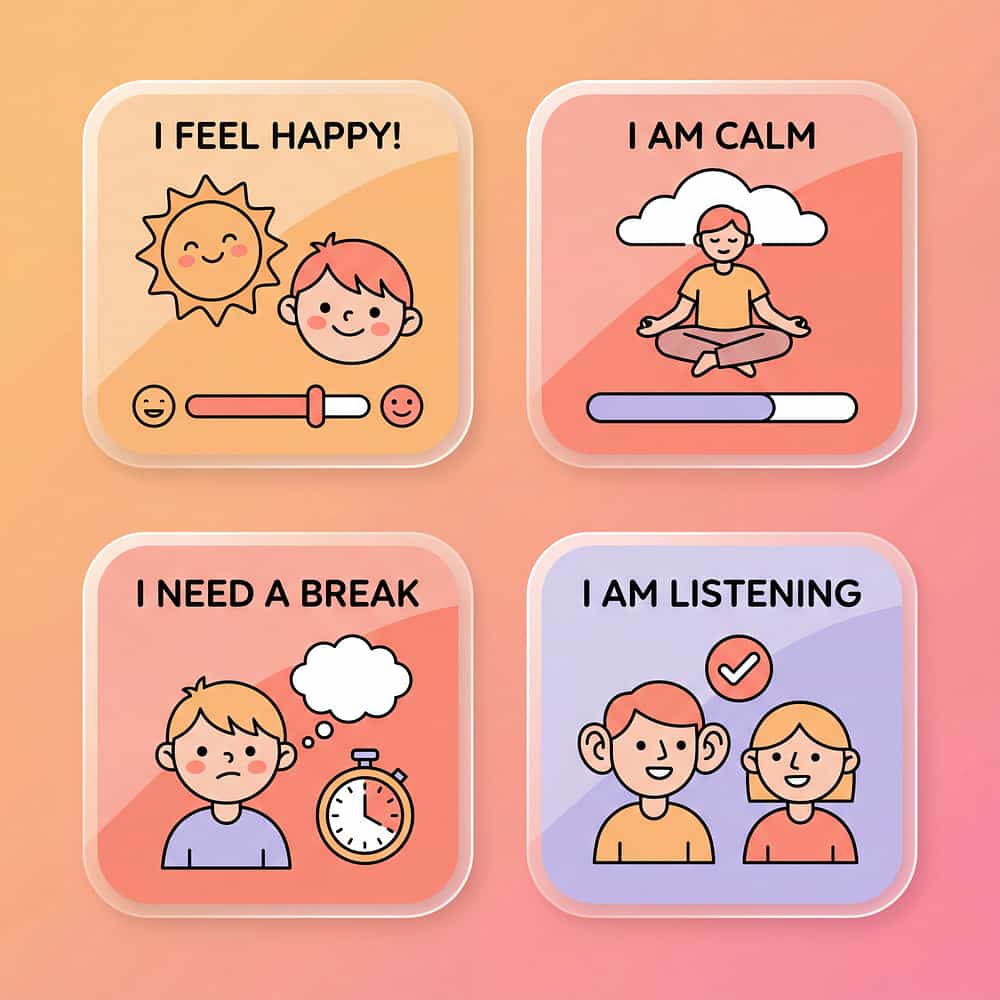
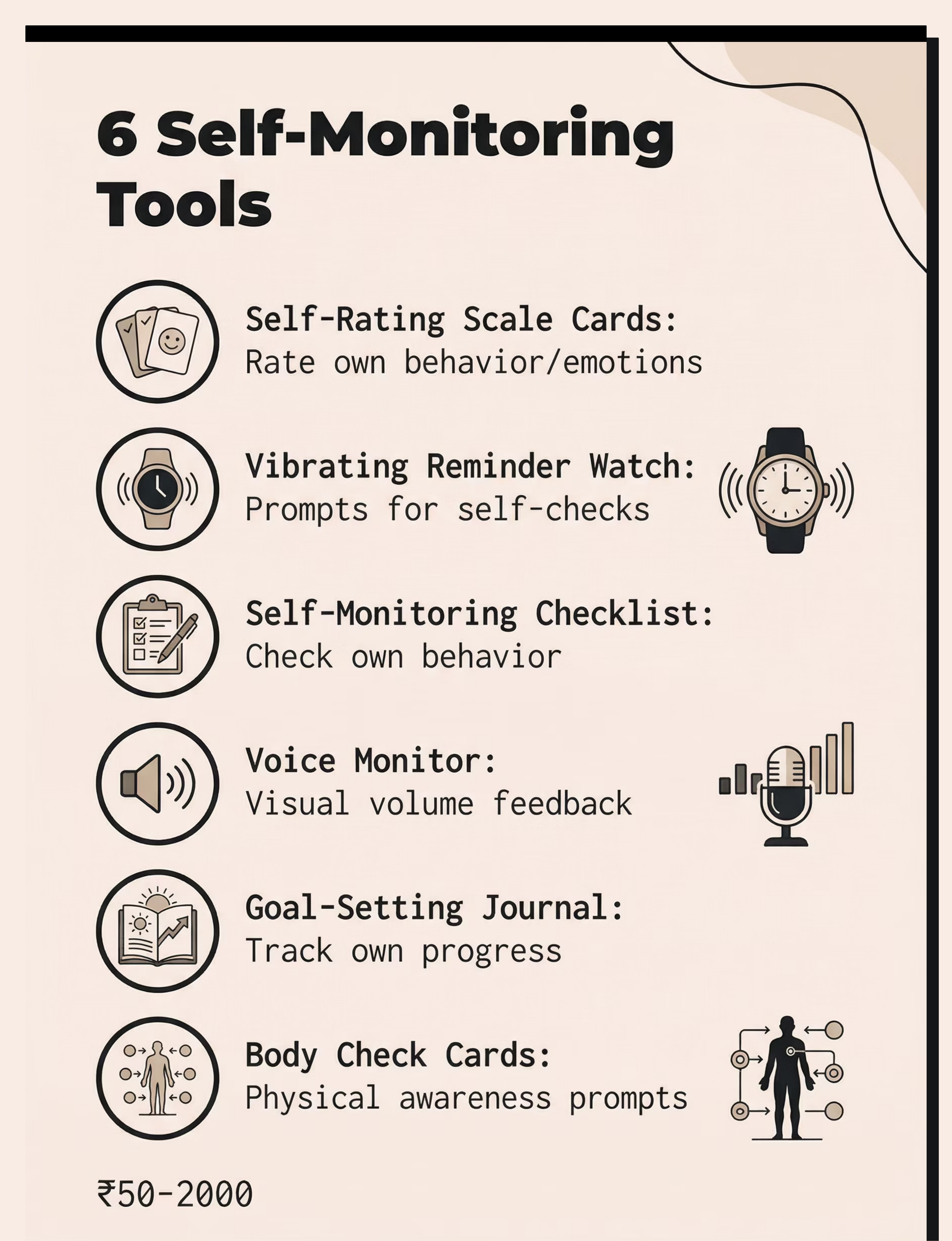
Self-Rating Scale Cards
Behavior Checklists
Visual Schedules with Self-Check
Tally Counters
Vibrating Reminder Watches
Digital Apps
Self-Rating Scale Cards
Best for: Building awareness, self-evaluation. Simple cards for children to rate their behavior or feelings, fostering self-awareness and understanding. Highly portable and cost-effective.
Behavior Checklists
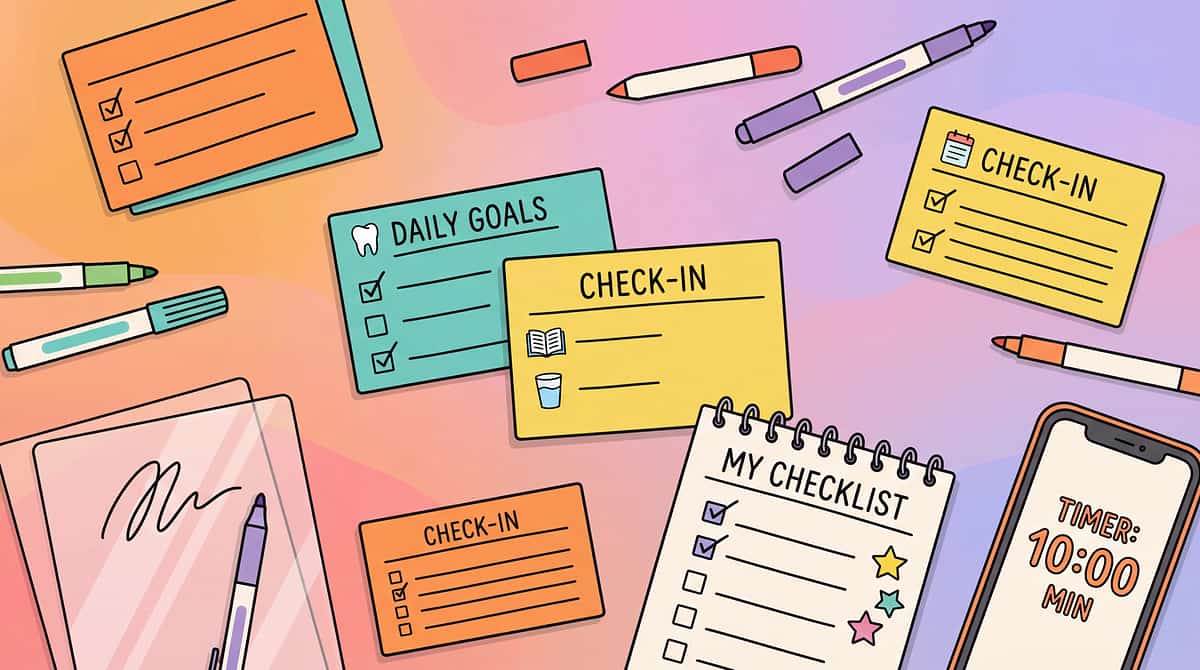
Best for: Task/behavior self-checks. Structured lists allowing children to mark off completed tasks or observed behaviors, promoting responsibility and self-management. Highly portable and easy to use across settings.
Visual Schedules with Self-Check
Best for: Following routines, promoting independence. Visual cues combined with self-checking mechanisms help children understand and manage their daily activities or task sequences. Great for all settings.
Tally Counters
Best for: Quantifying specific behaviors. Handheld devices or simple clickers allow children to track occurrences of a target behavior, providing concrete data for self-monitoring. Ideal for discrete tracking.
Vibrating Reminder Watches
Best for: Regular self-monitoring prompts. Wearable devices that provide discreet vibrations to remind children to check their behavior or focus, suitable for school and home. Very high portability.
Digital Apps
Best for: Interactive and flexible tracking. Applications on tablets or smartphones offering customizable tracking, gamification, and data visualization for older children. Offers high engagement and detailed insights.
How to Choose
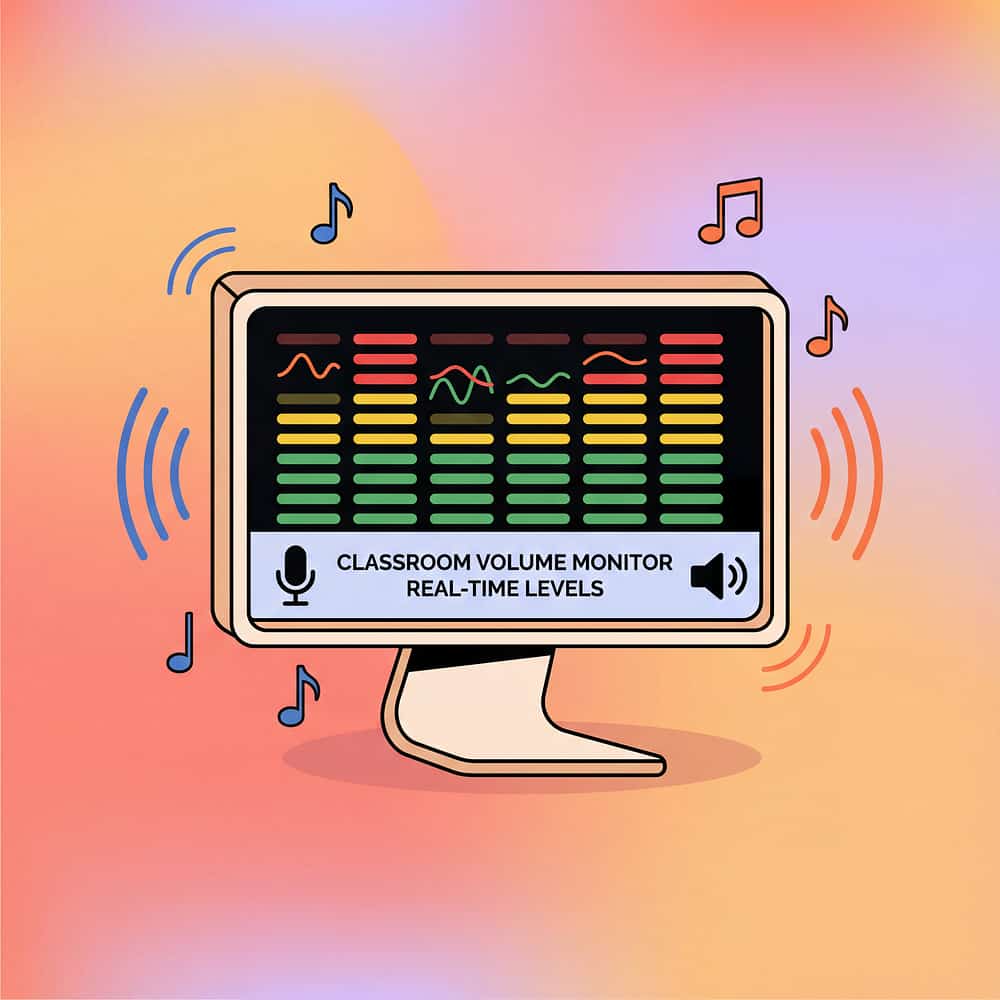
- By goal: Behavior awareness (cards), voice regulation (monitor), independence (watch)
- By setting: School needs (discrete watch), clinic (voice monitor), all settings (cards/checklist)
- By portability: High mobility (watch, cards), stationary (voice monitor)
Specifications & Self-Monitoring Process
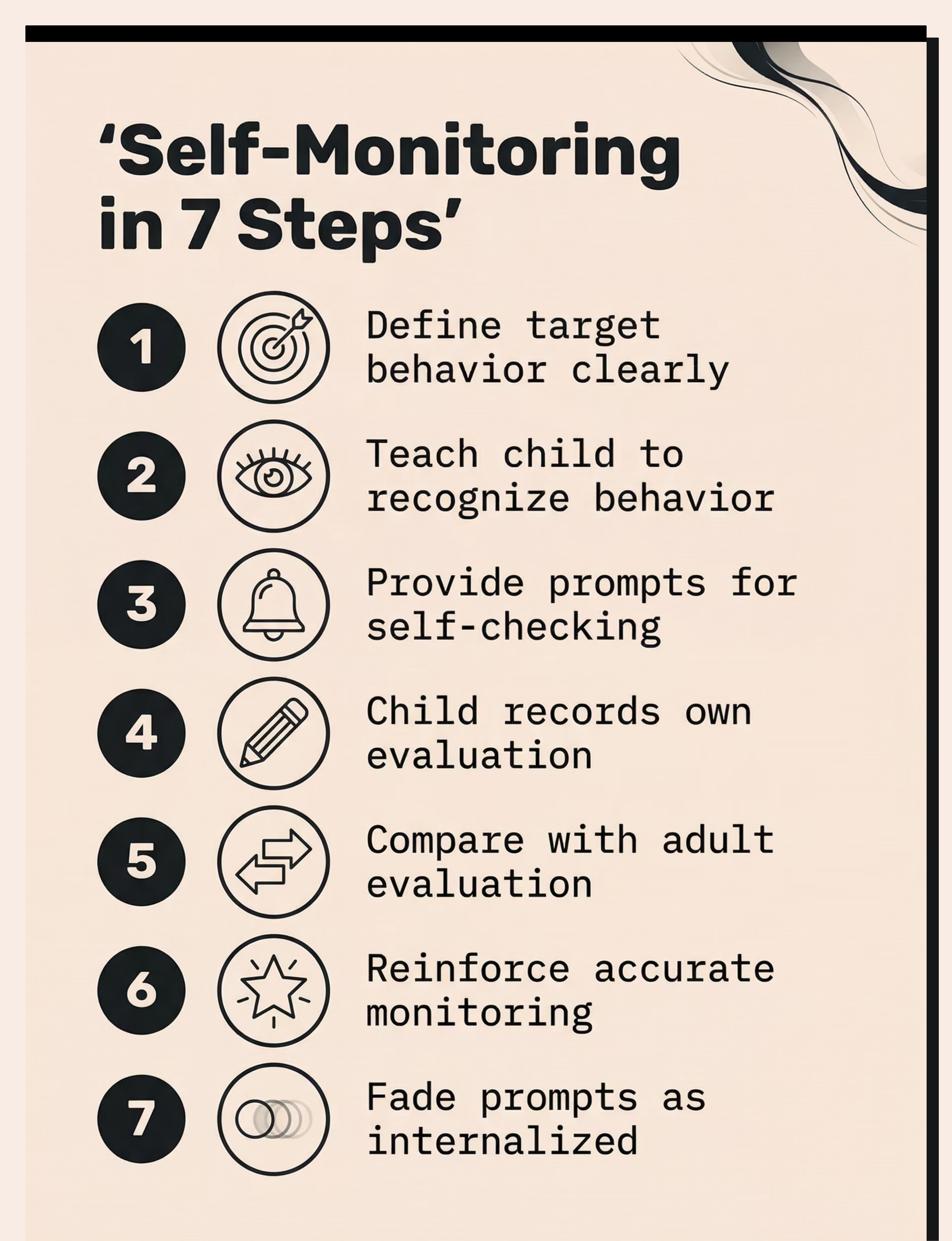
The 7-Step Process

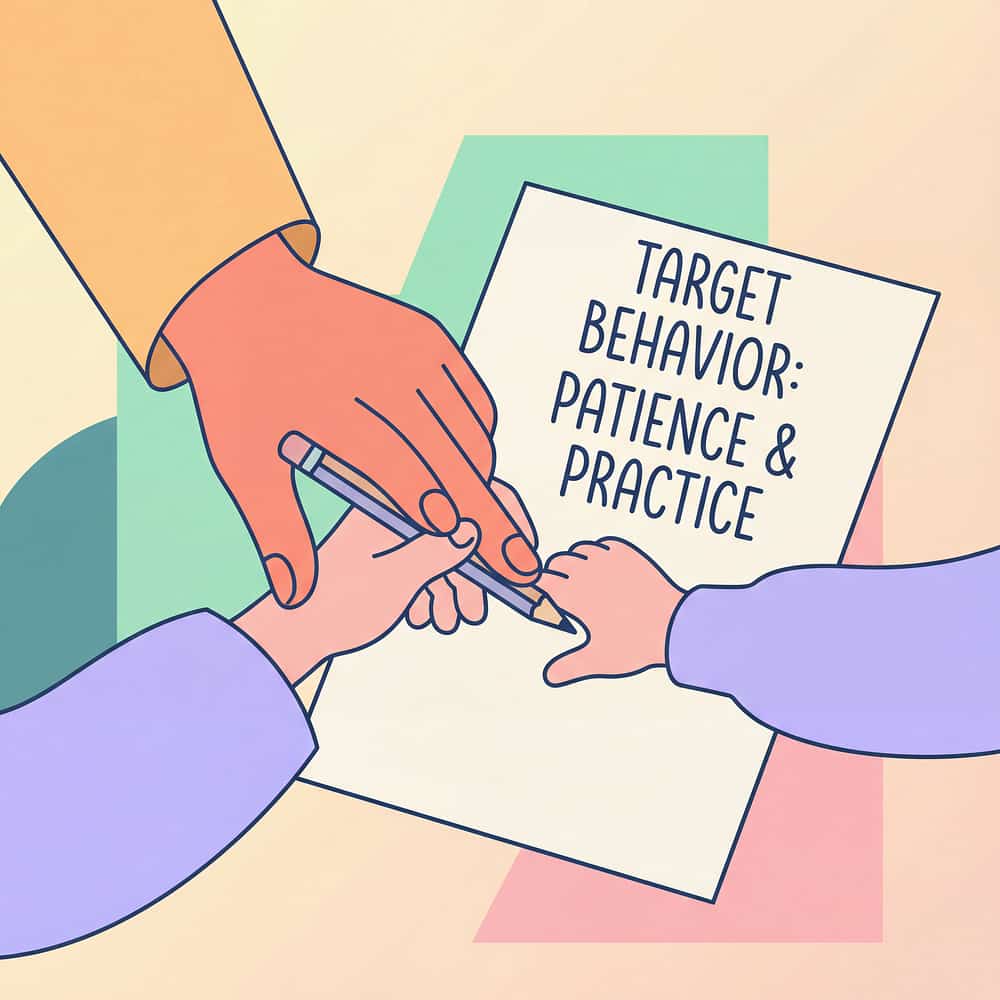
1. Define target behavior clearly
Using specific, observable language.

2. Teach child to recognize behavior
Through modeling and practice.

3. Provide prompts for self-checking
Using watches, timers, or visual cues.

4. Child records own evaluation
On a scale or checklist.

. Compare with adult evaluation
Initially to build accuracy.

6. Reinforce accurate monitoring
Regardless of behavior rating.

7. Fade prompts as internalized
Gradually reduce external support.
Materials & Features

Cards (paper or laminated)
Portable and versatile for various settings.

Watches (vibrating/audio)
Discreet prompts for self-monitoring.

Apps (smartphone-based)
Interactive and flexible tracking with data visualization.

Journals (written reflection)
Encourages deeper introspection and self-analysis.

Visual devices (volume displays)
Immediate feedback for specific behaviors.
Key features:
- Clear, objective criteria
- Accessible format for child's level
- Regular prompting mechanism
- Progress tracking capability
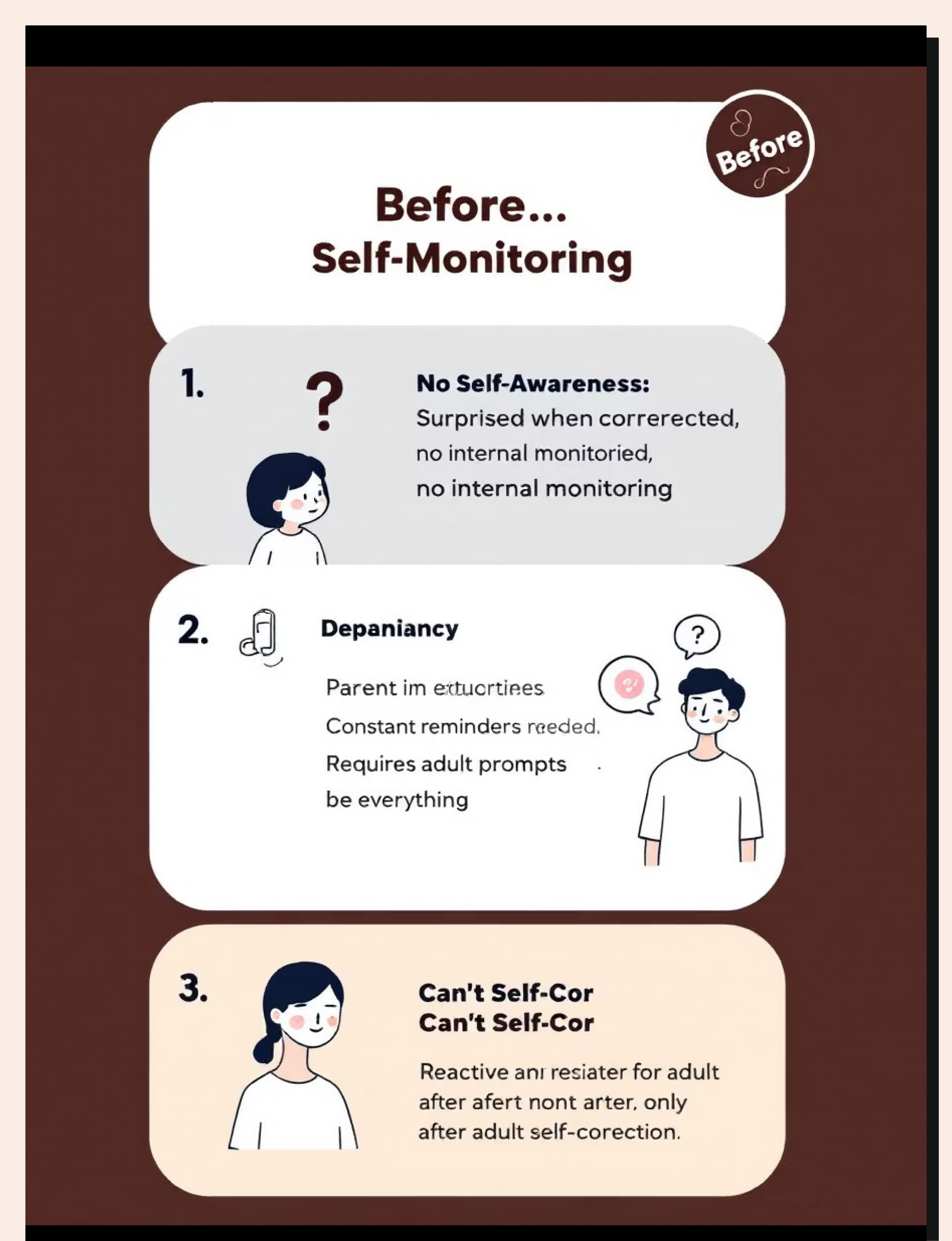
The Struggle (Before)

No Self-Awareness
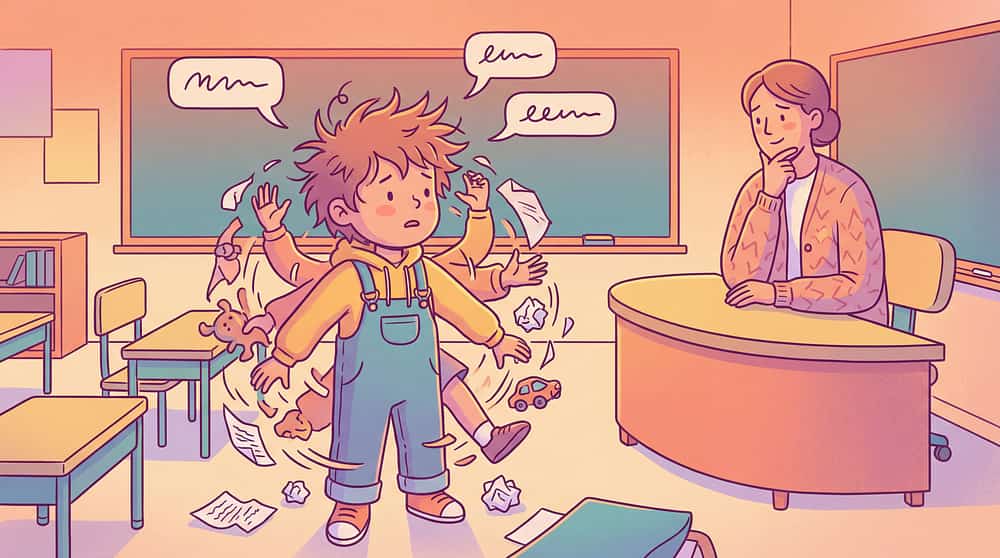
Situation: Child doesn't recognize when behavior is occurring. Surprised when corrected. No internal monitoring.
Experience: Constantly caught off-guard by adult feedback. Can't understand why they're being corrected.
Emotion: Confusion, frustration, feeling unfairly targeted

Constant Reminders Needed
Situation: Child requires adult prompts for everything. Doesn't self-initiate. Dependent on external control.
Experience: Can't function independently. Adults must constantly monitor and redirect. Exhausting for everyone.
Emotion: Helplessness, dependence, adult burnout

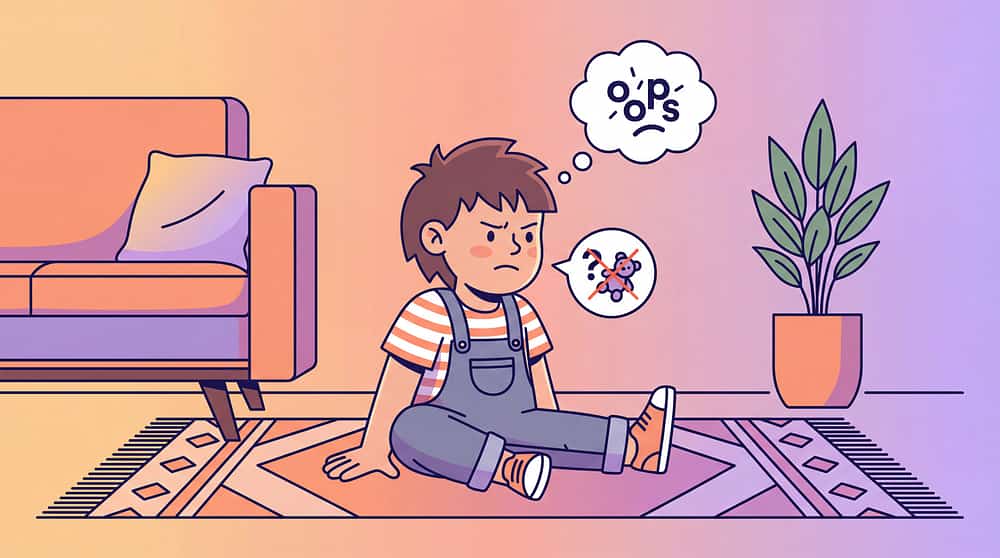
Can't Self-Correct
Situation: Child may know behavior is wrong but can't catch it in moment. No self-interruption. Only responds to correction.
Experience: Behavior happens automatically. Child realizes afterward but can't stop it during. Feels out of control.
Emotion: Powerlessness, reactive only, no proactive control
These scenarios represent the daily reality for families without self-monitoring tools. The cycle of external dependence prevents true skill development and independence.

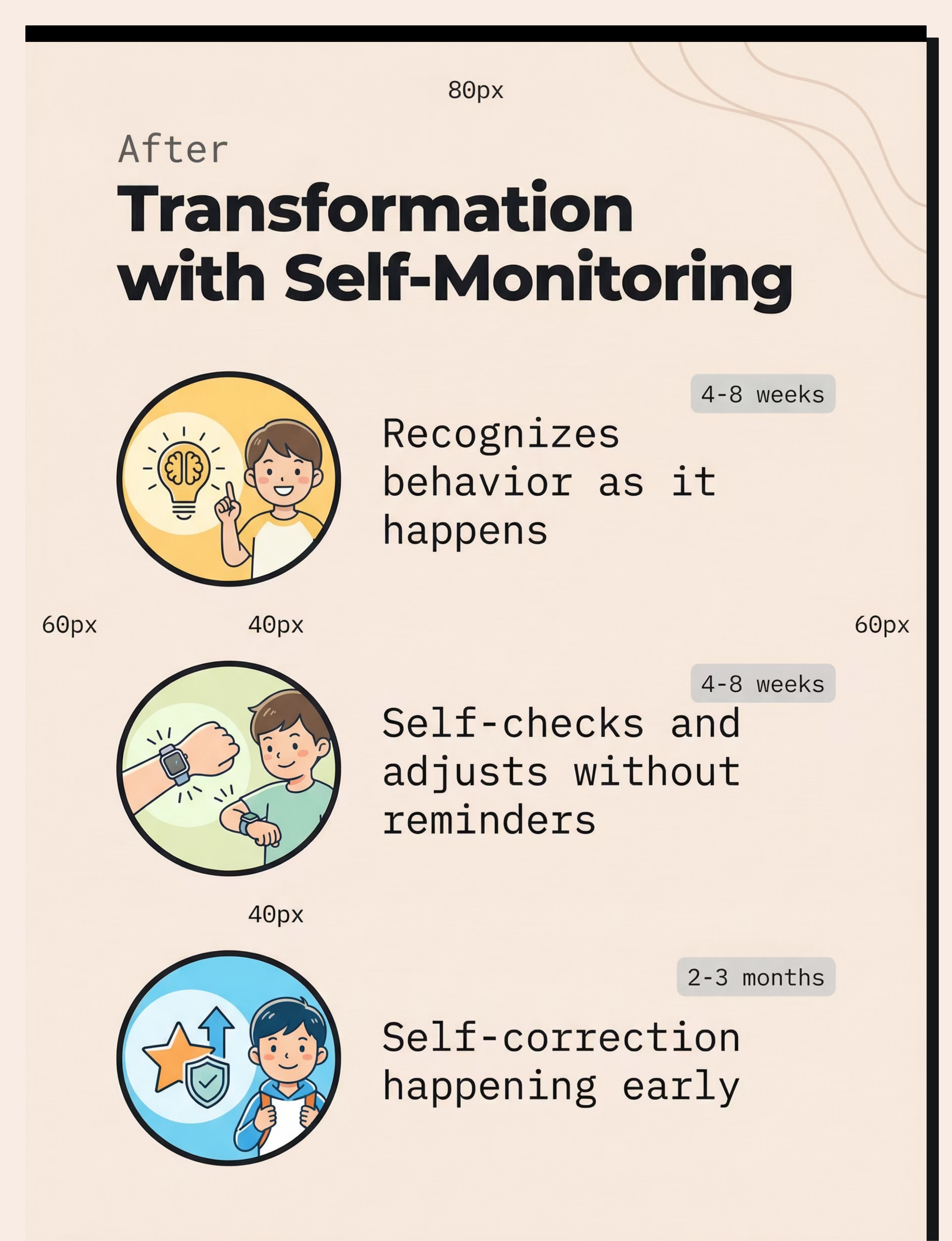
The Breakthrough (After)
Self-Awareness Achieved
Child recognizes behavior as it happens and can accurately self-evaluate. Confusion is replaced by understanding and empowerment.
Self-Correction Occurring
Self-monitoring enables early behavior interruption. The child learns to self-correct without external prompts, fostering true self-regulation.
Reduced Adult Prompts
As internal control grows, the need for constant adult reminders significantly decreases. This leads to greater child autonomy and family relief.
Independence Growing
The child functions more independently across all settings, taking ownership of their actions and choices. Pride and self-sufficiency flourish.
Skills Generalizing
Learned self-monitoring and self-regulation skills extend to new situations and challenges, ensuring long-term success and continued growth.
These transformations are typical when self-monitoring tools are implemented with consistency and proper support. The shift from external to internal control is life-changing, leading to lasting independence and confidence.

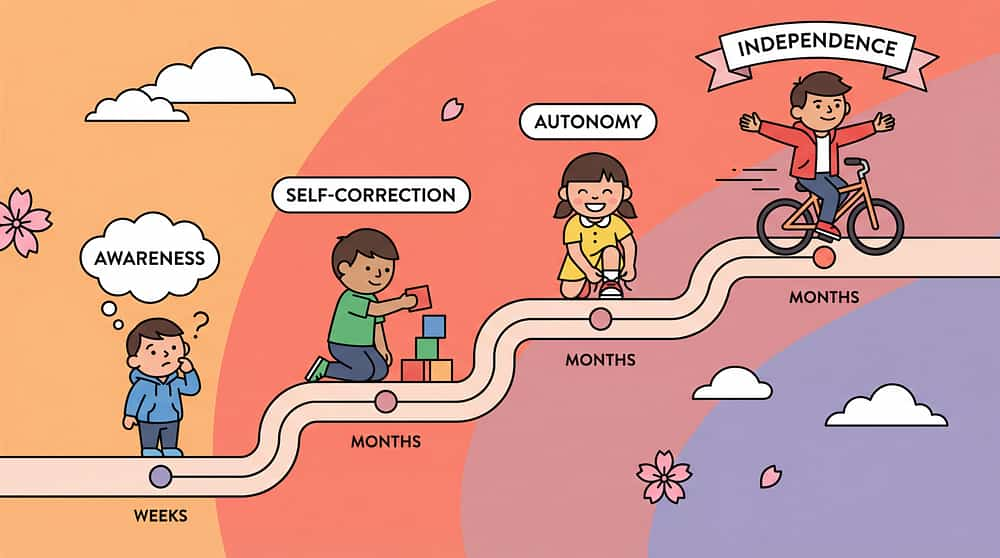
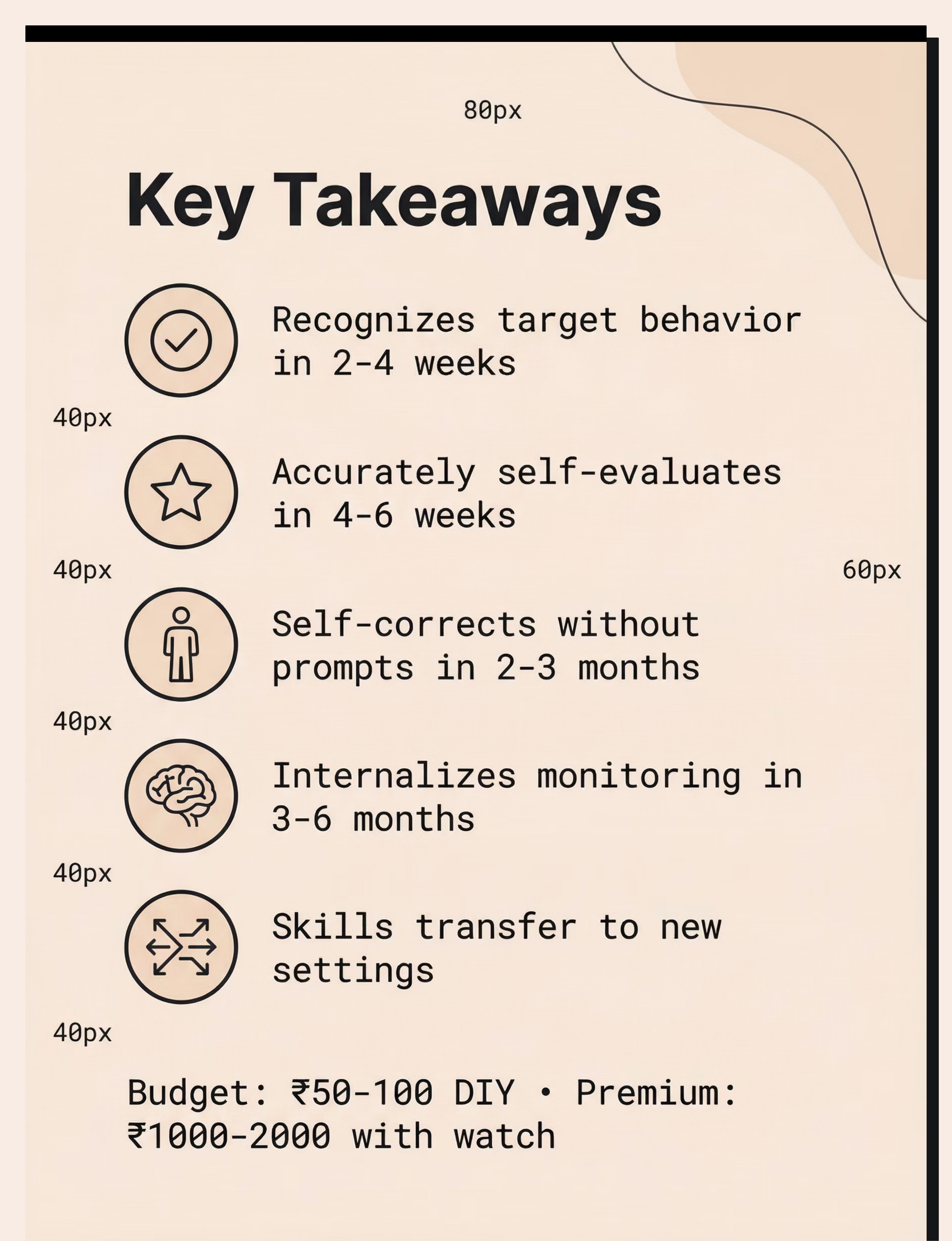
What to Expect (Realistic Timelines)
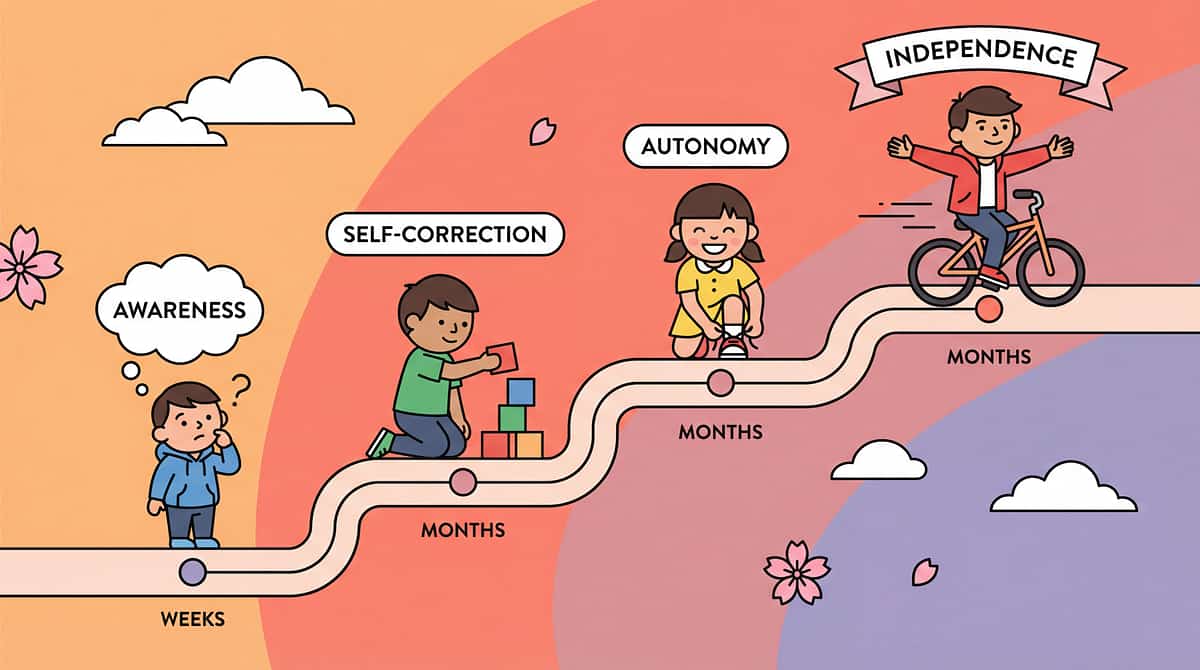
Recognizes Target Behavior
Child begins identifying when the behavior is occurring in real-time
1-2 weeks
Accurate Self-Rating
Child's self-ratings begin to align with adult observations
2-4 weeks
Responds to Prompts
Child consistently checks behavior when prompted by external cues
3-6 weeks
Self-Correction Begins
Child starts to adjust behavior independently without prompts
6-8 weeks
Independence Achieved
Self-monitoring becomes automatic, leading to full independence
8-12 weeks
Individual timelines vary based on child's age, cognitive level, consistency of implementation, and complexity of target behaviors. These are typical ranges from clinical practice and research.

Is This Right for My Child? (2-Minute Check)
"Does my child recognize their own behavior?"
A foundational step towards self-monitoring, indicating readiness to build awareness.
"Can my child understand simple rating scales?"
Their ability to use basic scales is key for tracking progress effectively.
"Is my child motivated by independence?"
Intrinsic motivation significantly boosts success in self-correction and growth.
"Do they respond well to visual cues?"
Visual aids can be powerful tools to support their self-monitoring journey.
Scoring: Positive answers to these questions suggest a strong fit for self-monitoring tools, aiding in their development and independence.

Usage Guide
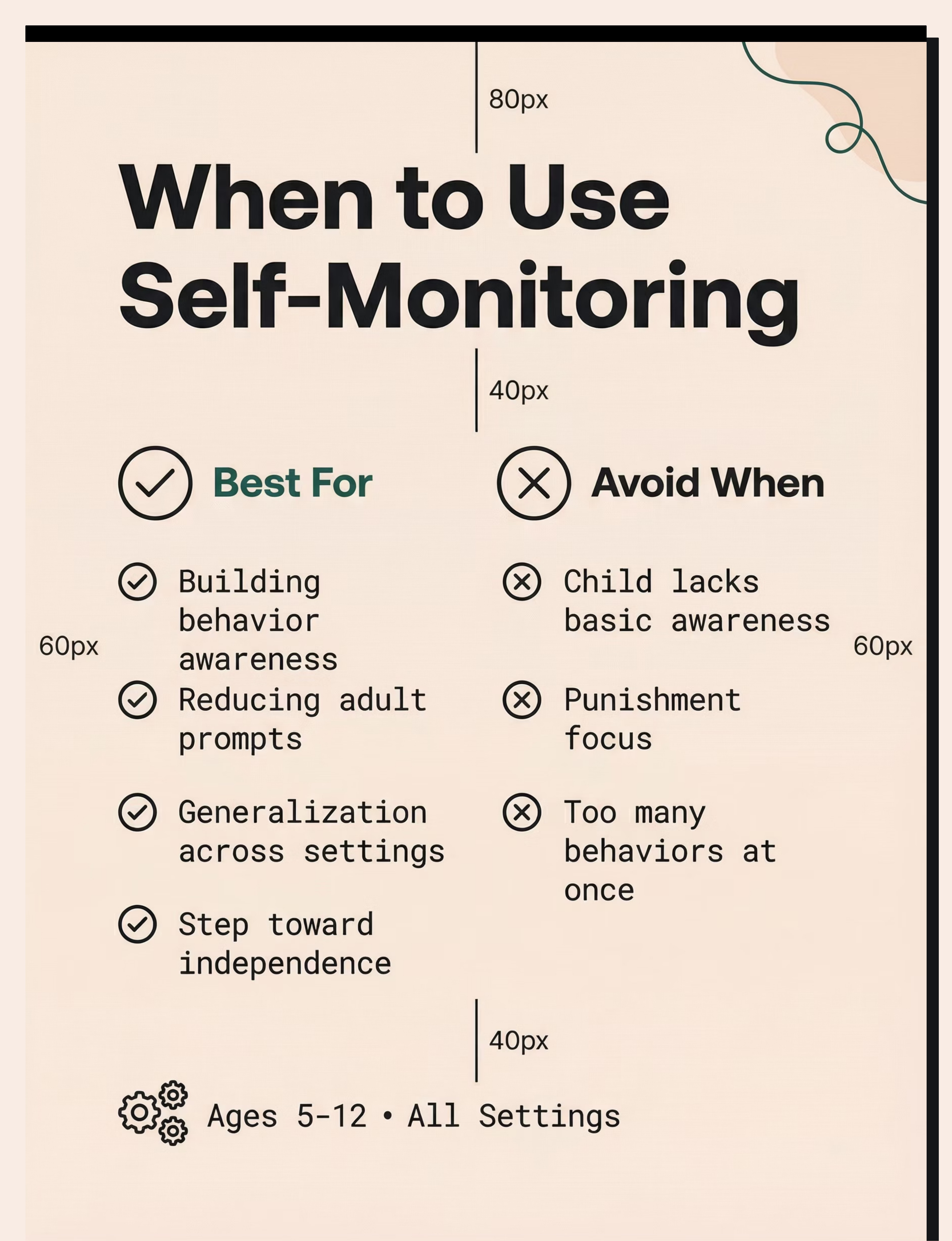
When to Use ✓ | When NOT to Use ✗ | |
|
|
Supervision by Development
Early Development | Adult-supported self-monitoring with immediate feedback and comparison | |
Developing Skills | Prompted self-monitoring with periodic adult verification | |
Independent Stage | Self-initiated monitoring with occasional check-ins only |
Settings & Duration
Ideal settings: School, Home, Clinic, Community
Duration: Regular intervals throughout day based on individual need. Frequency starts high and decreases as skills develop.

Safety First
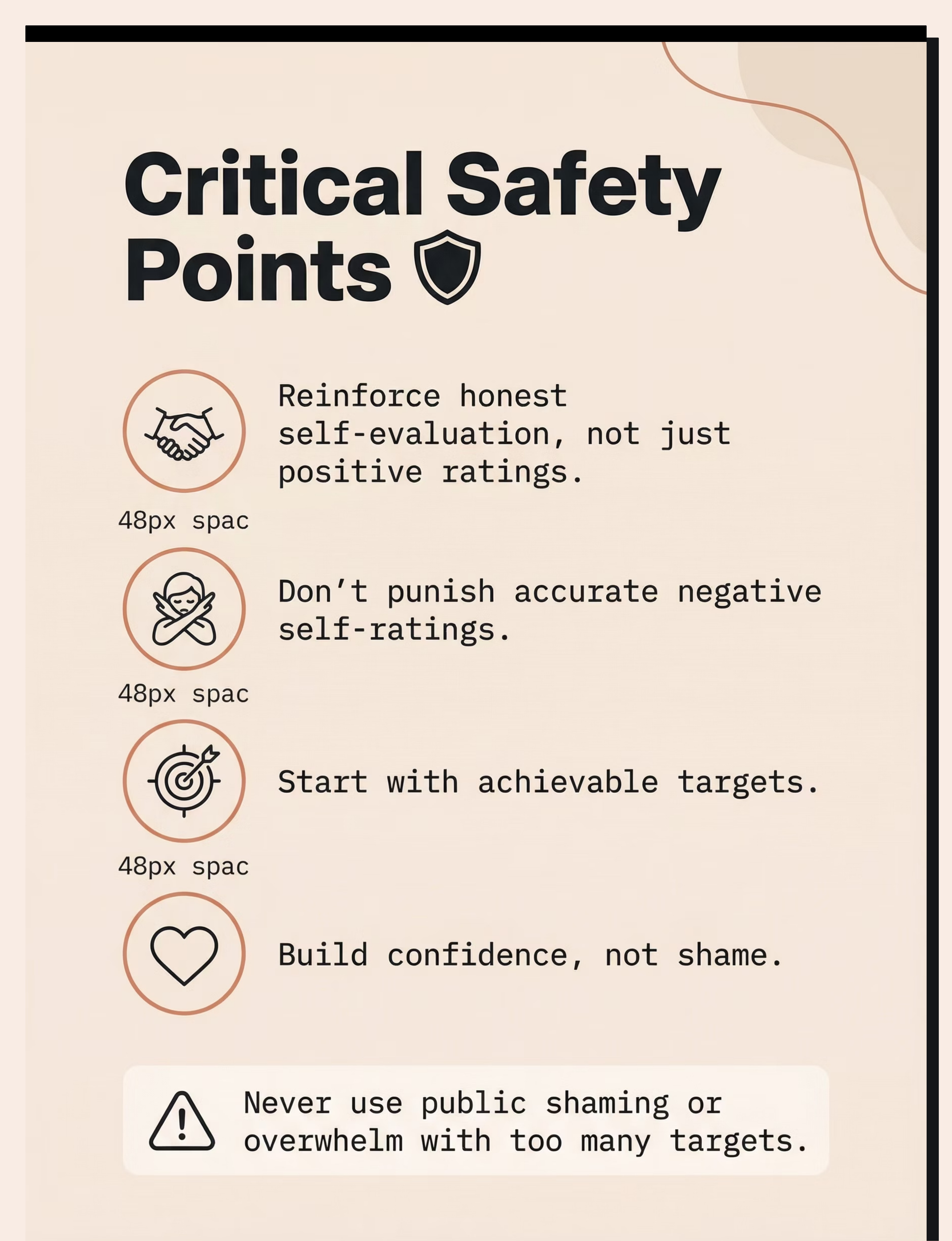
Critical Safety
- Reinforce honest self-evaluation, not just positive ratings.
- Do not punish accurate negative self-ratings—this destroys trust.
- Start with achievable targets to build confidence.
- Build confidence and awareness, never shame.
Implementation Warnings
- Inaccurate self-monitoring can be counterproductive.
- Overwhelming child with too many target behaviors.
- Public self-rating can cause embarrassment and resistance.
- Monitor for signs of anxiety or stress in the child.
Stop Signs (When to Pause)
- When honest negative self-evaluations are punished.
- If used for public shaming or embarrassment.
- When monitoring too many targets simultaneously.
- If introduced before child has awareness capacity or prerequisite skills.
Safety Checklist
Before Use
- ☑ Child has basic awareness capacity
- ☑ Behavior clearly defined
- ☑ Rating system child-appropriate
- ☑ Adult verification plan in place
During Use
- ☑ Child responding to prompts
- ☑ Self-ratings becoming accurate
- ☑ Calibration happening
- ☑ Reinforcing accurate monitoring
Signs of Success
- ☑ Accurate self-evaluation
- ☑ Decreasing adult prompts
- ☑ Self-correction occurring
- ☑ Generalization to new settings

Common Questions (Honest Answers)
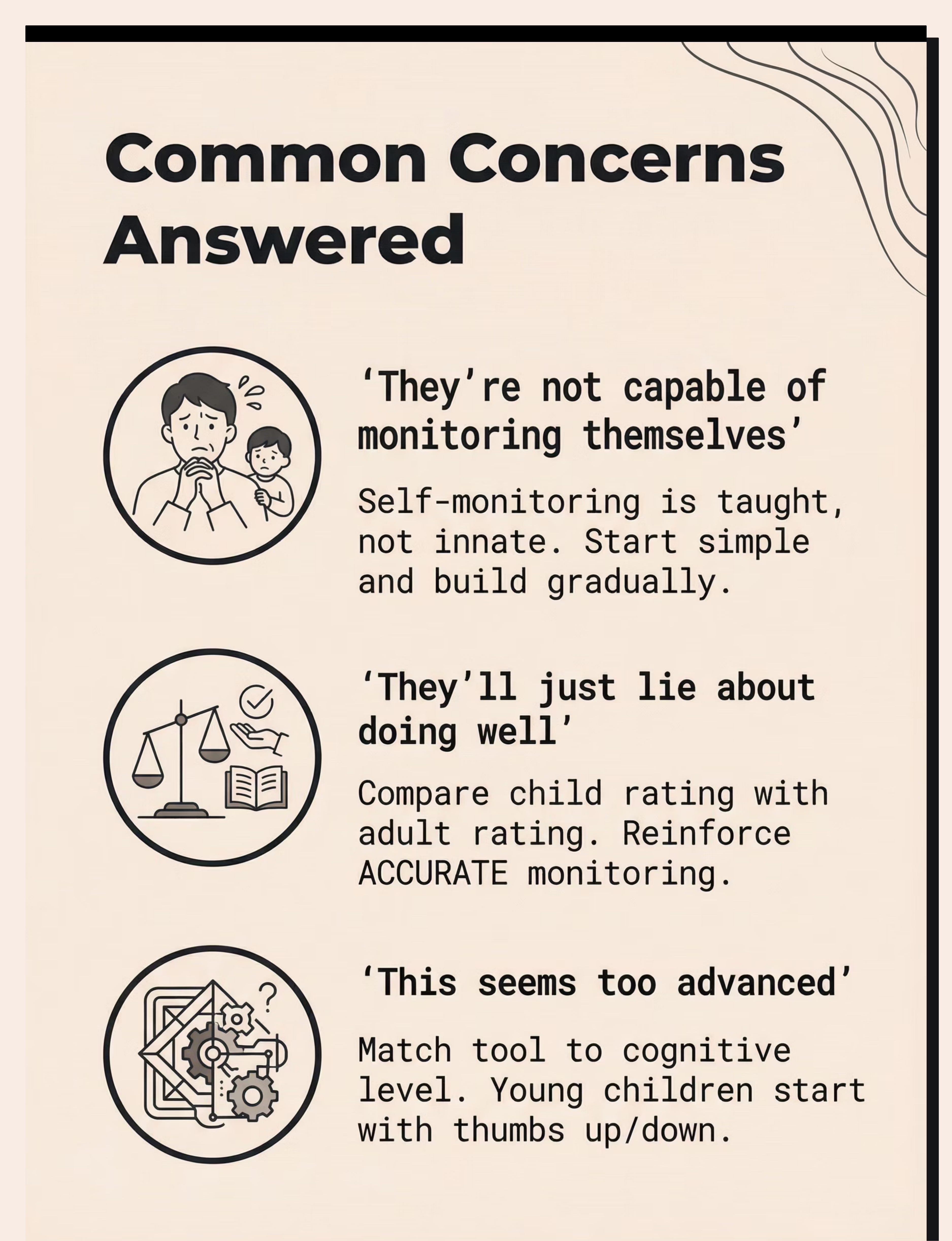
Q: They're not capable of monitoring themselves
A: Self-monitoring is taught, not innate. Start simple—one behavior, clear criteria, and adult verification. Build from there. Most children can learn this with proper support and developmental matching.
Q: What if they rate themselves inaccurately?
A: Initially, compare the child's rating with an adult's. Reinforce ACCURATE monitoring, not just positive ratings. Honesty is what gets reinforced. Calibration happens through systematic comparison.
Q: This seems like extra work
A: While it initially requires more structure and effort, it leads to significantly less adult monitoring long-term. Think of it as a short-term investment for long-term independence and reduced effort.
Q: How long until we see results?
A: Results vary based on the child, behavior, and consistency. You'll likely see initial improvements in awareness within weeks. Significant self-correction and independence can develop over several months of consistent application.

Investment Guide
Understanding the investment in self-monitoring tools involves considering both budget-friendly DIY options and more advanced professional systems. The complete range spans from basic materials to sophisticated technology, offering flexibility to suit various needs and budgets.
Overall Investment Range
Complete range: ₹0–8,000 INR (approximately $0–$100 USD)
Best starting point: Begin with DIY cards (₹0-500) to test effectiveness, then add professional systems (₹2,000-8,000) if needed for discrete prompting in social settings or comprehensive data tracking. Many families find excellent results with budget options.
Budget Option | DIY Self-Rating Cards & Checklists | 0 | |
Premium Option | Professional Self-Monitoring Systems | 2000 |
Key Features of Self-Monitoring
Personalized Customization
Tailor tools and strategies to individual needs and specific behaviors, ensuring relevance and effectiveness.
Behavior Tracking & Awareness
Develop a deeper understanding of patterns and triggers, leading to greater self-regulation.
Increased Independence
Foster self-reliance by teaching children to manage their own actions and progress.
Flexible Implementation
Adapt across various environments—home, school, and social settings—for consistent support.
Implementation Phases
Initial Assessment
Identify target behaviors and current monitoring needs.
Tool Selection
Choose between DIY cards, digital apps, or vibrating watches based on budget and context.
Training & Practice
Teach the child how to use the chosen system and practice regularly.
Ongoing Review
Regularly compare ratings, provide feedback, and adjust as needed.
Fading Support
Gradually reduce adult involvement as the child gains proficiency and independence.

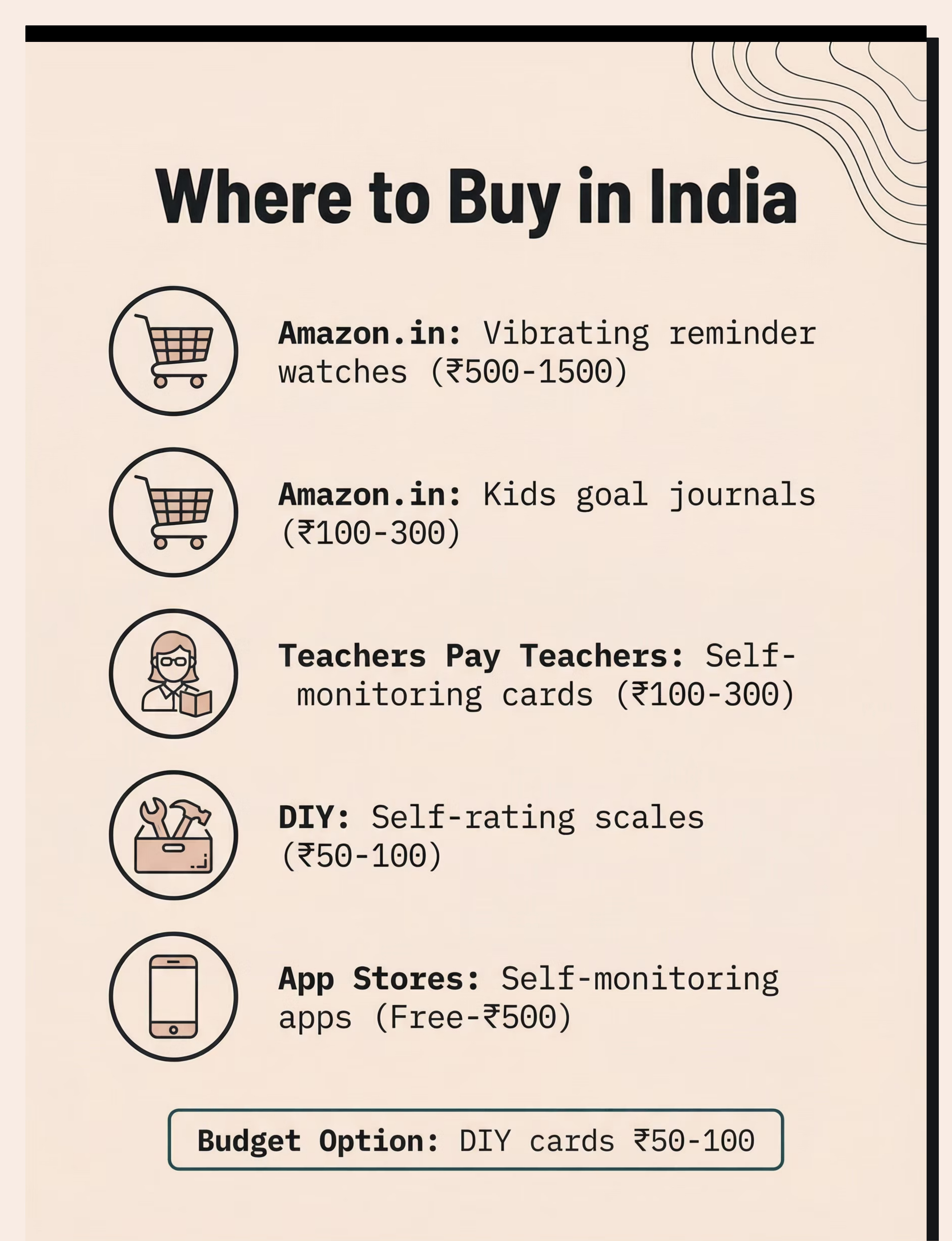
Where to Buy in India
Availability: Moderate
Amazon.in
Search: "vibrating reminder watch", "kids goal journal"
Price: ₹100–1,500
Flipkart
Search: "activity tracker for kids", "behavior chart"
Price: ₹200–1,200
Special Education Stores
Search: "self regulation tools", "sensory aids"
Availability: Varies by city, check local listings
Therapy Clinics
Recommendation: May offer bespoke tools or therapist recommendations
Availability: Direct consultation
Online Therapy Resources
Search: "printable self monitoring worksheets", "digital behavior trackers"
Price: Free–₹500 (for premium downloads/subscriptions)
Buying Tips ✓
- Simple self-rating scales are highly effective—don't over-complicate
- Vibrating watches provide discreet prompts in social settings
- Phone timers can work as prompting device (budget-friendly)
- Match complexity to cognitive level—simpler is often better
- DIY often works best for personalization to specific needs
Red Flags ⚠
- Tool too complex for child's developmental level
- No calibration system with adult evaluation
- System designed to punish poor self-ratings
- Introducing before child has awareness capacity

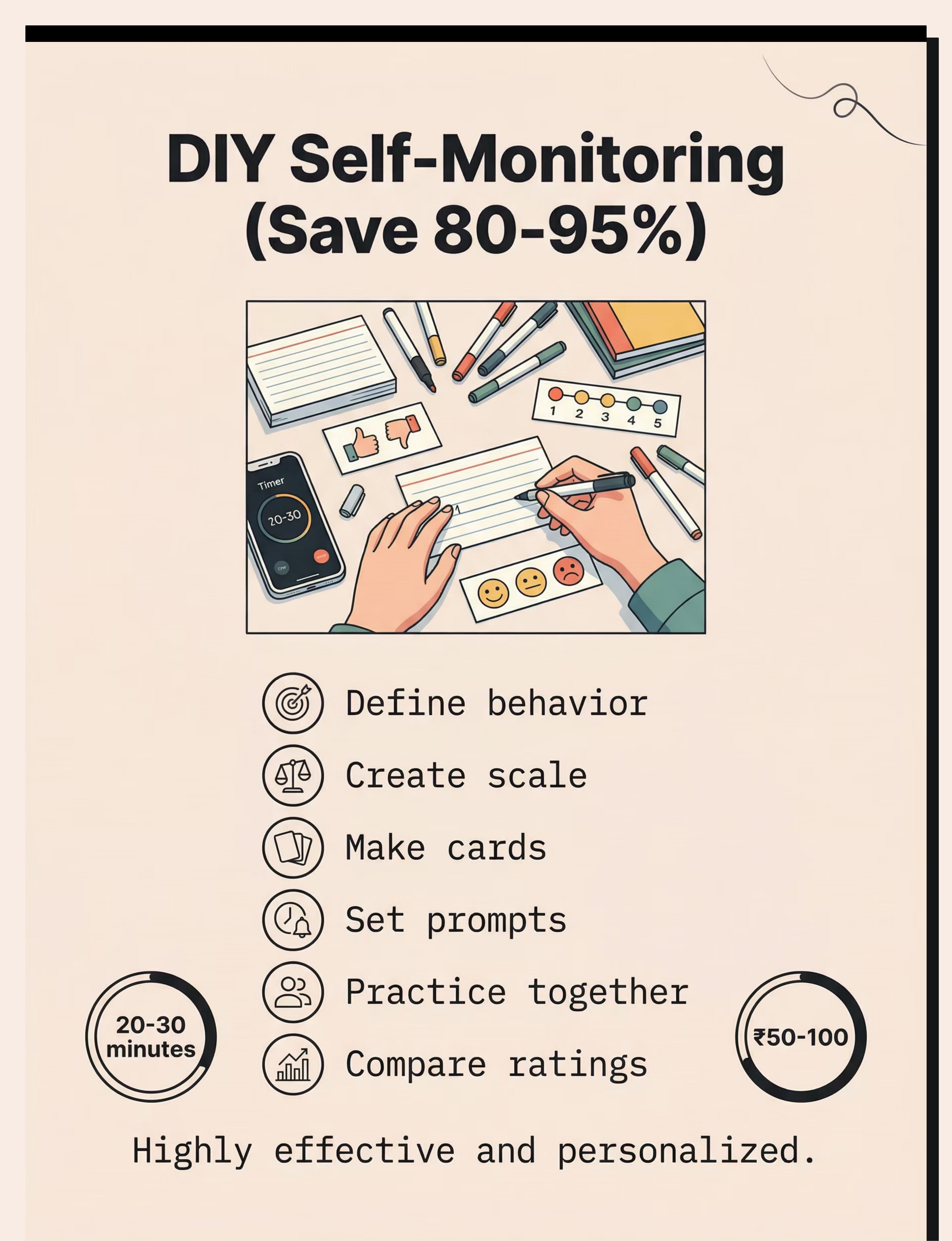
DIY Alternative (Save 80-95%)
Feasibility: Very High
Time: 20-30 minutes
Savings: 80-95%
Materials Needed
- Index cards or cardstock
- Rating scale (1-5, thumbs up/down, color-coded, emoji faces)
- Phone timer for prompts (already owned)
- Simple checklist template
- Optional: laminating sheets for durability
Step-by-Step Instructions
1
Define Behavior
Write behavior in specific, observable, child-friendly language they can understand
2
Create Scale
Choose age-appropriate rating: thumbs up/down, 1-5 numbers, color coded, emoji faces
3
Make Cards
Write behavior description + rating scale on each card, laminate for durability
4
Set Prompts
Program phone timer for regular intervals, test alarm volume and vibration
5
Practice Together
Model self-rating process, practice during calm moments before real implementation
6
Compare Ratings
Adult rates behavior too, discuss calibration together, reinforce honesty and accuracy
Customization Tips
- Simpler is better: Don't over-complicate with complex rating scales; simple self-rating is highly effective.
- Match complexity to cognitive level: Ensure the tool is appropriate for the child's developmental stage.
- Personalize: DIY allows for perfect customization to specific needs.
- Consider environment: Phone prompts are great for home; for school or public, consider discreet vibrating watches if upgrading later.
- Focus on visual cues: Use modeling and visual cues, especially for younger children.
Cost Breakdown
DIY provides significant savings, allowing families to implement effective self-monitoring tools for minimal cost, often utilizing items already available at home or low-cost stationery.
- DIY Cost: ₹50-100 (for basic materials like index cards or cardstock)
- Commercial Alternative Cost: ₹500-2000 (for pre-made tools like vibrating watches or behavior charts)
- Savings: 80-95% compared to commercial options.
Tradeoff: Phone prompts are less discreet than vibrating watches in social settings, but work perfectly well at home and save significant money. Most families start with DIY and upgrade only if needed.
Preview of self monitoring tools Therapy Material
Below is a visual preview of self monitoring tools therapy material. The pages shown help educators, therapists, and caregivers understand the structure and content of the resource before use. Materials should be used under appropriate professional guidance.


Share this resource
Help others discover thisLink copied!

Measuring Success & Complete Support
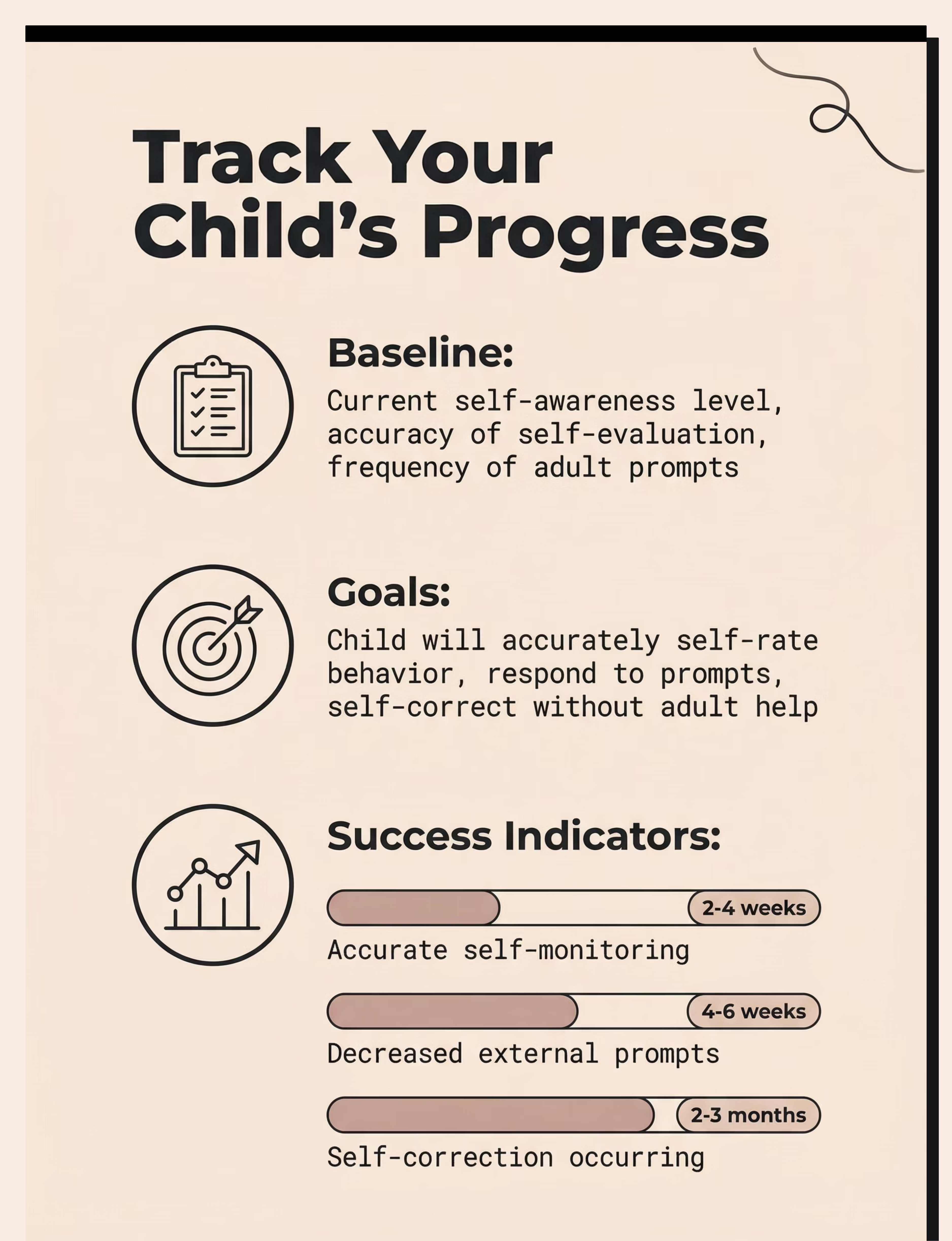
Track Progress
Baseline Measures
- Current self-awareness level
- Accuracy of self-evaluation
- Frequency of adult prompts needed
- Target behavior baseline frequency
Goals to Set
- Child will accurately self-rate [behavior]
- Child will respond to self-monitoring prompts
- Adult prompts will decrease by [X]%
- Child will self-correct [behavior]
Success Indicators
- Accurate self-monitoring
- Decreased external prompts
- Self-correction occurring
- Behavior improvement
- Generalization across settings
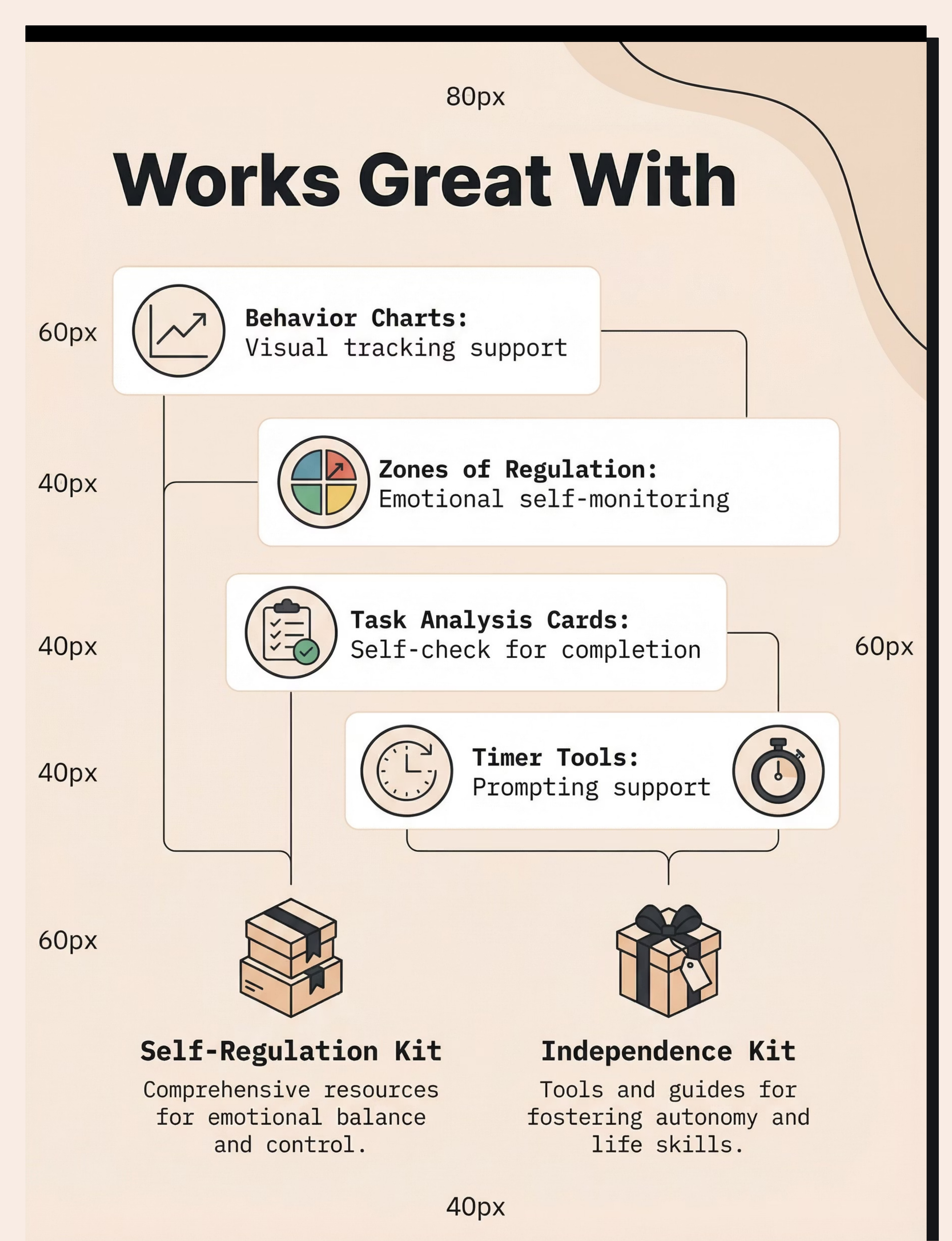
Complete the Kit: Pair It With...

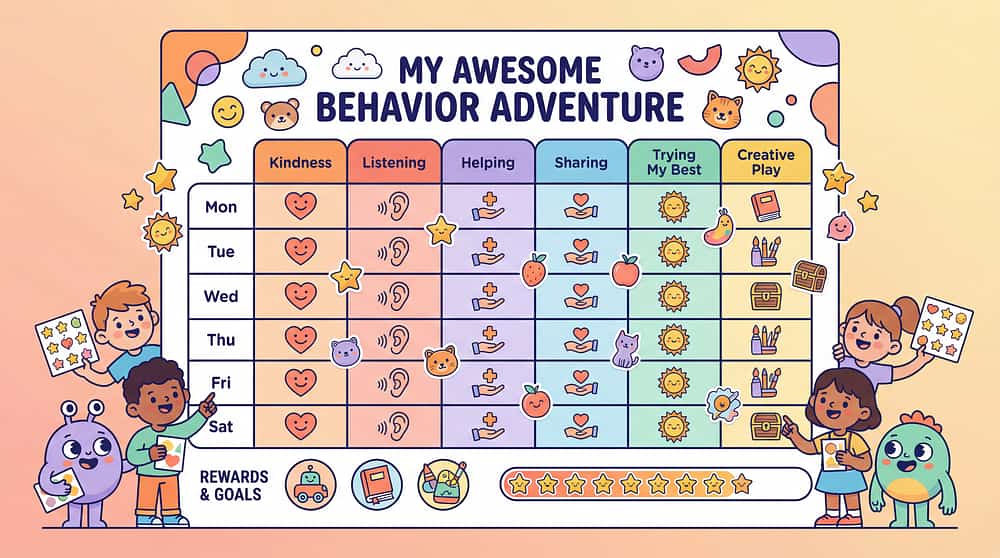
Behavior Charts (ID: 10.2)
Visual tracking support that complements self-monitoring with external reinforcement system

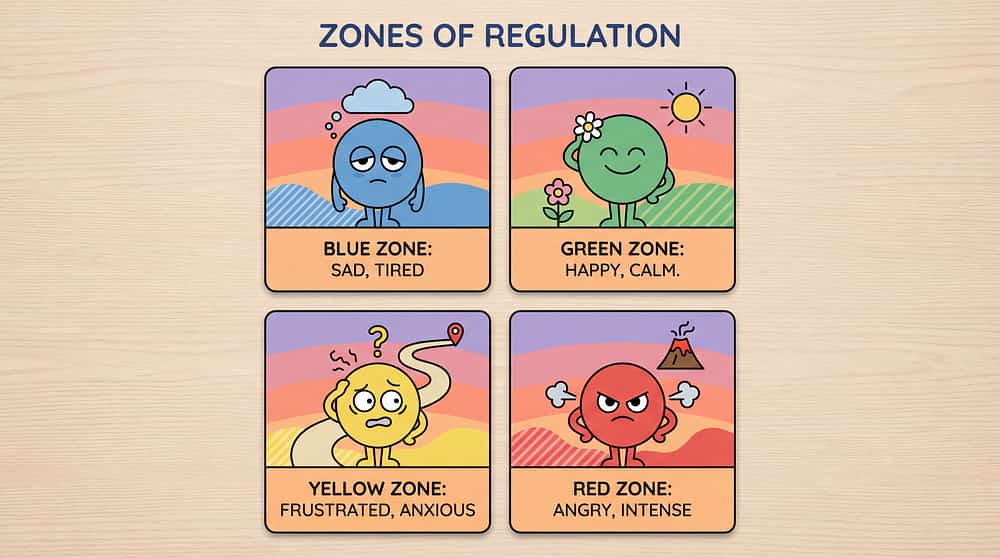
Zones of Regulation (ID: 2.4)
Emotional self-monitoring tool that teaches children to identify and regulate internal states

Task Analysis Cards (ID: 3.5)
Self-check system for task completion that builds independence in daily activities

Timer Tools (ID: 2.7)
Prompting support that works alongside self-monitoring systems for regular check-ins
Recommended Bundles
- Self-Regulation Kit: Self-Monitoring Tools (10.3) + Zones of Regulation (2.4) + Sensory Tools (2.3) = Complete self-regulation system
- Independence Kit: Self-Monitoring Tools (10.3) + Behavior Charts (10.2) + Task Analysis Cards (3.5) = Building comprehensive independence
Quick Summary
Self-monitoring tools develop self-awareness and self-regulation by teaching children to evaluate their own behavior with decreasing external prompts. Core Kit (Rank 2), strong evidence, essential for independence.
self-monitoring
self-regulation
awareness
independence
metacognition
ABA
BCBA
SpEd
core-kit
Common searches: self monitoring autism, self regulation tools, vibrating reminder watch, behavior awareness, self evaluation kids, independence autism, self correction
Get Support
FREE National Autism Helpline
Phone: 9100 181 181
Languages: 16+ languages supported
Website: pinnacleblooms.org
Expert guidance on implementing self-monitoring tools, troubleshooting challenges, and optimizing outcomes for your child.
Platform Integration
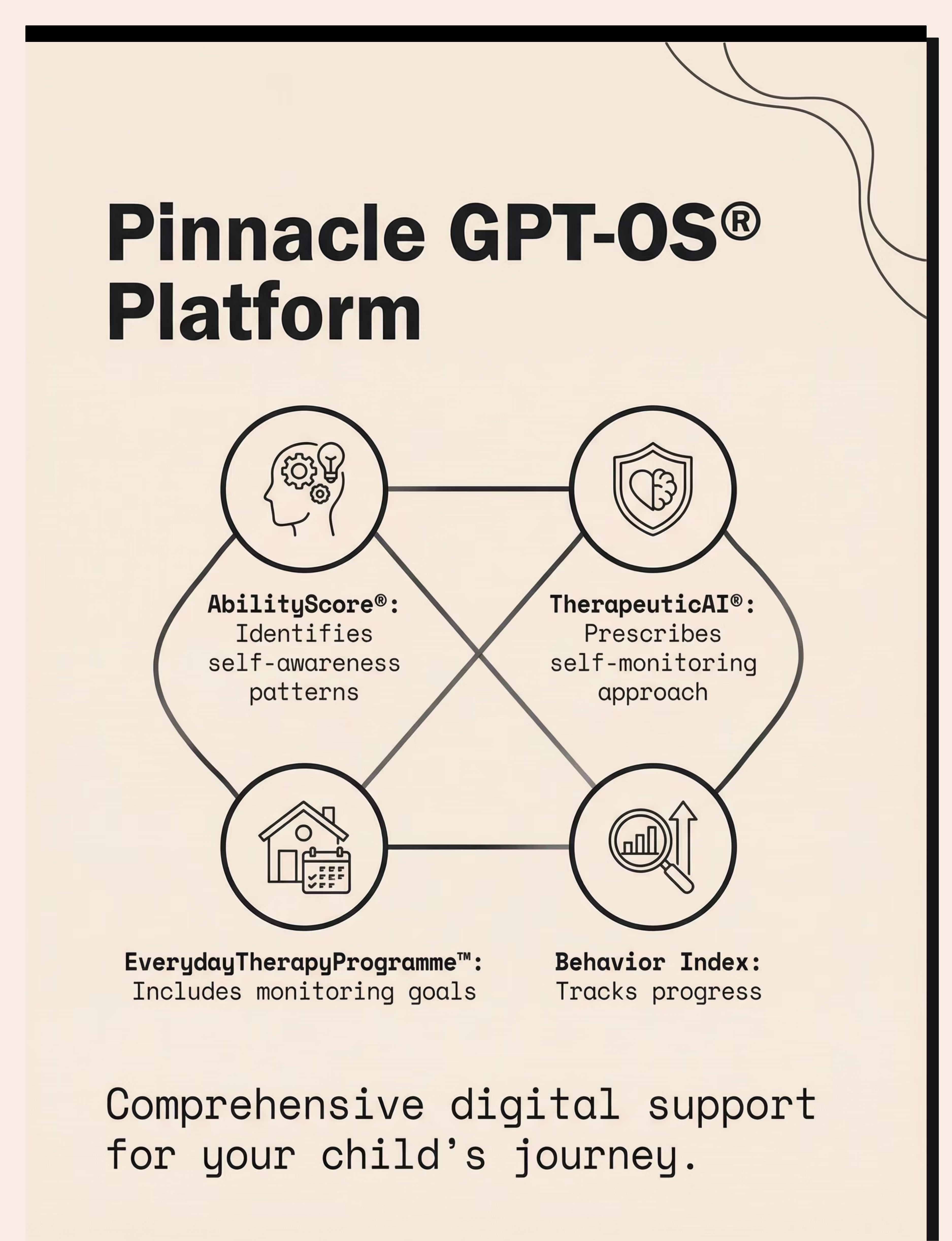
- AbilityScore®: Identifies self-awareness patterns and readiness for self-monitoring through comprehensive assessment
- TherapeuticAI®: Prescribes personalized self-monitoring approach based on child's cognitive level and target behaviors
- EverydayTherapyProgramme™: Includes self-monitoring goals integrated into daily routines across home, school, and community
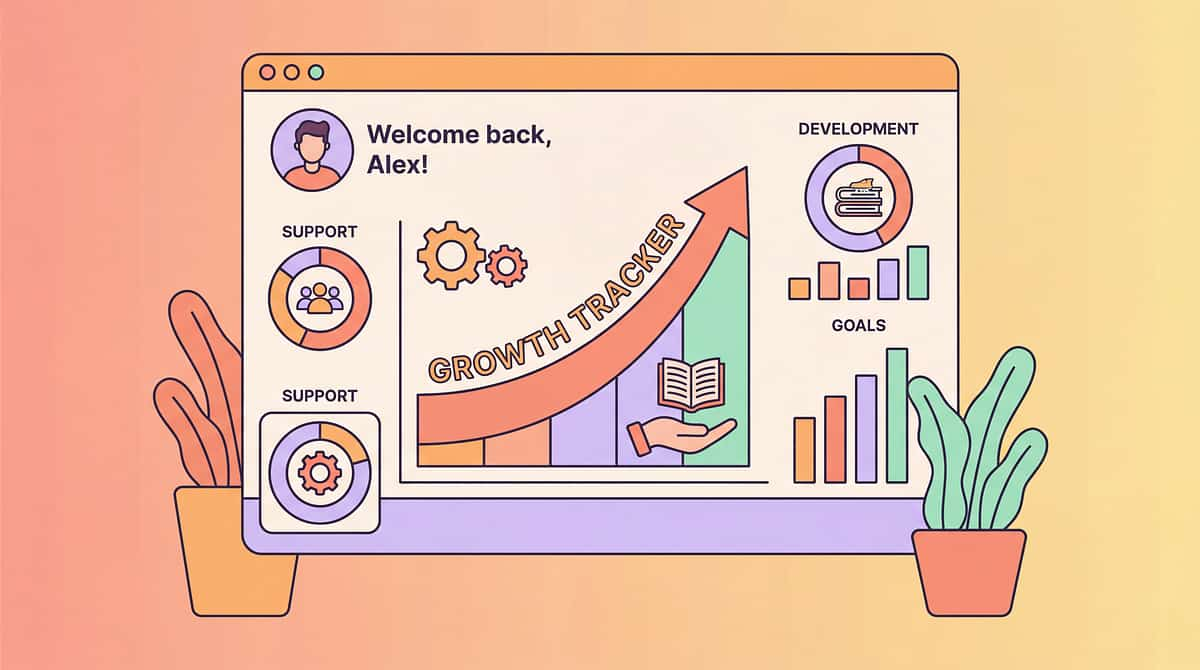
- Behavior Index: Tracks self-monitoring progress over time with data visualization and milestone achievement
Disclaimer: This is educational information designed to support families and professionals. Always consult qualified Board Certified Behavior Analysts (BCBAs), special education professionals, occupational therapists, or pediatricians for personalized recommendations. Individual results vary based on child's needs, consistency of implementation, and environmental factors. Self-monitoring tools are evidence-based interventions but require proper implementation and support.