














Tool ID: 1.11
OT Recommended
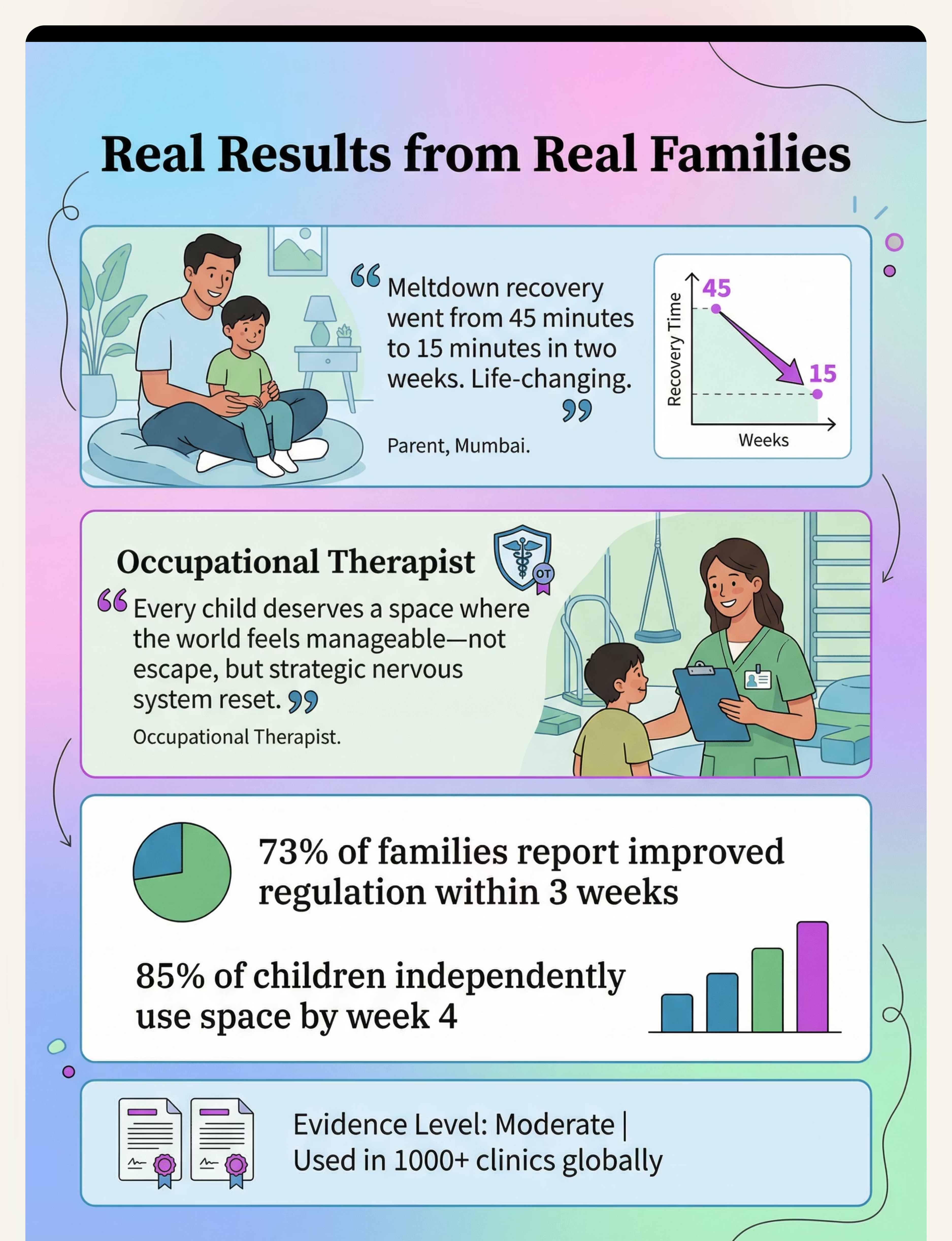
Moderate Evidence
Rank #2
Daily Use
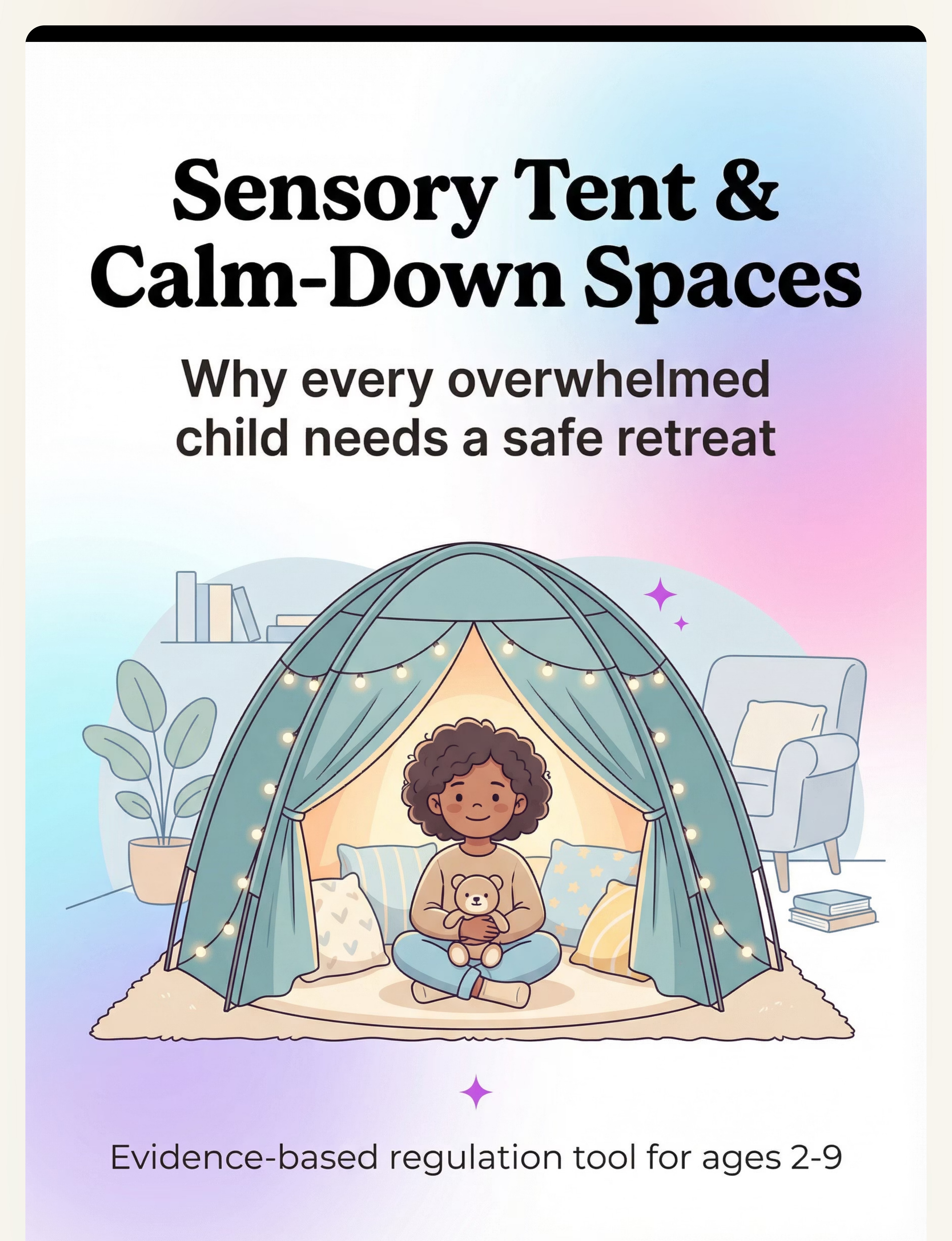
Sensory Tent / Hideaway / Calm-Down Space
Enclosed calming space system
Every child deserves a space where the overwhelming world feels manageable again. When sensory input becomes too much, when emotions run high, when the nervous system needs a moment to reset—a dedicated calm-down space can be the difference between a prolonged meltdown and quick recovery.
Sensory tents and hideaways provide that essential enclosed, reduced-stimulation environment where children can self-regulate, decompress, and return to the world feeling calmer and more capable. Whether it's a pop-up tent in the corner, a canopy over the bed, or even a thoughtfully arranged cardboard box fort, these spaces give children the gift of agency over their own regulation.
₹0–4,000
Home/Clinic/School
Ages 2-9

Who This Helps
Sensory Modulation
Helps children who become easily overwhelmed by sensory input find their baseline again through reduced visual and auditory stimulation.
Self-Regulation
Teaches children to recognize early signs of overwhelm and independently seek out their calm space before reaching crisis point.
Emotional Regulation
Provides a safe container for big emotions, giving children permission and space to feel without judgment or pressure to perform.
Overwhelm Recovery
Significantly reduces the time needed to recover from meltdowns by offering immediate access to a predictable, safe environment.
Ages 2-9 years
Home
Clinic
School
Indoors
Best for: Children who seek enclosed spaces, become overwhelmed by sensory environments, or need transition time after high-stimulation activities. Particularly effective for children with autism, ADHD, sensory processing differences, or anxiety.

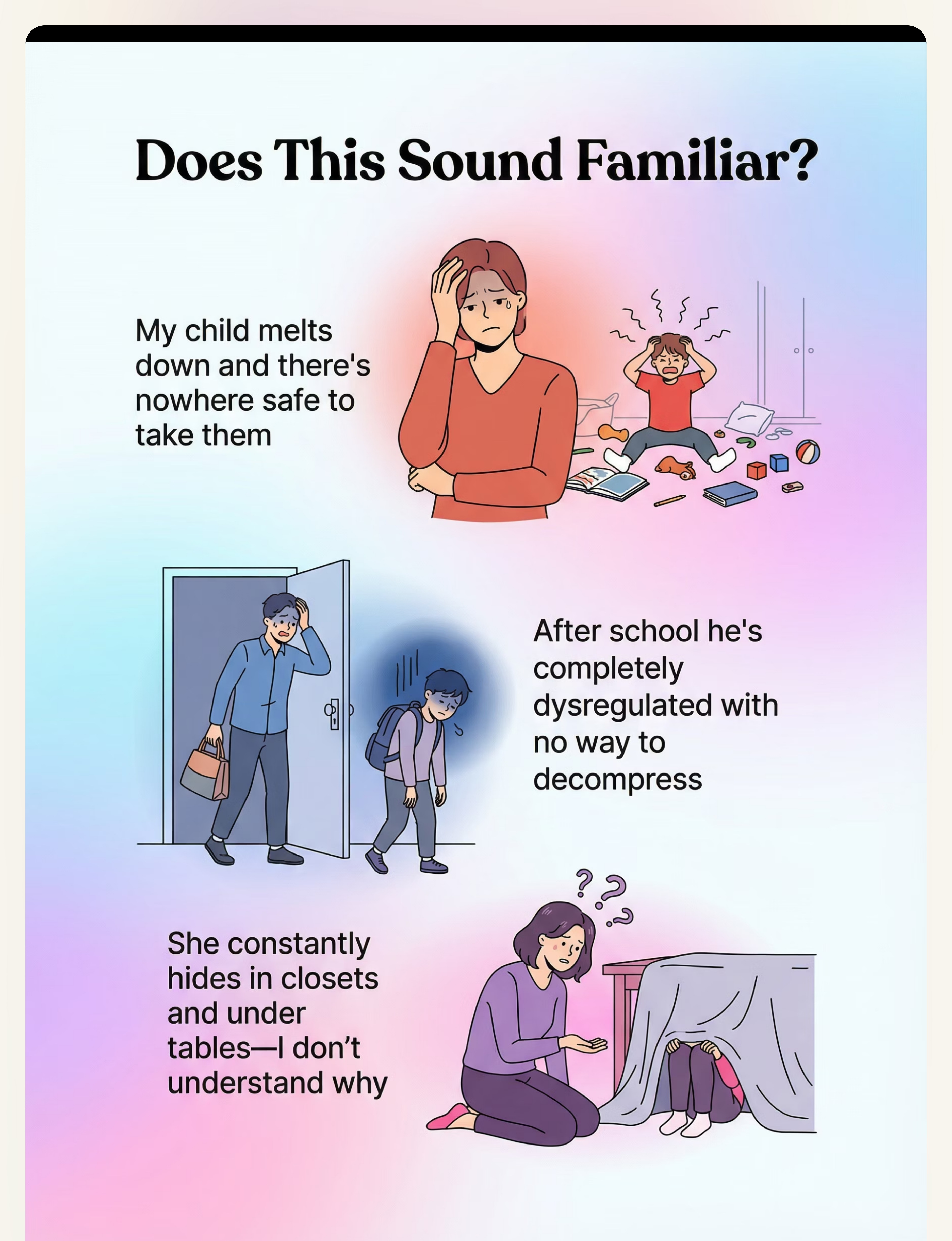
Does This Sound Familiar?
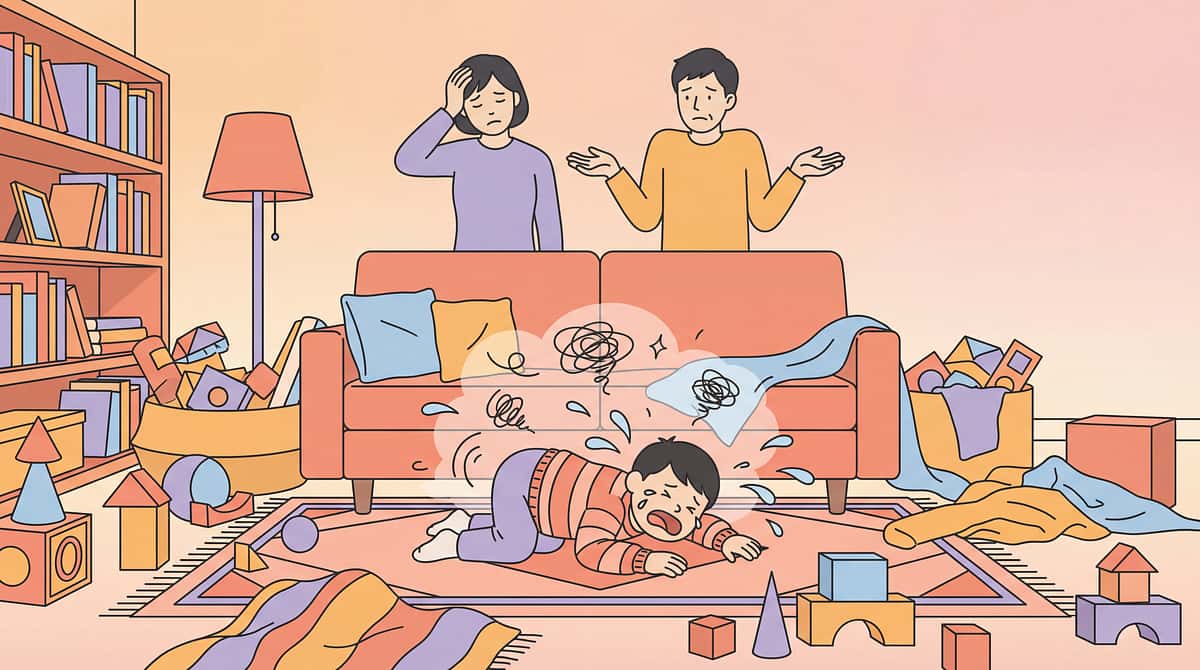
"My child melts down and I don't know where to take them. The whole house becomes a battlefield and I feel so helpless watching them struggle."
"She constantly hides under tables and in closets when overwhelmed. I worry she's scared or feels like she has to hide from us."
"He needs to escape but there's no safe place. I can see him searching for somewhere to go, getting more distressed by the second."
"The world is just too much for her sometimes. I wish I could give her a volume button to turn everything down."
"I wish there was a calm-down space that actually works. We've tried time-outs and they just make everything worse."
"After school, he needs time alone but just wanders dysregulated. By evening, everyone is exhausted and nothing gets done."
You're not alone. These are among the most common challenges parents share with us. The need for a safe retreat space is real, valid, and something we can address together.

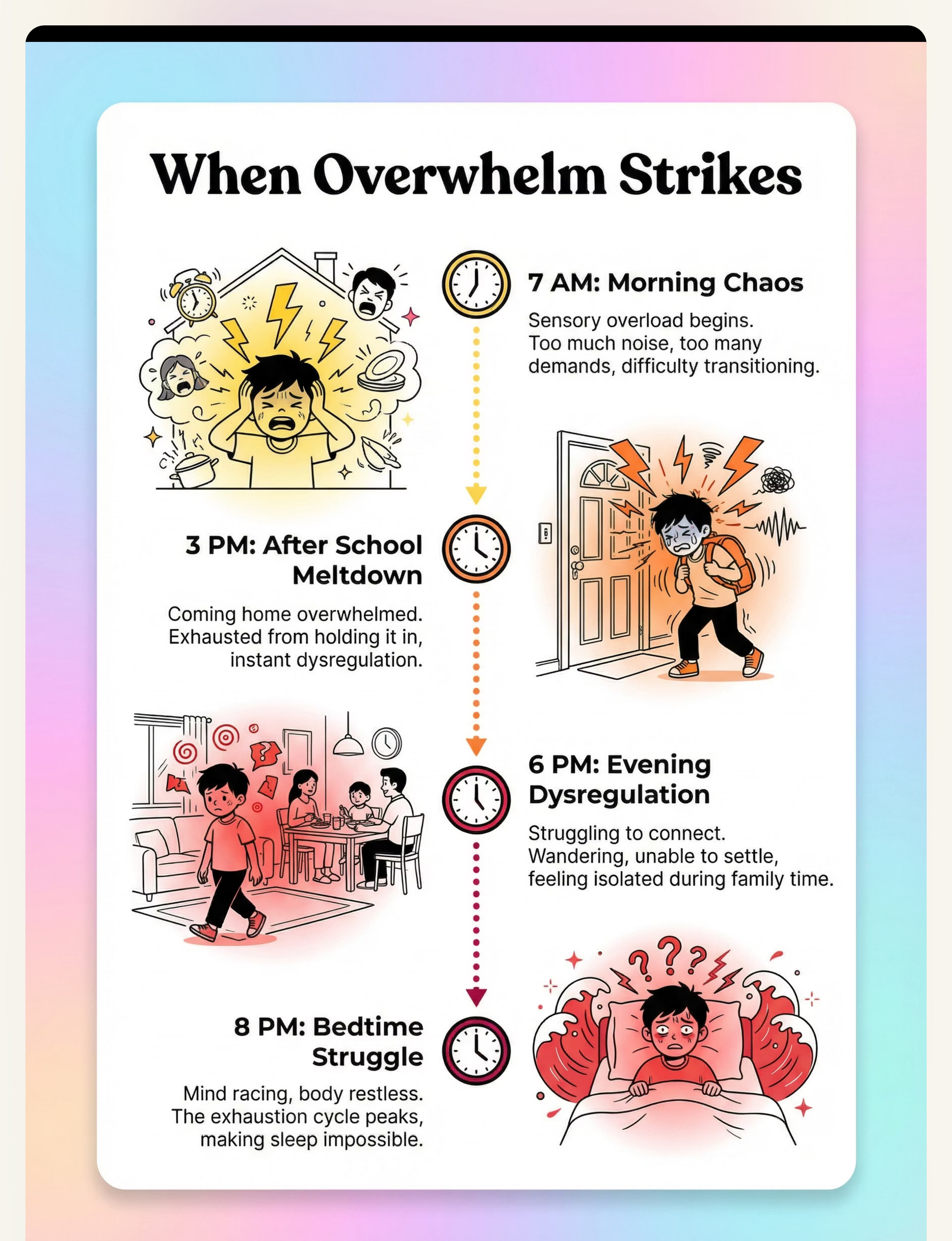
A Day Without the Right Support
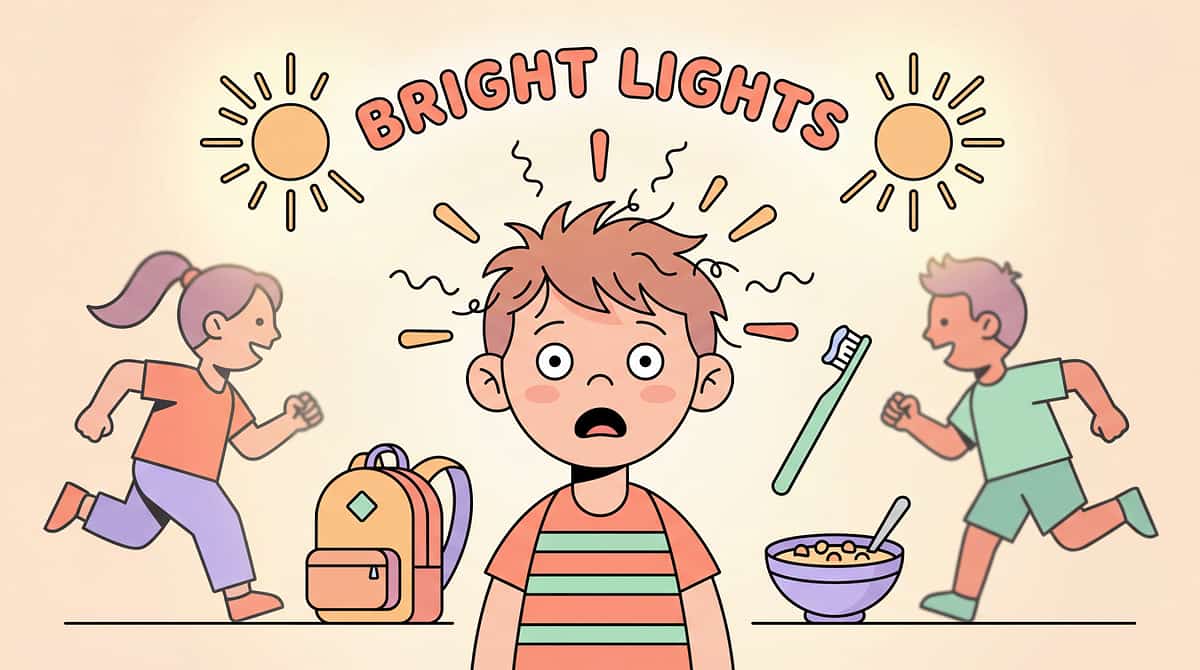
Morning Chaos
Overwhelmed by morning routines, noisy siblings, bright lights, and multiple demands. Already dysregulated before the day begins. No designated space to reset.
School Transitions
Struggling with classroom noise, fluorescent lights, unpredictable schedule changes. Fighting to hold it together, masking distress. No safe space to decompress.
After-School Meltdown
Arrives home with sensory system on overload from full day of input. Nowhere to release the pressure. Dysregulation spills into evening—crying, wandering, picking fights.
Bedtime Battle
Still wound up from the day. Cannot settle. Needs enclosed, quiet space to decompress but doesn't have one. Takes hours to fall asleep, exhausted parents sitting nearby.
This cycle of overwhelm without adequate regulation support leaves children feeling misunderstood and parents feeling helpless. Breaking this pattern requires providing what the nervous system is seeking: a predictable, safe space to reset.

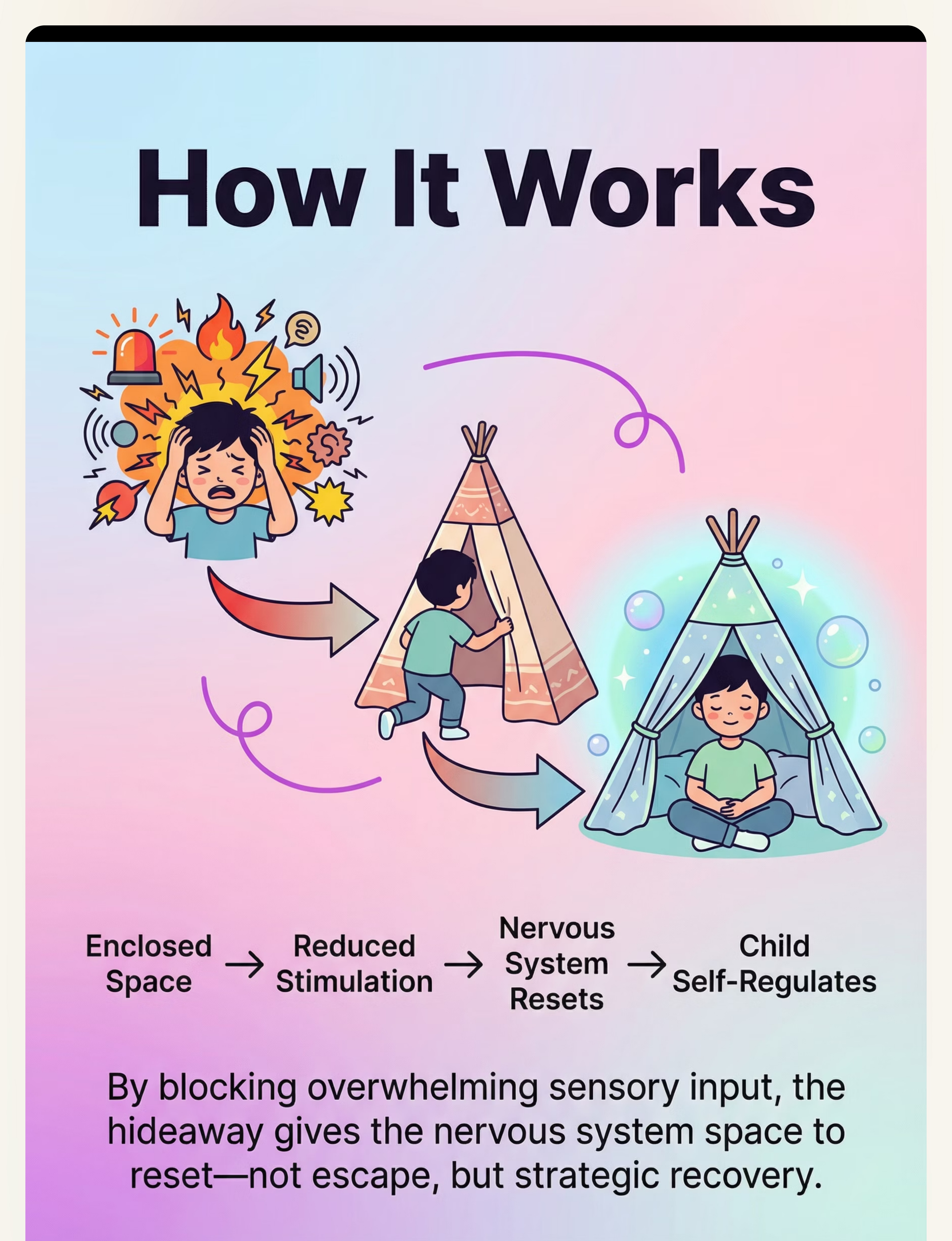
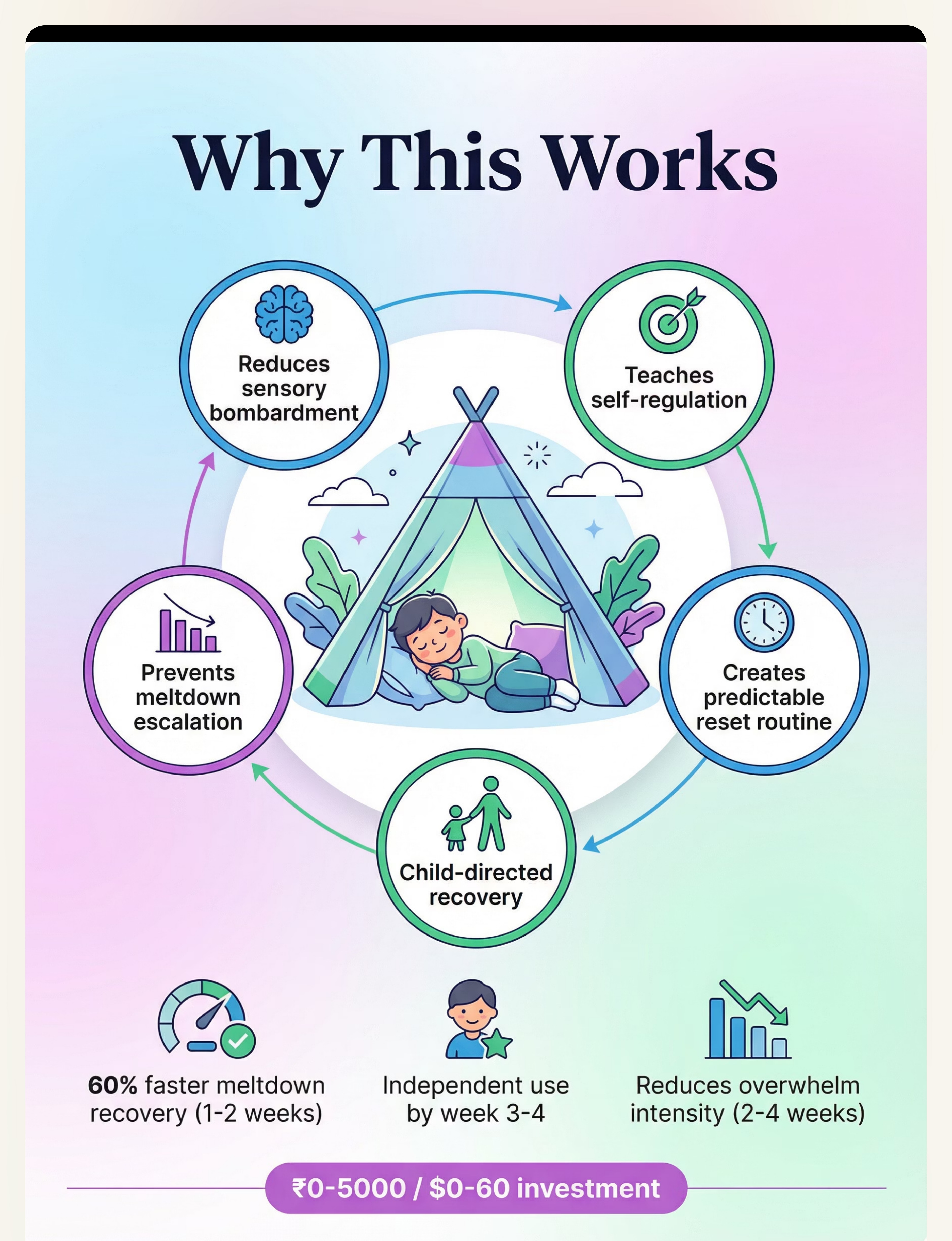
The Science Behind It
Enclosed Space
Child enters tent or hideaway, creating physical boundaries that signal safety to the nervous system
Reduced Input
Visual and auditory stimulation decreases dramatically inside the space, lowering sensory load
Less Bombardment
Nervous system experiences relief from constant processing demands, allowing parasympathetic activation
System Reset
With reduced demands, nervous system can regulate back to baseline, restoring capacity for engagement
Self-Regulation
Child practices managing their own state, building lifelong coping skills and emotional awareness
Ready to Engage
Child exits calmer and regulated, able to return to activities with renewed capacity and focus
Sensory Modulation
Self-Regulation
Emotional Regulation
Overwhelm Recovery
Safe Space
"Every child deserves a space where the world feels manageable. A sensory hideaway is not about escaping—it's about giving the nervous system a chance to reset so the child can return to the world regulated."— Occupational Therapist, Autism Specialist

How to Use It Right
✓ Free Entry and Exit
Child must be able to enter and exit the space freely and independently at all times. Never lock or block the entrance.
✓ Positive Strategy, Not Punishment
Never use calm-down space as punishment or time-out. Frame it as a helpful tool for feeling better, not a consequence for bad behavior.
✓ Add Calming Items Inside
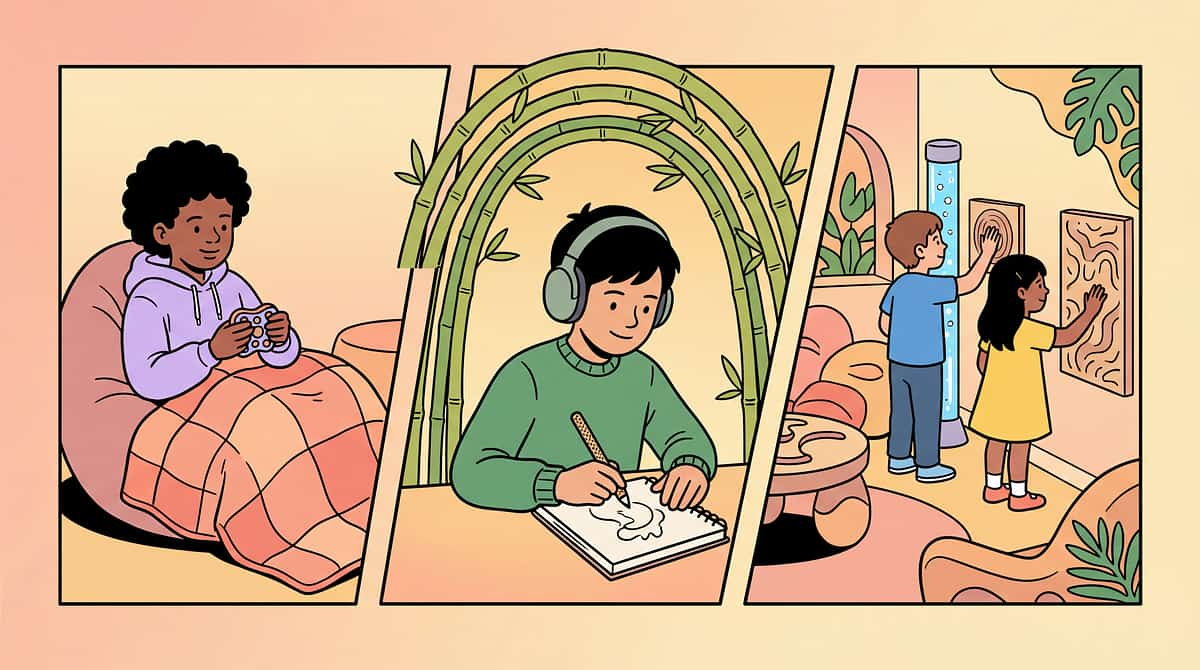
Include weighted blanket, fidgets, soft toys, or favorite books to make space inviting and multi-sensory supportive.
✓ Teach as Coping Strategy
Explicitly teach your child that this is their special space for when things feel too big. Practice using it during calm times first.
✓ Dim Lighting & Soft Textures
Keep lighting low (fairy lights or nightlight work well) and prioritize soft, comforting textures throughout the space.
✓ Let Child Personalize
Allow your child to decorate and customize their space. Ownership increases the likelihood they'll actually use it when needed.
Duration: Child-directed, typically 5-30 minutes per use. Trust your child to know when they're ready to come out—forcing early exit undermines the purpose.

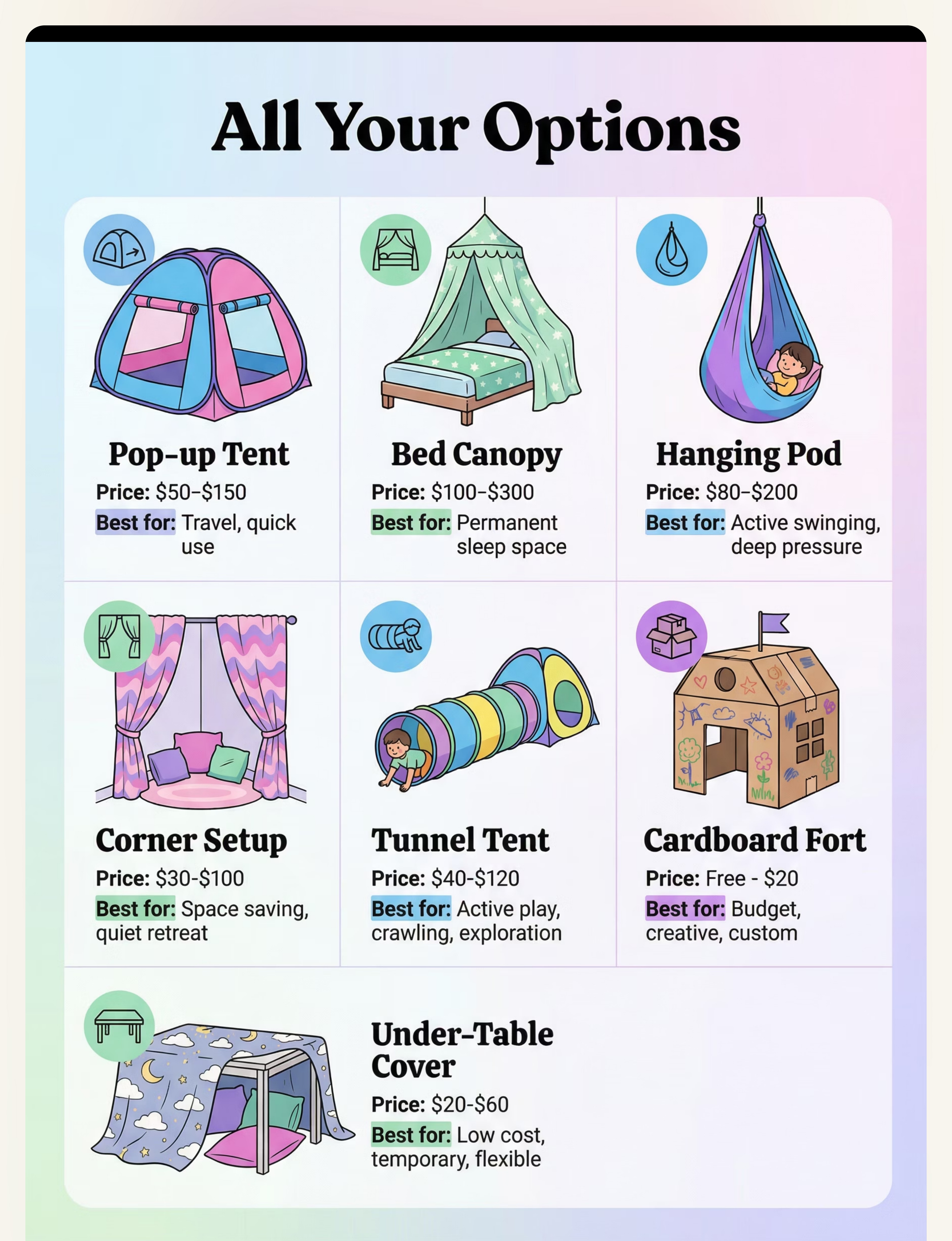
Choose Your Option (7 Variants)
Every family's space, budget, and child's needs are different. We've mapped out seven distinct options so you can find the right fit. Consider your child's age, your available space, portability needs, and budget when choosing.
1
Pop-Up Sensory Tent
Best for: Quick calm-down space, portable, minimal setup
Size: 90x90x90 cm typical
Portability: High (folds flat)
Settings: Home, Clinic
Ages: 2-9 years
Price: ₹800–2,500
2
Canopy/Bed Tent
Best for: Bedtime, blocking visual stimulation
Size: Fits over bed
Portability: Low
Settings: Home
Ages: 3-9 years
Price: ₹1,000–3,000
3
Lycra Body Pod / Hanging Swing Pod
Best for: Deep pressure + movement combined
Size: Suspended hammock-style
Portability: Low (requires installation)
Settings: Home, Clinic
Ages: 3-9 years
Price: ₹1,500–4,000
4
Sensory Corner Kit
Best for: Permanent calm-down space at home/school
Size: Corner setup materials
Portability: Low
Settings: Home, School, Clinic
Ages: 2-9 years
Price: ₹500–2,000
5
Tunnel Tent
Best for: Active calming, proprioceptive input
Size: Crawl-through tunnel + tent combo
Portability: Medium
Settings: Home, Clinic
Ages: 2-7 years
Price: ₹1,000–2,500
6
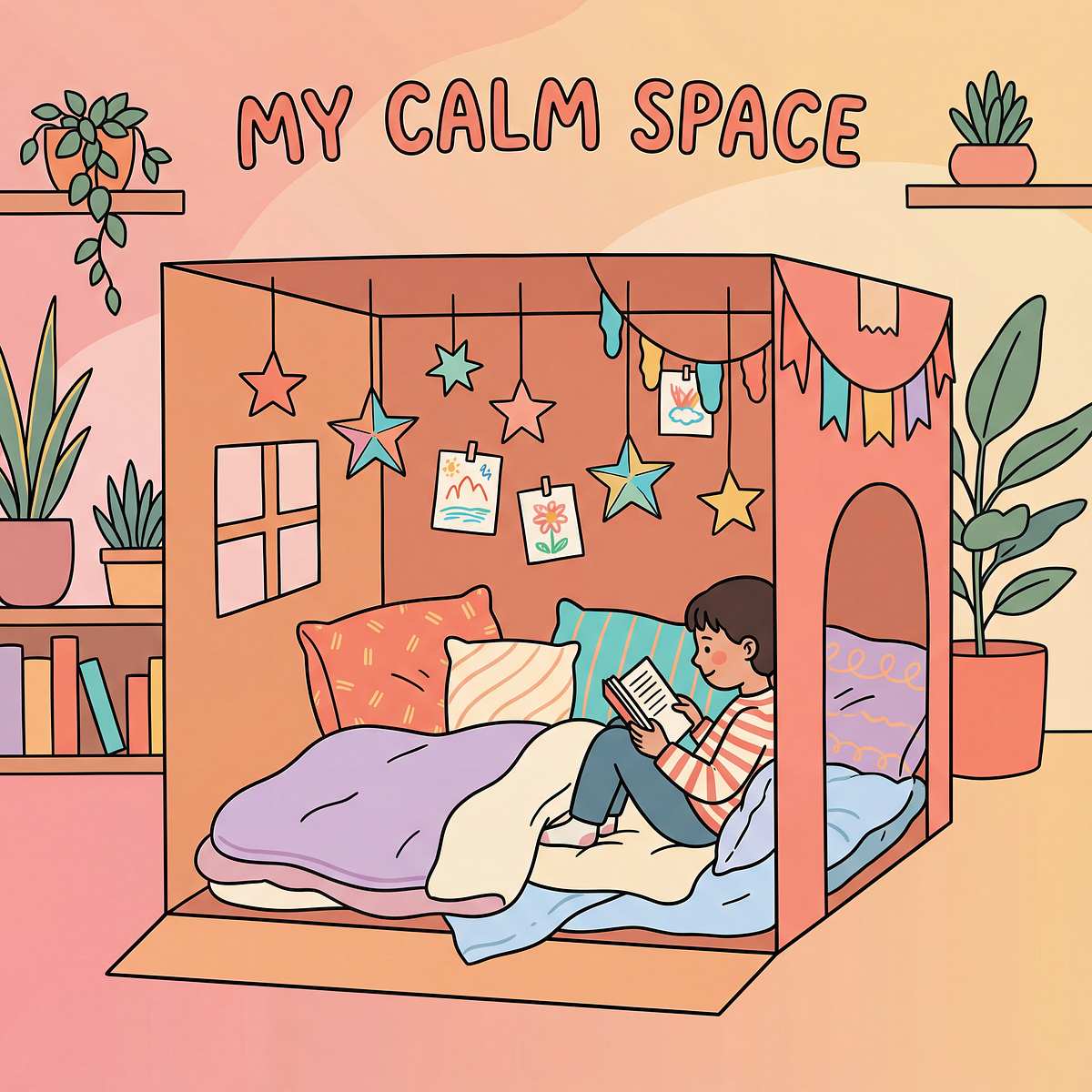
Cardboard Box Fort (DIY)
Best for: Budget option, customizable
Size: Large appliance box
Portability: Low
Settings: Home
Ages: 2-9 years
Price: ₹0–200
7
Under-Table Hideaway Cover
Best for: Discreet calm space, school/home
Size: Fits standard table
Portability: Medium
Settings: Home, School
Ages: 3-9 years
Price: ₹400–1,000
How to Choose
By Goal
- Immediate calming: Pop-up tent
- Sleep support: Canopy/bed tent
- Movement + calm: Hanging pod
- Permanent space: Corner kit
By Setting
- Home only: Bed tent, cardboard fort
- Multi-location: Pop-up tent
- School: Under-table cover, corner kit
- Clinic: Hanging pod, tunnel tent
By Portability
- High: Pop-up tent
- Medium: Tunnel tent, under-table cover
- Low/Permanent: Hanging pod, corner kit, bed tent
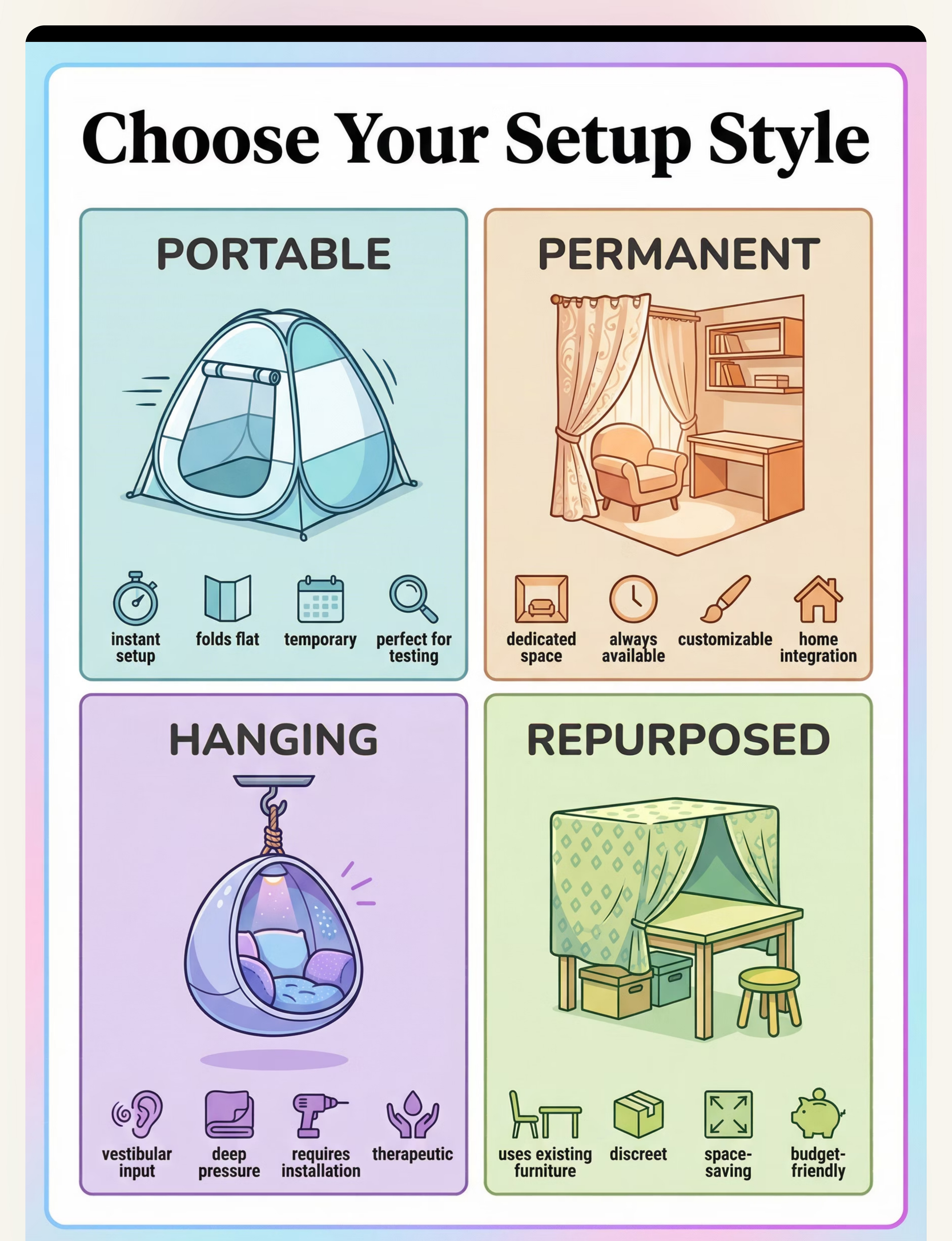
Setup Types & Specifications
Permanent Style
Setup: Dedicated space, customizable, always available
Best for: Children who need consistent access, families with available space, schools or clinics serving multiple children.
Hanging Style
Setup: Suspended, adds vestibular input, requires installation
Best for: Children who seek movement combined with enclosed space, when ceiling support is available and properly installed.
Repurposed Style
Setup: Uses existing furniture (table, closet)
Best for: Budget-conscious families, discreet school settings, or when dedicated floor space is limited.
Key Materials & Features
Essential Materials
- Breathable fabric (never fully enclosed plastic)
- Flexible poles or stable frame structure
- Non-toxic, child-safe materials throughout
- Machine-washable covers for hygiene
Must-Have Features
- Easy, unobstructed entry and exit
- Adequate ventilation at all times
- Stable structure that won't collapse
- Option for dim or adjustable lighting
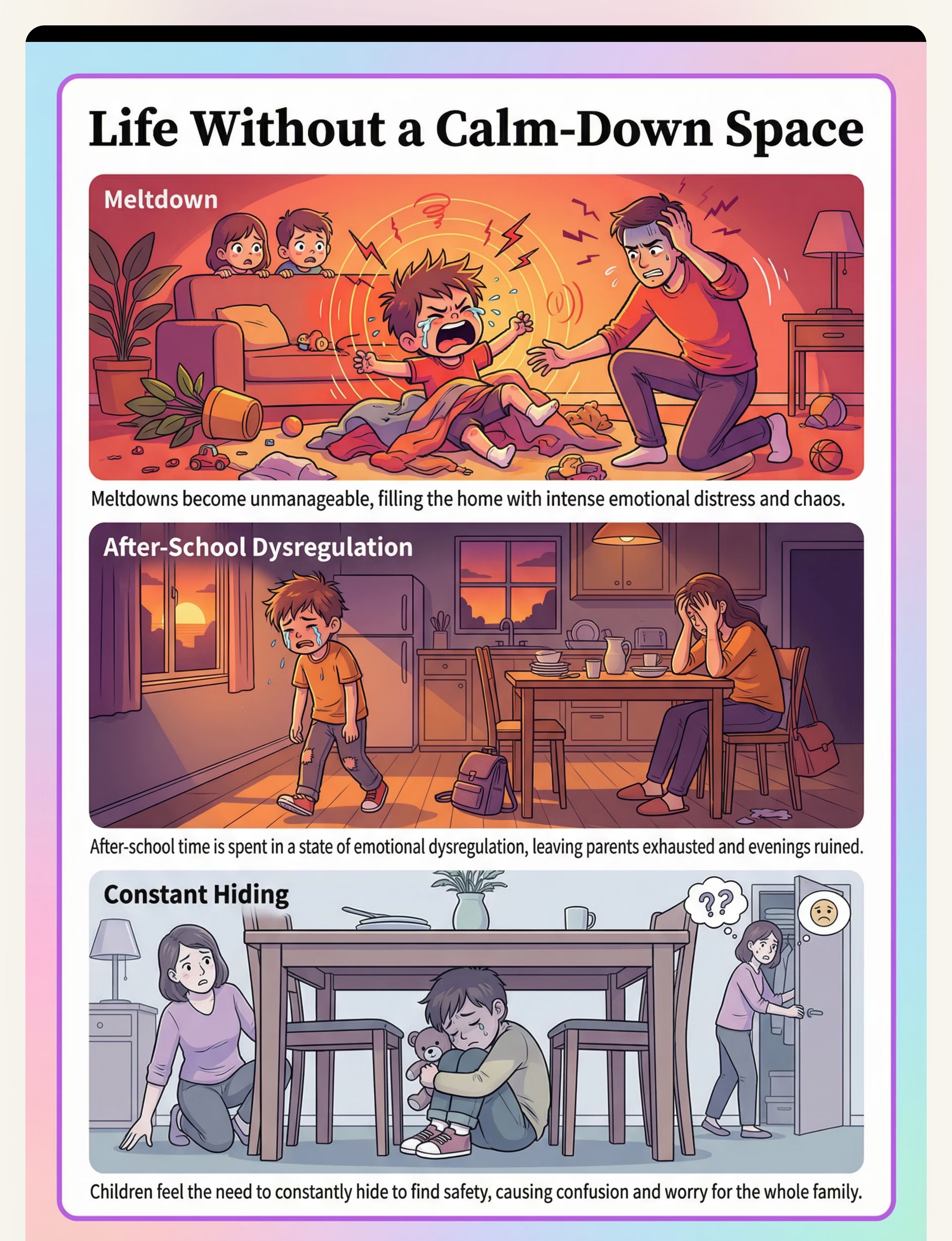
The Struggle (Before)

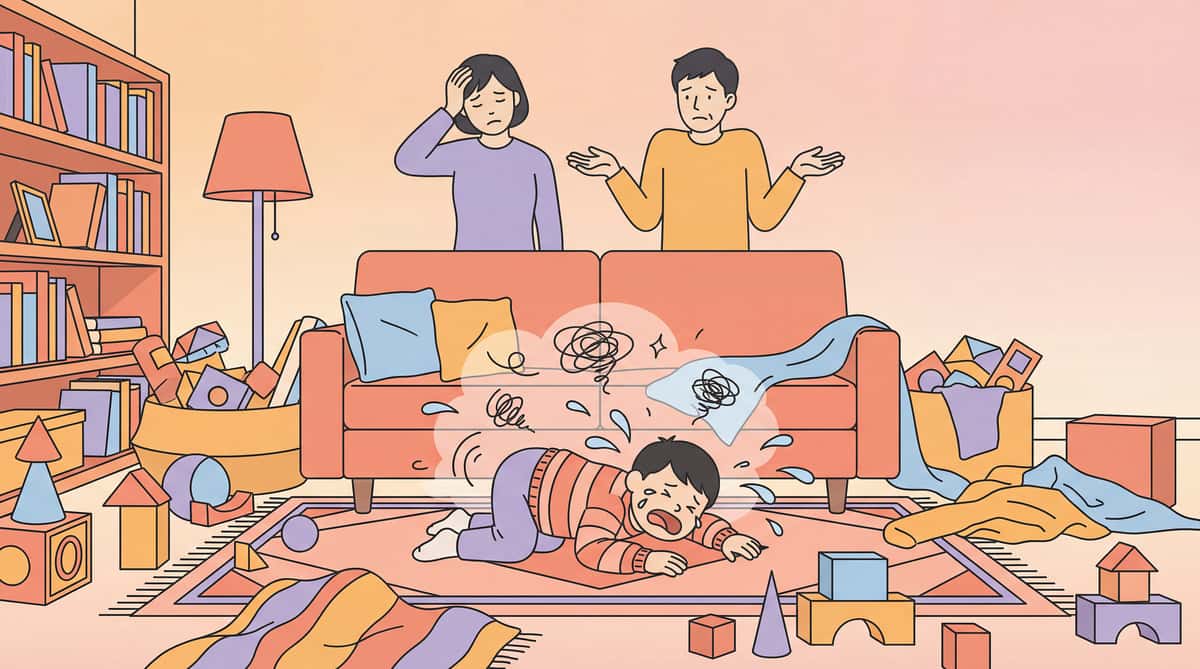
Meltdown Crisis
Situation: Child melts down in living room with no designated safe space to go. Meltdown escalates as they search for somewhere to retreat.
Experience: Siblings watch anxiously. Everyone becomes stressed. Parents feel helpless. Recovery takes hours, leaving the whole family exhausted.
Emotion:Chaos, helplessness, desperation

After-School Breakdown
Situation: Child arrives home completely overwhelmed from the sensory load of school. Nervous system is on overload with nowhere to release the pressure.
Experience: Wanders aimlessly, cries, picks fights with siblings. Sensory system desperately seeking regulation. Evening plans are completely derailed.
Emotion:Exhaustion, dread, frustration

Constant Hiding
Situation: Child instinctively seeks out enclosed spaces, constantly hiding under tables, in closets, under piles of blankets. The need is clear but not understood.
Experience: Parents worry and feel confused. Well-meaning relatives label child as "weird" or "antisocial." No one recognizes the sensory need being expressed.
Emotion: Confusion, concern, isolation

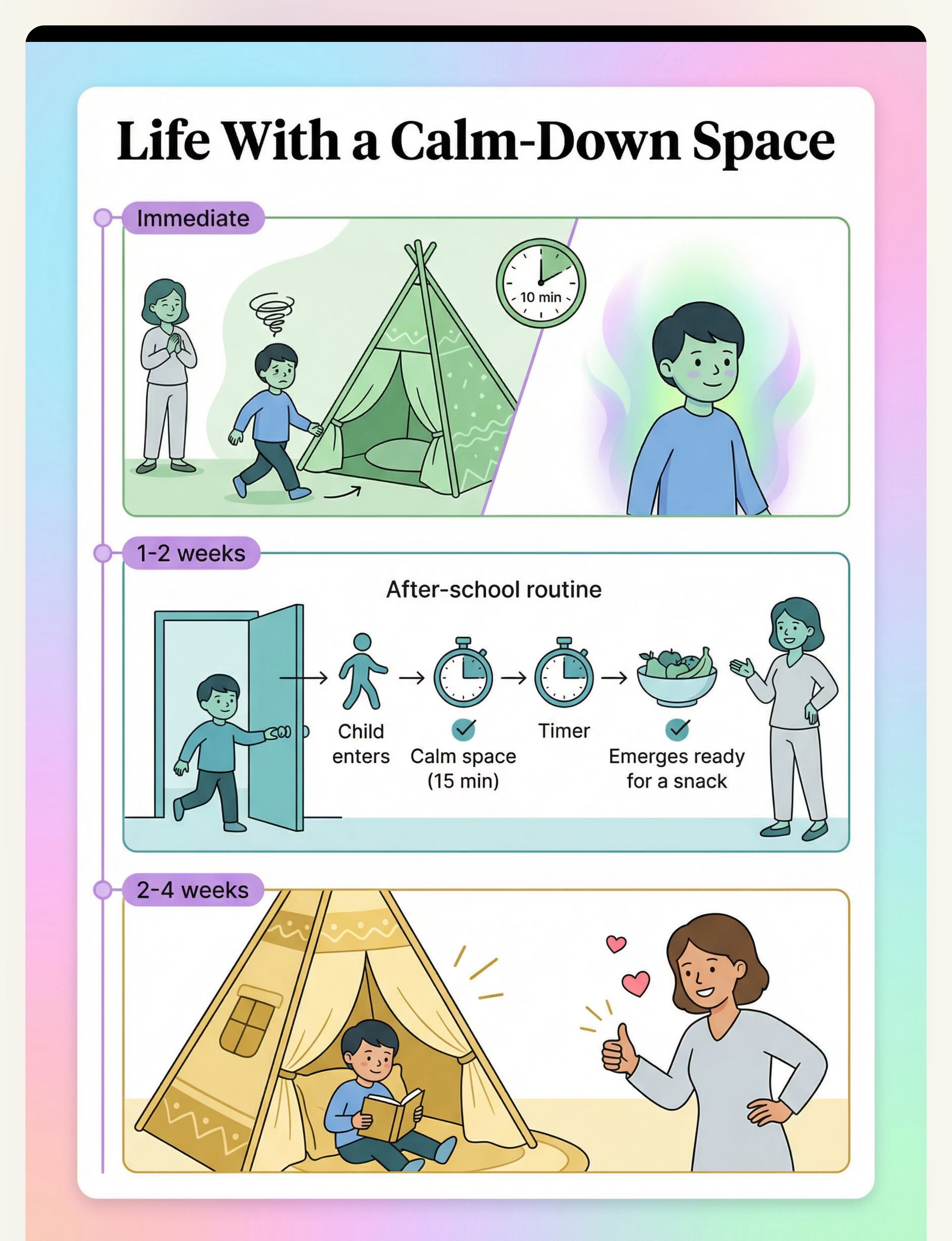
The Breakthrough (After)
Regulated Recovery
Situation: At the first sign of overwhelm, child independently goes to their sensory tent with their weighted blanket. Ten minutes later, emerges noticeably calmer.
Experience: Crisis averted. Family continues with evening. Child practiced self-regulation successfully. Everyone feels capable and calm.
Emotion:Relief, empowerment, pride
Timeframe: Immediate
Predictable Decompression
Situation: After-school routine becomes predictable: come home → 15 minutes in calm-down tent with fidgets → emerge ready for snack and homework.
Experience: Evenings transform. Child knows exactly what to do when overwhelmed. Parents can plan dinner knowing child will decompress first. System works.
Emotion:Peace, routine, confidence
Timeframe: 1-2 weeks
Understood Needs
Situation: Child now has a designated, appropriate space to retreat when needed. The need for enclosed space is understood, validated, and properly met.
Experience: No more hiding in unsafe closets. Family celebrates child's self-awareness. Therapists praise the environmental modification. Need is no longer shameful.
Emotion:Understanding, acceptance, validation
Timeframe: Immediate

What to Expect (Realistic Timelines)
Immediate
- Child has designated calm-down space available
- Physical environment supports regulation attempts
- Family understands purpose and use
1-2 Weeks
- Meltdown recovery time begins to decrease
- After-school decompression becomes routine
- Child starts associating space with feeling better
2-4 Weeks
- Child independently goes to space when overwhelmed
- Reduced meltdown intensity observed
- Proactive use increases (before crisis point)
1-3 Months
- Child develops lasting self-regulation skill
- Generalizes strategy to other settings
- Can verbalize need: "I need my calm space"
Important: Every child's timeline is unique. These timeframes represent typical patterns, but your child may move faster or need more time. Trust the process and your child's individual pace.

Is This Right for My Child? (2-Minute Check)
Answer these four questions honestly. Three or more "yes" answers indicate a strong fit for a calm-down space.
Does your child seek out enclosed spaces (closets, under tables, blanket forts)?
If yes, this indicates: Child is actively seeking enclosed space for regulation. This is a clear sensory need being expressed through behavior.
Confidence score: 95%
Does your child become overwhelmed by sensory input and need to 'escape'?
If yes, this indicates: Child requires a reduced-stimulation space to manage sensory load. Current environment exceeds their processing capacity regularly.
Confidence score: 92%
Does your child have difficulty recovering from meltdowns?
If yes, this indicates: Child would significantly benefit from a designated calm-down space with fewer demands during recovery period.
Confidence score: 88%
Does your child need transition time after high-stimulation environments?
If yes, this indicates: Child needs a decompression space to process sensory experiences and return to baseline before engaging in new activities.
Confidence score: 85%
Scoring: If you answered "yes" to 3 or more questions, a sensory hideaway is very likely to be beneficial for your child. Even one strong "yes" may indicate a need worth addressing.

Common Questions (Honest Answers)
1
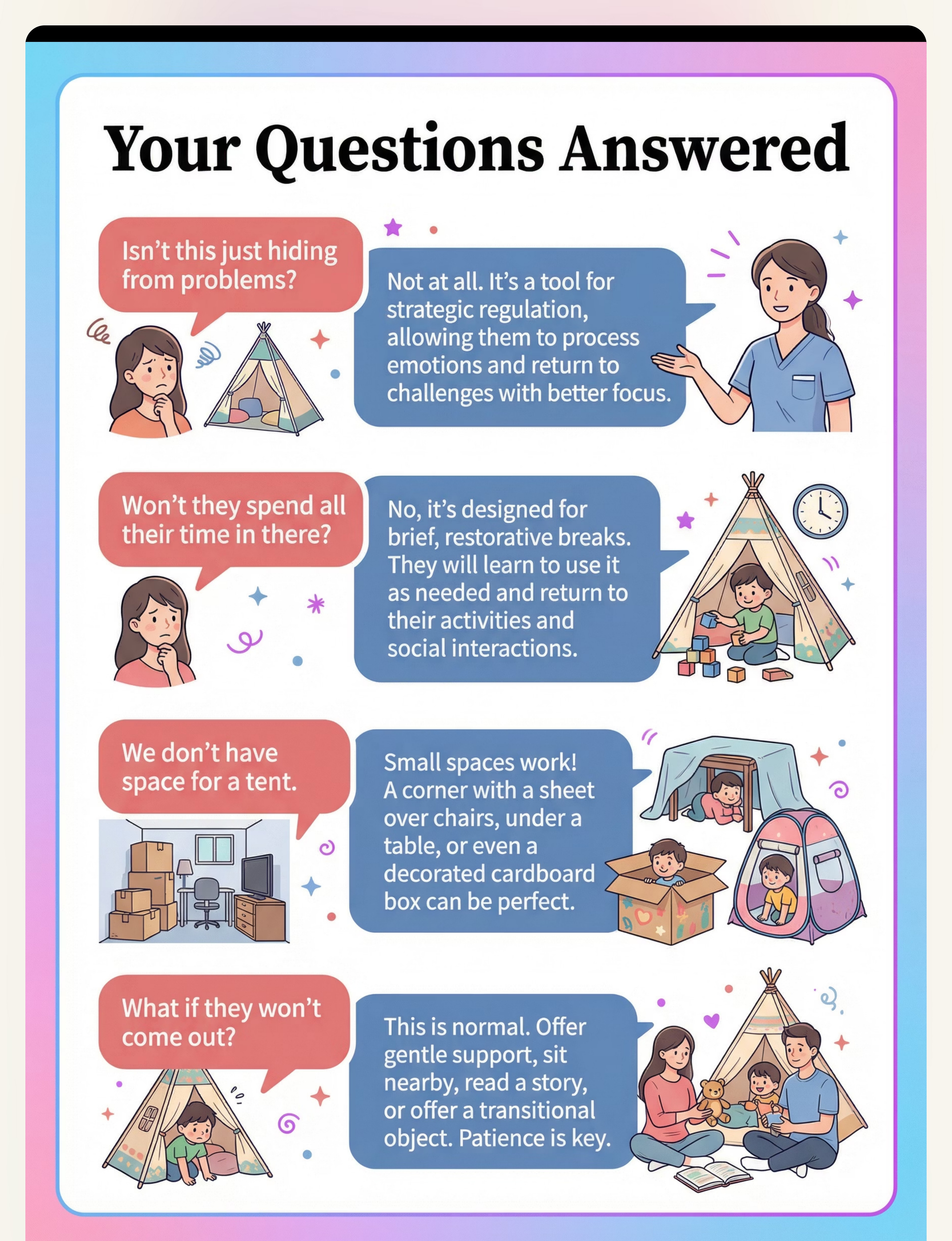
Q: Isn't this just hiding from problems?
A: No—it's strategic nervous system regulation. The child isn't avoiding problems; they're giving their overwhelmed system a chance to reset so they CAN handle problems effectively. It's a coping skill, not avoidance.
Think of it this way: Athletes take timeouts during intense games. Adults take breaks during stressful workdays. Children need the same opportunity to pause and regulate.
Try this instead: Frame the space as a "recharge station" rather than a "hiding spot." Language matters in how children internalize the tool.
2
Q: Won't they spend all their time in there?
A: Children naturally want to engage with the world. They use the space when needed, then return on their own. If your child is spending hours inside, that's valuable information—it tells you they're significantly overwhelmed and need the support.
As regulation improves over time, they'll need the space less frequently. Track patterns to understand your child's sensory needs better.
Try this instead: Use a visual timer for structured breaks if needed, but trust your child to know when they're ready to emerge in most cases.
3
Q: We don't have space for a tent
A: There are many space-efficient options! An under-table cover uses existing furniture. A cardboard box is free and works beautifully. Create a corner space with just a curtain. Even a closet with soft items works. A large blanket draped over chairs creates an instant hideaway.
The enclosed space matters far more than the specific product. Get creative with what you have.
Try this instead: DIY calm-down corner with cushions and a curtain rod in any available corner of your home.
4
Q: What if they won't come out?
A: Children naturally want to engage. If they won't come out, they're communicating that they're still overwhelmed. Don't force exit—this undermines trust and the purpose of the space.
Instead, regulate WITH them. Sit nearby quietly. Offer comfort through the entrance. Validate their need for continued space. Teach that it's a reset space for temporary use, not permanent residence.
Try this instead: Use a visual timer to help with transitions once they're calmer, but only after respecting their initial need for extended time.

Usage Guide: When & How
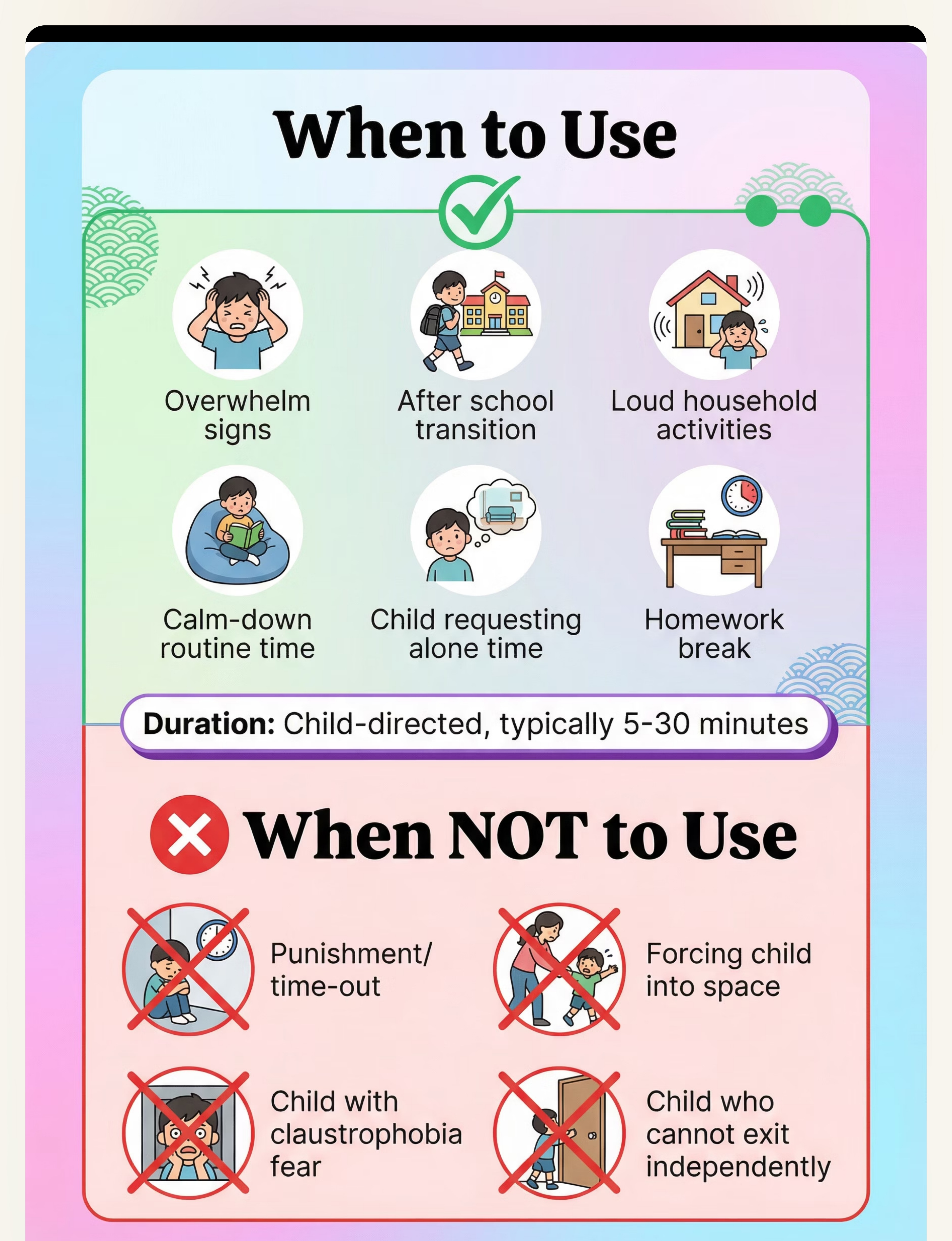
✓ When to Use
- When child is overwhelmed or approaching meltdown
- After-school decompression period (routine)
- During sensory-heavy household activities
- As part of established calm-down routine
- When child explicitly requests "alone time"
- During homework or learning breaks
✗ When NOT to Use
- Never as punishment or consequence
- Never force child into the space
- If child has claustrophobia or fear of enclosed spaces
- If child cannot exit independently
- For very young children without supervision
Supervision by Age
Age Range | Supervision Level | Notes | |
Under 3 years | Constant visual supervision | Adult must be able to see child at all times. Check every 2-3 minutes. | |
3-5 years | Frequent check-ins, within earshot | Check every 5-10 minutes. Adult nearby but not hovering. | |
5+ years | Periodic check-ins, child manages independently | Child can manage own use. Check in every 15-20 minutes or as needed. |
Usage Settings
Home
School
Clinic
Duration: Child-directed, typically 5-30 minutes per session. Some children need only 5 minutes to reset; others may need 20-30 minutes after particularly overwhelming experiences. Trust your child's internal regulation timeline.

Safety First
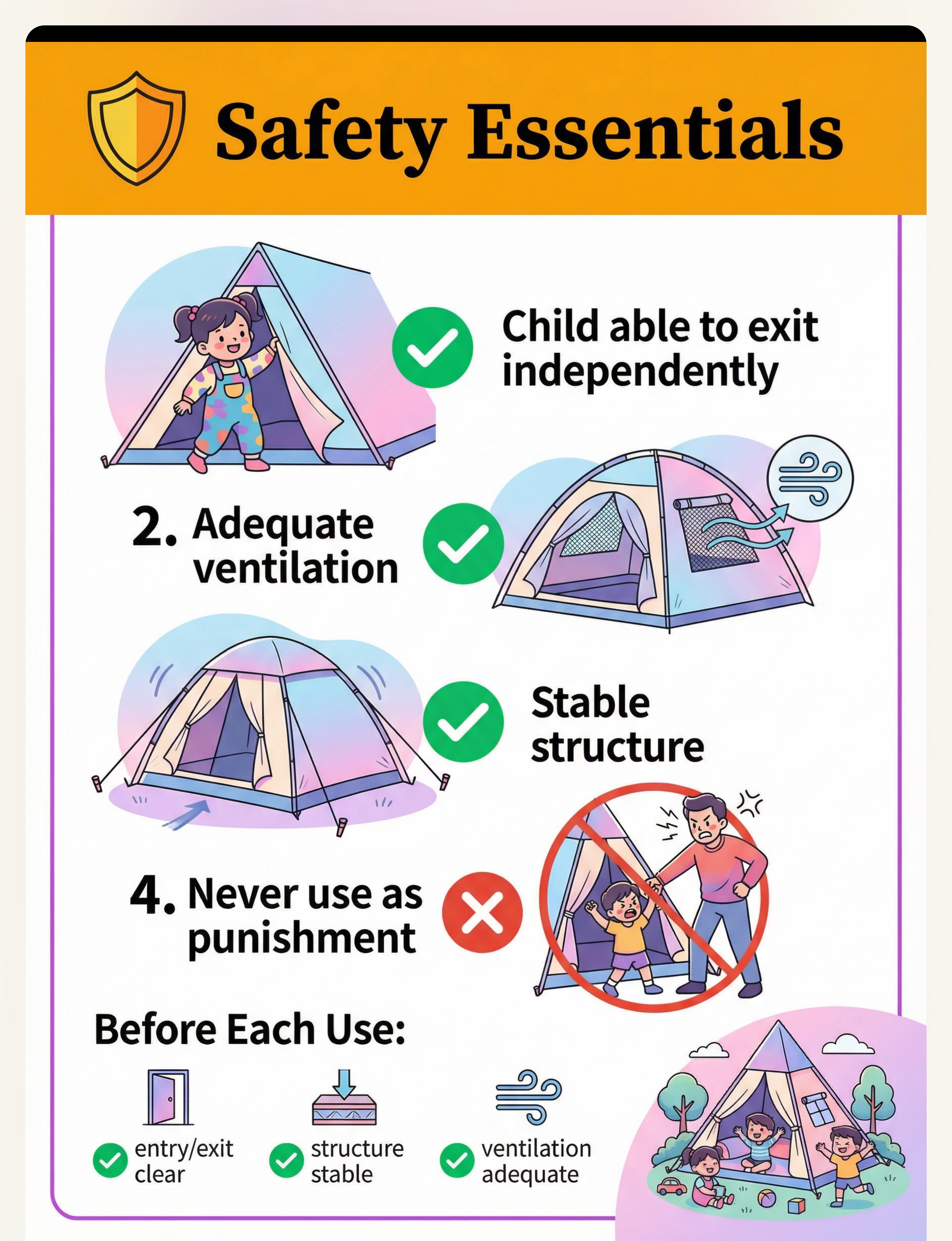
🚨 Critical Safety
- Child MUST be able to exit independently at all times—never lock or block entrance
- Ensure adequate ventilation—space must never be airtight or fully sealed
- Structure must be stable and not collapse on child
- Never use space as punishment or force child to enter
⚠️ Important Warnings
- Keep small items out for young children to prevent choking hazards
- Check for sharp edges or pinch points on poles and frames
- Properly secure hanging pods with weight-rated hardware
- Monitor for overheating in enclosed space, especially in warm climates
Contraindications
Do not use if:
- Child has claustrophobia or diagnosed fear of enclosed spaces
- Child has significant fear reactions to being in confined areas
- Child is unable to exit space independently due to age or physical limitations
Safety Checklist
Before Use
- ✓ Entry/exit unobstructed
- ✓ Structure stable and secure
- ✓ Ventilation adequate
- ✓ Inside items safe for child's age
During Use
- ✓ Child chose to enter (not forced)
- ✓ Child can exit when ready
- ✓ Not overheating inside
- ✓ Periodic check-ins as appropriate for age
Signs to Stop
- ⚠ Child won't exit for extended periods
- ⚠ Child is in distress inside
- ⚠ Structure appears unstable
- ⚠ Child showing signs of overheating

Investment Guide: Starter vs. Premium
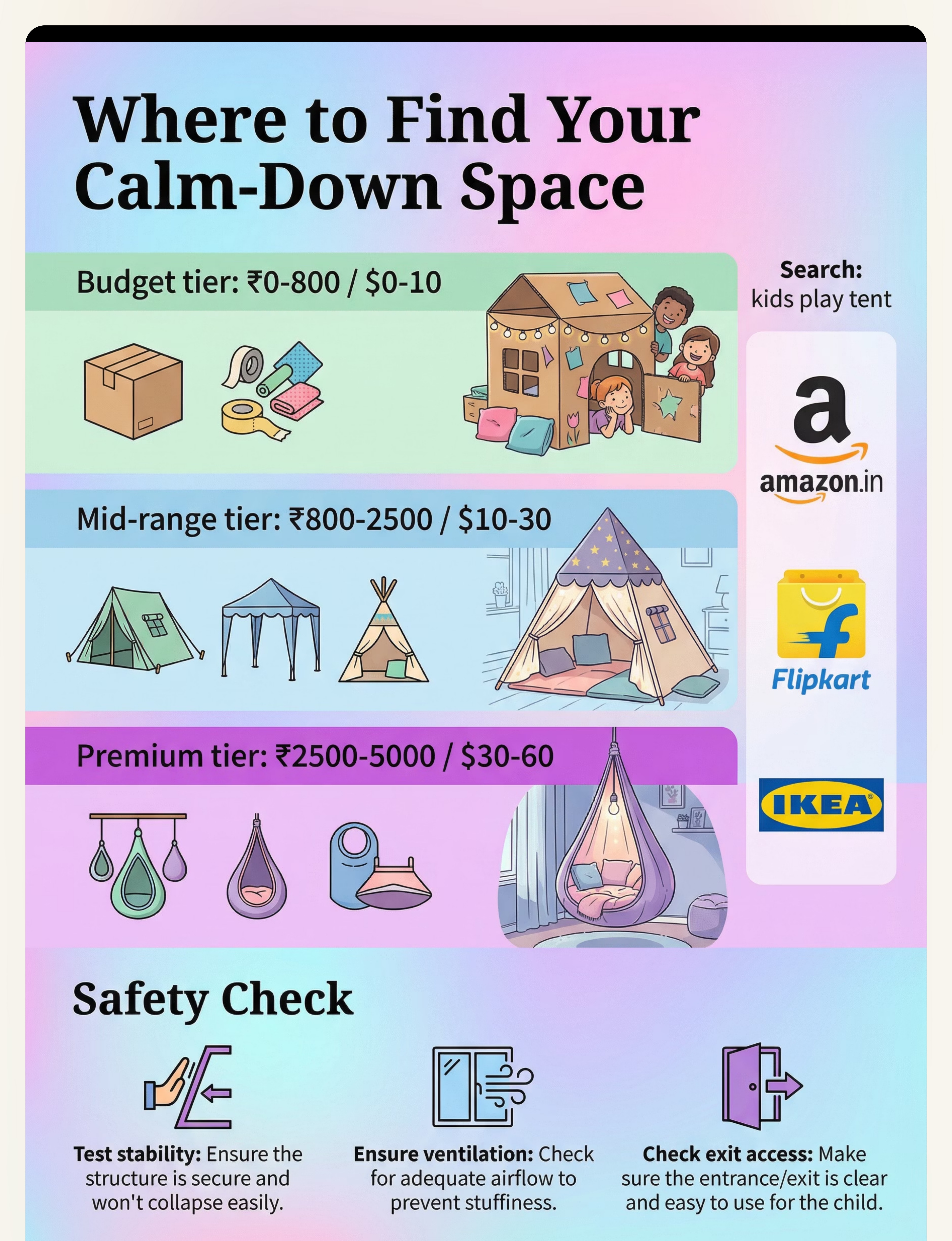
Sensory hideaways range from completely free DIY options to premium therapeutic equipment. Both ends of the spectrum can be highly effective—choose based on your budget, space, and your child's specific needs.
Budget Option
₹0-200
DIY Cardboard Box Fort
Large appliance box from electronics store (often free), decorated by child, filled with cushions and soft items
Note: Free and highly effective. Gives child ownership through decoration. Can't be washed but easily replaced.
Best for: Testing the concept before investing, tight budgets, or involving your child in the creation process for increased buy-in.
Premium Option
₹3K-5K
Lycra Hanging Pod with Cushion
Suspended hammock-style pod providing both enclosed space and gentle vestibular input through movement
Brands: Fun and Function, Southpaw, IKEA Ekorre (discontinued but similar products available)
Best for: Combining deep pressure with movement, children who seek vestibular input, clinic or school settings requiring durability.
₹0-4K
Overall Price Range
Complete spectrum from free DIY solutions to premium therapeutic equipment
Best starting point: If you're unsure whether your child will use an enclosed space, start with a free or low-cost option like a cardboard box fort or under-table cover. Once you've confirmed the benefit, you can invest in a more permanent or portable solution.

Where to Buy in India
Availability: Widely available across multiple platforms from budget to premium options
Amazon.in
Search Term: "kids play tent pop up"
Price Range: ₹800-2,500
Notes: Best selection
Amazon.in
Search Term: "bed canopy tent kids"
Price Range: ₹1,000-3,000
Notes: Sleep-focused
Flipkart
Search Term: "children tent house"
Price Range: ₹600-2,000
Notes: Budget options
IKEA
Search Term: "kids tent canopy"
Price Range: ₹1,000-2,500
Notes: Quality design
✓ Buying Tips
- Test stability before purchase—structure should not collapse on child under normal use
- Ensure adequate ventilation—breathable fabric is essential for safety
- Confirm child can enter and exit independently without assistance
- Choose washable materials for hygiene and longevity
- Consider size carefully—child should fit comfortably with calming items inside
- Read reviews specifically mentioning use by children with sensory needs
🚩 Red Flags
- No ventilation or completely sealed design (suffocation risk)
- Unstable structure that could collapse (safety hazard)
- Small openings that child cannot exit easily
- Non-breathable plastic materials that trap heat
- Sharp edges, exposed poles, or pinch points
- Product marketed as "time-out" or "punishment" tool

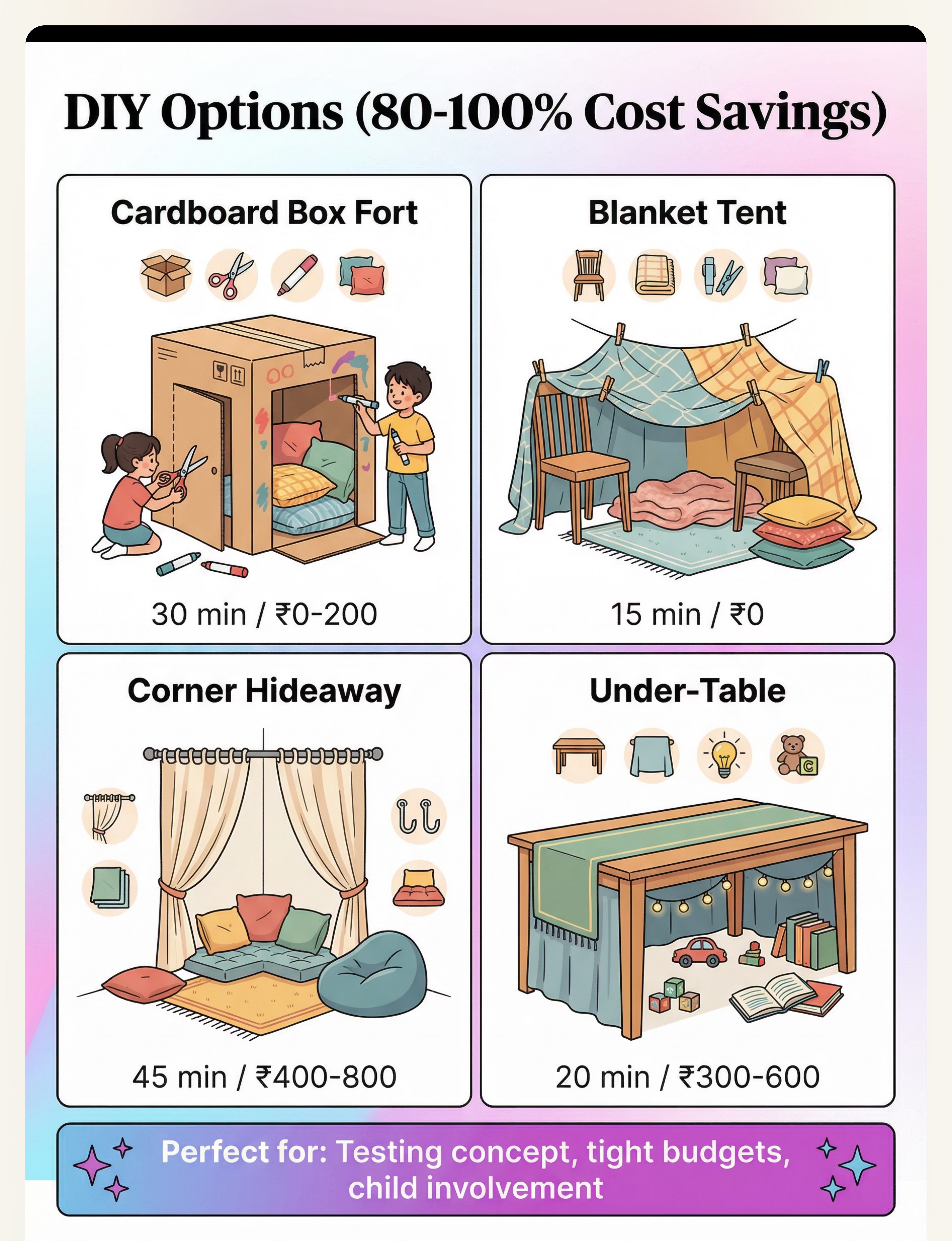
DIY Alternative (Save 80-100%)
Feasibility: Very High | Time: 30-60 minutes | Cost Savings: 80-100%
A DIY calm-down space can be just as effective as commercial options—and sometimes more so, because children who help create their space feel more ownership and are more likely to use it.
Materials Needed
- Large cardboard box (free from appliance stores when they receive deliveries)
- Blankets and chairs you already own
- Curtain rod and fabric for corner installation
- Cushions, pillows, and soft items from around your home
Five Simple Options
1
Cardboard Fort
Cut a door opening in large box, let child decorate inside and out with markers or stickers, add cushions and weighted blanket inside
2
Blanket Tent
Drape large blanket over dining chairs or couch to create enclosed cave, secure with clips if needed, add soft items inside
3
Corner Hideaway
Install tension curtain rod across corner of room, hang fabric panels to create three-sided enclosed space, add cushions on floor
4
Under-Table Space
Use existing table, drape fabric around three sides leaving front open, add cushions and soft lighting underneath
5
Closet Conversion
Clear items from low portion of closet, add cushions and soft items, remove door or keep open, add battery-powered nightlight
DIY vs. Commercial: Making the Decision
When to DIY | When to Buy Commercial | Key Tradeoffs | |
|
|
|

Measuring Success
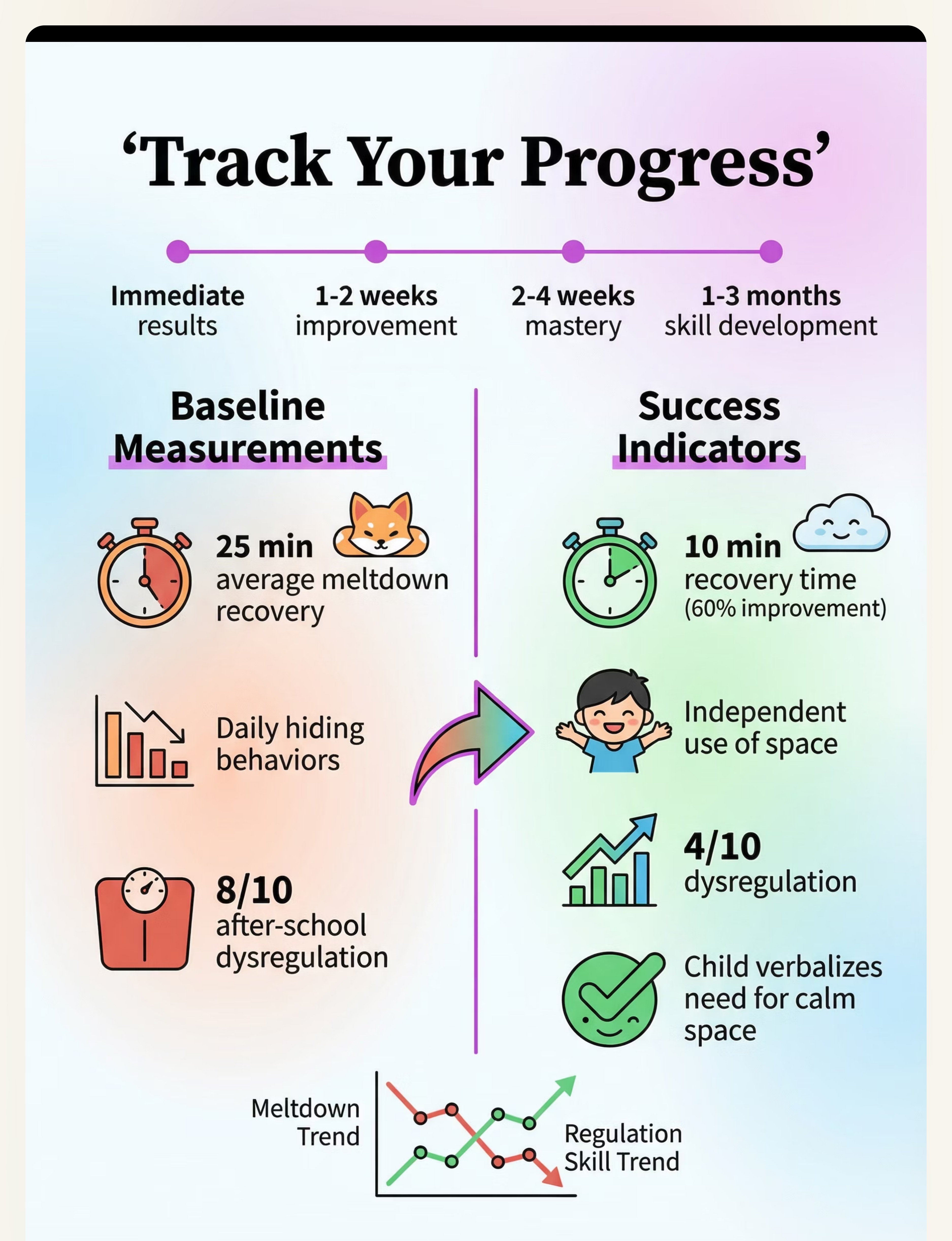
Establish Baseline Metrics
Before introducing the calm-down space, measure key indicators for one week, such as average meltdown duration, frequency of hiding behaviors, after-school dysregulation levels (1-10), and average recovery time from overwhelm. Document these as your starting point.
Set Clear, Achievable Goals
Define what success means for your family. Examples include the child independently using the space for early overwhelm signs, a 50% decrease in meltdown recovery time, establishing a consistent decompression routine, or the child verbalizing their need for the space.
Proactive Space Utilization
Track if the child uses the calm-down space proactively, before a full meltdown occurs, indicating developing self-awareness and early intervention.
Decreased Recovery Time & Intensity
Monitor for a significant reduction in the time it takes to recover from overwhelm (e.g., from hours to 10-20 minutes), and observe if meltdowns become less severe and shorter in duration.
Calm & Regulated Re-entry
Note if the child emerges from the space calmer and ready to re-engage, confirming the space effectively served its regulatory purpose.
Generalization of Strategies
Observe if the child begins to apply calming techniques learned in the space to other situations, or requests other calming tools, showing broader emotional regulation development.
Preview of sensory tent hideaway calm space Therapy Material
Below is a visual preview of sensory tent hideaway calm space therapy material. The pages shown help educators, therapists, and caregivers understand the structure and content of the resource before use. Materials should be used under appropriate professional guidance.


Share this resource
Help others discover thisLink copied!

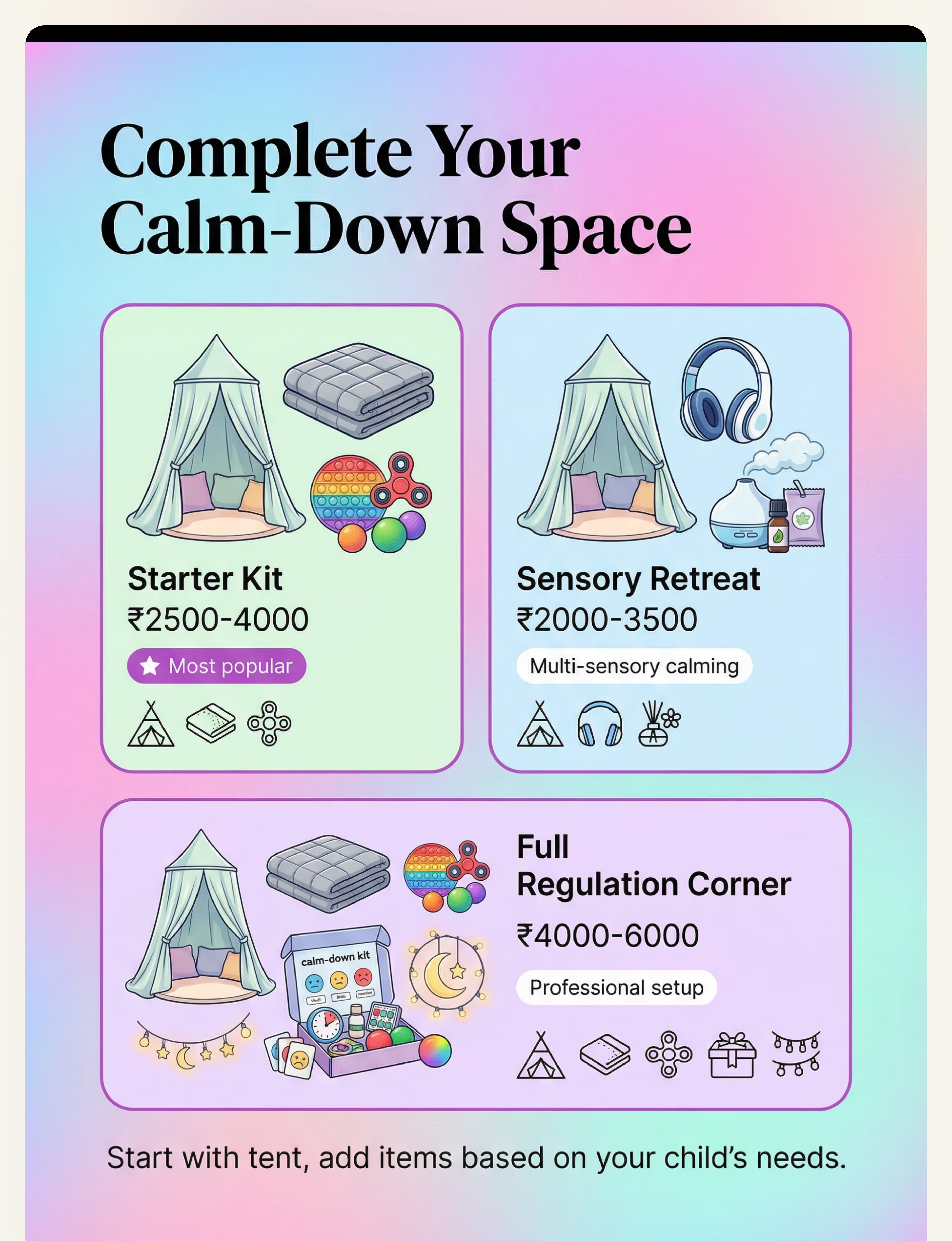
Complete Your Regulation Toolkit
A calm-down space works even better when paired with other sensory regulation tools. These complementary items enhance the calming environment and provide additional regulation pathways.
Pair It With...

Weighted Blanket
Tool ID: 1.1 | Perfect inside calm-down space for deep pressure input that enhances the calming effect of the enclosed environment.

Fidget Set
Tool ID: 1.4 | Provides tactile regulation tools to use while in the calm space, giving hands something to do during decompression.

Calming Scents
Tool ID: 1.10 | Adds olfactory calming element to create multi-sensory calm environment inside the hideaway space.

Ear Defenders
Tool ID: 1.3 | Reduces auditory input while in space, particularly helpful for children with auditory sensitivities.

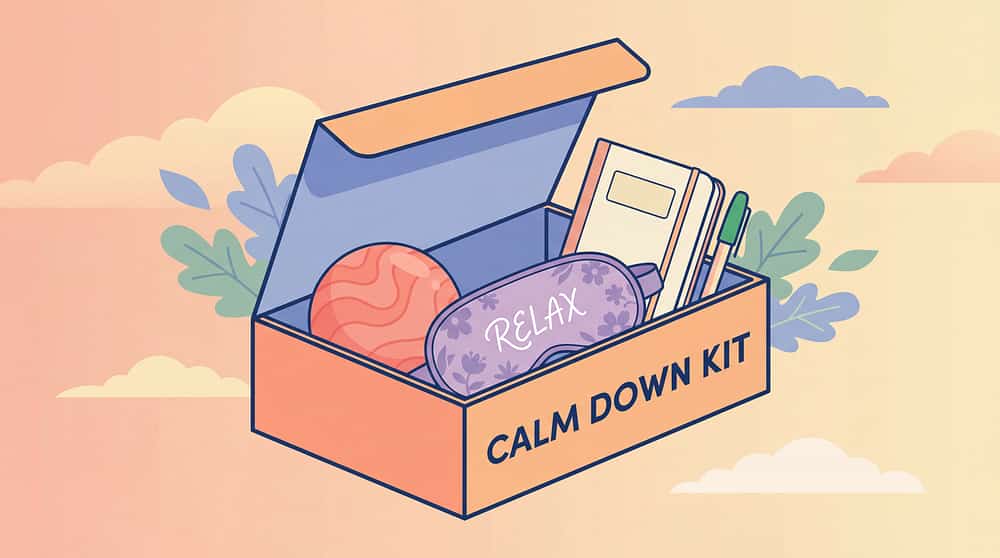
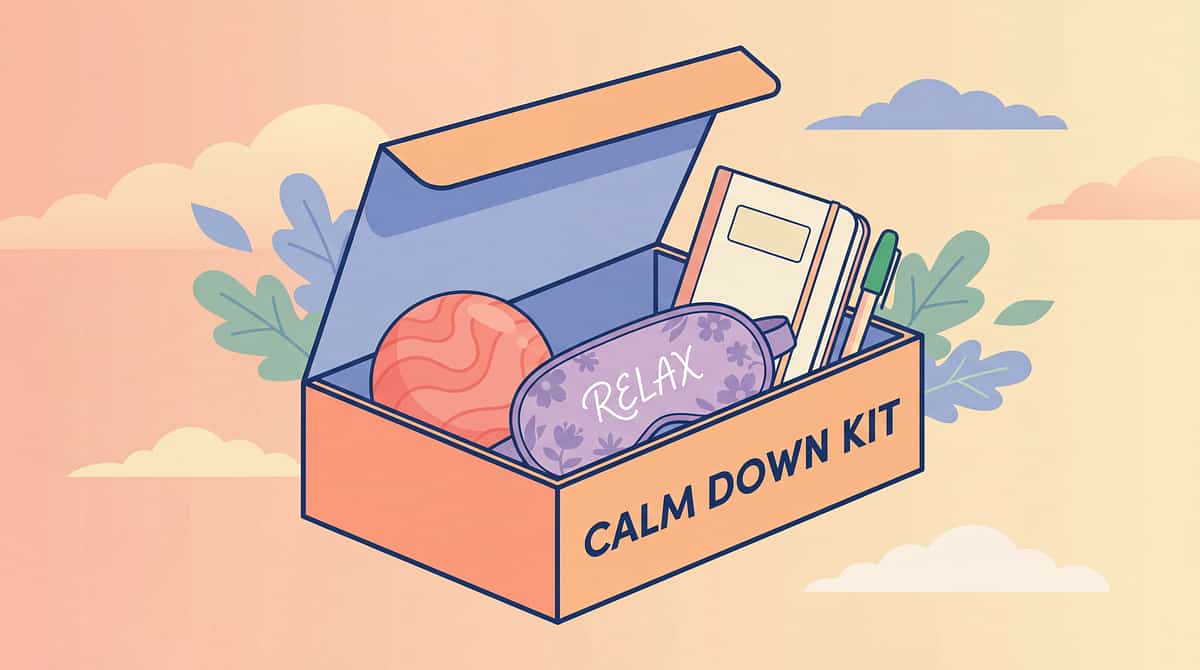
Calm-Down Kit
Tool ID: 2.3 | Comprehensive portable regulation tools that can be kept inside the calm-down space for easy access.
Complete Regulation Bundles
1
Calm-Down Corner Complete
Includes: Sensory tent (1.11) + Weighted blanket (1.1) + Fidget set (1.4) + Calm-down kit (2.3)
Use case: Full regulation space with multiple sensory pathways for comprehensive calming support
2
Sensory Retreat Kit
Includes: Sensory tent (1.11) + Ear defenders (1.3) + Calming scents (1.10)
Use case: Multi-sensory calming environment addressing visual, auditory, and olfactory input simultaneously
AI Summary & Search Terms
Quick Summary: Sensory tents and hideaways provide enclosed, reduced-stimulation spaces for self-regulation and meltdown recovery. Essential tool for overwhelmed children. Rank #2 in category, moderate evidence base, highly DIY-friendly with options from free to ₹4,000.
Common searches:
sensory tent autism
calm down corner kids
hideaway tent sensory
pop up tent autism
calm down space
sensory safe space
regulation space autism
Pinnacle Blooms Network® Platform Integration
This tool integrates seamlessly with Pinnacle's comprehensive child development ecosystem:
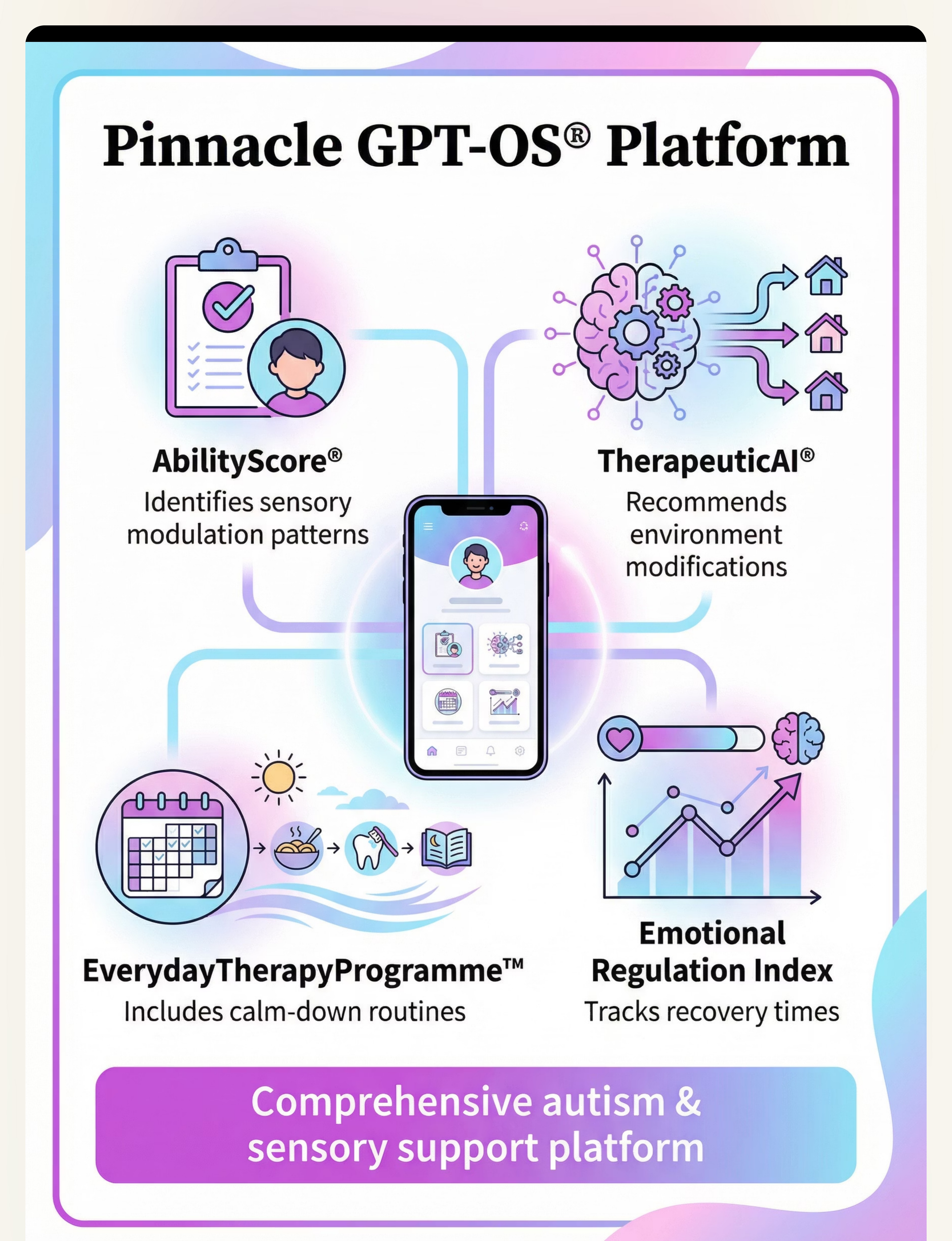
- AbilityScore® identifies sensory modulation patterns that indicate need for calm-down space
- TherapeuticAI® recommends calm-down space as evidence-based environment modification
- EverydayTherapyProgramme™ includes structured calm-down routines and usage schedules
- Emotional Regulation Index tracks recovery times and regulation progress over time
Get Expert Support
FREE National Autism Helpline
Phone: 9100 181 181
Languages: 16+ Indian languages
Website: pinnacleblooms.org
Speak with trained specialists who can help you choose the right calm-down space option, troubleshoot implementation challenges, and support your family's regulation journey.
Important Disclaimer: This is educational information provided by Pinnacle Blooms Network. Always consult qualified occupational therapists, speech-language pathologists, or pediatricians for personalized recommendations. Individual results vary based on each child's unique needs, sensory profile, and family context. This tool is one component of comprehensive sensory support.