

Tool ID: 5.4
Tool ID: 5.4
SLP + SpEd Recommended
Strong Evidence
Rank #2
Constant Use
₹0–1,000
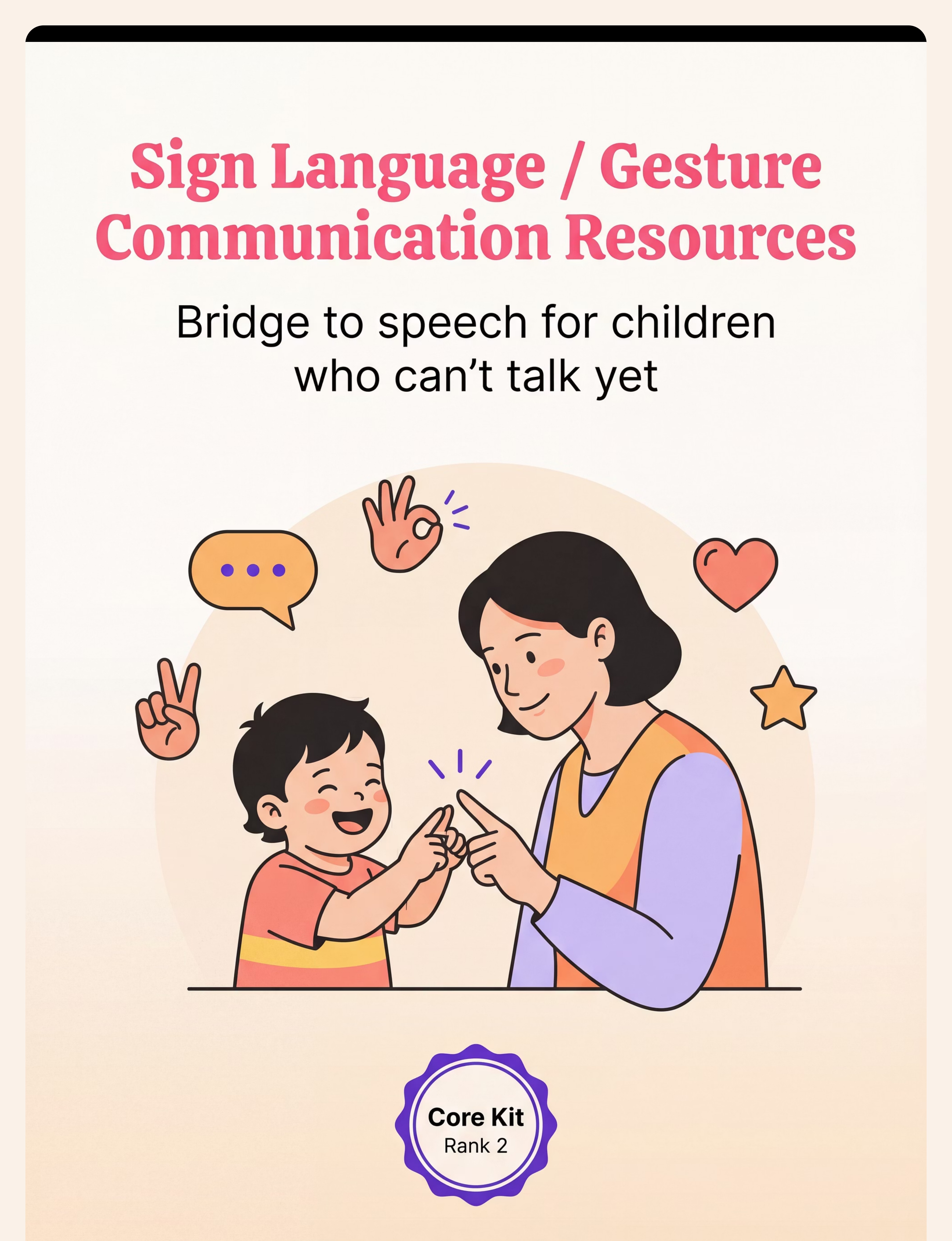
Sign Language / Gesture Communication Resources
Manual communication and gesture system
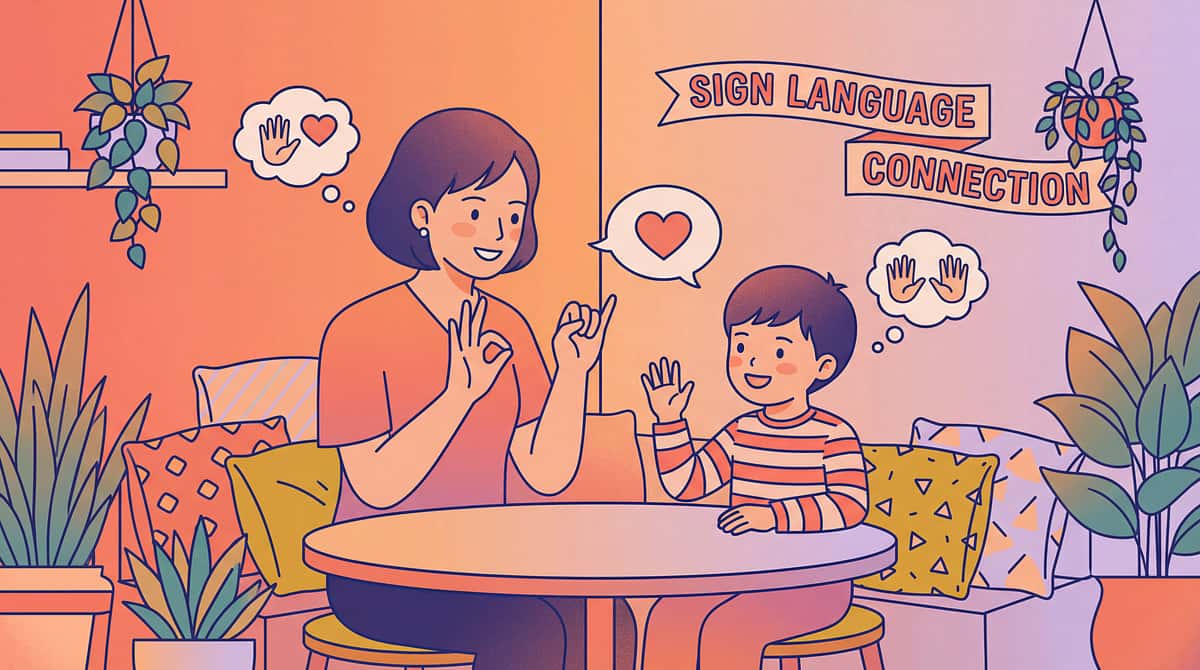
Give your child a voice when words won't come. Sign language provides an immediate, always-available bridge to communication that actually supports speech development for most children. Whether your child is just beginning their communication journey or needs an alternative way to express their needs, signing offers a proven, low-tech solution that reduces frustration and builds connection.
Who This Helps
Expressive Communication
Language Bridge
Motor-Based Communication
Frustration Reduction
Speech Support
Ages: 6 months - 9 years (and beyond)
Home
School
Clinic
All Settings
Pathway for Communication
Sign language creates a pathway for children to express themselves before speech develops or when verbal communication is challenging.
Pre-verbal or Minimally Verbal Children
Ideal for children who have needs to express but don't yet have the words to communicate them effectively.
Children with Motor Skills for Hand Movements
Supports those who can make purposeful hand gestures and movements, even if approximated, to facilitate communication.
Families Seeking Immediate Solutions
Provides a low-tech, always-available option for parents that doesn't require devices or electricity to connect with their child.
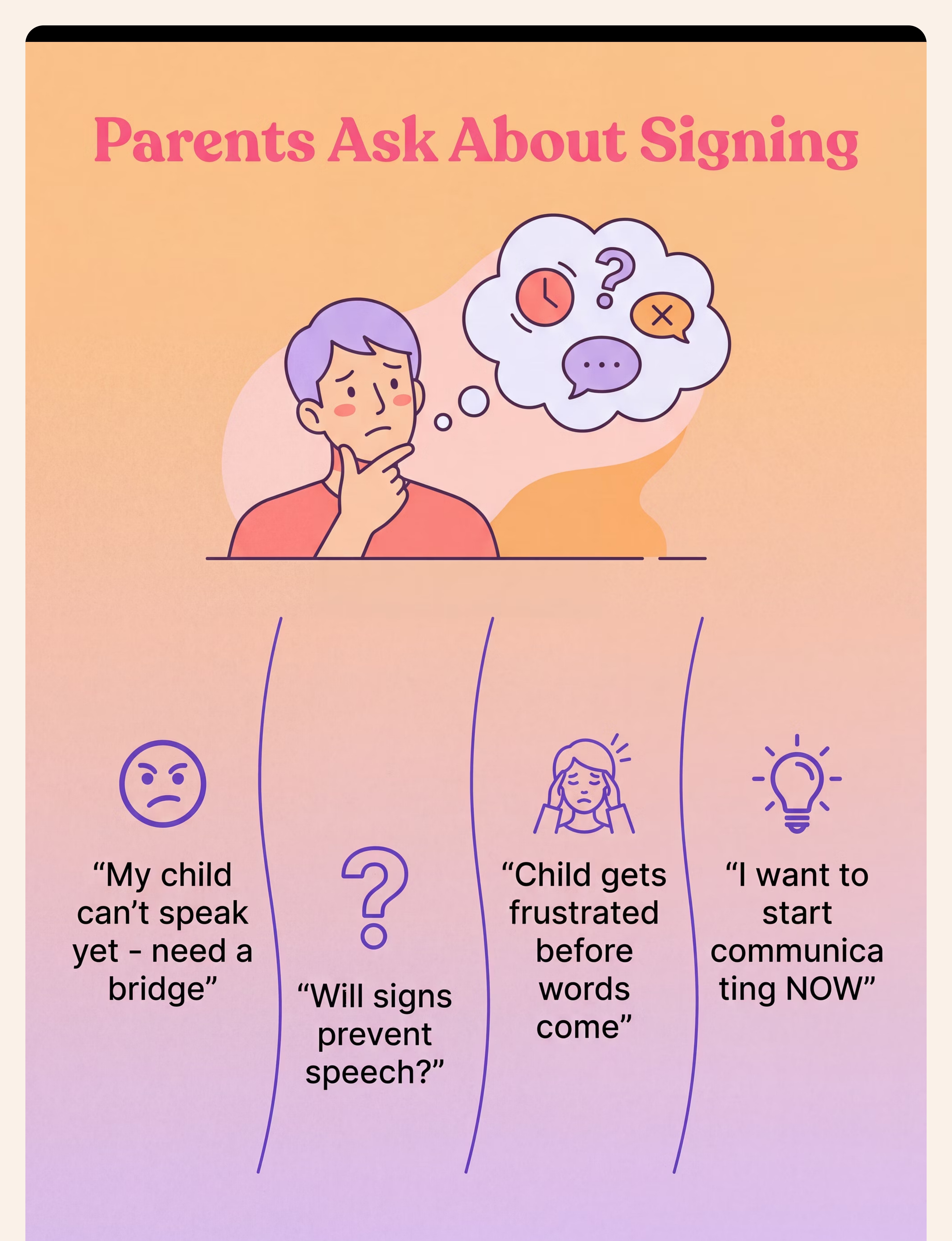
Does This Sound Familiar?
"My child can't speak yet - we need a bridge to help us understand each other before words come."
"AAC devices seem so complicated and expensive. Is there something simpler we can start with?"
"My child gets so frustrated when they can't tell me what they want. The meltdowns are breaking my heart."
"I want to start communicating with my child NOW, not after months of waiting for assessments and devices."
"Will teaching signs prevent my child from learning to talk? I'm worried it might delay speech."
"I don't know sign language myself. How can I teach something I've never learned?"
You're not alone. These are common challenges that thousands of parents face. Sign language offers a proven pathway forward - one that's accessible, affordable, and actually supports speech development for most children.
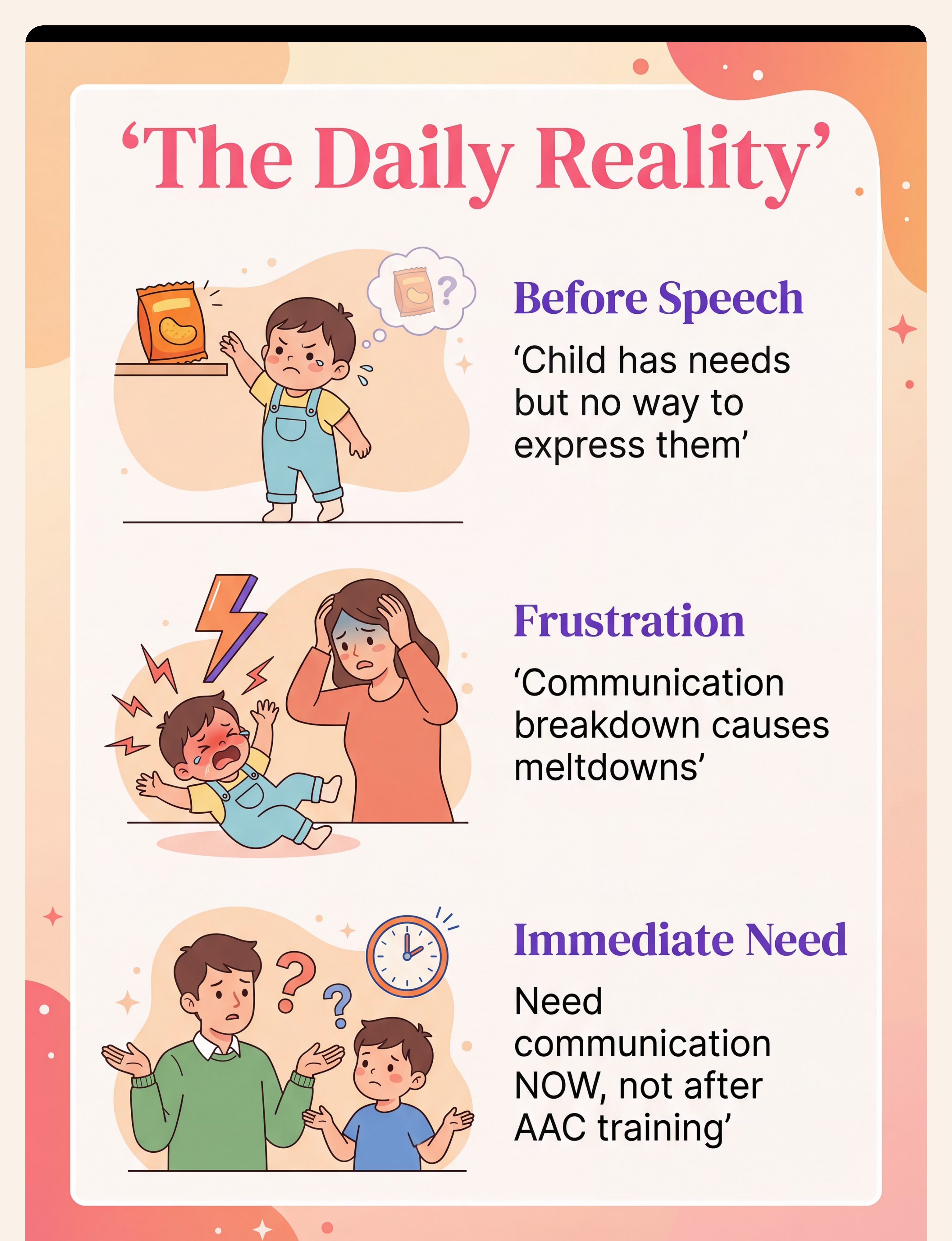
A Day Without the Right Support
Before Speech Develops
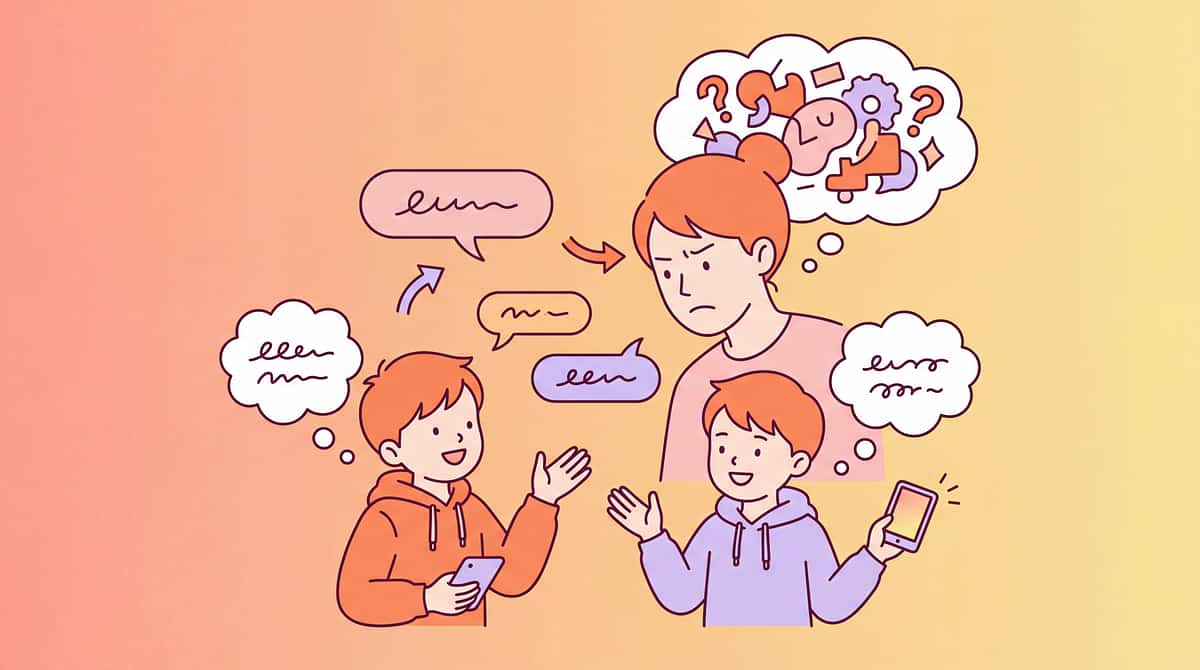
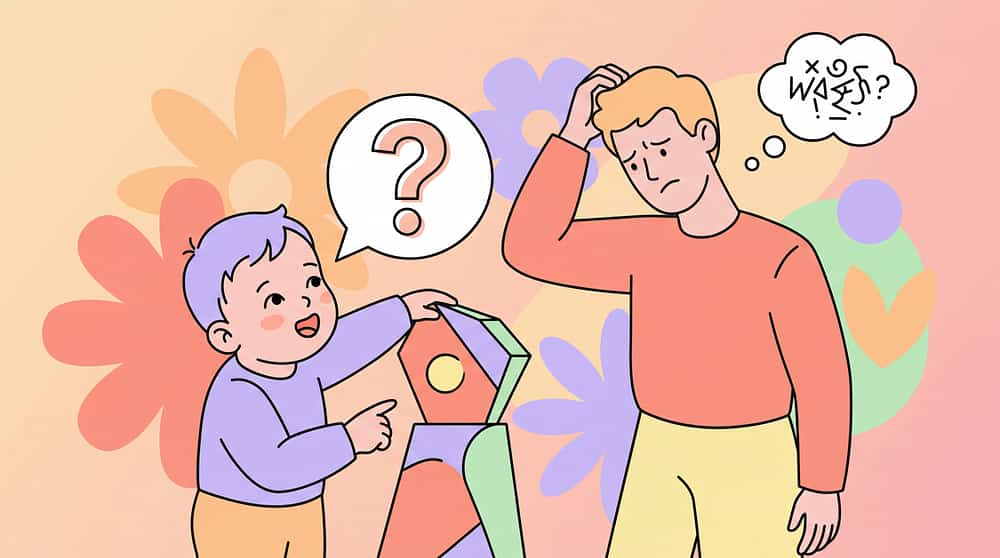
Your child has needs, preferences, and thoughts but no way to express them. Every want becomes a guessing game, every need a potential meltdown.
Moments of Frustration
Communication breakdowns happen constantly - at mealtimes, during play, at transitions. Your child tries to tell you something, but the message gets lost, leading to tears and tantrums.
Immediate Needs
When your child needs something right now - more food, help with a toy, or to signal they're done - there's no quick way to communicate. The waiting, the guessing, the frustration builds.
Seeking Simple Solutions
You need a communication method that's low-tech, always available, and doesn't require complicated setup or training. Something you can use immediately, anywhere, anytime.
The Science Behind It
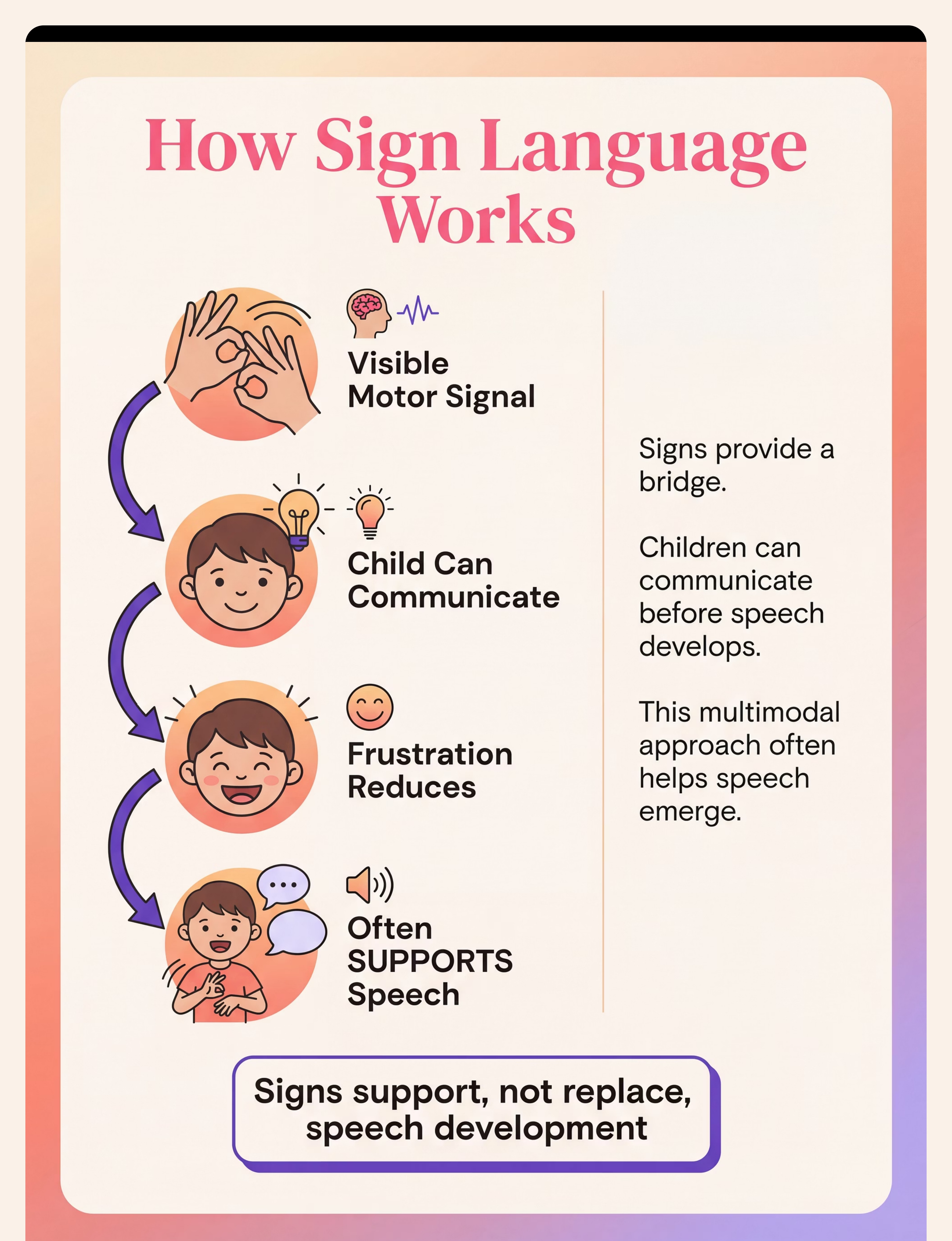
Signs Provide Visible Communication
Manual gestures create a motor-based communication system that children can see, imitate, and produce
Communication Before Speech
Children can communicate their needs and wants using hand movements before their verbal speech systems are ready
Frustration Reduces
Having a way to be understood decreases behavioral challenges caused by communication breakdowns
Speech Development Supported
Signs often trigger verbal attempts - children frequently say words while signing, creating multimodal communication
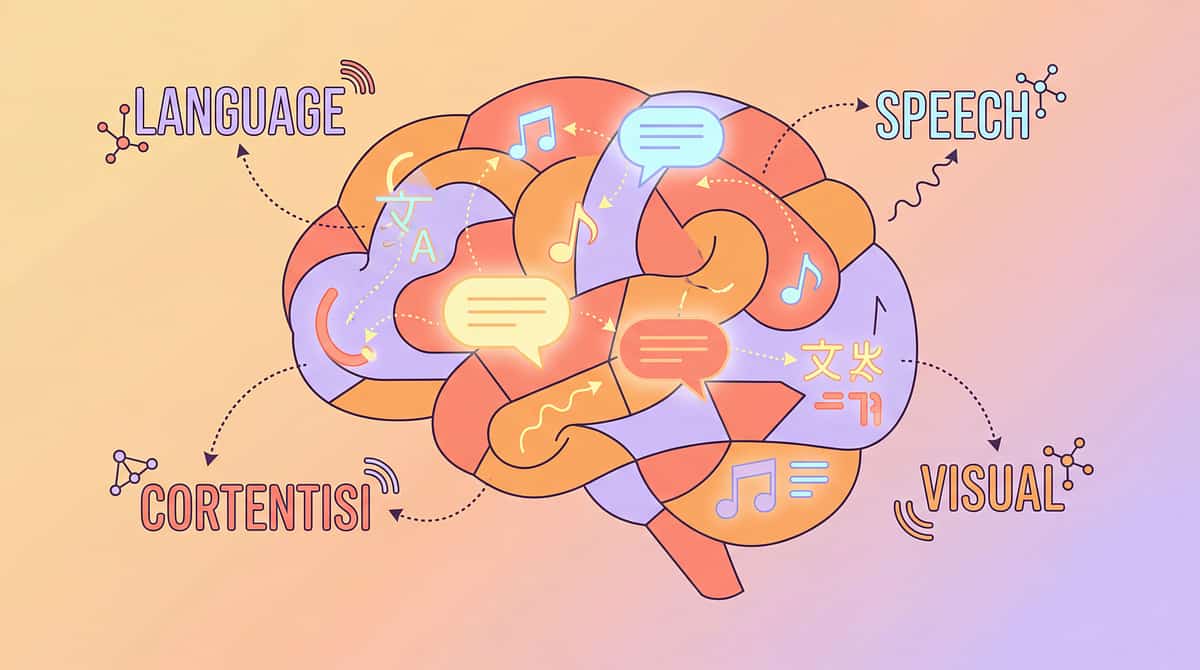
The mechanism works through providing an alternative motor pathway for communication. When signs are consistently paired with spoken words, they create a bridge that actually facilitates language development rather than hindering it.
Target Areas:
Expressive Communication
Language Bridge
Motor-Based Communication
Frustration Reduction
Speech Support
How to Use It Right
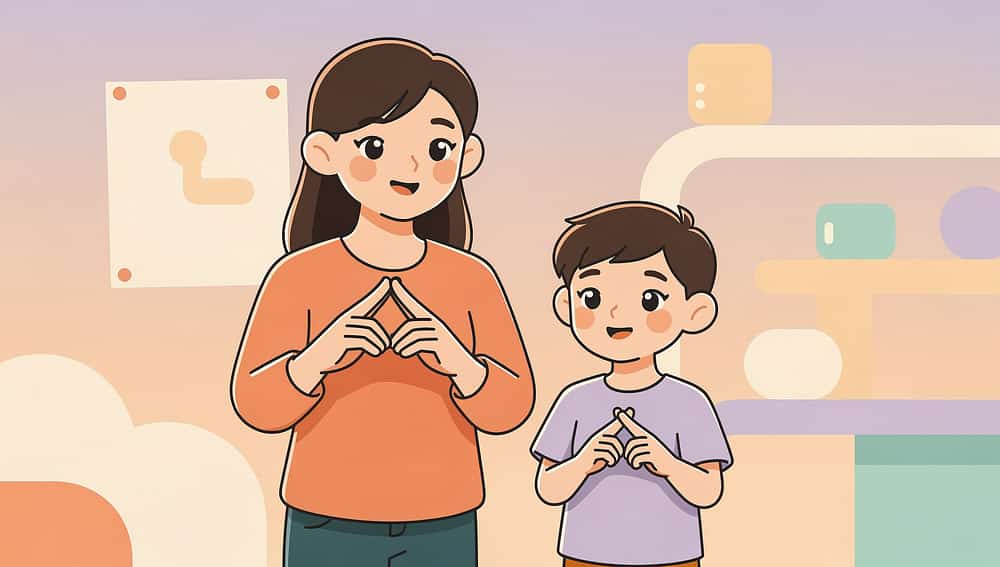
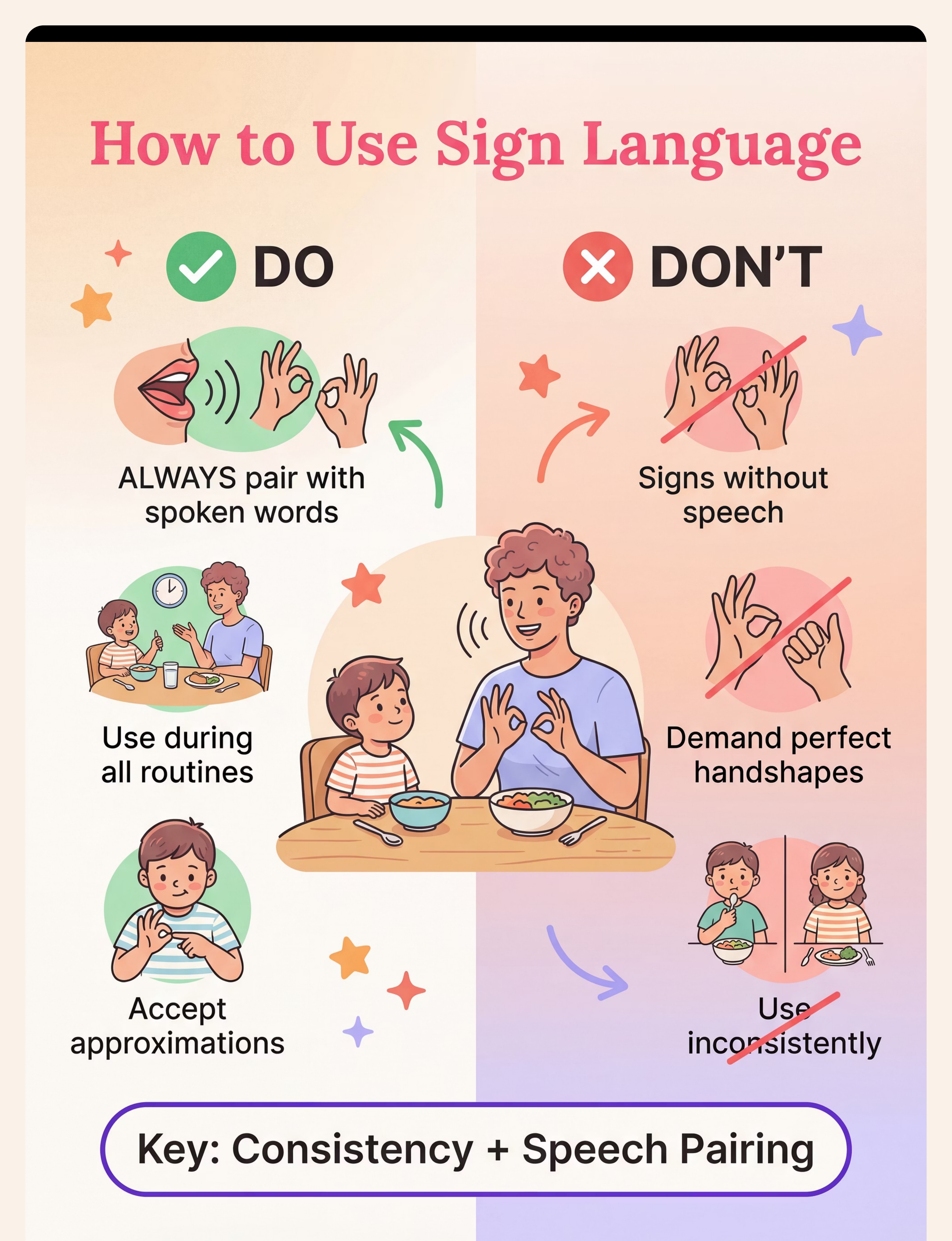
Pair Signs WITH Speech
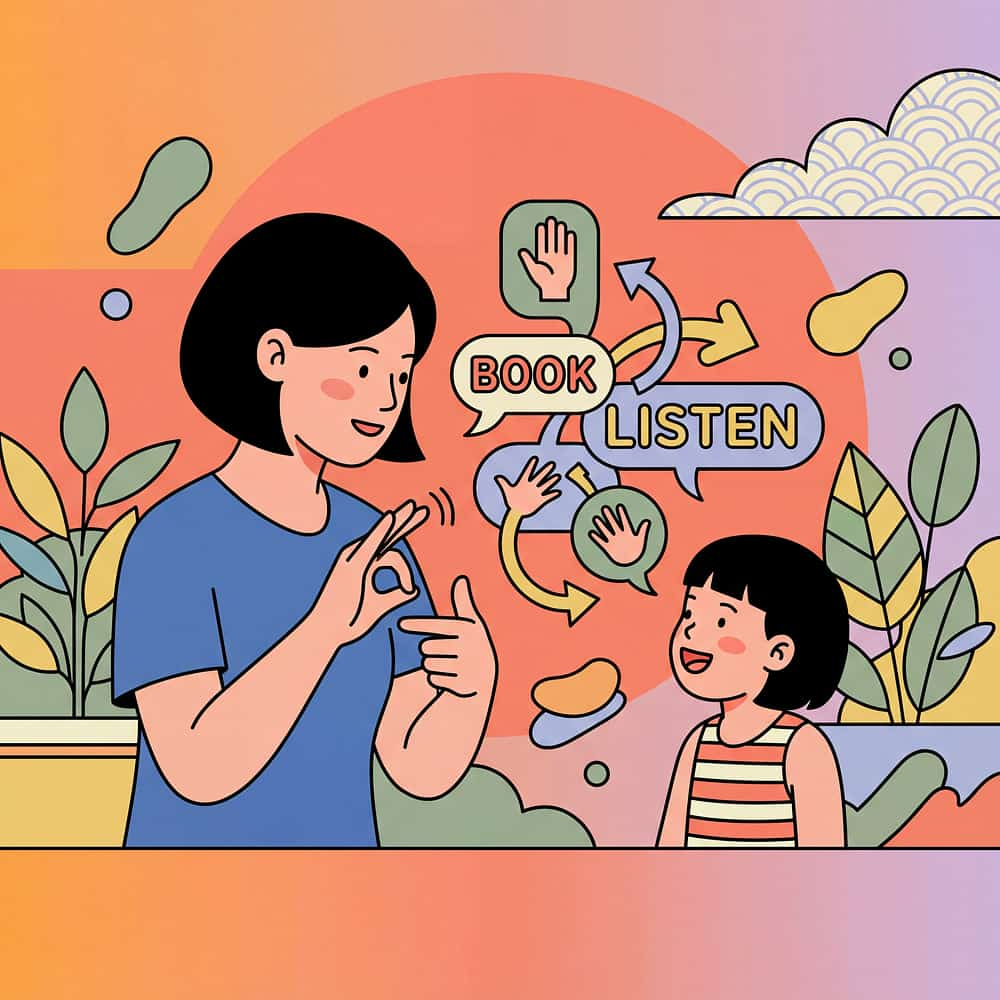
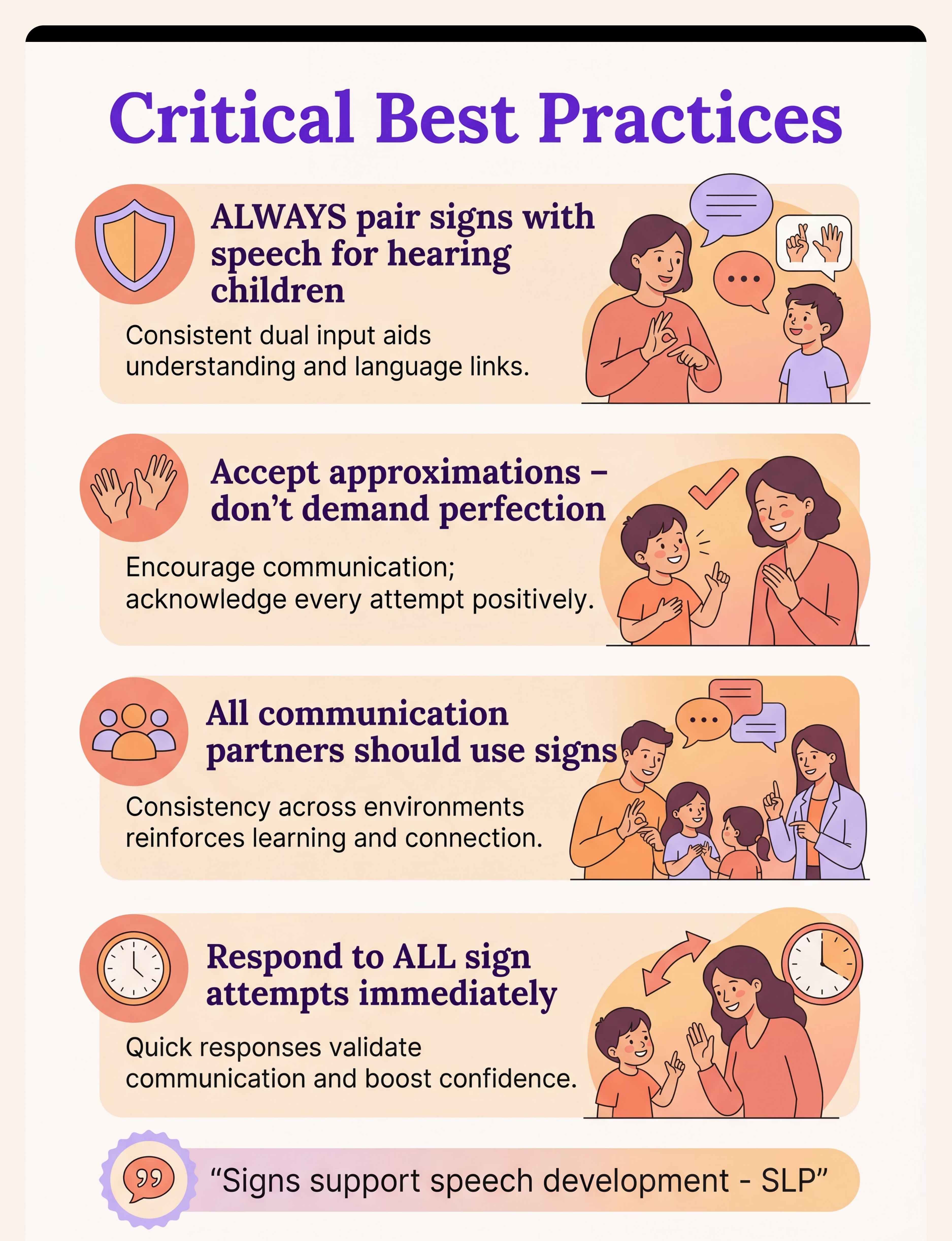
Always use total communication - say the word clearly while making the sign. This supports language development on multiple pathways and helps most hearing children eventually transition to verbal speech.
Start with Motivating Signs
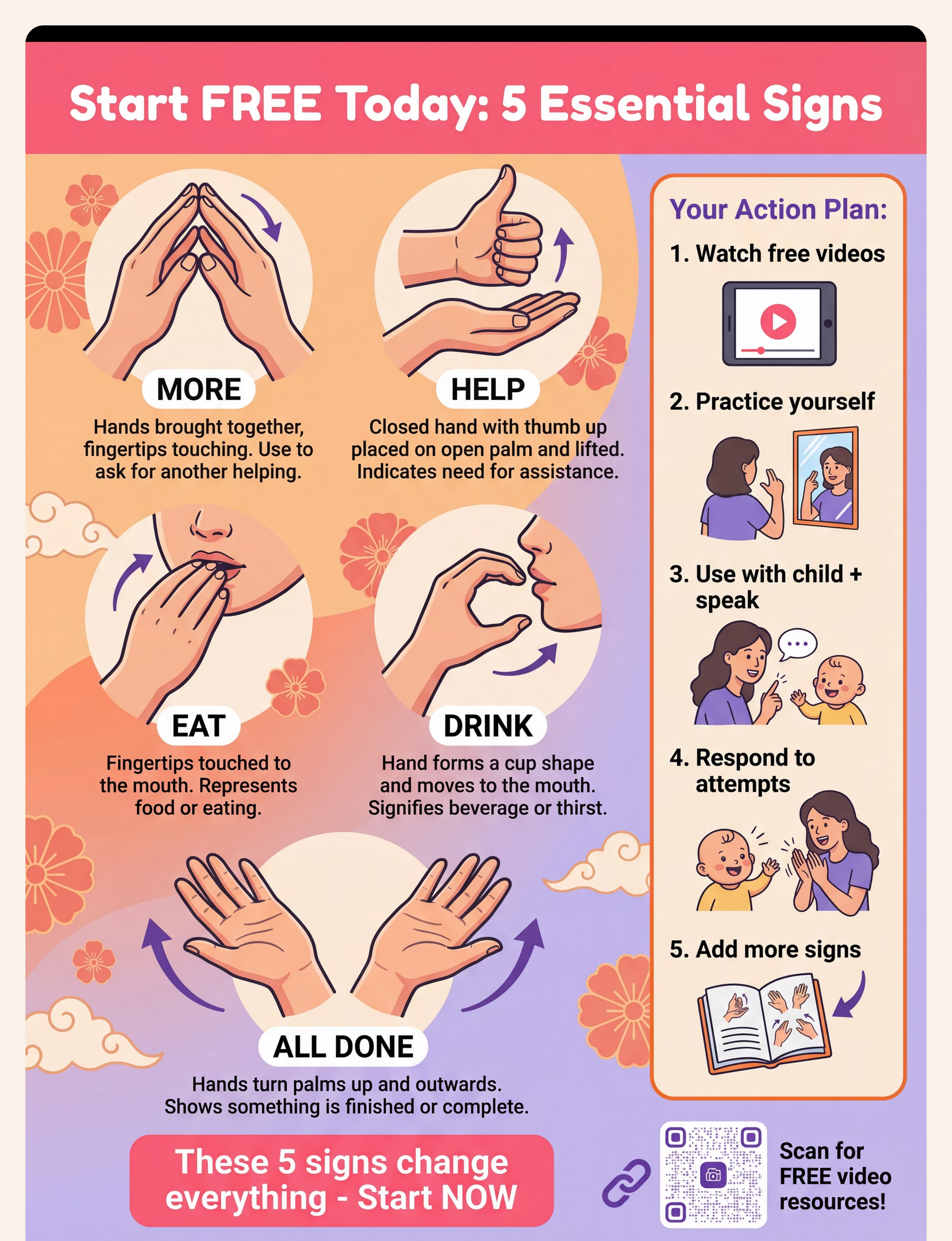
Begin with signs for things your child really wants: MORE, EAT, HELP, ALL DONE. These high-value words create immediate communication success and motivation to continue learning.
Be Consistent
Use the exact same sign every single time for each word. Consistency helps your child learn the connection between the gesture and its meaning faster.
Get Everyone on Board
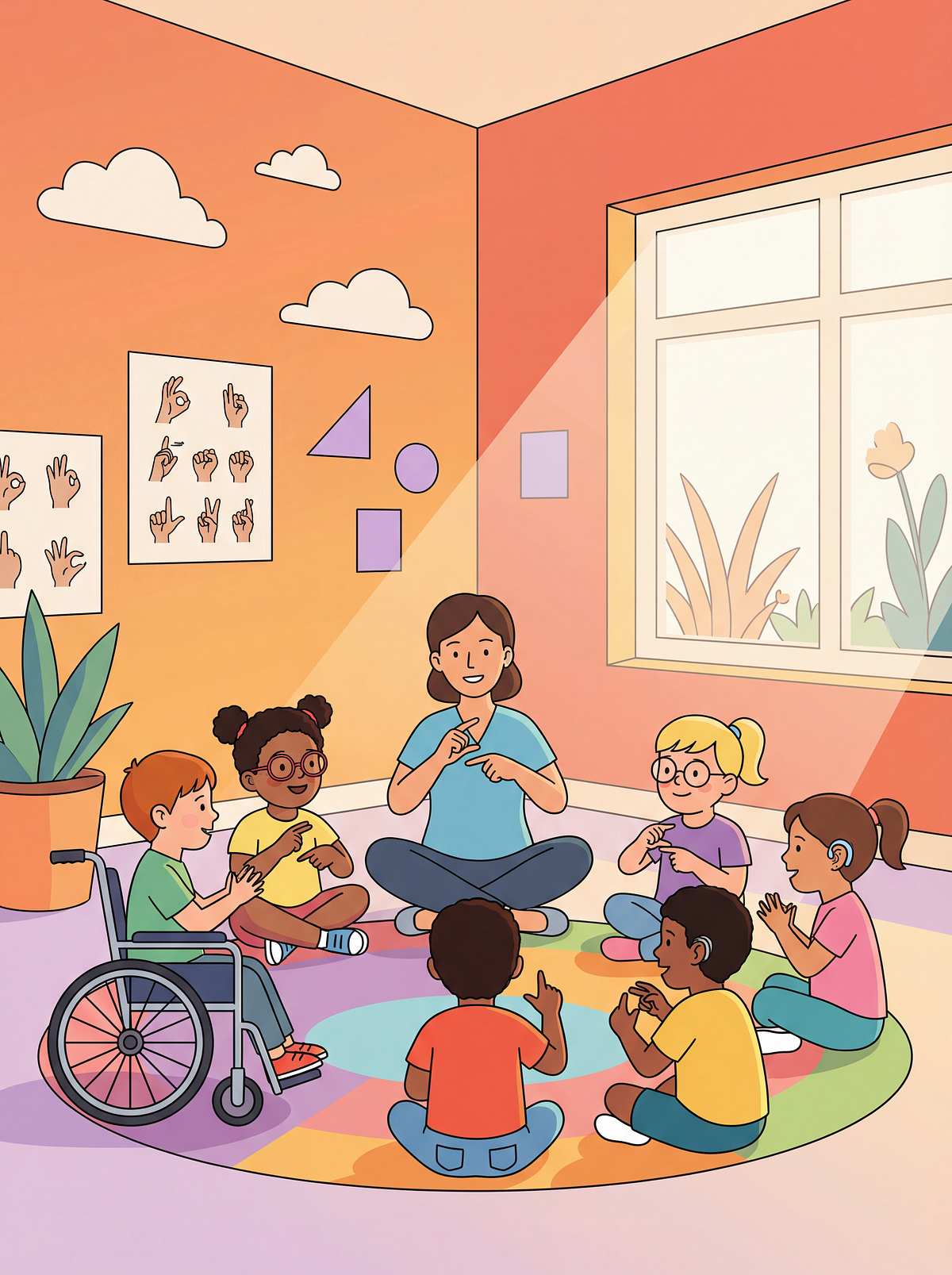
All communication partners - parents, siblings, grandparents, therapists, teachers - should use the same signs. Communication works best when everyone speaks the same language.
Accept Approximations
Don't require perfect handshapes or movements. If your child makes any consistent gesture for a word, that's their sign. Respond to attempts, not perfection.
Signs Support, Not Replace
Remember that for most hearing children, signs are a bridge to speech, not a replacement. Continue modeling spoken language alongside signing.

Duration: Ongoing - signs are always available and can be used throughout your child's day, every day. Most children begin using basic signs within 1-2 weeks of consistent modeling.
Expert Perspective
"Signs give children a way to communicate when speech isn't available yet. For most hearing children with autism, signs SUPPORT speech development - they don't replace it. The key is pairing signs with speech consistently."
— Speech-Language Pathologist
Professional Endorsement
Recommended by: SLP + SpEd
Evidence Level: Strong Evidence
Clinical Ranking: #2 in Communication & Language
Usage Pattern: Constant Use - Core Kit
Choose Your Option (6 Variants)
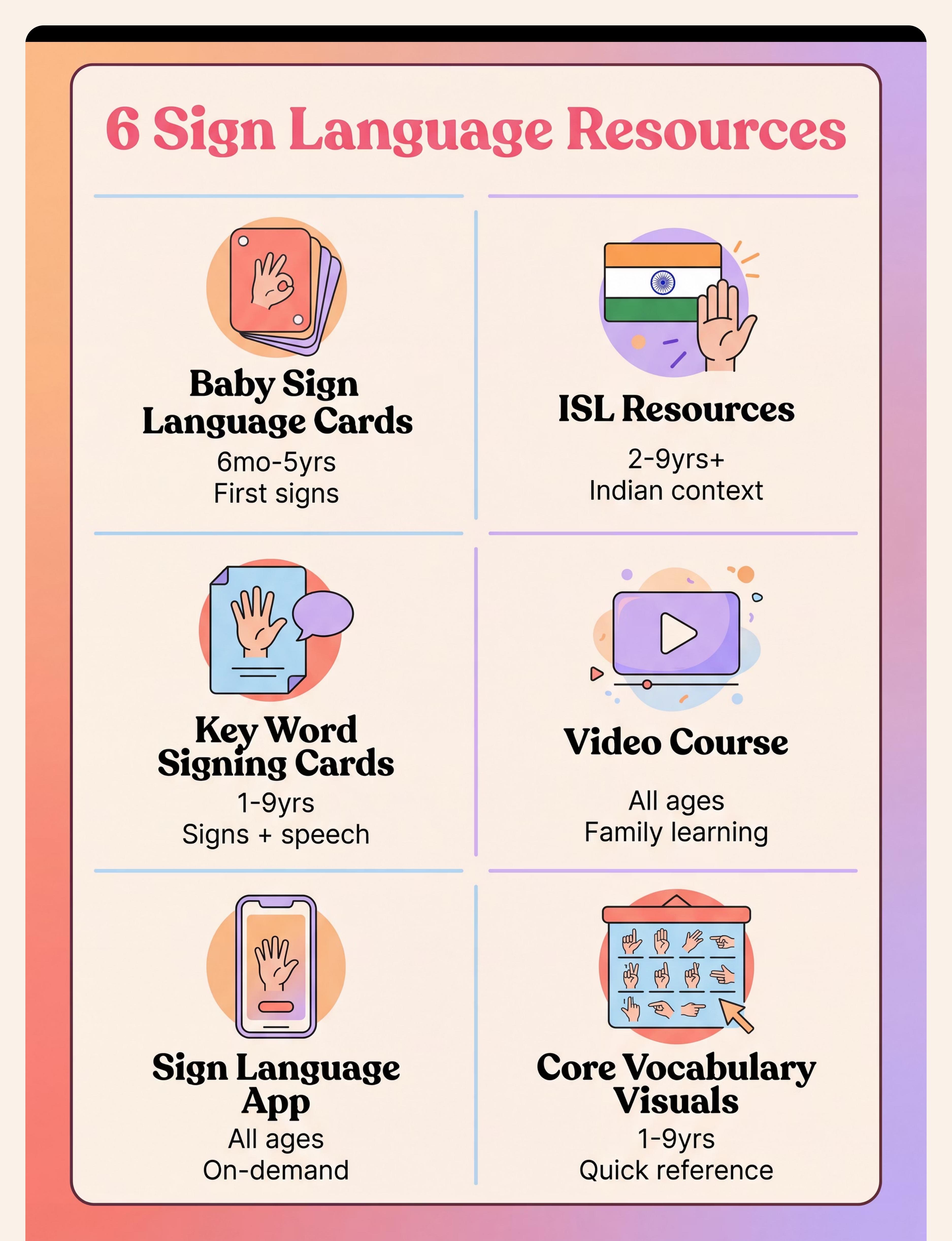
From simple baby sign cards to comprehensive Indian Sign Language resources, there's a signing option for every family's needs, budget, and learning style. Choose based on your child's age, your goals, and where you'll use signs most often.
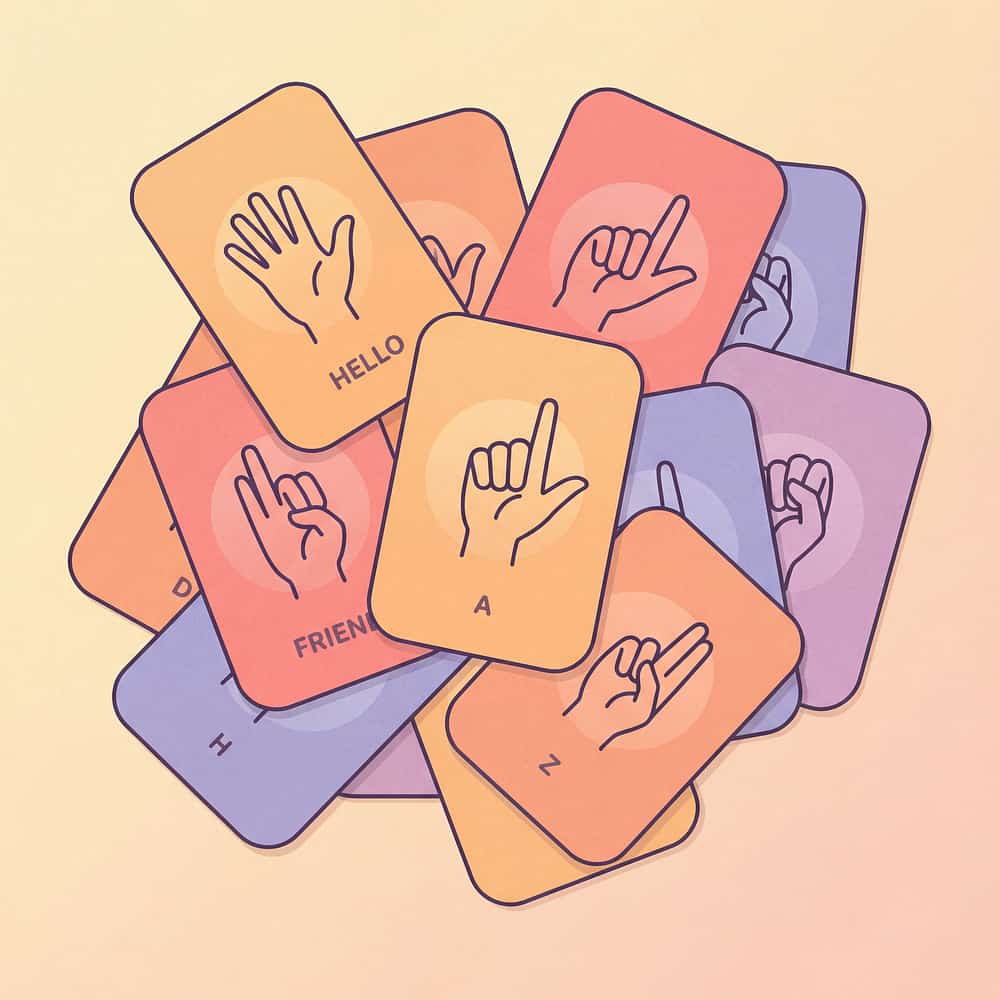
Baby Sign Language Cards/Book
Best for young children and first signs. Focuses on functional communication with basic signs.
Key Word Signing Poster/Cards
Aids in supporting spoken language and total communication by pairing signs with speech.
Core Vocabulary Sign Visuals
Provides quick reference for high-frequency signs with pictures, ideal for classroom display.
Sign Language App
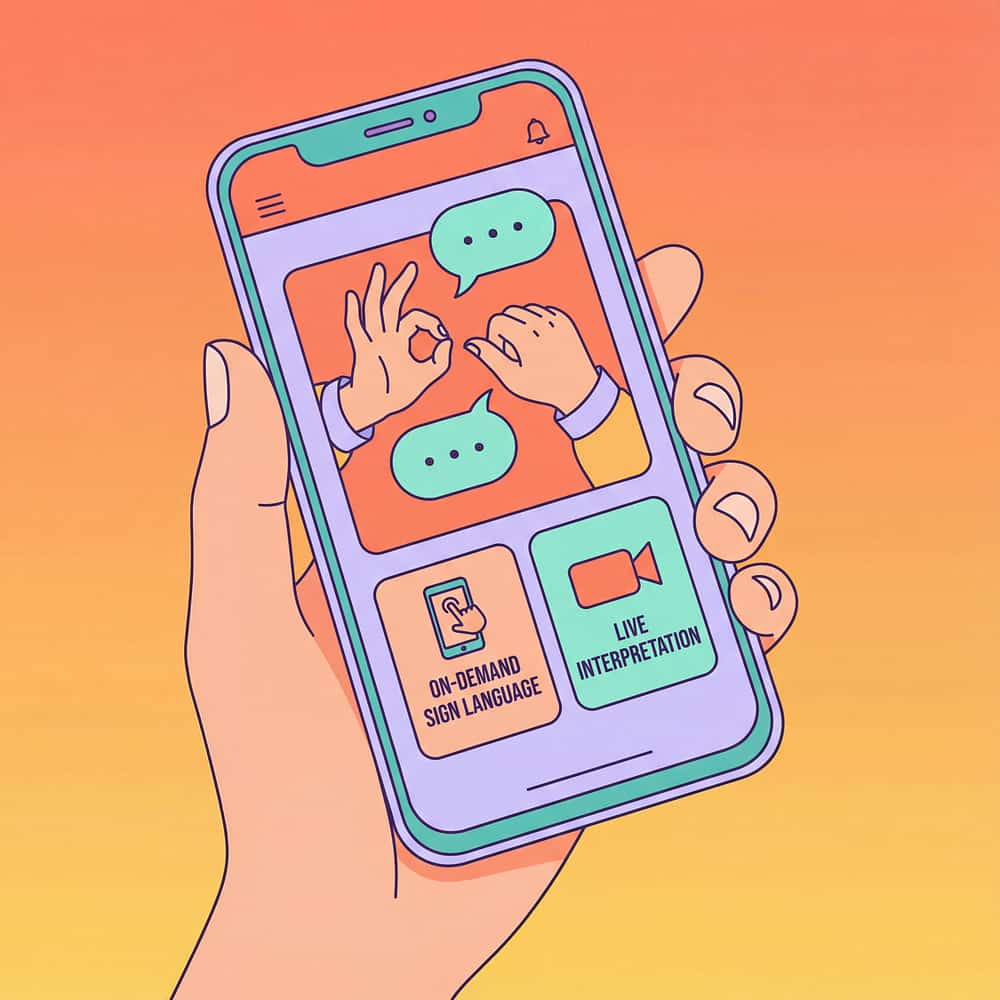
Offers on-demand, interactive sign learning with video references for all ages.
Sign Language Video Course
Comprehensive vocabulary learning through online/DVD courses, suitable for entire family learning.
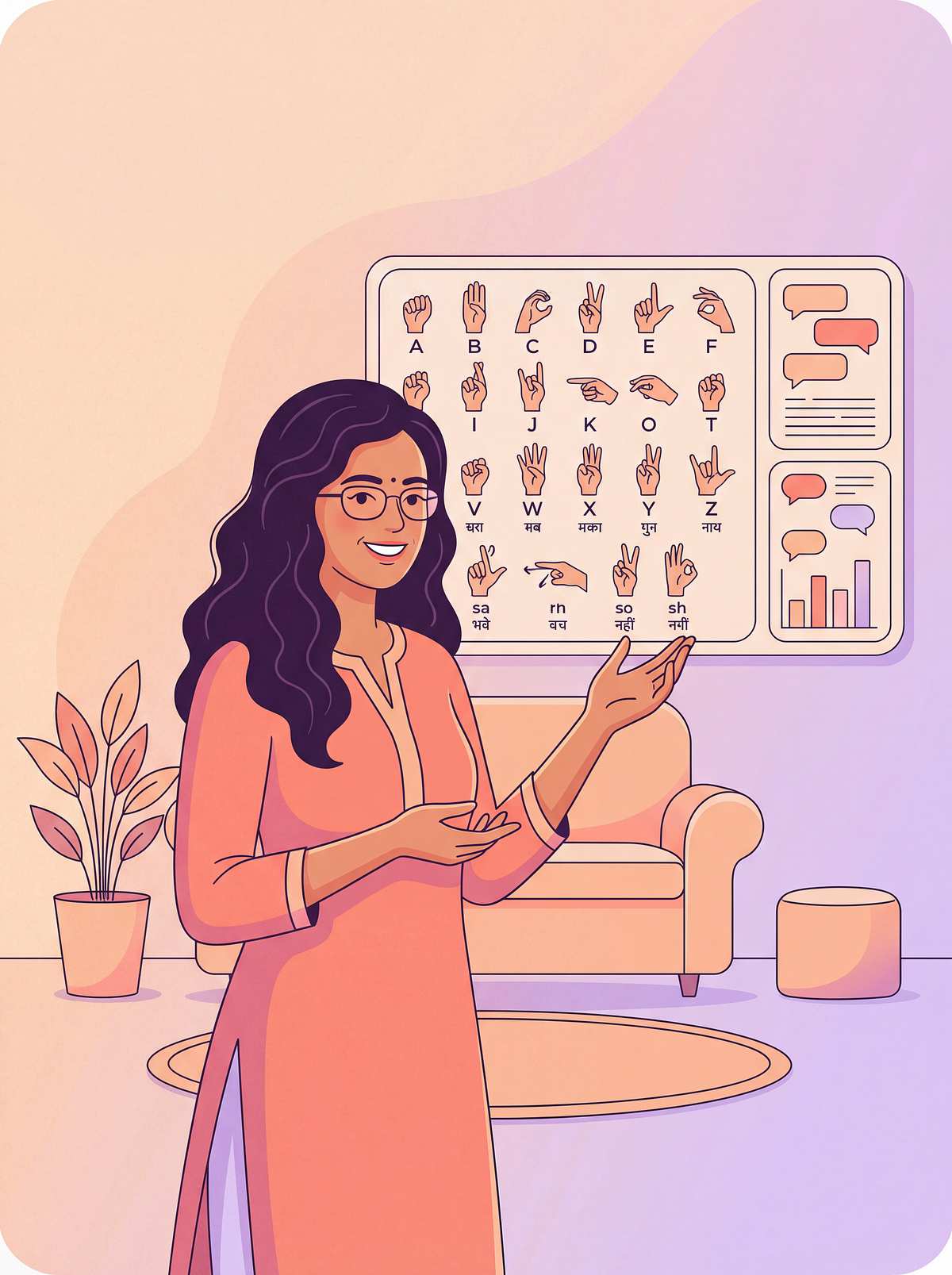
Indian Sign Language (ISL) Resources
Connects to the Indian context and deaf community with dedicated regional sign language resources.
By Goal
  • Immediate communication: Baby signs or key word signing
  • Cultural connection: ISL resources
  • Speech support: Key word signing
  • Family learning: Video course or app
By Setting
  • Home use: Any option works well
  • Classroom display: Posters or core vocabulary visuals
  • On-the-go: Apps for highest portability
  • Clinical practice: Cards or reference materials
Specifications & Types Guide
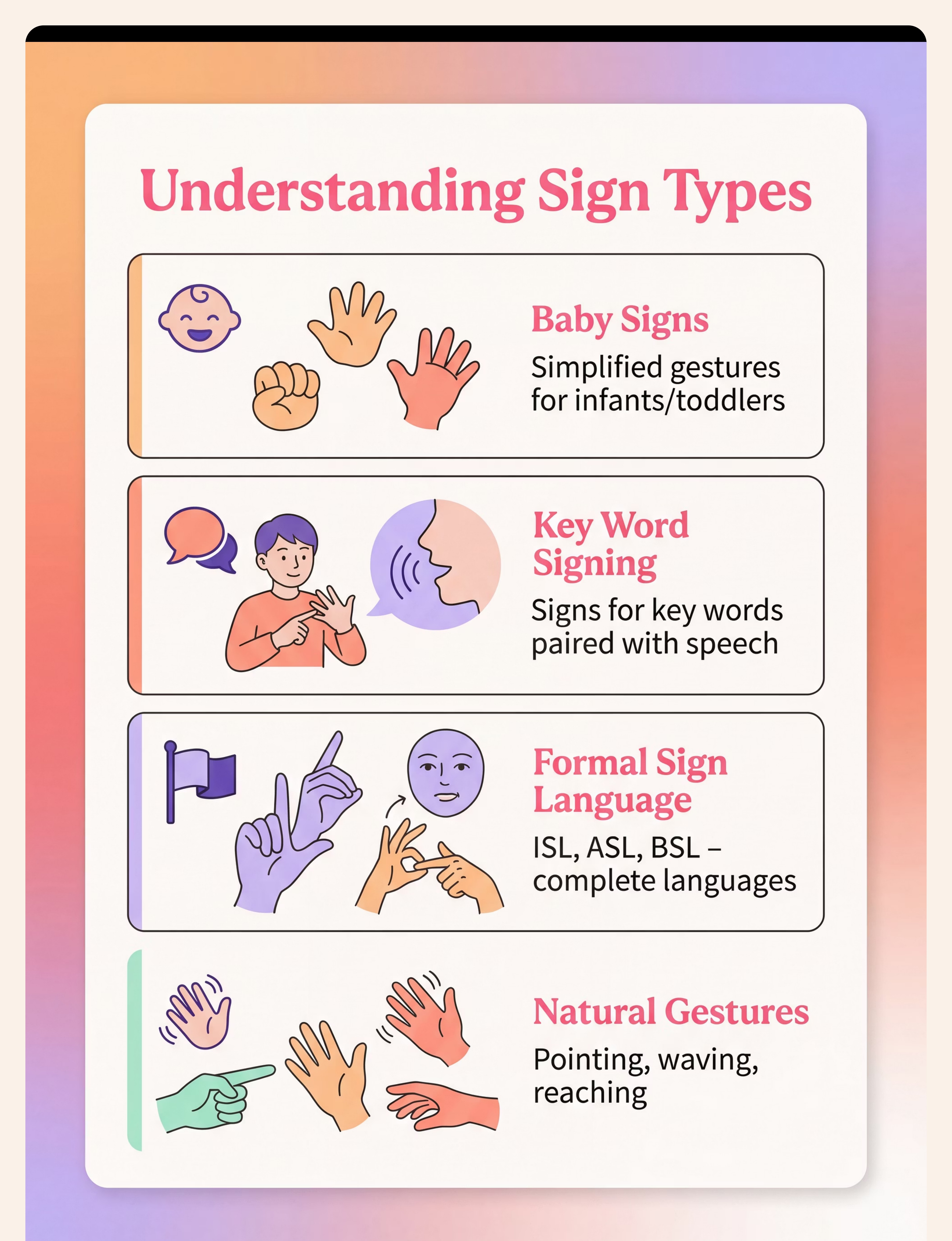
Sign Types
Baby Signs
Simplified gestures designed for infants and toddlers
Best for: First communicators, young children with emerging motor skills
Key Word Signing
Signs for key words paired with speech
Best for: Supporting spoken language development, total communication approach
Formal Sign Language
ISL, ASL, BSL - complete languages
Best for: Deaf community connection, comprehensive communication system
Natural Gestures
Pointing, waving, reaching
Best for: Building on existing communication, earliest stage
Materials & Features
Available Materials
Cards
Portable, durable reference

There was an error generating this image

Books
Structured learning sequence
Videos
Visual demonstration of movement
Apps
Interactive, on-demand access
Posters
Classroom/home display
Key Features
  • Visual demonstration of proper handshapes
  • Consistent use across materials
  • Always paired with speech
  • Focus on functional vocabulary
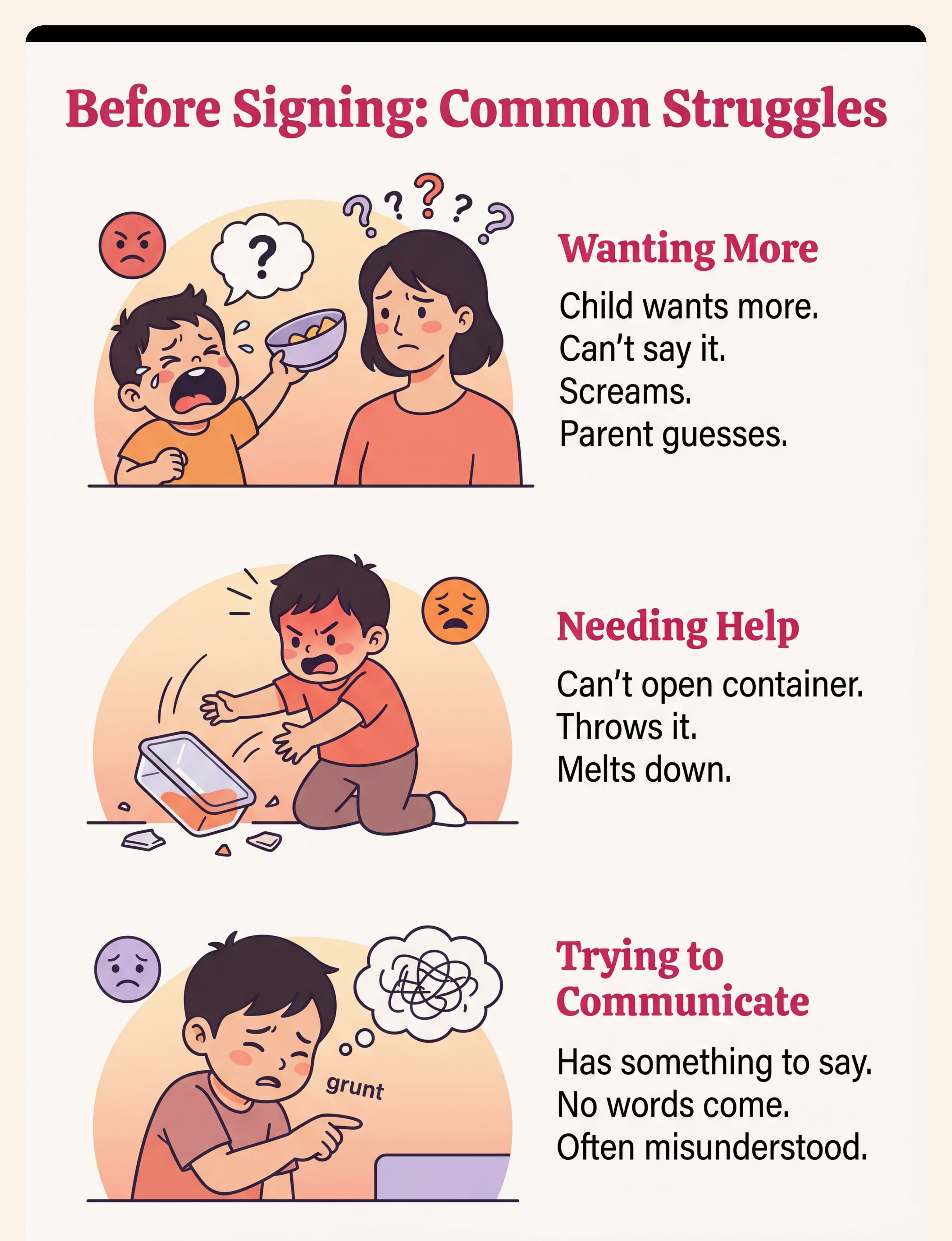
The Struggle (Before)
Wanting More
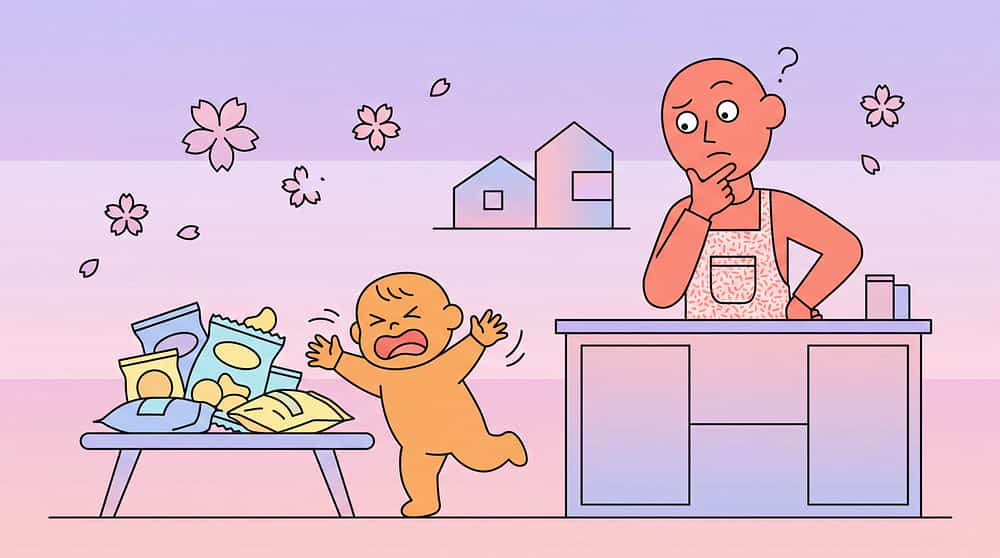
Situation: Child finishes snack. Wants more. Can't say 'more.' Screams. Parent guesses. Eventually realizes child wants more.
Experience: Every request becomes a guessing game, stretching out simple interactions into exhausting battles.
Emotion: Frustration and endless guessing wear down both parent and child.
Needing Help
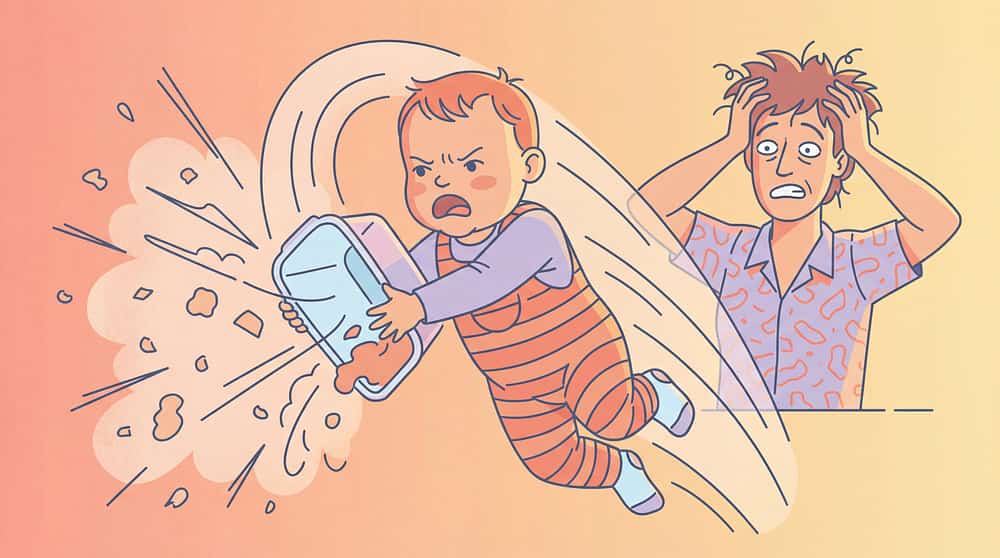
Situation: Child can't open container. Throws it. Melts down. Had no way to ask for help. Behavior was communication.
Experience: Without words, behavior becomes the only language - and it's often misunderstood as defiance rather than need.
Emotion: Frustration escalates into a sense of failure for everyone involved.
Communicating
Situation: Child has something to say. No words come. Points and grunts. Often misunderstood. Gives up trying.
Experience: The gap between wanting to connect and being understood feels impossible to bridge.
Emotion: Resignation and isolation settle in when communication attempts repeatedly fail.
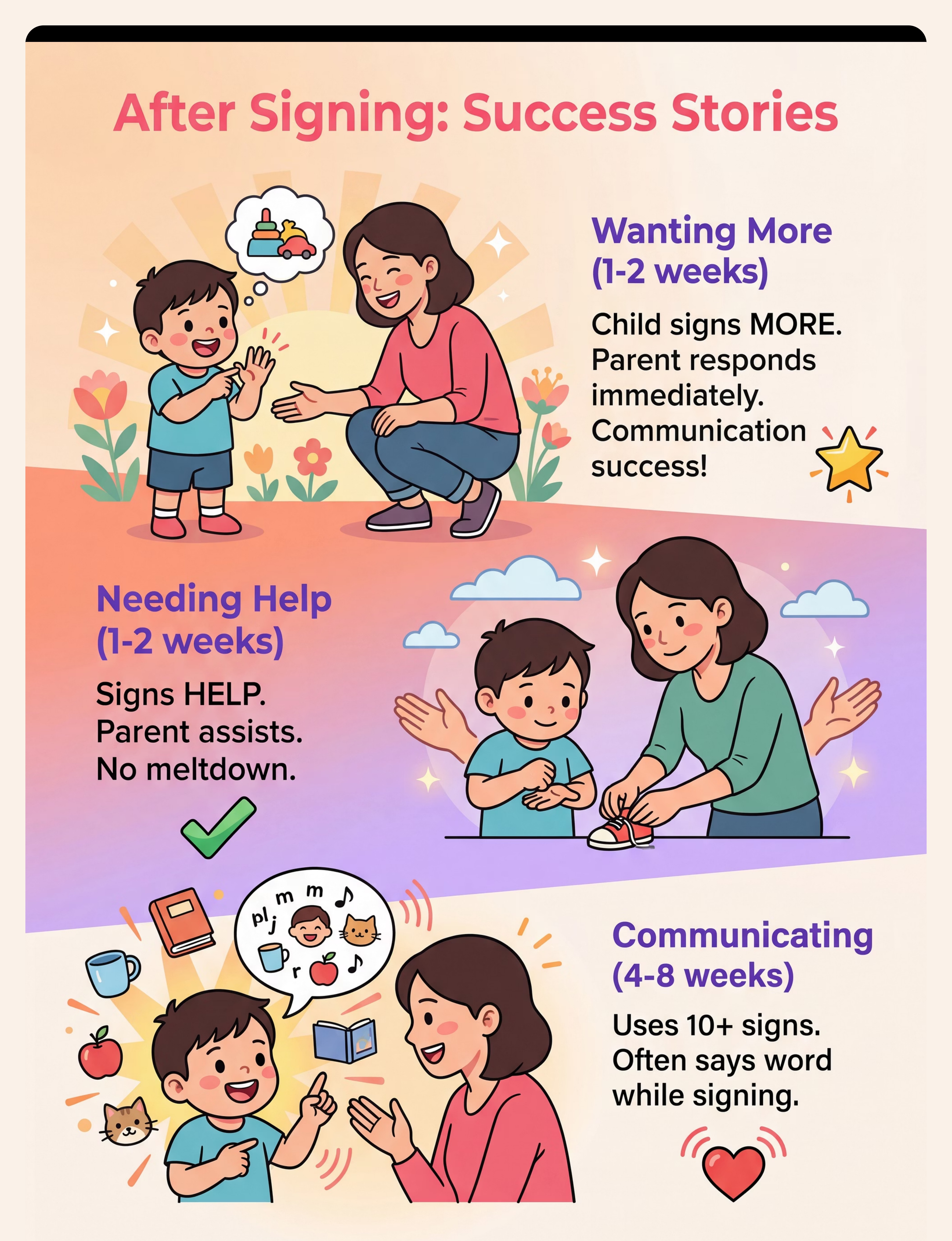
The Breakthrough (After)
Wanting More
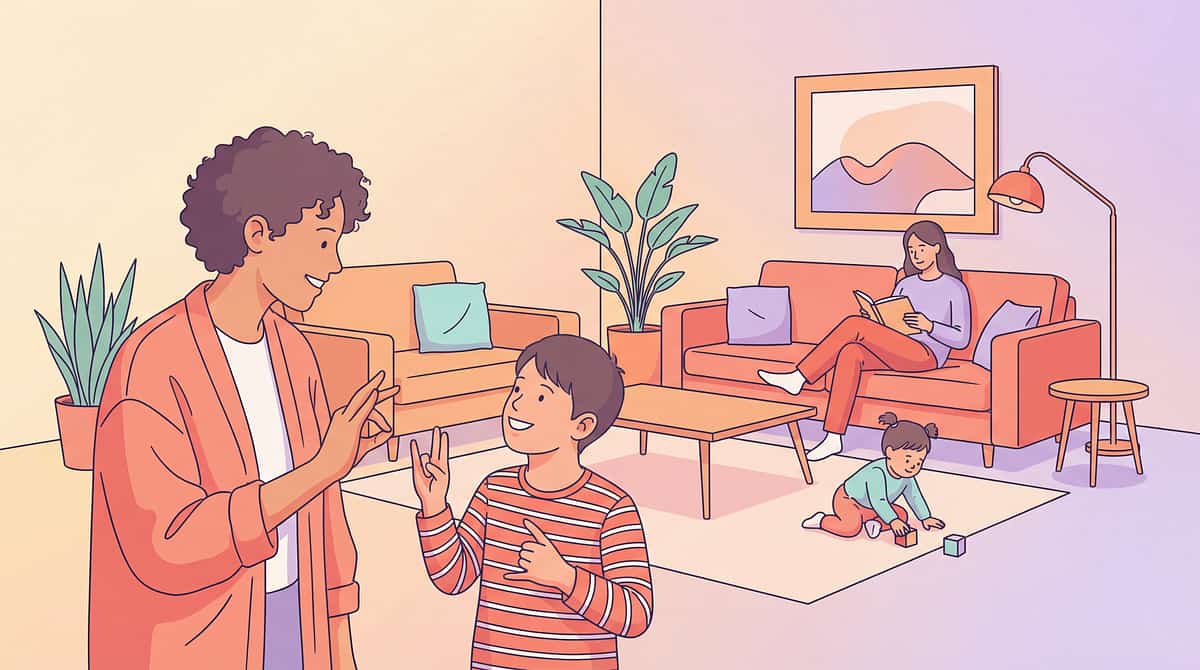
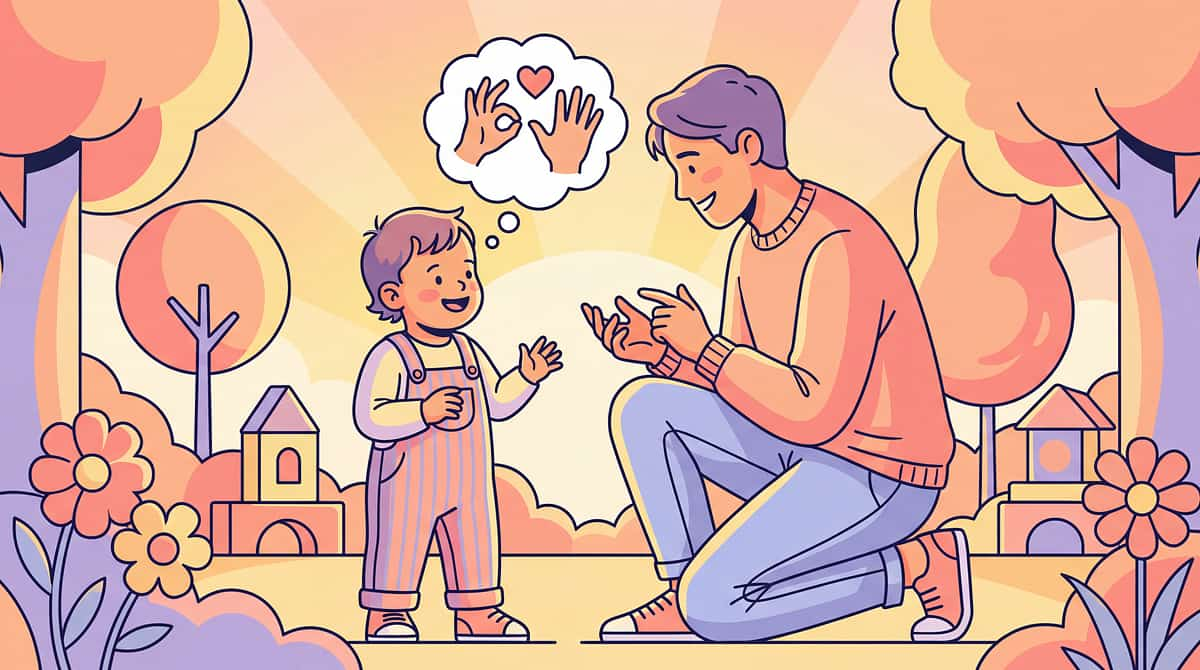
Situation: Child finishes snack. Signs 'MORE' (hands together). Parent responds immediately. Child gets more. Communication success!
Experience: The first time your child successfully communicates a want feels like magic - instant understanding, instant response.
Emotion: Success and empowerment replace frustration.
Timeframe: 1-2 weeks
Needing Help
Situation: Child can't open container. Signs 'HELP' (one hand lifts other). Parent assists. No meltdown. Communication worked.
Experience: Meltdowns decrease dramatically when children have appropriate ways to request assistance.
Emotion: Calm and capability replace chaos and struggle.
Timeframe: 1-2 weeks
Communicating
Situation: Child uses 10+ signs for daily needs. Communication happening. Frustration reduced. Often says word while signing.
Experience: As signing becomes natural, you notice your child frequently vocalizing while signing - speech emerging naturally.
Emotion: Connection and growth transform your daily interactions.
Timeframe: 4-8 weeks
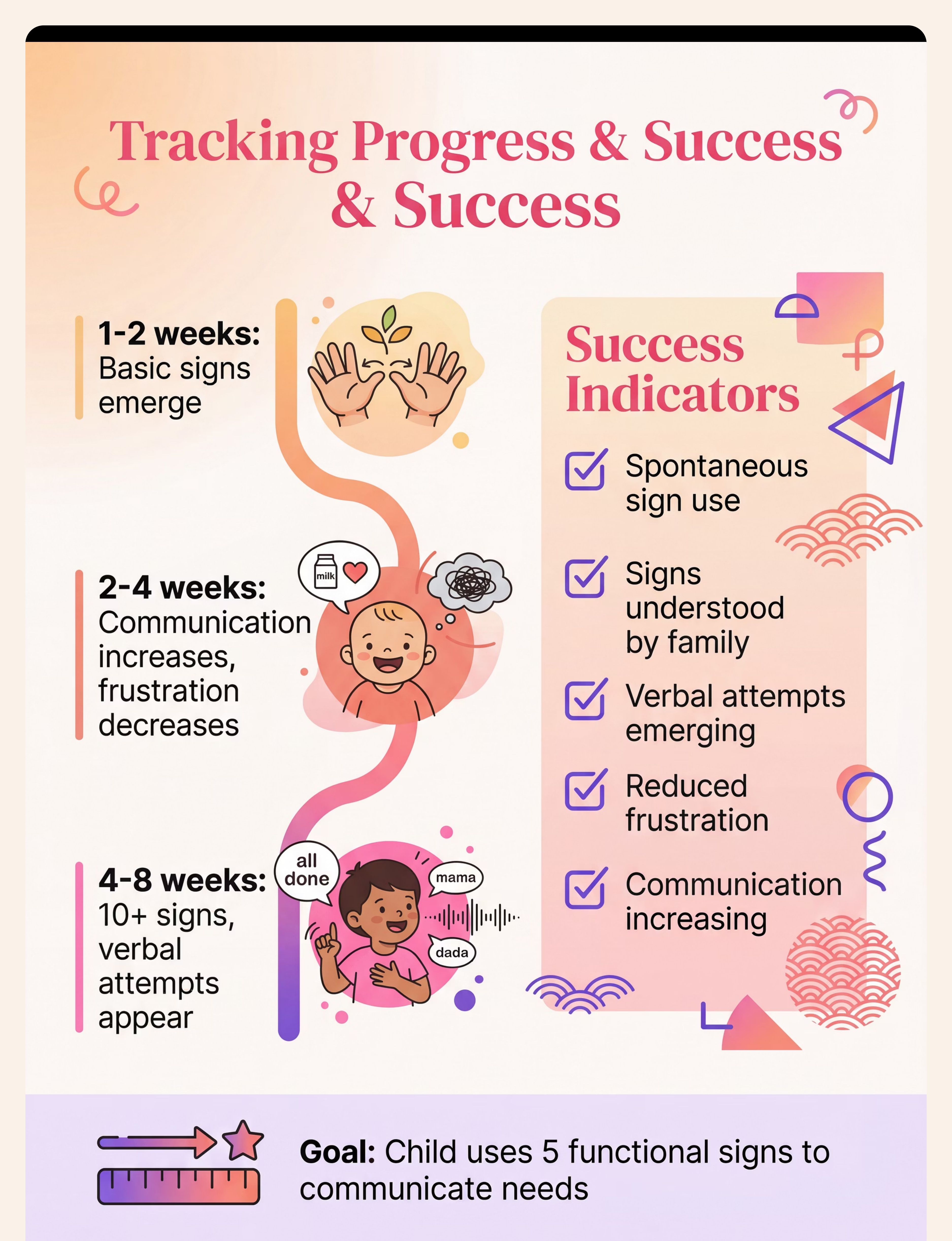
What to Expect (Realistic Timelines)
Sign language creates both immediate and long-term communication improvements. Here's what you can realistically expect as your child learns to sign:
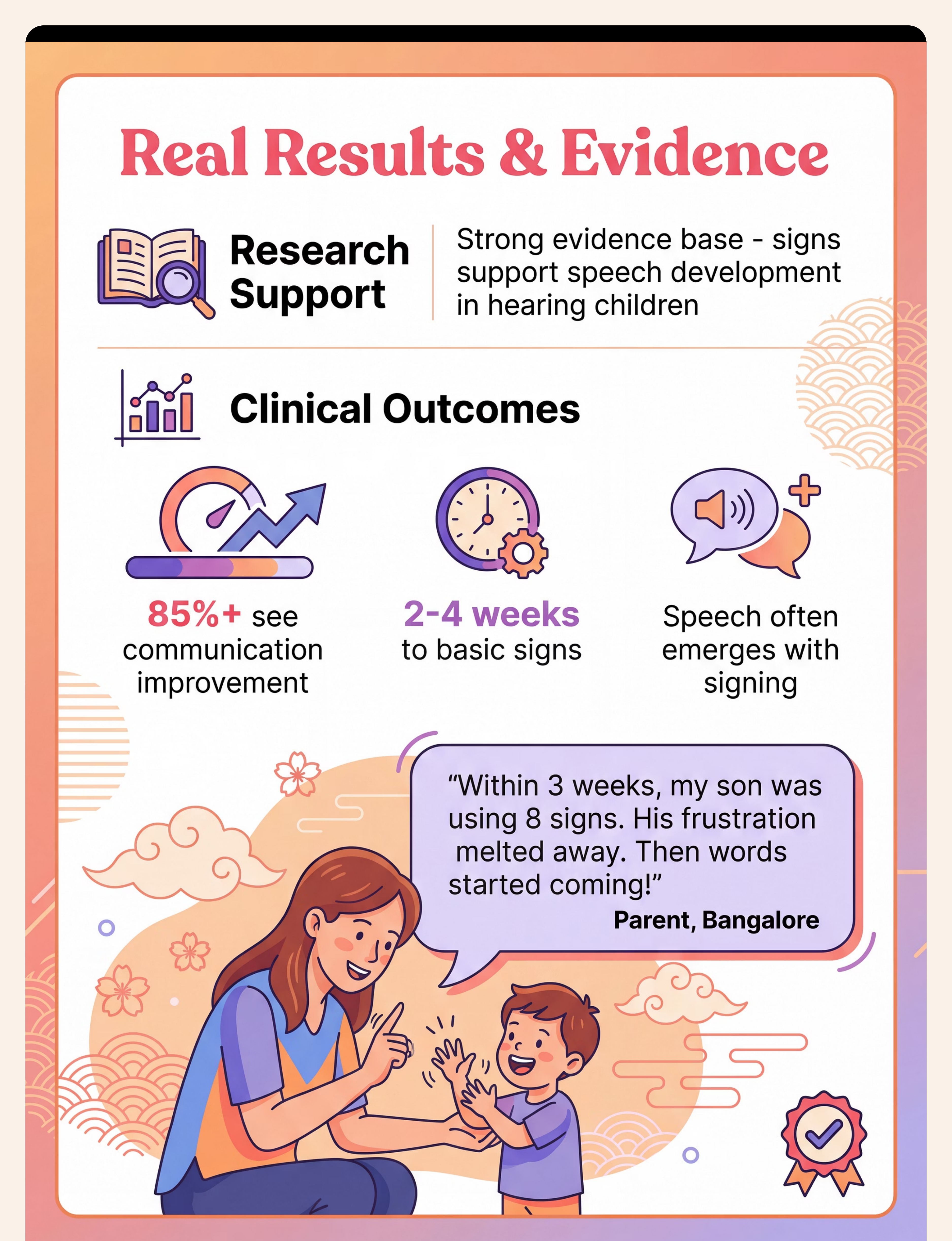
Child has immediate communication tool
Even basic sign exposure gives your child a new way to try communicating
1-2 weeks
Basic needs communicable via signs
Core functional signs become reliable communication tools
2-4 weeks
Frustration-based behavior decreases
Communication success reduces behavioral challenges significantly
2-4 weeks
Signs often accompanied by verbal attempts
Many children begin vocalizing while signing as speech emerges
4-8 weeks
Bridge to speech for many children
Signs facilitate rather than hinder speech development for most hearing children
Ongoing
Multimodal communication established
Your child develops flexible communication using signs, words, and other methods
Ongoing
Is This Right for My Child? (2-Minute Check)
Answer these four questions to determine if sign language is a good fit for your child's communication needs:
Does your child have motor skills to make hand movements?
If yes, this indicates: Can learn signs
Is your child pre-verbal or minimally verbal?
If yes, this indicates: Signs can bridge to speech
Do you want a low-tech, always-available communication option?
If yes, this indicates: Signs are ideal - no device needed
Are you willing to learn and use signs consistently?
If yes, this indicates: Family readiness for signing

Result: 3+ 'yes' answers = strong fit for sign language as a communication strategy
Common Questions (Honest Answers)
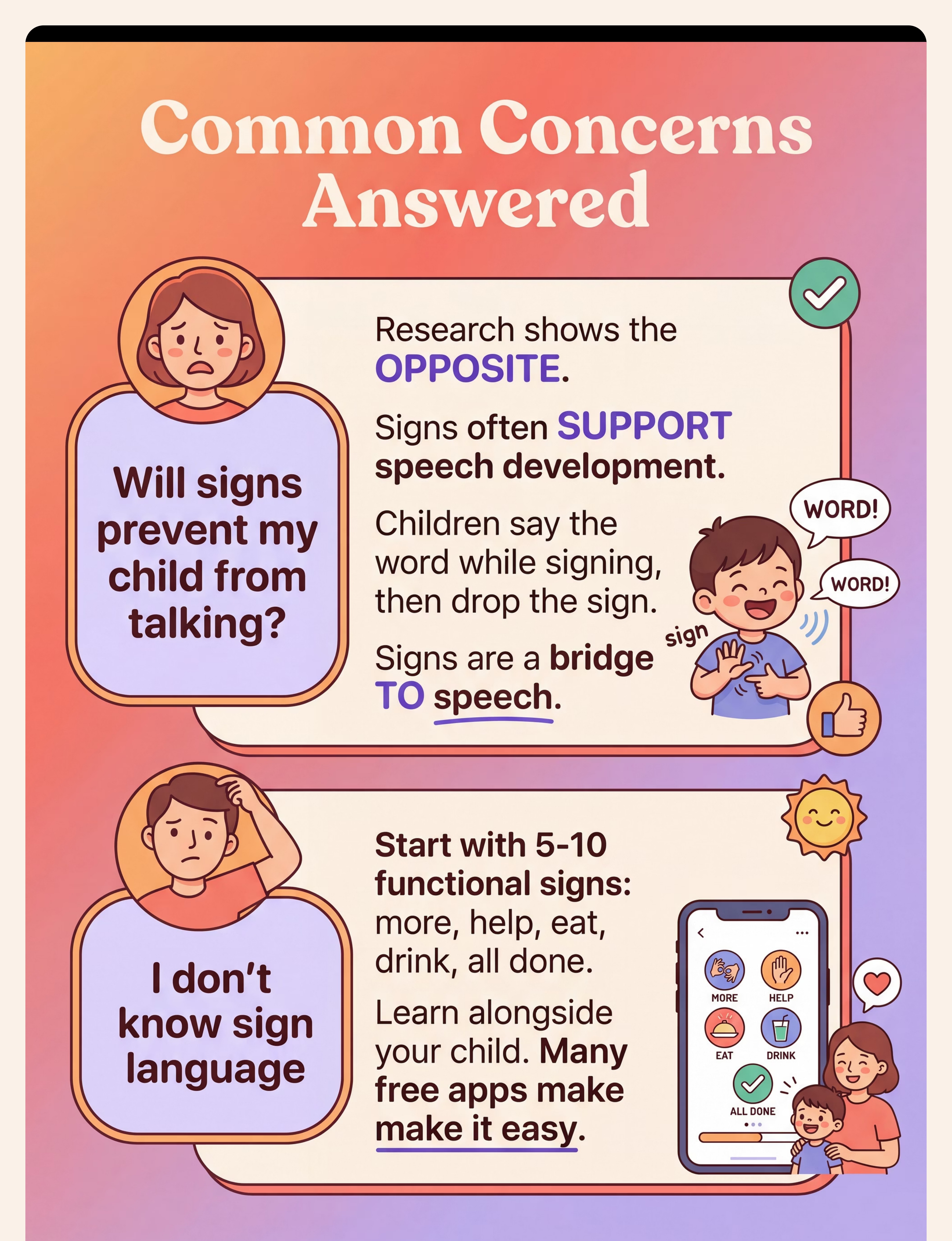
Q: Will signs prevent my child from talking?
A: Research shows the OPPOSITE for most children. Signs often SUPPORT speech development - children frequently say the word while signing, then eventually drop the sign. Signs are a bridge TO speech, not a replacement. The multimodal input actually strengthens language pathways.
Try this: View signs as speech support, not replacement. Always pair signs with spoken words.
Q: I don't know sign language
A: You don't need full sign language! Start with 5-10 functional signs (more, help, eat, drink, all done, want, stop). Learn alongside your child. Many apps and videos make learning easy. You don't need to be an expert - you need to be consistent.
Try this: Learn a few key signs together as a family. Start small and build gradually.
Q: Nobody else will understand the signs
A: Primary goal is family communication. But many basic signs are intuitive. Also teach signs to key people (school, therapy). Signs can be used alongside other AAC for broader communication. Your child can also develop their own modified signs that work for your family.
Try this: Combine signs with other communication methods. Create a simple reference card for regular caregivers.
Q: My child's motor skills aren't good enough
A: Accept approximations! If child makes ANY consistent gesture for a word, that's their sign. Signs can be adapted for motor limitations. Don't require perfection - require communication. The goal is understanding, not perfect handshapes.
Try this: Adapt signs to child's motor abilities. Celebrate attempts, not perfection.
Usage Guide
When to Use
When NOT to Use
All communication opportunities throughout the day
Don't use signs WITHOUT speech (for hearing children)
ALWAYS pair signs with spoken words for hearing children
Don't demand sign before responding (initially - respond to attempts)
During routines (meals, bath, play, transitions)
Don't use inconsistently (confuses child about meaning)
When teaching new words and concepts
Don't require perfect handshapes (accept approximations)
When child is communicating or trying to express something

Supervision by Age
Age Range
Supervision Level
Notes
Infant (6 months - 1 year)
Adult models constantly
Receptive understanding develops before production
Toddler (1-3 years)
Adult models and reinforces attempts
Accept approximations, respond to all attempts
Preschool (3-5 years)
Child uses independently, speech often emerges
Signs may fade naturally as speech develops

Duration: Ongoing - signs are always available. Many families continue using some signs even after speech develops, especially for quiet communication or emphasis.
Safety First
Critical Safety
  • ALWAYS pair signs with speech for hearing children
  • Accept approximations - don't demand perfection
  • Respond to ALL sign attempts to encourage communication
  • All communication partners should use signs consistently
Warnings
  • Don't use signs as ONLY communication (use with speech)
  • Don't stop signing when speech emerges (allow natural fade)
  • Ensure signs are functional, not just labels
  • Watch for frustration if signs not understood by others
Contraindicated
  • Using signs without accompanying speech for hearing children
  • Requiring perfect handshapes before responding
  • Inconsistent use across communication partners

Safety Checklist
Before You Start
  • Starter signs selected
  • Family members trained
  • Commitment to consistency established
  • Understanding of speech pairing
During Use
  • Always pairing signs with speech
  • Responding to all attempts
  • Modeling consistently
  • Accepting approximations
Signs of Success
  • Child using signs to communicate
  • Frustration decreasing
  • Verbal attempts alongside signs
  • Communication successful
Investment Guide
Sign language resources are among the most affordable AAC options available, with many excellent free resources and low-cost materials for families at every budget level.
Pricing Tiers for Sign Language Resources
Budget Option
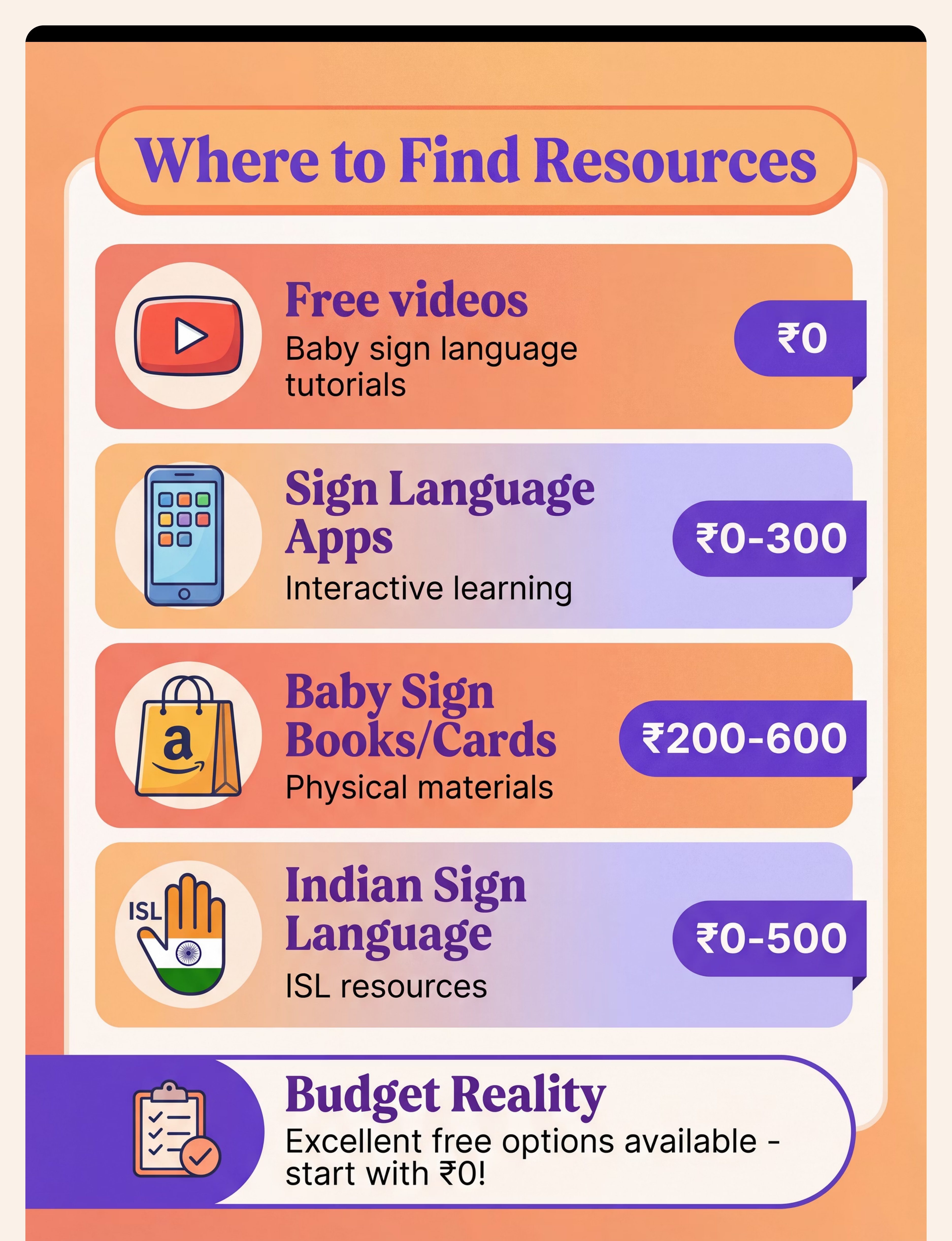
₹0
Free sign language apps and YouTube videos
Excellent free resources for learning basic signs, comprehensive starter vocabularies. Many apps and YouTube channels offer video demonstrations in multiple languages including Hindi and English.
Premium Option
₹500-1,500
Comprehensive sign language course + materials
Structured courses with physical materials, progress tracking, and comprehensive vocabulary building. Options include Baby Signing Time, Signing Savvy, and ISL resources with books, cards, and video components.

Overall Investment Range: ₹0–1,000 (US $0-12) | Tier: Very Low
This is one of the most accessible AAC options available, with quality free resources and affordable paid materials for every budget.
Making the Right Investment
Cost-Effectiveness
Sign language is inherently low-cost, offering immense value with free resources and affordable paid options.
Resource Availability
A wide range of learning materials from apps, videos, courses, and physical tools are readily available.
Family Participation
Accessible options encourage whole-family learning, creating a supportive communication environment.
Long-Term Value
Investing in sign language skills yields significant benefits for communication development and reduces frustration.
Phase 1: Exploration
Begin with free apps and YouTube videos to understand basic signs and assess interest.
Phase 2: Initial Learning
Utilize starter kits or entry-level courses for structured vocabulary acquisition.
Phase 3: Deepening Skills
Invest in comprehensive courses and advanced materials for broader communication skills.
Phase 4: Ongoing Practice
Continuous learning and practice through community groups, advanced resources, and daily use.
Where to Buy in India
Availability: Widely Available (many free options)
YouTube
Search: "baby sign language"
Price: ₹0 (Free)
Extensive free video demonstrations in multiple languages
App Store
Search: "sign language app"
Price: ₹0-300
Interactive learning apps with video demonstrations
Amazon.in
Search: "baby sign language book"
Price: ₹200-600
Physical books and card sets with illustrations
ISL Resources
Search: "Indian Sign Language learning"
Price: ₹0-500
Culturally relevant sign language for Indian context

Buying Tips ✓
Start with 5-10 most useful signs (more, eat, help, drink, all done)
Use video resources - seeing motion is essential for learning signs
Pair EVERY sign with spoken word consistently
Be consistent across family members and settings
Accept approximations - don't demand perfection
Red Flags
Using signs without speech (for hearing children)
Expecting immediate fluency
Only one person signing in the family
Requiring perfect handshapes before responding
DIY Alternative (Save 100%)
Feasibility: Very High | Time: Ongoing learning | Cost Savings: 100%
Materials Needed
  • Free videos/apps
  • Practice time
  • Consistency commitment
Steps to Get Started
  1. Choose 5 starter signs: MORE, HELP, EAT, DRINK, ALL DONE
  1. Watch video demonstrations (YouTube, free apps)
  1. Practice yourself first until movements feel natural
  1. Start using with child - ALWAYS pair with spoken word
  1. Respond immediately when child attempts sign
  1. Add new signs as first ones are learned
  1. Get other family members/caregivers on board

DIY vs Commercial
Consideration
When to DIY (Free)
When to Buy Commercial
Learning approach
Learning basic functional signs, family use only
Want structured curriculum, learning full sign language
Usage context
Bridge to speech, supplementing other AAC
Need physical materials, professional development
Trade-offs
Takes time to learn, requires consistency from all adults
Investment cost, but structured learning path

Preview of sign language gesture communication Therapy Material

Below is a visual preview of sign language gesture communication therapy material. The pages shown help educators, therapists, and caregivers understand the structure and content of the resource before use. Materials should be used under appropriate professional guidance.

Page 1
Page 2
Page 3
Page 4
Page 5
Page 6
Page 7
Page 8
Page 9
Page 10
Page 11
Page 12
Page 13
Page 14
Page 15
Page 16
Page 17
Page 18
Page 19
Page 20
Link copied!
Measuring Success & Next Steps
Track Progress
Measure First (Baseline)
  • Current communication methods your child uses
  • Words and signs child already produces
  • Communication frustration level (frequency of meltdowns)
  • Motor imitation skills (ability to copy movements)
Set Goals
  • Child will use 5 functional signs to communicate needs
  • Child will pair sign attempts with verbal attempts
  • Communication breakdowns will decrease by 50%
  • Signs will expand to 20+ vocabulary words
Success Indicators
  • Spontaneous sign use (without prompting)
  • Signs understood by family members
  • Verbal attempts emerging alongside signs
  • Reduced frustration and behavioral challenges
  • Communication increasing overall
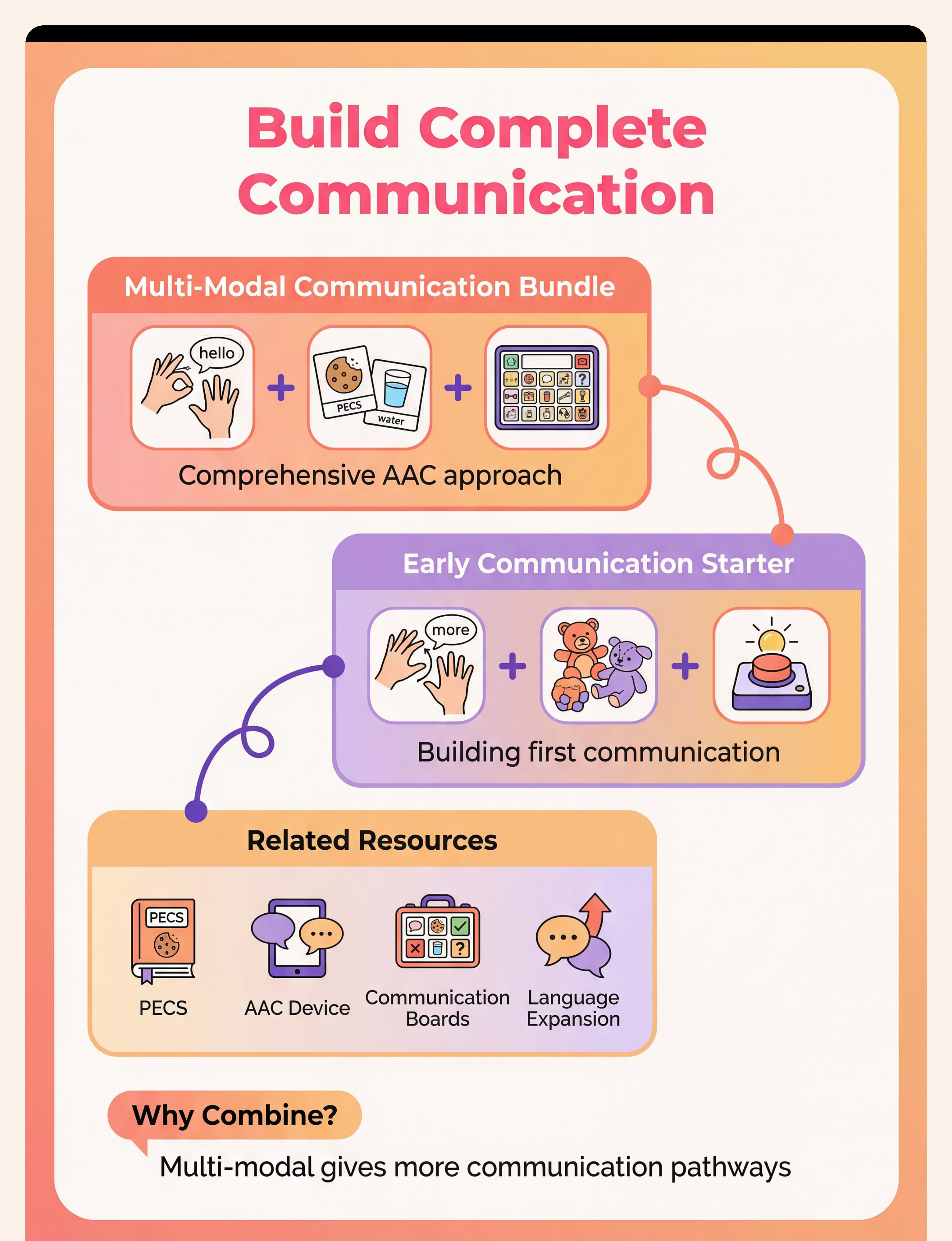
Complete the Kit
Pair It With...
PECS (Tool ID: 5.1)
Multi-modal AAC - combine picture exchange with signing for comprehensive communication
AAC Device (Tool ID: 5.3)
High-tech option - signs work as backup when devices aren't available
Communication Boards (Tool ID: 5.2)
Visual backup - combine signs with visual supports
Language Expansion (Tool ID: 5.5)
Building on signs - expand vocabulary and language complexity
Multi-Modal Communication Bundle
Includes: Sign Language (5.4) + PECS (5.1) + Communication Boards (5.2)
Use case: Comprehensive AAC approach using multiple communication methods

Quick Summary
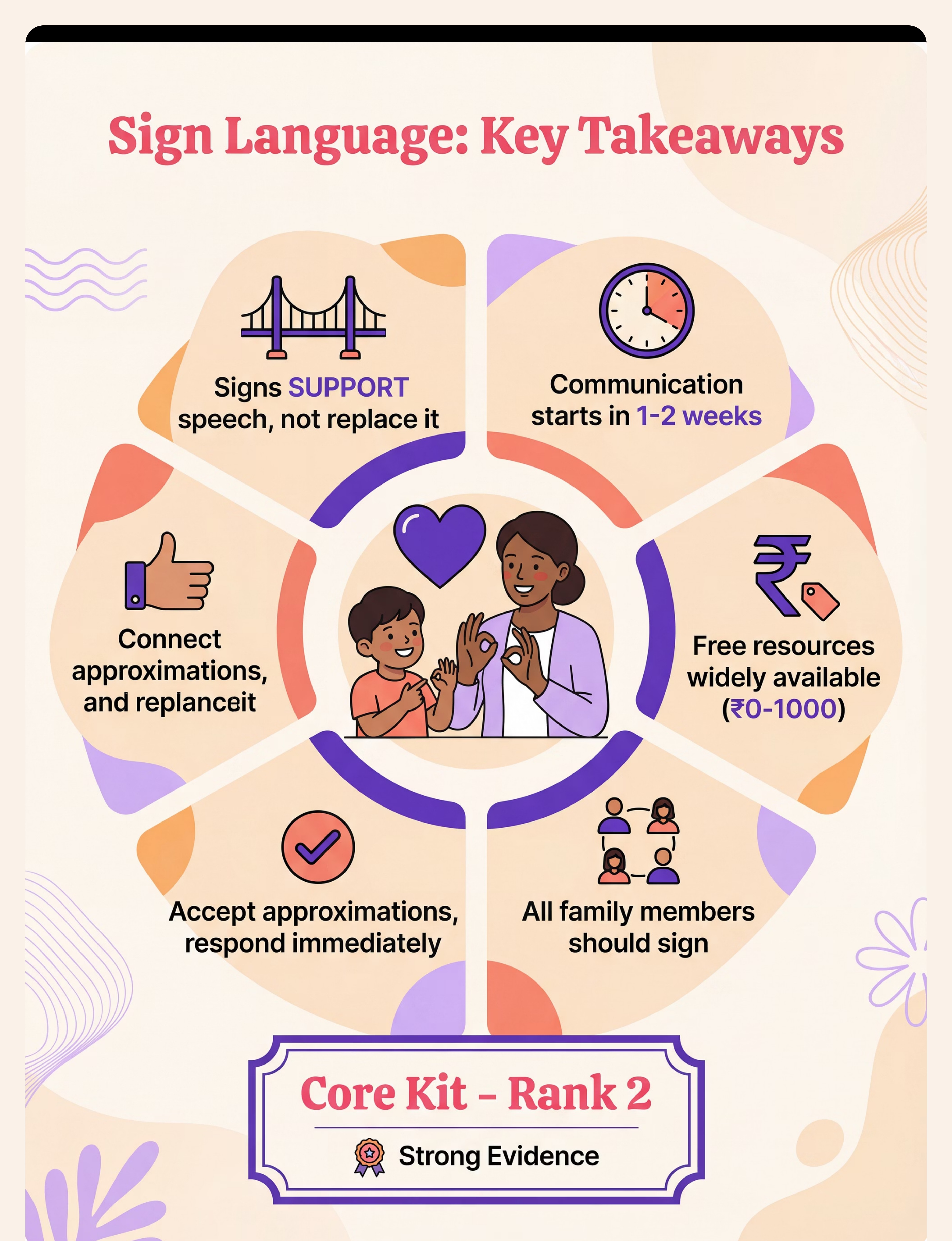
Sign language provides a motor-based communication system that bridges to speech for many children. Core Kit (Rank 2), strong evidence, low-tech and always available. Signs give pre-verbal children immediate communication tools, reduce frustration, and often support rather than hinder speech development when paired consistently with spoken language.
sign language
signing
gesture
ISL
communication
bridge
SLP
SpEd
core-kit
Common Searches
baby sign language autism, sign language autism, ISL autism, signing with autism, key word signing, total communication autism, gesture communication autism

Get Support
FREE National Autism Helpline
Phone: 9100 181 181
Languages: 16+ languages supported
Website: pinnacleblooms.org
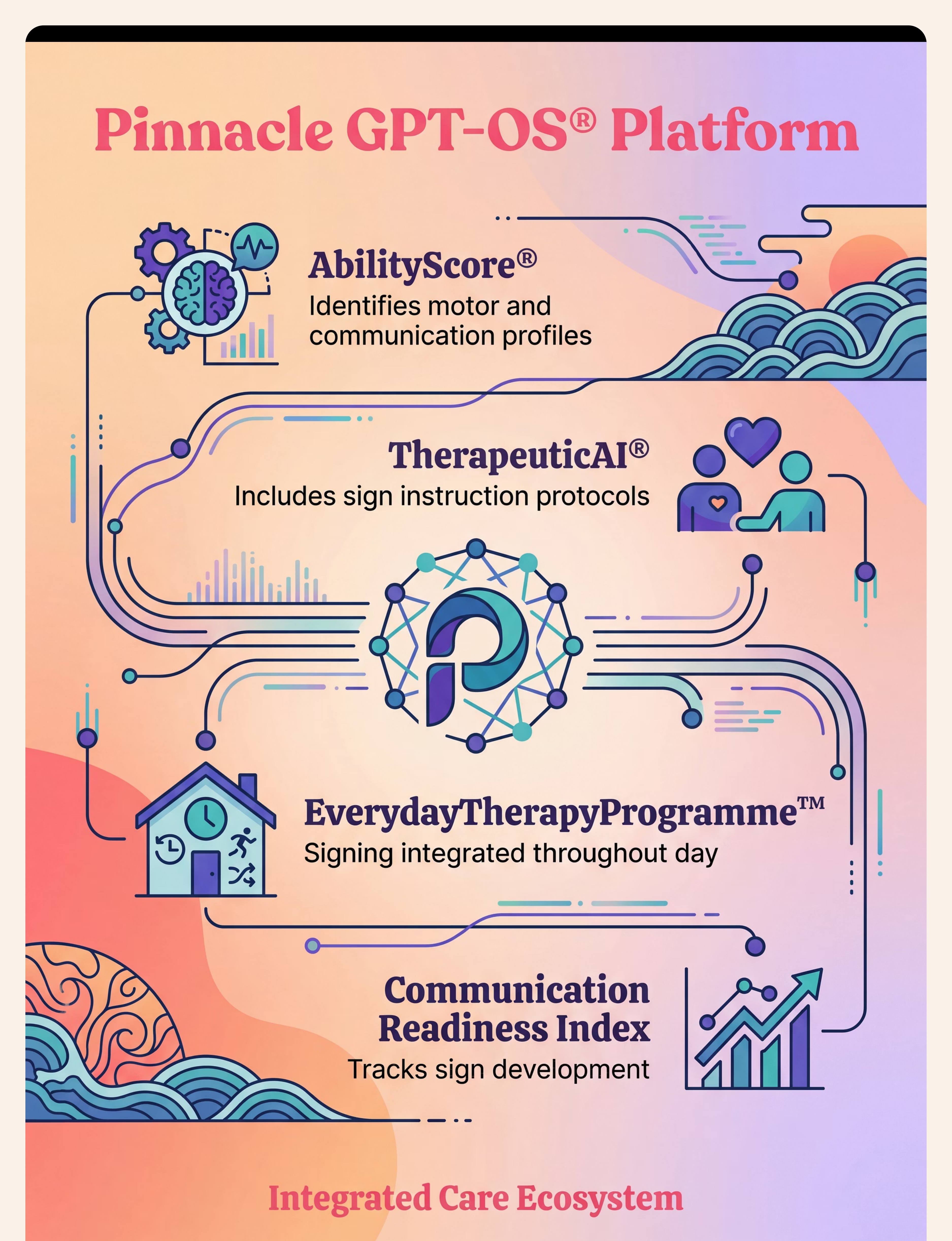
Platform Integration
This tool integrates with Pinnacle Blooms Network's comprehensive platform:
  • AbilityScore® identifies motor and communication profiles to guide sign selection
  • TherapeuticAI® includes structured sign instruction in therapy protocols
  • EverydayTherapyProgramme™ embeds signing throughout daily routines
  • Communication Readiness Index tracks sign development and speech emergence

Disclaimer: This is educational information. Always consult qualified occupational therapists, speech-language pathologists, or pediatricians before implementing any therapeutic approach. Individual results vary. Sign language should be part of a comprehensive, individualized communication plan developed with professionals.