









Tool ID: 14.4
Tool ID: 14.4
OT + SpEd
Strong Evidence
Rank #1
Daily Use
₹0–2,500
Sleep Routine Supports
Bedtime structure and transition system
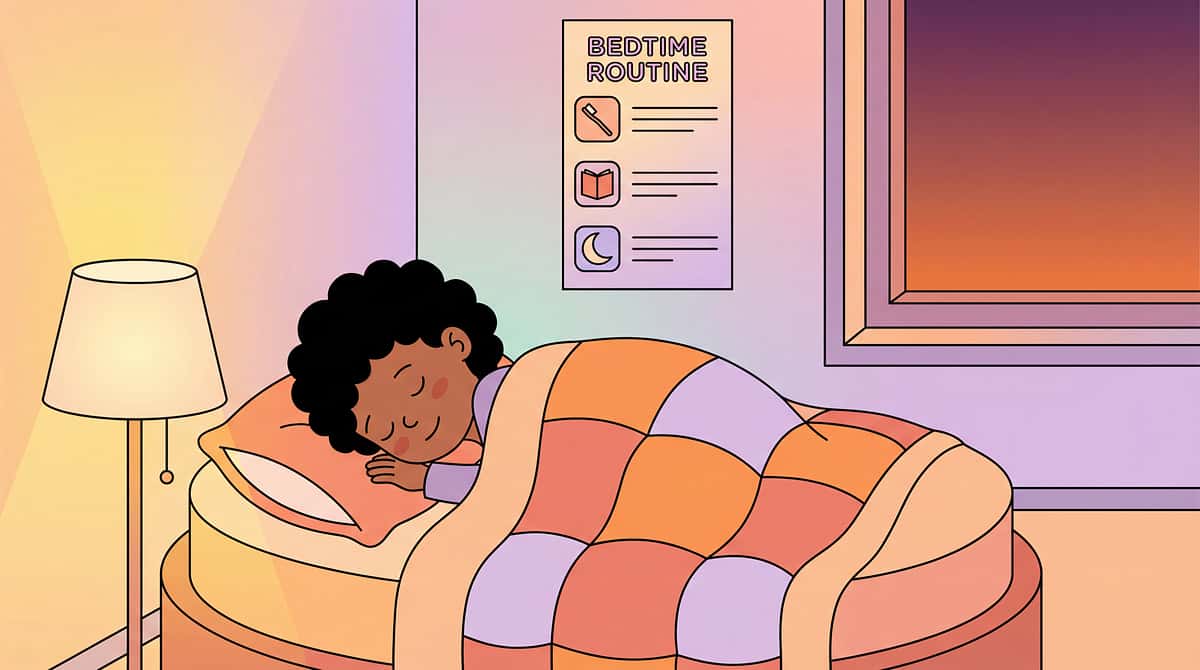
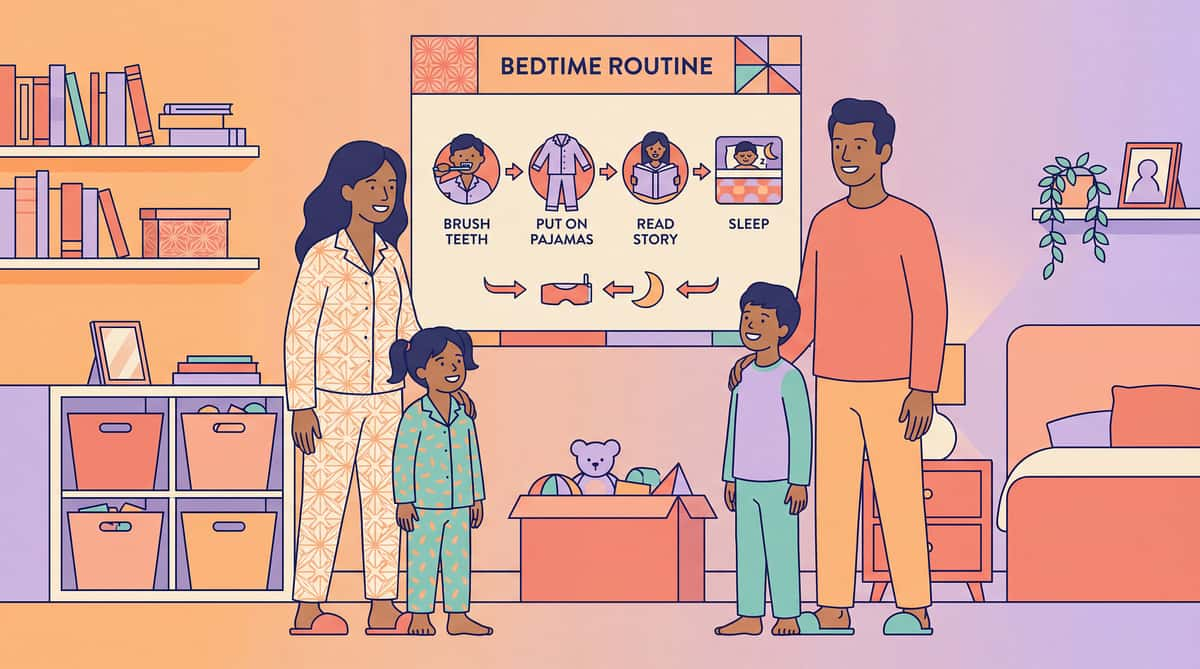
Provide structure, predictability, and visual supports for bedtime routine to reduce anxiety and improve sleep transitions. Essential foundation for healthy sleep patterns in children with developmental needs.
Who This Helps
Sleep routine supports help children build predictable, calming bedtime patterns through visual structure and clear expectations. By reducing anxiety about transitions and providing step-by-step guidance, these tools support successful sleep onset and independent sleep skills.
Children Needing Structure
Visual schedules and clear expectations reduce anxiety and make bedtime feel safe and manageable.
Families with Bedtime Challenges
Structured routines with visual supports can dramatically shorten bedtime and reduce conflicts.
Children with Wake Time Difficulties
OK-to-wake clocks and bedtime pass systems teach appropriate boundaries in developmentally supportive ways.
Promotes Healthy Routines
Establishes predictable and calming bedtime patterns for consistent sleep.
Eases Transitions
Reduces anxiety during bedtime transitions with clear, visual guidance.
Reduces Anxiety
Provides security and predictability, leading to a calmer sleep experience.
Fosters Independence
Supports development of independent sleep skills and self-regulation.
Improves Sleep Onset
Helps children fall asleep more easily and stay asleep longer.
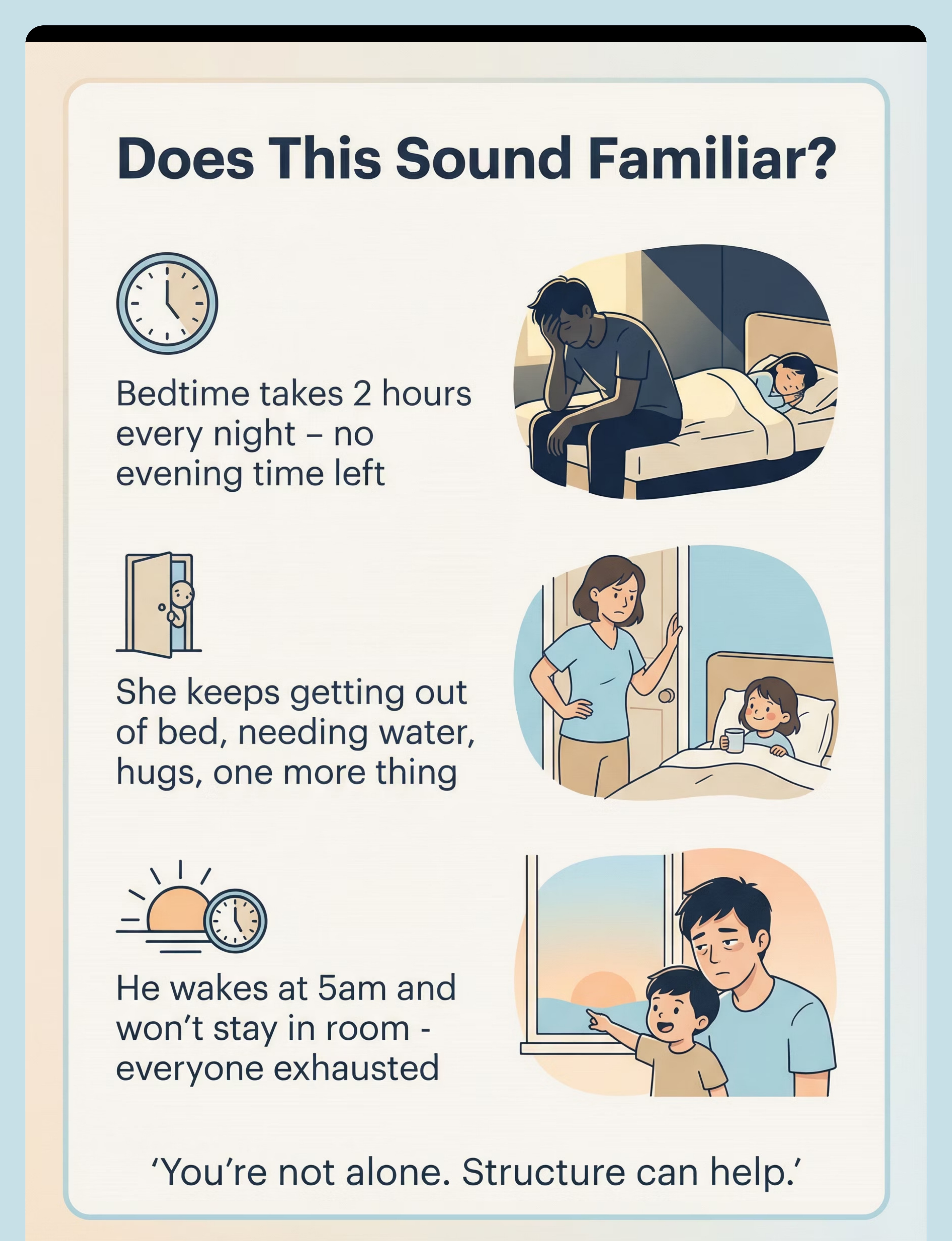
Does This Sound Familiar?
"Bedtime takes 2 hours every night. I'm exhausted and have no evening time for myself or my partner."
"He doesn't know what comes next in the routine. Every step requires reminding and negotiation."
"She keeps getting out of bed with one more request—water, bathroom, hug, scared. It never ends."
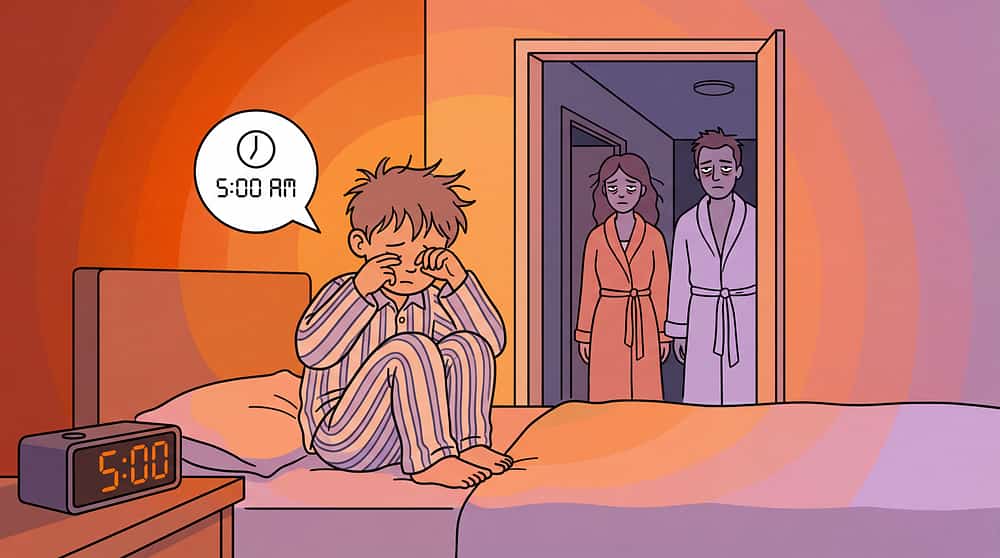
"He wakes up at 5am and immediately comes to our room. He doesn't understand it's too early."
"Bedtime is a battle every single night. We're all stressed and frustrated."
"She needs constant reminding of each step. Without me there, nothing happens."
You're not alone. These are common challenges that sleep routine supports are specifically designed to address. Thousands of families have found relief through structured, visual bedtime systems.
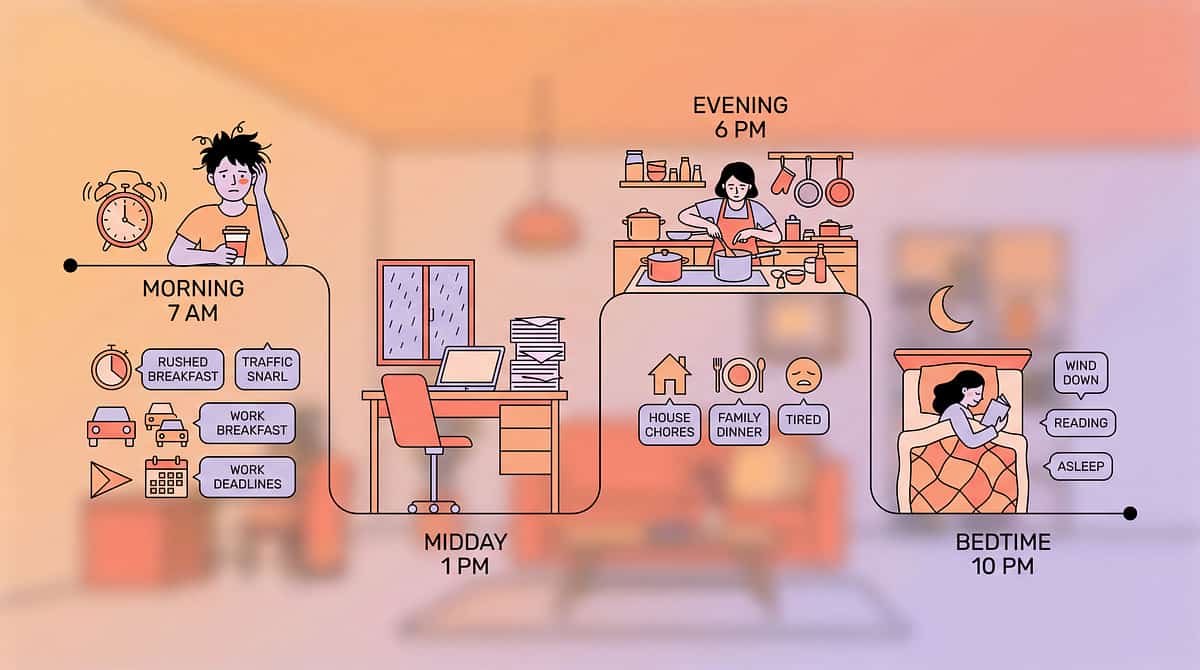
A Day Without the Right Support
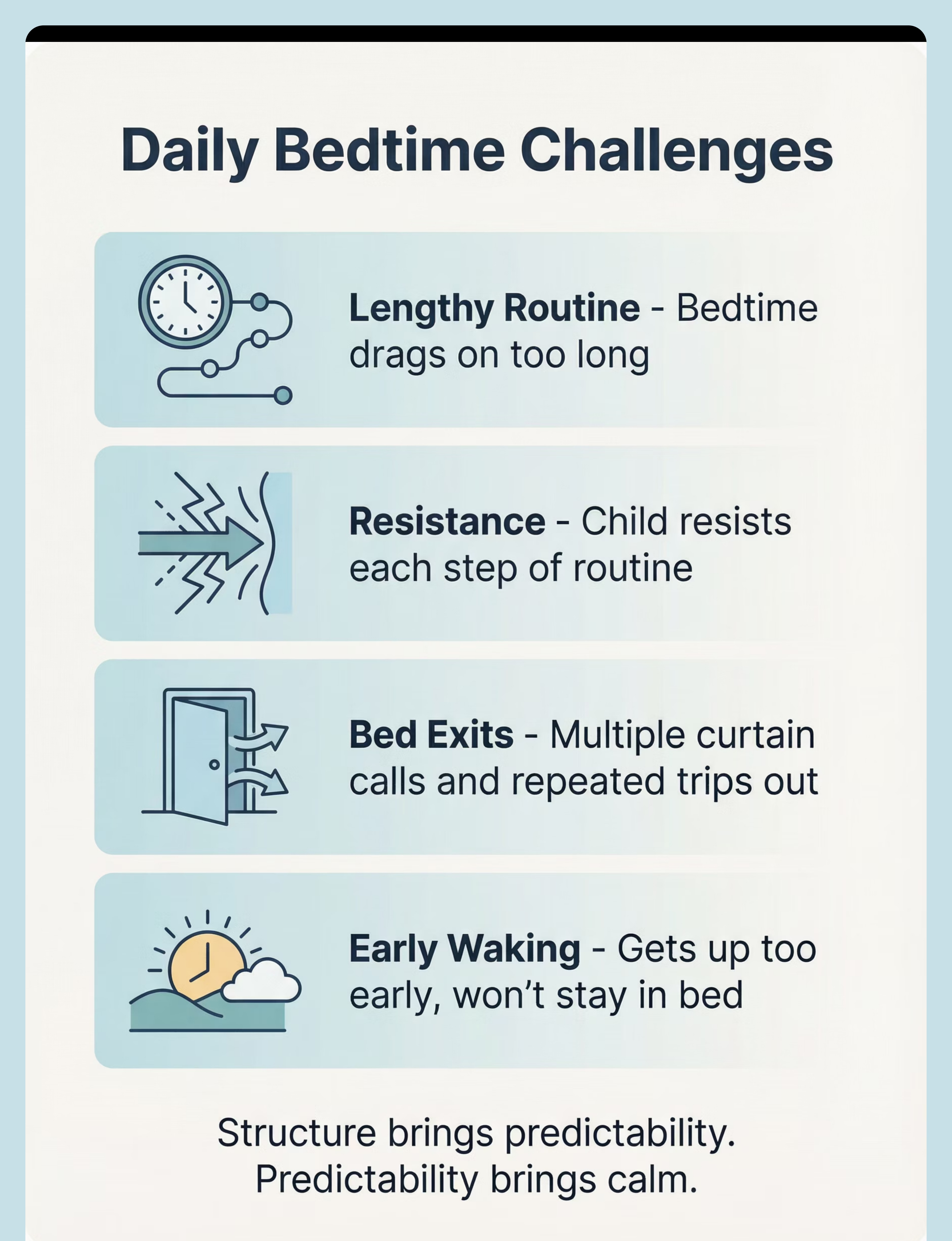
Lengthy Routine
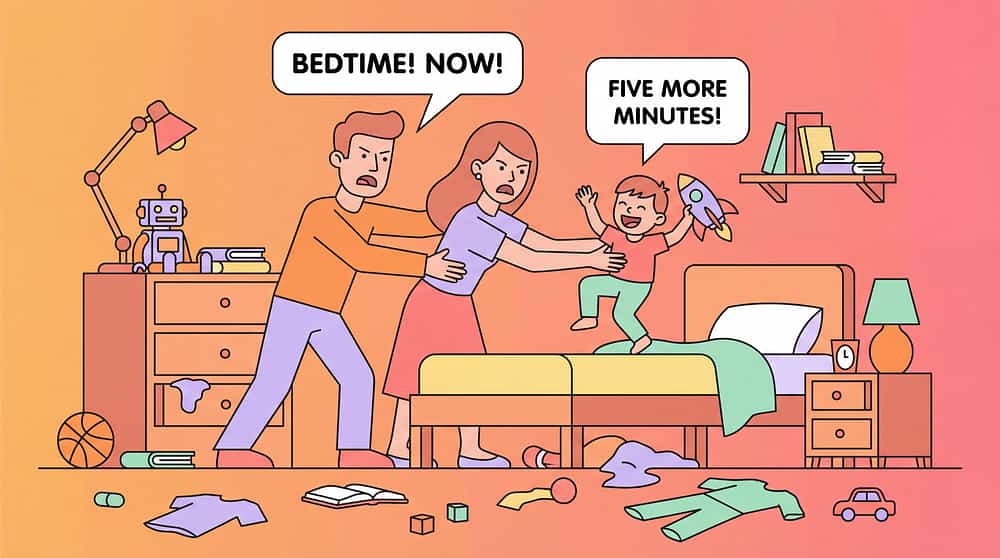
Bedtime drags on for hours with constant battles, stalling, and negotiations at every step. Parents are exhausted.
Resistance
Child resists each step of the routine. Every transition requires coaxing, reminding, and sometimes conflict.
Bed Exits
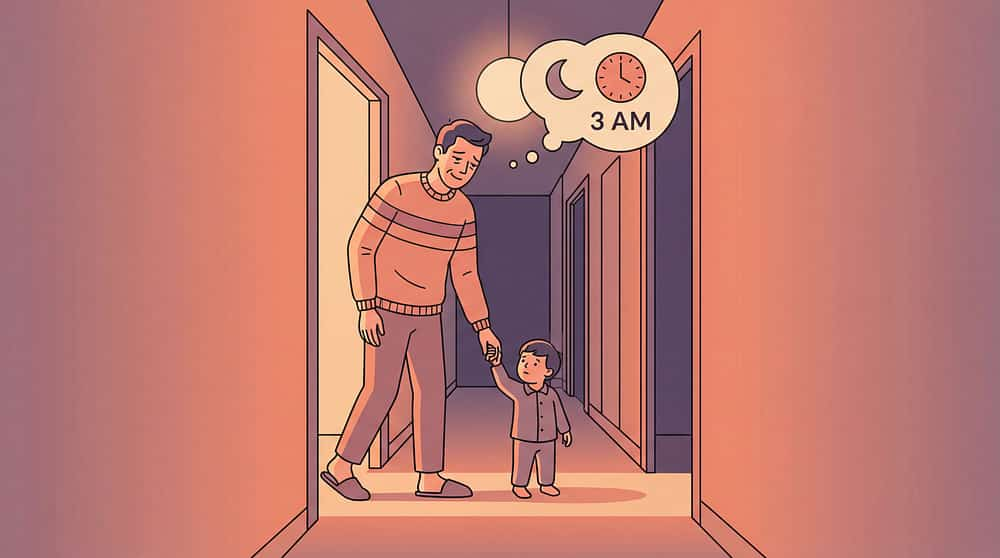
Multiple "curtain calls"—child comes out repeatedly for water, bathroom, one more hug, afraid, forgot something.
Early Waking
Child wakes too early and immediately seeks parents. Doesn't understand appropriate wake time. Everyone exhausted.
These daily struggles compound over time, affecting not just sleep but family stress levels, child's emotional regulation, and overall quality of life. The good news: structured support can transform these patterns.
The Science Behind It
sleep-routine-supports therapy material
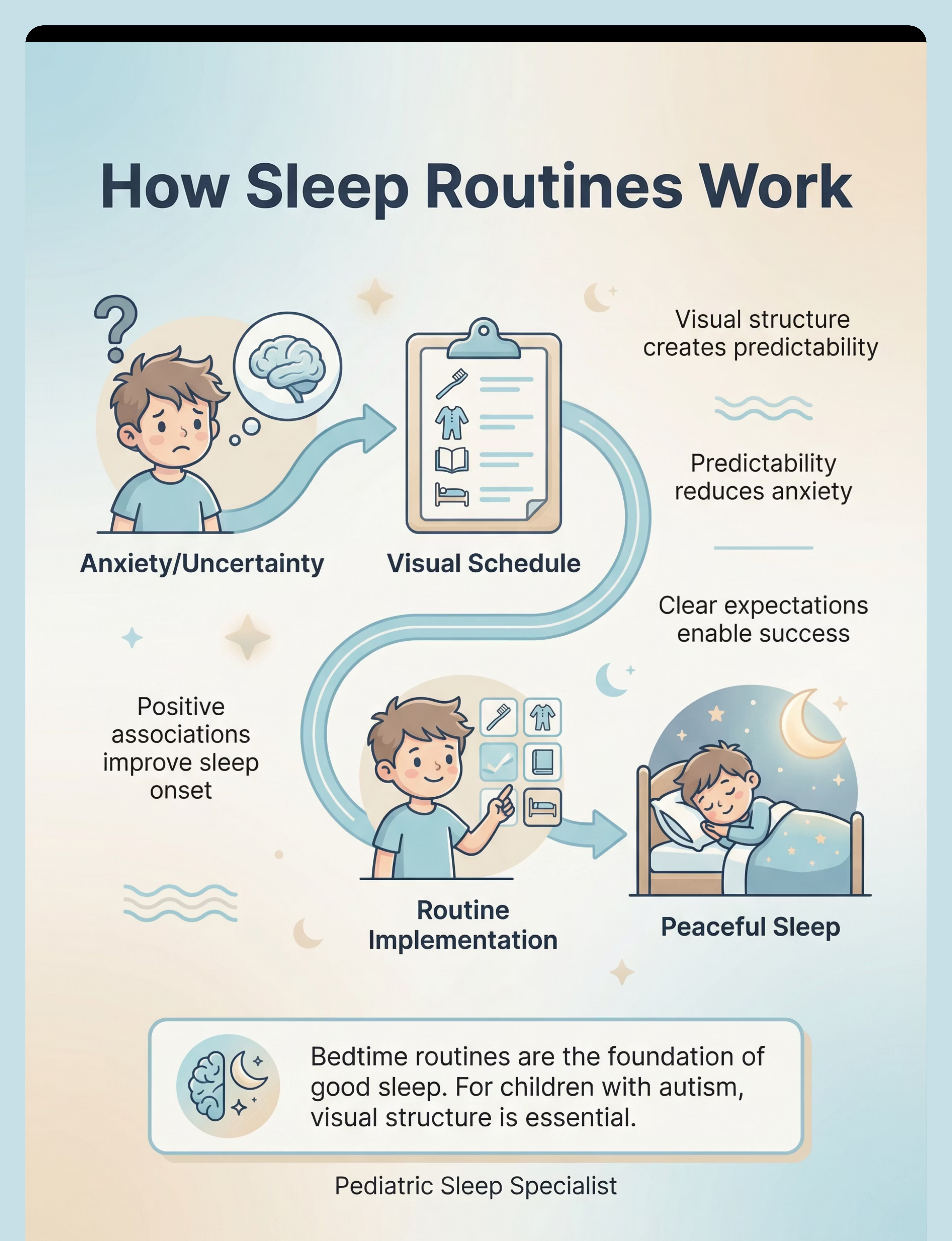
Visual Structure
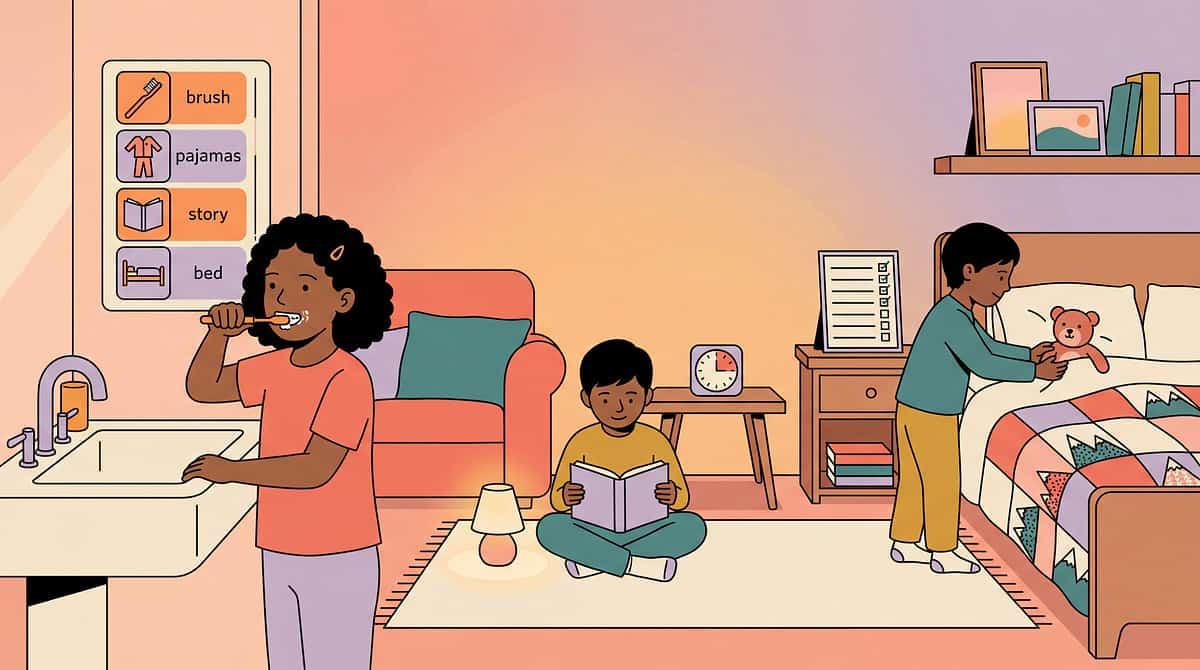
Clear visual supports show what comes next, removing ambiguity and reducing need for constant reminding.
Predictability
Consistent routine in same order every night builds neural pathways and reduces anxiety about transitions.
Reduced Anxiety
Knowing what to expect and when creates safety, allowing child to relax into the routine naturally.
Clear Expectations
Visual supports and boundary systems make expectations concrete and observable, not abstract.
Routine Completion
Child successfully moves through each step with growing independence and confidence.
Positive Association
Success breeds more success—bedtime becomes associated with calm and achievement rather than stress.
Easier Sleep Onset
Calm, predictable routine naturally leads to easier transition into sleep state.
Independent Skills
Over time, child internalizes routine and develops self-regulation abilities for long-term success.
Bedtime Routine
Transitions
Anxiety Reduction
Independence
Sleep Onset
Wake Time Boundaries
How to Use It Right
sleep-routine-supports therapy material
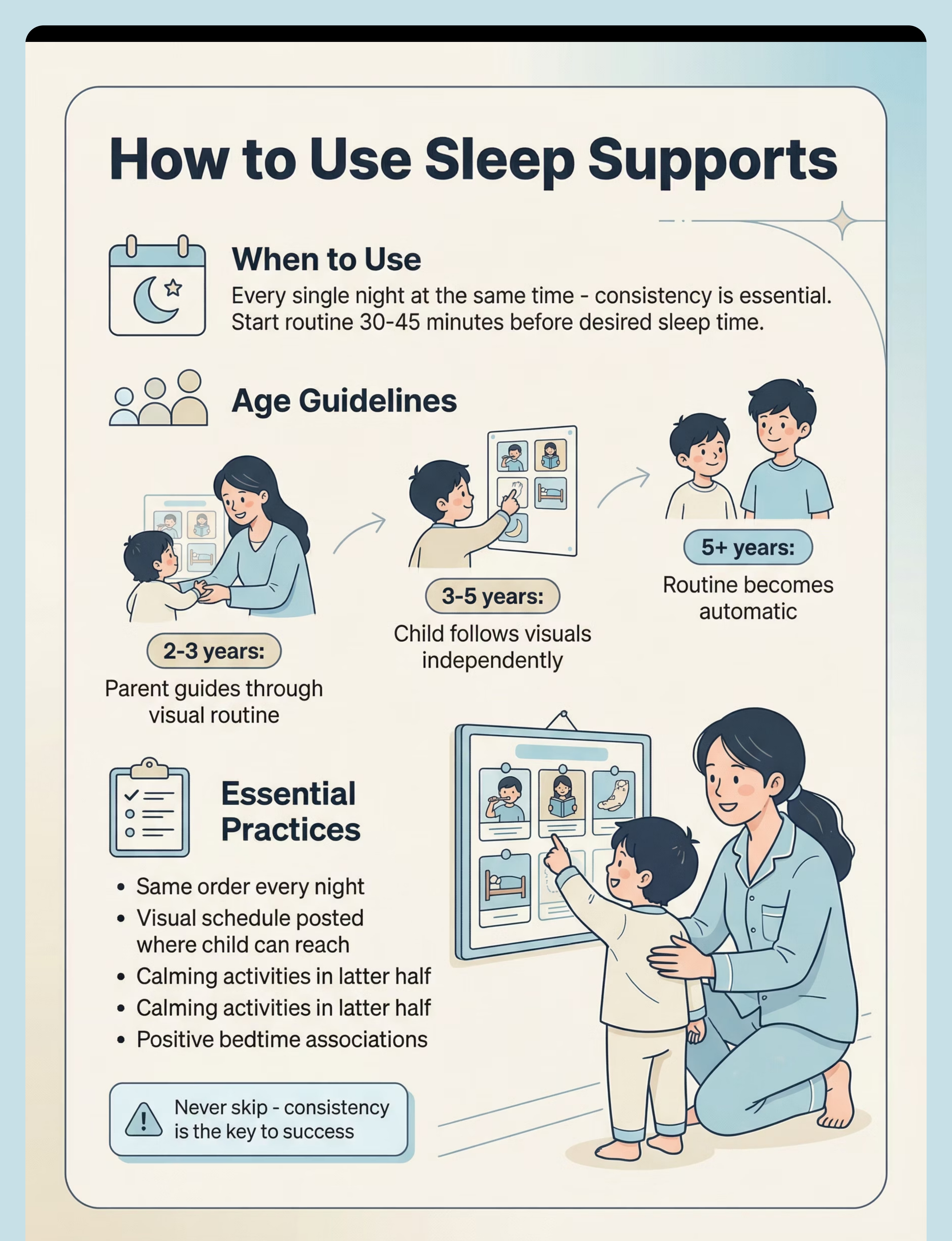
Maintain Consistent Routine Every Night
Same time, same order, same steps—consistency is the foundation. Even small variations can disrupt progress, especially in the early weeks of establishing the routine.
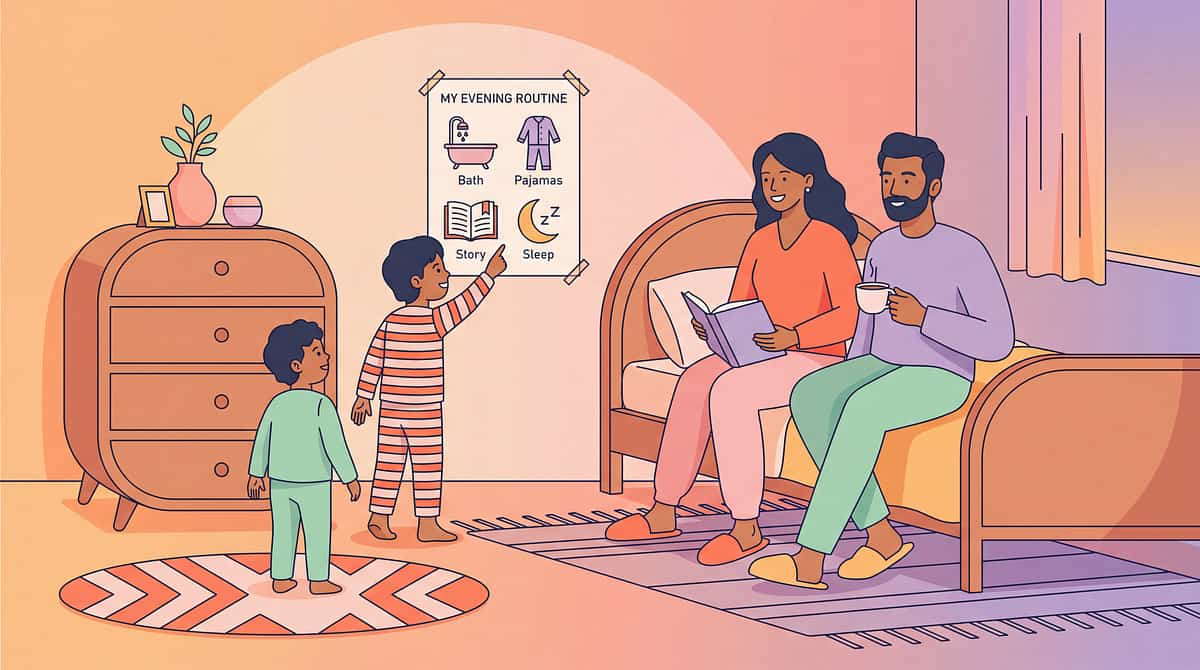
Post Visual Schedule Where Child Can See
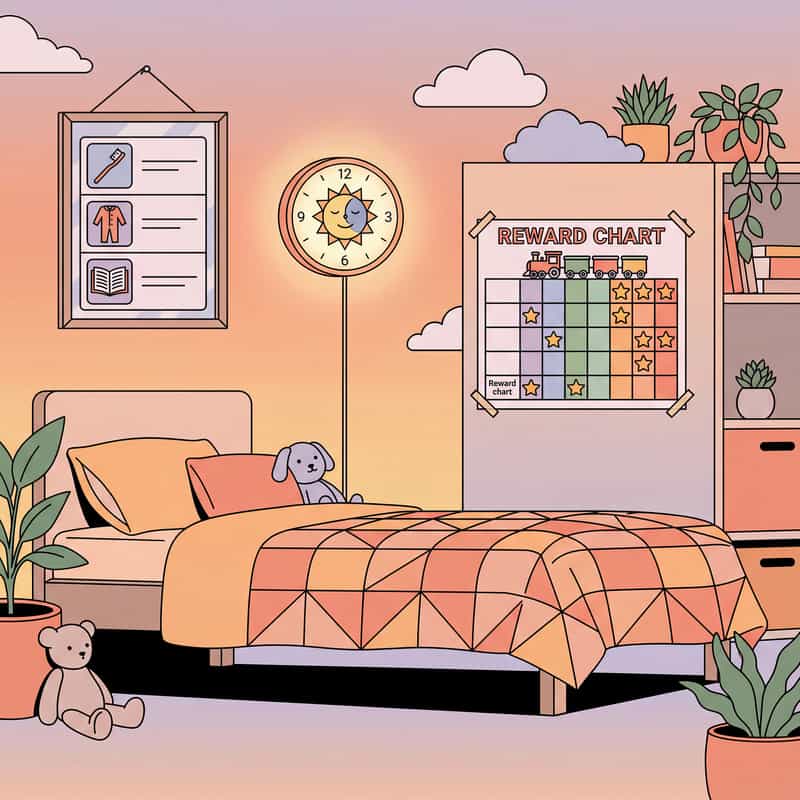
Place schedule at child's eye level in bedroom or bathroom. Child should be able to reference it independently without adult help.
Keep Activities in Same Order
Predictability builds security and reduces anxiety. Once established, resist changing the order unless absolutely necessary.
Include Calming Activities in Latter Half
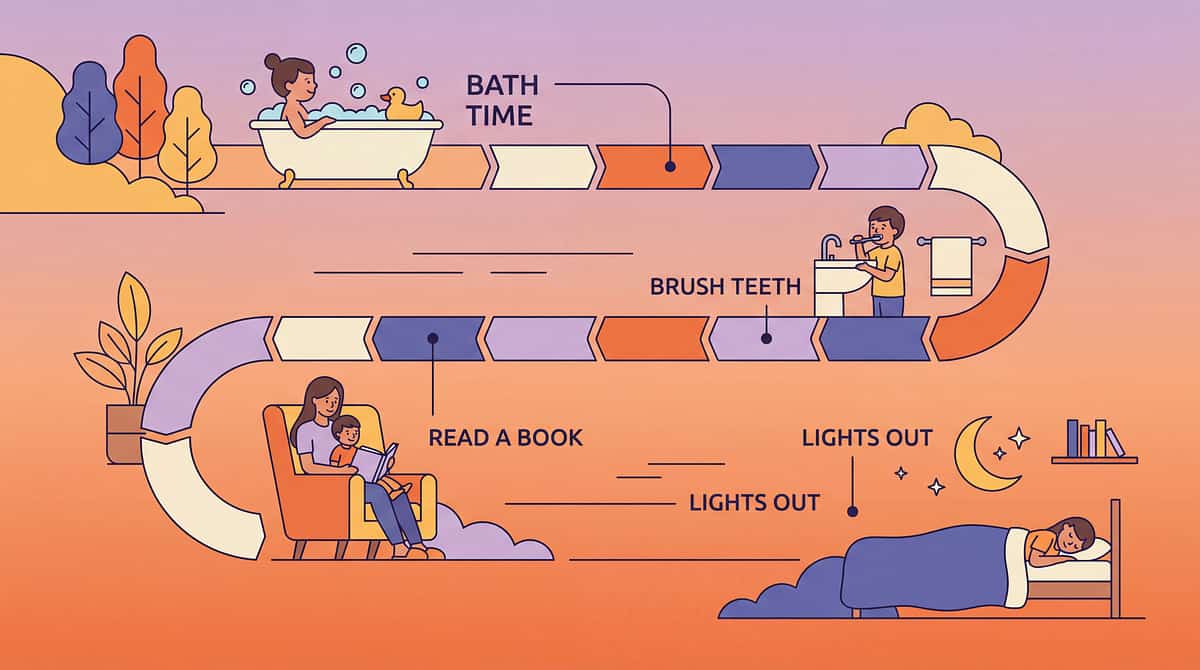
Structure routine to progressively calm—alerting activities like bath first, calming activities like reading closer to lights-out.
Use OK-to-Wake Clock for Early Risers
Teach child to wait for green light or designated signal. Requires consistent reinforcement initially but highly effective once learned.
Start Routine 30-45 Minutes Before Sleep Time
Allow adequate time for all steps without rushing. Rushed routines increase stress and defeat the purpose.

Duration Note: Most complete bedtime routines take 30-45 minutes once established. Initial weeks may take longer as child learns the system. Be patient with the process.
Expert Endorsement
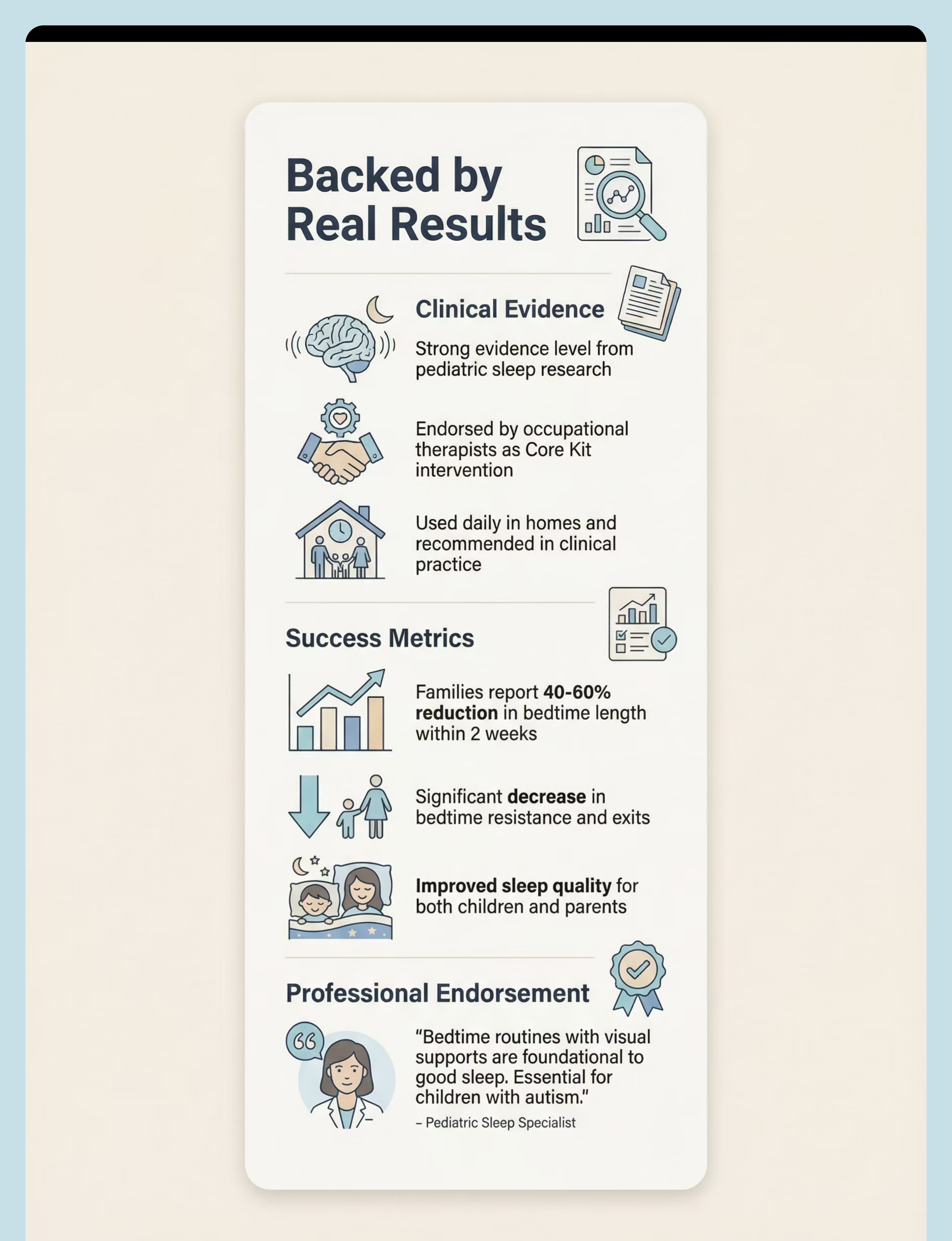
"Bedtime routines are the foundation of good sleep. For children with autism, the visual structure and predictability are essential. A consistent routine signals to the brain that sleep is coming, reduces anxiety about transitions, and builds independent sleep skills."
— Pediatric Sleep Specialist

OT + SpEd Recommended
Strong Evidence
Rank #1 in Category
Core Kit Essential
sleep-routine-supports therapy material
Choose Your Option (6 Variants)
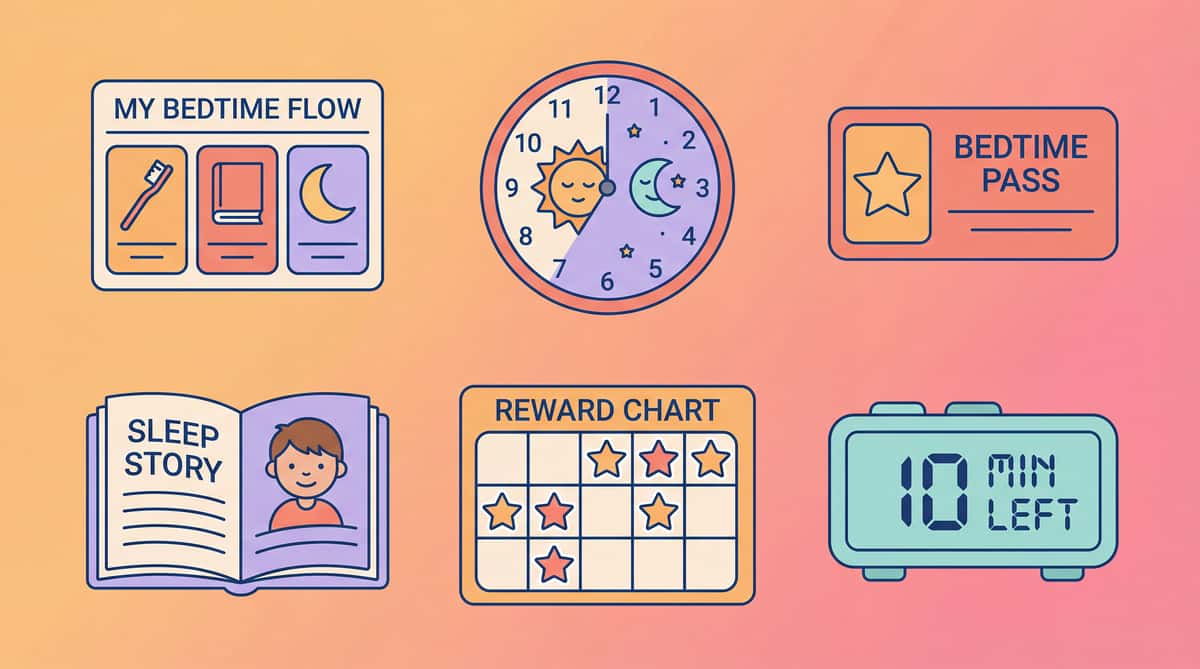
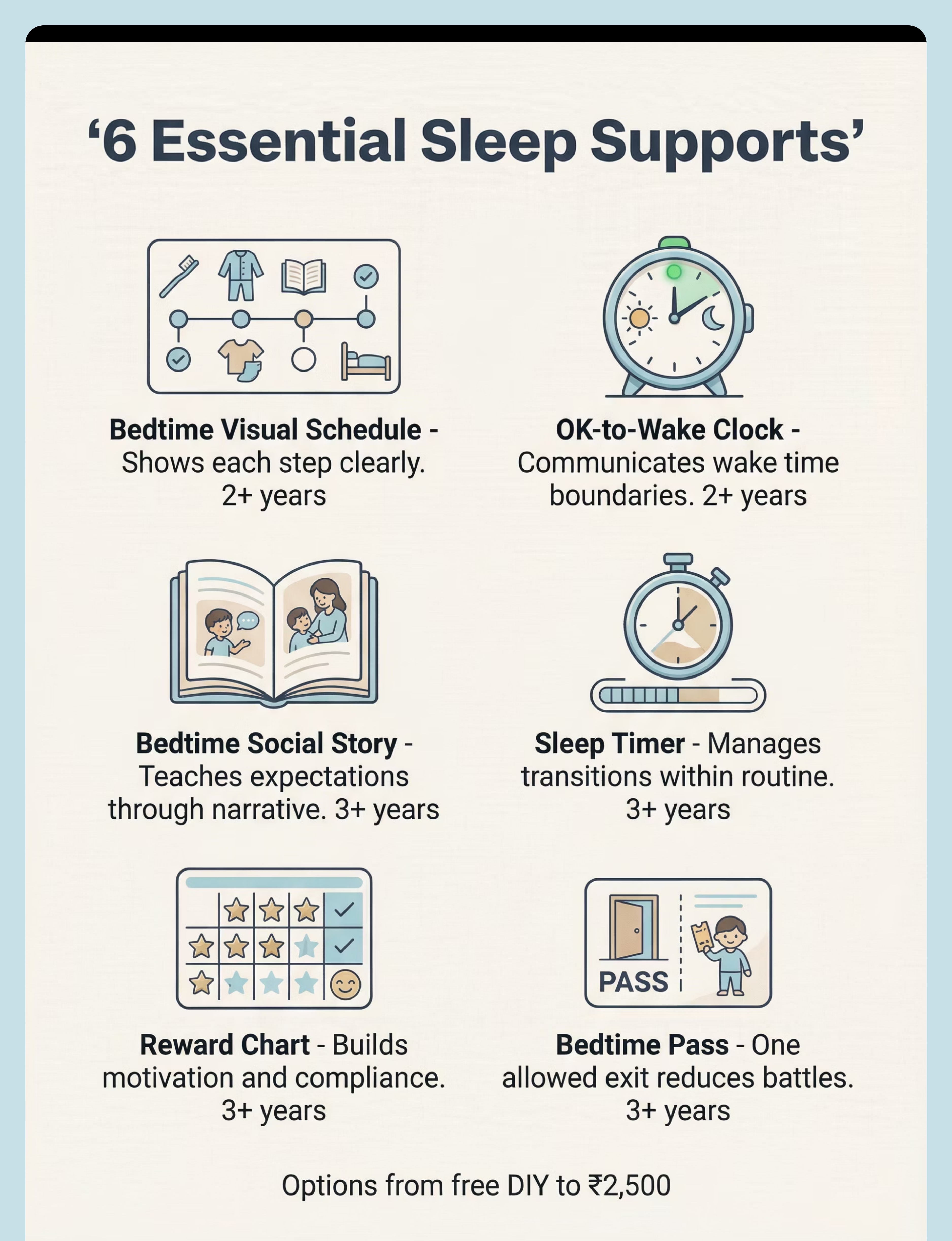
Each variant serves a specific bedtime challenge. Most families benefit from combining multiple supports for comprehensive bedtime success. Start with visual schedule as foundation, then add targeted solutions.
Overview of Bedtime Tools
Bedtime Visual Schedule
Predictability, transition support
OK-to-Wake Clock
Early risers, wake time boundary
Bedtime Social Story
Teaching bedtime expectations
Sleep Timer / Visual Timer
Transitions within routine
Bedtime Reward Chart
Building bedtime compliance
Bedtime Pass System
Reducing curtain calls/bed exits
Detailed Descriptions
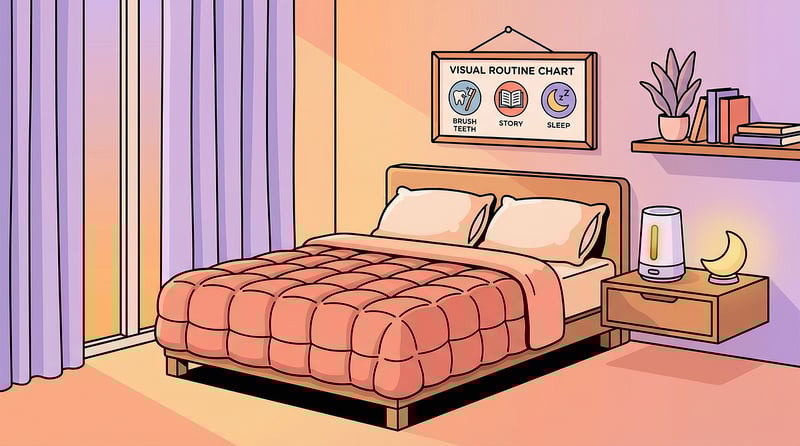
Bedtime Visual Schedule: Visual sequence of bedtime steps that child can reference independently. Foundation of structured bedtime routine.
Ages: 2+ years | Settings: Home - bedroom/bathroom | Portability: Low (posted) | Price: ₹50–500
OK-to-Wake Clock: Clock showing when it's OK to get up—teaches appropriate wake time boundaries through visual signal child can understand.
Ages: 2-8 years | Settings: Home - bedroom | Portability: Low | Price: ₹500–2,500
Bedtime Social Story: Story about bedtime expectations using narrative structure to teach routine and build positive associations.
Ages: 2+ years | Settings: Home | Portability: Medium | Price: ₹50–300
Sleep Timer / Visual Timer: Timer for bedtime activities—helps child understand time remaining for each step and anticipate transitions.
Ages: 3+ years | Settings: Home | Portability: Medium | Price: ₹200–1,000
Bedtime Reward Chart: Chart tracking bedtime success—provides positive reinforcement and visual record of progress over time.
Ages: 3+ years | Settings: Home | Portability: Low (posted) | Price: ₹50–300
Bedtime Pass System: Pass for one allowed exit from bed—acknowledges needs while setting clear limits. Highly effective and free to make.
Ages: 3+ years | Settings: Home | Portability: Very High | Price: ₹0–100

How to Choose
By goal: Predictability (visual schedule), wake boundaries (OK-to-wake clock), exit reduction (bedtime pass), motivation (reward chart)
By setting: All designed for home use, posted in bedroom or bathroom where child can access
By portability: Visual schedules and charts stay posted; timers and passes are portable for different rooms
Specifications & Routine Elements Guide
Materials
sleep-routine-supports therapy material
  • Laminated visuals for durability and repeated use
  • Clocks (OK-to-wake or standard)
  • Charts for tracking progress
  • Paper/cards for DIY options
Key Features
  • Visual and predictable — removes ambiguity
  • Consistent order — same sequence every night
  • Calming progression — activities move toward quiet
  • Clear expectations — child knows what's expected
Routine Elements Structure
sleep-routine-supports therapy material
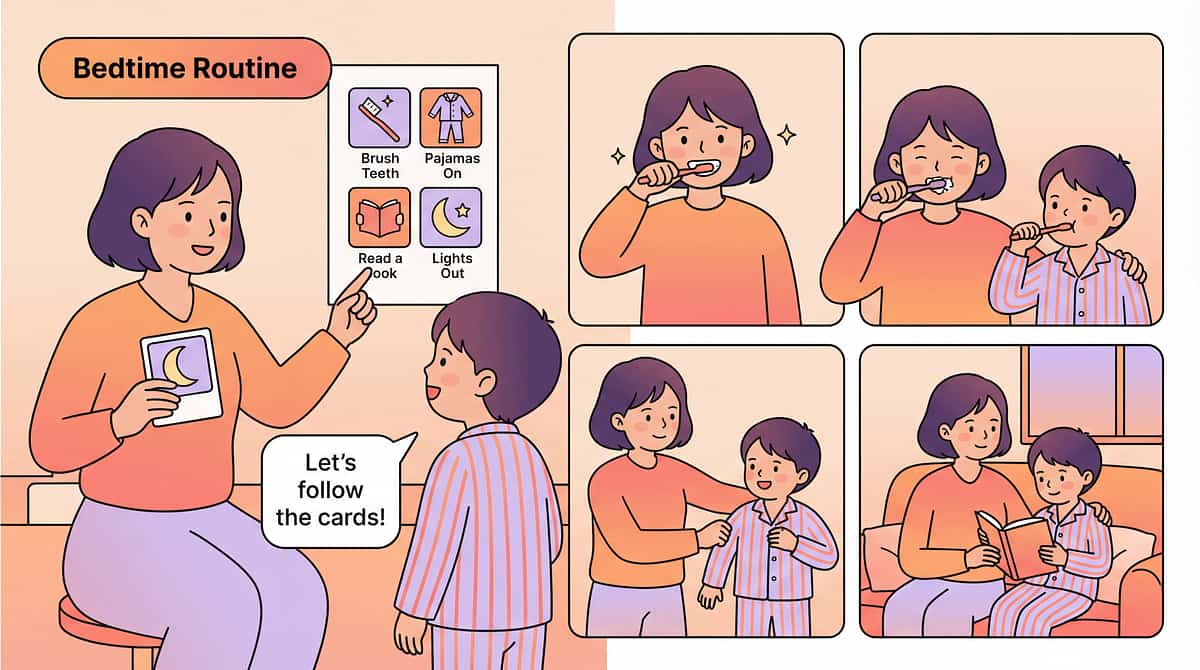
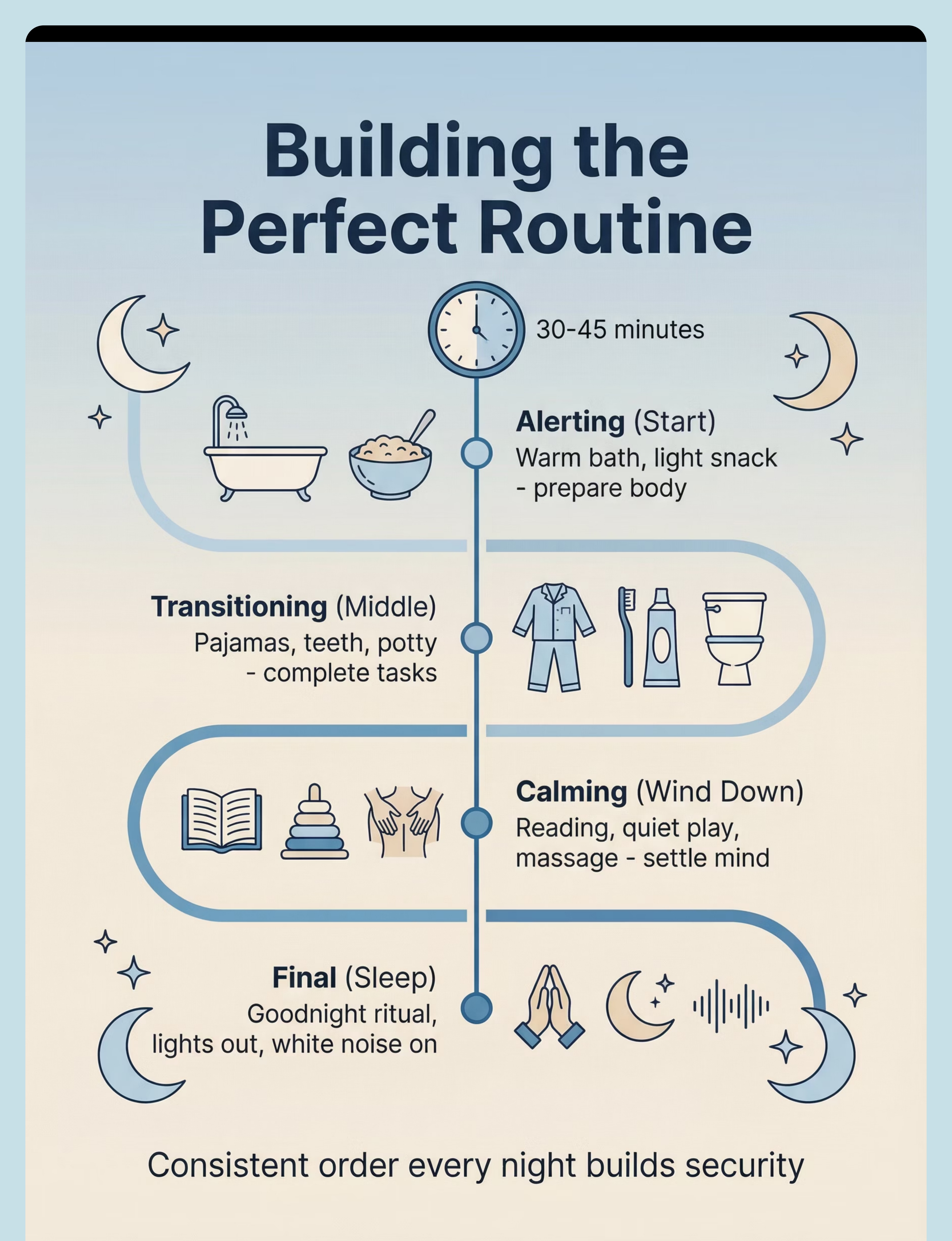
Alerting Phase: Bath/shower (warm water), light snack—activities that are engaging but start wind-down
Transitioning Phase: Pajamas, teeth brushing, potty/bathroom—practical steps that move toward bed
Calming Phase: Reading, quiet play, massage—progressively quieter activities that relax body and mind
Final Phase: Prayers/goodnight, lights out, white noise on—final steps that signal sleep is immediate
The progression from alerting → transitioning → calming → final creates a natural arc that prepares both body and mind for sleep. Each phase serves a purpose in the overall routine.
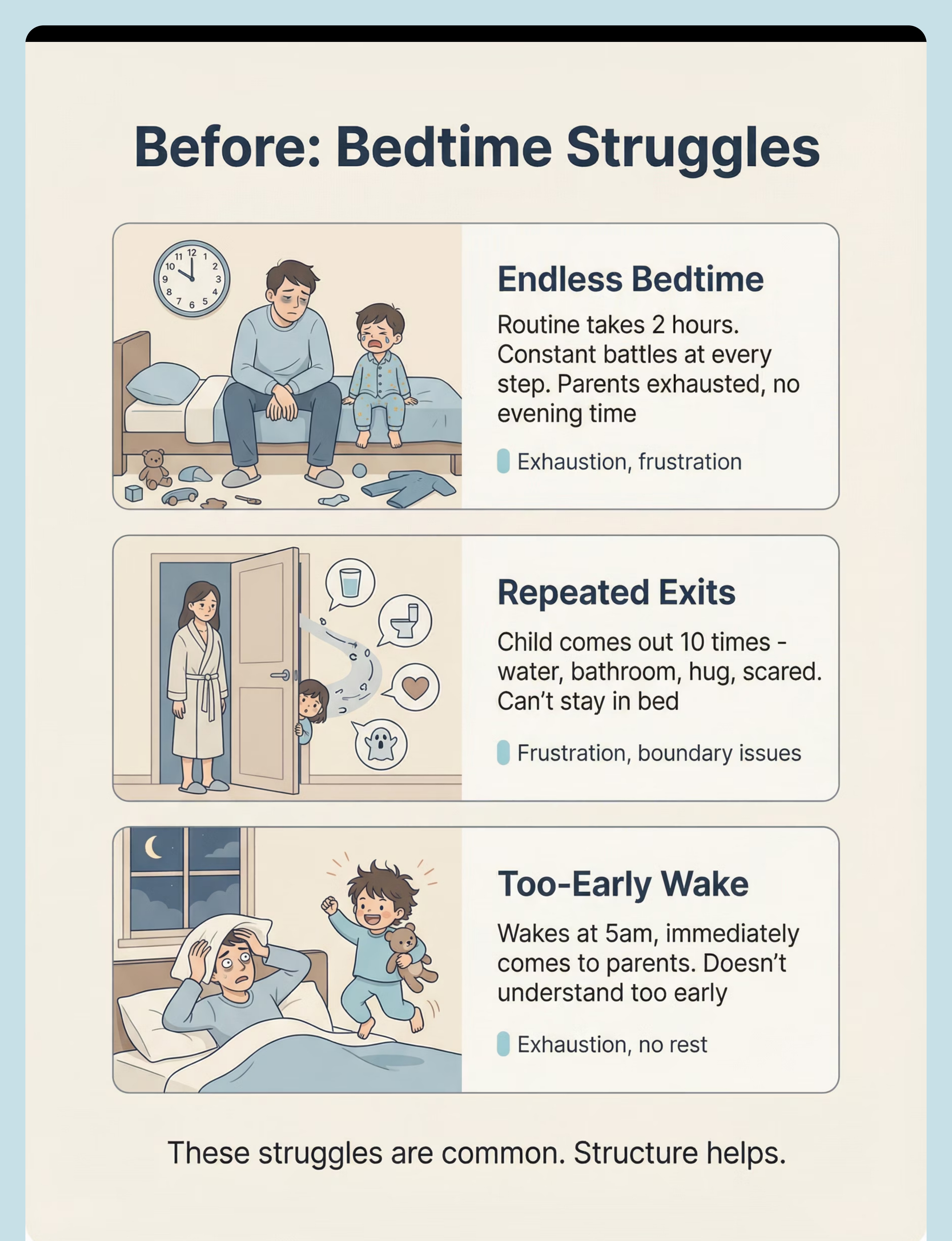
The Struggle (Before)
Endless Bedtime
Situation: Bedtime routine takes 2 hours every night
Experience: Constant battles and negotiations. Stalling at every step. Parents are completely exhausted. No time for themselves in the evening.
Emotion: Exhaustion, frustration, burnout
Repeated Bed Exits
Situation: Child comes out of room 10+ times every night
Experience: Needs water, bathroom, hug, scared, forgot something. Can't stay in bed. Parents feel like they're on endless duty. No clear boundaries seem to work.
Emotion: Frustration, helplessness, boundary struggles
Too-Early Wake Time
Situation: Child wakes at 5am and immediately seeks parents
Experience: Doesn't understand "it's too early." Entire family is sleep-deprived. Everyone exhausted. Can't teach concept of appropriate wake time.
Emotion: Exhaustion, no rest, chronic fatigue
These "before" scenarios represent the daily reality for many families—not occasional bad nights, but nightly patterns that erode everyone's wellbeing. The good news: these patterns can change with the right supports.
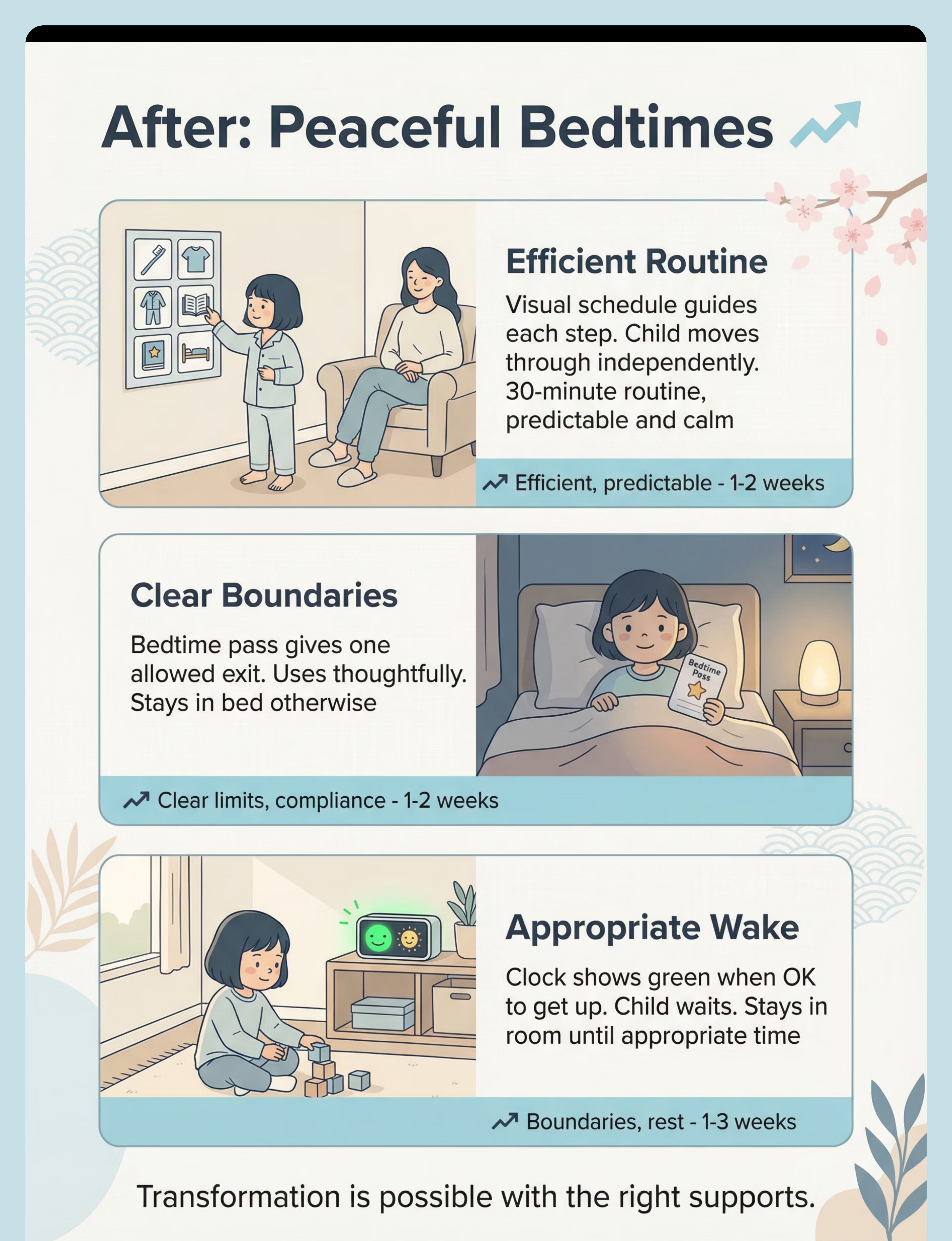
The Breakthrough (After)
Endless Bedtime → Efficient Routine
Situation: Visual schedule shows each step clearly
Experience: Child moves through routine independently, referencing visual schedule as needed. 30-minute routine that's predictable and calm. Parents have evening time.
Emotion: Efficient, predictable, peaceful
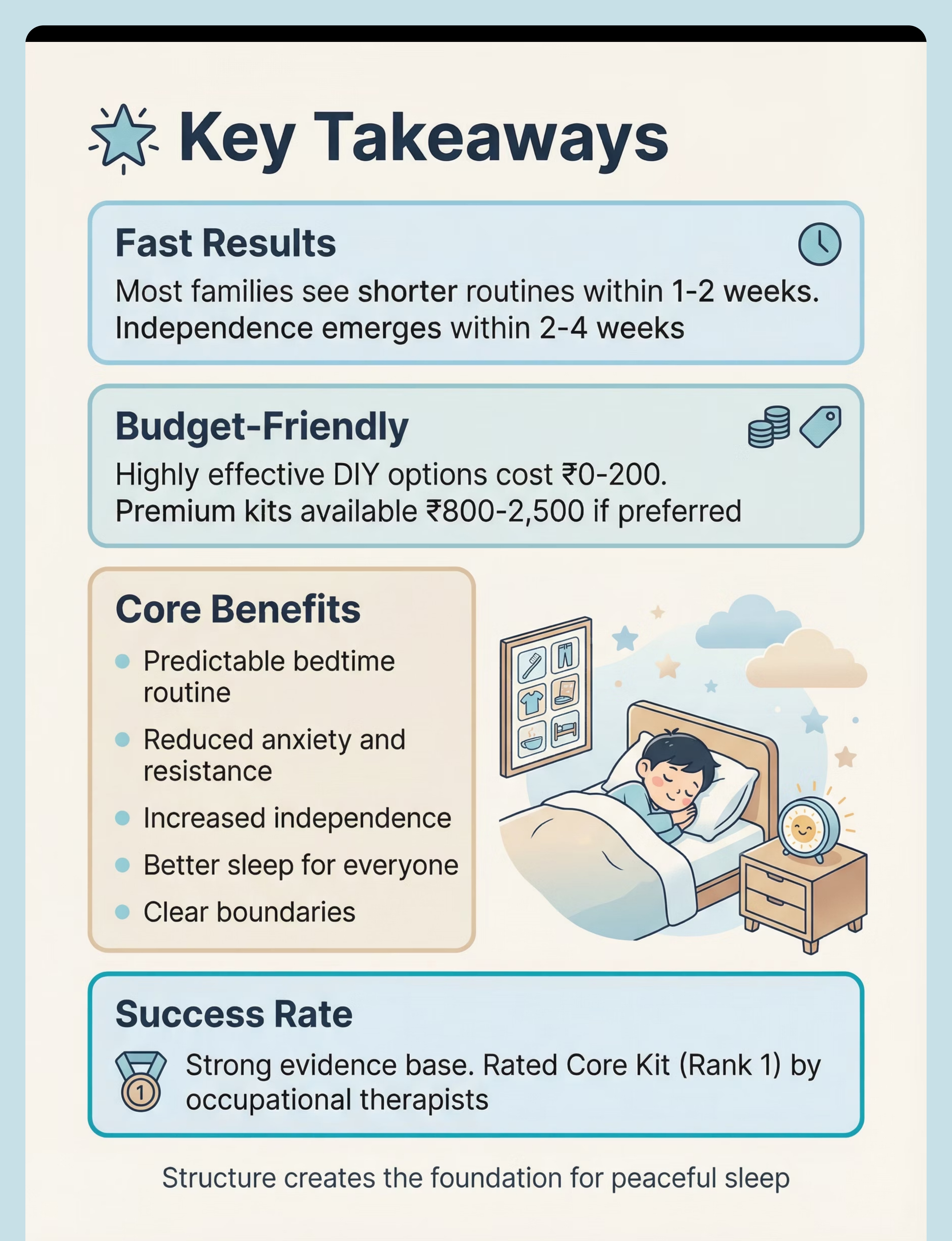
Timeframe: 1-2 weeks
Repeated Exits → Clear Limits
Situation: Bedtime pass system gives one allowed exit
Experience: Child uses pass thoughtfully—usually saves it for genuine need. Stays in bed otherwise. Fewer battles because limit is acknowledged and respected.
Emotion: Clear limits, compliance, mutual respect
Timeframe: 1-2 weeks
Early Wake → Appropriate Boundaries
Situation: OK-to-wake clock shows green when time to get up
Experience: Child waits for green light. Stays in room or plays quietly until appropriate time. Entire family gets needed rest.
Emotion: Clear boundaries, rest, success
Timeframe: 1-3 weeks
These transformations typically occur within 1-3 weeks of consistent implementation. The key is maintaining the structure even when it feels repetitive—that consistency is what creates the change.
What to Expect (Realistic Timelines)
Visual routine in place
Schedule created, posted, and introduced to child. Everyone understands the system and plan.
Timeframe: 1-3 days
Bedtime routine shortened
Length of routine decreases as child learns sequence and moves through steps more independently.
Timeframe: 1-2 weeks
Reduced bed exits
Curtain calls and repeated exits decrease significantly with bedtime pass system or clear expectations.
Timeframe: 1-2 weeks
Appropriate wake time established
Child learns to wait for OK-to-wake signal and stays in room until appropriate time.
Timeframe: 1-3 weeks
Independent routine skills developed
Child has internalized routine and can complete many or most steps without prompting or supervision.
Timeframe: 2-4 weeks

Remember: These are typical timeframes, but every child is different. Some children show rapid improvement, while others need more time. Consistency is more important than speed—maintain the structure even when progress feels slow.
Is This Right for My Child? (2-Minute Check)
Does your child have a consistent bedtime routine?
If YES: Good foundation—optimize with visual supports to increase independence and reduce prompting needs.
If NO: Start here—establish routine with visual supports as core foundation for sleep success.
Does bedtime take too long?
If YES: Visual schedule combined with timers can help shorten routine and increase efficiency significantly.
Does your child get out of bed repeatedly?
If YES: Bedtime pass system can help—acknowledges needs while setting one clear limit that child can understand.
Does your child wake too early?
If YES: OK-to-wake clock can help establish appropriate wake time boundaries in developmentally supportive way.

Scoring guidance: 3+ "yes" answers indicate strong fit for sleep routine supports. Even 1-2 "yes" answers suggest these tools could significantly improve your bedtime experience.
Usage Guide
Routine Implementation
When to Use: Every night
Consistency is essential—even skipping one night can disrupt progress
When to Use: Same time
Predictable timing helps regulate child's internal clock
When to Use: Same order
Sequence should remain constant to build habit and security
When to Use: Start 30-45 minutes before sleep
Allow adequate time without rushing
When NOT to Use: Skipping the routine
Consistency is the key to success. Skipping undermines all progress.
Supervision by Age
Young Children
Parent guides through entire routine with direct supervision
Developing Skills
Child follows visual independently with parent nearby for support
Independent
Routine is automatic—child completes with minimal or no supervision
Duration & Settings
Every night
Ongoing use
Home - bedroom/bathroom
Sleep routine supports are designed for long-term use. As child masters routine, you may fade some supports, but foundation of consistency remains essential.
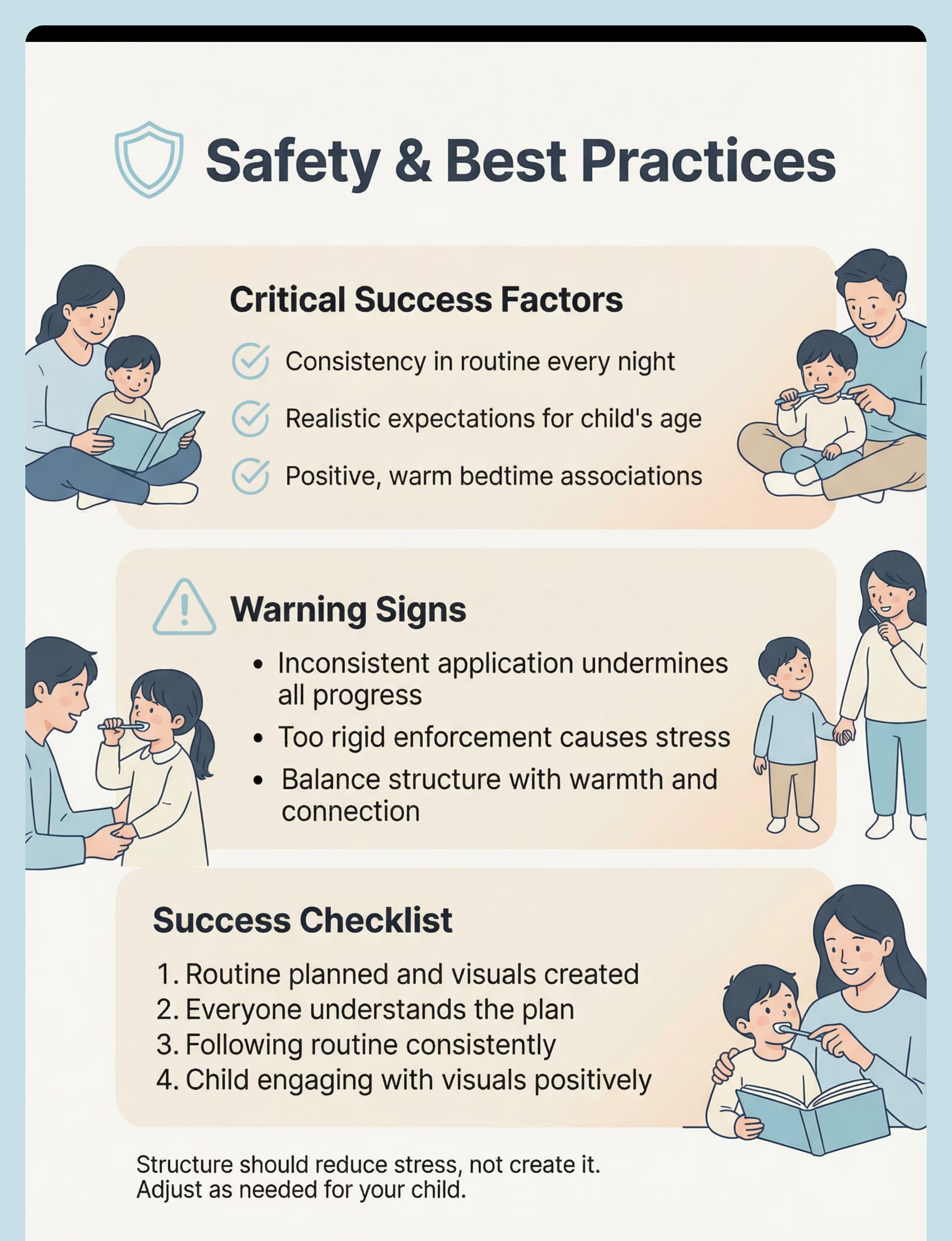
Safety First
Critical Safety Considerations
  • Consistency in routine: Inconsistency causes confusion and undermines all progress—maintain structure even when challenging
  • Realistic expectations for child's age: Adjust complexity of routine and level of independence expected to developmental level
  • Positive bedtime associations: Keep bedtime warm and supportive—avoid using as punishment or creating negative associations
Important Warnings
  • Inconsistency undermines progress: Even occasional skipping can set back weeks of work
  • Too rigid causes stress: While consistency is key, allow minor flexibility for illness or special circumstances
  • Balance structure with warmth: Routine should feel supportive and safe, not punitive or cold
Contraindications
  • Rigid enforcement causing distress: If structure is creating significant distress, consult therapist to modify approach
  • Inconsistent application: If you cannot commit to nightly consistency, wait until you can before starting

Safety Checklist
Before Use
  • Routine planned and written out
  • Visuals created and posted at child's eye level
  • Everyone in household understands plan
  • Timing appropriate for child's age and needs
During Use
  • Following routine consistently every night
  • Child engaging with visuals appropriately
  • Interactions remain positive and supportive
  • Routine length is manageable (30-45 min)
Signs of Success
  • Bedtime routine shortening over time
  • Less resistance from child
  • More independent completion of steps
  • Positive bedtime associations forming
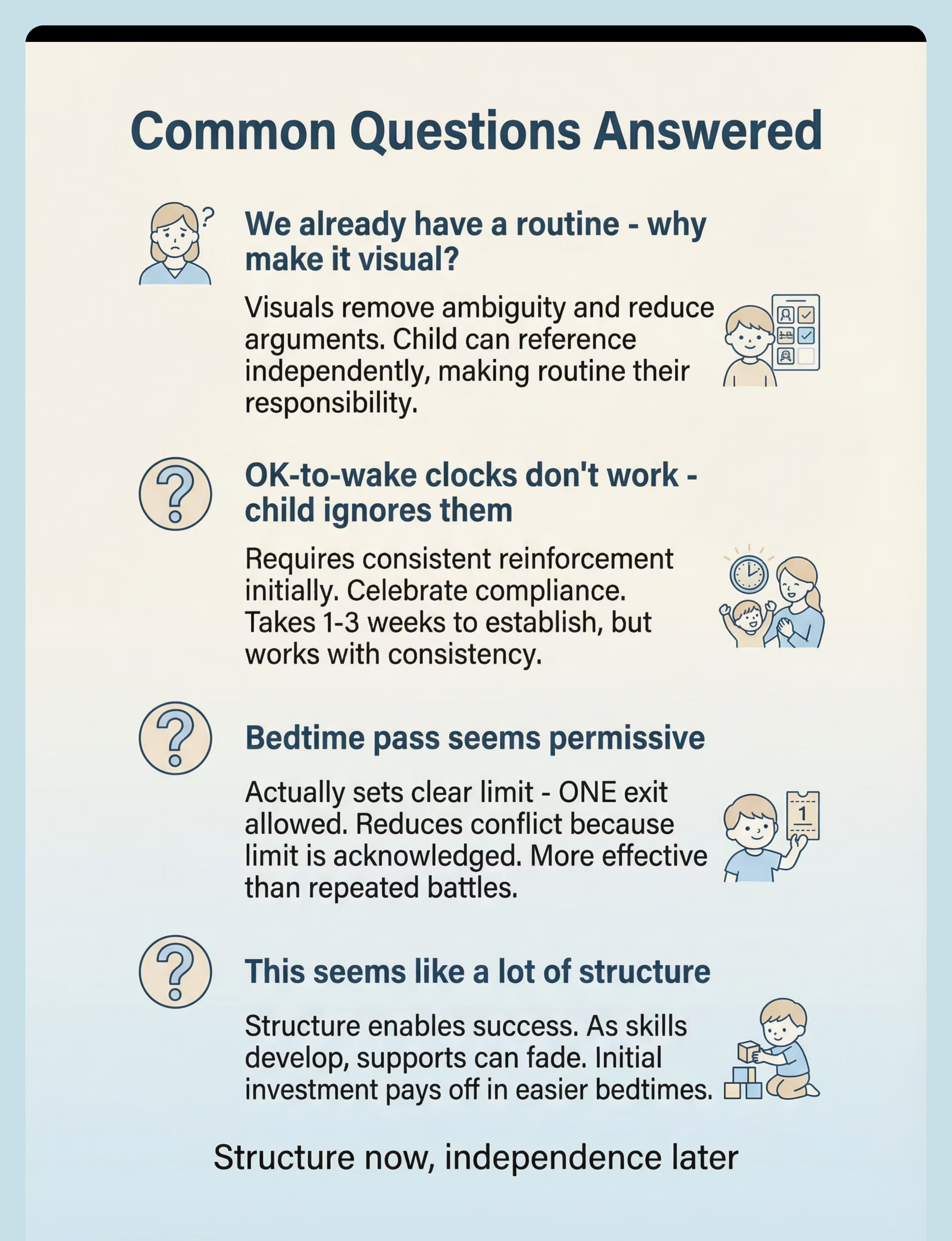
Common Questions (Honest Answers)
Q: We already have a routine—why make it visual?
A: Visual supports remove ambiguity and argument. Child can reference schedule independently without asking "what's next?" every step. Reduces need for constant reminding and makes routine the child's responsibility rather than yours. Independence and clarity are the goals.
Practical benefit: Reduces arguing; increases independence; frees you from being the constant director.
Q: OK-to-wake clocks don't work—my child ignores them
A: Requires consistent reinforcement initially. Child needs to actively learn the system over 1-3 weeks. Celebrate compliance enthusiastically. Apply natural consequence for not waiting (e.g., earlier bedtime if wakes family too early). Takes time but highly effective once established.
Key insight: Not instant solution—requires teaching phase with consistent reinforcement. Stick with it.
Q: Bedtime pass seems permissive—why allow an exit?
A: Actually sets clearer limit than saying "stay in bed" repeatedly—ONE exit allowed, child's choice. Child learns to use it wisely (usually saves for genuine need). Reduces conflict because limit is acknowledged. Much more effective than repeated battles where child keeps testing boundaries.
Reframe: Sets clear limit; reduces conflict; teaches decision-making.
Q: This is a lot of structure—isn't it too rigid?
A: Structure enables success. As skills develop over weeks/months, you can gradually fade supports. Initial investment in structure pays significant dividends in easier bedtimes. Think of it as training wheels—structure now, independence later. The goal is to internalize the routine, not depend on visuals forever.
Long view: Structure enables success; fade as skills develop; temporary support for long-term independence.
sleep-routine-supports therapy material
Investment Guide
Sleep routine supports range from completely free DIY options to commercial products around ₹2,500. Most families start with low-cost or free options and add targeted commercial tools as needed. The good news: the most effective support (visual schedule) can be made for under ₹200.
DIY Visual Schedule
0-200
Free Printables
0
Lamination (local shop)
50-100
Index Cards (bedtime pass)
20-50
OK-to-wake Clock
500-2000
Commercial Visual Schedule
200-500
Reward Chart
100-300
Starter Options
DIY Visual Schedule
Utilize free online printables and household items for an effective, low-cost solution.
Bedtime Pass System
Implement a simple card-based system to teach limits and encourage independent sleep.
Minimal Investment
Costs typically under ₹200 for lamination and index cards, yielding excellent results.
Premium Progression
1
OK-to-wake Clock
Begin with a popular smart clock (e.g., Hatch, Mirari) if early waking is a primary concern.
2
Commercial Visual Schedule
Integrate pre-made visual schedules for convenience and professional aesthetic.
3
Reward Chart
Introduce a structured reward system to reinforce positive sleep behaviors.
4
Targeted Additions
Add other commercial tools only as specific needs and challenges emerge.

Overall Price Range
₹0–2,500 (USD $0–30)
Best starting point: Begin with DIY visual schedule (under ₹200). If early-waking is major issue, invest in OK-to-wake clock (₹500-2,000). Add other supports as specific needs emerge. Most effective supports are the least expensive.
sleep-routine-supports therapy material
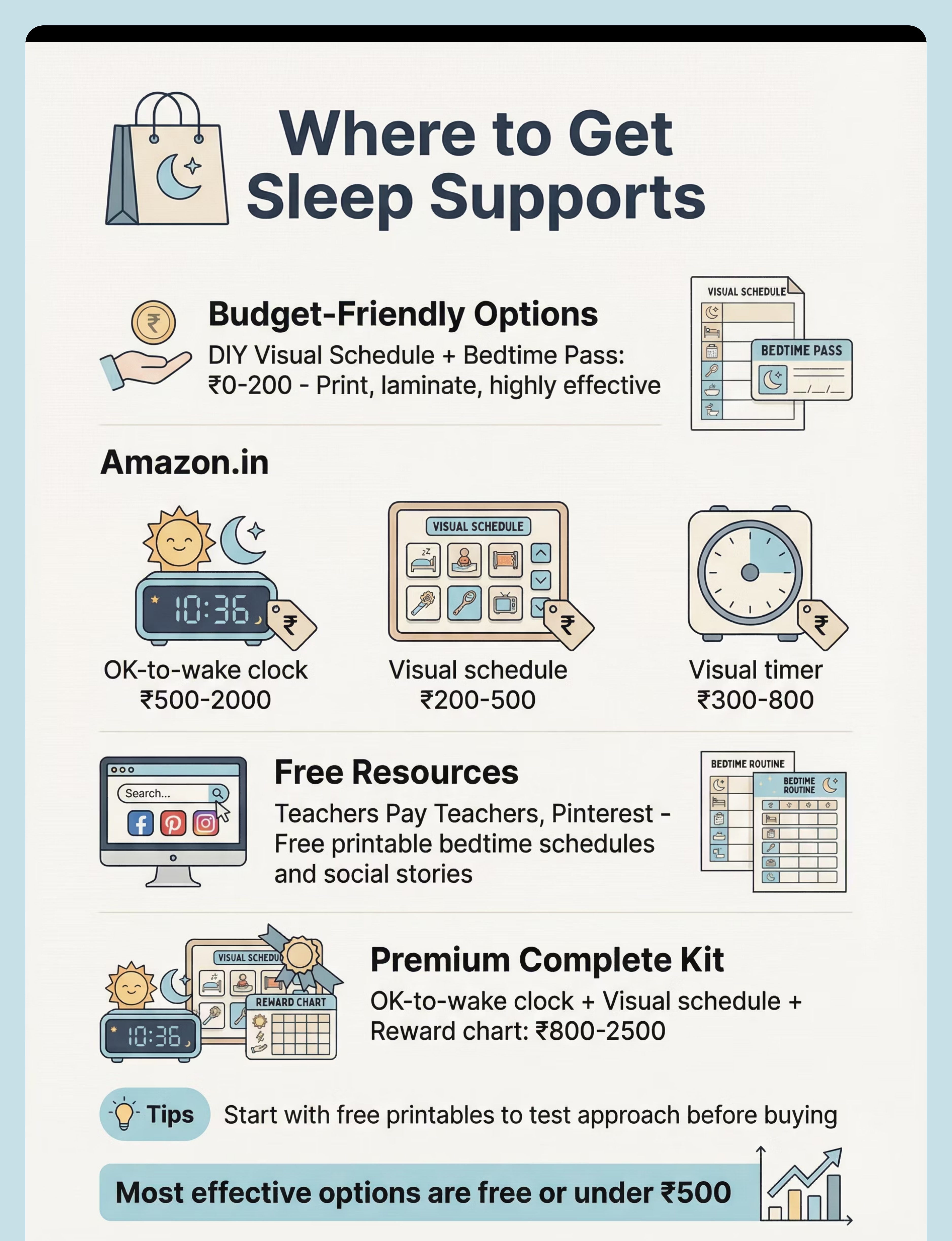
Where to Buy in India
Availability: Widely Available through online platforms and DIY options
Platform
Search Terms
Price Range
Best For
"ok to wake clock kids"
₹500-2,000
Early wake issues
"bedtime visual schedule"
₹200-500
Commercial schedules
"visual timer kids"
₹300-800
Time management
DIY
Print and laminate at local shop
₹50-200
Visual schedules
TPT/Pinterest
"Free bedtime visual schedule"
Free
Printable templates

Buying Tips
Free printables widely available online—excellent starting point
Laminate visuals for durability (₹50-100 at local shops)
Post schedule where child can see and reach independently
OK-to-wake clocks require consistent enforcement to work
Bedtime pass system is completely free to make (index card)
Red Flags
No visual supports attempted—missing foundation
Inconsistent routine—changing nightly undermines progress
OK-to-wake clock without consistent enforcement—won't work
Routine too complicated for child's developmental level
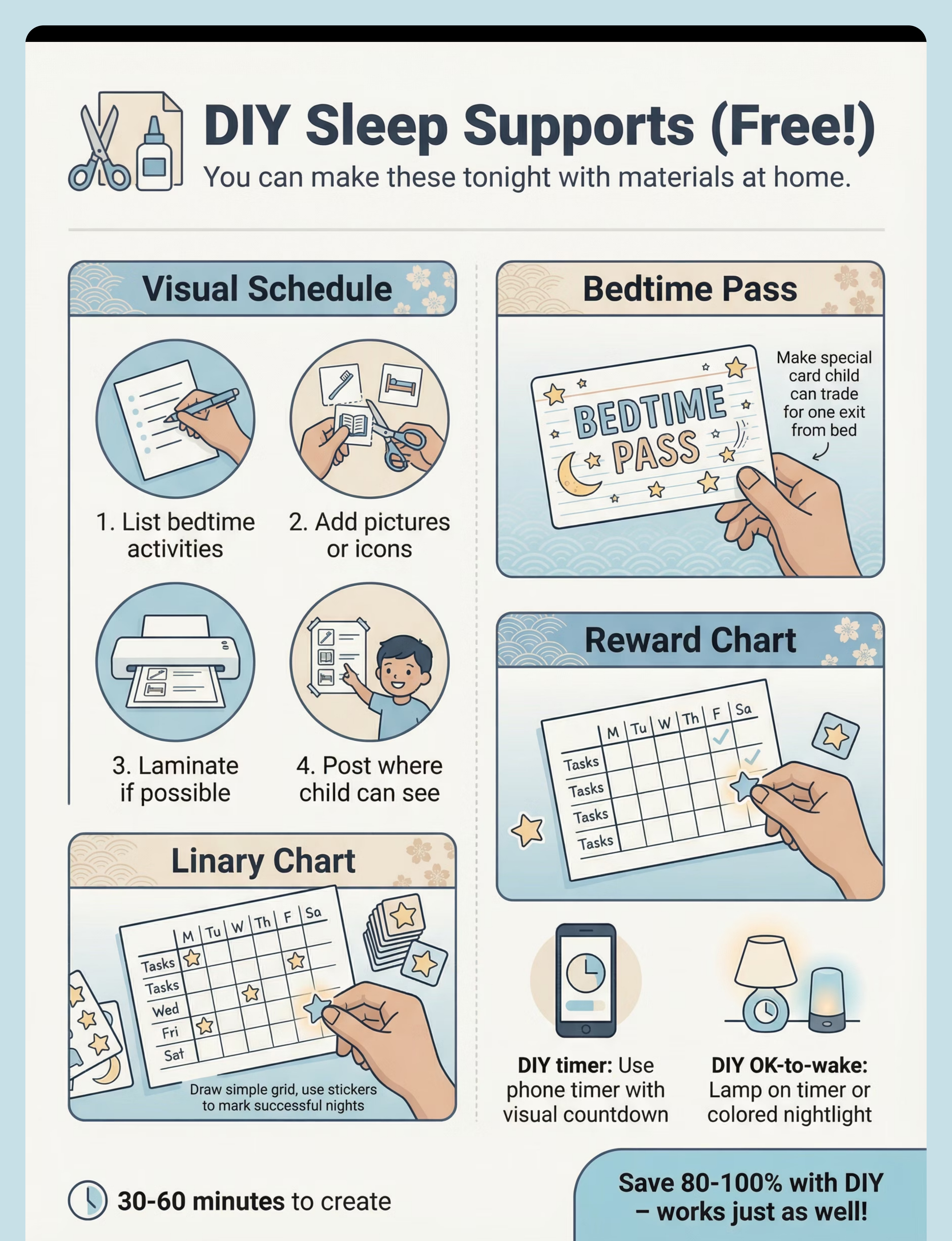
DIY Alternative (Save 80-100%)
Feasibility: Very High | Time Required: 30-60 minutes | Cost Savings: 80-100%
Materials Needed
  • Paper or cardstock
  • Pictures or icons (print from internet or draw)
  • Laminating sheets or lamination service
  • Index cards for bedtime pass
  • Optional: velcro dots, magnets, markers
Step-by-Step Instructions
  1. Visual schedule: List bedtime steps in order with pictures for each step. Laminate. Post in bedroom at child's eye level.
  1. Bedtime pass: Write "Bedtime Pass—Good for 1 Exit" on index card. Decorate if desired. Give to child at lights-out.
  1. Reward chart: Draw simple grid on paper (7 columns for week). Add row for each week. Use stickers for successful nights.
  1. Social story: Write simple bedtime story using photos of your child. Laminate pages. Read together nightly.
  1. Timer: Use phone timer or download free visual timer app. Many excellent free options available.
  1. DIY OK-to-wake: Use lamp on timer switch, or colored light system (green = OK to get up).
When to DIY works great for:
  • Visual schedules (DIY as effective as commercial)
  • Bedtime pass system (literally an index card)
  • Reward charts (paper and stickers work perfectly)
  • Social stories (personalized is better anyway)
Consider buying:
  • OK-to-wake clocks (harder to DIY effectively)
  • Visual timers (apps work but device may be too stimulating)
  • Want professional appearance for clinical consistency

Tradeoffs
DIY options work just as well as commercial products for most bedtime supports—visual schedules and bedtime passes are equally effective whether homemade or purchased. The main advantage of commercial products is durability and professional appearance, but these don't impact effectiveness.

Preview of sleep routine supports Therapy Material

Below is a visual preview of sleep routine supports therapy material. The pages shown help educators, therapists, and caregivers understand the structure and content of the resource before use. Materials should be used under appropriate professional guidance.

Page 1
Page 2
Page 3
Page 4
Page 5
Page 6
Page 7
Page 8
Page 9
Page 10
Page 11
Page 12
Page 13
Page 14
Page 15
Page 16
Page 17
Page 18
Page 19
Page 20
Link copied!
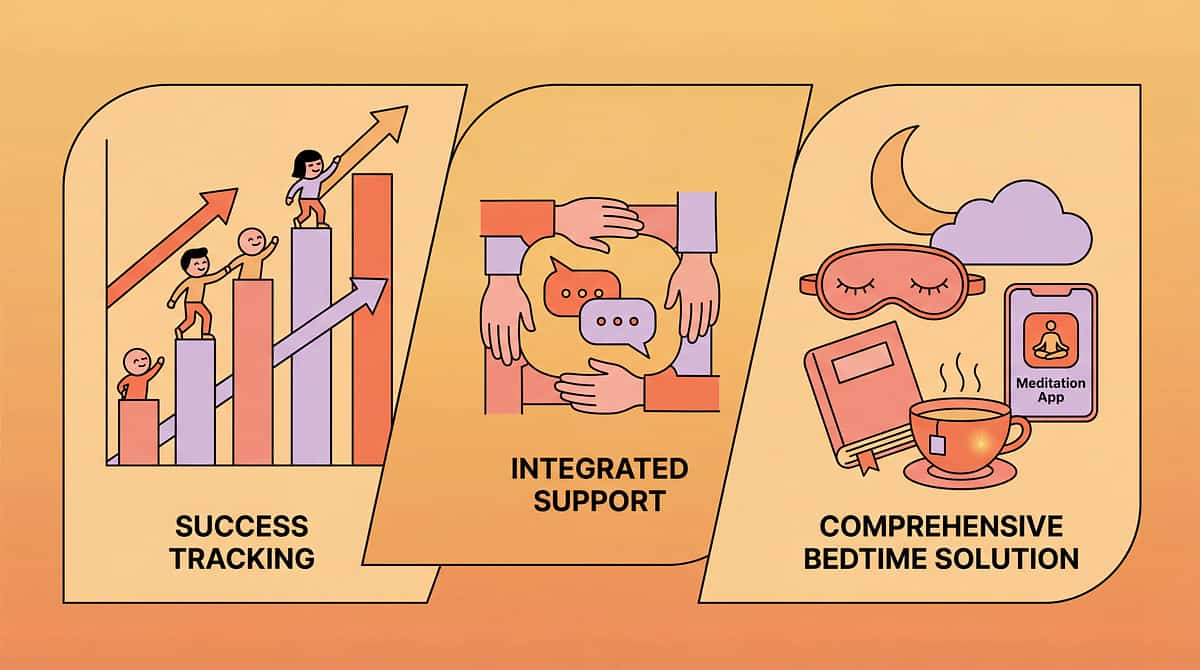
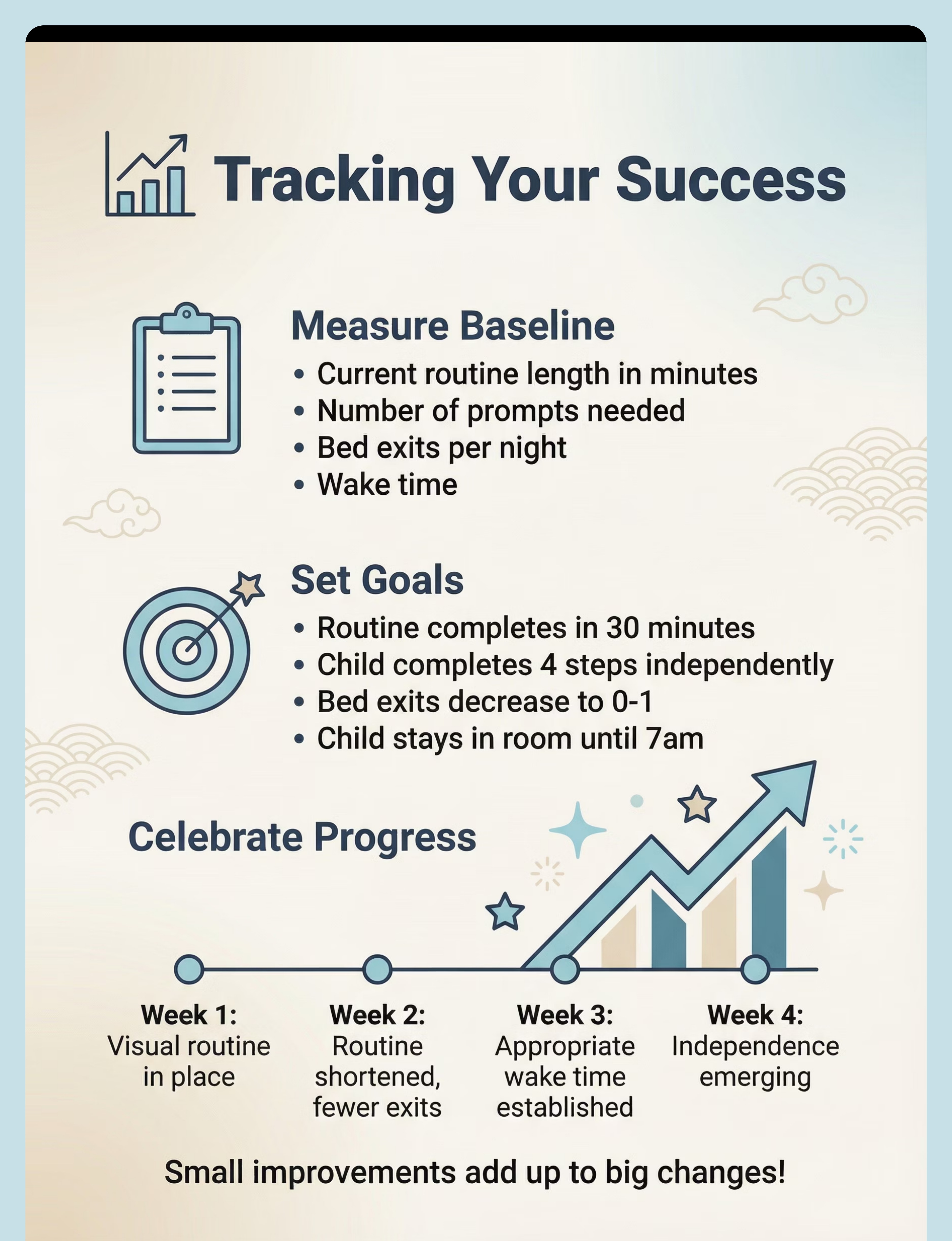
Complete Success System
1. Establish Baseline
  • Current bedtime routine length
  • Number of prompts/reminders
  • Number of bed exits
  • Current wake time vs. desired
2. Set Clear Goals
  • Routine completes in [X] minutes
  • Child completes [X] steps independently
  • Bed exits decrease to [X] per night
  • Child stays in room until [time]
3. Implement Core Routine Supports
Utilize visual schedules, OK-to-wake clocks, and bedtime passes for structure and predictability.
4. Monitor Progress & Adjust
  • Efficient routine completion
  • Growing independence
  • Fewer bed exits/curtain calls
  • Appropriate wake time maintained
5. Enhance with Companion Kits
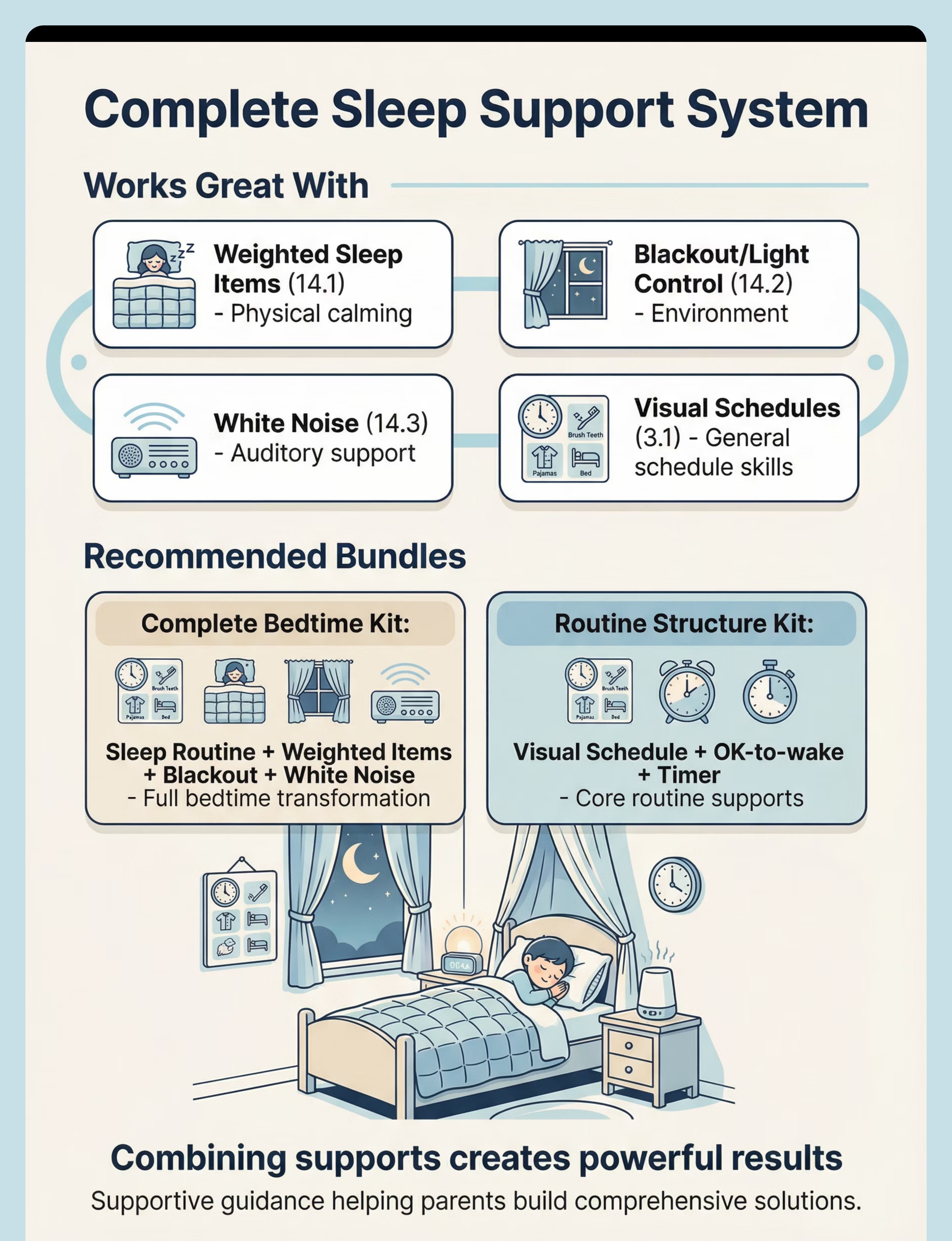
  • Weighted Sleep Items: For physical calming.
  • Blackout/Light Control: Optimize sleep environment.
  • White Noise: Mask disruptive sounds.
  • Visual Schedules (other areas): Apply skills beyond bedtime.
6. Seek Ongoing Support
Leverage national helplines and platform integrations for continuous assessment and personalized interventions.

Recommended Bundles
Complete Bedtime Kit: Sleep Routine Supports (14.4) + Weighted Sleep Items (14.1) + Blackout/Light Control (14.2) + White Noise (14.3) — Full bedtime environment optimization
Routine Structure Kit: Bedtime Visual Schedule (14.4.1) + OK-to-Wake Clock (14.4.2) + Sleep Timer (14.4.4) — Core routine and timing support

Quick Summary
AI Summary: Sleep routine supports provide structure, predictability, and visual guidance for bedtime through schedules, OK-to-wake clocks, bedtime passes, and reward systems. Core Kit (Rank 1), strong evidence, essential bedtime foundation.
sleep routine
bedtime
visual schedule
ok to wake
bedtime pass
structure
core-kit
Common Searches
bedtime visual schedule autism, ok to wake clock, sleep routine, bedtime social story, bedtime pass, sleep training visual, bedtime reward chart

Get Support
FREE National Autism Helpline
Phone: 9100 181 181
Languages: 16+ Indian languages supported
Free consultation and guidance for all developmental support questions
Platform Integration
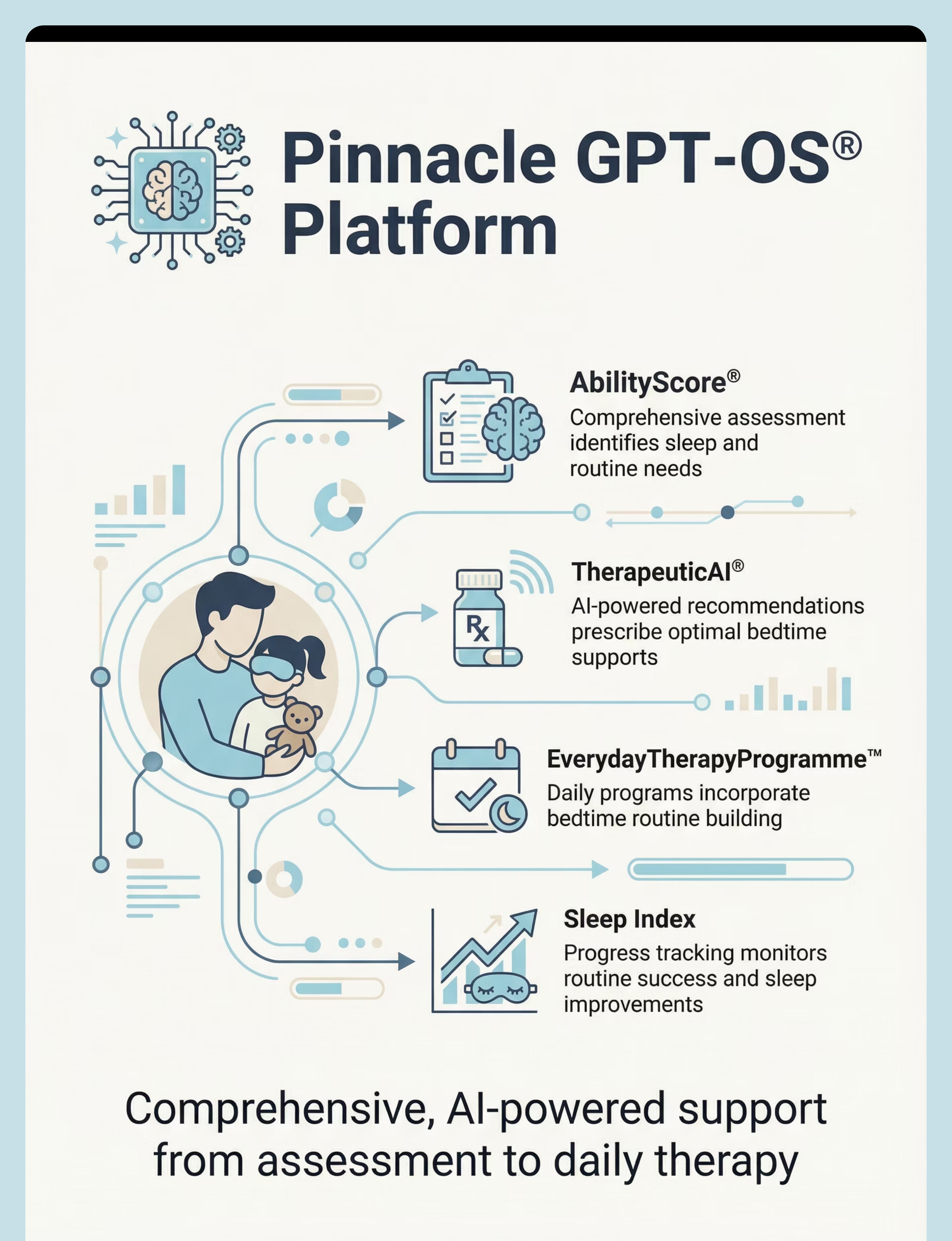
AbilityScore® identifies routine support needs through comprehensive assessment
TherapeuticAI® prescribes personalized bedtime interventions based on your child's profile
EverydayTherapyProgramme™ includes bedtime routine training as core component
Sleep Index tracks routine success and sleep quality improvements over time

Disclaimer: This is educational information. Always consult qualified occupational therapists, speech-language pathologists, or pediatricians for personalized guidance. Individual results vary. Sleep routine supports are evidence-based tools that support development when used consistently, but they are not a cure for sleep disorders or developmental conditions. Professional consultation is recommended for persistent sleep challenges.