




Social Skills Cards for Autism
Teaching the Hidden Rules of Friendship
Tool ID: 4.1
Psychologist + SpEd
Strong Evidence
Rank #1
Daily Use
₹150–1,200
Social Skills Cards / Scenarios
Social cognition and interaction teaching system
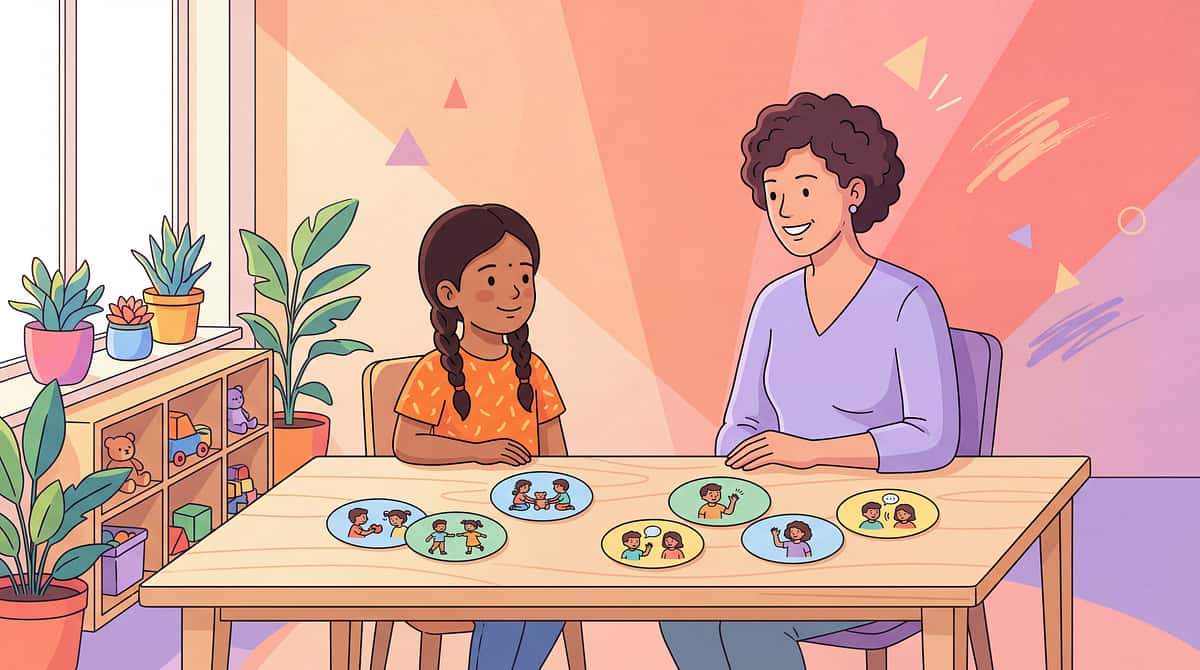
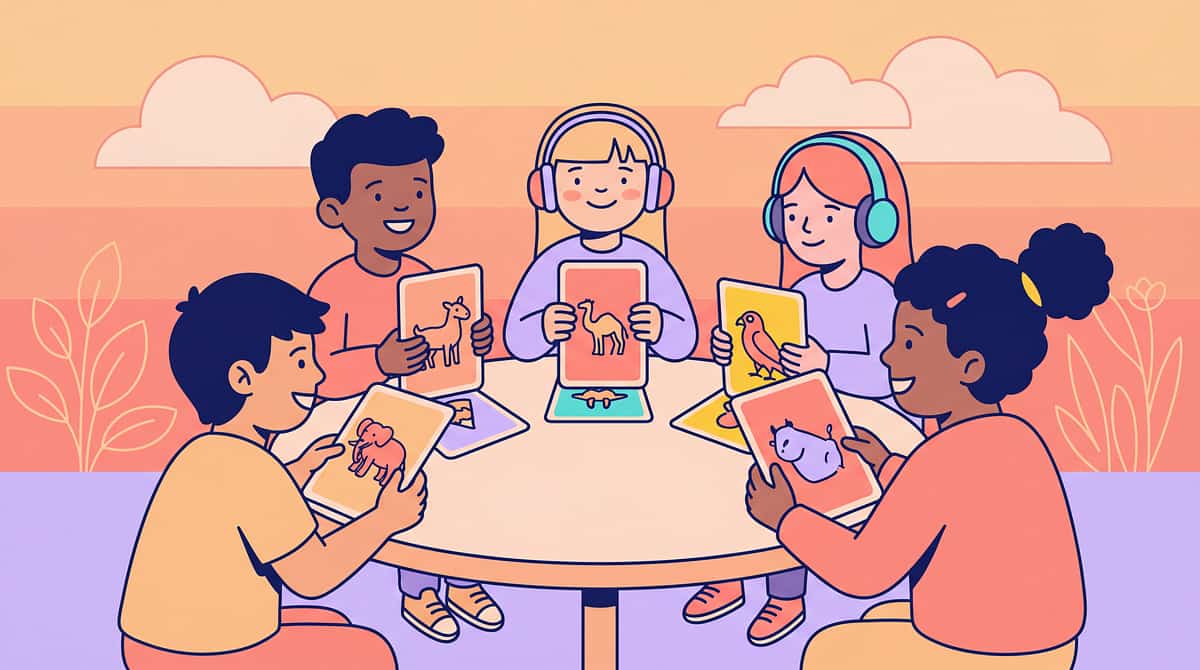
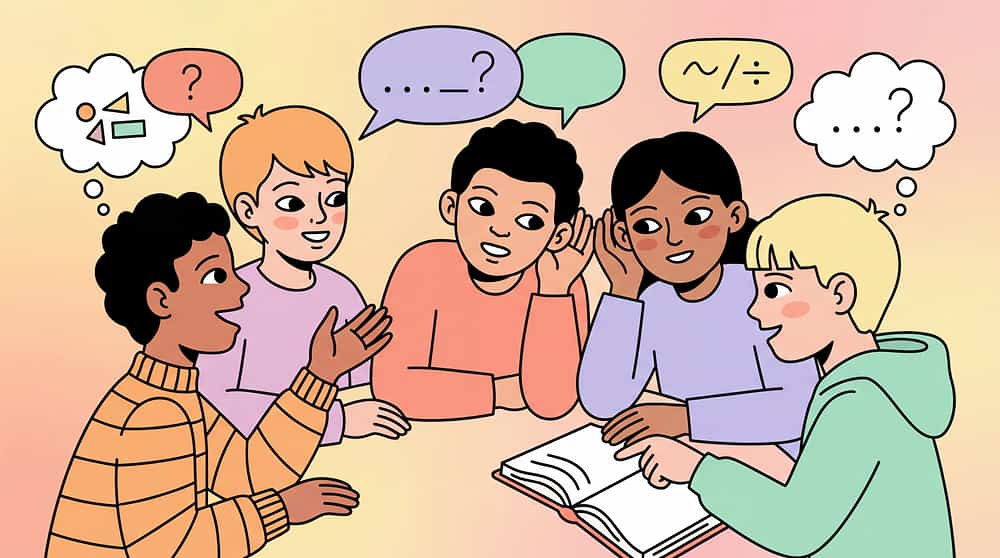
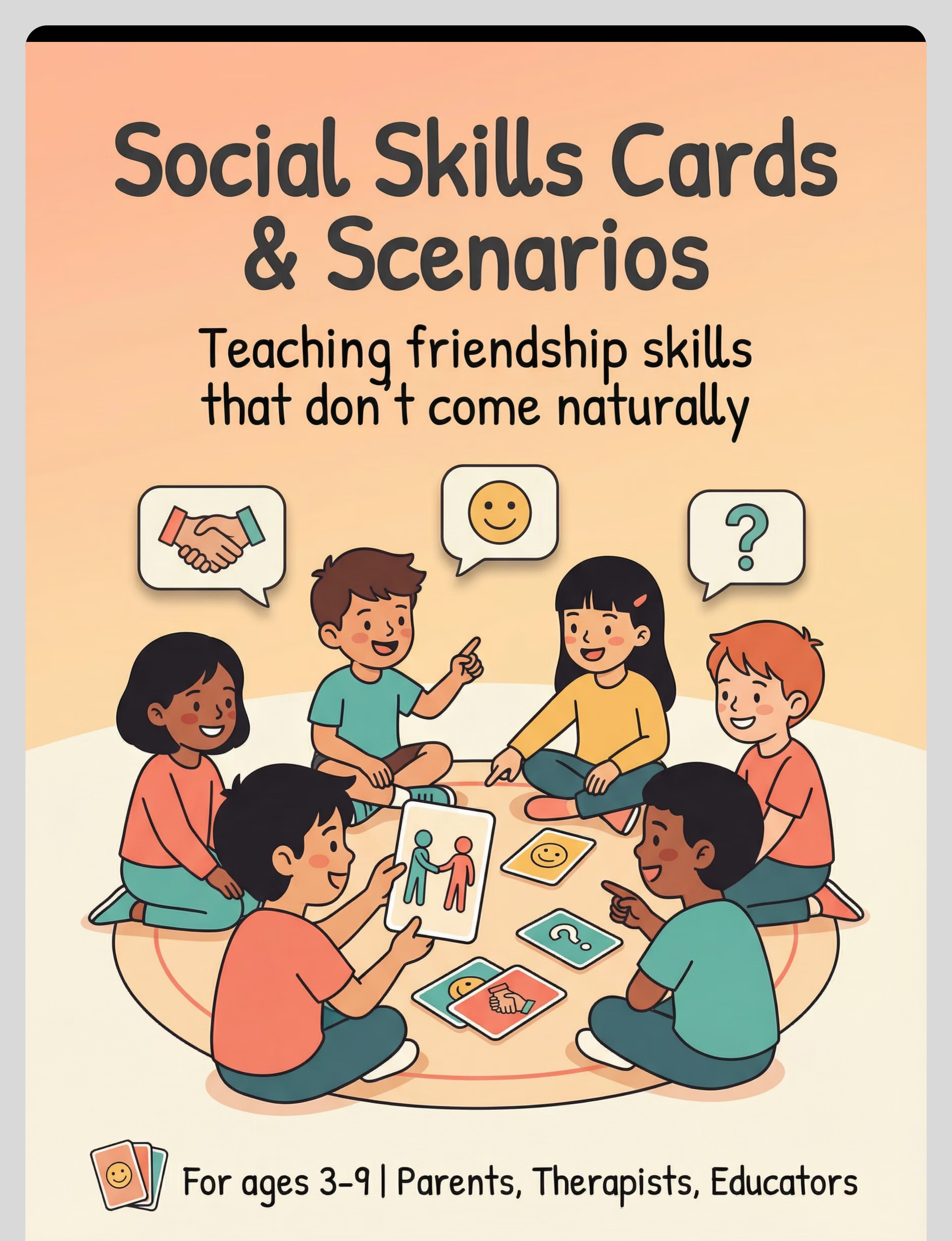
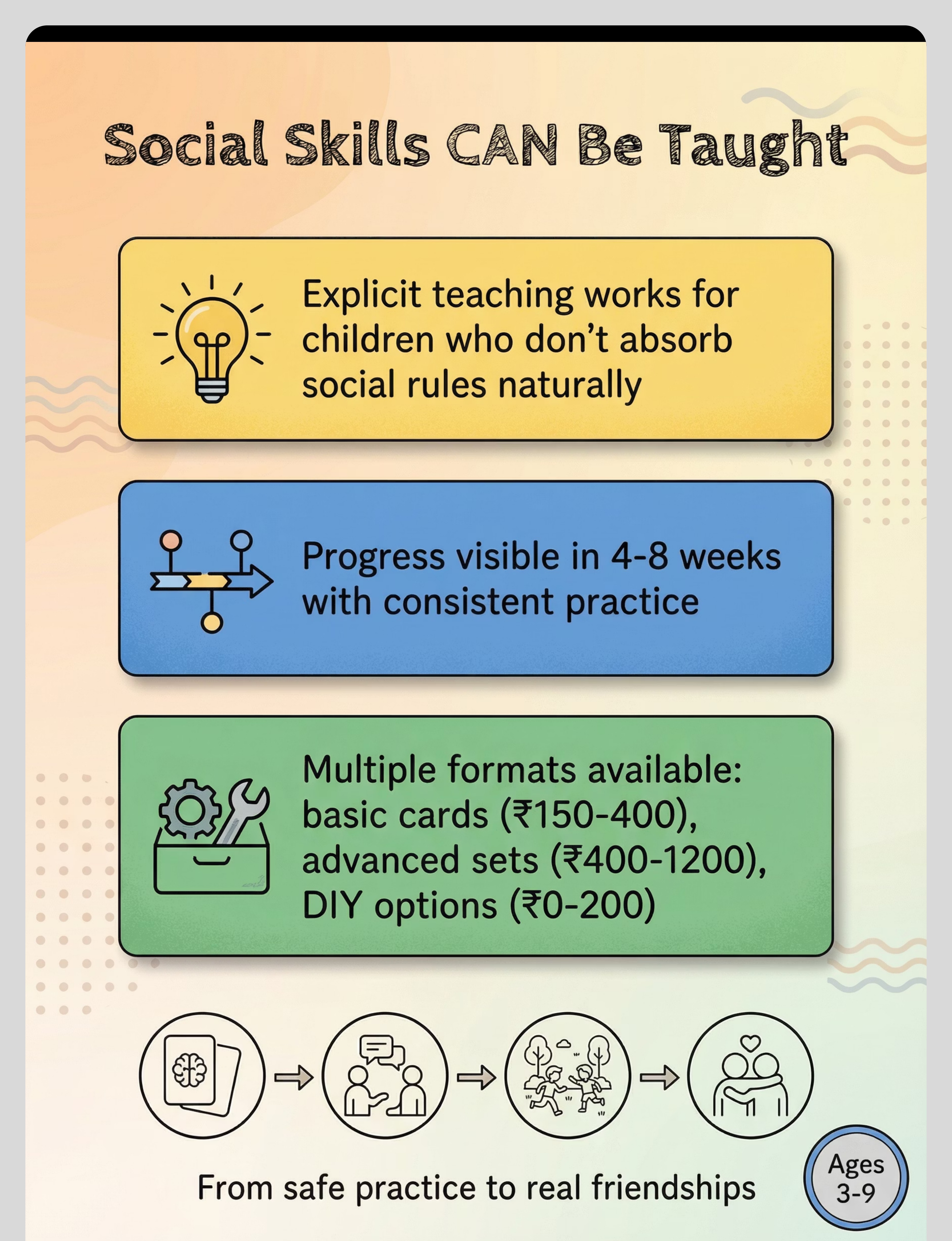
Explicitly teach social skills that neurotypical children learn implicitly. For children with autism who want friends but don't know how to make them, social skills cards break down the invisible rules of social interaction into clear, learnable steps. These visual teaching tools transform loneliness into connection through structured practice and real-world application.
Who This Helps
Social skills cards explicitly teach the implicit social rules that children with autism miss. These tools bridge the gap between wanting connection and knowing how to create it.
Social Skills
Perspective-Taking
Conversation
Friendship
Social Problem-Solving
Reading Social Cues
Ages 3-9 years
Home
Clinic
School
Outdoors
Children who struggle to make or keep friends
When your child wants connection but doesn't understand the social dance that comes naturally to others
Children who miss social cues others pick up naturally
Perfect for explicit teaching of body language, tone of voice, and unspoken social expectations
Children with one-sided conversations
Teaching the back-and-forth rhythm of reciprocal communication through structured practice
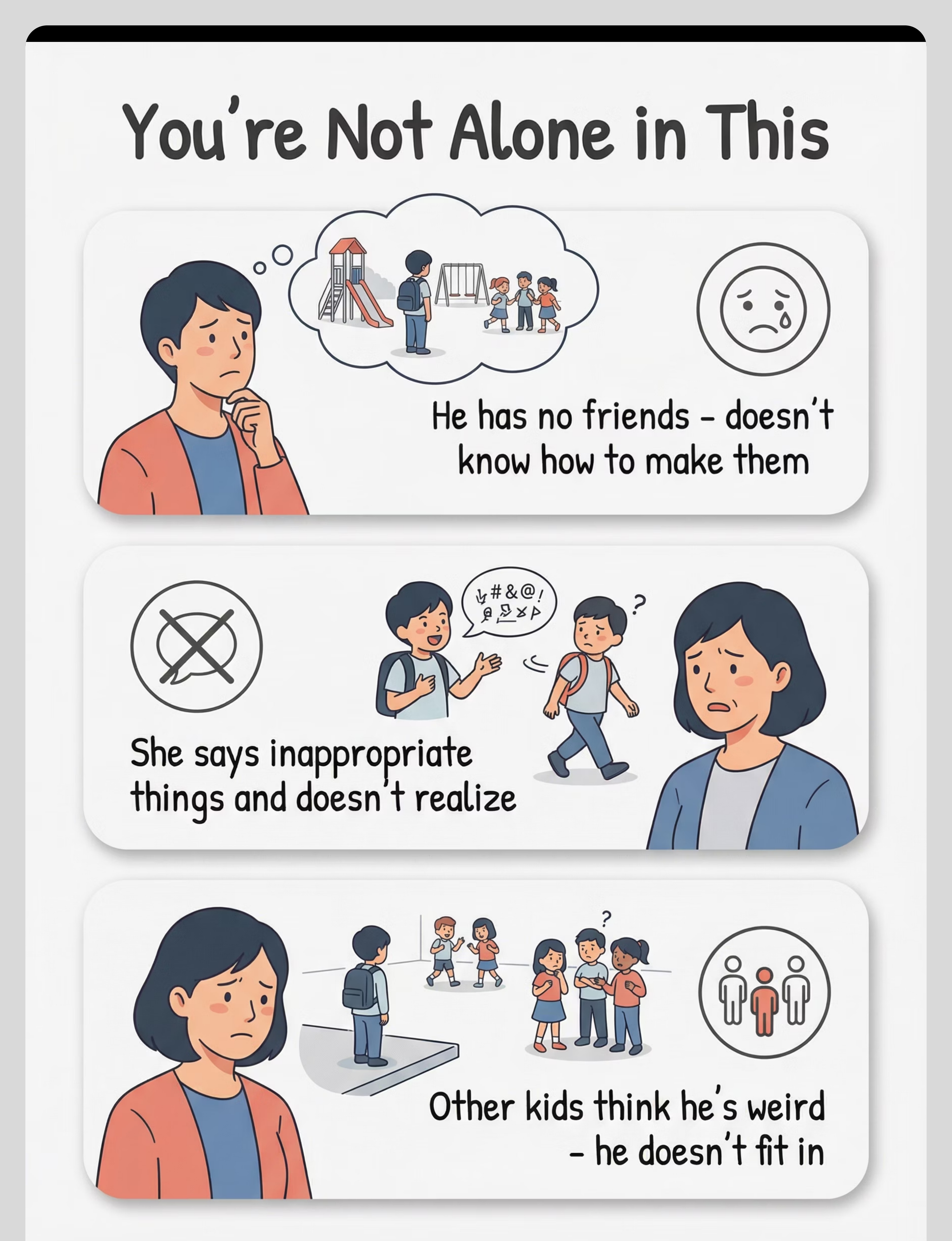
Does This Sound Familiar?
"He has no friends - doesn't know how to make them"
"She doesn't understand social cues at all"
"He says inappropriate things and doesn't realize"
"She wants friends but pushes them away"
"He can't have a back-and-forth conversation"
"Other kids think he's weird - he doesn't fit in"
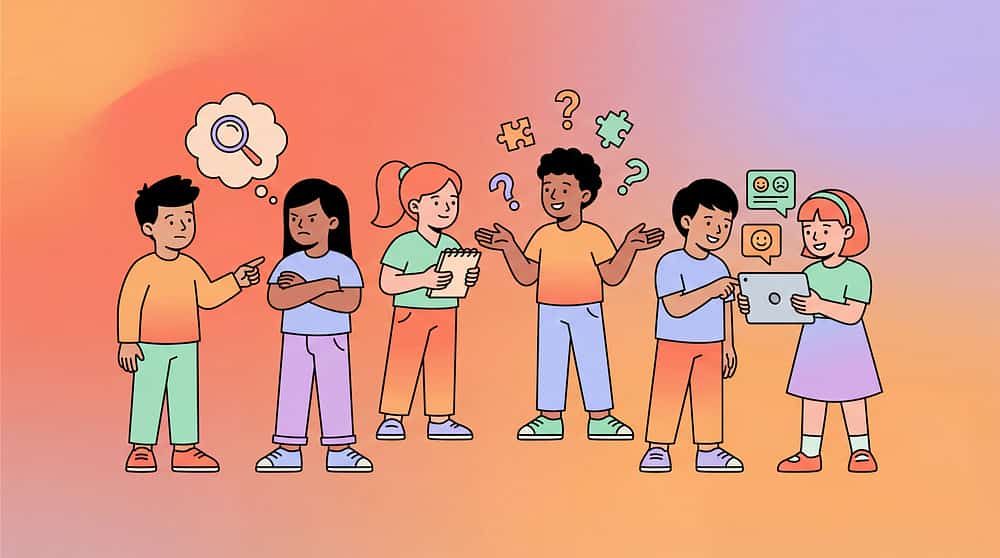
You're not alone. These are common challenges for children with autism. The social world operates on invisible rules that neurotypical children absorb without conscious effort. For children with autism, these rules need to be made visible, explicit, and teachable. That's exactly what social skills cards do.
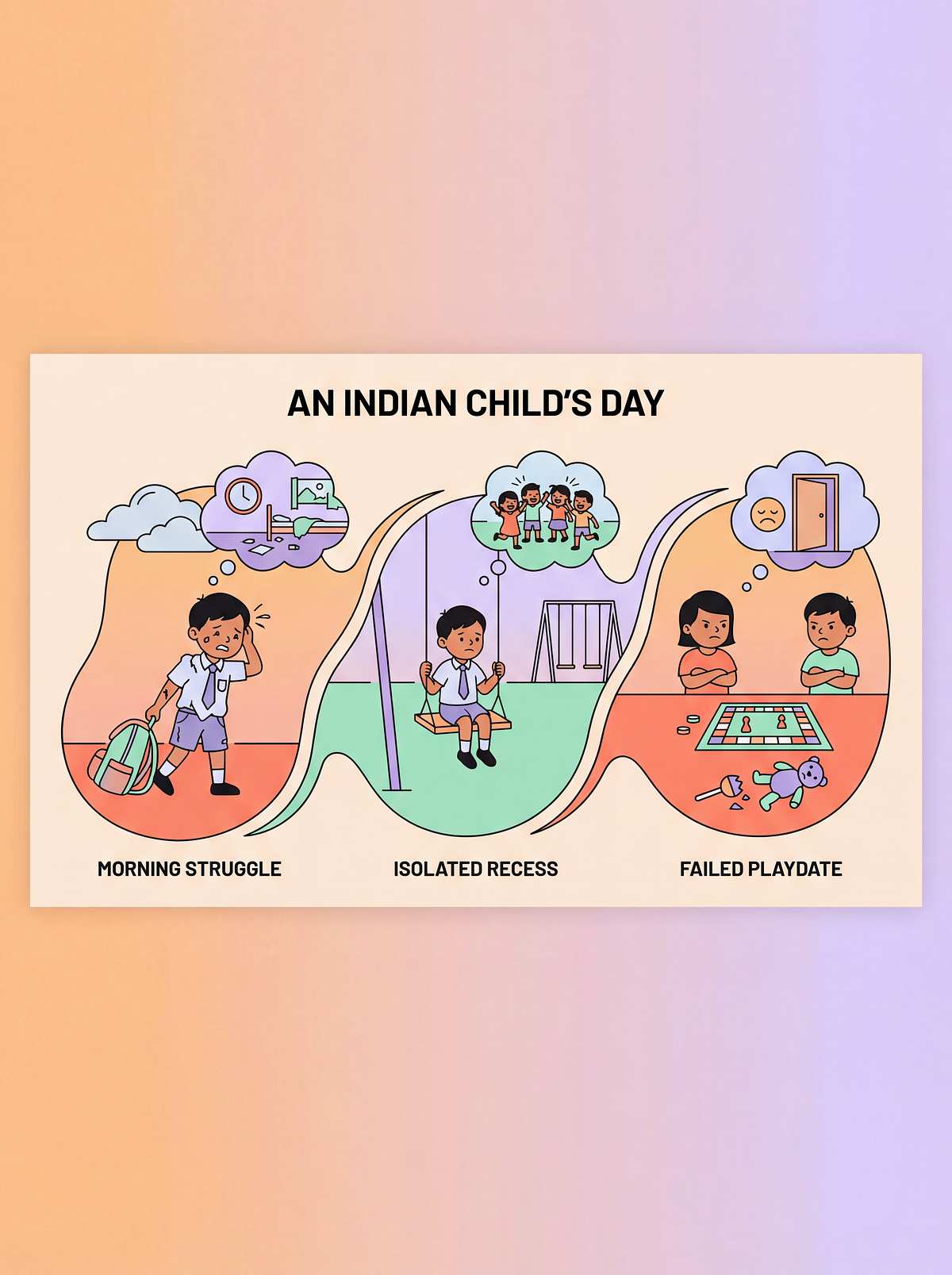
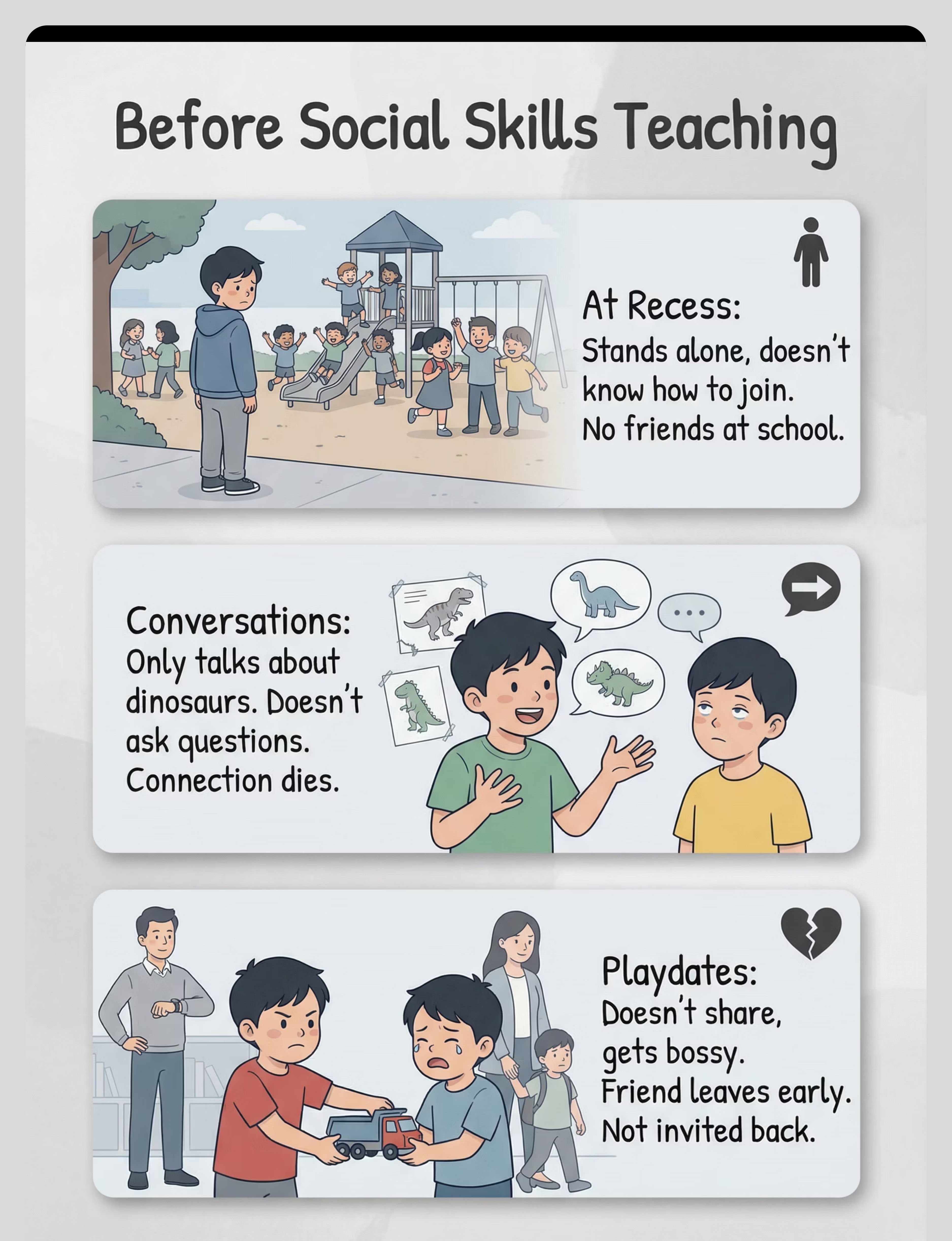
A Day Without the Right Support
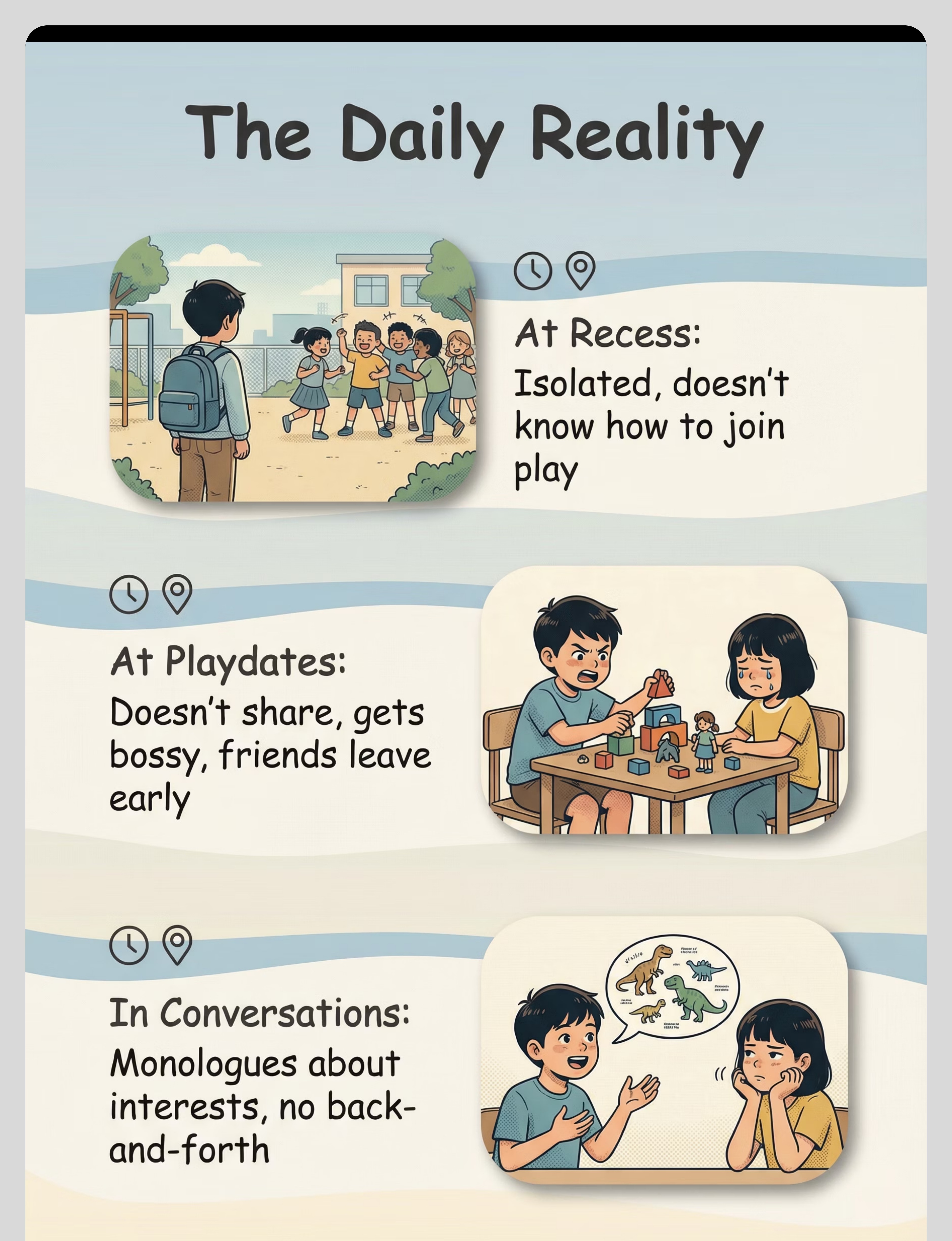
School Recess
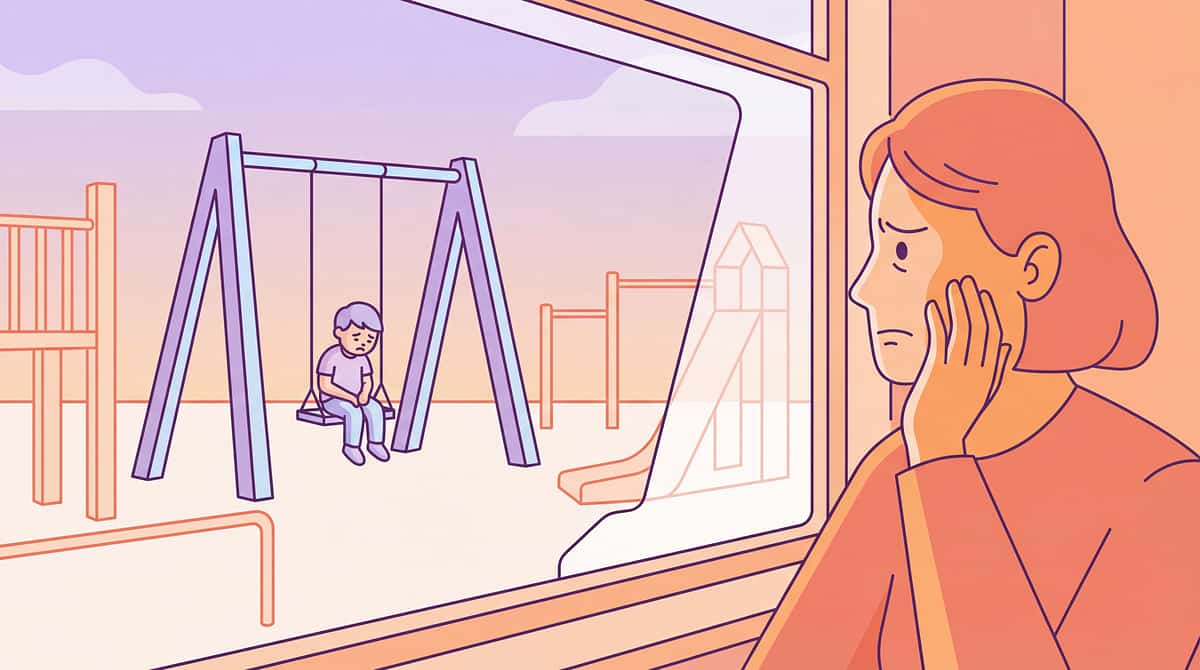
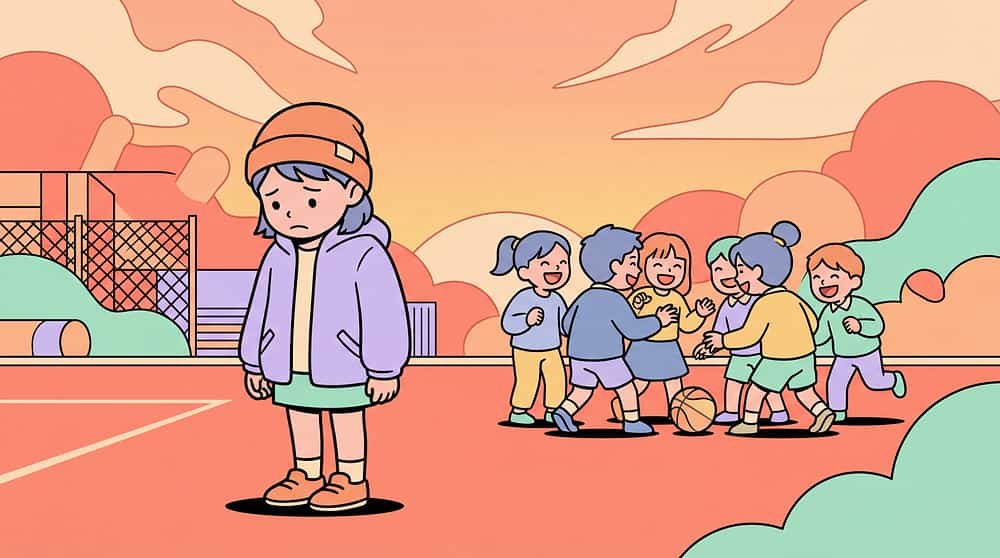
Isolated at recess, no one to play with. Standing alone while other children run and laugh together.
Conversation Attempts
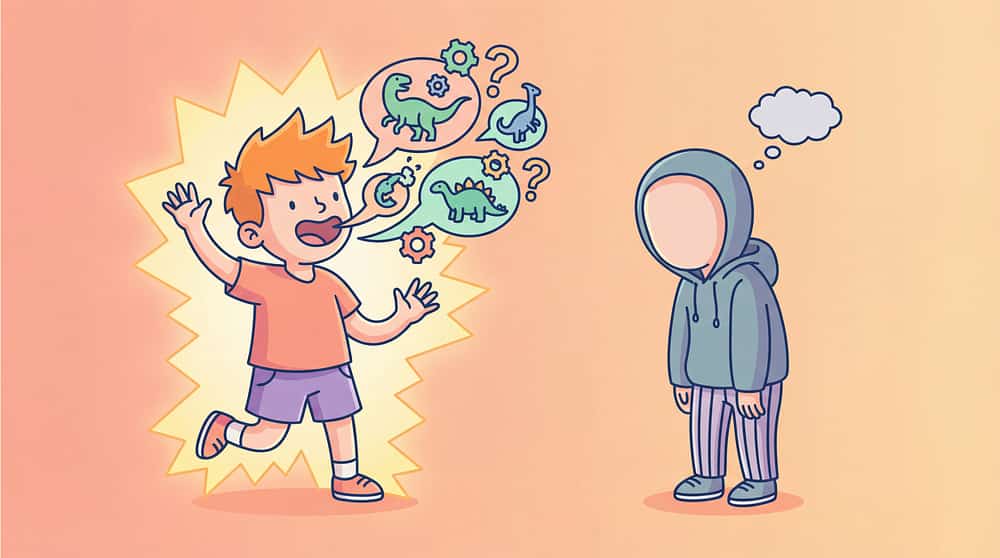
Monologues about interests, doesn't ask questions. The other child's eyes glaze over, conversation dies.
Playdate
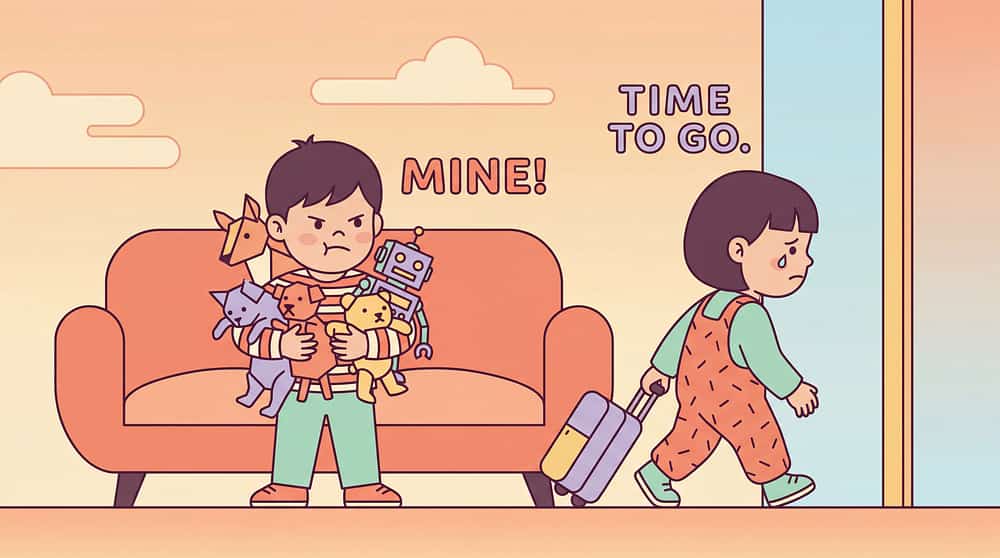
Doesn't know how to interact, play falls apart. The friend leaves early. Parents exchange worried glances.
Group Activities
Can't navigate group dynamics, gets excluded. Watches from the sidelines, wanting to join but not knowing how.
Each failed social interaction compounds the challenge. Without explicit teaching, the gap between your child and their peers widens. Loneliness becomes the daily reality. But it doesn't have to stay this way.
The Science Behind It
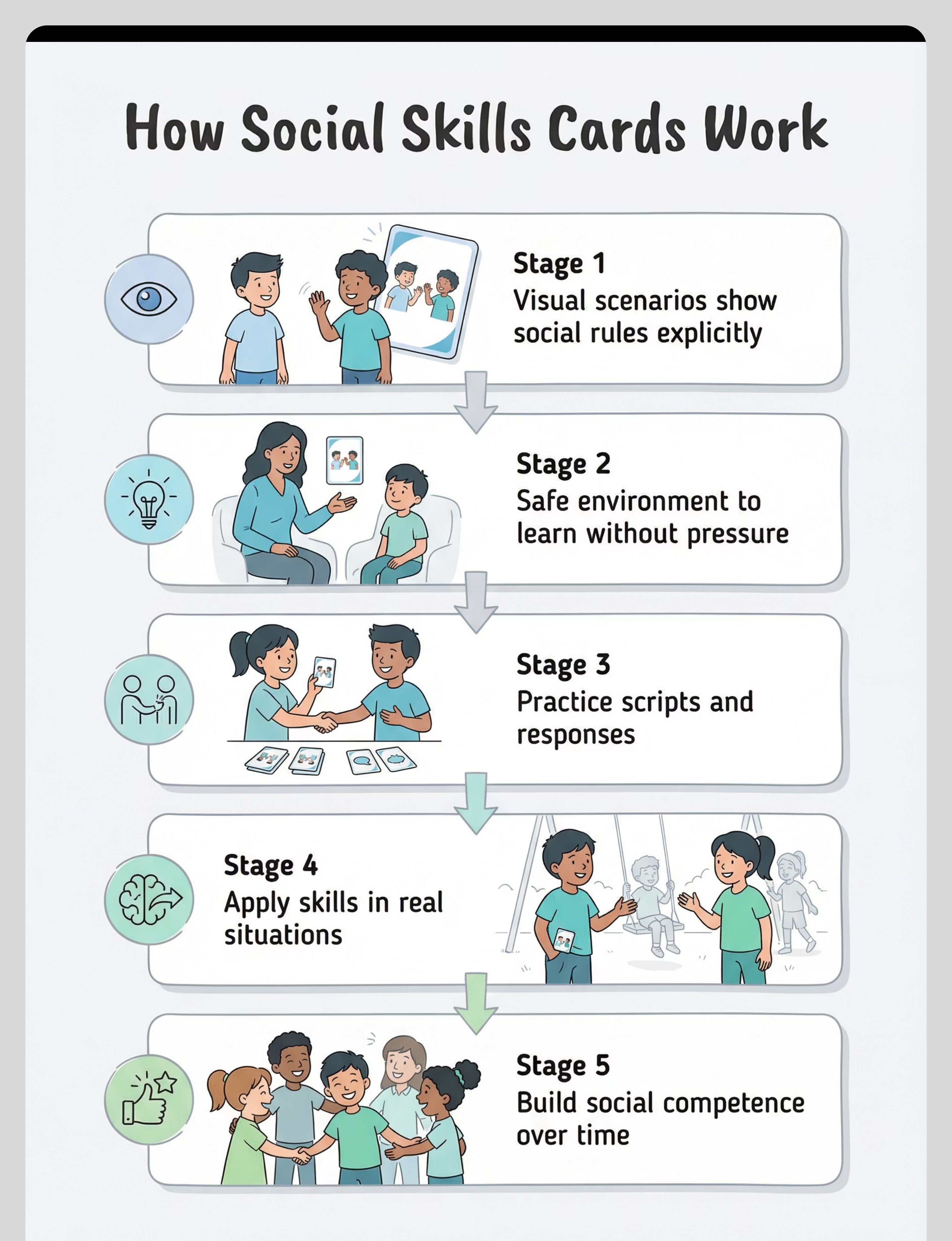
Visual Scenarios
Present social situations in concrete, visual format that makes implicit rules explicit and observable
Explicit Teaching
Break down unspoken social expectations into clear, teachable components with step-by-step guidance
Safe Practice
Practice responses in low-pressure environment where mistakes are learning opportunities, not social failures
Script Development
Create reliable social scripts that become internalized patterns through consistent repetition and success
Real-World Transfer
Generalize learned skills to actual social situations with support, building confidence and competence
Social Competence
Achieve improved peer relationships, successful interactions, and genuine friendships through practiced skills
Social Skills
Perspective-Taking
Conversation
Friendship
Social Problem-Solving
Reading Social Cues
How to Use It Right
Teach one skill at a time thoroughly
Master greeting before moving to conversation. Build foundation before complexity. Deep learning beats surface coverage.
Use role-play to practice
Cards teach concepts, role-play builds muscle memory. Practice the skill repeatedly until it becomes natural and automatic.
Connect to child's real-life situations
Use scenarios from your child's actual world. The playground at their school. The neighbor they want to befriend.
Practice in calm, low-pressure environment
Learn at home before trying at school. Build competence in safety before testing in the real world.
Generalize to natural settings
Bridge practice to reality with supported real-world attempts. Review cards before social situations, debrief after.
Celebrate attempts, not just success
Every try is progress. Reinforce courage to attempt, not just perfection in execution. Build confidence through encouragement.
Duration: 10-20 minute sessions with consistent daily practice. Social skills develop through repetition and real-world application, not one-time teaching.
Expert Perspective
"Social skills don't come naturally to all children. For those who need explicit teaching, breaking down social interactions into learnable components - like we do with any academic subject - is essential."
— Child Psychologist, Social Skills Specialist
Psychologist + SpEd Recommended
Strong Evidence
Rank #1 in Category
Core Kit Essential
Social skills cards are ranked #1 in the Social Skills Development category with strong research evidence. They represent the gold standard for explicit social teaching, used daily by psychologists and special educators across India and worldwide.
social-skills-cards-scenarios therapy material
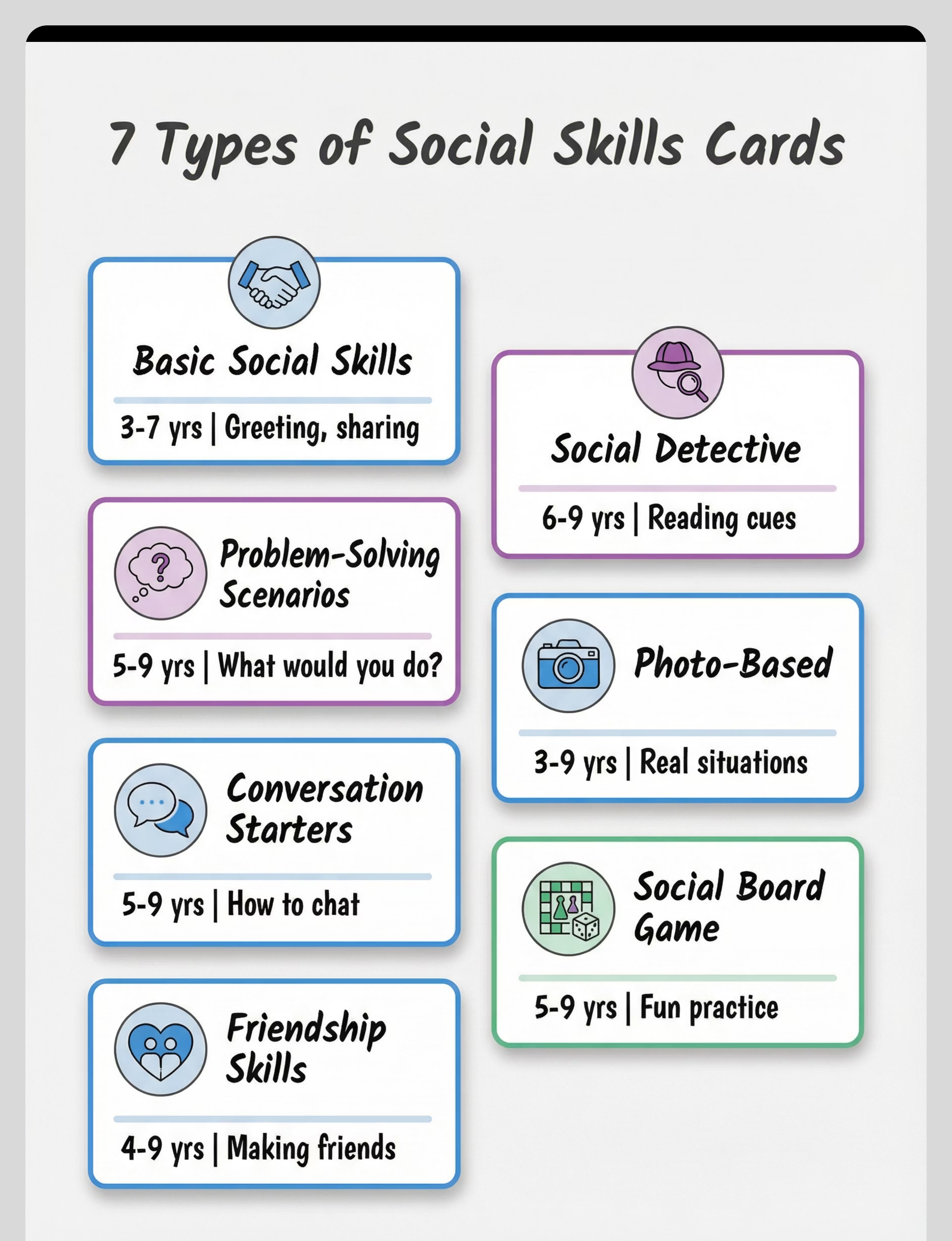
Choose Your Option (7 Variants)
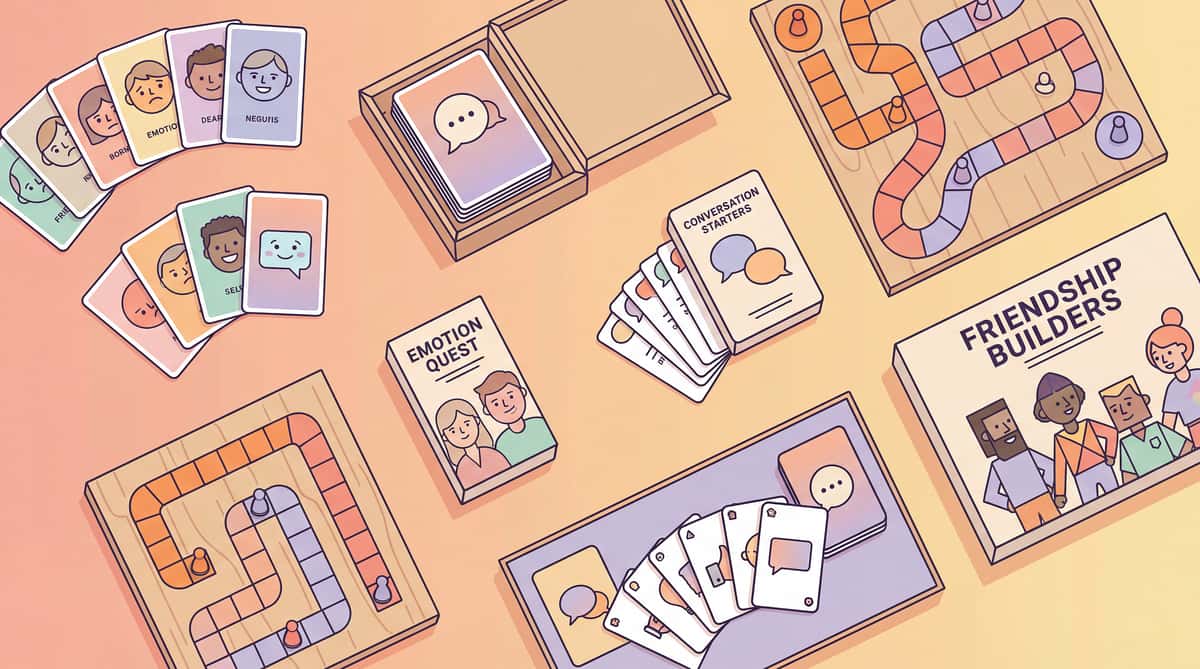
Select the card set that matches your child's current needs and developmental level. Start with foundational skills and progress to more complex social thinking as competence builds.
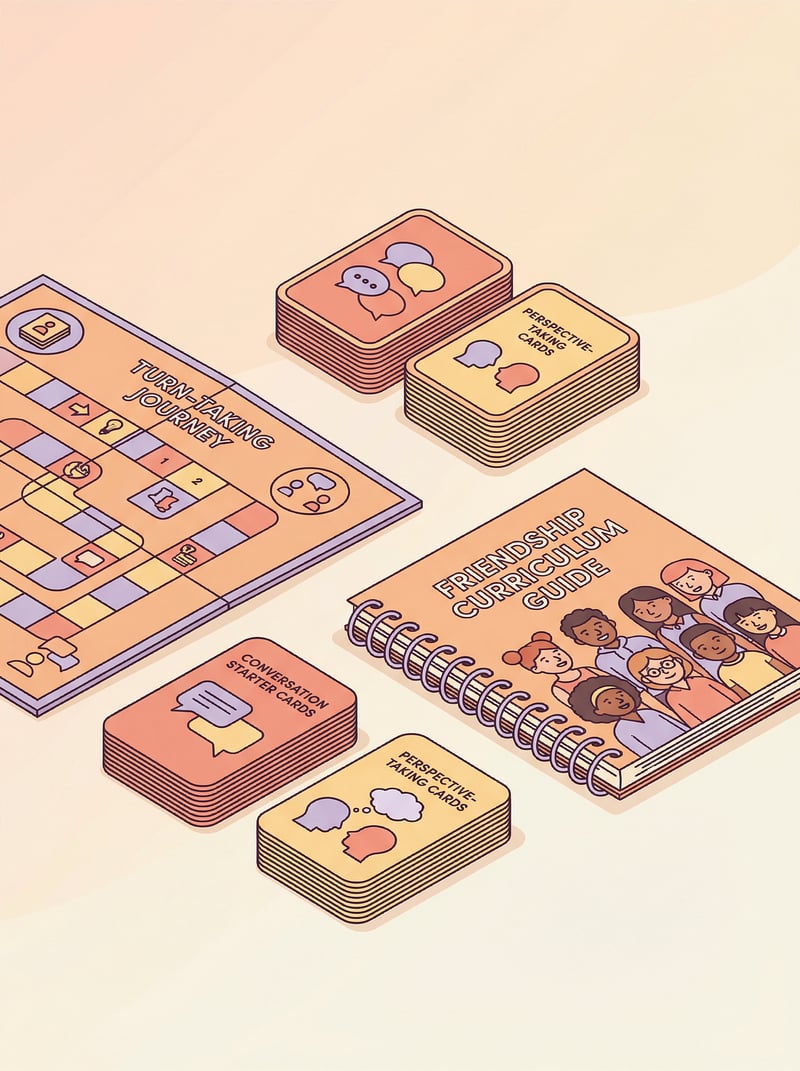
Basic Social Skills Card Set
Social Scenario Problem-Solving Cards
Conversation Starter Cards
Friendship Skills Cards
Social Detective / Social Thinking Cards
Photo-Based Social Situations
Social Skills Board Game
Basic Social Skills Card Set
Best for: Young children, basic skills (greeting, sharing)
Ages: 3-7 years | Settings: Home, Clinic, School
Portability: High | Type: Foundational social behaviors
Price: ₹200–600
Social Scenario Problem-Solving Cards
Best for: Practicing responses, perspective-taking
Ages: 5-9 years | Settings: Home, Clinic, School
Portability: High | Type: What would you do? scenarios
Price: ₹250–700
Conversation Starter Cards
Best for: Conversation skills, social initiation
Ages: 5-9 years | Settings: Home, Clinic, School
Portability: High | Type: How to start/maintain conversations
Price: ₹150–400
Friendship Skills Cards
Best for: Peer relationships, playground skills
Ages: 4-9 years | Settings: Home, Clinic, School
Portability: High | Type: Making and keeping friends
Price: ₹200–500
Social Detective / Social Thinking Cards
Best for: Higher-level social cognition
Ages: 6-9 years | Settings: Clinic, School, Home
Portability: High | Type: Reading social cues, hidden rules
Price: ₹400–1,200
Photo-Based Social Situations
Best for: Concrete learners, generalization
Ages: 3-9 years | Settings: All
Portability: High | Type: Actual social scenarios with real photos
Price: ₹300–800
Social Skills Board Game
Best for: Engaging practice, groups, siblings
Ages: 5-9 years | Settings: Home, Clinic
Portability: Medium | Type: Game-based social learning
Price: ₹400–1,000
How to Choose
By Goal
  • Basic skills: Start with Basic Skills Card Set
  • Conversation: Conversation Starter Cards
  • Friendship: Friendship Skills Cards
  • Advanced thinking: Social Detective Cards
By Learning Style
  • Concrete learners: Photo-Based Situations
  • Game motivation: Social Skills Board Game
  • Problem-solving focus: Scenario Cards
By Setting
  • Home practice: Any high-portability set
  • Therapy sessions: Social Detective or Scenario Cards
  • School use: Basic Skills or Conversation Cards
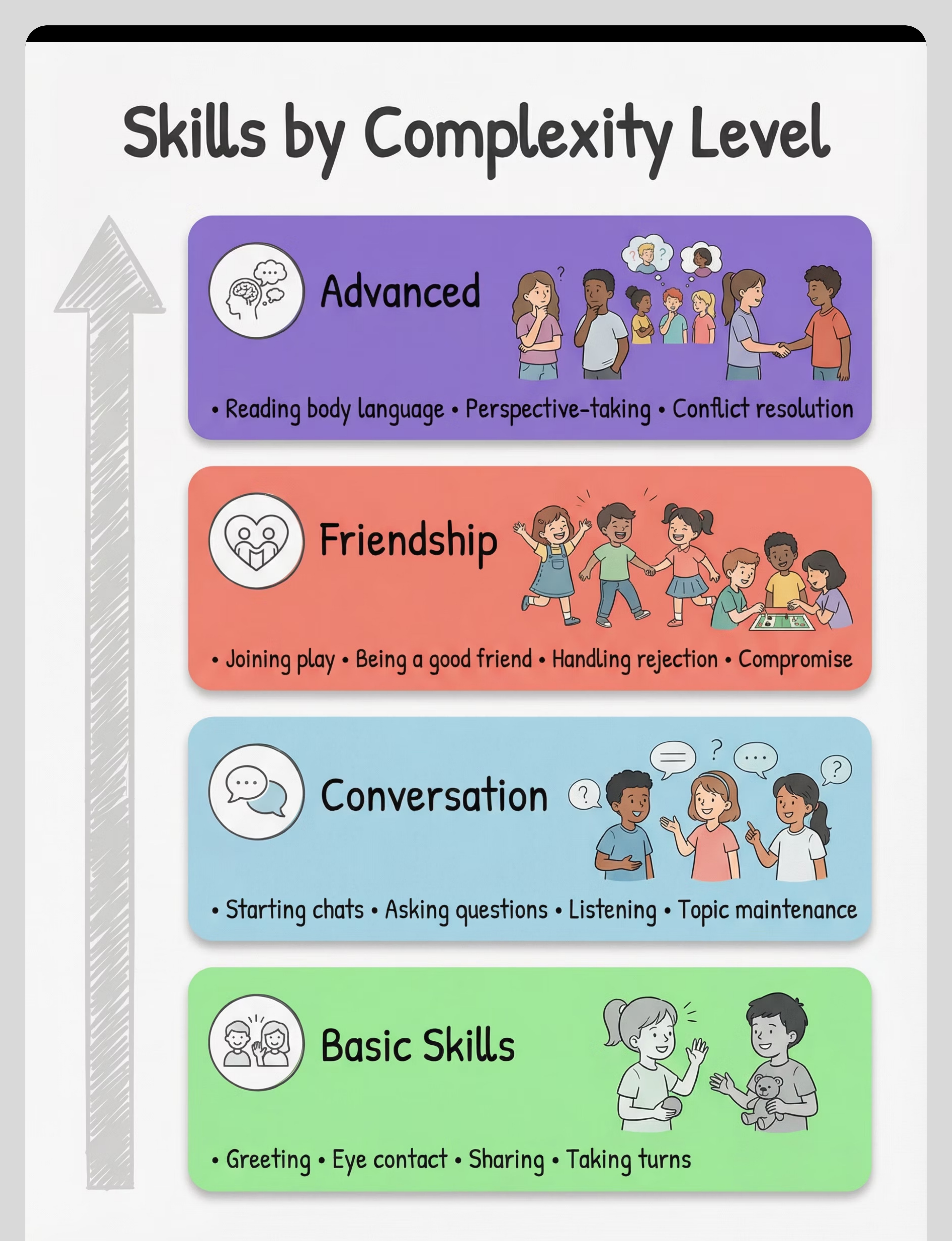
Understanding Skill Categories
Basic Skills
  • Greeting others appropriately
  • Making eye contact
  • Respecting personal space
  • Taking turns in activities
  • Sharing toys and materials
Foundation skills that every child needs before progressing to more complex social interactions.
Conversation Skills
  • Starting conversations naturally
  • Maintaining conversation topics
  • Asking relevant questions
  • Active listening behaviors
  • Ending conversations appropriately
The back-and-forth rhythm of reciprocal communication that builds connection.
Friendship Skills
  • Joining play groups successfully
  • Being a good friend
  • Handling rejection gracefully
  • Compromise and flexibility
  • Loyalty and trust-building
Skills for creating and maintaining lasting peer relationships.
Advanced Social Cognition
  • Reading body language accurately
  • Understanding sarcasm and jokes
  • Perspective-taking abilities
  • Conflict resolution strategies
  • Navigating group dynamics
Complex social thinking skills that unlock deeper social understanding.
The Struggle (Before)
Situation: Child stands alone during recess break. Doesn't know how to join the game happening nearby. Watches other kids laughing and playing together. Comes home sad every day. Reports having no friends at school.
Emotion: Loneliness, isolation, feeling invisible
Situation: Child talks only about dinosaurs for fifteen minutes straight. Doesn't notice the other child's disinterest. Doesn't ask any questions about the other person. Conversation dies awkwardly. Pattern repeats with every peer interaction.
Emotion: Disconnection, confusion about what went wrong
Situation: Friend comes over for playdate. Child doesn't share toys or take turns. Gets bossy about which game to play. Friend asks to leave early. Playdate ends badly. Not invited back to friend's house.
Emotion: Failure, rejection, not understanding why
Without explicit social teaching, these patterns repeat and intensify. Each negative experience makes the next social attempt more difficult. Loneliness becomes chronic. Self-esteem suffers. The gap between your child and their peers widens daily.
The Breakthrough (After)
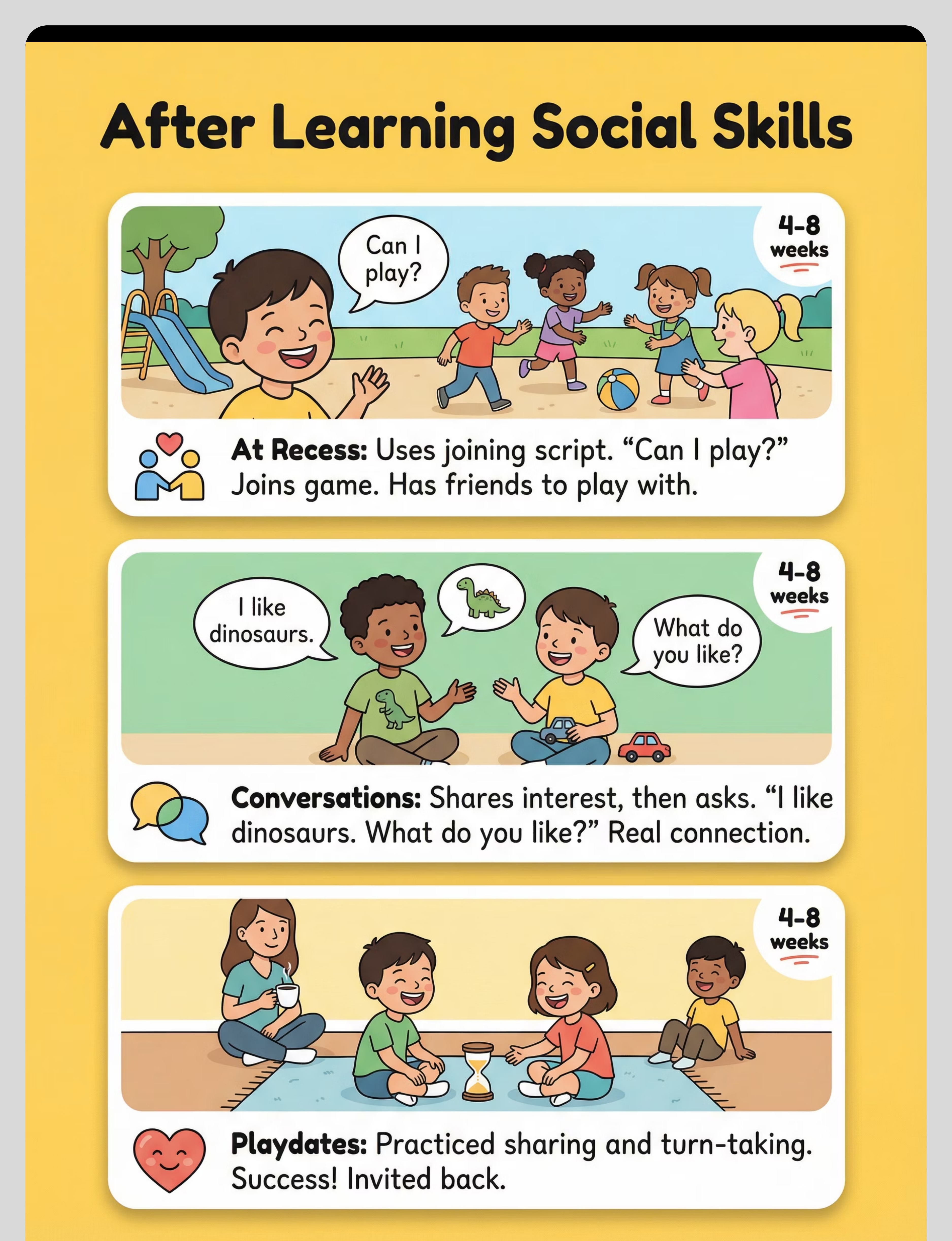
Recess Success
Situation: Practiced joining scripts using social skills cards: "Can I play?" Knows to watch the game first to understand it, then ask to join. Uses learned strategy with confidence. Successfully joins the game. Has someone to play with at recess.
Emotion: Inclusion, success, belonging
4-8 weeks
Conversation Connection
Situation: Learned conversation cards strategy: share one thing, then ask a question. "I like dinosaurs. What do you like?" Back-and-forth conversation actually happens. Other child stays engaged. Real connection is made.
Emotion: Connection, reciprocity, being heard
4-8 weeks
Playdate Win
Situation: Reviewed friendship skills cards before friend arrived. Practiced sharing and turn-taking strategies. Used timer for fair turns. Playdate goes smoothly. Friend has fun. Gets invited back next week.
Emotion: Friendship, competence, pride
4-8 weeks
With explicit teaching and consistent practice, transformation is possible. Scripts become internalized. Skills become natural. Your child develops the social competence they need to build genuine friendships.
What to Expect (Realistic Timelines)
2-4 weeks
Child has scripts for common social situations and can recall them when prompted by adult support
4-8 weeks
Can initiate interactions with peers using learned scripts with decreasing prompts needed
4-8 weeks
Conversation includes questions directed to others, not just statements about own interests
1-2 months
Successful playdates increase in frequency and duration, with fewer conflicts and meltdowns
2-3 months
Has at least one friend at school who they interact with regularly and positively
3-6 months
Reading basic social cues like facial expressions and body language more consistently

Important: Every child progresses at their own pace. These timelines represent typical progress with consistent daily practice and real-world application. Some children progress faster, others need more time. What matters is forward movement, not speed.
Is This Right for My Child? (2-Minute Check)
Does your child struggle to make or keep friends?
If yes, this indicates: Social skills teaching needed
Strong indicator that explicit social teaching would benefit your child significantly.
Does your child miss social cues that others pick up naturally?
If yes, this indicates: Explicit social teaching needed
Neurotypical children absorb these cues implicitly; your child needs them made visible.
Does your child have difficulty with conversations (one-sided, off-topic)?
If yes, this indicates: Conversation skills cards will help
Conversation structure can be taught using cards that break down the back-and-forth rhythm.
Does your child want friends but not know how to interact?
If yes, this indicates: Strong candidate for social skills teaching
The desire is there; the skills just need to be explicitly taught and practiced.
Interpretation: 3+ "yes" answers = strong fit for social skills cards. Your child has the motivation and need; they just require explicit teaching of the invisible social rules that others learned implicitly.
Common Questions (Honest Answers)
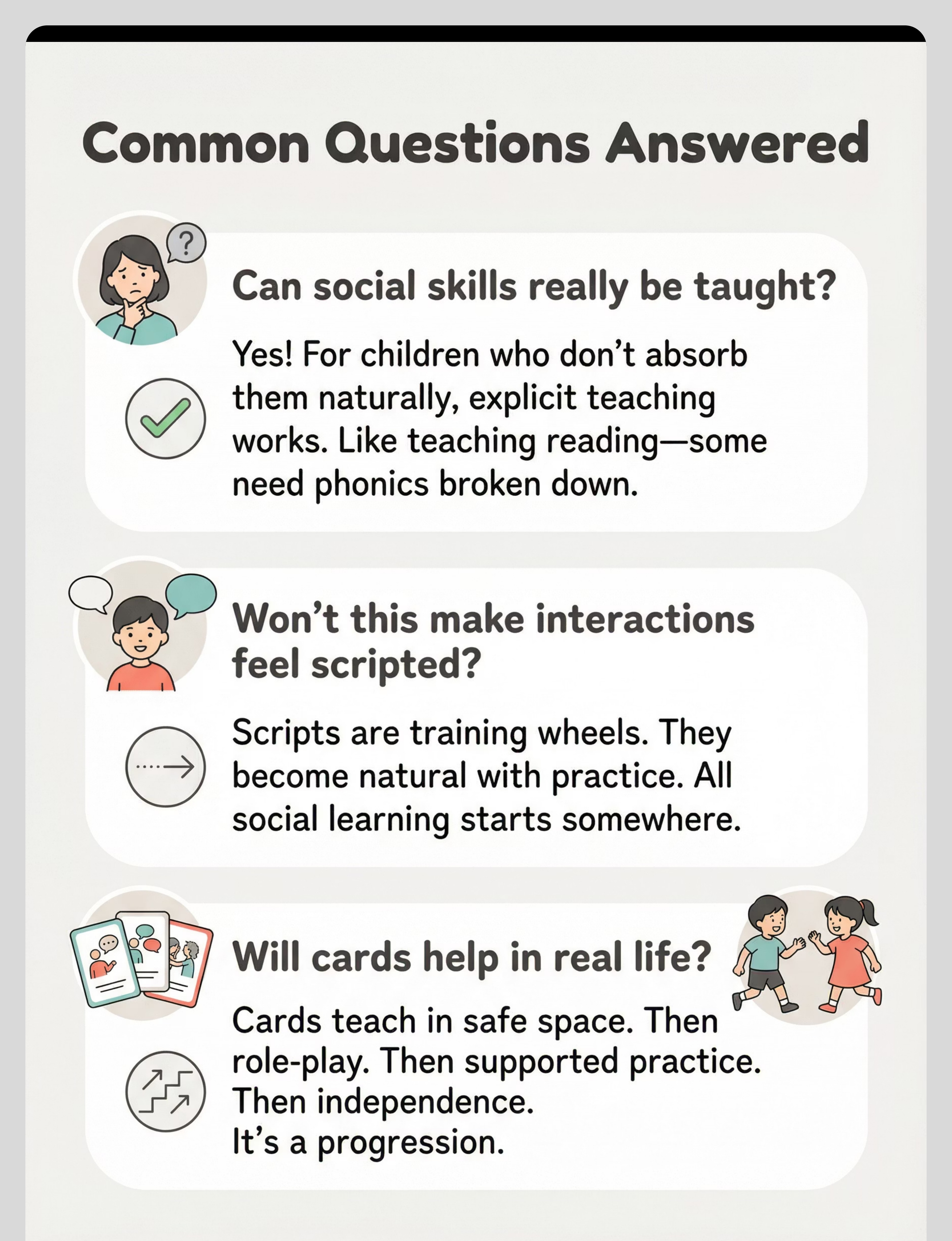
Q: You can't teach social skills - they're natural
Honest Answer: For neurotypical children, yes - they absorb social rules implicitly through observation. Children with autism often need EXPLICIT teaching of what others learn naturally. It's like teaching reading - some kids need phonics broken down, others absorb it. Social skills can absolutely be taught.
Think of it this way: Making the invisible visible.
Q: This makes interactions scripted and fake
Honest Answer: Scripts are training wheels. Initially, yes, interactions may feel scripted. Over time, scripts become internalized and natural. All social learning starts somewhere - neurotypical kids just learn scripts earlier and less consciously.
Consider: Scripts evolve into natural patterns with practice.
Q: My child doesn't want friends anyway
Honest Answer: Some children genuinely prefer solitude - that's okay. But many children with autism WANT connection but don't know HOW. Assess whether they're content or frustrated. If frustrated, teaching helps. If content, don't force.
Try this: Follow child's lead - teach skills they want to have.
Q: Cards won't help in real situations
Honest Answer: Cards are for TEACHING in safe environment. Then practice in role-play. Then support in real situations. Then independent use. It's a progression. Cards are step one, not the final goal.
The progression: Cards → role-play → supported practice → independence.
Usage Guide: When & How
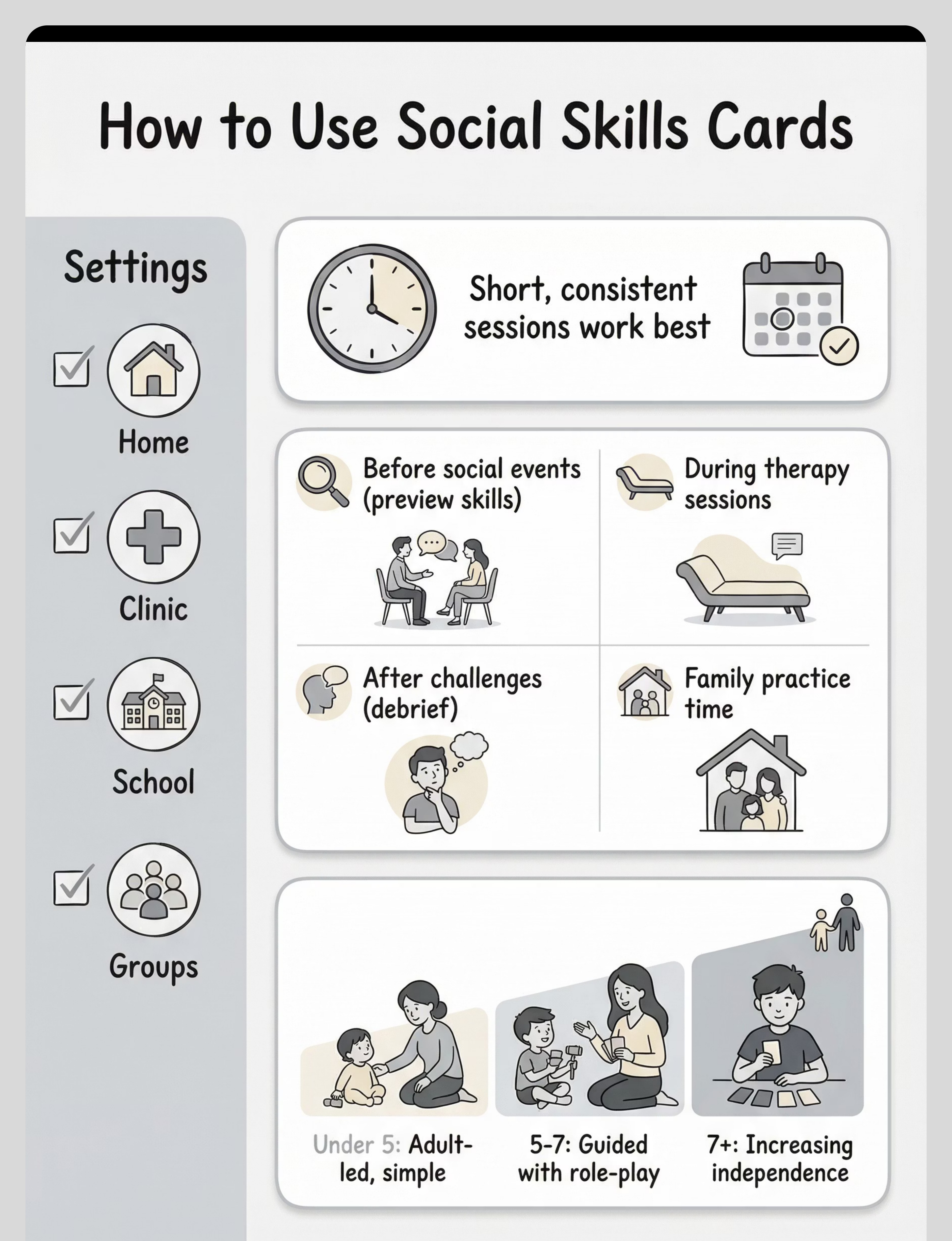
When to Use
When NOT to Use
Structured social skills sessions (10-20 minutes daily)
During active social crisis or meltdown
Before social situations to review relevant skills
To shame child for social mistakes made
After social challenges to debrief and learn
Overwhelming child with too many skills at once
During therapy sessions with professionals
Without practice and generalization component
Family practice time with siblings
Social skills groups with peers
Supervision by Age
Age Range
Supervision Level
Notes
Under 5 years
Adult-led
Simple scenarios, lots of modeling, concrete examples
5-7 years
Adult-guided
Include role-play, practice scripts together, gradual independence
7+ years
Increasing independence
Child can practice with peers, adult checks in and supports
Home
School
Clinic
Social Skills Groups
Duration: 10-20 minute focused sessions work best. Consistency matters more than length. Daily brief practice beats weekly long sessions.
Safety First
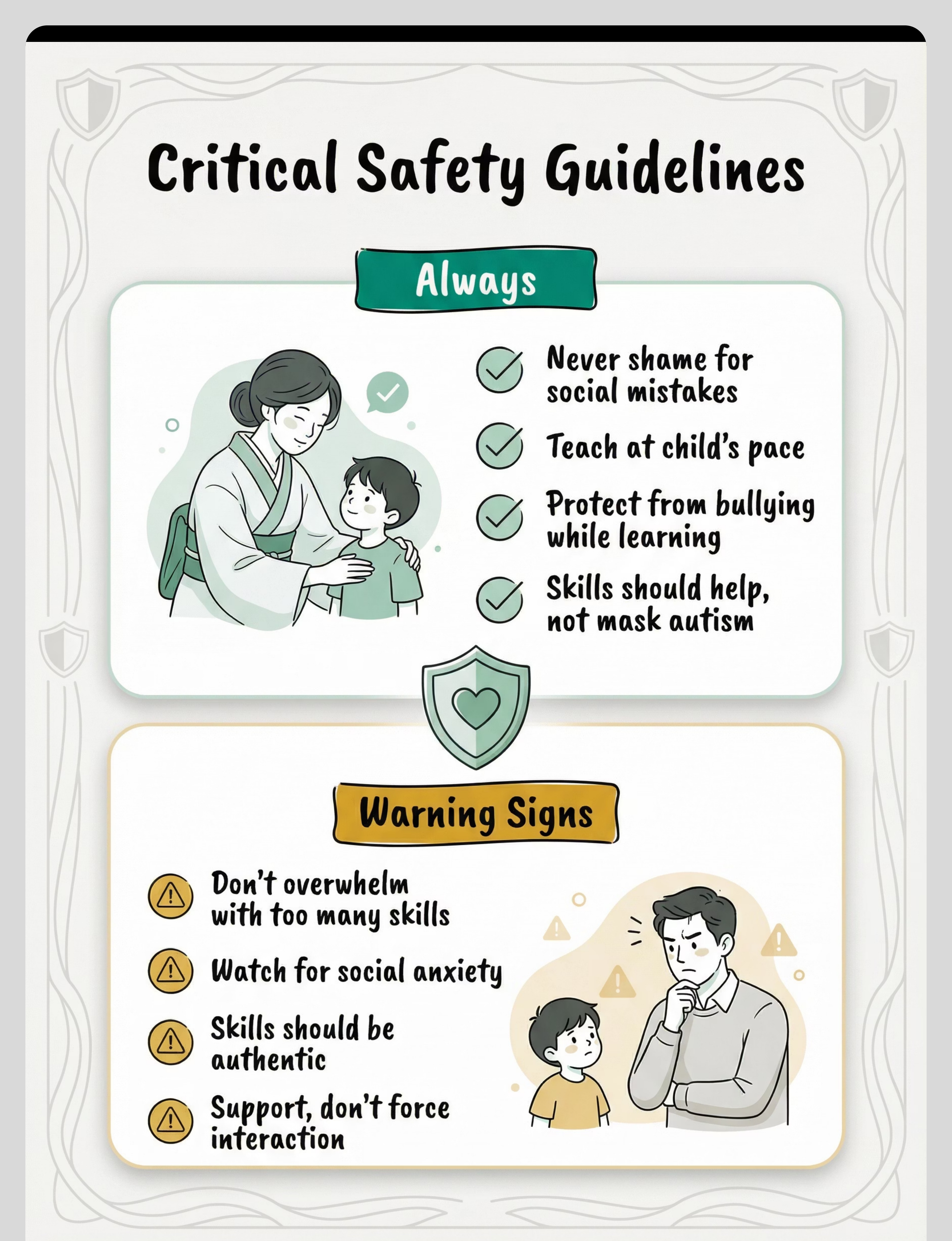
Critical Safety
  • Never shame child for social mistakes - mistakes are learning opportunities, not failures
  • Teach at child's pace, not forced - respect their readiness and comfort level
  • Protect child from bullying while learning - ensure practice happens in safe environments
  • Skills should help child, not mask their autism - authentic skills, not performative masking
Important Warnings
  • Don't overwhelm with too many skills at once - master one before adding another
  • Watch for anxiety about social performance - reduce pressure if child becomes stressed
  • Ensure skills are authentic, not performative masking - protect child's identity
  • Support, don't force, social interaction - child's autonomy is paramount
Before Use Checklist
  • Skills selected match child's needs
  • Materials appropriate for developmental level
  • Safe, supportive learning environment established
  • Practice plan in place with clear progression
Signs of Success
  • Child using learned skills in real situations
  • Initiating social interactions with peers
  • Improved peer relationships developing
  • Child feels more confident socially
Contraindicated: Shaming, forcing interaction, teaching masking over authentic skills
Investment Guide
Social skills cards range from budget-friendly DIY options to comprehensive commercial curricula. Quality teaching is possible at every price point.
Budget Option
₹0-200
Free printables or homemade cards using index cards, markers, and laminating pouches
Many free resources online from educational websites and therapy platforms
Starting out, targeting specific skills, supplementing commercial materials
Premium Option
₹800-2,000
Comprehensive curriculum with research-based methodology, professional materials, detailed teaching guides
Social Thinking, Super Duper Publications, Jill Kuzma
Comprehensive program, professional guidance on skill sequence, advanced social cognition
Overall Range: ₹150-1,200 (₹2-15 USD)
Our Recommendations
Start Basic
Begin with a basic commercial set (₹200-400) to understand structure and approach.
Customize with DIY
Supplement with DIY cards for situations specific to your child's life and unique needs.
Upgrade if Needed
Invest in premium materials if your child responds well and requires more advanced content.
Investment Pathway
Phase 1: Exploration
Utilize free resources and basic DIY cards to gauge initial interest and identify key areas of focus without significant financial commitment.
Phase 2: Foundation Building
Acquire a basic commercial set to establish a structured learning foundation and observe the child's engagement with formalized materials.
Phase 3: Targeted Enhancement
Develop custom DIY cards to address specific, evolving social scenarios relevant to the child's environment and interactions.
Phase 4: Advanced Development
Consider premium curricula for in-depth, research-backed methodologies as the child progresses and requires more complex social cognition tools.
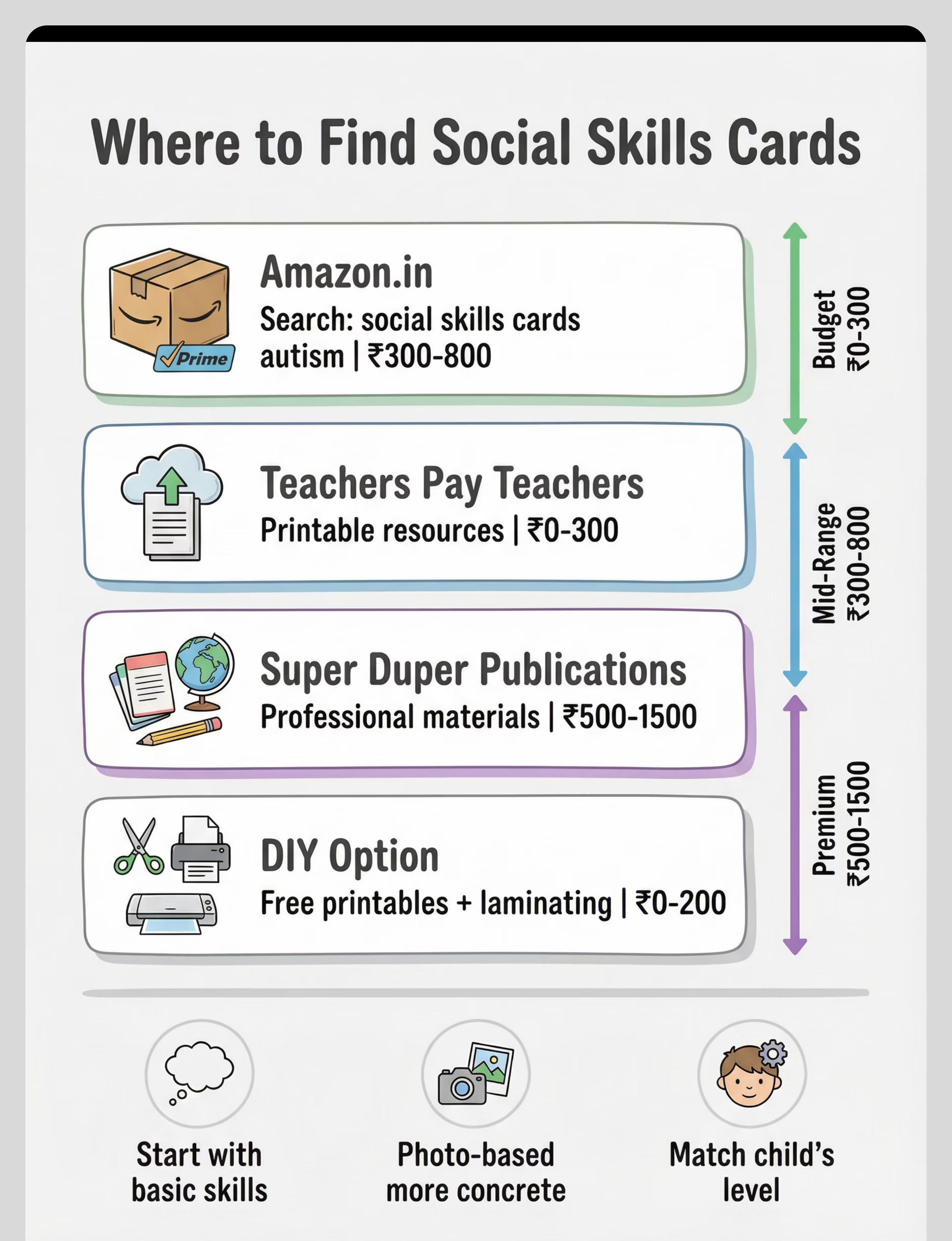
Where to Buy in India
Availability: Widely Available through online platforms and educational suppliers
Amazon.in
Search: "social skills cards autism"
Price Range: ₹300-800
Wide selection, customer reviews, Prime delivery available, easy returns
Amazon.in
Search: "social skills board game"
Price Range: ₹400-1,000
Game-based options for engaging practice with siblings and family
Teachers Pay Teachers
Search: "social skills cards printable"
Price Range: ₹0-300
Digital downloads, immediate access, many free options from educators worldwide
Super Duper Publications
Search: "social skills"
Price Range: ₹500-1,500
Professional therapy materials, research-based, detailed teaching guides included

Buying Tips
  • Start with basic skills before advanced social thinking materials
  • Photo-based cards more concrete than illustrations for young or concrete learners
  • Board games make practice fun and motivating for reluctant learners
  • Match complexity to child's current developmental level, not just age
  • Look for materials that include practice scripts and generalization support

Red Flags to Avoid
  • Materials too advanced for child's current level (leads to frustration)
  • No practice component included (teaching without application doesn't generalize)
  • Culturally inappropriate scenarios (won't connect to child's real world)
  • Only addresses one narrow area without progression pathway
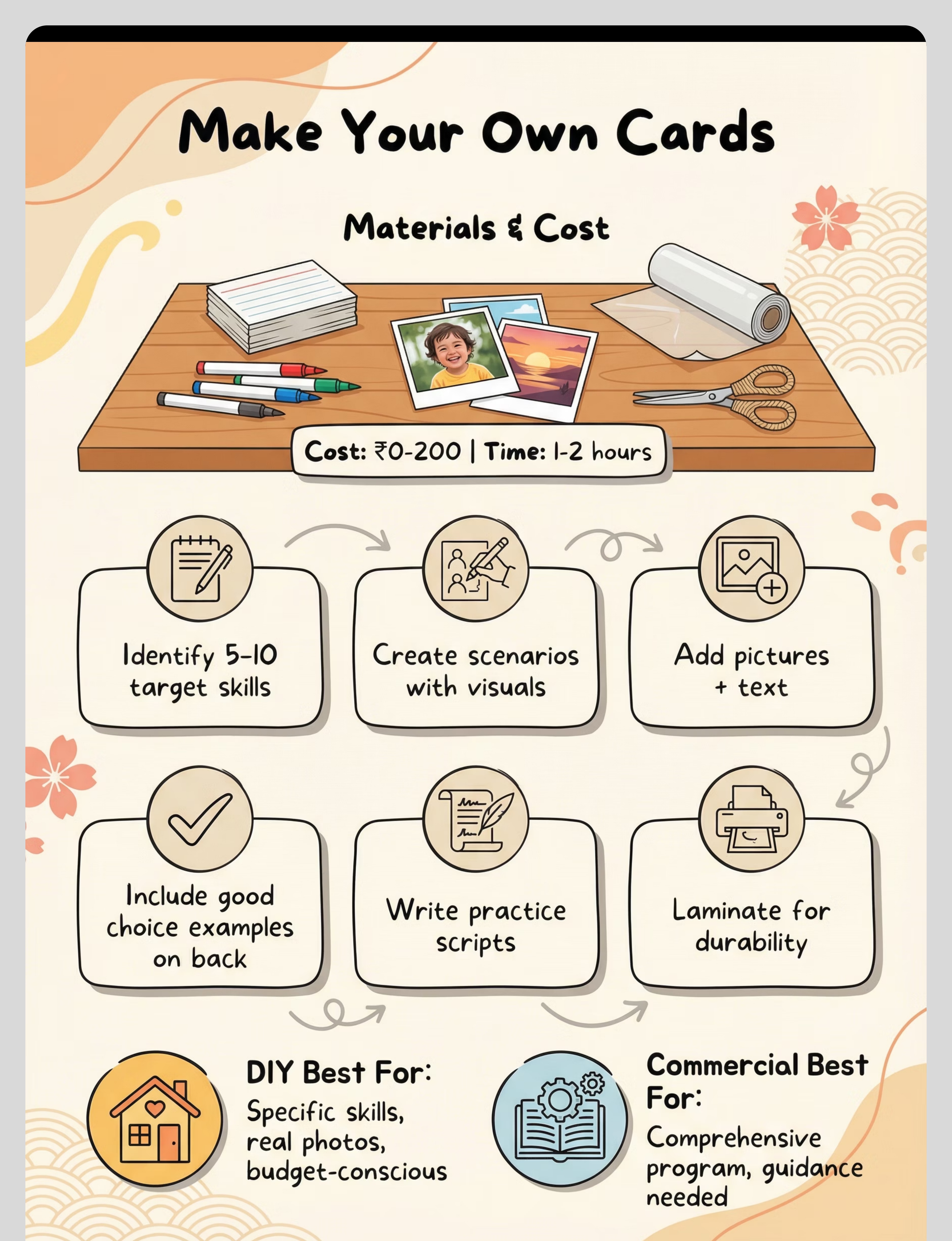
DIY Alternative (Save 70-90%)
Feasibility: High | Time Required: 1-2 hours for basic set | Cost Savings: 70-90%
Materials Needed
  • Index cards or cardstock
  • Markers or color printer
  • Photos (optional but helpful)
  • Laminating pouches for durability
  • Scissors and ruler
DIY Steps
  1. Identify 5-10 target social skills your child specifically needs (greeting, sharing, joining play, etc.)
  1. Create scenario cards with situations: "Your friend looks sad. What could you do?"
  1. Include visual (drawing or photo) plus text on front of card
  1. Add "good choice" examples on back of card with 2-3 appropriate responses
  1. Create practice scripts for common situations your child encounters
  1. Laminate for durability and repeated use
When to DIY vs. When to Buy Commercial
Choose DIY When:
  • Targeting specific skills unique to your child's needs
  • Using real photos from your child's actual life and environments
  • Budget-conscious and need to start immediately
  • Supplementing commercial materials with personalized content
Choose Commercial When:
  • Want comprehensive curriculum with proven skill sequence
  • Need professional guidance on developmental progression
  • Prefer board game format for engagement
  • Want Social Thinking methodology specifically
Tradeoffs: DIY cards are less comprehensive than commercial curricula and require you to identify target skills yourself. However, they can be more personalized to your child's specific situations and are immediately available at minimal cost. Many families use both: commercial materials for structure and DIY for personalization.

Preview of social skills cards scenarios Therapy Material

Below is a visual preview of social skills cards scenarios therapy material. The pages shown help educators, therapists, and caregivers understand the structure and content of the resource before use. Materials should be used under appropriate professional guidance.

Page 1
Page 2
Page 3
Page 4
Page 5
Page 6
Page 7
Page 8
Page 9
Page 10
Page 11
Page 12
Page 13
Page 14
Page 15
Page 16
Page 17
Page 18
Page 19
Page 20
Link copied!
Your Complete Support System
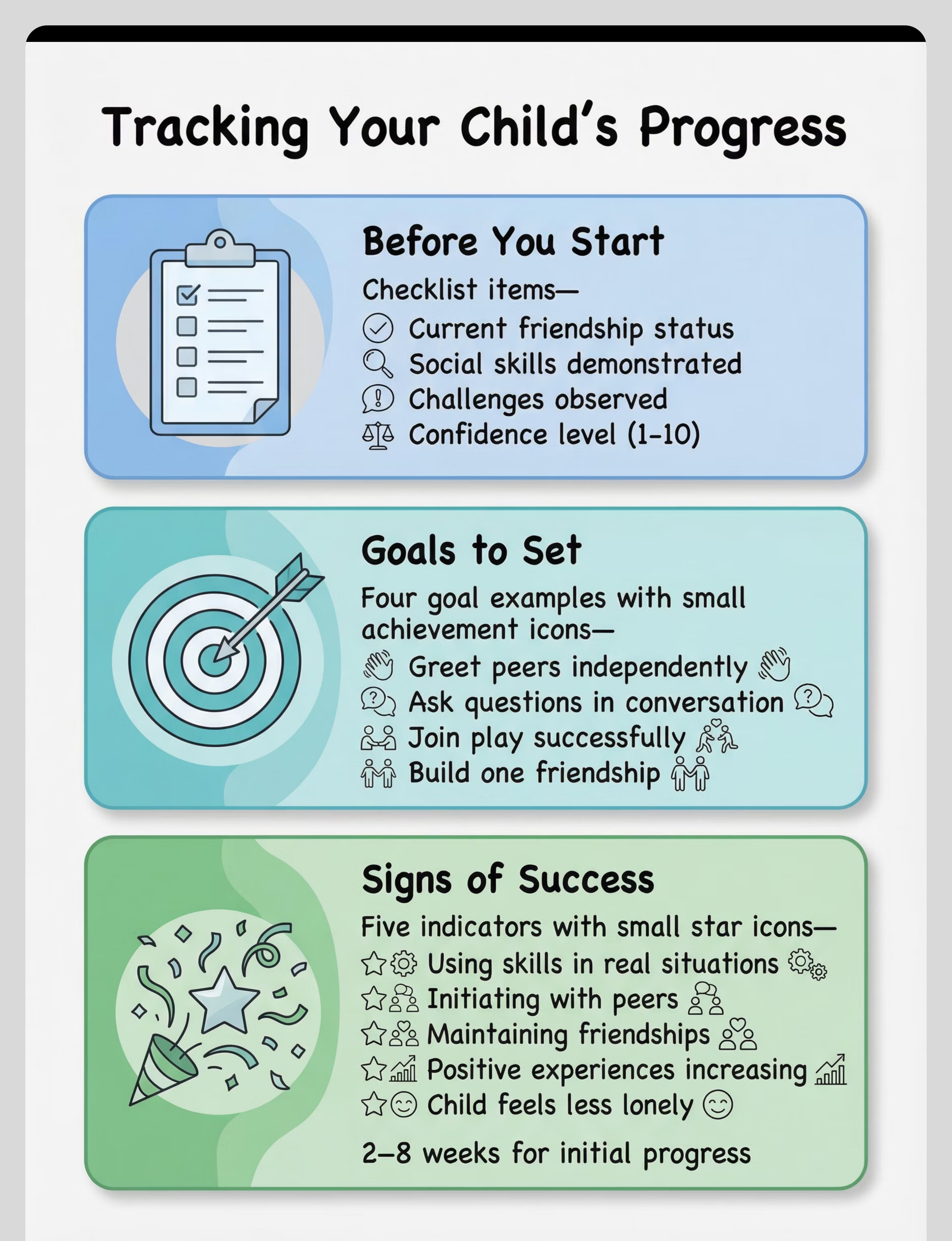
Measuring Success
Baseline (Measure First)
  • Current friendship status and peer relationships
  • Social skills child currently demonstrates
  • Specific social challenges observed daily
  • Child's social confidence level (1-10 scale)
Goals to Set
  • Child will greet peers independently
  • Child will ask questions in conversation
  • Child will successfully join play with peers
  • Child will have at least one reciprocal friendship
Success Indicators
  • Using learned skills in real situations
  • Initiating interactions with peers
  • Maintaining friendships over time
  • Positive social experiences increasing
  • Child reports feeling less lonely

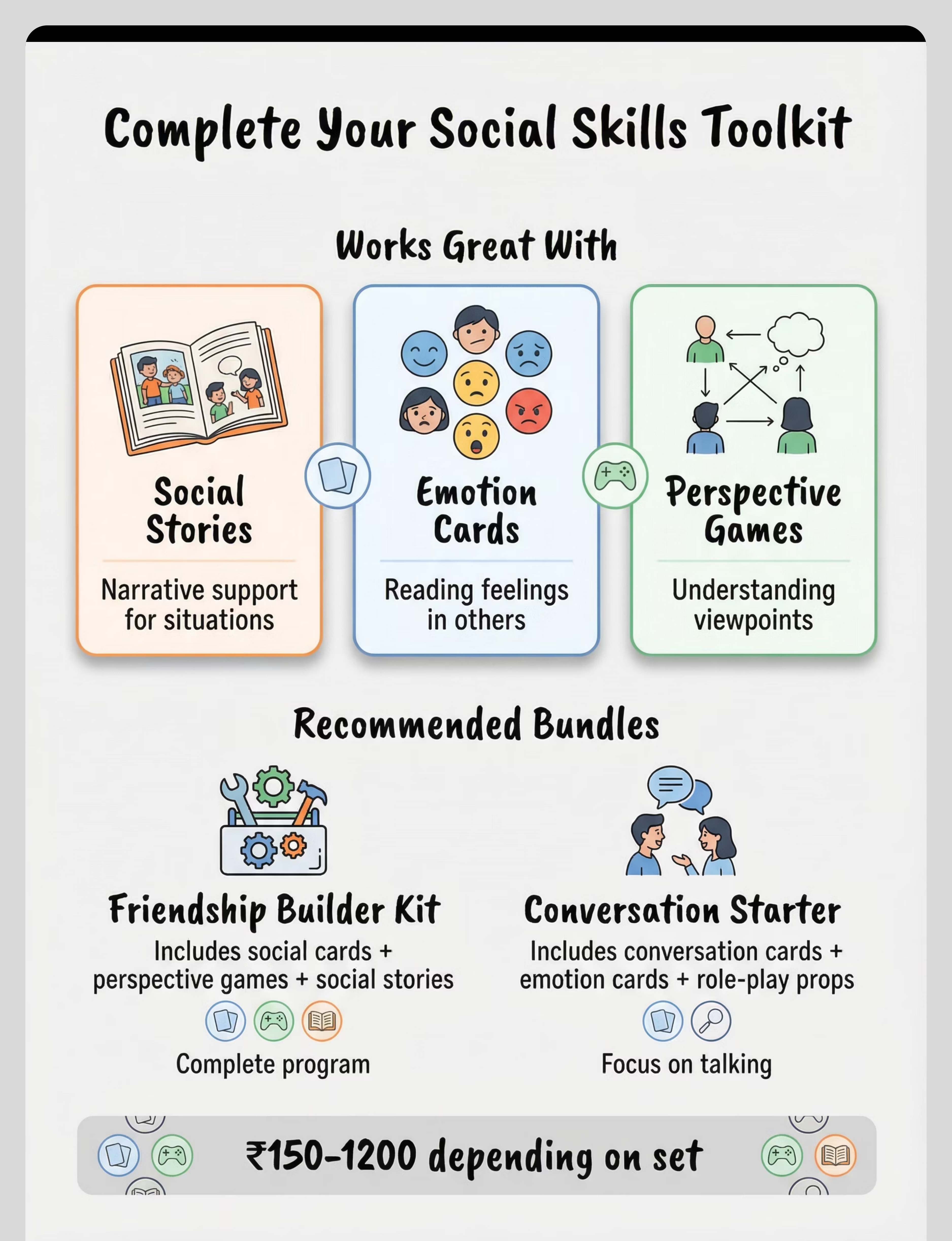
Complete the Kit: Pair It With...
Emotion Cards (2.2)
Narrative support for understanding emotions in social situations. Essential companion for reading others' feelings.
Social Stories (2.1)
Reading emotions and understanding others' perspectives. Perfect for building social cognition foundation.
Perspective-Taking Games (4.2)
Understanding others' viewpoints through engaging activities. Builds on skills learned with social cards.
Role-Play Props (4.3)
Practicing social skills in safe, fun environment. Brings card-based learning to life through play.
Recommended Bundles:
  • Friendship Builder Kit: Social Skills Cards (4.1) + Perspective-Taking Games (4.2) + Social Stories (2.2) - Complete social skills program for comprehensive development
  • Conversation Starter Bundle: Conversation Cards (4.1.3) + Emotion Cards (2.1) + Role-Play Props (4.3) - Focused on conversation skills with practical application

Quick Summary
AI Summary: Social skills cards explicitly teach the implicit social rules that children with autism miss. Core Kit (Rank 1), strong evidence, essential for social development.
social skills
friendship
conversation
scenarios
teaching
Psychologist
SpEd
core-kit
Common Searches: social skills cards autism, friendship skills autism, social scenarios autism, conversation cards autism, social thinking autism, making friends autism, social skills games

Get Support

FREE National Autism Helpline
Phone: 9100 181 181
Languages: 16+ languages supported
Professional guidance available for selecting and implementing social skills materials. Our team can help you choose the right cards for your child's specific needs and developmental level.
Platform Integration
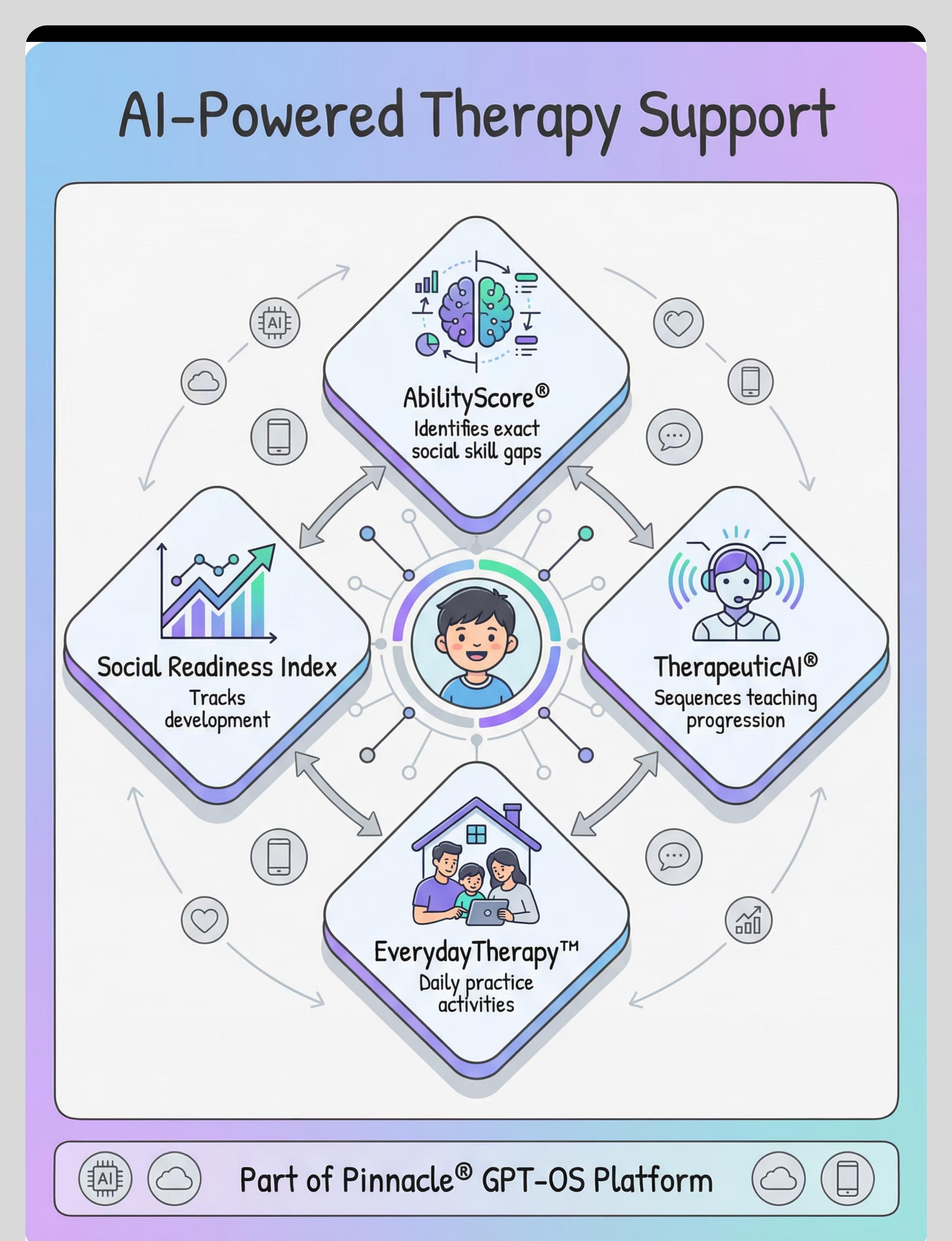
This tool integrates seamlessly with Pinnacle's comprehensive platform:
  • AbilityScore® identifies specific social skill gaps through assessment
  • TherapeuticAI® sequences social skill teaching for optimal progression
  • EverydayTherapyProgramme™ includes daily social practice activities
  • Social Readiness Index tracks your child's social development over time

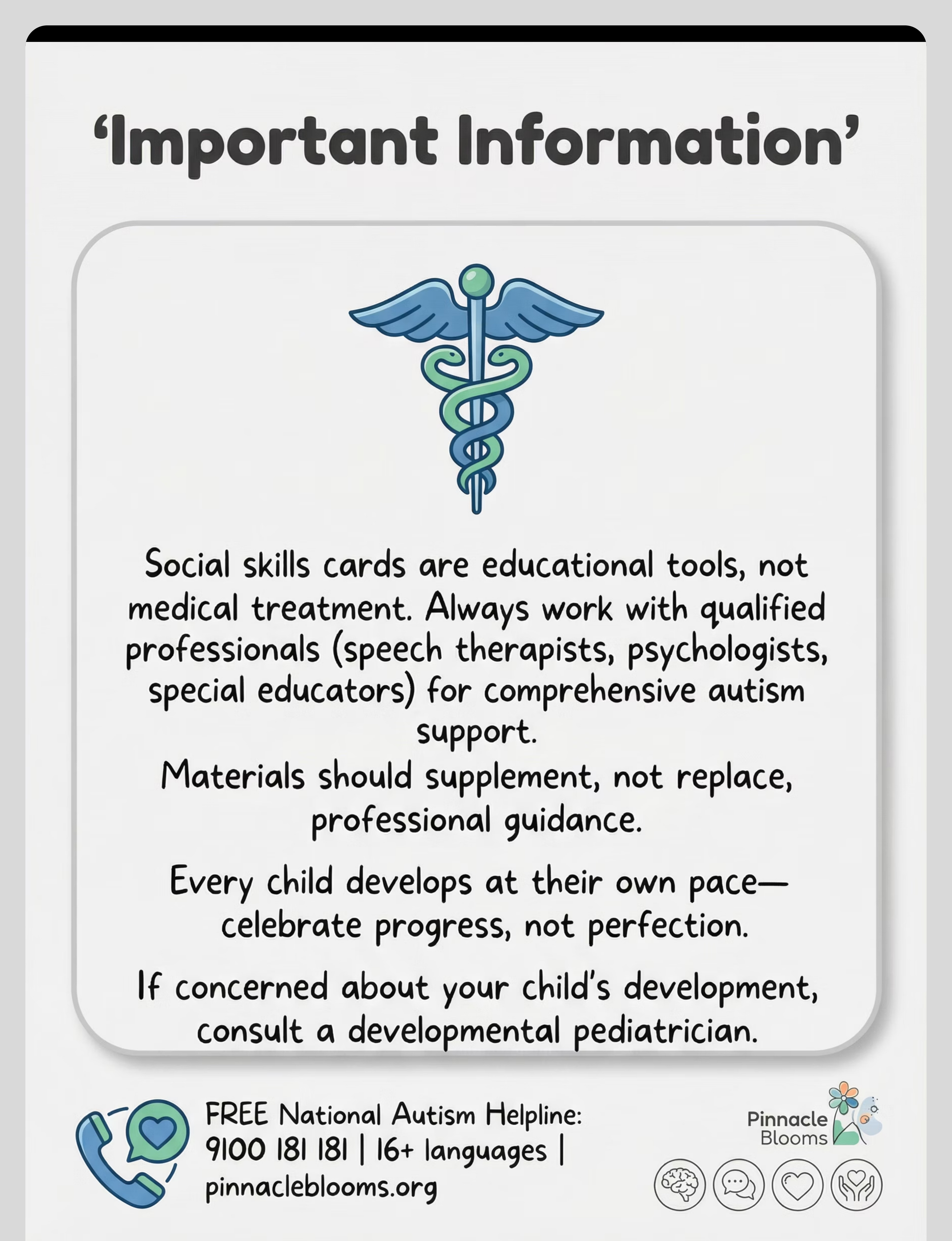
Disclaimer: This is educational information. Always consult qualified occupational therapists, speech-language pathologists, or pediatricians. Individual results vary. Social skills teaching should support your child's authentic self, not force masking or conformity.