










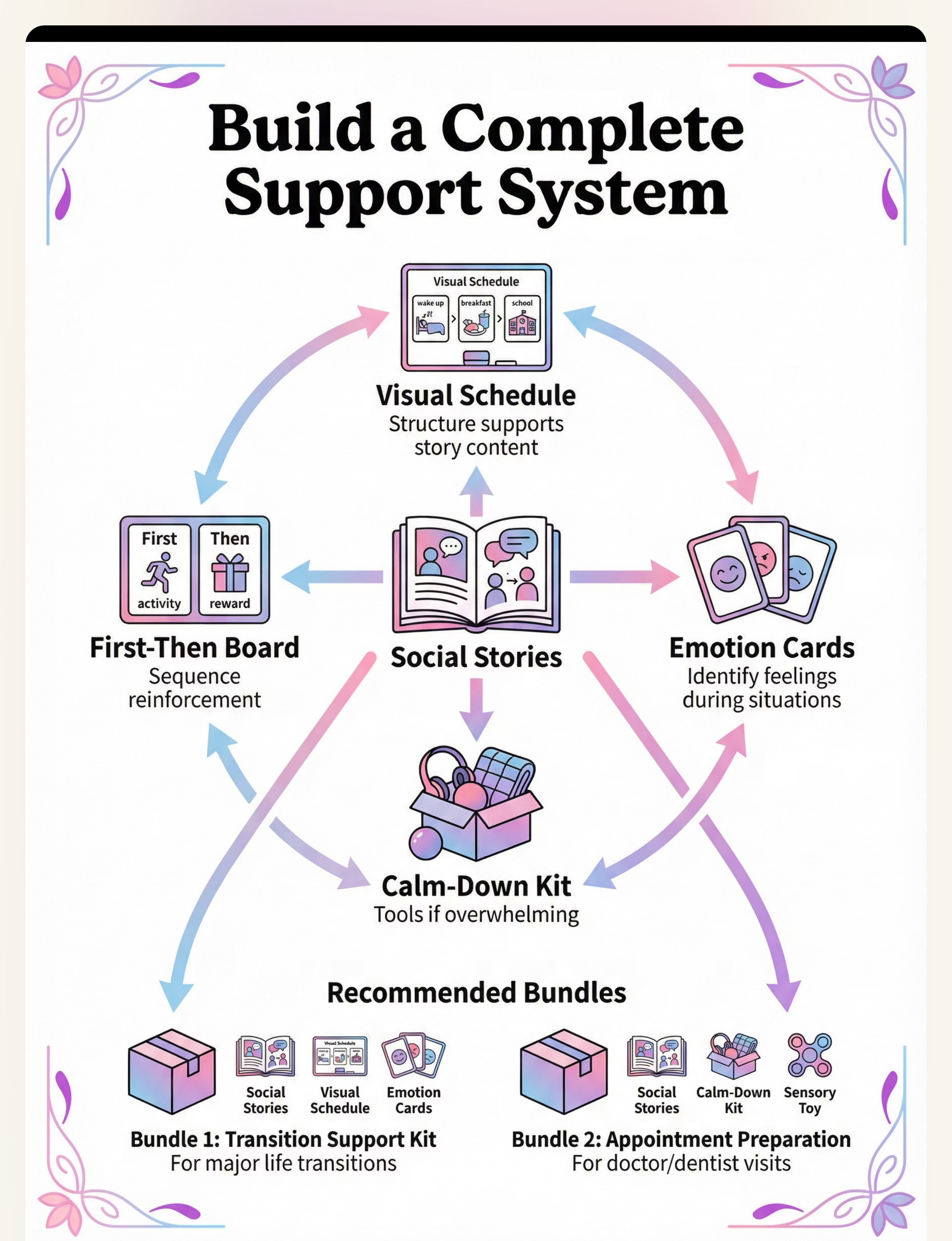

Tool ID: 2.2
Tool ID: 2.2
SpEd + Psychologist
Strong Evidence
Rank #1
Daily Use
₹0–1,000
Social Stories / Narrative Supports
Narrative-based behavioral and emotional preparation system
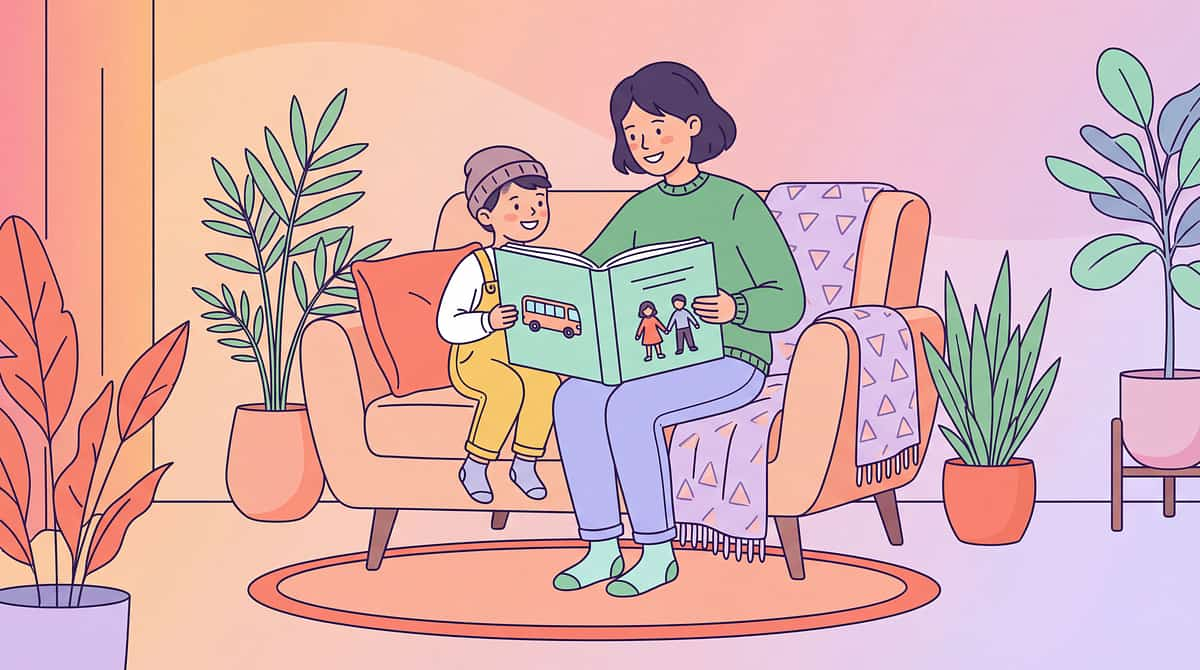
Prepare your child for challenging situations through the power of story. Social Stories make the unfamiliar familiar, turning anxiety into confidence by teaching exactly what to expect and what's expected. From doctor visits to birthday parties, these simple narratives transform terrifying unknowns into manageable steps.
Who This Helps
Anxiety Reduction
Prepares children for situations and teaches expected behaviors through narrative, reducing the fear of the unknown.
Behavioral Preparation
Explicitly presents social information so children know what to expect and what's expected of them.
Social Understanding
Makes implicit social rules explicit, helping children understand why people do things and what the "rules" are.
Transition Support
Smooths major transitions like new schools, new classes, or changing routines by providing clear expectations.
Ages 2-9 years
Home
School
Clinic
Travel
Best for: Children who become very anxious about new situations, have difficulty with specific recurring activities (doctor visits, haircuts), or seem confused about social expectations. Particularly effective when predictability and knowing what to expect reduces your child's anxiety.
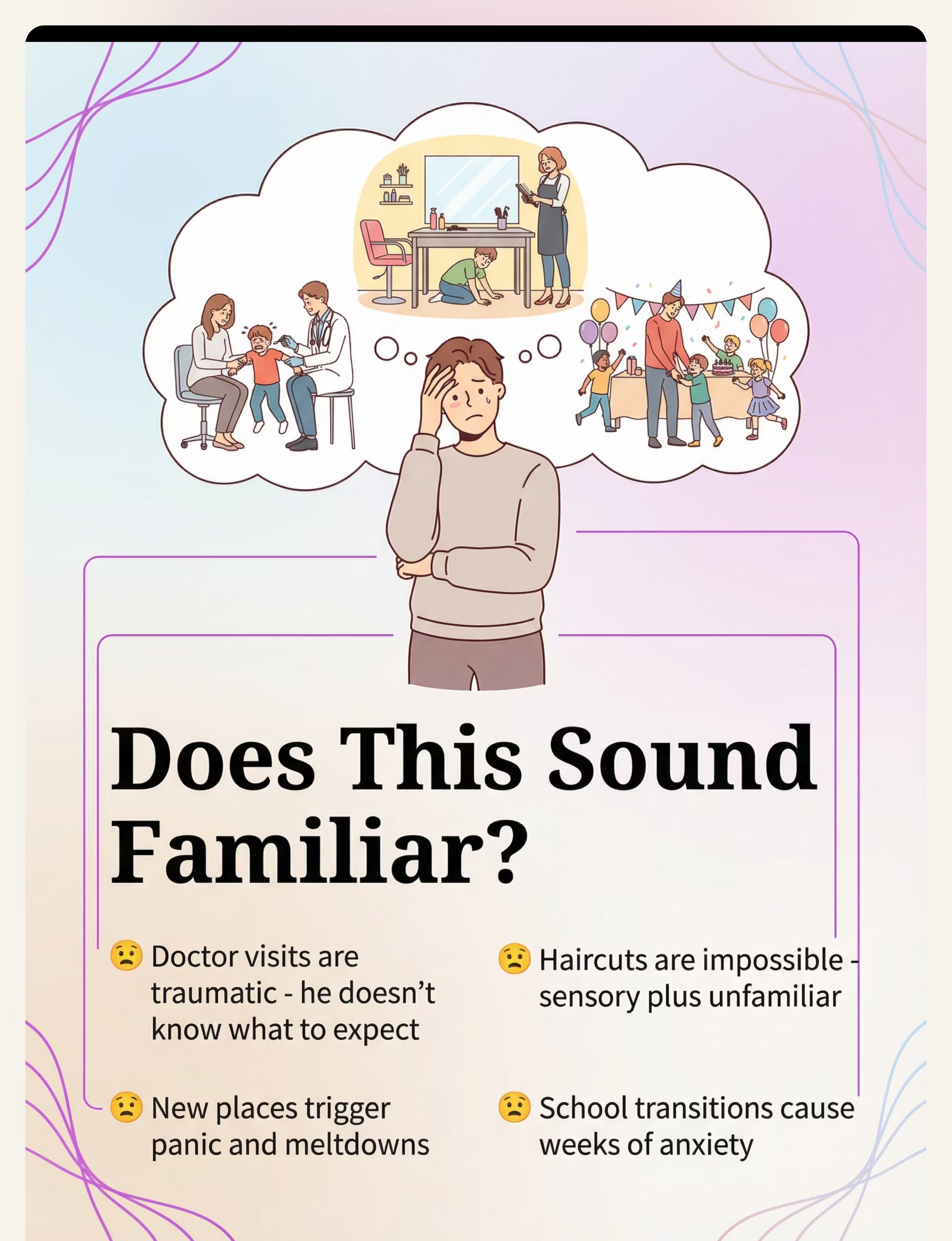
Does This Sound Familiar?
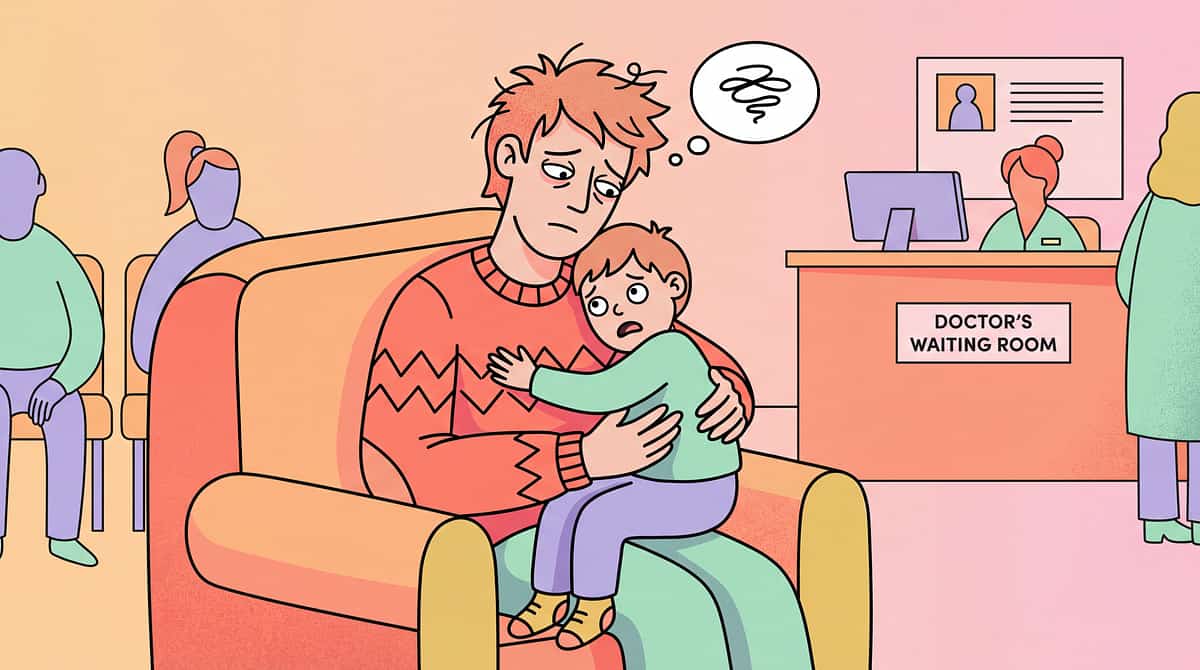
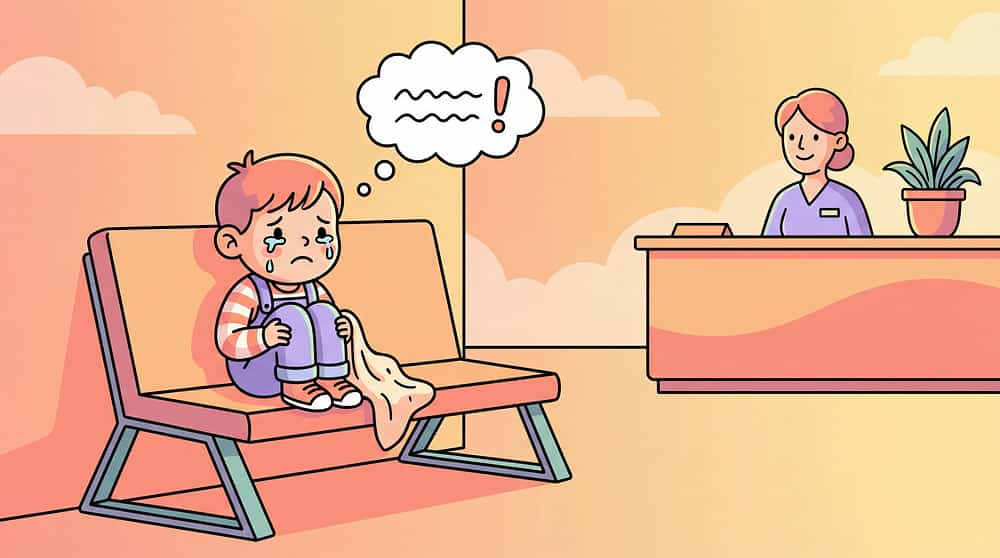
"Doctor visits are traumatic - he doesn't know what to expect. We've had to reschedule appointments three times because he's hysterical before we even enter the building."
"She panics at new places - unfamiliar is terrifying. Even going to a friend's house for the first time triggers complete shutdown."
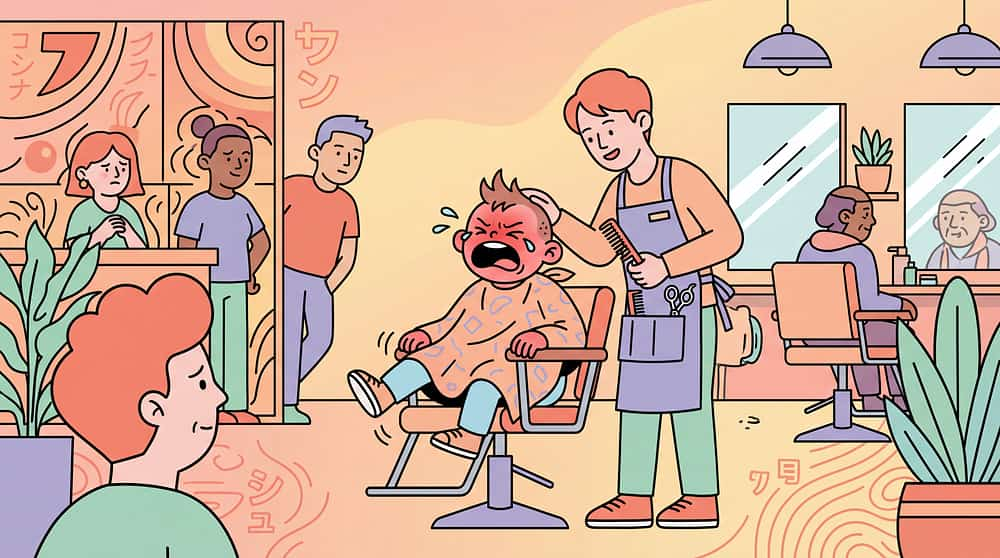
"Haircuts are impossible - the sensory experience combined with unfamiliar environment is too much. We had to leave mid-cut last time and his hair was uneven for weeks."
"He doesn't understand why we do things differently at grandma's house. The different routines and expectations cause so much confusion and distress."
"School transitions cause weeks of anxiety. Every September is torture, and changing classrooms mid-year is even worse."
"Fire drills send him into complete meltdown. The unpredictability and loud noise combine to create a traumatic experience every single time."

You're not alone. These are common challenges for children who struggle with uncertainty and need explicit preparation for social situations.
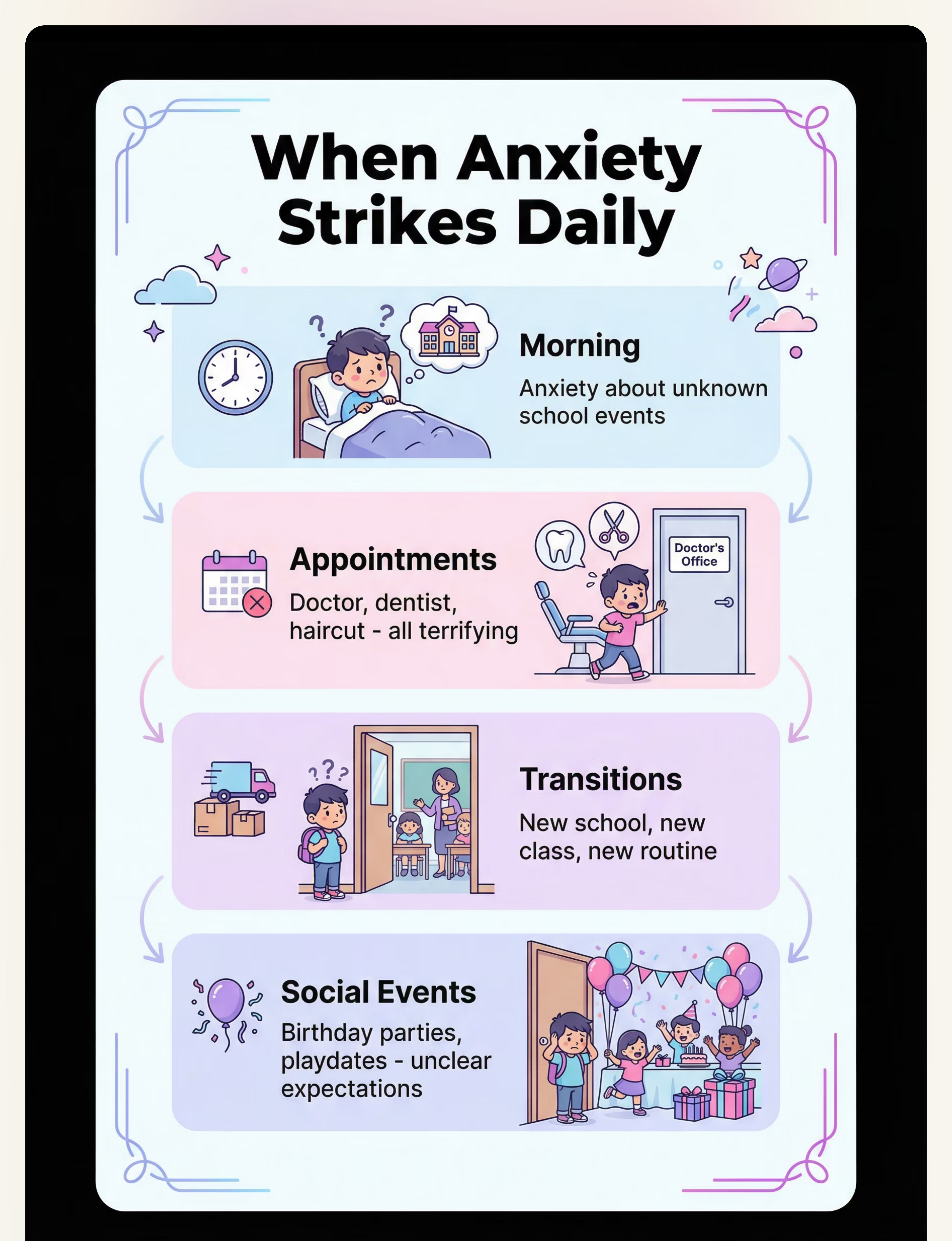
A Day Without the Right Support
Morning
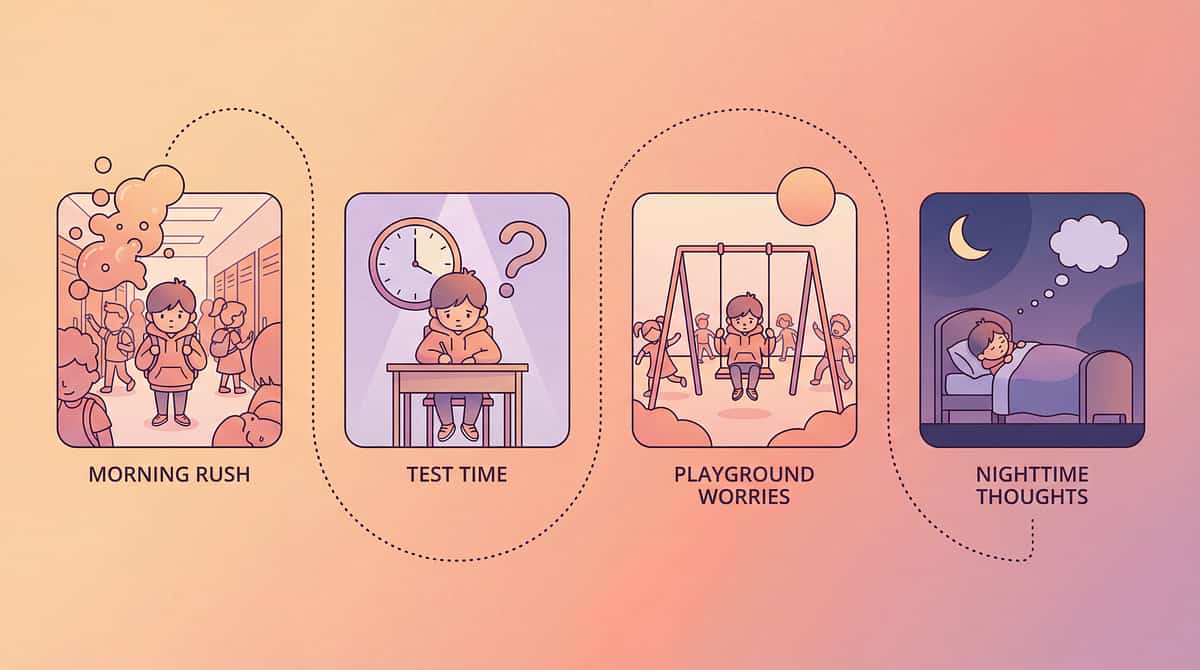
Wakes up with anxiety about school events. "What's happening today? Will there be an assembly? A substitute teacher?" The unknowns pile up before breakfast even starts.
Appointments
Doctor, dentist, haircut - all terrifying. Each appointment means encountering unfamiliar people, strange equipment, unpredictable sensations. The calendar becomes a source of dread.
Transitions
New school, new class, new routine - major life changes feel impossibly overwhelming. Weeks of anticipatory anxiety, sleepless nights, behavioral regression.
Social Events
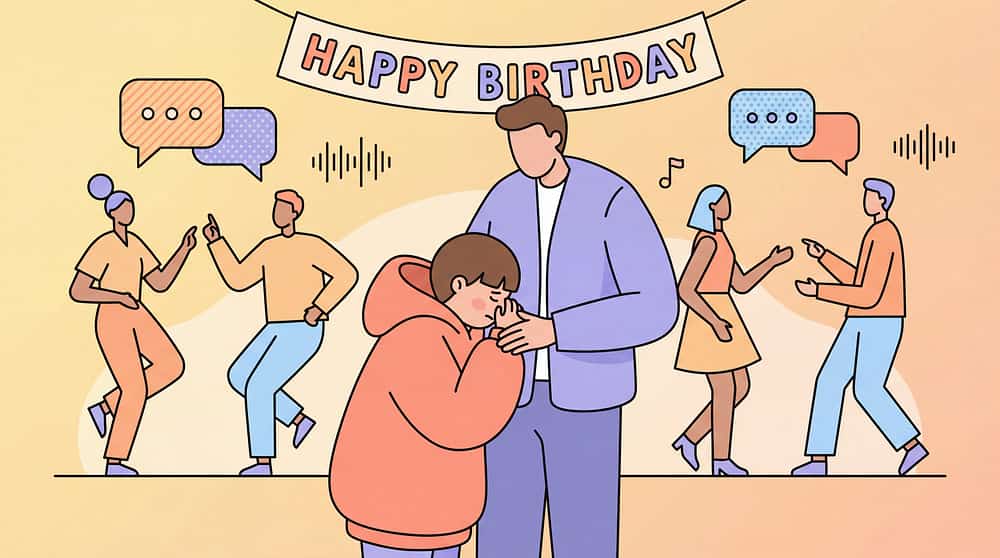
Birthday parties, playdates - unclear expectations everywhere. What are the "rules" of parties? What will happen? When can we leave? The social chaos is paralyzing.
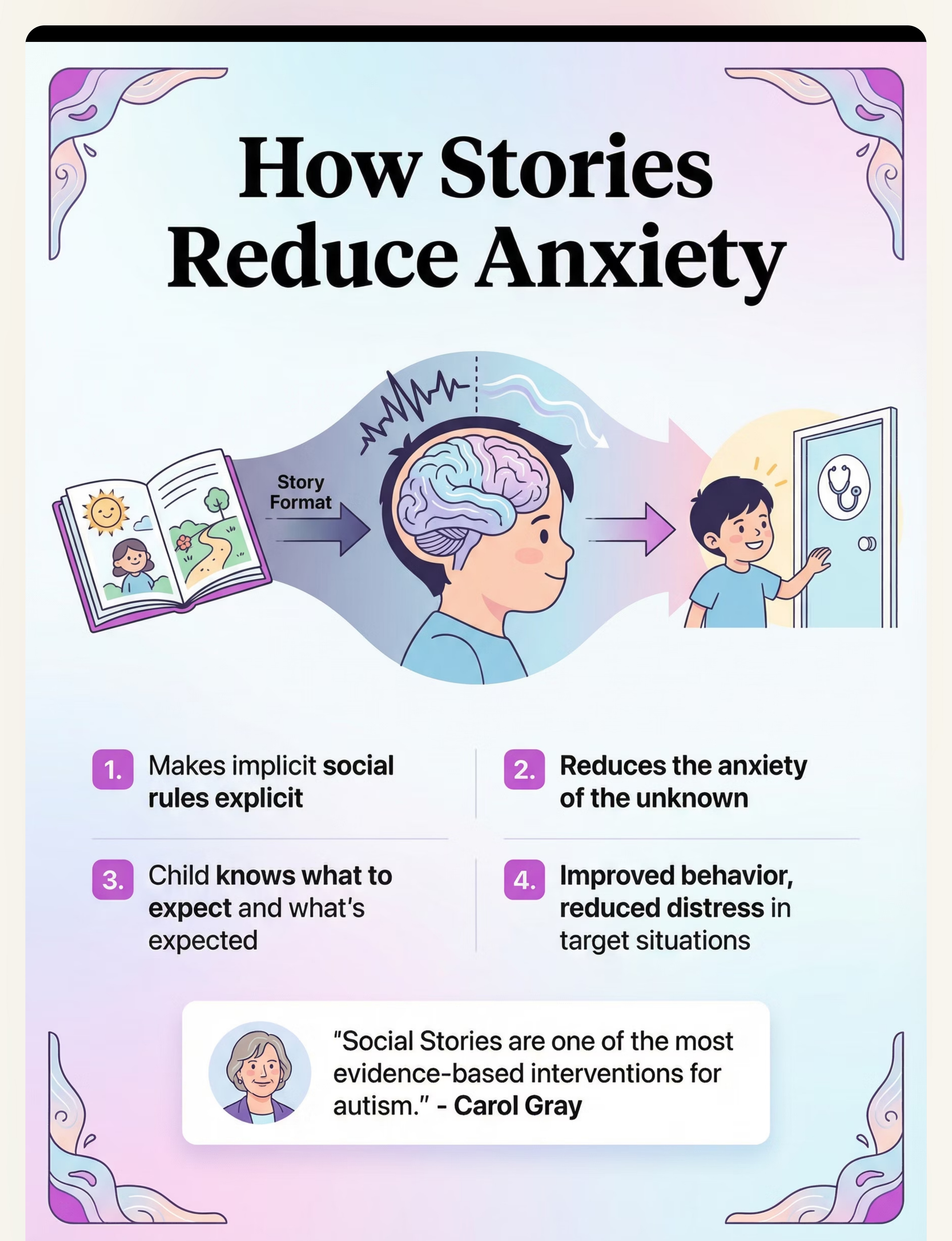
The Science Behind It
Story Format
Information presented in narrative form that the brain processes naturally and memorably.
Explicit Information
Social rules and expectations made visible and clear instead of implied.
Reduces Uncertainty
Knowing what will happen eliminates the anxiety-producing unknown variables.
Clear Expectations
Child understands exactly what to expect and what's expected of them.
Better Outcomes
Reduced distress and improved behavior in previously challenging situations.
Anxiety Reduction
Behavioral Preparation
Social Understanding
Transition Support
Perspective-Taking
How to Use It Right
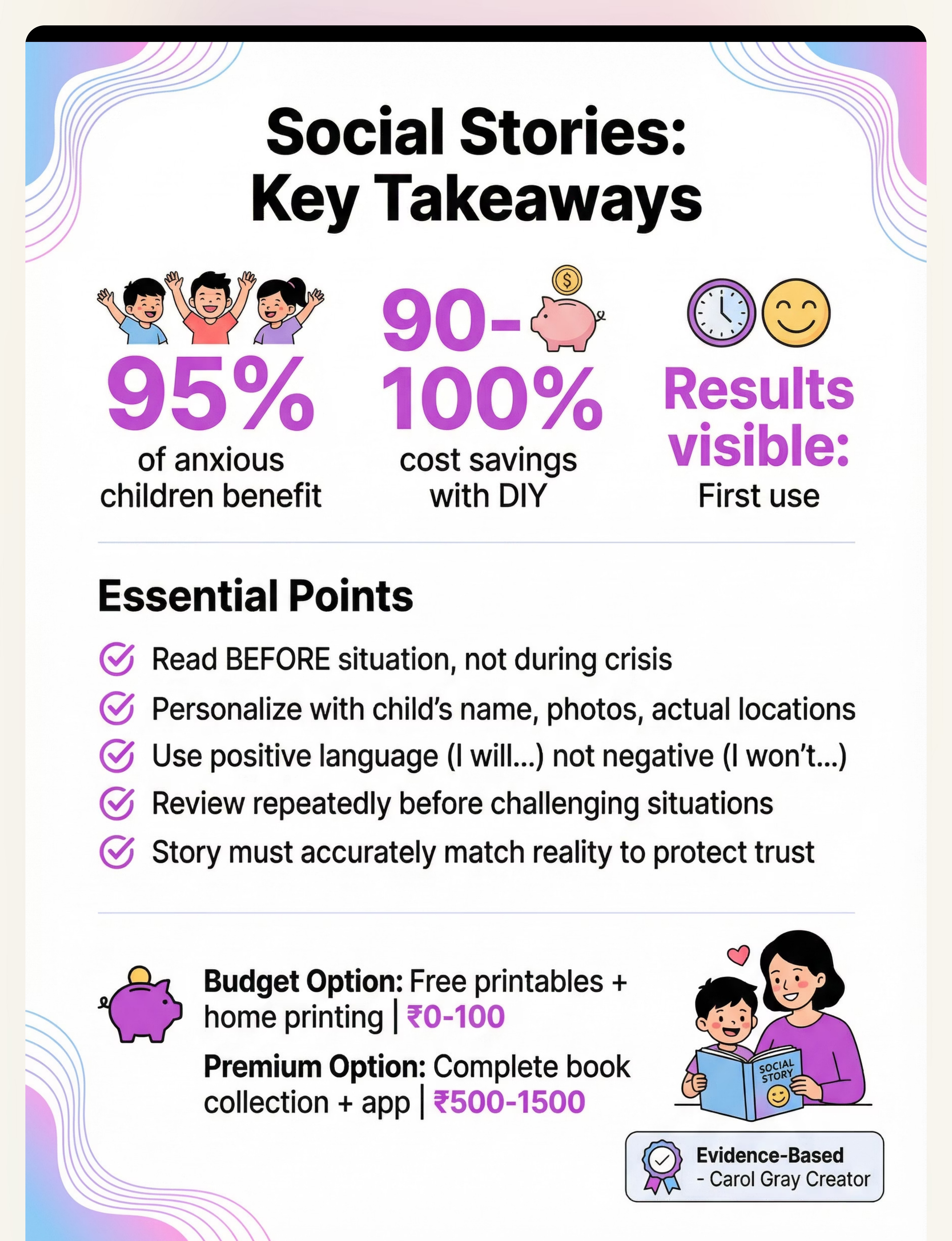
Read BEFORE the situation
Social stories are preparation tools, not crisis management. Start reading daily in the week leading up to the event - not during a meltdown.
Use first person language
Write as "I will..." not "You will..." This helps the child internalize the information and see themselves in the situation.
Include all sentence types
Combine descriptive sentences (what happens), perspective sentences (how others feel), and directive sentences (what to do).
Keep it positive
Frame expectations positively: "I will try to sit still" rather than "I won't run around." Focus on what TO do, not what NOT to do.
Personalize whenever possible
Use your child's name and real photos of actual locations, people, and situations for maximum relevance and impact.
Review repeatedly
Read the story multiple times before the challenging situation. Repetition cements understanding and builds confidence.

Duration: 2-5 minutes per reading. Plan for multiple readings in the days and hours before the target situation for best results.
Expert Endorsement
"Social Stories™ are one of the most evidence-based interventions for autism. They work by making implicit social rules explicit, reducing the anxiety of the unknown."
— Carol Gray, Creator of Social Stories™
social-stories-narrative-supports therapy material
SpEd + Psychologist Recommended
Co-owned by Special Education and Psychology professionals
Strong Evidence Level
Extensively researched and validated intervention approach
Rank #1 in Category
Top-rated tool in Emotional Regulation & Coping
Core Kit Essential
Foundational tool recommended for every therapeutic toolkit
social-stories-narrative-supports therapy material
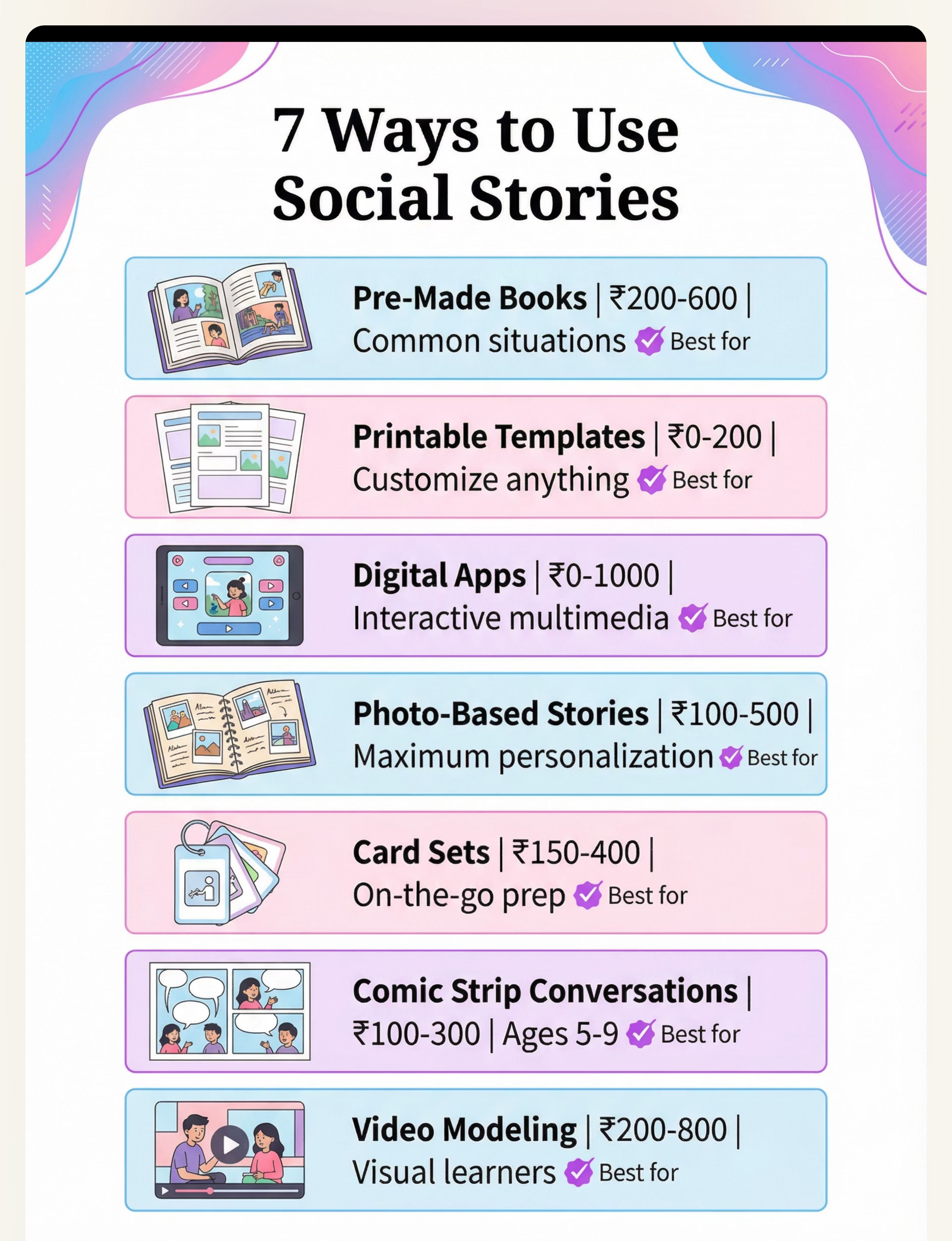
Choose Your Option (7 Variants)
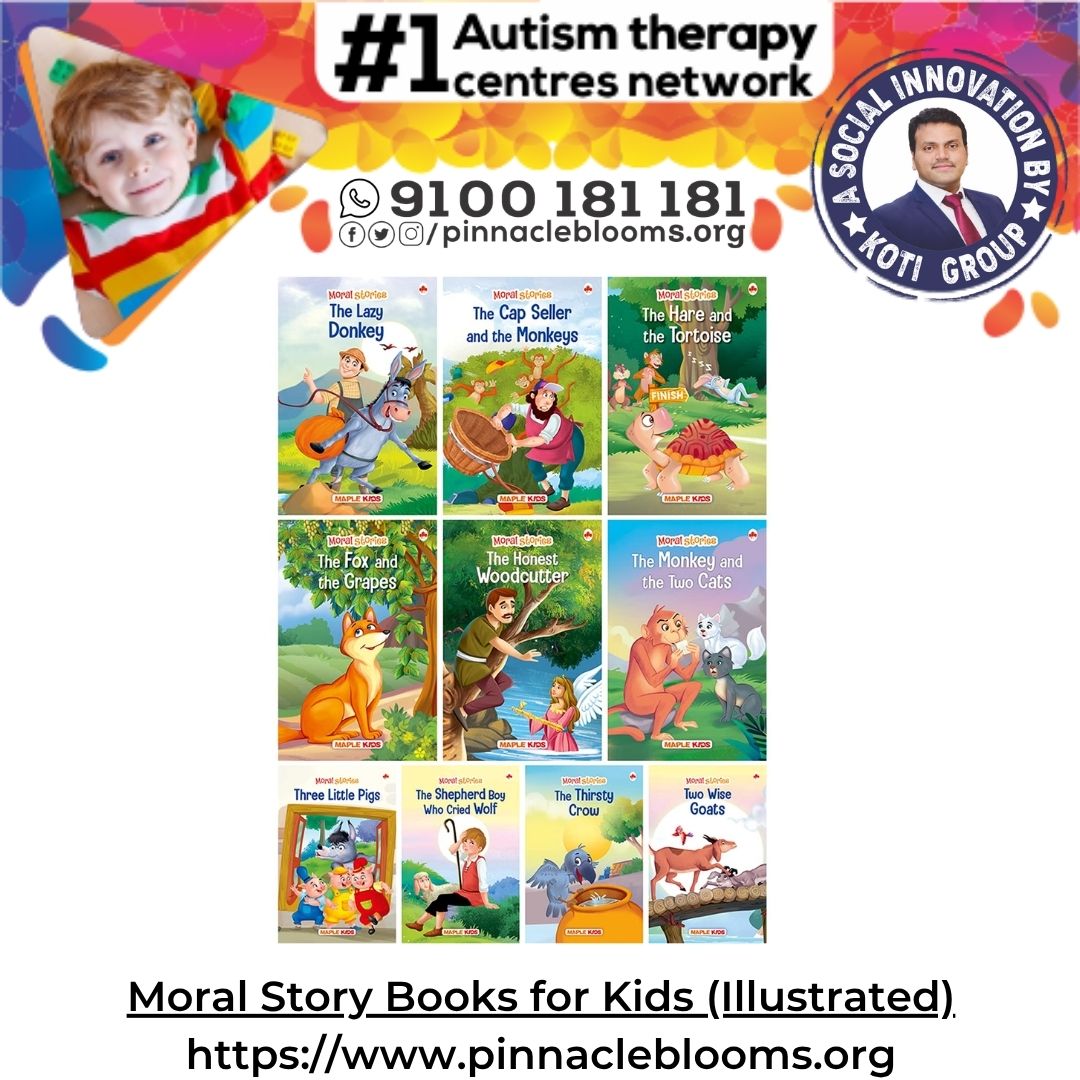
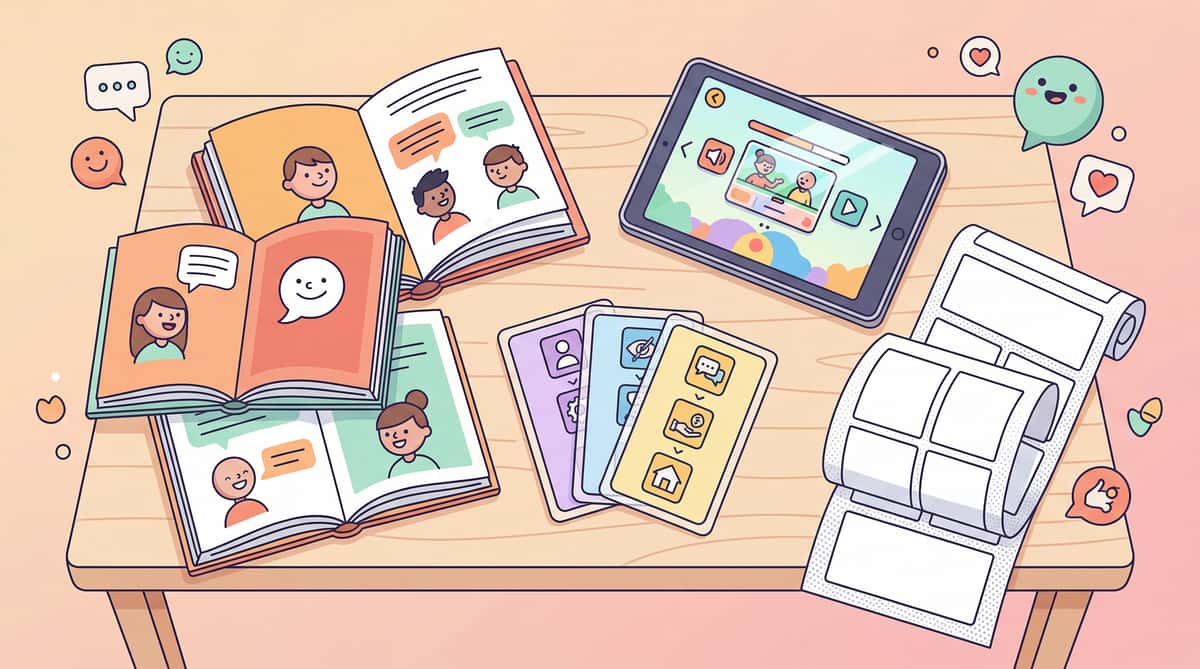
Pre-Made Social Story Books
Best for: Common situations (doctor, haircut, school)
Social Story Templates (Printable)
Best for: Personalized situations, flexibility
Social Story App/Digital
Best for: Tech-engaged children, multimedia
Photo-Based Social Stories
Best for: Maximum personalization, concrete learners
Social Story Card Sets (Situation Bundles)
Best for: On-the-go preparation, multiple situations
Comic Strip Conversations Kit
Best for: Understanding social interactions, perspective-taking
Social Narrative Video Set
Best for: Visual learners, modeling behavior
By Goal
  • Common situations: Pre-made books
  • Unique situations: Templates or photos
  • Tech preference: Apps or videos
By Setting
  • Home-based: Any format works
  • On-the-go: Cards, apps
  • Clinic use: Books, videos
By Portability
  • Highest: Apps (always available)
  • High: Cards, laminated stories
  • Medium: Books, videos
Specifications & Story Types
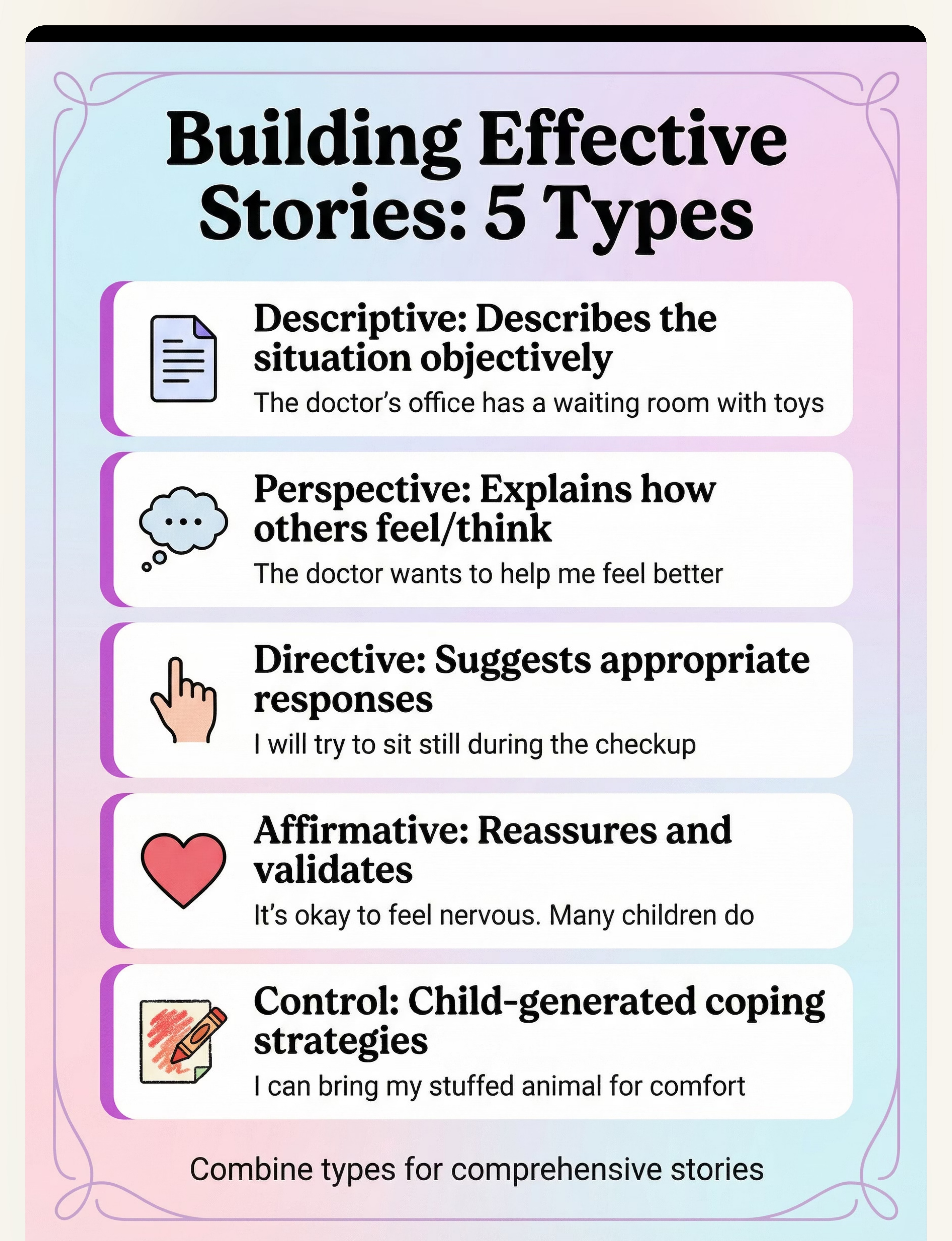
Story Types (Sentence Categories)
Descriptive
Describes the situation objectively: "The doctor's office has a waiting room with toys."
Perspective
Explains how others feel/think: "The doctor wants to help me stay healthy."
Directive
Suggests appropriate responses: "I will try to sit still on the exam table."
Affirmative
Reassures and validates: "Many children visit the doctor. This is normal and okay."
Control
Child-generated coping strategies: "If I feel scared, I can squeeze my squeeze ball."
Materials & Key Features
Common Materials:
  • Printed books or cards (durable paper)
  • Laminated pages (for repeated use)
  • Digital apps (interactive multimedia)
  • Photo paper (for personalized stories)
Essential Features:
  • First-person narrative: "I will..." perspective
  • Positive language: What TO do, not what NOT to do
  • Visual supports: Pictures, photos, or illustrations
  • Situation-specific: Tailored to exact scenario
  • Repeatable: Can be reviewed multiple times
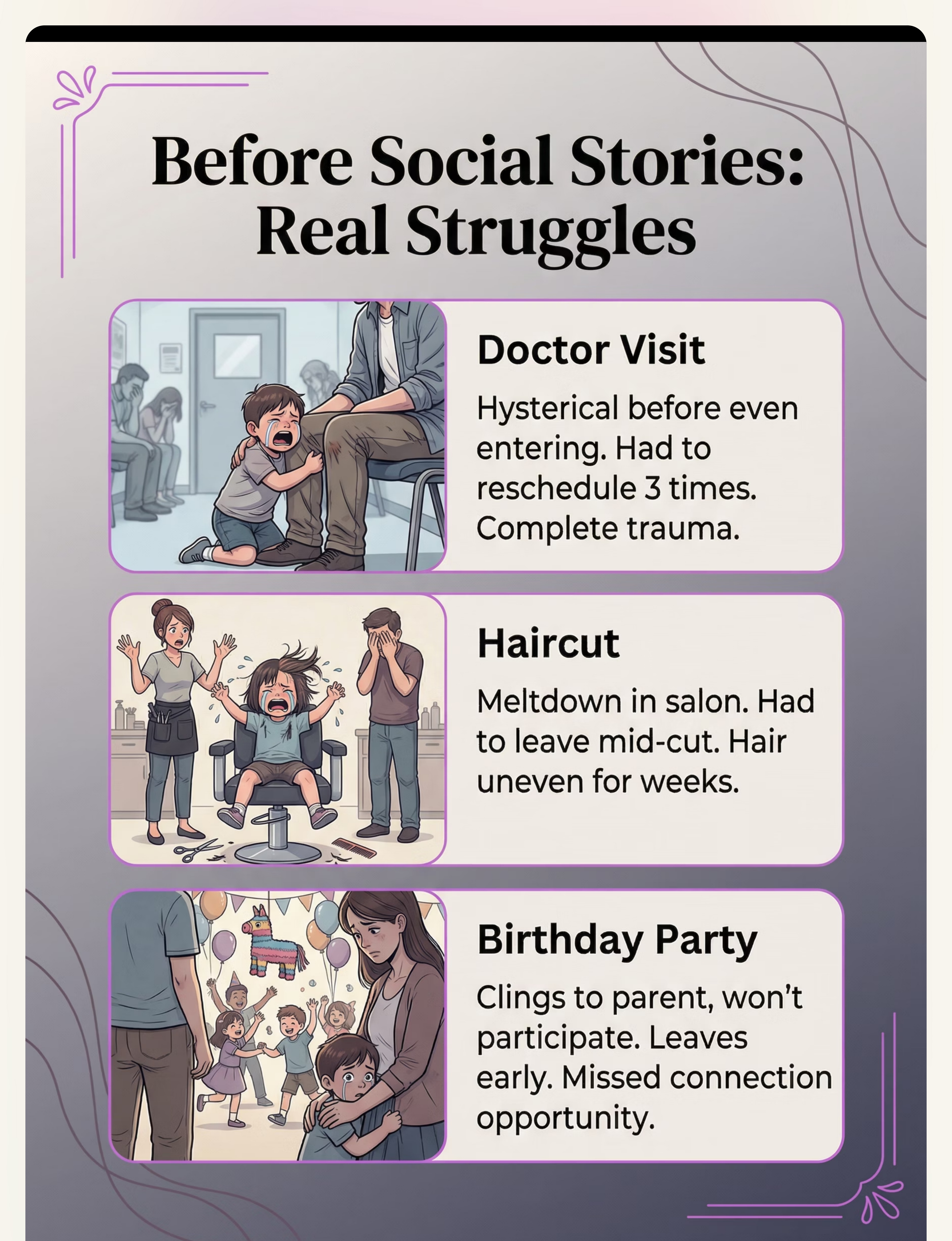
The Struggle (Before)
Doctor Visit
Situation: Routine checkup scheduled for next week
Experience: Child hysterical before even entering the building. Doesn't know what will happen. Fight-or-flight response fully activated. Visit impossible to complete. Had to reschedule three separate times, each attempt worse than the last.
Emotion: Trauma, avoidance, shame
Haircut
Situation: Hair grown too long, desperately needs cutting
Experience: Complete meltdown in salon within 30 seconds. Unknown person approaching to touch head. Loud clippers. Unfamiliar environment with bright lights and strange smells. Had to leave mid-cut. Child's hair uneven for weeks, leading to embarrassment at school.
Emotion: Embarrassment, failure, isolation
Birthday Party
Situation: Invited to classmate's birthday celebration
Experience: Child clings desperately to parent at entrance, won't participate in any activities. Doesn't understand the "rules" of parties. Overwhelmed by chaos, noise, and unpredictability. Leaves early in tears. Missed opportunity for social connection and friendship building.
Emotion: Isolation, disappointment, social anxiety
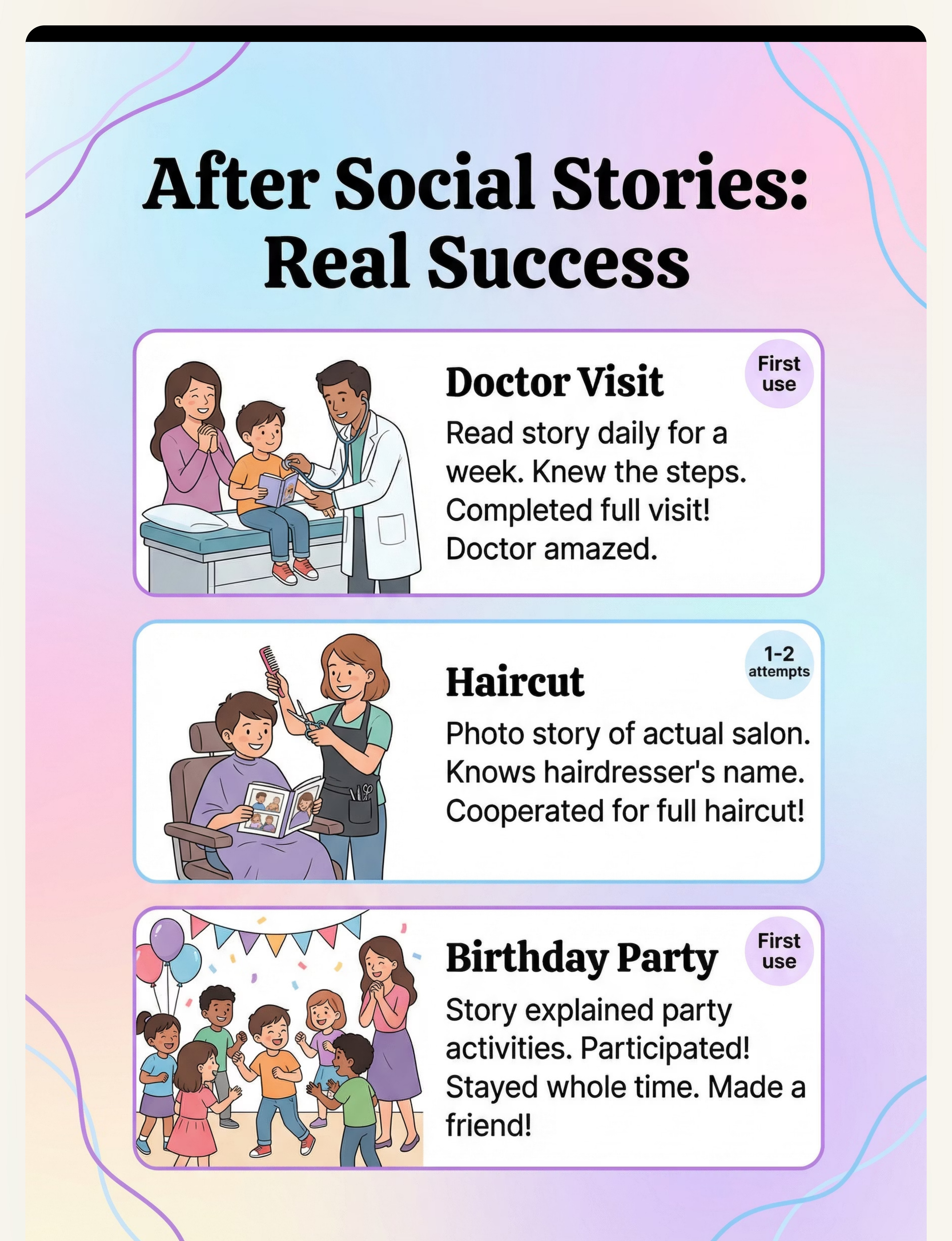
The Breakthrough (After)
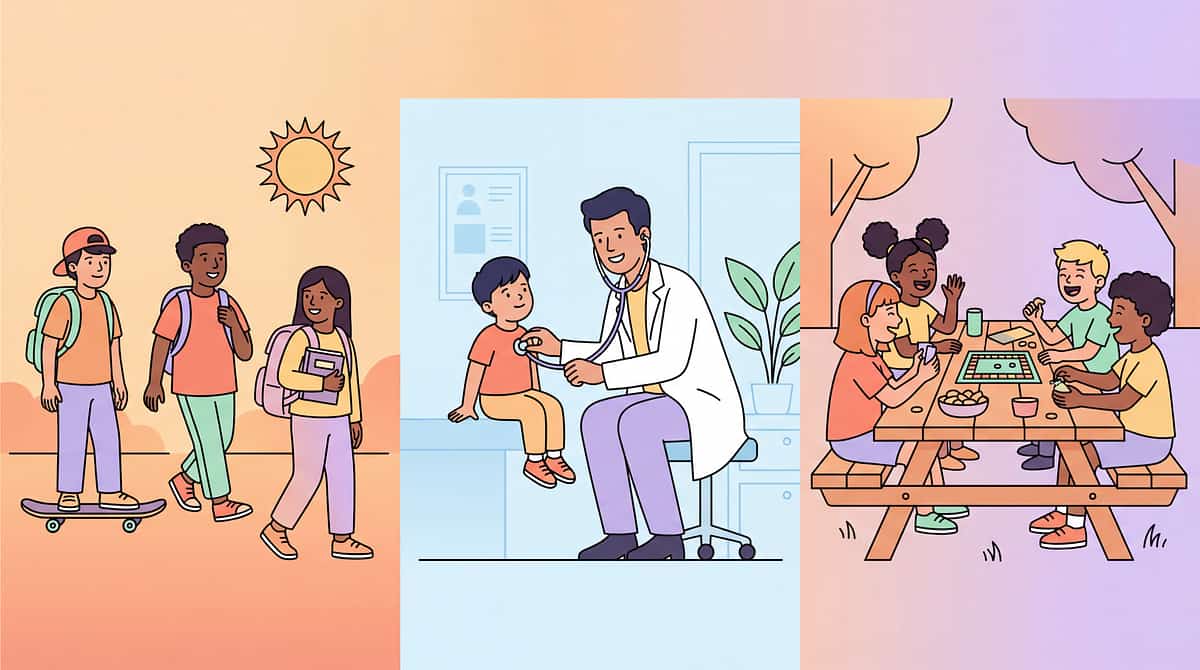
Doctor Visit
Situation: Armed with social story preparation
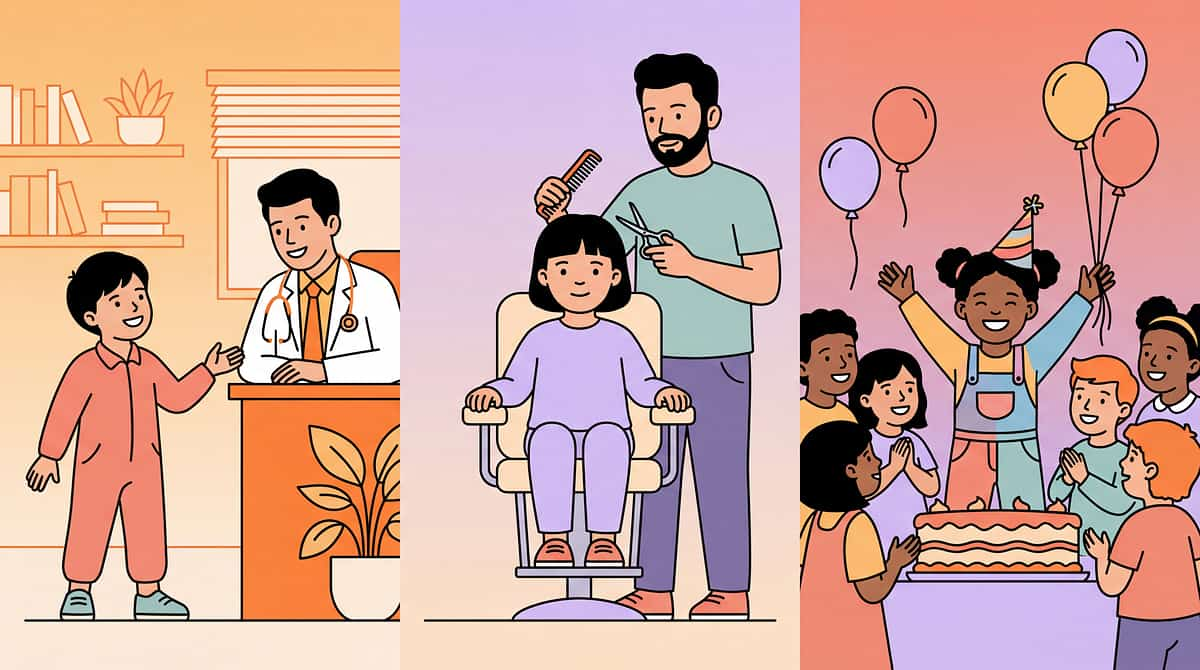
Experience: Read social story together daily for full week before appointment. Child now knows all the steps: check-in, waiting room, exam room, what doctor will do. Still nervous but anxiety is manageable. Completed entire visit successfully. Doctor amazed at the transformation.
Emotion: Success, capability, pride
First use
Haircut
Situation: Prepared with photo-based story
Experience: Photo-based story created showing actual salon visited beforehand. Child knows the hairdresser's name, recognizes the chair, understands the cape purpose. Cooperated for full haircut. Small fidgeting but no meltdown. Hairdresser gave high-five at end.
Emotion: Achievement, pride, confidence
1-2 attempts
Birthday Party
Situation: Story explains party structure
Experience: Social story clearly explains: arrival, cake, presents, games, singing routine. Child mentally prepared for each element. Participated in three different activities. Stayed the entire time. Made a friend who invited them to next playdate.
Emotion: Inclusion, joy, belonging
First use with preparation
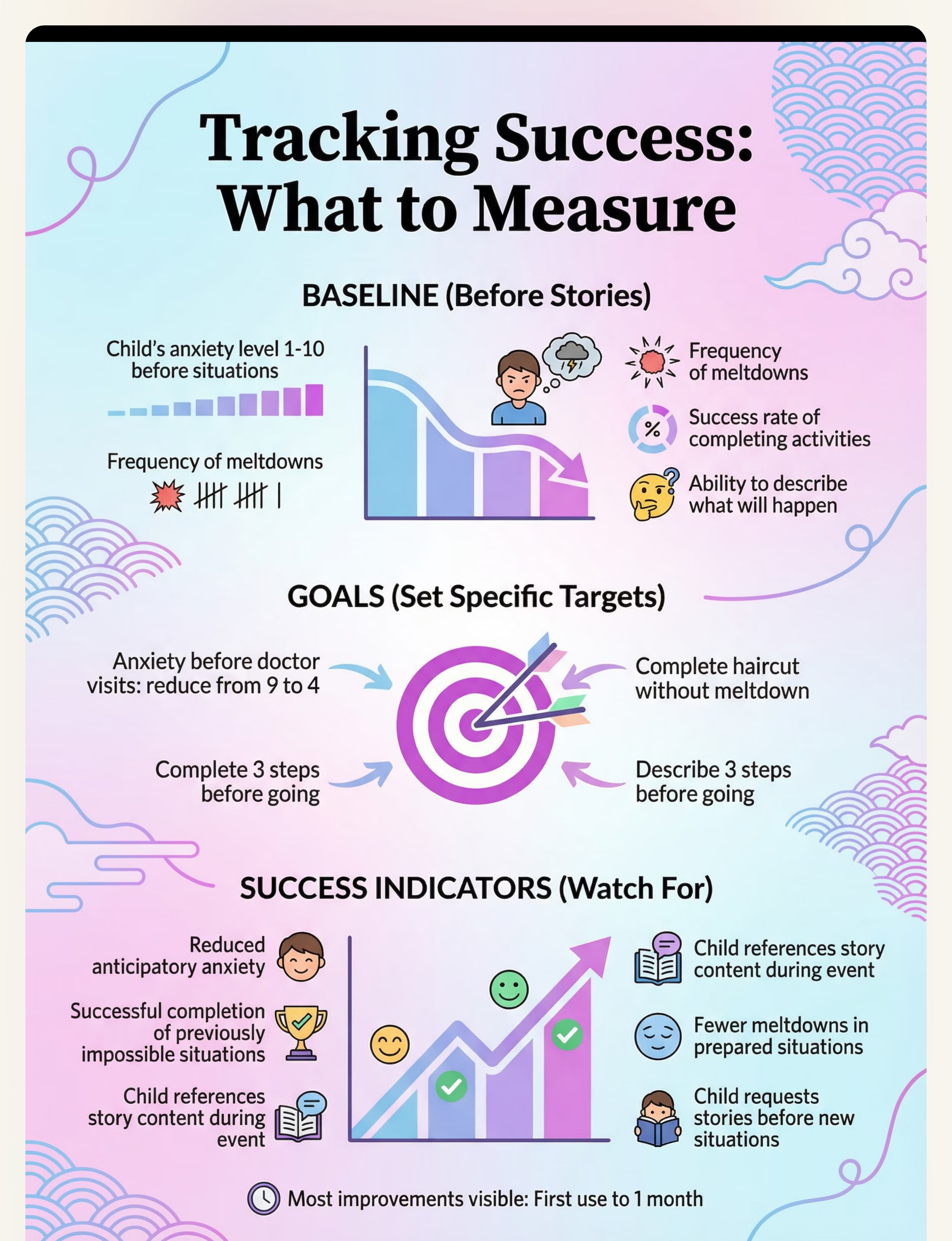
What to Expect (Realistic Timelines)
Immediate
Reduced anxiety before known challenging situations. Fewer meltdowns in prepared-for situations.
1-2 uses
Improved cooperation during previously difficult activities. Child begins to trust the preparation process.
2-4 weeks
Child actively asks for stories about upcoming new situations. Beginning to self-advocate for preparation.
Ongoing
Better understanding of social expectations across situations. Skills transfer to similar scenarios.
1-3 months
Generalization to similar unprepared situations. Child applies learned patterns to new scenarios independently.

Important: Every child responds differently. These timelines represent common patterns, but your child's journey may be faster or slower. Consistency in reading stories before situations is the key to success.
Is This Right for My Child? (2-Minute Check)
Question 1
Does your child become very anxious about new or unfamiliar situations?
✓ If yes, this indicates: Will benefit strongly from preparatory narratives
Confidence score: 95%
Question 2
Does your child have difficulty with specific recurring situations (doctor, haircut, etc.)?
✓ If yes, this indicates: Situation-specific stories will help significantly
Confidence score: 93%
Question 3
Does your child seem confused about social expectations?
✓ If yes, this indicates: Needs explicit social teaching through narrative
Confidence score: 88%
Question 4
Does knowing what to expect reduce your child's anxiety?
✓ If yes, this indicates: Predictability helps - stories will work very well
Confidence score: 96%

Scoring: 3 or more "yes" answers = strong fit for social stories. Even 1-2 "yes" answers suggest social stories could be beneficial as part of your toolkit.
Usage Guide
Social Stories Application
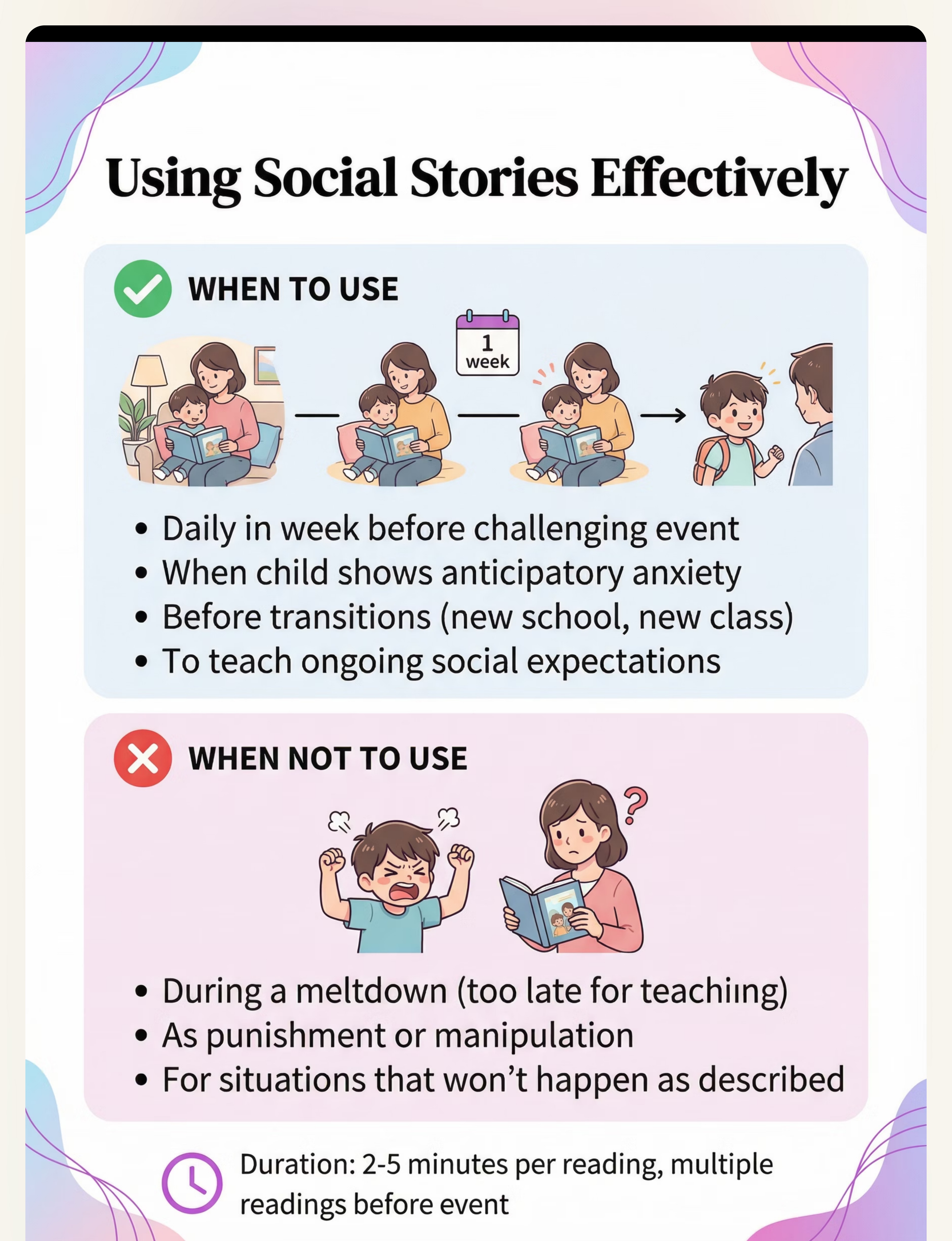
✓ When to Use
  • Before any new or challenging situation
  • Daily in the week leading up to appointment or event
  • When child shows anticipatory anxiety
  • To teach ongoing social expectations
  • After a difficult situation (to prepare for next time)
  • Before major transitions (school year, new class)
✗ When NOT to Use
  • During an active meltdown (too late for teaching)
  • As punishment ("You should have read your story")
  • To manipulate or trick child
  • For situations that won't actually happen as described
Supervision by Age
Under 3 years
Adult reads to child, pointing at pictures
3-6 years
Adult reads, child follows along and participates
6+ years
Child can read independently with adult support and discussion
Duration & Settings
Reading time: 2-5 minutes per reading; plan for multiple readings before the event
Home
School
Clinic
Travel

Age note: Simplify language and increase visual support for younger children (2-4 years). Add complexity and more detailed perspective-taking for older children (7-9 years).
Safety First
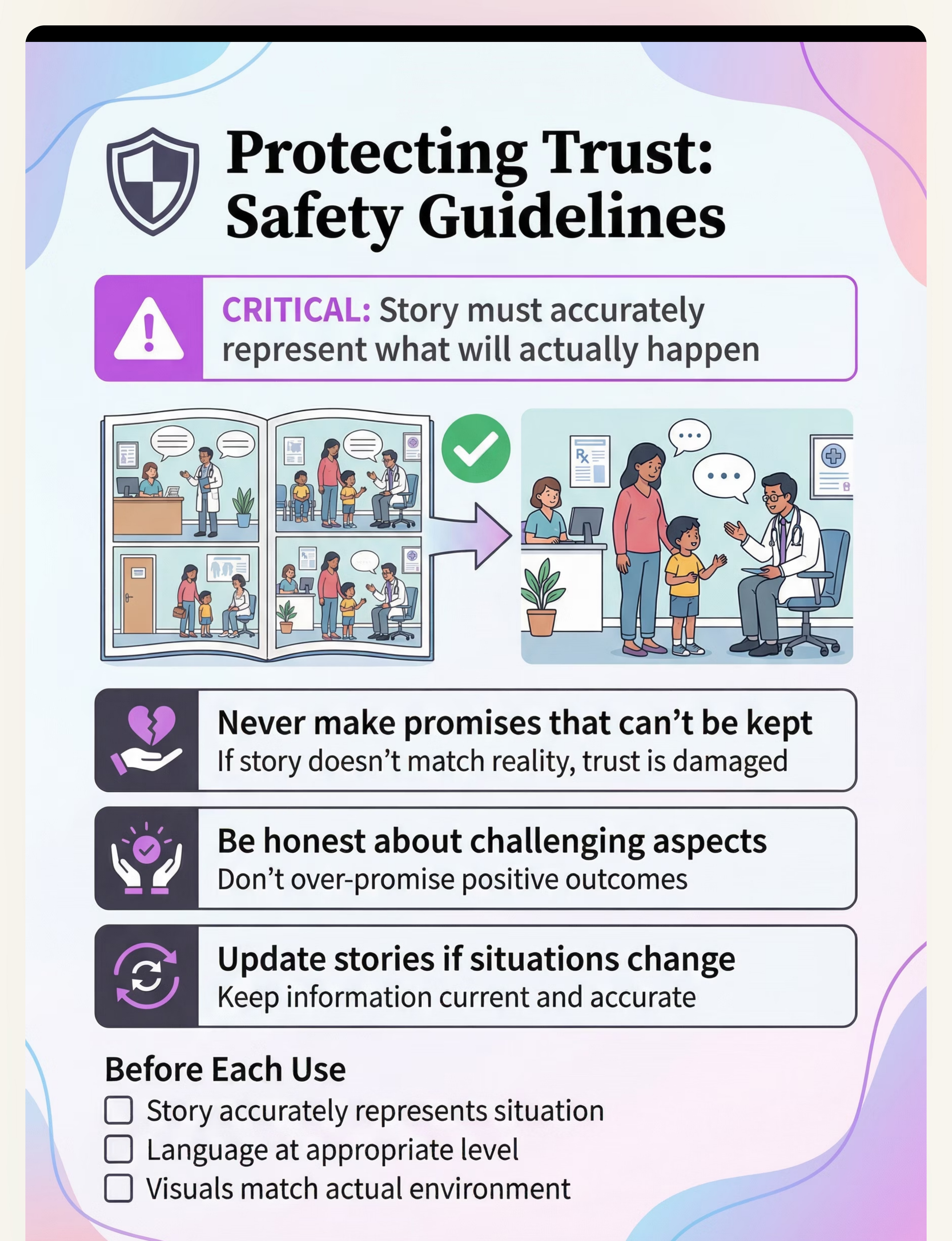
Critical Safety
  • Story MUST accurately represent what will actually happen
  • Don't make promises that can't be kept
  • Update stories immediately if situations change
  • Never use stories to deceive child about what's coming
Warnings
  • If story doesn't match reality, trust is damaged - potentially permanently
  • Don't over-promise positive outcomes child may not experience
  • Be honest about challenging aspects while remaining supportive
  • Allow for flexibility in child's response - stories prepare, don't script
Contraindicated
  • Using inaccurate information deliberately
  • Breaking trust with false or misleading stories
  • Using stories as punishment or consequence
Safety Checklist
Before Use
  • Story accurately represents situation
  • Language at appropriate level
  • Visuals match actual environment
  • Positive but honest framing
During Use
  • Child engaged with story
  • Answer questions that arise
  • Connect to child's experience
  • Read multiple times
Signs of Success
  • Child references story during situation
  • Anxiety reduces with repeated reading
  • Requests story before new situations
  • Improved behavior in target scenarios
Common Questions (Honest Answers)
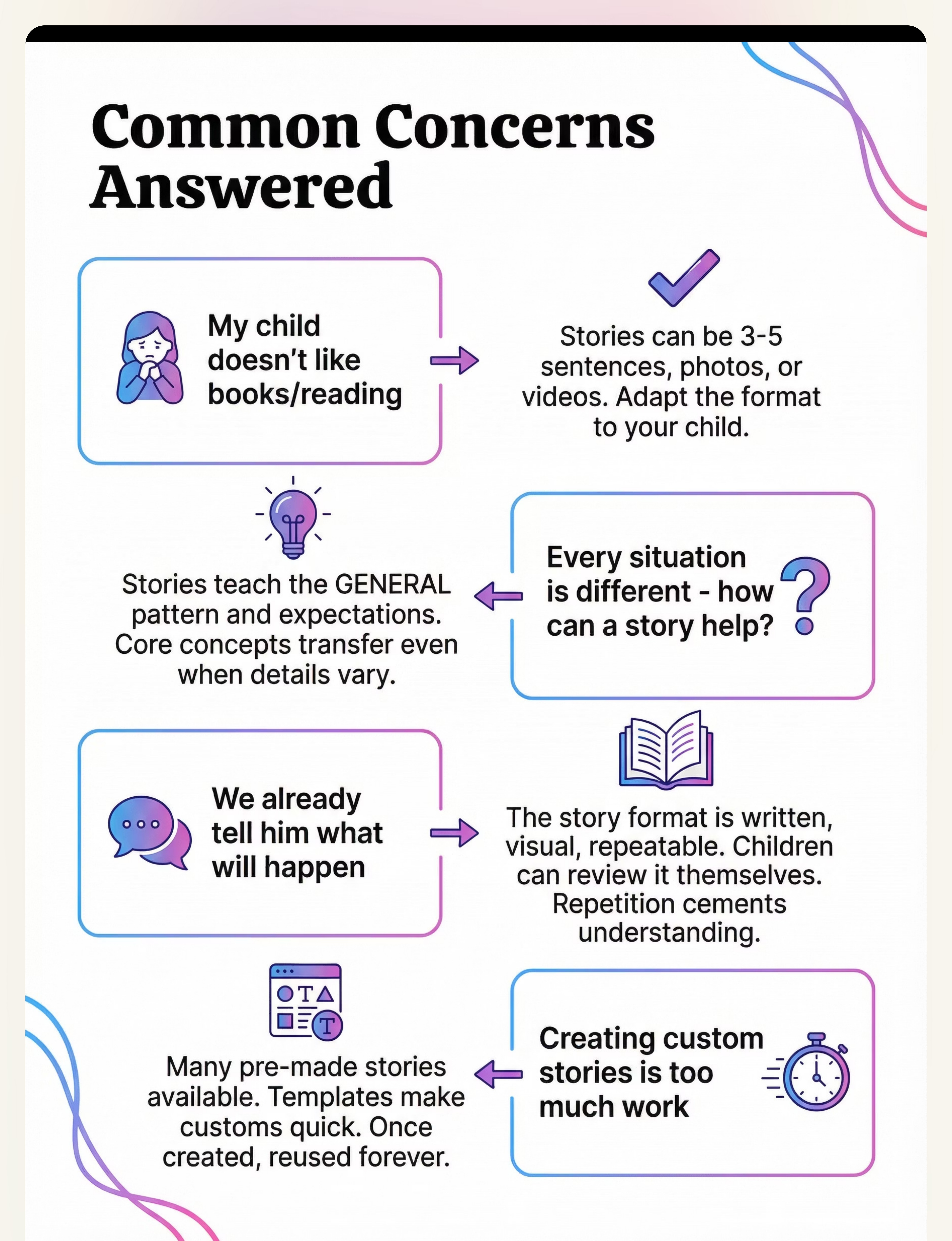
Q: "My child doesn't like books or reading"
A: Social stories can be very short (just 3-5 sentences), photo-based instead of illustrated, or even video format. The "story" can be as simple as a sequence of photos with one sentence each. Digital apps make it interactive and engaging. The key is adapting the format to your child's preferences - if they like tablets, use an app; if they like photos, use real pictures.
Try this: Start with photo-based cards or video social stories instead of traditional books.
Q: "Every situation is different - how can a story prepare them?"
A: Stories teach the GENERAL pattern and core expectations that transfer across variations. For example, "The doctor will check my ears. I will sit still. It will be quick." These core concepts apply even if the specific doctor, room, or exact procedure varies slightly. The child learns the framework, not just one specific scenario. Personalization helps maximize transfer.
Try this: Create customized stories for your most frequent specific situations, then use more general stories for occasional variations.
Q: "We already tell him what will happen verbally"
A: The story format is fundamentally different from verbal explanation. Stories are written (permanent reference), visual (pictures support understanding), repeatable (child can review independently), and follow a specific research-based structure mixing description, perspective, and direction. The written format allows for repetition and processing at child's own pace. Many children who can't retain verbal information can learn from written stories.
Try this: Combine verbal explanation with written story for reinforcement - use both approaches together.
Q: "Creating custom stories is too much work"
A: Many common situations already have pre-made stories available (doctor visits, dentist, haircuts, shopping, etc.). Templates make creating custom stories quick - often just 15-30 minutes. Once created, stories are reused multiple times. The investment of time pays off dramatically in reduced meltdowns, successful appointments, and decreased family stress. Many parents report that creating one good story saves hours of crisis management.
Try this: Start with pre-made stories for the most common challenging situations, then gradually build your custom library.
Investment Guide
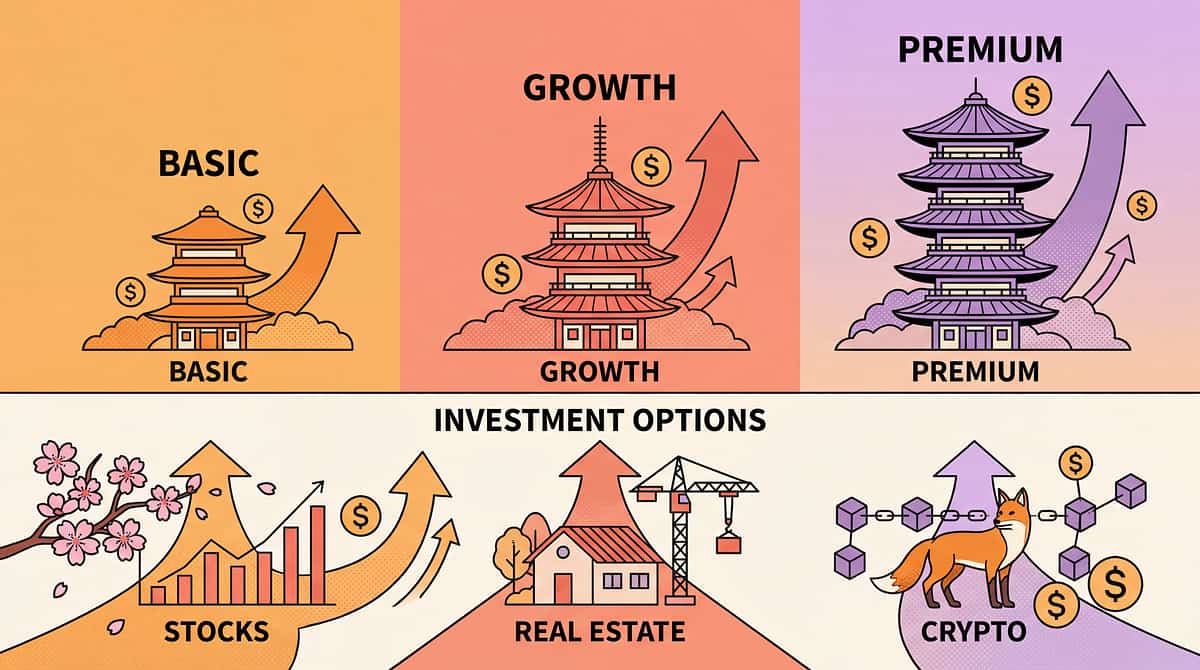
Understanding the costs associated with social stories can help you make informed decisions. The overall range for resources is typically ₹0–1,000 (or ₹0–12 USD). A great starting point is to begin with free printable templates to learn the format and see what works best for your child, then consider investing in premium options for convenience as needed.
Here's a comparison of common investment tiers:
Budget Option
₹0–100
Free printable social story templates + home printing
Families wanting to start immediately with zero cost, comfortable with DIY creation. Note: Requires printer, paper, and optional lamination.
Premium Option
₹500–1,500
Complete social story book collection + app subscription
Families wanting professional-quality stories immediately, covering multiple common situations. Recommended brands: Carol Gray Social Stories, Special Learning, Autism Little Learners.
Key Features by Option
Unlimited Customization
Tailor stories precisely to unique situations and individual needs.
Immediate Access
Start using resources right away with downloadable templates.
Learn Hands-On
Understand the social story format by creating it yourself.
Professional Illustrations
High-quality visuals for engaging and effective stories.
Extensive Situation Library
Access a wide range of pre-made stories for common challenges.
Interactive Digital Features
Engage children with apps and digital story formats.
Investment Progression
Start with Free Templates
Explore free printable templates to learn the format and discover what works for your child without any initial cost.
Evaluate Needs
Assess your family's specific requirements after gaining initial experience. Identify recurring situations or desired enhancements.
Invest in Premium
Consider purchasing professional book collections or app subscriptions for convenience, broader coverage, and enhanced features as your needs evolve.
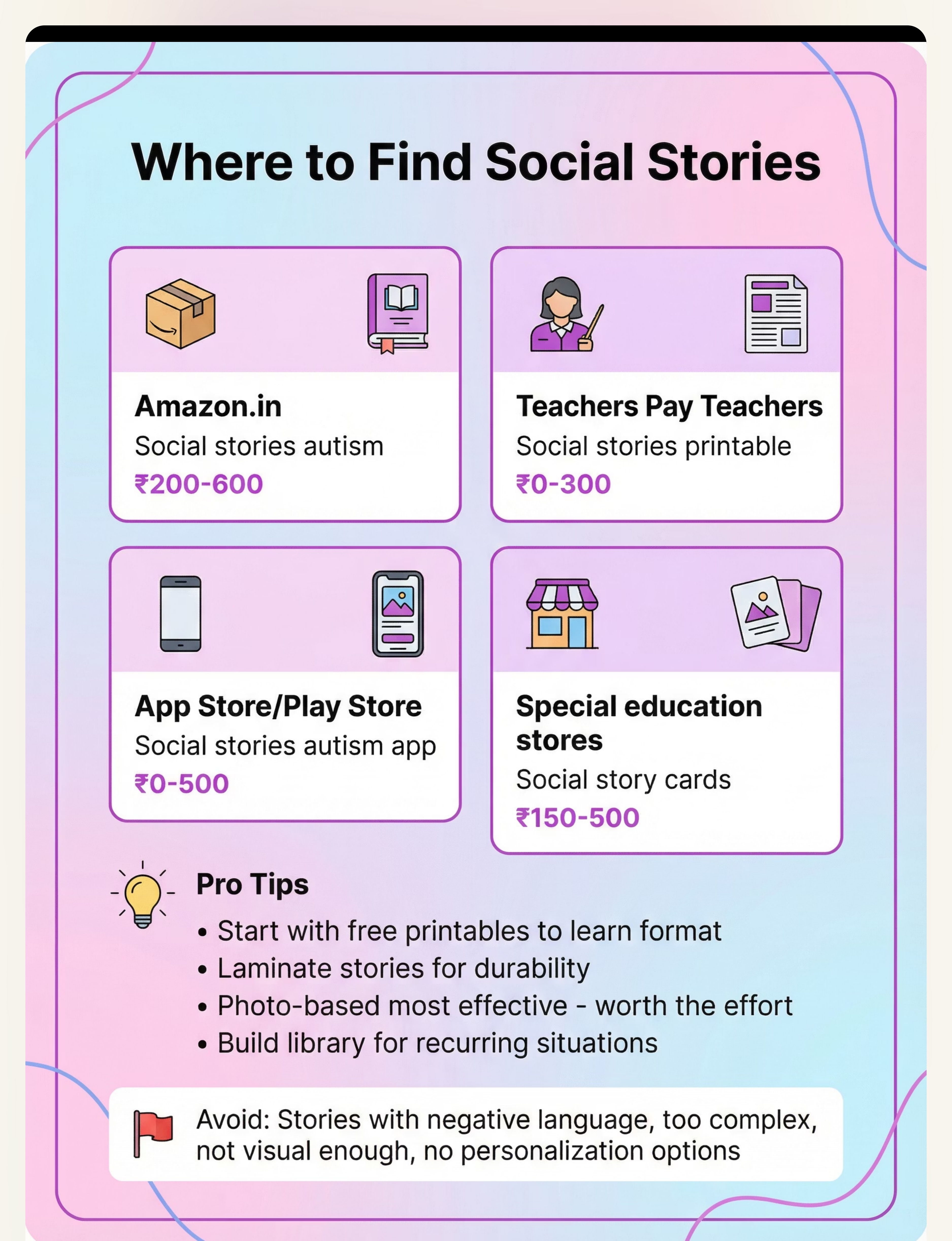
Where to Buy in India
Availability: Widely Available across multiple platforms
Platform
Search Term
Price Range
Amazon.in
"social stories autism"
₹200–600
Teachers Pay Teachers
"social stories printable"
₹0–300
App Store / Play Store
"social stories autism app"
₹0–500
Special education stores
"social story cards"
₹150–500
✓ Buying Tips
  • Start with free printables to learn the format before investing
  • Laminate stories for durability and repeated use
  • Photo-based stories are most effective - worth the extra effort
  • Build a library gradually for recurring situations
  • Apps allow easy customization with child's own photos
  • Read reviews focusing on age-appropriateness and language level
🚩 Red Flags
  • Stories using negative language ("Don't..." instead of "I will...")
  • Content too long and complex for your child's comprehension level
  • Insufficient visual supports (mostly text, few images)
  • Generic stories without personalization options or flexibility
  • Unrealistic promises about outcomes or timelines
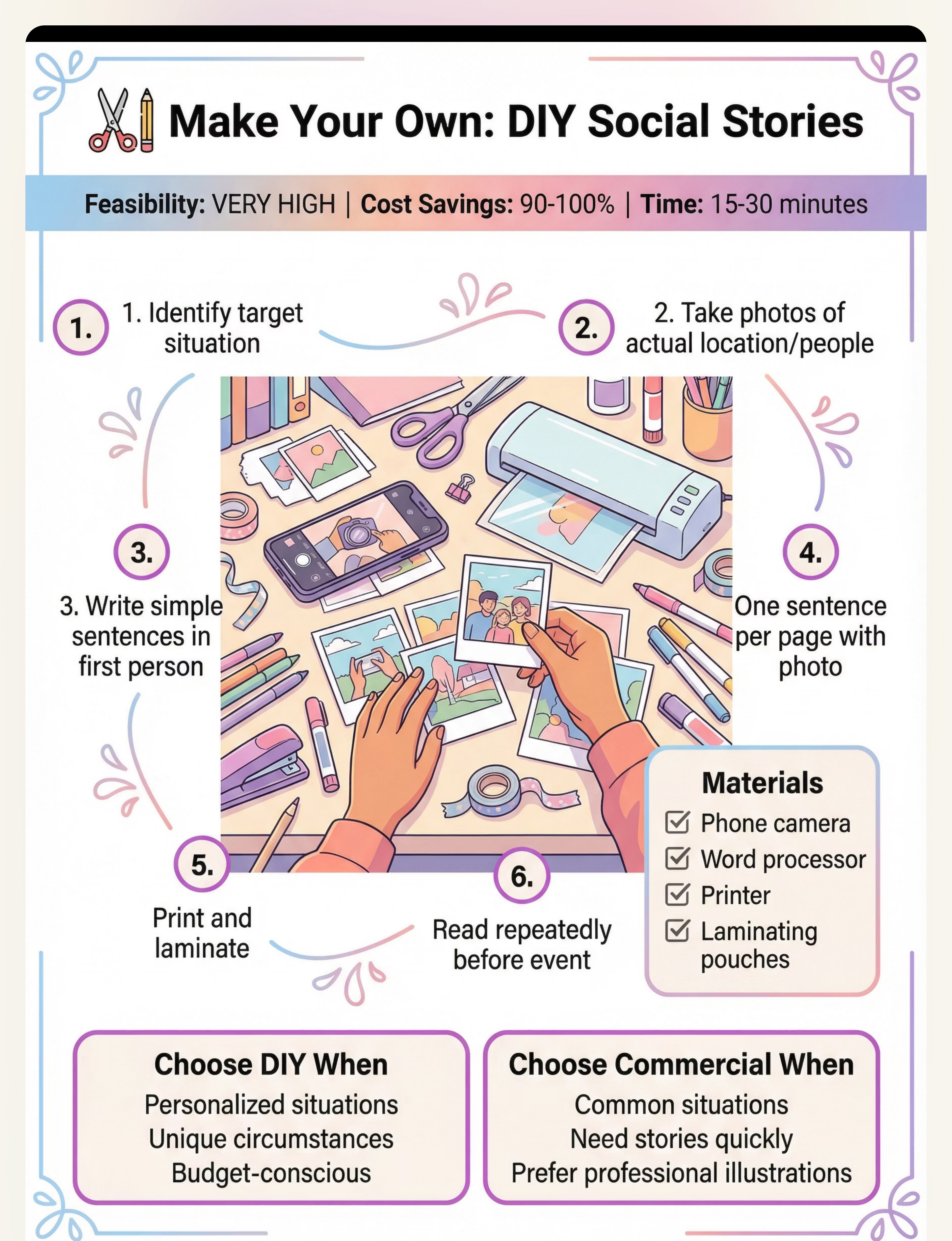
DIY Alternative (Save 90-100%)
Feasibility
Very High
Time
15-30 minutes per story
Cost Savings
90-100%
What You Need
  • Photos (phone camera works perfectly)
  • Word processor or PowerPoint
  • Printer (home or print shop)
  • Laminating pouches (optional but recommended)
  • Stapler or binding clips
social-stories-narrative-supports therapy material
How to Create (6 Simple Steps)
1
Identify target situation
Choose the specific situation causing anxiety or confusion
2
Gather or take photos
Visit location if possible; photograph actual people, places, and steps
3
Write simple sentences
"I will go to [place]. [Person] will help me. I will [expected behavior]. Then we will go home."
4
One sentence per page with photo
Keep it simple and visual - picture supports the text
5
Print, laminate, bind
Create durable version for repeated reading
6
Read repeatedly before situation
Review daily in week leading up to event
DIY vs Commercial Comparison
Situation
DIY: Personalized situations (your specific doctor, your school)
Commercial: Common situations well-covered by existing stories
Uniqueness
DIY: Unique circumstances not covered by published stories
Commercial: Standard social situations (haircut, party, shopping)
Personalization
DIY: Want photos of actual people and places child will encounter
Commercial: Professional illustrations are sufficient
Budget
DIY: Budget-conscious, willing to invest time instead of money
Commercial: Prefer convenience, willing to pay for time savings
Timeline
DIY: Have time to create in advance
Commercial: Need stories immediately without creation time
Format
DIY: Comfortable with computer/printer
Commercial: Prefer app format with interactive features
Tradeoffs: DIY takes more time initially and may not look as professionally polished, but offers maximum personalization and zero ongoing cost. Commercial options save time and look professional but cost more and may not fit your exact situation.

Preview of social stories narrative supports Therapy Material

Below is a visual preview of social stories narrative supports therapy material. The pages shown help educators, therapists, and caregivers understand the structure and content of the resource before use. Materials should be used under appropriate professional guidance.

Page 1
Page 2
Page 3
Page 4
Page 5
Page 6
Page 7
Page 8
Page 9
Page 10
Page 11
Page 12
Page 13
Page 14
Page 15
Page 16
Page 17
Page 18
Page 19
Page 20
Link copied!
Next Steps (Your Action Plan)
Empower your child by taking these immediate, actionable steps towards fostering understanding and confidence:
1
Identify the Situation
Pinpoint one specific upcoming event or context that typically causes anxiety or confusion for your child.
2
Choose Your Format
Decide between creating a DIY social story or purchasing a commercial one, considering your time, budget, and desired personalization level.
3
Create or Acquire
Develop your first social story based on the chosen situation and format. Gather photos or select a pre-made resource.
4
Read & Reinforce
Review the social story daily with your child for 5-7 days leading up to the event. Consistency is key to building confidence!
By actively using social stories, you're not only preparing your child for specific events but also fostering a foundation of independence and resilience. Embrace this journey of positive communication!
social-stories-narrative-supports therapy material