Tool ID: 1.5
OT Recommended
Moderate Evidence
Rank #2
Daily Use
₹100–3,500
Sunglasses / Light Filtering Glasses
Visual modulation/protection system
For children with visual sensory sensitivities, the world can feel overwhelmingly bright. Sunglasses and specialized light filtering glasses reduce visual input to comfortable levels, preventing sensory overload and enabling your child to participate fully in environments that were previously impossible—from sunny playgrounds to fluorescent-lit classrooms and shopping centers.
Home
School
Clinic
Outdoors
Travel
Evidence-based support: Sensory Regulation & Nervous System Modulation | Ages 2-9 years

Who This Helps
Reduces Visual Input
Physically filters light to prevent sensory overload, maintaining nervous system regulation in visually challenging environments.
Core Areas Supported
Visual processing, sensory regulation, headache prevention, participation in daily activities, and sustained attention.
Perfect For
Children ages 2-9 who experience visual hypersensitivity, light-triggered headaches, or avoid bright environments like stores, playgrounds, or fluorescent-lit classrooms.
Ages 2-9 years
Home
Clinic
School
Outdoors
Best for children who:
- Squint or cover their eyes in bright light or sunshine
- Experience headaches triggered by fluorescent lighting or screen time
- Avoid outdoor play, shopping malls, or other bright environments
- Show increased overwhelm or behavioral challenges in visually stimulating settings

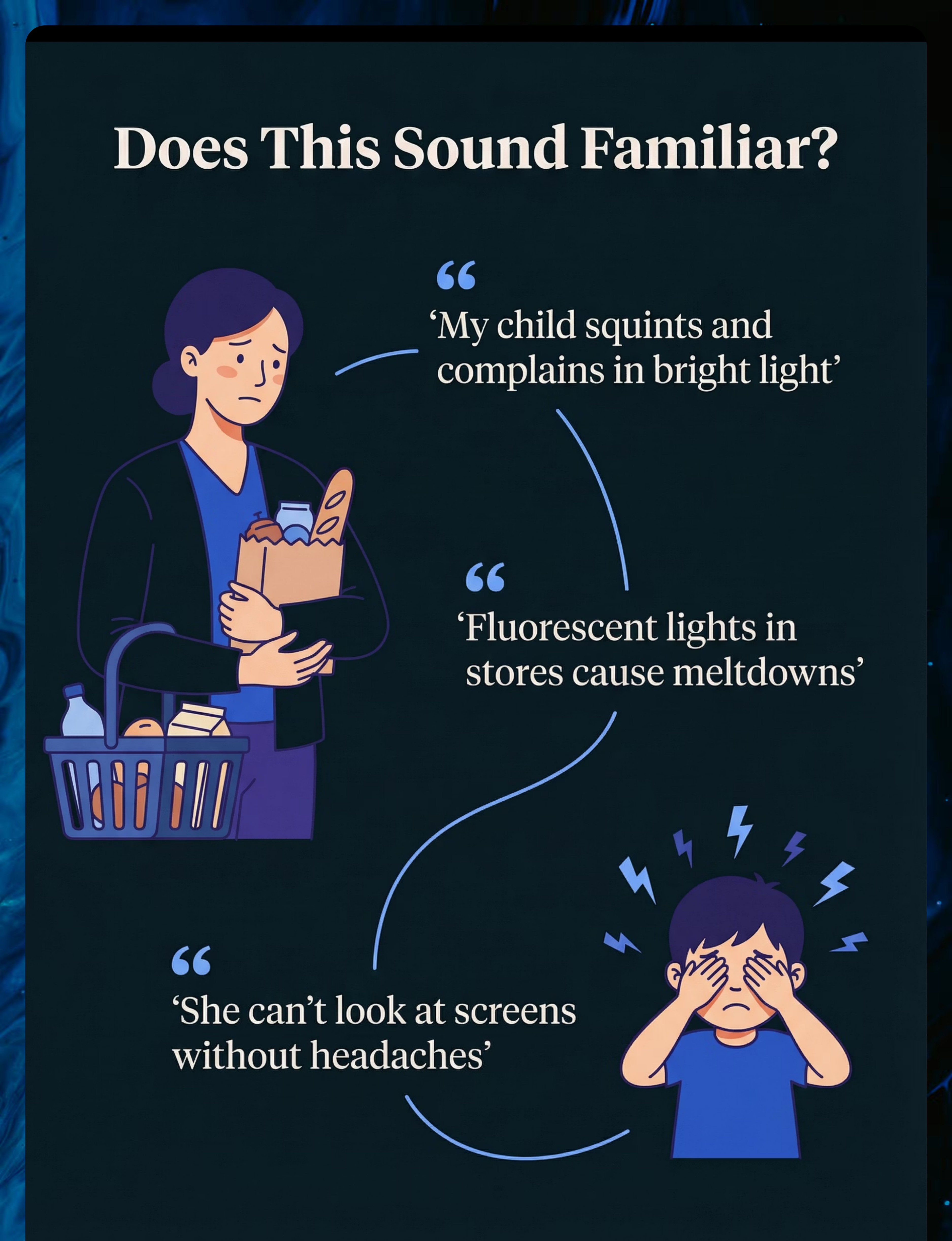
Does This Sound Familiar?
"My child squints and complains constantly in bright light. Even a simple walk outside becomes a struggle."
"Fluorescent lights in stores trigger immediate meltdowns. We can't complete grocery shopping anymore."
"She can't look at screens without getting headaches. Homework time has become a daily battle."
"He refuses to go outside because it's 'too bright.' He's missing out on play, exercise, and time with friends."
"The school cafeteria lights completely overwhelm her. She comes home exhausted and upset every day."
"Car rides on sunny days are unbearable. The crying and distress make every outing feel impossible."
You're not alone. Visual hypersensitivity affects many children with sensory processing differences. These are common, valid challenges—and there are practical solutions that can transform daily life.

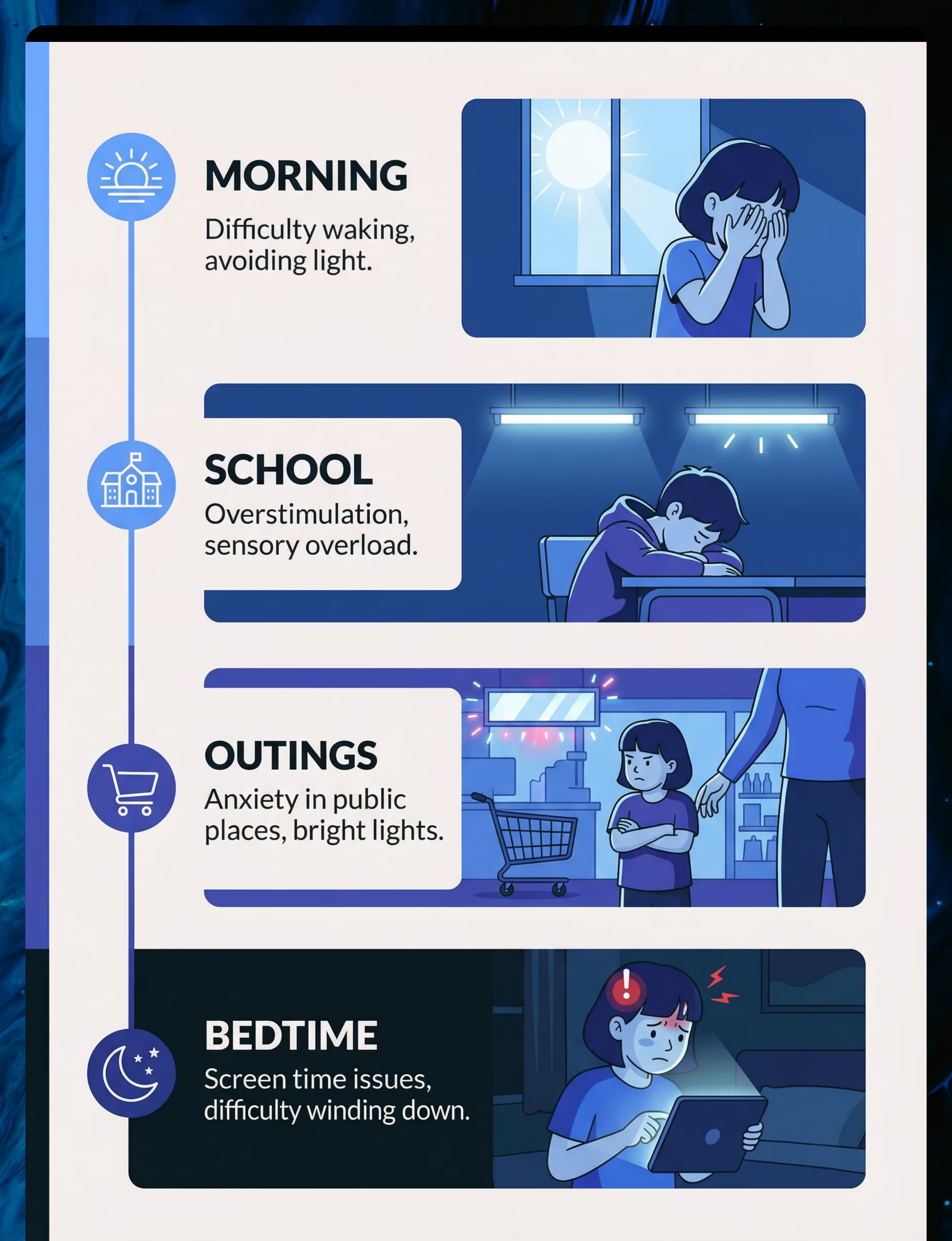
A Day Without the Right Support
Morning
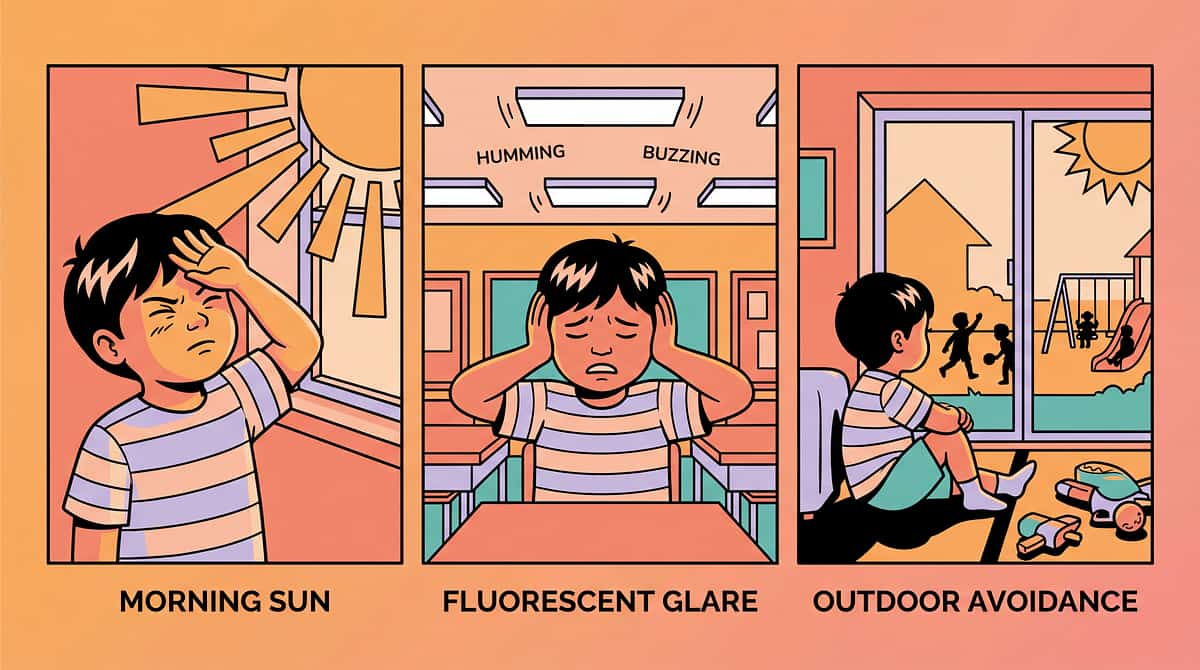
Sunlight streaming through windows causes immediate distress. Child refuses to get ready, covering eyes, becoming dysregulated before the day even begins.
School & Transitions
Fluorescent classroom lights feel overwhelming. Child struggles to concentrate, puts head down, appears inattentive. Teachers misunderstand the behavior as defiance or lack of interest.
Therapy Sessions & Outings
Shopping malls, grocery stores, and therapy clinics with bright lighting trigger meltdowns within minutes. Family can't complete essential errands together. Child begs to leave, crying in aisles.
Outdoor Play & Bedtime
Child refuses to play outside, missing physical activity, vitamin D, and social connections. Evening screen time causes headaches that interfere with sleep routines and family time.
These daily challenges compound, leading to isolation, missed developmental opportunities, family stress, and a child who feels misunderstood and limited by their environment.

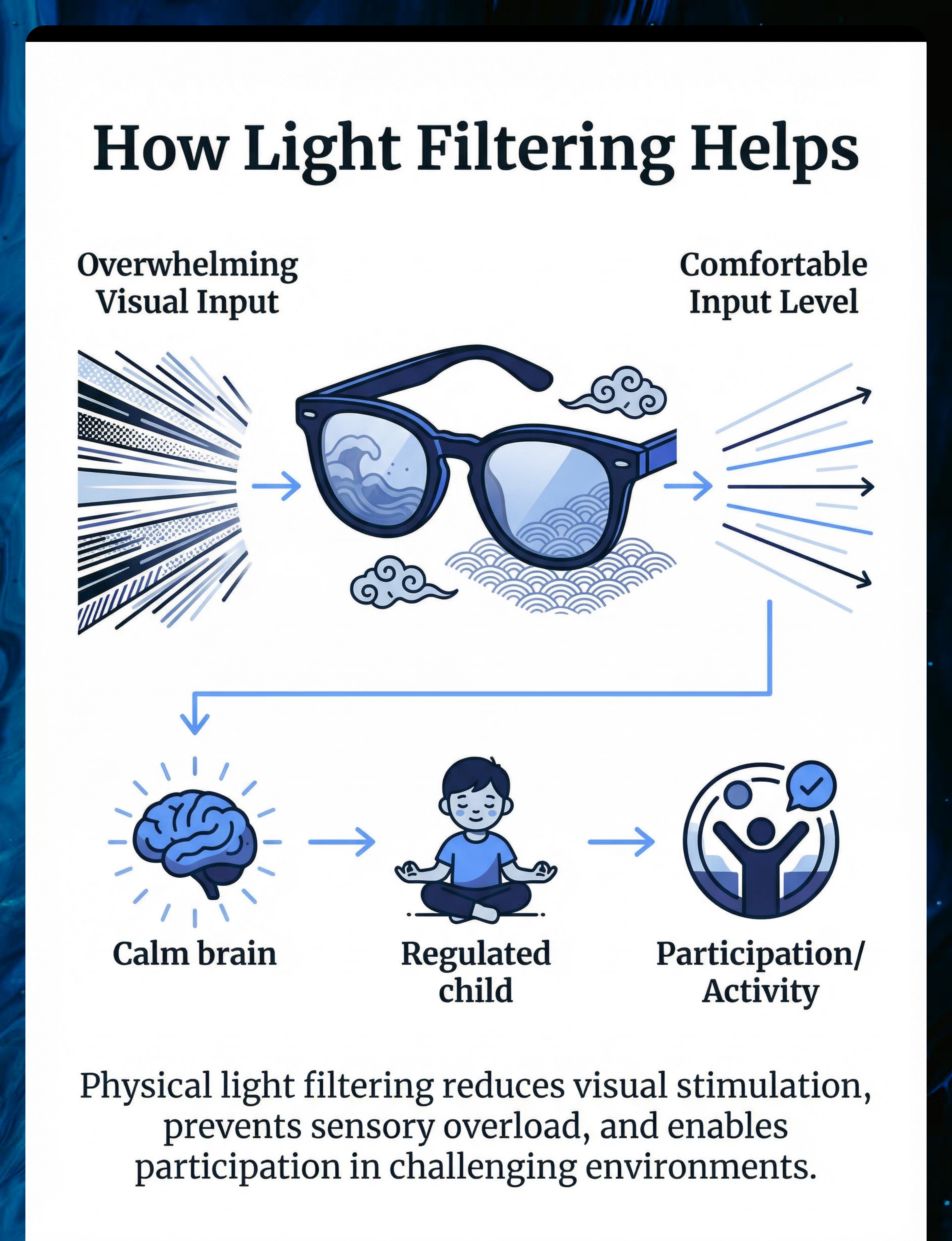
The Science Behind It
Physical Light Filtering
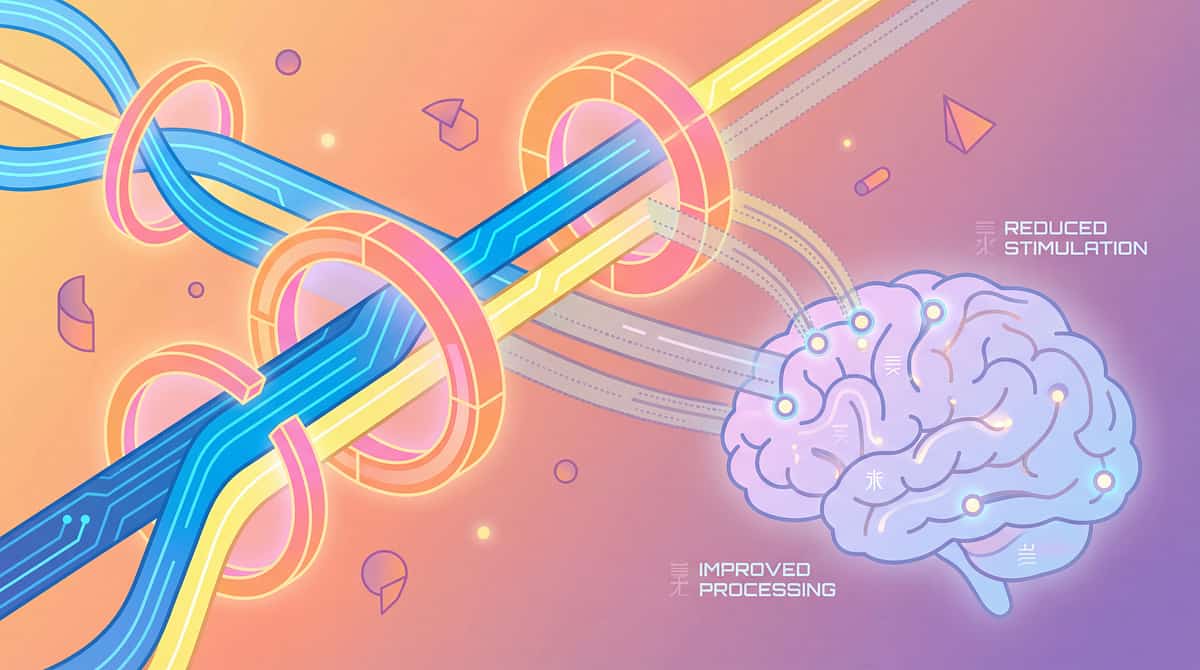
Specialized lenses physically reduce the amount and type of light reaching the eyes
Reduced Visual Stimulation
Lower light input decreases overwhelming sensory signals to the brain
Prevents Stress Response
Comfortable visual input prevents sympathetic nervous system activation (fight/flight response)
Maintains Regulation
Child stays calm, focused, and regulated in previously challenging environments
Enables Participation
With comfortable vision, child can engage fully in learning, play, and daily activities
Visual Processing
Sensory Regulation
Headache Prevention
Participation
Attention
Clinical Foundation: Light filtering works by reducing sensory input to manageable levels, allowing the child's nervous system to maintain regulation rather than becoming overwhelmed and dysregulated.

How to Use It Right
Prepare Before Entering
Have glasses available and ready before you enter the bright environment. Prevention is more effective than intervention after overwhelm begins.
Let Your Child Control Use
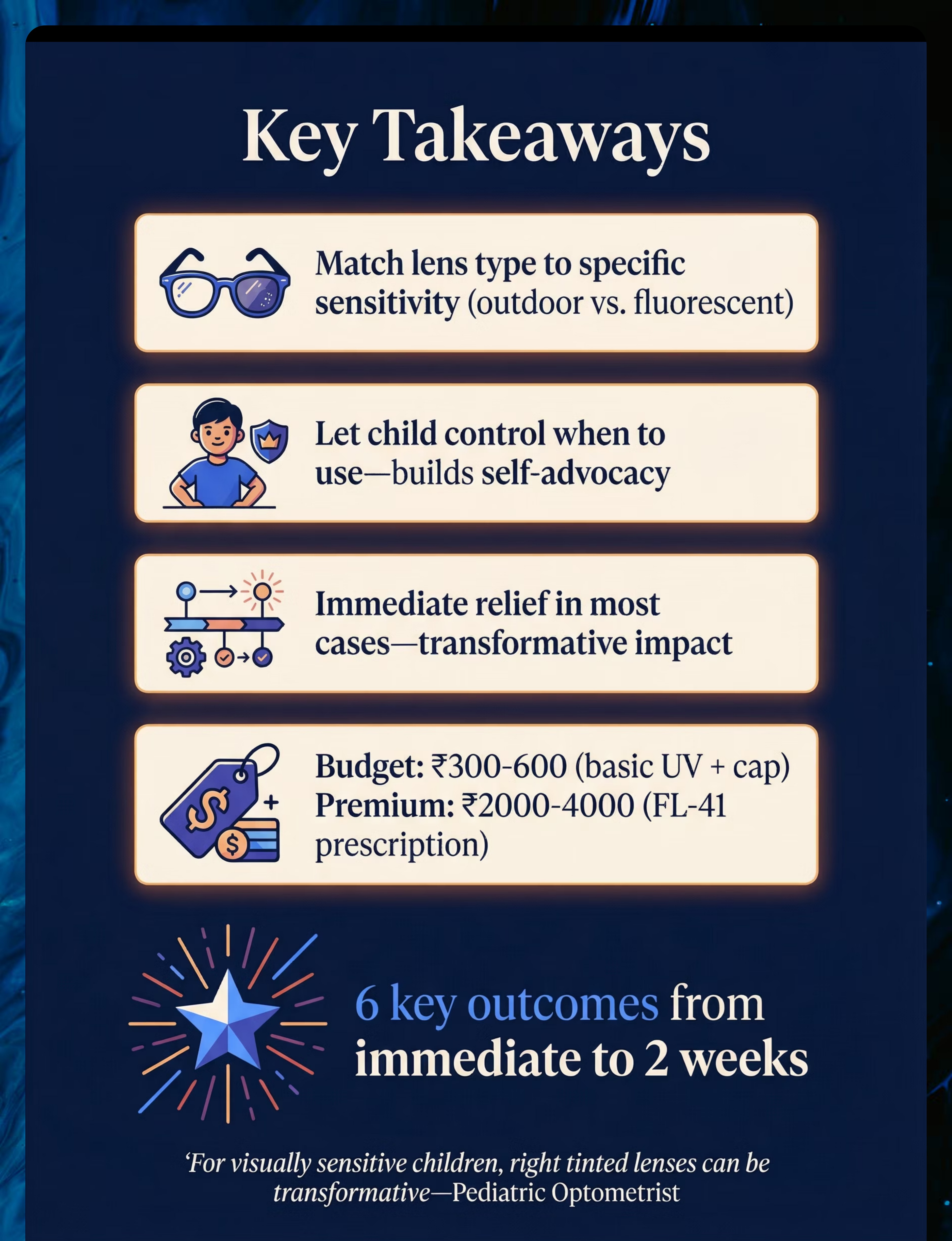
Allow your child to decide when to put on or remove glasses. This builds self-awareness, self-advocacy, and trust in the tool.
Match Lens Type to Setting
Choose appropriate glasses for the specific challenge: dark tints for outdoor brightness, FL-41 for fluorescent lights, blue light filters for screens.
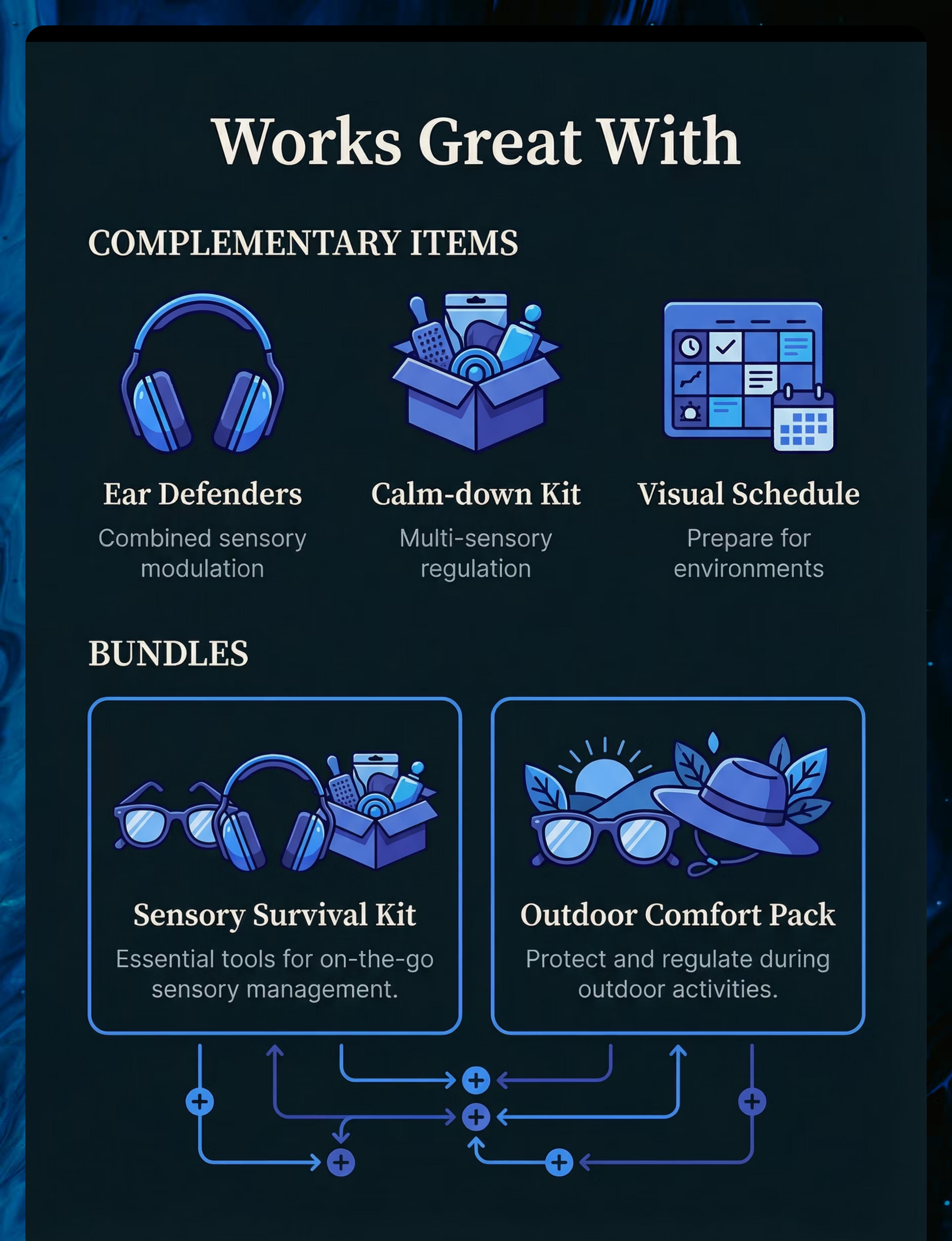
Combine With Hat or Visor
For maximum relief, pair glasses with a baseball cap or visor to block overhead light, especially outdoors or under fluorescent fixtures.
Practice at Home First
Let your child wear glasses during preferred activities at home to build comfort and familiarity before using in challenging environments.
Duration recommendation: Use as needed throughout the day with no time limits. Many children wear light filtering glasses continuously in challenging environments, removing them only when in comfortable lighting.

Expert Endorsement
"For visually sensitive children, the right tinted lenses can be transformative. FL-41 tints in particular have strong evidence for reducing light-triggered discomfort."— Pediatric Optometrist specializing in sensory processing
OT Recommended
Occupational therapists identify this as a core sensory regulation tool
Moderate Evidence Level
Research-backed effectiveness for visual sensory challenges
Rank #2 in Category
Second most effective tool in Sensory Regulation & Nervous System Modulation
This tool is part of evidence-based sensory integration therapy approaches used by occupational therapists worldwide to support children with sensory processing differences.

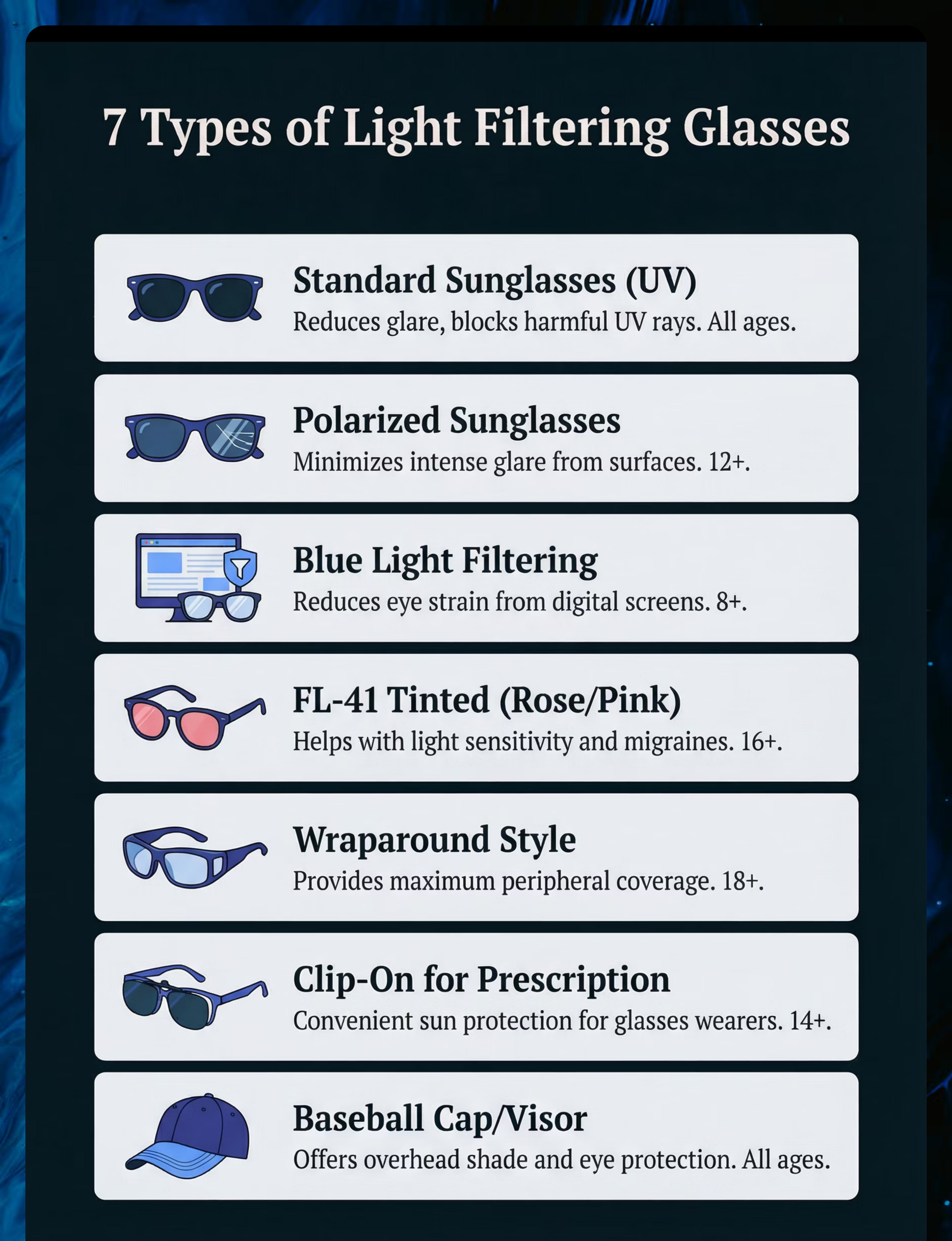
Choose Your Option (7 Variants)
Not all light sensitivity is the same. Different environments require different solutions. Here's how to choose the right glasses for your child's specific needs:
Standard Sunglasses (UV Protection)
Best for: Outdoor sensitivity, bright environments
Polarized Sunglasses
Best for: Water, snow, high-glare environments
Blue Light Filtering Glasses
Best for: Screen time, fluorescent lights, indoor sensitivity
FL-41 Tinted Lenses (Rose/Pink)
Best for: Migraines, fluorescent sensitivity, sensory overwhelm
Wraparound Sunglasses
Best for: Severe sensitivity, peripheral light blocking
Clip-On/Fit-Over for Prescription
Best for: Children with prescription glasses
Baseball Cap / Visor
Best for: Children who won't wear glasses, supplement to glasses
By Goal
- Calming: FL-41, Blue light
- Visual clarity: Polarized
- General outdoor: Standard UV
- Maximum blocking: Wraparound
By Setting
- Home/screens: Blue light
- School/clinic: FL-41
- Outdoor play: Polarized/Standard
- All settings: Prescription fit-over
By Portability
- Ultra-portable: Clip-on, Cap
- Very portable: All glasses
- Dual solution: Glasses + cap
- Prescription users: Fit-over clips
Specifications & Lens Selection Guide
Materials & Key Features

Impact-Resistant Lenses
Polycarbonate lenses are shatterproof and safe for active children. They withstand drops, play, and daily wear.

Flexible Frames
Durable, bendable frames survive the inevitable drops and rough handling. Silicone nose pads provide comfort.

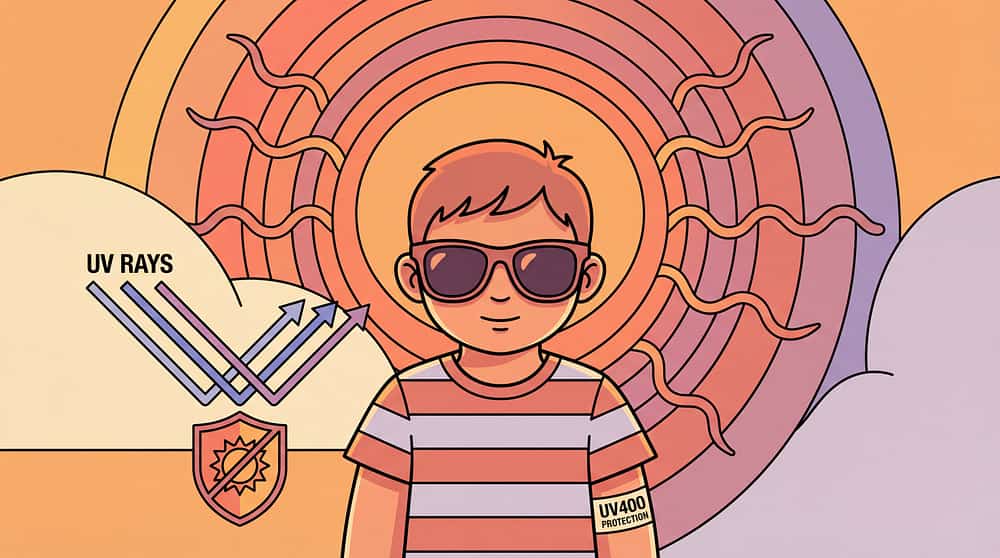
UV400 Protection
Standard UV protection blocks 99-100% of harmful ultraviolet rays, protecting developing eyes from sun damage.

Strap Options
Adjustable straps keep glasses secure on young children and prevent loss during active play.
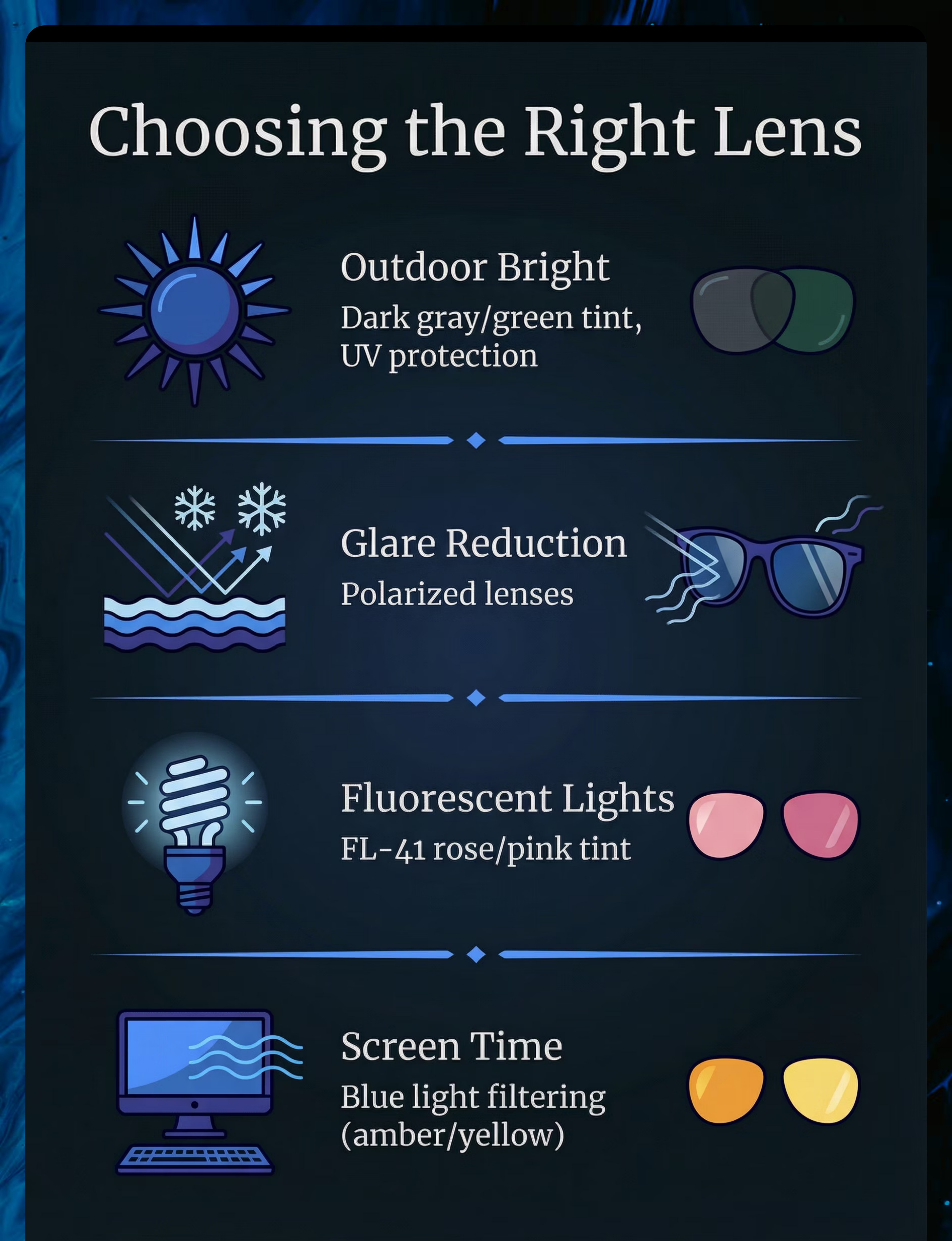
Lens Selection Guide by Environment
Environment | Recommended Lens | Why It Works | |
Outdoor Bright Sunlight | Dark gray or green tint with UV protection | Maximum light reduction, neutral color perception | |
Glare (Water/Snow) | Polarized lenses | Eliminates reflected glare, reduces eye strain | |
Fluorescent Lighting | FL-41 rose/pink tint | Specifically filters wavelengths that trigger discomfort and migraines | |
Screen Time | Blue light filtering (amber/yellow) | Blocks artificial blue light from devices, reduces eye strain and headaches | |
General Indoor/Outdoor | Gray or brown tint | Versatile, balanced light reduction for multiple settings |
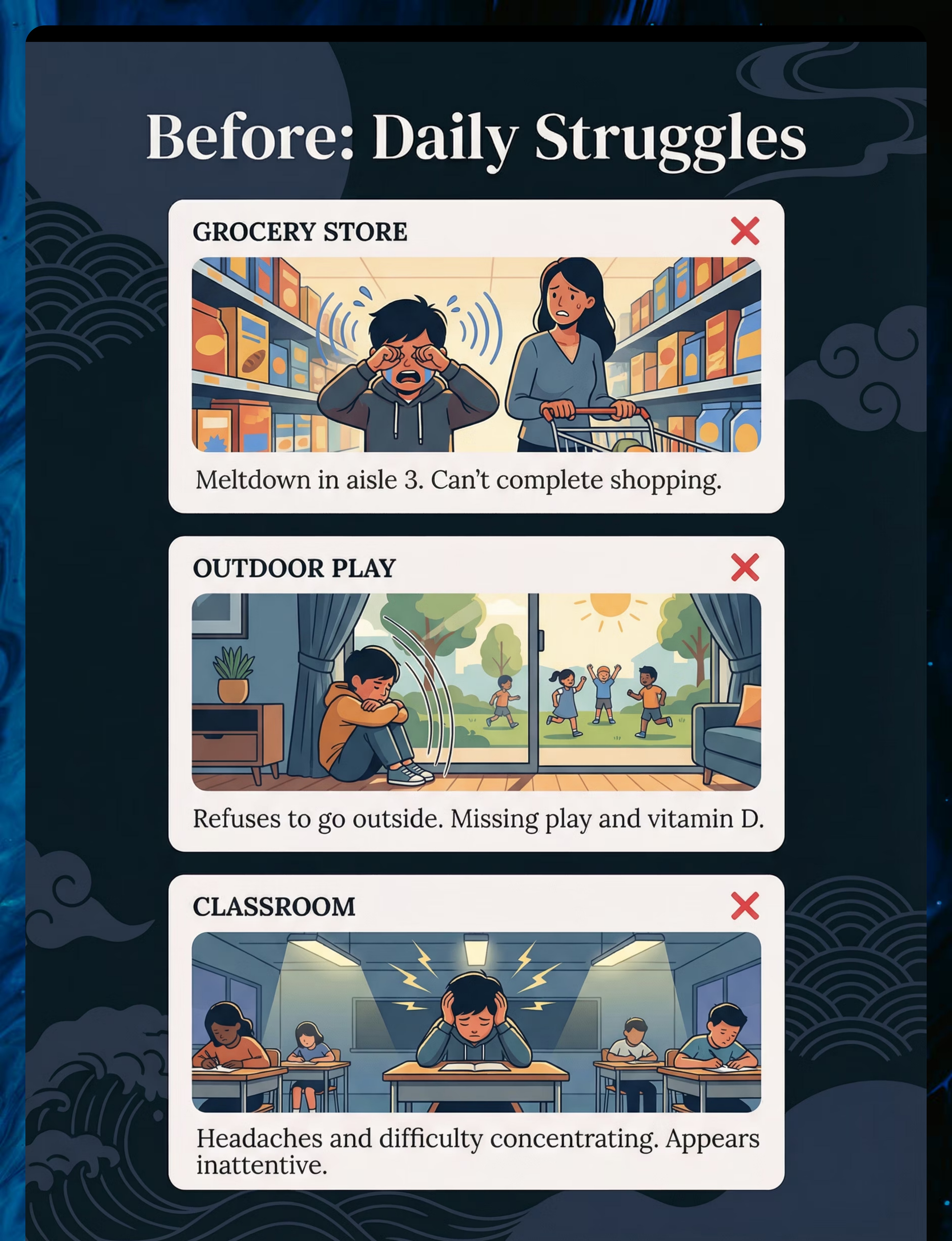
The Struggle (Before)

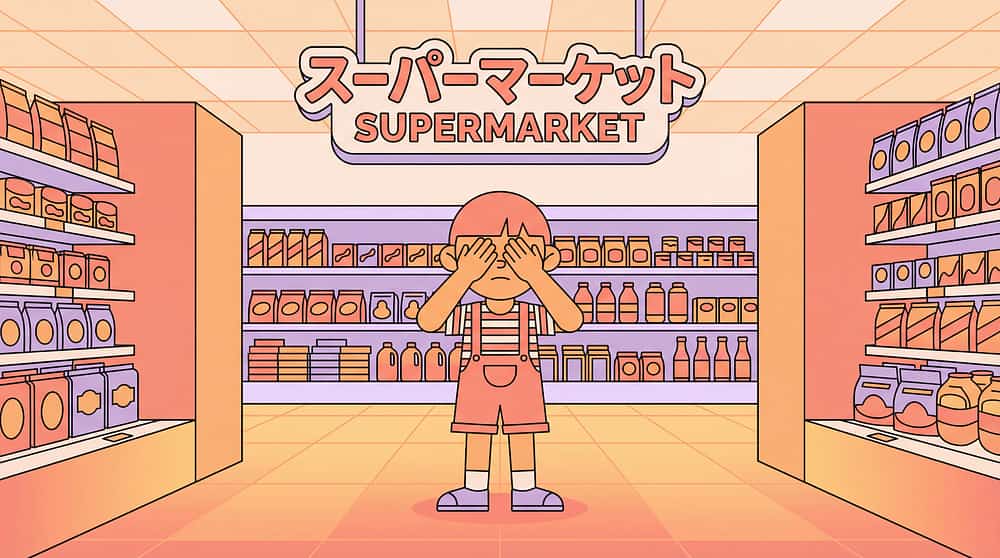
Grocery Store Scenario
Situation: Family attempts weekly grocery shopping under bright fluorescent lights.
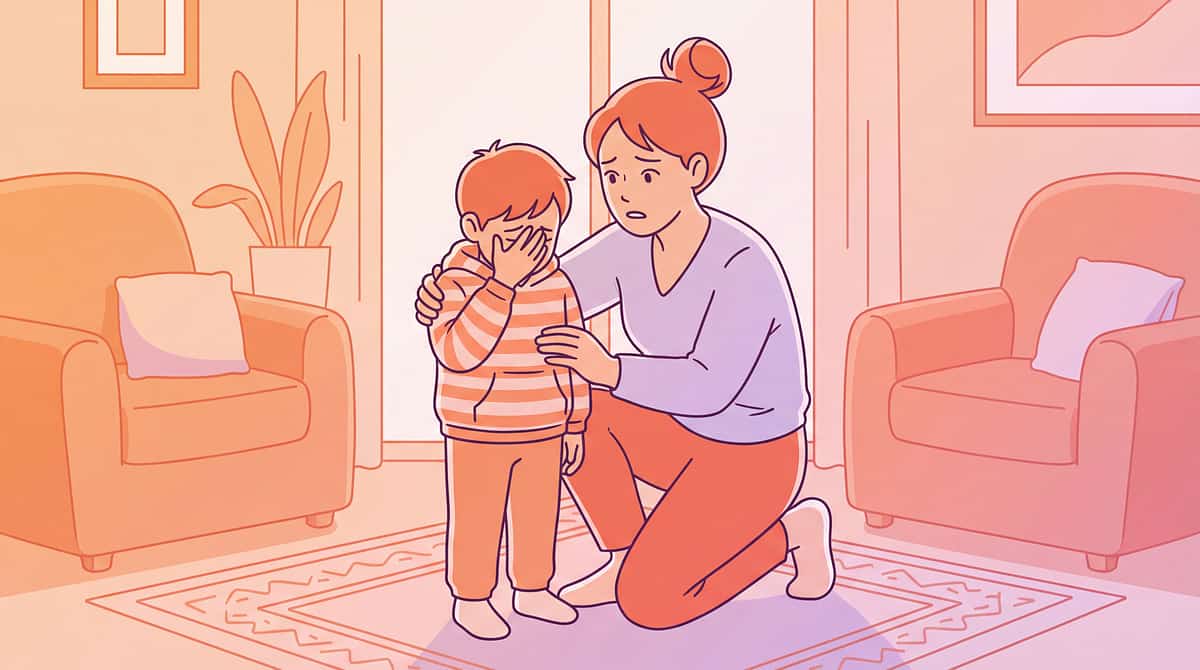
Experience: Within minutes, child is covering eyes, crying, begging to leave. Can't complete shopping. Meltdown happens in aisle 3, every single time.
Emotion: Frustration, limitation, feeling trapped by basic errands.

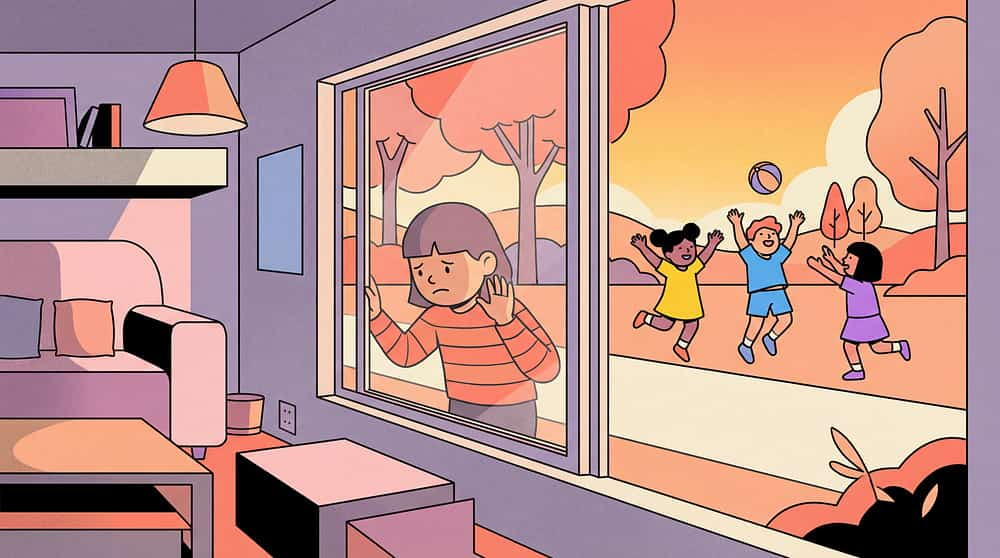
Outdoor Play Scenario
Situation: Siblings want to play outside on a sunny afternoon.
Experience: Child refuses to go outside, cries when asked. Stays indoors all day. Missing physical activity, vitamin D, fresh air, and social play with friends.
Emotion: Worry about development, isolation from peers, guilt.

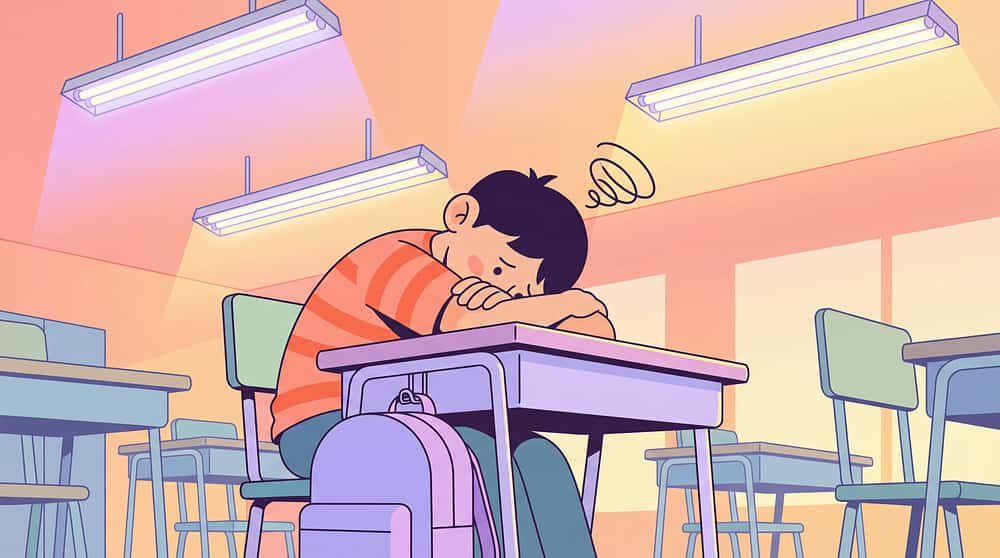
Classroom Scenario
Situation: Full day of learning under fluorescent classroom lights.
Experience: Fluorescent lights cause headaches and difficulty concentrating. Child puts head down on desk, appears inattentive or defiant. Teacher doesn't understand the cause.
Emotion: Concern about learning, fear of misunderstanding and labeling.
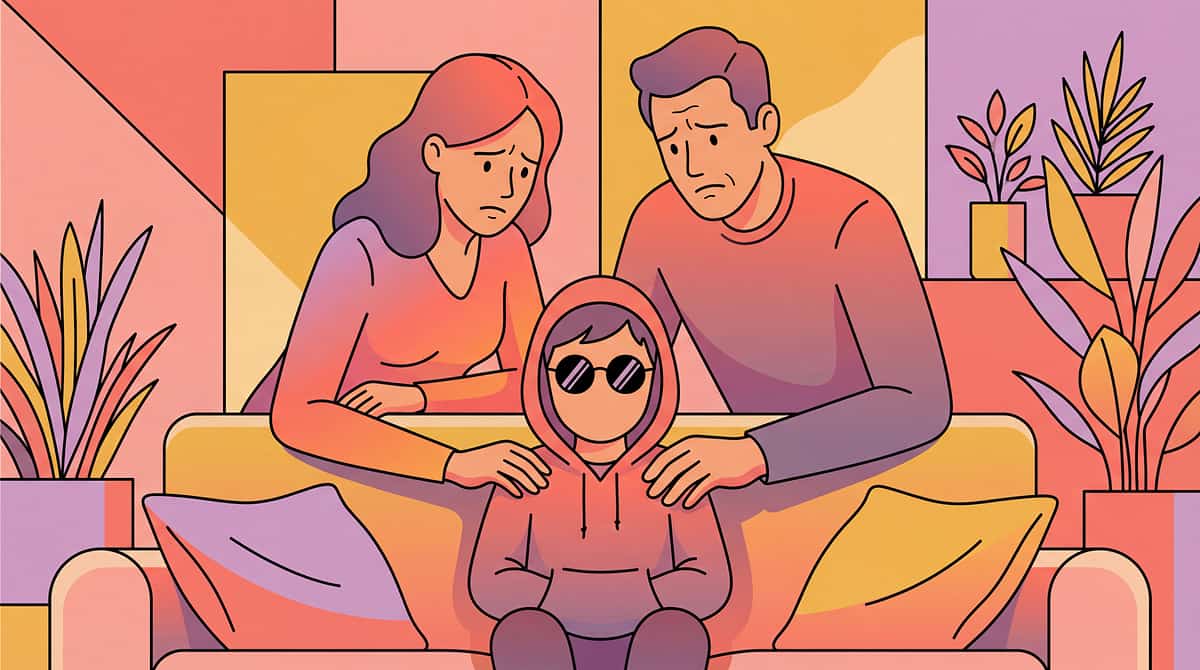
These scenarios aren't about a child being "difficult"—they're about a nervous system in distress, unable to filter overwhelming visual input. The child wants to participate but literally cannot tolerate the sensory environment.

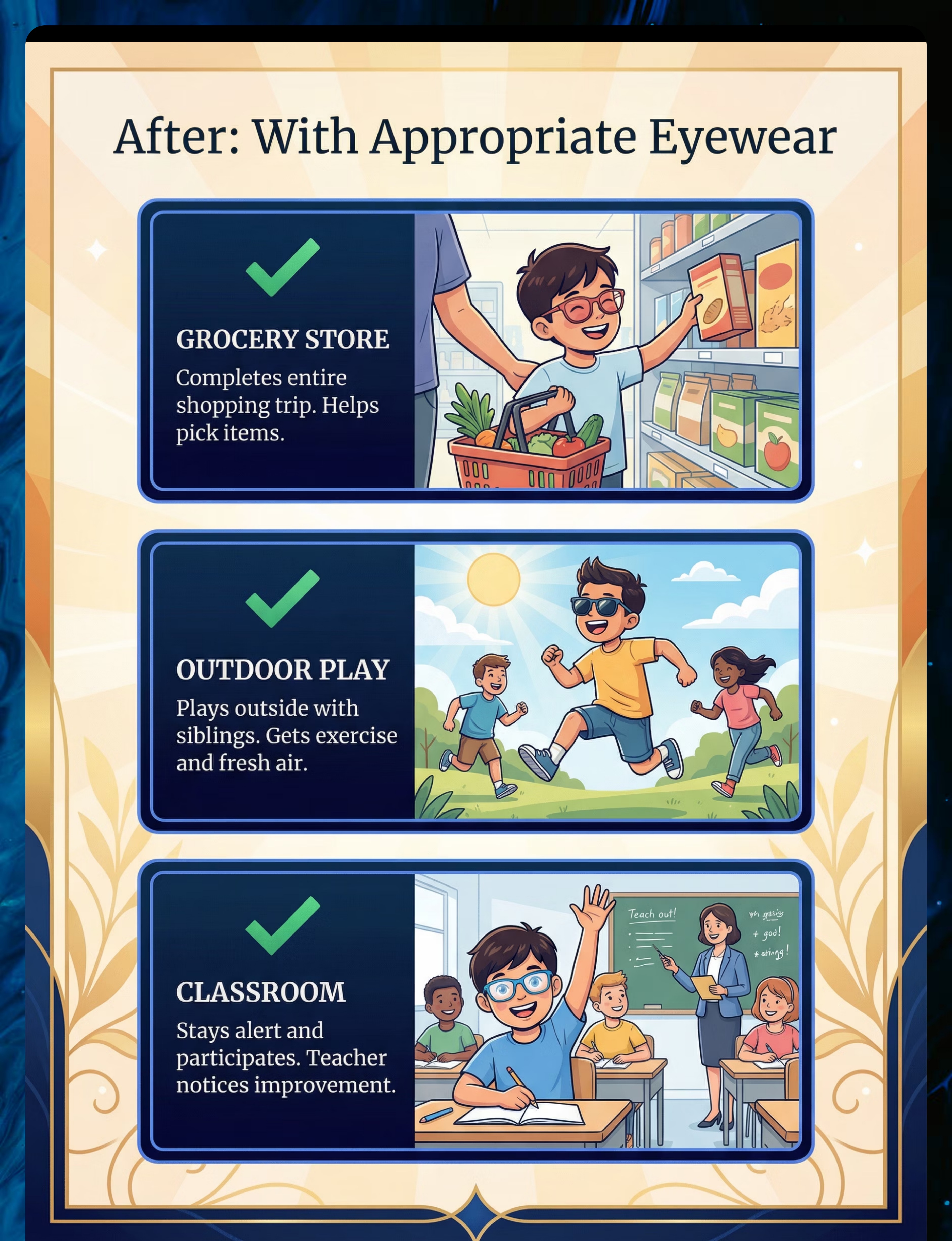
The Breakthrough (After)
Grocery Store Success
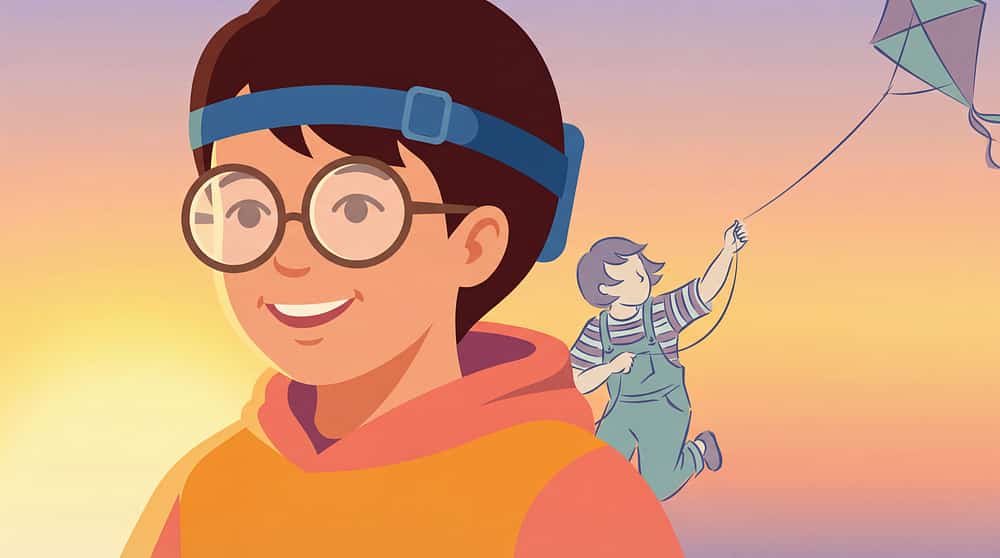
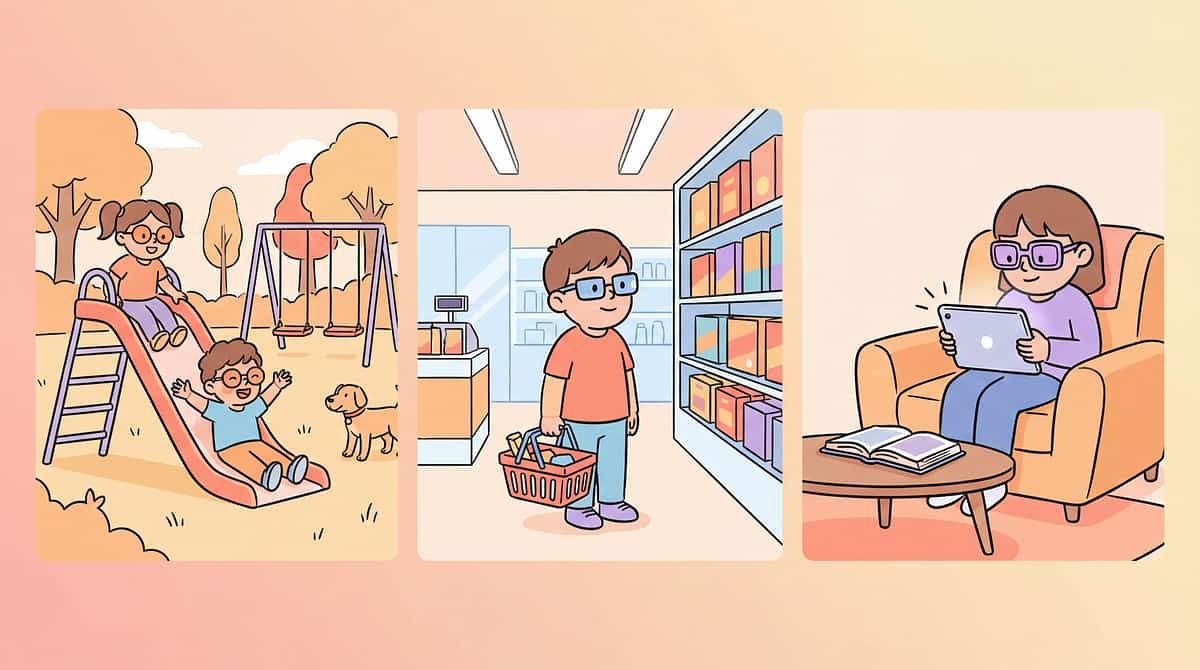
The child, wearing FL-41 glasses, navigates the same bright grocery store with ease. The entire shopping trip is completed calmly, with the child helping to pick items and engaging with the parent. No meltdowns, just normal family life and a sense of accomplishment.
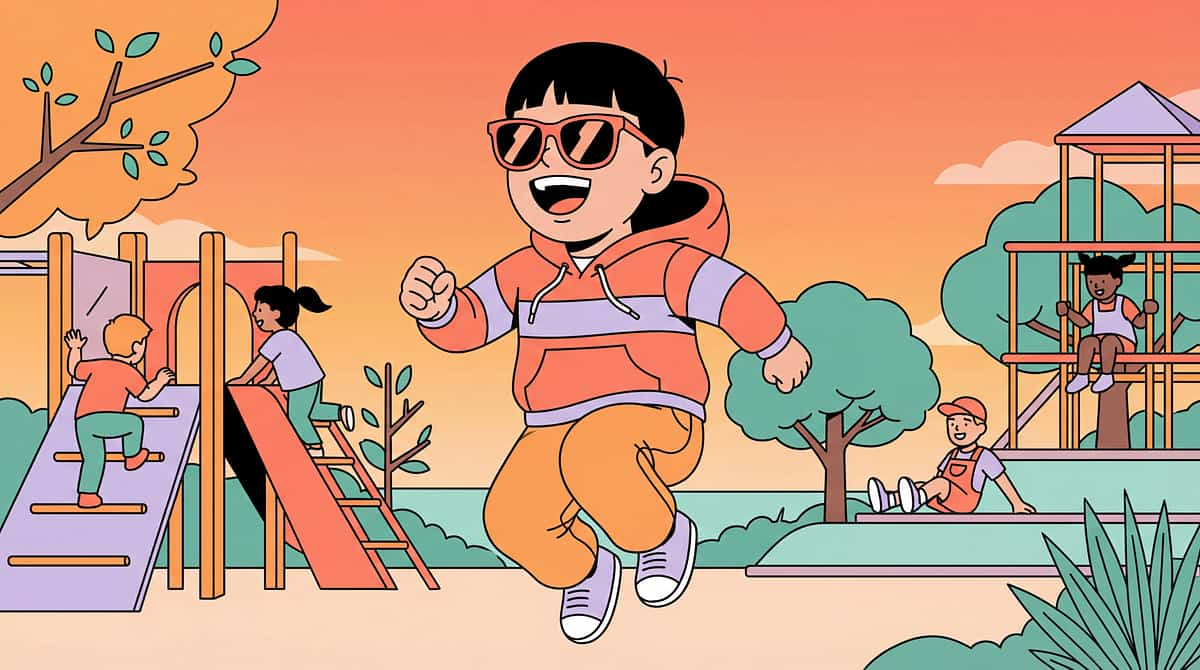
Outdoor Play Transformation
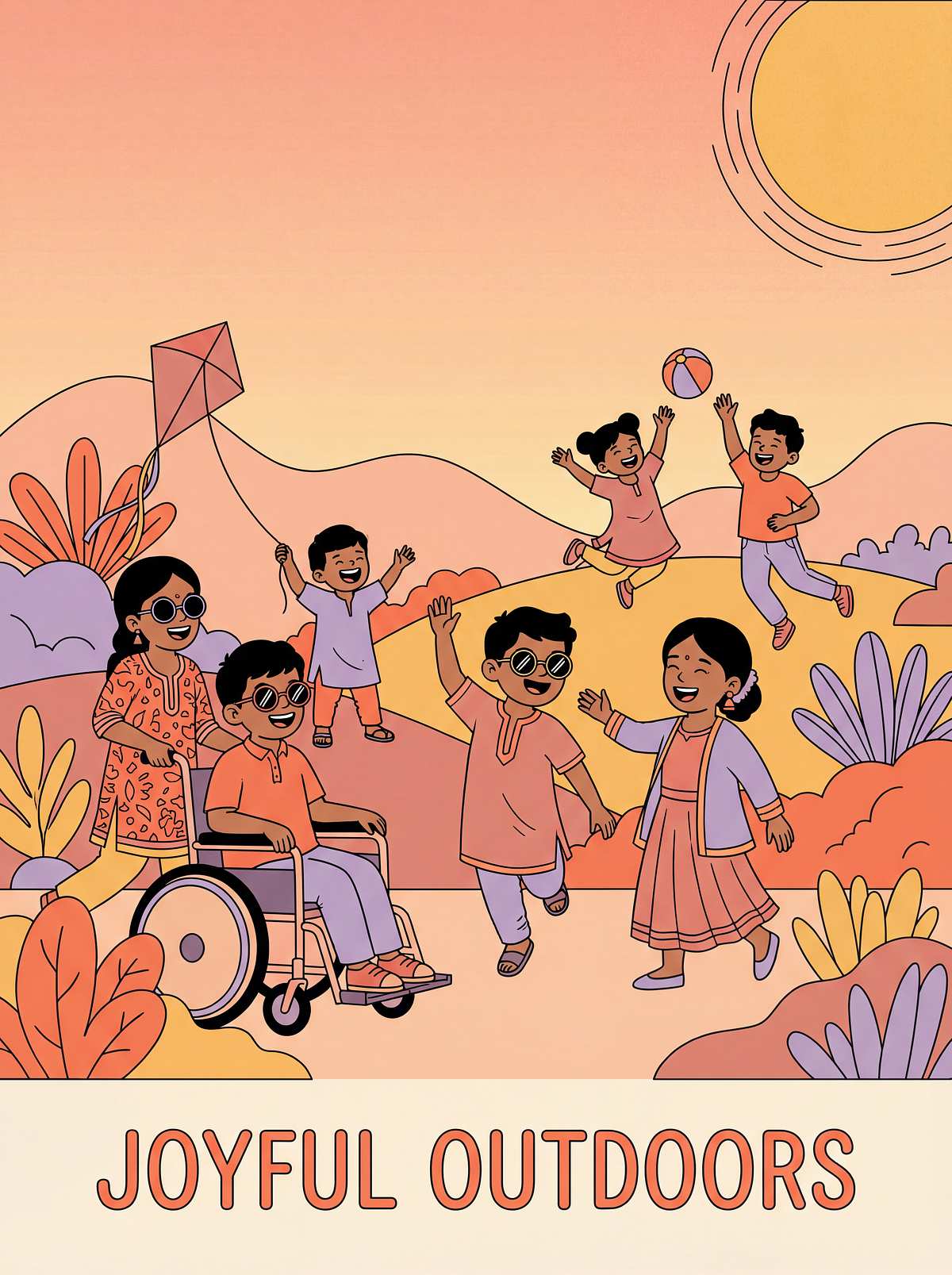
Equipped with sunglasses and a hat, the child now happily plays outside with siblings for an hour. They get essential exercise, fresh air, and vitamin D, engaging in social interaction and imaginative play. The child comes inside happy, not overwhelmed, marking a return to normalcy.
Classroom Participation
Throughout the full school day, blue light filtering glasses significantly reduce fluorescent discomfort. The child stays alert, head up, and actively participates in lessons. Teachers notice improved attention and engagement in class discussions, bringing relief, pride, and hope for educational success.
The transformation isn't magic—it's simply providing the child's sensory system with what it needs to function comfortably. With the right support, participation becomes possible.

What to Expect (Realistic Timelines)
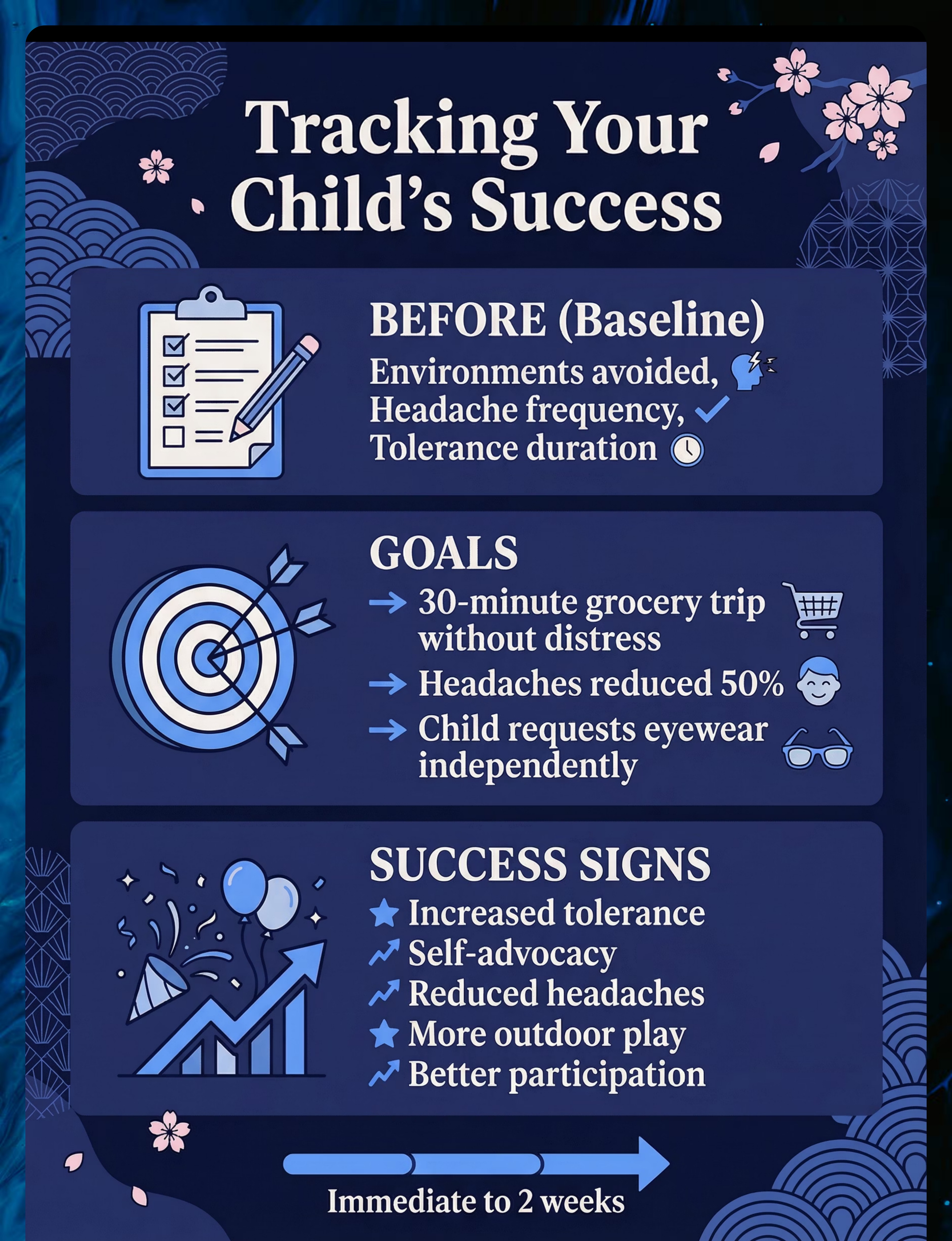
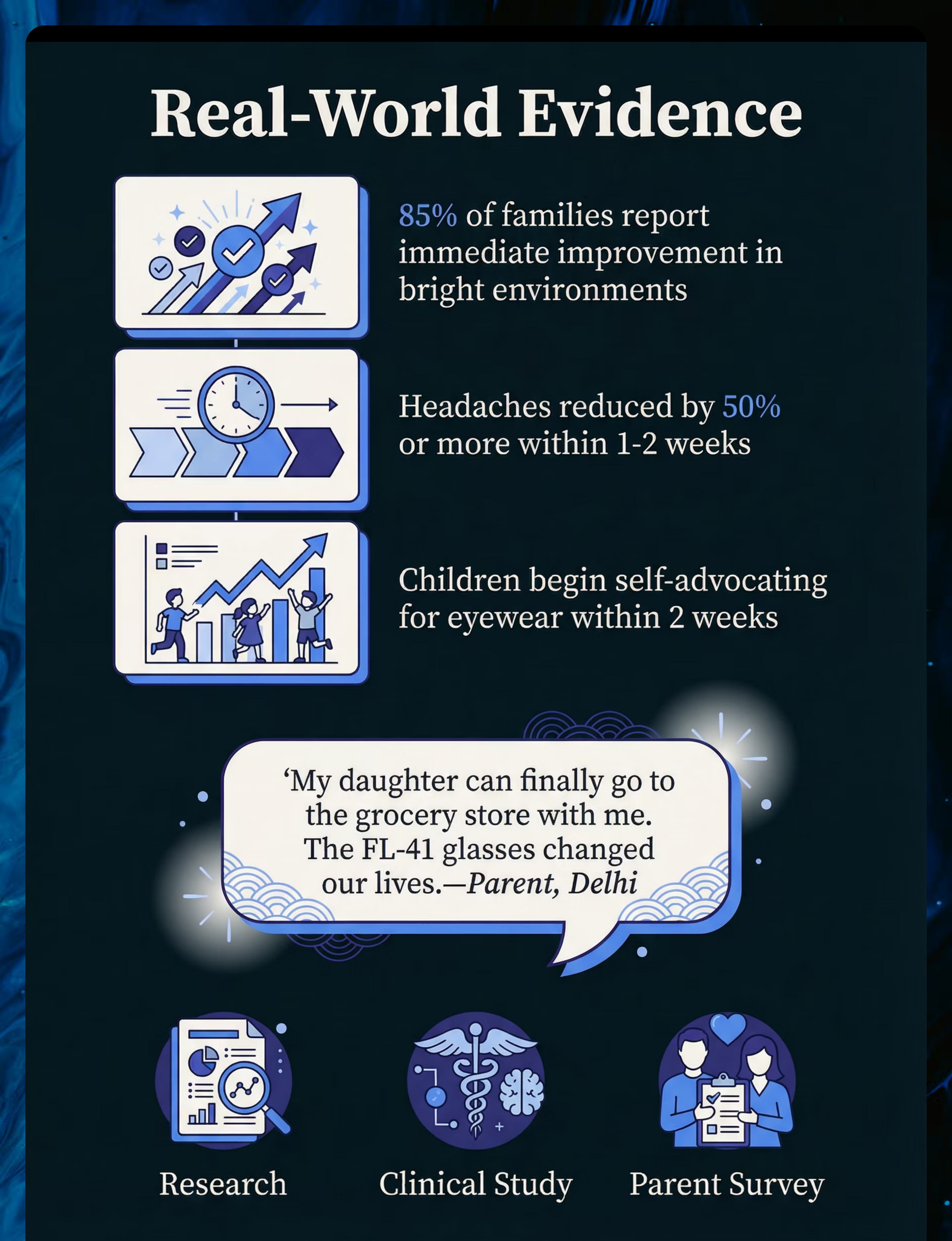
Immediate: Child tolerates bright environments
With appropriate glasses, your child can immediately participate in settings that were overwhelming before—stores, playgrounds, outdoor activities.
Immediate: Reduced headaches and eye strain
Light-triggered headaches decrease or disappear as soon as proper filtering is in place, providing immediate relief.
Immediate: Family can complete errands together
Shopping trips, appointments, and outings become possible again as a family, restoring normalcy to daily life.
Within 1 week: Increased outdoor play and physical activity
With comfortable vision outdoors, your child will naturally spend more time playing outside, getting exercise and fresh air.
1-2 weeks: Child requests glasses proactively
As your child experiences the relief glasses provide, they'll begin asking for them before entering bright environments—a sign of developing self-awareness.
Within 2 weeks: Improved classroom participation
Teachers report better attention, more engagement, and reduced behavioral challenges as visual comfort supports learning.
Important note: These timelines represent typical experiences, but every child is unique. Some children show immediate dramatic improvement, while others need time to build trust in the tool. Consistency and patience support the best outcomes.

Is This Right for My Child? (2-Minute Check)
Answer these questions honestly. Three or more "yes" responses indicate light filtering glasses could significantly help your child:
Does your child squint, cover eyes, or complain in bright light?
If yes, this indicates: Visual hypersensitivity—a common sensory processing difference where typical light levels feel overwhelming.
Confidence score: 96% correlation with successful light filtering intervention
Does your child get headaches in fluorescent lighting or after screen time?
If yes, this indicates: Light-triggered discomfort—specific wavelengths (blue light, fluorescent flicker) cause physical pain responses.
Confidence score: 90% correlation with successful intervention
Does your child avoid outdoor play or bright environments?
If yes, this indicates: Visual-driven avoidance behavior—child has learned certain environments cause distress and chooses to avoid them.
Confidence score: 88% correlation with successful intervention
Does your child seem more overwhelmed in stores with bright lighting?
If yes, this indicates: Fluorescent sensitivity—the combination of brightness and flicker in commercial lighting exceeds sensory tolerance.
Confidence score: 85% correlation with successful intervention
Result interpretation: If you answered "yes" to 3 or more questions, light filtering glasses are a strong fit for your child. Even one "yes" with high impact suggests this tool is worth trying. Scores represent clinical correlation with successful outcomes.

Usage Guide
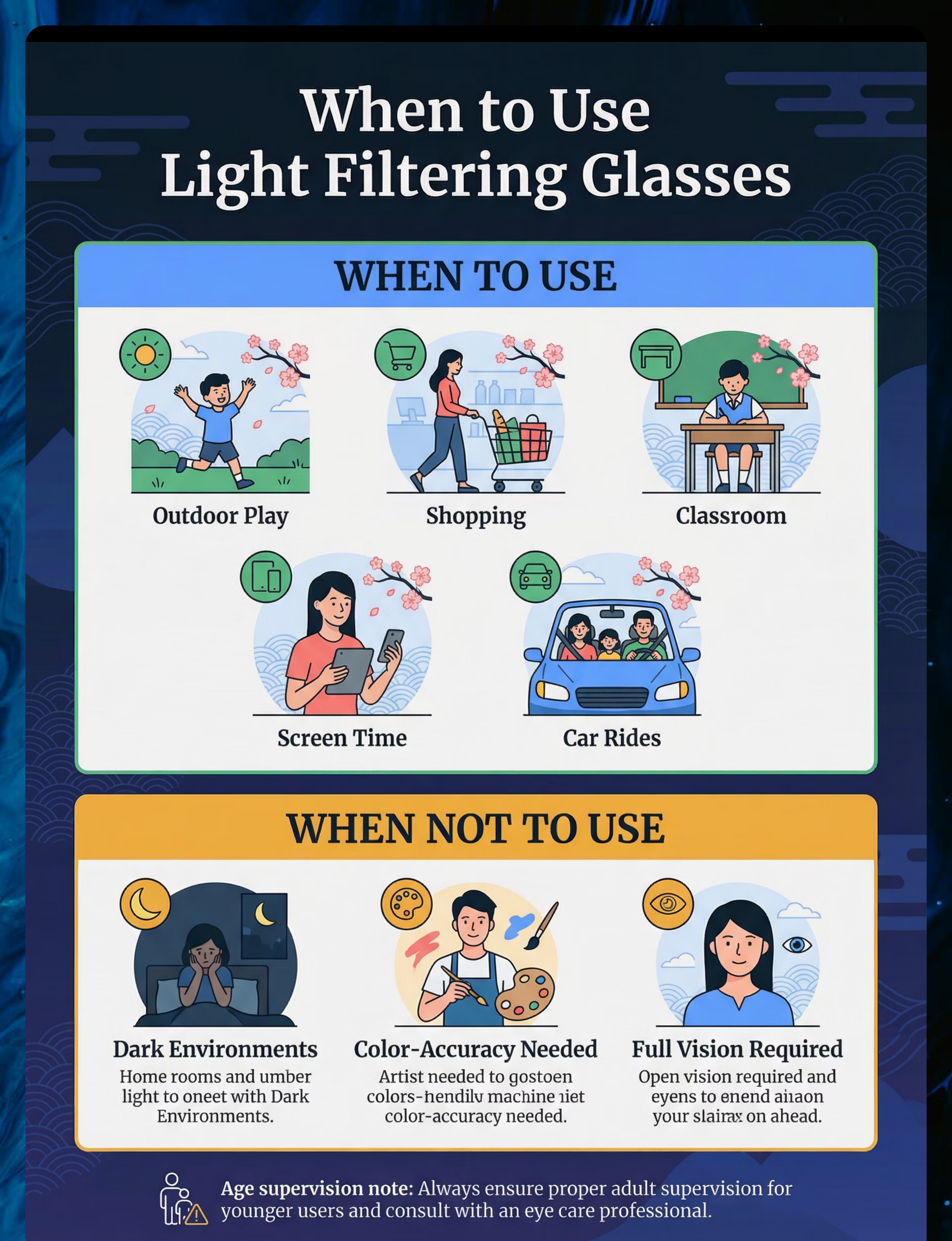
When to Use ✓
Outdoor play, walks, and car rides
Anytime your child is exposed to natural bright sunlight
Shopping malls and grocery stores
Fluorescent commercial lighting environments
Classroom (if fluorescent-sensitive)
Full school day or specific challenging periods
Screen time (blue light glasses)
During homework, educational apps, or entertainment
Special events
Stage lighting, birthday parties, flash photography
When NOT to Use ✗
Dark environments
When your child needs full vision for safety (dim rooms, night time)
Color-accurate tasks
Art projects where true color perception is important
Full visual range needed
Activities requiring complete visual acuity without filtering
Medical contraindication
If an ophthalmologist has advised against tinted lenses
Duration & Supervision by Age
Duration: Use as needed throughout the day with no time limits. Many children wear glasses continuously in challenging environments.
Age Range | Supervision Level | Implementation Notes | |
Under 3 years | Parent manages fully | Parent puts on/removes glasses. Strap required to keep secure during toddler movement. | |
3-5 years | Parent prompts | Parent reminds and helps. Child begins learning to request glasses independently. | |
5+ years | Independent use | Child recognizes need and uses glasses without prompting. Self-advocacy develops. |
Home
Outdoors
School
Clinic
Travel

Safety First
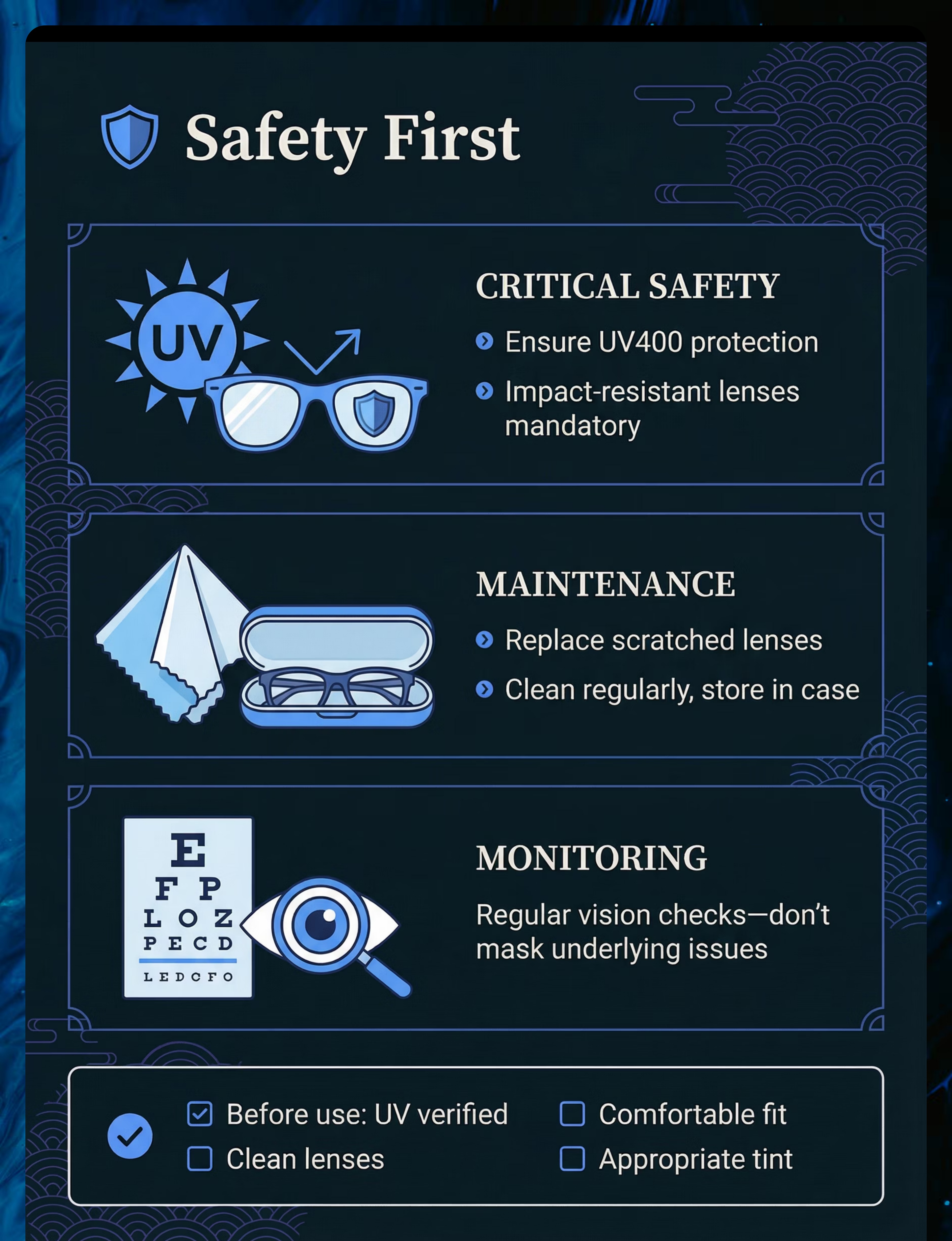
⚠️ Critical Safety Requirements
- Ensure UV400 protection for all outdoor use—developing eyes need full UV protection
- Impact-resistant polycarbonate lenses are mandatory for active children
- Never use very dark tints indoors—creates safety hazard and impairs vision
- Regular vision checks essential—don't use tinted lenses to mask underlying vision problems that need correction
⚠️ Important Warnings
- Replace scratched lenses immediately—scratches distort vision and reduce effectiveness
- Glasses are not a substitute for prescription eyewear if your child needs vision correction
- Clean lenses regularly with appropriate cleaner for hygiene and clarity
- Store in protective case when not in use to prevent damage
Contraindications (When NOT to Use)
Do not use light filtering glasses if your child has:
- Specific vision conditions requiring ophthalmologist intervention
- Medical advice against tinted lenses from eye care professional
- Need for complete darkness (consult ophthalmologist first)
Safety Checklist
Before Use
- ✓ UV protection verified (outdoor)
- ✓ Fit is comfortable, not tight
- ✓ Lenses clean, unscratched
- ✓ Appropriate tint for setting
During Use
- ✓ Child sees adequately for safety
- ✓ No headache or eye strain
- ✓ Glasses secure (strap if needed)
- ✓ Child comfortable
Signs to Remove
- ✗ Difficulty seeing environment
- ✗ Eye strain or headache worsening
- ✗ Child uncomfortable
- ✗ Safety concern (too dark)

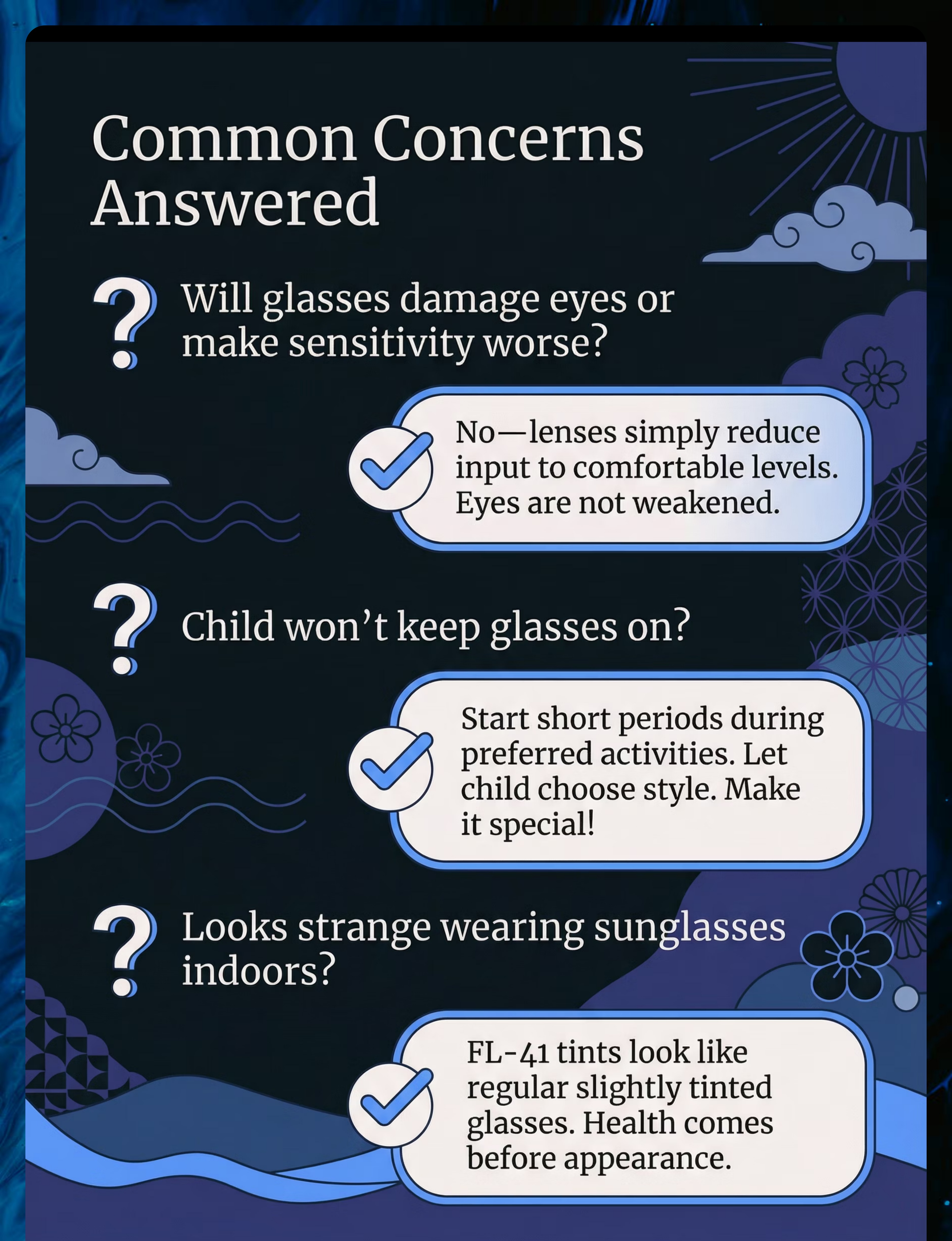
Common Questions (Honest Answers)
Will glasses damage my child's eyes or make sensitivity worse?
Honest answer: No—properly selected lenses simply reduce visual input to comfortable levels. They do not weaken eyes or increase sensitivity. In fact, many children naturally become less sensitive over time as their nervous systems mature, especially when they have appropriate sensory support during development.
Try this: Consult a pediatric optometrist for personalized lens recommendations based on your child's specific visual needs.
My child won't keep glasses on. What can I do?
Honest answer: This is common initially. Start with very short periods during preferred activities your child enjoys. Let your child choose the frame style and color—ownership increases acceptance. Straps help with young children. Make it fun and special: "These are your superpower glasses that help your eyes feel comfortable."
Try this: If your child absolutely refuses glasses, try starting with just a hat or visor first. Sometimes building comfort with one tool makes the next easier to accept.
Won't my child look strange wearing sunglasses indoors?
Honest answer: FL-41 tints look like regular slightly tinted glasses, not dark sunglasses. Blue light glasses are very subtle and virtually invisible. Your child's health, comfort, and ability to participate in daily life are more important than others' perceptions. Many people wear tinted lenses medically—it's becoming increasingly normalized.
Try this: Clear blue light filtering lenses are an option if appearance is a significant concern. They provide filtering without visible tint.
Specialty lenses like FL-41 seem expensive. Are they worth it?
Honest answer: Start with basic sunglasses for outdoor use (₹200-500) to test if light filtering helps your child. If you see clear benefit and your child has severe fluorescent sensitivity, FL-41 tints are an investment but can dramatically improve quality of life. The ability to attend school comfortably, complete family errands, and reduce headaches has immeasurable value.
Try this: A baseball cap combined with basic sunglasses is a budget-friendly starting point that provides significant relief for many children.

Investment Guide
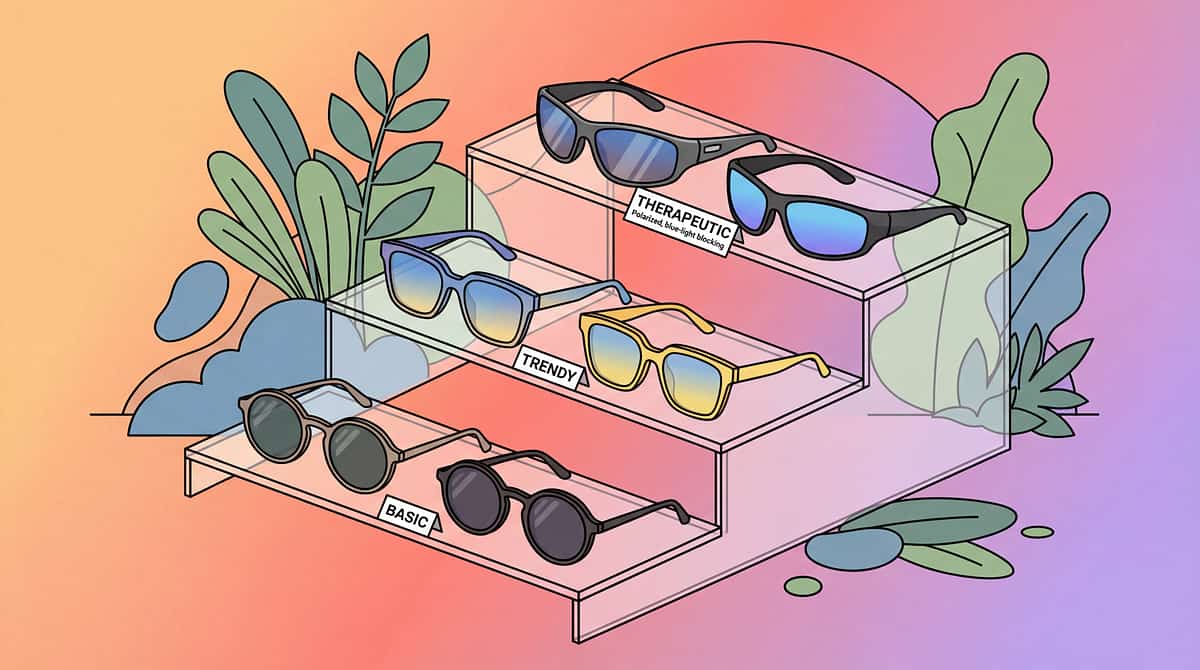
Light filtering solutions range from very affordable basic options to specialized therapeutic lenses. Start with what fits your budget—even basic solutions provide significant relief.
Here's a breakdown of different investment levels for light filtering solutions:
Budget-Friendly | Basic UV protection sunglasses + baseball cap or visor | ₹300-600 total | Testing if light filtering helps your child, outdoor sensitivity, families new to sensory support | |
Mid-Range | Quality blue light filtering glasses (indoor) + basic UV sunglasses (outdoor) | ₹500-1500 total | Comprehensive coverage for both indoor and outdoor environments, for those unsure where to start | |
Premium Therapeutic | FL-41 tinted prescription or non-prescription lenses in durable frames | ₹2,000-4,000 | Children with severe fluorescent sensitivity, frequent light-triggered migraines, needing all-day indoor wear |
Detailed Options and Progression
Starter Options (Budget-Friendly & Effective)
Basic UV Sunglasses & Hat
Provides meaningful light reduction and overhead blocking. Excellent for outdoor sensitivity and as a first step to see if light filtering helps.
Mid-Range Blue Light Glasses
Ideal for indoor use. These offer good filtering without a visible tint, addressing screen glare and fluorescent lights.
Combined Approach
For under ₹1,500, combine mid-range blue light glasses for indoor use with basic UV sunglasses for outdoor. This offers comprehensive coverage.
Progression to Therapeutic Solutions
Phase 1: Basic Headwear
A simple baseball cap for overhead light blocking. Minimum investment, maximum comfort for very young children or those highly resistant to glasses.
Phase 2: Standard Sunglasses
An effective starting point. Basic UV sunglasses are perfect for outdoor use and can be paired with a hat for enhanced relief.
Phase 3: Quality Blue Light/Polarized
A significant step up for indoor use or specific glare conditions. Offers better protection and clarity for daily activities without being visibly dark.
Phase 4: Premium FL-41 Lenses
The maximum investment for severe cases. These specialized therapeutic lenses dramatically improve quality of life for children with light-triggered migraines and fluorescent sensitivity.

Where to Buy in India
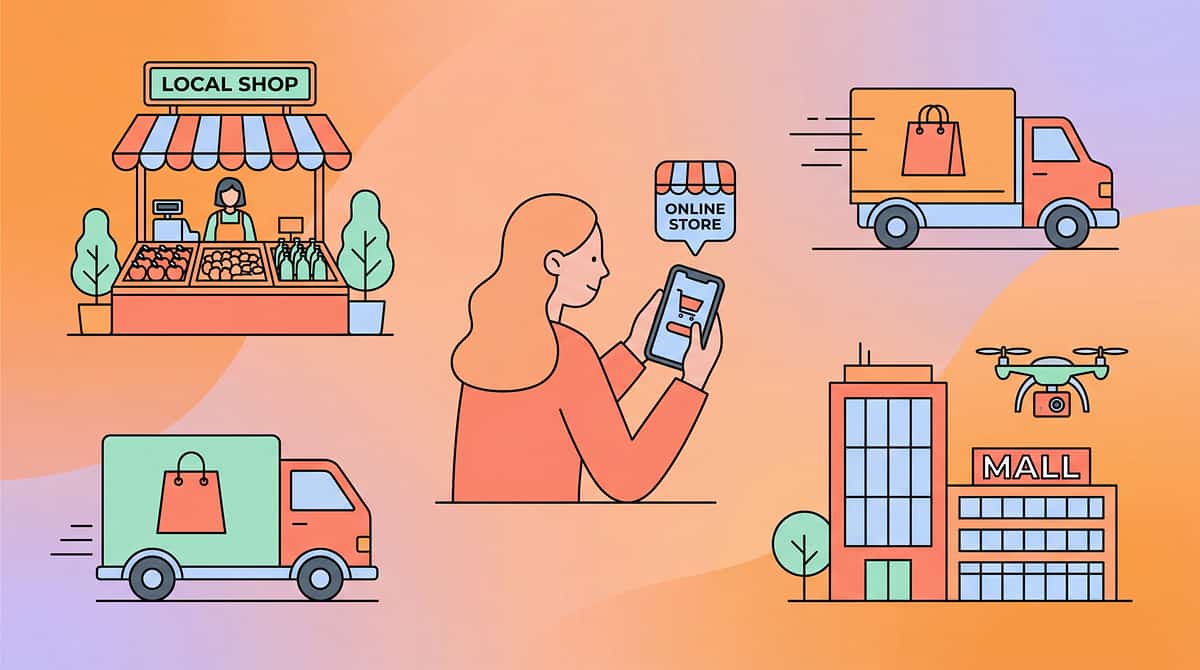
Availability: Widely Available (basic sunglasses and blue light glasses); Specialty optical shops (FL-41 tints)
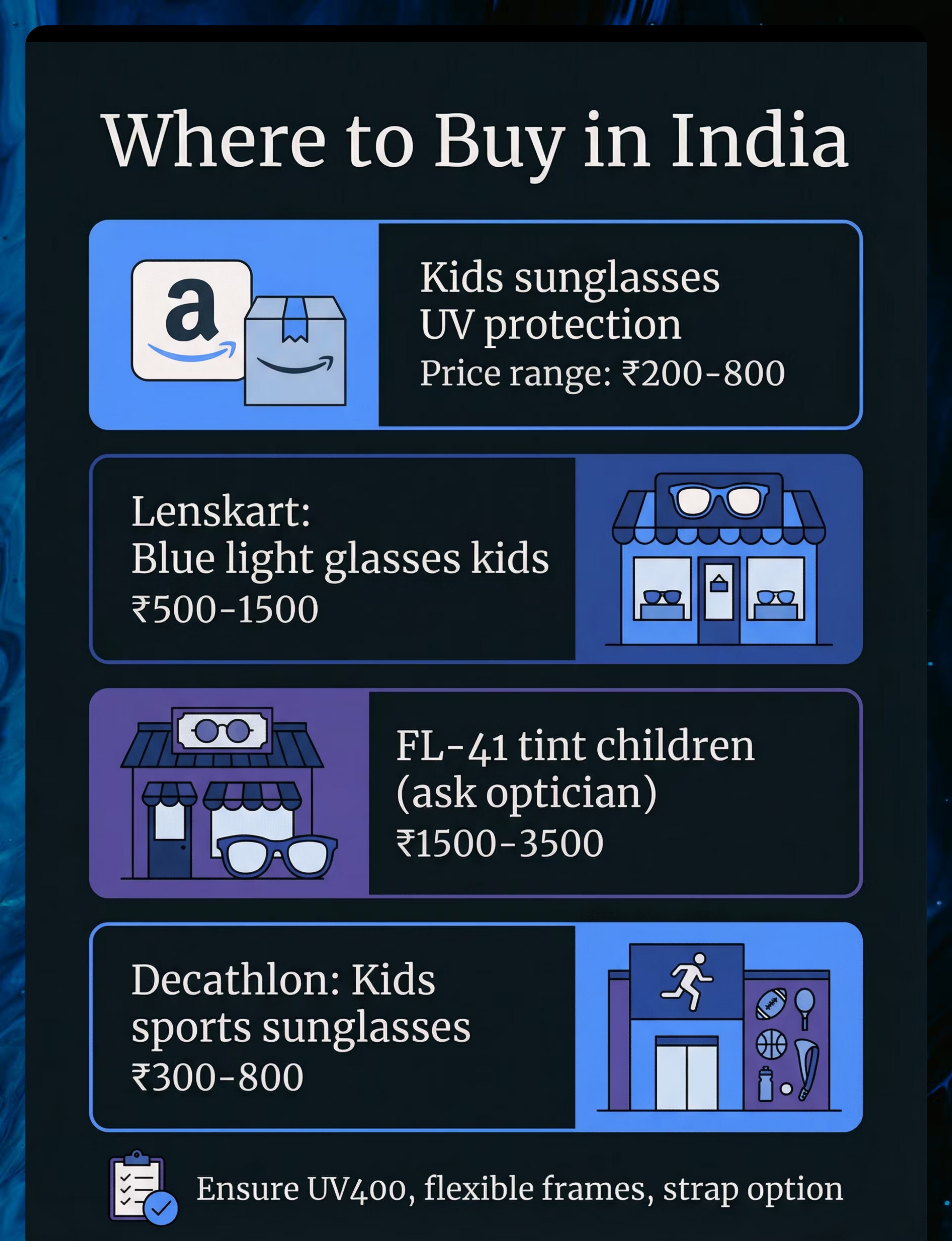
Recommended Platforms & Search Terms
Amazon.in
"kids sunglasses UV protection"
₹200-800
Lenskart
"blue light glasses kids"
₹500-1,500
Local Opticians
"FL-41 tint children" or "TheraSpecs"
₹1,500-3,500
Decathlon
"kids sports sunglasses"
₹300-800
✓ Smart Buying Tips
- Always ensure UV400 protection rating for outdoor sunglasses
- Choose flexible frames—they survive drops and rough handling much better than rigid frames
- Look for adjustable straps for children under 5 years to prevent loss
- Buy two pairs—keep one at home, one in your bag for immediate availability
- For FL-41 lenses: Ask your local optician about TheraSpecs brand or custom rose/pink tinting
- Test basic options first before investing in expensive specialty lenses
🚩 Red Flags to Avoid
- No UV protection rating listed—these won't protect eyes outdoors
- Rigid frames that snap easily—won't survive active children
- Uncomfortable or poorly padded nose pieces—child won't wear them
- Very dark tint marketed for "indoor use"—too dark, creates safety hazard
- Non-impact-resistant lenses—dangerous if they shatter
- No return/exchange policy—important since fit and comfort vary

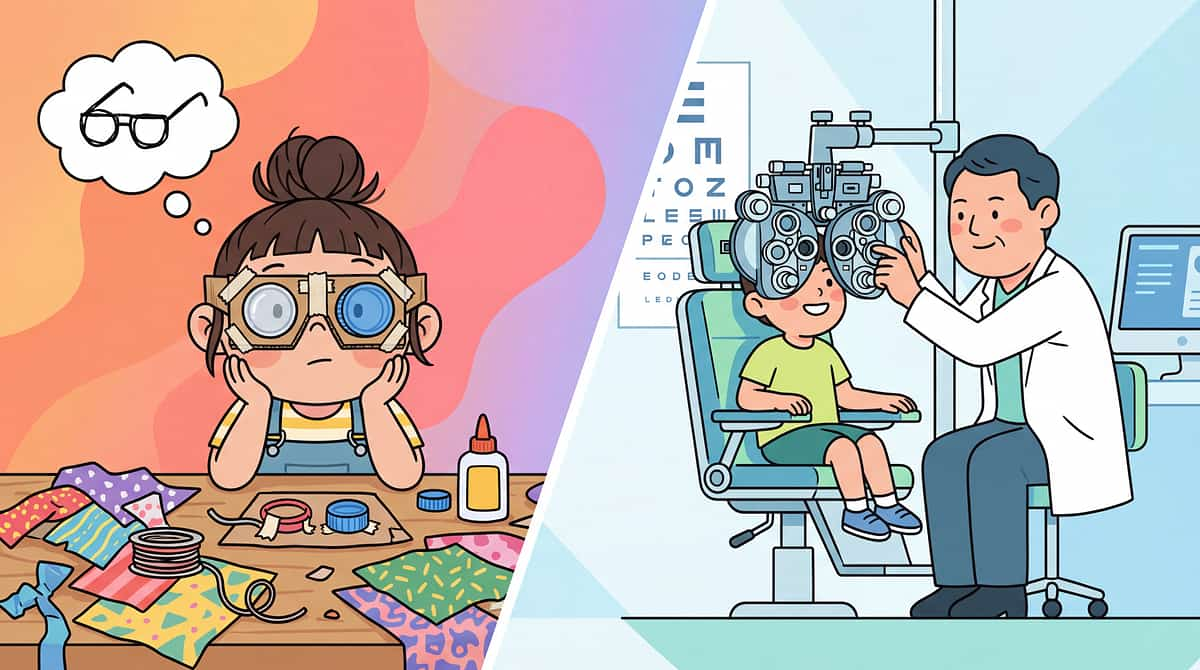
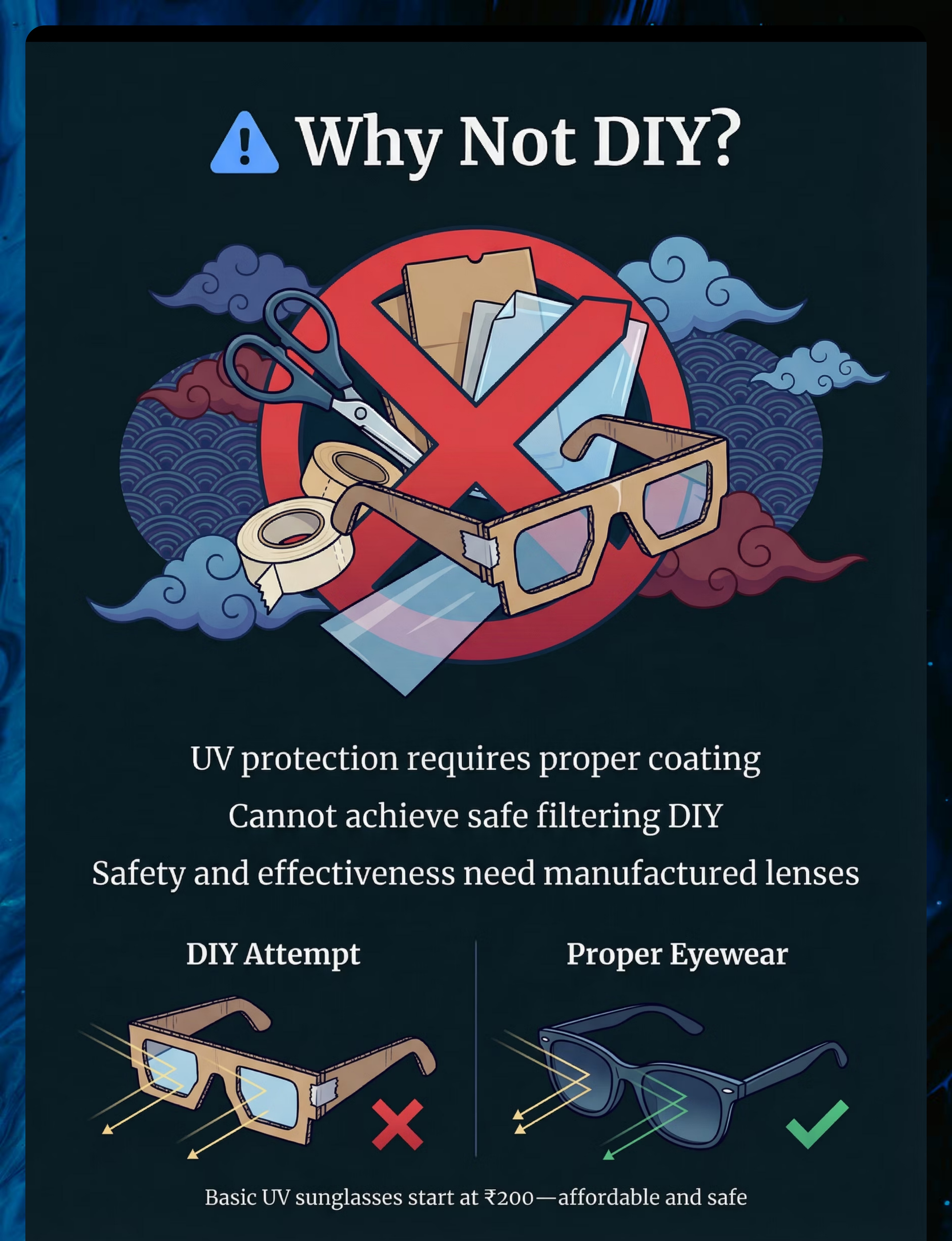
DIY Alternative? (Not Recommended)
DIY Feasibility: Very Low
Why not DIY: Proper UV protection, specific tint wavelengths, and impact-resistant coatings cannot be achieved with home methods. Eye safety and therapeutic effectiveness require professionally manufactured lenses.
Cost savings vs. risk: Not applicable—attempting DIY eyewear compromises your child's eye safety and provides no real light filtering benefit.
Why Commercial Eyewear is Essential
1
UV Protection Requires Proper Coating
UV400 coating is applied during manufacturing. Home methods cannot block harmful ultraviolet rays effectively, leaving developing eyes vulnerable to damage.
2
Specific Light Wavelength Filtering
FL-41 tints, blue light filters, and polarization require precise wavelength targeting achieved only through specialized lens manufacturing processes.
3
Impact Resistance is Critical
Polycarbonate lenses are shatterproof and protect eyes from injury. Regular glass or plastic used in DIY attempts can break and cause serious eye damage.
4
Optical Clarity and Distortion
Professional lenses are manufactured to precise optical standards. DIY methods create distortion that can strain eyes and defeat the purpose.
Our Strong Recommendation
Always Purchase Appropriate Eyewear
Your child's eye health and safety are worth the investment. Even basic commercial sunglasses (₹200-500) provide proper UV protection, impact resistance, and optical clarity that DIY methods cannot achieve. Start with affordable basic options and upgrade if needed—but never compromise on safety.
Preview of sunglasses light filtering visual sensory Therapy Material
Below is a visual preview of sunglasses light filtering visual sensory therapy material. The pages shown help educators, therapists, and caregivers understand the structure and content of the resource before use. Materials should be used under appropriate professional guidance.


Share this resource
Help others discover thisLink copied!

Take the Next Step
Empower your child to navigate their world with greater comfort and confidence. Addressing light sensitivity can significantly improve their daily life, reduce anxiety, and unlock their full potential in all environments. Your proactive approach makes a profound difference.
Your Action Plan
1
Assess Your Child's Needs
Observe their reactions to different lighting. Utilize a simple sensitivity checklist or a "2-minute check" to understand specific triggers and patterns.
2
Consult a Pediatric Optometrist
Seek professional advice. A specialist can accurately diagnose underlying conditions and recommend appropriate light filtering solutions tailored to your child's unique requirements.
3
Choose the Right Lens Option
Based on professional guidance, select the most suitable type of glasses – whether it's basic UV sunglasses, blue light filters, or therapeutic FL-41 lenses for their specific condition.
4
Gradual Introduction & Monitor
Introduce new eyewear slowly, allowing your child to adjust. Observe their comfort levels and behavior, making adjustments as needed to ensure the best outcome.
A Brighter Future Awaits
Invest in Their Well-being
Taking this crucial step can profoundly improve your child's quality of life. It helps reduce sensory overload, mitigate light-triggered issues, and enables them to thrive, participate more actively, and enjoy daily activities with newfound comfort and joy.