













Tool ID: 1.7
Tool ID: 1.7
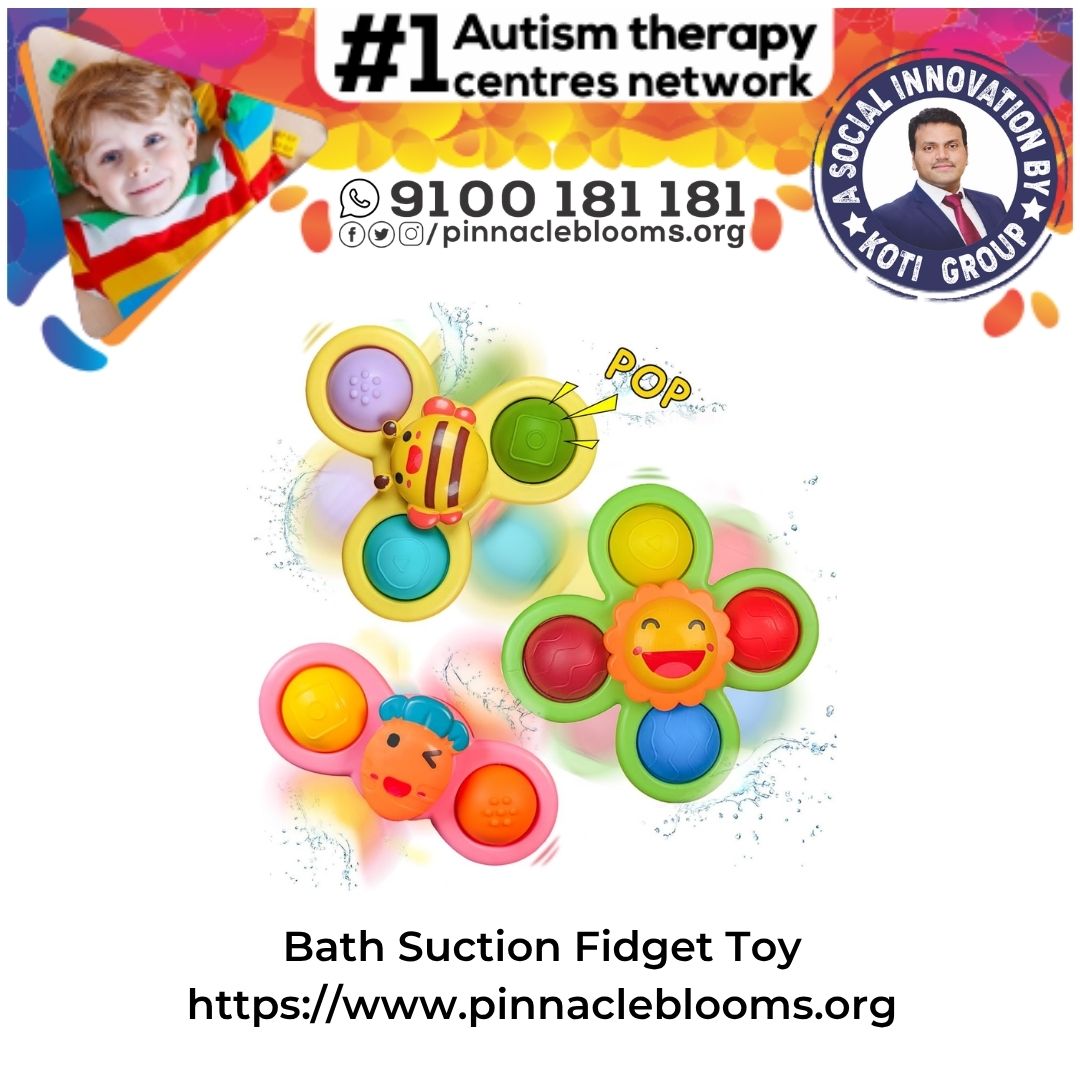
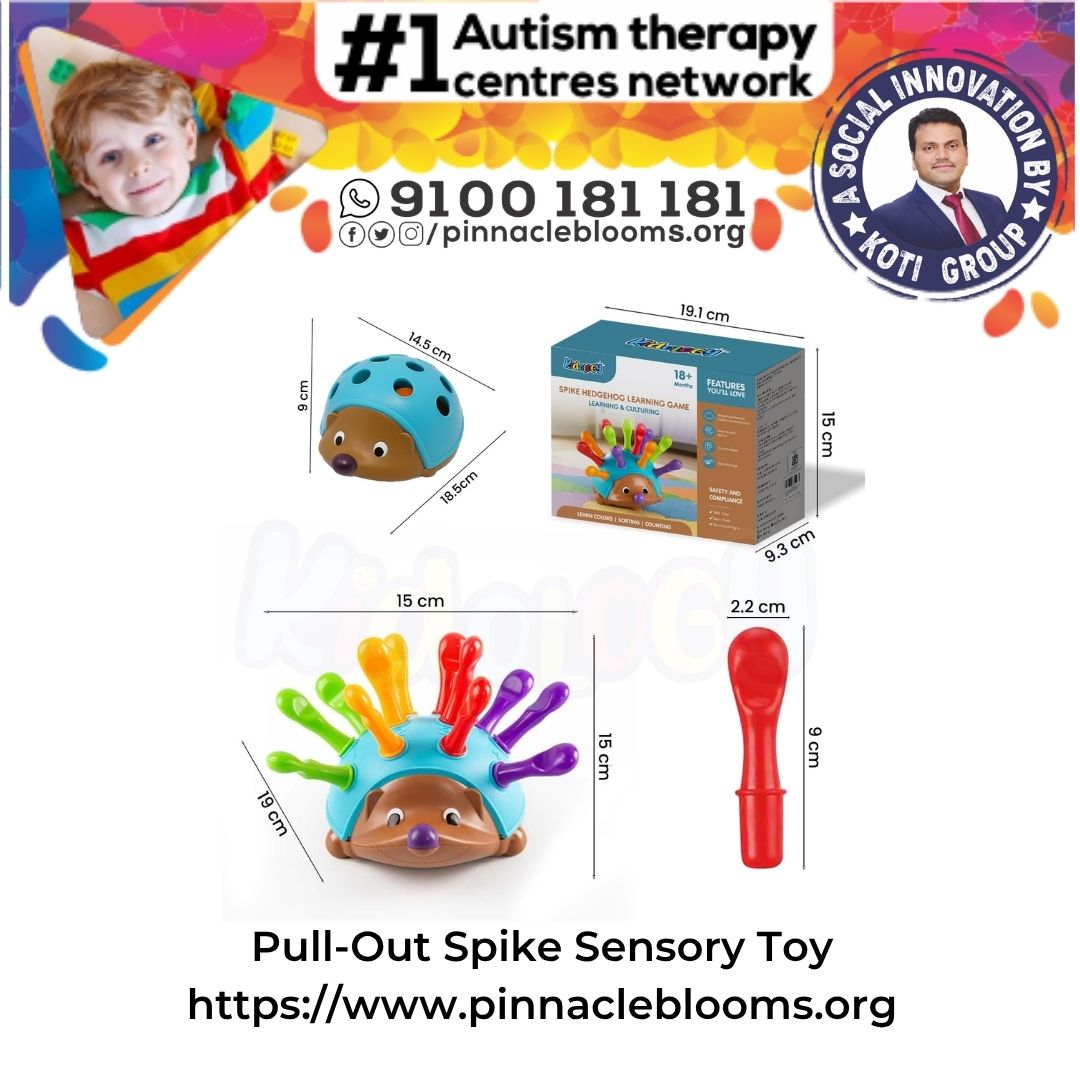
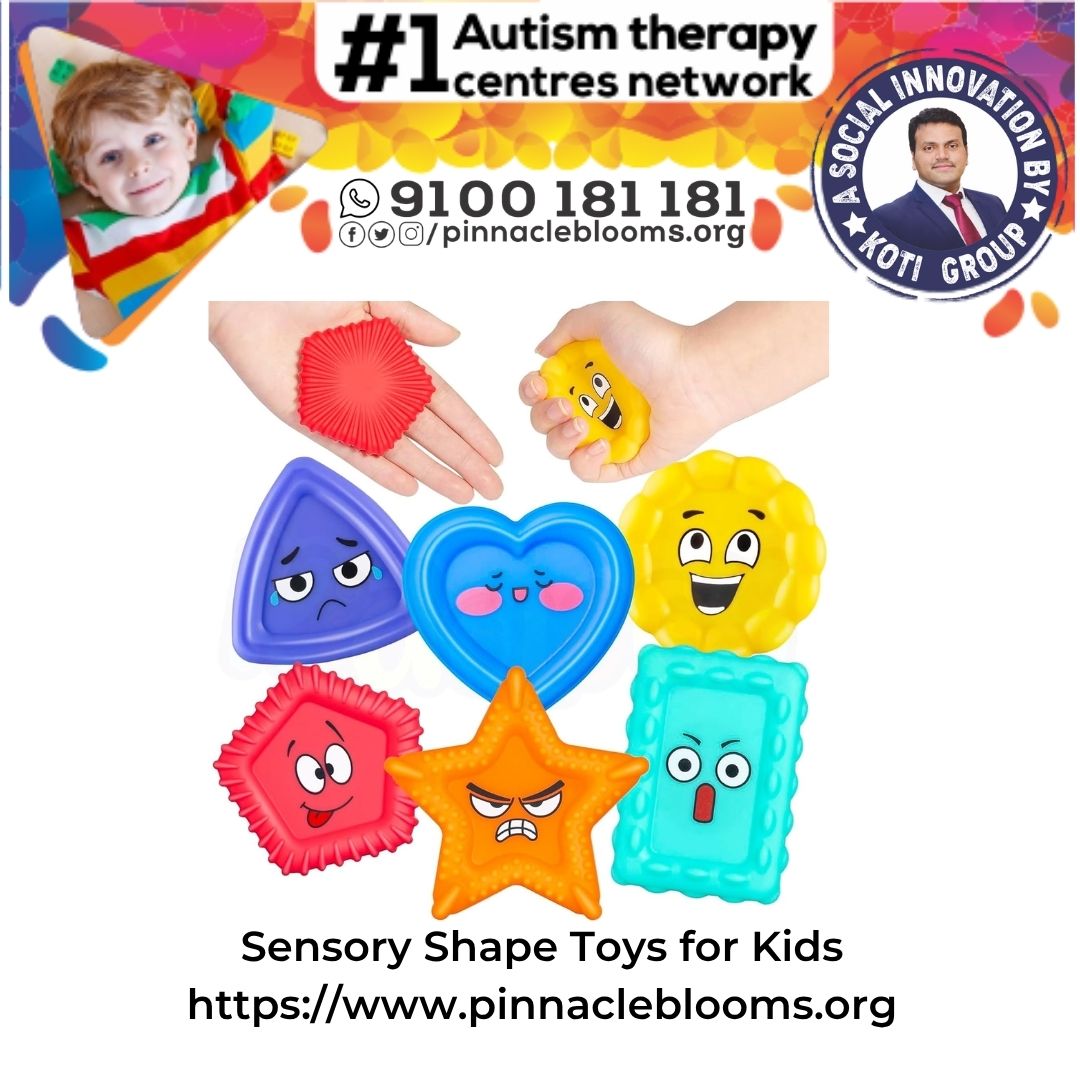
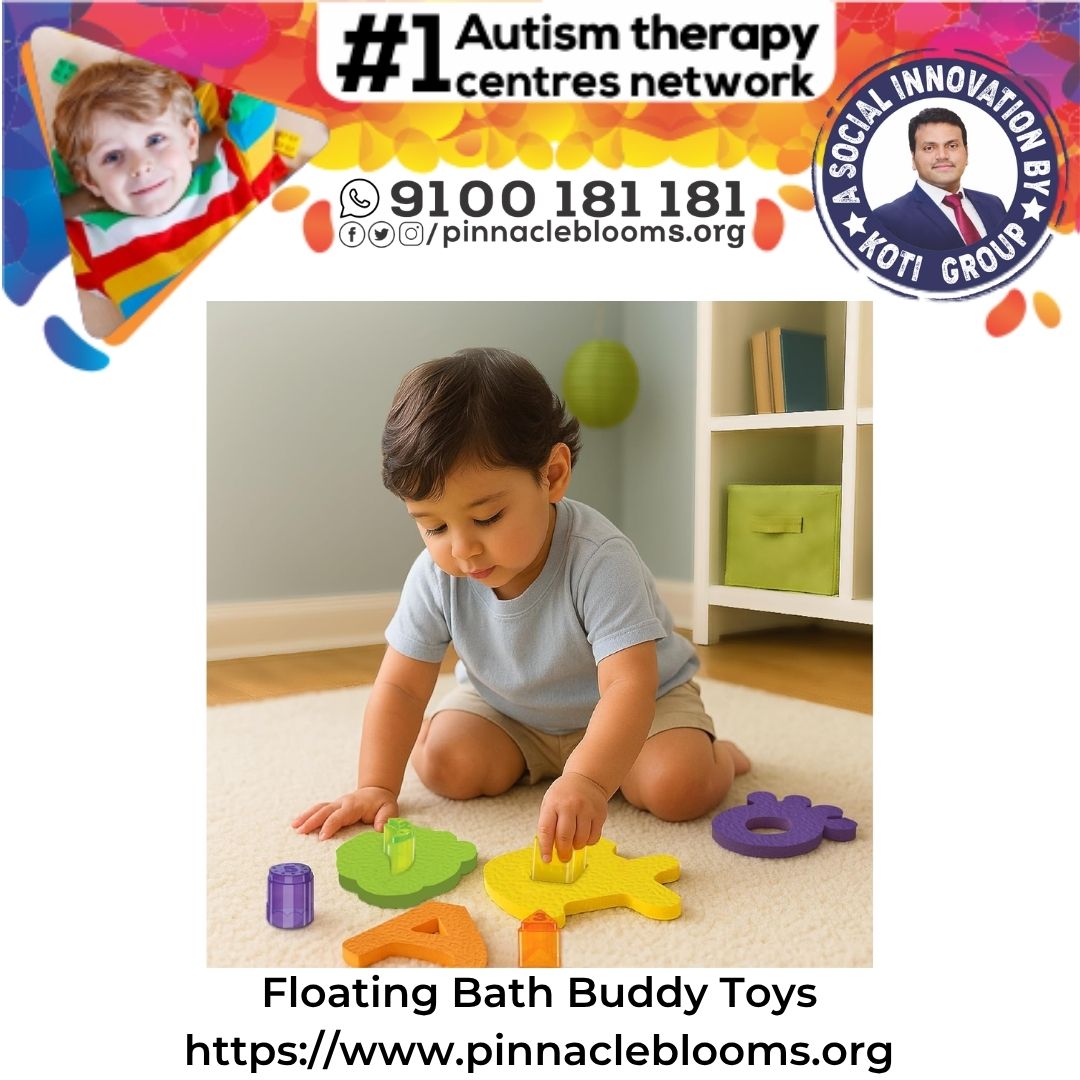
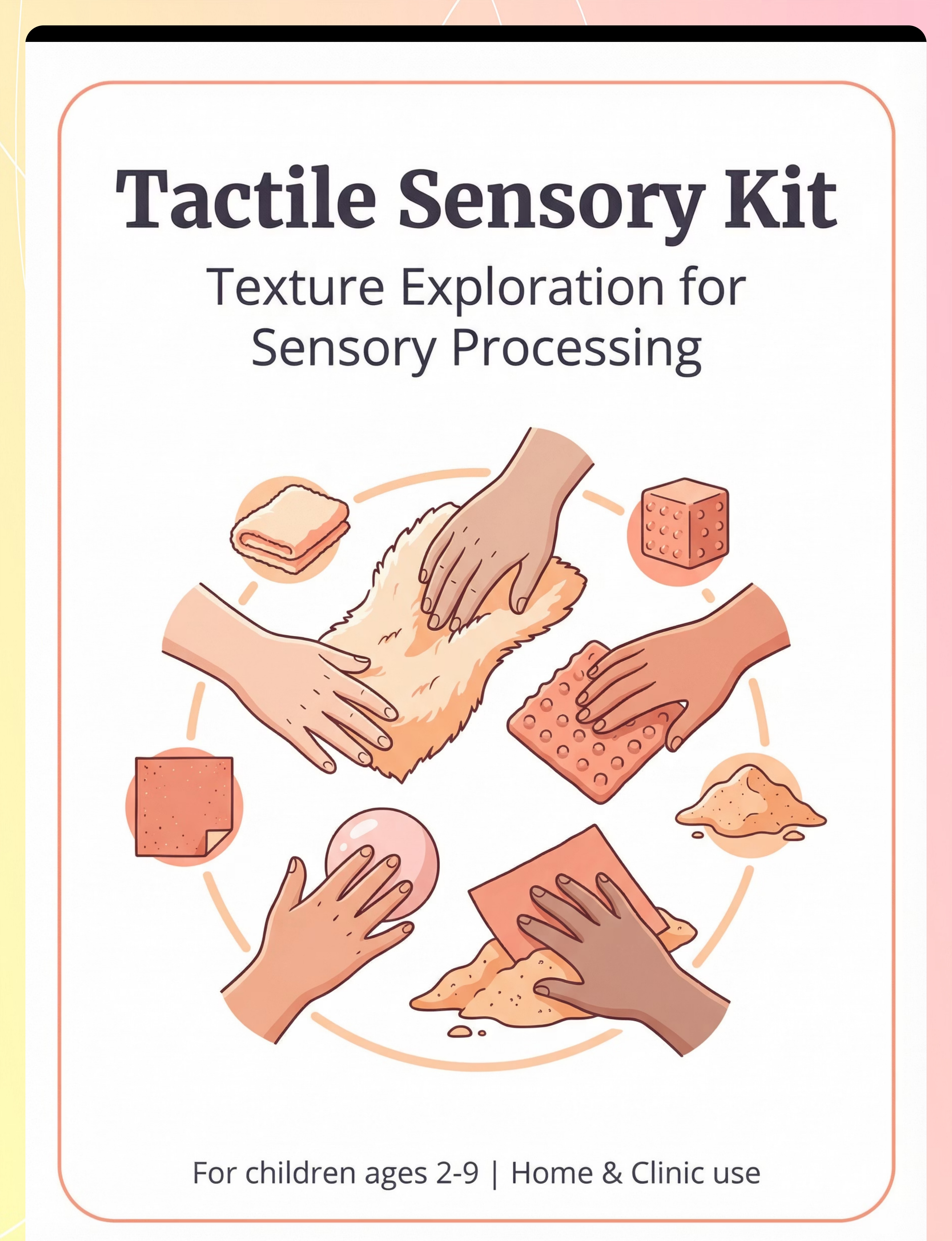
Tactile Sensory Kit
Tactile Input and Desensitization System
OT Recommended
Moderate-Strong Evidence
Rank #2
Daily Use
Home/Clinic
₹100–2,000
Transform tactile defensiveness into confident exploration through systematic, child-led texture experiences. From clothing battles to messy play participation, these research-backed tools help children build tolerance and discover the joy of touch.
Who This Helps
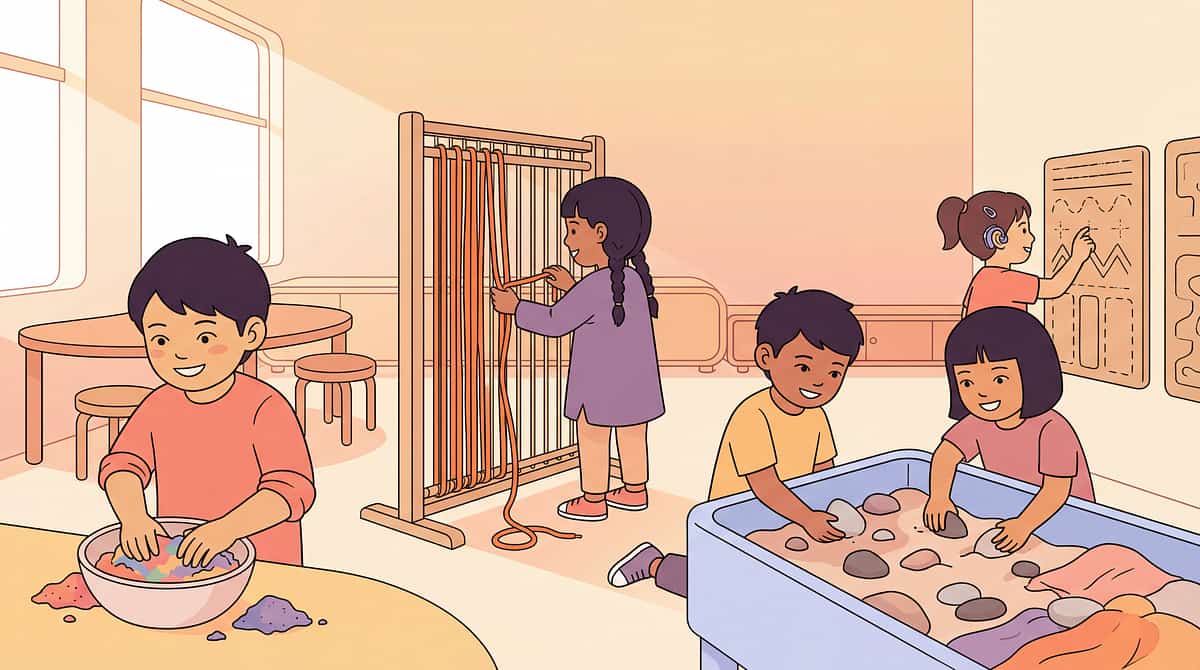
Tactile sensory kits provide controlled tactile input for exploration, desensitization, or seeking behaviors. These tools systematically help children adapt their tactile receptors, reducing defensive responses while improving regulation and body awareness.
Tactile Processing
Sensory Modulation
Fine Motor
Self-Regulation
Messy Play Tolerance
Ages 1-9 years
Home
Clinic
School
Tactile Defensive Children
Gradual desensitization helps reduce anxiety around textures in clothing, food, and play materials
Sensory Seeking Children
Provides appropriate, organizing tactile input to satisfy sensory needs in productive ways
Children with Limited Play
Opens access to art, messy play, outdoor activities previously avoided due to texture aversion
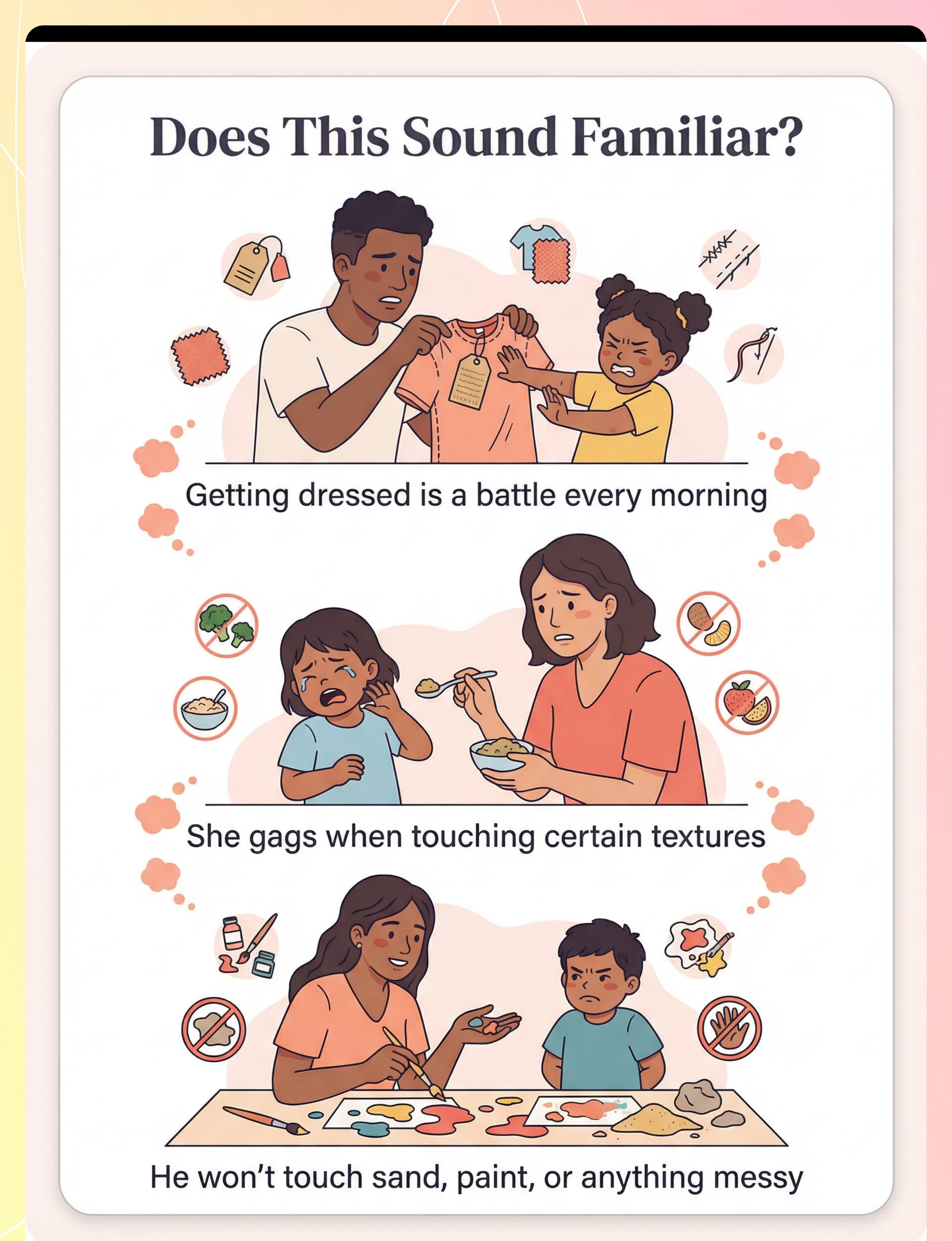
Does This Sound Familiar?
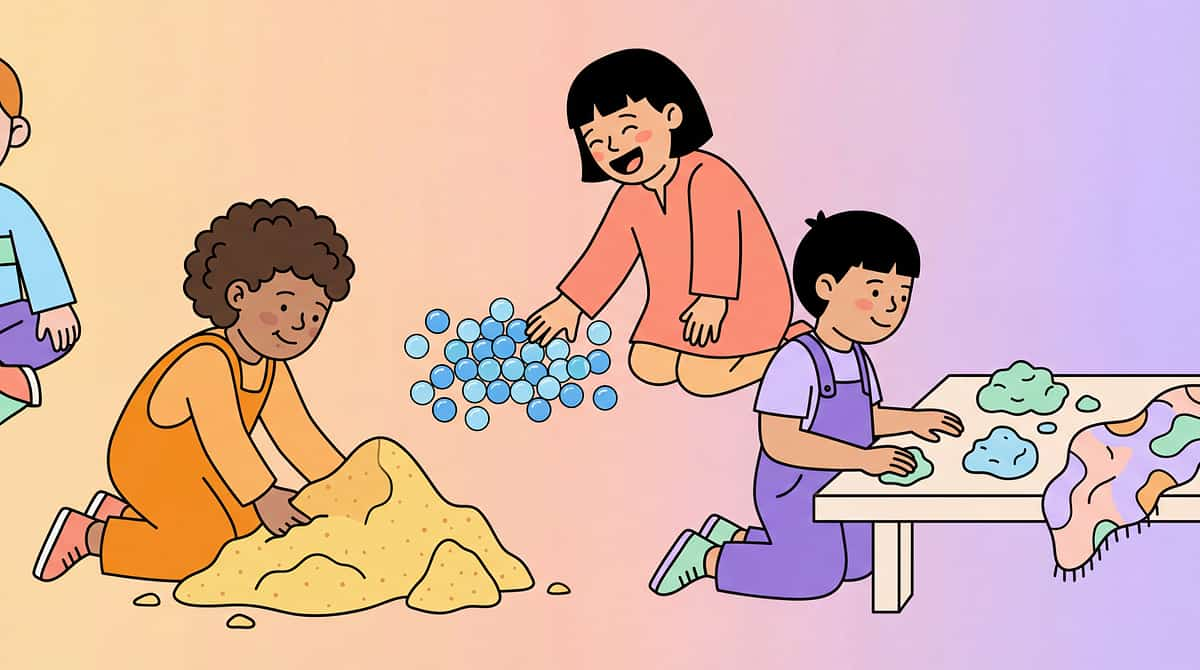
"My child won't touch anything messy - panics with paint, sand, food. Art class is impossible."
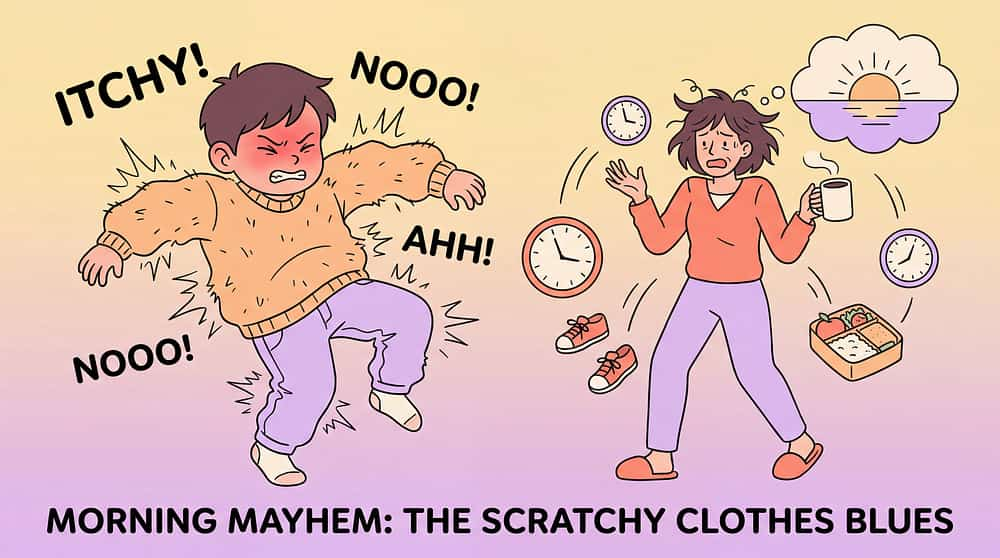
"Getting dressed is a battle every single morning. Every fabric bothers him - tags, seams, everything."
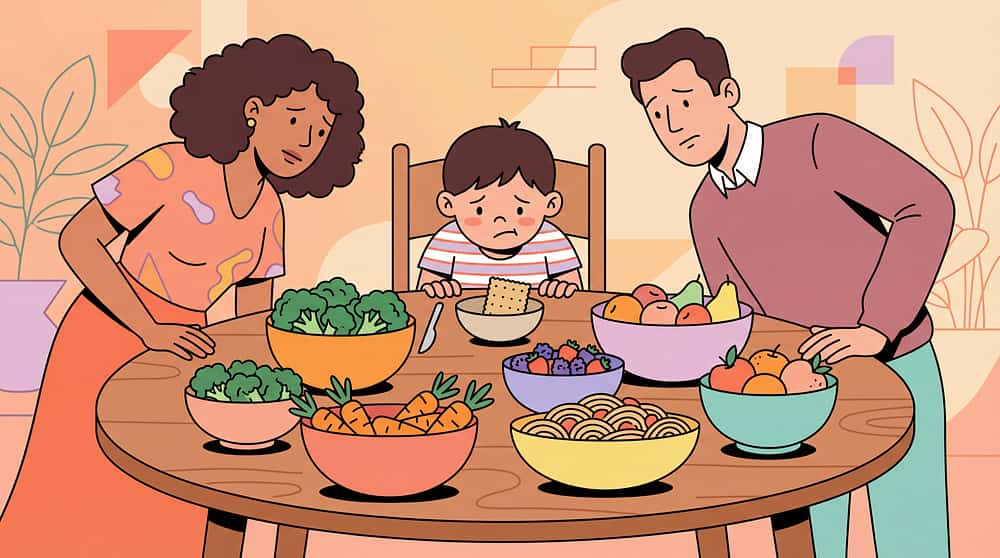
"She gags or cries when touching certain textures. I'm worried about her eating only smooth foods."
"He only eats smooth foods - won't try anything textured. Family meals have become stressful."
"Bath time is traumatic. She hates water on her skin and screams during washing."
"Won't play in the sandbox or touch grass. He's missing out on so much outdoor play."
You're not alone. These are common challenges faced by families of children with tactile processing differences. Tactile defensiveness can significantly impact daily life, but systematic intervention makes a profound difference.
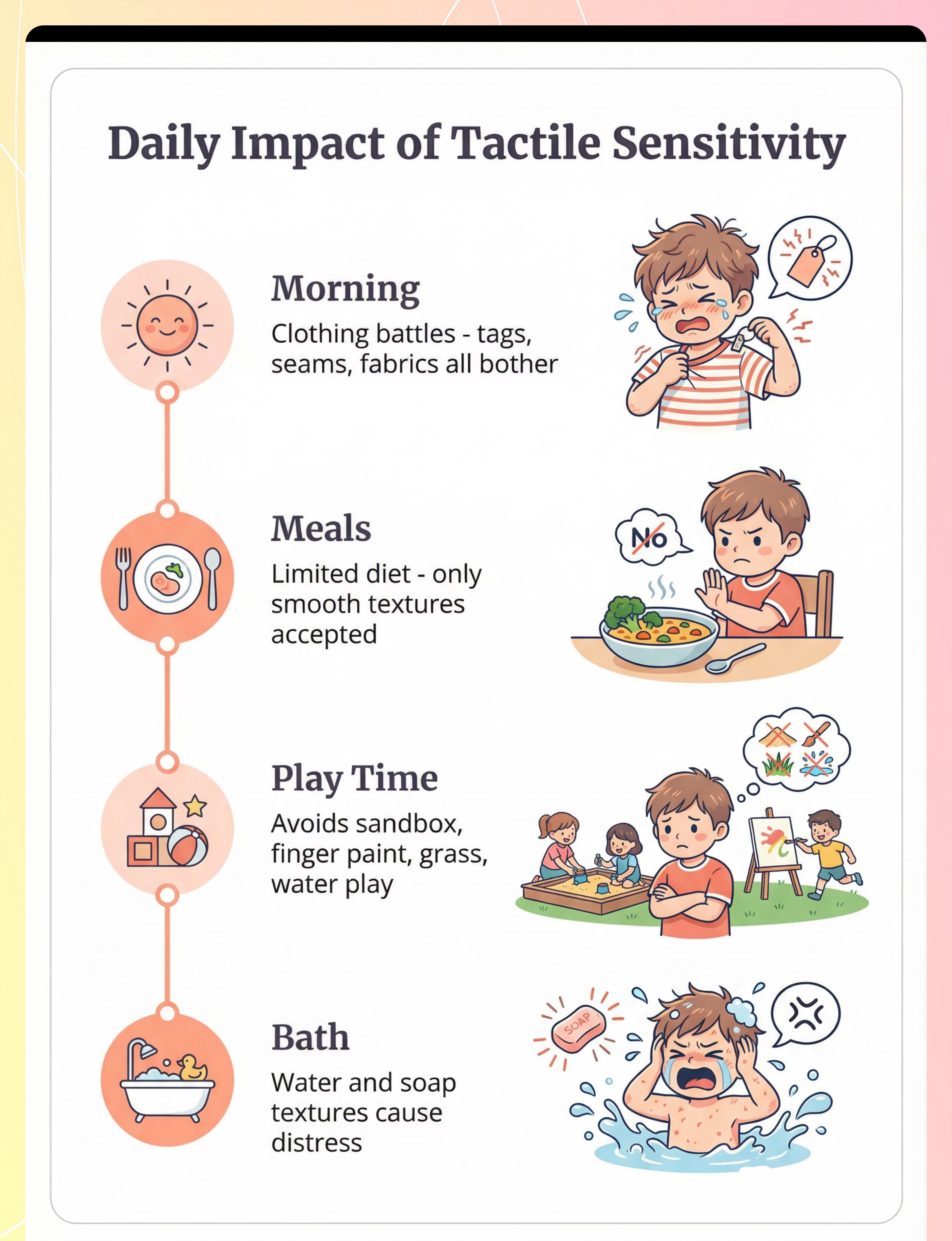
A Day Without the Right Support
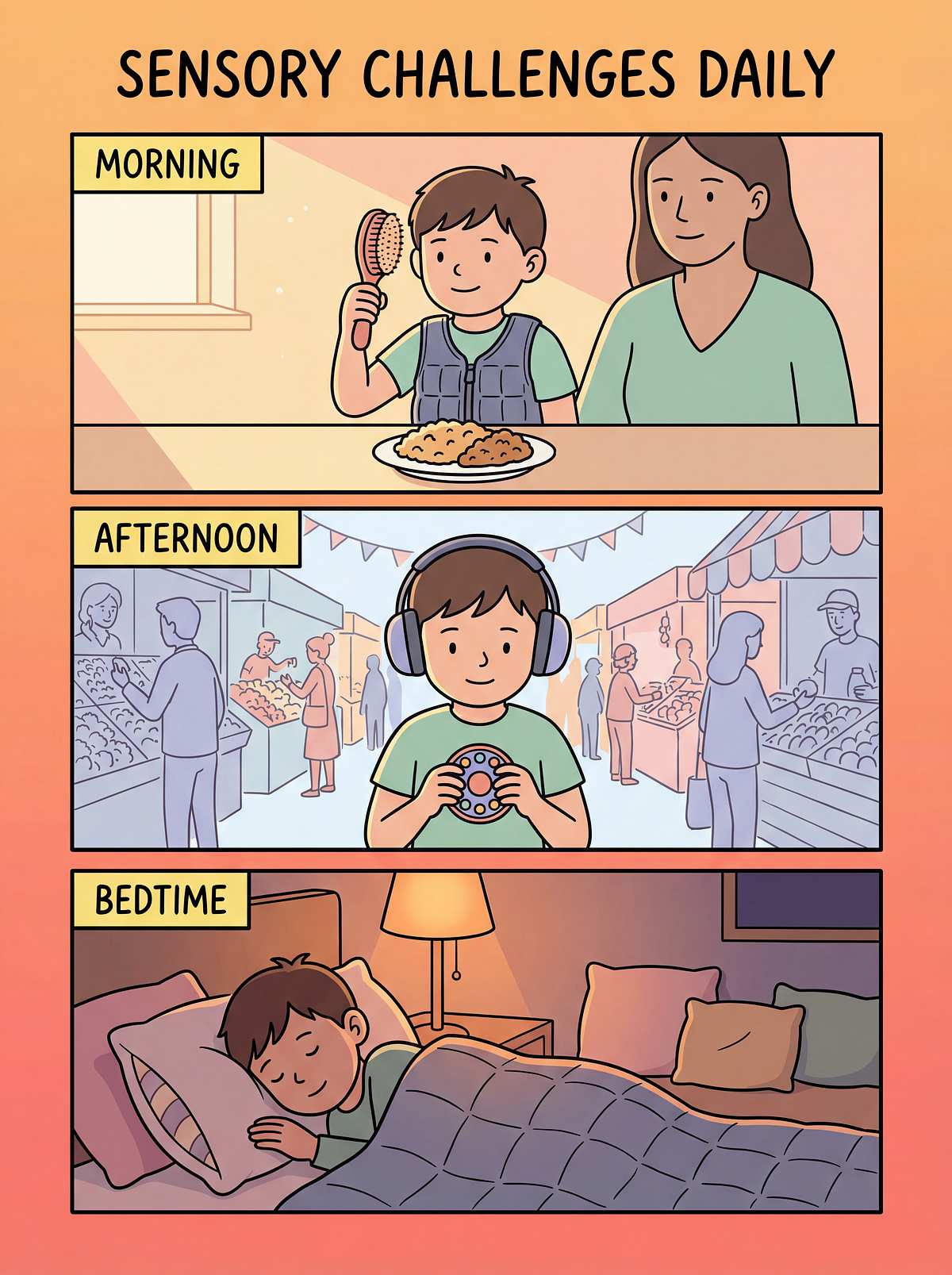
Morning Routine
Clothing battles begin the day. Tags cut out, seams cause crying, only 2-3 'safe' outfits work. Getting out the door takes forever.
School & Play
Child avoids sandbox, finger paint, messy activities. Sits out during art class. Labeled 'difficult' or 'oppositional' by teachers.
Meal Times
Limited foods due to texture aversion. Child eats only smooth textures, gags on anything new. Parents worry about nutrition.
Bath & Bedtime
Water and soap textures cause distress. Evening routine becomes a battle, leaving everyone exhausted and frustrated.
Each moment becomes a challenge when tactile processing differences go unaddressed. These daily struggles compound, affecting confidence, social participation, and family harmony. But there's a path forward.
The Science Behind It
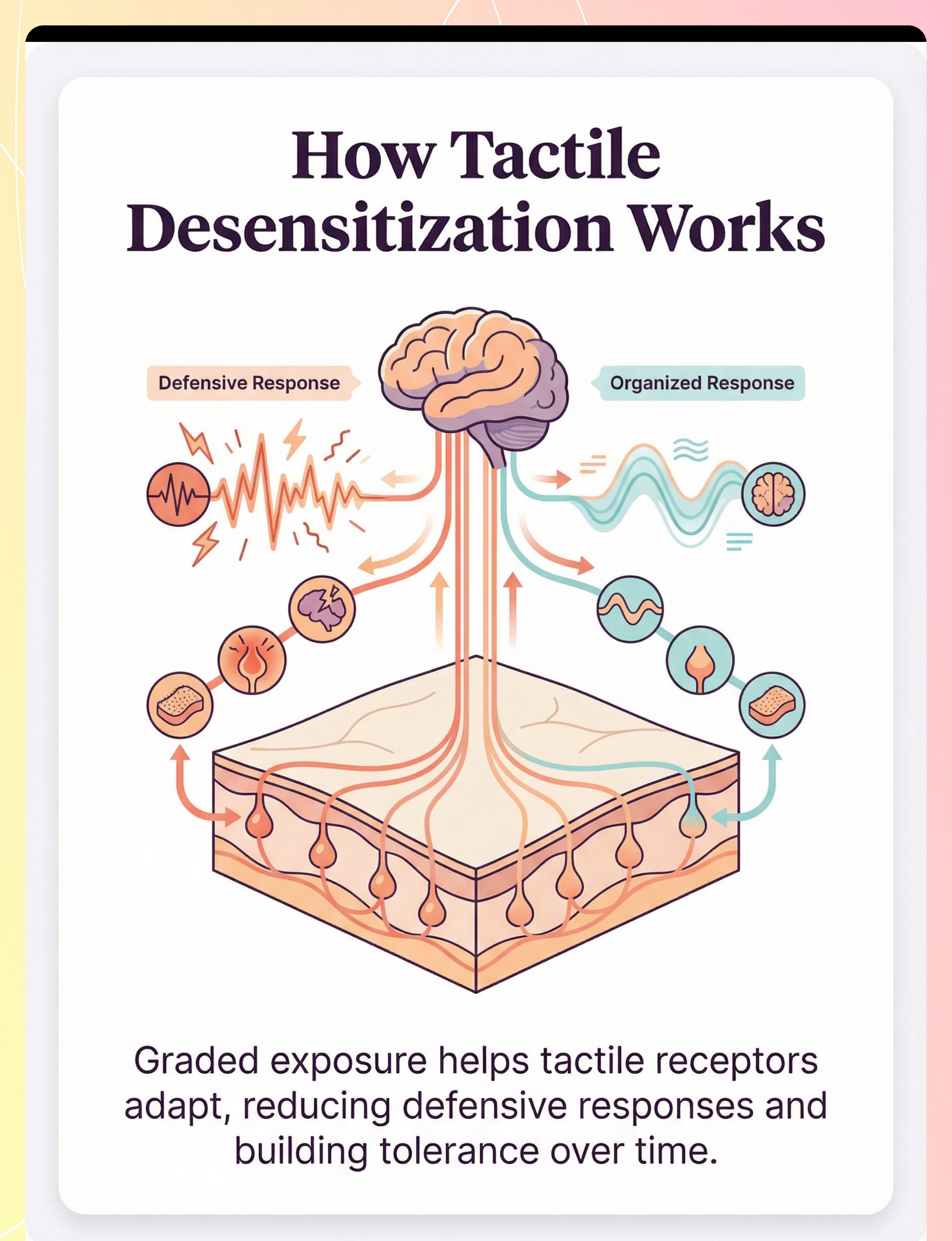
Understanding how tactile desensitization works helps parents feel confident in the process. This isn't magic - it's neuroscience applied with compassion.
Graded Tactile Exposure
Start with tolerable textures, gradually introduce more challenging ones at child's pace
Tactile Receptors Adapt
Repeated safe exposure helps sensory receptors in skin adjust and become less reactive
Reduced Defensive Response
Brain learns textures are safe, decreasing fight-or-flight reactions to touch
Improved Regulation
Organized sensory input supports overall body awareness and self-regulation skills
Tactile Processing
Sensory Modulation
Fine Motor
Self-Regulation
Messy Play Tolerance
How to Use It Right
Success with tactile desensitization depends on following evidence-based best practices. These guidelines ensure safe, effective progress while keeping the experience positive for your child.
1
Start with Preferred Textures
Always begin with textures your child already tolerates or enjoys. Build confidence before gradually introducing more challenging textures.
2
Child Controls the Pace
Never force tactile experiences. Let your child decide when to touch, how long to engage, and when to stop. This builds trust and reduces anxiety.
3
Pair with Preferred Activities
Combine challenging textures with activities your child loves. Hide favorite toys in sensory bins or play preferred music during texture time.
4
Deep Pressure Before Light Touch
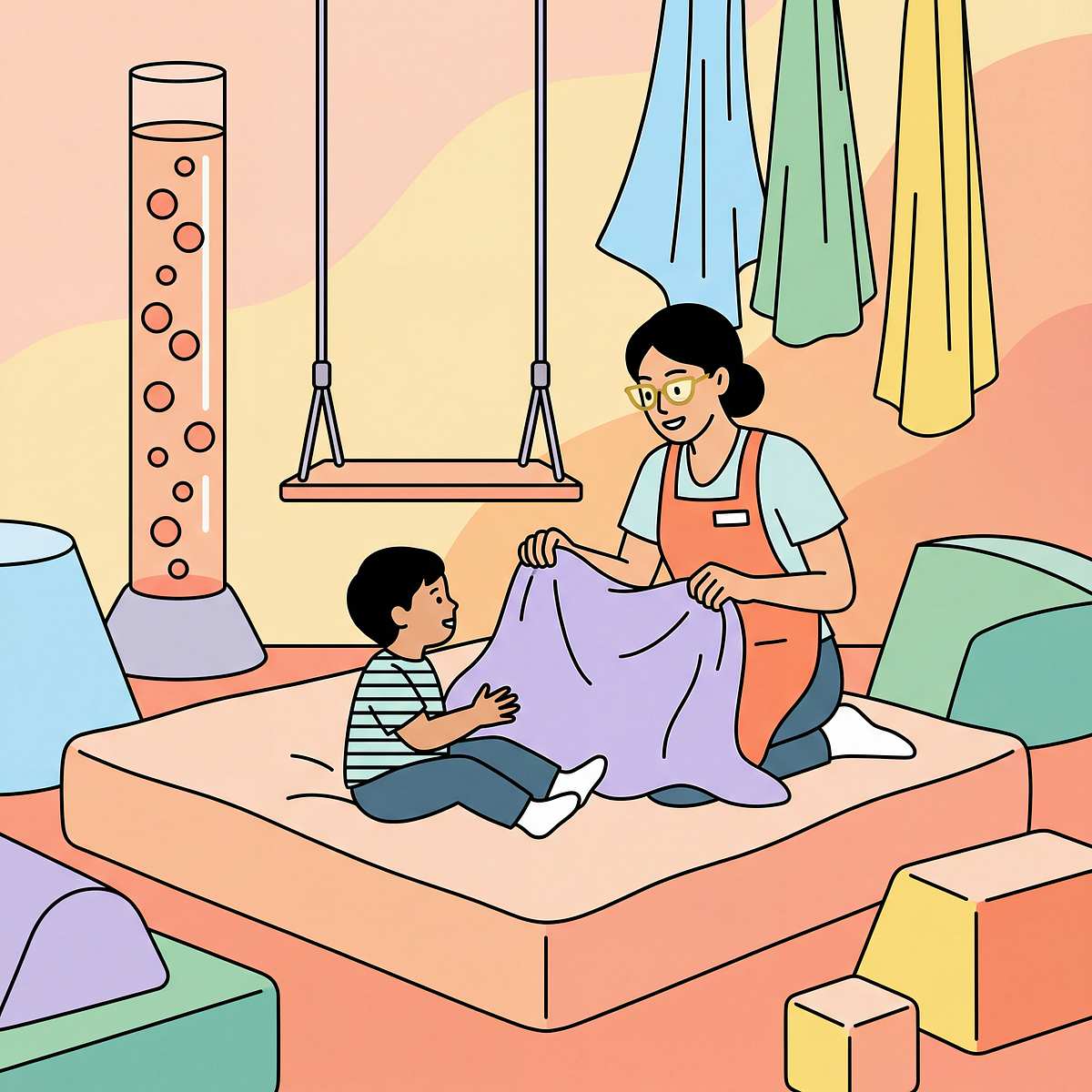
For defensive children, provide deep pressure input (weighted lap pad, firm hugs) before introducing light touch or challenging textures.
5
Follow OT Guidance for Brushing
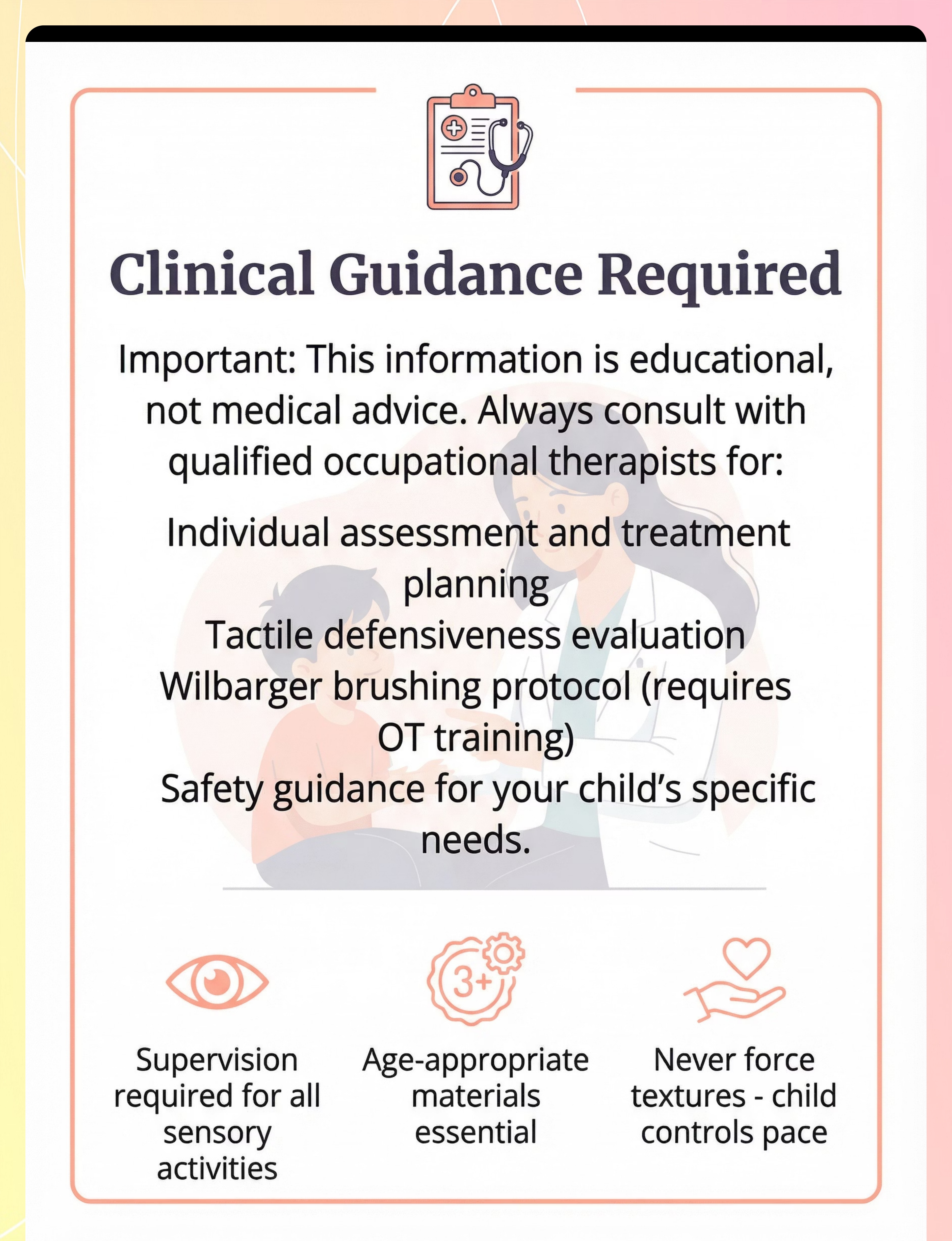
The Wilbarger brushing protocol requires specific training. Only implement under occupational therapist supervision to ensure safety and effectiveness.

Recommended Duration: 10-30 minutes per session, depending on child's tolerance and engagement level. Quality matters more than quantity.
Expert Perspective
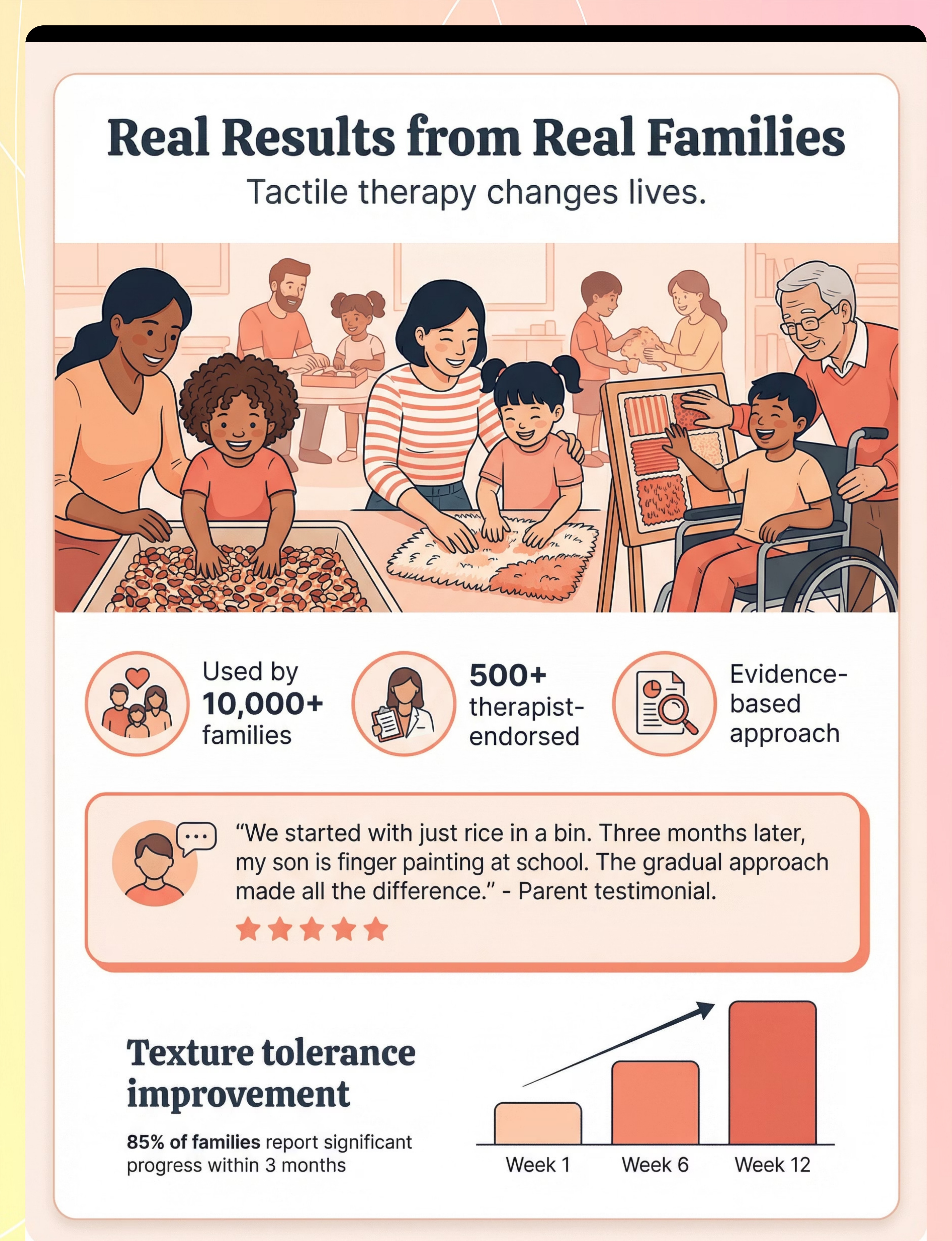
"Tactile defensiveness can significantly impact daily life - from clothing battles to food aversions to social touch. Systematic desensitization with the right tools transforms these challenges."
— Occupational Therapist, Sensory Integration Certified
OT Recommended
Primary discipline for tactile processing intervention
Moderate-Strong Evidence
Research-backed approach with proven outcomes
Rank #2 in Category
Top-tier tool in Sensory Regulation category
tactile-sensory-kit-texture-exploration therapy material
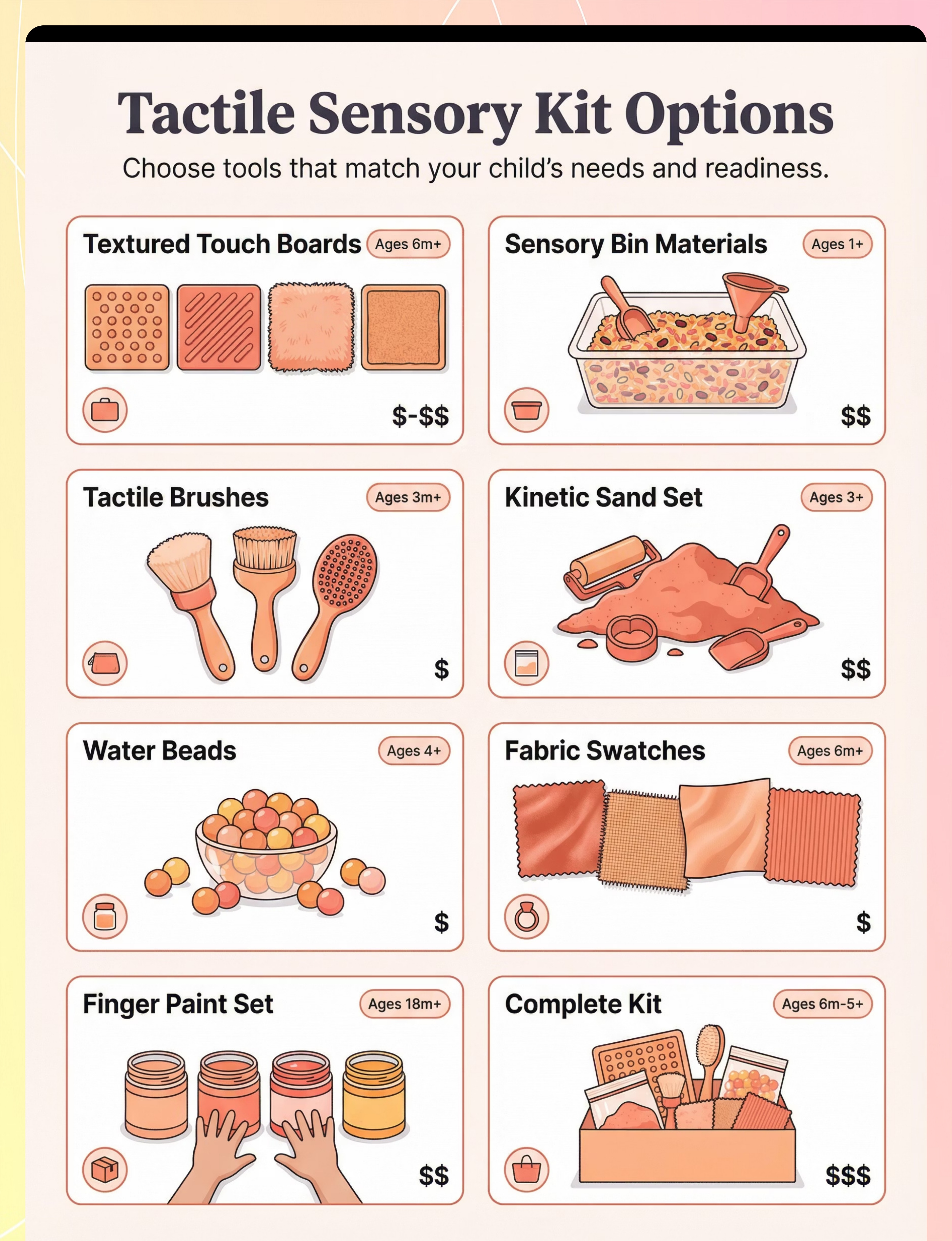
Choose Your Option (8 Variants)
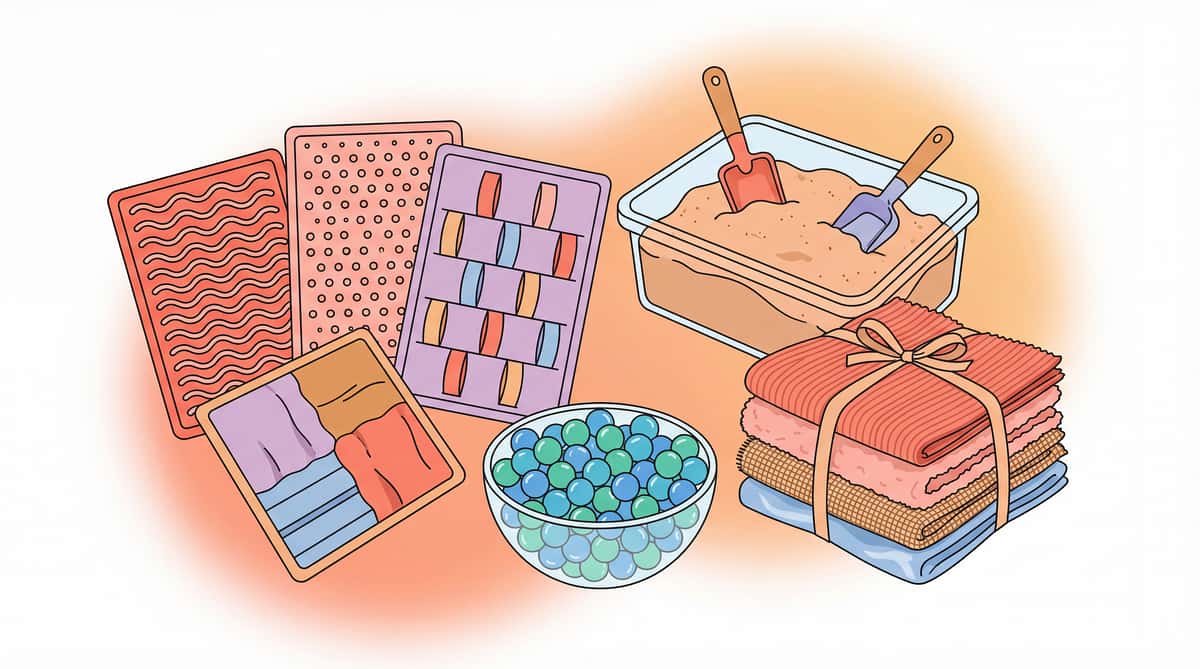
Textured Touch Board Set
Best for: Tactile exploration, desensitization, matching games
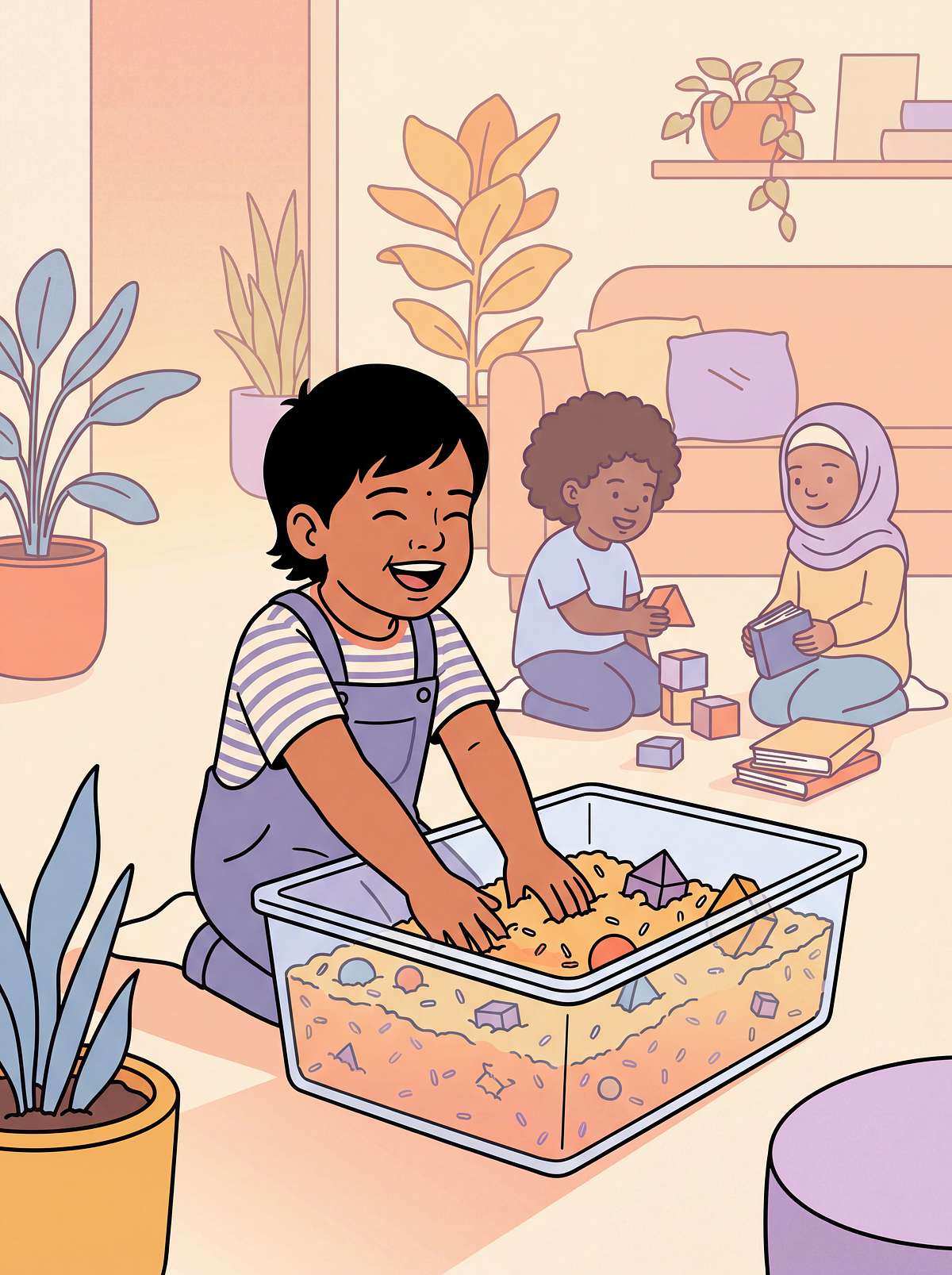
Sensory Bin Fill Materials
Best for: Immersive tactile play, desensitization, fine motor
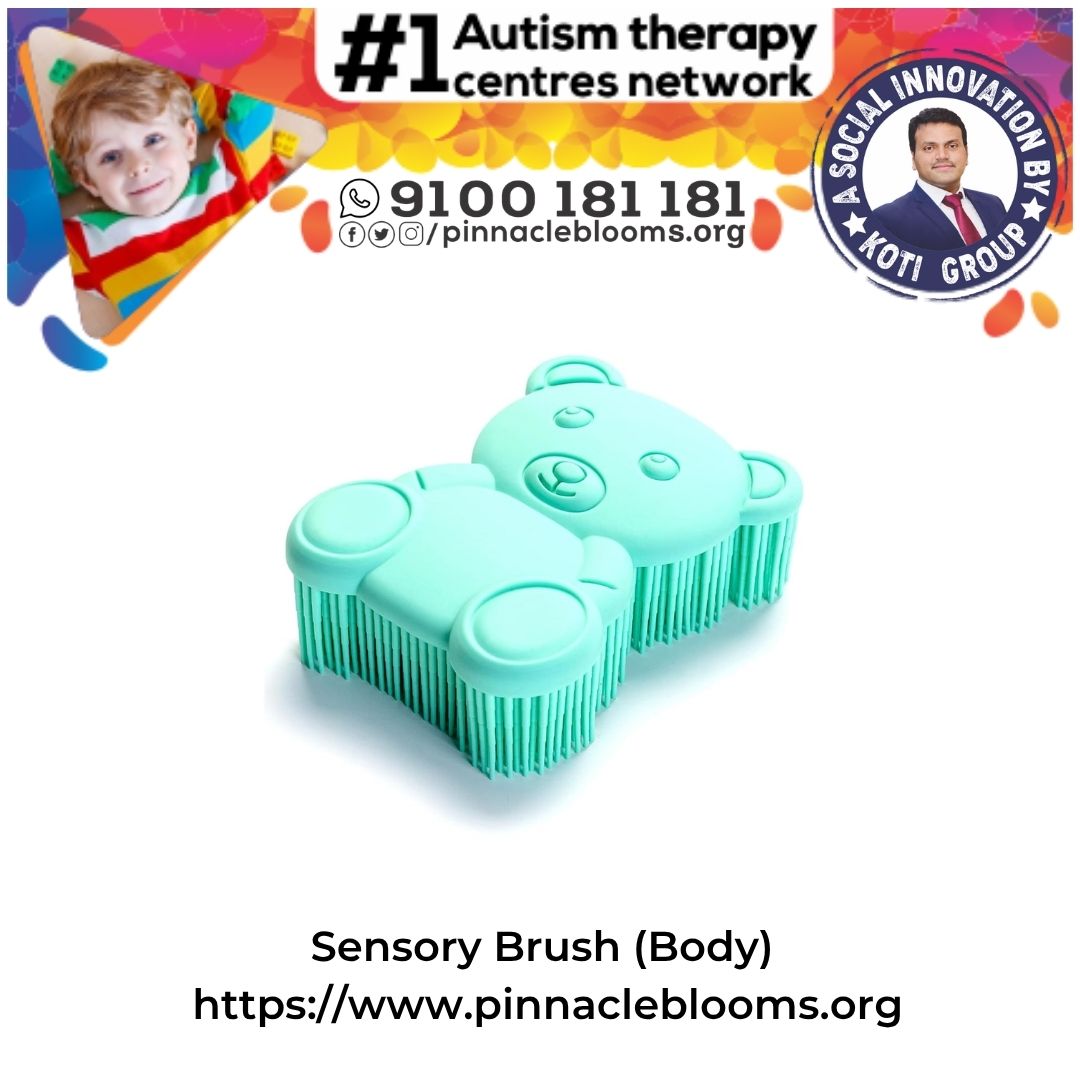
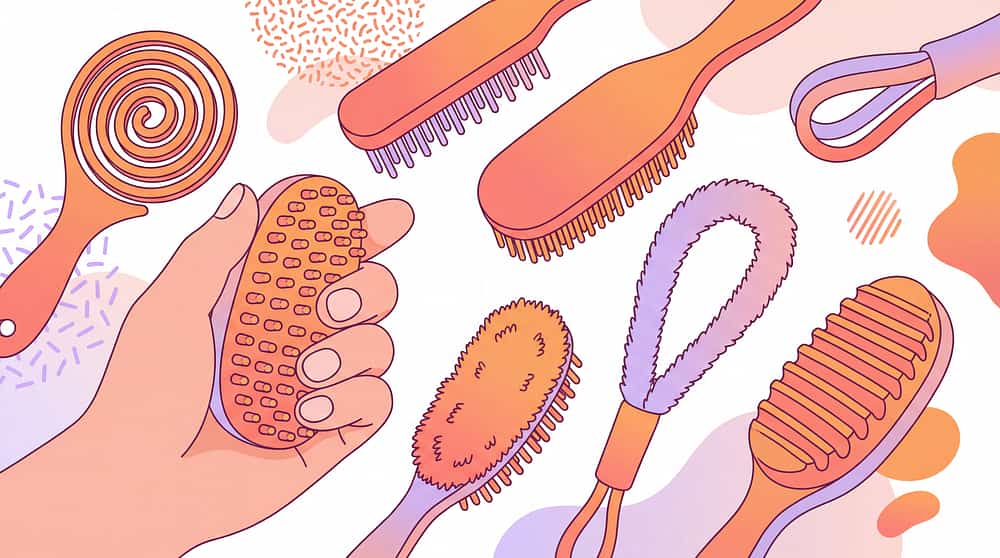
Tactile Brushes Set
Best for: Wilbarger brushing protocol, tactile input
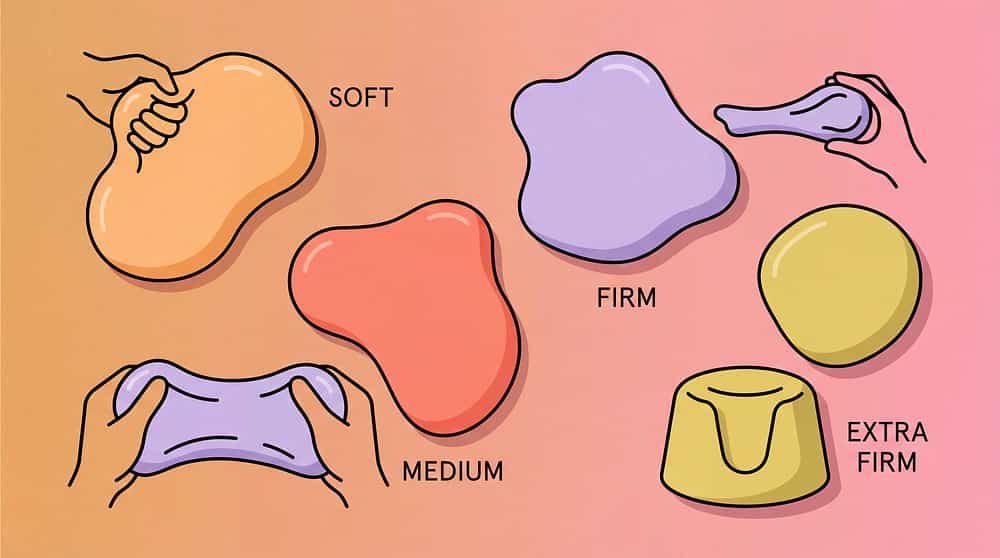
Kinetic Sand Set
Best for: Tactile play, fine motor, calming
Water Beads / Orbeez
Best for: Unique tactile experience, calming, sensory seeking
Sensory Fabric Swatches
Best for: Texture discrimination, clothing preparation
Finger Paint / Messy Play Set
Best for: Messy texture exposure, art, desensitization
Complete Tactile Sensory Kit
Best for: Comprehensive tactile program, clinic use
Every child's tactile needs are unique. Choose based on your child's specific sensory profile, age, setting, and goals. Start with one or two options, then expand as you discover what resonates.

How to Choose
  • By Goal: Desensitization (texture boards, fabric), Seeking (sensory bins, kinetic sand), Calming (water beads, kinetic sand)
  • By Setting: Home (any), Clinic (complete kit), Travel (fabric swatches, brushes)
  • By Portability: High (fabric, brushes), Medium (kinetic sand, texture boards), Low (sensory bins, water beads)
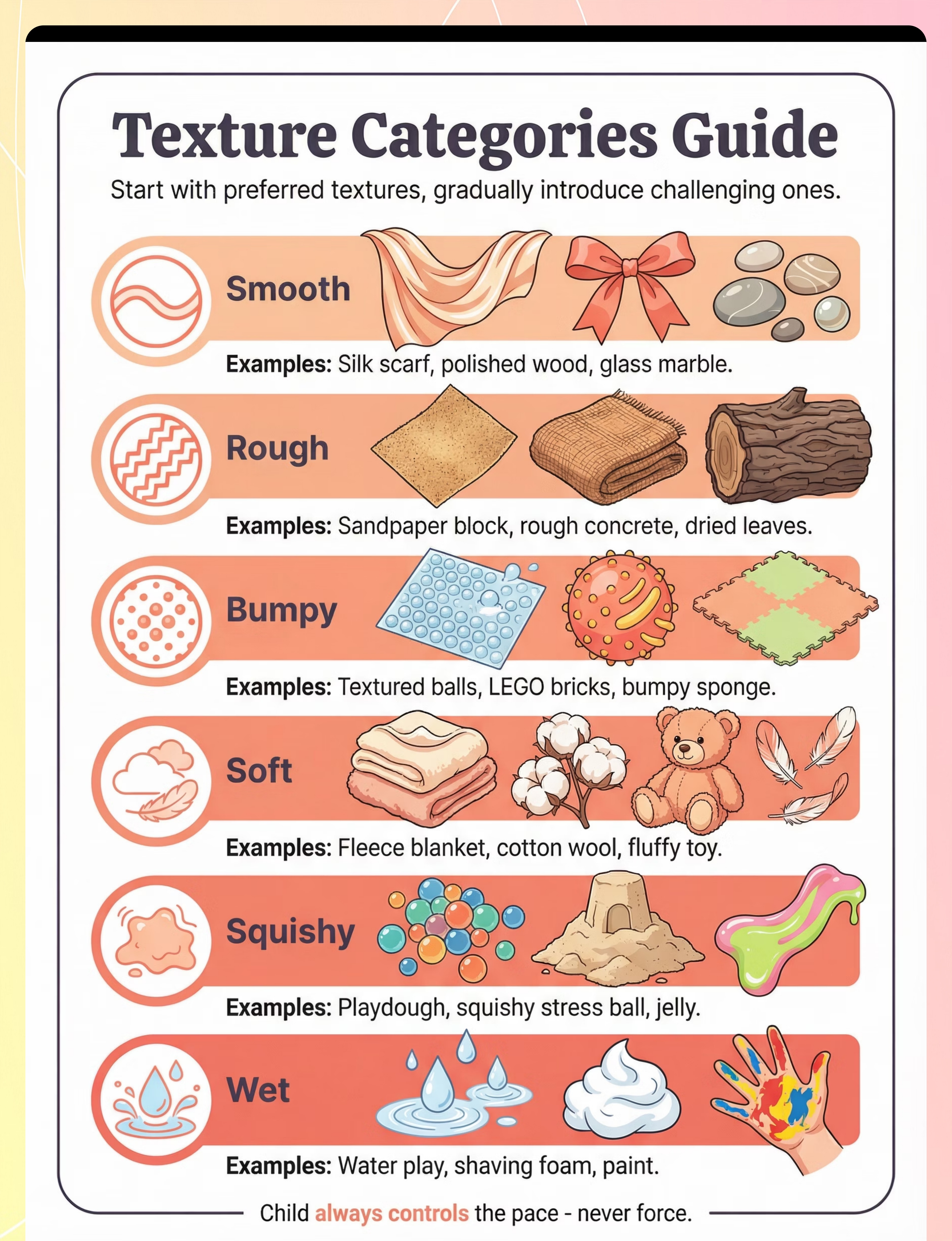
Understanding Texture Categories
Different textures serve different therapeutic purposes. Understanding categories helps you systematically expose your child to a full spectrum of tactile experiences.
Smooth Textures
Silk, satin, glass beads, smooth plastic
Often most tolerated; good starting point
Rough Textures
Sandpaper, burlap, rough wood, scratchy fabric
More challenging; build up gradually
Bumpy Textures
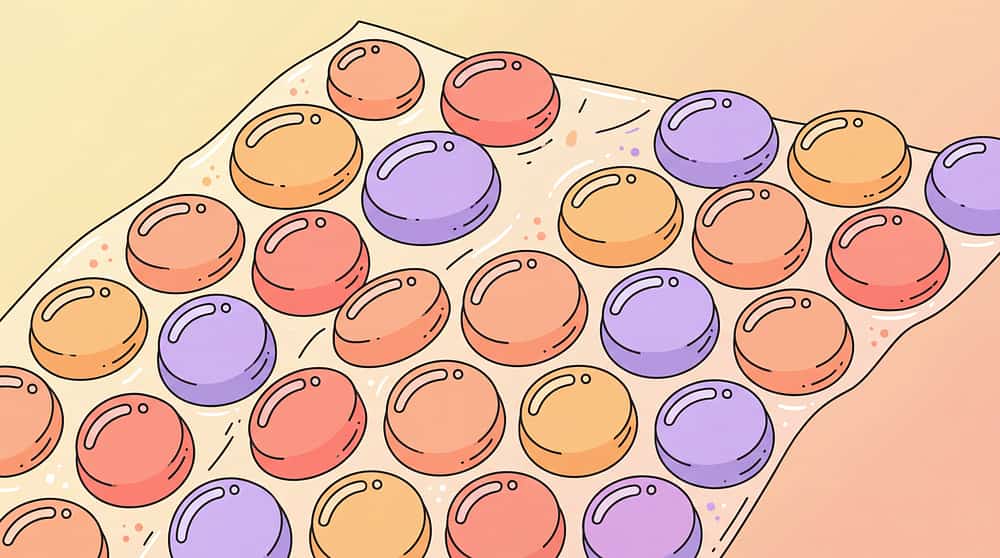
Bubble wrap, textured balls, bumpy mats
Provides organizing proprioceptive input
Soft Textures
Fleece, cotton, plush, feathers
Generally calming and comforting
Squishy Textures
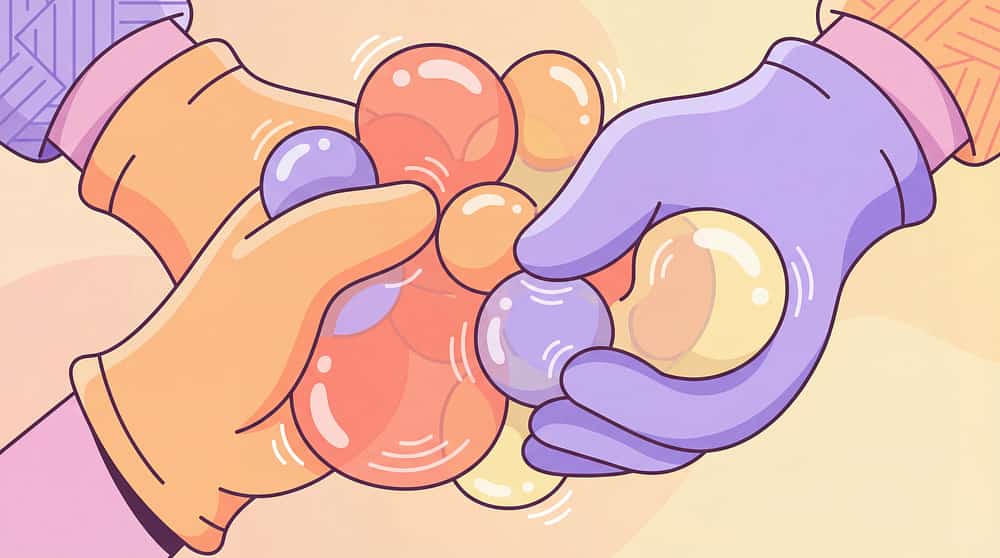
Water beads, kinetic sand, slime, putty
Unique sensation; very engaging
Wet Textures
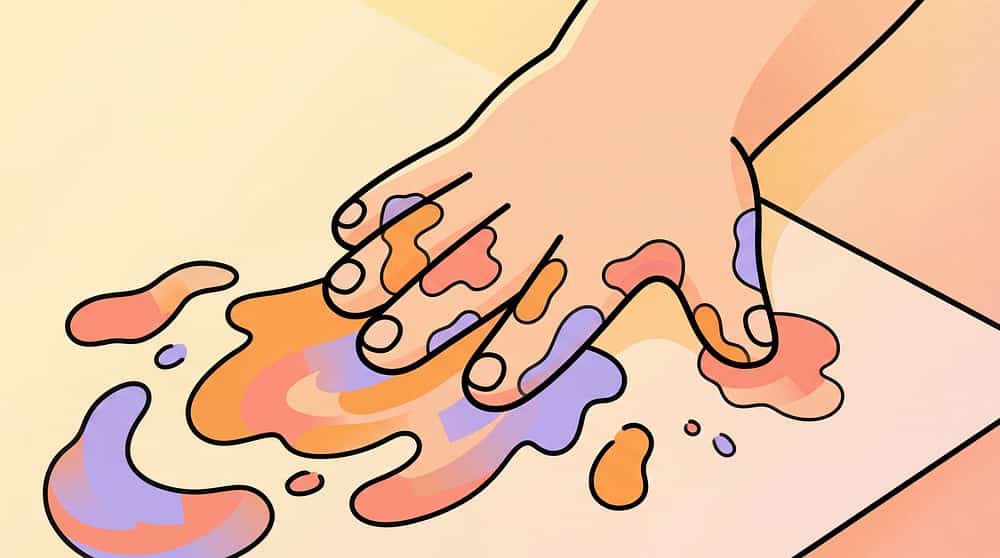
Water play, shaving cream, finger paint
Often most avoided; introduce last
Non-Toxic Materials
All recommended materials safe for age-appropriate mouthing
Washable Components
Easy to clean and maintain hygiene standards
Variety Essential
Exposure to full spectrum builds comprehensive tolerance
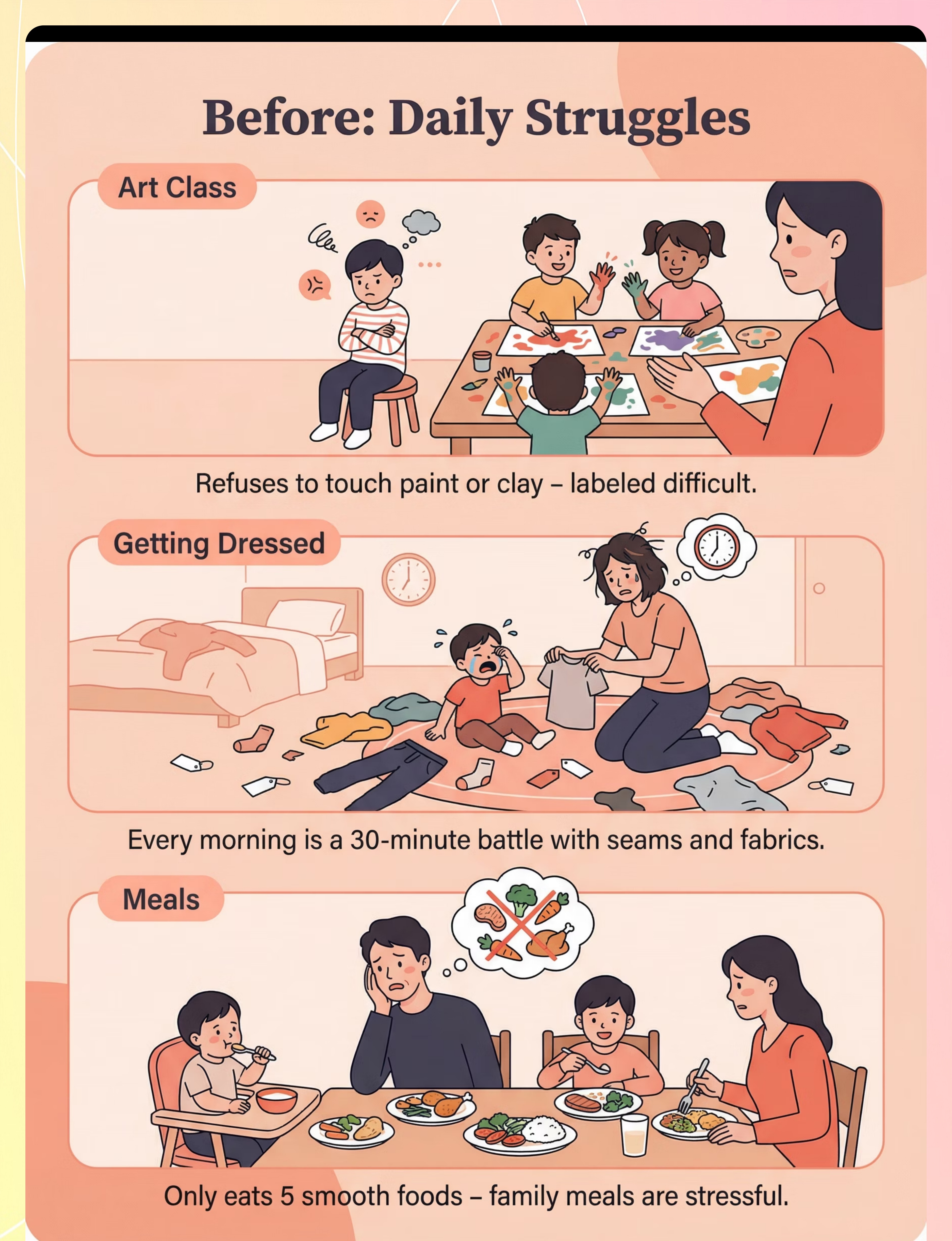
The Struggle (Before)
Understanding the impact of untreated tactile defensiveness helps us appreciate how transformative intervention can be. These scenarios represent real experiences families share.
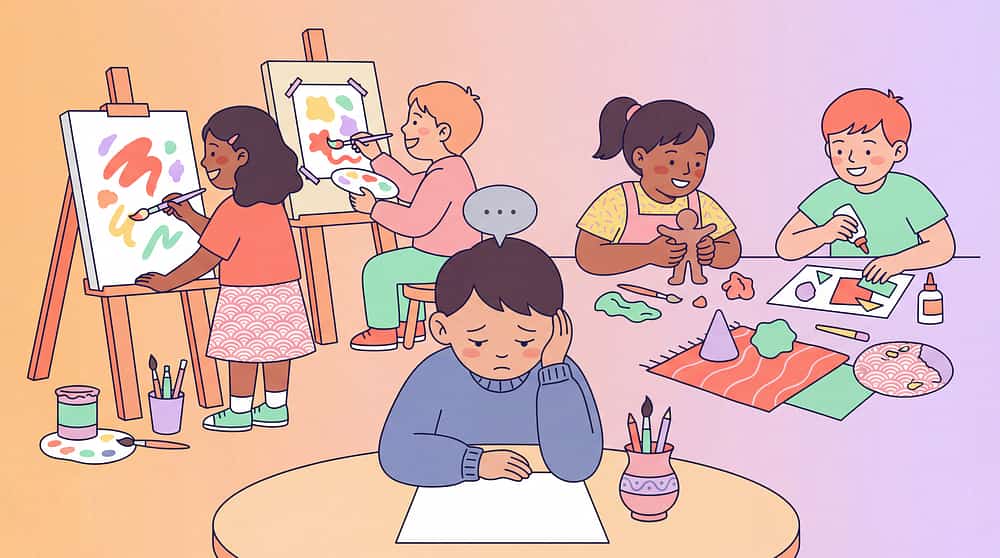
Art Class Exclusion
Situation: Child refuses to touch paint, clay, or glue during art activities
Experience: Sits out of class activities while peers participate. Teachers label child as 'difficult' or 'oppositional.' Missing critical creative development opportunities.
Emotion: Exclusion, misunderstanding, isolation from peers
Morning Clothing Battles
Situation: Every morning becomes a struggle over what child will wear
Experience: Tags cut out, seams cause crying, only 2-3 'safe' outfits work. Getting out the door takes forever. Parent and child both exhausted before day begins.
Emotion: Exhaustion, frustration, feeling trapped
Limited Food Repertoire
Situation: Child eats only 5 foods, all with smooth textures
Experience: Gags on anything new or textured. Family meals become stressful. Parents deeply worried about nutrition and social impact of restricted eating.
Emotion: Worry, limitation, social isolation
These challenges compound over time, affecting not just daily function but self-esteem, social relationships, and family dynamics. But there is a path forward.
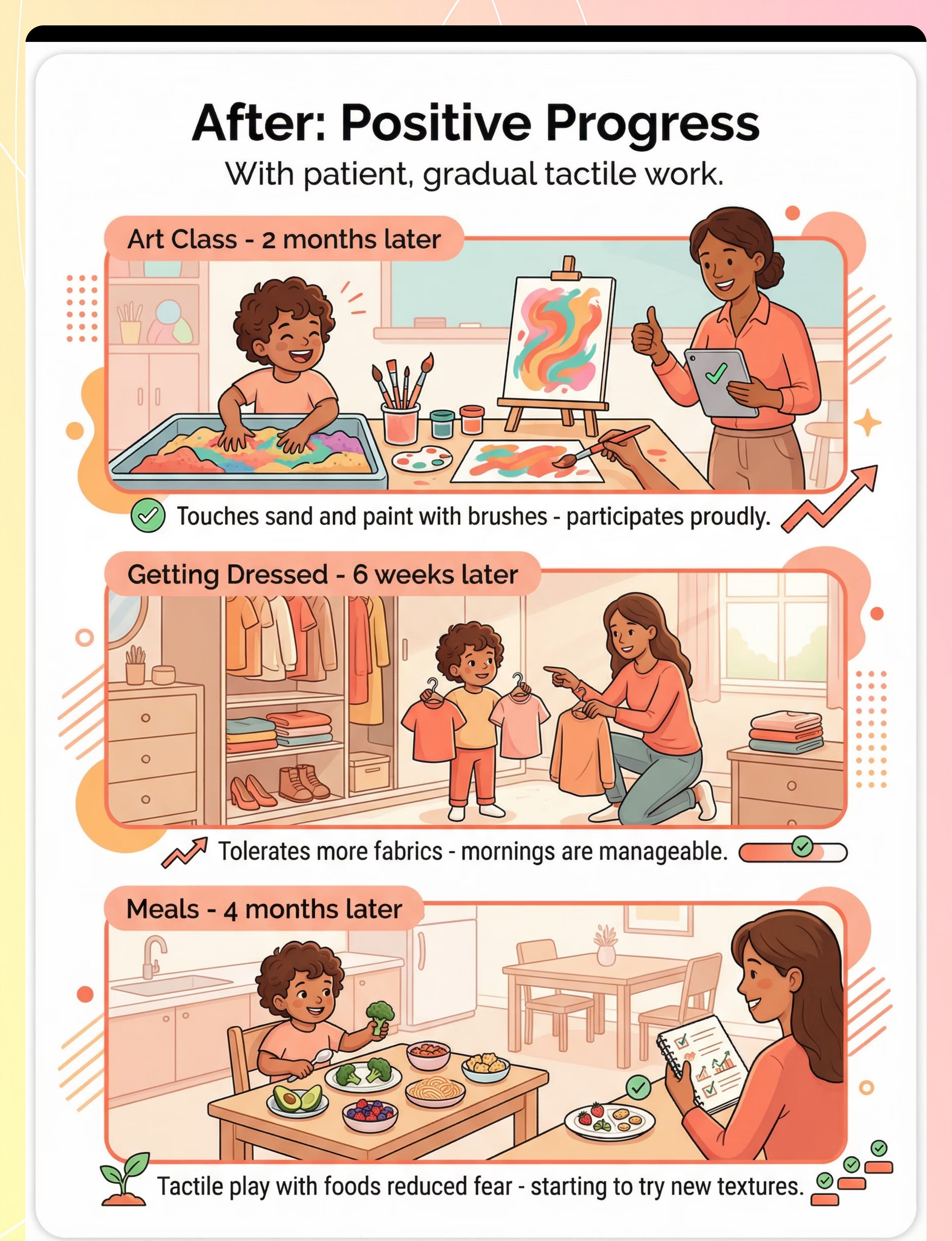
The Breakthrough (After)
Systematic tactile desensitization creates profound changes. These transformations happen gradually, building on small victories until participation becomes natural and joyful.
Art Class Participation
After gradual desensitization, the child engages fully in art activities, touching paint, clay, and glue. They create artwork to display proudly.
Outcome: Inclusion, pride, creative confidence.
Timeline: 2-3 months.
Smooth Morning Routines
Fabric exploration systematically expands clothing tolerance. Mornings become smoother and less stressful. The child even helps choose outfits with pride.
Outcome: Relief, normalcy, independence.
Timeline: 1-3 months.
Expanding Food Choices
Tactile play with food textures (separate from eating) reduces fear. The child begins touching and eventually trying new foods. Family meals become less stressful.
Outcome: Hope, progress, family connection.
Timeline: 3-6 months.
These outcomes aren't miracles - they're the result of consistent, compassionate intervention that respects the child's pace while systematically building new neural pathways.
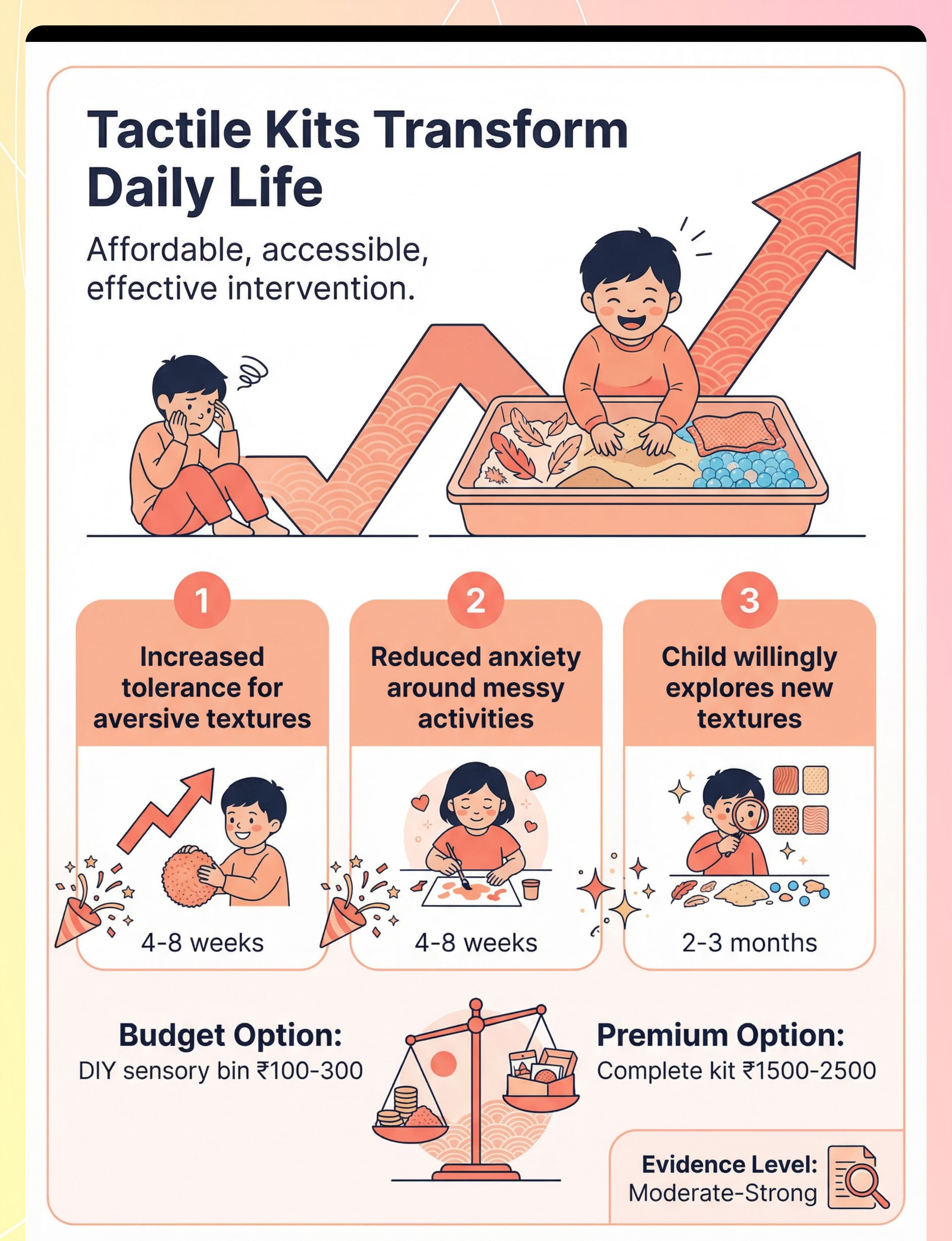
What to Expect (Realistic Timelines)
Setting realistic expectations helps families stay motivated through the gradual process of tactile desensitization. Progress happens in layers, with some changes visible quickly and others taking longer to solidify.
Increased Tolerance for Aversive Textures
Child shows reduced distress reactions when encountering previously avoided textures
4-8 weeks
Reduced Anxiety Around Messy Activities
Anticipation decreases; child can approach messy play with less pre-activity stress
4-8 weeks
Improved Participation in Play and Art
Engages in activities with peers; no longer sitting out during creative time
1-2 months
Expanded Clothing Tolerance
Can wear more fabric types; morning routines become smoother and less combative
6-12 weeks
Child Willingly Explores New Textures
Initiates tactile exploration independently; curiosity replaces avoidance
2-3 months
Foundation for Food Texture Expansion
Tactile tolerance generalizes to oral textures; food variety begins to increase
3-6 months

Important: Timelines vary by child, consistency of intervention, severity of defensiveness, and family support. Some children progress faster; others need more time. Trust the process.
Is This Right for My Child? (2-Minute Check)
Answer these questions honestly. Three or more 'yes' responses indicate a strong fit for tactile sensory intervention.
Does your child avoid touching certain textures?
Sand, paint, food textures, grass, or other materials trigger distress or avoidance
If yes, this indicates: Tactile defensiveness

Confidence score: 95%
Strong reactions to clothing elements?
Tags, seams, certain fabrics cause significant distress or refusal to wear items
If yes, this indicates: Tactile hypersensitivity

Confidence score: 92%
Very limited diet based on food textures?
Child eats only smooth foods or avoids entire categories due to texture rather than taste
If yes, this indicates: Oral tactile sensitivity

Confidence score: 88%
Seeks out certain textures repeatedly?
Constantly rubbing, touching, or seeking specific tactile input throughout the day
If yes, this indicates: Tactile seeking behavior

Confidence score: 85%
Result: 3+ 'yes' answers indicate strong fit for tactile sensory intervention. Consult with an occupational therapist for personalized assessment and program design.
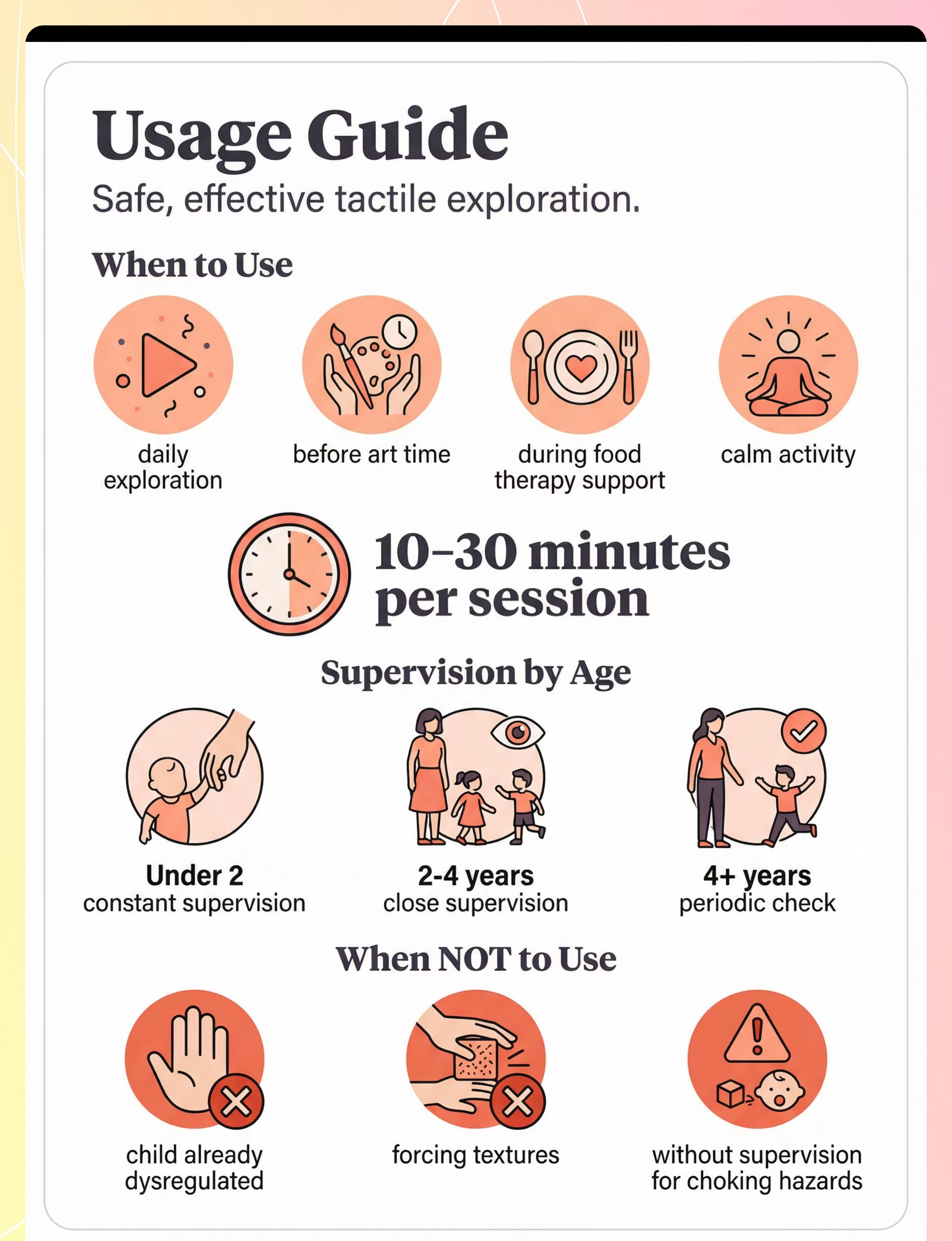
Usage Guide
When to Use ✓
  • Daily tactile exploration and play sessions
  • Before challenging tactile activities (preparation)
  • During art time to warm up to messy materials
  • As part of food therapy support program
  • As a calming and regulating activity
Settings
Home
Clinic
School (limited)
When NOT to Use ✗
  • Child is already dysregulated (wrong time to challenge)
  • Forcing textures child isn't ready for
  • Without appropriate supervision for choking hazards
  • If child has open wounds on hands
Duration
10-30 minutes per session depending on child's tolerance and engagement level
Supervision by Age
Age Range
Supervision Level
Notes
Under 2 years
Constant supervision
Mouthing-safe materials only; no small parts
2-4 years
Close supervision
Avoid small parts; monitor for ingestion
4+ years
Periodic supervision
Age-appropriate materials; check in regularly
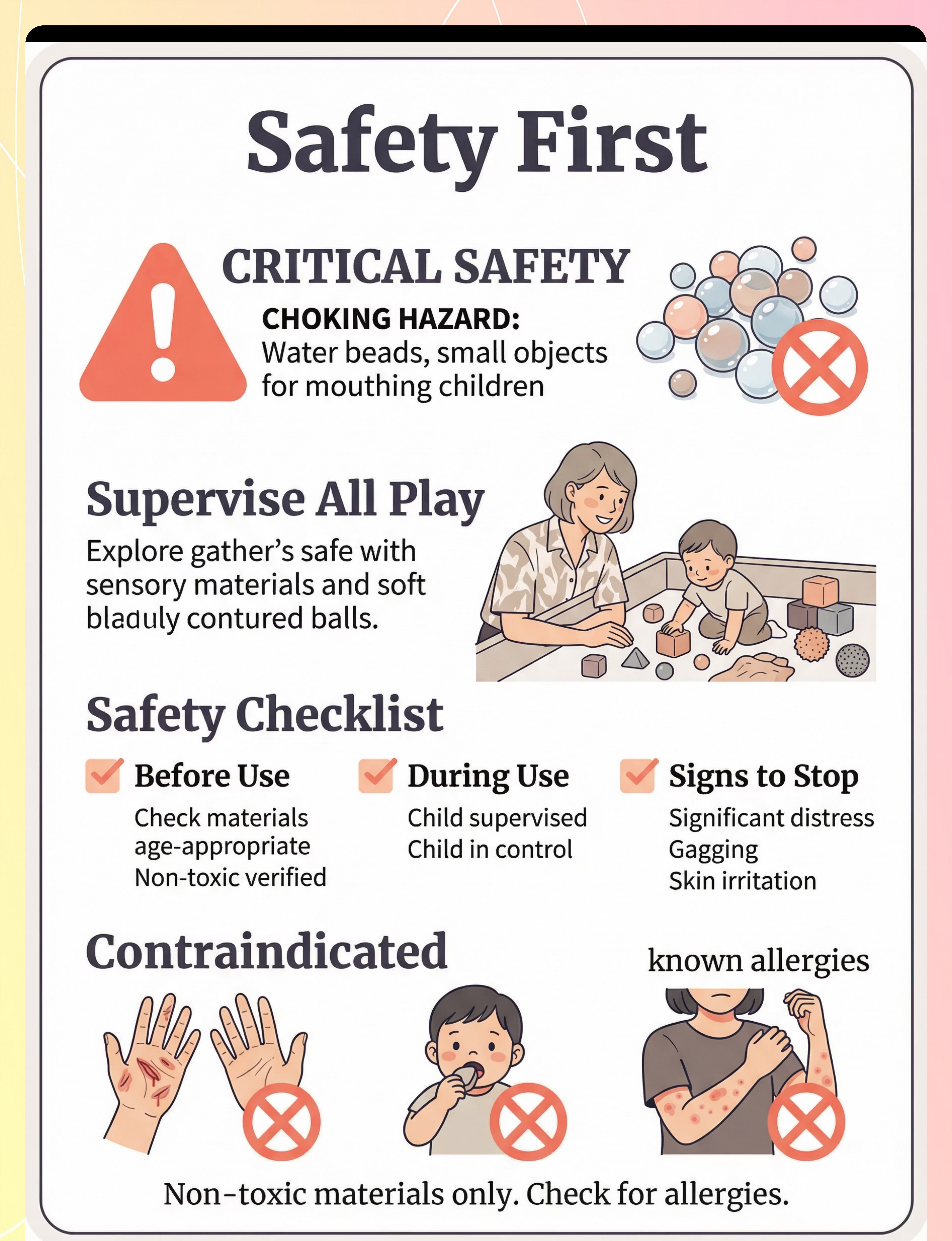
Safety First
Critical Safety Information
  • CHOKING HAZARD: Water beads and small objects are dangerous for children who mouth items
  • Supervise all sensory play with young children at appropriate levels for age
  • Use only non-toxic materials; verify safety labels before purchase
  • Check for allergies to latex, specific foods, or other materials before use
Important Warnings
  • Water beads expand dangerously if swallowed - can cause bowel obstruction
  • Food-based sensory bins can attract pests - replace regularly and store properly
  • Some textures may irritate sensitive skin - watch for reactions
  • Clean all materials regularly to maintain hygiene standards
Before Use ✓
  • Materials age-appropriate
  • No choking hazards for child's age
  • Non-toxic verified
  • Clean and uncontaminated
During Use ✓
  • Child supervised appropriately
  • Child in control (not forced)
  • Positive associations being built
  • Watch for distress signs
Signs to Stop
  • Significant distress
  • Gagging or nausea
  • Skin irritation
  • Attempting to eat unsafe materials
Contraindicated For
  • Children with open wounds on hands (risk of infection)
  • Severe tactile defensiveness without occupational therapist guidance
  • Known allergies to specific materials being used
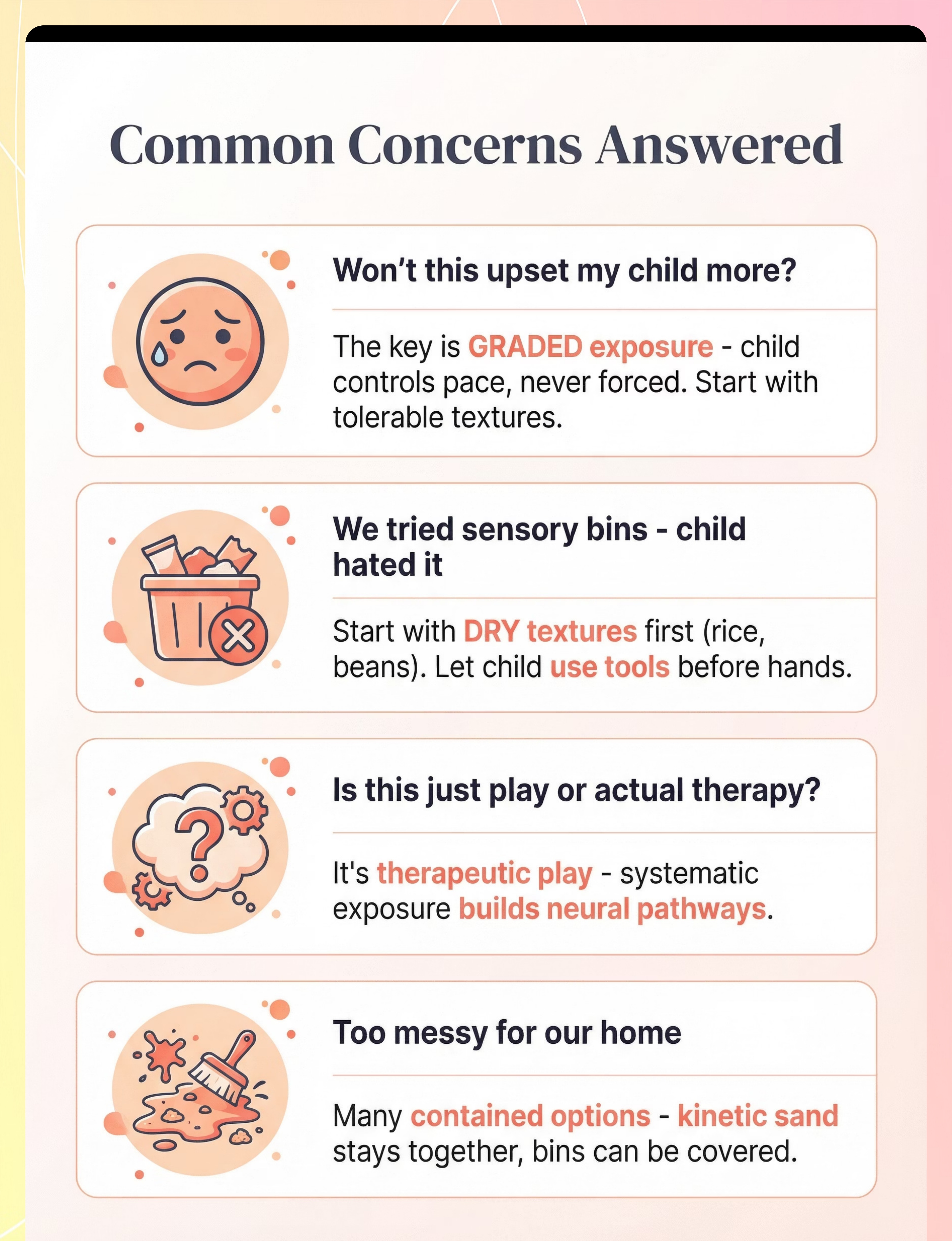
Common Questions (Honest Answers)
We've heard these concerns from hundreds of families. Here are honest, research-informed responses.
Won't this just upset my child more?
Concern: I'm worried introducing textures will increase distress
Response: The key is GRADED exposure - always starting with tolerable textures and never forcing participation. Child controls the pace entirely. We build positive associations first through play and preferred activities. Done right, this approach systematically reduces distress rather than increases it.
Try this: Work with an occupational therapist to create a personalized desensitization program tailored to your child's specific sensory profile.
We tried sensory bins and my child hated it
Concern: Previous attempts failed, why would this work now?
Response: Start with DRY textures like rice or beans before introducing wet materials. Let child use tools first (spoons, cups) rather than direct hand contact. Pair activities with preferred games or toys. Some children need deep pressure input BEFORE tactile exploration to prepare their nervous system.
Try this: Kinetic sand often works when other materials don't - it's less messy, more contained, and has a unique texture many defensive children accept as a first step.
Is this just play or actual therapy?
Concern: Looks like regular play - how is this therapeutic?
Response: It's therapeutic play - the most effective intervention approach for children. The exposure is systematic and purposeful, building neural pathways for tactile processing. Play-based doesn't mean ineffective - it means developmentally appropriate and engaging, which increases consistency and therefore outcomes.
Try this: Track progress using baseline measurements to see measurable changes in tolerance over 4-8 weeks.
Too messy for our home
Concern: I can't handle the cleanup with everything else
Response: Many options are completely contained: kinetic sand stays together naturally, sensory bins can be covered between uses, water beads can be contained in tubs. Set up a designated 'messy play area' with easy-to-clean surfaces. The investment in your child's tolerance is worth the occasional mess, and cleanup can become part of the routine.
Try this: Start with texture boards and fabric swatches - absolutely no mess at all, but still highly effective for building tolerance.
Investment Guide
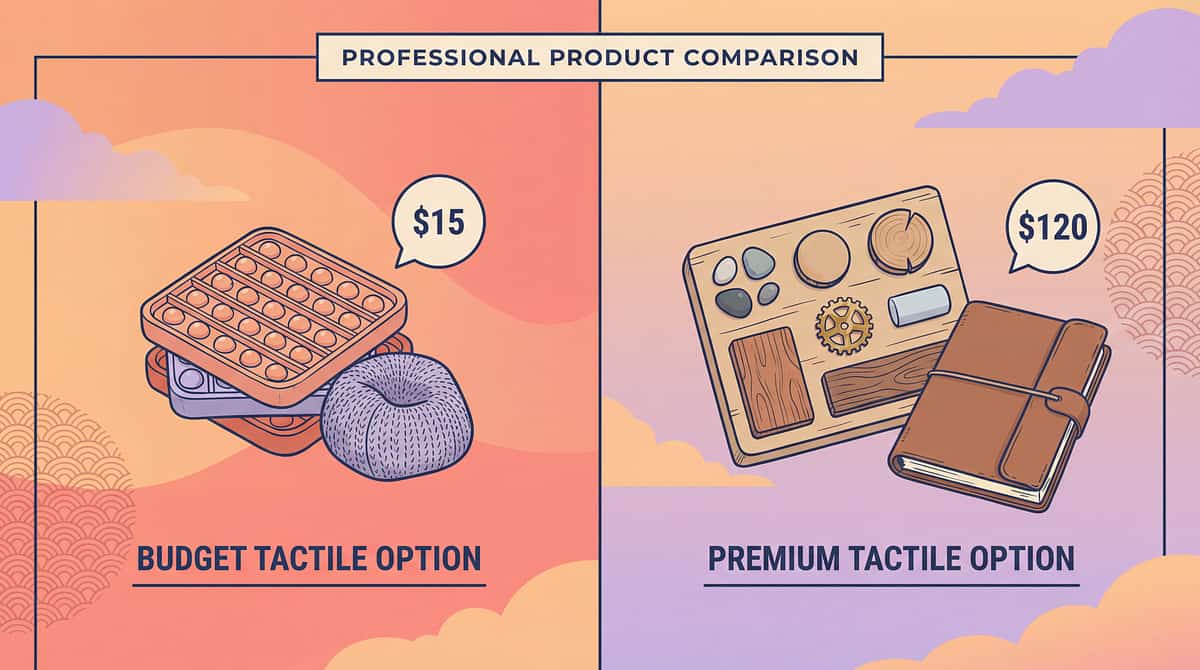
Understanding the financial commitment for sensory tools is crucial. We offer guidance on options ranging from budget-friendly DIY solutions to comprehensive professional kits, with an overall price range of ₹100-2,500 (approximately USD $1-30).
The key is to start small and incrementally build your child's sensory toolkit as their tolerance and engagement develop. Many families find success without needing to invest in the most expensive options right away.
Option Comparison
Cost
₹100-300
₹1,500-2,500
Materials
Household items (rice, beans, pasta)
Clinic-grade, durable materials
Customization
Highly customizable
Variety of textures
Mess Level
Variable, can be messy
Generally contained
Durability
Low
High
Organization
Basic
Professional system
Key Benefits & Value Progression
DIY & Cost-Effective
Utilize common household items to create sensory experiences, minimizing initial investment while allowing for testing and customization.
Tailored & Adaptable
Easily adjust materials based on your child's evolving preferences and tolerance, ensuring a personalized therapeutic journey.
Durable & Comprehensive
Invest in professional-grade kits for a wide range of textures and long-lasting materials, designed for serious intervention.
Phase 1: Exploration
Start with basic, low-cost options to observe your child's initial responses and preferred textures. This phase focuses on gentle introduction and engagement.
Phase 2: Gradual Expansion
As tolerance builds, introduce new materials and activities. This could involve adding more complex textures or a wider range of items within a DIY setup.
Phase 3: Targeted Intervention
If needed, consider a premium kit for specific therapeutic goals, offering a comprehensive and structured approach to sensory integration.
Phase 4: Sustained Growth
Continuous adaptation and integration of sensory play into daily routines, fostering long-term tactile tolerance and sensory regulation skills.

Best Starting Point: Begin with 1-2 components your child is most likely to accept (based on OT assessment), then expand the kit as tolerance builds. Most families achieve excellent results without purchasing the complete premium kit.
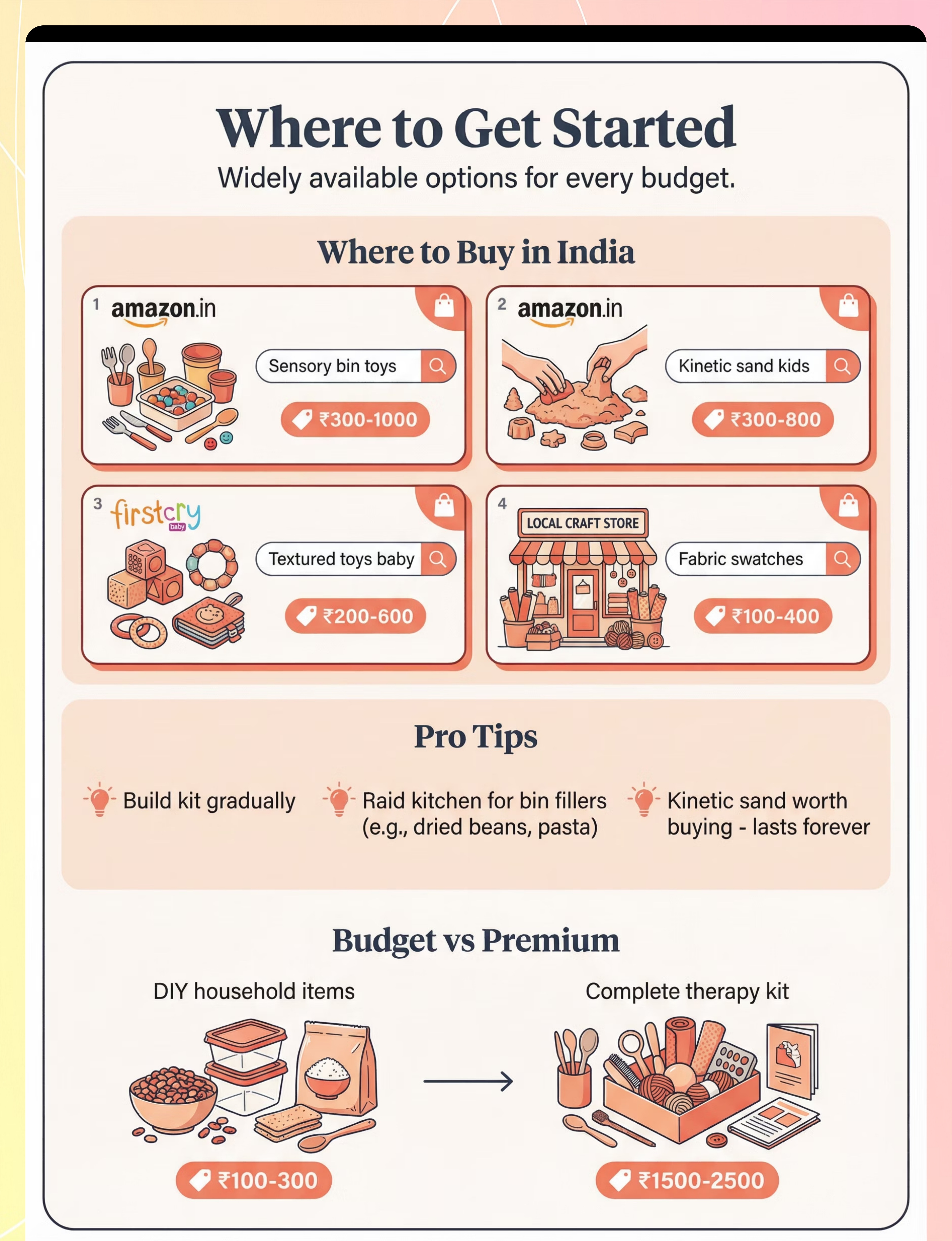
Where to Buy in India
tactile-sensory-kit-texture-exploration therapy material
Availability: Components widely available through multiple platforms; complete professional kits more limited but accessible
Recommended Platforms
Amazon.in
Search Terms: "sensory bin toys kids"
Price Range: ₹300-1,000
Amazon.in
Search Terms: "kinetic sand kids"
Price Range: ₹300-800
FirstCry
Search Terms: "textured toys baby"
Price Range: ₹200-600
Local craft stores
Search Terms: "fabric swatches, texture materials"
Price Range: ₹100-400

Buying Tips ✓
  • Build your kit gradually - don't need everything at once
  • Raid kitchen for free sensory bin fillers (rice, beans, pasta)
  • Fabric stores have inexpensive texture swatches
  • Kinetic sand is worth buying - lasts forever with proper storage
  • Water beads: buy in bulk for economy, very cost-effective

Red Flags
  • Small parts for children who mouth objects (choking hazard)
  • Toxic materials or strong chemical smell indicating unsafe components
  • Water beads marketed to children under 4 without supervision warnings
  • Materials that stain permanently without washable guarantee
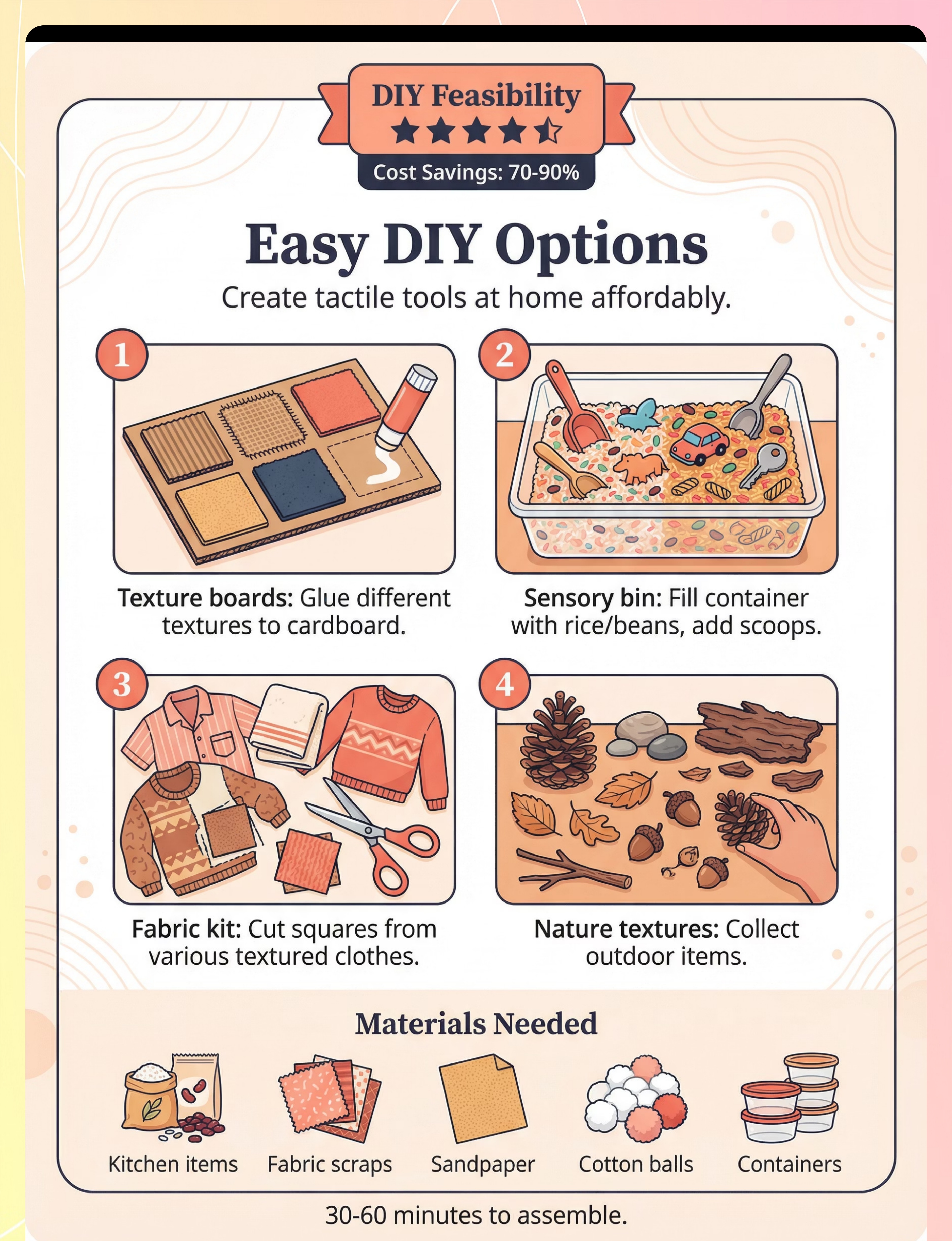
DIY Alternative (Save 70-90%)
DIY Overview
Feasibility: Very High
Cost Savings: 70-90% compared to commercial
Time Investment: 30-60 minutes to assemble complete kit
Materials Needed
  • Rice, beans, pasta (from kitchen)
  • Fabric scraps (from old clothes)
  • Sandpaper, cotton balls (craft store)
  • Containers and bins (household items)
Step-by-Step Instructions
1
Texture Boards
Glue different textures to cardboard squares. Use sandpaper, fabric, bubble wrap, cotton balls, corrugated cardboard.
2
Sensory Bin
Fill large container with rice or beans. Add scoops, small toys to hide, cups for pouring.
3
Fabric Kit
Cut 15x15 cm squares from old clothes with different textures - velvet, denim, silk, fleece, corduroy.
4
Nature Textures
Collect leaves, bark, smooth stones, pinecones, soft moss during outdoor walks.
5
Wet Play
Mix cornstarch with water for oobleck; use shaving cream; make simple finger paint from cornstarch and food coloring.
DIY vs Commercial: When to Choose Which
1
When to DIY
  • Budget-conscious families
  • Testing child's responses initially
  • Customizing to child's specific needs
  • Most sensory bin activities
2
When to Buy Commercial
  • Kinetic sand (can't replicate unique texture)
  • Professional texture boards (durability)
  • Clinic or school use (needs longevity)
  • Specialized tools like therapeutic brushes

Trade-offs to Consider
  • DIY options may not be as durable as commercial products
  • Requires creativity, time, and willingness to experiment
  • Food-based bins need regular replacement to prevent contamination
  • Some professional materials (like kinetic sand) truly can't be replicated at home

Preview of tactile sensory kit texture exploration Therapy Material

Below is a visual preview of tactile sensory kit texture exploration therapy material. The pages shown help educators, therapists, and caregivers understand the structure and content of the resource before use. Materials should be used under appropriate professional guidance.

Page 1
Page 2
Page 3
Page 4
Page 5
Page 6
Page 7
Page 8
Page 9
Page 10
Page 11
Page 12
Page 13
Page 14
Page 15
Page 16
Page 17
Page 18
Page 19
Page 20
Link copied!
Measuring Success & Building Your Kit
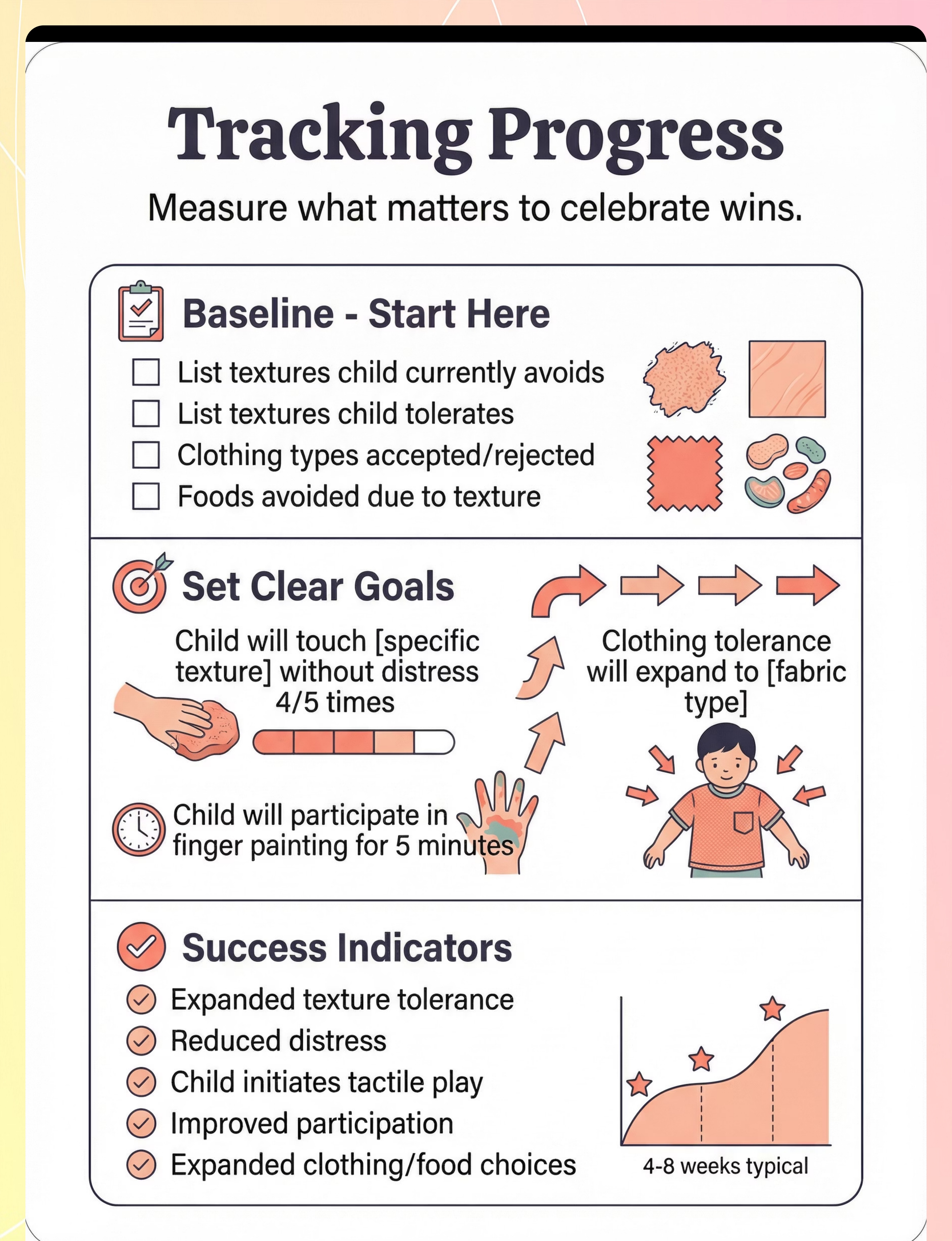
Track Progress Systematically
Baseline (Measure First)
  • List textures child currently avoids
  • List textures child tolerates or seeks
  • Clothing types child will/won't wear
  • Foods avoided due to texture
Goals (Be Specific)
  • Touch [texture] without distress 4/5 opportunities
  • Participate in finger painting for 5 minutes
  • Expand clothing tolerance to [fabric type]
  • Explore sensory bin for 10 minutes independently
Success Indicators
  • Expanded texture tolerance
  • Reduced distress reactions
  • Child initiates tactile play
  • Improved messy play participation
  • Expanded clothing/food tolerance

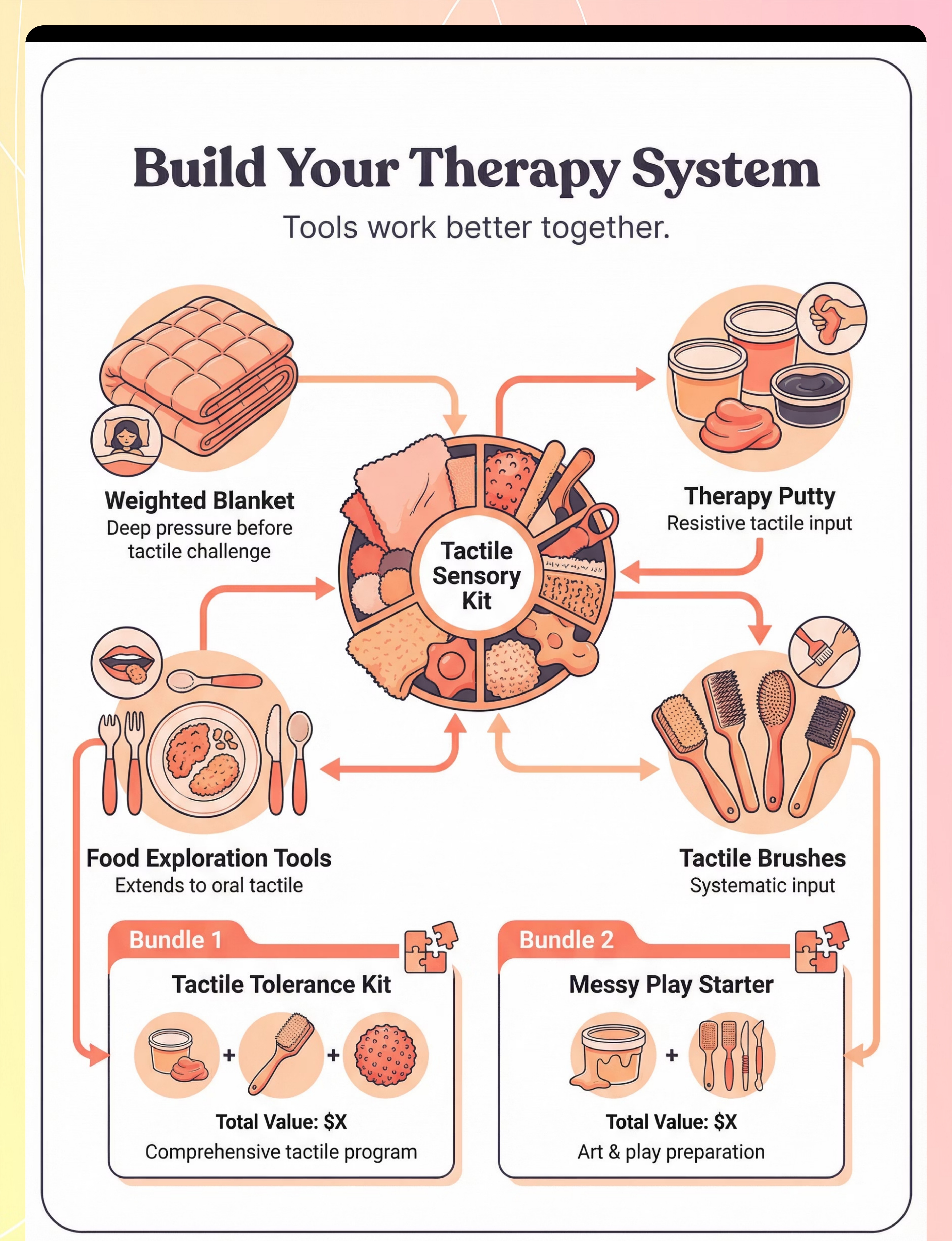
Complete the Kit: Pair It With...
Therapy Putty (ID: 1.6)
Provides resistive tactile input that many defensive children tolerate better than light touch textures
Weighted Blanket (ID: 1.1)
Deep pressure before tactile challenge prepares nervous system; reduces defensive response
Tactile Brushes (ID: 1.7.3)
Systematic tactile input through Wilbarger protocol; requires OT training for proper use
Food Exploration Tools (ID: 12.1)
Extends tactile tolerance work to oral textures; supports feeding therapy goals

Recommended Bundle
Tactile Tolerance Kit: Tactile Sensory Kit (1.7) + Therapy Putty (1.6) + Weighted Blanket (1.1) for comprehensive tactile program
Messy Play Starter: Kinetic Sand (1.7.4) + Finger Paint Set (1.7.7) for art and play preparation

Quick Summary
Tactile sensory kits provide controlled texture exposure for desensitization or seeking, addressing tactile defensiveness that impacts clothing, food, and play. Rank 2 tool with moderate-strong evidence base. OT-recommended approach for systematic tactile processing intervention.
tactile
texture
desensitization
sensory bin
kinetic sand
messy play
OT
defensiveness
Common Searches
tactile sensory kit autism, sensory bin ideas, tactile defensiveness therapy, kinetic sand sensory, texture toys autism, sensory play materials, tactile desensitization

Get Support
FREE National Autism Helpline
Phone: 9100 181 181
Languages: 16+ Indian languages
Website: pinnacleblooms.org
AbilityScore®
Identifies your child's specific tactile processing patterns through comprehensive assessment.
TherapeuticAI®
Sequences a personalized tactile desensitization program based on your child's sensory profile.
EverydayTherapyProgramme™
Includes daily tactile activities integrated into natural routines.
Daily Living & Independence Index
Tracks clothing tolerance and self-care skill improvements over time.

Important Disclaimer
This is educational information designed to support families and professionals. Always consult qualified occupational therapists, speech-language pathologists, or pediatricians for personalized assessment and intervention planning. Individual results vary based on child's unique profile, consistency of intervention, and family support. This material does not replace professional clinical judgment.