Tool ID: 18.4
Tool ID: 18.4
SpEd + Psychology
Strong Evidence
Rank #1
As Needed
Free
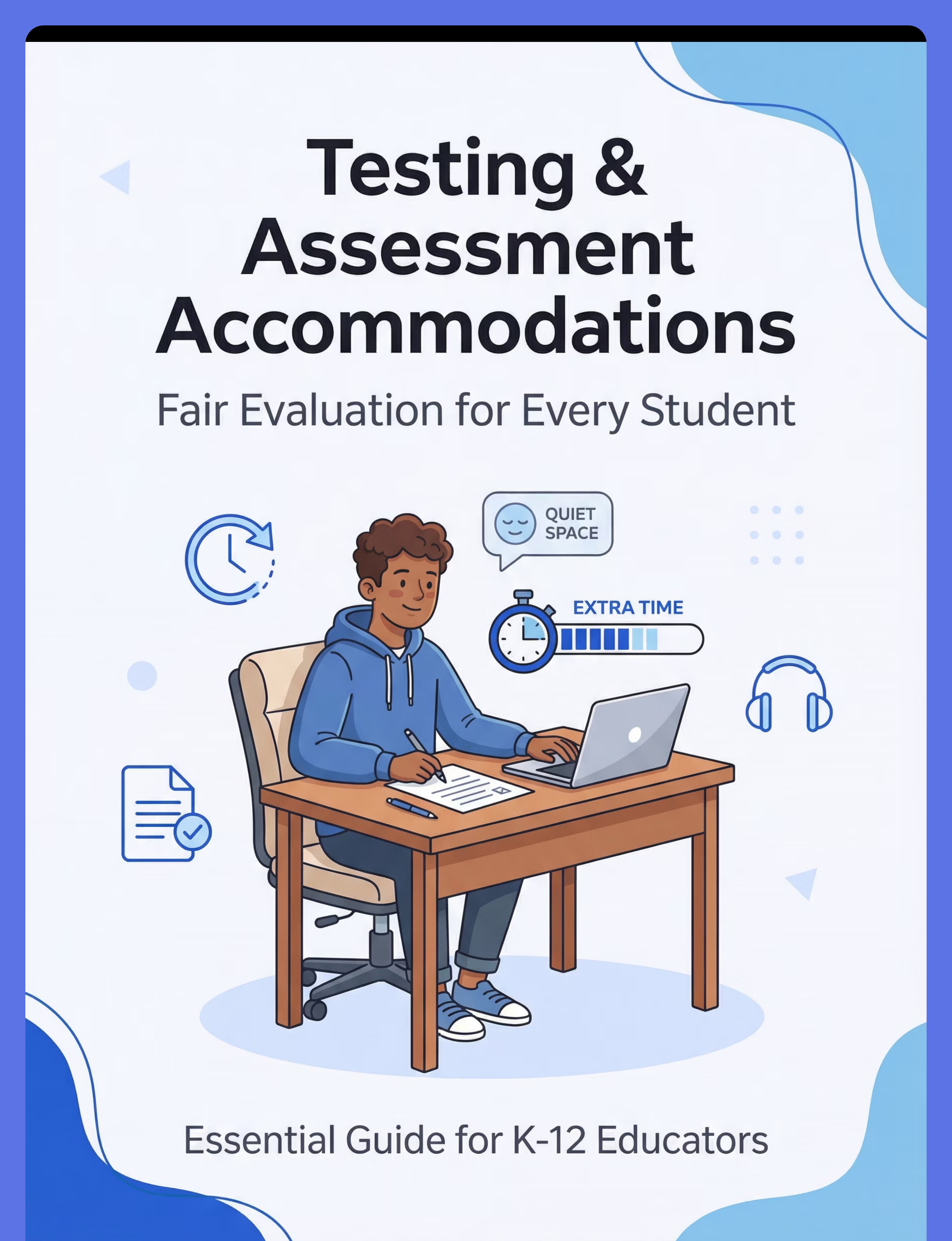
Testing & Assessment Accommodations
Academic evaluation accommodation system
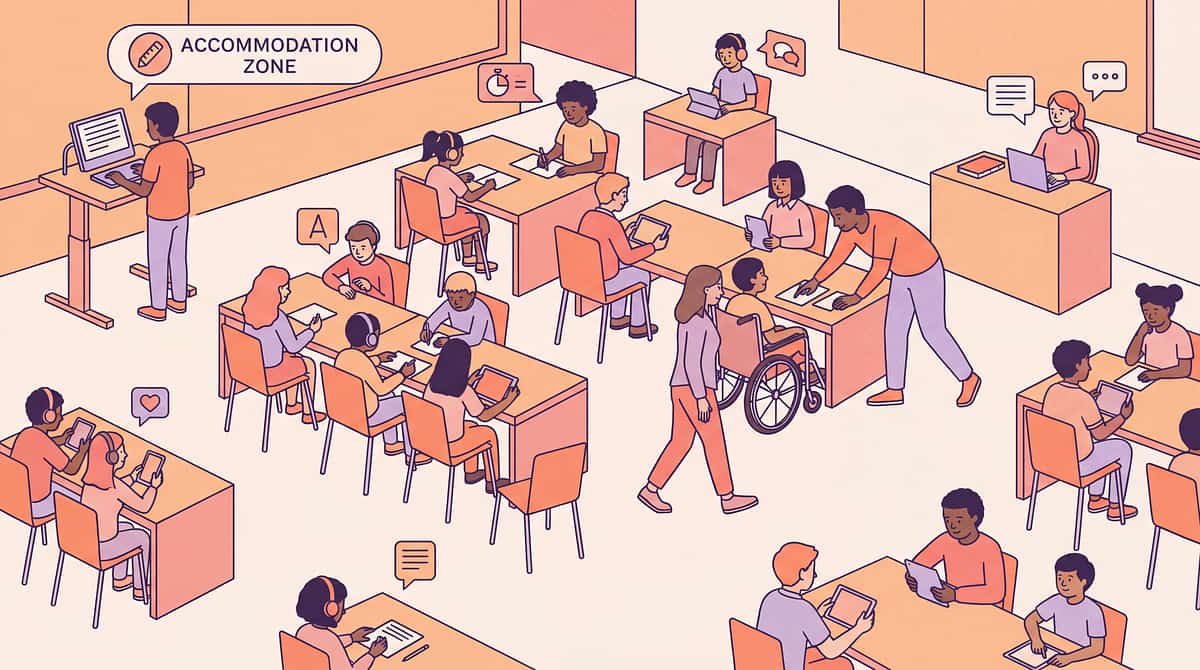
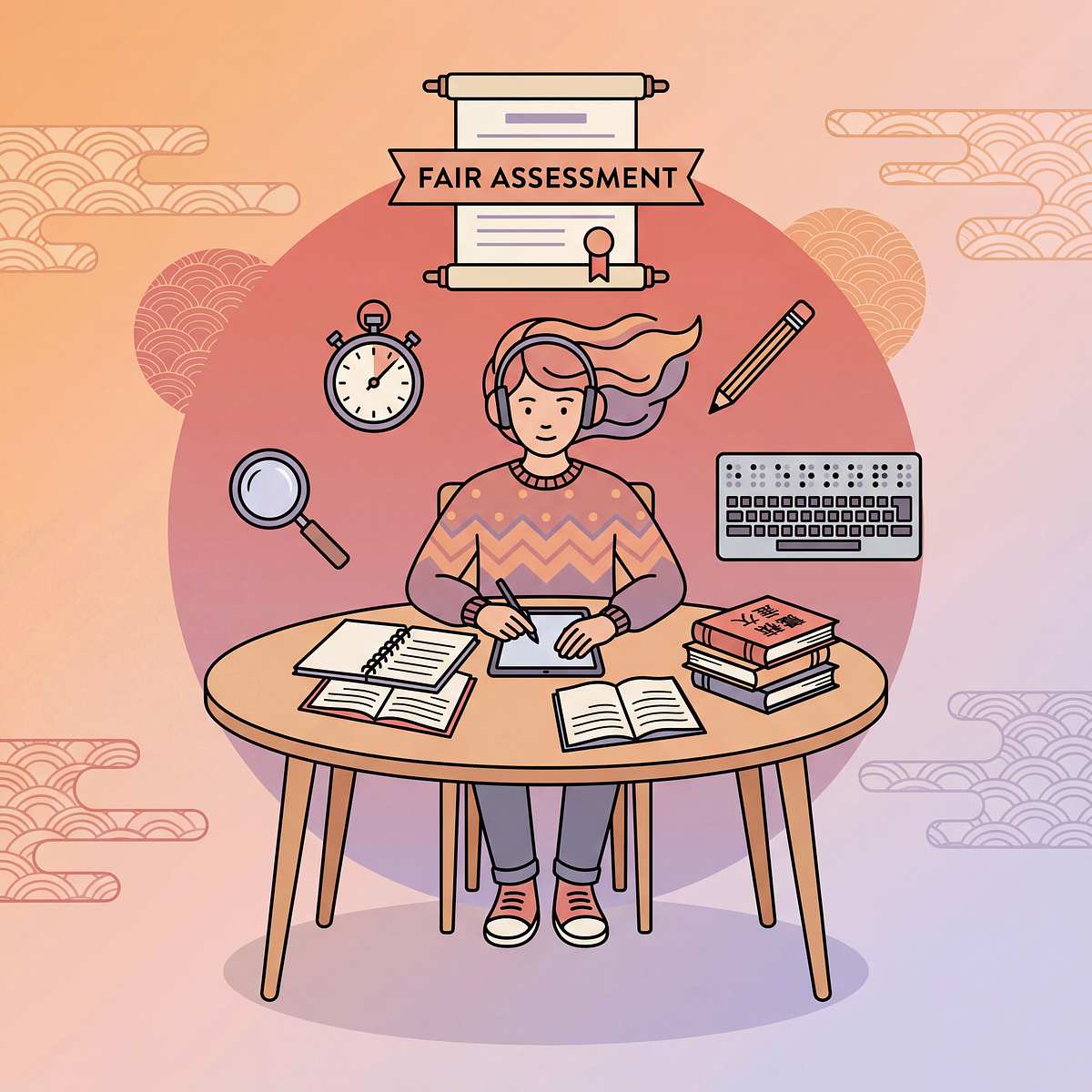
Ensure fair evaluation of your child's true knowledge and abilities through documented accommodations that remove barriers related to disability. These supports don't give advantages—they level the playing field so tests measure what your child knows, not how fast they process or how well they handle distractions.
Who This Helps
Core function: Provide accommodations during tests and assessments to ensure fair evaluation of knowledge and skills without barriers related to disability.
Fair Assessment
Anxiety Reduction
Accurate Evaluation
Access
Self-Efficacy
Academic Success
Processing Speed Differences
Children who know material but can't finish tests in time due to processing speed differences or written output challenges, where standard time isn't enough to demonstrate knowledge.
Test Anxiety
Students whose test anxiety blocks access to knowledge, where panic and overwhelm during testing prevent them from showing what they actually know.
Environmental Challenges
Learners who struggle with standard testing environments due to distractions, sensory overload, or other environmental factors that prevent focus and accurate performance.
All Age Ranges
Applicable to all school ages and continues through higher education with proper documentation, ensuring consistent support.
Diverse Testing Settings
Supports all testing situations at school, providing necessary accommodations across various academic environments.
Does This Sound Familiar?
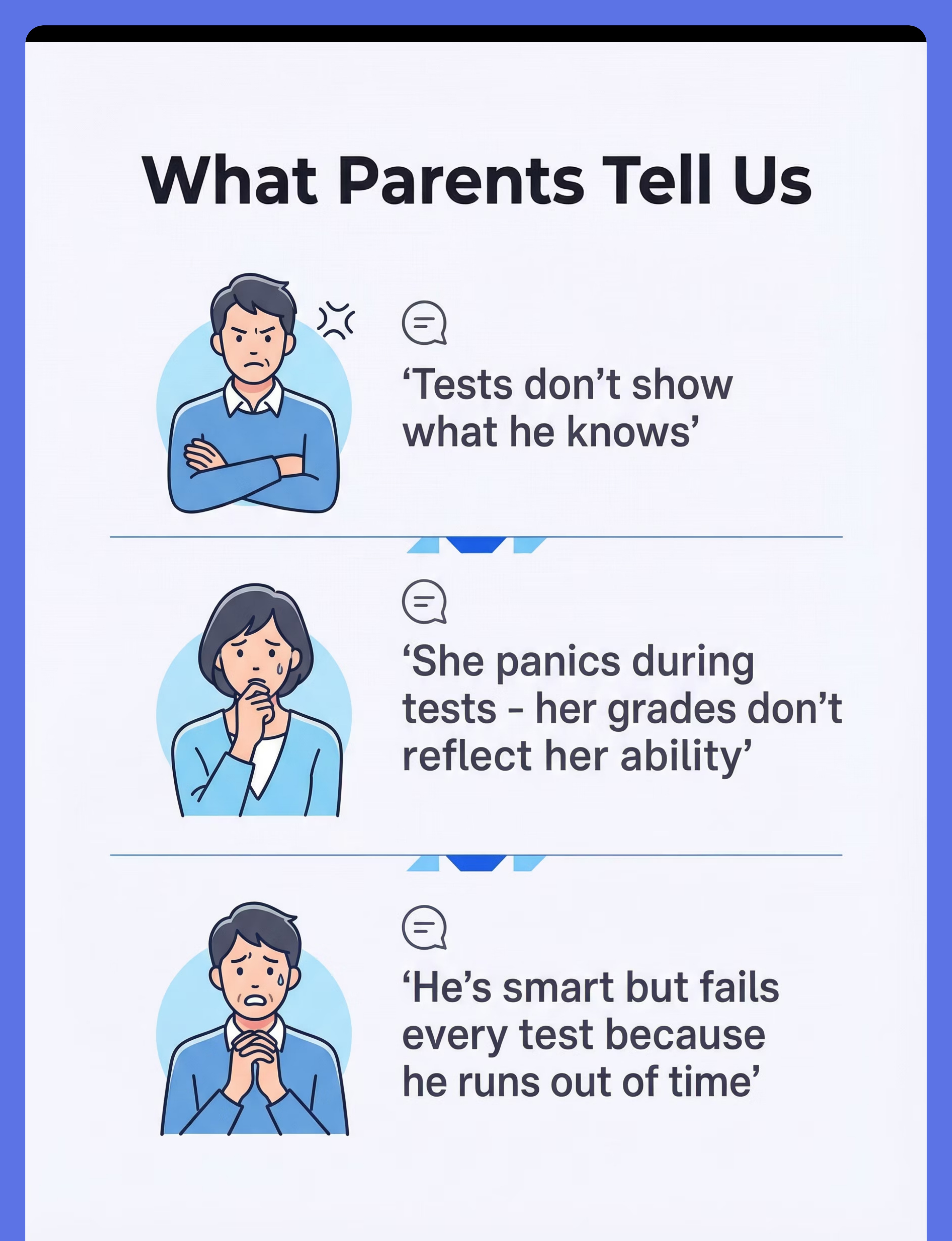
"Tests don't show what he knows. He understands everything at home, but his scores are terrible. It's so frustrating."
"She panics during tests. Complete freeze. She knows the material but anxiety takes over every time."
"He runs out of time every single test. Always the last one still writing when time's called."
"The testing environment overwhelms her. Too many students, too much noise, too many distractions."
"His grades don't reflect his ability at all. We know he's smart, but tests don't show it."
"She's incredibly intelligent but fails tests consistently. Something's not working."
You're not alone. These are common challenges that testing accommodations are specifically designed to address.
A Day Without the Right Support
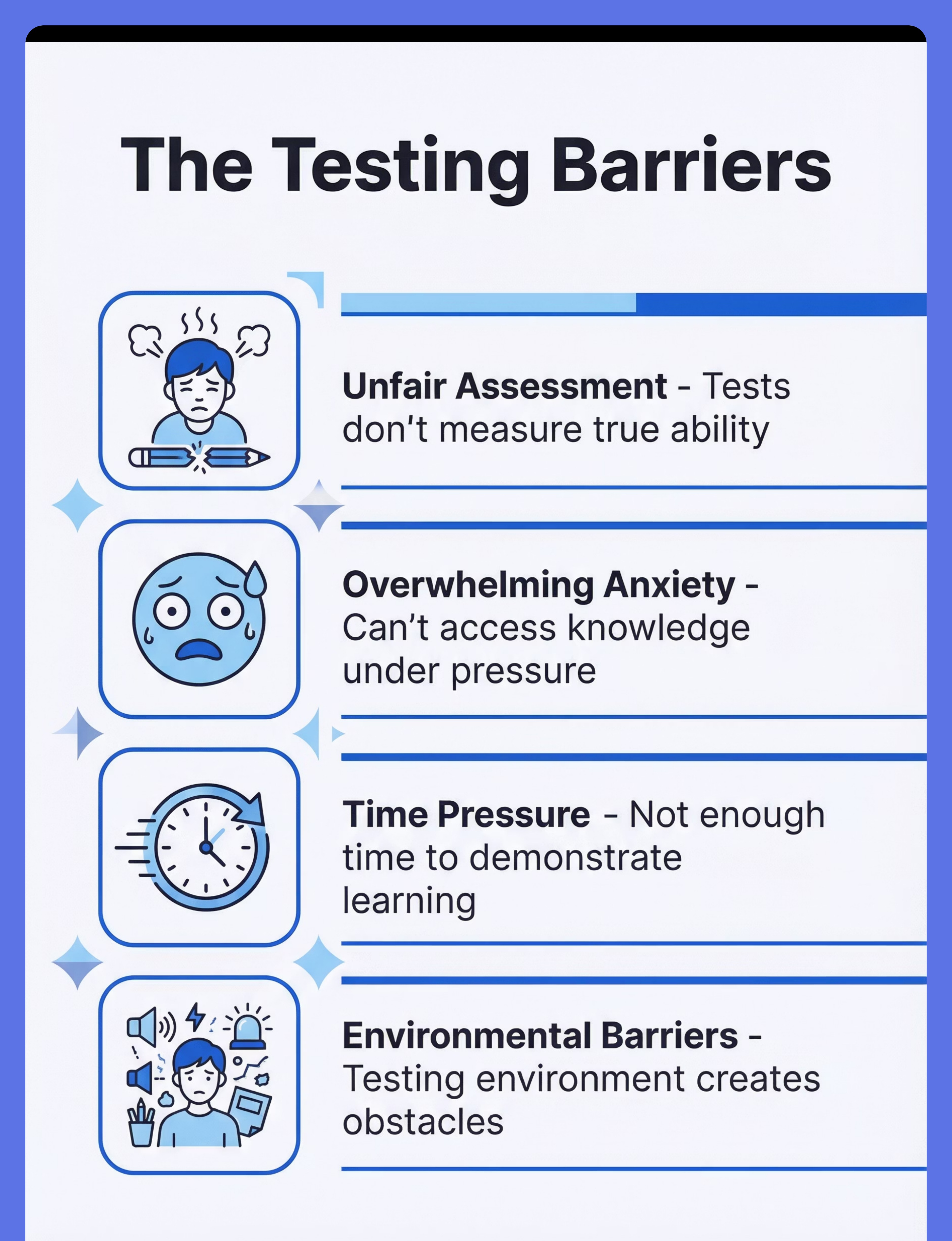
Unfair Assessment
Tests don't accurately measure ability. Your child knows the material but can't demonstrate it. Scores don't reflect learning. Academic potential hidden.
Test Anxiety
Overwhelming anxiety during testing. Panic blocks access to knowledge. Physical symptoms interfere. Can't think clearly under pressure.
Time Pressure
Never enough time to show what they know. Processing speed slower than peers. Written output takes longer. Incomplete tests despite full understanding.
Environmental Barriers
Testing environment itself becomes the barrier. Distractions everywhere. Sensory overload. Can't concentrate with 30 other students around.
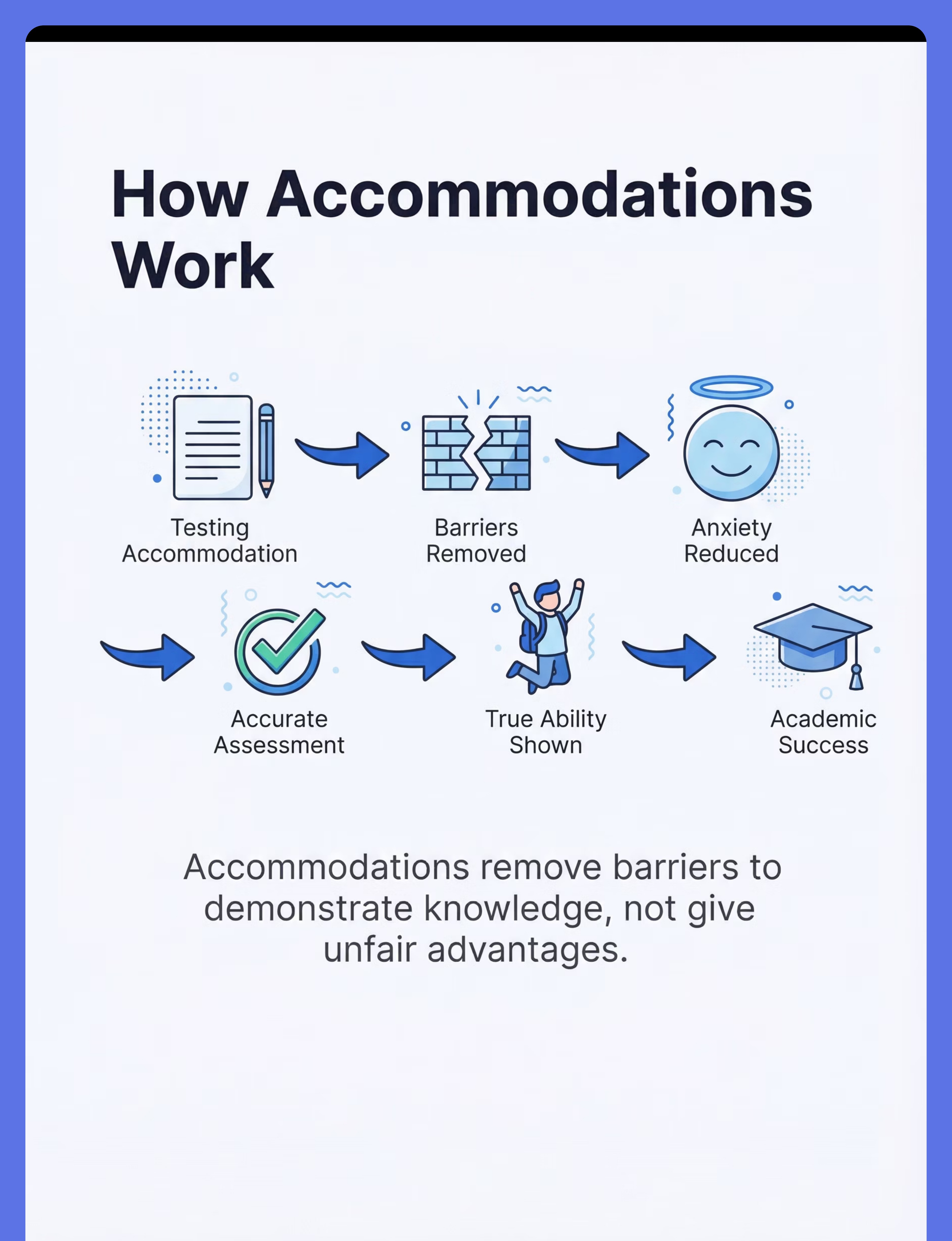
The Science Behind It
Testing Accommodation
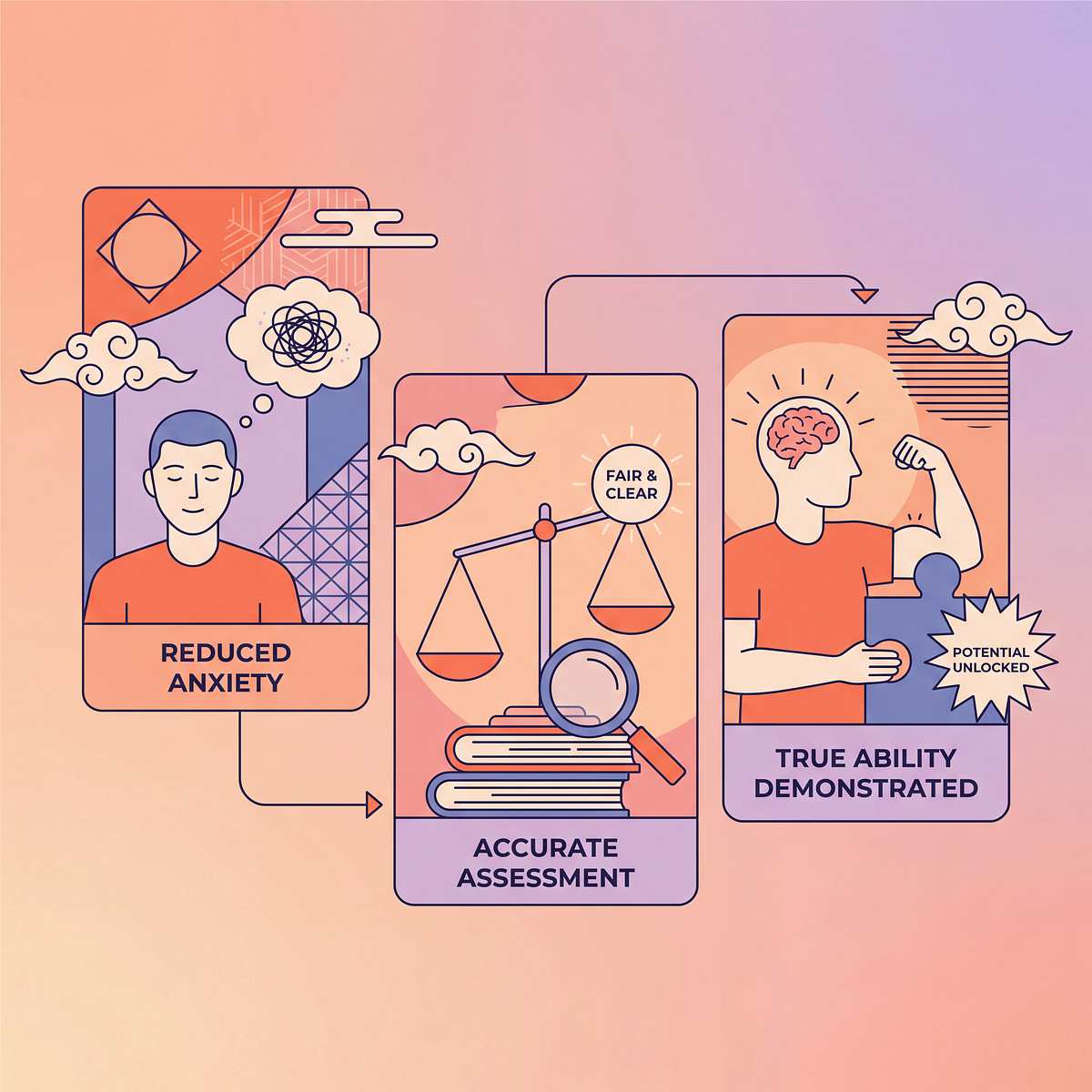
Documented supports that address specific barriers
Barriers Removed
Environmental, timing, or format obstacles eliminated
Anxiety Reduced
Stress decreases when fair conditions provided
True Ability Demonstrated
Knowledge accessed and expressed accurately
Accurate Assessment
Test scores reflect actual learning and understanding
Appropriate Programming
Educational decisions based on accurate data
Academic Success
Student achieves based on true ability
Self-Efficacy
Confidence grows with fair assessment
Testing accommodations create the conditions for fair assessment. When barriers are removed, your child's true knowledge and abilities shine through.
Fair Assessment
Anxiety Reduction
Accurate Evaluation
Access
Self-Efficacy
Academic Success
How to Use It Right
Document in IEP/504 Plan
All accommodations must be formally documented in your child's Individualized Education Program or 504 plan. This ensures legal protection and consistent implementation across all testing situations.
Practice Accommodations Before High-Stakes Tests
Children need experience using their accommodations before critical assessments. Practice builds familiarity, reduces anxiety, and ensures effective use during important tests.
Same Accommodations for All Tests
Consistency is crucial. Use documented accommodations for daily quizzes, unit tests, and major exams—not just high-stakes assessments. This builds skill and confidence.
Child Understands and Uses Accommodations
Your child should know what accommodations they have and feel comfortable requesting them. Self-advocacy is an essential skill that grows with practice and support.
Regular Review of Need
Accommodation needs may change over time. Review effectiveness annually during IEP meetings and adjust as your child's needs evolve.
Coordinate with Testing Organizations
For standardized tests like board exams, apply early for accommodations through the testing organization. Your IEP/504 documentation supports these requests.
Typical Duration: Throughout testing period, as documented in IEP/504
Expert Perspective
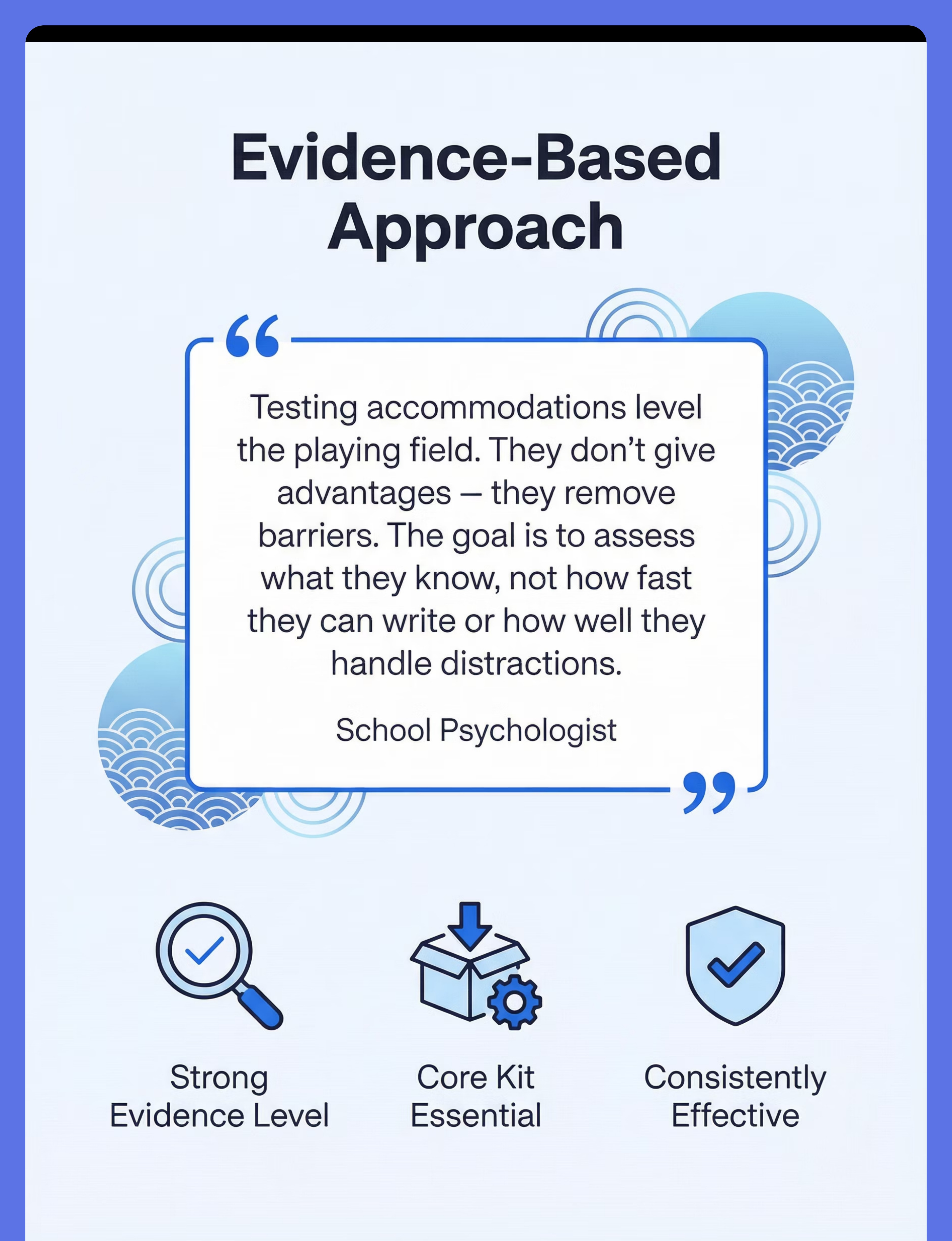
"Testing accommodations level the playing field. They don't give advantages - they remove barriers. A child who needs extended time due to processing speed differences should receive it. The goal is to assess what they know, not how fast they can write or how well they handle distractions."
— School Psychologist
SpEd + Psychology Recommended
Strong Evidence
Rank #1 in Category
Core Kit
testing-assessment-accommodations therapy material
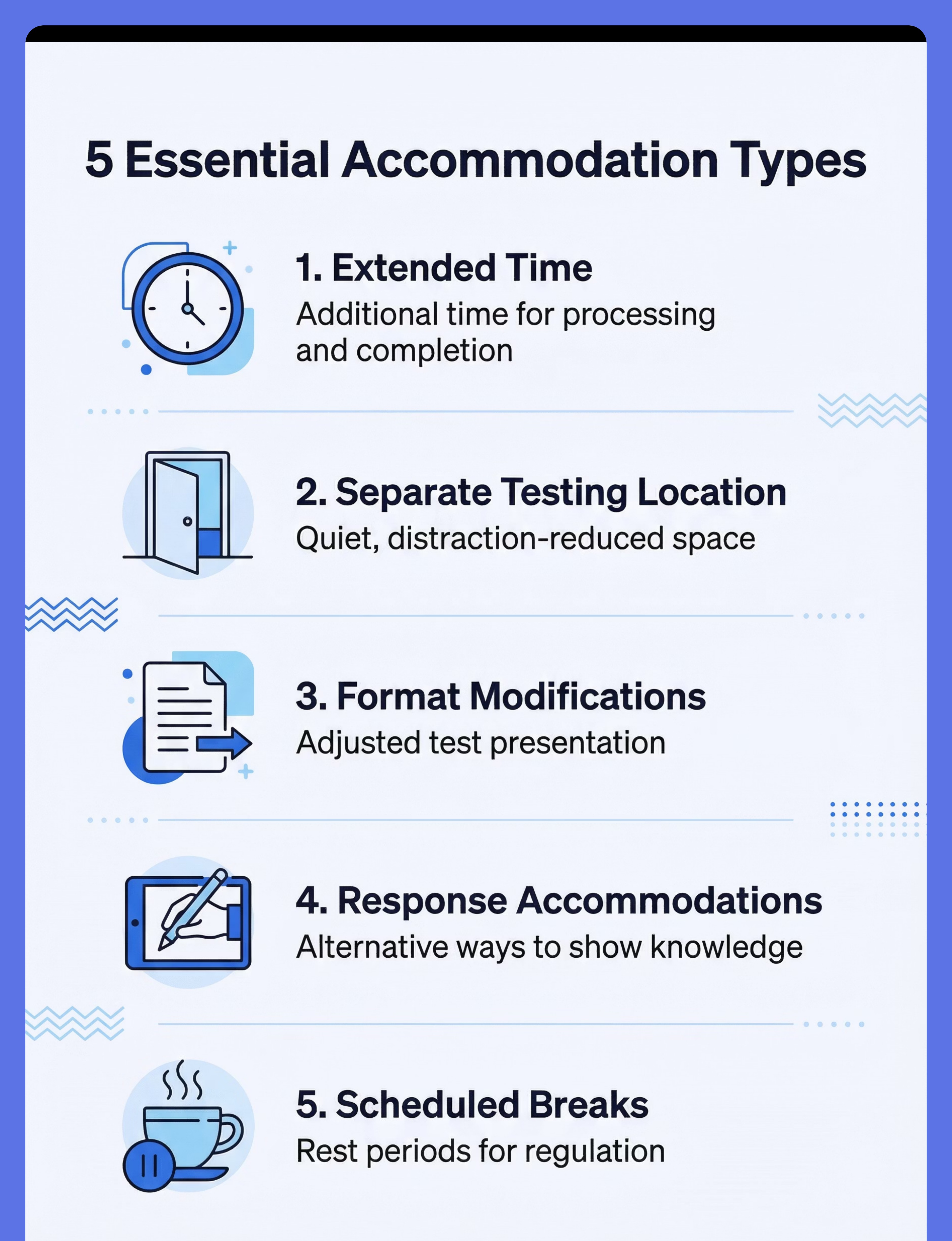
Choose Your Option (5 Accommodations)
All testing accommodations are free and provided through your child's IEP or 504 plan. Choose based on your child's specific barriers to accurate assessment.
1
Extended Time
2
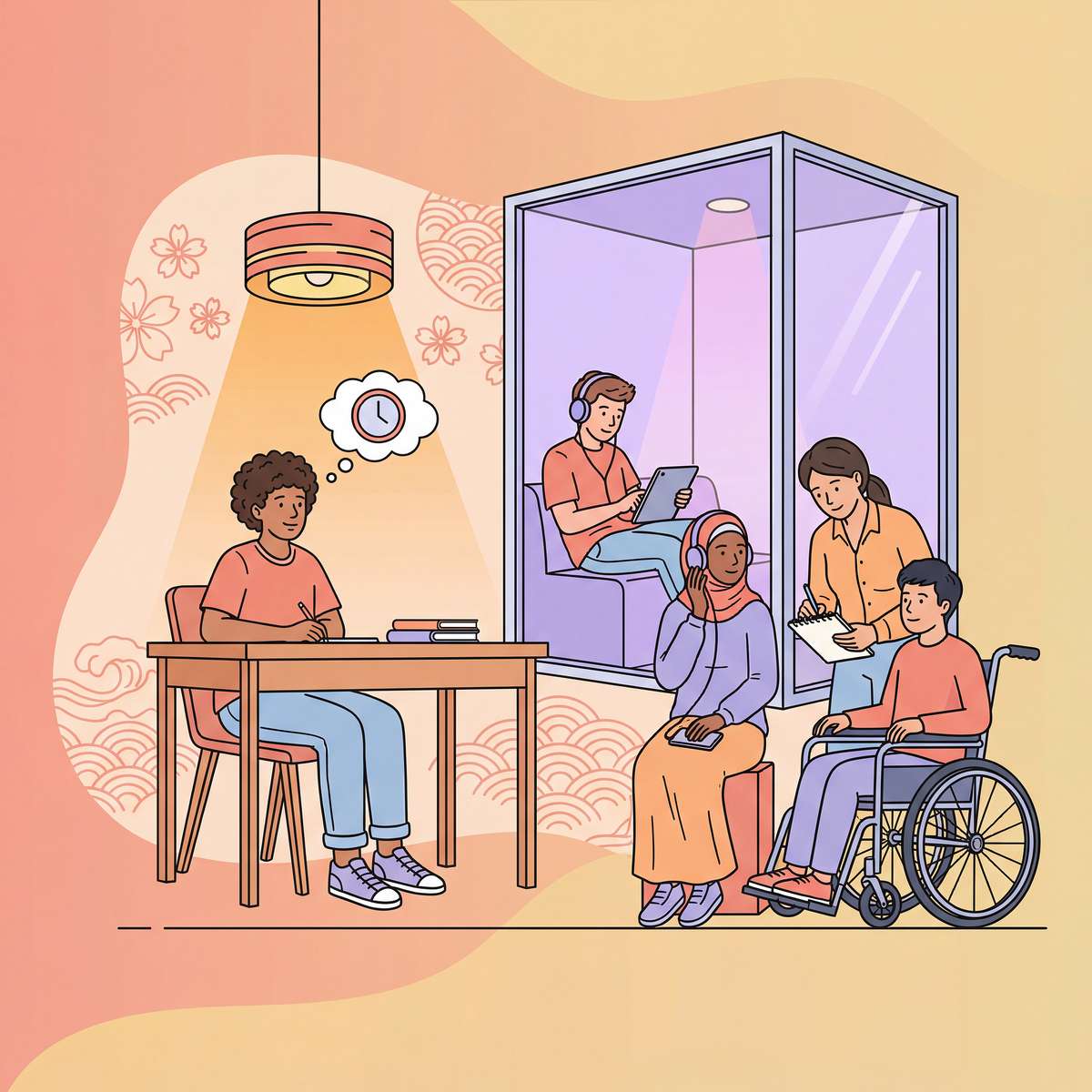
Separate Testing Location
3
Format Modifications
4
Response Accommodations
5
Breaks During Testing
Extended Time: Additional time for tests (typically 1.5x or 2x standard time).

Type: Time accommodation
Best for: Processing speed, anxiety, written output
Ages: All school ages
Settings: School
Cost: Free (IEP/504)
Separate Testing Location: Quiet/individual testing space away from classroom.

Type: Environmental accommodation
Best for: Distractibility, anxiety, sensory needs
Ages: All school ages
Settings: School
Cost: Free (IEP/504)
Format Modifications: Modified test format (large print, read aloud, highlighted text).

Type: Presentation accommodation
Best for: Reading difficulties, visual processing
Ages: All school ages
Settings: School
Cost: Free (IEP/504)
Response Accommodations: Alternative response methods (verbal, scribe, word processor).

Type: Output accommodation
Best for: Writing difficulties, motor issues
Ages: All school ages
Settings: School
Cost: ₹0–500 (mostly free; assistive tech may have cost)
Breaks During Testing: Scheduled or as-needed breaks during assessment.

Type: Timing accommodation
Best for: Attention, regulation, fatigue
Ages: All school ages
Settings: School
Cost: Free (IEP/504)

How to Choose
  • By primary barrier: Time pressure → Extended Time; Distractions → Separate Location; Reading → Format Modifications; Writing → Response Accommodations; Regulation → Breaks
  • By setting needs: Most accommodations work across all school testing situations
  • By child preference: Involve your child in identifying which supports help most
Specifications & Types Guide
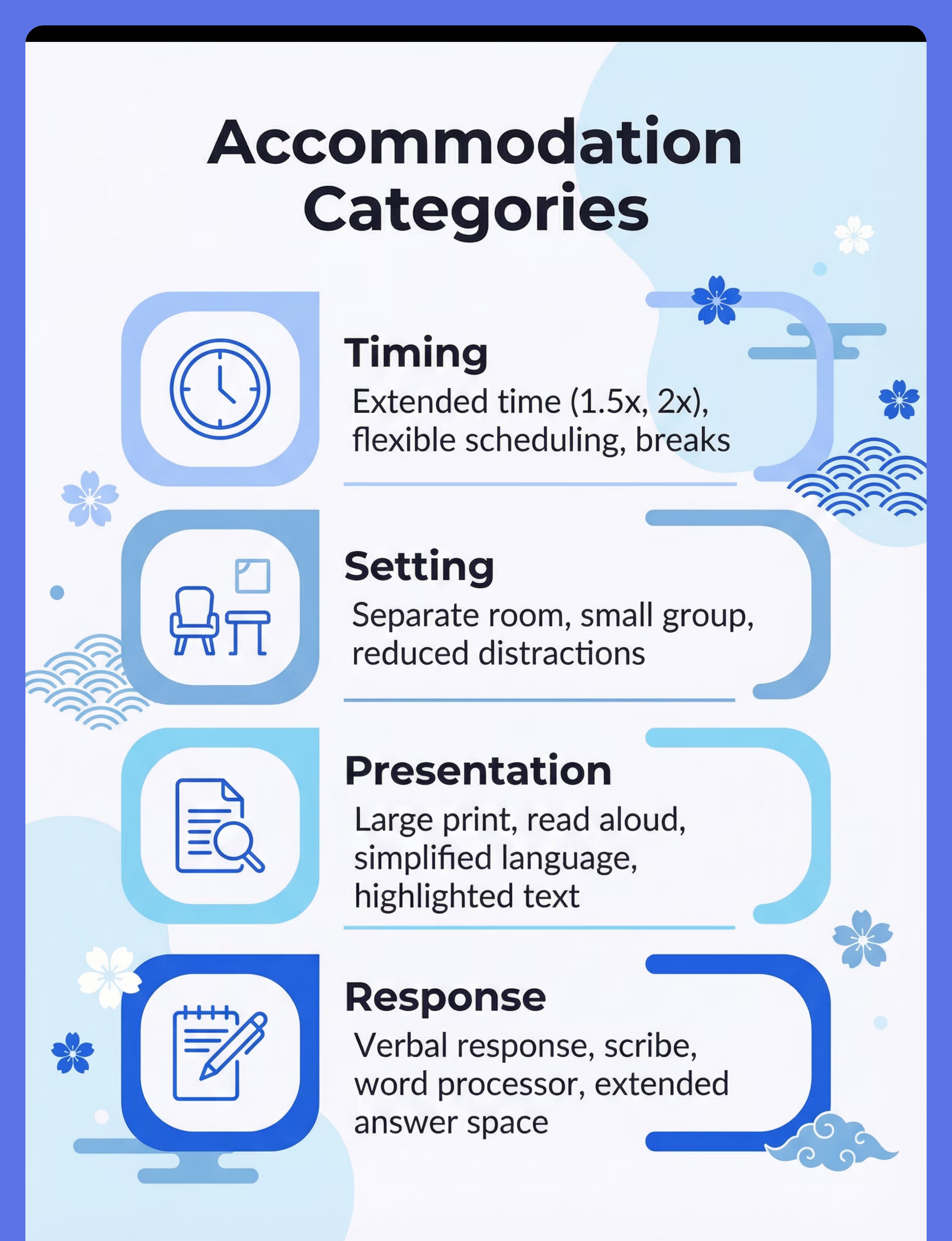
Accommodation Types
Timing Accommodations
  • Extended time (1.5x or 2x standard)
  • Scheduled breaks between sections
  • Flexible scheduling across days
  • Unlimited time for specific sections
Setting Accommodations
  • Separate room (individual or small group)
  • Reduced distractions environment
  • Preferential seating in regular classroom
  • Familiar proctor/teacher
Presentation Accommodations
  • Large print materials
  • Read aloud by proctor or audio
  • Simplified language instructions
  • Highlighted or color-coded text
Response Accommodations
  • Verbal response to scribe
  • Word processor for written answers
  • Extended answer space
  • Graphic organizers provided
Other Accommodations
  • Fidgets or sensory tools allowed
  • Frequent check-ins for understanding
  • Calculator or math aids when appropriate
  • Visual supports or schedules
Materials & Key Features
testing-assessment-accommodations therapy material
Required Documentation
  • IEP or 504 plan with accommodations listed
  • Psychoeducational evaluation results
  • Testing space designated by school
  • Timer or scheduling system
  • Alternative materials as specified
Key Implementation Features
  • Documented: Formally written in IEP/504 plan with specific details
  • Practiced: Used regularly before high-stakes assessments
  • Consistently applied: Provided for all tests, not just major ones
  • Appropriate to needs: Matched to documented barriers and evaluation results
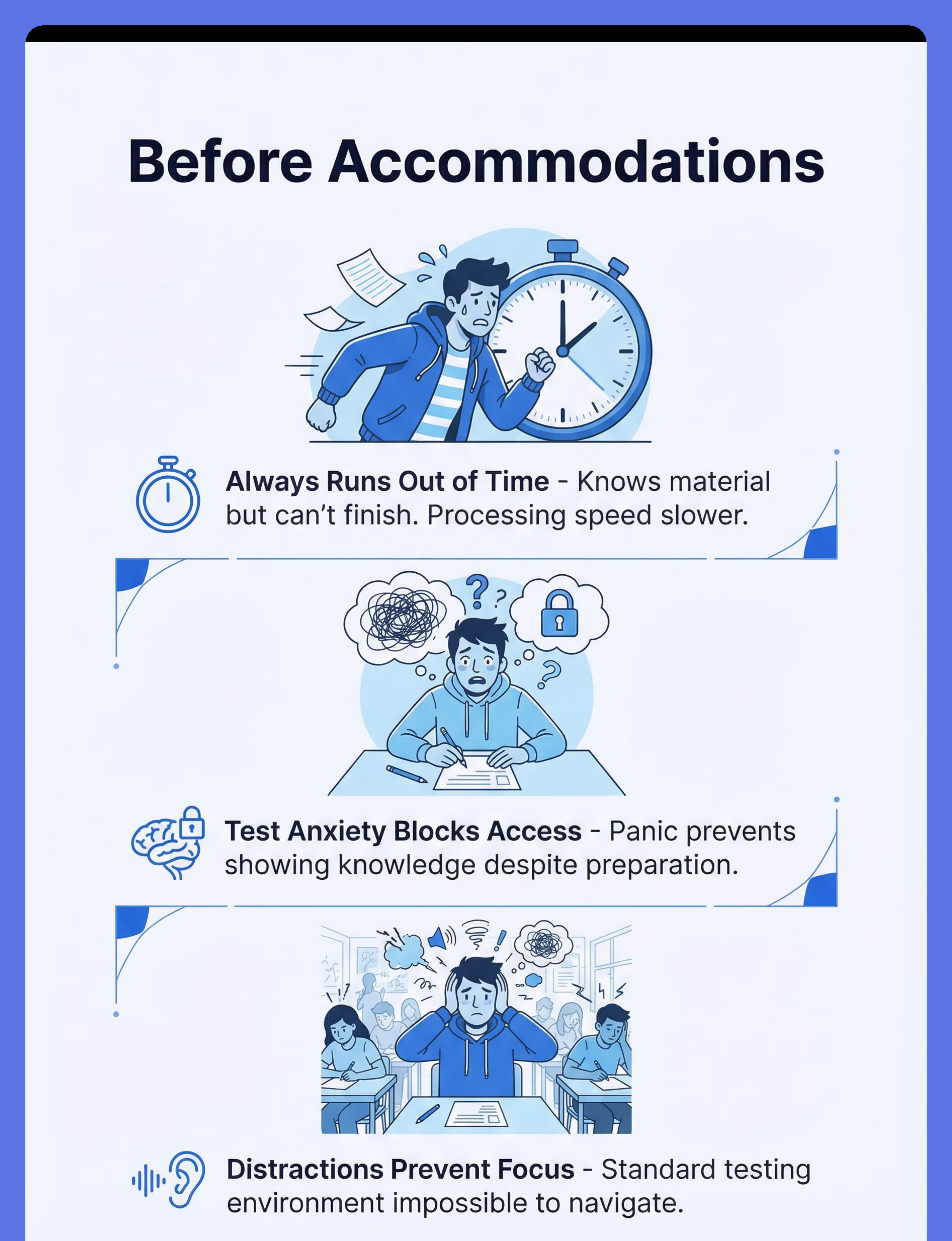
The Struggle (Before)
Always Runs Out of Time
Situation: Child knows material but can't finish in time. Processing speed slower. Written output slow. Fails tests despite knowledge.
Experience: Watching the clock with panic. Knowing answers but not enough time to write them. Incomplete tests. Failing grades that don't reflect understanding.
Emotion: Rushed, failing, frustrated, defeated
Test Anxiety Overwhelming
Situation: Panic during tests. Can't think. Freezes. Knows material but anxiety blocks access. Test scores don't reflect knowledge.
Experience: Heart racing, hands shaking, mind going blank. The knowledge is there but panic makes it unreachable. Watching other students finish while frozen in fear.
Emotion: Panicked, blocked, helpless, terrified
Distractions Prevent Focus
Situation: Standard classroom testing impossible. Other students, noises, movement all distracting. Can't concentrate. Poor performance.
Experience: Every pencil tap, every cough, every shuffle breaks concentration. Rereading the same question over and over. Unable to focus long enough to answer.
Emotion: Distracted, unable, overwhelmed, frustrated
The Breakthrough (After)
Always Runs Out of Time
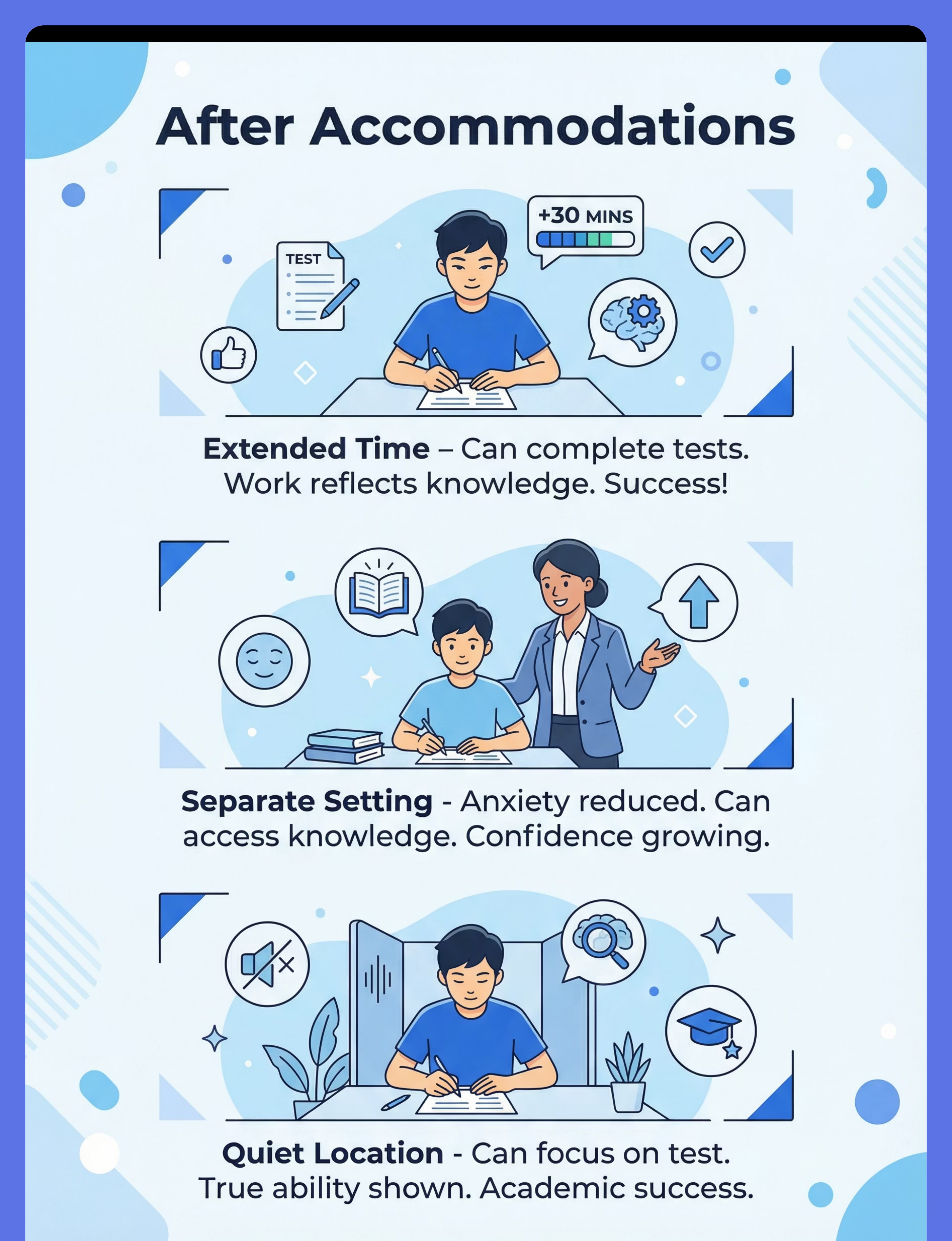
Situation: Extended time accommodation (1.5x or 2x). Can complete tests. Work reflects knowledge. Grades improve. Success!
Experience: Finally enough time to show what you know. Writing at your own pace. Completing tests fully. Grades that reflect your actual learning. Academic confidence growing.
Emotion: Adequate time, succeeding, confident, capable
Immediate (once in IEP)
Test Anxiety Overwhelming
Situation: Separate room, breaks, familiar proctor. Anxiety reduced. Can access knowledge. Tests reflect ability. Confidence growing.
Experience: Testing in a calm, quiet space with a supportive adult. Taking breaks when needed. Anxiety manageable. Mind clear. Knowledge accessible. Success!
Emotion: Calmer, accessing, capable, growing
2-4 weeks with practice
Distractions Prevent Focus
Situation: Separate testing location. Reduced distractions. Can focus on test. True ability shown. Academic success.
Experience: Quiet room, minimal distractions, able to concentrate fully. Reading questions once and understanding. Answering confidently. Test scores finally showing what you know.
Emotion: Focused, succeeding, proud, accomplished
Immediate (once in IEP)
What to Expect (Realistic Timelines)
Testing needs identified
Evaluation completed and specific barriers documented. Team understands what prevents accurate assessment of knowledge.
1-2 weeks
Accommodations documented in IEP/504
Formal meeting held, accommodations written into plan. Legal protections in place. School required to provide supports.
2-4 weeks
Accommodations practiced
Child gains experience using supports. Familiarity builds. Anxiety decreases. Knows what to expect and how to use accommodations effectively.
2-4 weeks
More accurate test results
Test scores begin to reflect actual knowledge and learning. Discrepancy between ability and performance decreases. Fair assessment achieved.
Next testing period
Improved academic confidence
Self-efficacy grows with fair testing. Child recognizes their own abilities. Academic identity strengthens. Positive cycle begins.
Ongoing
Remember: Progress isn't always linear. Some accommodations work immediately, while others require practice and adjustment. The goal is fair, accurate assessment—and that's worth the process.
Is This Right for My Child? (2-Minute Check)
Do test scores not reflect your child's actual knowledge?
You know your child understands the material at home or in conversation, but test results tell a different story. There's a clear gap between what they know and what tests show.
If yes, this indicates: Testing accommodations may help bridge this gap by removing barriers to demonstrating knowledge.
Does your child run out of time on tests?
Consistently the last one writing when time is called. Often leaves questions blank not from lack of knowledge, but lack of time. Processing or writing speed creates time pressure.
If yes, this indicates: Extended time accommodation may help provide adequate opportunity to demonstrate learning.
Does test anxiety significantly impact performance?
Your child shows physical signs of anxiety during tests—panic, freezing, blank mind. The anxiety itself becomes a barrier to accessing and expressing knowledge.
If yes, this indicates: Environmental accommodations (separate setting, breaks) may help reduce anxiety and improve access to knowledge.
Are testing accommodations in your child's IEP/504?
Formal documentation of accommodations ensures consistent implementation and legal protection for your child's rights to fair assessment.
If yes: Good - ensure implementation and monitor effectiveness.
If no: Request evaluation for accommodations through IEP/504 process.

Scoring Guide: 3 or more "yes" answers = strong fit for testing accommodations. Even 1-2 "yes" answers warrant discussion with your child's educational team about evaluation for accommodations.
Common Questions (Honest Answers)
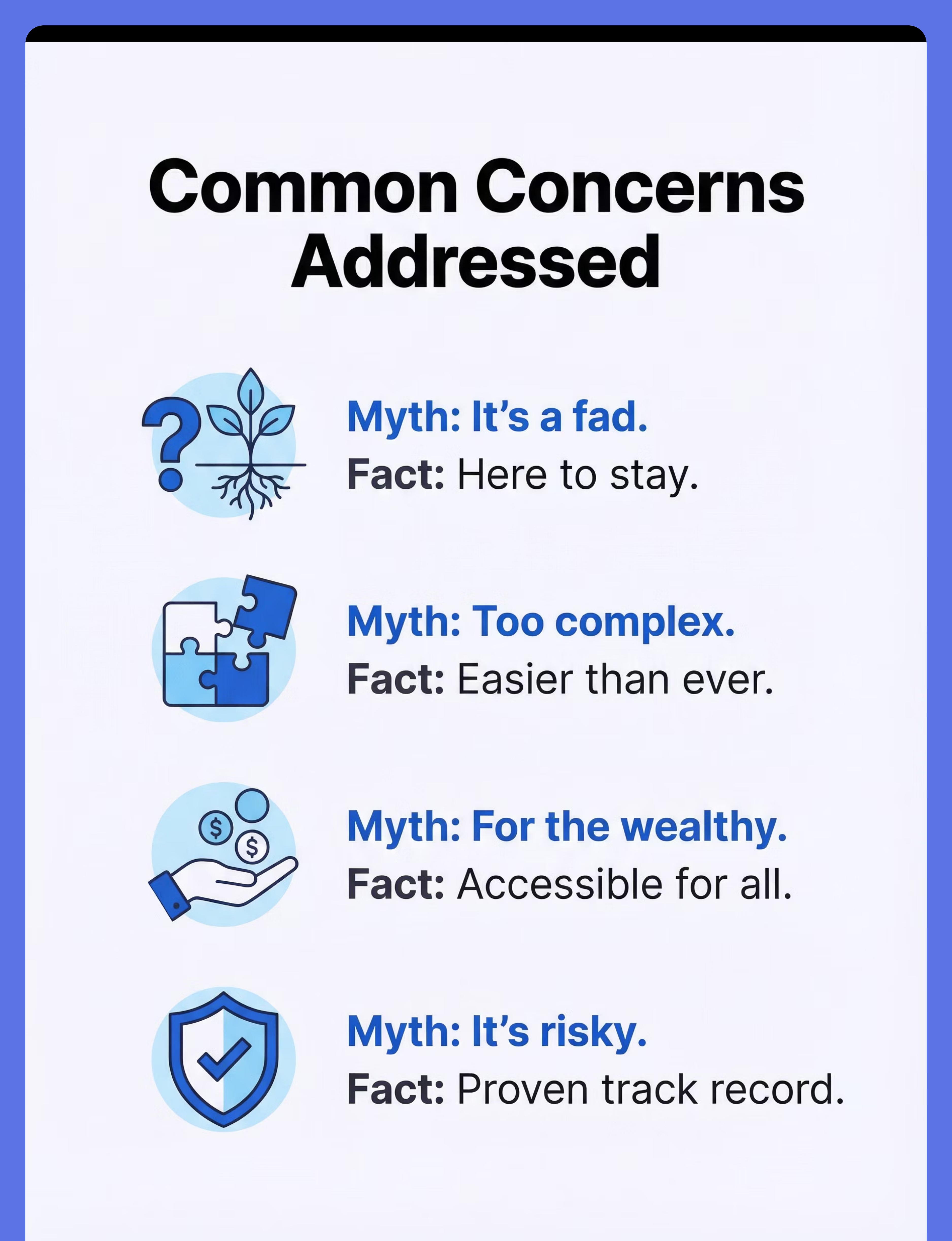
"That's giving them an unfair advantage"
Accommodations remove barriers, they don't provide an advantage. They level the playing field, much like glasses help vision. Your child still demonstrates the same knowledge and skills, but without disability-related barriers. It ensures fair, not easier, assessment.
"Real life doesn't have accommodations"
Many professional and daily life situations do offer accommodations like flexible schedules or assistive technology. The primary goal of school is learning, not just test-taking under pressure. Accommodations facilitate learning, which is paramount, and do not equate to lower expectations.
"It's too complicated to arrange"
Schools are legally mandated to provide documented accommodations. An IEP or 504 plan makes these official and enforceable. School staff are responsible for managing the logistics. Your role is advocacy to ensure your child's needs are documented and met.
"Won't be allowed on standardized tests"
Many standardized tests, including board exams like CBSE and ICSE, do permit accommodations with proper documentation. You typically apply through the testing organization well in advance. Your existing IEP/504 documentation supports these requests. Start the application process early, usually several months before the exam.
Key Takeaways
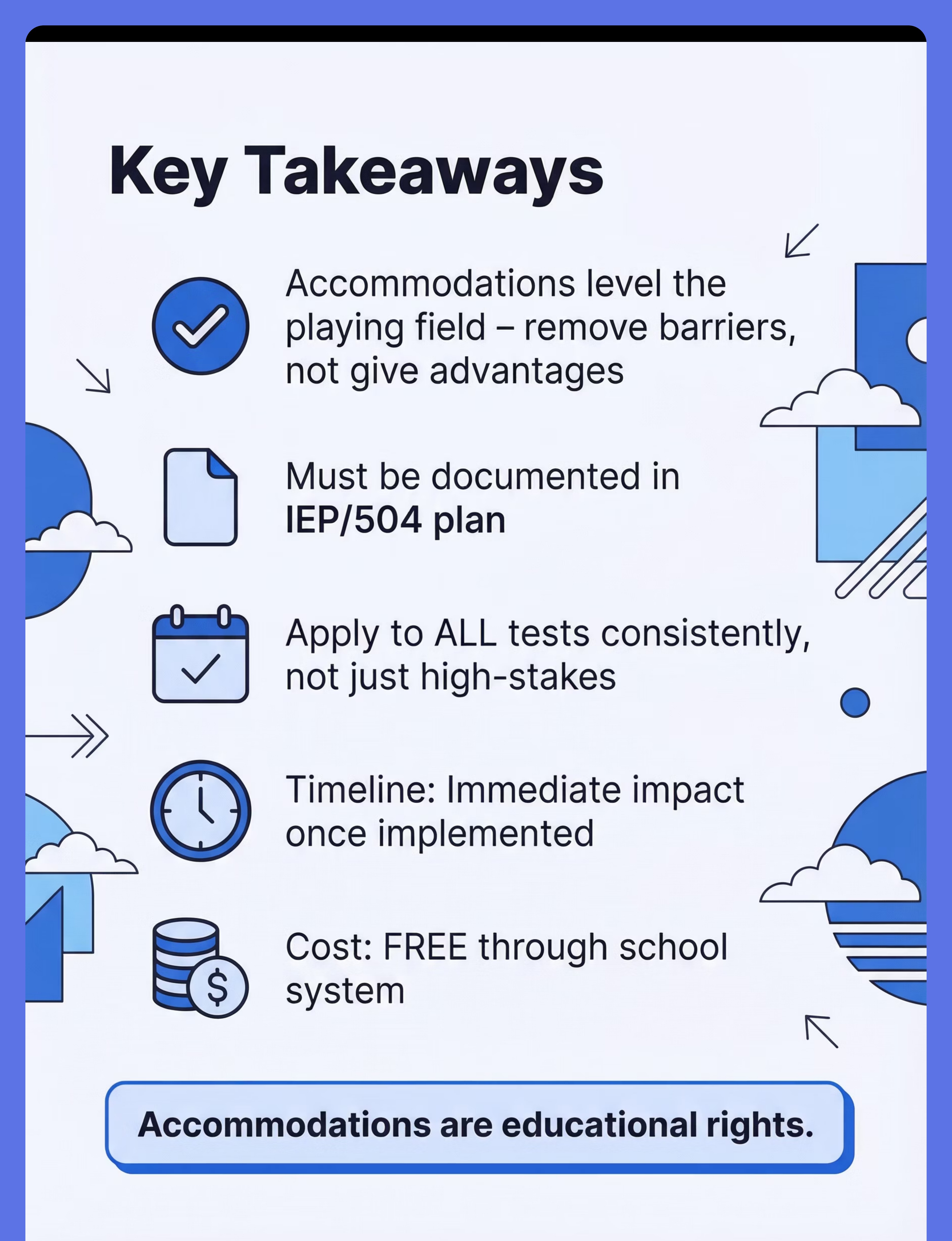
Accommodations remove barriers, they do not provide an unfair advantage.
Many real-world situations and jobs do offer various forms of accommodations.
Schools are legally required to provide documented accommodations; logistics are their responsibility.
Standardized tests often allow accommodations with proper and timely documentation.
Usage Guide
When to Use
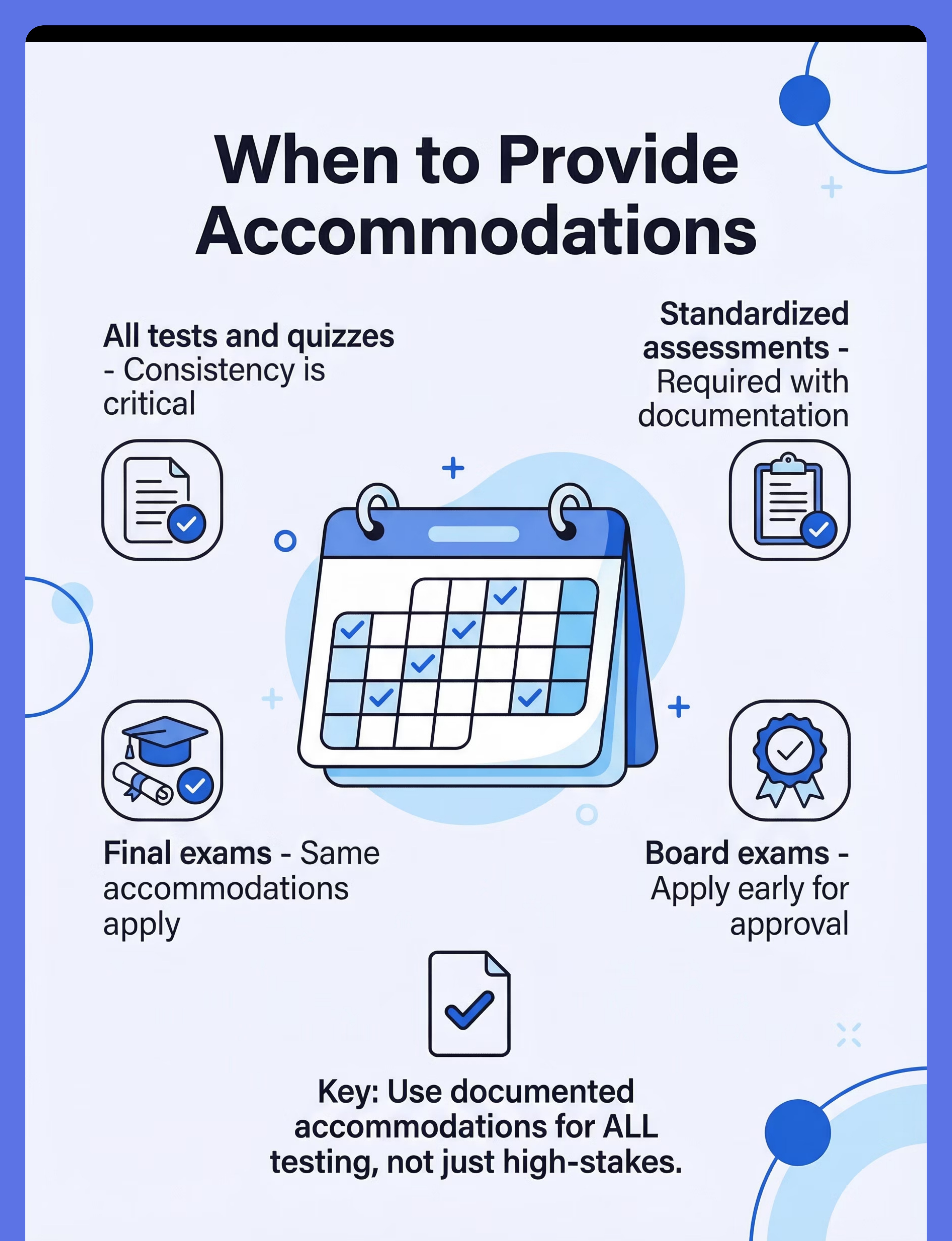
All tests and quizzes
Every assessment, not just major exams. Consistency builds skill and confidence.
Standardized assessments
State tests, achievement tests, diagnostic assessments with proper documentation.
Final exams
End-of-term and end-of-year comprehensive assessments.
Board exams
CBSE, ICSE, and other board examinations with advance application.
Classroom assessments
Daily quizzes, unit tests, projects with testing components.
When NOT to Use
Important:
Accommodations should be used for all testing when documented need exists. There are no situations where properly documented accommodations should be withheld.
Duration
Throughout testing period, as documented in IEP/504 plan. Accommodations remain in effect until the plan is reviewed and modified.
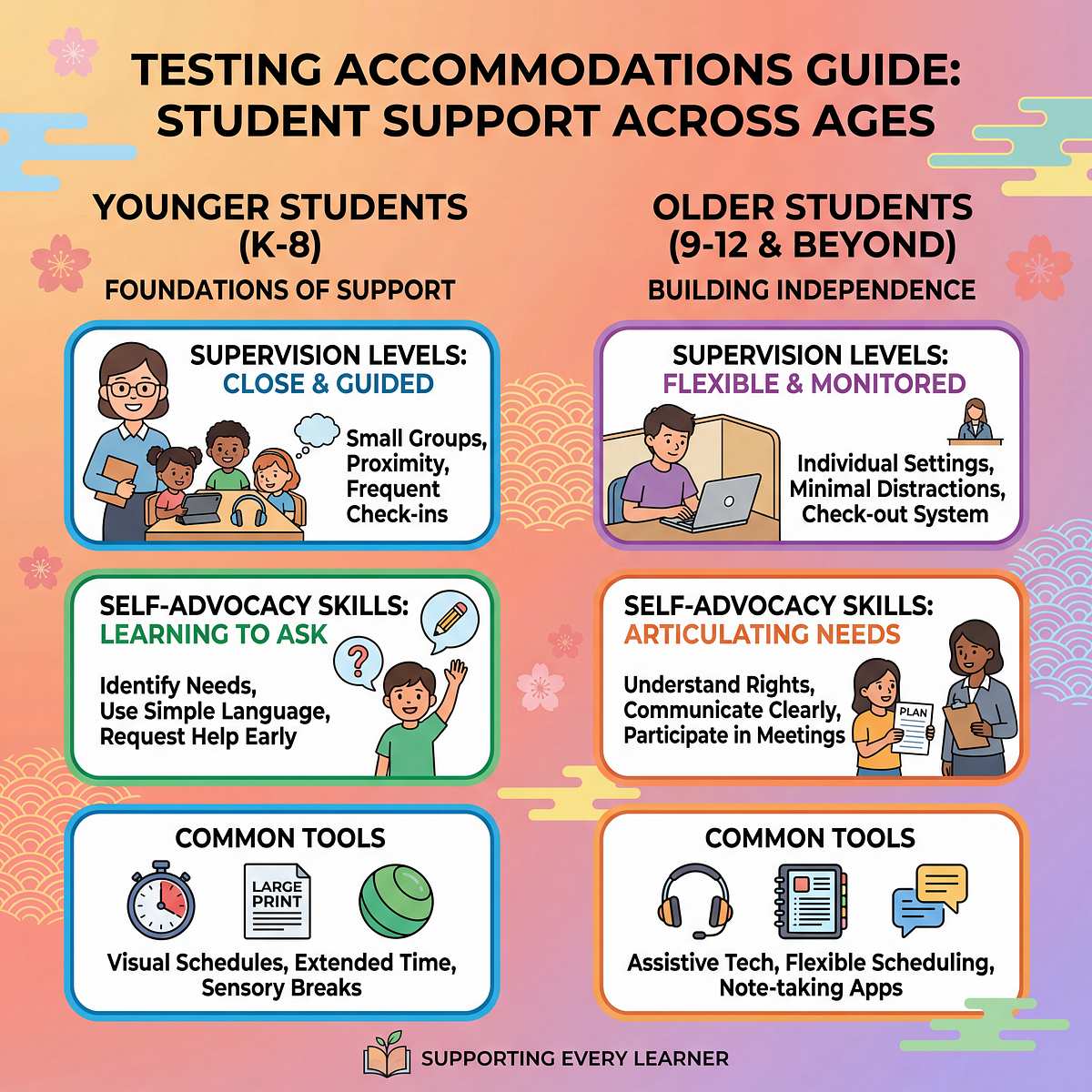
Supervision by Age
Age Range
Supervision Level
Notes
Young elementary
Fully provided by school
School staff implement all accommodations. Child learning what helps.
Older elementary to middle school
Child learning to advocate
Beginning to understand own accommodations. Starting to request supports with reminders.
High school and beyond
Self-advocacy for accommodations
Student knows accommodations and requests them. Builds critical self-advocacy skills for college/work.
Safety First
Critical Safety
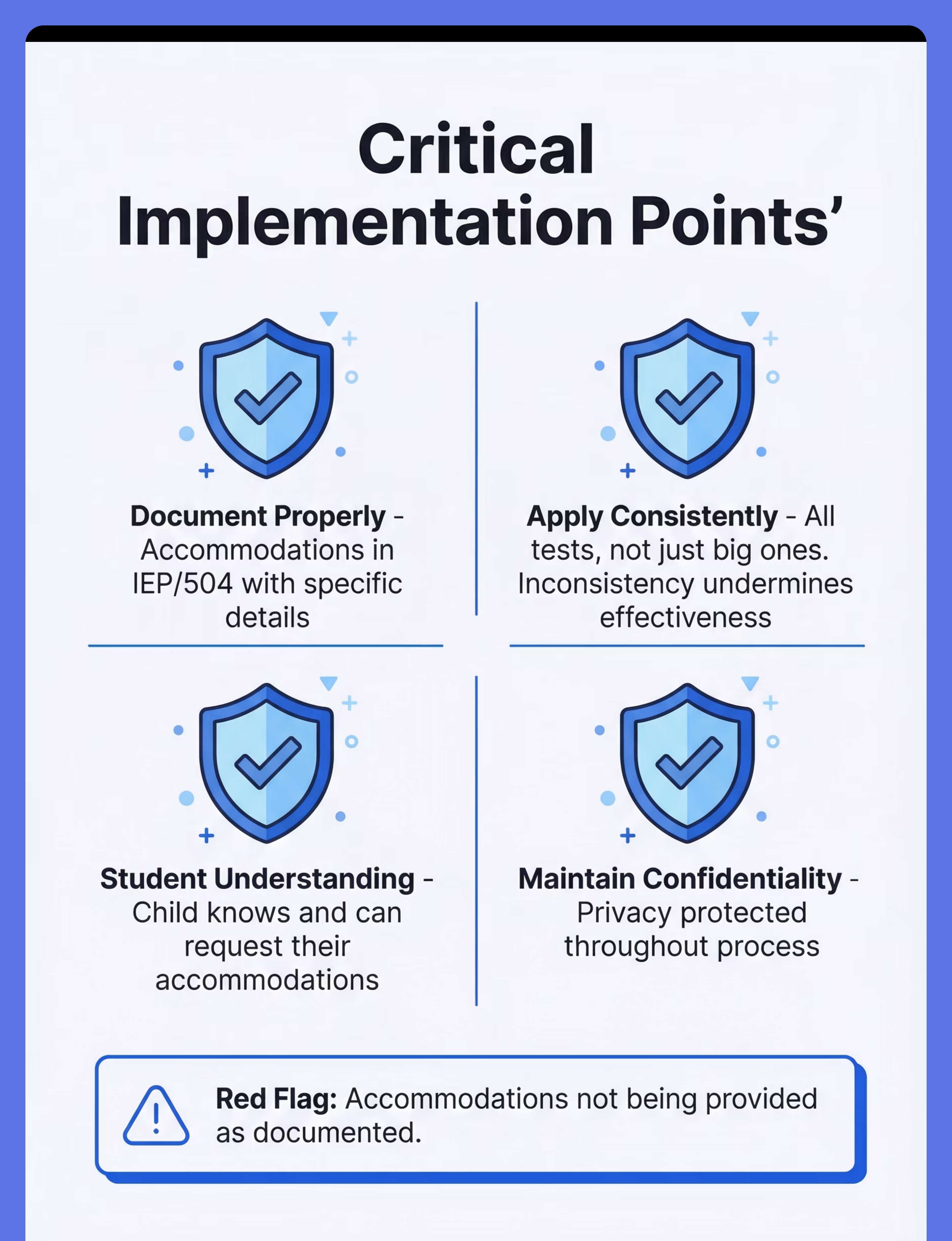
  • Accommodations must be properly documented in IEP or 504 plan
  • All accommodations must be applied consistently across all testing situations
  • Child must understand their own accommodations and feel comfortable using them
  • Confidentiality must be maintained - other students don't need to know details
Warnings
  • Inconsistent application of accommodations undermines their effectiveness and child's trust
  • Child should know and be able to request their accommodations - self-advocacy matters
  • Apply for board exam accommodations early - process takes several months
Contraindicated
  • Accommodations not matched to actual documented needs
  • Accommodations that change what is being measured (unless appropriate modification is intended)
Safety Checklist
Before Use
  • ✓ Needs documented through evaluation
  • ✓ Accommodations written in IEP/504
  • ✓ All relevant staff informed
  • ✓ Child understands accommodations
During Use
  • ✓ Accommodations being provided
  • ✓ Child using them effectively
  • ✓ Environment appropriate
  • ✓ Documentation being followed
Signs of Success
  • ✓ Test scores reflect knowledge
  • ✓ Reduced test anxiety
  • ✓ Academic confidence growing
  • ✓ Fair assessment achieved
Investment Guide
Testing accommodations are fundamental educational rights, not services you purchase. Schools are legally required to provide all documented testing accommodations at no cost to families under disability law. This ensures that every child has the opportunity to demonstrate their knowledge fairly.
The only potential cost associated with testing accommodations is if you choose to pursue a private evaluation (instead of a free school evaluation) to document your child's needs. Once these needs are properly documented through an IEP or 504 plan, all accommodations are provided by the school at no charge, regardless of their type or complexity.
Key Benefits & Rights
Zero Cost
All documented testing accommodations are provided by schools at no charge.
Educational Right
Provided under disability law through your child's IEP or 504 plan.
School Responsibility
Schools are legally mandated to offer these supports without additional fees.
Equity & Fairness
Ensures fair assessment for all students, promoting equal opportunity.
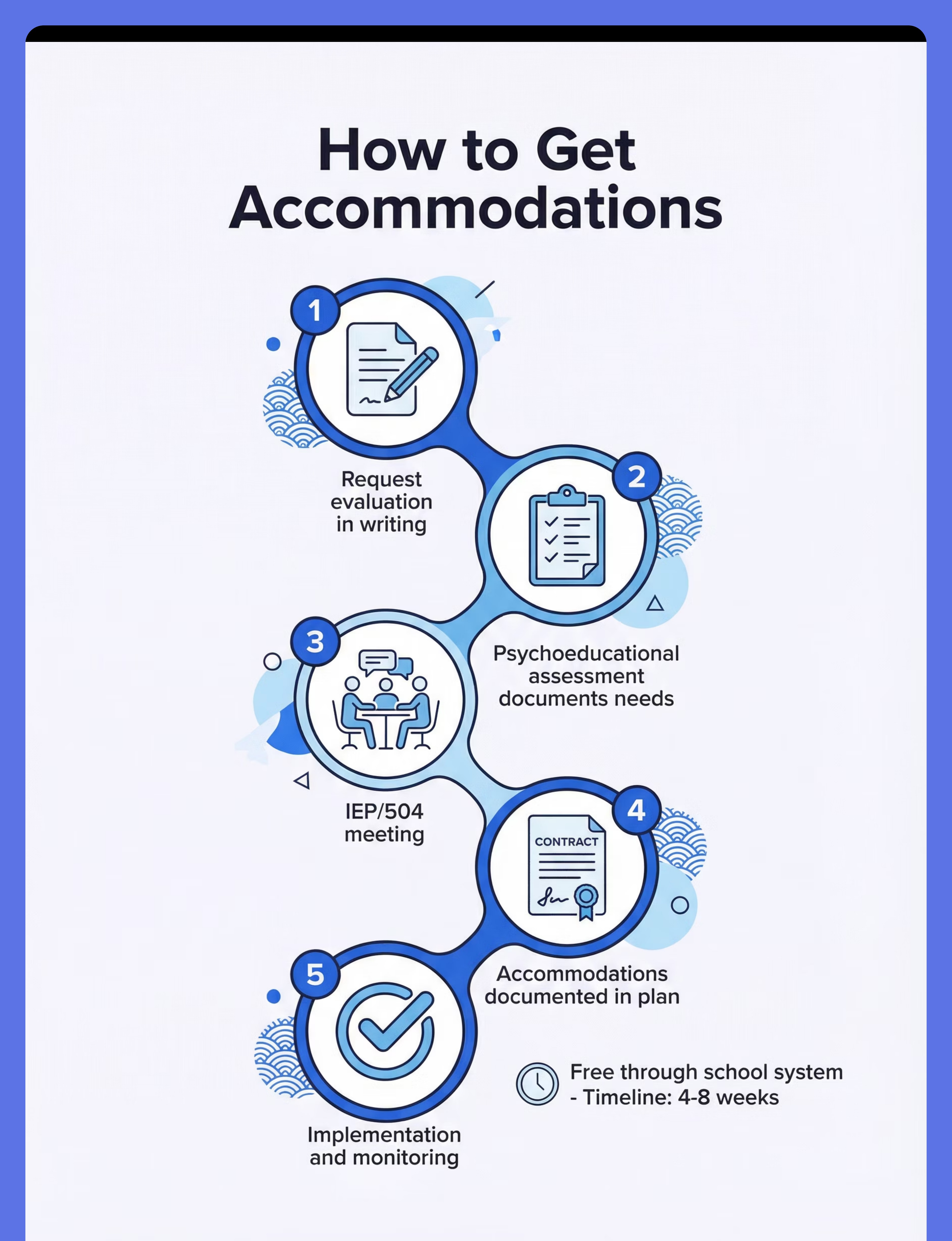
Process for Accommodations
Identify Need
Observe challenges and consider if accommodations might help.
Request Evaluation
Submit a formal request to the school for a special education evaluation. School evaluations are free.
Evaluation & Assessment
School conducts assessments to identify specific learning needs.
Develop IEP/504 Plan
Team meeting to document eligible accommodations in an official plan.
Implementation
School provides accommodations as outlined in the plan during testing.
Review & Adjust
Regular review of the plan to ensure effectiveness and make any necessary changes.

Overall Investment: ₹0
Testing accommodations are provided free through your child's IEP or 504 plan. The only potential cost is if you choose a private evaluation (instead of free school evaluation) to document needs. Once documented, all accommodations are provided at no charge.
Where to Access in India
Availability: Through IEP/504 Process at your child's school
School
Search for: IEP meeting request
Cost: Free
Start by requesting an IEP or 504 plan meeting in writing with your child's school.
School Evaluation
Search for: 504 plan request
Cost: Free
Schools provide free evaluations to determine accommodation needs.
Private Evaluation
Search for: Psychoeducational evaluation
Cost: Varies if private
If you prefer private evaluation, costs vary. School must still consider results.
Parent Advocacy
Search for: Parent advocacy resources
Cost: Free
Connect with parent advocacy organizations for support navigating the IEP/504 process.
CBSE/ICSE Board Exams
Search for: Board exam accommodations
Cost: Free with documentation
Apply for board exam accommodations through official channels with IEP/504 documentation.
Buying Tips
  • Request IEP/504 meeting in writing - creates official record
  • Get psychoeducational evaluation documenting specific needs and barriers
  • Be specific about needed accommodations based on evaluation results
  • Practice accommodations before high-stakes tests - familiarity reduces anxiety
  • Apply early for board exam accommodations - process takes several months
  • Keep copies of all documentation and correspondence
Red Flags
  • Accommodations documented in IEP/504 but not being provided - this violates your child's rights
  • Accommodations being provided differently than documented - must match plan exactly
  • Child unaware of their own accommodations - they should understand and be able to request them
  • Accommodations not applied consistently across all testing situations - should be used for all tests
  • School refusing to evaluate for accommodations despite documented struggles
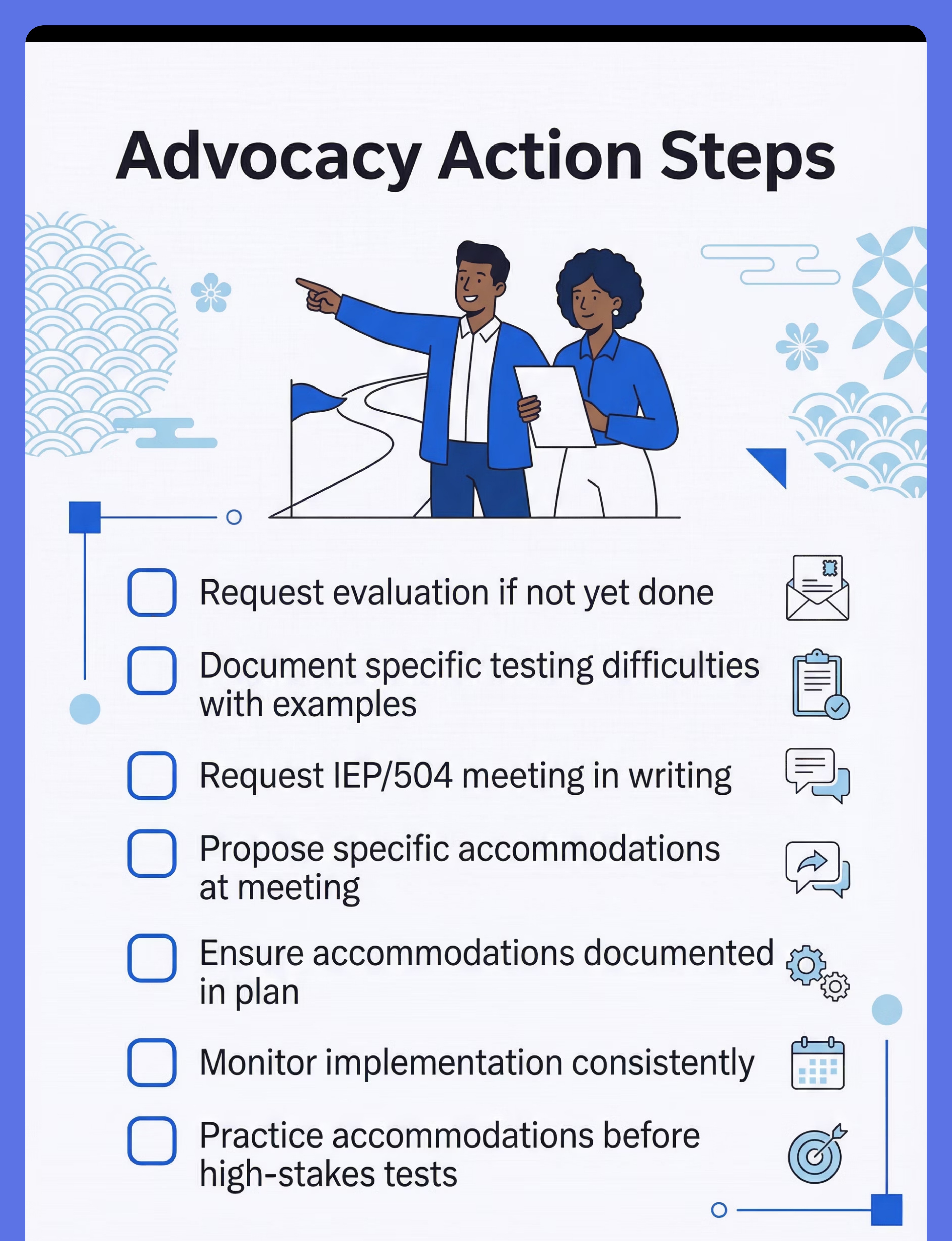
Advocacy Process (How to Get Accommodations)
Feasibility: This is an advocacy process, not a DIY project
Timeline: IEP/504 process typically takes 4-8 weeks from initial request to implementation
1
Request evaluation if not yet done
Submit written request to school for psychoeducational evaluation to assess testing accommodation needs. School must respond within specific timeline (varies by location).
2
Document specific testing difficulties
Keep records of test performance, teacher observations, and specific barriers. Gather examples showing discrepancy between knowledge and test scores. This supports your case.
3
Request IEP/504 meeting in writing
Formal written request creates official record. Include your concerns and desire to discuss testing accommodations. School must schedule meeting within required timeframe.
4
Propose specific accommodations at meeting
Come prepared with specific accommodation requests based on evaluation and documented needs. Explain how each accommodation addresses specific barriers. Be clear and specific.
5
Ensure accommodations are documented in plan
Verify that all agreed accommodations are written clearly in IEP/504 with specific details. Review document carefully before signing. Clear documentation ensures proper implementation.
6
Monitor implementation
Check regularly that accommodations are being provided as documented. Communicate with teachers and child. Address any inconsistencies immediately with school administration.
7
Practice accommodations before big tests
Ensure child uses accommodations on regular classroom tests before high-stakes exams. Familiarity reduces anxiety and builds confidence. Practice makes accommodations effective.

Required Materials for Process: Written documentation (evaluation results, teacher observations, examples of testing difficulties), meeting requests, advocacy support (parent advocate or support person if desired).

Preview of testing assessment accommodations Therapy Material

Below is a visual preview of testing assessment accommodations therapy material. The pages shown help educators, therapists, and caregivers understand the structure and content of the resource before use. Materials should be used under appropriate professional guidance.

Page 1
Page 2
Page 3
Page 4
Page 5
Page 6
Page 7
Page 8
Page 9
Page 10
Page 11
Page 12
Page 13
Page 14
Page 15
Page 16
Page 17
Page 18
Page 19
Page 20
Link copied!
Complete Success: Tracking, Connections & Support
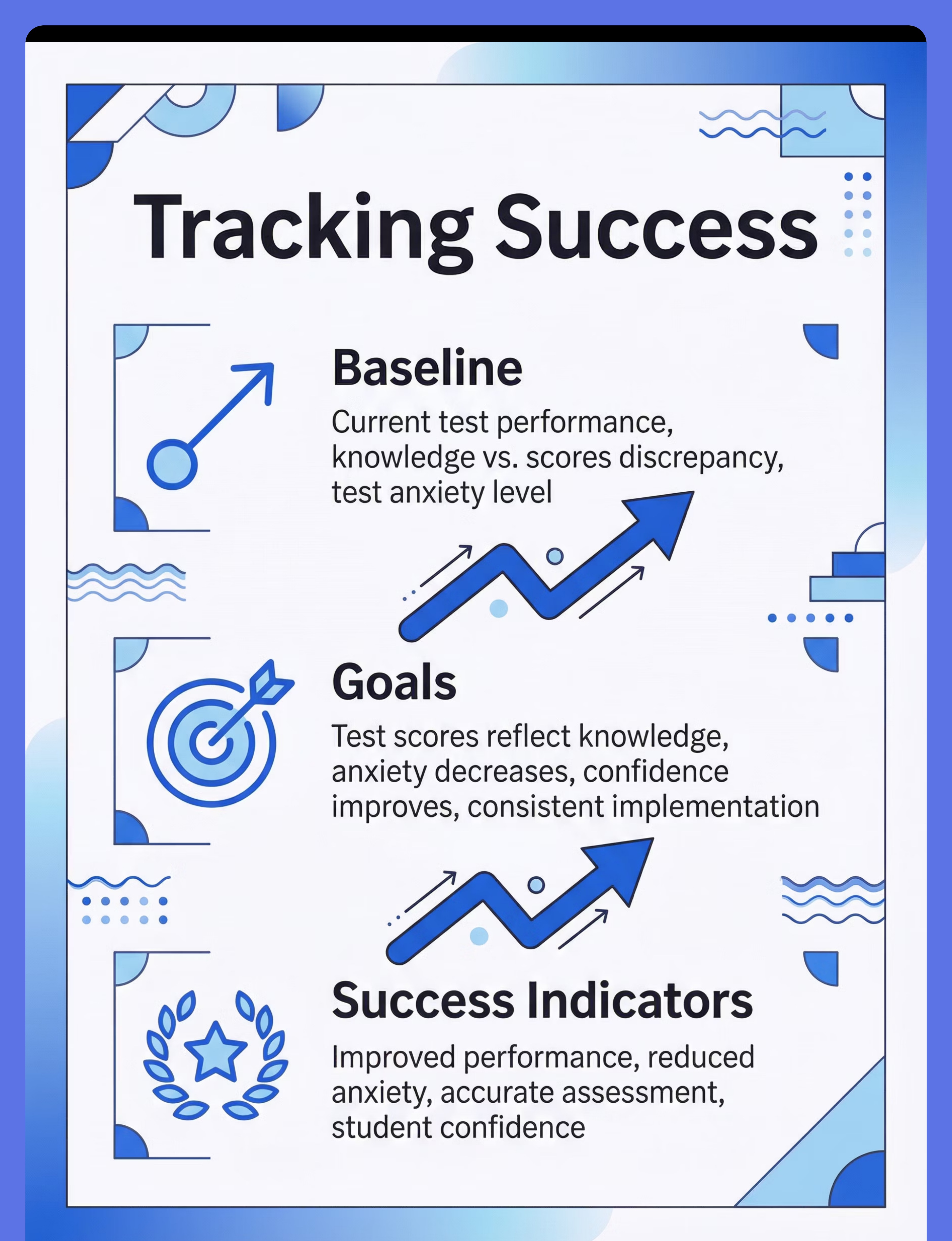
Tracking & Measuring Success
Monitoring progress is essential to ensure accommodations are effective. This involves:
Baseline (Measure First)
  • Current test performance levels
  • Gap between knowledge and test scores
  • Test anxiety severity (0-10 scale)
  • Current accommodations (if any)
  • Student confidence in testing (0-10)
Goals
  • Test scores will reflect actual knowledge
  • Test anxiety will decrease significantly
  • Academic confidence will improve
  • Accommodations will be provided consistently
  • Student will advocate for own needs
Success Indicators
  • ✓ Improved test performance
  • ✓ Reduced anxiety before/during tests
  • ✓ Accurate assessment of learning
  • ✓ Student confidence growing
  • ✓ Appropriate educational programming
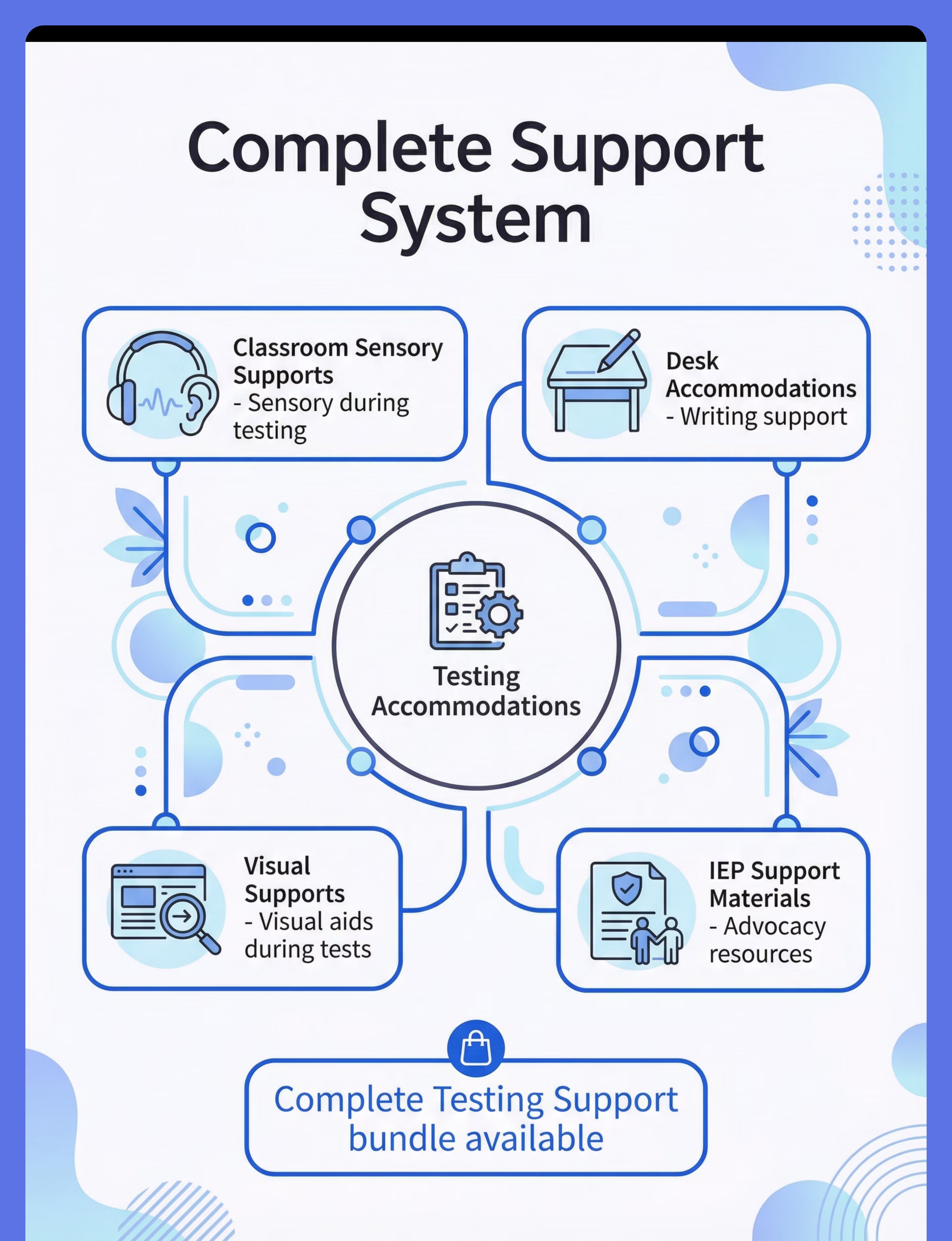
Connecting Resources & Solutions
Pair accommodations with essential supports for comprehensive success.
Complementary Supports
  • Classroom Sensory Supports (ID: 18.1)
  • Desk Accommodations (ID: 18.2)
  • Visual Supports for School (ID: 18.3)
  • IEP Support Materials (ID: 18.5)
Complete Bundles
Complete Testing Support: Includes Testing & Assessment Accommodations (18.4) + Classroom Sensory Supports (18.1) + Desk Accommodations (18.2). Provides comprehensive support for fair, accurate testing.
IEP Preparation Kit: Includes Testing & Assessment Accommodations (18.4) + IEP Support Materials (18.5) + Visual Supports for School (18.3). A complete advocacy toolkit for IEP/504 meetings.
Accessing Support & Information
Find free resources and integrated platforms to guide your advocacy journey.
Quick Summary
Testing and assessment accommodations ensure fair evaluation through extended time, separate setting, format modifications, and response alternatives documented in IEP/504 plans. Core Kit (Rank 1), strong evidence, essential for accurate assessment.
Common searches: testing accommodations autism, IEP testing accommodations, extended time autism, test anxiety accommodations, 504 plan testing, board exam accommodations, school testing support
Get Support
FREE National Autism Helpline: 9100 181 181 (pinnacleblooms.org)
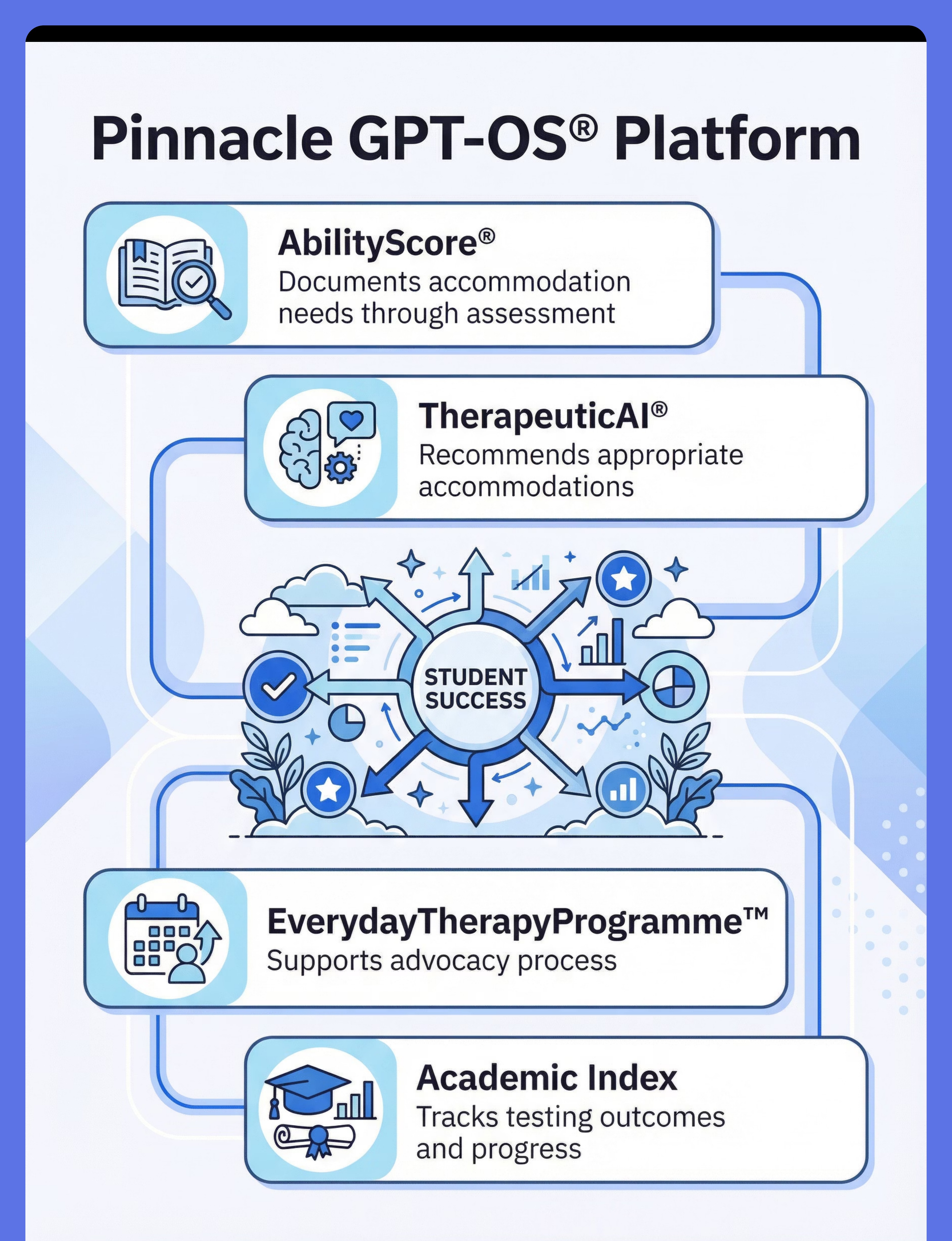
Platform Integration:
  • AbilityScore® documents specific accommodation needs.
  • TherapeuticAI® recommends appropriate testing accommodations.
  • EverydayTherapyProgramme™ supports parent advocacy.
  • Academic Index tracks testing outcomes and effectiveness.

Disclaimer: This is educational information about testing accommodations and educational rights. Always consult qualified special education professionals, school psychologists, or educational advocates. Individual accommodation needs vary and must be determined through proper evaluation. Implementation requirements vary by educational system and jurisdiction.