







Tool ID: 6.2
Tool ID: 6.2
PT + OT Recommended
Strong Evidence
Rank #1
Daily Use
₹400–3,000
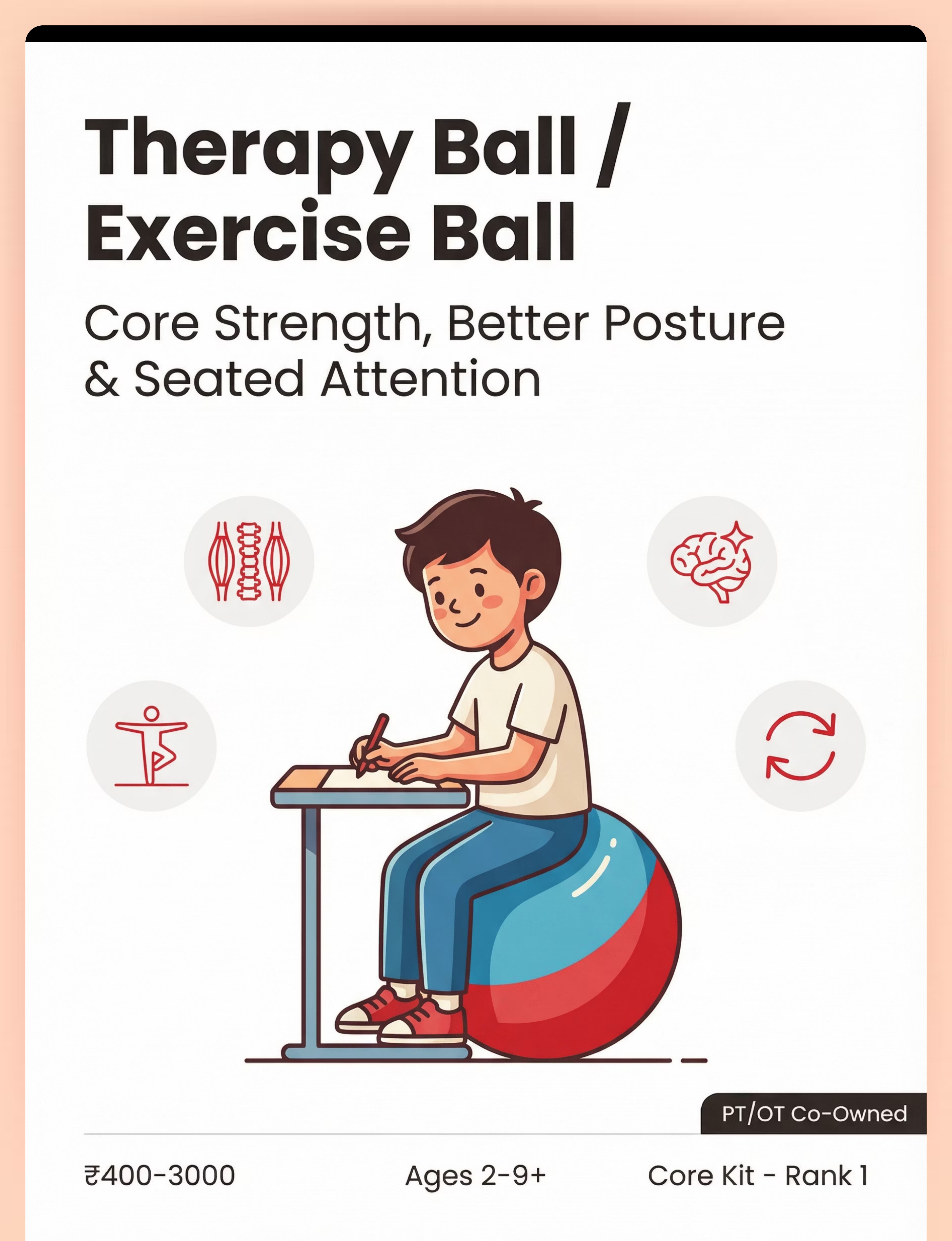
Therapy Ball / Exercise Ball
Dynamic seating and vestibular-proprioceptive input system
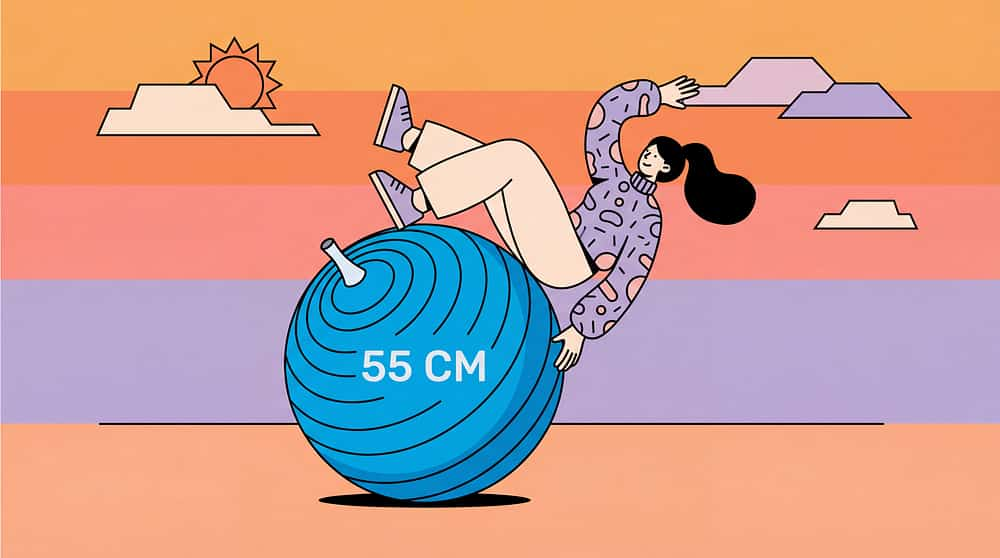
Transform seated attention, build core strength, and provide essential movement input with this foundational pediatric therapy tool. Whether your child struggles to sit still, has weak core muscles, or needs movement to focus, therapy balls offer a scientifically-backed solution that turns necessary seated time into therapeutic opportunity. Used daily in clinics, classrooms, and homes worldwide, therapy balls create the perfect balance between meeting movement needs and building the strength required for success in school and daily activities.
Who This Helps
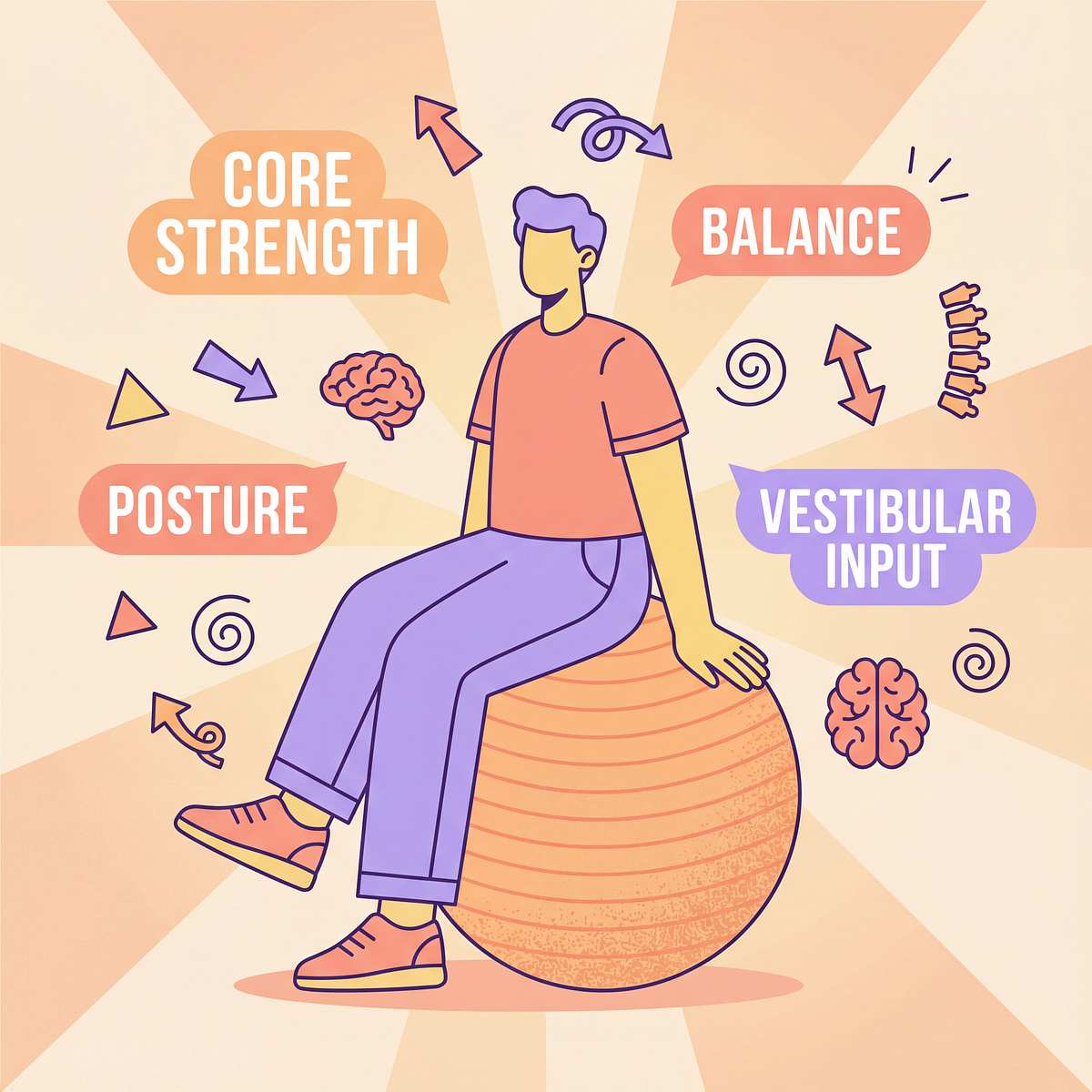
Therapy balls provide dynamic surfaces for core strengthening, balance development, vestibular input, and active seating—transforming how children with movement and attention needs engage with seated tasks and therapeutic activities.
Core Strength
Balance
Posture
Vestibular Input
Active Sitting
Proprioception
Ages 2-9 years (and beyond)
Home
School
Clinic
Children with weak core strength who slump, tire quickly, and struggle with posture during seated activities
Children who need movement to focus and can't sit still in traditional chairs at school or home
Children with balance challenges who benefit from vestibular-proprioceptive input throughout their day
Does This Sound Familiar?
"My child has weak core - poor posture everywhere. She slumps at the table, on the floor, even standing. It's like her body can't hold itself up."
"She can't sit still in a chair for more than two minutes. Constant wiggling, shifting, sliding off. Teachers are frustrated, homework is a battle."
"He falls out of his seat at school regularly. Not on purpose - his body just doesn't seem to know where it is in space. It's embarrassing for him."
"She slumps constantly and has no body awareness. I'm always saying 'sit up straight' but within seconds, she's collapsed again. Her core just seems non-existent."
"He needs movement but has to sit for homework. It's torture for both of us. He can't focus without moving, but can't do work while moving around."
"Her balance is so poor. Simple activities that other kids do easily are scary and difficult for her. She avoids playground equipment and physical activities."
You're not alone. These are common challenges for children with sensory processing differences, developmental delays, or low muscle tone. Therapy balls address the root cause: weak core muscles and unmet vestibular-proprioceptive needs.
A Day Without the Right Support
Morning Routine
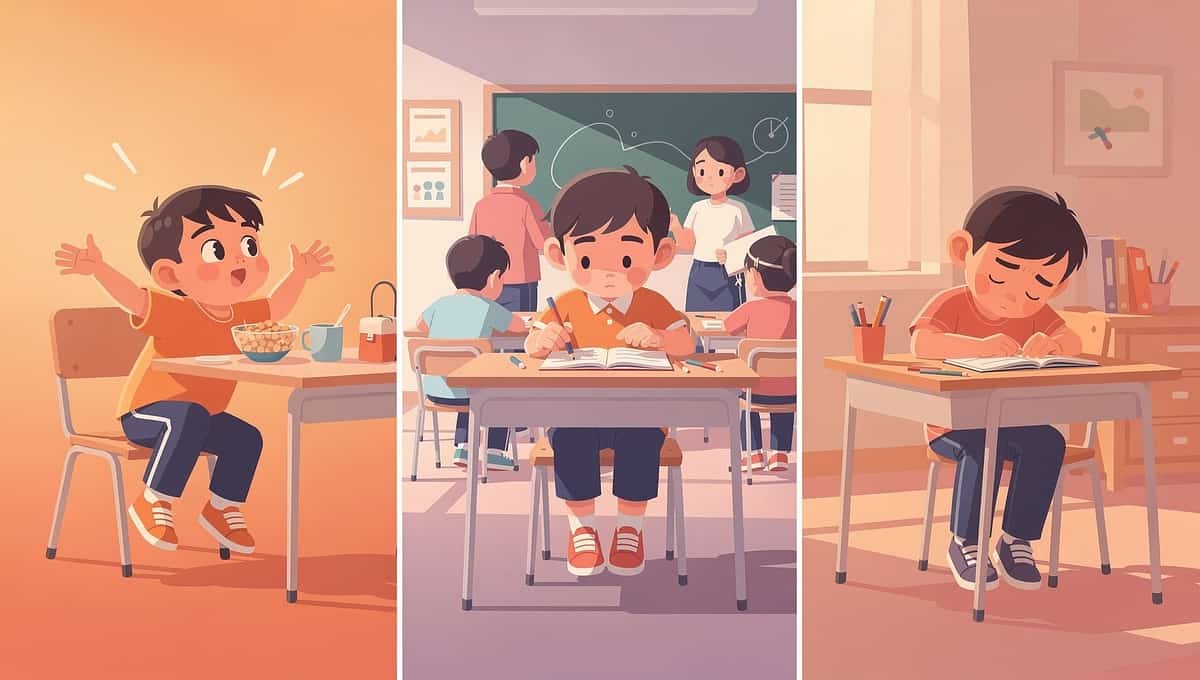
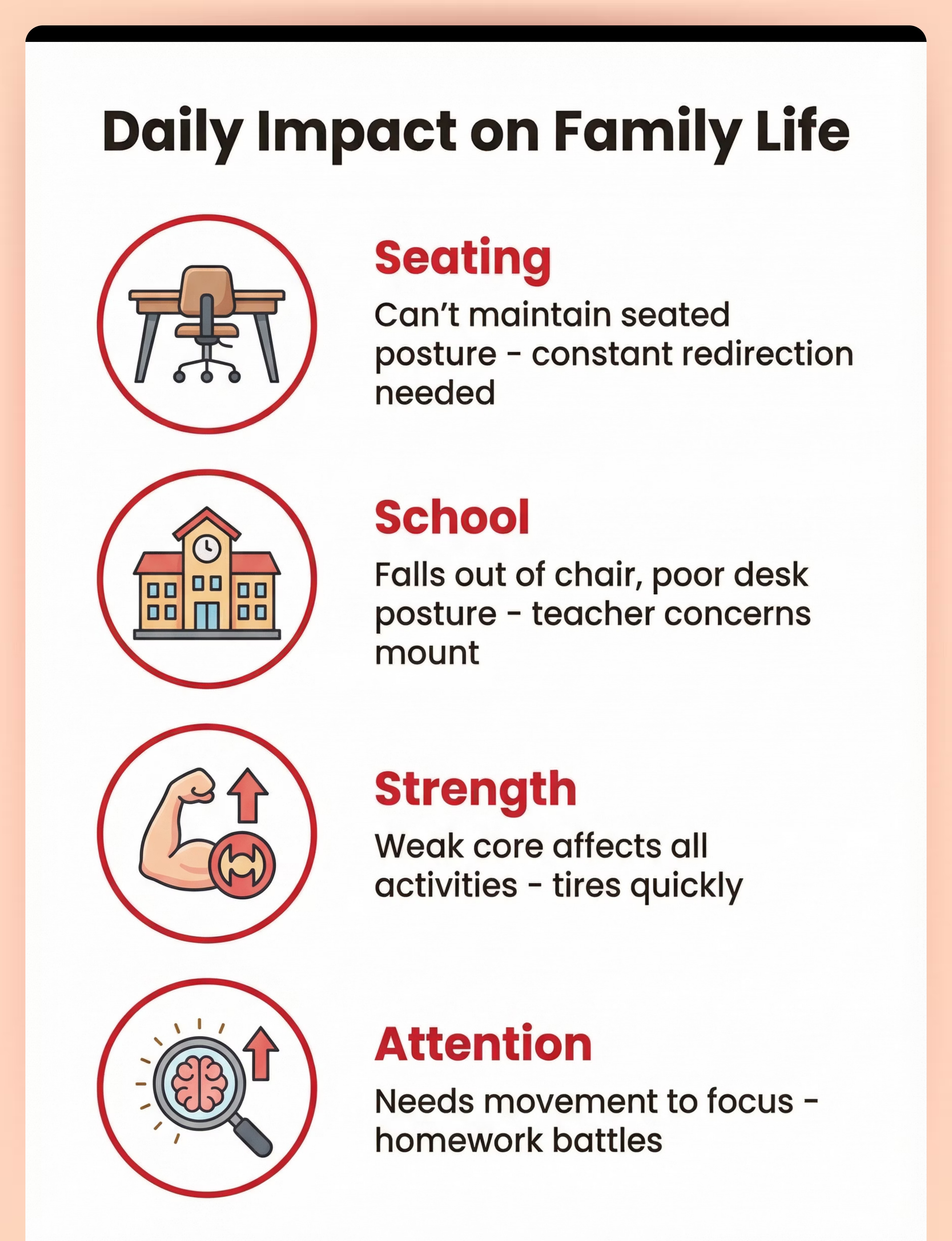
Can't maintain seated posture at breakfast table. Slides off chair, eats standing up. Getting dressed takes forever because balance is poor and child tires easily from the physical effort of dressing.
School Time
Falls out of chair during circle time. Teacher constantly redirecting at desk. Slumps forward onto desk during writing tasks. Can't focus because body is working so hard just to stay upright. Other kids notice.
After School
Homework battle begins. Can't sit still long enough to complete assignments. Needs movement breaks every few minutes. What should take 20 minutes stretches to over an hour with constant struggles and frustration.
Evening Activities
Avoids physical play because core weakness makes gross motor activities difficult and exhausting. Can't keep up with siblings or peers. Chooses sedentary activities, creating a cycle of further weakness.
Bedtime
Even bath time and getting ready for bed are exhausting because every position change requires so much effort. Child is physically and emotionally drained from fighting their body all day.
Every seated moment becomes a battle. Every physical activity highlights the weakness. The child internalizes messages of failure, difference, and inadequacy.
The Science Behind It
Understanding why therapy balls work helps you use them effectively and maintain consistency even when progress feels slow.
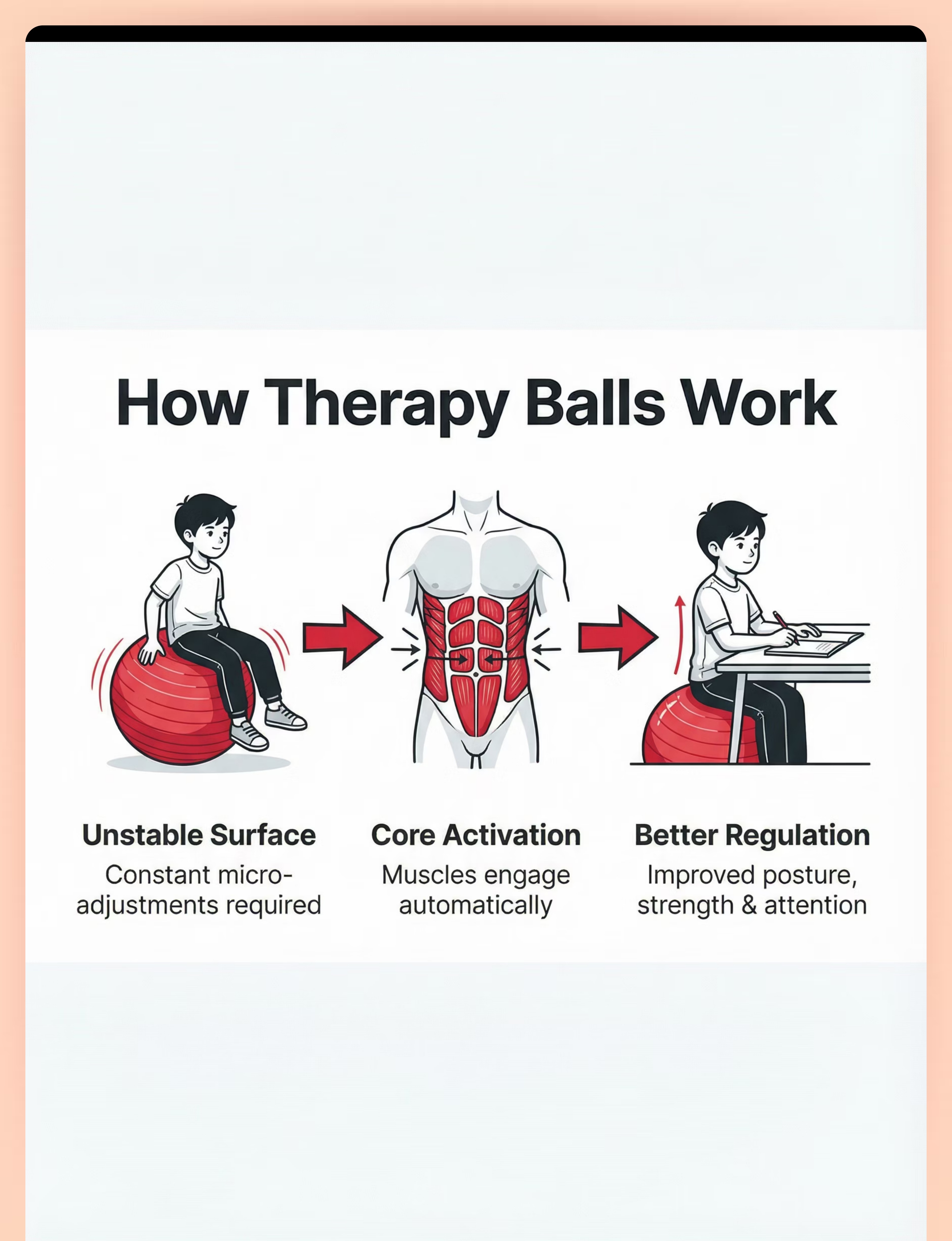
Unstable Surface
The ball's round, air-filled design creates an inherently unstable surface that prevents passive sitting
Constant Micro-Adjustments
Body must continuously make tiny balance corrections to stay centered, engaging core muscles automatically
Core Activation
Deep stabilizing muscles of trunk and abdomen activate to maintain position, building strength through use
Vestibular Input
Movement triggers inner ear receptors providing organizing sensory input that supports attention and regulation
Improved Function
Stronger core + better posture + vestibular input = improved seated attention, motor control, and overall regulation
Target Areas
Core Strength
Balance
Posture
Vestibular Input
Active Sitting
Proprioception
This isn't magic—it's physics and neurology working together. The unstable surface transforms passive sitting into active therapy, making every moment on the ball a strengthening opportunity.
How to Use It Right
Following best practices ensures safety, maximizes therapeutic benefit, and helps your child progress from supported beginner to confident independent user.
Size Appropriately
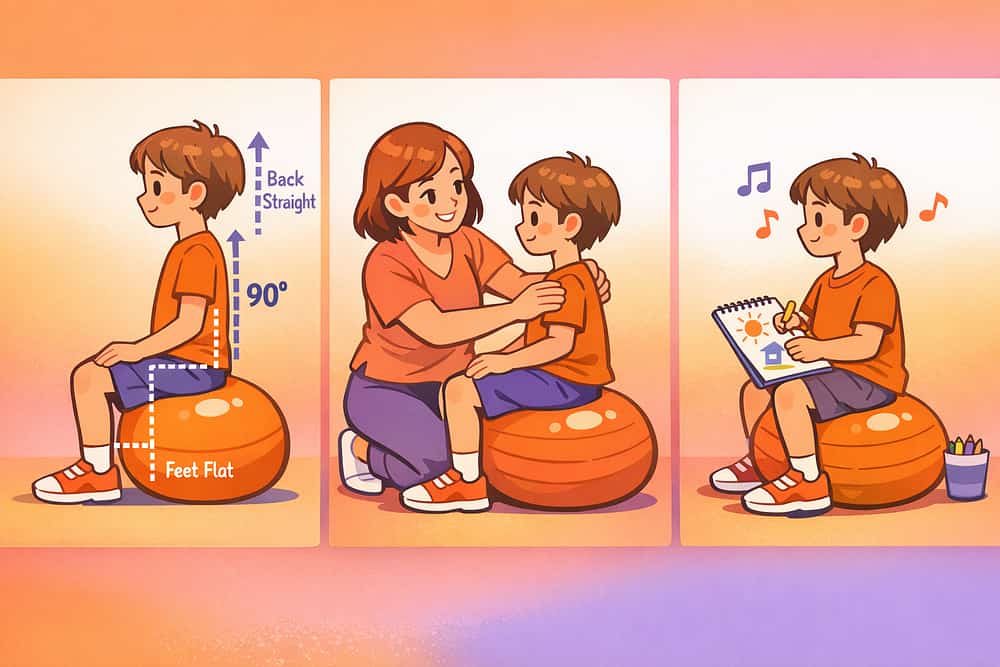
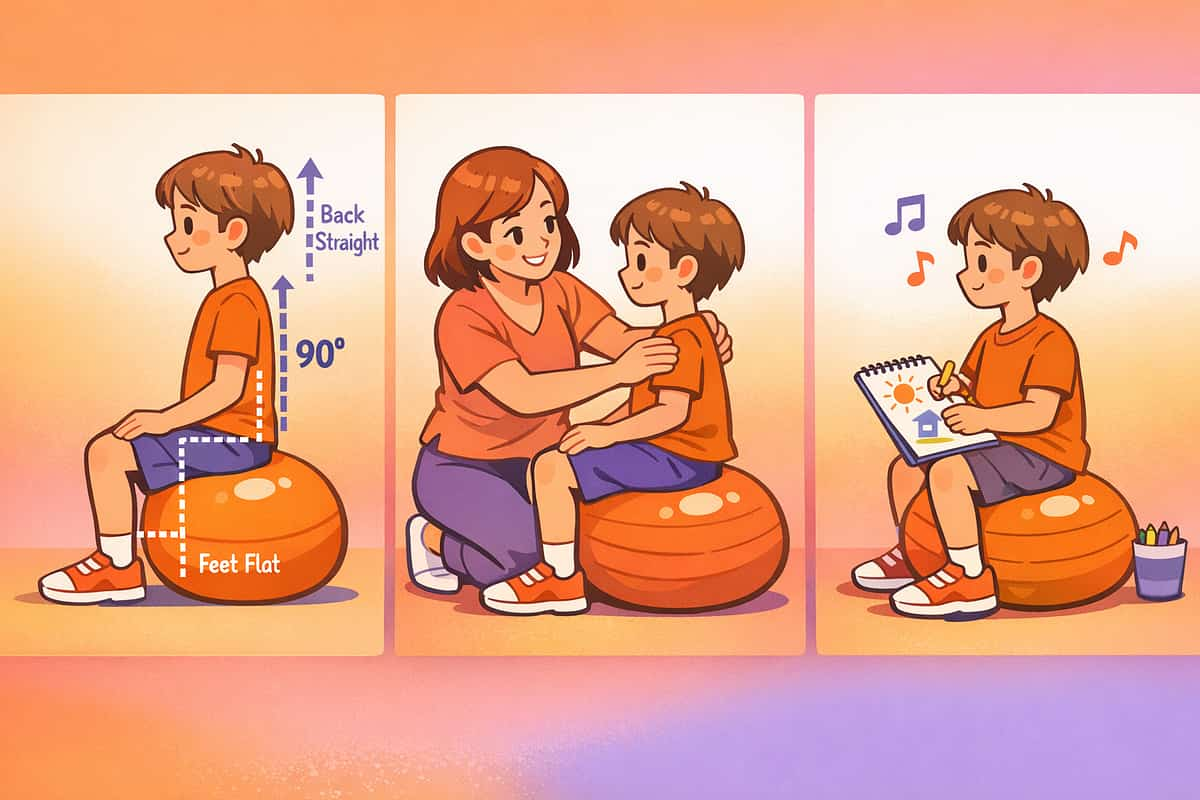
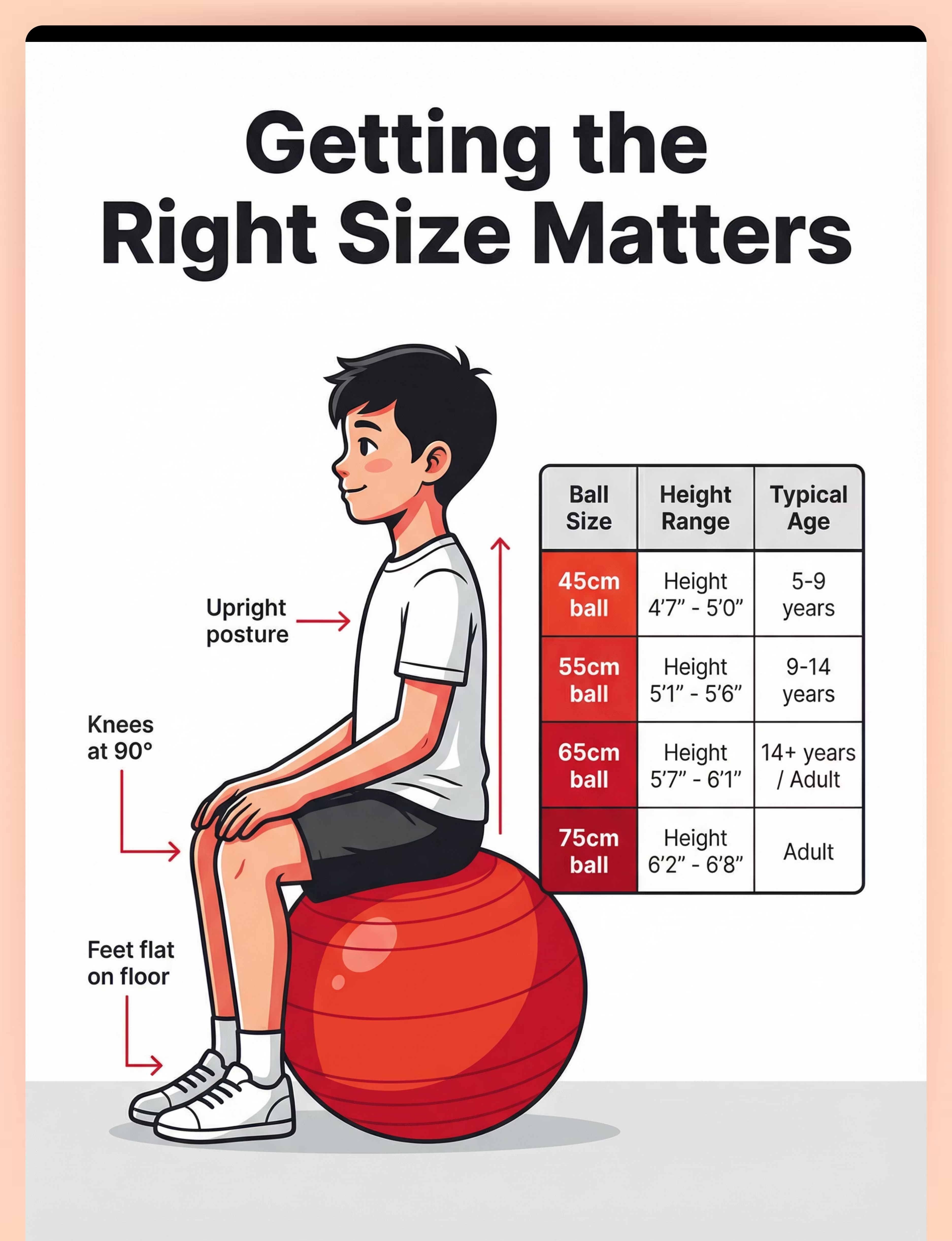
When sitting on the ball, child's feet should be flat on floor with knees bent at 90 degrees. This is critical for safety and effectiveness. Use the sizing guide to choose correctly.
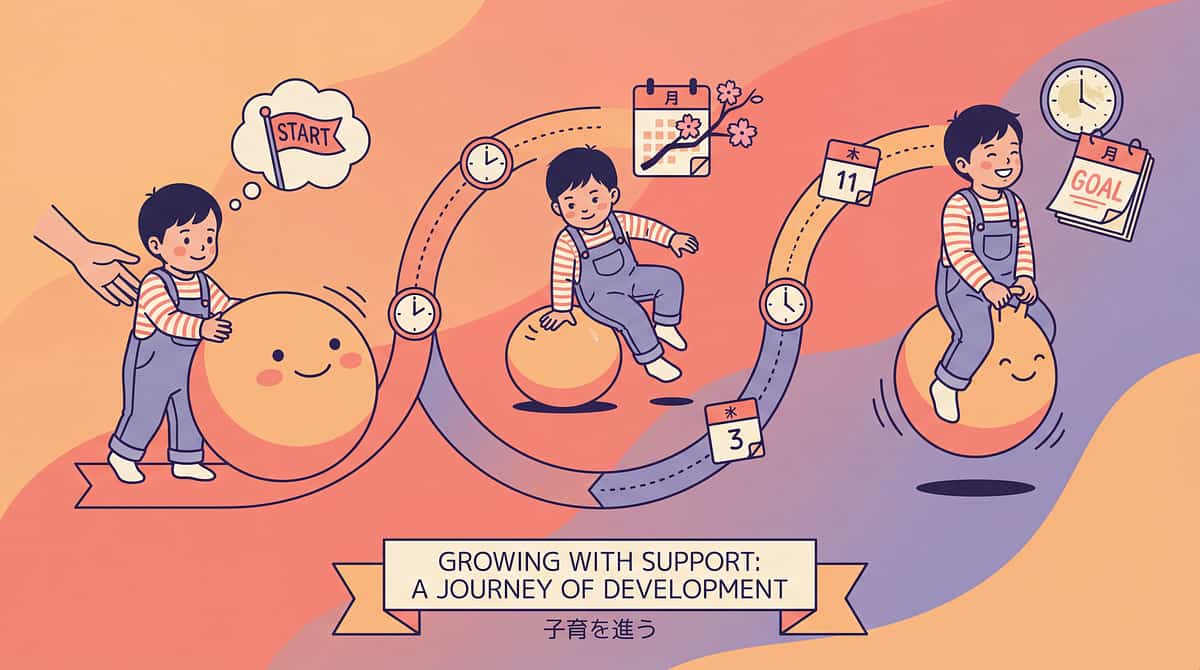
Start With Support
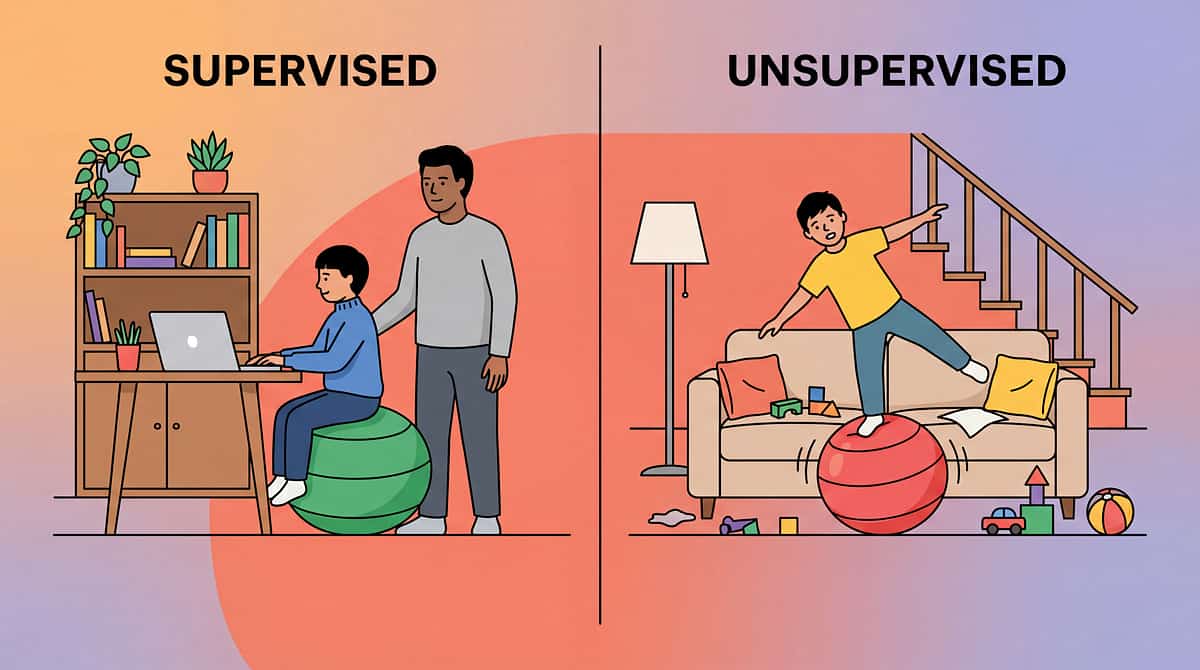
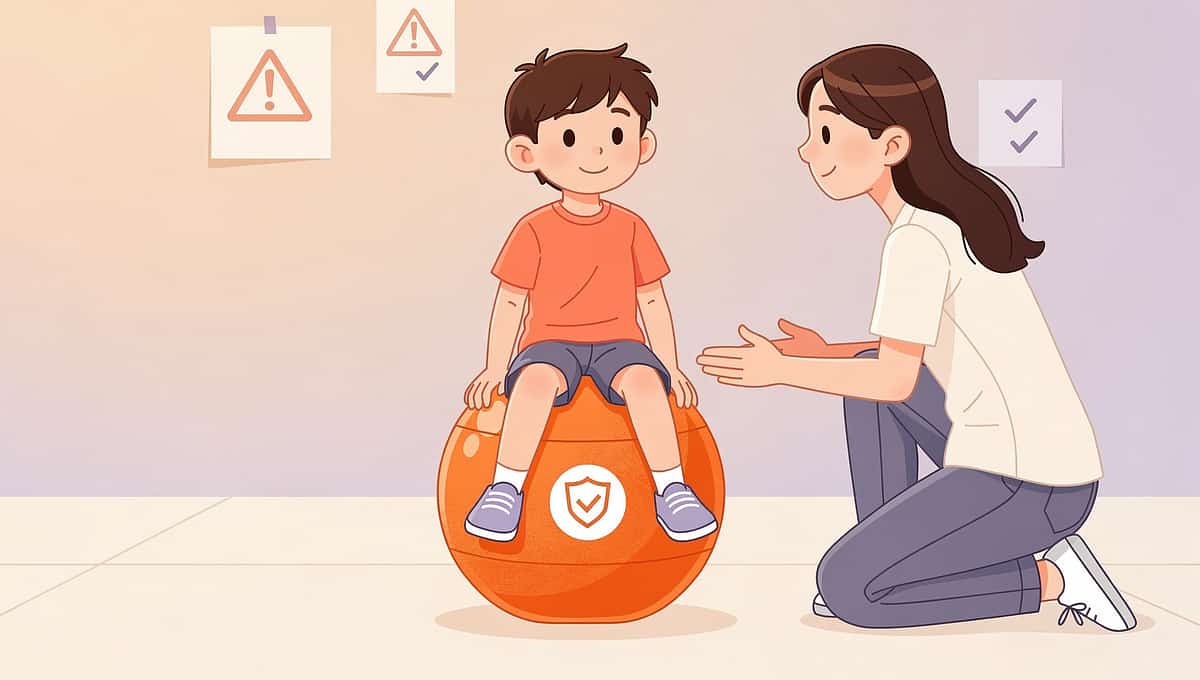
Begin with hands-on support and simple activities. Let child build confidence gradually. Hold their hands, spot them closely, and stay within arm's reach until they demonstrate safety.
Multiple Uses
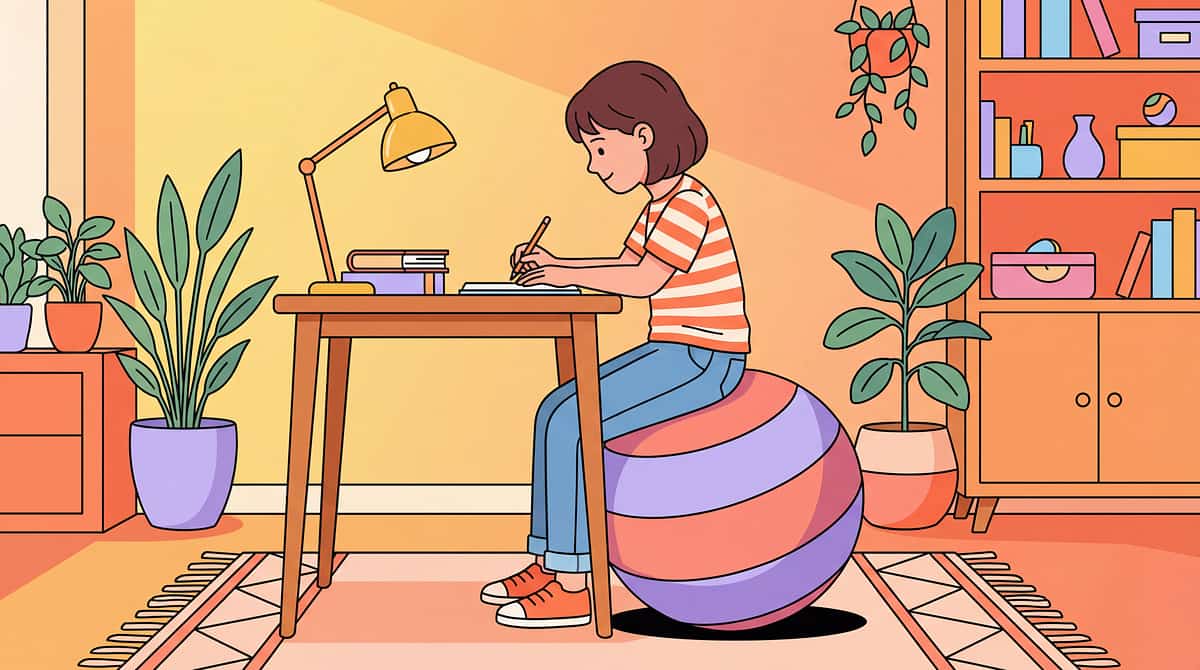
Use for active seating during homework or meals, for structured exercises prescribed by PT/OT, and for play activities. Variety maintains interest and addresses different goals.
Supervise Until Safe
Never leave a beginner unattended on a therapy ball. Supervision level decreases as skill and safety improve, but initial constant supervision is essential.
Respect Fear
Don't force if child is fearful. The ball should feel fun and regulating, not scary. Build confidence through positive experiences. Let them touch, push, sit with support first.
Adjust Inflation
Deflate slightly for more stability initially. A slightly softer ball is easier to balance on. Gradually increase firmness as skill improves for greater challenge.

Duration Guidance: For active seating, 15-30 minutes at a time is typically appropriate. For exercise sessions, follow your therapist's recommendations. Watch for fatigue and allow breaks.
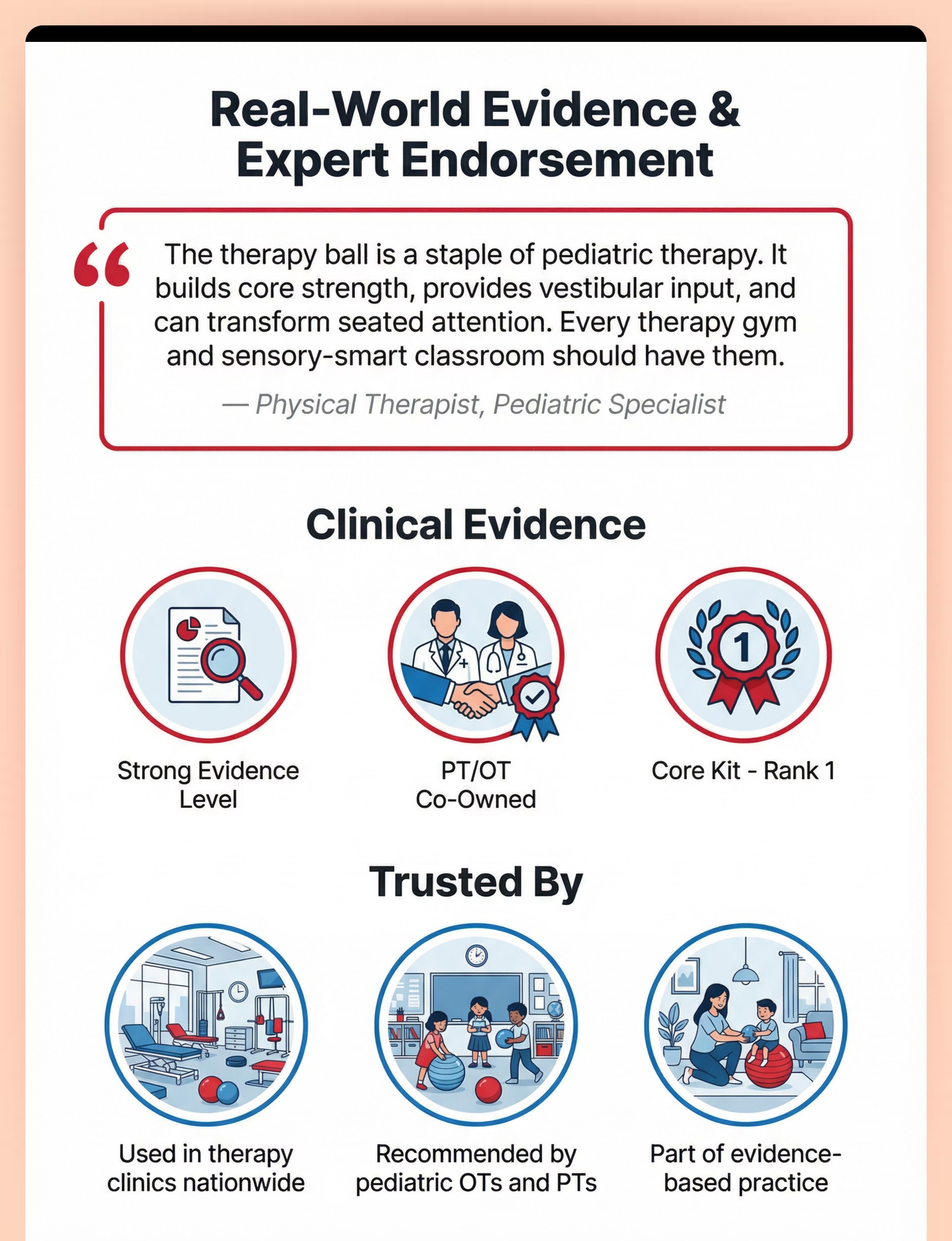
Expert Endorsement
"The therapy ball is a staple of pediatric therapy. It builds core strength, provides vestibular input, and can transform seated attention. Every therapy gym and sensory-smart classroom should have them."
— Physical Therapist, Pediatric Specialist
PT + OT Recommended
Strong Evidence
Rank #1 in Category
Daily Use Tool
Core Kit Essential
This isn't a trendy gadget or marketing hype. Therapy balls have decades of clinical evidence and are recommended by physical therapists and occupational therapists worldwide as foundational tools for core development, balance, and sensory integration.
Choose Your Option (5 Variants)
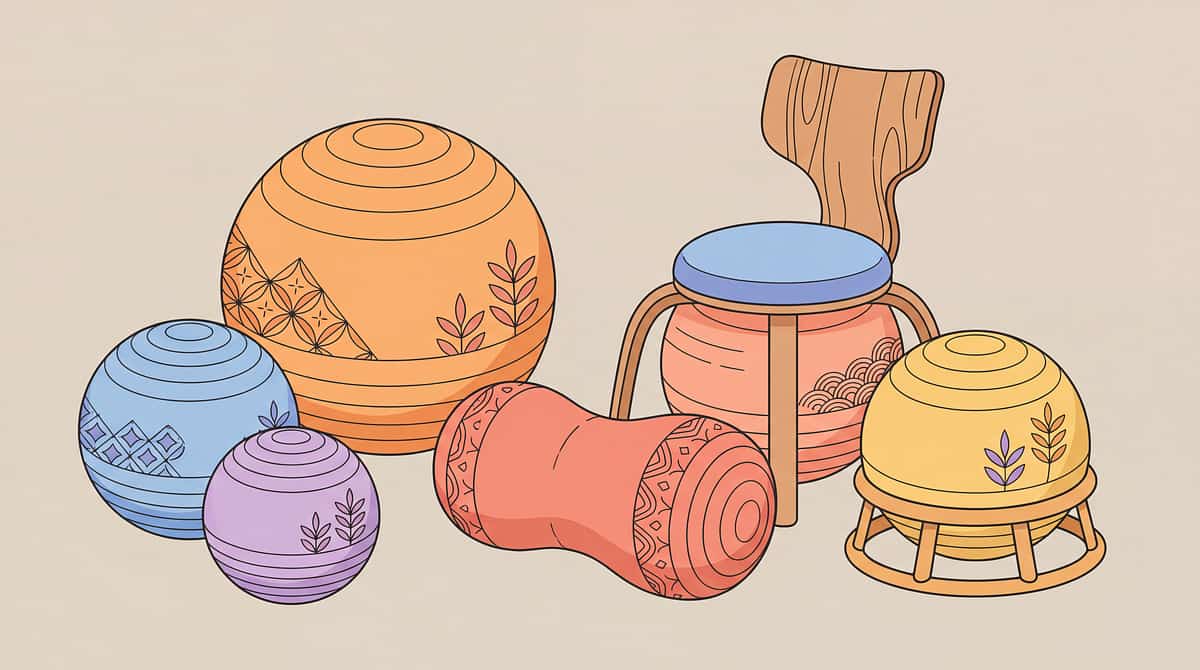
Select the variant that best matches your child's primary needs, setting, and goals. Most families benefit from starting with a standard therapy ball and adding specialized options as needs become clearer.
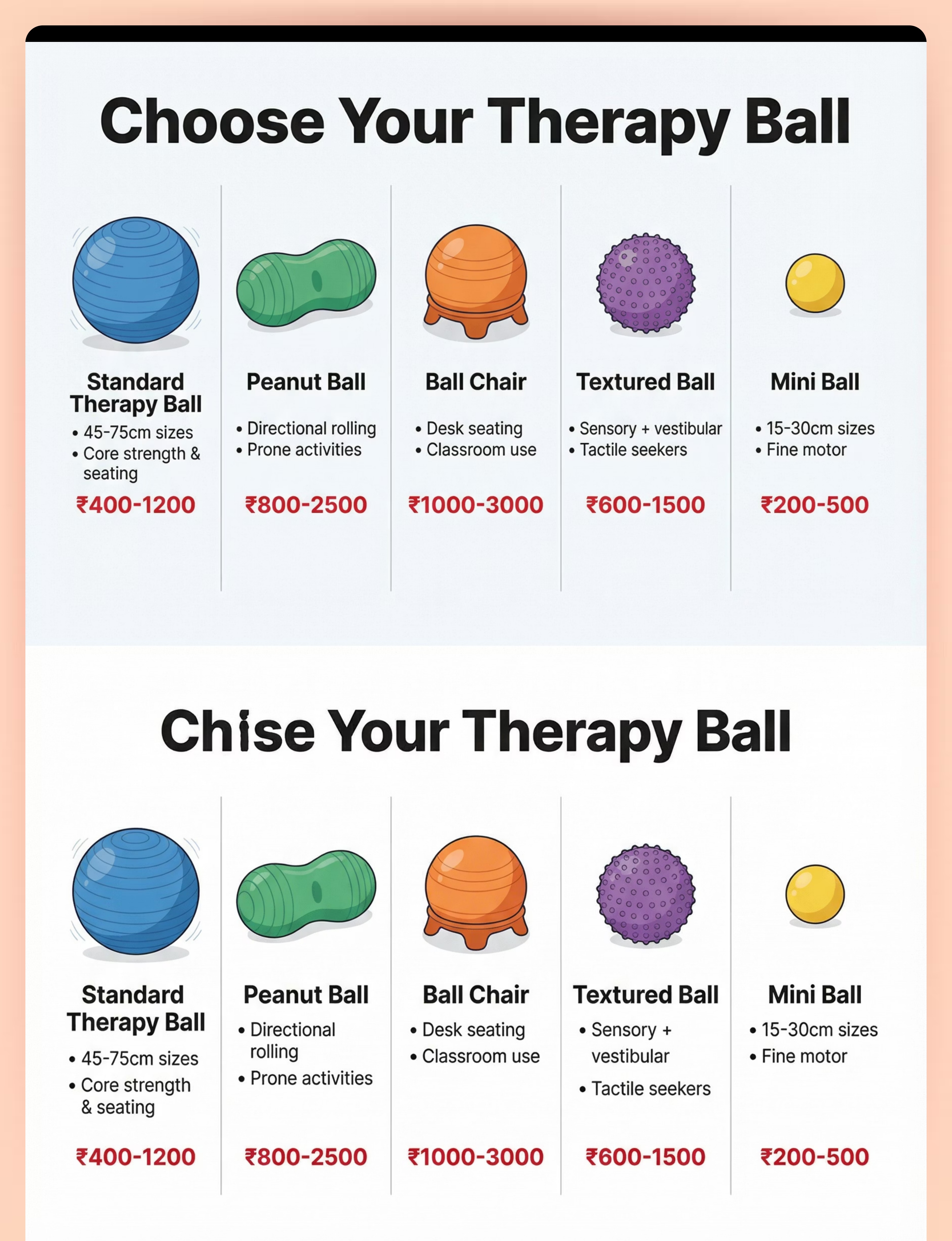
Standard Therapy Ball
₹400–1,200
Ages 3-9
Best for: Core strength, dynamic seating, general exercises
Sizes: 45cm, 55cm, 65cm, 75cm
Settings: Home, Clinic, School
Portability: Medium (deflatable)
The versatile foundation choice for most children. Classic inflatable exercise ball appropriate for all standard therapy ball activities.
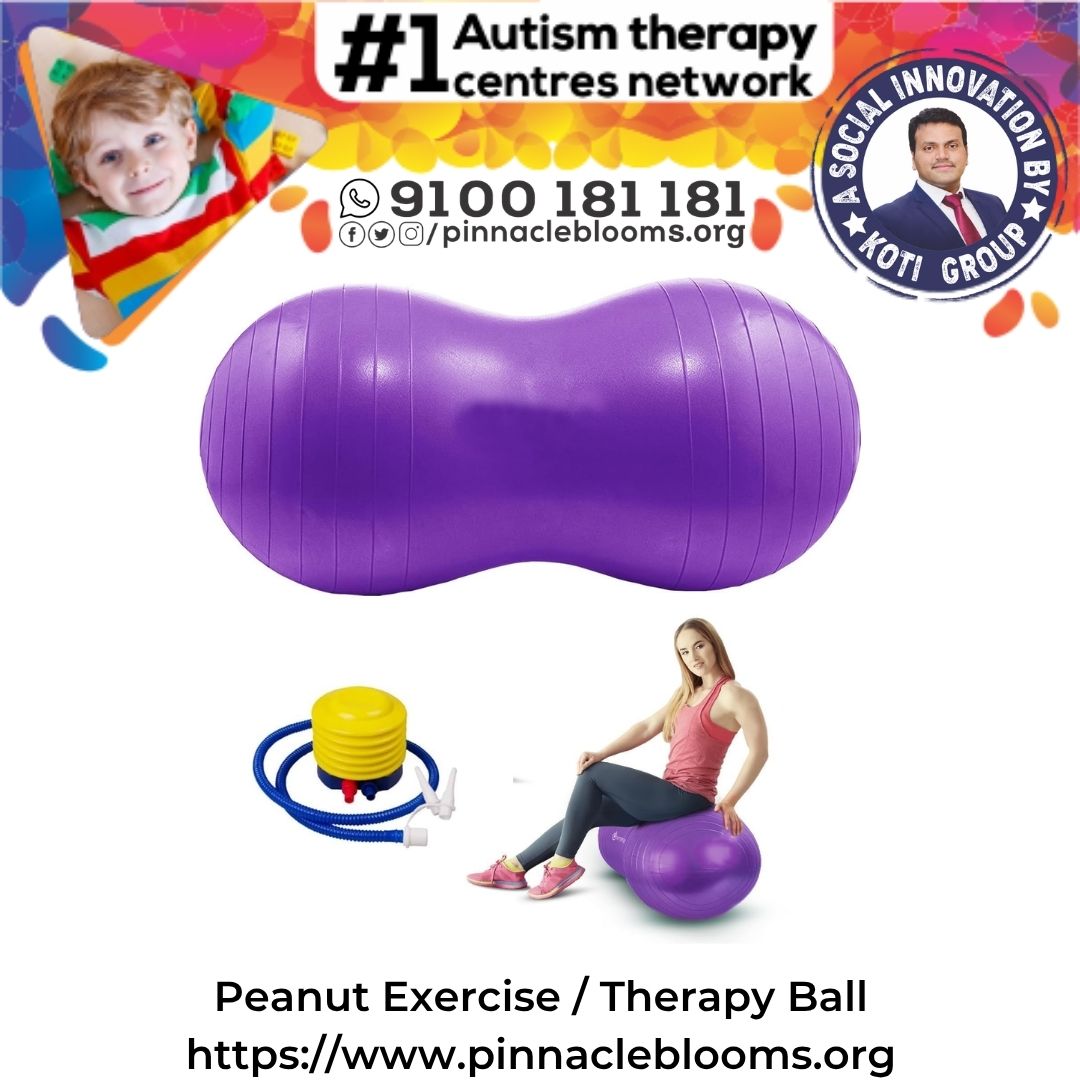
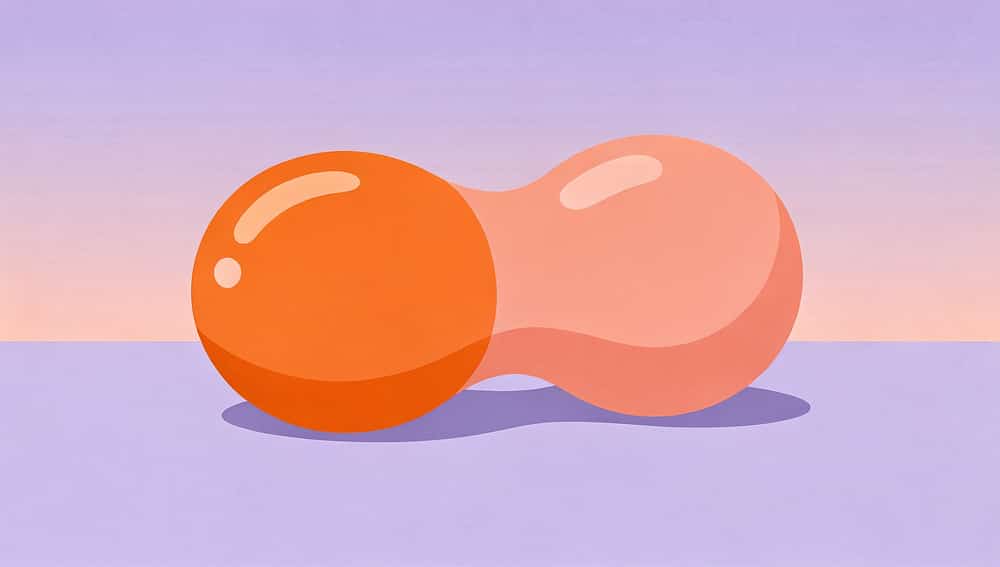
Peanut Ball / Physio Roll
₹800–2,500
Ages 2-9
Best for: Prone activities, bilateral coordination, therapy
Type: Peanut-shaped for stable, directional rolling
Settings: Clinic, Home
Portability: Medium
The shape prevents rolling sideways, making it ideal for prone (belly-down) positioning work and activities requiring more stability.

There was an error generating this image

Ball Chair / Ball with Base
₹1,000–3,000
Ages 5-9
Best for: Active sitting while working at desk
Type: Ball with stabilizing ring or base for classroom/desk seating
Settings: School, Home
Portability: Low
The stabilizing base prevents rolling away, making this the most classroom-friendly option. Often more acceptable to teachers than standard balls.

There was an error generating this image

Bumpy/Textured Therapy Ball
₹600–1,500
Ages 3-9
Best for: Tactile seekers, combined sensory input
Type: Sensory + vestibular combination with textured surface
Settings: Clinic, Home
Portability: Medium
The bumpy texture adds tactile input to the vestibular input, ideal for children who seek tactile stimulation or benefit from combined sensory input.
Mini Therapy Ball
₹200–500
Ages 2-9
Best for: Fine motor, targeted exercises, hand strengthening
Sizes: 15-30cm small balls
Settings: All settings
Portability: High
Small balls for hand exercises, squeezing activities, and smaller-scale activities. Highly portable. Great addition to larger therapy balls for comprehensive programming.

How to Choose
By Goal
  • Core/balance: Standard ball
  • Seated focus: Ball chair
  • Prone work: Peanut ball
  • Sensory seeking: Textured ball
  • Hand strength: Mini ball
By Setting
  • Home: Any option works well
  • School: Ball chair (most accepted)
  • Clinic: Standard or peanut ball
  • Multiple settings: Standard (deflatable)
By Portability
  • High portability: Mini ball
  • Medium: Standard, peanut, textured (deflatable)
  • Low: Ball chair with base
Sizing Guide (Critical for Safety)
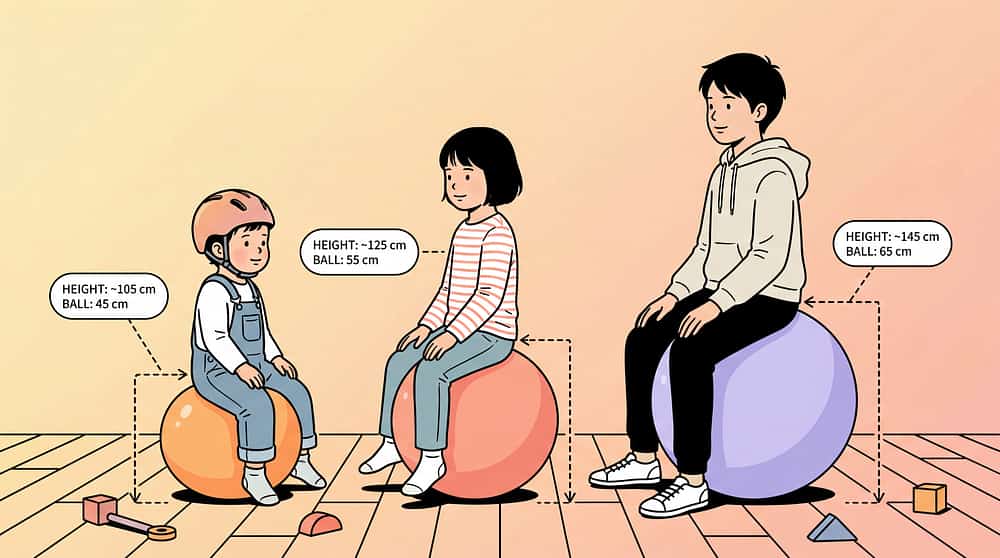
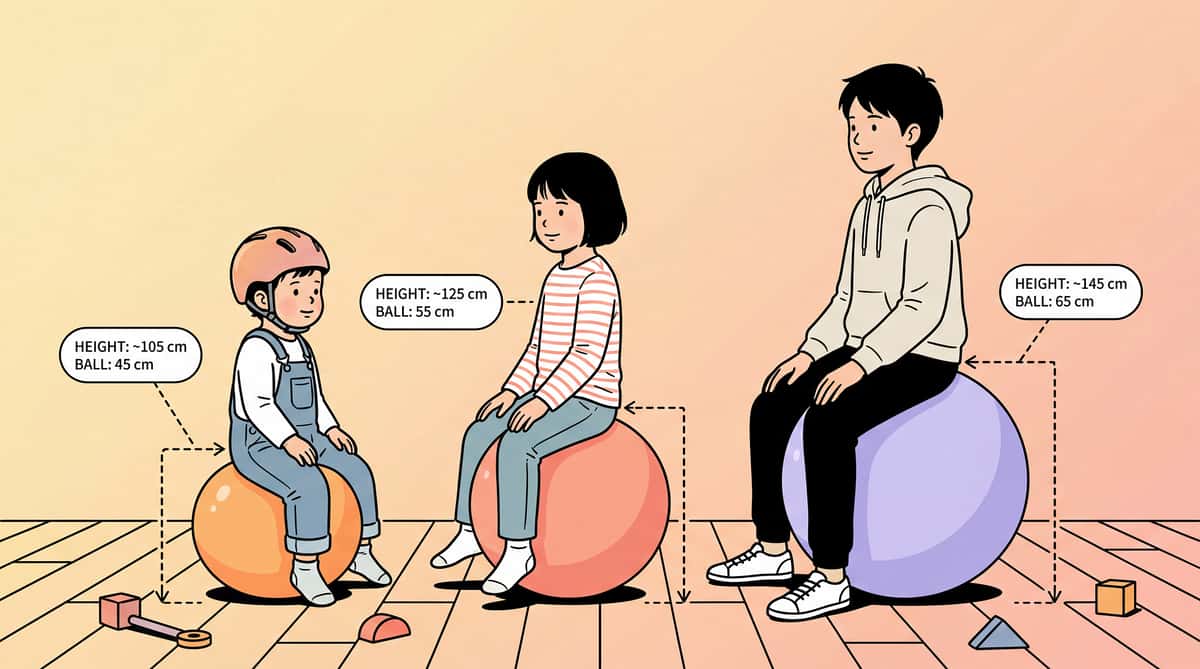
Proper sizing is essential for safety and therapeutic effectiveness. When your child sits on the correctly sized ball, their feet should be flat on the floor with knees bent at approximately 90 degrees. This position allows for safe balance while maximizing core engagement.
therapy-ball-exercise-ball therapy material
Ball Size
Child Height
Typical Age Range
45cm (18")
4'7" and under
Typically 3-6 years
55cm (22")
4'8" - 5'5"
Typically 6-10 years
65cm (26")
5'6" - 6'0"
Older children and small adults
75cm (30")
6'0" and above
Adults and tall teens

Important: Age ranges are approximate guidelines only. Always size based on your child's actual height, not their age. Measure your child and consult the height recommendations. When in doubt between two sizes, choose the smaller size for better control and safety.
Key Materials
  • Anti-burst PVC (essential for safety)
  • Textured options available for sensory input
  • Pump usually included with purchase
  • Check weight capacity rating for your child
Key Features to Look For
  • Anti-burst rated: Ball deflates slowly if punctured rather than exploding
  • Appropriate size: Use sizing guide above
  • Pump included: Check before purchasing separately
  • Weight capacity: Ensure rated for your child's weight
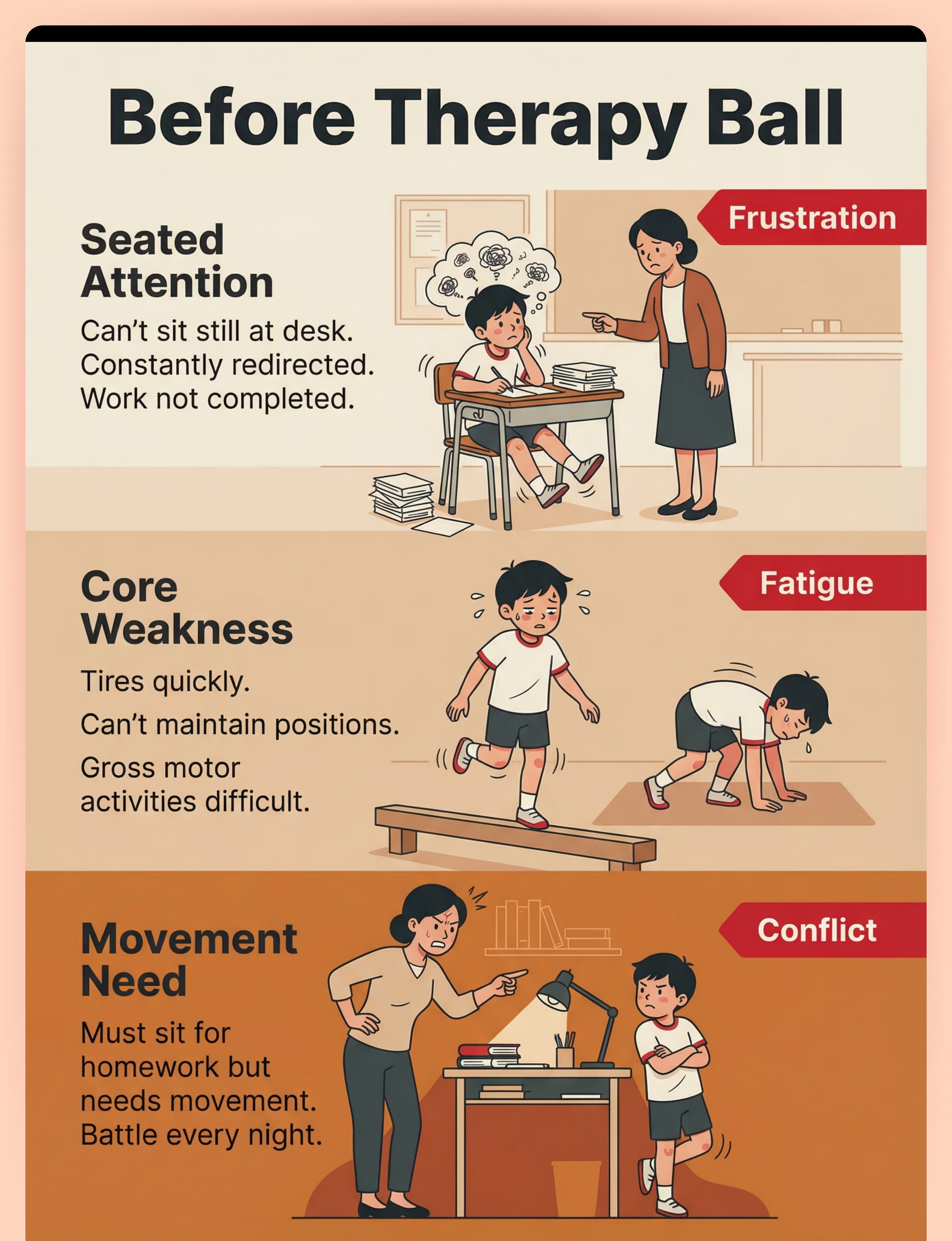
The Struggle (Before)
These scenarios represent real daily struggles families face. Understanding the "before" helps you recognize progress and maintain hope during the journey.
Seated Attention Challenges
Situation: Child can't sit still at desk during homework or meals
Experience: Constant wiggling, slumping, falling out of chair. Teacher or parent constantly redirecting. Child can't attend to work or conversation. Nothing gets completed. Everyone is frustrated.
Emotion: Frustration, failure, embarrassment for child; exhaustion for parents and teachers
Core Weakness Impact
Situation: Child has visibly poor posture and tires quickly during physical activities
Experience: Can't maintain any position for long. Constantly seeks support surfaces. Slumps, leans, lies down. Gross motor activities are difficult and exhausting. Avoids physical play. Development falling behind peers.
Emotion: Physical fatigue, struggle, feeling "not good at" physical activities; parental worry about development
Movement vs. Work Conflict
Situation: Child needs to move but must sit still for homework, meals, or classroom activities
Experience: Constant battle between movement needs and task demands. Neither need is being met. Child gets up repeatedly. Work doesn't get done. Movement is happening but not in productive ways. Conflict escalates.
Emotion: Conflict, exhaustion, sense that there's no solution; child feels blamed for needs they can't control
These struggles create a cycle: weak core makes sitting hard, sitting is avoided, core gets weaker. Breaking this cycle requires intervention.
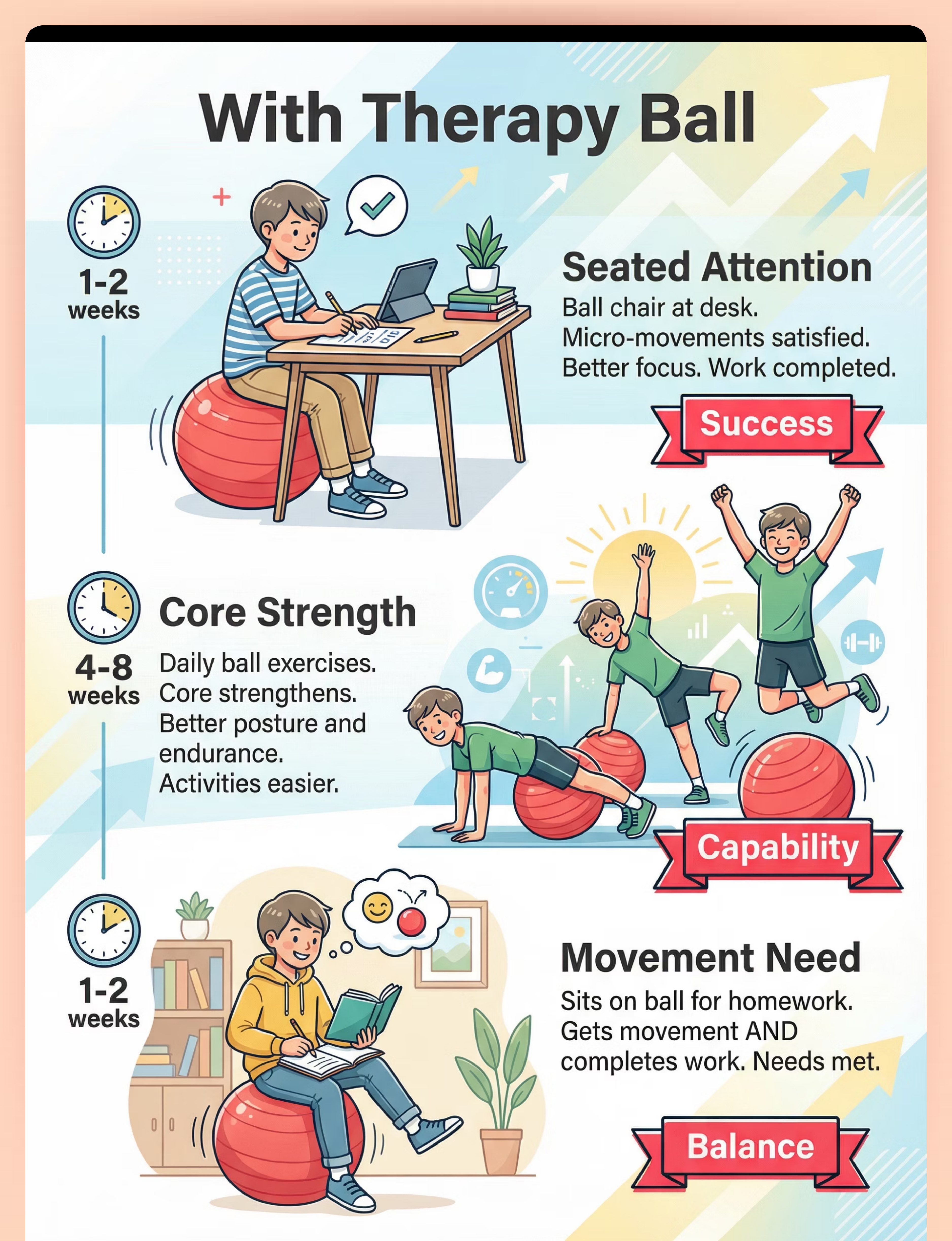
The Breakthrough (After)
With appropriate support, proper sizing, and consistent use, transformation happens. These are realistic outcomes families experience.
Seated Attention Success
Situation: Child uses ball chair at desk for homework and seated work
Experience: Micro-movements on ball satisfy movement need automatically. Core stays engaged. Child can attend to work. Productivity increases dramatically. Redirections decrease. Work gets completed.
Emotion: Focus, pride, success, capability; family relief and celebration
Timeframe: 1-2 weeks
Core Strength Building
Situation: Daily ball exercises and activities integrated into routine
Experience: Core strengthening happens gradually but measurably over weeks. Posture improves visibly. Endurance for physical activities increases. Activities that were difficult become easier. Child engages more confidently in gross motor play.
Emotion: Physical strength, capability, confidence; seeing child develop like peers
Timeframe: 4-8 weeks
Movement Needs Met
Situation: Child sits on therapy ball for homework time and other seated activities
Experience: Gets movement input AND completes work. Both needs met simultaneously. No more choosing between movement and productivity. Homework time becomes manageable. Child feels successful at meeting expectations.
Emotion: Balance, accomplishment, regulation; conflict resolved
Timeframe: 1-2 weeks
These aren't miracle cures, but they are consistent, achievable outcomes when therapy balls are sized correctly, used appropriately, and integrated into daily routines.
What to Expect (Realistic Timelines)
Setting realistic expectations helps you maintain consistency and recognize progress. Different goals have different timelines.
1
Movement needs met while seated
The micro-movements available on the ball provide immediate vestibular-proprioceptive input. Child feels more regulated and focused right away.
Immediate
2
Vestibular input throughout day
The sensory input from sitting on an unstable surface provides organizing input to the nervous system from the very first use.
Immediate
3
Better attention during seated tasks
Once novelty period passes and positioning is correct, most children show improved focus and task completion within 1-2 weeks of regular use.
1-2 weeks
4
Better seated posture
As core muscles begin to strengthen and child develops better body awareness, postural improvements become visible within 2-4 weeks.
2-4 weeks
5
Core strength improves
Measurable core strength gains require consistent daily use over 4-8 weeks. Progress continues with ongoing use beyond this timeframe.
4-8 weeks
6
Improved balance
Balance skills build gradually as core strength and body awareness improve. Expect visible balance improvements within 4-8 weeks of regular activities.
4-8 weeks

Remember: Every child progresses at their own pace. These timeframes are typical ranges based on daily use. Consistency matters more than intensity. Regular 15-30 minute sessions daily or near-daily produce better results than occasional longer sessions.
Is This Right for My Child? (2-Minute Check)
Answer these four questions to determine if a therapy ball is likely to be helpful for your child. If you answer "yes" to 3 or more questions, a therapy ball is a strong fit.
1
Does your child have poor core strength or posture?
If yes, this indicates: Therapy ball will help strengthen core muscles and improve posture through consistent use
Confidence score: 95%
2
Does your child struggle to sit still?
If yes, this indicates: Ball provides movement input while seated, meeting sensory needs without disrupting activities
Confidence score: 92%
3
Does your child benefit from movement to focus?
If yes, this indicates: Active seating on therapy ball is strongly indicated for homework, meals, and other seated activities
Confidence score: 90%
4
Does your child have balance challenges?
If yes, this indicates: Ball work will build balance skills through vestibular input and core strengthening activities
Confidence score: 85%
Interpretation: 3+ "yes" answers = strong fit for therapy ball. 2 "yes" answers = likely helpful, discuss with OT/PT. 1 or fewer "yes" = consider other tools first or get professional evaluation to identify primary needs.
Usage Guide
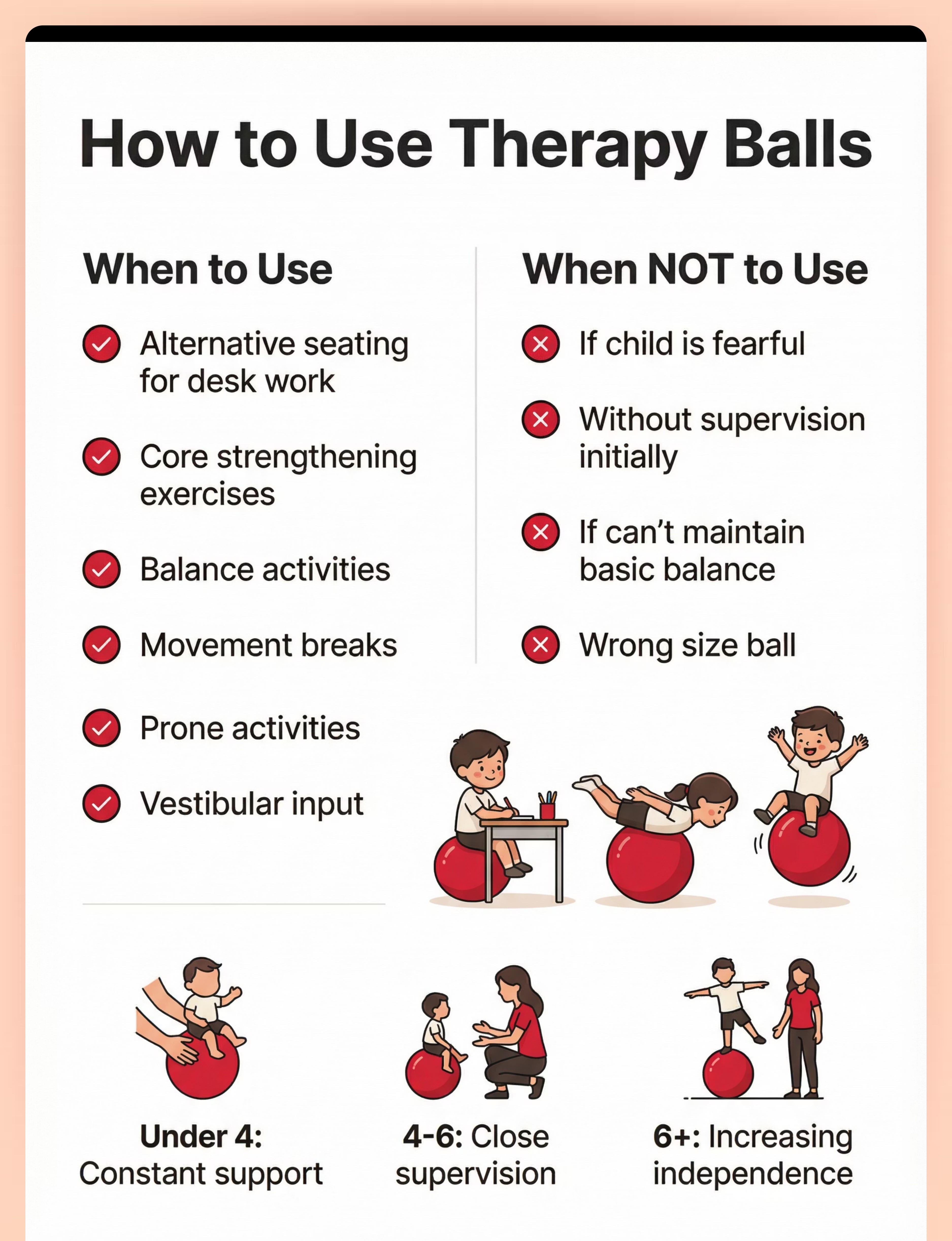
When to Use ✓
  • Alternative seating for desk work, homework, or meals
  • Core strengthening exercises prescribed by PT/OT
  • Balance development activities and games
  • Movement breaks during long seated periods
  • Prone activities (lying belly-down on ball)
  • Vestibular input activities for regulation
When NOT to Use ✗
  • If child is fearful (introduce slowly with support first)
  • Without supervision until child demonstrates safety
  • If child can't maintain basic balance even with support
  • Wrong size ball for child's height

Supervision by Age
Age Range
Supervision Level
Notes
Under 4 years
Constant hands-on support
Adult should be providing physical support and holding child. Never leave unattended. Focus on building comfort and confidence.
4-6 years
Close supervision, active spotting
Adult should be within arm's reach, ready to provide support. Watch constantly. Gradually increase independence as skill builds.
6+ years
Supervision with increasing independence
Level of supervision depends on individual child's skill and safety. Most children this age progress to independent use with periodic check-ins.

Duration Guidance
For active seating: 15-30 minutes at a time is typically appropriate
For exercise sessions: Follow your therapist's specific recommendations
Watch for signs of fatigue and allow breaks as needed
Appropriate Settings
Home
School
Clinic
Ball chairs with bases are most accepted in school settings. Standard balls work in all settings but may require advocacy for classroom use.
Safety First

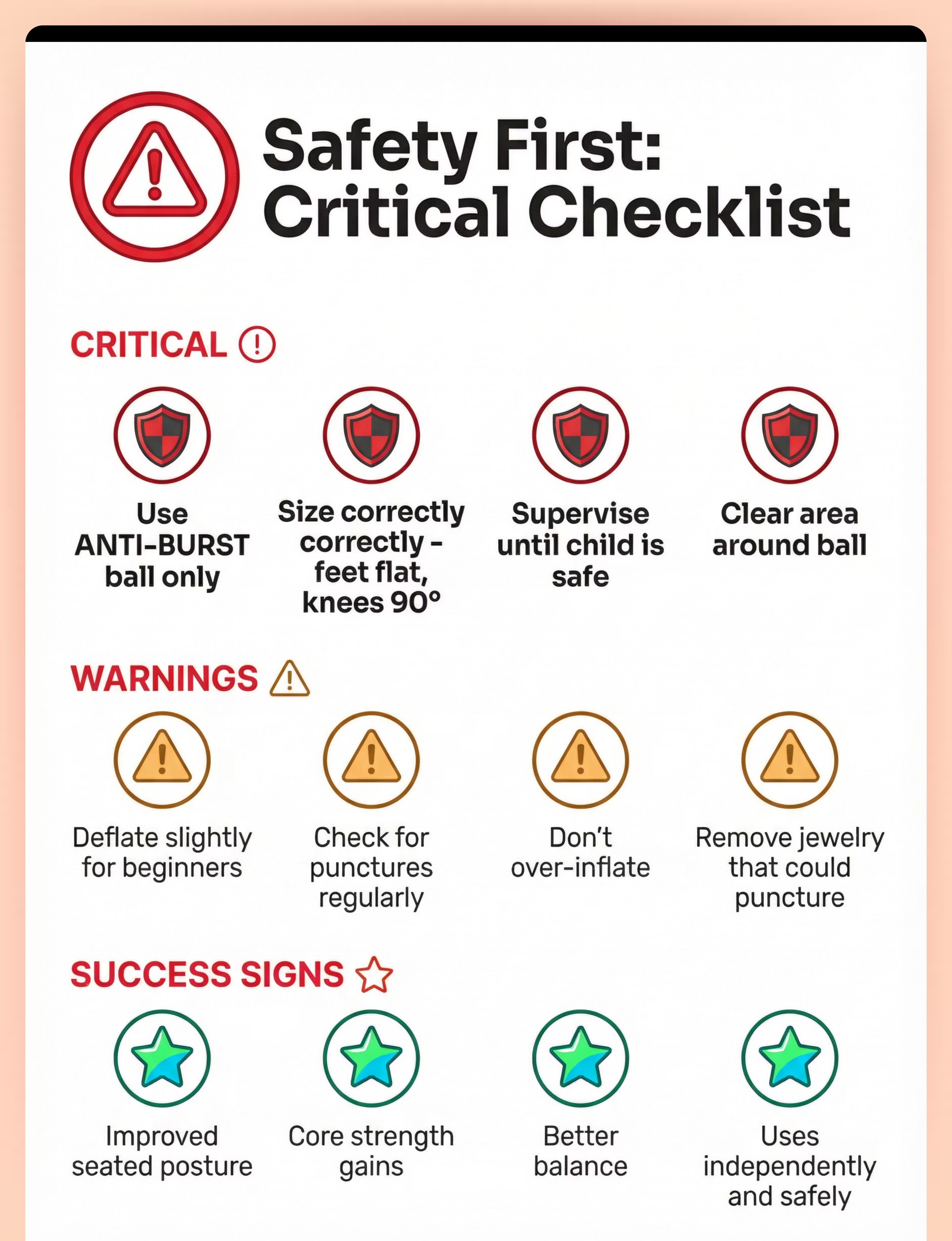
Critical Safety Requirements
  • Use ANTI-BURST ball only - ball should deflate slowly if punctured, not burst suddenly
  • Size correctly - feet flat on floor, knees at 90° when seated
  • Supervise until child demonstrates safety - level depends on age and skill
  • Clear area around ball - remove furniture with sharp edges, create safe space for activities

Important Warnings
  • Deflate slightly for beginners to increase stability
  • Check ball for punctures, wear, or damage regularly before each use
  • Don't over-inflate - follow manufacturer guidelines
  • Remove jewelry, belt buckles, or anything sharp that could puncture ball

Do NOT Use If:
  • Child has severe balance issues without available physical support
  • Child's fear has not been adequately addressed through gradual introduction
  • Ball is wrong size for child's height
  • Ball is not anti-burst rated

Safety Checklist
Before Use ✓
  • Correct size for child's height
  • Anti-burst rated and in good condition
  • Appropriate inflation level
  • Clear area with safe space around ball
  • Supervision plan in place
During Use ✓
  • Supervision appropriate to child's age and skill level
  • Child feels safe and confident
  • Correct positioning maintained
  • Activities appropriate to skill level
  • Watch for signs of fatigue
Signs of Success ✓
  • Improved seated posture over time
  • Visible core strength gains
  • Better balance in activities
  • Child uses ball independently and safely
  • Positive engagement with ball activities
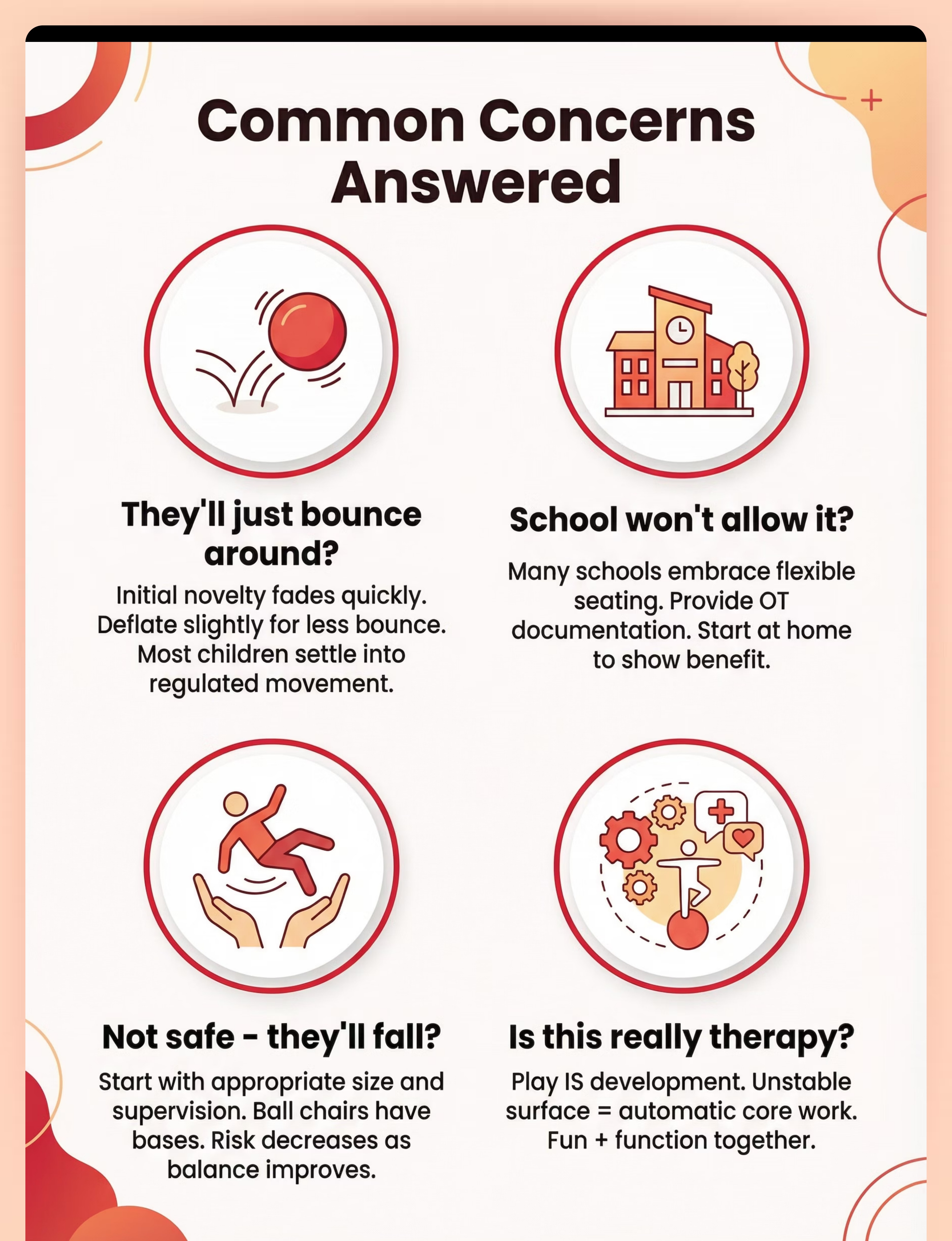
Common Questions (Honest Answers)
These are real concerns parents express. Here are evidence-based, honest answers.
Q: They'll just bounce around and not focus
Honest Answer: Initial novelty often equals bouncing—this is normal and temporary. It typically fades within a few days to a week. To speed this process, deflate the ball slightly to reduce bounce, set clear expectations about appropriate use, and stick with it through the novelty period. Most children settle into regulated movement that actually helps focus rather than disrupting it.
Try this: Deflate slightly for less bounce, establish clear "ball rules," and give it at least 1-2 weeks past the novelty phase before evaluating effectiveness.
Q: It's not safe - they'll fall off
Honest Answer: Start with appropriate sizing (feet flat on floor), begin with supported activities where you're providing physical support, and use ball chairs with stabilizing bases if safety is a major concern. Supervise closely initially—spotting distance decreases as balance improves. The risk of falling decreases quickly as core strength and balance develop. Most falls are minor and part of the learning process.
Try this: Use ball chair with stabilizing base; provide hands-on supervision initially; size correctly for child's height.
Q: School won't allow it
Honest Answer: Many schools now embrace flexible seating and active seating options. Provide documentation from your child's OT or PT explaining the therapeutic benefit. Offer a ball chair with base (more stable, less disruptive). Start by demonstrating success at home—take photos or video showing improved focus. Advocate with evidence, not just preference. Some schools require trial periods or specific accommodations documentation.
Try this: Get OT recommendation letter; offer ball chair option; demonstrate home success; work with school team to create trial period.
Q: Is this really therapy or just play?
Honest Answer: It's both—and that's exactly the point. Play is how children develop motor skills, and making therapy fun improves compliance and outcomes. The unstable surface requires constant micro-adjustments that activate core muscles automatically—therapy is happening whether the child realizes it or not. When you add structured exercises prescribed by PT/OT, you get targeted strengthening on top of the automatic benefit. The combination of fun and function is what makes therapy balls so effective.
Try this: Combine playful use throughout the day with structured exercise sessions for comprehensive benefit.
Investment Guide
Therapy balls are one of the most cost-effective therapeutic tools available. Even premium options are affordable for most families.

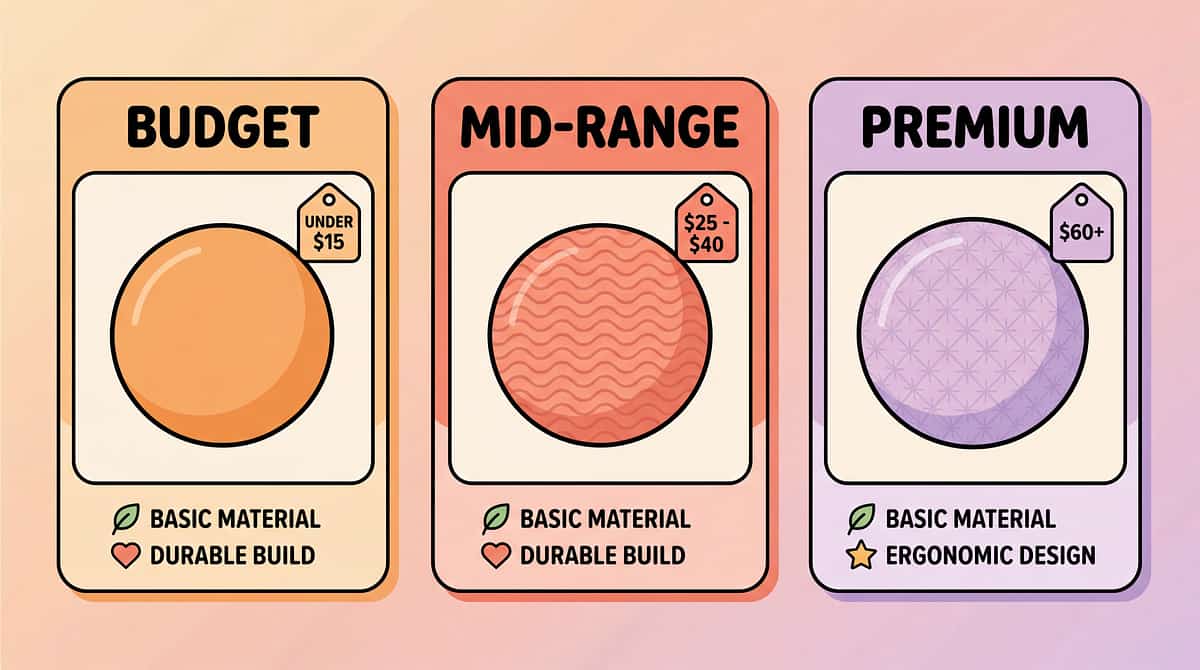
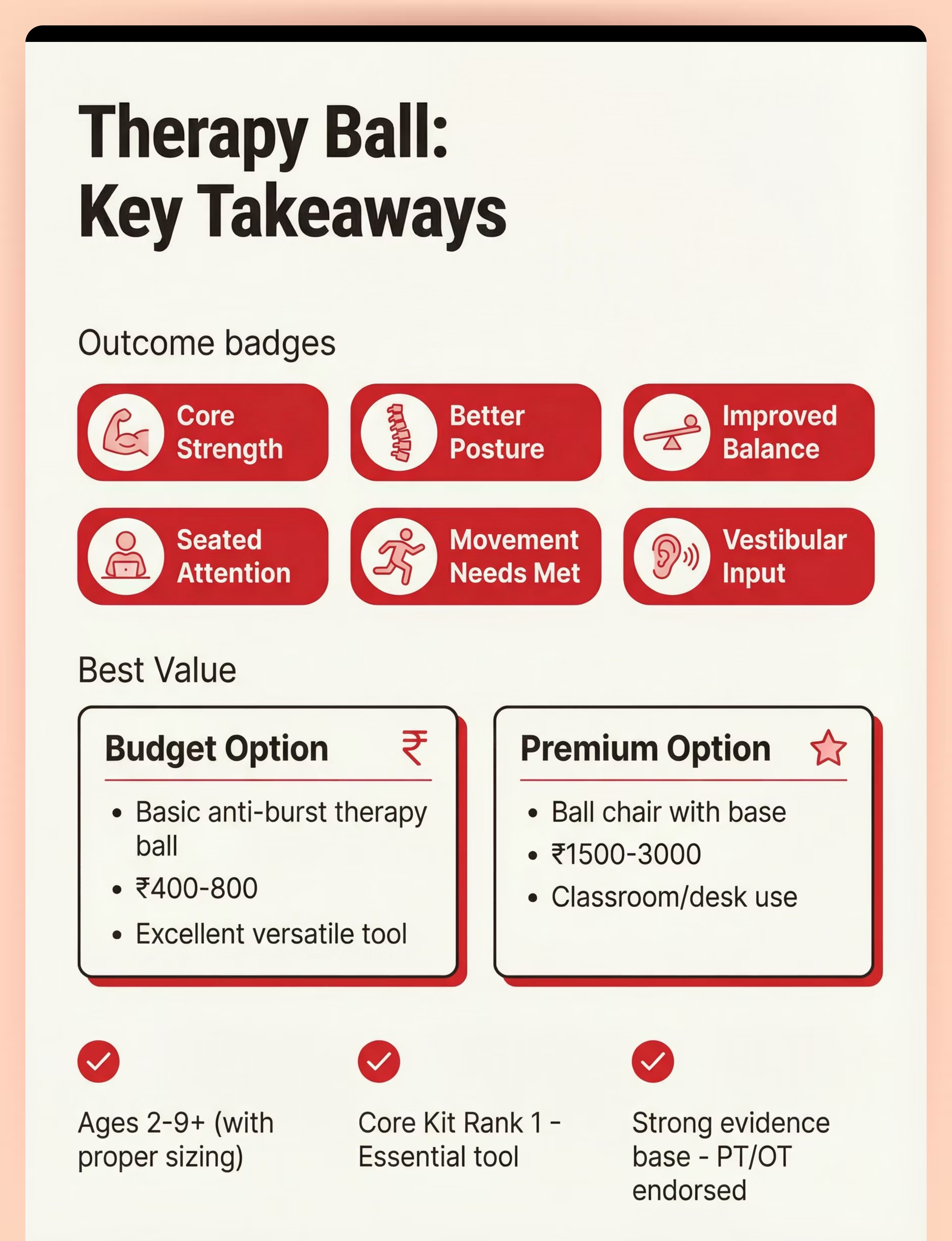
Budget Option
Basic anti-burst therapy ball with pump
Cost: ₹400-800 ($5-10 USD)
What you get: Anti-burst PVC exercise ball in appropriate size with inflation pump included
Note: Excellent value for versatile tool. This is all most families need to start. Add specialized options later if specific needs become apparent.
Recommended Starting Point

Premium Option
Ball chair with base for classroom/desk
Cost: ₹1,500-3,000 ($18-36 USD)
What you get: Therapy ball with stabilizing ring or base designed for desk use, often with back support options
Brands: Gaiam, Trideer, URBNFit
Note: Worth the investment if child needs active seating for homework or school. More accepted in classroom settings. More stable for beginners.

Overall Investment Range
Complete range across all variants: ₹400–3,000 ($5–36 USD)
Most common purchase: ₹600–1,200 for quality standard ball
This is a one-time purchase that lasts for years. Cost per use is pennies. Compare this to ongoing therapy co-pays or other interventions, and therapy balls represent exceptional value for the therapeutic benefit delivered.
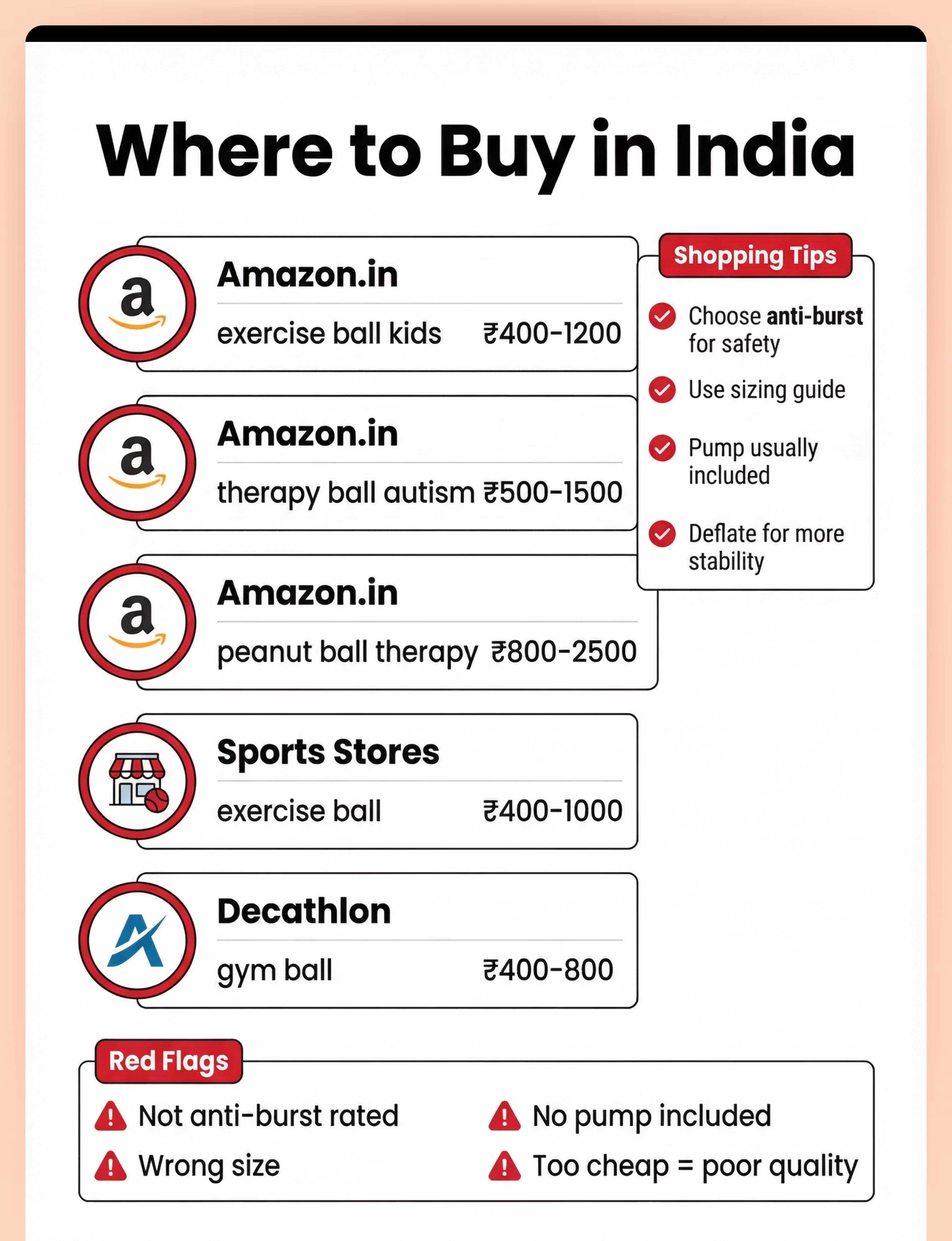
Where to Buy in India
Availability: Widely Available across India through online platforms and local sports stores
Platform
Search Term
Price Range
"exercise ball kids"
₹400-1,200
"therapy ball autism"
₹500-1,500
"peanut ball therapy"
₹800-2,500
Local sports stores
"exercise ball" or "gym ball"
₹400-1,000
Decathlon
"gym ball"
₹400-800

Buying Tips (Maximize Value & Safety)
  • Choose anti-burst rated balls only for safety—this is non-negotiable
  • Size matters—use the sizing guide based on child's height, not age
  • Check if pump is included—most include pump, but verify before purchasing separately
  • Slightly deflate for beginners—easier to balance on slightly softer ball initially
  • Ball chair for desk use—if primary use is homework/classroom, invest in ball chair with base
  • Read reviews—look for durability reports and anti-burst performance feedback

Red Flags (Avoid These)
  • Not anti-burst rated—unsafe, could cause injury if ball bursts suddenly
  • Wrong size for your child—won't be effective and increases fall risk
  • No pump included—adds cost and delay; verify before purchase
  • Too cheap to be quality—balls under ₹300 are often poor quality, not anti-burst, and unsafe
DIY Alternative
DIY Feasibility: Very Low—commercial purchase strongly recommended
Why you cannot DIY therapy balls: Safety requires commercial anti-burst construction. There is no safe way to create a therapy ball at home that provides the necessary safety features (anti-burst technology, appropriate materials, correct inflation, weight capacity ratings).

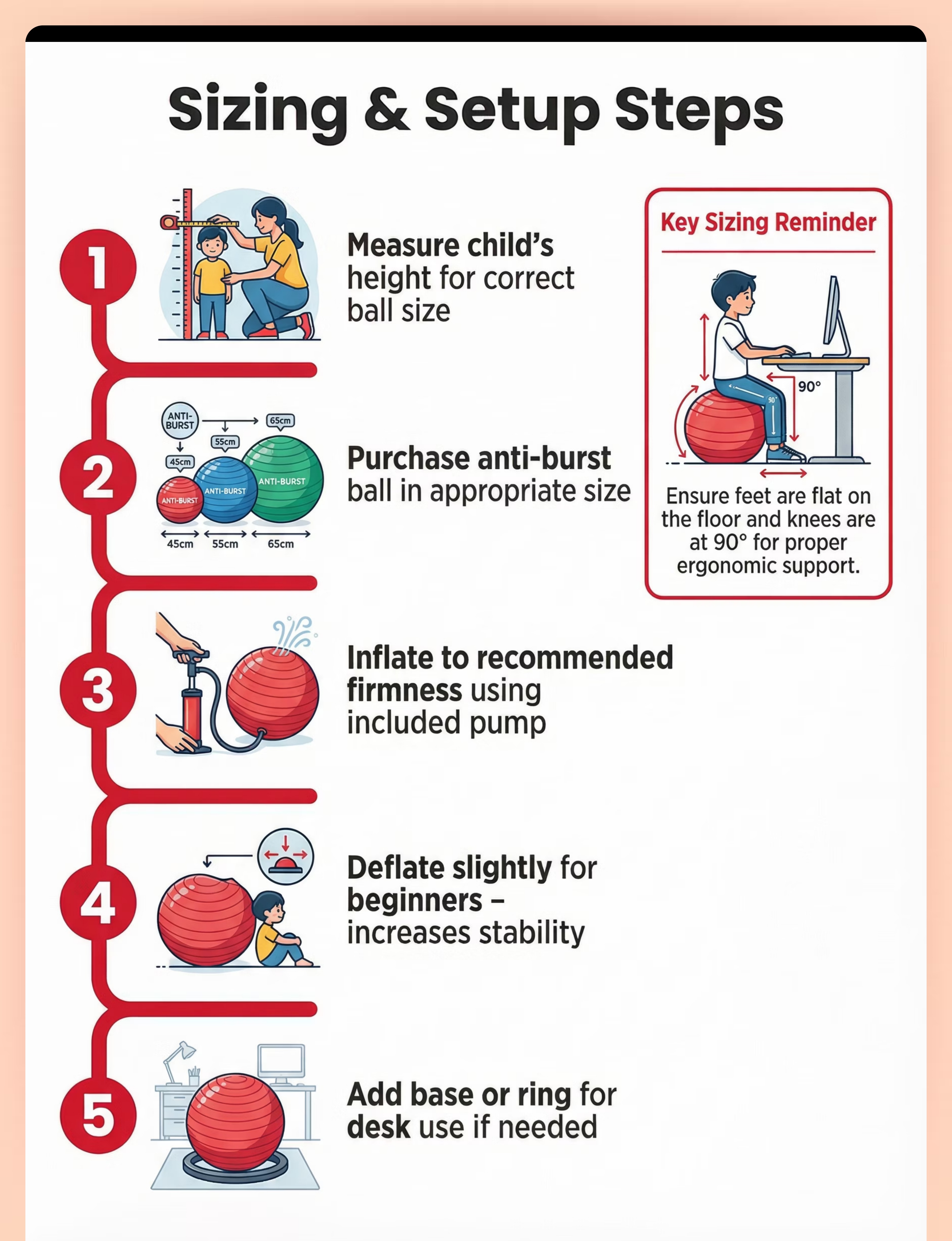
Setup Process (Once You Purchase)
1
Measure your child's height
Use the sizing guide to determine correct ball size. This is the most important step for safety and effectiveness.
2
Purchase anti-burst therapy ball in correct size
Order from reputable source. Verify anti-burst rating and that pump is included.
3
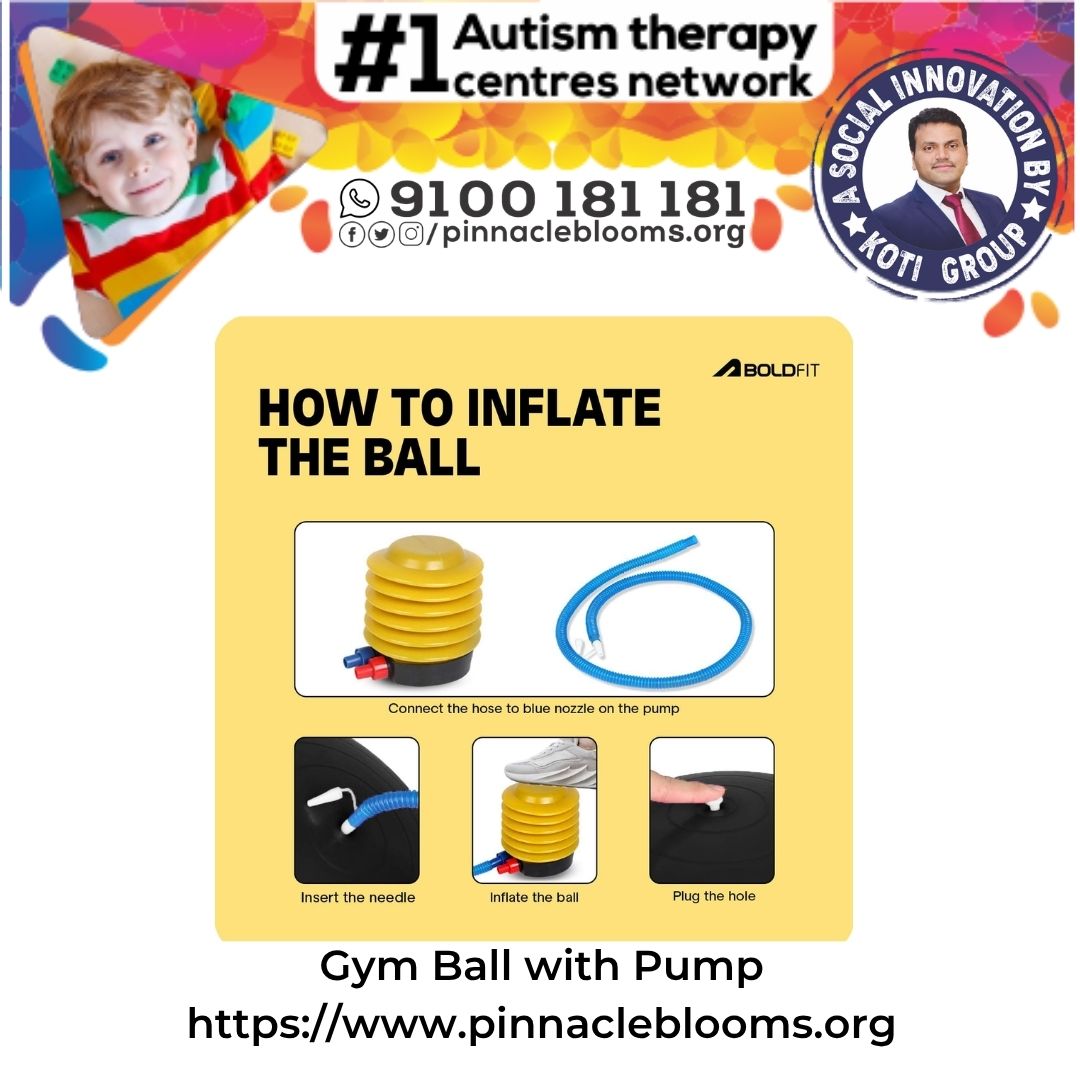
Inflate to appropriate firmness
Follow manufacturer instructions. Ball should be firm but give slightly when pressed. Don't over-inflate.
4
Deflate slightly for beginners
A slightly softer ball provides more stability. Gradually increase firmness as child's skill improves.
5
Add base or ring for desk use if desired
If primary use is seated work, consider adding stabilizing base. Can purchase separately or buy ball chair as complete unit.

DIY vs Commercial
When to DIY
When to Buy Commercial
N/A - cannot safely DIY
Always - safety requires commercial anti-burst product with proper materials, construction, and weight ratings

Safety Note: The anti-burst feature that allows balls to deflate slowly rather than burst suddenly cannot be replicated in DIY versions. This feature is essential for preventing injuries from sudden falls. Always purchase commercial therapy balls from reputable manufacturers.

Preview of therapy ball exercise ball Therapy Material

Below is a visual preview of therapy ball exercise ball therapy material. The pages shown help educators, therapists, and caregivers understand the structure and content of the resource before use. Materials should be used under appropriate professional guidance.

Page 1
Page 2
Page 3
Page 4
Page 5
Page 6
Page 7
Page 8
Page 9
Page 10
Page 11
Page 12
Page 13
Page 14
Page 15
Page 16
Page 17
Page 18
Page 19
Page 20
Link copied!
Measuring Success & Complete Support
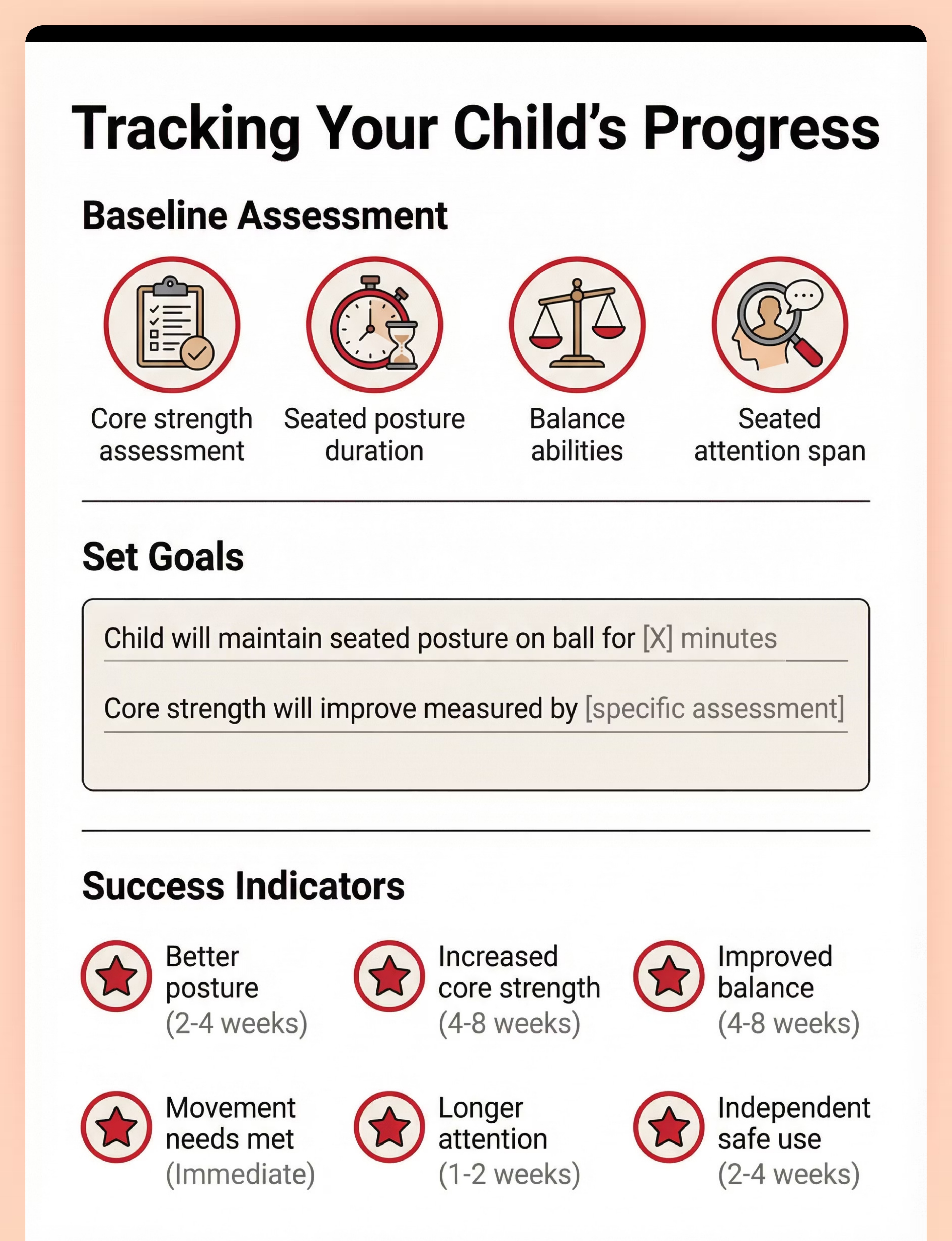
Track Progress
Establish baseline measures before starting, set specific goals, and track progress using clear success indicators.
Measure at Baseline
  • Core strength assessment (with PT/OT)
  • How long child can maintain seated posture
  • Balance abilities in various positions
  • Seated attention span during work tasks
Set Specific Goals
  • Child will maintain seated posture on ball for [X] minutes
  • Core strength will improve by [specific measures]
  • Balance will improve in [specific activities]
  • Seated attention during homework will increase
Success Indicators
  • Visibly better posture during seated activities
  • Measurable core strength increases
  • Improved balance and coordination
  • Longer sustained attention during work
  • Independent, safe use of ball

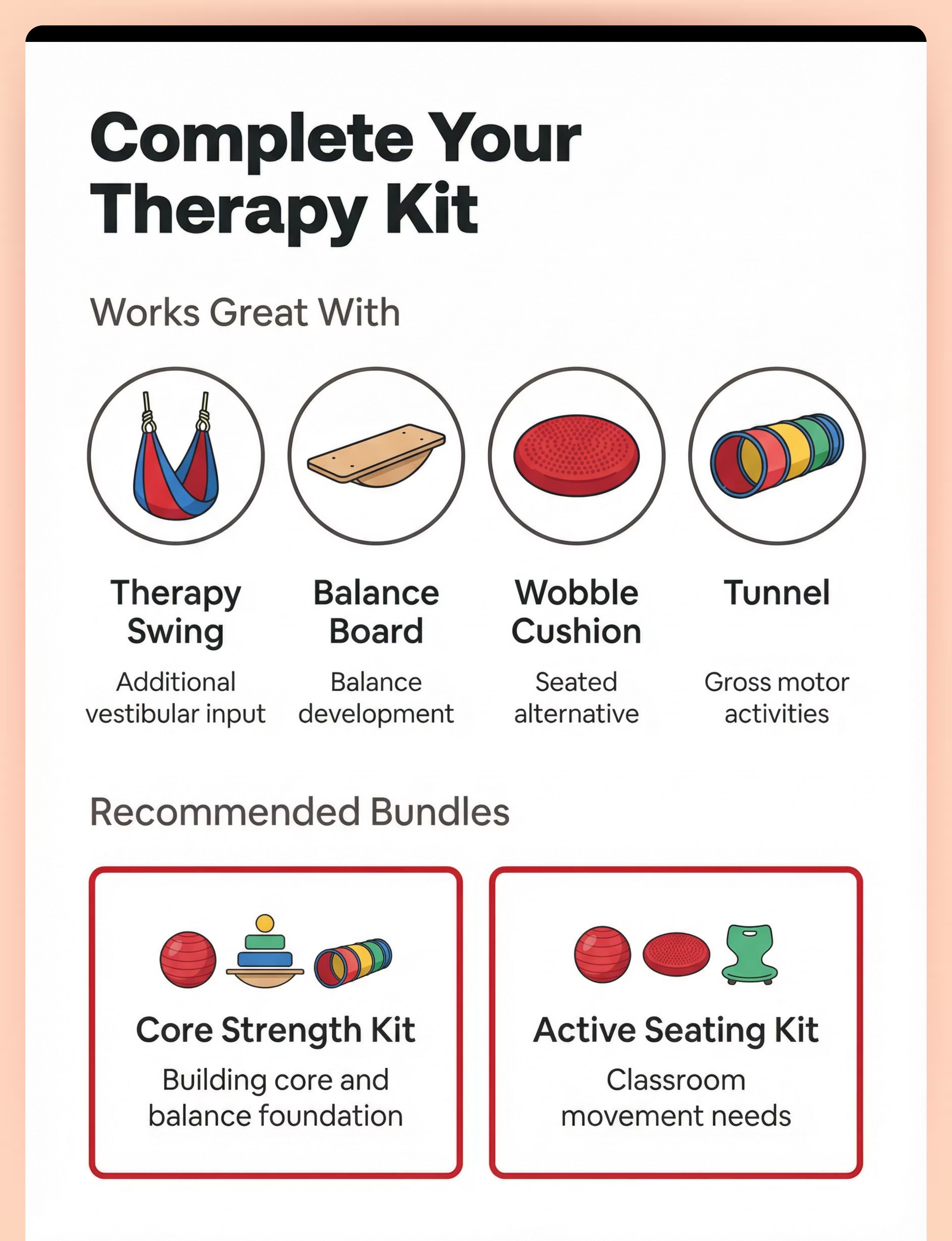
Complete the Kit - Pair It With
Therapy balls work synergistically with other gross motor and sensory tools. Consider these complementary options:
Therapy Swing (ID: 6.1)
Why pair: Provides additional vestibular input through different movement patterns, complementing ball work
Balance Board (ID: 6.3)
Why pair: Further develops balance skills and core strength through different challenges
Wobble Cushion (ID: 12.3)
Why pair: Provides less intensive active seating alternative for variety or travel
Tunnel (ID: 6.6)
Why pair: Adds gross motor activity variety and additional proprioceptive input
Recommended Bundles
  • Core Strength Kit: Therapy Ball (6.2) + Balance Board (6.3) + Tunnel (6.6) — Comprehensive core and balance development
  • Active Seating Kit: Therapy Ball (6.2) + Wobble Cushion (12.3) + Fidgets (1.4) — Meeting classroom movement needs

Quick Summary

AI Summary: Therapy balls provide dynamic seating, core strengthening, and vestibular input for improved posture, balance, and seated attention. Core Kit essential (Rank #1) with strong clinical evidence. Versatile tool appropriate for ages 2-9+ years across all settings.
therapy ball
exercise ball
core strength
balance
active seating
vestibular
PT
OT
core-kit
Common Searches: therapy ball autism, exercise ball kids, physio ball therapy, ball chair classroom, peanut ball therapy, core strength autism, active seating autism

Get Support

FREE National Autism Helpline
Phone: 9100 181 181
Languages: 16+ languages supported
Connect with our team for personalized guidance on selecting and using therapy balls, integrating them into your child's routine, and tracking progress.
Platform Integration
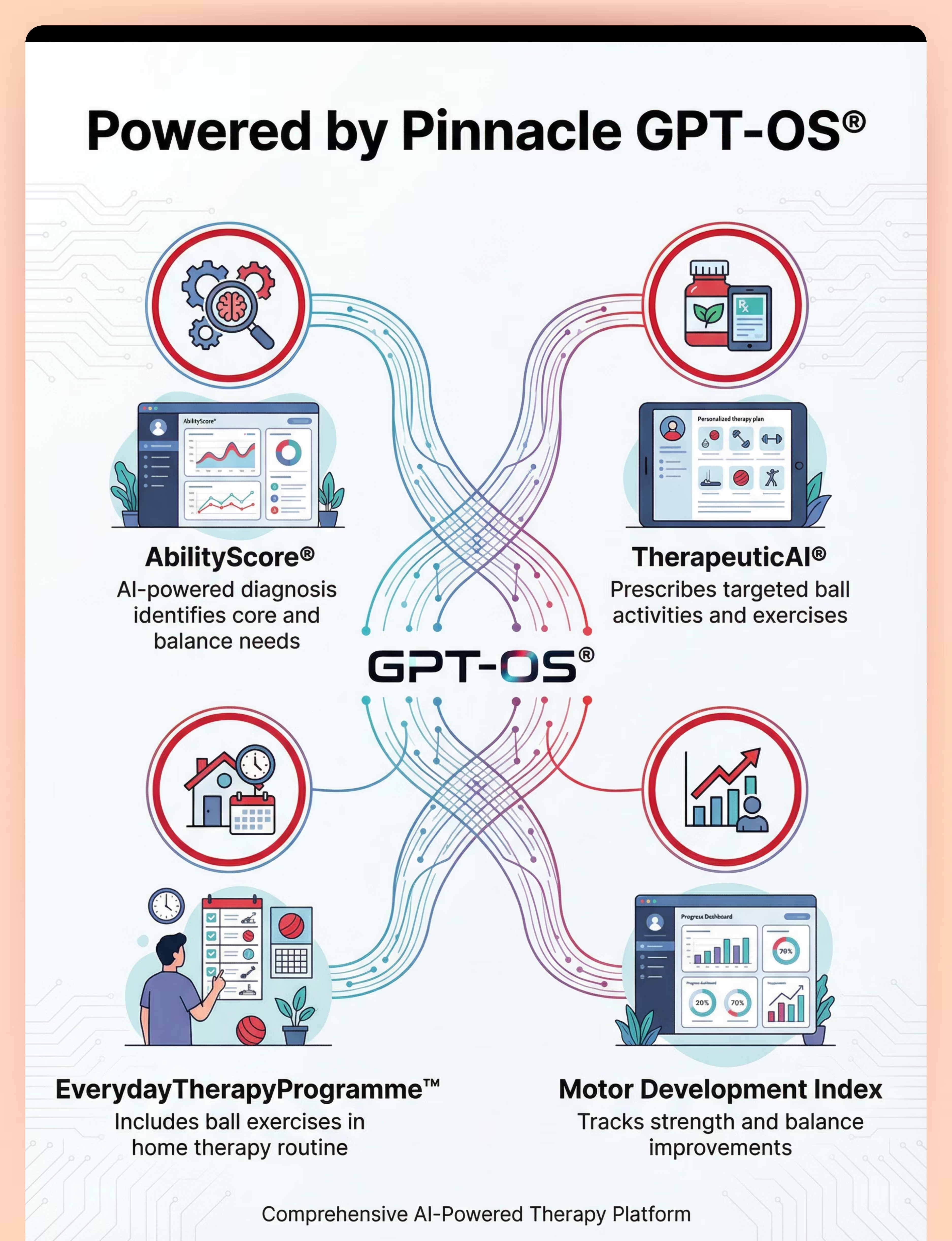
Therapy balls integrate seamlessly with Pinnacle Blooms Network's comprehensive platform:
  • AbilityScore® identifies your child's specific core strength and balance needs through comprehensive assessment
  • TherapeuticAI® prescribes personalized ball activities matched to your child's goals and skill level
  • EverydayTherapyProgramme™ includes structured ball exercises integrated into daily routines
  • Motor Development Index tracks strength and balance progress over time with objective measures

Important Disclaimer: This is educational information provided to help families make informed decisions. Always consult qualified occupational therapists, physical therapists, or pediatricians for personalized assessment and recommendations. Individual results vary based on child's unique needs, consistency of use, and other factors. Therapy balls are tools that support development but are not substitutes for professional evaluation and intervention when needed.