


















Tool ID: 1.6
Tool ID: 1.6
OT Recommended
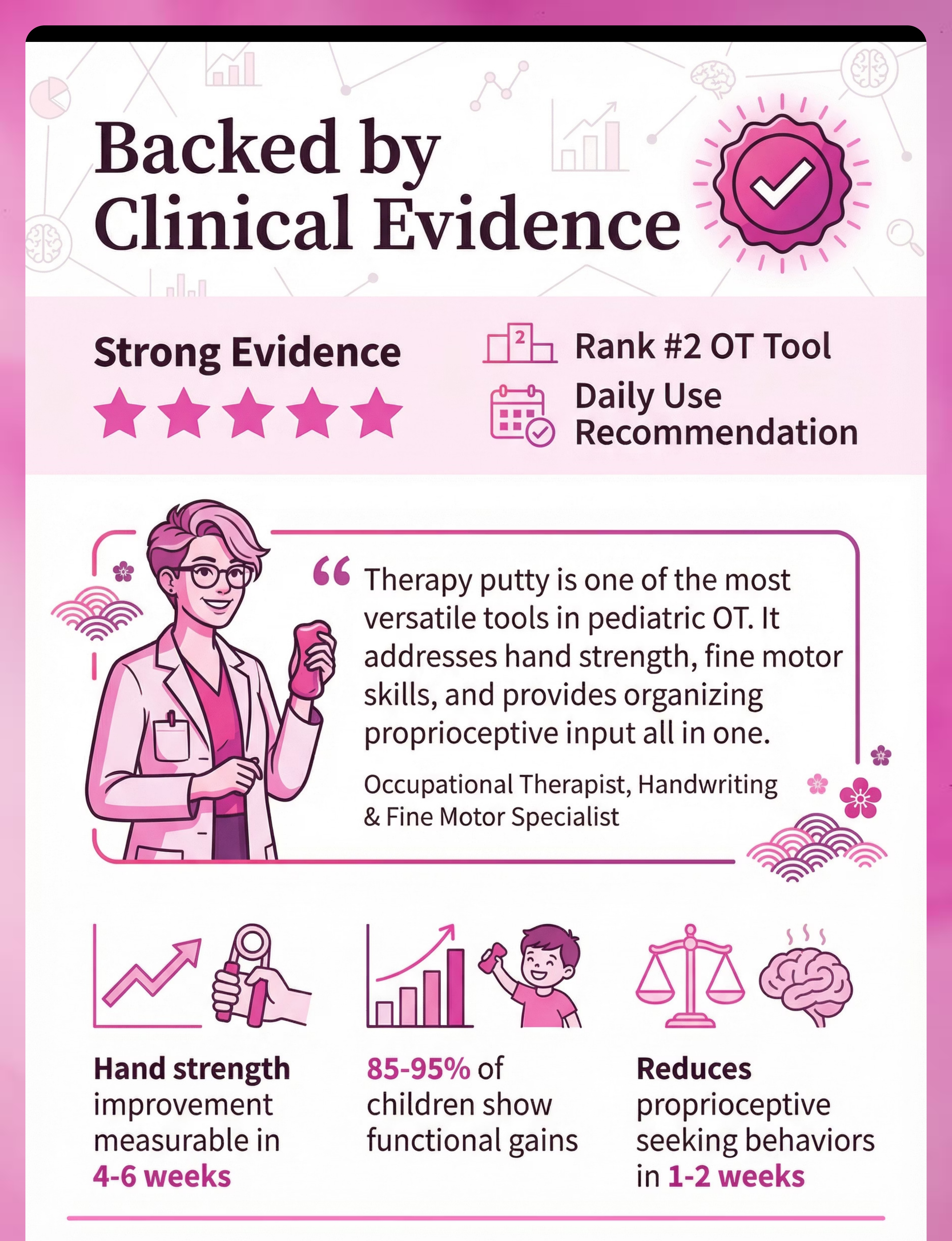
Strong Evidence
Rank #2
Daily Use
₹100–1,000
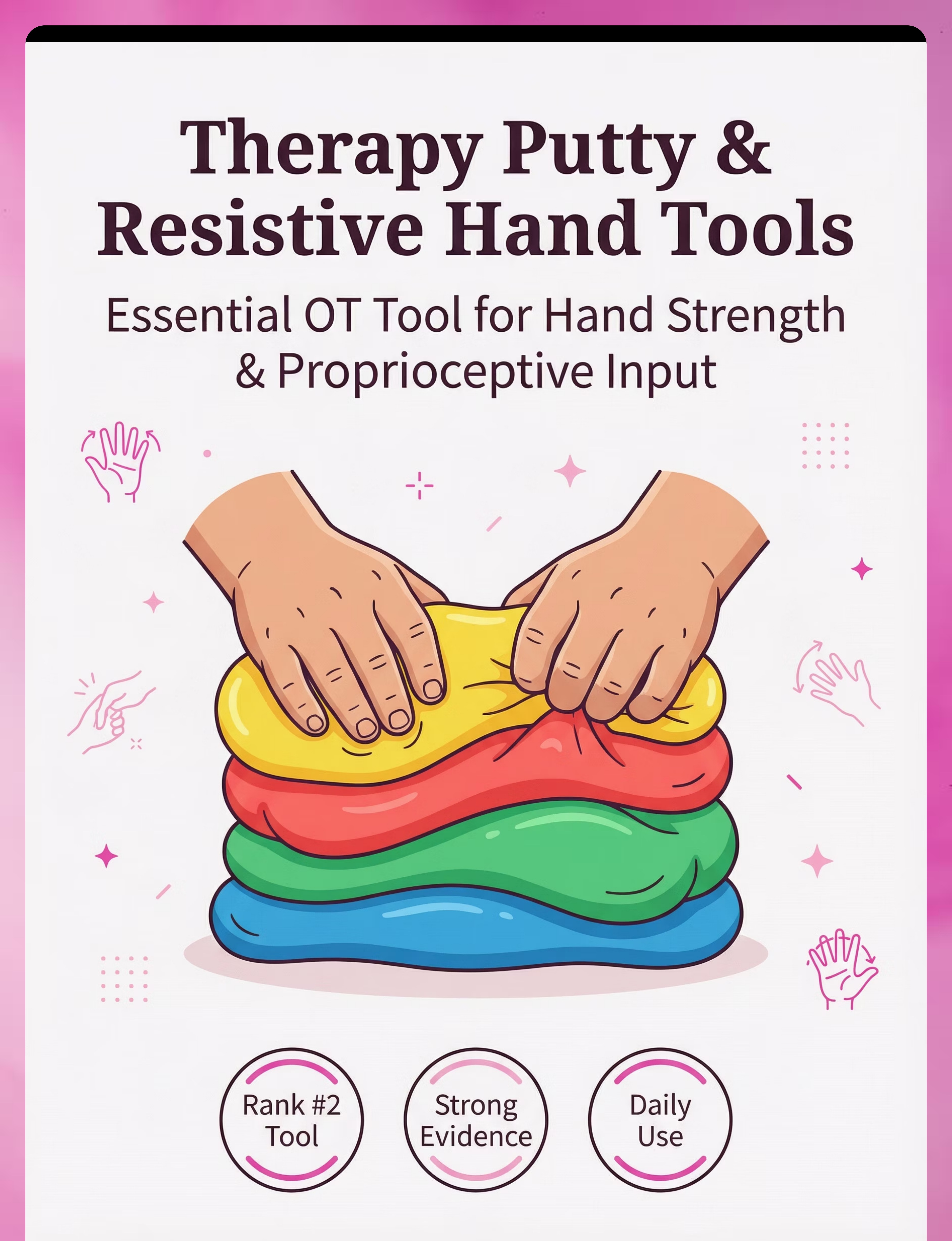
Therapy Putty / Resistive Hand Tools
Resistive proprioceptive hand input system
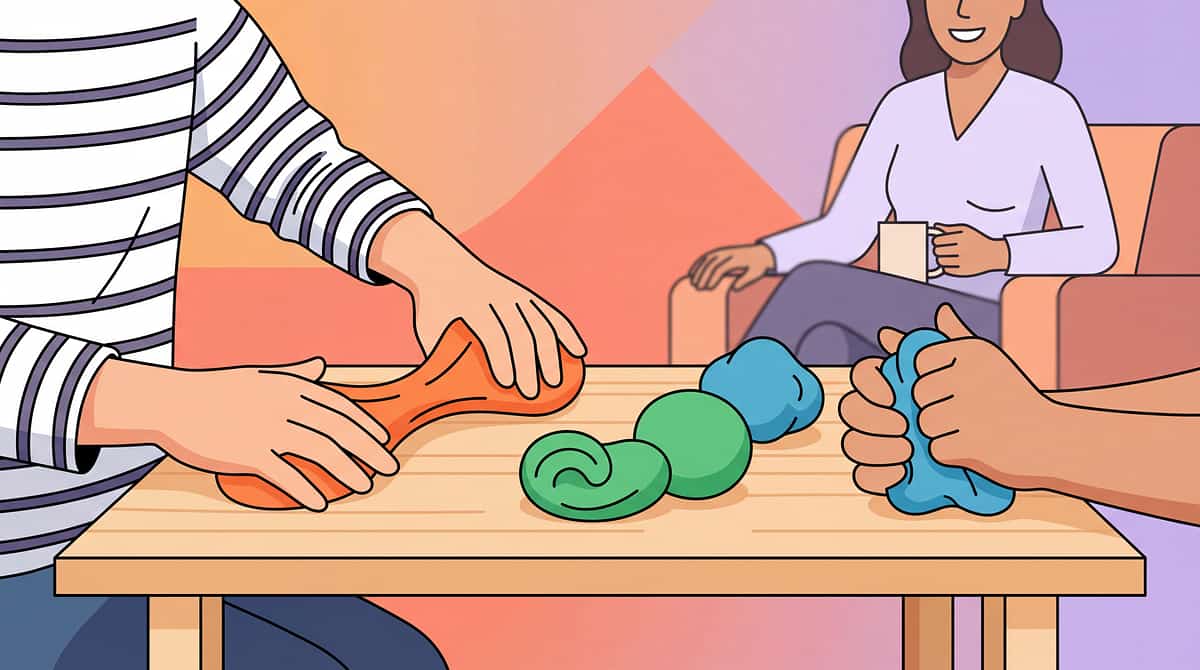
Give your child's hands the strength they need while providing calming, organizing input to their nervous system. Therapy putty is a foundational occupational therapy tool that addresses hand strength, fine motor skills, and self-regulation—all in one simple, portable material. Used daily in clinics and homes across India, these color-coded resistive tools transform handwriting struggles and sensory seeking into measurable progress.
Whether your child's hand tires after one sentence, they can't manipulate buttons independently, or they constantly seek to squeeze and press everything around them, therapy putty provides the targeted input their body craves while building the strength needed for independence.
Who This Helps
Resistive Proprioceptive Input
Provides deep pressure and sensory feedback through hand muscles, crucial for body awareness and sensory regulation.
Strengthens Hand Grip
Develops intrinsic hand muscles and overall hand strength, essential for daily tasks and fine motor activities.
Organizes the Nervous System
Offers calming and organizing input, helping to improve focus, reduce anxiety, and promote a sense of calm.
Improves Body Awareness & Calm
Enhances proprioception, leading to better understanding of body position and movement, and fostering a more regulated state.
Enhances Fine Motor Control
Supports the development of precise hand movements necessary for writing, buttoning, and other intricate tasks.
Children with weak hand strength
Perfect for children whose hands tire quickly during writing, coloring, or manipulative play. Builds endurance systematically through graded resistance levels.
Handwriting preparation
Essential pre-writing tool that develops the intrinsic hand muscles needed for pencil control, legible formation, and sustained writing tasks.
Proprioceptive seekers
Provides the deep pressure input that sensory-seeking children crave, redirecting squeezing and pressing behaviors into therapeutic strengthening.
Proprioception
Hand Strength
Fine Motor
Self-Regulation
Attention
Handwriting Prep
Ages 2-9 years
Home
Clinic
School
Outdoors
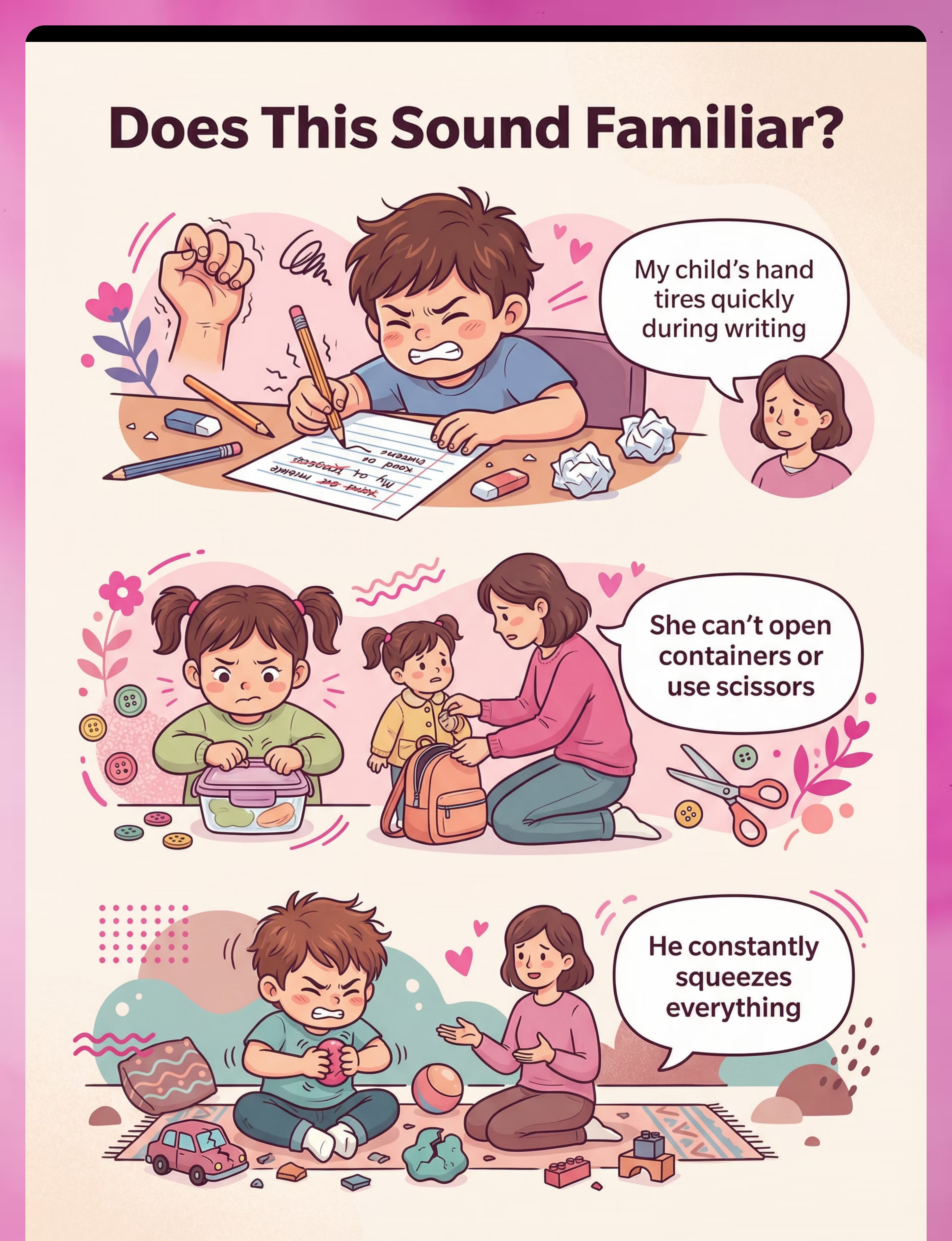
Does This Sound Familiar?
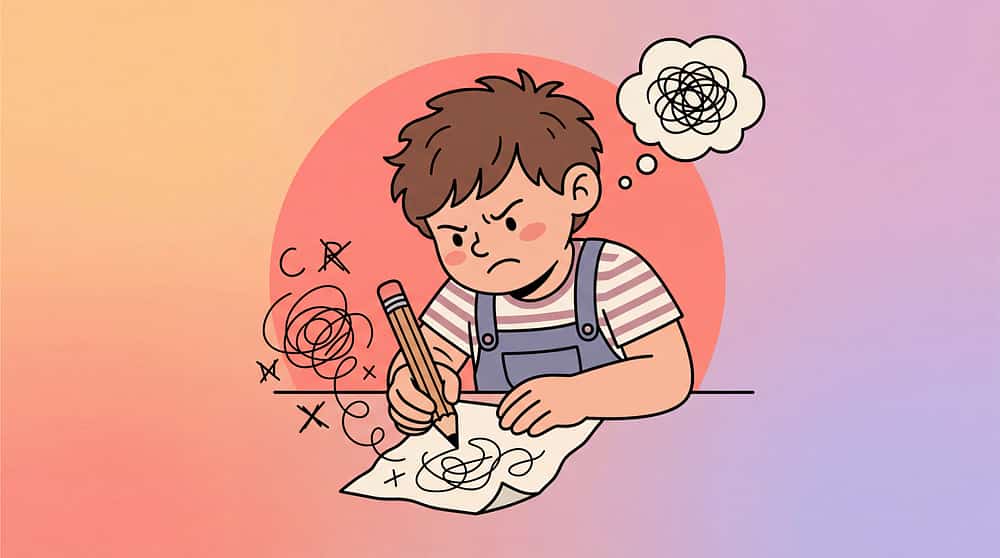
"My child's handwriting is illegible—their hand tires so quickly they can barely finish one sentence before complaining."
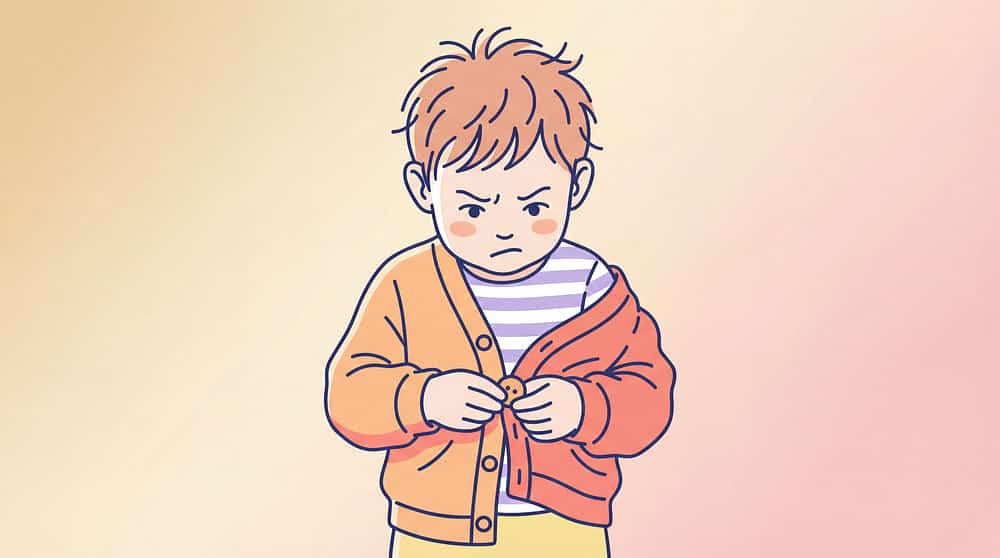
"He can't open containers, use scissors properly, or manipulate small objects like LEGOs. Everything requires help."
"Her hand strength is so weak the OT recommended exercises, but I don't know what tools to use or where to start."
"He constantly seeks to squeeze and press everything—destroying toys, squishing food, always needing that heavy input we can't always provide."
You're not alone. These are common challenges faced by parents of children with fine motor delays, sensory processing differences, and developmental needs. The right resistive tools can transform these daily struggles into opportunities for growth, independence, and calm.
A Day Without the Right Support
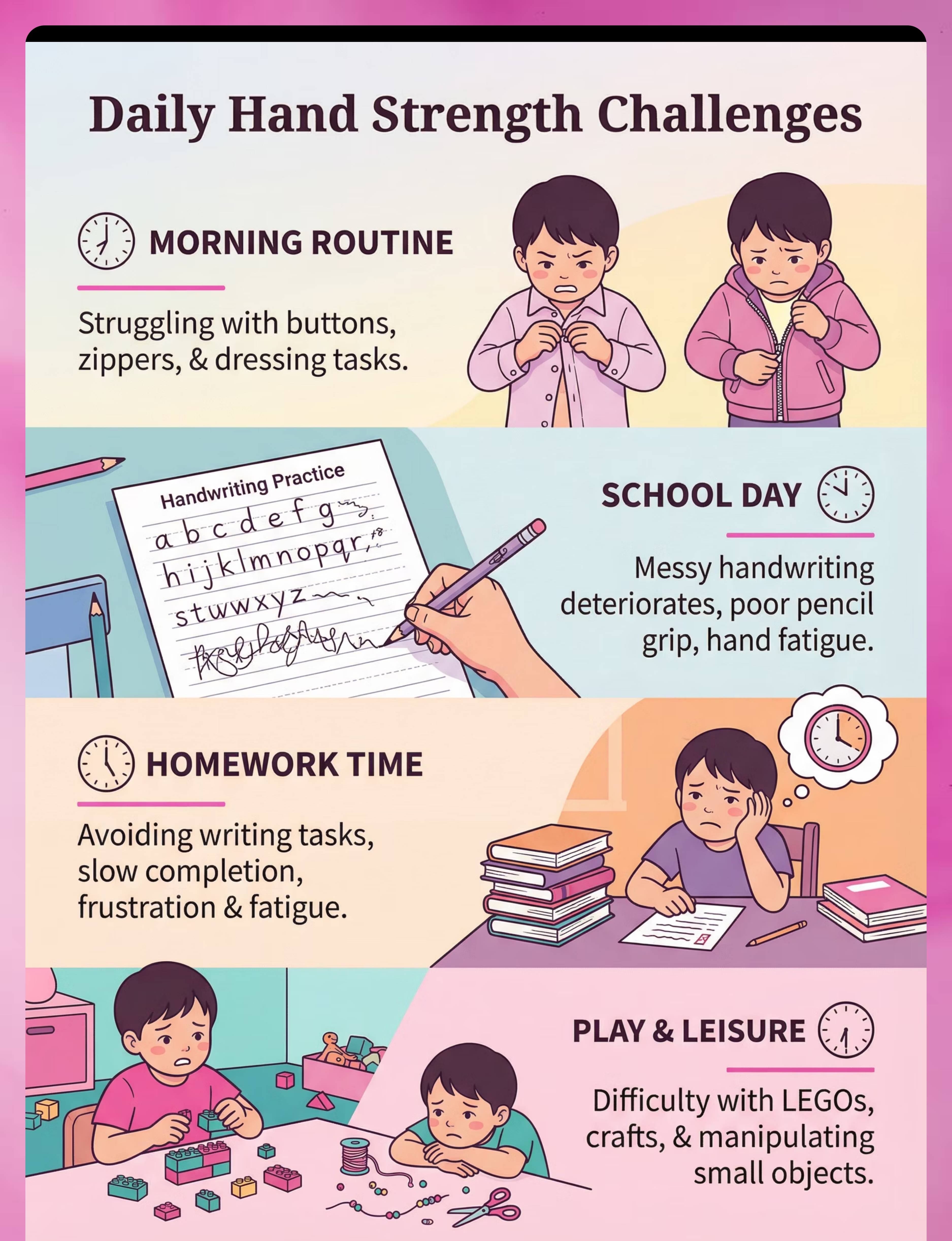
Morning Routine
Can't button clothes independently or manage zippers. Every morning starts with frustration and lost time as parents do what the child should be learning to do themselves.
School Transitions
Opening lunch containers, managing pencil case zippers, handling classroom materials—each transition becomes a reminder of what peers can do easily but feels impossible.
Classroom Writing
Hand tires after one sentence. Handwriting deteriorates as the lesson continues. Child avoids writing tasks entirely while teacher can't read completed work. Confidence plummet.s
Homework Time
What should take 15 minutes stretches to an hour. Hand pain, fatigue, and avoidance turn homework into a battle that exhausts the entire family every single evening.
Bedtime
The day ends with a child who couldn't be independent, couldn't keep up with peers, and seeks intense squeezing and pressing just to feel organized—leaving everyone drained.
The Science Behind It
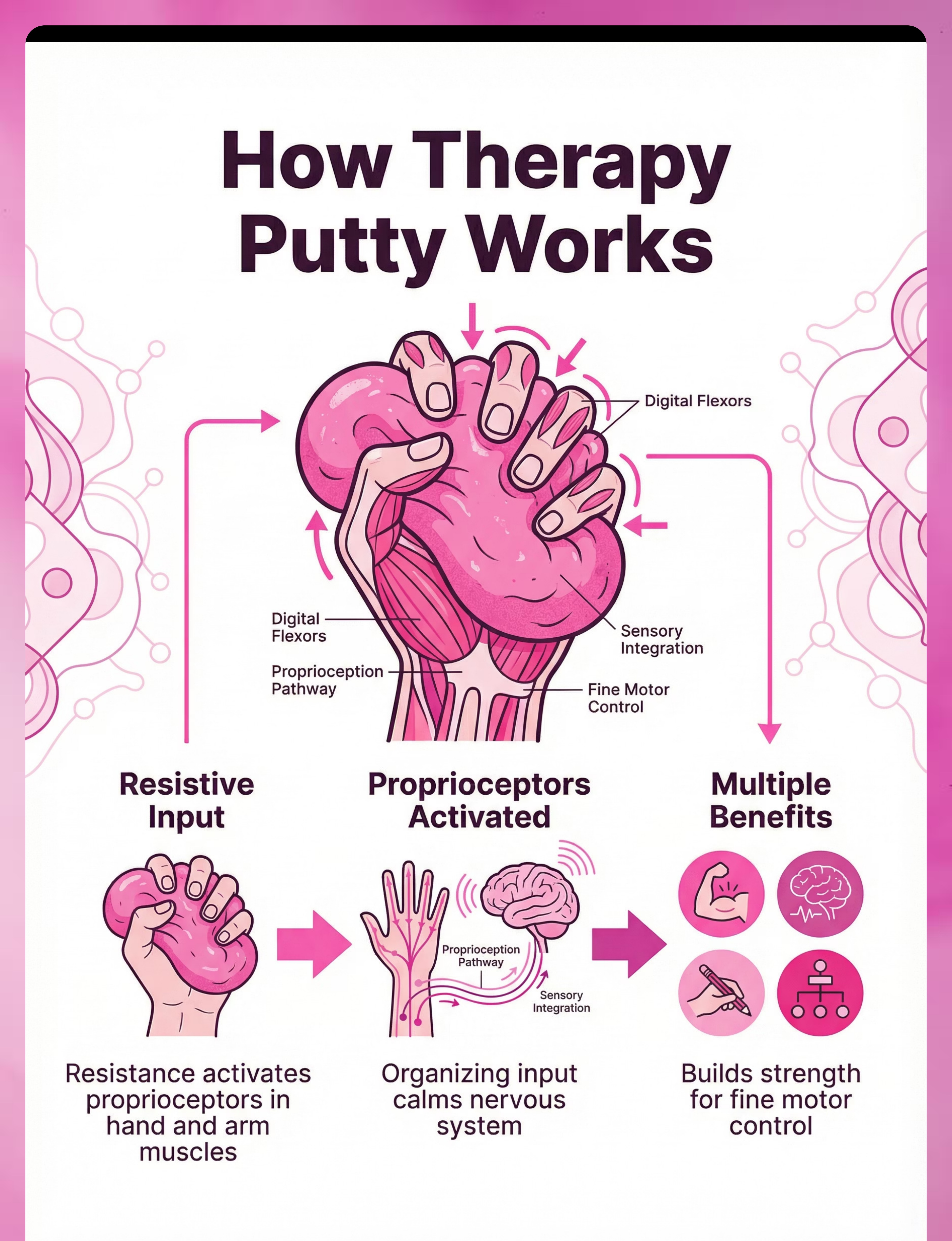
Therapy putty works through a precise neurological mechanism that addresses both strength and sensory regulation simultaneously. Understanding this science helps you use the tool most effectively.
Resistive Input
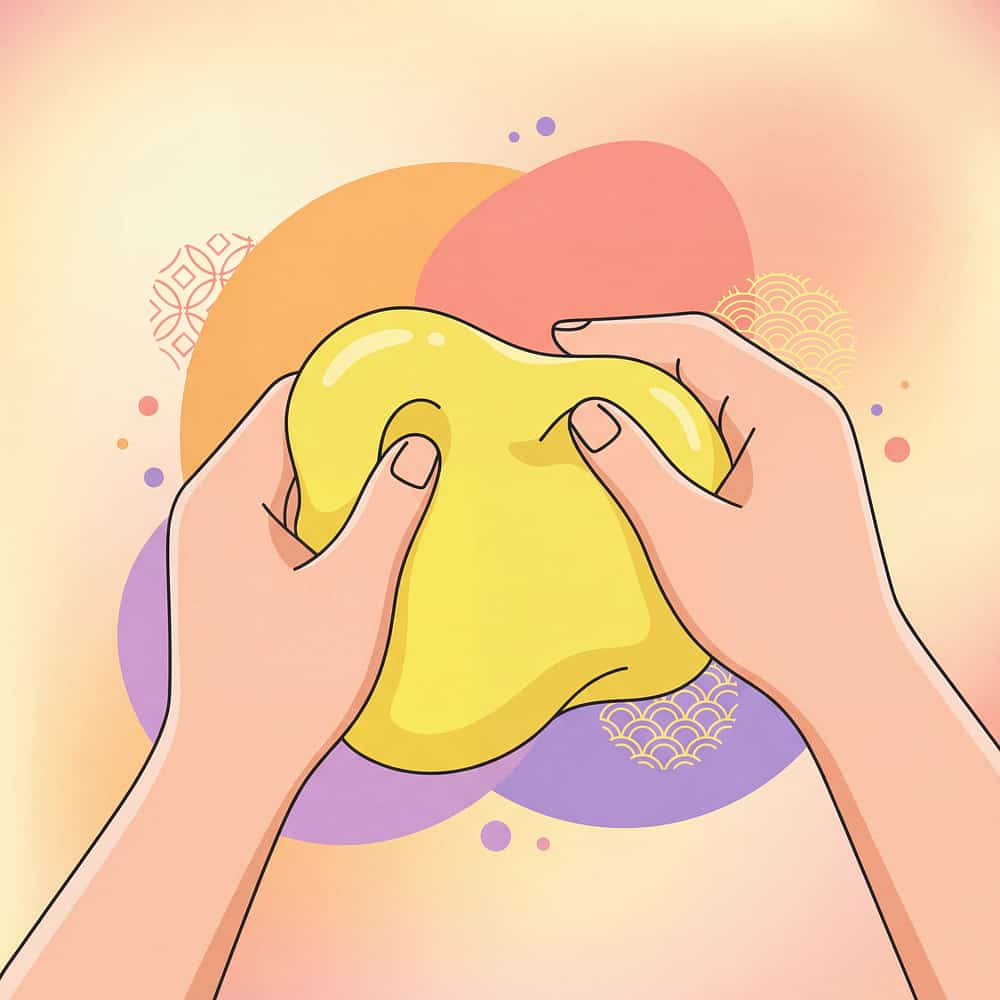
Squeezing, pinching, and manipulating putty activates hand and forearm muscles against graded resistance
Proprioceptor Activation
Muscle contraction stimulates proprioceptors that send organizing input through the nervous system
Body Awareness
The brain processes this input, improving body awareness, attention, and self-regulation capacity
Functional Result
Child experiences both calming organization AND builds measurable hand strength for functional tasks
This dual-action mechanism—strengthening while regulating—makes therapy putty irreplaceable in pediatric occupational therapy. The proprioceptive input provides immediate sensory benefits while the resistance training creates lasting functional improvements in fine motor control and handwriting endurance.
Proprioception
Hand Strength
Fine Motor
Self-Regulation
Attention
Handwriting Prep
How to Use It Right
Start with softer resistance, progress gradually
Begin with soft (red) or extra soft (yellow) putty for most children. Watch for fatigue—the resistance should be challenging but allow 5-10 minutes of manipulation without hand pain. Progress to firmer resistances as strength builds over weeks.
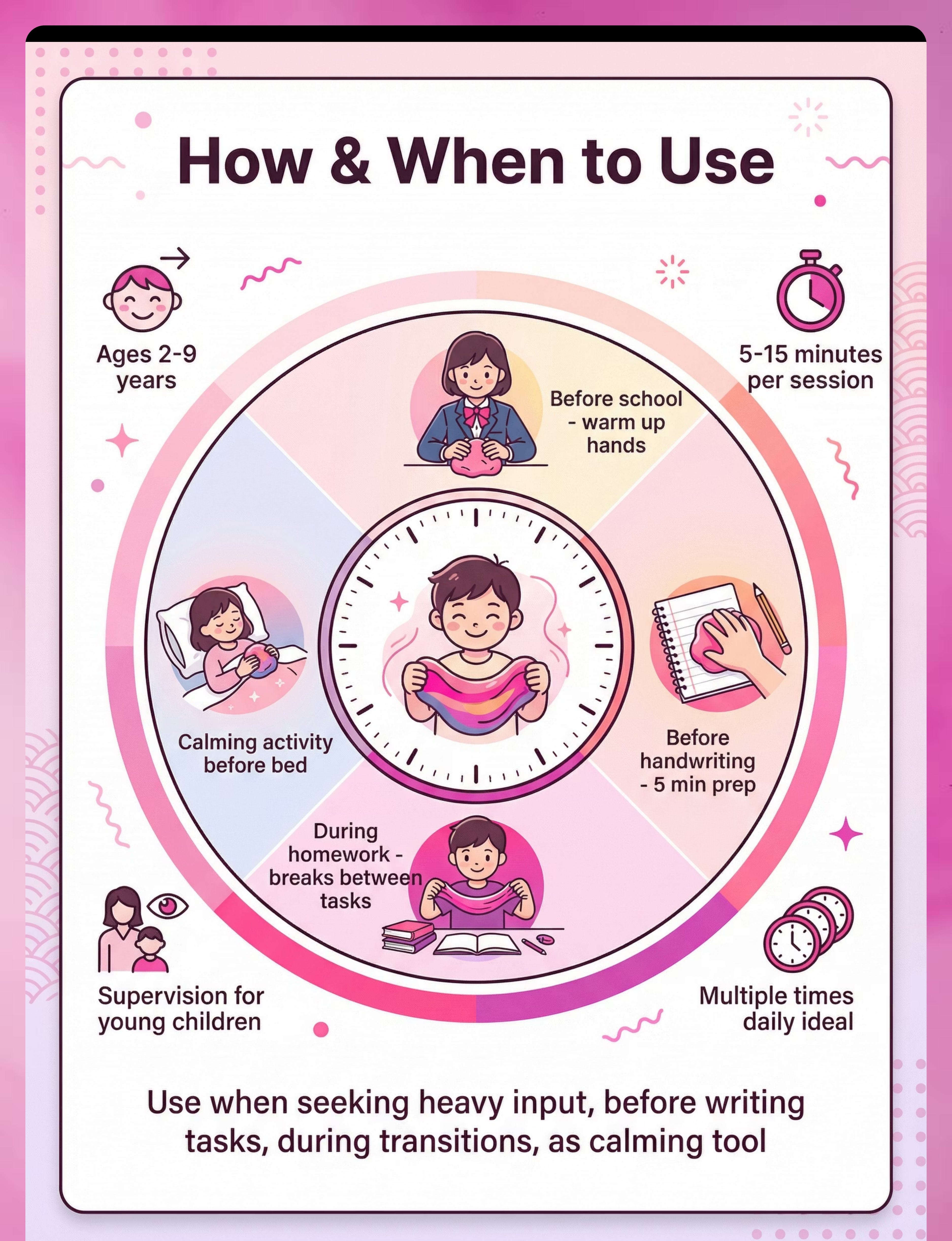
Use 5-10 minute sessions, multiple times daily
Short, frequent sessions are more effective than one long workout. Incorporate putty before handwriting (warm-up), during homework (fidget breaks), and during sensory-seeking moments throughout the day.
Combine with functional activities
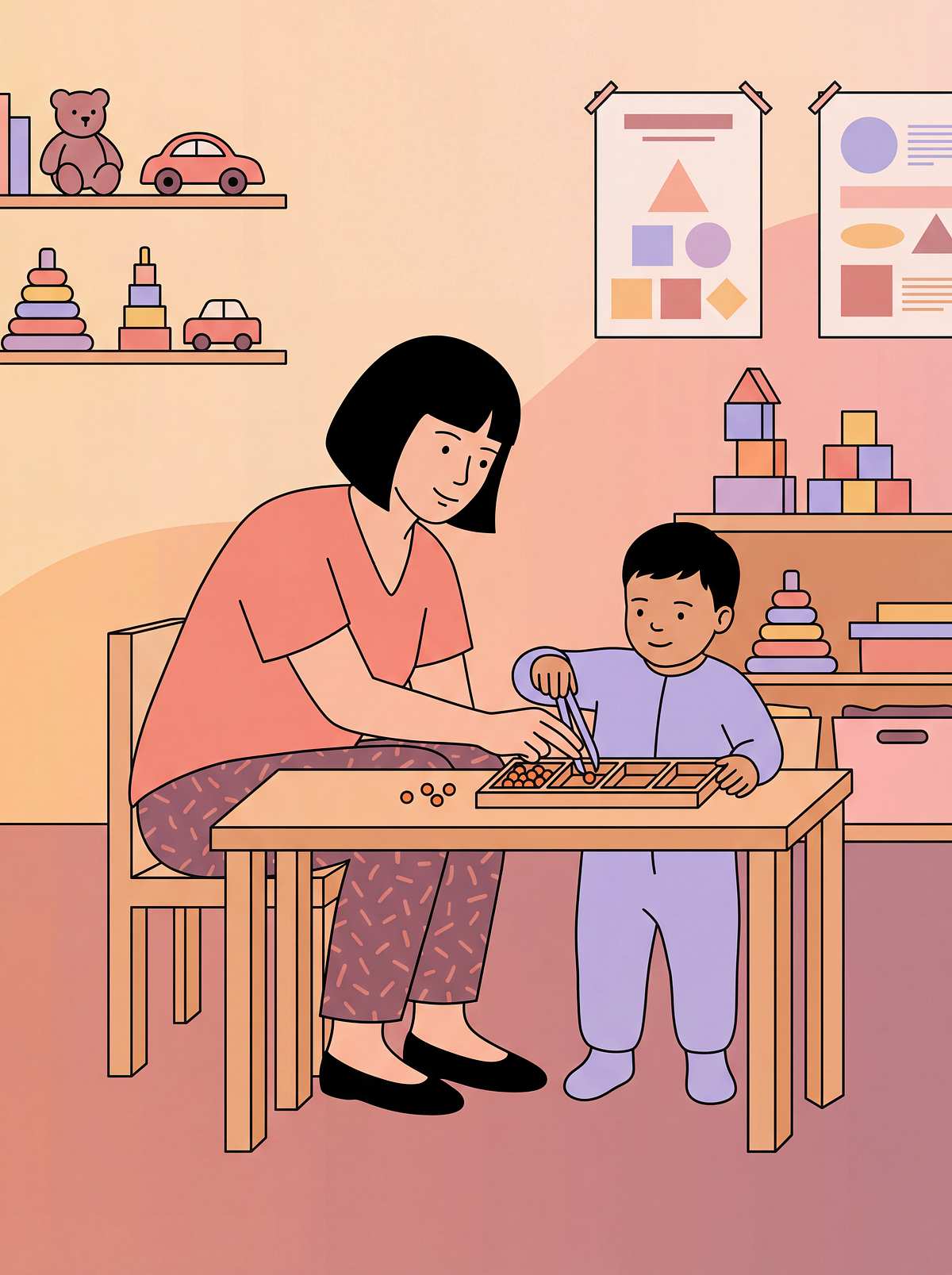
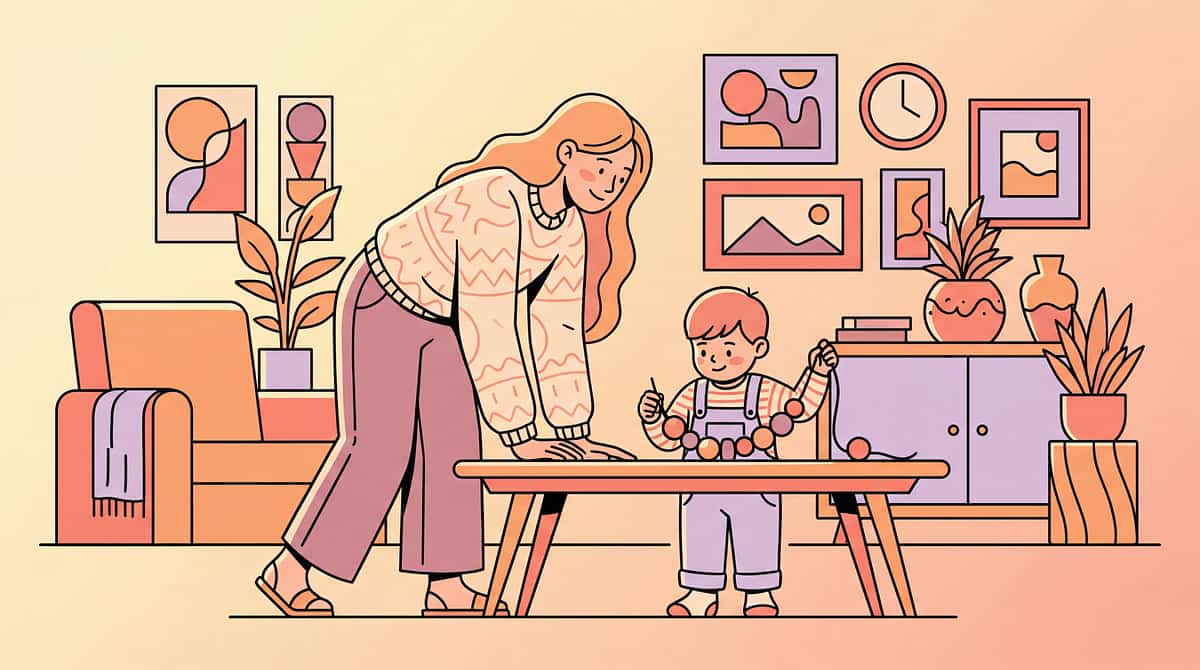
Hide small objects (beads, coins, buttons) in the putty for the child to find using only their fingers. This transforms strengthening into play while targeting precise finger movements needed for functional tasks.
Can be calming or alerting depending on use
Slow, sustained squeezes provide calming input. Quick, repetitive squeezes can be alerting and organizing. Observe your child's response and adjust the activity intensity to match their regulation needs.
Store in airtight container between uses
While silicone therapy putty doesn't dry out like Play-Doh, proper storage keeps it clean and prevents contamination. Keep in original container or sealed ziplock bag.
Recommended duration: 5-15 minutes per session, multiple times daily for best therapeutic results and measurable strength gains.
Expert Insight
"Therapy putty is one of the most versatile tools in pediatric OT. It addresses hand strength, fine motor skills, and provides organizing proprioceptive input all in one."
— Occupational Therapist, Handwriting and Fine Motor Specialist
OT Recommended
Strong Evidence
Rank #2 in Category
Daily Use Standard
This endorsement reflects decades of clinical experience and research supporting therapy putty as a foundational intervention. Its rank of #2 in the Sensory Regulation category reflects its unmatched versatility—addressing both sensory needs and functional skill development simultaneously. The strong evidence base comes from measurable improvements in grip strength, handwriting endurance, and self-regulation observed across thousands of children in therapy programs worldwide.
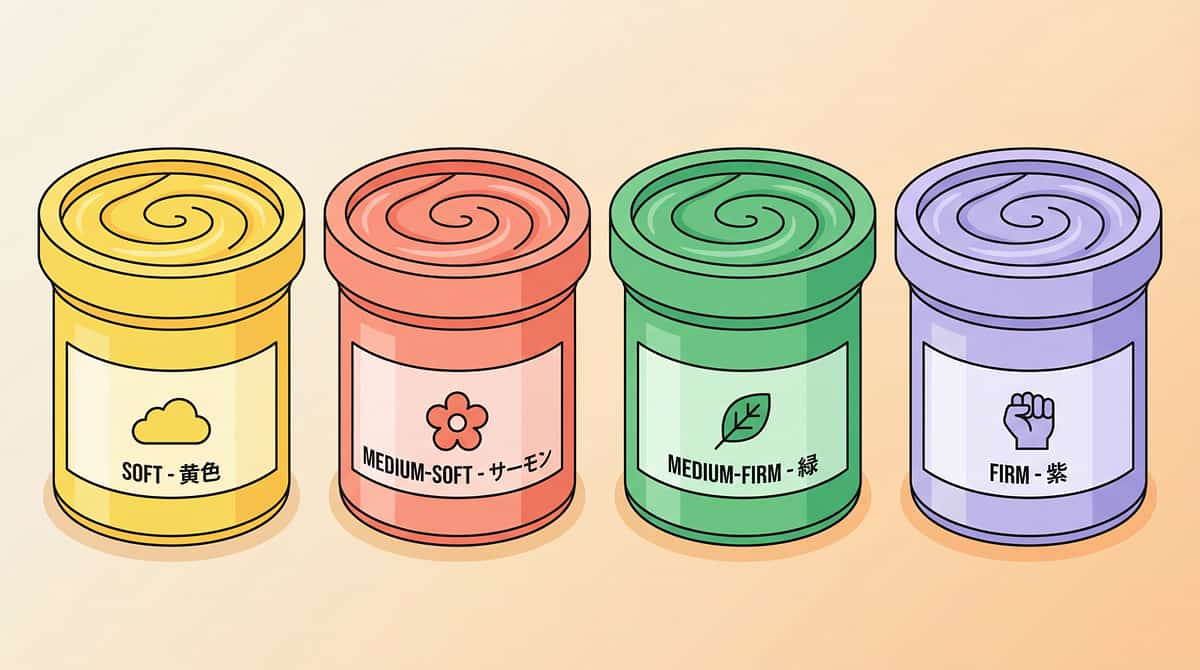
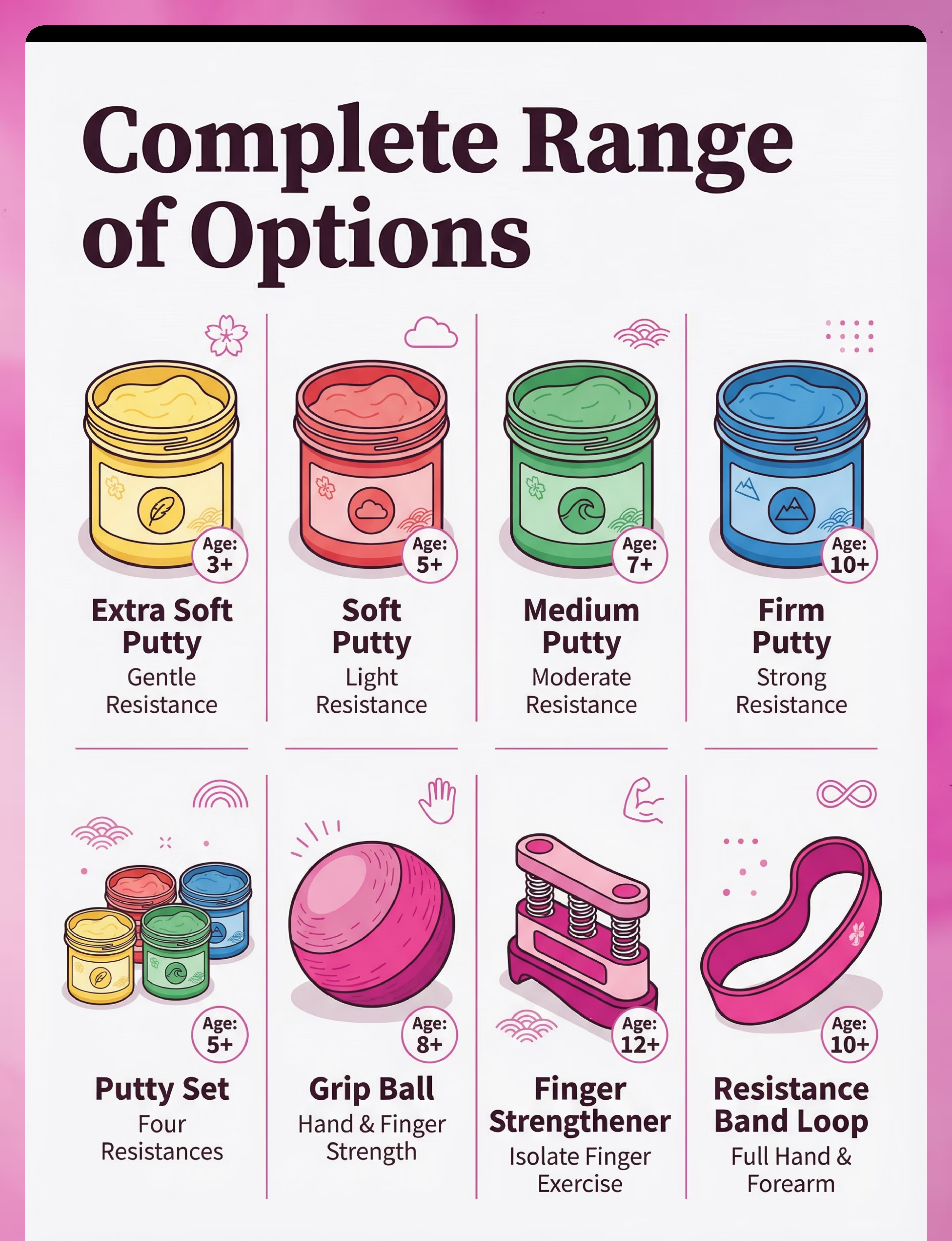
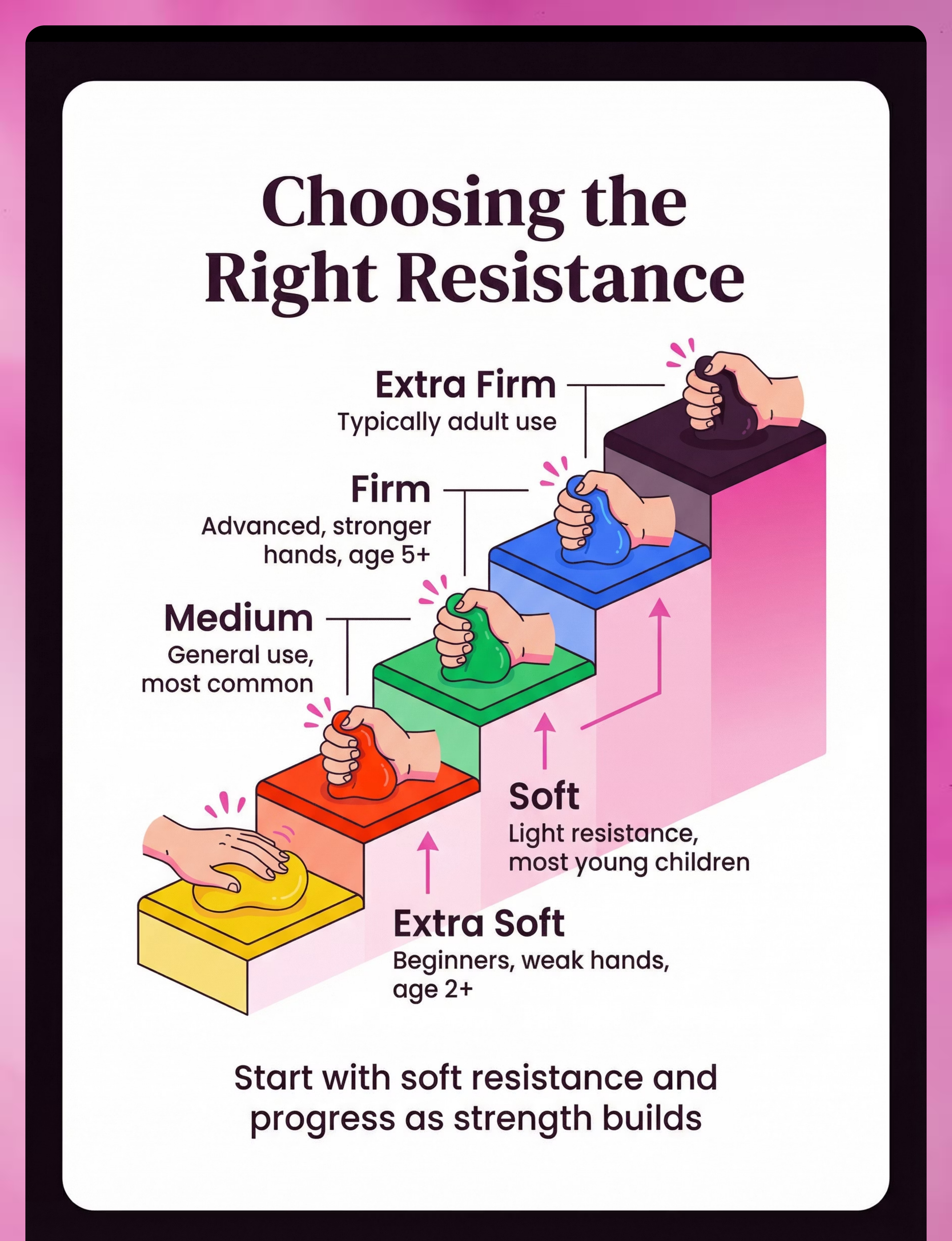
Therapy Putty: Color-Coded Resistance Levels
1
Resistance Progression
2
Extra Soft (Yellow)
Best for: Beginners, weak hands, warm-up, tactile exploration
3
Soft (Red)
Best for: Light resistance, finger strengthening start
4
Medium (Green)
Best for: General hand strengthening, most common use
5
Firm (Blue)
Best for: Advanced strengthening, older/stronger children
Understanding Resistance Levels
Therapy putty comes in color-coded resistance levels to match your child's current strength and therapeutic goals. Each color represents a specific resistance that should be challenging but manageable for 5-10 minutes of manipulation. Most children begin with soft (red) or medium (green) and progress over time as strength builds.

How to Choose
By goal: Calming/regulation → Start soft; Strengthening → Progress through resistances
By setting: Home/portable → Individual containers; Clinic → Full set for variety
By portability: Travel/school → Grip ball or resistance bands; Home therapy → Standard putty
Understanding Resistance Levels
Beginning level for very weak hands, tactile play, and warm-up activities before therapeutic work
Extra Soft (Yellow)
Early strengthening phase, appropriate for most young children starting therapy programs
Soft (Red)
General use level for moderate strength, most commonly prescribed for school-age children
Medium (Green)
Advanced strengthening for strong hands, older children, or those who have progressed through other levels
Firm (Blue)
Material Specifications
  • Silicone-based: Never dries out, unlike Play-Doh
  • Non-toxic: Safe for children, meets safety standards
  • Latex-free options: Available for children with allergies
  • Gluten-free options: Safe for children with sensitivities
  • Non-stick: Doesn't adhere to surfaces or fabrics
  • Reusable indefinitely: Cost-effective long-term investment
  • Color-coded: Easy resistance identification across brands
Quality silicone-based therapy putty is worth the investment over cheaper alternatives. It maintains consistent resistance, doesn't contaminate easily, and provides reliable therapeutic input session after session for months or years of daily use.
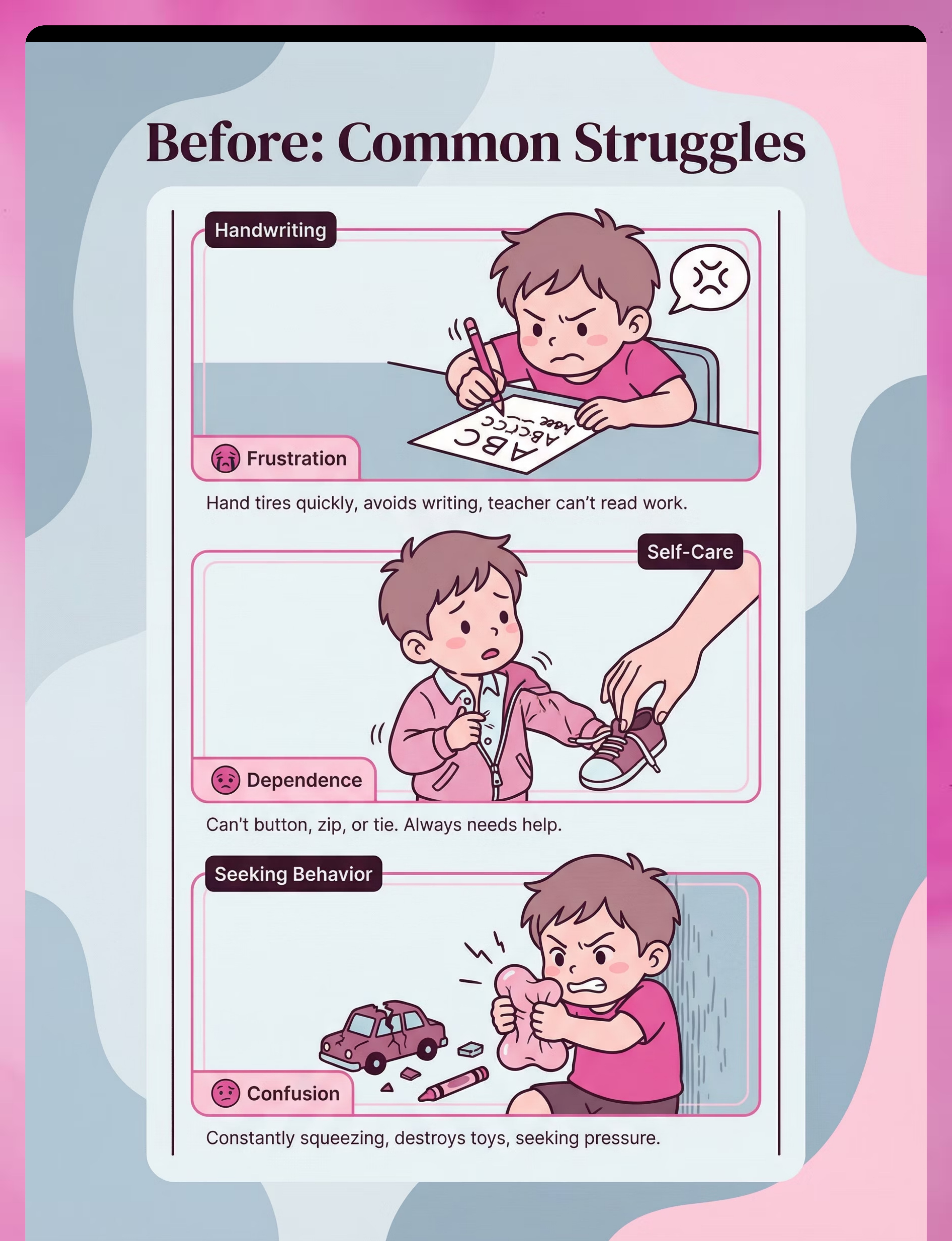
The Struggle (Before)
Handwriting
Situation: After one sentence, child complains of tired hand. Handwriting deteriorates with each word. Avoids all writing tasks. Teacher can't read completed work.
Experience: Every homework session becomes a battle. What peers complete in 15 minutes takes an hour. Hand pain and fatigue create genuine suffering.
Emotion: Frustration, avoidance, feeling "dumb" compared to peers who write effortlessly
Self-Care Independence
Situation: Can't button shirt, zip jacket, or tie shoes. Always needs help. Loss of independence frustrating for everyone involved.
Experience: Morning routine requires parent assistance for tasks the child should manage. Dependence grows as peers become independent.
Emotion: Dependence, frustration, loss of confidence and autonomy
Sensory Seeking Behavior
Situation: Child constantly squeezing things, pressing hard, seeking heavy input. Destroys toys by pressing too hard. Squishes food.
Experience: Parents don't understand why the child can't stop. Replacing broken toys becomes expensive. The seeking never stops.
Emotion: Confusion, exhaustion, feeling out of control
These scenarios represent real struggles faced daily by children with weak hand strength and unmet proprioceptive needs. The impact extends beyond physical limitations—affecting confidence, independence, peer relationships, and family dynamics. But these patterns can change with the right therapeutic tools.
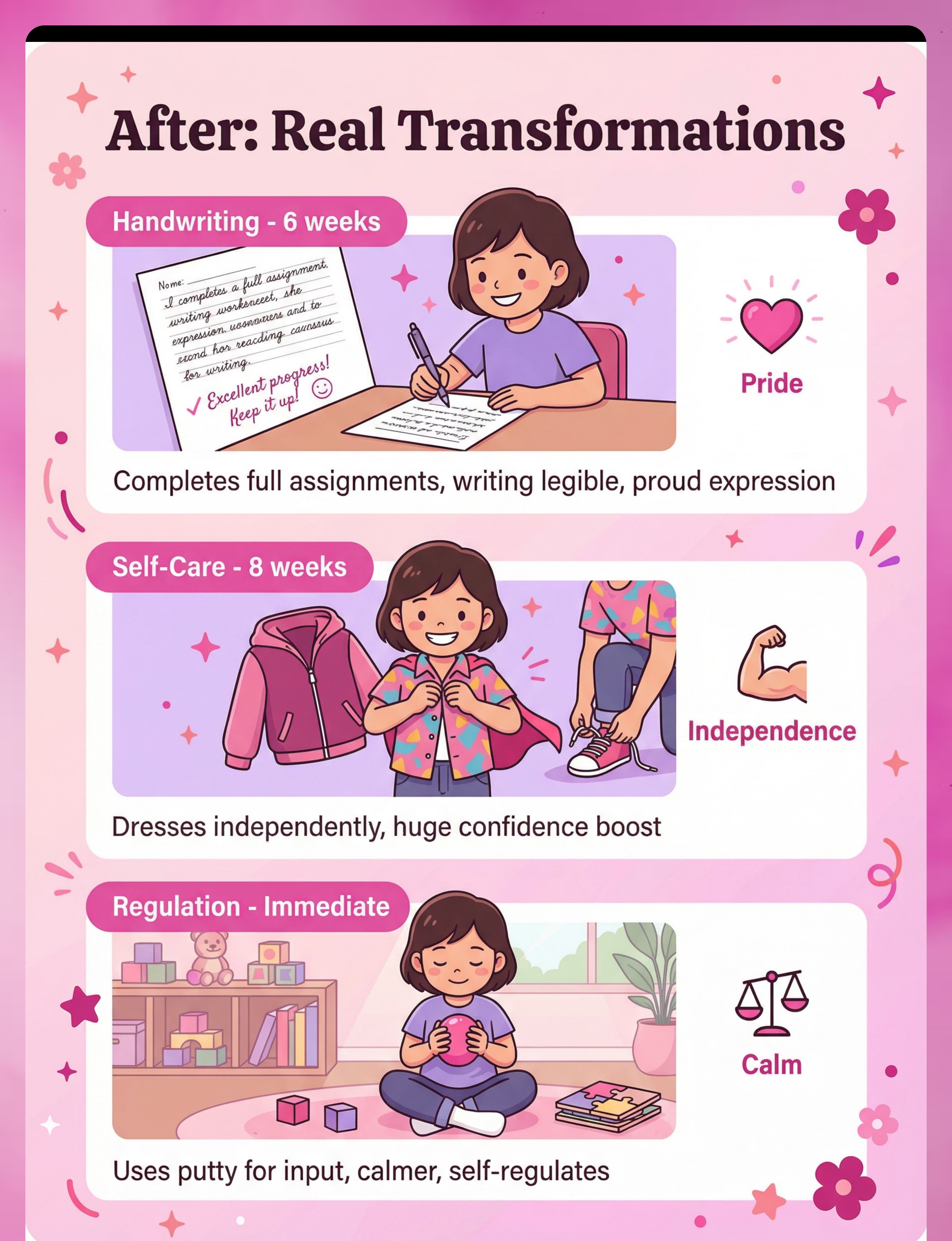
The Breakthrough (After)
Handwriting Improvement (4-8 Weeks)
Daily putty exercises lead to measurably improved hand endurance. Children complete full worksheets without complaints, and writing remains legible. This leads to positive feedback from teachers, active participation in writing tasks, and a significant reduction in homework time, fostering pride and a desire to write more.
Enhanced Self-Care Independence (6-8 Weeks)
Stronger fingers allow children to manipulate buttons, zippers, and snaps, leading to independent dressing and a huge boost in confidence. Morning routines become peaceful, and the child experiences a profound sense of capability and autonomy.
Regulated Sensory Input (Immediate)
Therapy putty provides the heavy input children crave, redirecting sensory-seeking behaviors from destructive actions to beneficial self-regulation. Children independently request putty when feeling disorganized, using it as a tool to achieve calm and control over their own bodies, effectively ending toy destruction.
These transformations happen consistently when therapy putty is used as directed—short sessions, multiple times daily, with appropriate resistance. The timeline varies by child, but the pattern of improvement is predictable and measurable. Parents and teachers notice the changes before formal assessments confirm the progress.
What to Expect (Realistic Timelines)
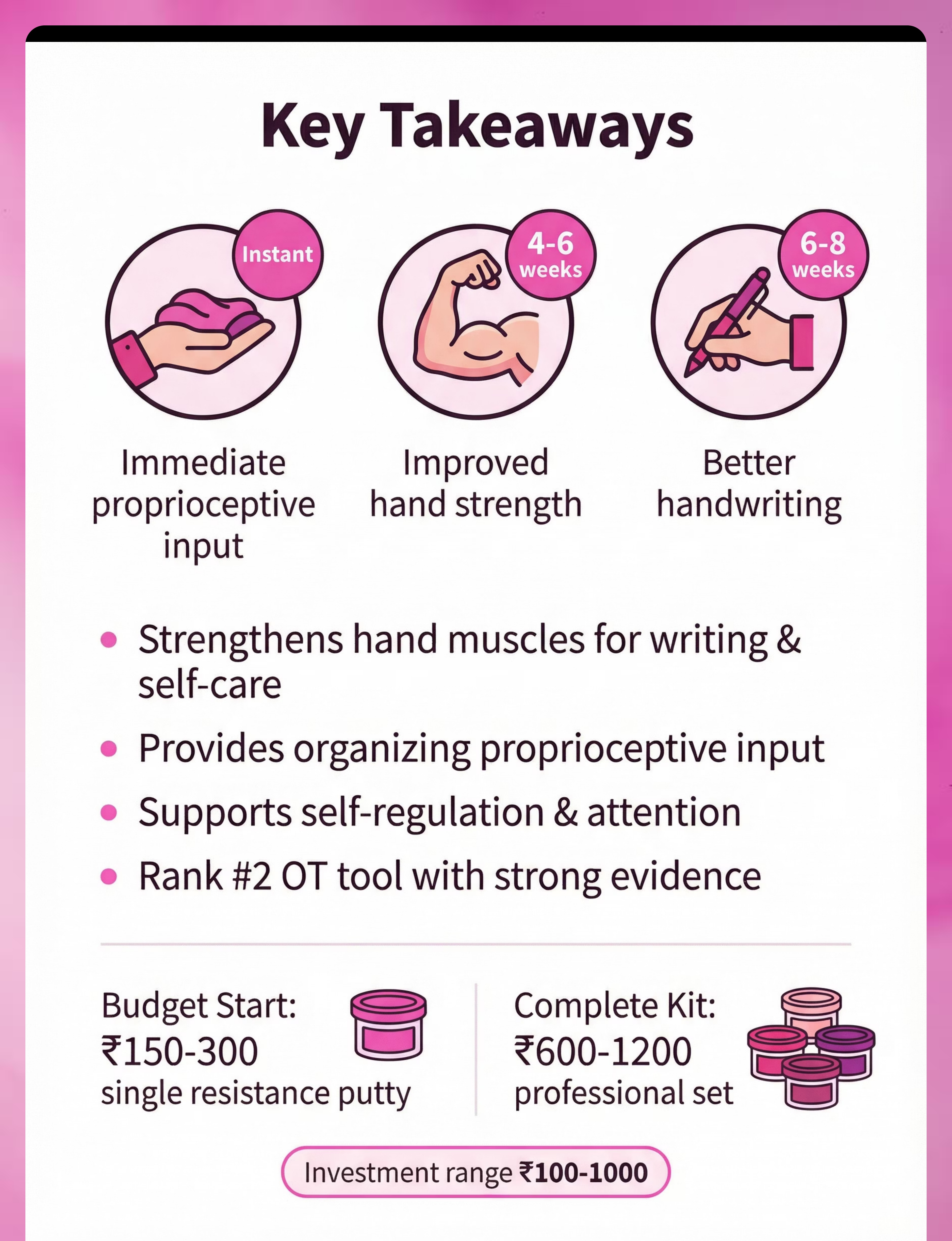
Immediate
Proprioceptive and calming input felt during and immediately after putty sessions. Child appears more organized and focused.
1-2 Weeks
Reduced seeking and destructive behavior as child learns to use putty for self-regulation. Parent reports calmer responses to transitions.
2-4 Weeks
Child begins using putty independently for regulation. Understands connection between putty use and feeling organized.
4-6 Weeks
Improved hand strength becomes measurable in grip assessments. Child notices own hands feel stronger.
6-8 Weeks
Better handwriting endurance visible in completed work. Improved fine motor manipulation (buttons, zippers, crafts) in daily tasks.
Expected Outcomes with Consistent Use
  • ✓ Immediate proprioceptive/calming input during sessions
  • ✓ Reduced seeking/destructive behavior within 1-2 weeks
  • ✓ Child uses putty independently for regulation within 2-4 weeks
  • ✓ Improved hand strength measurable within 4-6 weeks
  • ✓ Better handwriting endurance visible within 6-8 weeks
  • ✓ Improved fine motor manipulation within 6-8 weeks
These timelines assume daily use (multiple short sessions) with appropriate resistance. Progress may be faster or slower depending on starting strength, consistency of use, and individual differences. Occupational therapists can measure progress objectively through grip strength assessments and functional task observations.
Is This Right for My Child? (2-Minute Check)
Does your child's hand tire quickly during writing or coloring?
If yes, this indicates: Weak hand endurance—a primary target for therapy putty intervention
Does your child struggle with buttons, zippers, or small manipulatives?
If yes, this indicates: Fine motor and strength deficit—therapy putty builds precise finger control
Does your child seek to squeeze, press, or crush things?
If yes, this indicates: Proprioceptive seeking—putty provides organizing input the nervous system craves
Has handwriting been identified as a concern?
If yes, this indicates: Hand strength component likely—putty is essential handwriting preparation

Interpreting Your Results
3-4 "yes" answers: Strong fit—therapy putty addresses your child's core needs
2 "yes" answers: Likely beneficial—consult with occupational therapist for confirmation
1 "yes" answer: May help—consider alongside other interventions
0 "yes" answers: Explore other sensory or fine motor tools that better match your child's profile
Common Questions (Honest Answers)
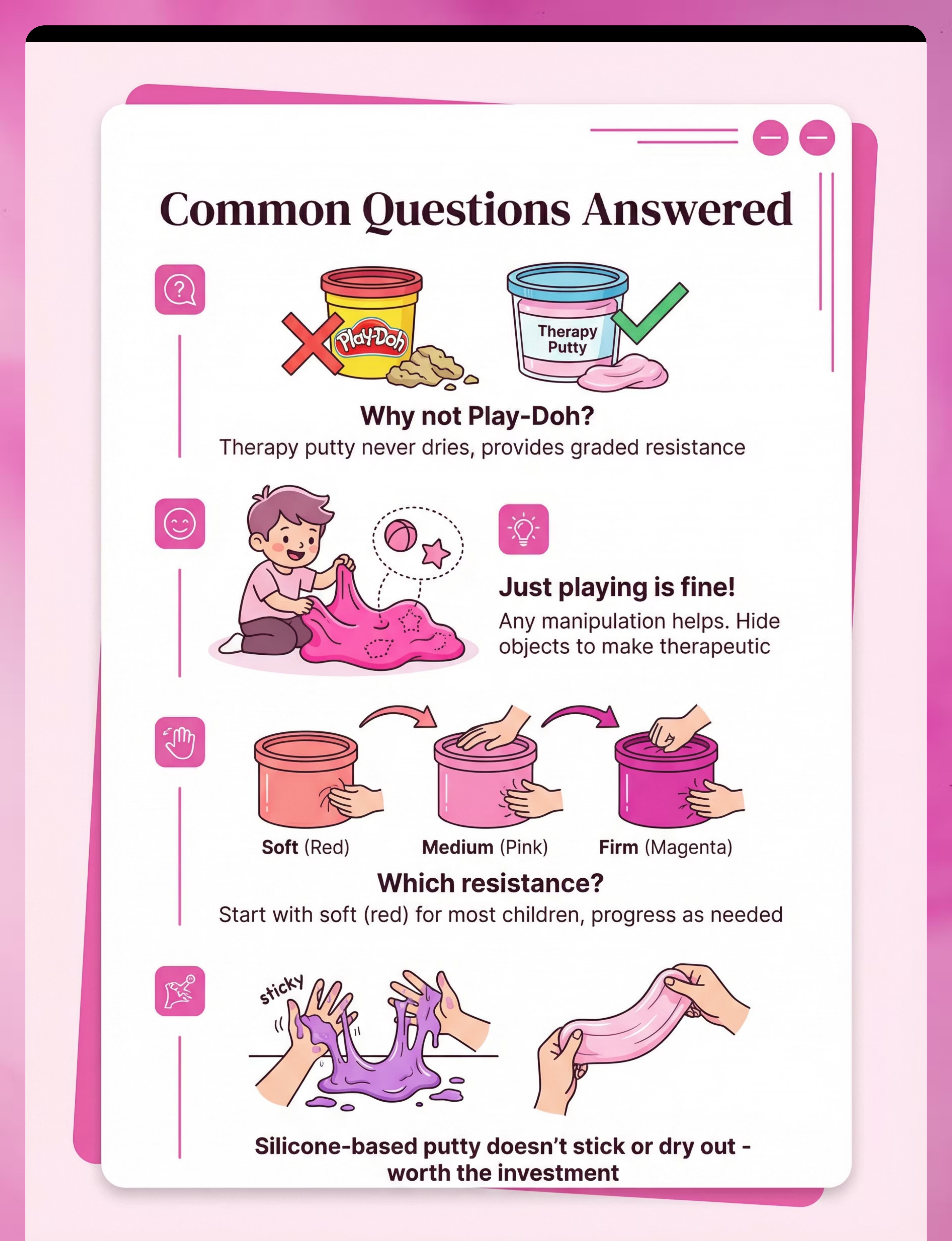
Play-Doh vs. Therapy Putty
Feature
Play-Doh
Therapy Putty
Primary Use
Play
Therapeutic strengthening
Material
Dries out quickly
Silicone-based (never dries)
Resistance
No graded resistance
Specific resistance levels
Consistency
Dries, variable
Consistent session after session
Longevity
Short-lived, casual use
Indefinite, worth investment
Messiness
Can be messy, dries on surfaces
Clean, pulls off surfaces, no residue
Child just plays with it, doesn't do exercises
That's actually fine! Any manipulation of the putty provides proprioceptive input and strengthening. To make it more therapeutic, hide small objects (beads, buttons, coins) in the putty for the child to find using only their fingers. This transforms strengthening into a game while targeting the precise movements needed for functional tasks. Structured "putty time" with specific activities can be incorporated into routine, but free play with putty still provides benefit.
How do I know which resistance to start with?
Start with SOFT (red) for most children. If that's too easy (child squishes through it instantly with no effort), move to medium (green). Watch for fatigue—the resistance should be challenging but the child should be able to manipulate it for 5-10 minutes without hand pain or excessive frustration. When in doubt, start softer and progress up. Consider buying a set with multiple resistances to find the right level and progress over time as strength builds.
It's messy and gets everywhere
Quality therapy putty (silicone-based) doesn't stick to surfaces or fabrics. It pulls cleanly off and doesn't dry out or leave residue. Keep in container when not in use. Cheap alternatives may be messier—invest in genuine therapy putty from reputable brands. If you're experiencing sticking issues, you likely have a lower-quality product. True silicone therapy putty is remarkably clean and easy to manage.
Usage Guide
When to Use
✓ Before handwriting tasks (warm-up routine)
✓ During homework (fidget tool during breaks)
✓ When child is seeking heavy input
✓ As calming activity during transitions
✓ Structured OT exercise sessions
✓ During waiting times (car, appointments)
When NOT to Use
✗ Child likely to eat it (supervise carefully)
✗ Hand injury is present
✗ During activities requiring clean hands
✗ If putty is dried out or contaminated
Supervision by Age
Age Range
Supervision Level
Notes
Under 3 years
Constant supervision
Mouthing risk—never leave alone with putty
3-5 years
Active supervision
Teach appropriate use, monitor closely
5+ years
Periodic check-ins
Can use independently once trained in proper use
Duration: 5-15 minutes per session
Frequency: Multiple times daily
Settings: Home, School, Clinic
Safety First

Critical Safety Information
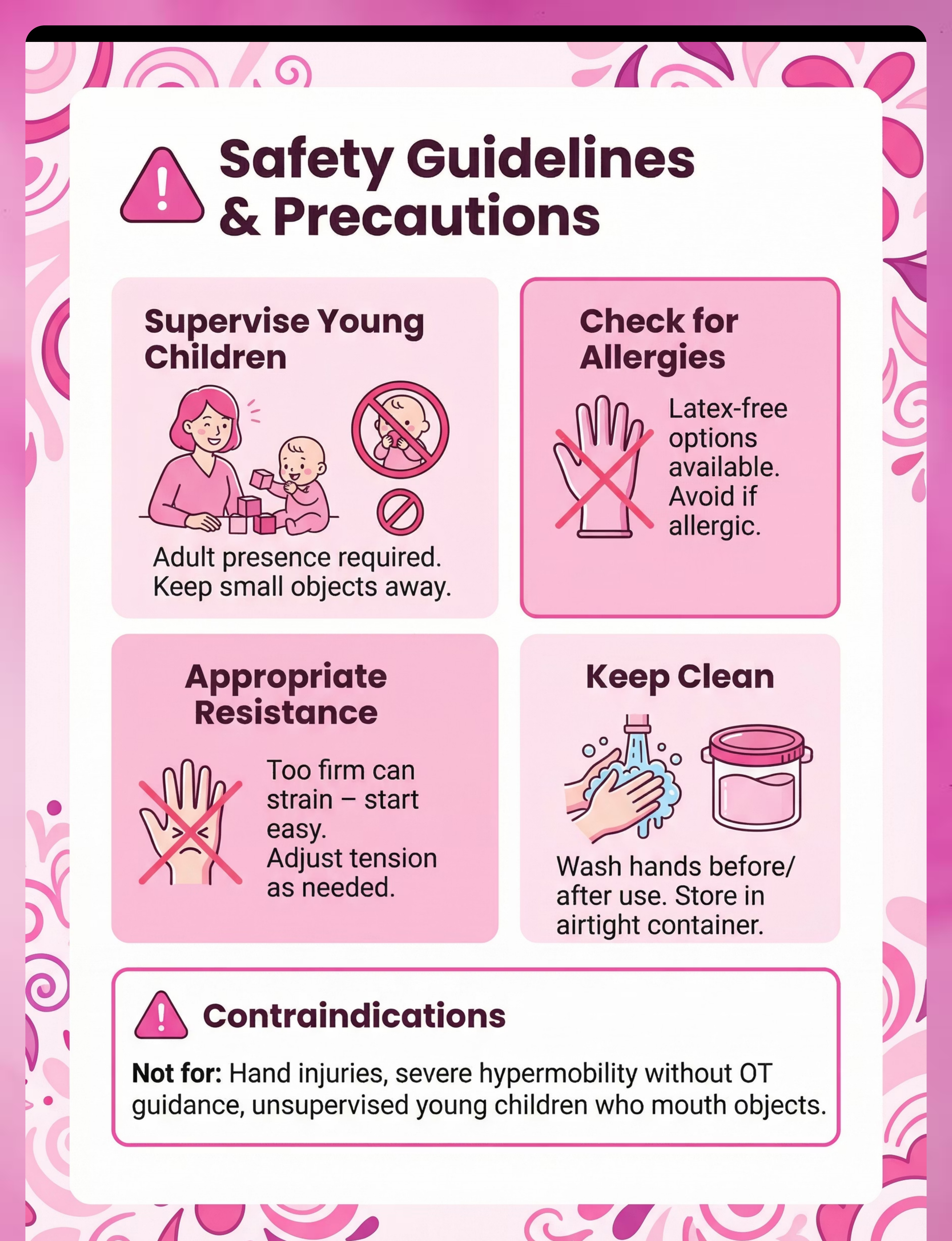
  • Not for eating—supervise young children carefully to prevent mouthing
  • Check for latex allergies before use (many brands offer latex-free options)
  • Replace if contaminated, moldy, or showing signs of degradation
  • Appropriate resistance is essential—putty that's too hard can cause hand strain or pain
Warnings
  • Keep away from carpet/fabric (cheap putty may stain; quality putty won't)
  • Wash hands thoroughly before and after use
  • Don't share between children during illness to prevent contamination
  • Store in airtight container to maintain cleanliness
Contraindicated For
  • Active hand or finger injuries
  • Severe joint hypermobility without OT guidance
  • Known latex allergy (check ingredients carefully)
  • Children who will eat it unsupervised
Safety Checklist
Before Use
  • Putty is clean and not contaminated
  • Appropriate resistance selected for child's strength level
  • Hands are clean
  • Supervision plan established for young children
During Use
  • Child using appropriately (not eating or throwing)
  • No hand pain, cramping, or excessive fatigue
  • Putty staying in designated area
  • Appropriate therapeutic activities being performed
Signs to Stop
  • Hand pain or cramping develops
  • Child attempting to eat putty
  • Putty becomes contaminated
  • Child shows frustration (may need easier resistance)
Investment Guide
Budget Option
Single Resistance Therapy Putty
Cost: ₹150-300
What you get: 2-4 oz container in one resistance level (start with soft or medium)
Best for: Testing if your child responds well to putty, home use, specific strengthening goal
Note: Perfect starting point—provides full therapeutic benefit at lowest investment
Premium Option
Professional Therapy Putty Set
Cost: ₹600-1,200
What you get: 4 resistances (extra soft, soft, medium, firm) with exercise guide
Best for: Clinic use, progressive strengthening program, long-term therapy, multiple children
Brands: TheraPutty, CanDo, Cando Theraputty (professional-grade options)
Overall Investment Range
₹100–1,000 INR
$1–12 USD
Therapy putty represents exceptional value—a one-time purchase provides months or years of daily therapeutic use. Unlike consumable toys or activities, quality silicone putty never dries out and maintains consistent resistance indefinitely. Many families find that even a basic single container provides such significant benefit that they expand to additional resistances over time.

Best starting recommendation: Purchase soft (red) or medium (green) single container (₹150-300) to confirm your child benefits from putty. If response is positive, expand to full set for progressive strengthening.
Where to Buy in India
Availability: Widely Available across India through online retailers, physiotherapy suppliers, and occupational therapy supply stores
Recommended Platforms
Amazon.in
Search: "therapy putty kids"
Price range: ₹150-500
Widest selection, customer reviews, fast delivery to most areas
Flipkart
Search: "hand exercise putty"
Price range: ₹150-400
Competitive pricing, frequent sales, good return policy
Physiotherapy Suppliers
Search: "TheraPutty pediatric"
Price range: ₹200-600
Professional-grade products, expert advice available
OT Supply Stores
Search: "therapy putty set"
Price range: ₹400-1,000
Clinical quality, often with exercise instructions included
Buying Tips
  • ✓ Silicone-based = won't dry out (worth the investment over cheap alternatives)
  • ✓ Color coding is usually standard across brands (yellow=softest → blue=firm)
  • ✓ 2-4 oz container is appropriate size for children
  • ✓ Store in original container or ziplock to maintain cleanliness
  • ✓ Check for latex-free if child has known allergies
  • ✓ Look for "non-toxic" and "gluten-free" certifications
Red Flags (Avoid)

  • ✗ Dries out quickly (not silicone-based)
  • ✗ Sticks to everything (low quality)
  • ✗ No resistance grading indicated
  • ✗ Strong chemical smell
  • ✗ Crumbles or falls apart easily
  • ✗ Impossibly cheap price (quality matters)
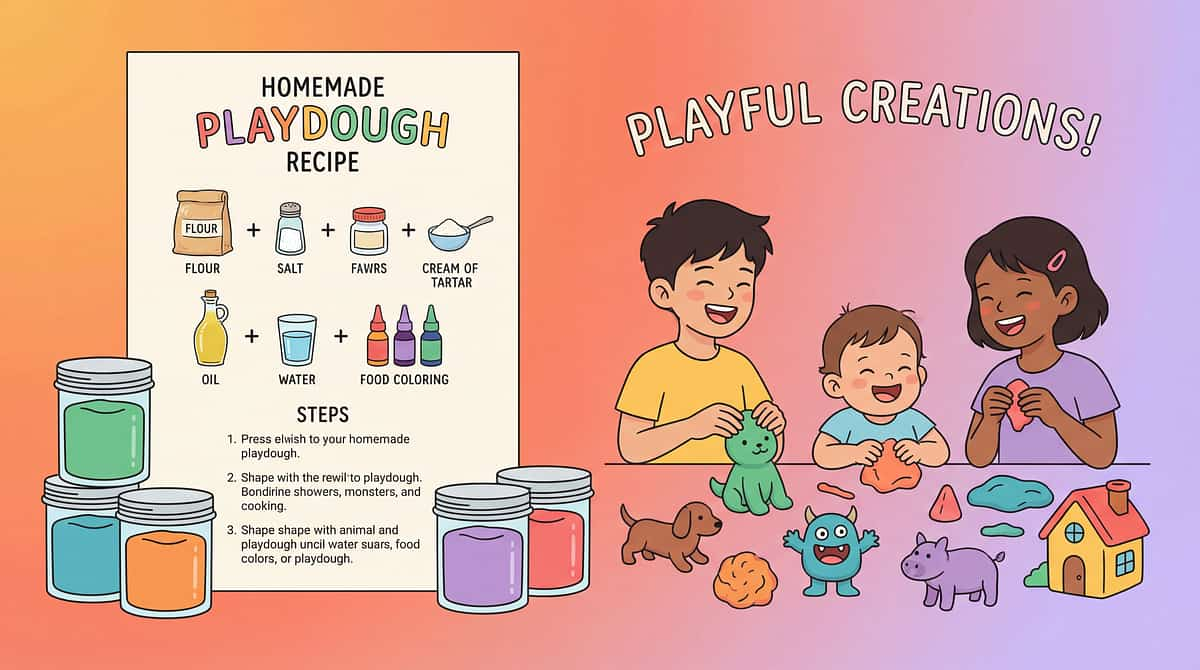
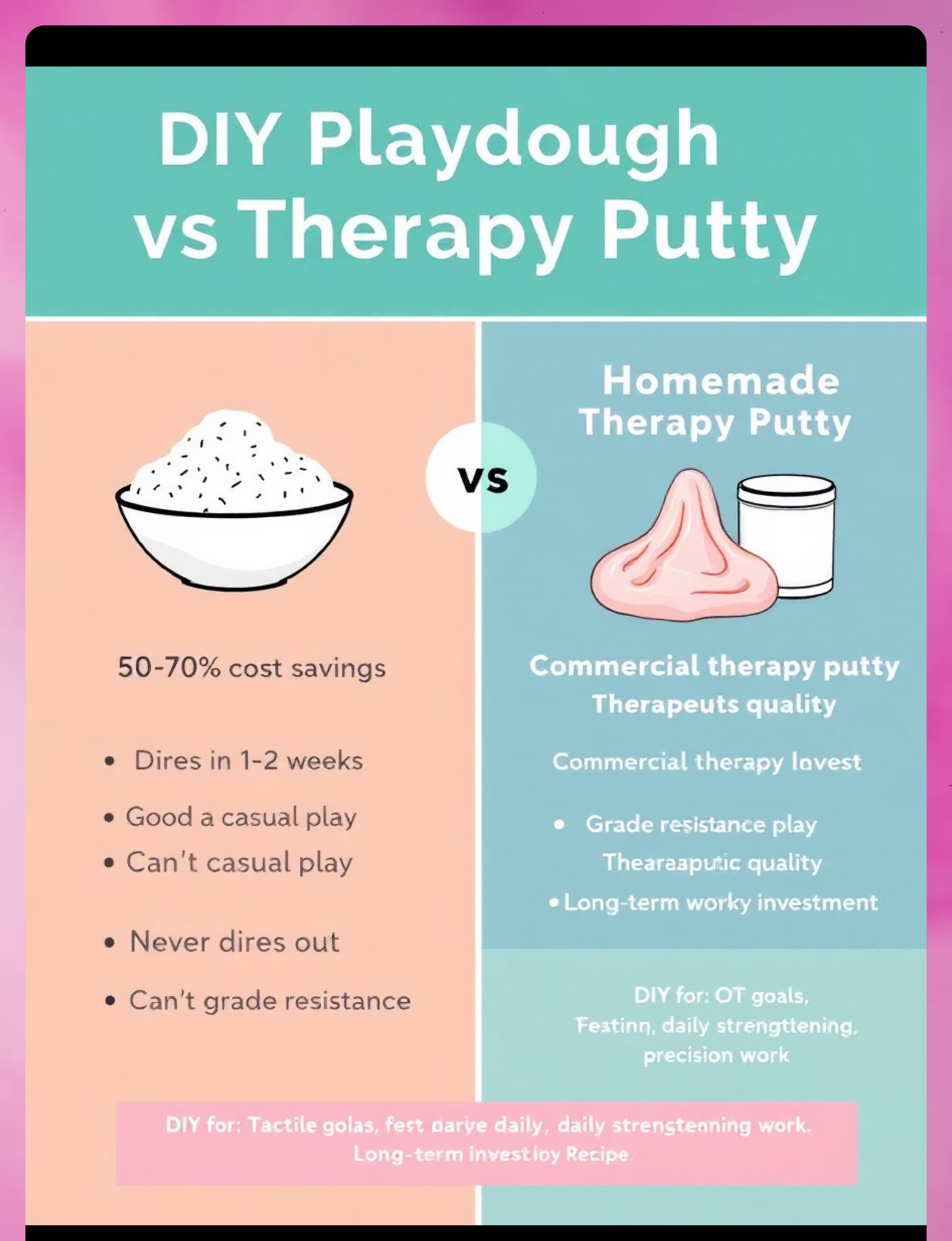
DIY Alternative (Save 50-70%)
Feasibility & Savings
Feasibility: Medium (playdough yes, true therapy putty no)
Cost Savings: 50-70% compared to therapy putty
Time Investment: 15-30 minutes preparation
Materials Needed
  • 1 cup all-purpose flour
  • 1/2 cup salt
  • 1 tablespoon cream of tartar
  • 1 cup water
  • 1 tablespoon cooking oil
  • Food coloring (optional)
Instructions
  1. Mix flour, salt, and cream of tartar in saucepan
  1. Add water and oil, stir to combine
  1. Cook on low heat, stirring constantly
  1. Continue stirring until mixture forms a ball and pulls away from sides
  1. Remove from heat and cool completely
  1. Knead until smooth (add food coloring during this step if desired)
  1. Store in airtight container in refrigerator
Important Tradeoffs

You cannot replicate true silicone therapy putty at home. Homemade playdough is a different material with different properties.
  • Dries out in 1-2 weeks (vs. indefinite for therapy putty)
  • Can't grade resistance precisely
  • May be messier than commercial putty
  • Not the same therapeutic quality
  • Requires regular remaking
When to Choose DIY vs. Commercial
Use Homemade Playdough When:
  • Exploring casual tactile play
  • Testing if child likes putty-type materials before investing
  • Supplementing therapy putty with additional sensory play
  • Budget is extremely limited temporarily
Use Commercial Therapy Putty When:
  • Pursuing specific therapeutic strengthening goals
  • Need graded, consistent resistance levels
  • Long-term daily use is planned
  • OT has recommended systematic strengthening program
  • Want material that lasts indefinitely

Preview of therapy putty resistive hand tools Therapy Material

Below is a visual preview of therapy putty resistive hand tools therapy material. The pages shown help educators, therapists, and caregivers understand the structure and content of the resource before use. Materials should be used under appropriate professional guidance.

Page 1
Page 2
Page 3
Page 4
Page 5
Page 6
Page 7
Page 8
Page 9
Page 10
Page 11
Page 12
Page 13
Page 14
Page 15
Page 16
Page 17
Page 18
Page 19
Page 20
Link copied!
Complete Support & Resources
Measuring Success
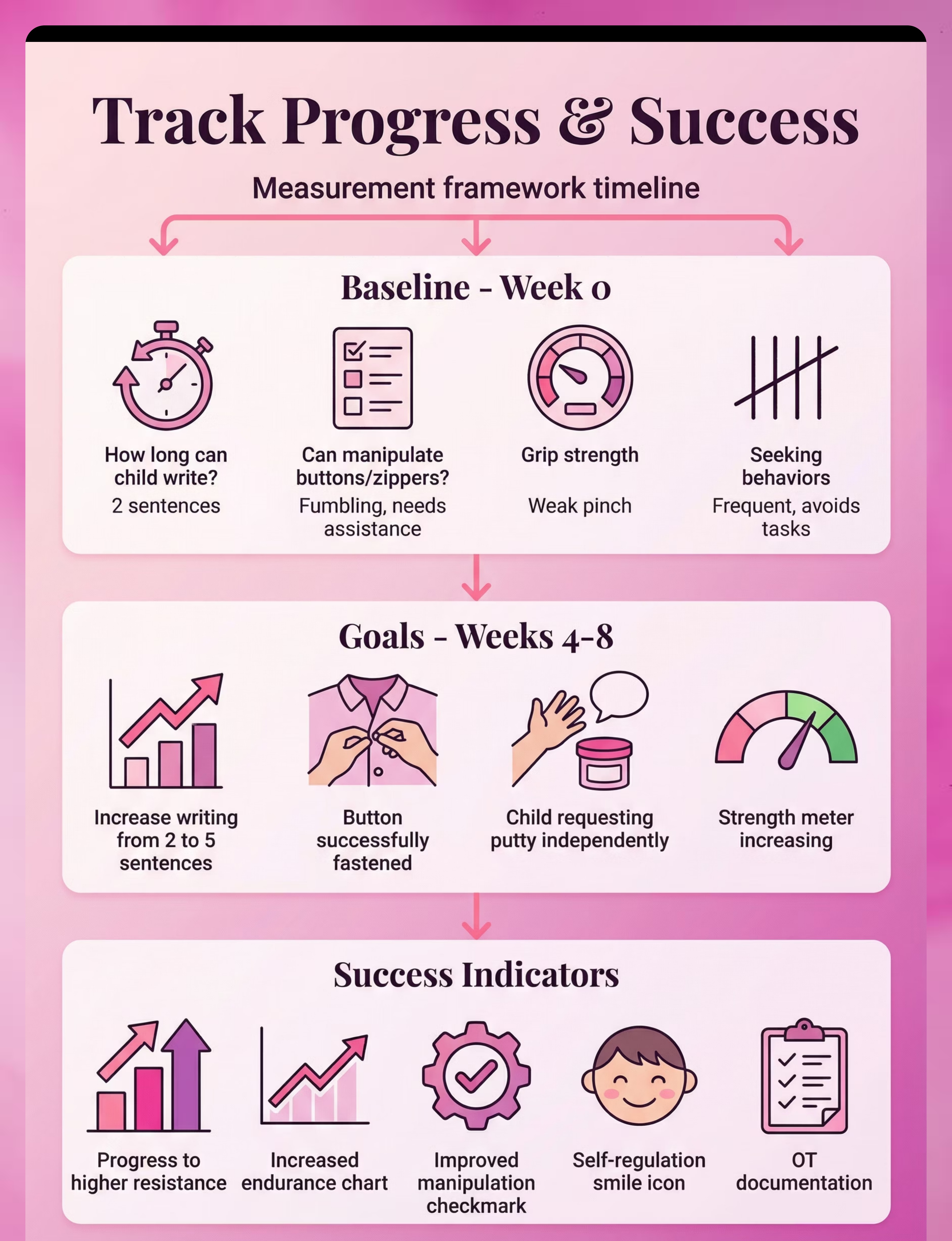
Establish Baseline
  • How long can child write before hand tires? (count sentences or minutes)
  • Can child manipulate buttons, zippers, snaps independently?
  • Request grip strength assessment from OT if available
  • Track frequency of proprioceptive seeking behaviors (squeezing, pressing)
Set Goals
  • Child will complete 10-minute putty session with medium resistance without fatigue
  • Handwriting endurance will increase from 2 sentences to 5 sentences
  • Child will independently request putty when seeking heavy input
  • Fine motor tasks (buttons, zippers) will be completed independently
Track Indicators
  • Progress to higher resistance levels over time
  • Increased handwriting endurance (sentence count, time)
  • Improved fine motor manipulation in daily tasks
  • Child independently using putty for self-regulation
  • OT documents measurable strength improvement
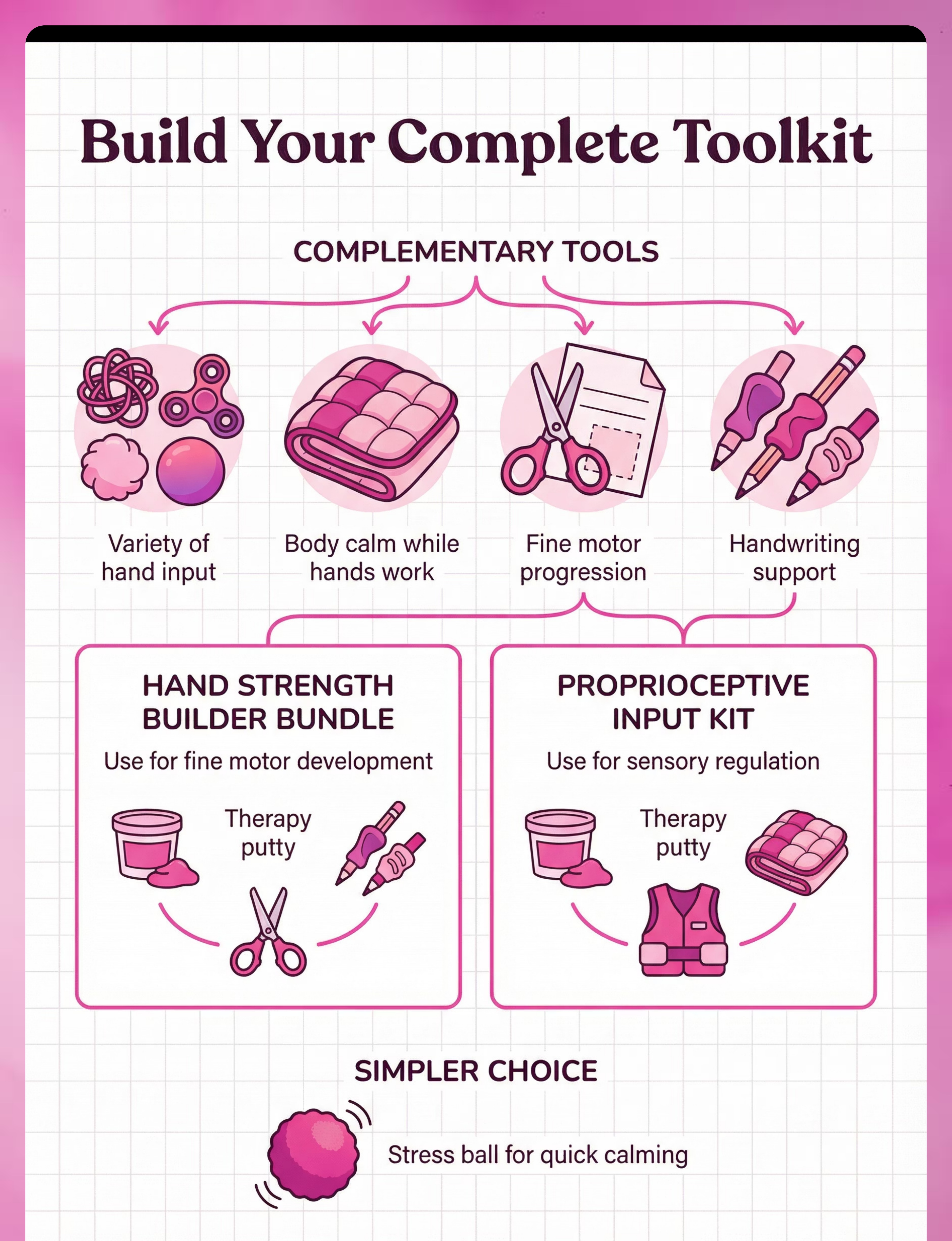
Pair It With...
Fidget Set (ID: 1.4)
Provides variety of hand input options beyond resistance work—expands sensory toolkit
Weighted Lap Pad (ID: 1.1)
Offers body calm while hands work with putty—combines proprioceptive strategies
Scissor Skills Set (ID: 7.1)
Natural fine motor progression once hand strength improves—builds on putty foundation
Pencil Grips (ID: 7.2)
Supports handwriting alongside strength building—complete handwriting solution
Recommended Bundles
  • Hand Strength Builder Kit: Therapy Putty (1.6) + Scissor Skills (7.1) + Pencil Grips (7.2) — Complete handwriting preparation
  • Proprioceptive Input Kit: Therapy Putty (1.6) + Body Sock (1.2) + Weighted Lap Pad (1.1) — Full body + hand proprioceptive strategies
AI Summary
Therapy putty provides resistive proprioceptive input that strengthens hands and supports self-regulation. Rank 2 in category, strong evidence base, essential for handwriting preparation and proprioceptive seekers. Color-coded resistance levels allow progressive strengthening from ages 2-9 across all settings.
putty
proprioceptive
hand strength
fine motor
handwriting
OT
resistive
self-regulation
Common Searches
therapy putty kids, hand strengthening autism, TheraPutty India, occupational therapy putty, hand exercise putty children, fine motor strengthening, resistive hand therapy
Get Expert Support

FREE National Autism Helpline
Phone: 9100 181 181
Languages: 16+ Indian languages supported
Website: pinnacleblooms.org
Connect with occupational therapists who can guide putty selection, demonstrate exercises, and create personalized strengthening programs.
Platform Integration
Therapy putty integrates seamlessly with Pinnacle Blooms Network's comprehensive child development platform:
  • AbilityScore®: Identifies fine motor and proprioceptive needs through developmental assessment
  • TherapeuticAI®: Prescribes specific putty exercises within personalized therapy sequences
  • EverydayTherapyProgramme™: Includes daily putty protocols integrated into home routines
  • Learning & Academic Readiness Index: Tracks handwriting improvement and fine motor progress over time

Disclaimer: This is educational information designed to help you make informed decisions about therapeutic tools. Always consult qualified occupational therapists, speech-language pathologists, or pediatricians before starting new interventions. Individual results vary based on child's unique profile, consistency of use, and quality of implementation. This content does not replace professional evaluation or treatment.