




















Tool ID: 6.1
Tool ID: 6.1
OT + PT
Strong Evidence
Rank #1
Daily Use
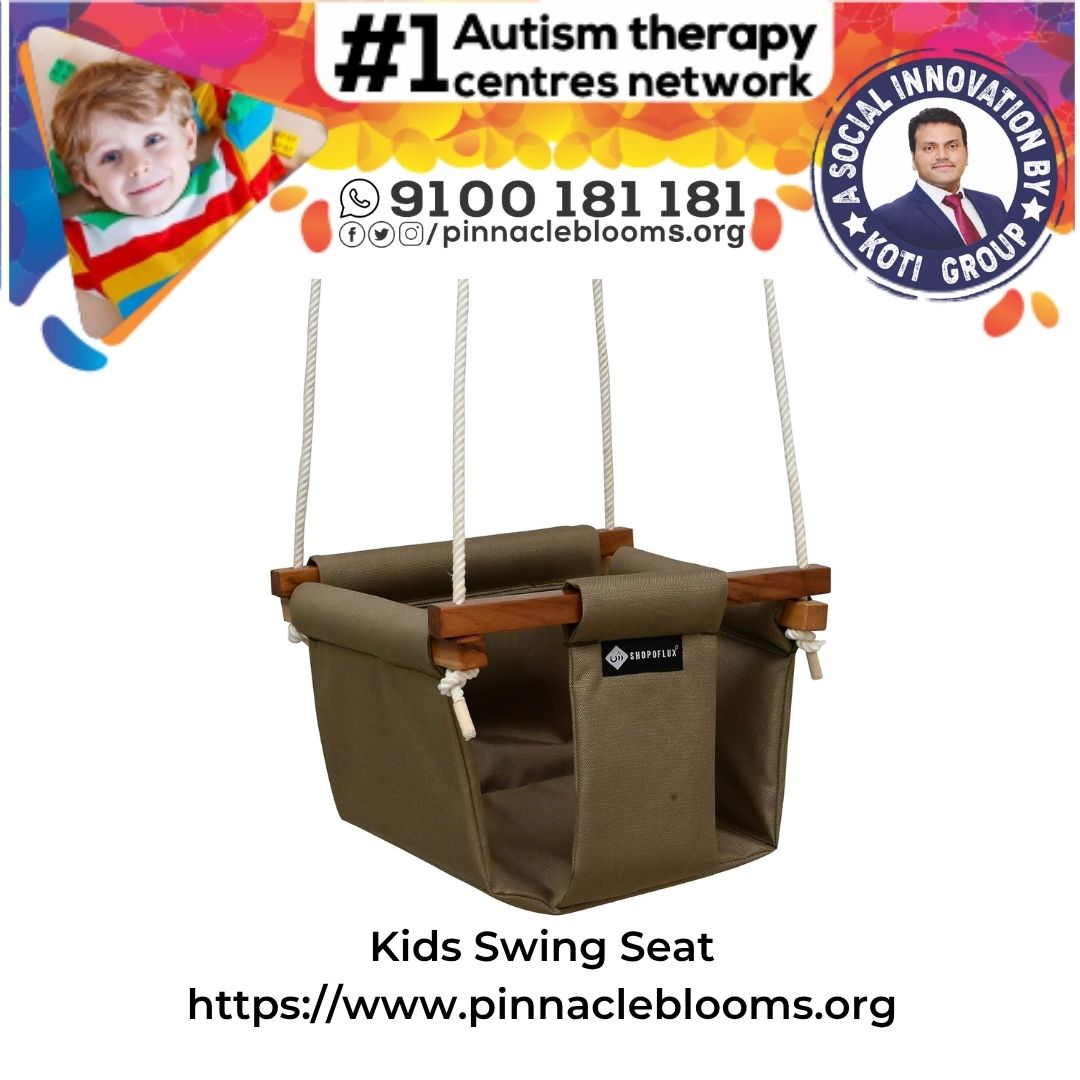
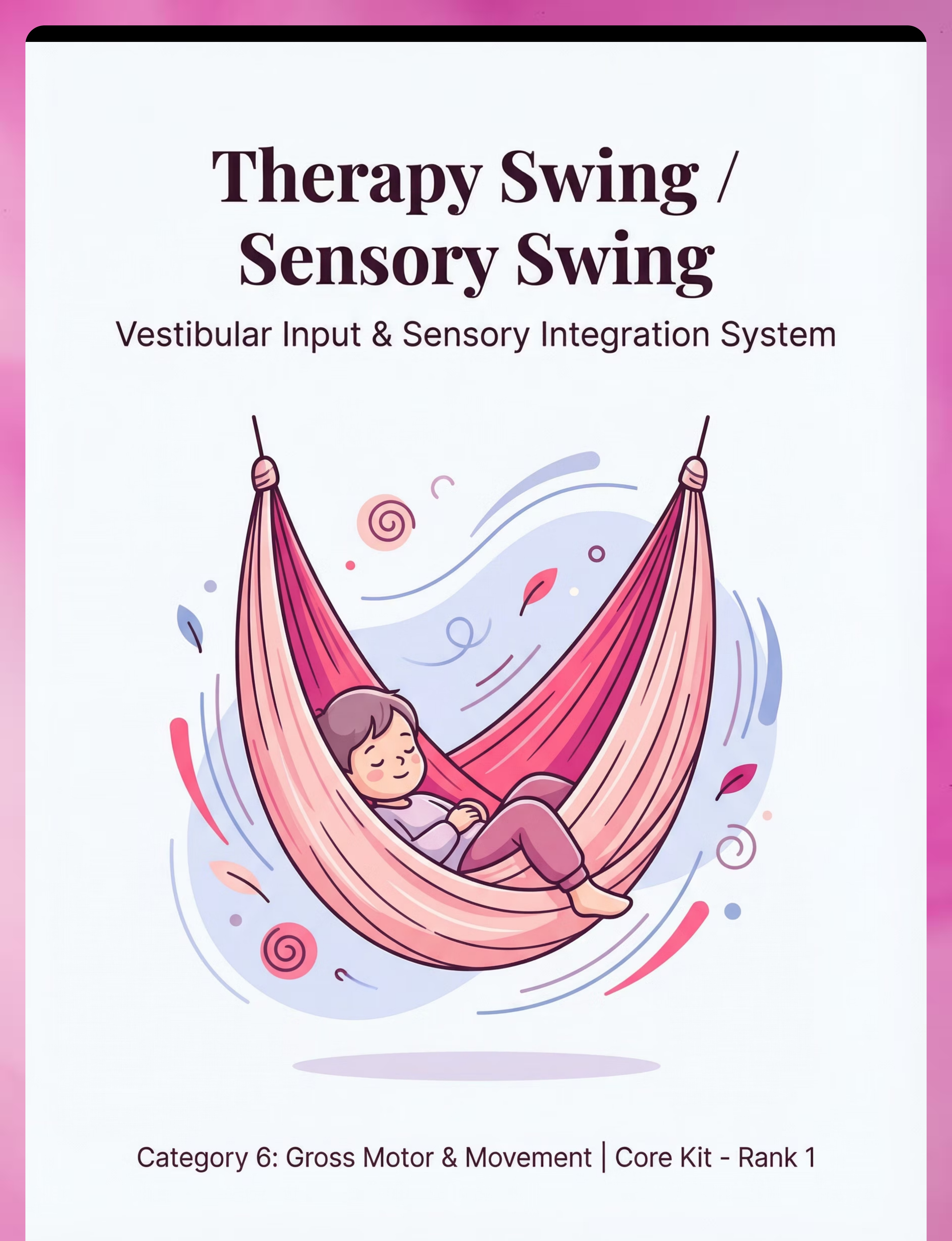
Therapy Swing / Sensory Swing
Vestibular input and sensory integration system
A powerful therapeutic tool designed to provide controlled vestibular input for sensory regulation, motor planning, and nervous system organization. Used daily in homes and clinics across India, therapy swings support children ages 2-12 in developing better focus, regulation, and body awareness through safe, supervised movement.
Home/Clinic
Daily Use
₹1,000–15,000
The Hidden Challenge Parents Face
The Invisible Struggle
Your child is restless, clumsy, or overly sensitive to movement, yet these signs are often dismissed as "just a phase" or misbehavior. This leaves parents feeling isolated and misunderstood.
Solutions That Fall Short
Traditional discipline or increased screen time might offer temporary calm, but they fail to address the core sensory needs. This leads to escalating behaviors and mounting frustration for the entire family.
The Exhaustion Cycle
The constant vigilance, endless demands for attention, and the emotional toll of unmet needs create a draining loop for parents. It impacts family harmony and your child's development.
Wishing for Answers
Many parents spend years searching for effective strategies, wishing they had understood the root cause of their child's challenges sooner to provide targeted, impactful support.
Who This Helps
Vestibular Processing
Organizes the brain's understanding of movement and position, creating a foundation for all other sensory processing.
Sensory Regulation
Helps children achieve an optimal state of alertness—calm when needed, energized when appropriate.
Core Strength
Builds postural control and body stability through dynamic movement challenges.
Motor Planning
Develops the brain's ability to plan, sequence, and execute coordinated movements.
Attention & Focus
Organized vestibular input supports sustained attention and concentration on tasks.
Calming & Alerting
Provides either calming or alerting effects depending on the type and speed of movement used.
Best For
  • Children who constantly seek movement
  • Kids struggling with focus and attention
  • Those needing nervous system organization
Ages 2-12 years
Home
Clinic
School
Outdoors
Does This Sound Familiar?
You're not alone. These are the daily challenges shared by thousands of parents across India whose children need vestibular input to feel organized and regulated.
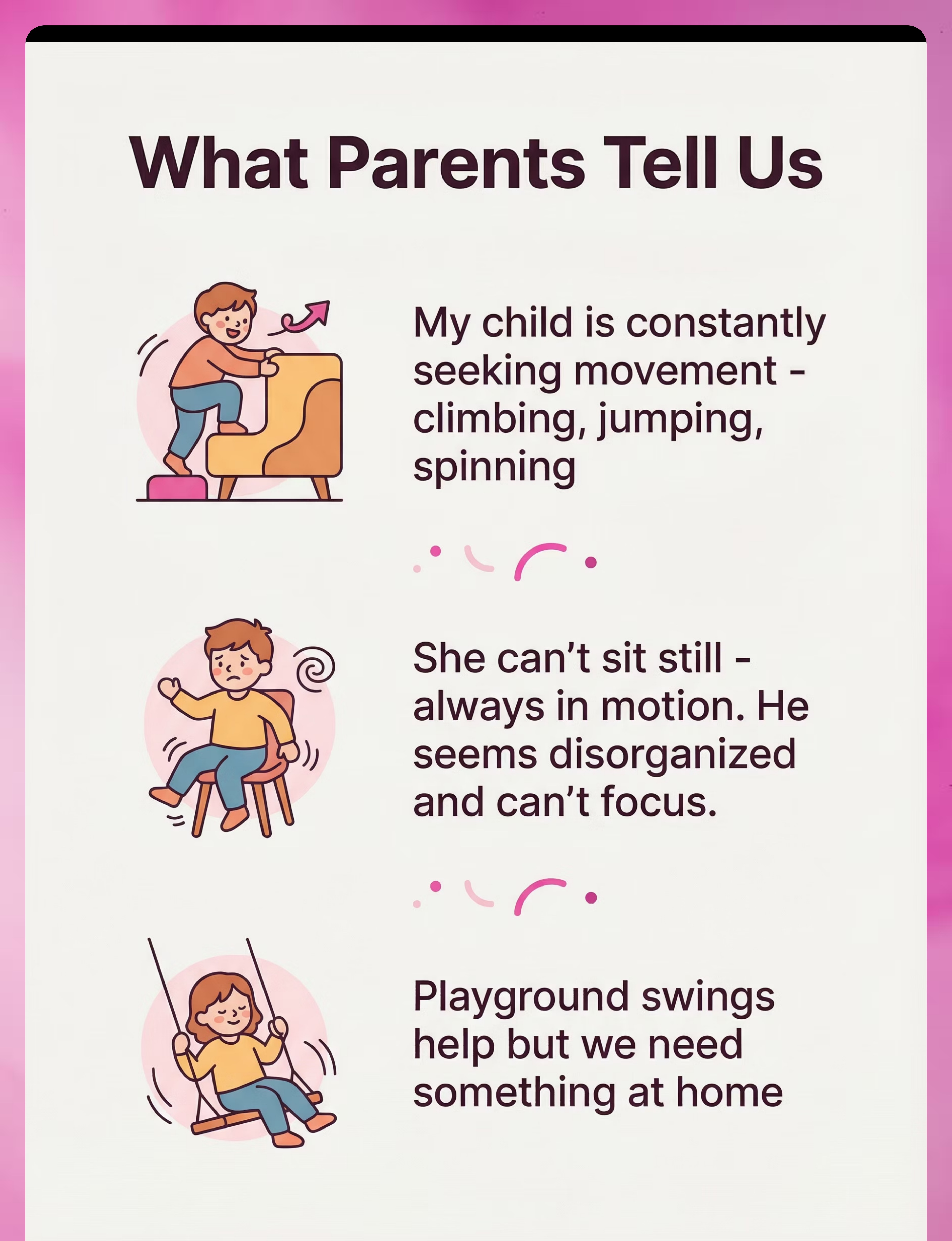
"My child is constantly seeking movement—climbing, jumping, spinning. I can't keep up, and I'm worried about safety."
"She can't sit still for even five minutes. Always in motion. Homework time is a battle every single day."
"He seems so disorganized and can't focus on anything. His body just doesn't seem to work with him."
"She's either running around like crazy or completely shut down. There's no in-between. I don't know how to help her find balance."
"Playground swings help calm him down, but we need something at home that works. We can't go to the park three times a day."
"He crashes into everything—the walls, furniture, his siblings. He's always seeking that input, and I don't know how to meet his needs safely."

These behaviors aren't defiance or hyperactivity—they're your child's nervous system seeking the vestibular input it needs to function. A therapy swing provides that input safely and effectively.
A Day Without the Right Support
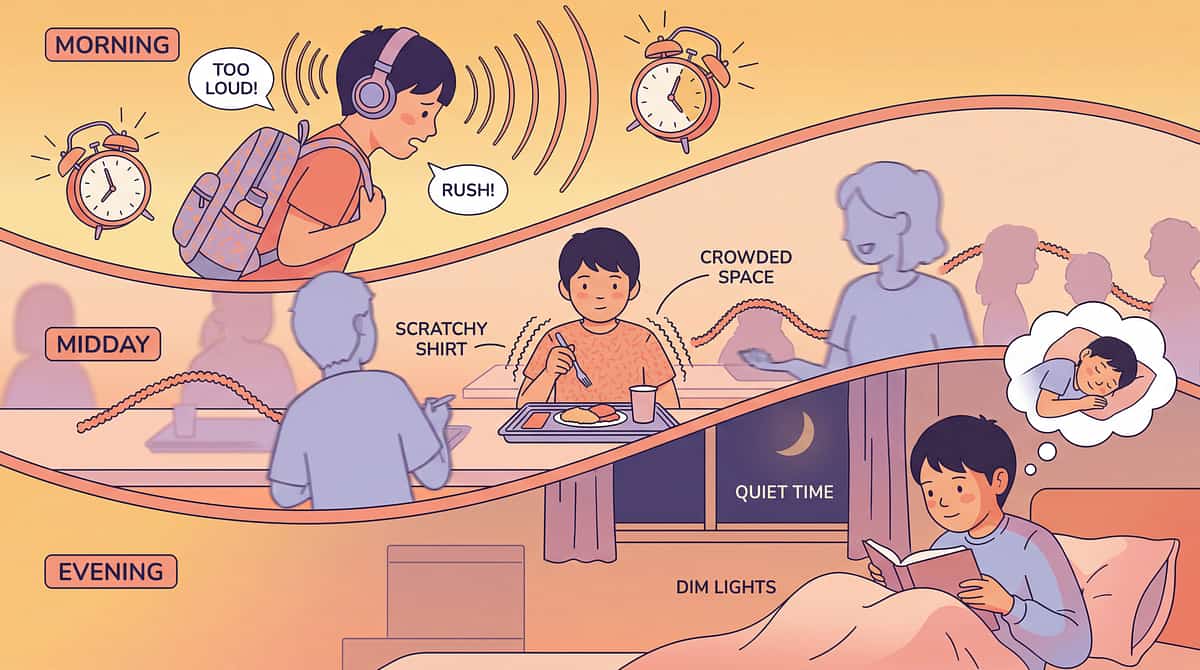
Without proper vestibular input, every transition and task becomes a challenge. Here's what a typical day looks like for families seeking solutions:
Morning
Difficulty waking, getting dressed takes forever, constant resistance
Transitions
Meltdowns moving between activities, can't shift gears
School/Therapy
Can't focus, fidgeting constantly, falling out of chair
Afternoon
Homework battles, dysregulation peaks, unsafe movement seeking
Bedtime
Can't settle down, difficulty calming body and mind
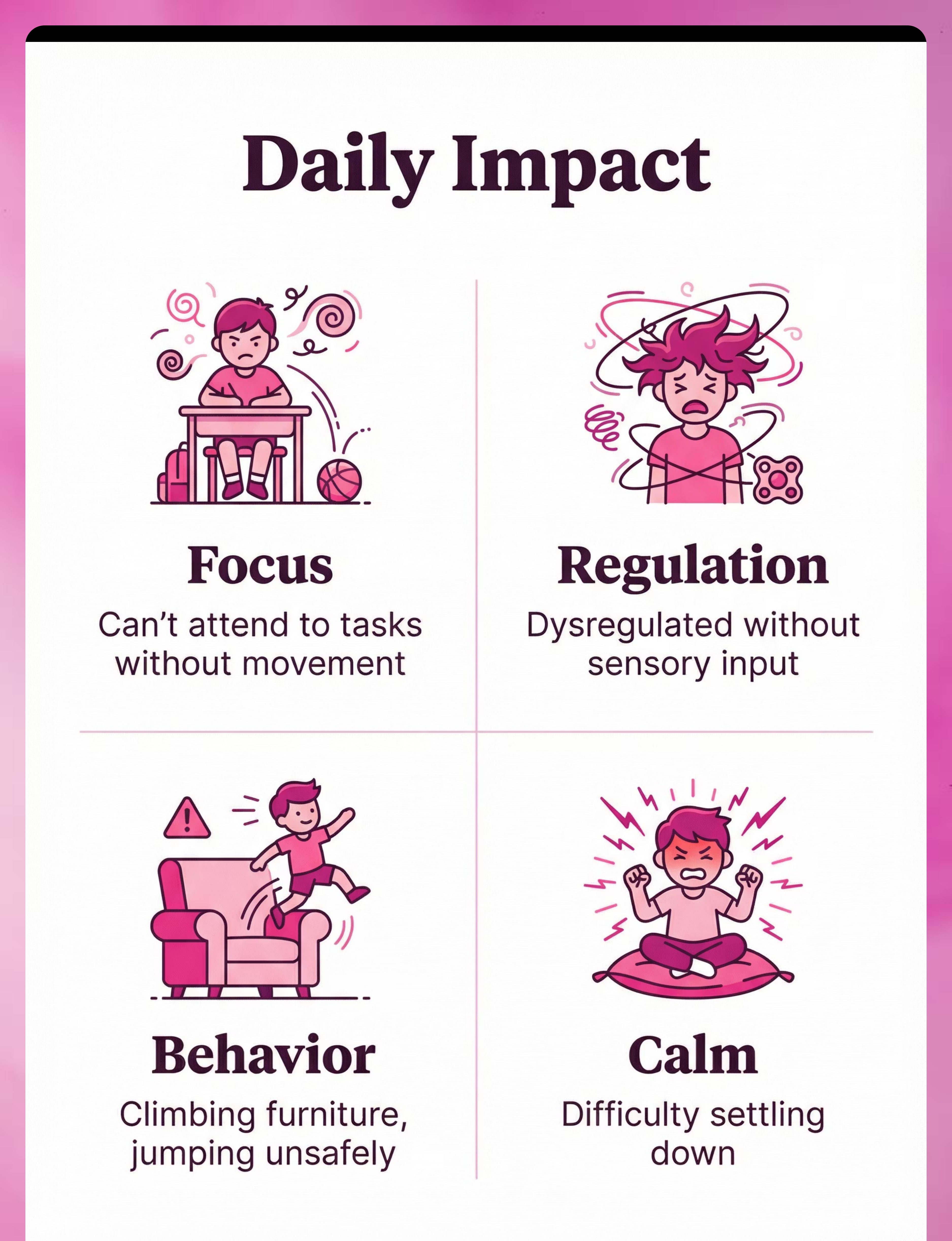
The Daily Struggle
  • Focus challenges: Can't attend to tasks without constant movement throughout the day
  • Regulation issues: Becomes dysregulated without appropriate sensory input to organize the nervous system
  • Behavior concerns: Climbing furniture, jumping unsafely from heights, seeking dangerous movement
  • Calm difficulties: Tremendous difficulty settling down for required activities like meals, homework, or sleep
Each of these challenges stems from an under-stimulated vestibular system. The good news? Proper vestibular input can transform these struggles into successes.
The Science Behind It
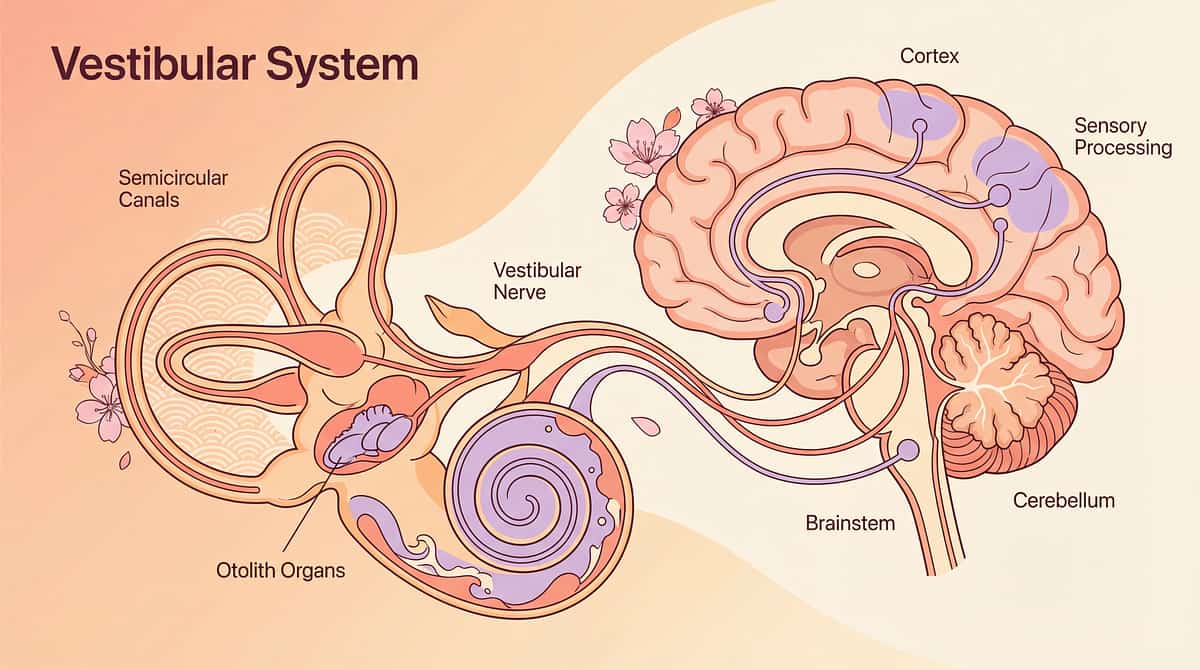
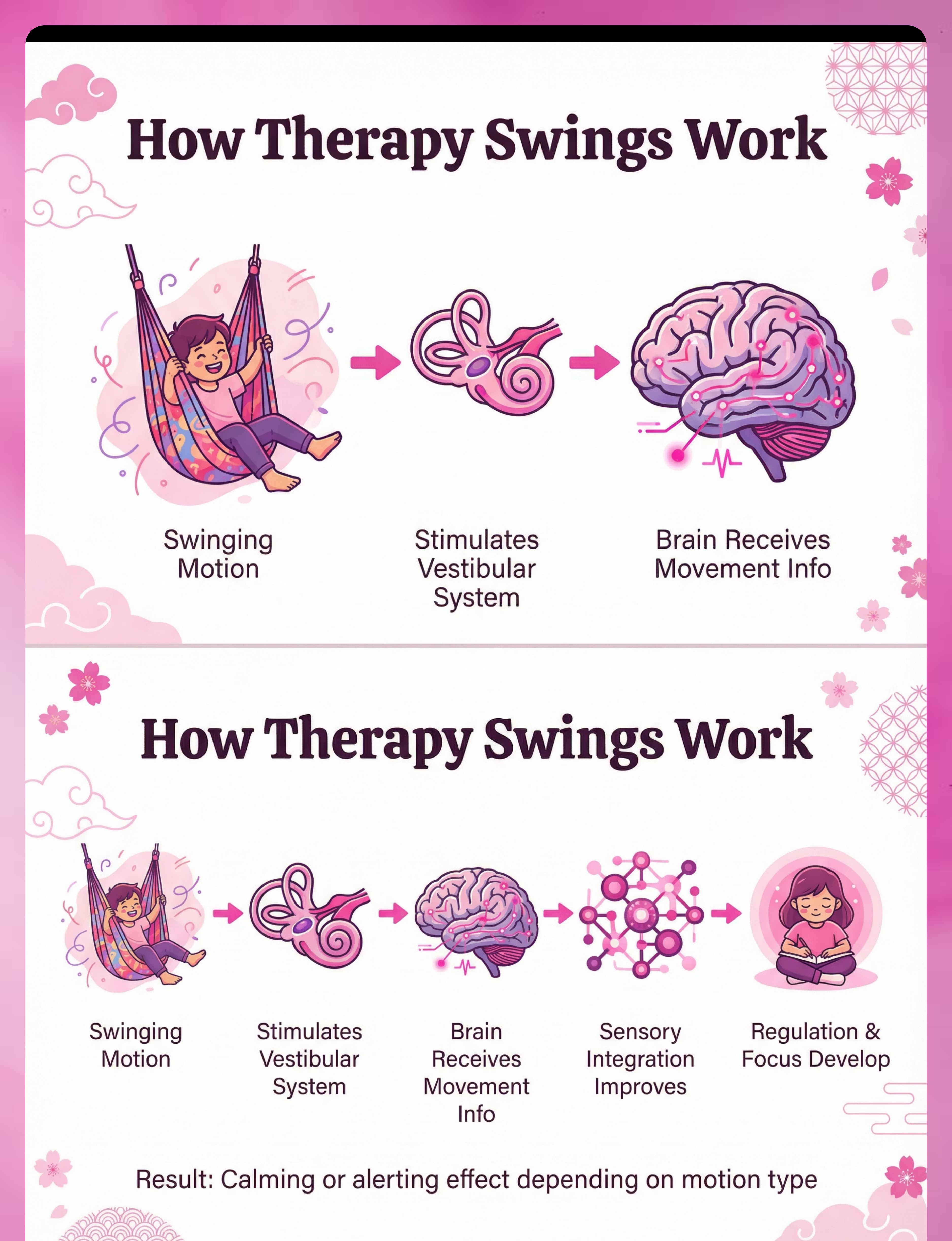
Understanding how therapy swings work helps you use them effectively. The vestibular system is the foundation of sensory integration—when it's organized, everything else falls into place.
Swinging Motion
Controlled movement stimulates the vestibular system in the inner ear
Brain Processing
Brain receives and interprets movement information from vestibular receptors
Sensory Integration
Improved integration of all sensory information throughout the nervous system
Development & Organization
Regulation, attention, and motor planning abilities develop and strengthen
Regulation Result
Calming or alerting effect achieved depending on the type and speed of motion
Vestibular Processing
Sensory Regulation
Core Strength
Motor Planning
Attention
Calming/Alerting

Clinical Note: The vestibular system processes information about movement, gravity, and spatial orientation. It's the first sensory system to fully develop in utero and serves as the foundation for all other sensory processing. When this system functions well, children can regulate their bodies, maintain attention, and move through their world with confidence.
How to Use It Right
Therapy swings are powerful tools—when used correctly, they transform regulation and focus. Follow these evidence-based best practices to ensure safe, effective use that supports your child's development.
Start Slow & Linear
Begin with slow, back-and-forth (linear) motion. This is the most organizing and least overstimulating pattern. Build gradually from here.
Watch for Overstimulation
Monitor your child carefully for signs like pale face, glazed eyes, or nausea. Stop immediately if these appear—less is more with vestibular input.
Use Rotary Motion Carefully
Spinning (rotary input) is extremely powerful and can quickly overwhelm. Use sparingly, under supervision, and only when appropriate for your child's needs.
Honor the Stop Signal
Your child must be able to stop whenever needed. Never force continued swinging. Self-regulation includes knowing when enough is enough.
Integrate into Sensory Diet
Use the swing as part of a structured sensory diet throughout the day—not as punishment or reward. Scheduled use is most effective.
Consult Your OT
Work with an occupational therapist to design therapeutic protocols specific to your child's sensory profile and regulation needs.
Typical Duration
5-15 minutes per session is usually sufficient. Watch for signs of overstimulation rather than following a strict timer. Quality matters more than quantity with vestibular input.

Remember: Vestibular input has a powerful, lasting effect. A little goes a long way. More is not better—appropriate input is better.
Expert Endorsement
therapy-swing-sensory-swing therapy material
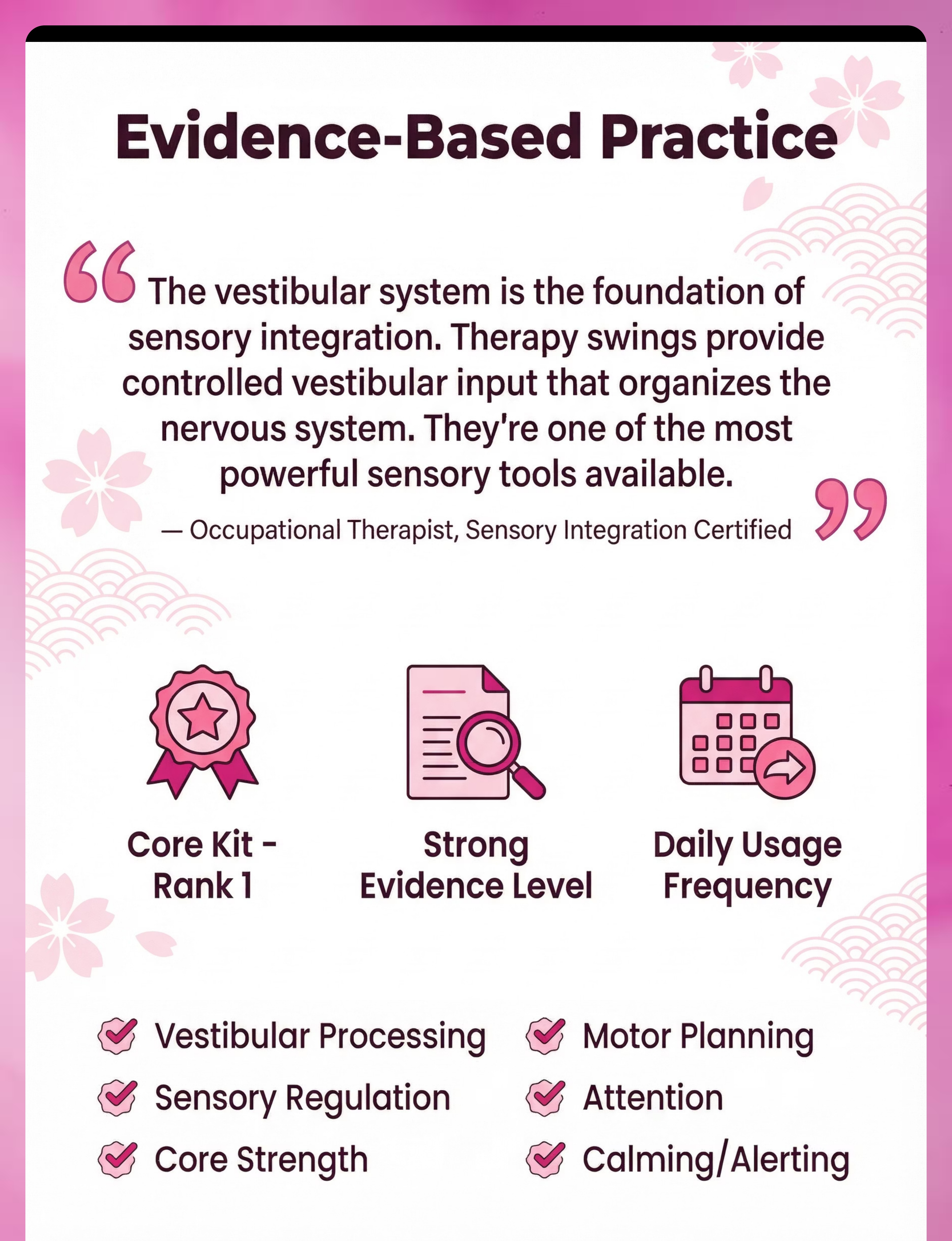
"The vestibular system is the foundation of sensory integration. Therapy swings provide controlled vestibular input that organizes the nervous system. They're one of the most powerful sensory tools available."
— Occupational Therapist, Sensory Integration Certified
OT + PT Recommended
Core tool used by both occupational therapists and physical therapists nationwide
Strong Evidence Base
Supported by decades of sensory integration research and clinical practice
Rank #1 in Category
Top-rated tool in Gross Motor & Movement for sensory regulation
Therapy swings are considered a Core Kit item—essential for comprehensive sensory support. Their effectiveness is backed by strong clinical evidence and widespread professional endorsement across India's therapeutic community.
therapy-swing-sensory-swing therapy material
Choose Your Option (7 Variants)
Different swings provide different types of vestibular input. Choose based on your child's sensory needs, available space, and therapeutic goals. Each variant serves specific purposes in a comprehensive sensory program.
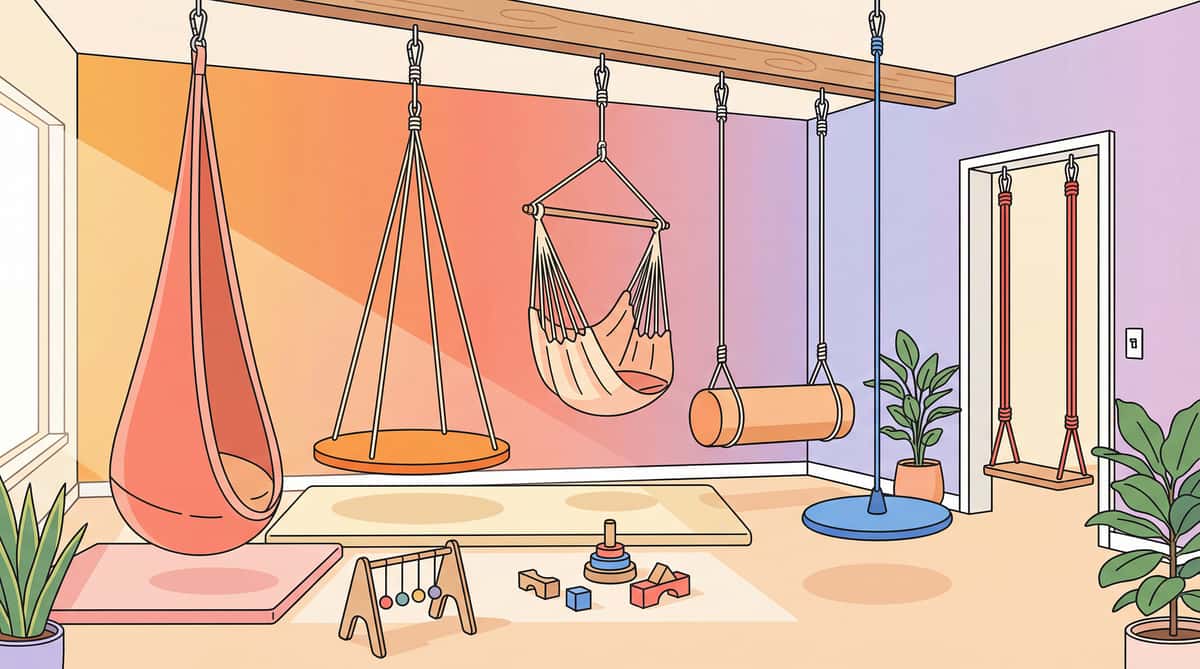
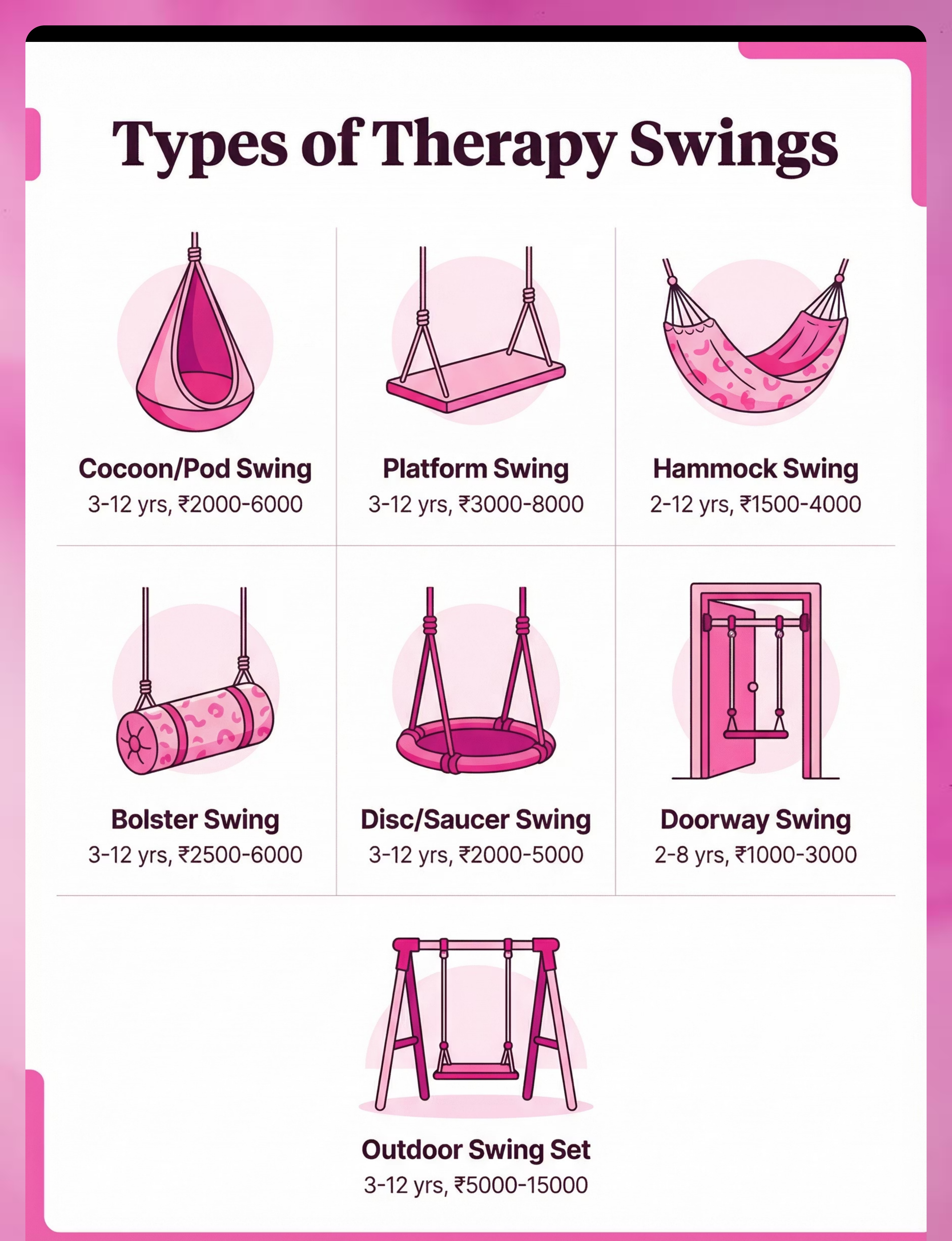
Types of Therapy Swings
Cocoon/Pod Swing
Platform Swing
Hammock Swing
Bolster Swing
Disc/Saucer Swing
Indoor Doorway Swing
Outdoor Therapy Swing Set
Variant Details
Cocoon/Pod Swing: Best for calming and providing proprioceptive + vestibular input, ideal for sensory seekers. Suitable for ages 3-12 years, supporting 50-100 kg. Generally installed with low portability. Price: ₹2,000–6,000. Suitable for both home and clinic.
Platform Swing: Versatile for lying, sitting, and standing activities, excellent for prone extension work. Designed for ages 3-12 years, supporting 75-150 kg. Low portability due to installation. Price: ₹3,000–8,000. Used in clinics and homes.
Hammock Swing: Offers relaxation and gentle vestibular input. Appropriate for ages 2-12 years, supporting 50-100 kg. Medium portability, making it somewhat easier to move. Price: ₹1,500–4,000. Great for home and clinic settings.
Bolster Swing: Focuses on developing core strength and bilateral coordination. For ages 3-12 years, supporting 50-100 kg. Requires installation, thus low portability. Price: ₹2,500–6,000. Used in clinics and homes.
Disc/Saucer Swing: Provides rotary vestibular input, often preferred by sensory seekers. Suits ages 3-12 years, supporting 50-100 kg. Low portability as it needs to be installed. Price: ₹2,000–5,000. Suitable for home and clinic.
Indoor Doorway Swing: An excellent solution for limited spaces or rental homes. For ages 2-8 years, supporting 30-50 kg. High portability, easily removable. Price: ₹1,000–3,000. Primarily for home use.
Outdoor Therapy Swing Set: Best for creating a dedicated outdoor sensory space, ideal for heavy use in schools or large homes. Supports ages 3-12 years and weights 75-150 kg. Very low portability due to permanent installation. Price: ₹5,000–15,000. Suitable for outdoor home use and schools.

How to Choose
  • By goal: Calming (cocoon/hammock) | Visual/motor (platform) | Alerting (disc/saucer) | Strength (bolster)
  • By setting: Home with space (cocoon/platform) | Limited space (doorway) | Outdoor (swing set)
  • By portability: Need to move/store (doorway/hammock) | Permanent installation (all others)
Specifications & Types Guide

There was an error generating this image

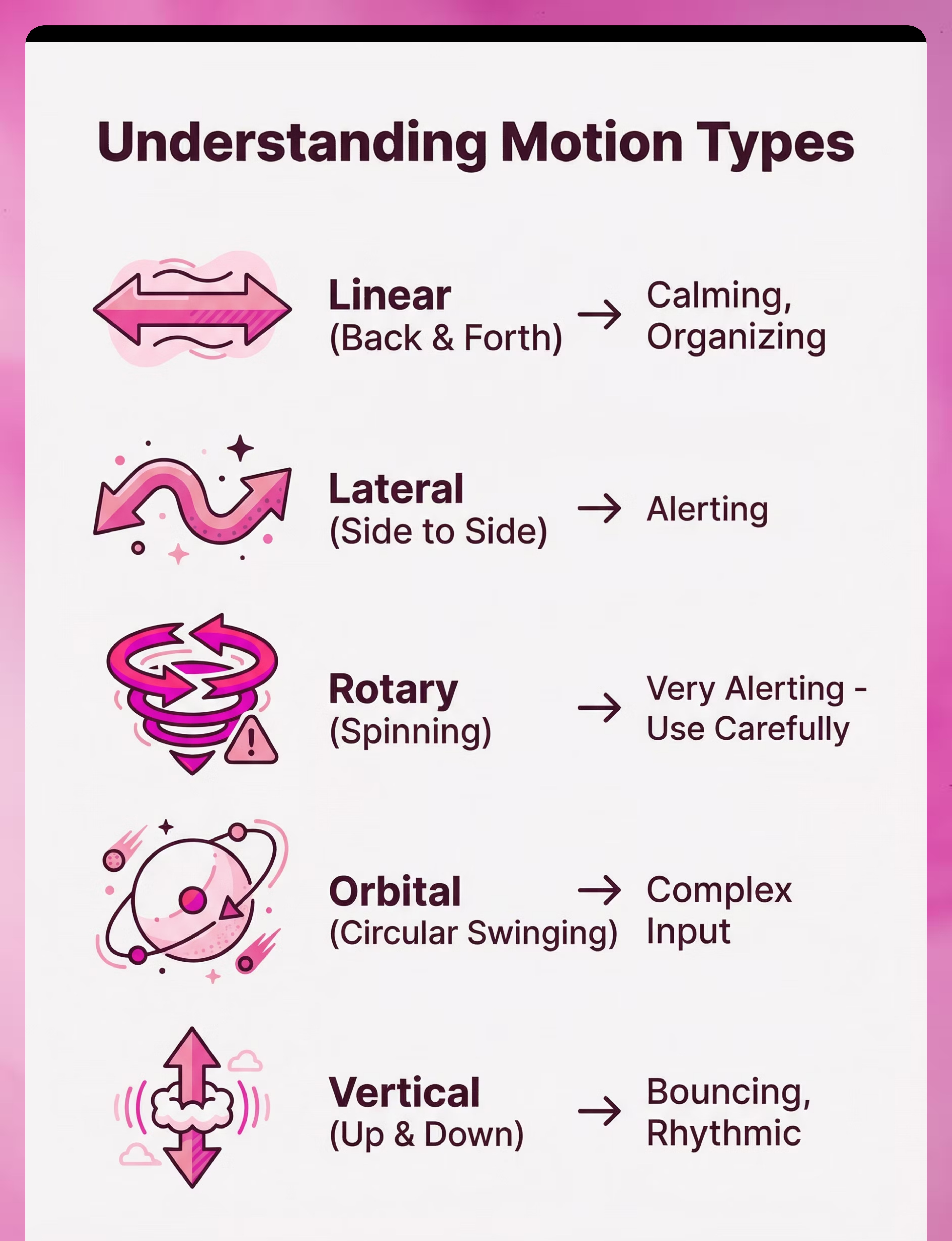
Linear (Back & Forth)
Effect: Calming and organizing
The most foundational motion pattern. Use this first with all children. Supports regulation and nervous system organization.

There was an error generating this image

Lateral (Side to Side)
Effect: Alerting and energizing
More complex than linear motion. Can increase alertness and arousal. Use when you need to "wake up" the system.

There was an error generating this image

Rotary (Spinning)
Effect: Very alerting—use carefully
Extremely powerful input. Can quickly lead to overstimulation. Always supervise. Limit duration. Watch closely for signs of too much input.
Orbital (Circular)
Effect: Complex, multi-directional input
Combines multiple motion patterns. More challenging to process. Use after child tolerates linear and lateral well.

There was an error generating this image

Vertical (Bouncing)
Effect: Up and down movement
Provides proprioceptive input along with vestibular. Good for sensory seekers who need joint compression combined with movement.
Materials & Key Features
Quality Materials
  • Heavy-duty fabric: Lycra, canvas, or specialized therapy-grade materials that won't tear or wear quickly
  • Climbing-grade hardware: Carabiners, straps, and mounts rated for climbing use—never use standard hardware
  • Padded/soft materials: Comfortable fabrics that won't irritate skin during extended use
  • Steel/wood frames: For outdoor sets, weather-resistant materials built to last
Essential Features
  • Appropriate weight capacity: Must exceed child's weight with safety margin
  • Secure mounting hardware: Professional-grade installation components included
  • Comfortable materials: Child should want to use it—comfort matters
  • Matches needs: Swing type should align with therapeutic goals

Critical: Never compromise on hardware quality. This is a safety issue. Always use climbing-grade components rated for appropriate weight.
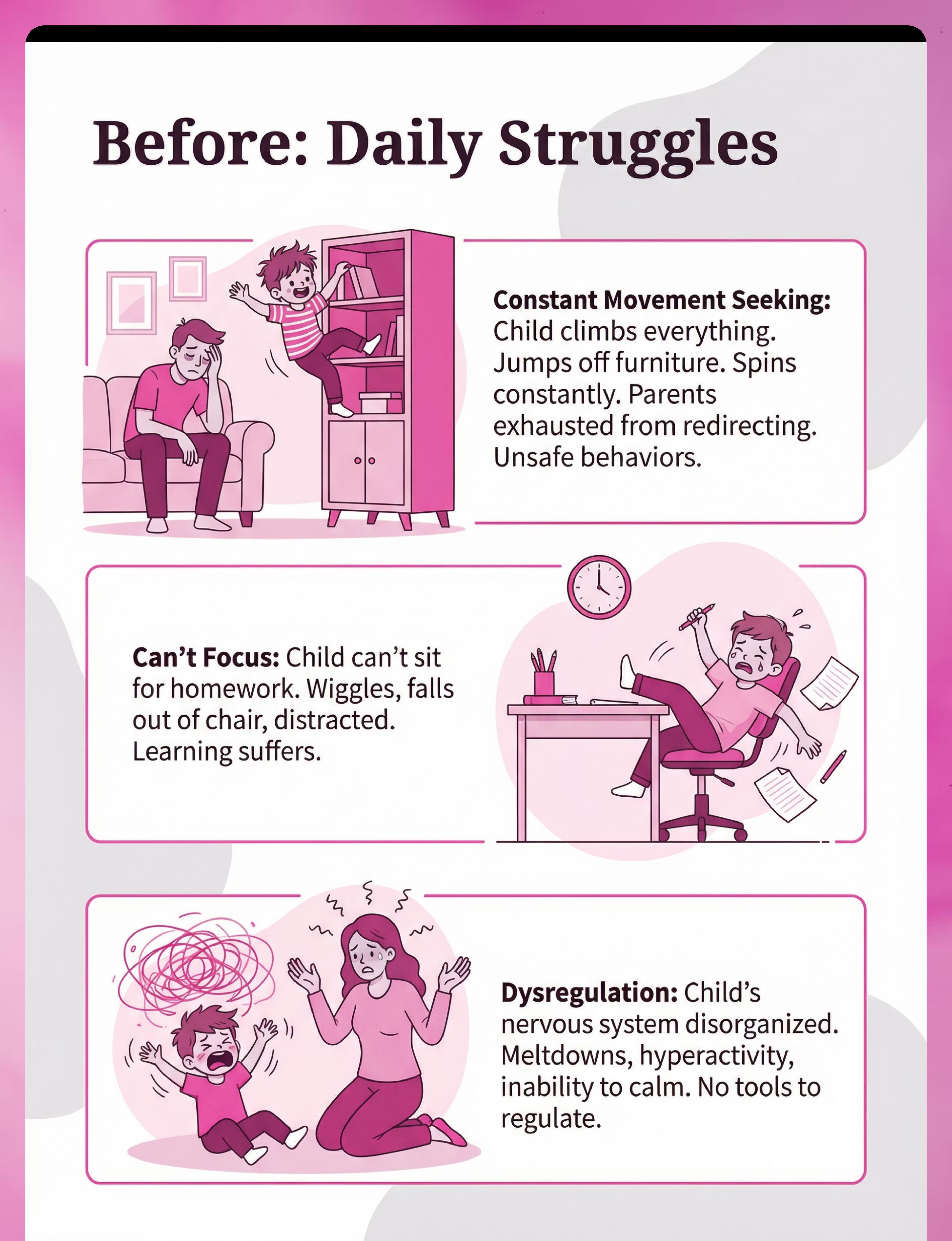
The Struggle (Before)
These are real scenarios from families before they found the right vestibular support. The emotional toll affects the entire family—but it doesn't have to be this way.

There was an error generating this image

Constant Movement Seeking
Situation: Child climbs everything—furniture, doorframes, counters. Jumps off couches and beds. Spins constantly until dizzy. Parents are exhausted from constant redirecting and terrified of injuries.
Experience: Every moment requires vigilance. Can't turn your back. Unsafe behaviors escalate. Nothing satisfies the need for movement.
Emotion: Exhaustion and fear dominate daily life

There was an error generating this image

Can't Focus or Sit Still
Situation: Child cannot sit for homework or meals. Constantly wiggling, falling out of chair, distracted by every sensation. Learning suffers. Family mealtimes are battlegrounds. Frustration builds on all sides.
Experience: Academic progress stalls. Simple tasks take hours. Teachers express concern. Siblings become resentful of disruption.
Emotion: Frustration and academic struggle create family tension

There was an error generating this image

Complete Dysregulation
Situation: Child's nervous system is completely disorganized. Frequent meltdowns without clear triggers. Swings between hyperactivity and complete shutdown. No tools to help them regulate. Family walks on eggshells.
Experience: Can't predict what will set them off. Outings are impossible. Isolation increases. Siblings and parents suffer. No sense of control.
Emotion: Chaos and helplessness pervade every day
If these scenarios feel familiar, you're not alone. Thousands of families experience this daily struggle—and thousands have found relief through proper vestibular support.
therapy-swing-sensory-swing therapy material
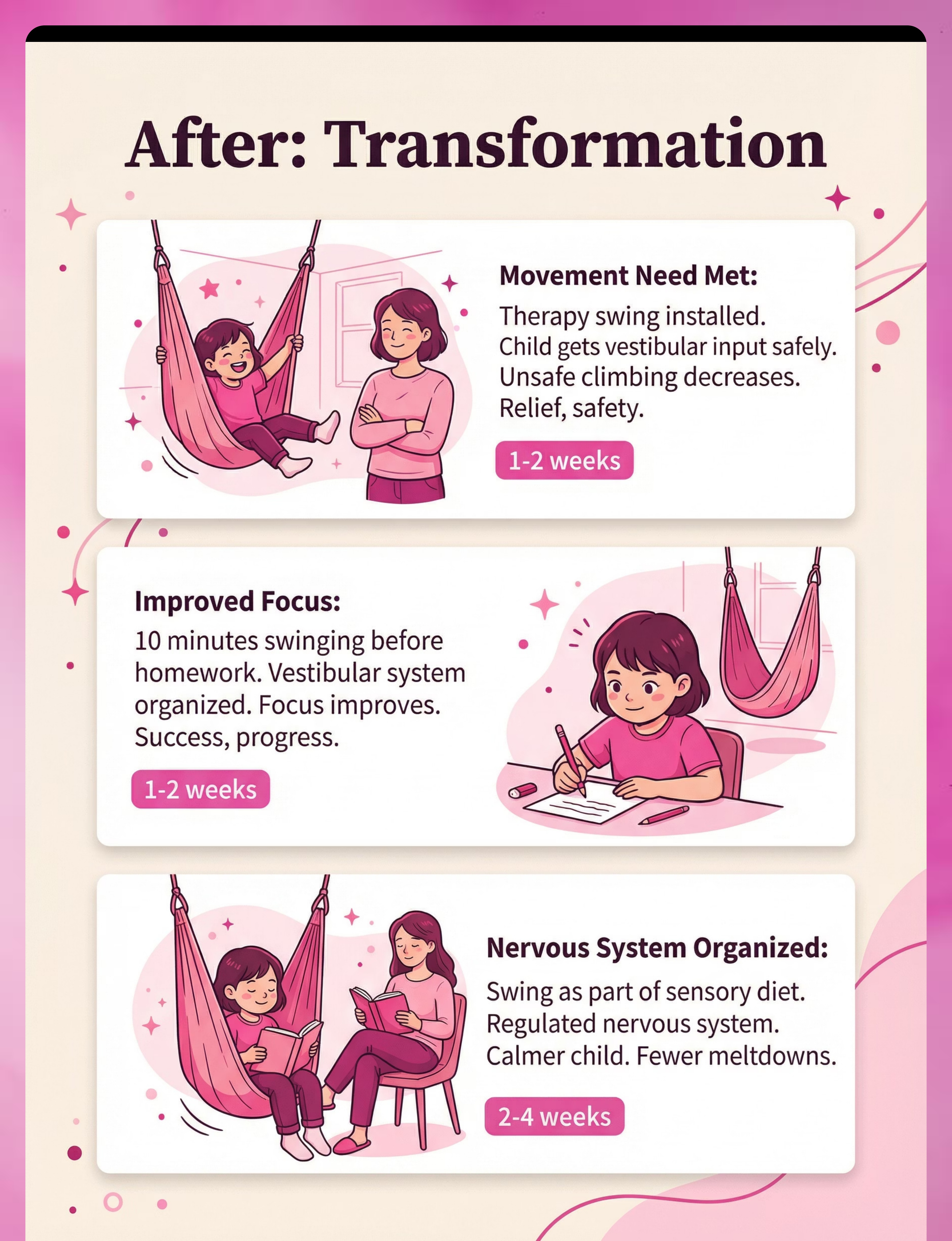
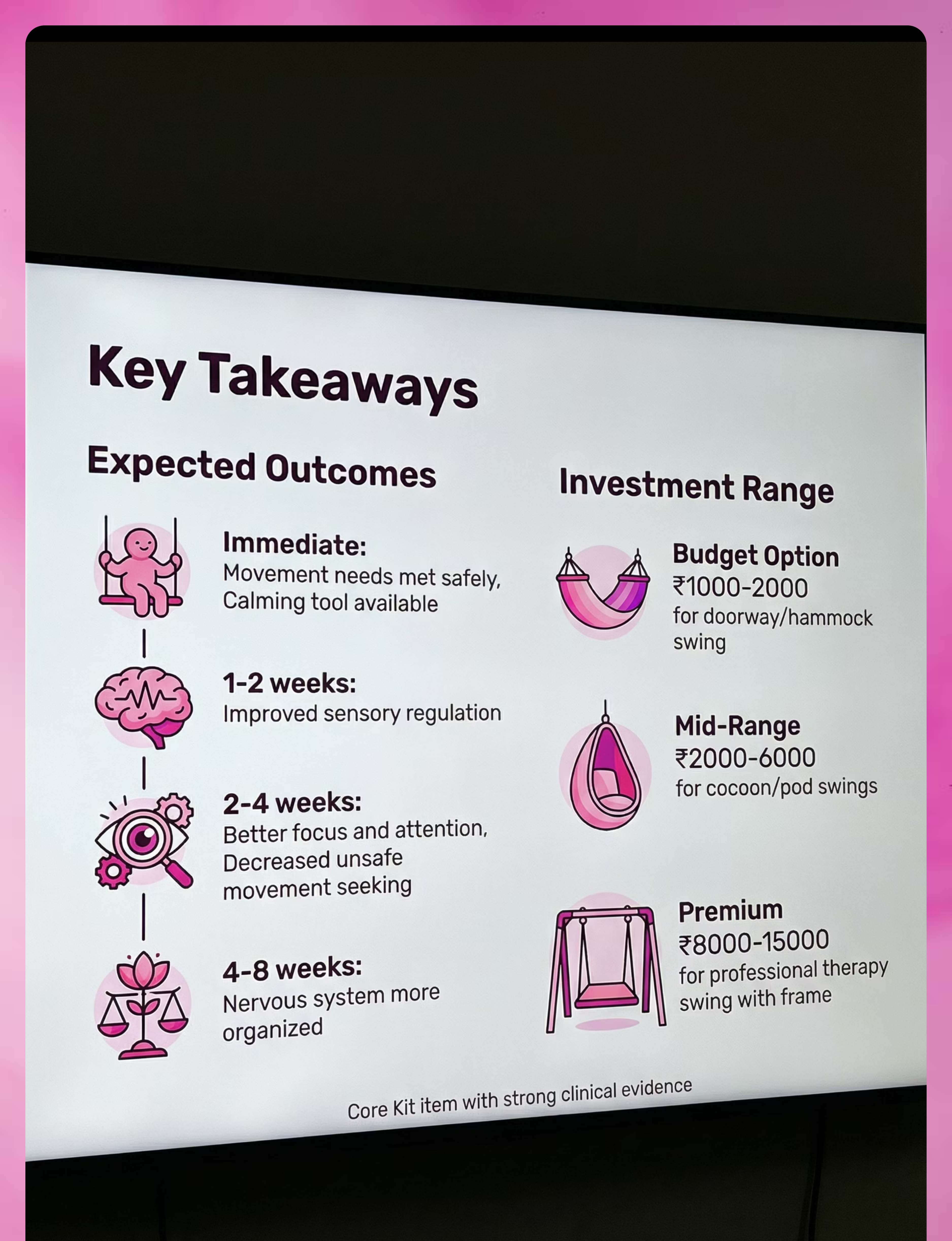
What to Expect (Realistic Timelines)
Setting realistic expectations helps you track progress effectively. Vestibular input creates both immediate and cumulative effects. Here's what research and clinical experience tell us about typical timelines.
Movement Needs Met Safely
Child has appropriate outlet for vestibular seeking. Immediate relief for movement-seeking behaviors.
Immediate
Calming Tool Available
Swing provides on-demand regulation support. Family has practical strategy for dysregulation.
Immediate
Improved Sensory Regulation
Nervous system begins organizing with consistent input. More regulated states throughout day.
1-2 weeks
Better Focus & Attention
Organized vestibular system supports sustained attention. Noticeable improvement in task completion.
2-4 weeks
Decreased Unsafe Seeking
Need for dangerous movement-seeking behaviors reduces significantly with appropriate input available.
2-4 weeks
Nervous System Organization
Cumulative effect of daily vestibular input creates lasting neurological organization and improved regulation.
4-8 weeks
therapy-swing-sensory-swing therapy material
Is This Right for My Child? (2-Minute Check)
Answer these quick questions to determine if a therapy swing is likely to benefit your child. Three or more "yes" answers indicate a strong fit and suggest consulting with an OT about implementation.
Does your child constantly seek movement (spinning, swinging, jumping)?
If yes, it indicates your child is a vestibular seeker, needing movement input for optimal nervous system function. A therapy swing can meet this need safely.
Does swinging at the playground help your child regulate?
If yes, this suggests vestibular input is clearly beneficial for your child's regulation. Having this available at home can provide consistent support.
Does your child have difficulty sitting still and attending to tasks?
If yes, an under-stimulated or disorganized vestibular system may be impacting attention and focus. Targeted vestibular input can support these skills.
Does your child seem disorganized or have poor motor planning?
If yes, this indicates the vestibular system is foundational for motor planning. Organized vestibular input supports better motor planning and body awareness.

Results: If you answered "yes" to 3 or more questions, a therapy swing is likely to be highly beneficial for your child. Consider consulting with an occupational therapist to develop a personalized sensory diet that includes swing use.
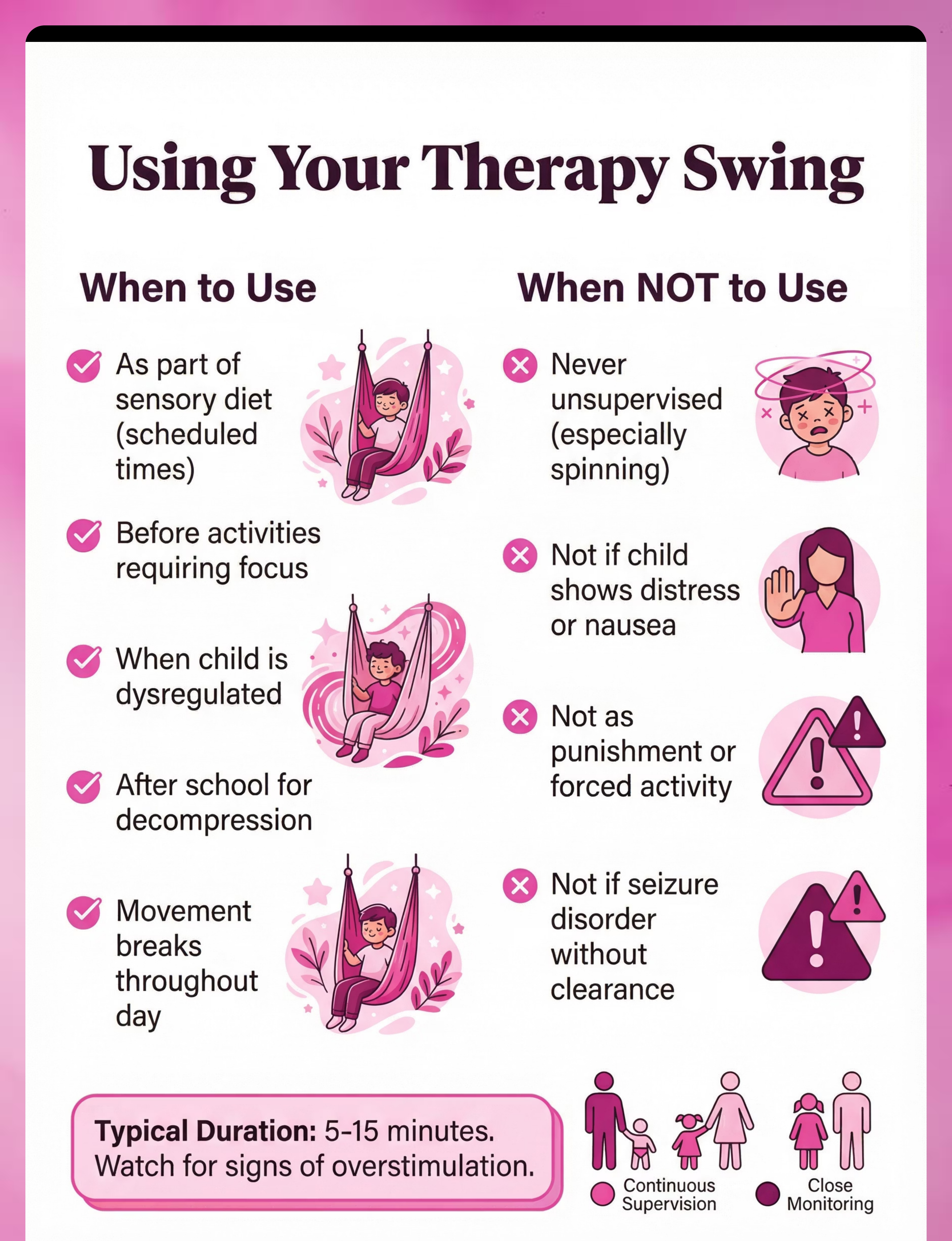
Usage Guide
When to Use ✓
As part of sensory diet
Incorporate swinging at scheduled times throughout the day for consistent vestibular input
Before focus activities
Use 10-15 minutes before homework, therapy, or other tasks requiring sustained attention
When dysregulated
Offer swing when child shows signs of dysregulation (if calming motion helps your child)
After school decompression
Use as transition tool to help nervous system recover from school demands
Movement breaks
Integrate throughout the day during natural transitions between activities
When NOT to Use ✗
Never unsupervised
Especially important with rotary/spinning motion which can quickly overstimulate
If showing distress
Stop immediately if child shows nausea, pale face, or requests to stop
Not as punishment
Never force swinging or use as consequence—this damages the tool's effectiveness
Seizure disorder caution
Do not use if child has seizure disorder without explicit medical clearance from physician
Supervision by Age
Age Range
Supervision Level
Notes
Under 5 years
Constant adult supervision
Adult must be within arm's reach at all times. Never leave alone with swing.
5-8 years
Adult present
Adult should be in same room and checking regularly, but can be less hands-on.
8+ years
Can use independently
Child can use with clear safety rules established. Adult checks in periodically.
Duration
5-15 minutes per session is typically sufficient. Quality over quantity—watch your child, not the clock.
Settings
Home
Clinic
School sensory room
Age Range
2-12 years (varies by swing type and weight limits—always verify)
Safety First
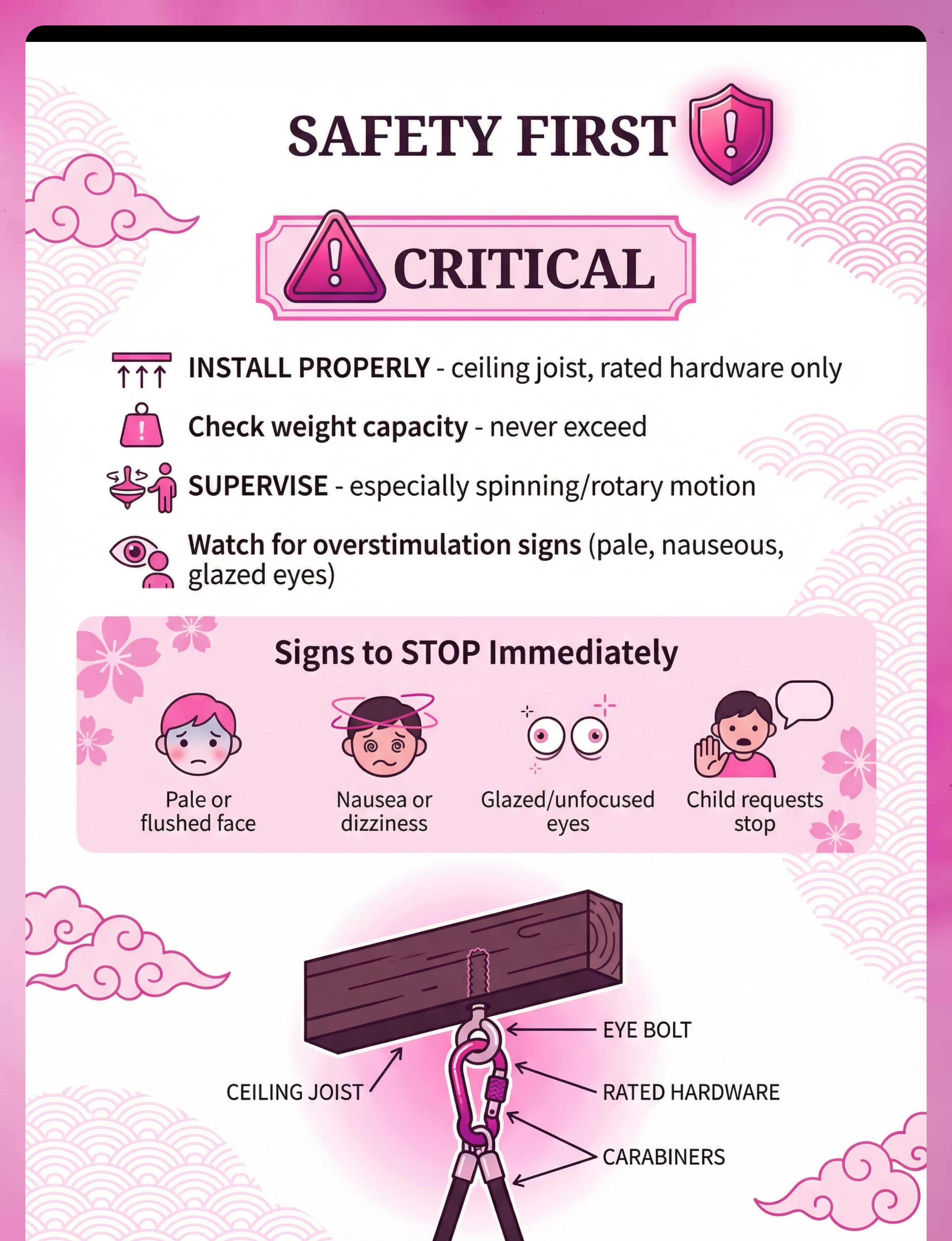
🚨 CRITICAL SAFETY
  • INSTALL PROPERLY: Ceiling joist installation only—never drywall alone. Use climbing-grade, rated hardware exclusively.
  • CHECK WEIGHT CAPACITY: Never exceed manufacturer's weight limit. Leave safety margin—don't push limits.
  • SUPERVISE ALWAYS: Especially critical with spinning/rotary motion which can quickly overwhelm the system.
  • WATCH FOR OVERSTIMULATION: Pale face, nausea, glazed eyes, excessive silliness mean STOP IMMEDIATELY.
⚠️ Important Warnings
  • Rotary (spinning) input is extremely powerful—limit duration and use sparingly
  • Stop immediately if child shows any signs of distress, nausea, or requests to stop
  • Inspect hardware regularly for wear, damage, or loosening—replace immediately if compromised
  • Maintain clear space around swing for safety—no furniture or obstacles in swing path
Contraindications
Seizure disorders: Do not use without explicit consultation and clearance from child's physician
Severe motion sensitivity: Child with extreme motion sensitivity may need gradual desensitization first
Unsupervised rotary motion: Never allow spinning without direct adult supervision—too powerful
Inadequate installation: Improper installation is dangerous—use professional installation if uncertain
Safety Checklists
Before Use ✓
  • Hardware secure and recently inspected
  • Weight capacity appropriate for child
  • Clear space around swing verified
  • Supervision plan in place and understood
During Use ✓
  • Adult present/nearby per age guidelines
  • Actively watching for overstimulation signs
  • Child can request stop at any time
  • Limiting rotary motion appropriately
Signs to Stop 🛑
  • Pale or flushed face
  • Nausea or dizziness reports
  • Glazed or unfocused eyes
  • Child requests to stop
  • Overly silly/disorganized behavior
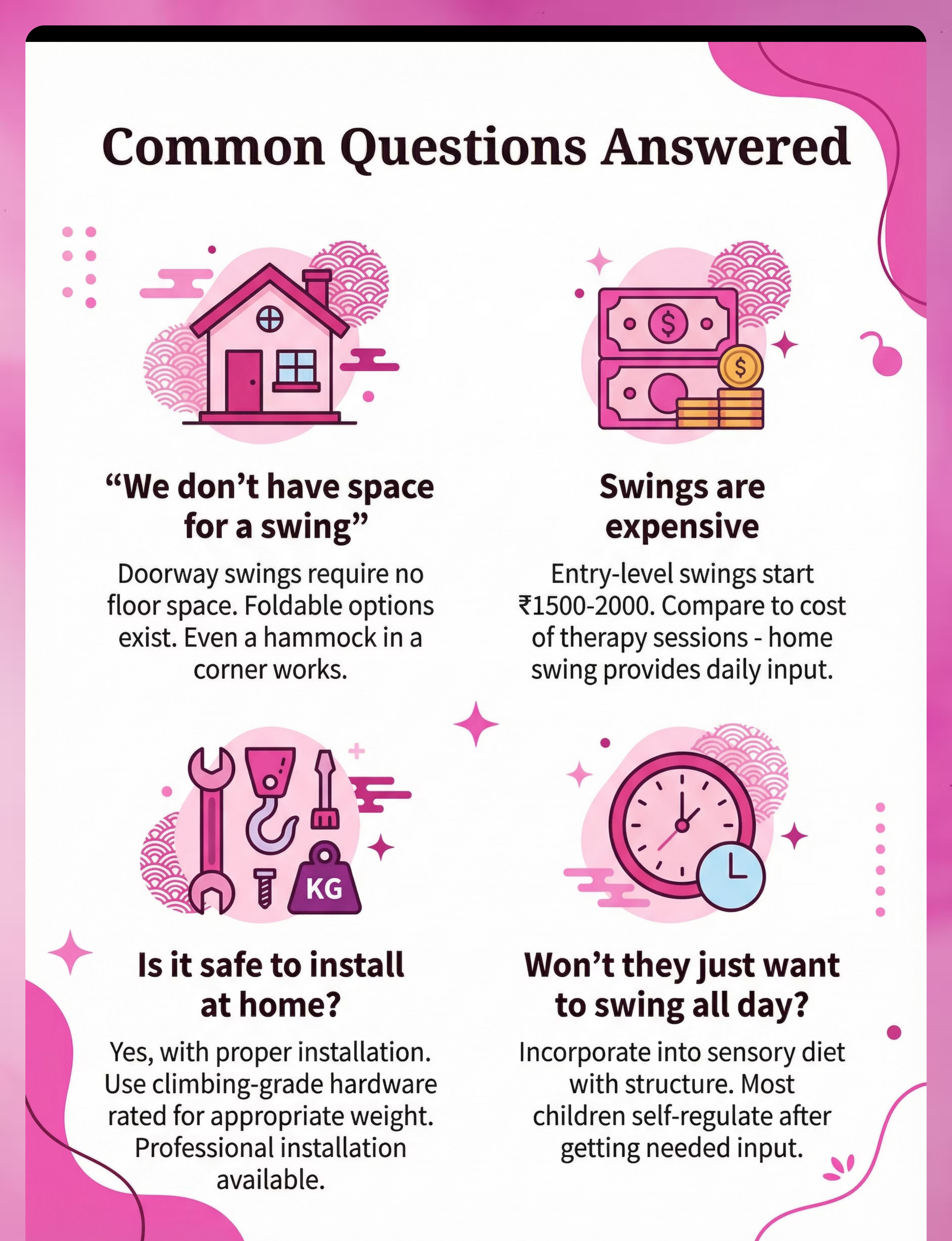
Common Questions (Honest Answers)
These are the real concerns parents raise. Here are honest, evidence-based answers to help you make an informed decision.
Q: We don't have space for a swing
A: Doorway swings require no floor space whatsoever—they attach to any standard door frame and can be removed when not in use. Foldable hammock options exist that hang in a corner and take up minimal space. Even a simple hammock in a corner works effectively. If indoor space is truly impossible, consider outdoor installation in a yard or balcony. Some swings are completely removable between uses.
Try this: Consider a doorway swing (₹1,000-3,000) or outdoor installation as space-saving alternatives.
Q: Swings are too expensive for our budget
A: Entry-level therapy swings start around ₹1,500-2,000—less than a single OT session in most cities. Basic hammock swings are the most affordable option and still highly effective. When you compare the cost to ongoing therapy sessions, a home swing provides daily vestibular input for years at a fraction of the price. DIY options are also possible with proper climbing-grade hardware (never compromise on safety).
Try this: Start with a hammock or doorway swing (₹1,500-2,000), and invest in quality hardware for safety. See DIY section for cost-saving options.
Q: Is it safe to install at home?
A: Yes, absolutely—with proper installation into structural ceiling joists or beams. Use climbing-grade hardware specifically rated for appropriate weight—never use standard hardware store components. Install into ceiling joists or beams, not drywall alone (drywall cannot support weight safely). Professional installation is available in most cities if you're uncertain. Always follow manufacturer guidelines exactly. When done properly, home swings are completely safe.
Try this: Get professional installation if uncertain, or use a rated swing frame designed for indoor use. Never compromise on hardware quality.
Q: Won't they just want to swing all day?
A: Initial novelty often means heavy use for the first few days—this is normal and actually beneficial. Most children naturally self-regulate after getting the vestibular input they need (typically 5-15 minutes). Incorporate swing time into a structured sensory diet with clear start and end times. Use a timer if needed to provide structure. When children receive "enough" vestibular input, they reach satiation and naturally move on to other activities. The key is structured use, not unlimited access.
Try this: Build swinging into a structured sensory diet with scheduled times throughout the day. Set time limits if needed (timer helps). Trust the satiation process.
Investment Guide
Therapy swings range from ₹1,000 to ₹15,000 depending on type, quality, and installation requirements. Here's how to think about the investment and choose what's right for your family's needs and budget.
Making the right choice involves understanding the different price points and how they align with your family's specific needs and long-term goals.
Understanding Price Tiers
The cost of a therapy swing can vary significantly. Here's a breakdown of typical investment levels:
Budget-Friendly
₹1,000-2,000
Doorway or basic hammock, no complex installation, ideal for initial trials.
Quality Home Setup
₹2,000-6,000
Durable, effective for daily use, some installation likely, good for long-term home use.
Professional Grade
₹8,000-15,000
High-quality materials, built for heavy use, compatible with multiple accessories, often requires professional installation.
Value Factors to Consider
Durability & Longevity
Investing in quality means a swing that withstands years of use and play.
Therapeutic Impact
The right swing can significantly enhance sensory regulation and development.
Safety & Reliability
Ensure hardware and materials meet high safety standards for peace of mind.
Versatility & Adaptability
Can the swing adapt to different activities or grow with your child's needs?
Cost Over Time & ROI
Initial Purchase
Start with an affordable option (₹1,000-2,000) to test effectiveness and your child's engagement.
Confirmation of Benefits
Within 3-6 months, observe positive changes in behavior and sensory processing.
Long-Term Savings
The home swing provides consistent sensory input, potentially reducing the need for external therapy sessions, saving significant costs over time.
Potential Upgrade
Many families upgrade to a more permanent, higher-quality system (₹2,000-6,000) once benefits are confirmed for sustained use.
Complete Investment Range
Overall price range: ₹1,000–15,000 (approximately $12-180 USD)
Most families invest: ₹2,000-6,000 for a quality home swing that will last several years

Best Starting Point
If you're new to therapy swings, we recommend starting with a hammock or doorway swing (₹1,500-2,500). This allows you to confirm that vestibular input helps your child before committing to permanent installation. Most families then upgrade to a more permanent solution within 3-6 months once they see the benefits.
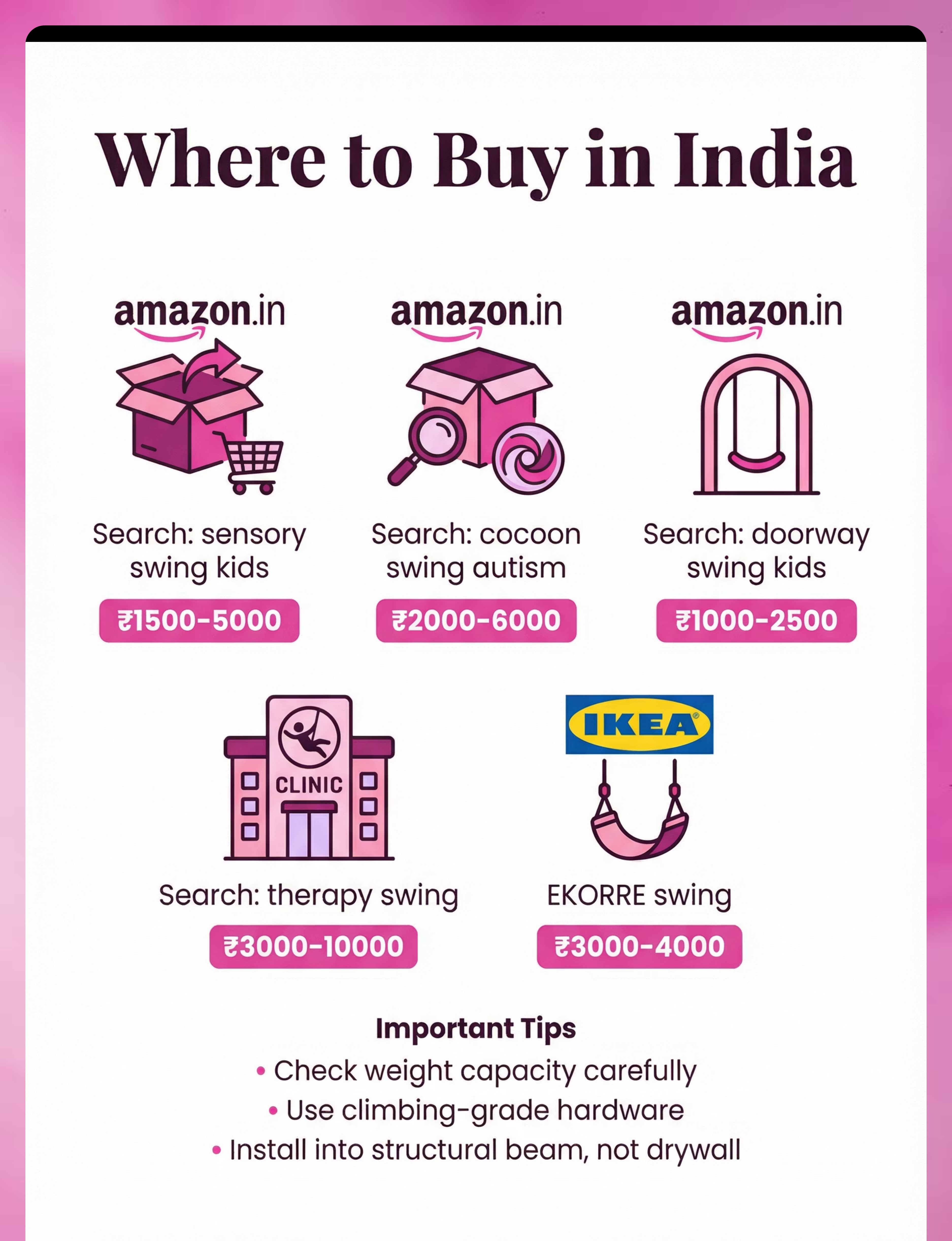
Where to Buy in India
Availability: Widely Available through online platforms and specialized therapy equipment suppliers across India
Search Terms: "sensory swing kids"
Price Range: ₹1,500-5,000
Best For: Wide selection, doorway and hammock swings
Search Terms: "cocoon swing autism"
Price Range: ₹2,000-6,000
Best For: Enclosed calming swings
Search Terms: "doorway swing kids"
Price Range: ₹1,000-2,500
Best For: Space-saving options
Therapy Equipment Suppliers
Search Terms: "therapy swing"
Price Range: ₹3,000-10,000
Best For: Professional-grade equipment
IKEA
Search Terms: "EKORRE swing"
Price Range: ₹3,000-4,000
Best For: Budget-friendly quality option
✓ Buying Tips
  • Always check weight capacity carefully—ensure it exceeds your child's weight with safety margin
  • Use climbing-grade hardware only (carabiners, straps)—never standard hardware
  • Install into structural beam or joist, not just drywall—drywall cannot support weight
  • Consider swing type based on your child's specific sensory needs and therapeutic goals
  • Enclosed/cocoon swings are best for calming; platform swings for active motor work
🚩 Red Flags to Avoid
  • Weight capacity too low for your child—never push weight limits
  • Flimsy, non-climbing-grade hardware included—this is a safety hazard
  • No installation guidance or specifications provided
  • Poor quality fabric or materials that will tear or wear quickly
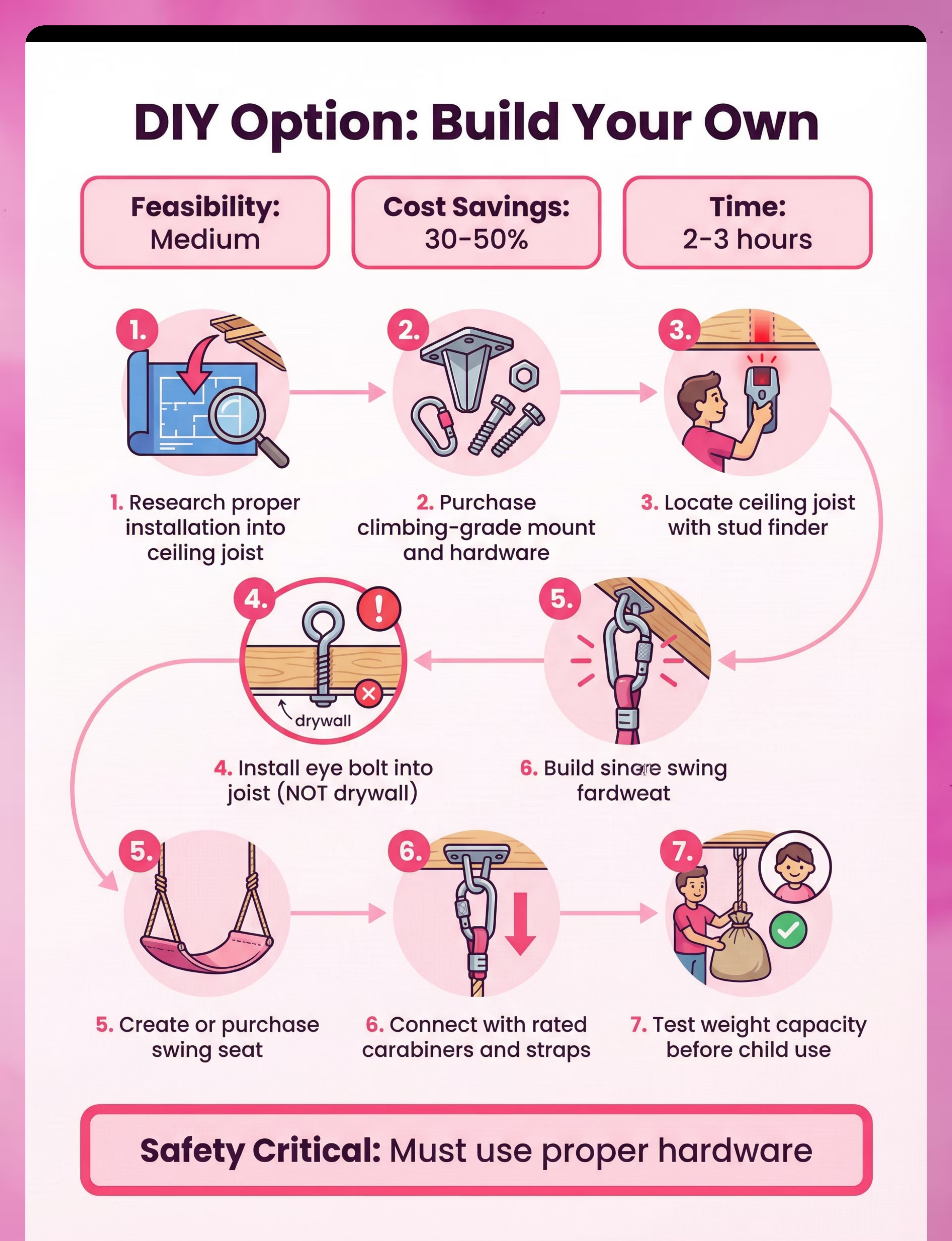
DIY Alternative (Save 30-50%)
Quick Facts
1
Cost Savings
30-50% compared to commercial options
2
Time Investment
2-3 hours for complete installation
3
Feasibility
Medium difficulty; requires professional-grade hardware

Critical: Safety is non-negotiable. You must use climbing-grade hardware—never compromise on this. If you're uncertain about installation, invest in professional installation.
Materials Needed
  • Heavy-duty fabric: Lycra, canvas, or specialized swing fabric (enough for your swing type)
  • Climbing-grade carabiners: Rated for at least 500 kg—never use standard carabiners
  • Rated ceiling mount: Eye bolt or specialized swing mount rated for weight
  • Straps/rope: Climbing-grade only—thickness appropriate for weight
Installation Steps
1
Research proper installation
Study how to install into ceiling joist safely. Watch multiple video tutorials. Understand load-bearing requirements.
2
Purchase climbing-grade hardware
Buy from climbing/mountaineering suppliers, not hardware stores. Verify weight ratings. Get professional advice if needed.
3
Locate ceiling joist
Use stud finder to locate solid joist. Verify by drilling small pilot hole. Mark location precisely.
4
Install eye bolt or mount
Drill into joist (not drywall). Install mount per manufacturer specifications. Ensure it's completely secure before proceeding.
5
Create or purchase swing seat
Sew heavy-duty fabric into appropriate shape, or purchase swing seat separately. Ensure all seams are reinforced.
6
Connect with rated hardware
Use climbing-grade carabiners and straps to connect swing to ceiling mount. Double-check all connections.
7
Test weight capacity
Test with weight exceeding child's weight before allowing child to use. Inspect all connection points carefully.
DIY vs Commercial Decision Guide
Factor
Choose DIY When...
Choose Commercial When...
Skills
You're comfortable with installation and have proper tools and hardware knowledge
You want guaranteed safety without installation concerns
Budget
You're budget-conscious but committed to using climbing-grade hardware
You prefer complete system with professional installation
Setting
Home use with single swing type needed
Clinic/school setting requiring multiple swings or professional appearance
Trade-offs
Safety Critical
Must use proper climbing-grade hardware—non-negotiable for child safety.
Installation Complexity
Can be tricky to locate joists and install properly—mistakes can be dangerous.
Time Investment
Takes 2-3 hours for careful, proper installation.
Warranty Concerns
No manufacturer warranty with DIY—you assume all responsibility.

Preview of therapy swing sensory swing Therapy Material

Below is a visual preview of therapy swing sensory swing therapy material. The pages shown help educators, therapists, and caregivers understand the structure and content of the resource before use. Materials should be used under appropriate professional guidance.

Page 1
Page 2
Page 3
Page 4
Page 5
Page 6
Page 7
Page 8
Page 9
Page 10
Page 11
Page 12
Page 13
Page 14
Page 15
Page 16
Page 17
Page 18
Page 19
Page 20
Link copied!
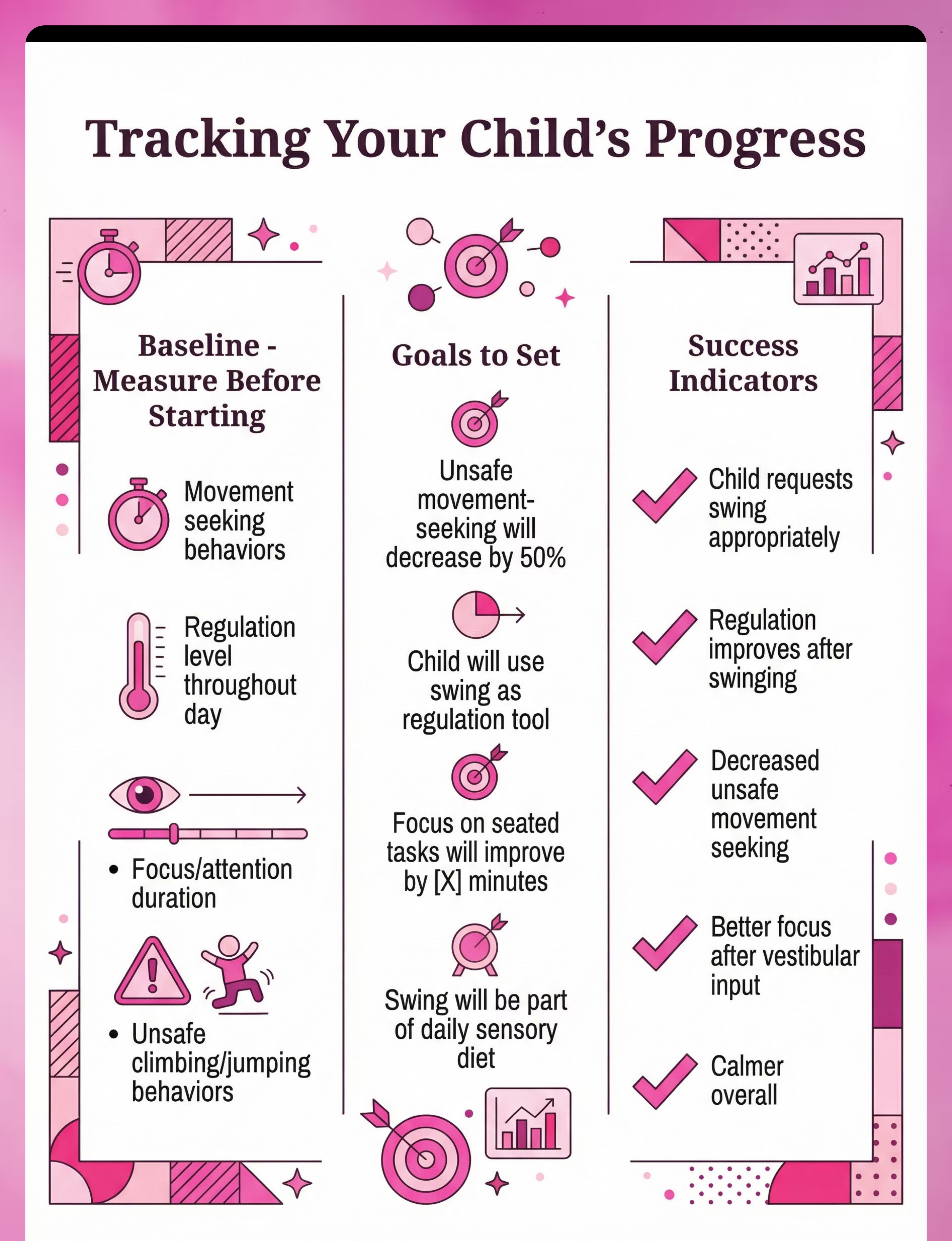
Measuring Success & Next Steps
Track Progress
Baseline (Measure First)
  • Count movement seeking behaviors per day
  • Rate regulation level (1-10 scale) at key times
  • Measure focus/attention duration on tasks
  • Track unsafe climbing/jumping incidents
Goals to Set
  • Unsafe movement-seeking will decrease by 50%
  • Child will use swing as regulation tool independently
  • Focus on seated tasks will improve by 10+ minutes
  • Swing will be part of daily sensory diet
Success Indicators ✓
  • Child requests swing appropriately
  • Regulation improves after swinging
  • Decreased unsafe movement seeking
  • Better focus after vestibular input
  • Calmer overall throughout day

Complete the Kit
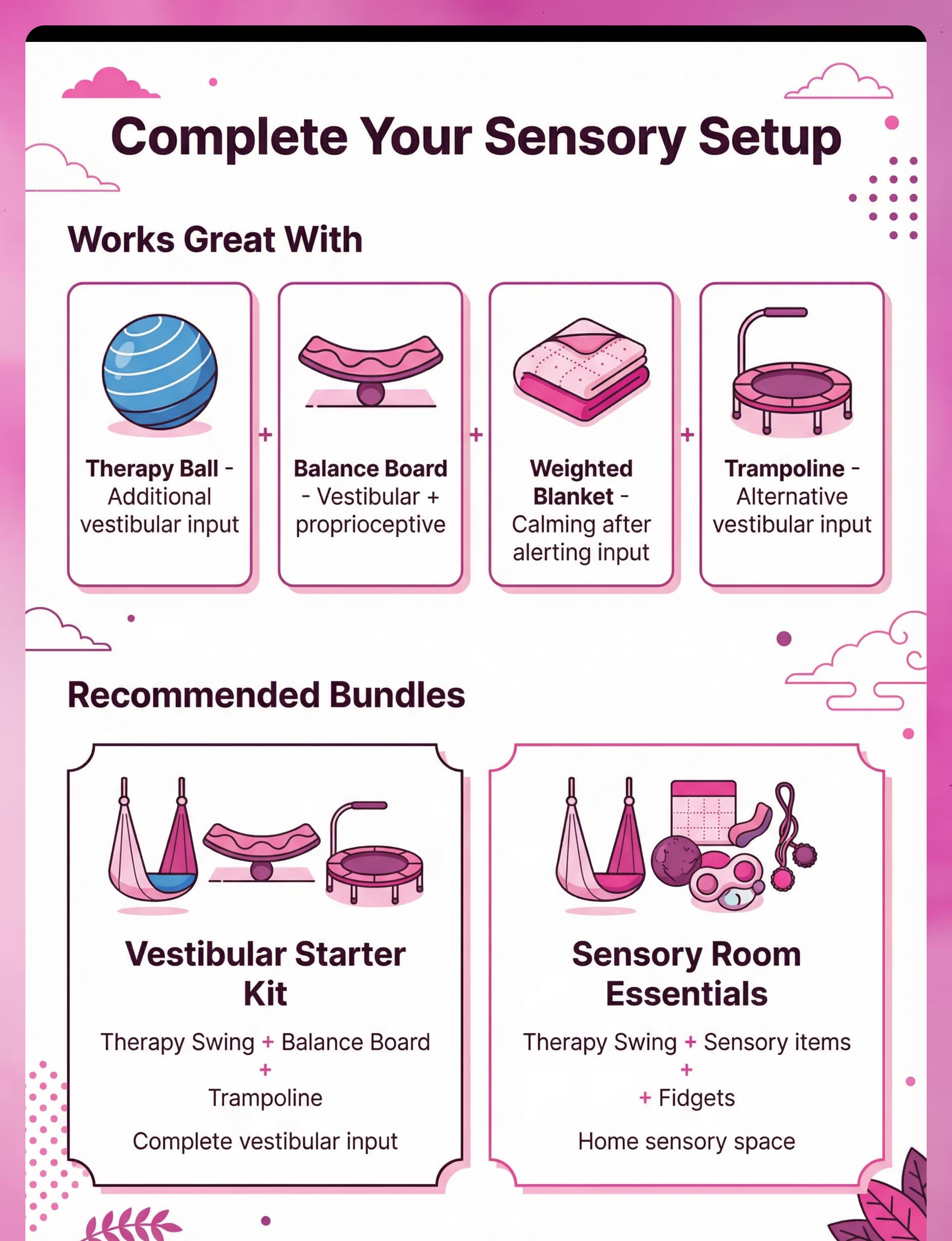
Therapy swings work even better as part of a comprehensive sensory approach. Consider pairing with these complementary tools:
Therapy Ball (ID: 6.2)
Additional vestibular input in different positions—sitting, bouncing, rolling. Complements swing use beautifully.
Balance Board (ID: 6.3)
Combines vestibular and proprioceptive input. Great for developing core strength alongside swing work.
Weighted Blanket (ID: 1.1)
Provides calming deep pressure after alerting vestibular input. Perfect for wind-down after swinging.
Trampoline (ID: 6.5)
Alternative vestibular input through bouncing. Offers variety in sensory diet alongside swing.
Recommended Bundles
Vestibular Starter Kit
Includes: Therapy Swing (6.1) + Balance Board (6.3) + Trampoline (6.5)
Use case: Complete vestibular input system providing multiple types of movement throughout the day
Sensory Room Essentials
Includes: Therapy Swing (6.1) + Visual Tools (1.11) + Auditory Tools (1.7)
Use case: Create comprehensive home sensory space addressing multiple sensory systems

AI Summary & Search Terms
Quick Summary: Therapy swings provide vestibular input for sensory regulation, focus, and nervous system organization. Core Kit (Rank 1), strong evidence, powerful sensory tool for daily use at home or clinic.
swing
vestibular
sensory
movement
regulation
gross motor
OT
PT
core-kit
Common searches: therapy swing autism, sensory swing kids, cocoon swing autism, vestibular swing, indoor swing sensory, platform swing therapy, sensory integration swing

Get Support
FREE National Autism Helpline
Phone: 9100 181 181
Languages: 16+ languages supported
Get personalized guidance on therapy swings and sensory diets from experienced professionals who understand your family's unique needs.
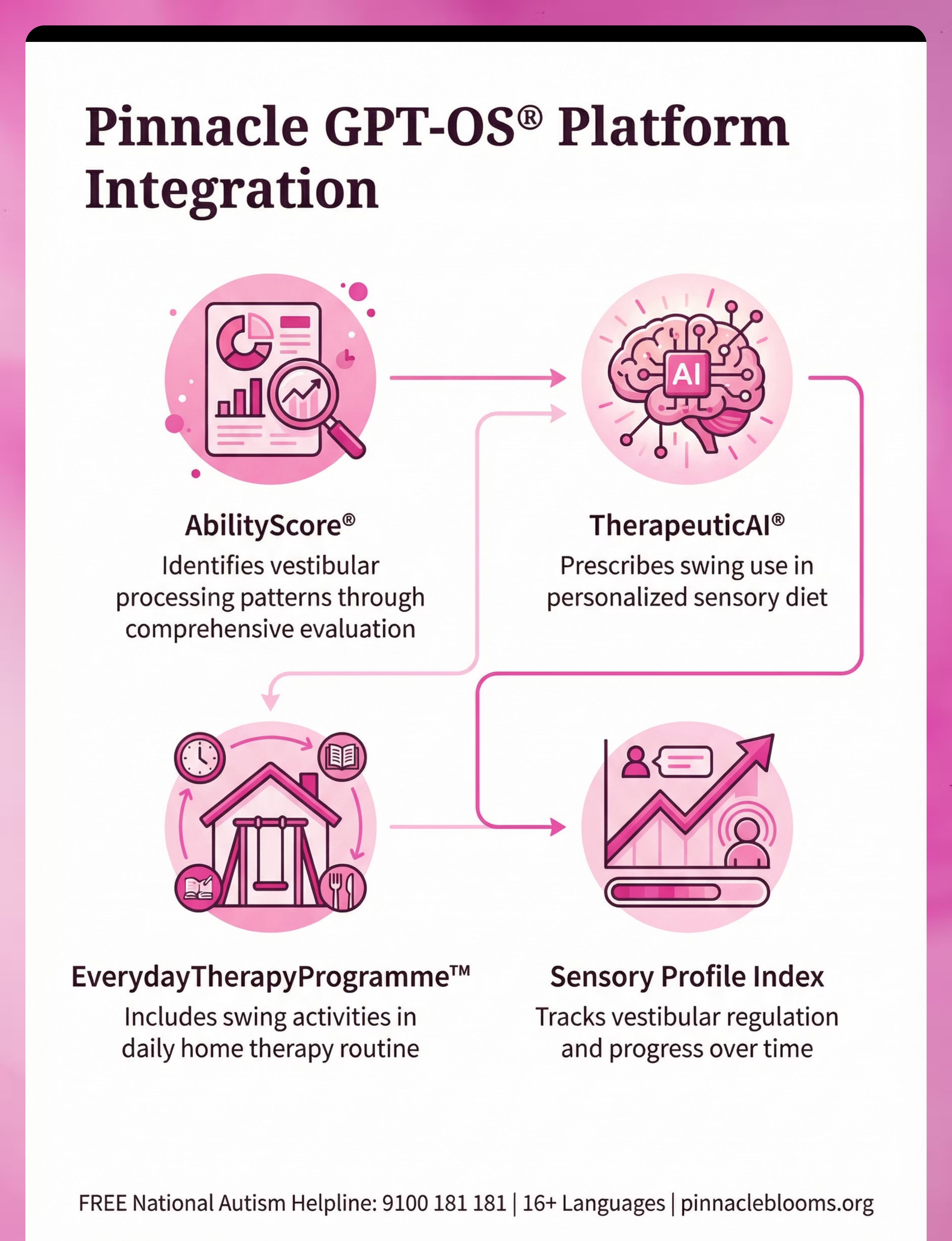
Platform Integration
Therapy swings integrate seamlessly with Pinnacle Blooms Network's comprehensive platform:
  • AbilityScore®: Identifies your child's specific vestibular processing patterns and sensory needs
  • TherapeuticAI®: Prescribes personalized swing protocols as part of comprehensive sensory diet
  • EverydayTherapyProgramme™: Includes structured swing activities integrated into daily routines
  • Sensory Profile Index: Tracks vestibular regulation progress over time with data-driven insights

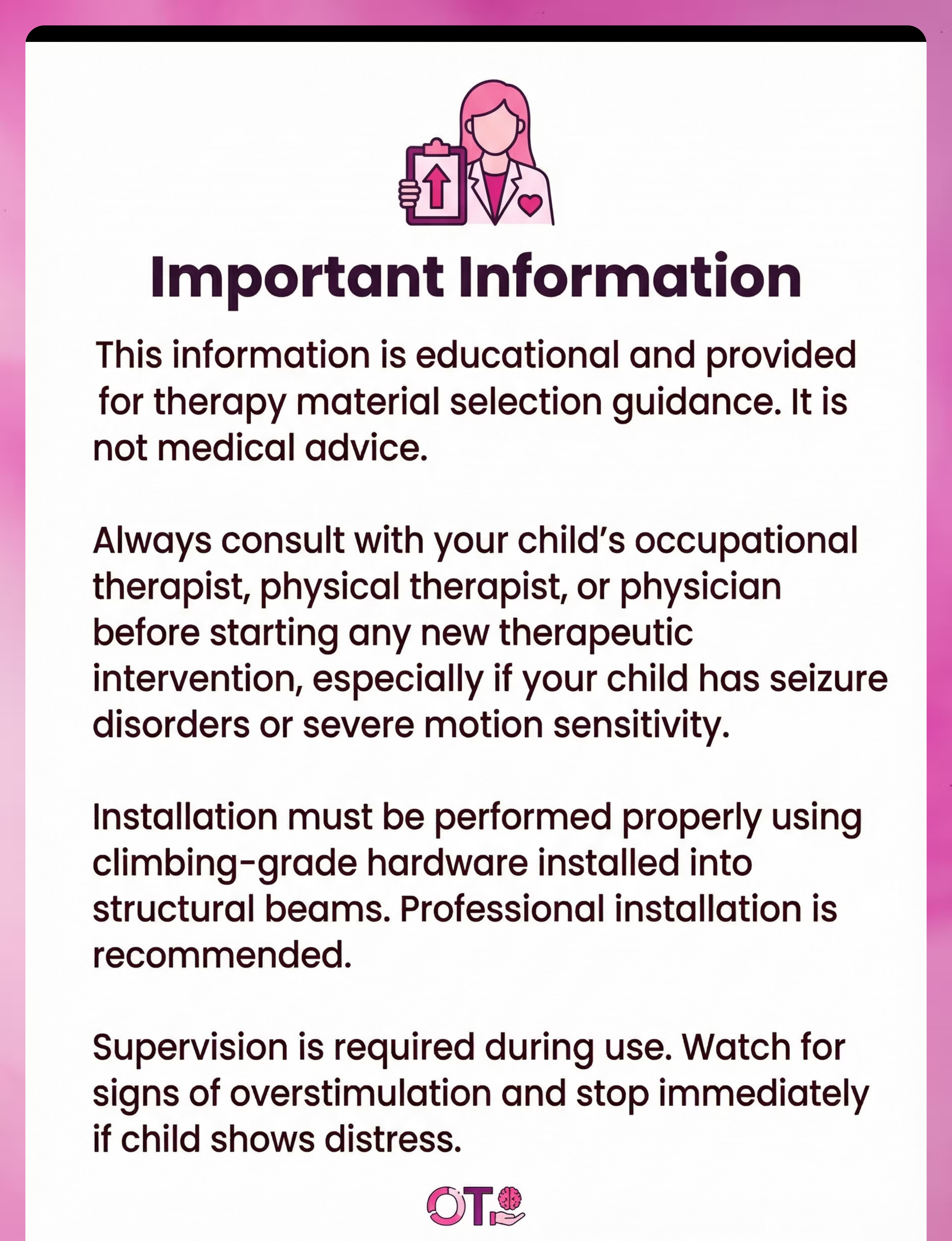
Important Disclaimer: This is educational information designed to help you understand therapy swings and their uses. Always consult qualified occupational therapists, speech-language pathologists, or pediatricians before starting any therapeutic program. Individual results vary based on each child's unique needs, sensory profile, and consistent implementation of recommendations.