















Tool id: 9.5
OT + SpEd
Strong Evidence
Rank #1
Daily Use
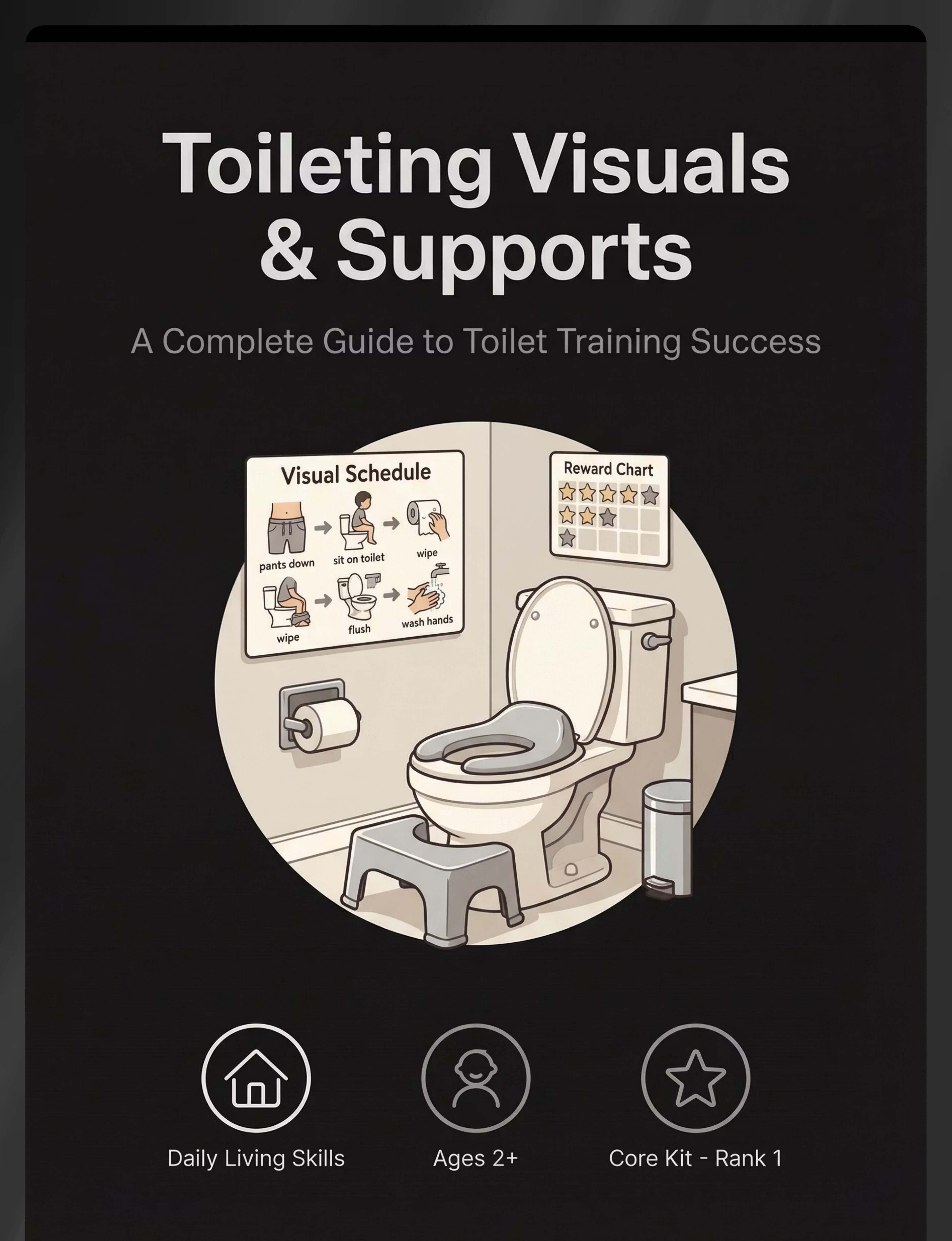
Toileting Visuals / Supports
Toilet training and continence independence system
Support toilet training and continence through visual structure, physical positioning, and systematic reinforcement. This complete system addresses the unique challenges families face when teaching this critical daily living skill, combining evidence-based approaches with compassionate, patient guidance.
Who This Helps

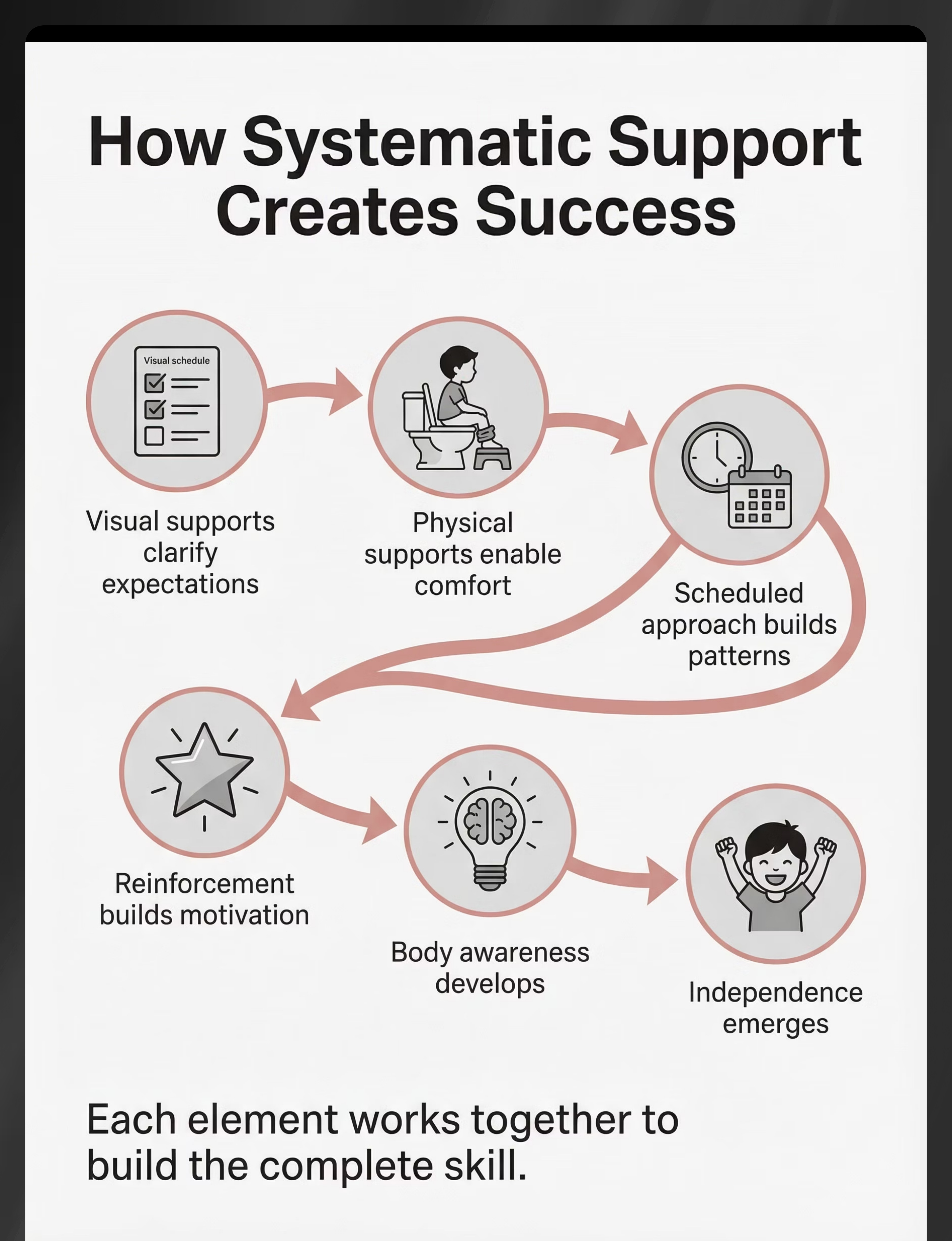
Visual supports clarify expectations, physical supports enable comfort and positioning, scheduled approaches build patterns, reinforcement builds motivation, bladder and bowel awareness develops, and independence emerges over time.
Toileting Independence
Building self-care skills for this essential daily activity
Routine Following
Learning predictable sequences through visual supports
Body Awareness
Developing connection to internal sensations and signals
Communication
Expressing needs clearly and confidently
Ages 2+ years
Home
School
Best for: Children showing readiness signs who need systematic, visual teaching approaches with proper physical positioning and consistent positive reinforcement to achieve this major developmental milestone.

Does This Sound Familiar?
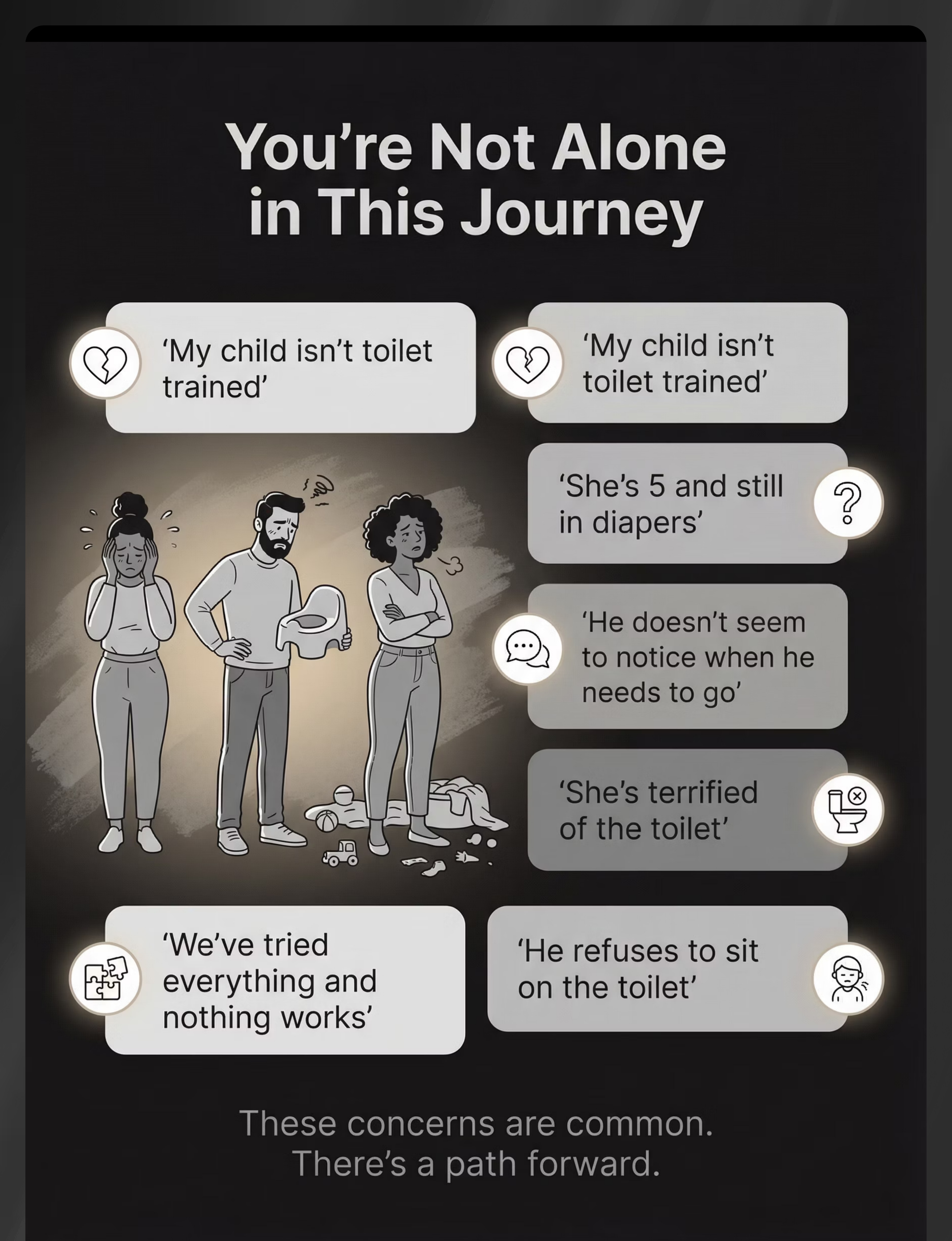
"My child isn't toilet trained and she's already 5 years old. We're still using diapers and I worry about school placement."
"He doesn't seem to notice when he needs to go. There's no signal, no awareness—it's like his body doesn't communicate with him."
"She's absolutely terrified of the toilet. She screams when we even mention the bathroom. We can't get her to sit down."
"We've tried everything—rewards, training pants, schedules. Nothing works. I don't know what else to do."
You're not alone. These are common challenges faced by families of children with autism. Toilet training often takes longer and requires specialized approaches, but with the right supports and patience, success is absolutely possible.

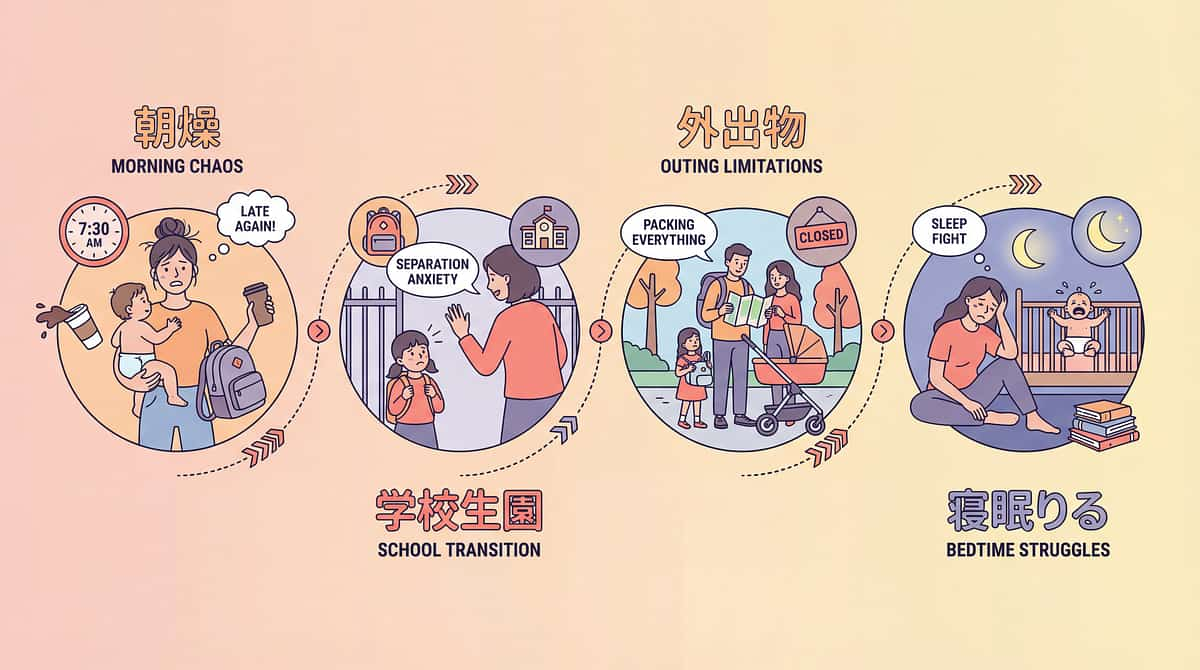
A Day Without the Right Support
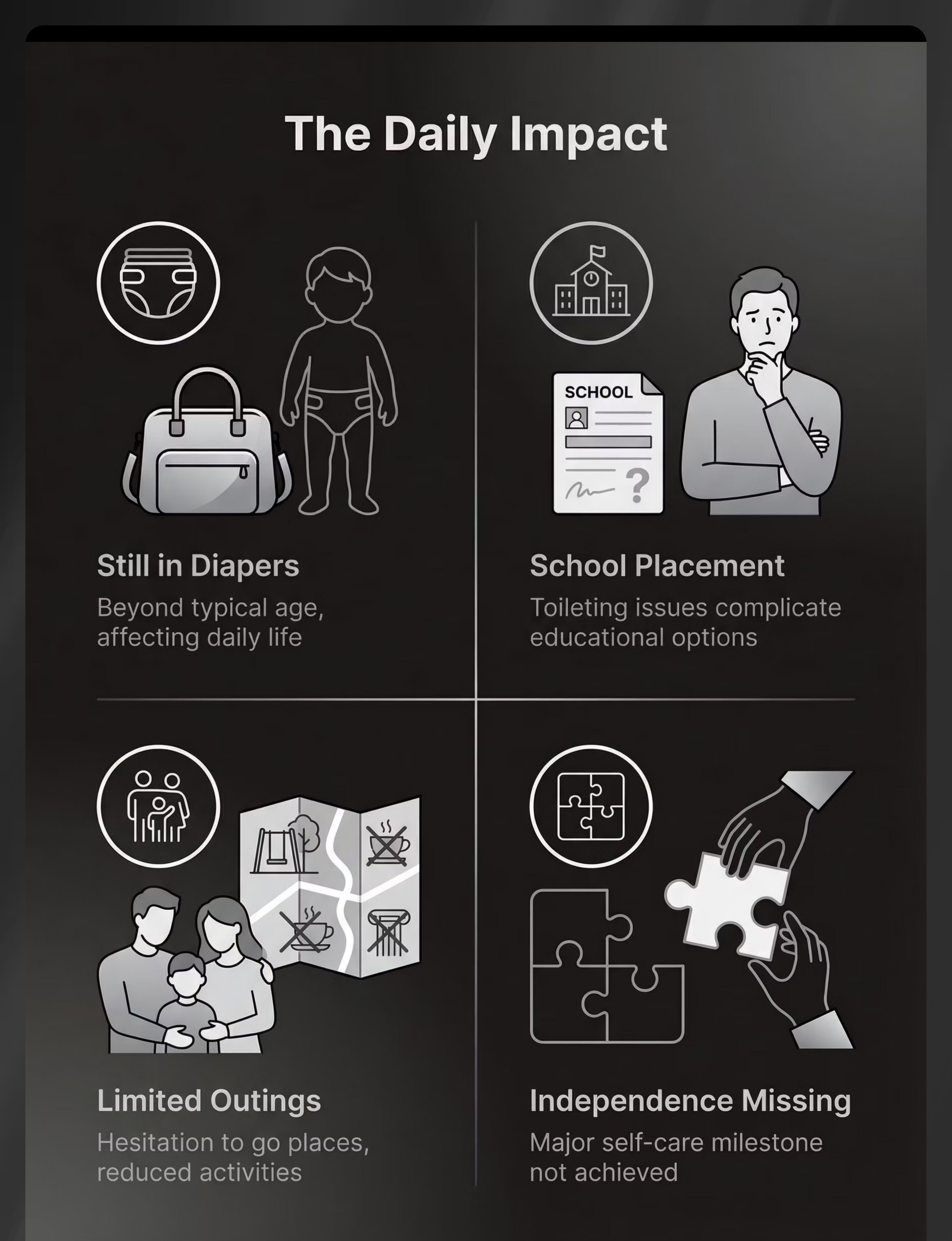
Morning Diaper Changes
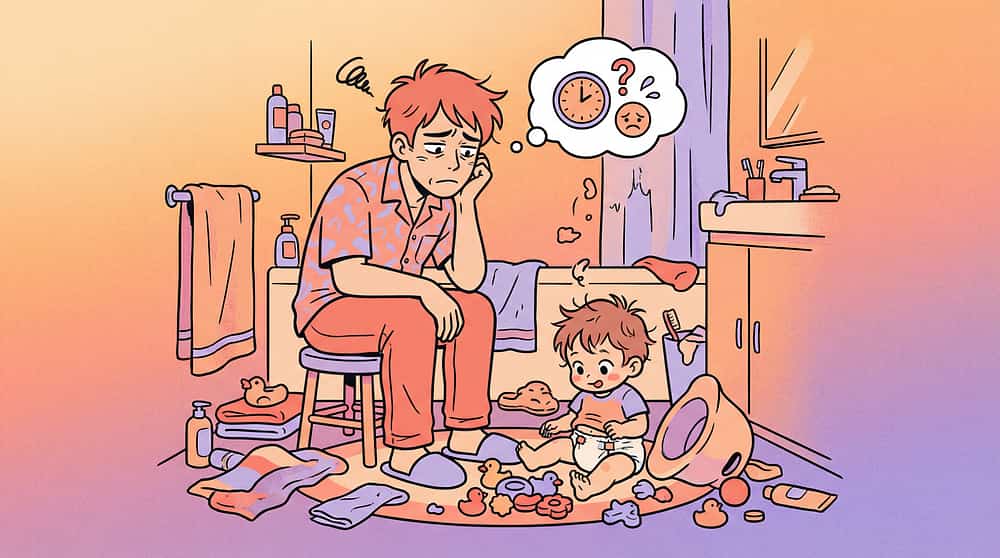
Still in diapers beyond typical age. Child resists changes. Family stressed about the day ahead and this basic routine taking so long.
School Placement Worries
Toileting issues complicate school options. Some programs require independence. Parents feel stuck and worried about educational opportunities.
Limited Outings
Family outings restricted due to toileting concerns. Diaper bags, finding changing facilities, anxiety about accidents—it limits freedom and participation.
Missing Milestone
This major self-care milestone feels out of reach. Parents see other children mastering this skill and wonder when—or if—their child will get there.

The Science Behind It
Visual Supports Clarify
Picture schedules show exactly what to do in what order
Physical Supports Enable
Proper positioning creates comfort and successful elimination
Scheduled Approach Builds Patterns
Regular sits catch successes and establish routines
Reinforcement Motivates
Positive rewards build interest and effort
Awareness Develops
Over time, body signals become clearer
Independence Emerges
Skills consolidate into confident, independent toileting
Toileting Independence
Routine Following
Body Awareness
Self-Care
Hygiene
Communication

How to Use It Right
1
Assess Readiness
Look for staying dry for periods, showing discomfort when wet, showing interest in bathroom, or following simple directions. Don't wait for perfect readiness—partial signs are enough to begin.
2
Create Visual Schedule
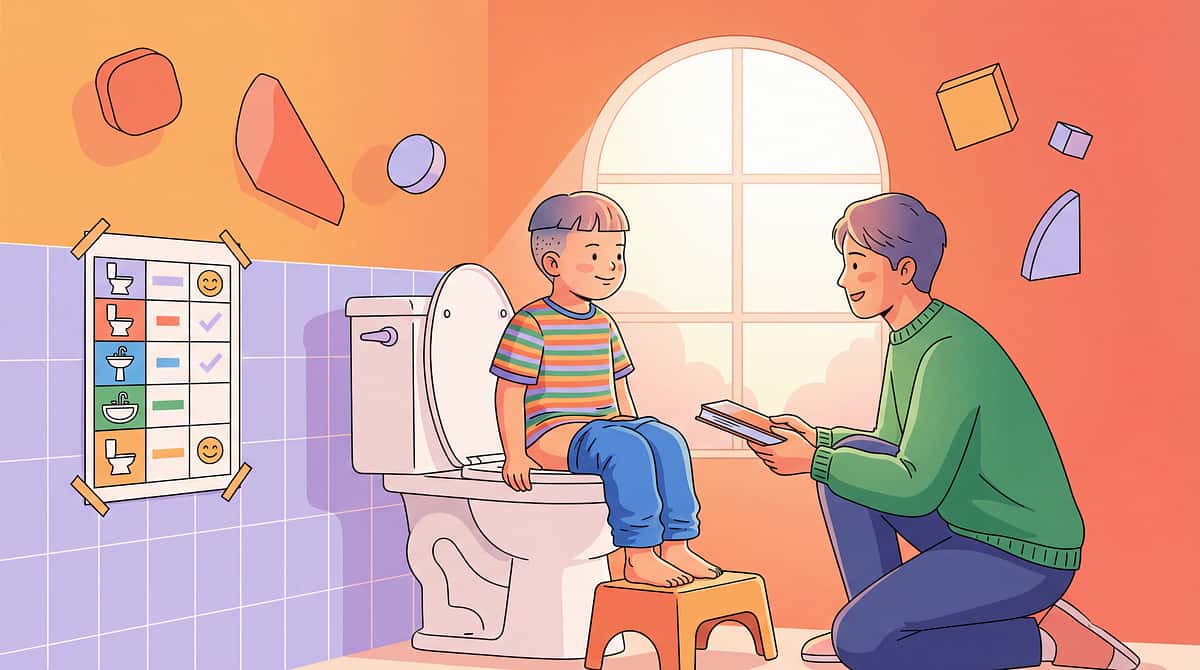
Picture cards showing: enter bathroom, pull down pants, sit on toilet, use toilet, wipe, flush, wash hands. Display at eye level where child can see.
3
Ensure Foot Support
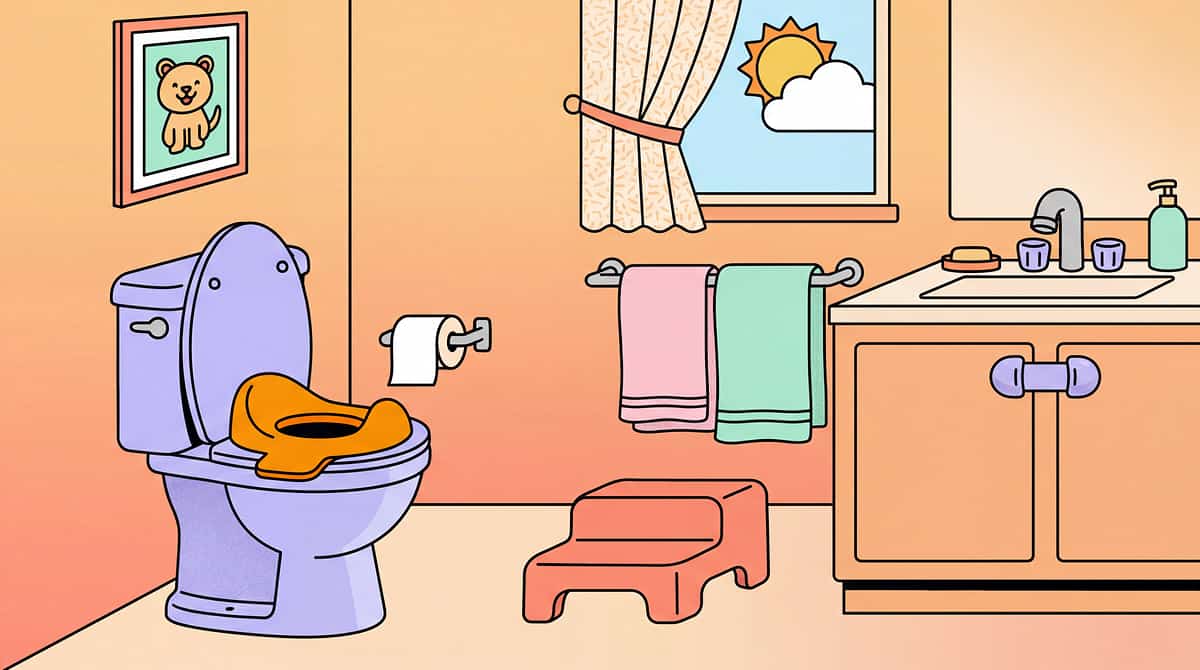
Feet must be supported and flat for proper elimination. Use stable stool. This is not optional—positioning directly affects success.
4
Implement Scheduled Sits
5-10 times daily at regular intervals. Upon waking, after meals, before bath, before transitions. Set timers. Consistency is everything.
5
Use Positive Reinforcement
Celebrate sitting and successes immediately with preferred rewards. Never punish accidents. Keep interactions positive, calm, and encouraging.
6
Practice Patience
For many children with autism, toilet training takes 2-6 months or longer. Progress isn't linear. Consistency over time brings results.
Duration guidance: Each sitting session should last 3-5 minutes maximum. Never force extended sitting. The overall training process is ongoing over weeks and months.

Expert Endorsement
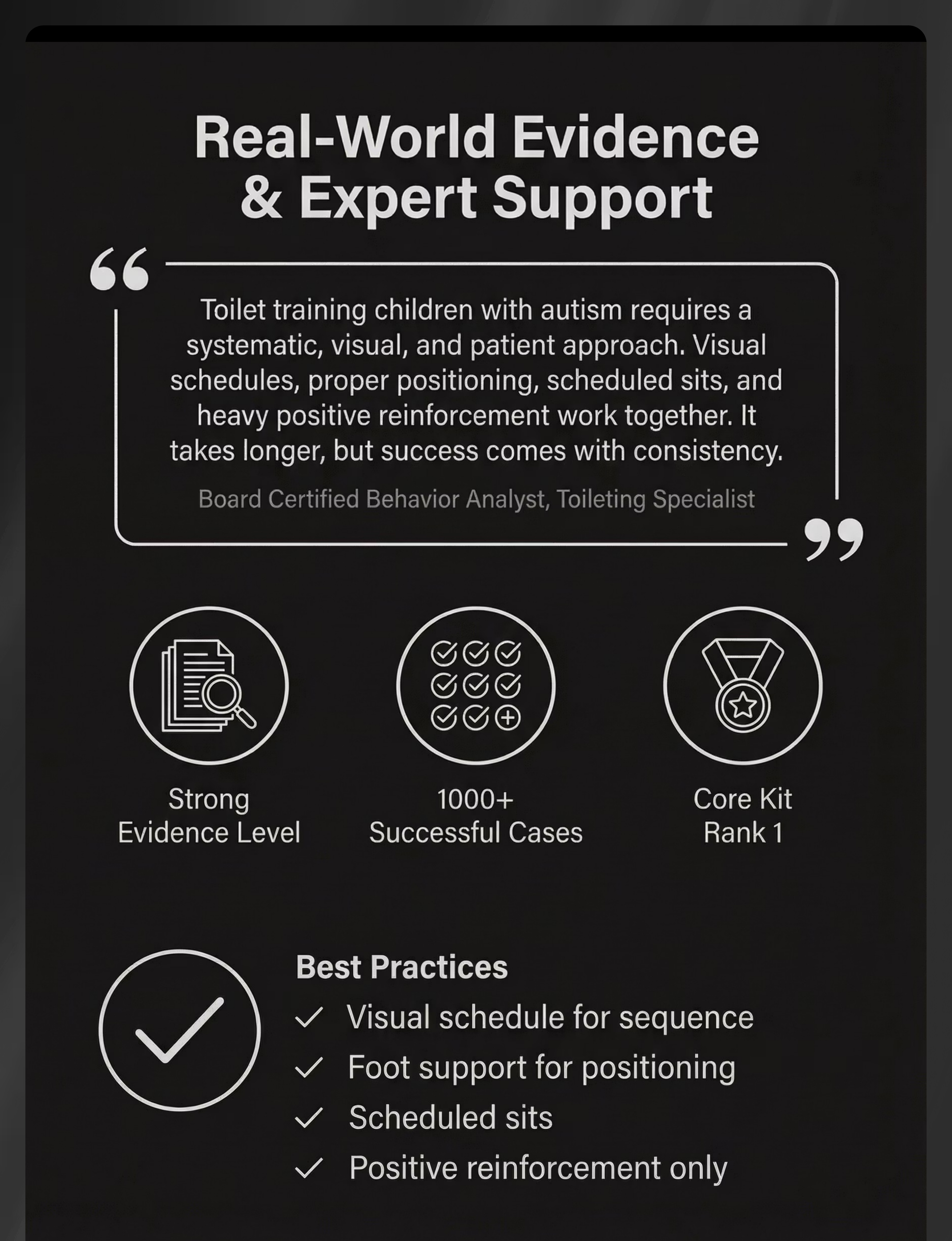
"Toilet training children with autism requires a systematic, visual, and patient approach. Visual schedules, proper positioning, scheduled sits, and heavy positive reinforcement work together. It takes longer, but success comes with consistency."— Board Certified Behavior Analyst, Toileting Specialist
OT + SpEd Recommended
Strong Evidence
Rank #1 in Category
Core Kit Essential
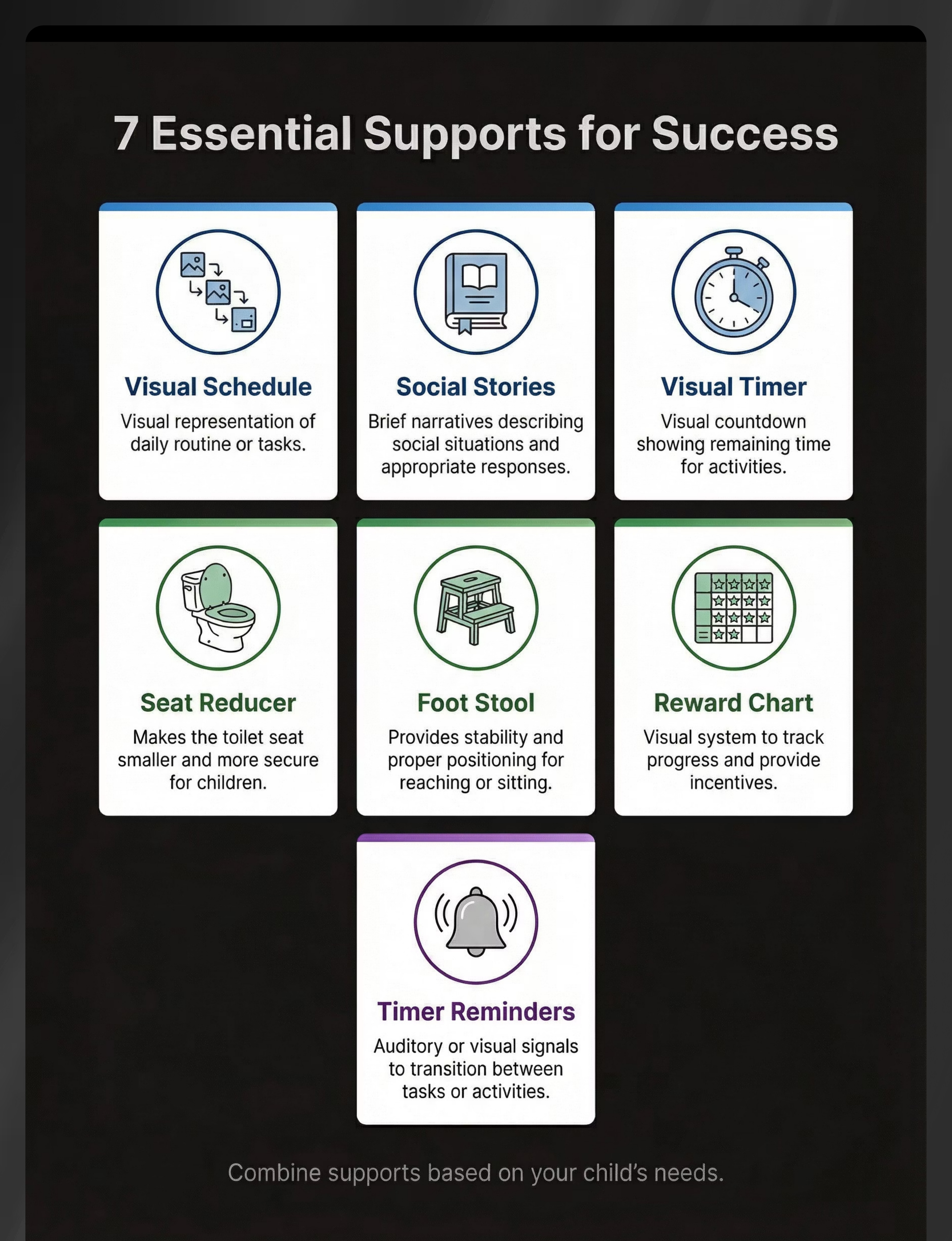
Choose Your Option (7 Variants)

Each variant serves a specific aspect of the toilet training process. Most families will need multiple supports working together. Select based on your child's needs, your priorities, and which elements of the process need the most support.
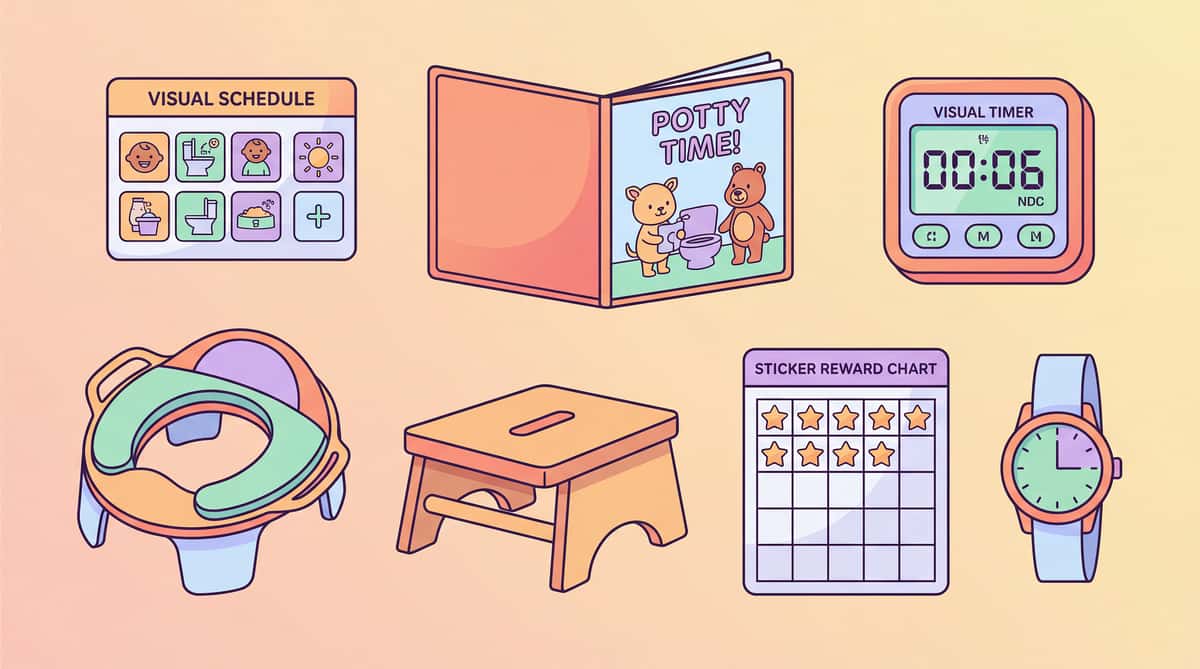
Toileting Visual Schedule
Type: Sequence support
Step-by-step pictures for learning routine & independence.
Potty Training Social Stories
Type: Conceptual preparation
Books explaining toilet use, reducing anxiety.
Visual Timer for Sitting
Type: Duration support
Helps with sitting tolerance and knowing when done.
Toilet Seat Reducer/Insert
Type: Physical comfort
Child-sized seat for security and proper positioning.
Toilet Foot Stool
Type: Positioning support
Provides stability and proper positioning for elimination.
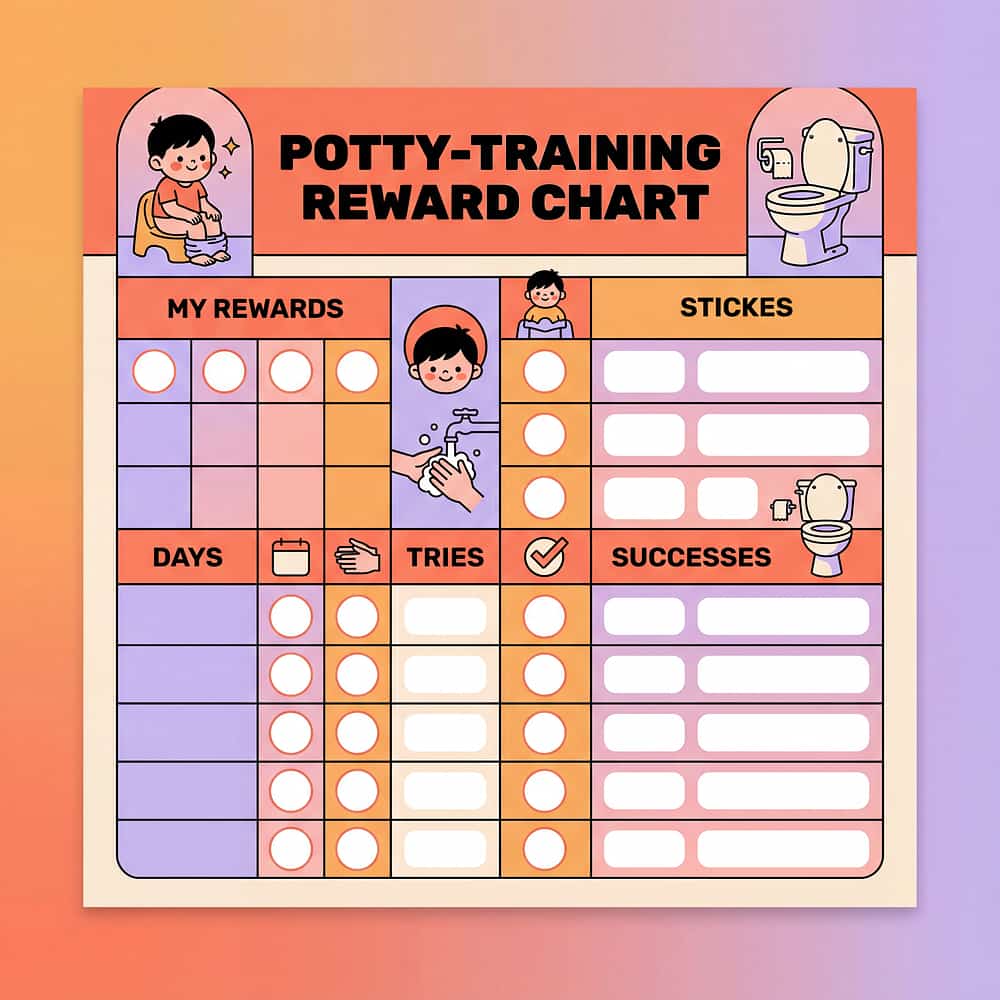
Toileting Reward Chart
Type: Motivation support
Visual chart for positive reinforcement and tracking.
Watch/Timer Reminders
Type: Prompting support
Wearable reminders for scheduled bathroom visits.
How to Choose
- By goal: Routine clarity → Visual schedule; Motivation → Reward chart; Physical comfort → Seat reducer + stool
- By setting: Home primary setup (seat, stool, schedule); Portable for outings (timer watch, mini schedule)
- By budget: Start with visual schedule + reward chart (under ₹500); Add physical supports next (seat + stool ₹400–1,400)
Specifications & Toileting Approach
Materials

Laminated visual cards (waterproof, durable)

Plastic seat inserts (easy to clean)

Stable plastic stools (non-slip)

Timers (visual countdown preferred)

Reward charts (customizable)
Key Features
- Clear visual sequence from start to finish
- Proper physical positioning with support
- Consistent, predictable schedule
- Immediate positive reinforcement
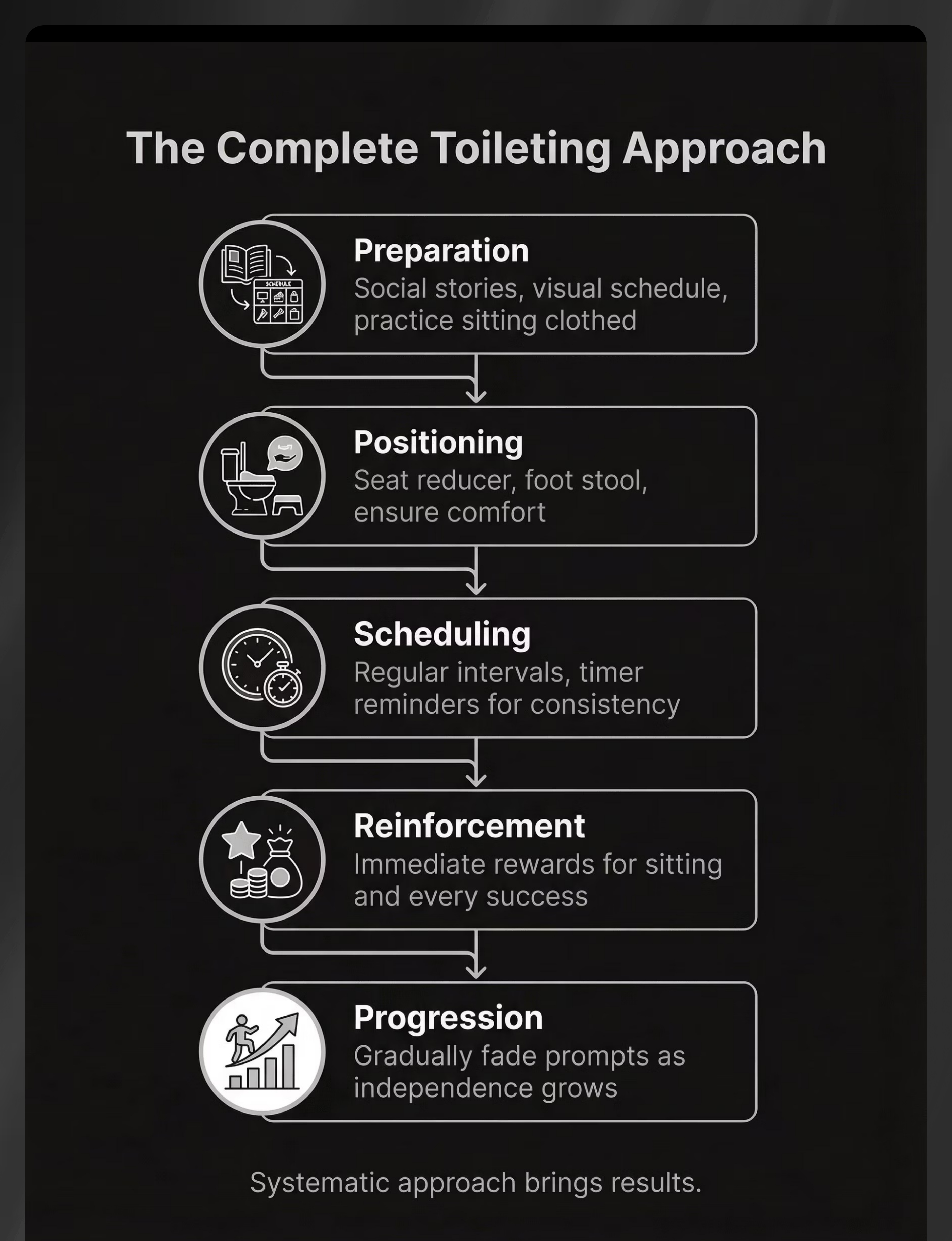
Complete Toileting Approach
Preparation Phase
Social stories, visual schedule creation, practice sitting while clothed to build comfort and familiarity
Positioning Phase
Seat reducer for security, foot stool for proper positioning, comfortable supportive setup
Scheduling Phase
Regular intervals throughout day, timer reminders for consistency, frequent opportunities
Reinforcement Phase
Immediate rewards for sitting attempts and successes, positive interaction every time
Progression Phase
Gradually fade prompts and supports as independence and awareness build over time
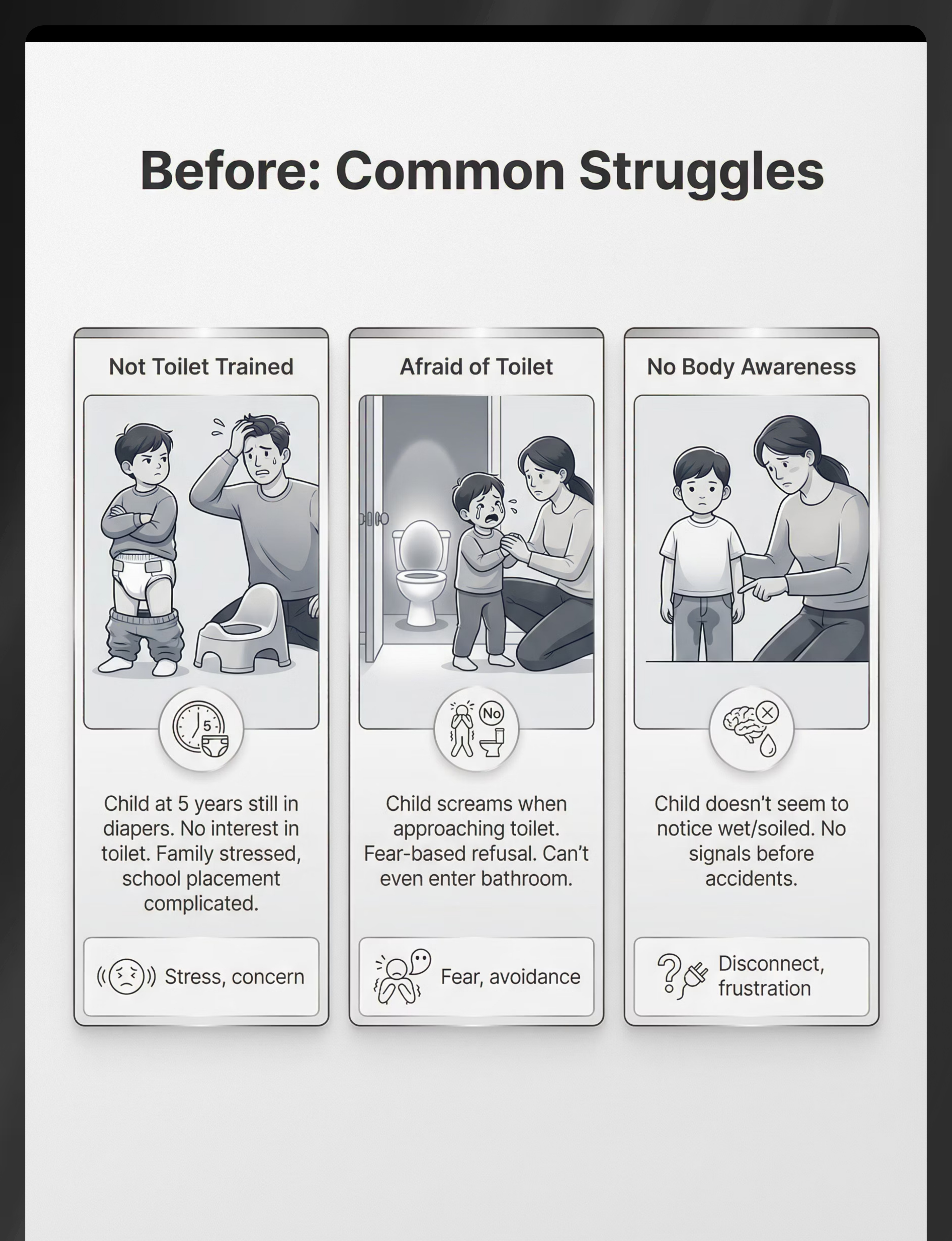
The Struggle (Before)

Not Toilet Trained
Situation: Child at 5 years still in diapers. No interest in toilet.
Experience: Family stressed about developmental milestone. School placement becoming complicated. Other children same age are trained.
Emotion: Stress, worry, concern about future, feeling stuck

Afraid of Toilet
Situation: Child screams when approaching toilet. Fear-based complete refusal.
Experience: Can't even enter bathroom. Every attempt escalates to meltdown. Fear seems overwhelming and insurmountable.
Emotion: Fear, anxiety, avoidance, helplessness

No Body Awareness
Situation: Child doesn't seem to notice when wet or soiled. No signals before accidents.
Experience: Body awareness appears completely missing. No connection between sensation and action. Parents constantly checking and changing.
Emotion: Disconnect, frustration, wondering if awareness will ever develop

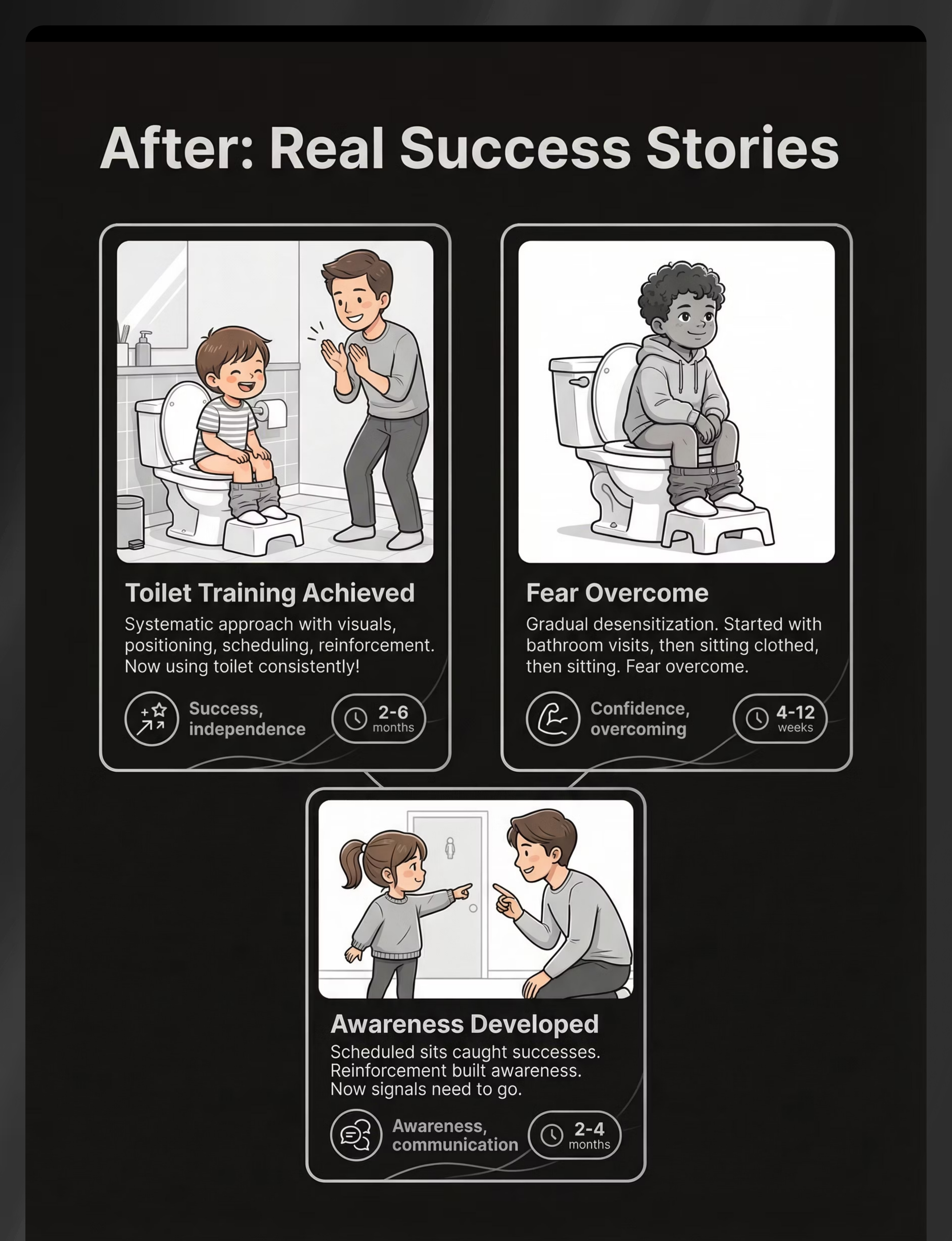
The Breakthrough (After)
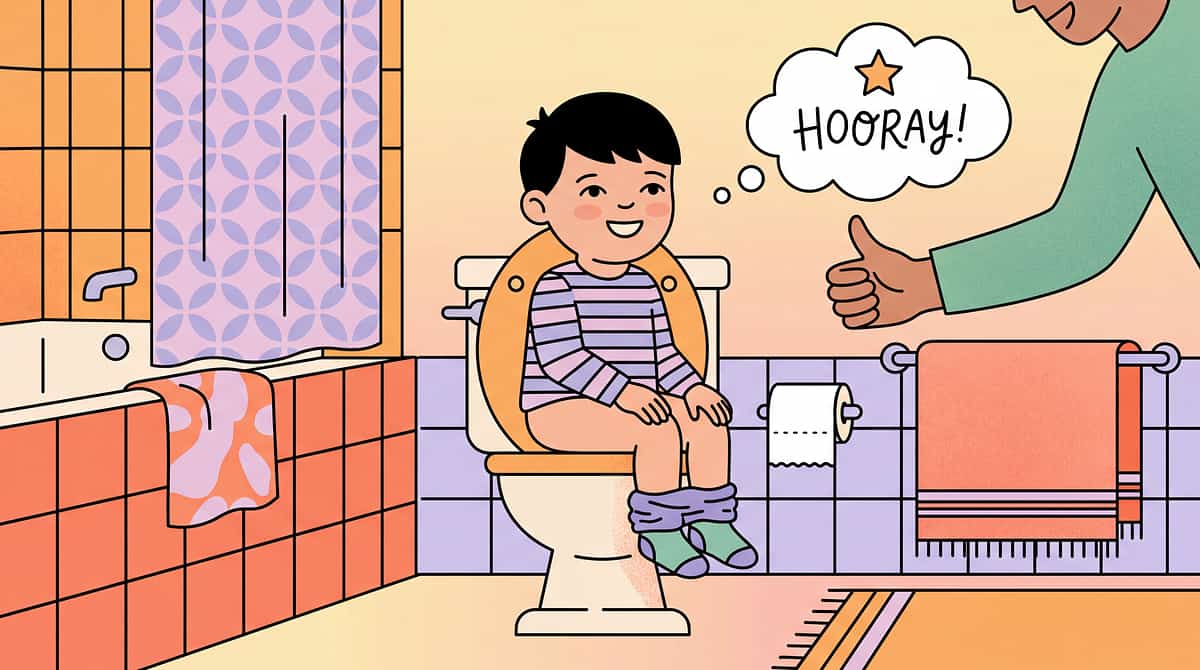
Toilet Trained Success!
Situation: Systematic approach with visuals, positioning, scheduling, and reinforcement implemented consistently.
Experience: Now using toilet consistently! School placement concerns resolved. Major milestone achieved. Family celebrations!
Emotion: Success, pride, independence, relief, joy
2-6 months
Fear Overcome
Situation: Gradual desensitization protocol followed. Started with just bathroom visits, then sitting clothed, then actual sitting.
Experience: Fear completely overcome through patient, step-by-step approach. Now enters bathroom calmly. Uses toilet without anxiety.
Emotion: Confidence, bravery, overcoming obstacles, capability
4-12 weeks
Body Awareness Developed
Situation: Scheduled sits caught successes which were heavily reinforced. Awareness built gradually over consistent practice.
Experience: Now signals need to use toilet! Body-mind connection established. Communication about needs emerging clearly.
Emotion: Awareness, connection, communication, understanding own body
2-4 months

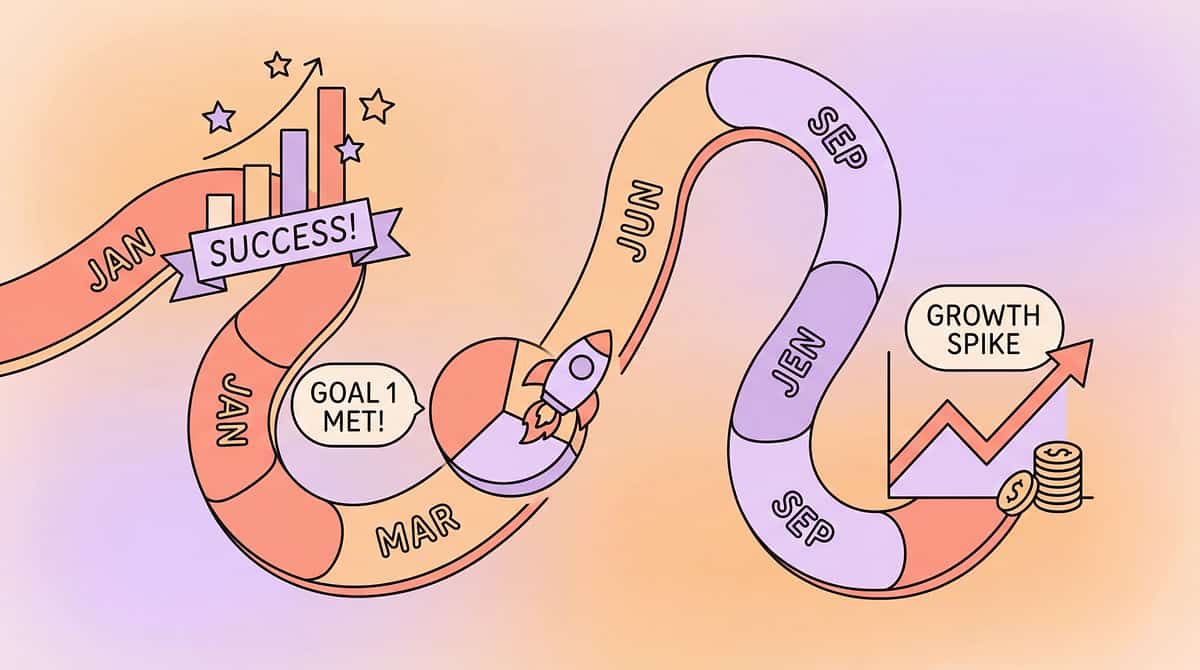
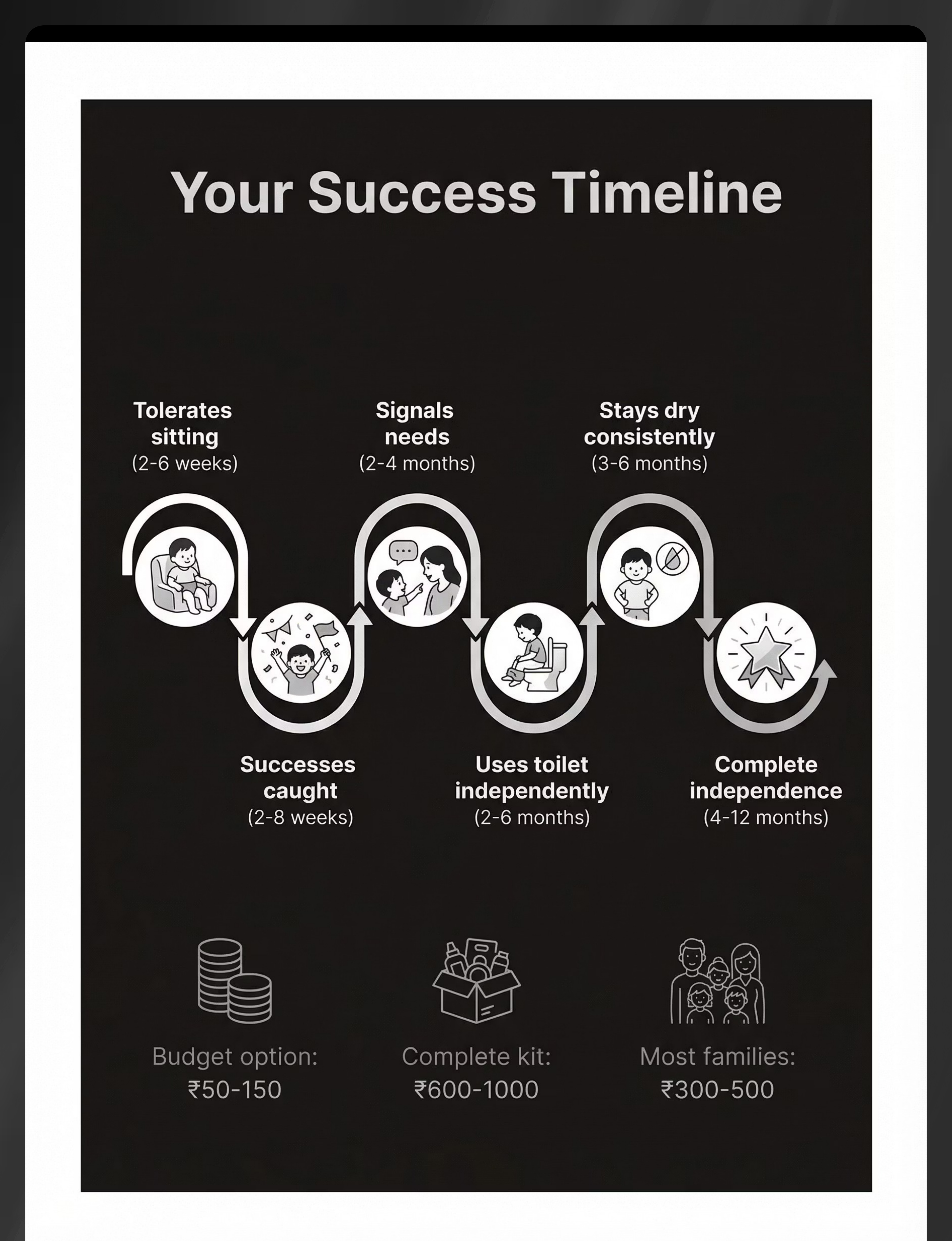
What to Expect (Realistic Timelines)
Tolerates Sitting on Toilet
Child will sit calmly for brief periods without distress. This is the foundation for everything else.
2-6 weeks
Successes Caught on Scheduled Sits
Regular scheduled sits begin catching successful eliminations. Positive reinforcement builds motivation and association.
2-8 weeks
Signals Need to Use Toilet
Body awareness develops. Child begins communicating need before elimination through words, signs, or leading parent to bathroom.
2-4 months
Uses Toilet Independently
Child initiates toileting independently with minimal prompts. Still may need help with clothing or hygiene steps.
2-6 months
Stays Dry Consistently
Accidents become rare. Dry periods extend to several hours. Confidence and skill consolidating.
3-6 months
Complete Toileting Independence
Full independence achieved including initiating, managing clothing, hygiene, and handwashing without assistance.
4-12 months
Important: These timeframes are typical ranges, but every child is unique. Some achieve milestones faster, others need more time. Consistent implementation of the complete approach matters more than speed. Celebrate every small success along the way.

Is This Right for My Child? (2-Minute Check)
Does your child show readiness signs for toilet training?
If yes, this indicates: Ready to begin structured approach with systematic visual and physical supports
If no, this indicates: Build pre-readiness skills first—focus on bathroom familiarity, sitting tolerance, and communication
Confidence score: 95%
Will your child sit on the toilet?
If yes, this indicates: Can proceed with structured training approach immediately
If no, this indicates: Gradual desensitization needed first—start with bathroom visits, then clothed sitting, then progress
Confidence score: 92%
Is proper positioning established (feet supported)?
If yes, this indicates: Physical setup ready for success—positioning directly affects elimination
If no, this indicates: Add foot stool and seat reducer immediately—this is non-negotiable for success
Confidence score: 88%
Is there a consistent schedule being followed?
If yes, this indicates: Structure in place for pattern building and success catching
If no, this indicates: Establish scheduled sits at regular intervals—consistency is the foundation
Confidence score: 90%
Scoring: 3+ "yes" answers indicate strong fit for beginning or continuing structured toilet training approach. Fewer "yes" answers indicate specific areas to address first before full implementation.

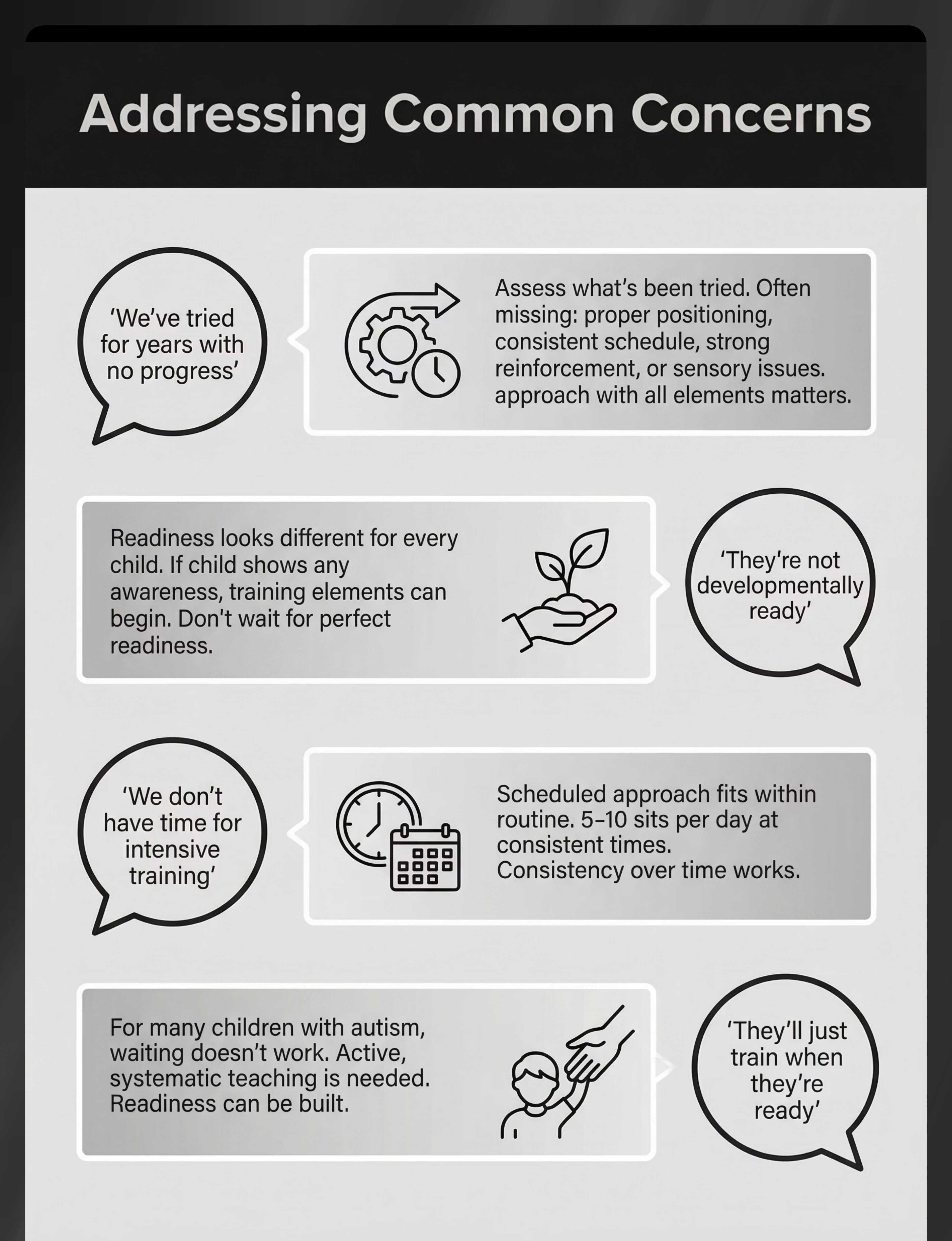
Common Questions (Honest Answers)
We've tried for years with no progress
Honest response: Let's carefully assess what has been tried. Often these elements are missing: proper positioning with foot support, truly consistent schedule (not occasional), strong enough immediate reinforcement, or unaddressed sensory issues.
What helps: A complete systematic approach with ALL elements present matters enormously. Missing even one piece can prevent success. Let's identify gaps and fill them.
They're not developmentally ready
Honest response: Readiness looks very different for every child, especially children with autism. If your child stays dry for any periods, shows any discomfort when wet, or shows any bathroom awareness, elements of training can absolutely begin.
What helps: Don't wait for "perfect" readiness that may never come. Look for partial readiness signs and begin systematically. Readiness can be built through the training process itself.
We don't have time for intensive training
Honest response: The scheduled approach can work within your family routine without taking over your entire life. It requires 5-10 brief sits per day at consistent times—this fits into existing routines.
What helps: Consistency over time matters more than intensity in any single day. Brief frequent sits integrated into your routine work better than occasional intensive efforts.
They'll just train when they're ready
Honest response: For many children with autism, passive waiting doesn't work. Active, systematic, visual teaching is needed. Earlier intervention is often easier than waiting until the gap between child and peers widens further.
What helps: Think of this as teaching any other skill—it requires active instruction, not passive waiting. Readiness is built through teaching, not by waiting for it to magically appear.

Usage Playbook
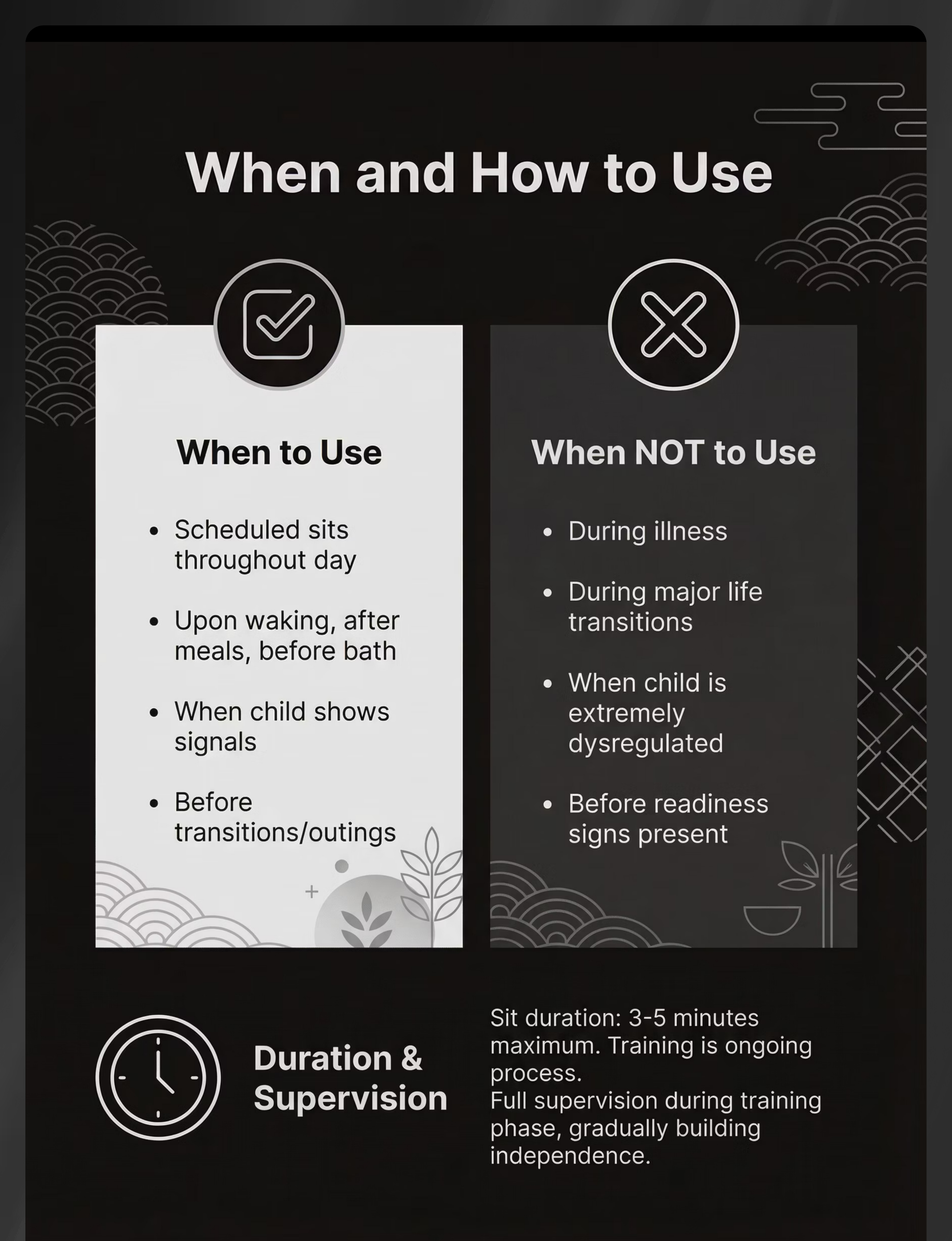
When to Use (Potty Training)
Daily Routine | Scheduled sits throughout the day at consistent times | |
Morning | Upon waking every morning (bladder usually full) | |
After Meals | After every meal (gastrocolic reflex timing) | |
Routines | Before bath or bedtime routine | |
Transitions | Before transitions or outings | |
Child Signals | Whenever child shows any signals or signs |
When NOT to Use (Potty Training)
Illness | During any illness (especially stomach issues) | |
Major Changes | During major life transitions (moves, new siblings) | |
Emotional State | When child is extremely dysregulated emotionally | |
Readiness | Before clear readiness signs are present |
Duration Guidelines
Sitting Duration | 3-5 minutes maximum per sit. Never force extended sitting—this creates negative associations. | |
Training Timeline | Ongoing process over weeks and months. Most children need 2-6 months of consistent implementation. |
Supervision by Stage
Training Phase | Full supervision and active support for every step | |
Developing Phase | Supervision with increasing independence for some steps | |
Independent Phase | Check-ins and hygiene verification, minimal hands-on support |
Ages 2+ (based on readiness)
Home Primary
School as Skills Develop

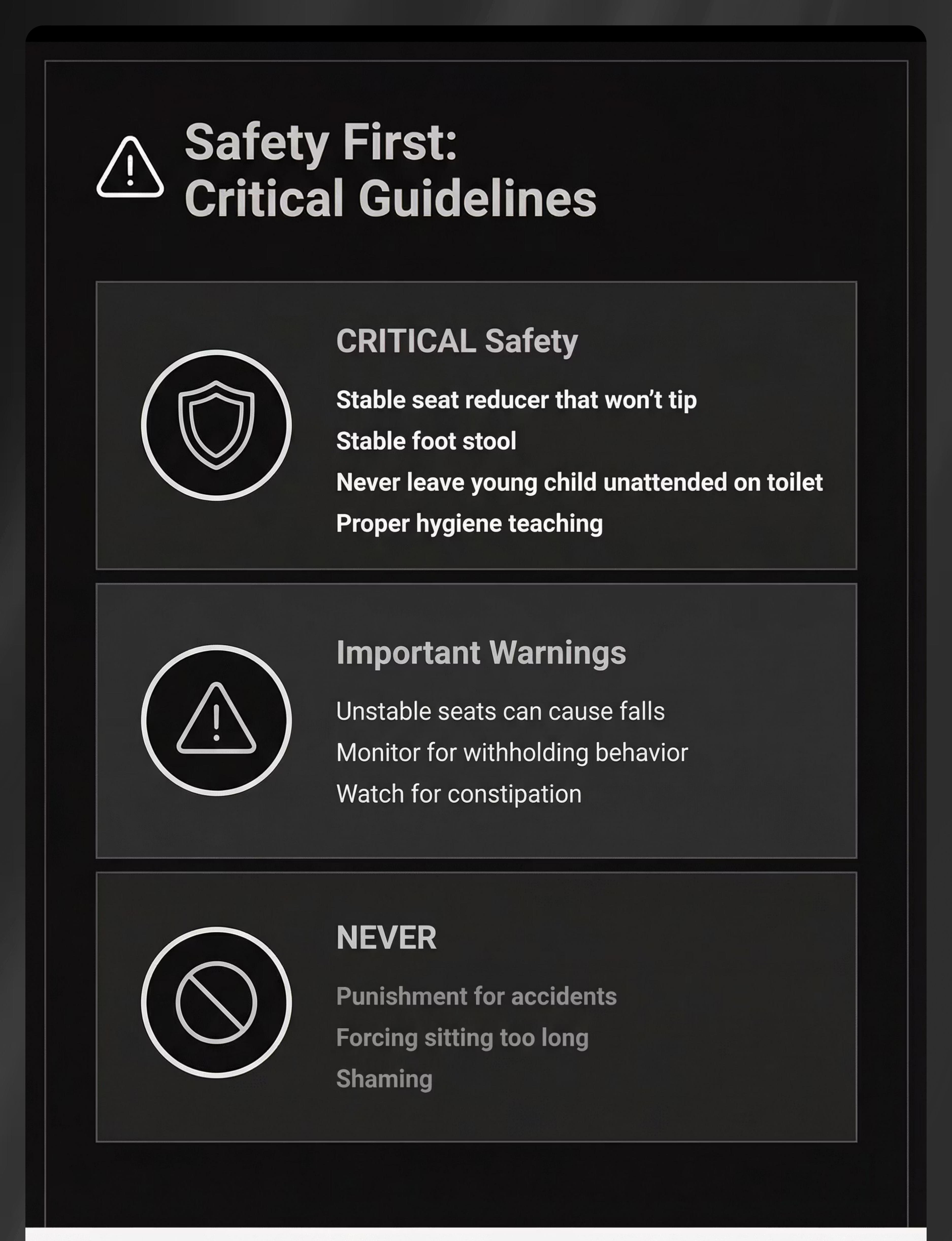
Safety First
Critical Safety
- Stable seat reducer that absolutely won't tip or slide
- Stable foot stool with non-slip surface and base
- Never leave young child unattended on toilet
- Proper hygiene teaching (wiping, handwashing)
Important Warnings
- Unstable seats can cause serious falls and injuries
- Monitor carefully for withholding behavior (refusing to go)
- Watch for constipation—this can derail training entirely
- Ensure proper hydration and fiber intake during training
Absolutely Contraindicated
- Punishment of any kind for accidents—this is harmful
- Forcing sitting for extended periods (over 5 minutes)
- Shaming or negative comments about accidents or progress
- Punitive approaches, withholding preferred activities
Safety Checklist
Before Each Use
- Positioning equipment stable and secure
- Visual schedule visible at eye level
- Reinforcers ready and accessible
- Positive, calm approach mentally prepared
During Use
- Following consistent schedule
- Maintaining positive interaction always
- Celebrating all successes immediately
- Keeping sitting times brief (3-5 min)
Signs of Success
- Tolerates sitting calmly
- Successes increasing in frequency
- Beginning to signal needs
- Longer dry periods emerging

Pricing & Investment Guide
Understanding the investment levels for toilet training tools helps families choose the right path for their needs, balancing cost with comprehensive support and durability.
Investment | ₹50–150 | ₹600–1,000 | |
What you get | Essential visual supports and reinforcement system. Print visual schedules from free resources, create simple reward charts, use phone timer. | Professional-quality physical positioning equipment plus complete visual support system. Durable materials designed for daily use over months. | |
Recommended brands | DIY / Free resources | BABYBJÖRN, Summer Infant, Squatty Potty |
Best for Budget
Families wanting to start immediately with minimal cost while assessing child's response before investing in physical equipment.
Important Note
These core supports are often sufficient for many children when combined with proper positioning using household items.
Overall Range
₹50–1,000 (USD $0.50–$12)
Phase 1: Starting Strong
Begin with visual supports and a reward system (₹50–200) to establish routine and assess response.
Phase 2: Add Equipment
Add physical positioning equipment (seat reducer + stool ₹400–1,400) once the child tolerates the bathroom and sitting approach has begun.

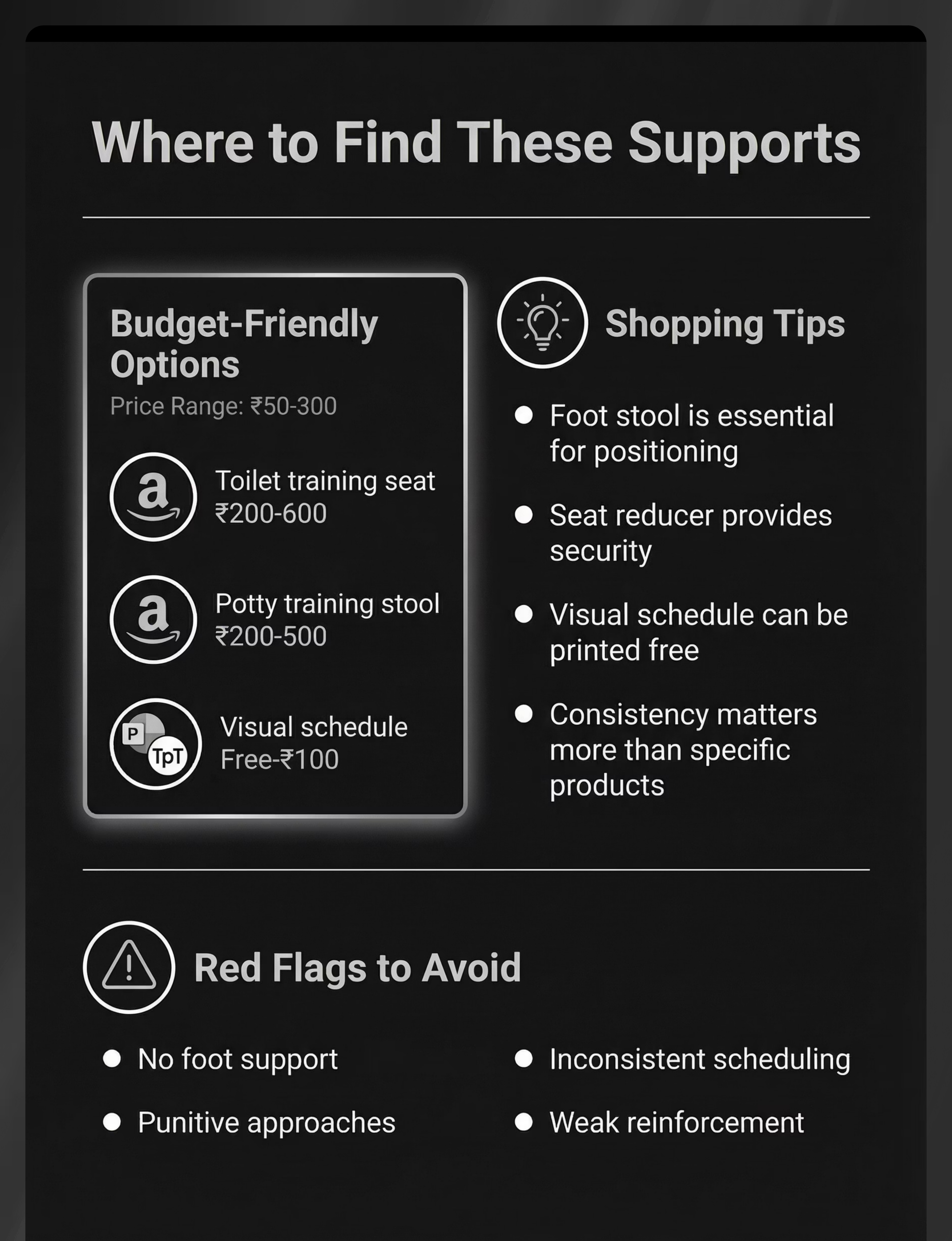
Where to Buy in India
Availability: Widely available through online platforms and some local stores. Physical positioning equipment readily available; visual supports often require printing or DIY creation.
Amazon.in
Search: "toilet training seat"
Price range: ₹200–600
Wide selection of seat reducers from multiple brands
Amazon.in
Search: "potty training stool"
Price range: ₹200–500
Foot stools in various heights and styles
Amazon.in
Search: "potty training visual schedule"
Price range: ₹100–300
Pre-made visual schedules and picture cards
Amazon.in
Search: "potty training timer watch"
Price range: ₹300–800
Wearable timer reminders for scheduling
Pinterest / TPT
Search: "toileting visual schedule"
Price range: Free–₹100
Downloadable printable visual schedules
Buying Tips
Foot stool is absolutely essential for proper positioning—don't skip this
Seat reducer provides security and prevents fear of falling in
Visual schedules can be printed free from many online resources
Strong, immediate reinforcers are more important than expensive products
Consistency in approach matters much more than specific brand of equipment
Red Flags When Buying
- No foot support provided or available
- Unstable seat reducers that could tip
- Punitive approaches suggested in materials
- Promises of "3-day training" for children with autism
- Approaches emphasizing speed over systematic teaching
- Weak or inconsistent reinforcement systems

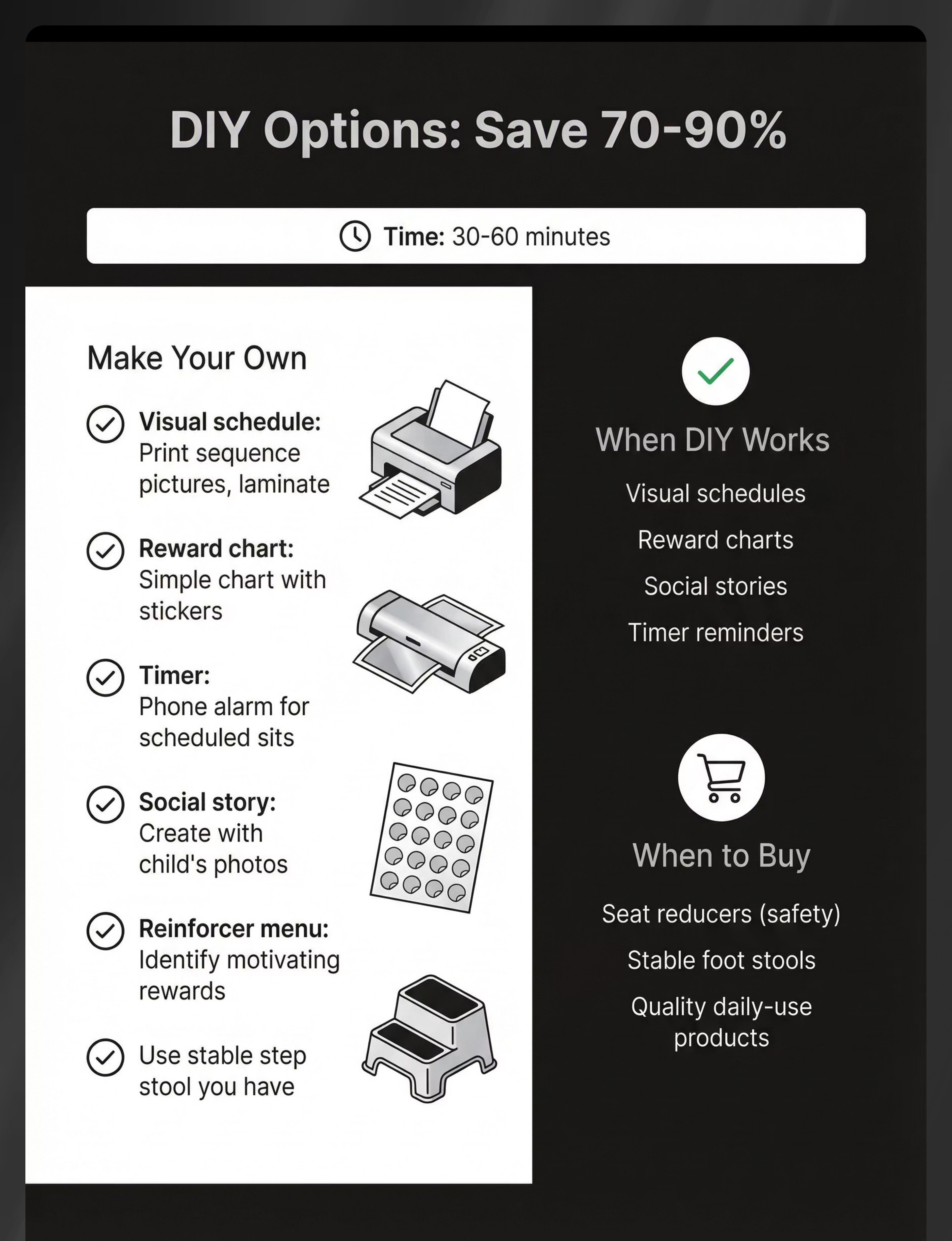
DIY Alternative (Save 70-90%)
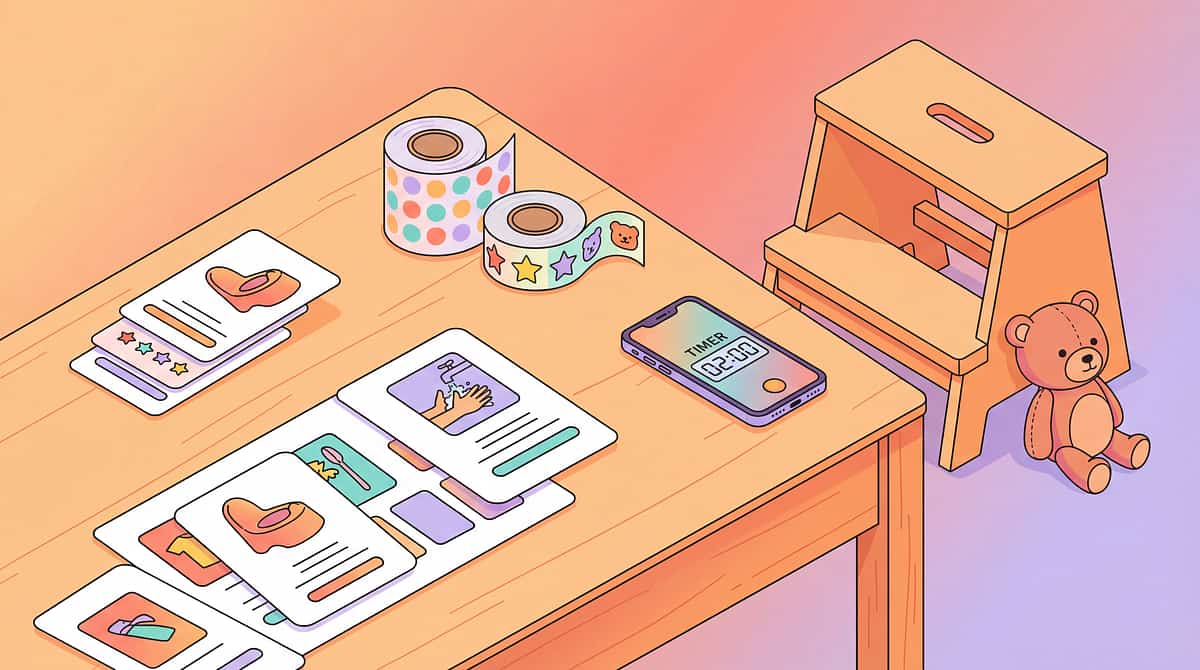
Feasibility: Very High for visual supports | Time required: 30-60 minutes | Cost savings: 70-90% compared to commercial options
Materials Needed
- Printed visual sequence pictures
- Simple sticker chart for rewards
- Phone timer for scheduled sits
- Stable step stool from home
- Child's preferred reinforcers
- Laminating sheets (optional but recommended)
Step-by-Step Creation
Visual schedule: Print toileting sequence pictures from free online resources, laminate for durability, attach with velcro or magnets
Reward chart: Create simple chart on paper with spaces for stickers after each successful sit or elimination
Timer system: Set phone alarms for scheduled sit times throughout the day (5-10 times daily)
Foot support: Use existing stable step stool that brings feet flat when seated
Social story: Create personalized book using child's own photos showing the bathroom and toilet in YOUR home
Reinforcer menu: Identify most motivating rewards through observation and trial
DIY vs Commercial Comparison
- DIY for visuals: Visual schedules, reward charts, and social stories are perfect for personalized DIY creation.
- Buy commercial for safety: Seat reducers and foot stools should be purchased to ensure stability and safety.
- Tradeoffs: DIY saves money but requires time; commercial products offer durability but lack personalization.
- Key takeaway: Don't compromise safety; personalize visuals for better engagement.
Important safety note: DIY seat reducers are not recommended due to safety concerns. Invest in a stable commercial seat reducer and foot stool. Visual supports, schedules, and reward systems are perfect for DIY creation and often work better when personalized to your specific child and home.
Preview of toileting visuals supports Therapy Material
Below is a visual preview of toileting visuals supports therapy material. The pages shown help educators, therapists, and caregivers understand the structure and content of the resource before use. Materials should be used under appropriate professional guidance.


Share this resource
Help others discover thisLink copied!

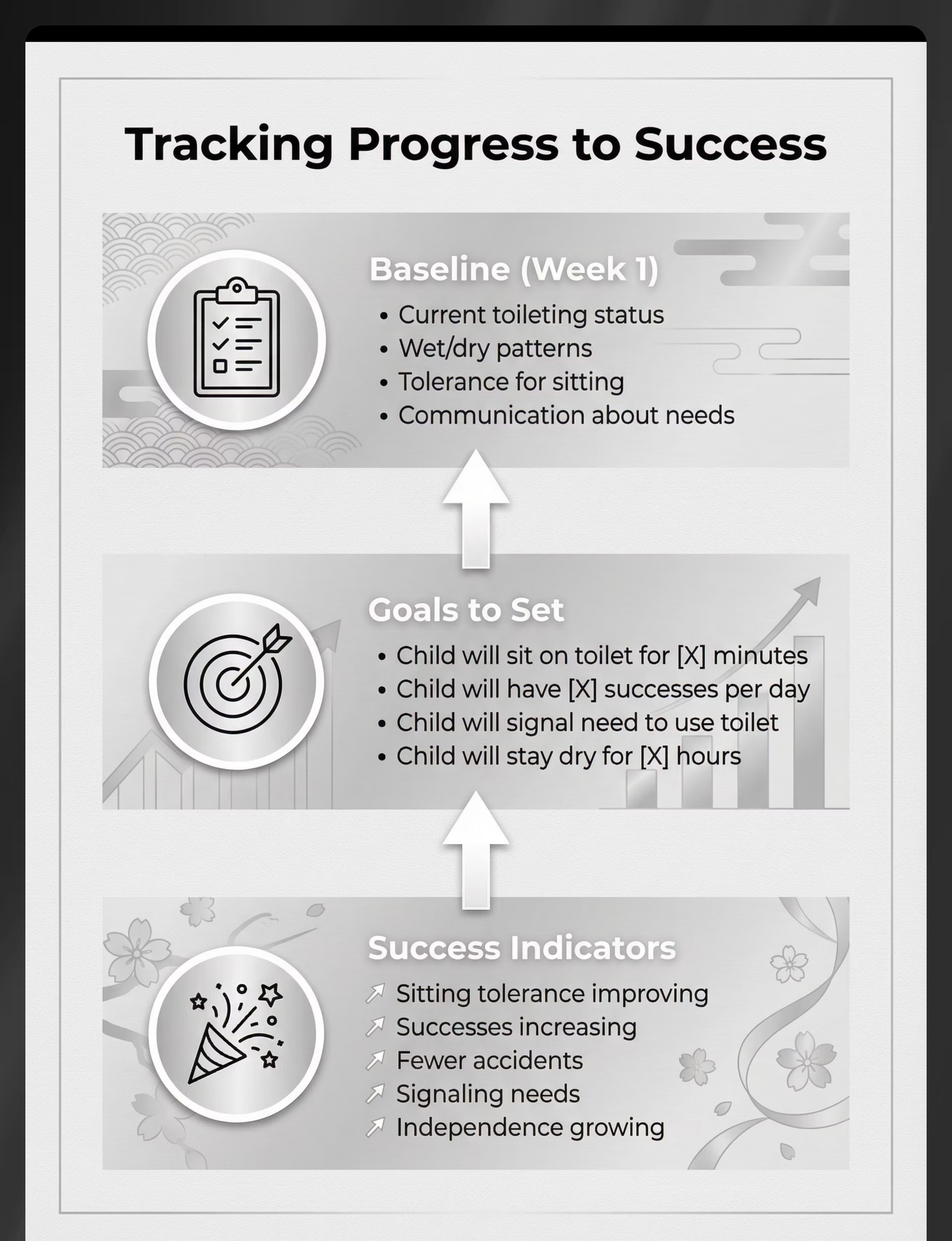
Measuring Success & Next Steps
Track Progress
Baseline (Measure First)
- Current toileting status and patterns
- Typical wet/dry periods throughout day
- Tolerance for bathroom and sitting
- Current communication about needs
Goals to Set
- Child will sit on toilet for [X] minutes calmly
- Child will have [X] successes per day
- Child will signal need to use toilet
- Child will stay dry for [X] hours
Success Indicators
- Sitting tolerance increasing
- Successful eliminations increasing
- Accidents decreasing in frequency
- Child signaling needs more consistently
- Independence increasing in steps
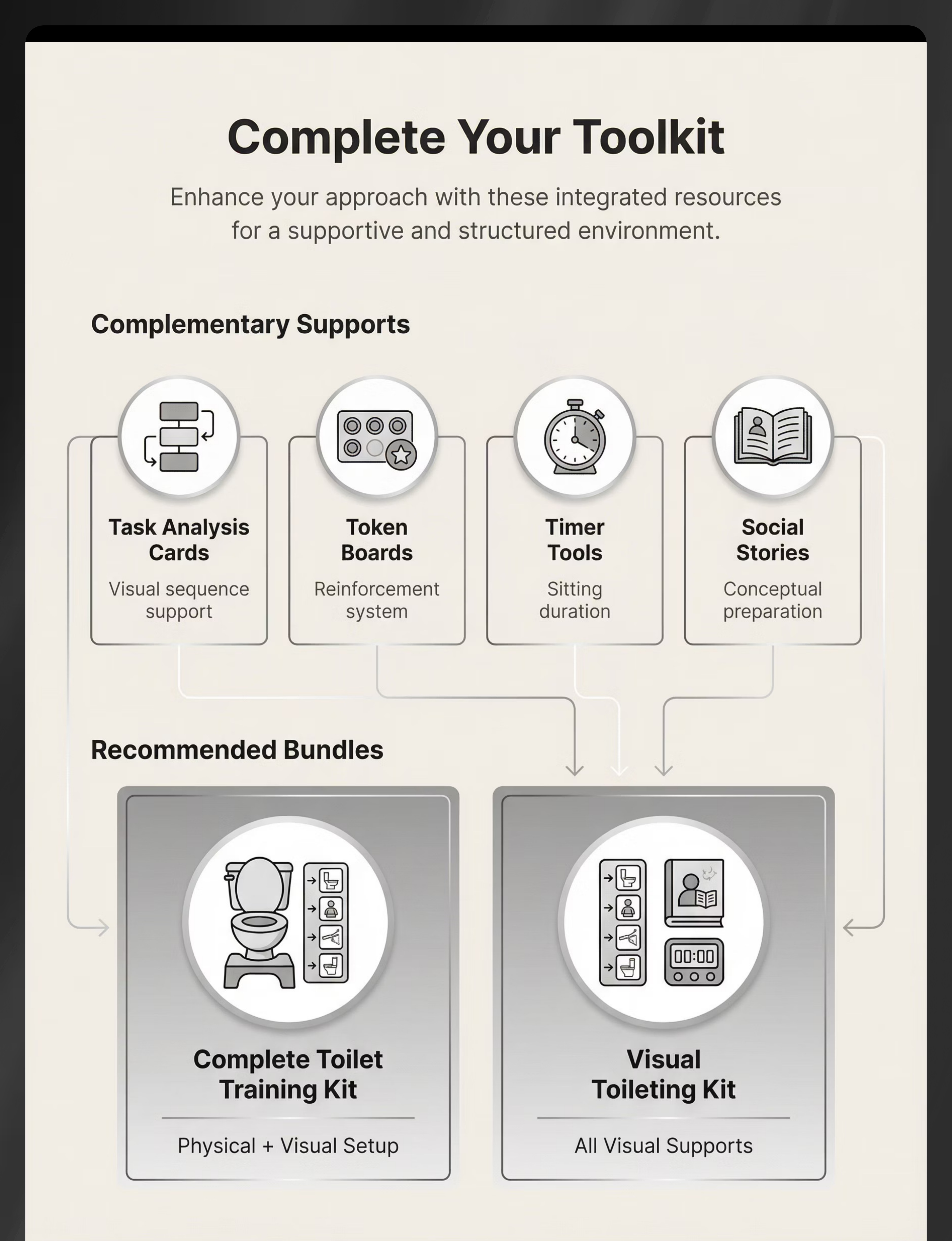
Complete the Kit
Pair It With...
Task Analysis Cards (ID: 3.5)
Visual sequence support for breaking down the complete routine
Token Boards (ID: 3.3)
Structured reinforcement system for building motivation
Timer Tools (ID: 2.7)
Visual support for sitting duration expectations
Social Stories (ID: 4.1)
Conceptual preparation and anxiety reduction
Complete Kits Available
Toilet Training Kit: Toileting visuals (9.5) + Seat reducer (9.5.4) + Foot stool (9.5.5) — Complete toilet training setup with all essential elements
Visual Toileting Kit: Visual schedule (9.5.1) + Social stories (9.5.2) + Visual timer (9.5.3) — Comprehensive visual supports for training
Quick Summary
AI Summary: Toileting visuals and supports provide the structured, visual, and physical framework needed for successful toilet training through systematic approach with proper positioning and reinforcement. Core Kit (Rank 1), strong evidence, critical ADL milestone.
toileting
potty training
continence
visuals
positioning
self-care
ADL
OT
SpEd
core-kit
Common searches: toilet training autism, potty training visual schedule, toileting social story, toilet seat reducer, potty training stool, continence training autism, toilet training supports
Get Support
FREE National Autism Helpline
Phone: 9100 181 181
Languages: 16+ languages supported
Website: pinnacleblooms.org
Connect with specialists who can guide your toilet training journey with personalized support and encouragement.
Platform Integration
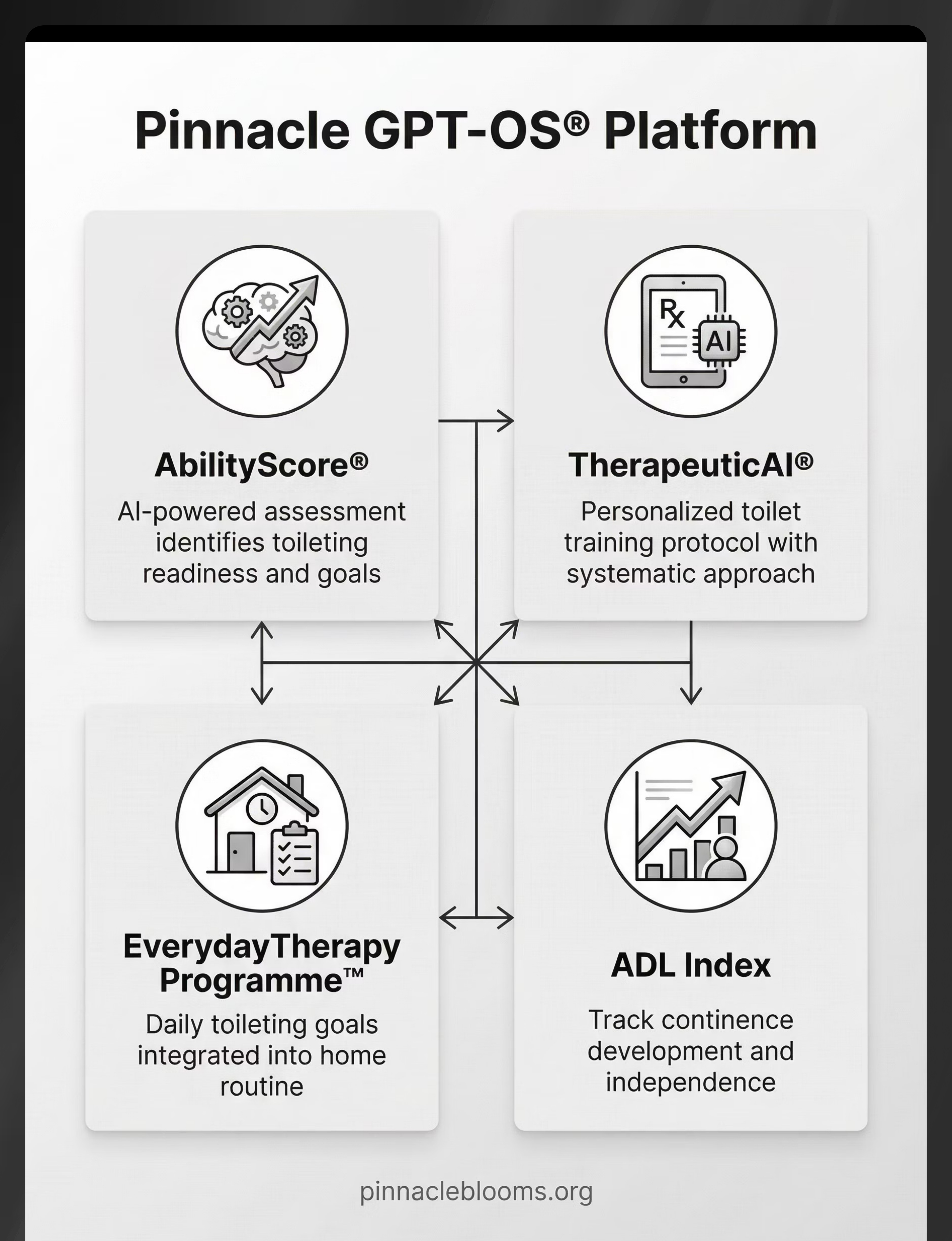
AbilityScore® identifies your child's toileting readiness and specific support needs
TherapeuticAI® prescribes personalized toileting protocol based on your child's profile
EverydayTherapyProgramme™ includes specific toileting goals integrated into daily routines
ADL Index tracks continence development progress over time with detailed metrics
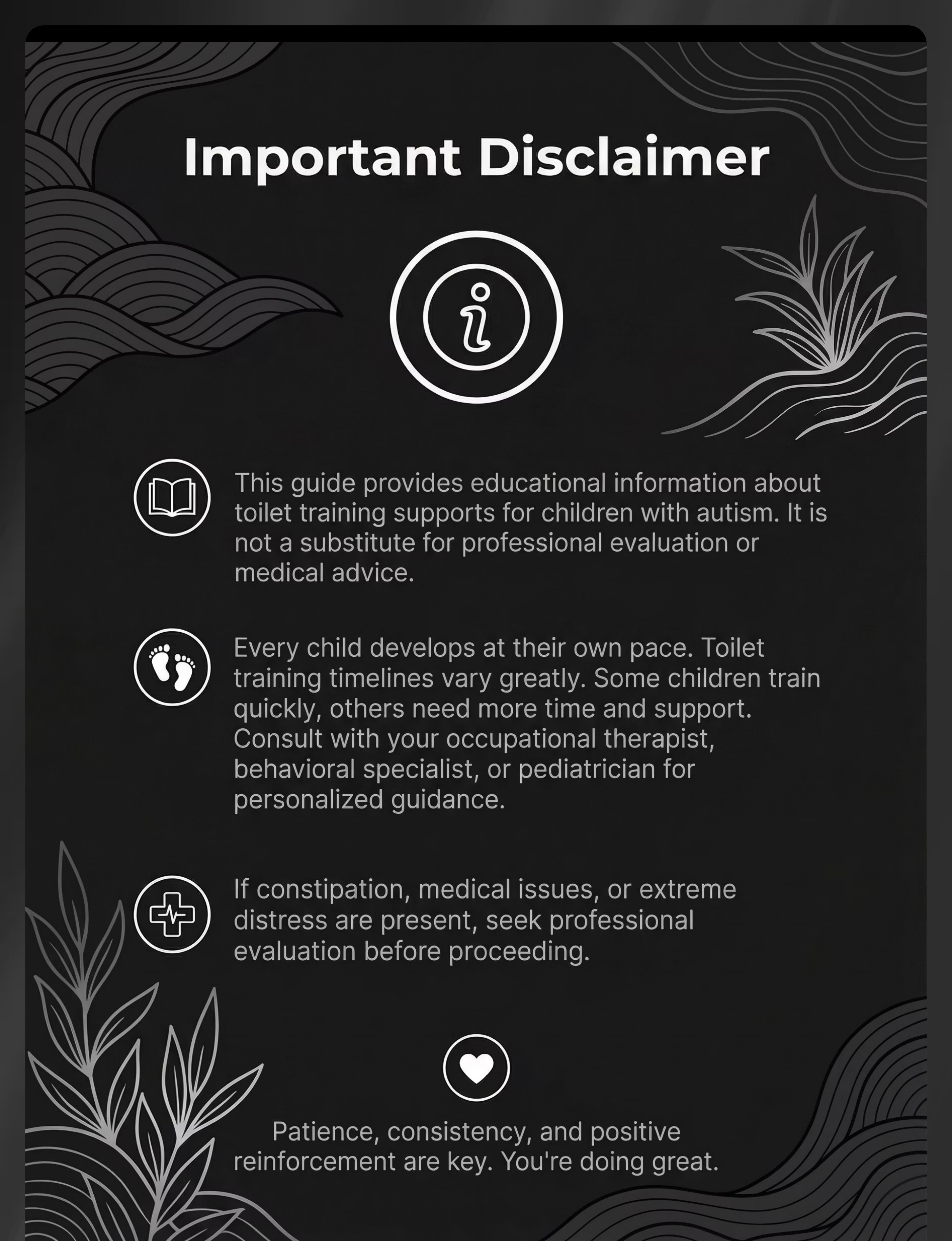
Disclaimer: This is educational information to support families in their toilet training journey. Always consult qualified occupational therapists, speech-language pathologists, behavior analysts, or pediatricians for personalized assessment and guidance. Individual results vary significantly based on child's readiness, consistency of implementation, and many other factors. Toilet training timelines are estimates based on typical progress with systematic approaches.