



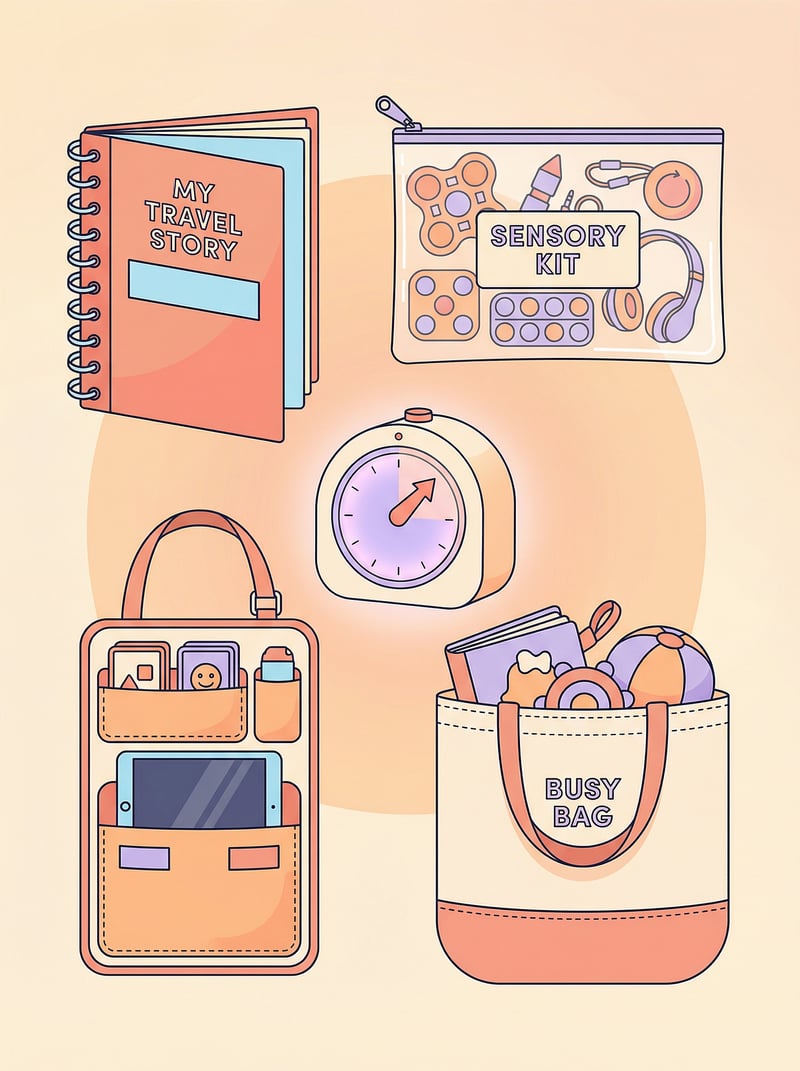
Tool ID: 17.1
Tool ID: 17.1
Core Kit
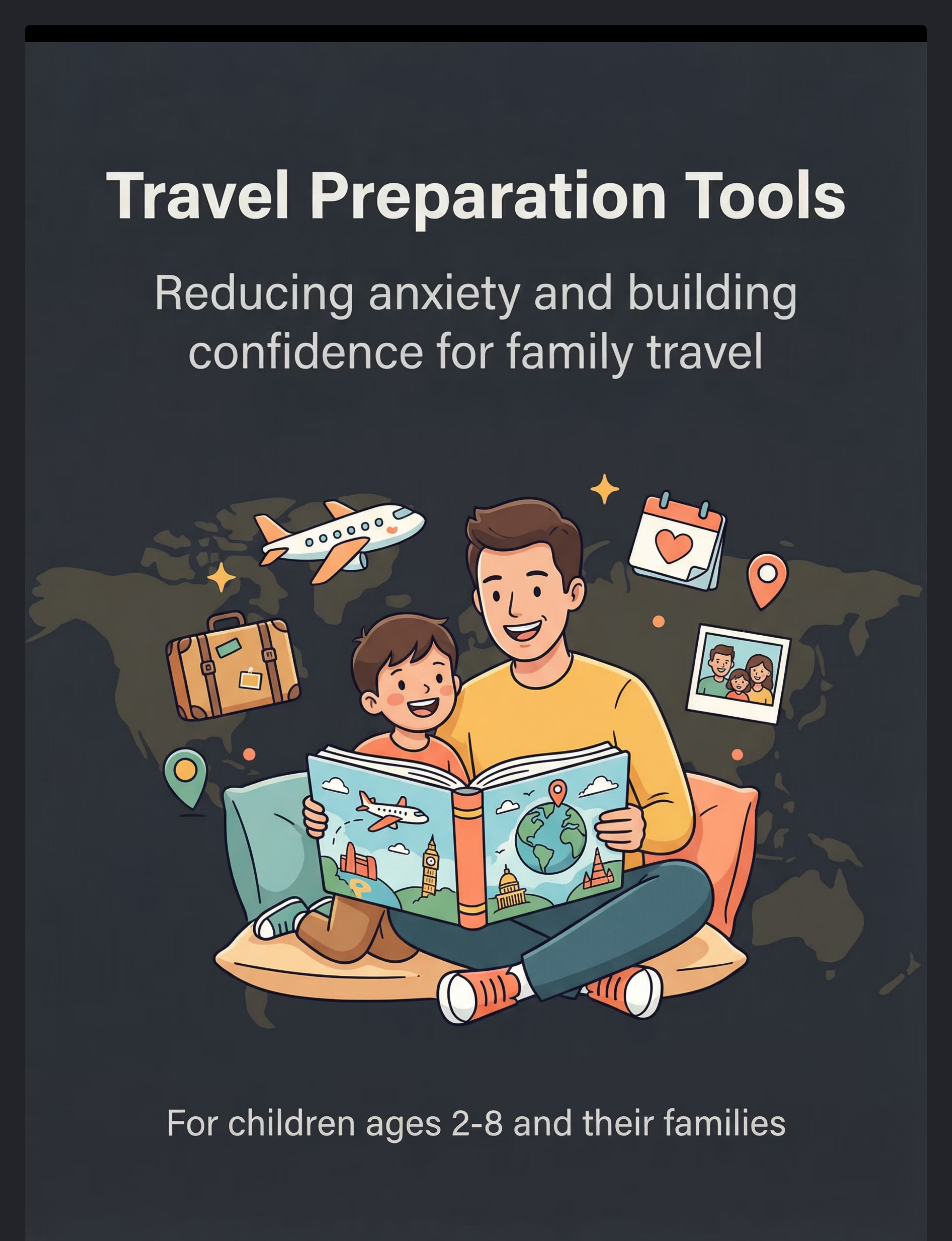
Travel Preparation Tools
Comprehensive preparation strategies to reduce travel anxiety and build confidence for successful family journeys
Travel anticipation and preparation system
SpEd + Psychology
Moderate-Strong Evidence
Rank #1
As needed
₹0–500
Prepare your child for travel through visual previews, social stories, and practice activities that transform anxiety into confidence. These evidence-based tools reduce travel-related stress and increase successful family travel experiences by making the unknown familiar.
Reduce Travel Anxiety
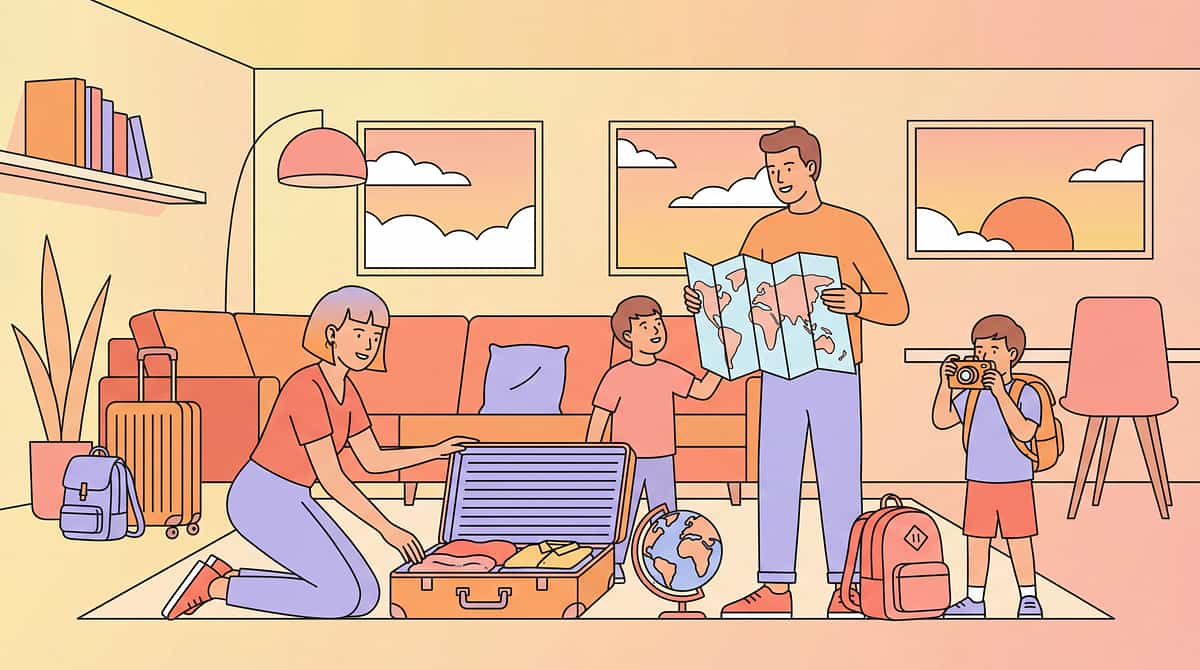
These tools help children understand what to expect during travel, reducing anxiety about new places and experiences, while building confidence for successful journeys.
Prepare for Anticipation & Expectations
Supports children and families in navigating the excitement and potential stress of upcoming trips, setting clear expectations for each stage of the journey.
Foster Flexibility & Tolerance
Encourages adaptability to new environments and unexpected changes, building tolerance for novel experiences encountered during travel.
Develop Independence & Self-Reliance
Empowers children to feel more capable and in control, fostering a sense of independence as they navigate various travel situations.
Support Age-Appropriate Preparation
Designed for children aged 2+ years, with content adaptable to various developmental levels for effective pre-travel preparation at home and on the go.
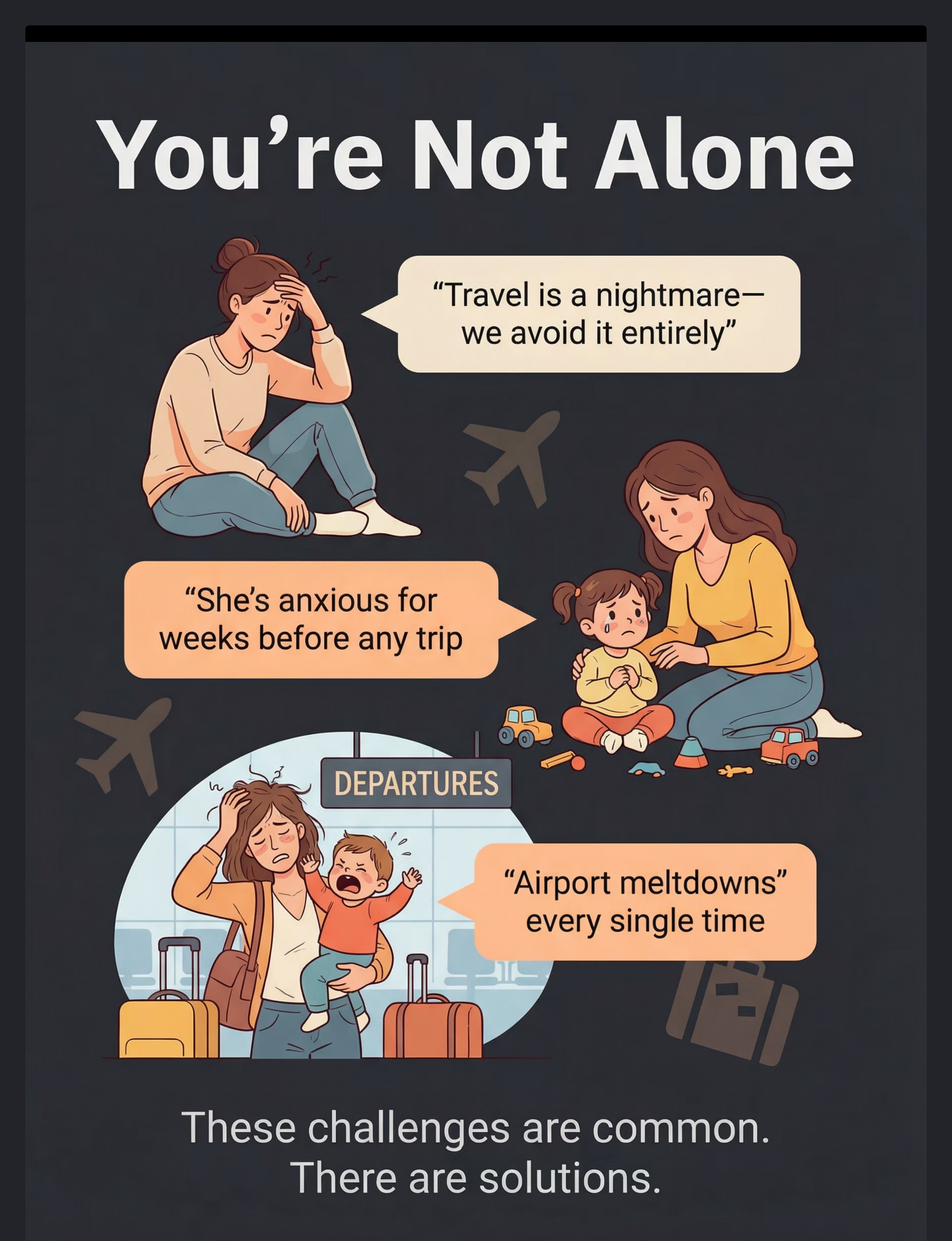
Does This Sound Familiar?
"Travel is a nightmare. Every trip becomes a source of stress for weeks beforehand. We've started avoiding family vacations altogether because the anxiety is just too much."
"He's anxious for weeks before trips. Sleep problems start, eating changes, behaviors escalate. The anticipation is harder than the actual travel sometimes."
"She doesn't understand where we're going. No matter how many times we explain, she can't picture it. The unknown terrifies her."
"We've avoided travel because of anxiety. Missing family weddings, skipping vacations, staying home when we long to explore. It breaks my heart."
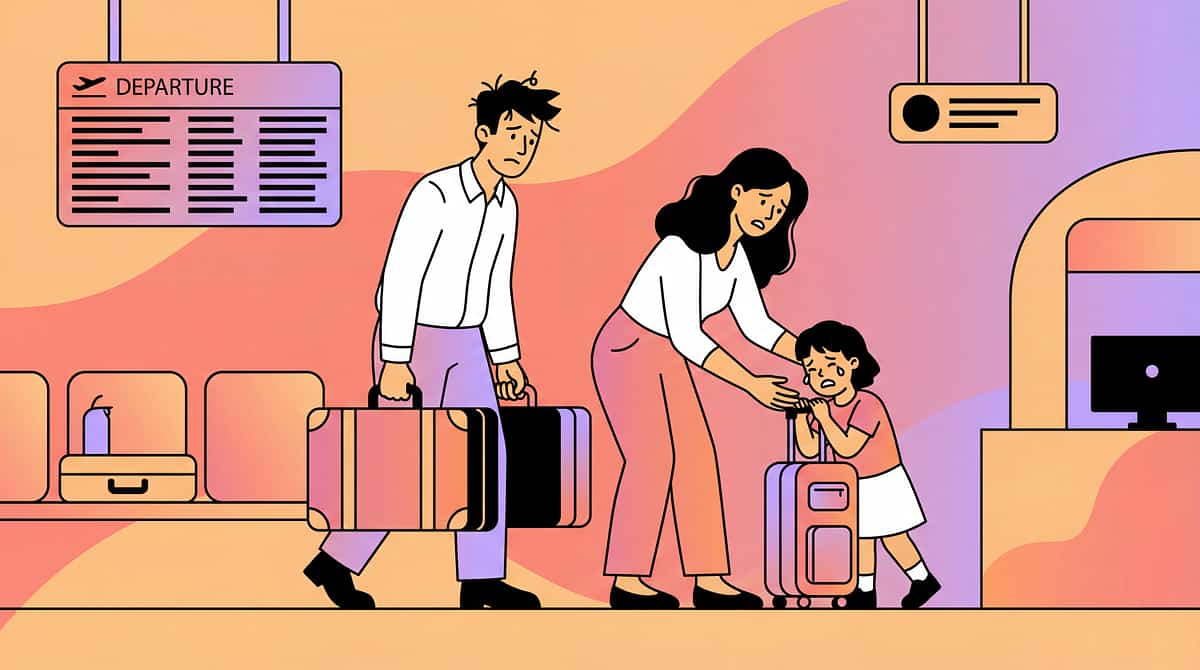
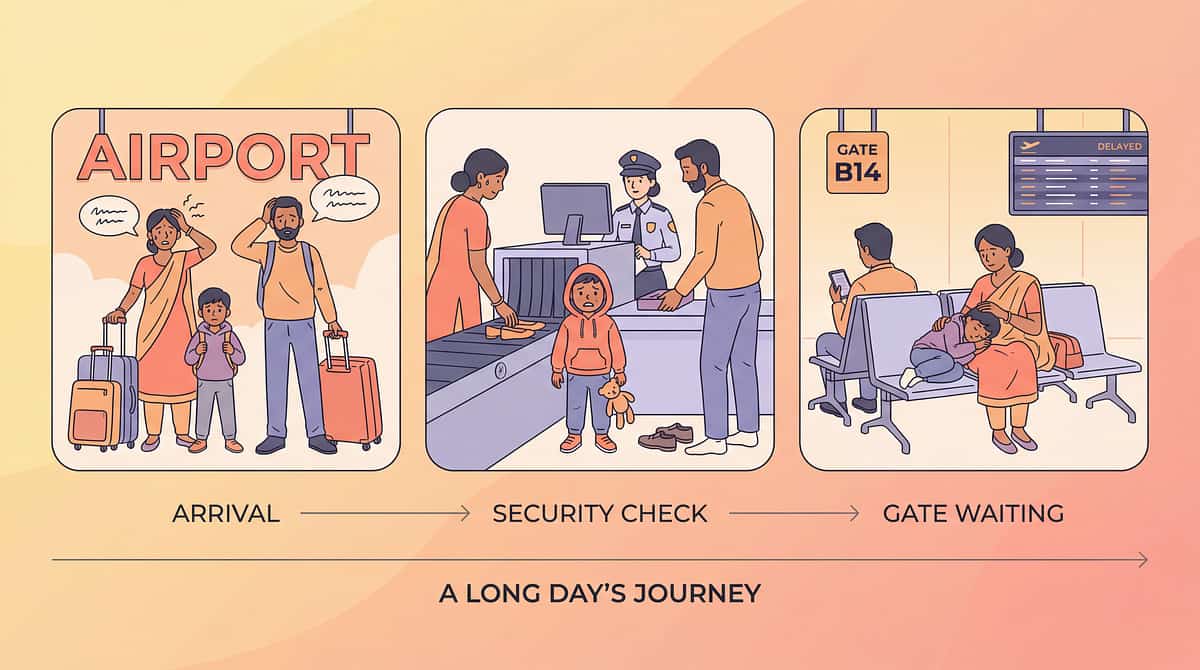
"She melts down at airports. Security, waiting, boarding—every stage is a disaster. The public scenes are exhausting and embarrassing."
You're not alone. These are common challenges for families with children on the autism spectrum. Travel preparation tools can help transform these experiences.
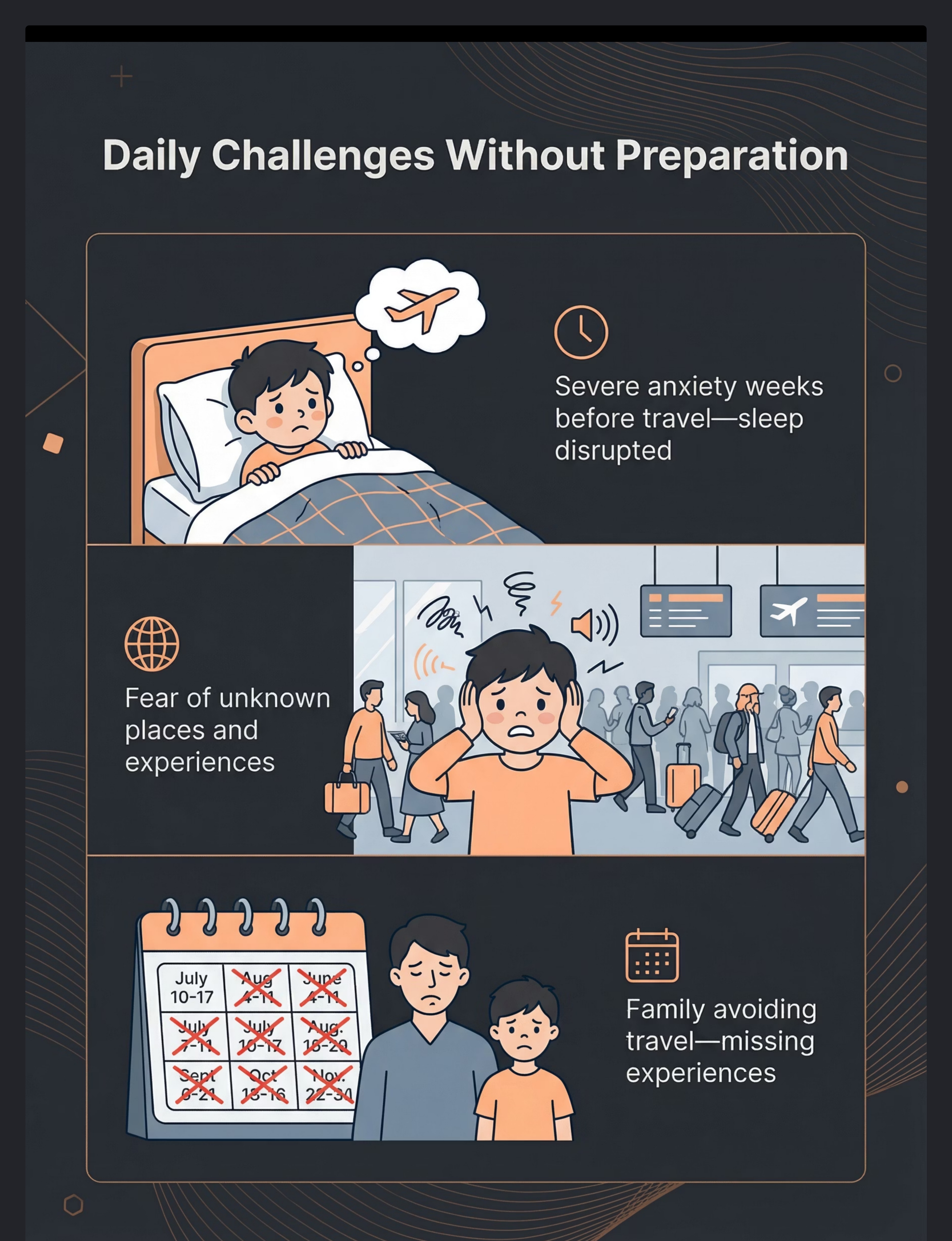
A Day Without the Right Support
Weeks Before
Severe anxiety building about upcoming trip. Sleep disrupted. Questions that can't be answered. Fear of the unknown growing daily.
Days Before
Child refusing to go. Imagination filling with fears. Family stressed and uncertain. Considering canceling the trip entirely.
Travel Day
Meltdowns at each transition. Airport security overwhelming. Waiting unbearable. Public scenes and exhaustion for everyone.
At Destination
Everything unfamiliar and frightening. Can't enjoy activities. Family stressed. Trip that should bring joy becomes ordeal.
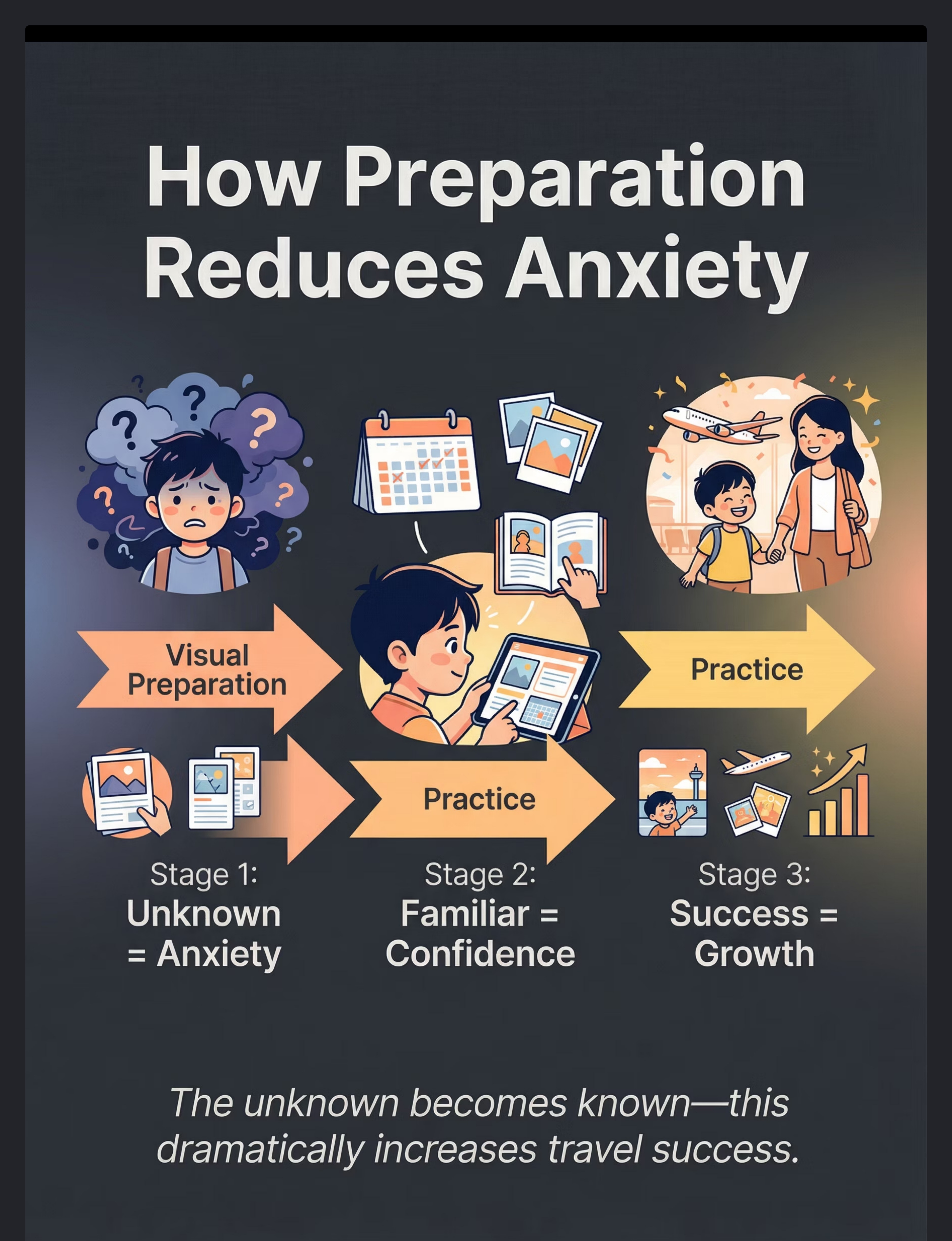
The Science Behind It
Visual/Narrative Preparation
Social stories, photos, and videos introduce what to expect in accessible formats
Familiarity Building
Repeated exposure makes unknown places and experiences feel familiar before arrival
Anxiety Reduction
The known becomes less threatening than the unknown, reducing anticipatory anxiety
Clear Expectations
Understanding what will happen creates predictability and sense of control
Skill Practice
Role-playing challenging moments builds competence and confidence
Successful Travel
Preparation leads to better experiences, expanding opportunities and family joy
This evidence-based approach transforms travel from a source of fear into an opportunity for growth and positive family experiences.
How to Use It Right
1
Start preparation well in advance
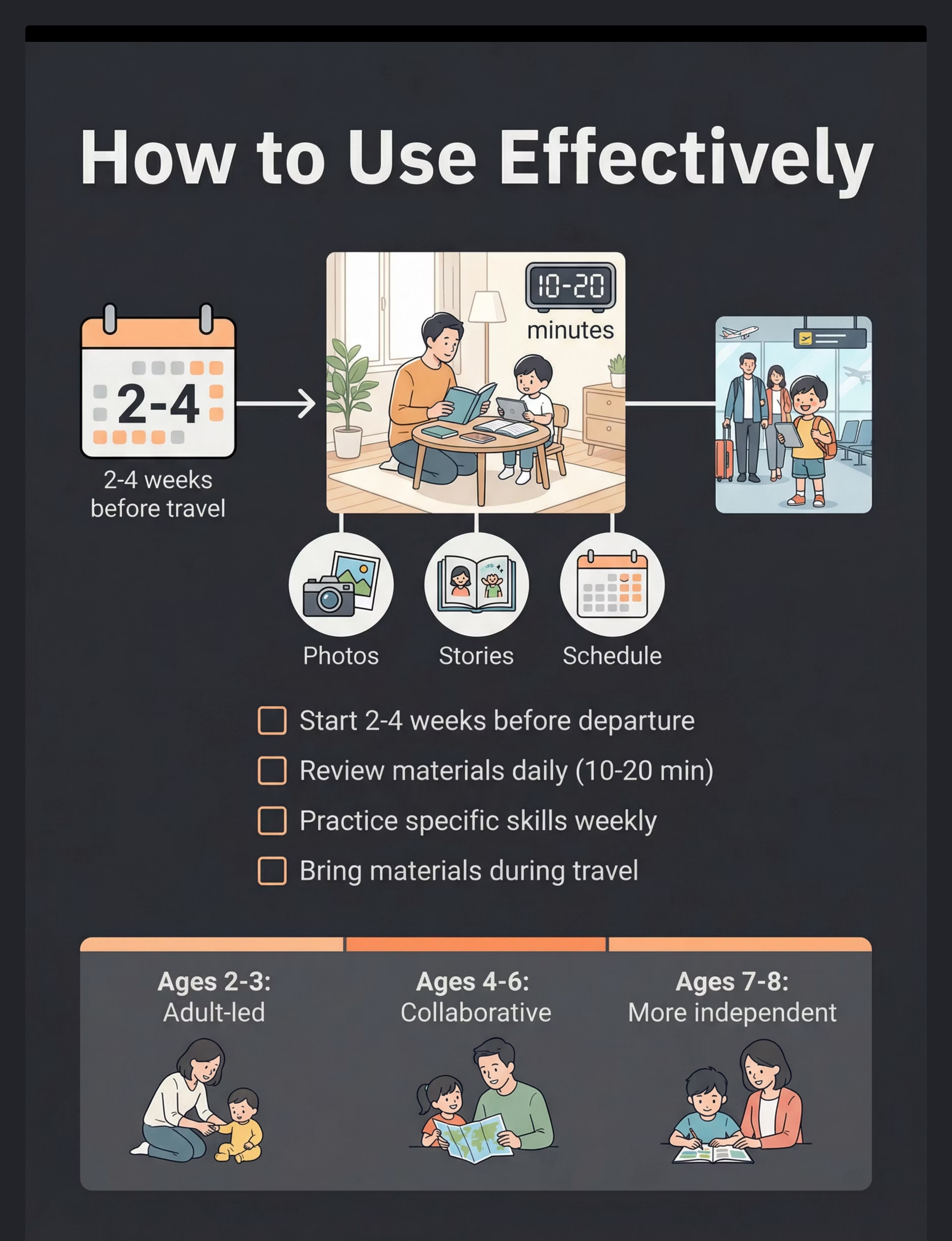
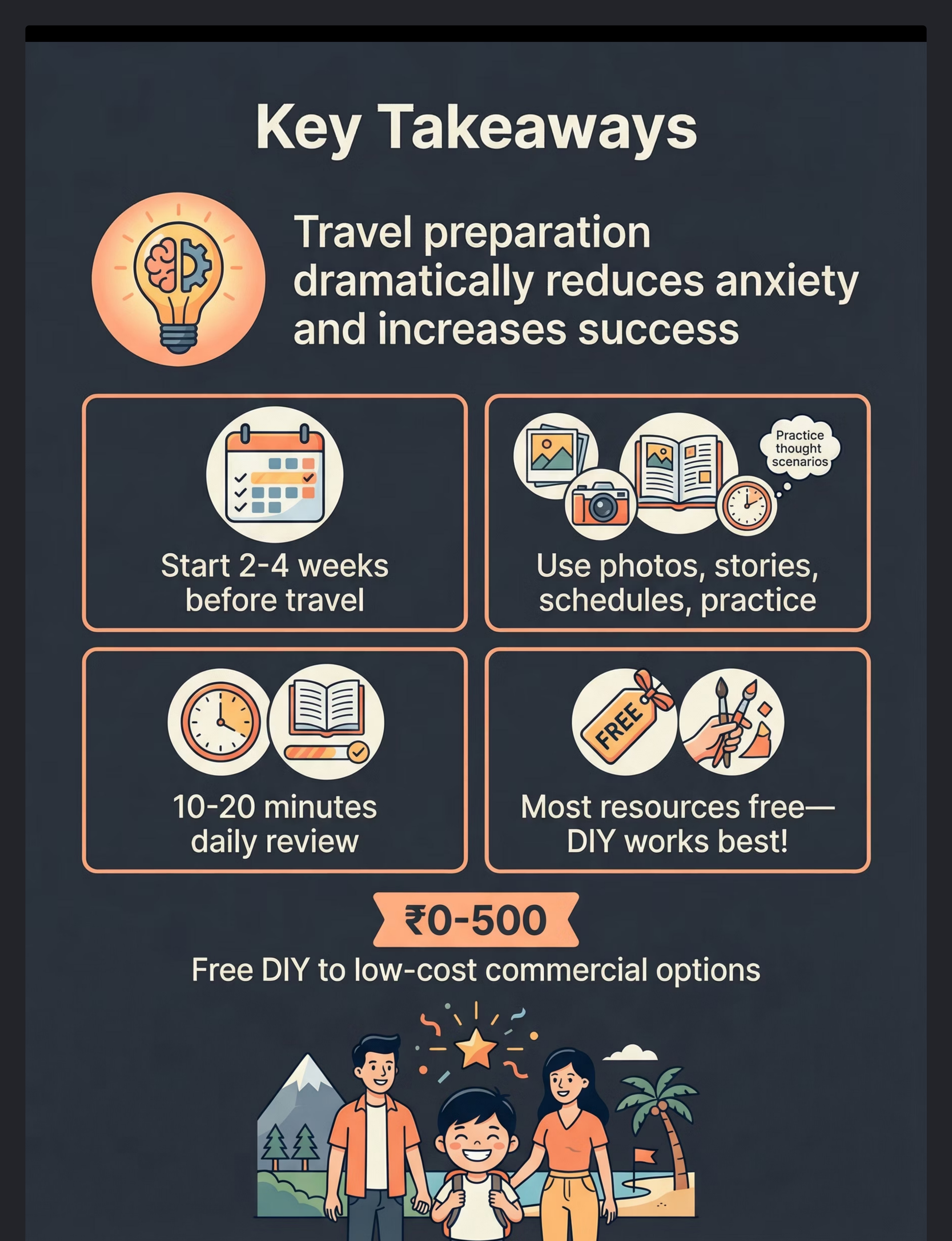
Begin 2-4 weeks before travel to allow time for familiarity to develop without overwhelming anxiety
2
Use child's preferred learning style
Visual learners need photos/videos, narrative learners need stories, kinesthetic learners need practice activities
3
Include both exciting and challenging aspects honestly
Build trust by being truthful about difficult parts while highlighting positives. Prepare for reality, not fantasy
4
Practice specific skills
Role-play airport security, staying seated on planes, using new bathrooms—whatever your child finds challenging
5
Review materials repeatedly before trip
Daily review sessions of 10-20 minutes help information become deeply familiar and reduce anxiety
6
Bring materials during travel
Visual schedules and stories provide comfort and reminders during the actual journey
Duration: 10-20 minutes daily during the 2-4 week preparation period, with materials available throughout travel
travel-preparation-tools therapy material
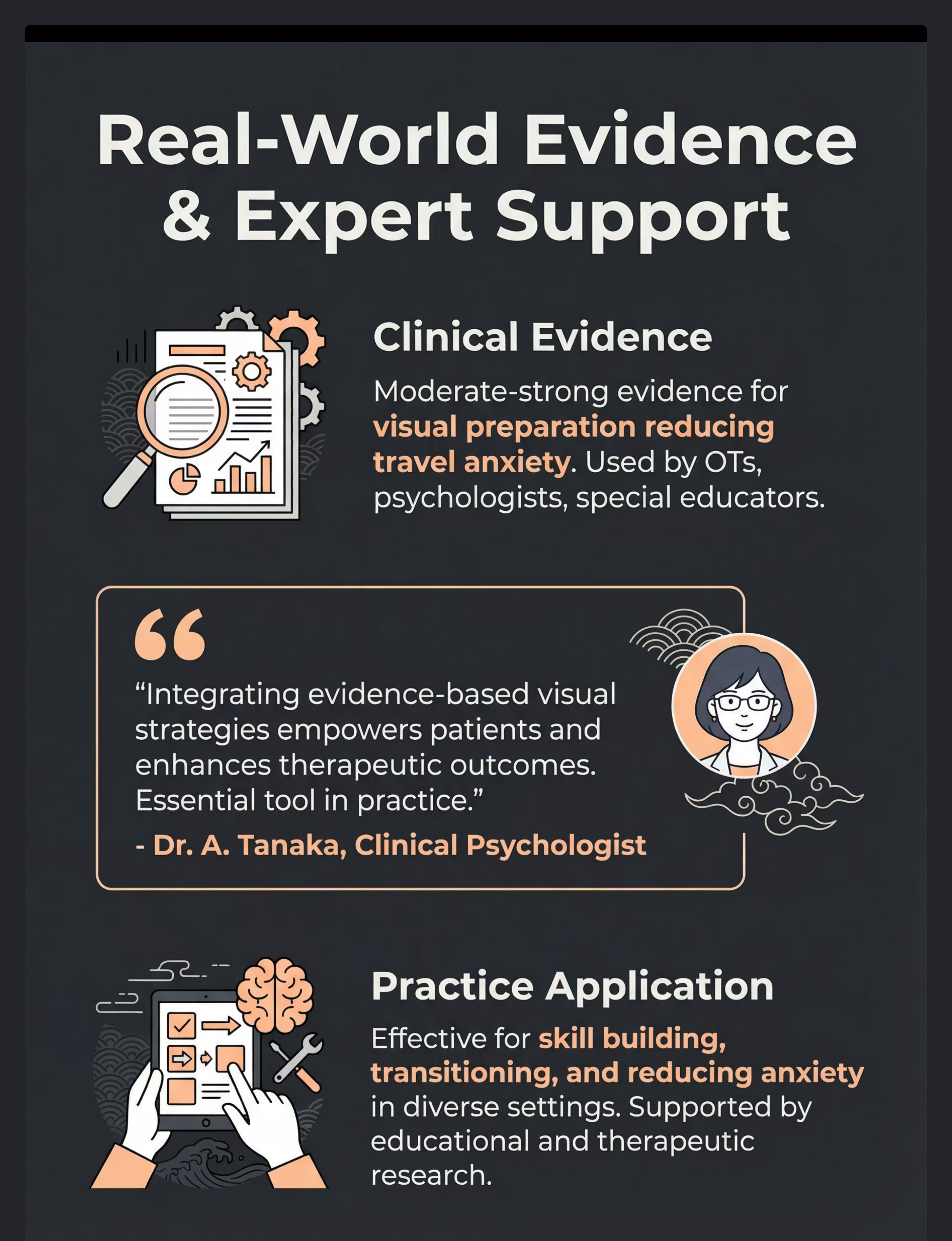
"Travel can be incredibly challenging for children with autism due to novelty, unpredictability, and sensory overload. Thorough preparation using visual supports, social stories, and practice dramatically increases success. The unknown becomes known."
— Child Psychologist, Anxiety Specialist

SpEd + Psychology Recommended
Moderate-Strong Evidence
Rank #1 in Category
Core Kit Essential
travel-preparation-tools therapy material
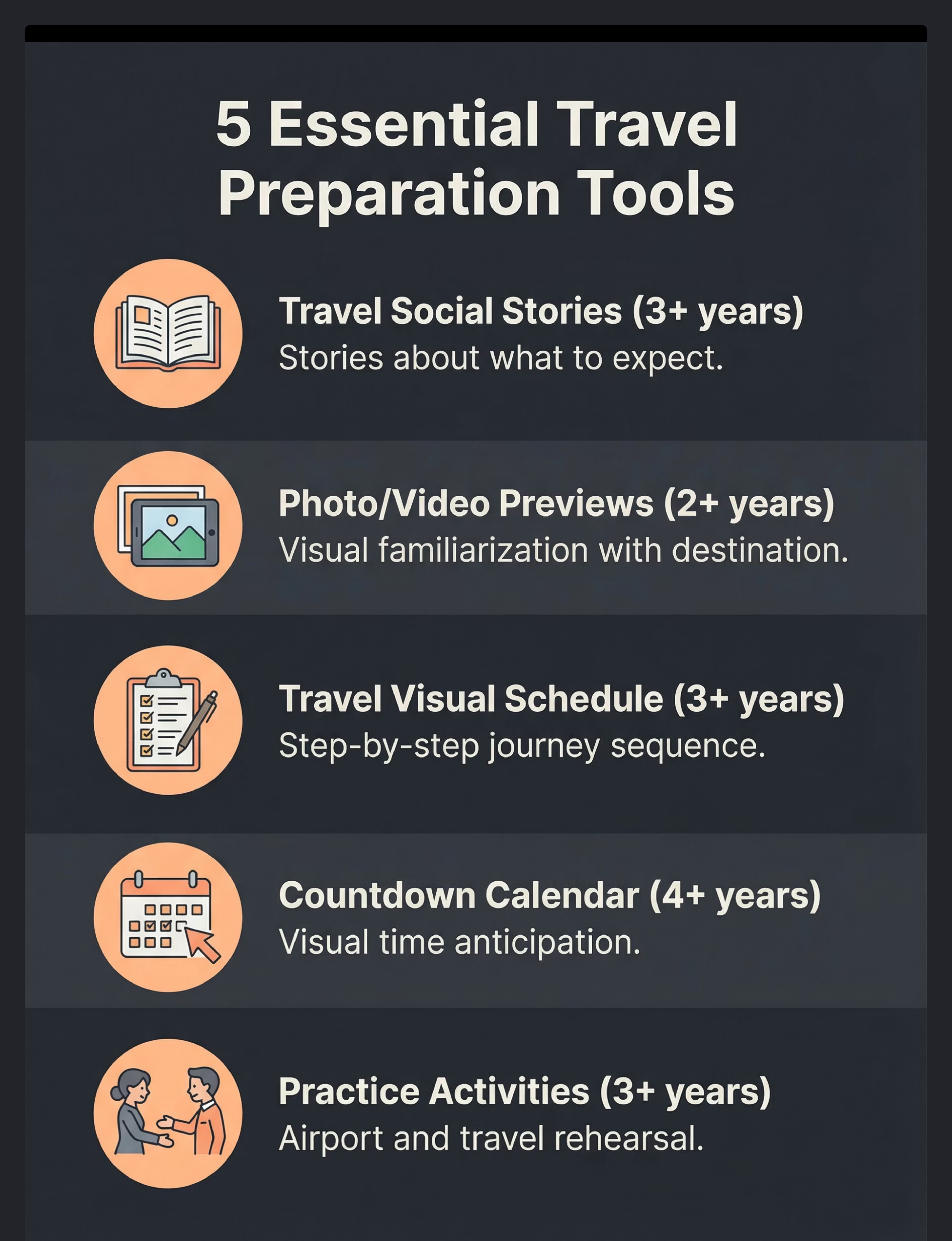
Choose Your Option (5 Variants)
Select preparation strategies based on your child's learning style, specific concerns, and the type of travel you're planning. Most families benefit from combining multiple approaches.
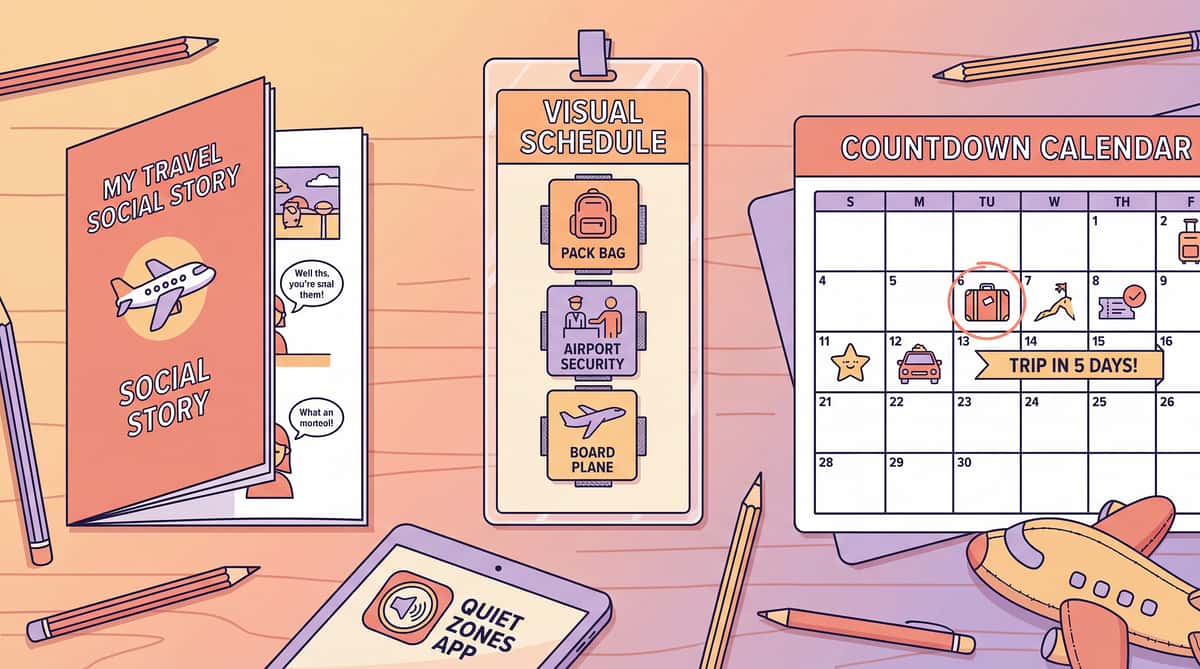
Travel Social Stories
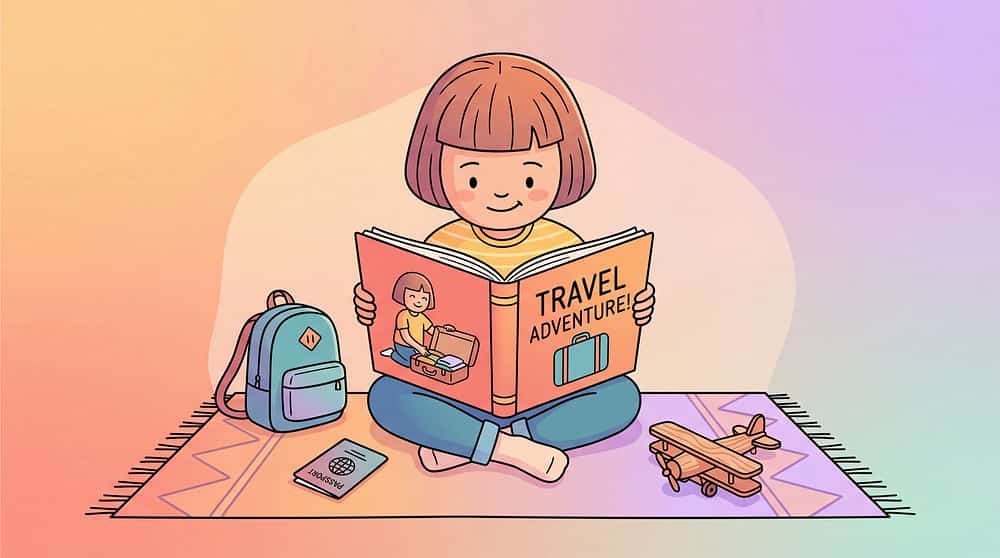
Narrative preparation using stories about the travel journey and destination.
Photo/Video Preview of Destination
Visual familiarization through previews of where you're going.
Travel Visual Schedule
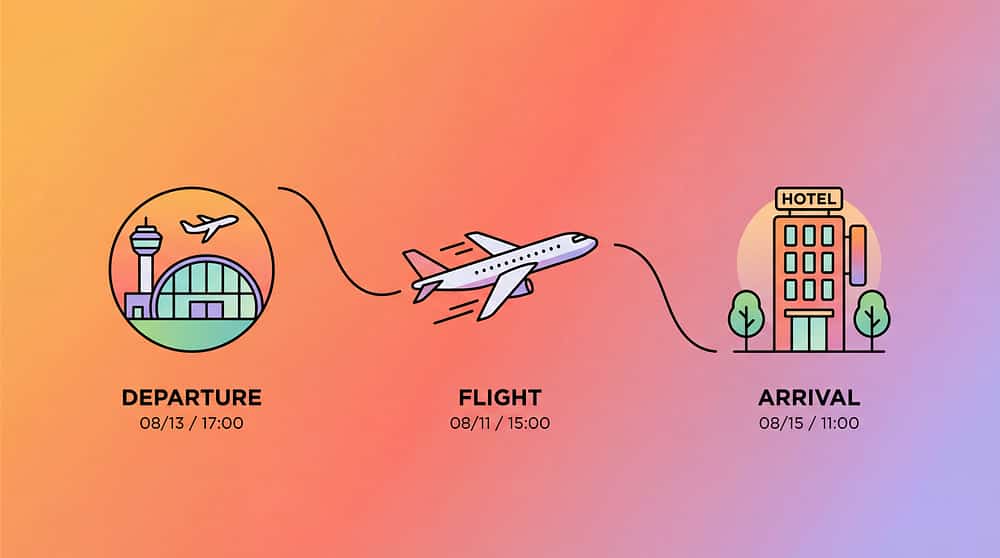
Sequence understanding through scheduled journey visualization.
Countdown Calendar
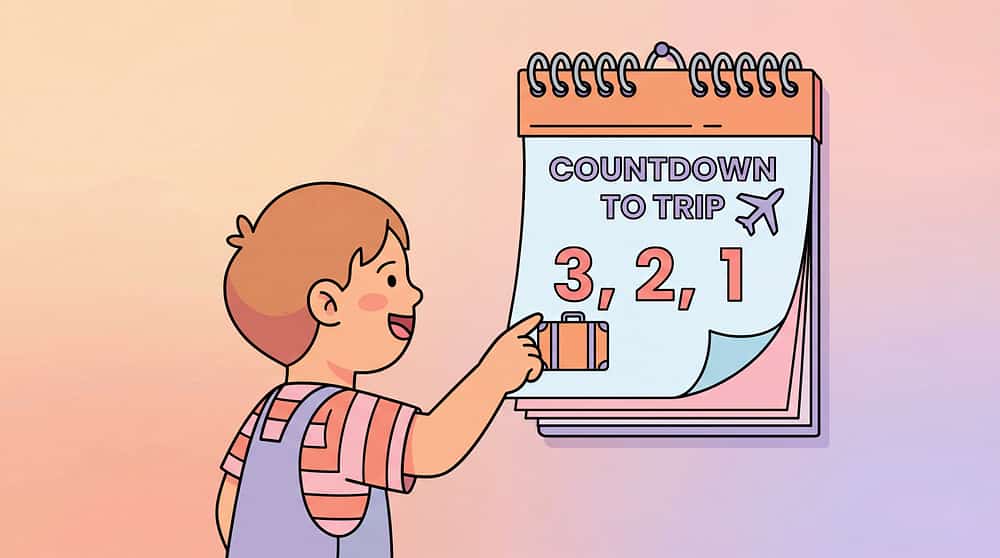
Time anticipation through visual countdown to travel.
Travel Practice Activities
Experiential preparation through role-play and practice.

How to Choose
  • By learning style: Visual learners → photos/videos; Narrative learners → social stories; Kinesthetic learners → practice activities
  • By concern: Time anxiety → countdown; Unknown places → previews; Process confusion → schedules
  • By age: Younger (2-3) → photos/videos; Older (4+) → all options available
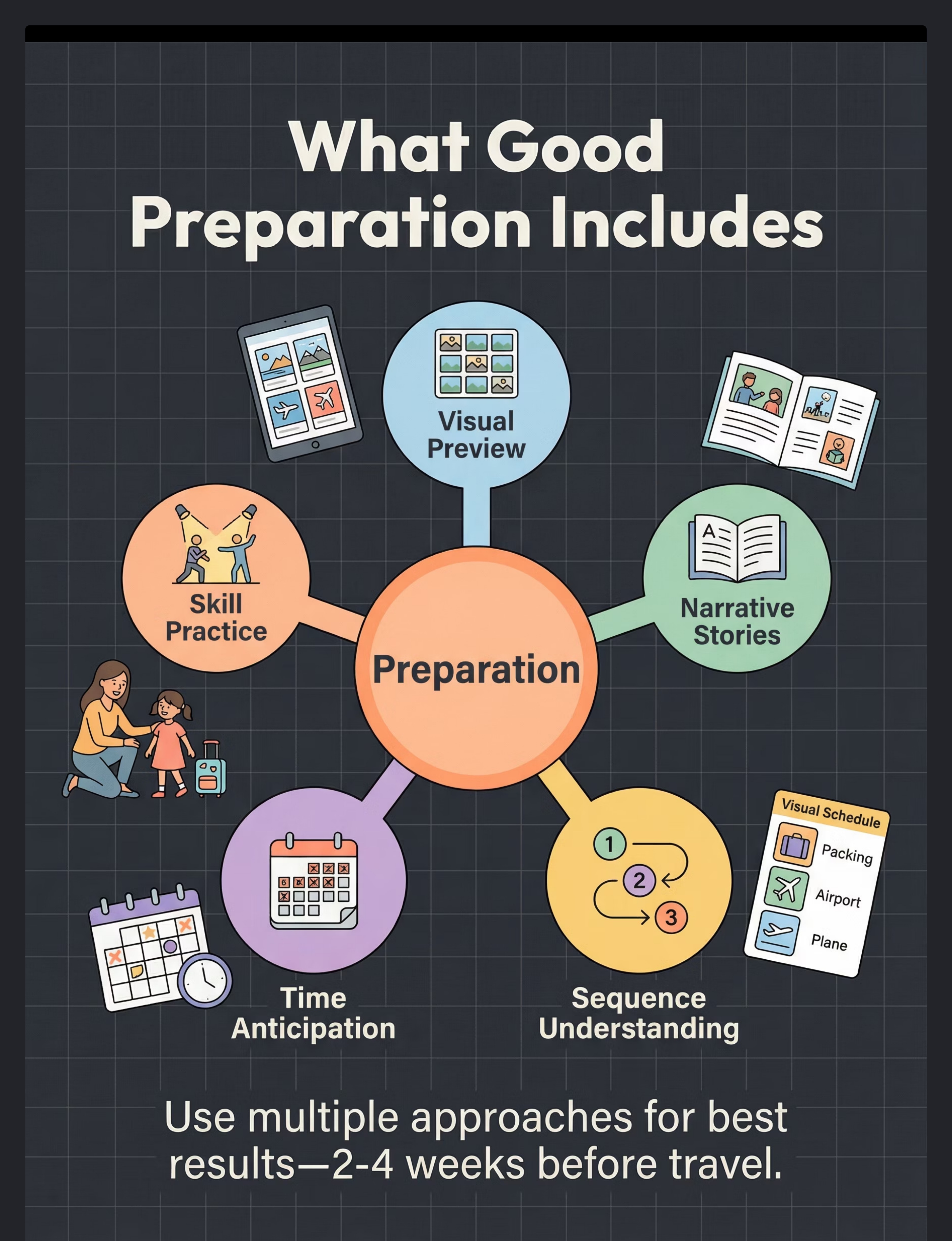
Preparation Elements Guide
Visual Preview
Photos, videos, virtual tours of destination. Shows exactly what places look like before arrival.
Narrative Preparation
Social stories about travel process. Explains what will happen in story format child can understand.
Sequence Understanding
Visual schedule of travel journey. Shows each step from leaving home to arriving at destination.
Time Understanding
Countdown to departure. Helps child understand when travel will happen and manage anticipation.
Skill Practice
Role-play of challenging moments. Practice airport security, staying seated, using new bathrooms.
Key Features: All preparation materials should provide accurate information in visual format with repeated exposure, being honest about both exciting and challenging aspects of the journey.
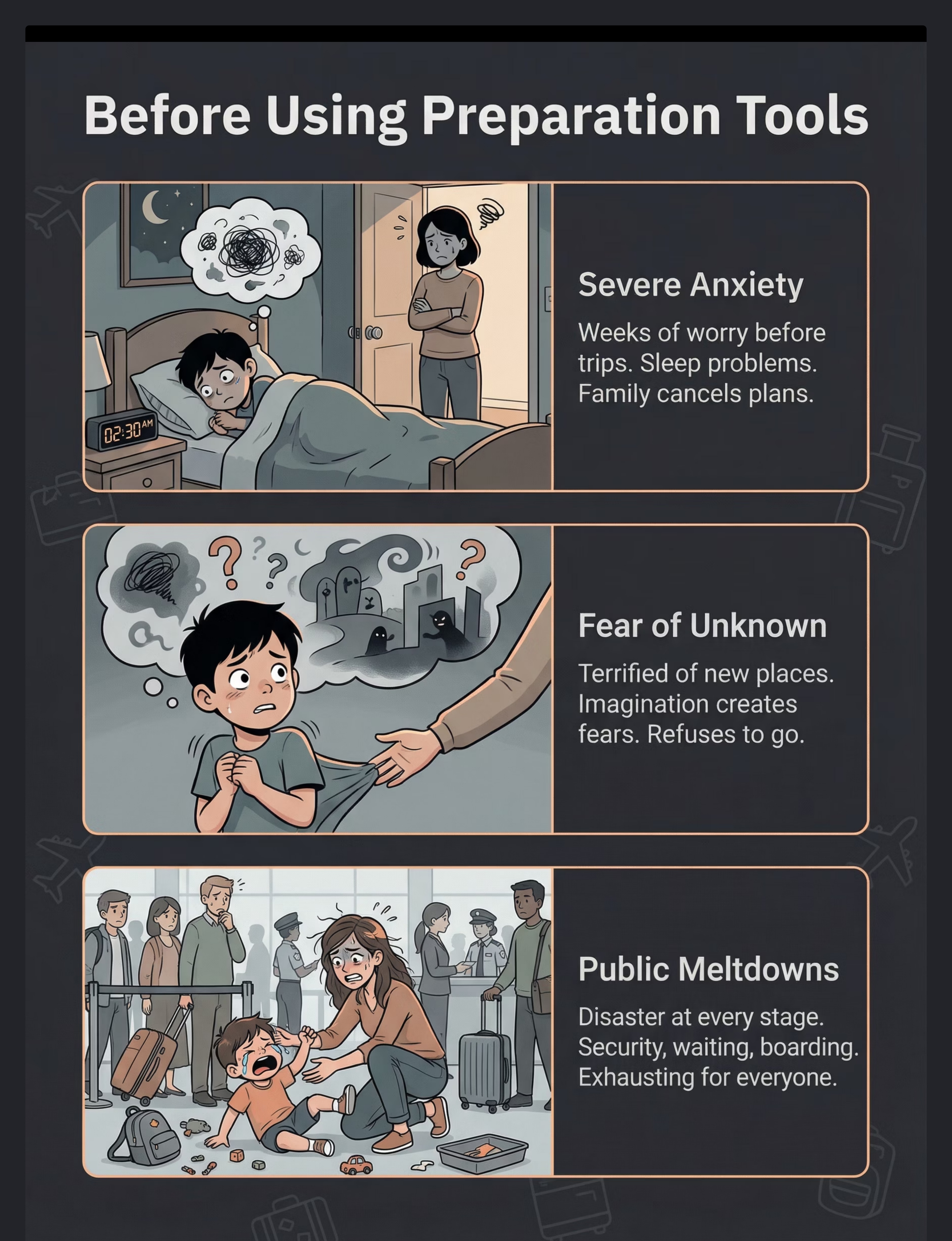
The Struggle (Before)
Severe Travel Anxiety
Situation: Weeks of anxiety before any trip. Child refusing to go. Sleep problems developing.
Experience: Family stressed and uncertain. Often end up canceling trips altogether.
Emotion: Anxious, avoiding, disappointed
Fear of Unknown Destination
Situation: Child terrified of new places. Can't picture where the family is going.
Experience: Imagination fills with fears and worst-case scenarios. Strong resistance to leaving familiar home environment.
Emotion: Terrified, resisting, overwhelmed
Airport/Travel Meltdowns
Situation: Every airport experience becomes a disaster. Security, waiting areas, boarding—challenges at each stage.
Experience: Public meltdowns and scenes. Entire family exhausted. Other travelers staring.
Emotion: Meltdowns, exhausting, embarrassing
travel-preparation-tools therapy material
The Breakthrough (After)
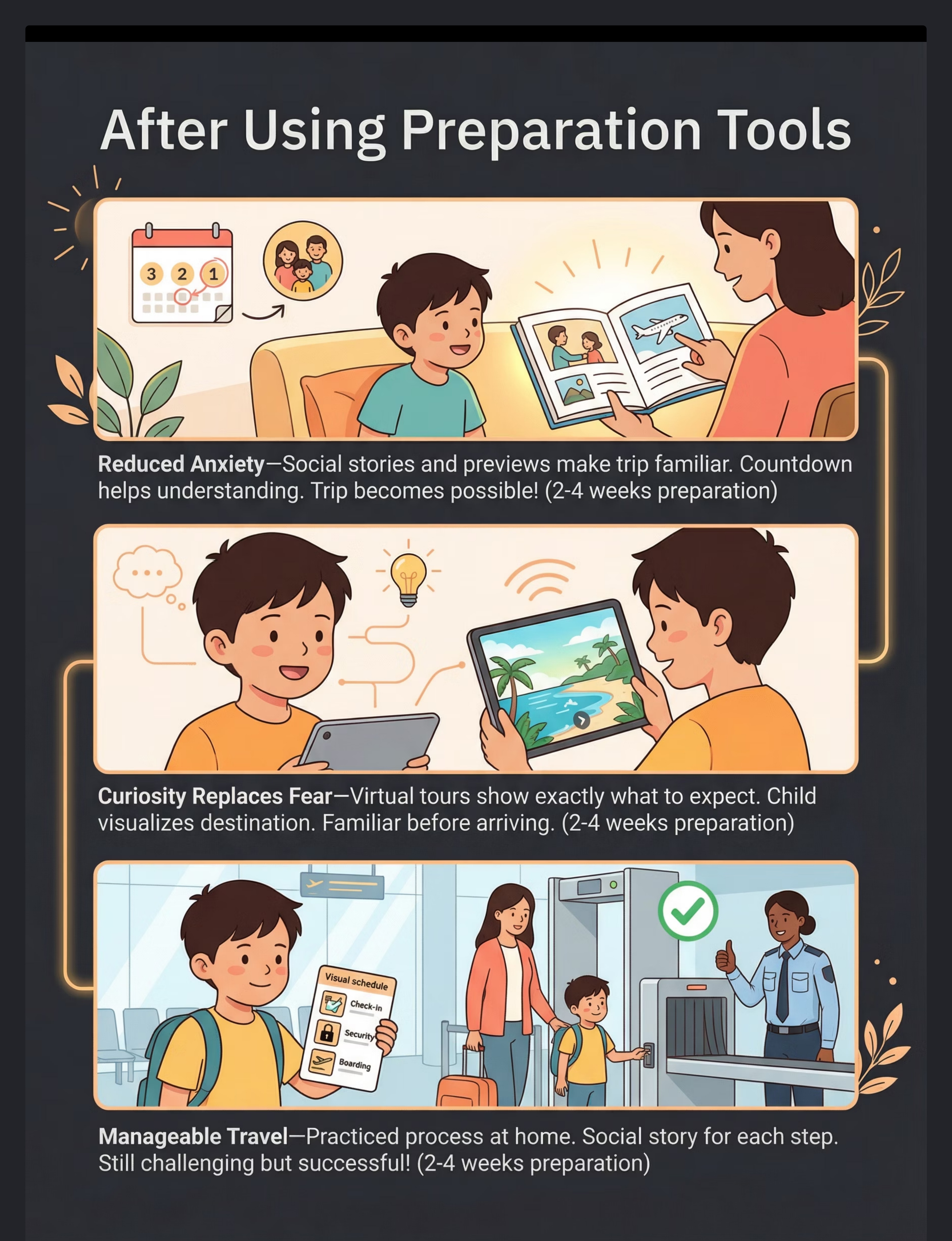
Reduced Travel Anxiety
Situation: Social stories and photo previews make the trip feel familiar before leaving home. A countdown calendar helps with time understanding. Experience: Anxiety is noticeably reduced, transforming the trip from an impossible dream to a possible reality. Emotion: Prepared, less anxious, hopeful.
Overcoming Fear of Unknown Destinations
Situation: Virtual tours, photos, and videos show exactly what to expect at the destination. Experience: The child can visualize where they are going, making places feel familiar even before arrival. Curiosity begins to replace fear. Emotion: Familiar, curious, excited.
Smooth Airport/Travel Experiences
Situation: The airport process is practiced at home through role-play, with social stories prepared for each step. Experience: The child knows what to expect, making the journey still challenging but manageable. The family experiences success! Emotion: Prepared, managing, proud.
What to Expect (Realistic Timelines)
Travel preparation is most effective when started well in advance. Here's what to expect at each stage of the process:
2-4 weeks before travel
Preparation materials gathered: social stories created, photos/videos collected, schedule made, countdown started
Daily for 1-2 weeks before
Regular preview sessions: 10-20 minutes daily reviewing materials, answering questions, building familiarity
1-2 weeks before
Practice completed: role-played challenging scenarios, practiced specific skills, built confidence
Leading up to trip
Reduced pre-travel anxiety: child more comfortable with idea of travel, fewer sleep problems, less resistance
During trip
More successful travel: smoother transitions, fewer meltdowns, more positive family experiences together
Is This Right for My Child? (2-Minute Check)
Does your child have anxiety about travel?
Does your child struggle with new or unknown places?
Have you had difficult travel experiences in the past?
Do you currently prepare your child visually for travel?
If you answered "yes" to these questions:
  • Does your child have anxiety about travel? This indicates: Thorough preparation is essential for reducing travel-related stress.
  • Does your child struggle with new or unknown places? This indicates: Visual previews will be very helpful for building familiarity.
  • Have you had difficult travel experiences in the past? This indicates: Better preparation strategies may help improve future trips.
  • Do you currently prepare your child visually for travel? This indicates: Good start—optimize your approach with these evidence-based strategies.
If you answered "no" to:
  • Do you currently prepare your child visually for travel? This indicates: Implementing preparation strategies could make a significant difference.
Interpretation: 3+ "yes" answers indicate this is a strong fit for your child. Even one "yes" suggests these tools could be helpful.
Common Questions (Honest Answers)
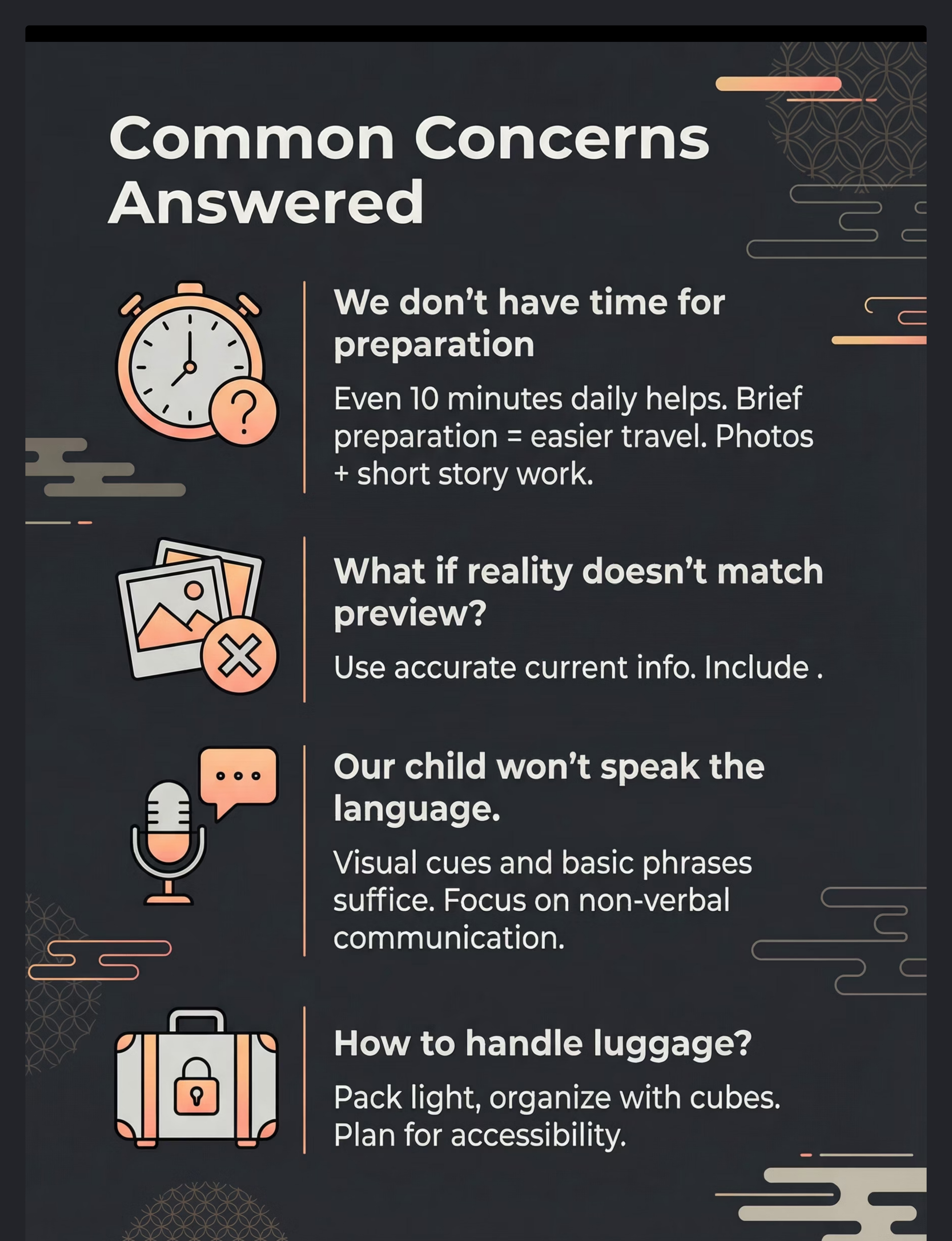
Q: We don't have time for all this preparation
Q: What if reality doesn't match the preview?
Q: They'll just get more anxious seeing it all
Q: We can't visit the destination beforehand
A: Even brief preparation helps significantly. Start with photos of destination and a short social story. Just 10 minutes daily is valuable. Research shows more preparation equals easier travel, but any preparation is better than none.
Try this: Even brief preparation helps; 10 minutes daily makes a difference
A: Use accurate, current information from reliable sources. Include "sometimes things change" concept in your social story to prepare for flexibility. Accuracy is important for building trust, so verify information before presenting it.
Try this: Use accurate info; prepare for possible changes as part of the story
A: For most children, the known is less scary than the unknown. Gradual exposure through preparation typically reduces anxiety. However, if you notice anxiety increasing, adjust your approach. Monitor your child's response and adapt accordingly.
Try this: Known usually less scary than unknown; adjust approach if needed
A: Virtual previewing is powerful and completely free! Use virtual tours, Google Street View, YouTube videos, and online photos. Contact hotels or destinations directly for photos. Technology makes destination familiarization accessible to everyone.
Try this: Virtual tours, online photos, YouTube videos—all free and effective
Usage Guide
When to Use
  • 2-4 weeks before any planned travel
  • Daily review sessions leading up to trip
  • During travel (bring materials for support)
  • After travel (review experience, take photos for future trips)
When NOT to Use
  • If causing more anxiety (adjust approach instead)
  • Too far in advance—more than 4 weeks may increase anxiety rather than reduce it
Supervision by Age
Age Range
Supervision Level
Notes
Young children (2-4)
Adult-led preparation
Parent guides all activities
Developing skills (5-8)
Collaborative preparation
Child participates actively
Older children (9+)
Independent with support
Child can review materials independently
Duration: 10-20 minutes daily during the 2-4 week preparation period
Settings: Home (before travel) for preparation; During travel (bring schedule and story for reference)
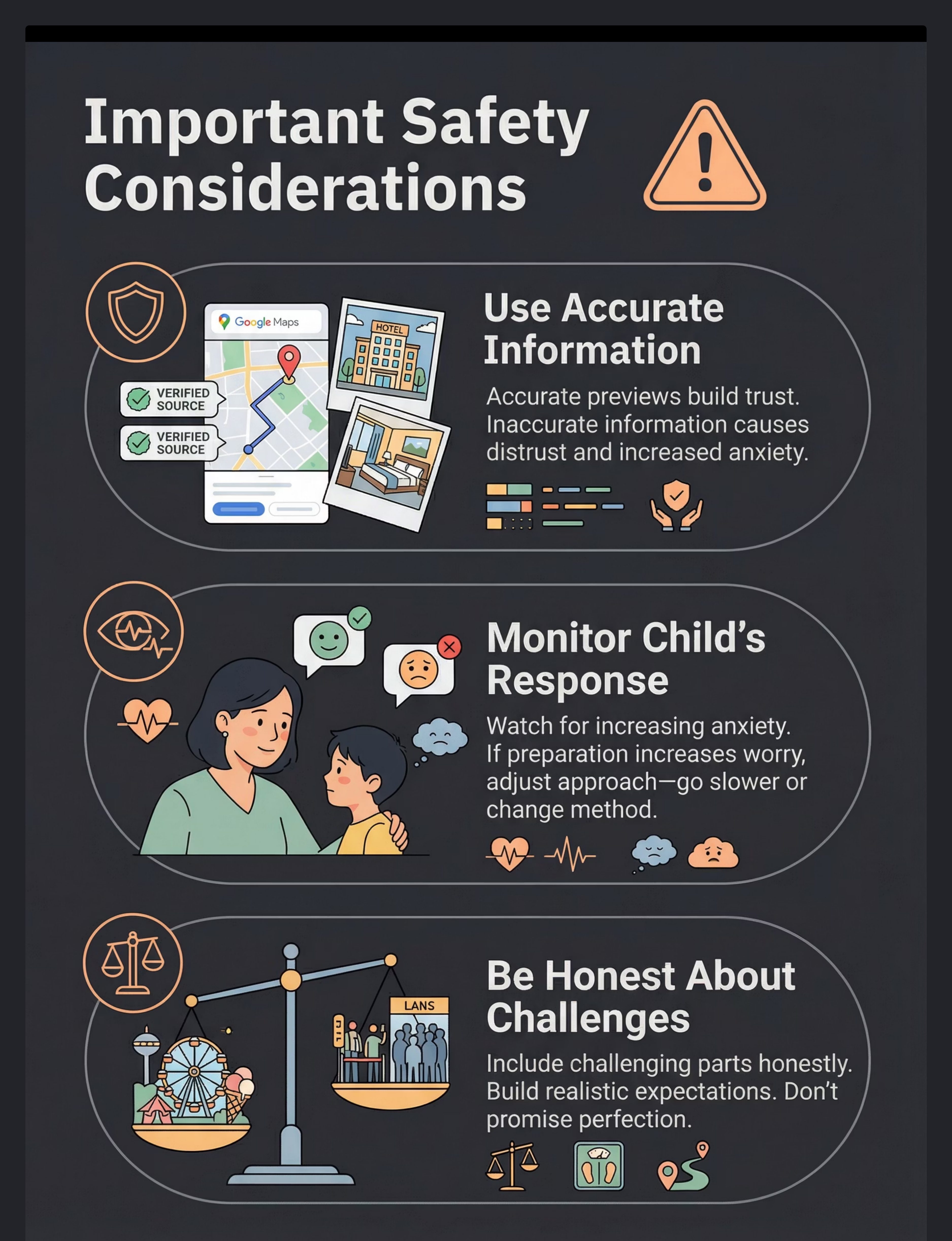
Safety First
Critical Safety Points
  • Ensure all information about destination is accurate and current
  • Be honest about challenging aspects—build trust through truthfulness
  • Monitor child for increasing anxiety during preparation
  • Adjust approach as needed based on child's response
Important Warnings
  • Don't start preparation too far in advance—may increase anxiety
  • Don't overwhelm with too much information at once
  • Watch for avoidance behaviors increasing rather than decreasing
Contraindicated
  • Inaccurate previews that create false expectations—causes distrust and increased anxiety
Before Use Checklist
  • Information gathered is accurate
  • Materials appropriate for child's level
  • Timeline for preparation set
  • Child's specific concerns identified
During Use Checklist
  • Regular review happening daily
  • Anxiety being managed appropriately
  • Questions being answered
  • Practice activities being done
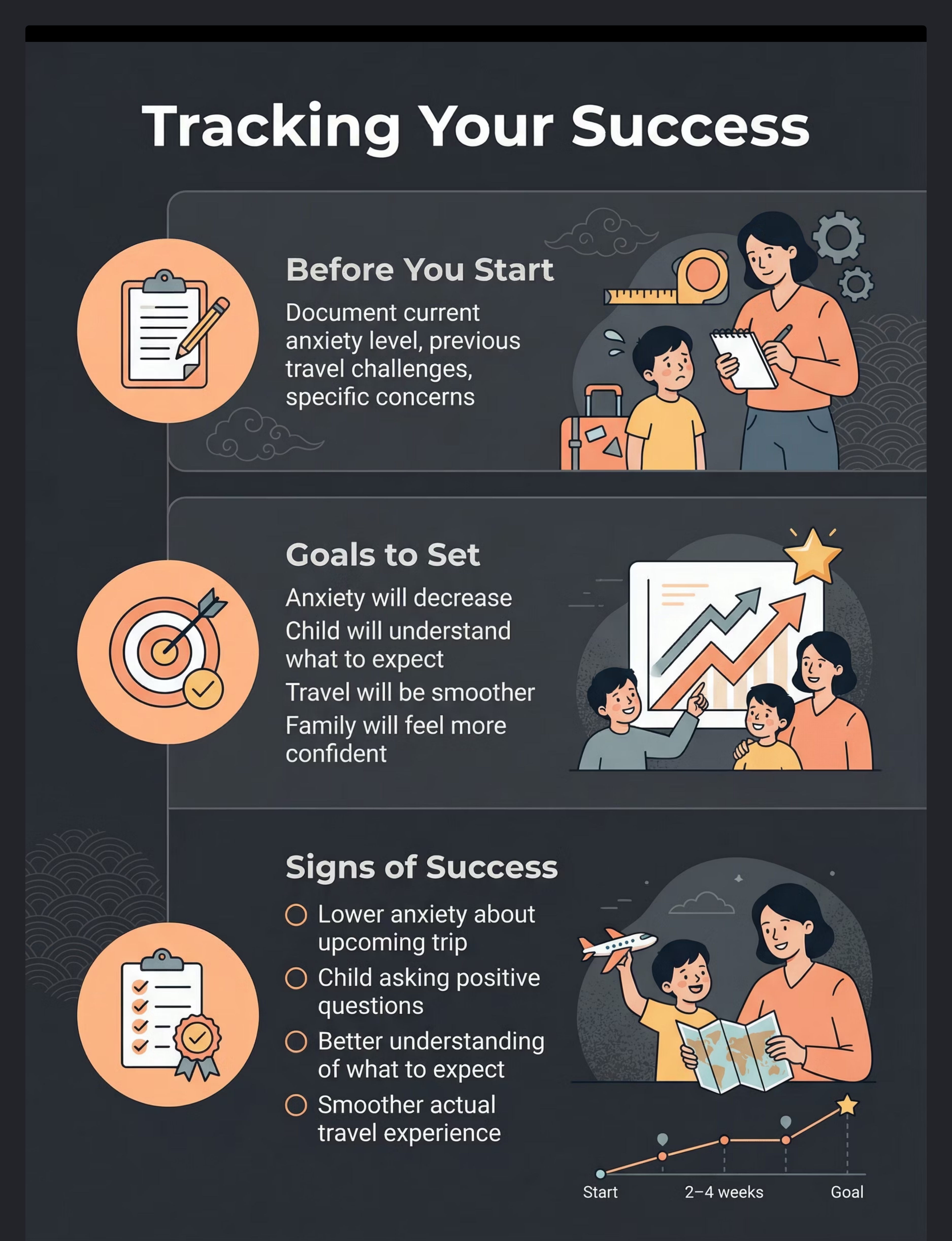
Signs of Success
  • Reduced anxiety levels
  • Child asking questions positively
  • Looking forward to trip aspects
  • Successful travel experience
Investment Guide
When planning for travel preparation resources, consider both free and paid options. The most effective approach often involves personalizing materials to your child's specific needs, which can be achieved through various investment levels.
Budget Option
₹0
DIY Social Stories + Online Photos/Videos
Create personalized social stories using free online templates. Gather destination photos from Google Images and Street View. Find travel process videos on YouTube. Completely free and highly effective, with high personalization.
Premium Option
₹300-500
Commercial Travel Social Story Books + Visual Calendar
Professional travel social stories covering common travel scenarios. Visual countdown calendar with engaging design. Brands: Various autism resource publishers.
Overall Price Range: ₹0–500 (Free to Very Low investment)
Key Investment Considerations
Prioritize Personalization
The DIY approach allows for unique content tailored to your child's specific trip and anxiety triggers, often proving more valuable than generic commercial materials.
Cost-Effectiveness
You can achieve highly effective preparation without spending any money by utilizing free online resources and your own creativity.
Flexibility & Iteration
DIY methods offer greater flexibility to adapt and update materials as your child's needs evolve or as trip details change.
Investment Progression Timeline
Phase 1: Research & Discovery
Begin by exploring free resources and identifying your child's core needs. This initial investment of time helps define your strategy.
Phase 2: Initial Resource Creation
Develop your first set of personalized materials, leveraging DIY options. This phase requires an investment of effort and creativity.
Phase 3: Testing & Adaptation
Implement and refine your chosen resources. This involves observing your child's response and making iterative improvements, potentially leading to small supplementary purchases if needed.
Phase 4: Ongoing Optimization
Continuously adjust and enhance your preparation toolkit based on travel experiences. This long-term investment ensures sustained effectiveness and reduced anxiety over time.
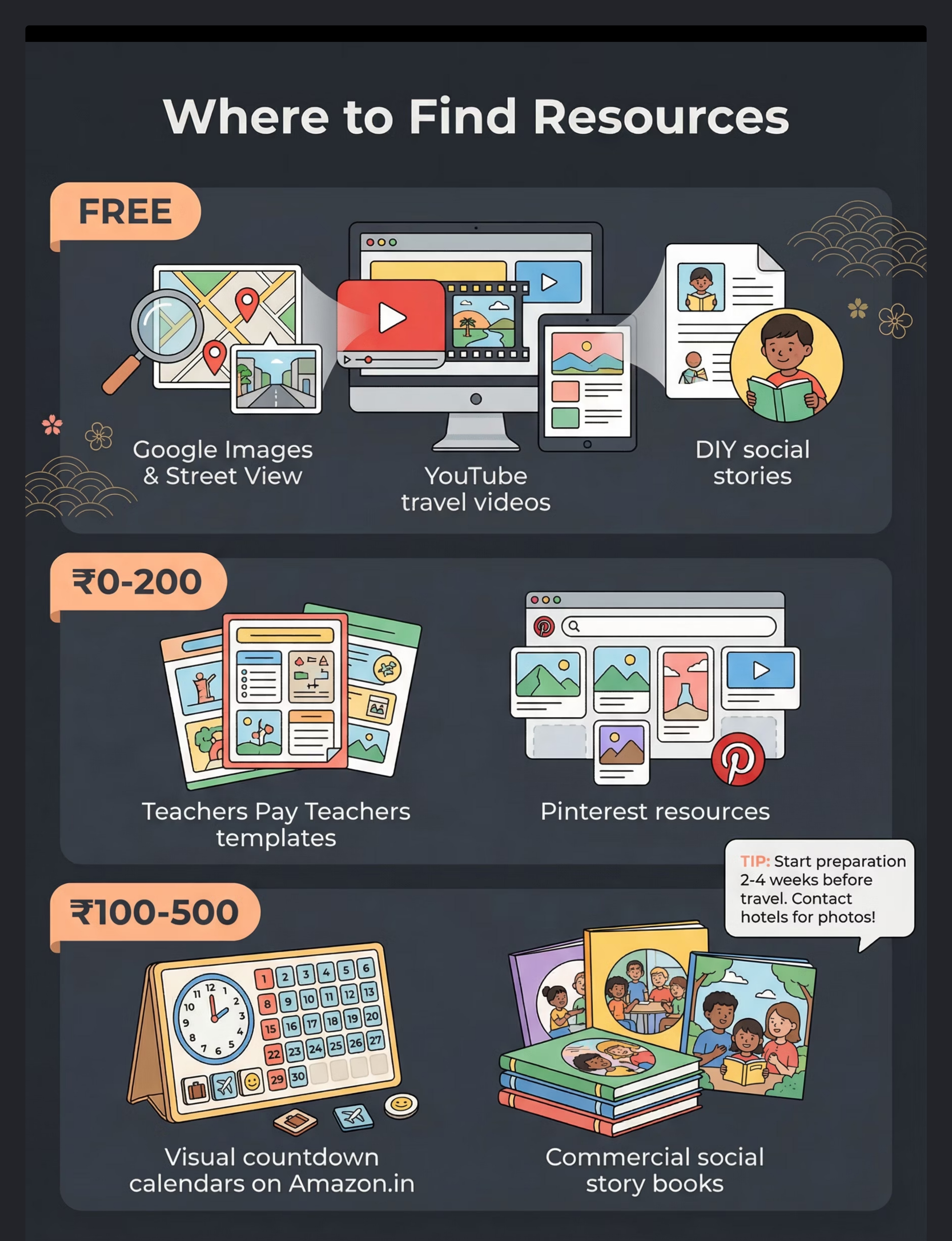
Where to Buy in India
Availability: DIY/Free Resources—most effective option for travel preparation
Google Images / Street View
Search: Your destination name, specific locations
Price: Free
Explore destinations virtually before visiting
YouTube
Search: "airport walkthrough" or "[destination] tour"
Price: Free
Video previews of travel processes and destinations
DIY Creation
Search: Create your own social story
Price: Free
Personalized materials for your specific trip
TPT / Pinterest
Search: "travel social story template"
Price: Free-₹200
Downloadable templates to customize
Amazon.in
Search: "visual countdown calendar"
Price: ₹100-400
Physical calendars if preferred over DIY

Buying Tips
  • Start preparation 2-4 weeks before travel for optimal results
  • Use Google Maps and Street View for detailed destination previews
  • YouTube has excellent airport walkthroughs and travel process videos
  • Take photos during your trip to use for preparing for future travels
  • Contact hotels or destinations directly—many will send photos upon request

Red Flags to Avoid
  • Inaccurate or outdated information that doesn't match current reality
  • Starting preparation too late—less than one week before travel
  • Not addressing your child's specific concerns and fears
  • Overwhelming your child with too much information at once
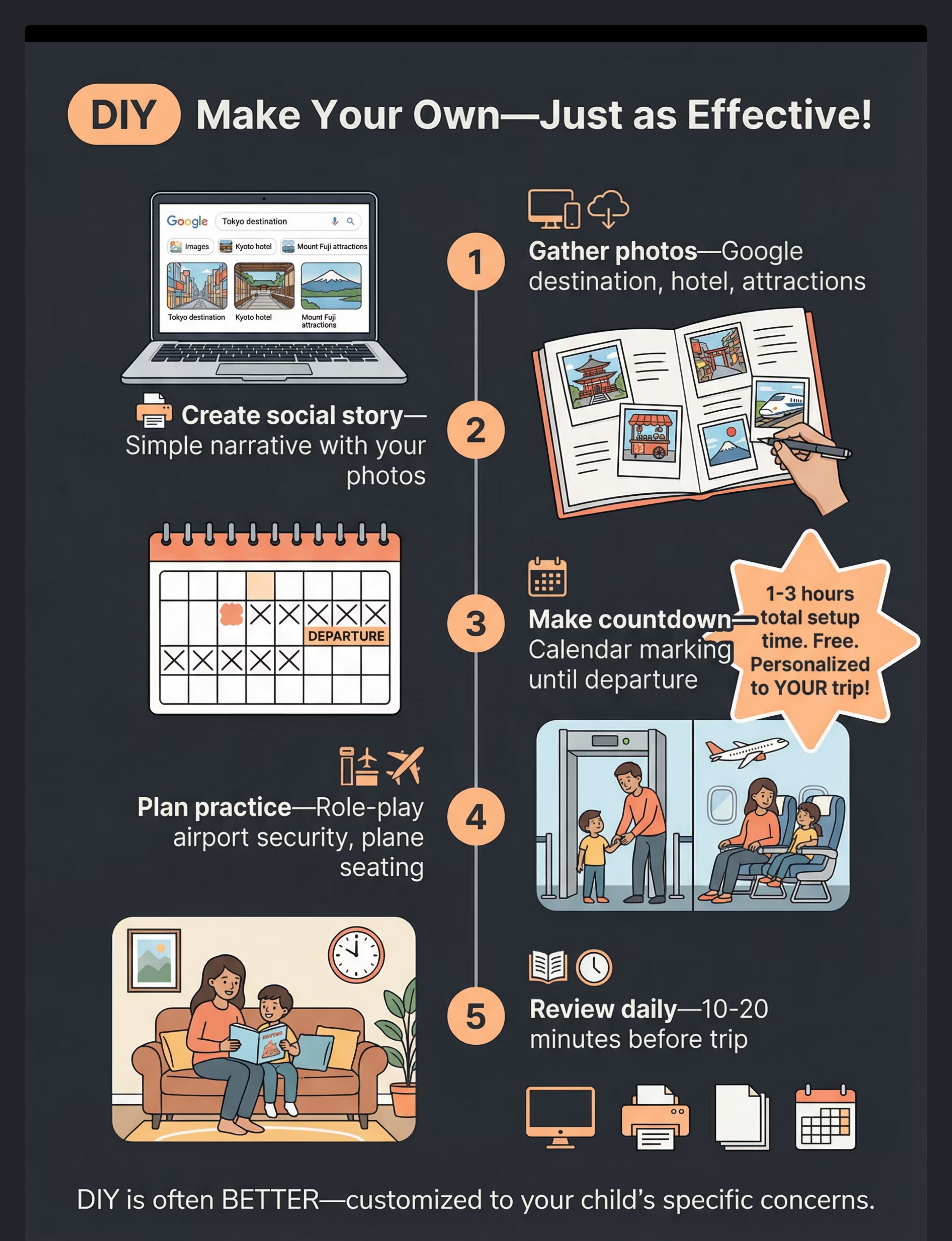
DIY Alternative (Save 100%)
Feasibility: Very High | Time Required: 1-3 hours initial setup | Cost Savings: 100% (completely free)
Materials Needed
  • Computer or smartphone with internet access
  • Printer (optional—can use digital versions)
  • Paper for printing if desired
  • Calendar (printable or hand-drawn)
Step-by-Step Instructions
1
Gather Photos
Use Google to search for images of your destination, hotel, attractions you'll visit. Save photos that show what places actually look like.
2
Create Social Story
Write a simple story with the photos you gathered, explaining the trip in language your child understands. Include what will happen, where you'll go, what you'll do.
3
Make Travel Schedule
Create a visual sequence showing the journey: leaving home → car/taxi → airport → plane → arrival → hotel. Use pictures for each step.
4
Set Up Countdown
Make or print a calendar marking the days until departure. Your child can cross off each day as it passes.
5
Plan Practice
Role-play challenging moments: going through airport security, sitting in airplane seat, using hotel bathroom, eating at restaurants.
6
Review Daily
Go through all materials regularly before the trip, answering questions and building familiarity. 10-20 minutes daily is ideal.
DIY vs Commercial Comparison
When to DIY
  • Almost always—DIY is ideal for travel preparation
  • When you want materials personalized to your specific trip
  • When your child's specific concerns need to be addressed
When to Buy Commercial
  • For general travel social stories covering basic concepts
  • If time is very limited and you need ready-made materials
Trade-offs: DIY is just as effective as commercial options—in fact, personalization often makes it more effective. No significant trade-offs; DIY is the recommended approach.

Preview of travel preparation tools Therapy Material

Below is a visual preview of travel preparation tools therapy material. The pages shown help educators, therapists, and caregivers understand the structure and content of the resource before use. Materials should be used under appropriate professional guidance.

Page 1
Page 2
Page 3
Page 4
Page 5
Page 6
Page 7
Page 8
Page 9
Page 10
Page 11
Page 12
Page 13
Page 14
Page 15
Page 16
Page 17
Page 18
Page 19
Page 20
Travel Transitions

Category 17: Travel & Transitions

5 MATERIALS

Portable supports for managing transitions, travel, community outings, and new environments. These materials provide comfort, predictability, and sensory support during changes in routine, helping children navigate challenging transitions with greater ease and independence.

Key Materials

  • Transition supports and warnings
  • Travel comfort and sensory kits
  • Car and vehicle supports
  • Waiting and queue supports
  • Travel preparation tools

Target Areas

  • Transition management
  • Travel comfort
  • Community participation
  • Flexibility
  • Predictability
Travel Preparation ToolsNarrative preparation tools supporting anticipatory anxiety reduction, procedural familiarity, and social story-based readiness for community and medical appointments.
Dentist Visit Story Board Book
Travel Prep
Link copied!
Your Next Step (Start Today)
Empower your child for seamless travels. Taking the first step in preparation can transform their travel experience from anxious to exciting. Start building confidence today!
Your 3-Step Action Plan
01
Choose Your Approach
Decide whether to embrace the personalized, free DIY method or explore commercial resources for specific needs.
02
Gather Materials This Week
Utilize online tools like Google and YouTube to collect photos and videos relevant to your upcoming journey.
03
Begin Daily Reviews
Dedicate 10-20 minutes each day to review materials, discuss, and role-play to build familiarity and ease.
Quick Start Checklist
  • Identify your child's main travel worries.
  • Find 5-10 key photos of your destination.
  • Watch a YouTube video of a travel process (e.g., airport check-in).
  • Create a simple visual countdown for your trip.
  • Schedule your first daily review session.
Preparation is key to unlocking joyful family adventures. Every step you take makes a difference, creating lasting positive memories. Remember, your family's journey is unique!