Tool ID: 7.4
OT + SpEd
Strong Evidence
Rank #1
Daily Use
₹50–1,000
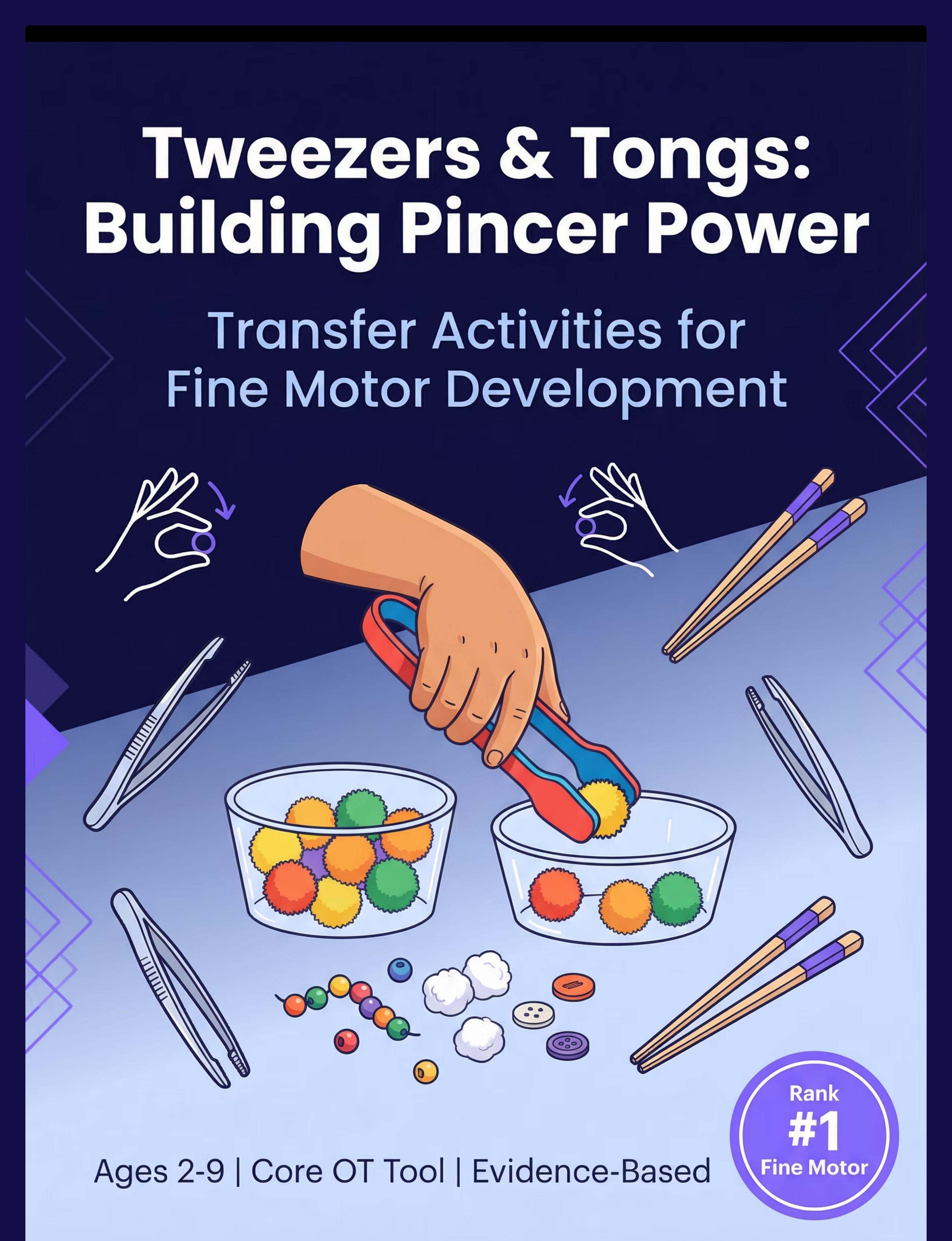
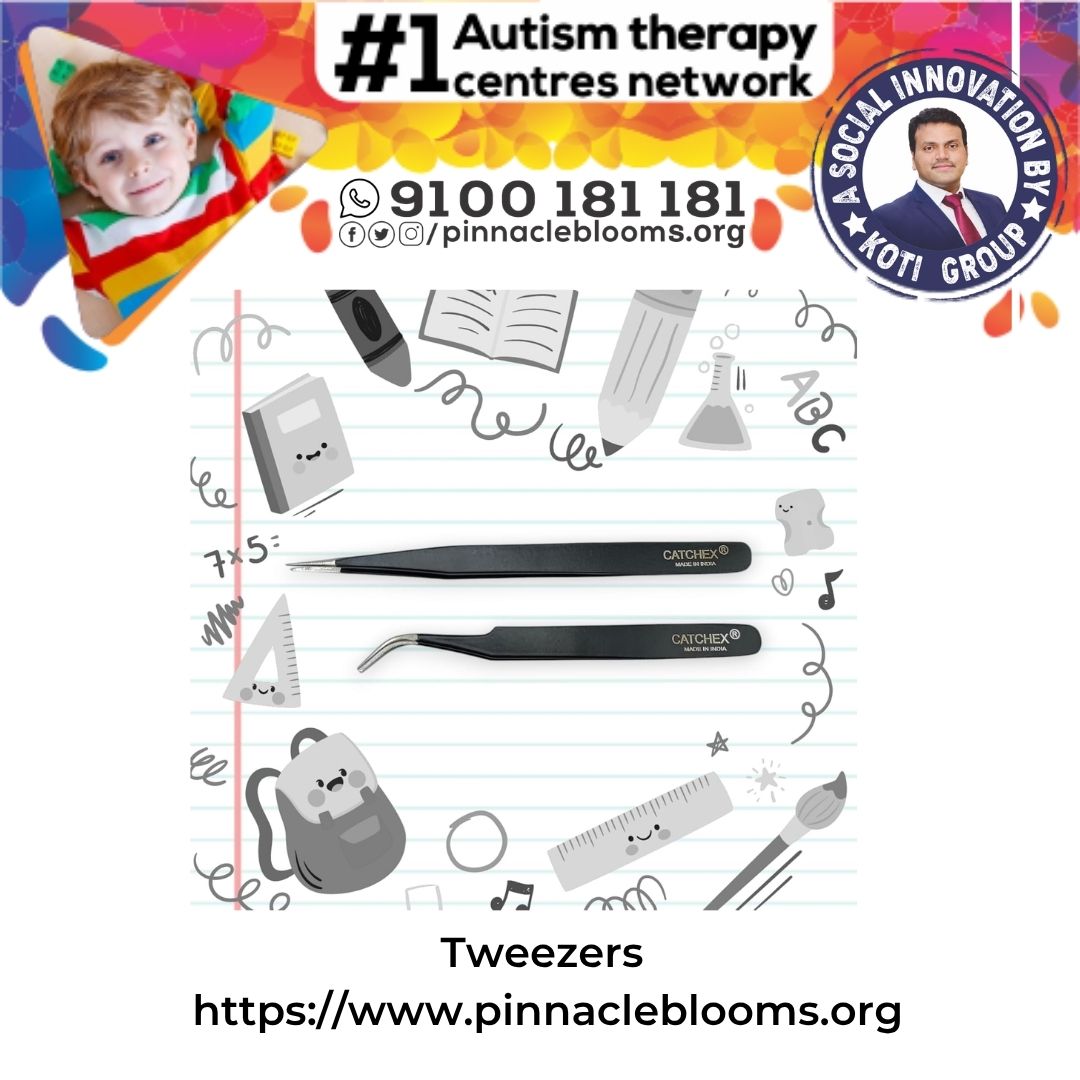
Tweezers / Tongs / Transfer Activities
Precision grasp and controlled release manipulation system
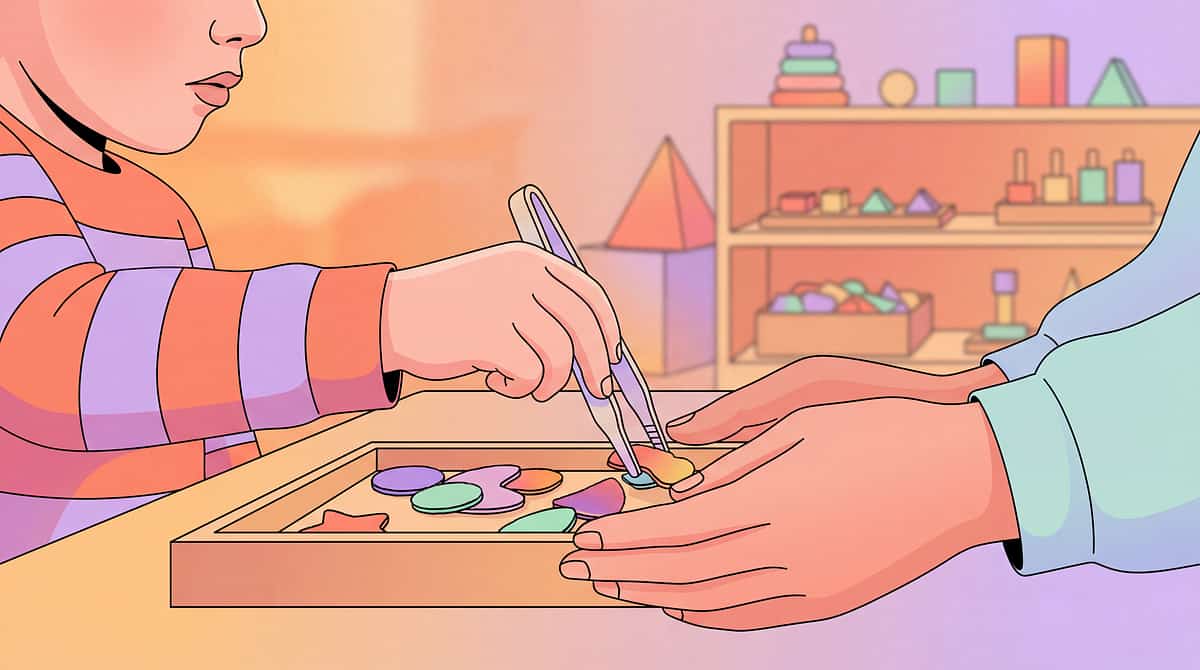
Transform weak pincer grasp into confident tool use through engaging transfer activities. These simple, research-backed tools develop the exact hand skills needed for writing, self-care, and daily independence.

Who This Helps
These tools develop pincer grasp, graded motor control, and tool use through transfer and manipulation activities—building foundational skills for writing, self-care, and countless daily tasks.
Pincer Grasp
Graded Motor Control
Eye-Hand Coordination
Tool Use
Controlled Release
Hand Strength
Ages 2-9 years
Home
Clinic
School
Weak Pincer Grasp
Perfect for children who struggle to pick up small objects with thumb and fingers
Tool Use Challenges
Builds the foundation for using forks, spoons, and craft tools independently
Pre-Writing Skills
Strengthens the same muscles needed for proper pencil grip and writing control

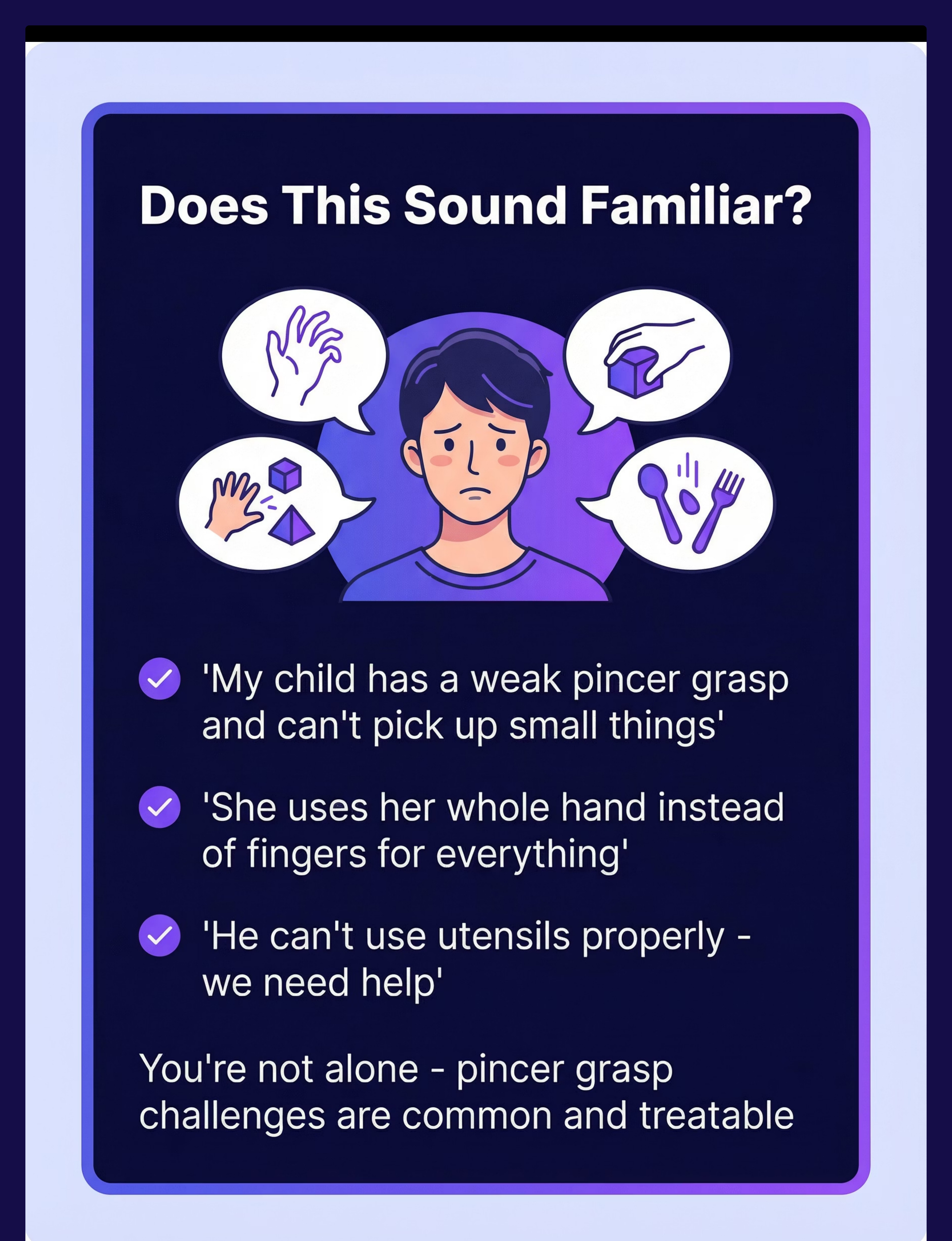
Does This Sound Familiar?
"My child has a weak pincer grasp and can't pick up small things properly."
"She uses her whole hand instead of just her fingers for everything."
"He can't use utensils properly and it's affecting mealtimes."
"Her grip is so weak—she avoids activities that require precision."
You're not alone. These are common challenges for children developing fine motor skills. The good news? Transfer activities with tweezers and tongs can help—and they're surprisingly simple to implement.

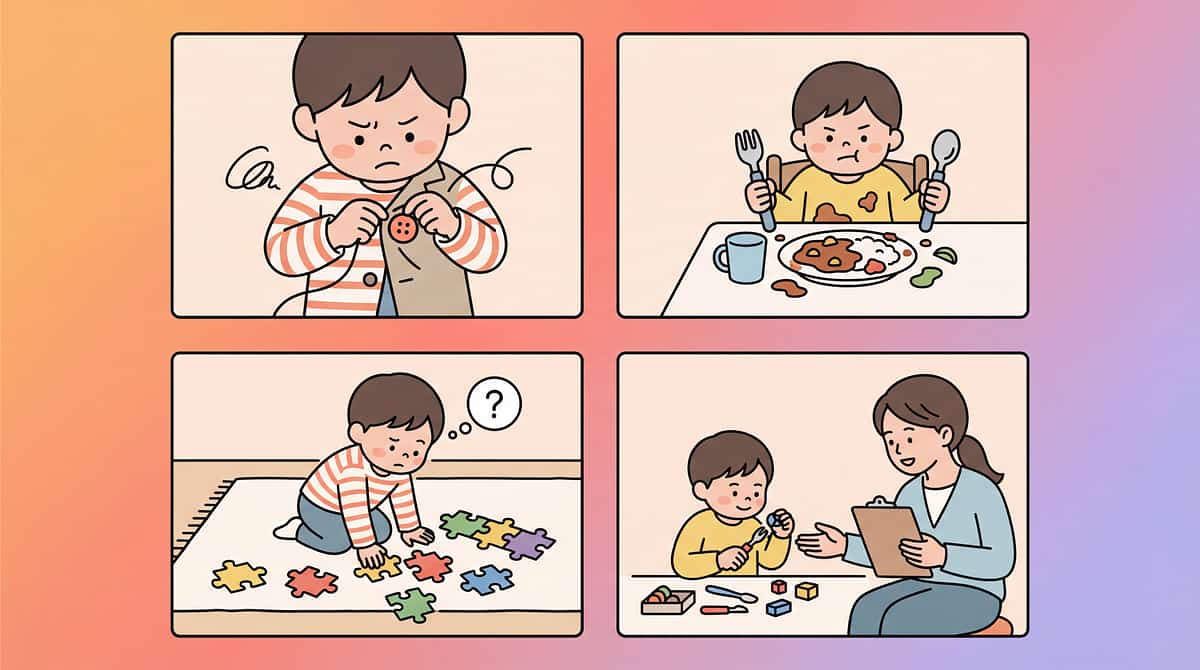
A Day Without the Right Support
Morning Self-Care
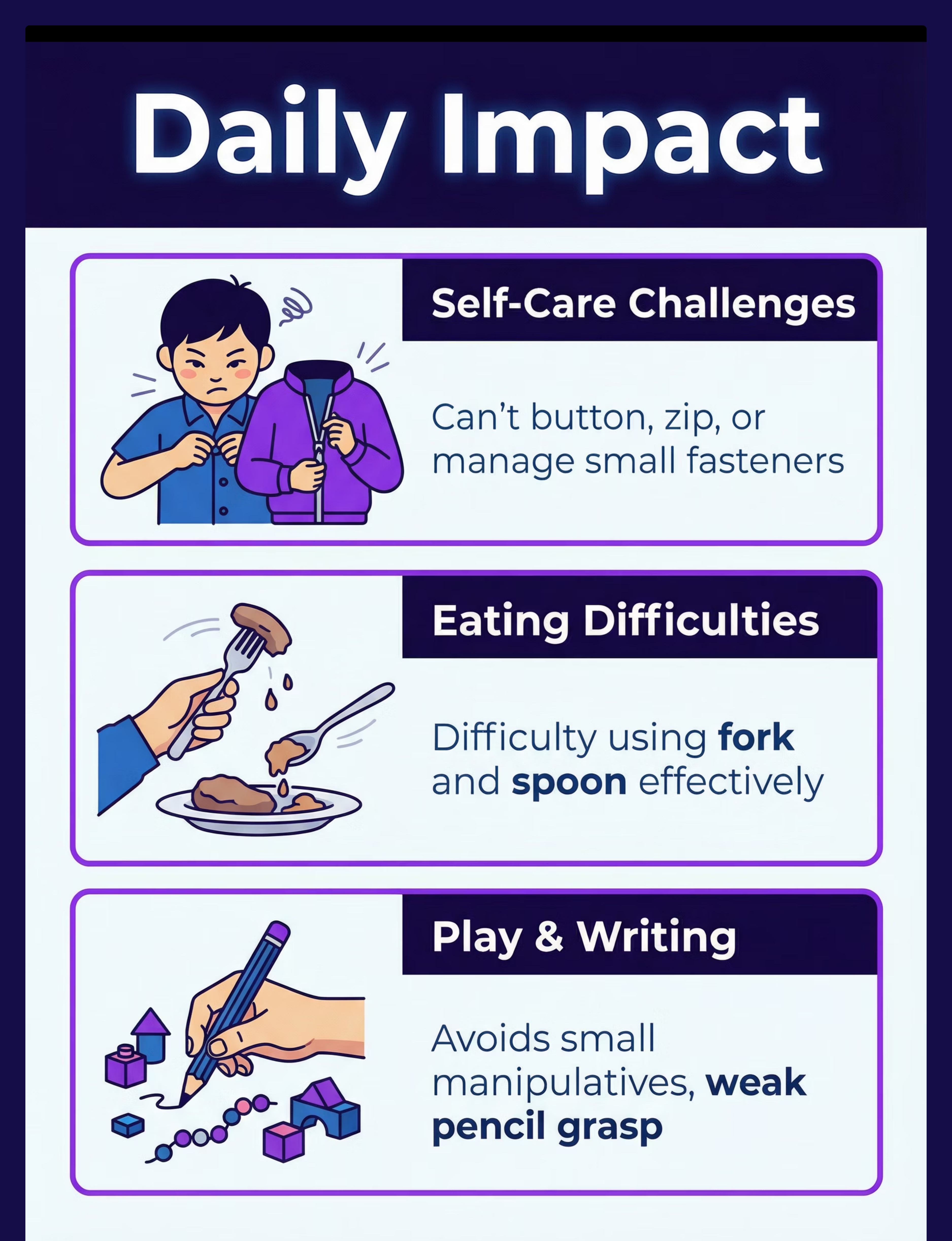
Can't button shirts, struggles with zippers, managing small fasteners feels impossible. Every morning starts with frustration and dependence on help.
Mealtime Struggles
Difficulty with utensils leads to spills and mess. Eating becomes stressful instead of enjoyable.
Play & Learning Time
Avoids small manipulatives, puzzles, and craft activities. Weak pencil grasp makes drawing and pre-writing tasks difficult.
Therapy Sessions
OT says pincer grasp is too weak for good pencil control. Needs strengthening before writing skills can improve.

The Science Behind It
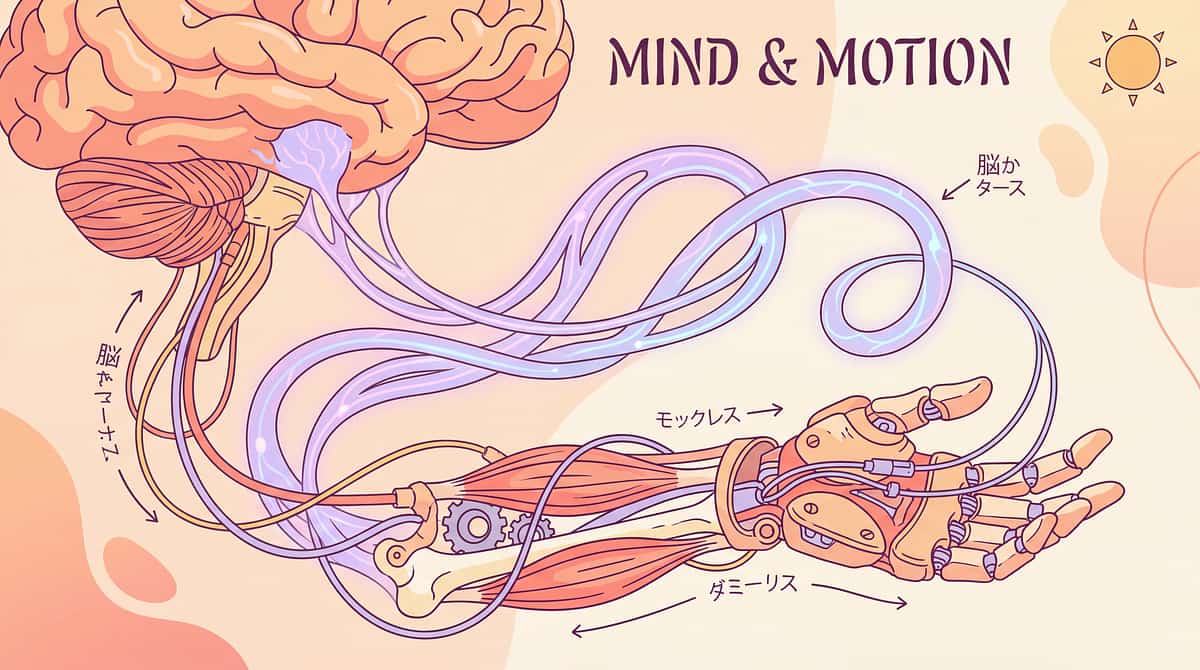
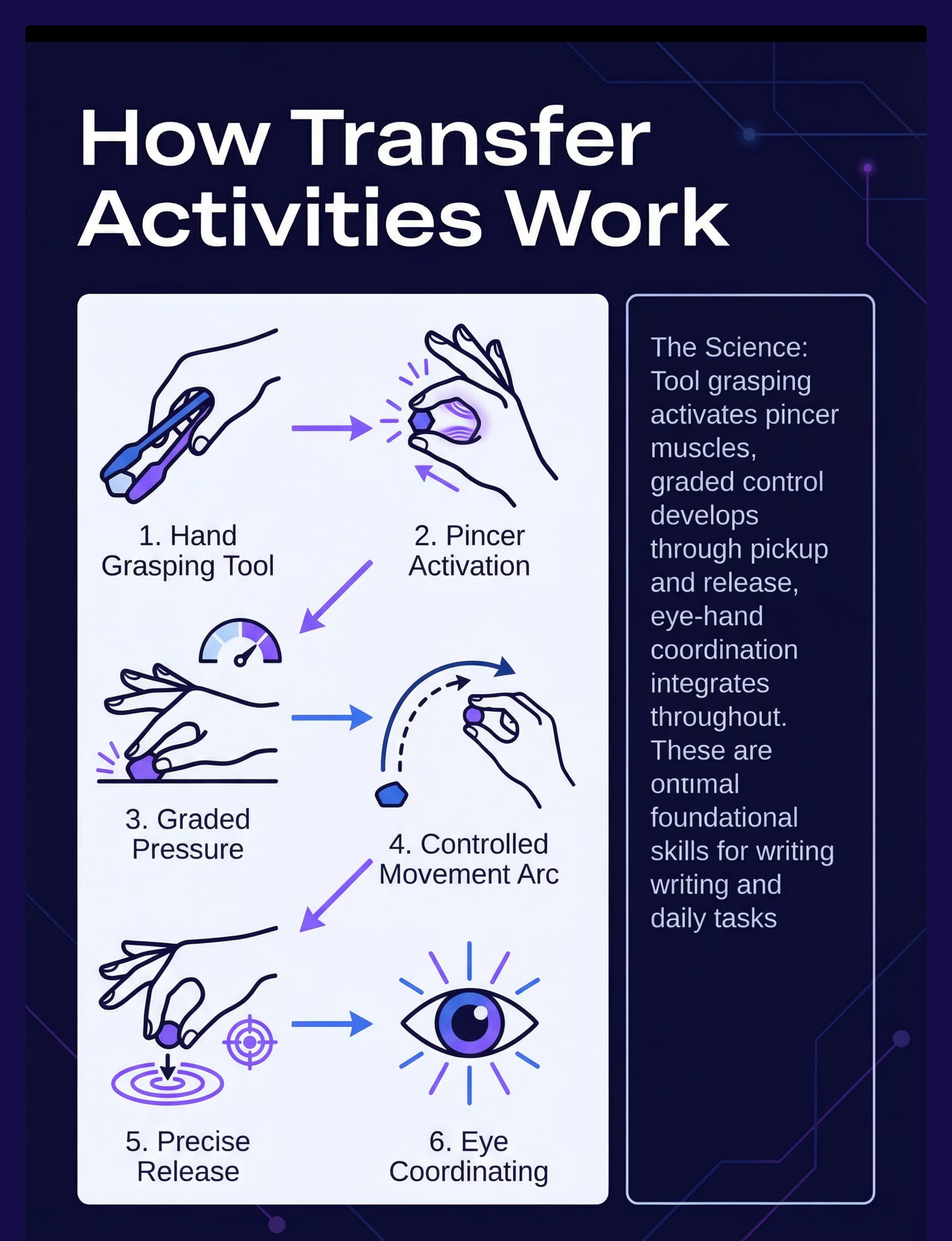
Transfer activities build fine motor skills through a carefully orchestrated sequence of movements that strengthen the exact muscles and coordination needed for daily tasks.
Visual Targeting
Child focuses eyes to locate and size up the object for grasping.
Motor Planning
Brain plans and sends signals for the optimal hand and finger movements.
Grip Adjustment
Fingers and thumb activate to grasp the tool, adjusting pressure for the object.
Controlled Release
Tool is moved steadily, then precisely opened to release the object.
Skill Refinement
Repeated actions strengthen neural pathways, leading to improved daily skills.
Throughout this entire sequence, eye-hand coordination is constantly at work—building the neural pathways needed for countless daily activities.
Targets: Pincer Grasp
Graded Motor Control
Eye-Hand Coordination
Tool Use

How to Use It Right
Start Large, Progress Small
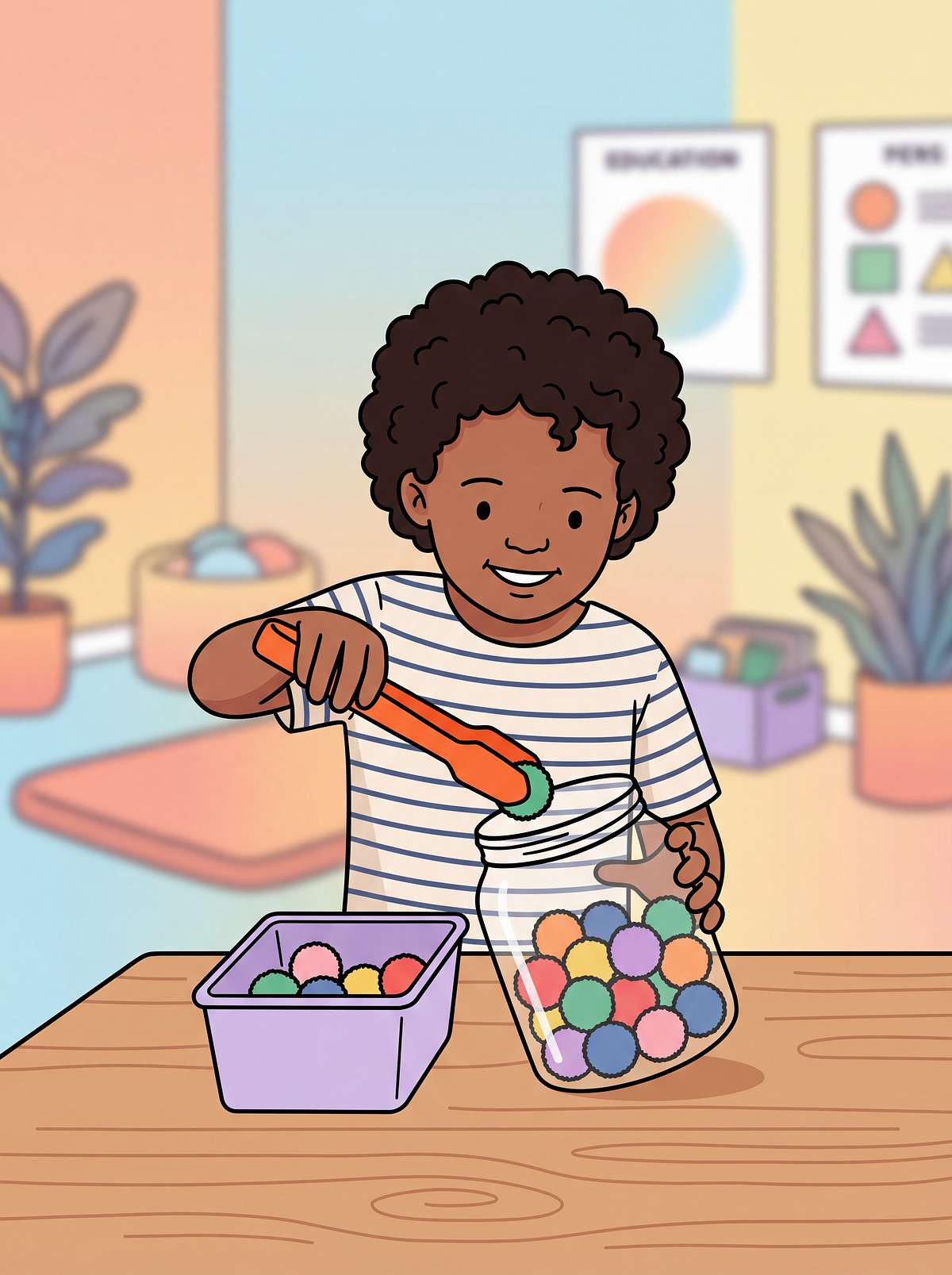
Begin with jumbo tongs and large objects like pom poms. As skills develop, gradually introduce smaller tweezers and tinier items.
Vary Your Materials
Use diverse transfer objects—pom poms, beads, dried beans, water beads—to maintain interest and challenge different aspects of control.
Container-to-Container Transfer
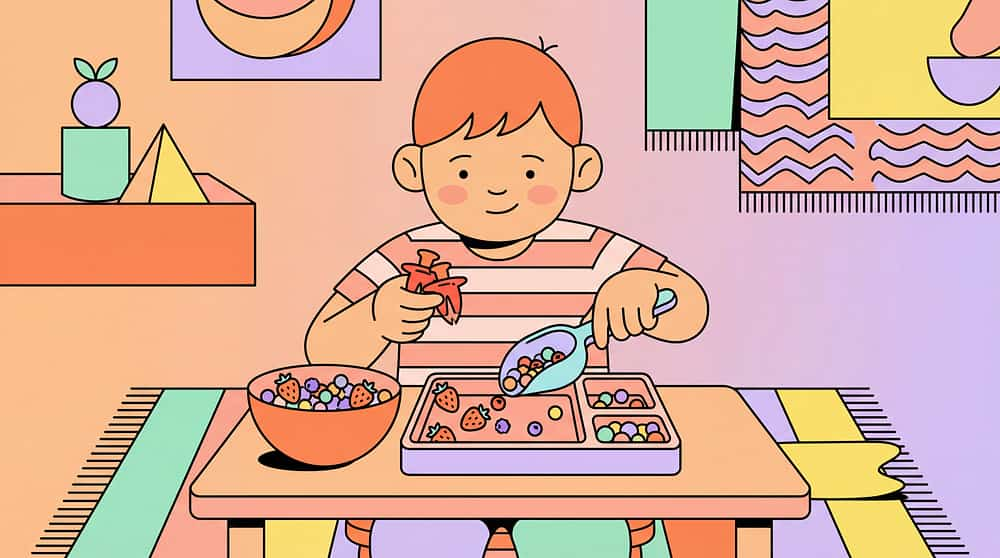
Set up purposeful activities where children move objects between bowls, ice cube trays, or themed containers.
Add Cognitive Challenge
Incorporate sorting by color, size, or type to engage both motor and cognitive skills simultaneously.
Make It Purposeful
Create real-world contexts—setting the table, organizing craft supplies, or feeding a toy animal—to increase motivation.
Celebrate Effort Over Perfection
Dropped objects are part of learning. Focus on tries and progress, not just successful transfers.
Duration: Sessions of 10-20 minutes work best, following the child's interest and engagement level. Daily practice yields the best results.

Expert Perspective
"Transfer activities with tweezers and tongs are Montessori gold and OT staples. They develop the exact pincer grasp and graded control needed for pencil use, buttoning, and countless daily tasks. Simple, affordable, effective."— Occupational Therapist, Montessori-trained
OT + SpEd Recommended
Co-endorsed by occupational therapy and special education professionals
Strong Evidence
Research-backed approach with proven outcomes
Rank #1 in Category
Top-rated tool in Fine Motor & Hand Skills

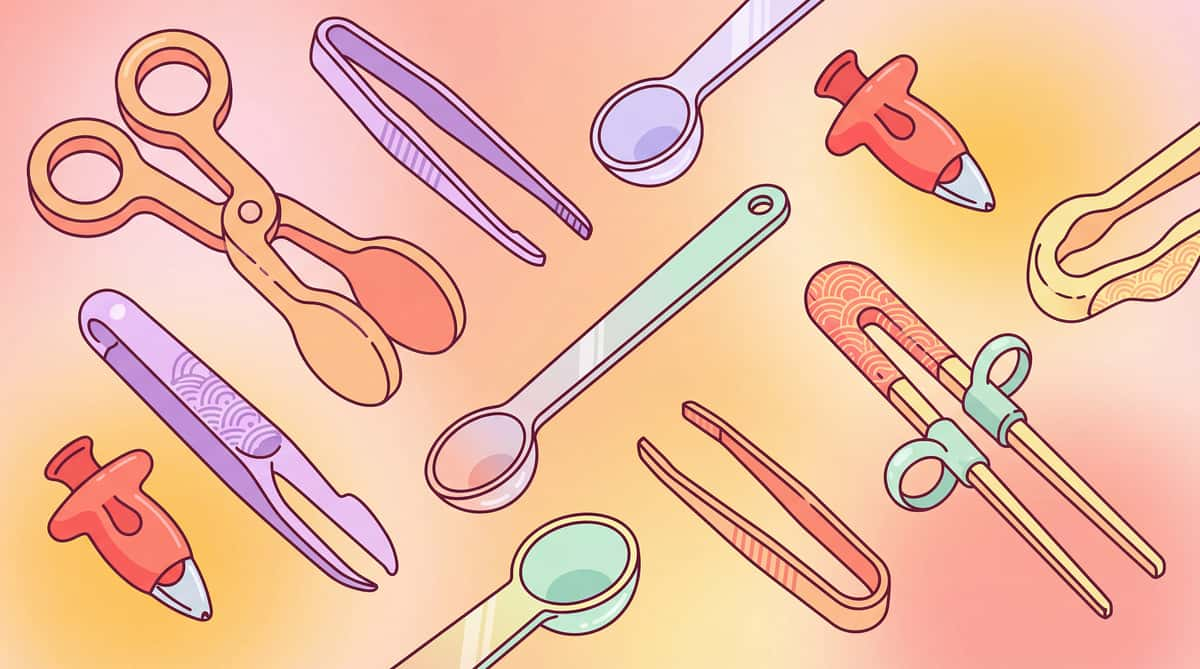
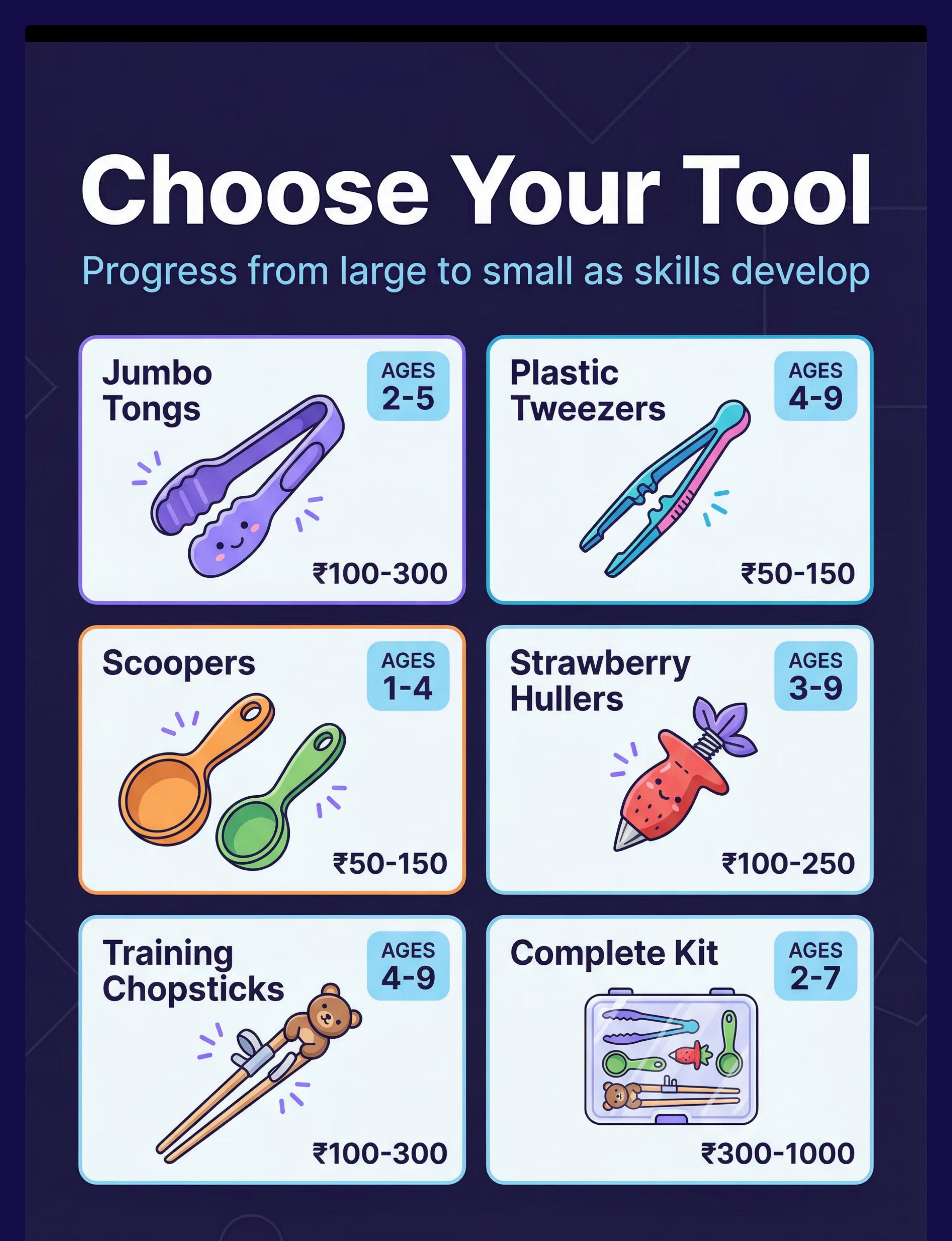
Choose Your Option (6 Variants)
Every child's needs are unique. Choose the tool that matches your child's current skill level and gradually progress to more challenging options.
Scoopers/Shovels
Ages 1-4. Best for youngest children and sensory bin activities, introducing tool-based transfer.
Jumbo Easy-Grip Tongs
Ages 2-5. Ideal for young children and those with weaker hands, an introduction to grasping tools.
Strawberry Hullers / Handy Scoopers
Ages 3-9. Great for hand strengthening and precision with a resistive squeeze-to-open action.
Standard Plastic Tweezers
Ages 4-9. Focuses on developing a precise pincer grasp for older children.
Chopstick Helpers / Training Chopsticks
Ages 4-9. Develops pincer motion using a cultural tool, fostering functional skills.
Transfer Activity Kit (Montessori)
Ages 2-7. A comprehensive set for structured fine motor programs, adaptable to various skill levels.
How to Choose
Selecting the right tool depends on your child's developmental stage and specific goals:
- By Skill Level: Begin with larger tools like scoops or jumbo tongs, then advance to smaller, more precise options such as tweezers or chopsticks.
- By Goal: For hand strengthening, opt for resistive tools. For precision, choose tweezers. For cultural skills, training chopsticks are ideal.
- By Setting: Any option works for home use. For classrooms, consider matching sets. Highly portable options are best for travel.
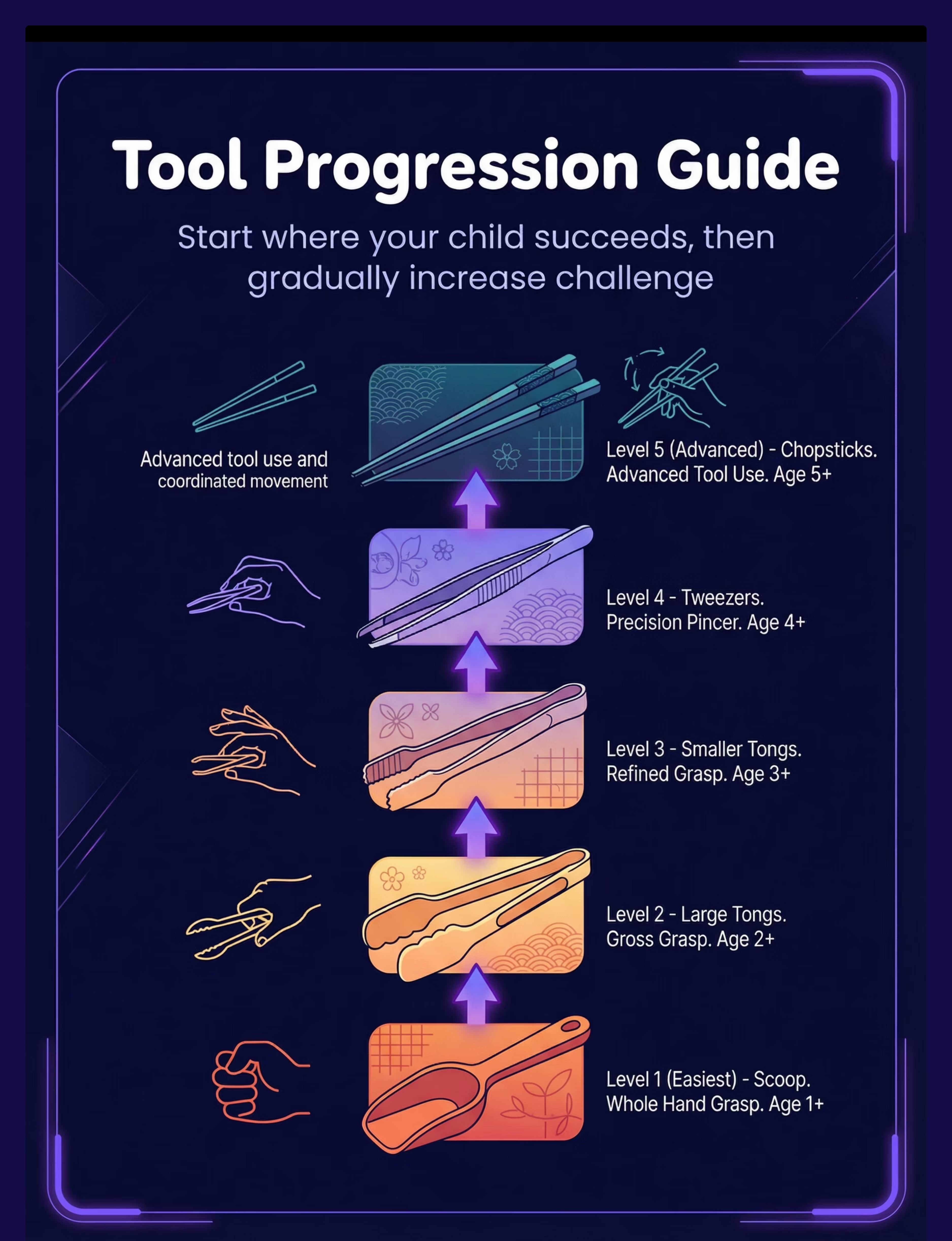
Tool Progression Guide
Children develop fine motor skills through a natural progression. Start where your child is comfortable and advance as skills strengthen.
Level 1: Scoops & Shovels
Skill: Whole hand grasp
Perfect starting point for youngest learners or those with significant motor delays. Large, easy-to-hold tools that build confidence.
Level 2: Jumbo Easy-Grip Tongs
Skill: Gross grasp with tool
Introduces tool use while still requiring larger hand movements. Easy-squeeze action builds strength gradually.
Level 3: Smaller Tongs / Handy Scoopers
Skill: Refined grasp
Requires more precision and control. Children begin using thumb-finger opposition more deliberately.
Level 4: Standard Tweezers
Skill: Precision pincer
True pincer grasp emerges. The exact motion pattern needed for writing and fine manipulation.
Level 5: Chopsticks / Training Chopsticks
Skill: Advanced tool use
Complex coordination of multiple fingers. Functional cultural skill that demonstrates mastery.
Key Materials: Plastic, metal, and silicone grips. Look for tools sized appropriately for small hands, with appropriate resistance for the skill level, safe tips, and easy-to-squeeze mechanisms.
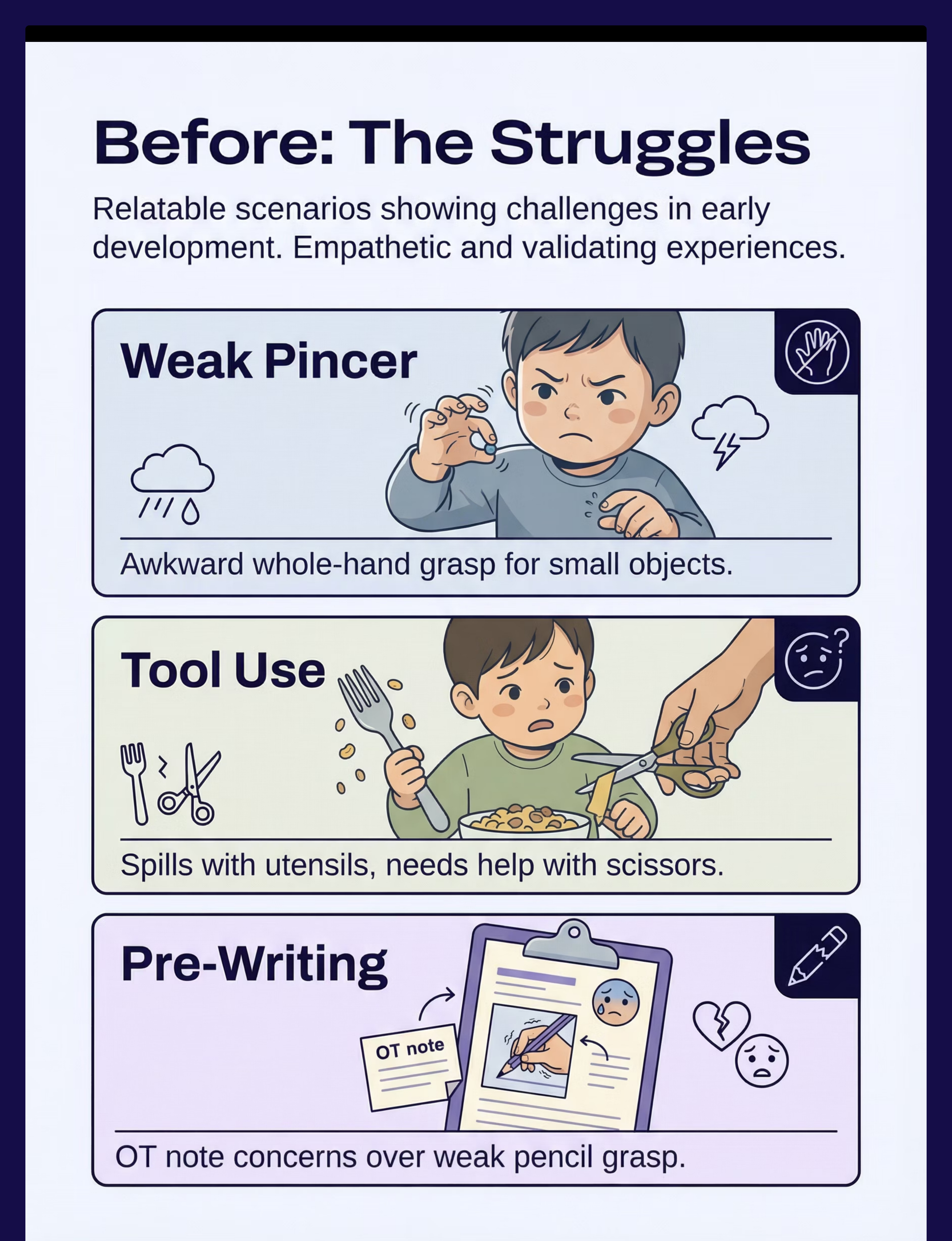
The Struggle (Before)

Weak Pincer Grasp
The Challenge
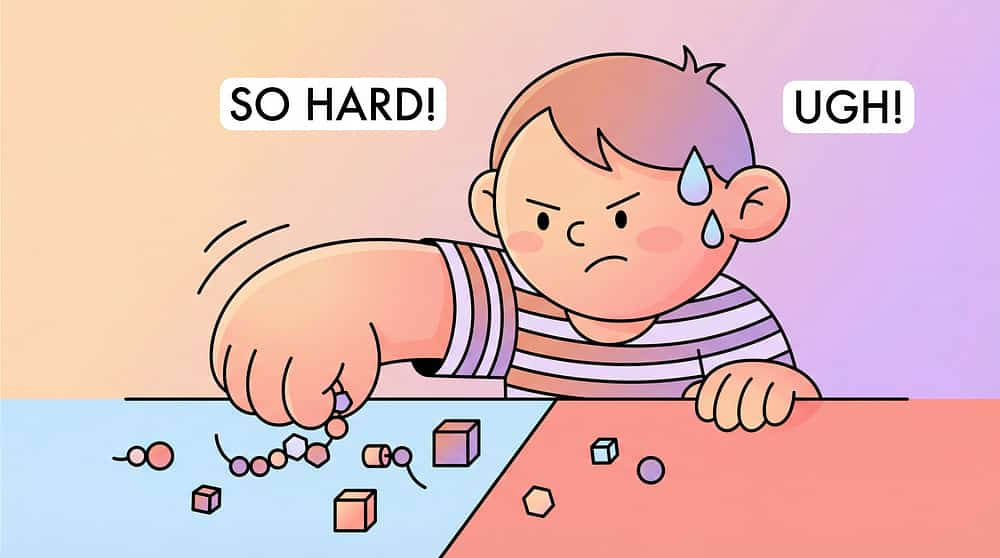
Situation: Child can't pick up small objects with thumb and finger. Uses awkward whole-hand grasp for everything. Fine motor tasks feel impossible.
Daily Impact: Struggles with beads, small toys, craft materials. Can't manage buttons or snaps independently.
Emotional Toll: Feelings of limitation and growing frustration with each failed attempt.

Tool Use Difficulties
Mealtime & Activities
Situation: Child can't use utensils effectively. Food spills constantly. Can't use tools for crafts or play. Always needs adult help.
Daily Impact: Every meal becomes messy and stressful. Art projects require constant intervention. Independence feels out of reach.
Emotional Toll: Dependence on others, frustration at not being able to do things peers can do easily.

Pre-Writing Concerns
Academic Readiness
Situation: Occupational therapist explains that pincer grasp is too weak for good pencil control. Writing skills can't improve until hand strength develops.
Daily Impact: Drawing and coloring are difficult. Pre-writing exercises feel overwhelming. Falling behind peers academically.
Emotional Toll: Parent concern about school readiness. Seeking solutions urgently.

The Breakthrough (After)
Witness the remarkable transformation as children progress from initial struggles to confident mastery of fine motor skills, fostering independence and academic readiness.
Week 1-2: Initial Success
Children achieve their first successful transfers with jumbo tongs, showing increased willingness to try precision tasks and visible excitement in their engagement.
Week 3-4: Building Confidence
Progress to smaller tongs, enjoying longer practice sessions without frustration. The pincer grasp begins to emerge spontaneously, reinforcing learned skills.
Month 2: Skill Transfer
Fine motor improvements translate to daily life, with better utensil use at mealtimes and an improved pencil grasp for pre-writing. Children even start requesting transfer activities.
Month 3+: Mastery & Independence
Children confidently use precision tweezers and apply skills across various daily tasks, displaying confidence in fine motor challenges and pride in their new accomplishments.
What to Expect (Realistic Timelines)
Progress happens gradually through consistent practice. Here's what families typically experience with regular transfer activities.

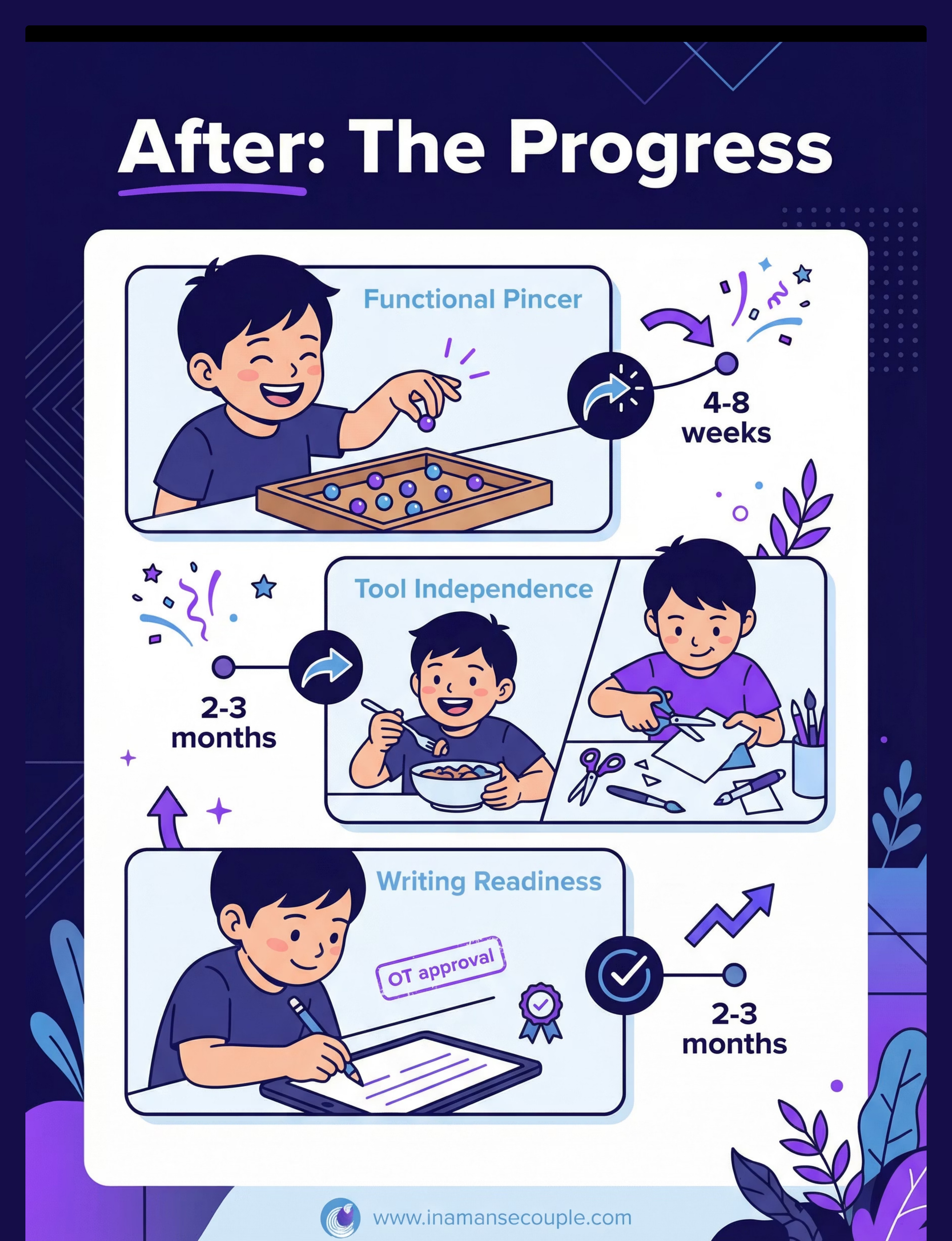
4-8 weeks
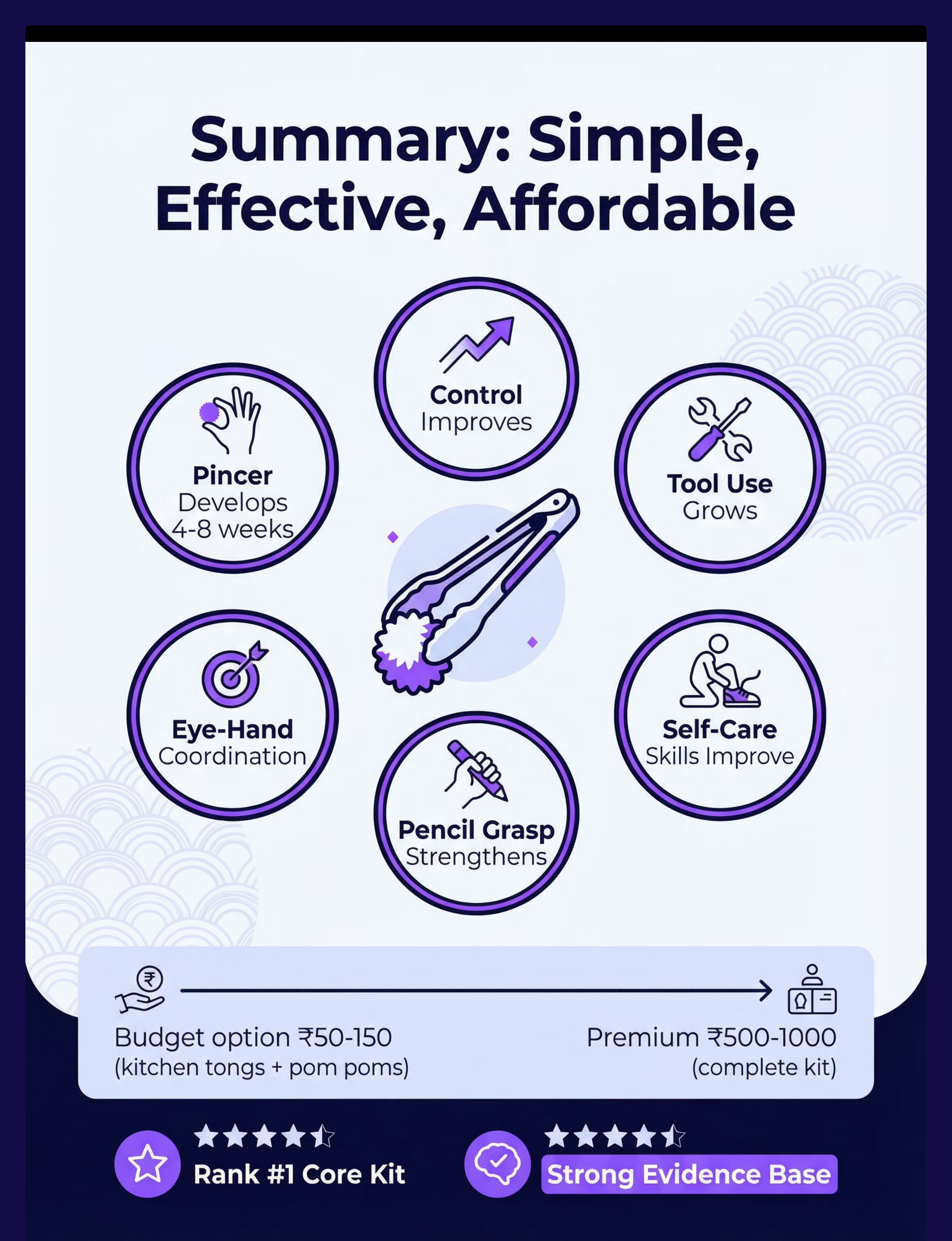
Pincer Grasp Develops
Thumb-finger coordination becomes more natural and automatic
4-8 weeks
Graded Control Improves
Child learns just-right pressure—not too tight, not too loose
2-3 months
Tool Use Competence Grows
Skills transfer to forks, spoons, craft tools, and other implements
4-8 weeks
Eye-Hand Coordination Improves
Visual tracking and motor planning work together seamlessly
2-3 months
Pencil Grasp Strengthens
Same muscles used for tweezers support writing development
2-3 months
Self-Care Skills Improve
Buttoning, zipping, and fasteners become more manageable
Remember: Every child progresses at their own pace. These timelines represent typical outcomes with consistent daily practice. Celebrate each small victory along the way.

Is This Right for My Child? (2-Minute Check)
Answer these questions to determine if transfer activities would benefit your child. Three or more "yes" answers indicate a strong fit.
Does your child have difficulty picking up small objects?
If yes, this indicates: Pincer grasp needs development
This is one of the clearest signs that transfer activities will help. Children should develop pincer grasp by age 9-12 months, but many need extra practice.
Does your child use whole hand instead of fingers for small items?
If yes, this indicates: Needs pincer grasp training
Using the whole hand (palmar grasp) when fingers should be used shows the need for targeted skill development.
Does your child struggle with utensil use?
If yes, this indicates: Tool use practice will help
Fork and spoon use requires the same pincer and graded control that transfer activities build.
Does your child have weak pencil grasp?
If yes, this indicates: Pincer strengthening needed
Pencil control relies on the exact same muscles and coordination patterns developed through tweezers work.
Scoring: 3+ "yes" answers = Strong fit for transfer activities | 2 "yes" answers = Likely beneficial | 1 or fewer = May want to explore other tools first or consult with OT

Common Questions (Honest Answers)
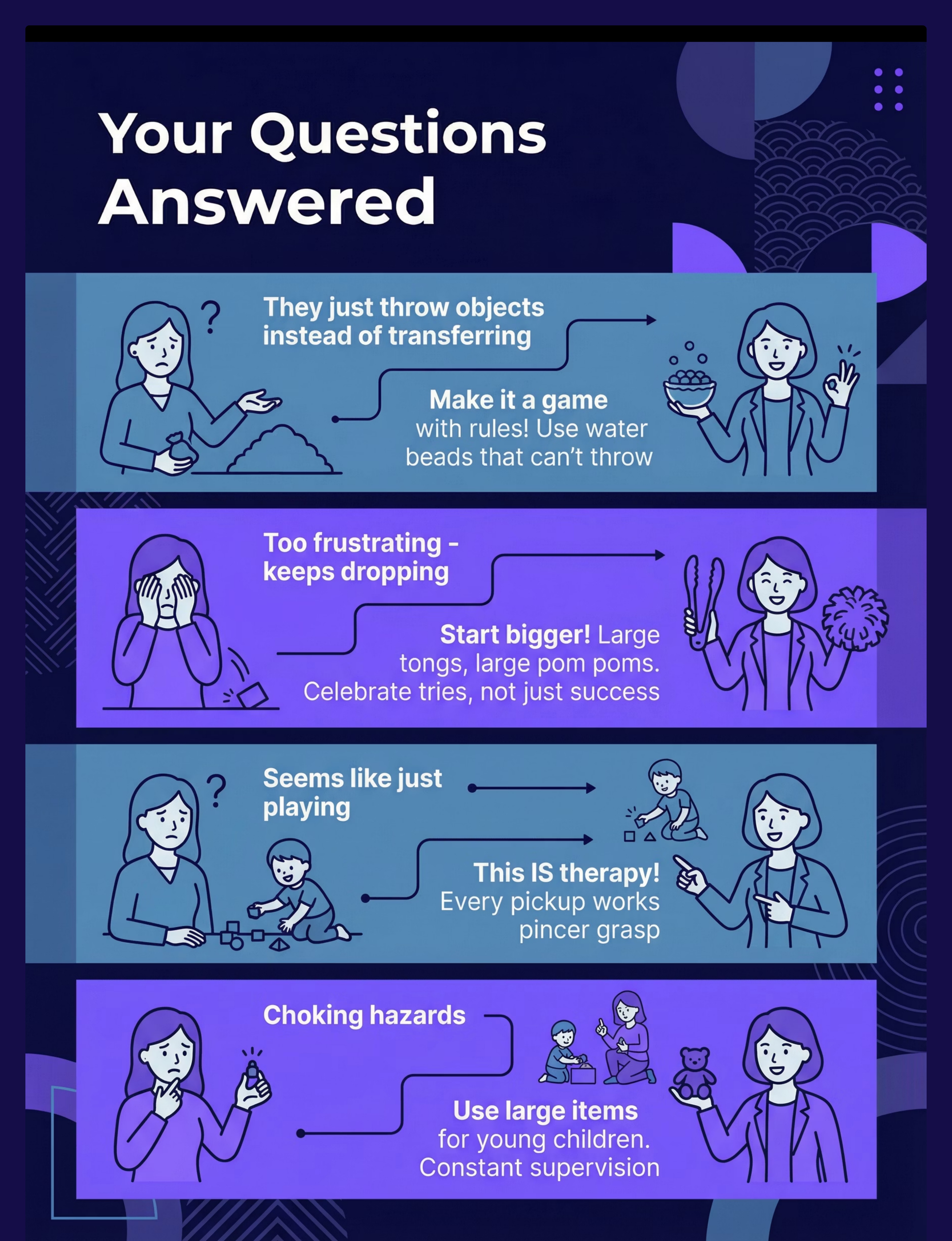
Q: They just throw the objects instead of transferring | A: Make it a game with clear rules! Create a "feed the monster" game where pom poms go into a container's mouth. Count together as you transfer. Try water beads in water—they can't be thrown effectively. Keep sessions short with very clear expectations from the start. Try this: Structured games with rules; water beads in water; short focused sessions; clear behavioral expectations. | |
Q: Too frustrating - objects keep dropping | A: Start much bigger than you think necessary! Use jumbo tongs with large soft pom poms first. Make initial activities ridiculously easy to build confidence and success. Remember that dropping is a natural part of the learning process—celebrate attempts and effort, not just perfect transfers. Try this: Larger tools and objects than you think needed; celebrate effort and tries, not perfection; build success before adding challenge. | |
Q: Seems like just playing, not therapy | A: This IS therapy—and it's highly effective! Every single pickup activates and strengthens pincer grasp. Every transfer builds graded motor control. Every release practices precise timing. Play is the very best vehicle for learning at this age. When activities are fun, children practice more, which equals faster progress. Try this: Trust that play IS therapeutic work; fun ensures consistent practice; more practice = better outcomes. | |
Q: Small objects are choking hazards | A: Absolutely valid concern. For young children or those who still mouth objects, use only large items—big pom poms, large wooden beads, cotton balls. Progress to smaller objects only when the mouthing phase has completely passed. Always maintain appropriate supervision based on age and development. Try this: Large objects for young or mouthing children; constant supervision for under-3s; progress smaller only when developmentally ready. |

Usage Guide
✓ When to Use
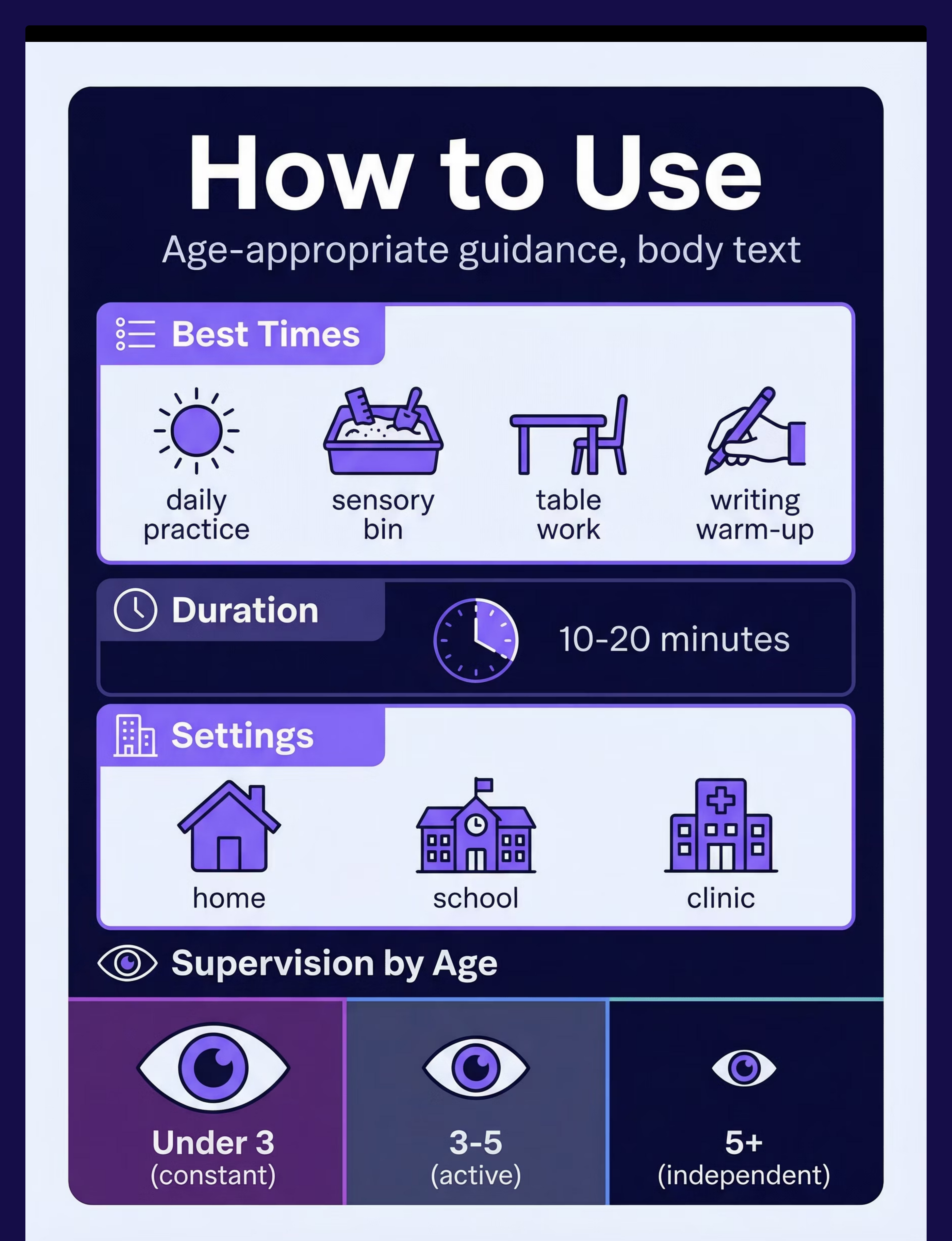
- Daily fine motor practice: 10-20 minutes as part of routine
- Sensory bin activities: Combine with rice, water beads, or dried beans
- Table work time: Structured learning sessions
- Before writing: Perfect warm-up for hand muscles
- Montessori practical life: Fits perfectly into prepared environment
✗ When NOT to Use
- Small objects with mouthers: Never without constant supervision
- Extreme frustration: Scale back difficulty immediately
- Rushed situations: Activities need focused attention
Supervision by Age
Age Range | Supervision Level | Notes | |

Under 3 years | Constant, direct supervision | High mouthing risk; use only large objects; stay within arm's reach | |
3-5 years | Active supervision | Watch for mouthing; check in frequently; adjust difficulty as needed | |
5+ years | More independence possible | Can work with periodic check-ins once skills established; still monitor for safety |
Recommended Duration: Sessions of 10-20 minutes, following child's natural interest and engagement. Daily practice yields best results, but even 3-4 times per week shows meaningful progress.

Safety First
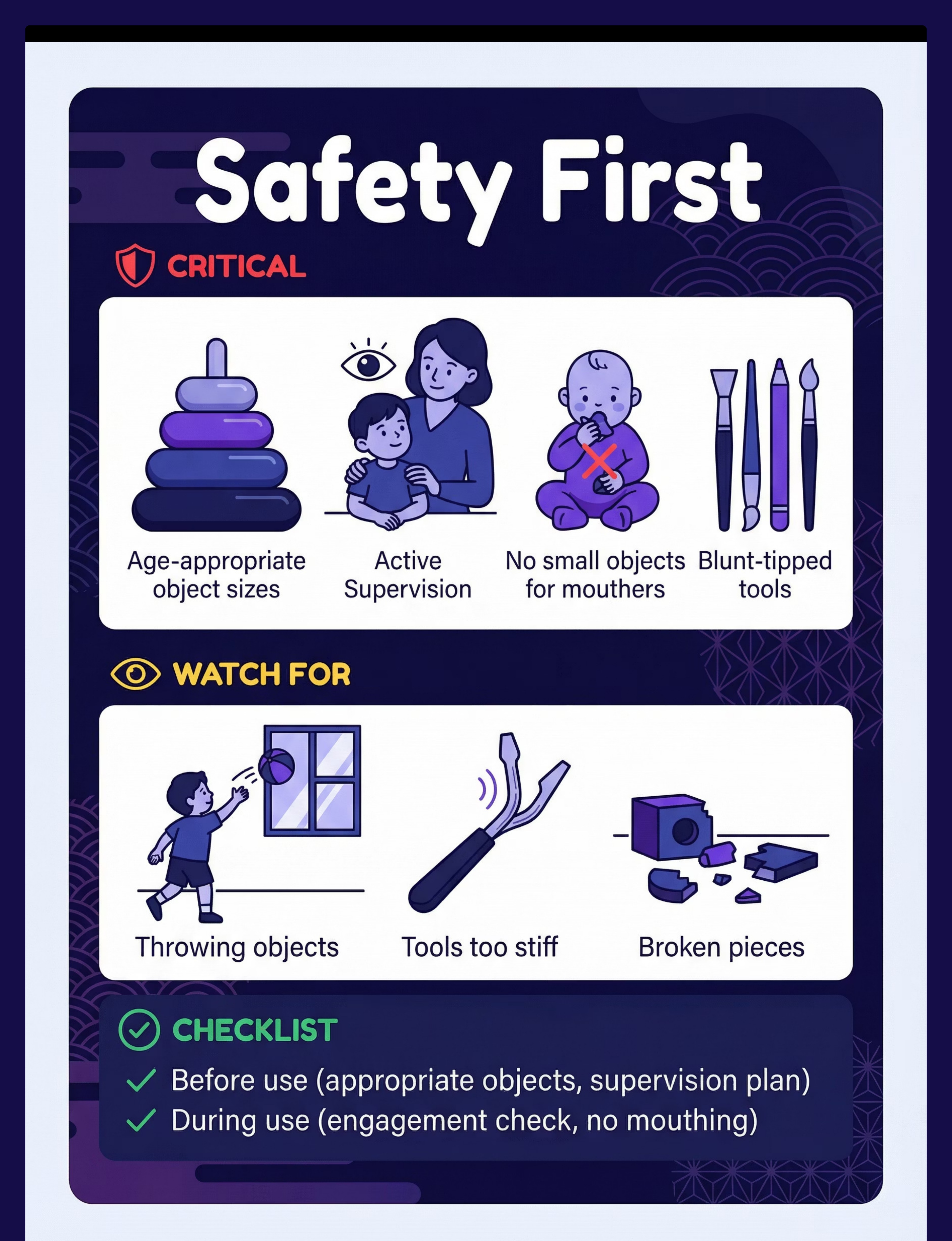
⚠ Critical Safety
- Object size must be appropriate for child's age and mouthing risk
- Always supervise young children during activities
- Never use small objects with children who still mouth items
- Ensure all tools have blunt, rounded tips—no sharp points
⚠ Important Warnings
- Watch carefully for throwing behaviors—redirect to transfer
- Check that tools aren't too stiff for child to squeeze successfully
- Inspect regularly for broken pieces or sharp edges
- Store small objects safely away from younger siblings
Contraindications
These tools should NOT be used in the following situations without professional guidance:
- Small objects with children who mouth or have pica tendencies
- Sharp-tipped tools of any kind
- Unsupervised use with very young children (under 3)
Safety Checklist: Before Use
- ✓ Objects appropriate for age
- ✓ Tool size matches hand size
- ✓ Supervision plan in place
- ✓ Clear, organized workspace
Safety Checklist: During Use
- ✓ Appropriate supervision maintained
- ✓ Child engaged, not frustrated
- ✓ No mouthing of objects
- ✓ Celebrating effort and tries
Safety Checklist: Signs of Success
- ✓ Pincer grasp improving visibly
- ✓ More successful transfers
- ✓ Less dropping overall
- ✓ Seeking transfer activities

Investment Guide
Transfer activities are remarkably affordable. You can start with household items or invest in specialized tools—both approaches work beautifully.
Here's a breakdown of the options and their benefits:
Budget Option | ₹50–150 | |
Premium Option | ₹500–1,000 |
Key Features & Benefits
Budget-Friendly Start
Use readily available household items to begin immediately without significant investment. Perfect for gauging initial interest.
Effectiveness & Learning
Both options deliver strong developmental benefits. Focus is on skill development, not just the tools used.
Scalability & Progression
Start simple, then upgrade to comprehensive kits as your child's skills and engagement grow, ensuring continued challenge.
Durability & Safety
Premium kits often offer enhanced durability and specialized designs for educational settings and long-term use.
Cost-Benefit Over Time
Whether you choose budget or premium, the investment in these activities yields significant long-term developmental returns.
Initial Engagement (₹50-150)
Low upfront cost allows for immediate exploration and interest assessment. Quick setup with existing items.
Skill Development (Ongoing)
Consistent practice with transfer tools refines fine motor skills, concentration, and hand-eye coordination.
Enhanced Learning (₹500-1,000)
Upgrading to a comprehensive kit introduces new challenges and extends learning possibilities with specialized tools.
Long-Term Value (Lifetime)
The skills developed support future academic success and everyday independence, offering lasting benefits for a minimal initial outlay.
Overall Range: ₹50–1,000
Best starting point: Begin with budget household items to assess interest and engagement. If your child loves it and you want more variety or a complete program, upgrade to a premium kit. Both approaches deliver results—choose based on your situation, not effectiveness.
Where to Buy in India
Availability: Widely available through online retailers, local stores, and even your own kitchen!
Platform | Search Terms | Price Range | |
Amazon.in | "kids tongs tweezers" | ₹150–400 | |
Amazon.in | "Montessori transfer set" | ₹300–800 | |
Amazon.in | "fine motor tools kids" | ₹200–500 | |
Kitchen stores | "small tongs" | ₹50–150 | |
Craft stores | "tweezers pom poms" | ₹100–300 |
Smart Buying Tips
- Kitchen tongs make perfect beginner tools—check your drawer first!
- Pom poms are ideal transfer objects: lightweight, colorful, graspable
- Ice cube trays make excellent sorting containers
- Water beads add sensory element and prevent throwing
- Progress tool and object size together as skills improve
🚩 Red Flags to Avoid
- Tools too stiff for your child to squeeze successfully
- Sharp tips that could injure (always check for rounded edges)
- Tools too small for beginner hands to control
- Choking-size objects for children who still mouth items
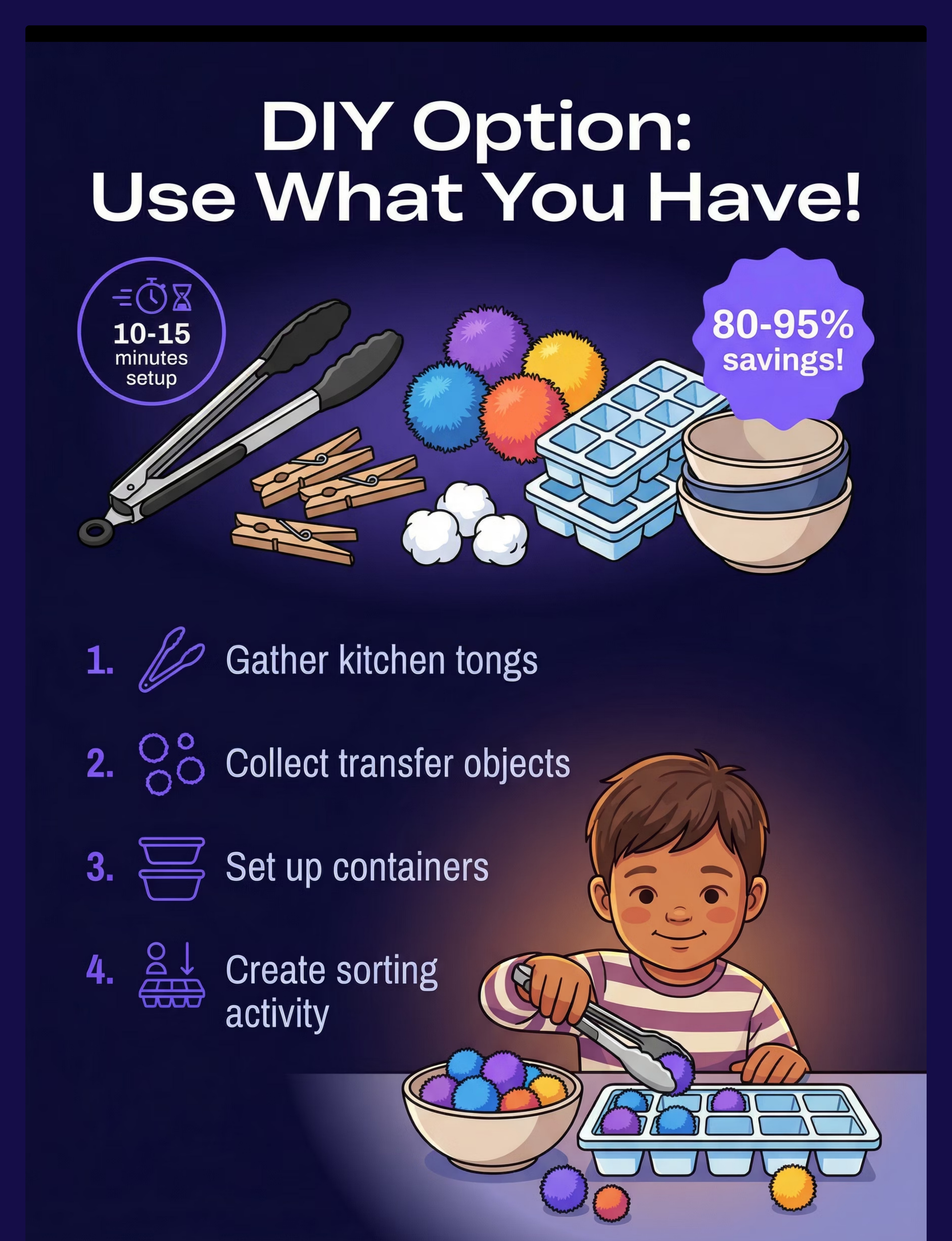
DIY Alternative (Save 80-95%)
DIY Overview
Feasibility: Very High—household items work excellently
Cost Savings: 80-95% compared to commercial kits
Time Required: 10-15 minutes setup
The beautiful truth about transfer activities is that household items work just as well as expensive specialized tools. Your kitchen likely contains everything you need right now.
Materials You Need
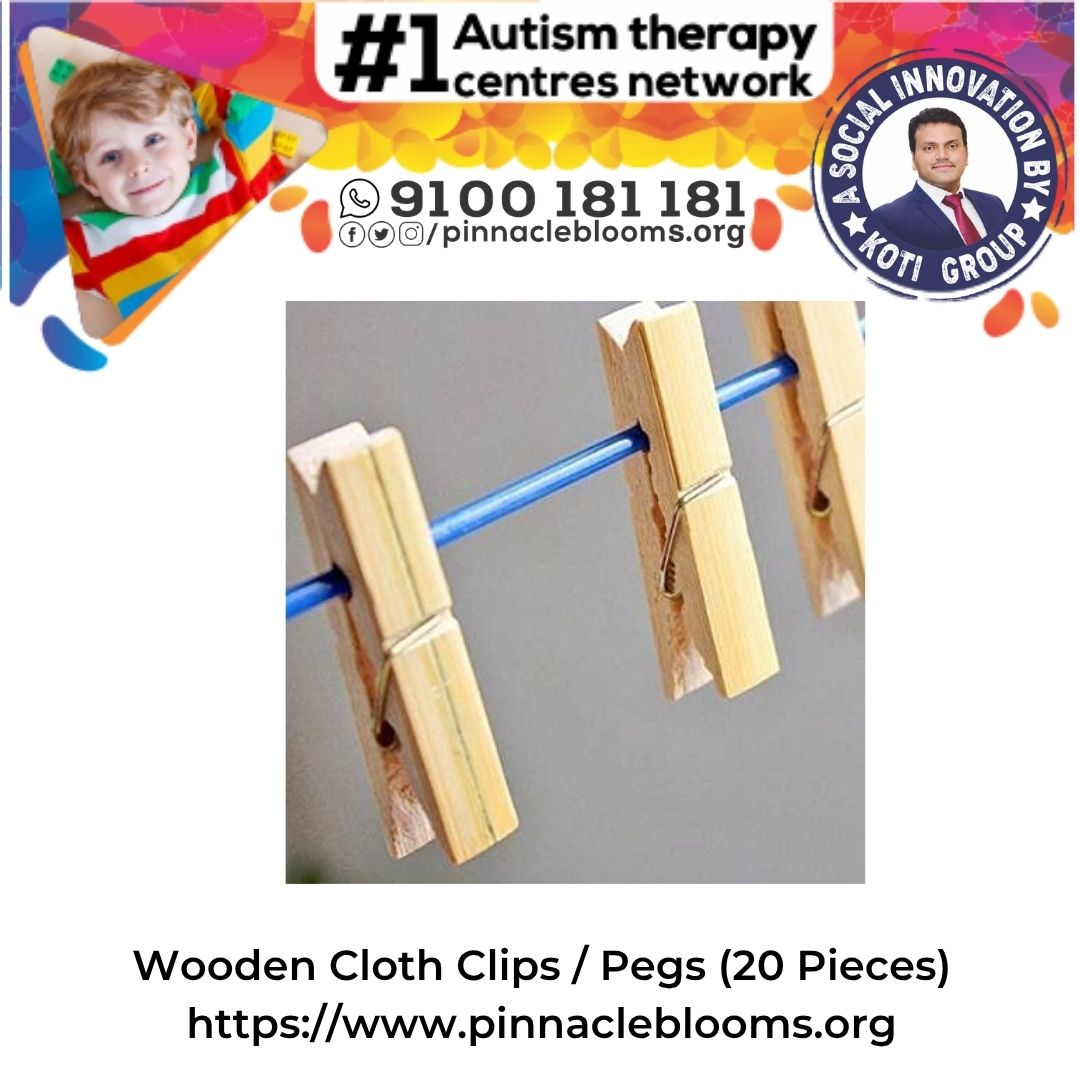
- Tools: Kitchen tongs, salad tongs, clothespins
- Objects: Pom poms, cotton balls, dried beans or pasta
- Containers: Ice cube trays, small bowls, muffin tins
- Optional: Water beads for sensory element
Simple Setup Steps
- Gather tongs from kitchen — Collect various sizes from your utensil drawer
- Collect transfer objects — Pom poms from craft store, or use cotton balls and dried beans
- Set up containers — Ice cube trays, small bowls, or muffin tins work perfectly
- Create sorting activity — Add color or size sorting for cognitive challenge
- Add clothespins — Clip to container edges for advanced pincer work
- Theme it — "Feed the animals" or "fill the treasure chest" for motivation
DIY vs Commercial Comparison
When to DIY
- Getting started and testing interest
- Customizing for your child's specific interests
- Varying difficulty easily as skills progress
- Working within tight budget
Tradeoff: Household tools work excellently—truly no compromise in effectiveness!
When to Buy Commercial
- Want cute/themed tools that boost motivation
- Need complete kit with structured activity instructions
- Classroom use requiring matching sets for multiple children
- Prefer ready-made solution
Advantage: Convenience and aesthetic appeal, structured progression guides
Preview of tweezers tongs transfer activities Therapy Material
Below is a visual preview of tweezers tongs transfer activities therapy material. The pages shown help educators, therapists, and caregivers understand the structure and content of the resource before use. Materials should be used under appropriate professional guidance.


Share this resource
Help others discover thisLink copied!
Track Progress & Complete the Kit
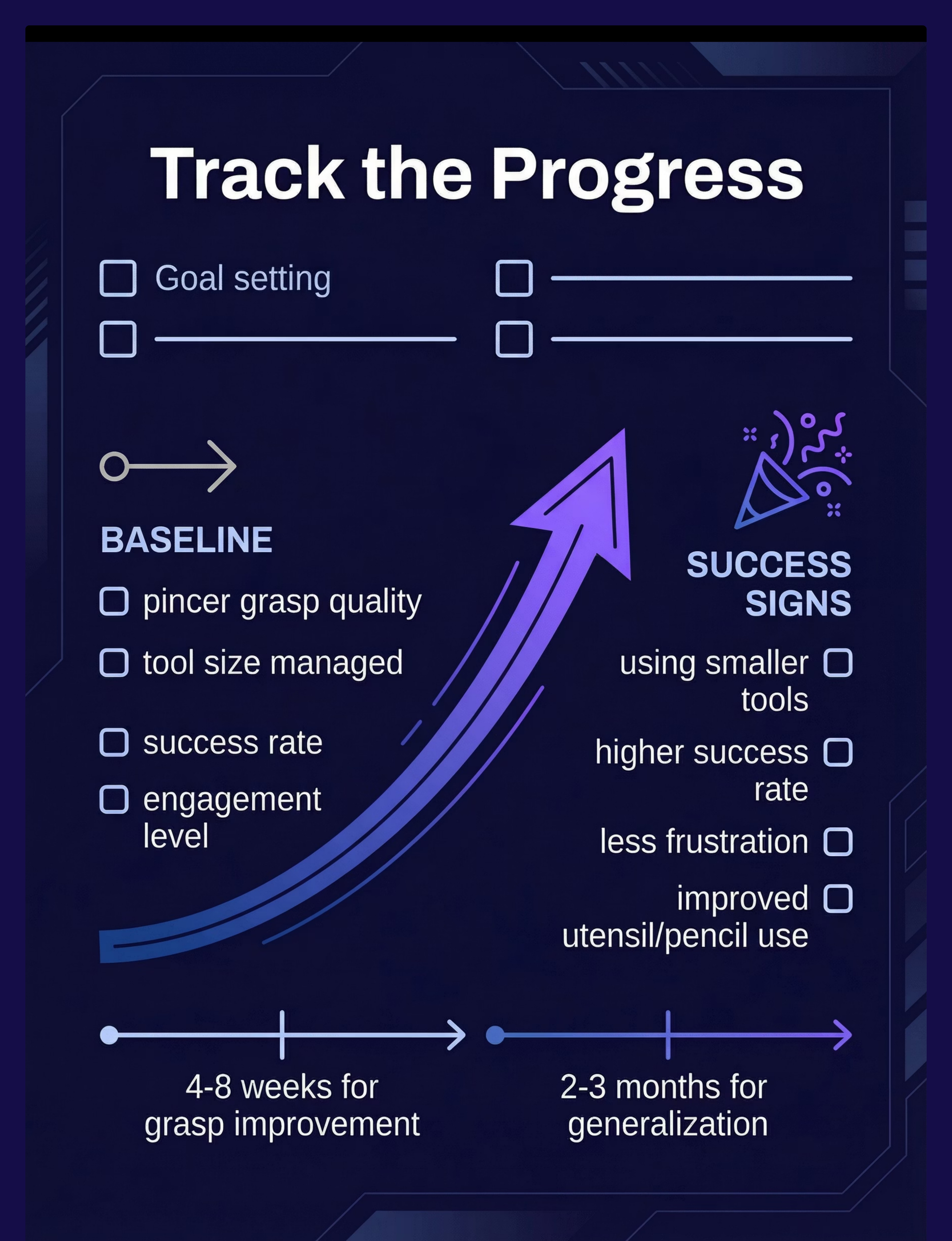
Measuring Success
Baseline (Start Here)
- Current pincer grasp quality
- Largest tool/object size child can manage
- Success rate of transfers
- Interest and engagement level
Goals to Set
- Transfer objects using tongs/tweezers
- Pincer grasp improvement
- Graded control development
- Tool use in daily tasks
Success Indicators
- ✓ Using smaller tools/objects
- ✓ Higher success rate overall
- ✓ Less frustration, more confidence
- ✓ Better utensil use at meals
- ✓ Improved pencil grasp
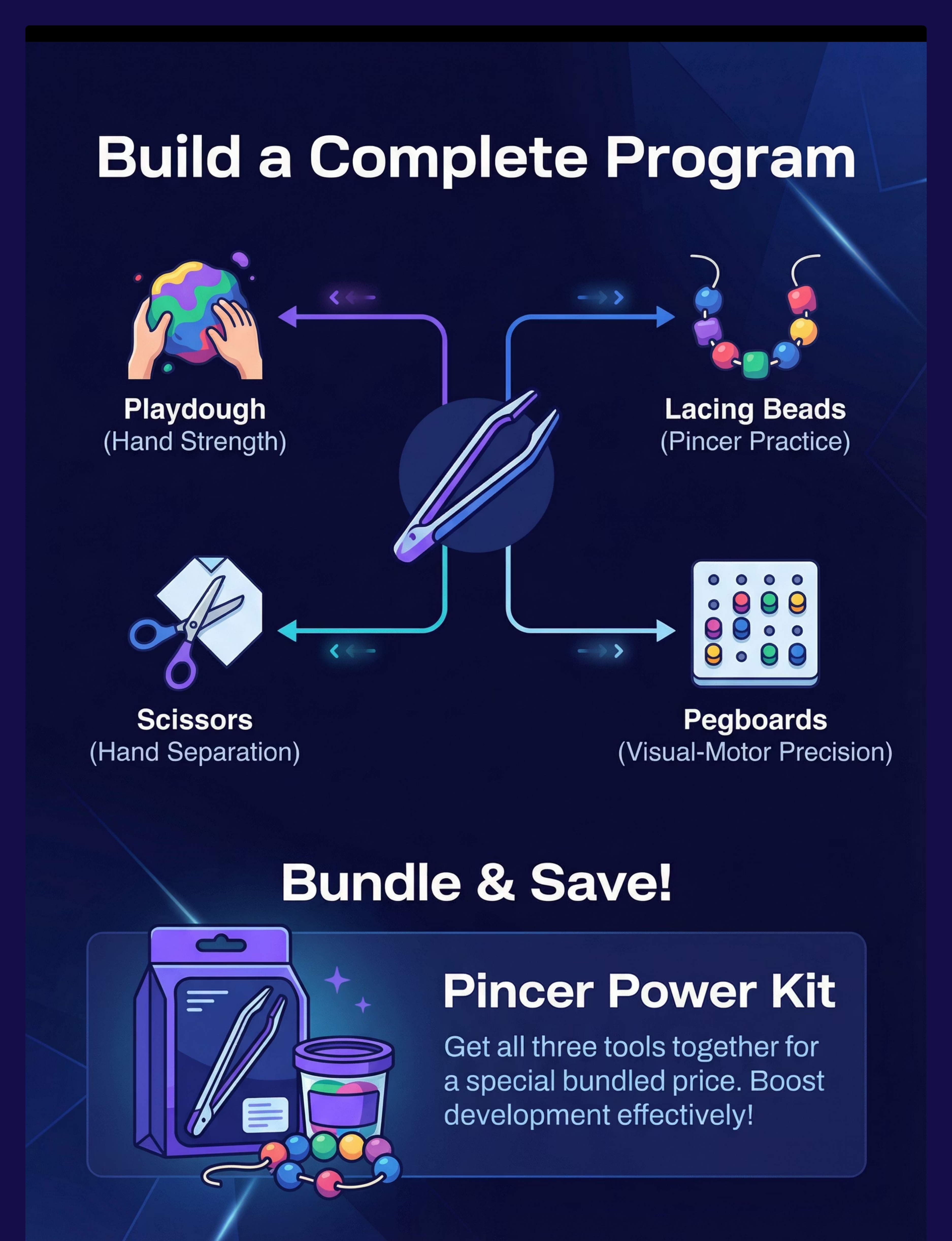
Pair It With... (Complete the Kit)
Transfer activities work beautifully alongside these complementary tools for comprehensive fine motor development:

Playdough/Putty (ID: 7.1)
Why pair: Builds hand strength for powerful grasping. Use before tweezers work as warm-up.

Lacing/Beading (ID: 7.2)
Why pair: Additional pincer grasp practice with threading component. Different movement pattern.

Scissors (ID: 7.3)
Why pair: Hand separation skills complement transfer work. Different tool use pattern.

Pegboards (ID: 7.5)
Why pair: Visual-motor precision with different grasp pattern. Adds spatial planning element.
Recommended Bundles
Pincer Power Kit (7.4 + 7.1 + 7.2): Complete pincer development from strength through precision
Montessori Fine Motor (7.4 + 7.5 + 7.2): Comprehensive practical life skills foundation
Quick Summary
Tweezers and tongs develop pincer grasp, graded control, and tool use through engaging transfer activities. Core Kit (Rank 1), strong evidence, versatile and affordable.
tweezers
tongs
transfer
pincer
fine motor
tool use
Montessori
OT
SpEd
core-kit
Common Searches: tweezers fine motor, tongs kids, transfer activities autism, pincer grasp activities, Montessori transfer, fine motor tools, occupational therapy tweezers
Get Support
FREE National Autism Helpline
Phone: 9100 181 181
Languages: 16+ Indian languages
Website: pinnacleblooms.org
Connect with trained professionals who can guide you through implementing transfer activities and answer specific questions about your child's development.
Platform Integration
This tool integrates seamlessly with Pinnacle Blooms Network's comprehensive platform:
- AbilityScore®: Identifies pincer grasp and tool use patterns through comprehensive assessment
- TherapeuticAI®: Prescribes personalized transfer activities based on your child's specific profile
- EverydayTherapyProgramme™: Includes daily pincer work integrated into natural routines
- Fine Motor Index: Tracks grasp development progress over time with objective measures
Disclaimer: This is educational information based on established occupational therapy practices. Always consult qualified occupational therapists, speech-language pathologists, or pediatricians for personalized assessment and recommendations. Individual results vary based on many factors including consistency of practice, child's baseline skills, and developmental trajectory.