















Tool ID: 14.1
Tool ID: 14.1
Sleep Category
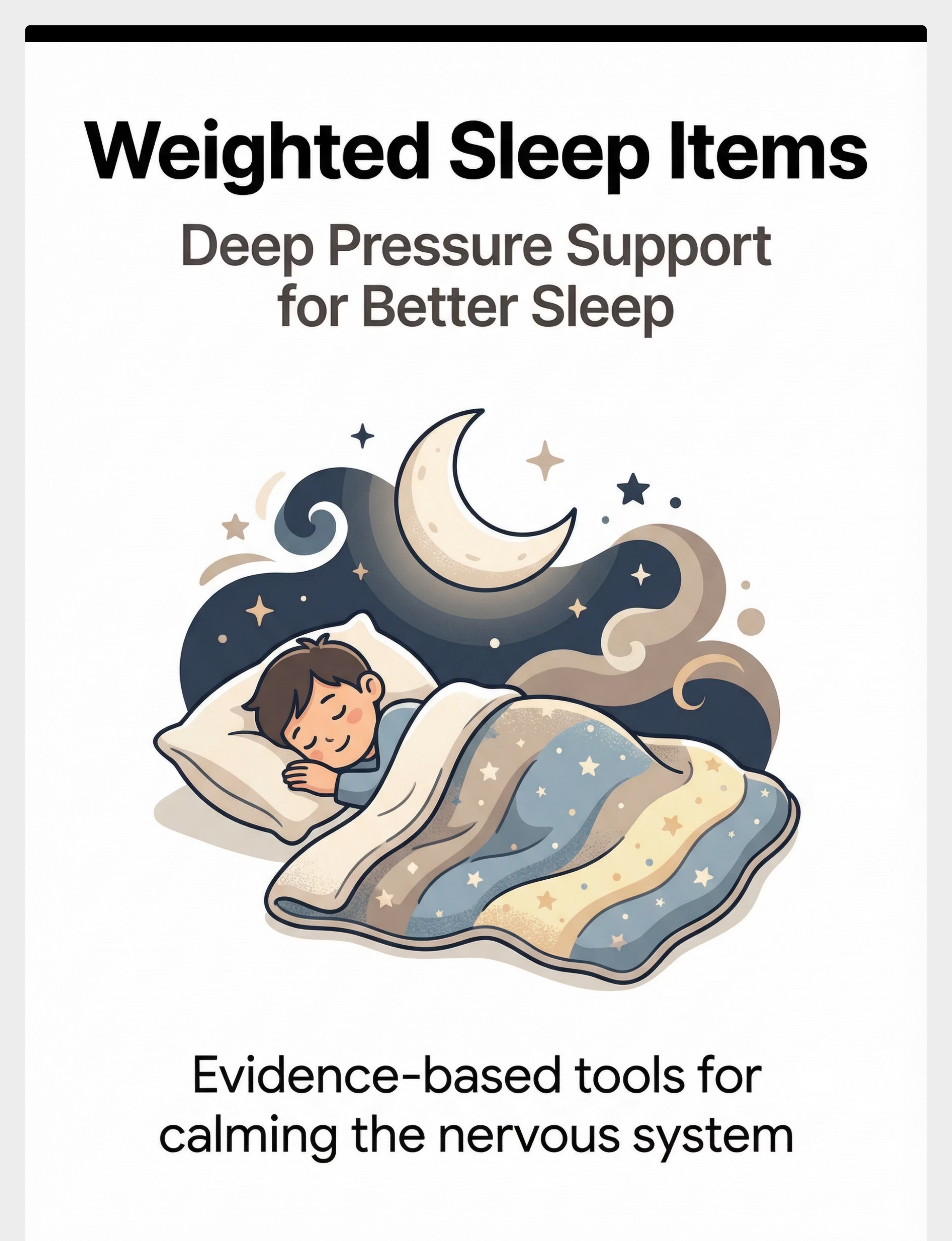
Weighted Sleep Items
Deep pressure sleep support system
OT + Parent Recommended
Rank #1
Moderate-Strong Evidence
Daily (Nightly) Use
₹300–8,000
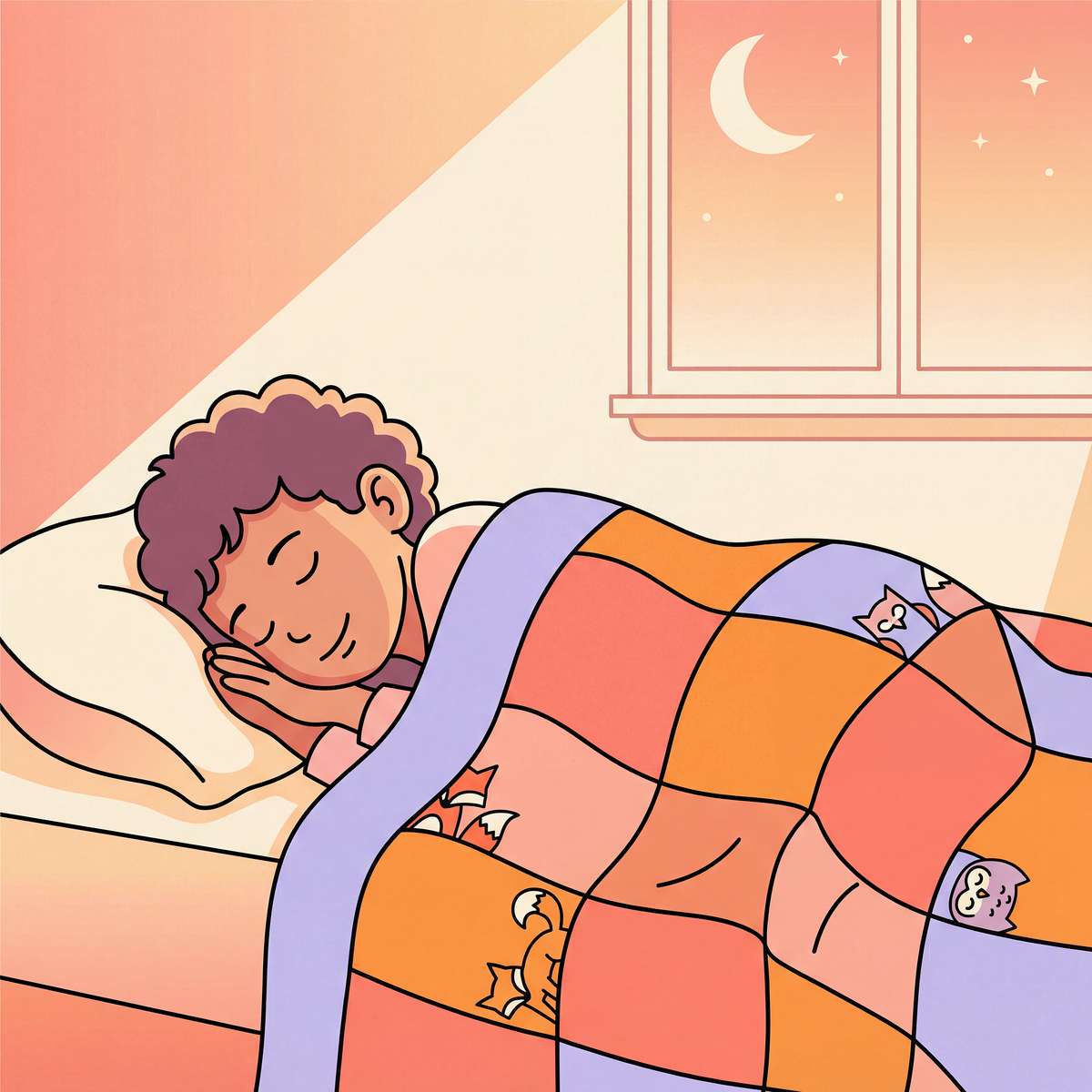
Transform sleepless nights into restful sleep with clinically-backed deep pressure therapy. Weighted sleep items provide the calming input many children with autism and sensory processing differences need to settle their nervous system, reduce anxiety, and achieve quality sleep that transforms daytime functioning.
Who This Helps
Weighted sleep items provide deep pressure input during sleep to promote calming, reduce anxiety, and improve sleep quality for children who struggle with settling their bodies and minds at bedtime.
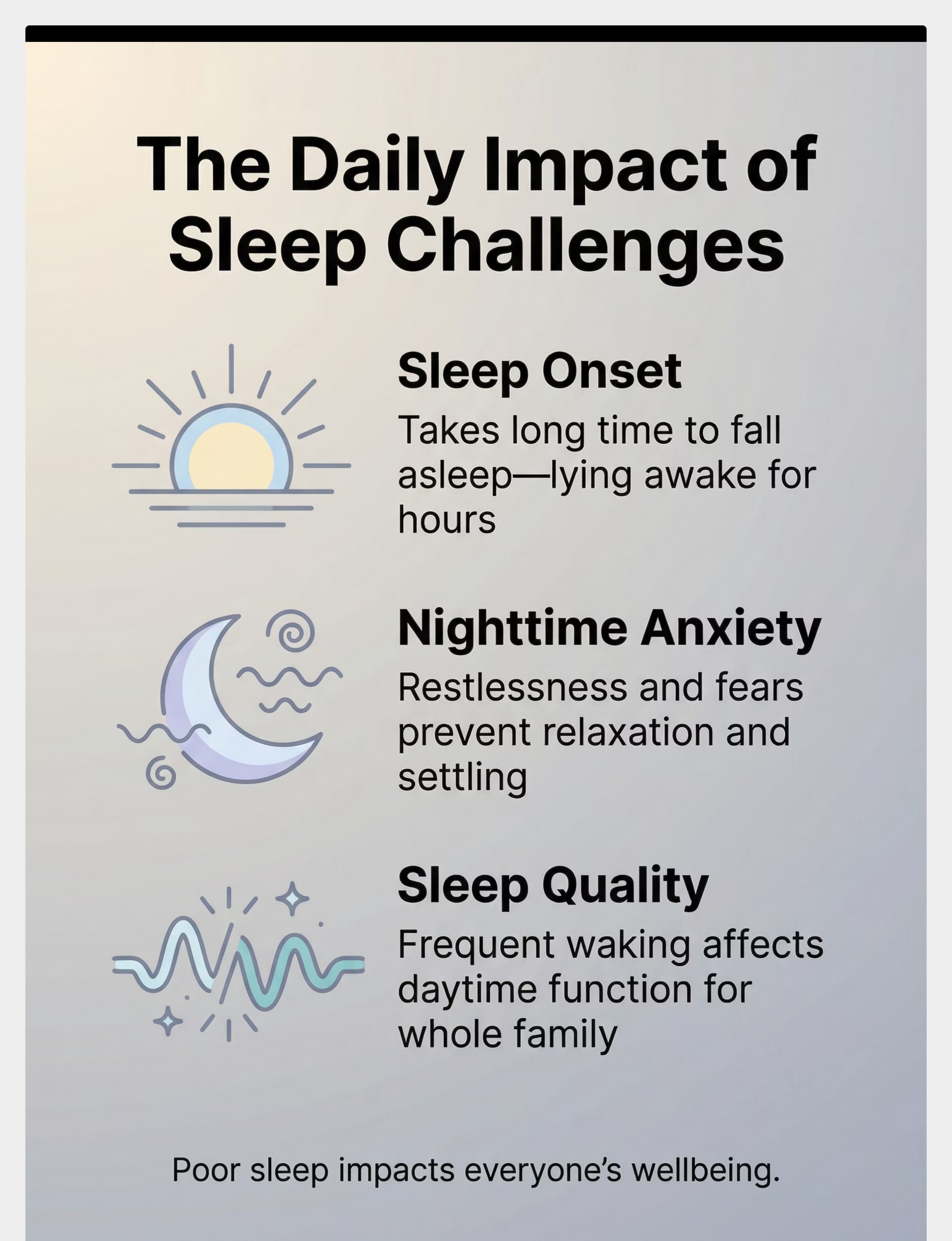
Sleep Onset
Sleep Quality
Anxiety Reduction
Sensory Regulation
Nighttime Calming
Ages: 2+ years
Home - Bedroom
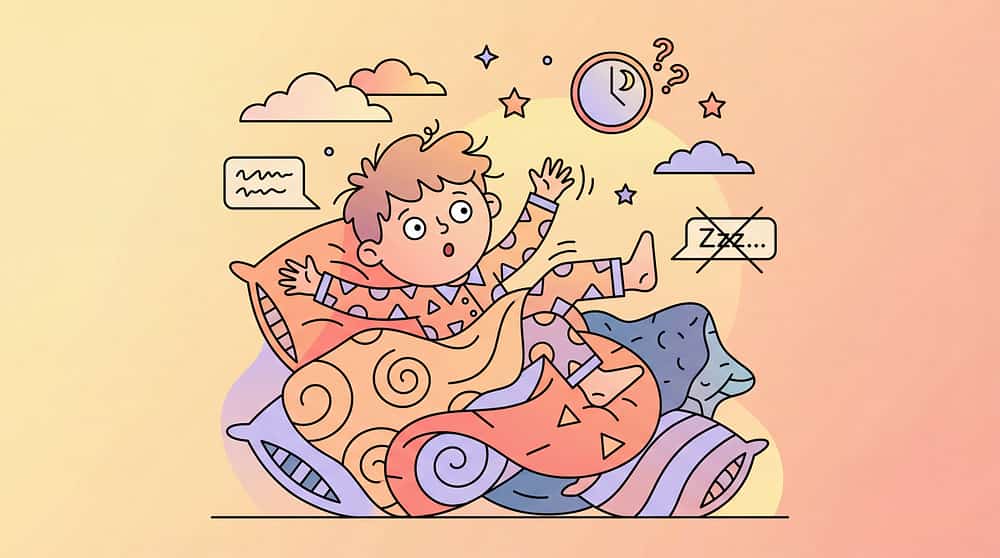
Struggling to Fall Asleep
For children whose bodies and minds race, preventing them from settling down and drifting off to sleep.
Seeking Deep Pressure
Ideal for kids who find comfort and calm in tight hugs, weighted items, or firm pressure.
Nighttime Worries
Helps children experiencing anxiety and fears at bedtime, promoting a sense of security and peace.
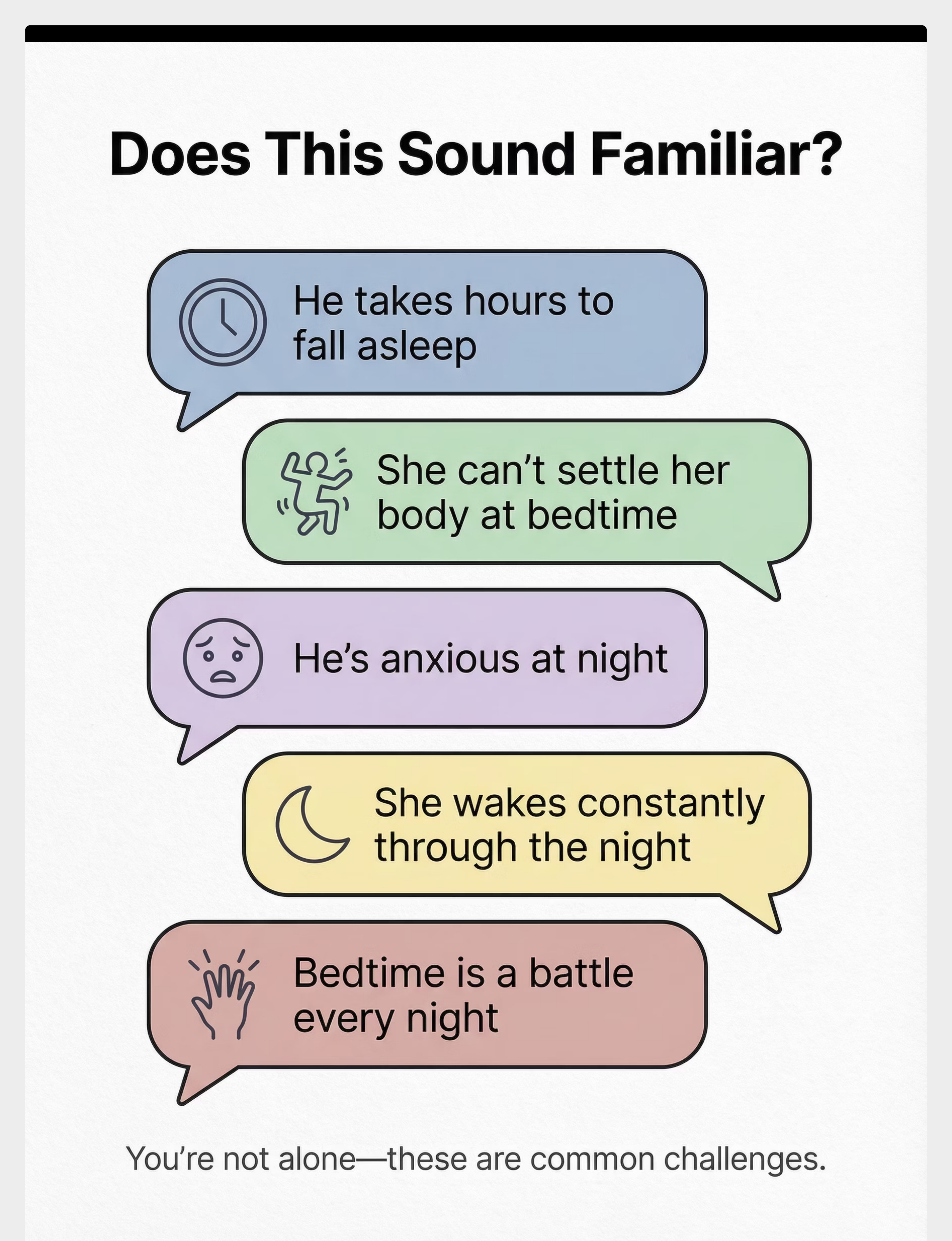
Does This Sound Familiar?
"He takes hours to fall asleep. We try everything, but his body just won't settle. Bedtime starts at 8 PM and he's still awake past 11. We're all exhausted."
"She can't settle her body at bedtime. Rolling, kicking, repositioning constantly. It's like her nervous system won't turn off no matter how tired she is."
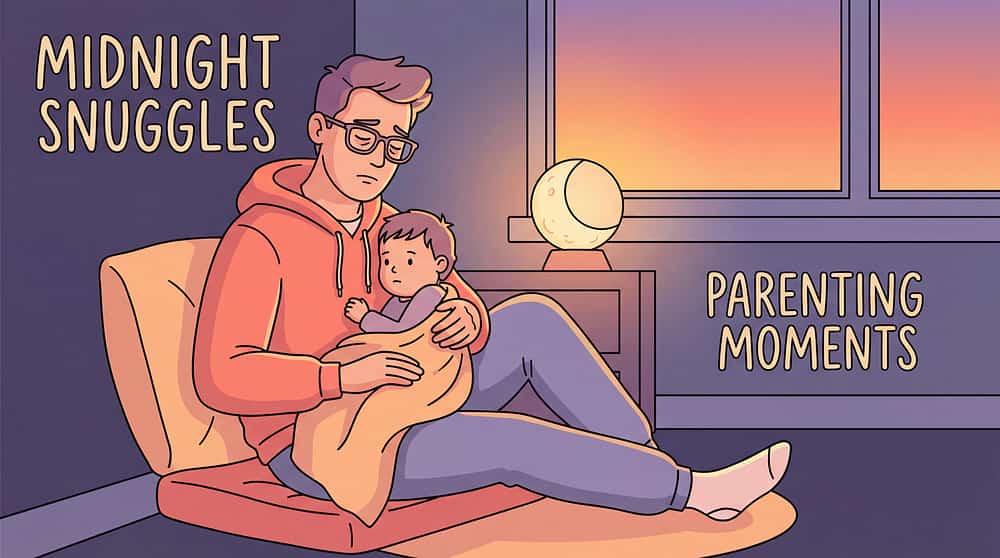
"He's anxious at night. The moment we say it's bedtime, the anxiety starts. He needs us in the room, holding him, reassuring him constantly."
"She wakes constantly through the night. We're up 4-5 times every night helping her resettle. No one in our family is getting real sleep."
You're not alone. These are among the most common challenges families face. Sleep difficulties affect the entire family's wellbeing, impacting daytime function, emotional regulation, learning, and family quality of life. But there is help.
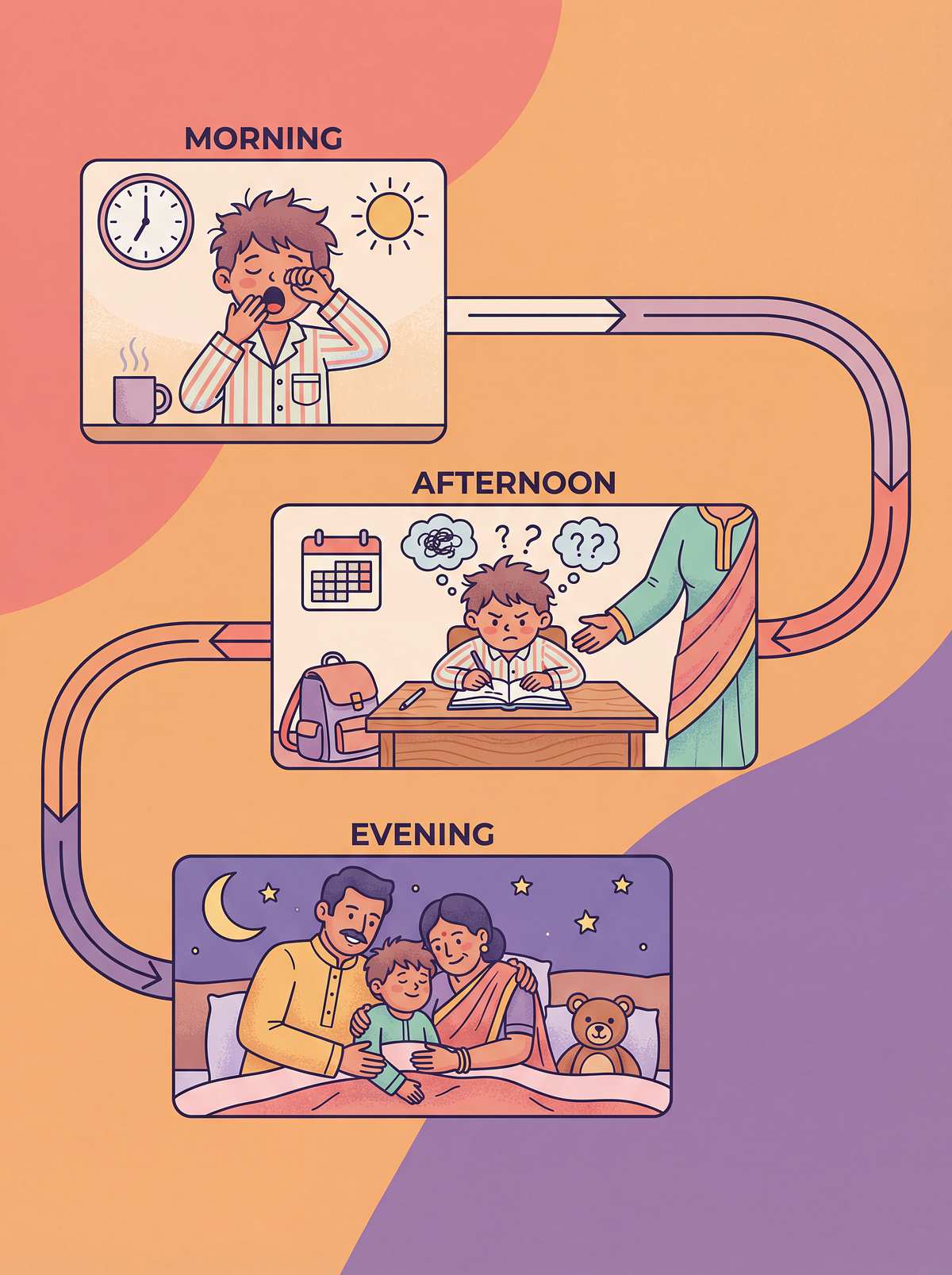
A Day Without the Right Support
Morning Exhaustion
Wake exhausted despite hours in bed. Poor sleep affects mood, regulation, learning. Behavior challenges throughout day from sleep deprivation.
Night Waking
Finally asleep, but wakes multiple times. Can't resettle independently. Each waking disrupts everyone. Sleep fragmented and unrestful.
Lying in Bed
Hours pass. Body restless, mind racing. Rolling, repositioning, unable to find comfort. Parents exhausted from trying to help settle.
Bedtime Approach
Anxiety builds as bedtime nears. Child resists, delays, becomes more activated rather than calmer. Transition to bed feels impossible.
The Science Behind It
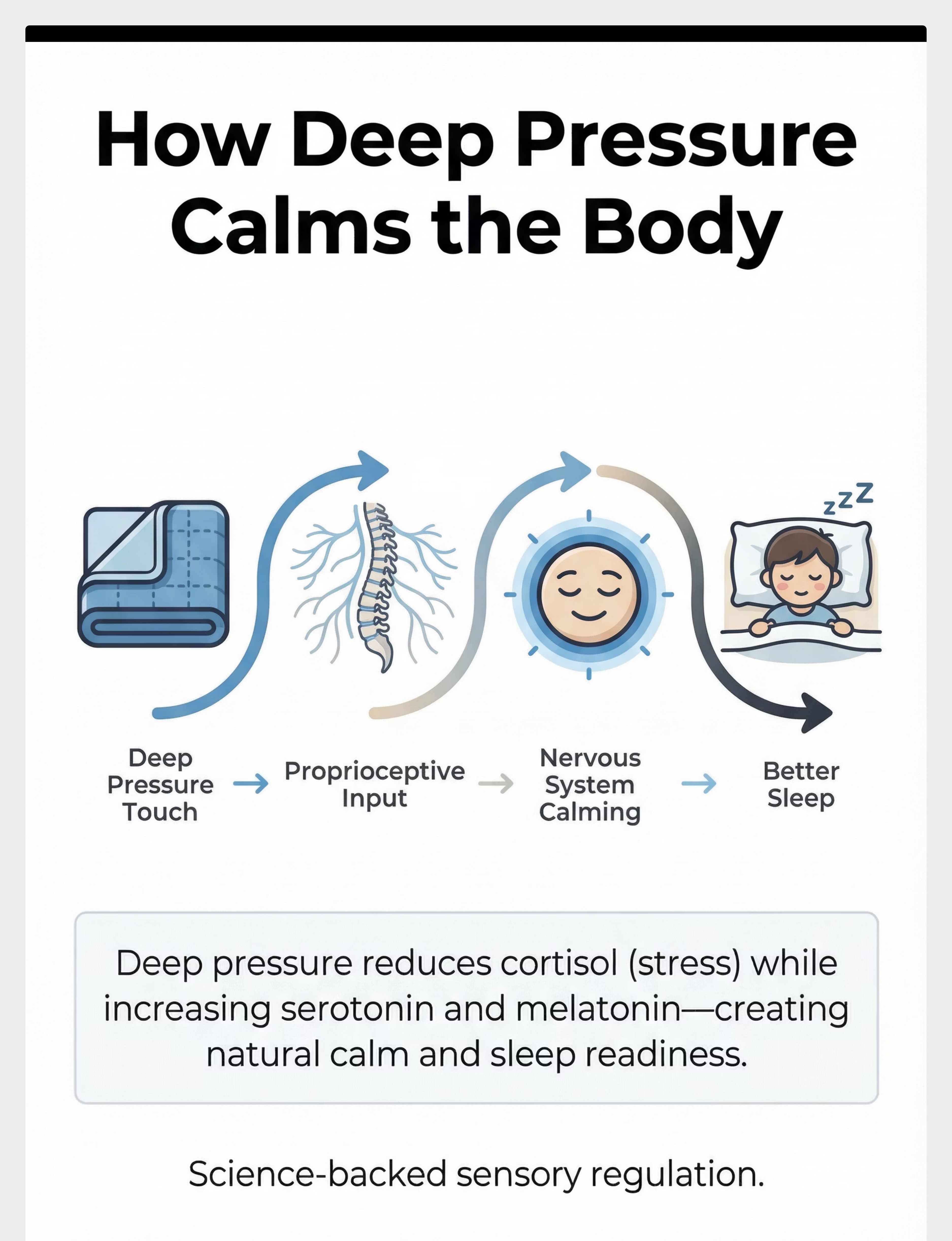
Weighted sleep items work through a well-researched neurological pathway that naturally calms the nervous system and promotes quality sleep.
Deep Pressure Touch
Even weight distribution provides gentle, consistent pressure across the body
Proprioceptive Input
Pressure activates proprioceptive receptors throughout muscles and joints
Nervous System Calming
Signals to brain reduce stress response and activate parasympathetic system
Hormonal Changes
Cortisol decreases while serotonin and melatonin increase naturally
Quality Sleep
Faster onset, deeper sleep, fewer wakings, improved daytime function
Sleep Onset
Sleep Quality
Anxiety Reduction
Sensory Regulation
Nighttime Calming
How to Use It Right
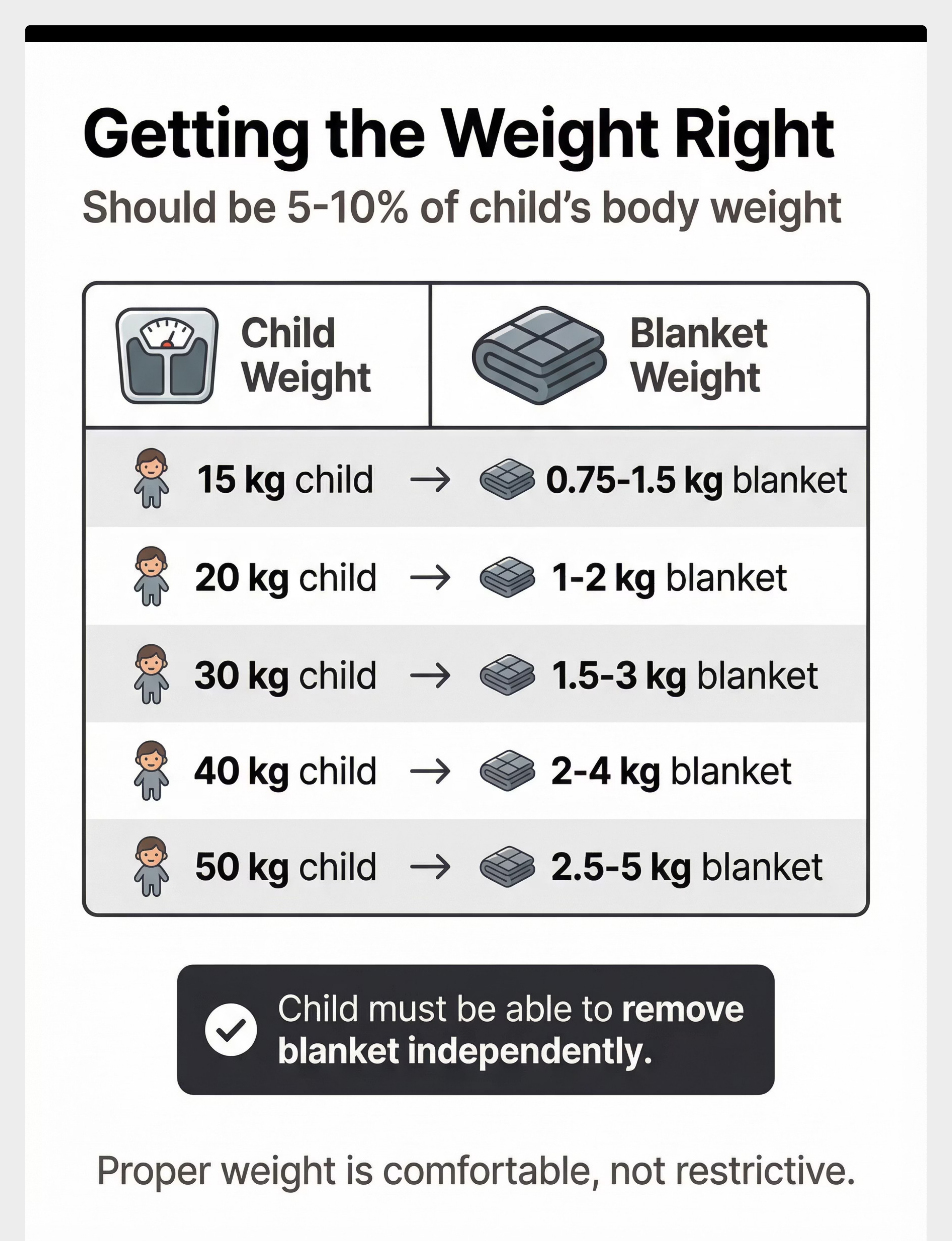
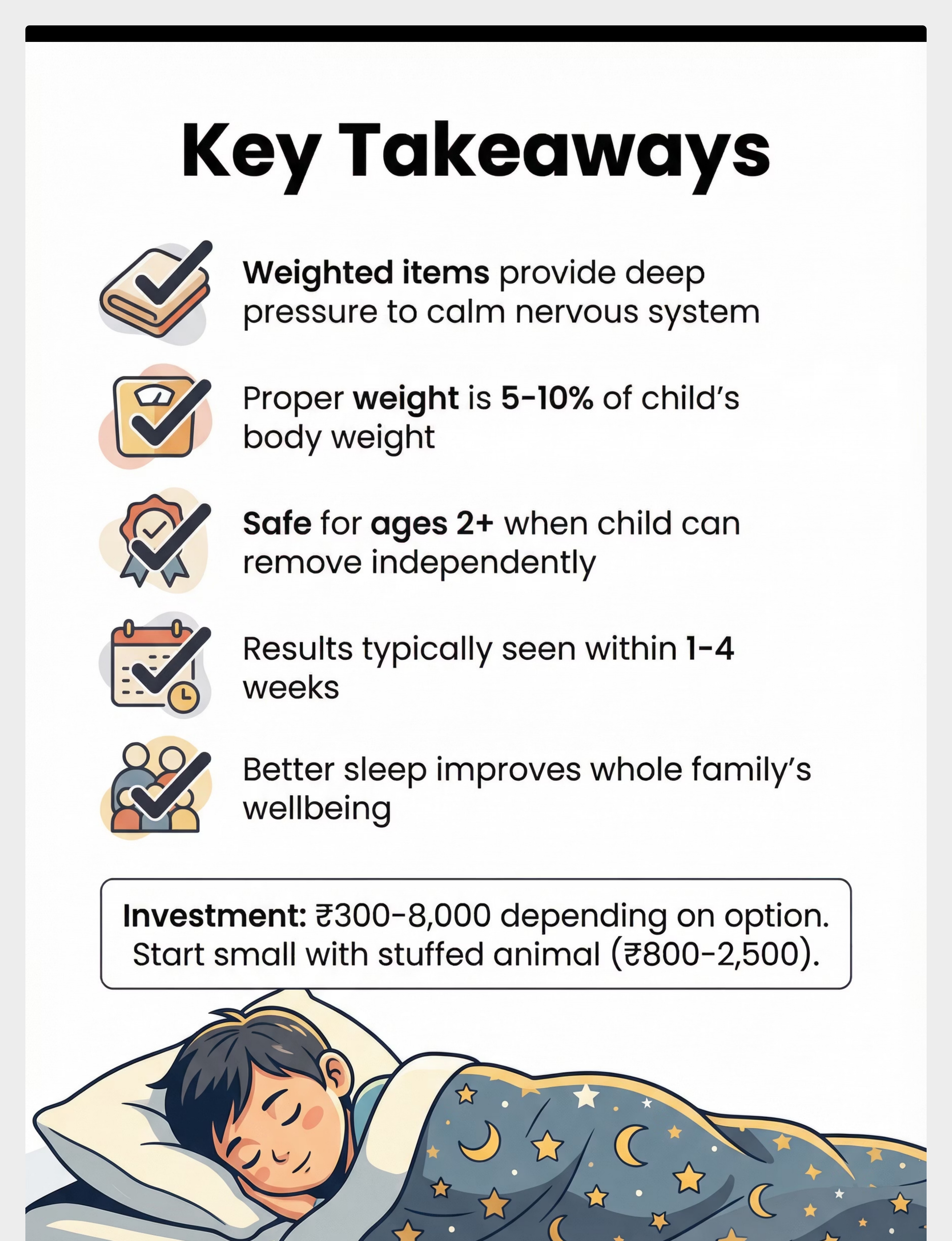
Weight should be 5-10% of child's body weight
Too light won't provide enough input; too heavy can be dangerous. Calculate carefully and stay within this range.
Child must be able to remove blanket independently
Critical safety requirement. Test this before nighttime use. Child should easily push off blanket without help.
Not for children under 2 years
Suffocation risk in very young children. Minimum age is 2 years, and only with ability to remove independently.
Start with shorter periods, build tolerance
Begin with 15-20 minutes during calm time. Gradually increase to full night use as child adjusts.
Ensure proper sizing (blanket fits bed, not floor)
Should cover body comfortably without excess weight hanging off bed pulling blanket down.
Wash according to instructions
Keep clean for nightly use. Choose washable options or removable covers for easy maintenance.

Usage Duration: Throughout sleep, once tolerance is built. Can be used nightly as part of consistent sleep routine.
Expert Endorsement
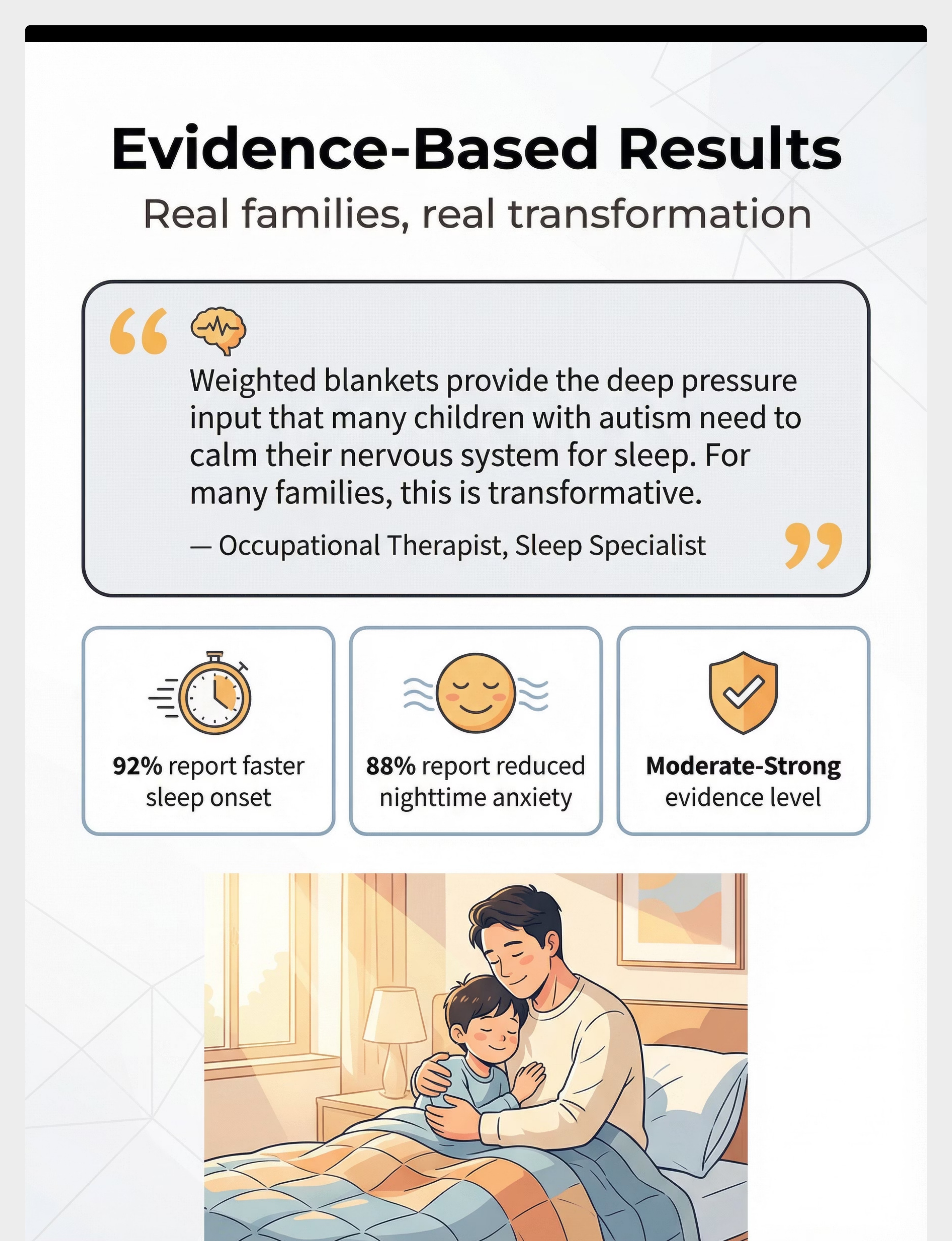
"Weighted blankets provide the deep pressure input that many children with autism need to calm their nervous system for sleep. The key is appropriate weight - not too heavy - and ensuring the child can move freely. For many families, this is transformative for sleep."
— Occupational Therapist, Sleep Specialist
weighted-sleep-items therapy material
OT + Parent
Recommended By
Jointly recommended by occupational therapists and parents as frontline sleep support
Moderate-Strong
Evidence Level
Multiple research studies support effectiveness for sleep and anxiety in neurodivergent children
Rank #1
Category Leader
Top-ranked sleep support tool in comprehensive evaluation of effectiveness and safety
weighted-sleep-items therapy material
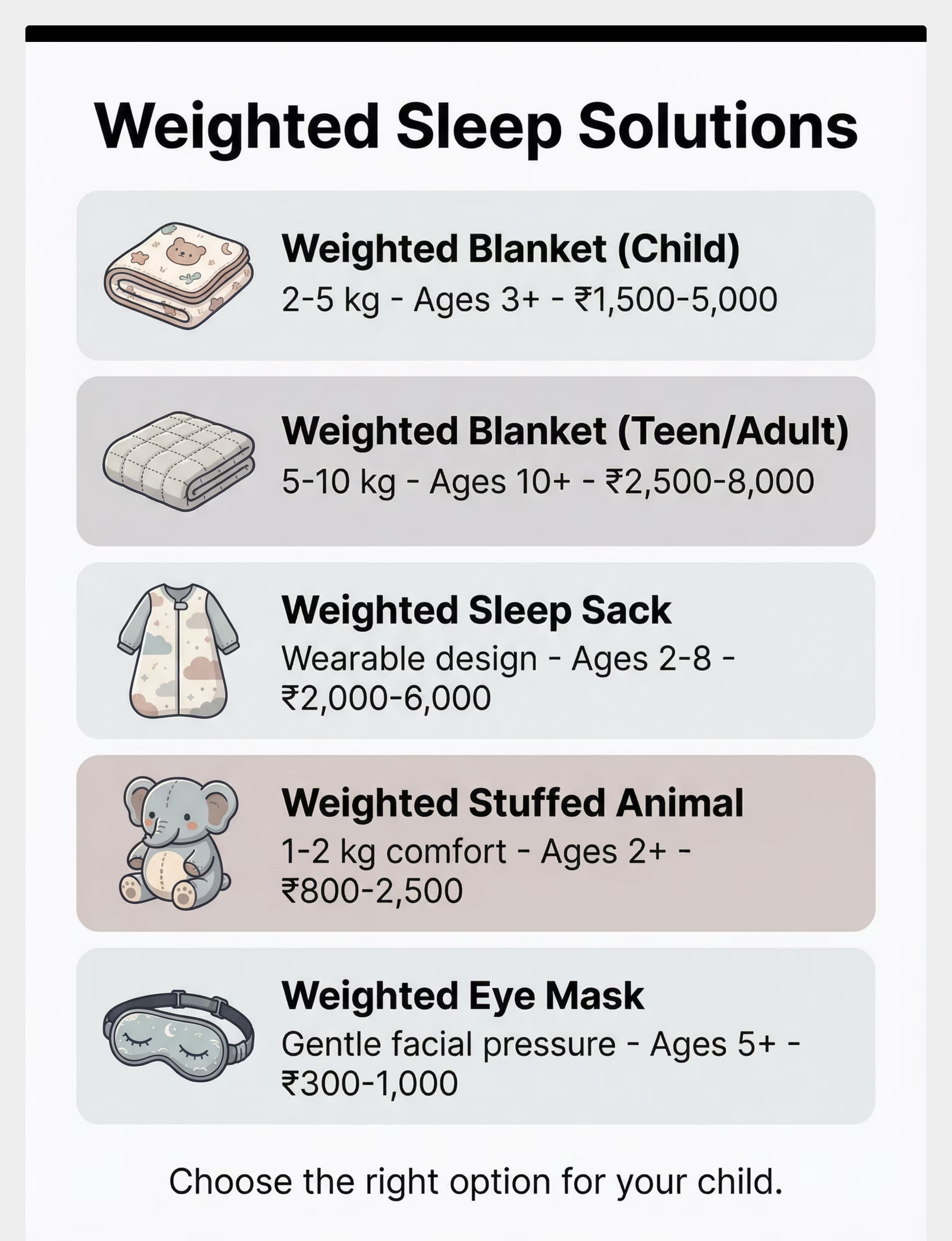
Choose Your Option (5 Variants)
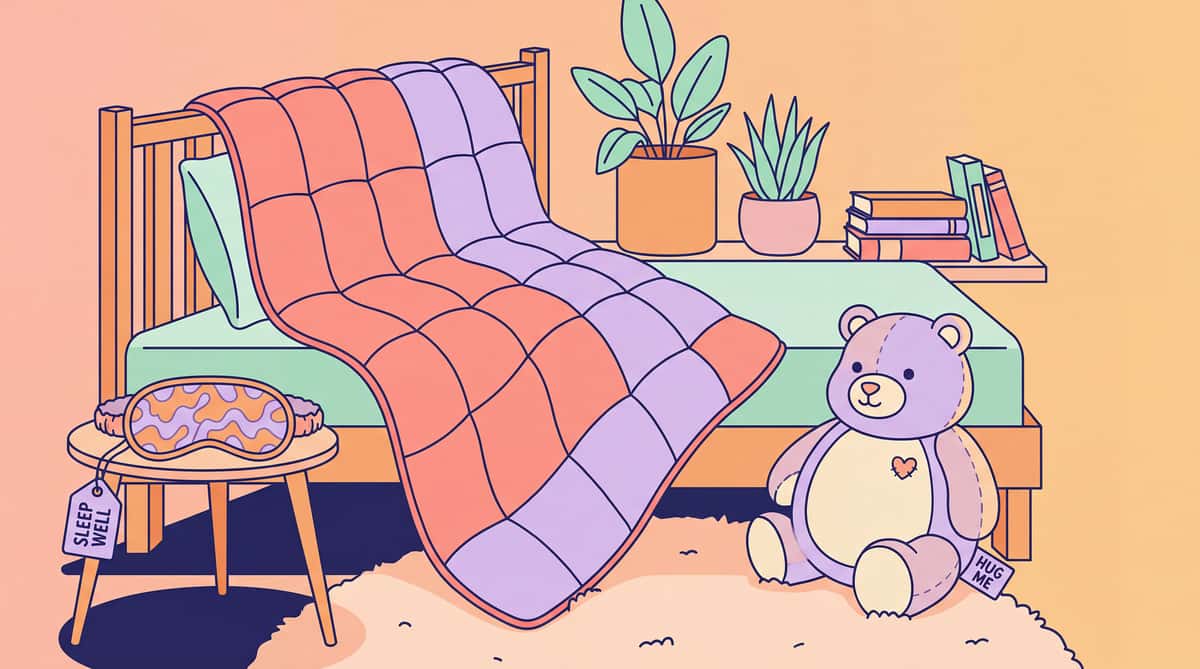
Select the weighted sleep solution that best matches your child's needs, preferences, and sleep challenges. All variants provide deep pressure input, but differ in coverage, portability, and specific use cases.
Weighted Blanket (Child)
Best for: Calming for sleep, anxiety reduction
Ages: 3+ years (weight appropriate)
Settings: Home - bedroom
2-5 kg
Low Portability
Price: ₹1,500–5,000
Weighted Sleep Sack
Best for: Older children, teens with sleep difficulties
Ages: 10+ years
Settings: Home - bedroom
5-10 kg
Low Portability
Price: ₹2,500–8,000
Weighted Stuffed Animal
Best for: Children who kick off blankets
Ages: 2-8 years
Settings: Home - bedroom
Wearable
Low Portability
Price: ₹2,000–6,000
Weighted Eye Mask
Best for: Comfort object with calming weight
Ages: 2+ years
Settings: Home, Travel
1-2 kg
Medium Portability
Price: ₹800–2,500
Weighted Light Sensitivity
Best for: Light sensitivity, facial pressure seeking
Ages: 5+ years
Settings: Home, Travel
Light weight
Very High Portability
Price: ₹300–1,000

How to Choose
By Goal
  • Full body calming: Weighted Blanket
  • Stays on all night: Sleep Sack
  • Comfort + pressure: Stuffed Animal
  • Light sensitivity: Eye Mask
By Setting
  • Home only: Blanket or Sleep Sack
  • Travel-friendly: Stuffed Animal or Eye Mask
  • Portable option: Start with smaller items
By Budget
  • Starting point: Eye Mask (₹300+)
  • Mid-range: Stuffed Animal (₹800+)
  • Full solution: Blanket (₹1,500+)
  • Older kids: Teen blanket (₹2,500+)
Specifications & Weight Guidelines
Cotton Outer
Breathable, comfortable, natural fabric for sensitive skin.
Glass Beads (Preferred)
Cooler, quieter, and more evenly distributed weight than plastic pellets.
Plastic Pellets
A budget-friendly alternative, though can be slightly louder.
Weight Calculation Guide
Rule: 5-10% of child's body weight
Child Weight
Blanket Weight Range
15 kg child
0.75 - 1.5 kg blanket
20 kg child
1 - 2 kg blanket
30 kg child
1.5 - 3 kg blanket
40 kg child
2 - 4 kg blanket
50 kg child
2.5 - 5 kg blanket
Key Features
  • Appropriate weight for child
  • Even weight distribution throughout
  • Breathable fabric to prevent overheating
  • Washable or removable cover
  • Correct size for bed

Important: Never exceed 10% of body weight. When in doubt, start lighter and assess comfort and effectiveness before considering a heavier option.
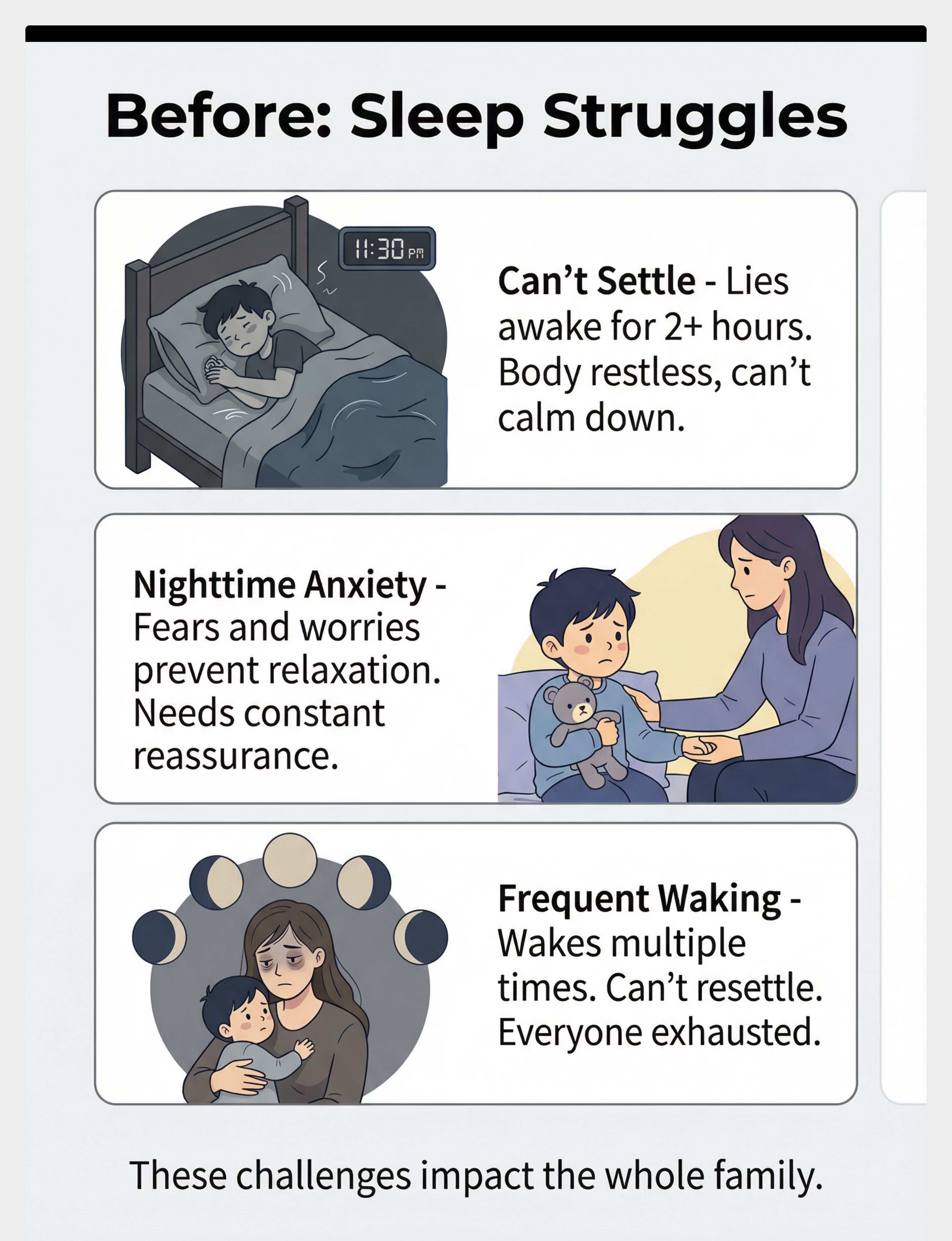
The Struggle (Before)
Can't Settle for Sleep
Situation: Child lies in bed for hours. Body restless, constantly repositioning. Can't calm down no matter how tired. Eventually exhausted into sleep.
Experience: Process takes 2+ hours every night. Parents trying every strategy - reading, singing, staying in room. Nothing helps body settle.
Emotion: Restless, frustrated, exhausted
Nighttime Anxiety
Situation: Child anxious at bedtime. Fears emerge, worries multiply as lights go down. Can't relax into sleep.
Experience: Needs parent present constantly. Holds parent's hand, needs reassurance. Sleep disrupted by anxiety even after falling asleep.
Emotion: Anxious, fearful, needing constant reassurance
Frequent Night Waking
Situation: Child wakes multiple times per night. Can't resettle independently. Calls for parents repeatedly.
Experience: Parents up 4-5 times nightly. Everyone exhausted. No one getting consolidated, restful sleep. Affects entire family.
Emotion: Exhaustion, disruption, desperation for sleep
The Transformation (After)
Witness the remarkable journey from restless nights to peaceful slumber, as weighted blankets bring calm and improved sleep to children and their families.
First Night: Instant Calm
The gentle pressure provides immediate comfort, helping your child settle faster and reducing initial tossing and turning. A noticeable shift towards relaxation begins.
Week 1: Quicker Sleep Onset
Within days, children begin falling asleep 15-30 minutes quicker. They stay in bed longer, experiencing fewer disruptions in the early hours of the night.
Week 2-3: Enhanced Sleep Quality
Deeper, more restorative sleep leads to mornings where children wake up feeling more refreshed and ready for the day. Night wakings become less frequent.
Month 1: Consistent Bedtime Routine
The weighted blanket becomes a cornerstone of a positive bedtime routine, significantly reducing bedtime anxiety and fostering a sense of security and predictability.
Month 2+: Improved Daytime Well-being
The cumulative effect of quality sleep translates into better daytime regulation, improved focus, reduced meltdowns, and an overall uplifted mood for the child and a more harmonious family life.
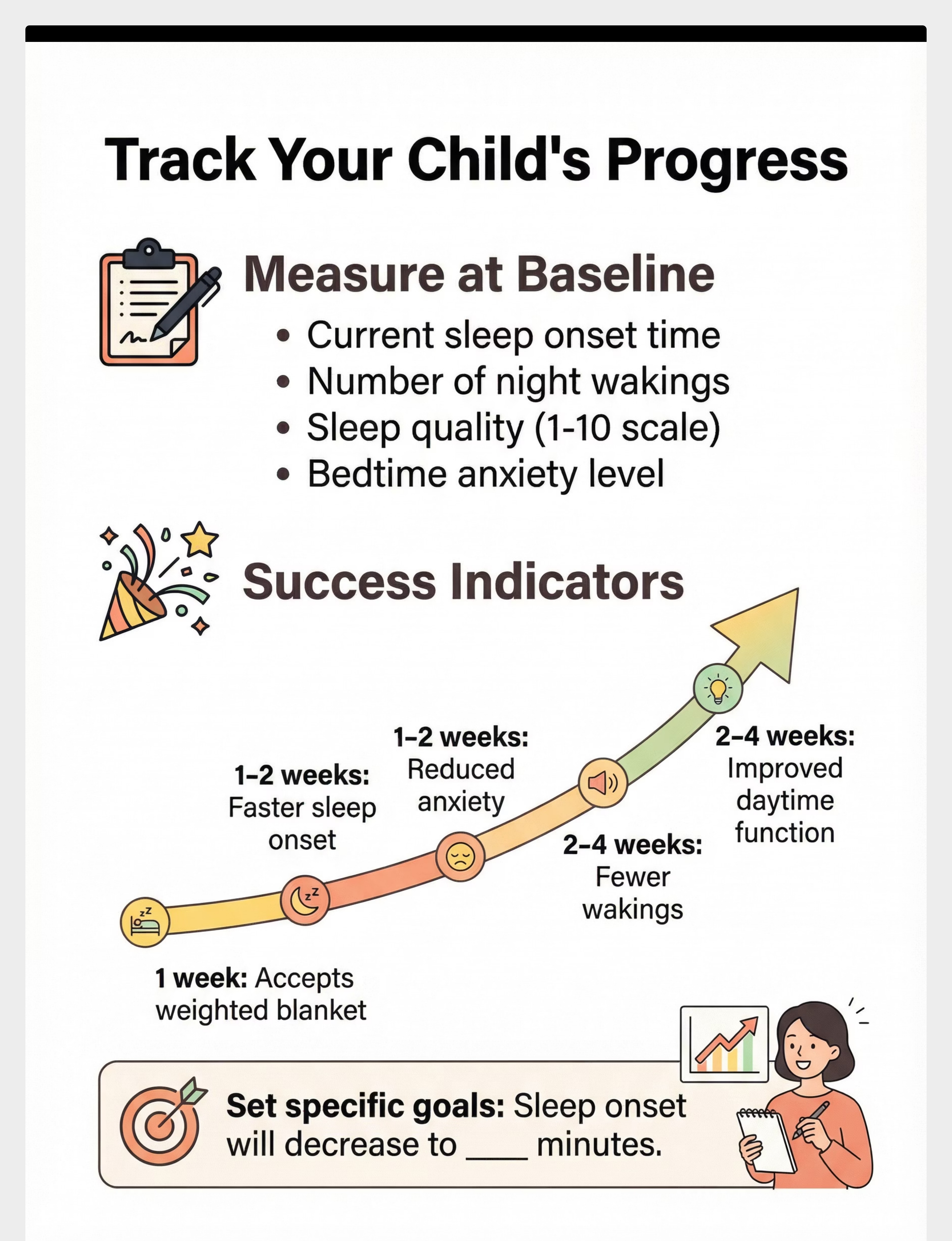
What to Expect (Realistic Timelines)
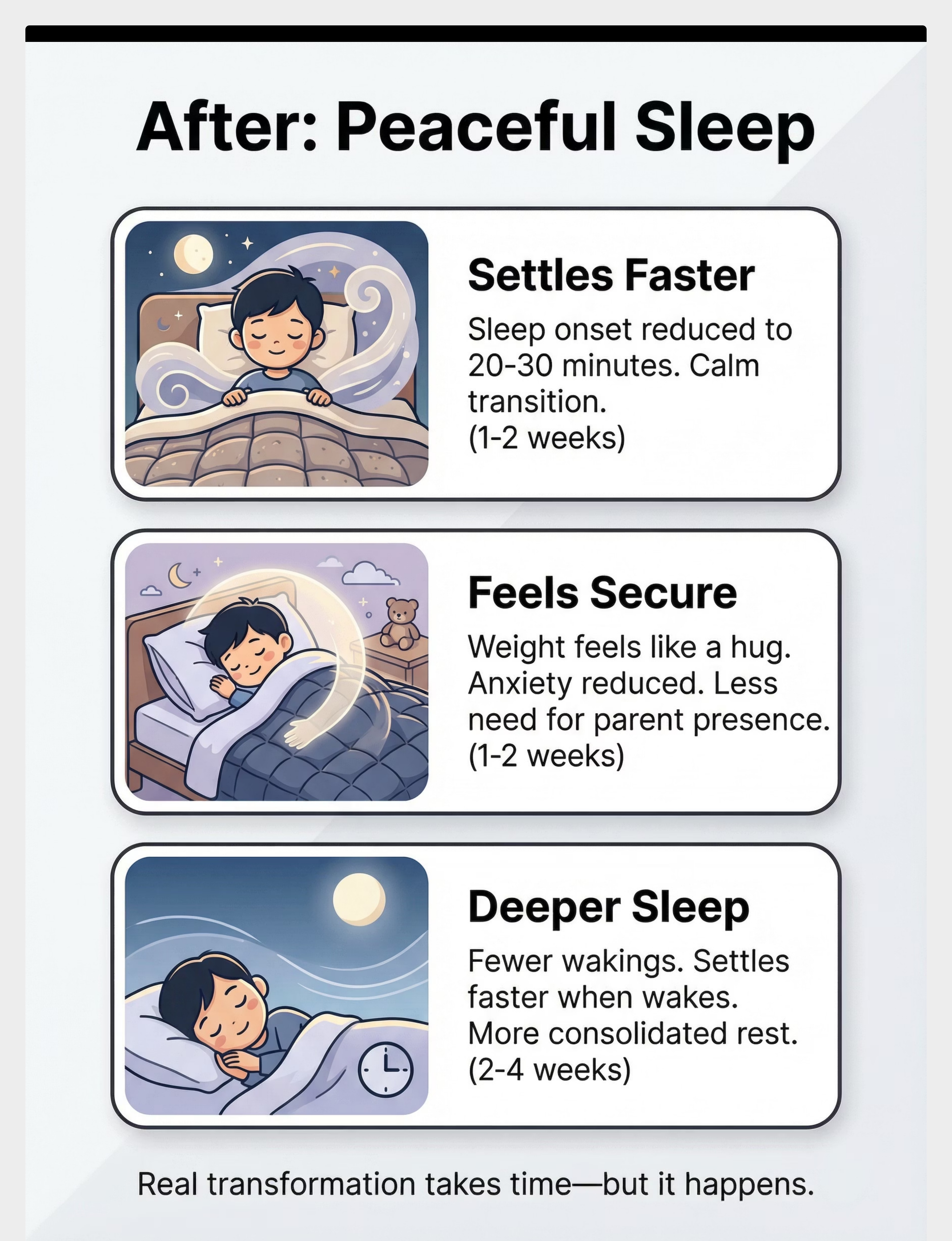
Sleep improvements happen gradually as the nervous system adjusts to the deep pressure input. Here's what most families experience:
Accepts weighted blanket
Child tolerates and may show preference for the weighted blanket during sleep time
1-7 days
Faster sleep onset
Time to fall asleep begins decreasing noticeably, settling happens more easily
1-2 weeks
Reduced nighttime anxiety
Bedtime resistance decreases, child reports feeling calmer and safer
1-2 weeks
Fewer night wakings
More consolidated sleep through the night, less frequent wake-ups
2-4 weeks
Improved daytime function
Better regulation, mood, attention, and learning from quality sleep
2-4 weeks

Individual results vary. Some children respond immediately, others need several weeks of consistent use. Patience and consistency are key to success.
Is This Right for My Child? (2-Minute Check)
Answer these four questions to determine if weighted sleep items are a good fit for your child's needs:
Does your child have difficulty falling asleep?
If yes, this indicates: Weighted blanket may help with settling
Long sleep onset times suggest nervous system needs help downregulating for sleep
Does your child seek deep pressure or tight hugs?
If yes, this indicates: Good candidate for weighted sleep items
Children who naturally seek pressure often respond excellently to weighted sleep solutions
Does your child have nighttime anxiety?
If yes, this indicates: Weight may provide security
The continuous deep pressure can reduce anxiety and increase feeling of safety
Is your child over 2 years and can remove a blanket independently?
If yes, this indicates: Safe for weighted blanket use
If no, this indicates: Not safe for weighted blanket
This is the most critical safety requirement - never compromise on this

Interpretation: 3+ 'yes' answers = strong fit for weighted sleep items. Even 2 'yes' answers suggests worth trying, especially if one is the safety question.
Usage Guide
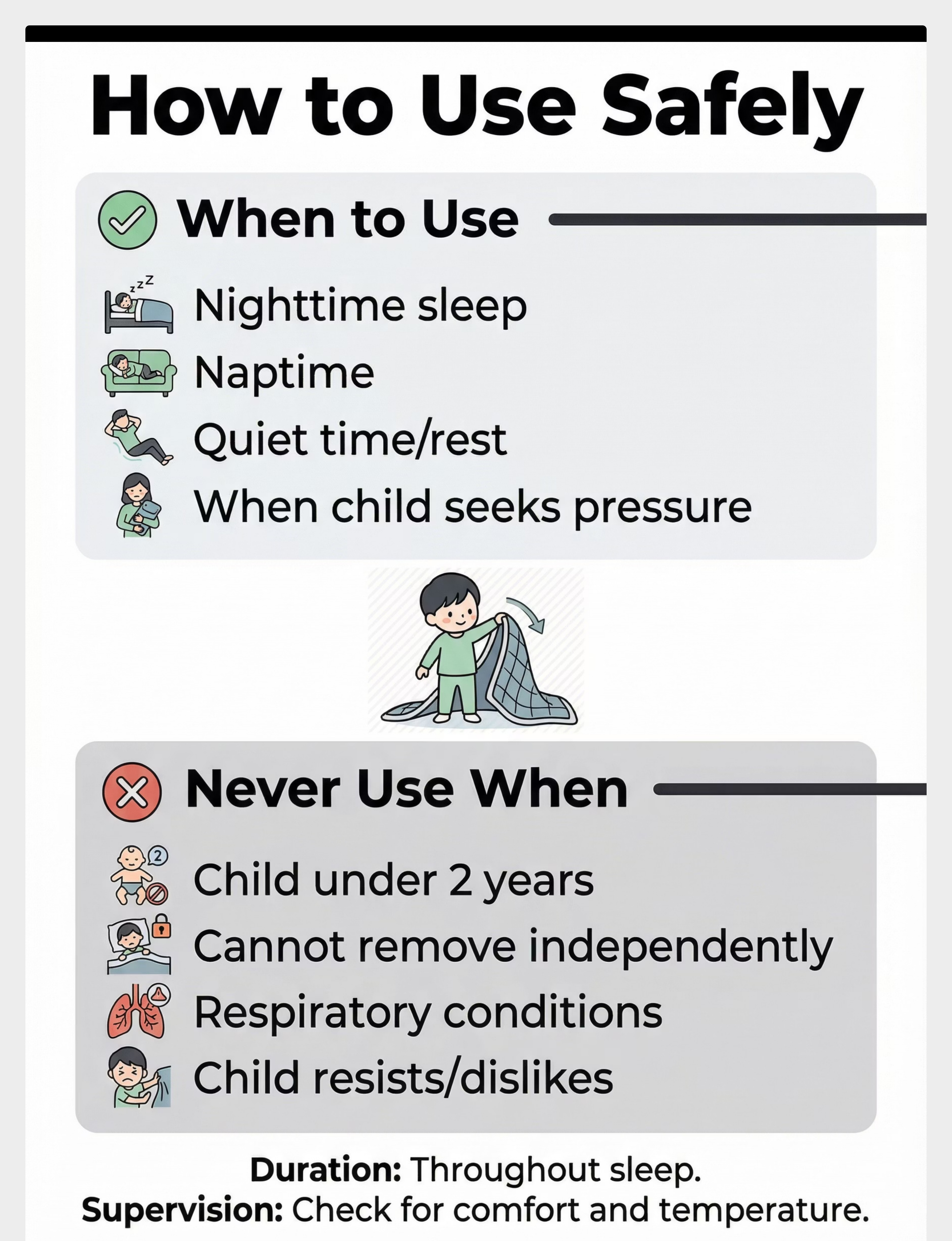
When to Use ✓
  • Nighttime sleep (primary use)
  • Naptime
  • Quiet time/rest periods
  • When child is seeking pressure input
Settings
Home - Bedroom
When NOT to Use ✗
  • Child under 2 years (never)
  • Child cannot remove independently
  • Child has respiratory conditions
  • Child resists or actively dislikes it

Supervision by Age
Age Range
Supervision Level
Notes
Young children (2-5 years)
Ensure child can move/remove freely
Check frequently initially; ensure no difficulty moving under blanket
Older children (6+ years)
Independent use
Once established as safe and beneficial, can use independently
All ages
Monitor for overheating; verify proper weight
Regular checks especially in warm weather; reassess weight as child grows

Duration: Throughout sleep once tolerance is established. Can be used every night as part of consistent sleep routine.
Safety First
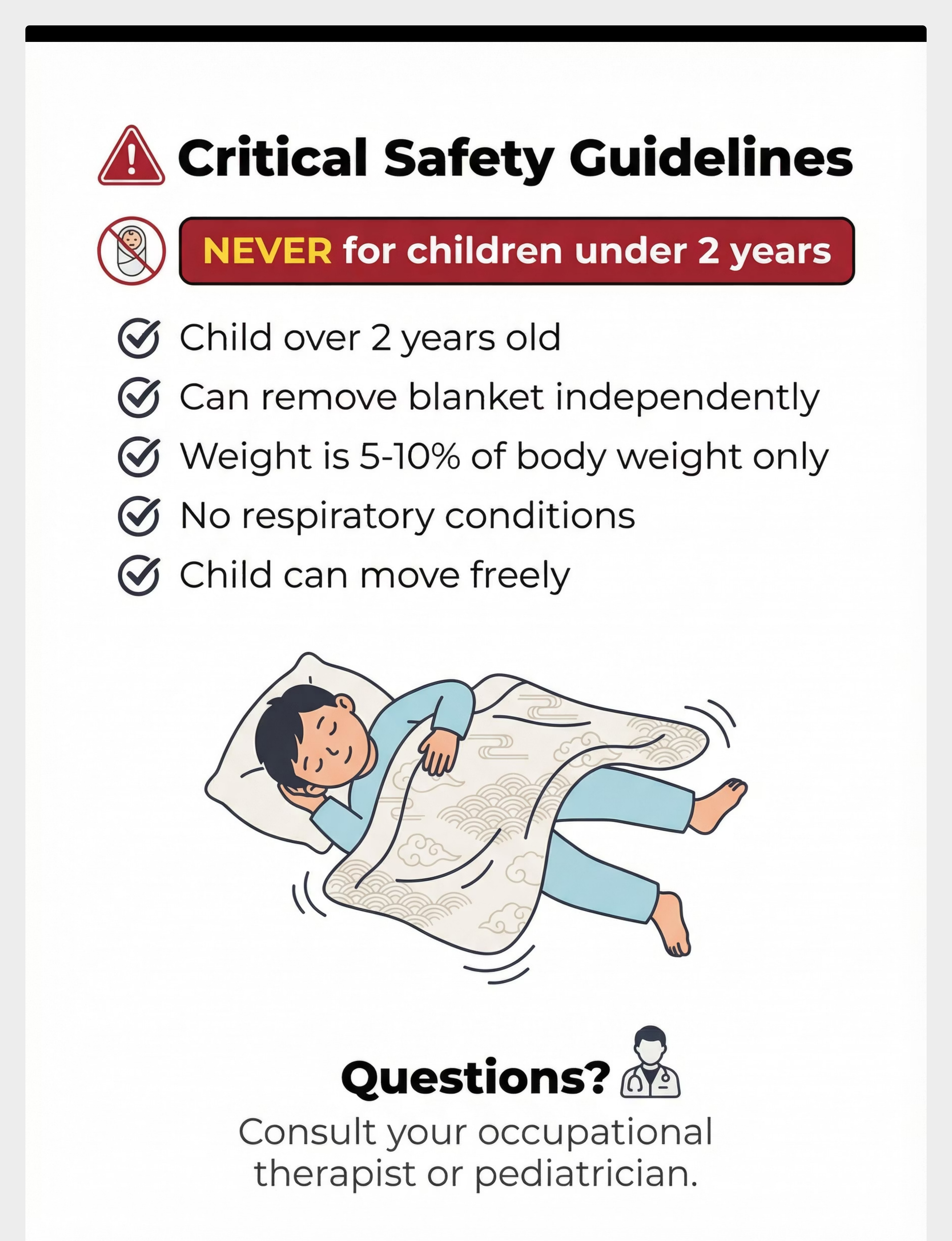
Critical Safety Requirements
  • NEVER for children under 2 years - suffocation risk
  • Child MUST be able to remove independently - test this before nighttime use
  • Weight 5-10% of body weight only - calculate carefully, never exceed
  • No respiratory conditions - consult doctor if any breathing concerns
  • Child should be able to move freely - blanket should never restrict movement
Important Warnings
  • Too heavy can be dangerous - always calculate weight properly
  • Monitor for overheating - choose breathable fabrics
  • Not for children who resist - never force use
  • Consult doctor if concerns - especially with medical conditions
Usage & Monitoring Checklist
Before Use
  • ✓ Child over 2 years
  • ✓ Weight appropriate (5-10%)
  • ✓ Can remove independently
  • ✓ No respiratory concerns
During Use
  • ✓ Child comfortable
  • ✓ Not overheating
  • ✓ Sleeping better
  • ✓ Can move freely
Signs of Success
  • ✓ Faster sleep onset
  • ✓ Calmer at bedtime
  • ✓ Fewer wakings
  • ✓ Better sleep quality
Common Questions (Honest Answers)
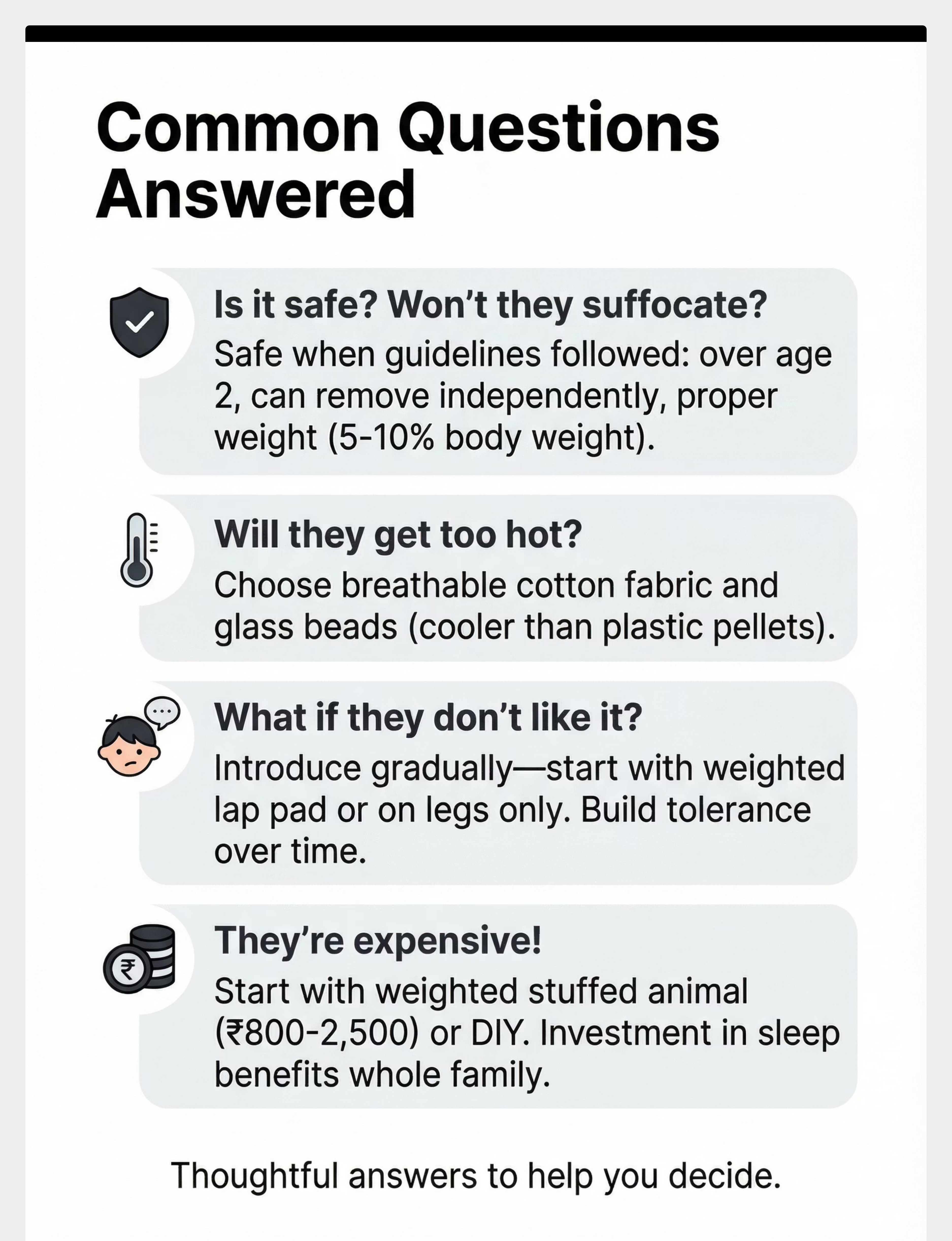
Is it safe? Won't they suffocate?
A: Safe when guidelines followed: child over 2, can remove independently, 5-10% body weight, no respiratory issues. Never for infants. Proper weight is comfortable, not restrictive. Child should easily push off blanket without help.
Try this: Test removal ability during day before nighttime use. Have child demonstrate pushing blanket off easily.
They'll get too hot
A: Choose breathable fabrics like cotton. Glass bead filling is cooler than plastic pellets. Some blankets are specifically designed for cooling. Lighter weight options available for warm climates.
Try this: Breathable fabrics; glass beads; cooling options; adjust weight for climate.
What if they don't like it?
A: Introduce gradually. Start with weighted lap pad during day first. Try blanket on legs only. Build tolerance slowly. Some children need time to adjust. Not appropriate for sensory avoiders who dislike pressure.
Try this: Gradual introduction; build tolerance; respect child's preferences; not right for every child.
They're expensive
A: Consider cost of poor sleep on whole family - health, function, quality of life. Start with weighted stuffed animal (cheaper option to test). DIY options exist and can save 40-60%. Investment in sleep is investment in everything else.
Try this: Cost of poor sleep is higher long-term; start with smaller/cheaper option; DIY possible; consider as health investment.
Investment Guide
Weighted sleep items range from affordable starter options to premium therapeutic-grade products. Choose based on your child's needs, your budget, and whether you're testing the concept or committing to long-term use.
Understanding the pricing spectrum can help you make an informed decision for your family's well-being.
Item Type
Price Range (INR)
Price Range (USD)
Weighted Eye Mask
₹300-1,000
$4-12
Weighted Stuffed Animal
₹800-2,500
$10-30
Weighted Blanket (Child)
₹1,500-5,000
$18-60
Weighted Sleep Sack
₹2,000-6,000
$24-72
Weighted Blanket (Teen/Adult)
₹2,500-8,000
$30-96

Considerations for Your Investment
Starting Point & Budget
Cost: ₹500-1,500 for a weighted stuffed animal or DIY lap pad.
Best for: Testing the concept, younger children, travel use, or tight budgets before committing to a full blanket.
Mid-Range Options
Cost: ₹1,500-5,000 for a child-sized weighted blanket. Brands offer various designs and materials.
Best for: Established need for deep pressure, balancing quality with cost, growing children.
Premium Investment
Cost: ₹2,500-5,000 for a quality child-sized weighted blanket from brands like Gravity, YnM, Calming Blankets.
Best for: Long-term nightly use, established deep pressure need, superior construction and materials.
Investment Progression
Stage 1: Explore & Test
Begin with a low-cost item like a weighted eye mask or stuffed animal to see if your child responds positively to the input. This minimizes initial financial risk.
Stage 2: Targeted Purchase
If initial testing is positive, consider investing in a child-specific weighted blanket. Focus on appropriate weight and material for their age and preferences.
Stage 3: Long-Term Solution
For sustained needs or as your child grows, upgrade to a premium child/teen/adult weighted blanket or a weighted sleep sack for continuous benefits and durability.

Value perspective: Poor sleep affects every aspect of child and family functioning. The cost of sleep deprivation - in health, emotional wellbeing, learning, and family quality of life - far exceeds the cost of an effective weighted blanket.
Where to Buy in India
Availability: Moderately Available - Weighted sleep items are increasingly available through major online platforms and specialty stores in India.
Recommended Platforms
Amazon.in: Weighted Blanket (Kids)
Search Term: "weighted blanket kids"
Typical Price: ₹1,500-4,000
Amazon.in: Weighted Blanket (Adult)
Search Term: "weighted blanket adult"
Typical Price: ₹2,500-6,000
Amazon.in: Weighted Stuffed Animal
Search Term: "weighted stuffed animal"
Typical Price: ₹800-2,000
Amazon.in: Weighted Eye Mask
Search Term: "weighted eye mask"
Typical Price: ₹300-800
Specialty Stores: Sensory Items
Search Term: "sensory weighted blanket"
Typical Price: ₹2,000-5,000
Buying Tips ✓
  • Calculate proper weight first (5-10% body weight)
  • Check weight distribution (should be even throughout)
  • Glass beads preferred over plastic pellets
  • Ensure washable or has removable cover
  • Size should fit bed, not hang to floor
Red Flags ✗
  • Too heavy for child's weight
  • Child cannot remove independently
  • Poor weight distribution (lumpy)
  • Non-breathable fabric
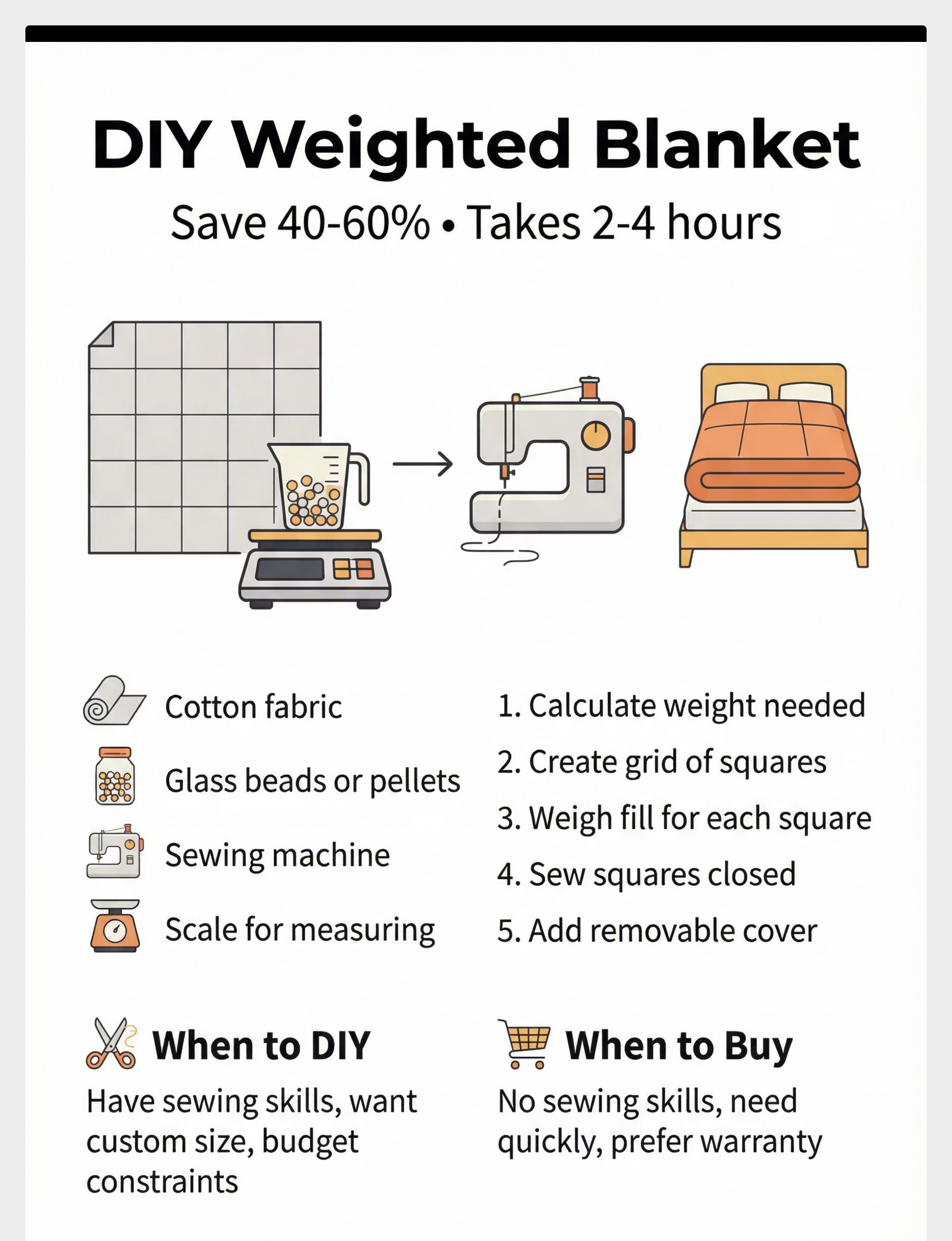
DIY Alternative (Save 40-60%)
Feasibility: Medium
Time: 2-4 hours
Cost Savings: 40-60%
Materials Needed
  • Cotton fabric (comfortable, breathable outer material)
  • Glass beads or plastic pellets (weight filling)
  • Sewing machine (or hand-sewing for smaller items)
  • Scale (for accurate weight measurement)
Step-by-Step Instructions
1
Calculate weight needed
Weigh child, calculate 5-10% of body weight, decide on blanket dimensions
2
Cut fabric to size
Cut slightly larger than final bed size to account for seams
3
Create grid of squares
Sew vertical and horizontal lines creating 4-6 inch squares throughout blanket
4
Weigh and add fill to each square evenly
Distribute total weight evenly across all squares, weigh each portion
5
Sew squares closed
Carefully sew each square closed after filling to prevent shifting
6
Add removable cover for washing
Create or purchase duvet-style cover for easy cleaning
7
Test weight and distribution
Check that weight is evenly distributed and total weight is correct

DIY vs Commercial Comparison
When to DIY
Have sewing skills or willing to learn
Want custom size/weight/fabric
Budget constraints
Enjoy crafting projects
When to Buy Commercial
No sewing skills or equipment
Want guaranteed quality and safety
Need quickly (DIY takes time)
Prefer warranty and return options

Tradeoffs: DIY requires sewing skills and time; weight distribution can be tricky to get perfectly even. Commercial blankets have quality assurance and warranty. DIY allows customization and significant cost savings.

Preview of weighted sleep items Therapy Material

Below is a visual preview of weighted sleep items therapy material. The pages shown help educators, therapists, and caregivers understand the structure and content of the resource before use. Materials should be used under appropriate professional guidance.

Page 1
Page 2
Page 3
Page 4
Page 5
Page 6
Page 7
Page 8
Page 9
Page 10
Page 11
Page 12
Page 13
Page 14
Page 15
Page 16
Page 17
Page 18
Page 19
Page 20
Link copied!
Measuring Success
Baseline (Measure First)
  • Current sleep onset time
  • Number of night wakings
  • Overall sleep quality
  • Bedtime anxiety level
Goals to Set
  • Sleep onset will decrease to X minutes
  • Night wakings will decrease to X times
  • Child will report feeling calmer
  • Sleep quality will improve
Success Indicators
  • Faster sleep onset
  • Fewer wakings
  • Better quality sleep
  • Improved daytime function

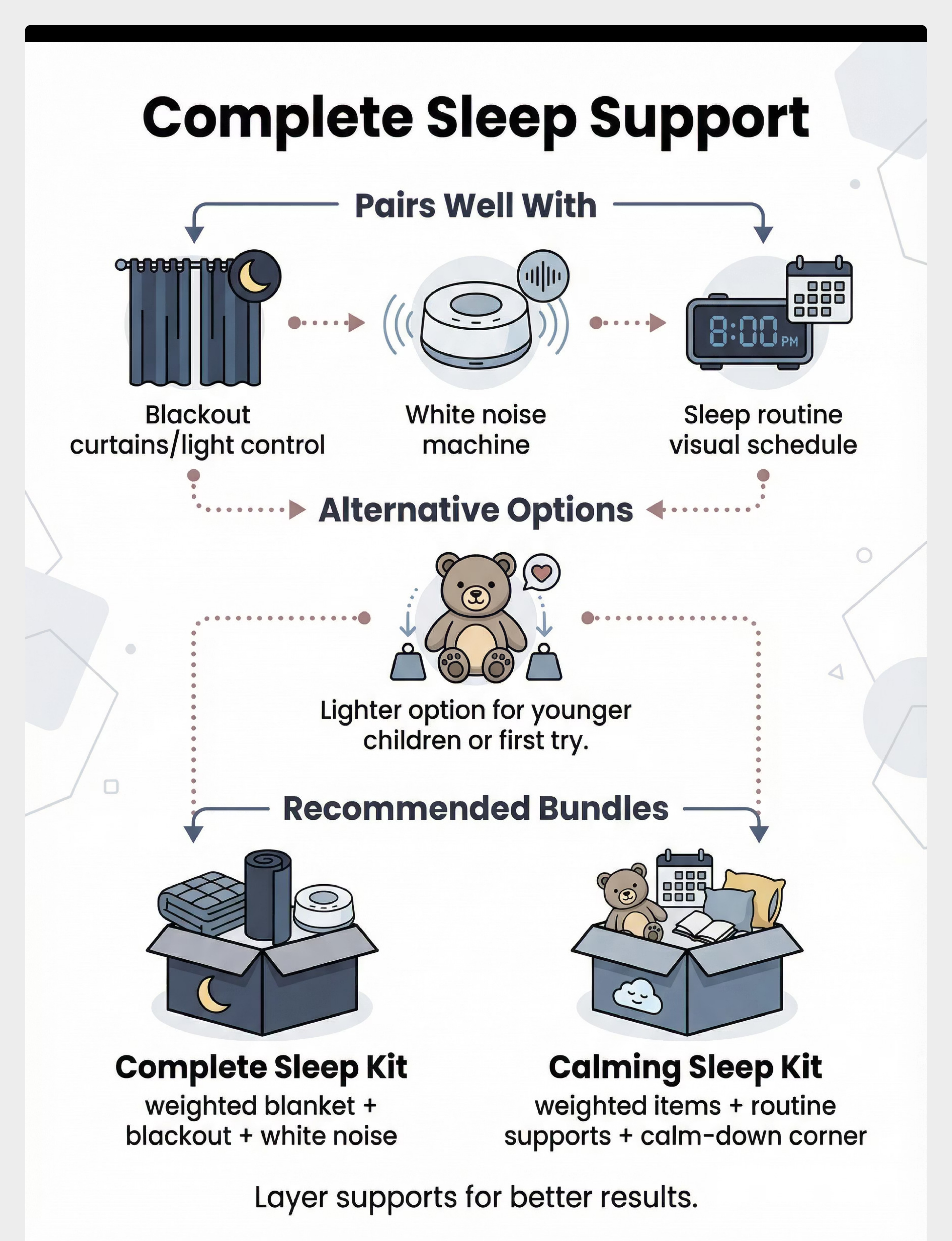
Complete the Kit
Pair It With...
Blackout/Light Control (ID: 14.2)
Complete sleep environment - combine deep pressure with optimal darkness
White Noise (ID: 14.3)
Auditory support - mask disruptive sounds while weighted blanket provides pressure
Sleep Routine Supports (ID: 14.4)
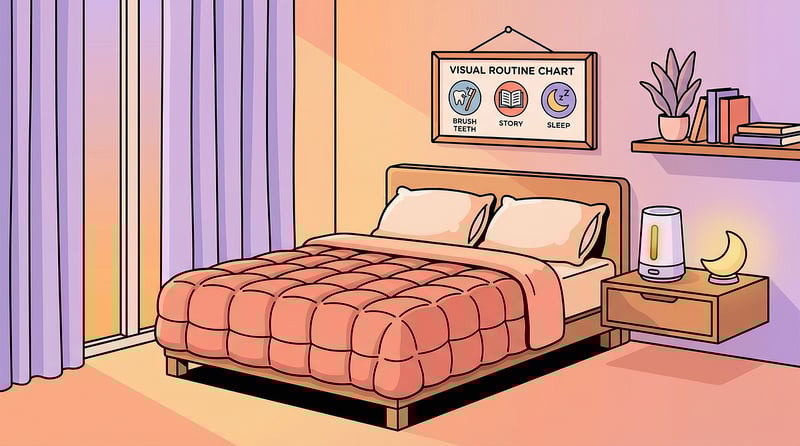
Bedtime structure - predictable routine enhanced by weighted blanket use
Weighted Lap Pads (ID: 1.1)
Daytime version - extend calming benefits throughout the day
Recommended Bundles
Complete Sleep Kit
Items: Weighted Sleep Items (14.1) + Blackout/Light Control (14.2) + White Noise (14.3)
Use Case: Full sleep environment optimization for comprehensive support
Calming Sleep Kit
Items: Weighted Sleep Items (14.1) + Sleep Routine Supports (14.4) + Calming Sensory Tools (2.8)
Use Case: Anxiety reduction + sleep support for emotionally sensitive children

Quick Summary
AI Summary: Weighted sleep items provide deep pressure input to calm the nervous system, reduce anxiety, and improve sleep onset and quality for children with sensory processing differences. Core Kit (Rank 1), moderate-strong evidence, transformative for many families.
weighted
sleep
deep pressure
blanket
anxiety
calming
OT
core-kit
Common Searches
weighted blanket autism, weighted blanket sleep, sensory blanket, deep pressure sleep, anxiety blanket, calming blanket, weighted sleep

Get Support
FREE National Autism Helpline
Phone: 9100 181 181
Languages: 16+ languages supported
Website: pinnacleblooms.org
Connect with expert guidance on implementing weighted sleep items and comprehensive sleep support strategies
Integrated Platform Support
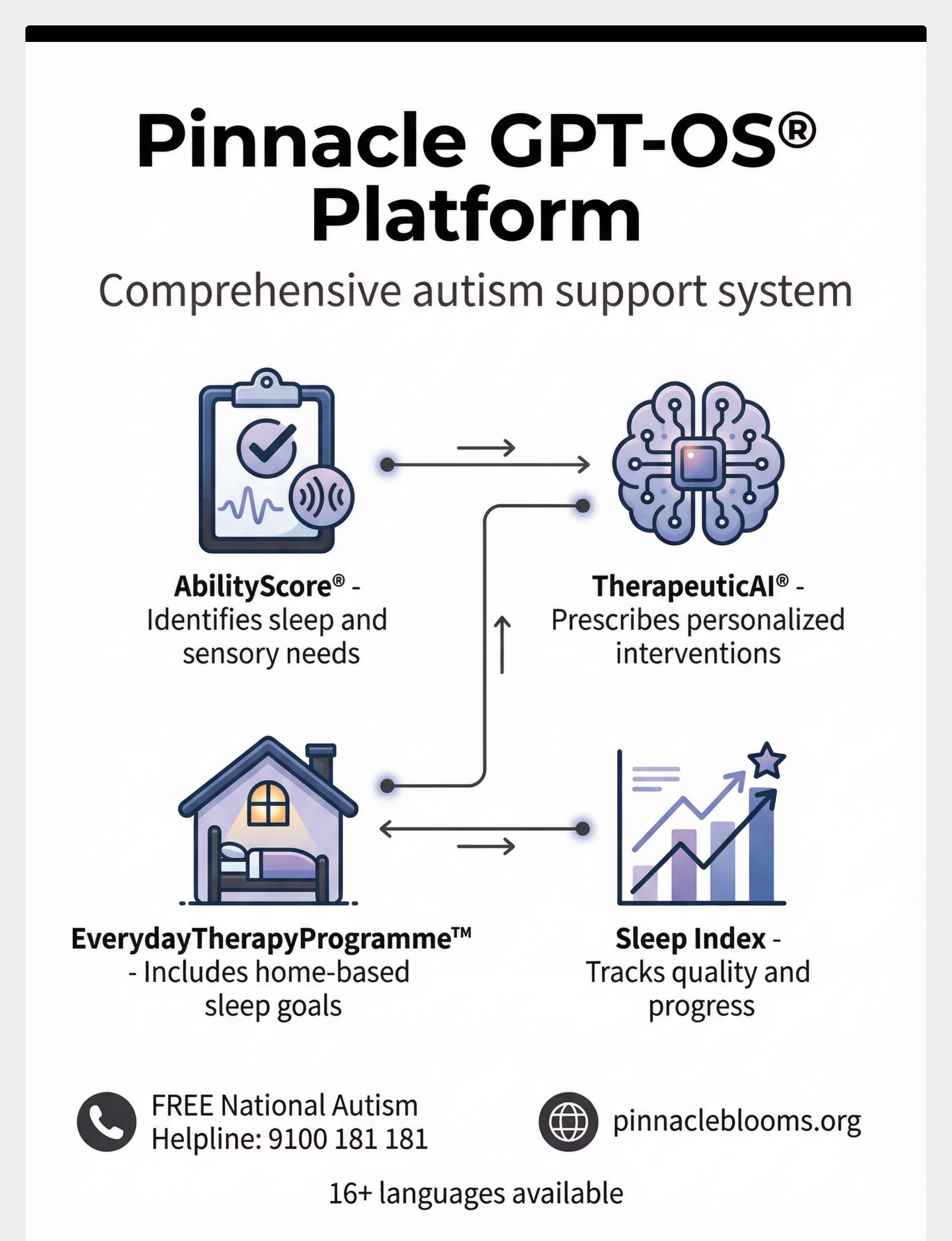
AbilityScore® identifies sleep and sensory needs through comprehensive assessment
TherapeuticAI® prescribes personalized sleep interventions including weighted items
EverydayTherapyProgramme™ includes sleep goals in daily therapeutic routines
Sleep Index tracks sleep quality improvements over time

Disclaimer: This is educational information. Always consult qualified occupational therapists, speech-language pathologists, or pediatricians before implementing new sleep interventions. Individual results vary based on child's unique needs, consistent implementation, and overall sleep environment.