


Tool ID: 12.1
Tool ID: 12.1
OT + PT Recommended
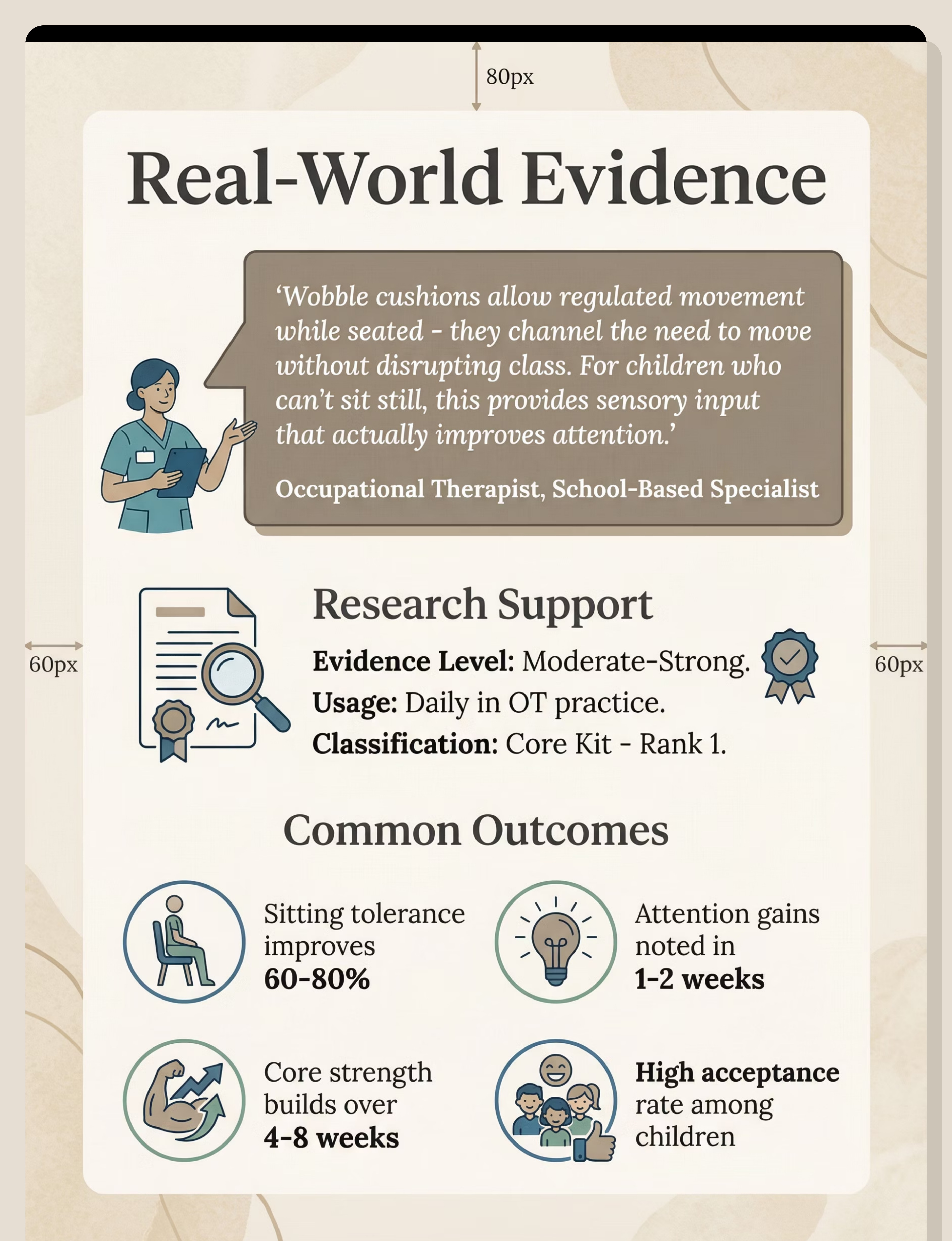
Moderate-Strong Evidence
Rank #1
Daily Use
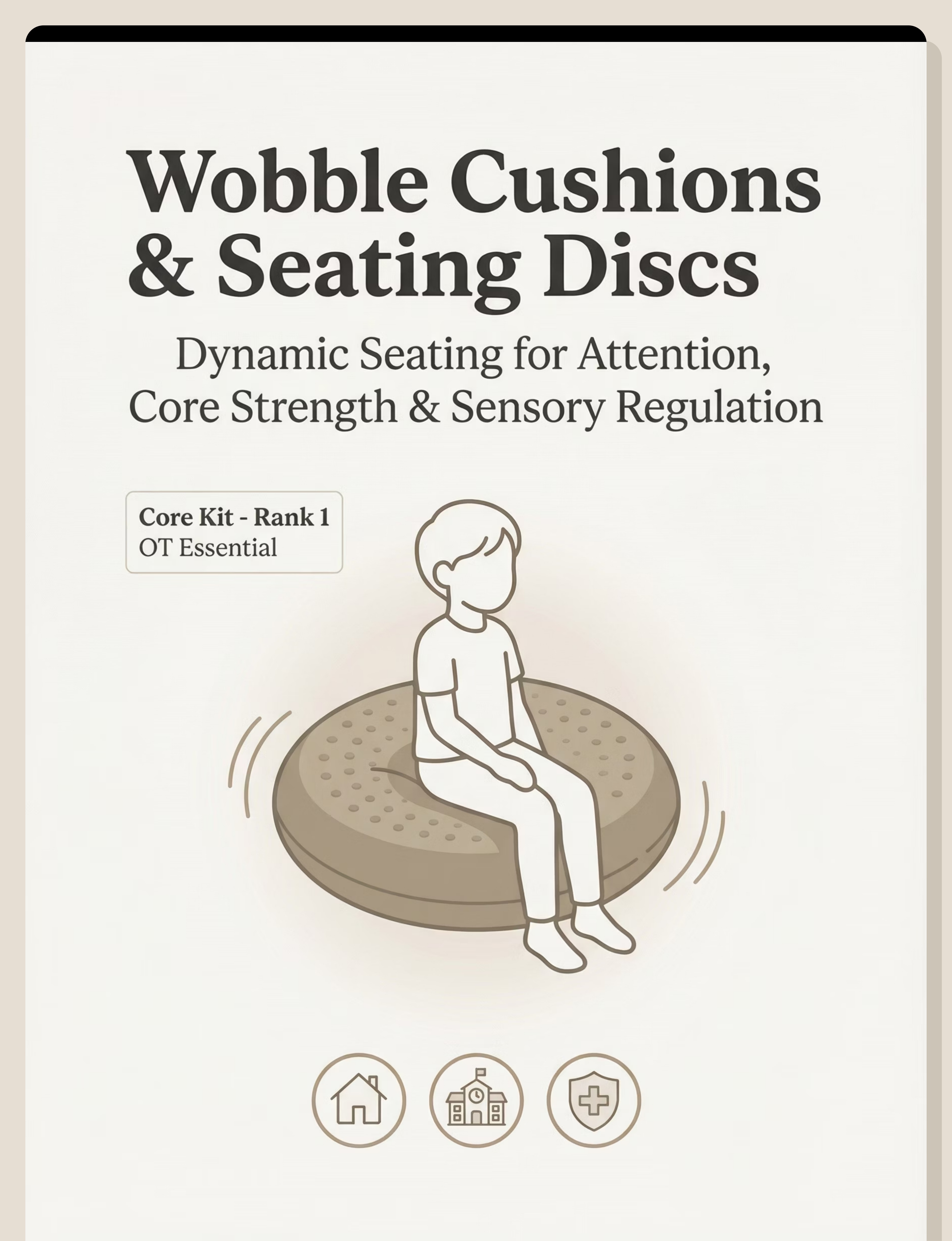
Wobble Cushions: Dynamic Seating for Focus & Regulation
Dynamic seating and core activation system
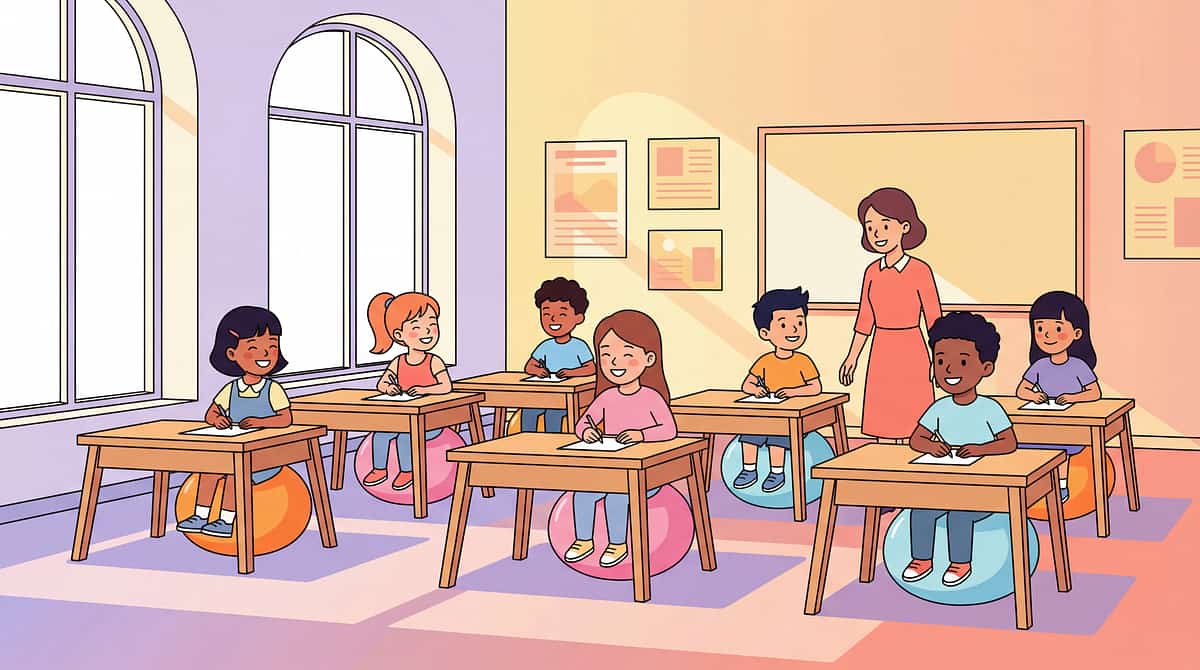
Wobble cushions provide a dynamic seating surface that allows movement while seated, engaging core muscles and delivering proprioceptive input that supports attention, sensory regulation, and sitting tolerance. These simple yet powerful tools transform restless energy into focused learning.
₹300–1,200
Ages 3+
Home • School • Clinic
Who This Helps
Dynamic Seating Surfaces
Allow movement while seated, promoting active engagement.
Engages Core Muscles
Strengthens core for improved posture and stability.
Provides Proprioceptive Input
Supports sensory regulation and body awareness.
Improves Attention & Focus
Helps restless energy translate into concentrated learning.
Supports Sitting Tolerance
Enables longer periods of comfortable and sustained sitting.
Core Strength
Postural Control
Attention
Sensory Regulation
Sitting Tolerance
Balance
Ages 3+ Years
Size-appropriate options for preschoolers through school-age children, with adjustable challenge levels to grow with your child's abilities.
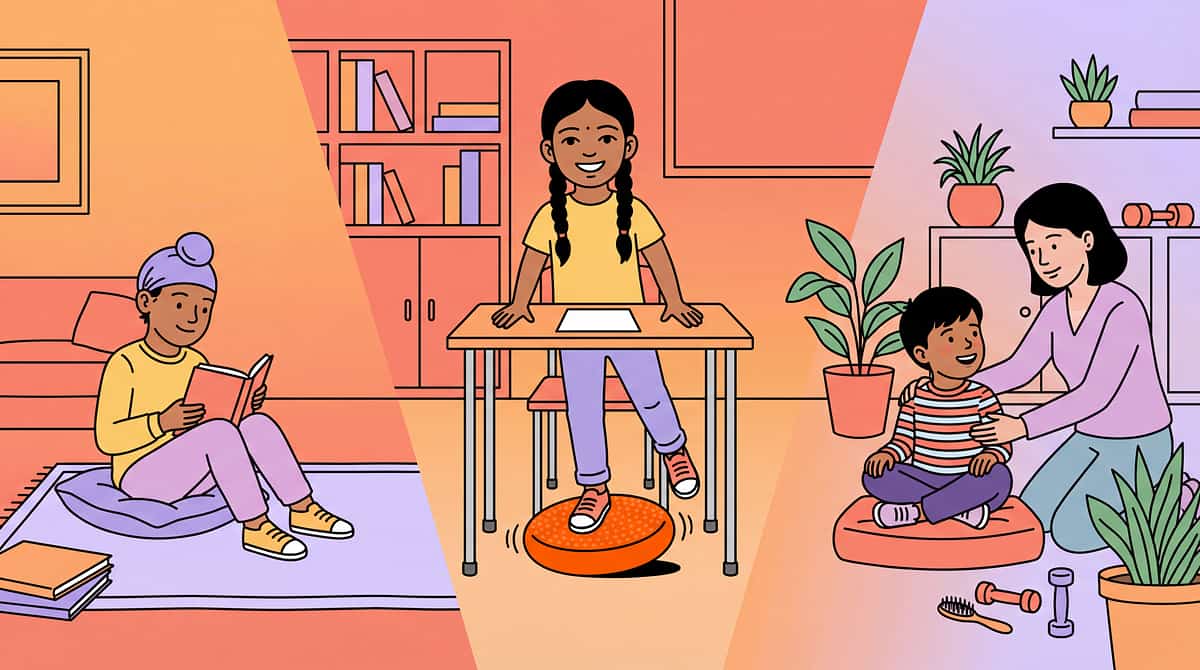
Multiple Settings
Highly portable and versatile for use at home during homework, in classrooms during lessons, and in therapy clinics during sessions.
Best For
Children who need to move constantly, have difficulty sitting still, seek proprioceptive input, or struggle with weak core muscles and postural control.
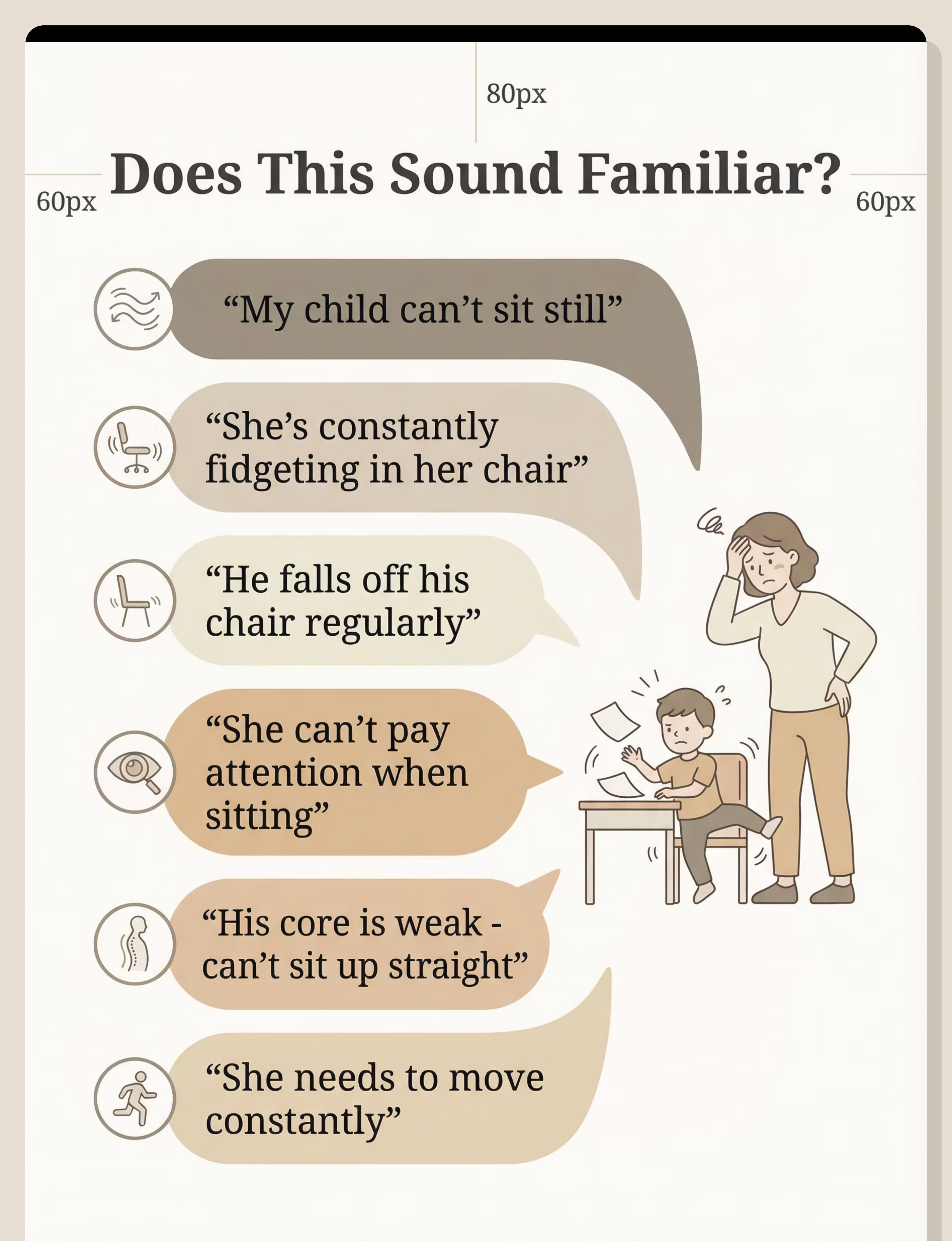
Does This Sound Familiar?
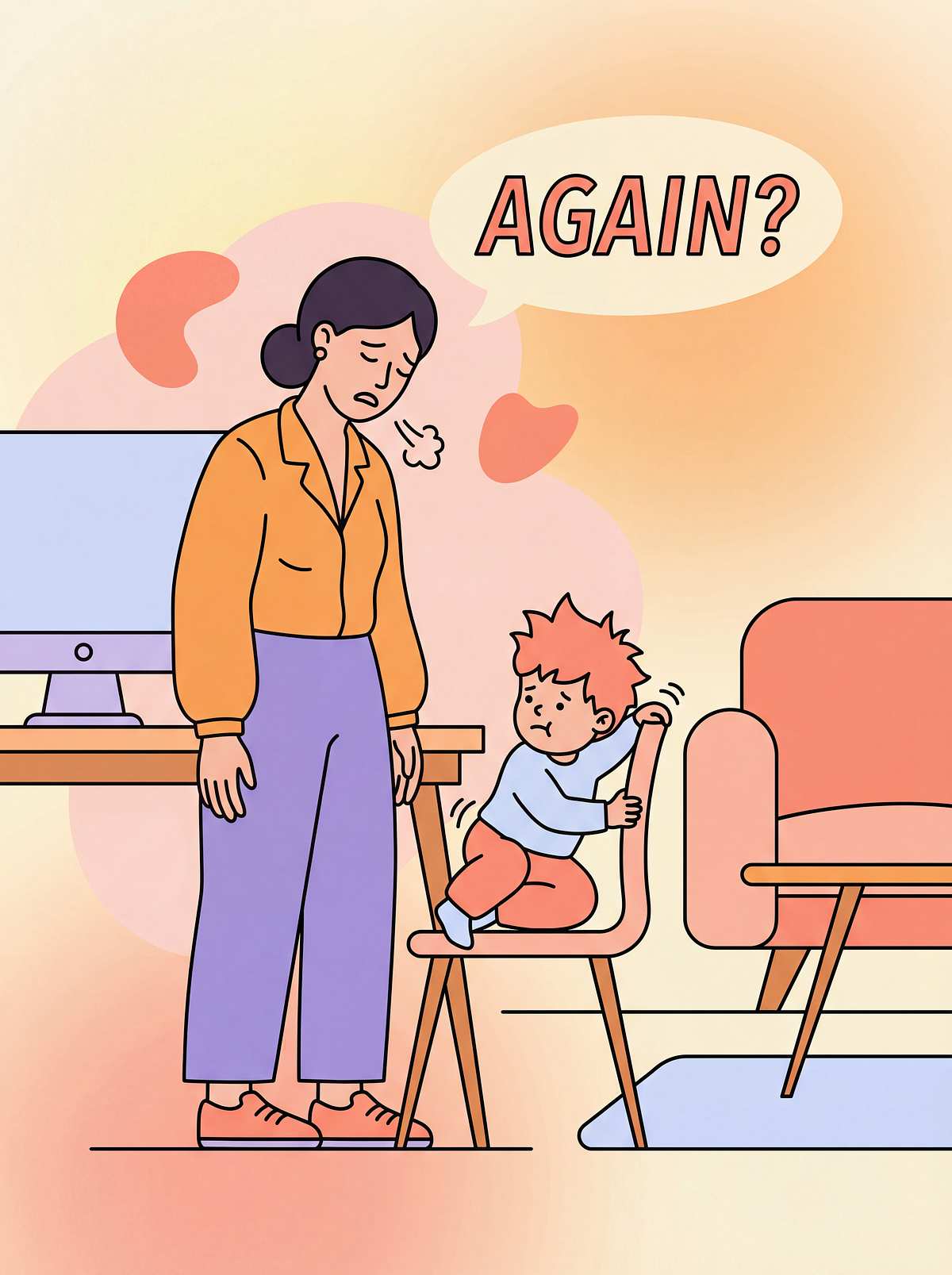
"My child can't sit still for more than a few minutes. She's constantly fidgeting in her chair during homework time."
"He falls off his chair regularly at school. The teacher says he's always moving and can't stay seated."
"She can't pay attention when sitting. Her core is so weak she can't even sit up straight for long."
"He needs to move constantly. Sitting still seems impossible, and it's affecting his learning."
You're not alone. These are common challenges for children with sensory processing differences, ADHD, autism, or weak core strength. The need to move isn't defiance—it's a neurological need that can actually be channeled to improve focus and learning.
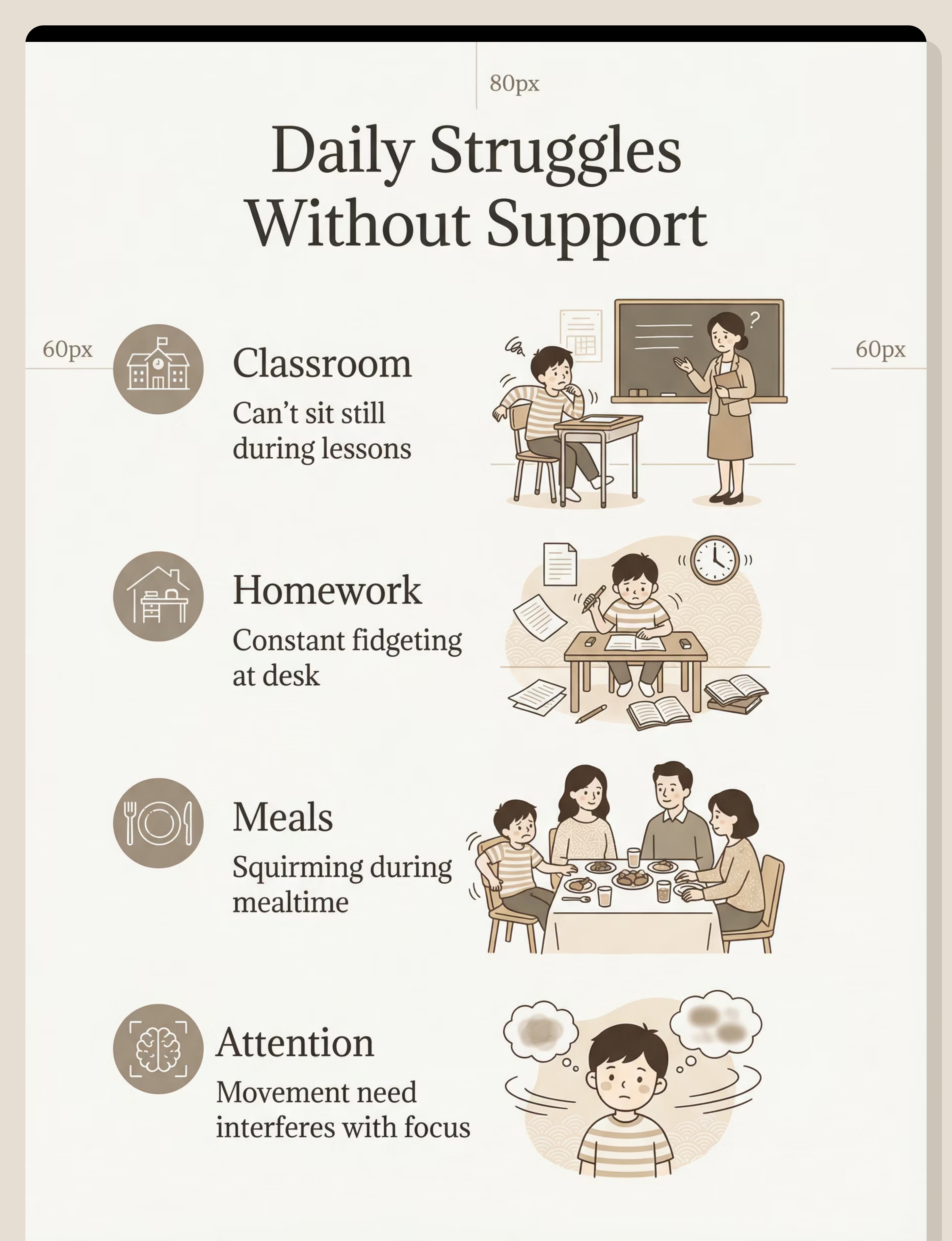
A Day Without the Right Support
Classroom Time
Can't sit still during lessons. Constant movement disrupts learning and distracts classmates. Teacher redirects repeatedly.
Homework Hour
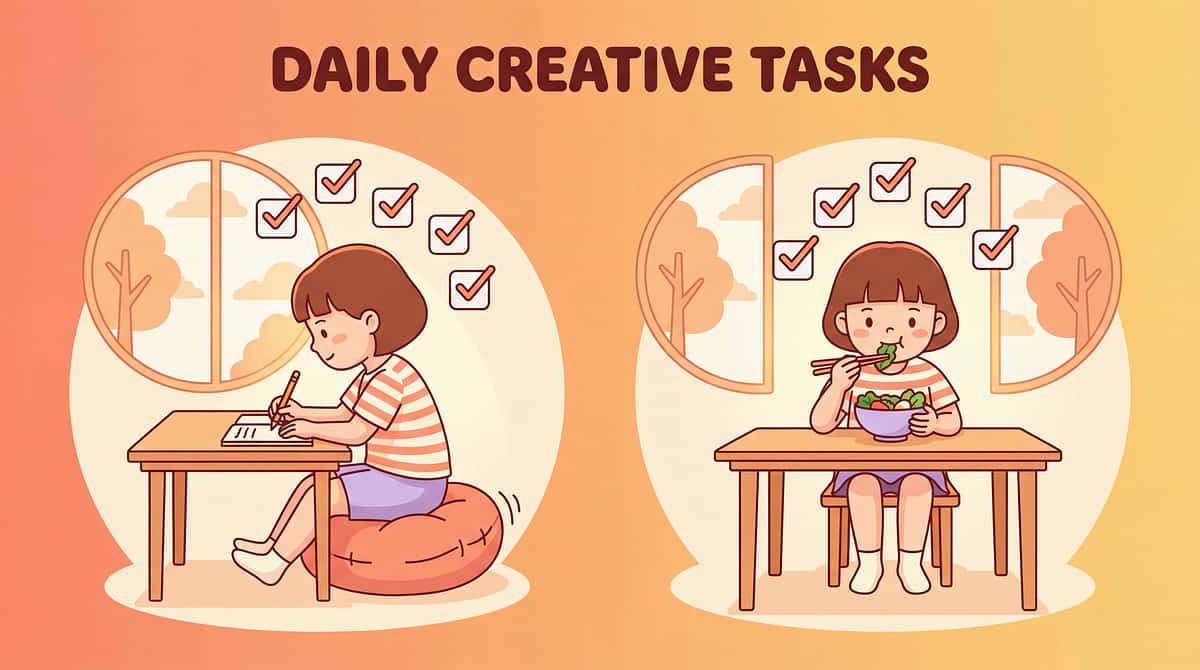
Constant fidgeting at desk makes completing assignments exhausting. Takes twice as long due to movement breaks needed.
Mealtimes
Squirming during meals. Can't stay seated long enough to finish eating. Family time becomes stressful.
Attention Struggles
Movement need interferes with focus. Either moves and gets distracted, or suppresses movement and can't concentrate at all.
Without appropriate support, the need to move creates a cycle of frustration, reduced learning, and behavioral challenges that affect the entire family and educational experience.
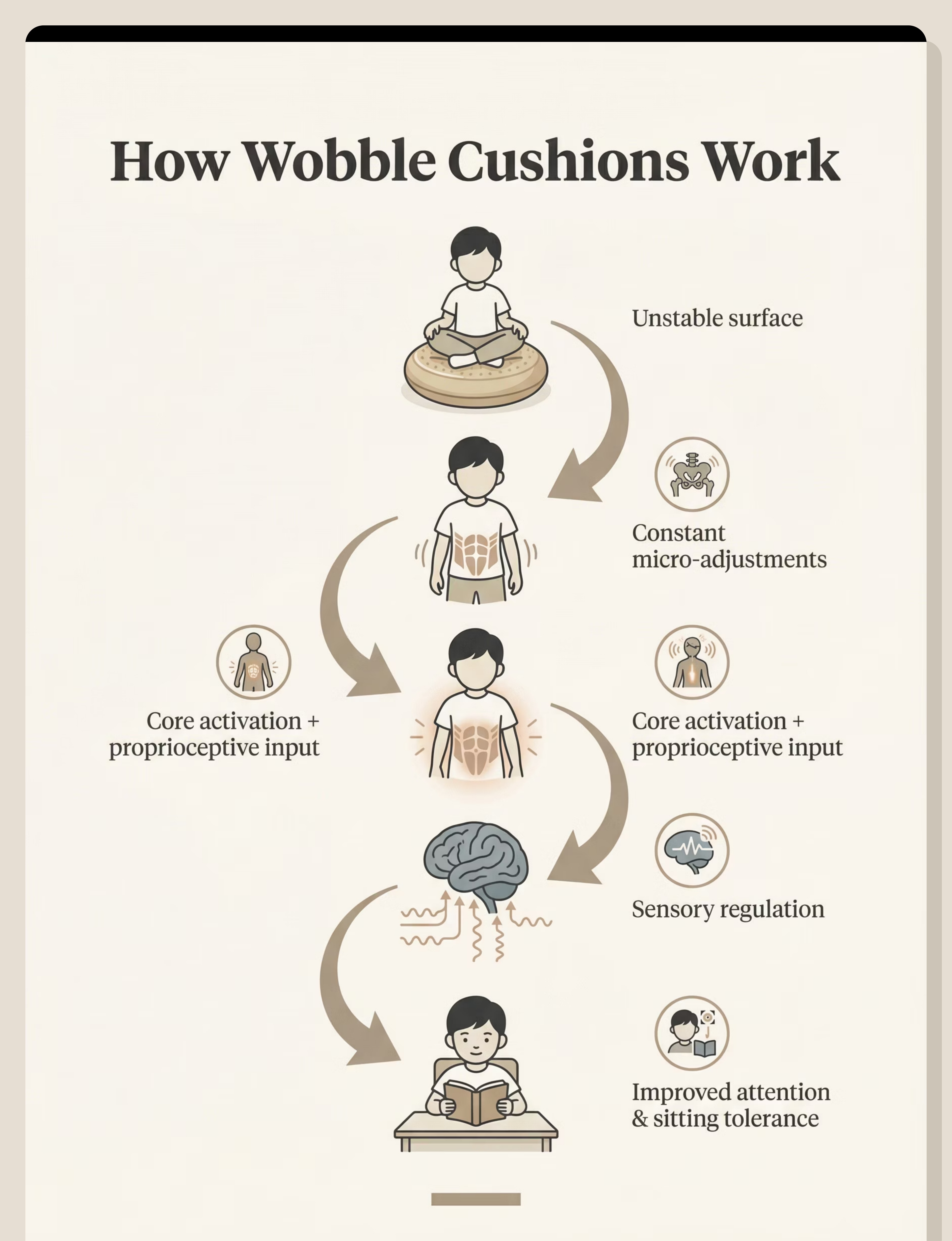
The Science Behind It
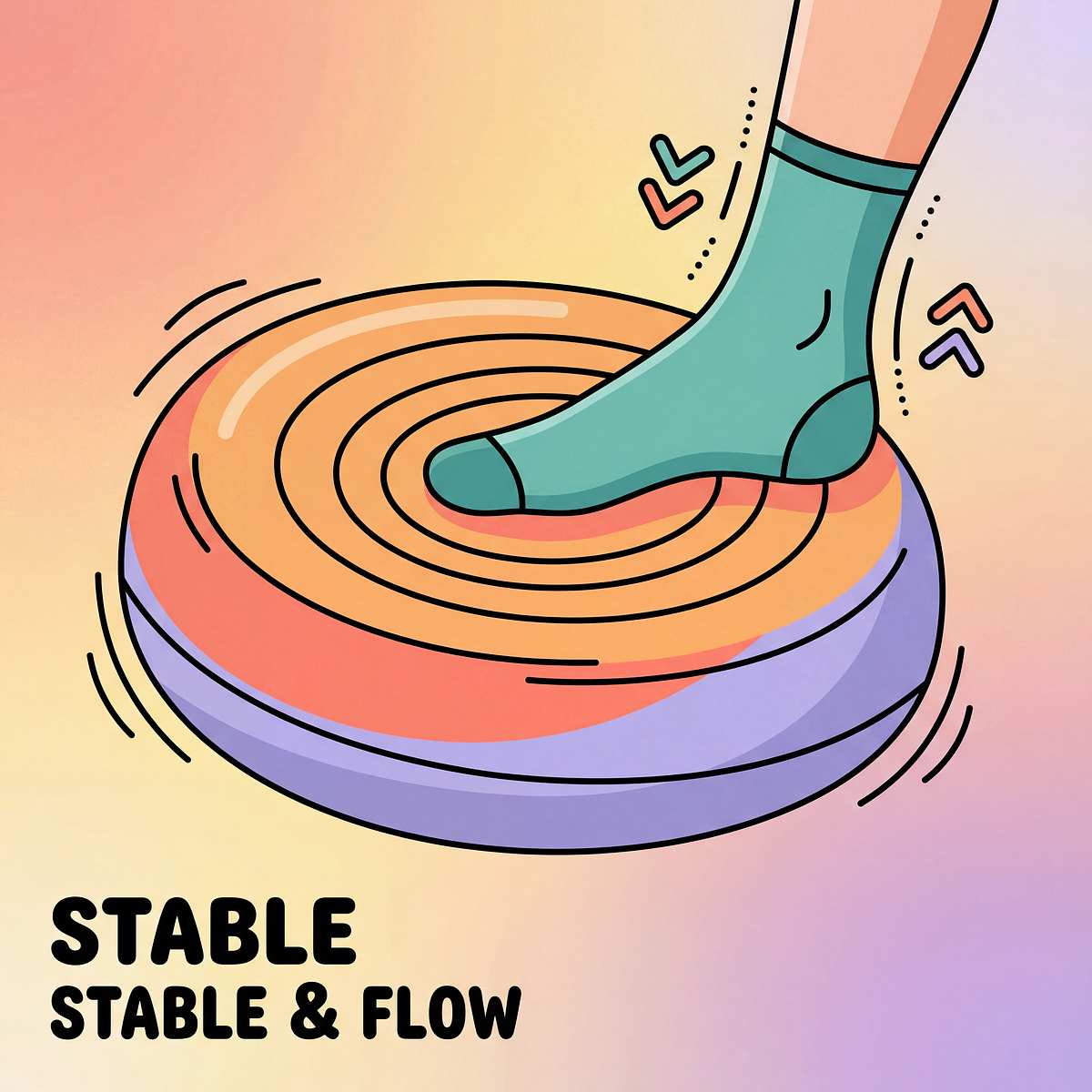
Unstable Surface
Cushion creates dynamic seating requiring constant micro-adjustments for balance
Core Activation
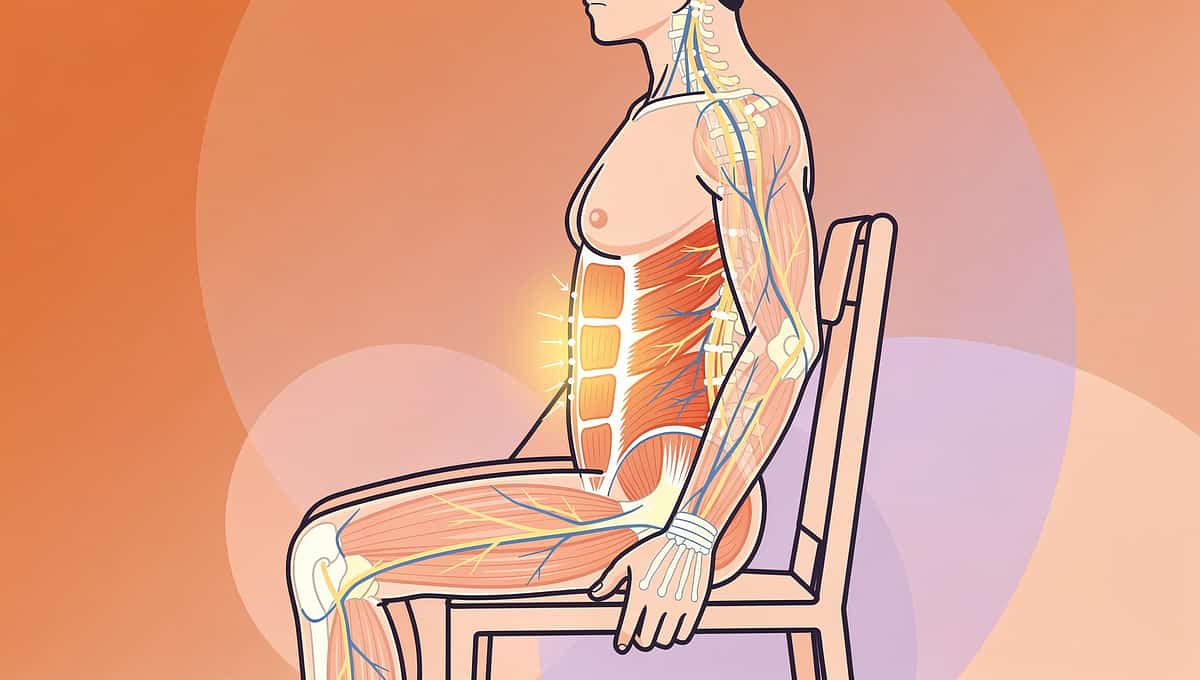
Body automatically engages core muscles to maintain seated position and stability
Proprioceptive Input
Movement provides deep pressure sensory input that regulates nervous system
Improved Attention
Regulated sensory input channels movement need, paradoxically improving focus and sitting tolerance
The unstable surface triggers a cascade of neurological responses: constant micro-adjustments engage core muscles, providing proprioceptive input that regulates the sensory system. This regulated movement actually improves attention by meeting the neurological need to move, allowing the brain to focus on learning rather than suppressing movement urges.
Targets: Core Strength
Postural Control
Attention
Sensory Regulation
Sitting Tolerance
Balance
How to Use It Right
1
Adjust Inflation Appropriately
Adjust inflation level for your child's specific needs. More air creates more instability and challenge; less air provides more stability for beginners or sensory avoiders.
2
Start Gradually
Begin with less inflation and increase gradually as your child builds tolerance and core strength. This prevents overwhelm and builds confidence.
3
Position Properly
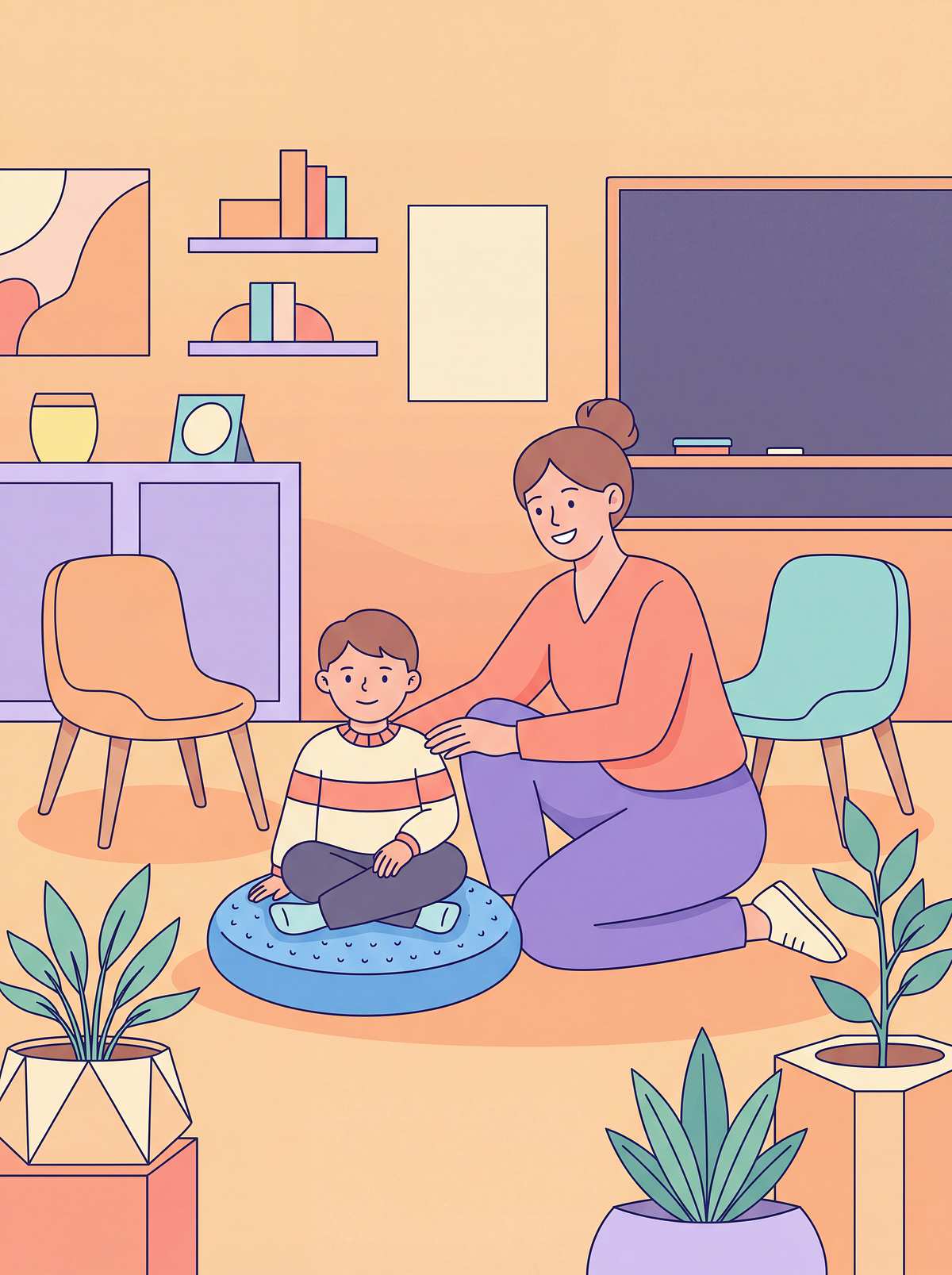
Ensure cushion is properly positioned on chair—not hanging off edges. Child should be able to sit with feet flat on floor or footrest.
4
Match Surface to Sensory Profile
Consider textured surfaces for sensory seekers who crave tactile input; smooth surfaces work better for children who are sensory avoiders.
5
Remember Movement Breaks
Wobble cushion is not a substitute for regular movement breaks. Children still need opportunities to stand, stretch, and move throughout the day.
6
Try Alternative Placement
Can be used under feet instead of seat for children who need foot movement or for whom seated wobbling is too challenging initially.

Duration: Throughout seated activities. Many children benefit from using the cushion all day during seated work, while others use it for specific challenging periods like homework or circle time.
Expert Insight
"Wobble cushions allow regulated movement while seated—they channel the need to move without disrupting class. For children who can't sit still, this provides sensory input that actually improves attention."
— Occupational Therapist, School-Based Specialist
OT + PT Recommended
Collaborative approach from occupational and physical therapy perspectives
Moderate-Strong Evidence
Research-backed intervention with demonstrated effectiveness
Rank #1 in Category
Top recommendation in Positioning & Seating category
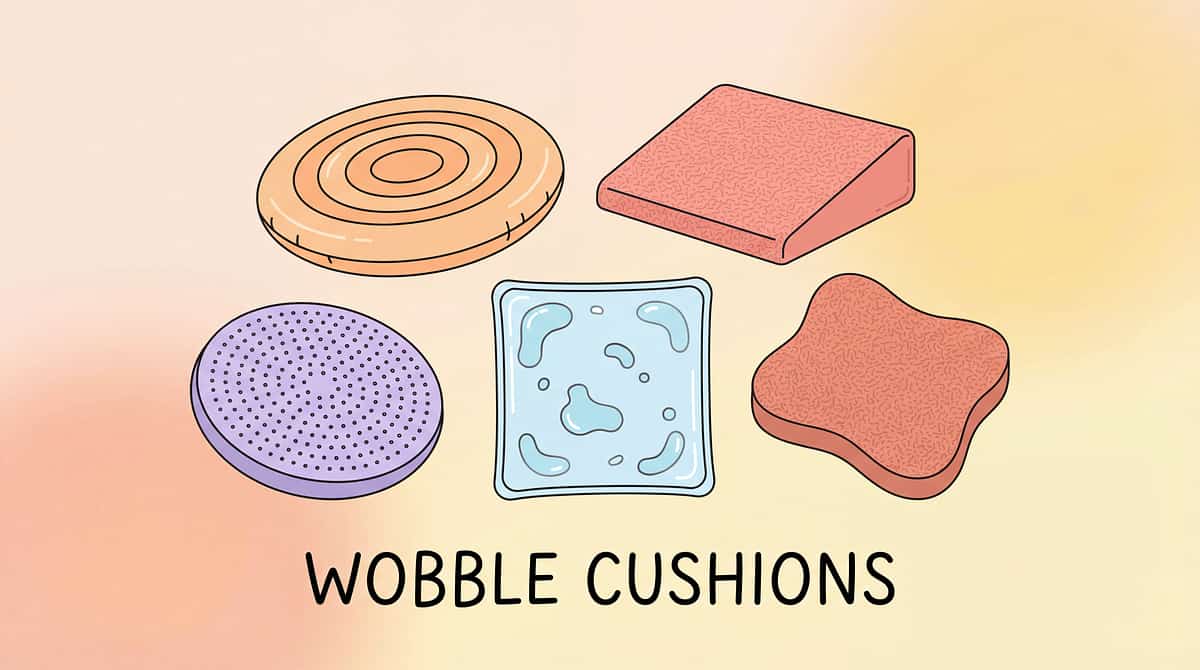
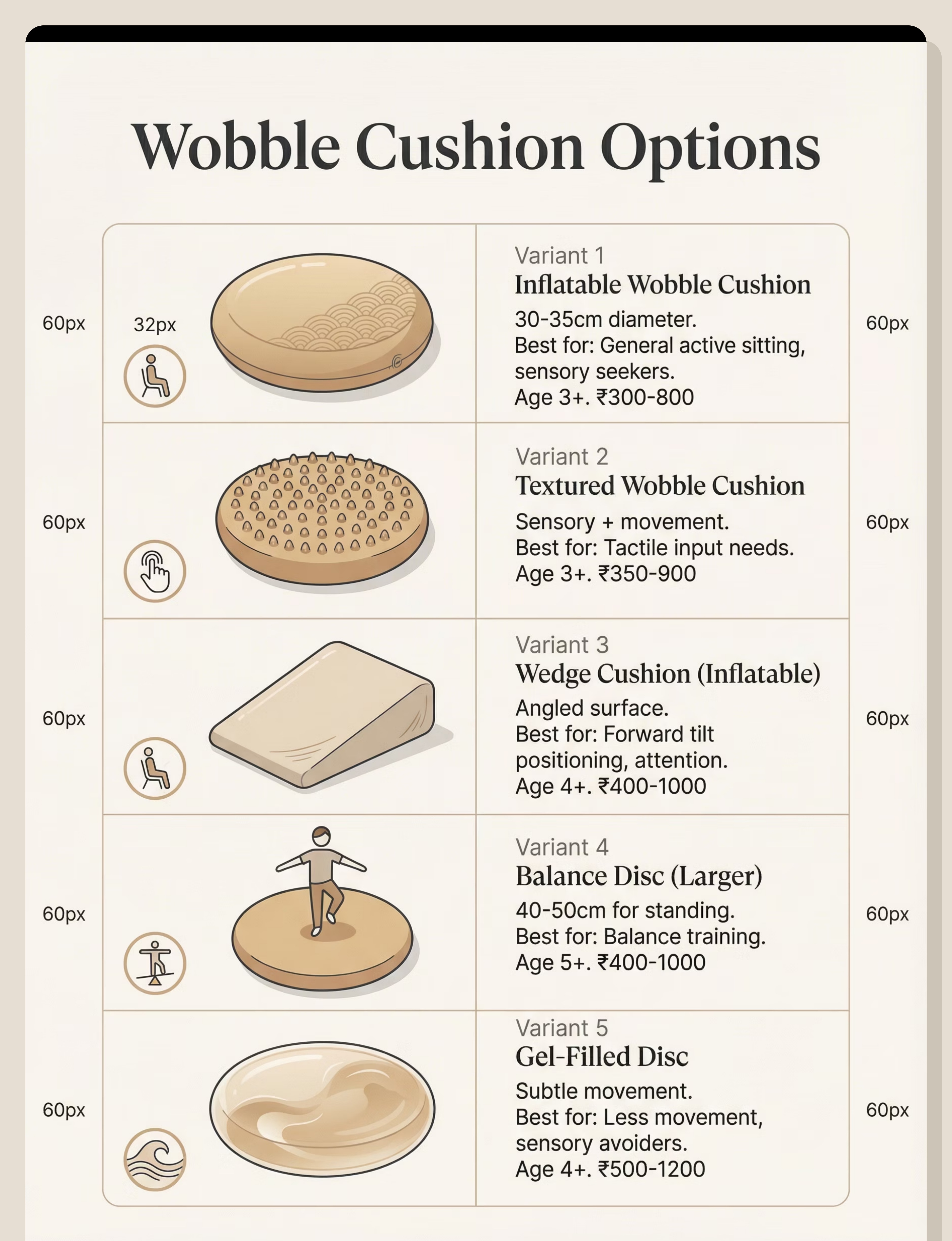
Choose Your Option (5 Variants)
Inflatable Wobble Cushion (Flat)
Type: Basic dynamic seating
Size: 30-35 cm diameter disc
Best For: General active sitting, sensory seekers
Ages: 3+ years | Settings: Home, School, Clinic
Portability: High
Price: ₹300–800
Textured Wobble Cushion
Type: Sensory + dynamic
Size: Disc with bumps/spikes on surface
Best For: Tactile input + movement, sensory seekers
Ages: 3+ years | Settings: All
Portability: High
Price: ₹350–900
Wedge Cushion (Inflatable)
Type: Positioning + movement
Size: Angled seating surface
Best For: Forward tilt positioning, attention
Ages: 4+ years | Settings: School, Home
Portability: High
Price: ₹400–1,000
Balance Disc (Larger)
Type: Standing balance training
Size: 40-50 cm for standing balance
Best For: Balance activities, standing work
Ages: 5+ years | Settings: Home, Clinic
Portability: Medium
Price: ₹400–1,000
Gel-Filled Disc
Type: Subtle movement
Size: Non-inflatable gel cushion
Best For: Less movement, sensory avoiders
Ages: 4+ years | Settings: School, Home
Portability: Medium
Price: ₹500–1,200
Wobble cushions come in several variants to match your child's specific needs, sensory profile, age, and use cases. Consider the primary goal (calming, attention, core strength), setting (home, school, clinic), and portability needs when choosing.

How to Choose
By Goal: General active sitting → flat cushion; tactile input → textured; positioning → wedge; balance training → larger disc; minimal movement → gel-filled
By Setting: School (requires quiet) → any inflatable; home → any option; clinic → larger balance disc
By Portability: Need to transport daily → smaller inflatables; stays in one place → gel-filled or larger disc
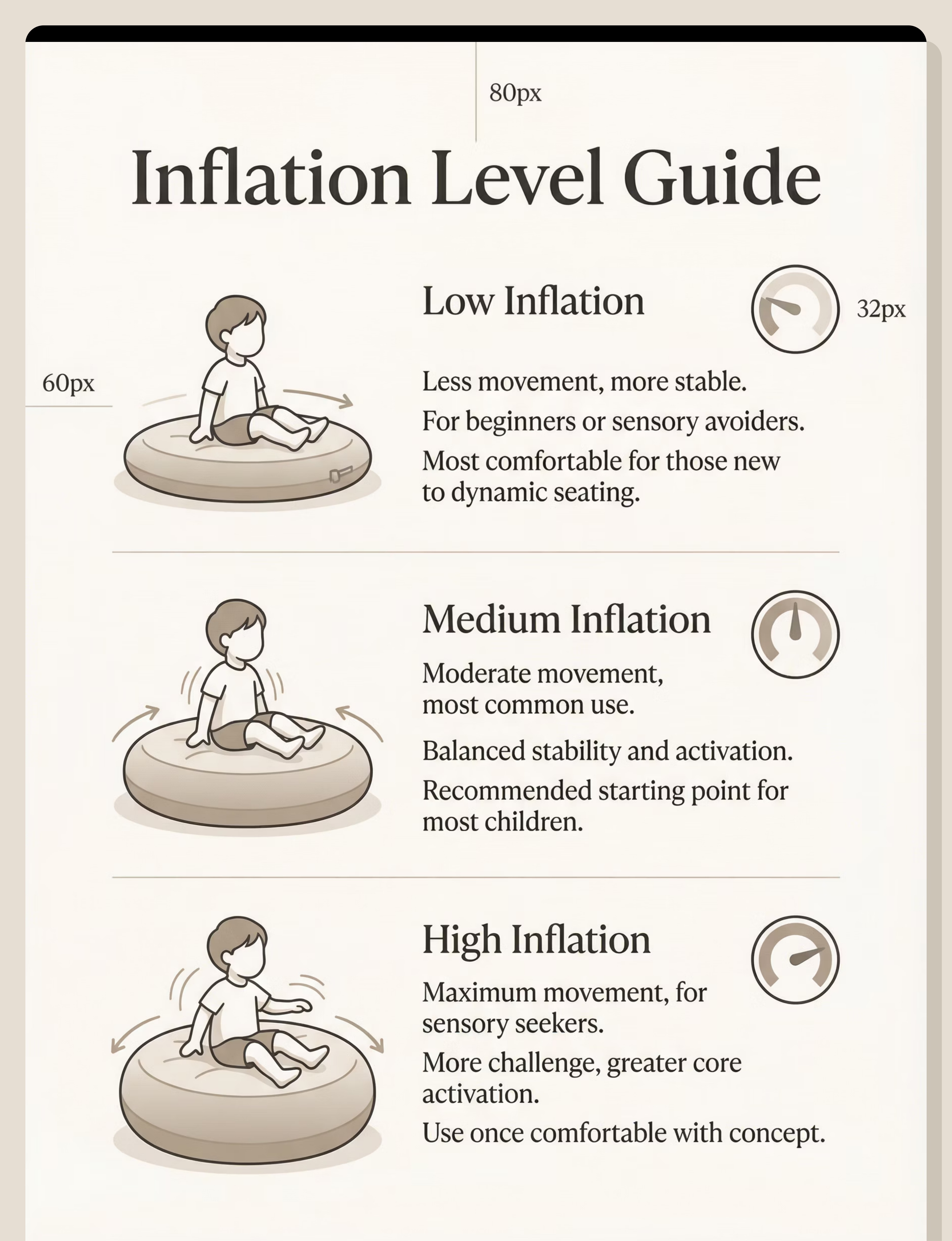
Understanding Inflation Levels
wobble-cushions-seating-discs therapy material
Low Inflation
Movement: Minimal, subtle
Stability: Most stable
Best For: Beginners, sensory avoiders, children building confidence, initial introduction to dynamic seating
When to Use: Starting point for most children, those who are hesitant about movement, children with balance concerns
wobble-cushions-seating-discs therapy material
Medium Inflation
Movement: Moderate, noticeable
Stability: Balanced challenge
Best For: Most common use, general active sitting, children who have adjusted to the cushion and need more input
When to Use: After successful low inflation period, for children with typical sensory needs, standard classroom use
wobble-cushions-seating-discs therapy material
High Inflation
Movement: Maximum, significant
Stability: Most challenging
Best For: Sensory seekers, children with good core strength, maximum proprioceptive input needs, advanced balance training
When to Use: For children who crave intense movement, therapeutic balance activities, older children with strong cores

Pro Tip: Inflation is adjustable—this is a key advantage. Start lower and increase gradually based on your child's response. You can also vary inflation for different times of day or activities. Some children need more stability in the morning and can handle more challenge later in the day.
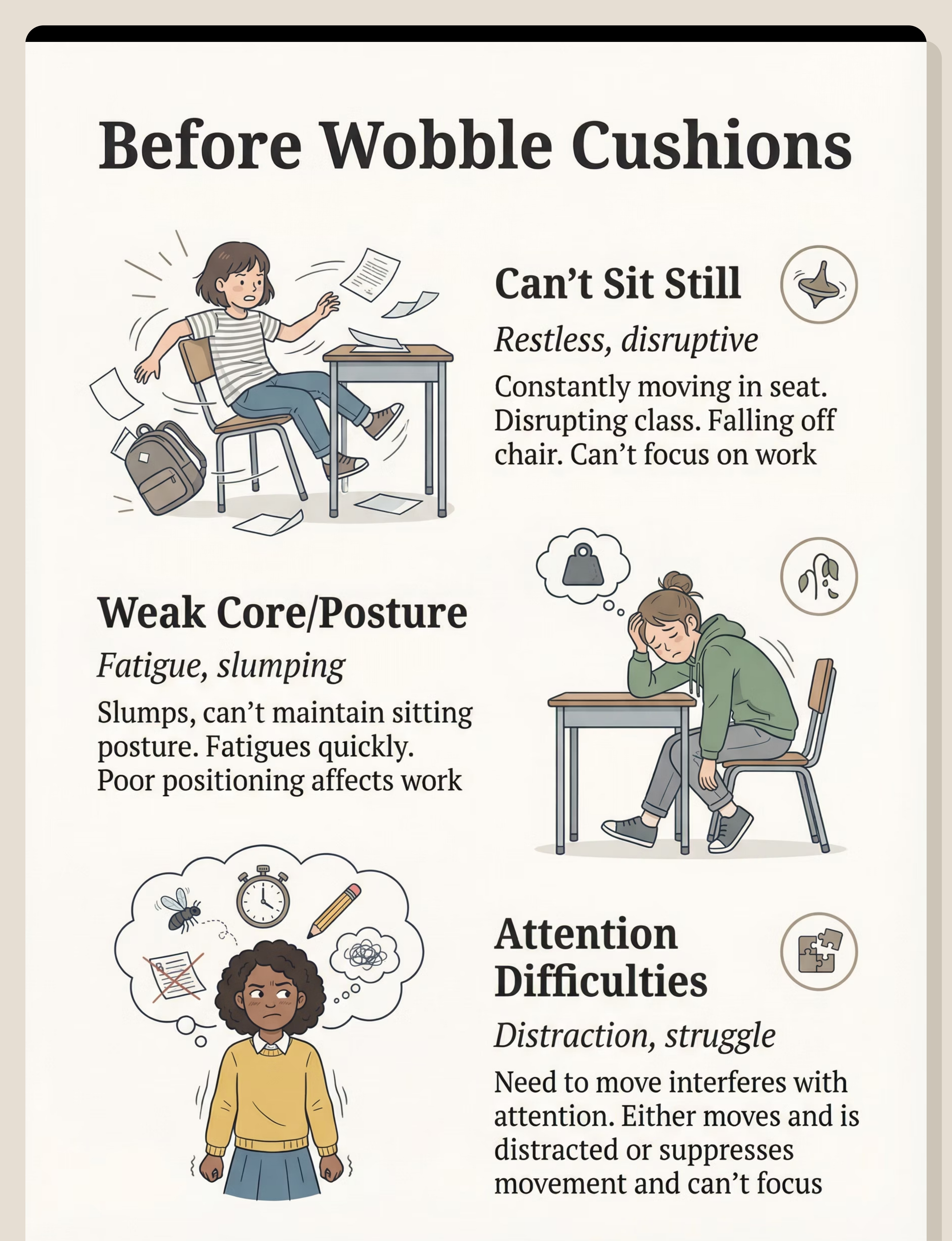
The Struggle (Before)
Scenario 1: Can't Sit Still
Situation: Child constantly moving in seat. Disrupting class. Falling off chair. Can't focus on work.
Experience: Every attempt to sit still requires enormous effort. The urge to move is overwhelming and impossible to ignore. Other children notice and comment.
Emotion: Restless, embarrassed, disruptive, frustrated by inability to meet expectations
Scenario 2: Weak Core/Poor Posture
Situation: Child slumps, can't maintain sitting posture. Fatigues quickly. Poor positioning affects handwriting and work quality.
Experience: Sitting up straight feels impossible. Back hurts. Gets tired quickly. Slumps over desk, which makes writing even harder. Can't sustain attention because of physical fatigue.
Emotion: Physical fatigue, slumping, discouraged, feels incapable
Scenario 3: Attention Difficulties
Situation: Child's need to move interferes with attention. Either moves and is distracted or suppresses movement and can't focus.
Experience: Caught in impossible choice—move and lose focus, or stay still and be unable to think. Both options lead to falling behind. Work takes twice as long as peers.
Emotion: Distraction, internal struggle, anxiety, feeling defeated
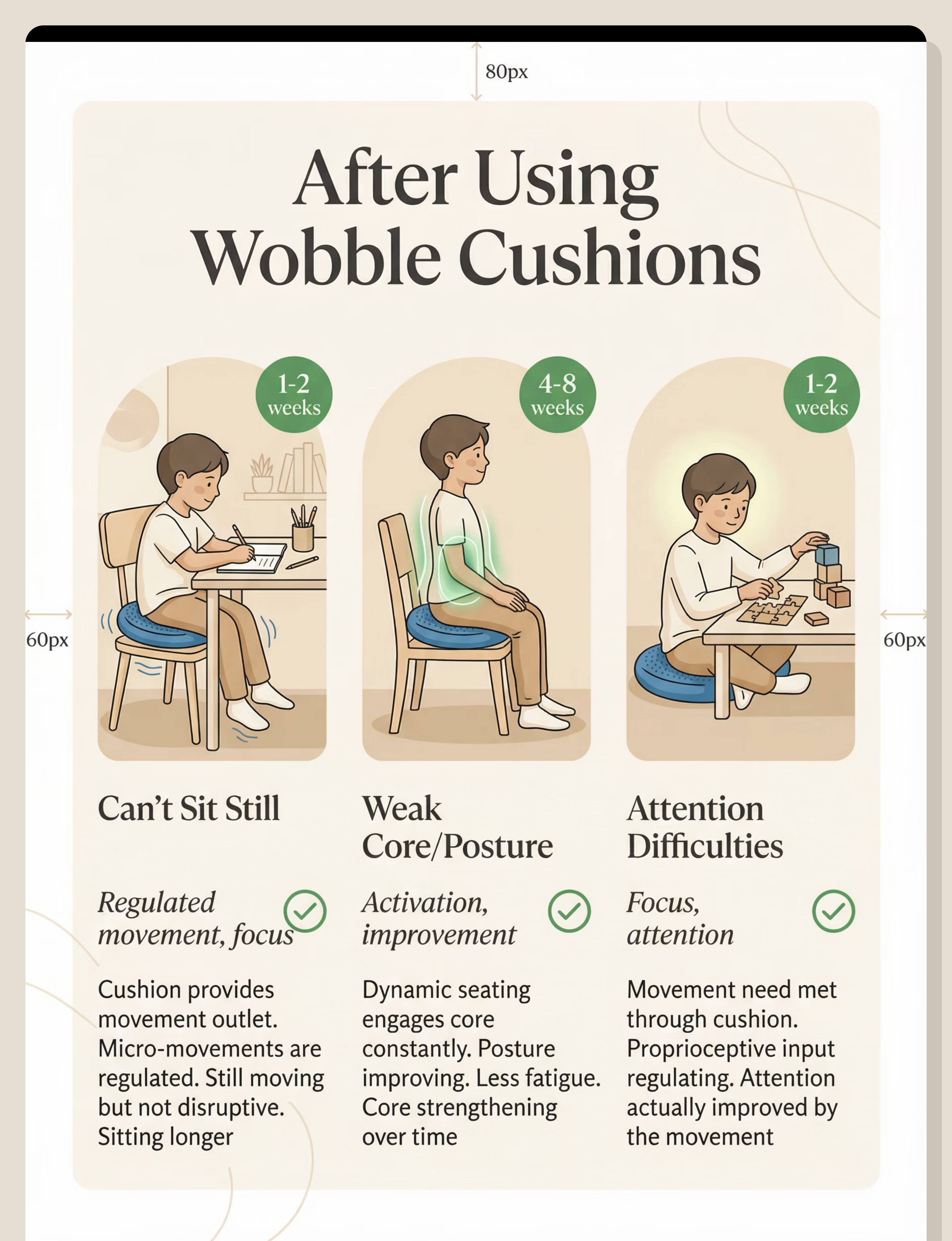
The Breakthrough (After)
1
Scenario 1: Can't Sit Still
Situation: Wobble cushion provides movement outlet. Micro-movements are regulated. Still moving but not disruptive. Sitting longer.
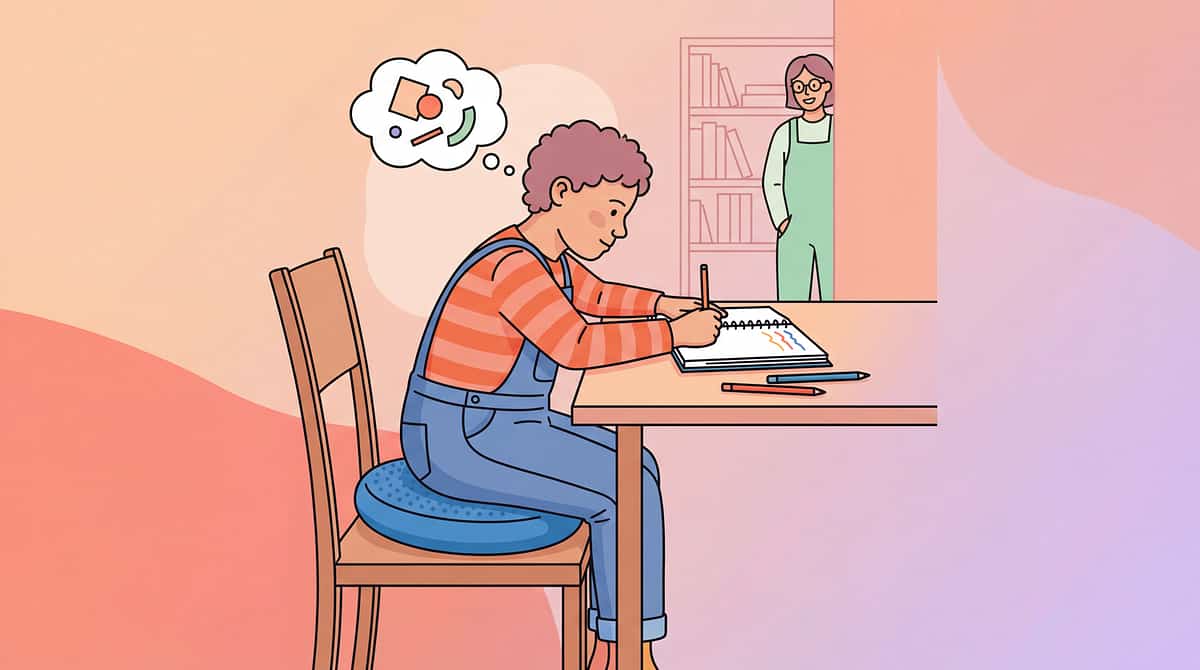
Experience: The cushion allows movement without disruption. Can rock and shift subtly while staying seated. Movement need is met, which paradoxically allows better focus. Teacher notices improvement.
Emotion: Regulated movement, relief, improved focus, increased confidence
Timeframe: 1-2 weeks
2
Scenario 2: Weak Core/Poor Posture
Situation: Dynamic seating engages core constantly. Posture improving. Less fatigue. Core strengthening over time.
Experience: The unstable surface makes core muscles work automatically. Sitting up becomes easier. Less tired at end of day. Handwriting improving because of better posture. Parents and teachers notice straighter sitting.
Emotion: Activation, physical improvement, pride in progress
Timeframe: 4-8 weeks
3
Scenario 3: Attention Difficulties
Situation: Movement need met through cushion. Proprioceptive input regulating. Attention actually improved by the movement.
Experience: No longer choosing between movement and attention—can have both. Subtle wobbling provides sensory input that helps brain focus. Completing work faster. Teacher reports better task completion.
Emotion: Focus, attention, calm alertness, academic success
Timeframe: 1-2 weeks
What to Expect (Realistic Timelines)
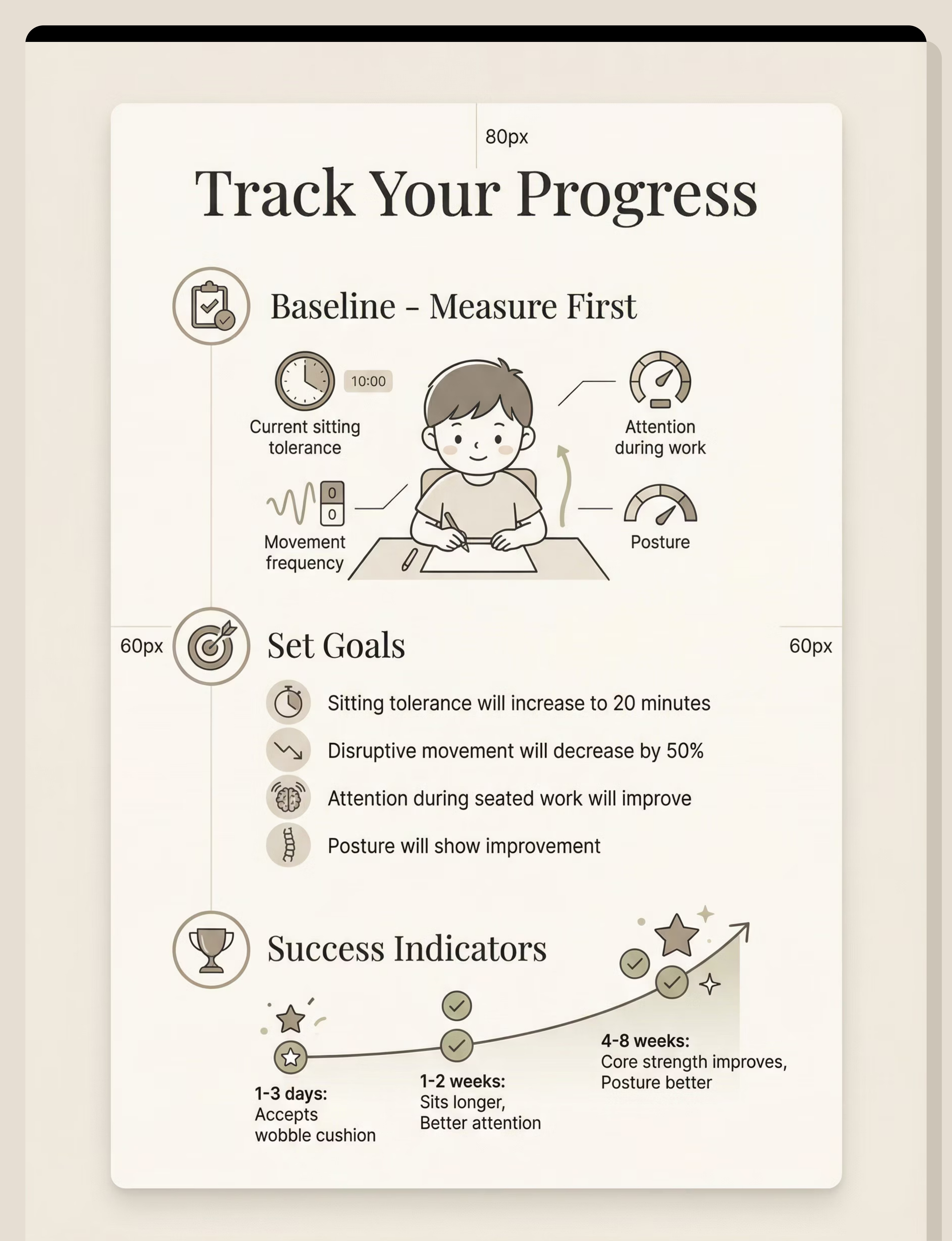
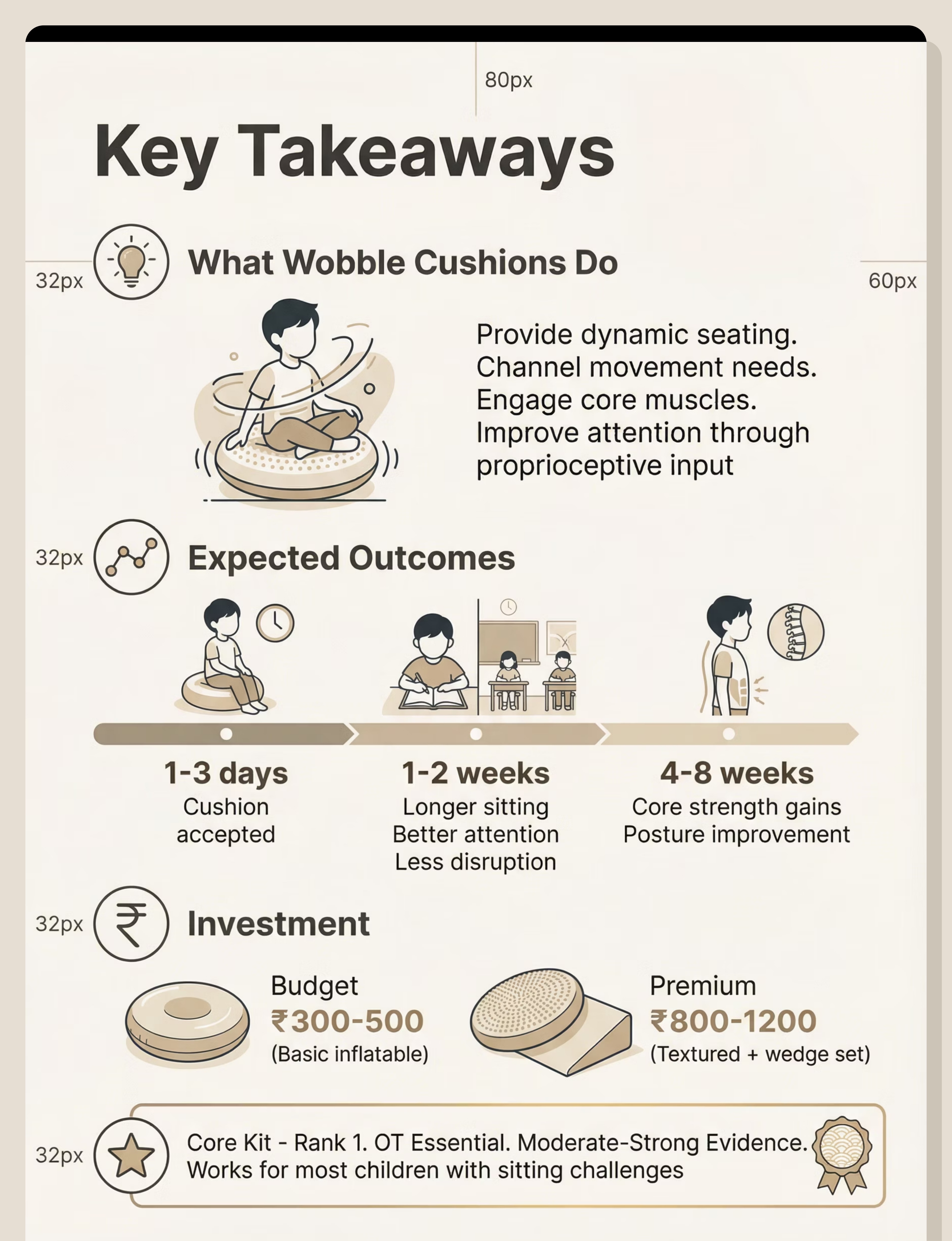
Accepts Wobble Cushion
Child accepts and uses the cushion willingly. Initial novelty and exploration. May be excited about having "special" seat.
1-3 days
Sits Longer with Cushion
Noticeable increase in sitting tolerance. Can remain seated for longer periods during work activities. Movement need is being met.
1-2 weeks
Attention Improves
Better focus during seated work. Task completion improves. Teacher or parent notices child is more present and engaged during activities.
1-2 weeks
Less Disruptive Movement
Movement becomes more regulated and less disruptive. Still moving but in subtle, appropriate ways. No longer disturbing others or falling off chair.
1-2 weeks
Core Strength Improves
Noticeable improvement in postural control and core strength. Sits up straighter. Less fatigue. Better endurance for seated activities.
4-8 weeks
Progress timelines vary by child, consistency of use, and individual sensory and motor profiles. Most families notice immediate improvements in sitting tolerance and attention within the first 1-2 weeks, while core strengthening requires more sustained use over 4-8 weeks. The cushion becomes a natural part of the seating routine rather than a special accommodation.
Is This Right for My Child? (2-Minute Check)
"Does my child constantly fidget, move, or shift position, struggling to stay seated during activities?"
Constantly fidgeting, moving, shifting position. Can't remain seated during activities that require sustained sitting. Always "on the go" even when seated.
If yes, this indicates: Wobble cushion may help channel movement need into regulated, productive micro-movements that support rather than disrupt focus.
"Does movement seem to help my child focus better?"
Paradoxically focuses better when allowed to move. Thinks better while pacing, rocking, or fidgeting. Suppressing movement makes concentration harder.
If yes, this indicates: Good candidate for dynamic seating. Movement isn't the problem—it's part of the solution for this child's nervous system.
"Does my child often slump, struggle with upright posture, or get tired quickly when sitting?"
Slumps frequently, can't maintain upright posture, fatigues quickly when sitting, leans on desk or furniture for support.
If yes, this indicates: Dynamic seating can strengthen core muscles through constant gentle engagement, improving posture and reducing fatigue over time.
"Does my child seek out deep pressure or intense physical play, like jumping or pushing heavy objects?"
Seeks deep pressure, likes being squeezed, jumps frequently, crashes into furniture, pushes/pulls heavy objects, enjoys intense physical play.
If yes, this indicates: Wobble cushion provides deep pressure and proprioceptive input through the movements required to maintain balance on unstable surface.

Scoring Guide: 3+ "yes" answers = strong fit for wobble cushion. Even 1-2 "yes" answers suggest this tool may be helpful. If uncertain, consider starting with a budget-friendly option to trial the approach before investing in multiple cushions or premium variants.
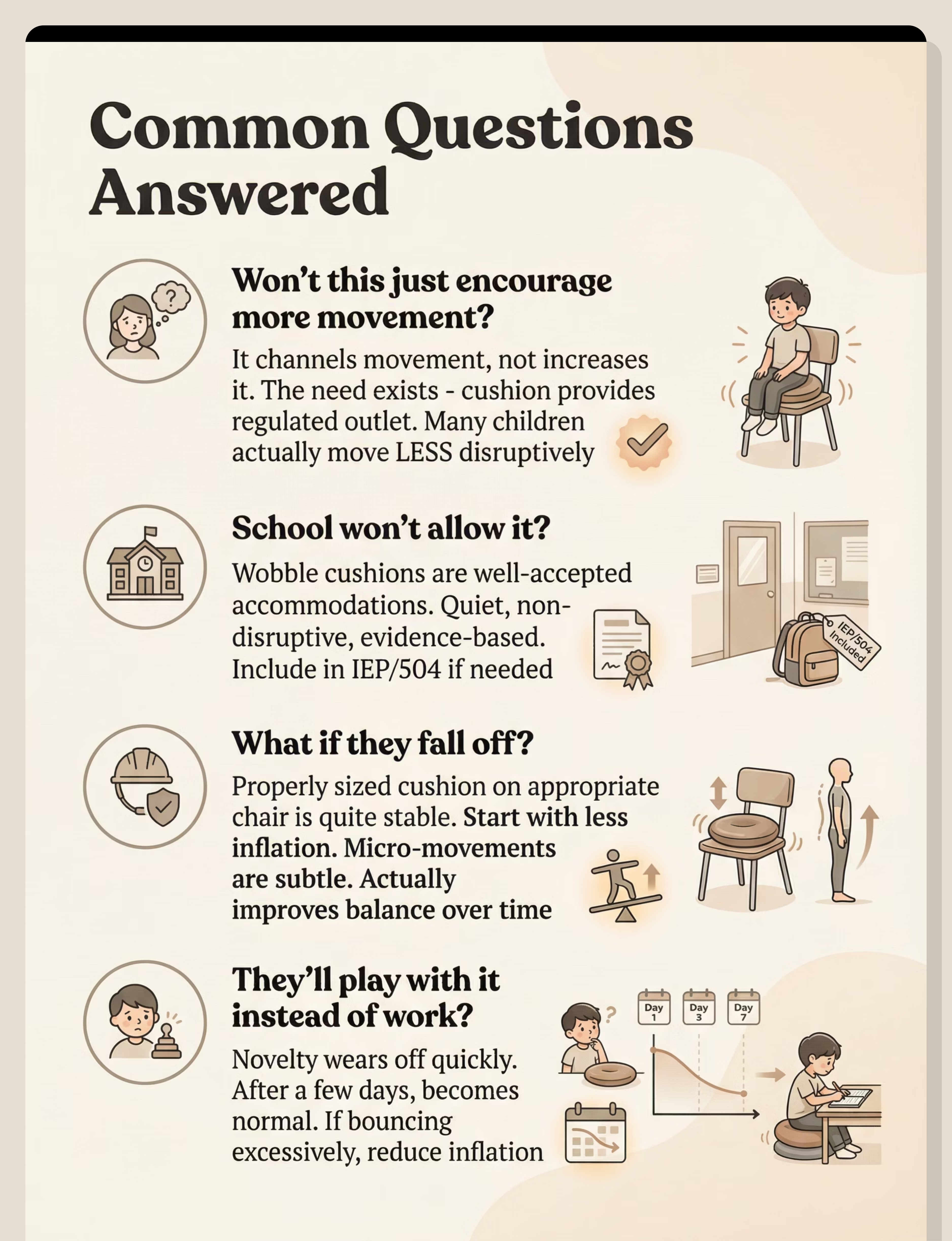
Common Questions (Honest Answers)
Won't this just encourage more movement?
Response: It channels movement, not increases it. The need to move exists regardless—the cushion provides a regulated outlet. Many children actually move LESS disruptively with cushion because their sensory need is being met appropriately. The movement becomes purposeful rather than random.
Key Insight: Channels existing need; reduces disruptive movement
School won't allow it
Response: Wobble cushions are well-accepted school accommodations. They're quiet, non-disruptive, and evidence-based. Many teachers embrace them once they see the results. Include in IEP/504 plan if needed as a sensory accommodation.
Key Insight: Well-accepted; IEP accommodation if needed
What if they fall off?
Response: Properly sized cushion on appropriate chair is quite stable. Start with less inflation to build confidence. The micro-movements are subtle, not bouncing. Actually can IMPROVE balance over time through constant core engagement.
Key Insight: Start less inflated; very stable when sized right
They'll play with it instead of work
Response: Novelty wears off quickly—usually within a few days. After initial exploration, it becomes normal seat. If bouncing excessively, reduce inflation or take brief break then return. The goal is subtle movement, not play.
Key Insight: Novelty fades; adjust inflation if needed
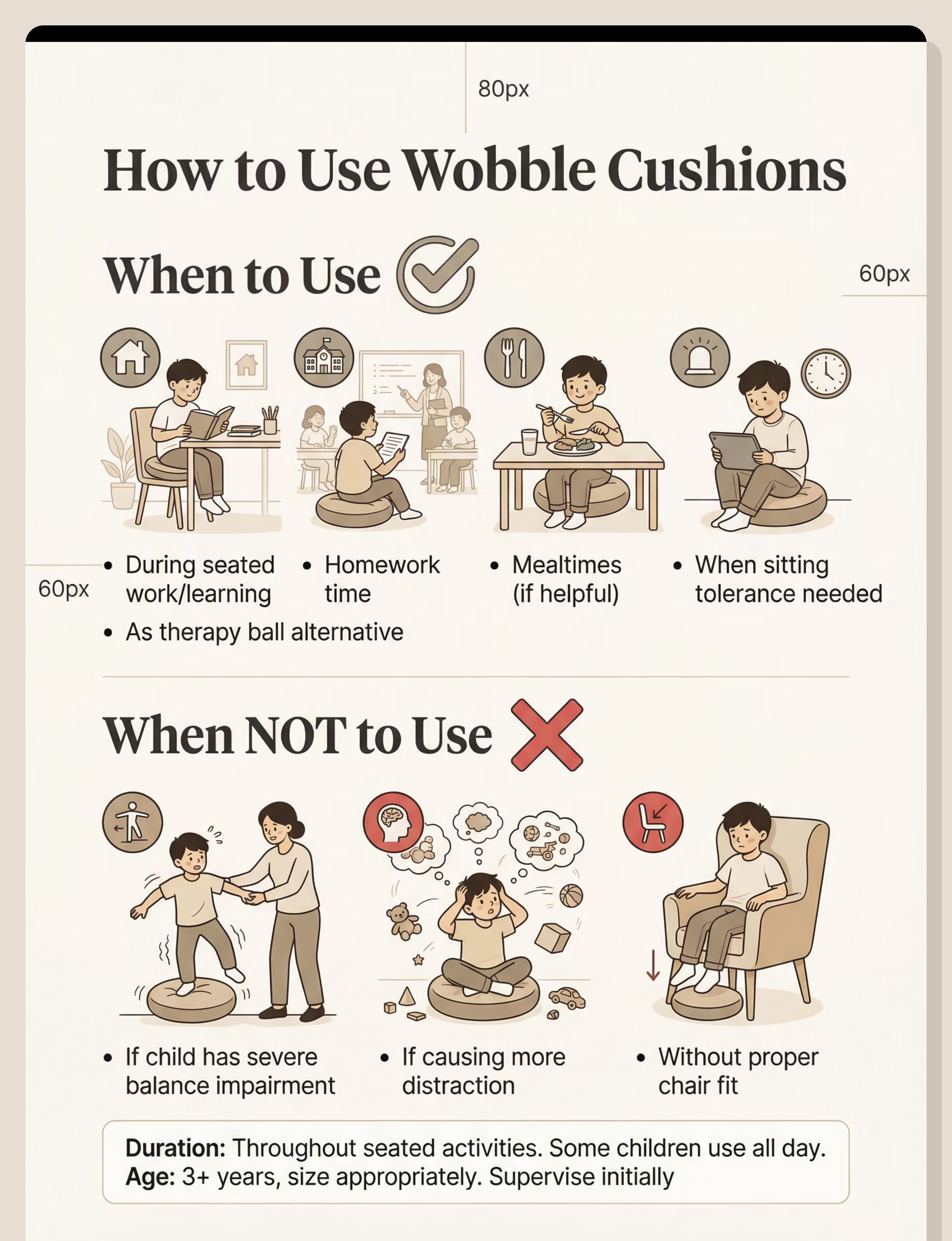
Usage Guide
When to Use ✓
When NOT to Use ✗
✓ During seated work and learning activities
✗ If child has severe balance impairment
✓ Homework time at home desk
✗ If causing more distraction than benefit
✓ Mealtimes if helpful for sitting tolerance
✗ Without proper chair fit and support
✓ When sustained sitting tolerance needed
✓ As alternative to therapy ball seating
Supervision by Age
Age Range
Supervision Level
Notes
Young children (3-5)
Supervise initially
Monitor during introduction phase. Ensure proper seating. Check inflation level.
School-age (6+)
Independent use once comfortable
After successful introduction period, most children can use independently.
All ages
Check inflation periodically
Cushions may lose air over time. Check weekly and adjust as needed.

Duration: Throughout seated activities. Some children use all day; others use for specific challenging periods. Duration should be based on child's individual needs and response.
Home
School
Clinic
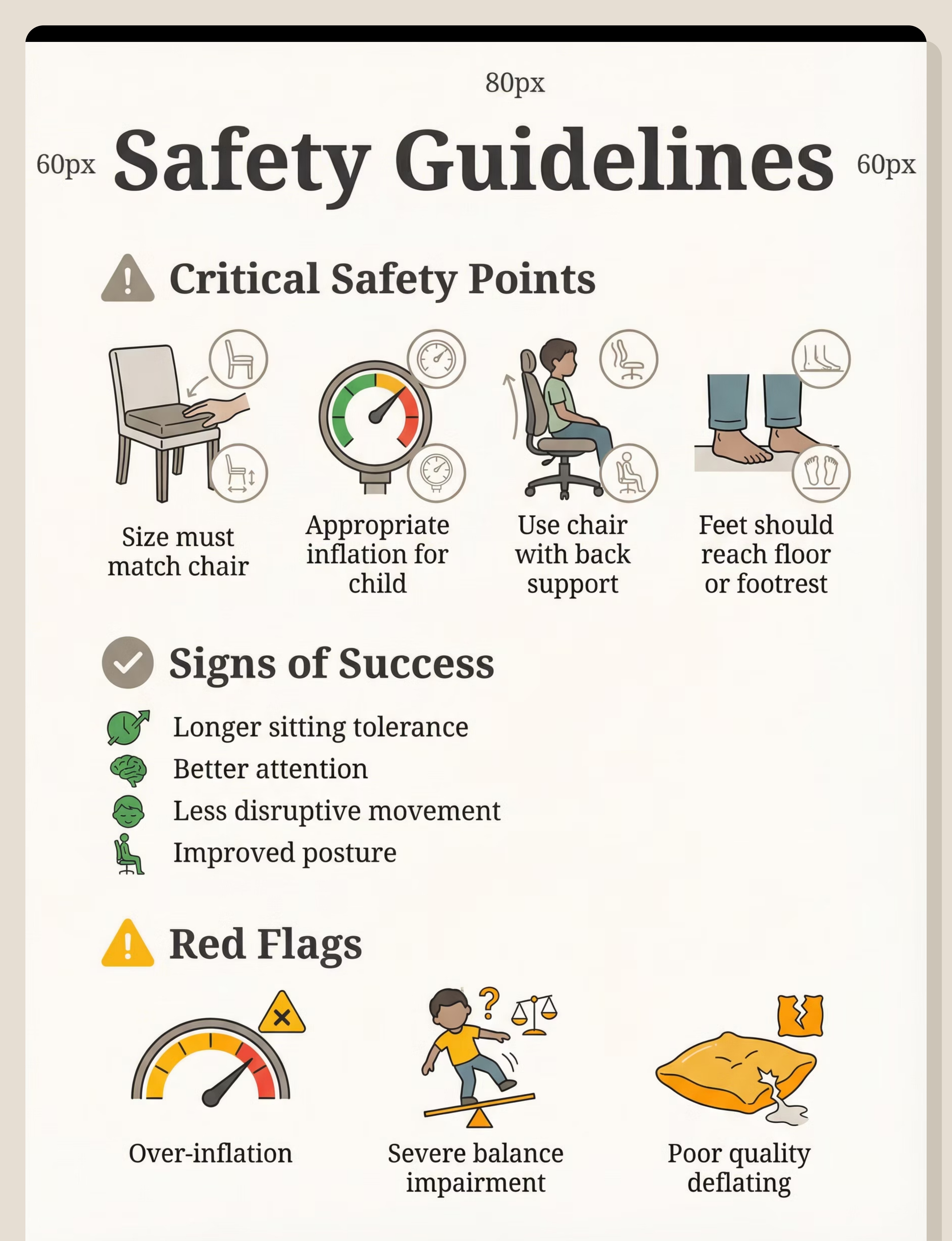
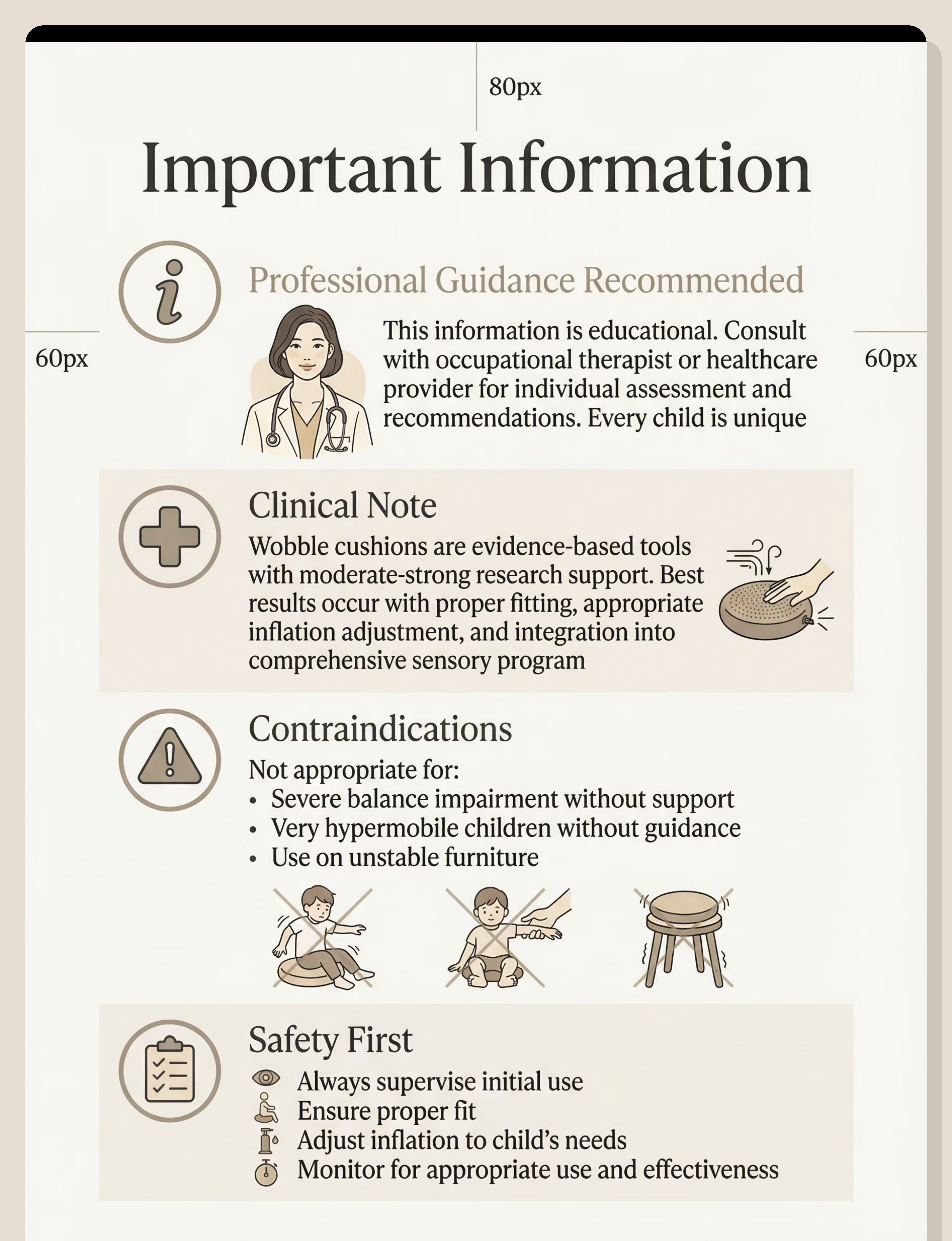
Safety First

Critical Safety
  • Proper size for chair—cushion should not hang over edges
  • Appropriate inflation level for child's abilities
  • Chair with backrest recommended, especially initially
  • Feet should reach floor or footrest for stability
Warnings
  • Over-inflation increases instability and fall risk
  • Poor quality cushions may pop or deflate suddenly
  • Not for use on stools without backs initially
Contraindicated
  • Severe balance impairment without proper support
  • Very hypermobile children without OT/PT guidance
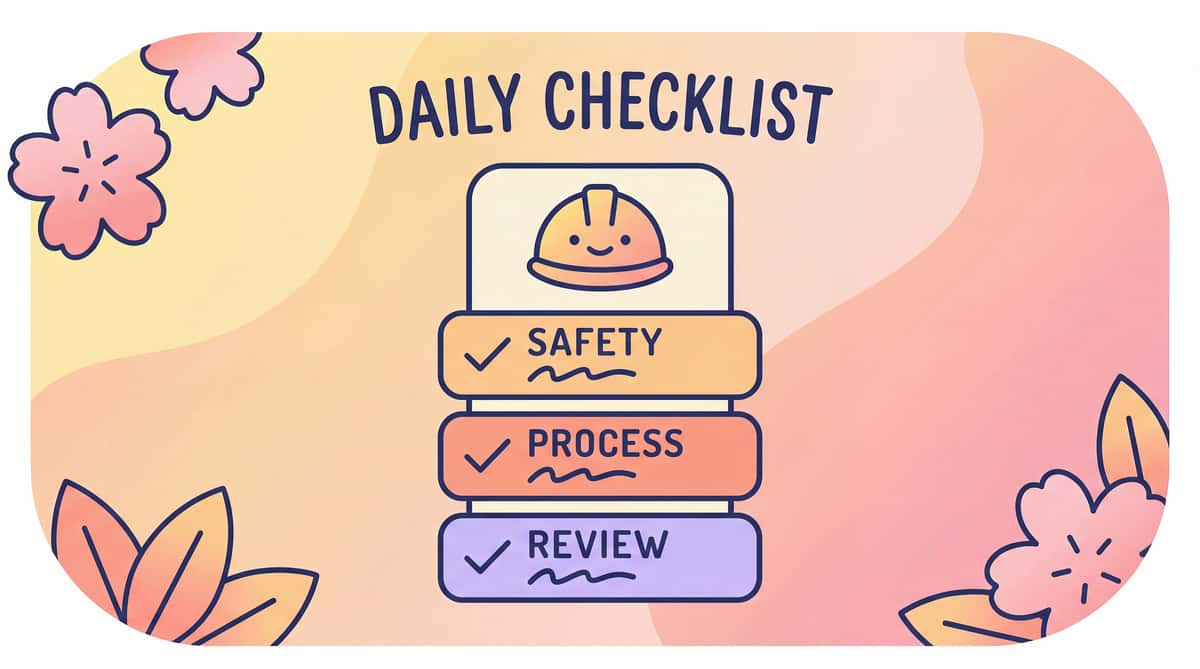
Before Use ✓
  • Size appropriate for chair
  • Inflation appropriate for child
  • Chair is stable
  • Child understands purpose and use
During Use ✓
  • Child using appropriately
  • Not excessive bouncing
  • Maintaining work focus
  • Appears comfortable
Signs of Success ✓
  • Longer sitting tolerance
  • Better attention to tasks
  • Less disruptive movement
  • Improved posture
Investment Guide
Best Starting Point
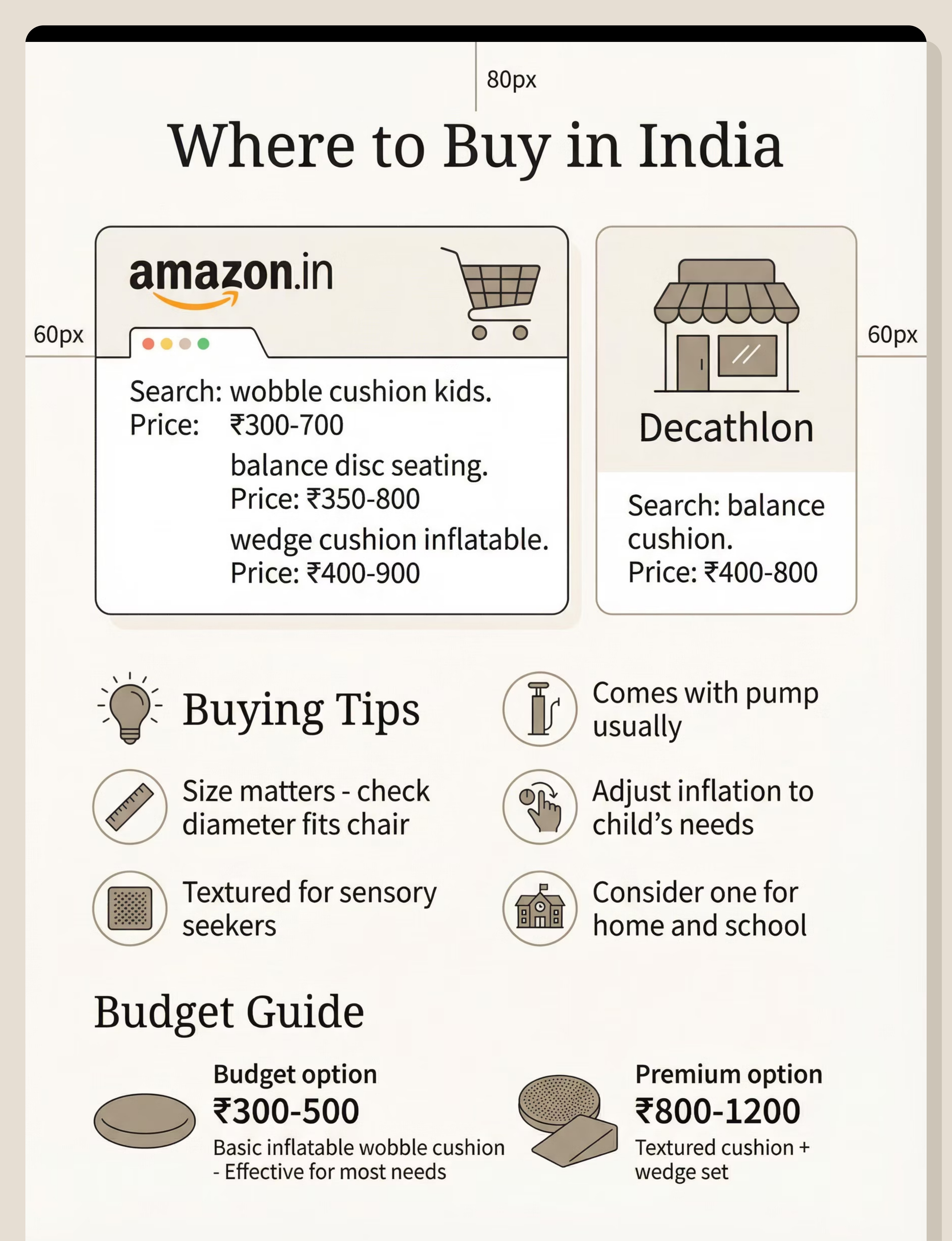
Budget Option: Basic Inflatable Wobble Cushion
Cost: ₹300-500
What You Get: Simple, effective flat disc cushion that provides dynamic seating and core engagement. Includes pump usually. Highly portable.
Note: Effective for most needs. Perfect for trying the approach before investing in multiple cushions or specialized variants.
Best For: First-time users, single location use, budget-conscious families, trial period
Enhanced Features
Premium Option: Textured Wobble Cushion + Wedge Cushion Set
Cost: ₹800-1,200
What You Get: Multiple cushion types for different needs and settings. Textured for sensory input, wedge for positioning. Higher quality materials that last longer.
Brands: Isokinetics, Gaiam, Black Mountain
Best For: Multiple settings (home + school), specific sensory/positioning needs, long-term investment

Overall Range: ₹300–1,200 (approximately $4-15 USD)

Value Assessment: Wobble cushions are low-cost interventions with high impact. Even budget options are effective. Most families start with a basic cushion and add specialized variants if needed. Consider purchasing one for home and one for school to ensure consistency across settings.
Where to Buy in India
Availability: Widely Available across online and retail platforms in India
Platform
Search Term
Price Range
Notes
Amazon.in
wobble cushion kids
₹300-700
Wide selection
Amazon.in
balance disc seating
₹350-800
Various brands
Amazon.in
inflatable seat cushion sensory
₹300-600
Sensory-specific
Amazon.in
wedge cushion inflatable
₹400-900
Positioning focus
Decathlon
balance cushion
₹400-800
In-store + online
Buying Tips
Size Matters
Check diameter fits child's chair
Surface Texture
Choose textured for sensory seekers
Pump Included
Usually comes with pump
Adjust Inflation
To child's specific needs
Home & School
Consider purchasing one for each setting
Purchase-to-Delivery Process
Browse & Select
Find your ideal wobble cushion
Place Order
Complete payment and confirm
Shipping Confirmation
Receive tracking details
In Transit
Monitor package movement
Delivery
Receive your wobble cushion
DIY Alternative
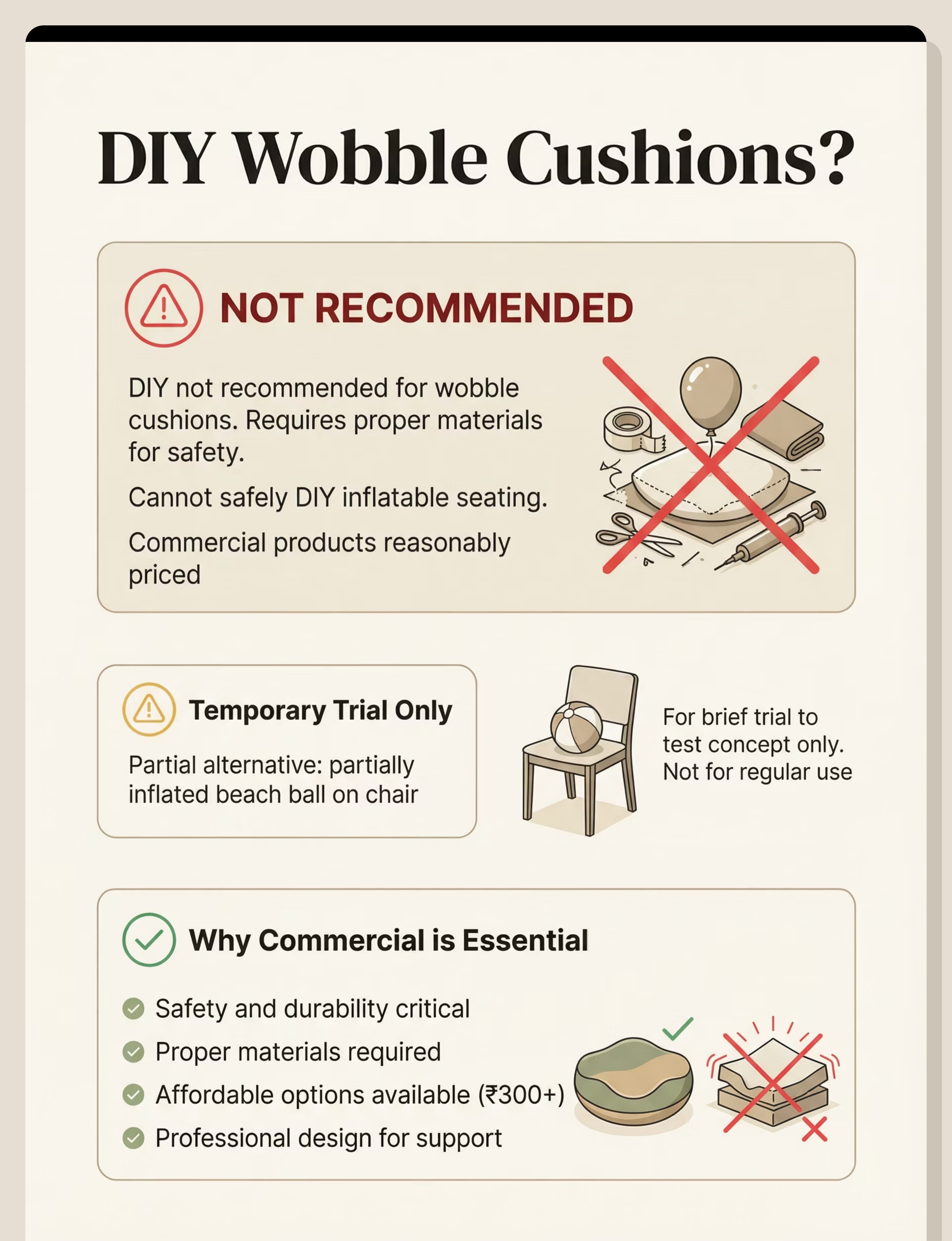
DIY Not Recommended
Feasibility: Low
Safety Concern: Cannot safely DIY inflatable seating equipment
Unlike some sensory tools, wobble cushions should not be DIY'd. Safety is paramount for seating equipment, and homemade versions cannot provide the proper materials, construction quality, or stability required for safe dynamic seating.
Why DIY Doesn't Work
  • Requires proper materials for safety and durability
  • Inflation systems need to be reliable and controlled
  • Weight-bearing capacity must be verified
  • Material quality affects stability and fall prevention
  • Commercial products are already reasonably priced
When to Choose Commercial
  • Always—safety and durability essential for seating
  • Wobble cushions are affordable (₹300-500 for basic)
  • Proper inflation control is critical
  • Quality materials prevent accidents
  • Commercial options come with proper sizing guidelines

Partial Alternative (Temporary Trial Only)
If you want to test the concept before purchasing: A partially inflated beach ball placed on a chair can give a very temporary sense of dynamic seating. However, this is NOT a safe long-term solution and should only be used for a brief supervised trial to see if your child responds to the concept. Purchase a proper wobble cushion for actual use.

Safety First
Given the low cost of commercial wobble cushions (starting at ₹300), there is no good reason to attempt DIY. The safety risks far outweigh any minimal cost savings. Always choose commercial products for seating equipment.

Preview of wobble cushions seating discs Therapy Material

Below is a visual preview of wobble cushions seating discs therapy material. The pages shown help educators, therapists, and caregivers understand the structure and content of the resource before use. Materials should be used under appropriate professional guidance.

Page 1
Page 2
Page 3
Page 4
Page 5
Page 6
Page 7
Page 8
Page 9
Page 10
Page 11
Page 12
Page 13
Page 14
Page 15
Page 16
Page 17
Page 18
Page 19
Page 20
Link copied!
wobble-cushions-seating-discs therapy material
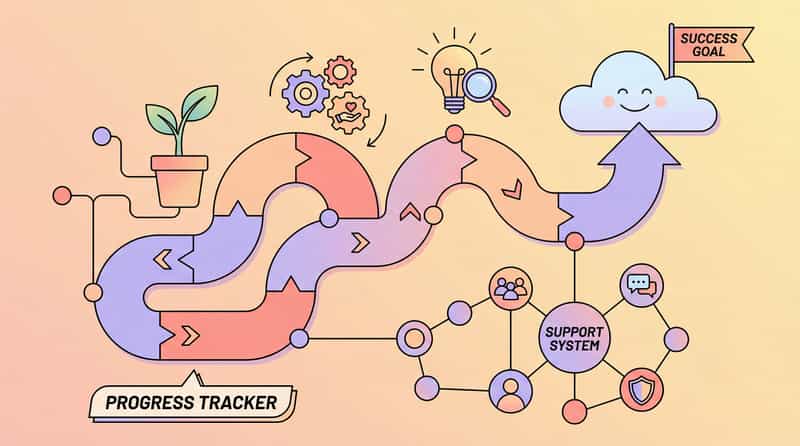
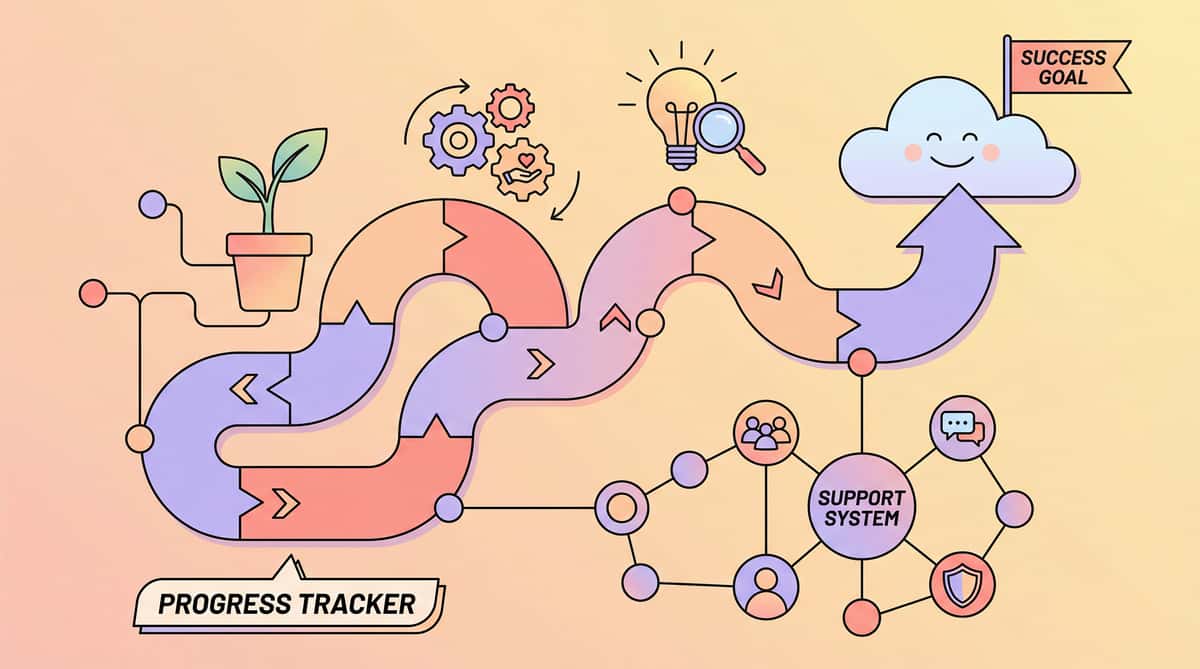
Complete Success System
Measuring Success
Baseline (Measure First)
Current sitting tolerance duration
Movement frequency/disruption level
Attention during seated work quality
Postural control and alignment
Goals
Sitting tolerance will increase to [X] minutes
Disruptive movement will decrease
Attention during seated work will improve
Posture will improve over 4-8 weeks
Success Indicators ✓
Longer sitting periods
Better attention to tasks
Less falling/fidgeting
Improved postural control

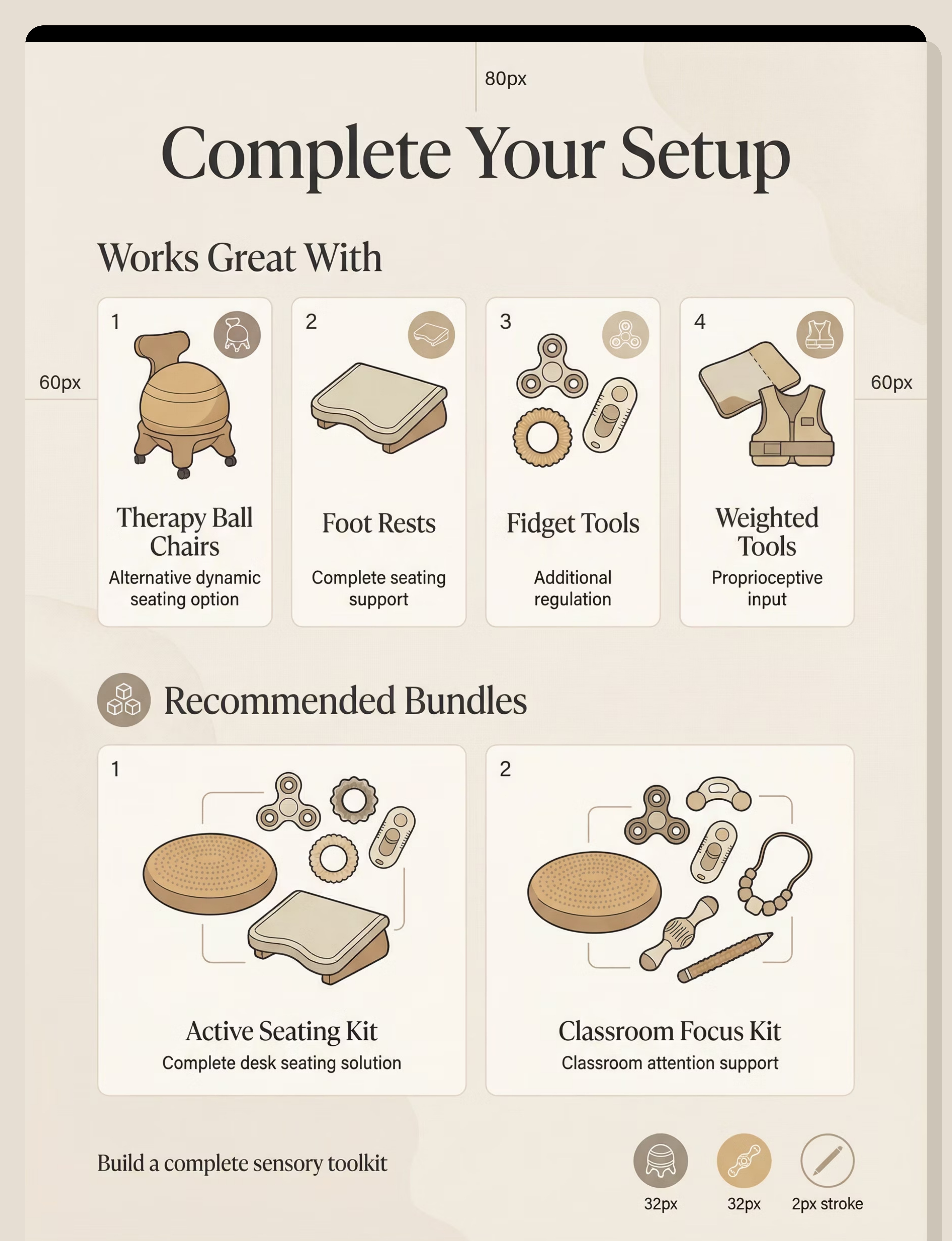
Pair It With...
1
Therapy Ball Chairs (ID: 12.2)
Why: Alternative dynamic seating option for children who need even more movement. Can rotate between wobble cushion and therapy ball depending on activity and regulation needs.
2
Foot Rests (ID: 12.3)
Why: Complete seating support system. Foot placement is critical for postural stability. Foot rests ensure proper positioning while wobble cushion engages core.
3
Fidget Tools (ID: 1.2)
Why: Additional regulation for hands during seated work. Wobble cushion addresses lower body movement need; fidgets address upper body and fine motor needs.
4
Weighted Tools (ID: 1.1)
Why: Complementary proprioceptive input. Weighted lap pad on legs combined with wobble cushion provides comprehensive sensory support system for sustained sitting.

Recommended Bundles
Active Seating Kit: Wobble Cushion (12.1) + Foot Rest (12.3) + Fidget Tools (1.2) = Complete desk seating solution
Classroom Focus Kit: Wobble Cushion (12.1) + Fidget Tools (1.2) + Visual Timers (2.7) = Comprehensive classroom attention support

Quick Summary
Wobble cushions provide dynamic seating that channels movement needs, engages core muscles, and improves attention through regulated proprioceptive input. Core Kit (Rank 1), moderate-strong evidence, essential classroom support for children with sensory regulation, attention, and postural control needs.
seating
wobble
dynamic
core
attention
sensory
classroom
OT
PT
core-kit
Common Searches
wobble cushion autism, sensory seating classroom, balance disc kids, active seating ADHD, wiggle seat, dynamic seating, sensory cushion

Get Support
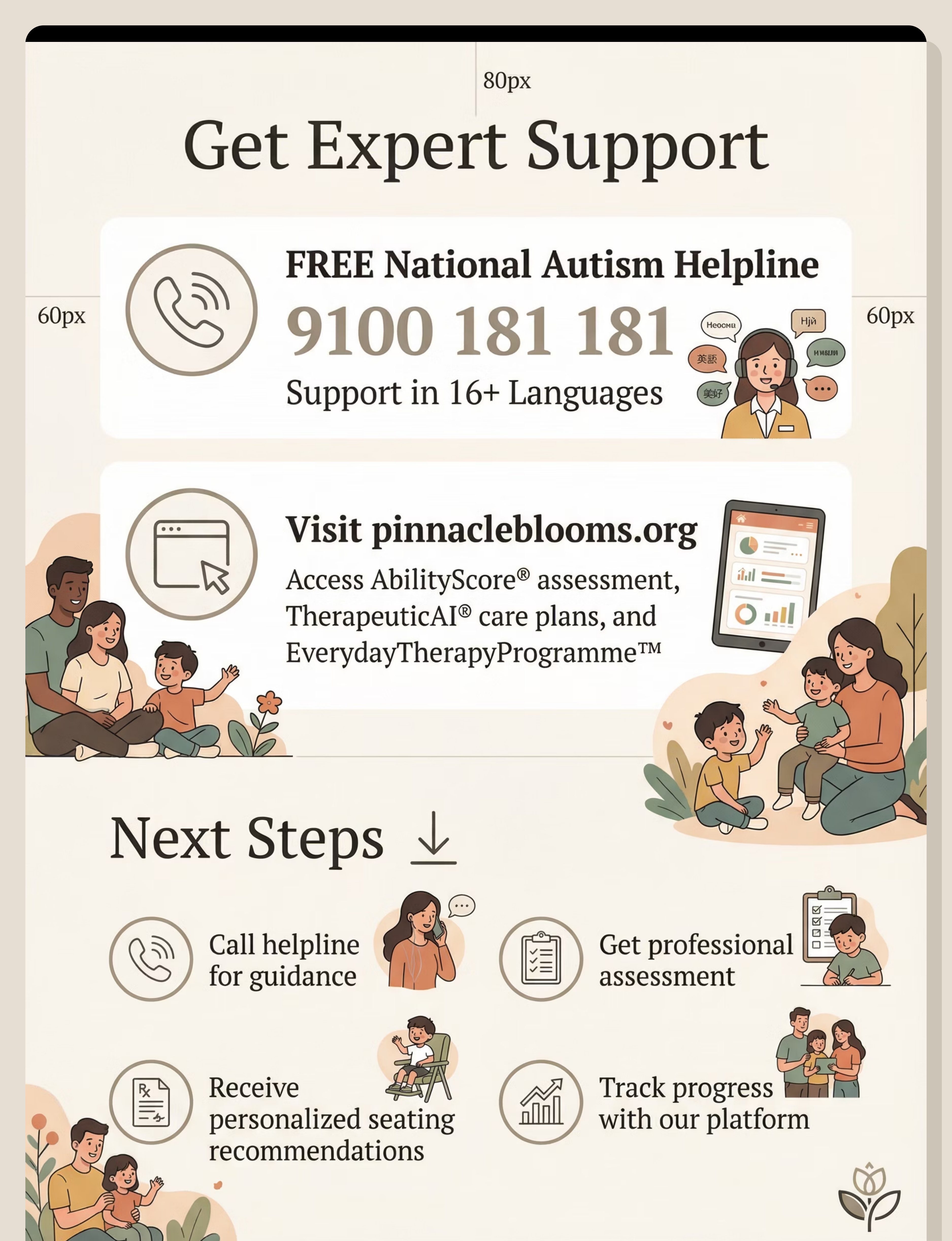
FREE National Autism Helpline
Phone: 9100 181 181
Languages: 16+ languages supported
Website: pinnacleblooms.org
Expert guidance for families navigating autism and developmental challenges. Free consultation, resource navigation, and clinical support.
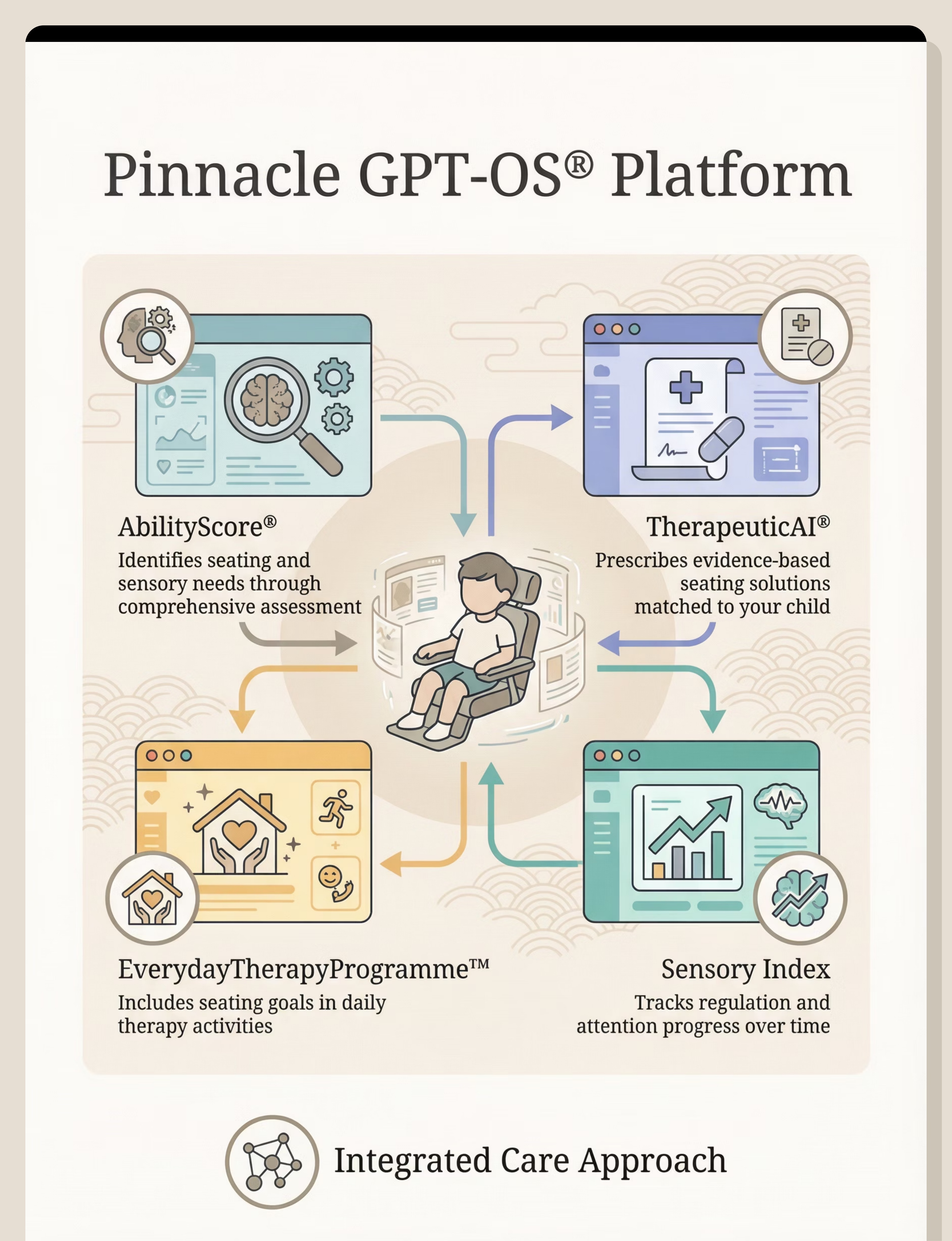
Platform Integration
AbilityScore® identifies specific seating and postural support needs through comprehensive developmental assessment.
TherapeuticAI® prescribes appropriate wobble cushion variants and inflation levels based on individual sensory profile and goals.
EverydayTherapyProgramme™ includes seating goals and tracks sitting tolerance, attention, and postural improvement over time.
Sensory Index monitors regulation progress and adjusts recommendations as child's needs evolve.

Disclaimer: This is educational information designed to support families and professionals. Always consult qualified occupational therapists, physical therapists, speech-language pathologists, or pediatricians for personalized assessment and recommendations. Individual results vary based on child's unique profile, consistency of use, and overall intervention approach. Wobble cushions are one component of comprehensive sensory and developmental support.